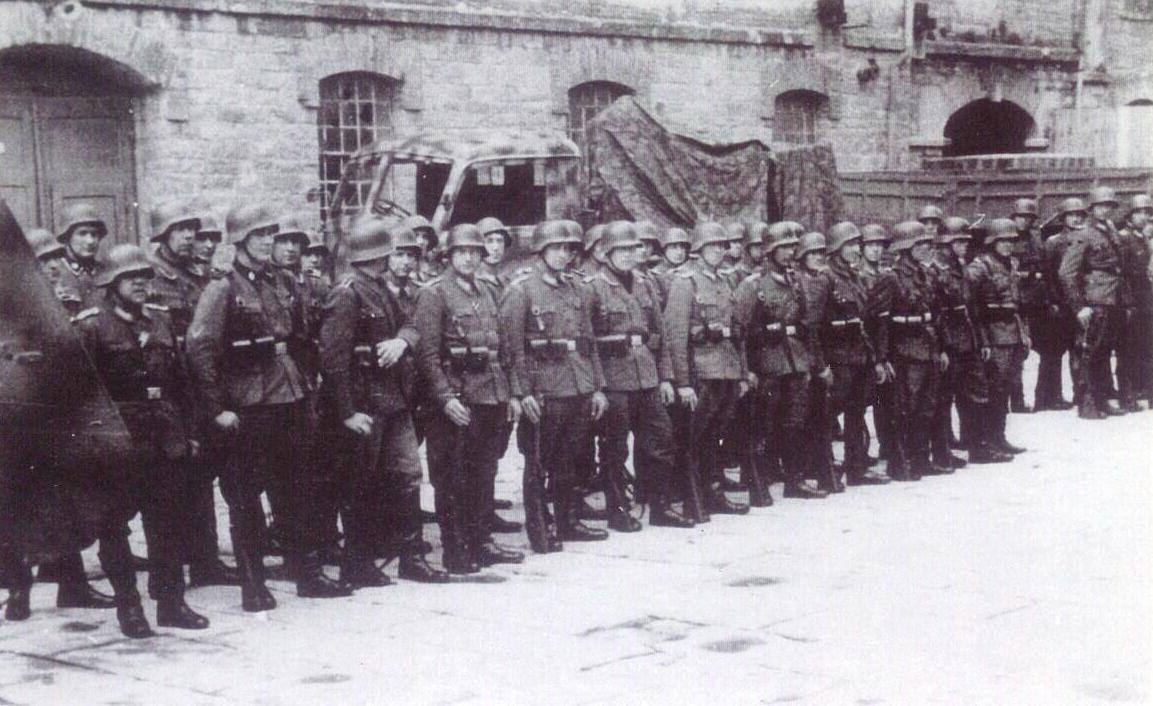
!!!!

SS/SD group photo at San Sabba
October 16, 2013, Wednesday — “That morning in October…”
Sixty years have now passed.
Sixty years ago today, the small Jewish community of Rome, numbering about 10,000 souls, was suddenly violated with great brutality.
On the morning of October 16, 1943, just at dawn, German soldiers, who had taken control of the city a month earlier and restored Mussolini to power, began to go door-to-door in the Jewish ghetto. They had with them a list of all the members of the Jewish community, their names and addresses…
And as the soldiers went up stairways and down hallways, and as families began to be arrested, and taken out to lorries in the streets below, word began to spread.
Some Jews managed to escape at the very last instant, running to the backs of their apartments, then out windows, down back stairways, and through the still-dark streets of Rome, seeking refuge.
And, in fact, many found refuge.
I myself have spoken to several of the survivors, some of them still alive today. Those Italian Jews, some still in Rome, some now in Israel, have described on videotape the events of that morning.
Some found refuge in Catholic convents and monasteries. Some found refuge in the Vatican.
So, in the end, the Germans found, arrested, and deported just a small percentage of Rome’s Jews, about 1,000 out of 10,000 (these figures are rounded approximations, just to give an idea of the overall numbers).
Of those 1,000, a mere handful ever returned. Nearly all, it is presumed, died in concentration camps.
So today, in memory of those who were torn from their homes in great fear, and transported on trains against their will, and finally incarcerated in concentration camps where nearly all of them died, is a day to remember.
It is a day to remember man’s inhumanity to man, and to pledge, to ourselves and to one another, that we will strive with great intensity to make sure that similar scenes never occur again.
And that is the main point of today’s anniversary, and of this letter: to remember those who suffered so unjustly, beginning on that day. May they always be remembered.
Today, however, is also a day to remember the actions of many who, at the risk of their own lives, helped the Jews of Rome on October 16, 1943, and in the days that followed.
There are many today who insist on downplaying the role of Italy’s Catholics, and of the Church in general, and of Pope Pius XII in particular, in saving from arrest and deportation some 90% of the Jews of Rome, 60 years ago today.
However, I feel strongly — and some of the surviving Jews of Rome with whom I have spoken have confirmed that my feeling is right and correct — that Pope Pius XII has been maligned.
The legend has grown up that he was indifferent to the suffering of the Jews of Rome, and of Europe.
This “black legend” is called “The Silence of Pope Pius XII.”
Some have gone so far as to depict Pius as “Hitler’s Pope” (there is a book by that name), compliant with and perhaps even sympathetic to Hitler’s National Socialist regime and its policy of persecution of the Jews.
This is a downright lie, but it has become entrenched in modern scholarly and public opinion.
So, on this 60th anniversary of the German round-up of Rome’s Jews, on which we do first of all recall the suffering and fear of those who were arrested, we nevertheless, in a second place, also recall the acts of wisdom and courage of many Catholics, and of Pope Pius XII himself, in protecting and providing places of refuge for many thousands of Rome’s Jewish community.
This debate is not finished.
All of us are waiting for more historical detail about the action of the Church and the Holy See to emerge from the Vatican archives, which have been opened up until the year 1939, and will soon be opened for the war years, which are of such critical importance. But I am persuaded the archives will only provide new, irrefutable evidence of the Church’s role in doing much that has never been made public to help and protect the persecuted Jews of Europe in those years.
So the debate over the historical record of Pope Pius XII remains open, and the role of our magazine, Inside the Vatican, is to try to shed light on what really happened, on the truth of what took place in those days.
To that end, we have just published, in our October 2013 issue, a lengthy special report, called “Dossier: Pope Pius XII and the Holocaust, History’s Emerging Verdict.”
And that entire dossier is included below, in this very lengthy (perhaps too lengthy) email.
The “Dossier” contains an introductory summary by William A. Doino, Jr., an expert in the field of Pope Pius studies, who explains the current status of the debate over Pius and his actions, motives, faults, and virtues.
That is followed by an article by Marilyn Mallory. Her piece is essentially a summary of another article: a very important recent essay by Italian scholar Dr. Matteo Napolitano, one of the leading researchers in the world in the field of the Second World War and the relations of the Church to the Jewish community.
Mallory summarizes the first half of Napolitano’s lengthy article.
We then present the entire second half of Napolitano’s article, translated into English. (This is the first time this information is being made available in the English language.)
The “Dossier” closes with a very brief interview by our colleague, Vladimiro Redzioch, a Polish journalist in Rome, of Judith Cabaud, author of a life of the Chief Rabbi of Rome during the last 1930s and early 1940s, Rabbi Eugenio Zolli.
Rabbi Zolli is a controversial figure, but he was at the very center of the events of October 16, 1943, so we must attempt to understand him and his role.
Zolli (who was from Trieste in northern Italy, and spoke German fluently), in his role as Chief Rabbi, warned the other leaders of the community that, with the German takeover of Rome in September 1943, the Jewish community was in grave danger.
Those words seem to have fallen on deaf ears.
Zolli encouraged the community to go into hiding, and to burn the records of the community, including the names and addresses of its members. Others in the community leadership disagreed with him, and this was not done.
Zolli and his family then went into hiding, and he and they avoided arrest.
Later, in February 1945 (Rome was liberated on June 6, 1944), Zolli, as he later wrote in his moving autobiography, Before the Dawn, had a mystical vision of Jesus Christ while in Rome’s synagogue. Zolli had always shown a profound interest in the figure of Christ, but now he took the very controversial and so painful decision to convert to Christianity, to Catholicism. He was baptized and entered the Church.
And Zolli’s name was then stricken from the list of the rabbis of Rome. And his name remains controversial in Rome’s Jewish community to this day.
I have a personal recollection of meeting a very impressive, learned woman in the late 1990s in Rome, in a little apartment in Trastevere: Zolli’s daughter, Miriam. She died not too many months after our meeting. Zolli’s grandaughter, Maura, who has become a leading scholar of the reasons for genocide, and my father, William Moynihan, were also with us that day.
Our conversation is etched in my memory. Over several hours, we discussed all the topics I have touched upon here, and many more.
And I mention this for one reason: these matters which we tend to think of today, in 2013, as distant history, detached from real people alive “here and now,” are not at all distant… not at all detached.
The wounds suffered by Rome’s Jewish community, like the wounds suffered by all who experience the cruelty and injustice of war, are deep, and painful. They caused, and cause, sorrow.
The way to heal these wounds is not to proclaim with perhaps a certain arrogance that “the historical record has been falsified and we have the truth.” No.
The way is rather to say, “these events were so painful, and had such sorrowful consequences, that we would like to work with you, and reason together with you, to try to understand all the truth of what happened as fully as possible, so that what can be healed, may be healed.”
It is in that spirit that we prepared our “Dossier” and it is in that spirit that we offer it here, today, on this anniversary, to our readers.
===============================
But first, a papal letter
The letter of Pope Francis to the Jewish Community of Rome
In the Synagogue of Rome today, at 11:30 a.m., a letter from Pope Francis was read, in conjuntion with a ceremony recalling the 70th anniversary of the deportation of the Jews of Rome.
The letter was addressed to the Chief Rabbi of Rome, Dr. Riccardo Di Segni.
Here is the text of the letter, in the original Italian.
Illustre Rabbino Capo,
stimati membri della Comunità ebraica di Roma,
desidero unirmi, con la vicinanza spirituale e la preghiera, alla commemorazione del 70° anniversario della deportazione degli Ebrei di Roma. Mentre ritorniamo con la memoria a quelle tragiche ore dell’ottobre 1943, è nostro dovere tenere presente davanti ai nostri occhi il destino di quei deportati, percepire la loro paura, il loro dolore, la loro disperazione, per non dimenticarli, per mantenerli vivi, nel nostro ricordo e nella nostra preghiera, assieme alle loro famiglie, ai loro parenti e amici, che ne hanno pianto la perdita e sono rimasti sgomenti di fronte alla barbarie a cui può giungere l’essere umano.
Fare memoria di un evento però non significa semplicemente averne un ricordo; significa anche e soprattutto sforzarci di comprendere qual è il messaggio che esso rappresenta per il nostro oggi, così che la memoria del passato possa insegnare al presente e divenire luce che illumina la strada del futuro. Il Beato Giovanni Paolo II scriveva che la memoria è chiamata a svolgere un ruolo necessario “nel processo di costruzione di un futuro nel quale l’indicibile iniquità della Shoah non sia mai più possibile” (Lettera introduttiva al documento: Commissione per i Rapporti Religiosi con l’Ebraismo, Noi ricordiamo. Una riflessione sulla Shoah, 16 marzo 1998) e Benedetto XVI nel Campo di concentramento di Auschwitz affermava che “il passato non è mai soltanto passato. Esso riguarda noi e ci indica le vie da non prendere e quelle da prendere” (Discorso, 28 maggio 2006).
L’odierna commemorazione potrebbe essere definita quindi come una memoria futuri, un appello alle nuove generazioni a non appiattire la propria esistenza, a non lasciarsi trascinare da ideologie, a non giustificare mai il male che incontriamo, a non abbassare la guardia contro l’antisemitismo e contro il razzismo, qualunque sia la loro provenienza. Auspico che da iniziative come questa possano intrecciarsi e alimentarsi reti di amicizia e di fraternità tra Ebrei e Cattolici in questa nostra amata città di Roma.
Dice il Signore per bocca del profeta Geremia: “Io conosco i progetti che ho fatto a vostro riguardo, progetti di pace e non di sventura, per concedervi un futuro pieno di speranza” (Ger 29,11). Il ricordo delle tragedie del passato divenga per tutti impegno ad aderire con tutte le nostre forze al futuro che Dio vuole preparare e costruire per noi e con noi.
Shalom!
Dal Vaticano, 11 ottobre 2013.
========================
Dossier
Pius XII and the Holocaust History’s Emerging Verdict
New sources, including archival research and eyewitnesses, demonstrate that Pope Pius XII opposed National Socialist doctrine and was able to rescue 80% of the Jews of Rome from deportation to extermination camps
By William A. Doino, Jr.
It is a moment of terror everyone who survived can remember: in the early hours of October 16, 1943, during the German occupation of Rome, the National Socialists sent in SS units to seize as many Roman Jews as possible, acting on orders from Berlin. “365 German soldiers fanned out through the narrow streets and courtyards,” one writer recounts. (1) “Families hid at the backs of their shuttered shops. The able-bodied and quick-witted jumped from their windows or fled along the rooftops. The unlucky were hounded from their homes at gunpoint and herded into the idling trucks.”
By the end of the operation, later that day, more than 1,200 of them had been rounded up, and of these, more than 1,000 were deported to the Auschwitz-Birkenau extermination camp in Poland. Only 16 survived the war. (2)
After 70 years, the National Socialist raid on Rome’s Jewish quarters has come to symbolize the Third Reich’s crimes against humanity. But even more, it has come to shape the views of many toward Pope Pius XII, who was present and active in Rome during the entire Occupation. What Pius actually did that day, and throughout the Holocaust, has been discussed and debated for decades — but often misleadingly, distorting and even caricaturing the true record of an extraordinary and compassionate man.
It was not always so. During the German Occupation (September 1943-June, 1944), Pius XII was regarded as a leader of the anti-National Socialist resistance — so much so that when liberation finally came, he was honored and praised the world over, above all by the Jewish community. But in what can only be described as a cruel twist of events, the Pope who had been celebrated for his wartime leadership suddenly came under fire, and was denounced for his alleged “silence” and indifference, especially for his supposed failure to react forcefully against the National Socialist round-up of Rome’s Jews — “under his very windows,” as his detractors said.
The inaccuracy and injustice of the charge was immediately apparent to those who knew better: Catholics and non-Catholics who worked closely with Pius XII to thwart National Socialist persecutions; rescuers who had been inspired to act by the Pope’s allocutions; and those who saw “the tears in the eyes” of the survivors who came to thank Pius after the war for his heroism, as Pope Paul VI memorably put it.
Why a good man was traduced, libeled and defamed has a great deal to do with post-war Communist propaganda, as expertly documented in Disinformation, the acclaimed work by Professor Ronald Rychlak and General Ion Pacepa. (3) But the better news is that the lies and errors surrounding the pontificate of Pius XII are gradually — and finally — being exposed and reversed. Four key developments have led to these welcome events.
1. New Archives and Eyewitnesses
In the last decade, new archives and eyewitnesses have appeared, establishing certain incontestable truths. Between 2003-2006, the archives of Pius XI’s pontificate (1922-1939) were released, demonstrating that Cardinal Eugenio Pacelli (the future Pope Pius XII), who served as Pius XI’s Secretary of State from 1930-1939, fiercely opposed National Socialist doctrine and practices, and supported the Third Reich’s many victims, contrary to what his critics have alleged. Claims that Pacelli undermined the German Catholic opposition to Hitler, or that he harbored anti-Semitic sentiments, have been thoroughly disproven. (4)
At the same time, letters, diaries, memoirs and videotaped personal testimonies from those who knew Pius XII have appeared, proving that he was directly involved in rescue efforts and gave specific instructions to protect Jews. The evidence for Pius’s life-saving interventions is now overwhelming, and previous claims that Pius did “little or nothing” to rescue Jews have been demolished. (5)
So, too, is the idea that Pius XII was “silent” during the Holocaust. Examination of the Pope’s wartime declarations — in his encyclicals, Christmas addresses, and radio messages — contradict that charge. (6)
Not only did Pius XII “speak out” against the Holocaust, he was one of the first ones who did so, authorizing Vatican Radio to explicitly condemn National Socialist atrocities against Jews and Catholics in Poland, and personally confronting German foreign minister Joachim Ribbentrop over them. No less an authority than Robert M.W. Kempner, a prosecutor at the post-war Nuremberg Tribunal, publicly praised Pius XII for issuing countless protests, public and private, against German war crimes. Sir Martin Gilbert, British historian, widely regarded as the foremost living authority on World War II and the Holocaust, has affirmed: “The Vatican, under Pius XII, had taken a public stand against National Socialist atrocities in Poland, very early on. That is something on the public record which cannot be taken away, denied or disparaged. To assert Pius XII was ‘silent’ about National Socialist mass murder is a serious error of historical fact.” (7)
2. Scholarly Reassessment
As more and more evidence has come forth, leading authorities like Sir Martin have taken note, producing important news studies and monographs supporting Pius: among them The Third Reich Against Pius XII: Pope Pacelli in National Socialist Documents by Italian historian Pier Luigi Guiducci (not yet available in English); and a collection of essays by top German academics, Eugenio Pacelli—Pius XII (1876-1958): In the View of Scholarship, edited by Peter Pfister, which has been translated. (8) The latter covers every aspect of Pius XII’s life and pontificate, dispelling many myths and misunderstandings, and the former, the result of seven years of careful research, is an extensive compilation of primary documents describing the intense conflict between Pius XII and the Third Reich.
That Pius XII was in contact with the German resistance to Hitler — and actually approved a plot to overthrow the monstrous National Socialist dictator — is but one example; another, is that the National Socialists planned to kidnap and possibly even kill Pius XII himself.
In a recent interview (9), Professor Guiducci describes the man who emerges from his study: “He [Pius XII] showed no uncertainties in the hours of grave decisions, since he did give instructions to resist National Socialist violence and never had a surrendering attitude… Most of all, his arms did not remain folded in the face of anti-Jewish raids in Rome on October 16, 1943. He intervened five times and on a particular occasion was even able to stop house-to-house searches, [making it possible] for part of the arrestees to be released, while on another occasion the Pope managed to stop the combing operation, [allowing] the Jews still at large to gain enough time to seek newer and safer hiding places, thus saving their lives.”
These statements confirm the findings of Michael Tagliocozzo, the leading authority on the National Socialist-round-up of Rome’s Jews, and himself a survivor of it, who now lives near Haifa, Israel. “I know that many criticize Pope Pacelli,” he said in an interview. (10) “I have a folder on my table in Israel entitled, ‘Calumnies Against Pius XII,’ but my judgment cannot but be positive. Pope Pacelli was the only one who intervened to impede the deportation of Jews on October 16, 1943, and he did much to hide and save thousands of us.”
What makes Pius XII’s intervention’s for the Jews of Rome so impressive is that the original National Socialist intention was to capture and deport all of them — believed to be 8,000 at the time, though today, it is now recognized that there were some 12,000. (11)
And while Pius XII and his fellow Italian rescuers were not able to protect every single one from the clutches of the National Socialists — as the ruthless October 16th roundup tragically demonstrates — they did rescue well over 80% of them in Rome, and throughout Italy — one of the highest survival rates in any National Socialist-occupied land.
In appreciation of that fact, the Congress of Delegates of the Italian Israelite communities erected a plaque, addressed to Pius XII, paying tribute to “Your Holiness, and to express the deepest sense of gratitude from all Jews, for the show of human brotherhood by the Church during the years of persecution and when their lives were put in danger by the National Socialist-Fascist atrocities….Jews will always remember what the Church, under order from the Popes, did for them in that dreadful time.” (12)
3. Pius XII’s Successors
It is a measure of Pius XII’s outstanding legacy that all his successors have spoken the world about him. “To Pius XII,” Blessed John XXIII said, “and to the mystery of grace which he served during a great pontificate of almost 20 years, belongs the merit of having lavished on the flock of Christ luminous treasures of heavenly wisdom and of the most intense zeal. The threefold title, ‘excellent doctor, lover of the divine law, light of the holy church’ is most fitting to the pontiff of our eventful age.” Blessed John Paul II called Pius XII a “great Pope,” and said of his pontificate: “I am convinced that history will reveal ever more clearly and convincingly how deeply Pius XII felt the tragedy of the Jewish people, and how hard and effectively he worked to assist them during the Second World War.” Pope Benedict Emeritus hailed a scholarly symposium defending Pius XII’s wartime conduct, delivered a series of addresses on Pius XII’s rich intellectual legacy — notably his contributions to Vatican II — and, most importantly, advanced his cause for sainthood, declaring him “Venerable.” (13)
And just a few months into his papacy, Pope Francis recalled the 70th anniversary of the bombing of San Lorenzo, expressing “gratitude to the man who was an attentive and provident father” at the time: “I refer to Venerable Pius XII, who, in those terrible hours, came close to his fellow citizens so badly affected. Pope Pacelli did not hesitate to come, immediately and without escort, among the still smoking ruins of the District of San Lorenzo, in order to console the frightened. Even at that time he showed himself to be a caring pastor who in the midst of his flock, especially in times of trial, ready to share in the sufferings of his people.” (14)
4. Yad Vashem’s Revisions
The weight of the evidence moving in favor of Pius XII has not escaped the attention of Yad Vashem, the state of Israel’s official Holocaust Memorial. For years, the Memorial criticized the wartime pontiff, culminating in a highly controversial exhibit on Pius XII in 2005, which the Vatican, and many prominent historians, strongly protested against for its inaccuracies and omissions. However, to its credit, Yad Vashem agreed to revisit the whole issue by bringing together a group of historians — some known to be supporters of Pius XII, others more critical — to reassess Pius XII’s legacy, based on the latest research.
The result was the publication of an important book on their findings: Pius XII and the Holocaust: Current State of Research (15), as well as the decision, in July of 2012, to revise its exhibit, acknowledging the evidence in Pius XII’s favor. (16) And just recently, a new Yad Vashem display further acknowledged the Vatican’s role in the protection and rescue of Jews. (17) While both retain certain (disputed) criticisms of the wartime Church, both also represent progress in a responsible direction. Yad Vashem has further stated that it is open to additional changes and revisions, after the Vatican releases the remaining archives of Pius XII’s pontificate. That is particularly encouraging to the Holy See, for it has long maintained that not only will the remaining archives vindicate Pius XII, but they will enhance his legacy. (18)
A Final Development?
There is one remaining development in history’s emerging verdict on Pius XII. It has not yet materialized, but many in Rome—and indeed throughout the world—eagerly anticipate it. That is the next advancement of Venerable Pius XII’s cause.
The Congregation for the Causes of Saints has produced no less than six massive volumes documenting Pius XII’s heroic virtues. (19) Having reached his present status, Pius XII is but one recognized miracle away from beatification, and a second from canonization. What is more, reports have begun to circulate in Rome that the new Pope, Francis, is seriously considering rapidly advancing Pius XII’s cause, waving some of the usual procedures. (20)
Should Francis decide to do so, or even advance Pius’s cause at a more moderate pace, it would be welcomed by Pius XII’s growing supporters, who believe —and now have an abundance of evidence to prove — that it is long past due that this remarkable man of God is finally recognized for the saintly pastor he was, and was known to be.
========================================
What Did Pius XII Know and When Did He Know It?
Analysis of an article by Dr. Matteo Napolitano, an Italian historian of Italian Fascism, in response to an article by Sergio Minerbi, an Israeli historian, on what Pope Pius XII knew of the round-up and whether he did anything to stop it
By Marilyn May Mallory
Did Pope Pius XII know in advance that Hitler was planning to arrest and deport the Jews of Rome on the morning of October 16, 1943 — 70 years ago this month — and, concerned less about the Jews than his own safety, not warn the Jewish community while attempting to make a deal with the National Socialists to ensure that he himself would not be arrested?
In the March-April issue of Nuova Storia Contemporanea (New Modern History), an Italian historian of Italian Fascism and the period of the Second World War, Dr. Matteo Napolitano(1), has written a powerful critique of this thesis, set forth in a December 2012 essay in the same journal by Israeli historian Sergio Minerbi.(2) Minerbi argues that Pius did know of the looming round-up, and did not warn the Jewish community. But Napolitano says Minerbi’s article is ultimately unpersuasive because not based on facts and documents, but on presumptions not supported by the documentation discovered by historians for the period.
In one devastating paragraph, Napolitano demolishes this defect in Minerbi’s thesis, saying that Minerbi “presumes” and considered it “probable” that Pius knew of the round-up, but never proves this presumption. Napolitano writes (p. 63): “The expressions that most catch the eye, precisely regarding a crucial issue that Minerbi should have documented rigorously, are the following (omitting the claims in the conditional tense): “The impression is that…,” “some historians claim that Hitler had informed the Vatican” (without further specifying who these “scholars” are or what sources they are basing this on), “it is reasonable to assume,” “it can therefore be presumed that…”; “probably” there was a quid pro quo between the Vatican and the National Socialists”; it is “quite likely” that Pius XII knew in advance of the raid; “it is more than likely that” Pius XII knew about this; “it is legitimate to assume” that; “it can be assumed” that. And in this way Minerbi goes on and on, presuming things.”
Napolitano opens his important essay (the second half of which we translate on the following pages), by summarizing Minerbi’s central argument: “that Pius XII knew of the possibility of a roundup of the Roman Jews but nevertheless negotiated with the National Socialists about only one point — to maintain the Vatican’s neutrality and inviolability, including his own personal safety. Therefore, the Pope would not have warned the Roman Jews about the imminent deportation because he preferred not to aggravate the German invaders.”
Napolitano then sets the scene in Rome and Italy in September and October of 1943, which was the context for the arrest of the Jews of Rome by the National Socialists.
The government of Mussolini had fallen that summer, and it appeared that Italy would be out of the war. But on September 8, when Italy declared an armistice, the Germans intervened, freed Mussolini in a daring raid, and re-installed him in power.
The Vatican was following all these events closely. On September 6, 1943, the Secretary of State Cardinal Maglione convened the cardinals in Rome. Deeply concerned about the situation in Italy, he forbade the clergy to get mixed up in the internal politics of various nations and to preserve the Vatican’s neutrality. But, in a postscript, Msgr. Domenico Tardini added that that statement had been toned down in case it fell into enemy hands. Thus, the cardinals had been forewarned that the Germans would not have hesitated to occupy not only Rome but also the Vatican, imprisoning and perhaps killing the Pope.
It was at this time that Pius XII prepared a letter of resignation, so that, if he were captured by the National Socialists, he would no longer be the Pope, but an ex-Pope, a simple cardinal, not the head of the Church.
The German Ambassador
Napolitano then considers the role of the German ambassador to the Vatican in those weeks, Ernst von Weizsäcker.
For Minerbi, the ambassador is precisely as he presents himself in his post-war autobiography.(3)
But Napolitano presents evidence that Weizsäcker’s memoirs do not give the entire truth about his diplomatic actions in those weeks.
Minerbi believes von Weizsäcker’s self-serving presentation of himself as “the one who protected the Roman Jews” by signing that “letters of protection be posted on the doors of religious houses.” It does not interest him that it was Pope Pius XII who decreed that the doors be opened to the Jews. But, more important, Minerbi overlooks the fact that Weizsäcker’s memoirs are a personal defense. He never signed letters of protection for the convents and it’s easy to see why not. What would Hitler’s reaction have been if he found that out? Also, the letters protected the inviolability only of Vatican properties. But the German ambassador did not know exactly how many there were and where they were.
The Safety of Rome and the Vatican in Exchange for the Jews?
Napolitano then discusses a theory that Minerbi puts forward: that Pius and the Vatican, very interested in the safety of the Roman people, negotiated so that the Germans would not harm the city, and in exchange, the Church would not protest the arrest of Rome’s Jews. But Napolitano notes that there is not a shred of evidence for this thesis and Minerbi produces no documents at all. Here Minerbi’s conjecture gets the better of rigorous verification.
Incidentally, Minerbi argues that there are no written orders from Pius XII even to give hospitality to the Roman Jews in convents, deducing from this that the Pope did not give any orders to save them. In the case of Hitler’s plan, however, Minerbi believes in the order to deport the Pope, but in this case there weren’t any written orders either.(4) That plan was conceived in the late summer of 1943, and announced on September 13 by Hitler to SS General Karl Friedrich Otto Wolff, commander of the SS in Italy. As is known, the opinion of Wolff, who was against the plan, prevailed even against Hitler. But Wolff stated that there were no written orders to that effect.(5)
Richard Breitman (a scholar who also cites Minerbi), in an interview with Corriere della Sera about his new studies on the Vatican seen by US intelligence agencies, stated:(6) “Hitler distrusted the Holy See because he knew that it hid Jews. In general, the Germans regarded the Pope as an enemy. Someone suggested in a telegram to play on his anti-communism to induce him to ‘understand’ National Socialistsm and have him transferred from Rome to the north: the Vatican and Germany had formed a common front against the USSR, and the Holy See would fall under the control of Berlin. But the proposal was rejected because they knew that Pius XII would never leave Rome and the Vatican was on the side of the Allies.”
What Conclusions Can Be Drawn?
In light of the foregoing, the failure of the deportation of the Pope can be read in other ways: it was stopped, but not because Pius XII had promised “obedience” to the Third Reich, in the sense of delivering the Roman Jews to the National Socialists in exchange for respecting the neutrality of the Vatican. Rather, as it turns out, Wolff had already decided that Pius XII and the Roman Curia would remain in place, and that the Vatican would not be invaded.
Spontaneously, Wolff sent to the Pope this assurance in return for obedience to the occupying authorities. It was merely formal obedience, aimed at maintaining social order (Pius XII was now seen as the Italian Head of State), and only he was able to facilitate, rather than prevent, better organization of care for the Jews who sought shelter in the convents, and for those who were still in search of a refuge.
The Fifty Kilos of Gold Demanded by the National Socialists
Lietenant Colonel Herbert Kappler, head of the National Socialist Gestapo (police) in Rome, had demanded 50 kilos of gold from the Roman Jews to prevent their arrest. Minerbi says that the Jews did not need any help from the Vatican to procure this gold. He says that Nogara’s note to Cardinal Maglione is inexact. The note states: “Dr. Zolli came to tell me yesterday at 14:00 that they had found 15 kg from some Catholic communities and so they had no need of our involvement.”(7)
In short, the Roman Jews asked the Vatican to contribute to the collection of gold, just in case they might come short, and that then this aid was not necessary, since the Jews found gold on their own, thanks to other interventions. Why, then, does Sergio Minerbi cast doubt on Nogara’s letter to Maglione, which partially summarizes these events?
Pius XII, the Chief Rabbi of Rome and the Roundup of the Jews
Minerbi is silent about the bitter disagreement between Chief Rabbi Zolli, on the one hand, and the leaders of the Jewish community in Rome and the Union of Italian Jewish Communities, Ugo Foa and Almansi Dante, on the other hand.
Zolli had warned the top leaders of the Roman Jewish community of the imminent danger.
As Jewish scholar, Anna Foa,(8) writes, Rabbi Zolli had warned his fellow Jewish leaders to destroy the membership files of the Jewish community, to allocate funds to the poorest so they could flee, and to urge all Jews to leave their homes and hide. His advice was rejected, and then he himself went into hiding just before the roundup. In a subsequent article, Minerbi is critical of Foa.(9)
Anna Foa concludes that “this story, essentially the delivery of a thousand Roman Jews to death by the leadership of the Community and of the Union” is “still an unresolved memory of the community of Rome, that continues to inspire around him repressions, accusations, projections, and to erect an insurmountable defensive barrier to date.”
Footnotes
1 M.L. NAPOLITANO, “Pio XII e gli ebrei di Roma nel 1943, A margine di un recente articolo di Sergio I. Minerbi,” in Nuova Storia Contemporanea, [“Pius XII and the Jews of Rome in 1943, Sidenotes to a recent article by Sergio I. Minerbi”].
2 S.I. MINERBI, “Pio XII e il 16 ottobre 1943,” in Nuova Storia Contemporanea, a. XVI, n. 6, novembre-dicembre 2012, pp. 15-40. [“Pius XII and October 16, 1943”]
3 E.H. VON WEIZSÄCKER, Memoirs, Chicago, Regnery Co., 1951, p. 289-293, passim.
4 Documenti presentati dal XVI Teste al Tribunale, facenti parte integrante della sua deposizione, autenticati dai Tribunali e inseriti negli Atti del Processo (Proc., foll. 1586-1611), in Congregatio de Causis Sanctorum, Romana Beatificationis et Canonizationis Servi Dei Pii XII (Eugenii Pacelli) Summi Pontificis (1876-1958), cit., Documento I (Proc., foll. 1586-1600), p. 831. [“Documents presented by the XVI witness to the Tribunal, an integral part of his testimony, authenticated by the Courts and inserted in the Acts of the Process”]
5 XVI Teste: Generale Carlo Federico Otto Wolff, nato il 13 maggio 1900, già Comandante Supremo delle SS e della Polizia tedesca in Italia, Sessione XVII (24 marzo 1972), ivi, p. 830. [“16th Witness: General Karl Friedrich Otto Wolff, born May 13, 1900, former Supreme Commander of the SS and German police in Italy”].
6 [19] E. CARETTO, “Ma i tedeschi consideravano Pio XII un nemico. I documenti segreti americani scagionano ‘il papa del silenzio’ e rivelano una ‘Gladio National Socialiststa,’” in Corriere della Sera, 29 giugno 2000, p. 35. [“But the Germans considered Pius XII an enemy. U.S. intelligence documents exonerate ‘the Pope of silence’ and reveal a ‘National Socialist Stay Behind’ plan,” in Corriere della Sera, June 29, 2000, p. 35.]
7 ADSS, vol. 9, doc. 353
8 A. FOA, “Il rabbino di Roma Israel Zolli e l’occupazione National Socialiststa. Inascoltato e dimenticato come Cassandra,” in L’Osservatore Romano, 29 ottobre 2010. [“The rabbi of Rome, Israel Zolli, and the National Socialist occupation: Unheeded and forgotten like Cassandra”].
9 S. MINERBI, “Anna Foa sbaglia su Zolli e sul ruolo del Vaticano,” in Kòlot-Voci, 7 novembre 2010, http://www.kolot.it/2010/11/07/anna-foa-sbaglia-su-zolli-e-sul-ruolo-del-vaticano. [“Anna Foa is wrong about Zolli and the role of the Vatican”].
========================================
Pius XII and the Tragic “Black Saturday” of October 16, 1943
Dr. Matteo Napolitano, an Italian historian of Italian Fascism and World War II, replies to Sergio Minerbi, Israeli historian. Here we have translated the second half of his article
By Dr. Matteo Napolitano
According to Minerbi, Pope Pius XII was “silent” precisely on that tragic Saturday, October 16, 1943. Why didn’t the Pope make any public statement about the imminent German roundup in the ghetto of Rome? Why didn’t he take to the streets? Why didn’t he occupy the train tracks which led from the Tiburtina train station in Rome to Auschwitz? In 2002, Minerbi even said that the news of a possible raid could also have been given as “one of those cryptic blurbs in Osservatore Romano which insinuated things without saying them specifically.”
Apart from the fact that these words radically undermine everything in Minerbi’s attack — if a Vatican newspaper could make insinuations and be understood anyway, then what’s the point of accusing the Pope of silence for not having spoken “expressly” but only through allusions? Apart from all this, as was stated, we fear that some important points have escaped Minerbi.
The raid on the Roman Jews was perpetrated on the night between October 15 and 16, 1943. On October 16, early in the morning, Princess Enza Pignatelli Aragona Cortés rushed to the Vatican to inform Pope Pius XII. He immediately ordered his Secretary of State, Cardinal Luigi Maglione, to summon the German Ambassador, Ernst von Weizsäcker, without delay. The explicit request of the Holy See was to end the raid immediately (it was still in progress and would end in the early afternoon of October 16).
Arriving at the Vatican, von Weizsäcker was asked to intervene on behalf of the Roman Jews, “in the name of humanity, and of Christian charity.”
“I always expect that you will ask me: ‘Why do you remain in your office?’” said Weizsäcker, in obvious discomfort.
At that Maglione replied, “I say simply, Your Excellency, you who have a good and tender heart, see if you can save many innocent people. It is painful for the Holy Father that so many people are made to suffer only because they belong to a particular race, precisely in Rome, right under the eyes of our common Father.”
“What would the Holy See do if things were to continue?” asked the German ambassador.
“The Holy See would not want to have to express its word of disapproval,” replied Maglione.
At this point, the German ambassador wove together an immense eulogy about the wise balance that the Holy See had been able to maintain until that moment between the warring parties, “even though he had more confidence in the Allies.” But he also envisaged the serious consequences if the Holy See were to take a step in the direction of making a protest, since the orders came “from the highest place.” He therefore asked that this “official conversation” not be reported to Berlin.
Maglione reiterated that, at present, he was appealing to feelings of humanity, leaving it up to Weizsäcker whether or not to disclose the contents of their conversation in Berlin. Certainly the Holy See did not have anything against the German people and did not want to do anything against them. “But I have to tell you, though” — it is Maglione who is speaking — “that the Holy See should not be compelled to protest. If the Holy See were obliged to do so, it would trust Divine Providence as to the consequences.”(1)
Sergio Minerbi fails to mention this last part of Maglione’s minutes, almost as if to exorcise the presence of the verb “protest” in a papal document, a verb that demolishes all argument against Pius XII.
But as for “Black Saturday,” we also have the testimony of Albert von Kessel, then a diplomat on the staff of the German embassy to the Holy See, who stated to L’Osservatore Romano as follows: “Ambassador von Weizsäcker had to fight on two fronts: to recommend to the Holy See, to the Pope, therefore, not to take inconsiderate actions, i.e., actions whose ultimate catastrophic consequences he perhaps had not foreseen. On the other hand, Ambassador von Weizsäcker had to try to persuade the National Socialists, through artful diplomatic reports, that the Vatican was showing ‘good will.’” (2)
“The fact is,” wrote Jacques Nobécourt(3), a scholar certainly not apologizing for Pius XII, “that the wording of the diplomat completely concealed the truth, which was as follows: Pius XII, warned from the outset by Princess Pignatelli, had acted immediately through two German religious, one belonging to his immediate entourage, Father Pfeiffer, and the other, the German seminary rector, Bishop Alois Hudal. Two hours later, the raid was suspended and 4,000 threatened Jews found refuge in convents and ecclesiastical colleges, and others with the Italians. But of the thousands deported to Auschwitz, two-thirds women and children, only 15 returned. The operation would have been stopped if Cardinal Maglione had not agreed with the discretion of the Ambassador, counting on the fact that he would intervene personall. But did he really do it? Strangely, after the war, Weizsäcker always maintained the story that Pius XII had not intervened, even against his closest collaborators. He was silent about the summons by the Secretary of State, probably in order not to add the accusation of his silence to the other accusations against him.”(4)
All these elements seem to be neglected by Minerbi. In his 2002 essay in the Italian review Nuova Storia Contemporanea,(5) he reports (on p. 38) the testimony of von Kessel, but omits the fact that von Weizsäcker wrote diplomatic reports that were “artfully construed,” i.e., fabricated.
The truth is that von Weizsäcker is indefensible because he said nothing in Berlin about the “official conversation” he had with Maglione in the early hours of that tragic October 16, 1943, and because he was silent even in his memoirs. Minerbi then spins an apologia for von Weizsäcker, through a “hypology” of the documents relating to him, because he omits important parts of what those documents say.
The “silence” of von Weizsäcker in Berlin about the possible papal protest against the raid of the “Black Saturday” fits into a well-known historiographical framework. Upon being sent to the Vatican, von Weizsäcker had told Hitler that he always tried to avoid that the Holy See interfere in matters in which it should remain aloof, but above all he had avoided tensions and conflicts with it (the Holy See) for the entire duration of the war. In short, Weizsäcker was following a policy of “appeasement” towards the Vatican.
So, any complaint or threat of protest from the Vatican on key issues threatened to derail his mission and to cancel all its policy. That’s why von Weizsäcker tried to hide the bitter truth in Berlin — his policy of appeasement did not eliminate the danger of a protest by the Vatican.6 Only by promising the Pope to act in the way he wanted, but without reporting back to Berlin, could von Weizsäcker hope to be successful. He therefore acted in accordance with the papal desires, but without Hitler knowing it. The Vatican, in order to obtain this result, seconded it.
This happened well before October 16, 1943. For example, when the National Socialists asked the Italian authorities on September 20, 1943, to hand over 6,000 Italians to avenge the death of six Germans killed in a hospital. The Italian Ambassador to the Vatican, Babuscio Rizzo (who still represented the King of Italy) spoke to the Secretary of State Maglione, who in turn summoned Ambassador von Weizsäcker. An Italo-German joint investigation had shown that no Germans had been killed in the hospitals of Rome; what was the point, then, of the retaliation?
Maglione then asked the German ambassador to intervene immediately with his superiors. But von Weizsäcker refused. He could not transmit such a request to Berlin, the Holy See being extraneous to the issue of foreign hostages. If he were to do so, there would be “severe reactions against the Holy See.” The only solution was to speak in a personal capacity “through friends, about the suitability of denouncing the threatened measure.”
Maglione did not share this attitude. It was right for the Holy See to intervene officially “always and in every way” in favor of all the faithful. The Pope, as bishop of Rome, had the right to intervene on behalf of his diocesan faithful. However, the Cardinal agreed in point of fact, if not of law, with the solution proposed by the ambassador not to report it back to Berlin, all this “for the good of the many young people who were threatened.”(7) As a result of that, the National Socialist plan to capture six thousand hostages was shelved.
Not to report back to Berlin about official talks on topics which were extraneous to the Vatican, in the eyes of Hitler — this was the attitude of von Weizsäcker, whose reports to Berlin were affected by this “pinkish-brown” veil. He reported to Hitler that the Pope understood his anti-Bolshevik crusade; to the Vatican he urged the utmost calm, so as not to provoke incidents with Berlin, in order not to unleash reprisals.(8)
It is in this much distorted context that Ambassador von Weizsäcker dealt with the Holy See about the question of the brutal National Socialist action in Rome on October 16, 1943. Even in this operation, the Vatican had to keep out of it, and von Weizsäcker behaved accordingly. So Hitler never knew that the Holy See had intervened promptly, threatening a protest, as is also demonstrated in the English documents, which actually talk about a sort of “ protest “ by Maglione to the German ambassador, “as soon as he learned about the arrests of the Jews in Rome.”(9)
Minerbi has not investigated this silence of von Weizsäcker about the Vatican’s position on the roundup of the Roman Jews, which is the real crux of historiography. For him, the “silence” of Pius XII is a settled issue, which leads him to speculate on why the Pope did not warn the Roman Jewish community of the impending National Socialist raid, but in this ignoring the documentation. Such a question makes no sense, in fact, given that the British and Vatican documents tell us that the Pope acted “as soon as he learned of the raid on the Jews in Rome.”
To ask, then, as we have seen, why L’Osservatore Romano did not publish “one of those cryptic blurbs that imply things without saying them specifically,”10 in our opinion is a boomerang that demolishes the very thesis of Minerbi about the “silence” of the Pope. Pius XII, in fact, not infrequently mentioned events and situations that the Germans understood very well, even without the pope having to say things expressly. So, saying that the Pope could refer to things without mentioning them openly, and yet be understood, means weakening the charge of “guilty silence” for he had not spoken publicly.
But what alternatives did Pius XII actually have?
For Minerbi, “it would not have been difficult for the Secretary of State of the Holy See to confidentially notify the rabbi, with whom a few days earlier he had held talks at the Secretariat itself.” (11) But warnings about what exactly?
At that moment, the rift within the Jewish Community of Rome was clear. As noted by Anna Foa,(12) Zolli had invited the brethren to go into hiding and to save what could be saved before it was too late. But community leaders had deliberately ignored his warnings, relying on strengthened relations with the fascist circles, without thinking that after September 8 there was only one authority in National Socialist Rome, without a corresponding Italian State authority. In addition, the real problem was that, in occupied Italy, for the people at that time the pope was the real leader of the Italian State, which made the National Socialists even more intransigent.
Given the passivity of the leaders of the Jewish community of Rome, the raid could not be avoided. Then there is the aggravating circumstance of their having thought that they could ward it off with the delivery of fifty pounds of gold, which Minerbi has rightly called a “huge robbery.”
That’s why Minerbi’s answers, whether those of 2002 or those of ten years later, are not convincing as to the silence of Pius XII. For Minerbi, the Pope wanted to save Rome, he feared the National Socialist invasion of the Vatican and deportation. That’s why he contracted with the Germans the task of “in maintaining public order near the front,” assuring the Germans of calm and ensuring that there were enough police to “prevent and repress any communist insurrection.”
Pius XII had instead been very clear: he was not concerned about the consequences of his acts, if he felt he had acted conscientiously. In fact, as early as May 1940 (therefore in the middle of the war, soon after the start of the German offensive in the West and one month before the entry of Italy into the conflict) he had said that he did not fear deportation at all.(13) And Maglione added that the Holy See would trust Providence as to the consequences of some of his acts which were unwelcome to the Germans.
The documents, it is true, also speak about his commitment to Rome and confirm his concern that it not become prey to the “mob,” i.e. communist insurgency. Pacelli’s anti-communism is not a secret to anyone, but he was not against it in the National Socialist way but rather in the American way.
Errors and Omissions of Minerbi: The Pope Remained Silent even after October 16?
The story on which we would now like to shed some light is about a false history which Minerbi also fell for, which, for all his alleged expertise in the subject studied here, seems strange at the least.
As we know, without producing any proof, Minerbi argues that Pius XII knew in advance of the roundup of the Roman Jews. Not only that, but he argues that Pius XII, after the pillage of the Jews, was silent with foreign diplomats. Is Minerbi right?
On page 36 (Italian version) of his essay, the scholar and diplomat writes that Owen Chadwick is mistaken in asserting that the Pope got the deportation of the Roman Jews to stop. Chadwick, writes Minerbi (note 102), “refers to ADSS vol. 9, no. 449, but this document deals with a different subject.”
True: The document in question is different and is dated December 1, 1943.
But it would be enough to flip back through the volume of Vatican documents until the fateful date of October 16, 1943, to find the telegram sent to the Foreign Office by Osborne, the British Minister to the Vatican,(14) which confirms exactly what Chadwick says. And it would suffice to browse the volume of Chadwick himself on Great Britain and the Vatican to find the document in question reproduced almost entirely.(15) Chadwick, therefore, limited himself in his book to quoting only the documentation that he had found.
Minerbi then mentions the audience of Osborne with Pius XII on October 18, 1943, two days after the raid, to tell us that the pope “did not say a word about the Jews awaiting deportation,” and noted that he had no complaints against the Germans, who until that moment had respected the Vatican.
But actually on October 18, 1943, Osborne did not even touch on the topic. Why? Why did he just say to the Pope that maybe he underestimated his moral authority and the “grudging respect” of the Germans; and to keep that in mind if, in the future, the opportunity arose to take a strong stand? As to the raid, as Minerbi himself admits (p. 37, Italian version; p. 122, English version), Osborne wrote on October 31, 1943, referring to a “sort of protest” of the Vatican.
These reports were not the fruits of a new audience with the Pope, but were certainly those gathered at the audience on October 18, 1943, as well as the result of other information that Osborne had managed to gather between October 18 and 31.
Thus Minerbi insisted so much on the silence of Pius XII with Osborne, two days after the raid, that he did not even ask why Osborne was silent about it. He also forgot that, precisely on October 18, 1943, the Vatican was already responding to the numerous Jewish families who, the day before, had turned to the pope. Exactly on October 18 they were received in an audience with Monsignor Montini who responded to the requests as follows: “The Holy See is doing all that is in its power to rescue these poor wretches.”(16)
It would also be useful to explain the context of the events. Osborne was part of a diplomatic community, that of the representatives of the enemies of the Axis, and the neutral powers, enclosed within the walls of the Vatican, surrounded first by Fascist Italy and then by National Socialist-occupied Italy. Clearly, his view of things was limited, having only vague reflections from the outside world. He proposed to his superiors things that they clearly rejected, and even received bitter reproaches from them for initiatives not required. In addition, the British Minister to the Vatican believed that his advice was absolutely followed by the pope. Moreover Osborne was convinced that what he was able to learn in Vatican circles about the actions of the pope was absolutely and definitively everything there was to know. But it was not. In a limited context, like that of a diplomatic mission in such an enclave, Osborne could not adequately judge the action of the Vatican, which took place on several European fronts, nor did he have the prestige of a Myron Taylor, Roosevelt’s personal representative to the Pope, to the point that all the diplomats imprisoned in the Vatican always anxiously awaited the arrival of Taylor, with fresh news on the progress of events in politics and war.(17)
Minerbi, then, does not mention that Osborne said things that were questionable and contradictory. He thought it unlikely that the Vatican territory would be invaded by the Germans. But Harold Tittmann (i.e. the envoy of Myron Taylor) tells in his memoirs that on August 23, 1943 Osborne said the exact opposite: that he had learned from reliable sources that the Vatican could be invaded by the Germans in the following days. And, being then at the home of Tittmann, he asked for his son to light the fire to burn the official documents of his archive. (18)
It should be added that all the diplomats from Allied countries on September 14, 1943, decided to do the same because the Vatican had advised them to burn every document they had in their legations. And Osborne did it, too.(19)
But the most sensitive issue that we would like to raise is that of a real mistake about the date, where even Minerbi has stumbled in order to maintain the thesis of the “posthumous silence” of the pope about the raid on October 16, 1943.
In the excitement of the quote, Minerbi reported in fact a dispatch from Harold Tittmann, informing us that Pius XII also showed with him a “lack of concern about the Jews… when the Pope received him in a private audience on 19 October [1943 ].”
Even though it had been only three days after the raid against the Jews of Rome — thunders Minerbi — the Pope did not even raise the topic, indeed he appeared serene.(20)
Except that, as in the previous case of Osborne, again Minerbi does not wonder why Tittmann did not even bring up the subject of the pope’s silence. In our recent book The Vatican Files we have amply demonstrated that that private audience between Pius XII and Tittmann was not held on the 19th but rather the 14th of October 1943: that is, two days before, not three days after the raid of the Roman Jews. How could Pius XII talk to Tittmann about an event that had not happened yet?(21)
The date of October 19, 1943 is in fact that of the telegram of Osborne, to whom Tittmann (devoid of his telegraphic service and code) gave his dispatch so that it might be “passed along” to Washington. The original of the telegram is undated, however. But L’Osservatore Romano, on October 15, 1943, gave notice of Tittmann’s private audience with Pope Pius XII, which had taken place the day before. In the registry of the audiences on October 14, 1943, preserved in the Vatican archives, it is clear that Tittmann was actually received by the pope at eleven o’clock that day.(22)
If you browse the registry and you go to the date of October 19, 1943, the name of Tittmann is not there, neither does it appear later. On the sheet dated October 18, 1943, however, the name of Osborne appears (the audience already mentioned by Minerbi, which took place at nine in the morning).
It should also be noted that there are two versions of Tittmann’s dispatch. In the one preserved in the British archives, Tittmann writes that he had not seen the pope since the previous Monday. The one preserved in the archives in the U.S. says that he had not seen the pope since the previous year. This is certainly a transmission error due to the series of steps that the dispatch of Tittmann underwent before reaching its destination via Algiers, in a complicated jigsaw puzzle. Osborne’s dispatch of October 19 has Tittmann’s undated one. A subsequent dispatch from the Foreign Office to the British Embassy in Washington contains both of them.
With absolute certainty, therefore, the dispatch from Tittmann was undated; it referred to the audience with Pius XII on October 14, 1943, and was transmitted by Osborne only five days later, and then was retransmitted from London overseas. Thus falls the polemic about the Pope who is silent with Tittmann about the raid on the Roman Jews: in fact it had not yet occurred.
Consequently, unknowingly or not, even in this case Sergio Minerbi was the victim of a certain “creative historiography.”
No less creative is the presentation by Minerbi of two other episodes, not marginal in the least, connected to the raid of October 16, 1943.
The first episode is the one about the capture of the lawyer Foligno, at eight o’clock on October 16, 1943, from his home in Rome on Via Flaminia 171.(23) Minerbi is inexorable.
While the National Socialists were preparing to capture the lawyer Foligno, a woman who lived in the same place loudly expressed her disapproval to a German officer. The officer replied that when the Holy Father had received His Excellency, the German Ambassador to the Holy See, a few days earlier, he had said: “If the deportation of the Jews has be done, better do it quickly.”(24)
According to Minerbi, it is totally unlikely “that the military would invent such a phrase of their own volition,” and then, the Holy See “would not have taken the trouble to follow up the matter for several days following the occurrence, had such a rumor been groundless. “(25)
In short, Minerbi leaves no escape for Pius XII. Except that, in hindsight, there are some missing links.
It should also be noted that there are two versions of Tittmann’s dispatch. In the one preserved in the British archives, Tittmann writes that he had not seen the pope since the previous Monday. The one preserved in the archives in the U.S. says that he had not seen the pope since the previous year. This is certainly a transmission error due to the series of steps that the dispatch of Tittmann underwent before reaching its destination via Algiers, in a complicated jigsaw puzzle. Osborne’s dispatch of October 19 has Tittmann’s undated one. A subsequent dispatch from the Foreign Office to the British Embassy in Washington contains both of them.
With absolute certainty, therefore, the dispatch from Tittmann was undated; it referred to the audience with Pius XII on October 14, 1943, and was transmitted by Osborne only five days later, and then was retransmitted from London overseas. Thus falls the polemic about the Pope who is silent with Tittmann about the raid on the Roman Jews: in fact it had not yet occurred.
Consequently, unknowingly or not, even in this case Sergio Minerbi was the victim of a certain “creative historiography.”
No less creative is the presentation by Minerbi of two other episodes, not marginal in the least, connected to the raid of October 16, 1943.
The first episode is the one about the capture of the lawyer Foligno, at eight o’clock on October 16, 1943, from his home in Rome on Via Flaminia 171.(23) Minerbi is inexorable.
While the National Socialists were preparing to capture the lawyer Foligno, a woman who lived in the same place loudly expressed her disapproval to a German officer. The officer replied that when the Holy Father had received His Excellency, the German Ambassador to the Holy See, a few days earlier, he had said: “If the deportation of the Jews has be done, better do it quickly.”(24)
According to Minerbi, it is totally unlikely “that the military would invent such a phrase of their own volition,” and then, the Holy See “would not have taken the trouble to follow up the matter for several days following the occurrence, had such a rumor been groundless. “(25)
In short, Minerbi leaves no escape for Pius XII. Except that, in hindsight, there are some missing links.
First: why doesn’t von Weizsäcker (whose credibility for Minerbi is equal to every challenge) mention this incident in his memoirs? Was it not he who was supposed to have heard with his own ears that Pope Pius XII said that if the Jews were to be deported, it was better to do it quickly? Secondly, von Weizsäcker did not belong to the SS, but rather distrusted it, and was not directly involved in the deportations. To what purpose would Pius XII have said such a thing? Thirdly, the lawyer Foligno belonged to the Sacred Roman Tribunal (so it was a Jew who converted to Catholicism, which shows that the National Socialists, with the Jews, were not too fussy). Is it possible that the Vatican would be disinterested?
In fact, the Roman curia was not disinterested in the case: the lawyer Foligno was released after a few hours through the intervention of the pope (indeed, as he himself wrote, “rather, by virtue of my position as a lawyer in the tribunal and the head of a mixed household.”).(26)
All this Minerbi does not say. The same Foligno went to the Secretary of State on October 19; “a) as thanks for what had been done for him — he was released after only a few hours of his arrest, and b) to ask for a refuge, which, however, the Holy See could not provide for him at that time.”(27)
Meanwhile “the affirmation of the German officer, that Pius XII would have said that they should hurry to deport the Jews, is for the Vatican a big and obvious falsehood, causing the Secretary of State to lodge a complaint.”(28)
Minerbi is silent even about this official Vatican complaint. Nor are his claims true, according to which the Holy See became interested in the story of Foligno only several days later. As we have seen, Foligno was released “soon,” i.e. immediately.
The second episode is much more delicate. Minerbi raises the case of Jewish children who, having been hosted in convents and monasteries, were arbitrarily baptized. After the war, when the World Jewish Congress asked Pius XII to return the children, the Vatican took its time.
Thus — writes Minerbi — thousands of orphaned Jewish children were baptized in the convents without the consent of their parents. They returned very few Jewish children to their relatives or to Jewish organizations.(29)
We have extensively dealt with the whole issue in a book co-written with the Vatican correspondent of the newspaper La Stampa, Andrea Tornielli, based entirely on archival sources.(30)
Returning to that study, which currently remains the only monograph on that event, we limit ourselves to a few observations: a ) we are not faced with a case of the abduction of Jewish children (or worse, in Daniel Goldaghen’s words, a papal kidnapper!) b ) it was not a case of baptized Jewish children being “denied” by the Church to their parents or blood-relatives. Generally, those who requested them were Jewish institutions that the Holy See could not validate as having natural rights to those children, c) the baptism was administered without the consent and often without the knowledge of the ecclesiastical authorities (who often had to appeal to some religious congregations to keep the little ones in their original faith). It was a few isolated cases, otherwise Jewish archives would have revealed many from 1946 until now.
Gerhart Riegner, an activist in the Geneva headquarters of the World Jewish Congress, who Minerbi also cites, admits that. When Riegner, in 1953, was hit with the case of the Finali brothers, which Minerbi also speaks about, he could hardly believe their incredible story. “There was certainly the Mortara affair in Bologna — Riegner tells in his memoirs — but it had happened a hundred years ago. That such a thing could occur in our time was difficult to accept.” (31)
There is also an Italian case. In 1944 a Jewish woman with two young children begged the Franciscan Missionaries of Mary to give them asylum, in Rome on the Via Balduina. After a few months, the woman asked for baptism for herself and for her children, and was satisfied. Then she departed, leaving the children in the custody of the Sisters. At the end of October 1947, she reappeared at the convent along with the leaders of a Jewish orphanage, and asked for the return of the children. The sisters took their time and inquired of the Vicariate, which in turn prepared a memo for the Holy See, dated November 5, 1947. Within twenty-four hours, Pius XII arranged the hearing on the case, November 6. In fact, he ordered the immediate return of the children to the mother, but not without a rebuke for her lack of fidelity and the recommendation not to “disturb” the “conscience” of the children, who had been initiated into the Catholic faith precisely at the behest of their mother.
Also in this case, therefore, the “creative historiography” against Pius XII did not stand the test of documentation and historiography accessible for some time to scholars.
Conclusions
We jokingly talked about “creative historiography” because the essay of Minerbi seemed in many (too many) parts full of assertive hypotheses (as the term seems an oxymoron) totally devoid of documentary support. No documents give evidence that the Vatican knew in advance of the raid on the Roman Jews, no document says that Pius XII settled down to a quid pro quo with the Germans — his silence on the deportation of Jews in exchange for the safety of himself and the Vatican. No document proves that the orders from the SS headquarters in Berlin to Kappler, given September 25, 1943, and transmitted back to Möllhausen from Kappler, were known in advance by the pope. No paper shows that Möllhausen’s proposal to Ribbentrop and Hitler on October 6, 1943, to use Roman Jews in alternative employment instead of deporting them (which was intercepted by the Allied secret services) had been known in advance by the Roman Curia.
There is no documentary proof, finally, that Wolff (the head of the SS and of the German Police in Italy), or von Weizsäcker really knew in advance of the deportation of the Jews, the only reason to hypothesize that they had informed the Pope.
Minerbi then, as we have seen, believes blindly in the SS, who were yelling in the streets of Rome that Pius XII had allowed the Roman Jews be deported as soon as possible — almost as if the minions of Himmler, the very people who arrested the lawyer Foligno at his home, were complete gentlemen, quite unable to invent from scratch every excuse to justify their most heinous acts. (No need to add that the blind faith of Minerbi in the good faith of the SS is contradicted by the documents.)
Evidently, Minerbi also considers the National Socialist criminal Adolf Karl Eichmann a complete gentleman. Eichmann is said to have confirmed in his memoirs (written many years later) the idea that the lightning action against the Roman Jews had been raised at an audience granted by Pius XII.
But if one looks at the diaries of Eichmann, there is no evidence of this: Pius XII is mentioned in passing, and not in relation to the raid of the Roman Jews.
On what basis, then, does Minerbi claim that Eichmann had an excellent memory and was telling the truth so many years after the events, we do not know.
Also, Eichmann wrote his memoirs predominantly in prison in Israel after his capture in 1960.(32) It is therefore clear that he intended to give it a procedural use in his defense, in order to escape the death penalty. So is there any plausible reason why a balanced historian should consider the Eichmann memoirs completely objective and reliable, given his character?
For Minerbi, as we have seen, there is no evidence that the Holy See gave written orders to monasteries and convents to give refuge to the persecuted Jews in Rome. For him, everything happened spontaneously, a private initiative of individual clergy and Catholics. But apart from the fact that only the Pope could nullify the enclosure of certain cloisters, and aside from the fact that a hierarchical Church such as that of Pacelli could not be anarchistic at such a time, apart from that, there is an inconsistency — because Minerbi instead believes in the National Socialist plan to deport the pope, even if there were no written orders for that plan. Minerbi, in fact, uses two weights and two measures.
Looking closer, there are not even any written orders issued by Pius XII to hide Jews in his villa at Castel Gandolfo or in the Canonical residence of St. Peter’s Basilica.
But the fact that there were some “guests” in those places, and just at the moment of greatest danger, that is well documented.(33) Could Pius XII not have been aware of this?
And if diaries and memoirs are worth something (Minerbi considers even the Eichmann memoirs to be reliable!) what about the “house diaries,” the “Chronicles,” of those monasteries and convents that hosted many Jews, which refer to verbal orders given by Pius XII or by the Holy See?(34)
And what about the memoirs of the “Righteous Among the Nations” like Don Aldo Brunacci and like the bishop of Assisi, Monsignor Giuseppe Placido Nicolini, who along with Friar Rufino Niccacci saved all the Jews of the Franciscan city, stating emphatically that they did so by order of Pius XII?(35)
No conclusion would fit better than words of a character very dear to Minerbi: An anti-clerical Jew layman turned Zionist, and during the Holocaust a great organizer of the Jewish network of assistance and rescue for his co-religionists who sought to relocate to Palestine.
It is Raffaele Cantoni, to whom Minerbi dedicated an extensive monograph.(36) It seems, however, that the following words of Cantoni have escaped Minerbi about Pius XII: “If it were true what it says in the play by a German [i.e., in the tendentious, accusatory drama The Deputy by Rolf Hochhuth] then the deeds were not seen and the events were not witnessed by us which happened in Florence, Rome, Milan, Genoa and in a hundred other cities in Europe invaded by the National Socialists, where the bishops were the first to do their utmost in defense of the Jews. Those deeds would not have happened.
“The Catholic Church has given to us Jews instead proof that it had saved all those it had been able to save…
“Whether one names Pius XI or Pius XII or John XXIII, they saved the Israelites, i.e., the children of Abraham, and saved them as children of God, in the same manner and to the same degree as they were committed to saving Christians. Ever since the regimes of Hitler began [sic] to look at us Jews like plague dogs that could infect the Aryan race, immediately we took thought and we looked to the Church and the Pope for protection.
“We were confident that we could count on the Pope and the Church in the hour of danger and there we were not deceived. My fellow Jews massacred by the National Socialists were six million, but it could have been much more numerous if Pius XII had not intervened effectively…
“These things and the truth speak for themselves; history does not change. The action of the Church and Pope Pius XII will remain as that of a Pontiff who did everything possible to save men, while the National Socialists were put to shame forever.”(37)
We could not agree more.
Footnotes
1 Actes et Documents du Saint-Siege relatifs à la Seconde Guerre Mondiale (d’ora in poi: ADSS), [Acts and Documents of the Holy See relative to the Second World War] (henceforth: ADSS), vol. 9, doc. 368.
2 L’Osservatore Romano, June 28, 1964, p. 33
3 J. NOBÉCOURT, “Il ‘silenzio’ di Pio XII,” in Dizionario Storico del Papato [“The ‘Silence’ of Pius XII,” in Historical Dictionary of the Papacy] P. Levillain, editor, Milano, Bompiani, 1996, p. 1186; cfr. also p. 1188.
4 J. NOBÉCOURT, Op Cit, p. 1186; cf. also p. 1188 which shows a similar judgment by Father Robert Graham, S.J., one of the editors of the series of Vatican documents.
5 S. I. Minerbi, “Pio XII, il Vaticano e il ‘sabato nero’. Le responsabilità nell’arresto e nella deportazione degli ebrei romani,” [“Pius XII, the Vatican and the ‘Black Saturday.’ The responsibility for the arrest and deportation of the Roman Jews”] in Nuova Storia Contemporanea, n. 3, maggio-giugno 2002, pp. 27-45. [“
6 As von Weizsäcker writes in his memoirs, in the interview with the Führer about his future mission to the Vatican, “I summed up for him my plan for Rome. Mutual non-interference, no fundamental discussions, no quarrels. Hitler agreed.” E. Von Weizsäcker, Erinnerungen [Memoirs], cit., p. 354.
7 Note from Cardinal Maglione, September 20, 1943, ADSS, vol. 7, doc. 410.
8 In German archives (notably at the Bundesarchiv Berlin, which were policy documents deposited from the two Germanys) there is evidence of this double registry of von Weizsäcker, particularly in the AA Fund, Mic. Series. 819, September 9, 1943 ff.
9 Osborne at the Foreign Office, October 31, 1943, tel. 400, National Archives, Kew Garden, UK, FO 371/37255. Osborne wrote: “As soon as he heard of the arrests of Jews in Rome, Cardinal Secretary of State sent for the German Ambassador and formulated some [sort?] of protest. The Ambassador took immediate action, with the result that large numbers were released… Vatican intervention thus seems to have been effective in saving a number of these unfortunate people. I enquired whether I might report this and was told that I might do so but strictly for your information and on no account for publicity, since any publication of information would probably lead to renewed persecution.”
10 In a recent article appeared in English for the Jerusalem’s review Italia, Minerbi writes: “Nor did he [Pius XII] pronounce any public declaration, not even in the pages of the Osservatore Romano, which could have made the danger clear even without explicitly stating it, as was done on other occasions”. S. I. Minerbi, Pius XII and the 16th October 1943, in Italia. Studi e ricerche sulla storia, la cultura e la letteratura degli Ebrei d’Italia, vol. XXI, pp. 91-128 (quot. p. 115).
11 This is the English rendering of the Italian version of Minerbi’s article, as published by Nuova Storia Contemporanea. S. I. Minerbi, Pio XII e gli ebrei di Roma nel 1943, in Nuova Storia Contemporanea a. XVI, n. 6, novembre-dicembre 2012, pp. 15-40. The original English version of this article, published in Italia, reads: “It would have been a very simple matter for the pope to summon Foà or Rabbi Panzieri to the Secretariat of State and give them an oral warning, since both men had conducted various talks with the Secretariat of State in the preceding days.” (p. 115).
12 A. Foa, “Il rabbino di Roma Israel Zolli e l’occupazione National Socialiststa. Inascoltato e dimenticato come Cassandra” [“The rabbi of Rome, Israel Zolli and the National Socialist occupation. Unheeded and forgotten like Cassandra”] in L’Osservatore Romano, October 29, 2010. The text of this article is based on a lecture given by the author to the Accademia Galileiana di Scienze, Lettere e Arti of Padua, as part of a conference on Politiche di sopravvivenza alle persecuzioni. I responsabili delle comunità ebraiche di fronte allo sterminio National Socialiststa [“The Politics of Surviving Persecution. The leaders of the Jewish community in the face of extermination by the National Socialists.”]
13 See the conversation which the Italian ambassador Dino Alfieri had with the Pope in his farewell audience on the occasion of his transfer to the new embassy in Berlin. Alfieri to Ciano, May 13, 1940, ASMAE: Diplomatic missions: Embassy to the Holy See, cited in M. CASELLA, Chiesa e Fascismo in Rivista di Storia della Chiesa in Italia [Church and Fascism in “Magazine of the History of the Church in Italy],” LV: January-June 2001, p. 109-174, Op. Cit. 140-141, for the Vatican version, ADSS, vol. I, p. 453 ff. Also Ciano, in his diary, on May 13, 1940 notes: “Alfieri spoke with the Pope. Will make a written report, but in the meantime stresses that he has found a specific intransigent attitude of the Church in the conflict. The Pope said he is ‘ready even to be deported to a concentration camp, but will not do anything against his conscience’. “ G. CIANO, Diario 1937-1943, edited by R. De Felice, Milan, Rizzoli, 1980, p. 430.
14 ADSS, vol. 9, note 9 on p. 506.
15 O. CHADWICK, Britain and the Vatican during the Second World War, Cambridge, Cambridge University Press, 1986, p. 289.
16 Note of Monsignor Montini, October 18, 1943, ADSS, vol. 9, doc. 376, cf. doc. 375 and n. 1 on p. 512.
17 See E. Di Nolfo, The Vatican and the United States: 1939-1952. From the papers of Myron Taylor, Milan, Franco Angeli, 1978.
18 H. Tittmann Jr., Inside the Vatican of Pius XII. The Memoir of an American Diplomat During World War II, New York, Doubleday, 2004, p. 183.
19 Ibid, p. 186.
20 S.I. Minerbi, Pio XII e il 16 ottobre 1943, [Pius XII and October 16, 1943], cit., P. 37.
21 M.L. NAPOLITANO, The Vatican Files. La diplomazia della Chiesa. Documenti e segreti [The Vatican Files: The Diplomacy of the Church. Documents and Secrets], Cinisello Balsamo, St. Paul, 2012, p. 92-100.
22 Secretary of State, Archives of the Master of the Chamber, Register 1943. See also ADSS, vol. 7, n. 1 on p. 678.
23 Note of Monsignor Montini, October 16, 1943, ADSS, vol. 9, doc. 369.
24 ADSS, 9, doc, 383 e n. 4 a p. 519.
25 S.I. Minerbi, Pio XII e il 16 ottobre 1943 [Pius XII and October 16, 1943], cit., p. 29 (p. 112 of the English version).
26 Foligno to Cardinal Maglione, December 2, 1943, ADSS, 9, doc. 453.
27 ADSS, 9, n. 1 on p. 507 and doc. 453.
28 ADSS, 9, doc, 383 and n. 4 on p. 519.
29 S.I. Minerbi, Pio XII e il 16 ottobre 1943 [Pius XII and October 16, 1943], cit., P. 39.
30 A. TORNIELLI-M.L. NAPOLITANO, Pacelli, Roncalli e i battesimi della Shoah [Pacelli, Roncalli and the baptisms of the Holocaust], Casale Monferrato, Piemme, 2005
31 G.M. Riegner, Ne jamais désespérer. Années soixante au service du people juif et des droits de l’homme [Never despair: Sixty years at the service of the Jewish people and human rights], Paris, Cerf, 1998, p. 623. Minerbi gives a more concise report in his book Un ebreo fra D’Annunzio e il sionismo: Raffaele Cantoni, [A Jew between D’Annunzio and Zionism: Raffaele Cantoni], Rome, Bonacci, 1992, p. 168, because it is based on an interview with Riegner before the release of his memoirs.
32 See also S.I. Minerbi, Eichmann, Diario del Processo [Journal of the Trial], Milan, Luni Editrice, 2000.
33 See the report of the canon of St. Peter, Monsignor Guido Anichini, Pius XII, February 13, 1944. ADSS, vol. 10, Doc. 53 especially. p. 129.
34 See A. Riccardi, L’inverno più lungo Pio XII, gli ebrei e i National Socialiststi a Roma, [The longest winter: 1943-44: [Pius XII, the Jews and the National Socialists in Rome], Bari, Laterza, 2008.
See also the important study of G. LOPARCO, “Ebrei e istituti religiosi: documenti e testimonianze,” in Rivista di Scienze dell’Educazione [Jews and religious Institutions: documents and testimony, in Journal of Science of Education] 43, n. 1, 2005, p. 99-104,
Nonché idem, La protezione degli ebrei nelle case religiose italiane (1943-1945). Mappa, reti di salvataggio, nomi, in Fondazione Emanuela Zancan (a cura di), Per carità e per giustizia. Il contributo degli istituti religiosi alla costruzione del welfare italiano, Padova, Fondazione E. Zancan Onlus – Centro Studi e Ricerca Sociale 2011, pp. 274-295.
[As well as G. Loparco, “The Protection of the Jews in Italian religious houses (1943-1945); Maps, rescue networks, names” in Fondazione Emanuela Zancan (edited by), For charity and for justice: The contribution of religious institutes to the construction of Italian welfare], Padova, Foundation E. Zancan, a non-profit organization – Center for Studies and Social Research], 2011, pp. 274-295.
35 On “Israel in Clausura” [On Israel in the Cloister] (as the French Colettine Poor Clares entitled a few pages of their Assisi Chronicles), see the well-documented study by F. SANDERS, Assisi 1943-1944. Documenti per una Storia, Assisi, Accademia Properziana del Subasio, 1994 [Documents for a History, Assisi, Properziana Academy of Subasio, 1994]. DON ALDO BRUNACCI, “Righteous among the Nations,” in his last filmed, long interview granted to the author.
36 S.I. Minerbi, Un ebreo fra D’Annunzio e il sionismo, cit. [A Jew between D’Annunzio and Zionism].
37 R. CANTONI, “Ha fatto tutto il possibile per salvare gli uomini,” in L’Osservatore della Domenica [ R. Cantoni, He did everything possible to save people], 28 June 1964, p. 67-68. For more details on the position of Cantoni about the “case of Pius XII,” cf. S.I. Minerbi, Un ebreo fra D’Annunzio e il sionismo [A Jew between D’Annunzio and Zionism], Op. Cit. 251-254.
==========================
Rabbi Zolli’s Action in Rome During World War II
Judith Cabaud on Eugenio Zolli, Chief Rabbi of Rome during the Second World War, whose name after the war was erased from the list of Chief Roman rabbis by Rome’s Jewish community
By Włodzimierz Rędzioch
Should the Jewish community of Rome rehabilitate Rabbi Eugenio Zolli?
Judith Cabaud: It seems evident to me that given the circumstances, Zolli’s actions regarding the Jewish community of Rome during the National Socialist occupation are beyond reproach. Any human being would have done the same thing by ordering the community’s files to be destroyed and encouraging people to go into hiding. One other fact often neglected is his role in the business of obtaining the 50 kg of gold as a ransom for the Jews taken theoretically hostages. He went to the Vatican to seek help from the Catholic Church, and it was granted him by the Pope. He was supposed to return to the door of the Vatican at 1 p.m. but didn’t do so because when he saw his daughter Miriam, she told him they had managed to get the needed sum from the whole Christian community in Rome. So should he have returned to the Vatican at 1 p.m. to tell them this? That is totally absurd, to risk his life and that of others just for a message. In a time where we have very easy communication, we can’t compare what we would do today in a similar case.
So should the Jewish community rehabilitate him?
Cabaud: Obviously the only thing one can reproach him for is to still be alive at the end of the war. Many a hero has been celebrated for much less than what Zolli did. The Jews of Rome should be proud to have had such a rabbi.
Was he a good man or a coward?
Cabaud: Reading Zolli’s memoirs reveals what he was: an intellectual with mystical qualities. He also had practical common sense which allowed him to be the chief rabbi in Trieste for 20 years. After he was sent to be the chief rabbi of Rome, the rabbinical seminary had to be shut down and all the events of the community were not to be seen on the outside. Moreover, the fascist government of Benito Mussolini had signed the “pact of steel” with Hitler in 1938. This created a terrific discrimination against Jews by the “anti-Semitic laws” in all walks of life. Jews were no longer allowed to be civil servants, teachers, etc. Or even sell post cards (Zolli tells the story of the vendor he had to defend). The rabbi went several times to the ministry to complain about this injustice to the Jews of Rome.
Apparently, the Jewish community of Rome considered Zolli a foreigner. After all, his birthplace was Italian only after 1918, when Trieste became a part of Italy by the Treaty of Versailles. And Zolli wrote many books and articles in German and in Italian on exegetical subjects which were far beyond the preoccupations of their daily life in Rome. Last and not least, who was he (the little ashkeNational Socialistm from central Europe) to tell the Jews of Rome, who had been there for thousands of years, what to do? From certain members of the community, there is evidence of a snobbish attitude toward him.
Did he try to do his duty to his people or abandon them?
Cabaud: Is it not doing one’s duty to one’s people to protect them from the rage of the National Socialists? Is it abandoning one’s people to try to stay alive? The answers to these questions are all too obvious.
But did he really abandon his people at all, or did his people not abandon him?
Zolli as a mystic lived an inner life like one of the prophets of the Old Testament. And his continual reading of the prophets certainly led him to his conversion. The prophets of ancient times never abandoned their people. They always tried to bring the people closer to God. That’s what Zolli endeavored to do.
But we also know how the prophets of the Bible were treated by their own. So it is not surprising to see what Zolli had to endure in calumny and persecution.
The Jewish community of today can make reparation for this kind of injustice by simply recognizing the facts about Rabbi Zolli in his life and in his work.
(End of Dossier)
…
 ABYSSUS ABYSSUM INVOCAT / DEEP CALLS TO DEEP