
!!!!
One city does not make a world
By Dr. Edward A. Peters
IN THE LIGHT OF THE LAW
[ Emphasis and {commentary} in red type by Abyssum ]
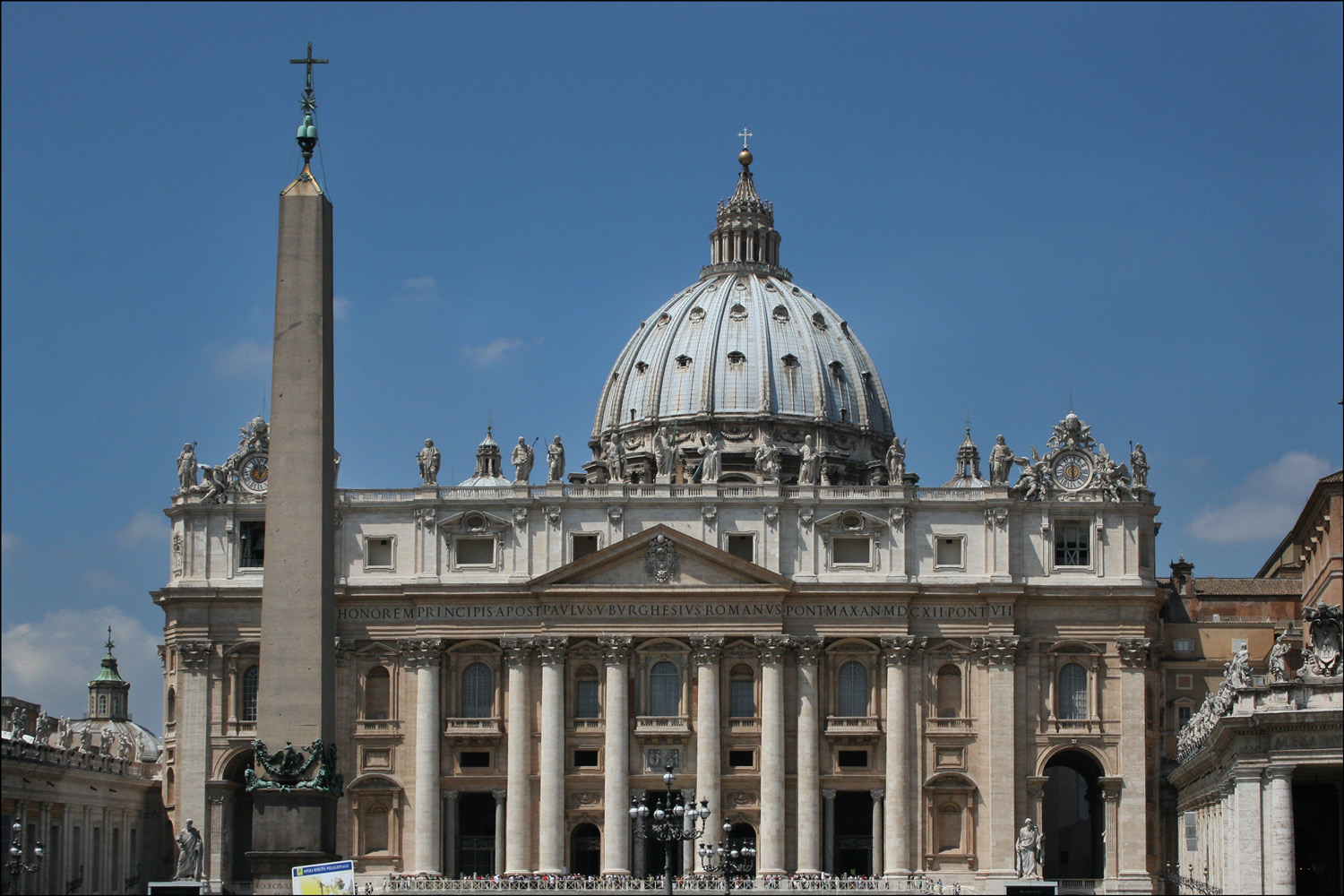
The bi-annual papal blessing “Urbi et Orbi”—to the City (meaning Rome, of course) and to the World—is a charming Catholic event reflecting the solicitude a pope feels for the City entrusted to his episcopal care and the World entrusted to his papal. The Italians’ gift for irony, however, has—so I am told—led to the quip that, from time to time, some popes confuse “the City” with “the World”, meaning that, Roman experiences and perspectives are not always applicable to the rest of the world, though they are sometimes treated as if they were. Humorously the quip makes an important point for Church administration, especially administration at the international level: one locale’s situation is rarely identical to another’s; one prelate’s experiences are rarely identical to another’s.
Dr. Kurt Martens is an internationally-respected Belgian canon lawyer who, for the last ten years, has taught canon law at the Catholic University of America. His brief reflections on the recent canonical conference in Rome, a conference focused on Pope Francis’ changes to the annulment process (due to take effect in about three days), are well worth reading:
I recently attended a conference in Rome, “La riforma operata dal m.p. ‘Mitis Iudex,’”sponsored by the Consociatio Internationalis Studio Iuris Canonici Promovendo—the international association of canon lawyers of which I am a board member—which dealt with the fiercely relevant topic of the new procedural norms for marriage nullity. When I heard that new legislation was about to take effect and that this conference happened to be organized on that very topic with some of the architects of the reform present, I knew I had to go.
In his introduction, Cardinal Coccopalmerio, himself a member of the reform commission, said that Pope Francis wanted to abbreviate and expedite the matrimonial nullity procedure with the motu proprio Mitis iudex. The three key elements of this reform were to be: (1) the abolition of the double conformity; (2) the composition of the collegiate tribunal with one cleric and two laity; and (3) the processus brevior with the bishop as judge. He failed to mention, however, that the reform took merely a few months and lacked the usual consultation of specialists worldwide. While the reform is merely procedural, the conference politely avoided the question of whether merely procedural reforms did not influence doctrine substantially, and how these reforms may have collateral effects.
In listening to professors Llobell and Moneta address the details of the reforming document, and in hearing the following Q&A session, a number of things became very clear to me, in particular about the use (or not) of the processus brevior. It was established, for example, that if the diocesan bishop were uncertain about the particular case, or the procedure in general, he should not use the processus brevior. Also raised was the concern that, while the defender of the bond can appeal a decision of the bishop in the processus brevior, there are legitimate concerns about how many defenders will have, in conscience, the courage to appeal such a decision of his own bishop.
Msgr. Bunge, a Rotal judge and one of the members of the reform committee, made a statement that struck me as deeply problematic. He referred to a decision coram Felici with a law section only four lines long, and gave that as the example of how decisions of bishops could look. The problem here is that the law section of a decision contains the essential legal and jurisprudential basis on which the arguments to arrive at moral certitude will rest. A good and solid law section will be pivotal for cases going through the processus brevior—to maintain the credibility of the decisions, to avoid abuses, and be clear on the nullity.
In private conversations, various members of the commission not only underscored the fact that the ordinary process had to be the rule and the processus brevior the exception, but they also admitted that the introduction of this processus brevior was meant to address particular situations where access to ecclesiastical tribunals was unavailable and the demand for canonical solutions very high. The example of Argentina was given over and over again. When one considers that Pope Francis emphasized that he wants a healthy decentralization, one has to question the prudence of such a massive reform of universal law to address such a particular and local problem. The conversation became somewhat comical when a colleague mentioned that, since the processus brevior must be done by the diocesan bishop himself and cannot be delegated, there could be no use of the processus brevior in times of a vacant diocesan see, periods which can last more than a year in the United States.
In his concluding remarks, professor Giuseppe dalla Torre brought to the fore the many unanswered questions. Of particular importance for the Italian context of the conference was his question about the relation between the new procedural norms and the concordatarian marriages. In essence, the concordat between Italy and the Holy See recognizes the civil effects of the religious marriage. When an ecclesiastical tribunal declares such a marriage null, the Italian court system can declare that this declaration of nullity is enforceable under Italian law, after going through an exequatur procedure. In 2001, in the famous Pellegrini-case, the European Court for Human Rights was asked about the violation of Article 6 of the European Convention on the ground that the Italian courts declared the decision of the ecclesiastical courts, annulling Ms. Pellegrini’s marriage, enforceable at the end of the proceedings in which her defense rights had been breached. Although the Court did not make a judgment about the ecclesiastical procedure, and in particular about the way she had been treated by the Roman Rota, the Court did so indirectly. The Court noted that “the right to adversarial proceedings, which is one of the elements of a fair hearing within the meaning of Article 6 § 1, means that each party to a trial, be it criminal or civil, must in principle have the opportunity to have knowledge of and comment on all evidence adduced or observations filed with a view to influencing the court’s decision.”
The Court considered that the Italian courts breached their duty of satisfying themselves—that Ms. Pellegrini had had a fair trial in the proceedings under canon law—before authorizing enforcement of the judgment of the Roman Rota. That was in 2001, before Pope Francis and before the shorter processes introduced by Mitis iudex. Since the new procedural norms take away a number of procedural guarantees, the fear of many Italian colleagues is that we might see a hike in cases like the Pellegrini-case, rendering the canonical system incompatible with modern procedural norms, simply because basic due process norms are not respected or even acknowledged. That is embarrassing, at a professional and academic level for any juridic system. At the pastoral level, it is a shameful denial of justice.
They { Professor Kurt Marten’s reflections} expressly reinforce, moreover, in regard to a canonical institute about which I know quite a bit (annulment procedures), a wider concern I have about Francis’ consistently negative approach to law and lawyers, namely, that Francis is treating canon law around the world as if it operates (or fails to operate) as he apparently experienced it in Argentina. If that is so (and that is the more benign interpretation that can be accorded Francis’ oft-invoked antinomian rhetoric), then the pope’s approach to universal annulment reforms would rest on a fundamentally flawed assumption.
Canon law, the oldest continuously-functioning legal system in the Western world, is an international legal system tasked with and capable of functioning across hundreds of civil legal jurisdictions, amid thousands of ethnic and linguistic groups of Catholics (each with their own historical and cultural experiences), at the hands of inconsistently-trained officers facing millions of judicial and pastoral decisions annually. Canon law is not and never could be always uniformly well-practiced. That is a patently impossible standard to hold any legal system to meet, let alone one with the responsibilities borne by the Church’s legal system. But, though one’s experience of canon law in a certain place (and largely in one context, marriage nullity) over a period of a few years was unsatisfactory, that would be a wholly insufficient reason to assume that all canonical cases around the world are handled as (allegedly) badly as the (relatively) few cases one might have observed in that one place.
The pope has related some hardships (bordering on the scandalous) that he says faced Catholics wishing to have their marriages adjudicated in Argentina. I believe him, and have said so. But I have yet to hear a single papal (or pontifically affiliated) comment to the effect that the annulment process can work, and does work, and does work well, at least in some places, if not in many! Re-sound some apparently skewered experiences of canonical tribunals in one place within an echo chamber of close advisors who also seem to have little interest in law or in the benefits that law brings to the Church, and thus extrapolate too hastily from the experiences of one City (Buenos Aires) to the experiences of the World, and no wonder there result such confusion and concern in the wake of reforms meant to “fix” an entire system—much of which system might not have been broken!
 ABYSSUS ABYSSUM INVOCAT / DEEP CALLS TO DEEP
You must be logged in to post a comment.