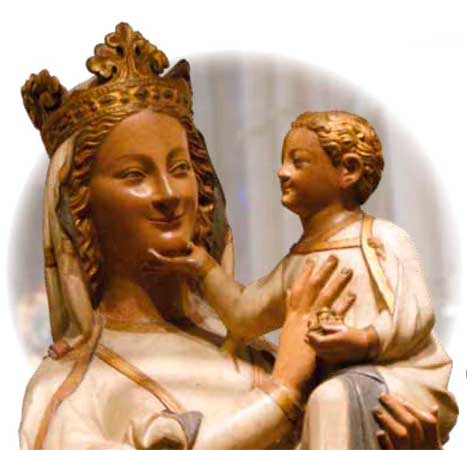
The Texas Catholic Conference of Bishops (TCCB), the lobbying and administrative arm for the Texas episcopacy, albeit with no canonical authority, has sided with the Cook Childrens Medical Center hospital to euthanize baby Tinslee Lewis. The very church that prides herself on caring for the destitute and displaced has tightened ties to the pro-death medical lobby, smothering the disabled in that suffocating yoke.


Think Judges Don’t Impact YOUR Life? Think Again.  

The Supreme Court of Texas (SCOTX) delivered more time to Baby Tinslee Lewis, an ill 20-month-old in a Fort Worth hospital. Through a long legal battle, Cook Children’s Medical Center has sought to impose death on this baby since last November. Thus far, the courts have ruled in favor of Trinity, Tinslee’s mother, who is fighting for the life of her precious daughter.  

Cook Children’s asked SCOTX for permission to withdraw the toddler’s life-sustaining treatment while the 10-Day Rule is argued in court. SCOTX declined the petition, and Tinslee will continue to receive treatment. Judges matter…they matter to Trinity and to Baby Tinslee, and judges indeed impact the daily lives of people.

A single judge in Texas could have put a death sentence on Tinslee—without due process.Under the 10-Day Rule of the Texas Advance Directives Act (Section 166.046 of the Health and Safety Code), patients rendered futile face death by hospital committee—no trial, no second opinion, no due process. The death of the patient is hastened because the committee feels that his or her quality of life is too low

Baby Tinslee is almost two years old and struggles with a congenital heart condition. In November 2019, Cook Children’s Medical Center in Fort Worth moved to withdraw her treatment, including a ventilator, without which the young child would die. Baby Tinslee’s mother would not acquiesce to the hospital, so Cook invoked the statutory 10-day process to euthanize the child.

The first judge protected Baby Tinslee, but Cook has not relented, even though she is conscious and interactive when not sedated. Those moving to “end her [alleged] suffering” say she would not live long even with medical interventions. If that were so, why rush to kill her? If she or any other patient with a disability is actively dying, why hurry to withdraw treatment?Advocates for disability rights have been asking these questions for decades.

In late July, the Court of Appeals for the Second District of Texas held the Texas futility law likely unconstitutional, thereby further protecting Tinslee. Cook Children’s Medical Center still persisted, hoping for a reversal by SCOTX of the appellate court’s ruling before a trial on the constitutionality of the 10-Day Rule.  

Disability advocacy organizations Not Dead Yet, National ADAPT, ADAPT of Texas, Protect TX Fragile Kids, and the Autistic Self Advocacy Network joined an amicus brief to SCOTX for Baby Tinslee. The brief was filed on October 8 by Texas health care and civil rights attorney Michelle Hayes, a practicing Catholic from Notre Dame Law School (the same school from which Amy Coney Barrett earned her law degree). Other signers of the brief are:The Healthcare Advocacy and Leadership Organization (HALO), The Terri Schiavo Life and Hope Network, Deacon Keith Fournier (also a Catholic attorney), The True Texas Project, Right to Life of East Texas, The Common Good Foundation, and Grassroots America We the PeopleTwo Texas Catholic bishops who have consistently rebuked the 10-Day Rule also signed the brief: Most Reverend Joseph E. Strickland, Bishop of the Diocese of Tyler, and Most Reverend René H. Gracida, Bishop Emeritus of Corpus Christi. Bishop Gracida cited then-Pope John Paull II: “Every medical action must always have its object—intended by the moral agent—the promotion of life and never the pursuit of death.” Address to the Italian Catholic Doctors Association (28 December 1978): Insegnamenti di Giovanni Paolo II, 1 (1978), 438.

Predictably, the Texas Catholic Conference of Bishops (TCCB), the lobbying and administrative arm for the Texas episcopacy, albeit with no canonical authority, sided with the hospital to euthanize Tinslee. The very church that prides herself on caring for the destitute and displaced has tightened ties to the pro-death medical lobby, smothering the disabled in that suffocating yoke. However, the TCCB can no longer present a unified position in support of the 10-Day Rule with Bishops Strickland and Gracida publicly opposing the law and working to protect Baby Tinslee’s Right to Life.
 Catholic healthcare institutions constitute a concrete sign of the way in which the ecclesiastical community take care of the sick following the example of the Good Samaritan. Congregation for the Doctrine of the Faith, Letter “Samaritus bonus” on the care of persons in the critical and terminal phases of life (22 September 2020), n. 9. Baby Tinslee’s case now returns to the district court, which will consider these questions: Are the rights of Baby Tinslee being violated? Should a hospital have unilateral authority to withdraw life-sustaining medical treatment from a patient against the will of the patient/surrogate? Do patients have any due process rights in these situations? Is the 10-Day Rule of the Texas Advance Directives Act unconstitutional?
The date of the trial has not been set by the 48th District Court over which Judge Sandee Marion presides. Cook Children’s must continue treating Baby Tinslee throughout the waiting period and the trial.

Tinslee’s case spotlights judicial philosophy; in other words, the judge could rule according to a strict interpretation of the Constitution and due process rights, or she may grant rights to a hospital to decide who lives and dies. There are many possible outcomes, but whatever decision is issued, this judicial decision will impact EVERY hospitalized patient in Texas.

A single judge could decide if Baby Tinslee lives or dies.

Judges matter.
 
Posted in Uncategorized | Comments Off on The Texas Catholic Conference of Bishops (TCCB), the lobbying and administrative arm for the Texas episcopacy, albeit with no canonical authority, has sided with the Cook Childrens Medical Center hospital to euthanize baby Tinslee Lewis. The very church that prides herself on caring for the destitute and displaced has tightened ties to the pro-death medical lobby, smothering the disabled in that suffocating yoke.

THE CORRUPTION OF THE BIDEN/CHINA RELATIONSHIP POSES A SERIOUS DANGER FOR THE United States SHOULD Joe Biden WIN THE ELECTION NEXT MONTH

← President Trump Make America Great Again Rally – Macon, GA – 7:00pm ET Livestream…Saturday October 17th – Open Thread →

Fox News Confirms Biden/China Payoff – Rudy Giuliani Talks to Lou Dobbs….

Posted on October 16, 2020 by sundance

In a breaking news story tonight, Fox News has confirmed with one of the Hunter Biden email recipients that the purpose of the content was setting up payments to Hunter Biden knowing the money would be funneled to his father, Joe Biden [SEE HERE]

In related news Rudy Giuliani appears on Fox News with Lou Dobbs to explain the content of the electronic files and the institutional blackout to keep the information hidden:https://www.youtube.com/embed/Cc3wf8wsWaU?version=3&rel=1&showsearch=0&showinfo=1&iv_load_policy=1&fs=1&hl=en&autohide=2&wmode=transparent

(Via Fox News) One of the people on an explosive email thread allegedly involving Hunter Biden has corroborated the veracity of the messages, which appear to outline a payout for former Vice President Joe Biden as part of a deal with a Chinese energy firm.

One email, dated May 13, 2017, and obtained by Fox News, includes a discussion of “remuneration packages” for six people in a business deal with a Chinese energy firm. The email appeared to identify Hunter Biden as “Chair / Vice Chair depending on agreement with CEFC,” in an apparent reference to now-bankrupt CEFC China Energy Co.

The email includes a note that “Hunter has some office expectations he will elaborate.” A proposed equity split references “20” for “H” and “10 held by H for the big guy?” with no further details. Fox News spoke to one of the people who was copied on the email, who confirmed its authenticity.

Sources told Fox News that “the big guy” is a reference to the former vice president. The New York Post initially published the emails and other controversial messages that Fox News has also obtained. (read more)

Posted in Uncategorized | 1 Comment

YOU MUST WATCH THE 30 TOP BLOOPERS OF SLEEPY Joe Biden

Posted in Uncategorized | Comments Off on YOU MUST WATCH THE 30 TOP BLOOPERS OF SLEEPY Joe Biden

We propose now to consider Belloc’s mature essay on the modern man more closely in order to understand its own principles and then, fittingly, also to apply his gracious insights still today, though some of them may seem to be a little too ethereal for us, and impractical.

Ordo Dei

A site about matters of the Catholic Church, history, philosophy, and literature

Hilaire Belloc’s 1936 Insights on “The Modern Man”

hicksonfamilyPhilosophyPolitical Economy  October 17, 2020 12 Minutes

Dr. Robert Hickson 

12 October 2020

Our Lady of the Pillar (36 A.D.)

Epigraphs

“Lest my title should mislead I will restrict it by definition.” (Hilaire Belloc, Who Own America? (1936, 1999), page 431.)

***

“That this new worship is vigorous and real may be proved by the test of sacrifice: that which a man worships is that for which he will sacrifice not only his comfort but, in extreme cases, his life.” (Hilaire Belloc, Who Owns America?, pages 434-435—my emphasis added.)

***

“Social energy is a function of the zest for living…The remedy can only be found in a change of philosophy; that is, of religion….But those that see this are few….But it is also their duty not to deceive themselves upon the conditions of their task….that the difficulty is increasing and that therefore they must bear themselves as must all those who attempt a creative effort at reform: that is, as sufferers who will probably fail.” (Hilaire Belloc, Who Owns America?, pages 440-442—my emphasis added.)

***

In 1936, when he was sixty-six years of age, Hilaire Belloc accepted an invitation to write an essay entitled “The Modern Man,” which was the final essay of a 21-chapter book, entitled Who Owns America?A New Declaration of Independence,1 a sequel to the 1930 Agrarian Manifesto, I’ll Take My Stand—The South and the Agrarian Tradition, as written by twelve prominent southern authors.

We propose now to consider Belloc’s mature essay on the modern man more closely in order to understand its own principles and then, fittingly, also to apply his gracious insights still today, though some of them may seem to be a little too ethereal for us, and impractical. Yet Belloc, as a Distributist, robustly stands between large-scale corporate, industrial capitalism and large state socialism and with both their own managing oligarchs (including the money power and financiers). For Belloc always tried to keep a proper proportion and humane scale of things in human affairs (not just in the economy). The test of humane scale was always a good criterion to aid and to measure his responsible judgments.

Belloc starts off by focusing on the limits and proportions of his analysis:

I write not of contemporary man in his infinite variety nor even of the modern European, but of the modern man under industrial capitalism—man as he has been formed through long association and particularly as he has been formed in Great Britain; but not Ireland save in the industrialist northeast corner of that island. (431)

Moreover, as Belloc’s special differentiations more concretely continue to develop, he says:

I write of modern man as you see him today [in year 1936—three years before the outbreak of World War II], not only in the streets of [the cities, variously named]…but in the villages; for the whole of our State has by this time arrived at much the same type of citizen (if citizen he can be called). The countryman has become a townee: to put it more elegantly, he has “acquired the urban mind.”

So defined, the modern man would seem to have three characteristics. (431-432—my emphasis added)

In an abbreviated manner, Belloc first summarizes those three characteristics, and then elaborates:

First, he has lost the old doctrinal position on transcendental things….Second, as a consequence of this [loss] he has lost his economic freedom, or, indeed, the very concept of it [economic freedom]. Third, there has been produced in him, by the loss of economic freedom, coupled with the loss of the old religious doctrines, an interior conception of himself which molds all his actions.

Let us develop these three characteristics and see how they are worked up to make the subject of our inquiry: the matter of the modern capitalist State. (432—my emphasis added)

It will be especially fruitful of truth for us if we now examine Hilaire Belloc’s candid assessment of England’s selective religious history and its present situation just before the Second World War, where Belloc will lose another son, Peter, in 1940. (Belloc’s eldest son, Louis, an aviator, was lost in 1918 near the end of the war, and his body was never recovered.)

Belloc now reveals a few other personal matters (without mentioning the loss of his beloved wife Elodie on 2 February 1914, on the Feast of Candlemas, just before the outbreak of World War I):

With all those of my own generation (I am in my sixty-sixth year) I knew extremely well an older generation which was in all ranks of society fixed upon certain transcendent doctrines chosen out of the original [Catholic] body of Christian doctrines inherited from the conversion of the Roman Empire and its development in the Middle Ages, though England has been changed in its religious attitude by the great philosophic revolution of the sixteenth and seventeenth centuries and was positively a Protestant country (as she still is negatively a Protestant country). Those ancient doctrines which were retained were strongly and, I repeat, always universally held. They include the doctrines of free will, the doctrine of the immortality of the soul (that is, a permanent personality) surviving death forever; the doctrine of the Incarnation—that is, the doctrine that God had become Man—which gave to the personality of man an infinite value since it was so regarded by its Creator; and the doctrine of eternal reward and punishment—reward for right and punishment for wrong-doing. (432-433—my bold emphasis added; italics in the original)

Belloc, as we shall see, is also especially attentive to the sometimes dire and disordered consequences after just one or more of these above certitudes and affirmations are no longer believed to be true and, therefore, binding.

There is also the matter of one’s sense of honor and moral code, or what Belloc calls, traditionally, “a certain code” (433):

There was also retained a certain code in declaring what was right and what was wrong; for instance, if you had a wife still living it was wrong to marry another wife. It was wrong to take away another man’s property in order to advantage your self. It was wrong for a public man to take a bribe and so forth, or to blackmail and so forth. (433)

Being an honest man himself, Belloc anticipates and answers some objections to his own position:

It may be objected by some that the old religious doctrines have been retained into our own day [1936]; no: not by the average man as doctrines—that is, certitudesSome parts have been retained, but not the same parts by the mass of men. You will still find a minority attached to one or the other of these doctrines. There is a large body which still holds to the doctrine of immortality divorced from the conception of eternal punishment for wrong-doing—and indeed from any punishment other than that suffered in this life.

The doctrine of the Incarnation has gone by the board. You may count up a large number of men and women who still maintain it, but most of these are in the minority—a small minority—of educated men, at least, outside the Catholic body. Most of them, moreover (outside the Catholic body), hold it as an opinion, not as a certitude; moreover, they give to it, each of them, any interpretation they choose, while the masses around them have stopped thinking of the thing altogether, let alone holding it even as an opinionWhat does remain of it is a sort of vague aroma which concedes that a long-dead individual who may or may not have really existed and who is, anyhow, long dead, provided an excellent model for conduct. This model is again a figment of the individual’s imagination supported occasionally by fragmentary recollections of ancient documents in themselves fragmentary. (443-434—my emphasis added, in order to help sharpen for us Belloc’s own very fine irony!)

Before moving on to examine his characterizing “second point, the political consequences of a change of religion,” (435—emphasis added) Belloc logically considers, by way of further preparation, “the doctrine of free will” (434):

The doctrine of free will, though inseparable from practical action, has been battered down. The conception of inevitable tendencies, of an inevitable chain of cause and effect, has superseded it. The code of right and wrong has gone, too, and with it, necessarily, the conception of eternal reward and eternal punishment. (434—my emphasis added)

After further lines of argument, Belloc then says: “with the loss of this old religion, the modern man has also lost the obvious truth that a culture is based upon the philosophy it holds.” (435—my emphasis added) For example:

If you believe in the transcendent importance and permanence of personality (that is, the immortality of the soul) and in the supreme sanctions attaching to a particular code of morals (that is, heaven and hell), you act more or less accordingly, by which it is not meant that an ideal is reached or even maintained, but that it remains an ideal and, therefore, permeates society. Thus, a man today [1936] most evil in other respects will not [usually] betray his own country nor deny the validity of its laws, though he will deny the divine authority lying behind those conceptions. (435—my emphasis added)

For the remainder of his essay (436-442), Belloc will concentrate on the last of his three specified characteristics of modern man upon which he has already so openly focused. In his introductory words Belloc now says:

As to the third characteristic, which is the most practically important for our analysis, the effect of all these [characteristics and grave losses!] on modern man’s conception of himself, it has by this time become glaringly apparent.

We note in the first place that with a loss of the sense of free will the modern man has lost the sense of economic freedom. We notice that temporal good has taken the place of other values. We note that a moral code, including property as a right—not as a mere institution—has disappeared. (436—italics in the original; bold emphasis added)

Just as now (in the year 2020) thoughtful and attentive people properly fear being, or becoming, dependently ensnared in some kind of manipulated “technological servitude,” so, too, did Hilaire Belloc warn against (and himself fear) the inhuman scale of servility and the dreaded combination of “insufficiency and insecurity” (438) where a man thereby dependently, if not desperately, surrenders his own economic freedom in order to have more economic security as well as to his having more of a sufficiency of wealth and protective insurance.

The proper way to face the combined risk of “insecurity and insufficiency” is a theme, or even the pervasive “sub-text,” throughout the last part of Belloc’s essay. The temptation to surrender remains: to sacrifice one’s modest integrity and economic freedom for the sake of more stably gaining a more guaranteed security and sufficiency—even for one’s family, for example, despite the further surrender and loss of a more humane scale of life, without any coarsening oligarchic over-centralization. In this light, let us consider Belloc’s own progression of words and insights.

Speaking of the growing ill consequences of “unlimited competition” as if it were itself a destructively wielded “sword,” Belloc resorts to an unexpected, yet helpful, metaphor:

The profound truth contained in the phrase “they that take the sword [of “unlimited competition”] shall perish by the sword” is no where more clearly apparent than here. Temporal good means in practice, wealth, and the pursuit of wealth as an end, and as almost the only end, has resulted in the destruction of all those safeguards whereby the individual wealth of the many was guaranteed. As a consequence there has arisen, through the action of unlimited competition, a polity in which a few control the means of production and the many have become wage-slaves under those few. Whether the few who control the means of production will form a stableclass or no may be debated. In the immediate past and on into our own day the pursuit of wealth as the supreme god has made even the wealth of the most wealthy unstable. But there are signs that this state of affairs is ending and that the strongest of those who control the means of production are creating an organization [financial, with debt bondage and management, too?] which will render their domination permanent.

A test of all this may be discovered in the conception of “success.” That idea is now almost wholly confined to the attainment of a position among those who control the means of production and are to that extent secure. (436-437—my emphasis added)

After speaking of “the strong attitude of mind” (437), Belloc speaks of several “derivatives” of this overall “attitude.” He gives several concrete examples, and then says, indeed:

It has become difficult or impossible for the modern man to dissociate the conception of virtue and greatness from the possession of much wealth.

But the most practically derivative of this attitude is the acceptation by the great mass of modern men of a quasi-servile position….To be secure in the reception of these [“regular enjoyment of payments”] is his chief aim, the loss of such support his chief dread. The modern man is not controlled in his actions by the fear of any ultimate spiritual effect of his actions, but of their effect upon the likelihood of his maintaining or losing this livelihood which he enjoys at the will of his economic masters….(through the orders of their own financial masters…). (437-438—my emphasis added)

After he discusses “plutocracy” and the instrumental “parliamentary system” and its ways of thwarting “direct popular action by the pretense of representation” and other “illusions” to which the modern man “submits,” Belloc candidly says:

Now it should be clear to anyone who will think lucidly and coldly upon the direction in which all this must move that it is moving toward the establishment of slavery. Industrial capitalism, as we now have it [in 1936], the control of the means of production, distribution, and exchange (and the control of the modes, therefore, by which production, distribution, and exchange are conducted) by a few, must mean that the many are compelled to work for the profit of the few. When this state of affairs has produced INSUFFICIENCY and INSECURITY, the obvious remedies, if we proceed upon the line of least resistance, would be found in giving to the dispossessed (who have come to form the vast majority of those who were formerly economically free) security and sufficiency on condition that they work under the orders of the few.

To be compelled to work, not by your own initiative, but at the initiation of another, is the definition of slavery.

Whether slavery shall come first in the form of slavery to the State before it arrive at the final and natural and stable form of slavery to individuals—slavery it still is, and the modern man accepts such slavery in the unshakable belief that it is in the nature of things. (438-439—my emphasis added)

Throughout his writings, also in this essay, Belloc emphasizes his incisive presupposition that “economic freedom…can only coexist with private property well distributed.” (439—my emphasis added) But, he also argues that the modern man doubts the validity of such a well-reasoned claim:

He will tell you that the system is impossible, giving as his reasons all manner of external conditions (such as the rapidity of communication, the concentration of the banking system, the cost of great units of machinery, and so forth), but having for his real reason the mere experience of his life. He has never known economic freedom. He has not seen it in action; and without experience of a thing, one cannot make a mental image of it. (439)

Moreover, as Belloc summarizes: not only is it so that “modern man is heading for slavery,” (439) but it is also a fact that “he is heading for the consequent decline of our civilization.” (439)

In conclusion, Hilaire Belloc briefly, but elegiacally, mentions first the degrading effects of “the modern mind” and then the proposed reforms and remedies that are fittingly to be nobly attempted now, without self-deception, and in the face of our approaching servitude and our declining civilization:

It is customary to ascribe to the influence of the press the cause of this development [a coming slavery and the companion decline of our civilization], but….the press in its present degradation…is but a function of the modern mind….

The few who have perceived these truths, the few who can contrast the modern man [and contrast the current man in 2020] with the immediate ancestry of his age, but have forgotten, know that the remedy can only be found in a change of philosophy; that is, of religion. They know further that the material test of this change and at the same time the prime condition which would foster the change would be the reinstitution of private property and its extension to a determining number of the community.

But those who see this are few. It is their duty to work upon the lines which their knowledge of the trouble suggests, but it is also their duty not to deceive themselves upon the conditions of their task….Therefore they must bear themselves as must all those who attempt a creative effort at reform [in religion and philosophy, too]: that is, as sufferers who will probably fail.

Such are Hilaire Belloc’s memorable elegiac tones, along with his characteristically poignant, but also very realistic, ending.

He braces us lesser men for the protracted combat—with robustness, and without sentimentality.

What we have is Nature, what we need is Grace.


–FINIS– 

© 2020 Robert D. Hickson

Posted in Uncategorized | Comments Off on We propose now to consider Belloc’s mature essay on the modern man more closely in order to understand its own principles and then, fittingly, also to apply his gracious insights still today, though some of them may seem to be a little too ethereal for us, and impractical.

Archbishop Carlo Maria Viganò sets out for all faithful Catholics a program on how to respond to the current crisis in the Church. Our answer cannot be to found a new church – which is what the Modernists are trying to do – but, rather, “to remain steadfast, to resist strong in Faith,” to preserve our own humility – remembering our own lack of understanding in the past – and to preserve our charity toward those who are now helping to destroy the faith.

MAIKE HICKSON

BLOGS

Archbishop Viganò: We have to remain ‘steadfast’ in the faith, not found a new church

‘We must not go down those steps, just as Christ did not descend from the Cross, nor to we look elsewhere for that salvation that comes only from the altar, from the immaculate Victim, from the Cross of Christ…’Fri Oct 16, 2020 – 10:33 am EST

Featured Image
Archbishop Carlo Maria Viganò 

October 16, 2020 (LifeSiteNews) – In answering an open letter from Vivente Montesinos, a Spanish blogger, Archbishop Carlo Maria Viganò sets out for all faithful Catholics a program on how to respond to the current crisis in the Church. Our answer cannot be to found a new church – which is what the Modernists are trying to do – but, rather, “to remain steadfast, to resist strong in Faith,” to preserve our own humility – remembering our own lack of understanding in the past – and to preserve our charity toward those who are now helping to destroy the faith.

We must “remain where we ought to be, like that priest dressed in sacred vestments [during the Holy Sacrifice of the Mass]. We must not go down those steps, just as Christ did not descend from the Cross, nor to we look elsewhere for that salvation that comes only from the altar, from the immaculate Victim, from the Cross of Christ,” Viganò tells this Spanish author, and with it, all of us.

Montesinos, in his September 25 Open Letter to Archbishop Viganò, had thanked him for his work and witness, for his encouragement of all those Catholics who find themselves now accused of being “against the Pope.” Montesinos assured Viganò of the prayers of thousands of Catholics. He stated: “We will never succumb to the lie of the world, spread today by Jorge Mario Bergoglio, the ecclesial hierarchy, the majority of the episcopate and the vast majority of consecrated persons, who want us to believe that we are not Catholics because ‘we do not obey the [current] Pope.’” In some ways, adds the journalist, Archbishop Viganò acts today “morally” more like a pope that the Pope in Rome.

“My personal belief is yes,” the journalist wrote, “and you will forgive me for the audacity to express this idea to you.”

With regard of the problem of obedience to a Pope that is leading Catholics today into error, the blogger continues by saying: “The Catholic must be with the Pope… yes… but as long as the Pope is with Christ.”

Responding to these words (see full statement below), Archbishop Viganò makes it clear that he does not wish to be described as having the role of a Pope. The fact that the Church in crisis, he answers, “is not a sufficient reason to attribute to me an authority that I do not and cannot have.”SUBSCRIBEto LifeSite’s daily headlinesSUBSCRIBEU.S. Canada World Catholic

But Archbishop Viganò encourages us to apply our duty to obedience only when it is in accordance with the Faith. Thus, obedience is conditional on what a Catholic is asked to do. For example, the archbishop states, “the faithful who refuse to receive Communion in the hand do not disobey their ecclesiastical superior, because that order is a sacrilegious abuse.”

But even if we at times need to disobey, the prelate continues, this does not “authorize us to create a parallel order, a utopia in which the flock gives itself its own shepherd and builds its own sheepfold; this would signify a usurpation of the authority of God.” Herewith, Archbishop Viganò seems to reject any idea or proposal to be part of establishing a parallel structure in opposition to the existing hierarchy of the Church, much of which seems tainted with Modernism and error.

One of these “self- proclaimed liberators from the Roman yoke,” he continues, are actually the “Modernists and their followers.” They attempted at “superimposing upon her [the Church] a spurious entity that claims her name but renounces her Faith.” This new creation is “a sort of monstrum,” which occupies much of the hierarchy of the Church and thus is “able to deceive the Clergy and the faithful.”

It is here the problem of “obedience to the Sacred Pastors” lies. But the answer cannot be “a revolution in the traditional sense” as a response to the “Conciliar revolution.” The answers are “true obedience” and “true humility.”

“It is in loving fidelity to the Truth of Christ that the fanatical dogmatism of the heretics is conquered.”

In light of Modernists errors, may the faithful Catholics stay firm but humble.

Our humility, according to Viganò, stems also from the fact that “many of us, only a few years ago, were still not yet aware of the deception perpetrated against the holy people of God.” Many missed the deeper “understanding of the creeping apostasy” that was taking place in the Church.

It is here that Archbishop Viganò calls us to remain steadfast in the faith, just as every priest offers the Sacrifice of the Mass every day, independent of his own moods and independent of the amount of the faithful present.

Please see here the full statement by Archbishop Viganò. The text was first published by Marco Tosatti, and is reprinted here with permission.

Dear Doctor Montesinos,

I read, with great attention to and agreement with your sentiments, the open letter which you addressed to me, which was published at Stilum Curiae (here). I ask your pardon for my delay in responding.

Some of the questions you ask me answer themselves, but it is good to reiterate that “we must obey God rather than men” (Acts 5:29). But precisely because we need to obey God, we must also not seek in men the hope of salvation that comes only from the Lord: “It is better to take refuge in the Lord than to trust in man” (Psalm 117:8). I recognize your good faith and your ardent zeal in your desire to be guided by faithful Pastors, but hearing me called “vicar of the Vicar” causes me a certain embarrassment. The fact that restating what the Church has always taught, denouncing the current drift, is not a sufficient motive, is not a sufficient reason to attribute to me an authority that I do not and cannot have.

This does not mean that the exercise of obedience must be uncritical. Reason first allows us to understand whether an order given by legitimate authority is coherent with the end to which it is ordered, and this applies in a particular way to questions concerning the Faith. In other cases – such as for example the obedience owed by monks to their abbot – even planting turnips upside down can be an instrument of sanctification; but here we are speaking of Christian perfection, of ascesis.

Each one of our actions places us before a choice and has consequences. It allows to obtain merit before God, to exercise our free will in adhering either to good or to evil, in allowing ourselves either to be conquered by Grace or to give in to temptation. Obedience is no exception: in choosing to obey or not we are put to the test, placed at a crossroads. The Christian who is faced with the choice of burning incense to an idol or facing martyrdom does not disobey the authority of the Emperor but obeys the superior authority of God. The priest whom the judge orders to violate the seal of Confession obeys the command of God by disobeying the illegitimate order of the judge. The faithful who refuse to receive Communion in the hand do not disobey their ecclesiastical superior, because that order is a sacrilegious abuse.

But this disobedience of ours – which is not disobedience at all, because it reaffirms obedience to a higher order which has been abusively violated by the one who is constituted in authority – does not authorize us to create a parallel order, a utopia in which the flock gives itself its own shepherd and builds its own sheepfold: this would signify a usurpation of the authority of God. On closer inspection, this is what all the heresiarchs tried to do, who pointed to the true Church as the whore of Babylon only so that they could have an alibi that would allow them to make a grotesque imitation of the Church, amputated in the Sacraments, in the Books of Sacred Scripture, in Doctrine, Morals, and Liturgy. And also in the Hierarchy.

The latest in this long series of self-proclaimed liberators from the Roman yoke are the Modernists and their followers. They have devised an even more subtle stratagem, attempting to obscure the Bride of Christ by superimposing upon her a spurious entity that claims her name but renounces her Faith. It is not another church, but a sort of monstrum that shares almost the entire Hierarchy with the true Church and thus is able to deceive the Clergy and the faithful. Thus, obedience to the Sacred Pastors finds itself today in conflict, often in the same person, with dutiful disobedience to the mercenaries. The fact that these mercenaries are nominally recognized as Catholics does not prevent them from expelling true Catholics from the sacred enclosure, accusing them of schism. This situation of bipolarism implies that those who remain faithful to the depositum fidei must pay homage to a sacred authority which, however, must be resisted by disobedience when it is exercised for purposes that conflict with the purpose for which it was instituted by Our Lord.

As I have written many times, a revolution in the traditional sense is not and never can be the response to the Conciliar revolution. On the contrary, it is in true obedience that is hierarchically ordered that the invincible weapon against the rebellion may be found, even when this rebellion is carried out by one’s Superiors. It is in true humility that one fights against the pride of the heretic or the fornicator, on the one hand; and the servility of the fainthearted or the courtier, on the other. It is in loving fidelity to the Truth of Christ that the fanatical dogmatism of the heretics is conquered. It is in the practice of virtue and in the life of Grace that the root of vice and sin which we denounce in certain prelates is eradicated, evils from which we cannot say that we ourselves are infallibly exempt, if only because of our connatural inclination to evil that we have inherited from Adam. “Whoever thinks he is standing must be careful not to fall” (1 Cor 10:12).

It is true: the Church is undergoing a tremendous crisis, which began before the Council and today has reached a point that appears humanly irreversible. It is true: we have heard words and seen actions, even from the highest Throne, that arouse scandal in the faithful and are in obvious contradiction with the Magisterium of the Roman Pontiffs. It is true: the majority of the faithful and clergy are molded into doctrinal and moral error, while anyone who remains firm in the Faith is accused of being an enemy of the Church and the Pope. If this was not the case, there would be no crisis. But if Providence has seen fit to test us today – to punish for decades of moral and doctrinal deviations – giving us a drunken Noah for a father (Gen 9:20-27), it is nevertheless our duty to cover his nudity with filial piety, without however denying the intoxication of the half-undressed old man. Once he has regained sobriety, he will bless those who have laid the cloak of Truth and Charity over his shame.

Whoever has the grace not to be misled in either Faith or Morals should not be proud of having a presumed state of purity, but rather must take account of the very great responsibility he has before God, the Church, and his brethren. This is true for the simple faithful and even more for the Shepherds. First of all, obedience to the teaching of Christ is not a merit but a duty for each one of us. Second, our adherence to what the Divine Master has taught us by means of Holy Mother Church does not place us in a condition of human privilege, since “to whomever much has been given, much will be asked; to whom more has been entrusted, even more will be demanded” (Lk 12:48). The fear of God makes us understand how important it is that what we believe and profess with the mouth is also believed in the heart, and that what we believe with the heart is also understood by the intellect.

Dear Vincent, if as you say, “We are where we have always been, and we have not moved: we are with Sacred Scripture, sound doctrine, the Holy Tradition, and the Magisterium of two thousand years,” nevertheless we have the duty to implore Heaven for the conversion of those whom the world, the flesh, or the devil have seduced. We do not know the vicissitudes of their life or the unfathomable depths of their soul. Indeed, we recall that many of us, only a few years ago, were still not yet aware of the deception perpetrated against the holy people of God. Our blindness at the time and the lack of understanding of the creeping apostasy is not very different from the situation in which many souls find themselves today, especially among the simple. The Sacrament of Confession – to which priest and layman, children and the elderly, rich and poor have recourse – reminds us of our corrupt nature and the need to place our total trust in God, the giver of all Graces. “Without Me you can do nothing,” Our Lord said (Jn 15:8).

We must likewise consider our belonging to the Mystical Body as the proof of the infinite Mercy of God, who with divine magnificence welcomed “good and bad” at the banquet (Mt 22:10), deigning to offer them also the wedding garment, that is, justification by means of Baptism. Before this royal gift, our humility lies in accepting the wearing of the precious garment of Grace, which erases our miseries and makes us worthy to sit at the table of the King. Expecting to participate at the banquet with our rags would not be humility, but presumption; believing that that garment is owed to us would make us worthy of the outer darkness. We see rather that we are like servants of the King, sent to the crossroads to call to the banquet “the poor, the crippled, the blind and the lame” (Lk 14:21).

Understandably, in addition to being aware of what is happening and analyzing the causes, it is also necessary to identify concrete action. To the question, “What should we do?” that priests and laity ask me and others, I respond with an analogy.

When the priest is at the altar, he is turned toward God and intercedes for the holy people. There are days on which only a few of the faithful unite themselves to the Holy Sacrifice, others on which the Church is packed; days when the commotion of the street and the noise of traffic echoes in the nave, others when sacred silence and recollection are accompanied only by the song of sparrows or the tolling of a bell; days when the celebrant ascends the altar with serenity and joy in his heart, others when his soul is oppressed by sorrow and discouragement. But he is there: standing, always facing the Cross, always faithful to the command to renew the Sacrifice of Christ in order to implore the Divine Majesty for graces and blessings for the Church, to adore the Most Holy Trinity, to expiate the sins of men. This must be our attitude in the face of the present crisis: to remain where we ought to be, like that priest dressed in sacred vestments. We must not go down those steps, just as Christ did not descend from the Cross, nor do we look elsewhere for that salvation that comes only from the altar, from the immaculate Victim, from the Cross of Christ. We must do that which has been done for two thousand years “semper, ubique, et ab omnibus”: immolate ourselves with Faith and Charity, with humility and constancy, with the fear of God and zeal for souls. The Popes and the Princes of the Church will pass away, all the powers of the earth and the stage of this world will also fade, but the Mass and the Priesthood will remain until the Day of Judgment.

Peter Kwasniewski writes: That is why I repeat: our sanctifying work, planned for us by God in His eternal Providence, is to remain faithful to tradition and to prayer, come what may; to bide our time, keep our sanity, hold steady, and wait for the Lord. He is still and always among us, not far away in utopian pastures” (here).

May Heaven grant that, if today, turning around for the Dominus vobiscum, the priest sees only a few faithful kneeling, tomorrow he may see gathered around the altar all those whom the Grace of God will have deigned to touch. Nothing else is asked of us, as Ministers of God and as simple faithful: to remain steadfast, to resist strong in Faith (1 Pt 5:9), praying to Our Lord and His Blessed Mother asking that they may shorten these times of trial which humanly speaking seem destined to last forever. The day will come when our firmness, rooted “in Him who gives me strength” (Phil 4:13), will be blessed by those who today deride us and despise us. The day will come when they will thank God for the apparent disobedience of those who, in the absence of Authority, remained faithful.

I respond to your final question by quoting Saint Paul: “I refer to the fact that each of you is saying: “I belong to Paul,” “I instead belong to Apollos,” “And I to Cephas,” “And I to Christ!” Is Christ then divided?  Was perhaps Paul crucified for you, or is it in the name of Paul that you were baptized?” (1 Cor 1:12-13). We do not look to those who proclaim the Word of God, but rather we try to conform ourselves to the will of Our Lord, in order to be an example and edification for our brothers. “So must your light shine before men, so that they may see your good works and give glory to your Father who is in heaven” (Mt 5:16).

To you, dear Vincent, and to all the associates of Adoración y Liberación, I give my heartfelt Blessing.

+ Carlo Maria Viganò, Archbishop

13 October 2020
Anniversary of the final apparition at Fatima

Official translation.

Posted in Uncategorized | Comments Off on Archbishop Carlo Maria Viganò sets out for all faithful Catholics a program on how to respond to the current crisis in the Church. Our answer cannot be to found a new church – which is what the Modernists are trying to do – but, rather, “to remain steadfast, to resist strong in Faith,” to preserve our own humility – remembering our own lack of understanding in the past – and to preserve our charity toward those who are now helping to destroy the faith.

THE KNIGHTS OF COLUMBUS HAVE TAKEN OVER AND SUBVERTED THE MARCH FOR LIFE FROM THE PURE PURPOSES OF THE MARCH AS ESTABLISHED BY Corpus Christi’s NELLIE GRAY, FOUNDER OF THE MARCH FOR LIFE

Dymphna’s Road

tuesday, october 13, 2020

LOUIE MAKES HIMSELF CLEAR

 Louie Verrechio used to annoy me when he’d carp about the March for Life or the Knights of Columbus’s involvement because he’d always allude to what he thought was wrong but was  vague on details. Now,  he and the magnificent Randy Engel have spelled out their argument.  It’s a thorough and disturbing one. 

It looks like Nellie Gray was betrayed either on her deathbed or after her death by the people running the March now. It also looks like the heads of the organization aren’t fighting for the outright abolition of abortion but rather, a slow nibbling away at it. Essentially, the consensus idea seems to be to pragmatically ignore  babies in the first trimester for now in order to convince people that abortion in the latter trimesters is evil and should done away with. Supposedly after years of that people will come to realize that protection should be extended for all babies. 

The March leadership, Randy Engel writes, has also  made an effort to water down the Catholicism that led Nellie Gray to start the March in the first place because the current president of March for Life feels that “Nellie Gray’s leadership was “too Catholic,” ” and continuing in Nellie’s path might offend the kindly Protestants, Jews and even pagans who might be pro-life but would hold their noses and let babies die rather than rally with Catholics to stop it. 

I’m going to have to read the whole thing a few times to fully digest it but I don’t like what I’ve read and as the wife of Knight of Columbus I really am disgusted with Carl Anderson. POSTED BY DYMPHNA AT 12:00 AMOlder PostHome

VIRGEN BLANCA

Virgen  Blanca

Posted in Uncategorized | Comments Off on THE KNIGHTS OF COLUMBUS HAVE TAKEN OVER AND SUBVERTED THE MARCH FOR LIFE FROM THE PURE PURPOSES OF THE MARCH AS ESTABLISHED BY Corpus Christi’s NELLIE GRAY, FOUNDER OF THE MARCH FOR LIFE

STARING INTO THE ABYSS WITH FATHER ED MEEKS

Posted in Uncategorized | 2 Comments

IT INCREASINGLY SEEMS REASONABLE TO EXPECT CIVIL WAR TO BEGIN IN THESE United States SHORTLY AFTER THE CONFLICTED RESULTS OF THE NOVEMBER PRESIDENTIAL ELECTION ARE ANNOUNCED, GIVEN THE LEVEL OF EMOTIONS BEING DISPLAYED ON ALL SIDES THE CLOSER WE GET TO THE CLOSE OF THE POLLS ON Election Day IN NOVEMBER. The decisions we make over the next few months are hugely consequential. If we fall into a cycle of violence, the consequences for America’s future as a democracy will be dire.

Americans Increasingly Believe Violence is Justified if the Other Side WinsOur research detected an uptick in recent months in the share of Americans willing to condone political unrest.


By LARRY DIAMOND, LEE DRUTMAN, TOD LINDBERG, NATHAN P. KALMOE and LILLIANA MASON

October 1, 2020


At the presidential debate this week, the Republican candidate voiced his concern about political violence—left-wing political violence. And the Democratic candidate likewise voiced concern about political violence—right-wing political violence.
They were both right.


Like a growing number of prominent American leaders and scholars, we are increasingly anxious that this country is headed toward the worst post-election crisis in a century and a half. Our biggest concern is that a disputed presidential election—especially if there are close contests in a few swing states, or if one candidate denounces the legitimacy of the process—could generate violence and bloodshed.


Unfortunately, we’re not being alarmist about the potential for violence; trends in public opinion that we’ve been tracking provide strong grounds for concern.

Our research, which we’re reporting here for the first time, shows an upswing in the past few months in the number of Americans—both Democrats and Republicans—who said they think violence would be justified if their side loses the upcoming presidential election.


This growing acceptance of the possibility of violence is a bipartisan movement. Our data shows that the willingness of Democrats and Republicans alike to justify violence as a way to achieve political goals has essentially been rising in lockstep.
All of us have been involved, separately and eventually together, in surveying and researching Americans’ political attitudes and engagement.

Late last year, we noticed an uptick in the number of respondents saying they would condone violence by their own political party, and we decided to combine our data sets to get as much information as possible on this worrisome trend. We were also monitoring another question: Would you condone violence if the other party’s candidate wins the presidential election?


While the pool of respondents between our datasets is slightly different, our questions have had the same wording. Here’s what we’ve found:• Among Americans who identify as Democrat or Republican, 1 in 3 now believe that violence could be justified to advance their parties’ political goals—a substantial increase over the last three years.


• In September, 44 percent of Republicans and 41 percent of Democrats said there would be at least “a little” justification for violence if the other party’s nominee wins the election. Those figures are both up from June, when 35 percent of Republicans and 37 percent of Democrats expressed the same sentiment.
• Similarly, 36 percent of Republicans and 33 percent of Democrats said it is at least “a little” justified for their side “to use violence in advancing political goals”—up from 30 percent of both Republicans and Democrats in June.


• There has been an even larger increase in the share of both Democrats and Republicans who believe there would be either “a lot” or “a great deal” of justification for violence if their party were to lose in November. The share of Republicans seeing substantial justification for violence if their side loses jumped from 15 percent in June to 20 percent in September, while the share of Democrats jumped from 16 percent to 19 percent.


• These numbers are even higher among the most ideological partisans. Of Democrats who identify as “very liberal,” 26 percent said there would be “a great deal” of justification for violence if their candidate loses the presidency compared to 7 percent of those identifying as simply “liberal.” Of Republicans who identify as “very conservative,” 16 percent said they believe there would be “a great deal” of justification for violence if the GOP candidate loses compared to 7 percent of those identifying as simply “conservative.” This means the ideological extremes of each party are two to four times more apt to see violence as justified than their party’s mainstream members.


[Update: Since this article published, we’ve received new polling data that strongly suggests the trend is not as large as originally thought. On the question of justifying violence, new data from the same source as the 2017 to 2019 trend suggests there has not been a significant shift in attitudes since December 2019, though there is still a notable increase from 2017.

On the question of justifying violence in the event of losing a presidential race, there has been a small increase but not as large as the one we originally described. We’re reviewing the new data and will update further.]


All together, about 1 in 5 Americans with a strong political affiliation says they are quite willing to endorse violence if the other party wins the presidency. (The surveys by YouGov and the Voter Study Group had margins of error ranging from 1.5 to 3 percentage points. The surveys by Nationscape had margins of error of 2 and 2.1 percentage points.)


How seriously should we take these expressions of violence? Both history and social psychology warn us to take them very seriously. In Europe in the 1920s and 1930s, a rising tide of armed street mobilization and of violent clashes between rival partisans ravaged fragile democratic cultures, bullied and marginalized moderate forces, and gave rising autocrats an excuse to seize emergency powers. Some of us who’ve studied the rise of authoritarians see strong parallels between that period of European history and factors at work in America today.


However, expressing approval of partisan violence does not mean someone is ready to pick up a gun. The steps from attitudes to actions are prohibitive for all but a tiny minority because of the legal, social, and physical risks of acting violently.
But even a shift of 1 percent in these surveys would represent the views of over a million Americans. Furthermore, two of us have found in our research that violent events tend to increase public approval of political violence—potentially creating a vicious cycle even if violence is sparked in only a few spots.


Viewed in this light, the events of this summer are especially worrying. Competing protesters from the right and left have clashed violently in Portland, Ore.; Kenosha, Wis.; and Louisville. Left-wing extremists have repeatedly laid siege to federal buildings in Portland, and on several occasions, armed right-wing protesters entered the State Capitol in Michigan.


Democrats have interpreted Trump’s remarks and tweets as legitimizing or even encouraging violence by his supporters—fears only intensified by the president’s comments during this week’s debate urging the Proud Boys, a misogynistic white supremacist group that has been active in recent street protests, to “stand back and stand by.”


Republicans, for their part, interpreted Joe Biden’s rhetorical question in a recent speech, “Does anyone believe there will be less violence in America if Donald Trump is reelected?” as a veiled threat of violence should Biden lose.


Moreover, the notable increase in violent views in the past year continues a worrisome trend. Between 2017 and 2019, our YouGov survey data showed a marked 9-point increase in the percentage of partisans who believe it would be at least “a little bit” justified for their own party to use violence to advance their political goals today.


What should leaders do? No lesson in the study of democratic breakdowns rings more clearly than that political leaders play the central role in fanning—or containing—political polarization and extremism. From Germany and Italy in interwar Europe to Latin America in the 1960s and 1970s, the rhetoric and tactics of leading politicians shaped the fate of democracies in crisis.


Recent research on the United States reaffirms this timeless truth: Leaders play an essential role in fueling the fire or extinguishing the flames of violence among their followers. Preliminary studies show that messages from Biden or Trump denouncing all violence can reduce mass approval of violence.


Everyone in a position of leadership in a democracy—whether in a neighborhood organization, a municipality, a political party, the Congress or the White House—has an obligation to renounce violence and explicitly dissuade their followers from turning to violent tactics or threats. Further, political leaders have a solemn responsibility to uphold and urge their followers to adhere to the essential norms of democracy, including the principles that the voters should freely decide who shall rule, and all valid votes should be counted toward that decision.


However, we fear we are now headed into such a severe downward spiral of partisan polarization that we cannot rely on the candidates and campaigns to pull us out of it.


In this context, any one of several possible scenarios risks triggering unprecedented post-election violence. Biden could surge from behind on Election Night to win on the strength of mail-in ballots that President Trump has already dismissed as fraud-ridden, prompting Trump’s supporters to feel the election was stolen from him. Should some Republican-controlled legislatures seek to throw out mail-in ballots wholesale and give their states’ Electoral College votes to Trump regardless of the final vote count, Democrats (and others) would be outraged. There could also be intense anger on the left if Trump wins reelection by once again losing the popular vote but winning by narrow margins in states that give him an Electoral College victory. Congress—itself so polarized—could be hard-pressed to ensure a widely legitimate outcome on its own.


The best hope now to tamp down support for this potential political violence is to establish an independent, bipartisan third force—a broad commission of distinguished leaders and democratic elders of both parties and of civil society. Its mission would be to reaffirm and defend our democratic norms, especially the critical principles that every valid vote should be counted and that political violence is never justified in the United States. Congress should immediately appoint such a commission.


We do not pull this alarm lightly. The decisions we make over the next few months are hugely consequential. If we fall into a cycle of violence, the consequences for America’s future as a democracy will be dire.


Larry Diamond is a senior fellow at the Hoover Institution. Lee Drutman is a senior fellow at New America. Tod Lindberg is a senior fellow at the Hudson Institute. Nathan P. Kalmoe is an associate professor of political communication at Louisiana State University. Lilliana Mason is an associate professor of government and politics at the University of Maryland.

Posted in Uncategorized | Comments Off on IT INCREASINGLY SEEMS REASONABLE TO EXPECT CIVIL WAR TO BEGIN IN THESE United States SHORTLY AFTER THE CONFLICTED RESULTS OF THE NOVEMBER PRESIDENTIAL ELECTION ARE ANNOUNCED, GIVEN THE LEVEL OF EMOTIONS BEING DISPLAYED ON ALL SIDES THE CLOSER WE GET TO THE CLOSE OF THE POLLS ON Election Day IN NOVEMBER. The decisions we make over the next few months are hugely consequential. If we fall into a cycle of violence, the consequences for America’s future as a democracy will be dire.

ORIGINALISM IN BABY STEPS

Ed Whelan@EdWhelanEPPC

Originalism in baby steps:

1. The Constitution is law. Its provisions–including its amendments–should be interpreted in accord with the meaning they bore at the time they were adopted. (Everyone has this sound intuition with respect to what “natural born Citizen” means.)

1/8:53 AM · Oct 16, 2020·TweetDeck61 Retweets14 Quote Tweets164 LikesEd Whelan@EdWhelanEPPC·Replying to @EdWhelanEPP

2. The Constitution, as amended, sets forth bounds on government power. Originalists dispute among themselves precise limits of those bounds. But all agree what within those bounds the democratic processes are free to operate to revise policies to adapt to changing circumstances.1945Ed Whelan@EdWhelanEPPC·

3. It is the modern project of the “living Constitution” that aims to prevent democratic processes from adapting to changing circumstances. It seeks to *entrench* favored progressive policies–e.g., on abortion.31340Ed Whelan@EdWhelanEPPC·

4. At bottom, the alternative to originalism is *just making it up*. That’s tempting, to be sure, as it’s a way to get the results you want, irrespective of what Constitution says and of how it can fairly be interpreted.11039

Ed Whelan@EdWhelanEPPC·5. How do we know what Constitution means when it says that president must be at least 35? Because originalist inquiry tells us that public meaning of age at time of Framing was in base 10, not base 6 or base 12. (Yeah, innumerates won’t get this.)3438Ed Whelan@EdWhelanEPPC·6. Contra Left’s claim, there are no “clear” provisions of Constitution that don’t ultimately depend on originalism for their clarity.3521Ed Whelan@EdWhelanEPPC·7. If you’re still in doubt, go ahead and take my “Are You an Originalist?” test.Are You an Originalist? – Ethics & Public Policy CenterThe term “originalism” identifies the traditional, common-sense principle that the meaning of the Constitution is to be determined in accordance with the meaning it bore when it was written. There is…eppc.org1224Frederick@Prise88·Replying to @EdWhelanEPPCLOLRobert Blackmer@TJTackleberry·Replying to @EdWhelanEPPCWell-said

Are You an Originalist?

Like Tweet Email

Published in National Review Online on July 13, 2005


Edward Whelan

BY EDWARD WHELAN
Share

President Bush’s promise to appoint originalist justices like Scalia and Thomas invites the question: What is this peculiar creature, the originalist?

The term “originalism” identifies the traditional, common-sense principle that the meaning of various provisions of the Constitution (and of other laws) is to be determined in accordance with the meaning they bore at the time they were promulgated. The status of originalism as the only legitimate method (or class of methods) of constitutional interpretation inheres in the very nature of the Constitution as law. As Chief Justice Marshall explained in his landmark 1803 opinion in Marbury v. Madison, the Constitution is “committed to writing” so that its “limits may not be mistaken or forgotten.” To disregard its limits is to “reduce[] to nothing what we have deemed the greatest improvement on political institutions — a written constitution.”

It is significant that the term “originalism” appears to be of relatively recent vintage. The reason for this is not that there is anything novel about originalism. Precisely the opposite. Until recent years, originalism had been so unchallenged as constitutional orthodoxy that there was no reason to develop a term that would distinguish it from any rival. As Justice Scalia has put it, “in the past, nonoriginalist opinions have almost always had the decency to lie, or at least to dissemble, about what they were doing.” But the rise of the “living Constitution” — the Orwellian euphemism that liberal activists have used to pretend that the Constitution has somehow “grown” to entrench forever their own policy preferences — made necessary a label for what everyone had previously recognized as elementary. 

An analogous semantic development might illustrate this point. According to the Oxford English Dictionary, the term “heterosexual” came into usage barely a century ago. This is obviously not because heterosexuals did not previously exist, but rather precisely because what we now call heterosexuality had been widely understood to be normative.

Here’s my simple single-question multiple-choice test for whether you are an originalist:

Q. The Constitution provides, as one of the criteria to be eligible to become president, that a person must be a “natural born Citizen” (or, alternatively, in a provision that long ago ceased to apply to any living persons, “a Citizen of the United States, at the time of the Adoption of this Constitution”) How would you figure out what the phrase “natural born Citizen” means?

(A) You would determine that the “natural born Citizen” requirement, whatever it means, is obviously a relic of a benighted and xenophobic past, a past that “evolving standards of decency,” as reflected in modern European electoral practices, requires be abandoned. It simply isn’t fair, you would conclude, that any candidates should be excluded by such an arbitrary requirement from running for president. You would invoke “the right to define one’s own concept of existence, of meaning, of the universe, and of the mystery of human life” as you instead substituted your own arbitrary criteria for eligibility.

(B) You would try to discern the current meaning of the phrase “natural born Citizen.” Its closest connection would appear to be to the concept of natural childbirth. Therefore, you would conclude that only those whose mothers did not use drugs during birth satisfy the requirement.

(C) You would look to literature as your guide. Macbeth finds great comfort in the promise that “none of woman born/Shall harm” him. But his comfort proves unwarranted when Macduff, who “was from his mother’s womb/Untimely ripp’d,” kills Macbeth. It follows that anyone whose birth was by Cesarean section is not a “natural born Citizen.”

(D) You would try to determine the public meaning of the “natural born Citizen” requirement at the time that the Constitution was adopted. 

If it is obvious to you that the proper response is (D), then you are an originalist. If you think that the answer might be (A), then you are probably Justice Stevens, O’Connor, Kennedy, Souter, Ginsburg, or Breyer. 

For what it’s worth, although I haven’t researched the issue, my own strong intuition is that the phrase “natural born Citizen” is meant to identify those persons who were citizens at birth, by virtue of the citizenship laws in effect at the time, as opposed to those who were naturalized after birth. And, any of you lawyers out there, please don’t tell me that the issue isn’t, or might not be, justiciable; my question is how to determine what the provision means, not whether courts would in fact decide it.

Some theorists, of course, contend that certain constitutional provisions, like “due process of law” or “cruel and unusual punishments,” are, to various degrees, open-ended, and deliberately so, and that these provisions were understood to delegate considerable discretion to judges to supply their meaning over time. This short essay is not the occasion to examine the validity of those claims or their compatibility with American principles of representative government. For present purposes, it suffices to observe that these theorists either expressly acknowledge or implicitly concede the legitimacy of originalism and merely contest with other originalists what originalism yields.

I very much suspect that many English speakers two or three generations ago were a bit nonplussed to be labeled “heterosexuals.” I hope that, if you have just discovered that you are an originalist, your reaction is more like the delight of Molière’s Monsieur Jourdain on learning that he had been “speaking in prose” all his life without knowing it.

– Edward Whelan is president of the Ethics and Public Policy Center and is a regular contributor to National Review Online’s “Bench Memos” blog on judicial nominations.

More replies

Michael Connors@TheShortestWay·Replying to @EdWhelanEPPCLet’s just leave it at this: From Joseph Story’s Commentaries on the Constitution of the United States, abridged by the author, preface, p. vi.1Doug Flynn@doug_flynn·Replying to @EdWhelanEPPC@DanRather needs to read this..2ProveIt2Me@CrustyOlSkeptic·Replying to @EdWhelanEPPCBut…those… “muh living document arguments”….

Posted in Uncategorized | 1 Comment

FRANCIS CANNOT BRING HIMSELF TO STOP PAYING HOMAGE TO THE PACHAMAMA GODDESS OF THE AMAZON INDIANS, HE CANNOT HELP HIMSELF. GOD HELP US !!!


Vatican issues coin of mother carrying ‘earth in her womb’ one year after Pachamama scandal

The Vatican City State Mint issued a 10 euro silver coin depicting a mother carrying the earth in her womb.Thu Oct 15, 2020 – 12:50 pm EST

Featured Image
New Vatican coin of mother earth | Pachamama in St. Peter’s Basilica, Oct. 2019 

Martin BürgerBy Martin Bürger
FOLLOW MARTIN


ROME, Italy, October 15, 2020 (LifeSiteNews) — The Vatican issued a coin depicting a mother carrying the earth in her womb. The issue of the coin comes almost one year to the day when the idol Pachamama was worshipped in the Vatican gardens in the presence of Pope Francis as part of the opening ceremony of the Amazon synod.

“The Vatican City State Mint will issue a 10 euro silver coin made by Maestro Oldani, depicting a mother carrying the earth in her womb, to whom we owe care and love as if it were a daughter, with long ears of wheat in her hair, in a reference between past and future that becomes timeless, and therefore eternal,” states the official description of the coin.

“The celebration of life on earth is a commitment to take care of the planet, a project to which the Church intends to offer its support, a grandiose and complex work that aims: to promote international action to guarantee everyone a future, the food that is needed, both in quantity and quality, so that economic advancement may be accompanied with social development, without which there is no real progress.”

Various media outlets, including the news website owned by the German bishops, made a connection between the coin and the Pachamama statues used in the context of the Amazon synod last year, even though the appearance of “Mother Earth” on the coin differs from the statues used in 2019.

“The coin recalls the Pachamama statues set up at the Amazon synod in the previous year, which according to the prefect of the Vatican communication dicastery, Paolo Ruffini, ‘stand for life, fertility and mother earth’ and should bring the culture of the Amazon region also objectively to the synod,” wrote katholisch.de.

In the fall of 2019, Alexander Tschugguel, a young Austrian Catholic, had thrown a number of the controversial Pachamama statues into the Tiber in Rome after they had been prominently featured in a church in Rome for days.

Similar statues had also been used in a religious ceremony in the Vatican gardens on October 4, 2019. Even Pope Francis blessed one of the statues. At the ceremony, people were bowing down to the ground worshiping the statue. Additionally, the Pope prayed in front of a Pachamama statue at St. Peter’s Cathedral on October 7 and then accompanied it in procession into the synod hall.PETITION: Urge Catholic bishops to refuse Holy Communion to pro-abortion Biden 

30,130 have signed the petition.Let’s get to 35,000!Add your signature:  Show Petition Text  Country…USACanadaAaland IslandsAfghanistanAlbaniaAlgeriaAmerican SamoaAndorraAngolaAnguillaAntarcticaAntigua and BarbudaArgentinaArmeniaArubaAustraliaAustriaAzerbaijanBahamasBahrainBangladeshBarbadosBelarusBelgiumBelizeBeninBermudaBhutanBoliviaBosnia and HerzegovinaBotswanaBouvet IslandBrazilBritish Indian Ocean TerritoryBrunei DarussalamBulgariaBurkina FasoBurundiCambodiaCameroonCape VerdeCayman IslandsCentral African RepublicChadChileChinaChristmas IslandCocos (Keeling) IslandsColombiaComorosCongoCook IslandsCosta RicaCote D’IvoireCroatiaCubaCuracaoCyprusCzech RepublicDemocratic Republic of the CongoDenmarkDjiboutiDominicaDominican RepublicEcuadorEgyptEl SalvadorEquatorial GuineaEritreaEstoniaEthiopiaFalkland IslandsFaroe IslandsFijiFinlandFranceFrench GuianaFrench PolynesiaFrench Southern TerritoriesGabonGambiaGeorgiaGermanyGhanaGibraltarGreeceGreenlandGrenadaGuadeloupeGuamGuatemalaGuernseyGuineaGuinea-BissauGuyanaHaitiHeard and McDonald IslandsHondurasHong KongHungaryIcelandIndiaIndonesiaIranIraqIrelandIsle of ManIsraelItalyJamaicaJapanJerseyJordanKazakhstanKenyaKiribatiKuwaitKyrgyzstanLao People’s Democratic RepublicLatviaLebanonLesothoLiberiaLibyaLiechtensteinLithuaniaLuxembourgMacauMacedoniaMadagascarMalawiMalaysiaMaldivesMaliMaltaMarshall IslandsMartiniqueMauritaniaMauritiusMayotteMexicoMicronesiaMoldovaMonacoMongoliaMontenegroMontserratMoroccoMozambiqueMyanmarNamibiaNauruNepalNetherlandsNetherlands AntillesNew CaledoniaNew ZealandNicaraguaNigerNigeriaNiueNorfolk IslandNorth KoreaNorthern Mariana IslandsNorwayOmanPakistanPalauPalestinePanamaPapua New GuineaParaguayPeruPhilippinesPitcairnPolandPortugalPuerto RicoQatarRepublic of KosovoReunionRomaniaRussiaRwandaSaint BarthelemySaint HelenaSaint Kitts and NevisSaint LuciaSaint MartinSaint Pierre and MiquelonSaint Vincent and the GrenadinesSamoaSan MarinoSao Tome and PrincipeSaudi ArabiaSenegalSerbiaSeychellesSierra LeoneSingaporeSint MaartenSlovakiaSloveniaSolomon IslandsSomaliaSouth AfricaSouth Georgia and the South Sandwich IslandsSouth KoreaSouth SudanSpainSri LankaSudanSurinameSvalbard and Jan Mayen IslandsSwazilandSwedenSwitzerlandSyriaTaiwanTajikistanTanzaniaThailandTimor-LesteTogoTokelauTongaTrinidad and TobagoTunisiaTurkeyTurkmenistanTurks and Caicos IslandsTuvaluUgandaUkraineUnited Arab EmiratesUnited KingdomUnited States Minor Outlying IslandsUruguayUzbekistanVanuatuVatican CityVenezuelaVietnamVirgin Islands (British)Virgin Islands (U.S.)Wallis and Futuna IslandsWestern SaharaYemenZambiaZimbabwe  State…AlabamaAlaskaAmerican SamoaArizonaArkansasCaliforniaColoradoConnecticutDelawareFederated States Of MicronesiaFloridaGeorgiaGuamHawaiiIdahoIllinoisIndianaIowaKansasKentuckyLouisianaMaineMarshall IslandsMarylandMassachusettsMichiganMinnesotaMississippiMissouriMontanaNebraskaNevadaNew HampshireNew JerseyNew MexicoNew YorkNorth CarolinaNorth DakotaNorthern Mariana IslandsOhioOklahomaOregonPalauPennsylvaniaRhode IslandSouth CarolinaSouth DakotaTennesseeTexasUtahVermontVirgin IslandsVirginiaWashingtonWashington D.C.West VirginiaWisconsinWyomingArmed Forces EuropeArmed Forces AmericasArmed Forces Pacific Keep me updated via email on this
petition and related issues.  Sign this Petition

The Pope confirmed later that the statue was called “Pachamama” and apologized for the Pachamama statues being thrown into the Tiber river.

Tschugguel himself tweeted earlier today, “We cannot buy those coins and throw them all in the Tiber, we have to fight this on a spiritual level! And we fight it by publicly opposing this #idolatrousness! #Staycatholic #staytrue #fightevil!”https://platform.twitter.com/embed/index.html?dnt=false&embedId=twitter-widget-0&frame=false&hideCard=false&hideThread=true&id=1316676014613975057&lang=en&origin=https%3A%2F%2Fwww.lifesitenews.com%2Fnews%2Fvatican-issues-coin-of-mother-carrying-earth-in-her-womb-one-year-after-pachamama-scandal&siteScreenName=LifeSite&theme=light&widgetsVersion=ed20a2b%3A1601588405575&width=550px

Tschugguel related recent societal ills to the Pachamama ceremony.

“We are currently going through a terrible year. 2020 is the year of #Corona, #BLM + #ANTIFA riots and violence, #Euthanasia introduced in many countries, #abortion pills made legal or more easy accessible in many countries,” he explained.

“Migration problematics everywhere. This all started or got worse with last years [sic] #Pachamama ‘worship’ in the #Vatican gardens. If you venerate pagan idols no wonder that terrible things are going to happen. We all knew it and still know it! And now the #UFN releases 2 new coins to remember this terrible #heresy? Catholics resist!”https://platform.twitter.com/embed/index.html?dnt=false&embedId=twitter-widget-1&frame=false&hideCard=false&hideThread=false&id=1316676012273479681&lang=en&origin=https%3A%2F%2Fwww.lifesitenews.com%2Fnews%2Fvatican-issues-coin-of-mother-carrying-earth-in-her-womb-one-year-after-pachamama-scandal&siteScreenName=LifeSite&theme=light&widgetsVersion=ed20a2b%3A1601588405575&width=550px

In response to the ceremonies in the Vatican Gardens, Bishop Athanasius Schneider at the time called on all Catholics — bishops, priests and laity — to offer acts of reparation, protest and correction for the use of the Pachamama statues, which he called a “new golden calf.”SUBSCRIBEto LifeSite’s daily headlinesSUBSCRIBEU.S. Canada World Catholic

In an open letter forcefully condemning the use of the Pachamama statue at the Amazon Synod in the Vatican, Bishop Schneider wrote, “In front of the eyes of the entire world and in the presence of the Pope, there were conducted clear acts of religious adoration of symbols and statues of the pagan, indigenous, South-American religions, the so-called ‘Pachamama.’”

“Such conduct of the highest Church authority which does not only not forbid the symbols of pagan religions and their worship, but, rather, even justifies them, causes a great damage for the salvation of souls, because thereby the First Commandment is being undermined and in practical terms is being rescinded,” Schneider said.

Pope Francis seemed to double down on the claim voiced by a number of Catholics that there was nothing wrong with the statues in section 78 of his post-synodal Apostolic Exhortation Querida Amazonia, published earlier this year.

In it, Pope Francis stated that people should “not be quick to describe as superstition or paganism certain religious practices that arise spontaneously from the life of peoples.” In section 79, the Pope continued that it is “possible to take up an indigenous symbol in some way, without necessarily considering it as idolatry,” adding that a “myth charged with spiritual meaning can be used to advantage and not always considered a pagan error.”


  Alexander TschugguelCatholicGaiaIdol WorshipIdolatryMother EarthPachamamaPope FrancisVatican City State

xxxxxx

Posted in Uncategorized | Comments Off on FRANCIS CANNOT BRING HIMSELF TO STOP PAYING HOMAGE TO THE PACHAMAMA GODDESS OF THE AMAZON INDIANS, HE CANNOT HELP HIMSELF. GOD HELP US !!!