CARDINAL RE, DEAN OF THE COLLEGE OF CARDINALS, GIVES PUBLIC SCANDAL WHEN HE ATTACKS CARDINAL ZEN, BISHOP EMERITUS OF Hong Kong IN A PUBLIC LETTER

NEWS

DEAN OF COLLEGE OF CARDINALS ATTACKS CARDINAL ZEN IN PUBLIC LETTER

FROM ROME EDITOR11 COMMENTS

by Br. Alexis Bugnolo

I had put some hope in Cardinal Re, I see that my hope was greatly misplaced. Here is my English translation of the Letter of the Cardinal Dean, made public today, attacking Cardinal Zen for denouncing the betrayal of Catholics in China. By this Letter Cardinal Re has definitively joined the dark side. First the Italian original, then my own English translation.  Prot. N. 1/2020 means that this is the very first letter Cardinal Re has written in his capacity as Dean of the College.

Vaticano, 26 febbraio 2020
Prot. N. 1/2020

Signor Cardinale,

Con riferimento ai vari interventi pubblici del Card. Joseph Zen Ze-kiun, S.D.B., e in particolare alla lettera del 27 settembre 2019, che il Vescovo emerito di Hong Kong ha inviato a noi membri del Collegio cardinalizio, sento il dovere di condividere alcune considerazioni e di offrire elementi che favoriscano una serena valutazione di questioni complesse riguardanti la Chiesa in Cina.

Desidero anzitutto far risaltare che, nell’approccio alla situazione della Chiesa cattolica in Cina, c’è una profonda sintonia di pensiero e di azione degli ultimi tre Pontefici, i quali – nel rispetto della verità – hanno favorito il dialogo tra le due Parti e non la contrapposizione. In particolare essi avevano in mente la delicata e importante questione della nomina dei Vescovi.

Cosi San Giovanni Paolo II, se da una parte favorì il ritorno alla piena comunione dei Vescovi consacrati illecitamente nel corso degli anni a partire dal 1958, e nel contempo fu suo desiderio sostenere la vita delle comunità “clandestine” che erano guidate da Vescovi e sacerdoti “non ufficiali”, dall’altra promosse l’idea di pervenire a un Accordo formale con le Autorità governative sulla nomina dei Vescovi. Tale Accordo, la cui stesura ha preso molto tempo, più di un ventennio, è stato poi firmato a Pechino il 22 settembre 2018.

Il Card. Zen varie volte ha affermato che sarebbe stato meglio nessun Accordo piuttosto che un “brutto Accordo”. I tre ultimi Pontefici non hanno condiviso tale posizione e hanno sostenuto e accompagnato la stesura dell’Accordo che, al momento attuale, è parso l’unico possibile.

In particolare, sorprende l’affermazione del Porporato che «l’accordo firmato è lo stesso che Papa Benedetto aveva, a suo tempo, rifiutato di firmare». Tale asserzione non corrisponde a verità. Dopo aver preso conoscenza di persona dei documenti esistenti presso l’Archivio Corrente della Segreteria di Stato, sono in grado di assicurare a Vostra Eminenza che Papa Benedetto XVI aveva approvato il progetto di Accordo sulla nomina dei Vescovi in Cina, che soltanto nel 2018 è stato possibile firmare.

L’Accordo prevede l’intervento dell’autorità del Papa nel processo di nomina dei Vescovi in Cina. Anche a partire da questo dato certo, l’espressione “Chiesa indipendente” non può più essere interpretata in maniera assoluta, come “separazione” dal Papa, così come avveniva in passato.

Purtroppo, c’è lentezza nel trarre in loco tutte le conseguenze che discendono da tale cambiamento epocale sia sul piano dottrinale che su quello pratico e permangono tensioni e situazioni dolorose. È impensabile, d’altra parte, che un Accordo parziale – l’Accordo tocca, infatti, solo il tema della nomina dei Vescovi – cambi le cose quasi in maniera automatica e immediata anche negli altri aspetti della vita della Chiesa.

Il Card. Zen, valutando gli “Orientamenti Pastorali della Santa Sede circa la registrazione civile del Clero in Cina”, del 28 giugno 2019, scrive: «Si firma un testo contro la fede e si dichiara che l’intenzione è di favorire il bene della comunità, un \evangelizzazione più adeguata, la gestione responsabile dei beni della Chiesa. Questa norma generale è ovviamente contro ogni principio di moralità. Se accettata, giustificherebbe l’apostasia» (vedi “Dubia”). Gli “Orientamenti Pastorale”, al contrario, sono stati pensati proprio per salvaguardare la fede in situazioni talmente complicate e difficili da porre in crisi la coscienza personale.

Il Porporato, poi, nella sua lettera parla anche dell’ «uccisione della Chiesa in Cina da parte di chi dovrebbe proteggerla e difenderla dai nemici» e, in particolare, in un’intervista, si rivolge ai cattolici con queste parole: «attendete tempi migliori, tornate alle catacombe, il comunismo non è eterno» (“New York Times”, 24 ottobre 2018). Si tratta, purtroppo, di affermazioni molto pesanti che contestano la stessa guida pastorale del Santo Padre anche nei confronti dei cattolici “clandestini”, nonostante che il Papa non abbia mancato di ascoltare ripetute volte l’Em.mo Cardinale e di leggere le sue numerose missive.

Caro confratello, questo sofferto intervento del Card. Zen ci aiuta a comprendere quanto sia ancora difficile il cammino della Chiesa in Cina e quanto complessa la missione dei Pastori e del Santo Padre! Siamo, pertanto, tutti chiamati a unirci strettamente a Lui e a pregare intensamente affinché lo Spirito Santo lo sostenga e sostenga le comunità della Chiesa cattolica in Cina, che pur nella sofferenza da lungo tempo mostrano la loro fedeltà al Signore, nel cammino della riconciliazione, dell’unità e della missione a servizio del Vangelo.

Augurando ogni bene, cordialmente saluto

Card Re

English translation:

Lord Cardinal,

With reference to diverse public statements by Cardinal Joseph Zen Ze-kiun, S. D. B., in particular to his letter of September 17, 2019, which he send as Bishop Emeritus of Hong Kong to us members of the College of Cardinals, I feel the duty to share some considerations and to offer my own contributions which fvor a serene evaluation of these complex questions in regard to the Church in China.

I desire, first of all, to point out, that in the approach to the situation of the Catholic Church in China, there is a pround agreement of thought and of action among the last three Pontiffs, which — in respect of the truth — has favored dialogue between the two Parties and not their opposition. In particular, they had in mind the delicate and important question of the nomination of Bishops.

Thus, Saint John Paul II, if he favored in part the return to full communion of the Bishops illicitly consecrated in the course of the years beginning in 1958, and at the same time had the desire to support the life of the “underground” community which was led by “un-official” Bishops and priests, on the other hand he promoted the idea of arriving at a formal Accord with the governing Authorities on the nomination of Bishops. Such an Accord, the composition of which took much time, more than 20 years, was signed at Peking on Sept. 22, 2018.

Cardinal Zen has affirmed several times that no Accord would have been better than a  “brutal Accord”.  The last three Pontiffs did not share such a position and have supported and accompanied the crafting of the Accord which, at the present, appeared to be the only one possible.

In particular, the affirmation of the Cardinal that “the signed accord is the same which Pope Benedict had, in his own time, refused to sign” is a surprising one. Such an assertion does not correspond to the truth. After having taken cognizance of the documents existing in the Current Archive of the Secretary of State, I am able to assure Your Eminence that Pope Benedict XVI approved the project of the Accord on the nomination of Bishops in China, which was only able to be singed in 2018.

The Accord foresees the intervention of the authority of the Pope in the process of nominations of Bishops in China. Even from this certain fact, the expression, “independent Church” cannot be interpreted in an absolute manner, as “separation” from the Pope, as it has been in the past.

Unfortunately, there is a delay in seeing all the consequences in practice which derive from such an epochal change both on the doctrinal plane and on the practical one and there remain tensions and sorrowful situations.  It is unthinkable, on the other hand, that a partial Accord — the Accord touches upon, in fact, only the theme of the nomination of Bishops — changes the things as if in an automatic and immediate manner even in the other aspects of the life of the Church.

Cardinal Zen, in evaluating the “Pastoral Orientations of the Holy See on civil registration of the Clergy in China”, of June 28, 2019, writes: “A test contrary to the Faith is signed and it declares that the intention is to favor the good of the community, a more adequate evangelization, a responsible care of the goods of the Church.  This general norm is obviously against every principle of morality. If accepted, it would justify apostasy” (see “Dubia”) The “Pastoral Orientations”, on the contrary, have been thought out precisely to safeguard the Faith in such complicated and difficult situations which would put personal conscience in a crisis.

The Cardinal, then, in his letter speaks also of the “slaughter of the Church in China by the party which should protect Her and defend Her from Her enemies” and, in particular, in an interview, addresses Catholics with these words: “wait for better times, return to the Catacombs, communism is not eternal” (New York Times, Oct. 24, 2018). This deals, unfortunately, with very heavy affirmations which contest the very pastoral guide of the Holy Father even in his relations with “underground” Catholics, not withstanding that the Pope has not omitted to listen repeatedly to the Eminent Cardinal and to read his numerous missives.

Dear confrere, this anguished intervention of Cardinal Zen helps us to understand how much the path of the Church in China is still difficult and how complex is the mission of Shepherds and of the Holy Father!  Consequently, we are all of us called to be closely united with Him and to pray intensely so that the Holy spirit support HIm and support the communities of the Catholic Church in China, which although suffering for a long time, shows their fidelity to the Lord, in the path of reconciliation, of unity and of mission in the service of the Gospel.

Wishing you all good, I cordially salute you,

Cardinal Re 

This letter is an outrage. It claims that the heretical and schismatic church is part of the Catholic Church, that the disagreement it has with the underground Church is a mutual fault which needs to be reconciled, and that the betrayal of 30 million Catholics to the wolves who wish to devour them is a work of the Holy Spirit and was approved by Pope Benedict!

Notice, he says he makes this statement on the basis of documents in the Secretary of State, while omitting whether he spoke with Pope Benedict XVI. If what he says is true, why not have Benedict XVI verbally confirm it?

It further attempts to exploit the pleas of Cardinal Zen to support the disastrous accord. Finally, it is the epitome of presumption to lecture a Chinese Cardinal about affairs in China and pretend that the Accord is something good for the Church.

I think it is very clear from this letter, which is the side chosen by Cardinal Re, and I fully believe that if there are any sane men left in the College of Cardinals that this letter will cause an uproar in the next consistory.

If the Cardinal truly means what he says, I dare him to propose the same kind of agreement for the nomination of Bishops with president Trump of the USA. The implication of this letter is that Marxism is good for the Church and that force to make Catholcis comply with Marxism is good for the faithful. Get ready for world wide persecution initiated by the Vatican! This letter is therefore most ominous.

___________

CREDITS: The Featured Image is copyright by ClearWisdom.net, and is taken from here. It shows what happens to anyone who is caught practicing an un approved religion or religioius discipline in China. It shows to undercover policement forcible siezing a praticioner of Falun Gong in Tianamen Square, Peking.

+ + +

SHARE THIS:

RELATED

Cardina Zen replies to Dean of College of Cardinals' circular letter

Cardina Zen replies to Dean of College of Cardinals’ circular letter

In “News”Archbishop Viganò writes letter of support to Cardinal Zen

Archbishop Viganò writes letter of support to Cardinal Zen

In “News”Italian Civil Protection Agency walks back on all COVID-19 numbers

Italian Civil Protection Agency walks back on all COVID-19 numbers

In “News”CARDINAL RECARDINAL ZENCHINAVATICAN-CHINA ACCORD

Post navigation

PREVIOUS POSTAdrian Willaert: Ave MariaNEXT POSTArchbishop Viganò writes letter of support to Cardinal Zen

11 THOUGHTS ON “DEAN OF COLLEGE OF CARDINALS ATTACKS CARDINAL ZEN IN PUBLIC LETTER”

  1. Randy EngelDear Brother Bugnolo – what were you doing at Opus Dei’s Pontifical University of the Holy Cross [without the corpus]? Randy EngelLikeREPLY
    1. From Rome EditorI studied at Holy Cross for one semester, at which time I was told that I could never use the word heretic again if I continued with them. So I left, realizing that they were all modernists.Liked by 5 peopleREPLY
  2. @txtradcatholicMore gaslighting from the Vatican. The letter is a typical example of how this regime lives on verbosity and ambiguity. Notice also the refusal to address the facts on the ground in the Chinese situation; another aspect of the gaslighting.
    Pray for the oppressed faithful in China and for the repentance and conversion of heart of these apostate prelates.
Posted in Uncategorized | Comments Off on CARDINAL RE, DEAN OF THE COLLEGE OF CARDINALS, GIVES PUBLIC SCANDAL WHEN HE ATTACKS CARDINAL ZEN, BISHOP EMERITUS OF Hong Kong IN A PUBLIC LETTER

THE 1ST AMENDMENT TO THE CONSTITUTION OF THE United States PROTECTS THE RELIGIOUS FREEDOM OF ALL CITIZENS BUT ATTACKS ON THE 1ST AMENDMENT ARE AIM MOST OFTEN AGAINST THE Roman Catholic Church

Crisis MagazineA Voice for the Faithful Catholic Laity

MAY 21, 2020

The Fate of the First Amendment Will Be Decided By These Nine Cases

PATRICK J. REILLY

This month the Little Sisters of the Poor returned to the U.S. Supreme Court, once again defending their right to practice the Catholic Faith by refusing to provide for contraceptives in their health insurance plan.

This is a stark reminder that even years later the Obama administration’s assault on religious freedom continues to impact religious organizations. And other serious threats have since emerged.

Catholic educators especially are nervously awaiting court rulings that could have a severe impact on schools and colleges. That’s scary, but it’s also true that each case presents a new opportunity to re-establish the rights of religious educators under the First Amendment, should judges be so inclined.

Now is a great time for your prayers!https://secureaddisplay.com/i/view/js/?Viewable=1&isMobile=0&AULU=31049420180502T2200289306460AB42454C400A8A16937CB3EB93D7&cb=1590075885468&ccvid=782917588&pvid=1593998408https://secureaddisplay.com/i/view/js/?Viewable=0&isMobile=0&AULU=31049420180502T2200289306460AB42454C400A8A16937CB3EB93D7&cb=1590075885468&ccvid=782917588&pvid=1593998408https://secureaddisplay.com/i/t/js/?ALU=126620200123T1103458100AAF778688CE4A0AAFD7AA950C616099&AULU=31049420180502T2200289306460AB42454C400A8A16937CB3EB93D7&cb=1590075885468&ccvid=782917588&pvid=1593998408

This month the Supreme Court heard arguments regarding the “ministerial exception,” a legal principle which prevents courts from interfering with the selection and removal of religious leaders or “ministers.” Catholic elementary schools in California are at the center of two cases under review: Our Lady of Guadalupe School v. Morrissey-Berru and St. James Catholic School v. Biel.

Effectively, the ministerial exception means that churches and religious organizations can set their own criteria for choosing, hiring, and firing certain employees with clear religious duties. It is essential that the Catholic Church be permitted, for example, to ordain only men without being sued for sex discrimination, or remove a missionary from a region without the threat of costly litigation.

Any religious organization needs the freedom to apply whatever criteria it deems necessary when choosing people to represent and teach its beliefs. The decision is fundamentally a religious one, and so it cannot be scrutinized by a court without risking government interference in religion and thereby violating the First Amendment.

Nevertheless, the Supreme Court has been cautious about applying the principle. It means that an employee designated a “minister” has no ability to file a discrimination claim, and so there are good reasons to be careful in defining the exception.

In 2012, the Court ruled in Hosanna-Tabor Evangelical Lutheran Church and School v. EEOC that the ministerial exception could be applied to a teacher who engaged in substantial secular duties but also taught religion and was formally deemed a “minister” by her church. The two new cases concern catechists at Catholic schools.

Under consideration is whether anyone who teaches religion—lay, religious, or clergy—should be under the ministerial exception, regardless of their job title or any formal religious certification as a “minister.” A broader question is whether teachers of other academic subjects should fall under the exception because, at least in a Catholic school, all teachers should be teaching the insights of the Catholic Faith as they relate to their subject. Teachers should also be witnessing to the Faith in both word and action, and they should be leading students in prayer.

An amicus brief to the Court prepared by Alliance Defending Freedom—and joined by the Association of Classical Christian Educators, the Association for Biblical Higher Education, and The Cardinal Newman Society—proposes a simple test for the Court to apply the ministerial exception: identify evidence that an employee of a religious organization substantially engages in religious functions, which are defined by the religious organization in a “good faith” effort to uphold its religious beliefs.

Another case to watch is InterVarsity Christian Fellowship/USA v. University of Iowa, which is now before the U.S. Court of Appeals for the Eighth Circuit. At issue is the University’s refusal to register a Christian organization, because it would require its leaders to adhere to its religious beliefs.

The case revolves around the ministerial exception, which is of concern to Catholic educators. The Becket Fund is defending the students, and a brief supporting them was filed in March by The Cardinal Newman Society, the Ethics and Religious Liberty Commission of the Southern Baptist Convention, and the Lutheran Church-Missouri Synod.

The Supreme Court is expected to rule very soon on whether federal law against sex discrimination can be used to prohibit religious organizations from upholding moral standards on homosexuality and gender. At issue is Title VII, which concerns employment, but educators are nervous because the education laws under Title IX are based upon Title VII’s nondiscrimination language.

The Obama administration tried to force schools and colleges under Title IX to admit “transgender” students to single-sex bathrooms, locker rooms, and sports teams under the guise of preventing sex discrimination. Faithful Catholic educators have consistently maintained that “sex” means male and female, as each person is created naturally, and laws against sex discrimination have always been rooted in the same understanding.

Now the Supreme Court is being asked to redefine “sex” in three cases: Altitude Express Inc. v. ZardaBostock v. Clayton County, Georgia, and R.G. & G.R. Harris Funeral Homes Inc. v. Equal Employment Opportunity Commission. The latter case concerns whether sex discrimination laws protect “gender identity,” and the others address “sexual orientation.”

Prior to the Court’s combined hearing of the cases in October, the U.S. Conference of Catholic Bishops (USCCB) weighed in with two strong amicus briefs defending religious organizations. Joining the briefs were The Cardinal Newman Society, the Catholic Bar Association, the Anglican Church, Southern Baptists, and Christian Schools International.

Both USCCB briefs highlighted the importance of upholding Catholic teaching on gender and sexuality in Catholic education:

To carry out their religious mission, faith-based schools must be able to hire and retain employees who agree with, and abide by the tenets of, the faith that it is the school’s purpose to impart. Few things undermine a faith-based school’s religious message as much as speech or conduct on the part of school administrators and teachers that contradict, reject, or distort that message.

The USCCB also explained the danger to Catholic schools, should the Supreme Court re-interpret the meaning of “sex” in Title VII and, by implication, Title IX. The Court could “imperil the ability of the school to effectively teach its faith” by requiring schools to employ people “who, by their speech and conduct, violate the religious teaching, including teaching on sexual ethics, that is a constitutive part of the school’s professed faith.”

Numerous other lawsuits have challenged the crucial role of mission-fit teachers and staff in Catholic schools. Although canon law requires that in Catholic schools “teachers are to be outstanding in correct doctrine and integrity of life,” some want schools to yield to gender ideology and the pro-choice mentality.

In Indiana, a trial court recently refused to dismiss a case brought against the Archdiocese of Indianapolis by a teacher who had been fired after entering a same-sex marriage. In Payne-Elliott v. Roman Catholic Archdiocese of Indianapolis, a teacher is suing the Archdiocese after he was fired from Cathedral High School for entering into a same-sex marriage.

The decision is especially disconcerting, because the Indiana court displayed an appalling lack of understanding of the Catholic Church. Cathedral is legally independent from the Archdiocese, but as a Catholic school it is under the bishop’s authority according to canon law. Thus the Archdiocese was fully justified in demanding that Cathedral uphold its standards for Catholic school teachers.

The Archdiocese was also right to insist that the Indiana court is interfering in a religious matter by allowing the teacher’s lawsuit to go forward. But the judge decided that the Archdiocese may not have final authority over Catholic education in its boundaries, and so the case cannot be dismissed on the basis of religious freedom.

This strange decision rests on false assumptions arising from another local dispute. Last year, Brebeuf Jesuit Preparatory School appealed to the Vatican for permission to retain its own teacher in a same-sex marriage. Although the Archdiocese has insisted that Brebeuf uphold Catholic principles, the Vatican Congregation for Catholic Education temporarily suspended sanctions against the school until the Vatican rules on the appeal, which is still pending nine months later. The trial judge took advantage of the situation to ignore the obvious religious authority of the Archdiocese.

There’s also a situation developing in Dayton, Ohio. Alumni of Archbishop Alter High School have launched an outrageous campaign to demand that the Archdiocese of Cincinnati remove the “morality clause” from its teacher employment contract. They are responding to the school’s decision not to renew the contract of an English teacher who entered into a same-sex marriage.

Morality clauses ensure that employees are clearly informed of the Church’s moral standards and expectations. Such a clause is an act of charity and justice toward anyone signing an employment contract, in that they know upfront what could cause them to be disciplined or fired.

But in this case, alumni want the moral standards eliminated altogether. They have appealed not only to the Archdiocese, but to state and federal legislators. This is the dangerous nonsense that Catholic education must confront in today’s increasingly secular culture.

More than ever, Catholic educators need to protect schools and colleges from legal threats to their Catholic identity. One of the most important protections is to adopt clear, consistent, and legally sound policies for every aspect of operations, uphold Catholic identity, and explain why certain standards are necessary to faithful Catholic education.

 Photo credit: Getty Images

Tagged as EducationLittle Sisters of PoorU.S. Supreme Courthttps://www.facebook.com/v2.10/plugins/like.php?action=like&app_id=485814248461205&channel=https%3A%2F%2Fstaticxx.facebook.com%2Fconnect%2Fxd_arbiter.php%3Fversion%3D46%23cb%3Dff79be5789fb0c%26domain%3Dwww.crisismagazine.com%26origin%3Dhttps%253A%252F%252Fwww.crisismagazine.com%252Ff15c0fd6edfdef4%26relation%3Dparent.parent&container_width=660&href=https%3A%2F%2Fwww.crisismagazine.com%2F2020%2Fthe-fate-of-the-first-amendment-will-be-decided-by-these-nine-cases&layout=button_count&locale=en_US&sdk=joey&share=true&show_faces=false62Patrick J. Reilly

By Patrick J. Reilly

Patrick J. Reilly is president of The Cardinal Newman Society, which promotes and defends faithful Catholic education.

Posted in Uncategorized | 1 Comment

AS WE CELEBRATE THE SOLEMNITY OF THE ASCENSION OF OUR LORD Jesus Christ TO HIS FATHER WE SHOULD REJOICE BECAUSE HE HAS NOT LEFT US IN THE WAY THAT IS MOST IMPORTANT TO US: HIS SPIRITUAL UNION WITH US

SPIRITUALITY

JESUS: LO, I AM WITH YOU ALWAYS!

FROM ROME EDITORLEAVE A COMMENT

A Meditation for The Ascension

by Br. Alexis Bugnolo

The confidence to ask the Lord for the things which are necessary for our salvation and the salvation of others, is one of the foundations of Christian living.

This confidence is a wonderful gift, and to fan it into flames, we need to follow it with a consideration on the gentle but pressing Presence, the Lord Jesus surrounds His faithful with, who call upon His Name!

If one reads through the Old Testament, one can discover many wonderful and awe-inspiring examples of just how good God can be to those who are faithful, and just how terrible He can be to those who are unfaithful.

In regard to how wonderful and good He can be to those who are faithful, Our Lord proclaims in the New Testament and most consoling truth:

Lo! I am with you always, even unto the consummation of the age!

Which some Bibles in English render as, Behold! I am with you always, even unto the end of the world!

The thought that Our Lord is nearby and at hand, and present, is a most consoling thought and consideration.  But to understand and appreciate this great grace, we need to first put it into proper context, and understand aright, what Our Lord is referring to.

First, let us consider what Our Lord  IS NOT referring to.  We live in an age of faithlessness, of apostasy, of infidelity, of heresy, and of out right paganism and the revival of the same.

One horrible error and perverse practice which has arisen in recent decades is called the “New Age Movement”.  And one error of this movement says that anyone can spiritually connect into some greater spiritual power or presence, at will.

On account of this pagan superstition, promoted by such films as Star Wars, or by the promotion of the sale of crystals or by those who advocate going to spiritual places to be “energized” or “to get into contact” with spiritual power; there are not a few of the faithful who believe, that Christian life is not about sanctification, but about being “empowered” spiritually, and about being “spiritual”.

Worse of all, this error holds, that being “spiritual” has nothing to do with being morally upright, with the observance of the 10 commandments.

The insidiousness of these errors of the New Age Movement, requires that we consider very carefully and exactly, what our Holy Catholic Faith teaches, and distinguish the truths of Our Faith, from these detestable errors.

Yes, it is true, that being spiritual, does not require that you be moral or upright.  The proof of this is that Satan, the most evil and devious spirit, is by nature a pure spirit, and thus has a pure spirituality.  He is very a very spiritual angelic person, but he is very evil and immoral.

So, as far as we Catholics are concerned, it is evident that if the Devil is very spiritual, that being spiritual is not the measure by which a Catholic can measure his fidelity to the Lord, or his progress in God’s grace, nor his sanctification by virtue.

As human beings, we can only be so spiritual, and we cannot be perfectly spiritual, since for us humans, such a spirituality would be unnatural and thus sinful.

This is because, as humans, we are composed of 1 soul and 1 body.  We are in truth, both our soul and our body.  But both together.  That is why when our soul separates from the body, in death, we can truly say, not only that our bodies “die”, but that “we” die.

If were were perfectly spiritual, we would not be living with a body; and since having a body is part of human nature, such a perfect spirituality is not proper for men.

Now, do not misunderstand me; I am not saying that we ought not be holy, or that we ought not be spiritual in the proper sense of the term.

And to understand what I mean to say, let me first explain, another term:  “carnal”.  What is of the flesh, is carnal; but in the terminology of St. Paul the Apostle, “carnal” has the meaning of “disordered by concupiscence”, that is by that spiritual disease which entered into man by Adam’s sin.  After Adam’s sin, man’s flesh became carnal in a sense it was not before.  Before, his flesh was carnal in the sense that “carnal” means nothing more than “of flesh”.  But after his flesh became “carnal” in the sense that his flesh became subject to the disorder of concupiscence, which is called the fomes of sin.  “Fomes” in Latin, means “tinderbox”, and St. Augustine uses this term to indicate that concupiscence in our flesh, is the tinder upon which sinful movements arise in our hearts and bodies.

So we should be spiritual, in the sense that we should mortify ourselves, body and soul, against concupiscence, that is against having a carnal mind, or living according to the sinful impulses of the flesh.

But it is better to call this “the work of our sanctification” or “the pursuit of perfection,” than “spirituality,” because while it is true that Dominicans have a particular spirituality, and Franciscans, and Carmelites and Benedictines, etc., too; it is also true to say that Satan has his own spirituality; but that is not anything we want to know or imitate!

Back to the words of Our Lord:

Thus, when Our Lord makes us the wonderful promise or proclamation, that He will be with us, unto the end of time, we must first understand that this promise is not true in all times and places.  This seems a contradiction, so let me explain.

Yes, it is true, that this promise is true in all times and places; but it is also false to say that it is true in all times and places.  This is because, we, in all times and places, do not deserve to benefit from this promise; and so in all times and places we cannot PRESUME that Our Lord is with us.  For that reason, to avoid presumption, we ought not ASSUME that Our Lord is with us; we must rather work and strive to be worthy of His Presence!

When we do work and do strive to be worthy of His continual Presence, then these words of Our Lord become true.  Not because our power makes them true, or our effort, or that we merit that they be true; no! Rather, because when we are worthy of His Presence, He makes His Presence felt, as it were. And when we do not merit it, He makes Himself absent, as it were, that is, He does not intervene in our lives with graces and mercies, lights an protections, and leaves us to ourselves — which is a most horrible fate.

For this reason we must be on the alert for 2 kinds of spiritual paralysis, which makes us insensible to the Presence of Christ:  blindness and indifference.  The Catholic who is blinded by mortal sin or by habitual venial sin, knows still by faith that Our Lord is present, for example, in the Most Blessed Sacrament, but it means nothing to him personally.  Likewise, a Catholic who by habitual sin or neglect lives as if this truth means nothing, even while confessing it on his lips, suffers from a hardening of the heart, which is called “indifference.”

A wonderful example to illustrate this, is the simple and beautiful faith of Catholics of the Eritrean Rite. The Eritrean Catholics, unlike us Romans, when waiting for the church to open, do not stand with their backs to the door of the church; no, they stand with their faces to the door.  If you ask them why, they say that it is because Our Lord is present in the Church, and they are waiting for Him to open the doors of His House to them!

Likewise, if you have a living faith and ardent love for Our Lord, it is second nature for you, when passing a Catholic Church were the Sacrament is reposed, to want, as it were, to go and embrace that church, give it a hug, as it were, since it is where Our Lord is dwelling.  We do not hug the doors or corners of our Churches, but perhaps that is because we are just not fervent enough!

Second, to understand the words of Our Lord, upon which we are meditating this month, we need to understand what the word “present” means.

“Present” in English comes from “praesens” in Latin; in Latin the word means “being before” that is “in front of”, or in other words, “before the face of”.  What is present, therefore, is right in front ofyou, you need only open your eyes to see it.

Obviously, when we speak of the Presence of God, we are using a metaphor, because God, as God, is not present physically, that is corporally, anywhere; simply because God is a pure Spirit, and has no body which is bound by spatial dimensions or locations.

We we say God is present, we mean that He is attentive by His Power, Knowledge and Love.  Though God is in no place, He is present to every place, because He created every place, and sustains every place in being.  All places, as it were, are in the palm of His Hand, and so wherever we are, we are not far from Him, ontologically speaking, even if we are far from him, spiritually speaking, because we are in sin or blinded by sin or made indifferent in our hearts by sin.

With these distinctions made and these errors avoided, we are now prepared to consider what Our Lord DOES mean by this holy words:  Lo! I am with you always, even unto the consummation of the age!

Our Lord is not present to us, without any purpose.  It is for our salvation! not for our sense of sentimental peace or well being.  God does nothing without purpose, and if He is actively attentive by His Power, Knowledge and Love, that is by His Grace and Mercy, it is to save us, and to help us towards salvation, or to aide us to help others towards their own.

God makes His presence known to us, in a variety of ways.  Often it is by a grace which enlivens our soul, so that we make and act of love, faith, or hope, which move us toward observing His Commandments or evangelical Counsels, or the precepts of the Church, or to fulfilling some particular duty.  Nearly every time, Our Lord works this actual grace through the mediation of our guardian Angel; sometimes through the mediation of a special Angel, associated with such a work, virtue, place, or person; often through the intercession of some Saint, and always through the Mediation of Jesus and Mary, who always have at heart and on their mind, our salvation.

God is present, also, in two ways:  actively and passively.  Actively by the manifestation of His Power or grace.  “Passively” when we are in the state of grace, in the sense, that we need not do anything to have Him present, since sanctifying grace makes Him present to us, and we to Him.  “Passively”, Christ is also present in the Most Blessed Sacrament,  in the sense that He need not do anything, nor we, that He be present there, since He has already made Himself present there Body, Blood, Soul and Divinity; the Divinity by means of the Humanity.  But God is so infinitely Active, that even when He is passively present, He is active, that is working grace and mercy in us or for us.

But the secret of sanctification lies in a wonderful truth, which is taught throughout the Old Testament and which is valid and applicable to our days, now that Our Lord has Ascended to His Father on High.  This truth is not emphasized in the New Testament, because in the New Testament the Apostles and Evangelists were emphasizing the Sacred Humanity of Our Lord, and the New Covenant wrought in His Blood.

The secret of which I speak refers to a the power and efficacy of a “spiritual covenant” with the Lord.  Each and every man woman or child, who has supernatural faith, can make a covenant with the Lord, and thereby make himself present to God and God to him, not by grace, but by a certain sort of spiritual contract, whereby one commits oneself to doing good works, and thereby to meriting those actual graces which lead to God’s greater blessings.

Now the motivation to make such a covenant comes from God, because in the work of our sanctification, man does nothing first.  So what I say here, presumes those cases where the Holy Spirit is giving the grace.  And we know by God’s working in the Old Testament and New Testament, that He wants men to make these kinds of spiritual covenants.

In the Old Testament these covenants were the bread and butter, as it were, of the Jewish religion; but in the New Testament Age in which we live, they are secondary and very inferior to the Covenant wrought in Christ’s Blood; nay, they are only effective in that Blood, that is, when employed to arrive at doing Christ’s will on earth.

Each one of us can make a covenant with the Lord, which regards any good work, great or small.  The vows of religious are a type of covenant; marriage vows are another; a private vow to go on pilgrimage, to give up drinking or smoking, or some particularly grave vice, such as gossiping, each of these are spiritual covenants, when we promise God to fulfill them or do them.

According to an exaggerated fear, common to the age of Jansenism, when to save souls from the extremity of scrupulosity in which they thought everything was a sin, confessors were apt to counsel nothing under the obligation of a promise — an exaggeration which went so far as to lead some new religious communities not to take vows! — many a manual or book on the spiritual life counseled against making promises to the Lord.  This is quite unimaginable, and quite unbelievable, that anyone would counsel something so diametrically opposed to all that God has revealed! simply out of fear that some scrupulous person, out there somewhere, might fall into trouble by such a promise!

Oh, what scruples to avoid scruples!

Nay, rather, God wants us to enter into such a covenant with Him; and to show us that He is very pleased by it, we have only read of the wonderful blessings God bestowed upon the Jews of the Kingdom of Judah in the Books of Samuel, Kings, Chronicles, and Judges, to see the efficacy of this spiritual practice.

When we promise the Lord to do a good work, habitually, or give up a habitual morally bad habit, we show God respect, trust, love, honor, and give Him glory, as the God of all Justice and Holiness!  And this is, indeed, a thing very pleasing to God, the Holy Ghost, who is infinitely zealous for our progress in all holiness and virtue, for by such a progress we are conformed to Him.

In making any such covenant, we merit immediately the remission of some of the temporal punishment for sins, esp. for the sins we have promised to avoid.

Indeed, the spiritual life of sanctification, cannot go forward without such promises or covenants.  Spiritual stability for us feeble, unstable men is founded upon a chain of such promises, well made and well thought out, and faithfully kept, even if at the beginning, it is difficult or we fail.

These covenants are the stages of the life of perfection, the training in the art of spiritual warfare that the Lord wants to train us in.

For those who want a suggested formula for a general covenant of life with the Lord Jesus, here is a suggested formula:

A Covenant Prayer with the Sacred Heart of Jesus

O Sacred Heart of Jesus! Thou art the Great and Wonderful Lord, the Mighty God!  Who has descended from Heaven, to sweat and suffer and die, rejected, so that I might live and have life eternal!  Who ascended into Heaven to prepare a place for me in Thy Eternal Kingdom! Who dost stand before the Throne of Mercy of Thy Eternal Father, ever interceding for us! Hear, I beg Thee, the prayer of a most unworthy creature!

Mindful of all that Thou has done for me, and of how much I, a wretched sinner, need Thee:  I resolve this day to make this covenant with Thee:  I take Thee to be My God, and I surrender myself to be Thy servant and subject!

I will do what Thou has commanded!  I will heed what Thou has counseled!  I will obey Thy Voice speaking to me through the true Pope, Benedict XVI, and the priests in communion with him, who are my sacred pastors.  I will mind the precepts of the Church, and confess my sins, especially resolving to uproot the vice of _________.  I am confident that with Thee all good things are possible, and that Thy grace is sufficient for me!  For to have Thee, is to have all, in time and eternity!

Help me, Save me, O most Merciful Heart of Jesus!  Make me be all Thine, and be always at my side, to help, protect, enlighten and guide me, this day, and to bring me safely to Thy Eternal Kingdom, in Heaven. Amen.

O Blessed Virgin, intercede for me, and obtain for me the grace to keep this covenant with your Divine Son! To be faithful to it, all my days. Amen.

+ + +

__________

CREDITS: The Featured Image is a detail from Gebhard Fugel’s, The Ascension of Christ, which is in the public domain, the original of which is in the Catholic Parish Church of St. Johannes Baptist, Obereschach, Stadt Ravensburg, Germany.

Posted in Uncategorized | 2 Comments

The U.S. Department of Health and Human Services (HHS) has admitted that, in direct violation of Federal law, it failed to provide a single vaccine safety report to Congress for thirty years, according to Informed Consent Action Network (ICAN).

ICAN vs. HHS: Key Legal Win Recasts Vaccine Debate


NEWS PROVIDED BYInformed Consent Action Network 

Sep 14, 2018, 09:45 ET

SHARE THIS ARTICLE


LOS ANGELES, Sept. 14, 2018 /PRNewswire/ — The U.S. Department of Health and Human Services (HHS) has admitted that, in direct violation of Federal law, it failed to provide a single vaccine safety report to Congress for thirty years, according to Informed Consent Action Network (ICAN).

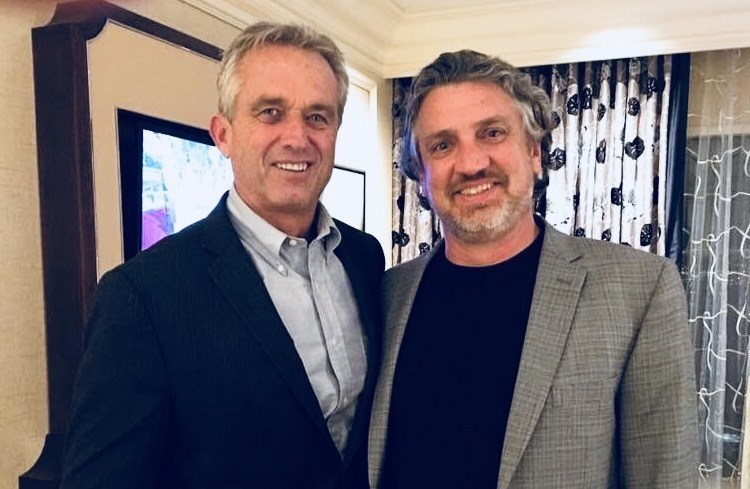
Robert F. Kennedy, Jr. (left), represented ICAN and founder Del Bigtree in its successful lawsuit against HHS.

This acknowledgement comes after eight months of stonewalling from HHS following a Freedom of Information Act (FOIA) request from the nonprofit ICAN, and its founder Del Bigtree. ICAN sought copies of the reports HHS was required to submit to Congress every two years, starting in 1988, detailing improvements it made to vaccine safety. ICAN was represented by Robert F. Kennedy, Jr.

ICAN sued HHS in the U.S. District Court for the Southern District of New York, demanding that the reports be shared with the public. HHS eventually conceded that those reports do not exist and the Court entered an order confirming this concession. 

“The 1986 National Childhood Vaccination Injury Act granted economic immunity to pharmaceutical companies for vaccine injuries and hence eviscerated their economic incentive for them to take responsibility for vaccine safety,” says Bigtree. “Market forces driving vaccine safety were simply eliminated.”

Congress therefore charged the Secretary of HHS with the explicit responsibility to assure vaccine safety. Biannual reports of HHS’s progress in improving vaccine safety were to be submitted to Congress. Yet, as ICAN has now proven, these reports were never created. 

“It is apparent that HHS doesn’t have a clue as to the actual safety profile of the now 39 doses, and growing, of vaccines given by one year of age, including in utero,” said Bigtree. “In 1986, a one-year old child received eleven doses.

“HHS spends billions annually promoting vaccines and generates a steady stream of reports promoting vaccines,” Bigtree says. “Yet, when, despite Federal law, HHS cannot bother to complete the simple task of preparing a biennial report on vaccine safety, there is little hope HHS is tackling the much harder job of improving vaccine safety.”

The 1986 Act shifted financial liability for vaccine injuries to the U.S. Government which has since 1986 paid over $3.9 billion for serious vaccine injuries. 

Bigtree hosts the weekly live online news program “The HighWire,” and is an Emmy-award winning producer of the CBS medical talk show “The Doctors.” He is producer of the groundbreaking documentary “Vaxxed: From Coverup to Catastrophe.” 

For more information, contact tom@icandecide.com.

SOURCE Informed Consent Action Network

Related Links

Posted in Uncategorized | 1 Comment

AN ANALYSIS OF THE “APPEAL FOR THE CHURCH AND THE WORLD” REVEALS THAT COVID-19 MEASURES ARE A PRELUDE TO THE REALIZATION OF A WORLD GOVERNMENT

Top Daily Headlines Sign up

Tuesday, 19 May 2020

Catholic Bishops: COVID-19 Measures Are “Prelude to the Realization of a World Government”

Written by  Warren Mass

Catholic Bishops: COVID-19 Measures Are “Prelude to the Realization of a World Government”

A document titled “Appeal for the Church and the World: to Catholics and all people of good will” — principally written by former apostolic nuncio Archbishop Carlo Viganò (shown) and promoted by an ad hocorganization that calls itself Veritas Liberabit Vos (the truth shall set you free) — makes some stark, accusatory statements about the harsh, restrictive abridgement of personal and religious freedoms imposed by governments in response to the COVID-19 pandemic. Much of the language used in the document is rarely seen outside of constitutionalist, conservative, or libertarian sources on “the right.” 

The document wasted no time in getting to the point, stating in the second paragraph, “Under the pretext of the Covid-19 epidemic, the inalienable rights of citizens have in many cases been violated and their fundamental freedoms, including the exercise of freedom of worship, expression and movement, have been disproportionately and unjustifiably restricted.”

The statement, dated 8 May 2020, carried the signatures of three Catholic cardinals: Cardinal Joseph Zen Ze-kiun, emeritus bishop of Hong Kong; Cardinal Janis Pujats, emeritus archbishop of Riga, Latvia; and Cardinal Gerhard Müller, former prefect of the Congregation for the Doctrine of the Faith.

It was also signed by several bishops, including two Americans: Joseph Strickland, bishop of Tyler, Texas, and Rene Henry Gracida, bishop emeritus of Corpus Christi, Texas.

Paragraph after paragraph, the document presented arguments often found in articles posted by The New American and a few other news sources still committed to defending the Constitution and personal freedom. It stated, “Public health must not, and cannot, become an alibi for infringing on the rights of millions of people around the world, let alone for depriving the civil authority of its duty to act wisely for the common good.”

Noting that there are growing doubts emerging from several sources about the actual danger of the virus, the document stated, “Many authoritative voices in the world of science and medicine confirm that the media’s alarmism about Covid-19 appears to be absolutely unjustified.”

The document then moved into deeper territory when it employed language very familiar to readers of The New American but usually dismissed as “conspiracy theory” by the major media:

We have reason to believe, on the basis of official data on the incidence of the epidemic as related to the number of deaths, that there are powers interested in creating panic among the world’s population with the sole aim of permanently imposing unacceptable forms of restriction on freedoms, of controlling people and of tracking their movements. The imposition of these illiberal measures is a disturbing prelude to the realization of a world government beyond all control.

The New American, its predecessor publications (including American Opinion), and countless books published by this publication’s affiliated book division (e.g, Global Tyranny… Step by Step: The United Nations and the Emerging New World Order, written by this magazine’s senior editor, William F. Jasper) have for decades exposed the machinations of power-hungry elitists who would impose world government, usually through the United Nations and its subsidiary agencies, including the World Health Organization (WHO), which has been in the news so much lately.

The New American reported on April 8 that over 20 Republican cosponsors had joined in on a resolution to defund the World Health Organization (WHO) until its director-general, Dr. Tedros Adhanom Ghebreyesus, resigns and the organization is investigated for its allegedly soft-on-China handling of the coronavirus outbreak. President Trump announced on April 14 that the United States would immediately halt all funding for the WHO, saying it had put “political correctness over lifesaving measures.” The WHO is, of course, an agency of the United Nations.

While not specifically naming the UN or WHO, the document “Appeal for the Church and the World” very clearly referred to such organizations when it mentioned “supranational bodies,” stating:

We also ask government leaders to ensure that forms of control over people, whether through tracking systems or any other form of location-finding, are rigorously avoided. The fight against Covid-19, however serious, must not be the pretext for supporting the hidden intentions of supranational bodies that have very strong commercial and political interests in this plan.

The expression “hidden intentions” is also suggestive of something most mainstream media people avoid saying — “conspiracy” — for fear it be tied to another word that tends to discredit it — “theory.”

The document also had something to say about the way many in the media have been reporting the pandemic:

We strongly urge those in the media to commit themselves to providing accurate information and not penalizing dissent by resorting to forms of censorship, as is happening widely on social media, in the press and on television. Providing accurate information requires that room be given to voices that are not aligned with a single way of thinking. This allows citizens to consciously assess the facts, without being heavily influenced by partisan interventions. A democratic and honest debate is the best antidote to the risk of imposing subtle forms of dictatorship, presumably worse than those our society has seen rise and fall in the recent past.

Not surprisingly, in a document originating with clerical leaders, the open letter defended the right of the Church (which by extension can be said of all churches, since freedom of worship is a universal right) to assert its autonomy to govern, worship, and teach. The document noted:

This autonomy and freedom are an innate right that Our Lord Jesus Christ has given her for the pursuit of her proper ends. For this reason, as Pastors we firmly assert the right to decide autonomously on the celebration of Mass and the Sacraments, just as we claim absolute autonomy in matters falling within our immediate jurisdiction, such as liturgical norms and ways of administering Communion and the Sacraments. The State has no right to interfere, for any reason whatsoever, in the sovereignty of the Church. Ecclesiastical authorities have never refused to collaborate with the State, but such collaboration does not authorize civil authorities to impose any sort of ban or restriction on public worship or the exercise of priestly ministry. The rights of God and of the faithful are the supreme law of the Church, which she neither intends to, nor can, abdicate. We ask that restrictions on the celebration of public ceremonies be removed.

The New American has reported about churches in this country resisting the onerous restrictions placed upon their efforts to conduct worship services. On May 12, we reported about two Illinois churches, Elim Romanian Pentecostal Church and Logos Baptist Ministries, who filed for a temporary restraining order against the enforcement of Governor J.B. Pritzker’s “Five Point” coronavirus plan, which potentially prohibits religious gatherings of 50 people or more through 2021, or when a vaccine or viable treatment option becomes available.

Another article on May 10 noted that Tabernacle Baptist Church of Nicholasville, Kentucky, had successfully obtained a restraining order from a U.S. District Court judge against Kentucky Governor Andy Beshear’s edict banning in-person church services.

The threat to religious freedom being waged under the pretext of “health and safety” is not unique to Catholic, or Baptist, or even non-Christian congregations, but is but one facet of the attempt being made by government at all levels to exploit the COVID-19 pandemic to consolidate power.

The document also noted the grave social and cultural costs of the many restrictions being placed on individuals in the name of protecting them from the coronavirus:

We are fighting against an invisible enemy that seeks to divide citizens, to separate children from their parents, grandchildren from their grandparents, the faithful from their pastors, students from teachers, and customers from vendors. Let us not allow centuries of Christian civilization to be erased under the pretext of a virus, and an odious technological tyranny to be established, in which nameless and faceless people can decide the fate of the world by confining us to a virtual reality.

The authors of “Appeal for the Church and the World” have done a comprehensive job of covering many of these threats to freedom being made “under the pretext of the Covid-19 epidemic.” It is well worth reading in its entirety.

(To read the entire text of the document, “Appeal for the Church and the World: to Catholics and all people of good will,” click here.)

Covid19 975x250

Image:

Warren Mass has served The New American since its launch in 1985 in several capacities, including marketing, editing, and writing. Since retiring from the staff several years ago, he has been a regular contributor to the magazine. Warren writes from Texas and can be reached at wmass@thenewamerican.com.

Related articles:

Illinois Churches Sue Over Plan to Restrict Services for Up to a Year

Churches Refuse to Cower Before Caesar; Court Victory in Kentucky

The COVID “Cure” Is More Deadly Than the Disease

Posted in Uncategorized | 1 Comment

CLARITY THROUGH AN ANALYSIS OF THE BIZARRE CASE OF “CATHOLIC ANSWERS” LIVE VERSUS “RADICAL TRADITIONALISTS”

Thursday, September 26, 2013

The Defense Rests

Written by  Peter Crenshaw | Remnant Columnist

The Bizarre Case of Catholic Answers Live vs. “Radical Traditionalists”

On May 31st, Catholic Answers Live radio host Patrick Coffin and apologist Tim Staples launched a two-hour attack on “radical traditionalism” which I responded to here. Apparently, the overall response to the show was not favorable. In a July 12th blog post entitled “Meet the Mad-Trads” host Patrick Coffin described the reaction as follows: 

We found ourselves on the business end of a nasty backlash. Of all the hot-button issues we’ve tackled head-on with me behind the mic (start the list with abortion, sexual sin, feminism, and homosexuality) no previous topic generated the kind of vitriol from (some) listeners. [1]

 Coffin then exposed the “vitriol” by posting excerpts from e-mails he received after the show. Some examples are as follows:

“Amazing! Wow! I am deeply disappointed by this apparent arrogance.”

“That show was an embarrassment to all Catholics.”

“I was extremely annoyed with the . . . program criticizing the “radical traditionalists,” which is a reference that in and of itself makes no sense whatsoever” (sic).

“I finally turned the radio off in disgust.”

“To treat anyone in such a manner—much less our fellow Catholics—is a serious failure in justice and charity, and I seriously doubt you would indulge in this kind of careless and misleading attack on any other group.”[2]

If this is what Coffin considers “vitriol” it is no wonder he and Staples consider any real criticism of Vatican II and the New Mass as “radical traditionalism.” Except now, Coffin has a new moniker for those who disagree with him: “Mad-Trads.” Realizing that there are a growing group of traditional Catholics who are in “full communion” with the Church, but reject the automatic defense of all things novel, these faithful Catholics must, of course, be marginalized. Hence, they are now caricatured as angry troglodytes who dare to question the following Neo-Catholic sacred cows: an ambiguous pastoral Council that defined no dogma, a novel liturgy manufactured by committee in 1969, a new “charismatic” movement with roots in Pentecostalism, and a supposed 1984 consecration of Russia that never mentioned the word “Russia.”

Coffin then refers to the “com boxes” of traditional websites functioning as “echo chambers of depression and disenfranchisement,” as if the proper response to the unprecedented tragedy we are now witnessing in the Church should be one of joy and elation. The irony is that while Traditional forums and “com boxes” are typically welcoming of debate; Catholic Answers’ own forum is rife with authoritarian moderators who act to snuff out all serious criticism of any post-Conciliar novelty. The result is exactly what Coffin criticizes, an “echo chamber.” However, instead of echoing “depression and disenfranchisement,” Catholic Answers forum echoes a deliriously optimistic vision of the current state of the Church coupled with deafening silence when it comes to criticizing dissident bishops and priests who are helping to destroy Her.

Coffin’s post finally ended with an announcement that Catholic Answers Live would devote yet another two-hour show to “radical traditionalism”:

Because of the intensity of the reactions to the May 31 show, we are going to revisit radical Traditionalism on Monday, August 12, again with Tim Staples. Perhaps some of our unhappy interlocutors will call the show and debate the issues directly on the air, instead of relying again on third-party reports and then firing off outraged emails based on them. We’ll be happy to take their calls.[3]

Still Trying to Define “Radical Traditionalism”

As promised, the dynamic duo returned for an August 12th show. The show began with a brief recap of a conference where the duo recently spoke. Apparently 4,500 Catholics paid money at this conference to watch Coffin and Staples conduct an “offbeat unplugged interview of each other” followed by Coffin’s “first large-scale magic show” on opening night. Thus, from the get go, the duo were able to prove, albeit unintentionally, that there is a serious crisis in the Church.

At that point, Coffin and Staples again tried to explain what they mean by “radical traditionalism.” Staples then went on to say that the positives from the last show far outweighed the negatives. What positives he was referring to, we are not told. Staples then made pains to explain that neither he nor Coffin was attacking “traditionalism” in the last episode. As for the term “radical traditionalists,” Staples said he used the term because it would not be fair to lump all traditionalists in one group.  He again resorted to the nebulous term “full communion” as the apparent dividing line between traditionalists and “radical traditionalists.” After lumping both the sedevacantists and the SSPX in the “radical traditionalist” camp, Staples did point out that there was a “qualitative difference” between sedevacantists and other “radical traditionalists.” He said that the sedevacantists are arguably in “formal schism” under canon law. Staples then pointed out that the SSPX has, in contrast, recognized the supremacy of the Bishop of Rome and that Pope Francis is the successor of St. Peter. Staples then went on to say that he and Coffin made all of these distinctions in the last broadcast and that any misunderstandings were perhaps due to listeners “tuning in late.”

Despite Staples’ assertions to the contrary, the last broadcast did not make such distinctions. If I recall, in that broadcast Staples tried to define “radical traditionalists” as those who reject the infallible Catholic teaching of Vatican I, that the clergy and faithful must submit to the Pope not only in matters concerning faith and morals, but also in those which regard the discipline and government of the Church. The problem with this definition, as I previously pointed out, is Staple’s own interpretation of this teaching, which consists of all Catholics being bound to absolutely accept and positively approve of every liturgical novelty allowed by a Pope or bishop as “tradition.” 

Thus, Staples’ previous definition was broader than he claims and lent itself to the very confusion that resulted. For there are a growing number of Catholics “in full communion with Rome” who oppose such novelties and yet still abide by Vatican I. Further, Patrick Coffin, had included as “radical traditionalists” those who participate in “endless bitter complaining about the Second Vatican Council” and “sarcastic recriminations against the Novus Ordo.” He even referred to these attitudes as “pernicious” and “against the Gospel.” 

Thus, in order to square their new definition of “radical traditionalism” with their previous one, Coffin and Staples would have to believe that every Catholic who does not accept with docility all post-Conciliar novelties is somehow not in “full Communion” with Rome. This strange view, which would exclude most Traditional Catholics from the Church while still maintaining that groups like the “nuns on the bus” remain in the Church, severely tests the principle of non-contradiction. In any case, one can clearly see why the previous broadcast created confusion on the issue. It was hardly the fault of the listeners.

Staples’ New Vatican II Definition of “Rad Trad”

Staples’ new and improved definition of “radical traditionalists” includes those who “separate themselves from ‘full Communion’ with the Catholic Church as it is defined in Lumen Gentium, paragraph 14…” The part of paragraph 14 Staples is most likely referring to reads as follows:

They are fully incorporated in the society of the Church who, possessing the Spirit of Christ accept her entire system and all the means of salvation given to her, and are united with her as part of her visible bodily structure and through her with Christ, who rules her through the Supreme Pontiff and the bishops. The bonds which bind men to the Church in a visible way are profession of faith, the sacraments, and ecclesiastical government and communion.[4]

Apparently Staples is assuming that the priests of the SSPX, and possibly other Traditional laity, are not united with the Church as a part of Her “visible bodily structure” or bonded to Her by “ecclesiastical government.” But is this true? The SSPX was instituted with full approval from the local bishop in 1970 and its ministers are currently under no censure of excommunication, but simply lack a canonical status. Rome has readily admitted that their situation is not like the Orthodox in that they are still considered subject to the Code of Canon Law and are not schismatic. Pope Benedict even went so far as to say in 2007 that the situation of the SSPX is, “a matter of coming to an interior reconciliation in the heart of the Church.”[5]

Of course, if Staples would look at paragraph eight of Lumen Gentium, he would learn that the “Church of Christ” merely “subsists in” the Catholic Church. Thus, even if the SSPX were not in “full Communion” with the Catholic Church, they could, according to Vatican II, still belong to the “Church of Christ” and thus contain “many elements of sanctification and truth.” Furthermore, even if the SSPX were formally schismatic, as Staples claims the sedevacantists are, paragraph fifteen of Lumen Gentium makes this seem like a pretty good state to be in: 

The Church recognizes that in many ways she is linked with those who, being baptized, are honored with the name of Christian, though they do not profess the faith in its entirety or do not preserve unity of communion with the successor of Peter. For there are many who honor Sacred Scripture, taking it as a norm of belief and a pattern of life, and who show a sincere zeal. They lovingly believe in God the Father Almighty and in Christ, the Son of God and Saviour. They are consecrated by baptism, in which they are united with Christ. They also recognize and accept other sacraments within their own Churches or ecclesiastical communities. Many of them rejoice in the episcopate, celebrate the Holy Eucharist and cultivate devotion toward the Virgin Mother of God. They also share with us in prayer and other spiritual benefits. Likewise we can say that in some real way they are joined with us in the Holy Spirit, for to them too He gives His gifts and graces whereby He is operative among them with His sanctifying power… [6]

Thus, according to Lumen Gentium, even if the SSPX is not “fully incorporated into the Society of the Church” they can still “in some real way” be joined with the Catholic Church in the Holy Spirit, receiving gifts and graces whereby God “is operative among them with His sanctifying power.” If this is the case, what is the real importance of full incorporation “into the Society of the Church?” As this exercise demonstrates, trying to pin any precise definition on the shifting, ambiguous, and contradictory language of Vatican II documents is a recipe for utter disaster; hence, the Traditionalists’ critique of the Council texts themselves.

Staples then proceeded to give a one-sided presentation of the history of the SSPX, before erroneously stating the SSPX does not accept the “full authority of the pope in matters of discipline and Vatican Council II.” [7] In reality, the SSPX not only accepts the full authority of the pope, but also believes the pope has more authority than Staples or Vatican II is willing to grant him. As the Society’s founder, Archbishop Marcel Lefebvre, stated:

They have collegialized the pope’s government and that of the bishops with a presbyterial college, that of the parish priest with a lay council, the whole broken down into innumerable commissions, councils, sessions, etc. The new Code of Canon Law is completely permeated with this concept. The pope is described as the head of the College of Bishops. We find this doctrine already suggested in the Council document Lumen Gentium, according to which the College of Bishops, together with the pope, exercises supreme power in the Church in habitual and constant manner.  This is not a change for the better; this doctrine of double supremacy is contrary to the teaching and Magisterium of the Church. It is contrary to the definitions of Vatican Council I and to Pope Leo XIII’s encyclical Satis Cognitum. The Pope alone has supreme power; he communicates it only to the degree he considers advisable, and only in exceptional circumstances. The pope alone has power of jurisdiction over the whole world.[8]

Any cursory inquiry into the matter would have revealed that the SSPX has always accepted the authority of the pope. Indeed, why would Bishop Fellay, and Archbishop Lefebvre before him, devote countless hours of time and energy in discussions with Benedict XVI and John Paul II if they did not believe them to have authority over the Church. The position of the Society, there for all to see on their website and all of their writings, is that even though the pope has supreme authority in the Church, there are situations where a Catholic is bound under the moral law to legitimately disobey lawful authority. This fundamental moral principle is a Catholic one and is confirmed by none other than the Angelic Doctor, St. Thomas Aquinas.

In addition, the SSPX has always accepted Vatican II as a Council of the Catholic Church. However, as the former Cardinal Ratzinger admitted in 1988:

The Second Vatican Council has not been treated as a part of the entire living Tradition of the Church, but as an end of Tradition, a new start from zero. The truth is that this particular Council defined no dogma at all, and deliberately chose to remain on a modest level, as a merely pastoral council; and yet many treat it as though it had made itself into a sort of superdogma which takes away the importance of all the rest.[9]

Thus, while the SSPX accepts Vatican II as a Council of the Church, there are clearly problematic elements of this Council, which apparently contradict the previous infallible Magisterium. Thus all Catholics, not just the SSPX, have an obligation to ask the Pope that these ambiguities be clarified for the sake of the faithful to clearly demonstrate how they are in conformity with previous Church teaching. This is, in fact, precisely what the SSPX tried to do during the doctrinal discussions from 2009 until 2011, without any success. After two years of doctrinal discussions on the proper interpretation of Vatican II, Cardinal Levada simply demanded that Bishop Fellay sign a very short doctrinal preamble which failed to officially clarify any of Vatican II’s problematic sections.  Such a clarification is now being  sought by not only the SSPX, but also such distinguished Church figures as Bishop Athanasius Schneider, the auxiliary bishop of Astana in Kazakhstan and Msgr. Brunero Gherardini, canon of the Vatican Arch-basilica and director of the international theological periodical Divinitas. [10] [11]

Thus the SSPX and all Catholics are left in the unenviable position of wondering what this unprecedented Council even says, much less whether what it says should be assented to.  In the meantime, the SSPX clearly adheres to unchangeable traditional Catholic teaching on ecumenism, religious liberty and collegiality. Can adherence to the Pre-Vatican II teachings on such subjects ever be grounds to call a Catholic a “radical traditionalist” or not in “full communion” with the Church? To do so would be to declare the Church’s own Tradition “radical” and not in “full communion.” This is why no member of the SSPX has ever been canonically sanctioned by Rome for reasons of faith or morals. The suspensions of Society priests in the 1970’s and the excommunications of Society bishops in 1988 were all solely in response to lesser disciplinary matters regarding prior Vatican approval for ordinations and consecrations.

In fact, if one reviews all of the disciplinary acts of the Post-Vatican II Church, one will find very few canonical sanctions against any bishops, priests or laymen for teaching error or spreading poisonous heretical doctrines. This simply goes to highlight the upside down priorities of the post-Conciliar Church which allows heretical clergy to spread their errors almost unabated, while cracking down with full canonical authority upon those clerics who violate mere disciplinary laws.

Indeed Dietrich Von Hildebrand’s observation from 1973 is just as true today as it was then:

…it is now especially infuriating when certain bishops, who themselves show this lethargy toward heretics, assume a rigorously authoritarian attitude towards those believers who are fighting for orthodoxy, and who are doing what the bishops ought to be doing themselves![12]

This exact same attitude can be attributed to Staples and Coffin. The inordinate amount of time they devote to condemning “radical traditionalists” while refusing to speak out against the fifth column of bishops and priests in the Church today is telling.

Frank from Tucson: Casualty of the Crisis

The duo then took their first caller, Frank from Tucson.  Frank complained of problems with his sister who was causing separation in his family. She started attending a mission chapel of the SSPX and started “changing.” Frank felt this is unfortunate since diversity is accepted at his local parish. So accepted, in fact, that Frank and his live-in girlfriend have been Eucharistic ministers at their parish for years! Coffin and Staples then stumbled over each other to cut Frank off. Staples then admitted that Frank’s apparently “radical traditionalist” sister was correct in saying his relationship was not acceptable to God and that his parish priest (who is in “full communion” by the way) was wrong. Frank then defiantly told the duo that things are going to change in the Church as they have been for the last couple of years.

Coffin then asked Staples an odd question as to whether the sexual morality of the Church was rooted in “traditionalism” or the Bible and the teaching of Jesus Christ. That Coffin thinks the sexual morality of the Church is not based in Catholic Tradition is telling, as apparently, in his mind, the Church is reduced to basing Her morality on Sacred Scripture alone. This is an interesting concept as the morality of certain acts, including abortion and contraception, are not explicitly condemned in the Bible nor spoken of directly by Christ, though the earliest Christian Tradition, including the Didache of the Apostles, condemns them.

Staples then went on to assure us that the Church’s moral law is infallible and unchangeable, quoting the novel teaching of Vatican II that the twofold purpose of the conjugal act is both unity in marriage and being open to life. In contrast, the Traditional teaching of the Church has always been that the bearing of children is the sole primary purpose of the conjugal act, any unitive purpose being clearly secondary. As a result of Vatican II “equaling” the two ends of marriage, and the Conciliar Church’s de facto inverting them through primary emphasis on the unitive[13], we have seen the almost universal use of artificial contraception by Catholics along with growing Catholic acceptance of homosexual “marriage.” For the arguments against these things, from both a Catholic and natural law perspective, flow from the propagation of children being the primary end of marriage. If this end is somehow downgraded to secondary or even placed as a co-equal end alongside the unitive, then one could argue that contraceptive and homosexual acts, though not open to life, are still unitive and therefore can still fulfill an end of marriage. Thus, Vatican II’s attempt to equal out and/or invert the Traditional Catholic teaching on marriage is a good example of how, by Conciliar standards, the infallible Catholic moral law can apparently change.

We have seen recent examples of this phenomenon in the post-Conciliar Church and not just from the far left. For example, after Pope Benedict’s comments regarding condom use in Africa, a moral theologian of Opus Dei made the case that the use of condoms may not be immoral in some circumstances.[14] Also certain bishops recently allowed for the use of the potentially abortifacient “morning after” pill at Catholic hospitals.[15] In addition, Pope Francis recently called for a new discussion of whether divorced and remarried Catholics should be denied Communion.[16] As these examples demonstrate, once the Traditional teaching of the Church is modified to account for modern sensibilities, a whole host of unintended consequences ensue.

Staples then asked Frank to please leave his contact information so that Staples could call his parish and then get back to him, presumably to correct Frank’s erring pastor. Not to be cynical, but does anyone familiar with the Church over the last fifty years think for a second that Frank’s priest will be swayed by the opinion of a Catholic Answers apologist? The perennial problem in these cases is that priests like Frank’s are allowed to spread error with absolutely no discipline by their bishop. Even worse, often times the bishop agrees with the erring priest. Thus Frank has become yet another casualty of the Vatican II aggiornamento, which rejects condemnation of modern error as too negative preferring only the positive affirmation of what is true.

After Frank closed his call by comparing traditionalists to the Taliban (which neither Staples nor Coffin responded to), Staples then promised to call Frank’s parish before publicly questioning Frank’s veracity on the air. Ironically, the surprise here is not that Frank’s pastor approves of his openly sinful relationship, but that Tim Staples actually has serious doubts as to whether the pastor of a modern Catholic parish approves of such a thing. This is yet another small reminder that while traditionalists live in reality, Neo-Catholics apparently live in a dream Church of their own making.

Conciliarizing Tradition

The next caller was Dee from East Tennessee. Dee stated that Pope Pius IX in his Syllabus of Errors, condemned propositions that the Church today advocates. He then asked on what basis Catholics should reject what Pius IX literally says in favor of a post-Conciliar interpretation, which contradicts what he literally says.

Staples then asked Dee what he would think it meant if he asked him to “put the kitty on the table.” Dee then said that it meant for him to put a feline on the table. Staples then asked, “but what if we are at a poker game?” Dee then said he’d have to ask Staples to define “kitty.” Staples then defined what a poker “kitty” is. Yes, this is the point to which Neo-Catholic apologetics has evolved since 1965.

Staples apparent point was that Dee was taking Pius IX “out of context.” Of course by “out of context” Staples did not mean Dee was taking words out of the context of the Syllabus, but that Dee was taking Pius IX out of the context of Vatican II. For instead of interpreting Vatican II through the lens of Tradition, as Pope Benedict advocated, Staples and other Neo-Catholic apologists prefer to interpret all past Papal documents through the lens of Vatican II. In doing so, they turn Vatican II into the very “superdogma” Pope Benedict XVI condemned. Staples went on to argue that only the Magisterium gets to say what Pius IX meant in the Syllabus and not Dee. Of course by Magisterium, Staples is referring to the post-Conciliar Magisterium, giving short shrift to the Magisterium of Pius IX under which the document was issued.

Staples then proceeded to explain what Pius IX really meant by his writings on religious freedom. In doing so, Staples happened to mention that by time of Vatican II, “there were no more Catholic countries.” This statement would be a shocking surprise to the many countries that recognized Catholicism as the state religion at the time of Vatican II, only to be pressured by the Vatican to change such laws in deference to the Council’s “new” teaching on the matter.

Having already responded to Neo-Catholic religious liberty arguments in a previous article , I will refrain from repeating myself here.[17] However, it should be noted that such arguments may not even be necessary for Traditionalists to make anymore. For according to Cardinal Walter Brandmüller, Emeritus of the Pontifical Committee for Historical Science, the Vatican II document on religious liberty, Dignitatis Humanae, does “not have a binding doctrinal content.”[18]

Catholic Answers Redefines Conciliar Teaching on Salvation of Non-Catholics

Dee then asked how the following proposition, condemned by Pius IX in the Syllabus of Errors, could be reconciled with post-Conciliar teaching:

Good hope at least is to be entertained of the eternal salvation of all those who are not at all in the true Church of Christ.[19]

Staples, to his credit, did a fairly good job of explaining the Traditional teaching on this subject, which can be found in paragraphs seven and eight of Pius IX’s own encyclical, Quanto Conficimaur Moerore.[20] However, is this the same teaching of Vatican II and the Post-Conciliar Church? Do the previously quoted paragraphs of Lumen Gentium really convey the same urgency of belonging to the Catholic Church for salvation as the Syllabus? Didn’t Lumen Gentium tell us that “in some real way” non-Catholic Christians are “joined with us in the Holy Spirit” and that God “gives His gifts and graces whereby He is operative among them with His sanctifying power?”

Furthermore, what Conciliar document can Staples point to that binds all Catholics to hold the Traditional position on the salvation of non-Catholics? In reality, the Conciliar Church allows extreme positions on both sides of this issue, apparently making the issue an open question. As evidence of this, John Paul II, whom Staples and Coffin refer to as “The Great”, allowed for the possibility of universal salvation; a position in direct contradiction to what Staples just held out to Dee as Catholic teaching. During a Wednesday audience in 1999 John Paul II stated (emphasis added):

Eternal damnation remains a possibility, but we are not granted, without special divine revelation, the knowledge of whether or which human beings are effectively involved in it.[21]

On the opposite side of the issue are The Slaves of the Immaculate Heart of Mary, a religious congregation, approved by the Church. They are allowed by the Vatican to hold the view of the late Fr. Leonard Feeney on the salvation of non-Catholics. Namely that no one at all can be saved unless they are first water baptized into the Catholic Church before death.[22] [23] This position is obviously in contradiction to Staples’ Traditional view of Church teaching on the matter as well.

Thus Dee is correct in that the position of the Conciliar Church on this issue has seemed to change. The Conciliar Church has taken what was once a uniform and clear Traditional teaching and has made it ambiguous. Ambiguous to the point where a Catholic can either believe that all people are saved or that none but the water baptized can be saved, and both positions can apparently somehow be reconciled with the teaching of Pius IX. This is not a “development of doctrine” as Staples alludes, but devolution of doctrine. When a legitimate development of doctrine takes place, it elucidates and further clarifies an already existing Catholic Truth. It never makes such a truth more ambiguous and open to wider interpretation under the guise of a “deeper understanding.”[24]

At this point the show cut to commercial including an interesting ad for Russell Shaw’s new book, American Church: The Remarkable Rise, Meteoric Fall, and Uncertain Future of Catholicism in America. The narrator stated in an alarming tone that, “Russell Shaw provides ample evidence of the absorption of Catholics into the secular culture of our nation that now threatens the Catholic identity of millions of faithful.” Any traditionalist listening to the show could not help but notice the irony. On the one hand, Catholic Answers promotes the Vatican II aggiornamento, which attempted to update the Church in order to be accepted by secular society. On the other hand, they also advertise a book documenting the “meteoric fall” which occurred as Catholics left the Faith in droves for the very secularism the Vatican II aggiornamento was attempting to embrace.

The “Rad-Trads” Keep Getting it Right!

The duo eventually returned and took a call from Tom in California. Tom pointed out that he used to be against “rad trads.” He used to argue against their positions that the Traditional Mass was never abrogated and that “pro multis” had been mistranslated as “for all” in the New Mass. But then the “rad trads” were proven right by Pope Benedict on both counts! Thus Tom wondered whether the duo would consider Benedict to be a “rad trad.”

Staples, then pointed out that no pope could be a “rad trad” because no pope could be “out of union with himself.” This statement demonstrates the fundamental flaw of Neo-Catholicism: that whatever policy or practice a pope allows, even if it is novel and contradictory to his predecessors and Tradition, must be accepted as the new standard of orthodoxy. This reasoning amounts to mere legal positivism, as it is not tied to any objective doctrinal standard. For example, under this definition, Staples could have held that any Catholic before the Motu Proprio in 2007, who insisted that the Traditional Mass was never abrogated was a “rad trad.” Yet after the 2007 Motu Proprio, Catholics could hold this exact same position, and yet not be “rad trads.” Thus, Neo-Catholicism’s vision of orthodoxy is constantly in flux, dependent on personal papal preferences, while traditionalists’ view of orthodoxy remains constant, regardless of who is pope.

Staples then commented on how he always disagreed with the translation of “pro multis” as “for all.” Yes, who in Catholic circles can forget the loud, consistent, and outspoken charge of the Neo-Catholics against this diabolical changing of the words of Our Lord; a change that afflicted a vast majority of all Novus Ordo Masses for over forty years? If you don’t remember it, that’s because it never happened. Neo-Catholic apologists like Tim Staples may have muttered from time to time that it is not their preferred translation, but all the while they preached calm acceptance of the erroneous translation. Instead it was the reviled “rad trads” who consistently spoke out against this travesty ever since it was foisted upon English speaking Catholics by ICEL in the 1970’s. [25]

Unlike the Traditionalists, the Neo-Catholic establishment possessed large influential voices, periodicals and newspapers with wide circulations during these years, not to mention friends in the curia. Yet none of this impressive power was ever brought to bear against the tragic mistranslation of the New Mass. Instead the Neo-Catholics acquiesced to this novelty, as they did all the others, so as not to be “divisive” or “disobedient.” They then attacked the traditionalists for making such a big deal over the matter and ended up defending the mistranslation.

Staples then admitted that canon 212 of the 1983 Code of Canon Law gives Catholics the right, and sometimes the duty, to make our spiritual concerns known to the hierarchy of the Church, as long as it is done respectfully. Whether Staples himself or any other Neo-Catholic apologist took advantage of this canon regarding the pro multis scandal was not stated. What was stated, however, is that “radical traditionalists” who utilize this canon and “don’t get their way” end up leaving full communion with the Church and “doing things that are illicit.”

First, it is curious that the refusal of Vatican authorities to correct a glaring mistranslation of the words of Our Lord in the consecration for almost forty years is seen by Staples as traditionalists “not getting their way” rather than an injustice being done to all Catholics.  Second, faced with such an unprecedented and clearly erroneous translation of the New Mass in English, many pious souls preferred to continue to assist at the then “illicit” Tridentine Mass.

The irony here is that a canon on the same page as the one Staples quoted, canon 214, states that Christ’s faithful have the right to worship God according to the provisions of their own rite approved by the lawful Pastors of the Church. As we know from immemorial Tradition, Quo Priumum of Pius V, and Summorum Pontificum of Benedict XVI, these souls had the legal and moral right to assist at the Tridentine Mass all along and did not act illicitly in doing so. Thus, in the final analysis, the truly “illicit” act was the deliberate mistranslation of the words of Our Lord in the consecration, not faithful Catholics assisting at the Traditional Mass.

Staples then went on to explain that if you, as a Catholic, point out through proper channels to your bishop atrocities against Our Lord and His Faith taking place in the Church on a daily basis and your bishop ignores you in perpetuity, you are simply to be silent, “have Faith in God,” and believe that “God is going to take care of things.” What a very different approach this is compared to the Traditional approach, beautifully stated by Dietrich Von Hildebrand, a man Pius XII called “The Twentieth Century Doctor of the Church”[26]:

…what is fitting at a time when no heresies occur in the Church without being immediately condemned by Rome, becomes inappropriate and unconscionable at a time when uncondemned heresies wreak havoc within the Church, infecting even certain bishops, who nevertheless remain in office. 

Should the faithful at the time of the Arian heresy, for instance, in which the majority of the bishops were Arians, have limited themselves to being nice and obedient to the ordinances of these bishops, instead of battling heresy? Is not fidelity to the true teaching of the Church to be given priority over submission to the bishop? Is it not precisely by virtue of their obedience to the revealed truths, which they received from the Magisterium of the Church, that the faithful offer resistance?[27]

Neo-Catholic Obsession With SSPX’s Non-Existent “Schism”

The duo then took a call from the Remnant’s own Chris Ferrara, otherwise known as “Chris in Richmond.” As Staples tried to interrupt twice, Chris made clear that the vast majority of Traditionalists are not sedevacantists, and asked further clarification as to what extent the duo considered the SSPX to be “radical traditionalists.” Staples then basically asserted the SSPX were all radical traditionalists for various reasons including their 1988 “schismatic act” before thanking Chris for his call and trying to politely usher him out of the door before the commercial break. Unfortunately for Staples, Coffin didn’t get the memo and offered Chris the last word.

Chris stated that he thought Staples had exonerated the Society from charges of schism. As Staples exclaimed “Oh no!” in horror in the background, Chris continued. Chris stated that he had a problem with Staples labeling the SSPX as schismatic. To support his case, Chris noted that the Richmond diocesan newspaper recently had to correct their previous description of the SSPX as schismatic. Staples then responded that both on the last broadcast and now again he was saying that the SSPX is not in schism, especially since the lifting of the excommunications. The duo then let Chris go, promising to take up the topic in the next hour.

The next hour began with Coffin lamenting the fact that certain listeners still seemed to think they were attacking all traditionalists, while Staples added that the last caller incorrectly thought they were exonerating the SSPX. Never in this lamentation did the duo realize the confusion might be one of their own making. Regardless, any hope of remedying the confusion was lost as Staples then launched into a discussion of schism.

Staples stated that there was much confusion over whether the SSPX was in a state of formal schism after their bishops were excommunicated in 1988. Staples then correctly pointed out that the case of the SSPX is distinguishable from the Orthodox schism as the Orthodox bishops had formal sees whereas Archbishop Lefebvre did not. Although Staples stated canonists “disagreed” as to whether the SSPX was in schism in 1988, Staples thought they were all “splitting hairs.”

Staples then astonishingly asserted that in his opinion, the SSPX was in formal schism from the consecrations in 1988 all the way up to the remitting of the excommunications of the SSPX bishops in 2009.  Staples justified this incorrect private opinion by quoting paragraph 2089 of the Catechism of the Catholic Church, which defines schism as “the refusal of submission to the Roman Pontiff or of communion with the members of the Church subject to him.” Thus, Staples incredibly took it upon himself to divine a private interpretation of a Catechism paragraph in order to determine that an entire Society of priests were in “formal schism” for over two decades.

Of course this private opinion of Staples is wrong and provably so. In 2005, well before the excommunications of the SSPX bishops were remitted in 2009, the head of Ecclesia Dei, Cardinal Castrillon Hoyos, stated the following in an interview with the highly respected 30 Days magazine:

Your Eminence, what was the nature of the audience granted by the Pope to the Superior General of the Saint Pius X Fraternity?

DARÍO CASTRILLÓN HOYOS: The audience is part of a process that began with a very important intervention by the then Cardinal Ratzinger, who signed a protocol of agreement with Monsignor Lefebvre before the latter decided to proceed to the episcopal consecrations of 1988.

Monsignor Lefebvre did not back off…

CASTRILLÓN HOYOS: Unfortunately Monsignor Lefebvre went ahead with the consecration and hence the situation of separation came about, even if it was not a formal schism. (Emphasis added)[28]

Thus, the “formal schism” question regarding the Society has been closed for at least eight years. Per the head of the Ecclesia Dei Commission, the very Commission set up by John Paul II to have competence over these matters in 1988, the episcopal consecrations of Archbishop Lefebvre did not create a formal schism. If Staples still disagrees, he is putting his private interpretation above that of the Church, something he accuses “radical traditionalists” of doing incessantly.

Staples then stated that Catholics can technically attend Society Masses, though if they continue they may be in danger of “imbibing” a “schismatic attitude” (as if schism were a disease one could catch). Of course, it is not clear how one can “imbibe” an attitude of separation from the Roman Pontiff at Society chapels when the Society accepts Pope Francis as the Roman Pontiff and prays for him at every Mass. Furthermore, Neo-Catholics are often the ones who refuse communion with fellow Catholics who attend Society chapels and not the other way around.

Mike in Mobile then called in, still asking the duo to clarify whether he was a traditionalist or a “radical traditionalist.” It should have been clear to the duo by now that they were causing even more confusion than their first broadcast. Staples told Mike to call his local diocese to ask whether a particular chapel was “in union with the Church” in order to tell whether radical traditionalist lurked therein. Thus, by this logic, if Mike ever visited Frank’s parish in Tucson he could be assured it is a parish in “full communion” with the Church. In addition, if Mike were, God forbid, ever inclined to move in with his girlfriend, he could rest assured that he’d still be able to distribute Holy Communion with Frank.

Novelty as Disciplinary Law of the Church

Next, Michael in San Diego called. Michael pointed out that Pius V’s bull Quo Primum forbade any changes to the Mass. Staples then reverted to the “Mass is completely changeable according to the whims of the pope” argument addressed extensively in my previous article responding to the first broadcast. One difference is that this time Staples compared the Fourth Lateran Council prohibiting new religious orders to Quo Primum’s prohibiting substantive changes to the Traditional Mass. This is like comparing apples to oranges. The prohibition on new religious orders found in the Fourth Lateran Council is clearly listed among other purely disciplinary acts and was obviously meant to be temporary in nature. The same cannot be said of Quo Primum.[29]

Staples then quoted from Pius IX and Leo XIII (and claimed to possess twenty similar quotes) to prove what traditional Catholics already believe: that the Pope has authority in disciplinary matters and not just matters of faith and morals.  In the quotes Staples cited, Pius IX and Leo XIII were reinforcing this teaching against the liberals of their day who were furiously trying to concoct novel doctrines and practices in every area of the Faith not nailed down by dogma.  The underlying assumption of Pius IX, Leo XIII and indeed all popes before Vatican II, was that the pope was strictly bound to pass on the Catholic Faith he received as well as the received rites and ceremonies that expressed such Faith. Thus the pope acted as a bulwark against novelty. It is no surprise then that Pius IX and Leo XIII would act to remind liberal Catholics that they are bound by papal decrees and acts meant to preserve the Faith.

Today the tragedy is that the innovators are inside the Church Herself.

In recent times, novel practices have been permitted through legislation, in many cases not even by the pope but by Vatican congregations and bishops’ conferences, that serve to undermine Catholic belief.  On occasion, when the innovators are able to get papal allowance for their novel disciplinary practices, they then have the audacity to claim that the admonitions of pre-Conciliar popes meant to guard against novelty somehow divinely protect their own novelties from any dissent or criticism. Neo-Catholics then repeat these pre-Conciliar papal admonitions against traditionalists ad nauseam, having unwittingly “imbibed” the liberal premise. Thus, the delighted innovators now have conservative apologists giving their destructive novelties cover, all the while attacking defenders of Tradition as “radical” on Catholic radio shows.

The Translation Tragedy Revisited

In addition to Quo Primum, Michael also claimed that the mistranslation of pro multis as “for all”, along with other changes to the consecration formula of the New Mass, invalidated it.  Staples basically said that “the Church” says the translation is valid, therefore it is. Even so, is it not apparent to Staples, or any other objective observer, that when the words of Christ Himself are changed in the Mass, not even by a pope, but by a committee of translators without a word of explanation or good reason to the Faithful, in direct violation of the command of Pope Pius V, that good Catholics may begin to develop questions and even doubts about that translation’s validity?

There is proof that many good Catholics did have such doubts. Since the first English translation was approved, Vatican congregations have been forced on two occasions (1974 and 2006) to issue statements assuring the faithful that the consecration of the New Mass in English is valid.[30] This, in and of itself, is an astonishing indictment of the translation. When in the history of the Church have the faithful had reason to doubt the validity of a Mass which uses mistranslations allowed by the Vatican? Thus, the validity of the English Mass Catholics attended for almost forty years was not assured by 2,000 years of Catholic Tradition and the words of Christ, but rather by the authority of a bureaucratic wing of the legislating Church. 

Neo-Catholic Revisionist History

Michael then stated that the intent of New Mass architect Archbishop Annibale Bugnini was to reduce the Holy Sacrifice of the Mass to a memorial supper and that, “Paul VI had six Protestants formulating the New Order Mass.” Staples then made the incredible claim that, “there were no Protestants that had input on the liturgy” before attempting to compare their presence to the presence of Protestants at the Council of Trent. Staples’ defense fails for two reasons.

First, it is beyond dispute that there were six Protestant ministers who were invited to be present at Bugnini’s “Concilium” during its creation of the Novus Ordo Mass. Though officially referred to as “observers,” Michael Davies demonstrates in his book, I am With You Always, that the six Protestant ministers did have an active consultation role in the formation of the New Mass and were by no means merely passive observers.[31]

Second, lest we forget, the Council of Trent was called primarily to resolve controversies regarding the new doctrines of Martin Luther and John Calvin, many of which had not yet been infallibly condemned. Martin Luther had previously declared that he submitted his ideas to the judgment of a future Council.  As the controversies were causing a large fracture of the faithful, it was hoped that a Council could still make formal binding and infallible decisions that both sides could agree to follow. In this context, it was an understandable move to allow those proposing the new doctrines to at least have a hearing at a Council whose eventual decisions the Church expected them to adhere to.  However, by the time Trent was finally called, the time in which Protestants would have obeyed a Council had largely passed.  In fact, very few Protestants at the time took the pope up on his magnanimous offer, as they were already hopelessly wed to their errors.

In contrast, by the time of Bugnini’s “Concilium”, Protestantism had already been condemned as a heresy for four centuries. The obvious intention of having six Protestant ministers involved in the creation of the New Mass was to gather their opinion as to which areas of the Traditional Mass they had problems with and what wording in the New Mass could they accept. The results of this consultation’s effects on the New Mass are obvious. Its creation even inspired one of those six Protestant ministers, Max Thurian, to observe “…With the New Liturgy, non-Catholic communities will be able to celebrate the Lord’s Supper with the same prayers of the Catholic Church.” Similarly, M. G. Siegvalt, Protestant Professor of Dogmatic Theology at Strasbourg noted, “…nothing in the renewed Mass need really trouble the Evangelical Protestant.”[32]

Staples then went on to mention that the word sacrifice is used in the New Mass. Although this is true, the problem is that when the word sacrifice is used in the New Mass it can almost always be interpreted to mean a sacrifice of praise, a sacrifice of thanksgiving or some other type of sacrifice besides a propitiatory sacrifice.  This was done for ecumenical reasons as Protestants explicitly reject the notion that the Mass is a propitiatory sacrifice.[33]

Coffin then interjected to recommend an anti-traditional book to Michael called, The Pope, The Council, and the Mass[34] Staples then went on to praise its authors James Likoudis and Kenneth Whitehead. Unfortunately, for Staples and Coffin, the authors of this book were obstinately wrong regarding the very two issues on which Staples previously admitted traditionalists were right. The 2006 version of Likoudis and Whitehead’s book obstinately defended the mistranslation of pro multis as “for all”, even stating that “some scripture scholars believe that ‘for all’ might even be a more faithful translation of the original sense of scripture.”[35] In addition, the book defended the proposition that the Traditional Mass was indeed abrogated and forbidden, stating: “the celebration of the Tridentine Mass is forbidden except where ecclesiastical law specifically allows it.”[36]

Absolute Obedience Required

Next up was David from New Jersey. David said that the duo made it seem as if the SSPX just didn’t want to follow the pope. In reality, David explained that Archbishop Lefebvre felt he had to disobey the pope out of conscience as the things he was asking him to do were against the Faith. Staples then amazingly compared the sincere rationale of Archbishop Marcel Lefebvre, a man who was made Apostolic Delegate to French Africa by Pius XII, who was appointed to the Preparatory Committee of Vatican II by John XXIII, and who was elected Superior General of the Holy Ghost Fathers in 1962, to the rationale of “Martin Luther” and “every schismatic in the history of the Church.”

Although granting that he could not judge Abp. Lefebvre’s conscience or soul, Staples went on to say that what the Archbishop did was “objectively gravely sinful.” Of course by stating it this way, Staples is clearly assuming that Abp. Lefebvre had no morally justifiable reasons to disobey the normal course of affairs by which a bishop gets permission from the pope to consecrate. If the Archbishop did have such reasons, then his consecrations would not be sinful at all.  However, Staples has apparently never considered such a possibility.

To the Neo-Catholic mind there is never a justifiable reason to disobey any ordinance, disciplinary law, or decree issued by competent Church authority and to do so is always gravely sinful. Thus any possible rationale one would have to do such a thing is simply considered the ravings of a schismatic. Yet are bishops, superiors, and popes always infallible in their orders, decrees, and ecclesiastical judgments? Consider:

The trial for sorcery started in Rouen against Joan was iniquitous. And yet it assembled the entire Establishment of the official Church. One hundred and twenty men took part in it, including a Cardinal, a prince of the Church, a great number of bishops, dozens of canons, sixty doctors in Canon Law or Theology, ten abbots, ten representatives of the University of Paris, the brightest part of ecclesiastical science in the heart of Christendom…

…Joan was condemned to death. The sentence of excommunication is read to her with the solemn form that the representatives of the Church conferred upon it. She climbs up the steps of the platform where was located the fire that was to consume her, officially condemned by the Holy Inquisition whose guardians indicated to her in the verdict, with the hypocrisy that was to be expected, that they sincerely thought that she, Joan, should have “preferred to remain faithfully and constantly in the communion, as well as in the unity of the Catholic Church and of the Roman Pontiff.” On her was placed a headgear on which the points of condemnation, that her detractors repeated unceasingly, were written: “heretic, schismatic, relapser”… 

…A quarter-century after her death, the cause of the heroine of Orleans was revisited and the Church rehabilitated her officially. Until then, the number of those who believed that it was forbidden to judge the verdicts of the representatives of the ecclesiastical Institution was large. Pius XII celebrated this dignified end of a French heroine who was to one day obtain on earth, as she had in heaven, the crown of saints: “In the silence, the words of a martyr faithful to her vocation resonate, filled with faith in the Church, to which she appealed by invoking the sweetest name of Jesus, her only consolation. Through the flames that rise up, she stares at the Cross, certain that she will one day obtain justice.” [37] [38]

Staples then unfortunately continued unabated in this vein to the point where he compared the actions of the SSPX to that of rabid feminist Catholics picketing for women priests.  Then, a few minutes later, Staples strangely denied that he made any such comparison and kindly preached that we should indeed make “distinctions” between the SSPX and women priest supporters. One clear distinction that Staples failed to make is that those Catholics who defy infallible teaching on women’s ordination, such as members of the Leadership Conference of Women Religious (LCWR),are still in “full communion” with the Church according to Staples, yet the Traditional priests of the SSPX, who deny not one Catholic dogma, are not.

Vatican II is Infallible….Except When it’s Not

Travis from Anaheim then rang in asking what level of authority Vatican II possesses. Staples then correctly pointed out that when John XXIII called the Council he stated that it was to be pastoral and would not make condemnations. Of course, Staples immediately gutted the words of John XXIII by stating Vatican II was also dogmatic because two documents of Vatican II are called “Dogmatic Constitutions.”

Regardless of the title “Dogmatic Constitution,” however, neither of these Council documents declared any new dogma. Thus, Staples is in effect saying that a Council that declared no dogma was somehow dogmatic. Apparently one of the advantages of Neo-Catholicism is that the principle of non-contradiction is optional.

Staples then went on to state that although there were no infallible declarations in Vatican II (aka no new dogmas) and no anathemas, this doesn’t mean that nothing in it is infallible or that adherence to the Council is optional. Staples then stated that Vatican II is, at the very least, on the level of the ordinary Magisterium and demands our assent.

Traditionalists agree, of course, that wherever Vatican II restated infallible Catholic teaching, it is infallible.  However, Neo-Catholics and even some traditionalists have a bad habit of referring to any act of the Vatican, Pope, or every part of a Council as part of the “ordinary Magisterium.”  This is not the case.

In contrast to the Extraordinary Magisterium whereby the pope declares infallible ex cathedra dogma, the term “ordinary Magisterium” should instead be more properly called the “ordinary and universal Magisterium.”  This latter Magisterium is also infallible because it consists of what was everywhere and always believed by Catholics. In other words, the “ordinary and universal Magisterium” is Tradition.

In contrast, there also exists an “authentic Magisterium.” The authentic Magisterium consists in papal statements, encyclicals, etc. that genuinely come from the Church and that are normally authoritative. However, the authentic Magisterium is not infallible and is therefore liable to error.

Since Vatican II deliberately chose not to invoke the infallibility of the Extraordinary Magisterium, only the texts of the Council documents that are in accordance with the ordinary and universal Magisterium of the Church (Tradition) are infallible. Thus, if there are any novel teachings in the Council, even though they came from a legitimate and thus “authentic” source, they are not protected by infallibility and thus can be in error.  This understanding of Catholic authority is well laid out by Dom Paul Nau, O.S.B. (Solemnes) in An Essay on the Authority of the Teachings of the Sovereign Pontiff written in 1956. [39]

As further evidence of this proposition, even Cardinal Walter Brandmüller, Emeritus of the Pontifical Committee for Historical Science, stated in May of 2012 that two of the most controversial documents of Vatican II for traditionalists, Nostra Aetate and Dignitatis Humanae, “…do not have a binding doctrinal content.”[40]

The Tragedy of the Franciscan Friars of the Immaculate

Miles in Arizona then called in, bringing up the tragic injustice that the Franciscan Friars of the Immaculate (FFI) are now suffering at the hands of the Vatican. Miles correctly pointed out that the FFI are currently being forbidden to say the Traditional Mass unless given specific permission. This, of course, is in direct violation of Summorum Pontificum, which recognizes the right of each Catholic priest to say the Traditional Mass.

Instead of recognizing this obvious fact, Staples cited a National Catholic Register story entitled, “Francis Has Not Contradicted Benedict’s Reforms Says the Franciscans of the Immaculate.”[41]What Staples did not point out, is that this article was based on the word of two Friars, neither one of whom had any authority to speak on behalf of the order, and both of whom were part of the progressive contingent within the order protesting against the use of the Traditional Mass.[42] [43] The FFI even released an official statement following news reports like the Register’s, stating that“the only official spokesman of our Institute, especially in this very delicate situation, remains our Procurator General, Fr. Alessandro Apollonio.”[44] Despite this fact, the Register story, still to this day, inaccurately states that Father Alfonso Bruno is an FFI spokesman.

In contrast to the two unauthorized spokesmen of the FFI, highly respected Catholic historian Dr.Roberto de Mattei did see this prohibition of the Traditional Mass, purportedly approved by Pope Francis, as a direct contradiction to Benedict XVI’s Summorum Pontificum. So much so, that Mattei urged the Friars to ignore it because it is an unjust law. [45]

True Obedience is the Solution

I would like to conclude by quoting the words of Dr. Mattei addressing the situation of the FFI. These words go beyond the FFI situation to the very heart of the conflict between Neo-Catholicism and true Catholicism: the issue of obedience. Here Mattei gives a true understanding of Catholic obedience, free from all Neo-Catholic spin to the contrary. My hope is that as many Neo-Catholics as possible read these words. In doing so, I hope they free themselves from the self-defeating ideology of Neo-Catholicism that protects and preserves novelty through a false notion of obedience, while attacking adherence to the Church’s own Tradition as disobedience:

…Today there is a purely legalistic and formalistic conception which tends to see the law as a mere instrument in the hands of those who have power (Don Arturo Cattaneo, 2011). According to the legal positivism, which has infiltrated into the Church, what is considered correct is issued by the authority… The law is only seen as the will of the rulers and not the reflection of the divine law, according to which God is creator and foundation of every law. He is the living and eternal law, the absolute principle of any law (jus divinum, ed. Juan Ignacio Arrieta, 2010).

For this reason, in a conflict between human and divine law, God and not the people is to be obeyed (Acts 5:29). Obedience is owed ​​to superiors because they represent the authority of God, and they represent it, because they keep the divine law and apply it. St. Thomas Aquinas affirms that it is better to fall into excommunication and exile to foreign lands where the earthly arm of the Church does not reach, than to obey an unjust command: ille debits potius excommunicatione, sustinere (…) vel in alias regiones remotas fugere (Summa Theologiae, Suppl, q. 45, a 4, 3 Upper)…

The resistance to unlawful commands is sometimes a duty to God and to our neighbor…The Franciscans of the Immaculate had obtained from Benedict XVI the extraordinary goods of the so-called “Tridentine” Mass, accepted and celebrated again today by thousands of priests lawfully throughout the world. There is no better way to express their gratitude to Benedict XVI and at the same time to express their protest against the injustice done to them, than to continue to celebrate in the serenity of a clear conscience, the Holy Sacrifice of the Mass in the traditional Roman Rite. No law can force their conscience. Maybe only few will do this, but compliance to prevent greater evil, will not help to avert the storm that goes beyond their Order and the Church.[46]Notes:

[1] The original blog post (http://www.catholic.com/blog/patrick-coffin/meet-the-mad-trads) has since been deleted. A copy of the text can be found at: http://angelqueen.org/2013/07/15/meet-the-mad-trads/. Mr. Christopher Ferrara has penned an excellent and thorough response to the post here: http://www.remnantnewspaper.com/Archives/201300731-ferrara-catholic-answers-mad-trad.htm

[2] Id.

[3] Id.

[4] http://www.vatican.va/archive/hist_councils/ii_vatican_council/documents/vat-ii_const_19641121_lumen-gentium_en.html

[5] http://www.vatican.va/holy_father/benedict_xvi/letters/2007/documents/hf_ben-xvi_let_20070707_lettera-vescovi_en.html

[6] Id.

[7] For the other side, see Davies’ excellent trilogy on the subject: http://www.sspxasia.com/Documents/Archbishop-Lefebvre/Apologia/

[8] http://www.sspxasia.com/Documents/Archbishop-Lefebvre/OpenLetterToConfusedCatholics/Chapter-13.htm

[9] http://unavoce.org/resources/cardinal-ratzingers-address-to-bishops-of-chile/https://www.youtube.com/embed/z8iBeaGeuxw?wmode=transparent

[11] http://www.dici.org/en/news/vatican-council-ii-a-debate-that-has-not-taken-place-by-msgr-brunero-gherardini/

[12] The Devastated Vineyard (Franciscan Herald Press, 1973), p. 4

[13] Conciliar documents list the unitive purpose first, as did Staples. Thus, even though the text says the two are equal ends, the Conciliar emphasis is consistently on the unitive.

[14] http://www.osv.com/tabid/7621/itemid/7267/Pope-Benedicts-intent-with-condom-remark.aspx

[15] http://www.catholicnewsagency.com/news/german-bishops-morning-after-pill-decision-causes-concern/

[16] http://www.catholicherald.co.uk/commentandblogs/2013/07/31/franciss-marriage-comments-could-be-more-significant-than-anything-else-he-said-on-the-plane/

[17] http://www.remnantnewspaper.com/Archives/2013-0531-p-crenshaw-weigel-ottaviani.htm

[18] http://rorate-caeli.blogspot.com/2012/05/card-brandmuller-nostra-aetate-and.html

[19] http://www.ewtn.com/library/papaldoc/p9syll.htm

[20] http://www.papalencyclicals.net/Pius09/p9quanto.htm

[21] http://www.vatican.va/holy_father/john_paul_ii/audiences/1999/documents/hf_jp-ii_aud_28071999_en.html

[22] http://catholicism.org/our-status-in-the-church.html

[23] http://catholicism.org/category/outside-the-church-there-is-no-salvation

[24] “The meaning of Sacred Dogmas, which must always be preserved, is that which our Holy Mother the Church has determined. Never is it permissible to depart from this in the name of a deeper understanding.” [Vatican I, Session III, Chap. IV, Dei Filius]

[25] ICEL is the acronym for the International Commission on English in the Liturgy.

[26] http://www.hildebrandlegacy.org/main.cfm?r1=2.00&ID=2&level=1

[27] The Devastated Vineyard (Franciscan Herald Press, 1973), p. 5

[28] http://www.remnantnewspaper.com/Archives/archive-2005-1130-hoyos-30days.htm

[29] See http://www.papalencyclicals.net/Councils/ecum12-2.htm#A%20prohibition%20against%20new%20religious%20orders vs. http://www.papalencyclicals.net/Pius05/p5quopri.htm

[30] http://www.adoremus.org/Arinze_ProMultis.html

[31] Michael Davies, I Am With You Always: The Divine Constitution and Indefectibility of the Catholic Church, 1997.

[32] http://www.sspxasia.com/Documents/Sacraments/Mass-why-the-Traditional.htm

[33] Trent, Session XXII, Chapter II: “…the holy council teaches that this [the Mass] is truly propitiatory and has this effect, that if we, contrite and penitent, with sincere heart and upright faith, with fear and reverence, draw nigh to God, we obtain mercy and find grace in seasonable aid… For the victim is one and the same, the same now offering by the ministry of priests who then offered Himself on the cross, the manner alone of offering being different. The fruits of that bloody sacrifice, it is well understood, are received most abundantly through this unbloody one, so far is the latter from derogating in any way from the former.” 

[34] Chris Ferrara points out some of the errors in this book in his excellent article Turning Point from 2007: http://www.remnantnewspaper.com/Archives/archive-2007-0715-turning_point.htm

[35] As quoted by Chris Ferrara at: http://www.remnantnewspaper.com/Archives/2009-0831-ferrara-catholic_tradition_vindicated.htm

[36] Id.

[37] http://rorate-caeli.blogspot.com/2012/01/600-joan-of-arc-ii-danger-of-ill.html

[38] http://rorate-caeli.blogspot.com/2012/01/600-joan-of-arc-iii-persecution-by.html

[39] Dom Paul Nau, O.S.B. (Solesmes), “An Essay on the Authority of the Teachings of the Sovereign Pontiff” (July 1956), available in the book, Pope or Church?  Essays on the Infallibility of the Ordinary Magisterium, translated by Arthur E. Slater, (Angelus Press, 1998).

[40] http://rorate-caeli.blogspot.com/2012/05/card-brandmuller-nostra-aetate-and.html

[41] http://www.ncregister.com/daily-news/no-rejection-of-benedict-in-franciscans-of-the-immaculate-decree-say-leader

[42] http://eponymousflower.blogspot.com/2013/08/rome-franciscans-of-immaculate-seem-to.html

[43] http://rorate-caeli.blogspot.com/2013/08/for-record-franciscan-friars-of.html

[44] http://www.immacolata.com/index.php/en/35-apostolato/fi-news/230-vatican-insider-response

[45] http://eponymousflower.blogspot.com/2013/08/lex-dubia-non-obligat-against-unjust.html

[46] http://eponymousflower.blogspot.com/2013/08/lex-dubia-non-obligat-against-unjust.html (Some minor grammatical corrections, which did not change the meaning of the text, were made to the cited translation for the sake of readability.)Published inRemnant Articlesback to topLast modified on Saturday, October 26, 2013https://platform.twitter.com/widgets/tweet_button.2a008290075125adde2d7b849b06a0bb.en-gb.html#dnt=false&id=twitter-widget-0&lang=en-gb&original_referer=https%3A%2F%2Fremnantnewspaper.com%2Fweb%2Findex.php%2Farticles%2Fitem%2F32-the-defense-rests&size=m&text=The%20Remnant%20Newspaper%20-%20The%20Defense%20Rests&time=1589943536150&type=share&url=https%3A%2F%2Fremnantnewspaper.com%2Fweb%2Findex.php%2Farticles%2Fitem%2F32-the-defense-restshttps://apis.google.com/se/0/_/+1/fastbutton?usegapi=1&annotation=none&size=medium&recommendations=true&origin=https%3A%2F%2Fremnantnewspaper.com&url=https%3A%2F%2Fremnantnewspaper.com%2Fweb%2Findex.php%2Farticles%2Fitem%2F32-the-defense-rests&gsrc=3p&ic=1&jsh=m%3B%2F_%2Fscs%2Fapps-static%2F_%2Fjs%2Fk%3Doz.gapi.en_US.ebk8EhJxLu4.O%2Fam%3DwQE%2Fd%3D1%2Fct%3Dzgms%2Frs%3DAGLTcCP6GuLd1aTsaaFO6Zp_Rjnyu1Wv5g%2Fm%3D__features__#_methods=onPlusOne%2C_ready%2C_close%2C_open%2C_resizeMe%2C_renderstart%2Concircled%2Cdrefresh%2Cerefresh%2Conload&id=I0_1589943535354&_gfid=I0_1589943535354&parent=https%3A%2F%2Fremnantnewspaper.com&pfname=&rpctoken=34971267https://www.facebook.com/v2.4/plugins/like.php?action=like&app_id=449478478466814&channel=https%3A%2F%2Fstaticxx.facebook.com%2Fconnect%2Fxd_arbiter.php%3Fversion%3D46%23cb%3Dfd54a4ae2ab1c8%26domain%3Dremnantnewspaper.com%26origin%3Dhttps%253A%252F%252Fremnantnewspaper.com%252Ff1a6c563626a1b6%26relation%3Dparent.parent&color_scheme=light&container_width=0&href=https%3A%2F%2Fremnantnewspaper.com%2Fweb%2Findex.php%2Farticles%2Fitem%2F32-the-defense-rests&layout=standard&locale=en_GB&sdk=joey&share=true&show_faces=true&size=small&width=340Peter Crenshaw | Remnant Columnist

Peter Crenshaw | Remnant Columnist

Latest from Peter Crenshaw | Remnant Columnist

More in this category: « A Council Father on Vatican II: “It stripped the Mass of all sense of holiness and reverence”‘Francis the Awesome’ »

Posted in Uncategorized | Comments Off on CLARITY THROUGH AN ANALYSIS OF THE BIZARRE CASE OF “CATHOLIC ANSWERS” LIVE VERSUS “RADICAL TRADITIONALISTS”

ONLY THOSE WHO SUFFER FROM THE SO-CALLED OSTRICH REFLEX CAN FAIL TO SEE THE SIGNS THAT POWERFUL PERSONS AND INTERESTS ARE TAKING ADVANTAGE OF THE PRESENT PANDEMIC TO ADVANCE DISCUSSION OF CHANGES IN WORLD GOVERNMENT

MAIKE HICKSON

Catholic political scientist: We must be ‘vigilant’ against New World Order post-COVID

Professor Felix Dirsch has published a response to the criticism of the Viganò Appeal concerning the corona crisis and its potential dangers to freedom worldwide.Tue May 19, 2020 – 7:47 pm EST

Featured Image
Prof. Felix Dirsch. kanal schnellroda / YouTube

May 19, 2020 (LifeSiteNews) — Professor Felix Dirsch, a German theologian, philosopher, and political scientist, has published a response to the criticism on the part of German media with regard to the May 7 Viganò Appeal concerning the corona crisis and its consequent potential dangers for the various freedoms of our countries. He sees a suppression of dissident voices at work.

In his commentary published on the website of the journalist Boris Reitschuster, Dirsch regrets the “inquisitorial reflexes of the media” that suppress an objective debate of the matters at stake, and he speaks of “a rather ‘subtle dictatorship’ as a result of the tendentious orientation of the leading media of quality: the exclusion and discrediting of dissidents whose own concerns are rejected without examination of the facts, even if the statement finds many starting points in the current discourse.”

Furthermore, Professor Dirsch quotes a recent article published by the prominent globalist and entrepreneur Bill Gates, who explained that the current corona crisis will foster major changes in the world now, one being the promotion of international “institutions to prevent the next pandemic,” thus furthering a globalized society.

Says Dirsch:

One of the protagonists in this field, the U.S. entrepreneur Bill Gates, who exerts great influence on the World Health Organization (WHO), comments on this in a guest article in the renowned Economist. He sees three major medical breakthroughs as a result of the corona crisis. It is obvious that the innovations will bring about fundamental global power shifts. It is no coincidence that Gates associates such research advances with the UN. In the translation of his article on Focus-Online it says: ‘Our progress will not only be seen in science. It will also be seen in our ability to ensure that everyone benefits from this science.’ I think we will learn from the years after 1945 in the years after 2021. With the end of the Second World War, leaders created international institutions like the UN to prevent further conflicts. After Covid-19, leaders will work on institutions to prevent the next pandemic.

Furthermore, Professor Dirsch supports the well reasoned interventions of Cardinal Gerhard Müller, who seems to have been especially singled out by critics in Germany, as well as of Bishop Athanasius Schneider. Both prelates have now published extensive defenses of their support of the Viganò Appeal and criticize an atmosphere in the public that suppresses a substantial debate and instead labels critics with derogatory names such as “conspiracy theorist.”SUBSCRIBEto LifeSite’s daily headlinesSUBSCRIBEU.S. Canada World Catholic

The author also regrets that there is a division even among Catholic conservatives with regard to this debate about the coronavirus and its dangers for our freedoms in society. He explicitly mentions here the criticism of Professor Roberto de Mattei, who had reproached the prelates signing the Viganò Appeal since they should keep to their theological and moral competencies.

PETITION: Tell politicians not to discriminate against churches when reopening society! Sign the petition here.

Speaking with the Tagespost, de Mattei argued that the bishops are leaving their field of expertise — which is that of theology and morality — when making statements on health matters and politics. For him, it is understandable when people criticize the interdiction of public Masses and of the administration of the sacraments during the pandemic. However, he is perplexed when “bishops make statements on the field of health measures taken by government, since this is beyond their field of expertise which is, after all, a theological and moral one.”

About this, Dirsch comments:

Even the historian Roberto de Mattei, known for his orthodoxy, questioned the competence of the bishops. He should have taken into account that Church dignitaries may very well express their opinion on questions concerning the common good. The magisterial authority is of course not as binding in such matters as in matters of faith.

The Catholic professor also addresses the fact that several German bishops and dignitaries had distanced themselves from the Viganò Appeal and especially criticized Cardinal Müller in person. “That state media such as ARD and ZDF [two German public-service television broadcasters] reject divergent views as a ‘conspiracy theory’ without defining this multifaceted concept,” Dirsch explains, “is anything but astonishing. But the fact that the German Bishops’ Conference dissociates itself from the appeal may be considered a bit much.” He especially shows himself astonished at the lack of charity toward fellow bishops, as well as at the eagerness of German bishops to please the spirit of the times, something that they just recently bemoaned with regard to their episcopal predecessors during the reign of Hitler.

In light of such regrettable conduct, Professor Dirsch also points out that indeed, there are serious researchers and experts who bring forth similar arguments to those of the Viganò Appeal, adding that there are taking place developments toward a world government — such as the World Bank, a World Court of Justice, and so on — which very well may be a cause of concern. He concludes by saying: “The danger cannot be dismissed that it is not the peoples who determine their own destinies, but a small elite. Also those who stigmatize all unpleasant opinions as conspiracy theories can hardly want such a trend.”


Translation of full statement by Professor Felix Dirsch: All Against Some

Instead of an objective discussion, the debate about the Viganò Appeal shows the usual inquisitorial reflexes of the media.

In our times characterized by the plurality of media, obsessed with clicks and gigabytes with which one can earn an enormous amount of money, it is not easy to bring it about that a topic is widely discussed. Often only excitement makes it into the leading media – and from there into countless secondary channels.

The appeal Veritas liberabit vos has achieved the feat of a controversial, if largely one-sided reception. The document was produced by some within the Vatican (in cooperation with various experts). Curial cardinals and curial archbishops such as Gerhard L. Müller, Joseph Zen Zen-kiun and Carlo M. Viganò were the first signatories. Numerous supporters, doctors, lawyers and others — mostly believers — put their name under the letter since its publication.

That such an appeal is not the last word of wisdom is self-evident. This text, too, which is addressed to all people of good will and does not contain any specifically dogmatic topics, can only vaguely hint at some things. More precise justifications of some theses are missing. So far, the objections are correct. Of course, such a paper is written to stimulate reflection. It is not intended to replace a comprehensive treatise.
He who is interested in contemporary events will detect numerous topics that are widely debated worldwide: These include the reference to the dangers of new tracking apps, which might make possible improved controls worldwide, the criticism of restrictions on freedom and of corona panic-mongering, which has been pointed out by a whole phalanx of [German] virologists and other experts (from Sucharit Bhakdi to Karin Mölling and Hendrik Streeck). The prohibitions of worship are justly being targeted. The reference to the dangers of a world government has provoked a particular rejection.

As in other debates in recent years, one particularly worrying fact stands out: Although dissenting opinions can certainly be expressed, one basic feature however dominates, which points to a rather ‘subtle dictatorship’ as a result of the tendentious orientation of the leading media of quality: the exclusion and discrediting of dissidents whose own concerns are rejected without any examination of the facts, even if the statement finds many reference points in the current discourse. One of the co-signatories, Athanasius Schneider, Auxiliary Bishop in Astana (Kazakhstan), expressed his dismay at the omnipresent ‘demagogic and popular rhetoric.’ In a personal statement he refers among other things to the consequences of the compulsory vaccination which endanger freedom. Not only in the case of the so-called Viganò document, one can only shake one’s head over the deficits of the prevailing culture of debate.

That state media such as ARD and ZDF [two German public-service television broadcasters] reject divergent views as a ‘conspiracy theory’ without defining this multi-faceted concept is anything but astonishing. But the fact that the German Bishops’ Conference dissociates itself from the appeal may be considered a bit much. Even more worthy of criticism is the way of dealing with the fellow bishops. The usual speech bubbles (“right-wing populism”, “conspiracy theory” and so on) prove that the notorious left and left-liberal propaganda arsenal has been adopted. Not only the vicar general [Klaus] Pfeffer from Essen revealed himself as a follower of the zeitgeist [“Zeitgeistlicher”]. The conformist Church, it can be pointed out, has struck again. Quite a few may remember well-known Church statements on illegal mass immigration, which reached its peak in 2015/16. The fact that prominent Catholic laymen such as the ZdK [Central Committee of German Catholics] chairman Thomas Sternberg raised their voice with a pathetic commentary is really outrageous. As if it were self-evident, and without any content-related discussion, Mr. Professor sees the reputation of Cardinal Müller ruined, on whom the shitstorm focused. Aha, that is to say: Impulses to current debates that are not politically correct ruin the reputation of the contributor! And here, Müller himself did not even write a line of it. A journalist even labeled this steadfast churchman as “Hans-Georg Maaßen of the Catholic Church” [a German lawyer and former president of the Federal Office for the Protection of the Constitution]; Müller may well understand the comparison with this excellent lawyer as praise.

The actions of the clergymen who are part of the regime seem particularly embarrassing against the background of the bishops’ letter on occasion of the 75th anniversary of the end of the war [World War II]. In it connections of numerous Catholics to the National-Socialist tyrannical state are admitted, which are anyway relatively undisputed. In fact only few remained without guilt. For that reason alone the raised warning finger, which has long become customary, is not due to those born after the war! The many opponents among the Christians who raised their voices are not being discussed in detail because of the gesture of subservience to the spirit of the times. The fact that this circle was rather manageable can hardly surprise us also in light of today’s experiences. German Civil Service Catholicism – like large parts of the post-war society – presents itself as “executioner” (Walter Cardinal Brandmüller). One does not get the impression that today’s Church leaders are more critical of the state authorities than they were back then. While in the dark 12 years [under Hitler’s reign] the fear of reprisals by the rulers understandably prevailed with many, today it is the fear of the virus, which is admittedly often only advanced in order to reduce civil rights and liberties.

The author of these lines, who has also put his name under the document, regrets that the Catholic-conservative camp is also divided with regard to the [Viganò] appeal. At least, the weekly newspaper Die Tagespost let two well-known signatories, Müller and Schneider, speak for themselves [see here LifeSitesreports]. Even the historian Roberto de Mattei, known for his orthodoxy, questioned the competence of the bishops. He should have taken into account that Church dignitaries may very well express their opinion on questions concerning the common good. The magisterial authority is of course not as binding in such matters as in matters of faith.

A word on the hot topic “world government” is appropriate here. No one will claim that it is just around the corner. Global-centralist tendencies are nevertheless frightening and should be debated beyond any speculations of conspiracy theories. Recently, the media reported extensively on the search for and financing of a new vaccine. One of the protagonists in this field, the US entrepreneur Bill Gates, who exerts great influence on the World Health Organization (WHO), comments on this in a guest article in the renowned Economist.  He sees three major medical breakthroughs as a result of the corona crisis. It is obvious that the innovations will bring about fundamental global power shifts. It is no coincidence that Gates associates such research advances with the UN. In the translation of his article on Focus-Online [a German magazine] it says: “Our progress will not only be seen in science. It will also be seen in our ability to ensure that everyone benefits from this science. I think in the years after 2021, we will learn from the years after 1945. With the end of the Second World War, leaders created international institutions like the UN to prevent further conflicts. After Covid-19, leaders will work on institutions to prevent the next pandemic.”

The appeal by the dignitaries and the many lay people who support it can help to remain vigilant against an even greater increase of power by leading globalists who look for major crises to instrumentalize them for their own purposes. In 1994, David Rockefeller — among other things the initiator of the still influential Bilderberg Conference — made it perfectly clear before the U.S. Economic Committee: “We are at the beginning of a global upheaval. All we need is a really big crisis and the nations will accept the ‘New World Order’.” The cryptic sentence can also be understood as a lasting warning.

Such a quotation says little in itself. Of course, it is occasionally misused by wacky conspiracy theorists. But if one registers in the last decades the tendencies toward centralization worldwide, one can only call for vigilance. The globalism that has been institutionalized long since is manifold: World Parliament, World Court of Justice, World Bank, World Army and World Police. There is the danger of a successive accumulation of power, which Kant had already discussed in his study Perpetual Peace. Such developments, with their potential to endanger freedom and democracy, need no further discussion. The danger cannot be dismissed that it is not the peoples who determine their own destinies, but a small elite. Also those who stigmatize all unpleasant opinions as conspiracy theories can hardly want such a trend.
Professor Felix Dirsch is a Catholic theologian and political scientist. He is the author of various publications, including Nation, Europe, Christianity and Right Christianity. Dirsch criticizes the influence of the 1968 generation and “political correctness.”

Translation by LifeSite’s Dr. Maike Hickson. Professor Dirsch and Boris Reitschuster kindly gave LifeSite permission to publish this text.

Posted in Uncategorized | Comments Off on ONLY THOSE WHO SUFFER FROM THE SO-CALLED OSTRICH REFLEX CAN FAIL TO SEE THE SIGNS THAT POWERFUL PERSONS AND INTERESTS ARE TAKING ADVANTAGE OF THE PRESENT PANDEMIC TO ADVANCE DISCUSSION OF CHANGES IN WORLD GOVERNMENT

BILL GATES, HERO OR VILLAN, IT DEPENDS ON THE TRUTH AS TO WHAT HE HAS ALREADY DONE AND WHAT HE INTENDS TO DO TO SHAPE THE WORLD’S POPULATION OF THE FUTURE


Italian Government call for arrest of Bill Gates

Posted in Uncategorized | 2 Comments

HOW NOT TO GOVERN A DIOCESE IN A TIME OF PANDEMICS

New post on Whispers of Restoration BlogChurch Without Mass: Case Study in Green Bay, WIby WhispersofRestorationMaledictus qui facit opus Domini fraudulenter
“Cursed be he that doth the work of the LORD fraudulently”
Jer 48:10abandonedchurchyard1A reader recently informed us of new liturgical guidelines issued by Bishop David Ricken for the Diocese of Green Bay, Wisconsin.The press release is viewable here, with guidelines here and a video here.Before commenting on these directly, an aside: there appears to be a lot of COVID-19 materials on this diocesan “Be Not Afraid” page… even a (deplorably written, it must be said) Coronavirus Deliverance Prayer. The diocesan communications office must be fully staffed and functional to crank out this much content – one supposes there isn’t much else to do at the chancery!On to the guidelines, Bishop Ricken insists: “a lot of time and prayer among many people has gone into preparing these guidelines,” and he looks forward “in the not too distant future” to “get back to partially filled churches, then maybe to completely filled churches in not too long a time.” So that’s great, in a maybe not so vague kind of partial way!Church Without Mass? Green Bay GuidelinesFor coming Sundays, parishes and chapels in the Green Bay Diocese may NOT hold public Masses, but may have a simple Communion Service, under stringent sanitary measures and gathering-size restrictions (which apparently are no longer binding viz. local government?).Per the bishop’s Directives, these Communion Services[W]ill include reading briefly from the Word of God, praying the Lord’s Prayer together, and receiving the Eucharist… [with] a small table with the proper items for sanitizing near the Communion station… only one Communion line… there should not be use of the communion rail… communicants may not stop or stay in the church prior to or after receiving Holy Communion… and should go immediately to their vehicle…You get the picture.Now, inasmuch as the above could easily describe a typical Sunday Mass in a Novus Ordo parish, one wonders why these Communion Services are being allowed, whereas Mass is not? Surely nobody would maintain that one is more likely to catch the Terribulous Virus at a Mass than at a Communion Service… and more puzzling still, why are weekday Masses permitted (under heavy restrictions, cf. guideline #4), but not on Sundays?Apparently, this is due to some unexplained “particular circumstances of this diocese.” Whatever these circumstances are, it clearly has everything to do with the presence of a priest (this being the only essential difference between an NO Mass and this Communion Service) and the higher likelihood of the presence of the faithful at a Sunday Mass (because after all, who really goes to weekday Masses, anyways? Eh?).So clearly we have a C-Y-A in effect here, to insure against possible litigation that could arise from resulting infection spikes if His Excellency permitted a full-on return to Sunday Mass (horror of horrors). To be fair, there may also be a real intention to protect the bodily health of the increasingly few priests among the (disproportionately aged) population of Northeast Wisconsin, as Bishop Ricken’s Directive #11 allows:11. In the case that the presiding priest is at heightened risk due to age or pre-existing conditions he should not participate in the distribution of Holy Communion.This probably covers just about every priest in his diocese.Of course, these are two depressingly worldly calculations and contrary to the entire spiritual and canonical tradition of the Church, but there it is… complete with a prayer for wisdom as the Diocese seeks “to meet the physical, emotional and spiritual needs of all people” – apparently in that order.The estimable Dr. John Rao’s recent piece is spot on here (as is his latest one), and worth quoting:These sad and lamentable prelates have made it crystal clear to the entire globe that laundromats and abortion mills are more “essential” to the life of man than the grace of Christ. Why would the world possibly take their “magisterial” teaching seriously after that kind of confession? How much of the spiritual literature of the Church must be rewritten to justify their new mentality? How foolish must we consider the priests of the Black Death who perished to give last rites to the sick in comparison with the sensible bishops of the present, huddled in their pointless palaces, warning the clergy of the physical dangers of shepherding the sheep?Still, this bishop is at pains to avoid suggesting any kind of equivalence between these Communion Services and the Holy Sacrifice of the Mass. From his Directives:Communion Services are never an alternative to the celebration of the Mass and must only be used for serious reasons. Living in this time of a global pandemic, which has led to thousands of deaths in our country, is a serious reason… We will stay the course, following the gating criteria as the health experts have shown at the Federal, State, even County level.See, it’s not that a Communion Service is an alternative to the Mass… it’s just that it is. Or at least, it is for the time being. That is to say, Mass just isn’t all that essential. In fact, the diocesan website strongly suggests the Mass is non-essential:GBScreenshotAnd apparently “this global pandemic, which has led to thousands of deaths in our country” fully justifies the unprecedented, canonically illegal, and indefinitely ongoing suspension of public worship; whereas diabetes, cardiac disease, and the seasonal flu – which are currently killing several times more people in our country – do not. These “health emergencies” are apparently not “grave” enough.Or at least, not yet.For, these guidelines are a superb exercise in social conditioning. There is no reasonable explanation for the continued prohibition of Sunday Masses in Green Bay, while Communion Services are nevertheless allowed and conducted by priests, as the new guidelines themselves envision….Unless, of course, your intention is to accustom someone to a Church without Mass.The Introductory Rite for Green Bay’s proposed Communion Service is so thickly ironic as to be almost sickening. One need not comment further:How gracious you are, Lord:
your gift of bread [sic] from heaven
reveals a Father’s love and brings us perfect joy.
You fill the hungry with good things
and send the rich away empty. One begins to wonder if the faithful would have a case, if they brought suit against a diocese for failure to provide services?Ah, well. In the meantime, at least we’re all staying safe and healthy, amiright?Kyrie eleison.WhispersofRestoration | May 15, 2020 at 8:32 pm | Tags: Mass | Categories: Uncategorized | URL: https://wp.me/p8Ne6x-3Vd
Posted in Uncategorized | Comments Off on HOW NOT TO GOVERN A DIOCESE IN A TIME OF PANDEMICS

HERE IS A PEEK BEHIND THE CURTAIN HIDING THE WIZARD OF THE USCCB TO FIND ONE OF THE THINGS TERRIBLY WRONG WITH THE STATE OF THE Roman Catholic Church TODAY. AND DO WE REALLY EXPECT OUR LORD TO RESCUE THE CHURCH FROM ITSELF????

Your Catholic Week in Review (Swallowing a Fly Edition!)There’s an old nursery rhyme dating back to the early part of the previous century about an old woman who swallows a fly.  In the rhyme, because she swallowed a fly, she decides to swallow a spider in order to catch the fly.  But the spider tickles inside, so she swallows a bird to catch the spider, and then swallows a cat to catch the bird, and so on.

The silliness of the rhyme is found in the absurdity of swallowing bigger and bigger things in order to take care of one small fly, and in the end, she swallows something so big that she dies.

While the little nursery rhyme is a fun and playful story that make children giggle, there is some wisdom to it in the idea of a cure being worse than the illness.

Since the 1960’s, the Catholic Church has been in a constant state of flux, as interior motions and solutions create and build upon an ever-mounting pile of problems.

In 1965, it could be said that the Church swallowed a fly with the closing of the Second Vatican Council.  Though many claim (without any evidence of it having ever been said) that John XXIII convened the Second Vatican Council in order to “open the windows and let in the fresh air,” what happened in reality was the adoption of a new mode of ambiguity.  Church documents that could be interpreted in both an orthodox and a heterodox manner would become the source of a great deal of heartburn in the succeeding decades.  So, if indeed the windows were opened, what came in was a fly.

This fly was followed by the spider of syncretism in the form of interfaith dialogue.  Rather than drawing those following false religions into the One True Faith, the opposite effect occurred; once-faithful Catholics were leaving in droves.  In 1969, the New Mass was promulgated, and everything changed over-night.  The New Mass was designed in such a manner as to be more attractive to protestants, but instead of drawing in protestants, many Catholics felt betrayed and abandoned. 

The thing is, syncretism of faith is inseparable from union with the world.  In other words, if the Catholic Faith is simply treated as a sort of first among equals (with other religions), then the Church’s moral authority in the world is automatically diminished.  As a result, the highest form of charity in the Church is no longer about bringing souls to Christ, but in performing merely material acts of charity.  And so, the rise of a Catholic-branded form of charity that was wedded to an idea of humanism had to come into being.  In this, we can say that the Church then swallowed the bird of humanistic charity to catch the spider of syncretism that was chasing the fly of faithful ambiguity.

But it doesn’t end there.  Once the absurd bird of humanistic charity flew in, it had to be caught by the cat of moral proportionalism.  Because humanistic charity is predicated upon the idea of saving lives instead of saving souls, rather than working to do both, the charitable works of the Church were forced to make compromises with the world.  No longer setting up missions and building the Body of Christ, professional Catholic charity-workers started working with institutions that viewed the elimination of children as the best means of fighting poverty.  They told themselves that if they didn’t work with these organizations, they would not be able to perform vital life-saving work.  The consequence of this was that a mentality crept in that contraception wasn’t as bad as AIDS, and that having fewer children wasn’t as bad having starving children.

So now, we have a cat of moral proportionalism chasing the bird of humanistic charity, which in turn is chasing the spider of syncretism, which was going after the fly of ambiguity.  Now comes the dog of indifferentism to chase after the cat.  Proportionalism deadens the soul to the sense of urgency for salvation and the fear of God.  In short, if some amount of sin is acceptable, then what’s the problem with sin at all?  If we see Catholics practicing contraception, and they aren’t hurting anyone, then what’s the problem with homosexuals having relationships, as long as they aren’t harming anyone?  But it doesn’t end there … Indifferentism invariably leads to the shirking of responsibility, which leads us to the goat of rebellion.

Since our Old Lady has swallowed all of these terrible things, one right after the other, the goat of rebellion is inevitable.  Indifferentism leads directly to disobedience.  When one is indifferent, they fail either to carry out the duties prescribed to them, or they flat refuse to perform their duties and profess hatred of them. And so, the goat of rebellion follows right on the tails of the dog of indifference.

So, it’s fitting that the goat of rebellion should be followed by the cow of paganism.  As the prophet Samuel told King Saul, “it is like the sin of witchcraft, to rebel: and like the crime of idolatry, to refuse to obey.”  Just as Aaron crafted a bull to be worshipped in the desert by the Jews while Moses was on the mountain, it is fitting that the cow of paganism be applied to the Church today.  At no other time in the history of the Church have we seen such a wide-spread rejection of both clerical and lay obligations to fulfill even the most basic of our duties as Catholics.  But nature abhors a vacuum, so the natural consequence of rebellion is idolatry for the worship of the True God is replaced by some other god, even if it is merely the self.

In the rhyme, after swallowing the fly, the spider, the bird, the cat, the dog, the goat and the cow, it ends with this line: “There was an old lady who swallowed a horse; …she’s dead, of course!”

The final end is the horse of judgment.  The punishment for the sin of idolatry is death.

Since October, wherein a wooden idol called “Pachamama” was venerated in the Vatican Gardens, paraded in the streets of Rome, and an earthen bowl representing Pachamama was placed on the altar of St. Peter’s, a previously unknown virus has been unleashed upon the world.  As a result of the virus, governments have shut down businesses and churches, bishops have withdrawn the sacraments, and an effort to create a global citizenship whose only passport is a vaccine to the virus is currently being discussed by global elitists.  And the response from the Church?

Today, led by Pope Francis, churches around the world are engaging in an “interfaith prayer,” which incorporates ambiguity, syncretism, humanism, moral proportionalism, indifferentism, rebellion and paganism all wrapped up into one single act.

There is one thing left for faithful Catholics, and that is to do penance and make acts of reparation.  Sr. Lucia said she saw souls falling into Hell like snowflakes in a blizzard.  If we don’t do penance now and make acts of reparation, then our souls may be one of those snowflakes.

More after the jump … CRS continues to dodge responding to the specific allegations in our series of reports. While CRS may be able to duck and weave while responding to faithful Catholics, they would have a much tougher time pulling off such an act if the bishops called them to task for their behavior.
If you have not yet written to your bishop, please use this sample letter to write him about your concerns (even if you know he will be hostile), and when you get a response, please let us know what he says.

Here is the letter:

Your Eminence/Excellency,

My name is (your name), I attend (name of parish) and as a member of your diocese, I am writing to you to ask you sincerely to call upon your brother bishops to launch a complete independent, third-party investigation of Catholic Relief Services (CRS) and its projects and to withhold your support for Catholic Relief Services until such an investigation is concluded. 

Beginning in March, the Lepanto Institute published a series of reports showing the following:Recent CRS-copyrighted documents promoted the use of condoms (including for avoiding pregnancy)CRS is the custodian of a website that houses documents that promote condoms, contraception and abortion.  As custodian of the website, CRS had reserved the right to remove any documents for any reason while simultaneously disclaiming responsibility for any document that promoted contraception or abortion.  This reserved right has since been removed, while the disclaimer remains.  Documents promoting abortion and contraception are still active on this website as of 06 May 2020.CRS created a health referral network in Cameroon that included contraception and abortion promoting organizations.  Included in this report is documented proof that CRS’s KIDSS project directly referred girls to a pro-abortion organization called RENATA specifically for “sexual and reproductive health services,” acknowledging that RENATA supplies girls with condoms.CRS (through its SMILE project) created a health referral network in Nigeria that included abortion-promoting agencies that are associated with Planned Parenthood.CRS implemented a program called DREAMS, which was specifically designed to promote and distribute condoms and encourage the use of other forms of contraception.CRS implemented a pornographic, contraception-pushing curriculum called Go Girls! and implemented a contraception promoting curriculum called Aflateen.  CRS is very close to Aflateen’s creator, Aflatoun, which signed a letter in support of an abortion-funding initiative in the Netherlands called “She Decides”.There is even a possibility that CRS violated the Mexico City Policy by providing funding to abortion-advocacy groups mentioned in the reports on the KIDSS project and the SMILE project.

Your Excellency, these are extremely serious allegations, and in order to find the truth, we cannot trust CRS to investigate itself.  This is why a thorough, independent investigation of all the evidence put forth by the Lepanto Institute will have to be conducted by a third party. 

We are praying for you, Your Eminence/Excellency. 

Sincerely,

Some other headlines you may have missed:LifeSiteNews: Cdl Müller: It’s no ‘conspiracy theory’ – pandemic is being used to implement ‘questionable measures’NCRegister: China’s Coronavirus Mishandling Further Undermines Accord With VaticanChurch Militant: Conflicting IdeologiesLifeSiteNews: Archbishop Viganò- Plans for a New World Order must be ‘unmasked, understood, and revealed’NCRegister: USCCB and Pro-Lifers Demand Morally Sound Coronavirus VaccineLifeSiteNews: English bishops’ senior health advisor is a convicted thief and lifelong LGBT activistAs always, please pray for the Church, for our bishops and priests, and for Lepanto’s mission as we continue to unearth the truth and “restore all things to Christ.” (Col. 1:20)Christus Vincit!

Michael Hichborn
President
Lepanto Insititute
 
Posted in Uncategorized | 1 Comment