In order to navigate the labyrinthine corridors of the very complex mind of Francis The Merciful, one must take the time to consider the history of his actions over years, not weeks, and, one must consider the ever-increasing probability that his statements and actions are intentional, not accidental.


 Wednesday, December 05, 2018 


 Francis’ Pauline conversion on the road to Orthodoxy 12-5-18 

 On November 15, Pope Francis reinstated an infamous homosexualist (and female ordinationist), Father Ansgar Wucherpfennig, as rector of the Sankt Georgen Graduate School of Philosophy and Theology in Frankfurt, Germany.1 Then days later, on December 3, Pope Francis released an interview in which he stated that homosexuals should not be allowed in the priesthood.

2 Moral whiplash. Can a tiger change his stripes in a fortnight?  Typically not. But instant conversions are not unknown phenomena. 

Could it be that Francis  has experienced a sudden, Pauline conversion on the road to Orthodoxy?  That is possible.  But not probable So, what do we make of all this? In order to navigate the labyrinthine corridors of this very confused mind, one must take the time to consider the history of his actions over years, not weeks, and, one must consider the ever-increasing probability that his statements and actions are intentional, not accidental. 

Pope Francis:  “Who am I to judge (homosexuals)?”  (2013)3Pope Francis:  “The Church should consider the benefits of gay civil unions.” (2014)4Pope Francis concelebrated mass and kissed the hand of an infamous homosexualist priest known for his campaign to change the Church’s treatment of homosexual acts. (2014)5

Pope Francis personally appointed Cardinal Godfried Daneels to the Synods on the Family in 2014 and 2015.  Cardinal Daneels’ resume at the time included the wearing of rainbow liturgical vestments and his statement, in 2013, that “I think that gay marriage is a positive development, that states are free to open up civil marriage for gays if they want.”  (Synods 2014, 2015)6     

 Pope Francis appointed (and still retains) infamous homosexualist and gay rights advocate, Fr. James Martin, to high Vatican office.  (2017)7In a book-length interview, Pope Francis signaled support for legal recognition of same-sex unions. (2017)8Pope Francis:  “God made you this way (homosexual).” (2018)9

Pope Francis consecrated as bishop a Portuguese homosexualist priest, and placed him in charge of the “Vatican Secret Archives” which contains much of the history documenting Pope Francis’ complicity in the McCarrick child sex abuse crimes.  (2018)10

A French priest announced that Pope Francis had personally approved his blessing of homosexual couples, to which announcement Pope Francis responded with silence. (2018)11

One of Pope Francis’ nine special Cardinal advisors announced that homosexual couples should receive “spiritual encouragement” from the Church, to which announcement Pope Francis responded with silence. (2018)12

Reinstatement of homosexualist rector of German seminary. (2018)13  With that behavioral history, why would Pope Francis now say that “homosexuals should not be Catholic priests”? I suggest that his historical pattern of behavior is a product of his strategy, and his statement this week is a product of his tactics.  The two may seem contradictory, but they are in fact complementary.   His long-term goal is to remake the Church in his image, which includes the dilution of sin as the Church understands it to be.  That goal has no chance of success if the Vigano allegations stick.14  Therefore, in order to distance himself from those allegations, and thereby maintain control of his power to make change, this Pope engages in short-term tactics of legerdemain by which he shows momentary behaviors which seemingly contradict the Vigano allegations.  The left jab, distracting the opponent from the right cross, is an oft proven tactic in human conflict. Pope Francis’ biographers have described him as “politically astute” and “cunning”.15  Those skills are evident and at work. 

Chip“We must love them both, those whose opinions we share and those whose opinions we reject, for both have labored in the search for truth, and both have helped us in the finding of it.”    – Aquinas, Commentary on Aristotle   Footnotes 1.    

Pope Francis reinstates homosexualist as rector of seminaryhttps://www.lifesitenews.com/blogs/vatican-approves-pro-homosexual-priest-as-rector-of-catholic-university https://www.lifesitenews.com/blogs/vatican-refuses-to-approve-pro-homosexual-jesuit-as-university-rector-germa https://www.lifesitenews.com/blogs/false-compromise-for-vatican-to-allow-pro-homosexual-priest-to-lead-univers  

 2.    Pope Francis says that homosexuals should not be priestshttps://www.nbcnews.com/news/religion/pope-francis-says-he-s-worried-about-homosexuality-priesthood-n942726 https://www.ncronline.org/news/vatican/if-gay-priests-religious-cant-be-celibate-they-should-leave-pope-says https://www.reuters.com/article/us-pope-homosexuals-book/be-celibate-or-leave-the-priesthood-pope-tells-gay-priests-idUSKBN1O10K7 

 3.    Pope Francis:  “Who am I to judge?https://www.nytimes.com/2013/07/30/world/europe/pope-francis-gay-priests.html  

4.    Pope Francis:  “The Church should consider the benefits of gay civil unions.”https://www.ncronline.org/news/politics/cardinal-dolan-pope-francis-opened-door-gay-civil-unions-debate http://time.com/13161/pope-francis-willing-to-evaluate-civil-unions-but-no-embrace-of-gay-marriage/ 

 5.    Pope Francis concelebrated mass and kissed the hand of an infamous homosexualist priest.https://www.lifesitenews.com/news/pope-kisses-the-hand-of-gay-activist-priest-allowed-to-concelebrate-mass  

6.    Pope Francis personally appointed Cardinal Godfried Daneels to the Synods on the Family in 2014 and 2015.  https://www.lifesitenews.com/news/gay-marriage-a-positive-development-retired-belgian-cardinal-danneels  

7.    Pope Francis appointed (and still retains) infamous homosexualist and gay rights advocate, Fr. James Martin, to high Vatican office.  http://www.vatican.va/roman_curia/segreterie/segreteria-comunicazione/documents/segreteria-per-comunicazione_profilo_en.html https://www.americamagazine.org/faith/2017/04/12/father-james-martin-appointed-pope-francis-vatican-department-communications https://www.lifesitenews.com/news/fr.-james-martin-pope-appoints-gay-friendly-bishops-cardinals-to-change-chu  

8.    In a book-length interview, Pope Francis signaled support for legal recognition of same-sex unions.https://www.lifesitenews.com/news/pope-francis-quietly-affirms-homosexual-civil-unions-contrary-to-catholic-t  

9.    Pope Francis speaks to homosexual man:  “God made you this way.”https://www.nytimes.com/2018/05/21/world/europe/pope-francis-gays-god-made-you-this-way-.html https://www.usatoday.com/story/news/nation-now/2018/05/21/pope-francis-gay-man-god-made-you-like-man-juan-carlos/628438002/ https://www.cnn.com/2018/05/21/europe/pope-francis-gay-comments-intl/index.html 

 10.           Pope Francis consecrated as bishop a Portuguese homosexualist priest, and placed him in charge of the “Vatican Secret Archives”.https://www.lifesitenews.com/news/pope-francis-elevates-to-bishop-pro-gay-priest-who-says-jesus-didnt-establi 

 11.           A French priest announced that Pope Francis had personally approved his blessing of homosexual couples.https://www.lifesitenews.com/news/french-priest-pope-francis-approved-my-blessing-of-homosexual-couples   

12.           One Pope Francis’ nine special Cardinal advisors announced that homosexual couple should receive “spiritual encouragement” from the Church.https://www.lifesitenews.com/news/cardinal-marx-i-did-not-propose-a-blessing-for-gay-couples-only-spiritual-e  

13.           Pope Francis reinstates homosexualist as rector of seminary.https://www.lifesitenews.com/blogs/vatican-approves-pro-homosexual-priest-as-rector-of-catholic-university https://www.lifesitenews.com/blogs/vatican-refuses-to-approve-pro-homosexual-jesuit-as-university-rector-germa https://www.lifesitenews.com/blogs/false-compromise-for-vatican-to-allow-pro-homosexual-priest-to-lead-univers  

14.           Archbishop Vigano’s allegations against Pope Francishttps://www.documentcloud.org/documents/4786599-Testimony-by-Archbishop-Carlo-Maria-Vigan%C3%B2.html http://www.ncregister.com/blog/edward-pentin/archbishop-vigano-responds-to-cardinal-ouellets-letter-with-new-testimony  

15.           Biographies of Pope Francishttps://www.amazon.com/Dictator-Pope-Inside-Francis-Papacy/dp/1621578321 https://www.amazon.com/Lost-Shepherd-Francis-Misleading-Flock/dp/1621577228/ref=pd_lpo_sbs_14_t_2?_encoding=UTF8&psc=1&refRID=VGB8N317BZWBY4S25J2K https://www.amazon.com/Pope-Francis-Untying-Paul-Vallely/dp/1472903706/ref=sr_1_1?s=books&ie=UTF8&qid=1543952269&sr=1-1&keywords=Pope+Francis%3A+Untying+the+knots    Who is going to save our Church? Not our bishops, not our priests and religious. It’s up to YOU, the people. You have the minds, the eyes, the ears to save the Church. Your mission is to see that your priests act like priests, your bishops act like bishops, and your religious act like religious.”  — Archbishop Fulton J. Sheen, speaking to the Knights of Columbus, June 197

2. “In accord with the knowledge, competence, and preeminence which they possess, [lay people] have the right and even at times a duty to manifest to the sacred pastors their opinion on matters which pertain to the good of the Church, and they have a right to make their opinion known to the other Christian faithful, with due regard to the integrity of faith and morals and reverence toward their pastors, and with consideration for the common good and the dignity of persons.”                   – Catholic Catechism #907 and Code of Canon Law, Can. 212 #3 “If the faith is endangered, a subject ought to rebuke his prelate even publicly.”            -Aquinas, Summa Theologiae: Fraternal Correction (Secunda Secundae Partis, Q. 33) “But even if we or an angel from heaven should preach to you a gospel contrary to the one we preached to you, he is, by that preaching, condemned.”    
St. Paul,  Galatians 1:8 

– Chip Fieldt


+++++++++++++++++++++++++++++++++++++++++++++++++++++


++++++++++++++++++++++++++++++
++++++++++++++++++++++++++++++
++++++++++++++++++++++++++++++
++++++++++++++++++++++++++++++
++++++++++++++++++++++++++++++
+


TWELVE VALID CARDINALS, i.e. CARDINALS APPOINTED BY POPES BENEDICT XVI AND SAINT JOHN PAUL II, MUST ACT SOON TO REMOVE FRANCIS THE MERCIFUL FROM THE THRONE OF SAINT PETER BEFORE HE DAMAGES THE INSTITUTIONAL CHURCH EVEN MORE THAN HE HAS ALREADY DAMAGED IT.
++++++++++++++++++++++++++++++
++++++++++++++++++++++++++++++
+++++++++++++++++++++++++++++++++++++++++++++++++++++
AN OPEN LETTER TO THE CARDINALS OF THE HOLY ROMAN CATHOLIC CHURCH
AND OTHER CATHOLIC CHRISTIAN FAITHFUL IN COMMUNION WITH THE APOSTOLIC SEE

Recently many educated Catholic observers, including bishops and priests, have decried the confusion in doctrinal statements about faith or morals made from the Apostolic See at Rome and by the putative Bishop of Rome, Pope Francis. Some devout, faithful and thoughtful Catholics have even suggested that he be set aside as a heretic, a dangerous purveyor of error, as recently mentioned in a number of reports. Claiming heresy on the part of a man who is a supposed Pope, charging material error in statements about faith or morals by a putative Roman Pontiff, suggests and presents an intervening prior question about his authenticity in that August office of Successor of Peter as Chief of The Apostles, i.e., was this man the subject of a valid election by an authentic Conclave of The Holy Roman Church?  This is so because each Successor of Saint Peter enjoys the Gift of Infallibility.  So, before one even begins to talk about excommunicating such a prelate, one must logically examine whether this person exhibits the uniformly good and safe fruit of Infallibility.
If he seems repeatedly to engage in material error, that first raises the question of the validity of his election because one expects an authentically-elected Roman Pontiff miraculously and uniformly to be entirely incapable of stating error in matters of faith or morals.  So to what do we look to discern the invalidity of such an election?  His Holiness, Pope John Paul II, within His massive legacy to the Church and to the World, left us with the answer to this question.  The Catholic faithful must look back for an answer to a point from where we have come—to what occurred in and around the Sistine Chapel in March 2013 and how the fruits of those events have generated such widespread concern among those people of magisterial orthodoxy about confusing and, or, erroneous doctrinal statements which emanate from The Holy See.
His Apostolic Constitution (Universi Dominici Gregis) which governed the supposed Conclave in March 2013 contains quite clear and specific language about the invalidating effect of departures from its norms.  For example, Paragraph 76 states:  “Should the election take place in a way other than that prescribed in the present Constitution, or should the conditions laid down here not be observed, the election is for this very reason null and void, without any need for a declaration on the matter; consequently, it confers no right on the one elected.”
From this, many believe that there is probable cause to believe that Monsignor Jorge Mario Bergoglio was never validly elected as the Bishop of Rome and Successor of Saint Peter—he never rightly took over the office of Supreme Pontiff of the Holy Roman Catholic Church and therefore he does not enjoy the charism of Infallibility.  If this is true, then the situation is dire because supposed papal acts may not be valid or such acts are clearly invalid, including supposed appointments to the college of electors itself.
Only valid cardinals can rectify our critical situation through privately (secretly) recognizing the reality of an ongoing interregnum and preparing for an opportunity to put the process aright by obedience to the legislation of His Holiness, Pope John Paul II, in that Apostolic Constitution, Universi Dominici Gregis.  While thousands of the Catholic faithful do understand that only the cardinals who participated in the events of March 2013 within the Sistine Chapel have all the information necessary to evaluate the issue of election validity, there was public evidence sufficient for astute lay faithful to surmise with moral certainty that the March 2013 action by the College was an invalid conclave, an utter nullity.
What makes this understanding of Universi Dominici Gregisparticularly cogent and plausible is the clear Promulgation Clause at the end of this Apostolic Constitution and its usage of the word “scienter” (“knowingly”).  The Papal Constitution Universi Dominici Gregis thus concludes definitively with these words:  “.   .   .   knowingly or unknowingly, in any way contrary to this Constitution.”  (“.   .   .   scienter vel inscienter contra hanc Constitutionem fuerint excogitata.”)  [Note that His Holiness, Pope Paul VI, had a somewhat similar promulgation clause at the end of his corresponding, now abrogated, Apostolic Constitution, Romano Pontifici Eligendo, but his does not use “scienter”, but rather uses “sciens” instead. This similar term of sciens in the earlier abrogated Constitution has an entirely different legal significance than scienter.] This word, “scienter”, is a legal term of art in Roman law, and in canon law, and in Anglo-American common law, and in each system, scienter has substantially the same significance, i.e., “guilty knowledge” or willfully knowing, criminal intent.
Thus, it clearly appears that Pope John Paul II anticipated the possibility of criminal activity in the nature of a sacrilege against a process which He intended to be purely pious, private, sacramental, secret and deeply spiritual, if not miraculous, in its nature. This contextual reality reinforced in the Promulgation Clause, combined with:  (1) the tenor of the whole document; (2) some other provisions of the document, e.g., Paragraph 76; (3) general provisions of canon law relating to interpretation, e.g., Canons 10 & 17; and, (4) the obvious manifest intention of the Legislator, His Holiness, Pope John Paul II, tends to establish beyond a reasonable doubt the legal conclusion that Monsignor Bergoglio was never validly elected Roman Pontiff.
This is so because:1.  Communication of any kind with the outside world, e.g., communication did occur between the inside of the Sistine Chapel and anyone outside, including a television audience, before, during or even immediately after the Conclave;2.   Any political commitment to “a candidate” and any “course of action” planned for The Church or a future pontificate, such as the extensive decade-long “pastoral” plans conceived by the Sankt Gallen hierarchs; and,3.  Any departure from the required procedures of the conclave voting process as prescribed and known by a cardinal to have occurred:each was made an invalidating act, and if scienter (guilty knowledge) was present, also even a crime on the part of any cardinal or other actor, but, whether criminal or not, any such act or conduct violating the norms operated absolutely, definitively and entirely against the validity of all of the supposed Conclave proceedings.
Quite apart from the apparent notorious violations of the prohibition on a cardinal promising his vote, e.g., commitments given and obtained by cardinals associated with the so-called “Sankt Gallen Mafia,” other acts destructive of conclave validity occurred.  Keeping in mind that Pope John Paul II specifically focused Universi Dominici Gregis on “the seclusion and resulting concentration which an act so vital to the whole Church requires of the electors” such that “the electors can more easily dispose themselves to accept the interior movements of the Holy Spirit,” even certain openly public media broadcasting breached this seclusion by electronic broadcasts outlawed by Universi Dominici Gregis.  These prohibitions include direct declarative statements outlawing any use of television before, during or after a conclave in any area associated with the proceedings, e.g.:  “I further confirm, by my apostolic authority, the duty of maintaining the strictest secrecy with regard to everything that directly or indirectly concerns the election process itself.” Viewed in light of this introductory preambulary language of Universi Dominici Gregis and in light of the legislative text itself, even the EWTN camera situated far inside the Sistine Chapel was an immediately obvious non-compliant  act which became an open and notorious invalidating violation by the time when this audio-visual equipment was used to broadcast to the world the preaching after the “Extra Omnes”.  While these blatant public violations of Chapter IV of Universi Dominici Gregis actuate the invalidity and nullity of the proceedings themselves, nonetheless in His great wisdom, the Legislator did not disqualify automatically those cardinals who failed to recognize these particular offenses against sacred secrecy, or even those who, with scienter, having recognized the offenses and having had some power or voice in these matters, failed or refused to act or to object against them:  “Should any infraction whatsoever of this norm occur and be discovered, those responsible should know that they will be subject to grave penalties according to the judgment of the future Pope.”  [Universi Dominici Gregis, ¶55]
No Pope apparently having been produced in March 2013, those otherwise valid cardinals who failed with scienter to act on violations of Chapter IV, on that account alone would nonetheless remain voting members of the College unless and until a new real Pope is elected and adjudges them.  
Thus, those otherwise valid cardinals who may have been compromised by violations of secrecy can still participate validly in the “clean-up of the mess” while addressing any such secrecy violations with an eventual new Pontiff.  In contrast, the automatic excommunication of those who politicized the sacred conclave process, by obtaining illegally, commitments from cardinals to vote for a particular man, or to follow a certain course of action (even long before the vacancy of the Chair of Peter as Vicar of Christ), is established not only by the word, “scienter,” in the final enacting clause, but by a specific exception, in this case, to the general statement of invalidity which therefore reinforces the clarity of intention by Legislator that those who apply the law must interpret the general rule as truly binding.  Derived directly from Roman law, canonical jurisprudence provides this principle for construing or interpreting legislation such as this Constitution, Universi Dominici Gregis.  Expressed in Latin, this canon of interpretation is:   “Exceptio probat regulam in casibus non exceptis.”  (The exception proves the rule in cases not excepted.)  In this case, an exception from invalidity for acts of simony reinforces the binding force of the general principle of nullity in cases of other violations. Therefore, by exclusion from nullity and invalidity legislated in the case of simony: “If — God forbid — in the election of the Roman Pontiff the crime of simony were to be perpetrated, I decree and declare that all those guilty thereof shall incur excommunication latae sententiae.  At the same time I remove the nullity or invalidity of the same simoniacal provision, in order that — as was already established by my Predecessors — the validity of the election of the Roman Pontiff may not for this reason be challenged.”  
His Holiness made an exception for simony. Exceptio probat regulam in casibus non exceptis.  The clear exception from nullity and invalidity for simony proves the general rule that other violations of the sacred process certainly do and did result in the nullity and invalidity of the entire conclave. Comparing what Pope John Paul II wrote in His Constitution on conclaves with the Constitution which His replaced, you can see that, with the exception of simony, invalidity became universal. 
In the corresponding paragraph of what Pope Paul VI wrote, he specifically confined the provision declaring conclave invalidity to three (3) circumstances described in previous paragraphs within His constitution, Romano Pontfici Eligendo.  No such limitation exists in Universi Dominici Gregis.  See the comparison both in English and Latin below:Romano Pontfici Eligendo, 77. Should the election be conducted in a manner different from the three procedures described above (cf. no. 63 ff.) or without the conditions laid down for each of the same, it is for this very reason null and void (cf. no. 62), without the need for any declaration, and gives no right to him who has been thus elected. [Romano Pontfici Eligendo, 77:  “Quodsi electio aliter celebrata fuerit, quam uno e tribus modis, qui supra sunt dicti (cfr. nn. 63 sqq.), aut non servatis condicionibus pro unoquoque illorum praescriptis, electio eo ipso est nulla et invalida (cfr. n. 62) absque ulla declaratione, et ita electo nullum ius tribuit .”] as compared with:Universi Dominici Gregis, 76:  “Should the election take place in a way other than that prescribed in the present Constitution, or should the conditions laid down here not be observed, the election is for this very reason null and void, without any need for a declaration on the matter; consequently, it confers no right on the one elected.”  [Universi Dominici Gregis, 76:  “Quodsi electio aliter celebrata fuerit, quam haec Constitutio statuit, aut non servatis condicionibus pariter hic praescriptis, electio eo ipso est nulla et invalida absque ulla declaratione, ideoque electo nullum ius tribuit.”]Of course, this is not the only feature of the Constitution or aspect of the matter which tends to establish the breadth of invalidity.
 Faithful must hope and pray that only those cardinals whose status as a valid member of the College remains intact will ascertain the identity of each other and move with the utmost charity and discretion in order to effectuate The Divine Will in these matters.  The valid cardinals, then, must act according to that clear, manifest, obvious and unambiguous mind and intention of His Holiness, Pope John Paul II, so evident in Universi Dominici Gregis, a law which finally established binding and self-actuating conditions of validity on the College for any papal conclave, a reality now made so apparent by the bad fruit of doctrinal confusion and plain error. It would seem then that praying and working in a discreet and prudent manner to encourage only those true cardinals inclined to accept a reality of conclave invalidity, would be a most charitable and logical course of action in the light of Universi Dominici Gregis, and out of our high personal regard for the clear and obvious intention of its Legislator, His Holiness, Pope John Paul II.  Even a relatively small number of valid cardinals could act decisively and work to restore a functioning Apostolic See through the declaration of an interregnum government.  The need is clear for the College to convene a General Congregation in order to declare, to administer, and soon to end the Interregnum which has persisted since March 2013. Finally, it is important to understand that the sheer number of putative counterfeit cardinals will eventually, sooner or later, result in a situation in which The Church will have no normal means validly ever again to elect a Vicar of Christ.  After that time, it will become even more difficult, if not humanly impossible, for the College of Cardinals to rectify the current disastrous situation and conduct a proper and valid Conclave such that The Church may once again both have the benefit of a real Supreme Pontiff, and enjoy the great gift of a truly infallible Vicar of Christ.  It seems that some good cardinals know that the conclave was invalid, but really cannot envision what to do about it; we must pray, if it is the Will of God, that they see declaring the invalidity and administering an Interregnum through a new valid conclave is what they must do.  Without such action or without a great miracle, The Church is in a perilous situation.  Once the last validly appointed cardinal reaches age 80, or before that age, dies, the process for electing a real Pope ends with no apparent legal means to replace it. Absent a miracle then, The Church would no longer have an infallible Successor of Peter and Vicar of Christ.  Roman Catholics would be no different that Orthodox Christians. In this regard, all of the true cardinals may wish to consider what Holy Mother Church teaches in the Catechism of the Catholic Church, ¶675, ¶676 and ¶677 about “The Church’s Ultimate Trial”.  But, the fact that “The Church .   .   .  will follow her Lord in his death and Resurrection” does not justify inaction by the good cardinals, even if there are only a minimal number sufficient to carry out Chapter II of Universi Dominici Gregis and operate the Interregnum. This Apostolic Constitution, Universi Dominici Gregis, which was clearly applicable to the acts and conduct of the College of Cardinals in March 2013, is manifestly and obviously among those “invalidating” laws “which expressly establish that an act is null or that a person is effected” as stated in Canon 10 of the 1983 Code of Canon Law.  And, there is nothing remotely “doubtful or obscure” (Canon 17) about this Apostolic Constitution as clearly promulgated by Pope John Paul II.  The tenor of the whole document expressly establishes that the issue of invalidity was always at stake.  This Apostolic Constitution conclusively establishes, through its Promulgation Clause [which makes “anything done (i.e., any act or conduct) by any person  .   .   .   in any way contrary to this Constitution,”] the invalidity of the entire supposed Conclave, rendering it “completely null and void”. So, what happens if a group of Cardinals who undoubtedly did not knowingly and wilfully initiate or intentionally participate in any acts of disobedience against Universi Dominici Gregis were to meet, confer and declare that, pursuant to Universi Dominici Gregis, Monsignor Bergoglio is most certainly not a valid Roman Pontiff.  Like any action on this matter, including the initial finding of invalidity, that would be left to the valid members of the college of cardinals.  They could declare the Chair of Peter vacant and proceed to a new and proper conclave.  They could meet with His Holiness, Benedict XVI, and discern whether His resignation and retirement was made under duress, or based on some mistake or fraud, or otherwise not done in a legally effective manner, which could invalidate that resignation.  Given the demeanor of His Holiness, Benedict XVI, and the tenor of His few public statements since his departure from the Chair of Peter, this recognition of validity in Benedict XVI seems unlikely. In fact, even before a righteous group of good and authentic cardinals might decide on the validity of the March 2013 supposed conclave, they must face what may be an even more complicated discernment and decide which men are most likely not valid cardinals.  If a man was made a cardinal by the supposed Pope who is, in fact, not a Pope (but merely Monsignor Bergoglio), no such man is in reality a true member of the College of Cardinals.  In addition, those men appointed by Pope John Paul II or by Pope Benedict XVI as cardinals, but who openly violated Universi Dominici Gregis by illegal acts or conduct causing the invalidation of the last attempted conclave, would no longer have voting rights in the College of Cardinals either.  (Thus, the actual valid members in the College of Cardinals may be quite smaller in number than those on the current official Vatican list of supposed cardinals.) In any event, the entire problem is above the level of anyone else in Holy Mother Church who is below the rank of Cardinal.  So, we must pray that The Divine Will of The Most Holy Trinity, through the intercession of Our Lady as Mediatrix of All Graces and Saint Michael, Prince of Mercy, very soon rectifies the confusion in Holy Mother Church through action by those valid Cardinals who still comprise an authentic College of Electors.  Only certainly valid Cardinals can address the open and notorious evidence which points to the probable invalidity of the last supposed conclave and only those cardinals can definitively answer the questions posed here.  May only the good Cardinals unite and if they recognize an ongoing Interregnum, albeit dormant, may they end this Interregnum by activating perfectly a functioning Interregnum government of The Holy See and a renewed process for a true Conclave, one which is purely pious, private, sacramental, secret and deeply spiritual.  If we do not have a real Pontiff, then may the good Cardinals, doing their appointed work “in view of the sacredness of the act of election”  “accept the interior movements of the Holy Spirit” and provide Holy Mother Church with a real Vicar of Christ as the Successor of Saint Peter.   May these thoughts comport with the synderetic considerations of those who read them and may their presentation here please both Our Immaculate Virgin Mother, Mary, Queen of the Apostles, and The Most Holy Trinity, Father, Son and Holy Spirit.
N. de Plume
Un ami des Papes


______________________________
____________


ReplyForward


Posted in Uncategorized | Comments Off on In order to navigate the labyrinthine corridors of the very complex mind of Francis The Merciful, one must take the time to consider the history of his actions over years, not weeks, and, one must consider the ever-increasing probability that his statements and actions are intentional, not accidental.

THE CHURCH WILL ALWAYS SUFFER FROM DISHONEST NEWSPAPER EDITORS AND PUBLISHERS WHO MANUFACTURE DATA AND THEN WRITE ARTICLES DEFAMING THE Catholic Church USING THEIR FALSE DATA


CATHOLIC LEAGUE
FOR RELIGIOUS AND CIVIL RIGHTSBoston Globe Rejects Request For Data
December 6, 2018Catholic League president Bill Donohue comments on his recent dealings with Boston Globe officials:
 
On November 4, there was a front-page story in the Boston Globe alleging that more than 130 bishops, or about a third of those still living,  have been accused of “failing to adequately respond to sexual misconduct in their dioceses.”
 
The news story, which was based on a study by reporters from the Globe and the Philadelphia Inquirer, garnered national headlines; it was released prior to a conference of U.S. bishops who were meeting in Baltimore to discuss the sexual abuse scandal.
 
How accurate was the study? We will never know. Why not? Because the Boston Globe is keeping it a secret: it denied me the right to examine its data.
 
That’s right, the same newspaper that insists on total transparency on the part of the bishops—they must allow full disclosure of their internal data—will not make public its data on the bishops.
 
What data are we talking about? The Boston Globe said the reporters from the two newspapers examined “court records, media reports, and interviews with church officials, victims, and attorneys.”
 
On November 16, I emailed Brian McGrory, editor of the Boston Globe, asking if he would allow someone to verify the study. He did not respond. On November 20, I made the same request in a letter mailed to him at the newspaper. On November 28, I received the first in a series of email exchanges with Scott Allen, Assistant Managing Editor for Projects.
 
“A group of seven reporters in Boston and Philadelphia reviewed public records of all living bishops, including media reports, court records and interviews with sources all over the country,” Allen said. The information was then entered into a spreadsheet.
 
“We chose not to publish the spreadsheet because the point of our exercise was not to fault individual bishops,” Allen wrote. “Instead, we were demonstrating the widespread lack of accountability in the church hierarchy.”
 
This is pure rubbish. If the point was not to “fault individual bishops,” why did the news story feature the photos of four bishops on the front page (three of whom were arguably innocent). And even if the point was to show lack of accountability, what does that have to do with my request to see the raw data?
 
My next request was to get permission to at least read the transcripts of the interviews that were conducted “with sources all over the country.” Again, I was turned down. Allen said, “We don’t circulate our interviews unless we plan to publish them.” That’s a nice Catch-22: I can’t read the transcripts because they won’t publish them.
 
I then asked why they wouldn’t publish the transcripts on their website. Allen told me that they do lots of interviews every week and don’t publish them. “But this is different,” I told him. This is not a news story—it is a study.
 
As a sociologist, I said, I have an interest in seeing “the raw data of a research project whose conclusions have been made public. It is common practice in professional research undertakings to make public the data upon which the conclusions have been made.”
 
This was the end of our exchange.
 
What is the Boston Globe hiding? Are they afraid that if people like me found out who they interviewed that it might blow up in their face?
 
A few years ago, Terence McKiernan of BishopAccountability told an audience of Church haters that Cardinal Timothy Dolan, Archbishop of New York, was concealing the names of 55 predator priests. This is an obscene lie. I have asked McKiernan several times for him to release the names and he never does.
 
Remember, the two newspapers are not saying that over 130 current bishops have been found guilty of covering up sexual misconduct. No, they said they have been accused of failing to adequately respond to sexual misconduct.
 
Accused by whom? The likes of McKiernan? Over the years, the Catholic League has shown many of the Church-suing lawyers and professional victims’ advocates to be liars. Moreover, who determines whether the bishop’s response was “adequate”? The same newspapers that have been at war with the Catholic Church for decades?
 
The study by the Boston Globe and the Philadelphia Inquirer cannot be taken seriously by any objective observer. By any professional standard, it is a sham.
 
I have notified every bishop who heads a diocese about this issue. To read my exchanges with the Boston Globe, click here.
Posted in Uncategorized | 2 Comments


12-5-18 

Pope Francis’ Pauline conversion on the road to Orthodoxy 

On November 15, Pope Francis reinstated an infamous homosexualist (and female ordinationist), Father Ansgar Wucherpfennig, as rector of the Sankt Georgen Graduate School of Philosophy and Theology in Frankfurt, Germany.1 Then days later, on December 3, Pope Francis released an interview in which he stated that homosexuals should not be allowed in the priesthood.

2 Moral whiplash. Can a tiger change his stripes in a fortnight?  Typically   not. But instant conversions are not unknown phenomena.  Could it be that this Pope has experienced a sudden, Pauline conversion on the road to      Orthodoxy?  That is possible.  But not probable So, what do we make of all  this? In order to navigate the labyrinthine corridors of this very confused mind, one must take the time to consider the history of his actions over      years, not weeks, and, one must consider the ever-increasing probability that his statements and actions are intentional, not accidental. 

Pope Francis:  “Who am I to judge (homosexuals)?”  (2013)3Pope Francis:      “The Church should consider the benefits of gay civil unions.” (2014)4      Pope Francis concelebrated mass and kissed the hand of an infamous homosexualist priest known for his campaign to change the Church’s treatment of     homosexual acts. (2014)5Pope Francis personally appointed Cardinal          Godfried Daneels to the Synods on the Family in 2014 and 2015.  Cardinal  Daneels’ resume at the time included the wearing of rainbow liturgical vestments and his statement, in 2013, that “I think that gay marriage is a            positive development, that states are free to open up civil marriage for gays if they want.”  (Synods 2014, 2015)6Pope Francis appointed (and still retains)   infamous homosexualist and gay rights advocate, Fr. James Martin, to high Vatican office.  (2017)7In a book-length interview, Pope Francis signaled support for legal recognition of same-sex unions. (2017)8Pope Francis:  “God made you this way (homosexual).” (2018)9Pope Francis consecrated as bishop a Portuguese homosexualist priest, and placed him in charge of the “Vatican Secret Archives” which contains much of the history documenting Pope Francis’ complicity in the McCarrick child sex abuse crimes.  (2018)10A French priest announced that Pope Francis had personally approved his blessing of homosexual couples, to which announcement Pope Francis responded with silence. (2018)11One of Pope Francis’ nine special Cardinal advisors announced that homosexual couples should receive “spiritual encouragement” from the Church, to which announcement Pope Francis responded with silence. (2018)12Reinstatement of homosexualist rector of German seminary. (2018)13  With that behavioral history, why would Pope Francis now say that “homosexuals should not be Catholic priests”? I suggest that his historical pattern of behavior is a product of his strategy, and his statement this week is a product of his tactics.  The two may seem contradictory, but they are in fact complementary.   His long-term goal is to remake the Church in his image, which includes the dilution of sin as the Church understands it to be.  That goal has no chance of success if the Vigano allegations stick.14  Therefore, in order to distance himself from those allegations, and thereby maintain control of his power to make change, this Pope engages in short-term tactics of legerdemain by which he shows momentary behaviors which seemingly contradict the Vigano allegations.  The left jab, distracting the opponent from the right cross, is an oft proven tactic in human conflict. Pope Francis’ biographers have described him as “politically astute” and “cunning”.15  Those skills are evident and at work. Chip“We must love them both, those whose opinions we share and those whose opinions we reject, for both have labored in the search for truth, and both have helped us in the finding of it.”    – Aquinas, Commentary on Aristotle   Footnotes 1.    Pope Francis reinstates homosexualist as rector of seminaryhttps://www.lifesitenews.com/blogs/vatican-approves-pro-homosexual-priest-as-rector-of-catholic-university https://www.lifesitenews.com/blogs/vatican-refuses-to-approve-pro-homosexual-jesuit-as-university-rector-germa https://www.lifesitenews.com/blogs/false-compromise-for-vatican-to-allow-pro-homosexual-priest-to-lead-univers   2.    Pope Francis says that homosexuals should not be priestshttps://www.nbcnews.com/news/religion/pope-francis-says-he-s-worried-about-homosexuality-priesthood-n942726 https://www.ncronline.org/news/vatican/if-gay-priests-religious-cant-be-celibate-they-should-leave-pope-says https://www.reuters.com/article/us-pope-homosexuals-book/be-celibate-or-leave-the-priesthood-pope-tells-gay-priests-idUSKBN1O10K7  3.    Pope Francis:  “Who am I to judge?https://www.nytimes.com/2013/07/30/world/europe/pope-francis-gay-priests.html  4.    Pope Francis:  “The Church should consider the benefits of gay civil unions.”https://www.ncronline.org/news/politics/cardinal-dolan-pope-francis-opened-door-gay-civil-unions-debate http://time.com/13161/pope-francis-willing-to-evaluate-civil-unions-but-no-embrace-of-gay-marriage/  5.    Pope Francis concelebrated mass and kissed the hand of an infamous homosexualist priest.https://www.lifesitenews.com/news/pope-kisses-the-hand-of-gay-activist-priest-allowed-to-concelebrate-mass  6.    Pope Francis personally appointed Cardinal Godfried Daneels to the Synods on the Family in 2014 and 2015.  https://www.lifesitenews.com/news/gay-marriage-a-positive-development-retired-belgian-cardinal-danneels  7.    Pope Francis appointed (and still retains) infamous homosexualist and gay rights advocate, Fr. James Martin, to high Vatican office.  http://www.vatican.va/roman_curia/segreterie/segreteria-comunicazione/documents/segreteria-per-comunicazione_profilo_en.html https://www.americamagazine.org/faith/2017/04/12/father-james-martin-appointed-pope-francis-vatican-department-communications https://www.lifesitenews.com/news/fr.-james-martin-pope-appoints-gay-friendly-bishops-cardinals-to-change-chu  8.    In a book-length interview, Pope Francis signaled support for legal recognition of same-sex unions.https://www.lifesitenews.com/news/pope-francis-quietly-affirms-homosexual-civil-unions-contrary-to-catholic-t  9.    Pope Francis speaks to homosexual man:  “God made you this way.”https://www.nytimes.com/2018/05/21/world/europe/pope-francis-gays-god-made-you-this-way-.html https://www.usatoday.com/story/news/nation-now/2018/05/21/pope-francis-gay-man-god-made-you-like-man-juan-carlos/628438002/ https://www.cnn.com/2018/05/21/europe/pope-francis-gay-comments-intl/index.html  10.           Pope Francis consecrated as bishop a Portuguese homosexualist priest, and placed him in charge of the “Vatican Secret Archives”.https://www.lifesitenews.com/news/pope-francis-elevates-to-bishop-pro-gay-priest-who-says-jesus-didnt-establi  11.           A French priest announced that Pope Francis had personally approved his blessing of homosexual couples.https://www.lifesitenews.com/news/french-priest-pope-francis-approved-my-blessing-of-homosexual-couples   12.           One Pope Francis’ nine special Cardinal advisors announced that homosexual couple should receive “spiritual encouragement” from the Church.https://www.lifesitenews.com/news/cardinal-marx-i-did-not-propose-a-blessing-for-gay-couples-only-spiritual-e  13.           Pope Francis reinstates homosexualist as rector of seminary.https://www.lifesitenews.com/blogs/vatican-approves-pro-homosexual-priest-as-rector-of-catholic-university https://www.lifesitenews.com/blogs/vatican-refuses-to-approve-pro-homosexual-jesuit-as-university-rector-germa https://www.lifesitenews.com/blogs/false-compromise-for-vatican-to-allow-pro-homosexual-priest-to-lead-univers  14.           Archbishop Vigano’s allegations against Pope Francishttps://www.documentcloud.org/documents/4786599-Testimony-by-Archbishop-Carlo-Maria-Vigan%C3%B2.html http://www.ncregister.com/blog/edward-pentin/archbishop-vigano-responds-to-cardinal-ouellets-letter-with-new-testimony  15.           Biographies of Pope Francishttps://www.amazon.com/Dictator-Pope-Inside-Francis-Papacy/dp/1621578321 https://www.amazon.com/Lost-Shepherd-Francis-Misleading-Flock/dp/1621577228/ref=pd_lpo_sbs_14_t_2?_encoding=UTF8&psc=1&refRID=VGB8N317BZWBY4S25J2K https://www.amazon.com/Pope-Francis-Untying-Paul-Vallely/dp/1472903706/ref=sr_1_1?s=books&ie=UTF8&qid=1543952269&sr=1-1&keywords=Pope+Francis%3A+Untying+the+knots    Who is going to save our Church? Not our bishops, not our priests and religious. It’s up to YOU, the people. You have the minds, the eyes, the ears to save the Church. Your mission is to see that your priests act like priests, your bishops act like bishops, and your religious act like religious.”  — Archbishop Fulton J. Sheen, speaking to the Knights of Columbus, June 1972. “In accord with the knowledge, competence, and preeminence which they possess, [lay people] have the right and even at times a duty to manifest to the sacred pastors their opinion on matters which pertain to the good of the Church, and they have a right to make their opinion known to the other Christian faithful, with due regard to the integrity of faith and morals and reverence toward their pastors, and with consideration for the common good and the dignity of persons.”                   – Catholic Catechism #907 and Code of Canon Law, Can. 212 #3 “If the faith is endangered, a subject ought to rebuke his prelate even publicly.”            -Aquinas, Summa Theologiae: Fraternal Correction (Secunda Secundae Partis, Q. 33) “But even if we or an angel from heaven should preach to you a gospel contrary to the one we preached to you, he is, by that preaching, condemned.”     St. Paul,  Galatians 1:8   

Posted in Uncategorized | 1 Comment

Drawing on lay expertise does not diminish episcopal authority; it enhances it. Bringing lay expertise to bear on this crisis is essential in getting at the facts and to restoring the badly-eroded credibility of too many bishops — and the Vatican. The leadership of the U.S. bishops’ conference understood that, and the majority of American bishops were prepared to act on that understanding with serious remedies. The February meeting must be informed of those remedies — and it should consider how Roman autocracy made a very bad situation worse.

The Dispatch: More from CWR...

Avoiding another Roman fiasco in February

There are disturbing signs that Those Who Just Don’t Get It are still not getting it, I’d like to flag some pitfalls the February meeting should avoid.

December 5, 2018 George Weigel The Dispatch 

CATHOLIC WORLD REPORT

(us.fotolia.com/krivinis)

By peremptorily ordering the American bishops not to vote on local remedies for today’s Catholic crisis of abusive clergy and malfeasant bishops, the Vatican dramatically raised the stakes for the February 2019 meeting that Pope Francis has called to discuss the crisis in a global perspective. How the Americans taking decisive action last month would have impeded Roman deliberations in February — the strange explanation offered by the Vatican for its edict — will remain an open question. Now, the most urgent matter is to define correctly the issues that global gathering will address. As there are disturbing signs that Those Who Just Don’t Get It are still not getting it, I’d like to flag some pitfalls the February meeting should avoid.

1. The crisis cannot be blamed primarily on “clericalism.”

If “clericalism” means a wicked distortion of the powerful influence priests exercise by virtue of their office, then “clericalism” was and is a factor in the sexual abuse of young people, who are particularly vulnerable to that influence. If “clericalism” means that some bishops, faced with clerical sexual abuse, reacted as institutional crisis-managers rather than shepherds protecting their flocks, then “clericalism” has certainly been a factor in the abuse crisis in Chile, Ireland, Germany, the U.K., and Poland, and in the McCarrick case (and others) in the United States. There are more basic factors involved in the epidemiology of this crisis, however. And “clericalism” cannot be a one-size-fits-all diagnosis of the crisis, or a dodge to avoid confronting more basic causes like infidelity and sexual dysfunction. “Clericalism” may facilitate abuse and malfeasance; it doesn’t cause them.

2. The language describing the crisis must reflect the empirical evidence.

“Protecting children” is absolutely essential; that is the ultimate no-brainer. But the mantra that this entire crisis — and the February meeting — is about “child protection” avoids the hard fact that in the United States and Germany (the two situations for which there is the largest body of data), the overwhelming majority of clerical sexual abuse has involved sexually dysfunctional priests preying on adolescent boys and young men. In terms of victim-demographics, this has never been a “pedophilia” crisis, although that language has been cemented into much of the world media’s storyline since 2002. If the Rome meeting ignores data and traffics in media “narratives,” it will fail.

3. Don’t ignore the devastating impact of a culture of dissent.

Ireland and Quebec demonstrate that sexual abuse occurred in the pre-conciliar Church. Still, the data suggest that there was a large spike in abuse in the late 1960s, 1970s, and much of the 1980s: decades when dissent from Catholicism’s settled moral teaching was rampant among priests, tacit among too many bishops, and tolerated for the sake of keeping the peace. That appeasement strategy was disastrous. February meeting-planners have said that the Church needs a change of culture. Does that include changing the culture of dissent that seems to have been involved in spiking the number of abusive clergy and malfeasant bishops? Then let the bishops gathered in Rome in February issue a clarion call to fidelity to the Church’s teaching on the ethics of human love, as explained in the Catechism of the Catholic Church and St. John Paul II’s Theology of the Body. And let them affirm that ethic as a pathway to happiness and human flourishing, rather than treating it a noble but impossible ideal

4. Forget bogus “solutions.”

How many times have we heard that changing the Church’s discipline of celibacy would reduce the incidence of clerical sexual abuse? It’s just not true. Marriage is not a crime-prevention program. And the data on the society-wide plague of sexual abuse suggests that most of these horrors take place within families. Celibacy is not the issue. The issues are effective seminary formation for living celibate love prior to ordination, and ongoing support for priests afterwards.

5. Resist playing the hierarchy card.

Drawing on lay expertise does not diminish episcopal authority; it enhances it. Bringing lay expertise to bear on this crisis is essential in getting at the facts and to restoring the badly-eroded credibility of too many bishops — and the Vatican. The leadership of the U.S. bishops’ conference understood that, and the majority of American bishops were prepared to act on that understanding with serious remedies. The February meeting must be informed of those remedies — and it should consider how Roman autocracy made a very bad situation worse.

+++++++++++++++++++++++++++++++++++++++++++++++++++++++++++++

++++++++++++++++++++++++++++++++++++++++++++++++++++++++++++


TWELVE VALID CARDINALS, i.e. CARDINALS APPOINTED BY POPES BENEDICT XVI AND SAINT JOHN PAUL II, MUST ACT SOON TO REMOVE FRANCIS THE MERCIFUL FROM THE THRONE OF SAINT PETER BEFORE HE DAMAGES THE INSTITUTIONAL CHURCH EVEN MORE THAN HE HAS ALREADY DAMAGED IT.

++++++++++++++++++++++++++++++++++++++++++++++++++++++++++++

AN OPEN LETTER TO THE CARDINALS OF THE HOLY ROMAN CATHOLIC CHURCH
AND OTHER CATHOLIC CHRISTIAN FAITHFUL IN COMMUNION WITH THE APOSTOLIC SEE

Recently many educated Catholic observers, including bishops and priests, have decried the confusion in doctrinal statements about faith or morals made from the Apostolic See at Rome and by the putative Bishop of Rome, Pope Francis. Some devout, faithful and thoughtful Catholics have even suggested that he be set aside as a heretic, a dangerous purveyor of error, as recently mentioned in a number of reports. Claiming heresy on the part of a man who is a supposed Pope, charging material error in statements about faith or morals by a putative Roman Pontiff, suggests and presents an intervening prior question about his authenticity in that August office of Successor of Peter as Chief of The Apostles, i.e., was this man the subject of a valid election by an authentic Conclave of The Holy Roman Church?  This is so because each Successor of Saint Peter enjoys the Gift of Infallibility.  So, before one even begins to talk about excommunicating such a prelate, one must logically examine whether this person exhibits the uniformly good and safe fruit of Infallibility.

If he seems repeatedly to engage in material error, that first raises the question of the validity of his election because one expects an authentically-elected Roman Pontiff miraculously and uniformly to be entirely incapable of stating error in matters of faith or morals.  So to what do we look to discern the invalidity of such an election?  His Holiness, Pope John Paul II, within His massive legacy to the Church and to the World, left us with the answer to this question.  The Catholic faithful must look back for an answer to a point from where we have come—to what occurred in and around the Sistine Chapel in March 2013 and how the fruits of those events have generated such widespread concern among those people of magisterial orthodoxy about confusing and, or, erroneous doctrinal statements which emanate from The Holy See.

His Apostolic Constitution (Universi Dominici Gregis) which governed the supposed Conclave in March 2013 contains quite clear and specific language about the invalidating effect of departures from its norms.  For example, Paragraph 76 states:  “Should the election take place in a way other than that prescribed in the present Constitution, or should the conditions laid down here not be observed, the election is for this very reason null and void, without any need for a declaration on the matter; consequently, it confers no right on the one elected.”

From this, many believe that there is probable cause to believe that Monsignor Jorge Mario Bergoglio was never validly elected as the Bishop of Rome and Successor of Saint Peter—he never rightly took over the office of Supreme Pontiff of the Holy Roman Catholic Church and therefore he does not enjoy the charism of Infallibility.  If this is true, then the situation is dire because supposed papal acts may not be valid or such acts are clearly invalid, including supposed appointments to the college of electors itself.

Only valid cardinals can rectify our critical situation through privately (secretly) recognizing the reality of an ongoing interregnum and preparing for an opportunity to put the process aright by obedience to the legislation of His Holiness, Pope John Paul II, in that Apostolic Constitution, Universi Dominici Gregis.  While thousands of the Catholic faithful do understand that only the cardinals who participated in the events of March 2013 within the Sistine Chapel have all the information necessary to evaluate the issue of election validity, there was public evidence sufficient for astute lay faithful to surmise with moral certainty that the March 2013 action by the College was an invalid conclave, an utter nullity.

What makes this understanding of Universi Dominici Gregisparticularly cogent and plausible is the clear Promulgation Clause at the end of this Apostolic Constitution and its usage of the word “scienter” (“knowingly”).  The Papal Constitution Universi Dominici Gregis thus concludes definitively with these words:  “.   .   .   knowingly or unknowingly, in any way contrary to this Constitution.”  (“.   .   .   scienter vel inscienter contra hanc Constitutionem fuerint excogitata.”)  [Note that His Holiness, Pope Paul VI, had a somewhat similar promulgation clause at the end of his corresponding, now abrogated, Apostolic Constitution, Romano Pontifici Eligendo, but his does not use “scienter”, but rather uses “sciens” instead. This similar term of sciens in the earlier abrogated Constitution has an entirely different legal significance than scienter.] This word, “scienter”, is a legal term of art in Roman law, and in canon law, and in Anglo-American common law, and in each system, scienter has substantially the same significance, i.e., “guilty knowledge” or willfully knowing, criminal intent.

Thus, it clearly appears that Pope John Paul II anticipated the possibility of criminal activity in the nature of a sacrilege against a process which He intended to be purely pious, private, sacramental, secret and deeply spiritual, if not miraculous, in its nature. This contextual reality reinforced in the Promulgation Clause, combined with:  (1) the tenor of the whole document; (2) some other provisions of the document, e.g., Paragraph 76; (3) general provisions of canon law relating to interpretation, e.g., Canons 10 & 17; and, (4) the obvious manifest intention of the Legislator, His Holiness, Pope John Paul II, tends to establish beyond a reasonable doubt the legal conclusion that Monsignor Bergoglio was never validly elected Roman Pontiff.

This is so because:1.  Communication of any kind with the outside world, e.g., communication did occur between the inside of the Sistine Chapel and anyone outside, including a television audience, before, during or even immediately after the Conclave;2.   Any political commitment to “a candidate” and any “course of action” planned for The Church or a future pontificate, such as the extensive decade-long “pastoral” plans conceived by the Sankt Gallen hierarchs; and,3.  Any departure from the required procedures of the conclave voting process as prescribed and known by a cardinal to have occurred:each was made an invalidating act, and if scienter (guilty knowledge) was present, also even a crime on the part of any cardinal or other actor, but, whether criminal or not, any such act or conduct violating the norms operated absolutely, definitively and entirely against the validity of all of the supposed Conclave proceedings.

Quite apart from the apparent notorious violations of the prohibition on a cardinal promising his vote, e.g., commitments given and obtained by cardinals associated with the so-called “Sankt Gallen Mafia,” other acts destructive of conclave validity occurred.  Keeping in mind that Pope John Paul II specifically focused Universi Dominici Gregis on “the seclusion and resulting concentration which an act so vital to the whole Church requires of the electors” such that “the electors can more easily dispose themselves to accept the interior movements of the Holy Spirit,” even certain openly public media broadcasting breached this seclusion by electronic broadcasts outlawed by Universi Dominici Gregis.  These prohibitions include direct declarative statements outlawing any use of television before, during or after a conclave in any area associated with the proceedings, e.g.:  “I further confirm, by my apostolic authority, the duty of maintaining the strictest secrecy with regard to everything that directly or indirectly concerns the election process itself.” Viewed in light of this introductory preambulary language of Universi Dominici Gregis and in light of the legislative text itself, even the EWTN camera situated far inside the Sistine Chapel was an immediately obvious non-compliant  act which became an open and notorious invalidating violation by the time when this audio-visual equipment was used to broadcast to the world the preaching after the “Extra Omnes”.  While these blatant public violations of Chapter IV of Universi Dominici Gregis actuate the invalidity and nullity of the proceedings themselves, nonetheless in His great wisdom, the Legislator did not disqualify automatically those cardinals who failed to recognize these particular offenses against sacred secrecy, or even those who, with scienter, having recognized the offenses and having had some power or voice in these matters, failed or refused to act or to object against them:  “Should any infraction whatsoever of this norm occur and be discovered, those responsible should know that they will be subject to grave penalties according to the judgment of the future Pope.”  [Universi Dominici Gregis, ¶55]

No Pope apparently having been produced in March 2013, those otherwise valid cardinals who failed with scienter to act on violations of Chapter IV, on that account alone would nonetheless remain voting members of the College unless and until a new real Pope is elected and adjudges them.  

Thus, those otherwise valid cardinals who may have been compromised by violations of secrecy can still participate validly in the “clean-up of the mess” while addressing any such secrecy violations with an eventual new Pontiff.  In contrast, the automatic excommunication of those who politicized the sacred conclave process, by obtaining illegally, commitments from cardinals to vote for a particular man, or to follow a certain course of action (even long before the vacancy of the Chair of Peter as Vicar of Christ), is established not only by the word, “scienter,” in the final enacting clause, but by a specific exception, in this case, to the general statement of invalidity which therefore reinforces the clarity of intention by Legislator that those who apply the law must interpret the general rule as truly binding.  Derived directly from Roman law, canonical jurisprudence provides this principle for construing or interpreting legislation such as this Constitution, Universi Dominici Gregis.  Expressed in Latin, this canon of interpretation is:   “Exceptio probat regulam in casibus non exceptis.”  (The exception proves the rule in cases not excepted.)  In this case, an exception from invalidity for acts of simony reinforces the binding force of the general principle of nullity in cases of other violations. Therefore, by exclusion from nullity and invalidity legislated in the case of simony: “If — God forbid — in the election of the Roman Pontiff the crime of simony were to be perpetrated, I decree and declare that all those guilty thereof shall incur excommunication latae sententiae.  At the same time I remove the nullity or invalidity of the same simoniacal provision, in order that — as was already established by my Predecessors — the validity of the election of the Roman Pontiff may not for this reason be challenged.”  

His Holiness made an exception for simony. Exceptio probat regulam in casibus non exceptis.  The clear exception from nullity and invalidity for simony proves the general rule that other violations of the sacred process certainly do and did result in the nullity and invalidity of the entire conclave. Comparing what Pope John Paul II wrote in His Constitution on conclaves with the Constitution which His replaced, you can see that, with the exception of simony, invalidity became universal. 

In the corresponding paragraph of what Pope Paul VI wrote, he specifically confined the provision declaring conclave invalidity to three (3) circumstances described in previous paragraphs within His constitution, Romano Pontfici Eligendo.  No such limitation exists in Universi Dominici Gregis.  See the comparison both in English and Latin below:Romano Pontfici Eligendo, 77. Should the election be conducted in a manner different from the three procedures described above (cf. no. 63 ff.) or without the conditions laid down for each of the same, it is for this very reason null and void (cf. no. 62), without the need for any declaration, and gives no right to him who has been thus elected. [Romano Pontfici Eligendo, 77:  “Quodsi electio aliter celebrata fuerit, quam uno e tribus modis, qui supra sunt dicti (cfr. nn. 63 sqq.), aut non servatis condicionibus pro unoquoque illorum praescriptis, electio eo ipso est nulla et invalida (cfr. n. 62) absque ulla declaratione, et ita electo nullum ius tribuit .”] as compared with:Universi Dominici Gregis, 76:  “Should the election take place in a way other than that prescribed in the present Constitution, or should the conditions laid down here not be observed, the election is for this very reason null and void, without any need for a declaration on the matter; consequently, it confers no right on the one elected.”  [Universi Dominici Gregis, 76:  “Quodsi electio aliter celebrata fuerit, quam haec Constitutio statuit, aut non servatis condicionibus pariter hic praescriptis, electio eo ipso est nulla et invalida absque ulla declaratione, ideoque electo nullum ius tribuit.”]Of course, this is not the only feature of the Constitution or aspect of the matter which tends to establish the breadth of invalidity.

 Faithful must hope and pray that only those cardinals whose status as a valid member of the College remains intact will ascertain the identity of each other and move with the utmost charity and discretion in order to effectuate The Divine Will in these matters.  The valid cardinals, then, must act according to that clear, manifest, obvious and unambiguous mind and intention of His Holiness, Pope John Paul II, so evident in Universi Dominici Gregis, a law which finally established binding and self-actuating conditions of validity on the College for any papal conclave, a reality now made so apparent by the bad fruit of doctrinal confusion and plain error. It would seem then that praying and working in a discreet and prudent manner to encourage only those true cardinals inclined to accept a reality of conclave invalidity, would be a most charitable and logical course of action in the light of Universi Dominici Gregis, and out of our high personal regard for the clear and obvious intention of its Legislator, His Holiness, Pope John Paul II.  Even a relatively small number of valid cardinals could act decisively and work to restore a functioning Apostolic See through the declaration of an interregnum government.  The need is clear for the College to convene a General Congregation in order to declare, to administer, and soon to end the Interregnum which has persisted since March 2013. Finally, it is important to understand that the sheer number of putative counterfeit cardinals will eventually, sooner or later, result in a situation in which The Church will have no normal means validly ever again to elect a Vicar of Christ.  After that time, it will become even more difficult, if not humanly impossible, for the College of Cardinals to rectify the current disastrous situation and conduct a proper and valid Conclave such that The Church may once again both have the benefit of a real Supreme Pontiff, and enjoy the great gift of a truly infallible Vicar of Christ.  It seems that some good cardinals know that the conclave was invalid, but really cannot envision what to do about it; we must pray, if it is the Will of God, that they see declaring the invalidity and administering an Interregnum through a new valid conclave is what they must do.  Without such action or without a great miracle, The Church is in a perilous situation.  Once the last validly appointed cardinal reaches age 80, or before that age, dies, the process for electing a real Pope ends with no apparent legal means to replace it. Absent a miracle then, The Church would no longer have an infallible Successor of Peter and Vicar of Christ.  Roman Catholics would be no different that Orthodox Christians. In this regard, all of the true cardinals may wish to consider what Holy Mother Church teaches in the Catechism of the Catholic Church, ¶675, ¶676 and ¶677 about “The Church’s Ultimate Trial”.  But, the fact that “The Church .   .   .  will follow her Lord in his death and Resurrection” does not justify inaction by the good cardinals, even if there are only a minimal number sufficient to carry out Chapter II of Universi Dominici Gregis and operate the Interregnum. This Apostolic Constitution, Universi Dominici Gregis, which was clearly applicable to the acts and conduct of the College of Cardinals in March 2013, is manifestly and obviously among those “invalidating” laws “which expressly establish that an act is null or that a person is effected” as stated in Canon 10 of the 1983 Code of Canon Law.  And, there is nothing remotely “doubtful or obscure” (Canon 17) about this Apostolic Constitution as clearly promulgated by Pope John Paul II.  The tenor of the whole document expressly establishes that the issue of invalidity was always at stake.  This Apostolic Constitution conclusively establishes, through its Promulgation Clause [which makes “anything done (i.e., any act or conduct) by any person  .   .   .   in any way contrary to this Constitution,”] the invalidity of the entire supposed Conclave, rendering it “completely null and void”. So, what happens if a group of Cardinals who undoubtedly did not knowingly and wilfully initiate or intentionally participate in any acts of disobedience against Universi Dominici Gregis were to meet, confer and declare that, pursuant to Universi Dominici Gregis, Monsignor Bergoglio is most certainly not a valid Roman Pontiff.  Like any action on this matter, including the initial finding of invalidity, that would be left to the valid members of the college of cardinals.  They could declare the Chair of Peter vacant and proceed to a new and proper conclave.  They could meet with His Holiness, Benedict XVI, and discern whether His resignation and retirement was made under duress, or based on some mistake or fraud, or otherwise not done in a legally effective manner, which could invalidate that resignation.  Given the demeanor of His Holiness, Benedict XVI, and the tenor of His few public statements since his departure from the Chair of Peter, this recognition of validity in Benedict XVI seems unlikely. In fact, even before a righteous group of good and authentic cardinals might decide on the validity of the March 2013 supposed conclave, they must face what may be an even more complicated discernment and decide which men are most likely not valid cardinals.  If a man was made a cardinal by the supposed Pope who is, in fact, not a Pope (but merely Monsignor Bergoglio), no such man is in reality a true member of the College of Cardinals.  In addition, those men appointed by Pope John Paul II or by Pope Benedict XVI as cardinals, but who openly violated Universi Dominici Gregis by illegal acts or conduct causing the invalidation of the last attempted conclave, would no longer have voting rights in the College of Cardinals either.  (Thus, the actual valid members in the College of Cardinals may be quite smaller in number than those on the current official Vatican list of supposed cardinals.) In any event, the entire problem is above the level of anyone else in Holy Mother Church who is below the rank of Cardinal.  So, we must pray that The Divine Will of The Most Holy Trinity, through the intercession of Our Lady as Mediatrix of All Graces and Saint Michael, Prince of Mercy, very soon rectifies the confusion in Holy Mother Church through action by those valid Cardinals who still comprise an authentic College of Electors.  Only certainly valid Cardinals can address the open and notorious evidence which points to the probable invalidity of the last supposed conclave and only those cardinals can definitively answer the questions posed here.  May only the good Cardinals unite and if they recognize an ongoing Interregnum, albeit dormant, may they end this Interregnum by activating perfectly a functioning Interregnum government of The Holy See and a renewed process for a true Conclave, one which is purely pious, private, sacramental, secret and deeply spiritual.  If we do not have a real Pontiff, then may the good Cardinals, doing their appointed work “in view of the sacredness of the act of election”  “accept the interior movements of the Holy Spirit” and provide Holy Mother Church with a real Vicar of Christ as the Successor of Saint Peter.   May these thoughts comport with the synderetic considerations of those who read them and may their presentation here please both Our Immaculate Virgin Mother, Mary, Queen of the Apostles, and The Most Holy Trinity, Father, Son and Holy Spirit.

N. de Plume
Un ami des Papes


A

Posted in Uncategorized | 1 Comment

The Exorcist offers a confrontation between modern people—some faithful, others not—and evil. It looks at possession and exorcism directly, in order to highlight the difficulties and contradictions in our understanding of religion and science, of morality and psychiatry. It underscores our all-too-human frailty and vulnerability.

45 years later, “The Exorcist” retains its ability to shock

The audience is forced to undergo horror in order to clarify the issue of good and evil in our fallen world.D

The Exorcist offers a confrontation between modern people—some faithful, others not—and evil. It looks at possession and exorcism directly, in order to highlight the difficulties and contradictions in our understanding of religion and science, of morality and psychiatry. It underscores our all-too-human frailty and vulnerability. 

Titus Techera  

THE CATHOLIC WORLD REPORT

The Dispatch 

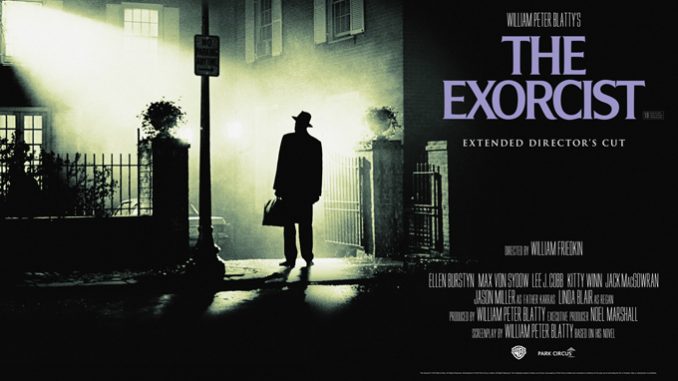
William Friedkin’s The Exorcist is the most famous horror movie that is also explicitly Catholic. The film, which turned 45 this year, was written by William Peter Blatty from his own novel—he won the Oscar for the screenplay. The Exorcist offers a confrontation between modern people—some faithful, others not—and evil. It looks at possession and exorcism directly, in order to highlight the difficulties and contradictions in our understanding of religion and science, of morality and psychiatry. It underscores our all-too-human frailty and vulnerability. It asks us to think about how we protect the innocence of children.

The story is simple, and it gets to the horror of facing up to evil in an unflinching way. A girl, Regan (played by a fearfully young Linda Blair) is possessed by a demon; her mother (played by Ellen Burstyn) becomes aware of this gradually and we, the audience, descend deeper into fear along with her. The decision to have a mother—the absence of a father is the first of many notes of social decay in this story—in the position of audience-substitute is a canny one, and to forces us to think about the relationship between life, love, and vulnerability.

The mother tries all the doctors she can, and in despair—though she has no faith herself—she turns to a priest, Father Karras (played by Jason Miller). The powers of medicine to protect the human body from mortality and evil are limited and that limitation can cause a crisis of faith—or open the path to faith.

The priest himself is educated scientifically and his faith wavers at the best of times. He is oppressed by his powerlessness. His dedication to the Church has made him a bad son, abandoning his mother to a lonely death in poverty that makes him feel guilty. He loathes himself and wonders if he’s unworthy of his vocation, and this opens him up to temptation.

The spiritual crisis of evil is about God and the devil in a spiritual war for our souls. But there is a worldly dimension to this crisis. We see Regan’s mother and her friends—successful, upper-class people with social and artistic pretensions, who nonetheless have something wrong with them that goes beyond sins and crimes we have learned to tolerate. They are respectable, but irresponsible. A socialite party, with its levity, is interrupted by a girl who is possessed, but no one can cares to notice; it is a rebuke of the preference for respectability over a moral effort to protect the innocent.

The exorcist of the title, Father Merrin (played wonderfully by Max von Sydow), only comes to the possessed girl in the third act. Exorcism is not our first idea—it is, in fact, our last resort. This is not merely a description of our liberal, secular society, but also of Church practice, which requires adequate scientific investigation before addressing the issue of possession. At the same time, the story uses this to dramatize how incredible evil is in the literal sense—we cannot believe what we are seeing, we do not know how to deal with it.

The story establishes two further points related to this problem. First, the beginning of the movie, which would seem to have nothing to do with the story of modern America, deals with the ancient past—the archaeological digging up of an ancient idol in the Middle East. We take a scientific attitude to old ideas about evil, thinking they cannot have any power now. We take a progressive view of power: we moderns have far more power now than has ever existed before, so what is there to fear? As a society, we have achieved unimagined powers; but individually, each one of us remains mortal and vulnerable and limited.

Second, Father Merrin himself has little doubt about the true character of the problem he is facing. He is able to explain to Father Karras that the experience of evil befalling a child, perhaps our greatest fear, is about desperation, which would make us “see ourselves as ugly and animal; to make us reject the possibility that God could love us.” Redemption would seem impossible if we gave in to that desperation.

If we instead want to face up to evil, we cannot shy away from gory or disgusting sights. The film is remains hard to watch, however ugly our entertainments have become since, and it stands as a warning to those who would prefer to look away from things. The audience of the movie is forced to undergo horror in order to clarify the issue of good and evil in our fallen world—it asks that we experience some of the horror of evil, because this cannot be treated merely as an abstract matter. It asks that we admit, through our fears, that we ourselves could experience evil in a way that would shake our very being. There is thus moral seriousness in what might seem like a mere entertainment trying to get money out of shocking people.

I invite readers interested in this movie and the ideas it dramatizes to listen to my conversation with Scott Beauchamp about it in our podcast.

About Titus Techera 8 ArticlesTitus Techera is the host of the American Cinema Foundation podcasts, a contributor to Law & LibertyThe Federalist, and National Review, and a grad student of political philosophy.

Posted in Uncategorized | Comments Off on The Exorcist offers a confrontation between modern people—some faithful, others not—and evil. It looks at possession and exorcism directly, in order to highlight the difficulties and contradictions in our understanding of religion and science, of morality and psychiatry. It underscores our all-too-human frailty and vulnerability.

GEORGE NEUMAYER TAKES A CRITICAL LOOK AT THE LIFE AND INFLUENCE OF THE LATE CARDINAL JOHN WRIGHT

Sunday Report

What Begins in Bad Theology Ends in Police Raids

December 2, 2018, 12:01 am

Prosecutors busting into chanceries is the new normal under Pope Francis.

Cardinal Daniel DiNardo, whose Galveston-Houston chancery was raided this week by prosecutors in search of abuse-related files, always struck me as a pretty haunted and compromised figure. DiNardo came out of Pittsburgh and the corrupt milieu of Cardinal John Wright, who was an accused pederast and a mentor to such slimy prelates as Donald Wuerl. Google DiNardo and Cardinal Wright and a creepy picture comes up of a young DiNardo sitting next to Wright in a white tuxedo. Wright liked to dress his seminarians up in such attire, just as Wuerl would later delight in having his young priests wear waiters’ uniforms and serve appetizers at parties held at his Pittsburgh mansion.

Many of the tributaries from the Church’s river of filth flowed out of Wright’s Pittsburgh. Wuerl, for one, who served as Wright’s secretary for many years, learned his nasty and self-indulgent clericalist habits at Wright’s knee. In the New York Review of Books, Garry Wills once recalled Wright’s life soaked in opulence, entitlement, and delusion:

In the early Sixties, I spent a day with John Wright, then the bishop of Pittsburgh, who loved to sweep around town in his chauffeured limousine, greeting people with his ring thrust forward for the kissing. At one point he directed his limousine to a Church-run home for deserted pregnant women, an admirable institution. Before we went inside, he had the chauffeur open the car trunk, which was entirely filled with large boxes containing Barbie-like dolls. (They may have been Barbies, in fact; I could not have told, since I was not then familiar with the product.) He told me a Catholic businessman had given him the dolls to hand out as presents, so he had the chauffeur load his arms with these toy-adult figures to bestow on the expecting mothers. His satisfaction in playing Lord Bounteous made it impossible for him to recognize the ludicrous inappropriateness of the gifts. They were infantilizing tokens, delivered by one who was himself infantilized. 

Back in his mansion, the bishop took me to a large locked room that contained his favorite treasures — books, manuscripts, relics, memorials, paintings, and statues, all of them celebrating Saint Joan of Arc. He boasted that he had every movie made about his heroine, beginning with silent treatments. He had projection equipment to show them all, and said that he had not only been an expert adviser for the 1948 film Joan of Arc, but got to know its star, Ingrid Bergman. Some Catholics censured Ms. Bergman after she publicly deserted her husband a year after Joan of Arc’s release; but her contribution to his self-importance made Wright forgive her. I left the mansion certain that I had been in the presence of a large fat baby who would never grow up. Later, as a cardinal appointed to the Curia in Rome, he would prove that he could be more pompous than any Italian prelate.

But that “large fat baby” was very dangerous. “Wright’s pederastic predilections were an ‘open secret,’” writes author Randy Engel (whose book, The Rite of Sodomy, details a specific accusation of abuse leveled at Wright by Bill Burnett). Wright was one of the godfathers of a high-living, dilettantish Gay Mafia within the Church, which not even in-the-know writers from the liberal Catholic media dispute these days. 

Former Newsweek religion editor Kenneth Woodward, for example, hints at something I have long asserted: that the creepy relationship between Wuerl and Wright is critically important background which explains not only Wuerl’s rise to the top of the Church but also Wuerl’s willingness to serve as the protector of pederasts. This is a long block quote from Woodward, writing recently in Commonweal, but it is worth reading carefully both for its text and subtext:

During the nearly four decades I spent writing about religion for Newsweek, I heard numerous tales of “lavender lobbies” in certain seminaries and chanceries, told mostly by straight men who had abandoned their priestly vocations after encountering them. At one time or another, the whispering centered on networks in Los Angeles, Milwaukee, Chicago, or Pittsburgh, among other dioceses. One of the few priests to complain in public was the late Andrew Greeley, who spoke of gay circles operating in the administration of Chicago’s Joseph Bernardin, a cherished friend of his. As far back as 1968, I heard similar rumors about priests serving in the Roman Curia, mostly from Italians, who are generally more relaxed about homosexuality than Americans and unsurprised when those leading double lives are outed. What concerns me, though, is not simply personal hypocrisy, but whether there are gay networks that protect members who are sexually active.

Here it is worth revisiting the career of Cardinal John J. Wright (1909–1979) who, like McCarrick, was the subject of numerous stories about his own sexuality. Again, these came mostly from former seminarians and priests of the Pittsburgh diocese, which had a reputation during Wright’s decade there as a haven for actively gay clerics. That was especially true of the Pittsburgh Oratory, which Wright founded in 1961 as a religious center ministering to Catholic students attending the city’s secular universities. 

Wright was an intellectually gifted churchman whose reputation as a liberal in the Spellman era rested chiefly on his interest in literature and the arts and his voluminous essays on those subjects and others published in liberal Catholic magazines, including this one. In 1969, at the age of sixty, Pope Paul VI chose Wright to head the Congregation for Priests in Rome and elevated him to cardinal. It was there, in the frenzied initial years of the post-council era, that I first heard stories of his leading a double life rather openly with a younger lover. What interests me now is not the private details of this double life, but whether it influenced how he ran the congregation overseeing the selection, training, and formation of the clergy. Donald Wuerl, who recently resigned as archbishop of Washington D.C., would surely know the truth about Wright. Wuerl’s first assignment after ordination at the age of thirty-one was as secretary to then Bishop Wright of Pittsburgh in 1966. The younger priest was said to be closer to the cardinal than the hair on his head. He became Wright’s omnipresent full-time personal assistant when the latter moved to Rome, even sitting in for him during the papal conclave that elected John Paul II.

In his own lifetime, Wright never paid any price for his scandals or suffered any consequences for foisting homosexual priests on the Church. But the costs of that corruption are coming due for his protégés and former seminarians. Wuerl’s career has more or less ended in disgrace, though he hangs on under a corrupt pope as an “apostolic administrator” and a member of Vatican congregations. And now the bill has come due for DiNardo in the form of a police raid this week on his chancery. Prosecutors are said to have seized his computer and personnel files.

What began as a theological turn away from orthodoxy and rigor in the 1960s — one which double-living prelates like Wright quietly blessed, all while posturing as “center-right,” the same stance, by the way, the Wuerls fake up — is ending in police raids, bankruptcies, and weekly scandals. 

I ran into DiNardo in Baltimore at the October gathering of U.S. bishops. He was sitting on a couch in the hotel lounge alone, talking on his cell phone breezily about his Thanksgiving plans, as if he had just completed an annoying corporate gig at the Marriott. No sooner had I asked him a well-informed question about that scandalously unproductive bishops’ gathering than he was accusing me of not “loving the beauty of the Church.” 

It was a rather odd line of attack for a cardinal in the thick of one of the grossest scandals in the history of the Church. Had he learned, I wondered, such pompous clericalist stalling and misdirection from Cardinal Wright? I noticed that the slightly slouchy seminarian in Wright’s white tuxedo hadn’t changed his body language much over the years. He remains in word and posture dyspeptic and defensive, whose rank-pulling may still work on gullible Catholics but clearly no longer impresses police.At his chancery, where prosecutors are carting off abuse files he won’t give them, the “beauty” of Catholicism is hard to see.

Cardinal Daniel DiNardo (YouTube Screenshot)

Posted in Uncategorized | 3 Comments

AN INDICATION OF HOW LOW THE POLITICAL STATURE OF OUR DEMOCRACY HAS SUNK IS THE PUSHING OF THE EX-CITY COUNCILMAN (OF El Paso, TEXAS) AS A FRONT-RUNNER FOR THE PRESIDENCY IN 2020

Political Hay

Calling O’Rourke

December 3, 2018, 12:05 am

The left’s nauseating love affair with “Beto.”

One of the more mystifying outcomes of the recent midterms, particularly as the nation reflects on the full life and multifarious accomplishments of George H.W. Bush, has been the elevation of Robert Francis O’Rourke to the top tier of potential presidential contenders. In response to a recent Morning Consult poll, registered Democrats ranked the losing Senate candidate among their top three preferences for the party’s 2020 nomination. They favored “Beto” over Elizabeth Warren, Cory Booker, Kamala Harris, Sherrod Brown, et al. The only two potential candidates who ranked higher than the Texas congressman were septuagenarians Joe Biden and Bernie Sanders.

Part of O’Rourke’s popularity is due, of course, to the amount of sycophantic media coverage he has received pursuant to his failed bid to unseat Senator Ted Cruz. The volume and tone of this coverage should not be contemplated during or immediately after eating. Politico, for example, just published a lengthy piece comparing Beto to Abraham Lincoln. I’m not kidding. And Politico is by no means the only publication to do so. In fact, O’Rourke has himself suggested a none-too-subtle connection between his own career and that of the Great Emancipator. Three weeks ago he published a solipsistic blog post about a morning run, which took him (Surprise!) to the Lincoln Memorial:

I walked over to the north wall and read Lincoln’s second inaugural address. My body warm, blood flowing through me, moving my legs as I read, the words so present in a way that I can’t describe or explain.… Picked up my run as I headed due East, now on the south side of the reflecting pool. Snow in my face, the flakes smaller, more biting now, maybe sleet. It had changed. My knee no longer hurt.… I wondered if the winds had changed too.

You can’t say you weren’t warned if you are now wiping vomit from your screen. It goes without saying that O’Rourke’s self-indulgent verbal slush fails to note that the inaugural address which so moved him would never have been delivered if Lincoln hadn’t defeated his northern Democratic opponent in 1864. The ability to recognize such irony requires the kind of intellectual subtlety with which Lincoln was so generously endowed and which neither nature nor education has provided Beto. Such subtlety has also been cruelly withheld from his media boosters as well as his star-struck supporters, who actually believe he has Lincoln’s greatness plus Barack Obama’s voter appeal.

Some Democrats remain immune to “Betomania,” however. Last week Rahm Emanuel warned that it was dumb to bet the 2020 presidential contest on a loser: “If Beto O’Rourke wants to go and run for president, God bless him. He should put his hat in and make his case. But he lost. You don’t promote a loser to the top of the party.” He is also being urged not to run for president by Democrats who see the need to show strength not merely at the top of the ticket but further down the ballot as well. Christopher Hooks writes in the Texas Observer that young Democrats like O’Rourke should work on rebuilding the party at the state level where it was damaged during the Obama era:

The nationalization of American politics and an overemphasis on the top of the ballot is a nationwide sickness, but it mostly afflicts the Democratic Party. In 2008, Democrats won the presidency and then forgot about the rest of politics — the state legislatures, the governors’ mansions — and, as a result, they spent much of the next decade in political hell.… Democrats lost control of the state legislatures in charge of redistricting, which begat election wipeouts.

Hooks has a point, of course, but this kind of long-term thinking requires a politician to put the good of the party before his own ambitions. This characteristic was conspicuously absent from Barack Obama’s personality. And it isn’t exactly Beto’s most prominent attribute. Throughout his Senate campaign, he insisted that he wouldn’t be a candidate for president in 2020 regardless of the outcome. But a week ago he executed a vertigo-inducing pirouette. When asked if he was still adamant about not running for the presidency in two years he told a group of reporters, “Amy and I made a decision not to rule anything out.” This immediately produced a tsunami of op-eds to the following effect:

Beto O’Rourke should reach for the gold ring. He’ll never be hotter than he is now. He is only 46 years old, charismatic, articulate and is the darling of social media. He can clearly raise a ton of dough. O’Rourke raised more than $70 million for his Senate campaign in Texas against incumbent Republican Ted Cruz.… O’Rourke should strike while the iron is hot. Shrinking violets do not become presidents.

If O’Rourke follows such stomach-turning advice, he will be doing President Trump a real favor. Beto will do fine in places like Austin and other college towns. But he’ll flop in the places that cost Hillary Clinton the 2016 election — the big city precincts where the African-American vote is crucial to any candidate’s success. From 2012 to 2016, black voter turnout dropped dramatically and clearly demonstrated that no Democrat can win without generating a level of enthusiasm among minorities comparable to that which Barack Obama enjoyed. A white bread candidate like Beto, with a skateboard and a billionaire wife, will never cut it. The left’s lovesick yearning for Beto will not end well.

Posted in Uncategorized | 1 Comment

THE TRUMP ADMINISTRATION IS PROTECTING CHILDREN BEING SMUGGLED INTO THE United States BY CHILD TRAFFICKERS BY CHECKING THE DNA OF THE CHILDREN AGAINST THE DNA OF THE SUPPOSED ‘PARENT’ WHO ARE SEEKING TO BRING THE CHILDREN INTO THE United States

© 2018 NEON NETTLE

 DNA Tests Expose Child Traffickers Abusing Immigration Loopholes at the Border Officials report a number of children are unrelated to ‘parents’ they are traveling with

By: Jay Greenberg  |

@NeonNettle on 13th July 2018 @ 7.00pm 

DNA tests reveal a number of children are not related to the ‘parents’ they were separated from As border agents enforce the Trump Administration’s policy to reunite migrant families separated whilst crossing the US/Mexico border, officials are reporting that DNA testing is showing that a number of children are not biologically related to the so-called “parents” they are traveling with.

Immigration officials tasked with reunifying families separated after illegally crossing America’s southern border fear that the testing is exposing loopholes that are being abused by child traffickers.After conducting testing and background checks on “families,” investigators have also discovered unrelated individuals claiming to be parents of children are actually dangerous criminals.It has long been suspected that Mexican cartels run child trafficking operations across the border by sending children to high-paying “clients” in the United States with operatives posing as parents.

According to border agents, the recent growing fear of separating families at the border has created loopholes in the immigration protocols that child traffickers may be taking advantage of.

An estimated 100 children under the age of 5 were separated under the policy imposed earlier this year, according to a report by The Washington Times. © press Mexican cartels are thought to be running child trafficking operations across the border The Western Journal reports: Even as a judge’s deadline for reunifying those families loomed this week, the administration acknowledged that just 38 of those young children had been returned to a parent’s custody.Sixteen other children were said to be near the end of the reunification process but their cases were still pending ahead of some final security checks.

In most of those cases, officials were awaiting the results of DNA tests to confirm a parental relationship with individuals who had already passed a background check.In at least one of the unresolved cases, a parent’s background check had not yet been completed.U.S. District Judge Dana Sabraw issued an order last month that the government must reunite the youngest children within 14 days.That deadline expired on Tuesday. Children older than 5 were ordered to be reunited within 30 days of the order.Federal authorities say they could not meet the earlier deadline due to a number of factors that made releasing the children into a parent’s custody unsafe or impossible

.In at least five cases, government records indicate an individual claiming to be a child’s parent was proven through DNA testing to not be related. Avoid Internet censorship by subscribing to us directly.  DNA testing has shown a number of children are not related to the ‘parents’ they were traveling with Another eight adults were not reunited with children they were traveling with because they were flagged for a serious criminal history including charges including murder and kidnapping.In these cases, officials determined that the children were not safe in the custody of those adults.

Sabraw addressed the government’s concerns in court on Tuesday and was unsympathetic to the excuses presented.“These are firm deadlines,” he said.“They’re not aspirational goals.”The judge told officials that they were still expected to abide by the previous ruling and that roadblocks along the way were not sufficient to cause delay to family reunification.A second deadline is approaching.Sabraw’s ruling mandates that children between 5 and 17 be returned to their parents’ custody by July 26.

Only a small fraction of the more than 2,000 children separated at the border fell into the youngest category impacted by Tuesday’s deadline.Nevertheless, those 102 cases presented a host of concerns the federal government faces in attempting to reunite these families.In addition to the issues described above, at least a dozen children under 5 arrived with parents who have since been deported.Eight more parents were released into the United States and have not undergone complete safety checks, officials say.

Among the other unusual circumstances is one parent who has been missing for more than a year and who the government thinks could possibly be an American citizen, along with the child.Health and Human Services official Chris Meekins defended the process by which federal agencies vet parents before reuniting them with their children.“Our process may not be as quick as some would like but there is no question it is protecting children,” he said.

READ MORE: https://neonnettle.com/news/4520-dna-tests-expose-child-traffickers-abusing-immigration-loopholes-at-the-border
© Neon Nettle

Posted in Uncategorized | 2 Comments

Patrick Deneen’s powerful critique of American liberal democracy has moved several Catholic writers to reconsider their church’s relation to it.


Patrick Deneen’s powerful critique of American liberal democracy has moved several Catholic writers to reconsider their church’s relation to it. Among the best of these efforts since Deneen’s Why Liberalism Failedcame out earlier this year was a provocative essay published by American Affairs entitled, “The Eclipse of Catholic Fusionism.” Author Kevin Gallagher declared therein that the prominent Catholics who had worked with political conservatives during the 1980s and 1990s to defend free-market principles were “adulterating the faith” with alien ideas and ignoring the “American Church’s long-standing skepticism of free-market economics.”

In Gallagher’s telling, American Catholics who helped shape the Republican Party’s politics from the Reagan presidency through those of George H.W. Bush and George W. Bush had to make ideological compromises that sapped Catholicism of its mission and shrouded the truth of its spiritual and moral claims. Supposedly what is needed to restore that mission is “a Catholicism more critical of the mainstream of American thought.” But the fact is that previous generations of Catholic Americans, well before the likes of Richard John Neuhaus, Michael Novak, George Weigel, or Robert George came on the scene, had shaped the mainstream of American thought.

To that tradition Gallagher pays scant attention, so great is his zeal to criticize the above-mentioned group. While a brief essay cannot cover the entire history of American Catholicism before the 1980s, it will attempt to show how misunderstood the relationship between liberal democracy and Catholicism has become recently. What follow are glimpses of history that will reveal that the “integralism” at work in Gallagher’s piece is just as foreign to the Catholic faith in America as Lockean liberalism is.

Carrollian Conciliarism

Starting before the time of the Revolutionary War, American Catholics began to offer a republican interpretation of Catholicism that, though devoted to representative government, nonetheless opposed classical liberalism, whether grounded in Protestant or in purportedly secular foundations. The originators of this interpretation were the most prominent Catholic Founders, the cousins Charles Carroll of Carrollton (the only Catholic signer of the Declaration of Independence) and John Carroll, a Jesuit priest who became the first American Catholic bishop.

The republican interpretation was developed across generations of Catholic leaders, including Archbishop “Dagger” John Hughes of New York, Archbishop John Ireland of St. Paul, Venerable Fulton J. Sheen, and Father John Courtney Murray. These figures had no patience for Lockean liberalism, but neither did they have any patience for the declining throne-and-altar politics that were slowly failing Europe and the Catholic Church in its seat in Rome.

Charles and John Carroll had undergone an English and French Jesuit education at a time when the Jesuits were partially suppressed in Europe, and much of what they learned from their teachers was a republican reinterpretation of Catholic political theology. As Michael Breidenbach has argued, conciliarists insisted, first, that infallible statements of doctrine came with the assent of councils of bishops in conjunction with papal authority, thus linking the Pope’s executive authority to the legislative collective authority of the bishops. Second, conciliarists denied that the Pope had any claim to temporal governance of a state. Papal authority was purely spiritual and moral, and his influence could only come in the form of counsel or indirectly through the instruction of the faithful. While the first tenet of conciliarism faded in America, the second remained a critical component for integrating the Church as a minority faith into the republic.

The Carrolls deployed conciliarism to ground their defense of the rights of conscience and the cause of American independence from Britain. Defense of these rights was the best that Catholics, a small minority in America, could hope for in a new nation whose constituent states, such as New Hampshire and Rhode Island, barred Catholics from voting or holding office. Even their fellow patriot John Jay expressed to the 1788 New York Ratification Convention a desire to deny Catholics property and civil rights.

The Carrollian conciliarist tradition continued into the next generation of Catholic leaders, who had to contend with the rapid increase in immigration to the United States from Catholic Ireland. One of the most famous of these leaders was Archbishop “Dagger” John Hughes of New York, so nicknamed because of the cross that bishops traditionally place before their signatures and its resemblance (in the eyes of American Protestants) to a dagger aimed at the heart of the Republic.

In 1840, New York Governor William Seward offered to help Bishop Hughes secure state funding for the Catholic schools in New York City. The schools were struggling to stay open despite Hughes’s successful fundraising in Catholic capitals in Europe. Protestants dominated the Common Council, which was responsible for distributing state funds in the city, and Hughes sought to expedite Seward’s plan by requesting the Common Council allocate funds to his Catholic schools.

To justify the request, Hughes had to appear before a meeting of the Common Council, which very quickly became a war of words between New York’s Protestants and Catholics. Though he had no hope of winning the debate, Hughes affirmed the republican virtue of his flock and defended the religious liberty of the Church. Moreover, he warned that American Protestants should consider starting their own sectarian schools, as the efforts to form a consensus Protestant curriculum had produced what he derisively called “Nothingarianism.” By this, Hughes meant that it was a mishmash of ideas to which no actual Protestant subscribed and that, in effect, it taught students to be indifferent to any Christian confession. He warned that this kind of religious instruction could only end up turning young Americans into atheists.

The Republic of Ireland

After the end of the Civil War, secular organizations like the National Liberal League attempted to strip religion from public institutions. As Philip Hamburger has shown in his work, the league combined “powerfully anti-ecclesiastical fears with intense desires of an almost religious character,” while developing its own liberal versions of funerals and baptisms. After reaching the height of its influence around 1876, the league spent the 1880s tearing itself apart over whether or not to support obscenity laws. In addition, the American Protection Association and the Ku Klux Klan argued for a “theological liberalism” that specifically condemned the spiritual authority of the Pope.

It was in this context that American Catholic bishops decided, in 1884, to convene the famous Third Plenary Council of Baltimore. The nation was in the throes of a renewed anti-Catholicism when the Third Plenary gathered a scattered U.S. Catholic hierarchy in the old English Catholic refuge to assess the state of the Church in America.

In a sermon from that 1884 meeting on the relationship between the Church and the United States, Archbishop John Ireland preached that the “surest safeguards for the Church’s own life and the prosperity of the republic will be found in the teachings of the Catholic Church, and the more America acknowledges those teachings, the more durable will her civil institutions be made.”

Archbishop Ireland emphatically endorsed republican government and the rights of conscience—yet he equally emphatically condemned the “Doctrinaires” of liberalism as “liars.” Thomas Hobbes and Jean-Jacques Rousseau preached what Ireland called “political Protestantism,” a doctrine that reduced to the “sacred right of insurrection” but that contained no guidance as to when insurrection may be rightly pursued. He nonetheless insisted that the American people were the true sovereign, declaring that

There are no kings or rulers by divine right in the sense that specified men or families are directly called by God to reign, or that specified governments are authorized by Him. Rulers govern by the will of the people, and derive their just powers from the consent of the governed in the sense that the consent, the choice, of the governed is the condition upon which heaven conveys authority.

Ireland was bound up in a transatlantic dispute over the “quasi-heresy of Americanism.” Pope Leo XIII, in his 1896 encyclical Longinqua oceani and his 1899 encyclical Testem benevolentiae nostrae, reminded American Catholic clergy and laity to obey Church authority and resist the false liberty promised by a state refusing to affirm the spiritual authority of the papacy. The American bishops responded with obedience if not agreement, as the conciliar tradition continued development and awaited a champion.

Americanism and Its Discontents

During the early 1930s, Archbishop Fulton J. Sheen (granted the title of “Venerable” by Pope Benedict XVI during his cause for canonization, which is ongoing) gained national renown as the most articulate and forceful advocate for the Catholic Church in America. The Illinois-born Sheen began his early life as a priest earning the highest academic honors but, after the anti-Catholic campaigns against Democratic presidential nominee Al Smith in 1928, moved into public advocacy in print and radio. Sheen gave popular religious addresses on the Catholic Hour and published paperbacks that provided edited transcripts of the addresses, and he eventually turned this success into an opportunity to appear on television. His show Life Is Worth Living was a surprise hit during the 1950s.

Sheen was contemptuous of liberalism for the same reason that Ireland had been: that it was unbounded by any external standard. He joked that reactionaries were simply old liberals preempted by a new generation that had redefined progress as something else entirely. In a litany of jokes mocking reactionaries and liberals alike, Sheen quipped, “The reactionary believes in staying where he is, though he never inquires whether or not he has a right to be there; the liberal, on the contrary, never knows where he is going, he is only sure he is on his way.”

Liberalism, whether old or new, was “a parasite on Christian civilization, and once that body upon which it clings ceases to be the leaven of society, then historical liberalism must itself perish,” said Sheen. The body politic required nourishment from the Jewish and Christian traditions that affirmed divine limits to human political action, these limits being the rights of individuals as created by God.

Naturally, Sheen regarded the Catholic Church as the supreme authority on the spiritual teaching concerning these rights, which he called, “Americanism.” Sheen defined it thus: “Americanism, as understood by our Founding Fathers, is the political expression of the Catholic doctrine concerning man.” To illustrate, he referred to the Founding, saying that the Declaration of Independence

affirms what the Gospel affirms as religion: the worth of man. Christ died on a cross for him, and governments are founded on account of him. He is the object of love theologically and politically—the source of rights, inalienable and sacred because when duly protected and safeguarded, he helps in the creation of a kingdom of Caesar which is the steppingstone to the Kingdom of God.

Even so, Sheen was careful to affirm the ultimate truth found in Catholicism as a truth that one could not be compelled to support. Hence his indefatigable efforts to bring more of his fellow Americans into the faith through debate and persuasion. To those who would take issue with his way of proceeding, he could merely gesture at the hosts of converts he had made, including the virtuoso violist Fritz Kreisler and the stateswoman Clare Booth Luce.

Enter John Courtney Murray

The New York-born Jesuit theologian John Courtney Murray was ordained in 1933 and in 1940 became a professor of theology at Woodstock College. Within the decade, he defended the relationship of church and state in the American order, and this caused the Vatican to request that he cease publishing on the subject. At the same time, ironically, Protestants and Other Americans for the Separation of Church and State was fighting to cut Catholic churches off from any public funding at the state and federal levels for fear of “foreign” influence.

The great threat to Americanism was liberalism itself, which Murray warned was increasingly supplanting traditional religious faith in public institutions in the same manner that Hughes, the critic of “Nothingarianism,” had warned about over a century before. The abolition of religion from public schools was, as Murray argued in 1948, an affirmation of the religion of democracy “as our great contemporary myth.”

It was a myth under which

a secularist system of values, constructed without reference to God or to any human destiny beyond this world, that presents itself as higher, more unifying religion than all ‘sectarianism.’ It looks down with contempt upon the rivalries of sects, as somehow un-American. It wants all sectarian religion kept out of the public school, as divisive of the mystical unity of the American people, at the same time that it asserts itself to be the proper object of support and promotion.

After the Vatican eased its restrictions on his work, he published We Hold These Truths (1960) and saw the Second Vatican Council approve Dignitatis humanae—the Church’s affirmation of religious freedom, a statement that Murray himself had helped to compose.

In We Hold These Truths, Murray remained adamant that a “sectarian liberal” faith was a distortion of the U.S. Constitution and a threat to people of faith. For the votaries of this ersatz religion, the First Amendment had become an “object of religious faith” that was tantamount to “a religious test [being] thrust into the Constitution. The Federal Republic has suddenly become a voluntary fellowship of believers in some sort of free-church Protestantism or in the tenets of naturalistic humanism.”

The reforms of the Second Vatican Council, which was held in the early 1960s, had divisive effects among American Catholics, especially as regarded changes to the Mass. Also at issue was exactly how much of a break from prior teaching did the Church make in other respects, such as its relationship with political regimes. The inauguration in 1978 of Cardinal Karol Józef Wojtyła as Pope John Paul II (now canonized as Pope Saint John Paul II) provided the direction American Catholics needed—not just in liturgical life but in politics. The hope for many conservative Catholics in the United States was that a bridge could be built between the conservative movement and the “reform of the reform” that John Paul II ushered in to stabilize the Church in the wake of Vatican II and resume its fight against communism.

For a generation of conservative American Catholics, Pope St. John Paul II, with President Reagan and British Prime Minister Margaret Thatcher, was part of the Holy Trinity that undid the Soviet Union and ushered in decades of peace and prosperity in the United States and other Western democracies.

Integralism: An Ideology of Catholic Despair

Young Catholic intellectuals like Gallagher, born during the post-Soviet Pax Americana, seem to know little about American Catholicism before the “reform of the reform” under John Paul II, and before the general decline of episcopal leadership culminating in the clerical abuse crises of 2002 and 2018. The free market Catholicism of Neuhaus, Novak, and company during the 1980s is where they joined the conversation. They saw Catholic intellectuals show greater sympathy for the Republican Party and global capitalism than for Catholic social teachings on such matters as assistance to the poor, or stewardship of the natural world. They then saw that allegiance rewarded with perpetual delay on challenging abortion and utter failure in preventing the Obergefell decision, which was written by a purported Roman Catholic Associate Justice of the Supreme Court. Not only had sectarian liberalism succeeded in capturing American institutions, it had captured prominent members of the Church.

One can understand why these Catholics believe that American liberalism is what caused things to turn out so differently from what Neuhaus and the others had promised. However, the blame does not belong to American institutions, but to the Church. The “dyarchy” of Catholic integralism (which subordinates secular political authority to the Catholic Church) is an intellectualization of despair—an expression of their unmet desire for clear, united, and orthodox teaching by a serious, truly celibate American Catholic clergy at a time when its leadership is divided, politically compromised, and often in open, unpunished violation of celibacy vows.

However understandable their view might be, it is also wrong. Lay Catholics like Novak or priests like Neuhaus may have had cultural influence within a faction of American Catholic intellectuals, but they did not wield the direct authority of a bishop. What have the priests and bishops of the past few decades been doing to lead the faithful in the United States? Why do they not meet with their congregations in church basements to fight for conscience rights like Hughes did, or exhort them on racial equality like Ireland did, or call for the defense against totalitarianism at home and abroad like Sheen did? At best (and with some exceptions), contemporary American Catholic bishops have been pious bureaucrats. At worst, they have behaved not like shepherds but like wolves.

Laity, even those as pious and serious as Gallagher (or, for that matter, as Robert George), simply cannot do what the American bishops should be doing. Not only has the episcopacy failed to lead or even protect its congregations, even as recently as the 2018 General Assembly of the United States Conference of Catholic Bishops, there has been little sign that the situation will improve any time soon. Engaged Catholic laity have responded with outrage. If Catholics cannot look to bishops, where can they look?

No wonder Gallagher expresses concern about “the youth” and no wonder he urges a “new political vocabulary.” As it turns out, however, the “new political vocabulary” is just the old vocabulary of over two centuries of American Catholic thought. Sadly, it is just new to him.

Finally, Gallagher’s admiration for the emerging discussions of “integralism” and “dyarchy” seems to make the very mistake he attributes to Neuhaus, Novak, and the rest of the previous generation of conservative Catholics leaders—that of confusing intellectual discourse for real episcopal leadership. Worse, this discourse already shows signs of degenerating into just another ideology hearkening toward a prefabricated political regime that will somehow come to be in the distant future. In the absence of a united, vigorous episcopal leadership today, American Catholics are left with well-meaning ideologues wishing for radical chic or play-acting the formation of the People’s Integralist Front. Under such circumstances, Catholicism becomes merely an identity (with noisome sub-categories like “leftCath” or “ethnoCath”), and the theology of St. Thomas Aquinas reduced to a tool to “own the libs” on Twitter.

James M. Patterson

James M. Patterson is Assistant Professor of Politics at Ave Maria University.

About the Author

Posted in Uncategorized | 1 Comment

THE HORROR!!! THE HORROR!!! THE HORROR!!! FRANCIS THE MERCIFUL CONTINUES TO SUPPRESS AND DESTROY CONSERVATIVE RELIGIOUS ORDERS. USQUEQUO, DOMINE? USQUEQUO, DOMINE ?

Featured Image
Matthew Cullinan Hoffman

Matthew Cullinan HoffmanF


NEWSCATHOLIC CHURCHFAITH

Tue Nov 27, 2018 – 1:16 pm 

Conservative order of nuns on verge of destruction following Vatican interventions

 Bishop João Braz De AvizDiocese Of LavalFranceFranciscan Friars Of The ImmaculateLittle Sisters Of Mary, Mother Of The RedeemerRobert Le GallSr. Geneviève MédevielleThierry Scherrer

November 27, 2018 (LifeSiteNews.com) – Almost all of the members of a conservative order of nuns that serve the elderly in French nursing homes have announced that they have asked to be released from their vows following attempts by the Vatican to force them to alter their way of life and to “modernize” their order.

According to their lay supporters, the sisters have been accused of engaging in “too much prayer” and concerns have been expressed that they wear the guimpe, a traditional form of religious head covering used by nuns that is no longer in vogue among the Church’s liberal elite. The sisters say that they are accused of a “deviant authoritarianism,” of being “too classical” in their thinking, and of being guilty of an “immobilism” in their devotion to their institute’s charism.

A total of 34 of the 39 members of the the Little Sisters of Mary, Mother of the Redeemer say they want to quit the order after a Vatican dicastery removed their superior general and attempted to impose three “commissioners” on them who were hostile towards their more traditional practices.

The three commissioners are led by a religious sister and theology professor with a short haircut who does not wear a habit, one who defends Amoris Laetitia and whom the sisters have said does not understand their religious charism.

The sisters say that their protests against the choice of commissioners and their request that they receive someone else more suited to their charism have fallen on deaf ears, leading them to the conclusion that they could no longer carry out their vocation within their institute.

“After having acquired the moral certainty throughout this year that the reception of the apostolic commissioner within our Institute would cause serious and certain harm, both regarding the understanding of the charisma bequeathed by God to Mother Mary of the Cross, our Foundress, and the way of living it, after many times proposing solutions of appeasement without any answer ever having been given to us, after consulting with authorized and competent persons, after having prayed much and always with the desire to remain daughters of the Church, wanting to remain faithful and obedient to the truth, it seemed to us that we had no choice but to renounce our vows,” the sisters wrote in a public statement issued on November 7 (PDF here).

“We are therefore 34 out of 39 Sisters who are members of the Institute, who have asked to be relieved of our vows by the Dicastery for Religious,” the sisters add. “We do not make this sacrifice lightly: we desire to remain in full communion with the Church, but we cannot indicate more clearly, nor more painfully, our impossibility, in conscience, to obey what is imposed.”

The Little Sisters of Mary, Mother of the Redeemer trace their origins back to 1939 when an organization of women was founded by Mere Marie de la Croix (“Mother Mary of the Cross”), according to the lay organization that defends their cause. It began as an association of the faithful and was given the status of an Institute of Consecrated Life in 1989 by the then-bishop of Laval, Louis-Marie Billé.

According to the French Catholic website Riposte Catholique, the Institute currently includes four communities located in the dioceses of Laval and Toulouse, where they supervise four nursing homes for the elderly in the French departments of Haute-Garonne and Mayenne. They also provide catechesis and training in the spiritual life to Catholic families, and open their convents to parish and spiritual retreat groups. Their service to the Catholic faithful, however, will soon come to an end if no resolution to the conflict can be found.

Invasive visitations

The Little Sisters’ travails began in 2016, when the Bishop of Laval, Thierry Scherrer, attempted to separate one of the nursing homes of the sisters from the association that administers them, despite concerns that such a reorganization would cost millions of euros and would endanger the financial viability of the home. The sisters opposed the idea, as did the nursing home’s board of directors, who rejectedScherrer’s proposal.  

In apparent retaliation, Bishop Scherrer ordered a canonical visit of the sisters, sending two representatives to investigate them in late 2016. The result was a highly negative report, made public in June 2017, that asserted the existence of “problems of governance” in the order, a claim vigorously disputed by the sisters, who have issued strong expressions of satisfaction with their superiors. The sisters have called the report a “caricature” of their order, produced as a “pre-judgment” against them.

Both the sisters and Bishop Scherrer then asked the Holy See to resolve the dispute. The Congregation for Institutes of Consecrated Life and Societies of Apostolic Life responded in September 2017 by removing the superior general of the Institute, Mère Marie de Saint Michel, as well as their mistress of novices, and sending them away from the mother house.

The Congregation then appointed three “commissioners” to oversee the sisters, who refused to accept them on the grounds that they were unsuited to their charism, and asked that other, more suitable commissioners be appointed. When this was refused, the sisters appealed to the Supreme Tribunal of the Apostolic Signatura, the highest court in the Catholic Church. The sisters say that in August the Tribunal ruled against them without allowing their canon lawyer to present his arguments, which the sisters denounced as unjust.

Meet the new boss: habitless Sr. Geneviève Médevielle, a defender of Amoris Laetitia

The Vatican is attempting to impose on the order Sr. Geneviève Médevielle, the principal among the three commissioners. Médevielle is a religious sister who dresses in lay clothing and wears a short haircut without a head covering. She is a professor of ethics at the Catholic Institute of Paris and the author of the recently-published book “Migrants, Francis, and us.” Médevielle writes in defense of Amoris Laetitia against “conservatives and traditionalists” who criticize it.

Marcel Mignot, president of the Association of Support for the Little Sisters of Mary, told the French publication La Croix, “The Little Sisters are reproached for praying too much, and they also want them to change their habit. They want to modernize them and make them evolve by taking them away from their roots.”

Médevielle denies the claim that she wants to transform the Institute, responding to La Croix, “I want to respect them, not to transform them! If there are changes, they absolutely will not concern their charism.”

However, according to the sisters’ Association of Support, “the commissioners have likewise announced the general outline of their project of reforming the congregation. The Little Sisters, have, in effect, clearly seen the evolutions that await them, towards a supposed modernity, made of progressive trivialization if they allow Sr. Medevielle take the reins of their institute, with the support of the Dicastery.”

“The latter has stated, following a meeting, ‘We won’t touch your charism at all, but rather your way of living it.’ That says it all!” the sisters’ lay supporters add.

“The goal that is sought is not to establish the truth and to allow the Little Sisters to continue their mission for the benefit of all, with respect for their charism,” the sisters’ supporters write. “The only goal of Rome is to complete the project of Bishop Scherrer: to gain control over the Institute to make it evolve in accordance with his views, whether it be in defiance of the truth, whether it be in defiance of the rights of the defense, whether it be by recourse to lying. It is, at least, unworthy of the values promoted by the Holy Father whenever he speaks publicly.”

In the meantime, the commissioners insisted that they would conduct a visitation, despite the appeal, and threatened to remove the sisters from the Institute if they refused to allow them entrance. They dismissed the fact that the sisters were in the process of appealing the commissioners’ appointments, claiming that it did not provide them any legal relief from the obligation to obey. The sisters then relented and allowed the visitation, which seemed to confirm their worst fears.

‘Intimidation, threats, and manipulation’

According to the sisters’ Association of Support, the three commissioners sought to meet with each sister individually to pit the sisters against one another, suggesting that if they cooperated they could have positions of importance in the new reorganized Institute.

“The visits have been carried out under duress, in the form of an individual interview with the Little Sisters, who were alone facing two commissioners…the latter, based on the profile of the sisters, would try to reassure some, while seeking to lure others with ‘good positions’ within the future organization of the congregation…As if the principal objection of this operation were to open a breach within the unity of the Little Sisters, in the hope of dividing them, while there prevails a beautiful communion  among them.”

“The methods used, a mix of intimidation, threats, and manipulation, feel like moral harassment to many sisters,” they add.

Sisters exonerated – but Vatican refuses to lift penalties

Following the visitation by the commissioners, a new report was issued on the state of the Institute in June of this year. According to the sisters’ Association of Support, the second report recognized that “many important elements in the first report of the canonical visit of 2016, on the basis of which the sanctions would be imposed, did not reflect reality.”

“They admit that the sisters constitute dynamic communities and that the spirit that reigns is positive. They only highlight some some rather banal criticisms, which don’t compare to the complaints made in the initial report,” the sisters’ supporters write.

Despite being vindicated in the second report, however, the sisters have been told that the sanctions placed on them by the dicastery will not be lifted. “The Little Sisters are stupefied!” writes the Association of Support. “They do not cease to express their indignation in the face of this fallacious report, demanding that justice be done for them, that all of the baseless and degrading sanctions be lifted.”

The sisters complain that while the accusation against their superiors of being too heavy handed is contradicted by the testimony of the sisters themselves, the Vatican itself has been extremely authoritarian in the way it has treated the sisters.

“Even though the superiors would be accused of a ‘deviant authoritarianism,’ as the first report says, here is obedience suddenly brandished as a duty without appeal, without the concern of a right conscience having a say in it, without ever having been explained to us the least objective foundation of all these Roman measures,” the sisters write in their most recent public statement. “So would there be two weights, two standards in this affair?”

In addition, the nuns write that one of their houses in southern France has been targeted by the Archbishop of Toulouse, Robert Le Gall, who has prohibited them from attending their more traditional form of Mass in their community chapel. This appears to be the same house that has refused to participate in Le Gall’s Mass at the local nursing home, presumably because of differences over liturgical practice. The house is located in Castelnau-d’Estrétefonds, to the north of Toulouse, in Haute-Garonne, and is led by Sr. Marie-Liesse Laplace.

Vatican sends ultimatum: submit or be dismissed

Finally, in September, the Cardinal Prefect of the Congregation for Institutes of Consecrated Life and Societies of Apostolic Life, João Braz de Aviz, sent an ultimatum to the sisters, requiring them to accept Sr. Geneviève Médevielle as their authority “without reserve” or face dismissal from the Institute. The vast majority have asked to be released from their vows, rather than submit to Médevielle. No announcements have yet been made regarding the response of the Holy See.

The sisters passed through a similar trial in the 1970s, when officials of the Holy See attempted to force them to join other institutes. The sisters resisted and expressed their preference for losing their status as religious rather than entering another institute, according to the Association of Support. However, their congregation survived the ordeal.

The sisters have stated publicly that they wish to see the public alerted to their situation, and to come to their aid in resisting what they regard as a grave injustice against their institute and its charism of aiding the suffering at the end of life. Contact information for those interested in supporting and defending the Little Sisters can be found at the bottom of this article.

The apparent persecution of the Little Sisters has garnered much media attention in France, and has been covered on television as well as in print media. The mayor of Saint-Aignan-sur-Roe, where the mother house of the sisters is located, is publicly supporting the sisters.

“I have trouble understanding this power struggle,” Mayor Loïc Pène told the newspaper Haut Anjou. “The Sisters have my full support because I know what they represent for the town. They are well integrated and it is of local interest that they remain present. I am well aware of everything they bring. All they do besides, they do well. I only hope for a happy ending to this conflict and that the nursing home does not end up being weakened.”

A representative of the Diocese of Laval told the same newspaper that the sisters have caused their own suffering by resisting the authority of Rome. She also claimed that the reform measures the commissioners are seeking to impose were already in the works years earlier.

“The situation is difficult, it is true, so much so that it is now in the hands of Rome. But from the beginning we have been involved in adjustments and recommendations and not at all in conflict or grievances,” said diocesan spokeswoman Véronique Larat. “The adjustments, by the way, had already been proposed by Bishops Billé and Maillard, the predecessors of Bishop Scherrer. He simply took a position in continuity with them.”

“The Sisters are very troubled by this situation due to [their] disobedience, [and] many people are suffering,” Larat added. “We are still calling for reconciliation and for them to allow the pontifical commissioner appointed by Rome to join them.”

Commenting on the impending destruction of the order, Risposte Catholique wrotein September: “Everywhere these nuns are very much loved by the clergy and the people. What will become of the forty or so nuns who will no longer be? What are we going to do with their retirement homes, the elderly they welcome, the staff who are employed there? We thus see bloodless dioceses amputate their last living forces, in a sort of self-annihilation of moribund churches.”

Institute of Franciscan friars destroyed in a similar way

The destruction of the Little Sisters of Mary, Mother of the Redeemer follows a pattern similar to the Vatican-induced collapse of the Franciscan Friars of the Immaculate (FFI), an order of Franciscans that followed a more traditional pattern of community life and that made free use of the traditional Latin Mass in accordance with the rites prevailing in 1962. Although the friars were within their legal rights to use the traditional form of the Mass in accordance with the papal motu proprio Summorum pontificum, their order came under attack for such practices by Bishop Braz de Aviz and others who frowned upon them. Among them, it seems, is Pope Francis himself.

Just as in the case of the Little Sisters, Braz de Aviz brought about the removal of the superiors of the FFI from their positions, and even the founder, Fr. Stefano Maria Manelli, was sent into house arrest at the age of 81. Five years later, he remains under house arrest. Other superiors were sent to remote houses of the order.

Likewise, a commissioner was placed over the order, Fr. Fidenzio Volpi, who seemed implacably hostile to the order’s charism and its works in general. Under his leadership, the FFI’s seminary was completely shut down, as was its book publishing service. A majority of the brothers left and were incardinated in other dioceses, and at least 15 cloisters of the order reportedly have closed their doors. The Traditional Latin Mass was only permitted by special permission from the commissioner.

Moreover, just as in the case of the Little Sisters, the members of the FFI never were given any specific reason for the imposition of the commissioner, except vague hints that they were too “traditional” for the tastes of the Vatican authorities, including, presumably, Pope Francis, who has refused to accept appeals from the order’s members. Within a few years, a thriving and beloved institute of Franciscans had become a shell of its former self.

Contact the author at mhoffman@lifesitenews.com.

Contact information:

Association of Support for the Little Sisters of Mary, Mother of the Redeemer

Main webpage in English: https://www.soutienpsm.com/severedifficulties

(You may also select French, Italian, or Spanish at upper right of webpage.)

Chez Mr Marcel MIGNOT
1 Avenue de Montréal
Résidence Montréal 2
72000 Le Mans
​Email: soutienpsm@gmail.com

To sign the petition of support: https://www.soutienpsm.com/signer-la-petition-anglais

Click here for links to coverage by the French blog Riposte Catholique (can be translated to English easily with Google Translate – in Chrome browser right click on webpage and select “Translate to English”).

Posted in Uncategorized | 1 Comment