

SAVE YOURSELF FROM THIS CORRUPT GENERATION

Fr. Rutler’s Weekly Column

April 22, 2018
   The Funeral Oration of Pericles, the statesman who helped make Athens great, honored the soldiers who died in the first phase of the Peloponnesian War, during which Athens took on Sparta. (If you will pardon the prejudice, that was like New York taking on Chicago.) Given in the winter of 431 – 430 B.C., Pericles’ oration extolled Athenian civilization at its height on the precipice of destruction. (The Athenian fleet would later sink into the waters off Aegospotami.) It is a model of eloquence, as transcribed in a very difficult Greek by the historian Thucydides. Esoteric grammarians enjoy its display of such devices as anacoluthon, asyndeton, hyperbaton, and the rhythmic proparoxytone that is absent from the rhetoric of contemporary politicians and prelates, although it occurs unintentionally at times in text messages and various forms of social media.

Imagine listening to this, declaimed without a microphone, over the bones of the dead: “For we have a peculiar power of thinking before we act, and of acting, too, whereas other men are courageous from ignorance but hesitate upon reflection. And they are surely to be esteemed the bravest spirits who, having the clearest sense of both the pains and the pleasures of life, do not on that account shrink from danger.”

Abraham Lincoln’s soul absorbed the Athenian ideal, and his address at Gettysburg has been compared to the Periclean oration, even though it had only 272 words while an English translation of Pericles has about 3,375. Pericles would die of the plague the year after he spoke, and Lincoln would be shot a year and a half after he left the cemetery in Pennsylvania.

Those speeches were animated by natural virtue, moved by classical piety for lives heroically sacrificed for high ideals. But for the greatest speech of a mortal, I nominate the Pentecost sermon of Saint Peter (Acts 2:14-41) with its sequel, Acts 3:12-25, translated into about 532 English words. Peter’s fishing village of Capernaum boasted no school of rhetoric, and Jerusalemites mocked the Galilean accent of his Aramaic, which was not an elegant language to begin with. (Ignore the dangling participle; even Pericles used it from time to time.) When Peter had finished, more than 3,000 people begged to be baptized.

There are too many speeches today, and public figures spout off daily, often bereft of the Athenian custom of “thinking before we act.” Lost is classical reserve, and, in the Church, there is a fatal weakness for inflated rhetoric, naïve instead of innocent and optimistic instead of hopeful: New Pentecost, New Springtime, New Evangelization. Perhaps because of such delusions, in just the last half-dozen years, the number of Millennials—who are the future of our culture—receiving ashes at the start of Lent has dropped from 50% to 41%. The non-dogmatic and non-threatening oratory of our current ecclesiastical culture would have better results if it simply translated Saint Peter’s lumpish Aramaic: “Save yourselves from this corrupt generation.”

Posted in Uncategorized | 1 Comment

HERE IS YOUR DOSE OF SATIRE TO HELP YOU COPE WITH THE REVELATION TODAY THAT A LOT OF BISHOPS ARE REALLY JUST JELLY BABIES

Eccles and Bosco is saved


English bishops to be replaced by jelly-babies

Posted: 20 Apr 2018 02:37 AM PDT

Following a report describing the Catholic Bishops’ Conference of England and Wales as a “spineless bunch of jellies”, Pope Francis has decided to dismiss all the bishops and replace them with jelly-babies. “They may be a little rigid,” he admitted, “but they’re a lot cheaper to maintain, and most people will notice very little difference.”jelly babies

Your new-look bishops. Cardinals in red, of course.

Although individually some of the bishops (Egan, Davies, …) do regularly show signs of non-gelatinous behaviour, it has been noticed that, when they gather together, their collective decisions are a disaster. It is best to clean out the fridge entirely, and start again.

This week, the bishops had a four-day party in Hinsley Hall, Leeds, and were fortified by a massive supply of cinnabons left over from Arthur Roche’s days and some vintage Nuits Saint Geoffrey Boycott (Yorkshire Burgundy).

The bishops must have considered making a joint statement on the decision of Ealing Council to promote the culture of death (abortuaries), block free speech, and ban vigils. This would have offended the pressure groups 40 Days for Death and Bad Counsel Network, of course, and made the Catholic Church do something that Jesus never intended – shine a light into the darkness of secular death-culture. Bishop Egan, to his credit, had already spoken out, but we have failed to locate any statement from the Cardinal Archjelly of Westminster.

jelly

The CBCEW pose for a group photo.

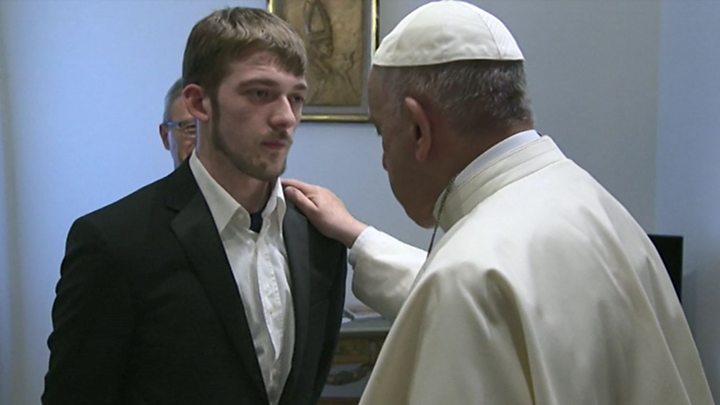
More bizarrely, the jellies issued a statement on the Alfie Evans case, in which the State is trying to enforce euthanasia on a child whose illness has not been properly diagnosed, going against the wishes of the parents to seek treatment away from Alder Hey hospital. Apparently, it is in the “best interests” of the child that he be bumped off (and sadly, we think this will ultimately happen); if you have any comments suggesting the removal of life-support facilities (such as food and drink) from brain-dead members of the judiciary, you should probably keep them to yourself.

It’s nice, once in a while, to see something good in Pope Francis.

What the bishops didn’t notice, in their cinnabon-induced stupor, is that Pope Francis is sticking up for Alfie. Said a spokesman for the Liverpool Archdiocese, “We didn’t even realise that Alfie was a Catholic. Next you’ll be telling us that Archbishop McMahon is a Catholic, ha ha ha.” So that puts paid to Vincent Nichols’s dreams of being Pope Francis II, and we’ll probably end up with Tobin instead. Nighty-night, Catholic Church, we did love you, Baby.

LATE NEWS: Cardinal Vincent Nichols has issued an angry statement on the Pope’s decision to replace him. “Wobble, wobble, blobble, globble, wobble!” he says. That’s telling him!

Posted in Uncategorized | Comments Off on HERE IS YOUR DOSE OF SATIRE TO HELP YOU COPE WITH THE REVELATION TODAY THAT A LOT OF BISHOPS ARE REALLY JUST JELLY BABIES

SHAWSHANK WORK GROUP

1524261149902blob


WHO IS MISSING ???

Posted in Uncategorized | 4 Comments

THE NUMBER OF AMERICANS WHO ARE SICK MENTALLY GROWS EXPONENTIALLY DAY BY DAY, SOON THEY WILL BE THE MAJORITY AT WHICH TIME WE WILL SING “FLY ME TO THE MOON”

Prof. Randa Jarrar, far left, celebrated Barbara Bush’s death, and the suffering of those who mourn her (YouTube screenshot)
Randa Jarrar, Symbol Of Left-Wing Academic Privilege
.

.

.You will have heard, most likely, of Randa Jarrar, a professor of English at Fresno State University. Her Twitter account is locked at the moment, but this is what brought her to infamy this week:

Randa Jarrar is a terrible person, repulsive in every way. Damon Linker gives a bit more information about the Jarrar case:

For readers who don’t follow the online political outrage machine: Jarrar took to Twitter shortly after the death of former first lady Barbara Bush to denounce her and the Bush family in vicious and vulgar terms. “Barbara Bush was a generous and smart and amazing racist,” she said in one tweet. “I’m happy the witch is dead,” she said in another. Her tweets quickly went viral — the original ones as well as follow-ups in which she bragged about her six-figure salary and invulnerability as a tenured professor, taunted the president of her university (Joseph Castro), and posted a phone number that was ostensibly her own but turned out to be the number of a crisis hotline that was soon overwhelmed with calls from people irate about her provocations and clamoring for her to be fired. Within 24 hours, Castro had announced that Jarrar would be investigated, and indicated that she could well lose her job after all.

I saw the Jarrar tweets when they first appeared, and decided that I didn’t want to dignify them by posting them. I know, right? Shocking for me to resist the opportunity to indulge in Dreherbait. But I did, because what Jarrar said was so beyond the pale of decency. However, her case has become a test of free speech principles.

My basic stance is that as deplorable as she is — listen to her various rants for more — protecting free speech means enduring speech you despise. I think Jarrar ought to be condemned — but not lose her job. Those calling for her firing over her insults to the Bush family are wrong (and note well than many conservatives and libertarians have spoken out against firing her). If the university wanted to can her for that prank to the crisis hotline, that would seem just to me. But not for her vile speech.

On the other hand, what if she had taken to Twitter to post anti-Semitic or otherwise racist statements? What if Jarrar were a thin right-wing white male who took to Twitter to dance on Ted Kennedy’s grave? Keep in mind that she did not say these things in a classroom.

Damon Linker points out that the president and board of trustees of Fresno State have a responsibility to protect freedom of expression, but they also have the responsibility to protect the university’s reputation. While Fresno State doesn’t have to worry as much about suffering from legislators punishing it, California being a very left-wing state, this is a needless provocation. The fact that Jarrar taunted her employer, saying she couldn’t be fired because of tenure, makes her a poster child for obscene academic arrogance. There are countless men and women who hold advanced degrees yet cannot find stable work in the academy — and this arrogant troll uses her extreme privilege to spite everyone.

She is not a sympathetic character.

Linker points out something true and important:

Is there any employer in any industry in the United States that would not treat an outburst like Jarrar’s as a fireable offense? The answer, I think, is no. If anything, norms against employees engaging in offensive speech have become stricter in recent years, with many insisting that public statements that demonize any person or group be punished swiftly and severely, the better to send a stern message about the importance of treating bigotry and hatred of any kind as intolerable.

Those saying that Jarrar should keep her job therefore seem to be defending the view that professors should have employment protections, even outside of the classroom and their specialized areas of academic research, that pretty much no one else in the country enjoys.

My job here at TAC involves opinion writing. I have been paid for most of my career to state my opinion. Yet no employer of mine — no newspaper, no magazine — would keep me on if I tweeted something as vile as what Jarrar tweeted. It would be devastating to the institutional reputation of these newspapers and magazines. TAC would lose donors left and right, and would take a real hit in terms of its credibility. Any magazine or publication would. I would never abuse the privilege I have. With that privilege comes responsibility.

So, today, I am much less sympathetic to Randa Jarrar than I was when she first spouted off. I still lean towards not firing her. But boy, is she ever a poster child for left-wing academic privilege and arrogance. If the university president fires her for pranking the crisis hotline, I won’t be sorry.

.

Posted in , , . Tagged , , , .
Posted in Uncategorized | 2 Comments

A Deductive System


{ABYSSUM}

The ideal form of a science is a deductive system. Like Euclid’s geometry. You start with a small number of definitions and axioms (postulates), and then you deduce all the other propositions (theorems) of the system from these axioms. The best kind of deductive system would be one in which all propositions in the system are deduced from a single axiom.

I think we can do something like this with the American cultural belief system often called secular humanism; or called, when considered as a political belief system, ultra-liberalism or progressivism. That’s what I propose to do here. I will attempt to deduce all the beliefs of secular humanism (progressivism, ultra-liberalism) from a single axiom, the axiom of personal freedom. I confess ahead of time that not all the deductions will be logically watertight; I am no Euclid. But they’ll be fairly tight.

 1. Freedom: The best of all things is personal liberty. In an ideal world, everybody would have as much of this as possible. The only limit to personal liberty would be harm to others; that is, we should be morally free to do whatever we like provided we do no harm to others.

2. Sexual freedom: follows logically from generic freedom. So long as we do no harm to unwilling others, two (or more) consenting adults should be free to perform any sexual act they like.

3. Free contraception:  If we are to have a cultural regime of sexual freedom, society, acting through government, will have to provide us with free-of-charge contraceptives to assure that unwanted pregnancies won’t result.

4. Free abortion: Since contraception, even when provided free of charge, won’t always work, abortion also will have to be provided free of charge. A regime of sexual freedom is impractical without abortion. (If it is objected to abortion that it does do harm to other – namely, it kills the unborn baby – we must deny that the unborn baby is a human being.)

5. Homosexuality: It makes no sense to allow sexual freedom to heterosexual persons without also allowing it to homosexual persons.

6. Same-sex marriage: If homosexual intercourse is morally allowable, same-sex marriage must also be morally and legally allowable.

7. Polygamy: If same-sex marriage is allowable, how can polygamy – whether in the form of polygyny, polyandry, or group marriage – be banned?

8. Polyamory: If polygamy is allowed, how can polyamory, its informal cousin, be banned?

9. Adult incest:  If we have a regime of sexual freedom, there can be no objection to incestuous relations between adult brothers and sisters (or homosexual relations between adult brothers or between adult sisters) or between parents and adult children – provided precautions are taken to prevent the birth of babies resulting from these relations.

10. Bestiality: Provided no harm is done to the animal in question, there can be no objection to sex between a human and an animal. If it is objected that this would be wrong because the animal is incapable of giving consent, it can be answered that we kill animals for food without first getting their consent. If we can kill a pig without consent, why can’t we have sex with a non-consenting pig?

11. Anti-violence: If freedom is the ultimate value, the repression of freedom is the ultimate disvalue. And of all the ways of repressing freedom, the most extreme is the use of violence. Hence, secular humanists have an intense abhorrence of violence.

12. Anti-capital punishment:  This is wrong because it is violent.

13. Anti-guns: Guns are instruments of violence, hence the fewer of them in existence the better.

14. Anti-war: War is violent. Therefore. . .

15. Anti-military: The purpose of the military is to make war. Therefore. . .

16. Pro-peace: Peace is the opposite of war.

17. Pro-diplomacy: When it comes to handling disagreements among nations, diplomacy is the alternative to war. Therefore, let us negotiate.

18. Anti-racism: Racism either takes the form of violence or tends toward violence.

19. Suspicion of police: Police are legally allowed to use guns and other forms of violence. Further, police have a reputation for using violence against blacks.

20. Suspicion of very rich people: They are greedy, and their greed leads them to take money away from non-rich people, which restricts the freedom of the latter. The rich, therefore, need to pay much more in taxes and have their industries heavily regulated.

21. Atheism: If God exists, and if we think of God as a lawgiver (the usual way of thinking of God), then God restricts our freedom by giving us laws. To be totally free, we must get rid of God.

22. Anti-Christianity: If there is no God, then Christianity is a false or invalid religion.  But since Christianity has been, in one form or another (usually a Protestant form), the kind of religion that has been dominant in America from the beginning, a fight against religion must particularly focus on Christianity.

23. A new God: Getting rid of God leaves us with a psychological vacuum. For we have always believed that there is some great power in existence that will cause the triumph of the good. But if God is no longer that power, what will it be? The state – that is, the federal government – is the most plausible candidate.

24. Growing the state: The more all-powerful the state is, and the more all-knowing it is, the more believable it is as an earthly God. And so the federal government must be given more and more power, and it must be enabled to capture more and more information about everything, including individual persons.

25. The omnicompetent state: The federal government, being God-like, can guarantee and enlarge our liberty. Therefore the state can solve all problems, can eliminate all obstacles to our freedom: poverty, ignorance, disease, racism, sexism, xenophobia, Islamophobia, hunger, floods, fires, hurricanes, tornadoes, global warming, etc.

To all of which, we might add: Boomerang. Alas, the relentless pursuit of absolute freedom ends up in something like totalitarianism.

David Carlin

David Carlin

David Carlin is professor of sociology and philosophy at the Community College of Rhode Island, and the author of The Decline and Fall of the Catholic Church in America.

Posted in Uncategorized | Comments Off on

“HE SAID,” “THEY SAID,” “WE SAID,” “YOU SAID,” “NO ONE SAID,” CONFUSION REIGNS SUPREME IN THE BERGOLIAN REGIME. BELIEVE JESUS CHRIST IN ORDER TO BE SAFE (SAVED).

German bishops deny that Vatican has rejected Protestant Communion plan

They also said that the Pope has agreed to meet Cardinal Marx in Rome.

Reports that the Vatican has rejected the German bishops’ guidance on Communion for Protestants are false, the Bishops’ Conference has said.

Several Catholic outlets have reported claims from various sources that the Congregation for the Doctrine of the Faith (CDF) had, with Pope Francis’s approval, rejected a draft plan to allow Protestants who are married to Catholics to receive Communion in certain circumstances.

However, the German Bishops’ Conference has now issued a statement saying the reports are “false”. They added that the Pope has agreed to meet Cardinal Reinhard Marx, the conference’s president, in Rome.

The German bishops voted in February to approve a draft plan to allow Protestant spouses of Catholics to receive Holy Communion after making a “serious examination of conscience” with a priest or other person with pastoral responsibilities. They must also “affirm the faith of the Catholic Church”, and wish to end “serious spiritual distress” and a “longing to satisfy hunger for the Eucharist”.

A group of seven bishops led by Cardinal Rainer Woelki, the Archbishop of Cologne, dissented from the plan and asked the Vatican to rule on whether it was permissible.

Austrian Catholic news site Kath.net reported on Wednesday that “well-informed Vatican sources” said the CDF had rejected the plan. National Catholic Register later said that Pope Francis had backed the CDF’s rejection, but asked for the letter not to be made public.

The plan was previously criticised by several prelates, including Cardinal Gerhard Müller, former Prefect of the CDF, who said it was a “rhetorical trick”.

“Neither the Pope nor we bishops can redefine the sacraments as a means of alleviating mental distress and satisfying spiritual needs,” the cardinal said. “They are effective signs of the grace of God.”

Posted in Uncategorized | 2 Comments

Here is a good reason, independent of C.S. Lewis’s stature, why his book, ABOLITION, deserves the praise heaped on it. The book addresses one of the most important questions that has been considered throughout Western and, Lewis insists, human history. Is there a moral reality woven into the fabric of the universe such that we can discover what is true about right and wrong and act accordingly?

The Best Defense Is a Good Offense: C.S. Lewis’s Abolition of Man
by Micah Watson
within Book Reviews, Natural Law, Philosophy
Apr 19, 2018 10:03 pm http://www.thepublicdiscourse.com/2018/04/19803/
A new critical edition of Lewis’s 1943 classic adds a treasure trove of supplementary material. Lewis’s warnings about the consequences of jettisoning natural law remain as trenchant today as they were when delivered during the Second World War.
Share this article:    

Almost twenty years ago Richard John Neuhaus wrote in the pages of First Things that some people can stop reading C.S. Lewis, and some others cannot, and the latter are eventually considered to be Lewis scholars. Yet as anyone who has delved into the thought of a great thinker knows, there are scholars who have published on the subject and there are scholars who almost inhabit the thought of the thinker. These scholars publish works that help us not only understand the life and ideas of a C.S. Lewis, a G.K. Chesterton, or a Thomas More, but also shape the contours of subsequent scholarship, interpreting their accomplishments afresh for a new generation one step further removed from the original context.

Michael Ward is such a scholar, ideally situated to help shepherd Lewis studies from the care of those who may have known Lewis personally to others not yet born when Lewis passed away on November 22, 1963. Educated in English at Oxford, in theology at Cambridge, and in divinity at St. Andrews, Ward lived in Lewis’s home The Kilns as Warden in the late 1990s, is advisor to the Oxford C.S. Lewis Society, author of the remarkable Planet Narnia, co-editor of the Cambridge Companion to C.S. Lewis, and has now provided a new critical edition of one of Lewis’s most important works, The Abolition of Man.Originally delivered as a set of three lectures at the University of Durham in 1943 before being published the next year, Abolition was not initially well received and remains underappreciated by the general public, even as several noteworthy and diverse thinkers—Leon Kass, Joseph Ratzinger, Francis Fukuyama, Wendell Berry, John Finnis—consider the work a classic for its treatment of human nature and natural law.

It is not hard to understand why Abolition is underappreciated by the general public, despite Walter Hooper’s describing it as “an all-but indispensable introduction to the entire corpus of Lewisiana.” It does not provide the whimsical narrative magic one finds in the Narnia Chronicles, or the fantastical metaphysical sci-fi adventurism of Lewis’s Space Trilogy. It lacks the everyman accessibility of the radio addresses Lewis gave during the Second World War that later became Mere Christianity, and couldn’t differ more in tone and genre from the psychologically and diabolically brilliant Screwtape in the letters bearing his name, or from Lewis’s iconoclastic reimagining of Hell and Heaven in The Great Divorce. Those who enjoy Lewis’s straightforward rational apologetics like Miracles and The Problem of Pain are more likely to appreciate Abolition, though there are significant differences here as well; Abolition does not defend Christianity or attempt to establish this or that proposition by positive argument.

Abolition is rather a serious work of philosophy that nevertheless does not fit the mold of how most philosophical work is done. It begins with what first seems a rather odd treatment of English textbooks for children and concludes with a near-apocalyptic warning about the future of humanity. Moreover, Lewis freely admits he will not be attempting to prove the validity of his position, because his position cannot be proven at all. Rather, he attempts to defend the validity of objective morality, which he refers to as the Tao, by interrogating the alternatives. And while this interrogation proceeds step-by-step in a careful manner, this is not a timid or mild-mannered book. The stakes are too high for that—humanity’s abolition is a weighty topic—and Lewis’s argument and conclusions are prophetic and his tone at times acerbic.

One of the challenges of writing about Lewis’s work is that he is such a clear and pithy writer. One is tempted to quote extensively or just refer the reader to Lewis’s various works, as few can match Lewis’s clarity or gift for the perfect analogy to illustrate a tricky concept. Nevertheless the seasoned Lewis reader and the newcomer alike can benefit from commentary about Lewis’s writings even as he will do best to read Lewis himself (advice Lewis himself gave about reading Plato and other greats).

Fortunately this new edition of Abolition does not make us choose. It includes the three lectures that compose the book, “Men without Chests,” “The Way,” and “The Abolition of Man,” and a good deal of invaluable secondary material laying out the biographical circumstances of the book and explaining references that may have become obscure in the seventy-four years since its publication. Indeed, Ward has done newcomers and experts alike a great service in not only providing Lewis’s text (fifty-eight pages), along with 105 footnotes, but also a thorough introduction (forty-three pages), commentary on the three lectures (ninety-six pages), questions for discussion, and a bibliography for further reading. This would be an ideal edition for one’s private collection, a book study group, or a college classroom.

In his supplementary materials, Ward does well to balance between explanation and evaluation. He brings his own perspective to bear on Lewis’s work, drawing out insights and implications that readers may otherwise gloss over or miss entirely. Some of these are well known but bear repeating, such as Lewis’s pointed avoidance of relying on divine revelation or Christian doctrine. Others are more speculative but nevertheless intriguing, such as Ward’s suggestion of a sort of intellectual if not consciously intentional lineage between Lewis’s Abolition, G.E.M. Anscombe’s “Modern Moral Philosophy,” and Alasdair MacIntyre’s After Virtue. He wisely attempts to avoid opining on whether Lewis’s arguments are ultimately successful and instead is content to provide the reader with the tools to discern what Lewis said, why he said it, and how his arguments work (or don’t).

While it is obvious Ward admires Lewis—and not entirely clear that he’s successful in suppressing his own views as to the argument’s merits—the secondary material in the book includes commentary from several strong critics of Lewis. And Ward can also be critical of Lewis’s style as well as the substance of his arguments, finding the third lecture of the book significantly weaker than the first two. Readers need not be concerned about a hagiographic treatment of either Lewis or Abolition.

Nevertheless there is also a good deal of praise for Abolition in the selections Ward chooses, and this for good reason. It is worth reflecting on why this odd little book struck such a chord with so many significant thinkers and retains such power nearly three quarters of a century after its publication. Lewis admirers could supply several reasons to read or reread Abolition, but here are three reasons, independent of Lewis’s stature, why the book deserves the praise heaped on it.

First, the book addresses one of the most important questions that has been considered throughout Western and, Lewis insists, human history. Is there a moral reality woven into the fabric of the universe such that we can discoverwhat is true about right and wrong and act accordingly? Or is morality something malleable, a tool for the powerful or for unguided evolution or for the flow of History, something that we need not discover but now that we have come of age can create and shape for ourselves? From Antigone’s challenge to Creon to the serpent’s asking “Did God really say?”—from Plato’s battle with the sophists to Pilate’s asking “What is truth?”—from Rousseau’s reimagined nature-less state of nature to Jefferson’s “We hold these truths to be self-evident”—from Nietzsche’s creative super men to today’s transhumanists—this is arguably the question that lies beneath all of our disputes and controversies.

Abolition addresses this perennial and paramount question, and in doing so takes the side of Antigone and Plato and the Bible and Confucius, and opposes Thrasymachus, Rousseau, Nietzsche, B.F. Skinner, and our modern skeptics. Whereas many of Lewis’s works describe and defend the Author of the moral law in both his special and general revelation, Abolition concerns itself only with the reality of the law itself, and the stark alternatives to a belief in objective morality. “All that is not eternal is eternally out of date,” Lewis wrote in The Four Loves, and thus, if Lewis is correct about the status of the moral law, we should expect his book to be forever “timely.”

The importance of the topic is not sufficient for the book’s standing, however, as there have been many good books written to defend moral reality that have fallen into obscurity. A second reason that Lewis’s work stands out is that it defends reason brilliantly in an age in which reason has fallen into disrepute. In his Screwtape Letters, published not long before Abolition, Screwtape notes that modern people no longer believe in reason. At one point human beings “knew pretty well when a thing was proved and when it was not; and if it was proved they really believed it. They still connected thinking with doing and were prepared to alter their way of life as the result of a chain of reasoning.” Fortunately—from the perspective of Hell—people no longer believe this. Back in the 1940s, Lewis had anticipated the advent of postmodernism, perspectivalism, and even fake news.

Lewis’s task in Abolition is therefore delicate. If people have largely rejected the legitimacy of logical reasoning, how does one make the case for the proposition that the foundational building blocks of morality cannot be established by argument, but are nevertheless real? It is quixotic to try to prove the validity of the moral law to a people averse to logical thinking, not only because of the hostile audience but because it is impossible to “prove” first principles.

Here we see a connection with a current controversy among natural lawyers, and that is how to think about the is/ought question. For Lewis’s position is squarely in the camp of those natural lawyers­­­—e.g., German Grisez, John, Finnis, Robert George—­who do not believe moral norms can be deduced from facts about human nature. Contrary to “old” natural law theorists like Ralph McInerny, Russell Hittinger, and Edward Feser, Lewis insists that “from propositions about fact alone no practical conclusion can ever be drawn.” Instead, practical conclusions can only follow from practical premises, and self-evident or basic premises at that. With theoretical reason we cannot ask for the more fundamental ground of the principle of non-contradiction, and neither in mathematical reasoning can we discover proof of the transitive principle that if A equals B, and B equals C, then A equals C. So it is with practical reasoning. “You must not hold a pistol to the head of the Tao,” Lewis avers, and so he opposes moral skeptics who demand an unreasonable examination of practical reason’s credentials as well as more friendly natural law proponents who attempt to ground the validity of natural law in observable “facts” about human nature.

Because the validity of natural law’s first principles cannot be proven, Lewis does not assume that the burden is on the natural law thinker or moral realist, as there is no common argumentative framework that can accommodate the starting premises of the radical moral skeptic and the moral realist. If Lewis’s book succeeds, it does so at least in part by portraying the stark chasm between the humanity that is in accord with objective morality and a post-humanity that sees morality as one more “reality” to be manipulated by the ethically untethered techniques of modern science and political power. It is not a work of natural law theory per se, explaining the nooks and crannies of how any particular system works. It is rather a powerful defense, an offensive defense if you will, of the reality of the natural law by means of laying out the horrors involved in the alternative.

Finally, Lewis’s book continues to strike a chord because technology has advanced enough to render questions about reengineering human nature practical and no longer merely hypothetical. While the debate about the status of morality and human nature stretches back to Antigone and beyond, the means to accomplish the abolition of man and woman seem closer to reality than they have ever been. Whereas the scientific experiments Lewis describes in Abolition and its fictional counterpart That Hideous Strength had a definite science-fiction feel to them in the 1940s, the attempts to transfer human consciousness, significantly delay or even eradicate death, and bioengineer coming generations no longer feel far off in the future. They are very much live issues.

Lewis’s point in his concluding chapter is that those who have put human nature on the dissecting table to be manipulated will no longer be guided by the morality that is, or was thought to be, inextricably connected to it. Lewis knew that some, perhaps many, will welcome this brave new world. Others of us will resist this development for the sake of all men and women with all the appropriate tools and rightful powers and prayers at our disposal. Lewis’s accomplishment with Abolition is to provide one such tool among many, and we will do well to revisit it often as the debate about who and what we are continues.

Micah Watson is associate professor of political science at Calvin College. He and Justin Dyer are the authors of C.S. Lewis on Politics and the Natural Law(Cambridge, 2016).

Copyright © 2018 The Witherspoon Institute, all rights reserved.
Posted in Uncategorized | Comments Off on Here is a good reason, independent of C.S. Lewis’s stature, why his book, ABOLITION, deserves the praise heaped on it. The book addresses one of the most important questions that has been considered throughout Western and, Lewis insists, human history. Is there a moral reality woven into the fabric of the universe such that we can discover what is true about right and wrong and act accordingly?

“NO MORE MAS” PLACE YOUR BETS

unnamed-2

Place Your Bets: The Arnobius/Pascal You-Bet-Your-Life Wager

Guy McClung

Catholic Stand  April 20, 2018


Pascal & His Wager

Blaise Pascal, 1623 A.D to 1662 A.D.,  noted author, thinker, mathematician, and philosopher, is famous for positing a thought argument about death, judgment, heaven, and hell that has come to be known as “Pascal’s Wager.”  Pascal said any rational person would live as if God exists so that one, perhaps, could live in heaven. This is a summary of Pascal’s Wager:

God is or He is not. If He is, heaven is possible, an eternal paradise in which one is forever happy, having every desired totally fulfilled. Even if one is an agnostic or an atheist, one should act now on this earth as would a true believer,  in a way which would merit such everlasting happiness – and avoid, if it exists, any eternal punishment, hell,  or everlasting fire. One should “bet,” not knowing the outcome,  that heaven does exist. One should place this eschatological wager because the possible winnings, the mega-millions of eternal happiness, far outweigh the possibility of nothingness after death.

Pascal contended that any intelligent person would see the wisdom and truth of this, and would, accordingly, live a life of virtue to “win” the wager for the afterlife.

Arnobius

Pascal was not the first thinker to posit the wager. Protagoras, a sophist philosopher (c. 490 B.C. – 420 B.C.)  lived an implicit version of the wager. Although he was an agnostic, he still continued to worship the gods of ancient Greece.

Arnobius of Sicca, an early Father Of The Church who died around 330 A.D, stated the wager explicitly in his writings. Because of his North African Berber origins, Arnobius is also known as “Arnobius Afer.” He was a convert from paganism to Christianity.

In the only book of Arnobius to survive, Against The Pagans, he states his version of the God/eternity wager:

Since, then, the nature of the future is such that it cannot be grasped and comprehended by any anticipation, is it not more rational, of two things uncertain and hanging in doubtful suspense, rather to believe that which carries with it some hopes, than that which brings none at all? For in the one case there is no danger, if that which is said to be at hand should prove vain and groundless; in the other there is the greatest loss, even the loss of salvation, if, when the time has come, it be shown that there was nothing false in what was declared.

Arnobius vigorously defended monotheism and Christianity and the divinity of Christ, particularly by asserting the rapid spread of Christianity to most of the then-known world, its civilizing influence on even barbarians, and its agreement with some of the best then-extant philosophies.  He wrote Against the Pagans  (also known as Against The Heathen) during the emperor Diocletian’s persecution of Christians to rebut and demolish pagan arguments that the woes of the times were caused by the wide promulgation of Christianity throughout the Roman empire.

Arnobius’s Prayer – Sometimes We Must Be Silent

Perhaps more uplifting than his God/eternity wager is a sublime prayer written by Arnobius.  It implicitly states many positions of faith going beyond human understanding, especially the wisdom to be preferred to some of the then-current atheistic teachings and agnostic philosophies.  This prayer has been described by one scholar as “worthy of admiration”:

O greatest, O Supreme Creator of things invisible! O You who are Yourself unseen, and who are incomprehensible! You are worthy, You are verily worthy — if only mortal tongue may speak of You — that all breathing and intelligent nature should never cease to feel and to return thanks; that it should throughout the whole of life fall on bended knee, and offer supplication with never-ceasing prayers. For You are the first cause; in You created things exist, and You are the space in which rest the foundations of all things, whatever they be. You are illimitable, unbegotten, immortal, enduring for aye, God Yourself alone, whom no bodily shape may represent, no outline delineate; of virtues inexpressible, of greatness indefinable; unrestricted as to locality, movement, and condition, concerning whom nothing can be clearly expressed by the significance of man’s words. That You may he understood, we must be silent; and that erring conjecture may track You through the shady cloud, no word must be uttered. Grant pardon, O King Supreme, to those who persecute Your servants; and in virtue of Your benign nature, forgive those who fly from the worship of Your name and the observance of Your religion. It is not to be wondered at if You are unknown; it is a cause of greater astonishment if You are clearly comprehended. ( Against the Heathen)

Conclusion

There have been many criticisms of the logic and presuppositions of the Arnobius/Pascal Wager.  Still, even for adamant and determined atheists, there must be that nagging little voice that says (like that silly  tiny  voice that periodically tells one to buy at least one lottery ticket): “Place your bet because it might be true, you might win, and the prize is infinite.”

About the Author: Guy McClung

Guy McClung lives with his wife of 44+ years south of Houston, Texas helping inventors develop and patent their inventions. Following two stints in the seminary with the missionary Oblates of Mary Immaculate, total 5 years (for which he is truly and forever thankful), he came to the realization that God was not calling him to that type of vowed obedience; so he left the seminary and got married. Seven children and eleven grandchildren later, he decided to try to write some words that would convey his thanks to God almighty for blessing after blessing after blessing.


Posted in Uncategorized | Comments Off on “NO MORE MAS” PLACE YOUR BETS

FROM THE HEART OF A YOUNG FATHER

FROM THE HEART OF A YOUNG FATHER


First Things

10 April 18


Bishops get a lot of unsolicited mail from strangers, some of it pleasant, some of it much less so. It goes with the job. But every once in a while a letter comes in that’s worth sharing with a wider audience.

Last month, in preparation for the October 2018 synod, roughly 300 young adults from around the world gathered in Rome to discuss their views of faith and the Church. The result was a valuable experience of dialogue and learning—so valuable that I think that continuing the process of listening to a wide range of young adult experiences is important. In that spirit, I offer a letter below, which I received just afterthe March pre-synod gathering. It was unsolicited and from a stranger—but hardly the first such letter to come my way. Though I’ve removed the author’s name and other identifiers, the content is unchanged and used with his permission. It deserves consideration as we seek a fuller understanding of the pastoral challenges facing young adults in a changing world.

I am 26 years old, a father of three young children, and I wish to offer my perspective, shared by many of my peers, on Rome’s upcoming synod [on “Young People, the Faith, and Vocational Discernment”].

Though the Church’s growing focus on evangelization of the “Nones” is encouraging, there have been recent discussions emanating from several prominent figures in Rome and throughout Church leadership regarding a so-called “paradigm shift” relative to doctrine, the supremacy of individual conscience, and pastoral accommodation. My wife and I find these developments disturbing and potentially disastrous for the evangelization of the young and the fallen-away.

We young people crave the truth and clarity of good teaching. On a secular level this is evidenced by the meteoric rise in popularity of Jordan Peterson. We crave the truth, no matter how blunt or difficult it is for us to swallow or for the shepherds of our flock to teach.

Our culture is roiled in confusion concerning the basic tenets of human nature: From a very young age, we’re deluged with propaganda that distorts basic scientific truths about gender, paints virtue and chivalry as “toxic masculinity,” denigrates the family, and desecrates the nature of sex and its fruits, especially the unborn child.

We urgently need the Church’s clarity and authoritative guidance on issues like abortion, homosexuality, gender dysphoria, the indissolubility of matrimony, the four last things, and the consequences of contraception (moral, anthropological, and abortifacient). My generation has never, or rarely, heard these truths winsomely taught in the parishes. Instead, we hear most forcefully and frequently from our bishops’ conference and our dioceses regarding the federal budget, border policy, net neutrality, gun control, and the environment.

Increasingly, we have noticed an appeasement of modern culture under the broad cloak of pastoral sensitivity, including cases of some high-profile clergy who deliberately blur the Church’s teaching regarding homosexuality and transgenderism in the name of “building bridges.” The dubia remain unanswered. Discussions of beauty in the liturgy and reverent reception of the Eucharist are mocked. Heads are scratched at decreasing Mass attendance, yet young people who look to tradition to recover our bearings are chided as “rigid.”

This shift away from clarity is demoralizing for young faithful Catholics, particularly those with a heart for the New Evangelization and my friends raising children against an ever-stronger cultural tide. Peers of mine who are converts or reverts have specifically cited teachings like Humanae Vitae, Familiaris Consortio, and Veritatis Splendor as beacons that set the Church and her wisdom apart from the world and other faiths. Now they’re hearing from some in the highest levels of the Church that these liberating teachings are unrealistic ideals, and that “conscience” should be the arbiter of truth.

Young Catholics crave the beauty that guided and inspired previous generations for nearly two millennia. Many of my generation received their upbringing surrounded by bland, ugly, and often downright counter-mystical modern church architecture, hidden tabernacles, and banal modern liturgical music more suitable to failed off-Broadway theater. The disastrous effect that Beige Catholicism (as Bishop Robert Barron aptly describes it) has had on my generation can’t be overstated. In a world of soulless modern vulgarity, we’re frustrated by the iconoclasm of the past 60 years.

In sum, many of us feel that we’re the rightful heirs of thousands of years of rich teaching, tradition, art, architecture, and music. We young Catholics increasingly recognize that these riches will be crucial for evangelizing our peers and passing on a thriving Church to our children. If the Church abandons her traditions of beauty and truth, she abandons us.

I offer these observations without bitterness or insult, but with love for my brothers and sisters who have not received the blessing, love, and formation God mysteriously granted to me and my friends. I am not alone. Though deeply troubled by the current state of affairs, we remain hopeful; and rooted in that confidence, we’re raising large families who will inherit the future of the Church. I sincerely hope this can be conveyed emphatically at the upcoming synod, and I thank every pastor and bishop who stands as a role model for evangelizing, preaching the truth, and promoting the beauty and richness our faith has to offer.

I can add little to that kind of witness. I’ll merely suggest the obvious: The future of the Catholic faith belongs to those who create it with their fidelity, their self-sacrifice, their commitment to bringing new life into the world and raising their children in truth, and their determination to walk Christ’s “narrow way” with joy. May God grant the 2018 synod fathers the grace and courage to lead young people on that path.

Charles J. Chaput, O.F.M. Cap., is the archbishop of Philadelphia.

Posted in Uncategorized | Comments Off on FROM THE HEART OF A YOUNG FATHER

HERE IS A LITTLE DISPUTATIO BETWEEN AUGUSTINE OF HIPPO AND FRANCIS OF ROME, WHO DO YOU DECLARE THE WINNER

I Place Before You St. Augustine and Jorge Bergoglio; Choose The Saint


The American Catholic

Wednesday, April 18, AD 2018 by Guy McClung


St. Augustine had views on marriage, sin, adultery,  and conscience directly contrary to those of Jorge Bergolgio as stated in his proclamation Amoris Laetitia (“AL” below). Passages quoted below from the works of St. Augustine, (henceforth “St. Augustine”) and Jorge Bergoglio (henceforth “Jorge”) show how widely the views of Jorge depart from, and in many instances contradict, Church teaching.


  1. Can there be eternal condemnation ?Jorge:  “The way of the Church is not to condemn anyone for ever” (AL, 296).

    St. Augustine:  “The Death of the Wicked Shall Be Eternal in the Same Sense as the Life of the Saints.This perpetual death of the wicked, then, that is, their alienation from the life of God, shall abide for ever, and shall be common to them all, whatever men, prompted by their human affections, may conjecture as to a variety of punishments, or as to a mitigation or intermission of their woes; just as the eternal life of the saints shall abide for ever, and shall be common to them all, whatever grades of rank and honor there may be among those who shine with an harmonious effulgence.” (Enchiridion, Chapter 113).

  1. Can saying Hell is not eternal make it so, even if you are wearing papal white ?Jorge:  “No one can be condemned for ever, because that is not the logic of the Gospel !” (AL. 297)

    St. Augustine: “There is No Ground in Scripture for the Opinion of Those Who Deny the Eternity of Future Punishments. It is in vain, then, that some, indeed very many, make moan over the eternal punishment, and perpetual, unintermitted torments of the lost, and say they do not believe it shall be so; . . . at the suggestion of their own feelings, they soften down everything that seems hard, . . .there is no reason why they should therefore suppose that there will be an end to the punishment of those of whom it is said, These shall go away into everlasting punishment; for this shall end in the same manner and at the same time as the happiness of those of whom it is said, but the righteous unto life eternal. “(Enchiridion, Chapter 112).

  1.  Is there a  Mortal Sin-Loving Adultery-Full Holy Marriage  sacramental matrimony continuum ?Jorge:  “Christian marriage, as a reflection of the union between Christ and his Church, is fully realized in the union between a man and a woman who give themselves to each other . . . Some forms of union radically contradict this ideal, while others realize it in at least a partial and analogous way. “ (AL, 292).

    St. Augustine:  “Let us suppose another, a fornicator, unclean, lascivious, covetous, or even more openly given to idolatry, a student of witchcraft, a lover of strife and contention, envious, hot-tempered, seditious, jealous, drunken, and a reveller, but a Catholic; can it be that for this sole merit, that he is a Catholic, he will inherit the kingdom of God, though his deeds are of the kind of which the apostle thus concludes: “Of the which I tell you before, as I have also told you in time past, that they which do such things shall not inherit the kingdom of God?”  (On Baptism, Against The Donatists, Book IV, Chap 18).

    Jorge: “Whatever the case, “all these situations  [civil marriage without sacramental marriage; divorced and civil remarriage;  simple cohabitation;  de facto unions;  material poverty] require a constructive response seeking to transform them into opportunities that can lead to the full reality of marriage and family in conformity with the Gospel.” (AL, 294).

    St. Augustine: “Let us therefore not flatter the Catholic who is hemmed in with all these vices, nor venture, merely because he is a Catholic Christian, to promise him the impunity which holy Scripture does not promise him . . .  For, in writing to the Corinthians, the apostle enumerates the several sins, under each of which it is implicitly understood that it shall not inherit the kingdom of God: “Be not deceived,” he says: “neither fornicators, nor idolaters, nor adulterers,  . . . shall inherit the kingdom of God.” 1 Corinthians 6:9-10.  He does not say, those who possess all these vices together shall not inherit the kingdom of God; but neither these nor those: so that, as each is named, you may understand that no one of them shall inherit the kingdom of God.” (On Baptism, Against The Donatists, Book IV, Chap 19).


  1. Is marriage a holy “Reality” for some &  loving adultery a holy “Reality” for others ?Jorge: “ For the Church’s pastors are not only responsible for promoting Christian marriage, but also the “pastoral discernment of the situations of a great many who no longer live this reality.” (AL, 293)

    St. Augustine: “We must, however, beware of incurring the prophetic condemnation: Woe unto them that call evil good, and good evil: that put darkness for light, and light for darkness: that put bitter for sweet, and sweet for bitter. . . . Woe unto them that call evil good, and good evil! For he condemns the work of God, which is the man, and praises the defect of man, which is the wickedness. .” (Enchiridion: Chapter 13).

  1. Can we enlist sympathy for innocent children to justify adultery ?Jorge: “The Church acknowledges situations “where, for se- rious reasons, such as the children’s upbringing, a man and woman cannot satisfy the obligation to separate” (AL 298).

    Jorge:  “I am in agreement with the many Synod Fathers who observed that “the baptized who are divorced and civilly remarried need to be more fully integrated into Christian communities in the variety of ways possible, while avoiding any occasion of scandal. . . .. This integration is also needed in the care and Christian upbring ing of their children, who ought to be considered most important”. (AL 299).

    St. Augustine:  “ . . the good sons of adulterers are no defense of adulteries . . “ (On The Good Of Marriage, Section 18).

  1. Hirelings Say To The Sinner: You Do Not SinJorge:  “ . . .since “the degree of responsibility is not equal  in  all  cases”, the  consequences  or  effects of a rule need not necessarily always be the same.”  (AL, 300).

    Jorge:  “This is also the case with regard to sacramental discipline, since discernment can recognize that in a particular situation no grave fault exists” (AL, 300, footnote 336).

    Jorge: “   Hence it is can no longer simply be said that all those in any “irregular” situation are living in a state of mortal sin and are deprived of sanctifying grace “ (AL, 301).

    St. Augustine: “If the hireling observe anyone indulging in wicked talking, or in sentiments to the deadly hurt of his soul, or doing ought that is abominable and unclean, and notwithstanding that he seems to bear a character of some importance in the Church (from which if he hopes for advantage he is an hireling); says nothing, and when he sees the man perishing in his sin, sees the wolf following him, sees his throat dragged by his teeth to punishment; says not to him, You sin; does not chide him, lest he lose his own advantage. This I say is, When he sees the wolf, he flees; he does not say to him, You are doing wickedly. This is no flight of the body, but of the soul. He whom you see standing still in body flies in heart, when he sees a sinner, and does not say to him, You sin; yea when he even is in concert with him.” (Sermons ON New Testament Lessons, Sermon LXXXVII).

  1. Can an individual conscience make evil good ?Jorge:  “Therefore, while upholding a general rule, it is necessary to recognize that responsibility with respect to certain actions or decisions is not the same in all cases. Pastoral discernment, while taking into account a person’s properly formed conscience, must take responsibility for these situations. Even the consequences of actions taken are not necessarily the same in all cases.” (AL, 302).

    Jorge:  “ . . . individual conscience needs to be better incorporated into the Church’s praxis in certain situations which do not objectively embody our understanding of marriage.” (AL, 303).

    Jorge:  “ Yet conscience can do more than recognize that a given situation does not correspond objectively to the overall demands of the Gospel. It can also recognize with sincerity and honesty what for now is the most generous response which can be given to God, and come to see with a certain moral security that it is what God himself is asking amid the concrete complexity of one’s limits, while yet not fully the objective ideal. ”(AL, 303; emphasis added)

    St. Augustine:   “But however strong may be the purposes either of angels or of men, whether of good or bad, whether these purposes fall in with the will of God or run counter to it, the will of the Omnipotent is never defeated; and His will never can be evil.” (Enchiridion, Chapter 102).

  1. Can there be God’s grace & good in the “faithfulnesss” of one adulterer to another ?Jorge:  “ . . . it  is possible that in an objective situation of sin – which may not be subjectively culpable, or fully such – a person can be living in God’s grace . . . By thinking that everything is black and white, we sometimes close off the way of grace and of growth, and discourage paths of sanctification which give glory to God. ” (AL, 305).

    St. Augustine:  “ . . .they [married people] owe faith alike to one another.  . . But the violation of this faith is called adultery, when either by instigation of one’s own lust, or by consent of lust of another, there is sexual intercourse on either side with another against the marriage compact: and thus faith is broken . . . But when faith is employed to commit sin, it were strange that we should have to call it faith; however of whatever kind it be, if also the deed be done against it, it is the worse done;. . . . Thus a woman, if, having broken her marriage faith, she keep faith with her adulterer, is certainly evil . . ..” (On The Good Of Marriage, Section 4).

    Conclusion

    St. Augustine, over sixteen hundred years ago, warned about those within the Church itself who would proclaim heresy and lead the faithful into sin:

    “. . . . Nevertheless, what ought above all things to be guarded against is, that no individual may allow himself to be tempted and deceived by men who are within the Catholic Church itself, and who are borne by it like the chaff that is sustained against the time of its winnowing. . . .. Accordingly, you will have to witness many drunkards, covetous men, deceivers gamesters, adulterers, fornicators, men who bind upon their persons sacrilegious charms and others given up to sorcerers and astrologers, and diviners practised in all kinds of impious arts..  . . . . .. Consequently, when you see many not only doing these things but also defending and recommending them, keep yourself firmly by the law of God, and follow not its willful transgressors. For it is not according to their mind, but according to His truth that you will be judged . . . .Believe these things, therefore, and be on your guard against temptations (for the devil seeks for others who may be brought to perish along with himself); so that not only may that adversary fail to seduce you by the help of those who are without the Church, whether they be pagans, or Jews, or heretics; but you yourself also may decline to follow the example of those within the Catholic Church itself whom you see leading an evil life,. . . But as regards the perverse, even if they find their way within the walls of the Church, think not that they will find their way into the kingdom of heaven; for in their own time they will be set apart, if they have not altered to the better.”  (On The Catechising Of The Uninstructed, Chapter 25, Section 48, emphasis added).

    Link to Augustine’s Works: (and many other Fathers Of The Church: http://www.newadvent.org/fathers/index.html)

Posted in Uncategorized | 2 Comments