HERE IS YOUR DAILY DOSE OF SATIRE TO HELP YOU THROUGH THE INSANITY OF THE DAYS NEWS

Eccles and Bosco is saved


The “Pope Francis is wonderful” conference

Posted: 15 Apr 2018 07:33 AM PDT

After a rather grim week caused by news of Ealing, Alfie Evans, Syria, etc. it was a great pleasure to be invited to the “Pope Francis is wonderful, humble, merciful, loving, handsome, brilliant and holy”conference at Villanova.With Registration priced at $225, the same amount that Jesus charged people to listen to the Sermon on the Mount, and the Conference Banquet at $75, the figure He charged the 5,000 for their sushi con ciabatta banquet, it was a bargain within reach of the poorest in our society.

Mr Bean

Massimo “Beans” Faggioli welcomes you to a feast of spiritual nourishment.

Some of the highlights were:

* Cardinal Tobin wishing everyone “Nighty-night baby!”
* Fr Antonio Spadaro doing tricks of arithmetic to prove that 2+2=5.
* Cardinal Maradiaga explaining that the money was just resting in his account.
* Faggioli himself telling us that the promoters of the Old Mass have theological views that are not Catholic any more.

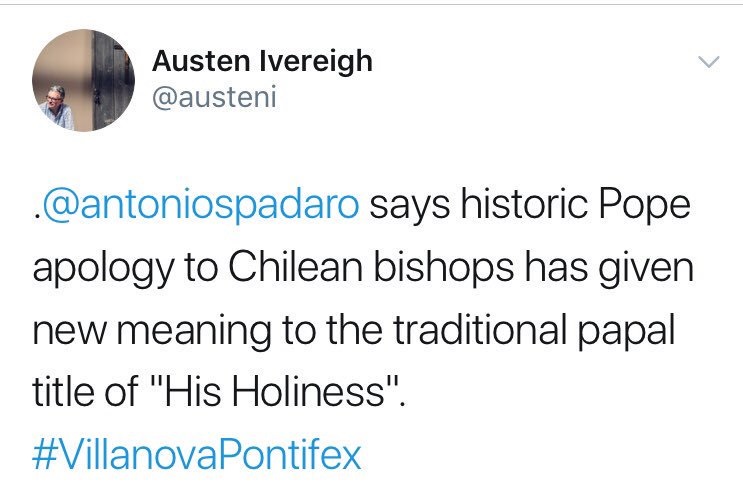
Spadaro on holiness

Spadaro explains that when we say “His Holiness” we don’t mean that he is holy.

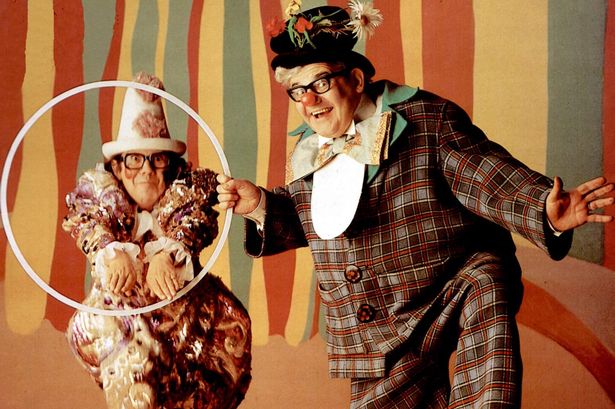
The highlight of the conference was surely the speech of Fr Spadaro, for a blizzard of soundbites from it was tweeted by Ivereigh and Faggioli, to the delight of everyone with a sense of humour. Before drowning the reader in spiritual nourishment, let’s have another photo.

The two Ronnies as clowns

After-dinner Cabaret. Austen Ivereigh and Joe Tobin entertain us.

Fr Spadaro is known worldwide as a brilliant mathematician, and this has helped him to master physics as well. So we were treated to the following words of wisdom.

Spadaro on science

Who says that Catholics don’t have a grasp of science?

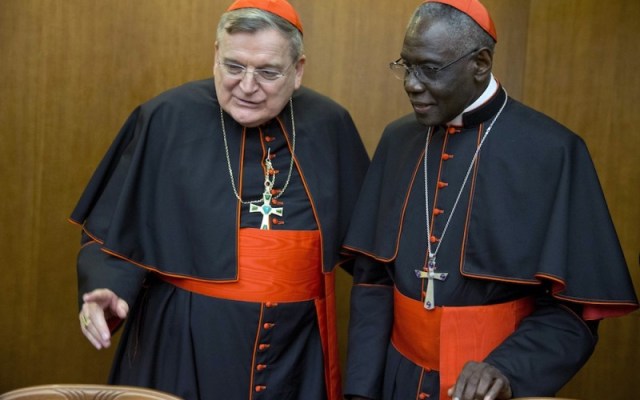
Personally, I was surprised not to see a few rigid Catholics there. Where were Sarah and Burke? No Zuhlsdorf? Fra’ Matthew Festing? How about Marcantonio Colonna? Surely he is now rich enough to afford the $225? But no, they all stayed away. It’s almost as if they didn’t want to celebrate the fact that Pope Francis is wonderful, humble, merciful, loving, handsome, brilliant and holy.

Plenary speakers at Villanova

Non-rigid modernist Catholics (could that be Joe Tobin’s much-loved sister?)

Anyway, this blog is for spiritual nourishment, not for photos of celebrities, so let us have one final piece of wisdom from Spadaro, who – it must be remembered – is not only an expert on science, but also a deeply spiritual figure.

Spadaro on spirits

Translation: “Why does everyone think my Gaudete et Exsultate is a turkey?”

Posted in Uncategorized | 1 Comment

BE MY GUEST, MY WOMB IS YOUR WOMB

Surrogacy: No Laughing Matter
by Jennifer Lahl
within Bioethics
Apr 15, 2018 08:00 pm http://www.thepublicdiscourse.com/2018/04/21343/
Surrogacy is no April Fools’ joke. It’s no laughing matter at all. It’s a big business that exploits, uses, abuses, preys on, and commodifies women. It turns children into products to be designed, selected, and purchased, while it profits handsomely. And it is willing to fight like mad to protect its moneyed interests.
Share this article:    

On April Fools’ Day 2018, a German LGBTI website came under attack for announcing the raffle of a surrogate mother in Thailand and an egg donor for a gay couple. The ‘package’ was said to be worth over $44,000 US. Immediately this raffle draw attention on Twitter, where it was criticized for being a “tasteless,” “racist,” “sexist,” and extremely unfunny attempt at an April Fools’ joke.

Julie Bindel, an original signer of the StopSurrogacyNow Petition, took to Twitter:

Those of us aware of the human rights abuses involved in surrogacy, or rather womb trafficking, will be very well aware that this so-called April Fools’ Day joke happens in real life, & the attitude is prevalent among gay men who consider it their right 2 use the inside of those women’s bodies for their own inconvenience. There is no ‘right’ to have your own biological child, or to use a poor, desperate woman’s body to carry that child…

I’ll let her remarks trail off, as she had some pretty salty language for gay men who use women as their surrogates.

The gay news quickly took her to task for her remarks. On Twitter, she responded, “We live in times where privileged gay men refer to a feminist critique of renting poor women’s wombs as ‘hate speech’ and make an actual ‘news’ story out of such slander.”

In the midst of the outrage, the managing editor of the LGBTI website said:

Surrogate babies are a controversial topic, so we expected some moral outrage.

Our April Fools’ joke is indeed sarcastic, but not sexist or racist. It’s a well known fact that gay couples from first world countries with a desire to have children use surrogate mothers from third world and emerging countries.

We would never raffle a real surrogate mother – even some users took it on trust. We wanted to start a debate about surrogate motherhood, and I guess that worked.

Debate? What debate?

No Real Debate on Surrogacy

This brief scuffle across a few news sites and on Twitter was certainly no debate. Trust me—I would be the first to welcome a serious public debate on surrogacy. If I’m brutally honest, there simply is no real debate on surrogacy taking place in America or anywhere else in the rest of the world. What is taking place here in the US is a state-by-state effort to pass legislation enabling commercial surrogacy. Internationally, efforts to legalize commercial surrogacy are underway in places like the Hague, the United Nations, and several national governments. One thing you should know for certain is that all of these efforts are carefully orchestrated—and well-funded—by the fertility industry, their lobbyists and attorneys, and gay surrogacy agencies like the one run by Sam Everingham, “Families through Surrogacy” or the group “men having babies.”

Few are probably aware that a commercial surrogacy bill just passed in Washington state, and that Governor Inslee has signed it into law. I testified in opposition to the bill at two hearings there. The first was chaired by the Senate committee member who authored the bill, a gay man who has children through surrogacy. The second hearing was chaired by a house committee member who is a lesbian. To be clear, my position against surrogacy has nothing to do with preventing gay men from having babies. My position is that no one has the right to use any woman’s body in order to have a child. Full stop.

New York and New Jersey are poised to pass similar commercial surrogacy bills, and no debate is taking place. The New York bill is authored and championed by another gay state senator who also has children via surrogacy. As he announced that his bill to legalize commercial surrogacy in New York had passed out of committee, Senator Brad Hoylman declared, “we have been stuck in the dark ages on surrogacy.” He makes it sound as if surrogacy is some form of women’s liberation.

On the contrary, this is a proposal to enter the dark ages on surrogacy, returning us to a Handmaid’s Tale era of female enslavement, creating a paid breeding class. While it is interesting to list the countries where laws have recently been changed to prohibit commercial surrogacy or to close borders to non-citizens traveling to hire surrogates, considerably more instructive and telling is examining why these changes have been made.

International Cause for Concern

Thailand, for example, closed its borders to commercial surrogacy after the Baby Gammy case was reported. Baby Gammy and his twin sister were born to a surrogate mother in Thailand, having been commissioned by a couple in Australia where commercial surrogacy is illegal. The intended parents left Baby Gammy in Thailand because he was born with Down Syndrome, and they didn’t want a child with a disability. It was later confirmed that the intended father is a convicted child molester in Australia. Authorities have so far refused to remove the little girl from his care, but they have instructed that he is never to be allowed to be alone with her.

Surrogacy has been banned in Nepal too. Why? Because women were exploited, and children were left in a precarious state after a 7.8 magnitude earthquake struck in April 2015. Nepal had become a destination for gay couples from Israel (where surrogacy is only permitted for heterosexual couples) who were seeking cheap “labor” for building their families. After the earthquake hit, the Nepalese government banned the practice, moved by the horrific photos of poor Nepalese women who were left behind, surrounded by ruins, while wealthy gay Israeli men boarded planes with their babies.

I could go on and on. The point is that surrogacy is prohibited and borders are closed in many countries because they have seen firsthand the ways in which surrogacy harms women and children.

In the United States, however, surrogacy is marketed as the loving, giving act of an “angel.” This is similar to the way in which egg donation is marketed. No concern is given to the health and well-being of the women involved. I have written extensively about these concerns in other pieces (see here, here and here). And make no mistake, it is heavily marketed with big, big money that downplays any risks or concerns for the needs and best interests of the children.

At the same time, any opposition—indeed, any questioning of whether surrogacy is anything other than rainbows and unicorns—is quickly silenced. I have been contacted by many surrogates who were tossed off message boards or banned from social media groups for even mentioning that they’ve had difficulty or that they were pausing to think about the larger implications of surrogacy on women or children.

It’s Time to Expose Big Fertility

One of the first steps in combating surrogacy, particularly in the consumer-driven developed, western world is by exposing big fertility. Surrogacy is big business, raking in billions of dollars worldwide each year. As a growth sector, it attracts investors getting in on the act too. Here’s how one report put it:

Sensing a lucrative market, private equity firms are pouring money into building national chains of fertility clinics. Some are spending on splashy advertising and a deliberate strategy of reaching out to young women who are not yet trying to conceive. [I wrote about egg banking here.] Venture capitalists are getting into the business, too; this year alone, PitchBook has tallied more than $178 million flowing into startups developing fertility products, such as a test that promises a credit-score-style rating of a woman’s fertility.

Surrogacy is expensive, routinely costing commissioning parents six figures. It can sometimes cost much more, since every attempt doesn’t necessarily end in the live birth of a child. Where does all that money go? Certainly, some of it goes to the surrogate mother (generally $20,000-$35,000 in the United States, much less in the developing world). By no means are surrogate mothers receiving the bulk of the funds. The truth is that vast sums of money flow to the agencies and attorneys who broker surrogacy deals, as well as to fertility doctors and fertility clinics.

When there is money to be made—particularly in a field that claims to be self-regulated—there are always bad actors eager to cash in. Theresa Ericson, a California-based surrogacy attorney who was convicted and sent to prison for leading a baby-selling ring, called herself the “tip of the iceberg, when it comes to people abusing the system.”

So no, there is no debate taking place on the ethics of surrogacy. What is happening is that a few of us, woefully understaffed and underfunded, are taking on an industry similar to the likes of Big Tobacco or Big Pharma, David vs. Goliath style.

Surrogacy is no April Fools’ joke. It’s no laughing matter at all. It’s a big business that exploits, uses, abuses, preys on, and commodifies women. It turns children into products to be designed, selected, and purchased, while it profits handsomely. And it is willing to fight like mad to protect its moneyed interests.

Join me in exposing big fertility and educating others to help me stop surrogacy now. Sign our statement at StopSurrogacyNow. Our films are also a great and easy way to educate others in your community.

Jennifer Lahl is the Founder and President of the Center for Bioethics and Culture and producer of the documentary films, Eggsploitation, Anonymous Father’s Day, Breeders: A Subclass of Women? and Maggie’s Story, which tells of a ten-time egg donor and her battle with stage-four cancer.

Copyright © 2018 The Witherspoon Institute, all rights reserved.

Support Public Discourse by making a secure donation to the Witherspoon Institute.

Posted in Uncategorized | 1 Comment

THE QUALITY OF MERCY IS NOT STRAINED, USUALLY, BUT, PERHAPS IN THIS INSTANCE IT WAS

Pope tells grieving child: your atheist father is in heaven


{ABYSSUM}


‘God has the heart of a father, your father was a good man, he is in heaven with Him,’ the Pope said

Pope Francis comforted a grieving child by telling him that his atheist father is in heaven.

During a visit to Rome’s deprived Corviale district on Sunday, the Pope answered questions from a group of children. One of them, a boy called Emanuele, burst into tears when he met the Pope.

After giving the child a long hug, Pope Francis asked him what was troubling him. Emanuele whispered in the Pope’s ear that his father, who was an atheist, had recently died and he was worried he could be in hell.

Pope Francis asked Emanuele for permission to tell the crowd what he had said, and then announced (according to La Stampa): “If only we could cry like Emanuele when we have pain in our hearts.”

The Pope said that although Emanuele’s father was an atheist, “he had his four children baptised, he was a good man. It’s nice that a son says that about his father, that he ‘was good’. If that man was able to raise his children like that, then he was a good man. God is proud of your father.”

The Pope continued: “God has the heart of a father, your father was a good man, he is in heaven with Him, be sure. God has a father’s heart and would God ever abandon a non-believing father who baptised his children? God was certainly proud of your father, because it is easier to be a believer and have your children baptised than to be a non-believer and have your children baptised. Pray for your father, talk to your father. That is the answer.”

The Catechism of the Catholic Church: “The teaching of the Church affirms the existence of hell and its eternity. Immediately after death the souls of those who die in a state of mortal sin descend into hell, where they suffer the punishments of hell, ‘eternal fire’. The chief punishment of hell is eternal separation from God, in whom alone man can possess the life and happiness for which he was created and for which he longs.

“The affirmations of Sacred Scripture and the teachings of the Church on the subject of hell are a call to the responsibility incumbent upon man to make use of his freedom in view of his eternal destiny. They are at the same time an urgent call to conversion.”

Posted in Uncategorized | 1 Comment

WHO IS NOT BOTHERED BY NEGATIVE THOUGHTS WHILE WE TRY TO PRAY

A technique from the Desert Fathers to control our negative thoughts

ALETEIA
DESERT FATHERS

Their technique of guarding the heart bears some similarities with today’s use of meditation.

The Desert Fathers, Christians who took shelter in the deserts of Mesopotamia, Egypt, Syria, and Palestine between the III and VII century, lived as hermits in huts, caves, in trees, or even on top of a stone pillar. They searched for a life of solitude, manual labor, contemplation, and silence, with the goal of growing spiritually. Convinced of the intimate union between the body, soul, and spirit, the Desert Fathers—who we could also say were the first therapists—developed recommendations to heal the “sicknesses of the soul.” Among these recommendations was that of controlling our thoughts, achieved thanks to one method in particular: guarding the heart. Jean-Guilhem Xerri, a psychoanalyst and medical biologist, has developed this practice, showing just how relevant it is in today’s society.

Why should we control our thoughts?

According to the Desert Fathers, uncontrolled thoughts are the origins of some of the sicknesses of the soul. They identified eight non-psychological sicknesses of a spiritual origin, classified by the monk Evagrius as: greed of any sort, a pathological relationship to sex, a pathological relationship to money, sadness, aggressiveness, acedia (an illness of the soul expressed by listlessness, boredom, laziness – a precursor to slothfulness) vanity, and pride. These eight generic diseases have a pathological source: narcissism, which the Fathers called   philautia, excessive self-love.

One of the causes for these thoughts, which were considered as troubling, was the imagination. If an imagination is left uncontrolled it elicits visions which sometimes crowd our minds to the point of taking over. With worst-case scenarios stemming from pornographic images, undeserved accolades… “The imagination leads us to make up stories in our heads that are not always correct or pacifying,” sums up Xerri. Where it is in our power to control them: “Whether the thoughts trouble us or not is something beyond our doing. But whether they dwell within us or not, that they stir up passions or not, is something which is within our power,” wrote one of the Desert Fathers, John Damascene, in his A Speech Useful for the Soul. We will always be a theater of sensations and thoughts: the question is, what do we do with it? “Faced with such a thought,” Xerri reminds us, “man has various possibilities: to acquiesce or not, to feed it or resist it.”

For these ancient monks the objective of gaining control of their thoughts was to reach Hesychasm; a state characterized by peace, calm, rest, silence, and deep inner solitude; necessary for the spiritual contemplation of things and beings, and the understanding of God.  The Desert Fathers prescribed many methods to achieve this: “guarding the heart”, sobriety, hospitality and practicing meditation.

What is “Guarding the Heart”?

Guarding the heart, in Greek nepsis (vigilance), is being attentive to everything that happens in our heart. It is a spiritual method which aims to free man of bad or passionate thoughts. It invites us to observe the thoughts which penetrate our soul, and to discern between the good and the bad. Evagrius said: “Take care of yourself, be the gatekeeper to your heart and don’t let any thought enter without questioning it.” As Xerri points out: “The elders noticed that holy thoughts led to a peaceful state, the others to a troubled state.”

The indispensable means of guarding the heart is paying close attention to thoughts and discerning between those which are good and healing, and those which are a source of distraction or obsession. The aim is to gain freedom, and to reach indifference, the ability to not be dominated by our thoughts.

Was guarding the heart the ancestor of mediation?

Today cognitive sciences are in agreement with the diagnosis established by the Desert Fathers concerning the illnesses of the soul, which are growing rapidly today, along with the therapies which they had already recommended nearly 2000 years ago. It is recognized that today we are all suffering from countless and continuous demands no our attention, and that this trend disturbs our interiority. Xerri lists a variety of areas in which we are over-stimulated, thanks especially to digital media: food, material goods, sex, leisure, self-image, superficiality, criticism…

Permanently in demand and needing to be available immediately, we have on average between three or four decisions to take each second, according to Xerri. Therefore, it is fanciful to expect to be able to voluntary control our decisions in all consciousness, it’s simply impossible. “We are victims of a real hold-up of our attentional abilities,” laments Xerri, “Yet our attention determines our relationship with the world.”

The patristic tradition and the neurosciences agree: taking back control of our attention is a fundamental challenge for our mental health. The Desert Fathers recommended guarding the heart; the fashion today is mindful meditation. Both these therapies practice the observation of what is going on in and around us. Meditation, in the contemporary and non-religious sense, means opening oneself to present experience, with attention given to what we are going through. Like guarding the heart, it invites us to change our way of being in the world, and to make it a habit to pay attention to our thoughts which infiltrate our soul.

A little prayer to help guard your heart

In their bid to find Hesychasm, the Desert Fathers would often empty their minds and recite the very simple Prayer of the Heart, or Jesus Prayer. So if you want a little help from our Orthodox forefathers in being able to control the thoughts that cross our minds, try and find time in the morning to say this prayer before the demands of the day really kick in: “Lord Jesus Christ, Son of God, have mercy on me, a sinner.” (Although “a sinner” was added over the years.)

Translated from French by Cerith Gardiner.

Posted in Uncategorized | 4 Comments

JESUS CHRIST, OUR RISEN SAVIOUR, OF THY SACRIFICE WE SING

Hymn for Eastertide

14 Apr 2018

God our Father, Lord of glory,
Thanks and praise we give to Thee;
In Thy mercy to our fathers,
Thou didst bring them through the sea.
So by water hast Thou saved us,
Now from Adam’s sin set free.
.
Jesus Christ, our Risen Saviour,
Of Thy sacrifice we sing;
As the lamb in ancient myst’ry
To Thy people life didst bring,
So in Eucharistic glory,
Thou, God’s Lamb, art made our King.
.
Holy Spirit, Breath from heaven,
We Thy precious gifts embrace;
At creation all things living
Thou didst sanctify with grace.
So may we, creation’s glory,
Be for Thee a dwelling place.
.
Loving mercy of the Father,
Sacrifice of Christ the Son,
Quick’ning power of the Spirit:
In us let Thy work be done!
May we rise to life eternal,
That our Paschal joy be won.
.
.
.
 Text: Fr. Christopher G. Phillips
Tune: “St. Thomas” 8.7.8.7.8.7

Posted in Uncategorized | 3 Comments

IS THERE SUCH A THING A CATHOLIC LIBERALISM? I DENY THAT THERE IS

PORTRAIT OF CARDINAL JOHN HENRY NEWMAN

Cardinal John Henry Newman is seen in a portrait in a church in Rome.  Cardinal Newman, who was one of the great intellectual minds of the Catholic Church in the 19th century. (CNS photo from Crosiers)

I rejoice to say, to one great mischief I have from the first opposed myself. For thirty, forty, fifty years I have resisted to the best of my powers the spirit of liberalism in religion. Never did Holy Church need champions against it more sorely than now, when, alas! it is an error overspreading, as a snare, the whole earth; and on this great occasion, when it is natural for one who is in my place to look out upon the world, and upon Holy Church as in it, and upon her future, it will not, I hope, be considered out of place, if I renew the protest against it which I have made so often.

Liberalism in religion is the doctrine that there is no positive truth in religion, but that one creed is as good as another, and this is the teaching which is gaining substance and force daily. It is inconsistent with any recognition of any religion, as true. It teaches that all are to be tolerated, for all are matters of opinion. Revealed religion is not a truth, but a sentiment and a taste; not an objective fact, not miraculous; and it is the right of each individual to make it say just what strikes his fancy. {65} Devotion is not necessarily founded on faith. Men may go to Protestant Churches and to Catholic, may get good from both and belong to neither. They may fraternise together in spiritual thoughts and feelings, without having any views at all of doctrine in common, or seeing the need of them. Since, then, religion is so personal a peculiarity and so private a possession, we must of necessity ignore it in the intercourse of man with man. If a man puts on a new religion every morning, what is that to you? It is as impertinent to think about a man’s religion as about his sources of income or his management of his family. Religion is in no sense the bond of society.

Hitherto the civil Power has been Christian. Even in countries separated from the Church, as in my own, the dictum was in force, when I was young, that: “Christianity was the law of the land”. Now, everywhere that goodly framework of society, which is the creation of Christianity, is throwing off Christianity. The dictum to which I have referred, with a hundred others which followed upon it, is gone, or is going everywhere; and, by the end of the century, unless {66} the Almighty interferes, it will be forgotten. Hitherto, it has been considered that religion alone, with its supernatural sanctions, was strong enough to secure submission of the masses of our population to law and order; now the Philosophers and Politicians are bent on satisfying this problem without the aid of Christianity. Instead of the Church’s authority and teaching, they would substitute first of all a universal and a thoroughly secular education, calculated to bring home to every individual that to be orderly, industrious, and sober, is his personal interest. Then, for great working principles to take the place of religion, for the use of the masses thus carefully educated, it provides—the broad fundamental ethical truths, of justice, benevolence, veracity, and the like; proved experience; and those natural laws which exist and act spontaneously in society, and in social matters, whether physical or psychological; for instance, in government, trade, finance, sanitary experiments, and the intercourse of nations. As to Religion, it is a private luxury, which a man may have if he will; but which of course he must pay for, and which he must not {67} obtrude upon others, or indulge in to their annoyance.

The general character of this great apostasia is one and the same everywhere; but in detail, and in character, it varies in different countries. For myself, I would rather speak of it in my own country, which I know. There, I think it threatens to have a formidable success; though it is not easy to see what will be its ultimate issue. At first sight it might be thought that Englishmen are too religious for a movement which, on the Continent, seems to be founded on infidelity; but the misfortune with us is, that, though it ends in infidelity as in other places, it does not necessarily arise out of infidelity. It must be recollected that the religious sects, which sprang up in England three centuries ago, and which are so powerful now, have ever been fiercely opposed to the Union of Church and State, and would advocate the un-Christianising of the monarchy and all that belongs to it, under the notion that such a catastrophe would make Christianity much more pure and much more powerful. Next the liberal principle is forced on us from the necessity of the case. Consider {68} what follows from the very fact of these many sects. They constitute the religion, it is supposed, of half the population; and, recollect, our mode of government is popular. Every dozen men taken at random whom you meet in the streets has a share in political power,—when you inquire into their forms of belief, perhaps they represent one or other of as many as seven religions; how can they possibly act together in municipal or in national matters, if each insists on the recognition of his own religious denomination? All action would be at a deadlock unless the subject of religion was ignored. We cannot help ourselves. And, thirdly, it must be borne in mind, that there is much in the liberalistic theory which is good and true; for example, not to say more, the precepts of justice, truthfulness, sobriety, self-command, benevolence, which, as I have already noted, are among its avowed principles, and the natural laws of society. It is not till we find that this array of principles is intended to supersede, to block out, religion, that we pronounce it to be evil. There never was a device of the Enemy so cleverly framed and {69} with such promise of success. And already it has answered to the expectations which have been formed of it. It is sweeping into its own ranks great numbers of able, earnest, virtuous men, elderly men of approved antecedents, young men with a career before them.

Such is the state of things in England, and it is well that it should be realised by all of us; but it must not be supposed for a moment that I am afraid of it. I lament it deeply, because I foresee that it may be the ruin of many souls; but I have no fear at all that it really can do aught of serious harm to the Word of God, to Holy Church, to our Almighty King, the Lion of the tribe of Judah, Faithful and True, or to His Vicar on earth. Christianity has been too often in what seemed deadly peril, that we should fear for it any new trial now. So far is certain; on the other hand, what is uncertain, and in these great contests commonly is uncertain, and what is commonly a great surprise, when it is witnessed, is the particular mode by which, in the event, Providence rescues and saves His elect inheritance. Sometimes our enemy is turned into a friend; sometimes he is despoiled of {70} that special virulence of evil which was so threatening; sometimes he falls to pieces of himself; sometimes he does just so much as is beneficial, and then is removed. Commonly the Church has nothing more to do than to go on in her own proper duties, in confidence and peace; to stand still and to see the salvation of God.

The Biglietto Speech, Rome, May 14, 1879

 CATHOLIC LIBERALISM

an sit, nego

Liberalism | Definition of Liberalism by Merriam-Webster

Definition of liberalism. 1 : the quality or state of being liberal. 2 a often capitalized : a movement in modern Protestantism emphasizing intellectual liberty with reference to the spiritual and ethical content of Christianity.

 IF WE COMBINE THE TWO WORDS “CATHOLIC” AND “LIBERALISM” WE CREATE A CHIMERA AN OXYMORON
chi·me·ra
kīˈmirə,kəˈmirə/
noun
 .
  1. a thing that is hoped or wished for but in fact is illusory or impossible to achieve.
    “the economic sovereignty you claim to defend is a chimera”
    synonyms: illusion, fantasy, delusion, dream, daydream, pipe dream, figment of the/one’s imagination, mirage

ox·y·mo·ron
ˌäksəˈmôrˌän/
noun
  1. a figure of speech in which apparently contradictory terms appear in conjunction (e.g., faith unfaithful kept him falsely true ).


lib·er·al
ˈ
         adjective
  1. open to new behavior or opinions and willing to discard traditional values.
    “they have more liberal views toward marriage and divorce than some people
     noun
  1. a person of liberal views.
 There is no doubt that some people are liberal, they hold liberal views. They can be said to Liberal Catholics.  But it cannot be said that they subscribe to a coherent social or political philosophy known as CATHOLIC LIBERALISM.

-ism

From Wikipedia, the free encyclopedia
-ism is a suffix in many English words, originally derived from the Ancient Greek suffix -ισμός (-ismós), and reaching English through the Latin-ismus, and the French-isme.[1] It is often used in philosophy to define specific ideologies, and, as such, at times it is used as a noun in its own right when referring to a broad range of ideologies in a general sense.[2] The suffix “-ism” is neutral[citation needed] and therefore bears no connotations associated with any of the many ideologies it identifies; such determinations can only be informed by public opinion regarding specific ideologies.

The concept of an -ism may resemble that of a grand narrative.[3]

The first recorded usage of the suffix ism as a separate word in its own right was in 1680. By the nineteenth century it was being used by Thomas Carlyle to signify a pre-packaged ideology. It was later used in this sense by such writers as Julian Huxley and George Bernard Shaw. In the United States of the mid-nineteenth century, the phrase “the isms” was used as a collective derogatory term to lump together the radical social reform movements of the day (such as slavery abolitionism, feminism, alcohol prohibitionism, Fourierism, pacifism, early socialism, etc.) and various spiritual or religious movements considered non-mainstream by the standards of the time (such as Transcendentalism, spiritualism or “spirit rapping”, Mormonism, the Oneida movement often accused of “free love”, etc.). Southerners often prided themselves on the American South being free from all of these pernicious “Isms” (except for alcohol temperance campaigning, which was compatible with a traditional Protestant focus on individual morality). So on September 5 and 9, 1856, the Examiner newspaper of Richmond, Virginia ran editorials on “Our Enemies, the Isms and their Purposes”, while in 1858 “Parson” Brownlow called for a “Missionary Society of the South, for the Conversion of the Freedom Shriekers, Spiritualists, Free-lovers, Fourierites, and Infidel Reformers of the North” (see The Freedom-of-thought Struggle in the Old South by Clement Eaton). In the present day, it appears in the title of a standard survey of political thought, Today’s Isms by William Ebenstein, first published in the 1950s, and now in its 11th edition.

Merriam-Webster Dictionary declared in December 2015, this word -ism to be the Word of the Year. A suffix is the Word of the Year because a small group of words that share this three-letter ending triggered both high volume and significant year-over-year increase in lookups at Merriam-Webster.com. Taken together, these seven words represent millions of individual dictionary lookups.[4]

Further reading

  • Today’s Isms: Socialism, Capitalism, Fascism, Communism, Libertarianism by Alan Ebenstein, William Ebenstein and Edwin Fogelman (11th ed, Pearson, 1999, ISBN978-0130257147)
  • Isms and Ologies: 453 Difficult Doctrines You’ve Always Pretended to Understand by Arthur Goldwag (Quercus, 2007, ISBN978-1847241764) ranges from Abolitionism to Zoroastrianism.
  • The Ism Book: A Field Guide to Philosophy by Peter Saint-Andre.
IS THERE SUCH THING AS CATHOLIC LIBERALISM?
I DENY THAT THERE IS !!!
IF IT DOES EXIST IT IS THE PHENOMENON KNOWN ASKASPERISM AND BERGOLIANISM THAT IS CURRENTLY DAMAGING THE INSTITUTIONAL CHURCH JUST A CARDINAL NEWMAN PREDICTED THAT IT WOULD, BUT IT IS NOT CATHOLIC LIBERALISM.
+Rene Henry Gracida
Posted in Uncategorized | 1 Comment

PSYCHOLOGISTS DO NOT FIND IT EASY TO DEFINE THE TYPE THAT TRIES TO CONTROL WITHOUT SEEMING TO DO SO. YET THERE ARE A LOT OF THEM, EVEN IN HIGH PLACES.

Fr. Rutler’s Weekly Column

April 15, 2018
While it is easy to identify bold personalities that enjoy a good fight, and others that shrink shyly from any kind of confrontation, psychologists do not find it easy to define the middle type that tries to control without seeming to do so. If it is hard to define “passive aggression,” you can recognize the indirect expression of hostility when you see it at work: sullen, procrastinating, self-pitying, cold and silent in a way that is far from golden.

It is wonderful that the Risen Lord did not say to the trembling apostles in the Upper Room, “I told you so.” There is no tone of vengeful vindication or even the slightest condescension. He just serenely explains how these events had to be. The Lord has an assignment for the apostles, just as he offers each of us a plan for life. And he takes us seriously, only asking that we take him seriously in return. That is why he shows his wounds. They have not vanished in the glory of the Resurrection, for they are reminders that the new course of history will be fraught with challenges for which the Church must be prepared.

On June 28 in 1245, Pope Innocent IV convened an Ecumenical Council in Lyon, France, where he would stay for several years for safety from the emperor Frederick II. He opened the Council with a sermon on the Five Wounds of the Church. They were: 1) public heresy growing out of personal immorality; 2) the persecution of Christians by Muslims; 3) schism in the Church; 4) the invasion of Christian countries by unbelievers; and 5) attempts of civil governments to control the Church. Does this sound familiar?

In his day, lax and immoral Catholics were trying to justify their lifestyle by “paradigm shifts” in doctrine, Muslims were terrorizing Christians in the Middle East, the rift between Western and Eastern churches was growing and would not be checked even by the attempt of a second Council of Lyons some thirty years later, Mongol hordes were invading Hungary and Poland, and the Holy Roman Emperor was claiming political authority over the bishops.

The French philosopher and mathematician, Blaise Pascal, said: “Jesus will be in agony until the end of the world.” Having risen from the grave, he can die no more, nor can he suffer as he once did. But the Church is his body and “inasmuch as you have done it to one of the least of these little ones, you have done it to me.” Christ’s supernatural agony is a triumph of divine love for those whose salvation he bought with his own blood. He is not passively aggressive, because his confrontation in every age is a direct one against “the Devil and all his pomps.” There is no need for revenge, for to get even is never to get ahead.

Posted in Uncategorized | 1 Comment

ARE THERE ANY LIMITS TO THE POWER OF A POPE TO GOVERN THE CHURCH? THE ANSWER IS YES, THERE ARE !!!

a7b7a-pa-24434646-800x500

The plenitudo potestatis of the Roman Pontiff

in service of the unity of the Church

Raymond Leo Cardinal Burke

April 7, 2018

In memory of Card. Joachim Meisner

Before entering into the heart of my topic, in this context of grateful and affectionate remembrance of the late Cardinal Carlo Caffarra, and of ardent desire to continue his work of selfless and total love for Christ and His Mystical Body, the Church, I would like to say a few words to honor the memory of Cardinal Joachim Meisner. From the beginning of the good fight to defend and promote the fundamental truths about marriage and the family, he was completely united with Cardinal Caffarra, Cardinal Walter Brandmüller and myself. As a true pastor of the Lord’s flock, he considered it his first duty to present tirelessly the teaching of Christ in the Church. I remember two moments, in particular, in his final battle to serve Christ and the Church.

After Cardinal Walter Kasper’s inaugural address during the Extraordinary Consistory of February 2014, as we left the Synod Hall, Cardinal Meisner approached me and expressed his concern about the false direction in which the address would have led the Church, if an adequate and swift correction were not given. He added, “All of this will end in a schism.” From that moment on, he did everything possible to defend Christ’s word on marriage.

The last time I had the pleasure of seeing Cardinal Meisner was on March 3 of last year, when I visited the Archdiocese of Cologne for an academic presentation in which he also participated. Cardinal Meisner was truly happy to be able to express to me in person all of his support for the work done to obtain a just response from the Holy Father to the dubia raised by the Post-Synodal Exhortation Amoris Laetitia. While he was clearly and deeply concerned about the present state of the Church, he did not fail to express all of his trust in the Lord who will not fail to sustain His Mystical Body in the truth of the faith.

Today, in honoring the memory of the great Cardinal Carlo Caffarra, let us also honor, as I am sure Cardinal Caffarra would have liked us to do, the memory of Cardinal Joachim Meisner, who, together with Cardinal Caffarra, in the words of Saint Paul, fought the good fight of faith, finished the race of his episcopal mission for the good of countless faithful, and, with fidelity and generosity, kept the faith.[1] Requiescat in pace!

Introduction

In one of the open discussions during the session of the Synod of Bishops held in October of 2014, the Synod Fathers were debating about the possibility of the Church permitting those living in irregular matrimonial unions to receive the Sacraments of Penance and the Holy Eucharist. At a certain point, one of the Cardinals, thought to be an expert in canon law, intervened with what he judged to be a definitive solution to the difficulty. Making reference to the dissolution of marriages in favor of the faith, he strongly asserted that we have not at all begun to comprehend the extent of the plenitudo potestatis of the Roman Pontiff. The implication was that the fullness of power which is, by divine law, inherent to the Petrine Office could permit the Holy Father to act in contradiction to the words of Our Lord Himself in chapter 19 of the Gospel according to Saint Matthew and the Church’s constant teaching in fidelity to the same words:

And I say to you: whoever divorces his wife, except for unchastity, and marries another, commits adultery; and he who marries a divorced woman, commits adultery.[2]

The Cardinal’s quite shocking affirmation made me think again about something which the Holy Father himself had said, at the beginning of the 2014 session of the Synod, to all of the Synod Fathers.

He told the Synod Fathers: “It is necessary to say with parrhesia all that one feels.”[3] He then concluded: “And do so with great tranquility and peace, so that the Synod may always unfold cum Petro et sub Petro, and the presence of the Pope is a guarantee for all and a safeguard of the faith.”[4] The juxtaposition of the classic words which describe the power of the Pope, such that all things in the Church must be with Peter and under Peter, and the presence of the body of the Pope in a meeting risks a misunderstanding of the authority of the Pope which is not magical but derives from his obedience to Our Lord.

Such magical thinking is also reflected in the docile response of some of the faithful to whatever the Roman Pontiff may say, claiming that, if the Holy Father says something, then we must accept it as papal teaching. In any case, it seems good to reflect a bit on the notion of the power inherent to the Petrine Office and, in particular, on the notion of the fullness of power (plenitudo potestatis) of the Roman Pontiff.

The fullness of power in the Tradition

The history of the terminology, plenitudo potestatis, to express the nature of the jurisdiction of the Roman Pontiff is succinctly described in a contribution of Professor John A. Watt of the University of Hull to the Second International Congress of Medieval Canon Law, held at Boston College from August 12th to 16th of 1963.[5] The term is first used by Pope Saint Leo the Great in 446. In his Letter 14, he writes about the authority of the Bishop with these words: “Thus we have confided to your charity our duties, such that you are called unto a share of solicitude, not unto the fullness of power.”[6] In his customary crystalline Latin, Pope Saint Leo the Great expresses the relationship of the Roman Pontiff with the Bishops. While both the Roman Pontiff and the Bishops share the solicitude for the good of the universal Church, the Roman Pontiff alone exercises the fullness of power, in order that the unity of the universal Church be effectively safeguarded and promoted.

The term, fullness of power, is found extensively in treatises on papal authority, especially in the canonical literature. Gratian includes the dictum of Pope Saint Leo the Great along with two others canons among his decrees. These decrees emphasized “papal primacy as expressed in the supreme appellate jurisdiction and the reservation of all major issues.”[7] Saint Bernard of Clairvaux contributed greatly to the reception of the term, so that “by the time of Huguccio it had reached a high level of development.”[8]

Pope Innocent III, grounding the term theologically in the reality of the Papal office as the Vicar of Christ on earth (Vicarius Christi), emphasized the position of the Roman Pontiff “supra ius” and “as iudex ordinarius omnium.”[9] Regarding the term, supra ius, “over the law,” it was clear that the Roman Pontiff could dispense from the law or interpret the law only for the purpose of serving the proper end of the law, not to subvert the law. The description of  the exercise of the fullness of power as the action of Christ Himself, through His Vicar on earth, was made with “the qualification that the pope must avoid decreeing anything that was sinful or might lead to sin or subversion of the Faith.”[10]

Cardinal Henry of Susa, called Hostiensis, an illustrious canonist of the 13th century, treated amply the notion of the fullness of power of the Roman Pontiff, using the term in 71 individual contexts in his writings: the Summa, the Apparatus or Lectura on the Gregoriana, and the Apparatus on the Extravagantes of Innocent IV. In Appendix A of his article, Professor Watt provides a representative list of legislative texts of Pope Innocent III in which he uses the term, fullness of power, while in Appendix B of his article, he provides a list of all 71 usages of the term, fullness of power, by Hostiensis.[11]

Hostiensis introduced a distinction of two uses of the fullness of power: the Pope’s “ordinary power,” ‘potestas ordinaria’ or ‘ordinata’ when by virtue of his plenitudo officii [“fullness of office”], he acted according to the law already established,” and “his absolute power, ‘potestas absoluta’ when by virtue of his plenitudo potestatis [“fullness of power”], he passed over or transcended existing law.”[12] The adjective, absolute, must be understood in the context of Roman Law and its service to the development of canonical discipline, not according to the secular understanding of Machiavelli or of a totalitarian dictators.

In Roman Law, it signified a dispensation from a law and supply of a defect in a law. In the words of Professor Watt,

Dispensation was a use of the absolute power to set aside existing law; suppletio was an act of absolute power to remedy defects that had arisen either through the non-observance of existing law or because existing law was inadequate to meet the particular circumstances. In both cases the absolute power, the plenitudo potestatis, stands revealed as a discretionary power over the established legal order, a prerogative power to act for the common welfare outside that order, if, in the pope’s judgment, circumstances made this necessary.[13]

In other words, the fullness of power was not understood as an authority over the very constitution of the Church or her Magisterium but as a necessity for the governance of the Church in accord with her constitution and Magisterium. Hostiensis describes it as a necessary tool so that “curia business could be expedited, delays shortened, litigation curtailed,”[14] while, at the same time, “he considered that it was a power to be used with great caution, as a power in the Pauline phrase ‘unto edification and not for destruction,’ a discretionary power to maintain the constitution of the Church, not to undermine it.”[15]

    It is clear that the fullness of power is given by Christ Himself and not by some human authority or popular constitution, and that, therefore, it can only be rightly exercised in obedience to Christ. Professor Watt observes:

It was axiomatic that any power which had been given by Christ to His Church was for the purpose of fulfilling the end of the society which He had founded, not to thwart it. Therefore the prerogative power could only be exercised within these terms. Therefore “absolutism” (solutus a legibus) was not licence for arbitrary government. If it was true that the will of the prince made the law, in the sense that there was no other authority which could make it; it was also true as a corollary that, where this will threatened the foundations of the society whose good the will existed to promote, it was no law. The Church was a society to save souls. Heresy and sin impeded salvation. Any act of the pope in quantum homo which was heretical or sinful in itself or might foster heresy or sin threatened the foundations of society and was therefore void.[16]

In other words, the notion of fullness of power was carefully qualified.

It was understood that it did not permit the Roman Pontiff to do certain things. For example, he could not act against the Apostolic Faith. Also, for the sake of the good order of the Church, it was a power to be used sparingly and with the greatest prudence. Watt observes:

It was unfitting to depart from the ius commune too frequently or to do so sine causa. The pope could do so, but he should not, for the exercise of the plenitudo potestatis was to further the utilitas ecclesie et salus animarum and not the self-interest of individuals. The setting aside of the ius commune must therefore always be an exceptional act impelled by grave reasons. If the pope did so act sine causa or arbitrarily, he put his salvation in danger.[17]

Since the notion of fullness of powers contains the just-described limitations, how is the violation of the limitations judged and corrected?

What is to be done if the Roman Pontiff so acts? Hostiensis is clear that the Pope is not subject to human judgement. “He should be warned of the error of his ways and even publicly admonished, but he could not be put on trial if he persisted in his line of conduct.”[18] For Hostiensis, the College of Cardinals, even though they do not share in the fullness of power, “should act as a de facto check against papal error.”[19]

Hostiensis recognized the need of the exercise of the fullness of power at certain times, in order to “rectify the imperfections of the established order or thwart those who were manipulating it for private ends,”[20] but he also “thought as a general rule the pope should be slow to depart from the common law and he also thought that he should take the fraternal advice of his appointed advisers before doing so.”[21]Apart from public admonition and prayer for divine intervention, he does not offer a remedy for the abuse of the fullness of power. If, a member of the faithful believes in conscience that a particular exercise of the fullness of power is sinful and cannot bring his conscience to peace in the matter, “the pope must, as a duty, be disobeyed, and the consequences of disobedience be suffered in Christian patience.”[22]

Time has not permitted me to examine the question of the correction of the Pope who abuses the fullness of power inherent to the primacy of the See of Peter. As many will know, there is an abundant literature on the question. Certainly the treatise, De Romano Pontifice of Saint Robert Bellarmine, and other classical canonical studies must be examined. Suffice it to say that, as history shows, it is possible that the Roman Pontiff, exercising the fullness of power, can fall either into heresy or into the dereliction of his primary duty to safeguard and promote the unity of faith, worship and practice. Since he is not subject to a judicial process, according to the first canon on the competent forum in the Code of Canon Law (“Prima Sedes a nemine iudicatur”),[23] how is the matter to be addressed?

A brief preliminary response, based upon the natural law, the Gospels and canonical tradition, would indicate a two-fold process: first, the correction of a supposed error or dereliction made directly to the Roman Pontiff himself; and, then, if he fails to respond, a public declaration. According to natural law, right reason demands that subjects be governed according to the rule of law and, in the contrary case, provides that they have recourse against actions in violation of the rule of law. Christ Himself teaches the way of fraternal correction which applies to all members of His Mystical Body.[24] We see His teaching embodied in the fraternal correction of Saint Peter by Saint Paul, when Saint Peter dissembled regarding the freedom of Christians from certain ritual laws of the Jewish faith.[25] Finally, the canonical tradition is summarized in the norm of can. 212 of the 1983 Code of Canon Law. While the first section of the canon in question makes clear that “the Christian faithful are bound to follow with Christian obedience those things which the sacred pastors, inasmuch as they represent Christ, declare as teachers of the faith or establish as rulers of the Church.,[26] the third section declares the right and duty of the faithful “to manifest to the sacred pastors their opinion on matters which pertain to the good of the Church and to make their opinion known to the rest of the Christian faithful, without prejudice to the integrity of faith and morals, with reverence toward their pastors, and attentive to common advantage and the dignity of persons.”[27]

To conclude this too brief examination of the development of the notion of the fullness of power from the time of Pope Saint Leo the Great, it must be observed that the contribution of the medieval canonists constitutes a deepening of the understanding of the Church’s faith regarding Petrine Primacy. It, in no way, pretended to offer doctrinal novelty. Professor Watt summarizes the matter thus:

That the concept of ecclesiastical sovereignty expressed by this particular term had been formulated before Hostiensis wrote, is clear from Innocent III’s decretals and the early commentary thereon. Examination of the decretist background to early decretalist work makes it clear that no novelty of doctrinal essence was here involved. The decretals register a crystallization of terminology; sure mark of the maturity of the canonist understanding of the notion in question. The Professio fidei known to the Second Council of Lyons was but a more solemn acceptance of a position held generally much earlier, not least among canonists, expressed now with the help of a term which the canonists had made a technical one. In the form adopted at Lyons, plenitudo potestatis represented two things, both of which corresponded exactly to its canonistic history: the principle of jurisdictional primacy as such, in all its judicial, legislative, administrative and magisterial aspects, and more narrowly, the principal that prelates derived their jurisdiction from the pope.

There was, however, a third level of interpretation of the term: the plenitude of power in its purest juristic form. This was the level at which the canonists were most deeply engaged, in that it concerned the practical applications of supreme authority and considered its relationship to law already in being and an ordo iuris already established. In short, a problem of developed legal theory, the concept of the power of the sovereign over law and the juridical order.

Progress was made with some simple distinctions about the nature of this power. The pope’s jurisdiction was said to be exercised in a two-fold way. There was an exercise which had a recognized and regular place, established by existing law and translated into practice by existing procedures: his ordinary power. There was further his extraordinary power, inhering him personally and alone, by which – manifestation par excellence of sovereign authority – existing law and established procedures might be suspended, abrogated, clarified, supplemented. This was the prerogative power of the pope supra ius; the plenitude of power seen in its most characteristic juristic form as the right to regulate established legal machinery. Solutus a legibus, the absolute ruler might redispose any of the mechanisms of law. In the doing thereof, the plenitude of power was deployed in its most practical form.

Once the plenitudo officii had been distinguished from the plenitudo potestatis and the potestas ordinaria from the potestas absoluta (and with these distinctions Hostiensis seems to have made his most individual contribution to the common stock of canonist ideas on papal power), it followed logically that the circumstances in which this power was used extra ordinarium cursum should be examined.[28]

In fact, the ever-deepening understanding of the fullness of power of the Roman Pontiff during the medieval period has led to the ongoing study of the primacy of Peter and of the power connected with it. Any discussion of the matter would be incomplete without taking into account the essential work accomplished by canonists during the Middle Ages.

Plenitudo Potestatis in the Magisterium

The term, fullness of power, was used in the definition of papal primacy at the First Vatican Council. Chapter Four of the Dogmatic Constitution Pastor aeternus, on the Church of Christ, promulgated on July 18, 1870, reads:

Furthermore, with the approval of the Second Council of Lyon, the Greeks professed that “the holy Roman Church possesses the supreme and full primacy and authority over the universal Catholic Church, which she recognizes in truth and humility to have received with fullness of power from the Lord himself in blessed Peter, the prince or head of the apostles, of whom the Roman pontiff is the successor. And, as she is bound above all to defend the truth of the faith, so too, if any questions should arise regarding the faith, they must be decided by her judgment.[29]

The dogmatic definition makes it clear that the fullness of power of the Roman Pontiff is necessary if the Apostolic Faith is to be safeguarded and promoted in the universal Church.

Later on in the same chapter of Pastor aeternus, the Council Fathers declare:

For the Holy Spirit was not promised to the successors of Peter that they might disclose a new doctrine by his revelation, but rather that, with his assistance, they might reverently guard and faithfully explain the revelation or deposit of faith that was handed down through the apostles. Indeed, it was this apostolic doctrine that all the Fathers held and the holy orthodox Doctors reverenced and followed, fully realizing that this See of St. Peter always remains untainted by any error, according to the divine promise of our Lord and Savior made to the prince of his disciples: “But I have prayed for you that your faith may not fail; and when you have turned again, strengthen your brethren”[Lk 22:32].

Now this charism of truth and of never-failing faith was conferred upon Peter and his successors in this chair in order that they might perform their supreme office for the salvation of all; that by them the whole flock of Christ might be kept away from the poisonous bait of error and be nourished by the food of heavenly doctrine; that, the occasion of schism being removed, the whole Church might be preserved as one and, resting on her foundation, might stand firm against the gates of hell.[30]

Following the constant understanding of the Church down the centuries, the Council Fathers taught that Petrine Primacy and the corollary fullness of power of the Roman Pontiff, instituted by Christ in His constitution of the Church as His Mystical Body, are directed exclusively to the salvation of souls by the safeguarding and promoting of the solid doctrine and sound discipline, handed down in an unbroken line by means of Apostolic Tradition.

Chapter 22 of the Dogmatic Constitution Lumen Gentium of the Second Vatican Ecumenical Council likewise used the term, fullness of power. Describing the relationship of the College of Bishops to the Roman Pontiff, the Council Fathers declare:

But the college or body of bishops has no authority unless it is understood together with the Roman pontiff, the successor of Peter as its head. The pope’s power of primacy over all, both pastors and faithful, remains whole and intact. In virtue of his office, that is, as vicar of Christ and pastor of the whole Church, the Roman pontiff has full, supreme, and universal power over the Church. And he is always free to exercise this power. The order of bishops, which succeeds to the college of apostles and gives this apostolic body continued existence, is also the subject of supreme and full power over the universal Church, provided we understand this body together with its head, the Roman pontiff, and never without this head. This power can be exercised only with the consent of the Roman pontiff. For our Lord placed Simon alone as the rock and the bearer of the keys of the Church [cf. Mt 16:18-19] and made him shepherd of the whole flock; it is evident, however, that the power of binding and loosing, which was given to Peter [Mt 16:19], was granted also to the college of apostles, joined with its head [cf. Mt 18:18; 28:16-20].[31]

The distinct office of the Roman Pontiff with respect to the College of Bishops and indeed to the universal Church is described in the following number of Lumen Gentium with these words: “The Roman pontiff, as the successor of Peter, is the perpetual and visible principle and foundation for the unity of the multiplicity of both the bishops and the faithful.”[32]

In an earlier part of the same Dogmatic Constitution, the Council Fathers explain:

This sacred synod, following in the steps of the First Vatican Council, teaches and declares with it that Jesus Christ, the eternal pastor, set up the holy Church by entrusting the apostles with their mission as he himself had been sent by the Father (cf. Jn. 20:21). He willed that their successors, the bishops namely, should be the shepherds in his Church until the end of the world. In order that the episcopate itself, however, might be one and undivided he put Peter at the head of the other apostles, and in him he set up a lasting and visible source and foundation of the unity both of faith and of communion.[33]

After the symposium entitled “The Primacy of the Successor of Peter,” organized by the Congregation for the Doctrine of the Faith from December 2nd to 4th of 1996, the Congregation published certain considerations regarding the subject of the Petrine Office and the power conferred upon it.

Regarding the relationship of the Petrine Office to the office of Bishop, the document declared:

All Bishops are subjects of the care of all the Churches (sollicitudo omnium Ecclesiarum) inasmuch as they are members of the Episcopal College which succeeds to the college of the Apostles, of which the extraordinary figure of Saint Paul was a member. This universal dimension of their episkopè (oversight) is inseparable from the particular dimension relative to the offices entrusted to them. In the case of the Bishop of Rome – Vicar of Christ in the proper manner of Peter as Head of the College of Bishops – , the care of all the Churches acquires a particular force because it is accompanied by full and supreme power in the Church: a truly episcopal power, not only supreme, full and universal, but also immediate, over all, both pastors and other faithful. The ministry of the Successor of Peter, therefore, is not a service which reaches each particular Church from outside, but is inscribed in the heart of every particular Church, in which “the Church of Christ is truly present and acts”, and by this carries in itself the opening to the ministry of unity. This interiority of the ministry of the Bishop of Rome to each particular Church is also an expression of the mutual interiority between the universal Church and the particular Church.[34]

The Petrine Office is therefore in its proper essence and in its exercise different from offices of civil government.

The document of the Congregation goes on to explain how the Roman Pontiff carries out his office as a service, that is, in obedience to Christ:

The Roman Pontiff is – as are all the faithful – submitted to the Word of God, to the Catholic faith and is the guarantee of the obedience of the Church and, in this sense, is the servant of the servants (servus servorum). He does not decide according to his own will, but gives voice to the will of the Lord who speaks to man in the Scriptures lived and interpreted by the Tradition; in other terms, the episkopè of the Primate has the limits which flow from divine law and the inviolable divine constitution of the Church contained in Revelation. The Successor of Peter is the rock who, contrary to arbitrariness and conformism, guarantees a rigorous fidelity to the Word of God: the martyrological character of his Primacy follows from this.[35]

The fullness of power of the Roman Pontiff cannot be properly understood and exercised except as obedience to the grace of Christ the Head and Shepherd of the flock in every time and place.

Canonical Legislation

            The fullness of the power of the Roman Pontiff is expressed in can. 218 of the 1917 Code of Canon Law, which reads:

The Roman Pontiff, who is the successor of St. Peter in the primacy, possesses not only a primacy of honor, but supreme and full power of jurisdiction in the entire Church in matters which belong to faith and morals as well as in those which pertain to discipline and the government of the Church throughout the world.

This power is truly episcopal, ordinary and immediate over all and each of the churches and over all and each of the pastors and the faithful, and is independent of every human authority.[36]

What is important to note initially is that the fullness of power is required by the primacy of the Roman Pontiff, which is not merely honorary but substantial, that is, it is required for the fulfillment of the supreme, ordinary, full and universal responsibility of safeguarding the rule of faith (regula fidei) and the rule of law (regula iuris).

            Can. 331 of the 1983 Code of Canon Law contains substantially the same legislation. It reads:

The bishop of the Roman Church, in whom continues the office given by the Lord uniquely to Peter, the first of the Apostles, and to be transmitted to his successors, is the head of the college of bishops, the Vicar of Christ, and the pastor of the universal Church on earth. By virtue of his office he possesses supreme, full, immediate, and universal ordinary power in the Church, which he is always able to exercise freely.[37]

The power of the Roman Pontiff is understood from the adjectives which modify it.

It is ordinary because it is stably connected to the office of primacy by Christ Himself. It is part of the ius divinum. It is a divine disposition.[38] It is supreme, that is the highest authority within the hierarchy and not subordinated to any other human power, while it remains always subordinate to Christ alive in the Church through the Tradition guarded and transmitted by the rule of faith and the rule of law. It is full in that it is equipped with all the faculties contained in the sacred power to teach, to sanctify and to govern. It is thus connected with the exercise of the infallible magisterium and with the authentic non-infallible magisterium (cann. 749 § 1, and 752), with legislative and judicial power, and with the moderation of the liturgical life and divine worship of the universal Church. It is immediate, that is, it may be exercised over the faithful and their pastors wherever and without condition, and it is universal, that is, it extends to the entire ecclesial community, to all the faithful, to the particular Churches and their congregations, and to all of the matters which are subject to the jurisdiction and responsibility of the Church.

What is evident in the canonical legislation is that “the Pope does not exercise the power connected to his office when he acts as a private person or simple member of the faithful.”[39] Evidently, too, given the supreme character of the fullness of power entrusted to the Roman Pontiff, he does not have an absolute power in the contemporary political sense and, therefore, is held to listen to Christ and to His Mystical Body the Church. In the words of the considerations offered by the Congregation for the Doctrine of the Faith in 1998:

To listen to the voice of the Churches is, in fact, a proper characteristic of the ministry of unity, also a consequence of the unity of the episcopal Body and of the sensus fidei of the entire People of God; and this bond appears substantially endowed with greater force and certainty than juridical instances – a moreover inadmissible hypothesis because of lack of foundation – to which the Roman Pontiff would have to respond. The final and binding responsibility of the Roman Pontiff finds its best guarantee, on the one hand, in its insertion in the Tradition and in fraternal communion and, on the other hand in the assistance of the Holy Spirit Who governs the Church.[40]

As one canonist comments on the fullness of the power of the Pope:

Without doubt, the end and the mission of the Church indicate well articulated limits which are not of easy juridical formulation. But, if we would wish juridical formulations, we could say that these limits are those that the divine law, natural and positive, establishes.

Above all, the Pope has to exercise his power in communion with the whole Church (c. 333, § 2). Wherefore, these limits stand in relationship with the communion in the faith, in the Sacraments and in ecclesiastical governance (can. 205). The Pope has to respect the deposit of the faith – he holds the authority to express the Credo in a more adequate manner but he cannot act contrary to the faith – , he has to respect all and each of the Sacraments – he cannot suppress nor add anything that goes against the substance of the Sacraments –  , and, finally, he has to respect the ecclesial rule of divine institution (he cannot prescind from the episcopate and has to share with the College of Bishops the exercise of the full and supreme power).[41]

Conclusion

            It is my hope that these reflections which are initial in character and require much further elaboration will help you to understand the necessity and the subtlety of the fullness of the power of the Roman Pontiff for the safeguarding and promoting of the good of the universal Church. According to Sacred Scripture and Sacred Tradition, the Successor to Saint Peter has power which is universal, ordinary and immediate over all the faithful. He is the supreme judge of the faithful, over whom there is no higher human authority, not even an ecumenical council. To the Pope belongs the power and authority to define doctrines and to condemn errors, to make and repeal laws, to act as judge in all matters of faith and morals, to decree and inflict punishment, to appoint and, if need be, to remove pastors. Because this power is from God Himself, it is limited as such by natural and divine law, which are expressions of the eternal and unchangeable truth and goodness that come from God, are fully revealed in Christ, and have been handed on in the Church throughout time. Therefore, any expression of doctrine or law or practice that is not in conformity with Divine Revelation, as contained in Sacred Scripture and the Church’s Tradition cannot be an authentic exercise of the Apostolic or Petrine ministry and must be rejected by the faithful. As Saint Paul declared: “There are some who trouble you and want to pervert the gospel of Christ. But if we, or an angel from heaven, should preach to you a gospel contrary to that which we preached to you, let him be anathema.”[42]

ARE             As devout Catholics and servants of the Church’s discipline, we must in all things teach and defend the fullness of the power with which Christ has endowed His Vicar on earth. At the same time, we must teach and defend that power within the teaching and defense of the Church as the Mystical Body of Christ, as an organic body of divine origin and divine life. I conclude with the words of Gratian in his Decretals:

Let no mortal being have the audacity to reprimand a Pope on account of his faults, for he whose duty it is to judge all other men cannot be judged by anybody, unless he should be called to task for having deviated from the faith.[43]

Raymond Leo Cardinal BURKE


[3] “Saluto del Santo Padre Francesco ai Padri Sinodali, 6 ottobre 2014”, La famiglia è il futuro. Tutti i documenti del Sinodo straordinario 2014, ed. Antonio Spadaro (Milano: Àncora Editrice, 2014), p. 118. English translation: Francis PP. II, “Pope Francis’ invitation to the Synod Fathers at the opening of the General Congregation: With honesty and humility,” L’Osservatore Romano, Weekly Edition in English, 10 October 2014, p. 6.

[4] Ibid., p. 118. English translation: Ibid., p. 6.

[5] Cf. J. A. Watt, “The Use of the Term ‘Plenitudo Potestatis’ by Hostiensis,” in Stephen Ryan Joseph Kuttner, ed., Proceedings of the Second International Congress of Medieval Canon Law, Boston College,12-16 August 1963 (Città del Vaticano: S. Congregatio de Seminariis et Studiorum Universitatibus, 1965), pp. 161-187. [Watt].

[6] “Vices nostras ita tuae credidimus charitati, ut in partem sis vocatus sollicitudinis, non in plenitudinem potestatis.” [Ep. 14, PL 54.671], quoted in Watt, p. 161.

[11] Watt, pp. 175-187.

[13] Watt, pp. 167-168.

[15] Watt, p. 168. Cf. 2 Cor 13, 10.

[26] “Quae sacri Pastores, utpote Christum repraesentantes, tamquam fidei magistri declarant aut tamquam Ecclesiae rectores statuunt, christifideles, … christiana oboedientia prosequi tenentur.” Can. 212, § 1. English translation: Canon Law Society of America.

[27] “… sententiam suam de his quae ad bonum Ecclesiae pertinent sacris Pastoribus manifestent eamque, salva fidei morumque integritate ac reverentia erga Pastores, attentisque communi utilitate et personarum dignitate, ceteris christifidelibus notam faciant.” Can. 212, § 3. English translation: Canon Law Society of America.

[28] Watt, pp. 172-173.

[29] “Approbante vero Lugdunensi Concilio secondo Graeci professi sunt: ‘Sanctam Romanam Ecclesiam summum et plenum primatum et principatum super universam Ecclesiam catholicam obtinere, quem se ab ipso Domino in beato Petro Apostolorum principe sive vertice, cuius Romanus Pontifex est successor, cum potestatis plenitudine recepisse veraciter et humiliter recognoscit; et sicut prae ceteris tenetur fidei veritatem defendere, sic et, si quae de fide subortae fuerint quaestiones, suo debent iudicio definiri’.” Heinrich Denzinger, Compendium of Creeds, Definitions, and Declarations on Matters of Faith and Morals, ed. Peter Hünermann with Helmut Hoping, English edition ed. Robert Fastiggi and Anne Englund Nash, 43rd ed. (San Francisco: Ignatius Press, 2012), p. 614, n. 3067. [Denzinger].

[30] Denzinger, p. 615, nos. 3070-3071.

[31] “Collegium autem seu corpus Episcoporum auctoritatem non habet, nisi simul cum Pontifice Romano, successore Petri, ut capite eius intellegatur, huiusque integer manente potestate Primatus in omnes sive Pastores sive fideles. Romanus enim Pontifex habet in Ecclesiam, vi muneris sui, Vicarii scilicet Christi et totius Ecclesiae Pastoris, plenam, supremam et universalem potestatem, quam semper libere exercere valet. Ordo autem Episcoporm, qui collegio Apostolorum in magisterio et regimine pastorali succedit, immo in quo corpus apostolicum continuo perseverat, una cum Capite suo Romano Pontifice, et numquam sine hoc Capite subiecutm quoque supremae ac plenae potestatis in universam Ecclesiam exsistit, quae quidem potestas nonnisi consentiente Roman Pontifice exerceri potest. Dominus unum Simonem ut petram et cavigerum Ecclesiae posuit [cf. Mt 16:18-19], eumque Pastorem totius sui gregis constituit [cf. Io 21: 15-19]; illud autem ligandi ac solvendi munus, quod Petro datum est [Mt 16:19], collegio quoque Apostolorum, suo Capiti coniuncto, tributum esse constat [Mt 18:18; 28:16-20].” Denzinger, pp. 880-881, no. 4146.

[32] “Romanus Pontifex, ac successor Petri, est unitatis, tum Episcoporum tum fidelium multitudinis, perpetuum ac visibile principium et fundamentum.” Denzinger, p. 881, no. 23.

[34] “89. Il Primato del Successore di Pietro nel Mistero della Chiesa”, Congregazione per la Dottrina della Fede, Documenti (1966-2013) (Città del Vaticano: Libreria Editrice Vaticana, 2017), pp. 480-481, n. 6. [CDF];

Communicationes 30 (1998), 210-211, n. 6.

[35] CDF, p. 481, n. 7. Communicationes 30 (1998), 212, n. 7.

[36] “Can. 218. – § 1. Romanus Pontifex, Beati Petri in primate Successor, habet non solum primatum honoris, sed supremam et plenam potestatem iurisdictionis in universam Ecclesiam tum in rebus quae ad fidem et mores, tum in iis quae ad disciplinam et regimen Ecclesiae per totum orbem diffusae pertinent.

§ 2. Haec potestas est vere episcopalis, ordinaria et immediate tum in omnes et singulas ecclesias, tum in omnes et singulos pastores et fidelis a quavis humana auctoritate independens.” English translation: John A. Abbo and Jerome D. Hannan, The Sacred Canons: A Concise Presentation of the Current Disciplinary Norms of the Church (St. Louis, MO: B. Herder Book Co., 1952), Volume 1, p. 281.

[37] “Can. 331  Ecclesiae Romanae Episcopus, in quo permanet munus a Domino singulariter Petro, primo Apostolorum, concessum et successoribus eius transmittendum, Collegii Episcoporum est caput, Vicarius Christi atque universae Ecclesiae his in terris Pastor; qui ideo vi muneris sui suprema, plena, immediata et universali in Ecclesia gaudet ordinaria potestate, quam semper libere exercere valet.” English translation: Canon Law Society of America, Code of Canon Law: Latin-English Translation, New English Translation, Washington, D.C.: Canon Law Society of America, 1998. [Hereafter, CLSA].

[38] Cf. cann. 131 § 1, and 145 § ; and Nota Explicativa Praevia of Lumen Gentium.

[39]“… el Papa no ejercita esta potestad aneja a su oficio cuando actúa come persona privada o como simple fiel.” Eduardo Molano, “Potestad del Romano Pontifice,” Diccionario General de Derecho Canónico, Vol. VI (Cizur Menor [Navarra]: Editorial Aranzadi, SA, 2012), p. 304. English translation by author.

[40] CDF, p. 483, no. 10. Communicationes, 213.

[43] “Huius culpas istic redarguere presumit mortalium nullus, quia cunctos ipse iudicaturis a nemine est iudicandus, nisi deprehendatur devius; pro cuius perpetuo statu uniuersitas fidelium tanto instantius orat, quanto suam salutem post Deum ex illius incolumitate animaduertunt propensius pendere”. Decretum Magistri Gratiani. Concordia Discordantium Canonum, 1a, dist. 40, c. 6, Si papa; Item ex gestis Bonifacii Martyris. Gratian, Decretals, 1a, dist. 40, c. 6, Si papa; ex Gestis Bonifacii martyris.

Posted in Uncategorized | 1 Comment

de MATTEI: ALL CATHOLICS HAVE AN OBLIGATION TO OPPOSE ERROR

El_Greco_021-large

Tu es Petrus: True Devotion to the Chair of Saint Peter

The following is Dr. Roberto de Mattei’s talk given on Saturday, April 7, 2018 at the “Weapons of Our Warfare” Catholic Family News conference, held in Deerfield, Illinois. 

Tu es Petrus: True Devotion to the Chair of Saint Peter

We find ourselves before one of the most critical moments that the Church has ever experienced in her history, but I am convinced that true devotion to the Chair of Saint Peter can offer us the weapons to come out victorious from this crisis.

True devotion. Because there is a false devotion to the Chair of Peter, just as – according to Saint Louis Marie Grignion de Montfort – there is a true and false devotion to the Most Blessed Virgin Mary.

The promise of Our Lord to Simon Peter in the city of Caesarea Philippi is clear: Tu es Petrus, et super hanc petram aedificabo Ecclesiam meam, et portae inferi non praevalebunt adversus eam (Matt. 16: 15-19).

“Thou art Peter; and upon this rock I will build my church, and the gates of hell shall not prevail against it.”

The primacy of Peter constitutes the bedrock on which Jesus Christ instituted His Church, and on which She will remain solid until the end of time. The promise of the Church’s victory, however, is also the announcement of a war. A war, which, until the end of time, will be waged by hell against the Church. At the center of this fierce war is the Papacy. The enemies of the Church, throughout the course of history, have always sought to destroy the Primacy of Peter, because they have understood that it comprises the visible foundation of the Mystical Body. The visible foundation, because the Church has a primary and invisible foundation which is Jesus Christ, of Whom, Peter is the Vicar.

True devotion to the Chair of Peter is, under this aspect, devotion to the visibility of the Church, and constitutes, as Father Faber observers, an essential part of the Christian spiritual life. [1]

The Attacks against the Papacy in History

Febronius claimed that he did not wish to challenge the Pope but rather the centralism of the Roman Curia, which he wanted to counterpoise, with national or provincial episcopal synods. Pius  VI  condemned his theses with the decree Super soliditate Petrae of November 28, 1786.

In Italy, analogous ideas were expressed by the Jansenist bishop of Pistoia, Scipione de’ Ricci. In 1786, Scipione de’ Ricci called a diocesan synod, with the intention of reforming the Church, reducing the Pope to being the ministerial head of the communities of the Pastors of Christ. Then the French Revolution broke out, and Pius VI, with the letter Quod Aliquantum of March 10, 1791 condemned the Civil Constitution of the Clergy, which affirmed that the bishops are independent of the Pope, that priests are superior to bishops, and that parish priests are elected by the simple faithful. With the bull Auctorem fidei of August 28, 1794 the ecclesiological errors of the Synod of Pistoia were also condemned.[2] Pius VI, however, was overwhelmed by the Revolution. In 1796 Bonaparte’s fleet invaded the peninsula, occupied Rome, and on February 15,  1798, proclaimed the Roman Republic. The Pope was arrested and brought to the city of Valence in France, where he died on August 29, 1799, worn out by his sufferings.

The Revolution seemed to have triumphed over the Church. The body of Pius VI was left unburied for several months, when it was brought to the local cemetery, in a trunk used as a casket for the poor, on which was written “Citizen Gianangelo Braschi – whose stage name was ‘Pope.’” The municipality of Valence notified the French Directory of the death of Pius VI, adding that the last Pope of history had been buried.

Ten years later, in 1809 the successor of Pius VI, Pius VII, old and infirm, was also arrested, and after two years of imprisonment in Savona, was taken to Fontainebleau, where he remained until the fall of Napoleon, forced to bow to his will. Never before had the Papacy appeared to the world to be so weak. But ten years later, in 1819, Napoleon was gone from the scene, and Pius VII had returned to the papal throne, recognized as supreme moral authority by the European sovereigns. In that year, 1819 the book On the Pope (Du Pape) was published in Lyon, the masterpiece of Count Joseph de Maistre, a work which had hundreds of reprints, and which anticipated the dogma of Papal Infallibility, later defined by the First Vatican Council.

The book On the Pope is considered as a manifesto of counter-revolutionary thought, which opposes itself to the Catholic liberalism of the Nineteenth and Twentieth Centuries. Here today, I would like to be an echo of this school of Catholic thought[3].

When in 1869, the First Vatican Council opened, two parties clashed: on one hand, the ultramontane or counter-revolutionary Catholics, supported by Pius the  IX, who fought for the approbation of the dogma of the Primacy of Peter and of Papal Infallibility. Among these were illustrious bishops, like Cardinal Henry Edward Manning, archbishop of Westminster, Louis Pie, bishop of Poitiers, Konrad Martin, bishop of Paderborn, joined by the best theologians of the time like Fathers Giovan Battista Franzelin, Joseph Kleutgen, and Henri Ramière. On the opposing side were the liberal Catholics headed by Monsignor Maret, dean of the theological faculty of Paris, and by Ignaz von Döllinger, rector of the University of Munich.

The liberals, echoing the conciliarist and Gallican theses, held that the authority of the Church did not reside in the Pontiff alone, but in the Pope united to the Bishops, and judged the dogma of Infallibility to be erroneous, or at least inopportune. Pius IX on December 8, 1870, with the constitution Pastor aeternus, defined the dogmas of the Primacy of Peter and of Papal Infallibility.[4] Today, these dogmas are for us a precious benchmark, on which to found true devotion to the Chair of Peter.

The Second Vatican Council and the New Conception of the Papacy

Liberal Catholics were defeated by the First Vatican Council but after a century, they became the protagonists and winners of Vatican Two.

Gallicans, Jansenists and Febronianists openly held that the structure of the Church has to be democratic, led from the bottom, by priests and bishops, of whom the Pope would be only a representative. The constitution Lumen Gentium,promulgated on November 21 1964  by the Second Vatican Council, was like all of the Council documents, an ambiguous one, which recognized these tendencies, but without bringing them to their final outcomes.

The Nota explicativa praevia, [preliminary explanatory note] desired by Paul  VI to save the orthodoxy of the document, was a compromise between the principle of the primacy of Peter and that of the collegiality of the bishops. That which took place with Lumen Gentium also occurred with the conciliar constitution Gaudium et Spes, which placed on the same level the two ends of matrimony: procreative and unitive. Equality in nature does not exist. One of the two principles is destined to assert itself over the other. And, as is the case in matrimony, the unitive principle prevailed over the procreative, so in the case of the constitution of the Church, the principle of collegiality is imposing itself on that of the Primacy of the Roman Pontiff.

Synodality, collegiality, decentralization are the words which today express the attempt to transform the monarchical and hierarchical constitution of the Church into a democratic and parliamentary structure.

A programatic “manifesto” of this new ecclesiology, is the discourse given by Pope Francis on October 17 2015, during the ceremony for the fiftieth anniversary of the institution of the Synod of Bishops. In that speech, Francis used the image of the “upside-down pyramid” to describe the “conversion” of the Papacy already announced in the exhortation Evangelii Gaudium of 2013 (no. 32). It seems that Pope Bergoglio wants to substitute the Roman-centric Church with a polycentric or multi-sided church, according to an image he often uses. A renewed Papacy, conceived as a form of ministry at the service of the other churches, renouncing the juridical Primacy or government of Peter.

To democratize the Church, the innovators seek to strip her of her institutional aspect, and to reduce her to a purely-sacramental dimension. It is the transition from a juridical Church to a sacramental Church, a Church of communion. What are the consequences? On a sacramental level, the Pope, as a bishop, is equal to all other bishops. That which places him above all the bishops and confers upon him a supreme, full and immediate power over the whole Church, is his juridical office. The specific munus of the Supreme Pontiff does not consist in his power of orders, which he has in common with all bishops of the world, but in his power of jurisdiction, or of government, which distinguishes him from every other bishop. The office which the Pope holds, does not represent a fourth level of Holy Orders following the diaconate, priesthood and episcopacy. The Petrine ministry is not a sacrament, but an office, because the Pope is the visible Vicar of Jesus Christ. The Church-Sacrament dissolves, with the visibility of the Church, the Primacy of Peter.

The Visibility of the Church

Jesus Christ entrusted the mission of governing to Peter, after the Resurrection, when He said: “Feed My lambs, feed My sheep” (John 21: 15-17). With these words, Our Lord confirmed the promise made to the Prince of the Apostles at Caesarea Philippi, and made him His visible Vicar on earth, with the powers of supreme head of the Church and universal Pastor. True devotion to the Chair of Peter is not the worship of the man who occupies this Cathedra, but is the love and veneration for the mission which Jesus Christ gave to Peter and to his successors. This mission is a visible mission, perceptible to the senses, as explained Leo XIII in the encyclical Satis cognitum (1896), and Pius XII in his encyclical Mystici Corporis Christi (1943).

Like her Founder, the Church consists in a human element, visible and external, and a Divine element, spiritual and invisible. She is a society, visible and spiritual, temporal and eternal at the same time, human for the members of which she is composed, and Divine for her origin, her end and her supernatural means. The Church has a first visibility because she is neither a spiritual current or a movement of ideas, but a true society endowed with a juridical structure; and a second visibility because she is supernatural society recognizable by her external marks, by which she is always one, holy, Catholic, apostolic and Roman[5].

The Pope is he in whom this visibility of the Church is concentrated and condensed. This is the meaning of the phrase of Saint Ambrose Ubi Petrus ibi ecclesia[6], (Where Peter is, there is the Church) which presupposes to the other saying, attributed to Saint Ignatius of Antioch: Ubi Christus, ibi ecclesia[7]. (Where Christ is, there is the Church). There is no true Church, outside of that founded by Jesus Christ, Who continues to guide and assist her invisibly, while her Vicar visibly governs her on earth.

Today, there is a modernist infiltration inside the Church, but there are not two churches. This is the reason why Fr. Gleize judges speaking of the “Conciliar Church,” as inaccurate, affirming that two churches, the Roman and the Conciliar,  do not exist[8]. And this is also the reason for which we need to be careful of speaking of the “Bergoglian church,” or of “the new Church.” The Church today is occupied by churchmen who betray or deform the message of Christ, but it has not been substituted by another church. There is only one Catholic Church, in which today cohabitate in a confused and fragmentary way, different and counterpoised theologies and philosophies. It is more correct to speak of a Bergoglian theology, of a Bergoglian philosophy, and, if one wishes, of a Bergoglian religion (or irreligion!), without coming to the point of defining Pope Bergoglio, the cardinals, the Curia and the bishops of the whole world as a “Bergoglian church.” Because, if we were to imagine that the Pope, the cardinals, the Curia, the world’s bishops comprise as a whole, a new Church, we would have to legitimately ask ourselves: “where is the Church of Christ? Where is her social and supernatural visibility?

And this is the principal argument against sedevacantism. But it’s also an argument against that inflated traditionalism, which while not declaring the vacancy of the Seat of Peter, thinks itself able to kick out of the Church the Pope, cardinals and bishops, and de facto reduces the Mystical Body of Christ to a purely-spiritual and invisible reality.

The Error of Papalotry

The Church, as a visible society, needs a visible hierarchy, a Vicar of Christ who governs her visibly. The visibility is, above all, that of the Chair of Peter, on which 266 Popes have sat until today.

The Pope is a person who occupies a chair, a cathedra: there is no cathedra without a person, but the danger exists that the person will lead others to forget the existence of the chair, that is of the juridical institution which precedes the person.

Papalotry is a false devotion which does not see in the reigning Pope one of the  265 successors of Peter, but considers him to be a new Christ on earth, who personalizes, reinterprets, reinvents and imposes the Magisterium of his predecessors, expanding and perfecting the doctrine of Christ.

Papalotry, before it is a theological error, is a deformed psychological and moral attitude. Papalotrists are generally conservatives or moderates who deceive themselves on the possibility of reaching good results in life without a fight, without effort. The secret of their life, is always to adapt themselves, to bring the best out of every situation. Their watchword is that everything is calm, there’s no need to worry about anything. Reality, for them, has never the characters of a drama. The moderates don’t want life to be a drama, because that would oblige them to assume responsibilities which they don’t want to assume. But because life is often dramatic, their sense of reality is turned upside down, into an absolute unreality. Faced with the current crisis in the Church, the moderate instinctively negates it. And the most effective way to tranquilize one’s own conscience, is by affirming that the Pope is always right, even when he contradicts himself or his predecessors. At this point, error inevitably passes from the psychological level to the doctrinal one, and it turns into papalotry, namely to the position which states that the Pope must always be obeyed, no matter what he says or does, because the Pope is the only and infallible law of the Catholic Faith.

On the doctrinal level, papalotry has its ideological roots in the voluntarism of William of Okcham (1285-1387) who, paradoxically, was a ferocious adversary of the Papacy. While Saint Thomas Aquinas affirmed that God, Absolute Truth and Supreme Good, could not will nor do anything contradictory, Ockham held that God could will and do anything, even evil, paradoxically, because evil and good do not exist in themselves, but are made that way by God. For Saint Thomas, something is commanded or forbidden inasmuch as it is ontologically good or evil; for the followers of Ockham, the opposite goes: something is good or bad, inasmuch as God has commanded or forbidden it. Once this principle is admitted, not only do morals become relative, but the representative of God on earth, the Vicar of Christ, can then exercise his supreme authority in an absolute and arbitrary manner and the faithful cannot but pay him unconditional obedience.

In reality, obedience to the Church entails for the subject the duty of fulfilling not the will of the superior, but only the will of God. Because of this, obedience is never blind and unconditional. It has its limits in the natural and Divine Laws, and in the Tradition of the Church, of which the Pope is guardian and not creator.

For the papalotor, the Pope is not the Vicar of Christ on earth, who has the duty of handing on the doctrine he has received, but is a successor of Christ who perfects the doctrine of his predecessors, adapting it to the changing of the times. The doctrine of the Gospel is in perpetual evolution, because it coincides with the magisterium of the reigning Pontiff. The “living” magisterium substitutes the perennial Magisterium, expressed by pastoral teaching which changes daily, and has its regula fidei (rule of faith) in the subject of the authority and not in the object of the transmitted truth.

A consequence of papalotry is the pretext of canonizing all and each of the Popes of the past, so that retroactively, each words of theirs, every act of governing is “infallibilized.” However, this concerns only the Popes following Vatican II and not those who preceded that Council.

At this point, arises the question: the golden era of the history of the Church is the Middle Ages, and yet the only medieval Popes canonized by the Church are Gregory VII and Celestine V. In the Twelfth and Thirteenth centuries, there were great Popes, but none of these were canonized. For seven hundred years, between the Fourteenth and Twentieth centuries, only Saint Pius V and Saint Pius X were canonized. Were all the others unworthy Popes and sinners? Certainly not. But heroism in the governing of the Church is an exception not the rule, and if all the Popes were saints, then nobody is a saint. Sanctity is such an exception, that it loses meaning when it becomes the rule. There is a doubt, that today they want to canonize all the Popes, because they don’t believe in anyone’ sanctity.

For those who want to learn more about this problem, they can read to their benefit the article published in The Remnant, which Christopher Ferrara dedicated to “The Canonization Crisis.”[9]

Is a Papal Diarchy Possible?

Papalotry does not exist in an abstract sense: today, for example, we need to speak in a more precise way of Francisolatry, but also of Benedictolotry, as Miguel Ángel Yáñez observed well, on Adelante la fé [10]. This papalotry can come to counterpoising Pope against Pope: the followers, for example, of Pope Francis against those of Pope Benedict, but also of looking for harmony and coexistence among the two Popes, imagining a possible division of their roles.

What took place on the occasion of the fifth anniversary of the election of Pope Francis, was significant and unsettling. All of the media’s attention was focused on the case of a letter of Benedict XVI to Pope Francis: a letter, which turned out to be manipulated and caused the resignation of the head of Vatican communications, Monsignor Dario Viganò. The discussion, revealed however, the existence of a false premise, accepted by all: the existence of a sort of papal diarchy, in which there’s Pope Francis who carries out its functions, and then there’s another Pope, Benedict, who serves the Chair of Peter through prayer, and if necessary, with counsel. The existence of the two Popes is admitted as a done deal: only the nature of their relationship is argued. But the truth is that it is impossible that two Popes can exist. The Papacy is not dis-mountable: there can be only one Vicar of Christ.

Benedict XVI had the ability to renounce the papacy, but consequently, would have had to give up the name of Benedict XVI, dressing in white, and the title of Pope emeritus: in a word, he would have had to definitively cease from being Pope, also leaving Vatican City. Why did he not do so? Because Benedict XVI seems to be convinced of still being Pope, although a Pope who has renounced the exercise of the Petrine ministry. This conviction is born of a profoundly-erroneous ecclesiology, founded on a sacramental and not juridical conception of the Papacy. If the Petrine munus is a sacrament and not a juridical office, then it has an indelible character, but in this case it would be impossible to renounce the office. The resignation presupposes the revocability of the office, and is then irreconcilable with the sacramental vision of the Papacy.

Cardinal Brandmüller rightly judged as unintelligible the attempt to establish a sort of contemporaneous parallelism of a reigning Pope and a praying Pope. “A two-headed Pope would be a monstrosity”[11], says Cardinal Brandmüller, who adds: “Canon Law does not recognize the figure of a Pope Emeritus” (…) “The resignee, consequently”, “is no longer Bishop of Rome, not even a cardinal.”[12]
Regarding the doubts, then, about the election of Pope Francis, Professor Geraldina Boni[13], remembers that Canonists have always taught that the peaceful “universalis ecclesiae adhaesio” (universal ecclesial acceptance) is a sign and infallible effect of a valid election and legitimate papacy, and the adhesion or acceptance of Pope Francis by the people of God has not yet been doubted by any of the cardinals who participated in the Conclave. The acceptance of a Pope by the universal Church is an infallible sign of his legitimacy, and heals at the root every defect of the papal election (for example, illegal machinations, conspiracies, et cetera). This is also a consequence of visible character of the Church and of the Papacy.

A nemine est judicandus, nisi a fide devius…

The juridical character of the Petrine office is described well by a canonist, above all suspicion, the former rector of the Gregorian University, Jesuit Father Gianfranco Ghirlanda, when during the time of transition between the last two pontificates, dedicated a clear article in Civiltà Cattolica to “The Vacancy of the Roman See.” “The vacancy of the Roman See occurs in case of the cessation of the office on the part of the Roman Pontiff, which happens for four reasons: 1) Death, 2) Sure and perpetual insanity or complete mental infirmity; 3) Notorious apostasy, heresy, schism; 4) Resignation.”

Father Ghirlanda explains: “In the first case, the Apostolic See is vacant from the moment of death of the Roman Pontiff; in the second and in the third from the moment of the declaration on the part of the cardinals; in the fourth from the moment of the renunciation.”

At this point, Father Ghirlanda lingers on the case of a heretical Pope. There is no reference to a Pope, since in the month of February 2013, no one had yet been elected. Father Ghirlanda refers to an “academic example”: “There is the case, admitted by doctrine, of notorious apostasy, heresy and schism, into which the Roman Pontiff could fall, but as a “private doctor,” that does not demand the assent of the faithful, because by faith in the personal infallibility that the Roman Pontiff has in the carrying out of his office, and therefore in the assistance of the Holy Ghost, we must say that he cannot make heretical affirmations, wishing to utilize his primatial authority, because if he were to do so, he would fall ipso iure from his office. However, in such cases, because ‘the first see is judged by no one’ (Canon 1404) no one could depose the Roman Pontiff, but only a declaration of the fact would be had, which would have to be done by the Cardinals, at least of those present in Rome. Such an eventuality, however, although foreseen in doctrine, is held to be totally unlikely, by the intervention of Divine Providence in favor of the Church”[14].

Father Ghirlanda is in this exposition, neither a traditionalist nor a progressivist, but a scholar who has gathered a thousand years of canonical tradition.

If, in the field of philosophy and theology, the undisputed summit of Christian thought is represented by Saint Thomas Aquinas, in the field of Canon Law, the equivalent of that School, is represented by Gratian (Magister Gratianus) and his disciples.

Recalling an assertion of Saint Boniface, bishop of Mains, Gratian affirmed that the Pope “a nemine est iudicandus, nisi deprehendatur a fide devius” (is judged by no one, except when he deviates from the Faith).[15]

This principle is reiterated in Summa decretorum, by Huguccio, or Hugh of Pisa[16], considered the most famous magister decretorum, master of decrees, of the XII Century.

Father Salvatore Vacca, who traced the history of the axiom Prima Sedes a nemine judicatur (the First See is judged by no one), recalled that “the thesis of the possibility of a heretical Pope would be held in consideration… during the whole of the Middle Ages, until the time of the Western Schism (1379-1417)[17]
In the case of a heretical Pope, the principle according to which Prima Sedes a nemine judicatur is not violated, in the first place because, according to canonical tradition, this principle admits only one exception, the case of heresy; in the second place because the cardinals would be limited to only certifying the fact of heresy, as would happy in the case of the loss of mental faculties, without exercising any deposition of the Roman Pontiff. The cessation of the primatial office would only be acknowledged and declared by them.

Theologians argue whether the loss of the pontificate would arrive at the moment in which the Pope falls into heresy or only in the case of the heresy becoming manifest or notorious, and publicly spread.

Arnaldo Xavier da Silveira[18] holds that although an incompatibility in radice (at the root) exists between heresy and papal jurisdiction, the Pope does not lose his office until the time when his heresy becomes manifest. The Church being a visible and perfect society, the loss of the faith by her visible Head would need to be a public fact. As a tree can live for a certain time after its roots have been severed, so can jurisdiction be maintained precariously by the possessor, even after a fall into heresy. Jesus Christ maintains the person of the heretical Pontiff in his jurisdiction provisionally, until the Church recognizes the deposition.

What is certain, is that recognizing the possibility for a Pope to fall into heresy does not mean in any way, diminishing the love for and devotion to the Papacy. It means admitting that the Pope is the Vicar, not always impeccable and not always infallible, of Jesus Christ, only Head of the Mystical Body of the Church.

Against “Catacombism”         

The theme of the visibility of the Church is an argument to combat another temptation widespread today: that of “Catacombism.” Catacombism is the attitude of those who retreat from the battlefield and hide themselves in the illusion of being able to survive without fighting. Catacombism is the refusal of the militant conception of Christianity.

The catacombist does not wish to fight, because he is convinced of having already lost the battle; he accepts the situation of the inferiority of Catholics as a given, without going back to the causes which have determined it. But if Catholics today are in the minority, it is because they have lost a series of battles; they have lost these battles because they have not fought them; they have not fought them because they have removed the very idea of the “enemy,” turning their backs on the Augustinian concept of the two cities fighting each other in history, the only concept that can offer us an explanation of what is happening, and what has happened. If one rejects this militant concept, one accepts the principle of irreversibility of the historic process and from catacombism one inevitably passes to progressivism and modernism. The catacombists oppose the Constantinian Church to the Minority and Persecuted Church of the first three centuries. But Pius XII in his address to Catholic Action on December 8, 1947, refutes this theory, explaining that the Catholics of the first three centuries were not catacombists, but conquerors.

“Not rarely has the Church of the first centuries been represented as “the Church of the catacombs,” as if the Christians of that time were used to living there, hidden. There is nothing more inaccurate: those subterranean necropolises, destined principally for the burial of the faithful departed, did not serve as places of refuge, if not, perhaps, sometimes, in terms of violent persecutions. The life of Christians, in those centuries marked by blood, was carried out in the midst of the streets and houses, in the open. These “did not live secluded from the world; they frequented, as others, the forum, the baths, the workshops, the shops, the markets, the public squares; they exercised their professions as sailors, soldiers, farmers and merchants.” (Tertullian, Apologeticum, c. 42). Wishing to portray that valorous Church, always ready to live on the forefront, a community of draft dodgers, hiding themselves for embarrassment or cowardice, would be an insult to their virtues. They were fully aware of their duty of conquering the world for Christ, to transform private and public life, according to the doctrine and law of the Divine Savior, where a new civilization could be born, another Rome, springing forth from the tombs of the two Princes of the Apostles. And they reached their goal. Rome and the Roman Empire became Christian.”

In times past, it was said that the Sacrament of Confirmation made us “soldiers of Christ,” and Pius XII, addressing the bishops of the United States said: “The Christian, if he does honor to the name he bears, is always an apostle; it is not permitted to the Soldier of Christ that he quit the battlefield, because only death puts an end to his military service.”[19]

We need to recover this militant concept of the Christian life.

The Strength of Silence and the Strength of Speech

There are those who say that we need to give up action and the fight, because by now there’s nothing left to do, on a human level. We need to wait on an extraordinary intervention of Divine Providence. Certainly it is God, and He alone, Who guides and changes history. But God requires the cooperation of men and if men cease working, Divine Grace will also cease to act. In fact, as Ambrose observed, “the Divine benefits are not passed to he who sleeps, but to he who watches.”[20].

There are those who say that we need to forego not only action, but even speech. Sometimes we meet someone who with their finger at their lips, and eyes raised to Heaven, tells us that we need to keep quiet and pray. Nothing else. But it would be an error to make silence a rule of behavior, because on the day of judgement, we will answer not only for vain words, but also for guilty silences.

There are vocations to silence, like those of many contemplative monks and nuns; but Catholics, from Pastors to the last of the faithful, have the duty of testifying to their Faith, with words and example. It was through the Word that the Apostles won over the world, and the Gospel was spread from the one end of the earth to the other.

Saint Athanasius and Saint Hilary did not remain silent against the Arians, Saint Catherine of Siena did not keep silent in front of the Popes of her time, and,  in recent times, these did not keep quiet but spoke: the bishop of Münster, Clemens August von Galen faced with Nazism, and Cardinal Josef Mindszenty, primate of Hungary, confronted by communism.

Today, moreover, silence isn’t used as a moment of recollection and of reflection which prepares one for battle, but as a political strategy, an alternative to fighting. A silence which predisposes us for dissimulation, to hypocrisy and final surrender. Day after day, month after month, year after year, the politics of silence has become a jail which imprisons many conservatives. In this sense, silence is not only a sin of today, but is also a chastisement for yesterday’s sins. Today, those who for too many years remained silent, are prisoners of silence. However, he is free, who in the course of the last fifty years has not kept silent, but has spoken openly and without compromises, because only the Truth makes us free. (John 8:32).
Tempus est tacendi, tempus loquendi says Ecclesiastes (3:7): “There is a time to keep silence, and a time to speak.” And today is the moment to speak.

To speak means, above all, to witness publicly one’s own fidelity to the Gospel and to the immutable Catholic truths, denouncing the errors which counteract it. In times of crisis, the rule is that which Benedict XV in the encyclical Ad beatissimi Apostolorum Principis of November 1, 1914 declared against the modernists: “It is Our will that the law of our forefathers should still be held sacred: “Let there be no innovation; keep to what has been handed down”: nihil innovetur nisi quod traditum est.”[21] Sacred Tradition remains the criterion for discerning that which is Catholic and that which is not, rendering resplendent the visible marks of the Church. Tradition is the faith of the Church that the Popes have maintained and transmitted throughout the course of the centuries. But Tradition comes before the Pope and not the Pope before Tradition.

Limiting ourselves, then, to a generic denunciation of the errors which oppose the Tradition of the Church, isn’t enough. It is for us to call out by name, all those who inside the Church profess a theology, a philosophy, a morality, a spirituality, in contrast with the perennial Magisterium of the Church, no matter what office they may occupy. And today we must admit that the Pope himself promotes and propagates errors and heresies in the Church. We need to have the courage to say this, with all the veneration which is due to the Pope. True devotion to the Papacy expresses itself in an attitude of filial resistance, as happened in the Filial Correction addressed to Pope Francis in 2017.

But there isn’t only a tempus loquendi (a time to speak). There is also a modus loquendi (way to speak), a way with which the Catholic expresses himself. The correction has to be filial, as it was, respectful, devout, without sarcasm, without irreverence, without contempt, without bitter zeal, without gratification, without pride, with a profound spirit of charity, which is love for God and love for the Church.

In the crisis of our days, every profession of faith and declaration of fidelity which disregards the responsibility of Pope Francis, lacks strength, clarity and sincerity. We need to have the courage to say: “Holy Father, you are the first one responsible for the confusion which exists today in the Church;” “Holy Father, you are the first one responsible for the heresies which are circulating in the Church today.”

The responsibility, finally, cannot not involve the cardinals who keep quiet, and who remaining silent, do not perform their duty as counselors and collaborators of the Pope.

But it’s not enough to denounce the Pastors who demolish, or favor the demolition of the Church. We must reduce to the indispensable minimum ecclesiastical cohabitation with them, as happens in an agreement of matrimonial separation. If a father exercises illicit physical or moral violence toward his wife and children, the wife, although recognizing the validity of the marriage itself, and without requesting an annulment, to protect herself and her children, can request a separation. The Church permits it. Giving up living habitually together means distancing oneself from the teachings and practices of the evil Pastors, refusing to participate in the programs and activities promoted by them.

But we must not forget that the Church cannot disappear. Therefore, it is necessary to support the apostolate of Shepherds who remain faithful to the traditional teachings of the Church, participating in their initiatives and encouraging them to speak, to act and to guide the disoriented flock.

It is time to separate ourselves from evil Pastors, and to unite ourselves to the good ones, inside of the one Church in which also live, in the same field, the wheat and the cockle. (Matthew 13:24-30), remembering that the Church is visible, and cannot save herself, outside of her legitimate Pastors.

The Church is visible and will save herself with the Pope, and not without the Pope. We need to renew the bond of love and veneration which joins us to the Successor of Peter above all with prayer, so Jesus Christ will give him and all prelates the necessary strength not to betray the sacred deposit of the Faith, and, if this were to take place, to return to the guidance of the abandoned sheepfold.

And yet, if the Vicar of Christ would betray his mission, the Holy Ghost would never cease to assist, not even for a moment, His Church, in which, even in times of defection from the Faith, a remnant, even a small one, of Pastors and faithful will continue to always keep and pass on Tradition, trusting in the Divine Promise: “I am with you all days, even to the consummation of the world.” (Matthew 28:20).

Pius XII in his encyclical Fulgens radiatur, of March 21, 1947, for the fourteenth centenary of the death of Saint Benedict said that: “Whoever considers his (Saint Benedict’s) celebrated life and studies in the light of the truth of history, the gloomy and stormy times in which he lived, will without doubt realize the truth of the divine promise which Christ made to the Apostles and to the society He founded “I am with you all days even to the consummation of the world.” [Matthew 28:20].

At no time in history does this promise lose its force; it is verified in the course of all ages flowing, as they do, under the guidance of Divine Providence. But when enemies assail the Christian name more fiercely, when the fateful barque of Peter is tossed about more violently and when everything seems to be tottering with no hope of human support, it is then that Christ is present, Bondsman, Comforter, Source of supernatural power, and raises up fresh champions to protect Catholicism, to restore it to its former vigor, and give it even greater increase under the inspiration and help of heavenly grace.”

For those who remain faithful to Tradition in times of crisis, their Model is the Most Blessed Virgin Mary, Who alone kept the Faith on Holy Saturday, and Who, after the Ascension of Our Lord into Heaven, did not keep silent but sustained with all the firmness and clearness of Her words, the nascent Church. Her Heart was, and remains, the Treasure Chest of the Church.[22]
Those truly devoted to Mary, about whom Saint Louis Marie Grignion de Montfort speaks, are also the true devotees of the Papacy, who in times of defection by the authorities, and the obscuring of the Faith, will not hesitate to brandish “the two-edged sword of the Word of God” (Hebrews 4:12), with which “they will pierce through and through, for life and for death, those against whom they are sent by Almighty God.”[23]

Their battle against the enemies of God will bring closer the triumph of the Immaculate Heart of Mary, which will also be the triumph of the Papacy and of the restored Church.

TRANSLATED BY BRENDAN YOUNG

[1] Frederick William Faber, La devozione e fedeltà al Papa, in AA. VV., Il Papa nel pensiero degli scrittori religiosi e politici, La Civiltà Cattolica, Roma 1927, II, pp. 231-238.

[2] Denz-H, 2601-2612.

[3] For a synthesis of this thought, see Plinio Corrȇa de Oliveira, Revolution and Counter Revolution,  The American Society for the Defense of Tradition, Family, Property, York (PA) 1993.

[4] Denz-H, 3050-3075.

[5] Louis Billot,  De Ecclesia Christi,I, Prati, Giachetti, 1909, pp. 49-51.

[6] St. Ambrose, Expositio in Psalmos, 40.

[7] St. Ignatius of Antiochia, Smirnenses, 8, 2.

[8] Fr. Jean-Michel Gleize, SSPX, “Angelus”, July 2013.

[9] https://remnantnewspaper.com/web/index.php/articles/item/3753-the-canonization-crisis-part-1

[10] https://adelantelafe.com/benedictolatras/

[11] Walter Brandmüller, Renuntiatio Papae. Alcune riflessioni storico-canonistiche (“Archivio Giuridico”, 3-4 (2016), pp. 655- 674, p. 660.

[12] Ivi, pp. 661, 660.

[13] Geraldina Boni, Sopra una rinuncia. La decisione di papa Benedetto XVI e il diritto, Bononia University Press, Bologna 2015.

[14] Gianfranco Ghirlanda, Cessazione dall’ufficio di Romano Pontefice, “La Civiltà Cattolica” q. n 3905 March, 2 th   2013, p. 445.

[15] Gratianus, Decretum, Pars I, Dist. XL.

[16] Hugh of Pisa, Summa Decretorum , Pars I, Dist.. XL, c. 6.

[17] Salvatore Vacca, Prima Sedes a nemine judicatur. Genesi e sviluppo storico dell’assioma fino al Decreto di Graziano, Pontificia Università Gregoriana, Roma 1993, p. 254.

[18] Arnaldo Xaveir da Silveira, Ipotesi teologica di un Papa eretico, Solfanelli, Chieti 2016.

[19] Pope Pius XII, Speech to the Bishops of United States of 1 November 1939.

[20] St. Ambrose, Expos. Evang. sec. Luc., IV, 49.

[21] St. Stephen I, Letter to Saint Cyprian, in Denz-H, n. 110. 4.

[22] St. Bonaventure, De Nativitate B. Virginis Mariae Sermo V, in Opera, cit., IX, p. 717).

[23] St. Louis Marie Grignion de Montfort,True Devotion to Mary, n. 57.

Posted in Uncategorized | 1 Comment

THIS IS TRULY A HORROR STORY OF VATICAN AND OPUS DEI CRUCIFIXION OF A YOUNG SPANISH STUDENT AT GAZTELUETA SCHOOL IN SPAIN

Gaztelueta-2

Opus Dei and Sex Abuse at Gaztelueta School

Randy Engel <rvte61@comcast.net>

8:09 PM (51 minutes ago)

The Gaztelueta Sex Abuse Case – Opus Dei on Trial by Randy Engel 4/6/2018


Part I  https://akacatholic.com/opus-dei-watch-march-part-1/

Part II   https://akacatholic.com/opus-dei-watch-march-part-2/


Posted in Uncategorized | 2 Comments