
!!!!
September 14, Feast of the Exaltation of the Cross
Formerly a sign of abject disgrace, it now adorns even crowns and crests
September 13, 2012
The Cross could not be decently mentioned amongst Romans, who looked upon it as an unlucky omen, and as Cicero says, not to be named by a freeman.
However, the Emperor Constantine attributed his victory in the Quintian fields, near the bridge Milvius, to the Cross of the Christians, the inscription of which he caused to be put under his statue with which the senate honoured him in Rome, as Eusebius testifies. The same historian mentions that in his triumph, he did not mount the capitol, to offer sacrifices and gifts to the false gods, according to the custom of his predecessors, but “by illustrious inscriptions promulgated the power of Christ’s saving sign.”
Codinus assures us that he caused the sign of the cross, which he had seen in the air, to be erected in the chief square at Constantinople. He also set up in the principal hall of his palace at Constantinople, a great figure of the cross which he had seen in the heavens, and by the power of which he had been victorious. That not only the monogram, but also the figure of the cross was placed in the Labarum is clear from the description in Eusebius, and from the ancient medals in which it is represented.

The vision of the Cross appeared to Constantine in the sky on the eve of a battle, with the words, “In this sign thou shalt conquer,” a prophecy that was to prove true the next day when Constantine was victorious at Pons Milvius.
The figure and sign of the cross were held in veneration before Constantine, who herein only practised what the church had learned from the apostles. St. Ephrem says, “The Christians marked their very doors with the precious and life-giving cross.” The figure of the cross was usually marked on the tombs of the primitive Christians
Eusebius assures us that he received the account he gives us from Constantine’s own mouth, who confirmed the truth of his narration by a solemn oath. That emperor loudly ascribed his victories to this miraculous sign of the Cross, which appears also from various inscriptions which he set up in public places, and from several medals which he and his successor struck.
Lactantius, who was preceptor to Crispus Cæsar, Constantine’s son, ascribes Constantine’s victory over Maxentius to the miraculous vision which he had in his sleep before the battle. Philostorgius, an Arian contemporary historian, in certain fragments of his history preserved by Photius, describing Constantine’s vision of the Cross in the air, says the heavenly sign extended very wide in the east with a wonderful light, and with the following inscription in Greek, “By this conquer.” In several ancient medals it is expressed in Latin: In hoc victor eris.
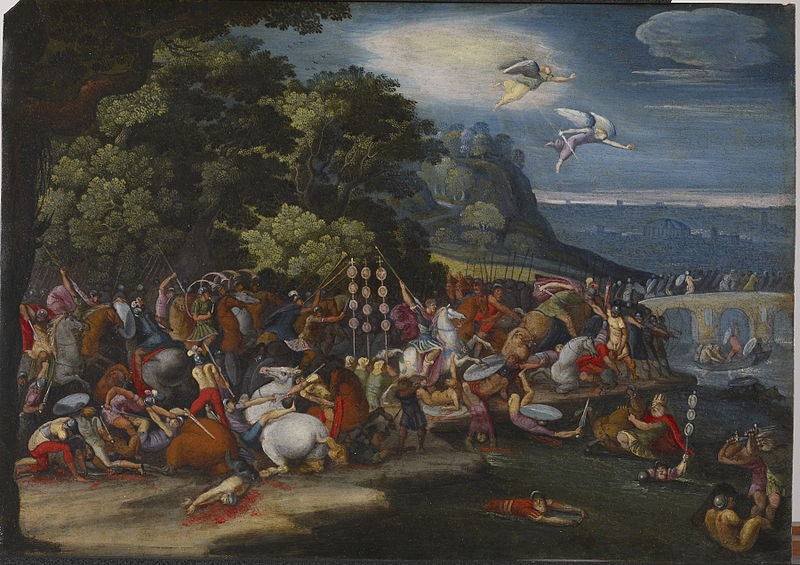
Painting of Constantine’s victory at the battle at the Milvian Bridge over the Tiber River in 312.
(adapted from Lives of the Fathers, Martyrs, and Other Principal Saints, by Rev. Alban Butler, Vol IX, D.&J. Sadlier Publisher, New York, 1821, pp 656-657).
 ABYSSUS ABYSSUM INVOCAT / DEEP CALLS TO DEEP
Would that history would repeat itself. The words “Jesus” and “prayer” are taken out of schools in America, we call are told by holiday greeting cards that it is better to say “happy holidays” than to say “Merry Christmas,” and so on. America is more like pre-Constantine Rome than we would like to admit. We need another Constantine or Don John of Austria to bring our world back into sync.