“(1) Adulterous sexual acts are in some special circumstances morally permissible… these propositions flatly contradict irreformable Catholic teaching. Proposition (1) contradicts not only the perennial moral teaching of the Church, but the teaching of scripture itself.”
(Edwardfeser.blogspot, “Denial flows into the Tiber,” December 18, 2016) – The Catholic Monitor
In my opinion, the two intellectual giants in the Church in the United States are Ed Feser and Fr. Chad Ripperger.
In philosophy Feser is the top mind while in spirituality and psychology Fr. Rippinger tops Feser.
Feser and Ripperger disagree on rather Catholics and Moslems worship the same “God.” I am sure that their disagreement is as Feser says because he is talking about the issue in the “philosophy of language” and not about the Catholic and Moslem “deep disagreements about the nature of God.”
Despite that I would love to see a debate between the two on the subject.
I have seen Feser totally destroy, with a devastating intellectual knock out Mark Shea (which is pretty easy), theologian Massimo Faggioli (a bit harder) and on YouTube win an impressive victory over a very intelligent Atheist.
I feel like I am getting into the ring with Mike Tyson when he was knocking everyone out in the first round, but I think Feser is wrong on the Open Letter.
First, I need to say, as always, his post on the Open Letter was overall very impressive and as always intellectually fair and even handed.
But, I disagreed with his statement that the Open Letter was “rashly made.”
The main reason I disagreed with that statement is because he wrote:
“For example, Pope Francis has made many statements that at least seem to contradict traditional Catholic teaching on divorce and remarriage, conscience, grace, capital punishment, and a variety of other topics.”
(Edwardfeser.blogspot, “Some comments on the Open letter, May 6, 2019)
It appears to me that Francis doesn’t just “seem to contradict traditional Catholic teaching on divorce and remarriage,” but explicitly “contradict[ed] traditional Catholic teaching on divorce and remarriage” when he in a “official act as the pope” placed the Argentine letter in the the Acts of the Apostolic See (AAS) in which he said of the Buenos Aires region episcopal guidelines:
“There is no other interpretations.”
The guidelines explicitly allows according to LifeSiteNews “sexuality active adulterous couples facing ‘complex circumstances’ to ‘access the sacraments of Reconciliation and the Eucharist.'”
(LifeSiteNews, “Confusion explodes as Pope Francis throws magisterial weight behind communion for adulterers, December 4, 2017)
In a article on OnePeterFive, specialist in Magisterial authority Dr. John Joy said “It means that it is an official act of the pope.”
Moreover, the article said:
“Dr. Joy pointed out that adding the letter to the AAS could, in fact, damage the credibility of Amoris Laetitia by potentially removing the possibility that it could be intercepted in an orthodox way, via its publication in the official acts of the Apostolic See, that the unorthodox interpretation is the official one.”
(OnePeterFive, “Pope’s Letter on Argentinian Communion Guidelines for Remarriage Given Official Status,” December 2, 2017)
The “official act of” Francis is a “unorthodox interpretation.”
It doesn’t just “seem to contradict traditional Catholic teaching.”
The “official act of the pope” is a “unorthodox interpretation” which means it contradicts traditional Catholic teaching which is just another way of saying by “official act the pope” is teaching heresy.
Now, let us quote Feser:
“(1) Adulterous sexual acts are in some special circumstances morally permissible… these propositions flatly contradict irreformable Catholic teaching. Proposition (1) contradicts not only the perennial moral teaching of the Church, but the teaching of scripture itself.”
(Edwardfeser.blogspot, “Denial flows into the Tiber,” December 18, 2016)
Pray an Our Father now for reparation for the sins committed because of Francis’s Amoris Laetitia.
Pray an Our Father now for the restoration of the Church as well as the Triumph of the Kingdom of the Sacred Heart and the Immaculate Heart of Mary.
Stop for a moment of silence, ask Jesus Christ what He wants you to do now and next. In this silence remember God, Father, Son and Holy Ghost – Three Divine Persons yet One God, has an ordered universe where you can know truth and falsehood as well as never forget that He wants you to have eternal happiness with Him as his son or daughter by grace. Make this a practice. By doing this you are doing more good than reading anything here or anywhere else on the Internet.
Francis Notes:
– Doctor of the Church St. Francis de Sales totally confirmed beyond any doubt the possibility of a heretical pope and what must be done by the Church in such a situation:
“[T]he Pope… WHEN he is EXPLICITLY a heretic, he falls ipso facto from his dignity and out of the Church, and the Church MUST either deprive him, or, as some say, declare him deprived, of his Apostolic See.” (The Catholic Controversy, by St. Francis de Sales, Pages 305-306)
– LifeSiteNews, “Confusion explodes as Pope Francis throws magisterial weight behind communion for adulterers,” December 4, 2017:
The AAS guidelines explicitly allows “sexually active adulterous couples facing ‘complex circumstances’ to ‘access the sacraments of Reconciliation and the Eucharist.'”
– On February 2018, in Rorate Caeli, Catholic theologian Dr. John Lamont:
“The AAS statement… establishes that Pope Francis in Amoris Laetitia has affirmed propositions that are heretical in the strict sense.”
– On December 2, 2017, Bishop Rene Gracida:
“Francis’ heterodoxy is now official. He has published his letter to the Argentina bishops in Acta Apostlica Series making those letters magisterial documents.”
Pray an Our Father now for the restoration of the Church by the bishops by the grace of God.
What is needed right now to save America from those who would destroy our God given rights is to pray at home or in church and if called to even go to outdoor prayer rallies in every town and city across the United States for God to pour out His grace on our country to save us from those who would use a Reichstag Fire-like incident to destroy our civil liberties. [Is the DC Capitol Incident Comparable to the Nazi Reichstag Fire Incident where the German People Lost their Civil Liberties?: http://catholicmonitor.blogspot.com/2021/01/is-dc-capital-incident-comparable-to.html?m=1 and Epoch Times Show Crossroads on Capitol Incident: “Anitfa ‘Agent Provocateurs‘”: http://catholicmonitor.blogspot.com/2021/01/epoch-times-show-crossroads-on-capital.html?m=1]
Pray an Our Father now for the grace to know God’s Will and to do it.
Posted inUncategorized|Comments Off on I AM A GREAT ADMIRER OF EDWARD FESER SO I WOULD LIKE TO READ A RESPONSE FROM HIM TO THIS POST THAT QUESTIONS HIS OPINION EXPRESSED ELSEWHERE
“A Wild Story… In Which Pat Draws His Pistol… In Church.”from: Patrick Kilchermann founder, Concealed Carry University host, The Guardian Broadcast producer, the 3 SECONDS FROM NOW series[Warning: This is going to be a very long email.IF you’re interested in hearing this story,you may want to break it up into installments and read it over time.] Guardian,
The last couple months have been interesting, and I now have a story for you that I suspect you’ll find deeply fascinating. Now: I’m going to write a full analysis and review of all the lessons learned from this incident in an email that I’ll send another time.
For now… this is a story that I imagine I’ll find cathartic to share – and I suspect you might pull a few nuggets of wisdom out of this one.
Here goes.
“Well! That was exciting.” It began like any other Sunday. I woke up before my little family and got busy preparing a big breakfast while knocking out sets of push-ups between tasks. We even managed to get out the door on time and it was a relaxing drive in.
WHERE PAT SITS IN CHURCH: Imagine a large hundred-and-fifty-year-old rectangular space of ancient roman architecture, with 4 gigantic stone pillars near the walls on either side, separated from each other by a distance of about 20 feet. My family usually sits against the right wall, 1/4 of the way back from the front of the room behind/near the first pillar. This day, however, the pews were full and so we were almost halfway back, behind the second pillar. I always sit furthest to the right, against the open aisle that exists between the pews and the wall – mobility and freedom of action.
As always, I’m carrying my 14+1 CZ75 with two 16rnd magazines in my front, left pocket.
Fifteen minutes into our service, I nudge my wife. I was irritated because a couple of the guys were moving around: One (a prominent businessman in that community) got up from the forward rows and walked to the back and another (a recently retired US attorney) walked down the side aisle with an expression that – to me – said something like “I’m probably being ridiculous, but….”. While not guardians, both are good quality men, and I was irritated because my intuition was saying “something’s up” – but they weren’t clueing me in. My wife brushed it off. “You’re reading into it. They probably had to use the bathroom.”
(I would later learn that the attorney did look for me.. but I wasn’t where he expected me, and so he grabbed someone else – a true shame! I am positive I could have prevented everything you’re about to read).
20 minutes later, halfway through and during the most solemn points of our service, we’re all kneeling in silent prayer. By this point, I have put my boy on my right (he was picking on one of his sisters) and my eyes are closed. Other than a baby crying here or there, you can hear a pin drop at this point of the service.
You can almost hear the pastor – back turned to us, himself in prayer – whispering his Latin, fifty feet away from me. Incense smoke rises slowly past a gigantic wooden Holy Cross, symbolically representing our prayers to Heaven.. and candles flicker. One could almost fall asleep from the peace in it all; with a hundred years of coolness radiating from the old stone walls and floor… When suddenly…… A door slams open from somewhere with a CRASH and a man’s voice begins yelling, screaming at the top of his lungs – screaming so harshly that one can’t understand a word he says!
Before I can even open my eyes, women are already shrieking in reaction. Now men take up the call, and as my eyes are snapping open I can already see that those in the front row are jumping up and pouring out of their pews – indeed, some are beginning to barrel over their pews to escape bottlenecks and move back faster.
I’m sure not even a full second has passed before the initial screams at this point, and now I hear the voices of grown men: “GET OUT! GET OUT! GET OUT!”
The screaming intensifies and I find I am instinctively jumping up from kneeling. I push my son across me toward my wife and as I jump out of the pew and into the aisle I realize my pistol is already in my hand.
So, now I have a tidal wave of people coming at me, and my CZ75 ProTek ACCU is four inches out of its holster – still pointed down – pinning my button-up shirt up against my abs. My left hand is covering it – the classic ‘discreet draw.’
(NOTE: Even this discreet draw was a mistake. I must have said a thousand times in my career, “keep your weapon holstered and concealed until you’re within imminent chronological proximity to your threat.” This is not a mistake I’d suggest making: based on the panic I saw, I would not place too much faith in even people who know you intimately not mistaking you for a shooter. I will be discussing further WHY I made this mistake and the mental conditioning we can do to prevent this, later.) I’ll never forget their faces.The faces worn by the wave of people sprinting toward me down that auxiliary aisle will forever be etched into my memory. I’ve seen ‘the universal fleeing bystander’ hundreds if not thousands of times in videos and photos, but when it’s people you know and respect – and in full color and resolution – reduced to animal urges…. it’s powerful indeed.
Guardian: These people were lost within themselves. There were definitely some gallant protectors in the crowd, carrying three or four kids each. But I do not doubt for a moment that some of them had momentarily forgotten everything. Their spouses, their kids… their faces were flushed and their eyes were huge. I’ve seen a couple car accidents and I’ve watched two people die ‘in public’ of painful, un-natural causes. But this was my first encounter with mass hysteria, and I can testify that panic is a very wild animal.
At this point, maybe 2 seconds have passed. As the wave nears me, I smash myself back against the pew. Even still, I am hit by the wave and pulled back a step and a half, and I fight my way forward and back into our pew.
Trusting the ‘wisdom of the crowd’ and abiding by what has always been my stated plans for a situation like this (to focus primarily on getting my family out safely) I shout “Let’s go!” at my wife, who has pulled our other children onto the floor and is covering the younger two, but she doesn’t react fast enough and I realize that with the time it would take to pick up our four kids, if we get out into the aisle at all, it’ll be at or toward the back of the pack: the kill zone. So I change my mind and put my hand out to say “stay.” Provided it’s one guy, I know they’ll be safer here with me moving forward to fight.
NOTE #1: I say ‘know’ here. What would be more accurate would be to say ‘understand.’ The phrase ‘to know’ seems to imply ‘thoughts put to words’, where ‘to understand’ seems to imply the sort of ‘whole-body knowledge’ that you get [with enough of the right kind of training] even if there’s no time to put a single word to a thought. NOTE #2: I’m making a second note, because this is critical. It’s critical for me to write this:
In my industry, teachers are fond of saying: “In that moment, you don’t have time to think or react. Your training will take over.” This is not true, or at least it’s not mostly true. Our 3 SECONDS FROM NOW series works to stand and witness against this notion, and my experience in the church was yet another that confirms it for me.
What I experienced there and in the Sim arena many times was: you ARE still in your mind’s driver’s seat. You do have to decide and act. However, these decisions and actions are born of intelligence (data) that hasn’t yet been fully processed by the conscious mind (and likely won’t be until later), and then those decisions are carried out by a body that is reacting – partially consciously and partially automatically – based on that intel.
I have referred to normal life as that where we ‘operating outside of the consciousness curve’: where our actions are planned and then executed by our body. Operating on theinside of that curve is when our conscious minds must be bypassed for self-preservation.
We modern humans are ACCUSTOMED to operating on or outside the consciousness curve. And so it feels, to a degree, as if we’ve lost control when we’re operating INSIDE of that curve.
But as anyone who’s been through something like this (or any Guardian, anyway) will testify, as I’m telling you now: you WILL still be in the driver’s seat… but in a different way than you’re used to – I believe that in those moments we’re operating right on that line, weaving rapidly between conscious and unconscious action. We’ll discuss this more later. Anyway, there we are. My wife is face down over top of two small children and without looking I push my son’s back so that he slides into her. People are storming by us and still there is a wall ahead of us as 15 rows of people empty. I am desperately scanning through the crowd, in a kneel-crouch, trying (and utterly failing) to get SOME kind of idea of what the heck is terrifying everyone so badly.
The noise, I would describe as a CACOPHONY. Perhaps my ears were extra sensitive on par with some ‘On Combat’esc distortion of the senses, but I think in fact the noise was just plain old deafening. I was focused on listening for gunshots, but the sounds of screams and shouts and shoes and slamming kneelers and boots and stomps and sprints was so loud for those first 3 to 3.5 or maybe 4 seconds that for a moment I couldn’t tell if there even were any gunshots.
While focusing over the pew I apparently shout to my wife “I’M GUNNA GETTHAT F—–R!” I don’t know why I said this, and I didn’t remember saying it until she reminded me when it was all over. (I grew up in a poor area with a mother who cussed like a sailor: evidently I regressed for a moment 😉
My head spins around and I look up to the choir loft – a massive balcony hosting an ancient pipe organ, and by far the #1 pick for an active shooter perch. I scan and look for movement or muzzle flashes or anything at all – there is nothing. A face catches my eyes, and in the row behind me it’s a young woman, early 20s, huge, terrified eyes looking from me to the CZ that I realize I am again not hiding very well as I scan the loft. I recognize her but don’t know her – I shout to her: “It’s okay, I’m a good guy!” She nods and sinks lower. Note #3:
In that split-second, I was very, very frustrated by the lack of control among the crowd. I couldn’t see forward of them, and therefore: I couldn’t help them. I assumed there just HAD to be a guy with a gun to cause such a panic, and I could only imagine that God or ‘fate’ or good luck or incompetence led to some kind of misfire or mishandling of his weapon, buying us all these precious seconds.
Did someone tackle him? At this very moment, was a good samaritan losing his grip on the guy’s gun?
I had no idea, and I was absolutely haunted for those seconds by the certainty that all I could do was wait until the wall of people cleared up, thinning out enough for me to get through them… or… they fell. I hated the feeling of waiting.
I knew exactly what a pistol would sound like when fired in that hall and I could imagine what a rifle would sound like in there. Through the screams and men’s yells, I could perfectly imagine that deafening, plunging sound of rifle fire. The sort that echoes so loudly from every direction that you could never use your ears to triangulate its location. I cringed as I waited for that, and what would be the sounds of bullets snapping through wooden seats and off the stone floor and through and into God knows what and who else.
Again, without any real thought, I ‘understood’ in that moment that within seconds this situation would go from ‘good guy prevents lots of carnage’ to at best ‘good guy took action way, way, way too late and here are twenty or thirty or even forty bodies to prove it.’ (Down the three aisles in this church, these perfect fields of fire, rifle rounds could easily have achieved that in those moments of high density and bottleneck – just one or two mags).
I can’t describe to you the frustration of knowing all this WHILE knowing I had the power to stop it, but while being completely devoid of any ability to SEE a shooter, much less make handgun contact with him.
In that moment, I saw and felt all those trade-offs… and again, it was miserable.
People say things like thoughts ‘flash through your mind’. In reality, I think this ‘understanding’ that I speak of is closer to the truth. Rather than a reel being played, it’s just a bunch of stuff that is immediately, already, and infinitely (and miserably) understood. After what was realistically probably five or maybe six seconds since the very first scream…. ….the wave is finally thinning as it passes me. I step back up and move to the pillar that I always sit behind just for this reason. Glancing behind me, I see a close acquaintance of mine – a man I trust as a reliable fighter. I didn’t know where he was sitting before church, and I’m glad to see him now. I couldn’t tell at the moment, but in his (large) hands is a microscopic Ruger LCP, which he has also drawn. (Unchambered, he told me later. Imagine!)
I do not know why, but I made no attempt to communicate with him; I didn’t even note his facial expression. I simply understood that a good guy was behind me. I take note (again, ‘sub-consciously) that almost the entire church is clearing out. People are forcing themselves through the doors in the back. No gunshots. I turn around and I look at my family as my head turns. Around them are a multitude of people: men, women, and children, either lying in the pews or lying or crouched on the floor.
With all this writing, it’s impossible to convey that only between 6 and 7 seconds have passed for this entire event up to this point. People say: it all just happened so fast! It sure does.
Pistol at high-ready but tight to my face I lean to cut the angle around the right side of the pillar, and there’s a man from our church walking out of the room that’s called a Sacristy, on what you could call ‘stage right’, way up front. He appears shaken, but not in a panic. Curious! I move around the left side of the pillar and take in the entire scene. The pastor is standing where he had been, looking toward the back of the church. I don’t see any fear on his face – only alarm and confusion.
It’s quickly getting less noisy, but many people must still be yelling while they’re pushing out of the church because even still, it’s very loud.
I do not see a shooter up front. It feels like a lull, an opportunity – so – I step away from the pillar and out into the auxiliary aisle. I stare forward, pistol now at low-ready but covered with my left hand, and when nothing happens or moves for a second, I say loudly: “Okay, family! Up, let’s get up and get out!”
My wife is looking at me. Red face, very intense. My wife is a very tough woman. She grew up breaking horses for $300 a pop, abusing and breaking her teenage body in ways that horrify me now, for sums that barely register, and in ways that only we slum-dog ‘dime a dozen rednecks’ seem to be able to do while still walking away. I’ve seen her cry twice in our entire marriage, and while she’s not crying here, she’s as intense as I’ve ever seen her. I re-holster, but keep my right hand gripped on the pistol.
I would prefer to say I did this because I realized cops might enter soon, but the reality was that, devoid of any gunshots, I had already begun to feel sheepish for what was quickly beginning to seem like an over-reaction of epic proportions.
I encourage them as they’re getting up, glancing from them to the front of the church. “Yep, yep, that’s right guys, up and out, just head out the back doors, follow momma.”
I planned to follow them, but then I see so many other faces staring at me – from the pews and floor. They’re lying flat, eyes glued to me. I felt they were looking for direction. I announce: “Okay guys, let’s go, let’s get up and out. It’s time to get out now, come on now, let’s go everyone, up, up.” I say it again and again, but they won’t budge until I make direct eye contact with each one. One by one, the eye contact seems to unlock them; without it, they’re like statues. Only one remains, and I know her personally. She won’t budge. I shout her name and I’m surprised by how angry I sound: “L_____!!!!! It’s time to GET your kids and GET OUT OF HERE.” She jumps into action. (I later learned that her husband was serving in a different role in the church that morning.)
By now, I turn to see my wife pausing at the back of the church. I wave her out, but I can tell she doesn’t want to go out the doors, and I don’t blame her. There’s no shooting in here, and it seems as safe as the unknowns out there. (Exiting the church leads to a tall set of stone stairs and it’s completely exposed to a street and large parking lot — you’d never even know where the shots were coming from.) She’s a smart woman, and I decide to just move to clear the front of the church.
I do not know what happened to my LCP acquaintance during this time, but now (I’m going to guess 12 seconds have passed) I am coming back inside the ‘consciousness curve’ and it’s much easier to think and plan. I do not want to walk down the auxiliary aisle because there are a handful of doors leading to small rooms off that walkway – better to move to the center aisle and stay low.
I look around.
The first thing that I observe which stuns me is the number of personal items scattered everywhere. Hats, coats, books, bags, children’s toys… the place is a mess.
The second thing I take in is the reality that people are regaining their nerve and are sporadically jumping from their aisles and darting to the exit at the back of the church, one by one from random corners.
My eyes make it further to my left, and there is a man around my age, standing in the center aisle, also facing toward the front of the church. His eyes are glistening, and his thick mustache covers an intense expression. I’ve seen him before but do not know him, and I see that his right hand is under his plaid shirt, presumably resting on a pistol handle. I instantly like this man. He glances at me out of the corner of his eyes, and I realize I’m doing the exact same thing: hand on my pistol, shirt draped over my hand. Our glance says a lot.
Without speaking I begin crossing over to him with the plan of clearing the front together, but as I begin to move he turns and heads for the rear exit – bound to check on his family I assume. I begin walking forward, looking down the pews and off into corners, watching every angle as my forward progress exposes them. My LCP acquaintance is back and moving up the right side, far faster than I want to walk right then.
I still see lots of people: many are still hiding in their pews. And by no means only the old or handicapped. I don’t tell anyone that it’s safe or that they can get up. For now, as my eyes scan, I’m extremely grateful for how still and silent it suddenly is in the church. Note #5:
Whenever I review confiscated security videos of active shootings, I can never believe how MANY people just sit or lay there, like targets. Even able-bodied people: they sit and wait. This truly is the ‘freeze’, the ‘playing dead.’
Trained Guardians seem to be at risk of a 1-5 second freeze without enough sound mental training and Acclimation. That’s deadly enough. But for sheep…. it seems to be perpetual. 30+ seconds, easy.
Shooters in these situations have absolutely zero scruples about approaching and shooting these victims point-blank. Indeed: that’s where most of the body count comes from in those kinds of situations. The people I see are staring at me as a glance over them, cautiously moving forward. The pastor is still standing there (he’s a guest pastor, a foreigner from Africa whose dialect is so strong as to be difficult to decipher), and now there are two people outside that sacristy: my LCP acquaintance and another man.
I am satisfied by the time I reach the front of the church that there is no danger. It was an eerie situation.
I move over to the acquaintance.
“What’s going on??”
‘They’ve got a guy in there, pinned down!’
I enter the little room. There are at least six guys lying on top of someone – it would be comical if it didn’t just follow such a wild situation, because it reminds me of a cartoon football pileup. I look at a couple of guys who are standing around the pile, but they seem dazed and we don’t speak. I move up to the pile and look between the hands and faces and arms.
I see a very young man, maybe early 20s, face pinned to the floor. Glasses are bent sideways around his nose and cheek. He is crying HARD. He is wailing, sobbing, gasping for breath. Someone from within the pile is saying: “It’s OKAY. You’re SAFE. You’re in the SAFEST PLACE IN THE WORLD. People are coming to help you.”
I stand back up. I ask one of the guys standing around who looks a little more calm: “Any weapons?”
“No, I don’t think so.”
“What was the deal?”
“I don’t know…”
I walk back out and there’s another (unarmed) friend who apparently peeled off from a pew and followed me up front. I say to him: “Well! THAT was exciting.”
He suggests that I go to the microphone and make an announcement. I, in turn, ask my LCP acquaintance to do it (who had followed me back into the room): I suddenly had the very strong urge to go and make sure my family was okay. In the end….
> The police arrived about 4.5 minutes after the first 911 call, and the first young officer sprinted up the side of the church, AR15 in hand. Fortunately, we had a guy go out and wait at ALL the exit doors (not just the main one) – and caught this officer as he sprinted up the courtyard to defuse his extremely high energy before he entered.
> Even this remarkable response time, of course, would have been miles and miles too late.
> The young man who caused the disturbance was NOT an active shooter… only a mentally disturbed person whose loud entrance and shouting caused a BIG panic. He had apparently wandered into the unlocked church in the wee hours and fallen asleep hiding in a wardrobe in that sacristy. When he woke up from his drug induced paranoia, he was panicked, thinking he’d been abducted.
> I was told later by several people, including the young woman who sat behind me, that my presence (including my pistol) were “..massively comforting..”
> The woman I shouted at later thanked me for kicking her into action.
> The young man, a paranoid schizophrenic, was arrested and taken away to get help. The church persuaded the authorities to not file charges, and a collection was taken up to pay for his mental treatment.
> My acquaintance says he will be promptly selling his Ruger LCP, and losing the 25lbs he needs to lose to carry a weapon that would actually provide some utility in a situation like that. I knew he had a S&W M&P, and I gave him a hard time for not having had it on him.
> Within 15 minutes, people had filtered back in and church continued… although with about 1/3 fewer people than who began. (I suspect some of them needed to go home and change their pants!)
> This was one of the most fascinating experiences of my life. I am deeply grateful for it.THE END…. ALMOST.Probably, it is much more prudent to not discuss a situation like this until after all the dust has settled. But I do not see any harm in sharing this one. (By now, I’ve been inundated with security team meetings and presentations; I’ve done walk throughs with the police, we’ve worked out security protocols, I’ve been training and training and training.)
I wanted to share this and all the impressions with you in case you’ve never been in a situation like this one. You know me: I’m all about building vicarious experience. I’m also happy to put down a written record of what I experienced while it’s all fresh in my memory.
But most important of all, this incident carries with it as much fruit in the form of wisdom as any that we’ve reviewed in our 3 SECONDS FROM NOW series, and so I want to focus on that.
Now, this email was necessarily long, so I’m going to end this here.
If you’ve stuck with me for this long read: I hope you’re a little more prepared! The more we can expose ourselves to this kind of stuff ahead of time, the absolutely better prepared we’ll be in the moment.
Good luck… and stay safe, my friend.
– PatIn a few days, I’d like to discuss the concept of training and readiness in a little more detail.
Stay tuned!
Concealed Carry University, LLC, 336 W 1st st. STE 113, Flint, Mi 48502, United StatesUnsubscribe from all email from Pat and the Concealed Carry University forever.
ReplyForward
Posted inUncategorized|Comments Off on READ THIS POST! IT MAY SAVE YOUR LIFE AND THE LIVES OF OTHERS
Why does the West want to annihilate what it built in the first place? The real enemy of the West is the West itself, its imperviousness to God and to spiritual values, which resembles a process of lethal self-destruction. —Robert Cardinal Sarah, The Day Is Now Far Spent
By this point, the contours of the Viganò debate are pretty clear. Where Archbishop Viganò blames an expansionist NATO and post-Christian West for the war in Ukraine, His Excellency’s critics believe he is not only whitewashing the harsh realities of Vladimir Putin’s regime but also ignoring key points of just war doctrine. As the archbishop often employs apocalyptic language to describe the convoluted machinations of globalists, there is also concern that he is turning into an eccentric conspiracy theorist. Rather than add to the already sizable volume of commentary either for or against Archbishop Viganò, it seems to me more interesting to note that in one sense he is not alone. That is, he is not the only churchman—or even the highest ranking—who has, on occasion, “looked East” to remedy “the errors of the West.”
Indeed, among observant Catholics it would be hard to find a living churchman more universally esteemed than Robert Cardinal Sarah. A Francophone native of Guinea, Cardinal Sarah has been characterized by no less a luminary than George Weigel as “a bright shining light,” one whose “faith illuminates the path to authentic Catholic reform.” For the most part, other Catholic commentators seem to share this view. Yet most who have heaped praises upon the cardinal have consistently and conspicuously ignored how dramatically the cardinal’s worldview clashes with that of America’s conservative Catholic establishment. It is not even as if the cardinal’s inconvenient views were curtly dismissed; no, they were not even acknowledged.
For instance, back in 2019 when Cardinal Sarah’s book The Day Is Now Far Spent came out, this writer was struck not only by the book’s emphatic and repeated condemnation of finance capitalism and globalization but also by the utter lack of interest reviewers exhibited toward this part of the book. Pointed statements like “Globalized humanity, without borders, is a hell,” were unambiguous, and surely relevant to the fiery controversies which were still roiling in the wake of Brexit and the election of Donald Trump. Few Catholic journalists have so much as alluded to such remarks.
As far as I know, nobody at all saw fit to notice Cardinal Sarah’s reflections upon U.S.-Russian relations, even though said relations have been a subject of burning interest in conservative Catholic circles for some time now. It was almost as if most Catholic journalists were simply ignoring statements like the following, which could by no means be rendered into safe, conservative-establishment boilerplate:
In Russia, the Orthodox Church has to a great extent resumed its pre-1917 role as the moral foundation of society. This arouses political opposition, but also a deep hatred on the part of the post-Christian elites of the West, not only vis-à-vis Russia, but also against the Russian Orthodox Church and, by extension, against Orthodox Christianity itself. The overtly political attack that aims to pit Ukraine against the Russian Orthodox Church under the authority of Patriarch Cyril of Moscow is a dangerous, stupid provocation.
Here a number of implicit positions on the part of His Eminence should be conceded, positions with which we may or may not agree. For one thing, unlike most Americans, Cardinal Sarah does not accept the idea of a “wall of separation” between church and state. Furthermore, he does not dismiss the Russian Orthodox Church either as a KGB front or a clique of damned schismatics.
Whether right or wrong on such matters, he seems to have been aware of something long forgotten by many American Catholics now sporting Ukrainian flags: The 2014 coup, backed by the Obama administration, which overthrew Ukraine’s pro-Russian government. (If nothing else, those critical of Washington’s hysterical reaction to January 6 might find it interesting to contemplate the U.S. State Department’s support for Ukrainian regime change via organized militias, street fighting, and Molotov cocktails; the truth is that the hypocritical American elite have no problem at all with violent insurrection, provided said catastrophe happens to somebody else.)
We might also recognize that, while the cardinal’s support for Russia against a post-Christian West was not so flamboyant and extravagant as Viganò’s, it was still well beyond the pale of political correctness, even back in 2019:
John Paul II was convinced that the two lungs of Europe had to work together. Today, Western Europe is employing extraordinary means to isolate Russia. Why persist in ridiculing that great country? The West is displaying unheard-of arrogance. The spiritual and cultural heritage of the Russian Orthodox Church is unequaled. The reawakening of faith that followed the fall of Communism is an immense hope.
At this point, the support the Russian government shows for Russian Orthodoxy is treated as a mark against it, as a sign of manipulativeness. For his part, Sarah takes for granted that the preservation of a nation’s Christian heritage is a good thing, regardless of how shallow the motives of politicians. “The West seems happy to see its churches turned into gymnasiums, its Romanesque chapels fall into ruin, its religious patrimony threatened by a total desacralization. Russia, on the contrary, is spending considerable sums to restore the treasures of Orthodoxy.”
And as if to drive home his comparison, Cardinal Sarah contrasted American and Russian involvement in the Middle East, yet again in favor of the Russians:
The Obama administration tried to bring freedom to the Syrians. Today the country resembles an expanse of ruins. Without Russia’s intervention, an Islamist regime would have ended up winning the day. The Christians of that country owe their survival to Moscow. Russia played its role as protector of the Christian minorities, most of them Orthodox. The Russian government intended to defend a religion, but also a culture.
Again, all of these remarks were published several years ago, so none of this is meant to put words in His Eminence’s mouth regarding the current situation. His current Twitter account indicates—unsurprisingly—that he laments the war, and the death and destruction, and would like to see a peaceful resolution. It hardly seems plausible that he would condone the invasion of one country by another, whatever the backstory. Yet given his previous critiques, it seems likewise doubtful that he would blame the war entirely on Russia, much less that he would rally around the Western banner.
To understand why, we need to remember that Cardinal Sarah’s perspective is informed by experiences radically different from those of, say, a suburban American Catholic. As a native African, Sarah retains an appreciation for the organic, tribal ties which Americans have largely discarded. As a post-colonial who is quite at home with French Catholic culture and ideas, he represents a radically counter-revolutionary worldview, one which looks askance not merely at socialism, but at the Lockean liberal project itself:
Western people are convinced that receiving is contrary to the dignity of human persons.But civilized man is fundamentally an heir, he receives a history, a culture, a language, a name, a family. This is what distinguishes him from the barbarian. To refuse to be inscribed within a network of dependence, heritage, and filiation condemns us to go back naked into the jungle of a competitive economy left to its own devices. Because he refuses to acknowledge himself as an heir, man is condemned to the hell of liberal globalization in which individual interests confront one another without any law to govern them besides profit at any price.
In case the reader hasn’t noticed, these are almost the diametric opposite of the sentiments found in the pages of National Review, which sees “liberal globalization” not as a hell but heaven.
Just to be clear, my real point here is neither to advocate a particular view of the war, nor to treat Cardinal Sarah as an infallible prophet, nor to insist that he was right about the state of Russia, about globalism, or about anything else in particular. No, the point is that a high-profile churchman believes that the West’s greatest enemy has never been al-Qaida, ISIS, or China, much less Russia, but rather the West itself—and none of those professing to admire him have seen fit to notice.
Catholic conservatives consistently evade the issue whenever an honored figure—living or dead—parts company with their own narrow agenda of “democratic capitalism.” Maybe this practice is due to dishonesty, or maybe it is mere cognitive dissonance. Either way, the harm it perpetuates goes far beyond foreign policy. If we fall into the habit of carelessly filtering out everything that might challenge us, then it is futile to discuss Cardinal Sarah’s thoughts—or anybody else’s.
Jerry D. Salyer holds a Bachelor of Science degree in Aeronautics from Miami University and a Master of Arts from the Great Books Program of St. John’s College, Annapolis. A veteran of the US Navy, Mr. Salyer now works as an educator and as a freelance writer.
On further review, the Office of Legal Counsel’s opinion on President Biden’s purported authority to “prospectively appoint” Judge Ketanji Brown Jackson to the Supreme Court is much worse than I first thought.
In a post on Friday evening, I offered some initial doubts about the soundness of OLC’s advice that Biden could, in the immediate aftermath of the Senate’s confirmation of Jackson’s nomination, complete his role in the appointment process by issuing a commission to Jackson that would take effect when Justice Breyer retires. In this post and a follow-on, I will expand my critique of the OLC opinion. (I won’t reiterate here my argument that the OLC opinion contradicts a passage in Marbury v. Madison, and I instead refer interested readers to point 2 of that previous post.)
To be clear, while I am very skeptical of OLC’s bottom line, I am not contending here that it is clearly wrong. I am instead maintaining that the reasoning in the OLC opinion is deeply defective and unpersuasive.
1. The OLC opinion prominently asserts:
Our Office has taken the position that prospective appointments are permissible for vacancies anticipated to occur during the appointing official’s own term of office. See Memorandum for Harlington Wood, Jr., Associate Deputy Attorney General, from William H. Rehnquist, Assistant Attorney General, Office of Legal Counsel, Re: Delay in Induction of Judge into Office Following His Confirmation by the Senate (Nov. 27, 1970) (“Rehnquist Memorandum”).
To my surprise, it turns out that that assertion is blatantly wrong.
The Rehnquist Memorandum that OLC cites was made public on Friday evening. As its title indicates, it addresses whether two United States Attorneys who had been “recently confirmed by the Senate to be district judges” could have “their ascension to the bench … delayed” so that they could complete their “work on important criminal prosecutions.” President Nixon had issued a judicial commission to one of the two confirmed nominees but not to the other. Both nominations involved newly created seats, not seats still occupied by an incumbent.
The Rehnquist Memorandum not only does not advise on the matter of prospective appointments. It does not even offer a word in passing on the matter. So I do not see how OLC can defend citing the Rehnquist Memorandum (and only the Rehnquist Memorandum) as support for the proposition that OLC “has taken the position that prospective appointments are permissible for vacancies anticipated to occur during the appointing official’s own term of office.” (I also don’t see how anything in the Rehnquist Memorandum provides even implicit support for that position.)
A cynic might suspect that OLC is trying to hide behind Rehnquist’s conservative bona fides to deflect scrutiny of its position.
2. The OLC opinion also asserts:
The Office [OLC] has previously noted that historical practice supports the President’s authority to make prospective appointments of judicial officers, including an Associate Justice of the Supreme Court.
This assertion is also false. The opinion cites two previous opinions in support of this assertion. Let’s start with the second one, the Rehnquist Memorandum. Again, there is not a sentence in the Rehnquist Memorandum that “noted that historical practice supports the President’s authority to make prospective appointments of judicial officers” or that even had anything remotely to do with the matter. The new opinion claims that the Rehnquist Memorandum “discussed” one instance of such an appointment, but as its own account reveals, the instance instead involved “a judicial officer [who] ha[d] been appointed many months before taking the oath and entering on the duties of the office.” In other words, rather than involving a prospective appointment, it involved an ordinary immediate act of appointment by the president and the confirmed nominee’s delay in accepting the appointment.
The other previous OLC opinion that the new opinion cites is a 1968 opinion on the power of President Johnson to nominate Abe Fortas to be chief justice (which is available as an attachment, pp. 154-169, to a 1979 opinion). Here too, the subject matter of the opinion has nothing to do with prospective appointments. It instead concerns the president’s power to make a nomination to a seat that is not yet vacant. It therefore bears instead on the (to my mind, uncontroversial) point that Biden had the power to nominate Jackson to Breyer’s seat.
OLC states that the 1968 opinion “provided several examples of judges who were appointed by the President prior to the effective date of the outgoing official’s resignation.” That statement is correct, as several can mean three. And those examples do appear to provide support for the proposition that presidents have made prospective appointments before, including to the position of associate justice.
But I do not think that it is correct to contend that the 1968 opinion “noted that historical practice supports the President’s authority to make prospective appointments.” Rather, the 1968 opinion compiled the data on these and other judicial appointments and lumped them all together as examples of nominations “in advance of the effective date of the resignation or retirement of the incumbent.” The 1968 opinion seems to take no particular note of, and certainly does not offer any comment on the issues raised by, the three instances that also happen to involve prospective appointments.
It’s also worth noting that each of those three instances involved the incumbent’s commitment to retire upon a specific date (that’s true of both of the associate-justice instances) or condition. By contrast, Breyer stated in January only that he “intend[ed]” his retirement decision to take effect at the end of the Court’s term, and he hedged even that mere statement of intention on the “assum[ption] that by then my successor has been nominated and confirmed.”
And of course there is the broader question whether previous actions by presidents provide meaningful evidence that a practice is constitutionally permissible or show instead that presidents sometimes acted unconstitutionally.
(I will note that the OLC opinion also cites a 1960 OLC opinion that apparently deals with “prospective appointments” to some fixed-term executive-branch offices. That opinion does not appear to be publicly available, and if it in fact provides meaningful support for the new OLC opinion, it would be odd that the new OLC opinion so badly misuses the Rehnquist Memorandum and the 1968 opinion.)
There are also several important matters that the OLC opinion fails to address. Given the evident rush in which the opinion was issued, this is perhaps understandable. But the gaps present some troubling questions about how the OLC advice might operate in practice.
3. In observing (correctly, in my view) that the president may make “prospective nominations” for “anticipated vacancies on the Supreme Court,” OLC does not clarify the bounds of an anticipated vacancy, nor does it address whether the president may make prospective nominations for vacancies that fall outside the bounds of what is “anticipated.”
In its 1968 opinion, OLC stated:
It should be noted that anticipated vacancies [for judicial or executive-branch positions] may be grouped into two categories: First, those that will take effect on a day certain; e.g., when a resignation is submitted as of a specific date, or a statutory term is about to expire. Second, those that will take effect upon fulfillment of a condition; e.g., when the removal or elevation of the incumbent takes effect, or the appointment and qualification of his successor. Nothing in the Constitution prevents advance nomination and confirmation to fill either category of anticipated vacancies.
This statement might well be read to imply that the Constitution prevents “advance nomination” for a future vacancy that falls outside of these two categories. But, alternatively, it might simply be that the settled practice of a president’s making advance nominations only for these two categories of anticipated vacancies reflects a sensible accommodation of the institutional interests of the president and the Senate—an accommodation that a president and a compliant Senate might choose to depart from.
4. In advising that “prospective appointments are permissible for vacancies anticipated to occur during the appointing official’s own term of office,” OLC does not explicitly state that prospective appointments are not permissible for vacancies that are anticipated to occur after the president’s current term of office. Is that in fact OLC’s position? And, if so, what are the constraints on anticipating a vacancy?
These questions interact in important ways with the question whether a president may make an advance nomination to a vacancy that falls outside the two categories of anticipated vacancies in item 3. Might a president, for example, assess that a particular justice seems to be in poor health, nominate a successor to that justice’s position, and, upon the Senate’s confirmation of that nomination, prospectively appoint the successor?
5. What happens if the president makes a prospective appointment to a vacancy but the vacancy does not actually occur during the president’s current term of office? Assume, for example, that Justice Breyer changes his mind and decides not to retire. Does Breyer’s prospective appointment of Jackson to the Breyer vacancy expire on January 20, 2025? Or does it remain potent, ready to spring into full operation whenever Breyer does vacate his seat?
On the one hand, the OLC opinion’s core conclusion that Biden, by making a prospective appointment of Jackson, would complete his role in the appointment process makes it puzzling to think that his appointment would somehow expire when his term ends. If that were the case, the Supreme Court could have dismissed Marbury v. Madison on the ground that Marbury’s failure to accept President Adams’s appointment while Adams was still president meant that the appointment expired when Thomas Jefferson took office. I am not aware of any precedent that an unaccepted appointment expires when the appointing president’s term expires.
On the other hand, the OLC opinion embraces the proposition that the president “could not ‘forestall the rights and prerogatives of [his] own successors by appointing successors to offices expiring after [his] power to appoint has itself expired.’” So this proposition would seem to mean that Biden’s prospective appointment of Jackson would expire on January 20, 2025 (at least if Biden is not elected to a second term). Or does it mean that Biden would “forestall the rights and prerogatives” only if he made a prospective appointment to a vacancy that he did not anticipate would occur during his term?
Depending on how this and the preceding questions are answered, a president might be able to make a batch of nominations to, say, the next ten or twenty associate-justice vacancies that will occur, have a compliant Senate confirm those nominations, and then make prospective appointments that will spring into operation over a course of many years, with the appointed individuals filling new vacancies as associated justices whenever such vacancies arise.
6. If the OLC opinion is correct and Biden could make a prospective appointment of Jackson, how must such an appointment be worded?
As I have noted, when the president uses the conventional language of the judicial commission, he states that he thereby “authorize[s] and empower” the appointed judge “to execute and fulfil the duties” of the judicial office. Without some amendment, such language in a commission making a prospective appointment would seem to be lie and thus a nullity.
According to the 1968 OLC opinion, President Grant’s commission of Edwin M. Stanton on December 20, 1869, specified that it would “take effect on or after February 1 [1870],” the date on which Justice Grier’s resignation would take effect, and President Harding’s commission on September 5, 1922, of George Sutherland to replace Justice Clarke likewise stated “commencing September 18, 1922,” the date on which Clarke’s resignation would take effect.
What does the commission that Biden has apparently issued Jackson actually say? And if it doesn’t similarly specify that it takes effect only upon Breyer’s retirement (or on a specific date that ends up being after Breyer’s retirement), is it nonetheless somehow valid?
* * *
As I have previously explained, it appears that Biden resorted to a prospective appointment of Jackson in order to try to foreclose the farfetched possibility that the Senate might somehow adopt a motion to reconsider its confirmation of Jackson. When Breyer does retire, Biden should issue Jackson a second commission in order to eliminate any question over the legitimacy of her appointment as an associate justice.
1990—Dissenting in Osborne v. Ohio, Justices Brennan, Marshall, and Stevens opine that possession of child pornography is protected by the First Amendment. Though unmoored from any plausible meaning of the First Amendment, their position is a logical extension of Justice Marshall’s activist ruling in Stanley v. Georgia (see This Day for April 7, 1969). And faithless as they are to the actual Constitution and to precedents with which they disagree, liberal judicial activists vigorously apply activist precedents.
1990—At the same time that it unanimously holds that a federal district judge, in implementing a desegregation plan, lacked the authority to directly impose an increase in the property-tax levy in a school district, the Supreme Court decides, by a 5-to-4 vote (in Missouri v. Jenkins), that the judge may direct the school district to increase the property tax and may enjoin the operation of any contrary state laws.
Writing in dissent (and joined by Chief Justice Rehnquist and Justices O’Connor and Scalia), Justice Anthony Kennedy disputes the “purported distinction between direct imposition of a tax by the federal court and an order commanding the school district to impose the tax,” and he condemns the majority holding:
“Today’s casual embrace of taxation imposed by the unelected, life-tenured Federal Judiciary disregards fundamental precepts for the democratic control of public institutions.”
2007—Dissenting from the Supreme Court’s rejection (in Gonzales v. Carhart) of a facial challenge to the constitutionality of the federal Partial-Birth Abortion Act of 2003, Justice Ruth Bader Ginsburg predicts that as-applied challenges to the law “will be mounted swiftly, to ward off serious, sometimes irremediable harm, to women whose health would be endangered by the intact D&E prohibition.” In fact, years later, not a single such challenge will have been brought. Why not? Probably because (as I explored in “The Mystery of the Missing Lawsuits”) the abortion industry’s medical evidence that Ginsburg was so eager to credit has always been very feeble.
2018—A Sixth Circuit panel rules (in Planned Parenthood v. Himes) that an Ohio law that bars the state department of health from funding organizations that perform or promote nontherapeutic abortions violates a Planned Parenthood affiliate’s constitutional rights.
In March 2019, the en banc Sixth Circuit, by a vote of 11 to 6, will repudiate the panel’s reasoning.
2009—Canon 2 of the Code of Conduct for United States Judges provides that a judge “should act at all times in a manner that promotes public confidence in the integrity and impartiality of the judiciary.” But then-Second Circuit judge Sonia Sotomayor evidently doesn’t see that canon as a barrier to partisan public cheerleading for Barack Obama. In a speech to the Black, Latino, Asian Pacific American Law Alumni Association—two weeks before news of Justice Souter’s decision to resign from the Court becomes public—Sotomayor makes a number of surprisingly partisan pro-Obama comments:
“The power of working together was, this past November, resoundingly proven.”
“The wide coalition of groups that joined forces to elect America’s first Afro-American President was awe inspiring in both the passion the members of the coalition exhibited in their efforts and the discipline they showed in the execution of their goals.”
“On November 4, we saw past our ethnic, religious and gender differences.”
“What is our challenge today: Our challenge as lawyers and court related professionals and staff, as citizens of the world is to keep the spirit of the common joy we shared on November 4 alive in our everyday existence.”
“It is the message of service that President Obama is trying to trumpet and it is a clarion call we are obligated to heed.”
Weeks later, President Obama will nominate Sotomayor to fill Souter’s seat.
2008—Even by Justice John Paul Stevens’s unusual standards, his opinion concurring in the judgment in Baze v. Rees is remarkably strange. Stevens rambles on for some nine pages explaining the idiosyncratic bases—at bottom, “my own experience”—for his newfound view, after more than three decades on the Court, that the death penalty itself violates the Eighth Amendment. But Stevens then concludes that he will abide by the Court’s precedents that the death penalty is constitutional—and that he agrees that petitioners failed to prove that Kentucky’s lethal-injection protocol violates the Eighth Amendment.
In a brief opinion responding to Stevens’s folly, Justice Scalia comments on Stevens’s ultimate reliance on his “own experience”: “Purer expression cannot be found of the principle of rule by judicial fiat.”
2010—As part of an impressive early bid to displace Rosemary Barkett as the wackiest judge on the Eleventh Circuit, new Obama appointee Beverly B. Martin votes in dissent (in United States v. Lee) to overturn Van Buren Lee’s conviction for attempting to entice a child to engage in illicit sexual activity. Martin argues that there was insufficient evidence to support the jury finding that Lee had taken a “substantial step” towards committing enticement, as he “never bought a plane, bus or train ticket” to travel to California (where he believed the targets of his actions to live) and “never set a date for a visit.”
Travel logistics aside, the majority spells out in painful detail that Lee and “Candi Kane”—the postal inspector posing as the mother of two girls, ages seven and twelve— “repeatedly discussed whether, how, and when Candi would grant Lee sexual access to her daughters, and Lee produced and sent Candi and her daughters sexually explicit images of him.”
2020—In a case challenging the Connecticut Interscholastic Athletic Conference’s policy of allowing biological males who identify as females to compete against girls, federal district judge Robert Chatigny chastises the girls’ attorneys for referring to the male athletes as “males.”
M. Edward Whelan III Distinguished Senior Fellow and
Antonin Scalia Chair in Constitutional Studies Ethics and Public Policy Center 1730 M Street N.W., Suite 910 Washington, D.C. 20036 202-682-1200 www.EPPC.org
Posted inUncategorized|Comments Off on LORD, PLEASE SPARE US KBJ
Respond to this post by replying above this lineNew post on A Sign of HopeMean Girls Dynastyby charliej373By Charlie JohnstonBack when I was a young fella my pet peeve was all of my friends who claimed that smoking marijuana helped facilitate deep and insightful thought in them. Now I was not completely abstinent, but I didn’t care for it because it would make my head fuzzy for three days – and a clear head was my main asset, so I preferred beer. I well knew, though, that if I drank too much, I got stupider, not smarter. But I did NOT get as stupid as when partaking of the weed – and the effects were much more short-lived. So most of the time when my friends were smoking I would stick to beer and we were all happy – except for my annoyance at their claim of how weed expanded their minds.One night, it came to a head. I just could not stand it anymore. So I proposed an experiment. I suggested we all partake and then write down those deep thoughts that came so we could peruse them the next day and see just how deep they actually were. Everyone agreed, thinking they were going to prove me wrong. The next day, as we read what we had written under the influence the night before, no one wanted to share his deep thoughts. They were that pathetic. I concluded rather triumphantly that marijuana makes you very stupid while also deluding you that you are very smart. Not everyone agreed with my conclusion, but none of my friends ever again proclaimed to me that they partook of weed because of the deep insight it gave. Maybe that’s the problem in modern culture: the whole world is high, getting stupider by the minute while thinking they are getting smarter. I knew we shouldn’t have legalized marijuana.A marvelous article in American Greatness suggested that we are now all being ruled by an overgrown group of mean girls from junior high school. That fits, too. There is no tyranny so arbitrary and capricious as a gaggle of adolescent mean girls. And just like some adolescent girls, nothing triggers our modern rulers more than hearing an idea they have never heard before and being asked to defend their own emotings.The fascist ethos of the anti-God left was fully exposed by their meltdown over Elon Musk’s bid to buy Twitter. Not a single leftist is worried that Musk is going to censor them: they are worried that he won’t let them censor Christians and conservatives anymore. When your tools for discernment are calling everything you disagree with “Russian disinformation” or simply “misinformation” and seeking to shut others up rather than prove your point, you might be a fascist. When you argue that actual free speech is a “threat to democracy,” you are not at all clear on the concept of democracy. When any disagreement with leftist government tools is an “insurrection,” your inner Josef Stalin is showing.The inmates have made America into an asylum – and they’re running it. As the great Dennis Prager says, the left ruins everything it touches. We have moved into very dangerous territory. A lot of reasonable people who are content to disagree and move on are being radicalized by the predations of the left. What they accuse you of is what they are actually doing – and they honestly think you are doing it because they think everyone is as perverse, vicious, and immoral as they are.If I were a liberal, I would be terrified right now – for fear that I was going to be counted with the reigning cultural Visigoths. A black man I am close to expressed this to me recently. Originally a supporter of Black Lives Matter, he is completely opposed to it now, considering it both a fraud and a terrible danger to black lives. He thinks they are trying to foment a race war – and wonders what idiot wants a race war when they constitute 13% of the population in the society.On the hopeful side, the real people I meet across the country have been uniformly kind and considerate. I’m not talking only about people who come to my talks. People I meet in stores, gas stations, and hotels are all friendly and cheerful. I don’t think it is nearly as bad among real people as the media and the lunatics running things want to make it out to be. Unfortunately, all those wonderful real people are not the ones driving the boat these days.Things must turn around quickly or we are headed for a full societal collapse. Some things are so toxic they demand intolerance, like putting cyanide in your soda – or a ruling dynasty of mean girls. I think we are about a year and a half away from there being no functional national authority. That does not mean it’s the end of America – but that we better get to know our own neighbors pretty quickly if we are going to have any sort of functional society that can head off the violence and strife when central authority implodes. And as we govern ourselves, locally or in larger regions, we better make sure that we adamantly insist that mean girls need not apply for leadership positions. We’d all have to be high to think that could work out.*********The last week I was on the road was filled with unexpected challenges. I have been pondering it, thinking it was some sort of sign that is worth contemplation. A week ago last Friday my car was vibrating badly as I drove coming out of Lubbock, Texas. I thought I had to get this looked at as soon as I got to St. Louis. I stopped off in Chickasha (pronounced like ricochet), Oklahoma at a Braum’s to get some ice cream and rest a bit. (Braum’s is a great ice cream and hamburger place, primarily in Kansas, Oklahoma and northern Texas. Check it out if you ever see one.) When I went back to the car, the suspension was creaking and popping something terrible. I figured I better not go anywhere with it like that, so I went to a hotel in town for the night.Saturday morning I went out early to find an auto repair shop. Most were closed. The closest I could find was a tire shop. So I stopped in, they took a look, and told me my rack and pinion steering had gone out and a control arm was shot – but they did not do that type of work. They recommended a newly opened shop around the corner – but it was closed that day. I left it at that shop and gave a call and left a message at the posted number. I started walking back to the hotel, trying to figure out what I would do to get to my talk in St. Louis on Sunday. After just two blocks, I saw a small car dealership that had a sign saying, “Rentals Available.” So I stopped in to see if that was a possibility. Turns out they meant rental homes. I laughed to the fellow behind the desk and said I was sure the rentals were nice, but they wouldn’t get me to St. Louis. He laughed back and offered me a ride back to the hotel, saying his partner could watch the shop for a few minutes.When I got back to the hotel my first priority was to figure out how to get to St. Louis for the next day’s talk. I had done all I could for that day for the car and the priority was to get to the talk. Local people put a ton of effort into setting these things up and I am absolutely loathe to postpone or cancel one. I had to cancel or postpone a couple when I had a bad case of Covid – and hope I never have to do that again. I checked potential rental cars, trains and even buses before settling on having to fly (which I HATE to do anymore). Since Chickasha is 40 miles from Oklahoma City, I had to arrange transportation. There were no shuttles or even cab service that ran that day, so I checked with some of the desk staff downstairs to see if they knew anyone who could drive me into the city. One of the housekeepers got her husband to do it. He did construction projects in the city, so it worked out and I got him a fresh tank of gas. He was a black guy who has some mixed race family. We chatted about the nonsense we have to deal with with the media constantly trying to set us all against each other – particularly those of us who have mixed race families. He dropped me off at an airport hotel, since my flight would be early Sunday morning.At four a.m. I got up to get to the airport. At the security checkpoint, I was held up while a TSA agent went furiously through my computer bag. She was so intent I finally asked her if she was looking for something specific. She said yes – and I told her if she would tell me what it was I might be able to help. Just then, she pulled a pocket knife out of the bag. I was astonished – thought I had lost it – and figured oh boy, this is NOT good. But she just told me I could take it back to my car, but couldn’t take it on the plane. I told her I didn’t have a car…and no time even if I did, so she could have it. She said she couldn’t do that, that they would have to dispose of it. I told her to do whatever, but if they had some thing where they could give it away, that would be best. I apologized once more and she sent me on my way.Our Region 7 Coordinator (Iowa, Illinois and Missouri), Bill Hammer, had come down from Iowa to rally the troops in St. Louis and he picked me up at the airport and drove me to my hotel. I crashed into bed at 9 a.m. then got up at 11:30 to prepare for the talk at one. Mark Lapchak, who helps with the scheduling, was there to tape the talk and drove me down to Belleville, Illinois where it was held. It was a great talk – a lively and energetic crowd with loads of comments and questions. That evening, the volunteers who put it together had dinner with me at a local eatery – a dinner originally planned for Saturday, but moved to Sunday evening because of the glitch in my schedule. We had a lively engagement there as well. On Monday, I was able to visit with some old friends (I lived in Belleville for five years), then on Tuesday Mark and I set off for Chickasha – a drive of eight hours.I had looked online to get an idea of what to expect on price for the type of work being done to the car – and it suggested $1,500 to $2,000 was not uncommon. The auto shop had to get an extra part but was not giving me a specific estimate. I was getting nervous and kind of expected them to hammer me. I was planning to go to Kansas City to spend the night with Joe and Connie Brickner, our Region 10 Coordinators (Kansas and Nebraska), but the shop told me they had to do an alignment on the car and it would not be ready until that afternoon. Still no estimate. Mark headed on out to the Brickners and I stayed an extra day in Chickasha. Finally, late in the afternoon, the son of the owner drove the repaired car to the hotel and gave me the bill. I steeled myself – and was, indeed, stunned. The bill was $330. I don’t think I could have gotten the parts for that much. I called the owner and she said the rack and pinion were fine, that it was just the boot and the lower control arm that had to be replaced. It was still an absurdly low price. I bought the shop lunch for the next day – and the car drove well, indeed. They did good work. Just in case you’re ever in Chickasha, the shop is Red Dirt Auto Repair. If they treat an out-of-towner in an emergency so well, I think you can trust them.Finally, Thursday morning I headed out for the 12 hour drive to get home to Denver in time for the Triduum. Holy Thursday always leaves me feeling bereft with the stripping of the altar. It feels like the world is truly plunged into darkness and sorrow. Good Friday services are particularly tough for me, as the hardest thing I do with my neurological damage is kneel and rise. Though I have a dispensation, I try not to use it – but the constant cycle of kneeling and standing during the petitions of the faithful are brutal on me. This time, I did too many and nearly triggered a neurological episode (I get nauseated, my head starts tingling and sweating and the pain flares tremendously). I skipped the last two kneels, then got out as fast as I could after the Veneration of the Cross and went home to bed, hoping to check the episode before it got too bad. It worked. Saturday night I attended the longest Easter Vigil I ever have – three and a half hours. A good friend was coming into the Church, so it was a very joyful Easter for me.I have pondered this. I got stuck in an unexpected area, distant from people I knew who could help. I got wonderful help from strangers. I kept my priorities straight so that I could keep my commitment – and living that commitment was a particularly wonderful event. I think I got a little loose in making decisions under stress, certainly not as precise and calm as I like to make them, but it worked with the help of strangers. Our hearts truly do want to reach out to each other, even in this time when the perpetually offended try to stifle that kindness. I fretted that I might be gouged on my car but could do nothing about it. Instead, I was blessed. I fretted that I would not make it home for the Triduum – and oh, how I wanted to get home! Except for a couple of days, I had not been home since mid-October. The last day’s drive was an exhausting marathon, but I made it – and had perhaps the most joyful Easter I have had since I was received into the Church 31 years ago. We are going to be beset by all manner of trials and temptations ahead. When you can’t see clearly the way ahead, stumble forward doing the best you can – and trusting to God for the rest. He is truly the only safe repository for your hope, however dark it may seem in the moment. St. Louis Volunteer Dinner – at the far end of the table you can see me, Event Host Jan Brennan in yellow, and Regional Coordinator Bill Hammer next to her. About a third of the way into our Easter fundraising campaign for CORAC, we are at 35% of our goal of $50,000. Check out our bi-weekly national newsletter, edited and put together by Sheryl Collmer of Texas. It covers news you won’t get anywhere else and puts the spotlight on various Regional and Team news from across the country. We cover the truckers convoy, the latest vaxx info and all manner of issues inside and outside of the Church. You have to register to see some of the material on the CORAC website, but there is no charge to do so or to take any of the many classes or check out the many instructional materials we put up. All you have to put up with is me begging for funds to keep hope alive every few months. Thank you all for your generosity and for all you do. If you haven’t donated yet, I’m begging you to do it now.If communication goes out for any length of time, meet outside your local Church at 9 a.m. on Saturday mornings. Tell friends at Church now in case you can’t then. CORAC teams will be out looking for people to gather in and work with.Find me on Gab at Charliej373 or at the CORAC group.Donate to CORAC!Join the Conversation!The Corps of Renewal and Charity (CORAC)18208 Preston Rd., Ste. D9-552Dallas, Texas 75252charliej373 | April 18, 2022 at 10:20 am | Tags: Dennis Prager, Elon Musk, Red Dirt Auto Repair, Twitter | Categories: CORAC, Culture, Discernment, Signs of Hope, Solidarity, Spiritual Preparation, Travels with Charlie | URL: https://wp.me/p9wpk6-19H
Posted inUncategorized|Comments Off on A SIGN OF HOPE
WE USED TO THINK THAT THE “MERCY KILLING” PRACTICED BY THE NAZI DOCTORS OF GERMANY’S THIRD REICH WAS AN ABERRATION OF THAT EPOCH, BUT THERE IS GROWING EVIDENCE THAT “MERCY KILLING” HAS BECOME AN ACCEPTED PART OF MODERN MEDICINE
When Physicians Turn Murderers: A Lesson From the Past
When Physicians Turn Murderers: A Lesson From the Past
April 13, 2022
By: Randy Engel
“When a doctor does go wrong, he is the first of criminals. He has the nerve and he has the knowledge.” – Sherlock Holmes, ‘The Speckled Band’
Introduction
On July 14, 1949, The New England Journal of Medicine published a historic warning to American physicians in the form of an essay titled “Medical Science Under Dictatorship,” written by Dr. Leo Alexander, Chief U.S. Medical Consultant at the Nuremberg War Crimes Trials.[1]
The Major War Nuremberg Trials, thirteen in number, were held from November 20, 1945, to October 1, 1946, at the Palace of Justice in Nuremberg, in the German State of Bavaria. The trials were conducted by an international tribunal representing the United States, Great Britain, France, and the Soviet Union. Twenty-four individuals were indicted, along with six Nazi organizations determined to be criminal.
Twelve additional trials took place from December 1946 to April 1949 under the auspices of U.S. military tribunals. The infamous Doctors Trial held from December 9, 1946, to August 20, 1947, included physicians and nurses who were accused of crimes against humanity, including medical experiments on prisoners of war. At the Judges Trial held from March 5 to December 4, 1947, sixteen lawyers and judges were charged with furthering the Nazi plan for racial purity by implementing the eugenics laws of the Third Reich.
From Small Beginnings…
According to Dr. Alexander:
Whatever proportions these crimes finally assumed; it became evident to all who investigated them that they started from small beginnings. The beginnings at first were merely a subtle shift in emphasis in the basic attitude of the physicians. It started with the acceptance of the attitude, basic in the euthanasia movement, that there is such a thing as a life not worthy to be lived.[2] This attitude in its early stages started with the severely and chronically sick. Gradually the sphere of those to be included in the category was enlarged to encompass the socially unproductive, the ideologically unwanted, the racially unwanted and finally all non-Germans. It is important to realize that the infinitely small wedged-in lever from which this entire trend of mind received its impetus was the attitude toward the non-rehabilitable sick.[3]
Medical Science Under Dictatorship
In the introduction to his study, originally addressed to the U.S. medical profession, Alexander notes that science under dictatorship, including medical science, becomes subordinated to the guiding philosophy of the dictatorship:
Irrespective of ideological trappings, the guiding philosophic principle of recent dictatorships, including the Nazis, has been Hegelian in that what has been considered “rational utility” and corresponding doctrine and planning has replaced moral, ethical, and religious values. Nazi propaganda was highly effective in perverting public opinion and public conscience, in a remarkably short time.
In the medical profession this expressed itself in a rapid decline in standards of professional ethics. Medical science in Nazi Germany collaborated with this Hegelian trend particularly in the following enterprises:
– The mass extermination of the chronically sick in the interest of saving “useless” expenses to the community as a whole.
– The mass extermination of those considered socially disturbing or racially and ideologically unwanted.
– The individual, inconspicuous extermination of those considered disloyal with the ruling group.
– And the ruthless use of “human experimental material” for medico-military research.[4]
Laymen Also Propagandized
Alexander explains that “Even before the Nazis took open charge, a propaganda barrage was directed against the traditional compassionate 19th century attitudes toward the chronically ill, and for the adoption of a utilitarian, Hegelian point of view. Sterilization and euthanasia of persons with chronic mental illness was discussed at a meeting of Bavarian psychiatrists in 1931.”[5]
Medical professionals were not the only target of the growing Eugenics Movement in Germany and throughout Europe, the United Kingdom, and the United States, however.
The blockbuster German pro-euthanasia film, Ich Klage An (English title, I Accuse), specifically targeted laymen.
Released in August of 1941, the film, commissioned by Nazi propaganda minister Joseph Goebbels, grossed over 5.3 million Marks, making it one of the most profitable movies of the Third Reich (1933-1945).[6]
The plot centers on a beautiful young wife suffering from multiple sclerosis. Alas, she can no longer play the piano. Her equally handsome doctor-husband comes to the “rescue” and murders her with a fatal overdose. At his trial, the doctor accuses society of great cruelty for legally preventing “mercy killings.”[7]
As the French social-political philosopher Jacques Ellul points out in his classic work Propaganda – The Formation of Men’s Attitudes (1965), “The most favorable moment to seize a man and influence him is when he is alone in the mass. It is at this point that propaganda can be most effective.”[8] Movies obviously fit this bill.
Although I Accuse was banned by the Allied powers after World War II, it can still be viewed today here in the States. In April 2019, the Hemlock Society of San Diego sponsored a showing of the German film at its Right-To-Die Festival (what a happy event that must have been!). Described as a “gentle and loving” film, I Accuse continues to be promoted on the Society’s website.[9]
The Nazi Aktion T4 Euthanasia Program
Alexander provides detailed information on the first direct order for euthanasia issued by German dictator Adolf Hitler on September 1, 1939 (backdated from October), which followed the earlier issuance of the Gesetz zur Verhütung erbkranken Nachwuchses (Law for the Prevention of Hereditary Diseased Offspring) in 1933.[10]
The organization established to carry out the obviously involuntary mass murder of chronically ill and aged patients was dubbed Aktion T4 by the Allies. Its Medical Division was directed by abortionist Dr. Karl Brant, who also served as Hitler’s personal physician, while the Administration Division was headed by Nazi Party Business Manager, Phillip Bouhler.[11]
Brant was eventually hanged for his crimes and Bouhler suicided.
The original liquidation tally for the euthanasia killings – which took place primarily in psychiatric hospitals in Germany, Austria, occupied Poland, and the Protectorate of Bohemia and Moravia between 1939 and 1945 – was set at 70,273, but was later updated to between 275,000 to 300,000 human beings after the war when additional medical files were discovered .[12]
It should be noted that the selection of patients to be exterminated was made by nurses and physician/consultants, mostly psychiatrists, who never actually examined the patients themselves, but rather based their decisions on a general vague survey. Their patients included not only the “mentally-defective” and the “physically sick,” but also those who were unable to work or could not be rehabilitated.[13]
Set apart was a separate organization devoted exclusively to the killing of children euphemistically known as “Realm’s Committee for Scientific Approach to Severe Illness Due to Heredity and Constitution.”[14]
Other euphemistically named Nazi agencies included the “Charitable Transport Company for the Sick,” which delivered the victims to the killing centers where they were murdered with carbon monoxide gas and later with cyanide gas (“cyclon B”); their bodies or body parts incinerated in a furnace, and their ashes sent home to the family.[15]
As a touch of “authenticity,” family members were sent a medical bill for the “Care service” (aka murder) of their relatives by the “Charitable Foundation for Institutional Care.” The invoice did not indicate for what they were actually being charged, and a fraudulent death certificate was issued to close the matter.[16]
Alexander notes that Nazi leaders believed that the German people would more readily approve of the mass killing of the physically and mentally ill than the extermination of political or racial enemies of the State. This assessment turned out to be true.
However, as Alexander explains, this did not mean that they had no use for the latter grouping in other ways, including slave labor in concentration camps and involuntary medical experimentation.
Much of the Nazi’s medical research and experimentation programs involved the development of new methods of mass killing and mass sterilization and castration to be used against conquered populations and “useless” Germans. Many of these research programs were labeled, “Terminal” meaning that a successful conclusion depended upon the test person being put to death.[18]
To eliminate “disloyal” or “suspect” members of the ruling class, Hitler [like Stalin] was especially interested in the development of deadly poisons that, having produced the desired effect, left no trace. Early crude research experiments carried out on concentration camp prisoners included intravenous injections of phenol, gasoline, and several alkaloids. These, however, left telltale odors emanating from the corpse.[19]
According to Alexander, at the Dachau concentration camp, Polish Catholic priests were used as human guinea pigs to test artificially-induced septicemia.[20] Later, so as not to draw suspicion from Schutzstaffel (SS) members [Hitler’s powerful agents of security, surveillance, and terror], experiments employing live tubercle bascilli were conducted exclusively on children imprisoned at the Neuengamme camp .[21]
Physicians as Killers
All of the above “medical” experiments involved German physicians on a massive scale. Alexander asks the question of how the Third Reich (1933-1945) was able to motivate its medical professionals including doctors, nurses, and hospital administrators to actively participate in such a long-term horror show?
And, not surprisingly, he has little difficulty in answering the question given the totalitarian nature of the Nazi dictatorship [and all totalitarian dictatorships] which feed on fear, hostility, suspicion, rivalry, and other forms of fratricidal warfare.[22]
According to Alexander, the Nazis, especially the SS, employed “an age-old method used by criminal gangs everywhere: that of making suspects of disloyalty clear themselves by participation in a crime that would definitely and irrevocably tie them to the organization. In the SS, this process of reinforcement of group cohesion was called ‘Blutkitt’ (blood cement)…”
“The important lesson here,” Alexander concludes, “is that this motivation, with which one is familiar in ordinary crimes, applies also to war crimes and to ideologically-conditioned crimes against humanity – namely, that fear and cowardice, especially fear of punishment, or ostracism by the group, are often more important motives than simply ferocity and aggressiveness.”[23]
From “War Crimes” to “An Act of Compassion” – The Netherlands Experience
It is a great irony that Alexander uses his essay to praise the medical profession of the Occupied Netherlands for its refusal to participate in the German Euthanasia program. During the entire occupation of Holland, Dutch doctors refused to carry out a single euthanasia death.[24] This was true.
Austrian-born Arthur Seyss-Inquart was the Reich Commissar for the Occupied Netherlands Territories. When the Dutch physicians declared that they would not cooperate with the Nazi euthanasia and sterilization orders, which were cloaked in euphemistic language, Seyss-Inquart threatened to revoke their licenses
The physicians held the line and returned their licenses and removed their shingles, while continuing to see their patients secretly. They no longer wrote out death or birth certificates. Even after one hundred doctors were arrested and sent to concentration camps, the Dutch physicians remained faithful to their Hippocratic oath and they cared for the widows and orphans of the arrested doctors. They resisted to the end and won.
Seyss-Inquart, on the other hand, was sentenced to death by hanging for war crimes at the Nuremburg trials.
The victory of the Dutch physicians, however, was short lived.
As the British journalist Malcolm Muggeridge later observed in his classic 2008 essay, “The Humane Holocaust,” it only took thirty years after the war for the Dutch physicians to turn into veterinarians and to transform euthanasia from a “war crime” into “an act of compassion.”[25]
Thus, the Netherlands was the first European country to give doctors the legal power to kill their born ill patients via euthanasia and assisted suicide in 1993, although the killings did not come into full vigor until 2002. The murder of unborn patients via induced abortion had already been legalized in Holland in 1981-1984.
The euthanasia movement in the Netherlands received its initial impetus in medical circles with the publication in 1969 of a booklet titled, “Medical Power and Medical Ethics,” by Leiden psychiatrist J.H. van den Berg. Berg argued that new technological capabilities of medicine had become counterproductive in many cases because they were guided by the traditional medical-ethical prescript to maintain, restore, and protect life. Berg proposed a more utilitarian medical ethic in which medicine would reorient itself from preserving biologic human life to sustaining meaningful personal life.[26]
In January 1996, Dutch doctors Henk ten Have and Jos Welie reviewed the status of euthanasia in the Netherlands as follows:
… the moral principle of respect for individual autonomy was the cornerstone of the original ideologic theory justifying the medical practice of euthanasia.[27]
Since the first court case in 1973, public debate on euthanasia in the Netherlands has become more intense. The past decade, however, has shown a shift in the euthanasia debate from the level of critical medical-ethical arguments, justifying or opposing euthanasia within the physician-patient relationship, to the socio-ethical and political problems of whether and how to regulate the actual practice of euthanasia given newly accumulated empirical data. Medical-ethical viewpoints regarding euthanasia in clinical practice have been moved to the background.[28]
… The present situation … leads to the following three conclusions: (1) in daily health care practices, the crucial distinction between voluntary and nonvoluntary termination of life is losing meaning; (2) contrary to previous decades, society tends to accept cases of nonvoluntary termination of life more easily… and (3) although the Dutch debate on euthanasia began as a protest again contemporary medicine’s power over death and dying, the general acceptance of euthanasia and the recent legislation MAY INCREASE MEDICAL POWER BY SHIFTING THE BALANCE FURTHER IN THE DIRECTION OF PHYSICIANS (emphasis added). Euthanasia is, after all, the ultimate step in medical interventionism; suffering is to be relieved by any means, even when it entails the elimination of the sufferer.[29]
Alexander’s Views on Euthanasia in the U.S.
Having praised Dutch physicians for their resistance to euthanasia during World War II, Alexander asks (in 1949) if there are any danger signs that American physicians have been infected with Hegelian, cold-blooded, utilitarian philosophy and whether early traces of it can be detected in their medical thinking that may make them vulnerable to departures of the type that occurred in Germany.
Had he remembered the success of the Eugenics Movement in the United States in favor of the “well-born” during the four decades preceding the Second World War he probably would not have asked the question.
In any case, Alexander gives the American medical profession a guarded pass.
As a positive sign, he notes that in the United States there were some encouraging trends including the societies of patients afflicted with various chronic diseases that have sprung up. These societies, (aka non-profit patient advocacy groups), Alexander says, are dedicating themselves to guidance and information for their fellow sufferers and for the support and stimulation of medical research.[30]
He notes that these special medical societies, which receive inspiration and guidance from outstanding physicians, are having an extremely wholesome effect in introducing fresh motivating power into the ivory towers of academic medicine.
“It is indeed interesting,” he says, “that these societies are activated by and for people suffering from illnesses who, under certain dictatorships, would have been slated for euthanasia.”[31]
Again, we have another irony, as Alexander cites the National Foundation for Infantile Paralysis, later renamed the National Foundation/March of Dimes, as one of these worthy societies. For less than two decades after his remarks were printed, the NF/MD NF/MOD was fully committed to the “Health by Death ethic” Alexander so harshly condemned.[32]
But perhaps the greatest irony of all in his essay is Alexander’s praise of the pharmaceutical industry which he saw as a positive element of a free democratic society.[33] According to Alexander, the pharmaceutical industry, “with great vision,” has invested considerable effort in the sponsorship of new (medical) research.[34]
Conclusion of “Medical Science Under Dictatorship”
Although Alexander’s essay on the horrific course that medical science followed in Nazi Germany, his critique could have as easily been applied to Stalin’s dictatorship (1929-1953) in the Union of Soviet Socialist Republics (USSR) as well, but for obvious political reasons was not.[35]
That being said, I believe the conclusion of Alexander’s essay is worth quoting in full:
Dictatorship can be indeed defined as systems in which there is a prevalence of thinking in destructive rather than in ameliorative terms in dealing with social problems. The ease with which destruction of life is advocated for those considered socially useless or socially disturbing instead of educational or ameliorative measures may be the first danger sign of loss of creative liberty in thinking, which is the hallmark of democratic society.[36]
All destructiveness ultimately leads to self-destruction; the fate of the SS and of Nazi Germany is an eloquent example. The destructive principle, once unleashed, is bound to engulf the whole personality and to occupy all its relationships. Destructive urges and destructive concepts arising therefrom cannot remain limited or focused upon one subject or several subjects alone, but must inevitably spread and be directed against one’s entire surrounding world, including one’s own group and ultimately the self. The ameliorative point of view maintained in relation to all others is the only real means of self-preservation.
A most important need in this country is for the development of active and alert hospital centers for the treatment of chronic illnesses. They must have active staffs similar to those of the hospitals for acute illnesses, and these hospitals must be fundamentally different from the custodial repositories for derelicts, of which there are too many in existence today. Only thus can one give the right answer to divine scrutiny: Yes, we are our brothers’ keepers.[37]
The COVID-19 Experience – Physicians As Technicians
It’s beenmore than seventy-two years since Dr. Leo Alexander wrote these moving words.
Today, it’s no longer possible to talk about the “slippery slope” of euthanasia or abortion. Those days are far gone. Americans, indeed, the whole world, appears to be sitting at the bottom of the moral dung heap of the slippery slope as the COVID-19 scamdemic has clearly demonstrated.
No, we don’t have the Nazi dictatorship of the hobnail boot on our necks; we have something indescribably worse. We have the dictatorship of the test tube – of thephysician turned technician as an agent of the all-powerful Deep State – as described by the French philosopher Jacques Ellul in his classic work, The Technological Society.[38]
From every side we are commanded to “follow the science.” Few suggest we follow God and his Commandments, first and foremost.
If there is anything that we can be grateful for from the faux COVID-19 “pandemic” that has engulfed the world, perhaps it is that God has apparently seen fit to give humanity a second and last chance to resist what has been dubbed the “New World Order,” and return to His Order of Grace, Holiness, and Virtue.
Regarding the physician turn killer, which is the main topic of this article, these two-years of the COVID-19 “pandemic” have given a totally new meaning to the axiom “Physician, heal thyself.”
Although I read Ellul’s book a half-century ago, it wasn’t until an attending physician attempted to ram the COVID-19 vaccine into my arm, after which a lengthy verbal debate ensued followed by a quick exit (mine), did I come to appreciate what the transition from doctor to technician really means. And frankly, it scared the hell out of me.
The Need for Hippocratic Health Centers
There is obviously no quick fix for the deadly medical holocaust we are facing worldwide, but I think that Alexander was on to something when he talked about separate and independent non-governmental clinics or hospitals or other forms of medical facilities where doctors have taken and abide by the Hippocratic oath; where healing is recognized as an art form not a business or corporate function; where patients can truly get informed before consent; where abortion, euthanasia, and all forms of eugenics are condemned; where staff advocates can assist all, most especially, the elderly and disabled patient in obtaining both life-giving and life-saving treatments for acute and chronic diseases – in short – full, prolife medical facilities like those we see most often associated with groups like Birthright which help mothers and their preborn children.
I believe that there is still a hard core of prolife physicians in this country and abroad, including those who sacrificed their careers to provide life-saving ivermectin and hydroxychloroquine to their COVID-19 patients, who are capable of establishing such centers so that Americans can regain a true choice in the selection of physicians and medical care they want for themselves and their families.
[26] Henk A.M.J. ten Have, MD, PhD, and Jos V.M. Welie, MMS, JD, PhD, “Euthanasia in the Netherlands,” Critical Care Clinics, Vol. 12, No. 1., January 1996, pp. 97-108.
[35] General Secretary “Uncle” Joseph Stalin, attended the Yalta Post-WWII Conference in Crimea held February 4-11,1945 along with President Franklin D. Roosevelt and Prime Minister Winston Churchill for the purpose of dividing up Germany and Europe. That Stalin was responsible for the murder of more than 40 million human beings, mostly his own countrymen, was ignored by the West which had a serious case of willful amnesia in the Stalin era. By the time the West came to its senses, it was too late. See Robert Conquest, The Great Terror – A Reassessment, Oxford Press, NY, 1990.
Important study: “On Doctrinal and Moral Disorders Abiding in the Church” — Fr. John Hardon’s 1990 critique of the “revised draft” of the Catechism (Part 1)
Rorate has received from Drs. Maike and Robert Hickson the following important study, which introduces and then provides the critique written by Fr. John Hardon, S.J. (1914–2000) in 1990 when he was given the opportunity to review a “revised draft” of what would become the Catechism of the Catholic Church. The text offered here, in two parts, was first published in Christian Orderin 2016and is now being made available on the internet for the benefit of a wider readership. Ever since Pope Francis decided to use the Catechism as a Trojan Horse for his erroneous position on the death penalty, we have become aware once more of the possibility of “weaponized catechisms,” and so, Fr. Hardon’s study acquires new relevance. It should be noted that many of his just criticisms seem to have made no difference in the framing of the final text.—PAK
Father John A. Hardon’s 1990 Commentaries on the “Revised Draft” of the Catholic Catechism
(Part I)
Epigraphs
June 21, 1990
Dear Bob,
Enclosed is a copy of my report on the “Proposed Draft” for the Universal Catechism. It is not to be duplicated or distributed. We can discuss it further on my 3-day stay in Front Royal.
In Our Lord,
John A. Hardon, S.J.
(A handwritten 1990 note that introduced the Sealed Package sent from Father John A. Hardon, S.J. to Dr. Robert Hickson in Front Royal, Virginia. This personal introductory note was written in ink on the official stationery of the “Jesuit Community at the University of Detroit” and it was dated 21 June 1990. The typed Report itself was entitled “Basic Reservations on the Revised Draft of the Catechism For the Universal Church”; and this 77-page Report was a copy of the one “personally submitted to Archbishop Jan Schotte, Secretary of the Synod of the Bishops, and also discussed with Rev. Christoph von Schonborn [sic], editor of the Catechism for the Universal Church.”)
“Robert,We are witnessing a massive effort to re-make our historic Faith.” (These are Father John Hardon’s own unforgettable words to me, first uttered in mid-1990: words that he later again at least three times solemnly, slowly and gravely expressed to me, his assistant, in person, during our collaboration on the proposed drafts of the New Catechism of the Catholic Church—starting in 1990 and lasting through 1995 mostly, then again intermittently until the official Latin Text of the New Catechism was finally promulgated on 15 August 1997.)
Almost a decade after first meeting Father John A. Hardon, S.J. in 1980 at Christendom College, I had the fruitful occasion of introducing him to then-Archbishop Jan Schotte, C.I.C.M.—the Secretary of the Synod of Bishops—and to Father Christoph von Schönborn, O.P., the latter being the Executive Secretary and Editor of the still-then-developing new Catechism of the Catholic Church (CCC). Both of them—one a Belgian and the other an Austrian—had belatedly invited Father Hardon to participate in a meeting about the New Catechism, and thus to fly at once to Washington D.C. from Detroit where he was then living in the Jesuit Community at the University of Detroit.
Although he was himself a Dogmatic Theologian and a major Catechist in the English-speaking world, Father Hardon had not been originally invited to this preparatory meeting in the United States. Father thus told me that he would not dare to be present at that meeting unless he were explicitly invited, which he was.
After collecting Father Hardon from the airport and taking him to the small conference, I first took him to meet the gracious Belgian Archbishop from the Roman Curia. Never shall I forget watching these two men together in their intimate and extended conversation—their gestures, the look in their eyes, their warm smiles, and the mutual reverence and gratitude. After Father Hardon had knelt down to receive the archbishop’s final blessing, Archbishop Schotte himself then at once knelt down to receive Father Hardon’s blessing. After Father Hardon showed his embarrassment at this spontaneous gesture, Archbishop Schotte quietly and humbly said: “Please, I ask for your priestly blessing. For, like you, I am also a priest.” Those words and that act touched Father Hardon very deeply. (In addition to its being obvious to me as a nearby observer, Father Hardon later gratefully and humbly told me so himself. I still remember the warm look on his face as he did so.)
At that time (in June of 1990), Christoph von Schönborn was still a Dominican priest teaching at the University of Fribourg in Switzerland, but soon (in 1991) he was to be made an auxiliary bishop in Vienna, Austria.[i] Back in 1987, he had been designated to be the editorial executive secretary of what would become the new Catechism of the Catholic Church. In our first conversation, just the two of us, he surprised me by saying that the working drafts of the new Catechism were in French. When I asked him why they were not in Latin, he modestly smiled and then hesitantly said: “Not enough of the Bishops know Latin. Although I would not want to make this fact public—nor announce it even here at our gathering— not enough of the Bishops sufficiently know Latin.” (I later told this reported fact to Father Hardon and he was likewise stunned.)
Furthermore, after Father Hardon had himself first read the working draft of the Catechism in its entirety, he told me that his faith was “deeply shaken.” And he reported to me that sad psychological fact in a slow and solemn tone, a tone well known to those who knew Father Hardon well. I still vividly remember some of the representative reasons he gave as to why he had been so unexpectedly, and so deeply, shaken, although—for reasons of prudence—he said he did not intend to include most of these perceptions and sobering insights in his later written and confidential commentaries which (at their own earnest invitation) he privately sent on to Archbishop Schotte and to Father von Schönborn themselves. That is to say, those same private commentaries which Father Hardon also later gave to me, although he told me gravely that I was never to copy them or otherwise to reveal them to anyone else while he was still alive.
Although Father Hardon died almost fifteen years ago [today, almost twenty-two years ago]—on 30 December 2000—it is only now my active intention finally to present and briefly to discuss these same written and confidential observations. Those who are very close to me have also especially encouraged me to do this now. For, in light of the recent [2015] Synod in Rome on the Family and Marriage, I believe that Father Hardon’s farsighted written commentaries and explicit as well as implicit doctrinal warnings will be even more understandable now. Moreover, as Father Hardon often said to me: “Contrast clarifies the mind.”
Archbp. Schotte and Card. Schönborn
But, first, it will be fitting and constitute my own attempt at a fuller integrity to convey what Father Hardon initially said to me orally, after I had asked him what it was cumulatively that had so shaken him. He said that the Draft Catechism left one with the impression that Jesus Christ had really added nothing essential in the New Testament that was not already there in the Old Testament, at least implicitly. For example, the eight Beatitudes—which indispensably and unmistakably require the supernatural grace of Christ just to be lived out at all, much less truly fulfilled—were presented in the Draft Catechism as already essentially contained in the Old Testament itself, and, after all, not uniquely added by Christ Himself as part of the new order of Grace. There was thus the implication, Father Hardon said, that these demanding and self-sacrificial Beatitudes—“The Commandments of the New Testament”—could somehow be lived out “naturally,” and even “virtuously,” without the need for grace.
Moreover, these seemingly ingratiating “ecumenical” tendencies to a sort of Judaizing, as it were, were further complemented in the “Revised Draft” by certain unnecessary and ambiguous concessions made to post-Vatican II ecumenism with Protestantism, and thus to what Father Hardon often called “Old Testament Christianity.” For example, the traditional Catholic Pater Noster now had a different ending—as presented in the Draft—and it now unaccountably included the Protestants’ own doxological-liturgical conclusion to the prayer, “For Thine is the Kingdom and the Power, and the Glory, Now and Forever. Amen.”
Father Hardon also had grave reservations about some of the Moral Portions of the Draft Catechism, especially the inordinately subjective understanding of an erroneous or largely unformed (even if sincere) conscience; to include the tendencies to consequentialism, to more subtle forms of subjectivism—even moral relativism as in “Situation Ethics” and thus, especially, the so-called “Fundamental Option Theory.” However, I do not now sufficiently recall Father Hardon’s own specific words to me here, much less his finely differentiated and erudite objections—although some of them will come out more clearly in his written commentaries, which we shall soon consider.
However, the most trenchant comment Father Hardon made to me—and the most enduring one he has left in my warmly receptive and attentive memory—was that the uniqueness of Jesus Christ and His generous revelation and the importance of His Church and the restored economy and sacramental order of grace were unfaithfully dimmed down and attenuated, as if the unique revelation of Christ were but one part of the larger array of comparative religions, especially those with some of their roots in historic Judaism.
He also noted the unaccountably attenuated treatment of the Mother of God—as also apparently happened, for the sake of ecumenism, at the Second Vatican Council, where some of the sincerely heart-pierced attendants (such as the French Peritus, Abbé Victor-Alain Berto, 1900-1968) even said and later wrote that “the Blessed Mother has been asked to leave the Marriage Feast of Cana.” (He said those words with a pierced heart soon after the special preparatory Schema on Our Lady had been discarded in 1962-1963.)
In any case, Father John Hardon himself was later to be similarly shaken in his Faith. More than once, as already mentioned, he gravely said to me: “Robert, we are witnessing a massive effort to re-make our historic Faith. Did you hear me?!” (I would take a solemn oath as to the veracity of these words—and also about the words he used later when he heard of Walter Kasper’s invited commentaries and proposed amendments—“Modi”—on the Revised Final Draft of the New Catechism. For, Father Hardon sincerely thought Kasper to be “shaky” even about the Incarnation!)
Father Hardon was himself a Dogmatic Theologian and he was thus very attentive to the concept and reality of “irreformable doctrine.” He more than once said to me down the years (1980-2000) that “The Faith is more than the authoritatively defined dogmas, but not less.” And he often spoke of how, since 1957, he had increasingly been disallowed to teach Dogma and Dogmatic Theology to his fellow Jesuits and their seminarian students after a revolution in the Jesuits in the United States—which began for Father Hardon, very personally, in the year 1957,especially as a result of the new leadership that had just been elected and was then returning from the General Congregation in Rome with new ideas. He more than once mentioned to me and others that “I have been living for many years amidst the revolution in the Jesuit Order. The revolution in the Jesuit Order in the United States began for me in 1957.”[ii] For example, it was then, still five years before the opening of Vaticanum II, that the Jesuit theologates in America were already, and quite ecumenically, to begin to be jointly certified by Protestant theologians—that is, with the engaged co-operation and concurrent approval of certain Protestant seminaries.
He therefore often mentioned the importance of that revolutionary year of 1957 for his own Jesuit life, although he had taken an additionally binding private personal vow that he would always live, where possible, in the Jesuit Community, and not outside. That sacrificially lived, common dwelling with his fellow Jesuits was, for sure, often to be a humiliation for him. He even frequently quoted the words of Saint John Berchmans, S.J., which the young saint expressed on his death bed after he was asked by his fellow Jesuit brothers “What has been your greatest penance and mortification during your life here?” Saint John’s explicit answer, in Father Hardon’s own repeated Latin words, was: “Vita Communis mea maxima poenitentia!” (“Common life with my fellow Jesuits has been my greatest mortification!”) Moreover, Saint John Berchmans was only twenty-two years of age in 1621 when he died and it was to be rather soon after he had made that surprising and candid response to a question! Furthermore, when he died, he was not yet an ordained Jesuit priest but still only a Jesuit scholastic, and thus young John Berchmans was fittingly to become the Patron Saint of Altar Servers, as well.
As to the larger, often liberal Catholic or modernist Catholic groups of Jesuits in 1990 America, I remember one incident that occurred to provoke Father Hardon very soon after he had first read and was shaken by the revised final draft of the new Catechism. He was surprised by what first appeared to be another condign critique of the Draft Catechism such as his own, though from an unlikely source. For, a large collection of liberal Jesuits had taken out a full-page Advertisement in the New York Times Newspaper and had thoroughly denounced the Final Draft, a leaked copy of which they had claimed to have read, sub secreto. But, these criticisms essentially conveyed the message that the Draft Catechism was an unmistakably reactionary document and even an atavistic and incorrigible text which must therefore be rejected and not at all supported.
Soon after this Advertisement was made public, The Wanderer Newspaper—a well-respected, long-standing, conservative enterprise—had its own ardent reaction. That conservative newspaper effectively said: “If these progressive, modernist Jesuits are so against this Draft Catechism, we must now support it entirely, promptly, and wholeheartedly!” Thus, they fell into a sort of trap, and, had they been more vigilant, they might well have seen at once that they were being subtly allured and led into a false dialectic. Father Hardon himself saw this at once—and was indeed provoked by the sly deception practiced by those Jesuits. (I recall Father Hardon’s calling the Editors of The Wanderer then, but I do not know to whom he spoke, nor what he said, nor how the editors responded—or whether the editors eventually thus made their own “change of policy” and vigilant and cautious “course correction.”)
Over all the years I knew Father Hardon, I often was his altar server in his private Masses—usually just the two of us, but sometimes there were four or five people altogether. Never once, however, did he offer in my presence the Sacrifice of the Mass in the Traditional Latin Gregorian- Tridentine Rite, although he sometimes offered the Novus Ordo Rite in Latin, and, in any case, he always used the Roman Canon. Nevertheless, he often emphatically said that his “greatest intellectual mortification was not to be able to teach Catholic Theology in Latin!” For, as he sometimes illustratively added, he usually had to teach Catholic Theology in one of the more secularized and connotatively awkward vernaculars, such as English—where one, for example, wincingly was obliged even to present grace, in part, as a “supernatural accident”! (But, he thought the Spanish vernacular much more Catholic.)
Moreover, in 1992, when the first official text of the new Catechism of the Catholic Church was to come out, it was NOT to be promulgated in Latin after all, but, rather, in a concurrent or sequential assortment of vernaculars, such as the French text first, which was often enough at odds with—and even incommensurate with—the more jumbled vernacular English Version. Such an operation was hardly a sign of pastoral wisdom on the part of the Church. Do we agree?
According to what Father Hardon had told me in late 1990-1991, two things had been promised to him: (1) Father von Schönborn, O.P. had assured him that Hardon (with Hickson) would be personally involved in the final, authoritatively official, Latin Text of the new Catechism; and (2) Pope John Paul II had personally told Father Hardon during his later visit in Rome that the official Latin version of the new universal Catechism would be promulgated FIRST in Latin, and only then would the various vernacular translations be reliably derived from that authoritative Latin text and then more widely and reliably promulgated. However, neither of these things ever came to pass.
Now we shall turn to Father Hardon’s own English-language commentary, which he gave me permission to make public after his death. (Father Hardon died on 30 December 2000, and both Cardinal Schotte and Pope John Paul II were to die some four years later, in early 2005, on 10 January and on 2 April 2005, respectively.)
The first category of Father Hardon’s Commentary is his reply to a series of acute questions put forthrightly to him, and thus also requesting his own sincere and candid replies. We shall present the essence of these replies first, and then select and report some of his deeper and more detailed comments. If, afterwards, there still be sufficient interest in Father’s own criteria and standards of judgment in 1990 —in defense of the Catholic Faith whole and entire—we shall somehow find a way to present in Part II some more of his insights and interwoven rationales—perhaps also then be able to publish Father Hardon’s entire Dossier. For, it is a treasure, and should be part of our Catholic heritage.
The Set of Questions Given to Father Hardon for His Response
Question 1: What is your over-all impression of the “Revised Draft”? Does it seem in your judgement to respond to the desire expressed at the time of the Extraordinary Synod of Bishops in 1985?
Question 2: In your judgement, does the “Revised Draft” as a whole represent an organic and synthetic presentation of the essentials of Catholic Doctrine which is concise and complete? Please indicate any important deficiencies which you may notice.
Question 3: Do you have any suggestions for improving the presentation and style (e.g., as regards the “In Brief”, the references, the readability and clarity, etc.)?
Question 4a: How do you evaluate the Introduction (“I believe”)? Is it doctrinally accurate and complete? Is its presentation organic and synthetic?
Question 4b: In your judgement, does the First Part (Credo) represent an organic, synthetic, precise, and complete presentation of all the articles of the faith?
Question 4c: Is the presentation of the Second Part, in your opinion, sufficiently precise, complete, synthetic and organic in its treatment of the Catholic teaching on the liturgy and the sacraments?
Question 4d: Does the Third Part, in your judgement, present the whole of Christian moral teaching in a synthetic, organic, concise and complete way?
Question 4e: Do you think that the Epilogue presents Christian prayer in an organic and complete fashion?
Father Hardon’s Ten Basic Reservations on the Revised Draft of the Catechism for the Universal Church:
1. The “Revised Draft” is not a summary of Catholic doctrine, but a compendium of Catholicism, Protestantism, and theological speculation.
2. The “Revised Draft” is ambiguous throughout on the meaning of faith. It is not committed to the Catholic Church’s definition of divine faith as the assent of the intellect to what God has revealed.
3. The “Revised Draft” does not teach what is clearly stated in Lumen Gentium of the Second Vatican Council that the ordinary universal magisterium of the Church is infallible.
4. The “Revised Draft” does not clearly teach that there are two sources of divine revelation, namely, Sacred Scripture and Sacred Tradition, where Sacred Tradition (like Sacred Scripture) was completed by the end of the apostolic age.
5. The “Revised Draft” is ambiguous on the causality of the seven sacraments instituted by Christ. It does not clearly teach what the Council of Trent defined, that the sacraments confer grace “ex opere operato.”
6. The “Revised Draft” in effect accepts the erroneous theory of the Fundamental Option. Only persons who have made the fundamental option to reject God are said to be liable to eternal punishment. Thus the meaning of mortal sin is not that of the Church’s universal ordinary magisterium.
7. The “Revised Draft” does not use the Vulgate text of the Bible. This is contrary to the Church’s magisterial history over the centuries.
8. The “Revised Draft” does not teach, or explain, the whole matter of development of doctrine, which is carefully and precisely taught by the Second Vatican Council.
9. The “Revised Draft” leaves open for speculation most of the Church’s irreversible teaching on morality.
10. The “Revised Draft” does not do justice to the teaching of the Second Vatican Council. This failure is shown especially in the selective use of the conciliar texts.
Immediately after listing these ten major Reservations, Father Hardon then adds: “In the following pages [pp. 4-68], each of these ten reservations is further explained and recommended revisions are made.” (There are certain other matters of moment that Father Hardon also had grave reservations about—such as the insufficiently presented full Catholic Doctrine on divine grace and its salvific indispensability (hence sanctifying grace)—but which he chose not to put in writing in his Commentary for Archbishop Jan Schotte then; although Father Hardon and I later discussed this omitted matter of moment at considerable length in person and in our preparations for (and in his own conduct of) the graduate-level catechetical class he recurrently taught on divine grace in Arlington, Virginia. He also often had to explain to the students why Our Incarnate Lord only had ONE of the three infused theological virtues.)
In what now follows, I shall try to convey—in his own words—what Father Hardon’s earnest reservations were in 1990, and why so. For, it was then only some two years before the new Universal Catechism was first to be introduced and officially promulgated by Pope John Paul II himself on 11 October 1992, i.e., intentionally proclaimed on the thirtieth anniversary of the opening of Vatican II. We may thereby better come to realize what is, arguably, still seemingly attenuated or entirely omitted in the contemporary Magisterium, and even more so in an ambiguously devious Para-Magisterium.
That is to say, it will alert our vigilance to the practical cautionary principle “Suppressio veri, suggestio falsi”—as Jesuit Father Hardon himself also used to say about the spreading phenomenon of sophistical deception and how it better succeeds in virtue of our own willing self-deception. In other words, when we are inclined to deceive ourselves (cf. “vulgus vult decipi”), deceivers thus profile us, and a manipulator can then work much more effectively. For, when you knowingly and tendentiously omit something that is true, you often enough also suggest something that is false. And you may also thereby more easily then manipulate and mislead someone else’s own objective self-deception.
Nor is the cardinal virtue of prudence the same as what earlier popes, such as Saint Gregory the Great himself, called “prudentia carnalis” or “prudentia carnis” (in his Moralia in Job, his own profound Moral and Doctrinal Commentary).
Let us begin with Father Hardon’s Reply to Question 1:
I do not believe that the “Revised Draft” fully responds to the desire expressed at the Extraordinary Synod of Bishops in 1985 [twenty years after the conclusion of Vatican II]. The fundamental reason is that this “Revised Draft” does not fully represent a “compendium of the whole of Catholic doctrine (compendium totius doctrinae catholicae).”
As will be expressed in greater detail in the answer to subsequent questions, the “Revised Draft” does not adequately fulfill certain essential elements desired by the bishops, namely totality, doctrine, and Catholicity.
Totality—Some important elements of the Catholic Faith are presented either ambiguously or too cursorily. Thus it may be said that the fullness of the Catholic Church’s teaching is not expressed in the present draft of the proposed Universal Catechism
Doctrine—The “Revised Draft” contains not a few theological opinions on important issues of the faith. Doctrine means what the Church’s Magisterium teaches for acceptance by all the faithful. On these terms, a sizable element of the proposed catechism is not doctrinal.
Catholicity—The request of the Extraordinary Synod of Bishops was for a compendium of Catholic teaching, in the primary sense of being directed to professed members of the Roman Catholic Church. The proposed “Revised Draft” can be called “Catholic” (with a small “c”) in the sense that it is addressed to all persons who are even nominally Christian. The opening plan is for a Catechism “…based on the great tradition of the catechisms both of the Protestant Reformation (Martin Luther, John Calvin), and of the Catholic Reformation of the sixteenth century. (Par. 0011)” This plan is substantiated throughout the entire “Revised Draft.” It closes with a commentary of the Protestant formula of the Lord’s Prayer.
Thus, Father Hardon’s complete and candid response to Question 1 will already give us, a good glimpse of his own overall and underlying views, and his well-pondered rationale. Father Hardon’s next response now to Question 2:
In my judgment the “Revised Draft” does not adequately represent “an organic and synthetic presentation of Catholic doctrine which is concise and complete.”…The “Revised Draft” is rather a compendium of Catholic doctrine Protestant beliefs, and theological speculation. The following are the principal areas of deficiency:
Faith
(Faith, as an assent of the intellect to the revealed Word of God.)
As defined by the First Vatican Council, to believe means to accept the truths which God has revealed on the authority of God who can neither deceive or be deceived. Conversely, it is axiomatic in Protestantism that faith is not the assent of the intellect. It is rather, as variously expressed by different denominations, a trustful confidence of the will in God’s loving mercy. This is bedrock Protestantism. It also explains what Protestant churches have made trust in God’s mercy through Jesus Christ primary, and the acceptance of the mind of revealed truths secondary for being a Christian. In fact, this option on matters of doctrinal truth is the main reason for the variety of Protestant denominations.
A reader of the “Revised Draft” will be confused, to say the least, about the real meaning of faith and the primacy of submitting the intellect to the infinite Mind of God. The ecumenical intent of the “Revised Draft” is praiseworthy. But sound ecumenism does not compromise on the essentials of revelation, here on the meaning of divine faith, as defined by the Roman Catholic Church.
The Infallibility of the Ordinary Universal Magisterium of the Catholic Church
It is not co-incidental that the “Revised Draft” selectively quotes from the Dogmatic Constitution of the Church (Lumen Gentium). In Lumen Gentium, it is clear that the teaching of the ordinary universal magisterium is infallible. Yet, the “Revised Draft” nowhere clearly expresses this. The consequences of this omission would be devastating. Since most of the Church’s basic teaching on morality has been through the ordinary universal magisterium, all the major dissenters from this teaching will be supported by the proposed Universal Catechism.
The Sources of Divine Revelation
There are two grave defects in the way the “Revised Draft” treats the sources of Divine Revelation. The first and most fundamental defect is the practical exclusion of Sacred Tradition as a co-equal source with Sacred Scripture of God’s public revelation to the human race. Where Dei Verbum is used by the author(s) of the “Revised Draft” in their treatment of revelation, they express themselves in such a way that Sacred Tradition becomes an explanation of Sacred Scripture or equated with the Church’s magisterial teaching after the close of the Apostolic Age. Nowhere in the “Revised Draft” is it clear that Divine Revelation has been communicated to mankind from two distinct sources, the Bible and the oral tradition inspired by the Holy Spirit, where both the Bible and inspired oral tradition were completed, and in that sense closed, by the end of the Apostolic Age.
The second defect is the treatment of the relationship between the Old and New Testament. The impression is left that somehow the Old Testament closed the Divine Law as binding upon the human race. As a consequence, Christ is made to appear as indeed the Savior of Mankind in whom we believe (trust) but not as its universal Lawgiver. It was precisely this erroneous estimate of Christ that was condemned by the Council of Trent. The Universal Catechism must make it clear that Christ who is Incarnate God, revealed the divine imperative will as it had never been manifested to the human race before.
Causality of the Sacraments
The proposed draft does not make clear what is absolutely fundamental to the Catholic understanding of the sacraments, that they produce grace ex opere operato.
It is essential that the Universal Catechism state clearly and unequivocally that the sacraments produce grace in those rightly disposed in virtue of the rite performed and do not depend for their intrinsic efficacy on the subjective disposition of those who convey or receive them.
The Basis for Eternal Damnation
The “Revised Draft” recognizes that some persons may be condemned to eternal punishment, but only those who have died totally unrepentant and their wills completely rejecting God. On these terms only persons who had made a “fundamental option” against God risk the eternal punishment of hell. But individual mortal sin would not be eternally punishable.
Father Hardon’s response to Question 3:
I have some major editorial problems with the “Revised Draft.”
1.The Vulgate text of the Bible is not used. This is contrary to the Church’s practice for centuries. In fact, the Second Vatican Council uses the Vulgate. Replacing the Vulgate with the present English translation of the Bible does more than deprive the Universal Catechism of biblical continuity. It introduces a version of the Bible which is often more of a paraphrase of the original Greek than a faithful translation.
2.Translations of Vatican II and Denzinger are not consistent; sometimes ideological, and even misleading.
3.The text of the “Revised Draft” is poorly written; it is not a thing of beauty. It is poorly edited with not a few mistakes in the draft. The citations have not been checked as is evident from the mistakes in references cited.
4.The “Revised Draft” is too long. It is “wordy” and should be re-edited.
5.The “Revised Draft” uses terms which have different connotations in English, like the word “cult.”
6. Absent in the “Revised Draft” is a conscious awareness of a crucial distinction between “continuous” and “discontinuous” development of doctrine. The faithful should be made aware of two things: that there has been remarkable development of doctrine in the past century, and certainly since the Council of Trent; [and] that this development has been “continuous.” In other words, the development has been consistent with the Church’s magisterial teaching since the time of Christ.
Father Hardon’s responses to Questions 4a-4e:
(4a.) The introduction (“I believe”) is doctrinally inadequate. The grounds for this judgement are expressed in the answer to question two (especially 2 and 3). What seems to me to be an underlying premise of the “Revised Draft” is to make the proposed Catechism “universal” in a different sense than that understood by the Catechisms of the Roman Catholic Church’s History. All the Catechisms from earliest Patristic times to St. Pius X have been expressions of the faith professed by believing Roman Catholics.
The “Revised Draft” appears to understand the word “universal” differently. The whole section on “I believe” leaves the impression that “universal” includes not only the faith of believing Catholics, but the faith of all believers. The problem is that non-Catholic Christians and non-Christians not only lack the fullness of God’s revealed truth. Their religions contain positive error….
(4b.) As explained above (in the answer to question two), once you obscure the essence of faith as the assent of the intellect to God’s revealed truth, this weakens the very meaning of the Creed. The Creed has always been understood by the Catholic Church as a summary of truths which the believing mind is to accept on God’s authority. Once you alter this meaning of faith, as the “Revised Draft” appears to have done, we cannot say that the presentation of the articles of the Apostles Creed is fully authentic. It is one thing to offer “an organic, synthetic, concise, and complete presentation.” It is something else to ensure that this presentation is authentically Catholic.
Moreover, once you obscure the fact that the sources of Divine Revelation are both Sacred Scripture and Sacred Apostolic Tradition, the very meaning of the Apostles Creed is affected. What the Apostles Creed contains is not only what God has revealed in Sacred Scripture but also what He has revealed in the oral tradition which was completed with the death of the last Apostle.
On the premises of the “Revised Draft” the whole content of the Apostles Creed would be found in Sacred Scripture….
(4c.) In my judgment, the Second Part is defective in its treatment of the Catholic understanding of Liturgy and the Sacraments. The worst defect is the ambiguity about the Sacraments as divinely instituted causes of grace (as explained above in the answer to question two). Consistent with this basic defect is the use of the word “sacrament” in so many senses that the fundamental meaning of the seven sacraments is gravely compromised.
(4d.) In my judgement, the presentation of Christian Moral Teaching [the Third Part of the Catechism] is gravely defective. As explained above, the most fundamental defect is the implication that Christ is indeed our Savior in whom we must believe (trust) but He is not also, and with emphasis, our Divine Lawgiver and Judge. Moreover, the extensive treatment given to the Natural Law only confirms the foregoing implication. It is as though the only real moral imperatives are those derived from the Natural Law. On these terms, Christian Morality would do no more than clarify and provide higher motives for keeping the Natural Law. This would exclude Christ’s moral teaching as Divinely revealed imperatives that are substantially supernatural.
(4e.) Epilogue—I do not think that the Epilogue correctly presents Christian prayer. Several features of this presentation are defective:
(1) The Protestant version of the Lord’s Prayer is given and in the process weakens the revealed character of the Pater Nostr [sic]. It is a matter of history that the Protestant ending of the Lord’s Prayer is not part of the Gospel text but a liturgical addition which Protestant biblical scholars themselves admit is not part of the New Testament.
(2) The Epilogue on the Lord’s Prayer fails to clearly distinguish between Christ’s prayer to His Heavenly Father and our praying to the Holy Trinity, (Father, Son and Holy Spirit).
(3) In explaining the invocation “Our Father who art in Heaven,” the “Revised Draft” obscures the revealed truth that heaven is primarily the place and state where the angels and saints enjoy the Beatific Vision of the Holy Trinity.
(4) A basic meaning of “thy kingdom come” is to understand the kingdom as the Church. Of course the kingdom of heaven is the Church Triumphant. But we may not minimize the fact that the kingdom in the Lord’s Prayer is the Catholic Church for whose extension, salvation, and sanctification we are praying when we say “thy kingdom come.”
After answering these eight questions submitted to him, Father Hardon went on to submit ten specific Reservations about the “Revised Draft,” giving now his deeper reasoning for his convictions.
These ten reservations may be recapitulated, as follows, in Father’s own words:
(1 and 2) The “Revised Draft” is not a summary of Catholic Doctrine, but a compendium [“an ecumenical compendium,” p. 4] of Catholicism, Protestantism, and Theological speculation; [it] is ambiguous throughout on the meaning of faith and it is not committed to the Catholic Church’s definition of divine faith as the assent of the intellect to what God has revealed.
(3) [It] does not teach what is clearly stated in Lumen Gentium of the Sacred Vatican Council that the Ordinary Universal Magisterium of the Church is infallible.
(4) [It] does not clearly teach that there are two sources of divine revelation, namely Sacred Scripture and Sacred Tradition, where Sacred Tradition (like Sacred Scripture) was completed by the end of the Apostolic Age.
(5) [It] is ambiguous on the causality of the seven sacraments instituted by Christ. It does not clearly teach what the Council of Trent defined, that the seven sacraments confer grace “ex opere operato.”
(6) [It] in effect, accepts the erroneous theory of the Fundamental Option. Only persons who have made the fundamental option to reject God are said to be liable to eternal punishment. Thus the meaning of mortal sin is not that of the Church’s universal ordinary magisterium.
(7) [It] does not use the Vulgate text of the Bible. This is contrary to the Church’s magisterial history over the centuries.
(8) [It] does not teach, or explain, the whole matter of development of doctrine, which is carefully and precisely [sic] by the Second Vatican Council.
(9) [It] leaves open for speculation most of the Church’s irreversible teaching on morality.
(10) The “Revised Draft” does not do justice to the teaching of the Second Vatican Council. This failure is shown especially in the selective use of the Conciliar texts.
After listing these ten major reservations, Father Hardon says: “In the following pages [pp.4-68], each of these ten reservations is further explained and recommended revisions are made.”
It is thus our proposal to present and examine these deeper considerations and proposed emendations in our Part II. But, it is now fitting to offer some Interim Conclusions which will also touch upon the later developments of the new Catechism in Rome, after June of 1990. I shall likewise thereby try to make my own limited and incomplete knowledge more explicit, and Father Hardon’s too.
SOME INTERIM CONCLUSIONS
Whether or not, after all his dedicated (though admittedly somewhat demoralizing) commentaries on the “Revised Draft” of the Catholic Catechism, Father Hardon ever received any reply from Archbishop Schotte or from Father von Schönborn I do not know. Father Hardon never told me if he did. Nor did anybody else. Nor did I ever see or correspond with Archbishop Schotte again, not even after he was made a Cardinal in 1994, while the Second (vernacular) Edition of the Catechism was being assiduously corrected and prepared and then promulgated. Nor did I have any further contact with Father von Schönborn, who himself soon became a bishop and archbishop of Vienna in 1991 and 1995, respectively, and was made a Cardinal in early 1998, some six months after the official Latin Editio Typica of the new Catechism was finally promulgated by Pope John Paul II (on 15 August 1997).
But Father Hardon did tell me that he had sent some of his commentaries to Bishop John Myers in Peoria, Illinois after being invited to do so, and they were well received. As far as I know, Bishop Myers was the only American bishop to ask for Father Hardon’s evaluation of the proposed new Catechism. Through some of Bishop Myer’s own assistants, Father Hardon also had some exchanges—especially about the moral sections of the Draft Catechism—with Professor Germain Grisez, a lay moral philosopher and moral theologian then at Mount Saint Mary’s College in Emmitsburg, Maryland. However, I do not know the specific nature or duration of Father Hardon’s fuller deliberations with that learned Professor of Christian Ethics, except for what he told me of some their conversations about the issue and implications and consequences of Pope Paul VI’s earlier 1968 Encyclical, Humanae Vitae.
Much more importantly, however, because of a reliable and candid personal contact Father Hardon and I had in Rome, we learned also in a timely way some very important things about Cardinal Ratzinger’s own detailed personal management of the needed revisions of the proposed Catechism. For it was in 1985 that he had first become the Prefect of the Congregation for the Doctrine of the Faith, and then additionally, in 1987, the Pope put him in overall charge of the proposed new Catechism.
After the various “Modi”—proposed revisions and emendations—flowed in from around the world in 1990-1991, some persons—including our personal contact—were also shaken to the depths in their own Faith (by their own admission) by what they saw and read. For, the “Modi” themselves were often revolutionary and nominalistic, and even subversively claiming that there should not be—and indeed could not be—a “Roman Catechism,” as such, because everything was culturally and historically dependent and thus restrictively determined. Perhaps Cardinal Ratzinger then even formulated his later-expressed insight about “the dictatorship of relativism.”
Cardinal Ratzinger, we were promptly told, knew and said that he had to enter into this matter more deeply and personally now himself, lest a veritable catastrophe come to pass. And he did.
However, we still heard of some oddities. For example, we learned that the somewhat aggressive Jewish organization B’nai B’rith submitted its own commentary on the proposed Catholic Catechism—and they were, sub secreto, apparently invited to do so. Another aspect of Ecumenism?
Former Father Walter Kasper might have encouraged this submission by B’nai B’rith, given his special interests in non-Christian religions, especially his mercy for the Jews. In any case, we were told that the long-awaited “Modi” from Walter Kasper had finally arrived, one of the last sets to arrive, and all the persons seated with and near Cardinal Ratzinger were “as excited as school girls,” as we were told by phone from Rome. (Father Kasper had become a new Bishop—with the approval of John Paul II—only a year before, on 17 June 1989.) When Father Hardon heard of this welcoming expectancy and of the nature of Kasper’s own Commentary (“Modi”), he had some very strong words about Kasper himself and about Kasper’s own personal doctrine “as to the Incarnation.” (However, Kasper was later made a Cardinal by Pope John Paul II, on 21 February 2001.) How are we to understand such things? To include Kasper’s further influential promotions and prestigious positions held under Pope Benedict XVI, as well as his more understandable support and endorsement by the current Pontiff, Francis.
The publication history of the new Catechism also makes us wonder further about the meaning of “pastoral.” On 11 October 1992—the 30th anniversary of Vatican II—Pope John Paul II promulgated his Apostolic Constitution, Fidei Depositum, along with the first vernacular version of the Catechism, but it was only in French. The official Latin version was not yet written, and would not be promulgated until five year later, on 15 August 1997, thereby causing even more confusions—and the need for more re-writings of the older (to be newly corrected) vernacular versions (such as the already at least twice-re-written English versions). One may also read Pope John Paul II’s Apostolic Letter, Laetamur Magnopere, of 15 August 1997, which introduces the official Latin Catechism, in order to see how the Pope still justifies this pastoral process, although he arguably omits or elides over many other issues of moment concerning the doctrine and softer language of the lengthy new Catechism.
On 28 June 2005, almost three months after the death of John Paul II, Pope Benedict XVI himself promulgated the much-shortened (200-page) Compendium of the Catechism of the Catholic Church. That Compendium, for some unexplained reason, deleted some of the more controversial ambiguous passages of the longer English CCC, or, in Latin, the Catechismus Catholicae Ecclesiae, such as: “quia Foedus Vetus nunquam est retractatum” (“because the Old Covenant has never been withdrawn”). (See the CCC or the CCE, paragraph 121—Vetus Testamentum.)
To be continued.
NOTES
[i] In 1995, Christoph von Schönborn was to be made the Archbishop of Vienna, Austria; and then, in 1998, he was made a Cardinal. Archbishop Schotte, who died in January of 2005, had been the Secretary General of the Synod of Bishops in Rome for almost twenty years, from 1985-2004. He was first made an Archbishop in 1985 and then a Cardinal in November of 1994. In 1990, for a second time, Archbishop Schotte was also to be visiting his beloved Belgian teacher, himself a very holy priest, Father Maurice du Castillon, C.I.C.M., who was then living in Virginia, after he had earlier been a Missionary Priest in China for many years and had also later taught Archbishop Schotte himself Chinese at the Seminary in Belgium. This beloved priest and deeply cherished Confessor—Father du Castillon—was to die shortly thereafter, on 15 November 1990; and he is now buried in Virginia beside his Belgian boyhood friend and fellow Chinese Missionary, Father Raymond de Jaegher, S.J. (who had died of cancer some ten years earlier, on 6 February 1980, after also being in Vietnam between 1954-1964 as a special adviser and priestly confessor to President Ngo Dinh Diem, who was treacherously assassinated in Saigon on 2 November 1963, All Souls’ Day).
[ii] Two or three times, I had asked Father Hardon about the earlier signs of revolution within the Jesuits, especially on the east coast up in Massachusetts, even in the 1940s and early 1950s—especially in the case of Father Leonard Feeney, S.J. and with the challenging presence of the Saint Benedict Center. For, this case seemed to be not only a struggle about discipline and obedience, but also, and especially, about doctrine, and “irreformable doctrine,” namely about Dogma. Father Hardon surprisingly told me, however, that he did not know much about that case or its larger implications, because he was from the Mid-West Jesuit Province (Cleveland and Detroit and the like). I did not press him on this matter, though I knew well that his close friend, the learned Father William Most, then also living in Virginia, had very strong views about Father Feeney himself and about what seemed to be (for the ardent Father Most) Father Feeney’s own objectively erroneous orientation in doctrine, not just in Jesuit obedience.
Posted inUncategorized|Comments Off on “ON DOCTRINAL AND MORAL DISORDERS ABIDING IN THE CHURCH” A CRITIQUE BY FATHER JOHN HARDON IN 1990 OF THE “REVISED DRAFT” OF THE CATECHISM OF THE CATHOLIC CHURCH
In the story of the Wizard of Oz the Scarecrow desperately wants a brain. When he finally meets the old huckster, the Wizard tells him sadly that he can’t give him a brain. Perking up, the Wizard says he can, however, give him a diploma. Folks, this was only a movie. It was never intended to become our national education policy.The other day I watched part of a hearing with Gen. Mark Milley and was startled that the whole front of his uniform was bedecked with more medals than those of Generals U.S. Grant, Dwight Eisenhower and John Pershing combined – all of whom won major wars. It made me wonder if maybe he had taken a trip to see the Wizard. If so, the Wizard must have told him, “I can’t help you win a war, but I can give you a chest full of medals.Then there is America’s most prominent dementia sufferer, Joe Biden. I imagine the Wizard told him. “I can’t give you enough votes to become president, but I can give you a unanimous media narrative.”People often draw glib lessons for our time from the fall of the Roman Empire. I think they miss the point. The catastrophe was the much earlier fall of the Roman Republic. The fall of the empire was the inevitable consequence of that disaster. When the republic fell Roman emperors retained the forms of freedom while robbing them of their substance. There was still, for example, a senate. The emperor, Caligula, showed his open contempt by appointing his horse, Incitatus, to be a senator. Presumably, this was because Mazie Hirono, AOC, Eric Swalwell, Adam Schiff, Elizabeth Cheney and Nancy Pelosi were not yet born – so not available to demonstrate his contempt for even the forms of democratic institutions.Ideally, form should illuminate and reveal the substance it represents. In simple grandeur, form and substance should ever ride in tandem with each other. A credential should only accompany actual accomplishment or, at a minimum, actual demonstrated competence. When form supplants substance, a society has begun its inevitable journey to catastrophic collapse. We have generals who can’t win wars – or even competently manage a retreat. We have public health authorities who intentionally withhold life-saving treatments in order to force their own expensive, experimental and deadly therapies on a besieged public. We have an occupant of the Oval Office who, quite literally, makes everything he touches worse than when he started. What can a teacher without knowledge actually teach? We pass out credentials like participation medals – and they no longer represent any accomplishment or competence. Yet we are stilled expected to defer to the credentials of “experts” who have no actual expertise, just a malicious and voracious appetite for power. If this is not completely reversed – and that right soon – the inevitable result is catastrophic collapse.We could all use a good pair of ruby slippers right about now.*********In the aftermath of the first round of the French presidential election, Marine Le Pen has a legitimate shot at ousting Emmanuel Macron in the final round a few weeks from now. It is still a long shot: Macron got 28 percent to Le Pen’s 23 percent in the first round. Macron’s closest left-wing competitor, Jean-Luc Melenchon, got 22 percent. The question is how much of Melenchon’s vote was left-wing that will go to Macron and how much is based on anti-Macron sentiment. If most of the rest of the votes distributed among the other nine candidates was anti-Macron, we will have a real horse-race in a few weeks.No media outlet ever mentions Le Pen without calling her “far-right.” Don’t jump for joy yet. Understand that in France the term far-right is akin to Mitt Romney’s “severe conservatism.” Le Pen’s party is okay with abortion until birth for any reason, is supportive of same-sex marriage, and is committed to big government activism to accomplish its aims. The only major issue that would be identified as conservative by American standards is Le Pen’s opposition to unfettered immigration. So, I guess she is more conservative than Romney. Frankly, though, of late, she has even been hedging on that. So she may be the French Romney – Marine DeLecto, perhaps. But for all the media bleating about how “far-right” she is, her stated positions are more akin to Lindsey Graham or Joe Manchin. That is, however, a dramatic improvement for France.*********With Donald Trump’s endorsement of Oprah’s buddy, Dr. Oz, for U.S Senate, I am getting closer to having a different preference for the Republican nomination than Trump, despite his many accomplishments in his first term as president. He has made some very good endorsements of Congressional candidates – but some are extremely clunky. Dr. Oz, who just two years ago was radically pro-abortion, is the clunkiest clunker of all.The problem is that Trump’s endorsees seem almost entirely determined by personal reasons and fits of pique. I don’t care for either of the gubernatorial candidates for the Republican nomination in Georgia – incumbent Brian Kemp or former Senator David Perdue, but Perdue is a LOT more deep state than Kemp, so if I lived in Georgia I would hold my nose and vote for Kemp. Trump endorsed Perdue because he is really ticked at Kemp.I admire Trump for truly making America great again for a brief, shining moment. I often don’t like his style. I understand that his pugnaciousness undoubtedly played a key role in giving him the strength to weather the constant and vicious attacks from the left – and so I give him a lot of latitude on that. But his greatest weakness was that he was easily flattered into giving jobs to people who everyone else could see were going to undermine America and him. Maybe he should watch The Godfather – and internalize the lesson that sometimes it needs to be less personal and more business.I support Trump because he worked hard to make America great again. But it looks more and more to me that that has been eclipsed by his desire to only make Trump great again – and he has a hideous blind spot for obvious hucksters who flatter him. I hope he gets back on track.*********I don’t particularly like being a contrarian so much of the time. Even though it feels soothing in those times when I am proved right, it can feel pretty precarious until that moment comes. I always worry that I am missing something that everyone else is getting.This Russia-Ukraine business has been a very fretful one for me. It is not just that the establishment and media have a completely different idea than I do on what is going on (actually, I don’t much care about the establishment and the media. They are stupid, malicious, and wrong most of the time – so I worry more if I agree with them than when I dramatically don’t). What bothers me is that so many people I deeply respect disagree with me on this one. That means I really am missing something or that many of the people I deeply admire are more easily bamboozled than I would like to think.Very simply, I would like to see Ukraine’s security guaranteed as an independent country with the autonomy and self-determination of those areas that are traditionally Russian (Crimea and the Donbass, largely) guaranteed. That seems logical and reasonable to me. And while I would have preferred that Russia had not invaded, it seemed both understandable and predictable to me that it would after being contemptuously ignored by western diplomats for some 23 years on the matter. But no, we must all agree that Vladimir Putin is the epitome of evil, a combination of Hitler, Pol Pot and Stalin combined and that Volodymyr Zelensky is the noble epitome of all that is sweetness and light. Meantime, all the narratives to support these theses just keep falling short for me. I can’t just forget the massive corruption in Ukraine, the official deployment of actual, openly declared neo-Nazi militia units to persecute Russians in the Donbass, nor that U.S. officials have taken advantage of and encouraged corruption in Ukraine so it can serve as those officials’ ATM and money-laundering haven.Now we are all supposed to react in horror and rage at the massacre in Bucha. But the story really does not add up. I can’t help but wonder if it is akin to the start of the Spanish-American War over independence for Cuba. In that case, the war was triggered when the American ship, Maine, was sunk, purportedly by Spanish forces. The public outrage that followed got America into the war on Cuba’s behalf. But evidence soon emerged that the Maine was probably sunk surreptitiously by Cuban forces in a successful attempt to whip up American public outrage against Spain. Now it is revealed that the viral photo of what was purported to be a “mobile Russian crematorium” is actually an eight-year-old photo of a waste disposal truck. (Go ahead, compare the images yourself – the two photos are identical in every particular, including the make, model, and positioning of cars in the background). This was obviously a ham-handed attempt to recall Nazi German crematoria and smear Russia with similar atrocities. Any criticism of Russian forces is enthusiastically embraced, even if they are contradictory. Are Russians killing, maiming and raping everyone in sight or are they meekly retreating in abject misery and failure? They are eagerly accused of both by straight-faced commentators who lack the intellectual curiosity to question the disconnect between these sordid tales. Oh, and we are not supposed to even question whether surrounding Russia with new NATO countries had any effect on all this, even though Russia has complained about it, to no avail, for decades.It is bloody hard to figure out what is actually going on when it seems our credentialed class is giving us all lies all the time. But here is what I still think is going on. Russia is winning the war by attaining what its primary goals were from the start. Ukraine could have peace – and Russian withdrawal – largely on the terms I described earlier in this section. But it can’t have it while demanding a post-war criminal trial against Vladimir Putin and, at least, on some occasions manufacturing crimes to smear him with. The globalists do not want peace – they think comprehensive war will ultimately cement their hold on authoritarian power throughout the globe. Zelensky must figure out that it is essential to cool down the rhetoric, get back to the negotiating table, and offer reasonable terms for peace and independence. It won’t be as much fun as wild rhetoric, but even if Putin were to reject such calmly made offers, it would clarify that Putin truly is entirely the aggressor and in the wrong for people like me. The globalists do NOT want such an event to happen and are madly trying to inflame things. If Zelensky can stop playing the green screen action hero, he can either end this war or clarify who the worst of the bad guys are.That’s my story and I’m sticking to it.*********A raft of people have asked how we are going to successfully organize getting people to meet outside their local Church on Saturdays at 9 a.m. if communications were to go down for any length of time. What is our master plan, they want to know, while helpfully informing me that it is not going to work in their area. Well, here is the master plan: YOU.I started this idea because it is easy to remember for anyone who hears it, knowing full well that we can only scratch the surface from national or even regional CORAC assets. The reality is that I’m probably going to be okay whatever happens. I devote time and thought on how to give opportunities for you to be okay. But the point of CORAC is not what we can do for you, but what we all can do for each other. Wherever you are, have you made the effort to let your friends at church know of this very basic plan? If you do, don’t you think that you, yourself, will have taken a giant leap in helping to bring people together in case of need? Are you worried that people will think you a little nutty? Welcome to my world. Which would you prefer: if things smooth out, to have people think you are a little nutty and if things go down having given real life and hope-saving information to those around you? Would you rather keep your mouth shut in order that people don’t look askance at you and leave them isolated and in panic if things do get dicey? Get some skin in the game. This is not like the old, dying system of waiting for some authority to come and solve every problem for you. The budding new system is for YOU to do the good you can while you can and work with your friends and neighbors to renew the face and faith of the world. Take this simple step and the odds go up dramatically that YOU will be okay whatever happens.There is not one person among you who cannot tell your friends at Church of this simple plan, a plan that will allow you to collaborate with your friends right where you are. It is what will give you a great chance of YOU being okay. So do it and quit complaining to me that I have not successfully figured out how to organize 350,000 churches across America.*********I am in Oklahoma right now. God bless Oklahoma! On Monday, Oklahoma Gov. Kevin Stitt signed into law a bill outlawing abortion except for genuine medical emergencies. It is the most comprehensive abortion ban in the country. Chatting with David Daleiden yesterday, he said it should be the model bill for every state in the nation (and wished he were in Oklahoma with me). There is a lot of wood to be chopped ahead – but Planned Parenthood and the Culture of Death no longer get whatever they want, whenever they want it. Thanks be to God.*********Things have picked up a bit this week on our Easter fundraising appeal for CORAC. I Have a goal of $50,000 in mind and we are almost at $10,000 this week, so we are 20% of the way there. Thank you. We have a lot of work ahead of us and we depend on both your generosity and our sweat equity together to make it happen. If you have not yet given, please consider giving the largest gift you can today. There truly is no place like home – but unless somebody comes up with a trove of ruby slippers, our only hope is in our God and each other.Squirrel in the Witness Protection ProgramIf communication goes out for any length of time, meet outside your local Church at 9 a.m. on Saturday mornings. CORAC teams will be out looking for people to gather in and work with.Find me on Gab at Charliej373 or at the CORAC group.Donate to CORAC!Join the Conversation!The Corps of Renewal and Charity (CORAC)18208 Preston Rd., Ste. D9-552Dallas, Texas 75252charliej373 | April 13, 2022 at 12:00 pm | Tags: Doctor Oz, Donald Trump, Marine Le Pen, Ukraine Crisis | Categories: Abortion, CORAC, Culture, Geo-Politics, Pro-Life, Solidarity | URL: https://wp.me/p9wpk6-19o
Posted inUncategorized|Comments Off on THINGS ARE BAD IN WASHINGTON BUT THEY HAVE NOT REACHED THE LEVEL OF CALIGULA APPOINTING HIS HORSE TO THE SENATE
The Brazen Serpent Prayerby charliej373Moses and the Brazen Serpent – Adriaen van NieulandtBy Charlie JohnstonIn the past week I have been inundated with stories of adverse events from the Covid shots. A woman who got a blood clot in her arm right after the shot, a man whose existing auto-immune disease took a sudden turn for the worse after the shot and several others. The worst was three young people from the same high school class, suddenly developing leukemia a year after graduation – which has sparked a panic in that community. Though I am a good month away from having the Brazen Serpent Prayer Cards available, I am going to publish the full prayer for you here today so you can easily print it out right now. A formal prayer is a sort of Sacramental – a visible sign of an invisible reality. No formal prayer is of much use if it does not truly signify the heart or, at least, the desired internal trajectory of the heart. Thus, if you throw yourself into reliance on God, but continue to act as if you are still the titan, the lie on your lips about what is in your heart will avail you nothing. If I had put together a great security package to protect myself during my pilgrimage and took great pains to purify all I ate and drank by my own means, I would have been living a deceptively pious lie, saying that I was throwing myself into radical dependence on God while continuing to live complete dependence on my own cleverness. My pilgrimage would have been a fraud instead of an acceptable offering to God.That does not mean that saying a prayer while you are trying to live it well, but are not yet there, is of no avail. I sometimes think that these prayers are among the most powerful. The cry of the father of the tormented son to the Lord, “I believe, help my unbelief!” (Mark 9:24) is one of the most moving prayers in the Gospels, rigorously honest in the confession of his own infirmity and eagerly seeking for it to become fully true in his heart. But a prayer must reflect either the reality of the heart or its true desire. Do not approach formal prayer as if you are trying to learn a magical incantation that will force God to your will. Prayer is to bring your will into alignment with God’s will – and the visible artifacts are to remind YOU what you owe to God, not a dunning note demanding what God must do for you.Besides helping people with the damages brought on by these shots, I think that even as things grow darker in the world, this is going to set off a sort of Jubilee for those who fully embrace God. I believe many people are going to be physically healed of things completely unrelated to the shot – if they first truly seek spiritual healing and healing of our broken mindsets. I have asked Beckita, the editor of this site and my caregiver during the first brutal 23 days of my battle with Covid, to write an account of all the people who helped – and my attitude in extremis. It was much worse than we let on publicly at the time – and many people were deeply concerned that I was not going to make it. I knew the dangers, but I was convinced that if I would be more useful on the other side of the veil, that is where God would take me – and if I would be more useful here, that is where God would leave me. Blessed be the name of the Lord, who works good in all things for those who love Him.In the second half of my convalescence, Mary and Mark Lapchak cared for me. Midway through my Novena to the Immaculate Conception, I ended taking all Covid-related supplements. At the time, I was getting better, but if I went up and down the staircase, I needed an extended nap. I tried to balance my reliance on God’s natural means and His supernatural means. I’m sure it was sloppy as all things are when you are deciding in the midst of things unfolding. But I stayed consistent to those things I had thought through before and had already made decisions. I tell you this because, as you make your own pilgrim way, you will be uncertain of a lot of decisions you make. Do your best and don’t worry about it. God is not waiting for you to make a mistake to give Him an excuse to smite you. He knows the trajectory of your heart – and will help grow it into real trust in Him as you go. There are still supplements for other things I take. Do not, do not, do not try to perfect the prayer and your actions as if you can get the details just right and force God to do what you want. At confession, my normal act of contrition is to say, “Lord, you know I love you. Have mercy on me, a poor sinner.” Some Priests don’t think that is enough, others think it magnificently simple and powerful. It is what I say unless directed to do otherwise. The thing is, God knows what is best. I don’t. So I bumble along the best I can, trusting that He will help me as I go. I don’t have much patience with “would have, could have, should have” scenarios. What’s done is done and I mainly seek to know, in the moment, what I should do – and use my many failures as opportunities to grow in the moment as I continue my pilgrim way. Jesus, I surrender myself to you. Take care of everything.Here, then, is the full text of the prayer:Come, Lord Jesus, purify this food and drink and all I consume in any way. Let it lead me to strength, to apostolate, and to take the next right step; at all times, in all places, and in all situations.Lord, let me never spurn the abundant natural means you have prepared for us. Let me take the next right step while never petulantly demanding that only Your supernatural means of protection are acceptable to me. Never let my obedient prudence stray into hubris that I know better than You, thus forfeiting the divine protection that is essential to me. Let me use all the tools You have given to discern between good and evil, knowing that I am responsible to you for every decision I ever make and cannot abrogate them to anyone else under the color of authority.When I err, Lord, show me Your mercy by firmly correcting me and filling me with resolve to get back up and go forward in Your service. When I have done well, give me the grace to minister to Your people who have stumbled, acting as true brothers and sisters in building each other up to strengthen Your Kingdom. Teach me to want what You want, never to attack the freedom You have given all people, but to convince and exhort in unfailing patience and humility. Lead me in a plain path, turning neither to the left out of anger nor to the right out of fear. Create in me a clean heart that I may participate with You in proclaiming Your Kingdom. Lord, You know I love you. Have mercy on me, a poor sinner. Amen.Use it, mean it, live it.*********Our Easter fundraising campaign for CORAC has gotten off to a moderate start. Please help if you can and donate today. We have a lot of wood to chop in the coming months.*********A lot of people have been worried about whether there will be anybody at their local Church on Saturday mornings at 9 a.m. if communications go down. This is because I am consistently telling people to do this. Understand that there are about 350,000 church buildings in the United States. We do not have the means to make arrangements at all, or even a small fraction, of them. Though I am encouraging Regional Coordinators to identify some and spread the word among their regions that these will be key spots, my main purpose in encouraging this is to do something most people can remember while communications are good. It wouldn’t do any good to recommend it if communications were already down. So it is unlikely that we will have your particular Church building covered. We will have some covered – and we will have teams of folks going looking outside Church buildings on Saturday mornings to find people. So, you cast your bread upon the waters – and we will try to work things up to gather more people in and publish means to do so.
Posted inUncategorized|Comments Off on THREE YOUNG PEOPLE DEVELOP LEUKEMIA A YEAR AFTER RECEIVING THE COVID VACINATION
Father Stu In Theaters April 11, 2022 Several of us had an opportunity, thanks to Carmel Communications, to attend a pre-screening of the forthcoming film Father Stu. This is an excellent biographical drama, and we would highly recommend you see it when it opens in theaters on April 13. Father Stu stars Mark Wahlberg as Fr. Stuart Long. In his younger years, Stu becomes a wild man, and the film follows his journey from washed-up amateur boxer to failed Hollywood actor to a holy man of God. Further, the strong focus on Confession was beautifully done, and meshed well with the plot. That said there are a few things to keep in mind before seeing Father Stu.The film is rated R for strong language. Yes, the language is strong but, it helps to tell this story and highlight the redemptive aspects of the plot. Also, viewers should be aware that there is one scene depicting impropriety between the male and female leads. However, none of these critiques should be a reason to avoid seeing the movie. In short, Father Stu is a deeply moving film that opens hearts and minds to the saving power of Christ. A beautiful movie, with great actors, a fantastic sound track, and a powerful story. Hopefully, you will be able to make some time to see it this Easter season.
Posted inUncategorized|Comments Off on HERE IS A GOOD FILM TO SEE AFTER EASTER

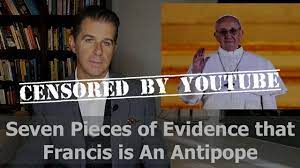
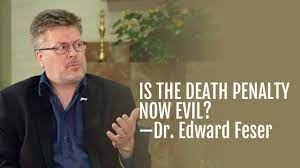

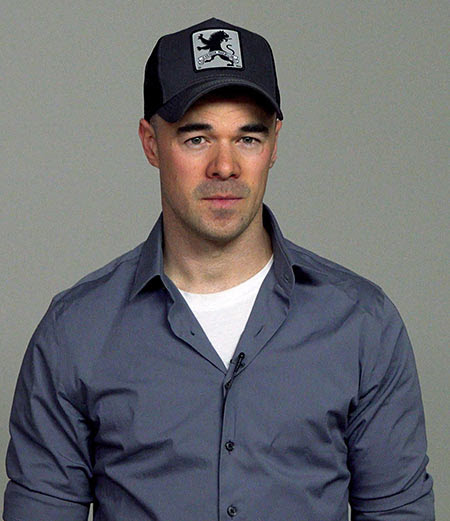
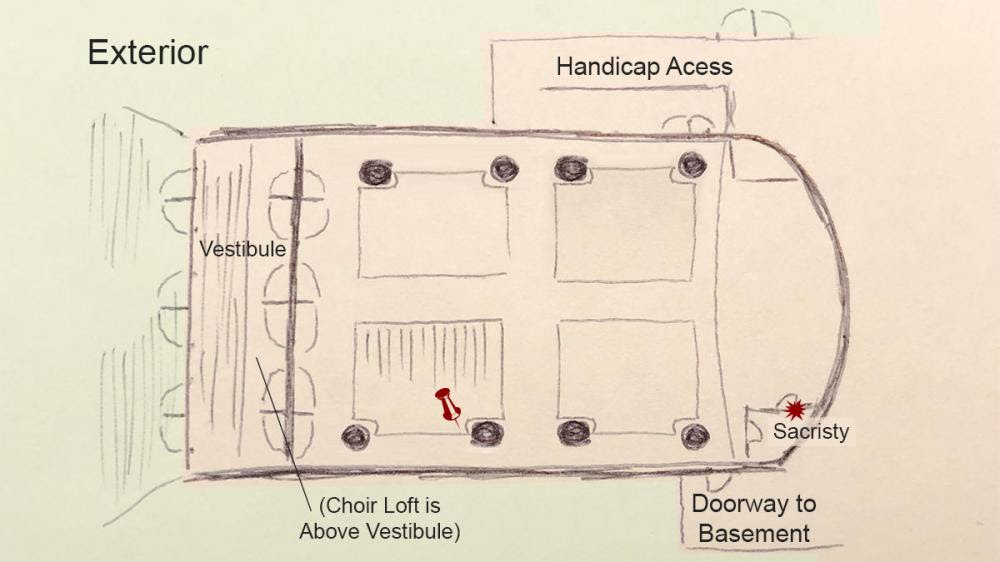

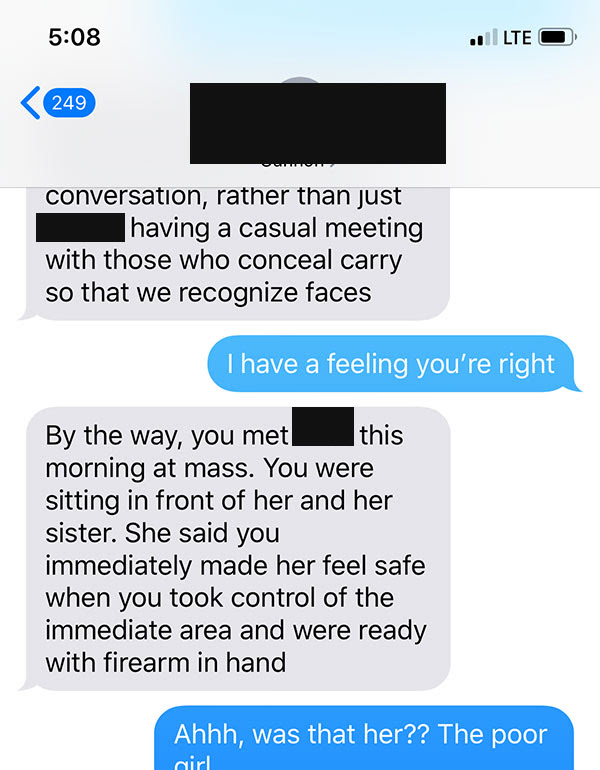 In a few days, I’d like to discuss the concept of training and readiness in a little more detail.


 By Charlie JohnstonBack when I was a young fella my pet peeve was all of my friends who claimed that smoking marijuana helped facilitate deep and insightful thought in them. Now I was not completely abstinent, but I didn’t care for it because it would make my head fuzzy for three days – and a clear head was my main asset, so I preferred beer. I well knew, though, that if I drank too much, I got stupider, not smarter. But I did NOT get as stupid as when partaking of the weed – and the effects were much more short-lived. So most of the time when my friends were smoking I would stick to beer and we were all happy – except for my annoyance at their claim of how weed expanded their minds.One night, it came to a head. I just could not stand it anymore. So I proposed an experiment. I suggested we all partake and then write down those deep thoughts that came so we could peruse them the next day and see just how deep they actually were. Everyone agreed, thinking they were going to prove me wrong. The next day, as we read what we had written under the influence the night before, no one wanted to share his deep thoughts. They were that pathetic. I concluded rather triumphantly that marijuana makes you very stupid while also deluding you that you are very smart. Not everyone agreed with my conclusion, but none of my friends ever again proclaimed to me that they partook of weed because of the deep insight it gave. Maybe that’s the problem in modern culture: the whole world is high, getting stupider by the minute while thinking they are getting smarter. I knew we shouldn’t have legalized marijuana.A marvelous article in American Greatness suggested that we are now all being ruled by an
  St. Louis Volunteer Dinner – at the far end of the table you can see me, Event Host Jan Brennan in yellow, and Regional Coordinator Bill Hammer next to her. About a third of the way into our Easter fundraising campaign for
  If communication goes out for any length of time, meet outside your local Church at 9 a.m. on Saturday mornings. Tell friends at Church now in case you can’t then. CORAC teams will be out looking for people to gather in and work with.Find me on
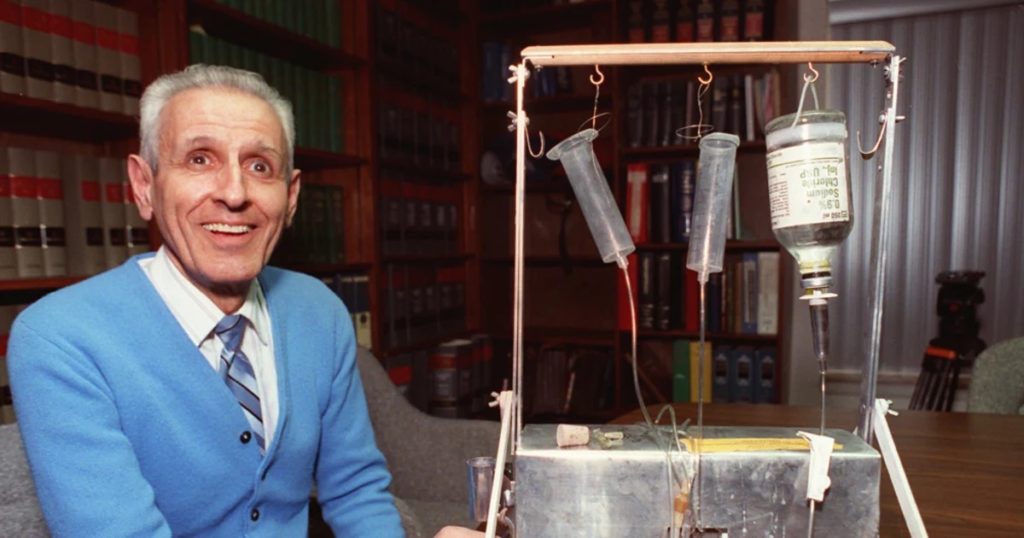
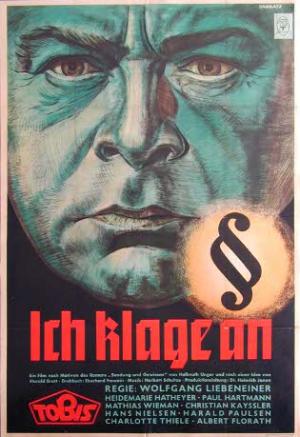






 Squirrel in the Witness Protection ProgramIf communication goes out for any length of time, meet outside your local Church at 9 a.m. on Saturday mornings. CORAC teams will be out looking for people to gather in and work with.Find me on
  Moses and the Brazen Serpent – Adriaen van NieulandtBy Charlie JohnstonIn the past week I have been inundated with stories of adverse events from the Covid shots. A woman who got a blood clot in her arm right after the shot, a man whose existing auto-immune disease took a sudden turn for the worse after the shot and several others. The worst was three young people from the same high school class, suddenly developing leukemia a year after graduation – which has sparked a panic in that community. Though I am a good month away from having the Brazen Serpent Prayer Cards available, I am going to publish the full prayer for you here today so you can easily print it out right now. A formal prayer is a sort of Sacramental – a visible sign of an invisible reality. No formal prayer is of much use if it does not truly signify the heart or, at least, the desired internal trajectory of the heart. Thus, if you throw yourself into reliance on God, but continue to act as if you are still the titan, the lie on your lips about what is in your heart will avail you nothing. If I had put together a great security package to protect myself during my pilgrimage and took great pains to purify all I ate and drank by my own means, I would have been living a deceptively pious lie, saying that I was throwing myself into radical dependence on God while continuing to live complete dependence on my own cleverness. My pilgrimage would have been a fraud instead of an acceptable offering to God.That does not mean that saying a prayer while you are trying to live it well, but are not yet there, is of no avail. I sometimes think that these prayers are among the most powerful. The cry of the father of the tormented son to the Lord, “I believe, help my unbelief!” (Mark 9:24) is one of the most moving prayers in the Gospels, rigorously honest in the confession of his own infirmity and eagerly seeking for it to become fully true in his heart. But a prayer must reflect either the reality of the heart or its true desire. Do not approach formal prayer as if you are trying to learn a magical incantation that will force God to your will. Prayer is to bring your will into alignment with God’s will – and the visible artifacts are to remind YOU what you owe to God, not a dunning note demanding what God must do for you.Besides helping people with the damages brought on by these shots, I think that even as things grow darker in the world, this is going to set off a sort of Jubilee for those who fully embrace God. I believe many people are going to be physically healed of things completely unrelated to the shot – if they first truly seek spiritual healing and healing of our broken mindsets. I have asked Beckita, the editor of this site and my caregiver during the first brutal 23 days of my battle with Covid, to write an account of all the people who helped – and my attitude in extremis. It was much worse than we let on publicly at the time – and many people were deeply concerned that I was not going to make it. I knew the dangers, but I was convinced that if I would be more useful on the other side of the veil, that is where God would take me – and if I would be more useful here, that is where God would leave me. Blessed be the name of the Lord, who works good in all things for those who love Him.In the second half of my convalescence, Mary and Mark Lapchak cared for me. Midway through my Novena to the Immaculate Conception, I ended taking all Covid-related supplements. At the time, I was getting better, but if I went up and down the staircase, I needed an extended nap. I tried to balance my reliance on God’s natural means and His supernatural means. I’m sure it was sloppy as all things are when you are deciding in the midst of things unfolding. But I stayed consistent to those things I had thought through before and had already made decisions. I tell you this because, as you make your own pilgrim way, you will be uncertain of a lot of decisions you make. Do your best and don’t worry about it. God is not waiting for you to make a mistake to give Him an excuse to smite you. He knows the trajectory of your heart – and will help grow it into real trust in Him as you go. There are still supplements for other things I take. Do not, do not, do not try to perfect the prayer and your actions as if you can get the details just right and force God to do what you want. At confession, my normal act of contrition is to say, “Lord, you know I love you. Have mercy on me, a poor sinner.” Some Priests don’t think that is enough, others think it magnificently simple and powerful. It is what I say unless directed to do otherwise. The thing is, God knows what is best. I don’t. So I bumble along the best I can, trusting that He will help me as I go. I don’t have much patience with “would have, could have, should have” scenarios. What’s done is done and I mainly seek to know, in the moment, what I should do – and use my many failures as opportunities to grow in the moment as I continue my pilgrim way. Jesus, I surrender myself to you. Take care of everything.Here, then, is the full text of the prayer:Come, Lord Jesus, purify this food and drink and all I consume in any way. Let it lead me to strength, to apostolate, and to take the next right step; at all times, in all places, and in all situations.Lord, let me never spurn the abundant natural means you have prepared for us. Let me take the next right step while never petulantly demanding that only Your supernatural means of protection are acceptable to me. Never let my obedient prudence stray into hubris that I know better than You, thus forfeiting the divine protection that is essential to me. Let me use all the tools You have given to discern between good and evil, knowing that I am responsible to you for every decision I ever make and cannot abrogate them to anyone else under the color of authority.When I err, Lord, show me Your mercy by firmly correcting me and filling me with resolve to get back up and go forward in Your service. When I have done well, give me the grace to minister to Your people who have stumbled, acting as true brothers and sisters in building each other up to strengthen Your Kingdom. Teach me to want what You want, never to attack the freedom You have given all people, but to convince and exhort in unfailing patience and humility. Lead me in a plain path, turning neither to the left out of anger nor to the right out of fear. Create in me a clean heart that I may participate with You in proclaiming Your Kingdom. Lord, You know I love you. Have mercy on me, a poor sinner. Amen.Use it, mean it, live it.*********Our Easter fundraising campaign for
  ABYSSUS ABYSSUM INVOCAT / DEEP CALLS TO DEEP

You must be logged in to post a comment.