OnePeterFive

Rebuilding Catholic Culture. Restoring Catholic Tradition.

The Pope that Broke the Camel’s Back

 Kennedy HallAugust 12, 2021

We have put up with a lot as Catholics, and we all have our breaking points—some at different moments and for different reasons.

“The straw that broke the camel’s back” refers to increasing the load on a beast of burden until the “final straw” makes the beast collapse. “Beast of burden” is a key concept, as we are talking about an animal that does not have a glorious existence, and is actually quite rugged, yet even the camel has its limits. In addition, we might imagine a scenario wherein the camel is treated in such a way where the master knowingly places more and more weight on the animal, knowing full well that eventually an end will be reached.https://0bf339a6493e09bbcf6974dd29408ba1.safeframe.googlesyndication.com/safeframe/1-0-38/html/container.html

When we consider the life of Catholics in the last few decades, our masters, it seems, tend to place more and more burdens on our shoulders, all while expecting that we must shoulder the weight of the continual poundage. They bind heavy and insupportable burdens, and lay them on men’s shoulders; but with a finger of their own they will not move them (Mt. 23:4). Just like the camel who keeps trucking along even though structural collapse is imminent, so too have we put up with considerable baggage that has weighed us down to the point of not being able to continue.

It has been very difficult to find any true Catholicism for decades. There are a litany of reasons for this, which I will not go into here. But I think one of our greatest sources of disappointment has been the state of the Papacy itself.

It is a good and traditional thing for a Catholic to love and revere the Pope. Of course he is the Holy Father. He is the Roman Pontiff. Thus it makes sense for us to piously think of him in the best possible light. Thou shalt not curse the prince of thy people (Ex. 22:28). But just like the camel, we all have limits, and it seems as if the Pope has crossed the line of reasonably giving him the benefit of the doubt.

Piously thinking the best about the pope can turn to excess which goes beyond reason. This “popesplaining” has led to more than enough excuses by pious Catholics of things that are inexcusable. I am not advocating for an arbitrarily negative outlook on any pope; he is the pope, if he does something good, then we should rejoice. But I think what has happened with Pope Francis has made many Catholics—who only a little while ago would have explained away any papal error—say “Enough!”

It’s almost as if the papacies of Paul VI, John Paul II and Benedict XVI weren’t “bad enough.” Did Paul VI oversee the beginnings of the seeming auto-destruction of the Liturgy? Sure, but he also put out the Credo against the swarming heresies and of course Humanae Vitae. This allowed a conservative Catholic to think to himself, “Well, things aren’t good, but the Pope is clearly orthodox.” How about John Paul II? He may have bungled the Marcel Lefebvre situation and seems to have participated—at least materially—in events of religious indifferentism. But he did speak strongly and bravely against Communism, and he wrote thoughtful documents that edified many of the faithful. And Pope Benedict? He may have been less effective than we had hoped in cleaning up the Church, and he did resign at a moment when we needed him the most. However, he did seem to vindicate Marcel Lefebvre in 2007 by affirming that the Latin Mass was “never juridically abrogated and, consequently, in principle, was always permitted,” besides producing some excellent theological works.

But Pope Francis is a whole different story. Granted, he opened up more freedom for the SSPX to operate and clarified that the faithful could access the Sacraments through them. He did initiate the year of Saint Joseph, and has uttered the odd remark in an interview or homily that comes off as orthodox. However, with his recent maneuvering where he has attempted to corral traditional Catholics to his beloved “peripheries,” it seems that any good he may have done was political appeasement. His gestures to the SSPX have been nice, but clearly he is not concerned with Tradition—or even a fan of it—if we consider his recent actions.

The burden of popesplaining was easy for many Catholics at first. His airplane interviews could be brushed off as non-doctrinal. His disturbing interviews with the Italian newspaper La Repubblica could be explained away as the ravings of an elderly atheist journalist who doesn’t take notes.

But the burden to explain Pope Francis began to grow as conservative Catholics—who are right-wing politically—tried to square the round peg of the Pope’s environmentalism with Catholic doctrine. It was quite a sight to see a fossil-fuel-loving Republican Catholic apologist weave a confusing yarn to explain why the Pope should be admonishing the faithful for driving vehicles and using air-conditioners.

But these things were just the beginning. As time went on, the burden got heavier and even conservative names such as Edward Feser and Eduardo Echeverria joined Roberto de Mattei and others in the Appeal to the Cardinals of the Catholic Church concerning Pope Francis and the death penalty.

Still, we saw the lengths various apologists would go to extract an orthodox interpretation out of Amoris Laetitia. But then Francis allowed a heterodox interpretation, and said there are “no other interpretations.” Thus the burden was getting too much for great conservative theologians like Fr. Aidan Nichols, who signed on with Peter Kwasniewski in “accusing Pope Francis of the canonical delict of heresy.”

Then came the obeisance given to the Pachamama idol. More and more, the burden of popesplaining was becoming too great for many Catholics.

With Traditionis Custodes, the current Roman Pontiff has added, as it were, the final burden to break us. Now that he has made his thoughts clear on orthodox Catholicism and the Traditional Roman Rite, I think many agree that Pope Francis will go down in history as the “Pope who broke the camel’s back.” There is no more popesplaining to be done at this point. It’s over.

We should rejoice in this, however, as the battle lines have been drawn for everyone to see, and more and more Catholics will wake up to the fact that the fight has been going on for a long time, and that we must abandon an exaggerated papalism, a false “Spirit of Vatican I.” These are troubling times, but they are also exciting times. Whatever happens, we can stop pretending that—at least for now—Rome will do anything to help us. We must cling to the faith of our ancestors, never put down our rosaries, and attend Mass where we know we should. The numbers will only grow as Pope Francis continues down this path against tradition.

Photo Credit: Wikipedia Commons.

Print Friendly, PDF & Email

Kennedy Hall

Kennedy Hall is the author of two books. He is the host of the Conservative talk-radio show, The Kennedy Profession on the Crusade Channel. He is married with four children and lives in Ontario, Canada. You can find his work at kennedyhall.ca.

Posted in Uncategorized | Comments Off on

OnePeterFive

Rebuilding Catholic Culture. Restoring Catholic Tradition.

Is the Novus Ordo the Only Law of Prayer?

 Joseph Shaw, PhDAugust 16, 20210 Comments

The practical fall-out from Traditionis Custodes will be making itself felt for some time to come. In some places it has already been devastating; in others, it appears it will be minimal. The theological fall-out, however, threatens a profound problem on a different plane. This arises from the claim made in Article 1 of the document, and repeated in the accompanying Letter to Bishops, that “the liturgical books promulgated by Saint Paul VI and Saint John Paul II, in conformity with the decrees of Vatican Council II, are the unique expression of the lex orandi of the Roman Rite.”

The official English translation which I have quoted is actually a poor rendering of the Italian expression, “l’unica espressione”, which means the only expression. The document is claiming that the only Missal which expresses the Roman Rite’s lex orandi, its “law of prayer,” is the reformed Missal.https://6e31d0dbc4050afba065ab3a6309c001.safeframe.googlesyndication.com/safeframe/1-0-38/html/container.html

The Church’s law of prayer, her lex orandi, must correspond to, and indeed determine, her law of belief (lex credendi): that was the claim of Prosper of Aquitaine when he coined the phrase in the 5thcentury. Prosper was making the point that if you want to know what people believe, then look at how they express themselves in prayer. If they genuflect at the reference to the Incarnation in the Creed, of if they kneel to receive Holy Communion, this tells you something: Arians will refuse to do the first, and Lutherans the second. A Missal is a “law of prayer” in the sense that it sets out a way for people to pray, and we would expect Catholic Missals to give a theologically correct law of prayer and Arian and Lutheran ones to give theologically erroneous ones. What, then, can it mean to say that the Roman Rite has only one law of prayer, and that this is the one expressed in a particular Missal, and not in another, in a document which allows both to be used in the Church?

I have not been alone in struggling to understand what this means. I recently took part in a collaborative blog-post with Fr. Anthony Ruff, the founder of the Pray Tell blog. On this issue Fr. Ruff responded:

[Pope Francis] did not say that the 1962 Missal has no lex orandi, or is opposed to the Church’s lex orandi. The 1962 Missal reflects the Roman rite’s lex orandi to the extent that it reflects the Church’s liturgy as found in the 1970 Missal. There is continuity between 1962 and 1970 in the sense that the core features of the reformed liturgy, which oftentimes derive from Catholic tradition of earliest centuries, are found in the 1962 Missal but in an occluded and obscure manner which needed to be made more apparent.

Fr. Ruff appears to be saying that the 1962 Missal has validity on loan, as it were, from the 1970 Missal: insofar as it agrees with the later Missal, it can be said to express the Roman Rite’s lex orandi.I’m not sure whether this can be squared with the wording of Traditionis Custodes or not, but it doesn’t matter because Fr. Ruff’s sympathetic interpretation does nothing to fend off the real problem with Article 1, which can be expressed as the simple question: what was the Church’s lex orandi up to 1962?

This question is addressed by Dr. Richard H. Bulzacchelli, Lecturer in Theology at Catholic Studies Academy and Senior Fellow with the St. Paul Center for Biblical Theology, in a video talk. On the hypothetical supposition that Traditionis Custodes should be understood literally, Dr. Bulzacchelli explains (from about the 19 minute mark):

If the Novus Ordo is the unique expression of the lex orandi of the Roman Rite then by definition no other liturgical form can express that lex orandi. The logical implications of this assertion are staggering. If the Usus Antiquior cannot express the lex orandi of the Roman Rite, then what we call the Roman Rite today … isn’t the same thing as what we called the Roman Rite in 1962. Yet that attitude is exactly what Francis says he wants to correct. The only way that’s not a contradiction is if the decision flowing from his own defined will is what determines what the truth is in the objective order of reality. … Did the Roman Rite exist for fifteen centuries without an authentic expression of its lex orandi?This would be impossible…

What Dr. Bulzacchelli is saying is that, if it is absurd to suggest (as surely it is) that the Roman Rite had no lex orandi of any kind in 1962, then it appears that Article 1 is claiming that the Roman Rite’s lex orandi changed in 1970 from the one expressed by the older Missal to that expressed by the newer Missal.

Now, in 1970 the Church adopted a new Missal, and by doing so adopted a new law of prayer, just in the sense that we had a new way of celebrating Mass. This is clearly true. But what does it mean that there is (now) only one expression of the Roman Rite’s law of prayer? The only reason for rejecting a Missal as a lex orandi is if it is theologically problematic, as we would reject the lex orandi of the Anglican Book of Common Prayer: it does not correspond faithfully to the Church’s lex credendi.

So is that the claim? That the 1962 Missal is theologically defective? But this implies after all that there was no authentic law of prayer for the Roman Rite in 1962. Unless it became theologically defective in 1970, or later, by a legislative act: as Bulzacchelli puts it, “the decision flowing from his own defined will is what determines what the truth is in the objective order of reality.”

Now possibly someone might say this: a statement might become theologically defective with the passage of time because of the way the Church’s Magisterium has developed. Thus we find that before the Definition of the Marian Dogmas, the Divine Praises did not include the lines “Blessed be her Holy and Immaculate Conception. Blessed be her Glorious Assumption.” Looking for the text online to create a booklet for Benediction, I once found a version which excluded those lines and I realized I had stumbled on a website maintained by one of the splinter groups deriving from the “Old Catholic” schism of 1870. Their lex orandi is defective, we might say, not because of something they had changed, but something they had refused to change.

However, this is not really right. The older version of the Divine Praises is not theologically defective: it is in no way incompatible with the Catholic Faith. Certainly the Old Catholic schismatics are motivated to keep it because they reject the dogmas, but liturgical texts which are merely silent about particular theological issues are not for that reason unusable: to say so would be absurd. Were it to become an issue in the context of the reconciliation of a body of schismatics to the Holy See, historical precedent would suggest that they would be allowed to make a statement of Faith and carry on with the older texts, if it meant so much to them.

And the parallel with the 1962 Missal is hard to make out. Could someone please show me the dogmatic definitions which are reflected in the reformed Missal, and whose absence from the older Missal gives an opportunity, for those attached to it, to display their rejection of them? There are of course no such definitions. The closest anyone has come to making the case for this is in relation to the Prayer for the Jews in the Good Friday Liturgy. I have examined this argument here but briefly it doesn’t survive the observation that the 1974 Liturgy of the Hours calls for the Jews to accept Jesus as their Messiah, and does so several times.

Nevertheless something like this reasoning may be behind Article 1. In the accompanying Letter to Bishops, Pope Francis criticizes the “rejection not only of the liturgical reform, but of the Vatican Council II itself, claiming, with unfounded and unsustainable assertions, that it betrayed the Tradition and the ‘true Church.’” Instead, he stresses continuity, calling Vatican II “a recent stage of this dynamic,” the “dynamic of Tradition.”

The problem is, if the 1962 Missal does not express the Church’s lex orandi, or does so (as Fr. Ruff imagines) only in an inadequate way and by reference to a later “stage of the dynamic”—in short, if it has no validity in and of itself—then it does look as though whatever the content of the tradition up to 1962 was, it was altered in its substance—“betrayed,” a partisan of that tradition might say—by the 1970 Missal.

This is why Dr. Bulzacchelli is concerned that Traditionis Custodes appears to be making true the very criticism of the Novus Ordo which it condemns, and which had hitherto seemed, not least to me, to be extreme and unwarranted. Either we say, with Pope Benedict XVI, that the old and the new are both legitimate expressions of the Church’s lex orandi (alongside all the other rites and usages), or we say that they conflict, and that the historical transition from old to new marked the moment at which the Church did not just develop its expression of existing doctrines, in which case the older expressions would remain valid, but adopted a new law of belief. Which of course is impossible.

My own view is that Pope Benedict was correct and that this part of Traditionis Custodes, as it stands and in the context of the Letter to Bishops, fails to express anything: it is incomprehensible because it is self-contradictory. This may seem a drastic option, but it is better than to swallow the logical implications Dr. Bulzacchelli draws out. Readers may derive some comfort from the thought that until the document appears, perhaps in Latin, in the Acta Apostolicis Sedis (as we have been promised it will), the text can still be tweaked, as actually happened, for far less serious reasons, with the text of Summorum Pontificum. However, I won’t be holding my breath.

Photo credit: Grant Whitty via unsplash.com.

Print Friendly, PDF & Email

Joseph Shaw, PhD

Dr Joseph Shaw has a Doctorate in Philosophy from Oxford University, where he also gained a first degree in Politics and Philosophy and a graduate Diploma in Theology. He has published on Ethics and Philosophy of Religion and has edited The Case for Liturgical Restoration: Una Voce Position Papers on the Extraordinary Form(Angelico Press). He is the Chairman of the Latin Mass Society of England and Wales and Secretary of Una Voce International. He teaches Philosophy in Oxford University and lives nearby with his wife and nine children.www.lmschairman.org

Posted in Uncategorized | Comments Off on


OnePeterFive

Rebuilding Catholic Culture. Restoring Catholic Tradition.

Is the Novus Ordo the Only Law of Prayer?

 Joseph Shaw, PhDAugust 16, 20210 Comments

The practical fall-out from Traditionis Custodes will be making itself felt for some time to come. In some places it has already been devastating; in others, it appears it will be minimal. The theological fall-out, however, threatens a profound problem on a different plane. This arises from the claim made in Article 1 of the document, and repeated in the accompanying Letter to Bishops, that “the liturgical books promulgated by Saint Paul VI and Saint John Paul II, in conformity with the decrees of Vatican Council II, are the unique expression of the lex orandi of the Roman Rite.”

The official English translation which I have quoted is actually a poor rendering of the Italian expression, “l’unica espressione”, which means the only expression. The document is claiming that the only Missal which expresses the Roman Rite’s lex orandi, its “law of prayer,” is the reformed Missal.https://8996f2371a0bc4e1ee147e0acf6bc0fd.safeframe.googlesyndication.com/safeframe/1-0-38/html/container.html

The Church’s law of prayer, her lex orandi, must correspond to, and indeed determine, her law of belief (lex credendi): that was the claim of Prosper of Aquitaine when he coined the phrase in the 5thcentury. Prosper was making the point that if you want to know what people believe, then look at how they express themselves in prayer. If they genuflect at the reference to the Incarnation in the Creed, of if they kneel to receive Holy Communion, this tells you something: Arians will refuse to do the first, and Lutherans the second. A Missal is a “law of prayer” in the sense that it sets out a way for people to pray, and we would expect Catholic Missals to give a theologically correct law of prayer and Arian and Lutheran ones to give theologically erroneous ones. What, then, can it mean to say that the Roman Rite has only one law of prayer, and that this is the one expressed in a particular Missal, and not in another, in a document which allows both to be used in the Church?

I have not been alone in struggling to understand what this means. I recently took part in a collaborative blog-post with Fr. Anthony Ruff, the founder of the Pray Tell blog. On this issue Fr. Ruff responded:

[Pope Francis] did not say that the 1962 Missal has no lex orandi, or is opposed to the Church’s lex orandi. The 1962 Missal reflects the Roman rite’s lex orandi to the extent that it reflects the Church’s liturgy as found in the 1970 Missal. There is continuity between 1962 and 1970 in the sense that the core features of the reformed liturgy, which oftentimes derive from Catholic tradition of earliest centuries, are found in the 1962 Missal but in an occluded and obscure manner which needed to be made more apparent.

Fr. Ruff appears to be saying that the 1962 Missal has validity on loan, as it were, from the 1970 Missal: insofar as it agrees with the later Missal, it can be said to express the Roman Rite’s lex orandi.I’m not sure whether this can be squared with the wording of Traditionis Custodes or not, but it doesn’t matter because Fr. Ruff’s sympathetic interpretation does nothing to fend off the real problem with Article 1, which can be expressed as the simple question: what was the Church’s lex orandi up to 1962?

This question is addressed by Dr. Richard H. Bulzacchelli, Lecturer in Theology at Catholic Studies Academy and Senior Fellow with the St. Paul Center for Biblical Theology, in a video talk. On the hypothetical supposition that Traditionis Custodes should be understood literally, Dr. Bulzacchelli explains (from about the 19 minute mark):

If the Novus Ordo is the unique expression of the lex orandi of the Roman Rite then by definition no other liturgical form can express that lex orandi. The logical implications of this assertion are staggering. If the Usus Antiquior cannot express the lex orandi of the Roman Rite, then what we call the Roman Rite today … isn’t the same thing as what we called the Roman Rite in 1962. Yet that attitude is exactly what Francis says he wants to correct. The only way that’s not a contradiction is if the decision flowing from his own defined will is what determines what the truth is in the objective order of reality. … Did the Roman Rite exist for fifteen centuries without an authentic expression of its lex orandi?This would be impossible…

What Dr. Bulzacchelli is saying is that, if it is absurd to suggest (as surely it is) that the Roman Rite had no lex orandi of any kind in 1962, then it appears that Article 1 is claiming that the Roman Rite’s lex orandi changed in 1970 from the one expressed by the older Missal to that expressed by the newer Missal.

Now, in 1970 the Church adopted a new Missal, and by doing so adopted a new law of prayer, just in the sense that we had a new way of celebrating Mass. This is clearly true. But what does it mean that there is (now) only one expression of the Roman Rite’s law of prayer? The only reason for rejecting a Missal as a lex orandi is if it is theologically problematic, as we would reject the lex orandi of the Anglican Book of Common Prayer: it does not correspond faithfully to the Church’s lex credendi.

So is that the claim? That the 1962 Missal is theologically defective? But this implies after all that there was no authentic law of prayer for the Roman Rite in 1962. Unless it became theologically defective in 1970, or later, by a legislative act: as Bulzacchelli puts it, “the decision flowing from his own defined will is what determines what the truth is in the objective order of reality.”

Now possibly someone might say this: a statement might become theologically defective with the passage of time because of the way the Church’s Magisterium has developed. Thus we find that before the Definition of the Marian Dogmas, the Divine Praises did not include the lines “Blessed be her Holy and Immaculate Conception. Blessed be her Glorious Assumption.” Looking for the text online to create a booklet for Benediction, I once found a version which excluded those lines and I realized I had stumbled on a website maintained by one of the splinter groups deriving from the “Old Catholic” schism of 1870. Their lex orandi is defective, we might say, not because of something they had changed, but something they had refused to change.

However, this is not really right. The older version of the Divine Praises is not theologically defective: it is in no way incompatible with the Catholic Faith. Certainly the Old Catholic schismatics are motivated to keep it because they reject the dogmas, but liturgical texts which are merely silent about particular theological issues are not for that reason unusable: to say so would be absurd. Were it to become an issue in the context of the reconciliation of a body of schismatics to the Holy See, historical precedent would suggest that they would be allowed to make a statement of Faith and carry on with the older texts, if it meant so much to them.

And the parallel with the 1962 Missal is hard to make out. Could someone please show me the dogmatic definitions which are reflected in the reformed Missal, and whose absence from the older Missal gives an opportunity, for those attached to it, to display their rejection of them? There are of course no such definitions. The closest anyone has come to making the case for this is in relation to the Prayer for the Jews in the Good Friday Liturgy. I have examined this argument here but briefly it doesn’t survive the observation that the 1974 Liturgy of the Hours calls for the Jews to accept Jesus as their Messiah, and does so several times.

Nevertheless something like this reasoning may be behind Article 1. In the accompanying Letter to Bishops, Pope Francis criticizes the “rejection not only of the liturgical reform, but of the Vatican Council II itself, claiming, with unfounded and unsustainable assertions, that it betrayed the Tradition and the ‘true Church.’” Instead, he stresses continuity, calling Vatican II “a recent stage of this dynamic,” the “dynamic of Tradition.”

The problem is, if the 1962 Missal does not express the Church’s lex orandi, or does so (as Fr. Ruff imagines) only in an inadequate way and by reference to a later “stage of the dynamic”—in short, if it has no validity in and of itself—then it does look as though whatever the content of the tradition up to 1962 was, it was altered in its substance—“betrayed,” a partisan of that tradition might say—by the 1970 Missal.

This is why Dr. Bulzacchelli is concerned that Traditionis Custodes appears to be making true the very criticism of the Novus Ordo which it condemns, and which had hitherto seemed, not least to me, to be extreme and unwarranted. Either we say, with Pope Benedict XVI, that the old and the new are both legitimate expressions of the Church’s lex orandi (alongside all the other rites and usages), or we say that they conflict, and that the historical transition from old to new marked the moment at which the Church did not just develop its expression of existing doctrines, in which case the older expressions would remain valid, but adopted a new law of belief. Which of course is impossible.

My own view is that Pope Benedict was correct and that this part of Traditionis Custodes, as it stands and in the context of the Letter to Bishops, fails to express anything: it is incomprehensible because it is self-contradictory. This may seem a drastic option, but it is better than to swallow the logical implications Dr. Bulzacchelli draws out. Readers may derive some comfort from the thought that until the document appears, perhaps in Latin, in the Acta Apostolicis Sedis (as we have been promised it will), the text can still be tweaked, as actually happened, for far less serious reasons, with the text of Summorum Pontificum. However, I won’t be holding my breath.

Photo credit: Grant Whitty via unsplash.com.

Print Friendly, PDF & Email

Joseph Shaw, PhD

Dr Joseph Shaw has a Doctorate in Philosophy from Oxford University, where he also gained a first degree in Politics and Philosophy and a graduate Diploma in Theology. He has published on Ethics and Philosophy of Religion and has edited The Case for Liturgical Restoration: Una Voce Position Papers on the Extraordinary Form(Angelico Press). He is the Chairman of the Latin Mass Society of England and Wales and Secretary of Una Voce International. He teaches Philosophy in Oxford University and lives nearby with his wife and nine children.www.lmschairman.org

Posted in Uncategorized | Comments Off on

FRENCH | GERMAN | ITALIAN | SLOVAK | SPANISH | PORTUGUESE

Search

RECENT COLUMNS

Archives

Did Jesus Conquer Death?Robert RoyalMONDAY, AUGUST 16, 2021Christianity is a historical religion in the sense that Christians believe God is at work not only in Creation in general, but in every individual life and in the broad sweep of time. He has been specifically and specially active in the history of the chosen people – Israel – and in the life of the Church – the New Israel, both of which have changed the course of the human race. The meaning of his actions is, to be sure, not always immediately apparent. And when it becomes clear is not always welcomed (See Old and New Testaments). A French poet even had the Israelites lamenting to God, “What did we ever do to You that you had to ‘choose’ us?” But He’s always at work. And He knows what He’s doing.Which, in this troubled season, leads straight to the question: So what is He doing with the multiple waves of this COVID thing? For some people, even for some Christians, sad to say, it’s only an occasion for getting hysterical over partisan politics. Cardinal Raymond Leo Burke was hospitalized with the virus this weekend and at the time of this writing is on a ventilator. When he announced that he’d been infected, he wrote in classic Christian terms, “Please pray for me [Author’s note: Please do.] as I begin my recovery. Let us trust in Divine Providence. God bless you.” But instead of solidarity with a fellow Christian who may be on the brink of eternity, the National Catholic Reporter highlighted that he was a “vaccine denier.” At the opposite extreme, some supporters of Burke claimed: Well, it’s the vaccines that are deadly.The good Cardinal commended himself to Providence, as should all of us given that no one really knows at this point what the important data about the pandemic are, what they would mean if we had them, and what to do with that information to lessen the pandemic’s impact. Infection and mortality rates differ among states and foreign countries, for various reasons. But other than basic prudential steps, it would be hard to say that anyone has figured out the ideal approach to stopping the virus. You can mouth “Follow the science” until you’re blue in the face. But the science is constantly changing, along with the virus – Iceland, for example, seemed a haven but recently “spiked.” The “Science” does not and cannot provide real-time solutions.This state of things is not so unusual in human affairs as it may seem. Anyone who has been involved in, say, political or military crises in Washington knows that you’re always operating with incomplete information, conflicting interpretations, and the need – still – to make decisions.So as a first approximation to what He’s doing with the pandemic waves, you might conclude that He’s making it repeatedly clearer to our postmodern technocratic Tower of Babel that we’re not as much on top of things as we thought not so long ago. Also, that the widespread fear of death – which we should know will come in some form someday anyway and should be preparing for – and our anger at medical and political leaders – as if they are minor deities who only need to take our advice to bring the pandemic to an end, are emotions born of our illusions of mastery. Instead of fear and anger, the pandemic should be teaching us humility.And a certain bravery in the face of death. There’s an old saying: “A ship in port is safe, but that is not what ships are built for.” Cowering in fear or with your face half-covered is not a life for a human being. It’s shocking that our public discussion of the pandemic focuses almost exclusively on preventing more cases – which is fine so far as it goes. But it’s increasingly evident that we’re going to have to decide at some point, since the virus variants will never go away now, that we have to live our lives anyway, and accept certain levels of risk and death. That’s our situation on earth anyway, virus or no virus.It’s not surprising that people who don’t believe in Divine Providence give in to illusory and self-destructive emotions. But it’s distressing that most Christians don’t seem to have reacted much differently.Besides realizing we are not in control, the pandemic might teach us Who is. C.S. Lewis, who after his conversion became Christian to the core, once observed: “The great thing, if one can, is to stop regarding all the unpleasant things as interruptions of one’s ‘own,’ or ‘real’ life. The truth is of course that what one calls the interruptions are precisely one’s real life – the life God is sending one day by day.”That sounds quite Christian, and reasonable, and easy enough, except when it’s not – like the present when life and death, freedom and unfreedom, are the stuff of that daily life. But all the more reason to draw away from what anyone can see is mere thrashing around and to seek the peace of our mortality.Yes, peace and freedom in the understanding that we will die. That used to be a profound truth the Church taught when it was less focused on the horizontal dimension of worldly affairs. Remember thou art dust. Ars moriendi (“The art of dying”). Jesus has conquered death. It sounds like capitulation. But it’s in recognizing that we will die someday – and that dying is not the worst thing that can happen – that we become free to live.Why has virtually no one in the Church – no bishop (except Burke commending himself to Providence), priest, spiritual director – reiterated that wisdom of our Faith. And called for recollection and calm – even as we work hard at fighting the pandemic? Have we all now become that worldly? *Image: Noli Me Tangere by Janssens and Wildens, c. 1620 [Museum of Fine arts, Dunkirk (Dunkerque), France]. Abraham Janssens painting the figures of Jesus and Mary Magdalene and Jan Wildens painted the landscape.© 2021 The Catholic Thing. All rights reserved. For reprint rights, write to: info@frinstitute.orgThe Catholic Thing is a forum for intelligent Catholic commentary. Opinions expressed by writers are solely their own.About the AuthorLatest ArticlesRobert RoyalDr. Robert Royal is editor-in-chief of The Catholic Thing, president of the Faith & Reason Institute in Washington, D.C., and currently serves as the St. John Henry Newman Visiting Chair in Catholic Studies at Thomas More College. His most recent books are Columbus and the Crisis of the West and A Deeper Vision: The Catholic Intellectual Tradition in the Twentieth Century.

Posted in Uncategorized | Comments Off on


Lying About White Supremacists
August 16, 2021
Catholic League president Bill Donohue comments on lies being told about white supremacists:
White people, in general, have a difficult time defending themselves against racist comments. That’s too bad because their reticence begets more attacks on them.
In his inaugural address, Joe Biden singled out white supremacy as a force to be reckoned with. He did not define what he meant by this term, nor did he offer any examples, though many reporters noted that he was referring to the January 6 Capitol riot.
David Horowitz slammed Biden’s remark as a “monstrous lie.” The evidence supports him.
Are white people a threat to safety? The latest FBI statistics reveal that blacks, who are 12.5% of the population, comprise 58% of all murder arrests and 40% of all violent crimes. In New York City, whites are 33% of the population but account for only 2% of shootings. Blacks, who are 23% of the population, commit 75% of all shootings.   
Christian Picciolini was a leader in the skinhead movement for a quarter century, so he should know who the white supremacists are. “It’s the average American. It is our mechanics, it’s our dentists, it’s our teachers, lawyers, doctors, nurses and unfortunately that’s the way it’s turned into the last 30 years.”
What is really unfortunate is the bigoted swipe at virtually every white person. If what he said were true, then, to take one index, we should expect that the rate of violent crimes committed by whites would be very high, but it isn’t. That’s because the “average American” is not a white supremacist.
New York Times columnist Charles Blow is also guilty of making wild generalizations. In his piece on August 16, he says that the latest census figures are “terrifying” for “white nationalists.” He does not explain who these people are, nor does he provide a scintilla of evidence that the “white power acolytes”—whoever they are—are terrified about the census.
The Anti-Defamation League (ADL), which was founded to combat anti-Semitism, but has more recently evolved into a left-wing activist organization, is leading the way with charges of white supremacy killings. It offers as an example of white supremacist violence the shootings at a Parkland, Florida high school, the Tree of Life synagogue killings in Pittsburgh, the shootings at the Poway Chabad in California, and a violent attack at a Walmart in El Paso, Texas.
The ADL’s analysis is sophomoric and misleading.
Nikolas Cruz, 22, killed 17 and wounded 17 others at Marjory Stoneman Douglas High School in Parkland in 2018. He had been expelled from the school for disciplinary reasons and was a known racist, but he was not active in white supremacist organizations. When he was jailed, he attacked an officer.
In 2019, Robert Bowers entered the Tree of Life Synagogue and yelled “All Jews must die” as he opened fire on the congregants. When the National Council of Jewish Women issued a statement about the deadliest attack on the Jewish community in American history, they cited his anti-Semitism but said not a word about him being a white supremacist.
The Poway synagogue shootings in 2019 were committed by John Earnest, a young man who hated Jews and Muslims. The San Diego ex-nurse, who killed one woman, had no criminal record and had no connection to any white supremacist group.
Patrick Crusius killed 22 people at a Walmart in El Paso in 2019. He said his target was “Mexicans.” He was known for his anti-Mexican rants and most of those whom he killed had Spanish surnames.
These four tragedies were the work of very sick men, all of whom were bigots. But if we are to call every white racist shooter a white supremacist—when there is no evidence of ties to any such group—then we are not dealing with reality. Klansmen are white supremacists, and they are not your “average American.”
To be sure, there are violent white supremacists, but to slap the label “white supremacist” on every white bigoted thug is positively absurd. Those who do so are furthering a political agenda, and are not interested in telling the truth.
Posted in Uncategorized | Comments Off on

THE CATHOLIC MONITOR

Is “Racist” Newsom in an “[Un-]Holy War against [Mexican] Nuns & Babies” as well as Black People & will he Lose for that Reason?

Black author Melissa Tate stated that Democrats for vaccine mandates and “vaccine passports” which apparently Democrat Gavin Newsom supports may be “racist”:

Melissa Tate@TheRightMelissaBlack people are the most “vaccine hesitant” by race. So all this talk by Democrats about “vaccine passports” to eat, have a job & travel … is their attempt to reinstitute racism.8:10 AM · Aug 14, 2021·Twitter for iPhone [https://twitter.com/TheRightMelissa]

The Washington Examiner also reported that Newsom is in a “holy war against [Mexican] nuns and babies”:

Gov. Gavin Newsom, in the name of battling the “patriarchy,” pledges to force nuns in his state to pay for abortions, and he’s furious that federal law constrains him in his holy war…

…  It is illegal in California to buy a health insurance plan without also buying abortion insurance.

That means every insured person and every group buying group insurance is being forced to finance abortion.

What Newsom hates and wants to destroy isn’t abortion restrictions, there are almost none of those in California, but letting nuns insure themselves and their staff without making themselves complicit in abortion.

The Missionary Guadalupanas of the Holy Spirit is an order of nuns in service of the poor that started in Mexico City. U.S. Bishops asked the nuns to come to Los Angeles to help poor immigrants there.

But being pro-life Catholic nuns in Los Angeles is not allowed. If you want to operate in California, you need to buy into Newsom’s morality, which prescribes that abortion financing is good … and therefore mandatory.

The sisters aren’t trying to outlaw abortion. They’re not trying to stop anyone else from buying abortion insurance. They are simply trying to love their neighbors while running their own religious order according to the divine moral law. That is, the sisters don’t want blood on their own hands, even if they know their state government supports abortion.” [https://www.aei.org/op-eds/gavin-newsoms-holy-war-against-nuns-and-babies/]

Not only is Newsom apparently at war with Black people and Mexican nuns, but he may lose the California governorship because of his extreme positions on mask mandates and vaccine mandates which are opposed by a large number of Blacks and Hispanics:

The liberal California SF Gate website reported “Shock poll shows Gavin Newsom losing recall vote by double digits”:

Just prior to the start of the first televised debate in the Gavin Newsom recall election Wednesday evening, a shock poll showed the governor losing the first question (“Should Gavin Newsom be recalled?”) by double digits.

The poll came from Survey USA and the San Diego Union Tribune, and was conducted among 1,100 Californians from Aug. 2 to Aug. 4. It found that 51% of respondents were in favor of recalling Newsom, while only 40% wanted to keep him in power. The previous Survey USA/San Diego Union Tribune poll from May found 36% in favor of the recall with 47% opposed. [ttps://www.sfgate.com/gavin-newsom-recall/article/poll-Gavin-Newsom-recall-losing-Elder-Paffrath-16364991.php?utm_campaign=CMS Sharing Tools (Mobile)&utm_source=t.co&utm_medium=referral]

Moreover, the liberal California website thought the reason may be the California “mask mandates”:

What happened in two weeks’ time that sent Newsom from an uncomfortable, but somewhat stable five percentage point advantage to a much more precarious two percentage point advantage? There’s a good chance it’s just noise (the poll’s margin of error is plus or minus three percentage points), but if you’re looking for a real-life event that could have shifted public opinion, such an event does exist.

The end-of-July news cycle was dominated by coverage of the spread of the delta variant of COVID-19, and 50% of California’s population is now under an indoor mask mandate.

In the Bay Area and Sacramento, some vaccinated residents have spoken out against the new mandates, and it’s definitely possible (if not very likely) there’s even more opposition to the measures that individuals would rather keep to themselves so as not to get labeled anti-mask.

Newsom himself did not issue any mask mandates, as the California Department of Public Health recommends, but does not require, indoor masks. That change in statewide guidance was accompanied by the governor stating that he supports counties that choose to implement mandates, so the governor can technically be linked to the new mask mandates. [https://www.sfgate.com/gavin-newsom-recall/article/Poll-recall-Gavin-Newsom-Larry-Elder-mask-mandate-16360329.php]

Might Newsom be losing not just because of the mask mandates, but because of the vaccine mandates?

Conservative scholar Dinesh D’Souza reported that “Blacks and Hispanics… have the lowest rates of Covid—9 vaccination”:Dinesh D’Souza@DineshDSouza

Which groups are not taking the #vaccines? Blacks and Hispanics. They have the lowest rates of Covid—9 vaccination. But the media pretends like the real culprits are Trump voters. Could this be because it’s easier to chastise and revile Trump voters than blacks and Hispanics? [https://twitter.com/DineshDSouza/status/1424094749393182720]

Stop for a moment of silence, ask Jesus Christ what He wants you to do now and next. In this silence remember God, Father, Son and Holy Ghost – Three Divine Persons yet One God, has an ordered universe where you can know truth and falsehood as well as never forget that He wants you to have eternal happiness with Him as his son or daughter by grace. Make this a practice. By doing this you are doing more good than reading anything here or anywhere else on the Internet.

Francis Notes:

– Doctor of the Church St. Francis de Sales totally confirmed beyond any doubt the possibility of a heretical pope and what must be done by the Church in such a situation:

“[T]he Pope… WHEN he is EXPLICITLY a heretic, he falls ipso facto from his dignity and out of the Church, and the Church MUST either deprive him, or, as some say, declare him deprived, of his Apostolic See.”
(The Catholic Controversy, by St. Francis de Sales, Pages 305-306)

Saint Robert Bellarmine, also, said “the Pope heretic is not deposed ipso facto, but must be declared deposed by the Church.”
[https://archive.org/stream/SilveiraImplicationsOfNewMissaeAndHereticPopes/Silveira%20Implications%20of%20New%20Missae%20and%20Heretic%20Popes_djvu.txt]

– “If Francis is a Heretic, What should Canonically happen to him?”: http://www.thecatholicmonitor.com/2020/12/if-francis-is-heretic-what-should.html

– “Could Francis be a Antipope even though the Majority of Cardinals claim he is Pope?”: http://www.thecatholicmonitor.com/2019/03/could-francis-be-antipope-even-though.html

 –  LifeSiteNews, “Confusion explodes as Pope Francis throws magisterial weight behind communion for adulterers,” December 4, 2017:

The AAS guidelines explicitly allows “sexually active adulterous couples facing ‘complex circumstances’ to ‘access the sacraments of Reconciliation and the Eucharist.'”

–  On February 2018, in Rorate Caeli, Catholic theologian Dr. John Lamont:

“The AAS statement… establishes that Pope Francis in Amoris Laetitia has affirmed propositions that are heretical in the strict sense.”

– On December 2, 2017, Bishop Rene Gracida:

“Francis’ heterodoxy is now official. He has published his letter to the Argentina bishops in Acta Apostlica Series making those letters magisterial documents.”

Pray an Our Father now for the restoration of the Church by the bishops by the grace of God.

Election Notes: 

– Intel Cryptanalyst-Mathematician on Biden Steal: “212Million Registered Voters & 66.2% Voting,140.344 M Voted…Trump got 74 M, that leaves only 66.344 M for Biden” [http://catholicmonitor.blogspot.com/2020/12/intel-cryptanalyst-mathematician-on.html?m=1]

– Will US be Venezuela?: Ex-CIA Official told Epoch Times “Chávez started to Focus on [Smartmatic] Voting Machines to Ensure Victory as early as 2003”: http://catholicmonitor.blogspot.com/2020/12/will-us-be-venezuela-ex-cia-official.html– Tucker Carlson’s Conservatism Inc. Biden Steal Betrayal is explained by “One of the Greatest Columns ever Written” according to Rush: http://catholicmonitor.blogspot.com/2021/01/tucker-carlsons-conservatism-inc-biden.html?m=1 – A Hour which will Live in Infamy: 10:01pm November 3, 2020: 
http://www.thecatholicmonitor.com/2021/01/a-hour-which-will-live-in-infamy-1001pm.html?m=1 What is needed right now to save America from those who would destroy our God given rights is to pray at home or in church and if called to even go to outdoor prayer rallies in every town and city across the United States for God to pour out His grace on our country to save us from those who would use a Reichstag Fire-like incident to destroy our civil liberties. [Is the DC Capitol Incident Comparable to the Nazi Reichstag Fire Incident where the German People Lost their Civil Liberties?http://catholicmonitor.blogspot.com/2021/01/is-dc-capital-incident-comparable-to.html?m=1 and Epoch Times Show Crossroads on Capitol Incident: “Anitfa ‘Agent Provocateurs‘”: 
http://catholicmonitor.blogspot.com/2021/01/epoch-times-show-crossroads-on-capital.html?m=1
Pray an Our Father now for the grace to know God’s Will and to do it. SHARE

Posted in Uncategorized | Comments Off on

The Implications of the Priesthood of John the Baptist

AUGUST 16, 2021 BY JOEL R. GALLAGHER

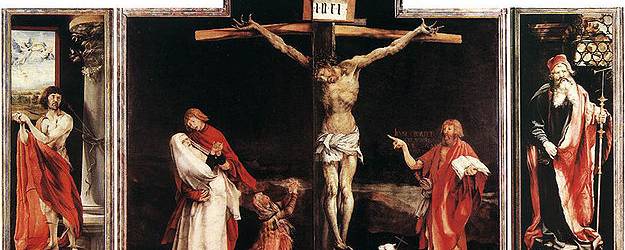
One of the most famous depictions of the crucifixion of Jesus is that of German painter Matthias Grünewald. Grünewald’s most recognized work appears on the center-front panel (when wings are closed) of his polyptych masterpiece, the Isenheim Altarpiece (early sixteenth century). The macabre scene famously depicts a frail, lanky, crucified figure of a bloodied and dead Jesus, blood trickling down from the postmortem wound on his side, with sores and wounds all over his emaciated body, gangly fingers awkwardly outstretched beyond the nails hammered through the palms of his hands, and his crowned head dangling lifeless almost below his seemingly dislocated shoulder.

At the time of its completion, it was one of the first realistic depictions of the crucifixion of Jesus; not that the figure of Jesus is realistic (the painting exaggerates and distorts in its imagery), but that the work expresses the grotesque reality of the extreme pain and suffering of the Roman crucifixion. Grünewald does not conceal or temper the absolute agony that Jesus must have experienced during his Passion and death as a result of the ruthlessly torturous scourging and execution by the very skilled Roman executioners.

For good reason then, the figure of John the Baptist in the painting is probably often neglected, perhaps with the exception of John’s prominently placed finger pointing at Jesus. At the very least, the words painted behind the Baptist are probably overlooked and less examined than the ghastly figure of Jesus on the cross, and rightly so. Yet there is John, placed anachronistically by Grünewald at the scene of the crucifixion, pointing at Jesus.

One might expect that the words behind the Baptist would read “Behold, the Lamb of God” given that there is a lamb at the feet of John which is holding a small cross and is itself bleeding into a chalice as John points at Jesus, and these are some of the most famous words that the Baptist ever uttered and are the words repeated during the Liturgy of the Eucharist today which memorializes and makes present the Passion and sacrificial death of Jesus on the cross; but they do not. Instead, the words painted behind him read: “Illum oportet crescere, me autem minui” [He must increase, but I must decrease].1 These are the words of the Baptist spoken in John 3:30 in response to one of John’s own disciples who tells John that all the people are instead now going out to Jesus to be baptized.

In this article, I will not offer an interpretation of Grünewald’s masterpiece or his depiction of John the Baptist; rather, I will use Grünewald’s portrayal of John, namely John’s act of pointing his finger at Jesus and the words written behind John, to assist me as I offer an interpretation of the priestly ministry of John the Baptist and to explain how this ministry can be lived out by our priests and bishops according to Benedict XVI.

Benedict explains that in John the Baptist, the entire priesthood of Israel and the Old Testament moves toward Jesus and is a pointer to, and prophecy of, Jesus and the proclamation of his mission.2 The Baptist’s father, Zechariah, is a priest from the division of Abijah and his mother, Elizabeth, is from the tribe of Aaron; because the service of priests in Old Testament law is connected with the tribes of the sons of Aaron and Levi, John the Baptist is indeed a priest who, as it was said, will not partake in wine or strong drink as was commanded of Aaron and his sons whenever they entered the tent of meeting.3 The priestly path to Jesus that is found in the Old Testament culminates in the person of John the Baptist who proclaims that, finally, the One who had been prophesied has arrived and that despite John’s own large following, this Jesus is the One who all should seek to follow, for it is John’s role only to show people the way to him.

In order to fulfill his specific priestly mission, John must decrease (“me autem minui,” as John says and as Grünewald painted). For any one of us, to decrease is a difficult thing; we desire to be heard and respected, and often want to be seen, recognized, praised, rewarded, and followed. But how much more difficult must this have been for the Baptist, whose own life was a miracle from God even from its very beginning. John’s father receives an angelic message about the birth of his son in the Temple during the liturgy (how appropriate for a priest whose son was going to be the final priest of the Old Covenant).4Benedict demonstrates that the story of the annunciation of John’s birth is saturated with Old Testament language and references, namely to the miraculous births of Isaac and Samuel.5 God had promised Abraham that his elderly and barren wife Sarah would have a son — and not just any son, but the son of promise through whom the covenant would pass. God later intervened in the life of Hannah, also barren, whose prayer for a child was miraculously answered by God; she gave birth to Samuel.

Benedict states that John thus belongs to a line of offspring born through miraculous interventions of God.6 Benedict writes: “Because he [John] comes from God in this special way, he belongs completely to God, and hence he also lives completely for men;” but not without an important purpose, as Benedict adds: “in order to lead them to God.”7

Jesus responds to Pilate’s inquiry about whether or not he is a king saying: “You say that I am a king. For this I was born, and for this I have come into the world, to bear witness to the truth. Every one who is of the truth hears my voice” (John 18:37). It is similarly said of John the Baptist that the specific reason he was born was to point to Jesus and to testify about the One who is Truth: “He [John] came for testimony, to bear witness to the light, that all might believe through him [Jesus]” (John 1:7). The precise reason that the Baptist came into the world was to convince everyone to look at Jesus just as Grünewald’s Baptist urges us to do, and as most of us probably reflexively do when encountering Grünewald’s crucifixion scene without first noticing the Baptist himself; this is the beauty and genius of Grünewald’s work.

Benedict explains that John is filled with the Holy Spirit from his mother’s womb and lives permanently in the tent of meeting; he is not a priest at certain moments, but he is a priest always and with his entire existence.8 The ultimate purpose of his entire priestly life is to point to Jesus. His mission began even in the womb of his mother wherein he leapt in the presence of Jesus who had been formed in the womb of his mother Mary six months after John was conceived, as if to prefigure what the Batist later mysteriously declares: “After me comes a man who ranks before me, for he was before me” (John 1:30).9 The prologue of John’s gospel attests to the special purpose of the life of the Baptist who, like Jesus, was “sent from God” (John 1:6), which denotes a divine mission which gives meaning to the Baptist’s entire existence.

Years later, throughout his own public ministry, John attracts many followers and preaches about repentance, conversion, and judgment. As the Gospels report, many came from all over Judea and from Jerusalem to the Jordan River to be baptized by John. Benedict says that John the Baptist must have produced an extraordinary impression in that highly charged political-religious environment and because the Jewish people believed that there was finally another prophet operating among them; God was once again acting in history.10

Benedict writes that there is no reason to dismiss Mark’s description as an exaggeration that “they went out to him all the country of Judea, and all the people of Jerusalem” on pilgrimage to be baptized by John.11 John was an enigmatic figure who touched the lives of many people and attracted many followers who came to listen to him and to be baptized; and yet, despite his having such a following and such power, John declared that he “must decrease” and he announced that all who came to him should look to Another for the ultimate message about God and salvation, and that they should turn to that One and follow him instead. This again must have been all the more difficult given the praise that Jesus heaps upon the Baptist: “Truly, I say to you, among those born of women there has risen no one greater than John the Baptist” (Matt 11:11).

If John the Baptist is a priest — the one who connects the priesthood of the Old and New Covenants — then how do priests today live out what might be called the Baptist dimension of their particular ministerial priesthood? What does it mean that a priest must decrease and that Jesus must increase? What does it mean to always point to Jesus, as Grünewald’s Baptist always does? After all, Jesus is the priest par excellence who serves as the supreme exemplar; and at the most important moments of their priesthood, priests act in persona Christi. Most priests (and most Christians, for that matter) who look at Grünewald’s crucifixion scene thus perhaps rightly see themselves in the figure of Jesus rather than in the figure of John. What then does the priesthood of John the Baptist mean for those who act in the person of Christ but who should also perform the priestly duties of the Baptist?

To always point at someone else is at the same time to always point away from oneself. The symbolic imagery obviously denotes humility. Benedict stresses that priests must preach Jesus, not themselves. In his homily at the 2008 Chrism Mass, during which priests renewed their ordination promises, Benedict said: “[As priests] we do not preach ourselves, but him and his Word, which we could not have invented ourselves. We proclaim the Word of Christ in the correct way only in communion with his Body.”12 Similarly, he says:

The officeholder [priest] ought to accept responsibility for the fact that he does not produce things himself but is a conduit for the Other and thereby ought to step back himself . . . . He should be in the very first place one who obeys, who does not say ‘I would like to say this now,’ but asks what Christ says and what our faith is, and submits to that . . . . When [priesthood] . . . is lived correctly, it cannot mean finally getting one’s hands on the levers of power but, rather, renouncing one’s own life project in order to give oneself over to service.13

The mission of priests is to always point to Jesus — to preach and teach what Jesus taught (and what the Church has taught in his name), and not what they want to teach. In an age of celebrity priests and social media priest-phenoms, it is all the more important for priests today to exercise the humble priesthood of the Baptist and to ensure that in their preaching, teaching, and social media posting, they are always pointing to Jesus and preaching Hismessage, not theirs. Ultimately, priests must be more concerned with producing followers of Jesus than followers on Twitter or Facebook.

Priests should ask themselves: Where does this teaching come from? Does it come from Jesus, or does it come from me? Is it something new, or is it something that is found in, or at least supported by, the magisterial teachings that the Church has proclaimed over the last 2000 years and which contain the faithful message of Jesus? Jesus’s words from John cited above are worth repeating: “Every one who is of the truth hears my voice.” Whose voice do we hear when priests and others preach, teach, write, and theologize in the name of the Church? If it is not Jesus’s voice, then it is not Truth.

This is perhaps one of the very good reasons why we should never give or hear applause after homilies in the Mass. While all of us in the pews hope to hear well-delivered and inspiring homilies, we must always remember that what is most important is that we hear the voice of Jesus and His message. Applause and other outward forms of praise following homilies during the Mass would give the impression that priests themselves deserve the credit for the Truth they are proclaiming. We should instead hold our applause for the moment we enter into heavenly glory (God willing) and see God “face to face” — the face of the One who should be the voice behind all preaching.

Benedict writes:

In proclaiming the faith . . . every priest speaks on behalf of Jesus Christ, for Jesus Christ. Christ entrusted his Word to the Church. This Word lives in the Church. And if I accept interiorly the faith of this Church and live, speak and think on the basis of it, when I proclaim Him, then I speak for Him . . . . The important thing is that I do not present my ideas, but rather try to think and to live the Church’s faith, to act in obedience to his mandate.14

When Jesus was teaching in the Temple, he was asked: “By what authority are you doing these things, and who gave you this authority” (Matt 21:23)? Jesus first refuses to answer, saying: “Neither will I tell you by what authority I do these things” (Matt 21:27); but later he tells the disciples: “All authority in heaven and on earth has been given to me. Go therefore and make disciples of all nations . . . teaching them to observe all that I have commanded you” (Matt 28:18–20). Jesus is granted authority to teach by God (and, of course, he is God) and it is this teaching sourced in God that the disciples must transmit, not their own teachings.

Similarly, we hear in John: “‘How is it that this man has learning, when he has never studied?’ So Jesus answered them, ‘My teaching is not mine, but his who sent me; if any man’s will is to do his will, he shall know whether the teaching is from God or whether I am speaking on my own authority. He who speaks on his own authority seeks his own glory; but he who seeks the glory of him who sent him is true, and in him there is no falsehood’” (John 7:15–18).

Those who preach Jesus speak Truth, and it is His voice we hear; those who speak on their own authority and seek their own glory only hear their own voice, and in their teaching is falsehood. The priest who always points to Jesus and says, “My teaching is not mine, but his who sent me” is living up to God’s commandment to make disciples of all nations, and is fulfilling the priestly duties of John the Baptist. Thus, what Benedict says in the context of a discussion of the priest’s role in the sacrament of penance and reconciliation can be applied to the priest’s roles as preacher and teacher: “It is much more necessary that the priest be willing to remain in the background, thus leaving space for Christ . . . . The priest certainly does not draw his authority from the consent of men but directly from Christ,”15 i.e., the priest must decrease and Jesus must increase because he has true authority.

If to preach Jesus is the Baptist mission of the priesthood, then what is the exact content of that preaching? It certainly includes all that Jesus taught and handed on to the Church in its 2000-year history, but the core of that teaching must be Jesus himself. Benedict has often argued that the absence of God and the loss of transcendence are the sources of the greatest crises of the modern, materialist era, and they seem to have had a detrimental impact on the art of preaching and teaching the faith as well. He writes:

What role does God really play in our preaching? Do we not normally avoid the issue and shift to matters that we deem more “concrete” and more urgent — to political, economic and psychological questions . . . ? We think that everyone knows about God already, and that the subject of God has little to say about our everyday problems. Jesus corrects us: God is the practical, the realistic topic for man . . . . We think that God is too far away, that he does not reach into our daily life; so we say to ourselves, let’s speak of close-at-hand, practical realities. No, says Jesus: God is present, he is within call. This is the first word of the gospel . . . . This has to be said to our world with completely new vigor on the authority of Christ.16

To preach Jesus means to preach about God who is always present and is the most practical topic even in the modern era. To preach Jesus means to preach about God-incarnate — Jesus — and his message that is contained in the gospels, the core of which is the double-foci on the ever-present God and salvation, all on the authority of Jesus himself.

Later in John we again hear Jesus declare the source of his teaching: “Do you not believe that I am in the Father and the Father in me? The words that I say to you I do not speak on my own authority; but the Father who dwells in me does his works” (John 14:10). The more interesting element to note here is the request that prompted Jesus’s words: “Philip said to him, ‘Lord, show us the Father, and we shall be satisfied.’ Jesus said to him, ‘Have I been with you so long, and yet you do not know me, Philip? He who has seen me has seen the Father; how can you say, ‘Show us the Father?’’” (John 14:8–9).

Here, Jesus responds by essentially doing exactly what Grünewald’s Baptist does — he points to Himself! The teaching he provides comes from the Father, and he and the Father are one, and those who see Jesus also see the Father, and they now know where Truth comes from. When a request is made: “Show us the source of your teaching,” priests and others who teach in the name of the Church (educators and theologians) must be able to point to Jesus in whom the Father and Son are one. They must be able to point to the Jesus that has been preached authentically by the Church over the past 2000 years; if they have to point to themselves, other persons, or more generally to the zeitgeist, then they are by necessity not pointing at Jesus.

If the Baptist’s ministry is a necessary element of the priesthood, then this humble approach to teaching and preaching Jesus and the faith applies in a particularly important and supreme way to the ministry of the bishop, who, the Second Vatican Council proclaimed, is “marked with the fullness of the sacrament of Orders [and] is ‘the steward of the grace of the supreme priesthood.’”17 As they are shepherds of the Church and successors to the apostles, “he who hears them, hears Christ,”18 or at least he ought to hear Christ and not the bishops and whatever they themselves want to teach and preach. Bishops are not ordained to their office to wield levers of power to enforce their agendas. They are called to step back and allow Jesus to speak through them so that God’s agenda may be fulfilled, and they must do so in accordance with the previous magisterial teachings of the bishops and the Church through whom Jesus has already spoken, because their “episcopal consecration . . . confers the office of teaching . . . which, of its very nature, can be exercised only in hierarchical communion with the head and the members of the college,”19 both past and present, i.e., they cannot individually or in small groups, national conferences, or synods teach with authority or infallibly on their own but must remain in communion with the entire apostolic college since its inception. “Among the principal duties of bishops, the preaching of the Gospel occupies an eminent place. For bishops are preachers of the faith, who lead new disciples to Christ, and they are authentic teachers, that is, teachers endowed with the authority of Christ.”20

Given their special roles of teaching and preaching Jesus, bishops should be more devoted to the humble ministry of the Baptist than even their priest-cooperators, not only because of the great responsibilities they have for transmitting and explaining the faith, but because of the harm they can inflict on the Church if they pursue their own agendas. As Benedict says, they must renounce their own life projects and give themselves over to the service of Jesus. John the Baptist’s entire life project, even from his mother’s womb, was service to Jesus, and in everything he did, he pointed away from himself, and at Jesus.

  1. All Scripture references are from the Revised Standard Version unless quoted from within another work. 
  2. Benedict XVI, Jesus of Nazareth: The Infancy Narratives, trans. Philip J. Whitmore (New York: Random House Large Print, 2012), 32. 
  3. Benedict, The Infancy Narratives, 31–32. See Luke 1:15, “He will be great before the Lord, and he shall drink no wine nor strong drink,” and Lev 10:9, “Drink no wine nor strong drink, you nor your sons with you, when you go into the tent of meeting.” 
  4. Benedict, The Infancy Narratives, 34–36. 
  5. Benedict, The Infancy Narratives, 37–39. 
  6. Benedict, The Infancy Narratives, 39. 
  7. Benedict, The Infancy Narratives, 39. 
  8. Benedict, The Infancy Narratives, 39–40. 
  9. Benedict, The Infancy Narratives, 45–46. 
  10. Benedict XVI, Jesus of Nazareth: From the Baptism in the Jordan to the Transfiguration, trans. Adrian J. Walker (New York: Doubleday 2007), 15. 
  11. Benedict, From the Baptism in the Jordan to the Transfiguration, 15–16. 
  12. Benedict XVI, Chrism Mass: Homily of His Holiness Benedict XVI (Vatican City: March 20, 2008), available at https://www.vatican.va/content/benedict-xvi/en/homilies/2008/documents/hf_ben-xvi_hom_20080320_messa-crismale.html. 
  13. Joseph Cardinal Ratzinger, Salt of the Earth: Christianity and the Catholic Church at the End of the Millennium, An Interview with Peter Seewald, trans. Adrian Walker (San Francisco: Ignatius Press, 1997), 192–193. 
  14. Benedict XVI, Light of the World: The Pope, the Church, and the Signs of the Times, A Conversation with Peter Seewald, trans. Michael J. Miller and Adrian J. Walker (San Francisco: Ignatius Press, 2010), 7. 
  15. Joseph Cardinal Ratzinger and Vittorio Messori, The Ratzinger Report: An Exclusive Interview on the State of the Church, trans. Salvatore Attanasio and Graham Harrison (San Francisco: Ignatius Press, 1985), 56–57. 
  16. Joseph Cardinal Ratzinger, Gospel, Catechesis, Catechism: Sidelights on the Catechism of the Catholic Church, trans. Adrian Walker (San Francisco: Ignatius Press, 1991), 41. 
  17. Second Vatican Council, Dogmatic Constitution on the Church Lumen Gentium(Vatican City: November 21, 1964), §26. 
  18. Lumen Gentium §20. 
  19. Lumen Gentium §21. 
  20. Lumen Gentium §25. 

FILED UNDER: ARTICLES TAGGED WITH: CATHOLIC BISHOPSHUMILITYJOHN THE BAPTISTPOPE BENEDICT XVIPREACHINGTHE PRIESTHOODJoel R. GallagherAbout Joel R. Gallagher

Joel R. Gallagher, Ph.D. teaches theology at Mount St. Mary’s University in Emmitsburg, MD. He received his doctoral degree from the Catholic University of America in Washington, DC. He previously taught courses at the Catholic University of America and Loyola University Maryland in Baltimore, MD. He is currently working on a series of articles on the mysteries of the life of Christ according to the theology of Thomas Aquinas and on a separate series of articles on various themes according to the theology of Benedict XVI. His academic website, which lists his published works, is msmary.academia.edu/JOELRGALLAGHER. He is married and has two daughters.10

Posted in Uncategorized | Comments Off on

VERITATIS SPLENDOR by Saint Pope John Paul II, Sections 31-34


“You will know the truth, and the truth will make you free” 
(Jn 8:32) 

31. The human issues most frequently debated and differently resolved in contemporary moral reflection are all closely related, albeit in various ways, to a crucial issue: human freedom.

Certainly people today have a particularly strong sense of freedom. As the Council’s Declaration on Religious Freedom Dignitatis Humanae had already observed, “the dignity of the human person is a concern of which people of our time are becoming increasingly more aware”.52 Hence the insistent demand that people be permitted to “enjoy the use of their own responsible judgment and freedom, and decide on their actions on grounds of duty and conscience, without external pressure or coercion”.53In particular, the right to religious freedom and to respect for conscience on its journey towards the truth is increasingly perceived as the foundation of the cumulative rights of the person.54

This heightened sense of the dignity of the human person and of his or her uniqueness, and of the respect due to the journey of conscience, certainly represents one of the positive achievements of modern culture. This perception, authentic as it is, has been expressed in a number of more or less adequate ways, some of which however diverge from the truth about man as a creature and the image of God, and thus need to be corrected and purified in the light of faith.55

32. Certain currents of modern thought have gone so far as to exalt freedom to such an extent that it becomes an absolute, which would then be the source of values. This is the direction taken by doctrines which have lost the sense of the transcendent or which are explicitly atheist. The individual conscience is accorded the status of a supreme tribunal of moral judgment which hands down categorical and infallible decisions about good and evil. To the affirmation that one has a duty to follow one’s conscience is unduly added the affirmation that one’s moral judgment is true merely by the fact that it has its origin in the conscience. But in this way the inescapable claims of truth disappear, yielding their place to a criterion of sincerity, authenticity and “being at peace with oneself”, so much so that some have come to adopt a radically subjectivistic conception of moral judgment. 

As is immediately evident, the crisis of truth is not unconnected with this development. Once the idea of a universal truth about the good, knowable by human reason, is lost, inevitably the notion of conscience also changes. Conscience is no longer considered in its primordial reality as an act of a person’s intelligence, the function of which is to apply the universal knowledge of the good in a specific situation and thus to express a judgment about the right conduct to be chosen here and now. Instead, there is a tendency to grant to the individual conscience the prerogative of independently determining the criteria of good and evil and then acting accordingly. Such an outlook is quite congenial to an individualist ethic, wherein each individual is faced with his own truth, different from the truth of others. Taken to its extreme consequences, this individualism leads to a denial of the very idea of human nature. 

These different notions are at the origin of currents of thought which posit a radical opposition between moral law and conscience, and between nature and freedom. 

33. Side by side with its exaltation of freedom, yet oddly in contrast with it, modern culture radically questions the very existence of this freedom. A number of disciplines, grouped under the name of the “behavioural sciences”, have rightly drawn attention to the many kinds of psychological and social conditioning which influence the exercise of human freedom. Knowledge of these conditionings and the study they have received represent important achievements which have found application in various areas, for example in pedagogy or the administration of justice. But some people, going beyond the conclusions which can be legitimately drawn from these observations, have come to question or even deny the very reality of human freedom. 

Mention should also be made here of theories which misuse scientific research about the human person. Arguing from the great variety of customs, behaviour patterns and institutions present in humanity, these theories end up, if not with an outright denial of universal human values, at least with a relativistic conception of morality. 

34. “Teacher, what good must I do to have eternal life?”. The question of morality, to which Christ provides the answer, cannot prescind from the issue of freedom. Indeed, it considers that issue central, for there can be no morality without freedom: “It is only in freedom that man can turn to what is good”.56 But what sort of freedom? The Council, considering our contemporaries who “highly regard” freedom and “assiduously pursue” it, but who “often cultivate it in wrong ways as a licence to do anything they please, even evil”, speaks of “genuine” freedom: “Genuine freedom is an outstanding manifestation of the divine image in man. For God willed to leave man “in the power of his own counsel” (cf. Sir 15:14), so that he would seek his Creator of his own accord and would freely arrive at full and blessed perfection by cleaving to God”.57 Although each individual has a right to be respected in his own journey in search of the truth, there exists a prior moral obligation, and a grave one at that, to seek the truth and to adhere to it once it is known.58 As Cardinal John Henry Newman, that outstanding defender of the rights of conscience, forcefully put it: “Conscience has rights because it has duties”.59

Certain tendencies in contemporary moral theology, under the influence of the currents of subjectivism and individualism just mentioned, involve novel interpretations of the relationship of freedom to the moral law, human nature and conscience, and propose novel criteria for the moral evaluation of acts. Despite their variety, these tendencies are at one in lessening or even denying the dependence of freedom on truth.

If we wish to undertake a critical discernment of these tendencies — a discernment capable of acknowledging what is legitimate, useful and of value in them, while at the same time pointing out their ambiguities, dangers and errors — we must examine them in the light of the fundamental dependence of freedom upon truth, a dependence which has found its clearest and most authoritative expression in the words of Christ: “You will know the truth, and the truth will set you free” (Jn 8:32). 

Posted in Uncategorized | Comments Off on VERITATIS SPLENDOR by Saint Pope John Paul II, Sections 31-34

THE CATHOLIC MONITOR

Free Lawyer’s “Vaccine Mandate Protest Letter” for Employers: “The Vaccine remains Unapproved by the FDA… Federal Law Forbids Mandating it, in accordance with the Nuremberg Code…” 

Abortion-tainted COVID-19 vaccines

High-profile trial lawyer Robert Barnes who deals in civil, criminal and constitutional law has written a “Vaccine Mandate Protest Letter” for those of you unfortunate enough to have an apparently lawless mandate employer which you can use free of charge:Robert Barnes@RobertBarnes July 26, 2021Vaccine Mandate Protest Letter 

No authorship claim or copyright asserted…this letter just came to me in a bottle, and I have no idea who might have penned it, nor can I possibly vouch for it, and what you fine folks do with it is entirely in your own hands, as the Gentlemen of the Bar remind me I can proffer no general legal advice in the matter, and must officially disclaim proffering any such advice here…edit and excise as you see fit, amend and append as you desire, and claim authorship or anonymity as may best befit you…as always, as you wish…

Dear Boss, 

Compelling any employee to take any current Covid-19 vaccine violates federal and state law, and subjects the employer to substantial liability risk, including liability for any injury the employee may suffer from the vaccine. Many employers have reconsidered issuing such a mandate after more fruitful review with legal counsel, insurance providers, and public opinio n advisors of the desires of employees and the consuming public. Even the Kaiser Foundation warned of the legal risk in this respect. (https://www.kff.org/coronavirus-covid-19/issue-brief/key-questions-about-covid-19-vaccine-mandates/)

Three key concerns: first, while the vaccine remains unapproved by the FDA and authorized only for emergency use, federal law forbids mandating it, in accordance with the Nuremberg Code of 1947secondthe Americans with Disabilities Act proscribes, punishes and penalizes employerswho invasively inquire into their employees’ medical status and then treat those employees differently based on their medical status, as the many AIDS related cases of decades ago fully attest; and third, international law, Constitutional law, specific statutes and the common law of torts all forbid conditioning access to employment upon coerced, invasive medical examinations and treatment, unless the employer can fully provide objective, scientifically validated evidence of the threat from the employee and how no practicable alternative could possible suffice to mitigate such supposed public health threat and still perform the necessary essentials of employment. 

At the outset, consider the “problem” being “solved” by vaccination mandates. The previously infected are better protected than the vaccinated, so why aren’t they exempted? Equally, the symptomatic can be self-isolated. Hence, requiring vaccinations only addresses one risk: dangerous or deadly transmission, by the asymptomatic or pre-symptomatic employee, in the employment setting. Yet even government official Mr. Fauci admits, as scientific studies affirm, asymptomatic transmission is exceedingly and “very rare.” Indeed, initial data suggests the vaccinated are just as, or even much more, likely to transmit the virus as the asymptomatic or pre-symptomatic. Hence, the vaccine solves nothing. This evidentiary limitation on any employer’s decision making, aside from the legal and insurance risks of forcing vaccinations as a term of employment without any accommodation or even exception for the previously infected (and thus better protected), is the reason most employers wisely refuse to mandate the vaccine. This doesn’t even address the arbitrary self-limitation of the pool of talent for the employer: why reduce your own talent pool, when many who refuse invasive inquiries or risky treatment may be amongst your most effective, efficient and profitable employees? 

First, federal law prohibits any mandate of the Covid-19 vaccines as unlicensed, emergency-use-authorization-only vaccines. Subsection bbb-3(e)(1)(A)(ii)(III) of section 360 of Title 21 of the United States Code, otherwise known as the Emergency Use Authorization section of the Federal Food, Drug, and Cosmetic Act, demands that everyone give employees the “option to accept or refuse administration” of the Covid-19 vaccine. (https://www.law.cornell.edu/uscode/text/21/360bbb-3 ) This right to refuse emergency, experimental vaccines, such as the Covid-19 vaccine, implements the internationally agreed legal requirement of Informed Consent established in the Nuremberg Code of 1947. (http://www.cirp.org/library/ethics/nuremberg/ ). As the Nuremberg Code established, every person must “be able to exercise free power of choice, without the intervention of any element of force, fraud, deceit, duress, overreaching, or other ulterior form of constraint or coercion; and should have sufficient knowledge and comprehension of the elements of the subject matter involved as to enable him to make an understanding and enlightened decision” for any medical experimental drug, as the Covid-19 vaccine currently is. The Nuremberg Code prohibited even the military from requiring such experimental vaccines. (Doe #1 v. Rumsfeld, 297 F.Supp.2d 119 (D.D.C. 2003). 

Second, demanding employees divulge their personal medical information invades their protected right to privacy, and discriminates against them based on their perceived medical status, in contravention of the Americans with Disabilities Act. (42 USC §12112(a).) Indeed, the ADA prohibits employers from invasive inquiries about their medical status, and that includes questions about diseases and treatments for those diseases, such as vaccines. As the EEOC makes clear, an employer can only ask medical information if the employer can prove the medical information is both job-related and necessary for the business. (https://www.eeoc.gov/laws/guidance/questions-and-answers-enforcement-guidance-disability-related-inquiries-and-medical). An employer that treats an individual employee differently based on that employer’s belief the employee’s medical condition impairs the employee is discriminating against that employee based on perceived medical status disability, in contravention of the ADA. The employer must have proof that the employer cannot keep the employee, even with reasonable accommodations, before any adverse action can be taken against the employee. If the employer asserts the employee’s medical status (such as being unvaccinated against a particular disease) precludes employment, then the employer must prove that the employee poses a “safety hazard” that cannot be reduced with a reasonable accommodation. The employer must prove, with objective, scientifically validated evidence, that the employee poses a materially enhanced risk of serious harm that no reasonable accommodation could mitigate. This requires the employee’s medical status cause a substantial risk of serious harm, a risk that cannot be reduced by any another means. This is a high, and difficult burden, for employers to meet. Just look at the all prior cases concerning HIV and AIDS, when employers discriminated against employees based on their perceived dangerousness, and ended up paying millions in legal fees, damages and fines. 

Third, conditioning continued employment upon participating in a medical experiment and demanding disclosure of private, personal medical information, may also create employer liability under other federal and state laws, including HIPAA, FMLA, and applicable state tort law principles, including torts prohibiting and proscribing invasions of privacy and battery. Indeed, any employer mandating a vaccine is liable to their employee for any adverse event suffered by that employee. The CDC records reports of the adverse events already reported to date concerning the current Covid-19 vaccine.(https://www.cdc.gov/coronavirus/2019-ncov/vaccines/safety/vaers.html ) 

Finally, forced vaccines constitute a form of battery, and the Supreme Court long made clear “no right is more sacred than the right of every individual to the control of their own person, free from all restraint or interference of others.” (https://www.law.cornell.edu/supremecourt/text/141/250)

With Regards,
Employee of the Year

XXX [https://vivabarneslaw.locals.com/upost/889925/vaccine-mandate-protest-letter]

Stop for a moment of silence, ask Jesus Christ what He wants you to do now and next. In this silence remember God, Father, Son and Holy Ghost – Three Divine Persons yet One God, has an ordered universe where you can know truth and falsehood as well as never forget that He wants you to have eternal happiness with Him as his son or daughter by grace. Make this a practice. By doing this you are doing more good than reading anything here or anywhere else on the Internet.

Francis Notes:

– Doctor of the Church St. Francis de Sales totally confirmed beyond any doubt the possibility of a heretical pope and what must be done by the Church in such a situation:

“[T]he Pope… WHEN he is EXPLICITLY a heretic, he falls ipso facto from his dignity and out of the Church, and the Church MUST either deprive him, or, as some say, declare him deprived, of his Apostolic See.”
(The Catholic Controversy, by St. Francis de Sales, Pages 305-306)

Saint Robert Bellarmine, also, said “the Pope heretic is not deposed ipso facto, but must be declared deposed by the Church.”
[https://archive.org/stream/SilveiraImplicationsOfNewMissaeAndHereticPopes/Silveira%20Implications%20of%20New%20Missae%20and%20Heretic%20Popes_djvu.txt]

– “If Francis is a Heretic, What should Canonically happen to him?”: http://www.thecatholicmonitor.com/2020/12/if-francis-is-heretic-what-should.html

– “Could Francis be a Antipope even though the Majority of Cardinals claim he is Pope?”: http://www.thecatholicmonitor.com/2019/03/could-francis-be-antipope-even-though.html

 –  LifeSiteNews, “Confusion explodes as Pope Francis throws magisterial weight behind communion for adulterers,” December 4, 2017:

The AAS guidelines explicitly allows “sexually active adulterous couples facing ‘complex circumstances’ to ‘access the sacraments of Reconciliation and the Eucharist.'”

–  On February 2018, in Rorate Caeli, Catholic theologian Dr. John Lamont:

“The AAS statement… establishes that Pope Francis in Amoris Laetitia has affirmed propositions that are heretical in the strict sense.”

– On December 2, 2017, Bishop Rene Gracida:

“Francis’ heterodoxy is now official. He has published his letter to the Argentina bishops in Acta Apostlica Series making those letters magisterial documents.”

Pray an Our Father now for the restoration of the Church by the bishops by the grace of God.

Election Notes: 

– Intel Cryptanalyst-Mathematician on Biden Steal: “212Million Registered Voters & 66.2% Voting,140.344 M Voted…Trump got 74 M, that leaves only 66.344 M for Biden” [http://catholicmonitor.blogspot.com/2020/12/intel-cryptanalyst-mathematician-on.html?m=1]

– Will US be Venezuela?: Ex-CIA Official told Epoch Times “Chávez started to Focus on [Smartmatic] Voting Machines to Ensure Victory as early as 2003”: http://catholicmonitor.blogspot.com/2020/12/will-us-be-venezuela-ex-cia-official.html– Tucker Carlson’s Conservatism Inc. Biden Steal Betrayal is explained by “One of the Greatest Columns ever Written” according to Rush: http://catholicmonitor.blogspot.com/2021/01/tucker-carlsons-conservatism-inc-biden.html?m=1 – A Hour which will Live in Infamy: 10:01pm November 3, 2020: 
http://www.thecatholicmonitor.com/2021/01/a-hour-which-will-live-in-infamy-1001pm.html?m=1 What is needed right now to save America from those who would destroy our God given rights is to pray at home or in church and if called to even go to outdoor prayer rallies in every town and city across the United States for God to pour out His grace on our country to save us from those who would use a Reichstag Fire-like incident to destroy our civil liberties. [Is the DC Capitol Incident Comparable to the Nazi Reichstag Fire Incident where the German People Lost their Civil Liberties?http://catholicmonitor.blogspot.com/2021/01/is-dc-capital-incident-comparable-to.html?m=1 and Epoch Times Show Crossroads on Capitol Incident: “Anitfa ‘Agent Provocateurs‘”: 
http://catholicmonitor.blogspot.com/2021/01/epoch-times-show-crossroads-on-capital.html?m=1
Pray an Our Father now for the grace to know God’s Will and to do it. 

Posted in Uncategorized | Comments Off on

THE CATHOLIC MONITOR

SEARCH

Not a “Accident of History that Pope Pius XII, in the Year 1950, on the Cusp of the Descent… into the Filth of the Sexual Revolution, Solemnly Defined the Bodily Assumption of Mary into Heaven” 

The Assumption of Mary had been strongly believed since the earliest times of Church history (in the East as well as in the West). Above is an Egyptian Coptic icon in the Church of St Menas, Cairo. [https://www.fministry.com/2011/08/assumption-of-blessed-virgin-mary.html]

It is of great significance that St. Paul weds the final answer and solution to all our pains and sorrows in this life not only to our adoption as the sons of God, but also to the redemption of our bodies (which unlike Mary’s Bodily Assumption, will not occur until the Final Judgment). Nor is it an accident of history that Pope Pius XII, in the year 1950, on the cusp of the descent of both the world and the Church into the filth of the sexual revolution, solemnly defined the Bodily Assumption of Mary into Heaven.

We might tend to think that Mary’s Bodily Assumption is merely an additional privilege granted to Her by a merciful God, and we might further possess what is probably a mostly unconscious attitude which considers the presence of our own bodies in Heaven as being a not-all-that- important adjunct to our attaining to the Vision of God’s Essence (the Beatific Vision). In this, we would be very wrong. As St. Paul also writes, “For we who live are always delivered unto death for Jesus’ sake; that the life also of Jesus may be made manifest in our mortal flesh.” And lest we are tempted to believe that this “life of Jesus in our mortal flesh” refers only to the soul and its presence in mortal flesh during this life. – James Larson

We must keep fighting for the restoration of the Church by exposing the falsehoods and evil that have entered the Church.

We must keep doing this, but we will fail if we don’t pray at Mass and outside Mass for the restoration.

Jesus Christ will restore the Church through His Mother. Independent scholar James Larson explained why:

Rosary to the Interior: For the Purification of the Church 

The Lord possessed me in the beginning of his ways, before he made anything from the beginning…. I was with him, forming all things: and was delighted every day, playing before him at all times. Playing in the world: and my delights were to be with the children of men. (Proverbs 8: 22, 30-31).

For we know that every creature groaneth and travaileth in pain, even till now. And not only it, but ourselves also, who have the first-fruits of the Spirit, even we ourselves groan within ourselves, waiting for the adoption of the sons of God, the redemption of our body.” (Romans 8: 22-23).

The two above-quoted passages from Holy Scripture present absolutely contrasting images of human life on this earth. The first, which is applied by the Church to Mary on the Feast of the Immaculate Conception (in the Missal of the Traditional Latin Mass), depicts the delight of spiritual childhood, playing before God with the innocence and purity which began for Mary on this earth with the Immaculate Conception, and which culminated with Her Glorious Assumption, Body and Soul, into Heaven. The second resonates with the loss of this spiritual childhood through both original and actual sin, which is the experience of each one of us. The first speaks of radiant perfection and joy achieved; the second, of painful labor, waiting, and hope.

It is of great significance that St. Paul weds the final answer and solution to all our pains and sorrows in this life not only to our adoption as the sons of God, but also to the redemption of our bodies (which unlike Mary’s Bodily Assumption, will not occur until the Final Judgment). Nor is it an accident of history that Pope Pius XII, in the year 1950, on the cusp of the descent of both the world and the Church into the filth of the sexual revolution, solemnly defined the Bodily Assumption of Mary into Heaven.

We might tend to think that Mary’s Bodily Assumption is merely an additional privilege granted to Her by a merciful God, and we might further possess what is probably a mostly unconscious attitude which considers the presence of our own bodies in Heaven as being a not-all-that- important adjunct to our attaining to the Vision of God’s Essence (the Beatific Vision). In this, we would be very wrong. As St. Paul also writes, “For we who live are always delivered unto death for Jesus’ sake; that the life also of Jesus may be made manifest in our mortal flesh.” And lest we are tempted to believe that this “life of Jesus in our mortal flesh” refers only to the soul and its presence in mortal flesh during this life, we also have the following from St. Paul:

Behold, I tell you a mystery. We shall all indeed rise again: but we shall not all be changed. In a moment, in the twinkling of an eye, at the last trumpet: for the trumpet shall sound, and the dead shall rise again incorruptible: and we shall be changed. For this corruptible must put on incorruption; and this mortal must put on immortality. (1 Cor. 15: 51-53).

What we are dealing with here is an extraordinary work of God’s Mercy, a mercy which applies not only to our souls, but also to our bodies which must eventually be gloriously united to our souls in order to constitute what it means to be fully human.

St. Thomas, in considering the question as to what constitutes the greatest act of God’s Mercy, writes the following:

“A work may be called great in two ways: first, on the part of the mode of action, and thus the work of creation is the greatest work, wherein something is made from nothing; secondly, a work may be called great on account of what is made, and thus the justification of the ungodly, which terminates at the eternal good of a share in the Godhead, is greater than the creation of heaven and earth, which terminates at the good of mutable nature.” (ST I-II, Q. 113. A, 9)

The angels were created, and offered a simple choice – whether to submit to God and His plan for creation, or not. Depending on this single choice – yes, or no – they were either instantly admitted to the Beatific Vision, or were irremediably sentenced for all eternity to Hell. The reason for this is that the angels are pure spirits who apprehend and will “immovably”, and therefore their initial choice, either for or against God and His divine order, was immovable and unchangeable. There could therefore be for them no “justification of the ungodly”.

A very different situation exists with human beings. As long as any man is alive, he exists with a potentiality either to accept or reject God and His Ways. The work of “justification of the ungodly” is therefore exclusively reserved to men. God’s greatest work, His supreme act of Mercy, was therefore reserved for men.

It can be of great profit to us to meditate a bit on the mystery of God’s mysterious creation of such “flesh-bound”, fragile, moveable, changeable creatures as are men. God certainly could have created only purely spiritual creatures (angels) from nothing; and, in St. Thomas’s words, this would have still been the greatest work according to its mode (the creation of something from nothing). But in creating man, he chose to unite an eternal, spiritual soul to what is virtually the smallest, weakest, and inconsequential thing imaginable – a mutable physical body possessing an incredible dependence upon the working of an enormous complexity of fragile and intricate parts and systems with all their growth and change, all of this being integrated with an extraordinarily rich complexity of neurological reactions and sensations, and united to an intellect and will, ever subject to change, and which is called upon to make fundamental free choices in the midst of all this mutability. It might almost seem to us as though God’s mercy could not rest until he reached out and offered Beatitude to the smallest and weakest thing conceivable.

At the very center of this Great Mystery stands Jesus Christ in Whom, for all eternity, was willed the unity of God with man – the Incarnation. And alongside Him, willed and conceived for all eternity in the Heart of the Trinity, was the creation of the Immaculate Body and Soul of a Woman Who was to be His Mother, completely united with Him in His work of redemption, and therefore also the Mother of all men. What began to be on this earth with the Immaculate Conception of Mary within the womb of her mother Anne, was present with God from endless ages. Appropriately, in the first reading for the Feast of the Immaculate Conception in the Traditional Latin Mass missal (and tragically omitted from this Feast in the Novus Ordo Mass) is the following description of both this eternal design, and the fundamental choice which inevitably must be made by every human being:

“The Lord possessed me in the beginning of his ways, before he made any thing from the beginning. I was set up from eternity, and of old before the earth was made. The depths were not as yet, and I was already conceived. neither had the fountains of waters as yet sprung out: The mountains with their huge bulk had not as yet been established: before the hills I was brought forth: 

“He had not yet made the earth, nor the rivers, nor the poles of the world. When he prepared the heavens, I was present: when with a certain law and compass he enclosed the depths: When he established the sky above, and poised the fountains of waters: When he compassed the sea with its bounds, and set a law to the waters that they should not pass their limits: when be balanced the foundations of the earth; I was with him forming all things: and was delighted every day, playing before him at all times. Playing in the world: and my delights were to be with the children of men. 
“Now therefore, ye children, hear me: Blessed are they that keep my ways. Hear instruction and be wise, and refuse it not. Blessed is the man that heareth me, and that watcheth daily at my gates, and waiteth at the posts of my doors. He that shall find me, shall find life, and shall have salvation from the Lord: 

“But he that shall sin against me, shall hurt his own soul. All that hate me love death.” (Proverbs *: 22-36)

The last two paragraphs of this passage of scripture set before us an eternal enmity. On the one hand are those who attain to spiritual childhood, find our Lady (and of course also Wisdom, Our Lord, and the Holy Spirit), keep her ways, and find life; and, on the other hand, are those who sin against her, “hurt” their own souls by so doing, and “love death”. It is the same enmity which we read about in the Garden of Eden between the Woman Who shall crush Satan’s head, and the Serpent who “lies in wait for her heel”. (Genesis 3:15). In Mary this victory is fully accomplished in Her Immaculate Conception and Her Assumption, Body and Soul, into Heaven. In each and every man and woman, and in the Church, this victory awaits those who “keep her ways”, and die to this world and the ways of “fallen flesh” in order “that the life also of Jesus may be made manifest in our mortal flesh.”

Stop for a moment of silence, ask Jesus Christ what He wants you to do now and next. In this silence remember God, Father, Son and Holy Ghost – Three Divine Persons yet One God, has an ordered universe where you can know truth and falsehood as well as never forget that He wants you to have eternal happiness with Him as his son or daughter by grace. Make this a practice. By doing this you are doing more good than reading anything here or anywhere else on the Internet.

Francis Notes:

– Doctor of the Church St. Francis de Sales totally confirmed beyond any doubt the possibility of a heretical pope and what must be done by the Church in such a situation:

“[T]he Pope… WHEN he is EXPLICITLY a heretic, he falls ipso facto from his dignity and out of the Church, and the Church MUST either deprive him, or, as some say, declare him deprived, of his Apostolic See.”
(The Catholic Controversy, by St. Francis de Sales, Pages 305-306)

Saint Robert Bellarmine, also, said “the Pope heretic is not deposed ipso facto, but must be declared deposed by the Church.”
[https://archive.org/stream/SilveiraImplicationsOfNewMissaeAndHereticPopes/Silveira%20Implications%20of%20New%20Missae%20and%20Heretic%20Popes_djvu.txt]

– “If Francis is a Heretic, What should Canonically happen to him?”: http://www.thecatholicmonitor.com/2020/12/if-francis-is-heretic-what-should.html

– “Could Francis be a Antipope even though the Majority of Cardinals claim he is Pope?”: http://www.thecatholicmonitor.com/2019/03/could-francis-be-antipope-even-though.html

 –  LifeSiteNews, “Confusion explodes as Pope Francis throws magisterial weight behind communion for adulterers,” December 4, 2017:

The AAS guidelines explicitly allows “sexually active adulterous couples facing ‘complex circumstances’ to ‘access the sacraments of Reconciliation and the Eucharist.'”

–  On February 2018, in Rorate Caeli, Catholic theologian Dr. John Lamont:

“The AAS statement… establishes that Pope Francis in Amoris Laetitia has affirmed propositions that are heretical in the strict sense.”

– On December 2, 2017, Bishop Rene Gracida:

“Francis’ heterodoxy is now official. He has published his letter to the Argentina bishops in Acta Apostlica Series making those letters magisterial documents.”

Pray an Our Father now for the restoration of the Church by the bishops by the grace of God.

Election Notes:  

– Intel Cryptanalyst-Mathematician on Biden Steal: “212Million Registered Voters & 66.2% Voting,140.344 M Voted…Trump got 74 M, that leaves only 66.344 M for Biden” [http://catholicmonitor.blogspot.com/2020/12/intel-cryptanalyst-mathematician-on.html?m=1]

– Will US be Venezuela?: Ex-CIA Official told Epoch Times “Chávez started to Focus on [Smartmatic] Voting Machines to Ensure Victory as early as 2003”: http://catholicmonitor.blogspot.com/2020/12/will-us-be-venezuela-ex-cia-official.html– Tucker Carlson’s Conservatism Inc. Biden Steal Betrayal is explained by “One of the Greatest Columns ever Written” according to Rush: http://catholicmonitor.blogspot.com/2021/01/tucker-carlsons-conservatism-inc-biden.html?m=1 – A Hour which will Live in Infamy: 10:01pm November 3, 2020: 
http://www.thecatholicmonitor.com/2021/01/a-hour-which-will-live-in-infamy-1001pm.html?m=1 What is needed right now to save America from those who would destroy our God given rights is to pray at home or in church and if called to even go to outdoor prayer rallies in every town and city across the United States for God to pour out His grace on our country to save us from those who would use a Reichstag Fire-like incident to destroy our civil liberties. [Is the DC Capitol Incident Comparable to the Nazi Reichstag Fire Incident where the German People Lost their Civil Liberties?http://catholicmonitor.blogspot.com/2021/01/is-dc-capital-incident-comparable-to.html?m=1 and Epoch Times Show Crossroads on Capitol Incident: “Anitfa ‘Agent Provocateurs‘”: 
http://catholicmonitor.blogspot.com/2021/01/epoch-times-show-crossroads-on-capital.html?m=1
Pray an Our Father now for the grace to know God’s Will and to do it. SHARE

Posted in Uncategorized | Comments Off on