Incredible but true. This very day, February 21, the day on which Pope Francis is inaugurating the summit on sexual abuse with the leaders of the Catholic hierarchy worldwide, the Church celebrates the liturgical memory of Saint Peter Damian, a great reformer of the 11th century, later proclaimed a doctor of the Church, the author of a book with an emblematic title: “Liber Gomorrhianus.”
The coincidence, as unintentional as it may be, could not have been more appropriate. Because in that book, composed in the form of a letter, Saint Peter Damian launched a dramatic appeal to the pope and bishops of his time, that they free the Church from the “sodomitic filth that insinuates itself like a cancer in the ecclesiastical order, or rather like a bloodthirsty beast rampaging through the flock of Christ.” Sodom and Gomorrah, in the book of Genesis, are the two cities that God destroyed with fire on account of their sins of sex against nature.
But there’s more. Because the German Church historian Walter Brandmüller, who recently has done the most to bring to light the extraordinary similarities between the crisis of the Church in the 11th century and the contemporary crisis, is also the cardinal who in the run-up to this summit signed, along with fellow cardinal Raymond Leo Burke, a letter-appeal to the bishops of the whole world that they break the silence and finally face head-on the plague of homosexual activity among sacred ministers.
Last November 5, in conjunction with the release of the essay by Cardinal Brandmüller on the relevance of Saint Peter Damian’s life and times, Settimo Cielo published an ample summary of it, with references to the complete text in German and Italian.
And what follows is that very post from Settimo Cielo, which more than ever is worth rereading today, on the day of the liturgical feast of that great saint and reformer.
*
Gomorrah in the 21st Century. The Appeal of a Cardinal and Church Historian
(Settimo Cielo, November 5, 2018)
“The situation is comparable to that of the Church in the 11th and 12th century.” As an authoritative Church historian and as president of the pontifical committee of historical sciences from 1998 to 2009, Cardinal Walter Brandmüller, 89, has no doubt when he sees the present-day Church “shaken to its foundations” on account of the spread of sexual abuse and homosexuality “in an almost epidemic manner among the clergy and even in the hierarchy.”
“How could it have come to this point?” the cardinal wonders. And his answer is found in an extensive and detailed article published in recent days in the German monthly “Vatican Magazin” directed by Guido Horst:
Brandmüller refers to the centuries in which the bishoprics and the papacy itself had become such a source of wealth that there was “fighting and haggling over them,” with temporal rulers claiming that they themselves could apportion these offices in the Church.
The effect was that the place of pastors was taken by morally dissolute persons who were attached to the endowment rather than to the care of souls, by no means inclined to lead a chaste and virtuous life.
Not only concubinage, but homosexuality too was increasingly widespread among the clergy, to such an extent that Saint Peter Damian in 1049 delivered to the newly elected pope Leo IX, known as a zealous reformer, his “Liber Gomorrhianus,” composed in the form of a letter, which in essence was an appeal to save the Church from the “sodomitic filth that insinuates itself like a cancer in the ecclesiastical order, or rather like a bloodthirsty beast rampaging through the flock of Christ.” Sodom and Gomorrah, in the book of Genesis, are the two cities that God destroyed with fire on account of their sins.
But the thing more worthy of note, Brandmüller writes, was that “almost simultaneously a lay movement arose that was aimed not only against the immorality of the clergy but also against the appropriation of ecclesiastical offices by secular powers.”
“What rose up was the vast popular movement called ‘pataria,’ led by members of the Milanese nobility and by some members of the clergy, but supported by the people. In close collaboration with the reformers associated with Saint Peter Damian, and then with Gregory VII, with the bishop Anselm of Lucca, an important canonist who later became Pope Alexander II, and with others still, the ‘patarini’ demanded, even resorting to violence, the implementation of the reform that after Gregory VII took the name ‘Gregorian’: for a celibacy of the clergy lived out faithfully and against the occupation of dioceses by secular powers.”
Subsequently, of course, it disperesed into pauperist and anti-hierarchical movements, on the verge of heresy, and was only partially reintegrated with the Church “thanks to the farseeing pastoral action of Innocence III.” But the “interesting aspect” on which Brandmüller insists is that “that reforming movement broke out almost simultaneously in the uppermost hierarchical circles in Rome and among the vast lay population of Lombardy, in response to a situation considered unbearable.”
So then, what is similar and different in the Church today, with respect to back then?
What is similar, Brandmüller notes, is that then as now the ones expressing the protest and demanding a purification of the Church are above all segments of the Catholic laity, especially in North America, in the footsteps of the “marvelous homage to the important role of the witness of the faithful in matters of doctrine” brought to light in the 19th century by Blessed John Henry Newman.
As then, so now these faithful find beside them a few zealous pastors. But it must be recognized – Brandmüller writes – that the impassioned appeal to the upper hierarchy of the Church and ultimately to the pope to join them in combating the scourge of homosexuality among the clergy and the bishops is not meeting with correspondingly adequate responses, unlike in the 11th and 12th centuries.
Also in the Christological battles of the 4th century – Brandmüller points out – “the episcopacy remained inactive for long stretches.” And if it remains so today, with respect to the spread of homosexuality among sacred ministers, “this could be based on the fact that personal initiative and the awareness of their responsibility as pastors on the part of the individual bishops are made more difficult by the structures and apparatus of the episcopal conferences, with the pretext of collegiality or synodality.”
As for the pope, Brandmüller attributes not only to the current one but also to his predecessors the weakness of not opposing the currents of moral theology according to which “what was forbidden yesterday can be allowed today,” homosexual acts included.
It is true – Brandmüller acknowledges – that the 1993 encyclical “Veritatis Splendor” of John Paul II – “in which the contribution of Joseph Ratzinger has not yet been duly recognized” – reconfirmed “with great clarity the foundations of the Church’s moral teaching.” But this “ran up against widespread rejection from theologians, perhaps because it had been published only when the theological-moral decay was already too far advanced.”
It is also true that “some books on sexual morality were condemned” and “two professors had their teaching licenses revoked, in 1972 and 1986.” “But,” Brandmüller continues, “the truly important heretics, like the Jesuit Josef Fuchs, who from 1954 to 1982 was a professor at the Pontifical Gregorian University, and Bernhard Häring, who taught at the Redemptorist Institute in Rome, as well as the highly influential moral theologian from Bonn, Franz Böckle, or from Tübingen, Alfons Auer, were able to spread without interference, right in front of Rome and the bishops, the seed of error. The attitude of the congregation for the doctrine of the faith in these cases is, in retrospect, simply incomprehensible. It saw the wolf come and stood looking on while it ravaged the fold.”
The risk is that on account of this lack of initiative on the part of the upper hierarchy even the most committed Catholic laity, left on its own, might “no longer recognize the nature of the Church founded on the sacred order and slip, in protesting against the ineptitude of the hierarchy, into an Evangelical-style communitarian Christianity.”
And instead, the more the hierarchy, from the pope down, feel supported by the effective resolve of the faithful to renew and revive the Church, the more a true housecleaning can be performed.
Brandmüller concludes:
“It is in the collaboration of the bishops, priests, and faithful, in the power of the Holy Spirit, that the current crisis can and must become the point of departure for the spiritual renewal – and therefore also for the new evangelization – of a post-Christian society.”
Brandmüller is one of the four cardinals who in 2016 submitted to Pope Francis their “dubia” on the changes being made in the doctrine of the Church, without ever receiving a response.
This time will the pope listen and take him seriously into consideration, as Leo IX did with Saint Peter Damian?
Posted inUncategorized|Comments Off on PETER DAMIAN, A SAINT FOR OUR TIME
Catholic League president Bill Donohue comments on the upcoming Vatican meeting on priestly sexual abuse:
According to Vatican observer Edwin Pentin, it is “not clear” whether “the role of homosexuality in the abuse crisis” will be addressed at the Vatican summit on clergy sexual abuse; it begins tomorrow. One thing is for sure: every effort to downplay the role of gays is being made.
A front-page story in the February 18 edition of the New York Times is typical of the way most of the media are covering this subject. “Studies repeatedly find there to be no connection between being gay and abusing children. Yet prominent bishops have singled out gay priests as the root of the problem, and right-wing media organizations attack what they have called the church’s ‘homosexual subculture,’ ‘lavender mafia,’ or ‘gay cabal.'”
Furthermore, Cardinal Blase Cupich, who will be at the summit, says that while most of the problem is a result of “male on male” sex abuse, “homosexuality itself is not a cause.” He says it can be explained as a matter of “opportunity and also a matter of poor training on the part of the people.”
All of these statements can be challenged. First of all, not all studies have shown that there is no link between homosexuals and the sexual abuse of minors.
A good summary of the literature that shows the central role of homosexual priests in the abuse scandal can be found in an article by Brian W. Clowes and David L. Sonnier. The most recent research that challenges the conventional wisdom on this subject is the study by D. Paul Sullins, a sociologist who teaches at Catholic University of America. He found that the link between homosexual priests and sexual abuse was strong.
Let it be said emphatically that it is morally wrong to blame all gay priests or to bully someone who is gay, be he a priest or a plumber. It is also wrong to call on all gay priests to resign: such a sweeping recommendation is patently unfair to those gay priests who have never violated anyone.
However, it is not helpful to the cause of eradicating the problem of sexual abuse in the priesthood to dismiss a conversation about the obvious. We can begin by talking honestly about who the victims are.
Notice that the New York Times says there is no connection between homosexuality and abusing “children.” This is a common way of framing the issue, and it is a deceitful one. Most of the victims were adolescents, not children. In other words, the problem is not pedophilia.
We know from one report after another, in both this country and abroad, that approximately 80 percent of the victims are both male and postpubescent. Ergo, the issue is homosexuality. This does not mean that homosexuality, per se, causes someone to be a predator (Cupich is technically right about that), but it does say that homosexuals are disproportionately represented in the sexual abuse of minors. We cannot ignore this reality.
The American Pediatric Association says that puberty begins at age 10 for boys. A study of more than 4,000 boys examined by a doctor, nationwide, also put the figure at age 10. The John Jay report on priestly sexual abuse found that less than 5 percent of the victims were prepubescent, meaning that pedophilia is not the problem.
The John Jay researchers try to protect homosexuals by saying that not all the men who had sex with adolescent males consider themselves to be homosexuals. But self-identification is not dispositive. If the gay priests thought they were giraffes, would the scholars conclude that the problem is bestiality?
It was the John Jay researchers who first floated the “opportunity” thesis that Cardinal Cupich picked up on. This idea is flawed. Predator priests hit on boys not because they were denied access to girls, but because they preferred males. More important, there is something patently unfair, as well as inaccurate, about this line of thinking.
It suggests that many priests are inclined to have sex with minors—and will choose the sex which offers them the greatest opportunity. There is no evidence to support this unjust indictment. Also, girl altar servers date back to 1983, after Canon law was changed. They became even more common in 1994 when Pope John Paul II ruled that girls can be altar servers.
If the “opportunity” thesis had any truth to it, we should have seen, over the past few decades, a spike in altar girls being sexually abused by priests, but this has not happened. Indeed, 80 percent of the victims are still male and postpubescent.
The notion that “poor training” is responsible for the scandal raises the obvious question: If all seminarians, straight and gay, were trained the same way (they were not segregated), then why didn’t the “poor training” that the heterosexuals experienced lead them to sexually abuse minors?
Finally, every honest observer who has examined this subject knows there is a homosexual subculture in the Church. Two months ago, Pope Francis said “homosexuality is fashionable and that mentality, in some way, also influences the life of the church.” Previously, he spoke about the “gay lobby” in the Church. Moreover, a 2016 decree on training for priests spoke about the “gay culture.” Also, it was Father Andrew Greeley who used the term “lavender mafia.”
Pope Francis is not a “right-winger,” and neither was Greeley.
We need to stop, once and for all, playing politics with this issue and face up to some tough realities.
In Superman comics there is a bizarro world where everything is inverted or “the exact opposite” of reality:
“[G]ood is bad, wrong is right,.. insanity is sane, liberty is tyranny.” (Urban Dictionary, “bizarro world”)
We recently saw the bizarro world with the left and the leftist media directing their hatred at the calm Catholic pro-life Covington kids because they smiled:
At a liar who was with one of two racist lunatic groups who were publicly verbally shouting things leftists usually denounce such as racist and homophobic bigotry at the Covington kids.
Now, as the Twightlight Zone music plays, we are about to enter the bizarro world of Pope Francis’s sex abuse synod.
Journalist Hilary White on her blog reported that Pope Francis’s head of the upcoming sex abuse synod Cardinal Blasé Cupich at a press conference said it “remain[s] at the level, of hypothesis” responding to the question:
“On the “hypothesis” that the culture of cover-up comes from priests and bishops being themselves involved in illicit sexual activity”?
In the bizarro world of Cupich apparently it is only a hypothesis that being involved in for example illicit murder or illicit sex or any illicit activity it might possibly in some hypothetical strange inverted world bring about a culture of cover-up.
In Francis’s bizarro world his chief Vatican sex abuse investigator Archbishop Charles Scicluna at the same press conference to the above question given to Cupich said “I haven’t investigated [sex abuse] cover-ups” according to White.
In the Francis inverted world his chief sex abuse investigator doesn’t “investigate [sex abuse] cover-ups.”
Scicluna to the question by journalist Edward Pentin on in the light of the McCarrick homosexual abuse of seminarians will the synod address gay abuse of adults:
Francis’s sex abuse investigator gave a long non-response.
Moreover, in a Crux article today called “Church’s leading reformer on sex abuse warns of more McCarricks,” Scicluna when asked if there are other McCarricks out there said:
“If we haven’t found them yet, it means that we don’t know where they are.”
It appears in the bizarro world the Church’s leading reformer and investigator needs help finding other McCarricks.
Here are a few leads for him:
Francis’s longtime spiritual son the McCarrick-like Bishop Gustavo Zanchetta was recently exposed by a AP exclusive as a allegedly sex abusing bishop.
Apparently, everyone, but Scicluna knows that there is a long list of close collaborators of Francis from his closest adviser Cardinal Oscar Rodriguez Maradiaga called the vice-pope to his Vatican top doctrine chief Luis Ladaria Ferrer who are accused of sex abuse cover-up.
However, in the bizarro world of Francis’s top sex abuse investigator Scicluna in his own words he says he doesn’t “investigate [sex abuse] cover-ups” so only Zanchetta need worry, but of course he “doesn’t know where they [or the McCarrick-like Zanchetta] are.”
If he needs help finding the McCarrick-like bishop maybe he can read the AP exposé which says Francis’s spiritual son was recently working at the Vatican. He apparently lives in the same Vatican residence as Francis.
But, Scicluna has to hurry to investigate Francis’s “close personal friend” at the pope’s home before Argentinean prosecutors get to the McCarrick-like bishop according to LifeSiteNews:
“Argentinean prosecutors have opened a criminal investigation for alleged sexual abuse against a bishop and close personal friend appointed and protected by Pope Francis, according to the attorney general’s office of Salta, Argentina.”
“The target of the investigation is Gustavo Zanchetta… [who] came to live in Casa Santa Marta, where Francis himself resides.” (LifeSiteNews, “Vatican sex abuse cover-up unravels as prosecutors home in on bishop protected by Pope Francis,” February 18, 2019)
The Twightlight Zone music can end now as we are leaving the bizzaro world of Francis’s sex abuse synod.
Pray an Our Father now for the restoration of the Church.
Posted inUncategorized|Comments Off on WILL THERE BE FIREWORKS FROM THE BIZZARO MEETING IN THE VATICAN THIS WEEK, PROBABLY NOT, BUT THEN AGAIN THE Holy Spirit CANNOT BE SECOND GUESSED
Five days ago, Archbishop Carlo Maria Viganò contributed the following statement to the National Catholic Register, which had invited him to be part of a symposium in anticipation of next week’s Vatican summit meeting on the clerical sexual abuse crisis.
Some of Archbishop Viganò’s more vocal traditionalist critics enjoy pointing out that, since His Excellency has been part of the post-conciliar Church, he must be considered part of the problem rather than the solution. From the moment we reported on the first Viganò letter, we have pushed back against this myopic point of view.
It is interesting to note now, in this latest Viganò letter, that the good Archbishop highlights the years leading up to and including the Second Vatican Council as when sexual abuse in the clergy became a massive problem. The Archbishop also takes a very pre-conciliar position on the admittance of homosexuals to the priesthood. I’d say if we were to scratch the surface of Archbishop Viganò just a bit, we’d find a traditionalist.
You’ll want to read this!
We’ve reproduced the statement below in its entirety:
Despite Grave Problems, the Lord Will Never Abandon His Church
I thank you for inviting me to take part in this symposium on “Abuse and the Way to Healing” in anticipation of the upcoming bishops’ summit at the Vatican. My contribution will draw on my personal experience of 51 years of priesthood.
It is evident to all that a primary cause of the present terrible crisis of sexual abuse committed by ordained clergy, including bishops, is the lack of proper spiritual formation of candidates to the priesthood. That lack, in turn, is largely explained by the doctrinal and moral corruption of many seminary formators, corruption that increased exponentially beginning in the 1960s.
I entered a pontifical seminary in Rome and began my studies at the Gregorian University when I was 25 years old. It was 1965, just months before the end of Vatican II. I couldn’t help but notice, not only in my own college but also in many others in Rome, that some seminarians were very immature and that these houses of formation were marked by a general and very serious lack of discipline.
A few examples will suffice. Seminarians sometimes spent the night outside my seminary, as the supervision was woefully inadequate. Our spiritual director was in favor of priestly ordination ad tempus — the idea that ordained priesthood could be a merely temporary status.
At the Gregorian, one of the professors of moral theology favored situation ethics. And some classmates confided to me that their spiritual directors had no objection to their presenting themselves for priestly ordination despite their unresolved and continual grave sins against chastity.
Certainly, those who suffer from deep-seated same-sex attraction should never be admitted to seminary. Moreover, before any seminarian is accepted for ordination, he must not only strive for chastity but actually achieve it. He must already be living chaste celibacy peacefully and for a prolonged period of time, for if this is lacking, the seminarian and his formators cannot have the requisite confidence that he is called to the celibate life.
Bishops have the paramount responsibility for the formation of their candidates to the priesthood. Any bishop who has covered up abuse or seduction of minors, vulnerable adults or adults under a priest’s pastoral care, including seminarians, is not fit for that responsibility or for any episcopal ministry and should be removed from his office.
I am praying intensely for the success of the February summit. Although I would rejoice greatly if the summit were successful, the following questions reveal that there is no sign of a genuine willingness to attend to the real causes of the present situation:
Why will the meeting focus exclusively on the abuse of minors? These crimes are indeed the most horrific, but the crises in the United States and Chile that have largely precipitated the upcoming summit have to do with abuses committed against young adults, including seminarians, not only against minors. Almost nothing has been said about sexual misconduct with adults, which is itself a grave abuse of pastoral authority, whether or not the relationship was “consensual.”
Why does the word “homosexuality” never appear in recent official documents of the Holy See? This is by no means to suggest that most of those with a homosexual inclination are abusers, but the fact remains that the overwhelming majority of abuse has been inflicted on post-pubescent boys by homosexual clerics. It is mere hypocrisy to condemn the abuse and claim to sympathize with the victims without facing up to this fact honestly. A spiritual revitalization of the clergy is necessary, but it will be ultimately ineffectual if it does not address this problem.
Why does Pope Francis keep and even call as his close collaborators people who are notorious homosexuals? Why has he refused to answer legitimate and sincere questions about these appointments? In doing so he has lost credibility on his real will to reform the Curia and fight the corruption.
In my third testimony, I begged the Holy Father to face up to the commitments he himself made in assuming his office as Successor of Peter. I pointed out that he took upon himself the mission of confirming his brothers and guiding all souls in following Christ along the way of the cross. I urged him then, and I now urge him again, to tell the truth, repent, show his willingness to follow the mandate given to Peter and, once converted, to confirm his brothers (Luke 22:32).
I pray that the bishops gathered in Rome will remember the Holy Spirit, whom they received with the imposition of hands, and carry out their responsibility to represent their particular Churches by firmly asking for, and insisting on, an answer to the above questions during the summit.
Indeed, I pray that they will not return to their countries without proper answers to these questions, for to fail in this regard would mean abandoning their own flocks to the wolves and allowing the entire Church to suffer dreadful consequences.
Despite the problems I have described, I continue to have hope, because the Lord will never abandon his Church.
Archbishop Carlo Viganò is the former apostolic nuncio to the United States.
Pope John Paul II rebuked Peters, US Bishops & Francis: “The Excommunication… includes those Accomplices [to]… Abortion”
Pope John Paul II rebuked Ed Peters’ claim that abortion accomplice Andrew Cuomo can’t be excommunicated in Evangelium Vitae, 62:
“The excommunication affects all those who commit this crime… and thus includes those accomplices without whose help the crime would not have been committed… abortion is a most serious and dangerous crime… excommunication is to… foster genuine conversion and repentance.” (The reproach of Christ, Catholic theologian Ronald Conte Jr., “Contra Ed Peters on Excommunication for Abortion,” September 9, 2015)
In fact, Pope John Paul II rebuked not only Peters, but Cardinal Timothy Dolan and all the United States bishops except for Bishop René Gracida and, it appears possibly, about five other US bishops.
Moreover, he rebuked Pope Francis who lauded as “a great Italian” abortionist Emma Bonino who was “directly or indirectly responsible for the deaths of approximately six million Italian babies.”(LifeSiteNews, “Notorious abortionist lauded by Pope Francis to speak at church in Italy,” July 19, 2017)
Look at what the bishops and Francis do, not to the lip service they give to protecting the unborn babies. And remember what Jesus said about doing:
“Then he will answer, ‘In truth I tell you, in so far as you neglected to do this to the least of these, you neglected to do it to me.'”
“‘And they will go away to eternal punishment, and the upright to eternal life.'”
Francis, the bishops, everyone reading this and I should tremble in our boots as we read Our Lord’s words. Joseph and Mary pray to Jesus that we receive the grace to do what He asks.
Note: Some argue that John Paul II was talking about Latae sententiae excommunication (sentences already passed); if this is the case then the bishops need to tell the accomplices they are already excommunicated and must repent before going to Communion.
In fact, Bishop Thomas Daly is doing something similar. He is denying Communion until the accomplices repent.
Also, if this is the case then the current canon law appears to have some deep problems.
Pray an Our Father now for the restoration of the Church.
FRED MARTINEZ
THE OKIE CATHOLIC
Posted inUncategorized|Comments Off on THE BISHOPS OF THE United States HAVE IT WITHIN THEIR POWER TO INFLUENCE NEGATIVELY THE TREND FOR STATES TO ADOPT INFANTICIDE AS New York STATE HAS DONE
Many of us remember being with Bishop Gracida on the Feast of St. Benedict, 2015 here in Raleigh at the Renaissance Hotel. The sex abuse scandals were then on the back burner but we were a small group committed to discussing the takeover of America’s healthcare system. In his keynote address Bishop Gracida said the problem with palliative care was that it has grown from the Cultural Virus of Proportionalism. He guided our discussions in the afternoon brainstorming session and urged that we take to social media. Surprise advice from a nonagenarian ordinary, but this was not your ordinary bishop despite his claim to be one. (His autobiography is titled AN ORDINARY’S NOT SO ORDINARY LIFE.). This is a humble bishop who trusts in the Lord and sees an obligation to act to save lives and souls. Here we are nearly 4 years later and we are yet to stretch far into social media. Trusting in the ways of the Lord we continue to pray for help. We at LifeTree are small, but we are presently directing our efforts at trying to prevent passage of the Palliative Care and Hospice Education Training Act (PCHETA) here in America. See https://www.congress.gov/bill/116th-congress/house-bill/647?s=1&r=42. This bill will replace millions of foundation funding with government funding. These monies will provide for the training of palliative professionals, the training of non-palliative professionals in the palliative philosophy, and finance a government-run campaign to encourage people to think favorably about today’s palliative medicine. The bill passed the House of Representatives with no opposition in the last Congress. It was done by voice vote. On that basis the bill has a strong chance of passing both the Senate and House in the present Congress. Unfortunately, I fear that our president does not know what he would be signing. In 2017 this Pope positioned two Soros people front and center at the Vatican. Soros scholars from his Project on Death in America (PDIA) are now members of the Pontifical Academy for Life. A year ago the Pontifical Academy for Life launched the PAL-Life Project in cooperation with the Secretariat of State and the Dicastery for the Laity, Family and Life to bring palliative care to the entire world. Their theme was Palliative Care: Everywhere and By Everyone. The implication is that all patients and all providers will be required to participate. Think about where we are headed. We all know how strong the current of globalism is today. Now ask yourself. Why push palliative care globally? The obvious answer is to install palliative medicine’s guidelines in a one world economy. Palliative care will become a “basic human right”! We pray for more people to realize what is happening within the Church with regards to the subtle ways of the euthanasia movement. We pray for a general awakening that people will see where the framers of Obamacare wanted to take us … and so then did! It breaks my heart to say the sad truth that, although the Church is officially against the radical campaign for physician assisted suicide, in its official capacities it is working to achieve the same end through the full transformation of healthcare.
Posted inUncategorized|Comments Off on THE ASSAULT ON HUMAN LIFE EXTENDS FROM THE WOMB UNTIL OLD AGE AND THE MEDICAL PROFESSION IS COMPLICIT IN ADVANCING THE ASSAULT
Note: The pope’s appointment of controversial Cardinal Kevin Farrell as the new camerlengo – the man responsible for administering the Vatican in the event of the pope’s death or resignation – raises questions about the future of the Church once Francis is no longer pope. The following article discusses some of the possibilities.
After providing evidence for the existence of widespread corruption in the hierarchy – corruption that, he claims, Pope Francis knew about and enabled – Archbishop Carlo Maria Viganò called on Pope Francis to resign: “He must acknowledge his mistake and. . .must be the first to set a good example for cardinals and bishops who covered up McCarrick’s abuses and resign along with all of them.”
Without getting into the thorny question of whether or not popes should resign, it’s worth considering some of the scenarios if Francis did choose to resign. At this point, it seems unlikely that he will, but if more revelations accumulate he might change his mind.
If Pope Francis did resign, much would depend on the manner of his resignation. The reasons he gives for resigning will help determine the direction that the Church takes after he steps down. If the pontiff fails to “acknowledge his mistake,” and simply claims age and failing health as an excuse, then there will be no resolution and no indication that the next pope should take the Church in a different direction.
Francis could also choose to continue to present himself as a victim of the “Great Accuser.” Like Christ before Pilate, he will make no answer to his accusers. But in order to lift the cloud of doubt raised by “reckless” accusations, he will consent to step aside for the good of the Church. In short, Francis might decide to present himself as a martyr for the Church, thus likely ensuring that the man elected to succeed him will be someone who will carry on the “martyr’s” mission.
Or suppose, on the other hand, that the pope does admit his errors, and has a complete conversion of heart of the type that Viganò is calling for. He then steps down on the grounds that he is unworthy to lead the Church.
Problem solved? Not quite. This is an improvement over the other two scenarios, but it still leaves unresolved the question of what kind of person would succeed Francis as pope.
This is why Viganò calls not only for the pope’s resignation, but also for the resignation of “all of them” – that is, all the “cardinals and bishops who covered up Mc Carrick’s abuses.” It’s not clear whether he is referring only to American bishops and cardinals or whether he also includes “a network of bishops promoting homosexuality who, exploiting their favor with Pope Francis, manipulated episcopal appointments so as to protect themselves from justice and to strengthen the homosexual network in the hierarchy.” [Viganò’s third testimony]. That “network of bishops” would include a number of Latin American and European bishops and cardinals several of whom are named in his first testimony.
*
The reason that the resignation of the pope alone is not sufficient to bring about reform is that, as things stand now, the election of the next pope will be largely in the hands of cardinals created by Francis. Of the cardinal electors, 59 have been appointed by Francis, 47 by Pope Benedict XVI and 19 by Pope John Paul II. And those appointed by Benedict and John Paul are quite probably near the cut-off age for voting.
Moreover, if Fr. James Martin is to be believed, Pope Francis has purposely “appointed gay-friendly bishops and archbishops and cardinals.” Like Special Counsel Robert Mueller, Pope Francis seems to choose his “team” with an eye toward ideological conformity
The presence of so many Francis appointees in the College of Cardinals puts a crimp in another scenario. Some Catholics who have given up on the hope that Francis will seriously tackle the abuse crisis, think that all that is necessary is to wait him out. They reason that he is getting along in years, and is unlikely to reign much longer. But this too ignores the fact that Francis has already stacked the College of Cardinals with prelates who are made in his own image, and who are therefore likely to elect someone like him.
Of course, that’s not inevitable. Pope Francis is not the most liberal Catholic prelate in the world, but he leans further to the left than most. Many, if not most, of the cardinals Francis has appointed are in all probability more moderate than he is. And while they might be reluctant to speak their minds in public about whatever dissatisfactions they may have, they will be less afraid to express themselves in a secret ballot.
Still, one shouldn’t bet too heavily that enough cardinals will do the right thing at the next conclave without a good deal of prompting. One particularly powerful prompt is the threat of removal from office. Although resignations are not in the power of the laity to demand, the laity should make it clear that, in some cases, resignations are what they expect.
Forced resignations are not the only solution to the abuse crisis, but they are a key part of the solution. Justice must be seen to be done. And removal from office provides a visible sign that something is being done. Justice demands that scandalous behavior should be met with serious public consequences. Requiring offenders to step down would clearly show that the Church understands the gravity of the crimes and is taking concrete action. Two dozen key resignations accompanied by penance would do more to clear the air than 200 hours of conferences or 2,000 pages of documents.
Without removal from office or even – as some have suggested – excommunication, talk of reform and adoption of new protocols will strike many as nothing but window dressing. If badly compromised cardinals and bishops remain on the scene, it will be taken as a signal that no real reform is intended.
Forced resignations are the most efficient and permanent way of removing some very bad actors from powerful positions. An added and obvious benefit is that it also removes their ability to vote in the next conclave.
*Image:The Mystic Marriage of Saint Catherine; Saint Celestine V Renouncing the Papacy; Saint Catherine Touched by Divine Love by Nicolas Bernard Lépicié, c. 1780 [The Met, New York]
TWELVE VALID CARDINALS, i.e. CARDINALS APPOINTED BY POPES BENEDICT XVI AND SAINT JOHN PAUL II, MUST ACT SOON TO REMOVE FRANCIS THE MERCIFUL FROM THE THRONE OF SAINT PETER BEFORE HE DAMAGES THE INSTITUTIONAL CHURCH EVEN MORE THAN HE HAS ALREADY DAMAGED IT.
++++++++++++++++++++++++++++++++++++++++++++++++++++++++++++++++++++++++++++++++++++++++++++++++++++++++++++++++++AN OPEN LETTER TO THE CARDINALS OF THE HOLY ROMAN CATHOLIC CHURCH
AND OTHER CATHOLIC CHRISTIAN FAITHFUL IN COMMUNION WITH THE APOSTOLIC SEE
Recently many educated Catholic observers, including bishops and priests, have decried the confusion in doctrinal statements about faith or morals made from the Apostolic See at Rome and by the putative Bishop of Rome, Pope Francis. Some devout, faithful and thoughtful Catholics have even suggested that he be set aside as a heretic, a dangerous purveyor of error, as recently mentioned in a number of reports. Claiming heresy on the part of a man who is a supposed Pope, charging material error in statements about faith or morals by a putative Roman Pontiff, suggests and presents an intervening prior question about his authenticity in that August office of Successor of Peter as Chief of The Apostles, i.e., was this man the subject of a valid election by an authentic Conclave of The Holy Roman Church? This is so because each Successor of Saint Peter enjoys the Gift of Infallibility. So, before one even begins to talk about excommunicating such a prelate, one must logically examine whether this person exhibits the uniformly good and safe fruit of Infallibility.
If he seems repeatedly to engage in material error, that first raises the question of the validity of his election because one expects an authentically-elected Roman Pontiff miraculously and uniformly to be entirely incapable of stating error in matters of faith or morals. So to what do we look to discern the invalidity of such an election? His Holiness, Pope John Paul II, within His massive legacy to the Church and to the World, left us with the answer to this question. The Catholic faithful must look back for an answer to a point from where we have come—to what occurred in and around the Sistine Chapel in March 2013 and how the fruits of those events have generated such widespread concern among those people of magisterial orthodoxy about confusing and, or, erroneous doctrinal statements which emanate from The Holy See.
His Apostolic Constitution (Universi Dominici Gregis) which governed the supposed Conclave in March 2013 contains quite clear and specific language about the invalidating effect of departures from its norms. For example, Paragraph 76 states: “Should the election take place in a way other than that prescribed in the present Constitution, or should the conditions laid down here not be observed, the election is for this very reason null and void, without any need for a declaration on the matter; consequently, it confers no right on the one elected.”
From this, many believe that there is probable cause to believe that Monsignor Jorge Mario Bergoglio was never validly elected as the Bishop of Rome and Successor of Saint Peter—he never rightly took over the office of Supreme Pontiff of the Holy Roman Catholic Church and therefore he does not enjoy the charism of Infallibility. If this is true, then the situation is dire because supposed papal acts may not be valid or such acts are clearly invalid, including supposed appointments to the college of electors itself.
Only valid cardinals can rectify our critical situation through privately (secretly) recognizing the reality of an ongoing interregnum and preparing for an opportunity to put the process aright by obedience to the legislation of His Holiness, Pope John Paul II, in that Apostolic Constitution, Universi Dominici Gregis. While thousands of the Catholic faithful do understand that only the cardinals who participated in the events of March 2013 within the Sistine Chapel have all the information necessary to evaluate the issue of election validity, there was public evidence sufficient for astute lay faithful to surmise with moral certainty that the March 2013 action by the College was an invalid conclave, an utter nullity.
What makes this understanding of Universi Dominici Gregisparticularly cogent and plausible is the clear Promulgation Clause at the end of this Apostolic Constitution and its usage of the word “scienter” (“knowingly”). The Papal Constitution Universi Dominici Gregis thus concludes definitively with these words: “. . . knowingly or unknowingly, in any way contrary to this Constitution.” (“. . . scienter vel inscienter contra hanc Constitutionem fuerint excogitata.”) [Note that His Holiness, Pope Paul VI, had a somewhat similar promulgation clause at the end of his corresponding, now abrogated, Apostolic Constitution, Romano Pontifici Eligendo, but his does not use “scienter”, but rather uses “sciens” instead. This similar term of sciens in the earlier abrogated Constitution has an entirely different legal significance than scienter.] This word, “scienter”, is a legal term of art in Roman law, and in canon law, and in Anglo-American common law, and in each system, scienter has substantially the same significance, i.e., “guilty knowledge” or willfully knowing, criminal intent.
Thus, it clearly appears that Pope John Paul II anticipated the possibility of criminal activity in the nature of a sacrilege against a process which He intended to be purely pious, private, sacramental, secret and deeply spiritual, if not miraculous, in its nature. This contextual reality reinforced in the Promulgation Clause, combined with: (1) the tenor of the whole document; (2) some other provisions of the document, e.g., Paragraph 76; (3) general provisions of canon law relating to interpretation, e.g., Canons 10 & 17; and, (4) the obvious manifest intention of the Legislator, His Holiness, Pope John Paul II, tends to establish beyond a reasonable doubt the legal conclusion that Monsignor Bergoglio was never validly elected Roman Pontiff.
This is so because:1. Communication of any kind with the outside world, e.g., communication did occur between the inside of the Sistine Chapel and anyone outside, including a television audience, before, during or even immediately after the Conclave;2. Any political commitment to “a candidate” and any “course of action” planned for The Church or a future pontificate, such as the extensive decade-long “pastoral” plans conceived by the Sankt Gallen hierarchs; and,3. Any departure from the required procedures of the conclave voting process as prescribed and known by a cardinal to have occurred:each was made an invalidating act, and if scienter (guilty knowledge) was present, also even a crime on the part of any cardinal or other actor, but, whether criminal or not, any such act or conduct violating the norms operated absolutely, definitively and entirely against the validity of all of the supposed Conclave proceedings.
Quite apart from the apparent notorious violations of the prohibition on a cardinal promising his vote, e.g., commitments given and obtained by cardinals associated with the so-called “Sankt Gallen Mafia,” other acts destructive of conclave validity occurred. Keeping in mind that Pope John Paul II specifically focused Universi Dominici Gregis on “the seclusion and resulting concentration which an act so vital to the whole Church requires of the electors” such that “the electors can more easily dispose themselves to accept the interior movements of the Holy Spirit,” even certain openly public media broadcasting breached this seclusion by electronic broadcasts outlawed by Universi Dominici Gregis. These prohibitions include direct declarative statements outlawing any use of television before, during or after a conclave in any area associated with the proceedings, e.g.: “I further confirm, by my apostolic authority, the duty of maintaining the strictest secrecy with regard to everything that directly or indirectly concerns the election process itself.” Viewed in light of this introductory preambulary language of Universi Dominici Gregis and in light of the legislative text itself, even the EWTN camera situated far inside the Sistine Chapel was an immediately obvious non-compliant act which became an open and notorious invalidating violation by the time when this audio-visual equipment was used to broadcast to the world the preaching after the “Extra Omnes”. While these blatant public violations of Chapter IV of Universi Dominici Gregis actuate the invalidity and nullity of the proceedings themselves, nonetheless in His great wisdom, the Legislator did not disqualify automatically those cardinals who failed to recognize these particular offenses against sacred secrecy, or even those who, with scienter, having recognized the offenses and having had some power or voice in these matters, failed or refused to act or to object against them: “Should any infraction whatsoever of this norm occur and be discovered, those responsible should know that they will be subject to grave penalties according to the judgment of the future Pope.” [Universi Dominici Gregis, ¶55]
No Pope apparently having been produced in March 2013, those otherwise valid cardinals who failed with scienter to act on violations of Chapter IV, on that account alone would nonetheless remain voting members of the College unless and until a new real Pope is elected and adjudges them.
Thus, those otherwise valid cardinals who may have been compromised by violations of secrecy can still participate validly in the “clean-up of the mess” while addressing any such secrecy violations with an eventual new Pontiff. In contrast, the automatic excommunication of those who politicized the sacred conclave process, by obtaining illegally, commitments from cardinals to vote for a particular man, or to follow a certain course of action (even long before the vacancy of the Chair of Peter as Vicar of Christ), is established not only by the word, “scienter,” in the final enacting clause, but by a specific exception, in this case, to the general statement of invalidity which therefore reinforces the clarity of intention by Legislator that those who apply the law must interpret the general rule as truly binding. Derived directly from Roman law, canonical jurisprudence provides this principle for construing or interpreting legislation such as this Constitution, Universi Dominici Gregis. Expressed in Latin, this canon of interpretation is: “Exceptio probat regulam in casibus non exceptis.” (The exception proves the rule in cases not excepted.) In this case, an exception from invalidity for acts of simony reinforces the binding force of the general principle of nullity in cases of other violations. Therefore, by exclusion from nullity and invalidity legislated in the case of simony: “If — God forbid — in the election of the Roman Pontiff the crime of simony were to be perpetrated, I decree and declare that all those guilty thereof shall incur excommunication latae sententiae. At the same time I remove the nullity or invalidity of the same simoniacal provision, in order that — as was already established by my Predecessors — the validity of the election of the Roman Pontiff may not for this reason be challenged.”
His Holiness made an exception for simony. Exceptio probat regulam in casibus non exceptis. The clear exception from nullity and invalidity for simony proves the general rule that other violations of the sacred process certainly do and did result in the nullity and invalidity of the entire conclave. Comparing what Pope John Paul II wrote in His Constitution on conclaves with the Constitution which His replaced, you can see that, with the exception of simony, invalidity became universal.
In the corresponding paragraph of what Pope Paul VI wrote, he specifically confined the provision declaring conclave invalidity to three (3) circumstances described in previous paragraphs within His constitution, Romano Pontfici Eligendo. No such limitation exists in Universi Dominici Gregis. See the comparison both in English and Latin below:Romano Pontfici Eligendo, 77. Should the election be conducted in a manner different from the three procedures described above (cf. no. 63 ff.) or without the conditions laid down for each of the same, it is for this very reason null and void (cf. no. 62), without the need for any declaration, and gives no right to him who has been thus elected. [Romano Pontfici Eligendo, 77: “Quodsi electio aliter celebrata fuerit, quam uno e tribus modis, qui supra sunt dicti (cfr. nn. 63 sqq.), aut non servatis condicionibus pro unoquoque illorum praescriptis, electio eo ipso est nulla et invalida (cfr. n. 62) absque ulla declaratione, et ita electo nullum ius tribuit .”] as compared with:Universi Dominici Gregis, 76: “Should the election take place in a way other than that prescribed in the present Constitution, or should the conditions laid down here not be observed, the election is for this very reason null and void, without any need for a declaration on the matter; consequently, it confers no right on the one elected.” [Universi Dominici Gregis, 76: “Quodsi electio aliter celebrata fuerit, quam haec Constitutio statuit, aut non servatis condicionibus pariter hic praescriptis, electio eo ipso est nulla et invalida absque ulla declaratione, ideoque electo nullum ius tribuit.”]Of course, this is not the only feature of the Constitution or aspect of the matter which tends to establish the breadth of invalidity.
Faithful must hope and pray that only those cardinals whose status as a valid member of the College remains intact will ascertain the identity of each other and move with the utmost charity and discretion in order to effectuate The Divine Will in these matters. The valid cardinals, then, must act according to that clear, manifest, obvious and unambiguous mind and intention of His Holiness, Pope John Paul II, so evident in Universi Dominici Gregis, a law which finally established binding and self-actuating conditions of validity on the College for any papal conclave, a reality now made so apparent by the bad fruit of doctrinal confusion and plain error. It would seem then that praying and working in a discreet and prudent manner to encourage only those true cardinals inclined to accept a reality of conclave invalidity, would be a most charitable and logical course of action in the light of Universi Dominici Gregis, and out of our high personal regard for the clear and obvious intention of its Legislator, His Holiness, Pope John Paul II. Even a relatively small number of valid cardinals could act decisively and work to restore a functioning Apostolic See through the declaration of an interregnum government. The need is clear for the College to convene a General Congregation in order to declare, to administer, and soon to end the Interregnum which has persisted since March 2013. Finally, it is important to understand that the sheer number of putative counterfeit cardinals will eventually, sooner or later, result in a situation in which The Church will have no normal means validly ever again to elect a Vicar of Christ. After that time, it will become even more difficult, if not humanly impossible, for the College of Cardinals to rectify the current disastrous situation and conduct a proper and valid Conclave such that The Church may once again both have the benefit of a real Supreme Pontiff, and enjoy the great gift of a truly infallible Vicar of Christ. It seems that some good cardinals know that the conclave was invalid, but really cannot envision what to do about it; we must pray, if it is the Will of God, that they see declaring the invalidity and administering an Interregnum through a new valid conclave is what they must do. Without such action or without a great miracle, The Church is in a perilous situation. Once the last validly appointed cardinal reaches age 80, or before that age, dies, the process for electing a real Pope ends with no apparent legal means to replace it. Absent a miracle then, The Church would no longer have an infallible Successor of Peter and Vicar of Christ. Roman Catholics would be no different that Orthodox Christians. In this regard, all of the true cardinals may wish to consider what Holy Mother Church teaches in the Catechism of the Catholic Church, ¶675, ¶676 and ¶677 about “The Church’s Ultimate Trial”. But, the fact that “The Church . . . will follow her Lord in his death and Resurrection” does not justify inaction by the good cardinals, even if there are only a minimal number sufficient to carry out Chapter II of Universi Dominici Gregis and operate the Interregnum. This Apostolic Constitution, Universi Dominici Gregis, which was clearly applicable to the acts and conduct of the College of Cardinals in March 2013, is manifestly and obviously among those “invalidating” laws “which expressly establish that an act is null or that a person is effected” as stated in Canon 10 of the 1983 Code of Canon Law. And, there is nothing remotely “doubtful or obscure” (Canon 17) about this Apostolic Constitution as clearly promulgated by Pope John Paul II. The tenor of the whole document expressly establishes that the issue of invalidity was always at stake. This Apostolic Constitution conclusively establishes, through its Promulgation Clause [which makes “anything done (i.e., any act or conduct) by any person . . . in any way contrary to this Constitution,”] the invalidity of the entire supposed Conclave, rendering it “completely null and void”. So, what happens if a group of Cardinals who undoubtedly did not knowingly and wilfully initiate or intentionally participate in any acts of disobedience against Universi Dominici Gregis were to meet, confer and declare that, pursuant to Universi Dominici Gregis, Monsignor Bergoglio is most certainly not a valid Roman Pontiff. Like any action on this matter, including the initial finding of invalidity, that would be left to the valid members of the college of cardinals. They could declare the Chair of Peter vacant and proceed to a new and proper conclave. They could meet with His Holiness, Benedict XVI, and discern whether His resignation and retirement was made under duress, or based on some mistake or fraud, or otherwise not done in a legally effective manner, which could invalidate that resignation. Given the demeanor of His Holiness, Benedict XVI, and the tenor of His few public statements since his departure from the Chair of Peter, this recognition of validity in Benedict XVI seems unlikely. In fact, even before a righteous group of good and authentic cardinals might decide on the validity of the March 2013 supposed conclave, they must face what may be an even more complicated discernment and decide which men are most likely not valid cardinals. If a man was made a cardinal by the supposed Pope who is, in fact, not a Pope (but merely Monsignor Bergoglio), no such man is in reality a true member of the College of Cardinals. In addition, those men appointed by Pope John Paul II or by Pope Benedict XVI as cardinals, but who openly violated Universi Dominici Gregis by illegal acts or conduct causing the invalidation of the last attempted conclave, would no longer have voting rights in the College of Cardinals either. (Thus, the actual valid members in the College of Cardinals may be quite smaller in number than those on the current official Vatican list of supposed cardinals.) In any event, the entire problem is above the level of anyone else in Holy Mother Church who is below the rank of Cardinal. So, we must pray that The Divine Will of The Most Holy Trinity, through the intercession of Our Lady as Mediatrix of All Graces and Saint Michael, Prince of Mercy, very soon rectifies the confusion in Holy Mother Church through action by those valid Cardinals who still comprise an authentic College of Electors. Only certainly valid Cardinals can address the open and notorious evidence which points to the probable invalidity of the last supposed conclave and only those cardinals can definitively answer the questions posed here. May only the good Cardinals unite and if they recognize an ongoing Interregnum, albeit dormant, may they end this Interregnum by activating perfectly a functioning Interregnum government of The Holy See and a renewed process for a true Conclave, one which is purely pious, private, sacramental, secret and deeply spiritual. If we do not have a real Pontiff, then may the good Cardinals, doing their appointed work “in view of the sacredness of the act of election” “accept the interior movements of the Holy Spirit” and provide Holy Mother Church with a real Vicar of Christ as the Successor of Saint Peter. May these thoughts comport with the synderetic considerations of those who read them and may their presentation here please both Our Immaculate Virgin Mother, Mary, Queen of the Apostles, and The Most Holy Trinity, Father, Son and Holy Spirit.N. de Plume
Un ami des Papes
__________________________________________
A regular reader of abyssum.org wrote to me as follows:
“What should I do when everything within me recoils from Pope Francis as from Satan himself?
What should I do when everything within me wants to FLEE, as from Satan himself, the apostate church he is (knowingly or unknowingly) leading?
How is it possible that the Sacrament of Pope Francis is the true Sacrament? (If our Lord still comes to Francis then I too must stay).
I BELIEVE in God’s right ordering of the family, Church, Society. I BELIEVE that God – AND Satan – work through the HEAD of any human community. So I BELIEVE that whatever spirit is flowing through & from Francis IS flowing to & through me IF I receive the headship of Francis. Well, I DON’T! It’s one thing to be subject to the rule of a sinful man… (that I can absorb in prayer & reparation as an even greater sinner)… it’s quite another to be subject to Satan.
I recently deactivated my Twitter so I could focus on a life of prayer. Then, when Francis signed the Human Fraternity document in the name of the Catholic Church & ALL Catholics, I went back to publicly renounce that signing in my name.
But now I realize that I want to renounce EVERYTHING from this man. We’re not just talking about a fallen man – we’re talking about the ANTI-CHRIST! I want to RENOUNCE his headship over me. I don’t want ANYTHING to do with him OR his “church.” This is how I FEEL! I simply don’t know what to THINK!
I cleave, spiritually, to Saint Peter & the Holy Sacrifice of the Mass of All the Ages… but otherwise I am in total confusion.
All I know is, is that there are profound spiritual laws/realities in operation here & I barely know what I am asking.”
Do not allow yourself to be plunged into despair, trust in the Lord Jesus Christ!
Remember the words of Our Lord to his disciples when, as they were crossing the Sea of Galilee after the miracle of the feeding of the 5000 with the loaves and fishes. Their small boat was caught in a storm and the disciples in terror awakened Jesus asleep in the boat.
Matthew 8:23-27 New International Version (NIV)
Jesus Calms the Storm
23 Then he got into the boat and his disciples followed him. 24 Suddenly a furious storm came up on the lake, so that the waves swept over the boat. But Jesus was sleeping. 25 The disciples went and woke him, saying, “Lord, save us! We’re going to drown!”
26 He replied, “You of little faith, why are you so afraid?” Then he got up and rebuked the winds and the waves, and it was completely calm.
27 The men were amazed and asked, “What kind of man is this? Even the winds and the waves obey him!”
It is natural for us to feel somewhat panic-stricken even as the disciples were panic stricken in that storm, because in many ways the storm in which the barque of Peter is now being tossed about is far worse than that storm on the lake.
I know for my own personal experience that one must cultivate trusting in the Lord for a long time before it become habitual. If you have read my autobiography, AN ORDINARY’S NOT SO ORDINARY LIFE, you will recall the time I was alone piloting my Cessna single engine airplane on an instrument flight plan and air traffic control put me through two thunder storms at 9,000 feet and I blacked out each time. The airplane did not have an autopilot. When I regained consciousness each time I found that I flying straight and level BUT WAS TWO THOUSAND FEET LOWER THAN I WAS BEFORE I ENTERED THE STORMS.
Emotionally I now feel as I did then, emotionally “washed out” by what is happening. It does not seem possible that the Church will survive the present chaos in which it finds itself. But I believe, and you should believe also, that Christ is REALLY IN CHARGE OF HIS CHURCH AND NOT EVEN “THE GATES OF HELL” WILL PREVAIL AGAINST THE CHURCH.
My experience in surviving my periods of blackout during those two storms has enabled me to remain calm during this present crisis in the Church. I know that Our Lord Jesus Christ is in charge and I MUST TRUST HIM.
Viganò VindicatedThis morning, on the day after the news that the Vatican has reduced former Cardinal and Archbishop Theodore McCarrick to the lay state(McCarrick, 88, has been staying in a small friary in western Kansas; I mistakenly wrote that he was in Oklahoma in my last email; thank you to those who brought this mistake to my attention), I received the following email letter, in both English and Italian, from Italian journalist Marco Tosatti, an Italian colleague of mine. He has been covering Vatican affairs with distinction for 40 years. The letter is entitled: “Astonishing. Sodom. Martel Writes that the Pope Knew about McCarrick.”Tosatti then gives the passages from a new book, Sodom: In the Closet of the Vatican, by French author Frederic Martelwhich seem to confirm one of the central statements made by Archbishop Carlo Maria Viganòin his August 2018 Testimony: that Viganò told Pope Francis in 2013, at the very outset of Francis’ papacy, that McCarrick had a decades-long reputation for “corrupting generations of seminarians” by his homosexual molestations, but that Francis, evidently not considering the information important or disqualifying of McCarrick, continued to listen to McCarrick’s advice on Church appointments, and to employ him, though retired, as a sort of informal Vatican ambassador to countries like China, Armenia, Iran and Cuba, lifting restrictions on his travel that Pope Benedict had imposed.Tosatti calls this evidence confirming Viganò’s account “astonishing” because the confirmation comes from a professedly “pro-Francis” source. Tosatti terms it a type of wound against Pope Francis from “friendly fire.”And it does appear — though tracing out all the motivations of this matter is a difficult and delicate task, not yet complete — that the source, the new book Sodom: In the Closet of the Vatican, officially to be published on February 21 but already being widely cited from advance copies, was in fact written, at least in part, to support Pope Francis and his declared policy of “greater openness” and “greater mercy” toward many, especially those who identify as homosexuals, who are said to have been “marginalized” in the past by the Church.Yet this very “supportive” book, in the passages in question, seems to confirm a devastating part of Viganò’s 2018 Testimony. The point: the new book, written over 5 years by a self-described French homosexual activist who tells us he was invited to stay a week every month in a Vatican residence inside Vatican City and so was able to speak with dozens of high-ranking Vatican officials, a man writing ostensibly to bring about greater acceptance of homosexuality in the Catholic Church and in the Vatican (see in this regard the review and analysis by Italian Catholic Prof. Roberto de Mattei below), confirms, citing high-ranking Church officials very close to Francis, that Archbishop Viganò did not lie, but told the truth, when he said he informed Francis about McCarrick’s reputation in 2013.Here below is Tosatti’s email.================“Astonishing. Sodom. Martel Writes that the Pope Knew about McCarrick.” By Marco Tosatti, Sunday, February 17, 2019Sodom, the book by [French self-described homosexual activist] Frederic Martel we have been dealing with in recent days, reserves sensational news. According to the author, in the English version of the text, and we offer here our translation, Pope Bergoglio was really informed by Archbishop Carlo Maria Viganò of the past of predation towards seminarians and young priests, but he did not consider the fact so important. And consequently not only did he relieve him of the restrictions that Benedict XVI had imposed on him (whose existence was confirmed, as well as by Viganò, by Cardinal Marc Ouellet) but he also used him as an advisor for appointments in the United States (the promotion of Kevin Farrell to Camerlengo and entrusting Blase Cupich with the organization of the summit on child abuse are the more recent confirmations, if ever they were needed) and he used him as his personal representatve both in the United States (with Obama) and abroad in China, Armenia, Iran and Cuba.In our opinion, this is a case of an extraordinarily interesting “friendly fire”; because if there is someone of whom Frederic Martel speaks well, when not enthusiastically, in his long work, it is really Pope Bergoglio. Martel, as we know, was helped and hosted by prelates in the Vatican, to carry out his task. In a television interview, he mentioned at least four high prelates close to the Pope who favored and encouraged him. He said he had met the Director of Civiltà Cattolica, Antonio Spadaro sj several times; in the book there is an interview with Spadaro, and an interview with Cardinal Lorenzo Baldisseri, the great director of the Synods (more or less pre-arranged) about the family and the young. He is a “famiglio” of the Pontiff, a man of his trust. So we have to believe Martel, particularly because he puts the central phrase in quotes. Here is a little portion [of Martel’s new book] we have translated [with the key quotation at the end in italics]:”…[Viganò names] cardinals and bishops of the Roman Curia and the American episcopate who, according to him [Viganò], took part in this huge cover-up: it is an endless list of names of prelates, among the most important in the Vatican, who were thus ‘outed,’ whether right or wrong. (When the Pope dismissed the allegations, his entourage indicated to me that Francis ‘was initially informed by Viganò that Cardinal McCarrick had had homosexual relations with over-age seminarians, which was not enough in his eyes to condemn him’).”If Martel writes the truth — and there is no reason to believe the opposite, since he is certainly not a conservative homophobe Pharisee moralizing and hypocritical — some considerations are required.The first: even though the seminarians were not under age, if a person hierarchically in a high position, and who can decide the fate of one of his subordinates, sexually harasses him, it is no longer a question of sex between consenting adults: there is a form of violence. Now we know that this fact does not seem important to the Pontiff. Or at least, not so important, at least not to favor and use the abuser until this bond becomes too embarrassing, and then sacrifice him to the public opinion.Second: it is months and months that the Catholics are waiting for an answer: Did Viganò lie, or not? It seems that according to Martel, and according to the entourage of the Pontiff, he has told the truth.So why not admit it? Why not to say, as a man and a Christian, “it’s true I was warned, but I thought it was not so serious. I was wrong in my judgment, forgive me”?Such behavior would have a very different effect from the savage reactions with which the Pope’s hand and pen men, assisted by obliging mass media, were unleashed in the aggression of the person of Viganò, trying to ascribe the responsibilities of the ascent and of the glory of McCarrick to previous popes, trying to deny that Benedict XVI had imposed the restrictions that could be imposed on the state of affairs, and that these restrictions had in fact been canceled by Pope Bergoglio. Let us not forget that the Nuncio Viganò wrote to Cardinal (Pietro) Parolin, Secretary of State, a letter asking whether the sanctions against McCarrick should be considered abolished. Without ever receiving an answer (…)[end of the Tosatti email]===================Here is an Associated Press report on the new book and its author.Bombshell Book Alleges a Vatican Gay Subculture, HypocrisyA gay French writer has lifted the lid on what he calls one of the world’s largest gay communities — the Vatican.Feb. 15, 2019, at 2:26 p.m. BY NICOLE WINFIELD AND ANGELA CHARLTON, Associated PressPARIS (AP) — A gay French writer has lifted the lid on what he calls one of the world’s largest gay communities, the Vatican, estimating that most of its prelates are homosexually inclined and attributing much of the current crisis in the Catholic Church to an internal struggle.In the explosive book, “In the Closet of the Vatican,” author Frederic Martel describes a gay subculture at the Vatican and calls out the hypocrisy of Catholic bishops and cardinals who in public denounce homosexuality but in private lead double lives.Aside from the subject matter, the book is astonishing for the access Martel had to the inner sanctum of the Holy See. Martel writes that he spent four years researching it in 30 countries, including weeks at a time living inside the Vatican walls. He says the doors were opened by a key Vatican gatekeeper and friend of Pope Francis who was the subject of the pontiff’s famous remark about gay priests, “Who am I to judge?”In an interview Friday in a Paris hotel, Martel said he didn’t tell his subjects he was writing about homosexuality in the Vatican. But he said it should have been obvious to them since he is a gay man who was researching the inner world of the Vatican and has written about homosexuality before. He said it was easier for him, as a gay foreigner, to gain the trust of those inside the Vatican than it would have been for an Italian journalist or Vatican expert.”If you’re heterosexual it’s even harder. You don’t have the codes,” he told The Associated Press. “If you’re a woman, even more so.”Martel says he conducted nearly 1,500 in-person interviews with 41 cardinals, 52 bishops or monsignors, and 45 Vatican and foreign ambassadors, many of whom are quoted at length and in on-the-record interviews that he says were recorded. Martel said he was assisted by 80 researchers, translators, fixers and local journalists, as well as a team of 15 lawyers. The 555-page book is being published simultaneously in eight languages in 20 countries, many bearing the title “Sodom.”The Vatican didn’t immediately respond to a request for comment.Martel appears to want to bolster Francis’ efforts at reforming the Vatican by discrediting his biggest critics and removing the secrecy and scandal that surrounds homosexuality in the church. Church doctrine holds that gays are to be treated with respect and dignity, but that homosexual acts are “intrinsically disordered.””Francis knows that he has to move on the church’s stance, and that he will only be able to do this at the cost of a ruthless battle against all those who use sexual morality and homophobia to conceal their own hypocrisies and double lives,” Martel writes.But the book’s Feb. 21 publication date coincides with the start of Francis’ summit of church leaders on preventing the sexual abuse of minors, a crisis that is undermining his papacy. The book isn’t about abuse, but the timing of its release could fuel the narrative, embraced by conservatives and rejected by the gay community, that the abuse scandal has been caused by homosexuals in the priesthood.Martel is quick to separate the two issues. But he echoes the analysis of the late abuse researcher and psychotherapist A.W. Richard Sipe that the hidden sex lives of priests has created a culture of secrecy that allowed the abuse of minors to flourish. According to that argument, since many prelates in positions of authority have their own hidden sexual skeletons, they have no interest in denouncing the criminal pedophiles in their midst lest their own secrets be revealed.”It’s a problem that it’s coming out at the same time (as the summit),” Martel acknowledged in the AP interview, adding that the book was finished last year but its release was delayed for translation. “But at the same time it’s, alas, the key to the problem. It’s both not the subject, and the subject.”The Rev. James Martin, a Jesuit priest and author of “Building a Bridge” about how the Catholic Church should reach out more to the LGBT community, said that based on the excerpts he had read, Martel’s book “makes a convincing case that in the Vatican many priests bishops and even cardinals are gay, and that some of them are sexually active.”But Martin added that the book’s sarcastic tone belies its fatal flaw. “His extensive research is buried under so much gossip and innuendo that it makes it difficult to distinguish between fact and fiction.””There are many gay priests, bishops and cardinals in ministry today in the church,” Martin said. “But most of them are, like their straight counterparts, remaining faithful to a life of chastity and celibacy.”In the course of his research, Martel said he came to several conclusions about the reality of the Holy See that he calls the “rules,” chief among them that the more obviously gay the priest, bishop or cardinal, the more vehement his anti-gay rhetoric.Martel says his aim is not to “out” living prelates, though he makes some strong insinuations about those who are “in the parish,” a euphemism he learns is code for gay clergy.Martin said Martel “traffics in some of the worst gay stereotypes” by using sarcastic and derogatory terms, such as when he writes of Francis’ plight: “Francis is said to be ‘among the wolves.’ It’s not quite true: he’s among the queens.”Martel moves from one scandal to another — from the current one over ex-Cardinal Theodore McCarrick of Washington to the priest-friendly gay migrant prostitute scene near Rome’s train station. He traces the reasons behind Pope Benedict XVI’s resignation, and devotes a whole chapter to the cover-up of the Mexican founder of the Legion of Christ, the pedophile Rev. Marcial Maciel. In each, Martel parses the scandal through the lens of the gay-friendly or homophobic prelates he says were involved.Equal parts investigative journalism and salacious gossip, Martel paints a picture of an institution almost at war with itself, rife with rumor and with leaders struggling to rationalize their own sexual appetites and orientations with official church teachings that require chastity and its unofficial tradition of hostility toward gays.”Never, perhaps, have the appearances of an institution been so deceptive,” Martel writes. “Equally deceptive are the pronouncements about celibacy and the vows of chastity that conceal a completely different reality.”Martel is not a household name in France, but is known in the French LGBT community as an advocate for gay rights. Those familiar with his work view it as rigorous, notably his 90-minute weekly show on public radio station France Culture called “Soft Power.” Recent episodes include investigations into global digital investment and the U.S.-China trade war.As a French government adviser in the 1990s, he played a prominent role in legislation allowing civil unions, which not only allowed gay couples to formalize their relationships and share assets, but also proved hugely popular among heterosexual French couples increasingly skeptical of marriage.His nonfiction books include a treatise on homosexuality in France over the past 50 years called “The Pink and the Black” (a sendup of Stendhal’s classic “The Red and the Black”), as well as an investigation of the internet industry and a study of culture in the United States.Martel attributes the high percentage of gays in the clergy to the fact that up until the homosexual liberation of the 1970s, gay Catholic men had few options. “So these pariahs became initiates and made a strength of a weakness,” he writes. That analysis helps explain the dramatic fall in vocations in recent decades, as gay Catholic men now have other options, not least to live their lives openly, even in marriage.Martel said no special interests financed the book, other than his advance from the publisher.===============Here, from Rorate Caeli, is a review of the new book by Italian Catholic Professor Roberto de Mattei. De Mattei warns that the work is part of a larger effort seeking to “mainstream” homosexuality and homosexual activity in the teaching of the Church.De Mattei: An LGBT Pamphlet against the ChurchBy Roberto de MatteiCorrispondenza RomanaFebruary 14, 2019An LGBT pamphlet against the Church. The title is “Sodom” and the author a well-known French LGBT activist. The book however, was hatched in Italy, during a conversation between the author and the publisher, Carlo Fetrinelli, son of Gian Giacomo, the publisher-terrorist who died in 1972, while placing a bomb on an Enel (Italian Electric Company) pylon in Segrate. “Sodom” will be presented within the next few days in eight languages and in about twenty countries.The official launching of the book will take place on February 21, in conjunction with the Vatican conference dedicated to the sexual abuse of minors. What we are dealing here with then, is a powerful media operation, which has the Catholic Church as its target. The author of the book, Frédéric Martel, presented in the press at times with different titles i.e. sociologist, researcher and historian, has achieved a certain amount of fame for his last paper, Global Gay, translated into various languages (published in Italy by Feltrinelli), dedicated to the current triumphant march of the homosexual movement all over the world. Involved directly in numerous associations active in the diffusion of the LGBT agenda, Martel has been engaged, for years, at the forefront, of the process in promoting and “normalizing” homosexuality. The LGBT “militancy” of the author of “Sodom” made him one of the leading promoters of Law n. 99-944 ( November 15, 1999) (Dupacte civil de solidarité et du concubinage), the so-called PACS, which introduced civil unions in France. Over the following years, the LGBT activist continued his involvement in the homosexual cause, dedicating numerous articles in favor of introducing pseudo-homosexual marriage in France, until its complete legalization on May 18, 2013.Martel is now addressing sodomy in the Church, stating that he had conducted an “in situ” investigation over a period of 4 years, interviewing around 1500 people in the Vatican and various countries. In reality what the book is lacking is precisely documentation. After reading, we know nothing more than what we already did about the diffusion of homosexuality in the Church.This extremely grave problem, brought to light by Archbishop Carlo Maria Viganò’s testimony, has been analyzed in a scientific and documented manner by two Polish scholars, Father Dario Oko and Father Andrzej Kobyliński, authors of studies that have been ignored by the international press. But Martel is not looking for the truth. He has an ideological thesis to display and in his pages he doesn’t reveal, but suggests, insinuates, calumniates and denigrates.Monsignor Battista Ricca, called by Sandro Magister “the prelate of the gay lobby” opened the doors of the Vatican to him. “He explains painstakingly how to pass the control of the gendarme and the Swiss Guards. I am to meet a prelate with watery eyes, a ‘sniper’ close to Francis, who has known glory and downfall. As we shall see, he is the one I’m obliged to for being able to stay in one of the Vatican residences.” The author recounts that he was installed in Rome for a week every month., “staying regularly inside the Vatican, thanks to the hospitality of high-level prelates who often revealed themselves as “part of the clique” ; about forty cardinals and hundreds of bishops, monsignors, priests and nuncios (the Pope’s ambassadors) agreed to meet me. Among them, purported homosexuals, there every day in the Vatican, allowed me to penetrate their world of insiders.” Among his informers, we have Father Antonio Spadaro “a Jesuit considered one of the Pope’s eminence grise with whom I had regular discussions at the headquarters of the periodical La Civiltà Cattolica, of which he is the director.” He is the one who explains that “Cardinal Burke is at the head of the opposition to the Pope.” Cardinal Raymond Burke, to whom Martel dedicates a chapter of his book, is logically, one of his targets. His fault? That of categorically condemning homosexuality.Martel’s thesis is that behind every “homophobe” in reality there lies a homosexual, but since nothing of this sort can be demonstrated against the American Cardinal, the French activist settles for a detailed caricatural description of the Cardinal’s very normal apartment. “The Cardinal – he writes –in his style of dressing and unusual gait, calls irresistibly to mind a drag-queen.” However, Martel admits, “Burke is one of the few who has had the courage of his opinions” as indeed has Monsignor Viganò, who seems to him “a trustworthy witness, his letter irrefutable; it appears to me nonetheless” – he adds – “that Viganò’s act is more irrational and solitary than one would want to believe; a desperate act; a personal vendetta which is first of all – fruit of a deep interior wound.” What then are the homosexual churchmen guilty of? Not for having violated the moral law, but of being hypocrites and of not having given public witness to their vice. “Let me be clear; a priest or a cardinal should not be ashamed of being homosexual; I think rather that it should be a possible social status among many others.” “[So] the men of the Church should say: we are homosexual and proud of it; the Church [should] say: I was wrong in condemning homosexuality.”This is why Martel is a supporter of Pope Francis’ “reform”: “Pope Benedict XVI’s resignation and Pope Francis’ resolve to reform, help set free the ‘word’. This Latin-American Pope is the first to have used the word ‘gay’ – not only the term ‘homosexual’ – and may be considered, in comparison to his predecessors, the most ‘gay-friendly’ among the modern Pontiffs. He has used both magical and contorted words about homosexuality. ‘Who am I to judge?’ And one might also think that this Pope doesn’t even have the tendency nor the inclination, which were instead attributed to four of his recent predecessors. Yet Francis is today the object of a violent campaign, due to his presumed liberalism on questions of sexual morality, pursued by conservative cardinals who are very ‘homophobic’ – and for the most part, secretly homophiles.” “What Francis cannot bear, is not so much widespread homophilia, but the vertiginous hypocrisy of those who sustain an austere morality, despite having a companion, adventures and sometimes even escorts. For this reason he incessantly whips the fake devout, the insincere bigots and the Pharisees. This duplicity, this schizophrenia, have been frequently denounced by Francis in his morning homilies at Santa Marta. His formula merits being at the forefront of this book: ‘Behind the rigidity, there is always something hidden; in many cases a double life.’”Martel, like Pope Francis, is convinced that behind every “homophobe” there hides a “homophile,” a man attracted, or obsessed by homosexuality, whether he practices it or not. “It might also be said that there is an unwritten rule which is practically always true in Sodom: the more a prelate is a homophobe, the more the probability that he himself is homosexual.” “The more a prelate is vehemently against ‘gays,’ the stronger his homophobic obsession is, the more probability that he is not sincere and that his vehemence is hiding something.”The aim of the book? To destroy the Bastille of Catholic morality. “Fifty years after Stonewall — the gay revolution in the United States — the Vatican is the last bastion to get rid of! Many Catholics have now grasped the deception even before reading the description of Sodom.”The steps to follow are: support and encourage the “Bergoglian Reform”; disqualify the Churchmen faithful to Tradition; impede the discussion inside the Church on the plague of homosexuality, above all, at the upcoming conference.It must be noted, however, that the LGBT’s support of Pope Francis will not help him at all in the gravely difficult situation he finds himself; the cardinals and bishops demonized in this book, will emerge much stronger after this badly-conducted attack; and if the Presidents of the world Episcopal Conferences do not deal with the theme of homosexuality, the meeting of February 21-24 will be a [total] failure.What can be considered a fiasco as of this moment however, is Frédéric Martel’s pamphlet.
Translation: Contributor Francesca Romana [end, analysis of Prof. Roberto de Mattei]
The news broke very early this morning (about 9:30AM Rome time) that Theodore McCarrick, once the Cardinal Archbishop of Washington, DC, powerful Church fundraiser, and a kingmaker in ecclesiastical politics — including the election of Pope Francis — had been found guilty of depraved crimes by the Congregation of the Doctrine of the Faith (CDF) and forcibly defrocked.
As punishments for clergy go, this is one of the most severe. It was necessary. And yet, as initial reactions to the news show, it’s not nearly enough to placate the outrage and sense of injustice among the faithful, who are beyond weary at the disgusting corruption that has infected not just the Catholic clergy, but the highest echelons of leadership in the Catholic Church.
The CDF, having investigated claims against McCarrick since he was first revealed last summer to have a credible accusation against abuse of a minor from decades ago, issued a decree finding him guilty of “solicitation in the Sacrament of Confession, and sins against the Sixth Commandment with minors and with adults, with the aggravating factor of the abuse of power.” All of these are, of course, serious, but there’s a particular sacrilegious dimension to solicitation in the Sacrament of Confession. In a 1962 secret instruction of the Sacred Congregation of the Holy Office — since made public and available on the Vatican website — the “unspeakable crime” of solicitation is described to have occurred:
whenever a priest – whether in the act itself of sacramental confession, or before or immediately after confession, on the occasion or under the pretext of confession, or even apart from confession [but] in a confessional or another place assigned or chosen for the hearing of confessions and with the semblance of hearing confessions there – has attempted to solicit or provoke a penitent, whosoever he or she may be, to immoral or indecent acts, whether by words, signs, nods, touch or a written message, to be read either at that time or afterwards, or he has impudently dared to have improper and indecent conversations or interactions with that person (Constitution Sacramentum Poenitentiae, §1). [emphasis added]
The proceedings, the instruction warns, were to be kept absolutely confidential, and the penalty of automatic excommunication was attached to the breaking of that silence.
While these rules were in place to avoid scandal and the needless destruction of reputations, this approach, in hindsight, was arguably one of the biggest problems with how the pre-conciliar Church dealt with such matters — and perhaps why a code of silence about abuse continues to this day. We have since learned that we can’t kill this disease by keeping it in the darkness. It must be exposed to the light.
Are we in a better place now because of transparency? Yes and no. It is demoralizing to be made aware of just how bad things have become, and how depraved the actions of some members of the clergy have truly been. Transparency is also being used to manipulate perception. The timing of the McCarrick announcement, for example, shows it to be an obvious public relations ploy. The global gathering of episcopal conference heads begins next week in Rome to discuss the clerical sex abuse crisis, and we have already been told to lower our expectations for any results. It appears they think that rushing to reach a decision, and announcing it just before the meeting gets under way, is going to fool us into thinking that they take all of this very seriously.
It doesn’t.
The truth is, as I discussed in the most recent 1P5 Minute, McCarrick was of no use to the regime any longer. At the age of 88, he is approaching the end of his life, and is ineligible to vote in the next conclave. It’s true that advanced age and voter ineligibility didn’t stop him from openly (and successfully) canvassing for Bergoglio at the last conclave, but under the weight of credible allegations of abuse — and other, less verified but still plausible accusations that came out later — he has become politically radioactive. His influence has not just been reduced, but nullified. And any man who acquires so much power while abusing so many with such impunity necessarily collects an impressive array of enemies. They could do nothing while he was still on the top of the heap, but once he was finally vulnerable, it is no surprise that swift retribution followed.
More to the point, by means of the explosive testimony of Archbishop Viganò, McCarrick became a massive liability to the man he helped elect to the papacy. And Francis, despite his showy geniality and camera-friendly humility, rules not as a shepherd, but a vindictive Latin American despot who does not take kindly to those who fail him or stand in the way of his power.
McCarrick had to go, and it cost the establishment in Rome absolutely nothing. If there is no honor among thieves, do we really expect it from the ranks of clergy who have dedicated their lives to the pursuit of sins that cry out to heaven for vengeance? Or those who, like Francis, surround themselves with such “men”?
This is a move that cannot — must not — deflect our attention from the accountability that none of us can reasonably expect to emerge from the meeting next week in Rome. As Archbishop Viganò said in his most recent statement, “I am praying intensely for the success of the February summit,” but there is “no sign of a genuine willingness to attend to the real causes of the present situation.” And as of yet, there has been no response to his urging that the pope — whom he accuses of having covered up for McCarrick’s crimes — “tell the truth, repent, show his willingness to follow the mandate given to Peter and, once converted, to confirm his brothers (Luke 22:32).”
Eminent Vaticanista Marco Tosatti asks the question more bluntly today, saying that the questions raised by Viganò in his testimonies
remain without any answer from the Pope, and strangely they have never been asked by any journalist after the frustrated attempts by colleagues Anna Matranga and Cindy Wooden. They may be easily summarized:
When did you know that McCarrick was a perverse man, a serial homosexual predator?
Is it true or false that Archbishop Viganò informed you of it on June 23, 2013?
And if so, why did you use McCarrick as your unofficial representative in the United States and around the world, and as a “suggester” of nominations for bishops in the United States and elsewhere?
Take note of this: when the McCarrick scandal exploded, the journalists of the “magic circle” around Pope Francis tried to raise doubts about whether Benedict XVI had really imposed restrictions on McCarrick. The October 7 letter of Cardinal Marc Ouellet, which was essentially an “own goal”, vehemently denied that these restrictions had been made by Benedict XVI. Now, in the most outrageously absurd way, the Vatican apparatus is trying to say that in reality they were just “suggestions”… Such as: “Your Eminence, it might be good if you could…hold yourself back.”
And all the good Catholics swallow this stuff.
Of course, fewer and fewer good Catholics still buy into the “Francis was innocent and didn’t know” narrative. Even the most generous and charitable people have their limits.
An Abuse Victim Finds Some Measure of Justice
Long time McCarrick abuse victim James Grein, who said in an interview last year that he never came forward because he was afraid that McCarrick would have him killed, released a statement today. In it, he says:
For years I have suffered, as many others have, at the hands of Theodore McCarrick. It is with profound sadness that I have had to participate in the canonical trial of my abuser. Nothing can give me back my childhood and I have not taken any pleasure in testifying or discussing what happened to me. There are no winners here. With that said, Today I am happy that the Pope believed me. I am hopeful now I can pass through my anger for the last time. I hope that Cardinal McCarrick will no longer be able to use the power of Jesus’ Church to manipulate families and sexually abuse children.
This great historical and holy situation is giving rise to all Catholics and victims of abuse across the world. It’s is time for us to cleanse the church. Our Lady’s work is in process.
McCarrick has haunted the church for the last 50 years. A church which has been cut off from Jesus. Run by men who have chosen to worship money, power, greed. The exact opposite of God’s Holy Teaching.
This has to change. It’s Jesus’ Church – I want to return.
After thanking those who helped him through the process, Grein turns his attention to the ongoing civil investigations into clerical abuse:
We must continue to pressure state AGs and senators to open the statutes of limitations. It’s these SOLs that has kept all of the abuse hidden from us. Hundreds of priests, bishops and cardinals are hiding behind man made law. It is Time that we opened the books and expose the pure evil of these men.
It certainly is. Past time.
Questions Remain
For those who have been watching this case unfold from the beginning, questions remain. Foremost among them is: where is there any sign of repentance from Theodore McCarrick? Some are asking why, if he will not admit to his many crimes, he not faced the penalty of excommunication for such an egregious abuse of the power and influence of his clerical state, and the corruption of seminarians and minors?
Others want to know if there is any actionable civil crime that could land McCarrick in a prison cell for the rest of his life. Thus far, however, it appears that his abuses happened long enough ago to shield him through the very statues of limitations Grein mentions.
Questions arise too, about the fact that the McCarrick’s laicization coincides almost simultaneously with the announcement that one of his protégés — Cardinal Kevin Farrell — has been given the position of camerlengo at the Holy See. This means that Farrell — who has denied any knowledge of McCarrick’s illicit activities despite serving as McCarrick’s auxiliary bishop and living with him for years — would have administrative power to keep the Holy See running during an interregnum caused either by the death or abdication of the pope. Though largely ceremonial, the position of camerlengo is one given to men of particular influence and stature. There is no question that it should be perceived as a vote of confidence from Pope Francis, despite Farrell’s incredible claims of ignorance about McCarrick.
But this is a pattern for Farrell, who also denied knowledge of the horrific crimes of Fr. Marcial Maciel, despite having spent years in an influential position within the Legionaries of Christ and acting as a driver used by the Legion to chauffeur influential figures important to Maciel’s designs — a position of trust. According to another former Legionary priest who knew Farrell well, the Irish-born Cardinal had a much closer relationship to Maciel than he would like the public to believe.
Farrell may face troubles of his own if certain information comes to light. It was reported last September by Italian journalist Francesca Fagnani that Farrell has a dossier “similar” to that of McCarrick in the files of the CDF. Thus far, neither this dossier, nor a 300-page report on the so-called Lavender Mafia commissioned by Pope Benedict XVI (which Fagnani claims to have seen) have been released. She indicated at the time, however, that “If the public became aware of the content of the report, it would be a disaster for the image of the Church, already devastated throughout the world by sexual scandals.”
If Fagnani and her publication, Il Fatto Quotidiano, were waiting for a special occasion to release what they know, there is no time like the present. But with Francis closing ranks around his allies and Archbishop Viganò living in hiding for fear of his life because of his own testimony, perhaps the truth was deemed too dangerous to risk taking public.
Whatever the case, with prelates like Cardinals Farrell, Blase Cupich, and Joseph “Nighty Night Baby” Tobin in positions of power and influence as the sex abuse crisis unfolds, the disgraced McCarrick successor Cardinal Donald Wuerl not yet removed from his position of influence both in Washington, DC and the Congregation for Bishops, and the accused-of-neglect-in-clerical-abuse Cardinal DiNardo still running the USCCB — just to name a few — it’s hard to imagine our expectations for the summit — or for the Church’s general response to the abuse crisis — being much lower.
A McCarrick laicization does nothing to change that.


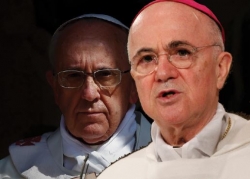


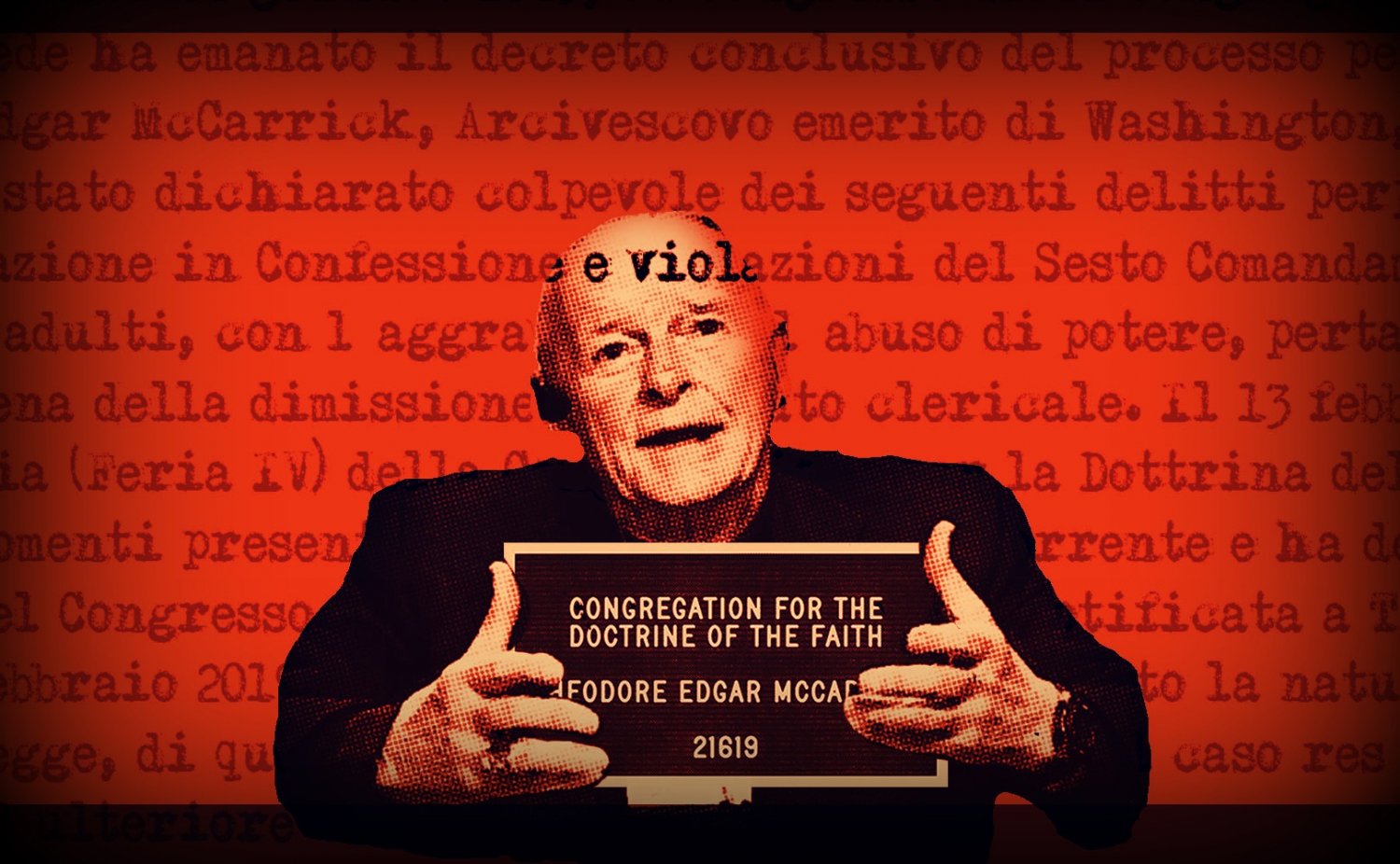

 ABYSSUS ABYSSUM INVOCAT / DEEP CALLS TO DEEP
You must be logged in to post a comment.