Pope Francis’s “Power Play” against the American Bishops Sex Abuse Conference is Built on a Lie and will lead to Hell
The liberal Daily Beast headline said it best:
“Pope Francis Just Pulled a Power Play on American Bishops at Crucial Conference”
Even the liberal Anne Barrett Doyle, the co-director of the left-leaning Bishops Accountability victims group, said the Vatican’s power play was “truly incredible”:
The gay activist Michael Sean Winters writing for the dissenting homosexualist National Catholic Reporter explained that the Francis’s power play was about protecting the gay sex abusers from “procedures and policies which might help police the crime of sex abuse” and not to “blame the gays” for their sex abuse:
“The pope doesn’t talk in his sleep and they don’t let us listen at the door if he did. But, the obvious place to start finding an answer came in the address delivered by Archbishop Christophe Pierre [who is speaking for Pope Francis], the apostolic nuncio, immediately following the announcement…”
‘… The U.S. bishops’ conference proposals were too narrowly focused on procedures and policies which might help police the crime of sex abuse but they did not get to the root of the problem, the clerical culture that led bishops to think more about their own reputations than about the welfare of children exposed to sexual predators.”
“As I noted this morning, there are two meta-narratives competing to become the overarching frame for the bishops’ response to the sex abuse mess, the “blame the gays” narrative we saw at First Things and on EWTN in recent weeks, or the clerical culture narrative. Pierre clearly applied the latter:”
‘We cry for the injustices perpetrated upon victims of abuse. We vow to fight a clerical culture that tolerates the abuse of authority. When abuse occurs, it is our sin and we must take it as such. These are not the sins of the media or the products of vast conspiracies. These are things we must recognize and fix. Our Holy Father has said it must end, and it must — not simply because he has said it, but because each of us in our hearts know that this is the only right thing to do.’
Francis’s power play in calling homosexual sexual abuse “clericalism” or even pedophilia is a lie. There has been clericalism in the Church since St. Paul rebuked St. Peter for a type of clericalism, but never has the Church experienced a crisis of the gravity of the present gay sex abuse scandal which is largely not a pedophile crisis.
Attorney and international child rights advocate Liz Yore refuted this misrepresentation with facts:
Yore clearly showed that it is not a pedophile crisis, but a homosexual sexual abuse crisis.
But even if is it was a pedophile crisis, Francis’s power play in calling the so-called pedophile scandal “clericalism” is a lie except in the sense that Francis is using the full clerical power of the papacy to protect homosexual pedophile sex abusers. The clericalism finger is pointing directly at Francis. In this sense, clericalism is the problem because the Pope is abusing his clerical papal authority to protect gay sex abusers. So if the Pope is going call the sex abuse crisis clericalism then the finger points mainly to Francis and his gay sex abuse protecting inner circle.
That Francis and his appointed Vatican consultant Fr. James Martin are building a bridge to hell using this abuse of clerical authority can clearly be seen when you substitute the word pedophile for gay or LGBT and other gay activist language as quoted from Martin’s WMOF speech in the Catholic Herald:
– Headline: “Fr. James Martin critiques [‘pedophilephobic’] pastors at WMOF”
– “‘[W]elcome [pedophile] persons’… into parish life.”
– “Don’t reduce [pedophile] people to the call to chastity.”
-“The priest said those with [‘pedophilephobic’] pastors, ‘either silently or overtly,’ are ‘out of luck.'”
-“[L]isten to [pedophile] parishioners;. ‘trust that the Holy Spirit will guide them’… rather than ‘simply repeating Church teachings without considering their [pedophile] lived experience.” (Catholic Herald, August 23, 2017)
Don’t forget Church Militant’s September 20, 2017 headline where we substitute pedophile for homosexual:
– “Father Martin: [Pedophiles] not Bound to Chastity”
The point is there is no reason under the sun not to justify pedophile behavior if one uses Martin and Francis language in justifing gay behavior in the Church.
There is no reason not to justify pedophile crimes using Francis/Martin-speak when one substitutes pedophile for gay:
– “Who am I to judge” [pedophiles].
– “God made you like this” [pedophiles].
– That is the “lived experience” of [pedophiles].
– [Pedophile] “discrimination… should be avoided.”
Here is one that even conservative Catholics were using in the earlier part of the McCarrick scandal:
“It is consensual” so it’s not that big a deal and can be taken care of in the confessional.
What Fr. Z said of Martin applies to Francis and in the long run to pedophilia and gay sex abuse:
“[T]his is part of a larger, concerted effort to normalize sodomy, which is a sin that ‘cries to heaven’… Martin’s talk is a nightmare of manipulation and misdirection… they use ‘lived experience’ to justify whatever the hell they want.” (Fr.Z’s Blog, “@JamesMartinSJ talk at #WMOF18,” August 23, 2018)
The Francis/Martin language “is a nightmare of manipulation and misdirection” that is a bridge to hell.
Pray an Our Father now for the restoration of the Church.
THE VALID CARDINALS, i.e. CARDINALS APPOINTED BY POPES BENEDICT XVI AND SAINT JOHN PAUL II, MUST ACT SOON TO REMOVE FRANCIS THE MERCIFUL FROM THE THRONE OF SAINT PETER BEFORE HE DAMAGES THE INSTITUTIONAL CHURCH EVEN MORE THAN HE HAS ALREADY DAMAGED IT.
Recently many educated Catholic observers, including bishops and priests, have decried the confusion in doctrinal statements about faith or morals made from the Apostolic See at Rome and by the putative Bishop of Rome, Pope Francis. Some devout, faithful and thoughtful Catholics have even suggested that he be set aside as a heretic, a dangerous purveyor of error, as recently mentioned in a number of reports. Claiming heresy on the part of a man who is a supposed Pope, charging material error in statements about faith or morals by a putative Roman Pontiff, suggests and presents an intervening prior question about his authenticity in that August office of Successor of Peter as Chief of The Apostles, i.e., was this man the subject of a valid election by an authentic Conclave of The Holy Roman Church? This is so because each Successor of Saint Peter enjoys the Gift of Infallibility. So, before one even begins to talk about excommunicating such a prelate, one must logically examine whether this person exhibits the uniformly good and safe fruit of Infallibility.
If he seems repeatedly to engage in material error, that first raises the question of the validity of his election because one expects an authentically-elected Roman Pontiff miraculously and uniformly to be entirely incapable of stating error in matters of faith or morals. So to what do we look to discern the invalidity of such an election? His Holiness, Pope John Paul II, within His massive legacy to the Church and to the World, left us with the answer to this question. The Catholic faithful must look back for an answer to a point from where we have come—to what occurred in and around the Sistine Chapel in March 2013 and how the fruits of those events have generated such widespread concern among those people of magisterial orthodoxy about confusing and, or, erroneous doctrinal statements which emanate from The Holy See.
His Apostolic Constitution (Universi Dominici Gregis) which governed the supposed Conclave in March 2013 contains quite clear and specific language about the invalidating effect of departures from its norms. For example, Paragraph 76 states: “Should the election take place in a way other than that prescribed in the present Constitution, or should the conditions laid down here not be observed, the election is for this very reason null and void, without any need for a declaration on the matter; consequently, it confers no right on the one elected.”
From this, many believe that there is probable cause to believe that Monsignor Jorge Mario Bergoglio was never validly elected as the Bishop of Rome and Successor of Saint Peter—he never rightly took over the office of Supreme Pontiff of the Holy Roman Catholic Church and therefore he does not enjoy the charism of Infallibility. If this is true, then the situation is dire because supposed papal acts may not be valid or such acts are clearly invalid, including supposed appointments to the college of electors itself.
Only valid cardinals can rectify our critical situation through privately (secretly) recognizing the reality of an ongoing interregnum and preparing for an opportunity to put the process aright by obedience to the legislation of His Holiness, Pope John Paul II, in that Apostolic Constitution, Universi Dominici Gregis. While thousands of the Catholic faithful do understand that only the cardinals who participated in the events of March 2013 within the Sistine Chapel have all the information necessary to evaluate the issue of election validity, there was public evidence sufficient for astute lay faithful to surmise with moral certainty that the March 2013 action by the College was an invalid conclave, an utter nullity.
What makes this understanding of Universi Dominici Gregisparticularly cogent and plausible is the clear Promulgation Clause at the end of this Apostolic Constitution and its usage of the word “scienter” (“knowingly”). The Papal Constitution Universi Dominici Gregis thus concludes definitively with these words: “. . . knowingly or unknowingly, in any way contrary to this Constitution.” (“. . . scienter vel inscienter contra hanc Constitutionem fuerint excogitata.”) [Note that His Holiness, Pope Paul VI, had a somewhat similar promulgation clause at the end of his corresponding, now abrogated, Apostolic Constitution, Romano Pontifici Eligendo, but his does not use “scienter”, but rather uses “sciens” instead. This similar term of sciens in the earlier abrogated Constitution has an entirely different legal significance than scienter.] This word, “scienter”, is a legal term of art in Roman law, and in canon law, and in Anglo-American common law, and in each system, scienter has substantially the same significance, i.e., “guilty knowledge” or willfully knowing, criminal intent.
Thus, it clearly appears that Pope John Paul II anticipated the possibility of criminal activity in the nature of a sacrilege against a process which He intended to be purely pious, private, sacramental, secret and deeply spiritual, if not miraculous, in its nature. This contextual reality reinforced in the Promulgation Clause, combined with: (1) the tenor of the whole document; (2) some other provisions of the document, e.g., Paragraph 76; (3) general provisions of canon law relating to interpretation, e.g., Canons 10 & 17; and, (4) the obvious manifest intention of the Legislator, His Holiness, Pope John Paul II, tends to establish beyond a reasonable doubt the legal conclusion that Monsignor Bergoglio was never validly elected Roman Pontiff.
This is so because:1. Communication of any kind with the outside world, e.g., communication did occur between the inside of the Sistine Chapel and anyone outside, including a television audience, before, during or even immediately after the Conclave;2. Any political commitment to “a candidate” and any “course of action” planned for The Church or a future pontificate, such as the extensive decade-long “pastoral” plans conceived by the Sankt Gallen hierarchs; and,3. Any departure from the required procedures of the conclave voting process as prescribed and known by a cardinal to have occurred:each was made an invalidating act, and if scienter (guilty knowledge) was present, also even a crime on the part of any cardinal or other actor, but, whether criminal or not, any such act or conduct violating the norms operated absolutely, definitively and entirely against the validity of all of the supposed Conclave proceedings.
Quite apart from the apparent notorious violations of the prohibition on a cardinal promising his vote, e.g., commitments given and obtained by cardinals associated with the so-called “Sankt Gallen Mafia,” other acts destructive of conclave validity occurred. Keeping in mind that Pope John Paul II specifically focused Universi Dominici Gregis on “the seclusion and resulting concentration which an act so vital to the whole Church requires of the electors” such that “the electors can more easily dispose themselves to accept the interior movements of the Holy Spirit,” even certain openly public media broadcasting breached this seclusion by electronic broadcasts outlawed by Universi Dominici Gregis. These prohibitions include direct declarative statements outlawing any use of television before, during or after a conclave in any area associated with the proceedings, e.g.: “I further confirm, by my apostolic authority, the duty of maintaining the strictest secrecy with regard to everything that directly or indirectly concerns the election process itself.” Viewed in light of this introductory preambulary language of Universi Dominici Gregis and in light of the legislative text itself, even the EWTN camera situated far inside the Sistine Chapel was an immediately obvious non-compliant act which became an open and notorious invalidating violation by the time when this audio-visual equipment was used to broadcast to the world the preaching after the “Extra Omnes”. While these blatant public violations of Chapter IV of Universi Dominici Gregis actuate the invalidity and nullity of the proceedings themselves, nonetheless in His great wisdom, the Legislator did not disqualify automatically those cardinals who failed to recognize these particular offenses against sacred secrecy, or even those who, with scienter, having recognized the offenses and having had some power or voice in these matters, failed or refused to act or to object against them: “Should any infraction whatsoever of this norm occur and be discovered, those responsible should know that they will be subject to grave penalties according to the judgment of the future Pope.” [Universi Dominici Gregis, ¶55]
No Pope apparently having been produced in March 2013, those otherwise valid cardinals who failed with scienter to act on violations of Chapter IV, on that account alone would nonetheless remain voting members of the College unless and until a new real Pope is elected and adjudges them.
Thus, those otherwise valid cardinals who may have been compromised by violations of secrecy can still participate validly in the “clean-up of the mess” while addressing any such secrecy violations with an eventual new Pontiff. In contrast, the automatic excommunication of those who politicized the sacred conclave process, by obtaining illegally, commitments from cardinals to vote for a particular man, or to follow a certain course of action (even long before the vacancy of the Chair of Peter as Vicar of Christ), is established not only by the word, “scienter,” in the final enacting clause, but by a specific exception, in this case, to the general statement of invalidity which therefore reinforces the clarity of intention by Legislator that those who apply the law must interpret the general rule as truly binding. Derived directly from Roman law, canonical jurisprudence provides this principle for construing or interpreting legislation such as this Constitution, Universi Dominici Gregis. Expressed in Latin, this canon of interpretation is: “Exceptio probat regulam in casibus non exceptis.” (The exception proves the rule in cases not excepted.) In this case, an exception from invalidity for acts of simony reinforces the binding force of the general principle of nullity in cases of other violations. Therefore, by exclusion from nullity and invalidity legislated in the case of simony: “If — God forbid — in the election of the Roman Pontiff the crime of simony were to be perpetrated, I decree and declare that all those guilty thereof shall incur excommunication latae sententiae. At the same time I remove the nullity or invalidity of the same simoniacal provision, in order that — as was already established by my Predecessors — the validity of the election of the Roman Pontiff may not for this reason be challenged.”
His Holiness made an exception for simony. Exceptio probat regulam in casibus non exceptis. The clear exception from nullity and invalidity for simony proves the general rule that other violations of the sacred process certainly do and did result in the nullity and invalidity of the entire conclave. Comparing what Pope John Paul II wrote in His Constitution on conclaves with the Constitution which His replaced, you can see that, with the exception of simony, invalidity became universal.
In the corresponding paragraph of what Pope Paul VI wrote, he specifically confined the provision declaring conclave invalidity to three (3) circumstances described in previous paragraphs within His constitution, Romano Pontfici Eligendo. No such limitation exists in Universi Dominici Gregis. See the comparison both in English and Latin below:Romano Pontfici Eligendo, 77. Should the election be conducted in a manner different from the three procedures described above (cf. no. 63 ff.) or without the conditions laid down for each of the same, it is for this very reason null and void (cf. no. 62), without the need for any declaration, and gives no right to him who has been thus elected. [Romano Pontfici Eligendo, 77: “Quodsi electio aliter celebrata fuerit, quam uno e tribus modis, qui supra sunt dicti (cfr. nn. 63 sqq.), aut non servatis condicionibus pro unoquoque illorum praescriptis, electio eo ipso est nulla et invalida (cfr. n. 62) absque ulla declaratione, et ita electo nullum ius tribuit .”] as compared with:Universi Dominici Gregis, 76: “Should the election take place in a way other than that prescribed in the present Constitution, or should the conditions laid down here not be observed, the election is for this very reason null and void, without any need for a declaration on the matter; consequently, it confers no right on the one elected.” [Universi Dominici Gregis, 76: “Quodsi electio aliter celebrata fuerit, quam haec Constitutio statuit, aut non servatis condicionibus pariter hic praescriptis, electio eo ipso est nulla et invalida absque ulla declaratione, ideoque electo nullum ius tribuit.”]Of course, this is not the only feature of the Constitution or aspect of the matter which tends to establish the breadth of invalidity.
Faithful must hope and pray that only those cardinals whose status as a valid member of the College remains intact will ascertain the identity of each other and move with the utmost charity and discretion in order to effectuate The Divine Will in these matters. The valid cardinals, then, must act according to that clear, manifest, obvious and unambiguous mind and intention of His Holiness, Pope John Paul II, so evident in Universi Dominici Gregis, a law which finally established binding and self-actuating conditions of validity on the College for any papal conclave, a reality now made so apparent by the bad fruit of doctrinal confusion and plain error. It would seem then that praying and working in a discreet and prudent manner to encourage only those true cardinals inclined to accept a reality of conclave invalidity, would be a most charitable and logical course of action in the light of Universi Dominici Gregis, and out of our high personal regard for the clear and obvious intention of its Legislator, His Holiness, Pope John Paul II. Even a relatively small number of valid cardinals could act decisively and work to restore a functioning Apostolic See through the declaration of an interregnum government. The need is clear for the College to convene a General Congregation in order to declare, to administer, and soon to end the Interregnum which has persisted since March 2013. Finally, it is important to understand that the sheer number of putative counterfeit cardinals will eventually, sooner or later, result in a situation in which The Church will have no normal means validly ever again to elect a Vicar of Christ. After that time, it will become even more difficult, if not humanly impossible, for the College of Cardinals to rectify the current disastrous situation and conduct a proper and valid Conclave such that The Church may once again both have the benefit of a real Supreme Pontiff, and enjoy the great gift of a truly infallible Vicar of Christ. It seems that some good cardinals know that the conclave was invalid, but really cannot envision what to do about it; we must pray, if it is the Will of God, that they see declaring the invalidity and administering an Interregnum through a new valid conclave is what they must do. Without such action or without a great miracle, The Church is in a perilous situation. Once the last validly appointed cardinal reaches age 80, or before that age, dies, the process for electing a real Pope ends with no apparent legal means to replace it. Absent a miracle then, The Church would no longer have an infallible Successor of Peter and Vicar of Christ. Roman Catholics would be no different that Orthodox Christians. In this regard, all of the true cardinals may wish to consider what Holy Mother Church teaches in the Catechism of the Catholic Church, ¶675, ¶676 and ¶677 about “The Church’s Ultimate Trial”. But, the fact that “The Church . . . will follow her Lord in his death and Resurrection” does not justify inaction by the good cardinals, even if there are only a minimal number sufficient to carry out Chapter II of Universi Dominici Gregis and operate the Interregnum. This Apostolic Constitution, Universi Dominici Gregis, which was clearly applicable to the acts and conduct of the College of Cardinals in March 2013, is manifestly and obviously among those “invalidating” laws “which expressly establish that an act is null or that a person is effected” as stated in Canon 10 of the 1983 Code of Canon Law. And, there is nothing remotely “doubtful or obscure” (Canon 17) about this Apostolic Constitution as clearly promulgated by Pope John Paul II. The tenor of the whole document expressly establishes that the issue of invalidity was always at stake. This Apostolic Constitution conclusively establishes, through its Promulgation Clause [which makes “anything done (i.e., any act or conduct) by any person . . . in any way contrary to this Constitution,”] the invalidity of the entire supposed Conclave, rendering it “completely null and void”. So, what happens if a group of Cardinals who undoubtedly did not knowingly and wilfully initiate or intentionally participate in any acts of disobedience against Universi Dominici Gregis were to meet, confer and declare that, pursuant to Universi Dominici Gregis, Monsignor Bergoglio is most certainly not a valid Roman Pontiff. Like any action on this matter, including the initial finding of invalidity, that would be left to the valid members of the college of cardinals. They could declare the Chair of Peter vacant and proceed to a new and proper conclave. They could meet with His Holiness, Benedict XVI, and discern whether His resignation and retirement was made under duress, or based on some mistake or fraud, or otherwise not done in a legally effective manner, which could invalidate that resignation. Given the demeanor of His Holiness, Benedict XVI, and the tenor of His few public statements since his departure from the Chair of Peter, this recognition of validity in Benedict XVI seems unlikely. In fact, even before a righteous group of good and authentic cardinals might decide on the validity of the March 2013 supposed conclave, they must face what may be an even more complicated discernment and decide which men are most likely not valid cardinals. If a man was made a cardinal by the supposed Pope who is, in fact, not a Pope (but merely Monsignor Bergoglio), no such man is in reality a true member of the College of Cardinals. In addition, those men appointed by Pope John Paul II or by Pope Benedict XVI as cardinals, but who openly violated Universi Dominici Gregis by illegal acts or conduct causing the invalidation of the last attempted conclave, would no longer have voting rights in the College of Cardinals either. (Thus, the actual valid members in the College of Cardinals may be quite smaller in number than those on the current official Vatican list of supposed cardinals.) In any event, the entire problem is above the level of anyone else in Holy Mother Church who is below the rank of Cardinal. So, we must pray that The Divine Will of The Most Holy Trinity, through the intercession of Our Lady as Mediatrix of All Graces and Saint Michael, Prince of Mercy, very soon rectifies the confusion in Holy Mother Church through action by those valid Cardinals who still comprise an authentic College of Electors. Only certainly valid Cardinals can address the open and notorious evidence which points to the probable invalidity of the last supposed conclave and only those cardinals can definitively answer the questions posed here. May only the good Cardinals unite and if they recognize an ongoing Interregnum, albeit dormant, may they end this Interregnum by activating perfectly a functioning Interregnum government of The Holy See and a renewed process for a true Conclave, one which is purely pious, private, sacramental, secret and deeply spiritual. If we do not have a real Pontiff, then may the good Cardinals, doing their appointed work “in view of the sacredness of the act of election” “accept the interior movements of the Holy Spirit” and provide Holy Mother Church with a real Vicar of Christ as the Successor of Saint Peter. May these thoughts comport with the synderetic considerations of those who read them and may their presentation here please both Our Immaculate Virgin Mother, Mary, Queen of the Apostles, and The Most Holy Trinity, Father, Son and Holy Spirit.N. de PlumeUn ami des Papes
Posted inUncategorized|Comments Off on The National Catholic Reporter, for once got it right when it explained that Francis’s power play stopping the U.S. bishops from enacting the proposed reforms was about protecting the gay sex abusers from “procedures and policies which might help police the crime of sex abuse” and to avoid putting the “blame on the gays” for their sex abuse.
The bishops of America’s 196 Catholic dioceses and archdioceses gathered in Baltimore on Monday morning, meeting for the first time since sexual abuse scandals rocked the church in the summer. They planned to vote on measures to tackle the crisis and prevent further crimes.
In the opening minutes of their meeting, the bishops heard a surprising report: Pope Francis had asked them not to vote on any of their proposals.
The pope does not want U.S. bishops to act to address bishops’ accountability on sexual abuse until he leads a worldwide meeting in February of church leaders, the president of the U.S. Conference of Catholic Bishops, Cardinal Daniel DiNardo, told the gathered bishops as the meeting opened Monday morning.
“At the insistence of the Holy See, we will not be voting on the two action items,” DiNardo said. He said he was “disappointed” by the pope’s directive.
Anne Barrett Doyle, co-director of BishopAccountability.org, called the last-minute order from the Vatican “truly incredible.”
“What we see here is the Vatican again trying to suppress even modest progress by the U.S. bishops,” said Doyle, whose group compiles data on clergy abuse in the church. “We’re seeing where the problem lies, which is with the Vatican. The outcome of this meeting, at best, was going to be tepid and ineffectual, but now it’s actually going to be completely without substance.”
Read the whole thing to see what the papal nuncio told the bishops this morning. Jaw-dropping.
Any illusions that Francis was part of the solution to this crisis should now be dispelled. He is the chief stonewaller. Archbishop Viganò told us so.
As I’ve been writing since visiting Rome earlier this autumn, the atmosphere in the Vatican is one of siege and denial. One has the impression that Francis is like Pius IX, desperately trying to defend the Papal States — except in Francis’s case, he’s trying to defend the Church’s ability to control events — and, let’s be honest, to cover up for priestly buggery and episcopal corruption. It’s as if Uncle Ted were sitting at his right side, Wormtonguing all the livelong day.
What must it feel like to be a faithful Catholic mother and father this morning, knowing that even 16 years after Boston, and mere months after learning that a senior American cardinal was in fact a serial molester, the Holy Father does not take the abuse crisis seriously? For heaven’s sake, the US Catholic Church is facing a federal RICO investigation! And still, the pontiff punts. If you read the nuncio’s quote, you’ll see that the Pope does not intend to give the laity any say in the reform that the Catholic bishops have manifestly been unable to carry out.
From Barbara Tuchman’s The March Of Folly, this passage on how six Renaissance popes provoked the Protestant Reformation:
The folly of the popes was not pursuit of counter-productive policy so much as rejection of any steady or coherent policy either political or religious that would have improved their situation or arrested the rising discontent. Disregard of the movements and sentiments developing around them was a primary folly. They were deaf to disaffection, blind to the alternative ideas it gave rise to, blandly impervious to challenge, unconcerned by the dismay at their misconduct and the rising wrath at their misgovernment, fixed in refusal to change, almost stupidly stubborn in maintaining a corrupt existing system. They could not change it because they were part of it, grew out of it, depended on it.
Can there be any doubt? PF is a liar, a hypocrite, a fraud, radically corrupt, and gravely, gravely wounding the Church of which he is head.
I am beside myself with anger right now. PF is more interested in showing his supposed ‘enemies’ who’s boss than he is in dealing with evil. He is more interested in preserving his image and his friends, than in seeking truth. He is all about himself at this point, completely blinded to the needs of others. He hides his corruption and bankruptcy and pride behind a patina of ‘synodality’ and ‘humility.’
My only hope is that Christ will use him to scourge the Church and bring about its renewal. We must suffer the death-pangs of an ecclesial era that we have allowed to fester for decades. Pope Francis is both a cause and a symptom. He is a disgrace to every victim of abuse and to every person committed to reforming the Church.
Obviously I am not going to reveal the name of this theologian — who, not coincidentally, is a father — but I tell you this: I bet he never, in his wildest dreams, imagined ever writing words like this about a pope. Yet here we are.
Speaking before the conference session had even been called to order, DiNardo told the bishops he was clearly “disappointed” with Rome’s decision. The cardinal said that, despite the unexpected intervention by Rome, he was hopeful that the Vatican meeting would prove fruitful and that its deliberations would help improve the American bishops’ eventual measures.
While DiNardo was still speaking, Cardinal Blase Cupich of Chicago intervened from the floor, expressing his support for the pope.
“It is clear the the Holy See is taking the abuse crisis seriously,” Cupich said.
At the same time, he suggested that the work which had gone into preparing the two proposals should not go to waste.
Cupich suggested that if the conference could not take a binding vote, they should instead continue with their discussions and conclude with resolution ballot on the two measures. This, he said, would help best equip Cardinal DiNardo to present the thought of the American bishops during the February meeting, where he will represent the U.S. bishops’ conference.
That’s actually not a bad idea. Make Francis own this terrible decision.
Well, maybe. But you know, there were actually people who convinced themselves that John Paul II had a secret plan to defeat the scandal, and if everybody just calmed down and trusted the Pope, everything would work out.
UPDATE.6: Church chronicler Rocco Palmo points out that Pope Francis didn’t want the bishops meeting this November anyway. It beggars belief to think that Francis had canonical problems with the US bishops’ proposals, but only sprung it on them the morning they were gathering to talk about the proposals. And, the Pope has known since this summer, when his very good friend Ted McCarrick was outed as a molester, that the American episcopate was in crisis. Recall that he kept USCCB chief Cardinal DiNardo cooling his heels for weeks, despite DiNardo’s urgent request for an audience.
I don’t know what Francis’s game is here, but he long ago surrendered the benefit of the doubt.
THE VALID CARDINALS, i.e. CARDINALS APPOINTED BY POPES BENEDICT XVI AND SAINT JOHN PAUL II, MUST ACT SOON TO REMOVE FRANCIS THE MERCIFUL FROM THE THRONE OF SAINT PETER BEFORE HE DAMAGES THE INSTITUTIONAL CHURCH EVEN MORE THAN HE HAS ALREADY DAMAGED IT.
Recently many educated Catholic observers, including bishops and priests, have decried the confusion in doctrinal statements about faith or morals made from the Apostolic See at Rome and by the putative Bishop of Rome, Pope Francis. Some devout, faithful and thoughtful Catholics have even suggested that he be set aside as a heretic, a dangerous purveyor of error, as recently mentioned in a number of reports. Claiming heresy on the part of a man who is a supposed Pope, charging material error in statements about faith or morals by a putative Roman Pontiff, suggests and presents an intervening prior question about his authenticity in that August office of Successor of Peter as Chief of The Apostles, i.e., was this man the subject of a valid election by an authentic Conclave of The Holy Roman Church? This is so because each Successor of Saint Peter enjoys the Gift of Infallibility. So, before one even begins to talk about excommunicating such a prelate, one must logically examine whether this person exhibits the uniformly good and safe fruit of Infallibility.
If he seems repeatedly to engage in material error, that first raises the question of the validity of his election because one expects an authentically-elected Roman Pontiff miraculously and uniformly to be entirely incapable of stating error in matters of faith or morals. So to what do we look to discern the invalidity of such an election? His Holiness, Pope John Paul II, within His massive legacy to the Church and to the World, left us with the answer to this question. The Catholic faithful must look back for an answer to a point from where we have come—to what occurred in and around the Sistine Chapel in March 2013 and how the fruits of those events have generated such widespread concern among those people of magisterial orthodoxy about confusing and, or, erroneous doctrinal statements which emanate from The Holy See.
His Apostolic Constitution (Universi Dominici Gregis) which governed the supposed Conclave in March 2013 contains quite clear and specific language about the invalidating effect of departures from its norms. For example, Paragraph 76 states: “Should the election take place in a way other than that prescribed in the present Constitution, or should the conditions laid down here not be observed, the election is for this very reason null and void, without any need for a declaration on the matter; consequently, it confers no right on the one elected.”
From this, many believe that there is probable cause to believe that Monsignor Jorge Mario Bergoglio was never validly elected as the Bishop of Rome and Successor of Saint Peter—he never rightly took over the office of Supreme Pontiff of the Holy Roman Catholic Church and therefore he does not enjoy the charism of Infallibility. If this is true, then the situation is dire because supposed papal acts may not be valid or such acts are clearly invalid, including supposed appointments to the college of electors itself.
Only valid cardinals can rectify our critical situation through privately (secretly) recognizing the reality of an ongoing interregnum and preparing for an opportunity to put the process aright by obedience to the legislation of His Holiness, Pope John Paul II, in that Apostolic Constitution, Universi Dominici Gregis. While thousands of the Catholic faithful do understand that only the cardinals who participated in the events of March 2013 within the Sistine Chapel have all the information necessary to evaluate the issue of election validity, there was public evidence sufficient for astute lay faithful to surmise with moral certainty that the March 2013 action by the College was an invalid conclave, an utter nullity.
What makes this understanding of Universi Dominici Gregisparticularly cogent and plausible is the clear Promulgation Clause at the end of this Apostolic Constitution and its usage of the word “scienter” (“knowingly”). The Papal Constitution Universi Dominici Gregis thus concludes definitively with these words: “. . . knowingly or unknowingly, in any way contrary to this Constitution.” (“. . . scienter vel inscienter contra hanc Constitutionem fuerint excogitata.”) [Note that His Holiness, Pope Paul VI, had a somewhat similar promulgation clause at the end of his corresponding, now abrogated, Apostolic Constitution, Romano Pontifici Eligendo, but his does not use “scienter”, but rather uses “sciens” instead. This similar term of sciens in the earlier abrogated Constitution has an entirely different legal significance than scienter.] This word, “scienter”, is a legal term of art in Roman law, and in canon law, and in Anglo-American common law, and in each system, scienter has substantially the same significance, i.e., “guilty knowledge” or willfully knowing, criminal intent.
Thus, it clearly appears that Pope John Paul II anticipated the possibility of criminal activity in the nature of a sacrilege against a process which He intended to be purely pious, private, sacramental, secret and deeply spiritual, if not miraculous, in its nature. This contextual reality reinforced in the Promulgation Clause, combined with: (1) the tenor of the whole document; (2) some other provisions of the document, e.g., Paragraph 76; (3) general provisions of canon law relating to interpretation, e.g., Canons 10 & 17; and, (4) the obvious manifest intention of the Legislator, His Holiness, Pope John Paul II, tends to establish beyond a reasonable doubt the legal conclusion that Monsignor Bergoglio was never validly elected Roman Pontiff.
This is so because:1. Communication of any kind with the outside world, e.g., communication did occur between the inside of the Sistine Chapel and anyone outside, including a television audience, before, during or even immediately after the Conclave;2. Any political commitment to “a candidate” and any “course of action” planned for The Church or a future pontificate, such as the extensive decade-long “pastoral” plans conceived by the Sankt Gallen hierarchs; and,3. Any departure from the required procedures of the conclave voting process as prescribed and known by a cardinal to have occurred:each was made an invalidating act, and if scienter (guilty knowledge) was present, also even a crime on the part of any cardinal or other actor, but, whether criminal or not, any such act or conduct violating the norms operated absolutely, definitively and entirely against the validity of all of the supposed Conclave proceedings.
Quite apart from the apparent notorious violations of the prohibition on a cardinal promising his vote, e.g., commitments given and obtained by cardinals associated with the so-called “Sankt Gallen Mafia,” other acts destructive of conclave validity occurred. Keeping in mind that Pope John Paul II specifically focused Universi Dominici Gregis on “the seclusion and resulting concentration which an act so vital to the whole Church requires of the electors” such that “the electors can more easily dispose themselves to accept the interior movements of the Holy Spirit,” even certain openly public media broadcasting breached this seclusion by electronic broadcasts outlawed by Universi Dominici Gregis. These prohibitions include direct declarative statements outlawing any use of television before, during or after a conclave in any area associated with the proceedings, e.g.: “I further confirm, by my apostolic authority, the duty of maintaining the strictest secrecy with regard to everything that directly or indirectly concerns the election process itself.” Viewed in light of this introductory preambulary language of Universi Dominici Gregis and in light of the legislative text itself, even the EWTN camera situated far inside the Sistine Chapel was an immediately obvious non-compliant act which became an open and notorious invalidating violation by the time when this audio-visual equipment was used to broadcast to the world the preaching after the “Extra Omnes”. While these blatant public violations of Chapter IV of Universi Dominici Gregis actuate the invalidity and nullity of the proceedings themselves, nonetheless in His great wisdom, the Legislator did not disqualify automatically those cardinals who failed to recognize these particular offenses against sacred secrecy, or even those who, with scienter, having recognized the offenses and having had some power or voice in these matters, failed or refused to act or to object against them: “Should any infraction whatsoever of this norm occur and be discovered, those responsible should know that they will be subject to grave penalties according to the judgment of the future Pope.” [Universi Dominici Gregis, ¶55]
No Pope apparently having been produced in March 2013, those otherwise valid cardinals who failed with scienter to act on violations of Chapter IV, on that account alone would nonetheless remain voting members of the College unless and until a new real Pope is elected and adjudges them.
Thus, those otherwise valid cardinals who may have been compromised by violations of secrecy can still participate validly in the “clean-up of the mess” while addressing any such secrecy violations with an eventual new Pontiff. In contrast, the automatic excommunication of those who politicized the sacred conclave process, by obtaining illegally, commitments from cardinals to vote for a particular man, or to follow a certain course of action (even long before the vacancy of the Chair of Peter as Vicar of Christ), is established not only by the word, “scienter,” in the final enacting clause, but by a specific exception, in this case, to the general statement of invalidity which therefore reinforces the clarity of intention by Legislator that those who apply the law must interpret the general rule as truly binding. Derived directly from Roman law, canonical jurisprudence provides this principle for construing or interpreting legislation such as this Constitution, Universi Dominici Gregis. Expressed in Latin, this canon of interpretation is: “Exceptio probat regulam in casibus non exceptis.” (The exception proves the rule in cases not excepted.) In this case, an exception from invalidity for acts of simony reinforces the binding force of the general principle of nullity in cases of other violations. Therefore, by exclusion from nullity and invalidity legislated in the case of simony: “If — God forbid — in the election of the Roman Pontiff the crime of simony were to be perpetrated, I decree and declare that all those guilty thereof shall incur excommunication latae sententiae. At the same time I remove the nullity or invalidity of the same simoniacal provision, in order that — as was already established by my Predecessors — the validity of the election of the Roman Pontiff may not for this reason be challenged.”
His Holiness made an exception for simony. Exceptio probat regulam in casibus non exceptis. The clear exception from nullity and invalidity for simony proves the general rule that other violations of the sacred process certainly do and did result in the nullity and invalidity of the entire conclave. Comparing what Pope John Paul II wrote in His Constitution on conclaves with the Constitution which His replaced, you can see that, with the exception of simony, invalidity became universal.
In the corresponding paragraph of what Pope Paul VI wrote, he specifically confined the provision declaring conclave invalidity to three (3) circumstances described in previous paragraphs within His constitution, Romano Pontfici Eligendo. No such limitation exists in Universi Dominici Gregis. See the comparison both in English and Latin below:Romano Pontfici Eligendo, 77. Should the election be conducted in a manner different from the three procedures described above (cf. no. 63 ff.) or without the conditions laid down for each of the same, it is for this very reason null and void (cf. no. 62), without the need for any declaration, and gives no right to him who has been thus elected. [Romano Pontfici Eligendo, 77: “Quodsi electio aliter celebrata fuerit, quam uno e tribus modis, qui supra sunt dicti (cfr. nn. 63 sqq.), aut non servatis condicionibus pro unoquoque illorum praescriptis, electio eo ipso est nulla et invalida (cfr. n. 62) absque ulla declaratione, et ita electo nullum ius tribuit .”] as compared with:Universi Dominici Gregis, 76: “Should the election take place in a way other than that prescribed in the present Constitution, or should the conditions laid down here not be observed, the election is for this very reason null and void, without any need for a declaration on the matter; consequently, it confers no right on the one elected.” [Universi Dominici Gregis, 76: “Quodsi electio aliter celebrata fuerit, quam haec Constitutio statuit, aut non servatis condicionibus pariter hic praescriptis, electio eo ipso est nulla et invalida absque ulla declaratione, ideoque electo nullum ius tribuit.”]Of course, this is not the only feature of the Constitution or aspect of the matter which tends to establish the breadth of invalidity.
Faithful must hope and pray that only those cardinals whose status as a valid member of the College remains intact will ascertain the identity of each other and move with the utmost charity and discretion in order to effectuate The Divine Will in these matters. The valid cardinals, then, must act according to that clear, manifest, obvious and unambiguous mind and intention of His Holiness, Pope John Paul II, so evident in Universi Dominici Gregis, a law which finally established binding and self-actuating conditions of validity on the College for any papal conclave, a reality now made so apparent by the bad fruit of doctrinal confusion and plain error. It would seem then that praying and working in a discreet and prudent manner to encourage only those true cardinals inclined to accept a reality of conclave invalidity, would be a most charitable and logical course of action in the light of Universi Dominici Gregis, and out of our high personal regard for the clear and obvious intention of its Legislator, His Holiness, Pope John Paul II. Even a relatively small number of valid cardinals could act decisively and work to restore a functioning Apostolic See through the declaration of an interregnum government. The need is clear for the College to convene a General Congregation in order to declare, to administer, and soon to end the Interregnum which has persisted since March 2013. Finally, it is important to understand that the sheer number of putative counterfeit cardinals will eventually, sooner or later, result in a situation in which The Church will have no normal means validly ever again to elect a Vicar of Christ. After that time, it will become even more difficult, if not humanly impossible, for the College of Cardinals to rectify the current disastrous situation and conduct a proper and valid Conclave such that The Church may once again both have the benefit of a real Supreme Pontiff, and enjoy the great gift of a truly infallible Vicar of Christ. It seems that some good cardinals know that the conclave was invalid, but really cannot envision what to do about it; we must pray, if it is the Will of God, that they see declaring the invalidity and administering an Interregnum through a new valid conclave is what they must do. Without such action or without a great miracle, The Church is in a perilous situation. Once the last validly appointed cardinal reaches age 80, or before that age, dies, the process for electing a real Pope ends with no apparent legal means to replace it. Absent a miracle then, The Church would no longer have an infallible Successor of Peter and Vicar of Christ. Roman Catholics would be no different that Orthodox Christians. In this regard, all of the true cardinals may wish to consider what Holy Mother Church teaches in the Catechism of the Catholic Church, ¶675, ¶676 and ¶677 about “The Church’s Ultimate Trial”. But, the fact that “The Church . . . will follow her Lord in his death and Resurrection” does not justify inaction by the good cardinals, even if there are only a minimal number sufficient to carry out Chapter II of Universi Dominici Gregis and operate the Interregnum. This Apostolic Constitution, Universi Dominici Gregis, which was clearly applicable to the acts and conduct of the College of Cardinals in March 2013, is manifestly and obviously among those “invalidating” laws “which expressly establish that an act is null or that a person is effected” as stated in Canon 10 of the 1983 Code of Canon Law. And, there is nothing remotely “doubtful or obscure” (Canon 17) about this Apostolic Constitution as clearly promulgated by Pope John Paul II. The tenor of the whole document expressly establishes that the issue of invalidity was always at stake. This Apostolic Constitution conclusively establishes, through its Promulgation Clause [which makes “anything done (i.e., any act or conduct) by any person . . . in any way contrary to this Constitution,”] the invalidity of the entire supposed Conclave, rendering it “completely null and void”. So, what happens if a group of Cardinals who undoubtedly did not knowingly and wilfully initiate or intentionally participate in any acts of disobedience against Universi Dominici Gregis were to meet, confer and declare that, pursuant to Universi Dominici Gregis, Monsignor Bergoglio is most certainly not a valid Roman Pontiff. Like any action on this matter, including the initial finding of invalidity, that would be left to the valid members of the college of cardinals. They could declare the Chair of Peter vacant and proceed to a new and proper conclave. They could meet with His Holiness, Benedict XVI, and discern whether His resignation and retirement was made under duress, or based on some mistake or fraud, or otherwise not done in a legally effective manner, which could invalidate that resignation. Given the demeanor of His Holiness, Benedict XVI, and the tenor of His few public statements since his departure from the Chair of Peter, this recognition of validity in Benedict XVI seems unlikely. In fact, even before a righteous group of good and authentic cardinals might decide on the validity of the March 2013 supposed conclave, they must face what may be an even more complicated discernment and decide which men are most likely not valid cardinals. If a man was made a cardinal by the supposed Pope who is, in fact, not a Pope (but merely Monsignor Bergoglio), no such man is in reality a true member of the College of Cardinals. In addition, those men appointed by Pope John Paul II or by Pope Benedict XVI as cardinals, but who openly violated Universi Dominici Gregis by illegal acts or conduct causing the invalidation of the last attempted conclave, would no longer have voting rights in the College of Cardinals either. (Thus, the actual valid members in the College of Cardinals may be quite smaller in number than those on the current official Vatican list of supposed cardinals.) In any event, the entire problem is above the level of anyone else in Holy Mother Church who is below the rank of Cardinal. So, we must pray that The Divine Will of The Most Holy Trinity, through the intercession of Our Lady as Mediatrix of All Graces and Saint Michael, Prince of Mercy, very soon rectifies the confusion in Holy Mother Church through action by those valid Cardinals who still comprise an authentic College of Electors. Only certainly valid Cardinals can address the open and notorious evidence which points to the probable invalidity of the last supposed conclave and only those cardinals can definitively answer the questions posed here. May only the good Cardinals unite and if they recognize an ongoing Interregnum, albeit dormant, may they end this Interregnum by activating perfectly a functioning Interregnum government of The Holy See and a renewed process for a true Conclave, one which is purely pious, private, sacramental, secret and deeply spiritual. If we do not have a real Pontiff, then may the good Cardinals, doing their appointed work “in view of the sacredness of the act of election” “accept the interior movements of the Holy Spirit” and provide Holy Mother Church with a real Vicar of Christ as the Successor of Saint Peter. May these thoughts comport with the synderetic considerations of those who read them and may their presentation here please both Our Immaculate Virgin Mother, Mary, Queen of the Apostles, and The Most Holy Trinity, Father, Son and Holy Spirit.N. de PlumeUn ami des Papes
From Martini To Bergoglio. Toward a Vatican Council III
The synod of last October was supposed to be about young people. And instead in concluding it, Pope Francis said that “its first fruit” was “synodality.”
In fact, the most surprising paragraphs of the final document – and also the most contested, with dozens of votes against – were precisely the ones on the “synodal form of the Church.”
Surprising because synodality was practically never talked about, neither in the preparatory phase of the synod, nor in the assembly, nor in the working groups. Only to see it appear in the final document, in the writing of which “L’Osservatore Romano” has revealed that the pope also took part.
An “obvious manipulation,” Sydney archbishop Anthony Fisher called it, giving voice to the protest of not a few synod fathers over this contradictory way of imposing an idea of collegial government with an act of sovereignty from on high.
But then came “La Civiltà Cattolica,” the official voice of Casa Santa Marta, to confirm that it has to be this way, entitling its editorial of commentary on the synod: “The young have reawakened the synodality of the Church.”
And so one’s thoughts go back inexorably to that 1999 synod at which Cardinal Carlo Maria Martini, a Jesuit like Jorge Mario Bergoglio, sketchedout the “dream” of a Church in a perennial synodal state, listed a series of “disciplinary and doctrinal knots” that had to be addressed collegially, and concluded that for such questions “not even a synod could be sufficient,” but that there was a need for “a more universal and authoritative collegial instrument,” in essence a new ecumenical council, ready to “repeat that experience of communion, of collegiality” which was Vatican II.
Among the questions listed by Martini is none other than the ones that today are at the center of Francis’s pontificate:
– “the position of woman in the Church,” – “the participation of the laity in some ministerial responsibilities,” – “sexuality,” – “the discipline of marriage,” – “penitential practice,” – “ecumenical relations with the sister Churches,” – “the relationship between civil laws and moral laws.”
And like Martini, Francis too keeps hammering away at the “style” with which the Church should address such questions. A permanent “synodal style,” or “a way of being and working together, young and old, in listening and in discernment, in order to arrive at pastoral choices that respond to reality.”
So much for the ordinary life of the Church, on all levels.
But then synodality is also invoked as a form of hierarchical governance of the universal Church, the expression of which are the synods properly so called – not for nothing referred to as “of bishops” – and the ecumenical councils.
Today the idea of a new ecumenical council is fostered by few. What is more vigorous, with the encouragement of Francis, is the discussion on how to bring about the evolution not only of the synods, both local and universal, as consultative and deliberative, but also of the episcopal conferences, decentralizing and multiplying their powers and even endowing them with some “genuine doctrinal authority” (Evangelii Gaudium” 32).
But it is not out of the question that the hypothesis of a new council could also see a growing number of supporters soon. So why not gear up and study again what the councils were in the history of the Church, and what they can continue to be in the future?
Cardinal Walter Brandmüller, an authoritative Church historian and president of the pontifical committee for historical sciences from 1998 to 2009, gave a conference on this very subject last October 12 in Rome, reproduced in its entirety on this other page of Settimo Cielo:
The first concerns the superiority of the council over the pope as affirmed by the decree of Constance “Haec Sancta” of 1415, and reasserted today by not a few theologians.
The second concerns the eventuality of a future new council and its implementation, with almost twice as many bishops as Vatican II.
Enjoy the read!
*
CONSTANCE, OR THE SUPERIORITY OF THE COUNCIL OVER THE POPE
Right from the start the decree of Constance “Haec Sancta” of 1415 was the object of heated debate between those who upheld the superiority of the council over the pope and their opponents.
Recently it was the jubilee of the council of Constance in 1964 that reignited the discussion.
The problem thought to be particularly pressing was how to reconcile the decree of Constance “Haec Sancta” – which not only Hans Küng, Paul de Vooght and others, at the time following Karl August Fink, celebrated as the “magna carta” of conciliarism, or putting the council before the pope – with the 1870 dogma on the jurisdictional primacy and doctrinal infallibility of the pope.
In this case did not one council, one dogma, perhaps contradict another in an important question of faith?
At the time, therefore, not a few erudite theological pens, including that of a preeminent dogmatist of Freiburg, swung into action in making, with noteworthy expenditure of acumen, attempts at harmonization, of a sometimes almost acrobatic audacity.
And yet… just a bit of history would have been enough to recognize the groundlessness of the problem: the “council” that in April of 1415 had formulated the decree “Haec Sancta” – the stumbling block – was in fact anything but a universal council; it was instead an assembly of supporters of John XXIII. The gathering of Constance became a universal council only when it was joined by the supporters of the other two “schismatic popes” in July of 1415 and in the autumn of 1417.
What was decided in 1415 in Constance was devoid of both canonical and magisterial authority. And in fact, when the newly elected pope Martin V approved the decrees decided in the years 1415-1417, he deliberately left out “Haec Sancta.”
*
HOW TO CONVENE A FUTURE COUNCIL, WITH AN IMMENSE NUMBER OF BISHOPS
In recent decades there has been repeated talk about a council “Vatican III.” According to some, this should correct the mistaken developments launched by Vatican II, while according to others it should complete the reforms requested at the time.
So should there – and therefore can there – be another universal ecumenical council in the future?
The answer to this question essentially depends on how one would imagine such a “gigantic” council, because that is what it would be.
If a council were to be convened today, the bishops who would have a place and a voice in it would number – according to the situation in 2016 – 5,237. During Vatican II the participating bishops were around 3,044. Just a glance at these numbers is enough to understand that a council of a classical cast would fail for this reason alone. But even supposing that it were possible to resolve the immense logistical and financial difficulties, there are a few simple logical considerations of a sociological and socio-psychological nature that make such a gigantic enterprise look unachievable. Such a high number of participants in a council, who for the most part do not know each other, would be an easily maneuverable mass in the hands of a determined group aware of its own power. The consequences are all too easy to imagine.
The question is therefore how, in what forms and structures, the successors of the apostles can exercise in a collegial manner their ministry as teachers and pastors of the universal Church in the aforementioned circumstances, in a way that would correspond to both the theological and practical-pastoral requirements.
In the search for any historical examples, one looks above all to the council of Vienne of 1311-1312, at which 20 cardinals and 122 bishops participated. The peculiarity lies in how one arrives at these numbers. Two guest lists have been preserved, one papal and one royal. Those who had not been invited could go, but were not obligated to do so. In this way the council was able to keep within contained dimensions, even if the criteria for the selection of the guests – putting the two lists side by side – was not without difficulties. To prevent problems of this kind, the selection of persons to be invited had to be subjected to objective, institutional criteria.
Today and tomorrow, however, a gradual synodal process could make the objections baseless. One could take as an example Martin V, who in the preparatory phase of the council of Pavia-Siena had given the guideline – which in any case was followed by few – to prepare for the universal council with provincial synods. In an analogous way, Vatican I had also been preceded by a series of provincial synods – cf. the “Collectio Lacensis” – which in one form or another prepared the decrees of 1870. Thus, in the various parts of the world, or in the different geographical areas, particular councils could be held to discuss, in the phase of preparation of the universal council, the themes expected to be dealt with at it. The results of these particular councils could be presented, discussed, and addressed in a definitive way, perhaps already in the form of draft decrees, during the council.
The participants at the council would be selected by the particular councils that preceded it, and sent to the universal council with a mandate to represent their particular Churches. Thus it could rightly be called “universalem Ecclesiam repraesentans” and act as such.
This model would make it possible not only to prepare an ecumenical council well in advance, but also to conduct it with a limited duration and number of participants. So why not look back to the first universal council, that of Nicaea in 325, which went down in history as the council of 318 fathers (318 like the “trusted servants” of Abraham in Genesis 14:14)? The “Credo” that they formulated is the same “Credo” that is still proclaimed today by millions of Catholics all over the world on Sundays and feast days. And thus this first general council of just 318 bishops is still a point of crystallization at which truth and error part ways.
*
(The requirement to precede universal synods and councils with synodal moments in the various local Churches is also emphasized in the extensive document on “Synodality in the life and mission of the Church” published on March 2, 2018 by the international theological commission).
(English translation by Matthew Sherry, Ballwin, Missouri, U.S.A.)Condividi:
THE VALID CARDINALS, i.e. CARDINALS APPOINTED BY POPES BENEDICT XVI AND SAINT JOHN PAUL II, MUST ACT SOON TO REMOVE FRANCIS THE MERCIFUL FROM THE THRONE OF SAINT PETER BEFORE HE DAMAGES THE INSTITUTIONAL CHURCH EVEN MORE THAN HE HAS ALREADY DAMAGED IT.
Recently many educated Catholic observers, including bishops and priests, have decried the confusion in doctrinal statements about faith or morals made from the Apostolic See at Rome and by the putative Bishop of Rome, Pope Francis. Some devout, faithful and thoughtful Catholics have even suggested that he be set aside as a heretic, a dangerous purveyor of error, as recently mentioned in a number of reports. Claiming heresy on the part of a man who is a supposed Pope, charging material error in statements about faith or morals by a putative Roman Pontiff, suggests and presents an intervening prior question about his authenticity in that August office of Successor of Peter as Chief of The Apostles, i.e., was this man the subject of a valid election by an authentic Conclave of The Holy Roman Church? This is so because each Successor of Saint Peter enjoys the Gift of Infallibility. So, before one even begins to talk about excommunicating such a prelate, one must logically examine whether this person exhibits the uniformly good and safe fruit of Infallibility.
If he seems repeatedly to engage in material error, that first raises the question of the validity of his election because one expects an authentically-elected Roman Pontiff miraculously and uniformly to be entirely incapable of stating error in matters of faith or morals. So to what do we look to discern the invalidity of such an election? His Holiness, Pope John Paul II, within His massive legacy to the Church and to the World, left us with the answer to this question. The Catholic faithful must look back for an answer to a point from where we have come—to what occurred in and around the Sistine Chapel in March 2013 and how the fruits of those events have generated such widespread concern among those people of magisterial orthodoxy about confusing and, or, erroneous doctrinal statements which emanate from The Holy See.
His Apostolic Constitution (Universi Dominici Gregis) which governed the supposed Conclave in March 2013 contains quite clear and specific language about the invalidating effect of departures from its norms. For example, Paragraph 76 states: “Should the election take place in a way other than that prescribed in the present Constitution, or should the conditions laid down here not be observed, the election is for this very reason null and void, without any need for a declaration on the matter; consequently, it confers no right on the one elected.”
From this, many believe that there is probable cause to believe that Monsignor Jorge Mario Bergoglio was never validly elected as the Bishop of Rome and Successor of Saint Peter—he never rightly took over the office of Supreme Pontiff of the Holy Roman Catholic Church and therefore he does not enjoy the charism of Infallibility. If this is true, then the situation is dire because supposed papal acts may not be valid or such acts are clearly invalid, including supposed appointments to the college of electors itself.
Only valid cardinals can rectify our critical situation through privately (secretly) recognizing the reality of an ongoing interregnum and preparing for an opportunity to put the process aright by obedience to the legislation of His Holiness, Pope John Paul II, in that Apostolic Constitution, Universi Dominici Gregis. While thousands of the Catholic faithful do understand that only the cardinals who participated in the events of March 2013 within the Sistine Chapel have all the information necessary to evaluate the issue of election validity, there was public evidence sufficient for astute lay faithful to surmise with moral certainty that the March 2013 action by the College was an invalid conclave, an utter nullity.
What makes this understanding of Universi Dominici Gregisparticularly cogent and plausible is the clear Promulgation Clause at the end of this Apostolic Constitution and its usage of the word “scienter” (“knowingly”). The Papal Constitution Universi Dominici Gregis thus concludes definitively with these words: “. . . knowingly or unknowingly, in any way contrary to this Constitution.” (“. . . scienter vel inscienter contra hanc Constitutionem fuerint excogitata.”) [Note that His Holiness, Pope Paul VI, had a somewhat similar promulgation clause at the end of his corresponding, now abrogated, Apostolic Constitution, Romano Pontifici Eligendo, but his does not use “scienter”, but rather uses “sciens” instead. This similar term of sciens in the earlier abrogated Constitution has an entirely different legal significance than scienter.] This word, “scienter”, is a legal term of art in Roman law, and in canon law, and in Anglo-American common law, and in each system, scienter has substantially the same significance, i.e., “guilty knowledge” or willfully knowing, criminal intent.
Thus, it clearly appears that Pope John Paul II anticipated the possibility of criminal activity in the nature of a sacrilege against a process which He intended to be purely pious, private, sacramental, secret and deeply spiritual, if not miraculous, in its nature. This contextual reality reinforced in the Promulgation Clause, combined with: (1) the tenor of the whole document; (2) some other provisions of the document, e.g., Paragraph 76; (3) general provisions of canon law relating to interpretation, e.g., Canons 10 & 17; and, (4) the obvious manifest intention of the Legislator, His Holiness, Pope John Paul II, tends to establish beyond a reasonable doubt the legal conclusion that Monsignor Bergoglio was never validly elected Roman Pontiff.
This is so because:1. Communication of any kind with the outside world, e.g., communication did occur between the inside of the Sistine Chapel and anyone outside, including a television audience, before, during or even immediately after the Conclave;2. Any political commitment to “a candidate” and any “course of action” planned for The Church or a future pontificate, such as the extensive decade-long “pastoral” plans conceived by the Sankt Gallen hierarchs; and,3. Any departure from the required procedures of the conclave voting process as prescribed and known by a cardinal to have occurred:each was made an invalidating act, and if scienter (guilty knowledge) was present, also even a crime on the part of any cardinal or other actor, but, whether criminal or not, any such act or conduct violating the norms operated absolutely, definitively and entirely against the validity of all of the supposed Conclave proceedings.
Quite apart from the apparent notorious violations of the prohibition on a cardinal promising his vote, e.g., commitments given and obtained by cardinals associated with the so-called “Sankt Gallen Mafia,” other acts destructive of conclave validity occurred. Keeping in mind that Pope John Paul II specifically focused Universi Dominici Gregis on “the seclusion and resulting concentration which an act so vital to the whole Church requires of the electors” such that “the electors can more easily dispose themselves to accept the interior movements of the Holy Spirit,” even certain openly public media broadcasting breached this seclusion by electronic broadcasts outlawed by Universi Dominici Gregis. These prohibitions include direct declarative statements outlawing any use of television before, during or after a conclave in any area associated with the proceedings, e.g.: “I further confirm, by my apostolic authority, the duty of maintaining the strictest secrecy with regard to everything that directly or indirectly concerns the election process itself.” Viewed in light of this introductory preambulary language of Universi Dominici Gregis and in light of the legislative text itself, even the EWTN camera situated far inside the Sistine Chapel was an immediately obvious non-compliant act which became an open and notorious invalidating violation by the time when this audio-visual equipment was used to broadcast to the world the preaching after the “Extra Omnes”. While these blatant public violations of Chapter IV of Universi Dominici Gregis actuate the invalidity and nullity of the proceedings themselves, nonetheless in His great wisdom, the Legislator did not disqualify automatically those cardinals who failed to recognize these particular offenses against sacred secrecy, or even those who, with scienter, having recognized the offenses and having had some power or voice in these matters, failed or refused to act or to object against them: “Should any infraction whatsoever of this norm occur and be discovered, those responsible should know that they will be subject to grave penalties according to the judgment of the future Pope.” [Universi Dominici Gregis, ¶55]
No Pope apparently having been produced in March 2013, those otherwise valid cardinals who failed with scienter to act on violations of Chapter IV, on that account alone would nonetheless remain voting members of the College unless and until a new real Pope is elected and adjudges them.
Thus, those otherwise valid cardinals who may have been compromised by violations of secrecy can still participate validly in the “clean-up of the mess” while addressing any such secrecy violations with an eventual new Pontiff. In contrast, the automatic excommunication of those who politicized the sacred conclave process, by obtaining illegally, commitments from cardinals to vote for a particular man, or to follow a certain course of action (even long before the vacancy of the Chair of Peter as Vicar of Christ), is established not only by the word, “scienter,” in the final enacting clause, but by a specific exception, in this case, to the general statement of invalidity which therefore reinforces the clarity of intention by Legislator that those who apply the law must interpret the general rule as truly binding. Derived directly from Roman law, canonical jurisprudence provides this principle for construing or interpreting legislation such as this Constitution, Universi Dominici Gregis. Expressed in Latin, this canon of interpretation is: “Exceptio probat regulam in casibus non exceptis.” (The exception proves the rule in cases not excepted.) In this case, an exception from invalidity for acts of simony reinforces the binding force of the general principle of nullity in cases of other violations. Therefore, by exclusion from nullity and invalidity legislated in the case of simony: “If — God forbid — in the election of the Roman Pontiff the crime of simony were to be perpetrated, I decree and declare that all those guilty thereof shall incur excommunication latae sententiae. At the same time I remove the nullity or invalidity of the same simoniacal provision, in order that — as was already established by my Predecessors — the validity of the election of the Roman Pontiff may not for this reason be challenged.”
His Holiness made an exception for simony. Exceptio probat regulam in casibus non exceptis. The clear exception from nullity and invalidity for simony proves the general rule that other violations of the sacred process certainly do and did result in the nullity and invalidity of the entire conclave. Comparing what Pope John Paul II wrote in His Constitution on conclaves with the Constitution which His replaced, you can see that, with the exception of simony, invalidity became universal.
In the corresponding paragraph of what Pope Paul VI wrote, he specifically confined the provision declaring conclave invalidity to three (3) circumstances described in previous paragraphs within His constitution, Romano Pontfici Eligendo. No such limitation exists in Universi Dominici Gregis. See the comparison both in English and Latin below:Romano Pontfici Eligendo, 77. Should the election be conducted in a manner different from the three procedures described above (cf. no. 63 ff.) or without the conditions laid down for each of the same, it is for this very reason null and void (cf. no. 62), without the need for any declaration, and gives no right to him who has been thus elected. [Romano Pontfici Eligendo, 77: “Quodsi electio aliter celebrata fuerit, quam uno e tribus modis, qui supra sunt dicti (cfr. nn. 63 sqq.), aut non servatis condicionibus pro unoquoque illorum praescriptis, electio eo ipso est nulla et invalida (cfr. n. 62) absque ulla declaratione, et ita electo nullum ius tribuit .”] as compared with:Universi Dominici Gregis, 76: “Should the election take place in a way other than that prescribed in the present Constitution, or should the conditions laid down here not be observed, the election is for this very reason null and void, without any need for a declaration on the matter; consequently, it confers no right on the one elected.” [Universi Dominici Gregis, 76: “Quodsi electio aliter celebrata fuerit, quam haec Constitutio statuit, aut non servatis condicionibus pariter hic praescriptis, electio eo ipso est nulla et invalida absque ulla declaratione, ideoque electo nullum ius tribuit.”]Of course, this is not the only feature of the Constitution or aspect of the matter which tends to establish the breadth of invalidity.
Faithful must hope and pray that only those cardinals whose status as a valid member of the College remains intact will ascertain the identity of each other and move with the utmost charity and discretion in order to effectuate The Divine Will in these matters. The valid cardinals, then, must act according to that clear, manifest, obvious and unambiguous mind and intention of His Holiness, Pope John Paul II, so evident in Universi Dominici Gregis, a law which finally established binding and self-actuating conditions of validity on the College for any papal conclave, a reality now made so apparent by the bad fruit of doctrinal confusion and plain error. It would seem then that praying and working in a discreet and prudent manner to encourage only those true cardinals inclined to accept a reality of conclave invalidity, would be a most charitable and logical course of action in the light of Universi Dominici Gregis, and out of our high personal regard for the clear and obvious intention of its Legislator, His Holiness, Pope John Paul II. Even a relatively small number of valid cardinals could act decisively and work to restore a functioning Apostolic See through the declaration of an interregnum government. The need is clear for the College to convene a General Congregation in order to declare, to administer, and soon to end the Interregnum which has persisted since March 2013. Finally, it is important to understand that the sheer number of putative counterfeit cardinals will eventually, sooner or later, result in a situation in which The Church will have no normal means validly ever again to elect a Vicar of Christ. After that time, it will become even more difficult, if not humanly impossible, for the College of Cardinals to rectify the current disastrous situation and conduct a proper and valid Conclave such that The Church may once again both have the benefit of a real Supreme Pontiff, and enjoy the great gift of a truly infallible Vicar of Christ. It seems that some good cardinals know that the conclave was invalid, but really cannot envision what to do about it; we must pray, if it is the Will of God, that they see declaring the invalidity and administering an Interregnum through a new valid conclave is what they must do. Without such action or without a great miracle, The Church is in a perilous situation. Once the last validly appointed cardinal reaches age 80, or before that age, dies, the process for electing a real Pope ends with no apparent legal means to replace it. Absent a miracle then, The Church would no longer have an infallible Successor of Peter and Vicar of Christ. Roman Catholics would be no different that Orthodox Christians. In this regard, all of the true cardinals may wish to consider what Holy Mother Church teaches in the Catechism of the Catholic Church, ¶675, ¶676 and ¶677 about “The Church’s Ultimate Trial”. But, the fact that “The Church . . . will follow her Lord in his death and Resurrection” does not justify inaction by the good cardinals, even if there are only a minimal number sufficient to carry out Chapter II of Universi Dominici Gregis and operate the Interregnum. This Apostolic Constitution, Universi Dominici Gregis, which was clearly applicable to the acts and conduct of the College of Cardinals in March 2013, is manifestly and obviously among those “invalidating” laws “which expressly establish that an act is null or that a person is effected” as stated in Canon 10 of the 1983 Code of Canon Law. And, there is nothing remotely “doubtful or obscure” (Canon 17) about this Apostolic Constitution as clearly promulgated by Pope John Paul II. The tenor of the whole document expressly establishes that the issue of invalidity was always at stake. This Apostolic Constitution conclusively establishes, through its Promulgation Clause [which makes “anything done (i.e., any act or conduct) by any person . . . in any way contrary to this Constitution,”] the invalidity of the entire supposed Conclave, rendering it “completely null and void”. So, what happens if a group of Cardinals who undoubtedly did not knowingly and wilfully initiate or intentionally participate in any acts of disobedience against Universi Dominici Gregis were to meet, confer and declare that, pursuant to Universi Dominici Gregis, Monsignor Bergoglio is most certainly not a valid Roman Pontiff. Like any action on this matter, including the initial finding of invalidity, that would be left to the valid members of the college of cardinals. They could declare the Chair of Peter vacant and proceed to a new and proper conclave. They could meet with His Holiness, Benedict XVI, and discern whether His resignation and retirement was made under duress, or based on some mistake or fraud, or otherwise not done in a legally effective manner, which could invalidate that resignation. Given the demeanor of His Holiness, Benedict XVI, and the tenor of His few public statements since his departure from the Chair of Peter, this recognition of validity in Benedict XVI seems unlikely. In fact, even before a righteous group of good and authentic cardinals might decide on the validity of the March 2013 supposed conclave, they must face what may be an even more complicated discernment and decide which men are most likely not valid cardinals. If a man was made a cardinal by the supposed Pope who is, in fact, not a Pope (but merely Monsignor Bergoglio), no such man is in reality a true member of the College of Cardinals. In addition, those men appointed by Pope John Paul II or by Pope Benedict XVI as cardinals, but who openly violated Universi Dominici Gregis by illegal acts or conduct causing the invalidation of the last attempted conclave, would no longer have voting rights in the College of Cardinals either. (Thus, the actual valid members in the College of Cardinals may be quite smaller in number than those on the current official Vatican list of supposed cardinals.) In any event, the entire problem is above the level of anyone else in Holy Mother Church who is below the rank of Cardinal. So, we must pray that The Divine Will of The Most Holy Trinity, through the intercession of Our Lady as Mediatrix of All Graces and Saint Michael, Prince of Mercy, very soon rectifies the confusion in Holy Mother Church through action by those valid Cardinals who still comprise an authentic College of Electors. Only certainly valid Cardinals can address the open and notorious evidence which points to the probable invalidity of the last supposed conclave and only those cardinals can definitively answer the questions posed here. May only the good Cardinals unite and if they recognize an ongoing Interregnum, albeit dormant, may they end this Interregnum by activating perfectly a functioning Interregnum government of The Holy See and a renewed process for a true Conclave, one which is purely pious, private, sacramental, secret and deeply spiritual. If we do not have a real Pontiff, then may the good Cardinals, doing their appointed work “in view of the sacredness of the act of election” “accept the interior movements of the Holy Spirit” and provide Holy Mother Church with a real Vicar of Christ as the Successor of Saint Peter. May these thoughts comport with the synderetic considerations of those who read them and may their presentation here please both Our Immaculate Virgin Mother, Mary, Queen of the Apostles, and The Most Holy Trinity, Father, Son and Holy Spirit.N. de PlumeUn ami des Papes
The Conversion of the Papacy and the Present Church Crisis
The reform we need is in the direction of simplicity, transparency, and integrity – what many thought we were getting in Francis, before discovering otherwise – and whatever does not serve directly the task of the successor of Peter should be marginalized or eliminated.
Editor’s note:The following essay by Dr. Farrow is much longer and more detailed in many ways than the usual feature articles published by CWR. But we are publishing it because we think it addresses, in a serious and learned way, some essential theological questions facing the Church today. The views and opinions expressed in the piece are Dr. Farrow’s alone and do not necessarily reflect the views and opinions of the editors or of Ignatius Press.
One salutary aspect of the troubling Bergolio pontificate is that it forces us to think about the papal office as such. This appeared plainly enough in the recent response of Cardinal Ouellet to Archbishop Viganò, suggesting (with pontifical approval) that the latter was out of communion with the pope. It also appeared in the Secretariat of State’s secret agreement with the Chinese government, in which canon 377 and the integrity of the process of apostolic succession were violated in exchange for a purely symbolic acknowledgment of the pope as titular head of all Chinese Catholics. It appeared, still more starkly albeit inconsequentially, in Fr Rosica’s notorious remark about the pope being above scripture and tradition and the Church now being ruled quite openly by an individual qua individual, as also in Bishop Carrara’s heretical claim that “God’s Spirit is embodying itself in Francis’s spirit.” It appeared in the Apostolic Constitution Episcopalis Communio of the Holy Father Francis, which carries forward the Bergoglian “conversion of the papacy” (EC 10; cf. Evangelii gaudium 32) by means of the putative transfer of magisterial authority from the pope to an ad hoc synod of bishops – a move intended to lend weight, for example, to the youth synod’s Final Report, which will be used further to convert the Catholic idea of the family and of the conscience, so that the latter also may stand above scripture and tradition.
In short, there is an awful lot of conversion going on here, as indeed there must be, given the quality of catholicity that belongs to the Church (Cyril, CL18.23). Once begin converting the plumbing, so to say, and you must renovate the entire house. But where better to begin than with the papacy itself, which John Paul II and Benedict XVI both thought must undergo change? That is exactly where the work began immediately after Cardinal Bergoglio’s election, following plans prepared in advance, and it has already been going on long enough now that it is impossible simply to stop it, were that desirable. Nor is it desirable, as the present sexual scandals and doctrinal deviations demonstrate; for the moral corruption on the seven hills and on the shores of the seven seas, which has so seriously infected and compromised the Church, began infecting it at least a century ago. Change was and is needed. But not this change.
True and False Respect for the Pontiff
To understand the Bergoglian conversion of the papacy we need to understand the larger crisis – many are at last admitting that there is a crisis – to which it belongs. That crisis is a concatenated one that has taken some time to break into the open. It involves, first, a loss of faith in tradition and a failure to stand fast (2 Thess. 2:15); second, widespread sexual immorality among the laity and the clergy; third, malfeasance in high office, including the papal office, regarding doctrine, discipline, appointments, and finances; fourth, a nexus of deceptions and cover-ups in which even the otherwise well-behaved have too often become enmeshed, despite the fact that “no prelate should desire that any good be achieved by a lie” (Aquinas, Super II ad Thess., C2, L1, 32); fifth, in service of those cover-ups a gross and, in some mouths, richly hypocritical distortion of respect for the pontiff, a distortion that does not stop short of substituting a false doctrine of communion such as that which appears in Ouellet’s letter; sixth, abandonment of the Great Commission in favor of a mission of inclusiveness, where “making disciples of all nations” decidedly does not mean “teaching them to observe all that I have commanded you” (Matt. 28:19f.); seventh, a deliberate plan to use the papacy to dissolve what is left of the centralized, authoritarian Tridentine Church and to overcome the synthesis of Vatican I and II that was attempted, with limited success, by the previous four popes – that is, to generate a decentralized, morally and doctrinally flexible, post-modern Church that is open both to Protestant and to pagan elements, with a vast and welcoming Courtyard of the Gentiles.
Obviously I cannot elaborate on all this here. I want to focus on the fifth feature of the crisis, which would not exist but for the first four and which is required by the final two. By “distortion of respect for the pontiff” I mean more than at first appears in the much remarked (and truly remarkable) statements reprised above. Anyone learning of them should not fail to be horrified by them, and by the tacit or open support they get from those who have spent much of their lives attacking Francis’s predecessors. But we should be no less horrified by those ordinary folk who are trying so very hard to convert their habitual respect for the occupant of the Chair of Peter into the kind of respect that is now being demanded of them – a respect that blurs the distinction between the person and the office and amounts, as I have said before, to a clericalism of one.
Roberto de Mattei is very helpful here. In Tu es Petrus, he argues that what is needed now is “true devotion to the Chair of Saint Peter,” not false. He insists that this true devotion is, among other things, “devotion to the visibility of the Church” and as such indispensable to the spiritual life. De Mattei offers a profound critique of the papalotry so much in evidence today. “Papalotry,” he says, “is a false devotion which does not see in the reigning Pope one of the 265 successors of Peter, but considers him to be a new Christ on earth, who personalizes, reinterprets, reinvents and imposes the Magisterium of his predecessors, expanding and perfecting the doctrine of Christ.” He observes astutely that this papalotry, “before it is a theological error, is a deformed psychological and moral attitude,” one that shies from the struggle that is proper to the Church militant:
Papalotrists are generally conservatives or moderates who deceive themselves on the possibility of reaching good results in life without a fight, without effort. The secret of their life, is always to adapt themselves, to bring the best out of every situation. Their watchword is that everything is calm, there’s no need to worry about anything.
The price for that is that they must see the pope, not as “the Vicar of Christ on earth, who has the duty of handing on the doctrine he has received, but [as] a successor of Christ who perfects the doctrine of his predecessors, adapting it to the changing of the times.” They must even allow that “the doctrine of the Gospel is in perpetual evolution, because it coincides with the magisterium of the reigning Pontiff.” Thus “the ‘living’ magisterium substitutes the perennial Magisterium, expressed by pastoral teaching which changes daily, and has its regula fidei in the subject of the authority and not in the object of the transmitted truth.” That Cardinal Ouellet speaks of communion with Peter in subjective terms as “better feelings towards the Holy Father” nicely illustrates the point.
De Mattei afterwards offers wise warnings to those who fail to see that “papalotry can come to counterpoising Pope against Pope,” or to “looking for harmony and coexistence” between Benedict and Francis, “imagining a possible division of their roles” (as even Benedict is said to have done). Or that it can come to positing two churches instead of one, by way of “that inflated traditionalism, which, while not declaring the vacancy of the Seat of Peter, thinks itself able to kick out of the Church the Pope, cardinals and bishops, and de facto reduces the Mystical Body of Christ to a purely spiritual and invisible reality,” thus falling neatly into the trap laid for it. He insists, as we must, that “there is only one Catholic Church, in which today cohabitate, in a confused and fragmentary way, different and counterpoised theologies and philosophies,” and that we must speak up – respectfully not disrespectfully – in defense, not of traditionalism, but of the tradition itself. For “Tradition comes before the Pope and not the Pope before Tradition.” He also supplies a useful analysis of the possibility of a pope falling personally into heresy, and of the situation that must then appertain. Recognizing that possibility, he asserts, “does not mean in any way diminishing the love for and devotion to the Papacy. It means admitting that the Pope is the Vicar, not always impeccable and not always infallible, of Jesus Christ, [the] only Head of the Mystical Body of the Church.”
Now, this almost suffices in elaboration of the fifth element of the crisis. Almost, but not quite. The argument is important enough to get it right, and there are one or two difficulties with it, theologically, that call for friendly amendments.
Idolatry of the Person and Idolatry of the Office
The first difficulty lies in De Mattei’s claim that “the primacy of Peter constitutes the bedrock on which Jesus Christ instituted His Church, and on which She will remain solid until the end of time” – that, and his further claim that “the fierce war” conducted by the devil against the Church is a war centered on the papacy. It seems to me that, though this appears to be drawn straight from Pastor Aeternus, it risks an exaggeration that mirrors, or is mirrored by, the false devotion we are both wanting to address; and that in its own way it hints at two churches, one visible and the other invisible. Jesus Christ, not Peter, is the stone that the builders rejected but that God has made the cornerstone, which is “marvelous in our eyes” (Psa. 118:22f.; cf. Matt. 21:42). Both the visible and the invisible dimensions of the Church are founded on Jesus, as Paul explicitly says, and with him on the apostles and prophets (Eph. 2:20ff.; cf. Rev. 21:14).
The Church Jesus promised to build, considered in its temporal phase as the Church militant – temporal and eternal, militant and triumphant, are much better categories than visible and invisible when thinking about the Church – is built upon upon himself and no other. It is not, in the most important and fundamental sense, built on the primacy of Peter, whether as a person or as the holder of an office and a vocation. The petra to which Jesus refers in Matt. 16:18 is certainly not Petros the man, as the Rosican element today would have it, nor even Petros the office-holder, as De Mattei would have it, nor yet the bare confession (“Thou art the Christ, the Son of the living God!”), as Protestants would have it. Rather this petra is the divinely generated missionary dynamic of Peter confessing Christ in and for the whole apostolic college, as every holder of his office is bound to do. It is only in relation to the college that the primacy of Peter comes into play, and only because of its collective vocation and authority to confess Christ truly that the college itself matters. Jesus himself remains both the bedrock of the Church and its architect.
This requires and will receive some elaboration, lest anyone suppose that I mean to contradict Pastor Aeternus or Lumen Gentium. In response, however, to the obvious objection that both these documents refer (in the words of the latter at §19) to “the universal Church, which the Lord established on the apostles and built upon blessed Peter, their chief, Christ Jesus Himself being the supreme cornerstone,” and that the natural way to read them is to assume an identification between petra and Petros, it should be said right here that the assumption may be natural enough, and frequently made, but is nonetheless unsound. Pastor Aeternus, to be sure, speaks in its opening paragraph of a visible foundation on the strength and firmness of which “was to be built the eternal temple,” and does so immediately after speaking of Christ instituting in Peter “the permanent principle of both unities [that of the bishops and, consequently, that of the faithful] and their visible foundation.” But it must be borne in mind that Pastor Aeternus is appending Matthew 16 to John 17, which is entirely Christological and not at all Petrological, in order to defend the Church from a particular form of attack upon its unity. It is treating, in other words, of the essential role of the Petrine office or primacy in maintaining the unity of the Church militant for which Jesus prayed. That it regards that office as the indispensable principle and foundation of unity in the matter it is treating – namely, “the doctrine concerning the 1. institution, 2. permanence and 3. nature of the sacred and apostolic primacy, upon which the strength and coherence of the whole Church depends” – is neither in doubt nor in question. What Vatican II later referred to as communio hierarchica is, as both councils maintain, indispensable. The reason it is indispensable is that there should be unity of confession and discipline even where there are differences of contexts and rites. None of this, however, requires a simple equation between petra and Petros in Matt. 16:18. Indeed it is better sustained, I think, by the richer and more Christological reading proposed above.
Perhaps De Mattei and I are not very far apart, then, since we both see this unity of confession and discipline as under threat again today, this time from Rome itself – a possibility neither Vatican I nor Vatican II considered – through a new and more subtle kind of attack on the Petrine principle and ultimately on Christ himself. But there is something more to consider.
De Mattei goes on to supply us with a quick sketch of the war against the papacy, as it was conducted in modernity overtly and covertly, and of the counter-attack that produced the triumph of Vatican I. He then laments the ambiguities of Vatican II (we might also lament its cowardice in the face of Communism) and of Lumen Gentium’s “compromise between the principle of the primacy of Peter and that of the collegiality of the bishops,” before drawing the following curiously inverted analogy, which suggests that the Petrine office is the visible Church’s procreative principle and the apostolic college its unitive principle:
That which took place with Lumen Gentium also occurred with the conciliar constitution Gaudium et Spes, which placed on the same level the two ends of matrimony: procreative and unitive. Equality in nature does not exist. One of the two principles is destined to assert itself over the other. And, as is the case in matrimony, the unitive principle prevailed over the procreative, so in the case of the constitution of the Church, the principle of collegiality is imposing itself on that of the Primacy of the Roman Pontiff. Synodality, collegiality, decentralization are the words which today express the attempt to transform the monarchical and hierarchical constitution of the Church into a democratic and parliamentary structure.
This attempt at a democratic transformation he traces into the program of Francis and his advisers, who seek “a renewed Papacy, conceived as a form of ministry at the service of the other churches, renouncing the juridical Primacy or government of Peter” in a “transition from a juridical Church to a sacramental Church, a Church of communion.”
De Mattei’s contention is that the purely sacramental church of Pope Francis has no real place for the Petrine ministry, since the latter is “not a sacrament, but an office.” It therefore dissolves the primacy of Peter and, with it, the visibility of the Church. (As the Preliminary Explanatory Note to Lumen Gentium insists, “without hierarchical communion the sacramental-ontological function, which is to be distinguished from the canonico-juridical aspect, cannot be exercised.”) Of course it needs a false primacy in place of the true, a Rosican primacy, a primacy of the man. By way of correction, De Mattei reminds us that “true devotion to the Chair of Peter is not the worship of the man who occupies this Cathedra, but is the love and veneration for the mission which Jesus Christ gave to Peter and to his successors.” This mission “is a visible mission, perceptible to the senses,” but the innovators of the Francis reformation are stripping it of its concreteness and its visibility, quite effectively “renouncing what is essential to its mission” (UUS 95). One of the better accounts of that stripping and renunciation, I will add, is provided by Roberto Pertici in The End of “Roman Catholicism.” Anyone who doubts that it is taking place would do well to read both articles.
Here we seem to be very much on the same page, though it bears mentioning that there are three ecclesial dimensions to which to attend, not two only: the evangelico-magisterial, the ontologico-sacramental, and the juridico-canonical. In the Bergoglian attempt to “help the Church acquire her natural polyhedral shape” (2018 Instrumentum laboris, 10, 177), such that one face of the Church need not look much like another, it is not just the juridical that is suffering. All three dimensions are suffering, especially the evangelical, which “among the principal duties of bishops … occupies an eminent place” (LG 25). Still, it is the juridical with which we are at present concerned, and though we are on the same page there are some discrepancies in our respective scripts that worry me. De Mattei claims that, “like her Founder, the Church consists in a human element, visible and external, and a Divine element, spiritual and invisible.” But the divine element is not merely spiritual and invisible, nor is the human element merely visible and external. This is not true of Jesus Christ, who is of one being with the Father, and cannot be true of the Church either, which “by no weak analogy” may be compared to the mystery of the incarnate Word (LG 8). De Mattei comes to the conclusion that the pope “is he in whom this visibility of the Church is concentrated and condensed.” Not so. The visibility of the Church, as much as the invisibility, is concentrated and condensed in its cornerstone, Jesus Christ. And while Jesus’ parousia is awaited it is concentrated for us in the eucharistic sacrifice by which we anticipate that wonderful event (LG 50).
Again, this is not to deny what the councils have asserted. “The Roman Pontiff, as the successor of Peter, is the perpetual and visible principle and foundation of unity of both the bishops and of the faithful,” as the individual bishops “are the visible principle and foundation of unity in their particular churches” (LG23; cf. CCC 880–87). It is, however, to insist that what we are talking about when we talk about the primacy of Peter is precisely the unio collegialis. It is “in order that the episcopate itself might be one and undivided” that Christ “placed Blessed Peter over the other apostles, and instituted in him a permanent and visible source and foundation of unity of faith and communion” (LG 18, following PA). This is for the sake of all the faithful, certainly, but it is the unio collegialis that is, so to say, solidified in the successor of Peter the confessor.
As I observed in Ascension Theology(80ff.), refusal to acknowledge the concreteness of the real presence of Christ in the Eucharist leads Protestants to disallow in principle what the Orthodox disallow only in practice; namely, that the Church “is subject to a particular discipline,” that it is Petrine. If there were no Petrine office, no steward of the keys in service of the King (cf. Isa. 22:22), there would indeed be no visible principle and foundation of unity in the Church capable of lending it the integrity of confession and discipline that Protestantism necessarily and manifestly lacks. But we must not read more into the papacy than that. The pope is steward of the keys, and this undoubtedly belongs to the visibility of the Church. His use of those keys lends definition to the Church through the regular process of rendering judgments as well as through speaking to and for her. But we must be very cautious in claiming that he concentrates in himself what belongs to the Church, whether evangelically, ontologically, or juridically, for it belongs to Jesus Christ himself to do that (Col. 1:15–20), not to the bishop of Rome or any other bishop. We may allow the Ignatian maxim that where the bishop is, there is the Church, and a fortiori that where the pope is, there is the Church, because Christ causes the unity of the Church militant to be served through the visible and tangible fact of the episcopal and papal office. But how are we to think of those offices and of that service? “Exercising within the limits of their authority the function of Christ as Shepherd and Head, they gather together God’s family as a brotherhood all of one mind, and lead them in the Spirit, through Christ, to God the Father. In the midst of the flock they adore Him in spirit and in truth. Finally, they labor in word and doctrine, believing what they have read and meditated upon in the law of God, teaching what they have believed, and putting in practice in their own lives what they have taught” (LG 23; cf. 27).
This brings us back to that curious analogy by which the Petrine primacy becomes the Church’s procreative principle. There is a sense, albeit a secondary one, in which Peter-confessing-Christ may be deemed the Church’s procreative principle; in witness of that, Acts 2 suffices. But De Mattei wants to press this into a parallel between Christ as the invisible guide of the Church and the pontiff as visible guide. Which again is false. The invisible guide of the Church is the Holy Spirit, and it has no visible guide other than Christ himself. The King is on a journey; he has gone to the Father to prepare for us a new dwelling place, a new or renewed creation; he will return when that work is accomplished. Meanwhile the Church has her scriptures and creeds; she has her bishops and her pastors. Chief among those is the steward of the keys and of the integrity of her gospel. To say that is to say enough, though of course it is the business of councils to elaborate and apply that where necessary.
Do not think this the mere quibble of a theologian with an historian, an unwarranted quibble since we are both opposing the papalotry of the Francis reformation. It matters quite fundamentally to the analysis and to the objection to papal personalism. De Mattei seems here to have his own “clericalism of one” – or that of Joseph de Maistre, to whom he appeals. If Jesus is the invisible guide of the Church, then the pope may be the visible guide. If Jesus is the divine ground of the Church, the pope may be (pro tempore, at least)the human ground. And this is wrong, wrong in almost the same way that the reasoning of those who are doing their level best to follow Francis – to follow him despite the fact that he is leading them down the path to dissolution of the visible Church – is wrong. God the Father is the procreative principle of the Church, as of every family in heaven and on earth (Eph. 3:14ff.). He is its first and its final cause. The incarnate Son is the divine and human ground of the Church, of the new humanity that will live forever in God, and the head of the mystical body. He is its material cause. The Holy Spirit is the one who gives form and vitality to the Church, and its counselor (John 15:26). He is the efficient and perfecting cause of the Church, in its visibility as in its invisibility. And the pope? Neither in his own person, nor yet ex officio, is he what De Mattei and De Maistre make him out to be. He is neither the fons et origo of the Church as a human institution (which already exists in the calling and commissioning of the Twelve; cf. PA 3 and LG 19) nor ordinarily its guide and leading light (even in Peter’s day, the leading light was probably Paul), though he is both confessor-in-chief and steward of the keys. Certainly he is not, as De Maistre contends, the creative or unifying principle of authentic human civilization, though that is an argument for another day.
In brief, I worry that there is an idolatry of the office at work in this attempt to overcome idolatry of the person. If there is, we need another way to confront the latter and to develop or recover a sound respect for the Chair of Peter. There are powerful acids at work dissolving the institutional lineaments of the Church, and the current idolatry of the person is one of those acids. But we should not aim at neutralizing those acids by repristinating a view of the papal office that was tried and found wanting.
That is what Cardinal Newman sought to warn us against when the Church was fighting a different idolatry, that of nationalism. Newman, like Cardinal Manning and the fathers of Vatican I, knew that the Church needed to reassert her unique mandate and authority. But he also knew how unsustainable was the papal overreach that appeared from time to time in the past millennium, punctuated, as it was, by devastating collapses. (Both the overreach and the collapse are nicely illustrated by Boniface VIII, but more important and more recent examples can be supplied.) Vatican I had to defend the papacy against Gallicanism and other forms of nationalist idolatry that were threatening to ruin the Church by taking it captive to human and even to demonic agendas. Its defenses still stand, and they can and should be held against the globalist and inclusivist idolatry – the pseudo-Catholicism of the new anti-colonial colonialists – that threatens the Church today. What is happening instead is that the latter has penetrated the Church’s defenses as far as Rome itself. But is that, as De Mattei seems to believe, because Vatican II dismantled the defenses? Or is it because the Church is still being tested in regard to the real object of its faith?
From the Dictatus Papae to the Dictator Pope
The proper object of the Church’s faith is definitely not the pope. If it were, we could accept Cardinal Ouellet’s apparent equation of communion with “better feelings towards the Holy Father” and humble submission to his agenda. The real object of its faith, we agree, is the Holy Trinity. And should we not admit just here (parenthetically, but purposefully) that the very title, Holy Father, contains a temptation to idolatry of the office, if not indeed of the person? That, after all, is the title used by Jesus in John 17 for God himself, when he prayed over his disciples that they might be one.
Of course, that is not how we came to use it of the pope! All bishops in the apostolic succession, being charged with discerning and declaring the truth of the Catholic faith in their own time and place, are fathers in God to their own flocks and as such “holy fathers,” even if that title, as a formal one, is normally reserved for them when they deliberate and speak in concert at Church councils. In the midst of them, both when they gather and when they are dispersed, as the visible and abiding sign of their unity in the truth, stands the bishop of Rome, the successor of Peter, who first confessed Christ. For that reason he is regarded as the holy father, a regard that has carried over into an official title and form of address. But particularly after Gregory VII and the Dictatus Papae program to eliminate any serious competition from other patriarchs to papal dignity and authority, this form of address has carried with it the risk of contradicting our Lord himself. For the same Lord who committed to Peter the keys, generating a peculiar stewardship of the Church’s confession and discipline, also said that we are to call no man on earth our father, meaning that we are not to ascribe the kind of authority to any man, himself excepted, that belongs to God. “For you have one Father, who is in heaven,” as “you have one teacher” and “one master, the Christ” (Matt. 23:8–10). This is a warning against both kinds of idolatry.
The warning was not meant to be taken literally, nor was it. Whether in the home or in the civic sphere or in the Church itself, people were and are addressed by such titles of respect. To learn with Jesus to call God “Father” is not to unlearn the language of “our father Abraham.” To learn in the Holy Spirit to say “Jesus is Lord” is not to decline to specify any lesser lords. (Archbishop Coleridge, who appears to be drunk on democracy, has this backwards.) It does, however, require us to reckon with the fact that language for God is analogical and that “between the Creator and the creature so great a likeness cannot be noted without the necessity of noting a still greater unlikeness,” as the fathers of Lateran IV put it. Properly speaking, then, the title in question belongs only to the Father in heaven, and is given him by the one person who truly knows what it means (Matt. 11:27; conversely, cf. 16:17). Great care must be taken with any other use of it, especially with its use for the bishop of Rome, since in his case the iconic function of bishops is at its most potent. Christians, we must be clear, do not owe any bishop unqualified loyalty or allegiance, any more than they owe unqualified obedience to their natural parents. Honor your father and your mother. Honor also the king. And by all means honor the pope. But unqualified obedience can rightly be rendered to God and his Christ alone.
On this point, De Mattei is admirably clear, but the Latin tradition has not always been clear. When we read of the Roman pontiff in the Dictatus Papae that “his name alone shall be spoken in the churches,” that “this is the only name in the world,” that “he who is not at peace with the Roman Church shall not be considered ‘catholic,’” and the like, are we not seeing signs of a growing papalotry, of a growing confusion between the person and the office, and indeed between the kingly and priestly office of Christ and the office of steward that he assigned to Peter? Or when we turn to an authoritative source such as the Council of Florence, bearing in mind that all is in support of a hoped-for (though unachieved) reunion of the Church and of Christendom, do we not find, even there, language that must carefully be hedged round?
We also define that the holy apostolic see and the Roman pontiff holds the primacy over the whole world and the Roman pontiff is the successor of blessed Peter prince of the apostles, and that he is the true vicar of Christ, the head of the whole church and the father and teacher of all Christians, and to him was committed in blessed Peter the full power of tending, ruling and governing the whole church, as is contained also in the acts of ecumenical councils and in the sacred canons. (Tanner, DEC 1: 528; cf. PA 3.1, 4.2.)
The language that needs hedging, here as in Pastor Aeternus, is that of headship. For the Church cannot have two heads without becoming a monstrosity. And it cannot have a head in heaven, Jesus Christ, and a head on earth, the vicar of Christ, as if the heavenly Church were one thing and the earthly Church something else. Raphael’s La Disputa is instructive: In heaven the Church is gathered round Christ in his glorified humanity; on earth the Church is gathered round the sacred host, Christ made present in a mystery. It is not gathered round the pope, who like everyone else, despite his exalted station, is a communicant subject to the judgment and mercy of Christ.
To say that the pope is not the object of the Church’s faith is also to say (pace Boniface in Unam sanctam) that he is not the head of Catholics in the one sense that ultimately matters: being members of the mystical body of Christ and children of the Father in heaven. Only in two distant analogical senses is he the head of Catholics: the pastoral sense, in which (as Florence says) he is, in principle at least, the father and teacher of all Christians and not merely of his own diocesan family; and the juridical or institutional sense, in which is the head of the apostolic college. Neither Vatican II nor current canon law compromises either of these latter senses:
The bishop of the Roman Church, in whom continues the office given by the Lord uniquely to Peter, the first of the Apostles, and to be transmitted to his successors, is the head of the college of bishops, the Vicar of Christ, and the pastor of the universal Church on earth. By virtue of his office he possesses supreme, full, immediate, and universal ordinary power in the Church, which he is always able to exercise freely. (Canon 331)
What Vatican II does do in Lumen Gentium is what had to be done, both with Peter and with Mary, for it could not be done with one only of these. Just as it does not let Mariology loose from Christology or ecclesiology, it does not let Petrology loose either. It is careful not to let the vicar of Christ become a principle independent of the unio collegialis. Otherwise put: It does not let him become the epiphany of Christ, as Christ is the epiphany of the Father. This was a real threat, renewed after Vatican I, just as unbridled Marianism was a real threat, renewed after the promulgation of the Marian dogmas.
I am only a theologian and not a proper historian, and I am only engaged here in the work of a friendly amendment (at least that is how I see it), but I will dare to put a sharp question, albeit only in the form of an illustration, to those who think that we used to have a view of the papacy that was just about right: Was it not by the smoke of Satan that we grew so confused as to employ Caesar’s sedia gestatoria to exalt the Roman pontiff, as if he were the very epiphany of Christ, indeed, of Christ seated in heaven? Is the answer to Francis’s immodest papal modesty the restoration of the sedia or at least of the thinking behind it? Better the pope should be carried around on a cross. Better yet, we should leave both the cross and the throne to him to whom they belong! Stewards are merely stewards, and the original steward expressed that, tradition tells us, when he asked to be crucified upside down.
Though, like every priest, the pontiff acts sacramentally in persona Christi, and though like every bishop he is an icon of the heavenly Father, and though the Holy See, by virtue of his vicariate, is answerable to no higher authority among men, he is not Christ made manifest and must not be viewed or treated as such. Moreover, his participation in the royal priesthood of Christ is not of a different kind than that of any other Christian. Nor is his participation in the episcopal order of a different kind than that of any other diocesan bishop, though their exercise of the episcopacy rests on his concurrent exercise. His authority is greater, to be sure, for the authority of the Church on earth comes to rest with Peter, when it does not come to rest earlier. But the one who tries to make of Peter something more than this risks making of him an antichrist. It is only in his possession of the keys, hence in the global reach of his ordinary power, that he differs from other bishops, and in his capacity, formally recognized at Vatican I, to speak ex cathedra with the Church’s charism of infallibility. And even there a caveat stands, as De Mattei rightly insists. He may not exercise it arbitrarily or in contradiction of its prior exercise, for the magisterium of the Church is a single teaching office, and “this teaching office is not above the word of God, but serves it, teaching only what has been handed on, listening to it devoutly, guarding it scrupulously and explaining it faithfully in accord with a divine commission and with the help of the Holy Spirit, it draws from this one deposit of faith everything which it presents for belief as divinely revealed” (DV 10; cf. LG 25).
I agree with De Mattei that this caveat has never been more important, for (despite the saeculum obscurum of the tenth century and the Great Schism of the fourteenth and other dark times) never before have we endured a pope who, qua pope, sits so loosely to established doctrinal and moral judgments of the Church, refusing to guard them scrupulously and quite evidently favouring change. In the pontificate of Francis we have already witnessed three synods and numerous personal statements and actions designed to relax those judgments, all under what John Paul II called the sign of mercy (cf. UUS 93). The problem we face today, however, does not lie in a pontiff determined to complete the work of Vatican II, and of his immediate predecessors, by seeking a more modest papacy and a more modest Church. It lies rather in a pontiff apparently quite willing to ignore Vatican II and his predecessors where it is convenient to do so, and to expand, rather than contract, papal power over both doctrine and practice, on the way to that relaxed, indeed, deracinated Church and papacy that the St-Gallen plans called for. Which in its own odd way confirms that reform was and is needed. It has been needed, I think, for a very long time. Without detracting from Gregory VII’s achievements, the path marked out in the Dictatus Papae did not provide a solid foundation for the unity of the Church and for its good governance. Despite the fact that the Church has been blessed with many fine popes and some wonderfully productive pontificates, not to speak of the remarkable achievements of its modern councils, it has not yet managed, on that path, to make of the papacy the instrument of unity it ought to be. John Paul II said as much in Ut unum sint. So the question is: what kind of reform do we really need?
Towards a more Petrine Papacy
The Bergoglian reform is not a reform so much as a revolution. To be sure, it takes its cue for what it calls the “conversion” of the papacy from Ut unum sint, to which appeal is made in Evangelii gaudium. Yet it has been clear from the start that its larger goal is to dissolve the neo-Vatican synthesis of the last four pontificates along with the remains of the older Tridentine form of Catholicism, which under Leo XIII (as George Weigel argued in a recent Newman lecture at McGill) was already giving way to something more attuned to the changed circumstances of the modern world. Its vision for the future of the papacy can be debated, but the current papalotry of the person it promotes – “I belong to Francis!” – is plainly in service of a radical downgrading of the office itself.
De Mattei, Pertici, et al., are on solid ground when they claim that “Who am I to judge?” signals the deliberate abandonment of a function proper to the Petrine office, a refusal of the power of the keys. For the context of the question and the answer was the scandal over Msgr Ricca and the “gay lobby” inside the Church, to which it is not CCC 2358 that applies but rather the last line of 2357, together with 1 Cor. 5, which explicitly mandates judgment inside the Church, as do the relevant disciplinary canons. Now, muddling contexts is something we are all guilty of on occasion, and it sometimes happens with the best of intentions. In this pontificate, however, it is difficult to avoid the impression of a pattern and even a program. Authority comes to rest with Peter all right; only Peter authoritatively says that authority must never come to rest. He is free, therefore, to stand above scripture and tradition in such judgments as he does choose to make. He is free even to renounce, for all practical purposes, things once universally regarded as essential. Meanwhile, “the duty to admonish, to caution and to declare at times that this or that opinion being circulated is irreconcilable with the unity of faith” (UUS 94), becomes the duty to defend the revolution from its critics.
At the heart of the revolution formally – that is, strategically – is “synodality” or the quest for the Church’s “natural polyhedral shape.” The papacy is to be converted by a transfer of papal responsibility and authority to episcopal synods, which will then be free to walk their own path without worrying about what other particular churches have to say. The papal role will be that of a more or less neutral referee, though the rules of the game have yet to be declared. Here we need the requisite texts in front of us, beginning with John Paul’s, for they need to be compared and contrasted:
When the Catholic Church affirms that the office of the Bishop of Rome corresponds to the will of Christ, she does not separate this office from the mission entrusted to the whole body of Bishops, who are also ‘vicars and ambassadors of Christ’. The Bishop of Rome is a member of the ‘College’, and the Bishops are his brothers in the ministry. Whatever relates to the unity of all Christian communities clearly forms part of the concerns of the primacy. As Bishop of Rome I am fully aware, as I have reaffirmed in the present Encyclical Letter, that Christ ardently desires the full and visible communion of all those Communities in which, by virtue of God’s faithfulness, his Spirit dwells. I am convinced that I have a particular responsibility in this regard, above all in acknowledging the ecumenical aspirations of the majority of the Christian Communities and in heeding the request made of me to find a way of exercising the primacy which, while in no way renouncing what is essential to its mission, is nonetheless open to a new situation. For a whole millennium Christians were united in ‘a brotherly fraternal communion of faith and sacramental life … If disagreements in belief and discipline arose among them, the Roman See acted by common consent as moderator’. In this way the primacy exercised its office of unity (UUS95, emphasis added).
And now Francis:
Since I am called to put into practice what I ask of others, I too must think about a conversion of the papacy. It is my duty, as the Bishop of Rome, to be open to suggestions which can help make the exercise of my ministry more faithful to the meaning which Jesus Christ wished to give it and to the present needs of evangelization. Pope John Paul II asked for help in finding ‘a way of exercising the primacy which, while in no way renouncing what is essential to its mission, is nonetheless open to a new situation’. We have made little progress in this regard. The papacy and the central structures of the universal Church also need to hear the call to pastoral conversion. The Second Vatican Council stated that, like the ancient patriarchal Churches, episcopal conferences are in a position ‘to contribute in many and fruitful ways to the concrete realization of the collegial spirit’. Yet this desire has not been fully realized, since a juridical status of episcopal conferences which would see them as subjects of specific attributions, including genuine doctrinal authority, has not yet been sufficiently elaborated. Excessive centralization, rather than proving helpful, complicates the Church’s life and her missionary outreach” (EG 32, emphasis added).
These texts, at first glance, seem very much in continuity, but in one crucial respect they are not. In Ut unum sint, as in Unitatis Redintegratio, there is no thought of a magisterial referee who leaves unresolved, within the full communion of the Church, “disagreements in belief and discipline” that arise between particular churches or regional synods – not where those disagreements touch on the unity of faith and morals that the pope is obliged to protect. But that is just what the Bergoglian reform intends by promising a new juridical status to those synods. What we are talking about is Gallicanism by another name, or denominationalism under another label.
At the heart of the revolution materially, on the other hand, is so-called sexual liberation, which is why the revolutionaries want nothing to do with John Paul II’s theology of the body or with talk about chastity, as the recent synod again demonstrated. It is also why clericalism is fingered as the sole cause of the sexual scandals. God forbid that any admission should be made that disordered sexual desires are at work in the scandals, for the revolution is devoted to suppressing the very notion of disordered desires. Yet there is indeed a clericalism at work, both in the creation of the scandals and in the attempt to suppress as far as possible further discussion of them. This was very much on display in Cardinal Ouellet’s letter, which (beyond the McCarrick business) managed only to admit “the fact that there could be in the Vatican persons who practice or support sexual behavior that is contrary to the values of the Gospel.” What kind of fact, we may ask, is a hypothetical? What if anything ought to be done about it, if it is not just hypothetical? In the face of present reports from the Vatican and what Archbishop Viganò has called the plague of homosexuality among the clergy, this is, quite frankly, an appalling dodge. And what exactly is meant by “gospel values” anyway? Not much, it seems, or at all events nothing very like what Paul said to the Thessalonians:
You know what instructions we gave you through the Lord Jesus. For this is the will of God, your sanctification: that you abstain from immorality; that each one of you know how to control his own body in holiness and honor, not in the passion of lust like heathen who do not know God; that no man transgress, and wrong his brother in this matter, because the Lord is an avenger in all these things, as we solemnly forewarned you. For God has not called us for uncleanness, but in holiness. Therefore whoever disregards this, disregards not man but God, who gives his Holy Spirit to you.” (1 Thess. 4:1–8)
Alas, many do disregard it – disregard God! – inside as well as outside the Vatican. That much is evident. Some indeed are taught to disregard it by clerics who reason that Paul was not fully aware of “the risk of becoming enclosed in an elitist and judgmental group,” a risk that “was already a major temptation in the circle of Jesus’ disciples” (IL 176) and certainly in his own prior Pharisaical circles. Perhaps we can allow that Paul had “a basic awareness of the existence of other lifestyles,” but we can hardly look to him for “a deliberate effort towards their inclusion” (IL 26; cf. Rom. 1:18ff.). For he did not yet grasp the role of conscience, which “helps us to see what gifts we can offer and what contributions we can bring, even if not completely up to the standard of our ideals“ (IL 116). He did not yet know that “realities are greater than ideas” and that listening to people “in the real circumstances of their lives” is the best way to discern the call of the Spirit (IL 4). He did not understand that “in free and open societies, in which different identities need to engage in dialogue, closed ideologies make no sense” (IL 149). No, today it is not the traditions handed on by St Paul we require, or by St Peter either for that matter. We require a renovated view of human sexuality that will not merely justify a great deal of what used to be regarded as immoral but also demand a conversion of the very concept of morality. For in the polyhedral Church neither doctrine nor discipline nor “gospel values” will be quite what they were, once upon a time. And the anti-magisterial will be said to be magisterial.
But enough. The critics are right that the revolution is wrong. This is not reform; it is not even conversion. It is conquest. If it is not stopped, the gates of Hades will prevail against the Church, which will die out everywhere just as it is dying out in the lands of the revolutionaries themselves. We must appeal to Heaven to stop it and be prepared to help stop it, confident in our Lord’s promise that those gates shall not prevail and that his Church will not fail. But that begs the question as to the kind of reform we ought, with Heaven’s help, to be looking for. Shall we, too, judge what I have called the neo-Vatican synthesis something inherently unstable and the work of Vatican II irredeemably flawed? After all, the revolutionaries themselves agree with De Mattei that this synthesis, with its hermeneutic of continuity, won’t do. To them it is nothing more than an unfortunate interlude – a spell, so to say, in a half-way house – before the work of Vatican II could be resumed. Shall we hold out, instead, for a restoration of something like the old Tridentine Catholicism that the council fathers accidentally or deliberately let slip? If not, what sort of reform should we look for? Either way, of course, we cannot assume that the revolution will be defeated at the next conclave and true reform undertaken. We may labour and pray for that, but those in favor of the revolution are many and the rota of cardinal electors continues to be revised. Our resolve may be tested a good while longer, so it is best to be as certain as possible what it is that we are resolved on.
For my part, I do not think we should try to reverse course to Trent, or even to Vatican I. It is a Protestant way of thinking to suppose that we can go backward in history rather than forward, just as it is a Protestant way of thinking to suppose that moving forward means endless revolution. I do not believe that Vatican II was Protestant in either sense, though we know all too well that both kinds of Protestantism were in play then and that the latter is in play now. Moreover, if Tridentine Catholicism were itself as stable as its proponents suppose it to be, if it were adequate not only to the post-Reformation period but to the Enlightenment and post-Enlightenment era and to every subsequent era – if Trent was the end of history and its prayer book the end of prayer books – how and why did it give way to the changes that overtook it? Why, like the reforms of Gregory VII and of Florence, was it followed, sooner or later, by great disasters and schisms? As for those who want to say that Vatican II was not a genuine council at all, because it perversely allowed that imbalances and imperfections and dangers of various kinds still existed, together with new challenges and opportunities that required adjustments, they are difficult to distinguish from sedevacantists. Behind the question, then, as to what kind of reform is needed, there remain other stubborn questions. What did the council really aim at? Where did the last four pontificates succeed, and where did they fail, in carrying forward that aim? What did they do or fail to do in the face of the determination of others – both during the council and afterwards – to throw the switch, as Francis has now done, that would send the Church down another track altogether, the track to heterodoxy and to the Sacred Polyhedron?
These are questions I am not fully competent to answer. I will venture to say, however, that any attempt to decide what kind of reform is needed must take into account that the larger ecclesial crisis we face is a crisis of morals even before it is a crisis of doctrine or of ecclesial institutions. The truths reprised in Humanae vitae and Veritatis splendor have been and are being rejected, not for doctrinal reasons – though there are false anthropologies and heretical theologies at play in their rejection – but for personal reasons, reasons primarily of sexual license and especially of homosexual license. Here we must not forget that “standing fast” includes, and has always included, adherence to the biblico-dominical moral tradition and to the liturgico-doxological tradition of the ancient Church. Abandon either of those, and doctrinal traditions are sure to be abandoned as well, leading eventually to a full-blown crisis of authority. It follows that the first step towards reform must be a decisive step towards both moral and liturgical discipline. God must once again be honored and obeyed as God – that, and nothing less, is right and just! It is the common failing of recent pontiffs that they did not take such a step but, even in the matter of episcopal appointments and the selection of cardinals, permitted the drift into corruption to continue. So long as this corruption remains, no authentic reform is possible.
It must also take into account what has happened in the present pontificate, which has already succeeded in changing the way the papacy is conceived. Bergoglio, it seems, did not intend to be just another pope; he intended that there never would be such again. Will there be? Should there be? After Francis, can there be? Immoral popes and pompous popes and scheming political popes and incompetent or badly misguided popes, and even anti-popes, there have been aplenty; but a pope who says, “Who am I to judge?” – who deliberately mislays the keys? And yet he is the pope; of that he wants us to be clear. Is he the exception that proves the rule, or is he the exception that proves the rule revoked? Or perhaps this is a false alternative. Perhaps he is the exception that shows us that our understanding of the rule has been faulty; that we need a fresh way of thinking about what it means to be keeper of the keys and confessor-in-chief.
On my view, that is just what we need – only not the fresh thinking he is offering us, which is all aggiornamento and no ressourcement, all conversion rather than reform. We need to return to the Scriptures and the fathers for a better vision of the Petrine ministry; that is, to the sources the St Gallen group (I do not say Francis himself) learned to despise. This vision will have room in it for the example set by the likes of Leo the Great and Gregory the Great, or for that matter Leo XIII and John Paul II, but it will not be a vision that relies on outstanding gifts and energy. It will not need Peter to be Paul, as it were, or even to be the Peter of Acts 2. It will be a vision rather of a papacy, and of popes, styled primarily on the Peter of his two epistles, which ought to be read and expounded and pondered at the next conclave in their entirety.
The Peter we meet there, of course, knows nothing of Christendom or the end of Christendom. He has never thought about how “the Vatican” should negotiate “the modern world;” indeed, he has never heard of either. But he does know that our age is but a watch in the night and that the day of the Lord will come upon it like a thief (2 Pet. 3:8–13). He knows how to confess Christ in the meanwhile, how to tend the flock through proclamation of the gospel of Christ, and how to name and rebuke lawlessness and moral corruption. He also knows that neither he nor his fellow bishops and presbyters are anything more than witnesses to Christ on temporary assignment over assigned portions of his flock. His vision of his own office is a modest one, but he is not modest about the gospel it serves or the kingdom it announces.
So I exhort the elders among you, as a fellow elder and a witness of the sufferings of Christ as well as a partaker in the glory that is to be revealed. Tend the flock of God that is your charge, not by constraint but willingly, not for shameful gain but eagerly, not as domineering over those in your charge but being examples to the flock. And when the chief Shepherd is manifested you will obtain the unfading crown of glory. (1 Pet. 5:1–4).
Were Peter himself to be returned to us and take his own chair in St Peter’s, I fancy he would read to us his second epistle, supplemented perhaps by a few reflections on Acts 5, and then act accordingly. “The time has come for judgment to begin with the household of God, and if it begins with us…” (2 Pet. 4:17). He would probably dismantle a good deal of the Vatican machinery, not being content with John Paul II’s disposal of the sedia gestatoria. He would certainly drive out from his own house (as John Paul II did not or could not) those “who secretly bring in destructive heresies” and those who “have hearts trained in greed” or “entice unsteady souls” (2 Pet. 2:1ff.), even if he had to appeal to God to use a “speechless donkey” to get the job done.
I have not forgotten that we cannot go backward in history, and I am not saying that Peter redivivuswould or could ignore what has been achieved in two millennia of Christianity. I am not proposing a reform that is, in its own way, a down-grading of the papal office. I am proposing that the reform we need is in the direction of simplicity, transparency, and integrity – what many thought we were getting in Francis, before discovering otherwise – and that whatever does not serve directly the task of the successor of Peter should be marginalized or eliminated. That task is not so very difficult to delineate. It is the responsibility of the pope to guard the faith and to protect the integrity of the sacraments, first in his own diocese – which pontiffs for far too long have not served in a direct or intimate way – and then through the exercise of oversight in the college of bishops and, occasionally, in ecumenical councils. It is nothis responsibility to be pastor to the planet, which he can be only by selling his papal soul to the media devil. It is not his responsibility even to choose bishops, though he has the right to choose and depose bishops. His responsibility is to see that bishops who are “carried away with the error of lawless men and lose [their] own stability” (2 Pet. 3:17) are disciplined effectively or else replaced, lest the unity of the Church in essential matters of faith and morals be compromised.
This for a millennium was how popes were regarded and, when willing and able, functioned, despite some sorry (even sordid) exceptions. As for being “the head of the whole church and the father and teacher of all Christians,” with “the full power of tending, ruling and governing the whole church,” we have no good reason, even with chapter three of Pastor Aeternus clearly in view, to apply this Florentine determination in any more expansive or ambitious way. It is by making too much of the papal office that we have ended up making too little of it, even electing a pontiff who gives every appearance of combining these mistakes; that is, who allows communio to be converted into uncritical adulation of his own person while converting his office into that of referee between the orthodox and the heterodox in the looming wars of “synodality.”
And whom do I imagine carrying out a proper reform of the papacy? No one, if not a man like Peter, a man who knows that chains can fall away (even chains forged deep in the Vatican bureaucracy) and locked doors be opened. If such a man cannot be found among those at the next conclave, the members of that conclave should break with the extra-canonical tradition of selecting one of their own number, and select another who is evident to all as such a man. For the office may be greater than the man, but the office nevertheless requires the man.
Half of countries have fertility rates below replacement level, study finds
1 COMMENT
Peter D. BeaulieuNOVEMBER 10, 2018 AT 7:12 PM Adding to the picture given by Dr. Douglas Farrow, are we also witnessing the Islamicization of the Church? Consider at least these three mutating tendencies: abrogation, ecclesial polygamy, and tribalism…First, ABROGATION. Islam explains contradictions in the Koran (the two meanings of “jihad”) as “abrogation”. The first jihad is internal spiritual struggle (the early years in Mecca); the second is peace as a consequence of external conquest (the later Medina period and beyond). Both meanings exist side-by-side as continuous revelation or “perpetual evolution”, and yet the latter abrogates/displaces the former. And greater clarity—the self-evident principle of non-contradiction—simply has no place. Likewise, broadly, with proposed/imposed “paradigm shifts” in the Church today? If the secular domain, for example, can even abrogate the true meaning of “marriage,” then why can’t ex-cardinal McCarrick and his lieutenants and mounted (so to speak) cavalry also redefine “celibacy” to permit homosexual consent and predation? Second. ECCLESIAL POLYGAMY. In the future sober history will surely detect the parallel between pre-modern, intertribal polygamy in Arabia as a security mechanism—and now, within the Church, the post-modern, “progressive” fatwas of “anthropological cultural change”—enabling not only predation, but across the landscape mutually-supporting networks of homo-sexualized kingmaking. Regressive double-lives unchallenged because linked to each other and to progressive social-gospel works serving a desperate world. Mercy-theology decapitated from the commandments.Third, TRIBALISM. The Muslim self-understanding of Islam’s deep sectarianism is as a horizontal, big-tent “congregational theocracy.” How different, this, from the now-threatened “hierarchical communion” of the Eucharistic Catholic Church. But does the college of bishops in union with the papacy now risk becoming more a collage of scattered national bishops’ conferences and synods and podium prophets—first a polyhedron church and then a congregational theocracy?REPLY
THE VALID CARDINALS, i.e. CARDINALS APPOINTED BY POPES BENEDICT XVI AND SAINT JOHN PAUL II, MUST ACT SOON TO REMOVE FRANCIS THE MERCIFUL FROM THE THRONE OF SAINT PETER BEFORE HE DAMAGES THE INSTITUTIONAL CHURCH EVEN MORE THAN HE HAS ALREADY DAMAGED IT.
Recently many educated Catholic observers, including bishops and priests, have decried the confusion in doctrinal statements about faith or morals made from the Apostolic See at Rome and by the putative Bishop of Rome, Pope Francis. Some devout, faithful and thoughtful Catholics have even suggested that he be set aside as a heretic, a dangerous purveyor of error, as recently mentioned in a number of reports. Claiming heresy on the part of a man who is a supposed Pope, charging material error in statements about faith or morals by a putative Roman Pontiff, suggests and presents an intervening prior question about his authenticity in that August office of Successor of Peter as Chief of The Apostles, i.e., was this man the subject of a valid election by an authentic Conclave of The Holy Roman Church? This is so because each Successor of Saint Peter enjoys the Gift of Infallibility. So, before one even begins to talk about excommunicating such a prelate, one must logically examine whether this person exhibits the uniformly good and safe fruit of Infallibility.
If he seems repeatedly to engage in material error, that first raises the question of the validity of his election because one expects an authentically-elected Roman Pontiff miraculously and uniformly to be entirely incapable of stating error in matters of faith or morals. So to what do we look to discern the invalidity of such an election? His Holiness, Pope John Paul II, within His massive legacy to the Church and to the World, left us with the answer to this question. The Catholic faithful must look back for an answer to a point from where we have come—to what occurred in and around the Sistine Chapel in March 2013 and how the fruits of those events have generated such widespread concern among those people of magisterial orthodoxy about confusing and, or, erroneous doctrinal statements which emanate from The Holy See.
His Apostolic Constitution (Universi Dominici Gregis) which governed the supposed Conclave in March 2013 contains quite clear and specific language about the invalidating effect of departures from its norms. For example, Paragraph 76 states: “Should the election take place in a way other than that prescribed in the present Constitution, or should the conditions laid down here not be observed, the election is for this very reason null and void, without any need for a declaration on the matter; consequently, it confers no right on the one elected.”
From this, many believe that there is probable cause to believe that Monsignor Jorge Mario Bergoglio was never validly elected as the Bishop of Rome and Successor of Saint Peter—he never rightly took over the office of Supreme Pontiff of the Holy Roman Catholic Church and therefore he does not enjoy the charism of Infallibility. If this is true, then the situation is dire because supposed papal acts may not be valid or such acts are clearly invalid, including supposed appointments to the college of electors itself.
Only valid cardinals can rectify our critical situation through privately (secretly) recognizing the reality of an ongoing interregnum and preparing for an opportunity to put the process aright by obedience to the legislation of His Holiness, Pope John Paul II, in that Apostolic Constitution, Universi Dominici Gregis. While thousands of the Catholic faithful do understand that only the cardinals who participated in the events of March 2013 within the Sistine Chapel have all the information necessary to evaluate the issue of election validity, there was public evidence sufficient for astute lay faithful to surmise with moral certainty that the March 2013 action by the College was an invalid conclave, an utter nullity.
What makes this understanding of Universi Dominici Gregisparticularly cogent and plausible is the clear Promulgation Clause at the end of this Apostolic Constitution and its usage of the word “scienter” (“knowingly”). The Papal Constitution Universi Dominici Gregis thus concludes definitively with these words: “. . . knowingly or unknowingly, in any way contrary to this Constitution.” (“. . . scienter vel inscienter contra hanc Constitutionem fuerint excogitata.”) [Note that His Holiness, Pope Paul VI, had a somewhat similar promulgation clause at the end of his corresponding, now abrogated, Apostolic Constitution, Romano Pontifici Eligendo, but his does not use “scienter”, but rather uses “sciens” instead. This similar term of sciens in the earlier abrogated Constitution has an entirely different legal significance than scienter.] This word, “scienter”, is a legal term of art in Roman law, and in canon law, and in Anglo-American common law, and in each system, scienter has substantially the same significance, i.e., “guilty knowledge” or willfully knowing, criminal intent.
Thus, it clearly appears that Pope John Paul II anticipated the possibility of criminal activity in the nature of a sacrilege against a process which He intended to be purely pious, private, sacramental, secret and deeply spiritual, if not miraculous, in its nature. This contextual reality reinforced in the Promulgation Clause, combined with: (1) the tenor of the whole document; (2) some other provisions of the document, e.g., Paragraph 76; (3) general provisions of canon law relating to interpretation, e.g., Canons 10 & 17; and, (4) the obvious manifest intention of the Legislator, His Holiness, Pope John Paul II, tends to establish beyond a reasonable doubt the legal conclusion that Monsignor Bergoglio was never validly elected Roman Pontiff.
This is so because:1. Communication of any kind with the outside world, e.g., communication did occur between the inside of the Sistine Chapel and anyone outside, including a television audience, before, during or even immediately after the Conclave;2. Any political commitment to “a candidate” and any “course of action” planned for The Church or a future pontificate, such as the extensive decade-long “pastoral” plans conceived by the Sankt Gallen hierarchs; and,3. Any departure from the required procedures of the conclave voting process as prescribed and known by a cardinal to have occurred:each was made an invalidating act, and if scienter (guilty knowledge) was present, also even a crime on the part of any cardinal or other actor, but, whether criminal or not, any such act or conduct violating the norms operated absolutely, definitively and entirely against the validity of all of the supposed Conclave proceedings.
Quite apart from the apparent notorious violations of the prohibition on a cardinal promising his vote, e.g., commitments given and obtained by cardinals associated with the so-called “Sankt Gallen Mafia,” other acts destructive of conclave validity occurred. Keeping in mind that Pope John Paul II specifically focused Universi Dominici Gregis on “the seclusion and resulting concentration which an act so vital to the whole Church requires of the electors” such that “the electors can more easily dispose themselves to accept the interior movements of the Holy Spirit,” even certain openly public media broadcasting breached this seclusion by electronic broadcasts outlawed by Universi Dominici Gregis. These prohibitions include direct declarative statements outlawing any use of television before, during or after a conclave in any area associated with the proceedings, e.g.: “I further confirm, by my apostolic authority, the duty of maintaining the strictest secrecy with regard to everything that directly or indirectly concerns the election process itself.” Viewed in light of this introductory preambulary language of Universi Dominici Gregis and in light of the legislative text itself, even the EWTN camera situated far inside the Sistine Chapel was an immediately obvious non-compliant act which became an open and notorious invalidating violation by the time when this audio-visual equipment was used to broadcast to the world the preaching after the “Extra Omnes”. While these blatant public violations of Chapter IV of Universi Dominici Gregis actuate the invalidity and nullity of the proceedings themselves, nonetheless in His great wisdom, the Legislator did not disqualify automatically those cardinals who failed to recognize these particular offenses against sacred secrecy, or even those who, with scienter, having recognized the offenses and having had some power or voice in these matters, failed or refused to act or to object against them: “Should any infraction whatsoever of this norm occur and be discovered, those responsible should know that they will be subject to grave penalties according to the judgment of the future Pope.” [Universi Dominici Gregis, ¶55]
No Pope apparently having been produced in March 2013, those otherwise valid cardinals who failed with scienter to act on violations of Chapter IV, on that account alone would nonetheless remain voting members of the College unless and until a new real Pope is elected and adjudges them.
Thus, those otherwise valid cardinals who may have been compromised by violations of secrecy can still participate validly in the “clean-up of the mess” while addressing any such secrecy violations with an eventual new Pontiff. In contrast, the automatic excommunication of those who politicized the sacred conclave process, by obtaining illegally, commitments from cardinals to vote for a particular man, or to follow a certain course of action (even long before the vacancy of the Chair of Peter as Vicar of Christ), is established not only by the word, “scienter,” in the final enacting clause, but by a specific exception, in this case, to the general statement of invalidity which therefore reinforces the clarity of intention by Legislator that those who apply the law must interpret the general rule as truly binding. Derived directly from Roman law, canonical jurisprudence provides this principle for construing or interpreting legislation such as this Constitution, Universi Dominici Gregis. Expressed in Latin, this canon of interpretation is: “Exceptio probat regulam in casibus non exceptis.” (The exception proves the rule in cases not excepted.) In this case, an exception from invalidity for acts of simony reinforces the binding force of the general principle of nullity in cases of other violations. Therefore, by exclusion from nullity and invalidity legislated in the case of simony: “If — God forbid — in the election of the Roman Pontiff the crime of simony were to be perpetrated, I decree and declare that all those guilty thereof shall incur excommunication latae sententiae. At the same time I remove the nullity or invalidity of the same simoniacal provision, in order that — as was already established by my Predecessors — the validity of the election of the Roman Pontiff may not for this reason be challenged.”
His Holiness made an exception for simony. Exceptio probat regulam in casibus non exceptis. The clear exception from nullity and invalidity for simony proves the general rule that other violations of the sacred process certainly do and did result in the nullity and invalidity of the entire conclave. Comparing what Pope John Paul II wrote in His Constitution on conclaves with the Constitution which His replaced, you can see that, with the exception of simony, invalidity became universal.
In the corresponding paragraph of what Pope Paul VI wrote, he specifically confined the provision declaring conclave invalidity to three (3) circumstances described in previous paragraphs within His constitution, Romano Pontfici Eligendo. No such limitation exists in Universi Dominici Gregis. See the comparison both in English and Latin below:Romano Pontfici Eligendo, 77. Should the election be conducted in a manner different from the three procedures described above (cf. no. 63 ff.) or without the conditions laid down for each of the same, it is for this very reason null and void (cf. no. 62), without the need for any declaration, and gives no right to him who has been thus elected. [Romano Pontfici Eligendo, 77: “Quodsi electio aliter celebrata fuerit, quam uno e tribus modis, qui supra sunt dicti (cfr. nn. 63 sqq.), aut non servatis condicionibus pro unoquoque illorum praescriptis, electio eo ipso est nulla et invalida (cfr. n. 62) absque ulla declaratione, et ita electo nullum ius tribuit .”] as compared with:Universi Dominici Gregis, 76: “Should the election take place in a way other than that prescribed in the present Constitution, or should the conditions laid down here not be observed, the election is for this very reason null and void, without any need for a declaration on the matter; consequently, it confers no right on the one elected.” [Universi Dominici Gregis, 76: “Quodsi electio aliter celebrata fuerit, quam haec Constitutio statuit, aut non servatis condicionibus pariter hic praescriptis, electio eo ipso est nulla et invalida absque ulla declaratione, ideoque electo nullum ius tribuit.”]Of course, this is not the only feature of the Constitution or aspect of the matter which tends to establish the breadth of invalidity.
Faithful must hope and pray that only those cardinals whose status as a valid member of the College remains intact will ascertain the identity of each other and move with the utmost charity and discretion in order to effectuate The Divine Will in these matters. The valid cardinals, then, must act according to that clear, manifest, obvious and unambiguous mind and intention of His Holiness, Pope John Paul II, so evident in Universi Dominici Gregis, a law which finally established binding and self-actuating conditions of validity on the College for any papal conclave, a reality now made so apparent by the bad fruit of doctrinal confusion and plain error. It would seem then that praying and working in a discreet and prudent manner to encourage only those true cardinals inclined to accept a reality of conclave invalidity, would be a most charitable and logical course of action in the light of Universi Dominici Gregis, and out of our high personal regard for the clear and obvious intention of its Legislator, His Holiness, Pope John Paul II. Even a relatively small number of valid cardinals could act decisively and work to restore a functioning Apostolic See through the declaration of an interregnum government. The need is clear for the College to convene a General Congregation in order to declare, to administer, and soon to end the Interregnum which has persisted since March 2013. Finally, it is important to understand that the sheer number of putative counterfeit cardinals will eventually, sooner or later, result in a situation in which The Church will have no normal means validly ever again to elect a Vicar of Christ. After that time, it will become even more difficult, if not humanly impossible, for the College of Cardinals to rectify the current disastrous situation and conduct a proper and valid Conclave such that The Church may once again both have the benefit of a real Supreme Pontiff, and enjoy the great gift of a truly infallible Vicar of Christ. It seems that some good cardinals know that the conclave was invalid, but really cannot envision what to do about it; we must pray, if it is the Will of God, that they see declaring the invalidity and administering an Interregnum through a new valid conclave is what they must do. Without such action or without a great miracle, The Church is in a perilous situation. Once the last validly appointed cardinal reaches age 80, or before that age, dies, the process for electing a real Pope ends with no apparent legal means to replace it. Absent a miracle then, The Church would no longer have an infallible Successor of Peter and Vicar of Christ. Roman Catholics would be no different that Orthodox Christians. In this regard, all of the true cardinals may wish to consider what Holy Mother Church teaches in the Catechism of the Catholic Church, ¶675, ¶676 and ¶677 about “The Church’s Ultimate Trial”. But, the fact that “The Church . . . will follow her Lord in his death and Resurrection” does not justify inaction by the good cardinals, even if there are only a minimal number sufficient to carry out Chapter II of Universi Dominici Gregis and operate the Interregnum. This Apostolic Constitution, Universi Dominici Gregis, which was clearly applicable to the acts and conduct of the College of Cardinals in March 2013, is manifestly and obviously among those “invalidating” laws “which expressly establish that an act is null or that a person is effected” as stated in Canon 10 of the 1983 Code of Canon Law. And, there is nothing remotely “doubtful or obscure” (Canon 17) about this Apostolic Constitution as clearly promulgated by Pope John Paul II. The tenor of the whole document expressly establishes that the issue of invalidity was always at stake. This Apostolic Constitution conclusively establishes, through its Promulgation Clause [which makes “anything done (i.e., any act or conduct) by any person . . . in any way contrary to this Constitution,”] the invalidity of the entire supposed Conclave, rendering it “completely null and void”. So, what happens if a group of Cardinals who undoubtedly did not knowingly and wilfully initiate or intentionally participate in any acts of disobedience against Universi Dominici Gregis were to meet, confer and declare that, pursuant to Universi Dominici Gregis, Monsignor Bergoglio is most certainly not a valid Roman Pontiff. Like any action on this matter, including the initial finding of invalidity, that would be left to the valid members of the college of cardinals. They could declare the Chair of Peter vacant and proceed to a new and proper conclave. They could meet with His Holiness, Benedict XVI, and discern whether His resignation and retirement was made under duress, or based on some mistake or fraud, or otherwise not done in a legally effective manner, which could invalidate that resignation. Given the demeanor of His Holiness, Benedict XVI, and the tenor of His few public statements since his departure from the Chair of Peter, this recognition of validity in Benedict XVI seems unlikely. In fact, even before a righteous group of good and authentic cardinals might decide on the validity of the March 2013 supposed conclave, they must face what may be an even more complicated discernment and decide which men are most likely not valid cardinals. If a man was made a cardinal by the supposed Pope who is, in fact, not a Pope (but merely Monsignor Bergoglio), no such man is in reality a true member of the College of Cardinals. In addition, those men appointed by Pope John Paul II or by Pope Benedict XVI as cardinals, but who openly violated Universi Dominici Gregis by illegal acts or conduct causing the invalidation of the last attempted conclave, would no longer have voting rights in the College of Cardinals either. (Thus, the actual valid members in the College of Cardinals may be quite smaller in number than those on the current official Vatican list of supposed cardinals.) In any event, the entire problem is above the level of anyone else in Holy Mother Church who is below the rank of Cardinal. So, we must pray that The Divine Will of The Most Holy Trinity, through the intercession of Our Lady as Mediatrix of All Graces and Saint Michael, Prince of Mercy, very soon rectifies the confusion in Holy Mother Church through action by those valid Cardinals who still comprise an authentic College of Electors. Only certainly valid Cardinals can address the open and notorious evidence which points to the probable invalidity of the last supposed conclave and only those cardinals can definitively answer the questions posed here. May only the good Cardinals unite and if they recognize an ongoing Interregnum, albeit dormant, may they end this Interregnum by activating perfectly a functioning Interregnum government of The Holy See and a renewed process for a true Conclave, one which is purely pious, private, sacramental, secret and deeply spiritual. If we do not have a real Pontiff, then may the good Cardinals, doing their appointed work “in view of the sacredness of the act of election” “accept the interior movements of the Holy Spirit” and provide Holy Mother Church with a real Vicar of Christ as the Successor of Saint Peter. May these thoughts comport with the synderetic considerations of those who read them and may their presentation here please both Our Immaculate Virgin Mother, Mary, Queen of the Apostles, and The Most Holy Trinity, Father, Son and Holy Spirit.N. de PlumeUn ami des Papes
Posted inUncategorized|Comments Off on HERE IS A MUST READ ESSAY !!!
In a wonderful article from years ago that I only recently discovered, “The Mass and the Four Most Important Lessons of Childhood,” Michael P. Foley argues that the four basic responses that parents teach their children from an early age map onto the four basic purposes of the Holy Sacrifice of the Mass:
Implicit, then, in the objective to raise children who say “I love you,” “thank you,” “please,” and “I’m sorry” is something more than a trivial habit of politeness, a meaningless conformity or capitulation to social convention. Somehow, the aim is to form a young mind into the kind of person who is loving, grateful, deferential, and, when necessary, contritely determined to make amends. Perhaps this is because such qualities are not only choices worthy in themselves, but they also lead to the acquisition of other virtues. …
Interestingly, this fourfold path to authentic human flourishing, as it were, bears a remarkable similarity to the traditional theology of the Mass. Specifically, saying “I love you” at home is analogous to the act of adoration that takes place in the Mass, “thank you” to thanksgiving, “please” to petition, and “I’m sorry” to satisfaction.
Strikingly, the four acts to which Dr. Foley refers line up with major themes of the four great prayers of the Ordinary of the Mass:
the Kyrie corresponds to contrition (“have mercy on us”);
the Gloria to gratitude (“we give thee thanks”);
the Sanctus to adoration (“holy, holy, holy…”);
the Agnus Dei to petition (“grant us peace”).
It is true that all four acts are mingled together in each of these prayers, yet there is a certain progression from one to the next. The Kyrie is penitential; the Gloria is full of rejoicing; the Sanctus is a solemn chant of angels bowing before God’s throne; the Agnus Dei is pleading for salvation from the Savior now present on the altar. The millennium-old Gregorian chants of the Kyrie, the Gloria, the Sanctus, and the Agnus Dei, as well as many of the polyphonic Mass settings, musically evoke these very spiritual attitudes and habituate us to make a serious response to Our Lord, as befits His divine Majesty.
We see here, too, a model of the basic order in which we proceed in the Christian life. First, we repent of our evil. Then we give thanks for God’s mercy. After this, we are ready to adore Him with a pure heart. Lastly, we present our needs. We remove impediments first, honor God for His glory, and think of our own wants last.
Now, what happens when parents neglect to form their children in the habit of saying “please” and “thank you,” “I love you,” and “I’m sorry”? The kids become little self-centered barbarians, incapable of moving on to the finer feelings and higher realities in life. They are rude or miserly towards their superiors, shrewd with their equals, bullying toward their inferiors. In short, they are malformed human beings who think of their wants first, do not think of the needs and demands of others, and don’t even recognize the impediments to their own maturation. We can see this today in so much deplorable behavior of children and young adults, who get away with things that no parents would have tolerated decades ago.
Following Foley’s insight, what do you suppose would happen if the spiritual fathers of the Church, the bishops and priests, failed to form their spiritual children in the proper habits of saying “I’m sorry” and “thank you,” “I love you” and “please” to Almighty God in the Holy Sacrifice of the Mass? What if, instead of ensuring a true discipline of self-denigrating sorrow, prompt thanks, adoring love, silent respect, and humble petition, they provided a relaxed, casual environment, where the priest and people face each other in a self-congratulatory and self-celebrating circle, to the accompaniment of folksy, trite, sentimental, trendy music? Would the children of the Church ever learn how to worship God that way? Or would they become little self-centered spiritual barbarians, over-confident toward their heavenly Father, chummy with their neighbors, and altogether bereft of the “fear of the Lord” that is the beginning of wisdom?
This is exactly what happened – not just here or there, but everywhere in the Catholic Church. Growing up in a post-Vatican II parish, I fell prey to it myself. I was told to receive the host in my hands and to take the cup from the obligatory “extraordinary” minister of holy communion. I cannot remember ever hearing anything serious about the Eucharist. I was an altar boy who served with altar girls, and it was not apparent to me from the casual atmosphere of the sacristy or the minimal rubrics that we were taking any of this very seriously. I became a lector, and later an extraordinary minister myself, and joined the contemporary choir. I even wrote a guitar song during my time in the charismatic movement. Yes, I was trying to live my faith, but what was I living? All this was vanity of vanities, bearing little or no resemblance to Catholicism as it existed from the time of the Apostles to the Second Vatican Council. It was only later that I was given the light to see how sacrilegious these practices are, how much they grieve the Holy Spirit Who guided the development of doctrine, morals, and liturgy over twenty centuries.
Catholics who spent their early years as I did – how many of them have long since fallen away? Many of my relatives, friends, and acquaintances; we all know, or know of, far too many. There but for the grace of God went I. How many millions have fallen away during and after the Council, because they could no longer find the religion of Christ, could no longer recognize in the ever-shifting rites of the Church the earnest discipline of a loving parent, inculcating repentance, gratitude, adoration, supplication?
The reformed liturgy has trained Catholics to think, first and foremost, of their (supposed) needs and wants; just consider how “active participation” has been understood and practiced as a sort of blanket excuse for liturgical experimentation, so we can all “be involved.” It has trained them to neglect the Creator’s divine right to the worship of His creatures. It has habituated them to anthropocentric customs and art forms that deplete spiritual insight and wipe out asceticism. In short, the new liturgy has failed to inculcate the fundamental virtues, and the shepherds who sheepishly embraced it failed in their duty of parenting the offspring of God.
Notice that the four acts – adoration, contrition, thanksgiving, supplication – are all directed to God. The Mass is about Him, not about us, except inasmuch as we find ourselves in Him. Therefore, anything said or done, seen or heard that detracts from our saying to God “I’m sorry,” “thank you,” “I love you,” and “please” is not simply beside the point, as if it were a mild slip-up; it is offensive to God and harmful to our souls.
For example, if you wanted to say “thank you” or “I love you” to someone, would you turn your back to him first and then say your words as if to someone else? Would you first establish eye contact with a different person and then say these things obliquely to the one for whom they are intended? No, of course not, unless in jest, in parody or mockery. Or if you were welcoming the king or queen of a nation, would you have the band play the Beatles?
This absurd situation obtains at most celebrations of the Novus Ordo. Systematically, the altars were turned around. The Mass, that awesome sacrifice offered by the God-man Jesus Christ to the Most Holy Trinity – the sacrifice of a God worthy of a God, which thereby benefits man in reorienting him to the Alpha and Omega – was turned into a service in which a “presider” addresses himself to an “assembly,” facing the people all the time, even when he is apparently addressing God, praying toward the people when presumably praying for them to God, turning his back to the Lord for Whom modern man no longer has any time or any serious thought. And all the while, the miserable muzak grinds on, shredding peace, obliterating contemplation, severing Catholics of today from the Church of the ages.
Is all this a minor problem, one easily fixed – perhaps even one that is getting better with time? Or is it a serious problem, deeply ingrained, and getting worse?
It is the latter. We are now dealing with a generation of Catholics, multiple generations, that have known nothing other than abusive liturgical parenting; people who don’t know what reverent liturgy looks like, or what real sacred music sounds like, or what theocentric adoration feels like. The vast majority of believers around the world have never attended an authentically Catholic liturgy. With each passing decade, the way back to sanity and sanctity grows longer, harder, more remote, more countercultural.
Yet there is cause for hope. True liturgy appeals to something profound within man’s soul; it calls out to those who are serious searchers; it rewards those who stumble upon it by divine favor; it grows in attractive power as the rest of the Church evaporates into irrelevancy. It may still be a lamp barely taken out from under its bushel; it may still be a tiny light shining in a vast darkness, and blocked from view by moutainous ecclesiastical barriers; but it is really there, and the warmth and luminosity of it is unmistakable once you get within range of it.
The recent exercise in Bergoglian Peronism that was the Youth Synod yielded one of the most ridiculous propositions ever seen from the Vatican – namely, that Catholic sites on the internet be regulated and evaluated for sound content. We know, reading between the lines, that this proposal was directed at conservative and traditional sites successfully opposing the “new paradigm” on all fronts. One of the most poignant ways in which these resources have helped bring about a bit of springtime in the midst of the postconciliar winter has been the burgeoning display of photographs of magnificent solemn liturgies in all of the Church’s authentic rites. When practicing Catholics who are not already familiar with the glorious Roman liturgy see these photos, their curiosity is piqued, their capacity for the divine provoked, their aesthetic sense awakened, their hunger for something more than Vatican II Catholicism stirred up. When they act upon this actual grace and seek out a liturgy that corresponds to the greatness of God and to His image in man, it is the first step toward a deeper conversion.
This is why the devil hates it so much – why he hates, in fact, all things traditional. They are the fruits and tools of good parenting in every sphere of Catholic life, be it liturgy, devotion, doctrine, morals, or artistic culture, prepared for us by centuries of spiritual fathers who lived fervently and profoundly understood the fundamental acts of adoration, contrition, thanksgiving, and supplication. These are the acts that save the souls of Catholics from the world, the flesh, and the devil. It is never too late to adopt better spiritual parents and to begin your childhood anew.
THE VALID CARDINALS, i.e. CARDINALS APPOINTED BY POPES BENEDICT XVI AND SAINT JOHN PAUL II, MUST ACT SOON TO REMOVE FRANCIS THE MERCIFUL FROM THE THRONE OF SAINT PETER BEFORE HE DAMAGES THE INSTITUTIONAL CHURCH EVEN MORE THAN HE HAS ALREADY DAMAGED IT.
Recently many educated Catholic observers, including bishops and priests, have decried the confusion in doctrinal statements about faith or morals made from the Apostolic See at Rome and by the putative Bishop of Rome, Pope Francis. Some devout, faithful and thoughtful Catholics have even suggested that he be set aside as a heretic, a dangerous purveyor of error, as recently mentioned in a number of reports. Claiming heresy on the part of a man who is a supposed Pope, charging material error in statements about faith or morals by a putative Roman Pontiff, suggests and presents an intervening prior question about his authenticity in that August office of Successor of Peter as Chief of The Apostles, i.e., was this man the subject of a valid election by an authentic Conclave of The Holy Roman Church? This is so because each Successor of Saint Peter enjoys the Gift of Infallibility. So, before one even begins to talk about excommunicating such a prelate, one must logically examine whether this person exhibits the uniformly good and safe fruit of Infallibility.
If he seems repeatedly to engage in material error, that first raises the question of the validity of his election because one expects an authentically-elected Roman Pontiff miraculously and uniformly to be entirely incapable of stating error in matters of faith or morals. So to what do we look to discern the invalidity of such an election? His Holiness, Pope John Paul II, within His massive legacy to the Church and to the World, left us with the answer to this question. The Catholic faithful must look back for an answer to a point from where we have come—to what occurred in and around the Sistine Chapel in March 2013 and how the fruits of those events have generated such widespread concern among those people of magisterial orthodoxy about confusing and, or, erroneous doctrinal statements which emanate from The Holy See.
His Apostolic Constitution (Universi Dominici Gregis) which governed the supposed Conclave in March 2013 contains quite clear and specific language about the invalidating effect of departures from its norms. For example, Paragraph 76 states: “Should the election take place in a way other than that prescribed in the present Constitution, or should the conditions laid down here not be observed, the election is for this very reason null and void, without any need for a declaration on the matter; consequently, it confers no right on the one elected.”
From this, many believe that there is probable cause to believe that Monsignor Jorge Mario Bergoglio was never validly elected as the Bishop of Rome and Successor of Saint Peter—he never rightly took over the office of Supreme Pontiff of the Holy Roman Catholic Church and therefore he does not enjoy the charism of Infallibility. If this is true, then the situation is dire because supposed papal acts may not be valid or such acts are clearly invalid, including supposed appointments to the college of electors itself.
Only valid cardinals can rectify our critical situation through privately (secretly) recognizing the reality of an ongoing interregnum and preparing for an opportunity to put the process aright by obedience to the legislation of His Holiness, Pope John Paul II, in that Apostolic Constitution, Universi Dominici Gregis. While thousands of the Catholic faithful do understand that only the cardinals who participated in the events of March 2013 within the Sistine Chapel have all the information necessary to evaluate the issue of election validity, there was public evidence sufficient for astute lay faithful to surmise with moral certainty that the March 2013 action by the College was an invalid conclave, an utter nullity.
What makes this understanding of Universi Dominici Gregisparticularly cogent and plausible is the clear Promulgation Clause at the end of this Apostolic Constitution and its usage of the word “scienter” (“knowingly”). The Papal Constitution Universi Dominici Gregis thus concludes definitively with these words: “. . . knowingly or unknowingly, in any way contrary to this Constitution.” (“. . . scienter vel inscienter contra hanc Constitutionem fuerint excogitata.”) [Note that His Holiness, Pope Paul VI, had a somewhat similar promulgation clause at the end of his corresponding, now abrogated, Apostolic Constitution, Romano Pontifici Eligendo, but his does not use “scienter”, but rather uses “sciens” instead. This similar term of sciens in the earlier abrogated Constitution has an entirely different legal significance than scienter.] This word, “scienter”, is a legal term of art in Roman law, and in canon law, and in Anglo-American common law, and in each system, scienter has substantially the same significance, i.e., “guilty knowledge” or willfully knowing, criminal intent.
Thus, it clearly appears that Pope John Paul II anticipated the possibility of criminal activity in the nature of a sacrilege against a process which He intended to be purely pious, private, sacramental, secret and deeply spiritual, if not miraculous, in its nature. This contextual reality reinforced in the Promulgation Clause, combined with: (1) the tenor of the whole document; (2) some other provisions of the document, e.g., Paragraph 76; (3) general provisions of canon law relating to interpretation, e.g., Canons 10 & 17; and, (4) the obvious manifest intention of the Legislator, His Holiness, Pope John Paul II, tends to establish beyond a reasonable doubt the legal conclusion that Monsignor Bergoglio was never validly elected Roman Pontiff.
This is so because:1. Communication of any kind with the outside world, e.g., communication did occur between the inside of the Sistine Chapel and anyone outside, including a television audience, before, during or even immediately after the Conclave;2. Any political commitment to “a candidate” and any “course of action” planned for The Church or a future pontificate, such as the extensive decade-long “pastoral” plans conceived by the Sankt Gallen hierarchs; and,3. Any departure from the required procedures of the conclave voting process as prescribed and known by a cardinal to have occurred:each was made an invalidating act, and if scienter (guilty knowledge) was present, also even a crime on the part of any cardinal or other actor, but, whether criminal or not, any such act or conduct violating the norms operated absolutely, definitively and entirely against the validity of all of the supposed Conclave proceedings.
Quite apart from the apparent notorious violations of the prohibition on a cardinal promising his vote, e.g., commitments given and obtained by cardinals associated with the so-called “Sankt Gallen Mafia,” other acts destructive of conclave validity occurred. Keeping in mind that Pope John Paul II specifically focused Universi Dominici Gregis on “the seclusion and resulting concentration which an act so vital to the whole Church requires of the electors” such that “the electors can more easily dispose themselves to accept the interior movements of the Holy Spirit,” even certain openly public media broadcasting breached this seclusion by electronic broadcasts outlawed by Universi Dominici Gregis. These prohibitions include direct declarative statements outlawing any use of television before, during or after a conclave in any area associated with the proceedings, e.g.: “I further confirm, by my apostolic authority, the duty of maintaining the strictest secrecy with regard to everything that directly or indirectly concerns the election process itself.” Viewed in light of this introductory preambulary language of Universi Dominici Gregis and in light of the legislative text itself, even the EWTN camera situated far inside the Sistine Chapel was an immediately obvious non-compliant act which became an open and notorious invalidating violation by the time when this audio-visual equipment was used to broadcast to the world the preaching after the “Extra Omnes”. While these blatant public violations of Chapter IV of Universi Dominici Gregis actuate the invalidity and nullity of the proceedings themselves, nonetheless in His great wisdom, the Legislator did not disqualify automatically those cardinals who failed to recognize these particular offenses against sacred secrecy, or even those who, with scienter, having recognized the offenses and having had some power or voice in these matters, failed or refused to act or to object against them: “Should any infraction whatsoever of this norm occur and be discovered, those responsible should know that they will be subject to grave penalties according to the judgment of the future Pope.” [Universi Dominici Gregis, ¶55]
No Pope apparently having been produced in March 2013, those otherwise valid cardinals who failed with scienter to act on violations of Chapter IV, on that account alone would nonetheless remain voting members of the College unless and until a new real Pope is elected and adjudges them.
Thus, those otherwise valid cardinals who may have been compromised by violations of secrecy can still participate validly in the “clean-up of the mess” while addressing any such secrecy violations with an eventual new Pontiff. In contrast, the automatic excommunication of those who politicized the sacred conclave process, by obtaining illegally, commitments from cardinals to vote for a particular man, or to follow a certain course of action (even long before the vacancy of the Chair of Peter as Vicar of Christ), is established not only by the word, “scienter,” in the final enacting clause, but by a specific exception, in this case, to the general statement of invalidity which therefore reinforces the clarity of intention by Legislator that those who apply the law must interpret the general rule as truly binding. Derived directly from Roman law, canonical jurisprudence provides this principle for construing or interpreting legislation such as this Constitution, Universi Dominici Gregis. Expressed in Latin, this canon of interpretation is: “Exceptio probat regulam in casibus non exceptis.” (The exception proves the rule in cases not excepted.) In this case, an exception from invalidity for acts of simony reinforces the binding force of the general principle of nullity in cases of other violations. Therefore, by exclusion from nullity and invalidity legislated in the case of simony: “If — God forbid — in the election of the Roman Pontiff the crime of simony were to be perpetrated, I decree and declare that all those guilty thereof shall incur excommunication latae sententiae. At the same time I remove the nullity or invalidity of the same simoniacal provision, in order that — as was already established by my Predecessors — the validity of the election of the Roman Pontiff may not for this reason be challenged.”
His Holiness made an exception for simony. Exceptio probat regulam in casibus non exceptis. The clear exception from nullity and invalidity for simony proves the general rule that other violations of the sacred process certainly do and did result in the nullity and invalidity of the entire conclave. Comparing what Pope John Paul II wrote in His Constitution on conclaves with the Constitution which His replaced, you can see that, with the exception of simony, invalidity became universal.
In the corresponding paragraph of what Pope Paul VI wrote, he specifically confined the provision declaring conclave invalidity to three (3) circumstances described in previous paragraphs within His constitution, Romano Pontfici Eligendo. No such limitation exists in Universi Dominici Gregis. See the comparison both in English and Latin below:Romano Pontfici Eligendo, 77. Should the election be conducted in a manner different from the three procedures described above (cf. no. 63 ff.) or without the conditions laid down for each of the same, it is for this very reason null and void (cf. no. 62), without the need for any declaration, and gives no right to him who has been thus elected. [Romano Pontfici Eligendo, 77: “Quodsi electio aliter celebrata fuerit, quam uno e tribus modis, qui supra sunt dicti (cfr. nn. 63 sqq.), aut non servatis condicionibus pro unoquoque illorum praescriptis, electio eo ipso est nulla et invalida (cfr. n. 62) absque ulla declaratione, et ita electo nullum ius tribuit .”] as compared with:Universi Dominici Gregis, 76: “Should the election take place in a way other than that prescribed in the present Constitution, or should the conditions laid down here not be observed, the election is for this very reason null and void, without any need for a declaration on the matter; consequently, it confers no right on the one elected.” [Universi Dominici Gregis, 76: “Quodsi electio aliter celebrata fuerit, quam haec Constitutio statuit, aut non servatis condicionibus pariter hic praescriptis, electio eo ipso est nulla et invalida absque ulla declaratione, ideoque electo nullum ius tribuit.”]Of course, this is not the only feature of the Constitution or aspect of the matter which tends to establish the breadth of invalidity.
Faithful must hope and pray that only those cardinals whose status as a valid member of the College remains intact will ascertain the identity of each other and move with the utmost charity and discretion in order to effectuate The Divine Will in these matters. The valid cardinals, then, must act according to that clear, manifest, obvious and unambiguous mind and intention of His Holiness, Pope John Paul II, so evident in Universi Dominici Gregis, a law which finally established binding and self-actuating conditions of validity on the College for any papal conclave, a reality now made so apparent by the bad fruit of doctrinal confusion and plain error. It would seem then that praying and working in a discreet and prudent manner to encourage only those true cardinals inclined to accept a reality of conclave invalidity, would be a most charitable and logical course of action in the light of Universi Dominici Gregis, and out of our high personal regard for the clear and obvious intention of its Legislator, His Holiness, Pope John Paul II. Even a relatively small number of valid cardinals could act decisively and work to restore a functioning Apostolic See through the declaration of an interregnum government. The need is clear for the College to convene a General Congregation in order to declare, to administer, and soon to end the Interregnum which has persisted since March 2013. Finally, it is important to understand that the sheer number of putative counterfeit cardinals will eventually, sooner or later, result in a situation in which The Church will have no normal means validly ever again to elect a Vicar of Christ. After that time, it will become even more difficult, if not humanly impossible, for the College of Cardinals to rectify the current disastrous situation and conduct a proper and valid Conclave such that The Church may once again both have the benefit of a real Supreme Pontiff, and enjoy the great gift of a truly infallible Vicar of Christ. It seems that some good cardinals know that the conclave was invalid, but really cannot envision what to do about it; we must pray, if it is the Will of God, that they see declaring the invalidity and administering an Interregnum through a new valid conclave is what they must do. Without such action or without a great miracle, The Church is in a perilous situation. Once the last validly appointed cardinal reaches age 80, or before that age, dies, the process for electing a real Pope ends with no apparent legal means to replace it. Absent a miracle then, The Church would no longer have an infallible Successor of Peter and Vicar of Christ. Roman Catholics would be no different that Orthodox Christians. In this regard, all of the true cardinals may wish to consider what Holy Mother Church teaches in the Catechism of the Catholic Church, ¶675, ¶676 and ¶677 about “The Church’s Ultimate Trial”. But, the fact that “The Church . . . will follow her Lord in his death and Resurrection” does not justify inaction by the good cardinals, even if there are only a minimal number sufficient to carry out Chapter II of Universi Dominici Gregis and operate the Interregnum. This Apostolic Constitution, Universi Dominici Gregis, which was clearly applicable to the acts and conduct of the College of Cardinals in March 2013, is manifestly and obviously among those “invalidating” laws “which expressly establish that an act is null or that a person is effected” as stated in Canon 10 of the 1983 Code of Canon Law. And, there is nothing remotely “doubtful or obscure” (Canon 17) about this Apostolic Constitution as clearly promulgated by Pope John Paul II. The tenor of the whole document expressly establishes that the issue of invalidity was always at stake. This Apostolic Constitution conclusively establishes, through its Promulgation Clause [which makes “anything done (i.e., any act or conduct) by any person . . . in any way contrary to this Constitution,”] the invalidity of the entire supposed Conclave, rendering it “completely null and void”. So, what happens if a group of Cardinals who undoubtedly did not knowingly and wilfully initiate or intentionally participate in any acts of disobedience against Universi Dominici Gregis were to meet, confer and declare that, pursuant to Universi Dominici Gregis, Monsignor Bergoglio is most certainly not a valid Roman Pontiff. Like any action on this matter, including the initial finding of invalidity, that would be left to the valid members of the college of cardinals. They could declare the Chair of Peter vacant and proceed to a new and proper conclave. They could meet with His Holiness, Benedict XVI, and discern whether His resignation and retirement was made under duress, or based on some mistake or fraud, or otherwise not done in a legally effective manner, which could invalidate that resignation. Given the demeanor of His Holiness, Benedict XVI, and the tenor of His few public statements since his departure from the Chair of Peter, this recognition of validity in Benedict XVI seems unlikely. In fact, even before a righteous group of good and authentic cardinals might decide on the validity of the March 2013 supposed conclave, they must face what may be an even more complicated discernment and decide which men are most likely not valid cardinals. If a man was made a cardinal by the supposed Pope who is, in fact, not a Pope (but merely Monsignor Bergoglio), no such man is in reality a true member of the College of Cardinals. In addition, those men appointed by Pope John Paul II or by Pope Benedict XVI as cardinals, but who openly violated Universi Dominici Gregis by illegal acts or conduct causing the invalidation of the last attempted conclave, would no longer have voting rights in the College of Cardinals either. (Thus, the actual valid members in the College of Cardinals may be quite smaller in number than those on the current official Vatican list of supposed cardinals.) In any event, the entire problem is above the level of anyone else in Holy Mother Church who is below the rank of Cardinal. So, we must pray that The Divine Will of The Most Holy Trinity, through the intercession of Our Lady as Mediatrix of All Graces and Saint Michael, Prince of Mercy, very soon rectifies the confusion in Holy Mother Church through action by those valid Cardinals who still comprise an authentic College of Electors. Only certainly valid Cardinals can address the open and notorious evidence which points to the probable invalidity of the last supposed conclave and only those cardinals can definitively answer the questions posed here. May only the good Cardinals unite and if they recognize an ongoing Interregnum, albeit dormant, may they end this Interregnum by activating perfectly a functioning Interregnum government of The Holy See and a renewed process for a true Conclave, one which is purely pious, private, sacramental, secret and deeply spiritual. If we do not have a real Pontiff, then may the good Cardinals, doing their appointed work “in view of the sacredness of the act of election” “accept the interior movements of the Holy Spirit” and provide Holy Mother Church with a real Vicar of Christ as the Successor of Saint Peter. May these thoughts comport with the synderetic considerations of those who read them and may their presentation here please both Our Immaculate Virgin Mother, Mary, Queen of the Apostles, and The Most Holy Trinity, Father, Son and Holy Spirit.N. de PlumeUn ami des Papes
Posted inUncategorized|Comments Off on This is why the devil hates all things traditional. They are the fruits and tools of good parenting in every sphere of Catholic life, be it liturgy, devotion, doctrine, morals, or artistic culture. These are the acts that save the souls of Catholics from the world, the flesh, and the devil.
“At the end of things we can, I think, come yet again to know — as we know and forget and know and again forget so many times — that Paradise is not a place that lasts forever here on Earth, but something that exists in the hearts of good people that hold their holy light within and, when that light is called forth, let it shine through.“
Paradise, California is the name of the town he was living in.
When I had my “lose almost everything” event, I literally didn’t even have underwear. I was wearing pajamas with men’s boxer briefs. And bright pink exercise sneakers.
(My natural disaster was not fire, so I was eventually able to salvage clothes and some other stuff, and a brave friend retrieved my FRN stack. But, much had to be given away or lost due to logistics.)
Life is much, much easier if you come to the adult realization that home is WHERE YOU MAKE IT, and that childish fantasies of finding some Narnian paradise-on-earth is a sign of a deeply immature, narcissistic soul. This isn’t home here on earth, as St. Augustine so clearly articulated, but we can, and we are called to, project the joy of the supernatural hope we bear into this world. What we should project is the joy at the very hope that we will, someday, see our beloved Christ in the Beatific Vision. Not that the world will ever conform to our fantasies. Because our greatest fantasies are NOTHING compared to the reality of the Beatific Vision….
But, as it is written: That eye hath not seen, nor ear heard, neither hath it entered into the heart of man, what things God hath prepared for them that love Him.
1 Corinthians 2:9
Last year I went to a favorite restaurant near my current dwelling down by a river, and upon going to the counter to pay the bill the youngish guy leaned forward and said, “Can I ask you a question?” Now, just a few hours before, a rare thing had happened to me. A man had propositioned me. Ugh. So I was thinking of that and groaned when the guy said to me, somewhat “sotto voce“, “Can I ask you a question?”
But here is what he said: “We see you come here to eat, and we see you walk by many days through the window. You always look SO HAPPY. Why are you SO HAPPY?”
And then you know what I did? I explained it to him. “I get to go to Adoration and Mass in the Old Rite every day. I get to see beauty every day. I live close by, we’re neighbors. And some days, I get to come here and eat yum-yums with you. How could I not be happy?”
Because home and happiness is where you make it in this world. Period. Full stop.
Posted inUncategorized|Comments Off on WORDS OF WISDOM FROM A MAN WHO LIVED IN PARADISE, CALIFORNIA AND WHO LOST EVERYTHING IN THE FOREST FIRE THAT SWEPT THROUGH Northern California
Bishops from across the United States take part in the 2013 Fall General Assembly in Baltimore. (Addie Mena/CNA)NATION | NOV. 9, 2018The US Bishops and Fraternal CorrectionThe Archbishop McCarrick scandal highlights an obligation to correct and report sexual misconduct by a brother bishop, but will more reforms make a difference?Joan Frawley Desmond
WASHINGTON — Shortly after his 2009 appointment as the bishop of Cheyenne, Wyoming, then-Bishop Paul Etienne began reviewing depositions from victims who alleged that Bishop Emeritus Joseph Hart of Cheyenne had engaged in sexual abuse of minors.
“After consulting with Archbishop [Pietro] Sambi, the U.S. nuncio at the time who supported [the plan], I wrote a letter in 2010 to the prefect of the Congregation for the Doctrine of the Faith,” Archbishop Etienne told the Register, recalling his decision, while bishop of Cheyenne, to request a Vatican review of the allegations against Bishop Hart, shepherd of Cheyenne from 1978 to 2001.
Initial accusations against Bishop Hart dated back to his time as a priest in the Diocese of Kansas City-St. Joseph, Missouri, and resulted in a settlement without any acknowledgement of guilt. Subsequent allegations arose from his tenure as bishop of Cheyenne, but civil and Church authorities found insufficient evidence to act.
The family of a local victim met with Bishop Etienne shortly after his arrival to ask why Bishop Hart continued to play an active role in the diocese. Despite the accusations, Bishop Hart had been maintaining his innocence throughout the investigation.
Over time, Bishop Etienne not only forwarded the case file to Vatican officials, who also found insufficient evidence in the Kansas City-St. Joseph case; Bishop Etienne also imposed restrictions on Bishop Hart’s public ministry.
In 2016, Bishop Etienne was appointed archbishop of Anchorage, and his successor, Bishop Steven Biegler, continued to investigate accusations against Bishop Hart.
After additional evidence was provided, Bishop Biegler’s review of the case led to the finding of a credible allegation against Bishop Hart. Civil authorities also renewed their investigation of the accused bishop.
Committed to Truth
Asked to explain the renewed investigation against Bishop Hart, Archbishop Etienne replied, “I did it out of my love for the Church.”
“I wouldn’t have been able to keep a good clean conscience if I had not asked for that level of attention and investigation,” he added.
Archbishop Etienne’s and Bishop Biegler’s commitment to episcopal oversight stood out in a recent report into bishop accountability jointly published by ThePhiladelphia Inquirer and TheBoston Globe. At the same time, the article also cited the difficult and lengthy battle to remove Bishop Hart from ministry as an object lesson on the stark limits of “fraternal correction.”
“Pressure from fellow bishops — or what some dubbed ‘fraternal correction’ — worked only if the accused bishop felt guilty about what he’d done,” the authors of the investigative report concluded.
Still, Archbishop Etienne and Bishop Biegler’s action against a fellow bishop offers a striking counterpoint to the predominant media narrative of episcopal “cover-up,” following the disclosure that disgraced ex-Cardinal Theodore McCarrick had been promoted to archbishop of Washington and remained in office despite repeated reports of his sexual misconduct with seminarians.
Fraternal Gathering
The U.S. bishops are expected to address the subject of fraternal correction during their Nov. 12-14 meeting in Baltimore, where the agenda will primarily focus on improved oversight and accountability for bishops accused of sexual abuse and misconduct or of negligence in failing to remove clerics who harmed minors and vulnerable adults.
The discussion will include proposals for both a revised “Code of Conduct” for bishops and the establishment of a confidential third-party reporting system that will allow whistleblowers and victims to make reports without fear of retaliation by their religious superiors.
Further, the assembly will evaluate “policies addressing restrictions on bishops who were removed or resigned because of allegations of sexual abuse of minors … or misconduct with adults, including seminarians and priests,” according to the USCCB administrative committee’s Sept. 19 statement.
“The bishops have decided that the [Dallas] Charter needs review, and they want to clarify the issue of reporting fellow bishops,” Deacon Bernie Nojera, the executive director of the U.S. bishops’ Office of Child and Youth Protection, told the Register.
A strong conduct code would reflect a “clear understanding of expectations,” for bishops, the deacon explained, while noting that the approval of a “third-party reporting system” would fortify the push for episcopal accountability.
Encouraging Reforms
No doubt, the fallout from the McCarrick scandal has put enormous pressure on Cardinal Daniel DiNardo of Galveston-Houston, the president of the U.S. Conference of Catholic Bishops, and other Catholic leaders to secure reforms that will prevent future cover-ups of episcopal misconduct. Revelations about past allegations against the prominent archbishop quickly sparked calls for the creation of a national, independent panel of expert lay faithful to take up cases involving bishops.
“[W]e have reached a point where bishops alone investigating bishops is not the answer,” said Bishop Edward Scharfenberger of Albany, New York.
Yet it is worth noting that both the Code of Canon Law and a “Statement of Episcopal Commitment,” approved as part of the 2002 Dallas Charter for the Protection of Children and Young People, already provide guidance on a bishop’s obligation to challenge and report sexual abuse and misconduct by a brother bishop.
“We will apply the requirements of the charter also to ourselves, respecting always Church law as it applies to bishops,” reads one portion of the “Statement of Episcopal Commitment.”
“If another bishop becomes aware of … an allegation of the sexual abuse of a minor by a bishop, he, too, is obliged to inform the apostolic nuncio and comply with applicable civil laws.”
Likewise, information about “financial demands for settlements involving allegations of any sexual misconduct by a bishop” must also be forwarded to the nuncio, according to the statement, which emphasized the need for “fraternal support, fraternal challenge and fraternal correction” within a province.
The statement, among other materials, has been under review by the USCCB Committee on Clergy, Consecrated Life and Vocation, chaired by Cardinal Joseph Tobin of Newark, New Jersey, and will likely undergo revision.
Bishop Thomas Daly
Cardinal Tobin was not available for comment before the Baltimore meeting. Bishop Thomas Daly of Spokane, Washington, a member of the U.S. bishops’ Committee on Clergy, said the deliberations were confidential, but he stressed that fraternal correction was “more than a friendly pep talk.”
It “involves accountability,” Bishop Daly told the Register. “In the real world,” if you were a business executive who engaged in sexual misconduct or failed to address such behavior in another employee, “you would very often lose your job.”
However, Dominican Father Joseph Fox, vicar of canonical services for the Archdiocese of Los Angeles, questioned the need for more extensive reforms, pointing out that each bishop already takes an oath to assume specific oversight responsibilities and that the Code of Canon Law also gives additional authority to the metropolitan archbishops to make sure “faith and ecclesiastical discipline are carefully observed and to notify the Roman Pontiff if there are any abuses.”
Father Fox cited high-profile cases in Palm Beach, Florida, and Santa Rosa, California, among other dioceses, where episcopal oversight was properly exercised in recent decades and bishops stepped down after acknowledging sexual misconduct.
“The legislative, administrative and judicial functioning of [Church] governance belongs by divine ordination to the bishops,” said Father Fox, who implied that it was more important for Church leaders to double down on their oversight responsibilities rather than to give more authority to lay specialists with a background in relevant disciplines, like law enforcement.
The laborious and consequential campaign to revive an investigation into the allegations of abuse against Bishop Hart would seem to give weight to Father Fox’s assertion.
Concrete Measures
But Archbishop Etienne is a strong proponent of additional reforms.
“We must come up with well-defined concrete measures that give people an opportunity to report the misconduct of a bishops or misgovernance of a bishop,” he said.
The Anchorage archbishop believes that such measures must include the creation of a “new body, composed mostly of laypeople,” who investigate episcopal misconduct and negligence “and make their findings known to the nuncio.”
Now, as all eyes are on the U.S. bishops and their plans for reforms, Archbishop Etienne acknowledges the gravity of this unprecedented moment, even as he expressed hope that change was possible.
“The Bible is full of stories of fidelity, infidelity and renewing the fidelity,” he said. “God is calling the Church and the Body of Christ to come back to be renewed.”
In his Alaska province, Archbishop Etienne has proposed that he and his brother bishops meet more frequently, “not only to do business, but to fraternally support each other, to pray together and to celebrate the Eucharist together, and that was warmly received.”
Bishops, he said, must keep their eyes “fixed on Christ, as the Letter to the Hebrews says. But we are sinners, too, and we need to continually devote ourselves to prayer and fraternal support.”
Judica me, Deus, et discerne causam meam de gente non sancta.
IMPORTANT RESOURCE: Form For Conditionally Baptizing a Miscarried Baby
What graces are flowing from this discussion! A couple of listeners, including SuperMommy herself, sent in this EXCELLENT little document that explains how to go about Conditionally Baptizing a miscarried baby person. It is a Conditional Baptism because, of course, it can’t be known if the little person is dead, or if the soul still dwells in the body. So the form is, “IF YOU ARE ABLE TO BE BAPTIZED…”
Since most miscarriages occur in the first trimester, it is important for Mom and Dad to both learn how to identify the tiny person in the tiny amniotic sac, usually concealed in a blood clot, and open the sac thus exposing the baby – because the waters of baptism need to touch the baby. Of course, some miscarriages happen so early that the mother doesn’t even know that she was pregnant, and just thinks it is a menstrual period. There is nothing that can be done about that, and we rely on the Divine Providence. HOWEVER, it is a great consolation for the parents to know that if a miscarriage occurs, that they did everything they could. Then they know that if the soul of the baby was still with the body that they did, in fact, baptize their child. If not, then, again, it goes to the Divine Providence, but what a consolation to know that every effort was made!
HOW TO BAPTIZE IN CASE OF MISCARRIAGE

By Alana M. Rosshirt

Reprinted from Marriage: The Magazine of Catholic Family Living, May, 1959

ALANA ROSSHIRT (Mrs. John L.) is a graduate of St. Mary's College, Notre Dame.
Indiana. Her husband is a lawyer and member of the Illinois, Indiana, and
Florida Bars. They lost a baby last summer, but have a year- and-a half old son.

"In every case of miscarriage, no matter at what stage pregnancy, the fetus
must be baptized; absolutely, if it's certainly alive; conditionally, if the
presence of life is doubt."

This quote from Canon Law could not be clearer and yet many Catholics
are ignorant of the Church's teaching in this matter. My husband and I
were made aware of it almost by accident.

Shortly before we were married, we stopped at St. Peter's Church in
Chicago's Loop for confession. When I mentioned to the priest that I was
about to be married, he told me I should know how to baptize in case of a
miscarriage. He suggested my asking a Catholic doctor or nurse how to
recognize the fetus and how to baptize it. He told me to be sure my
husband knew too.

I followed his advice and explained the procedure to Jack. We supposed
that every couple received the information much the same way, as we
had. It was only after we had lost a. baby that we found out how few
couples know what to do in such a case.

After my first miscarriage we told our close friends how happy we were
that Jack had been able to baptize the fetus. The amazed looks of our
friends made us wonder. We decided to mention it to more of our friends
and see what their reaction would be.

Many young couples who had never lost a baby actually thought it was a.
rather rare occurrence and that it always happened in a hospital. Others
never thought of the fetus as a real person until the very late stages. Still
others assumed a layman would never be able to recognize an embryo or
fetus.

A few thought we were rather silly to make such a production of it,
because the fetus was undoubtedly dead. Only a small number realized
too late that they should have attempted baptism and felt badly that they
hadn't known what to do.

What surprised us most were the couples who had had several
miscarriages and never thought of baptism. If all these had been
uneducated Catholics, we would have understood how such a thing could
be, but they weren't.

Everyone we talked to wanted to know how Jack found the fetus and
what he did. Even some of our non- Catholic friends who feel that
baptism is only ceremony to officially name a child, were interested
because they didn't like the idea of their baby being disposed of in any
disrespectful manner.

Some of these views became even more amazing when we looked up the
frequency of miscarriages - about one out of ten pregnancies, and some
reports estimated as high as one out of six. Most of us know from our
own experience and that of our friends, that it is not a. rare occurrence,
and that it doesn't matter how many children a woman has carried
successfully, the next one might be a miscarriage.

It is, then, the responsibility of every adult Catholic, and especially every
husband and wife, to know how to administer baptism in such a case.

Theologians say the fetus can and should be baptized even if it appears to
be dead since the soul can remain for a while. It is best not to take any
chances since actual decomposition, which is the only certain sign of
death, is difficult for the layman to determine.

Since about three-fourths of miscarriages occur during the first three
months, it is necessary to know what the embryo looks like as well as
how to administer the sacrament.

Many doctors give expectant mothers pamphlets on pre-natal and baby
care which have descriptions of the size and weight of the fetus at various
stages. These can help immensely in knowing the general size, but there
isn't time to run to the book when a miscarriage occurs. These pamphlets
also give danger signals which can alert the husband and wife to a
possible miscarriage and give them time to review the baptismal
procedure. In a Catholic hospital when miscarriage occurs, the fetus is
baptize immediately by trained personnel. At home it is a different story.
Any emergency is complicated by lack of trained personnel and even
further by emotional involvement.

The mother is generally in no condition to help. and the father is faced
with what seems to be a million things to do at once. The fetus should be
baptized, the mother made comfortable, the doctor notified, and then
whatever else seems necessary, in that order. The most important thing to
remember is that speed is essential. The embryo or fetus does not have
much time. It is not equipped to live outside the womb and it has just
experienced a violent entry into the world.

Most of us know the essentials of emergency baptism: the intention; the
water; the direct contact of the water with the person being baptized by
pouring it over the head in a flowing or washing manner; and
pronouncing the words aloud while pouring the water.

It is the same for baptizing the fetus except when it is not sufficiently
developed to pour water on the head. In such a case it should be
immersed in a pan of tepid water while the words are said. It is very
important that the fetus itself be touched by the water, and not just the
membranous sac that surrounds it. This sac must be broken before
baptism or the sacrament is not valid.

The water must touch the "person," The big problem in the baptism of a
miscarriage is finding the fetus. A membrane surrounds the fetus, but
both may be enclosed in a blood clot. The membrane can be distinguished
from the blood clot by touch. If not, the whole can be placed in a loop of
gauze and lukewarm water run over it which will remove the blood.
After the membrane is broken so that water can touch the fetus itself, it
should be immersed in the lukewarm water and gently moved around
while the words, usually of conditional baptism, are said: "If you are
capable of being baptized, I baptize you in the Name of the Father and of
the Son and of the Holy Ghost."

After the fetus is baptized, the mother made comfortable, and the doctor
notified, then call your pastor or a Catholic undertaker and he will tell you
what to do with the tiny remains. If possible, they should be placed in the
consecrated ground of a Catholic cemetery, usually in the family lot if
there is one. Catholic cemeteries also have sections for un-baptized
babies.

In no case can the remains be disposed of in any disrespectful manner.
The fetus must be considered a person and be treated with the same
respect and dignity any human being is given.

When a fetus dies without baptism through no one's fault, it is not a great
tragedy. It will live forever in Limbo and have every ounce of natural
happiness of which it is capable. Parents who have failed to baptize
miscarriages are not guilty if they simply didn't know any better. But for
the good of such souls, this ignorance should be eliminated.

Parents can tell sons and daughters who are about to be married, and,
after news of an expected grandchild, they can ask if the parents-to-be
know how to baptize should a miscarriage occur. High school and
college marriage courses can make the students aware that such a thing
can happen and what their duty is. Priests can mention it in their premarital
counseling and even when the couple comes to set a date for the
wedding.

It is not necessary to go into all the details with young people. If they are
just told to ask a Catholic doctor or nurse to explain the procedure at the
first opportunity, or at least when pregnancy is suspected.

Baptizing a fetus is not a pleasant task, but the rewards to the parents, to
say nothing of the eternal gratitude of their child, are immeasurable.

Our first baby was baptized by a priest in our parish church with all the
splendor of the liturgy ten days after he was born. Our second baby was
baptized by an anxious and perplexed father in the bathroom sink
scarcely three months after conception. The glory of it is that the
sacrament was the same, making them both children of God.
Posted inUncategorized|Comments Off on BAPTIZE A MISCARRIED BABY
(Universal Pictures)MOVIES | NOV. 9, 2018‘The Grinch’: An SDG Review in Seussian VerseDoes Tinseltown’s latest Grinch honor the book? From his lair on Mount Critic, SDG takes a look.Steven D. Greydanus
Do the Tinsels Of Tinsel-town Like Christmas Day?
From my lair On Mount Critic… It’s tricky to say.
They Tinsel up holiday movies each year But I don’t see much joy or holiday cheer.
The Tinsels don’t Seuss well. Their efforts fall flat, From the unspooky Lorax to Mike in the Hat. Only Horton was done right, kind and angelic And Blue Sky’s Who-ville was drolly Geisel-ic. But Ron Howard’s Who-ville was ugly and vile: A hell in the ’burbs in true Tinsel-town style. Shallow, promiscuous, cruel through and through. If I’d been born there, I would be a Grinch, too.
Now we’re back in Who-ville for the Grinch’s return With the Lorax and Minions crew — cause for concern. While they’ve mastered the “secrets” of box-office glory Their “despicable” debut was their last decent story. It’s easy to see how this thing could go wrong With Lorax-ish satire that doesn’t belong In this tale of kind Whos who welcome a crank Enlarging his heart and forgiving his prank.
So I’m happy to state, though my praise may be faint-ish, My critical heart is more pleased than complaint-ish. The Tinsels have managed to Seuss out this one And it’s decent, good-hearted, forgettable fun.
It’s visually playful, with gadgetry Gru-vy Repurposed in new ways both Grinchy and Who-vy. Especially the heist — a logistical dream As much as a mean anti-holiday scheme.
Replacing Karloff-ian malice and spite Cumberbatch-ian grousing makes this one Grinch-lite. It’s a kinder and gentler tale than we’ve seen — Of course he’s not nice, but this Grinch is less mean. (I knew that he wasn’t as mean as he said When he caved to his pets and let them in his bed. And one is a reindeer as big as a moose! This pushover’s not the guy scripted by Seuss!)
But he does still hate Christmas! The whole thing is bosh! Except … gingerbread might be worth a nosh And scenes of togetherness of kith and kin… He sneers, but it’s clear he’s conflicted within. And, you know, I’m okay with this sour-sweet sinner: Clinging to mean … tempted by Christmas dinner.
The Whos are quite decent, I’m happy to say, In an innocent, cheerful, Ned Flanders-ish way. They may go a bit far with the whole Christmas thing But they sing for-real carols about Christ the King.
Then there’s Cindy-Lou Who, bouncy and sprightly — A bit like young Ellie from Up, very slightly — Determined to make contact with Santa Claus, But her mother’s well-being is her only cause. (Mom is single, a nurse, and works hard to get by. It’s the third Dad-less Seuss film with no reason why.)
There are bits that don’t work, to tell you the truth, Like glimpses of Grinchy’s unfortunate youth. There’s hit-and-miss slapstick, and weak gags are made, And added narration doesn’t quite make the grade. (Pharrell Williams’ delivery falls a bit short; Anapestic tetrameter isn’t his forte.)
But the group-hug finale sells it with feeling, And Who-ville, though silly, is warmly appealing. All are accepted, whatever the hue, Or the shade, or the size, or the shape of the Who. Even nasty outsiders, green-furred and alone Find kindness and mercy to such as them shown.
The classic tale takes this too much as a given. Seuss’s Grinch is converted — but is he forgiven? When he brings the Whos’ things back down from Mount Crumpit, Announcing himself with a literal trumpet, Does he apologize — repent in the least? Or merely presume of his place at the feast?
Grace is a gift, not a matter of course. And that’s one way this movie improves on its source.
Caveat Spectator:Mild rude humor and slapstick action. Fine family viewing.
Posted inUncategorized|Comments Off on Since 2000, Steven D. Greydanus, the Register’s film critic, has reviewed every Dr. Seuss movie in rhyming verse. As one who has pushed the ‘canonization’ of Dr. Seuss, I could not pass up sharing this with you.
I have been reading Pope John’s Council, the second book in Michael Davies’ trilogy on what happened to the Catholic liturgy before, during, and after the Second Vatican Council. Davies wrote it more than forty years ago, but he could have written it yesterday.
A few changes here and there would have sufficed. He might have omitted the reference to “nude altar boys” en passant in a list of liturgical abuses. He might have replaced it with a chapter on what was done to the boys in the vestry instead.
He might have made more current his statistics on the collapse, in Europe and North America, of the liberal Protestant denominations. They are now at what I’ll call the Quaker Line, the line at which further fall must be negligible, because the denomination continues only as a spiritual hobby.
The periti at the Council, most of them liberal theologians, claimed to speak for “the people,” as did the journalists who covered the events. It was a nice circle, with journalists interpreting the Council according to what the theologians said about it, and the theologians interpreting the will of Catholic people according to what the journalists said about it.
The much-adored “spirit” of Vatican II, as far as I can capture it in my Leyden jar, was but the back-room maneuvering of a political convention, or a faculty senate, or something similarly indirect, bureaucratic, disingenuous, and vicious. If the spirit had a name, it would be Nick, as in Machiavelli.
The spirit or specter is one thing, of course, and the documents, all of them orthodox though sometimes ambiguous and unhelpful, are another. In the name of the specter, all kinds of bad things were done, and continue to be done. But since the specter purports to be a democratic one, as if that were a good thing in any case, we hear now as we heard then about the will of the Catholic people.
Vox populi, vox Dei was never a Catholic doctrine. The first cry of the people recorded in the New Testament was “Crucify him!” I expect it will be the world’s last cry too.
But who are “the people,” anyway? Who were they then? Who are they now? Someone who says he speaks for the people ought to tell us where we can find them, and why we should care what they think.
Some are Catholics secundum mundum. Or rather all of us are that, to a certain extent, because we take our direction from the world around us, and not from Christ who came to overcome the world. It is as inevitable in us as breathing.
*
Do not conform yourselves to the world, says Saint Paul, but be transformed according to the renewal of your minds. In our time the world is all agog about sex, but it needn’t be that. It might be money or power or ambition or national pride or comfort or something. Barabbas is the patron of the world.
Yet some people really are secundum mundum strictly speaking. They believe that the world has much to teach the Church about good and evil, God and man, man and woman and child, the home and the marketplace, the church and the state. Some of these are theoretical about it, like intelligent worms in a brain. Others are stolid.
If the Church fits their taste, which they derive from a combination of advertising, mass schooling, and social fads, like plaid slacks, then three cheers for the Church, but if not, then the Church will catch up eventually. I can’t find a patron for these, unless it is some Meshuggene who said to Aaron, “Go ahead, make the golden calf. It’s the thing, you see.”
Some are Catholics secundum se. They subject the teachings of the Church to their own independent reason, which sheds, to use Spenser’s fine words, “a little glooming light, much like a shade.”
The psalmist meditates lovingly and gratefully upon the law of God, and it makes him wiser than his teachers. Jesus says that if we love him we will keep his commandments, and the Father will give us light. He does not say that we should wait until we understand them.
Obedience to God enlightens. The good son obeys his father and thereby comes to dwell in his father’s wisdom. But the Catholic secundum se places himself in a fundamental attitude of disobedience. He may try to wait out the Church by complying, for a time, or minimally; he seeks the least he can do to stay within the law.
Thus does he combine the vice of the Pharisee with the vice of the licentious. “I am not like other men,” he says, “who obey blindly. I will go only where my mind takes me.” His mind usually takes him exactly where some less noble organ of his spiritual or corporal constitution wants to go. His patron is Pilate, the intellectual.
Some are Catholics secundum ignorantiam. We have had four or five decades of bad preaching, bad liturgy, bad instruction, and bad schools or none at all. Many Catholics do want to obey, but do not know what they are doing. They mess up the Mass with the most innocent will in the world. They char their loved ones to powder and do not think of the resurrection of the flesh. If it isn’t obviously cruel, they believe that it must be all right. Their patron is the woman at the well.
Some are Catholics ex officio. Try to pry your church’s music from the cold talons of the director. Try to reform your parish school’s curriculum, and see how far you get with the principal, or with the diocesan superintendent. Occasionally a Catholic ex officio will lose his faith; he will never lose his job. His patron is Caiaphas.
So to whom do we listen? Who are the people? The telltale is obedience, and that alone.
*Image:Caiaphas and Annas by J.J. Tissot, c. 1890 [Brooklyn Museum]
THE VALID CARDINALS, i.e. CARDINALS APPOINTED BY POPES BENEDICT XVI AND SAINT JOHN PAUL II, MUST ACT SOON TO REMOVE FRANCIS THE MERCIFUL FROM THE THRONE OF SAINT PETER BEFORE HE DAMAGES THE INSTITUTIONAL CHURCH EVEN MORE THAN HE HAS ALREADY DAMAGED IT.
Recently many educated Catholic observers, including bishops and priests, have decried the confusion in doctrinal statements about faith or morals made from the Apostolic See at Rome and by the putative Bishop of Rome, Pope Francis. Some devout, faithful and thoughtful Catholics have even suggested that he be set aside as a heretic, a dangerous purveyor of error, as recently mentioned in a number of reports. Claiming heresy on the part of a man who is a supposed Pope, charging material error in statements about faith or morals by a putative Roman Pontiff, suggests and presents an intervening prior question about his authenticity in that August office of Successor of Peter as Chief of The Apostles, i.e., was this man the subject of a valid election by an authentic Conclave of The Holy Roman Church? This is so because each Successor of Saint Peter enjoys the Gift of Infallibility. So, before one even begins to talk about excommunicating such a prelate, one must logically examine whether this person exhibits the uniformly good and safe fruit of Infallibility.
If he seems repeatedly to engage in material error, that first raises the question of the validity of his election because one expects an authentically-elected Roman Pontiff miraculously and uniformly to be entirely incapable of stating error in matters of faith or morals. So to what do we look to discern the invalidity of such an election? His Holiness, Pope John Paul II, within His massive legacy to the Church and to the World, left us with the answer to this question. The Catholic faithful must look back for an answer to a point from where we have come—to what occurred in and around the Sistine Chapel in March 2013 and how the fruits of those events have generated such widespread concern among those people of magisterial orthodoxy about confusing and, or, erroneous doctrinal statements which emanate from The Holy See.
His Apostolic Constitution (Universi Dominici Gregis) which governed the supposed Conclave in March 2013 contains quite clear and specific language about the invalidating effect of departures from its norms. For example, Paragraph 76 states: “Should the election take place in a way other than that prescribed in the present Constitution, or should the conditions laid down here not be observed, the election is for this very reason null and void, without any need for a declaration on the matter; consequently, it confers no right on the one elected.”
From this, many believe that there is probable cause to believe that Monsignor Jorge Mario Bergoglio was never validly elected as the Bishop of Rome and Successor of Saint Peter—he never rightly took over the office of Supreme Pontiff of the Holy Roman Catholic Church and therefore he does not enjoy the charism of Infallibility. If this is true, then the situation is dire because supposed papal acts may not be valid or such acts are clearly invalid, including supposed appointments to the college of electors itself.
Only valid cardinals can rectify our critical situation through privately (secretly) recognizing the reality of an ongoing interregnum and preparing for an opportunity to put the process aright by obedience to the legislation of His Holiness, Pope John Paul II, in that Apostolic Constitution, Universi Dominici Gregis. While thousands of the Catholic faithful do understand that only the cardinals who participated in the events of March 2013 within the Sistine Chapel have all the information necessary to evaluate the issue of election validity, there was public evidence sufficient for astute lay faithful to surmise with moral certainty that the March 2013 action by the College was an invalid conclave, an utter nullity.
What makes this understanding of Universi Dominici Gregisparticularly cogent and plausible is the clear Promulgation Clause at the end of this Apostolic Constitution and its usage of the word “scienter” (“knowingly”). The Papal Constitution Universi Dominici Gregis thus concludes definitively with these words: “. . . knowingly or unknowingly, in any way contrary to this Constitution.” (“. . . scienter vel inscienter contra hanc Constitutionem fuerint excogitata.”) [Note that His Holiness, Pope Paul VI, had a somewhat similar promulgation clause at the end of his corresponding, now abrogated, Apostolic Constitution, Romano Pontifici Eligendo, but his does not use “scienter”, but rather uses “sciens” instead. This similar term of sciens in the earlier abrogated Constitution has an entirely different legal significance than scienter.] This word, “scienter”, is a legal term of art in Roman law, and in canon law, and in Anglo-American common law, and in each system, scienter has substantially the same significance, i.e., “guilty knowledge” or willfully knowing, criminal intent.
Thus, it clearly appears that Pope John Paul II anticipated the possibility of criminal activity in the nature of a sacrilege against a process which He intended to be purely pious, private, sacramental, secret and deeply spiritual, if not miraculous, in its nature. This contextual reality reinforced in the Promulgation Clause, combined with: (1) the tenor of the whole document; (2) some other provisions of the document, e.g., Paragraph 76; (3) general provisions of canon law relating to interpretation, e.g., Canons 10 & 17; and, (4) the obvious manifest intention of the Legislator, His Holiness, Pope John Paul II, tends to establish beyond a reasonable doubt the legal conclusion that Monsignor Bergoglio was never validly elected Roman Pontiff.
This is so because:1. Communication of any kind with the outside world, e.g., communication did occur between the inside of the Sistine Chapel and anyone outside, including a television audience, before, during or even immediately after the Conclave;2. Any political commitment to “a candidate” and any “course of action” planned for The Church or a future pontificate, such as the extensive decade-long “pastoral” plans conceived by the Sankt Gallen hierarchs; and,3. Any departure from the required procedures of the conclave voting process as prescribed and known by a cardinal to have occurred:each was made an invalidating act, and if scienter (guilty knowledge) was present, also even a crime on the part of any cardinal or other actor, but, whether criminal or not, any such act or conduct violating the norms operated absolutely, definitively and entirely against the validity of all of the supposed Conclave proceedings.
Quite apart from the apparent notorious violations of the prohibition on a cardinal promising his vote, e.g., commitments given and obtained by cardinals associated with the so-called “Sankt Gallen Mafia,” other acts destructive of conclave validity occurred. Keeping in mind that Pope John Paul II specifically focused Universi Dominici Gregis on “the seclusion and resulting concentration which an act so vital to the whole Church requires of the electors” such that “the electors can more easily dispose themselves to accept the interior movements of the Holy Spirit,” even certain openly public media broadcasting breached this seclusion by electronic broadcasts outlawed by Universi Dominici Gregis. These prohibitions include direct declarative statements outlawing any use of television before, during or after a conclave in any area associated with the proceedings, e.g.: “I further confirm, by my apostolic authority, the duty of maintaining the strictest secrecy with regard to everything that directly or indirectly concerns the election process itself.” Viewed in light of this introductory preambulary language of Universi Dominici Gregis and in light of the legislative text itself, even the EWTN camera situated far inside the Sistine Chapel was an immediately obvious non-compliant act which became an open and notorious invalidating violation by the time when this audio-visual equipment was used to broadcast to the world the preaching after the “Extra Omnes”. While these blatant public violations of Chapter IV of Universi Dominici Gregis actuate the invalidity and nullity of the proceedings themselves, nonetheless in His great wisdom, the Legislator did not disqualify automatically those cardinals who failed to recognize these particular offenses against sacred secrecy, or even those who, with scienter, having recognized the offenses and having had some power or voice in these matters, failed or refused to act or to object against them: “Should any infraction whatsoever of this norm occur and be discovered, those responsible should know that they will be subject to grave penalties according to the judgment of the future Pope.” [Universi Dominici Gregis, ¶55]
No Pope apparently having been produced in March 2013, those otherwise valid cardinals who failed with scienter to act on violations of Chapter IV, on that account alone would nonetheless remain voting members of the College unless and until a new real Pope is elected and adjudges them.
Thus, those otherwise valid cardinals who may have been compromised by violations of secrecy can still participate validly in the “clean-up of the mess” while addressing any such secrecy violations with an eventual new Pontiff. In contrast, the automatic excommunication of those who politicized the sacred conclave process, by obtaining illegally, commitments from cardinals to vote for a particular man, or to follow a certain course of action (even long before the vacancy of the Chair of Peter as Vicar of Christ), is established not only by the word, “scienter,” in the final enacting clause, but by a specific exception, in this case, to the general statement of invalidity which therefore reinforces the clarity of intention by Legislator that those who apply the law must interpret the general rule as truly binding. Derived directly from Roman law, canonical jurisprudence provides this principle for construing or interpreting legislation such as this Constitution, Universi Dominici Gregis. Expressed in Latin, this canon of interpretation is: “Exceptio probat regulam in casibus non exceptis.” (The exception proves the rule in cases not excepted.) In this case, an exception from invalidity for acts of simony reinforces the binding force of the general principle of nullity in cases of other violations. Therefore, by exclusion from nullity and invalidity legislated in the case of simony: “If — God forbid — in the election of the Roman Pontiff the crime of simony were to be perpetrated, I decree and declare that all those guilty thereof shall incur excommunication latae sententiae. At the same time I remove the nullity or invalidity of the same simoniacal provision, in order that — as was already established by my Predecessors — the validity of the election of the Roman Pontiff may not for this reason be challenged.”
His Holiness made an exception for simony. Exceptio probat regulam in casibus non exceptis. The clear exception from nullity and invalidity for simony proves the general rule that other violations of the sacred process certainly do and did result in the nullity and invalidity of the entire conclave. Comparing what Pope John Paul II wrote in His Constitution on conclaves with the Constitution which His replaced, you can see that, with the exception of simony, invalidity became universal.
In the corresponding paragraph of what Pope Paul VI wrote, he specifically confined the provision declaring conclave invalidity to three (3) circumstances described in previous paragraphs within His constitution, Romano Pontfici Eligendo. No such limitation exists in Universi Dominici Gregis. See the comparison both in English and Latin below:Romano Pontfici Eligendo, 77. Should the election be conducted in a manner different from the three procedures described above (cf. no. 63 ff.) or without the conditions laid down for each of the same, it is for this very reason null and void (cf. no. 62), without the need for any declaration, and gives no right to him who has been thus elected. [Romano Pontfici Eligendo, 77: “Quodsi electio aliter celebrata fuerit, quam uno e tribus modis, qui supra sunt dicti (cfr. nn. 63 sqq.), aut non servatis condicionibus pro unoquoque illorum praescriptis, electio eo ipso est nulla et invalida (cfr. n. 62) absque ulla declaratione, et ita electo nullum ius tribuit .”] as compared with:Universi Dominici Gregis, 76: “Should the election take place in a way other than that prescribed in the present Constitution, or should the conditions laid down here not be observed, the election is for this very reason null and void, without any need for a declaration on the matter; consequently, it confers no right on the one elected.” [Universi Dominici Gregis, 76: “Quodsi electio aliter celebrata fuerit, quam haec Constitutio statuit, aut non servatis condicionibus pariter hic praescriptis, electio eo ipso est nulla et invalida absque ulla declaratione, ideoque electo nullum ius tribuit.”]Of course, this is not the only feature of the Constitution or aspect of the matter which tends to establish the breadth of invalidity.
Faithful must hope and pray that only those cardinals whose status as a valid member of the College remains intact will ascertain the identity of each other and move with the utmost charity and discretion in order to effectuate The Divine Will in these matters. The valid cardinals, then, must act according to that clear, manifest, obvious and unambiguous mind and intention of His Holiness, Pope John Paul II, so evident in Universi Dominici Gregis, a law which finally established binding and self-actuating conditions of validity on the College for any papal conclave, a reality now made so apparent by the bad fruit of doctrinal confusion and plain error. It would seem then that praying and working in a discreet and prudent manner to encourage only those true cardinals inclined to accept a reality of conclave invalidity, would be a most charitable and logical course of action in the light of Universi Dominici Gregis, and out of our high personal regard for the clear and obvious intention of its Legislator, His Holiness, Pope John Paul II. Even a relatively small number of valid cardinals could act decisively and work to restore a functioning Apostolic See through the declaration of an interregnum government. The need is clear for the College to convene a General Congregation in order to declare, to administer, and soon to end the Interregnum which has persisted since March 2013. Finally, it is important to understand that the sheer number of putative counterfeit cardinals will eventually, sooner or later, result in a situation in which The Church will have no normal means validly ever again to elect a Vicar of Christ. After that time, it will become even more difficult, if not humanly impossible, for the College of Cardinals to rectify the current disastrous situation and conduct a proper and valid Conclave such that The Church may once again both have the benefit of a real Supreme Pontiff, and enjoy the great gift of a truly infallible Vicar of Christ. It seems that some good cardinals know that the conclave was invalid, but really cannot envision what to do about it; we must pray, if it is the Will of God, that they see declaring the invalidity and administering an Interregnum through a new valid conclave is what they must do. Without such action or without a great miracle, The Church is in a perilous situation. Once the last validly appointed cardinal reaches age 80, or before that age, dies, the process for electing a real Pope ends with no apparent legal means to replace it. Absent a miracle then, The Church would no longer have an infallible Successor of Peter and Vicar of Christ. Roman Catholics would be no different that Orthodox Christians. In this regard, all of the true cardinals may wish to consider what Holy Mother Church teaches in the Catechism of the Catholic Church, ¶675, ¶676 and ¶677 about “The Church’s Ultimate Trial”. But, the fact that “The Church . . . will follow her Lord in his death and Resurrection” does not justify inaction by the good cardinals, even if there are only a minimal number sufficient to carry out Chapter II of Universi Dominici Gregis and operate the Interregnum. This Apostolic Constitution, Universi Dominici Gregis, which was clearly applicable to the acts and conduct of the College of Cardinals in March 2013, is manifestly and obviously among those “invalidating” laws “which expressly establish that an act is null or that a person is effected” as stated in Canon 10 of the 1983 Code of Canon Law. And, there is nothing remotely “doubtful or obscure” (Canon 17) about this Apostolic Constitution as clearly promulgated by Pope John Paul II. The tenor of the whole document expressly establishes that the issue of invalidity was always at stake. This Apostolic Constitution conclusively establishes, through its Promulgation Clause [which makes “anything done (i.e., any act or conduct) by any person . . . in any way contrary to this Constitution,”] the invalidity of the entire supposed Conclave, rendering it “completely null and void”. So, what happens if a group of Cardinals who undoubtedly did not knowingly and wilfully initiate or intentionally participate in any acts of disobedience against Universi Dominici Gregis were to meet, confer and declare that, pursuant to Universi Dominici Gregis, Monsignor Bergoglio is most certainly not a valid Roman Pontiff. Like any action on this matter, including the initial finding of invalidity, that would be left to the valid members of the college of cardinals. They could declare the Chair of Peter vacant and proceed to a new and proper conclave. They could meet with His Holiness, Benedict XVI, and discern whether His resignation and retirement was made under duress, or based on some mistake or fraud, or otherwise not done in a legally effective manner, which could invalidate that resignation. Given the demeanor of His Holiness, Benedict XVI, and the tenor of His few public statements since his departure from the Chair of Peter, this recognition of validity in Benedict XVI seems unlikely. In fact, even before a righteous group of good and authentic cardinals might decide on the validity of the March 2013 supposed conclave, they must face what may be an even more complicated discernment and decide which men are most likely not valid cardinals. If a man was made a cardinal by the supposed Pope who is, in fact, not a Pope (but merely Monsignor Bergoglio), no such man is in reality a true member of the College of Cardinals. In addition, those men appointed by Pope John Paul II or by Pope Benedict XVI as cardinals, but who openly violated Universi Dominici Gregis by illegal acts or conduct causing the invalidation of the last attempted conclave, would no longer have voting rights in the College of Cardinals either. (Thus, the actual valid members in the College of Cardinals may be quite smaller in number than those on the current official Vatican list of supposed cardinals.) In any event, the entire problem is above the level of anyone else in Holy Mother Church who is below the rank of Cardinal. So, we must pray that The Divine Will of The Most Holy Trinity, through the intercession of Our Lady as Mediatrix of All Graces and Saint Michael, Prince of Mercy, very soon rectifies the confusion in Holy Mother Church through action by those valid Cardinals who still comprise an authentic College of Electors. Only certainly valid Cardinals can address the open and notorious evidence which points to the probable invalidity of the last supposed conclave and only those cardinals can definitively answer the questions posed here. May only the good Cardinals unite and if they recognize an ongoing Interregnum, albeit dormant, may they end this Interregnum by activating perfectly a functioning Interregnum government of The Holy See and a renewed process for a true Conclave, one which is purely pious, private, sacramental, secret and deeply spiritual. If we do not have a real Pontiff, then may the good Cardinals, doing their appointed work “in view of the sacredness of the act of election” “accept the interior movements of the Holy Spirit” and provide Holy Mother Church with a real Vicar of Christ as the Successor of Saint Peter. May these thoughts comport with the synderetic considerations of those who read them and may their presentation here please both Our Immaculate Virgin Mother, Mary, Queen of the Apostles, and The Most Holy Trinity, Father, Son and Holy Spirit.N. de PlumeUn ami des Papes
Posted inUncategorized|Comments Off on THE TITLE “THE PEOPLE OF GOD” IS STILL A VALID TITLE FOR THE CHURCH ESTABLISHED BY Jesus Christ IN SPITE OF ITS HAVING FALLEN INTO DISUSE IN THE POST-VATICAL II ERA


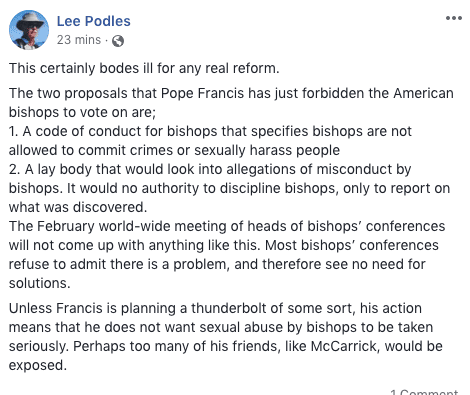






 ABYSSUS ABYSSUM INVOCAT / DEEP CALLS TO DEEP
You must be logged in to post a comment.