A formerly evanescent creature called “Synodality” has been spotted with increasing frequency in these last days of the Synod on Young People, Faith, and Vocational Discernment (to give the synod its full working title). The bishops vote on the final document later today – and several crucial questions remain in play.
The cynical among observers in Rome say that the emergence of “synodality” as a theme at this late hour is no accident. The explicit LGBT language that was in the Working Document, written prior to the Synod, was effectively blocked early in the process by the firmly expressed opposition of dozens of African bishops and others from around the world.
The first draft of the final document still contains a paragraph about young people being confused and wanting “clear and open” discussion of male and female, sexual orientation, etc., which – if it survives into the final document – could still perpetrate great mischief.
Which is why the Synod Fathers must stand strong when they vote this afternoon against this fallback language as well, because it’s clear that this is a Trojan Horse. Some of the most prominent figures in the Vatican hope to pursue what they are calling a deeper “elaboration” of these themes in anthropological, theological, and pastoral terms.
Anyone familiar with the past two papacies might think we already have quite a rich, profound, and faithful “elaboration” of such matters in the Theology of the Body, Familiaris Consortio, and institutions like the original John Paul II Institute on Marriage and the Family.
As we’ve seen in the way that the JPII Institute has been re-configured, however, it wouldn’t be wrong to think that the elaboration spoken of here may really be more of a repudiation of all that – and the Church’s long tradition on sex, marriage, and family.
In a papacy that often proceeds by way of ambiguities, this language – which means everything and nothing – simply cannot be allowed to stand. Though it was a clear victory for Catholic orthodoxy that stronger terms have been defeated, this formulation potentially authorizes everything that was feared at the beginning. And that some powerful figures within and outside the Vatican are still pushing.
And they are not stopping even there. Some of them have suggested finding a way to claim that the Working Document, which contained the explicit LGBT language, be described as still somehow operative, despite the later deliberations of the bishops and the final document.
But to do this would be to say that there was no real need for the Synod. If the preoccupations of those who proposed themes for the bishops to explore continue in force, even if the bishops didn’t want them to be included at the end of their work, everyone might just as well have stayed home.
And perhaps this is why there is now such a strong drive towards strengthening the idea of synodality as a more frequent, almost regular gathering. Despite Vatican denials, this looks more and more like turning synods into a periodic legislature, or – worse – something resembling the many Protestant Synods dating back to the beginnings of the Reformation, wherein Catholic things may be debated and, deliberately or not, thereby put in doubt.
You only have to imagine what a young person casually aware of the Synod on Youth has been hearing. It’s something like: the Catholic Church is discussing how to welcome gays – “accompanying,” if they ever hear the term, suggesting that the Church doesn’t feel any great urgency that they change their lives. Instead, the Church feels an urgency to meet them halfway now, with the other half to be reconsidered later.
There are rumors – perhaps true, perhaps not – that the need to promote synodality is why Pope Francis himself, contrary to synod statutes, took part in the drafting of the final document the other evening. According to the rules, the synod is supposed to present the deliberations of the bishops to the pope, who may either accept or reject – even just ignore – them.
*
Vienna’s Cardinal Christoph Schönborn, a close ally of the pope on these matters, admitted at a briefing yesterday that synodality wasn’t much present in the original documents. Asked about the difference between collegiality and synodality, he argued that collegiality is the normal state of things for the pope and bishops.
Just as Jesus gathered his Apostles around him, from the early days of the Church, it was understood that the pope and bishops constituted a “college” of those entrusted with an authoritative administration of the Church.
Synodality, Schönborn said, is a much broader term that seems to include everyone in a kind of “walking together.” So pope, bishops, priest, religious, lay people old and young, are all synodal in some novel sense. At the same time, he explained, being synodal does not do away with traditional offices and authorities.
But all this sounds very much like shifting responsibilities and making the Church more horizontal. To begin with, ever since Paul VI put forward the idea of occasional synods, they have always been called, as the current one also has been, a synod of bishops.
The Church can always have dialogues with others, Catholic and not. The original notion was to have some members of the college of bishops meet to advise the pope on emerging questions, not to suggest that matters of faith or morals were up for redefinition, as the Protestant synods often did.
Cardinal Reinhard Marx, with whom I rarely agree, said some things the other day that are not only true but important – though maybe not in the way that he meant them. First, he confessed that he was tired, after three weeks of the Synod, of being constantly asked about “the same things,” meaning homosexuality, as if it were the central moral concern of Christianity.
Me too. If you dip into the work of the great saints, doctors, confessors, etc., you’ll find little about the subject because – unlike some modern Christians – they could take it as a given that followers of Jesus would have nothing to do with it. Their true interests lay elsewhere.
And that made his second point more poignant: “The Church has to change to something different.” He specified that he meant that documents and debates are all well and good, but that, in the end, all the energy needs to be transmitted to Church structures, offices, meetings, etc. (Or so the simultaneous interpreters put it on the fly.)
This response brackets, however, the question of what is going to be transmitted and what it will do to the Church. It’s difficult to see how anything that has so far come out of the Synod on Young People will restructure, let alone save – the German Church.
By contrast, Eamon Martin, Archbishop of Armagh and Primate of All Ireland, commented that he’d learned a few things about the need to incorporate young people more into the workings of the Church. But at that meeting with young people both in Ireland and at the Synod, he had been particularly struck by how much, in an uncertain world with many things changing so fast, young people are looking for something stable, reliable, trustworthy – precisely what a Church confident of its truth can provide.
So we will see the outcome of these two alternatives by the end of the day. Will the bishops choose a Church of change that is coming to resemble the society it’s meant to evangelize, or will it present itself as the age-old infallible Bride of Christ?
*Image: Ghent Altarpiece by Jan and Hubert van Eyck (bottom center panel of the polyptych), 1432 [Saint Bavo Cathedral, Ghent, Belgium]. Depicted on the bottom right are the Apostles, kneeling, with popes and bishops standing behind. All adore the Lamb of God.
One of the many things that has disturbed me in this ecclesial turmoil through which we are living is the simple thought: what are the abusive priests thinking? What do they think of themselves and of their victims? How can they live with themselves? Do they believe anything of the Catholic Faith? The same question might be asked of the shepherds who are complicit or cowardly: does their conscience ever awaken in a quiet moment and thunder against their hypocrisy? It is hard to believe that anyone can become as callous and as corrupt as the Pennsylvania report (and, one fears, many forthcoming reports like it) shows the perpetrators and their protectors to be.
I recall my many years of teaching Aristotle’s Ethics to undergraduates. Aristotle notes that the worse someone becomes morally, the less he is capable of seeing his own wickedness. The “limit case” is the state of vice, a habitual frame of reference and settled inclinations that make the vicious man incapable of seeing the world except viciously. He is bent on desiring what is bad and is no longer aware of an alternative.
According to Aristotle, it can get even worse: there is the condition of “bestiality,” which he describes as inhuman or subhuman vice. Aristotle classifies both cannibals and sodomites as bestial – that is, worse than vicious.
Is Aristotle pessimistic about the situation of the vicious and the bestial? Absolutely. He says they are stuck in a hole and cannot get out of it. While a man is still drifting toward vice, he can check himself and get back on the road of virtue, but once he is fully committed to vice, he is a lost soul.
Christians believe this, as well – but Christians also believe in the transformative power of God’s grace. God can take a persecutor of the Church, like the future St. Paul, and intervene dramatically in his life, without Saul’s invitation. He can confront and blind the persecutor and lead him step by step into the Church and make him a great saint. When Augustine, after years of enthrallment to lust, picked up a copy of St. Paul’s letters and began to read, God pierced him to the heart and finally released him from that sin. From then on, Augustine was a believer and lived what he believed.
Every conversion is like this, although most are less dramatic. At one period in our lives, we are comfortable with sinning, perhaps even unaware that we are sinning. Over a period of time, we become uncomfortable, we hate ourselves for what we are doing, and we want to change. There is always the hidden or open working of God’s grace, without which we cannot turn to Him and cannot be saved from the evil of our fallen nature.
This is a sobering message, and it is pure Gospel truth. Without “salutary self-hatred,” as the tradition calls it, we will not turn our lives around and make the difficult sacrifices necessary to follow God’s commandments. This is not the end of the story; there is a virtuous self-love we are meant to attain, when we love in ourselves the good that God created, the good He has redeemed.
If there is one thing perfectly obvious about the Church in our times, it is that evil self-love abounds, and virtuous self-love is a rare sight.
Let’s face it: how many times have we, feeling exasperated, discouraged, or plain angry with evils in the world, wondered why the Lord doesn’t intervene with His outstretched arm and sweep away the enemy with a blast of the breath of His mouth, as He did with the Egyptians when delivering Israel from bondage? Why doesn’t He rid the world of the worst evildoers, like (to use an image from the prophets) a man wiping out a dish? But we seldom remember what Scripture teaches us about the worst punishment of the Lord upon sinners. This is not fire and brimstone, hail and scorching winds, the ground splitting open to swallow up rebels. It is simply God withholding the grace of conversion from the sinner, precisely as a just punishment for his sinful actions.
The general consensus of Catholic theologians is that God never fails to give us “actual graces” – that is, momentary promptings and opportunities for conversion, which do not yet amount to “sanctifying grace” or the life of God in the soul. These promptings are rather in the nature of someone outside us shouting, “Hey! Look here! Come over and join me.” If we take advantage of the actual grace, our conversion is under way. But if we ignore, dismiss, or hold in contempt these actual graces when they come (and they don’t come wrapped and labeled for easy recognition), we are pushing conversion ever farther away.
This should stir up humility, contrition, and holy fear in all of us. While we have faith, we should use it to ask for more; while we are sorry, we should act on that sorrow to ask for more repentance; while we are aware of our weaknesses, we should beg for conversion. Otherwise, if we squander what we have been given or keep following our disordered desires, we will have only ourselves to blame if the Lord permits us to lose what we evidently want to lose and be stuck with what we evidently want to gorge ourselves on.
All this is a long preface to a letter I received from a young priest. Obviously, in writing to me, he asked for my discretion, so his name and location will not be discernible from this version, which I have his permission to publish. Nevertheless, what remains is powerful enough: a glimpse into the sick, vicious, even bestial mentality of the men causing such harm to the Mystical Body of Christ on Earth, a glimpse into their unrepentant blindness of sin.
This, in keeping with Aristotle’s age-old wisdom, is the reason there is not going to be a sudden great “cleaning out” of the Church under this pope and under many of the bishops currently in office. They donot really see the evil as evil, although they may pay lip service to the opinions of the crowds from whom their funding comes. They may well be incapable of seeing the evil as evil, because the Lord is punishing them for their evil by withholding the grace of conversion from them.
The worst thing that can happen to a sinner is to remain unconvicted and unrepentant of his sin, as a prelude to eternal damnation. As stark as it sounds, I believe we could describe abusive clergy and their sympathizers as “living dead,” men without sanctifying grace in their souls, without charity for God or neighbor, without desire for Heaven. Their consciences are blanketed over with years of vice or worse. They are already living in the Hell that will be theirs forever – unless they respond to the actual graces by which God is calling them back to Himself.
* * *
Dear Dr. Kwasniewski,
I remember meeting you at – – – . I am currently a diocesan priest. I had to leave the place I was before due to rampant sexual promiscuity and its attendant cover-up and the persistent refusal to recognize it as a problem.
I have never witnessed sexual abuse. But I have witnessed things like stalking, targeting, and seductive behavior by priests. One priest who was accused by others had at some point actually tried to seduce me. Being a mature adult man, I never tolerated the behavior and walked away. But the sheer quantity and persistence of this behavior eventually led to my having to tell several of them that if they ever attempted to communicate with me again, I would get the police involved. That is the only sort of language they know how to speak: victimization. They are hell-bent on making you their victim, and the only thing that will stop them is if you threaten to make them a victim. Then, after you threaten them, they crawl into a corner with tears as if you’ve wounded them unjustly. They protest: “I wasn’t doing anything wrong!” They tempt you to apologize so that in your moment of weakness, they can then victimize you. Their entire rubric for life is to seduce and victimize, all the while pretending as though this is how natural friendships are supposed to be. They play the role of victim when their seductive tactics are exposed. In this climate, there is nothing that can be done to preserve the peace of a fraternal community. There simply is no peace, no charity – only sin and sacrilege and the charred remains of Catholicism.
There are now stringent rules in place at – – – to prevent predators from abusing young people. But the rubric of seduction is not limited to the sexual. There is such a thing as intellectual seduction, which is happening in a variety of ways. Those who are instructed by these men become victims of not knowing Catholic faith or morals, since they are taught gibberish in religion classes. The goal is to create adults whose consciences are malformed. The malformed conscience is easily seduced. Thus, even though the law protects these children from physical sexual abuse, it does not protect them from the intellectual abuse of having their consciences polluted and malformed, so that society will end up containing more people who are easily victimized and who will victimize others. The predators are not interested in religion except as a convenient ruse behind which to hide their sins. Even Our Lord himself is a nicety to them, an imaginary faun-like being whom they mentally flirt with, who clinks an imaginary martini glass and laughs with them at their own naughtiness and everyone else’s, waving a hand and forgiving them without repentance, even in the midst of their sin. They use biblical quotes in random ways to make excuses for their behavior. They denounce traditionalists as psychologically disturbed or full of hate. They pray only as a way of appearing pious to other people. God and faith are nothing more than anti-depressant drugs to them, and not even very effective ones at that.
I used to work in the secular music world. It is the same there. Active homosexuals and their sympathizers band together and form exclusive cliques from which all others are banned. They pride themselves as artistically sensitive; thus, they must be seen to be artistic by others. In reality, they are killing arts and culture.
Everything is mere appearance, fantasy, phenomena – nothing is substance. Wherever men engage in sodomy, or really, any regular unchastity, whether with boys, girls, young adults, or old adults, a culture of cover-up flourishes. Unchaste priests always feel that they are in the same exclusive club; they hate and despise all chaste priests. Each knows who the others are, and they have an unwritten agreement that they will defend and protect each other no matter what and will try to make life difficult for their chaste confreres. They will publicly decry child abuse and cover-up, but since they do not believe in natural law, they would have no qualms if child abuse and cover-up were suddenly legalized, much as some people changed their minds about the morality of marijuana when states began to legalize it. They have no virtue of charity to unite them, and they have no courage to fight for the good. They cling most desperately to their shared lusts. As long as there are large numbers of unchaste priests, this degenerate downward spiral will not go away.
I recently discovered that the examination of conscience provided by my current parish to penitents never references unchastity even once. Abortion is on the list of sins, but unfaithfulness to one’s spouse is not on the list. Instead, it says “non-exclusive love of spouse,” which is rather ambiguous. Contraception is completely missing. So is immodesty in dress, speech, or behavior. So are homosexual acts, bestiality, pornography, and masturbation. The vaguely termed “disrespect of sexual dignity” is on the list. I also learned from experience that this entire “soft approach” has all been carefully calculated. The word “dignity,” in particular, is suggestive of the pro-homosexual Dignity movement.
In one parish’s missal, I have seen the words “man” and “men” crossed out, and gender-neutral pronouns assigned to our beloved Savior. Deacons have been trained to say that Jesus Christ became “human” instead of “man,” and our people are told to say “for us and for our salvation” instead of “for us men and for our salvation,” as the approved text has it. Even staff members refuse to call priests “Father.” This is not uncommon in parishes, at least in the northeast USA.
The response of liberals to this disgusting mess is to argue that the Church, far from needing to recover its higher standards from the past, has not changedenough. According to them, the current scandals are happening because John Paul II and Benedict XVI unreasonably prevented Vatican II from achieving the end for which it was called: to bring the Catholic Church fully “up to date” with the modern world. The problem, they say, is that the priesthood is an enclosed society, too cut off from normal people, in which vice is allowed to flourish because of a protective “old boys’ club.” “If only women were there, things would be so much better,” they plead. They also think this problem is linked to the hierarchical nature of the priesthood, that Our Lord never intended the priesthood to be hierarchical or distinct from the laity, and that this distinctness is the cause of the abuse crisis. They argue for new laws requiring transparency and accountability between bishops and laity. They want the laity more involved in the management and oversight of the Church, especially the formation of priests. In their minds, the priesthood is inherently imperialistic and power-driven, and this is harming the Church. Judging by his most recent statement about this matter, the Holy Father feels the same way.
What they are really saying, underneath all of this banter, is that the law of celibacy must change. But if you ask them, “Do you mean that the law of celibacy needs to change?,” they will reply, “No,” because they fear being victimized by the current position of “strong thinking” in the Church’s teaching on celibacy rearticulated by John Paul II and Benedict XVI. They take their moral formation from the gay pseudo-philosopher Gianni Vattimo, for whom virtue means a submission of the strong thought of logic and nature to the weaker thought of inner needs. They truly believe that the law of celibacy should change, but they will not say this publicly.
In fact, they want the entire Catholic teaching on the virtue of chastity to change. But before they can say this openly, they need to feel that Church authorities have reached a “weak position” on the issue of celibacy such that they can speak freely about it without fear of persecution. Under Francis’s papacy, they are starting to feel more confident. But until they reach a point where they can say this openly, they shroud their true opinion in statements like the above, using terms like transparency, oversight, accountability, lay involvement, etc.
In the meantime, they allow the unchaste, secular world to wreak moral havoc on themselves and their flock. They perniciously allow the malformed consciences of their parishioners to be exposed to repeated temptations to sin, the goal being that the majority of Church members will eventually want to compromise with the unchaste principles of secularism. Meanwhile, if we are to believe Sr. Lucia of Fatima, souls are going to Hell in droves.
For now, the liberal priests beat their breasts; they make generic confessions and generic absolutions, and they shout, “Enough! This must stop! I am sick of this! We have failed you, the Church has failed you, and we are collectively sorry. May God forgive us!” They treat the name of Our Lord as a general panacea, and they never once do they demand any internal repentance, never once demanding contrition for and confession of that ocean of sexual vice that pounds against the shores of so many souls. They like to foment the sense that the clergy as a whole have failed the laity, or worse, that the Church as a whole has failed them, because it makes the laity think that the essence of the priesthood and of the Church needs to be changed drastically. Liberal priests have taken the temperature of the masses, and they believe that the majority of Catholics are now almost ready for the gigantic ideological shift toward the left that the Church has been waiting for since Vatican II. This is going to be their big push for total destruction of all that you and I would recognize as Catholicism.
The devil is surely behind this. His ultimate goal is to wrench the Catholic Church out of itself in slow motion, so that it disintegrates into secularism by an erosion of chastity. The Novus Ordo is also part of this plot, since it was intentionally designed to foster a lack of understanding and reverence for Christ. It is an indirect attack on the immaterial object of faith itself, which is Christ Our Lord, High Priest of God and supreme model of manly virtue. The word for this is apostasy. And when the ultimate Good is unknown or obscured, it should not surprise anyone that lower material goods are sought in a disordered manner. This includes, among other things, money, power, and sex.
Even the conservatives play into this system. Conservative bishops fear the power of the enormous secret homo-collective, as well as the intellectual seducers, and they survive by compromising with this system. Conservatives are not, as a rule, allowed into the system, nor do they want to be part of it. They do everything they can to avoid it. Hence, in some ways to their disadvantage, the conservatives have only suspicions, not evidence. To denounce a priest because of suspicions is very risky; even if many agree that a certain type of activity is cliquish, seductive, effeminate, sexually charged, flirtatious, or shady, one needs actual evidence for guilt. There is rarely such evidence. Hence, the valiant whistleblower becomes the boy who cried wolf, and even good priests do not want to live with someone who has denounced other priests without sufficient evidence. It is easy for the lavender mafia to destroy the priestly career of whistleblowers; all they have to do is pay someone a lot of money to accuse the whistleblower falsely (they are always well funded), and, thanks to the Dallas Charter, the whistleblower’s priestly career is over.
Thanks to recent press, everyone now knows that this homosexual, protective, well financed club exists. Good priests would expose it if they could. But…they lack evidence. So they have to be compromisers, pretending not to suspect anything just to save their skin.
Vast numbers of clergy have never read a single work by Aristotle or Aquinas, or any magisterial work prior to 1960 – and because they were formed in a secular, non-classical, anti-ecclesial, non-liturgical, non-literary, atheistic culture posing as Catholicism, they have absorbed its thinking and internalized its lies. Their souls are full of stumbling blocks placed there by heretics. They have become intellectually and morally bankrupt and are in no way suited to be pastors of souls. There is no rapport, no common language or common ground with them, because the very ground for knowing the real is denied by them. They think primarily with slogans. For generations, they have not been doing the primary thing they are supposed to do: uphold the apostolic traditions. Their predecessors rejected their own identity as priests and bishops a generation ago and accepted themselves as well dressed community activists and fundraisers who were content to possess priestly character and enjoy the trappings of Catholicism without the Faith. Some of them were successful at these things – so successful that they attracted the attention of the pope, who made them monsignors, bishops, even cardinals. The popes should have looked for piety in bestowing honors upon the clergy, but instead they looked for money, diplomatic skills, secular political connections, and willingness to submit to power.
You call it an apostasy, and rightly so. Let us call a spade a spade. It is time to decry modernism in the clergy, and every modernist priest must be denounced, whether or not it is his fault that he is one. Culpability cannot be taken into account when so many souls are endangered. The surest way to do this is for a pope to repeal Vatican II and its attached postconciliar pronouncements. By “repeal,” of course I do not mean delete it from the list of councils; I mean to cease to render it a springboard for implementing constant change, and to relegate it to a position of impotence in the practical life of the Church. It shall no longer be quoted in catechisms or taught in schools; it shall be a quaint museum piece for scholars of the future to discuss over tea. If there is anything in it that sheds light on the Catholic faith better than any other council or pope, I would like to know what it is; surely, fifty years would have been enough time to discover it. Bishop Barron keeps saying councils take one hundred years to have any effect; people like him say this merely to evade the present disaster. This “one hundred years” statement is pure nonsense; it is not based on historical evidence. Regardless, since it was never meant to teach anything definitively or to condemn anything definitively, Vatican II as an ecumenical council stands in contradiction to its own essence, which is to be magisterial.
So repeal it. If this is done, many priests and bishops who worship the holy twins (Roncalli and Montini) will form a schism. The ones who stay with the Church will truly reform her. This, and only this – not more policies and procedures, not more laws and regulations – will bring about a new flourishing of the Catholic Faith and will rid the Church of the filth that the clergy have allowed to accumulate in her spiritual granaries, mixing with her food and silently poisoning her children with hidden apostasy over these several generations. (I’m not saying everything was rosy before Vatican II; the apostasy was already fomenting for decades prior to the Council. Clergy formation in the 1940s was already abysmal, totally exposed to attack from the nouvelle théologie onslaught of the 1950s. Vatican II only provided this intellectual and liturgical cancer with the enzymes it needed to metastasize exponentially.)
People will say: “Why couldn’t bishops just summon their priests one by one and ask if they are sexually active?” The priests in most need of repentance would be the ones who lie the most freely. Their loyalty to the club of “New Liturgy, New Morality, New Church” trumps their loyalty to their bishop and to God. This entire edifice of nouveau-Catholicism must be repealed in order to provoke their free departure. Gay witch hunts would not be successful.
When I say my daily rosary, one of my intentions is for an end to modernism in the clergy. When Our Lady of Fatima visited us, she knew the perils we were facing. The more I meditate on this, the more I think the portion of the Third Secret not yet disclosed is about widespread clerical apostasy and its heraldic centerpiece, the Second Vatican Council. Homosexuality in the clergy is but one little part of a vast campaign to thwart the salvation of souls. We are in the middle of a chaos created by Satan, and chaos is, by nature, hard to describe, especially when one is standing amid the ruins.
There is no “grand solution” for mortals such as ourselves. The work Our Lord wants us to do right now in order to clear and rebuild this ruined city starts with the removal of one piece of garbage, then another, and another, wherever and whenever we can, and the reinstallation of anything that is good, true, and beautiful, be it sound doctrine and Christian morals in our families and our schools, solemn and reverent liturgy in our parishes, good intellectual formation, a serious commitment to the traditional devotions and customs of the Church. Brick by brick. In the end, Mary’s Immaculate Heart will triumph.
Instrumentum Laboris points to a church which seems to be losing sight of sin, redemption, grace, faith, the sacraments, and eternal destiny. The Catholic Church could well be exchanging her theological birthright for a Mass of sociological potage.
One does not have to be a Roman Catholic to appreciate the underlying concerns of the synod on youth that is currently ongoing in Rome, nor that of the document that was prepared as a basis for the discussion. That the church—any church—is only ever one generation from extinction may be a cliché, but it is nonetheless true. And so I have spent some time looking at the document upon which the synod is based—Instrumentum Laboris (IL)—to see if there is anything that a Protestant might find useful in its analysis and its proposals.
Sadly, IL is a missed opportunity. It suffers from two basic flaws: it takes young people far too seriously, and it does not take young people seriously enough. That might seem like a somewhat paradoxical complaint, but it captures neatly the problem faced in a document which listens too much and says too little.
The Importance of Listening
The document has three major sections. The first, “Recognizing: The Church Listens to Reality,” sets forth the various contexts and issues faced by young people. It is largely based upon consulting with youth in various forums. The second, “Interpreting: Faith and Vocational Discernment,” is an attempt to provide a framework for critical reflection on the findings of part one. Finally, the third, “Choosing: Paths of Pastoral and Missionary Conversion,” offers potential ideas for the members of the synod to formulate specific strategies.
There are some elements of IL that are commendable. The Roman Catholic Church is currently facing a significant challenge: in an era when traditional institutions in general are losing authority, the sex abuse scandal has shattered her ability to speak with moral authority to the secular world, and even to the doubters within her own fold. To start re-engaging young people by first listening would seem to be appropriate. No apologetic strategy is ever going to succeed if it does not address the actual questions people are asking. Knowing that matters such as unemployment, poverty, racism, loneliness, sexuality, and others are of deep concern to many young people is helpful. Further, to speak with any authority, the church first has to regain that authority. Therefore, the desire to engage young people seriously and humbly is surely wise.
Yet there is always the potential that listening will move from an apologetic strategy to something more significant. Ours is an age dominated by consumerism and entertainment and this has reshaped many of our institutions, from government to higher education. To quote from the musical Ain’t Misbehavin’, “Find out what they like, and how they like it, and let him have it just that way”—that has become the governing strategy of electoral politics as of much else in this world. “What sells?”, if not the only question asked by many institutions, is frequently the most important.
The fear of losing customers, votes, students, or members can become an overriding concern for organizations that depend in practice upon a loyalty that can be as easily withdrawn as given. But the problem for the Catholic Church is that it has certain standards that are part of who she is. They are not negotiable, however unattractive they might be to young people. So, the fact that some young people find the church’s teaching on contraception, abortion, and sexuality unattractive is interesting but, with the exception of explaining her position more clearly, there seems little the church can really do in response. Catholicism is defined by dogma, not by focus groups. Those who dislike her dogma but still want to belong to her face a hard but unavoidable choice. And failure to make this point—that Catholicism is dogmatic and therefore by definition exclusive—is emblematic of the timidity of the document as a whole.
Simply Listening is Not Enough
Few Christians would deny that listening is important, but it cannot be an end in itself, nor can it be the implicit justification for dogmatic timidity. For example, if a neighbor has lost, say, a child to cancer and is wondering how a God of love might allow such a thing to happen, it is absolutely appropriate first to listen to the agony of the one who has been bereaved. But the task of the church does not terminate in such compassionate listening. She is not simply a corporate therapist, nor is her task fulfilled when she has shown empathy for the one suffering. A doctor who says “I know exactly how you feel” to a cancer patient may be appropriately empathetic, but if he offers no treatment, he is criminally negligent. And so the church is not simply to listen but to provide answers to people’s deepest need—not merely the sociological or psychological symptoms of the same—and those answers are to be based upon God’s revelation in the Bible. However, ILnever makes this point. So many questions and needs are thrown up by the listening process; and nowhere is the gospel—the dogmatic gospel—explicated as providing an answer. Perhaps the authors hope that this will regain the church some authority, but church authority is useless if the church has nothing to say.
For all of the listening that the document highlights, and all of the empathy that it enjoins, the lack of explicit theology is therefore a lethal lacuna. The results are diagnoses of the problems which fail to rise above the material and the immanent, and an outline of a strategy which has all the pious trappings of a Christian response without any distinctly Christian content. Far be it from me, a Protestant, to lecture Catholics on the nature of their faith, but Cardinal Newman was the one who pressed home the fact that Christianity was nothing if it was not dogmatic. And on that score, this document, if not quite nothing, certainly offers little in the way of substance.
This non-dogmatic ethos is perhaps most evident in the language of IL. The word “journey,” a hallmark of postmodern piety, occurs thirty-two times, while “sin” and its cognates—not so cool in our therapeutic climate—occur a mere six times. And “sin” is never elaborated, defined, or given structural importance. Of course, one might respond that IL assumes the teaching of the Catechismand therefore has no need to spend time on such basic matters. But that rather begs the question of how a document which is attempting to address the needs and concerns of young people can devote virtually no space at all to the primary problem: young people’s alienation from God by their sin, and the solution: God’s grace. Either the authors are incompetent or mischievous because the omission of either an explicit and robust anthropology or Christology leaves the document open to all manner of interpretations which may or may not fall within the bounds of Christian orthodoxy.
This startling omission from a document which purports to be Christian leaves paragraphs like the following ominously detached from any theological context:
For example, during the IS [the International Seminar on the Condition of Youth, 2017] some experts pointed out how mass migration can become an opportunity for intercultural dialogue and for the renewal of Christian communities that are at risk of becoming too inward-looking. Some LGBT youths, through various contributions that were received by the General Secretariat of the Synod, wish to benefit from greater closeness and experience greater care by the Church, while some BC ask themselves what to suggest to young people who decide to create homosexual instead of heterosexual couples and, above all, would like to be close to the Church.
The juxtaposition of the issues created by migration and those surrounding LGBT youths is problematic. In an orthodox theological framework, this would be the equivalent of lumping oranges in with apples. As it stands, it simply makes it look as if both were equally legitimate identities and that the questions they raise are both opportunities to become more “outward looking”—itself an interesting phrase which is aesthetically appealing in our present age but possesses no specific content and is left worryingly open-ended precisely because IL does not set it within a dogmatic context. It also implicitly concedes the distinctive modern fiction that sexuality is to be equated with the authentic identity of the individual. Yet any understanding of personhood and identity assumes an anthropology and therefore a theology. The Catholic Church has both. That the document fails to employ either should be a matter of grave concern to Catholics.
The Missing Pieces of Instrumentum Laboris
And that brings me to the real problem with the document: it never even identifies the central problem that young people face. Christianity, at least in those forms which take the Bible seriously, places rebellion against a holy God at the foundation of all other human problems. Yes, unemployment, poverty, disabilities, despair, loneliness, sexual confusion and a multitude of other difficulties afflict young people across the globe. But the real problem is that human beings need God’s grace and forgiveness. It is noteworthy that numerous Catholic critics have commented on the lack of sacramental theology in IL, but this oddity actually makes perfect sense given that such theology is meant to address the problem of sin and sin is barely mentioned. Indeed, the paucity of references to sin and the fact that such are never elaborated or given any significance in the analysis is the rather obvious poker tell: this is not a document which draws upon the content of classic Christian theology for its understanding of the phenomena it observes, even as it occasionally uses its rhetoric.
Some might respond by saying that such a criticism is unfair because the document is narrowly focused by intention and simply assumes the content of Catechism. Yet if that is the case, why does the Catechism’s content make so little impact upon how IL interprets the findings and diagnoses the problems? One cannot blithely talk about the effects of sin without elaborating on sin and underscoring the complicity of all human beings in the problem. Young people do not get to privilege their problems as purely the fault of forces beyond their control. Nor are the concerns and complaints of young people unvarnished statements of reality. Anyone who has read Paul’s letter to the Romans or Augustine’s Confessions—or any critical theorist, if leaders in the church prefer modern, secular authorities!—knows that the human heart is deceitful above all things and no disinterested guide to reality. And when the LGBT identity is casually introduced with no comment, the kindest conclusion would be that this document is careless; a less generous reading might see it as something far more mischievous. As I stated at the start, IL takes young people’s voices so seriously that it ends up not taking their spiritual condition seriously at all. But that’s always going to be the way with theology by focus group rather than by revelation: the results will inevitably reflect the limited concerns of the chosen group, not the larger realities of human existence.
Whatever side one chooses in the Reformation of the sixteenth century—be it Bellarmine or Calvin—one thing is for sure: the Tridentine Catholics and the Magisterial Protestants were debating matters of real, ultimate significance. I am a Protestant by conviction and have very serious disagreements with Rome, but I regard traditional Catholicism as asking the right questions and providing substantial answers about the nature of sin, redemption, grace, faith, the sacraments, and eternal destiny. Christianity is a religion with a holy God and a tragic vision of a magnificent but fallen humanity at its core, so tragic that only a bloody sacrifice—the sacrifice of God Incarnate—can atone. I may reject the Mass but I can at least see that it marks the centerpiece of a serious theology and ecclesiology and is attempting to address the complexity of the human condition. By contrast Instrumentum Laboris points to a church which seems to be losing sight of those central issues. The Catholic Church could well be exchanging her theological birthright for a Mass of sociological potage.
Carl R. Trueman is a professor in the Alva J. Calderwood School of Arts and Letters at Grove City College, Pa. He writes regularly at FirstThings.com and WhiteHorseInn.org.
Plenty of controversy now surrounds Pope Francis: his seemingly invalid election, his long pattern of heterodox teaching, the Viganò report implicating him in cascading sex abuse crimes, the ongoing Amoris Laetitia debacle, the Vatican sell-out to Communist China – pick your disaster.
As this pope’s penchant for “making a mess” shows no sign of diminishing, to the peril of countless souls, we agree with Chris Ferrara’s assessment over at The Remnant and his call (like Bishop Gracida’s) for an imperfect synod to defend the Church from Francis – a kind of emergency family intervention to stop the violence of an abusive father.
But having noted earlier controversies, we maintain that the worst dimension of this pontificatus horribilis has been a certain revisionist approach to divine worship, now set to display itself in liturgical spades at the conclusion of the Youth Synod currently underway in Rome.
Many have decried Francis’s liturgical offenses over the years: offering Masses with giant puppets, balloons, and tango dancing in the sanctuary; omitting genuflections before the Blessed Sacrament; withholding the papal blessing at audiences but publicly blessing psychotropic herbs for pagan rituals; displaying profane items like beach balls on high altars; employing sacred vessels, furnishings, and vestments of novel design or illicit material; and a lengthy record of communicatio in sacris that has united this pope in worship with – even bestowed on him the formal “blessings” of – heretics, schismatics, Muslims, Jews, and witch doctors. Would that all of it were fake news.
These past deviations pale in comparison to what’s coming.
After wielding what appears for all the world to be a Wiccan stang at the opening Mass of the Synod, the pope has announced that he will celebrate a new form of Mass at its conclusion – a liturgy that priests, bishops, cardinals, and theologians are denouncing as barely recognizable as a Catholic rite.
This is really bad.
Earlier this summer, one of Pope Francis’s advisers elicited justifiably strong reactions after affirming that this pope “breaks Catholic traditions whenever he wants,” welcoming the same as a “new phase” of Church history in which the faithful are no longer to follow Christ per the dictates of Scripture and Tradition, but are rather to be “ruled by an individual” without any moorings at all [1].
Albeit far from Catholic, one could hardly call this diagnosis inaccurate. A number of commentators (Catholic and otherwise) have already shown Francis’s ongoing overthrow of traditional doctrine and discipline to bear marked similarities to the autocratic machinations of organized crime lords and socialist dictators of the past – but none of his earlier departures from Sacred Tradition are as staggering as this coming celebration of a new form of Mass, representing a radical break with all prior liturgical forms in the Roman Rite [2].
The pope announced it as a “liturgical innovation,” a “change in a venerable tradition” that “affects our hereditary religious patrimony, which seemed to enjoy the privilege of being untouchable and settled” – calling this a “special and historical occasion” and insisting that “we should not let ourselves be surprised by the nature, or even the nuisance, [?!] of its exterior forms.”
Does this sound even remotely like a “hermeneutic of continuity” to anyone?
From the same announcement (our emphasis):
We must prepare for this many-sided inconvenience. It is the kind of upset caused by every novelty that breaks in on our habits. We shall notice that pious persons are disturbed most, because they have their own respectable way of hearing Mass, and they will feel shaken out of their usual thoughts and obliged to follow those of others. Even priests may feel some annoyance in this respect. […] This novelty is no small thing.”
Read the pope’s words again. Tradition? Forget it. Piety? Over and done.
Friends, this is a plain announcement from the See of Peter that the sacred rites, once entrusted by Jesus Christ to his Apostles for the offering of eternal mysteries, are no longer binding or relevant.
This is a declaration of liturgical revolution.
Considering those involved in the making, it could hardly be otherwise.
Earlier this summer, many scoffed when Cardinal Gerhard Müller (former prefect for the Congregation of the Doctrine of the Faith) denounced a “blatant process of Protestantizing” he was observing in the Catholic hierarchy, with bishops who “justify their infidelity to the Catholic faith with allegedly pastoral concern” [4].
Now scoffers can do little more than ignore this clear and public demonstration of the same: that a mysterious committee (apparently even Cardinals had no idea who constituted the group) of sundry “liturgical experts” has worked long in closed-door sessions, at the pope’s behest, to draft a new rite of Mass, with direct input from Protestant pastors in the process [5].
It already verges on incredible that any Catholic hierarch would have the gall to fabricate a new rite of Mass to suit his contemporary taste (ignoring the anathemas pronounced by the Council of Trent on such ventures!), but to find that formal heretics were invited to contribute to this rupturing of the most venerable liturgical tradition in the world simply beggars belief. Men who routinely violate the divine rights of the Church, reject any number of her sacraments, contemn Our Lord in the Holy Eucharist, and deny the various dogmas enshrined in the Catholic Mass are invited to help with the impious creation of a new one? Can any devout Catholic fail to be offended by such grievously irreverent treatment of the sacred?
We even find in a French interview with Mr. Jean Guitton, the pope’s personal friend and confidant, an (accidental?) admission that changing the Catholic Mass to be as amenable as possible to non-Catholics was one of the Pope’s chief aims:
The intention of [the] Pope … with regard to what is commonly called the Mass, was to reform the Catholic liturgy in such a way that it should almost coincide with the Protestant liturgy … to get as close as possible to the Protestant Lord’s Supper … [in] an ecumenical intention to remove, or at least to correct, or to relax, what was too Catholic, in the traditional sense, in the Mass and, I repeat, to get the Catholic Mass closer to the Calvinist Mass [sic]. [6]
So there’s that.
As if Guitton’s admission weren’t troubling enough, one now finds that the Italian archbishop selected by the pope to midwife this unholy aberration confirmed the same operating principle: “[h]elp[ing] in any way the road to union of the separated brethren, by removing every stone that could even remotely constitute an obstacle or difficulty” in the liturgy [7]. This monsignore even describes the lamentable result as “a major conquest of the Catholic Church” [8].
Beg your pardon?
Even the humblest layperson can detect how this Protestantization has been achieved, simply by reading the text of the new rite side by side with the old. One finds that the Catholic Mass has been stripped of prayers expressing Catholic doctrine, with roughly 80% of the original content being deleted entirely or significantly altered in this new, intentionally less Catholic rite [9] – and seeing as the pope’s introductory Instruction itself expresses heretical Eucharistic doctrine [10], it’s debatable whether this form of worship can even be called “Catholic” in any meaningful sense.
Indeed, the Protestant theologian Max Thurian looks like one of the first to confirm such misgivings (as many feared after last year’s reports of an “ecumenical Mass” in the works): “It is now theologically possible for Protestants to use the same Mass as Catholics” [11]. At the same time, Catholic priests the world over are heard giving dramatic declamations like: “At this critical juncture, the traditional Roman rite, more than one thousand years old, has been destroyed” [12] and, in the words of one Jesuit (naturally) adviser to the committee of liturgical destroyers:
Not only the words, the melodies, and some of the gestures are different. To tell the truth, it is a different liturgy of the Mass. This needs to be said without ambiguity: the Roman Rite as we knew it no longer exists. It has been destroyed. [13]
Where are the cardinals?
Are there any Catholics, any men left among them to rescue the sacred rites?
To be fair, some have raised an alarm on this liturgical overthrow – although limiting themselves to publishing said “concerns” in roundabout ways and without taking any concrete steps to stop this shipwreck. One wonders how bad it will need to get before one of them decides to “resist Cephas to the face” (cf. Gal. 2:11).
Still, one can be encouraged by the efforts of two cardinals in the sees of Berrhoea and Colonia in Cappadocia, who apparently got advance notice of this impending liturgical madness, sought to intervene privately with the pope, and then published their theological critique of the bogus new rite (now available in English, see note #14 below).
Their conclusions are devastating.
To take one excerpt (our emphasis):
[The new liturgy] represents, both as a whole and in its details, a striking departure from the Catholic theology of the Mass[.] … The new form of Mass was substantially rejected by the Episcopal Synod, was never submitted to the collegial judgement of the Episcopal Conferences and was never asked for by the people. It has every possibility of satisfying the most modernist of Protestants[.] … To abandon a liturgical tradition which for four centuries stood as a sign and pledge of unity in worship, and to replace it with another liturgy which, due to the countless liberties it implicitly authorizes, cannot but be a sign of division – a liturgy which teems with insinuations or manifest errors against the integrity of the Catholic Faith – is, we feel bound in conscience to proclaim, an incalculable error. [14]
The pope was clearly prepared for such rejection of this rite by faithful Catholics, as can be read in the very text of his announcement:
[The new rite] has been thought out by authoritative experts of sacred Liturgy; it has been discussed and meditated upon for a long time. We shall do well to accept it with joyful interest and put it into practice punctually, unanimously and carefully. … So do not let us talk about ‘the new Mass.’ Let us rather speak of the ‘new epoch’ in the Church’s life. [15]
Let’s try putting that in layman’s terms:
This is happening. Sit down and shut up. Hail the Revolution.
Awake Yet?
If you aren’t already nodding your head with sad recognition and understanding, you may want to brace yourself: for, although accurate, some of the news items above aren’t exactly recent.
The New Mass that Pope Francis will celebrate at the end of the Youth Synod this month was created fifty years ago. It was crafted and imposed on the Church by one of his predecessors – that hapless innovator he now claims to have “canonized,” Pope Paul VI: a man whose sanctity is far from certain, still farther from exemplary(and about as “miraculous” as an inaccurate medical diagnosis), and at whose feet must be laid (among other things) the single greatest catastrophe in Church history: the near total replacement of the Roman Rite of Mass with a novel, modernist construct – an attempted abortion of liturgical tradition.
If you were born after 1965, Paul VI’s impious New Mass – the Novus Ordo Missae – is likely the only rite for the offering of the Holy Sacrifice that you have ever known. It’s just as likely that you were never told its true history (although much of this is now public record, which one might explore here), so you can be forgiven for not walking out of it years ago.
The important thing is to walk out now.
Otherwise, why be alarmed by the deviations of the current pontificate, or any yet to come? Ecclesiastical innovators have already dared to touch our most precious heritage, seeking to supplant it with a fabrication that even then-cardinal Ratzinger referred to as a “banal, on-the-spot product” [16]. One thinks of St. Vincent of Lérins’s observation of the mad abandonment of Tradition in his own day:
Such is the insanity of some men, such the impiety of their blinded understanding, such, finally, their lust after error, that they will not be content with the rule of faith delivered once and for all from antiquity, but must daily seek after something new, and even newer still, and are always longing to add something to religion, or to change it, or to subtract from it! [17]
Happily, no Roman Catholic in good standing needs special permission to return to our true and traditional rites, whether to offer them as a priest or to attend them as a member of the faithful. Still more joyous is the fact that these are increasingly available as the exodus from SquishyChurch continues apace. In fifty years, we have little doubt that the “traditional Latin Mass” (TLM) will once again be our dominant (if not exclusive, please God) liturgical practice around the globe. Indeed, this trend is already observable.
Furthermore, the continued claim of various bishops, priests, and theologians is that the TLM alone constitutes an act of worship pleasing to God in the Roman tradition, and we have yet to find a cohesive argument to the contrary. More on that here.
The question is: What’s keeping you from right worship?
True piety admits no other rule than that whatsoever things have been faithfully received from our fathers the same are to be faithfully consigned to our children; and that it is our duty, not to lead religion whither we would, but rather to follow religion whither it leads. [18]
PRIESTS: If you still offer the Novus Ordo, it’s time to stop.
The wind is changing. Return your flocks to the objective liturgical tradition of the Church; render to God the worship owed to Him, and render to the faithful what is theirs by right: that timeless treasury of ars celebrandi and the countless graces of our priceless heritage in the traditional Mass. If you don’t know it, learn it. Start today. We know that you may suffer for this, but the faithful remaining through the growing darkness are prepared to help you. And remember: you signed up for the Cross.
You’re a priest. Your principaltask isto render worthy sacrifice unto God. Regarding the cura animarum, right worship still remains the most significant of your duties toward the faithful – before parish programs, enrollment goals, and all else. If God’s children go hungry, deprived of that supernatural nourishment granted by a Mass grown organically over centuries of faithful devotion, it will be because you chose to feed them with a modernist construct designed by the faithless. Are you prepared to render an account for such withholding from God and His people?
LAITY: If you still belong to a Novus Ordo parish, it’s time to leave.
Even apart from the growing likelihood of total infrastructural collapse, you also bear the first duty of rendering God that worship befitting His glory, that which He has crafted in the Church over centuries: the traditional Latin Mass. Don’t wait for friends and family to understand, or for your pastor to come around – until diocesan priests are ready to refuse to offend God’s glory any longer (braving the “St. Luke’s treatment” if they must), relocation is your path. Let the dead bury their dead; as for you and your house, serve ye the Lord.
Find an FSSP or ICKSP or other TLM community, and get over there. Change jobs; pack up and move if you have to (as plenty of other families are doing, particularly those with kids to raise), and behold the days of the 4th century relived, wherein the lay faithful groaned to see the majority of their bishops embrace heresy and give their churches over to erroneous rites. What did the layfolk do in those days? They left, clinging to the few faithful priests they could find, recognizing that nothing was more important than worship in Spirit and Truth. St. Basil the Great said of them:
Matters have come to this pass: the people have left their houses of prayer, and now assemble in the deserts – a pitiable sight; women and children, old men, and men otherwise infirm, wretchedly faring in the open air, amid the most profuse rains and snow-storms and winds and frosts of winter; and again in summer under a scorching sun. To all this they submit, because they will have no part in the wicked Arian leaven. (Letter 242)
Now it’s our turn. What are we prepared to do?
Nothing supersedes man’s duty to render God that worship proper to His Majesty, and the Novus Ordo just ain’t it.Rooting ourselves in communities that exclusively offer the traditional rites is essential for achieving this end, and once we have done so, it will be necessary to dig in and hold on, with a weather eye to the horizon. Because in point of fact, nobody has ever been to the Novus Ordo – we’ve only ever seen iterations of it. This inherently malleable rite has no enduring essential form. It has no prior tradition to pass on. It has no yesterday in the devotion of centuries, but only a limitless variety of novel tomorrows.
Wicked tomorrows. Do you see it yet?
Having been orchestrated to reflect the personal taste of the celebrant and local surround like an endless mirror hall, amid a resurgent paganism in wider society, the Novus Ordo must allow for increasingly evil iterations. Worse is yet to come, and we think soon. Run far. Run fast.
Our Lady of Victory, Destroyer of Heresies, pray for us!
And bravo the restoration!
Editor’s note: This article was posted originally at Whispers of Restoration and is edited and republished here with permission.
[2] Space does not permit a thorough demonstration of the radical rupture represented by this new liturgical rite. More studies on this point will soon be forthcoming around the world, but the two cardinals’ intervention referenced in note #14 below makes for a good start.
[3] Emphasis added. See the full text of the pope’s address here.
[4] Emphasis added. See Cardinal Müller’s full interview here.
[5] After this little detail was mentioned in papers from the Vatican’s L’Osservatore Romano to theDetroit News, another Catholic paper unpacked it here.
[6] As reported in Apropos,12.19.1993, and Christian Order,10.1994.
[7] As declared by Msgr. Bugnini in L’Osservatore Romano, 3.19.1965.
[8] Bugnini’s full trumpeting is rather frightening stuff, as reads here: “The liturgical reform is a major conquest of the Catholic Church, and it has ecumenical dimensions, since the other Churches and Christian denominations see in it not only something to be admired in itself, but equally as a sign of further progress to come” (p. 126).
[9] See a simple chart comparing the two rites here. Find another liturgical scholar’s quantification of the liturgical change in terms of percentages in the work here.
[10] That the pope’s General Instruction was almost immediately retracted and rewritten to try to cover the heretical Eucharistic doctrine it originally expressed (see especially nos. 7 and 48) has done nothing to change the fact that the new rite itself still expresses the same error. See the cardinals’ critique in #14 below.
[11] Find his comments in La Croix 5.30.1969, as noted by D. Bonneterre at p. 100 here.
[12] This is the lamenting assessment of respected Catholic liturgist Fr. Klaus Gamber at p. 99 of The Reform of the Roman Liturgy (Harrison, NY, 1993).
[13] This is the gleeful assessment of the questionable Jesuit Fr. Joseph Gelineau at pp. 9-10 of Demain la liturgie (Paris, 1976).
[14] Read (an English translation of) the full letter and theological study of Cardinals Ottaviani, Bacci, and their team of theologians here.
[15] Find the pope’s attempt to, in his words, “relieve your minds of the first, spontaneous difficulties which this change arouses” here.
[16] As penned in his Introduction to La Réforme Liturgique en question (Le-Barroux: Editions Sainte-Madeleine), 1992, pp. 7-8.
[17] From Ch. 21 of St. Vincent of Lérins’s Commonitory, readable here.
THE VALID CARDINALS, i.e. CARDINALS APPOINTED BY POPES BENEDICT XVI AND SAINT JOHN PAUL II, MUST ACT SOON TO REMOVE FRANCIS THE MERCIFUL FROM THE THRONE OF SAINT PETER BEFORE HE DAMAGES THE INSTITUTIONAL CHURCH EVEN MORE THAN HE HAS ALREADY DAMAGED IT. – The Most Reverend Rene Henry Gracida
AN OPEN LETTER TO THE VALIDLY APPOINTED CARDINALS Recently many educated Catholic observers, including bishops and priests, have decried the confusion in doctrinal statements about faith or morals made from the Apostolic See at Rome and by the putative Bishop of Rome, Pope Francis. Some devout, faithful and thoughtful Catholics have even suggested that he be set aside as a heretic, a dangerous purveyor of error, as recently mentioned in a number of reports. Claiming heresy on the part of a man who is a supposed Pope, charging material error in statements about faith or morals by a putative Roman Pontiff, suggests and presents an intervening prior question about his authenticity in that August office of Successor of Peter as Chief of The Apostles, i.e., was this man the subject of a valid election by an authentic Conclave of The Holy Roman Church? This is so because each Successor of Saint Peter enjoys the Gift of Infallibility. So, before one even begins to talk about excommunicating such a prelate, one must logically examine whether this person exhibits the uniformly good and safe fruit of Infallibility. If he seems repeatedly to engage in material error, that first raises the question of the validity of his election because one expects an authentically-elected Roman Pontiff miraculously and uniformly to be entirely incapable of stating error in matters of faith or morals. So to what do we look to discern the invalidity of such an election? His Holiness, Pope John Paul II, within His massive legacy to the Church and to the World, left us with the answer to this question. The Catholic faithful must look back for an answer to a point from where we have come—to what occurred in and around the Sistine Chapel in March 2013 and how the fruits of those events have generated such widespread concern among those people of magisterial orthodoxy about confusing and, or, erroneous doctrinal statements which emanate from The Holy See. His Apostolic Constitution (Universi Dominici Gregis) which governed the supposed Conclave in March 2013 contains quite clear and specific language about the invalidating effect of departures from its norms. For example, Paragraph 76 states: “Should the election take place in a way other than that prescribed in the present Constitution, or should the conditions laid down here not be observed, the election is for this very reason null and void, without any need for a declaration on the matter; consequently, it confers no right on the one elected.” From this, many believe that there is probable cause to believe that Monsignor Jorge Mario Bergoglio was never validly elected as the Bishop of Rome and Successor of Saint Peter—he never rightly took over the office of Supreme Pontiff of the Holy Roman Catholic Church and therefore he does not enjoy the charism of Infallibility. If this is true, then the situation is dire because supposed papal acts may not be valid or such acts are clearly invalid, including supposed appointments to the college of electors itself. Only valid cardinals can rectify our critical situation through privately (secretly) recognizing the reality of an ongoing interregnum and preparing for an opportunity to put the process aright by obedience to the legislation of His Holiness, Pope John Paul II, in that Apostolic Constitution, Universi Dominici Gregis. While thousands of the Catholic faithful do understand that only the cardinals who participated in the events of March 2013 within the Sistine Chapel have all the information necessary to evaluate the issue of election validity, there was public evidence sufficient for astute lay faithful to surmise with moral certainty that the March 2013 action by the College was an invalid conclave, an utter nullity. What makes this understanding of Universi Dominici Gregisparticularly cogent and plausible is the clear Promulgation Clause at the end of this Apostolic Constitution and its usage of the word “scienter” (“knowingly”). The Papal Constitution Universi Dominici Gregis thus concludes definitively with these words: “. . . knowingly or unknowingly, in any way contrary to this Constitution.” (“. . . scienter vel inscienter contra hanc Constitutionem fuerint excogitata.”) [Note that His Holiness, Pope Paul VI, had a somewhat similar promulgation clause at the end of his corresponding, now abrogated, Apostolic Constitution, Romano Pontifici Eligendo, but his does not use “scienter”, but rather uses “sciens” instead. This similar term of sciens in the earlier abrogated Constitution has an entirely different legal significance than scienter.] This word, “scienter”, is a legal term of art in Roman law, and in canon law, and in Anglo-American common law, and in each system, scienter has substantially the same significance, i.e., “guilty knowledge” or willfully knowing, criminal intent. Thus, it clearly appears that Pope John Paul II anticipated the possibility of criminal activity in the nature of a sacrilege against a process which He intended to be purely pious, private, sacramental, secret and deeply spiritual, if not miraculous, in its nature. This contextual reality reinforced in the Promulgation Clause, combined with: (1) the tenor of the whole document; (2) some other provisions of the document, e.g., Paragraph 76; (3) general provisions of canon law relating to interpretation, e.g., Canons 10 & 17; and, (4) the obvious manifest intention of the Legislator, His Holiness, Pope John Paul II, tends to establish beyond a reasonable doubt the legal conclusion that Monsignor Bergoglio was never validly elected Roman Pontiff. This is so because:1. Communication of any kind with the outside world, e.g., communication did occur between the inside of the Sistine Chapel and anyone outside, including a television audience, before, during or even immediately after the Conclave;2. Any political commitment to “a candidate” and any “course of action” planned for The Church or a future pontificate, such as the extensive decade-long “pastoral” plans conceived by the Sankt Gallen hierarchs; and,3. Any departure from the required procedures of the conclave voting process as prescribed and known by a cardinal to have occurred:each was made an invalidating act, and if scienter (guilty knowledge) was present, also even a crime on the part of any cardinal or other actor, but, whether criminal or not, any such act or conduct violating the norms operated absolutely, definitively and entirely against the validity of all of the supposed Conclave proceedings. Quite apart from the apparent notorious violations of the prohibition on a cardinal promising his vote, e.g., commitments given and obtained by cardinals associated with the so-called “Sankt Gallen Mafia,” other acts destructive of conclave validity occurred. Keeping in mind that Pope John Paul II specifically focused Universi Dominici Gregis on “the seclusion and resulting concentration which an act so vital to the whole Church requires of the electors” such that “the electors can more easily dispose themselves to accept the interior movements of the Holy Spirit,” even certain openly public media broadcasting breached this seclusion by electronic broadcasts outlawed by Universi Dominici Gregis. These prohibitions include direct declarative statements outlawing any use of television before, during or after a conclave in any area associated with the proceedings, e.g.: “I further confirm, by my apostolic authority, the duty of maintaining the strictest secrecy with regard to everything that directly or indirectly concerns the election process itself.” Viewed in light of this introductory preambulary language of Universi Dominici Gregis and in light of the legislative text itself, even the EWTN camera situated far inside the Sistine Chapel was an immediately obvious non-compliant act which became an open and notorious invalidating violation by the time when this audio-visual equipment was used to broadcast to the world the preaching after the “Extra Omnes”. While these blatant public violations of Chapter IV of Universi Dominici Gregis actuate the invalidity and nullity of the proceedings themselves, nonetheless in His great wisdom, the Legislator did not disqualify automatically those cardinals who failed to recognize these particular offenses against sacred secrecy, or even those who, with scienter, having recognized the offenses and having had some power or voice in these matters, failed or refused to act or to object against them: “Should any infraction whatsoever of this norm occur and be discovered, those responsible should know that they will be subject to grave penalties according to the judgment of the future Pope.” [Universi Dominici Gregis, ¶55] No Pope apparently having been produced in March 2013, those otherwise valid cardinals who failed with scienter to act on violations of Chapter IV, on that account alone would nonetheless remain voting members of the College unless and until a new real Pope is elected and adjudges them. Thus, those otherwise valid cardinals who may have been compromised by violations of secrecy can still participate validly in the “clean-up of the mess” while addressing any such secrecy violations with an eventual new Pontiff. In contrast, the automatic excommunication of those who politicized the sacred conclave process, by obtaining illegally, commitments from cardinals to vote for a particular man, or to follow a certain course of action (even long before the vacancy of the Chair of Peter as Vicar of Christ), is established not only by the word, “scienter,” in the final enacting clause, but by a specific exception, in this case, to the general statement of invalidity which therefore reinforces the clarity of intention by Legislator that those who apply the law must interpret the general rule as truly binding. Derived directly from Roman law, canonical jurisprudence provides this principle for construing or interpreting legislation such as this Constitution, Universi Dominici Gregis. Expressed in Latin, this canon of interpretation is: “Exceptio probat regulam in casibus non exceptis.” (The exception proves the rule in cases not excepted.) In this case, an exception from invalidity for acts of simony reinforces the binding force of the general principle of nullity in cases of other violations. Therefore, by exclusion from nullity and invalidity legislated in the case of simony: “If — God forbid — in the election of the Roman Pontiff the crime of simony were to be perpetrated, I decree and declare that all those guilty thereof shall incur excommunication latae sententiae. At the same time I remove the nullity or invalidity of the same simoniacal provision, in order that — as was already established by my Predecessors — the validity of the election of the Roman Pontiff may not for this reason be challenged.” His Holiness made an exception for simony. Exceptio probat regulam in casibus non exceptis. The clear exception from nullity and invalidity for simony proves the general rule that other violations of the sacred process certainly do and did result in the nullity and invalidity of the entire conclave. Comparing what Pope John Paul II wrote in His Constitution on conclaves with the Constitution which His replaced, you can see that, with the exception of simony, invalidity became universal. In the corresponding paragraph of what Pope Paul VI wrote, he specifically confined the provision declaring conclave invalidity to three (3) circumstances described in previous paragraphs within His constitution, Romano Pontfici Eligendo. No such limitation exists in Universi Dominici Gregis. See the comparison both in English and Latin below:Romano Pontfici Eligendo, 77. Should the election be conducted in a manner different from the three procedures described above (cf. no. 63 ff.) or without the conditions laid down for each of the same, it is for this very reason null and void (cf. no. 62), without the need for any declaration, and gives no right to him who has been thus elected. [Romano Pontfici Eligendo, 77: “Quodsi electio aliter celebrata fuerit, quam uno e tribus modis, qui supra sunt dicti (cfr. nn. 63 sqq.), aut non servatis condicionibus pro unoquoque illorum praescriptis, electio eo ipso est nulla et invalida (cfr. n. 62) absque ulla declaratione, et ita electo nullum ius tribuit .”] as compared with:Universi Dominici Gregis, 76: “Should the election take place in a way other than that prescribed in the present Constitution, or should the conditions laid down here not be observed, the election is for this very reason null and void, without any need for a declaration on the matter; consequently, it confers no right on the one elected.” [Universi Dominici Gregis, 76: “Quodsi electio aliter celebrata fuerit, quam haec Constitutio statuit, aut non servatis condicionibus pariter hic praescriptis, electio eo ipso est nulla et invalida absque ulla declaratione, ideoque electo nullum ius tribuit.”]Of course, this is not the only feature of the Constitution or aspect of the matter which tends to establish the breadth of invalidity. Faithful must hope and pray that only those cardinals whose status as a valid member of the College remains intact will ascertain the identity of each other and move with the utmost charity and discretion in order to effectuate The Divine Will in these matters. The valid cardinals, then, must act according to that clear, manifest, obvious and unambiguous mind and intention of His Holiness, Pope John Paul II, so evident in Universi Dominici Gregis, a law which finally established binding and self-actuating conditions of validity on the College for any papal conclave, a reality now made so apparent by the bad fruit of doctrinal confusion and plain error. It would seem then that praying and working in a discreet and prudent manner to encourage only those true cardinals inclined to accept a reality of conclave invalidity, would be a most charitable and logical course of action in the light of Universi Dominici Gregis, and out of our high personal regard for the clear and obvious intention of its Legislator, His Holiness, Pope John Paul II. Even a relatively small number of valid cardinals could act decisively and work to restore a functioning Apostolic See through the declaration of an interregnum government. The need is clear for the College to convene a General Congregation in order to declare, to administer, and soon to end the Interregnum which has persisted since March 2013. Finally, it is important to understand that the sheer number of putative counterfeit cardinals will eventually, sooner or later, result in a situation in which The Church will have no normal means validly ever again to elect a Vicar of Christ. After that time, it will become even more difficult, if not humanly impossible, for the College of Cardinals to rectify the current disastrous situation and conduct a proper and valid Conclave such that The Church may once again both have the benefit of a real Supreme Pontiff, and enjoy the great gift of a truly infallible Vicar of Christ. It seems that some good cardinals know that the conclave was invalid, but really cannot envision what to do about it; we must pray, if it is the Will of God, that they see declaring the invalidity and administering an Interregnum through a new valid conclave is what they must do. Without such action or without a great miracle, The Church is in a perilous situation. Once the last validly appointed cardinal reaches age 80, or before that age, dies, the process for electing a real Pope ends with no apparent legal means to replace it. Absent a miracle then, The Church would no longer have an infallible Successor of Peter and Vicar of Christ. Roman Catholics would be no different that Orthodox Christians. In this regard, all of the true cardinals may wish to consider what Holy Mother Church teaches in the Catechism of the Catholic Church, ¶675, ¶676 and ¶677 about “The Church’s Ultimate Trial”. But, the fact that “The Church . . . will follow her Lord in his death and Resurrection” does not justify inaction by the good cardinals, even if there are only a minimal number sufficient to carry out Chapter II of Universi Dominici Gregis and operate the Interregnum. This Apostolic Constitution, Universi Dominici Gregis, which was clearly applicable to the acts and conduct of the College of Cardinals in March 2013, is manifestly and obviously among those “invalidating” laws “which expressly establish that an act is null or that a person is effected” as stated in Canon 10 of the 1983 Code of Canon Law. And, there is nothing remotely “doubtful or obscure” (Canon 17) about this Apostolic Constitution as clearly promulgated by Pope John Paul II. The tenor of the whole document expressly establishes that the issue of invalidity was always at stake. This Apostolic Constitution conclusively establishes, through its Promulgation Clause [which makes “anything done (i.e., any act or conduct) by any person . . . in any way contrary to this Constitution,”] the invalidity of the entire supposed Conclave, rendering it “completely null and void”. So, what happens if a group of Cardinals who undoubtedly did not knowingly and wilfully initiate or intentionally participate in any acts of disobedience against Universi Dominici Gregis were to meet, confer and declare that, pursuant to Universi Dominici Gregis, Monsignor Bergoglio is most certainly not a valid Roman Pontiff. Like any action on this matter, including the initial finding of invalidity, that would be left to the valid members of the college of cardinals. They could declare the Chair of Peter vacant and proceed to a new and proper conclave. They could meet with His Holiness, Benedict XVI, and discern whether His resignation and retirement was made under duress, or based on some mistake or fraud, or otherwise not done in a legally effective manner, which could invalidate that resignation. Given the demeanor of His Holiness, Benedict XVI, and the tenor of His few public statements since his departure from the Chair of Peter, this recognition of validity in Benedict XVI seems unlikely. In fact, even before a righteous group of good and authentic cardinals might decide on the validity of the March 2013 supposed conclave, they must face what may be an even more complicated discernment and decide which men are most likely not valid cardinals. If a man was made a cardinal by the supposed Pope who is, in fact, not a Pope (but merely Monsignor Bergoglio), no such man is in reality a true member of the College of Cardinals. In addition, those men appointed by Pope John Paul II or by Pope Benedict XVI as cardinals, but who openly violated Universi Dominici Gregis by illegal acts or conduct causing the invalidation of the last attempted conclave, would no longer have voting rights in the College of Cardinals either. (Thus, the actual valid members in the College of Cardinals may be quite smaller in number than those on the current official Vatican list of supposed cardinals.) In any event, the entire problem is above the level of anyone else in Holy Mother Church who is below the rank of Cardinal. So, we must pray that The Divine Will of The Most Holy Trinity, through the intercession of Our Lady as Mediatrix of All Graces and Saint Michael, Prince of Mercy, very soon rectifies the confusion in Holy Mother Church through action by those valid Cardinals who still comprise an authentic College of Electors. Only certainly valid Cardinals can address the open and notorious evidence which points to the probable invalidity of the last supposed conclave and only those cardinals can definitively answer the questions posed here. May only the good Cardinals unite and if they recognize an ongoing Interregnum, albeit dormant, may they end this Interregnum by activating perfectly a functioning Interregnum government of The Holy See and a renewed process for a true Conclave, one which is purely pious, private, sacramental, secret and deeply spiritual. If we do not have a real Pontiff, then may the good Cardinals, doing their appointed work “in view of the sacredness of the act of election” “accept the interior movements of the Holy Spirit” and provide Holy Mother Church with a real Vicar of Christ as the Successor of Saint Peter. May these thoughts comport with the synderetic considerations of those who read them and may their presentation here please both Our Immaculate Virgin Mother, Mary, Queen of the Apostles, and The Most Holy Trinity, Father, Son and Holy Spirit.N. de PlumeUn ami des Papes
http://www.jeffjacoby.com/21726/enlightened-despots-are-never-enlightenedJournalist/dissident Jamal Khashoggi (r) was tortured and murdered in the Saudi consulate in Istanbul. The death squad that killed him reportedly included at least four men with direct ties to the Crown Prince Mohammed bin Salman (l).DURING A CRACKDOWN on political dissent last year, the Saudi Arabian government arrested dozens of peaceful individuals. Those seized in just a single week’s raids, The New York Times reported, included “clerics, academics, a poet, an economist, a journalist, the head of a youth organization, at least two women, and … a son of a former king.” None of the detainees was known to advocate extremist or criminal acts; their offense was that they failed to publicly applaud Riyadh’s diplomatic and economic campaign against neighboring Qatar.That wave of arrests 13 months ago prompted Jamal Khashoggi, a former Saudi editor living in quiet self-exile, to break his silence. He wrote a column for The Washington Post decrying the “climate of fear and intimidation” in his homeland. He struggled to understand how Crown Prince Mohammed bin Salman, widely hailed as a reformer, could preside over such repression.”I am raising my voice,” he wrote, because “to do otherwise would betray those who languish in prison. I can speak when so many cannot.”In subsequent columns, Khashoggi kept raising his voice about the Saudi government’s human rights abuses and strangling of dissent. A few other journalists and activists kept raising their voices too. But only a few. Much more prevalent were the upbeat accounts of how the crown prince was such an impressive force for reform, moderation, and women’s emancipation. The prevailing attitude was captured in the headline of one effusive column by Thomas Friedman: “Saudi Arabia’s Arab Spring, At Last.”As the whole world knows, Khashoggi has now been silenced. If reports are accurate, he was tortured, murdered, and dismembered at the Saudi consulate in Istanbul earlier this month; the gruesome crime, it appears, was committed by a Saudi death squad that included several men with direct ties to the crown prince.And so once again the West is being taught a lesson it never seems to master for long: Enlightened despots aren’t enlightened. Any regime that imprisons, tortures, or kills people because of their opinions is by definition an enemy of the free world — our enemy. Tyrants may embrace capitalismor talk up political reforms. They may legitimately win an election or crack down on corruption. They may quote Thomas Jefferson or sign arms-reductions treaties. They may even make the trains run on time.But if they jail or murder dissidents, they are not our friends. Granted, our governments may have interests in common, our businesses may buy and sell from each other, and our intelligence services may collaborate against a mutual foe. But at the most fundamental level, there is an unbridgeable moral gulf between a liberal democracy like the United States and a brutal dictatorship like Saudi Arabia. We forget that at our peril.So-called foreign policy “realists” don’t go in much for moral gulfs. They tend to regard human rights as a minor concern in international relations. President Trump’s unwillingness to let Khashoggi’s fate undermine US-Saudi relations is rightly drawing disgusted criticism. But how different is it from George H.W. Bush’s insistence in 1989 that the Tiananmen Square slaughter not interfere with US-China relations? Or from Barack Obama’s refusal to condition normalized relations with Cuba on a softening of the Castro regime’s ruthless persecution of dissidents?To be sure, Planet Earth is a messy place, and statecraft cannot be reduced to mere slogans. Nonetheless, no objectives matter more in the long run than the survival of liberty and human rights. That should always be a pillar of American foreign policy, as it was with the Truman Doctrine in the 1940s, the defense of South Korea in the 1950s, and support for Poland’s Solidarity movement in the 1980s.For two generations — dating back to the time of President Roosevelt and the first Saudi king, Abdul Aziz — politicians and lobbyists have proclaimed that Saudi Arabia is an indispensable friend of the United States. But the Saudi regime, cutthroat and inhumane, is no true friend.Yet when it comes to Saudi Arabia, liberty and human rights have always been treated as a non-issue. Though the House of Saud has always been cruel, intolerant, and cutthroat, the United States has for decades showered the Saudi regime with diplomatic and military support on the grounds that it provides stability (not to mention a steady flow of oil) in a volatile part of the world. The fulsome praise for Crown Prince Mohammed has been merely the latest iteration of the myth of what George W. Bush once called the “eternal friendship” between America and Saudi Arabia.There is no such friendship. With the Saudis there is only realpolitik, and to confuse the two is dangerous. The kingdom is ruled by a pitiless crime family, one that flogs and beheads dissidents for speaking their minds, that prohibits the practice of any religion but Islam, and that disseminates fanatical Wahhabi Islamism across the globe. The Saudis execute prisoners at the rate of one every two days, often for crimes, such as apostasy and witchcraft, that don’t exist in the civilized world. “Saudi-funded radicals have been involved in every civil war across the Muslim world over the last decade,” writes Michael Brendan Dougherty in National Review. There are not many societies with which we have less in common.No one should have been surprised in 2001 that Osama bin Laden and 15 of the 9/11 terrorists were Saudi. No one should be surprised in 2018 if it is proven that Riyadh dispatched a team of killers to literally butcher a nonviolent dissident in a foreign consulate. Saudi Arabia is an evil desert empire, and such things are to be expected.Time and again, credulous Western elites convince themselves that one of the world’s dictators has become a champion of reform. Time and again, they learn how wrong they were. Jamal Khashoggi will be remembered. The lesson of his death probably won’t.(Jeff Jacoby is a columnist for The Boston Globe).– ## —
DESTROYER: Pope to Celebrate New Rite of Mass at Youth Synod Closing
For those just now connecting the dots…
Pattern of Liturgical Deviance
Plenty of controversy now surrounds Pope Francis: his seemingly invalid election, his long pattern of heterodox teaching, the Viganò report implicating him in cascading sex abuse crimes, the ongoing Amoris Laetitia debacle, the Vatican sell-out to Communist China, pick your disaster.
As this Pope’s penchant for “making a mess” shows no sign of diminishing to the peril of countless souls, we agree with Chris Ferrara’s assessment over at The Remnant, and his call (like Bishop Gracida’s) for an imperfect synod to defend the Church from Francis: a kind of emergency family intervention to stop the violence of an abusive father.
But having noted earlier controversies, we maintain that the worst dimension of this pontificatus horribilis has been a certain revisionist approach to divine worship, now set to display itself in liturgical spades at the conclusion of the Youth Synod currently underway in Rome.
Many have decried Francis’ liturgical offenses over the years: offering Masses with giant puppets, balloons, and tango dancing in the sanctuary; omitting genuflections before the Blessed Sacrament; withholding the Papal Blessing at audiences, but publicly blessing psychotropic herbs for pagan rituals; displaying profane items like beach balls on high altars; employing sacred vessels, furnishings, and vestments of novel design or illicit material; and a lengthy record of communicatio in sacris that has united this Pope in worship with – even bestowed on him the formal “blessings” of – heretics, schismatics, Muslims, Jews, and witch doctors. Would that all of it were fake news.
Still, these past deviations pale in comparison to what’s coming.
After wielding what appears for all the world to be a Wiccan stang at the opening Mass of the Synod, the Pope has announced that he will celebrate a new form of Mass at its conclusion: a liturgy that priests, bishops, cardinals and theologians are denouncing as barely recognizable as a Catholic rite.
This is really bad.
Unprecedented, Catastrophic Rupture
Papal Stang?
Earlier this summer, one of Pope Francis’ advisors elicited justifiably strong reactions after affirming that this Pope “breaks Catholic traditions whenever he wants,” welcoming the same as a “new phase” of Church history in which the faithful are no longer to follow Christ per the dictates of Scripture and Tradition, but are rather to be “ruled by an individual” without any moorings at all.[1]
Albeit far from Catholic, one could hardly call this diagnosis inaccurate. A number of commentators (Catholic and otherwise) have already shown Francis’ ongoing overthrow of traditional doctrine and discipline to bear marked similarities to the autocratic machinations of organized crime lords and socialist dictators of the past; but none of his earlier departures from Sacred Tradition are as staggering as this coming celebration of a new form of Mass, representing a radical break with all prior liturgical forms in the Roman Rite.[2]
The Pope announced it as a “liturgical innovation,” a “change in a venerable tradition” that “affects our hereditary religious patrimony, which seemed to enjoy the privilege of being untouchable and settled” – calling this a “special and historical occasion” and insisting that “we should not let ourselves be surprised by the nature, or even the nuisance, [?!] of its exterior forms.”
Does this sound even remotely like a “hermeneutic of continuity” to anyone?
From the same announcement (our emphasis):
“We must prepare for this many-sided inconvenience. It is the kind of upsetcaused by every novelty that breaks in on our habits. We shall notice that pious persons are disturbed most, because they have their own respectable way of hearing Mass, and they will feel shaken out of their usual thoughts and obliged to follow those of others. Even priests may feel some annoyance in this respect. […] This novelty is no small thing.”[3]
Read the Pope’s words again. Tradition? Forget it. Piety? Over and done.
Friends, this is a plain announcement from the See of Peter that the sacred rites, once entrusted by Jesus Christ to his Apostles for the offering of eternal mysteries, are no longer binding or relevant.
This is a declaration of liturgical revolution.
Considering those involved in the making, it could hardly be otherwise.
REVEALED: Designed By Heretics, Expressing Heresy
Earlier this summer, many scoffed when Cardinal Gerhard Müller (former Prefect for the Congregation of the Doctrine of the Faith) denounced a “blatant process of Protestantizing” he was observing in the Catholic hierarchy, with bishops who “justify their infidelity to the Catholic faith with allegedly pastoral concern[.]”[4]
Now scoffers can do little more than ignore this clear and public demonstration of the same: that a mysterious committee (apparently even Cardinals had no idea who comprised the group) of sundry “liturgical experts” has worked long in closed-door sessions, at the Pope’s behest, to draft a new rite of Mass with direct input from Protestant pastors in the process.[5]
It already verges on incredible that any Catholic hierarch would have the gall to fabricate a new rite of Mass to suit their contemporary taste (ignoring the anathemas pronounced by the Council of Trent on such ventures!), but to find that formal heretics were invited to contribute to this rupturing of the most venerable liturgical tradition in the world simply beggars belief. Men who routinely violate the divine rights of the Church, reject any number of her Sacraments, contemn Our Lord in the Holy Eucharist, and deny the various dogmas enshrined in the Catholic Mass are invited to help with the impious creation of a new one? Can any devout Catholic fail to be offended by such grievously irreverent treatment of the sacred?
We even find in a French interview with Mr. Jean Guitton, the Pope’s personal friend and confidant, an (accidental?) admission that changing the Catholic Mass to be as amenable as possible to non-Catholics was one of the Pope’s chief aims:
“The intention of [the] Pope… with regard to what is commonly called the Mass, was to reform the Catholic liturgy in such a way that it should almost coincide with the Protestant liturgy… to get as close as possible to the Protestant Lord’s Supper… [in] an ecumenical intention to remove, or at least to correct, or to relax, what was too Catholic, in the traditional sense, in the Mass and, I repeat, to get the Catholic Mass closer to the Calvinist Mass [sic].”[6]
So there’s that.
As if Guitton’s admission weren’t troubling enough, one now finds that the Italian Archbishop selected by the Pope to midwife this unholy aberration confirmed the same operating principle: “Help[ing] in any way the road to union of the separated brethren, by removing every stone that could even remotely constitute an obstacle or difficulty” in the liturgy.[7] This monsignore even describes the lamentable result as “a major conquest of the Catholic Church.”[8]
Beg your pardon??
Even the humblest layperson can detect how this Protestantization has been achieved, simply by reading the text of the new rite side-by-side with the old. One finds that the Catholic Mass has been stripped of prayers expressing Catholic doctrine, with roughly 80% of the original content being deleted entirely or significantly altered in this new, intentionally less Catholic rite[9] – and seeing as the Pope’s introductory Instruction itself expresses heretical Eucharistic doctrine[10], it’s debatable whether this form of worship can even be called “Catholic” in any meaningful sense.
Indeed, the Protestant theologian Max Thurian looks like one of the first to confirm such misgivings (as many feared after last year’s reports of an “ecumenical Mass” in the works): “It is now theologically possible for Protestants to use the same Mass as Catholics.“[11] At the same time, Catholic priests the world over are heard giving dramatic declamations like: “At this critical juncture, the traditional Roman rite, more than one thousand years old, has been destroyed,”[12] and in the words of one Jesuit (naturally) advisor to the committee of liturgical destroyers:
“Not only the words, the melodies, and some of the gestures are different. To tell the truth, it is a different liturgy of the Mass. This needs to be said without ambiguity: the Roman Rite as we knew it no longer exists. It has been destroyed.”[13]
Where are the Cardinals??
Are there any Catholics, any men left among them to rescue the sacred rites?
To be fair, some have raised an alarm on this liturgical overthrow – although limiting themselves to publishing said “concerns” in roundabout ways, and without taking any concrete steps to stop this shipwreck. One wonders how bad it will need to get before one of them decides to “resist Cephas to the face.” (cf. Gal 2:11)
Still, one can be encouraged by the efforts of two Cardinals in the sees of Berrhoea and Colonia in Cappadocia, who apparently got advance notice of this impending liturgical madness, sought to intervene privately with the Pope, and then published their theological critique of the bogus new rite (now available in English, see note #14 below).
Their conclusions are devastating.
To take one excerpt (our emphasis):
“[The new liturgy] represents, both as a whole and in its details, a striking departure from the Catholic theology of the Mass… The new form of Mass was substantially rejected by the Episcopal Synod, was never submitted to the collegial judgement of the Episcopal Conferences and was never asked for by the people. It has every possibility of satisfying the most modernist of Protestants… To abandon a liturgical tradition which for four centuries stood as a sign and pledge of unity in worship, and to replace it with another liturgy which, due to the countless liberties it implicitly authorizes, cannot but be a sign of division–a liturgy which teems with insinuations or manifest errors against the integrity of the Catholic Faith–is, we feel bound in conscience to proclaim, an incalculable error.”[14]
The Pope was clearly prepared for such rejection of this rite by faithful Catholics, as can be read in the very text of his announcement:
“[The new rite] has been thought out by authoritative experts of sacred Liturgy; it has been discussed and meditated upon for a long time. We shall do well to accept it with joyful interest and put it into practice punctually, unanimously and carefully. …So do not let us talk about ‘the new Mass.’ Let us rather speak of the ‘new epoch’ in the Church’s life.”[15]
Let’s try putting that in layman’s terms:
“This is happening. Sit down and shut up. Hail the Revolution.”
Awake Yet?
Now, if you aren’t already nodding your head with sad recognition and understanding, you may want to brace yourself: for although accurate, some of the news items above aren’t exactly recent.
The New Mass that Pope Francis will celebrate at the end of the Youth Synod this month was created fifty years ago. It was crafted and imposed on the Church by one of his predecessors – that hapless innovator he now claims to have “canonized,” Pope Paul VI: a man whose sanctity is far from certain, still farther from exemplary(and about as “miraculous” as an inaccurate medical diagnosis), and at whose feet must be laid (among other things) the single greatest catastrophe in Church history: the near-total replacement of the Roman Rite of Mass with a novel, modernist construct – an attempted abortion of liturgical tradition.
If you were born after 1965, Paul VI’s impious New Mass – the Novus Ordo Missae – is likely the only rite for the offering of the Holy Sacrifice that you have ever known. It’s just as likely you were never told its true history (although much of this is now public record one might explore here), so you can be forgiven for not walking out of it years ago.
The important thing is to walk out now.
Otherwise, why be alarmed by the deviations of the current pontificate, or any yet to come? Ecclesiastical innovators have already dared to touch our most precious heritage, seeking to supplant it with a fabrication that even then-Cardinal Ratzinger referred to as a “banal, on-the-spot product”.[16] One thinks of St. Vincent of Lerins’ observation of the mad abandonment of Tradition in his own day:
“Such is the insanity of some men, such the impiety of their blinded understanding, such, finally, their lust after error, that they will not be content with the rule of faith delivered once and for all from antiquity, but must daily seek after something new, and even newer still, and are always longing to add something to religion, or to change it, or to subtract from it!”[17]
Happily, no Roman Catholic in good standing needs special permission to return to our true and traditional rites, whether to offer them as a priest or to attend them as a member of the faithful. Still more joyous is the fact that these are increasingly available as the exodus from SquishyChurch continues apace. In fifty years, we have little doubt that the “Traditional Latin Mass” (TLM) will once again be our dominant (if not exclusive, please God) liturgical practice across the globe. Indeed, this trend is already observable.
Furthermore, the continued claim of various bishops, priests, and theologians is that the TLM alone comprises an act of worship pleasing to God in the Roman tradition, and we have yet to find a cohesive argument to the contrary. More on that here.
The question is: What’s keeping you from right worship?
Embrace Right Worship, Resist the Revolution
“True piety admits no other rule than that whatsoever things have been faithfully received from our fathers the same are to be faithfully consigned to our children; and that it is our duty, not to lead religion whither we would, but rather to follow religion whither it leads.”[18]
PRIESTS: If you still offer the Novus Ordo, it’s time to stop.
The wind is changing. Return your flocks to the objective liturgical tradition of the Church; render to God the worship owed to Him, and render to the faithful what is theirs by right: that timeless treasury of ars celebrandi and the countless graces of our priceless heritage in the traditional Mass. If you don’t know it, learn it. Start today. We know you may suffer for this, but the faithful remaining through the growing darkness are prepared to help you. And remember: you signed up for the Cross.
You’re a priest. Your principletask isto render worthy sacrifice unto God. Regarding the cura animarum, right worship still remains the most significant of your duties towards the faithful; before parish programs, enrollment goals, and all else. If God’s children go hungry, deprived of that supernatural nourishment granted by a Mass grown organically over centuries of faithful devotion, it will be because you chose to feed them with a modernist construct designed by the faithless. Are you prepared to render an account for such withholding from God and His people?
LAITY: If you still belong to a Novus Ordo parish, it’s time to leave.
Even apart from the growing likelihood of total infrastructural collapse, you also bear the first duty of rendering God that worship befitting His glory, that which He has crafted in the Church over centuries: the Traditional Latin Mass. Don’t wait for friends and family to understand, or for your pastor to come around – until diocesan priests are ready to refuse to offend God’s glory any longer (braving the “St. Luke’s treatment” if they must), relocation is your path. Let the dead bury their dead; as for you and your house, serve ye the Lord.
Find an FSSP or ICKSP or other TLM community, and get over there. Change jobs, pack up and move if you have to (like plenty of other families are doing, particularly those with kids to raise), and behold the days of the 4th century relived; wherein the lay faithful groaned to see the majority of their bishops embrace heresy and give their churches over to erroneous rites. What did the layfolk do in those days? They left, clinging to the few faithful priests they could find, recognizing that nothing was more important than worship in Spirit and Truth. St. Basil the Great said of them:
“Matters have come to this pass: the people have left their houses of prayer, and now assemble in the deserts – a pitiable sight; women and children, old men, and men otherwise infirm, wretchedly faring in the open air, amid the most profuse rains and snow-storms and winds and frosts of winter; and again in summer under a scorching sun. To all this they submit, because they will have no part in the wicked Arian leaven.” (Letter 242)
Now it’s our turn. What are we prepared to do?
Nothing supersedes man’s duty to render God that worship proper to His Majesty, and the Novus Ordo just ain’t it. Rooting ourselves in communities that exclusively offer the traditional rites is essential for achieving this end; and once we have done so, it will be necessary to dig in and hold on, with a weather eye to the horizon. Because in point of fact, nobody has ever been to the Novus Ordo – we’ve only ever seen iterations of it. This inherently malleable rite has no enduring essential form. It has no prior tradition to pass on. It has no yesterday in the devotion of centuries, but only a limitless variety of novel tomorrows.
Wicked tomorrows. Do you see it yet?
Having been orchestrated to reflect the personal taste of the celebrant and local surround like an endless mirror-hall, amid a resurgent paganism in wider society the Novus Ordo must allow for increasingly evil iterations. Worse is yet to come, and we think very soon. Run far. Run fast.
Our Lady of Victory, Destroyer of Heresies, pray for us!
[2] Space does not permit a thorough demonstration of the radical rupture represented by this new liturgical rite. More studies on this point will soon be forthcoming around the world, but the two Cardinals’ intervention referenced in note #14 below makes for a good start.
[3] Emphasis added. See the full text of the Pope’s address here. Pope Paul VI, that is.
[4] Emphasis added. See Cardinal Müller’s full interview here.
[5] After this little detail was mentioned in papers from the Vatican’s L’Osservatore Romano to the Detroit News, another Catholic paper unpacked it here.
[6] As reported in Apropos 12.19.1993 and Christian Order 10.1994.
[7] As declared by Msgr. Bugnini in L’Osservatore Romano 3.19.1965.
[8] Bugnini’s full trumpeting is rather frightening stuff, as reads here: “The liturgical reform is a major conquest of the Catholic Church, and it has ecumenical dimensions, since the other Churches and Christian denominations see in it not only something to be admired in itself, but equally as a sign of further progress to come.” (p. 126)
[9] See a simple chart comparing the two rites here. Find another liturgical scholar’s quantification of the liturgical change in terms of percentages in the work here.
[10] That the Pope’s General Instruction was almost immediately retracted and rewritten to try and cover the heretical Eucharistic doctrine it originally expressed (see especially nos. 7 and 48) has done nothing to change the fact that the new rite itself still expresses the same error. See the Cardinals’ critique in #14 below.
[11] Find his comments in La Croix 5.30.1969, as noted by D. Bonneterre at p. 100 here.
[12] This is the lamenting assessment of respected Catholic liturgist Fr. Klaus Gamber at p. 99 of The Reform of the Roman Liturgy (Harrison, NY, 1993).
[13] This is the gleeful assessment of the questionable Jesuit Fr. Joseph Gelineau at pp 9-10 of Demain la liturgie (Paris, 1976).
[14] Read (an English translation of) the full letter and theological study of Cardinals Ottaviani, Bacci, and their team of theologians here.
[15] Find the Pope’s attempt to, in his words, “relieve your minds of the first, spontaneous difficulties which this change arouses” here.
[16] As penned in his Introduction to La Reforme Liturgique en question (Le-Barroux: Editions Sainte-Madeleine), 1992, pp. 7-8.
[17] From Ch. 21 of St. Vincent of Lerin’s Commonitory, readable here.
Magdalene POCTOBER 17, 2018 AT 4:36 PM Although I did move once from a parish, diocese, and home town to escape a sodomite priest, moving again is not in my future. We have Novus Ordo parishes in a Novus Ordo diocese BUT we do have a TLM every Sunday. There is a FSSP parish in the diocese but almost 2 hours from me; not practical to go or even possible at present. I think of my relatives, especially those in small towns who have no choice of a TLM to assist at and must be satisfied with what the Lord has provided for them where they are at. Yes, the faithful deserve more. They have for years. They have deserved the whole Rite of all the SAcraments, they have deserved true teachings and holy priests but these things are rarely provided for them. May God have mercy and intervene soon.LikeREPLY
BartOCTOBER 17, 2018 AT 5:59 PM “Pope to Celebrate New Rite of Mass at Youth Synod Closing” Do you mean he will use the Novus Ordo, or has he drafted some new mess?LikeREPLY
WhispersofRestorationOCTOBER 17, 2018 AT 8:30 PM Indeed, he will use the Novus Ordo. We’re pointing out that the Novus Ordo itself is still newsworthy, and allows in principle for unlimited novel adjustments in the future – something being strongly signaled in the Amazon Synod preparations, and which we intend to write more on in the near future. Stay tuned!LikeREPLY
editorOCTOBER 17, 2018 AT 10:35 PM I’m afraid I strongly dislike this type of writing. The page was emailed to me by a Catholic Truth reader who said something to the effect that things can’t get much worse… and I’ve just replied to tell him that, true enough, when the novus ordo was introduced all those years back, that was about as bad, liturgically, as it could get. I added that he’d presumably not realised that this was one of those articles calculated to shock only to realise you’d been fooled. I had realised quickly, not least when I read the quote from Paul VI NOT attributed to him, about the “nuisance” of ditching the traditional Mass. I think that’s dishonest. Causing unnecessary angst in souls already deeply disturbed by what is going on in the Church. Honestly, things are so bad now, nobody with even a smattering of awareness of how the Devil is attacking the Church today, nobody should be attending, let alone writing about, the new Mass. Just vote with your feet. And if you are two hours away from a TLM, stay at home, read your missal, pray your rosary, do some extra spiritual reading. Nobody is obliged to participate in any “liturgy” which is a spiritual danger. So, I disagree – the new Mass is anything but newsworthy. It’s dead. Cardinal Ranjith foretold, some years ago, that in 30 years, it would be gone. Don’t try to resuscitate it. Let it rest in peace.Liked by 1 person
WhispersofRestorationOCTOBER 18, 2018 AT 3:08 AM We couldn’t agree more with your encouragement to “vote with your feet” in leaving the Novus Ordo behind, and it’s precisely to this end that we’ve written the article. You are certainly free to disagree that a rite not a half century old is still NEWS in the long memory of the Church (or not worth reporting on); but while some Catholics have the blessed awareness of this novelty and are “over it” as you suggest, they remain the exception to date. This article is not chiefly for them, but rather for those who (as the first line suggests) are just beginning to “connect the dots” regarding the nature of the NO as a revolutionary abandonment of right worship and objective liturgical tradition.Also, if you note any missing or incorrect attributions, or faulty references, we would welcome learning of such. All citations are accurate to our knowledge, albeit carefully positioned to make the aforementioned point. Blessings to you and your work! Like
JBOCTOBER 17, 2018 AT 6:17 PM This is a very thorough commentary, expressing many concerns of mine all in one place. I will share it. Does anyone else feel as if they are being ripped into two by the constant instence of non-truth as Truth? God help usLikeREPLY
Steve JacobsonOCTOBER 18, 2018 AT 6:01 PM I’m sorry, but this blog entry is quite misleading as it implies that Bergoglio would be undertaking to celebrate something different altogether from the rite of Mass he always presides over. I was skeptical after realizing that all of the footnotes referenced criticism of VII, as opposed to what readers are led to believe is something even beyond the Novus Ordo Missae. This only detracts from what should be real and contemporary criticism of his words and actions that occur on an almost daily basis, and are part of what is diabolical within what some people have referred to as a Youth “Sin-Nod”.Liked by 1 personREPLY
WhispersofRestorationOCTOBER 19, 2018 AT 12:56 AM No need to apologize for mistaking the article’s central point. Still, if one were to consider a given Pope’s continued celebration of an impious, heterodox liturgical rite as somehow less “real” or “contemporary” (significant?) than ANYthing else among that Pope’s sundry words and deeds, such a one might benefit from a read of Jackson’s “Nothing Superfluous”; Mosebach’s “Heresy of Formlessness”; SIre’s “Phoenix from the Ashes”; or even our article below; for nothing could be more important than right worship, and thus nothing more disastrous than its loss, its removal, its replacement with a deviant construct – be that construct fifty seconds or fifty years old. Bravo the restoration!https://whispersofrestoration.blog/2018/03/27/et-invisibilium-why-we-cant-make-rites-or-doctrine/
McCarrick Scandal Spotlights Bishops’ Appointment ProcessPosted by Joan Frawley Desmond on Saturday Oct 20th, 2018 at 9:26 AMDoes the failure to act on reports of the disgraced ex-cardinal’s alleged sexual misconduct reflect problems with the Church’s process of appointing bishops, or were established practices ignored?
WASHINGTON — When Cardinal Daniel DiNardo of Galveston-Houston, the president of the U.S. Conference of Catholic Bishops, called for a “prompt and thorough examination” of questions posed by the scandal engulfing Archbishop Theodore McCarrick, he spoke on behalf of a lot of Catholics when he singled out one unresolved mystery.
Why, asked Cardinal DiNardo, did Archbishop McCarrick’s misconduct fail to impede “his advancement” from auxiliary bishop to bishop and from archbishop to cardinal?
Given the scope of the Catholic Church’s established process of identifying, vetting and appointing episcopal candidates, it is a puzzle that deserves careful examination. But some analysts would frame the problem a little differently: Did the failure to act on reports of Archbishop McCarrick’s alleged misconduct reflect problems with the Church’s process of appointing bishops, or were established practices ignored?
“That is a good question,” agreed Archbishop Joseph Kurtz of Louisville, Kentucky, the past USCCB president.
The conference did not respond to interview requests for this story, but Archbishop Kurtz, speaking on his own behalf, told the Register that he was reserving judgment until he could review the findings of an upcoming U.S.-led investigation into the four dioceses where the ex-cardinal had once served (Metuchen, New York, Newark and Washington), as well as the results of the Vatican’s review of relevant archival documents.
“Until we have the facts, we won’t know what caused McCarrick’s situation to continue for so long without action,” he said.
But if Church leaders and authorities contacted for this story are cautious about affixing blame for the failure to remove Archbishop McCarrick after reports of his misbehavior first surfaced almost two decades ago, they are in agreement about the path that should be followed in the vetting of episcopal candidates.
The search for suitable episcopal candidates involves local bishops and lay leaders, the USCCB and the nuncio, the Holy See’s Congregation for Bishops and the pope as the definitive arbiter.
Canon law sets the framework for identifying and vetting candidates.
A “suitable” candidate is a man with “solid faith, good morals, piety, zeal for souls, wisdom, prudence and human virtues” (Code of Canon Law, 378).
Canon 378 also states that he must be of “good reputation,” no younger than 35 years old, and “ordained to the presbyterate for at least five years.” Further, he must possess advanced degrees in “sacred Scripture, theology or canon law from an institute of higher studies approved by the Apostolic See.”
Archbishop Naumann
Archbishop Joseph Naumann of Kansas City, Kansas, told the Register that when he searches for prospective bishops, he looks for “holy men of prayer,” leadership, an ability to direct “multiple ministries” and a willingness to collaborate with fellow priests and laypeople.
“Finally, you look for humility: someone who understands their limitations,” he said.
“Being a bishop is an impossible responsibility, but God makes it possible and brings other people in our lives that help a bishop fulfill his mission,” he added.
The Kansas City archbishop, the chairman of the U.S. bishops’ Committee on Pro-Life Activities, still remembers the “surprise” he felt after learning that he had been appointed auxiliary bishop for St. Louis.
“There was no prior interview or application,” he said. “You get a call from the nuncio telling you that the Holy Father has appointed you to this position and asking if you accept.”
The lack of prior notice underscores the secrecy of the entire process. And over the years, Archbishop Naumann has learned a great deal about the grave responsibility of naming prospective bishops.
“Every bishop is encouraged to look for candidates, and every bishop is free to propose candidates directly to the apostolic nuncio,” he said.
As the metropolitan archbishop of an episcopal province, he is also required to meet in secret about every three years with other bishops to share and evaluate candidates, forwarding the top choices to the nuncio.
The USCCB leadership follows the same general guidelines and pattern to conduct its own review of possible candidates.
However, Archbishop Kurtz made clear that the outcome of this effort is hard to read.
Any time there is an opening, the USCCB is “always invited to give a list of three names — known as the terna (triad).
“But there is no built-in dialogue or opportunity to know whether our insights are going to be used at all or how they will be used,” said Archbishop Kurtz.
Rome’s Role
The apostolic nuncio leads the initial investigation of top episcopal candidates and usually casts a wide net, seeking confidential assessments from bishops, priests and laypeople before submitting his short list to the Holy See.
Church law holds that the “definitive judgment concerning the suitability of the one to be promoted pertains to the Apostolic See.”
In Rome, the Congregation for Bishops will initiate its own inquiry, soliciting the Congregation for the Doctrine of the Faith and other relevant dicasteries for information about a candidate, said Dominican Father Joseph Fox, the vicar for canonical services for the Archdiocese of Los Angeles.
The unexpected phone call to the man chosen for the post, like the one Archbishop Naumann received, is the final outcome of this elaborate investigation, at least as it is defined in canon law. But Church leaders and experts emphasized that this critical work is also shaped by the personal relationships and priorities of the pope, the nuncio and other high-ranking Church leaders engaged in the process of appointing bishops.
For example, Archbishop Naumann said he had not been in regular contact with the nuncio.
“The nuncio develops a network of people he has a lot of confidence in, and I am not one of those people,” he said matter-of-factly.
In contrast, when Archbishop Naumann had the “privilege” to work with Cardinal Justin Rigali, during the latter’s tenure as archbishop of St. Louis, he witnessed a high level of trust and respect between Cardinal Rigali and “nuncios who were here during the time of his service.”
The basis for that trust, he suggested, was the fact that Cardinal Rigali had served on the Congregation for Bishops and thus was personally known to the U.S. nuncios.
Surprise Papal Picks
The same dynamic can apply when a pope appoints a nuncio with whom he has a strong bond. However, when the papal legate is appointed by a previous pontiff, the newly elected pope may bypass the nuncio and look for guidance elsewhere.
To take one recent example, Archbishop Carlo Viganò was named the U.S. nuncio by then-Pope Benedict XVI, but he remained in his post after the election of Pope Francis.
In his Aug. 25 testimony, Archbishop Viganò alleged that Pope Francis had relied on the counsel of then-Cardinal McCarrick in the appointment of Cardinal Blase Cupich of Chicago — despite Archbishop Viganò’s reported warnings about Archbishop McCarrick’s record and the fact that Cardinal Cupich was not among the leading candidates on the list forwarded to Rome.
In fact, similar tensions have surfaced during previous pontificates, and experts note that Pope St. John Paul II bucked the preferences of the USCCB when he opted to appoint then-Bishop John O’Connor of Scranton, Pennsylvania, as the archbishop of New York and to appoint Cardinal Francis George of Chicago.
“The two most important appointments John Paul II made in the U.S. were John O’Connor to New York and Francis George to Chicago,” George Weigel, the papal biographer, told the Register.
“The O’Connor appointment revitalized the pro-life movement when spirits were beginning to flag, and the appointment of Francis George to Chicago set in motion a basic change in the self-understanding and direction of the USCCB, which was confirmed when Cardinal George was elected its president.”
Shifting Process
Stepping back from the recent crisis in the Church, Christopher Ruddy, an associate professor of systematic theology at The Catholic University of America, traced the shifting role of the pope in the selection of bishops across the arc of Church history.
In the early Church, “most famously, St. Ambrose was acclaimed and chosen as bishop by the people of Milan,” said Ruddy. “He wasn’t even baptized.”
And in the Middle Ages, monarchs and local rulers were in firm control of the process. As late as the 19th century, the pope had very limited powers in this regard.
“In 1829, when Pope Leo XII died, there were 646 diocesan bishops in the Latin Churches,” said Ruddy.
Of that group, the vast majority were appointed by the state, and 67 were named by cathedral chapters — the leading clergy of a given diocese, he said. “Only 24 were appointed by the pope.”
The exception to this general pattern, he suggested, was the hands-off approach to Church appointments of the Founding Fathers.
“The story goes that at some point Benjamin Franklin was asked by a Vatican diplomat, ‘What role does the U.S. government want to have in the appointment of bishop?’” recalled Ruddy. “Franklin replied, ‘None.’”
Yet over time, the pope’s influence on episcopal appointments steadily increased in tandem with the advance of a more centralized papacy. And by the Second Vatican Council, the Church had repudiated the state’s entanglement in the appointment process.
“In the future, no rights and privileges of election, nomination, presentation or designation of bishops are granted to civil authorities,” reads another passage of canon law dealing with bishops’ appointments.
Recent Events
Ruddy noted that the recent pact between the Holy See and China had raised serious questions about the outsized role of the Chinese Communist Party in the selection of the nation’s Catholic bishops. But details of the agreement have not been released, and he said he would delay comment.
Yet if the Holy See’s negotiations with Beijing have sparked a storm of criticism from Catholics within China and beyond, the questions posed by Archbishop McCarrick’s unchecked rise to the College of Cardinals could, if unresolved, shake the credibility of the episcopal appointment process.
And though Pope Francis’ recent acceptance of Cardinal Donald Wuerl’s resignation was framed by the cardinal as a necessary first step toward healing in the Archdiocese of Washington, his critics were surprised to learn that he will continue to serve on the Congregation for Bishops, as one of two Church leaders in the U.S. with considerable influence over the selection of future U.S. bishops.
“Cardinal Wuerl’s suggestion that the Pope appoint someone who has become a bishop since 2002, because they won’t have a [problematic] track record” on abuse, may not solve the problem, said Terrence McKiernan, who leads Bishop Accountability, a watchdog group. ”We know that someone who became a bishop after 2002 may have previously been vicar general, where they might have performed badly.”
Indeed, experts say future episcopal candidates may also face additional scrutiny over their handling of financial matters and cited growing concerns about Church leaders’ handling of the Papal Foundation to emphasize this point.
Meanwhile, the recent letter from the prefect of the Congregation for Bishops, Cardinal Marc Ouellet, who offered a scathing critique of Archbishop Viganò’s testimony, was designed to bolster the Holy See’s credibility, but seemed to backfire.
Cardinal Ouellet challenged Archbishop Viganò’s account of the Holy See’s repeated failure to address reports about McCarrick, and yet the prefect’s letter implicitly accepted the substance of the nuncio’s central claims, fueling further criticism of Vatican stonewalling.
Archbishop Viganò responded to Cardinal Ouellet’s criticisms in an Oct. 19 letter.
And now, critics and supporters of the Holy See are waiting to see how the Pope will handle the next important test: the high-stakes selection of Cardinal Wuerl’s successor.
“I don’t know if the normal appointment process was followed with McCarrick,” said one bishop, who did not want to be identified because of the sensitivity of the subject. “But after the most recent events,” he told the Register, “the process will likely be followed more diligently.”
Trusting the Holy Spirit
Archbishop Naumann, for his part, agreed with the suggestion that an approach mandated by canon law could be tightened up in practice.
“Absolutely, we need to look at how we can hopefully prevent” someone like Archbishop McCarrick from being appointed in the future, he said.
Then he issued a caveat designed to maintain a measure of perspective during a time of destabilizing crisis.
“We need to look at Jesus: If he had gone to a human resources officer and had the apostles evaluated, probably none of them would have qualified,” said the archbishop. “The Lord likes to use weak individuals to make sure we know that he is doing the work, and, personally, I find that consoling.”
No process will be “fullproof” in preventing someone who makes gravely immoral choices from becoming a bishop — “we are dealing with human beings,” he concluded. And yet, we must “trust that the Holy Spirit is guiding this process.”
“This Evening I saw the Future of the Church: The Future is the Traditional Mass”
by Fr. Richard G. Cipolla
RORATE COELI
This evening I saw the future, the real Future of the Church, not the one being imagined by the crowd in Rome who mistake the future because of the mindless bureaucracy that thinks it has the Spirit imprisoned in the 1960s under the title of the “spirit of Vatican II.” When the present Pontiff was elected, I wrote an essay called “Back to the Future”, which predicted that the Church would have to relive the sixties but this time with a vengeance. All those prelates and their briefcase carrying followers who went underground during the pontificate of John Paul II would meet and talk with great nostalgia during those dark (for them) years under John Paul II and Benedict XVI. They talked about the “unfinished work” of the Council, that work that had little to do with Council documents but much more to do with their image of the New Church that would be updated to fit the needs and desires of Modern Man.
Poor things. They did not realize that Modern Man died in the sixties and that Post-Modern Man was emerging and was slouching towards Bethlehem. When you live in a sealed container that is the Vatican and its bureaucracy, there is little chance you will be conversant with what is really happening in the world and in the mind and hearts of people. But the 60s crowd are back and with a vengeance. The only 60s program that kept on going during their exile was the program of the moral corruption of the clergy. That continued to grow and flourish. The destruction of the liturgical life of the Church was for a time halted, and it seemed that there might be a possibility of questioning the basis of liturgical reform following the Council and of at least thinking that there was in fact a discontinuity in the liturgical life of the Church that resulted in the emptying out of our churches.
But a bureaucrat cannot possibly conceive of a discontinuity in the life of the Church, for the bureaucrat must believe that whatever happens is by definition the work of the Holy Spirit, and so the only thing that he must do is to rethink and change course according to what he hears and what he is told is the latest manifestation of the Spirit, be it in a synod, or a sermon, or an encyclical, or a press conference, or what is whispered in the hallways and the loggia.
It is the bureaucrats at all levels of the clergy who kept the apparatus alive for fifty years, so that when a Pope resigned, they only had to change the direction in which they faced when they woke up in the morning: from the East to the West. One need not wonder how the double coup of a resignation of a Pope and an election of a 60s bishop to the papacy did not result in confusion and chaos. For when those formerly in power and then underground for fifty years came into their own once again, back to the future, the supporting bureaucracy in all levels of the Church were ready and able to support them in their project of remaking the Church in their own 60s image.
And part of the glue holding this together and making it possible was the damnable success of the moral corruption of the clergy at all levels, a corruption that enabled the bureaucracy to control by intimidation based on incriminating knowledge and to advance their agenda unimpeded, except for a few gadfly cardinals and bishops.
So it is precisely while the Synod for Youth is meeting in Rome in quasi-secrecy that I saw the Future this evening. I was invited to sit in choir during a Traditional Solemn Mass in a parish church of my diocese. The celebrant, the pastor of the parish, the deacon and the sub-deacon were each young priests of the diocese. The Mass was celebrated with no frills, no excesses, no sign of aestheticism. The Feast was the Maternity of the Blessed Virgin Mary, instituted by Pius XI to celebrate the anniversary of the Council of Ephesus, at which Mary was proclaimed as Theotokos, the bearer of God, affirming the full divinity of the person of Christ. The music of the Mass was all Gregorian chant, Mass IX. The servers were all young men, some new to this, some quite practiced in serving this Mass. It was the worship of God in its purest form, in its traditional form, a form whose liturgical modesty and reticence invites prayer and therefore worship. The sacred ministers gave themselves over to their roles in the Mass in a naturally self-effacing way. They knew the proper tones for the various chants and sang them well. The sermon was intelligent and truly Catholic. These three men made worship possible by getting themselves out of the way and letting the rite speak for itself.
Many of the young priests in my diocese have learnt the Traditional Roman Mass, aka the Extraordinary Form. They love this Mass in a sober way without any hint of “high church” prancing or panting. They love Christ and his Church. They are loyal to the teaching of the Magisterium. They are priests who are at home in any situation and who enjoy each other’s company. They enjoy the company of both men and women in their parishes. The bureaucrats who run the Church do not know that these priests exist. And that is good. For while the bureaucrats are running around at synods and conferences and trying to put out noxious fires without the water of moral purity and therefore failing every time: these young priests, not only in my diocese, but in most dioceses through the Catholic world, are just learning once again how to worship and are discovering the beauty of worship, and they are teaching this to their flock. And they, and the Traditional Mass they love,— they are the Future of the Church.
Posted inUncategorized|Comments Off on While the bureaucrats are running around at synods and conferences and trying to put out noxious fires without the water of moral purity and therefore failing every time: young priests, not only in my diocese, but in most dioceses through the Catholic world, are just learning once again how to worship and are discovering the beauty of worship, and they are teaching this to their flock. And they, and the Traditional Mass they love,— they are the Future of the Church.
Well this goes a long way to explain it! Consider this:
Chief Heather Fong (left), is the first SFPD female, lesbian chief of police.
Theresa Sparks (center), a former male, is president of the San Francisco Police Commission, CEO of a multi-million dollar sex toy retailer, and a transgender woman.
Sgt. Stephan Thorne (right), a former female, is the first transgender male SFPD police officer.
Their Representative in Congress is Nancy Pelosi.
Where else are you going to find an Asian lesbian police chief, one deputy chief who is a woman who was a man, another deputy chief who is a man who was a woman, and a police commissioner who was a man and is now a woman whose full-time job is running a dildo store. Now that’s diversity. Get with it.
There are those who would not let facts get in the way of theory, and such was the English philosopher Herbert Spencer who promoted the “survival of the fittest.” This “Social Darwinism” theorized that the weak and poor would gradually die out to make way for an inevitable social progress. He was idolized by Andrew Carnegie, even though that richest man in the world was generous in philanthropies that Spencer disdained.
Carnegie prevailed upon his mentor to visit Pittsburgh, whose Bessemer mills were supposed to be a model of social progress. Spencer confessed: “Six months’ residence here would justify suicide.” Spencer’s theory that people are shaped by culture rather than shaping it, opposed the “great man” theory of the historian Thomas Carlyle, for whom culture is shaped by individuals of “Godly inspiration and personality.” But Carlyle did acknowledge the influence of cultural conditions and, moreover, warned that personal influence could be benign or evil.
The greatest figures in history have been the saints, for their spiritual influence is more long-lasting than even their political impact. Consider two saints that the Church celebrates this week.
Saint John of Capistrano was a skilled lawyer and diplomat in the fifteenth century. As governor of Perugia in Italy, his reforms were so radical that he was arrested by some who needed reformation. The imprisonment afforded him time to reflect on what really changes society, and he became a Franciscan. He did not relinquish his powerful mind and energy when he relinquished glamor, and he became a polyglot missionary throughout more than a dozen countries in Europe. His crowds were so huge that he had to preach outdoors, and he could be heard by 125,000 without a microphone. In 1456, at the age of 70, he joined the Hungarian general Hunyadi in lifting the siege of Budapest, riding on horseback into overwhelming numbers of Ottoman Turks, and saving western civilization.
Another saint we celebrate this week is Pope John Paul II. On his return to Poland as Vicar of Christ, the nervous hands of the Communist leader Wojciech Jaruzelski shook, and soon afterward the Marxist empire collapsed. As Karol Wojtyla, his Polish culture shaped him, with its legacy of heroism and suffering, and he in turned shaped much of our present world. If our secular schools and media are bewildered by the influence of saints, and do not mention them, it is because any recognition of their existence must acknowledge the existence of God who made them heroically virtuous beyond the abilities of the naturally great. Saint John Paul II wrote in the encyclical Centesimus Annus: “For an adequate formation of a culture, the involvement of the whole man is required, whereby he exercises his creativity, intelligence, and knowledge of the world and of people. Furthermore, he displays his capacity for self-control, personal sacrifice, solidarity and readiness to promote the common good.”
Posted inUncategorized|Comments Off on THE GREATEST HUMANS IN HISTORY HAVE NOT BEEN POLITICIANS BUT INSTEAD HAVE BEEN MEN AND WOMEN WHO WERE/ARE SAINTS. THEIR INFLUENCE FOR GOOD ON OTHERS IS TRULY INCALCULABLE


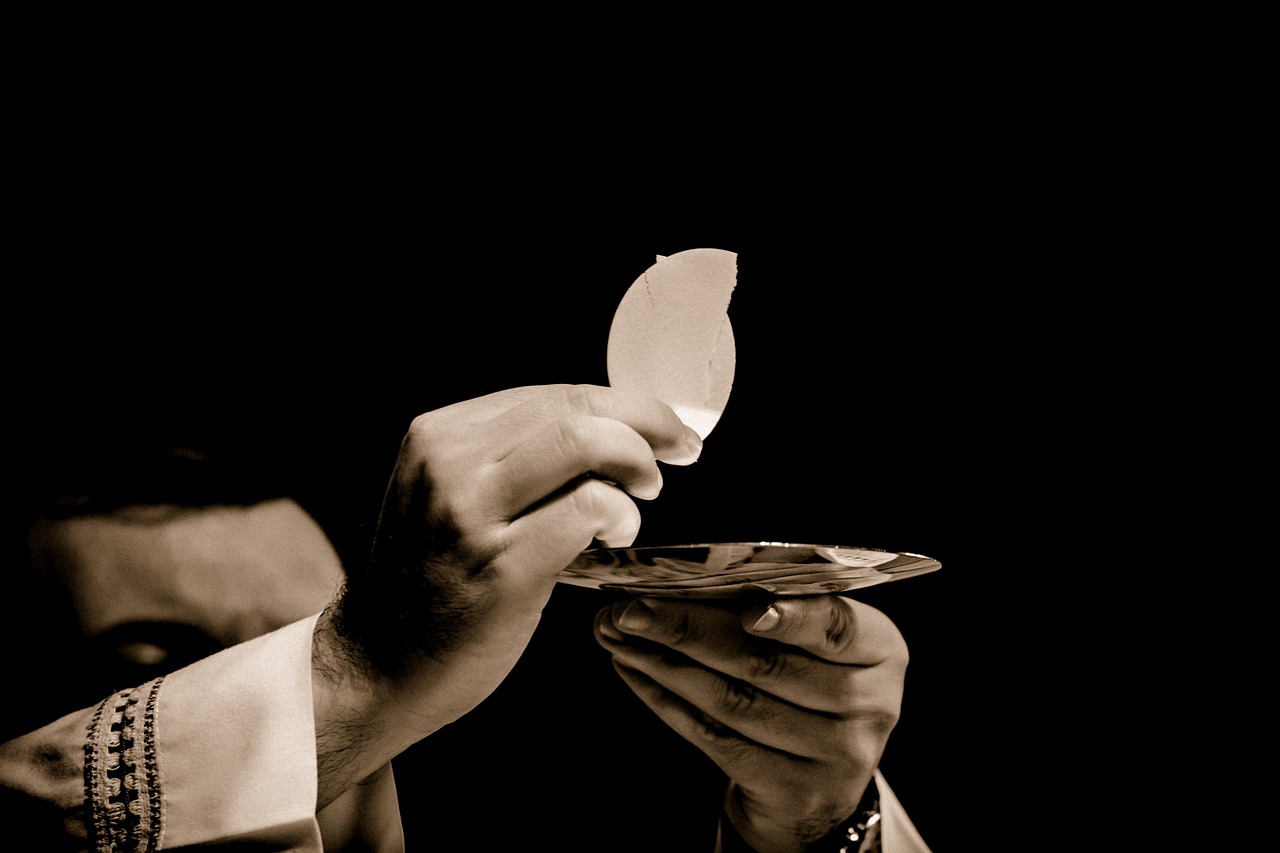



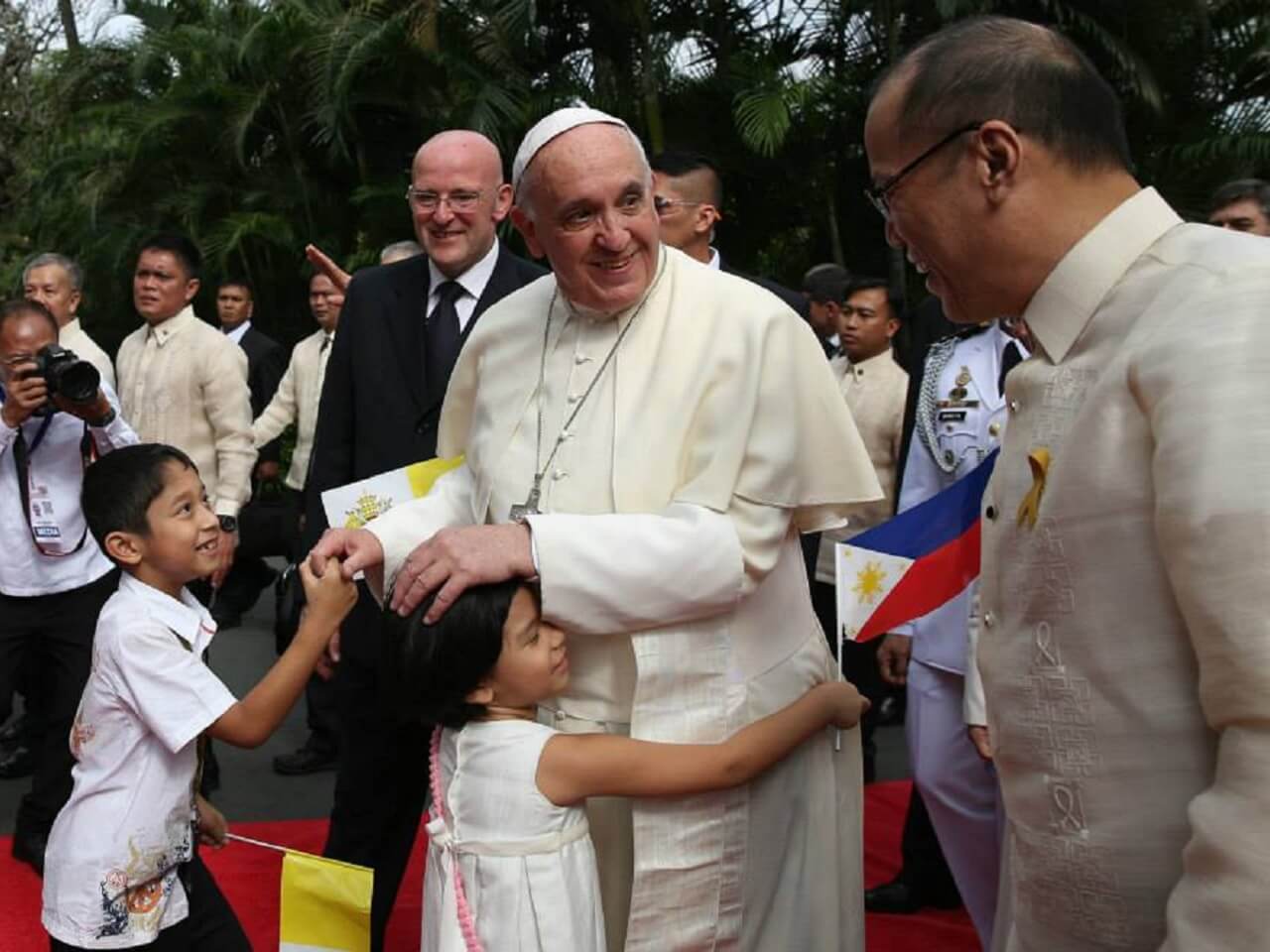

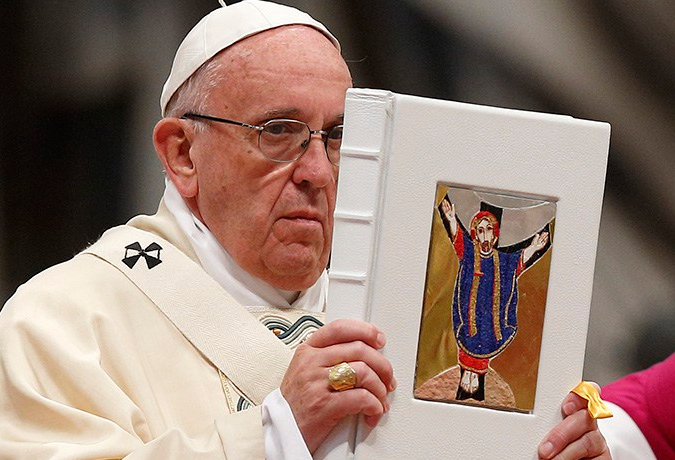


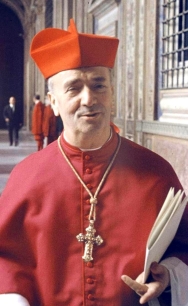


You must be logged in to post a comment.