
|
|||||||||||||||||
|
|
|||||||||||||||||
|

In practice, the U.S. Conference of Catholic Bishops (USCCB) is an open borders lobby, a fifth column in cope and chasuble. Its most recent instruction to the laity insinuates that open borders are a core tenet of a Christian worldview.
The group recently voted to rewrite their quadrennial advisory for Catholic voters: “Forming Consciences for Faithful Citizenship.” The document traditionally appears the November prior to a presidential election year. Ostensibly, June’s comprehensive revision was done in anticipation of the 2020 election. But the timing — a year and a half ahead of schedule — suggests a move to influence the 2018 midterms.
The stated purpose of this early revision is to “apply the teaching of Pope Francis to our day.” On bedrock matters such as abortion, euthanasia, obligation to the poor and vulnerable, and the nature of marriage, Francis teaches nothing that requires a new edition. Only his zeal for open borders, plus the utility of climate change dogma for global income distribution, bears on our coming elections.
Francis has a blinkered grasp of the complex political, cultural, and moral underpinnings of wealth production and, correspondingly, of the means to alleviate poverty. He is a globalist for whom prosperity is a zero-sum game divorced from the aims, habits, and political milieu of national cultures. Hence, his scatter-shot strikes against “a system that causes enormous suffering to the human family … and our Common Home in order to sustain the invisible tyranny of money that only guarantees the privileges of a few.”
People of good will can debate what works and doesn’t work in reducing poverty here and in the developing world. But the bishops, echoing Francis, do not offer grounds for debate. Instead, they rely on dogmatic assertions, insinuating equivalence between moral theology and their own politics.
According to USCCB, a correct Catholic conscience assigns no guilt to unproductive and failed states. It spares poor nations any agency in their own condition. When Andrés López Obrador, front-runner in Mexico’s upcoming presidential election, called for mass-migration to the United States as “a human right,” he raised no eyebrows among the USCCB.
Undermining immigration policy is a USCCB mission. It does so through such affiliates as Migration and Refugee Services and the Campaign for Human Development. It has sponsored National Migration Week, an annual media event, since the 1970s. It founded a subsidiary, the Catholic Legal Immigration Network, to promote amnesty. And in 2016, the bishops aggressively opposed efforts to obligate non-compliant locales — sanctuary cities — to enforce existing immigration law.
Addressing last year’s 3rd World Meeting of Popular Movements — a mass political liturgy initiated by Francis — San Diego’s Bishop Robert McElroy of San Diego, called on religious leaders and activists to obstruct ICE attempts to locate and/or deport illegals. “We must all become disrupters,” he said.
At the same rally, Ghana’s Cardinal Peter Turkson, alluded to the shooting of Michael Brown, in Ferguson, Missouri: “I have learned how government policies and programs and business decisions can interact subtly to perpetuate isolation, poverty and hostility on racial lines, which can explode in a police shooting of an unarmed black teenager.” The USCCB apparently found nothing questionable about either statement.
By fanning a political stance favorable to open borders, the USCCB protects the annual flow of hundreds of millions of federal monies to itself and such affiliates as Catholic Relief Services and Catholic Charities. (More than $500 million in 2016.) In addition to using tax dollars to support programs many tax payers oppose, immigration is an income-producing issue at the diocesan level. As bishops struggle to maintain infrastructure, they have incentive to breathe divine purpose into practical politics: “Our purpose is to help Catholics form their consciences in accordance with God’s truth.”
God’s truth tilts left, it would seem. The bishops declare: “The Church is principled but not ideological. … the foundational principles that guide these teachings should not be … used selectively in order to serve partisan interests.” Yet partisanship is precisely the agenda. Their “call to political responsibility” is a progressive propaganda dressed in utopian boilerplate (“pursuit of a civilization of love”) and tailored to a Christian idiom.
They remind us we are “citizens of the heavenly Kingdom, whose reign is not yet fully realized on earth but demands our unqualified allegiance.” Implicit in that not yet is expectation that, in time, the ideal society will be achieved. Whoever said, “My kingdom is not of this world,” (no yet about it) failed to anticipate the saving power of the global state toward which our bishops point their staffs.
Illegal immigration poses no problem for the bishops. Viewed from the piazza of global solidarity, there are no aliens, only “newcomers.” [Bold font peppers the text.] The “dignity of the human person,” a phrase repeated multiple times in the text, washes away divisive judgments. High-sounding, the phrase is an all-purpose abstraction that can serve any ends. (Alfie Evans, remember, was made to suffocate and dehydrate to death in the name of human dignity.) For voters, the abstraction is meant to trump immigration law.
At points, our bishops appear disassociated from the country which supports them. They scold death penalty abolitionists: “Our nation’s continued reliance on the death penalty cannot be justified.” Yet capital punishment is rarely invoked. In 2016 twenty people were executed, this after 7 to 34 years of additional post-sentencing adjudication. In that same year, 1,930 murders were committed in California plus 1,459 in Texas alone. Where is the reliance?
By admonishing voters to “humanize globalization,” the bishops position themselves in the vanguard of a globalist world freed from competing national aims and interests. To a clerical elite impatient for the withering away of the national state, an open border is the staging ground for assault on citizenship and national sovereignty.
The conscience guide includes pro forma nods to national security and border integrity. But its heart is elsewhere. The USCCB cherishes visions of a “global community” [a fixed refrain] joined in “global solidarity” with “international bodies and international law” to address “global poverty,” “global climate change,” “global problems’, and the “global dimensions” of all earthly woes between here and New Jerusalem.
“Economic justice and care for creation,” twinned with climate alarmism, are the hooks on which hang the one-world gospel: “It is important that we address the rising number of migrants who are uprooted from their homeland as a consequence of environmental degradation and climate change.”
Doctrinaire assertions substitute for data and argument throughout:
Care for creation is a duty of our faith and a sign of our concern for all people, especially the poor who, both everyday experience and scientific research show, suffer the gravest effects of all attacks on the environment. … We are part of a global community charged with being good stewards of the earth’s environment, what Pope Francis calls “our common home, which is being threatened.” [italics mine]
Concern for wise and just stewardship of resources is not new. It was central to what Max Weber called the Protestant ethic, a critical factor in the conservation movement of the mid-1800s. What is new is the apocalyptic mystagoguery of a pope who warns oil executives about the looming potential of fossil fuels to destroy humanity.
Global community. Our common home. The document imposes an aura of religious authority on figures of speech. Chief among these is the globalist fantasy: “We are one human family.” A trope favored by recent pontificates, and repeated by the USCCB, it confuses zoological taxonomy with social reality. We are one species, but only in terms of Linnaean classification can we be called a family. That intimate, affective unit we recognize as a human family is bound by blood ties, law, custom, and cultural affinity.
Voting instruction bends the gospel mandate to “welcome the stranger” into a rallying cry that omits biblical distinctions between strangers. The journeying foreigner and the alien are not the same. Predictably, our bishops ignore Ruth’s resonant pledge to Naomi — “Thy God will be my God; thy people, my people.” Her words offend against diversity. Open borders enthusiasts are selective in their quotes. Among the ones they neglect: “Cursed is the man who moves his neighbor’s boundary stone.” (Deut. 27:17).
Much of the guide is familiar: The USCCB is against war, torture, oppression, all the obligatory unpleasantnesses. It is for nuclear disarmament, children, affordable housing, and healthcare. It endorses the ever-expanding welfare state. 2018 moves the needle further left by championing “food security for all,” a neologism for distribution of subsidized food, and “sustainable agriculture.” This last signals limits on economic growth and political freedom to save later generations from unspecified catastrophe. Put simply, it obligates Catholics to repent beforehand for what might occur later — what Pascal Bruckner calls “compensatory sadism.”
Church teaching is coherent, the bishops insist, “and rests on a comprehensive vision of the dignity of the human person.” But the incoherence of the application of Church teaching erodes its purposes.
What serves human dignity in concrete situations is beyond the compass of a rhetorical abstraction. Our bishops, curtsying to Francis, ignore practical distinctions between protecting the poor themselves and protecting or creating programs that do nothing to break the cycle of poverty. They prefer welfare spending to the growth that is a surer antidote to poverty.
Let us not argue with the USCCB on this: “It is as citizens faithful to the Lord Jesus that we contribute most effectively to the civil order.” Yes, but the spirit of fidelity unfolds first and most decisively within our flesh-and-blood families, in person-to-person allegiance to one another. That indwelling constancy precedes “political and financial support for beneficial United Nations programs” and “other international bodies.”
At crucial moments in particular places, the demands of fidelity might necessarily, and in good conscience, contradict the game plans of self-ordained world improvers.
Maureen Mullarkey is an artist who writes on art and culture. She keeps the weblog Studio Matters. Follow her on Twitter, @mmletters.
OnePeterFive
When it comes to Pope Francis, you cannot trust what he says. There’s more and more evidence of that all the time.
And of course, we must never forget The Peron Rule.
On the matter of intercommunion, it’s true that he signed off on the CDF’s rejection of the German bishops’ handout.
Catholics who wanted to believe the best immediately got excited. “Hey look! He’s orthodox on this one!”
But now, we see what it for what it was: sleight of hand. A rhetorical head fake. Another papal shell game.
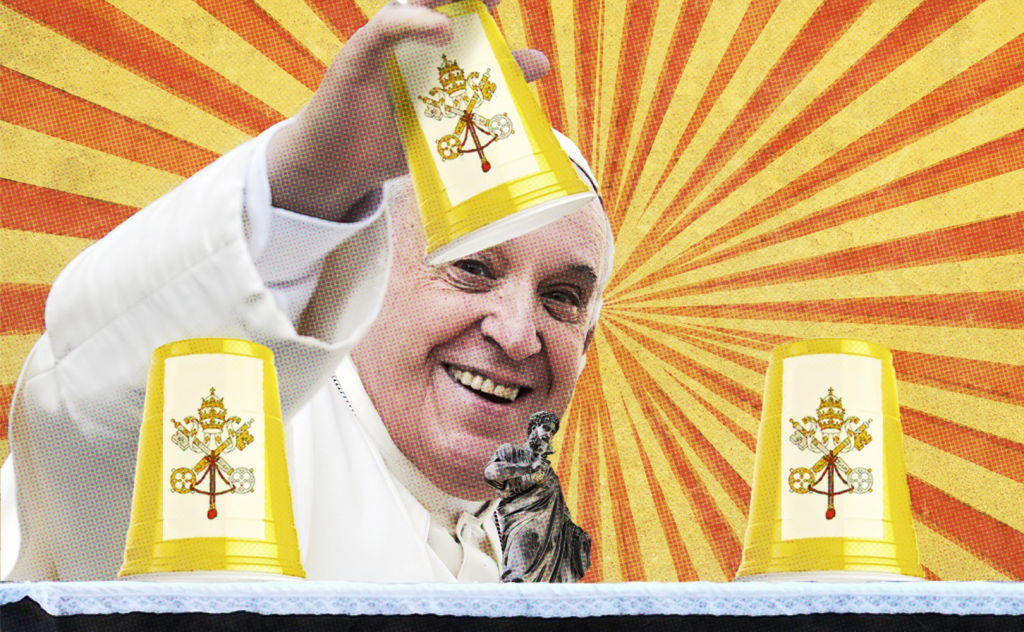
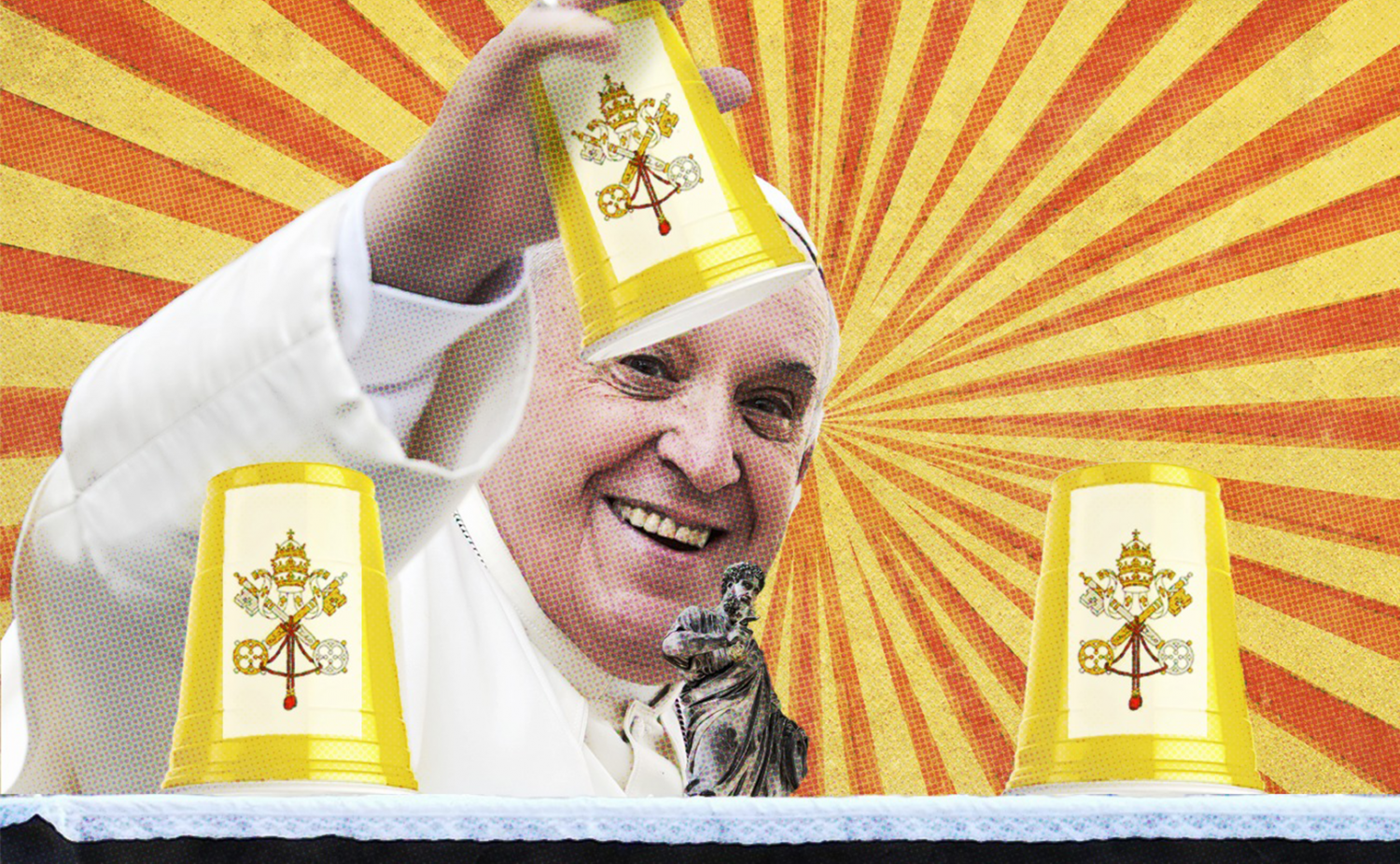
“Pope says local bishop should make the call on intercommunion” reads a new headline over at Crux. The pope has circled back to the intercommunion issue and spun it in a new direction. If you want to see what he did, you have to pay close attention to the way the cups move. Do you see which one the ball — which of course represents papal authority and approval in our little metaphor here — is under when he starts? Watch closely – the emphasis is mine:
After a day of touting ways in which Christians might share in greater unity, that commitment to coming together didn’t prevent Pope Francis from backing the Vatican’s doctrinal watchdog in its decision to insist on caution regarding proposals for intercommunion with Protestants.
On a return flight to Rome on Thursday from a day-long ecumenical pilgrimage to Geneva, Francis said he supported the Vatican’s Prefect for the Congregation for the Doctrine of the Faith, Cardinal-elect Luis Ladaria, in requiring a rethink of a draft proposal from the German bishops that would allow for non-Catholics to receive communion under certain conditions.
[…]
Last month, the Congregation for the Doctrine of the Faith (CDF) rejected the German proposal, which was approved by roughly three-quarters of the bishops during a meeting earlier in the spring. In a letter published this month, Ladaria said the proposal was “not mature enough to be published.”
Francis said that Ladaria did not act unilaterally, but with the pope’s permission…
Up until now, we’re all on the same page. Everybody is watching the cup labeled, “Francis forbids intercommunion via the CDF”. But while he’s talking about Ladaria having his permission, he’s distracting us. People are watching his words, and when he sees our eyes are not on his hands, he makes the switch. The ball goes under another cup so quickly that almost nobody even sees the transition. Slow it down and keep your eye on the ball:
…and that under the Code of Cannon [sic] Law it is up to the local bishop to decide under what conditions communion can be administered to non-Catholics, not local bishops’ conferences.
“The code says that the bishop of the particular church, and that’s an important word, ‘particular,’ meaning of a diocese, is responsible for this… it’s in his hands.”
Moreover, Francis said, the problem with having an entire bishops’ conference deal with such questions is that “something worked out in an episcopal conference quickly becomes universal.”
Did you see him make the switch?
The problem with the Bergoglian version of this illusion is that there’s no final reveal. The magician distracts the audience from what’s happening on the table and then thanks them for coming without ever lifting the cups to show them where the ball landed. He doesn’t actually want them to know he performed his magic, because his whole job was simply to distract them long enough that they forget he was pulling a trick at all.
The ones watching the stage show go home assuming the ball stayed right where it was.
But it’s not under the “Francis forbids intercommunion via the CDF” cup anymore. It’s now under the “Francis says individual bishops can decide the rules on intercommunion” cup.
Some people have seen him perform his version of this trick enough times that they’ve learned how to look for the switch. But most, unfortunately, have not. And since they’re confident that the ball is still under the cup it should be under, they will argue with anyone who tells them otherwise.
Meanwhile, the Catholic media is unlikely to report on the unscrupulous magician who isn’t really doing harmless party tricks, but playing a confidence game.
So the game will continue.
Departing from my imperfect metaphor before it falls all the way apart, I’d like to return for a moment to what I wrote back in April. I said that I believed Francis wasn’t happy with the flaming bag of… um… intercommunion handouts that was left on his doorstep. The Germans overstepped. They got a little too cute. This isn’t how Francis works, and that’s “a good part of the reason why this document was rejected. Because where Francis seems most comfortable working through insinuation, the Germans tried to create something more explicit. In writing.”
He more or less confirmed exactly this when he said, in the comments cited above, that “something worked out in an episcopal conference quickly becomes universal.”
We can’t have that. Remember what he told the Lutheran lady who asked him if she could receive Communion back in November 2015:
I wouldn’t ever dare to allow this, because it’s not my competence. One baptism, one Lord, one faith. Talk to the Lord and then go forward. I don’t dare to say anything more.
No ruling from the top. No official decree. Much easier to kick it downstairs and create chaos. Atomize and deconstruct the universal faith, one bishop at a time.
Because Hagan lío or something.

CRISIS MAGAZINE
October’s youth synod is about finishing the old business of the St. Gallen mafia. It will mark four years since Archbishop Bruno Forte crafted a manipulatedsynodal report on the “precious support” in same-sex relationships—released the very day that two Italian political parties backed homosexual unions.
Pope Francis approved the text before it was published, and his homily that day excoriated “doctors of the law”—an “evil generation”—for resisting the “God of surprises.” Archbishop Forte, meanwhile, declared to the media that “describ[ing] the rights of people living in same-sex unions” is a matter of “being civilized.”
Both men are followers of the late Cardinal Carlo Martini—the “ante-pope” and mafia leader. Martini endorsed same-sex civil unions before his death, after battling Humanae Vitae for years and preaching “discernment” on sexual issues in Night Conversations. There the Jesuit plotted to use young “prophets” to revolutionize the Church—and said it would “never occur” to him to “judge” homosexual couples, years before Pope Francis’s “Who am I to judge?”
Other mafia alumni—the kingmakers behind Pope Francis’s election—crusaded for “gay Masses,” hailed “gay marriage” laws as “positive,” and tried to make homosexuality “central” to the family synod. Amoris Laetitia’s ghostwriter—the author of Heal Me With Your Mouth: The Art of Kissing—has openly lamented the pushback against the homosexual agenda there.
Amoris Laetitia, as one priest has shown, was really written to legitimize homosexual activity—but Humanae Vitae, natural law, and the Catechism’s language still stand in the way.
That is why Archbishop Forte and Cardinal Baldisseri planned, in prior synods’ working documents, to use young people to revolutionize moralizing language on sexuality (78), permitting a “re-reading” of natural law (30). Last year, Archbishop Forte already explained how the youth synod will develop Amoris Laetitia’s vow to integrate “everyone” (297).
Cardinal Baldisseri recently presented the synod’s Instrumentum Laboris, which lauds conscience for discerning “what gift we can offer … even if maybe not fully up to the ideal.” It says “some LGBT young people” want “greater care from the Church”—pushing the question of “what to propose” to young same-sex couples.
Baldisseri claims this revolutionary first use of “LGBT” by the Vatican merely quotes a pre-synodal document by young people—yet the ideological term never appears there. It’s an ominous disparity, given his history of synodal manipulation.
Another leader behind the Instrumentum Laboris is Fr. Giacomo Costa, S.J.—the Vice President of the Martini Foundation, handpicked by the pope to help lead the synod as a special secretary. Fr. Costa’s writings have promoted same-sex couples’ struggle for “social and civil rights.” He also helped write the synod’s preparatory document, which vows to execute Amoris Laetitia 37’s promise to “make room for the consciences of the faithful,” who “are capable of carrying out their own discernment.”
He and the Instrumentum Laboris are thus promoting Martini’s “School of the Word,” where young people just listen to the Bible for their own answers about God’s will. At the pre-synodal meeting, young Catholics, non-Catholics, and atheists were led in meditation on Jesus’s promise that truth will “make you free” (John 8:32), as explicated by Gandhi (“[God] is conscience. He is even the atheism of the atheist”) and the Muslim poet Rumi (“You are a copy of the holy Book of God… Look for whatever you want within yourself”).
Fr. Costa then helped oversee the young writers and editors of the pre-synodal text, as shown by photos of teams at work. While those handpicked young people deny a “conspiracy” or “agenda,” a number are aligned with groups militating for a revolution on sexuality.
Their first draft demanded “open-mindedness” on sexuality and the “welcoming” of “everyone” who violates the Church’s “desired ‘standards.’” Their final text said young people “may want the Church to change her teaching” on contraception, abortion, homosexuality, cohabitation, marriage, and the priesthood. While it diplomatically admitted that “many” youths accept these teachings, it announced that what’s “important” is “discussion” with dissenting “convictions” on these “polemical issues.”
One of the four writers behind that first section works as a producer for Fr. Thomas Rosica, a Martini disciple who gave skewed briefings against “exclusionary language” on homosexuality at the family synod. Fr. Rosica recently acknowledgedhis staff member’s role in the document and said to “really pray” that “the right young people” are delegates at the synod (23:37).
Another one of the four writers—a journalist featured at Crux—represented the Lay Centre. The group tried to influence the family synod by hosting Msgr. Philippe Bordeyne, a participant of a “shadow council” on legitimizing same-sex unions (and an expert at a Vatican seminar for this synod). Both Msgr. Bordeyne and the Lay Centre’s co-founder sit on the board of a Martini-patronized group working to “welcome” homosexual couples.
Before sending its three delegates to the pre-synodal meeting, the Lay Centre hosted Cardinal Tobin, who once welcomed an “LGBT pilgrimage” to Mass and recently said the Church is “moving on the question of same-sex couples.” One young delegate told him about the Church’s “mistakes” in ministering to those “of a different sexual orientation” (38:36). Cardinal Tobin criticized a “cold,” “nominalistic ethic,” saying young people’s “greatest fear” is that the Church “judges them.”
“Now, I think we can correct that, but we’re gonna need help,” he told her (43:04).
She then helped edit the pre-synodal text, saying the meeting showed that “all of us, even if we disagree with Church teachings … are hopeful and still want to be engaged.” She was also trained to fight for “radical inclusion” by Voices of Faith, whose latest conference attacked the Church for being “homophobic and anti-abortion.”
One Voices of Faith delegate helped write the text’s second section lamenting “rules” and “judgment.” Another was surprised by others’ silence on “LGBT” issues, admitting that the question of including “homosexuality and gender” in the text was “contested until the end.”
That section is subversively modeled on the English Facebook group’s pleas for bold, open orthodoxy:
[The Church] must be stable and not “water down” her truths. [The young] want the Church to openly address issues often considered taboo: homosexuality, abortion, birth control, and gender.
Mysteriously, that cry metamorphosed into this:
The young … desire answers which are not watered-down, or which utilize pre-fabricated formulations. We, the young Church, ask that our leaders speak in practical terms about controversial subjects such as homosexuality and gender issues, about which young people are already freely discussing without taboo.
Baldisseri also emphatically told the young writers to “explore the [delegates’] different cultures,” so their first draft avoided “very Catholic things” like Adoration and called Jesus a “historical figure.” Others pushed back, yet there was a “tense point” where the meeting’s organizers expressed their desire that the writers not stay up amending the text.
The “huge online community” requesting the Extraordinary Form of the Mass also wasn’t “properly” represented by online moderators, who accused those young people of being a “lobby.”
Meanwhile, Fr. James Martin, S.J. is boasting that “LGBT”—this political term that Cardinal Baldisseri falsely attributes to the young people’s text—is now “harder” to criticize. Fr. Martin’s pro-“LGBT” book has been glowingly endorsed by Cardinal Farrell—a key leader behind the synod and the World Meeting of Families—and Fr. Martin recently headlined a conference organizing young people to lobby the synod, sponsored by an LGBT group that received extensive funding to push the homosexual agenda at the family synod.
Fr. Martin—who dreams of the day when the Catechism’s language on homosexuality can change and priests can “come out” and same-sex couples can kiss at Mass—has been handpicked by the Vatican to headline the World Meeting of Families along with top revolutionaries, cardinals who’ve already saidconscience determines whether one can receive the Holy Eucharist while engaging in homosexual activity, who’ve already flaunted brazen homosexual-themed events within the sacred spaces of the Church.
We’re clearly in a well-plotted endgame now. According to the men behind Pope Francis’s election—ominously scandal-ridden figures like Cardinal Danneels, Cardinal Murphy-O’Connor, and Cardinal Theodore McCarrick—the timeline was just four or five years to “make the Church over again.”
(Photo credit: Cardinal Baldisseri, Pope Francis, and Cardinal Farrell at pre-synod youth meeting, March 19, 2018; Vatican Media/CNA.)

Julia Meloni writes from the Pacific Northwest. She holds a bachelor’s degree in English from Yale and a master’s degree in English from Harvard.

The American Spectator
{Emphasis and Commentary by Abyssum in red type}
Like sharks thrashing about in chum-filled bloody water, the unhinged hysterics of the progressive left have gone into a feeding frenzy as they prepare to attack whomever President Trump nominates to replace retiring Supreme Court Justice Anthony Kennedy. Thanks to Kennedy’s retirement, Trump is now in a position to appoint a non-activist, strict constructionist to the Court. Senate confirmation of the nominee will result in a solid, reliably conservative Court majority.
Needless to say, the Democrats in the Senate and their leftist supporters view this as the coming of the Apocalypse. But it was the triumphant Democrats who, during the heady days of the Obama administration, changed the Senate rules to allow judicial confirmations to proceed on a simple majority vote. Thanks to their lack of foresight and the existing bare majority of Republicans in the Senate, they are facing a tough uphill battle. So we should expect the desperate Democrats to resort to every device and artifice to slime, smear, destroy, and defeat the nominee.
For a preview of just how low they may go, consider the road taken by Senate Democrats last September as they tried to derail the nomination of Notre Dame Law School professor Amy Coney Barrett for a position on the Seventh Circuit Court of Appeals. Ultimately, Barrett was confirmed and is now a circuit court judge. And, according to news reports, she is on Trump’s short list for the Supreme Court.
But, when Barrett appeared before the Senate Judiciary Committee, the bigoted and outrageous antics of Senators Dick Durbin and Dianne Feinstein prompted me to write the following column which was published by the Philadelphia Inquirer:
Questioning of judicial nominee’s Catholicism by Feinstein and Durbin would make the Klan proud
September 15, 2017
Article VI of the Constitution prohibits a religious test for public office. Nevertheless, last week in the Senate Judiciary Committee, Democratic Sens. Dick Durbin and Diane Feinstein grilled a judicial nominee about the depth of her Catholic faith and made clear that, in their estimation, she was “too Catholic” to hold office.
Why would Durbin, who is Catholic, and Feinstein {who is a Jew} believe such a public display of intolerance was either warranted or politically advisable?
To answer this question, their jaw-dropping behavior must be placed in its historical context.
For example, in 1912, former Georgia congressman and onetime vice presidential candidate Tom Watson published The Roman Catholic Hierarchy, a reprise of his voluminous anti-Catholic polemics and speeches. To him, Catholics constituted an alien and immoral subversive force bent on turning America into a vassal state of the Vatican. Quoth Watson, “We have heard the potentates of this faith in America confess that, on an issue between our Government and the Pope, they would adhere to Papa.”
Based in no small part on the popularity of his anti-Catholicism, Watson was elected to the U.S. Senate.
By the 1920s, the Ku Klux Klan had become a politically powerful organization with more than four million members. The July 1, 1925, issue of the American Standard, the Klan’s official publication, featured an expose headlined “Jesuit Hypnotism of Protestants Uncovered.” This article contended that, acting under Jesuit mind control, “depraved and enslaved Romanists” had assassinated Presidents Lincoln, Garfield, and McKinley.
The same issue set forth the Klan’s Program for America, which advocated “[r]ecognition of the fact, that since Roman Catholics give first allegiance to an alien potentate, the pope, who claims supremacy over all secular governments, their claim to citizenship, the ballot, and to public office in this Protestant country is illegitimate, and must be forbidden by law.”
When John Kennedy, a Catholic, ran for president in 1960, groups such as Protestants and Other Americans United for Separation of Church and State opposed his candidacy because they believed Catholics’ loyalty would always be to Rome and to their religion and not to the rule of American law.
Kennedy’s presidency should have proved once and for all that Catholics were capable of following the law regardless of their religious beliefs. Given this — and the similar performance by legions of Catholic public servants at all levels of government — you might think that by 2017, being a Catholic would no longer be a political liability.
But if you believe that, you are wrong. Although the bigotry has been sugarcoated for intellectual consumption, and the Klan robes are being left in the closet, the ugly intolerance and hatred remain. They come to us today under the cloak of liberal progressivism, which advocates an inclusive society open to all cultures and beliefs — unless you happen to be a traditional practicing antiabortion* Catholic.
Which brings us back to Durbin and Feinstein’s outrageous interrogation of Notre Dame law professor Amy Coney Barrett, a nominee to the Court of Appeals for the Seventh Circuit.
Among her many accomplishments, Barrett has clerked for the U.S. Supreme Court and served on its appellate rules committee. She has taught law at George Washington University and the University of Virginia and has published numerous scholarly articles in leading law reviews. Her nomination has received bipartisan endorsement from more than 70 law professors (including the Obama administration’s former acting solicitor general).
But instead of exploring Barrett’s impressive qualifications, Feinstein and Durbin, acting as ex officio arbiters in matters of faith and morals, set out to determine whether the nominee was perhaps too devoutly Catholic to be trusted with a judgeship.
They focused on a law review article Barrett coauthored when she was a student that discussed what should be done if a Catholic judge’s religion conflicted with his duty to follow established death penalty law. It concluded that “[t]he legal system has a solution for this dilemma — it allows (indeed it requires) the recusal of judges whose convictions keep them from doing their job.”
Unsatisfied with this endorsement of the primacy of law over religion, Durbin probed the depths of Barrett’s faith, going so far as to ask, “Do you consider yourself an orthodox Catholic?”
Not to be outdone, Feinstein concluded her questioning by telling Barrett, “the [Catholic] dogma lives loudly within you, and that’s of concern.”
Durbin and Feinstein’s egregious antics fall into that time-honored political tradition of pandering to their supporters’ prejudices. In that respect, liberal progressives are intolerant and contemptuous of the Catholic Church’s position on the sanctity of life and fear traditional antiabortion Catholics as a collective threat to the secular sacrament of abortion, an institution that must be preserved without restriction at all costs.
Progressives have a peculiar conceit that they are too intelligent, enlightened, and sophisticated to be swayed by base prejudice. But by opposing antiabortion Catholics for their supposed subversive loyalty to the religion of Rome over the interests of American society, Durbin, Feinstein, and their like-minded progressive liberal supporters are treading a well-worn path of hate, bigotry, and religious intolerance. {Which is clearly unconstitutional when Congress is considering approval of presidential nominees for public office.}
Tom Watson and the old Ku Klux Klan would heartily approve.
That column described how far the left was willing to go to defeat a nominee to a circuit court of appeals. Given the relatively higher stakes riding on the upcoming Supreme Court nomination, Durbin and Feinstein’s utterly shameful behavior may prove to be a model of senatorial decorum compared to what awaits Justice Kennedy’s putative replacement at the hands of increasingly desperate leftists who correctly perceive the looming threat to their judicially conjured and enforced progressive world order.
*Throughout the original column submitted to the Philadelphia Inquirer for publication, I used the term “pro-life Catholic.” For reasons unknown, the editors changed every use of that term to “antiabortion Catholic.” A minor point possibly, but one that I believe obfuscates the affirmative motivation of my co-religionists who seek to protect innocent life in the womb. {The action of the editors of the Philadelphia Inquirer in changing the words “pro-life Catholic” is customary when a news organ panders to the left/liberals since abortion since Roe v Wade enjoys the ‘legality’ bestowed by that decision of the Supreme Court and casts pro-life Catholics as unlawful.}I
George Parry is a former federal and state prosecutor who practices law in Philadelphia. He blogs at knowledgeisgood.net and may be reached by email at kignet1@gmail.com.

Civility and Civil Disobedience — a New Low
The polarization of U.S. society sank to a new low this month when White House spokeswoman Sarah Huckabee Sanders was asked by restaurant owner Stephanie Wilkinson to leave The Red Hen in Lexington, Virginia, because Sanders worked for President Trump. Wilkinson told The Washington Post, “This feels like the moment in our democracy when people have to make uncomfortable actions and decisions to uphold their morals.”
Other White House officials also were refused restaurant service, were accosted in a movie theater or had their homes turned into protest sites.
Fueling the protests, U.S. Rep. Maxine Waters, D-Calif., told supporters, “If you think we’re rallying now, you ain’t seen nothing yet. If you see anybody from that [Trump] cabinet in a restaurant, in a department store, at a gasoline station, you get out and you create a crowd, and you push back on them, and you tell them they’re not welcome anymore, anywhere.”
Waters was denounced by leaders of both parties. But barely a year after House Majority Whip Steve Scalise, R-La., was nearly killed by a shooter during practice for the Congressional Baseball Game for Charity in Arlington, Virginia, the polarization in the country has only grown worse.
In a culture trapped in an echo chamber of angry partisan websites and mainstream media and at a time when the digital continent is filled with trolls, vitriol, shaming and virtue signaling, directly accosting elected officials is the next step.
The level of disagreement is revealed in a new Rasmussen poll that found 31% of likely U.S. voters say it’s likely that the United States will experience another civil war sometime in the next five years. The poll also found that 59% of all voters are concerned that those opposed to Trump’s policies will resort to violence.
Political violence has been seen before in the United States, on both sides of the political spectrum. The protesters argue that their actions are justified by Trump’s own often inflammatory language and that his policies — above all, over immigration — are pushing the country into this partisan strife. They see their actions as a form of civil disobedience. Yet they might take some lessons in how to be authentically civil, while opposing actions or policies deemed unjust.
Unquestionably, the president’s policies have sparked considerable, and at times necessary, opposition from across the political and religious divide. Not every voice is unreasonable or uncivil. The U.S. bishops and some evangelical Protestants, for example, have spoken out against the separation of children from their parents at the border. The bishops issued a strong but civil statement that called for an end to family separation and comprehensive, sensible immigration reform. These declarations are in sharp contrast to the uncivil behavior that has become so commonplace under the guise of civil disobedience or the “resistance.”
One of the darkest moments in the history of the nation occurred 50 years ago. In 1968, in the midst of the Vietnam War, the sexual revolution and the important struggle of the civil-rights movement, a divided and doubting America witnessed the assassinations of Rev. Martin Luther King Jr. and Sen. Robert Kennedy, D-N.Y.
The anniversary of King’s tragic death serves as a reminder of where fevered rhetoric can lead but also what real civil disobedience should look like. In 1957, King wrote about the power of nonviolence. The nonviolent resister, he wrote, “does not seek to humiliate or defeat the opponent, but to win his friendship and understanding. … And so at the center of our movement stood the philosophy of love.”
What can Catholics do? First, even when we might disagree over politics or policies, we can offer to a divided America a clear moral vision founded on the truth and love that flow from life in Christ.
Pope Benedict XVI understood this when, speaking at the White House in 2008, he declared, “Democracy can only flourish, as your Founding Fathers realized, when political leaders and those whom they represent are guided by truth and bring the wisdom born of firm moral principle to decisions affecting the life and future of the nation.”
This is an era in which there are no moral truths, when sexuality, gender, family bonds and the value of human life are deemed fluid and subject to the whims of the times. We as a society have lost our ability to talk to each other, to have shared cultural values and a common moral vocabulary, and to see those who hold contrary political views as persons, made in the image and likeness of God.
Just as we must bring a clear moral vision for the country, we must also stand as proof that we have not forgotten how to love.
In his address to the National Catholic Prayer Breakfast in Washington, D.C., in May, Archbishop Joseph Naumann of Kansas City, Kansas, echoed King’s 50-year-old advice and gave a poignant lesson to all those claiming to be civil in their civil disobedience.
“We have no permanent enemies,” he said, “but only confused brothers and sisters who have yet to encounter the Lord of Life and to experience his unconditional love and amazing grace. We are called to renew our nation, not primarily by enacting laws, but by announcing the joy and hope of the Gospel of Jesus to individuals in desperate need of its Good News. It is our task to reclaim our culture, one mind, one heart, one soul at a time.”
That is true civility — and true obedience to Christ’s command to his followers: “Love one another as I have loved you” (John 13:34).

Why Noble Beauty is Taking the Church by Storm
“Lex orandi, lex credendi.” (“As we pray, so we believe.”) —An ancient Christian motto
For the first decade of my life as a Catholic (I grew up Calvinist and needed to undergo about four major conversions until I made it home to Rome at age 21), I had an awe-inspired love for the Latin Mass. I was pleasantly clueless about the “politics” that surround the Traddies vs. the Novus Ordo-ies (ok, I made up that last term, but you get the gist). I had absolutely no idea what a spectacular liturgical bombshell Pope Benedict XVI’s 2007 motu proprio summorum pontificum was. I was just irresistibly, dare I say, naively, drawn to the Extraordinary Form.
To me, it was the complete opposite of Calvinism, which was incredibly charming to my prodigal soul. I’d roam over to FSSP parishes whenever I got the chance, drilled myself in Ecclesiastical Latin just for kicks, and sported a mantilla when I had riled up enough nerve to do so. I wasn’t exactly a “rad-Trad,” but I definitely watched them with a twinge of envy and admiration, though from afar. The Extraordinary Form of the Mass fed me when I was hungry for God, and I had to believe God was pleased when I grazed on the luscious spiritual pastures I found therein. It was a beautiful exchange. And yet, something critical was amiss in my comprehension of the Latin Mass.
Last summer, I began reading Noble Beautyby Dr. Peter Kwasniewski, a prolific author, speaker and founding member of Wyoming Catholic College. {https://wp.me/px5Zw-6KN}Three-fourths of the way through the jewel-weed of its texts, I was a seriously different woman. And of course, a more authentically Catholic one. As I watched the book bring to life the true story behind the Extraordinary Form, I began to understand its place in the Church. Mother Church – so, so fantastically close to Christ’s Heart – and yet, so jangled and roughed up by confusion, so singed by fireworks of heresy and scandal – was being rescued by the resurgence of the Latin Mass. The wondrous, contemplative depth of the Extraordinary Form, with its spectacular charm and spiritual charisma, has become a lifeboat for us roaming Catholics, lost at sea.
All throughout Noble Beauty, Dr. Kwasniewski reveals to us why the modern world truly does need the Mass of the Ages – perhaps more now, actually, than ever. Firstly, he opens with a chapter titled, “Why the New Evangelization Needs the Old Mass.” Points covered in this chapter expound upon the following claim he made in his preceding book, Resurgent in the Midst of Crisis, “The New Evangelization will stand or fall on the strength of authentic liturgical renewal, and this renewal will stand or fall depending on whether or not it is rooted in the traditional Latin Mass as an immense good in itself and as a constant point of reference for the modern form…”
Following chapters of Noble Beauty cover the topics such as: the preeminence of sacred tradition in the liturgy, the New Liturgical Movement as urgent care for a sick Church, and how the Usus Antiquior elicits superior participation (contrary to popular belief). He also discusses the resounding, interior peace that the Low Mass lends to the soul, as well as grace-filled glory the High Mass has to offer. Appealing to Our Lady, Queen of the Liturgy, he also does a uniquely powerful comparison between the Holy Rosary and the Extraordinary Form of the Mass.
“The traditional liturgy, like the Rosary, never tires of recalling the memory and invoking the intercession of the all-glorious Mother of God and Lord, Jesus Christ…. Hail, Queen of the Most Holy Rosary! Hail, Our Lady of Victories! Pray for us in this vale of tears, and obtain from Thy Son the longed-for restoration of the great and beautiful liturgy of the Roman Church. Amen.”
In 1988, there were only about 20 places in the United States where you could find a traditional Latin Mass being offered on Sundays. Now there are well over 500 and counting, and the average age of Catholics attending the Latin Masses is much younger than those attending the Novus Ordo rite.
As Dr. Kwasniewski reminds us in Noble Beauty, “It all comes back to the motu proprio: are we willing or unwilling to embrace it? ‘He that hath an ear, let him hear what the Spirit saith to the churches,’ (Rev. 2:7).” Fr. Zuhlsdorf, President of Tridentine Mass Society of Madison, and a popular blogger known as “Fr. Z,” haunts us beautifully with his famous slogan, “Save the Liturgy, Save the World.” How important is it to us to help save the world, and the Church?
A Prayer for the Traditional Movement
Lord, remember in Thy Kingdom,
all religious, clergy, and laity throughout the world,
who are dedicated to the Usus Antiquior.
Bless us, govern us, defend us, purify us, and multiply us
for the good of souls, for the restoration of Thy Church,
and for the glory of Thy Holy Name.

Legacy of Jahi McMath – More Brain Death ConflictsFEEDBLITZ 01 JUL 18 {Commentary by Abyssum} While Jahi McMath is now definitively dead, the ongoing federal and state lawsuits brought by the McMath family may still clarify or alter traditional understandings of brain death. But even without any judgments or verdicts, the cases have already had an enormous impact. The McMath cases have very publicly demonstrated that families can successfully resist brain death diagnoses. I have written about this. Furthermore, just yesterday, McMath attorney Chris Dolan saidthat “he has fielded more than a dozen inquiries from families, around the world, asking for help battling a brain death declaration.”
There has always been a “crack” in the door of brain death. The McMath cases have opened that door a bit further, showing other families that they can: (a) refuse permission to conduct brain death tests {which frequently cause real death, the total cessation of vital functions such a circulation of blood and breathing}, (b) dispute the accuracy of tests already conducted, (c) deny the legal validity of brain death tests, or (d) assert religious objections.
|

*
This year there are at least three U-turns that Francis has made on crucial questions, but always without making it clear if these are definitive and sincere, seeing what he has said and done before and after the apparent reversals.
*
The first U-turn has been activated against the ordination of women to the priesthood. Here, properly speaking, Jorge Mario Bergoglio has not contradicted himself, because every time he has been asked since becoming pope he has always said he is against it personally, for example after his voyage to Sweden, where he had however embraced a female Lutheran bishop (see photo).
But at the same time he has long allowed the favorable opinions to run free, also on the part of figures on friendly terms with him, like cardinal of Vienna Christoph Schönborn.
Last May 29, nonetheless, there appeared on “L’Osservatore Romano” a note from the prefect of the congregation for the doctrine of the faith, the Spanish Jesuit Luis Ladaria, who reconfirmed that the no to women priests is “definitive” and “infallible.”
Ladaria enjoys the esteem of Francis, who a few days ago also made him a cardinal. It must be said, however, that the supporters of women priests have not given up, because meanwhile Francis has set up a commission to study the ordination of women not to the priesthood but to the diaconate, which is however still a sacrament and is the first of the three steps that culminate in ordination as bishop.
To judge by the preparatory document of the synod for the Amazon, scheduled for 2019, it is projected that this same region will see the ordination of the first women deacons. And then who knows.
*
The second U-turn has been activated against communion being given also to Protestant spouses who are married to Catholics. When asked about this very question three years ago, while he was visiting the Lutheran church in Rome, Pope Francis leaned heavily toward the favorable side. And in Germany, where mixed couples are numerous, this new practice has spread to such an extent that last February a majority of the German bishops approved a documentthat justifies it.
Seven bishops including one cardinal, however, have appealed to Rome. The pope called them in for consultation, took some time, but then handed the issue back to Cardinal Ladaria, who with a letterdated May 25 written “with the explicit approval of the pope,” blocked both the document and the practice that had entered widely into use, putting everything off until a future reflection “at the level of the universal Church” and of an overall ecumenical accord, meaning a remote and improbable future, since the Orthodox Churches are unshakably against so-called “intercommunion.”
Except that a few days ago, returning from his voyage to Protestant Geneva, Francis once again reopened the question, praising the document made null and void by Ladaria, and asserting that “there has been no braking.”
*
The third and most striking U-turn, that made by Pope Francis against the bishops of Chile – one in particular, Juan de la Cruz Barros Madrid – complicit in the sexual abuse committed by the priest who was their teacher when they were young, Fernando Karadima, tried and convicted by the congregation for the doctrine of the faith in 2011.
Until a few months ago, Francis had been saying that he was absolutely sure of the innocence of these bishops, and defended them with drawn sword against those who were “calumniating” them.
But then the 2400 pages of the canonical investigation that he finally ordered led him to confess that he had been spectacularly mistaken “through the lack of reliable and balanced information.” Whose fault was that?
Most of the suspicion has fallen on Cardinal Francisco J. Errázuriz, a longtime friend of Bergooglio. But at the origin of the deception is above all a Jesuit, Germán Arana, who shuttles between Rome, Spain, and Chile, and continues to belong, even after the blunder, to the most intimate circle of the pope’s confidants.
It is in this circle of his allies that Francis’s weak spot is to be found. And seeing what has gone before, it appears altogether unlikely that in the future he will make a real U-turn precisely here, with a drastic housecleaning.
(English translation by Matthew Sherry, Ballwin, Missouri, U.S.A.)
———-
This commentary was published in “L’Espresso” no. 26 of 2018 on newsstands July 1, on the opinion page entitled “Settimo Cielo” entrusted to Sandro Magister.
Here is the index of all the previous commentaries:


You must be logged in to post a comment.