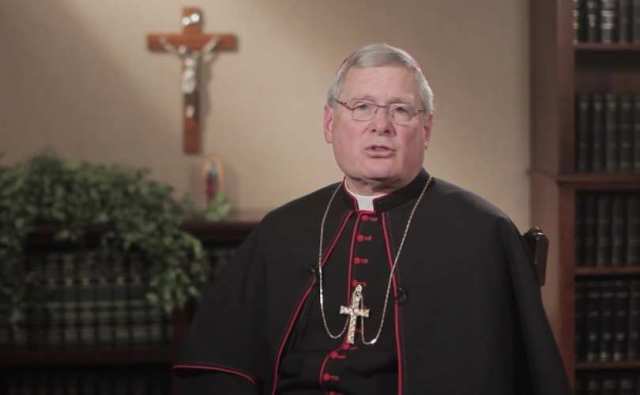
IT WOULD APPEAR THAT FRANCIS MISSES HIS JEWISH PSYCHOANALYST VERY MUCH

Settimo Cielodi Sandro Magister

How Bergoglio Is Rewriting His Life. The Years of the “Great Desolation”

GesuitiCile

*

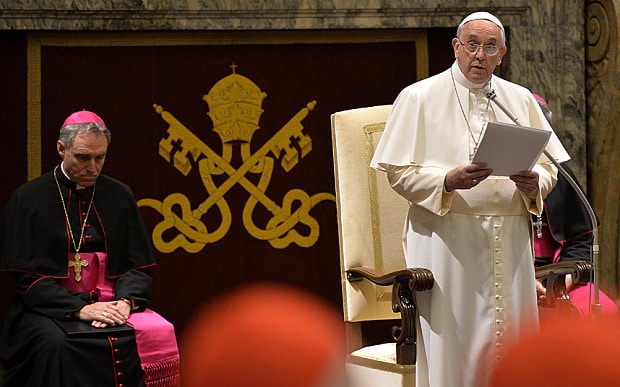
In the closed-door meeting that he held at the beginning of Lent, on February 15, with the priests of the Rome diocese of which he is bishop, Francis sketched out in an unexpected way the trajectory of his life, describing it as a series of “passages,” some of them bright, others dark.

Let’s review word by word this autobiography of his, very instructive on the personality of Jorge Mario Bergoglio, in the official transcription that has been released and that respects the disorder of his speech in Italian.

The first phase is one of rapid and dazzling ascent toward what further on he would call “omnipotence”:

“Right after I was ordained, I was appointed superior the next year, novice master, then provincial, rector of the faculty… A stage of responsibility that began with a certain humility, because the Lord has been good, but then, with time, you feel more sure of yourself: ‘I got this, I got this…’ is the word that comes most. One knows how to get around, how to do things, how to manage….”

In effect, the young Jesuit Bergoglio celebrated his first Mass in 1969, in 1970 became novice master, and in 1973, at the age of just 37, was appointed superior of the Argentine province of the Society of Jesus. He held this position until 1979, when his successor was a Jesuit close to him, Andrés Swinnen, and then until 1985 was rector of the Colegio Máximo di San Miguel.

It must be noted, however, that already in this phase of success there emerged within him an inner disquietude, which he tried to resolve in 1978 by going “for six months, once a week” to a Jewish psychoanalyst, “who helped me greatly, when I was 42 years old,” as he himself revealed last summer in the book-length interview with the French sociologist Dominique Wolton.

But here is the second “passage” of his autobiography, no longer of ascent but of precipitous decline, which pope recounted to the priests of Rome:

“And all of this ended, so many years of leadership… And there began a process of ‘but now I don’t know what to do.’ Yes, be a confessor, finish the doctoral thesis – which was there, and which I never defended. And then starting over and rethinking things. The time of a great desolation, for me. I experienced this time with great desolation, a dark time. I believed that it was already the end of life, yes, I served as a confessor, but with a spirit of defeat. Why? Because I believed that the fullness of my vocation – but without saying so, now that I think of it – was in doing things, these things. But no, there is something else! I did not quit prayer, this helped me a lot. I prayed a lot, in this period, but I was ‘as dry as a log.’ I was helped so much by prayer there, in front of the tabernacle… But the last periods of this time – of years, I don’t remember if it was from 1980… from 1983 to ’92, almost ten years, nine full years – in the last period prayer was very much in peace, it was with great peace, and I said to myself: ‘What will happen now?” because I felt different, with great peace. I was a confessor and spiritual director, in that period: it was my work. But I experienced it in a very dark way, very dark and suffering, and also with the infidelity of not finding the path, and compensation, compensating for [the loss] of this world made of ‘omnipotence,’ seeking worldly compensations.”

Desolation, dark time, dryness, spirit of defeat… In effect, beginning from 1986, when his bitter enemy Víctor Zorzín became the new provincial of the Argentine Jesuits, Bergoglio was rapidly pushed aside, sent against his will to study in Germany and finally forced into a sort of exile in the city of Córdoba, between 1990 and 1992, without any role anymore.

He sustained himself with prayer. But even as he recounts it today, Bergoglio experienced those years with great suffering, in never-resolved tension between the sense of defeat and the will to make a comeback.

And among those who held the power at the time in the Society of Jesus, both in Argentina and at its general curia in Rome, all the way up to superior general Peter Hans Kolvenbach, this lack of psychological balance of his and therefore his unreliability had become the shared judgment.

It was perhaps in order to offer a belated remedy for this quarrel that Pope Francis, last January 20 in Perù, speaking off the cuff to the priests and religious, wanted to recall that “I cared a lot” about Kolvenbach, “a Dutch Jesuit who died last year,” in part because “it was said that he had such a sense of humor that he was able to laugh at everything that happened, at himself and even at his own shadow.”

But getting back to the account of his own life that Francis presented to the priests of Rome, here is the third and last series of “passages,” all of them once again on the rise, starting with that “telephone call from the nuncio” that – he says – “put me on another path,” that of the episcopate.

It was the spring of 1992, and the Vatican nuncio in Argentina at the time, Ubaldo Calabresi, telephoned him to tell him that he would be consecrated bishop at the behest of the archbishop of Buenos Aires, Cardinal Antonio Quarracino, who wanted him as his auxiliary.

What came afterward was an unstoppable rise: to coadjutor bishop with right of succession, to archbishop of Buenos Aires, to cardinal…

“And then the last passage, from 2013. I didn’t realize what had happened there: I continued to act like a bishop, saying: ‘You take care of it, since You put me here.’”

The miraculous turning point that in 1992 plucked him out of the exile in which his confreres of the Society of Jesus had confined him was “prepared [for him] by the Lord – he was careful to emphasize – precisely in that “dark, not easy” period.

But in any case that period did not resolve – to the contrary – his psychological qualms, as proven by two of the public “confessions” he has made as pope, one at the beginning of the pontificate and another a few weeks ago.

He told the first to students of Jesuit schools on June 7, 2013, in regard to his decision to live at Santa Marta instead of at the Apostolic Palace:

“For me it is a question of personality: that is what it is. I need to live with people, and were I to live alone, perhaps a little isolated, it wouldn’t be good for me. I was asked this question by a teacher: ‘But why don’t you go and live there?’. I replied: ‘Please listen, professor, it is for psychological reasons’. It is my personality. I cannot live alone, do you understand?”

He told the second last January 16 to his fellow Jesuits from Chile (see photo), in the closed-door conversation that was afterward transcribed and published with his permission in “La Civiltà Cattolica” of February 17, and it concerns the reason why he does not want to read the writings of his opponents.

The reason – he said – is that of safeguarding his “mental health,” or in other words his “mental hygiene,” formulas that he hammered away at three times in just one minute of conversation, and that presuppose an apodictic judgment of “insanity” on those who criticize him, without room for a rational engagement:

“For my own good [mental health] I do not read the content of internet sites of this so-called ‘resistance.’ I know who they are, I know the groups, but I do not read them for my own mental health. If there is something very serious, they tell me about it so that I know. You know them… It is displeasing, but you have to go on. Historians tell us that it takes a century for a Council to put down its roots. We are halfway there.

“Sometimes we ask: but that man, that woman, have they read the Council? And there are people who have not read the Council. And if they have read it, they have not understood it. Fifty years on! We studied philosophy before the Council, but we had the advantage of studying theology after it. We lived through the change of perspective, and the Council documents were already there.

“When I perceive resistance, I seek dialogue whenever it is possible; but some resistance comes from people who believe they possess the true doctrine and accuse you of being a heretic. When I cannot see spiritual goodness in what these people say or write, I simply pray for them. I find it sad, but I won’t settle on this sentiment for the sake of my own mental well-being [mental hygiene].”

(English translation by Matthew Sherry, Ballwin, Missouri, U.S.A.)
Posted in Uncategorized | 1 Comment

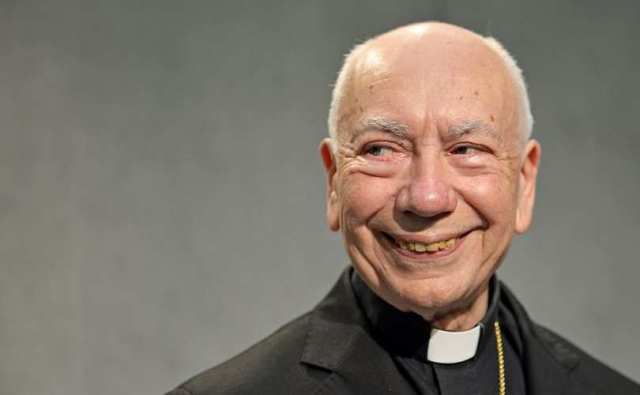
Cardinal_Francesco_Coccopalmerio_grinning_810_500_55_s_c1-2

Cardinal Francesco Coccopalmerio


When Cardinals Clash

Friends: Be sure to tune into The World Over on EWTN tonight. The Papal Posse (host Raymond Arroyo and TCT’s Robert Royal and Father Gerald Murray) will discuss recent happenings in the Vatican, including the subject of Father Murray’s column below. The program airs at 8:00 PM EST, but check your local listing for the time and station in your area. If you miss the initial broadcast, be sure to go to EWTN’s YouTube page for The World Over, which can be found by clicking here.


It was easily predictable that the Amoris Laetitia (particularly footnote 351),would lead to jarring assaults on the Church’s doctrinal unity – even by some of the Church’s own shepherds. Cardinal Francesco Coccopalmerio, President of the Pontifical Council for Legislative Texts, has just joined the ranks of prelates who say that Pope Francis has authorized giving Holy Communion to those in adulterous second “marriages.” Coccopalmerio even extends this permission to others living in sexual relationships apart from marriage in his newly published booklet, The Eighth Chapter of the Post-Synodal Apostolic Exhortation Amoris Laetitia (which some think authoritative since it was issued by the Vatican’s own publishing house, the Libreria Editrice Vaticana).

Coccopalmerio writes:

The divorced and remarried, de facto couples, those cohabiting, are certainly not models of unions in sync with Catholic Doctrine, but the Church cannot look the other way. Therefore, the sacraments of Reconciliation and of Communion must be given even to those so-called wounded families and to however many who, despite living in situations not in line with traditional matrimonial canons, express the sincere desire to approach the sacraments after an appropriate period of discernment. . . .it is a gesture of openness and profound mercy on the part of Mother Church, who does not leave behind any of her children, aware that absolute perfection is a precious gift, but one which cannot be reached by everyone.

What do we find here? Slogans and euphemisms. A slogan is meant to stop discussion. Euphemisms intentionally steer the reader away from precise and accurate descriptions of reality. A seminary professor of mine once noted that verbal engineering always precedes social engineering. In this case, it’s doctrinal engineering

Slogans such as “look the other way” and “not leave behind any of her children,” and euphemisms such as “so-called wounded families” and “situations not in line with traditional matrimonial canons” show a decision not to present a carefully reasoned and precise defense of what is being endorsed. Rather, Coccopalmerio tries to sweep the reader along with emotional appeals and misdirection.

“Not looking the other way,” means that the Church should simply ignore the sinfulness of certain behaviors. In the case of unions involving adultery and fornication, the question is not about healing “so-called wounded families” but warning sinners that their behavior gravely offends God.

When he says that the Church should “not leave behind any of her children,” he means that the refusal to give Communion to those publicly living a seriously sinful life would be an unjust abandonment. Adulterous unions are now simply “situations not in line with traditional matrimonial canons.” God’s law on the indissolubility of marriage and the immorality of adultery is now a mere “tradition” embodied in a canon. Violating that law is only a “situation not in line” with that canon, which was written down somewhere, at some time, by someone. How important is a canon compared to actual people who “express the sincere desire to approach the sacraments after an appropriate period of discernment”?

Cardinal Francesco Coccopalmerio

Coccopalmerio describes observing the Sixth Commandment as “absolute perfection [that] is a precious gift, but one which cannot be reached by everyone.” But the Church has never taught that observing the Sixth Commandment is a state of “absolute perfection,” beyond the capability of any of her sons and daughters. It’s an error to consider marital fidelity as an ideal not reachable by many Christians. The grace of the sacrament of marriage is given by God to strengthen married persons in fulfilling their obligation to marital fidelity. Infidelity is a choice against one’s obligations to God and one’s spouse. It is not an authorized alternative for those who “cannot” reach “absolute perfection.”

Coccopalmerio further states: ““The Church could admit to the Penitence and Eucharist the faithful who find themselves in illegitimate unions [who] want to change that situation, but can’t act on their desire.”

God does not permit, let alone oblige, anyone to commit a mortal sin. And He does not authorize anyone to publicly enter a union that contradicts His law on marriage. A person who has placed himself is an adulterous union must for the good of his soul get himself out of that situation. The Church has the duty to uphold the sanctity of the Holy Eucharist. Those who publicly reject the Sixth Commandment, in various ways, cannot be admitted to the reception of Holy Communion until they have put an end to their sinful acts.

In contrast to all this, Cardinal Robert Sarah has published a second book-length interview with French journalist Nicholas Diat, which will soon appear in English: The Power of Silence, Against the Dictatorship of Noise. In this profound dialogue about the need for believers to recover a love for silence in our agitated world, Cardinal Sarah addresses the burning questions raised by chapter eight of Amoris Laetitia:

Christ is certainly afflicted in seeing and hearing priests and bishops who should protect the integrity of the teaching of the Gospel and of doctrine multiplying words and writings that dilute the rigor of the Gospel by their deliberately ambiguous and confused affirmations. To these priests and these prelates who give the impression of taking up the exact opposite of the traditional teaching of the Church in matters of doctrine and morality, it is not out of place to recall the severe words of Christ: “Therefore I tell you, every sin and blasphemy will be forgiven men, but the blasphemy against the Spirit will not be forgiven. And whoever says a word against the Son of man will be forgiven; but whoever speaks against the Holy Spirit will not be forgiven, either in this age or in the age to come.” “He is guilty of an eternal sin”, Mark adds. (My translation)

The rigor of the Gospel is what will save souls. The dilution of that rigor by anyone in the name of false compassion does great harm by reworking the Gospel into something it is not.

Fr. Gerald E. Murray

Fr. Gerald E. Murray

The Rev. Gerald E. Murray, J.C.D. is a canon lawyer and the pastor of Holy Family Church in New York City.

Posted in Uncategorized | 2 Comments

MUELLER FINALY GETS IT RIGHT, HOORAY !

Featured Image
Cardinal Gerhard Müller, prefect of the Congregation for the Doctrine of the Faith
Claire ChretienClaire ChretienFollow Claire

Former Vatican doctrine head: ‘Paradigm shift’ means ‘corruption’ of doctrine

February 20, 2018 (LifeSiteNews) – The Vatican’s former doctrine chief has penned an essay responding to senior Cardinals who have recently described Amoris Laetitia as a “paradigm shift” for the Church.

A “paradigm shift…by which the Church takes on the criteria of modern society to be assimilated by it” isn’t a “development” of doctrine, but “a corruption” of it, Cardinal Gerhard Müller wrote in a lengthy First Things essay. Müller is the former Prefect for the Congregation of the Doctrine of the Faith.

His essay answered the question, “Can there be ‘paradigm shifts’ in the interpretation of the deposit of faith?”

Vatican Secretary of State Cardinal Pietro Parolin recently claimed that the controversial Amoris Laetitia is a “paradigm shift” for the Church.

“The text itself insists on this, that’s what is asked of us — this new spirit, this new approach!” Parolin said.

Müller, citing centuries of Church history and quoting Blessed John Henry Newman’s writings, laid out why a “paradigm shift” is really a rotting of Catholic doctrine rather than a “development” of it.

“According to Newman, a true development occurs when Christianity is able to assimilate the surrounding environment, informing and changing its culture, whereas corruption happens when it is instead the environment that assimilates Christianity to itself,” wrote Müller. “Thus, a paradigm shift, by which the Church takes on the criteria of modern society to be assimilated by it, constitutes not a development, but a corruption.”

He continued:

For a development to be healthy, it must proceed in logical continuity with the teachings of the past. Is there any logical continuity between John Paul II’s Familiaris Consortio n. 84—which teaches that the divorced living in a new union must resolve to live in continence or else refrain from approaching the sacraments—and the change of this selfsame discipline that some are proposing? There are only two options. One could explicitly deny the validity of Familiaris Consortio n. 84, thus denying by the same token Newman’s sixth note, “Conservative Action upon the Past.” Or one could attempt to show that Familiaris Consortio n. 84 implicitly anticipated the reversal of the discipline that it explicitly set out to teach. On any honest reading of John Paul II’s text, however, such a procedure would have to violate the basic rules of logic, such as the principle of non-contradiction.

…in the exercise of its teaching ministry, it is not enough for the Church’s Magisterium simply to appeal to its judicial or disciplinary power as if its teachings were nothing but a matter of legal and doctrinal positivism. Rather, the Magisterium must seek to present a convincing case, showing how its presentation of the faith is in itself coherent and in continuity with the rest of Tradition. The authority of the papal Magisterium rests on its continuity with the teachings of previous popes. In fact, if a pope had the power to abolish the binding teachings of his predecessors, or if he had the authority even to reinterpret Holy Scripture against its evident meaning, then all his doctrinal decisions could in turn be abolished by his successor, whose successor in turn could undo or redo everything as he pleased. In this case we would not be witnessing a development of doctrine, but the dire spectacle of the Bark of Peter stranded on a sandbank.

Pope Francis has not yet answered a dubia, or formal request, from four cardinals asking him if Amoris Laetitia is consistent with Catholic moral teaching.

Müller explained that bishops’ conferences directives implementing Amoris Laetitiacan’t be considered orthodox if they simply “declare their conformity with the pope’s presumed intentions in Amoris Laetitia.

“They are orthodox only if they agree with the words of Christ preserved in the deposit of faith. Similarly, when cardinals, bishops, priests, and laity ask the pope for clarity on these matters, what they request is not a clarification of the pope’s opinion. What they seek is clarity regarding the continuity of the pope’s teaching in Amoris Laetitia with the rest of tradition,” wrote Müller.

Using principles that Newman taught, Müller argued, is how one should properly read Amoris Laetitia:

The criteria that Newman unfolds are useful, then, to disclose how we should read Pope Francis’s apostolic exhortation Amoris Laetitia. The first two criteria are “preservation of type” and “continuity of principles.” They are meant precisely to ensure the stability of the faith’s foundational structure. These principles and types prevent us from speaking of a “paradigm shift” regarding the form of the Church’s being and of her presence in the world. Now chapter VIII of Amoris Laetitia has been the object of contradictory interpretations. When in this context some speak of a paradigm shift, this seems to be a relapse into a modernist and subjectivist way of interpreting the Catholic faith. It was in 1962 that Thomas Kuhn introduced his controversial and at the same time influential idea of “paradigm shifts” into the debate internal to the philosophy of science, where the expression received a precise, technical meaning. Apart from this context, however, this term also has an everyday use, referring to any form of fundamental change in theoretical forms of thought and social behavior. “Jesus Christ is the same yesterday, today, and forever” (Heb 13:8)—this is, in contrast, our paradigm, which we will not exchange for any other. “For no other foundation can any one lay than that which is laid, which is Jesus Christ” (1 Cor 3:11). [emphasis added]

Posted in Uncategorized | Comments Off on MUELLER FINALY GETS IT RIGHT, HOORAY !

VATICAN CORRUPTION ON A SCALE YOU HAVE TROUBLE IMAGINING IN WHICH THE CARDINALS OF THE UNITED STATES ARE COMPLICIT

Featured Image
John-Henry WestenJohn-Henry WestenFollow John-Henry

NEWS

Leaked docs raise question of Pope’s personal role in new Vatican financial scandal


{Abyssum}

ROME, February 20, 2018 (LifeSiteNews) – Leaked documents obtained by LifeSiteNews connect the Pope himself to a new Vatican financial scandal and raise serious questions about his global reputation as the “pope for the poor.”

LifeSiteNews has obtained internal documents of the U.S.-based Papal Foundation, a charity with a stellar history of assisting the world’s poor, showing that last summer the Pope personally requested, and obtained in part, a $25 million grant to a corruption-plagued, Church-owned dermatological hospital in Rome accused of money laundering. Records from the financial police indicate the hospital has liabilities over one billion USD – an amount larger than the national debt of some 20 nations.

The grant has lay members of the Papal Foundation up in arms, and some tendering resignations. Responding to questions from LifeSiteNews, Papal Foundation staff sent a statement saying that it is not their practice to comment on individual requests.

Speaking of grants in general, the Papal Foundation said their mission has not changed. “The grants to help those in need around the world and of significance to the Holy Father are reviewed and approved through well-accepted philanthropic processes by the Board and its committees,” it said.

Lay membership or becoming a “steward” in the Papal Foundation involves the pledge “to give $1 million over the course of no more than ten years with a minimum donation of $100,000 per year.”  Those monies are invested in order to make a perpetual fund to assist the Church.

However, the majority of the board is composed of U.S. bishops, including every U.S. Cardinal living in America. The foundation customarily gives grants of $200,000 or less to organizations in the developing world (see a grant list for 2017 here) via the Holy See.

According to the internal documents, the Pope made the request for the massive grant, which is 100 times larger than its normal grants, through Papal Foundation board chairman Cardinal Donald Wuerl in the summer of 2017.

Despite opposition from the lay “stewards,” the bishops on the board voted in December to send an $8 million payment to the Holy See. In January, the documents reveal, lay members raised alarm about what they consider a gross misuse of their funds, but despite their protests another $5 million was sent with Cardinal Wuerl brooking no dissent.

Along with this report, LifeSite is publishing three leaked documents. Access them here, here, and here.

‘Negligent… flawed… reckless’

On January 6, the steward who until then served as chairman of the Foundation’s audit committee submitted his resignation along with a report of the committee’s grave objections to the grant.

“As head of the Audit Committee and a Trustee of the Foundation, I found this grant to be negligent in character, flawed in its diligence, and contrary to the spirit of the Foundation,” he wrote in his resignation letter accompanying the report. “Instead of helping the poor in a third-world country, the Board approved an unprecedented huge grant to a hospital that has a history of mismanagement, criminal indictments, and bankruptcy.”

“Had we allowed such recklessness in our personal careers we would never have met the requirements to join The Papal Foundation in the first place.”

The audit committee chairman’s report noted that the Foundation’s “initial $8 million was sent without any supporting documentation.”

He said the board eventually received a “2-1/2 inch thick binder of information (mostly in Italian)” but it lacked essential details. The report notes:

There was no Balance Sheet.  There was no clear explanation as to how the $25 million would be used. Normal grant requests are fairly specific about how our money will be used. Buried in the thick binder was only a one-page financial projection labelled “Draft for Discussion” showing:

2017   1.6 million Euro PROFIT

2018   2.4 million Euro PROFIT

2019   4.4 million Euro PROFIT

And on this data, our Board of Directors voted to grant this failing hospital $25 million of our hard-earned dollars. To put this in perspective, rarely have we given above $200,000 to a grant request. I pointed out that there was NO PROFESSIONAL DUE DILIGENCE, just a lot of fluff. If the numbers presented were accurate, then this commercial enterprise should go to a bank.  They don’t need our money.  If the numbers were not accurate, then a decision could not be made.

The controversial hospital

The lay members of the board have good reason to be concerned about the supposed recipient of their generosity. Pope Francis asked for the funds to be directed to the Istituto Dermopatico dell’Immacolata (IDI), a dermatological hospital in Rome that has been plagued with corruption and financial scandal for years.

On May 15, 2013, ANSA, the leading news wire in Italy, reported “police confiscated over six million euros worth of property and bank accounts as part of investigations into alleged corruption at the Italian hospital group Istituto Dermopatico dell’Immacolata (IDI).”

The news of Vatican financial corruption connected to the IDI hit international headlines in 2015 with a June 20 Reuters article showing the Italian magistrates suspected Vatican Cardinal Giuseppe Versaldi diverted 30 million euros destined for a Church-owned children’s hospital to the Church-owned IDI.

Another ANSA piece from 2016 reported, “Finance police discovered IDI was 845 million euros in the red and 450 million euros in tax evasion while 82 million euros had been diverted and six million euros in public funds embezzled.”

In May 2017, La Repubblica – the only newspaper Pope Francis says he reads – reported on court rulings revolving around the IDI detailing twenty-four indictments, leading to a dozen convictions, some of which carried over three years in prison. The court recognized the evidence from the financial police including “about 845 million euros in balance sheet liabilities and over 82 million in diverted funds, plus the undue use of another 6 million public funds.”

‘He is the Pope, and we listen to him’

On January 19, after numerous calls and emails among lay members supporting the audit committee’s position, the Foundation’s executive committee sent a letter trying to placate the donating members.

That document, sent by Foundation President Bishop Michael Bransfield, and signed by Cardinal Wuerl, Cardinal Timothy Dolan, as well as several Stewards on the executive, highlights that the request for the donation came directly from Pope Francis. They wrote:

Many of us believe that, had it been us, we would have told the Holy Father that the Papal Foundation would not be able to help on this project – but we weren’t in the room with him. We can surmise what we would have done, had it been one of us, but we really don’t know. In fact, we have been explicit throughout our history that this is the Papal Foundation. We have worked in conjunction with the pope from the very beginning. We don’t approve every request he makes, but he is the Pope, and we listen to him, and we listen intently. (emphasis in the original)

Attempts to mollify big donors

The executive’s letter regrets “the significant degree of discontent” but admonishes: “If we do not have love in our hearts toward one another, we are like clanging gongs or clashing cymbals.”

“We do not believe it is in the best interest of Christ or his Church to presume bad faith or ill will…,” it adds, but allows it is “legitimate to have disagreements over prudential decisions.”

“The Papal Foundation has bylaws that put the ultimate control of the organization in the hands of the US-domiciled Cardinals,” says the letter.

The executive concedes that when a grant is “over one hundred times the size of many of our other grants, there should be near unanimity in the vote, and that is not what happened.”

The letter also notes that while half of the $25 million was already transferred to the Vatican – for the IDI – Cardinal Wuerl “has written to the Secretary of State to request, given the circumstances surrounding this grant, that the Holy See decline to accept any further monies pursuant to the grant that was approved in December.”

Moreover the executive proposes a “new grant policy wherein any grant of more than $1 million must be approved by a majority of both lay and clerical Trustees on the Board.”

A first attempt to quell the stewards was sent on January 8 suggesting that the massive request of funds for the corrupt hospital was actually a part of Pope Francis’ effort to fight financial corruption. Accompanied by a letter and reflection from Cardinal Wuerl, a “PF Stewards Report” explained that the $25 million request of the Pope for the IDI was made, “in the larger context of the Holy Father’s commitment to confront and eliminate corruption and financial mismanagement both within the Vatican itself and in outside projects with which it was involved or sponsored.”

A source inside the Vatican informed LifeSiteNews that much financial corruption continues unabated under Pope Francis even though the Pope was informed of it.

The Papal Foundation’s record

The Papal Foundation has a stellar record of assisting the Popes to support the poor, largely in developing nations. Since their first gift to Pope St. John Paul II in 1990, the Foundation’s fund has grown to over $215 million, and has given a total of $121 million in grants and scholarships.

From a look at their recent grants it is evident that the use of funds heretofore has been above reproach. The wealthy American Catholic families funded the building of churches, monasteries, schools and seminaries in impoverished nations. AIDS hospices, facilities for care of youth with physical and mental disabilities, and the like have also benefited from their generosity.

It seems this scandal is the first in the 30-year history of the organization. The executive letter states: “It is true that over the last fifteen years, if not longer, most of our donations have gone to the poor, and most of those poor have been in the poorer countries of the world.” It acknowledges that throughout the organization’s history, “almost all of the decisions of the organization were made with near unanimity of the Board.”

++++++++++++++++++++++++++++++++++++++++++++++++++++++++++++++++++++++++++++

{The shocking news about the The Papal Foundation gift made at the request of Francis raises questions in my mind about two other scandals, one of which directly involved Francis and the other of which is shrouded in mystery.

First, what happened to the $140,000,000 left to the Knights of Malta which led Francis to fire Cardinal Burke as the Cardinal Protector of the Knights and to fire the Supreme Knight and to replace him with one of the Friends of Francis.

Second, was Francis involved in the ‘loan’ of $400,000 to Cardinal Sodano for the ‘remodeling’ of his apartment.  A loan made by the Bambino Children’s Hospital in Rome.  Was the money passed through the Hospital in a money laundering operation.  The Italian Government thinks it was and has launched an investigation,   the results of which will probably never be made public.}

 
Posted in Uncategorized | 1 Comment

CORRAGIO !!!

Trenches on the Western front are the scars left on the body of the suicidal West (Willequet Manuel/Shutterstock)

Rod Dreher

THE AMERICAN CONSERVATIVE

Are We Declining? Are We Falling?

Let me preface this post by saying that I spent my last day in France making a quick trip to stay with a farm family in Picardy. I’ll be writing about that in a separate post. One of the things I did while there was visit a restored German trench from the Battle of the Somme. As it turns out, the trench went right through the farmer’s land. One million men died or were wounded in that battle.

One. Million. Men.

My hosts told me that everything I saw around me in the villages was built after the war. There had been virtually nothing left.

What we are going through today is, I think, the working-out of what happened there on the Somme — and, more broadly, World War I. That is not an original thought, of course, but if you want to see where Western civilization committed suicide, well, the Somme is as good a place as any to visit.

Rusty Reno writes in his column this month:

Millennials are derided as “snowflakes.” But feelings of intensified vulnerability are not limited to the young. Religious believers also see themselves under assault. Rod Dreher’s recent book, The Benedict Option, has struck a chord in large part because it is suffused with end-of-days sentiments. “If demographic trends continue, our churches will soon be empty.” “We’ve lost on every front.” “The public square has been lost.” We face a “thousand-year flood.”

When religious people talk like this, one would think secular people should be confident and secure. But that’s not the case. They express a similar pessimism. They watch The Handmaid’s Tale, a TV series based on Margaret Atwood’s imagined future of theocratic fundamentalism that forces women into sexual servitude. This dystopian pessimism was reinforced last fall when a number of powerful men were accused of sexual harassment. This led the New York Times to appoint a new “gender editor.” She told her readers that we need to battle against the “widely held perception that women’s bodies are available for public consumption.” There is peril everywhere, it seems. An academic friend tells me the administration at his university asks faculty to remove personal information from their curricula vitae—date of birth, home address, citizenship, marital status, and so forth. “It is good practice nowadays to not make this kind of personal information publically available.”

He continues:

Our present cultural moment is one of suspicion, anxiety, and worries about vulnerability. Many, perhaps most, fear that they are being discriminated against and marginalized. And those who don’t? They often live in the fear that they will be accused of white privilege or some other sin. Perhaps this is to be expected. Patriarchy, racism, heteronormativity—they are said to infect everything. One area of public discourse immune from the postmodern hermeneutics of suspicion is wonkish policy debate. But this is dominated by economistic thinking, which takes as its first premise rational self-interest. Here, too, we’re pictured as eyeing each other with competitive suspicion.

The anxiety baffles me. Our society works pretty well. In many cities, crime is down dramatically, reaching historically low levels. The economy grows, both here at home and globally. American war-making has settled into a pattern of limited engagement that leaves most of us undisturbed. Meanwhile, public culture rings with warnings that things are heading toward disaster—global warming, resurgent racism, populism. Every week our office receives review copies of another book that promises to show us how to “save liberal democracy.”

Some point to social media as the source of our unease. It debases political discourse by reducing debate to brief punches and jabs. Others bemoan the general coarsening of our society. How can we feel at ease when TV hosts launch into rants liberally punctuated with f-bombs? And it’s not just celebrities posing as political commentators, but the commentators themselves, as well as those on whom they comment, including the present occupant of the White House. Then there is the general atmosphere of polarization and rancor, which beckons us to reach for rhetorical weapons. As many have pointed out, half of the country has difficulty talking to the other half. The red vs. blue divide has become cultural.

The chasm between reality and how we talk makes me skeptical of end-times rhetoric. It’s not the 1930s. Even the 1930s were not the 1930s of our overheated political imaginations. In this issue I offer a more modest explanation of our present travails (“Goodbye, Heraclitus”). Our crisis, I argue, emanates from problems in the upper reaches of society, not anger or protest from below. The unease at the top is the result of the decadence of our postwar political and cultural outlook. This failing consensus makes our leadership class increasingly unable to lead. And this, in turn, gives our present debates and challenges the atmosphere of crisis and doom. Those who need to lead us are frustrated with their ineffectiveness. They don’t like being ignored and tuned out. Like Americans abroad who imagine that foreigners will understand their English if they yell more loudly, the instinct of our elites is to insist upon their solutions (and their authority) with even greater force.

At the end of an era—and we are at the end of one, the postwar era—there’s a great deal of heat and not much light. We will have to endure a time of political and cultural disorientation. As we do so, let’s maintain our equilibrium. Our society needs people who remain focused on human realities rather than the apocalyptic visions and self-referential polemics of our disoriented elites. God’s truth illuminates reality, which means that as religious believers, we should be able to keep our cool in the present, overheated moment.

Read the whole thing.

It is always a good thing for me to read sensible words offering caution about apocalypticism. I mean that. I take Rusty’s remarks with a sense of gratitude.

But — and you knew there would be a but — I simply cannot believe that from a Christian point of view, “steady on” is a sensible general option. No, I’m not saying “run shrieking for the exits” is what we should do, but it seems quite clear to me that we Christians (and all religious believers in the West) are in an intense crisis, one that will prove decisive for our future.

After all, Pope Benedict XVI himself spoke of the spiritual crisis of Europe as the worst since the Roman Empire’s fall. In a 2008 general audience in Rome, Pope Benedict commemorated the patron saint of his pontificate, saying in part:

Benedict describes the Rule he wrote as “minimal, just an initial outline” (cf. 73, 8); in fact, however, he offers useful guidelines not only for monks but for all who seek guidance on their journey toward God. For its moderation, humanity and sober discernment between the essential and the secondary in spiritual life, his Rule has retained its illuminating power even to today. By proclaiming St Benedict Patron of Europe on 24 October 1964, Paul VI intended to recognize the marvellous work the Saint achieved with his Rule for the formation of the civilization and culture of Europe. Having recently emerged from a century that was deeply wounded by two World Wars and the collapse of the great ideologies, now revealed as tragic utopias, Europe today is in search of its own identity. Of course, in order to create new and lasting unity, political, economic and juridical instruments are important, but it is also necessary to awaken an ethical and spiritual renewal which draws on the Christian roots of the Continent, otherwise a new Europe cannot be built. Without this vital sap, man is exposed to the danger of succumbing to the ancient temptation of seeking to redeem himself by himself – a utopia which in different ways, in 20th-century Europe, as Pope John Paul II pointed out, has caused “a regression without precedent in the tormented history of humanity” (Address to the Pontifical Council for Culture, 12 January 1990). Today, in seeking true progress, let us also listen to the Rule of St Benedict as a guiding light on our journey. The great monk is still a true master at whose school we can learn to become proficient in true humanism.

John Paul II spoke of the communist utopias. This alludes to why this crisis is far worse than most people think, given that they judge by the fact that “our society works pretty well.” Yes, historically speaking, it does. But guess what: techno-optimism was quite strong at the dawn of the 20th century. That all died in the Somme, and at Verdun. Or at least it ought to have done; Auschwitz should have finished it off. And if not that, then Soviet communism, and Maoism.

Point is, civilization is an extremely fragile thing. What concerns me — not as a Christian, in particular — is that we are fast losing a sense of what it means to be human. We are a people unmoored from transcendent values, from history, and from a sense of limits. How far can we go? Can anybody say with any confidence? The point is not that things are more peaceful and prosperous than they ever have been, but the growing sense — a realistic sense! — that it’s all a high-wire act without a net.

This past weekend, I met a French Catholic social activist who told me that he had appeared at a small demonstration in Paris last year in which he held up a sign saying that the gender of children is not a game. (I saw the sign: that is literally what it said.) He said that the media treated him and his fellow demonstrators as if they were the second coming of Adolf Hitler. He knew things were bad for people who believe the things that he does, but it deeply shocked him that his position is considered by the dominant culture today to be viciously bigoted.

Ten years ago is the blink of an eye. Had you told people in 2008 that this was coming, and coming fast, they would have accused you of scaremongering. Yet here we are.

As a Christian, specifically, I don’t know how fellow believers can be sanguine about what we’re seeing. The Western world will go on without Christianity, should it come to that, but as believers, we hold that this would mean the loss of countless souls. I want my children, and their children, and their children’s children, to profess the Christian faith. I believe their eternal destiny depends on this. Christianity in Europe is flat on its back — and we in the US are on the same path. Now is the time to sound the alarm! I strongly urge you to read my response from last October to the absurd remarks of Father Antonio Spadaro, a top Jesuit adviser to Pope Francis. His retro-1970s accomodationist rhetoric is based on an absurd read of the times, at least in the West. For US Catholics, sociologist Christian Smith delivers a bit of the bad news:

Just over half the young people raised by parents who describe themselves as “liberal” Catholics stop going to Mass entirely once they become “emerging adults”—a new demographic category that means either prolonged adolescence or delayed adulthood, defined here in Young Catholic America as ages eighteen to twenty-three.

But now, let’s put that sad trend in perspective: The picture isn’t all that much better for the children of “traditional” Catholics. Although only a quarter of those young adults say they’ve stopped going to Mass entirely, only 17 percent say they’re going every week, and in general, their allegiance to church membership and participation seems nearly as faded as the kids of so-called feckless liberals.

Nobody is safe. The time to act to sauve qui peut is now. One of the strongest points I’m taking away from my time in Paris is that young French Catholics (30 and under) know much better than their American counterparts what it is like to live in a post-Christian country — and they know that if they don’t live with more radicalism than their parents, they aren’t going to make it.

“The chasm between reality and how we talk makes me skeptical of end-times rhetoric,” my friend Rusty Reno writes. Just looking at the situation with Catholics and other Christians, what reality, exactly, is there to be skeptical about? I talked to a Catholic farmer this weekend who showed me his village church. They have one mass there every three months. There is one priest for 25 parishes.

On the up side, I met a young French Catholic couple who returned last year to France from Houston, where the husband worked in industry. They were part of a big, active Catholic parish in the city, and came home to France full of enthusiasm and ideas for living a more active Christian life. Reality is not dismal everywhere! But we have to be serious about our time and the challenges it poses. Just because you’re paranoid doesn’t mean they aren’t out to get you.

Posted in , , , , .
Posted in Uncategorized | Comments Off on CORRAGIO !!!

I LOVE CONVERSION NARRATIVES


A regular reader of Abyssum sent me an email this morning from which I have copied the excerpt shown below.  I watched the video and just as my friend warned me I was turned off by her mannerisms.  At first I was also distracted by the way she had color streaked her hair and her constant playing with her hair.  But what she had to say in telling her conversion narrative was so wonderful that watched the whole video.

If you have children or grandchildren between the ages of 12 and 22 I urge you to gently persuade them to watch this YouTube video on their cellphone somewhere where they will not be interrupted; it is thought provoking and they need to feel that she is talking to them without being interrupted by anyone else.

Lizzie posted her video on YouTube this morning and already it has had 3240 views.

Abyssum

++++++++++++++++++++++++++++++++++++++++++++++++++++++++++++++++++++++++++++

INCLUDED IN THIS EMAIL DISTRIBUTION TO FRIENDS IS A BISHOP, A PRIEST, A DEACON, A HIGH SCHOOL TEACHER, YOUTH MINISTERS, A PERSON IN RCIA, A FEW DEVOUT LAY CATHOLICS (ONE LIVING IN EUROPE WITH HER HUBBY AND KIDS), AND ONE PROTESTANT. I HOPE YOU DON’T THINK I’M TOTALLY WEIRD TO FORWARD THIS VIDEO TO YOU BECAUSE IT IS VERY UNUSUAL
 
IT IS THE SECOND HALF OF A VIDEO OF A 23-YEAR OLD CONVERT. HER MANNERISMS AND WAY OF SPEAKING ARE OF THE VERY YOUNG SO SHE CAN BE ANNOYING (TO ME). HOWEVER, SHE IS OFF THE CHARTS BRIGHT AND DID HER HOMEWORK BEFORE CONVERTING. IF YOU STICK WITH THE VIDEO, YOU WILL DISCOVER A  WELL-THOUGHT OUT, WELL-EXPLORED CONVERSION. AFTER A WHILE I MOVED AWAY FROM FOCUSING ON HER PLAYING WITH HER HAIR, AND THE SING-SONG WAY YOUTH SPEAK, TO LISTENING TO HER REASONS FOR CHOOSING CATHOLICISM. GREAT EVANGELIZING TOOL FOR YOUNG PEOPLE!
CLICK HERE: {If you click on the link shown below and your browser will not open the video for you, simply copy the link and paste it in the YouTube search box and it will show.}

https://www.youtube.com/watch?v=pRndjtob4lU

Posted in Uncategorized | 1 Comment

HERE IS YOUR LITTLE DOSE OF SATIRE TO HELP YOU GET THROUGH THE DAY

Eccles and Bosco is saved


Pope Francis has got a little list

Posted: 19 Feb 2018 11:18 AM PST

It was time that someone set the Pope Francis book of insultsto music, and it will now form part of Gilbert and Sullivan‘s latest opera, The Dictator, subtitled The Fourteenth Ordinary General Assembly of the Synod of Bishops.Pope singing a song

Take it away, Holy Father!

As some day it may happen that a victim must be found,
I've got a little list – I've got a little list
Of the Catholics that we are trying to drive underground,
And who never would be missed – who never would be missed!

There's the creed-reciting parrot-Christians meaning what they say –
The fomenter of coprophagia - he has had his day –
The self-absorbed Promethean neo-Pelagian -
And airport bishops, who are quite authoritarian,
Museum mummies, and of course the fundamentalist –
They'd none of 'em be missed – they'd none of 'em be missed!

CHORUS (Spadaro, Martin and Rosica): 
He’s got 'em on the list – he’s got 'em on the list;
And they'll none of 'em be missed – they'll none of 'em be missed.

Pope and Spadaro

“I’m sure they’ll not be missed.”

Mr and Mrs Whiner, and the others of their race -
And the old triumphalist - I’ve got him on the list!
And the existential tourist with a pickled-pepper face -
He never would be missed – he never would be missed!
Then the sloth-diseased acedic Christian - he'll be going soon,
The slaves of superficiality, the sourpuss priest-tycoon;
And the modern gnostics, rigid Christians, who are too polite -
The Christian bats who still prefer the shadows to the light!
And then the querulous and disillusioned pessimist –
I don’t think he'd be missed – I’m sure he'd not be missed!

CHORUS. He’s got him on the list – he’s got him on the list;
And I don’t think he'll be missed – I’m sure he'll not be missed!

Pope and Cupich“Buddy, can you spare a paradigm?”

And that type of leprous courtier, who just now is rather rife,
The restorationist – I’ve got him on the list!
Promoters of the poison of immanence, causing strife –
They'd none of 'em be missed – they'd none of 'em be missed.
And those cardinals who know their faith, 
                                 but will not change their mind,
Such as – What d'ye call him – Raymond Thingy,
                                     and Walter -  Never-mind,
And then there's Gerhard What's-his-name, and Robert You-know-who –
The task of filling up the blanks I'd rather leave to you.
But it really doesn't matter whom you put upon the list,
For they'd none of 'em be missed – they'd none of 'em be missed!

CHORUS. You may put 'em on the list – you may put 'em on the list;
And they'll none of 'em be missed – they'll none of 'em be missed!

Burke and Sarah

“Let’s go for a drink – I don’t think we’ll be missed.”

Posted in Uncategorized | 1 Comment

Brace yourself, you are about to be spoon fed Amoris Laetitia syrup, but be aware that it will give you spiritual stomach ache.

AMORIS LAETITIA CONFERENCE TO TRANSMIT ‘NEW PARADIGM’ ACROSS AMERICA

NEWS: US NEWS

Print Friendly and PDF

by Stephen Wynne  •  ChurchMilitant.com  •  February 16, 2018    50 Comments

“New Momentum” lineup shows conference will skew sharply to the Left

BOSTON (ChurchMilitant.com) – Dozens of liberal American bishops will be gathering later this month to craft plans for transmitting Amoris Laetitia’s “new paradigm” to parishes across the United States.

The schedule for February 19, 21 and 23, a series of “New Momentum Conferences” are being marketed as “tailor-made” programs to help U.S. bishops harness — and channel — the “new momentum” Amoris Laetitia is said to offer diocesan pastoral ministry.

Modeled on the October 2017 Boston College Amoris Laetitia symposium, the seminars will take place at three liberal Catholic universities: Boston College, the University of Notre Dame and Santa Clara University.

Participants include some of the leading liberals in the U.S. Catholic Church today.

The principal organizers of “New Momentum” are Cdl. Blase Cupich of Chicago; Cdl. Kevin Farrell, head of the Dicastery for Laity, Family and Life; and Boston College theologian, Fr. James Keenan, SJ.

Image
Cdl. Kevin Farrell of the Dicastery for Laity, Family and Life

Cupich is one of the most left-leaning bishops in the United States. He endorses Fr. James Martin, famous for his crusade to normalize homosexuality. After Martin was disinvited from several major speaking engagements over his controversial pro-gay stance, Cupich publicly invited him to speak at his cathedral in Chicago. Martin afterward boasted of the speaking invitation on his Twitter page. Cupich has suggested that active homosexuals should be admitted to Holy Communion.

Cupich has called repeatedly for American society to adopt “a consistent ethic of life” — a reference to the “seamless garment” theory of his modernist predecessor, Chicago Cdl. Joseph Bernardin. Cupich compares Planned Parenthood’s trafficking in aborted baby body parts with issues like joblessness and a broken immigration system — his “consistent ethic of life” in action. For years, he’s pressured his priests and seminarians to avoid praying in front of abortion mills and to refrain from supporting the annual 40 Days for Life campaign, which has saved more than 13,000 lives over the past decade. Cupich shows no objection to pro-abortion politicians receiving Holy Communion.

Cardinal Farrell is known for his emphasis on social justice and his praise of prelates favoring Holy Communion to civilly remarried divorcees.

The New Momentum conferences will take place behind closed doors.Tweet

Father Keenan is a long-time supporter of the gay agenda inside the Church. In 2003, just before Massachusetts became the first state to legalize same-sex “marriage,” he testified against a proposed amendment to the Commonwealth constitution that would have defined marriage as the stable union of one man and one woman. The bill, Keenan asserted, was “contrary to Catholic teaching on social justice,” falsely stating that “this same position has been endorsed by the U.S. Catholic Bishops.”

Cardinal Donald Wuerl (Washington, D.C.) and Abp. Wilton Gregory (Atlanta) are scheduled to speak at the upcoming Boston College seminar.

Wuerl proclaims the primacy of conscience, telling his priests and seminarians that in implementing Amoris Laetitia, the laity alone are culpable for their own moral choices, which include if and when to receive Holy Communion.

Image
Abp. Wilton Gregory of Atlanta

Gregory, meanwhile, is a leading advocate of the pro-gay agenda in the Church, promoting a pro-gay retreat in his archdiocese and providing New Ways Ministry and DignityUSA a permanent home at the Shrine of the Immaculate Conception in Atlanta, despite Church censure for open opposition to Church teaching on homosexual acts.

In addition to Cupich, Cdl. Joseph Tobin (Newark) will present at the University of Notre Dame.

Tobin applauds Fr. James Martin’s work as “brave, prophetic and inspiring,” and has given his blessing to gay pilgrimages and Masses at his cathedral. He’s also among the few prelates to publicly criticize the dubia cardinals, calling critics of Amoris Laetitia “naive at best.” Tobin also advocates for female cardinals.

Bishop Robert McElroy (San Diego) will feature at the Santa Clara University conference. A top pro-gay prelate, McElroy was the first U.S. bishop to defy Church teaching by publicly declaring divorced and civilly remarried Catholics can receive Holy Communion. In September, McElroy blasted faithful Catholics as a “cancer” in the Church. In 2016, he called for the Church to drop the terms “intrinsically disordered” and “intrinsic evil” from its vocabulary, arguing they’re “judgmental.”

The “New Momentum” conferences will take place behind closed doors.

Posted in Uncategorized | 3 Comments

THE FORSEABLE FUTURE LIFE IN THE CHURCH DOES NOT LOOK VERY BRIGHT, SO TAKE OFF YOUR DARK GLASSES OR PULL YOUR HEAD OUT OF THE SAND, BE A GOOD SCOUT AND “BE PREPARED”

Hilary_White_300_300_55gray_s_c1

Hillary White, formerly of Norsia, now of Perugia, Italy

You are now entering the Bergoglian Age: please remove sunglasses

{Abyssum}

A short time ago, an old conservative friend of mine from Canada wailed to me in a Facebook message, “You don’t really think we’re looking at 50 more years of this?” I had to tell him that I saw no reason not to think so, and that it was time to start facing up to certain realities. I told him to consider that we have been put into this situation after nearly 40 years of “conservative” popes, as the term is now understood. This is not the doing of one man, or even one group of highly successful conspirators. This is the wasteland of the Real, and it has been in the making for a long, long time.

We have to start thinking seriously about how we are going to move forward in this situation. We cannot change it.  No sentence beginning with the words “I wish” is worth the bother of completing. I was advised recently by a confessor not to try to force the world to be the way it ought to be, but to try to live in it in the here and now as it actually is. Things are the way they are. And we need to start preparing ourselves in a concrete manner for a long period of spiritual and ecclesiastical famine.

For the last five+ years – and indeed for much of the last five decades – faithful Catholics have looked to the hierarchy for a rescue that has failed to arrive. We thought the “conservative” John Paul II would save us from the “liberals” but it turned out that “conservatism” wasn’t what we thought it was. A very brief analysis of John Paul’s reign at the very least leaves a lot of very difficult questions about his reign. All of the cardinals who voted in the last Conclave – including the former archbishop of Buenos Aires – were John Paul or Benedict appointments.

This coup has been so successful mainly because of conservatism; the compromise-dialogue-and-appease mindset that creates a “conservative” prelate is the wide open door the Bergoglians walked through.

After the last Conclave, we were still standing quietly looking at the horizon for rescue:

For a while we thought maybe Benedict was the man he was cracked up to be. Then…

For a while we hoped that the “good bishops” would say something at the Synods. Then…

For a while we sort of thought maybe the Dubia would be a thing to stop the runaway Bergoglian Cube Van of Peter. Then…

We’ve seen petitions galore, hundreds of thousands signing Filial Appeals… Fraternal this’s, Statements of Faith thats and Theological Censures the other things. Can anyone even remember how many there have been? Clearly the petitions thing is as dead a letter as the old Remaining in the Truth of Christ book

What I fear is that if we are still looking to the “conservative” bishops or cardinals to come galloping over the hill at the last minute we will have failed to prepare sufficiently for the reality we find in the here and now. {Read the post on Abyssum immediately preceding this one.}  I think the time has come to finally start taking seriously the possibility that we are looking at a long haul, as well as a catastrophic break-up of the unity of the Church. The Second Vatican Council and its horrific aftermath stretched Catholic doctrinal unity to the breaking point; the Bergoglians have broken it. The schism that many have been predicting for decades is finally here. These are now the current facts we have to deal with.

We’re going to have to face up to the fact that we are not going to be welcome in the Church for very much longer. I have said for a while that the purpose of the Bergoglian pontificate is to purge the vestiges of opposition. For all these years we have been able to find that one parish, that one good religious order, that one good seminary, that one good school. These little ghettos of “conservatism” or even Traditionalism are soon to be cleared. Are in fact being cleared as we speak.

The regime are not such naive fools as the “conservatives” and their mindset is alien to them, as it is to all of the modernist “progressivist” school in every area of life in our society. (As in fact, it must be to us, since this nonsense is the product of nothing more than a lukewarm lack of conviction.) Now that they have full power we can be sure that the age of tolerance is over. Whatever else we still wonder about, we can be sure that accommodation of many viewpoints will not continue to be an earmark of the modern Church; there will be no more “big umbrella”. There’s a reason they call it “totalitarianism”.

The things we think are necessities are going to be taken away.

As a certain fellow Gen-X friend said today in a discussion about what’s coming for Summorum Pontificum:

Summorum lives only because Benedict does. It goes within six months of Benedict. Faggioli and company have been prepping the ground for its destruction. Over time, it will be suppressed entirely. But first the general authorization has to be revoked and traditionalism “ghettoized” to the FSSP, ICKs, etc. 

Then the poisonous trads who are gumming up the works of the New Paradigm with their critiques of Mercy™ will be given their own FFI Apostolic Visitation treatments. Sadly, crypto-Lefebvrianism is everywhere and must be rooted out… 

Then, as a sign of Mercy™, Jorge/Tagle will start imposing the hybrid mass that was tried in Buenos Aires. Because Benedict wanted the two forms to inform each other! Even though Magnum Principum will start heading towards congregationalism, making the two forms even more of a meeting of two north pole magnets. Then, when no one is attending the hybrid Mass, it will be closed because the Sheep Did Not Like the Smell. Then it will be FORWARD, FORWARD–ALWAYS FORWARD!

I want to start focusing our attention on what we are going to do for the immediate future, in a practical sense. I want to do a series of short posts based on a set of questions I’m passing around to a number of articulate Trads who understand that we have to start thinking seriously about what we’re going to do in the long run. I’ve sent the following around and will continue to do so to solicit opinions on how we should go forward in a Church and a world that is going to become increasingly hostile to believers – whether we call ourselves “traditionalists” or not.

  • What plans are we making now to ensure we can receive the valid sacraments, at least according to the minimum required by the Precepts of the Church?
  • How are parents planning on teaching their children the Faith and protecting them from doctrinal errors coming from their Catholic school, from the parish, from the bishop, from the national bishops’ conference and from the Vatican?
  • How are we prepared to answer questions about the Faith and the Church – including those about the current situation – from people thinking of becoming Catholics, in a way that will help them be received with full and accurate knowledge?
  • If we are thinking of pursuing a vocation to religious life, what are our plans for when the monastery or convent or order is either dissolved for its refusal to jure or when there are only you and a few others in the community who will not give up the Faith?
  • What are your plans if you are a young man – or the parents of a young man – thinking of the priesthood?
  • What are you intending to do if you are a bishop who refuses to “implement” Amoris Laetitia – and whatever is coming next – when ordered by Rome to do so?
  • How do you plan, in your current state of life, to continue to practice the Catholic Faith and fulfil your duties within it?

People have been asking me a lot, “What should we do?” I’m going to take that seriously and ask the smart and experienced people, laymen, religious and priests, (I even know a bishop or two I’m thinking of asking) what they think we’re looking at for the immediate future, and how we can start to work on ways to deal with it.

And I want to hear from readers. How are you planning on dealing with the coming Bergoglian Age? The following is the Word doc I’m sending around to various people. As they respond, I’ll post their answers, and we can start thinking about making serious plans. Feel free to chime in with your own ideas via email or on the What’s Up With FrancisChurch facebook page.

A conversation with Tradition

There’s been a lot of reacting to this or that individual piece of Bergoglianism. But pulling the camera back a bit we can see the reality that over the last five years they have been releasing the New Paradigm – the new religion – one piece at a time, systematically and with in fact a good deal of logic.

Let’s talk about the post-Bergoglian future. What are our options, given the current trajectory? We’re going to start with the assumption that Amoris Laetitia is indeed going to act as the wedge driven into the heart of the Church to split it. Do you think there will be a general sundering of the Church over this and if so, what will the various bits and pieces look like?

Do we imagine there will be those – Chaput, for instance – who will make Amores L. his line in the sand on sexual morals but who will continue to paper over the vast differences between Catholicism and Bergoglianism in other areas? Will there be a formal, public split between the Bergoglian enthusiasts like Wuerl and those who will continue pretending that this is the only thing wrong?

Do you see this option as being a common one among self-identified “conservatives”? Or is there any growth of the realisation that Amoris L is just a fatal symptom of a larger disease?

Let’s break it down further and ask what the different possibilities are for laymen, priests and bishops. What should a bishop do, for instance, if he finds his diocese isolated in a sea of Amoris L. bishops and a Bergoglian national conference? Will there be Catholic islands, safe zones surrounded by seas of zombies, orcs and morlocks?

What real powers to resist does an individual bishop have in the face of a Pope Tagle, Cupich or Maradiaga? Is it canonically or doctrinally feasible for a bishop – ordered perhaps to allow same-sex “blessings” or to ordain women deacons – to say, “I’m sorry Holy Father, but I am obliged in conscience to decline your order.”? What happens when he is pressed and thrown out of the episcopate and his diocese given to someone more amenable?

It seems clear that though John Paul II and Benedict refused to use the power of the keys to rid the Church of bad men, the Bergoglian Sect is fully aware of the uses of that power, and does not hesitate to wield it to get rid of good men. I suppose it would be useful then to ask what they don’t have the power to do. How far is it not possible for them to go against a recalcitrant bishop?

What should lay people do? I remember John Muggeridge quoting Hamish Fraser: “Whatever they do in Rome, I’m staying Catholic.” We’ve said for a while now, “Just keep the Faith. Practice the Faith and pass it on to whomever you can.” Do the things in keeping with your state in life. But is there anything more specific you can suggest?

~


Posted in Uncategorized | 6 Comments

WHAT ARE THE CAUSES OF THE PRESENT CRISIS IN THE CHURCH? WELL, OBVIOUSLY, IT IS PRIMARILY THE VATICAN. BUT A CLOSE SECOND ARE THE BISHOPS OF THE CHURCH, NOT SINCE THE FOURTH CENTURY HAS THEIR QUALITY BEEN SO POOR.

Rockford_Bishop_David_Malloy_810_500_55_s_c1-2

Bishop David Malloy of the Diocese of Rockford, Illinois

Tue Jan 24, 2017 – 12:28 pm EST

U.S. bishop defies Vatican by requiring priests to get permission before offering traditional Mass

Ad Orientem , David Malloy , Diocese Of Rockford , Extraordinary Form , Pope Benedict Xvi , Summorum Pontificum

ROCKFORD, Illinois, January 24, 2017 (LifeSiteNews) — Bishop David Malloy has told priests in his Rockford, Illinois diocese they must ask permission before offering the traditional form of the Mass. The new rule has critics alarmed as it contravenes Pope Benedict XVI’s 2007 document Summorum Pontificum, which promoted wider celebration of the traditional Mass.

“The idea that Bishop Malloy has the right to repeal Summorum Pontificum for his diocese is simply wrong,” Dr. Joseph Shaw wrote in Rorate Caeli.

“There is no way a bishop can reverse the solemn legislation of the Supreme Pontiff,” added Shaw, a University of Oxford academic and chairman of the U.K. Latin Mass Society.

Malloy invoked the need for “unity” as the basis for his January 11 directive.

He also required that priests ask permission to say Mass facing the altar, or “ad orientem,” a practice that Cardinal Robert Sarah, Vatican head of liturgy, encouraged all Latin-rite priests to adopt.

“The unity of our sacramental celebration strengthens our shared faith and limits confusion among the faithful throughout the Diocese,” Malloy wrote.

The letter goes on:

… in order to underscore our unity in prayer and to avoid differences between and even within parishes on this point, I ask that no Masses be celebrated ‘ad orientem’ without my permission.

Second, for similar reasons, in keeping with Art. 5 §1 of Summorum Pontificum, and with due regard to Art. 2 of that same document, Masses are not to be celebrated using the Extraordinary Form without my permission.

That last paragraph is “truly astonishing,” Shaw noted.

Article 2 states the “priest needs no permission from the Apostolic See or from his own ordinary” to offer the Extraordinary Form “in Masses celebrated without people.”

Article 5 §1 states in part that a pastor should “willingly receive” the petitions of parishioners who are “attached to the previous liturgical tradition” to celebrate the Extraordinary Form.

Shaw writes: “Having referred to these sections, Bishop Malloy then contradicts them: priests do need his permission, and they should not willingly receive requests to celebrate the ancient Mass.”

Article 5, §1 further states that when parishioners request the Tridentine Mass, the pastor should “see to it that the good of these faithful be harmoniously brought into accord with the ordinary pastoral care of the parish, under the governance of the Bishop according to canon 392, by avoiding discord and by fostering the unity of the whole Church.”

Canon 392 notes that: “Since the bishop must defend the unity of the universal Church, he is bound to foster the discipline which is common to the whole Church, and so press for the observance of all ecclesiastical laws.”

Shaw writes that it’s “obvious” the statement of Article 5, §1 “is not intended to contradict the earlier statement that priests don’t need permission to celebrate the Traditional Mass; rather, it is intended to govern the way that they go about doing so.”

Interestingly, Canon 392 also enjoins a bishop to “exercise vigilance so that abuses do not creep into ecclesiastical discipline, especially regarding the ministry of theword, the celebration of the sacraments and sacramentals, the worship of God and the veneration of the saints, and the administration of goods.”

“How do you ‘avoid discord’ by managing these traditionally inclined faithful Catholics (with their large families) when at the same time you allow every other parish to do just about anything they want without the slightest peep, even in the face of absurd innovations or liturgical abuses?” Fr. John Zuhldorf wrote in a blog post entitled “Trad lives matter!”

He also charged Malloy with contradicting Summorum Pontificum.

“The Bishop of Rockford wrote ‘with due regard to Art. 2’ and then he completely ignored it and wrote something that precisely contradicted it. According to Art. 2, priests of that diocese – or any other diocese in the world for that matter – do not need his permission.”

“Granted, Art. 2 says ‘without the people,’ but the Bishop did not restrict himself to that,” Zuhlsdorf said.

Malloy appears to argue the Tridentine Mass is a danger to unity “merely from the fact that it is different from the Novus Ordo,” observed Shaw, adding that this also seems to be behind the ban to celebrate the Novus Ordo Mass “ad orientem.”

But that not only contradicts Summorum Pontificum but Vatican II, he contended.

The Vatican II document Sacrosanctum Concilium “declares that holy Mother Church holds all lawfully acknowledged rites to be of equal right and dignity; that she wishes to preserve them in the future and to foster them in every way(#4).”

It further declares: “Even in the liturgy, the Church has no wish to impose a rigid uniformity in matters which do not implicate the faith or the good of the whole community. (37)”

Ironically, Malloy’s argument “is also contrary to the whole tenor of the 1970 Missal,” Shaw said, “which, as has often been pointed out, is a Missal of options.”

LifeSiteNews contacted the Rockford diocese for comment but has not yet received a response.

Posted in Uncategorized | 1 Comment