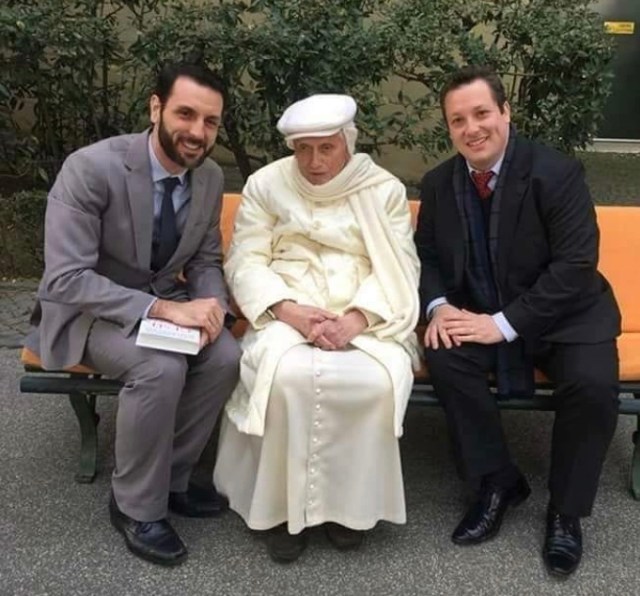
Pray for Pope Benedict xvi

IMG_1860

Posted in Uncategorized | 3 Comments

HERE IS YOUR LITTLE DOSE OF SATIRE TO HELP YOU COPE WITH FATHER ANTONIO SPADARO WHO, UNLIKE JESUS, HAS A RECORDER

Eccles and Bosco is saved


The Pope praises the Eccles blog

Posted: 17 Feb 2018 02:28 AM PST

In some conversations in Chile, faithfully transcribed by Fr Antonio Spadaro, Pope Francis has lavished praise on this, the Eccles blog.”So many Catholic blogs faithfully record everything I say or do,” explained the Holy Father, “and this leads readers to conclude that I am a heretic. On the other hand, there isn’t a word of truth in Eccles’s lovely blog, from beginning to end. Therefore readers of it do not question my orthodoxy, my sanity, or my fitness for the role of Deputy God and Corrector of Catholic Teaching.”

Fr Spadaro catches up on “Eccles”.

“As for the other blogs,” continued the Pope, “I don’t even read them. I’m too busy not reading letters from Cardinal Burke, and from people in Chile. It takes me several hours every day to not read anything that comes my way. My loyal sidekick Spadaro, the Jeeves to my Wooster, the Robin to my Batman, and the Fool to my King Lear, does all my reading for me, don’t you, Boy Wonder?”

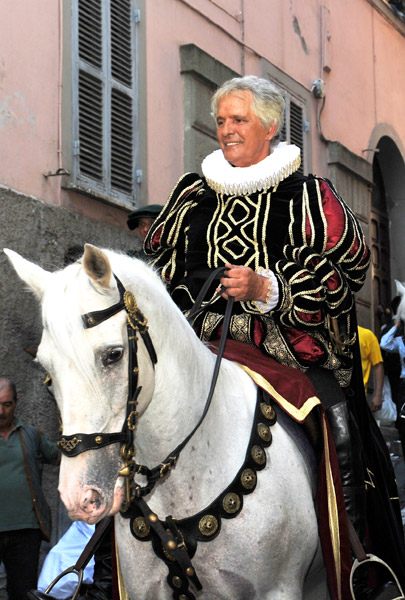
“As for that book by Marcantonio Colonna – and we know who you are, it didn’t take us long to spot someone riding round Rome in a 16th century costume – well, I haven’t read that at all. But I can assure you that it is false from beginning to end, especially the bit about my being caught in General Galtieri’s wardrobe dressed as a nun. Or was it my being caught in a nun’s wardrobe dressed as General Galtieri? Anyway it never happened.”

Not the best way to be inconspicuous in Rome.

“Reading Eccles’s blog, on the other hand, has kept me sane. It is full of spiritually nourishing advice, and many of the ideas he comes up with provide inspiration for my own policies. I ask myself ‘WWED’ – ‘What Would Eccles Do?’ and then try to take it even further.”

“Well, that’s all I’ve got time for now, I need to go out and insult a few more Catholics. Luckily Eccles has drawn my attention to a fine 19th century list, which includes terms such as ‘goldfish-catcher’, ‘turnip shepherd’ and ‘proprietor of midgets’. I must try and work these into my next homily.”

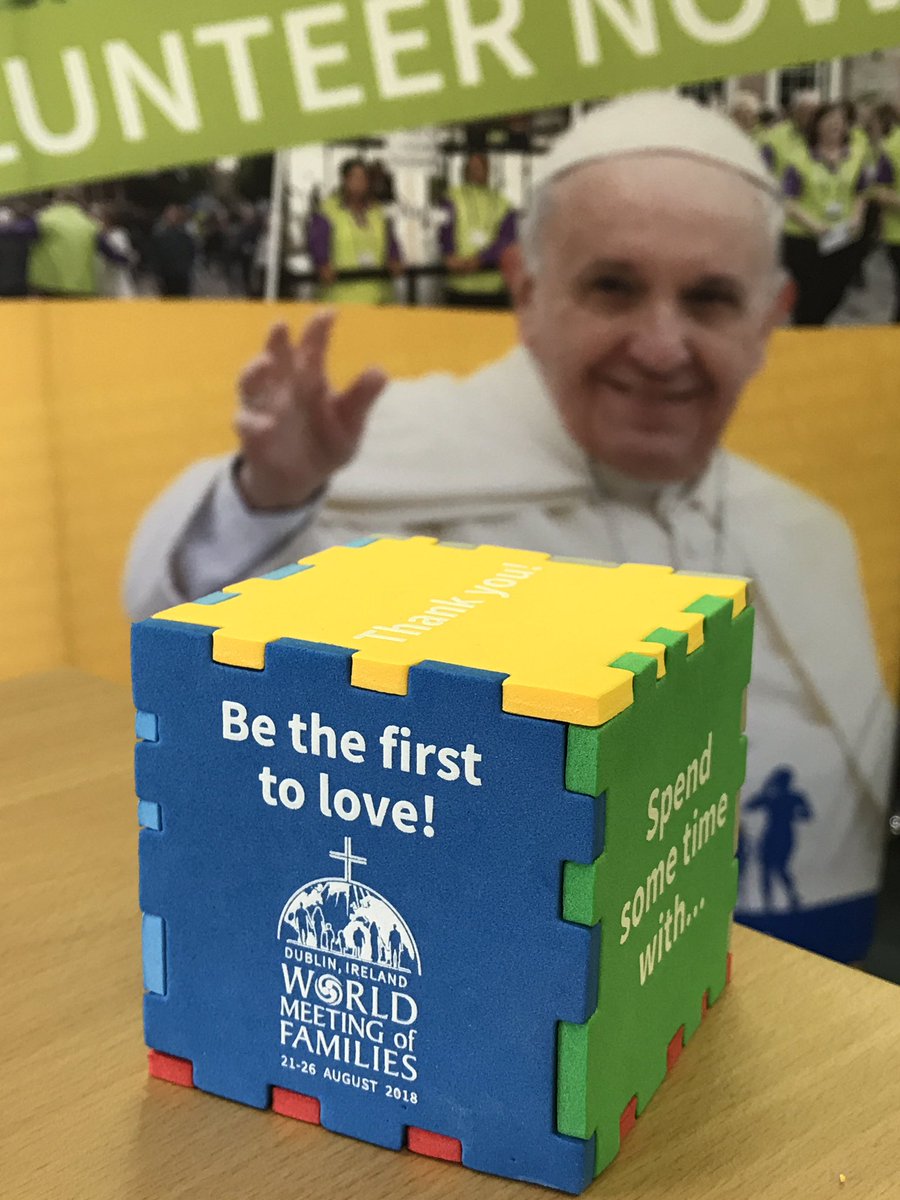
The Amoris Cube – an Eccles invention – is harder to solve than the Rubik cube.

Posted in Uncategorized | 2 Comments

How a parish group dedicated to the Eucharist helped revive a London church

The Sodality of the Blessed Sacrament now has hundreds of members across the world

A teacher friend of mine recently said, when talking to one of his students about the Reformation, “What do you know already?” He was expecting answers about Henry VIII wanting to get divorced, or the Catholic Church being so wealthy at the expense of the faithful. But he was greeted with an in-depth explanation of how indulgences and transubstantiation work. The student, unprompted, commented: “Transubstantiation, for Catholics, means that God is always in the same room as them.”

You may think that this was a child from a devoutly Catholic family, receiving a Catholic education. But this boy is at a secular school and comes from a Muslim household. Yet here, in one sentence, was an observation of an important reality: God comes down from heaven to be with us truly and really.

How many of us consider this reality when we go to church? To some extent, going to Mass can become like brushing our teeth: we do it every day and it becomes part of our routine, but we don’t necessarily consciously think about it each time. The same can be true of the Blessed Sacrament: Our Blessed Saviour is there in every tabernacle, and we see that small white Host being elevated during Mass. But do we always recognise that this truly is Christ, body and blood, soul and divinity, coming down from heaven and being fully present in our midst? Do we realise that Jesus is with us?

We have had cause to think about this more deeply, working on the restoration of Corpus Christi, Maiden Lane, in Covent Garden. This is a church that was beginning to show the wear of time and looking tired and distressed. It was a far cry from the bright lights of the theatres surrounding it.

A parishioner commented that, in stripping away the grubby whitewash, she first realised how bad it had become. For the first time in many years, people began to discover London’s hidden gem that has the Blessed Sacrament as its focus and heart. The eyes are immediately drawn to the great tabernacle, adorned by three thurible-bearing angels. The sanctuary walls have been lovingly gilded so that the entire Sanctuary appears to be the heart of a tabernacle, and the dark blue of the ceiling is adorned with stars, reminding us that our worship at Mass unites with the worship of the cosmos as our hearts are lifted to heaven.

The restoration of the building was only one part of the revival of Corpus Christi. The entire project would be meaningless without a spiritual anchor; for us, this most naturally is a confraternity dedicated to worshipping and honouring this greatest of sacraments and helping to catechise the faithful more about our Eucharistic Lord. Thus, in October 2016 the Sodality of the Blessed Sacrament was founded as a means to bring Catholics together in a particular way around a common focus.

The inspiration was twofold. When Fr Henry Manning, later Cardinal Manning, built the church of St Mary of the Angels in Bayswater, he constructed the two adjoining schools before the church. By the time the church was ready to open, he had a flourishing resident Catholic population. Let us also remember that Cardinal Manning opened this church with a very particular vision in mind, ie that of a “shrine of the Blessed Sacrament in the heart of London”.

The inspiring writings of Mgr Ronald Knox, who preached at the Forty Hours’ Devotion at Corpus Christi for 30 years, and whose homilies were collected in the book Window in the Wall, helped to pull our vision together. The homilies from our Sodality Masses are likewise collected in a monthly newsletter, and sent out to all members together with the writings of saints and popes, so that even those who cannot be present at the Masses can join in with the work and prayers of the Sodality. A monstrance lapel pin is also sent out to all members.

Since the Sodality was established, it has grown to several hundred members from all over the world, with bishops, priests, Religious, seminarians and laity as members. On the first Thursday of the month at 6:30pm there is a Sung Mass at which different priests preach on various aspects of the Blessed Sacrament. This is followed by a period of Adoration and Benediction.

Members honour the Blessed Sacrament in a particular way, pray for one another and have helped to raise the funds to buy a processional canopy so that, when Cardinal Vincent Nichols comes to “re-open” the restored church on June 3, we will be able to have a Eucharistic procession around Covent Garden.

Pope Benedict XVI once commented that “without the Eucharist the Church quite simply would not exist.” The Adoremus Eucharistic Congress taking place in Liverpool in September will highlight the importance of this reality. Why not join the Sodality today as part of your preparation for this most important occasion, and unite your prayers with those of Catholics around the world?

Fr Alan Robinson is parish priest of Corpus Christi, Maiden Lane. The next Sodality Mass there is on Thursday March 1 at 6:30pm. To apply for membership and find out more about the Sodality, visit sodality.co.uk


Posted in Uncategorized | 1 Comment

A CATHOLIC PRAYER TO JESUS CHRIST HEALER


A CATHOLIC PRAYER to
JESUS CHRIST HEALER

Lord Jesus Christ, our sole Redeemer!

Only Begotten Son of the Eternal Creator Father,

From and through Whom proceeds the

Eternal Sanctifier and Giver of Life, the

Holy Spirit, by Whom You did become

Man of the immaculately redeemed flesh of the

Blessed Virgin Mary,

Your most holy Mother;

True God and True Man!

Have mercy on me

and heal me!


Dr. Michael B. Ewbank


Posted in Uncategorized | 2 Comments

MARY, OUR MOTHER

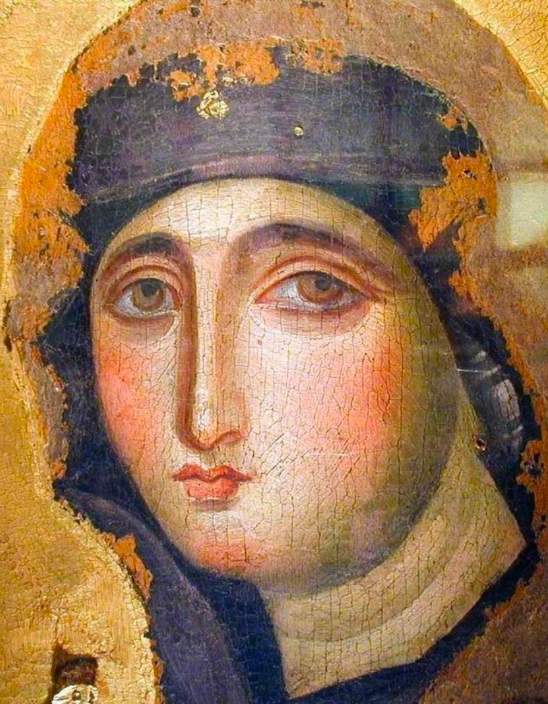
Perhaps the First Image of Mary Painted by St. Luke
RECLAIMING BEAUTY IN THE EVERYDAY

Why Mary Is the Best Promoter of Culture

“A Mother’s arms are more comforting than anyone else’s.” – Princess Diana

 By Carrie Gress

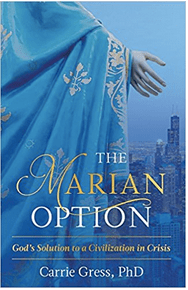
In my book, The Marian Option: God’s Solution to a Civilization in Crisis, I spent a lot of time talking about how Mary is a unique driver of culture. The insight was certainly not my own, but hails from some unlikely places. The first is from Henry Adams (1838-1918), grandson of President John Quincy Adams, and great-grandson of Founding Father and President John Adams.

In the early 1900s, Adams, a Protestant who had spent much time living in Europe, wrote about the extreme power wielded by the Virgin Mary:

The twelfth and thirteenth centuries were a period when men were at their strongest; never before or since have they shown equal energy in such varied directions, or such intelligence in the direction of their energy; yet these marvels of history – these Plantegenets [a dynastic family of kings]; these Scholastic philosophers; these architects of Rheims and Amiens; these Innocents, and Robin Hoods, and Marco Polos; these crusaders who planted their enormous fortresses all over the Levant; these monks who made the wastes and barrens yield harvest – all, without apparent expedition, bowed down before the woman.

Screen Shot 2017-06-15 at 8.13.43 PM.png

What Adams recognized over a century ago as he walked through the cities, churches, cathedrals, and cemeteries, was that the height of European culture was centered around devotion to Our Lady. In the places where European culture soared, so too did devotion to Our Lady, and perhaps vice versa, where devotion to Mary soared, so too did culture.

Mary As Masterpiece

Decades later, art historian Sir Kenneth Clark stated that there is something unusual about the feminine element in religion and culture. Sir Clark says, “The all-male religions (a reference to Israel, Islam, and the Protestant North)  have produced no religious imagery—in most cases have positively forbidden it. The great religious art of the world is deeply involved in the female principle.” Mary certainly offers that feminine principle.

Mariologist Fr. Johann Roten offers a theological explanation for Mary’s cultural influence. “As masterpiece, Mary is a direct reference to the divine artifex: she is part of the creative manifestation of God’s marvelous deeds.” He continues, “Mary’s beauty is beauty of promise and hope.” Marian culture is then an extension of Mary’s virtues. It isn’t art for arts sake, or beauty for the sake of beauty, but like Mary herself, points to something, or in this case, someone, beyond herself. To see the material elements of Marian culture, such as art, music, architecture, and literature, the viewer doesn’t simply bask in its beauty or cleverness for its own sake, but enters into Christ’s story.

And even Fulton Sheen observed that Mary’s influence stems from her role as a woman to edify men. He wrote, “When man loves a woman, it follows that the nobler the woman, the nobler the love; the higher the demands made by the woman, the more worthy a man must be. That is why woman is the measure of the level of our civilization.” When men love the most noble of women, the bar of culture is raised to new heights.

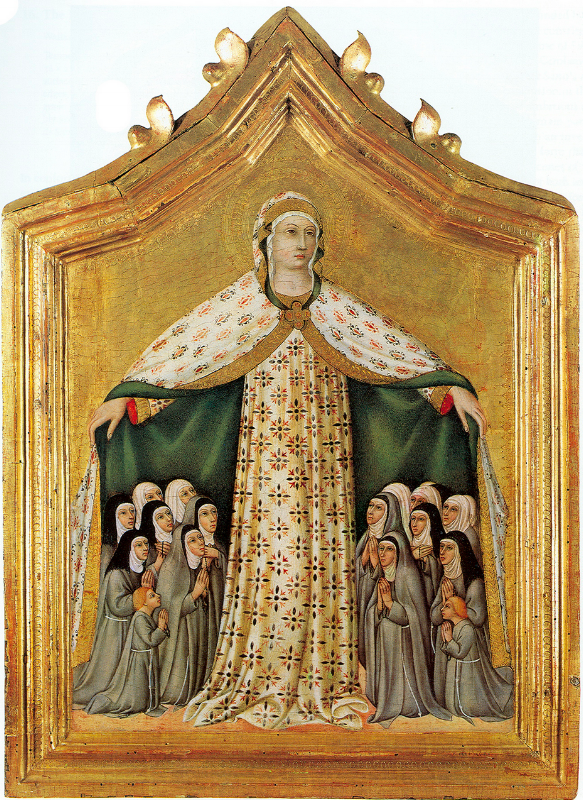
Virgin of Mercy, Sano di Pietro, 15th century;
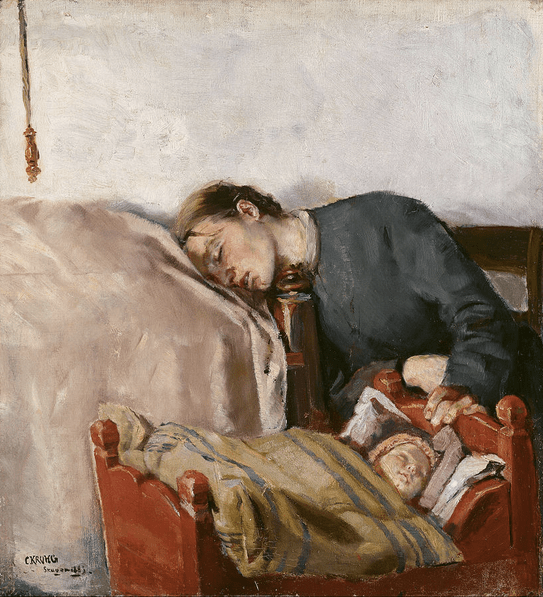
Mother and Child, 1183, Christian Krohg, National Gallery, Norway

Mother and Child, 1183, Christian Krohg, National Gallery, Norway

Science continues to inform us about the role of bonding between a mother and child, particularly at birth. The imprinting that happens between the two starts early in the the womb. Remarkable details have emerged, such as the data that says that the child knows the mother’s scent before birth from the amniotic fluid. Hormones like oxytocin are released during physical contact, provide an abundance of peace and other feelings of well-being. This certainly doesn’t end with infancy. But all of this physical mothering has to have greater perfection in its spiritual form when it comes from the perfect mother, Our Perfect Mother.

There is new research emerging about the most successful business cultures. The book The Culture Code by Daniel Coyle reports that the companies with the most successful cultures live with a sense of family – where human contact and connecting, a future together, and safety and care all play a role. Surpassing even intelligence levels of employees, these familial things are hallmarks of successful organizations.

It is interesting to look at how the Church has operated for centuries by living out this extended family concept long before it was “a thing.” Companies like Google and Twitter actually call their employees “googlers” or “tweeps” giving them something of a family name. Similarly, the Church has names like Benedictines, Augustinians, Franciscans, Dominicans, and Carmelites, that have also had successful cultures that have lasted centuries and centuries. Additionally, individual members are called brother, sister, father, mother within these orders, further solidifying the family ethos.

But Christ and the Church in their wisdom saw to it to also give us a Mother so we would not be left orphans. At the heart of every family is a mother. And it is from the mother that culture can and does flow — because she brings order, connection between members, a deep sense of belonging, and the safety that comes from just being held. Mary, as the perfect mother, wants to be all of this. And in those times and places when she has been at the center of a culture – the true mother of the family — those places have flourished.

As for those places where she is forgotten Pope Pius X tells us what happens. “If we were to lose Mary, the world would wholly decay. Virtue would disappear, especially holy purity and virginity, connubial love and fidelity. The mystical river through which God’s graces flow to us would dry up. The brightest star would disappear from heaven, and darkness would take its place.”

IMG_2659.JPG

ABOUT CARRIE GRESS

Prior to my life as mother and author, I traveled extensively and lived in France, Rome, and Poland. One of my first articles was about a high-end hotel in heart Krakow, Poland, written for a travel industry magazine.

I have always found it exhilarating to explore the foreign, but particularly countries that boast a Christian past – and even better if they have a Christian future. I’m intrigued to see how Christ and his Mother, the saints and religious symbols, are included into the fabric of everyday – from the simple, such as Christmas ornaments and holy cards, to the elaborate, in soaring architecture and priceless paintings.

Having spent years studying the philosophical side of beauty, there is no reason why we can’t reclaim beauty in our every day lives and let go of the kitsch that is so prevalent in Catholic art and objects.

Not everything here is overtly Catholic, but everything will have something that can reach a Catholic soul. This is the true capacity of beauty – it is the breathe of God. All true beauty comes from him, so whatever captures you, renews your sense of wonder, fills you with awe, enlivens your heart, or helps quiet your soul with peace, has its source in Our Lord.

Posted in Uncategorized | 3 Comments

THE PRESSURE FROM PROGRESSIVES, WHO ARE IN REALITY LEFT-WING TOTALITARIANS, MUST BE RESISTED EVEN THOUGH LIKE HANS AND SOPHIE SCHOLL IT MAY MEAN MARTYRDOM

Hans Scholl and his sister Sophie, with their friend Christoph Probst, in 1943


How Newman inspired the German resistance

It is 75 years since anti-Nazi demonstrators took the action which would lead to their executions

Seventy-five years ago, on February 18, 1943, Hans Scholl and his sister Sophie were caught distributing anti-Nazi leaflets in Munich University. Five days later they were tried and executed for high treason on Hitler’s direct orders. The Scholls belonged to a group of students who, using the nom de guerre of the White Rose, spoke out against National Socialism and circulated thousands of leaflets telling Germans of their moral duty to resist Hitler and his “atheistic war machine”. They also condemned the persecution of Jews in the year when Hitler began to implement the Final Solution – and were among the few to speak publicly of the Holocaust while it was taking place.

The Scholls and their friends are household names in Germany. Sophie has nearly 200 schools named after her; she was dubbed the greatest German woman of all time by a popular television series called Greatest Germans, and the film Sophie Scholl: The Final Days (2005) was nominated for an Oscar in the category Best Foreign Language Film.

After the conspirators of the failed July 20, 1944 attempt on Hitler’s life, the White Rose students are the best-known example of Germans who sought to resist the Nazis. That there were so few similar deeds shows just how difficult and dangerous resistance was, and how successful Nazi tactics had been in desensitising consciences and eliminating whatever stood in their way. Even the effort to maintain some form of inner or passive resistance required great determination.

Perhaps surprisingly, both Hans and Sophie were initially enthusiastic members of the Hitler Youth, and even became group leaders. But they were disillusioned by their experiences, and began to oppose virulently every manifestation of Nazism. In search of meaning for their lives, they discovered in Christian writers, ancient and modern, answers to their deepest longings. From their letters and diaries we know that they were strongly influenced by St Augustine’s Confessions, Pascal’s Pensées and George Bernanos’s Diary of a Country Priest. Now it has become clear that their lives were also shaped by the writings of Blessed John Henry Newman.

The man who brought Newman’s writings to the attention of the Munich students was the philosopher and cultural historian Theodor Haecker. Haecker had become a Catholic after translating Newman’s Grammar of Assent in 1921, and for the rest of his life Newman was his guiding star. He translated seven of Newman’s works, and on several occasions read excerpts from them at the illegal secret meetings Hans Scholl convened for his friends. Strange though it may seem, the insights of the Oxford academic were ideally suited to help these students make sense of the catastrophe they were living through.

Haecker’s influence is evident already in the first three White Rose leaflets, but his becomes the dominant voice in the fourth: this leaflet, written the day after Haecker had read the students some powerful Newman sermons, finishes with the words: “We will not be silent. We are your bad conscience. The White Rose will not leave you in peace! Please read and distribute!”

When Sophie’s boyfriend, a Luftwaffe officer called Fritz Hartnagel, was deployed to the Eastern Front in May 1942, Sophie’s parting gift was two volumes of Newman’s sermons. After witnessing the carnage in Russia, Fritz wrote to Sophie to say that reading Newman’s words in such an awful place was like tasting “drops of precious wine”.

In another letter, Fritz wrote: “We know by whom we were created, and that we stand in a relationship of moral obligation to our creator. Conscience gives us the capacity to distinguish between good and evil.” These words were taken almost verbatim from a famous sermon of Newman’s called “The Testimony of Conscience”. In it, Newman explains that conscience is an echo of the voice of God enlightening each person to moral truth in specific situations. All of us, he argues, have a duty to obey a right conscience over and above all other considerations.

At the White Rose trial, Sophie said that it was her Christian conscience that had compelled her to oppose the Nazi regime non-violently. The same was true for Hans: he, like his sister, had found in Newman and other Christian writers the resources and inspiration to make sense of the brutal and demonic world around him.

Fritz Hartnagel was evacuated from Stalingrad just before the German army surrendered. In his last letter to Sophie. he laments the loss of the two volumes of Newman sermons she had given him – not knowing that Sophie was already dead when he was writing. When Fritz visited Sophie’s parents, he gave them a collection of Newman sermons translated by Theodor Haecker. Haecker himself also visited the Scholls, and signed the visitor’s book with Newman’s own motto, Cor ad cor loquitur (“Heart speaks to heart”).

Paul Shrimpton’s Conscience Before Conformity: Hans and Sophie Scholl and the White Rose resistance in Nazi Germany (2018) is published by Gracewing and will be available in early March

Posted in Uncategorized | 2 Comments

ARE YOU SLEEPING IN THE GARDEN LIKE THE APOSTLES ? WAKE UP ! THAT IS WHAT LENT IS ALL ABOUT. WAKE UP!


An engineer in Alexandria named Ctesibius is said to have invented the pipe organ around 265 B.C., originally an “hydraulis” using water to raise air pressure. Although there was a “water organ” in the narthex of Hagia Sophia in Constantinople for heralding the Emperor, one theory holds that organs are not commonly used in the Byzantine rite because they are reminders of the horrors endured by the holy martyrs as pagan entertainment. There were many places in the various circuses and amphitheaters throughout the Empire where these spectacles took place. Possibly the first to be sentenced to the damnatio ad bestias, or being fed to wild beasts, in the Flavian amphitheater of the Colosseum of Rome, was Ignatius, bishop of Antioch.

On February 24, that Colosseum will be floodlit red, along with churches in Syria and Iraq, to publicize the persecution of Christians in our own day. The sponsoring organization, Aid to the Church in Need, reports that in a dozen countries, conspicuously in Egypt and Turkey, anti-Christian persecution has reached a new peak. The situation has worsened in Nepal since new “blasphemy” laws were introduced. While crowds applaud the Winter Olympics in Pyeongchang to the sound of music, around 70,000 Christians are languishing in North Korean labor camps. There is a faint echo here of the 1936 Summer Olympics in Berlin, but at least they had Jesse Owens.

Floodlighting may be one vivid way to awaken the attention of people in more comfortable lands to what is happening. Much of our media, as they either willfully or uncomprehendingly ignore the persecution, are like the idols that “have mouths but cannot speak; eyes, but cannot see; ears, but cannot hear” (Psalm 115:5-6). Looking the other way can become a habit. For instance, much of the world ignored the deportations by the Nazis in 1942 from Lyons, France, when those marked for death were herded into the same Colosseum where the saints Blandina, Ponthinius, Epidodius and Alexander were brutalized in the second century.

The modest abstinences and disciplines of Lent should awaken the senses to perceive things of God more clearly. They can also alert somnolent consciences to harsh realities in other parts of the Church. In Holy Week the Church will remember how Christ awakened the three apostles as they slept through his agony. Pascal said, “Jesus will be in agony until the end of the world.” It was the triumphant risen Lord who asked Paul, “Why are you persecuting me?”—for heaven does not ignore earth: “… to the extent that you did it to one of these brothers of mine, even the least of them, you did it to me” (Matthew 25:40). The Resurrection acclamation, “Christus vincit! Christus regnat! Christus imperat! – Christ conquers! Christ reigns! Christ commands!” was inscribed on the obelisk that is now in St. Peter’s Square, but that once stood in the Circus of Nero and cast its shadow on the suffering martyrs.

Father George W. Rutler

Posted in Uncategorized | 1 Comment

The 90th Academy Awards ceremony, presented by the Academy of Motion Picture Arts and Sciences, will honor the best films of 2017 and will take place at 5:00 p.m. PST on March 4, 2018. If you plan to watch it prepare yourself by reading and absorbing this post.

Thespian, Throw Away the Mask!

From the Fathers of the Church to Benedict XVI, the Christian critique of the society of the spectacle. The new risks of the digital age. How to exalt or destroy a person by image manipulation

by Sandro Magister


ROME, February 20, 2011 – Benedict XVI’s message for the world day of communications, published on the feast day of the patron saint of journalists, Saint Francis de Sales, has called attention back to a very timely question, made even more pressing by recent national and international events.

It is the question of respect for the “truth” of facts and of persons, in the flurry of communications. A truth already difficult to grasp in direct, face-to-face relationships among men – where the authentic is often masked by the representation of himself that each tends to give – but which is in even greater danger when it is filtered by the media and even more by the internet, where the possibility for anyone to mold one or more identities to his own pleasure is expanded to the extreme.

The popular uprising that for weeks has invaded the streets of various Muslim countries of northern Africa and of the Middle East was ignited and spread to a large extent over the internet. But this very fact makes comprehension of it more difficult, and its political outcome more uncertain. In the world of the virtual, the boundary between reality and artifice is more elusive than ever.

In Italy, a vicious power struggle has been underway for months that is also marked by these ambiguities. With its epicenter the libertine private life of a prime minister, Silvio Berlusconi, who is at the same time a television magnate. And with blunt instruments that are in turn part of a “reality show” – not televised, but played out in society itself – in which truth and lie, reality and fiction, public and private, real persons and “personae” in the Latin sense of disguise mix together in an inextricable tangle.

In commenting authoritatively last January 24 on these events, Cardinal Angelo Bagnasco, president of the Italian episcopal conference, expressed the “dismay” that overtakes someone who amid such mayhem “looks at the actors of the public stage.”

The metaphor of the theater is more appropriate than ever. Because the dangers of a “society of the spectacle” are not only of today, much less do they belong to the virtual world alone, but they accompany the entire history of man, whose life is always theater as well.

*

In fact, ancient Christianity also considered the theater a theme of strong critical reflection. And many Fathers of the Church, including Augustine, wrote significant things about it, which when reread today are startling for their timeliness.

A specialist on the literature of the Fathers, Professor Leonardo Lugaresi, who teaches in Bologna and Paris, published in “L’Osservatore Romano” last February 16 a systematic summary of the criticisms that ancient Christianity made against the society of the spectacle.

Lugaresi maintains that “the fundamental question is always the same: that of the authenticity of human experience, which is ultimately that of identity.”

Benedict XVI, in his message for the world day of communications, insists on the same concept, when he urges acceptance of “the challenge to be authentic and faithful, and not give in to the illusion of constructing an artificial public profile for oneself.”

A call that also applies against the diabolical temptation – of the devil as “simulator” – to fabricate false images not only of oneself but of others, whether to exalt or to destroy.

One glaring case of the destruction of a person through falsified images of him was the one that hit Dino Boffo two years ago, when he was the director of the newspaper of the Italian episcopal conference, “Avvenire.” He was not rehabilitated until many months later, with his appointment as program director of TV2000, the television channel owned by the CEI.

That attack was conducted by multiple actors, and on multiple terrains: media, political, ecclesiastical. Even the pope was wrongfully dragged onstage. The game of fabrication was such that even today some aspects of that episode remain obscure, while the substance was summarized by http://www.chiesa in this article:

> Italy, United States, Brazil. From the Vatican to the Conquest of the World
(11.2.2010)

*

In recent days, in Italy but also abroad here and there, another festival of illusions were the demonstrations held in many squares “in defense of the dignity of women,” against the libertine private life of prime minister Berlusconi.

There the language reached exaggerated heights of mystification. To such an extent that the sincere and wise words that some personalities and segments of the Catholic world itself believed needed to be said in the street and to the street were also bent immediately in false directions.

“The Presentation of Self in Everyday Life,” as Erving Goffman entitled one of his famous books.

Benedict XVI, with his message for the world day of communications, is reminding everyone that the public “representation” of oneself and of others, real and virtual, should be faithful to the truth.

But here is the illuminating article published by Professor Lugaresi in “L’Osservatore Romano” of February 16, 2011.

____________


THE FATHERS OF THE CHURCH BETWEEN THEATER AND INTERNET

by Leonardo Lugaresi

Benedict XVI’s message for the world day of social communications, made public on January 24, draws our attention to the problems posed by certain “limits typical of digital communication: the one-sidedness of the interaction, the tendency to communicate only some parts of one’s interior world, the risk of constructing a false image of oneself, which can become a form of self-indulgence.” […]

It is interesting to note that the pope’s reminder, although it refers to a completely new phenomenon, presents significant similarities with an ancient question on which the critical reflection of the Fathers of the Church was exercised in a masterful way, and from which it could therefore be useful to take some cues, for a deeper understanding of this teaching of Benedict XVI.

The Fathers obviously did not know about the internet, but the “virtual world” with which they had to come to terms was for them was constituted – in a “society of the spectacle” as Greco-Roman society of the imperial age was to a large extent – by the dimension of the “ludus,” meaning scenic representation, and more broadly that theatricality which invaded so many aspects of civil life in late antiquity, even outside of the walls of the theaters, amphitheaters, and circuses, and of the numerous festivities of the calendar.

The condemnation of spectacles, so decisive and without ambiguity in the ancient Church, is not in fact motivated in the last instance by their idolatrous or immoral contents, as is so often repeated, but by deep concern about the threat that Tertullian, in his “De spectaculis,” calls the “ratio veritatis,” the criterion of truth.

The reality of spectacles, in fact, presented itself to the eyes of the Fathers as a profoundly ambivalent one, in which true and false were mixed up, to the point of bringing into crisis the very validity of such an opposition. Suffice it to think of the fact that the actor, in the act of interpreting a character, is “true” precisely in his being “false,” in that he is, and at the same time is not, the character he represents.

His ability to transform himself, surpassing all the “normal” limits posed by distinctions of age, gender, “status,” by which the same individual can be, depending on the moment, man or woman, king or slave, thus appears as a  dangerous threat to the natural identity of man: as if the pluriform shadow of Proteus had risen up to obscure the face of Adam.

The theme of the critique of the ambivalence of representation is of Platonic origin, but saw a decisive development in Christianity. The identity that is threatened, in fact, is felt as a creatural identity, in that in the nature of each human being is reflected the original image that God imprinted there.

Patristic thought therefore recognizes, in this overturning of natural reality performed by the “fictio” of spectacle and in the construction of pseudorealities more capable of raising passions and emotions in the spectators the more devoid they are of ontological  substance, the hand of the devil, meaning the one who by definition is the “evil imitator” of God, the “simia Dei” who, incapable of creating, can only adulterate the nature created by God. In this regard, Tertullian speaks explicitly of the devil as “aemulator” and “interpolator” of the divine work.

When the pope raises frankly the question of the authenticity of friendship in the virtual world one hears, in his words, the echo of a profound patristic reflection.

In a famous page of the “Confessions” (3,2), Augustine, recalling his youthful experience as an impassioned theatergoer, pointedly notes how the spectators like to suffer by contemplating on the stage painful and tragic events which should prompt compassion if they were encountered in real life, and asks himself, “But what kind of compassion is it that arises from viewing fictitious and unreal sufferings? The spectator is not expected to aid the sufferer but merely to grieve for him. And the more he grieves the more he applauds the actor of these fictions.”

This passage deserves extensive exegesis, but the essential point is very clear:  for Augustine, a truly human relationship is realized only where there is responsibility. The other, in the moment in which I encounter him, makes me in some way responsible, in the sense clarified perfectly by the parable of the good Samaritan with which Jesus responds to the same question that Benedict XVI, not by accident, proposes to us again in reference to the virtual world: “Who is my neighbor?”

The relationship of neighbor, which is the only truly human one, always implies the element of responsibility, in the sense that the other makes a claim on me with his very existence, he constitutes for me a challenge to which I must respond.

Augustine denies precisely that this could happen in the pseudo-relationship between the spectator and the actor, and of course we cannot help but agree with him if we apply his analysis to television, the medium par excellence that puts us in a position of “false closeness” with reality, where we see everything, but as completely passive and exonerated spectators.

The internet, it is said, is something else, and indeed it is precisely its accessible and widespread interaction, with the possibility for each user to be an active subject in the communications network into which he is inserted, that seems to be its most innovative and seductive characteristic.

There is, however, an indispensable condition for this to take place, and it is commitment to the truth and with the truth. “The truth of Christ,” the pope reminds us, “is the full and authentic response to that human desire for relationship, communion and meaning which is reflected in the immense popularity of social networks.”

But commitment with the truth demands continuity of attention, concreteness, concentration on what is essential. Here another factor of ambivalence typical of the virtual world enters into play.

The enormous multiplicity of points of interest, of opportunities, of the attractions and the extraordinary facility of the connections that can be established with the most diverse camps of human experience – in a dimension that seems to nullify the obstacles posed by time and space in the real world – is indeed a great resource, but also a very powerful stimulus to distraction, even the dispersion of the ego from “inside” to “outside” of itself (according to a psychological dynamic that is very well known to every navigator of the web, when he realizes that he has lost precious hours going from link to link, but that perhaps was never as lucidly analyzed as it was by Augustine).

It is that illness of the spirit which ancient thought had diagnosed as “polypragmosyne,” “curiositas,” and on which – in the context of the controversy over spectacles – the Fathers also said memorable things. Suffice it to remember the pregnant formula with which Tertullian, in the “De praescriptione haereticorum” (7, 12), indicates the novelty of the Christian position: “Nobis curiositate opus non est post Christum Iesum nec inquisitione post evangelium.” After the encounter with the good news that is Christ Jesus, there is no more room for “curiositas,” nor do we need Google anymore to know who we are.

The ancient Christian condemnation of the theater certainly cannot be proposed again today, much less does the Church want to distance itself from the internet, at which it looks instead with sincere appreciation.

But some of the reasons with which the Fathers, with great power of thought, upheld that judgment deserve to be the object of our reflection even today, to help us to embody that “Christian style of presence also in the digital world” that the pope desires.

____________

The complete text of Benedict XVI’s message for the world day of communications of June 5, 2011:

> Truth, Proclamation and Authenticity of Life in the Digital Age

In regard to the demonstrations on January 14 in Italy, the different views of the editorialist of the CEI newspaper “Avvenire,” Marina Corradi, and of the director of the same newspaper, Marco Tarquinio, placed side-by-side on the front page of the edition of the day before:

> Corradi: Io non ci andrò, e rifletto

> Tarquinio: Io ci andrei, per poter dire

And Tarquinio’s response to the readers, after the demonstration:

> Ascoltare, capire, esser chiari

__________

English translation by Matthew Sherry, Ballwin, Missouri, U.S.A.

Posted in Uncategorized | Comments Off on The 90th Academy Awards ceremony, presented by the Academy of Motion Picture Arts and Sciences, will honor the best films of 2017 and will take place at 5:00 p.m. PST on March 4, 2018. If you plan to watch it prepare yourself by reading and absorbing this post.

POPE BENEDICT IN 2010 REVEALED TO US THE NEW IDOLS WITH WHICH MODERNISM WOULD TEMPT US AWAY FROM JESUS CHRIST AND HIS CHURCH


The New Polytheism and its Tempter Idols

Benedict XVI sounds the alarm. Forgetfulness of the one God clears the way for a world dominated by a plurality of new gods with seductive faces. A voyage among the devotees of modern paganism
by Sandro Magister

{ABYSSUM}

ROME, December 9, 2010 – “Polytheism”: this word echoed like thunder, last October, in a speech by Benedict XVI at the synod of the bishops of the Middle East, the very birthplace of the one God made man, Jesus, and of the most powerful forms of monotheism in history, Judaism and Islam.

“Credo in unum Deum” is the mighty chord that gives rise to Christian doctrine. But for Joseph Ratzinger, pope theologian, polytheism is anything but dead. It is the perennial challenge that still rises up today against faith in the one God.

“Let us remember all the great powers of the history of today,” the pope continued at the synod. Anonymous capital, terrorist violence, drugs, the tyranny of public opinion are the modern divinities that enslave man. They must fall. They must be made to fall. The downfall of the gods is the imperative of yesterday, today, and always for believers in the one true God.

But today’s polytheism is not made up only of dark powers. Its many gods also have friendly faces, and the ability to seduce.

It is the “gay science” prophesied by Nietzsche more than a century ago, which offers every single man “the greatest advantage”: that of “setting up his own ideal and deriving from it his law, his joys, and his rights.”

It is the triumph of the individual free will, without the yoke of a tablet of the law anymore, only one for everyone because it is written by just one intractable God.

That admiration for the “Genius of Christianity” which had inflamed Chateaubriand and the Romantics is today giving up ground to an enthusiastic rediscovery of the “Genius of paganism,” the title of a book by the French anthropologist Marc Augé.

In Italy, another anthropologist, Francesco Remotti, is lashing out against “L’ossessione identitaria,” the title of his latest book, and reproaches the pope, in another of his books in letter form, for his stubborn proceeding “against nature,” against a modernity that instead offers the delights of polytheism, so fluid, pluralist, tolerant, liberating.

THE “SPIRIT OF ASSISI”

Of course, the current revival of polytheism is not bringing the cults of Jupiter and Juno, Venus and Mars, back into vogue. But the philosophy of the learned pagans of the Roman empire is again blossoming intact in the reasoning of many modern proponents of “weak thought.” And not only of these. Those who today reread, sixteen centuries later, the dispute between the monotheist Ambrose, the holy patron of Milan, and the polytheist Symmachus, a senator of pagan Rome, are strongly tempted to agree with the latter, when he says: “What does it matter by what path each one seeks, according to his own judgment, the truth? It is not by one road alone that one may reach such a great mystery.”

The magnanimous equality among all religions and gods that these words seem to inspire also enchants many Christians. The “spirit of Assisi” born from the multi-religious gathering held in 1986 has so infected common opinion that in 2000 the Church of John Paul II and of then cardinal Ratzinger felt the duty to remind Catholics that there is only one savior of humanity, and it is the God made man in Jesus: a truth on which the entire New Testament stands or falls, a truth that over two millennia the Church had never felt the need to reiterate with an “ad hoc” pronouncement. And yet, that declaration of 2000, “Dominus Iesus,” was greeted with a firestorm of protests, inside the Church and outside, because of its exclusion of a plurality of paths of salvation all sufficient in themselves and full of grace and truth.

That these sentiments might conceal nostalgia for a plurality of gods is possible, but today’s polytheism, on a mass level, is more subtle.

The current idea is that the various religions are in their way all an expression of a “divine.” And nonetheless this supreme divinity, as the pagan Symmachus explained to Ambrose, is unknowable and far away, too far away to impassion men and take care of them.

From a Latin writer of the third century, Minucius Felix, another dialogue has come down to us, highly refined, in which the pagan Caecilius, walking along the beach of Ostia, after paying homage to a statue of Serapis, explains that “in human things everything is doubtful, uncertain, undecided,” but precisely for this reason it is good to follow the religion of the ancients and adore “those gods whom our father taught us to fear, rather than to know too closely.”

In a homily in Saint Peter’s Square last June 11, Benedict XVI said that “Oddly, this kind of thinking re-emerged during the Enlightenment.” And in effect, a champion of the age of the Enlightenment like the nonbeliever Voltaire ordered his relatives and servants to pay homage to Christianity and its precepts, for reasons of civic good manners. God exists, maybe. And maybe he’s the one who created the world. But then he became so disinterested as to disappear from the horizon. His goodness lies entirely in causing no disturbance whatsoever.

And so, under the heaven of this vague and remote divinity, the earth has been populated with new gods. In secular and pragmatic clothes.

POLYTHEISM OF VALUES

Already in the nineteenth century, in his “Three Essays on Religion,” the economist and philosopher John Stuart Mill wrote that polytheism was much more functional than monotheism in describing that plurality of ethics that characterized the scenario of life in the first industrial society. And Max Weber, in the early twentieth century, coined the formula “Polytheismus der Werte,” polytheism of values, precisely to indicate the pantheon of modern society.

In a world that has become disenchanted, no longer with a single God who might proclaim commandments valid for all, each of the social spheres – from politics to the economy, from art to science to religion itself – is directed by its own god with his own oracles. Oracles often in conflict with each other, with man dramatically alone only in the hour of decision.

Weber, with the impeccable detachment of the scholar, did not say whether this modern polytheism was a good thing or a bad thing. But other thinkers who have come after him are no longer concealing where their sympathies lie.

In the second half of the twentieth century, to the “political theology of monotheism” promoted by Erik Peterson (one of the authors most read and admired by Joseph Ratzinger since he was a young professor), the German philosopher Odo Marquard counterposes a “political theology of polytheism,” and in the title of his essay praises this polytheism as “enlightened.” In his judgment, man always needs myths, and the important thing is that these myths be numerous and open to infinite variations, as in ancient mythology, unlike Judaism and Christianity, which rest on unique and incontrovertible historical events.

In Spain, the philosopher Maria Zambrano has criticized Christian spirituality’s asceticism of medieval origin, destructive of the sentiments. It is poetry, in her view, that can free man from “monolithism” and restore him to his joyous native polytheism.

In Italy, Salvatore Natoli is the philosopher who defends an “ethics of the finite,” meaning a collection of multiple “polytheistic” references that offer man points of support, never definitive but nonetheless always capable of saving him provisionally from the anarchy of his instincts.

Certainly, however, the work that has most instilled a reevaluation of polytheism in contemporary Italian culture is more literary than philosophical: it is “Le nozze di Cadmo e Armonia” by Roberto Calasso, from 1988, with its glorious evocation of classical mythology.

FOR A REENCHANTMENT OF THE WORLD

In spite of the “disenchantment of the world” described by Weber, in fact, modern society does not appear immune from the opposite seduction of a newly enchanted world.

Alain de Benoist, a thinker of the French “nouvelle droite,” is the most passionate promoter of this return to neopagan sacrality.

For the cultural current that he represents, the great enemy is precisely the Judeo-Christian perspective with its “desacralizing” idea of creation. If there is no other God apart from the one God, in fact, creatures no longer have anything divine about them, and even the stars, as the first page of Genesis says, are mere “lights” hung by the Creator from the vault of heaven to mark the day and the night. The world is definitively relegated to is profanity.

Leonardo Lugaresi, a professor in Bologna and Paris and a specialist on ancient Christianity, observes: “In the  accusation today that Christianity is responsible for the desacralization of the world, what is coming back into play, under new forms, is nothing other than the old accusation of atheism lodged against the Christians of the first centuries.”

And he adds: “As back then, so also for a certain neopagan mentality of today Christianity is harmful because it has taken away from the earth its enchantment, its gods, and has deprived man of a religious relationship with nature. As a result, the new paganism wants to heal the world of the ‘monotheistic rupture’, which means restoring to it the sacrality and divinity that Christianity has taken away.”

NOT JUST ANY SORT OF GOD

The formula “monotheistic rupture” refers back to the studies of a great Egyptologist, the German Jan Assmann, who studied in depth the revolutionary innovation introduced by the one God of the religion of Moses with respect to the polytheism of Egypt at the time. It is no surprise, therefore, that the publishing house il Mulino, in publishing this year ten essays assigned to as many authors on the ten commandments of the Mosaic decalogue, assigned to Assmann the commentary on “You shall have no other God.”

Assmann is not an apologist for polytheism. But he sees in Mosaic monotheism, since its emergence, an exclusive and intolerant opposition to the other religions. All of the forms of monotheism that have come to light in history, from Judaism to Christianity to Islam, bear within themselves, in his view, the poison of violence. And so he asks monotheism to move beyond its absolutes and “reach the transcendental point thanks to which true tolerance becomes possible,” which means elevating itself to the superior form of “religious wisdom” or of “deep religion” embodied by wise men like Albert Schweitzer, Mahatma Gandhi, and Rabindranath Tagore –  in short, elevating itself “to the eighteenth-century ideal of tolerance expressed by the Mason Lessing in the parable of the three rings, in the story of Nathan the wise.”

And what is this if not the religion without norms or dogmas of the Enlightenment, with its remote God? And for what can it make room, this vague religion, if not for a new and arbitrary polytheism?

Last September 13, in receiving the new German ambassador to the Holy See, Walter Jürgen Schmid, Benedict XVI raised his eyes from the written text and continued: “Generally many people show an inclination for more permissive religious concepts, also for themselves. A supreme, mysterious and indeterminate being who only has a hazy relationship with the personal life of the human person is succeeding the personal God of Christianity who reveals himself in the Bible. These conceptions are increasingly stimulating discussion in society, especially in the area of justice and legislation. Yet, if someone abandons the faith in a personal God, the alternative arises of a “god” that does not know, does not hear and does not speak; and, especially, of one that has no will. If God has no will of his own, in the end good and evil are no longer distinguishable; good and evil are no longer in contradiction but in an opposition in which the one would be a complement to the other. In this way human beings lose their moral and spiritual strength which is essential for the person’s overall development. Social action is increasingly dominated by private interests or the calculations of power, to the detriment of society.”

From these words it is even more clear why today, for Pope Benedict, “the supreme and fundamental priority” is that of reopening access to God for a disoriented humanity.

And “not just to any god, but the God who spoke on Sinai; to that God whose face we recognize in a love driven to the very end, in Jesus Christ, crucified and risen.”

(From “L’espresso” no. 50 of 2010).

____________

It is against this background that one must interpret Benedict XVI’s decisions to institute a new dicastery in the curia “for the new evangelization” and to dedicate to this same theme the synod of bishops in 2012, as also the initiative for dialogue with nonbelievers that he has called “court of the gentiles” and entrusted to his minister of culture, Cardinal Gianfranco Ravasi.

Among the recent speeches by Pope Benedict on God and polytheism, see in particular the meditation delivered at the synod of bishops for the Middle East on October 11, 2010:

> “It is the faith of the simple that knocks down false gods”

The speech addressed on September 13, 2010 to the new German ambassador to the Holy See:

> “Mr Ambassador…”

The homily of June 11, 2010, at the closing of the Year for Priests:

> “The Year of the Priest which…”

And the “lectio divina” given to the seminarians of Rome on February 12, 2010:

> “Every year it is a great joy to me…”

__________

English translation by Matthew Sherry, Ballwin, Missouri, U.S.A.
Posted in Uncategorized | Comments Off on POPE BENEDICT IN 2010 REVEALED TO US THE NEW IDOLS WITH WHICH MODERNISM WOULD TEMPT US AWAY FROM JESUS CHRIST AND HIS CHURCH

FOR THE REMANT TO BE A CREATIVE MINORITY IN TODAY’S CRISIS IT MUST IMITATE THE CHRISTIANS OF THE FIRST THREE CENTURIES

Settimo Cielo di Sandro Magister

How To Be a “Creative Minority” Today. The Example of the Christians of the First Three Centuries

Costantino


Dear Magister,

Your article on the “Benedict option” truly grasps one central question – “the” central question, I would say – of contemporary Christianity: how to live as Christians in a (now) non-Christian world.

This was also the problem of the Church of the first centuries: how to live as Christians in a (still) non-Christian world.

There is one factor that was very much present to the conscience of Christians back then, and instead today tends not to be recognized anymore, while it is decisive in the manner of confronting it: it is that of “krisis,” meaning the judgment that is capable of “bringing into crisis” the worldly culture, and of “chresis,” meaning the capacity to “use in the right way” that which this culture possesses but no longer knows how to use correctly.

The “Benedict option” overcomes the risk of becoming a self-ghettoization if – as I believe is in the author’s mind – it is armed with this strong “critical capacity,” which is the opposite of closure, and on the contrary is the true form of dialogue with the world that Christians, explicitly called be Christ to be the leaven, salt, and light of the world, can and must conduct.

Together with other scholars of the Church Fathers I have been working for a number of years on this theme of “krisis/chresis.”

Next autumn is supposed to see the publication, because of the interest we have taken in it, of the Italian translation of the fundamental work by Christian Gnilka, “Chresis. Die Methode der Kirchenväter im Umgang mit der Antiken Kultur,” Basel, 2012, to which we will also dedicate a conference in the spring of 2019, probably in Bologna.

Moreover, there has just come out, from the publishing house of the University of the Holy Cross, the proceedings of another conference we held in Bologna in 2016: A.M. Mazzanti-I. Vigorelli eds.), “Krisis e cambiamento in età tardoantica. Riflessi contemporanei”, Edusc, Rome, 2017.

In it is present a contribution of mine, which was in fact entitled: “‘Cottidie obsidemur.’ Living as Christians in a non-Christian world: the proposal of Tertullian.” I think that something will be found in it that is pertinent to the debate underway.

Thank you. With great cordiality and esteem,

Leonardo Lugaresi

*

Dear Professor Lugaresi,

It is I who thank you. And I offer to the readers of Settimo Cielo the following illuminating extract from the introductory part of your presentation.

Sandro Magister

*

LIVING AS CHRISTIANS IN A NON-CHRISTIAN WORLD. THE LESSON OF THE FIRST THREE CENTURIES

by Leonardo Lugaresi

Christianity was, at least for the first three centuries of its history, that which in sociological terms can be defined as a minority group, even though it was growing rapidly.

Still at the beginning of the 4th century, when Constantine decided to “open” to Christianity by taking it as the culture of reference for his political project, his was an audacious political wager, because he was betting everything on an entity that was certainly significant in sociocultural terms but was still firmly in the minority in the big picture of the Roman empire.

It therefore seems correct to approach the Christian history of the first centuries primarily with an interest in seeking to understand how a minority group handles the problem of its survival in a context that is culturally and socially foreign, if not hostile, and inevitably exercises on it a sort of intense and permanent osmotic pressure, that sense of “siege” to which Tertullian refers: “cottidie obsidemur” (Apologeticum 7,4).

We are accustomed to thinking that the conduct of minority groups under conditions similar to those of the first Christians normally tends to become polarized on one of these two opposing trajectories:

– either toward a growing assimilation of the cultural models prevalent in the environment to which it belongs;
– or, on the contrary, toward an attitude of increasing exclusion of the outside world, toward which the group enacts a sort of identitarian entrenchment.

One extreme manifestation of this second attitude, which could also be classified as a third option, is that which results in the attempt to exit completely from the sociocultural context in which one is inserted, realizing a certain form of secession: collective (with the resulting search for a new homeland, a “promised land”), or individual (through anacoresis, the “flight into the desert”).

So then, during the course of the first three centuries Christians did not do any of the things that we have just said:

1) they did not assimilate, because if a full and complete assimilation of Christianity into Hellenism had truly taken place, we today would not be here talking about it as a reality still existing and clearly distinct from the Greco-Roman cultural legacy;

2) they did not separate and close themselves off in a world apart, and did not take on the logic of the sect (at least when it comes to “mainstream” Christianity: there have been sectarian tendencies, but these have always taken, in fact, the way of new formations, which, significantly, have exercised their separatist criticism above all toward the “big Church” that has compromised with the world);

3) much less did they dream of, let alone plan, an exit, a secession, from the Roman world.

Of course, starting at the end of the 3rd century, with monasticism there would be in the ecclesial experience a form of estrangement from the “polis” and of choosing the “desert,” which would seem to present itself as this third option. This, however, concerns an élite group of individuals and is a critical self-distancing rather than an abandonment of the city. The monk indeed leaves the urban social context, but maintains with it a relationship that is very close and incisive, because he holds onto a relationship with other Christians who “remain in the world” and makes his anchoritic existence a parameter of judgment for all those who continue to live in the urban space.

There exists, however, a fourth modality of relationship that a minority group can have with the world that surrounds and “besieges” it, and it is that of entering with it into a strongly critical relationship and of exercising – including by virtue of its own capacity to maintain solidity and consistency of behaviors with respect to the judgments thus elaborated – a cultural influence on society, which in the long run can come to the point of bringing the general order into crisis.

The fundamental question that we should ask ourselves, therefore, is not: “How did the Christians conquer the Roman empire?” but rather: “How did they live as Christians in a completely non-Christian world,” that is, perceived by them as foreign and hostile to Christ?

Christianity was in effect able to realize, over the span of several centuries, a real change of cultural paradigms – world view, models of behavior, forms of expression – acquiring a position that was bit by bit less marginal in the public sphere and increasingly influential over it.

Christianity in the ancient world thus went – over the span of about three centuries – from the stigma of “exitiabilis superstitio,” of deadly superstition rejected by all, to the recognition of its full plausibility as the religious and cultural foundation of the empire refounded by Constantine, with no need for Christians to become in the meantime the majority or even a sizable minority of the population.

It is important to clarify that since “God did not send the Son into the world to judge the world, but that the world may be saved through him” (Jn 3:17), from the Christian point of view the form of this judgment is not neither condemnation nor indiscriminate openness, but precisely crisis.

In its positive value of distinction between true and false, good and bad, beautiful and ugly, useful and harmful, based on comparison with a criterion, crisis is in fact the judgment that dismantles closed systems, brings out their latent tensions and contradictions, transforms the internal relationships among the elements that compose them and brings into question the rules of their functioning: in a word, it puts them to the test and opens them up to change.

The possibility of “krisis” depends on the historical fact of the incarnation of the Son of God, who comes into the world, but as other than the world introduces an element of comparison, a criterion for observation, of which human wisdom would otherwise be deprived.

Help in illustrating this concept may come from a quote from the first of the Homilies on the Hexameron of Basil of Caesarea. In that discourse, the great Cappadocian father observes at a certain point that worldly wisdom, meaning the science of the Greeks, is able to measure all of the visible, but fascinated as it is by the circularity of cosmic movement is not able to conceive of it as having a beginning in time, and so considers that the world is eternal because it is “without beginning.” What it does not know is: “In the beginning God created.” Open to an exclusively spatial dimension and closed to the temporal one, the natural philosophy of the pagans is incapable of judging the events of the world because it cannot grasp their meaning: its exponents, in fact, are able to observe, describe, count, and measure the whole world, but they have not found a single means of coming to the point of thinking of God as the creator of the universe and the just judge, who assigns the just retribution for actions performed; nor of getting an idea about ​​the end of the world in keeping with the doctrine of judgment.

In other words, what Basil means is that without beginning (and consequently without end), the “krisis” of the world is not possible, because the world, eternally equal to itself beyond its changing appearances, cannot be placed in comparison with anything other than itself, with something or Someone who comes before or comes after it, or who is below or above it.

The “theologia physica” of the pagan philosophers is therefore not capable of judging the world because it has no point of support outside of this for producing leverage. In the incarnation of the Son of God, Christians maintain instead that they have found the point of support that allows them to activate the critical operation.

It is with this awareness of the “critical force” of creation and incarnation that Tertullian, more than a century and a half before Basil, set out to judge the reality of the world that “besieges” Christianity.

[…]

———-

Leonardo Lugaresi, a scholar of the Fathers of the Church and a professor in Bologna, as well as being an esteemed writer for “L’Osservatore Romano,” is already familiar to the readers of Settimo Cielo through his contributions to the debates over the new forms of polytheism in contemporary culture:

> The New Polytheism and its Tempter Idols

And on the power of the image in entertainment-centered modern culture:

> Thespian, Throw Away the Mask!

(English translation by Matthew Sherry, Ballwin, Missouri, U.S.A.)

Posted in Uncategorized | 1 Comment