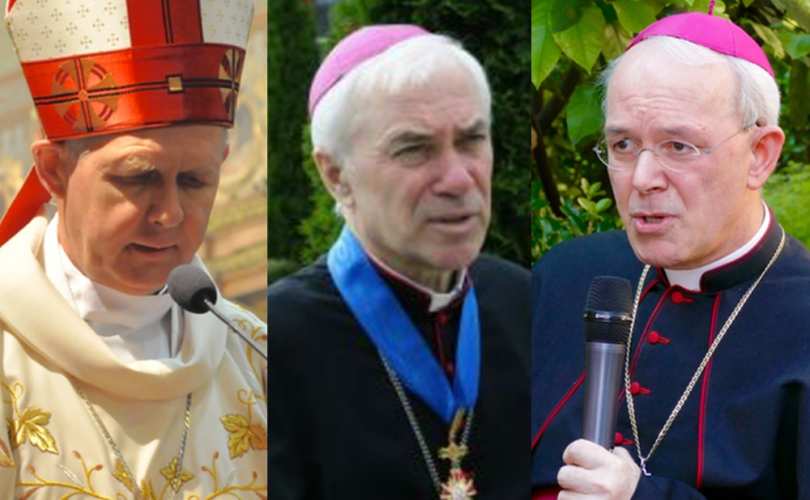
ANOTHER FOF, FRIEND OF FRANCIS, JOINS THE VATICAN CURIA, THIS TIME A RABBI FROM BUENOS AIRES WHO SUPPORTS ABORTION IN SOME CASES

Vatican Academy for Life Member Says Bible Sometimes Calls for Abortion

Vatican Academy for Life Member Says Bible Sometimes Calls for Abortion

Right, a member of the “Academy for Life.” Such is the life under Francis the False Prophet.

ROME, February 12, 2018 (LifeSiteNews) —  A recently appointed member of the Pontifical Academy for Life has argued that scripture justifies abortion in cases of rape or if the unborn child has serious disabilities, a position diametrically opposed to the teaching of the Catholic Church.

In a predominantly pro-life article published in Spanish on InfoBae, on Feb. 11, Rabbi Dr. Fishel Szlajen denounced abortion on demand, describing it as a crime that has been turned into a right. “‘The right to decide what to do with one’s own body’” manipulates and intentionally obscures the fact that we are dealing with “two distinct humans,” he said.

But Rabbi Szlajen also claimed there is one case when scripture calls for abortion.

“In only one case does the Bible call for abortion: when the life of the conceptus [the unborn child] inexorably threatens that of its mother,” the rabbi said. He added that in such cases the life of the mother takes priority.

Rabbi Szlajen based his argument on the Jewish law of the “rodef,” which he said allows people in certain circumstances to kill someone who is endangering the lives of others, “even when he is not aware of it.”

Cases of anencephaly, irreversible degenerative pathologies, and terminal disease in which the conceptus will certainly die are examples of ‘tzorech gadol’ (grave necessity) where “abortion is permitted with severe restrictions in time and form.”

Similar criteria would apply to pregnant women in cases of rape, when continuing the pregnancy would put them at “serious psychophysical risk,” Rabbi Szlajen added. “However, these cases are quantitatively insignificant compared to the 56 million annual induced abortions in the world, the majority of which are unwanted pregnancies because they conflict with personal, family or social interests,” he said.

This latter argument was used to pass the Abortion Act 1967 in the UK.

Some Jewish scholars have suggested that various public figures could qualify as rodfim. The most notorious example is that of Israeli Prime Minister Yitzhak Rabin who was assassinated in 1995 for concessions made to the Palestinian Authority in the Oslo Accord. The assassin, Yigal Amir, justified his actions partly on the basis of din rodef, under the assumption that making concessions to the Palestinian Authority would endanger Jewish lives.

Rabbi Szlajen is from Argentina and serves as the director of the Department of Culture for the AMIA Jewish community center in Buenos Aires, and a professor in the Department of Philosophy and Letters at the University of Buenos Aires.

He was one of two rabbis appointed by Pope Francis to the Pontifical Academy for Life in June 2017. It is the first time rabbis have been invited to be members of the academy.

Not alone

Rabbi Fishel Szlajen is not the only new member of the Pontifical Academy to believe abortion is permissible in certain circumstances. According to The Catholic Herald, Rabbi Avraham Steinberg, who was appointed to the academy in 2017, has said the unborn child has “no human status” before 40 days. After 40 days, he argues, an unborn child has “a certain status of a human being, not full status.”

The only UK-based member of the academy, Anglican clergyman and moral theologian, Nigel Biggar, has also in the past supported legalized abortion up to 18 weeks.

According to The Catholic Herald, Biggar said in 2011 it is “not clear that a human fetus is the same kind of thing as an adult or a mature human being, and therefore deserves quite the same treatment.”

“It then becomes a question of where we draw the line, and there is no absolutely cogent reason for drawing it in one place over another,” he said.

Biggar, who teaches moral and pastoral theology at the University of Oxford, said: “I would be inclined to draw the line for abortion at 18 weeks after conception, which is roughly about the earliest time when there is some evidence of brain activity, and therefore of consciousness.”

A concerning pattern

Rabbi Szlajen’s claim that scripture calls for abortion in certain cases is the latest in a pattern of public statements from new Vatican-appointed members of the Pontifical Academy for Life that are raising considerable concern.

As LifeSiteNews first reported in early January, Italian moral theologian Fr. Maurizio Chiodi, has argued on the basis of Pope Francis’ apostolic exhortation on the family, Amoris Laetitia, that there are circumstances that not only allow but even “require” married couples to use artificial contraception.

His comments were made on Dec. 14, 2017, in a public lecture sponsored by the department of moral theology at the Pontifical Gregorian University in Rome.

In late January, the National Catholic Register also reported that another new member, German moral theologian Gerhard Höver, proposed in a reflection on Amoris Laetitia posted on the Academy’s website, that the term “intrinsically evil” is too restricting, as it fails to account for the complexity of different situations.

Jesuit Father Alain Thomasset, also a new member of the academy since last year, has said he does not believe in the existence of the term.

Founded in 1994 by St. John Paul II, the Pontifical Academy for Life is charged with defending and promoting “the value of human life and the dignity of the person.”

In the past, new members had to sign a declaration of fidelity to the Church’s pro-life teachings, but new statutes implemented last year ended that requirement.

In an interview last year with the National Catholic Register, Archbishop Vincenzo Paglia, president of the Pontifical Academy for Life, offered reassurances that the new statutes “require a stronger commitment on the part of members to the Church’s pro-life teaching” and that they “promote and defend the principles of the value of life and the dignity of the person, interpreted in conformity with the magisterium of the Church.”

But last summer the archbishop oversaw the selection of new members, including Rabbis Szlajen and Steinberg, Nigel Biggar, Prof. Höver, Fr Chiodi and Fr Thomasset, who clearly have differences with the Church’s teaching on marriage and family life.

Asked if the academy’s leaders were aware of their views before they were selected, the spokesman told the Register “we knew” but added that it was important to provide them “space,” in continuity with “Pope Francis’ preference for dialogue and debate with those holding differing opinions.”

Drawing on Scripture and Tradition, the Catholic Church regards abortion as an intrinsically evil act. The Catechism of the Catholic Church states concerning abortion:

2270 Human life must be respected and protected absolutely from the moment of conception. From the first moment of his existence, a human being must be recognized as having the rights of a person – among which is the inviolable right of every innocent being to life.(Cf. CDF, Donum vitae I,1.)

Before I formed you in the womb I knew you, and before you were born I consecrated you. (Jer 1:5; cf. Job.10:8-12; Psalm 22:10-11)

My frame was not hidden from you, when I was being made in secret, intricately wrought in the depths of the earth. (Ps 139:15.)

2271 Since the first century the Church has affirmed the moral evil of every procured abortion. This teaching has not changed and remains unchangeable. Direct abortion, that is to say, abortion willed either as an end or a means, is gravely contrary to the moral law:

You shall not kill the embryo by abortion and shall not cause the newborn to perish. (Didache 2,2)

God, the Lord of life, has entrusted to men the noble mission of safeguarding life, and men must carry it out in a manner worthy of themselves. Life must be protected with the utmost care from the moment of conception: abortion and infanticide are abominable crimes. (GS 51 § 3.)

Read the full article at Life Site News

Posted in Uncategorized | 2 Comments

ONE OF THE MOST CONTROVERSIAL JESUITS OF THE 20TH CENTURY WAS TEILHARD DE CHARDIN

Restore DC Catholicism, Veritatis Gaudium

Veritatis Gaudium and Heretic Teilhard De Chardin

By BPPS

Veritatis Gaudium and Heretic Teilhard De Chardin

{Abyssum}

Teilhard de Chardin is one of the architects of the spiritual apostasy among the Catholic clergy.  After the expose on the heretic Chardin, listen closely to the expose on the “New Theology” and compare it with Veritatis Gaudium, Section 2, second paragraph.  “As I have had occasion to note, one of the main contributions of the Second Vatican Council was precisely seeking a way to overcome this divorce between theology and pastoral care, between faith and life. I dare say that the Council has revolutionized to some extent the status of theology – the believer’s way of doing and thinking”.

The priest in this video is doing a study on the Book of Revelations.  Notice at the 56:00 mark he speaks of the pit being opened and smoke coming out – smoke that obscures true doctrine.  The pit is blocked by a door to which God holds the key – the key given to the pope.  So in light of this, how may we view the “god of surprises”, “pastoral versus doctrinal”, etc?  Do we see the latest blasphemy of Cardinal Marx in a new light?

Read the full article below the Wikipedia article.

++++++++++++++++++++++++++++++++++++++++++++++++++++++++++++++++++++++++++++

From Wikipedia:

Pierre Teilhard de Chardin SJ (French: [pjɛʁ tejaʁ də ʃaʁdɛ̃] (About this sound listen ); 1 May 1881 – 10 April 1955) was a French idealist philosopher and Jesuit priest who trained as a paleontologistand geologist and took part in the discovery of Peking Man. {It is ironic that the man, Alfred C. Kinsey, who wrote The Sexual Behavior of the Human Male in 1948 a book which launched the sexual revolution was written by a scientist whose field of study was the entomology, the study of bugs, like de Chardin he became an ‘expert’ in a field for which he was not trained.) He conceived the vitalist idea of the Omega Point (a maximum level of complexity and consciousness towards which he believed the universe was evolving) and developed Vladimir Vernadsky‘s concept of noosphere.

Although many of Teilhard’s writings were censored by the Catholic Church during his lifetime because of his views on original sin, Teilhard has been posthumously praised by Pope Benedict XVIand other eminent Catholic figures, and his theological teachings were cited by Pope Francis in the 2015 encyclical, Laudato si’. The response to his writings by evolutionary biologists has been, with some exceptions, decidedly negative.

Early years

Pierre Teilhard de Chardin was born in the Château of Sarcenat at Orcines, close to Clermont-Ferrand, France, on 1 May 1881. On the Teilhard side he was descended from an ancient family of magistrates from Auvergne originating in Murat, Cantal, and on the de Chardin side he was descended from a family that was ennobled under Louis XVIII. He was the fourth of eleven children. His father, Emmanuel Teilhard (1844–1932), an amateur naturalist, collected stones, insects and plants and promoted the observation of nature in the household. Pierre Teilhard’s spirituality was awakened by his mother, Berthe de Dompiere. When he was 12, he went to the Jesuit college of Mongré, in Villefranche-sur-Saône, where he completed baccalaureates of philosophy and mathematics. Then, in 1899, he entered the Jesuit novitiate at Aix-en-Provence.

Teilhard was ordained a priest on 24 August 1911, at age 30.

Paleontology

From 1912 to 1914, Teilhard worked in the paleontology laboratory of the Museum National d’Histoire Naturelle in Paris, studying the mammals of the middle tertiary period. Later he studied elsewhere in Europe. In June 1912 he formed part of the original digging team, with Arthur Smith Woodward and Charles Dawson, at the Piltdown site, after the discovery of the first fragments of the (fraudulent) “Piltdown Man“. Some have suggested he participated in the hoax.[2][3] Marcellin Boule, a specialist in Neanderthal studies, who as early as 1915 had recognized the non-hominidorigins of the Piltdown finds, gradually guided Teilhard towards human paleontology. At the museum’s Institute of Human Paleontology, he became a friend of Henri Breuil and in 1913 took part with him in excavations at the prehistoric painted Caves of Castillo in northwest Spain.

In 1933, Rome ordered him to give up his post in Paris. Teilhard subsequently undertook several explorations in the south of China. He traveled in the valleys of Yangtze River and Sichuan in 1934, then, the following year, in Kwang-If and Guangdong. The relationship with Marcellin Boule was disrupted; the museum cut its financing on the grounds that Teilhard worked more for the Chinese Geological Service than for the museum.[citation needed]

During all these years, Teilhard contributed considerably to the constitution of an international network of research in human paleontology related to the whole of eastern and southeastern Asia. He would be particularly associated in this task with two friends, the English/Canadian Davidson Black and the Scot George B. Barbour. Often he would visit France or the United States, only to leave these countries for further expeditions.

World travels

Pierre Teilhard de Chardin (1947)

From 1927 to 1928, Teilhard based himself in Paris. He journeyed to Leuven, Belgium, and to Cantal and Ariège, France. Between several articles in reviews, he met new people such as Paul Valéry and Bruno de Solages, who were to help him in issues with the Catholic Church.

Answering an invitation from Henry de Monfreid, Teilhard undertook a journey of two months in Obock, in Harrar and in Somalia with his colleague Pierre Lamarre, a geologist, before embarking in Djibouti to return to Tianjin. While in China, Teilhard developed a deep and personal friendship with Lucile Swan.[5]

During 1930–1931, Teilhard stayed in France and in the United States. During a conference in Paris, Teilhard stated: “For the observers of the Future, the greatest event will be the sudden appearance of a collective humane conscience and a human work to make.” From 1932–1933, he began to meet people to clarify issues with the Congregation for the Doctrine of the Faith, regarding Le Milieu divin and L’Esprit de la Terre. He met Helmut de Terra, a German geologist in the International Geology Congress in Washington, D.C..

Teilhard participated in the 1935 YaleCambridge expedition in northern and central India with the geologist Helmut de Terra and Patterson, who verified their assumptions on Indian Paleolithic civilisations in Kashmirand the Salt Range Valley. He then made a short stay in Java, on the invitation of Dutch paleontologist Ralph von Koenigswald to the site of Java man. A second cranium, more complete, was discovered. Professor von Koenigswald had also found a tooth in a Chinese apothecary shop in 1934 that he believed belonged to a three-meter-tall ape, Gigantopithecus, which lived between one hundred thousand and around a million years ago. Fossilized teeth and bone (dragon bones) are often ground into powder and used in some branches of traditional Chinese medicine.[6]

In 1937, Teilhard wrote Le Phénomène spirituel (The Phenomenon of the Spirit) on board the boat Empress of Japan, where he met the Raja of Sarawak. The ship conveyed him to the United States. He received the Mendel Medal granted by Villanova University during the Congress of Philadelphia, in recognition of his works on human paleontology. He made a speech about evolution, the origins and the destiny of man. The New York Times dated 19 March 1937 presented Teilhard as the Jesuit who held that man descended from monkeys. Some days later, he was to be granted the Doctor Honoris Causa distinction from Boston College. Upon arrival in that city, he was told that the award had been cancelled.[citation needed]

Rome banned his work L’Énergie Humaine in 1939. By this point Teilhard was based again in France, where he was immobilized by malaria. During his return voyage to Beijing he wrote L’Energie spirituelle de la Souffrance (Spiritual Energy of Suffering) (Complete Works, tome VII).

In 1941, Teilhard submitted to Rome his most important work, Le Phénomène Humain. By 1947, Rome forbade him to write or teach on philosophical subjects. The next year, Teilhard was called to Rome by the Superior General of the Jesuits who hoped to acquire permission from the Holy See for the publication of Le Phénomène Humain. However, the prohibition to publish it that was previously issued in 1944 was again renewed. Teilhard was also forbidden to take a teaching post in the Collège de France. Another setback came in 1949, when permission to publish Le Groupe Zoologique was refused.

Teilhard was nominated to the French Academy of Sciences in 1950. He was forbidden by his Superiors to attend the International Congress of Paleontology in 1955. The Supreme Authority of the Holy Office, in a decree dated 15 November 1957, forbade the works of de Chardin to be retained in libraries, including those of religious institutes. His books were not to be sold in Catholic bookshops and were not to be translated into other languages.

Further resistance to Teilhard’s work arose elsewhere. In April 1958, all Jesuit publications in Spain (“Razón y Fe”, “Sal Terrae”,”Estudios de Deusto”, etc.) carried a notice from the Spanish Provincial of the Jesuits that Teilhard’s works had been published in Spanish without previous ecclesiastical examination and in defiance of the decrees of the Holy See. A decree of the Holy Office dated 30 June 1962, under the authority of Pope John XXIII, warned that “… it is obvious that in philosophical and theological matters, the said works [Teilhard’s] are replete with ambiguities or rather with serious errors which offend Catholic doctrine. That is why… the Rev. Fathers of the Holy Office urge all Ordinaries, Superiors, and Rectors… to effectively protect, especially the minds of the young, against the dangers of the works of Fr. Teilhard de Chardin and his followers” (AAS, 6 August 1962).

The Diocese of Rome on 30 September 1963 required Catholic booksellers in Rome to withdraw his works as well as those that supported his views.[7]

Teachings

Teilhard de Chardin has two comprehensive works, The Phenomenon of Man and The Divine Milieu.[10]

His posthumously published book, The Phenomenon of Man, set forth a sweeping account of the unfolding of the cosmos and the evolution of matter to humanity, to ultimately a reunion with Christ. In the book, Teilhard abandoned literal interpretations of creation in the Book of Genesis in favor of allegorical and theological interpretations. The unfolding of the material cosmos is described from primordial particles to the development of life, human beings and the noosphere, and finally to his vision of the Omega Point in the future, which is “pulling” all creation towards it. He was a leading proponent of orthogenesis, the idea that evolution occurs in a directional, goal-driven way. Teilhard argued in Darwinian terms with respect to biology, and supported the synthetic model of evolution, but argued in Lamarckian terms for the development of culture, primarily through the vehicle of education.[11] Teilhard made a total commitment to the evolutionary process in the 1920s as the core of his spirituality, at a time when other religious thinkers felt evolutionary thinking challenged the structure of conventional Christian faith. He committed himself to what the evidence showed.[12]

Teilhard made sense of the universe by assuming it had a vitalist evolutionary process.[13][14] He interprets complexity as the axis of evolution of matter into a geosphere, a biosphere, into consciousness (in man), and then to supreme consciousness (the Omega Point).

Teilhard’s unique relationship to both paleontology and Catholicism allowed him to develop a highly progressive, cosmic theology which takes into account his evolutionary studies. Teilhard recognized the importance of bringing the Church into the modern world, and approached evolution as a way of providing ontological meaning for Christianity, particularly creation theology. For Teilhard, evolution was “the natural landscape where the history of salvation is situated.”[15]

Teilhard’s cosmic theology is largely predicated on his interpretation of Pauline scripture, particularly Colossians 1:15-17 (especially verse 1:17b) and 1 Corinthians 15:28. He drew on the Christocentrism of these two Pauline passages to construct a cosmic theology which recognizes the absolute primacy of Christ. He understood creation to be “a teleological process towards union with the Godhead, effected through the incarnation and redemption of Christ, ‘in whom all things hold together’ (Col. 1:17).”[16] He further posited that creation would not be complete until each “participated being is totally united with God through Christ in the Pleroma, when God will be ‘all in all’ (1Cor. 15:28).”[16]

Relationship with the Catholic Church

In 1925, Teilhard was ordered by the Jesuit Superior General Wlodimir Ledóchowski to leave his teaching position in France and to sign a statement withdrawing his controversial statements regarding the doctrine of original sin. Rather than leave the Society of Jesus, Teilhard signed the statement and left for China.

This was the first of a series of condemnations by certain ecclesiastical officials that would continue until after Teilhard’s death. The climax of these condemnations was a 1962 monitum (warning) of the Holy Office cautioning on Teilhard’s works. It said:[23]

Several works of Fr. Pierre Teilhard de Chardin, some of which were posthumously published, are being edited and are gaining a good deal of success. Prescinding from a judgement about those points that concern the positive sciences, it is sufficiently clear that the above-mentioned works abound in such ambiguities and indeed even serious errors, as to offend Catholic doctrine. For this reason, the most eminent and most revered Fathers of the Holy Office exhort all Ordinaries as well as the superiors of Religious institutes, rectors of seminaries and presidents of universities, effectively to protect the minds, particularly of the youth, against the dangers presented by the works of Fr. Teilhard de Chardin and of his followers.

The Holy Office did not place any of Teilhard’s writings on the Index Librorum Prohibitorum (Index of Forbidden Books), which existed during Teilhard’s lifetime and at the time of the 1962 decree.

Shortly thereafter, prominent clerics mounted a strong theological defense of Teilhard’s works. Henri de Lubac (later a Cardinal) wrote three comprehensive books on the theology of Teilhard de Chardin in the 1960s[24]. While de Lubac mentioned that Teilhard was less than precise in some of his concepts, he affirmed the orthodoxy of Teilhard de Chardin and responded to Teilhard’s critics: “We need not concern ourselves with a number of detractors of Teilhard, in whom emotion has blunted intelligence”.[25] Later that decade Joseph Ratzinger, a German theologian who became Pope Benedict XVI, spoke glowingly of Teilhard’s Christology in Ratzinger’s Introduction to Christianity:[26]

It must be regarded as an important service of Teilhard de Chardin’s that he rethought these ideas from the angle of the modern view of the world and, in spite of a not entirely unobjectionable tendency toward the biological approach, nevertheless on the whole grasped them correctly and in any case made them accessible once again. Let us listen to his own words: The human monad “can only be absolutely itself by ceasing to be alone”. In the background is the idea that in the cosmos, alongside the two orders or classes of the infinitely small and the infinitely big, there is a third order, which determines the real drift of evolution, namely, the order of the infinitely complex. It is the real goal of the ascending process of growth or becoming; it reaches a first peak in the genesis of living things and then continues to advance to those highly complex creations that give the cosmos a new center: “Imperceptible and accidental as the position they hold may be in the history of the heavenly bodies, in the last analysis the planets are nothing less than the vital points of the universe. It is through them that the axis now runs, on them is henceforth concentrated the main effort of an evolution aiming principally at the production of large molecules.” The examination of the world by the dynamic criterion of complexity thus signifies “a complete inversion of values. A reversal of the perspective”.

This leads to a further passage in Teilhard de Chardin that is worth quoting in order to give at least some indication here, by means of a few fragmentary excerpts, of his general outlook. “The Universal Energy must be a Thinking Energy if it is not to be less highly evolved than the ends animated by its action. And consequently … the attributes of cosmic value with which it is surrounded in our modern eyes do not affect in the slightest the necessity obliging us to recognize in it a transcendent form of Personality.”

Over the next several decades prominent theologians and Church leaders, including leading Cardinals, Pope John Paul II and Pope Benedict XVI all wrote approvingly of Teilhard’s ideas. In 1981, Cardinal Agostino Casaroli, on behalf of Pope John Paul II, wrote on the front page of the Vatican newspaper, l’Osservatore Romano:

What our contemporaries will undoubtedly remember, beyond the difficulties of conception and deficiencies of expression in this audacious attempt to reach a synthesis, is the testimomy of the coherent life of a man possessed by Christ in the depths of his soul. He was concerned with honoring both faith and reason, and anticipated the response to John Paul II’s appeal: “Be not afraid, open, open wide to Christ the doors of the immense domains of culture, civilization, and progress”.[27]

Cardinal Avery Dulles, S.J., said in 2004:[28]

In his own poetic style, the French Jesuit Teilhard de Chardin liked to meditate on the Eucharist as the first fruits of the new creation. In an essay called The Monstrance he describes how, kneeling in prayer, he had a sensation that the Host was beginning to grow until at last, through its mysterious expansion, “the whole world had become incandescent, had itself become like a single giant Host”. Although it would probably be incorrect to imagine that the universe will eventually be transubstantiated, Teilhard correctly identified the connection between the Eucharist and the final glorification of the cosmos.

Cardinal Christoph Schönborn wrote in 2007:[29]

Hardly anyone else has tried to bring together the knowledge of Christ and the idea of evolution as the scientist (paleontologist) and theologian Fr. Pierre Teilhard de Chardin, S.J., has done. … His fascinating vision … has represented a great hope, the hope that faith in Christ and a scientific approach to the world can be brought together. … These brief references to Teilhard cannot do justice to his efforts. The fascination which Teilhard de Chardin exercised for an entire generation stemmed from his radical manner of looking at science and Christian faith together.

Pope Benedict XVI in his book Spirit of the Liturgy incorporates Teilhard’s vision as a touchstone of the Catholic Mass:[30]

And so we can now say that the goal of worship and the goal of creation as a whole are one and the same—divinization, a world of freedom and love. But this means that the historical makes its appearance in the cosmic. The cosmos is not a kind of closed building, a stationary container in which history may by chance take place. It is itself movement, from its one beginning to its one end. In a sense, creation is history. Against the background of the modern evolutionary world view, Teilhard de Chardin depicted the cosmos as a process of ascent, a series of unions. From very simple beginnings the path leads to ever greater and more complex unities, in which multiplicity is not abolished but merged into a growing synthesis, leading to the “Noosphere” in which spirit and its understanding embrace the whole and are blended into a kind of living organism. Invoking the epistles to the Ephesians and Colossians, Teilhard looks on Christ as the energy that strives toward the Noosphere and finally incorporates everything in its “fullness”. From here Teilhard went on to give a new meaning to Christian worship: the transubstantiated Host is the anticipation of the transformation and divinization of matter in the christological “fullness”. In his view, the Eucharist provides the movement of the cosmos with its direction; it anticipates its goal and at the same time urges it on.

Pope Francis refers to Teilhard’s eschatological contribution in his encyclical Laudato si’.[32]

Evaluations by scientists

According to Daniel Dennett, “it has become clear to the point of unanimity among scientists that Teilhard offered nothing serious in the way of an alternative to orthodoxy; the ideas that were peculiarly his were confused, and the rest was just bombastic redescription of orthodoxy.”[33] Similarly, Steven Rose wrote that “Teilhard is revered as a mystic of genius by some, but amongst most biologists is seen as little more than a charlatan.”[34]

In 1961, the Nobel Prize-winner Peter Medawar, a British immunologist, wrote a scornful review of The Phenomenon Of Man for the journal Mind:[35] “the greater part of it, I shall show, is nonsense, tricked out with a variety of metaphysical conceits, and its author can be excused of dishonesty only on the grounds that before deceiving others he has taken great pains to deceive himself”. The evolutionary biologist Richard Dawkins called Medawar’s review “devastating” and The Phenomenon of Man “the quintessence of bad poetic science”.[36]

Sir Julian Huxley, the evolutionary biologist, praised the thought of Teilhard de Chardin for looking at the way in which human development needs to be examined within a larger integrated universal sense of evolution, though admitting he could not follow Teilhard all the way.[37] Theodosius Dobzhansky drew upon Teilhard’s insistence that evolutionary theory provides the core of how man understands his relationship to nature, calling him “one of the great thinkers of our age”.[38]

George Gaylord Simpson, however, felt that if Teilhard were right, the lifework “of Huxley, Dobzhansky, and hundreds of others was not only wrong, but meaningless”, and was mystified by their public support for him.[39] He considered Teilhard a friend and his work in paleontology extensive and important, but expressed strongly adverse views of his contributions as scientific theorist and philosopher.[40]

The philosopher Dietrich von Hildebrand criticized severely the work of Teilhard. According to this philosopher, in a conversation after a lecture by Teilhard: “He (Teilhard) ignored completely the decisive difference between nature and supernature. After a lively discussion in which I ventured a criticism of his ideas, I had an opportunity to speak to Teilhard privately. When our talk touched on St. Augustine, he exclaimed violently: ‘Don’t mention that unfortunate man; he spoiled everything by introducing the supernatural.'” [60] Von Hildebrand writes that Theihardism is incompatible with Christianity, substitutes efficiency for sanctity, deshumanizes man, and describes love as merely cosmic energy.

Influence on the New Age movement

Teilhard has had a profound influence on the New Age movement and has been described as “perhaps the man most responsible for the spiritualization of evolution in a global and cosmic context”.[61] New Age figure and self-described evolutionary biologist Jeremy Griffith described Teilhard as a “visionary” philosopher and a contemporary “truth-sayer” or “prophet”.[62]

++++++++++++++++++++++++++++++++++++++++++++++++++++++++++++++++++++++++++++

SUNDAY, FEBRUARY 4, 2018

Veritatis Gaudium Inspired By The Heretic Teilhard De Chardin

Teilhard de Chardin is one of the architects of the spiritual apostasy among the Catholic clergy.  After the expose on the heretic Chardin, listen closely to the expose on the “New Theology” and compare it with Veritatis Gaudium, Section 2, second paragraph.  “As I have had occasion to note, one of the main contributions of the Second Vatican Council was precisely seeking a way to overcome this divorce between theology and pastoral care, between faith and life. I dare say that the Council has revolutionized to some extent the status of theology – the believer’s way of doing and thinking”.

The priest in this video is doing a study on the Book of Revelations.  Notice at the 56:00 markk he speaks of the pit being opened and smoke coming out – smoke that obscures true doctrine.  The pit is blocked by a door to which God holds the key – the key given to the pope.  So in light of this, how may we view the “god of surprises”, “pastoral versus doctrinal”, etc?  Do we see the latest blasphemy of Cardinal Marx in a new light?

Posted in Uncategorized | 1 Comment

THE FAITH WHICH THE CHURCH PROMOTES ORIGINATES IN REVELATION BUT RESTS ON THE VIGOROUS USE OF PHILOSOPHY AND THEOLOGY, THE ABSENCE OF WHICH IS PARTICULARLY NOTICEABLE SINCE MARCH 13, 2013

How quickly we have forgotten what he said (Thoom/Shutterstock)

Faith & Reason Vs. Mush

  • TheAmerican Conservative

Discouraged by Cardinal Cupich’s relativistic “new paradigm” speech? Read Archbishop Charles Chaput’s muscular defense of Pope John Paul II’s 1998 encylical Fides et Ratio, which is, obviously, about the connection between faith and truth. Excerpts:

Finally, without vigorous philosophy, theology and the very life of the Church risk slipping into emotivism. In the name of being pastoral, the Church threatens to become merely indulgent, malleable, affective, and practical; in effect, anti-intellectual. This is exactly the wrong moment for that kind of mistake.

We live in a time when Christian truth is increasingly misunderstood, disdained, or simply unknown, even among baptized Catholics. Michael Polanyi would have recognized our culture’s contradictions, and its emerging shape. It’s a mix of “fierce moral scepticism [paradoxically] fired by moral indignation. Its structure is exactly the same as that of the moral inversion underlying modern totalitarianism”—a contempt for traditional morality, fused with and fueled by ferocious moralizing for social change. Rational consistency is irrelevant. Passion becomes its own justification.

At a more immediate level, the pastor of a local church must meet his people in their hearts and real lives, but also in their minds. We’re beings made for the truth. Thus a clear, appealing presentation of the faith plays a vital role in forming Christians. As a bishop, I sometimes hear from parishioners that one of their concerns with some priests has to do with the content of the homilies they hear each week. They’re happy with calls for kindness or generosity, but they also hunger for homilies that present the substance of the faith, its mysteries and doctrines, in ways that are accessible and attractive. That kind of homily isn’t easy to do. But it’s impossible to do if we don’t have a credible theology, one informed by the strong philosophical traditions of learning that are at the heart of the Church and her patrimony.

More:

Writing in the wake of Vatican II, the Italian Catholic philosopher Augusto Del Noce made three simple observations. First, our era is a “peculiar combination of the greatest perfection of means with the greatest confusion about goals.” Second, in the face of modern atheism—often less a hatred of God than a technology-driven indifference to him—“for a large part of today’s religious thought, the quest for aggiornamento simply means surrendering to the adversary.” And third, much of what styles itself as Christian progressivism, no matter how good its intentions, serves as the instrument of that surrender.

For Del Noce, the Church’s mission in every era is to bring the world into line with eternal principles while respecting the good in those things which are new. Much of progressive thought does the “exact inverse, since [it seeks] to bring Catholicism into line with the modern world.” By stressing action over contemplation and politics over metaphysics, progressivism reduces the supernatural core of Christian faith to a system of social ethics—a kind of baptized, humanitarian chaplaincy to a world that doesn’t need or want it. The result is obvious. The proof, for Del Noce, would be the hollowed-out national churches that now mark much of northern Europe.

A truly great Catholic intellect, in contrast, speaks from the heart of the Church because he or she is both a rigorous thinker and deeply attuned to the Word made flesh, wisdom incarnate. The confusion that dogged the Catholic world in the years immediately after Vatican II emerged in part from the absence of that kind of rigorous intellect fused with a deep and sincere faith. John Paul did much to heal the confusion. But it has never entirely disappeared, and it’s alive in our own day with new force. This is why the substance of Fides et Ratio is so important—not just for scholars, but also for everyday Christians who turn to the Church for guidance and a path to eternal life.

Read the whole thing. And read it in conjunction with the Cupich address. There is a titanic intellectual and spiritual struggle going on in the Catholic Church today. Whether or not you are a Catholic, and especially if you live in the West, this matters. A lot.

Posted in . Tagged , , , , , , .
Posted in Uncategorized | 1 Comment

The great Cardinal Mindzenty, implacable foe of atheistic Communism will almost certainly be canonized some day. Pray that he may be recognized liturgically for the saint that he was/is.

mindszenty

Cardinal Jozef Mindszenty (the great warrior against communism, who lived for 15 years in the US Embassy in Budapest) died in 1975, and was buried in Mariaxell, a Marian shrine in Austria, as he had settled in Vienna. After the fall of communism, it was decided to disinter his remains, and take them back in solemn procession to his cathedral in Ersz
tegom in Hungary, to be re-buried in the crypt, which happened in May 1991.
Several witnesses testified to the fact that when his body was unearthed, it was incorrupt. I have always wondered whether there is a photo of this anywhere, and I believe I have finally found this. I scoured a few Hungarian websites, and while I don’t speak the language, I saw the photo mentioned in connection with 1991.

But I was not 100% sure. Today however I received an email from the official website of Cardinal Mindszenty’s cause for sainthood, in Budapest. It said, “Dear Mr. Rabel, yes, this is the photo of the body if Cardinal Mindszenty in Mariatell in 1991, and was incorrupt. Best regards, Brigitta Nagy assistent”

Eleanor Schlafly from St Louis was the foundress of the Cardinal Mindszenty Foundation, and in regard to this she said, “We Missourians have a saying. Show me”. Here it is. You can tell by the discolouration on the insides of the coffin, that it had been underground for a lengthy period of time.

God bless
Andrew Rabel

Posted in Uncategorized | 8 Comments

VERACITY AND MENDACITY, CAN THE AVERAGE LAYPERSON RECOGNIZE THAT THEY ARE DIFFERENT ???

pope mad
Friday, February 9, 2018

SPECIAL REPORT: Papal Cover-up Alleged, Pope Accused in International Sex Abuse Case

Written by 

 THE REMNANT

pope mad

No more “humble pope”

Hey, remember five minutes ago when Pope Francis shouted at a reporter in Chile that there was “no evidence” supporting complaints against his good friend Bishop Juan Barros? And, just for good measure he accused the people accusing him – victims of sexual abuse by Barros’ mentor, the convicted sex-predator Karadima – of committing “calumny”?[1] And remember when Cardinal O’Malley told the pope off in public over the “pain” these accusations had caused the victims of sexual abuse? And then remember how the pope had apologised-except-not-really because the accusations are, after all, still lies, and that there’s still “no evidence” against Barros…?

The press, secular as well as Catholic, is full this week of the story that the pope did indeed see evidence of Barros’ complicity in Karadima’s sexual abuse – not only that Barros had helped to cover it up but that he had been present and a direct witness at the time and therefore a passive participant. Nicole Winfield and the Associated Press dropped the bomb that the information came directly from the victims, whom Francis had dismissed and refused to meet with on his trip, and delivered through his own Commission on sexual abuse:

Pope Francis received a victim’s letter in 2015 that graphically detailed how a priest sexually abused him and how other Chilean clergy ignored it, contradicting the pope’s recent insistence that no victims had come forward to denounce the cover-up, the letter’s author and members of Francis’ own sex- abuse commission have told The Associated Press.

The fact that Francis received the eight-page letter, obtained by the AP, challenges his insistence that he has “zero tolerance” for sex abuse and cover-ups. It also calls into question his stated empathy with abuse survivors, compounding the most serious crisis of his five-year papacy.

Now it appears that Francis had also overruled a 2015 warning from the Congregation for the Doctrine of the Faith that Barros should not be made a bishop. The Italian Catholic daily La Nuova Bussola Quotidiana reports that not only did the pope see a letter from victims, but that the CDF, under Muller, “had already conducted an preliminary investigation into Barros and the other bishops close to Karadima which had led to the decision to relieve them of their duties.

“But with a letter signed by the Pope in January 2015 and sent to the Chilean bishops, the request for exemption is blocked and shortly thereafter Barros is promoted to…Osorno.”

The article points out that while Karadima was convicted by a Vatican tribunal on the testimony of the victims, it is the same testimony of the same victim-witnesses that Francis now dismisses in the accusations against Barros. The accusations that stood against Karadima come from the same sources as those against Barros, who the victims said was in the room watching at the time.

While the specifics are still not known, readers may be reminded by this of a peculiar incident about a year later in which Pope Francis summarily ordered the dismissal of three priests of the CDF, whose remit was investigations of clerics accused of sexual abuse. The website One Peter Five reports, via Marco Tosatti, that the pope ordered their removal without offering any explanation to then-cardinal prefect Gerhard Muller. When, after several attempts and three months later[2], Muller was able to get an audience with the pope to ask the reason, he received the response, “I am the pope, I do not need to give reasons for any of my decisions. I have decided that they have to leave and they have to leave.”

Marco Tosatti reports the CDF incident, but it follows an odd story of a meeting of curial officials to discuss certain bishop appointments. Without naming names, (or, frustratingly, giving dates[3]) Tosatti relates:

“It was some time ago to make a bishop, not in Italy. The nuncio has prepared the triad [the “terna” or list of three candidates]. A cardinal, head of the dicastery, perhaps the same holder of the Congregation for Bishops, during the ordinary assembly took the floor, saying: ‘The first candidate indicated is excellent, the second is good. But I would like to warn of the third, whom I know well, since he was a seminarian, and who presents problems both on the level of doctrine and morality. He responds little to the necessary criteria. But the third was a friend of someone and another cardinal, of the circle currently in power, has flung himself at his colleague, accusing him of impropriety.’ The meeting ended without further decisions.”

Whatever the details of these strange incidents, what is clear in Chile is that no amount of eyewitness testimony was going to make the slightest difference. Bergoglio wanted Barros as a bishop and that was that. Even while “apologising” the pope had doubled down when questioned about it by journalists, saying, “You, in all good will, tell me that there are victims, but I haven’t seen any, because they haven’t come forward.”

“In the case of Barros it’s been observed, it’s been studied; there’s no evidence. The best thing to do if someone believes it’s the case is to come forward quickly with evidence.”

The AP report, however, says exactly the opposite; that members of his own (now defunct[4]) abuse Commission had approached Cardinal O’Malley, the pope’s “top abuse advisor,” with the letter to deliver to the pope.  

Marie Collins, the Irish abuse survivor and Commission member who resigned, citing the Vatican’s refusal to take meaningful action, told AP, “When we gave him [O’Malley] the letter for the pope, he assured us he would give it to the pope and speak of the concerns. And at a later date, he assured us that that had been done.” Juan Carlos Cruz, the Karadima victim whose membership on the Commission the Vatican had blocked, told AP, “Cardinal O’Malley called me after the pope’s visit here in Philadelphia and he told me, among other things, that he had given the letter to the pope – in his hands.”

On the face of it, there are only a few logical possibilities here. In fact, unless Cardinal O’Malley – who has, as of this writing, remained silent – comes forward and says that he didn’t hand the letter over pope, there is really only one; that the pope lied. And this is what is now being said quite openly by a vast array of voices, secular and Catholic, left and right.

As Winfield writes,

“The revelation could be costly for Francis, whose track record on the abuse crisis was already shaky after a botched Italian abuse case he intervened in became public[5]. More recently, he let the abuse commission lapse at the end of last year. Vatican analysts now openly question whether he ‘gets it,’ and some of his own advisers privately acknowledge that maybe he doesn’t.”

 “No evidence…” Lie big, lie often, and when caught, keep lying.

One of the many things these secular reporters seem not to be paying attention to is that “no evidence” is in fact a well-rehearsed, stock response for Bergoglio. He said almost exactly the same in 2013 when confronted about another predatory homosexual he was sheltering. The hoopla surrounding the “Who am I to judge” comment tends to obscure the context of the comment.

It was made in response to a question by a journalist about Monsignore Battista Ricca – a prelate whose promiscuous homosexuality is so well known it was covered by the Telegraph as early as July 2013. Ilze Scamparini asked the popeabout Ricca, saying, “What you intend to do about this? How are you confronting this issue and how does Your Holiness intend to confront the whole question of the gay lobby?”

What reply did Bergoglio give? His standard one: “No evidence.”

About Monsignor Ricca: I did what canon law calls for, that is a preliminary investigation. And from this investigation, there was nothing of what had been alleged. We did not find anything of that.This is the response.”

He added, “In this case, I conducted the preliminary investigation and we didn’t find anything.”

But Ricca’s activities, for which the pope claimed there was no evidence, were notorious. They include being caught in flagrante in an elevator with a teenaged male prostitute, and his sexual relationship with a captain in the Swiss army. So flagrant was Ricca’s behaviour that it took intervention by Uruguay’s nuncio to have him removed. It was reported in 1999 and 2000 by L’Espresso, who said the information was confirmed by “numerous bishops, priests, religious and laity” in Uruguay[6].

In fact, the evidence shows that Ricca is completely in line with Bergoglio’s normal procedures. As “Marcantonio Colonna” wrote in the Dictator Pope, “In fact his patronage of Monsignor Ricca fits the pattern which was well established when he was Archbishop of Buenos Aires, whereby he surrounds himself with morally weak people so as to have them under his thumb.”

It was at this early “no evidence” comment on the plane home from Rio that some of those paying attention started to understand that Bergoglio’s policy is in line with that of certain leaders of the past who recommended that if a politician was going to lie, he should lie big and lie brazenly. And in case anyone was wondering what will happen next, the same advice said to keep on lying after you’re caught.

The pattern of silence and, when pressed, flat-out denial has been Bergoglio’s policy since long before he came on the international scene. He has a long record in Argentina of shaving close to scandals and vociferously denying involvement, and relying heavily on the broad good will of Catholics towards bishops to pull it off. Perhaps his biggest error with Barros was failing to understand just how little of that capital of trust there is left in the Catholic world as a whole. Indeed, on the subject of priests sexually abusing young people, it could only be measured in the negative numbers.

“Argentine Victims Who Tried to Meet with Pope Francis…”

Though the website Bishop Accountability is blatantly anti-clerical, their data is unassailable since most of it comes from information that is already public. On their Argentina page is a long list of accusations that Bergoglio/Francis simply isn’t interested in hearing from victims.

“In Pope Francis’s 21 years as bishop and archbishop of Buenos Aires, the Wall Street Journal reports, including the years when he headed the Argentine bishops’ conference, he declined to meet with victims of sexual abuse.”

“All of them tried to contact the cardinal archbishop in 2002 or later,” the same period when Pope Benedict and other bishops were striving to meet with victims and demonstrate an interest in the problem. The site says that “in addition to Bergoglio’s failure to respond to victims, the public record contains no evidence that he released any information about abusers.”

In fact, he went so far as to flatly deny there had been any instances of abuse in his archdiocese. Weeks after his election to the papacy, he was quoted by his close friend, Rabbi Abraham Skorka, “In my diocese it never happened to me, but a bishop called me once by phone to ask me what to do in a situation like this.” Francis added that he agreed with the “zero tolerance” attitude of the Irish episcopate and admired Pope Benedict’s reforms – most of which he was later to quietly reverse.

It was at exactly this time, however, that victims from Argentina were attempting to get the new pope’s attention. One, known to the press only as “Gabriel,” wanted to talk to Francis about the sexual abuse he suffered at the hands of Julio César Grassi, accused of molesting at least five boys, “who has been avoiding the sentences of the justice of Morón and the Court of Cassation. So far, judges and prosecutors at all instances found him guilty.”

In case anyone thinks the Grassi-Gabriel case was not serious enough for the pope’s attention, Bishop Accountability summarises, “A year after Gabriel had filed criminal charges [2003] but before the start of Grassi’s trial, three men ransacked the survivor’s apartment and beat him.” These men threatened to kill him if he did not retract his testimony and quit the case.

Ten years [after Gabriel filed criminal charges], in May 2013, with Grassi still free despite his conviction in 2009, “Gabriel and his attorney, Juan Pablo Gallego, brought a two-page letter addressed to Pope Francis to the office of the papal nuncio in Buenos Aires. An employee refused to accept the letter after learning of its topic and threatened to call security if Gabriel and Gallego did not leave the premises.”

The group surmises that it was Bergoglio’s direct intervention with judges in the case that prevented a conviction against Grassi for so long and delayed his sentencing through multiple appeals. In 2006, then-Archbishop Bergoglio complained of a “media campaign” and claimed that the Grassi case was “different” from other accusations. During his criminal trial Grassi said Bergoglio “never let go” of his hand. In 2009, Grassi was convicted of two counts of aggravated sexual assault and corruption in the case of “Gabriel,” who was aged 13 at the time of the abuse, but the appeals dragged on until he was finally sent to prison in September 2013.

Several more similar cases, all of whom were rebuffed in their attempts to meet with Bergoglio, are detailed here, for the strong-of-stomach.

 A virtuoso performance-liar

Looking back and carefully examining his record, Jorge Bergoglio’s mastery of using the weaknesses of morally compromised men is becoming evident. It is arguable that even the members of the so-called “San Gallen Mafia” who apparently conspired to put him on Peter’s throne were used by him. But he is also a master of judging an audience and telling them what they expect to hear; a key skill for all grifters and confidence tricksters.

Looking carefully at the infamous “Who am I to judge” comment, this was clear early on. The first part of that interview is a blatant and enormous lie, and it was from there that the pope moved on to his apology for homosexuality in general. Recall that this was the very first airplane interview, on the trip back to Rome from World Youth Day in Rio, a matter of weeks after his election. At the time, the papal apologists sprang instantly into action and we heard all about how the pope was talking strictly within the boundaries of Catholic doctrine.

But perhaps in hindsight, we are ready to examine the full implications of his little speech, one that was clearly well-rehearsed. (Don’t forget, no question is asked in a papal interview without being thoroughly vetted ahead of time. Journalists must submit their questions well in advance.) This was the pope laying out his policy regarding homosexuality, a policy for which he was duly rewarded by being lauded on the cover of the homosexualist lobby’s US trade magazine.

Read his full answer carefully:

I see that many times in the Church, over and above this case, but including this case, people search for “sins from youth”, for example, and then publish them. They are not crimes, right? Crimes are something different: the abuse of minors is a crime. No, sins.

But if a person, whether it be a lay person, a priest or a religious sister, commits a sin and then converts, the Lord forgives, and when the Lord forgives, the Lord forgets and this is very important for our lives. When we confess our sins and we truly say, “I have sinned in this”, the Lord forgets, and so we have no right not to forget, because otherwise we would run the risk of the Lord not forgetting our sins. That is a danger.

This is important: a theology of sin. Many times I think of Saint Peter. He committed one of the worst sins, that is he denied Christ, and even with this sin they made him Pope. We have to think a great deal about that.

But, returning to your question more concretely. In this case, I conducted the preliminary investigation and we didn’t find anything. This is the first question. Then, you spoke about the gay lobby. So much is written about the gay lobby. I still haven’t found anyone with an identity card in the Vatican with “gay” on it. They say there are some there.

I believe that when you are dealing with such a person, you must distinguish between the fact of a person being gay and the fact of someone forming a lobby, because not all lobbies are good. This one is not good.

If someone is gay and is searching for the Lord and has good will, then who am I to judge him? The Catechism of the Catholic Church explains this in a beautiful way, saying … wait a moment, how does it say it … it says: “no one should marginalize these people for this, they must be integrated into society”. The problem is not having this tendency,no, we must be brothers and sisters to one another, and there is this one and there is that one. The problem is in making a lobby of this tendency: a lobby of misers, a lobby of politicians, a lobby of masons, so many lobbies. For me, this is the greater problem. Thank you so much for asking this question. Many thanks.

One of the pope’s favourite rhetorical techniques is a combination of Begging the Question and conspiracy. He starts by assuming, without any effort at defence or explanation, a point that concedes the whole issue. This was the first time a pope had ever used the political term “gay”. Not “homosexual,” not “same-sex attracted,” but “gay,” meaning that he started by adopting the entirety of the homosexualist movement’s linguistic manipulations. Language counts in politics, and a pope using that term means he is by implication starting the discussion – and his pontificate – by aligning himself with the basic tenets of a movement that is violently opposed to Catholic moral teaching, and in direct opposition to his immediate, and still living, predecessor.

In this case too, he was addressing a plane load of journalists who were either secular themselves, or for the most part are the kind of Catholic who believes it is fine to “disagree” with Catholic teaching on sexuality. There are very few “conservative” Catholics in the Vatican journalist pool. This means that his use of this language was a conspiratorial wink and nod to his immediate audience, a sly message to say, “People talk all the time about a gay lobby, but you and I both know this is mostly nonsense, propaganda from those people… those conservatives…We cool and hip people don’t hate gays, do we?”

This astonishing departure follows an implied but very clear assertion that Ricca has repented and given up his activity, an assertion that has absolutely no evidence to back it up. We are simply asked to take the pope’s word for it, but given that it follows his astoundingly brazen lie that there was no evidence for Ricca’s homosexual activity in the first place, we can take the assurance for what it seems to be worth.

Next, after another little inside nudge-nudge-wink-wink joke about the “gay lobby” – implying (but of course never outright saying) that the whole thing is hysterical nonsense – we hear a direct contradiction to Catholic teaching from no less a source than his predecessor, Pope Benedict Ratzinger. “The problem is not having this tendency.” Well, actually, your holiness, yes it is, particularly in the case of priests. The “tendency” is called in the same catechism you quote “intrinsically disordered” and Ratzinger was very clear that this “tendency” is a sign of a serious emotional dysfunction that “must” preclude a man from being ordained.

Squandering the capital of trust

A few months ago in a piece for the Remnant, I talked about why the Church (and nearly all human societies) regard lying as a sin:

A mistake many make about lying is to understand it only in terms of morality. But Thomas makes the point that it is first a matter of metaphysics. Lying is an act at variance in its essence with the nature of reality.

Thomistic theology teaches that it is by lying that we become most like the devil, and most unlike God, because we are trying to change the nature of reality to suit our own purposes. Habitual lying in effect changes you into a different kind of being, one that is by nature an opponent of Truth, ordered against Truth. This of course means that a person whose “orientation,” as we might say, is towards falsehood, even when he is at any given moment saying something true, is still servicing his lies. He tells the truth only to continue to control and manipulate reality. It was not by violence, but by lying and manipulation, by issuing half-truths and pretending to be the kind of man he was not, that Shakespeare’s character Iago earned the title of most evil character in English literature.

Human beings are naturally ordered towards the truth, and we have to work at assuming a lie. This is why confidence tricksters can be successful, why lying works for getting what you want; people don’t see it coming. The first natural assumption is trust, at least at the basic level of expecting truth most of the time. We therefore instinctively see lying as a betrayal of trust.

Considering how much trust the Catholic faithful had in the papacy until about 1965, how much un-earned trust Francis started with just by being elected, this pontificate should be remembered as one of the great confidence scams in history. Believing Catholics have watched aghast as this pope has habitually trampled on every aspect of Catholic teaching. Sandro Magister recently published a piece on his website that listed in dizzying detail the many times, in only the last few months, that pope Francis has falsified with obvious intention, the words of Christ in Scripture and the teaching of the Church.

Of course this would be of little interest to secular journalists, who have paid no mind to his habit of rewriting Catholicism, but the sex abuse crisis is something secular journalists are very interested in, a fact Bergoglio seems not to have understood. It is now irrefutable that Pope Bergoglio is a habitual liar – that in fact truth, like reality, seems to mean nothing to him except as a tool.

Sociologists talk about the concept of the “high trust society,” one in which citizens believe what they are told by the elites and trust them to govern and protect them adequately. They warn that the general loss of trust in institutions leads to a general state of chaos, in which laws on the books matter little as citizens turn to their last resort of protecting themselves and their own families. This is the way societies disintegrate. It has been said many times that the sex abuse crisis has created a massive loss of trust in prelates among the Catholic faithful, and this is true.

With a professional confidence trickster on the papal throne, blatantly using lies and manipulation to maintain power and ram through an agenda at radical variance with Catholic doctrine, how long before that predictable disintegration occurs? Are we seeing it already? Are we seeing it in the declarations of this or that episcopate on Amoris Laetitia and Communion for divorced and civilly remarried Catholics? With Cardinal Marx and others promoting “blessings” for “same-sex unions” are we going to be seeing an escalation of it? I have seen a veritable chorus of Catholics on social media declaring that if Paul VI is canonised, their loss of faith in the Church as an institution will be complete.

I am told from contacts inside the Vatican that after the trip to Chile Bergoglio’s support has completely dried up. He has no more resources of trust even among the people he has chosen to surround himself with and after the reports of Cardinal Sandri going toe-to-toe with him in a shouting match, it seems that perhaps even his legendary vicious temper tantrums are failing to have the desired effect of terrorising his subordinates into submission.

Marie Collins, by no stretch even a “conservative” Catholic, echoed this concern, saying the Barros affair has “definitely undermined credibility, trust, and hope” in Francis.

“All I can say is that people who had a lot of hope in this particular pope, and I am talking about just ordinary Catholics that I know in my own parish, would find it very difficult now…and cannot understand and cannot believe that this particular pope has said the things he has said in the last few weeks,” she told the National Catholic Reporter.

It may seem like a moment to enjoy, seeing the apparently unbreachable shell of papal teflon finally cracking, but in reality this situation is potentially very harmful for souls in the long run. There is a multitude of problems this pontificate has created or made worse that we will be dealing with for a long time after Bergoglio is gone, but perhaps one of the bigger ones will be the destruction of trust. Already fractured since the collapse of all Catholic institutions after Vatican II and the horrors of the sex abuse crisis, how much will there be to repair of the once-steadfast trust Catholics instinctively had in the Church after this?

Notes:

[1] “Not one victim has come forward in Chile; show me the proof. This is slander and calumny. Is that clear?”

[2] The book “The Dictator Pope” relates that regular meetings between the pope and dicastery heads have been abolished and even high-ranking curia prefects are often unable to see the pope, whose appointments are now completely controlled by the Secretariat of State. It is certainly clear that no one sees the pope unless Cardinal Parolin approves, which may be the reason Cardinal Zen, in his efforts to warn Francis of the dangers of a Vatican deal with the communist Chinese government had to wait in the rain at a Wednesday general audience.

[3] This is common in Italian journalism that has somewhat different standards from that of the Anglo world… and drives the rest of us spare. Italians care about getting a general picture of what’s going on, where Anglo-Saxons are considered weirdly obsessed with trivial details.

[4] Though she never blamed the pope, Marie Collins complained that Vatican officialdom had simply not implemented the Commission’s recommendations. The time limit of the Commission’s members was allowed to lapse without renewal and though it was not dissolved formally the Commission has ceased to function with no word of any plan to revive it.

[5] Probably a reference to the Inzoli case in which Francis overturned a previous sentence of a Vatican tribunal after the priest – now laicised – approached some of the pope’s close advisors for help, including Cardinal Coccopalmerio.

[6] Not that anyone in Rome was trying very hard. Sandro Magister reported after the “Who am I to judge” comment, “Before the appointment, Francis had been shown, as is customary, the personal file on Ricca, in which he had not found anything unseemly. He had also heard from various personalities of the curia, and none of them had raised objections.”

[
Posted in Uncategorized | 1 Comment

HERE IS TODAY’S LITTLE DOSE OF SATIRE TO HELP YOU TROUGH THE DAY

Eccles and Bosco is saved

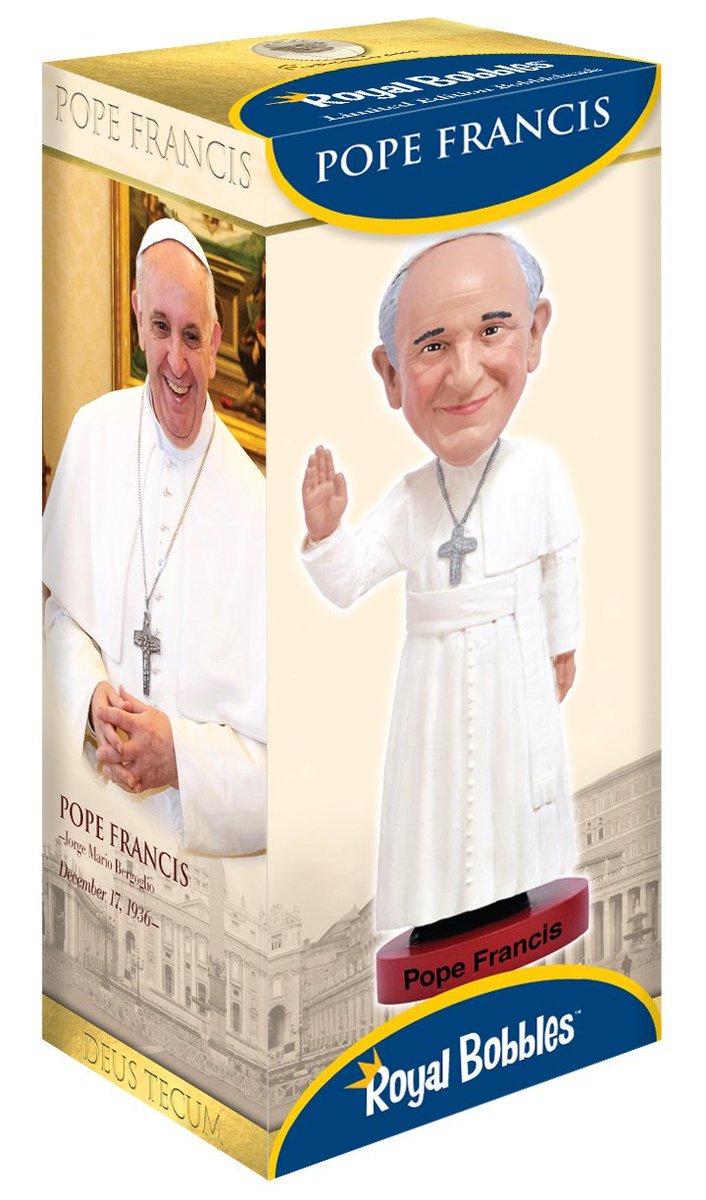
It Looks Nothing Like Pope Francis – the winners!

Posted: 09 Feb 2018 06:34 AM PST

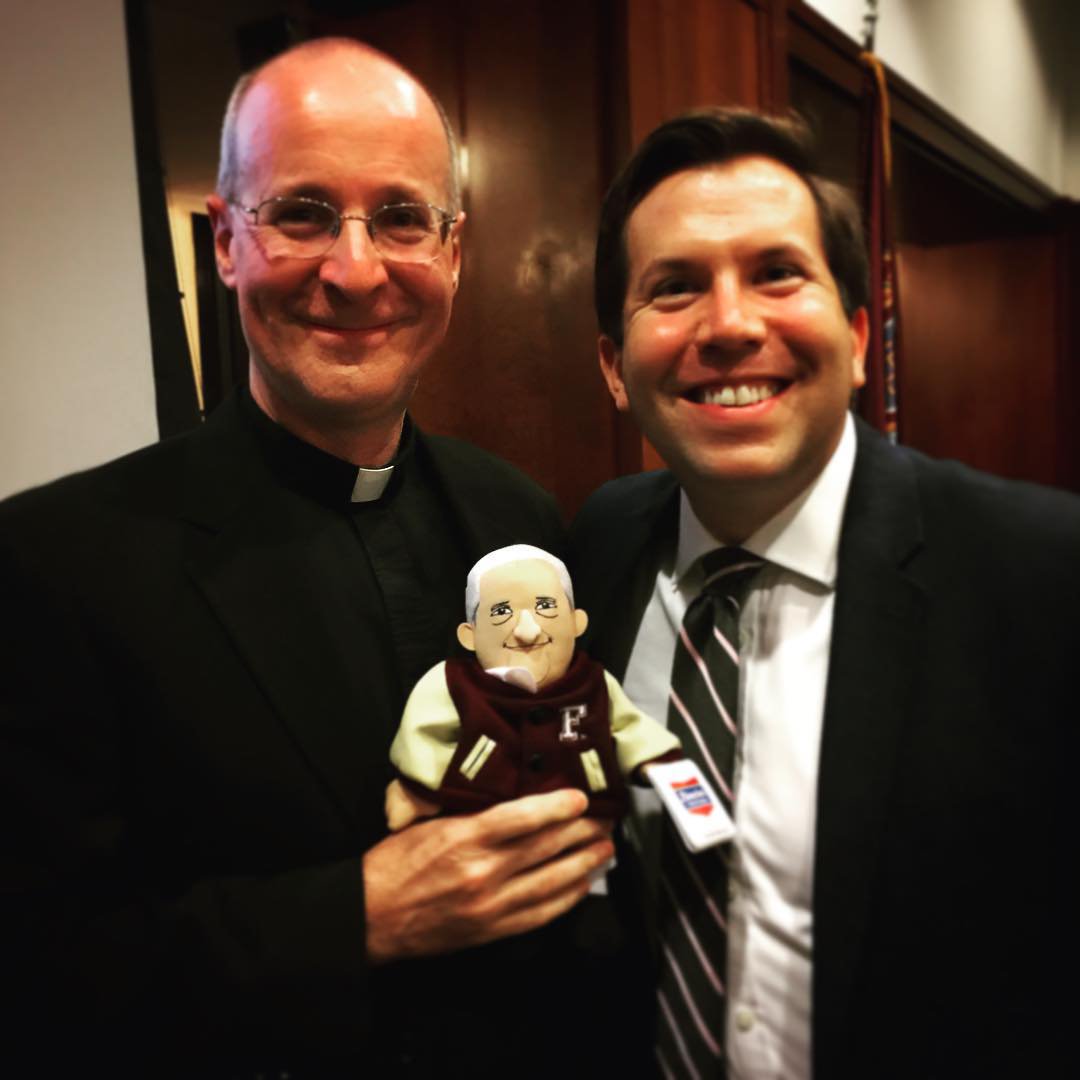
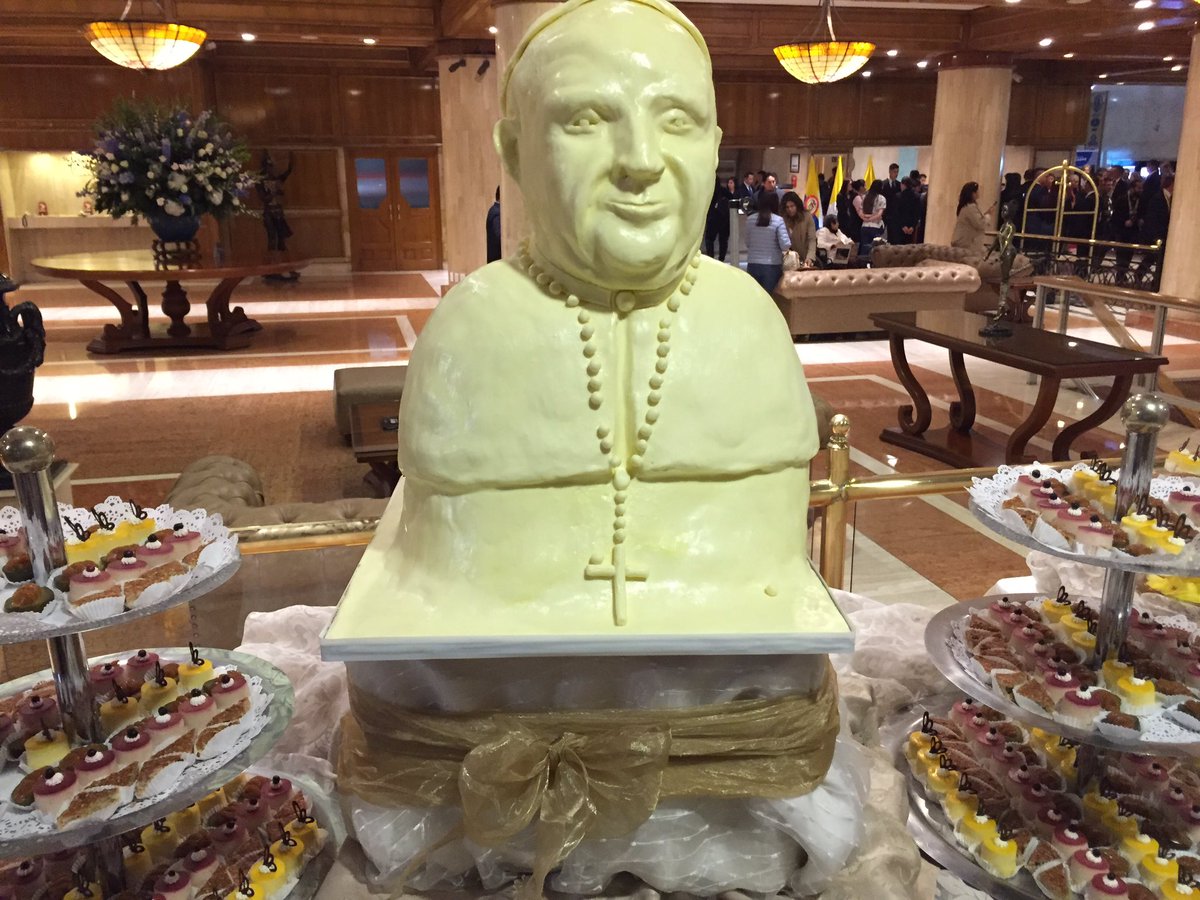
There are numerous pictures, models, effigies, etc. of Pope Francis in circulation, most of which look nothing like the Holy Father. As Pope Francis prepares to pack his bags and flee to Argentina, we present some of the worst, with thanks to various contributors.pope lookalike

A new “Looks nothing like Pope Pius XIII” line will be on sale soon.

pope lookalike

Shine, Jesus, Shine!

pope lookalike

A “gay” couple celebrate their (undersized) designer baby.

pope lookalike

“But I prefer a good fudge.”

pope lookalike

Look more like a space alien than a pope.

pope lookalike

Change the name on the base, and it can be anyone you like.


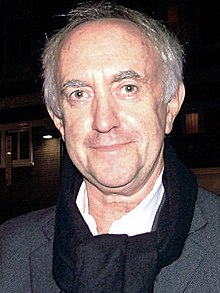
Whereas, we all know that Pope Francis is really the actor Jonathan Pryce.

Jonathan Pryce

Jonathan Pryce.

Except that Pryce (or possibly Francis) was once a James Bond villain.

James Bond villain

Pryce (or Francis) in “Tomorrow never dies”.

Posted in Uncategorized | 1 Comment

WHY I NEVER USE GPS WHEN I DRIVE

image14

Posted in Uncategorized | 2 Comments

THE CHURCH IN CHINA IS LOST WITH FRANCIS SURRENDERING TO SORONDO

Settimo Cielodi Sandro Magister

The China Invented by Bishop Sánchez Sorondo. His Diary From Half a Century Ago Has Been Discovered

Cina


“We can understand that in the enthusiasm of wanting an agreement between China and the Vatican, Chinese culture, Chinese people and Chinese mentality are exaggerated and exalted, as Pope Francis does. But presenting China as a model…”

It is a dumbfounded Fr. Bernardo Cervellera, director of the agency Asia News of the Pontifical Institute for Foreign Missions, who comments on the judgments of Argentine bishop Marcelo Sánchez Sorondo, just back from a trip to China.

Sánchez Sorondo is the chancellor of two pontifical academies, that of sciences and that of social sciences, as well as a diligent lackey of the court of Pope Francis. And in effect there has been astonishment over the he extravagant praises that he lavished on the regime of Beijing in an interview a few days ago for the Spanish-language section of Vatican Insider:

> “Chinos, quienes mejor realizan the social doctrine de la Iglesia”

Here are a few selections from them:

“At this time, those who are the best at putting the Church’s social doctrine into practice are the Chinese.”

“The economy does not dominate politics, as happens in the United States. Free-market thinking has obliterated the concept of the common good, it states that this is an empty idea, but the Chinese seek the common good, they subordinate things to the general good. I have been assured of this by Stefano Zamagni, a traditional economist respected for some time, by all the popes.”

“I encountered an extraordinary China. What people do not know is that the central Chinese principle is: work, work, work. This is nothing other, at bottom, than what St. Paul said: he who does not work should not eat.”

“There are no ‘villas miserias,’ no drugs, the young people do not take drugs. There is a positive national conscience. The Chinese have a moral quality that is not found anywhere else.”

“The pope loves the Chinese people, he loves their history. There are many points of contact right now. One cannot think that today’s China is that of the time of John Paul II or of Russia during the cold war.”

*

Needless to say, his trip to China has made Sánchez Sorondo an enthusiast. Such an enthusiast as to send the memory back a half century ago, to the travel diaries of the many famous intellectuals, writers, churchmen who went to China at the end of the Cultural Revolution, a terrifying, fanatical, bloody season which they nevertheless  admired and exalted as the birth of a virtuous new humanity.

What is presented below is a representative extract from that infatuated diarism of the early seventies. Its authors were two Italian Catholics of the highest caliber: Raniero La Valle (b. 1931), former director of the Catholic newspaper of Bologna, “L’Avvenire d’Italia,” as well as a celebrated chronicler of the Second Vatican Council, and Gianpaolo Meucci (1919-1986), a disciple of Fr. Lorenzo Milani and president of the juvenile justice court in Florence.

They made the journey that they recount in 1973, between the bloodiest phase of the Cultural Revolution (1966-1969) and the death of Mao Zedong (1976).

In re-reading this exaltation of Chinese society that they present, it is striking how similar it is to what Bishop Sánchez Sorondo is saying today.

Also with regard to the Chinese Church of yesterday and today, the judgments of the one and the other are not so different. What they dream of is a Church that is not “foreign” but “sinicized,” which is precisely what is wanted – in their own way – by the current leaders of Beijing: a Church submissive in everything to their power.

But before giving the floor to this diary of half a century ago, it is appropriate to make a clarification on Professor Zamagni, whom Sánchez Sorondo cites in his own support.

Nothing could be more wrong. Zamagni, a world-renowned economist, former dean of the faculty of economics at the University of Bologna, interviewed by the online newspaper of his city, Rimini, did not want to comment on the words of the bishop, but a couple of his quotes are enough to show how far at the polar opposite he places himself.

In 2015 he said in an interview with “Famiglia cristiana”: “China believed it could go against nature. This this is the Chinese evil. Beijing adopted the model of the capitalist market economy within a dictatorial communist system with a single Marxist-Maoist party. Even the most naive knows that this is a marriage not to be made.”

A year ago, in “Avvenire,” he denounced “the ever deeper separation between market capitalism and democracy.” And last November, in a conference at the Pontifical Gregorian University, he reiterated: “The capitalist market economy has always been seen as balanced by democracy, through the ‘welfare state.’ But the novelty of these times is that this connection has been broken: one can be capitalist without being democratic.” Both times he said: “The textbook example is that of China.”

It is urgent to get back to reality.

*

TRAVEL NOTES

by Gianpaolo Meucci and Raniero La Valle

[From “Incontro con la Cina”, Libreria Editrice Fiorentina, Florence, 1973, pp. 70-73]

Chinese society is full of vivacity, joy, serenity. During a monthlong stay in China there has never been even the most fleeting impression of the existence of a domineering police power. Even the guards at the government building, who try in every way to give themselves a martial air, appear almost ridiculous when compared with their counterparts in the West, such that in comparison with them our rookie soldiers guarding the barracks or monuments look like Nazis.

China is a country governed not by a law, but by adherence to a faith, under the guidance of a priestly structure that has not yet become estranged from the masses, a joyful and liberating faith that even includes a carnival, the days of the lunar new year, in which above all the peasants dig into their savings and spend considerable sums relative to the income that is kindly provided by the municipalities themselves.

This is why the Chinese experience leaves an indelible mark on every visitor who suddenly finds himself living in a world he has dreamed of, in a society of men committed to joyfully freeing man, driven by faith in man.

But we would like to add a few notes about the meeting we had with the Catholic Church in Beijing, to find a key of interpretation for the Chinese reality.

It was Sunday, and we asked to be put in a position to attend Mass at the Catholic church of Nam-Dang, which had been reopened for worship after a brief period of closure during the years of the Cultural Revolution.

What could have been an experience full of meaning and hope was in reality the most painful and mortifying of all the experiences of our long journey.

We all shared the same conclusive judgment: it is good, it is fitting that a Church of this kind should disappear, if the desire is that the proclamation of the Gospel message should some day reach the Chinese people and open it to another dimension.

The church of Nam-Dang is the monument of the colonialist mentality that for centuries has polluted the missionary action of the Church, accepted by most and challenged by few enlightened spirits.

Think of a church from the late baroque period of old Rome, transplanted to Beijing with its Sacred Heart, the usual statue of Our Lady on the high altar, a few saints, including a Saint Rita of the present-day devotion in Italy.

The priest who says Mass is old, just as the seven Chinese present are old. He mumbles the mass in Latin, facing the altar.

After Mass we talk to a younger priest, while we are not allowed to interview the bishop who, we are told, lives within the complex of that church.

We carefully avoid any question with political nuances, but we insist on questions relating to the religiosity of the Chinese people.

The priest, who is holding the “Pars aestiva” of the breviary, with the style of a Roman seminarian style of the 1920’s, does not respond to what he is asked. He is a stranger to his people, and is content to adhere formally to schemes that have been taught to him with a colonialist mentality and intentions.

We repeatedly, also on other occasions, tried to turn the conversation to the religiosity of the Chinese people and to religious freedom. We are convinced that it was not done to mask a real anti-religious attitude, that the answers were evaded. Christianity was the religion of the master and the of colonialist powers, and they fought it in the people of its ministers, citizens of the occupying countries; but the Chinese constitution admits religious freedom.

What Rome’s attitude toward the Chinese bishops may be in the future seems of little interest to us.

(English translation by Matthew Sherry, Ballwin, Missouri, U.S.A.)

Posted in Uncategorized | 1 Comment

IN CASE YOU HAVE DIFFICULTY IN RECOGNIZING HERESY WHEN YOU ENCOUNTER IT READ THIS ARTICLE BY ROD DREHER, IT CAN HELP YOU

Blase Cupich, Cardinal Archbishop of Chicago (Dominican University/Flickr)

Rod Dreher

{Abyssum}

Voice Of Conscience = Voice Of God ???????

Chicago’s Cardinal Blase Cupich just gave a big speech defending Amoris Laetitia, Pope Francis’s apostolic exhortation. From the National Catholic Reporter‘s take:

The third of Cupich’s principles calls the conscience of the individual person an “essential” element in the task of discerning how God is calling them to live their life.

The cardinal cites at length from paragraph 303 of the exhortation: “Conscience can do more than recognize that a given situation does not correspond objectively to the overall demands of the Gospel. It can also recognize with sincerity and honesty what for now is the most generous response which can be given to God.”

He also cites the definition for conscience given in Gaudium et Spes as “the most secret core and sanctuary of a man … [where] he is alone with God, Whose voice echoes in his depths.”

“When taken seriously, this definition demands a profound respect for the discernment of married couples and families,” the cardinal states. “Their decisions of conscience represent God’s personal guidance for the particularities of their lives. In other words, the voice of conscience — the voice of God … could very well affirm the necessity of living at some distance from the Church’s understanding of the ideal.” [Emphasis mine — RD]

Cupich notes that Francis urges pastors to carefully exercise discernment, working with individuals to “take into account the complexity of various situations.”

“It is hard to overstate the significance of this hermeneutical shift,” the cardinal states. “By fully embracing the understanding of conscience found in Gaudium et Spes, Pope Francis points not only to the possibility of accompaniment in the Church’s ministry with families but also to its necessity.”

Well, I agree with His Eminence that it is hard to overstate the significance of this hermeneutical shift. Notice the highlighted part above. The voice of the individual’s conscience is the voice of God. The Church no longer teaches truth, but its own opinion of the “ideal.”

More:

“The result is not relativism, or an arbitrary application of the doctrinal law, but an authentic receptivity to God’s self-revelation in the concrete realities of family life and to the work of the Holy Spirit in the consciences of the faithful,” states the cardinal.

“As pastoral discernment attends to the reality of a situation, the conscience based Christian moral life does not focus primarily on the automatic application of universal precepts,” he continues. “Rather, it is continually immersed in the concrete situations which give vital context to our moral choices.”

Oh, please. The result is relativism, straight up.

Here is a link to the full text of the Cupich speech.  I want to point out sections that the NCR report didn’t cover. Such as:

At the heart of this shift is a fully incarnational approach, which the Cardinal explains, is a two-way street. On the one hand the Church embraces the family with the Gospel message. Yet, since the family is already itself a Gospel, the Gospel of the family, there is a reciprocity to this incarnational approach that recognizes the contribution that families make to the Church’s understanding and proclamation of the Gospel. In other words, there has to be a holistic connection between our knowledge and our practice, our ideas and our experience have to inform each other.

See that? The family “is already itself a Gospel”. What does that mean? Could it mean that the family is on the same level as the Gospel in terms of the proclamation of Truth?

More:

This insight has enormous consequences. If we are serious about fully appreciating that the concrete lives of families and couples are part of salvation history in which God continues to engage and redeem humanity, then at the least it will mean moving away from presenting an abstract and idealized presentation of marriage. Instead, we should begin with a view that married life is “…a challenging mosaic made up of many different realities, with all their joys, hopes and problems” (AL 38). Likewise, if we accept that families are a privileged place of God’s self-revelation and activity, then no family should be considered deprived of God’s grace. Our ministerial approach should begin with the understanding that families are not problems to solve. Rather, they are opportunities for the Church to discern with the aid of the Spirit how God is active in our time and what God is calling us to do here and now.

Oh? What about the families of the “three-person babies” that labs in Britain are about to manufacture? What about polygamist families?

More:

The presupposition must always be that whenever there is a family striving to live together and to love one another, the Spirit is already present. The task of those who minister to families, then, is to open their eyes to see, and to help families discern where God is calling them. All of this represents an enormous change of approach, a paradigm shift holistically rooted in scripture, tradition and human experience.

Uh huh. In what sense is the Spirit present in the family of four, all of whom call themselves transgender? In what sense can this be considered blessed by God?

More Cupich:

It goes without saying that this will also mean rejecting an authoritarian or paternalistic way of dealing with people that lays down the law, that pretends to have all the answers, or easy answers to complex problems, that suggests that general rules will seamlessly bring immediate clarity or that the teachings of our tradition can preemptively be applied to the particular challenges confronting couples and families. In its place a new direction will be required, one that envisions ministry as accompaniment, an accompaniment, which we will see, is marked by a deep respect for the conscience of the faithful.

In 2016, some of Canada’s Catholic bishops approved clerical cooperation with euthanasia, explicitly citing Amoris Laetitia and Pope Francis’s idea of “accompaniment”.

Again, read the entire Cupich speech to see for yourself what one of Pope Francis’s closest allies has said.

I could be wrong, but this seems to me like a new religion. Cardinal Cupich recently denounced The Benedict Option. Having read this speech, I see why he finds the Ben Op so threatening. You conservative Catholic readers should too, and read the signs of the times.

Posted in , . Tagged , , , , .
Posted in Uncategorized | 9 Comments

THE PRIEST’S ROLE IN THE CONFESSIONAL IS TO ABSOLVE SIN, NOT TO HELP THE PENITENT SEEK TO DISCOVER REASONS WHY THEIR SIN WAS NOT REALLY SINFUL FOR THEM

Defenders, The Catholic Thing

“The priest’s job is to tell people not to sin, not to tell them to discover reasons why their sin is not sinful for them”

“The priest’s job is to tell people not to sin, not to tell them to discover reasons why their sin is not sinful for them”

In the church of man being founded by False Prophet Francis, everything to approve of and promote sin will be encouraged and implemented.

As has been widely reported, three bishops in Kazakhstan – Tomash Peta, Jan Pawel Lenga, and Athanasius Schneider – issued a Profession of the Immutable Truths about Sacramental Marriage on December 31, 2017. This precisely reasoned defense of Catholic teaching on marriage gets to the heart of the problems occasioned by the eighth chapter of Amoris Laetitia.

Now that the initial flurry of commentary has died down, I’d like to examine calmly here three paragraphs that summarize why permission to receive Holy Communion given to people who are in “second marriages” and have the intention to continue to commit acts of adultery is a grave offense against Catholic teaching on the sacredness and indissolubility of marriage. This permission abolishes the perennial sacramental discipline that protects and upholds this teaching.

The Kazakh bishops write: “Sexual relationships between people who are not in the bond to one another of a valid marriage – which occurs in the case of the so-called ‘divorced and remarried’ – are always contrary to God’s will and constitute a grave offense against God.” This is plainly true. Adultery is never pleasing to God, is never authorized or tolerated by God, is always evil.

They continue: “No circumstance or finality, not even a possible imputability or diminished guilt, can make such sexual relations a positive moral reality and pleasing to God. The same applies to the other negative precepts of the Ten Commandments of God. Since ‘there exist acts which, per se and in themselves, independently of circumstances, are always seriously wrong by reason of their object.’ (John Paul II, Apostolic Exhortation Reconciliatio et Paenitentia, 17)”

This is a key point sometimes overlooked in the debate. Adultery can never be “a positive moral reality and pleasing to God.” Therefore, the Church must never encourage people to engage in acts that are always per se offensive to God. It is pastorally deficient to advise that a person committing such evil acts may responsibly judge himself not to be guilty of giving serious offense to God due to alleged circumstances that diminish his culpability for his sins.

How can he be so sure of his innocence of his persistent mortal sin that he thinks God will not hold him to account, but rather wants him to receive the Holy Eucharist without repenting of his sin? And why would a priest advise someone that he may continue to commit the sin of adultery as long as that person thinks he will not be held guilty by God for that sin?

From left: Peta, Lenga, and Schneider

The priest’s job is to tell people not to sin, not to tell them to discover reasons why their sin is not sinful for them. It is an act of spiritual arrogance in God’s sight for the priest advisor or the civilly “remarried” person to claim that, because of some alleged exculpatory reason, he does not have to obey the Sixth Commandment now and in the future, and that he can worthily receive Holy Communion. We are called by Christ to conform our lives to God’s law, which includes the recognition by our intellect of the justice and holiness of that law.

The Kazakh bishops go on:

The Church does not possess the infallible charism of judging the internal state of grace of a member of the faithful (see Council of Trent, session 24, chapter 1). The non-admission to Holy Communion of the so-called “divorced and remarried” does not therefore mean a judgment on their state of grace before God, but a judgment on the visible, public, and objective character of their situation. Because of the visible nature of the sacraments and of the Church herself, the reception of the sacraments necessarily depends on the corresponding visible and objective situation of the faithful.

The canonical prohibition of the administration of the Holy Eucharist to those who “persist in manifest grave sin” (Canon 915) is based on the external action (in this case the contracting of a civil marriage and the ongoing cohabitation as man and wife). This cannot be set aside by any claim that a person judges himself to be inculpable of “manifest grave sin.” This canonical prohibition reinforces the moral guidance that the Church has always given in such cases: it’s perilous to one’s soul to violate God’s law, and it is a dangerous self-delusion to seek out reasons why that law does not oblige one’s obedience. Looking for excuses to keep sinning is not the way to fulfill God’s will in one’s life.

In an interview with The National Catholic Register, Bishop Athanasius Schneider summed up the matter: “The Church, for 2,000 years, always and everywhere unambiguously forbade people to receive Holy Communion while they lived more uxorio with a person who was not their legitimate spouse and who, at the same time, publicly formalized such a non-marital union and had no firm intention to stop such sexual relations. Since this universal practice of the Church touched an essential point of the sacraments, it has to be considered as irreformable.”

In another interview at the Rorate Caeli website, he defended the propriety of the Kazakh bishops raising these objections to Pope Francis in a spirit of Christian charity. His argument applies by analogy to any member of the faithful who turns to Pope Francis with his concerns about Amoris Laetitia and the subsequent developments:

When bishops remind the pope respectfully of the immutable truth and discipline of the Church, they don’t judge hereby the first chair of the Church, instead they behave themselves as colleagues and brothers of the pope. The attitude of the bishops towards the pope has to be collegial, fraternal, not servile and always supernaturally respectful, as it stressed (sic) the Second Vatican Council (especially in the documents Lumen Gentium and Christus Dominus). One has to continue to profess the immutable faith and pray still more for the pope and, then, only God can intervene and He will do this unquestionably.

So, fidelity and prayer – our sure hope in this troubled moment in the life of the Church.

Read the full article at The Catholic Thing

Posted in Uncategorized | 2 Comments