MURDER MOST FOUL

unnamed-27

Charlie Gard Dies After Life Support is Switched Off: Mother Says “Our Beautiful Boy is Gone”

INTERNATIONAL   STEVEN ERTELT   JUL 28, 2017   |   1:29PM    WASHINGTON, DC

Charlie Gard has passed away after his life support was switched off today. His parents said in a post on social media that “our beautiful boy” is gone.

Charlie was at the center of a massive international debate after the hospital where he was receiving treatment for a rare disease refused to allow an experimental treatment to help him and also refused transferring him to another hospital that would allow the treatment.

Charlie’s parents took their fight to numerous courts to protect his life but to no avail. Each of the courts and a British judge argued that it was in Charlie’s best interest to be removed from the life support.

Charlie’s mother, Connie, said: “Our beautiful little boy has gone, we are so proud of you Charlie.”

Leading pro-life advocates mourned Charlie’s deathsaying it’s a very concerning harbinger of things to come.

The boy suffers from a rare mitochondrial disease and brain damage. On Thursday, a judge ruled that Charlie will be taken to hospice to die, rather than home as his parents requested.

On Monday, Connie Yates and Chris Gard decided to end the legal battle to get their son experimental treatment. Based on new evidence, the couple said Charlie’s condition has deteriorated too much and there no longer is any hope of the experimental treatment working.

His parents and Great Ormond Street Hospital have been in a months-long legal battle over his treatment. Their final request to a judge this week was to be allowed to take Charlie home to die.

On Thursday, a judge ruled that Charlie will be moved to hospice and his life support will be removed at a time not publicly disclosed. He will not be allowed to go home, as his parents wished.

Charlie’s parents have long expressed the desire to be allowed to take him home to die. However, their first choice was to take Charlie to the United States for an experimental treatment. They raised more than $1.5 million for his medical care.

Click here to sign up for pro-life news alerts from LifeNews.com

His parents said they knew the chance of the experimental treatment working was slim, but they wanted to try anyway for Charlie’s sake.

However, the courts and hospital refused to allow them to transfer their son to another hospital. About a month ago, the European Court of Human Rights ruled that the hospital can remove Charlie’s life support and allow him to die. However, the hospital later agreed to consider new evidence involving Charlie’s condition before taking him off the ventilator.

But on Monday, lawyer Grant Armstrong said experts confirmed that it is too late to treat their son.

The BBC reported Armstrong “told the presiding judge Mr Justice Francis that US neurologist Dr Michio Hirano had said he was no longer willing to offer the baby experimental therapy after he saw the results of a new MRI scan last week.”

Hirano previously said Charlie had an 11 percent to 56 percent chance of benefiting from the experimental treatment. He and a group of doctors examined Charlie last week and gave their expert opinions to the judge.

Questions remain about whether Charlie could have benefited from the experimental treatment, had it not been delayed for months during the legal battle between Charlie’s parents and the hospital. The court battle began in March.

Their last request to take Charlie home to die also was denied.

We promised Charlie every day we would take him home. It seems really upsetting, after everything we’ve been through, to deny us this,” his mother said.

The hospital opposes the parents’ request. Its lawyers argued that Charlie needs to stay at the hospital or go to a hospice facility until he dies. Doctors claimed his ventilator will not fit through the door of his parents’ home, and he could suffer a painful death.

Despite all of his problems, Charlie’s parents – and millions like them – believe that Charlie is a valuable, living human being who should be given a chance to live.

Leading pro-life advocates helped Charlie’s parents fight for his life.

Charlie’s parents brought Terri Schiavo’s brother Bobby Schindler to London to help them fight for care for their son. Schindler spoke with LifeNews exclusively about their invitation.

Schindler told LifeNews: “We are here by invitation from the family to come alongside them as they struggle to save their son, Charlie. The critical issue here is not a political one, but the simple notion that families know what is best for their loved ones.”

“Charlie’s situation is very reminiscent of my family’s battle to save my sister, Terri. Hopefully being here can help his parents, Connie and Charlie, deal with the day-to-day emotional roller coaster, as they fight for their son’s right to live,” Schindler added.


Posted in Uncategorized | 1 Comment

FRANCIS APPROVED OF HOLY COMMUNION FOR ADULTERERS

Amoris Laetitia, Cronies, Featured, Life Site News

Archbishop Paglia: Francis Approved of Holy Communion for Adulterers

Archbishop Paglia: Francis Approved of Holy Communion for Adulterers

They are getting bolder now, speaking more openly what has been obvious for several years to men and women of real faith.

ROME, July 27, 2017 (LifeSiteNews) – The archbishop tasked with leading the Vatican’s pro-life academy says the Pope’s controversial teaching document on marriage opens Holy Communion to those in public grave sin.

Archbishop Vincenzo Paglia says Amoris Laetitia calls for “integration” of those in “irregular situations,” including “sacramental integration.”

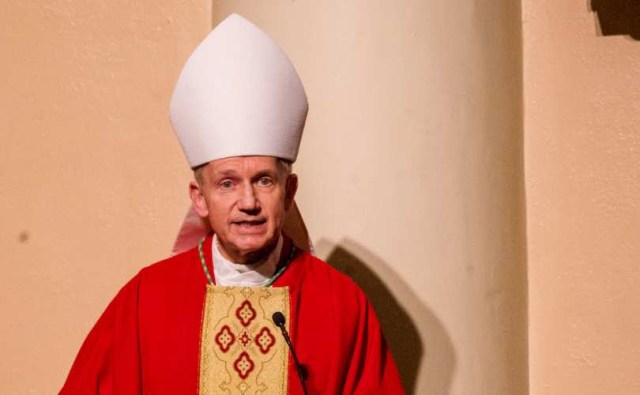
The archbishop, who serves as Grand Chancellor of the St. John Paul II Pontifical Institute for the Study of Marriage and Family, famously commissioned a homoerotic painting containing his likeness for his former cathedral.

Asked in a recent email interview with the Diocese of Charleston newspaper The Catholic Miscellany to describe what Pope Francis’s frequently used concept of “accompaniment” should entail, Paglia cited one of Amoris Laetitia’s controversialpassages in paragraph 297 of the document, which states that according to the Gospel “No one can be condemned for ever.”

The archbishop said accompaniment will vary in each situation, cannot be closed off from the community, and that “the pope urges priests to be priests, to accompany, and not to be judges from whom there is no appeal.”

“Amoris Laetitia provides some guidelines,” Archbishop Paglia stated. “Those who live in irregular situations, if they accept being accompanied in a shared faith journey in the Christian community (especially if the process is promoted and guided by the bishop), will be able to encounter various and gradual forms of integration, not excluding sacramental integration.”

“Accompaniment leads to overcoming unfair forms of exclusion and to appreciating the human, moral and ecclesial condition of others,” he said as well.

The term “accompaniment” has been a regular buzzword since the two controversial Synods on the Family in 2014 and 2015 signaling a sort of ecclesial escorting of Catholics in irregular unions back into the sacramental life of the Church. Very often in its use the crucial element of repentance and turning away from sin is excluded.

“Irregular unions” refers to homosexual or cohabiting unions, as well as those who are divorced and civilly remarried, though its use in these discussions has typically meant the latter.

Amoris Laetitia remains extremely controversial one year after its release, as its ambiguities have opened the door to Communion for the divorced and remarried, allowing varying bishops’ conferences worldwide to implement the document in divergent ways, and the pope persists in silence in response to requests for clarification.

Archbishop Paglia was appointed by Pope Francis last year as President of the Pontifical Academy for Life and Grand Chancellor of the Pontifical Pope John Paul II Institute for Studies on Marriage and Family.

The appointments have been a part of indicating an apparent overhaul of the two institutions in favor of a departure from fidelity to Catholic teaching on life.

Archbishop Paglia dismissed concerns in a recent interview over Pope Francis’ controversial changes to the pontifical academy and theological institute he leads.

The pope had cleared previous Academy members out and replaced them, in numerous instances with individuals that support abortion, euthanasia and other things in conflict with Church teaching.  Members are no longer required to sign a declaration of fidelity to the Church’s pro-life teachings.

Asked whether the changes made by the pope signified a reluctance to fight for Christian values, the archbishop stated, “My view is the exact opposite. I am so certain of the power of Christian values that I don’t feel a need to defend them, they defend themselves.”

The archbishop has defended controversial pro-abortion picks for Pontifical Academy of for Life appointees.

A book containing arguments for admitting divorced and civilly remarried Catholics to the sacraments was published under Archbishop Paglia’s purview in 2015 while he head of the Pontifical Council for the Family.

The archbishop himself has not been without controversy.

The Pontifical Council for the Family promulgated a controversial sex-ed program for youth in 2016 under his direction that used sexually explicit and suggestive images and departed from the Church’s magisterium’s perennial teaching on sex education in a number of ways.

The program left parents out of the education process and failed to condemn harmful sexual behaviors that violate Church teaching, among many other problematic elements.

Reports surfaced this past March that Archbishop Paglia had commissioned a homosexual artist back in 2007 when he was a diocesan bishop to paint a blasphemous homoerotic mural in his cathedral church.

The giant mural covering the opposite side of the facade of the Diocese of Terni-Narni-Amelia’s cathedral church portrays Jesus carrying nets to heaven filled with naked and semi-nude homosexuals, transsexuals, prostitutes, and drug dealers, intermingling in erotic exchanges. The image of the archbishop himself is depicted among those in the nets.

Archbishop Paglia has defended the mural deemed by Catholic critics to be  “blasphemous” and “disgusting,” as well as “demonic,” saying it was part of a commitment to evangelizing.

Regarding his inclusion in the mass of nude bodies shown in the mural, he said, “I too am included in the mural as one who needs redemption no less than anyone else.”

Read the full article at Life Site News

Posted in Uncategorized | Comments Off on FRANCIS APPROVED OF HOLY COMMUNION FOR ADULTERERS

WHY SPEAK THE TRUTH PLAINLY WHEN DOUBLE-SPEAK CAN HIDE ONE’S OBJECTIVE AND THUS AVOID OBJECTION


The Alleged Vatican Commission on Humanae Vitae – Nothing to See Here?

ONE/PETER/FIVE
Google+PinterestPocket

Back in May, we shared a report from veteran Vatican journalist Marco Tosatti, who had gotten wind of an alleged Vatican commission formed to study — and possibly to revisit — the teachings on contraception found in Humanae Vitae. Within a month’s time, the existence of this commission was confirmed by Professor Roberto de Mattei in a piece for Corrispondenza Romana.

De Mattei cited the words of Msgr. Marengo himself — the man who had been identified as the leader of this new commission on Humanae Vitae — and they were troubling indeed. They indicated that he favors an approach to the question of contraception that is reminiscent of the way Amoris Laetitia dealt with communion for the “remarried”.

In a more recent article in the same Newspaper (Vatican Insider, March 23rd 2017) with the significant title, Humane Vitae and Amoris laetitia, Monsignor Marengo asks if: “the polemical game – the pill yes – the pill no, like today’s – Communion to the divorced  yes – Communion to the divorced no – is only an appearance of discomfort and strain, [which is] much more decisive in the fabric of ecclesial life.

Marengo, in turn, cited the pope in this context, quoting Francis as speaking of an “excessive idealization, above all when we have reawakened trust in grace” that “has not made marriage more attractive and desirable, but quite the opposite.”

As I said in my commentary at the time:

[T]he key takeaway here is that just like we’ve been told over and over again that Christian marriage is an all-but-unattainable ideal, so if you messed up, no big, enjoy your adultery and by the way, here’s some Holy Communion, this is a mapping of that same “you’re never going to live this so why even try” ethos onto the question of contraception.

Interestingly, months later, certain media outlets have begun pushing back against the idea of this commission, relegating reports like ours to the realm of conspiracy theory. Cindy Wooden of Catholic News Service had a story yesterday in which she confirmed that “Four theologians specializing in marriage and family life are studying Vatican archival material with a view of telling the whole story of how and why Blessed Paul VI wrote his encyclical ‘Humanae Vitae’ on married love.”

Wooden continues:

Msgr. Gilfredo Marengo, leader of the group and a professor of theological anthropology at Rome’s Pontifical John Paul II Institute for Studies on Marriage and Family, spoke to Vatican Radio about the study July 25, the 49th anniversary of the encyclical’s publication.

Some bloggers, writing in the spring about the study group, alarmingly presented it as an initiative of Pope Francis to change the encyclical’s teaching against the use of artificial contraception.

Archbishop Vincenzo Paglia, chancellor of the John Paul II Institute, categorically denied the bloggers’ reports.

In reply to an email, Msgr. Marengo told Catholic News Service July 26 that the study “is a work of historical-critical investigation without any aim other than reconstructing as well as possible the whole process of composing the encyclical.”

“Anyone who imagined any other aim should have simply done their work and verified their sources,” he said.

Interestingly, Archbishop Paglia had also denied that such a commission even existed — and, according to Luciano Moia of Avvenire, that Msgr. Marengo was even associated with it. (More on that in a moment.)

Inés San Martín, the intrepid Vatican correspondent for Crux, takes a more sarcastic tone in her piece today entitled, “No, Virginia, there’s no ‘secret commission’ on Humanae Vitae“. The executive summary at the top of her commentary tells you most of what you need to know:

Rumors of late, circulated by mostly conservative blogs, have suggested that Pope Francis and Italian Archbishop Vincenzo Paglia have created a secret commission to reevaluate the teaching of ‘Humanae Vitae,’ Pope Paul VI’s 1968 encyclical on birth control. As it turns out, establishing the truth of the matter is even easier than generating the conspiracy theory in the first place.

San Martín continues:

Paglia has denied that any such commission exists. Speaking recently with Argentine journalist Andrés Beltramo Álvarez, Paglia said, “There’s no commission, that’s all been made up.”

This interview was published online on July 13 in the Spanish Alfa y Omega. Paglia himself provided a translation into English via Twitter.

Yet on Tuesday, Vatican Radio published a separate interview with Father Gilfredo Marengo, a professor of theological anthropology at the St. John Paul II institute in Rome. Responding to questions, he said he leads a “research group” on Humane Vitae.

That raised some eyebrows, since Marengo is precisely the man the rumors had identified as leader of the alleged “reinterpreting-the-document” commission. So, I picked up the phone, called the John Paul II Pontifical Institute, and asked to speak with him.

He wasn’t there, but the person on the other side of the line happily gave me his email. I wrote, and not ten minutes later I had a response.

Marengo told me that, together with colleagues, he’s part of a research group on Humane Vitae, but it “has nothing to do with ‘reforming the encyclical’.”

[…]

Based on the Marengo interview with Vatican Radio, it would have been easy enough to whip up a piece claiming it proves Paglia was lying, that there really is a secret cabal planning to gut Humanae Vitae, slap on a click-bait headline, and presto: A new Internet sensation is born.

As it turns out, though, picking up the phone to get the actual facts of the situation was just as easy.

[…]

Perhaps the moral of the story is this: If conspiracy theorists would devote the same energy to real reporting as they do to mental gymnastics and connect-the-dots exercises, they might actually know what’s going on once in a while.

For Wooden and San Martín, it seems that the fact that the group not only exists and is headed up by the very people who were claimed to be running it months ago is irrelevant. You see, it’s just a research group! Nothing more. The word “commission” is nowhere to be found! And why would anyone believe that such a group might suggest some changes in pastoral application of HV’s guidelines on contraception? Surely, something as unchangeable as the Catholic teaching on contraception has never been overturned by pastoral guidelines issued as a result of a working group set up to study a matter of established doctrine.

I suppose we’re meant to believe that it’s more plausible that this group has been set up under the guidance of a man who has publicly stated — recently — that he views contraception through the same lens as Communion for the “remarried” simply because he has nothing else to do with his time. It’s not like there’s a priest shortage or anything. “Humanae Vitae: The Untold Story” is obviously a top priority in 2017.

Here I will return to the man who broke this story three months ago: Marco Tosatti (who, I’m fairly certain, has been practicing Vatican journalism for longer than the young Miss San Martín has been alive, in case she’s interested in any pointers of her own). In his post today, he engages in a bit of a “connect-the-dots exercise”, but we’ve decided (with his permission) to reproduce a translation* of it in full below all the same:


There are some things that are pleasing. On 11 May, we wrote that “In the Vatican, good sources tell us that the pontiff is about to nominate — or has even already formed — a secret commission to examine and possibly study changes to the Church’s position on contraception, as it had been settled in 1968 by Paul VI in the encyclical Humanae Vitae. It was the last document of this type signed by Pope Montini, and it was the formalization of what the Second Vatican Council had elaborated on this issue. So far, we have no official confirmation of the existence and composition of this body; but a request for confirmation or denial has been issued to the competent headquarters and so far has not been answered. This could be a signal in itself, in the sense that if the news were completely unfounded, it would not be difficult to say so. ”

A few days later, the US Catholic site OnePeterFive resumed the news, confirming its solidity. And on June 14, prof. Roberto de Mattei, on Corrispondenza Romana, provided some details. De Mattei wrote: “It will be Monsignor Gilfredo Marengo, Professor at the John Paul II Pontifical Institute, [who will act as] the coordinator of the commission nominated by Pope Francis to “re-interpret” the encyclical Humane Vitae by Paul VI, in the light of Amoris laetitia, on the occasion of  the fiftieth anniversary of the former’s promulgation, which  falls next year. The initial rumors of the existence of this commission, still secret, reported by Vatican reporter Marco Tosatti, were of a sound source. We can confirm that there is a commission, made up of Monsignor Pierangelo Sequeri, Head of the John Paul II Pontifical Institute, Professor Philippe Chenaux, Lecturer in Church History at the Lateran Pontifical University and Monsignor Angel Maffeis, Head of the Paul VI Institute in Brescia. The coordinator is Monsignor Gilfredo Marengo, Lecturer in Theological Anthropology at the John Paul II Institute and member of the Steering Committee of the CVII-Center Vatican II Study and Research magazine.”

On 4 July, in the Italian bishops’ newspaper, Avvenire, Monsignor Vincenzo Paglia, President of the Pontifical Academy for Life, released an interview with Luciano Moia. As writes Lorenzo Bertocchi today for La Nuova Bussola Quotidana: “The journalist [Moia], committed to the renewal of moral theology established by Amoris Laetitia, asked the prelate if certain ‘media manipulations’ about a secret commission for the ‘revision’ of Humanae vitae, the encyclical of Pope Paul VI on contraception and human love, corresponded to reality. Not only that; Moia also cited a supposed list of experts and theologians — from Pierangelo Sequeri to Gilfredo Marengo — who would be involved in this project. And then the fateful question: ‘Is there something true in all this?’ ‘Just nothing’, Paglia replied, rather, ‘it is a good time for the Church to help everyone reinvent the force of generativity while the world risks sterility’.”

Two days ago, Vatican Radio hosted an interview with Mgr. Gilfredo Marengo. In that same interview, he says that there is “a research group on the Encyclical, in view of the 50th anniversary”. It also names the members of the group involved in the work: Monsignor Pierangelo Sequeri, head of the Pontifical Institute John Paul II, prof. Philippe Chenaux, professor of Church History at the Pontifical Lateran University and Msgr. Angelo Maffeis, head of the Paolo VI Institute of Brescia. The very names same indicated by prof. But Mattei.

In substance: the news is confirmed, and even a certain secrecy is confirmed as well — let’s call it that — about the existence of this group. So much so that neither the institutional sources that we had contacted in May, without any reply, or Archbishop Paglia, who would have adjusted his denial in a different way, nor our colleague Moia, a specialist in these issues for the bishops’ daily, knew about it. As we said, these are events that give some satisfaction. And they confirm us in our great confidence and respect — with sound, deep reservations — towards official denials.


Why must we constantly play this cat and mouse game with the truth? Why, when we have a Vatican (and collaborators) that can’t be trusted — going so far as to change the wording of published translations and transcripts in a way that gives cover to controversial papal remarks (something John Allen of Crux defended) — should we believe these denials of reports that have been proven to be so close to the mark?

Is it that the “reconstruction” isn’t quite right? Is that enough to justify saying that a thing isn’t true? It’s not a “commission,” it’s a “research group,” so despite the fact that all the other details match up, it’s a conspiracy theory or a fabrication? Certainly, it’s within the realm of possibility that this “research group” will work diligently on a “historical-critical investigation” that will reconstruct “as well as possible the whole process of composing the encyclical.”

But without any other aim? No searching for loopholes? No examination of what possible equivocations Pope Paul VI might have considered before deciding against them? No exploration of Pope Francis’ own deeply troubling statements and gestures regarding the permissibility of contraception? No progress made in working toward the Francis’s beliefthat “We must always go forward. Always forward!”, and his goal of accomplishing “irreversible reform“?

Mark me down as skeptical.

Earlier today, I posted an excerpt of an essay pertaining to institutions in the secular sphere, and how when lying becomes necessary to maintain the status quo, the organizational goose is cooked. One part stands out:

Truth is power, lies are weakness. All we get now are lies, statistics designed to mislead and phony reassurances that the status quo is stable and permanent. The truth is powerful because it is the core dynamic of solving problems. Lies, gamed statistics and false reassurances are fatal because they doom any sincere efforts to fix what’s broken before the system reaches the point of no return.

The truth also has a name: Jesus Christ. And it is Him whom we serve. The present ecclesiastical system does indeed seem to have reached a point of no return, but Our Lord has guaranteed us that the Church He founded will never succumb to the enemy.

I long for the day when those in power in the Church lose the fear of confronting evil or of telling the whole truth, and instead work courageously to defend Christ’s teachings rather than constantly revisiting them in the hopes of finding a way around them.


*Maike Hickson assisted with this translation.

Posted in Uncategorized | 2 Comments

BLESSED PIER GIORGIO FRASSATI: “HE SHOWS US THAT HOLINESS IS POSSIBLE FOR ALL OF US” POPE BENEDICT

Blessed Pier Giorgio Frassati


Courageous Priest


The Cure for Spiritual Cancer

Posted: 27 Jul 2017 09:22 AM PDT

By Fr. Daniel Doctor

[ Emphasis and {commentary} in red type by Abyssum ]

As a priest, one of my roles is to be a spiritual physician.  So, when those sick from sin and evil and its effects can come to the sacrament of confession, they can be relieved of them. The priest plays a vital role in our spiritual lives because he can diagnose the root cause of these spiritual illnesses that a soul can suffer from and can offer relief. As a priest in many different parishes throughout our diocese, but also looking at the America Catholic Church at large, my diagnosis as a spiritual physician is that our world, our culture, and in some cases even our Church, is suffering from a form of spiritual cancer.  This form of spiritual cancer is unlike anything we physicians have seen before.  This form of spiritual cancer metastasizes at a very fast rate and affects everything that it comes in contact with.  It even seems, at times, that no solution or remedy… that no matter the spiritual practice, penance, or acquired virtues we develop, seem to be able to weaken its hold on us or even slow its rate of growth once it takes hold.

When we look back over the great Traditions of our Catholic Church, the great craft Our Lord has given to us priests to wield brings about our own personal holiness and our neighbor’s as well.  This craft, this art, these skills which have been passed down to us by all those great saints, great spiritual physicians of old, we come to an understanding that our spiritual lives are not based on our feelings or ruled by our emotions.  As a physician, I can’t offer cures that don’t work, or just based on how I feel today. My priestly action to help Our Lord cure or relieve the sufferings of others or the effects caused by sin is based on a rational science taught for over 2000 years.  It is called the Science of the Saints and this Science offers a cure for the evils and sinfulness we see in the world and in our own lives.

According to these great Saints, the only known cure for this kind of spiritual cancer that is affecting our lives and our world is Eucharistic Adoration.  When you come before our Lord in
Adoration, Our Lord’s mercy and love radiate the spiritual cancer within us (that is, the sin and evil and its harmful effects.)  And if we spend enough time in His presence, it radiates to the cellular level. As St. Paul taught “the wages of sin is death” and death is at work within those who live in sin. Our Lord, on the other hand, replaces the damage done by sin and evil at the deepest level within us, with His very presence transforming death into life.

We priests offer no other cure than the Divine Physician Himself! Who wants to penetrate our very selves at the deepest level with His most gracious and incredible Love, at the very level of our cells if you will.

Therefore, God begins to do His work in us:  healing us, transforming us, helping us to be Holy, to be like Him.  And as the cure works its course throughout us, we begin to be created anew, transformed into His very self.  The cure for all the spiritual cancers and evils in our world is Jesus Christ and His wonderful presence in the Blessed Sacrament.  Remember the words of our Lord, “Go and learn these words; I desire mercy not sacrifice,” and that Our Lord came to “call sinners not the righteous.” So, have we gone and learned the meaning of these words? Do we put them into practice? We all need Eucharistic Adoration in our lives if we ever hope to make it safely into the harbor of Heaven.

If we admit, and rightfully so, that we have sinned and are now infected or affected by those sins, we need the cure that radiates from the Heart of our Savior in the Holy Eucharist. To
overcome being sick from the effects of our former way of life, we need a nurse to bring us all the way back to health. This nurse, God also provides in the healing and loving help we receive from the Mother of God, most especially from her Rosary.

You see, my brothers and sisters, the Rosary has two very important effects in those who pray it.  First, it is a formidable weapon (!!) against any further infection from sin.  It is a defense weapon against evil and its effects. Secondly, it teaches us the moral virtues, by reflecting on the mysteries.  It is an offense weapon, offering to us a sure way of attacking the sins we need to learn to overcome, so that we live in a way that we no longer commit them.

The Blessed Virgin, being both a good Mother and life-giving Nurse, not only wants us to heal and get well.  She does not wish any further or future damage to come to us. The greatest
way to avoid future evil is by developing the virtues, which Mary’s Rosary gives to those who pray it.  These the spiritual strengths and grace given to us by Our Lady help or fortify us against any future evil or its effects.

That’s why I love Blessed Pier Giorgio Frassati.  He personifies the very core of what the Science of the Saints teaches us.  At a very early age, he began sneaking out of his house very early in the morning to attend Mass. At the age of 7, he started Eucharistic Adoration giving an hour everyday and no one in his family knew.

His friends remarked of him, “you never saw him anywhere without his rosary in hand.” What an awesome thing to say of any Catholic! At the age of 14, he make his first Holy Communion and continued to received Our Lord every day until his death at the age of 24.  He once said he was so blessed that Christ came to him in Holy Communion everyday that he had to return that love in acts of charity.  When asked by his friends why he was always so happy, he responded, “How can I not be? I have Christ within me.”  When a friend retorted, “How can you be so sure?” He responded, “I receive Him everyday and he has never refused me His presence.”

As Giorgio grew older and had more control over his schedule, while he was at college studying mining engineering, he would love to spend all night in Adoration.  When asked what do you pray for he said, “I pray for all the youth of the world who are sinning” and for their conversion. At a very profound level Giorgio understood something we do not and it came to him in all those hours of Adoration, in all those countless rosaries, and bouquets of flowers he would bring to our Lady.  It was a love story and the love story was about how God came down to a soul, the soul of a little boy, and transformed him into a Saint.

Giorgio was an athlete, a world class skier and mountain climber, a social leader and a political activist of his time even getting arrested for his religious beliefs.  More than once he got into a fist fights to defend it.  He was a college student working on his advanced degrees in Engineering.  At his funeral Mass, over a thousand people from his hometown of Turin, Italy showed up.  Why?  Because of all those hours of love that he received from Our Lord and our Lady.  He could not contain it, he had to spread it around.   And so between all his social, political, and religious activities, as well as all his studies and family responsibilities, he still fed and took care of the health and physical needs of thousands of people. He would go into the poorest areas of Turin to care for their needs. Giorgio was one of the wealthiest Bachelors in all of Italy.  Yet no one knew, not his friends, not his family, all the secret works of charity and acts of devotion to Our Lord and His Mother that he performed.  But, even in all that he gave to poor, it is believed that he caught polio meningitis from them. Giorgio gave every ounce of himself to love others, even though in the end that is what killed him.

And now I think my spiritual best friend Giorgio looks at us with some pity, but with great encouragement.  As Pope Benedict said of him, “Giorgio shows us that holiness is possible for all of us.”  Why? Because what he did to become holy and a saint is something all of us can do, all of us should do:  Eucharistic Adoration most especially at night and over night and praying the Rosary. That’s it, nothing less, nothing more.  Just those two simple things, done with great love and persevering devotion directed his life and can make us saints, too.  It did it to Giorgio and it can for you, too.  Because these two devotions, more than any others, can make us holy.

Blessed Pier Giorgio was “no pie in the sky” Saint.  He was quite practical and he had a vision of how we can and must help each other.  As he said, the great gift that we Christians have is the gift of persuasion but we seldom use it. We don’t persuade others to be holy.  We rarely persuade others to Eucharistic Adoration or to pray the Rosary.  We have all these wonderful opportunities to help others become holy, if we would just persuaded them to do it.  When you take the time to read over the letters that Giorgio sent to his friends and that his friends sent to him, you can see the great influence he had on their holiness and their belief that they could become holy.  Because they could see it in him and he always encouraged and persuaded them to keep going to the top, to keep climbing in their search to find and reach for God.

One of his closest friends once remarked, “He could convert you by making the sign of the cross.” Wow!! Simply making the sign of the cross could convert somebody!! How often we make it so sloppily and without much thought, like we are swatting flies, and all the while we could be converting somebody by our actions, by our devotions done reverently. This is what I think, and what most people, especially the youth, find so attractive about Blessed Giorgio.  He is just like us, trying to make friends, trying to get though life, trying to get though college, and all the complexities of family and friends that go with it, and reaching – trying to get to heaven. But by some great miracle, that we all seem to miss, it was simply right in front of our face… all time.

As your priest and a spiritual physician, I hope I have persuaded you to take care of your spiritual health and to visit your spiritual physician often.  Also, I hope I have given you a guide to
better-improve your spiritual health. This is the power that the Communion of Saints have.  They teach us, reveal to us how to be holy, how to be friends of Christ, how to save our souls.  It is beyond words to express how important it is to read the lives of the Saints and realize what we can learn from them, beyond words to even describe the wonderful grace-filled effects that come to us from Eucharistic Adoration or praying the Rosary.  So fill your lives with them.

Posted in Uncategorized | Comments Off on BLESSED PIER GIORGIO FRASSATI: “HE SHOWS US THAT HOLINESS IS POSSIBLE FOR ALL OF US” POPE BENEDICT

GUNS DO NOT KILL PEOPLE ANY MORE THAN CARS KILL PEOPLE; PEOPLE KILL PEOPLE WITH GUNS AND CARS. SHOULD CARS BE BANNED ALONG WITH GUNS?

Posted in Uncategorized | Comments Off on GUNS DO NOT KILL PEOPLE ANY MORE THAN CARS KILL PEOPLE; PEOPLE KILL PEOPLE WITH GUNS AND CARS. SHOULD CARS BE BANNED ALONG WITH GUNS?

JESUIT FATHER JAMES MARTIN FINALLY BEGINNING TO DRAW CONDEMNATION FROM CONSERVATIVE AMERICAN BISHOPS

unnamed-26
Defenders, Life Site News

Bishop Paprocki: Vatican Advisor Fr. Martin is part of “strong …LGBT lobby … within the church”

[ Emphasis and {Commentary} in red type by Abyssum ]

Bishop Paprocki: Vatican Advisor Fr. Martin is part of “strong …LGBT lobby … within the church”

Bishop Paprocki is one of the few bishops willing to defend Jesus’ teachings on sodomy. Pray much for Bishop Paprocki.

SPRINGFIELD, Illinois, July 27, 2017 (LifeSiteNews) — A U.S. bishop said that the outcry from “within the Church” against his statement prohibiting unrepentant homosexuals from receiving Communion or a public funeral within his diocese shows the existence of a “strong…LGBT lobby” that has infiltrated the Church.

Illinois Bishop Thomas Paprocki singled out newly-appointed Vatican advisor Father James Martin, S.J., for getting “a lot wrong” in his criticism of the bishop’s June 12 decree.

Father Martin is a Jesuit and editor-at-large of America magazine. In his June 2017 book titled Building a Bridge he urges Catholics who identify as “gay” to begin “conversations” with their bishops so as to move the Church in the direction of eventually accepting homosexuality as part of God’s creation.

When Bishop Paprocki issued his decree on same-sex “marriage” last month, Fr. Martin responded to it with a series of critical tweets.

Tweeted the priest as quoted by the bishop: “If bishops ban members of same-sex couples from funeral rites, they must also ban divorced and remarried Catholics without annulments … women who have children out of wedlock, members of straight couples living together before marriage, anyone using birth control … To focus only on LGBT people, even those in same-sex marriages, without a similar focus on the sexual or moral behavior of straight people is in the words of the Catechism a ‘sign of unjust discrimination.’”

Paprocki said that the “fact that there would be such an outcry against this decree is quite astounding and shows how strong the LGBT lobby is both in the secular world as well as within the church.”

He went on to address specific points raised by Fr. Martin, saying that the priest “gets a lot wrong in those tweets.”

“[C]anon law prohibits ecclesiastical funeral rites only in cases of ‘manifest sinners’ which gives ‘public scandal,’ and something such as using birth control is a private matter that is usually not manifest or made public,” he said.

The bishop went on to say that his decree does not focus on “LGBT people” as Fr. Martin alleges, but on those in a “so-called same-sex marriage, which is a public legal status.”

“No one is ever denied the sacraments or Christian burial for simply having a homosexual orientation. Even someone who had entered into a same-sex ‘marriage’ can receive the sacraments and be given ecclesiastical funeral rites if they repent and renounce their ‘marriage,’” he said.

Paprocki said that Martin ignored the “key phrase” of his decree that ecclesiastical funeral rites are to be denied to persons in same-sex “marriages” “unless they have given some signs of repentance before their death.”

“This is a direct quote from canon 1184 of the Code of Canon Law, which is intended as a call to repentance,” he said.

Paprocki said that while a public Mass of Christian Burial in church cannot be celebrated for “unrepentant manifest sinners” because of giving public scandal, the priest or deacon may, however, “conduct a private funeral service, for example, at the funeral home.”

No one in ‘grave sin’ can receive Communion

The bishop said that Fr. Martin’s criticism of his decree as only applying to “LGBT people” raises an important point, namely that anyone who commits “grave sin” is unworthy of receiving Communion.

“He is right that the Church’s teaching does not apply only to people in same-sex marriages. According to canon 916, all those who are ‘conscious of grave sin’ are not to receive Holy Communion without previous sacramental confession,” said Paprocki.

The bishop went on to list a number of situations where those living in grave sin should not present themselves for Communion until they have repented, gone to confession, and amended their lives. This includes:

  • “Those who have sexual relations outside of a valid marriage, whether they are heterosexual or homosexual…This includes the divorced and remarried without an annulment.”
  • “Those who have had an abortion or have assisted in performing or procuring an abortion.”
  • “Those politicians and judges who helped to make same-sex marriage legal and who aid and abet abortion, for example, by voting for taxpayer funding for abortion.”
  • “Those who use artificial contraception.”
  • “Those who miss Mass on Sundays and Holy Days of Obligation, unless it would be impossible due to a grave cause such as serious illness.”

Bishop Paprocki said that those who “do receive Holy Communion while conscious of grave sin compound the moral offense by committing the sin of sacrilege.”

He said his decree did not address all the above situations because “they have long been part of Church teaching” while the “concept of same-sex ‘marriage’” was something relatively new.

Not alone in criticizing Fr. Martin

Bishop Paprocki joins Philadelphia Archbishop Charles Chaput in criticizing Father Martin for getting the Church’s teaching wrong on homosexuality.

Earlier this month Archbishop Chaput criticized Father Martin for failing to be clear about the sinfulness of homosexual acts in his book Building a Bridge.

“What the text regrettably lacks is an engagement with the substance of what divides faithful Christians from those who see no sin in active same-sex relationships,” the archbishop wrote in a column titled A letter to the Romans.

Also earlier this month canon law expert Fr. Gerald Murray criticized Fr. Martin’s book for advocating for the “relaxation of the Church’s teaching that sodomy is gravely immoral and that any attraction to commit acts of sodomy is an objective disorder in one’s personality.”

“The point of this book is not to suggest ways in which the Church, in fidelity to the teaching of Christ, can improve her outreach to those persons who feel attracted to commit the sin of sodomy in the hope that they will reject this wrongful tendency and embrace chastity. If that were the case, then the very successful experience of Courage, which has spread throughout the United States and internationally, would have been at least mentioned, if not highlighted,” he wrote.

Read the full article at Life Site News

Posted in Uncategorized | Comments Off on JESUIT FATHER JAMES MARTIN FINALLY BEGINNING TO DRAW CONDEMNATION FROM CONSERVATIVE AMERICAN BISHOPS

WHAT IF IT WAS YOUR CHILD? YOU COUNT FOR NOTHING IN AN OMNIPOTENT STATE

03c94-mary2band2bjesus2b4

Charlie Gard’s Mom Shouts “What If It Was Your Child” After Judge Says Charlie Will Die in Hospice

INTERNATIONAL   STEVEN ERTELT   JUL 26, 2017   |   12:47PM    WASHINGTON, DC

Charlie Gard’s mother Connie Yates today left a courtroom in tears after the judge in the case said Charlie would have to die in a hospice if his parents and the London Hospital that has been refusing to treat him properly can’t come to an agreement over where he will be when his life support is removed.

Charlie’s parents have been fighting with the hospital over whether or not they can take him home so he can be surrounded by friends and family after he is removed from life support. However the hospital has refused to allow him to go home — saying that it doesn’t think his ventilator would be able to fit through the front door of his house.

Charlie’s say they have found a doctor willing to look after the 11-month old boy so they can spend time with him at home away from the hospital during his final days but Judge Francis says Charlie will die in a hospice unless both sides can agree.

That prompted an emotional response from Yates.

Here’s more:

CHARLIE Gard’s mum has today fled the court in tears as a judge confirmed the tot will die in a hospice unless a deal is struck with Great Ormond Street by midday tomorrow.

Connie Yates – who is at the High Court alone – began crying and shouting “what if it was your child?” before leaving the hearing this afternoon.

A High Court judge was set to announce his decision on where Charlie will end his life after his parents and hospital lawyers took on a new legal fight – if the hospital and parents could not reach an agreement.

Fiona Paterson, a lawyer representing GOSH said the situation could not carry on and said “this cannot drag on into another day”.

After Mr Armstrong asked for 48 more hours to find an intensivist [board-certified physician who provides special care for critically ill patients] who can take care of Charlie, the judge said the indecision between the two groups is “compounding” the parents’ misery.

He said he was hoping for an agreement to be reached today and said: “I have gone out of my way to accommodate the parents’ wishes.”

He said he might give the parents until 12pm tomorrow to try to reach an agreement, but said there must be a “default position” if they cannot agree.

On Monday, Connie Yates and Chris Gard decided to end the legal battle to get their son experimental treatment. Based on new evidence, the couple said Charlie’s condition has deteriorated too much and there no longer is any hope of the treatment working.

Their final request to a judge this week was to be allowed to take Charlie home to die. The 11-month-old British infant has a rare mitochondrial disease and brain damage. His parents and Great Ormond Street Hospital have been in a months-long legal battle over his treatment.

We promised Charlie every day we would take him home. It seems really upsetting, after everything we’ve been through, to deny us this,” his mother said.

Keep up with the latest pro-life news and information on Twitter

London High Court judge Justice Francis is expected to rule on the request today, according to the Daily Mail.

The hospital opposes the parents’ request. Its lawyers argued that Charlie needs to stay at the hospital or go to a hospice facility until he dies. Doctors claimed his ventilator will not fit through the door of his parents’ home, and he could suffer a painful death.

The 11-month-old British infant has a rare mitochondrial disease. His parents and Great Ormond Street Hospital have been in a months-long legal battle over his treatment.

His mother told Good Morning Britain previously that she does not want her son to suffer. She said it has been “absolute living hell” to wait and wonder when the hospital might end his life support.

“He’s our own flesh and blood and we don’t even have a say in his life whatsoever,” Yates said. “We are not bad parents, we are there for him all the time, we are completely devoted to him and he’s not in pain and suffering, and I promise everyone I would not sit there and watch my son in pain and suffering, I couldn’t do it.”

Questions remain about whether Charlie could have benefited from the experimental treatment, had it not been delayed for months during the legal battle between Charlie’s parents and the hospital. The court battle began in March.

In the Royal Court of Justice in London, Connie stated, “Charlie was left to lie [in Great Ormond Street Hospital] and deteriorate. We wanted Charlie to have the chance … [there] was never false hope, as confirmed by many experts. Now we’ll never know…” Connie and Chris underscored that they “should have been trusted as parents.”

Despite all of his problems, Charlie’s parents – and millions like them – believe that Charlie is a valuable, living human being who should be given a chance to live.

Leading pro-life advocates helped Charlie’s parents fight for his life.

Charlie’s parents brought Terri Schiavo’s brother Bobby Schindler to London to help them fight for care for their son. Schindler spoke with LifeNews exclusively about their invitation.

Schindler told LifeNews: “We are here by invitation from the family to come alongside them as they struggle to save their son, Charlie. The critical issue here is not a political one, but the simple notion that families know what is best for their loved ones.”

“Charlie’s situation is very reminiscent of my family’s battle to save my sister, Terri. Hopefully being here can help his parents, Connie and Charlie, deal with the day-to-day emotional roller coaster, as they fight for their son’s right to live,” Schindler added.

.

.+++++++++++++++++++++++++++++++++++++++++++++++++++++++++++++++++++++++++

.

Parental and Governmental Authority in Medical Decisions: The Tragic Case of Charlie Gard

July 10th, 2017

 2913  409  3365

By preventing Charlie Gard from receiving further medical treatment, the United Kingdom is exceeding its legitimate authority, and violating the right of Connie Yates and Chris Gard to make an intimate and important family decision about how best to care for their sick child.

Much ink has been spilled debating whether or not further experimental treatment would be in the best interests of Charlie Gard. That debate is important and worthwhile. But it is not, in fact, the central question at issue in this case. Rather, the central question is: Who has the authority to make this controversial medical decision on Charlie’s behalf? The doctors at Ormond Street Hospital? The British courts? Or Charlie’s parents?

All three parties have some legitimate stake in the case. Like all medical professionals, Charlie’s doctors have the right to refuse to provide medical treatment to which they have a conscientious objection. Therefore, if they believe that further treatment for Charlie’s rare mitochondrial disorder would be unethical because his condition has deteriorated to the point at which it would only prolong Charlie’s suffering, they should not be forced to provide it. Yet in this case the British doctors are not only refusing to provide the requested treatment themselves; they also are seeking to prevent Charlie from receiving treatment from other doctors willing to provide it. They had no real right, therefore—at least from an ethical rather than legal perspective—to take the issue to court in the first place.

The state is charged with promoting the public good, which includes a responsibility to protect children from abuse and neglect. Yet giving further treatment to Charlie Gard presents no direct threat to the public good—not even economically, since the parents have raised the funds to pay for the treatment. Further, there is no question here of abuse or neglect. Indeed, the High Court went out of its way to praise Charlie’s parents, Connie Yates and Chris Gard, for their exceptional commitment and devotion to their son.

That leaves us with the parents. For the British doctors, Charlie is one among hundreds of patients—obviously a very special patient due to the rarity of the case and the public attention it has received, but nonetheless still one among many. For the United Kingdom, Charlie is just one of the millions of children within its realm. But for Connie and Chris, Charlie is a beloved son, with whom they have a unique, permanent, and irreplaceable bond. Connie and Chris gave Charlie his life and his identity. They are the ones who brought Charlie into the world, the ones to whom he is most intimately connected, and the ones most deeply invested in Charlie’s well-being. They are, therefore, the ones most directly responsible for Charlie’s care, and the ones with primary authority to make decisions on Charlie’s behalf.

That the family (recognized as a natural pre-political community by great figures ranging from Aristotle and Locke to Gandhi and Confucius) possesses the right to a certain autonomy over its internal affairs is widely accepted not only as a matter of moral principle (as I have argued in previous articles and in a book), but also in national and international law. This right has been affirmed by the United States Supreme Court in cases like Meyer v. Nebraska, Pierce v. Society of Sisters, and Wisconsin v. Yoder. These cases all affirm the right of parents to direct the education and upbringing of their children as a fundamental aspect of a free society. This same basic principle applies to medical decision-making as well.

Similarly, Article 8 of the European Convention of Human Rights and Article 12 of the Universal Declaration Human Rights mark out the family as a private sphere that is relatively autonomous from coercive state interference, to the extent that that is compatible with the rights of others and the maintenance of a democratic society. The Universal Declaration further states that the family is “the natural and fundamental group unit of society” (Article 16) and that “parents have a prior right to choose the kind of education that shall be given to their children” (Article 26), again pointing to a broader principle of parental decision-making authority.

By using its coercive power to prevent Charlie from receiving further medical treatment, the United Kingdom is clearly overstepping the bounds of its legitimate authority, violating the right of Connie Yates and Chris Gard to make a profoundly intimate and important family decision about how best to care for their sick child.

But what about Charlie? Isn’t it justified for the state to step in order to prevent him from being subjected to additional pain and suffering, all for a slim hope of a slight improvement in his condition? Although no one doubts Charlie’s parents’ good intentions, might not prolonging his suffering on the basis of such faint and limited hope be nonetheless tantamount to abuse?

If it were clear that Charlie was suffering terribly and that further treatment would only exacerbate that suffering, then perhaps the answer would be yes, and state intervention would be justified. Nonetheless, the perhaps needs to be emphasized, especially because even when doctors are completely sure of their prognosis, they can nonetheless be wrong. Just consider the case of Jahi McMath, declared dead on neurological grounds by several expert doctors in California. Jahi’s parents disagreed with the doctors and had Jahi moved to a New Jersey facility that agreed to keep her on life support. Subsequent reportsindicate that, while still extremely sick and disabled, Jahi is now uncontroversially alive and even able to make voluntary movements in response to her mother’s commands.

The case of Charlie Gard is far from crystal clear. The doctors have admitted that they are not sure whether, or to what extent, Charlie is in fact suffering. Nor are they sure whether, or to what extent, the experimental treatment will cause him suffering. Charlie’s mother insists that he is not in pain, adding “I promise everyone I would not sit there and watch my son in pain and suffering, I couldn’t do it.” Further, there is disagreement among medical expertsl about whether or not the experimental treatment will improve his state. The treatment has helped children with other variants of the disease, but the fact is that it has never yet been tried on someone with Charlie’s exact condition.

Given that reasonable and well-informed people who genuinely seek to promote Charlie’s well-being can and do disagree about whether or not pursuing the treatment is in Charlie’s best interests, it is absurd to consider the treatment a form of unintentional abuse. In this case, the courts are simply substituting their own controversial and uncertain judgment for that of the parents. And since there is frequently a fair amount of uncertainty and controversy in medical decision-making, the court’s intrusion in this case sets a precedent for extremely broad state interference with parents’ decisions regarding the medical care of their children. Even further, it sets a precedent for state intrusion in all medical decision-making.

For the right of parents to make medical decisions on behalf of their children is, in a certain respect, an aspect of the more general right of patients to make autonomous decisions about their own care. Imagine that Charlie was an adult suffering from terminal cancer, and that—directly, through a living will, or through a proxy—he indicated his wish to receive any and all possible life-prolonging treatments, even if they were painful, and even if they held out only a tiny hope of benefit. Imagine further that Charlie had the resources to pay for this treatment himself. In such a case, Charlie’s wishes would be followed. Some doctors might refuse to administer a treatment that they considered futile, but no one would take Charlie (or his proxy) to court to prevent him from receiving the treatment from another doctor. And even if someone did bring such a case to court, the judges would certainly rule in Charlie’s favor.

Of course, the real Charlie Gard is a baby and cannot make medical decisions for himself, appoint a proxy, or express his wishes in any way. But this is sometimes the case with adults as well. The documentary Extremis, which is a thought-provoking exploration of end-of-life decision-making, presents the case of a ventilator-dependent middle-aged woman who had suffered a traumatic brain injury. She appeared to be completely unresponsive, and there were no signs that her condition was improving. The woman had not written a will and had never explicitly indicated her wishes for end-of-life treatment. While the doctor believed that continuing life support was futile and recommended withdrawing it, the woman’s daughter, her closest relative and therefore the default health care proxy, felt that withdrawing the ventilator would be tantamount to killing her mother. I believe that the daughter was mistaken on this point; the choice to withdraw a disproportionately burdensome treatment is not a choice to kill someone, but rather a choice to avoid the burdens of the treatment, while accepting as an unintended side effect that the patient may die sooner as a result. Nonetheless, the doctor rightly followed the daughter’s wishes, because the daughter was the one with the authority to make the decision. The patient did unexpectedly have brief periods of consciousness before finally passing away several months later.

Thus, as in the case portrayed in Extremis, in the case of Charlie Gard the wishes of Charlie’s parents, the ones who have primary authority to make decisions on his behalf, should have been followed without further controversy. They should have been allowed to bring Charlie to the US for experimental treatment as soon as they had decided on that course of action. Perhaps the silver lining for Charlie and his parents is that, as a result of the media coverage and widespread public outrage, the US doctors are now offering to send the experimental drugs to the UK so that Charlie can receive the experimental treatment without having to endure transatlantic travel. Whether or not the British government will allow this to happen remains to be seen.

For the rest of us, perhaps the silver lining in this tragic case will be an increased public awareness of the need to be vigilant in defending parental decision-making authority against the encroachments of an overweening state.

Melissa Moschella is an assistant professor of medical ethics at Columbia University. She is the author of To Whom Do Children Belong?: Parental Rights, Civic Education, and Children’s Autonomy (Cambridge University Press, 2016).


Posted in Uncategorized | 2 Comments

SATAN’S MINIONS ARE WORKING OVERTIME, BE ON YOUR GUARD

Featured Image
Giulio Napolitano / Shutterstock.com
John-Henry WestenJohn-Henry Westen

NEWS

Vatican rumblings: Pope Francis aiming to end Latin Mass permission

ROME, July 26, 2017 (LifeSiteNews) – Sources inside the Vatican suggest that Pope Francis aims to end Pope Benedict XVI’s universal permission for priests to say the Traditional Latin Mass (TLM), also known as the Extraordinary Form of the Mass. While the course of action would be in tune with Pope Francis’ repeatedly expressed disdain for the TLM especially among young people, there has been no open discussion of it to date.

Sources in Rome told LifeSite last week that liberal prelates inside the Congregation for the Doctrine of Faith were overheard discussing a plan ascribed to the Pope to do away with Pope Benedict’s famous document that gave priests freedom to offer the ancient rite of the Mass.

Catholic traditionalists have just celebrated the tenth anniversary of the document, Summorum Pontificum. Pope Benedict XVI issued it in 2007, giving all Latin Rite priests permission to offer the TLM without seeking permission of their bishops, undoing a restriction placed on priests after the Second Vatican Council.

The motu proprio outraged liberal bishops as it stripped them of the power to forbid the TLM, as many did. Previously priests needed their bishop’s permission to offer the TLM.

Additionally, Summorum Pontificum stated that wherever a group of the faithful request the TLM, the parish priests should willingly agree to their request.

The overheard plans are nearly identical to comments from an important Italian liturgist in an interview published by France’s La Croix earlier this month. Andrea Grillo a lay professor at the Pontifical Athenaeum of St Anselmo in Rome, billed by La Croix as “close to the Pope,” is intimately familiar Summorum Pontificum. Grillo in fact published a book against Summorum Pontificum before the papal document was even released.

Grillo told La Croix that Francis is considering abolishing Summorum Pontificum. According to Grillo, once the Vatican erects the Society of Saint Pius X as a Personal Prelature, the Roman Rite will be preserved only within this structure. “But [Francis] will not do this as long as Benedict XVI is alive.”

The plan, as related to LifeSite, involved making an agreement with the Society of St. Pius X and, with that agreement in place, sequestering those Catholics wanting the TLM to the SSPX. For most, that would strip them of access to the TLM since there would not be nearly enough SSPX priests to service Catholics wanting the TLM worldwide.

Moreover, LifeSite’s source suggested that the plan may explain a May 20, 2017 letter by the recently ousted Prefect of the Congregation for the Doctrine of Faith, Cardinal Gerhard Müller. Even though Cardinal Müller wanted the SSPX fully reconciled to help fight modernists in the Church, the May 20 letter seemed to scuttle an agreement between Pope Francis and the SSPX which would see them get a personal prelature. The letter includes provisions long known to be completely unacceptable to the SSPX, thus nullifying an understanding SSPX leader Bishop Bernard Fellay believed was imminent.

The LifeSite source suggested that the May 20 letter by Muller perhaps was written because he knows what Francis was up to and wanted to avoid the plan to bury Summorum Pontificum with Pope Benedict. “It’s directed not so much against Fellay but against the agreement,” said the source. “Pope Francis was very angry that document came out from Cardinal Muller and some say that’s why he made the decision to dismiss him.”

RELATED

Cardinal Burke responds to Pope Francis: The Latin Mass ‘is no exception’

Pope Francis denounces ‘restorationist’ orders bursting with young people

Now the pope’s calling traditional priests effeminate?

Pope Francis on the young who like Latin Mass: ‘Why so much rigidity?’

Was Pope Francis warning against bishops ordaining ‘traditionalist’ seminarians?

Posted in Uncategorized | Comments Off on SATAN’S MINIONS ARE WORKING OVERTIME, BE ON YOUR GUARD

He who is filled with parresia will proclaim the Gospel from the rooftops (cf. Matt. 10:27); he will not hide the message and place it under a bushel (cf. 5:15), especially in the face of heresy coming from the hierarchy.


July 26, 2017, Wednesday
Rome at Mid-Summer…


But we have this treasure in earthen vessels, that the excellency of the power may be of God, and not of us.” —St. Paul, 2nd Corinthians 4:7


Let us ask the Lord for this parresia, this apostolic fervor that impels us to move forward, as brothers, all of us forward! Forward, bringing the name of Jesus in the bosom of Holy Mother Church, and, as St. Ignatius said, ‘hierarchical and Catholic.’ So be it.” —Pope Francis, April 23, 2013, during the first weeks of his pontificate, in a homily on the Feast of St. George (link). The Pope was asking all of us to speak the truth boldly as we all move forward together in the faith. It has been a central teaching of this pontificate


The Lord does not abandon His Church, even when the boat has taken on so much water as to be on the verge of capsizing.” —Emeritus Pope Benedict XVI, in remarks he prepared in Rome for the July 15 funeral in Cologne, Germany, of his old friend Cardinal Joachim Meisner, who died on July 5. The remarks were read by Archbishop Georg Gaenswein in Cologne; Emeritus Pope Benedict did not attend the funeral but remained in the Vatican where he has lived since his resignation in 2013


=================


So be it


Late July in Rome… hot, sunny, dry… the air pulls water from the flesh like a vast dehumidifier… but today was not as scaldingly hot as last week, and some clouds even broke up the previously flawless azure sky. It even seemed i might rain… But there was no rain.


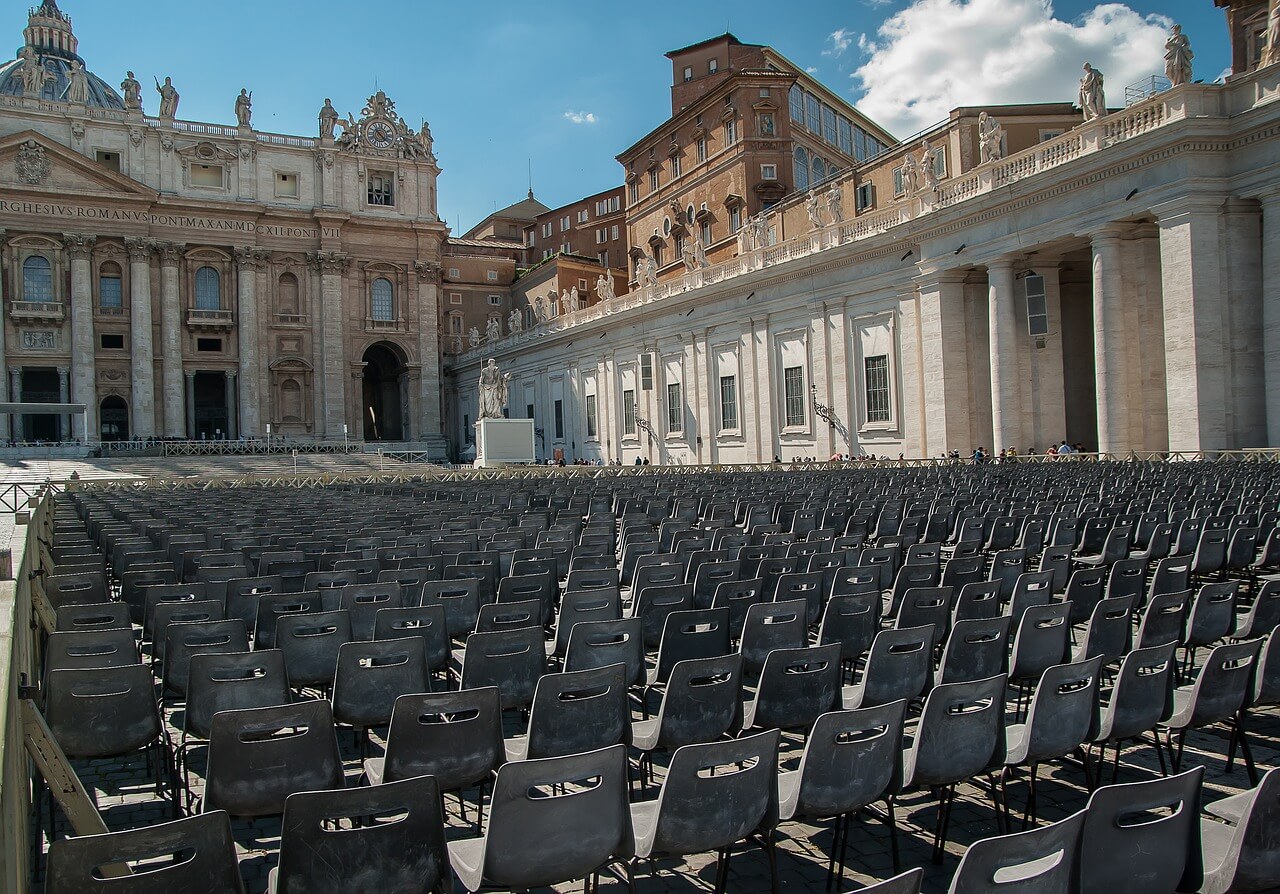
Vatican officials yesterday decided to turn off the fountains in St. Peter’s Square, because there has been no rain here for weeks and the distant reservoirs providing Rome’s water supply are shrinking dangerously.


Crowds continue to wait for hour upon hour under the hot sun in St. Peter’s Square to pass through the security controls and enter St. Peter’s Basilica.


But the Square seems strangely silent, as the water does not flow, and the summer sun beats down, scalding the heads and shoulders of the faithful and the curious as they seek to draw near to the tomb of Peter.


In this odd, dry, sweating silence, murmurs and whispers fill the city with peculiar intensity, as if we are infected by a form of intellectual fever… in cafes, on benches, in restaurants, in un-air-conditioned cardinals’ apartments, in apostolic palace corridors decorated with the pale ancient maps of a Europe, and a world, prior to the Industrial Revolution, hushed voices rise and fall, heads nod in agreement, or shake in sadness and disbelief, then silence falls…


These are the relatively quiet days that have followed what we may call the “days of thunder,” which came at the end of June, and in the first half of July.


What follows is by no means a comprehensive report on these tumultuous days, merely a partial summary.


On June 20, Libero Miloni, the Auditor General of the Vatican — the man charged with final authority to account for all the income and expenses of the entire Vatican — resigned with no official explanation whatsoever.


Reports in the Italian media claimed that Miloni had resigned, not because he was not a competent professional, but because he did not make “enough concessions to the court ceremonial of the Vatican, to internal equilibria, and to the clerical susceptibility.” (link and also link)


One report put it this way: “Milone acted like a professional and this was the problem. Because he was not afraid of anybody, the resistance group called him ‘the Executioner.’ A long list of Cardinals complained to Francis who eventually gave in. Francis asked Milone to accept a lower pay. Milone was paid tax-free 20,000 Euros a month, which is a normal salary for a manager hired from the free market. At this point Milone decided to quit.”


Whether these reports are accurate or not, clearly, the unexplained departure of the Vatican’s chief accountant suggested that the Pope’s financial reform of the Vatican was encountering difficulties.


And then, another bombshell related to a high-ranking figure in Pope Francis’ financial reform efforts detonated…


On Thursday, June 29, it was announced in Australia that Australian Cardinal George Pell, chosen by Pope Francis to be the head of the entire financial reform effort, would be indicted on charges of child abuse in Australia, and  asked to appear in Australian court to face the charges on July 26 (today). He did appear in court today. He did not speak a word, and the court proceedings were continued to mid-September. (link) “For the avoidance of doubt and because of the interest might I indicate that Cardinal Pell pleads not guilty to all charges and will maintain his presumed innocence that he has,” Pell’s lawyer told the court.


Then, another bombshell….


On Friday, June 30, Cardinal Gerhard Mueller, head of the Congregation for the Doctrine of the Faith, and so the chief doctrinal authority on the Church after Pope Francis, met with Pope Francis… and Pope Francis told Mueller that his services would no longer be needed in that post.


Reuters headlined: “Second conservative departure in three days.” (link)


The Associated Press connected the decision with the fact that Mueller’s office handles investigations into allegations of sexual abuse by priests, and that these investigations have been criticized as insufficiently rigorous (link).


The AP article states: “Perhaps sensing a need to change course, Francis declined to renew the mandate of German Cardinal Gerhard Mueller as prefect of the Congregation for the Doctrine of the Faith, the Vatican office that processes and evaluates all cases of priests accused of raping or molesting minors. Francis named Mueller’s deputy, Monsignor Luis Ladaria Ferrer, a Spanish Jesuit, to run the powerful office instead. During Mueller’s five-year term, the Congregation amassed a 2,000-case backlog and came under blistering criticism from Irish abuse survivor Marie Collins, who had been tapped by Francis in 2014 to advise the Church on caring for abuse victims and protecting children from pedophile priests.”


So the impression was given that Francis’s “reform agenda” with regard to sexual abuse, as well as with regard to Vatican finances (Miloni’s resignation and Pell’s departure from Rome for Australia), was faltering, more than four years into his papacy, and that the Pope was anxious to have Pell and Mueller “out of the way.”


Mueller was taken by surprise. He had had no inkling of this decision.


In the days that followed, Rome pulsed with chatter, which slipped over onto the internet.


Mueller, it was said, had not expected to be renewed. It was said that he had had no indication that the Pope would ask him to leave the post for which his whole life of theological study had prepared him. He had expected he might remain until age 75, another six years, it was said…


But some writers suggested that a number of events in the past three years should have made it quite clear why, for theological reasons unrelated to the abuse cases, Pope Francis might not have wished to keep Mueller in his post (link).


Some reports suggested that Mueller was deeply offended both by the Pope’s decision, and by the way the Pope communicated it.


Soon after his dismissal, Mueller spoke by telephone with his friend, Cardinal Joachim Meisner, the retired archbishop of Cologne. (link)


On July 5, not many hours after speaking with Mueller, Meisner suddenly passed away.


Meisner’s death meant the passing of a close friend of Mueller, and also of Emeritus Pope Benedict. Here is a report on Meisner’s death (link).


Meisner in that final conversation expressed his solidarity with Mueller, Mueller himself reported (of course, it is not best practice to accept the account of a conversation given by only one of the two speakers, but in this case there seems little reason to doubt the essential truth of Mueller’s reconstruction of what was said: link):


“Cardinal Gerhard Müller, the former Prefect of the Congregation for the Doctrine of the Faith, has just revealed in a new 5 July interview that he spoke with Cardinal Meisner the night before he died. As the Passauer Neue Presse reports: ‘Müller had spoken over the phone with the former Archbishop of Cologne [Cardinal Meisner] the previous night [before he died the next morning]; and they also had spoken about the non-renewal of his former position. Meisner had shown himself to be “deeply saddened” by this dismissal. “That moved him personally and wounded him – and he considered it to be a form of damage for the Church,” as the Curial Cardinal [Müller] himself described the reaction of Meisner.


“Cardinal Müller also commented and sharply criticized in this new interview the conduct of Pope Francis with regard to his dismissal from the CDF. According to the Passauer Neue Presse: ‘In the interview with the PNP [Passauer Neue Presse], he explained that Pope Francis “communicated his decision” not to renew his term “within one minute” on the last work day of his five-year-term as Prefect of the Congregation for the Faith. Additionally, he [Müller] was not given any reasons for it. “This style [sic] I cannot accept,” as Müller stressed, clearly distancing himself from the procedure of the Pope. In dealing with employees, also in Rome “the Church’s social teaching should be applied.”'”


On July 15, Meisner’s funeral Mass was celebrated in Cologne.


At the Mass, Archbishop Georg Gaenswein read an extraordinary message from Meisner’s old friend… Emeritus Pope Benedict XVI. (link)


Here is the text of that message composed by the Emeritus Pope, who turned 90 in April (link):


“At this hour, when the church of Cologne and faithful from further a field gathered to say goodbye to Cardinal Joachim Meisner, my heart and thoughts are with you also, and gladly accepting the invitation of Cardinal Woelki, I wish to address a word of remembrance to you.


“When I heard of the death of Cardinal Meisner last Wednesday, I did not want to believe it. The day before we had talked on the phone. His gratitude for the fact that he had been on vacation after he had participated in the beatification of Bishop Teofilius Matulionis in Vilnius on Sunday before (June 25) was clear in his his voice. The love for the Church in the neighboring countries in the East, which had suffered under the Communist persecution, as well as the gratitude for the withstanding the sufferings of that time, shaped his life. And so is it is no coincidence that the last visit to his life was one to a Confessor of the Faith in those countries.


“What particularly impressed me in that last talk with the retired Cardinal, was the loosened joy, the inner joy, and the confidence he had found. We know that this passionate shepherd and pastor found it difficult to leave his post, especially at a time in which the Church stands in particularly pressing need of convincing shepherds who can resist the dictatorship of the spirit of the age and who live and think the faith with determination. However, what moved me all the more was that, in this last period of his life, he learned to let go and to live out of a deep conviction that the Lord does not abandon His Church, even when the boat has taken on so much water as to be on the verge of capsizing.


“Two things in recent times which pleased him more than anything:


“(1) On the one hand, he has always told me how deeply he in the Sacrament of Penance, how young people, especially young men, are experiencing the grace of forgiveness—the Gift, they have found the life that only God can give.


“(2) The other thing that has always touched him and gave him joy, was the quiet growth of Eucharistic Adoration. At the World Youth Day in Cologne this was a central point for him — that there was Adoration, a silence in which only the Lord spoke to the heart. Some Pastoral and Liturgical experts felt that such silence in looking at the Lord can not be achieved with such a huge number of people. Some were also of the opinion that Eucharistic Adoration was overtaken as such, by the Mass, since the Lord would be received in Eucharistic bread and not be looked at. But that this Bread can not be eaten like any food, and that the Eucharistic sacrament “welcomes” all dimensions of our existence – that reception must be worship, has now become very clear. Thus, the time of Eucharistic Adoration at the Cologne World Youth Day has become an interior event, which remained unforgettable to the Cardinal.


“When, on his last morning, Cardinal Meisner did not appear at Mass, he was found dead in his room. His Breviary had slipped out of his hands: he was praying as he died, looking at the Lord, talking to the Lord. The death that was given to him, shows once again how he lived: looking at the Lord and talking to him. So we can confidently recommend his soul to the goodness of God. Lord, we thank thee for the testimony of thy servant Joachim. Let him be intercessors for the Church of Cologne, and on the whole Be earthly! Requiescat in pace!”


Now, in this text written by Emeritus Pope Benedict in memory of Meisner, what drew the attention of the press were these words: “However, what moved me all the more was that, in this last period of his life, he (i.e., Meisner) learned to let go and to live out of a deep conviction that the Lord does not abandon His Church, even when the boat has taken on so much water as to be on the verge of capsizing.”


Some people took these words as an unusual, oblique criticism by the emeritus Pope of… the leadership of the present Pope, Francis, in guiding the Church.


One Italian author, Leo Zagami, wrote (link):


“Controversy of course erupted in the Vatican after Benedict XVI’s touching words were read in memory of his great friend, under the vaults of the magnificent Cathedral, and even if very diplomatic, they still raise questions about Meisner’s sudden death, and filter a not-so-mild form of criticism towards the present state of the Vatican from the Pope Emeritus.


“In his tribute to Meisner, Ratzinger said these words that should help you understand the gravity of the present crisis in the Catholic Church: “We know that for him, a passionate pastor, it was difficult to leave the Office, precisely at a time when the Church needs pastors, who can resist the dictatorship of the spirit of the time, and know how to live with faith and reason.’


“So Ratzinger talks openly about the ‘dictatorship of the spirit of the time’ addressing in a not-so-mild fashion, the modernization imposed by Bergoglio…”


Then on July 18, Archbishop Gaenswein, who, as the reader of the words of Emeritus Pope Benedict at the funeral had played a pivotal role in these events, intervened.


He flatly denied that Benedict had intended any criticism of Francis.


“Responding to interpretations of a recent reference by Emeritus Pope Benedict XVI to the Church being near ‘capsizing,’ the retired pontiff’s closest aide on Tuesday said it’s a ‘fantasy’ to set him up against Pope Francis. ‘They’re trying to use the Pope Emeritus in an anti-Francis tone,’ said German Archbishop Georg Gänswein, speaking to the Italian daily Il Giornale.” (link)


On July 19, there appeared a new interview given by Cardinal Müller in early July to the prominent secular German news agency DPA (German Press Agency).


In this interview, Mueller expressed his loyalty to Pope Francis, but also his concern about certain decisions taken by the Pope, especially in personnel matters, and he further suggested that Emeritus Pope Benedict was “disappointed” by his dismissal.


“In former times, one always said that a good ruler is characterized by the fact that he calls the best – also sometimes uncomfortable – counselors to his side, and not the opportunists and mediocre people who at all times have tried to get close to those in power,” Mueller said. (link)


According to Die Welt, Müller counts himself to be among the “circle of the uncomfortable counselors.”


He himself does not think highly of “the behavior of the courtiers” at the Vatican, nor of the conduct of the “careerists who try, with the help of flattery, to get into some kind of small positions [‘Pöstchen‘].


“Rather take the risk of some disadvantages than bending one’s conscience,” Müller said.


Now it is July 26.


So the month is not yet over!


And in these hot July days, rumors continue to swirl:


(1) that theologians may have begun to study the documentation surrounding Paul VI’s document Humanae Vitae (1968) with an eye toward some sort of revision of that text;


(2) that liturgists may be studying some sort of melded Catholic-Protestant liturgy, without a traditional consecration, which both Catholics and Protestants may attend;


(3) that next year’s Synod of religious vocations, already under preparation, may include proposals to re-consider the discipline of priestly celibacy, and perhaps also of the female diaconate, a matter that many had thought definitively settled;


(4) that Pope Francis may be considering some revision of, or even the abrogation of, the July 7, 2007 document Summorum Pontificum of Benedict XVI which permitted wider celebration of the old Mass by any priest in the world without approval by his bishop (but many do not take this rumor very seriously, link)


And then, there is the article by Father Spadaro and his colleague in Civilta Cattolica which attacks the American Evangelicals and conservative Catholics who supported the election of President Trump as “Manichean” and “apocalyptic” in their theology, which merits further comment.


But what is the “bottom line” here?


What can we take away from all of these swirling events, rumors, appointments, resignations?


First, that human beings — even when they are in high Church positions — are fallible. “Put not your trust in princes,” Scripture says.


We carry the great treasure of the Gospel, of the proclamation of Jesus Christ, St. Paul writes, in “vessels of clay,” that is, these mortal bodies we all have and live in.


It is the treasure of the proclamation that counts, not these bodies.


We must protect and defend this proclamation, this sharing of the “Good News” (sometimes with words) so that the “worldliness” of the world, and of ourselves, never drowns out the central message, that there is hope, and that hope is a person, and that that person has a name… that behind and beneath all the shifting appearances of time and space, the Holy One lives, and draws us to Him…


And to protect this proclamation, we need boldness, and truth-telling.


We cannot do other than follow the example of the first apostles, who spoke the truth even at the risk of their lives… even at the cost of their lives.


So what we must do now is what we know, deep down, we must always do: seek truth, find truth, speak truth, without fear.


Even if it is uncomfortable, inside the Church, or outside of the Church.


This is the right way.


In this regard, I would like to cite the work of an American, Andrew Greenwell, of Corpus Christi, Texas.


He has given us an excellent summary of the meaning of the word “parresia,” the word which Pope Francis has used on several occasions to describe the type of bold truth-telling that he hopes will distinguish the speech of Christian believers. (link)


Greenwell writes:


“The Pope used the word parresia (παρρησία), composed from two words: pas (πας) which means ‘all,’ and rēsis (ρησις) meaning ‘saying’ or ‘speech.’


“The word therefore literally means ‘speech which says it all,’ and this suggests its ordinary meaning ‘to speak publicly,’ ‘to speak boldly,’ ‘to speak frankly,’ ‘to speak plainly,’ ‘to speak openly.’


“The word parresia comes from the privilege given the Greeks in their assemblies, courts, and theaters where they could speak boldly and criticize and challenge their opponents openly and frankly without fear of reprisal. The concept was that insulating the speaker from the fear of harm or retribution would encourage plain, honest, and forthright speech.


“The word parresia or one of its forms is used in the Gospels (e.g., Mark 8:32, John 7:4, 13, 26; 10:24; 11:14, 54; 16:25, 29; 18:20), in Acts (2:29; 4:28, 31; 28:31), and in the letter to the Hebrews (3:6; 10:19, 35; 4:16), and in the Pauline (2 Cor. 3:12; 7:4, Eph. 3:12; 6:19; Phil. 1:20; Col. 2:15; 1 Tim. 3:13; Phil. 1:8) and Johannine epistles (1 John 2:28; 3:21; 4:17; 5:14). It therefore has a good biblical pedigree.


“A classical biblical use of the term parresia is found in the Book of Acts, where the apostles Peter and John are in Jerusalem during the Feast of Pentecost, when ‘suddenly there came from the sky a noise like a strong driving wind,’ and ‘there appeared to them tongues as of fire, which parted and came to rest on each of them,’ and they were ‘filled with the Holy Spirit and began to speak in different tongues.’ (Acts 2:1-4) It was the Holy Spirit that ‘enabled them to proclaim’ the Gospel to the Jews ‘from every nation under the heaven staying in Jerusalem.’ (Acts 2:5)


“Peter stood up with the other eleven Apostles and preached his bold sermon to the Jews there assembled proclaiming to them the truth of the Lord Jesus whom they had had a part, directly or indirectly through their leaders, in crucifying, but who had emerged victorious from the grave in the Resurrection.


“By Peter’s bold speech, inspired by the Holy Spirit and, as it were, elocuted by a tongue of fire, the Jews were ‘cut to the heart.’ They were told to repent and be baptized ‘everyone one of you, in the name of Jesus Christ for the forgiveness of your sins; and you will receive the gift of the Holy Spirit.’ (Acts 2:37-38)…


“St. Peter and St. John were apprehended, brought into the presence of the Jewish temple authorities and questioned. Peter, ‘filled with the Holy Spirit,’ (Acts 4:8) boldly preached the Gospel to those who had conspired successfully to put Jesus to death…


“The authorities ‘observing the boldness (parrēsían) of Peter and John,’ after meeting in counsel, ‘ordered them not to speak or teach at all in the name of Jesus.’ (Acts 4:13, 18)


“Not intending to be squelched by the authority of mere men when they had been called and sent by the Son of God himself, Saints Peter and Paul said in reply, ‘Whether it is right in the sight of God for us to obey you rather than God, you be the judges. It is impossible for us not to speak about what we have seen and heard.’ (Acts 4:19-20).


“Someone filled with parresia will find it impossible not to speak about his encounter with the Lord, and His mercy, and His grace. His joy in boldly communicating the Gospel comes from the fulfillment of this duty which arises out of his love of God and his love of neighbor.


“Those filled with the parresia Pope Francis spoke of can only say: caritas Christi urget nos, the love of Christ — of the Christ who is eager to find a home with the poor and feed with supersubstantial food those hungry for the Gospel — compels us. (Cf. 2 Cor. 5:14)


“In this, the Apostles Peter and John were no different than their Lord who, arrested by the temple guards and brought to the high priest to be questioned, responded to the high priest: ‘I have spoken publicly (parrēsía) to the world. I have always taught in a synagogue or in the temple area where all the Jews gather, and in secret (kryptō) I have said nothing.’ (John 18:20)


“He who is filled with parresia will proclaim the Gospel from the rooftops (cf. Matt. 10:27); he will not hide the message and place it under a bushel (cf. 5:15).


“He will have no fear of opposition. He will bear all insults. He will never lose heart. This is what will steel him against his critics: In Deo laudavi verbum, in Deo speravi, non timebo quid faciat caro mihi. ‘In God I will praise my words, in God I have put my trust: I will not fear what flesh can do against me.’ (Ps. 55:5 [56:4])…


“In a world which increasingly rejects the Gospel, diffidence is not an option. Whether we be placed before the high priests of secularized culture, the scribes in the liberal media, the talking heads and commentators and comics who ridicule Christians of being drunk on the heady wine of passémores, or the moral relativists who, desirous to excuse all manner of sin, uphold the nonsensical doctrine that there is no dogma but the dogma that there is no dogma: the Gospel must be made known with boldness, with parresia.


“Yes, Pope Francis, your prayer is sound: ‘Let us ask the Lord for this parresia, this apostolic fervor that impels us to move forward, as brothers, all of us forward! Forward, bringing the name of Jesus in the bosom of Holy Mother Church, and, as St. Ignatius said, ‘hierarchical and Catholic.’ So be it.”


So be it… even when the boat has taken on so much water as to be on the verge of capsizing….


======================

Posted in Uncategorized | Comments Off on He who is filled with parresia will proclaim the Gospel from the rooftops (cf. Matt. 10:27); he will not hide the message and place it under a bushel (cf. 5:15), especially in the face of heresy coming from the hierarchy.

NOT EVEN SAINT THOMAS AQUINAS COULD MAKE SENSE OUT OF WHAT IS COMING OUT OF THE MOUTHS OF SOME OF THE CARDINALS OF THE CHURCH; OUR FAITH MUST BE FOUNDED ON JESUS CHRIST, NOT THEM

unnamed-11

Monday, July 24, 2017

Cardinal Müller: “Francis and I? I am Loyal to the Pope, but no Flatterer”

(Rome) Matteo Matzuzzi of Il Foglio published a detailed interview with Gerhard Cardinal Müller, the Prefect of the Roman Congregation for the Congregation of the Faith, who had been dismissed by Pope Francis on June 30th. The interview also addresses the question of why Cardinal Müller gave the decisive vote in the final vote of the bishop’s synod of 2015, which saved Cardinal Kasper from a defeat and Pope Francis from the loss of face, but only made the controversial post-synodal letter Amoris laetitia possible.

The pope was breaking the dams, the Prefect of Doctrine and the Faith played fire-brigade – and was shown the door

In the last 16 months, since the publication of the controversial post-synodal letter of Francis, Amoris laetitia, Cardinal Muller has entered the public with a clear counter-position to the pope without criticizing the Pope directly and by name. The core question of the double bishops’ synod on the family was whether or not re-married divorced – and in consequence other believers in irregular relationship situations – are admitted to the sacraments. The traditional doctrine of the Church is decidedly no, because Christ teaches the indissolubility of marriage against the divorce practice of the Old Testament. On 20 February 2014 Cardinal Walter Kasper, on the other hand, said yes to the Cardinal’s Consistory. There is no doubt that Pope Francis favored Kasper’s affirmation and that today’s practice was made possible by him in some dioceses and whole countries. Officially, however, the pope did not raise the question, in order not to expose himself to charges of heresy. Critics therefore speak of an oblique advocacy.
The fact is that today every bishop of the world Church can decide for his diocese himself, whether or not remarried divorced persons are admitted to the Holy Communion. In 1977, as the historian Roberto de Mattei recalled a few days ago, Archbishop Marcel Lefebvre prophesied this fragmentation of the world Church, which would have to reach out to those who want an adaptation of the Church to the temporal spirit.

Francis Brought the “Greatest Confusion”

Cardinal Müller has repeatedly appeared in the past months in order to contradict the case of Kasper and his followers. The Prefect of Faith renounced any criticism of Pope Francis, although that he was the main contributor to the “greatest confusion” only a blind man could deny, as Cardinal Carlo Caffarra criticized at the beginning of the year. Cardinal Müller emphasized, however, what was implicitly a criticism of Cardinal Kasper, and also of Pope Francis, that the doctrine of the Church and, indeed, the resulting practice had changed. The prefect of faith also emphasized that “no one, not even the pope,” could change the doctrine of Christ about the indissolubility of marriage.
Clear words, which, however, could not stop the oncoming train of the Kasperians because they know the Pope on their side. Thus they could and can call the CDF prefects, whether they were called Müller or Ladaria, a “good man” in the distant Rome.
Before the first Bishop’s Synod, Kasper had declared unequivocally against criticism that the Synod was either going the way it wanted it, or it could be canceled at once. It was a form of coercion that would have had consequences but which did not exist, because Kasper had been the shadow of Francis since the beginning of the pontificate.

An “inherited” CDF prefect

The relationship between Pope Francis and the Faith Prefectures inherited from  Benedict XVI. never reached a brotherly cordiality. At the latest, with the protest letter of the thirteen cardinals, one of them Müller, at the beginning of the decisive bishop’s synod in 2015, led to the final break. The cardinals felt they were being led by nose, and said that clearly. They gathered in Rome to discuss each other, and had to conclude that the Synodic Government, already determined by faithful Bergoglians, had already already formulated the synodic result. The Cardinals protested against a defeat of the Synod and, above all, against preconceived results. Pope Francis and his court had been caught in flagranti manipulating the course of events.
The pope “raged,” was how Edward Pentin reported when in November 2016 the Dubia (doubts) of four cardinals about Amoris laetitia became known. He did not so much rave about the letter, which he could dispose of in the paper basket. He raged that the letter became public. The same papal anger against the four cardinals, Brandmüller, Burke, Caffarra, and Meisner, with their Dubia (doubts) about Amoris laetitia is still there a year later. Francis ignores the Dubia to this day, and it may be concluded that he had also ignored the protest letter of the 13 Cardinals of October 2015. His anger, the only reaction, is triggered because the criticism of the Cardinals, whether wanted or not, came to the public.
In 2015, the pope himself appeared before the synodals and raged against a “hermeneutics of conspiracy”. Against the Dubia of the Cardinals, he sent out his closest collaborators, who attacked and publicly denounced them. To be exact, the representatives of the papal entourage did not fall over the Dubia, which would have been justifiable. No, they left the Dubia on the left, refused to be contentious like the Pope, and fell upon the Cardinals themselves.
It is not only since then, whoever adheres faithfully to the traditional doctrine and practice of the Church, Francis is in the process of having them trampleddismissedfired, placed under house arrest, or placed under interim administration.
Cardinal Müller was dismissed on June 30th. The admission that he had not been extended in his office after the expiry of his term of office is, at best, cosmetics to defuse the situation.

It is well known that at the end of the double synod on the family, which was specially constituted and directed to push through the Kasper proposal and allow the remarried divorced to Communion, that with the dambreak in the remarried divorced against the Christ’s commandment, further dam breaks would be automatically included.

Schönborn’s Graduality Principle and Humanae vitae

The Kasper thesis, with which he wanted to achieve his goal, could also be applied to other situations. Christoph Cardinal Schönborn already provided the extended theory for the first family code in 2014: the gradual principle. There are therefore no irregular situations. As such, the Church identifies all sexual relations between people outside marriage, the only regular relationship provided by God. According to Schönborn, every relationship between two people is only a gradual differentiation of the Lord’s command. Sometimes more, sometimes less. The Church should accompany the fullness, but in all respects already weakened the realization of this commandment. This thesis forbids, this is the main point, any criticism of irregular relations , such as adultery. This would overcome the contrast that finally exists between the Church and the Zeitgeist since the sexual revolution of the 1960s. This was a contrast that a few clerics felt as a strain and which they wanted to get rid of today rather than tomorrow.
Pope Paul VI. Had, on the other hand , affirmed him with his Encyclical Humanae vitae, which was often designated as prophetic, in the “Revolution Year” Even at that time, entire bishops’ conferences, including those of the German-speaking world, were denied him. A break that has since destroyed the Church like a poison on the living body. Amoris laetitia is the first step to overcome the break. Not in the sense of the restoration of the commandment of Christ, but by capitulation to the prevailing temporal spirit and its hypersexualization.
At the end of the Bishop’s Synod in 2015, the plan of the Kasperians, supported by Francis, still seemed to fail. The required majority was not reached during the vote on the synod report. A victory of the sacramental order handed down throughout the line, but with a beauty defect. The Pope would have stood in public as a loser, and a profound break would have been visible in the church. Such a scenario not only made the Kasperians nervous, who were threatened with a loss of content. It also made those nervous about the public image of the church, its image and prestige.
Thus, a compromise was made feverishly presented by Cardinal Schönborn, who – not Kasper – became one of the real makers of “Amoris laetitia”. The vote on the revised final report resulted in a majority of only one vote. Knapper did not go anymore. Cardinal Müller had voted for the compromise. His voice was so decisive.

Why did Cardinal Müller vote for synod report?

Matzuzzi asked the dismissed faith prefect why he had voted for the Schönborn draft. He had, since the publication of Amoris laetitia, had to run after the Bergoglians, to remind them, quite unsuccessfully, that “no authority, no priest, no bishop and not even the pope” could correct the teaching of Jesus Christ.
Here the answer from Cardinal Müller:
“The Synod has clearly stated that the individual bishops are responsible for this way [of the remarried divorced] to lead people to the full sacramental grace. This interpretation is there, no doubt. But I have never changed my private and subjective position. As a Bishop and Cardinal, I have represented the doctrine of the Church, which I also know in its fundamental developments from the Council of Trent to Gaudium et Spes, which constitute the two guidelines. This is Catholic, the rest belongs to other convictions. I do not understand how different theological and dogmatic interpretative positions can be reconciled with the clear words of Jesus and St. Paul. Both have clarified that you can not marry a second time when the legal partner still lives. “

“Understand the Reasons for the Dubia of the Four Cardinals”

At the same time, Cardinal Müller explained the reasons given by Cardinal Burke, Cardinal Brandmüller, Cardinal Caffarra, and Cardinal Meisner, who had since passed away, to the Pope to present five Dubia to Amoris laetitia.
“I do not understand why you do not start a dialogue in peace and serenity. I do not understand what obstacles stand in the way. Why are such tensions made public, too?”
Words which are an obvious criticism of Pope Francis, who has refused to meet the Cardinals’ desire for dialogue since September 2016. Also, at their request of last April to be received by the Pope in audience, the four cardinals received no answer. No Answer!

The Spirit of God and the Spirit of the World

Cardinal Müller sees a willingness within the Church to work to adapt to the spirit of time. Matzuzzi referred to Benedict XVI’s criticism of the Zeitgeist. Cardinal Müller:
“The emeritus pope spoke of the zeitgeist, but St. Paul spoke of the spirit of God and the spirit of the world. This contrast is very important and must be understood. The affirmation of faith – the Church and the bishops – does not depend on the applause of an uninformed mass. And another thing: our work is treasured and appreciated when we convince a man to give himself completely to Jesus Christ by placing his existence in the hands of Jesus. In his first epistle, St. Peter speaks of Jesus Christ the souls of souls! And today one speaks of responsibility for culture and the environment? Yes, but we have many competent laity. People who bear responsibility in politics: we have governments and parliaments, etc. The Apostles did not transfer Jesus to the secular government of the world. There were prince-bishops in earlier centuries and they have not done well to the Church.”
And addressed to secularization, Cardinal Müller said:
“They live as if God did not exist. The problem is not secularization but de-Christianization.”
Text: Giuseppe Nardi
Photo: Il Foglio (Screenshot)
Trans: Tancred vekron99@hotmail.com
AMDG
You might also like:
“Revolution” Amoris Laetitia: the — “Pastoral …
Pope Francis and the Marginalization of the CDF
The “Anti-Bergolio-Cardinal”: Cardinal Burke and the …

10 comments:

  1. I repeat what I said:

    If Müller wants to help he should learn the TLM ASAP, buy a cappa magna, and go around the world celebrating high profile pontifical Masses like Cardinal Burke does. This would be more spiritually edifying and give more prominence and force to his words. Enough with these stupid interviews.

    Reply

  2. Yada! Yada! Yada! The same old story. (P)Francis is destroying the Church. Francis of Assisi predicted that in the 13th century. With the devil involved, as humans, we can do nothing. God is allowing it to happen for unknown reasons. Prayer is the only answer. We are living in the time of The Third Secret. It is no longer if. It is when.

    Reply

  3. I am loyal to the Pope too, may Pope Benedict have many more healthy years.

    Reply

  4. Unfortunately, Cardinal Müller appears unable to grasp that the time for speaking out with effect about the maelstrom into which the Church has been plunged ran out when the pope gave him his marching orders. If he’d called this diabolical disorientation for what it is while still CDF Prefect, the cost may indeed have been greater but so would the reward. Now, his muted observations amount to little more than noises off stage and the stage has been left to the villains of the place.

    Reply

  5. “Amoris Laetitia”, just how do you condone “fornication, adultery, and sodomy”? Scripture is pretty d–n clear on the subject. If you tolerate any of the three, then you have an apostate leader. Muller was intimidated. Has everyone “gone to the moon”?

    Reply

  6. I am loyal to the Pope Francis: May God recall to be near Him his faithful servant Francis at the soonest and give him his eternal reward as he deserves it.

    Reply

Posted in Uncategorized | 1 Comment