HOW DO I LOVE THEE? LET ME COUNT THE WAYS!

JOHN-HENRY WESTEN

From the desk of the editor.

Featured Image
giulio napolitano / Shutterstock.com

BLOGS

The A – Z list of concerns with Pope Francis

July 11, 2017 (LifeSiteNews) – The confusion caused by Pope Francis in the Catholic Church is out of control. There have been so many incidents over the last four years that the specifics, despite their grave damage, are often forgotten. In an effort to encourage prayer for an end to the confusion and disorientation in the Church, LifeSite presents the following A-Z list of concerns with Pope Francis.

Amoris Laetitia

The document so long awaited to bring needed clarification from the Pope served rather to increase confusion the world over as the Pope himself approved interpretations (Malta, Germany) which allowed for Holy Communion to be given to divorced and remarried Catholics.

Burke demotion

Cardinal Raymond Burke was removed from one of the highest offices in the Church, as the supreme justice of the Church’s highest court. Instead he, one of the most faithful Cardinals, was given a largely ceremonial position with the Order of Malta and even there his role was stripped.

Cohabitation

Pope Francis said “cohabitations” with fidelity are “real marriage” and “have the grace of real marriage.” On another occasion when the Pope made similar remarks, papal confidante Fr. Antonio Spadaro tweeted a photo of the Pope greeting a couple who “prefer to live together without getting married.”

Danneels

Cardinal Godfried Danneels, the emeritus archbishop of Brussels, was a personal appointment by Pope Francis to the Synods of Bishops on the family. In addition to wearing rainbow liturgical vestments and being caught on tape concealing sexual abuse, Danneels said in 2013 of the passage of gay “marriage”: “I think it’s a positive development that states are free to open up civil marriage for gays if they want.”

Image
Cardinal Danneels in Rainbow vestments

Emma Bonino

Pope calls Italy’s foremost abortion promoter one of nation’s ‘forgotten greats’. In an interview with Corriere Della Sera Pope Francis praised Italy’s unrepentant leading abortionist and proponent of abortion, Emma Bonino, as one of the nation’s “forgotten greats,” comparing her to great historical figures such as Konrad Adenauer and Robert Schuman.

First synod interim doc

The scandalous mid-term relatio of the first Synod on the Family was seen and approved-for-release by the Pope according to Cardinal Lorenzo Baldisseri, secretary general of the Synod of Bishops. “The documents were all seen and approved by the Pope,” Baldisseri said. In a section titled ‘Welcoming homosexual persons’, the document states: “Homosexuals have gifts and qualities to offer to the Christian community.” It then asks: “Are our communities capable of providing [them a welcoming home], accepting and valuing their sexual orientation, without compromising Catholic doctrine on the family and matrimony?”

Gender-confused couple at Vatican

Image
Pope Francis meeting with woman who underwent sex-change surgery (to right of pope) and her ‘wife’ (to left of pope.)

On October 2, 2016, Pope Francis referred to a woman who underwent a sex-change operation as a “man.” He referred to her as having “married” another woman and admitted to inviting and receiving them to the Vatican in 2015, describing the couple as “happy”. Clarifying his use of pronouns, the pope said, “He that was her but is he.”

Holy See population control

Since shortly after the election of Pope Francis there has been a steady stream of population control pushers speaking at the Vatican. These include: Paul Ehrlich, the father of the population control movement; John Bongaarts, vice president of the pro-abortion Population Council; pro-abortion U.N. Secretary General Ban Ki-Moon; and population controllers Jeffrey Sachs and John Schellnhuber. The head of the Vatican’s Pontifical Council for Sciences, Bishop Marcelo Sorondo, who ran most of those conferences, is himself a population control advocate saying on camera at one such Vatican conference that limiting births was an obligation of the Church.

Irresponsible to have 8 children?

On January 19, 2015 while speaking of “responsible” parenthood, the pope cautioned against Catholics being “like rabbits.” The pope spoke about a woman he knows who he said was pregnant with her eighth child after having the first seven by C-section.  He said he had “rebuked” her, saying, “But do you want to leave seven orphans? That is to tempt God!” “That is an irresponsibility. [That woman might say] ‘no but I trust in God.’ But God gives you methods to be responsible,” he said.

“Some think that, excuse me if I use that word, that in order to be good Catholics we have to be like rabbits.”  He added, “No. Responsible parenthood!”

Judge – Who am I to….

Despite the avalanche of evidence of harm to the Church from the Pope’s first ‘Who am I to judge’ remark on his first plane interview in 2013, he repeated the line in June 2016 while misrepresenting the Catechism on homosexuality.

Kasper

A few days into his pontificate, Pope Francis praised one of Cardinal Kasper’s books and then selected Kasper to deliver the controversial keynote address to launch the synods on the family. Kasper was selected as a personal appointee of the pope to the synods and regularly meets with Pope Francis. Kasper defended the vote of the Irish in favor of homosexual “marriages”, saying: “A democratic state has the duty to respect the will of the people; and it seems clear that, if the majority of the people wants such homosexual unions, the state has a duty to recognize such rights.”

Luther, serious sin to convert

Image
Pope Francis next to a statue of Martin Luther

The Pope spoke to an audience before a statue of Luther in the Vatican just prior to his going to Sweden to helplaunch the 500th anniversary of Lutheranism. The Vatican issued a stamp featuring Luther and put out a document saying Catholics now recognize Martin Luther as a ‘witness to the gospel’.

On another occassion he said it is a “very grave sin” to try to convert Orthodox to Catholicism: “There is a very grave sin against ecumenism: proselytism.”

Multiplication of loaves

During the Angelus of June 2, 2013, he spoke about Christ’s miracle of the multiplication of the loaves and fishes as taking place by “sharing.” “This is the miracle: rather than a multiplication it is a sharing, inspired by faith and prayer,” he said. He was even more explicit about it in July 2015 in a homily preached in Christ the Redeemer Square in Bolivia. Pope Francis said, “This is how the miracle takes place. It is not magic or sorcery. … Jesus managed to generate a current among his followers: they all went on sharing what was their own, turning it into a gift for the others; and that is how they all got to eat their fill. Incredibly, food was left over: they collected it in seven baskets.”

Name calling against faithful

Pope Francis has frequently castigated faithful adherents of the Catholic faith as “obsessed,” “doctors of the law,” “neo-pelagian,” “self-absorbed,” “restorationist,” “fundamentalist,” “rigid,” “ideological,” “hypocritical,” and much more. In addressing faithful Cardinals at the Synod of the Family, in magazine interviews,book interviews, radio interviews, official church documents, and in homily afterhomily, he has used condemning language indicating they are “idolaters and rebelswho will never arrive at the fullness of the truth,” and  “heretics and not Catholics.”

Overhaul of Cardinal Sarah’s dicastery

Cardinal Sarah, head of the Vatican’s liturgical dicastery, called for the faithful to kneel for Holy Communion and priests to face ad orientem for Mass. Pope Francis reacted swiftly to counter the suggestion, having the Vatican press office issue a statement saying that there was no change and stressing the ordinary form is to be preferred. Shortly thereafter the Pope replaced most of Cardinal Sarah’s collaborators in his dicastery with liberals.

Pontifical Academy for Life scandals

Image
Archbishop Paglia | Depiction of Paglia in Cathedral mural clutching semi-nude man.

Pope Francis named controversial Archbishop Vincenzo Paglia to lead the Pontifical Academy for Life despite scandals such as the Vatican sex-edprogram and the homoerotic mural he erected at his former cathedral. Thereafter all the members of the Academy were removed, the pro-lifepledge discontinued, and a new list of members named that included anti-life advocates.

Queer selection of Cupich

In 2014 Pope Francis appointed Bishop Blase Cupich as Archbishop of Chicagodespite his reputation for telling priests not to join 40 Days for Life. After he demonstrated his dissent to Catholic teaching on homosexuality, saying homosexual couples should be given Holy Communion, Cupich was nevertheless named a Cardinal.

Refusal to answer dubia

Image

After massive confusion around the globe over Communion for adulterers, four prominent Cardinals sent Pope Francis a letter on September 19, 2016 asking for clarification to five key questions. Two months later with no answer received, they went public with their questions and humbly begged the Pope for an answer for the good of the Church. Despite the pleas of theologiansand scholars worldwide, and tens of thousands of faithful and clergy, the Holy Father has steadfastly refused to answer. On April 25 the Cardinals formally asked the Pope for a meeting to discuss the matter, but after not even receiving the courtesy of a reply, they released their letter June 19.

Scalfari interviews: ‘Annihilation’ rather than hell?

In March 2015 in an interview with La Repubblica founder Eugenio Scalfari, the Pope suggested no person could go to hell, and proposed annihilation for those who fully reject God. The article says: “What happens to that lost soul? Will it be punished? And how? The response of Francis is distinct and clear: there is no punishment, but the annihilation of that soul.”

There was some controversy over Repubblica’s Scalfari interview. The Vatican would neither verify nor deny it in its specific parts, but nevertheless published it in the Vatican newspaper, and on the Vatican website. They later deleted it from the website, only to republish it again, then delete it again. Vatican watchers compared the most controversial part regarding the impossibility of people going to hell for all eternity to the statement from the Pope’s latest exhortation Amoris Laetitia, in which he said, “No one can be condemned for ever, because that is not the logic of the Gospel!”

Traditional youth bashing

“I always try to understand what’s behind people who are too young to have experienced the pre-conciliar liturgy and yet still they want it,” the pontiff said in a November 2016 interview. “Sometimes I found myself confronted with a very strict person, with an attitude of rigidity. And I ask myself: Why so much rigidity? Dig, dig, this rigidity always hides something, insecurity or even something else. Rigidity is defensive. True love is not rigid.”

He spoke similarly in May 2017 when in a homily he spoke “of the many young people in the Church today who have fallen into the temptation of rigidity.”  Speaking of those who are ‘rigid’ and insincere, he said, “They are rigid people living a double life: They make themselves look good, sincere, but when no one sees them, they do ugly things.”

Universality destruction

In his 2013 Exhortation Evangeli Gaudium, Pope Francis called for a “conversion of the papacy” and expressed a need to give episcopal conferences “genuine doctrinal authority.” Decentralization is a key demand of heterodox clergy in the Church. During the 2015 Synod on the Family, Pope Francis said he “felt the need to proceed in a healthy ‘decentralization’” of power to the “Episcopal Conferences.” He discussed plans for decentralization with his College of Cardinals both in December 2015 and again in June 2017. In 2016 Pope Francis suggested decentralization as a way forward in the debate over Communion for adulterers.

Vatican doctrine chief dismissal

Cardinal Gerhard Muller, prefect of the Congregation for the Doctrine of Faith, 69, was removed from his post despite all his contemporary predecessors remaining in office till their retirement. Several Cardinals told Pope Francis to remove Muller, who maintained doctrinal orthodoxy since he was opposing the Pope’s agenda for change. Muller revealed that the Pope dismissed him in a one minute conversation. The move is widely seen as a punishment for opposing the Pope’s agenda.

World Youth Day sex ed

At World Youth Day in 2016, the Vatican released a teen sex-ed program that neglected the parents’ central role in such matters, failed to even mention mortal sin, and included sexually explicit photos and films.

X-rated speech

The dignity of the papacy took a hit when Pope Francis used the scatological termscoprophilia (love of excrement) and coprophagia (love of eating excrement) to bash the media for reporting on scandals within the Church.

Yayo Grassi

Image

When the United States nuncio had pro-family hero Kim Davis meet with Pope Francis at the nunciature during his USA papal visit, Davis was refused permission to take photos of the meeting. When the media asked the Vatican about the meeting they first refused to confirm it, and after some time said that “the only real audiencegranted by the Pope at the nunciature (embassy) was with one of his former students and his family.” The Pope’s former student, Yayo Grassi, was there with his sister and mother and his homosexual partner. They took not only photos but also video in which Pope Francis can be seen embracing Grassi and his homosexual partner.

Zika (contraception)

Pope Francis was asked about “avoiding pregnancy” in areas at risk of Zika virus transmission. “Paul VI, a great man, in a difficult situation in Africa, permitted nuns to use contraceptives in cases of rape,” he said.  “On the other hand, avoiding pregnancy is not an absolute evil,” he added. “In certain cases, as in this one, such as the one I mentioned of Blessed Paul VI, it was clear.” Asked for clarification, the Vatican confirmed that Pope Francis was approving use of contraceptives and condoms in grave cases. (A contradiction of Church teaching.)

Posted in Uncategorized | Comments Off on HOW DO I LOVE THEE? LET ME COUNT THE WAYS!

TERRORISM, WHETHER PERPETRATED BY THE RIGHT OR THE LEFT IS STILL TERRORISM, REGARDLESS OF YOUR POLITICS


July 10, 2017, Monday
Hilarion and Butovo


Every day they brought in and shot 200, 300, 400 people. There were 15-16-year-old children. Why were they shot?” —Russian Orthodox Metropolitan Hilarion Alfeyev, on the executions in Butovo, a place on the sourthern edge of Moscow where more than 20,000 people were executed from the late summer of 1937 until the autumn of 1938 under the regime of Joseph Stalin (link). We met with Hilarion here in Moscow this morning


Today in Moscow it was cool, and in the morning there were some sprinkles of rain.


We were received this morning for about 30 minutes by Metropolitan Hilarion Alfeyev, the head of the External Relations Department of the Moscow Patriarchate, in the Danilovsky monastery.


Our discussions focused on ways our Urbi et Orbi Foundation, an initiative of Catholic lay men and women I founded in 2012, might continue to collaborate on common projects with the Orthodox in order to “build bridges” of mutual understanding to improve relations between our long-divided Churches, and also between our countries, in a time when the United States and Russia seem to be on the verge of a new “Cold War,” with potentially grave consequences for regional and world peace.


Hilarion told us he is grateful for our collaboration thus far, and that he hopes it will continue. Our collaboration on small common projects like exchanges of scholars and seminarians between Rome and Moscow has borne quite positive fruits, he said. (Note: If you would like to support us in this work, please go to this link on our website, or write to me via return email; I will try to respond personally to all emails.)


Hilarion noted that, in this context — since many members of our Foundation are Americans — the recent long conversation, for about two and a half hours, between American President Donald Trump and Russian President Vladimir Putin seemed a significant event. That meeting occurred on Friday, July 7, in Hamburg, Germany. (Here is a link to an article about the meeting.)


Hilarion asked us what out program was for our days in Moscow, and we told him that we intended to go tomorrow to Butovo, a place on the outskirts of Moscow where many thousands of people in the 1930s were executed under the regime of Joseph Stalin.


The place has now become a shrine to the Orthodox Church martyrs who died there, though many others, including Jews and non-believers, were also killed at Butovo.


“Good,” Hilarion said. “You should go.”


Then he told the story of an Orthodox Metropolitan from St. Petersburg who was arrested in the 1930s, though he was an old man in his 80s, and soon to die anyway of natural causes.


The old man was so weak that he was brought to Butovo on a stretcher, Hilarion said.


And then, when the old man reached Butovo, he was executed there, he said.


The Execution of the Innocent


This story moved all of us deeply.


The inhumanity of man to man can be astonishing; all people of good will can recoil at such pitilessness.


In a sense, this is the continuing theme of our present pilgrimage:


— that we all share a common humanity, which is, scripture tells us, in “the image and likeness of God”


— that this common humanity, our common frailty and mortality, our common struggle not to mar or surrender or lose that interior icon of the eternal divinity within us which is our most precious possession, which we once called the soul, which we might call our deepest and truest self, is a compelling reason for our mutual compassion, for our kindness to one another, as we all proceed on our common pilgrimage to our common end and judgment.


Our group includes Daniel Schmidt, retired vice president of the Bradley Foundation of Milwaukee, Wisconsin; William Forti, a retired executive with Gerneral Dynamics Corporation from Claremont, California; Curtis Kauffman, a retired journalist, also from Claremont; distinguished Catholic laywoman Kathleen Hessert Gunderman, founder and CEO of Sports Media Challenge, who has helped to shape the social media strategy and public image of such athletes as basketball champion Shaquille O’Neal, football champion Peyton Manning, and baseball champion Derek Jeter, from Charlotte, North Carolina; and Ivanna Richardson, who was born in Ukraine during the Second World War, but who has spent nearly all of her life in the United States, and who felt some hesitation in joining us in Russia for her  first visit here ever, from Front Royal, Virginia.


Here is a New York Times article from 10 years ago, in 2007, by accomplished journalist Sophia Kishkovsky, whose work I greatly admire, about Butovo (link).


BUTOVO JOURNAL
Former Killing Ground Becomes Shrine to Stalin’s Victims
In Butovo, just outside Moscow, more than 20,000 people were shot to death and buried during the Stalinist terror of the 1930s.


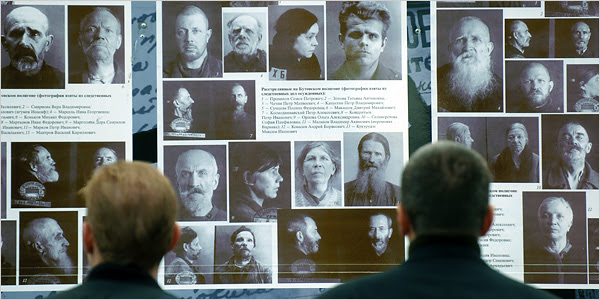
(In May 2007, visitors to the shrine there looked at secret police photos of victims, including many Russian Orthodox priests, who were executed as enemies of the people.)


By SOPHIA KISHKOVSKY
JUNE 8, 2007
BUTOVO, Russia — Barbed wire still lines the perimeter of the secret police compound here on the southern edge of Moscow where more, perhaps far more, than 20,000 people were shot and buried from August 1937 through October 1938, at the height of Stalin’s purges.


Now, gradually, Butovsky poligon — literally, the Butovo shooting range — is becoming a shrine to all of the victims of Stalin’s murderous campaigns.


Grass-covered mounds holding the victims’ bones crisscross the pastoral field, which is now dotted with flowers and birch trees.


Searing portraits from victims’ case files found in the archives of the secret police are displayed, along with a grim month-by-month chart of executions, in front of a small wooden church in the field.


“This place is our Russian Golgotha,” said Andrei Kuznetsov, 34, a social worker, making the sign of the cross recently in front of a newly built white stone church near the site, the Church of the Resurrection and the Holy New Martyrs and Confessors of Russia. “There is Golgotha in the Holy Land, where our Lord Jesus Christ suffered for our sins. All of Russia was Golgotha in the 20th century.”


The killing ground is a symbol of a much larger, bloodier conflict in Russian society, that between the Bolsheviks and the Russian Orthodox Church. One thousand of those killed here are known to have died for their Orthodox faith. More than 320 have been canonized as “new martyrs” of the church — bishops, monks, nuns and lay people who were victims of Soviet rule.
The new church was consecrated on May 19, 2007, as part of the celebration of the reunion of the Russian Orthodox Church and the Russian Church Abroad, an émigré group that broke away in the 1920s.


The walls of the church are filled with icons of the new martyrs, including one depicting their executioners shooting them.


Glass cases in the lower church are filled with their personal items, like an executed priest’s prayer book and his violin.
Visitors to the former killing ground, originally a military firing range, looked at the long row of monuments inscribed with names of the dead.
The names of the victims are engraved on plaques lining one of the fences around the field. The fence overlooks dachas that were built in a parklike setting for officials of the K.G.B., the secret police agency was a successor of the Stalin-era N.K.V.D. and endured until the collapse of the Soviet Union.


“They say the strawberries grew especially large at these dachas,” said Galina Pryakina, 70, nodding at the mounds of bones as she traced her finger across the plaques and found the name of a monk, now a saint, killed on the same day as her father, June 4, 1938.


She visited the site this year on the fourth Saturday after Easter, a day that Patriarch Aleksy II of the Russian Orthodox Church has chosen in recent years to commemorate Butovo’s martyrs. “I spent 66 years looking for him,” Ms. Pryakina said of her father. She was an infant when he was arrested, supposedly as a Romanian spy, and she and her mother were sent into exile.


Three years ago, she journeyed to Moscow from her home in southern Kazakhstan to find her father’s burial place. She headed for a cemetery in the city’s north, but a woman at a bus stop — Ms. Pryakina is convinced that it was a vision of the Virgin Mary — directed her to Butovo. Within minutes, her father’s name was tracked in a database here.


The Rev. Kirill Kaleda, rector of the Church of the Resurrection and the Holy New Martyrs and Confessors of Russia, has a tragically intimate connection to the parish.


His grandfather Vladimir Ambartsumov, who was a priest, is one of the new martyrs. He was arrested in 1937 and sentenced to “10 years without the right of correspondence,” the official euphemism for a death sentence. The Kaleda family spent decades searching for him.
“I remember very well how when we were little, after our morning and evening prayers, we would add a prayer asking to find how our Grandpa Volodya died,” Father Kaleda said. “It seemed that hope of learning the circumstances of Grandfather’s death had almost vanished. We had thought he died somewhere in the camps.”
Mikhail Mindlin, a concentration camp survivor who devoted his retirement in the 1980s and 1990s to systematically studying Soviet repression, fought to have the existence of the Butovo killing ground recognized by the state. Eventually, thanks to sympathetic K.G.B. officials, files with the names of those executed on the orders of Stalin’s henchman Nikolai I. Yezhov were found in secret police files.


The scope of the killings is staggering.


Butovo’s victims ranged from peasants and factory workers to czarist generals, Russian Orthodox hierarchs, German Communists, Latvian writers, invalids and even Moscow’s Chinese launderers, dozens of whom were executed as enemies of the people.


Ultimately many Soviet officials, including Yezhov and other N.K.V.D. officials who carried out the purges, were gunned down at Butovo and elsewhere as the revolution consumed its creators.


Some objections have been raised to the Russian Orthodox focus of the memorial, given the wide variety of victims buried here. But Arseny Roginsky, the chairman of Memorial, an organization that works to catalog Soviet crimes and help victims of repression, said the church had stepped into a void left by the state.


“It’s a bit strange that this is a purely Orthodox place, but nothing tragic,” he said. “I don’t really like this. I think this should be a multicultural place.

“But it’s better that there be something than nothing. If the state is not ready to understand the meaning of terror in its history, the role and place of terror in its history, it’s not so terrible that the Orthodox Church took it upon itself.”


=================


Tomorrow, Butovo…


So what is my point?


My point is that the Russians suffered enormously under Communism. And that Butovo is a place that stands symbolically for all of this suffering.


My point is that this suffering is little known, little remembered, in the West. And that it should be better known, better remembered.


My point is that, if we knew more about the suffering the Russian people passed through, we might understand in a deeper way the Russians’ own understanding of their history.


My point is that if we all were to have more knowledge and understanding of what others have passed through, more knowledge of what fathers were lost, what sons were lost, what brothers and sisters and friends and grandparents and acquaintances were lost, then we might begin to have the first elements of that compassion which could become a basis for the building of a just and durable international peace.


Tomorrow, then, we go to Butovo, in the hope that, even if we are tired, even if we are foreigners, even if we have not ourselves been directly affected by Butovo, even if we cannot fully understand what we will see, nevertheless we wish to stand there, in that place, to be present in Butovo, where suffering was profound 80 years ago.


We do this to be witnesses to long-ago men and women who were executed… to bear testimony that they have not been completely forgotten.


May this serve in some small way to prevent such events from ever occurring again.


To Butovo, then — a symbol of all those places where suffering has been borne by innocent men and women, and by those not executed who loved those innocent men and women, and lost them…

Posted in Uncategorized | Comments Off on TERRORISM, WHETHER PERPETRATED BY THE RIGHT OR THE LEFT IS STILL TERRORISM, REGARDLESS OF YOUR POLITICS

BRAVO ARCHBISHOP ALEXANDER SAMPLE, MAY YOUR TRIBE INCREASE

Featured Image
Archbishop Alexander Sample youtube screenshot
Pete BaklinskiPete BaklinskiFollow Pete

NEWS, ,

U.S. archbishop: Active gays must repent and change lifestyle before receiving Communion

[ Emphasis and {commentary} in red type by Abyssum ]


PORTLAND, Oregon, July 10, 2017 (LifeSiteNews) — An American archbishop has released guidelines upholding the Church’s constant teaching that Catholics in “serious sin” – including active homosexuals and those in adulterous unions { meaning, serial adulterers’, i.e. having sexual relations with a person who is still canonically and sacramentally married to another person}– must repent before receiving Communion.

The new guidelines from Archbishop Alexander Sample of Portland, Oregon are intended to implement Pope Francis’s Exhortation Amoris Laetitia in a way that he said is “compatible with Church teaching.”

The guidelines state that those in “serious sin,” including divorced and civilly-remarried persons living unchastely as well as persons in an active same-sex relationship, must “sacramentally confess all serious sins with a firm purpose to change, before receiving the Holy Eucharist.”

Sample wrote in his May 2017 guidelines that Amoris Laetitia “calls for a sensitive accompaniment of those with an imperfect grasp of Christian teaching on marriage and family life, who may not be living in accord with Catholic belief, and yet desire to be more fully integrated into Church life, including the Sacraments of Penance and the Holy Eucharist.”

But true accompaniment, he said, can only take place within the “tradition of the Church’s teaching and life.”

“In fact, pastors must always convey Catholic teaching faithfully to all persons – including the divorced and remarried – both in the confessional as well as publicly. They should do this with great confidence in the power of God’s grace, knowing that, when spoken with love, the truth heals, builds up, and sets free (cf. Jn 8:32),” the guidelines state.

The Archbishop said that there have been “misuses” of the Pope’s Exhortation “in support of positions that are not compatible with Church teaching.”

Among these is the notion that an individual’s conscience has, after Amoris Laetitia,become the final judge in moral matters. Such a position is taken by Chicago Cardinal Blase Cupich, who has argued that the civilly-divorced-and-remarried as well as active homosexuals should be able to receive Communion if they came to the decision “in good conscience.”

But, following what the Church has always taught, the Archbishop’s guidelines state: “Catholic teaching makes clear that the subjective conscience of the individual can never be set against the objective moral truth, as if conscience and truth were two competing principles for moral decision-making.”

They continue:

As St. John Paul II wrote, such a view would ‘pose a challenge to the very identity of the moral conscience in relation to human freedom and God’s law. . . . Conscience is not an independent and exclusive capacity to decide what is good and what is evil’ (Veritatis Splendor 56, 60). Rather, ‘conscience is the application of the law to a particular case” (Veritatis Splendor 59). Conscience stands under the objective moral law and should be formed by it, so that “[t]he truth about moral good, as that truth is declared in the law of reason, is practically and concretely recognized by the judgment of conscience’ (Veritatis Splendor 61).

Archbishop Sample said that in view of Catholic teaching on conscience, “priests must help the divorced and civilly remarried to form their consciences according to the truth.”

“This is a true work of mercy,” he said.

Divorced and civilly-remarried Catholics wishing to return to a sacramental life within the Church must either “‘regularize’ their marital status in the Church” (receive a declaration of nullity for first union and then marry within the Church) or, if this cannot be done, “refrain from sexual intimacy” by living “as brother and sister.”

“Undertaking to live as brother and sister is necessary for the divorced and civilly-remarried to receive reconciliation in the Sacrament of Penance, which could then open the way to reception of the Holy Eucharist. Such individuals are encouraged to approach the Sacrament of Penance regularly, having recourse to God’s great mercy in that sacrament if they fail in chastity,” the guidelines state.

They continue:

[W]here pastors give Holy Communion to divorced and remarried persons trying to live chastely, they should do so in a manner that will avoid giving scandal or implying that Christ’s teaching can be set aside. This is left to the prudential judgement of the pastor involved. In other contexts care must also be taken to avoid the unintended appearance of an endorsement of divorce and civil remarriage; thus, divorced and civilly remarried persons would not hold positions of responsibility in a parish (e.g. on a parish council), nor would they carry out liturgical ministries or functions (e.g., lector, extraordinary minister of Holy Communion).

The guidelines specifically address what pastors must do when a same-sex couple presents themselves openly in a parish.

The Church welcomes all men and women who honestly seek to encounter the Lord, whatever their circumstances. But two persons in an active, public same-sex relationship, no matter how sincere, offer a serious counter-witness to Catholic belief, that can only produce moral confusion in the community. Such a relationship cannot be accepted into the life of the parish without undermining the faith of the community, most notably the children.

“Those living openly same-sex lifestyles would not hold positions of responsibility in a parish, nor would they carry out any liturgical ministry or function until they are reconciled with the Church and are living in accord with the Church’s moral teaching,” they add.

Sample said that while the guidelines may be a “hard teaching for some” they “correspond[] with our belief about the nature of the Holy Eucharist, marriage and the Church.”

The Archbishop said that guidelines are to be “considered normative for the Archdiocese of Portland, and they are to be carefully and faithfully observed.”

“The sanctity of marriage and God’s plan for a joy filled marriage require all those engaged in pastoral ministry to exercise the tremendous responsibility entrusted to them with complete fidelity to Catholic teaching coupled with mercy and compassion,” he said.

Archbishop Alexander Sample’s Amoris Laetitia Guidelines, May, 2017.

DOCUMENT
PAGES
Zoom


Posted in Uncategorized | 2 Comments

TRUMP IN POLAND SCORED A TRIUMPH WITH HIS SPEECH TO THE POLES


images_010

Trump’s Stunner in Poland: An America and Europe First Speech for the Ages

By Fr. Mark Pilon | July 10, 2017 |


[ Emphasis and {commentary} in red type by Abyssum ]


When I read the president’s speech in Warsaw the other day, I was stunned. Who could have “thunk” it? Certainly in my lifetime, I have never read a presidential address that caught me by such surprise. It was the context that grabbed me. Western civilization has a context, and that’s what has been missing from presidential addresses for a long, long time, perhaps with the exception of Ronald Reagan. But this speech seems to grasp the contextual situation much better than Reagan did in terms of the full scope of the struggle for survival going on in our world.

A friend of mine in Louisville, who was a big fan of both Nixon and Reagan, confirmed my own response to the speech when he wrote to me: “What a splendid address it was. Much better than anything Reagan or Nixon had to offer. The specific and repeated evocation of Catholic Poland warmed many hearts, including mine. Who could have expected it?” And he added this little comment, which I also agree with: “I guess this does scare Francis and his St. Gallen/Lavender Mafia. Trump connects better with the Catholic people than they do.”

The President’s speech was far-ranging, and I thought he hit all the right notes. But it was especially inspiring in the way it uplifted the Polish spirit, and lavishly praised the heroism of this great nation throughout history, with a particular emphasis on its suffering and resistance during World War II and throughout the communist oppression. It was not an America first speech, but a Western civilization first speech, and an America and Europe first speech. It spoke frankly about the survival of Europe depending upon their meeting their own obligations of self-defense. It invited Russia to stop meddling in the affairs of other nations and join the effort to preserve Western civilization from the neo-barbarians.

There is so much in the speech that’s worth repeating, but one really has to read it to appreciate its full impressiveness. But there are lines which jumped out at me that I think are worth repeating here. For instance, here are a few gems:

– “Poland is the geographic heart of Europe, but more importantly, in the Polish people, we see the soul of Europe.  Your nation is great because your spirit is great and your spirit is strong.” 

And what does he mean by the soul of Europe?

– “I am here today not just to visit an old ally, but to hold it up as an example for others who seek freedom and who wish to summon the courage and the will to defend our civilization.”

– “Poland and the other captive nations of Europe endured a brutal campaign to demolish freedom, your faith, your laws, your history, your identity – indeed the very essence of your culture and your humanity.”

– “A million Polish people did not ask for wealth.  They did not ask for privilege.  Instead, one million Poles sang three simple words: ‘We Want God.’ … Their message is as true today as ever.  The people of Poland, the people of America, and the people of Europe still cry out, ‘We want God.’” 

“We reward brilliance.  We strive for excellence, and cherish inspiring works of art that honor God.  We treasure the rule of law and protect the right to free speech and free expression. … And above all, we value the dignity of every human life, protect the rights of every person, and share the hope of every soul to live in freedom.  That is who we are.  Those are the priceless ties that bind us together as nations, as allies, and as a civilization.”

– “We have to remember that our defense is not just a commitment of money, it is a commitment of will.  Because as the Polish experience reminds us, the defense of the West ultimately rests not only on means but also on the will of its people to prevail … We can have the largest economies and the most lethal weapons anywhere on Earth, but if we do not have strong families and strong values, then we will be weak and we will not survive.”

– “Our own fight for the West does not begin on the battlefield – it begins with our minds, our wills, and our souls.  Today, the ties that unite our civilization are no less vital, and demand no less defense, than that bare shred of land on which the hope of Poland once totally rested.  Our freedom, our civilization, and our survival depend on these bonds of history, culture, and memory.”

There is no need here for me to comment on these statements of the President. They speak for themselves, and I think every clear thinking person can easily understand and appreciate them. I really think this speech may go down in history and that it holds out great hope for the world and for the development of this presidency and the contributions of this President to world stability and peace.

Every President has speech writers. I don’t know who contributed the research and formulation of ideas. I do suspect that someone like Steve Bannon, who seems to have a grasp of the larger picture and issues, may have had something to do with it, but what matters is that President Trump approved this speech and delivered it magnificently. And it’s amazing how many times he was interrupted with chants of “Donald Trump, Donald Trump, Donald Trump!” Again, given all the hate spewed from our national and local media, who would’ve thought that Polish citizens would have a much higher opinion of this President than that of his American enemies.

And finally, regarding that second comment by my good friend from Louisville – who, by the way, once worked for a very prominent Republican Senator when he was a local politician – I have this final comment. It’s unfortunate that Pope Francis recently took yet another swipe at the President when he suggested that Trump had a distorted vision of the world in common with leaders from Russia, communist China, and communist North Korea. He seems to have no hesitation in judging political leaders’ actions and motives; there is no “who am I to judge” in their regard. 

Now some American bishops have been following his lead in this regard. For instance, Cardinal Tobin of Newark New Jersey, recently advised his fellow bishops and other Catholics that Trump was not to be trusted with regard to his pro-life efforts and that he was unfortunately appealing to the dark side of Americans – whatever that means. One cannot imagine an American prelate ever making anything like such a derogatory statement regarding President Obama, or any other Democratic president for that matter. It almost seems like Tobin was worried that many Catholics were listening more to Trump than to the bishops when it comes to politics. {They are !!!}

I think the Cardinal was right in that regard, for most American Catholics no longer pay much attention to the bishops’ political opinions. And if Trump keeps giving speeches like the one in Warsaw, that tendency is only going to increase.

Fr. Mark A. Pilon, a priest of the Diocese of Arlington, Virginia, received a Doctorate in Sacred Theology from Santa Croce University in Rome. He is a former Chair of Systematic Theology at Mount St. Mary Seminary, a former contributing editor of Triumph magazine, and a retired and visiting professor at the Notre Dame Graduate School of Christendom College. He writes regularly at https://littlemoretracts.wordpress.com/ 

Commentary posted at: http://www.cnsnews.com/commentary/fr-mark-pilon/


Posted in Uncategorized | Comments Off on TRUMP IN POLAND SCORED A TRIUMPH WITH HIS SPEECH TO THE POLES

FRANCIS PRESENTED FIVE DUBIA OF HIS OWN TO CARDINAL MUELLER MINUTES BEFORE HE FIRED HIM

Source: Before Dismissal of Cardinal Müller, Pope Asked Five Pointed Questions

After Cardinal Gerhard Müller, former Prefect of the Congregation for the Doctrine of the Faith, revealed that he had personally spoken by phone with the now-deceased Cardinal Joachim Meisner about his recent dismissal, and that this conversation had taken place the night before Meisner’s sudden death on the morning of 5 July, several well-informed sources in Europe in communication with me all used the same expression, namely, they speculated that perhaps Cardinal Meisner had “died of a broken heart.” In light of the following disclosures about the content of the 30 June meeting between Pope Francis and Cardinal Müller, we might be even more inclined to believe that this was the case – at least as a moral possibility.

The following information comes from the report of a trustworthy German source, who spoke to OnePeterFive on condition of anonymity. He quotes an eyewitness who recently sat with Cardinal Müller at lunch in Mainz, Germany. During that meal, Cardinal Müller is alleged to have disclosed in the presence of this eyewitness certain information about his final meeting with the pope, during which he was informed that his mandate as Prefect of the CDF would not be renewed.

According to this report, Cardinal Müller was called to the Apostolic Palace on 30 June, and he thus went there with his working files, assuming that this meeting would be a usual working session. The pope told him, however, that he only had five questions for him:

  • Are you in favor of, or against, a female diaconate? “I am against it,” responded Cardinal Müller.
  • Are you in favor of, or against, the repeal of celibacy? “Of course I am against it,” the cardinal responded.
  • Are you in favor of, or against, female priests? “I am very decisively against it,” replied Cardinal Müller.
  • Are you willing to defend Amoris Laetitia? “As far as it is possible for me,” the Prefect of the Congregation for the Faith replied: “there still exist ambiguities.”
  • Are you willing to retract your complaint concerning the dismissal of three of your own employees? Cardinal Müller responded: “Holy Father, these were good, unblemished men whom I now lack, and it was not correct to dismiss them over my head, shortly before Christmas, so that they had to clear their offices by 28 December. I am missing them now.”

Thereupon the pope answered: “Good. Cardinal Müller, I only wanted to let you know that I will not extend your mandate [i.e., beyond 2 July] as the Prefect of the Congregation for the Faith.” Without any farewell or explanation, the pope left the room. Cardinal Müller at first thought that the pope left in order to fetch a token of gratitude, and thus he waited patiently. But, there was no such gift, nor even an expression of gratitude for his service. The Prefect of the Papal Household, Archbishop Georg Gänswein, then had to explain to him that the meeting was over, and that it was time for him to leave.

At the time of this writing, we have not been able to obtain confirmation of these events from Cardinal Müller, nor from his secretary, to whom we reached out for comment. Similarly, we requested a comment from Greg Burke at the Vatican Press Office, but as of press time, we have received no response.

If this report is true – and, given the sources, we have little reason to doubt it – we can well imagine why Cardinal Meisner would have been distressed after hearing about this meeting in the hours before his death. Did these five questions with their yes or no answers, if indeed they were asked of Cardinal Müller, constitute a sort of reverse dubia? Were the Cardinal’s responses, insofar as they were in accordance with orthodox Catholic thought, the reason he was not asked to continue in his role as Prefect of the CDF? Of the five questions, three (female diaconatepriestly celibacy, and the promotion of Amoris Laetitia) have been widely discussed as part of the pope’s “reform” agenda. (It seems worthy of mention in this regard that Archbishop Luis Francisco Ladaria Ferrer, S.J., who has been tapped as Müller’s replacement as CDF Prefect, was appointed last year as President of the Commission for the Study of the Diaconate of Women.) But is the female priesthood really expected to be reviewed in relation to the female diaconate, even though Pope Francis has already personally affirmed the understanding that Pope John Paul II ruled definitively against the possibility? And what of the final alleged question — the one pertaining to the pope’s dismissal of three priests from the CDF last year without cause? If such a question were asked, was it merely a test of unquestioning obedience? Recall that the pope’s reported answer, when asked by Cardinal Müller about the dismissal of these three priests, was simply to say, “I am the pope, I do not need to give reasons for any of my decisions. I have decided that they have to leave and they have to leave.”

In an interview with German newspaper Passauer Neue Press, Müller revealed additional information that appears to support the above-described abruptness of his final meeting with the pope:

Pope Francis, Cardinal Müller said, “communicated his decision” not to renew his term “within one minute” on the last work day of his five-year-term, and did not give any reasons for it.

“This style [sic] I cannot accept,” said Müller. In dealing with employees, “the Church’s social teaching should be applied,” he added.

As our own report on Cardinal Müller’s departure documented, he has suffered a number of indignities during his tenure as CDF prefect under the present pontificate. Nevertheless, Müller has taken pains since the announcement of his departure to give the public appearance that his relationship with the pope was not strained. “There were no differences between me and Pope Francis,” Müller told a local German newspaper during the same visit to Mainz when he was alleged to have revealed to his dining companion the context of his final meeting with the pope. It is not entirely clear if Müller is expressing a lack of conflict between himself and the pope as a sign of solidarity, or in order to emphasize the unexpectedness of the pope’s decision not to renew his term. Whatever the case, he has sought in public to downplay the significance of his departure.

There is little about Müller’s dismissal from one of the Catholic Church’s most prominent ecclesiastical offices that isn’t unusual. As respected Vatican journalist Marco Tosatti noted in his important July 7 essay for First Things, Müller’s departure from the position at age 69 — well before the mandatory retirement age — was “a gesture unprecedented in the Church’s recent history.” Over the past six decades, Tosatti noted, “prefects of the Church’s most important congregation (it has been called La Suprema) have retired due to age or health reasons, or have been called, in the case of Joseph Ratzinger, to become the pope.” None during that time has suffered the indignity of simply being unceremoniously let go.

One anecdote recounted by Tosatti from his own conversations with friends of the German cardinal gives particular credence to the emerging picture that Pope Francis has long treated the prefect emeritus with contempt:

It appears that Müller experienced life under Bergoglio as a sort of Calvary. This, despite Müller’s statements—he has been a good soldier to the end, and even beyond.

The first step of Müller’s Calvary was a disconcerting episode in the middle of 2013. The cardinal was celebrating Mass in the church attached to the congregation palace, for a group of German students and scholars. His secretary joined him at the altar: “The pope wants to speak to you.” “Did you tell him I am celebrating Mass?” asked Müller. “Yes,” said the secretary, “but he says he does not mind—he wants to talk to you all the same.” The cardinal went to the sacristy. The pope, in a very bad mood, gave him some orders and a dossier concerning one of his friends, a cardinal. (This is a very delicate matter. I have sought an explanation of this incident from the official channels. Until the explanation comes, if it ever comes, I cannot give further details.) Obviously, Mūller was flabbergasted.


Like Marco Tosatti, we have sought but may never be able to provide an explanation of the incident of the five questions from official channels. We can only say that our sources are not given to idle speculation. They are confident that the events transpired as they have been described.

For now, it is enough to note that under the present circumstances, even the skeptical would have a hard time dismissing a report of such an incident. The stories coming out of the Vatican are more incredible each day — and even the worst of them seem not to merit comment — or more importantly, correction — in the eyes of Church officials.


Steve Skojec contributed to this story.

Posted in Uncategorized | Comments Off on FRANCIS PRESENTED FIVE DUBIA OF HIS OWN TO CARDINAL MUELLER MINUTES BEFORE HE FIRED HIM

IT IS ALMOST IMPOSSIBLE TO WATCH MITCH McCONNELL LEAD THE SENATE AND NOT BECOME TOTALLY CYNICAL


July 9, 2017, 11:20 am

{Only Ted Cruz has had the courage to take the floor of the Senate and call Mitch O’Connel a liar. Abyssum}

Posted in Uncategorized | Comments Off on IT IS ALMOST IMPOSSIBLE TO WATCH MITCH McCONNELL LEAD THE SENATE AND NOT BECOME TOTALLY CYNICAL

TO KNOW JESUS CHRIST IS TO LOVE HIM, AND THAT IS WHAT CATHOLICISM IS ALL ABOUT.

h5_1975


The Church and the New Left

In common with many other countries, the Catholic Church in America today is closely intertwined with the major party on the left. In my religious congregation, for example, the U.S. Province is 60 to 80 percent Democrat. This is also the case in other religious orders and many whole dioceses. People caught up in this mixing of worlds have to flip back and forth between Catholic concepts and Democrat ideology as they go through the day. Unfortunately, many bishops do not show them anything better.

Catholicism was never meant to be a department of a political party, either party: “The Church, by reason of her role and competence, is not identified in any way with the political community nor bound to any political system. She is at once a sign and a safeguard of the transcendent character of the human person.” (Vatican II)

As its name indicates, Catholicism deals in universals. The dictionary tells us that the word universal means “pertaining to the whole of something, occurring everywhere.” Catholicism holds the total and ultimate meaning for everyone everywhere.

The Church is the Body of Christ who really is the Way, the Truth and the Life – for everyone. For the New Left, however – the Left that we have seen in action over the past few years – this is not and cannot be true. The New Left holds that it holds the total meaning of the world for the world. There can be no legitimate rivals. This mindset comes from the radical wing of the Enlightenment, via various later developments, with its vicious hostility to Catholicism and its denial of the role of Christ.

Now, for example, from Divine Revelation, Catholicism teaches the universals of human nature. Thus, seeing an individual human being means seeing all of the possibilities of that human being. This is the exact opposite of working to kill a human being, born or unborn. Here we come to the foundation of the Left’s thinking. The Left is all about power over human beings – carefully disguised with the claim that it’s for their own good, of course.

Catholicism, on the other hand, is not about power, but simply about the truth. Although some Catholics have misused power over the centuries, for the rest (a very large number), the Catholic truth is Christ taken in the fullness of His presence as the Divine Word – and is its own reward.

For the Left, the reward is power for the Left’s elite core. Their constituent groups get various kinds of payoff.

Catholic thinking is only Catholic thinking when it sets out the universal aspects of man and nature, and our relation to God. So, as might be expected, there is a long tradition of social, legal, and political reflection.

Catholicism conceives of a nation as an entity with sovereignty, a legal structure and its just application, all concepts that the Left only uses when it is convenient.

Historically, the Left always has to leech on wealth and institutions that it did not create, and in the process, the Left elites become prosperous. These pre-existing resources provide power bases for the growth of the Left. Catholicism, on the other hand, is not parasitic. Real Catholicism provides vast services to millions and does not expect anything in return.

The Church knows too, for example, that there are objectively evil acts. The Left does not. Catholicism knows what marriage is. It knows what calumny and detraction are. Acting as if the Church does not know – the radical Enlightenment position as well as the current socialist position – means that God’s revelation in Judeo-Christian history did not happen. And does not matter.

Trying to shoehorn Leftist slogans into the Catholic doctrine and practice eats away at the value of the Church from the inside. When I think of much that has transpired in the Church in the past half-century and more, it reminds me of the Hagfish, which are known to devour their prey from the inside.

Yet one of the Catholic events of recent decades that the Left often celebrates takes a different view: “The Church and the political community in their own fields are autonomous and independent from each other. Both, under different titles, are devoted to the personal and social vocation of the same men.” (Vatican II)

The “different titles,” within the same human being, are the key. When a particular individual acts politically, he has only one source for knowing how things really are. That is the Church. If he acts according to two sets of contrary ideas, he is denying his integrity as a human being. You cannot serve two masters.

Lastly, in some general sense, the people in the pews know whether Father or Bishop is a leftist. They either go along with politicized religion that ends up as some kind of liberal Protestantism or they move on to some other religious community that actually believes and practices a faith that is not consumed by politics.

When segments of the Catholic hierarchy pass on the Faith in a form that is not quite right, or never really mention the inconvenient non-political side of the Faith, they are departing from the fullness and depth of Christ, from the presence among us that He promised until the end of the world.

The New Left does this to all of the institutions onto which it latches. It hollows them out and devours them. Remember the Hagfish!

Bevil Bramwell, OMI

Bevil Bramwell, OMI

Fr. Bevil Bramwell, OMI, PhD is the former Undergraduate Dean at Catholic Distance University. His books are: Laity: Beautiful, Good and TrueThe World of the SacramentsCatholics Read the Scriptures: Commentary on Benedict XVI’s Verbum Domini, and, most recently, John Paul II’s Ex Corde Ecclesiae: The Gift of Catholic Universities to the World.

Posted in Uncategorized | Comments Off on TO KNOW JESUS CHRIST IS TO LOVE HIM, AND THAT IS WHAT CATHOLICISM IS ALL ABOUT.

THE REIGN OF POPE ALEXANDER VI WAS MARRED BY THE SIN OF FORNICATION ; THE REIGN OF POPE FRANCIS SEEMS TO BE MARRED BY THE SIN OF SODOMY; WHICH IS WORSE???


The-Last-Judgment-by-MichelangeloThe Last Judgment mural in the Sistine Chapel by Michaelangelo


The Holy Office.
The Holy Office. (Edward Pentin photo)
.
.THE NATIONAL CATHOLIC REGISTER
EDWARD PENTIN
BLOGS  |  JUL. 8, 2017
.
.
The Drug-Fueled Homosexual Scandal Allegations at the Holy Office
Whatever the exact truth behind the lurid and disturbing story, it has further exposed such gravely sinful behavior taking place in the Vatican that one senior member of the curia says has “never been worse.”
.
.

According to reports in the mainstream media, Vatican police broke up a drug-fueled homosexual debauched party in an apartment of the Holy Office, but how true is it?

The news first broke in a June 28 article in Il Fatto Quotidiano: the Vatican gendarmerie raided a flat in the same building as the Congregation for the Doctrine of the Faith where they discovered hard drugs and a group of men engaged in homosexual activity. A number of prominent secular English-speaking media outlets have subsequently published extensive details of the Il Fatto Quotidiano report.

The article claims the occupant of the apartment was the secretary to Cardinal Francesco Coccopalmerio, president of the Pontifical Council for Legislative Texts, the Church’s most important canon law office.

The report further claims that the area of the building was reserved not just for monsignors but senior curial officials, suggesting that the secretary had influential friends in high places to secure such a prestigious apartment.

Others residing in the Holy Office reportedly complained about a steady stream of young male visitors and of noisy parties in the secretary’s apartment — complaints that prompted the police raid. Further suspicions were also raised when others saw the secretary, a monsignor from the diocese of Palestrina near Rome, had access to a luxury car with Vatican plates which allegedly allowed him to bring drugs into the Vatican without ever being stopped by the Vatican police.

The article goes on to say that after the police bust, the secretary was taken to the Pio XI clinic in Rome where he underwent detoxification treatment for cocaine use. He was then sent away to a monastery at an unknown location in Italy.

The article’s author, Francesco Antonio Grana, says Pope Francis, whose Santa Marta residence is just 500 yards from the Holy Office, was aware of the raid and knew of the monsignor’s capture. Grana also points out that the main entrance to the Holy Office opens onto Italian territory and so is out of the control of the Swiss Guard and the Vatican police.

“Anyone, day and night, can enter the Vatican freely through this entrance without being subjected to any check,” Grana observed, adding that it made the Holy Office “a perfect location to enjoy the privileges of extraterritoriality without having to undergo checks of either the Italian State or those of Vatican City.”

He also revealed that Cardinal Coccopalmerio had reportedly recommended, unsuccessfully, that the secretary be made a bishop.

The Vatican is refusing to discuss the lurid story. Laura Signore, secretary to the commander of the Vatican police, Domenico Giani, told the Register June 30 that “as usual” the police commander “cannot issue any kind of statement or interviews.”

She added that the article is “seriously lacking in truth” and recommended we contact the Holy See Press Office for further information.

Vatican won’t confirm

Holy See spokesman Greg Burke made it clear he would not confirm the orgy allegations, and did not comment when asked if he could not confirm all, or just parts, of the account reported in Il Fatto Quotidiano. Asked later if the Vatican would comment when the story had received global attention, Burke continued to remain silent.

On July 6, the Register called the secretary in question on his cell phone, but he instantly refused to speak when told he was speaking to a journalist, mumbling words to the effect: “Look, I cannot talk,” and hanging up.

In the meantime, a reliable senior member of the curia has told the Register that he has heard from “multiple sources” that the story is true, including from another senior curial figure.

He said the extent of homosexual practice in the Vatican has “never been worse,” despite efforts begun by Benedict XVI to root out sexual deviancy from the curia after the Vatileaks scandal of 2012.

A Vatican official who used to greet Cardinal Coccopalmerio’s secretary from time to time, told the Register he had noticed he hadn’t seen him for at least two months, and before he disappeared, had become very thin.

The Register also contacted Cardinal Coccopalmerio June 6 directly via email, asking if he was able to confirm the story, but he has so far not responded.

The precise details of the reported events in the CDF therefore remain open to question, but the substance of the story appears to be true. If so, many would find such behavior taking place in the Holy Office building not only unconscionable but also highly sacrilegious.

The Holy Office building, which today is also home to some religious sisters as well as the CDF, dates back to the 16th century. From 1908 to 1965, the CDF was officially known as the Supreme Sacred Congregation of the Holy Office and its purpose was to “spread sound Catholic doctrine and defend those points of Christian tradition which seem in danger because of new and unacceptable doctrines.”

Since Benedict XVI’s pontificate, the Vatican dicastery has also been responsible for handling clerical sex abuse cases, although it should be stressed this scandal appears to have had nothing to do with the Congregation.

Pope Francis has addressed the issue of homosexuality in the Vatican before, and in particular the existence of a gay lobby. Returning from World Youth Day in Rio de Janeiro in 2013, he said he had yet to find “anyone who can give me a Vatican identity card with ‘gay’ [written on it]. They say they are there.”

After saying all lobbies are bad, he cited the Catechism’s teaching against marginalizing homosexual persons, saying, “If a person is gay and seeks the Lord and has good will, well who am I to judge them?”

Last year, Cardinal Oscar Maradiaga, a close adviser to Pope Francis, acknowledged the presence of a “gay lobby” in the Vatican and said that “little by little the Pope is trying to purify it.”

Elmar Mäder, a former commander of the Swiss Guard from 2002 to 2008, said last year “a network of homosexuals” exists within the Vatican after a series of claims about homosexual priests working in the curia. “I cannot refute the claim that there is a network of homosexuals,” he said. “My experiences would indicate the existence of such a thing,” he told the Swiss newspaper Schweiz am Sonntag.


Even demons are repulsed

In light of the latest scandal and the current situation, one former official urged readers to recall the warnings of the Lord on homosexual acts, especially between priests, as explained by St. Catherine of Siena in her Dialogues written as if dictated by God Himself.

The medieval mystic, co-patron of Rome and Doctor of the Church, relayed the words at a time when a number of clergy had fallen into grave sin.

Such priests, the Lord told St. Catherine, not only fail from resisting their fallen nature, “but do even worse as they commit the cursed sin against nature [homosexual acts].”

“Like the blind and stupid having dimmed the light of the understanding, they do not recognize the disease and misery in which they find themselves,” the Lord continued, adding that it not only causes God “nausea, but displeases even the demons themselves, whom these miserable creatures have chosen as their lords.”

He added that “this sin against nature is so abominable that, for it alone, five cities were submersed, by virtue of the judgement of My Divine Justice, which could no longer bear them.” The Lord told St. Catherine that even the demons are “repulsed upon seeing such an enormous sin being committed.”

As a remedy, St. Catherine recounted the Lord saying:

“Never cease offering me the incense of fragrant prayers for the salvation of souls, for I want to be merciful to the world. With your prayers and sweat and tears, I will wash the face of my bride, Holy Church. I showed her to you earlier as a maiden whose face was all dirtied as if she were a leper. The clergy and the whole of Christianity are to blame for this because of their sins, though they receive their nourishment at the breast of this bride.”

Edward Pentin

Edward Pentin began reporting on the Pope and the Vatican with Vatican Radio before moving on to become the Rome correspondent for the National Catholic Register. He has also reported on the Holy See and the Catholic Church for a number of other publications including NewsweekNewsmax, ZenitThe Catholic Herald, and The Holy Land Review, a Franciscan publication specializing in the Church and the Middle East. Edward is the author of “The Rigging of a Vatican Synod? An Investigation into Alleged Manipulation at the Extraordinary Synod on the Family”, published by Ignatius Press. Follow him on Twitter @edwardpentin


Posted in Uncategorized | 1 Comment

IF YOU LOVE LIFE, JOIN THE REMNANT AND KEEP IT FOR ALL ETERNITY

IMG_5480

A Bright Future for the Church in America

by Bud Macfarlane

CATHOLIC CITY.COM

What follows is a hopeful and perhaps jolting look into the Catholic landscape in America over the next two generations. For our purposes, we will define “faithful,” “orthodox,” “devout,” or “authentic” Catholics as those who believe and strive to practice what the Church teaches as the Catholic Church herself teaches it. It is impossible to understand what the coming generations of Catholics in our country will be like without a brief survey of the past, so there we shall begin.

The Church Implodes
In the United States during the late 1960s and early 1970s, the Catholic Church nearly self-destructed in terms of maintaining itself as a self-perpetuating organization. Here we are considering the Church as an institution in a particular country, not as the mystical Body of Christ. Large numbers of priests left the priesthood, candidates for the priesthood dwindled dramatically, and seminaries began to close down. Most of the clergy who remained embraced liberal views and practices justified as being supported by distorted, misleading, or downright contradictory interpretations of the teachings or purported “spirit” of Vatican II. The minority of faithful priests who remained were often persecuted or exiled to the smallest rural parishes. Entire congregations of nuns began to shrink in size or disappear altogether.

Sunday Mass attendance, as a rough and minimal indicator of the spiritual commitment of Catholics, dropped from large majorities of baptized Catholics (at 80%) to small minorities (at 20%). This 20% figure has held steady or fallen only slightly since the turn of the Millennium. Virtually all Catholics stopped going to Confession regularly, if at all. Married Catholics as a whole ceased to be open to having large families with numerous studies or surveys showing that almost all (perhaps up to 98%) actively rejected the Church’s rich teaching regarding the transmission of life. Liturgical abuse abounded in ways too numerous to describe here. Once stalwart Church institutions, from grammar schools to virtually all colleges, ceased to be authentically Catholic.

Additionally, powerful cultural forces outside of the Church contributed to its disintegration: the widespread acceptance of the sexual revolution; post-modern secular philosophies (largely atheistic if not antagonistic to religious belief); the explosion of substance abuse; consumerism; secular feminism; the ever-spreading sleaze in the entertainment industry; along with the rapid increase of a largely anti-religious government intrusion into every aspect of life (the most horrid example being the legalization of abortion via judicial fiat by the Supreme Court). All these forces and more hammered away at the Church and her members.

Many in the tiny percentage of faithful Catholics who remained placed responsibility upon ineffectual or openly liberal bishops and the liberal priests and nuns who dominated everyday life in parishes. I was assured by a very reliable source that a majority of our bishops were prepared to break away from Rome (schism) in the late 1970s and early 1980s. If you are nearing fifty years of age, you were a child when this implosion of the Church began playing out. Anyone younger can only glean how dramatically and quickly the Church fell apart from numerous books written on the subject (such as “The Desolate City” by Anne Roche Muggeridge, first published in 1986).

In short, the Church hierarchy, her clergy (including most congregations of nuns, who administered and staffed a heretofore spectacularly successful alternative parochial school system), and virtually all of the laymen in the Catholic Church in our country failed to inculcate the one, true faith to tens of millions of souls comprising two generations of Catholics. This phenomenon was not limited to America, with the Canadian province of Quebec being the starkest example, transforming from one of the most homogenously Catholic societies in modern history to one of the least in less than a decade. European Catholicism had already been in decline before the 1960s. In August 2011, Pope Benedict movingly acknowledged this tragedy by apologizing for “generations” of “cradle Catholics” who failed to pass on the true Faith.

The Tiny Remnant of “Evangelical” Catholic Families
By 2010, based on our research, including reviews of decades worth of polling bolstered by professional interaction with tens of thousands of Catholics, we estimate that fewer than five percent of Catholics in the United States believe and practice what the Church teaches as the Church herself teaches it. This tiny minority makes up a minority of the twenty percent of baptized Catholics who still regularly attend Sunday Mass. These statistics can vary greatly depending on the diocese and parish, but of the roughly fifteen million Catholic families in the United States, we estimate that there remain only 150,000 families raising children under the age of eighteen who live in accord with the magisterial teachings of the Church—or a handful of families or fewer per parish. These families consider being devoutly Catholic the unparalleled purpose of life.

“So Thick You Can Cut It with a Knife”
These devout families will never abandon the true Faith. Religion correspondent John Allen, in a commentary on the preponderance of the children of these families at the 2011 World Youth Day in Spain, accurately characterized “evangelical Catholics” as those whose faith is “seen as a matter of personal choice rather than cultural inheritance, which among other things implies that in a highly secular culture, Catholic identity can never be taken for granted. It always has to be proven, defended, and made manifest.” He goes on to describe the children of the John Paul II generation thusly:

We’re not talking about the broad mass of twenty- and thirty-something Catholics, who are all over the map in terms of beliefs and values. Instead, we’re talking about that inner core of actively practicing young Catholics who are most likely to discern a vocation to the priesthood or religious life, most likely to enroll in graduate programs of theology, and most likely to pursue a career in the church as a lay person — youth ministers, parish life coordinators, liturgical ministers, diocesan officials, and so on. In that sub-segment of today’s younger Catholic population, there’s an Evangelical energy so thick you can cut it with a knife. (“Big Picture at World Youth Day: It’s the Evangelicals, Stupid!” National Catholic Reporter, August 19, 2011)

The Next Two Generations
As we have seen, beginning in the late 1960s, the Church in the United was severely damaged over a period of two generations. Yet out of the tiny minority of faithful Catholics remaining, countertrends surfaced almost immediately in the 1970s, including the founding of alternative publishing houses (such as St. Ignatius Press); the birth of a handful of small, dynamic new Catholic colleges; the formation of new religious congregations; the reform of parts or offshoots of existing orders and congregations; and a movement that many now overlook, known as the Catholic Charismatic Renewal, which deeply and permanently influenced the spiritual lives of hundreds of thousands of faithful in the late 1970s and early 1980s. Lay media apostolates such as Keep the Faith (audio tapes) and Catholics United for the Faith were founded to help the devout minority resist the avalanche of confusing or contradictory teachings being disseminated in parishes and educational institutions.

Pope John Paul II was elected in 1978 and over the next three decades installed virtually all of the hundreds of current, more faithful American bishops as old-guard liberals retired or died. An achingly slow and often painful reform of seminaries began. His wildly popular Theology of the Body is just one example of how the Church responded effectively to modern intellectual and cultural attacks on families. A master marketer, he introduced powerful concepts and pithy phrases such as “the New Evangelization” and “the Culture of Life” into the worldwide Catholic lexicon, while personally evangelizing every corner of the earth, including a special focus on reaching young Catholics through biennial World Youth Days. Additionally, he embraced the Internet, reformed the Code of Canon Law, and introduced the supremely successful Catechism of the Catholic Church, which continues to be an invaluable resource for faithful Catholics.

The new Catechism’s impact cannot be underestimated. For the first time in decades Catholic teaching was clear, detailed, annotated, and issued from an unimpeachable source. It became more problematic for liberal pastors and educators to frustrate initiatives by faithful Catholics by flatly denying what the Church actually teaches (an alarmingly common tactic).

Vocational Lag: John Paul II Priests
With the exception of certain groups of far-right liturgical traditionalists, the tiny minority of faithful Catholic families in the United States took great hope in John Paul’s papacy, and it was the children of these families who began entering the otherwise decimated seminaries, convents, and new/reformed congregations, although they have not yet fully impacted the Church because of what we will refer to as vocational lag. Vocational lag is the natural effect that time itself plays in delaying the institutional impact faithful priests can have on the Church. It normally takes almost thirty years from birth for a priest to be ordained. It typically takes another twenty years before priests become pastors or fill other positions of authority within dioceses—if at all in those dioceses dominated by the bureaucracies of liberal prelates.

These young men, almost always from large families, who entered American seminaries beginning in the early 1980s, faced tremendous obstacles and barriers. If faithful to Rome, they were discouraged if not directly persecuted during their formations. A significant number were essentially forced out of the seminary, yet many survived the gauntlet through ordination. As young priests, they were often marginalized by heterodox pastors and bishops. A significant portion of this marginalization was caused by powerful cadres of homosexual priests, who formed “lavendar mafias” within some dioceses to protect their turf and facilitate their abuses. Sadly, many of the best and brightest young men of the first generation after Vatican II were drawn away from the diocesan priesthood and solid religious congregations by the Legionaries of Christ, which was only recently exposed as founded by one of the greatest charlatans in Church history.

The natural allies of devout seminarians and young priests, the small minority of faithful older priests, had already been exiled to the smallest and most remote parishes. Today, almost fifty years after Vatican II, most of the liberal priests have either retired, have lost enthusiasm after decades of presiding over ever-dwindling congregations, have passed away, or will retire soon. Many of the most despicable have been ejected from the Church by the belated exposure of the largely homosexuality-driven sex scandals, yet another sickening, devastating legacy of liberal ascendancy in the 1970s and 1980s.

Now, finally, the vocational lag is catching up to our time, and the first generation of “John Paul II priests” are now reaching middle-age and a significant portion of them are becoming pastors. The best are being appointed as bishops. Members of the current generation of faithful priests are becoming pastors more quickly than ever before to fill positions in increasingly depopulated rectories, reducing the normal timeframe of vocational lag from this point forward. It took two generations of sacrifice and generosity by these heroic young men, yet amidst the ruins of an imploded Church, Jesus is making all things new as we enter the third generation under our beloved Pope Benedict XVI.

The Blessed Mother
In the mid-1980s American Catholics in large numbers became intensely interested in a seeming explosion of appearances of the Virgin Mary around the world, especially at Medjugorje, Yugoslavia, however controversial it eventually became, infusing numerous and energetic “reverts” (cradle Catholics returning to the sacraments) into the Church in the United States. The Rosary made a comeback for many Catholics (although the faithful had never abandoned it) while the Divine Mercy message and Chaplet, a gift of Jesus to the world through Saint Faustina of Poland in the 1930s, initially suppressed through the 1960s, became part of the orthodox Catholic spirituality.

More Positive Trends: Protestant Converts, Lay Apostolates
Protestant ministers of every stripe began converting to Catholicism in unprecedented numbers (the most influential and well-known being Scott Hahn), injecting great hope, fresh insights, and new enthusiasm into devout circles. Numerous Catholic magazines were started. A liberal Catholic institution, the University of Steubenville, was renewed in orthodoxy (again, initially through the underestimated Charismatic Renewal), becoming a national center of influence through thousands of graduates, numerous summer conferences, and many other outreaches. Opus Dei, a dynamic movement with unique canonical status as a “personal prelature,” and with its emphasis on disciplined lay holiness, took root in cities all over America.

The 1990s witnessed the founding of dozens of dynamic new-generation Catholic media and outreach apostolates (a Catholic term for “ministries”), virtually all of which self-identified as being part of the “the New Evangelization.” These apostolates, most often started or staffed primarily by laymen, influenced millions of souls, including the Mary Foundation, EWTN, and St. Joseph Communications, to give just a few examples. Ave Maria Law School was founded and continues to prosper. In the mid-1990s, the Internet gave birth to thousands of websites (and later, blogs, and more recently, YouTube instructional videos) devoted to sowing the one, true Faith within and without the devout Catholic ghetto.

These new-generation apostolates address an impressive array of issues in our modern culture. As just one example, there are several organizations that promulgate effective, scientific forms of Natural Family Planning. For the first time in history, culturally relevant and expert teachings on every aspect of authentic Catholicism are available almost instantly.

The Expanding Third Generation
The Catholic river, so to speak, is widening, and the current is growing stronger as we enter the third generation of post-Vatican II Catholicism in America. Earlier, we highlighted the roughly 150,000 “evangelical Catholic families” now raising children in the United States; these form the tributaries feeding into the river. A significant number of these families are home-schooling or partially home-schooling, but most are finding other orthodox educational options available as dioceses are renewed and as lay Catholics open their own private schools insulated from direct administrative authority of aging liberals clinging to power in diocesan chanceries. Many of these faithful families make do with less-than-optimal Catholic schools and even public schools based on their own particular circumstances.

The children from these families have much lower “attrition rates.” That is, they are much less likely to abandon their faith as they grow into adulthood. Their parents, many of whom painfully witnessed many or most of their relatives and close friends reject the Church, are well aware of the spiritual challenges facing their children, having run the gauntlet themselves. These parents consciously and actively work to successfully guide their children through the spiritual minefield of secular culture.

Two into Two Hundred
As heartening examples, consider two first generation marriages (that is, parents who raised children in the 1960s and 1970s) based in the Midwest and the West Coast, respectively. Between them, these two families raised twenty-five children. Virtually everyone associated with Thomas Aquinas College in California or the University of Dallas in Texas, where a significant number of the children and grandchildren attended or attend, knows of these families. Their now-adult children (second generation) are raising or have raised over two hundred grandchildren (third generation) with very low attrition rates. Two marriages in two distant cities from the first generation are now bearing fruit with nearly two hundred holy marriages and numerous vocations spanning the country as the third generation matures.

Although still a minority of practicing Catholics, these “third generation” children are entering and will enter a much more potent, energized, and faithful Catholic environment over the next two decades than did the second generation under Pope John II. Their sons and daughters with vocations will enjoy multiple options for orthodox seminaries, convents, and dioceses, along with support from an increasing number of solid pastors and bishops after ordination or taking religious vows. Detailed surveys taken every decade confirm that the vast and growing majority of seminarians are orthodox in belief and practice. (Of significant note, in 2011 the number of seminarians in the United States increased for the first time in decades.)

Additionally, there are now multiple options for faithful Catholic colleges in every region of the country, along with the Cardinal Newman Society, an apostolate which helps parents locate them. There will be an expanding cornucopia of intellectual and educational material from numerous publishing houses, websites, and other media apostolates to provide for independent formation within those families still struggling for support within liberal or partially compromised dioceses. Based on our interactions with present-day students and two decades worth of graduates of these faithful colleges, second generation parents, many with siblings who fell away by haphazardly entering less-than-faithful marriages, seem to have learned to take an active role in providing opportunity and guidance for their children when it comes to choosing from a growing population of potential spouses faithful to Catholic teaching.

Because these families are lovingly welcoming many more children than the twenty percent of Catholics who now attend Sunday Mass, the number of faithful Catholic families will perhaps triple or quadruple by the end of the third generation, that is, over the next twenty years. Adjusting for infertility and late marriages, the historical birthrate for devout Catholic families is between five to seven children, three times more than the two-child birthrate of intact American, nominally Catholic families. As their grown children marry, the 150,000 families will soon become 500,000, then 1,000,000 families by the time their grandchildren, the fourth generation, begin to mature twenty to thirty years hence. A veritable tidal wave of new vocations (the offspring of the current 150,000 families) are already beginning to impact the institutional Church in the United States and will surge in influence over the next two decades.

Instead of one or two of these families in a parish, there will soon be a handful, then dozens, and ultimately a majority of the members of any given parish. Lay Catholics of these second and third generation families, along with an expanding influx of “reverts,” will influence all aspects of parish life over the next few decades, supported by ever larger numbers of faithful priests, including taking more responsibility for baptismal formation, marriage preparation, religious education, parochial school administration, and RCIA programs. Empowered by the authentic teachings of Vatican II regarding lay responsibility, and with the precedent and inspiration of two generations of lay Catholic apostolic activity and institution-building, coming generations of faithful Catholic laymen will not hesitate to jump into the fray. As a result, fewer souls will be lost to the Culture of Death from the twenty percent who still regularly attend Sunday Mass.

As for the majority of the twenty percent of Catholics who do not currently adhere to (or even know) the complete teachings of the Church but still attend Sunday Mass, some, perhaps many, will leave as the new generation of bishops, priests, nuns and laymen charitably and confidently present the authentic teachings of the Church to either embrace or reject. Yet more than ever before, many will be “reverted” as they are finally given a chance to freely accept the true teachings of the Church for the first time since the 1960s, and just as importantly, are influenced by the examples and efforts of the “evangelical Catholic families” all around them.

Others, mostly young married couples who were not raised to be devout, but who tend to return to practicing their faith as they start having children, will be swept along with the rising current of dynamic orthodoxy. As Pope Benedict intimated when he was Cardinal Ratzinger and as pope, in the coming generations, the Church will be smaller but much more faithful and spiritually potent.

Great Variety Within Catholic Orthodoxy
It would be a great mistake to think of the minority of faithful Catholic families as culturally homogenous. Nothing could be further from reality. They straddle every economic and occupational segment of society. There are faithful Catholics on the Supreme Court and in high political offices. A very small percentage actually work in apostolic or institutional-Church related professions—most are earning their livings in the world in every kind of job, although they are much more likely to have stay-at-home moms for obvious reasons. There are differences based upon regional and ethnic backgrounds—from East Coast Italians to West Coast Hispanics. As a result of a significant portion embracing home-schooling or partial home-schooling, cultural differences are further enhanced; some families are infused with music, others focus academically on the sciences, or embrace athletics, and so on. Some have rarely watched television or secular movies while others are film buffs yearning to write and produce Christian films. There are Latin Mass traditionalists and charismatics. More than ever, some are devotedly practicing the faith through the travails of civil divorces, permanent separations, and annulments. There are holy Catholic couples who are unable to have children or larger families for medical or other serious reasons. Others struggle against addiction, depression, or other mental and physical maladies. Some are mid-marriage converts from every kind of Protestantism, exhibiting stark contrasts in the naming of their children: with pre-conversion children biblically named Rebekah and Daniel and post-conversion children named after saints such as Dominic and Catherine. Some live quiet, isolated lives in rural areas far from the nearest devout family. There seem to be almost as many “kinds” of devout Catholics as there are devout Catholic families.

It’s All About the Love
It must be noted that the conscious purpose of the new wave of evangelical Catholic families is not to take back control of the institutional church, although this will eventually be the outcome. For all their cultural variety, devout Catholics, being Catholic, live their faith in a day-to-day struggle for holiness. Their openness to bearing children and embracing the challenges of raising them is the result of a love for each other, for children, and for God; having children is not undertaken as a grim duty to repopulate a decimated institution. The expansion of the third generation truly is the fruit of love between spouses in individual “domestic churches,” in cooperation with God’s grace and with a firm reliance on His providence based upon a supernatural gift of faith.

Bear in mind that the 150,000 families of the second generation represent nearly a million adults and children, and that there exist many more faithful Catholics who are beyond child-rearing age. In fact, these “first generation” Catholics, the ones who survived the implosion, raised children during the dark years, who attend daily Mass, who pray the Rosary faithfully, who financially supported and support the new apostolates, who founded and financed most of the new and renewed institutions, they are the true heroes and heroines. They are our parents and grandparents, saints of a soon-to-be bygone era of decline.

Horizontal and Vertical Evangelization
Currently, there are between 70 million to 80 million baptized or self-identified Catholics in the United States, representing roughly 15 million families and 25 percent of the overall population. As previously noted, 80% of these Catholics do not attend Sunday Mass. Tragically, these souls contracept, abort, divorce, and vote in similar patterns and percentages to non-Christian agnostics and atheists with the same demographic or cultural profiles. These individuals are adrift with widely varying degrees of diffidance, disagreement, ignorance, or even affection towards the Church. In our apostolic experience, many are surprisingly open to returning to the sacraments if approached in a respectful way. We must continue to reach out to each soul in what can be characterized as “horizontal” evangelization. We have more resources, tools, media, and “evangelical” Catholics to do so than ever before.

In the meantime, the fact that tens of millions of nominal Catholics exist, combined with the impressive facade of nearly 20,000 parishes and other institutions in our country, helps maintain a false perception that the Catholic Church wields enormous cultural influence. But that influence has essentially been dissipated along with the tepid faith of the laity and hierarchy alike in decades past, and it will only be rejuvenated in proportion with the courage of her current bishops, the holiness of her priests and nuns, and the authentically Catholic spirituality imbued in the lives of what is now a very small minority of her members.

Despite the facade, only a few million Catholic families still attend Sunday Mass (which again, is only a rough measure of minimal spiritual commitment), which in turn gives a sense for how small a minority the 150,000 faithful families really are. Yet over the next two generations, hundreds of thousands of additional faithful Catholic families representing several million more children and adults are already forming and will continue to come into existence. To these we add the millions of dedicated Catholics from the first and second generations who have moved beyond child-rearing age. These saints are us, the Church Militant as it was commonly called before Vatican II, and we are on the march. In short, the future for the Church is wonderfully bright, indeed, bright shining as the sun, even as the secular god-hating, baby-hating culture in which we live grows darker and more demonic.

Unstoppable Vertical Evangelization
Because they will never abandon the true faith, because they are so culturally diverse, because they are spread out geographically to every corner and crack of the Church and society at large, and because they have adapted to thrive in otherwise toxic spiritual environments over the decades, nothing this author can foresee can stop or forestall these devout families from coming into existence and renewing the Catholic Church in America.

A key insight is that long-term Catholic evangelization and renewal is essentially “vertical,” working up and down over multiple generations via the holiness of individual souls, marriages, children, extended families, and the new families and vocations that flow from the radically counter-cultural, supernatural domestic life required to merely survive the fallout from the implosion of the Church and a sin-drenched society. Jesus provides the grace and initiative to reach those who have fallen away within our generation—horizontal evangelization—but the future of the Catholic Church in our country (or any nation) will prosper or decline depending on the holiness of her most faithful families—vertical evangelization.

We must remain profoundly grateful to our parents and grandparents who kept the faith and remained open to life, whatever their faults and shortcomings, struggling as they did during one of the most agonizing and difficult spiritual and cultural environments in human history. Because of their sacrificial love, fierce fidelity, and God’s grace, we are slowly but surely reclaiming our dioceses and parishes with good bishops, priests, nuns, and dedicated laymen. Because of their fidelity, we have replaced or reclaimed institutions lost during the implosion (at least to an extent that serves the present needs of the third and fourth generations). This is their legacy, it is now our inheritance, and through millions of individual tributaries and feeder streams, we will be able to more effectively draw into the holy river the minority who still attend Mass and who are generally open to improving their relationship with Jesus, and then, together, go out in search of all the lost sheep until the United States can only be described as the most Catholic country on earth.


Bud Macfarlane, founder of CatholiCity.com and the Mary Foundation, is the author of three bestselling Catholic novels, available free of charge from Saint Jude Media. You can comment on his articles here.

Posted in Uncategorized | 1 Comment

EINSTEIN SHOULD HAVE CONSULTED SAINT PAUL, WHO ANNOUNCED THE UNIFIED FIELD THEORY WHEN HE SAID: “IN HIM (CHRIST) ALL THINGS ARE HELD TOGETHER.” COL. 1:17.

pompeo-batoni-st-paul-473x593

THE APOSTLE SAINT PAUL

For Albert Einstein, “The most incomprehensible thing about the world is that it is at all comprehensible.” The day before he died in Princeton Hospital in 1955, he spent hours speculating about a “unified field theory,” a project he had begun in the 1920s. Roughly put, it is a “theory of everything” that melds general relativity and quantum field theory to explain all the physical aspects of the universe. A close associate of Einstein, who often conducted seminars in Einstein’s house at 112 Mercer Street in Princeton, John Archibald Wheeler of Johns Hopkins, said shortly before his own death in 2008 that if such a theory were discovered, the most astonishing thing about it would be its simplicity.

All this is pretty obscure to me since, if we yield to the cognitive experts on how the brain works, my right lobe may be active and even over-active, but my left lobe is atrophied. I  know, however, that the Divine Intelligence who made all things, came into his own creation and told us all we need to know in order to live forever: “The Word (Logos) was made flesh and dwelt among us” (John 1:14) and the darkness of ignorance has never cancelled out that light of truth.

As for a unified theory of everything, Christ the Logos showed that everything in creation is “contingent,” that is, connected to him, from the light at the farthest rim of the universe to the light that shone in Bethlehem at his earthly birth. All that exists is related to him and depends on him: “Not that we are sufficient in ourselves to consider anything as coming from ourselves, but our sufficiency is in him” (2 Cor. 3:5).

A unified field theory is child’s play compared to the mystery that explains eternity as well as time. Jesus knew that this would be beyond our intelligence, even with right and left brain lobes combined, so he allowed: “I have yet many things to say to you: but you cannot bear them now” (John 16:12). He was hinting at that theological contingency by which everything influences everything else. For the moment, all we need to know is that God who “-ists” enables us to “exist” and that we can become what he wants us to be by our association with him, in the sacramental life. Christ’s unified fact, not a theory, transcends the most cogent speculations of the earthly physicists. He prayed to his Divine Father: “I in them and you in me, that they may become perfectly one, so that the world may know that you sent me and loved them even as you loved me” (John 17:23).

If our world seems to be spinning out of control in its terrors and perversions, that is only because it has separated from Christ. “In him all things hold together” (Col. 1:17).

Father George W. Rutler


Posted in Uncategorized | Comments Off on EINSTEIN SHOULD HAVE CONSULTED SAINT PAUL, WHO ANNOUNCED THE UNIFIED FIELD THEORY WHEN HE SAID: “IN HIM (CHRIST) ALL THINGS ARE HELD TOGETHER.” COL. 1:17.