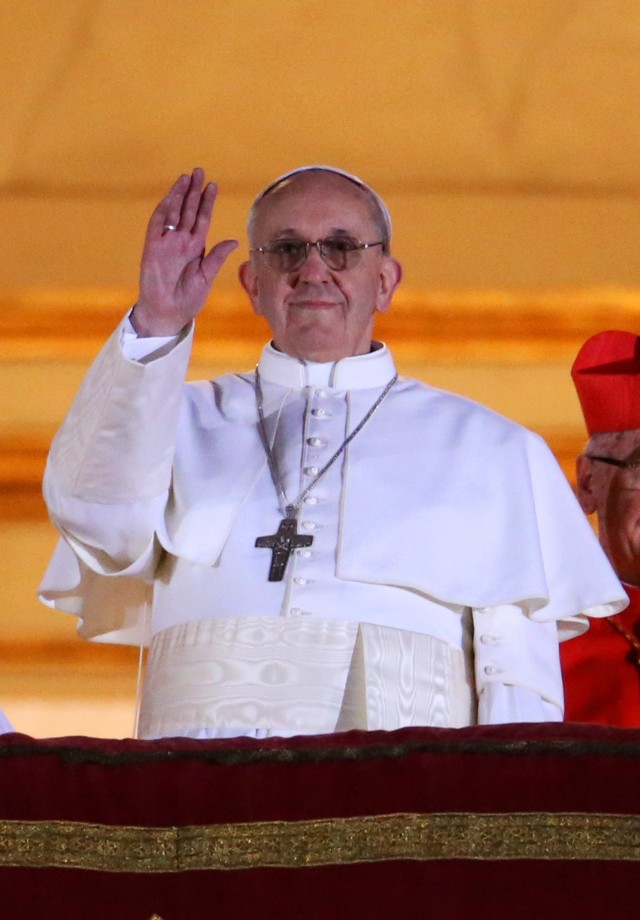
WANT TO KNOW WHAT IS BOTHERING FRANCIS? IT IS VERITATIS SPLENDOR, THE GREATEST ENCYLICAL PUBLISHED IN THE LAST 100 YEARS

Settimo Cielodi Sandro Magister 

05 lug 17

Müller Out. But the Real Attack Is Against “Veritatis Splendor”

Muller

WWW.CHIESA


[ Emphasis and {commentary} in red type by Abyssum ]

On Sunday, July 2, the very day on which Pope Francis removed Cardinal Gerhard L. Müller as prefect of the congregation for the doctrine of the faith, from all the Catholic churches of the Roman rite at the beginning of Mass the following prayer went up to God, called the “collect” in the missal:

“Deus, qui, per adoptionem gratiæ, lucis nos esse filios voluisti, præsta, quæsumus, ut errorum non involvamur tenebris, sed in splendore veritatissemper maneamus conspicui. Per Dominum nostrum….”

In the official English translation:

“O God, who through the grace of adoption chose us to be children of light, grant, we pray, that we may not be wrapped in the darkness of error but always be seen to stand in the bright light of truth. Through our Lord…”

Fate – or divine providence? – would therefore have it that the expulsion of Cardinal Müller should be accompanied by the choral liturgical invocation that the “splendor of truth” may continue to illuminate the Church.

“The splendor of truth” is precisely the title of the most important doctrinal encyclical of John Paul II, published in 1993:

> Veritatis splendor

It is an encyclical “on some fundamental questions of the Church’s moral teaching”: precisely the questions that have now returned to being an object of conflict, with extensive and influential sectors of the Church maintaining that it is time to leave behind – especially after the publication of “Amoris Laetitia” – some of the main principles of “Veritatis Splendor.”

It should be enough to observe that no fewer than four of the five “dubia” submitted in September of last year to Pope Francis by cardinals Walter Brandmüller, Raymond L. Burke, Carlo Caffarra, and Joachim Meisner hinge precisely on the consistency, or lack thereof, between “Amoris Laetitia” and “Veritatis Splendor.” And these “dubia” still remain completely open, in part because of Pope Francis’s refusal to take them into consideration and to meet with the four cardinals.

But what were the genesis and objective of “Veritatis Splendor”? To answer this question there is one exceptional witness: Joseph Ratzinger.

As Müller’s predecessor at the helm of the congregation for the doctrine of the faith, he contributed in a substantial way to the writing of that encyclical.

But even after his resignation as pope, he continues to judge “Veritatis Splendor” as being of “unchanged relevance,” to be “studied and assimilated” even today.

In 2014, in a thoughtful chapter for a book in honor of John Paul II, Ratzinger pointed to none other than “Veritatis Splendor” as the most important and relevant of that pope’s fourteen encyclicals.

A chapter that deserves a second reading, with an eye to what is happening in the Church today, under the reign of his successor Francis.

Here is the passage dedicated by the “pope emeritus” to that encyclical.

*

ON “VERITATIS SPLENDOR”

The encyclical on moral problems “Veritatis Splendor” took many years to ripen and remains of unchanged relevance.

The constitution of Vatican II on the Church in the contemporary world, contrary to the tendency of moral theology at the time to focus on the natural law, wanted Catholic moral doctrine on the figure of Jesus and his message to have a biblical foundation.

This was attempted by fits and starts for only a brief period. Then the opinion took hold that the Bible does not have any morality of its own to proclaim, but refers to moral models valid for their time and place. Morality is a question of reason, it was said, not of faith.

So on the one hand morality understood in terms of natural law disappeared, but its Christian conception was not affirmed in its place. And since neither a metaphysical nor a Christological foundation could be recognized for morality, recourse was had to pragmatic solutions: to a morality based on the principle of seeking the greater good, in which there is no longer anything truly evil or truly good, but only that which, from the point of view of efficacy, is better or worse.

The great task that John Paul II took on in this encyclical was that of rediscovering a metaphysical foundation in anthropology, as also a Christian concretization in the new image of man in Sacred Scripture.

Studying and assimilating this encyclical remains a great and important duty.

*

Seeing what is happening today in the Catholic Church, even at its highest levels, all the reasons that motivated the encyclical “Veritatis Splendor” are present once again, with equal if not greater dramatic force.

And they are also making more relevant than ever the prayer to remain “in the splendor of truth” that went up last Sunday from all the churches.

(English translation by Matthew Sherry, Ballwin, Missouri, U.S.A.)

Posted in Uncategorized | 2 Comments

THE ENEMIES OF THE CHURCH WOULD ONLY BE HAPPIER IF THEY COULD CAUSE POPE BENEDICT TO BE CHARGED WITH PEDOPHILIA, THERE IS NOT LIMIT TO THEIR HATRED

Cardinal:
The Rise and Fall of George Pell
louise milligan
melbourne, 277 pages, $11.21

George Cardinal Pell was charged last week with multiple counts of sexual abuse of children. He currently resides in Rome, tasked with cleaning up the Vatican finances. In the coming weeks he will fly to his native Australia, where he vows to fight all charges. His successor in the see of Sydney, Archbishop Anthony Fisher, advises letting the justice system take its course.

Australian civil authorities have yet to announce the number and nature of the offenses with which Pell is charged. But allegations against Pell have been accumulating for years. He stands publicly accused of complicity in a sex abuse coverup in the diocese of Ballarat in the 1970s and early 1980s; complicity in a sex abuse coverup in the archdiocese of Melbourne in the late 1980s and 1990s; and various counts of child molestation, assault, and indecent exposure, from 1961 through 1997.

In recent decades, child sex abuse cases have notably arisen from, and elicited, public hysteria. They have created poor conditions for the operation of the justice system. Ludicrous prosecutions and unjust convictions have resulted, far too numerous to count as the cost of doing business. In Australia, public hysteria concerning Pell is already extreme. Here is Louise Milligan’s florid book, written “from the complainants’ point of view.” Its publication was advanced from July to May, presumably to influence the deliberations of the civil authorities. Once Pell had been charged, its publisher removed it from local bookshops to avoid influencing the deliberations of jury members. But its claims have already been broadcast throughout the Australian media. Archbishop Fisher’s repose in the justice system may prove mistaken.

The formal charges against Pell may differ from those highlighted in Milligan’s book. It is in the nature of sex abuse hysteria that allegations, true or not, will multiply. So I would be surprised if the formal charges did not include novel accusations. But let us scrutinize the case we have before us, in the same way those formal charges must be scrutinized: in terms of their cogency, credibility, and underlying assumptions.

Milligan does not attempt to conceal her hostility to the Catholic Church. She recalls her Catholic girlhood with a shudder. When she can, she quotes her sources disclaiming any vendetta against the Church. But she is equally happy to quote a source, for instance, who recalls that his mother “took her shoe off and hit me in the face about six or seven times and said I was dirty”—in accordance, he says, with the “Catholic system.” Whenever she can, Milligan associates Catholicism with the victimization of children.

In her image of Pell, this association takes a monstrous form. Pell exhibits a “sociopathic lack of empathy,” not least in his adherence to traditional Catholic moral teaching. This portrait soon descends into schoolyard caricature. Taking up a popular epithet for him, Milligan calls Pell a “bully” over a dozen times. As a bishop, Pell used print, radio, and televisual media to bully his flock, by (for instance) voicing his concurrence in Veritatis Splendor. Pell is a bully because, when confronted by people who feel that Catholic moral teaching is unkind, he insists, nonetheless, that it is true. One source recalls Pell’s televised argument with actress and remarried divorcée Colette Mann: “There was sheer pain in her voice and there was pain and hurt in her whole attitude and she was speaking from her heart. If George had just reached out to her and touched her on the forearm and said something like ‘I am so sorry’ … But no. He hasn’t an ounce of empathy.” Pell is endlessly convicted by his critics of being insufficiently therapeutic, of failing to model emotiveness and bring about catharsis. The freighting of one churchman with such vast psychodynamic potency verges on the fetishistic.

A longstanding trope about sex abuse attributes empathy to alleged victims and their advocates, and lack of empathy to alleged pedophiles and their defenders. Accordingly, Milligan presents herself as Pell’s empathetic opposite. She confesses herself “a heart-on-my-sleeve type of person.” Narrating her interviews with accusers, she depicts their signs of emotion in detail, and relates her own feelings in response. Occasionally, empathy compels her to descend to inanities: “My heart’s in my throat. … It’s the feeling you get when you’re a little kid and you lift up a rock in the yard and a whole lot of bugs scurry out and you throw it down.” Lurking behind the kiddish prose is an attempt at coercion, in the grand tradition of the 1980s. “We believe the children” was the slogan of that decade, with its daycare scares and Satanic panics. All were obliged to show empathy for the victims—and empathy demanded belief.

Milligan has inherited this formula. In order to empathize with the victim of child sex abuse, we must first of all believe his claim that he is a victim of child sex abuse. Since we are not sociopaths, we arrive at the dogma “Children never lie”—which is absurd on its face and ruinous in application. In the 1980s, it required the conviction of preschool teachers for raping their charges in subterranean catacombs that did not exist; for sodomizing them with butcher knives, which mysteriously failed to inflict tissue damage; for abducting them in hot-air balloons; for administering magic philters and narcotic candy corn; and for whatever else a childish mind can dream up. We have since discarded the Halloweeny trappings, but the residue of this tradition endures. We retain the imperative of empathy, and its function as epistemological coercion. Feel what the children feel—don’t think about what they say.

Milligan’s first substantive charge against Pell is that he was complicit in a sex-abuse coverup in the diocese of Ballarat, Victoria during the 1970s and early 1980s. At this time, Pell was a junior priest with no authority in disciplinary matters, nor any formal charge to inquire into pedophilic infractions. His critics strain to establish his responsibility for crimes in which he played no part. Such was one goal of the prosecutors who examined Pell in Rome last year for the Royal Commission Into Institutional Responses to Child Sexual Abuse—a major Australian television event, notable for how blunt and stumbling Pell was. Milligan relates the proceedings in eight digressive chapters.

Pell responded to the prosecutors’ questions with a frankness that bordered on heedlessness. He admitted that in 1974, when a boy spoke vaguely to him of the pedophilic behavior of a Fr. Dowlan of the Christian Brothers, Pell did not inquire further or intervene. Asked by the prosecutor to explain his inaction, Pell was blunt: The boy “wasn’t asking me to do anything about it.”

From a Catholic perspective, this answer is unsatisfactory. Unfortunately for the prosecution, Catholic moral teaching is not legally binding in Victoria, Australia. Victoria’s mandatory reporting laws require adults in certain professional groups to report any knowledge or reasonable suspicion of physical or sexual abuse of a minor. These laws, however, were not on the books in 1974. At that time, sexual contact between adults and minors was not assumed to be injurious. Insupportable as it seems now, the medicolegal stigmatization of such contact was considered more injurious than the contact itself. Philip Jenkins summarizes the consensus of Western psychologists and civil authorities, from roughly 1950 to 1975: “A sexual episode would cause little harm to a child, provided the police or courts did not ‘make an issue’ of it.” Mandatory reporting did not exist in the southern or northern hemispheres, nor did the other kinds of special treatment we now accord pedophilic and ephebophilic offenders. Pell’s inaction, though St. Peter marked it a sin of omission, was not a crime at the time.

Nor would it be today, since Victoria’s mandatory reporting laws apply to doctors, nurses, midwives, teachers, principals, and police, but not to priests. Speaking of sins of omission, Milligan relates none of these legal or historiographical facts.

Throughout Pell’s interrogation, which took place over nineteen-and-a-half hours in the middle of four consecutive nights in Rome, the prosecutor evoked several blunders. One admission, concerning rumors of another priest’s depravities, was instantly notorious: “It was a sad story and of not much interest to me.” Pell convicts himself of tactlessness several times over. Narrating the interrogation, Milligan is a spastic cheerleader, getting excited every time the prosecutor “[goes] in for the kill”—though in every instance the prosecutor fails to kill. Somehow, her clumsy prey keeps escaping criminal responsibility. Perhaps it’s the facts.

The prosecutors and journalists see the problems. Pell appears to have known little, even of discrete acts, much less of serial acts and their abetting. Hence the refrain of the legal and media pursuers of Pell: “He knew or should have known.” If Pell did not commit a crime by failing to act on the scant knowledge he possessed, then he committed some pseudo-criminal infraction by failing to acquire fuller knowledge. This gambit excuses the prosecutors from having to prove anything about Pell’s action or inaction, his knowledge or ignorance. Pell is, in truth, on trial for failing to take sufficient interest—for lacking empathy. Lack of empathy is not a crime according to any law currently on the books in Australia, but it may serve for a hanging offense, if they can raise a hue and cry.

Arriving at Pell’s next assignment, auxiliary bishop of Melbourne from 1987 to 1996, Milligan levels a more ambitious charge: that Pell acted as “an archdiocesan fixer,” who “warned [people] off speaking the truth” about sex abuse. Pell’s superior at this time, Archbishop Frank Little, is widely blamed for covering up sex abuse. Milligan reports that Little was extremely secretive, including around his subordinates; she acknowledges that Pell’s relations with Little, a doctrinal liberal, were “decidedly frosty.” She avoids clarifying Pell’s status as Little’s antithetical successor-in-waiting, and the widely held expectation that Pope John Paul II would retire Little early in order to replace him with Pell, as indeed he did. Pell, for theological and political reasons, seems to have been as far out of Little’s loop as any churchman in the archdiocese. Despite all this, Milligan would have us believe that Pell spent nine years “fixing” things on Little’s behalf. (It is also interesting to note the kid-glove treatment Milligan affords Little, a “progressive” churchman who was “all for openness and embracing the laity.” She barely discusses his protection of pedophiles, and she reports that her sources are “at a loss to explain” it. I suspect that if Little had been a conservative, an explanation would be ready to hand.)

There is some dubious stuff in these pages. The culminating vignette is the story of Eileen Piper. In 1993, Eileen’s daughter, Stephanie, lodged a rape allegation against a priest in the archdiocese of Melbourne. One day, Eileen was at the house of her ailing brother, a monsignor in the archdiocese. While she was there, Milligan writes, George Pell showed up, “in a dominant mood.” He dismissed Eileen from the room and shut the door so that she would not hear the conversation that ensued. Milligan, undaunted, transcribes the money quote: “Don’t you dare have anything to do with your sister’s case, now that’s an order.” Bracket my doubts about this story, which are not exhausted by concerns about acoustics and Eileen’s memory (she was ninety-one when interviewed by Milligan). We know that the monsignor went ahead as he had planned: He stood by his sister at the trial, giving her moral support. Nor did he catch any flak for it. Stipulate that Pell spoke and acted as Eileen claims. I do not see what Milligan imagines he “fixed” by doing so.

Pell stands accused of making no threats, no bribes. He is not accused of instructing any victim or parent to keep quiet. The most he did, if he did even this, was to tell other priests not to get involved in scandals. At least Milligan’s ace reporting has established that Pell was a—what’s the word?

If these accounts of people being warned off speaking the truth by an archdiocesan fixer are true, they suggest Pell was a man used to getting his own way, to throwing his weight around with the priests below him and who … felt comfortable in exercising raw power, and was dismissive of those beneath him.

“Bully,” that’s it. For kicks, notice how this sentence says the same thing twice (I have omitted a parenthetical). More important: Milligan argues here that if it’s true that Pell was a fixer, then clearly he was a bully. This is a bizarre climbdown. For if it’s true that Pell was a fixer, then surely he is a criminal—guilty of intimidating witnesses, obstructing justice, probably tampering with evidence, and who knows what else. Why doesn’t Milligan say that, rather than retreat to her routine charge, that Pell lacks empathy and social finesse?

One hundred days after becoming archbishop of Melbourne, Pell empowered an independent commission to investigate allegations of sex abuse lodged against clergy or lay employees of the archdiocese. The commissioners were also authorized to provide complainants with counseling and financial compensation, as they saw fit. Known as the “Melbourne Response,” this system made a form of justice available to victims who were disinclined to establish legal liability—though it did not preclude their also pursuing civil action, if they wished. The year was 1996, six years before the American sex-abuse crisis.

The Melbourne Response seems designed to unfix everything Pell supposedly had fixed while serving as auxiliary. But if one is relying on Milligan, one does not glean this. For Milligan neglects to summarize the Melbourne Response process, in her haste to quote criticisms of it as “top-down, paternalistic,” “patronising, incomplete, and insufficient,” and prone to “re-traumatize” victims. Milligan records complaints about optics and power dynamics, with some claimants offended by the masculine decor in the office of the archdiocese’s solicitor. A “senior priest,” one of Milligan’s many anonymous sources, pronounces the last word on Pell in Melbourne (it’s five letters):

When I push the senior priest to tell me what Pell was then, if not a pioneer on child abuse, he is blunt: “To be honest, I don’t think anything of him. He was an ambitious man and a bully and all the things I don’t think bishops should be.”

If it’s not exactly true that Pell was an archdiocesan fixer, at least Milligan has shown that he was a bully. If Milligan cannot exactly discredit the Melbourne Response, at least she can show that Pell, in implementing it, was a bully. If none of the criminal charges are landing, at least they are sticking—they are adding up to something, even if it is only that Pell is a bully.

Below, we shall see how Milligan’s depiction of Pell as a bully substitutes for coherent charges of criminal responsibility.

Milligan claims that in 1961, as a seminarian assisting at an altar boys’ camp on Phillip Island, Pell repeatedly thrust his hands inside the pants of twelve-year-old Phil Scott and molested him. He is said to have accomplished this assault several times inside a tent, during sessions of wrestling or pillow-fighting, in the presence of other boys—who in every instance were “seemingly oblivious,” so busy were they “horsing around.” Pell is also said to have assaulted Scott during an “evening stroll,” in the presence of the other boys, and to have put his hands inside Scott’s swim trunks as Scott swam or walked in the waves. Forty-one years after their alleged occurrence, Scott reported these assaults to Church authorities. A criminal inquiry into his complaint led to its dismissal by a judge in 2002.

Milligan acknowledges a problem with these charges (a problem from which Pell’s bullying will save her). Typically, an offender cultivates a relationship with his victim, gaining trust, creating incentives for cooperation and silence, before assaulting him (this convention is referred to as “grooming”); and the initial assault is rarely forcible. The abruptness, both social and physical, of Scott’s claimed assaults is abnormal.

Milligan asks an anonymous Church official for comment. Anonymous acknowledges that “straight-out grabbing” is anomalous behavior for a sex offender. “But if there was ever anyone who might offend in that way, I can imagine that George might,” because George is “not a very subtle person.” Milligan hastens to add, “To be clear, this person is not saying Pell is an offender, but rather, if it was proven that Pell was, it wouldn’t be a shock to learn that this was the way Pell chose to offend”: like a bully. (Reader, to be clear, I am not saying you are a wife-beater, but rather, if it were proven that you were, …)

More fatally, Scott admits the presence, often the close proximity, of eyewitnesses who in every instance failed to eyewitness. Supposedly, horseplay served as camouflage for assaults that took place in plain sight. I have encountered this conceit before, and I shall return to it shortly.

There is no eyewitness evidence, no physical evidence, no circumstantial evidence, no cogency, and no contemporary report. Scott lodged his claim four decades after the alleged assaults—enough time for memories and evidence, if there had been any, to perish; and enough time for Pell to have become a lightning rod in the Australian media. We are left with Scott’s word against Pell’s. The judge at the inquiry was finally “not satisfied that the complaint [had] been established,” in view of “some valid criticism of the complainant’s credibility.”

Scott has been a bookmaker, drunk driver, drug addict, drug trafficker, and violent criminal—an altar boy with a life of crime, as the Herald Sundubbed him, uncharitably though not inaccurately. He has thirty-nine convictions from twenty court appearances, for offenses including but not limited to tax avoidance, substance abuse, and physical assault. Milligan never finds quite the right tone in which to relate these facts. “Dealing amphetamines was a major slip-up, to put it mildly. … It was really, really embarrassing.” Indeed.

Milligan charges that to adduce Scott’s biography in the context of his allegation is “character assassination.” On the contrary, it is unavoidable.

Phil Scott is Patient Zero. In every spurious sex abuse case, there is an original accuser, whose story proves contagious. The exemplary Patient Zero is the paranoid schizophrenic woman who instigated the seven-year-long McMartin Preschool fiasco. More reputable people may then tell similar untruths: some confused, or misremembering, or misguided, or mobilized by the media, or browbeaten by enthusiastic police or prosecutors or therapists; others opportunists who see little risk and lots of upside in a venture that someone else has boldly opened.

Phil Scott’s allegation was lodged and publicized in 2002. In 2015, two men, friends from childhood on, alleged that Pell had assaulted them in the Eureka Stockade Pool in Ballarat. In the summer of 1978-79, when Lyndon Monument and Damian Dignan were eight or nine years old, Pell would visit the pool and play “the game.” “The game” involved stirruping a boy’s feet underwater, then tossing the boy into the air. It is alleged that, while he was at it, Pell fondled the boys and may have digitally penetrated them. Milligan notes a similarity between this allegation and one of Scott’s allegations—the one in the waves, in that both settings involve water. She views the similarity as corroborative, though others may regard it as evidence that Australians like to swim and read newspapers.

We are given to understand that Pell accomplished his assaults in plain view of swimmers and sunbathers, without visible deviation from the physical business of “the game.” Let us sharpen the picture, which Milligan has left rather blurry.

Monument and Dignan both claim that Pell, having linked his hands beneath the water and taken a boy’s two feet upon them, would “let one hand go” and allow the free hand to “wander” upward. Pell, therefore, performed a feat of stamina and dexterity that would tax a magician or a circus performer: balancing a boy upright on one hand, while with the other hand molesting him. This arrangement requires the boy to hold his legs tight together. Yet Monument’s account of the molestation precludes this: “The hand on my crotch would cover my penis and testicles and would also cover my anus area.” And so far, we have supposed that the fondling took place outside the boy’s clothes; this seems the simplest prospect. And yet: “Pell would put his hands”—wait, plural now?—“under the shorts and underpants that Monument was wearing, touching his genitals.”

Pell would then need to extract his hand (or hands). Milligan never clarifies when or how this was done. She and the complainants seem to suggest that Pell kept a hand inside the boy’s clothes during the act of tossing him into the air:

“Father Pell would throw me into the air and I would dive into the water.” Monument says the priest would have an open hand cupped around his crotch during this. He later explains to me at one point that he distinctly remembers Pell’s fingers being at the entrance to his anus, but as to whether the priest digitally penetrated him, he cannot comfortably remember.

But that is impossible. Our predator must have withdrawn his hand or hands from the boy’s limbs and garments while the boy was still in the water. Then he must have placed his hand or hands down again, to link or re-link them beneath the boy’s feet. Only then would he have been able to release the boy into the air.

Monument characterizes the assaults as “furtive and fleeting.” On the contrary, the performance he and Dignan describe can only have been strenuous, intricate, and time-consuming. The motions of assault and extrication are not consonant with “the game”; nor are they discreetly appended to it.

Factor in digital penetration, and the proposition becomes still more complicated—though you’ll have to do the math on that yourself. Nor will I dwell on the impediments presented by the boys’ clothing: drawstrings (on Dignan’s board shorts and Monument’s footy shorts) plus underwear. And I will adduce without elaboration the natural mobility and reactiveness of a child who is being manhandled.

Perhaps these assaults occurred. But the account Milligan has extracted is incoherent. With its illogical and elusive particulars, it is downright surreal.

In its surreality, it recalls the case of Arnold Friedman of Great Neck, New York. In the late 1980s, Friedman held regular computer classes in the basement of his home, teaching boys aged eight to eleven how to do things with PCs. In 1987, he was accused by more than a dozen students of having forced them to participate in sex games, including sessions of sodomitical leap-frog. As one accuser put it, years later: “Yeah, leap-frog. I remember about that. … Arnold … would leap, one person to another, sticking his d*** each in their a**.” The flagrancy of this nonsense, which was contradicted at the time by several of the boys in the computer class, did not save Friedman from prosecution. (He committed suicide in prison in 1995.) Nor does it prevent his accusers, now adults, from persisting in their claims. Only a sociopath would disbelieve them.

In Friedman’s basement as in Pell’s pool, we observe a distinctly childish ignorance of what is anatomically practicable. Genitalia are always easy to find and fondle, even inside clothes. Orifices are not just easy to find, but elastically permissive. This sort of thing reached its hysterical height, perhaps, with the 1986 conviction of Gerald Amirault, proprietor of a daycare center in Maiden, Massachusetts, for, among other things, penetrating his charges’ bottoms with a butcher knife. It is no surprise if children fail to consider the practicality of these propositions. But adults have no excuse.

In Friedman’s basement as in Pell’s pool and the altar boys’ tent, “the game” provides a pretext; assault is a variation on the fleeting contact entailed by sport or play. This type of allegation is common in spurious sex-abuse cases, in part because it solves a common problem: If the victim was never alone with the predator, when and where did the assault take place? Magic answer: In plain sight, during “the game.” Pedophiles are so adept at sleight-of-hand. (Pushing a child on a swing is another popular pretext.) But in truth, sexual assault can almost never be disguised as innocent ludic contact. The latter is necessarily fleeting. Molestation, definitionally and as a practical matter, is not.

Of all the charges in Milligan’s book, the following is the one I find most credible. It is, in the words of one journalist, the “story of [Pell’s] not rushing to get dressed” after surfing, “to the puritanical appal of some chap.” But let us consider the charge with seriousness.

At the Torquay Surf Life Saving Club during the summer of 1986-87, Les Tyack walked into a changing room. He beheld, in the far corner, Pell, naked and toweling himself. Three or four meters from Pell were three boys, aged eight to ten, “also naked and getting changed.” Confusingly, Tyack says both that Pell was “facing” the boys at this point, and that he “had his back angled towards” them. Tyack entered the showers, which were “behind a screen” on one side of the room. Tyack claims that he showered behind the screen for “five to ten minutes.” He claims that after his shower he beheld Pell again, still in his corner, still naked, with the towel now “over his right shoulder.” He claims that the three boys, now dressed, were where they had been, and that Pell and the boys were looking at each other. Tyack became “very suspicious” (a word he uses three times) that what he had interrupted was an act of indecent exposure. (It is hard to see what room remained for suspicion, if the boys were indeed gazing steadily at Pell’s naked front, as Tyack seems to say.) Tyack claims he told the boys to get out, then addressed Pell: “I know what you’re up to, piss off, get out of here, if I see you back in this club again, I’ll call the police.” Pell, we are told, turned to face the wall, making sure that “at no time was [Tyack] given the opportunity to see the front of him.” Pell did not otherwise respond to Tyack’s challenge.

We know from records that Pell continued to patronize the surf club in the years after 1986-87. Tyack did likewise, serving as a lifeguard and bringing his sons around. Tyack never mentioned the incident to other members of the club, nor (I presume, since Milligan does not mention it) to his sons. Nor did he call the police. He says he figured his threat to do so would have done the trick. Gradually, Tyack became “aware of the bigger picture and the problem that was going on with priests.” He was “seeing more and more people coming out with accusations on the priests, on other priests’ activities, and then with Pell.” In 2012, he reported his story to the civil authorities. He hoped that “those collating all the evidence could put it aside there, and it might help form a dossier on Pell’s activities. I saw it as being perhaps very supportive of the victims of pedophilia.”

I’ll limit myself to three questions.

Did Tyack really spend five-to-ten minutes showering behind a screen in a changing room? People generally do not luxuriate, or execute lengthy hygienic regimens, in public showers. And we are to believe that the boys hung around all that time, with nothing to do but stand in place and gaze at Pell. The timing is important, since duration—lingering—is necessary to make a man’s nakedness in a changing room malign. That, and his “suspicious” preference that another man not see his front. (But most men will prefer not to have their naked fronts looked at directly by other men.) By stretching the shower to five-to-ten minutes, Tyack opens up a blank that, he says, can only be filled with indecent exposure.

Why would Pell expose himself when he knew there was an adult in the room, just behind a screen? Tyack was liable to poke his head out at any moment. He was also within earshot, should the boys cry out or seek help. And hearing the shower go off, surely a man with something to hide would wrap that towel around his waist.

Why did Tyack wait a quarter-century, including a decade after the Phil Scott allegation had hit the news, to make his report?

My mother and I once contradicted each other in our separate depositions to an insurance company lawyer, on a point of importance concerning a traffic accident we had witnessed: Had the cab been against the curb, or in the right turn lane, when the fire truck scraped its fender? We each told the truth as we remembered it. The incident was recent, and my memory was vivid. Alas, having a vivid memory is not the same as having a tape to play back. Asked to supply a detail I did not possess (or did I? I thought I did), I constituted that detail in a manner consonant with what I believed was true: “Oh, definitely against the curb.” For the cab driver had not been at fault. And he needed our help, lest he be held liable and fired and deported (he was a recent immigrant). It was clear that the firemen and police intended to railroad him.

In 2012, Tyack told the truth as he remembered it. The incident was twenty-five years in the past, but his memory was vivid. No one can accuse him of fabricating an allegation out of whole cloth. He avoids claiming that he saw a crime; he saw something “very suspicious,” and alleges the crime by inference. He claims that his shower lasted five-to-ten minutes, and he stresses Pell’s reluctance to show him his naked front. On the strength of these details, Tyack’s memory invites an interpretation that accords with what he believes is true: that the Catholic Church, and Pell in particular, are hurting kids. And it allows him to act out his good-citizen’s impulse: Toss this in the dossier, it might do some good.

“The more I have heard over the years of the incidents involving the victims of the Catholic Church, the more this incident has played on my mind.” Indeed.

Milligan ends with an “explosive new charge” against Pell, provided by a claimant she calls The Kid. The Kid is in his thirties by the time Milligan meets him. His pseudonym is a misnomer, though not an idle one. We believe the children, even after they have graduated from college.

The Kid alleges that in 1997, when he and his friend, the pseudonymous Choirboy, were thirteen-year-olds singing in the choir of St. Patrick’s Cathedral in Melbourne, Archbishop Pell assaulted both of them. One Sunday after Mass, The Kid and The Choirboy supposedly went to a back room, where they got drunk on communion wine. Pell, supposedly discovering them, locked the door and forced both boys to give him oral sex. (This is the account The Kid has given to police. Milligan, without explanation, omits the detail of the communion wine.)

The conceit of naughty choirboys sloshing communion wine, and an archbishop prowling about his cathedral seeking whom he may devour, mashes up Maria Monk with parochial-school daydreams. But let’s permit The Kid his clichés, and address his logic. According to The Kid, St. Patrick’s stored communion wine unsecured in an unlocked back room, in sufficient quantities to intoxicate two adolescents. And the archbishop, when desirous of malign pleasures, exacted them from two victims simultaneously, generously furnishing each with a corroborating witness. He did this while having the favor of the pope and eyeing a red hat. Perhaps recognizing the incongruousness of these elements, Milligan characterizes the assault as Pell’s “last major slip-up.” I would add that, like Phil Scott’s drug-dealing, it was really, really embarrassing.

After the release of Milligan’s book, a police report was obtained by an Australian newspaper, containing an interview with a priest who had been on Pell’s staff at the time in question. The priest says that the cathedral’s communion wine was kept locked in the safe that contained the chalices. He says that it is “physically impossible” for Pell to have been alone with any choirboys, anywhere in the cathedral, “before, during, or after the celebration of Sunday Mass or on any other occasion.” On Sundays, Pell arrived at the cathedral fifteen minutes before the eleven o’clock Mass; was met at the door by this priest and attended by him constantly thereafter; vested for Mass; celebrated Mass, which ended shortly after noon; stood at the door of the cathedral, shaking hands with exiting Massgoers; removed his vestments; and departed the cathedral, to have lunch at a restaurant or visit a parish, still accompanied by the priest.

The Kid is clean-cut and college-educated. Milligan disclaims The Kid’s clean record as a basis for our credence; she is offended by the very idea of needing to establish the credibility of an accuser. Yet she keeps mentioning The Kid’s clean record, as much as to say, “Why would he lie?”

The Choirboy does not have a clean record. He struggled with drug abuse and depression throughout his teens and twenties. On several occasions, his mother asked him whether anyone had sexually abused him. You can call this an enlightened motherly intuition, as Milligan does. Or you can call it obedience to a pop-psychology canard, whereby all psychological disturbance is a warning sign of sex abuse. Every time he was asked, The Choirboy answered No. Milligan wonders why The Choirboy would lie. This time, the question is not rhetorical. Shades of Roland Summit’s debunked but influential 1979 paper, “The Child Sexual Abuse Accommodation Syndrome.” Summit’s thesis was that “children never lie” about sexual abuse—except when they conceal it, as they routinely do, in order to accommodate their abusers. When it comes to child sex abuse, denial is confirmation; No means Yes. And so, The Choirboy is the only one of Pell’s alleged victims who is capable of deceit. But despite his lies, The Choirboy’s mother went on suspecting. The Kid has now vindicated her. And what does The Choirboy say to that? Nothing. He is dead.

He died of a heroin overdose in 2014. His mother says that Pell and his people “need to be responsible for that death.” Toss in one count of manslaughter. Why not?

During his trial or after it, three years or three days from this writing, new facts may emerge that demonstrate to me and all the world that George Cardinal Pell of Australia is guilty as sin. On that day, I will regret this review, but I will not repent of it.

Charges have been flying at Pell for fifteen years. Hundreds of claimants insist that he must have done this and must have known that. Perhaps I have persuaded you that the imperative of empathy for victims of child sex abuse does not necessitate your belief in each and all of the charges leveled at the cardinal. You surely have not fallen for Milligan’s “Why would he lie?” gambit—a version of “Children never lie,” extended to children who are past their majority.

So you are not hysterical. But I suspect you are disinclined to sympathize with a man to whom so many gross suspicions cling. You reckon the proof is in the proliferation: “Why would they all lie? There has to be some truth in it, somewhere. Some of this stuff is true, or half-true. One or two or a few of these claims are true. Somewhere in there.”

But the dazzling proliferation of claimants and allegations is common in spurious sex abuse cases. Arnold Friedman had over a dozen accusers. The McMartin Preschool case generated 321 charges from forty-one children. We now know that every charge was a lie and every child was a liar. Yet today, with the children now well into their thirties, many of them still insist that their charges were true. In Wenatchee, Washington, in 1994, forty-three adults were arrested on 29,726 counts of sex abuse alleged by sixty children, aged nine to thirteen. In 1995, every last charge was dropped.

If proliferation is not proof, perhaps passion is. Pell’s critics are in hysterics over him; surely they are not spun up over nothing. Of course evils have been wrought by the Catholic clergy, in Australia and elsewhere. But why should Pell be the one monster, embodying all the evils of the evil city? Because he is the country’s only cardinal; for decades, he has been the country’s most visible, audible, and CatholicCatholic. Pell is the monster, not because of what we can establish about what he did or knew, but because of his stature, and because his ideology runs afoul of the great and the good, and because he is not constantly damp with empathy. And because René Girard was right: There is always a scapegoat; it’s just a question of who.

Scapegoating campaigns do not require evidence or answer to logic. They do not always even convince their participants. For example, I do not believe that the parents of the McMartin Preschool children really believed there were Satanic catacombs beneath that preschool. Certainly not after they had excavated the site for the first time, and come up empty. (This actually happened.) On that day, the parents of the McMartin Preschool children should have confessed: Their children had lied about the catacombs. Instead, they hired a second archeological contractor to dig up the lot again. In this ludicrous episode, the McMartin parents’ pursuit of “the truth” was revealed as a lie—but a lie to which they had committed themselves so fully, they could hardly recant. No doubt they were lying to themselves.

At some point during her researches, Louise Milligan should have asked herself whether she was digging up the antipodal catacombs.

Milligan concludes her book with a victory lap on behalf of doctrinal liberalism. Pope Francis is “an entirely different sort of leader to Pope Benedict XVI and Pope John Paul II,” in that he “warns of the perils of theological rigidity” and seems open to liberalizing the Church’s moral teaching on sexuality. In his pontificate, doctrinal conservatives are out of favor: Raymond Cardinal Burke, Marc Cardinal Ouellet, Pell himself—what Milligan calls “the Pell faction.” Milligan appears to expect that, through personnel shakeups and apostolic exhortations, Francis will evacuate Catholicism of its doctrinal commitments.

True, Francis did a strange thing by promoting Pell to head the newly constituted Secretariat of the Economy, with a brief to reform the Vatican finances. But fear not: Pell’s reform has failed. Francis canceled the audit Pell had planned, and he has gradually retracted Pell’s prerogatives. “The Cardinal’s wings have been seriously clipped.” Milligan favors the continued financial corruption of the Curia, because if malfeasance and embezzlement were to cease, it would represent a victory for Pell.

In 2015, Milligan’s good man in the Vatican, Francis, appointed Juan Barros bishop of Osorno, Chile. Barros is widely blamed by Chilean Catholics for covering up the crimes of the notorious pedophile Fr. Fernando Karadima. Hearing of Chilean Catholics’ objection to the appointment, Francis was filmed calling them “stupid.” During Barros’s ordination Mass, Chilean Catholics stormed the Osorno cathedral. The man was consecrated bishop in a bulletproof vest—whisked into the sanctuary by bodyguards at the crucial moment, then whisked away again. Quibble about the Melbourne Response, and whether it demonstrates sufficient empathy. I will take it over the Osorno Response.

In many and various ways, Francis is worse on child sex abuse than Benedict, his “rigid” predecessor. The Vatican’s child sex abuse task force is falling apart. In 2014, Francis personally restored to the priestly state a Fr. Inzoli, a friend of Francis’s friends, who had been defrocked in 2012 after his conviction for child molestation by the Congregation for the Doctrine of the Faith. Two years after Francis’s intervention, Fr. Inzoli was convicted by the Italian civil authorities and sentenced to prison. (Yet he remained in the priestly state until just last week—until the very day of Pell’s charging, in fact.) In 2010, Godfried Cardinal Danneels of Belgium, a liberal Catholic hero, spoke with a victim of his pedophile friend, Bishop Roger Vangheluwe, in a meeting that was secretly recorded. On tape, Danneels instructs the victim to remain silent and to “ask forgiveness” for the abuse: “Acknowledge your own guilt.” Three years later, the just-elected Pope Francis greeted the world from the St. Peter’s loggia, with Danneels in his retinue. He has continued to favor Danneels with plum appointments.

Francis is the first good pope in Milligan’s lifetime. He has clipped the wings of Pell. I’ll let you decide why Milligan wrote this book: because she hates pedophiles—or because she hates the Church.

Julia Yost is associate editor of First Things.

Become a fan of First Things on Facebook, subscribe to First Things via RSS, and follow First Things on Twitter.

Posted in Uncategorized | Comments Off on THE ENEMIES OF THE CHURCH WOULD ONLY BE HAPPIER IF THEY COULD CAUSE POPE BENEDICT TO BE CHARGED WITH PEDOPHILIA, THERE IS NOT LIMIT TO THEIR HATRED

THE CHURCH WILL BE DIFFERENT FOR THE NEXT SEVERAL POPES, FRANCIS IS SEEING TO THAT

Settimo Cielodi Sandro Magister 

02 lug 17 

How Francis Is Preparing the Place for His Successor

MovPop

WWW.CHIESA

Francis has no desire to go down in history as a “transitional” pope. That which he is doing, he wants it to survive his departure. And to make sure of this he is institutionalizing the things dearest to him, he is making them stable, with all the numbers to keep moving forward on their own.

The World Day of the Poor is one of these creations of his, officially canonized a few weeks ago.

Jorge Mario Bergoglio’s idea that the Church is like a “field hospital” will be embodied from now own every year, in November, in a celebration of works of mercy on behalf of the hungry, naked, homeless, strangers, imprisoned.

With the pope, this pope, who in Rome will eat together with hundreds of the poor, it will be difficult for one of his successors not to do the same. Pope Francis will run the dress rehearsal in Bologna on October 1, where the program for the visit already shows that at noon the pope will be “at lunch with the poor at the basilica of San Petronio.”

Then there are the “Scholas Occurrentes,” a network of schools that, born in Buenos Aires when Bergoglio was archbishop of that city, now connects more than 400,000 institutes all over the world, no matter whether Catholic or secular.

There is nothing religious in the meetings among these schools. What holds sway are words and concepts like “dialogue,” “listening,” “encounter,” “bridges,” “peace,” “integration.” And even skimming the now numerous talks Francis has given to the “Scholas, the silence on the Christian God, on Jesus and the Gospel, is practically sepulchral.

But in spite of that, Bergoglio has set up the “Scholas Occurrentes” as a “pious foundation” of pontifical right, hosts their world conferences at the Vatican, and three weeks ago, on June 9, inaugurated an office for them within the pontifical palace, which will make it more complicated to dislodge them in the future.

The turning point is no small matter. For centuries, the schools of the Society of Jesus have been the beacon of Catholic education. While these “Scholas” so dear to the Jesuit pope make more news for the frequent soccer games “for peace” that he sponsors with Maradona, Messi, or Ronaldinho at his side, as also for the bizarre encounter one year ago in the ring in Las Vegas – this too convened by the pope under the banner of dialogue – between a Catholic and a Muslim boxer, both of whom were received at Santa Marta after the Muslim, who lost by knockout in the sixth round, had been released from the hospital.

In the political field the same thing is happening. Not a year goes by in which Francis does not convene around him a world meeting of what he calls the “popular movements.”

This network of movements did not exist before him – far from it. It is another of his inventions. He has entrusted its selection to an Argentine trade unionist friend of his, Juan Grabois, who fishes each time from among the diehards of the historic anti-capitalist and anti-globalist assemblies of Seattle and Porto Alegre, with a side order of indigenous and environmental groups and with prominent guests like Bolivian president Evo Morales, in his capacity as a coca grower, or former president of Uruguay José “Pepe” Mujica, with a past as a guerrilla, who has now retired to live a frugal life on a farm.

To this gathering, Bergoglio gives fiery speeches every time of thirty pages and more, which are the quintessence of his general political vision, harnessing the people as a “mystical category” called to redeem the world.

There have been four convocations so far: the first in Rome in 2014, the second in Bolivia in 2015, the third again in Rome in 2016, the fourth – on a regional scale – in Modesto in the United States last February, with the pope joining this time by video conference. Others will follow.

But that’s not all. For his successor, Francis has prearranged even more. He has dismissed all the members of the Pontifical Academy for Life and has appointed new ones.

With the difference that while before they were all adamantly united against abortion, artificial procreation, and euthanasia, today that is no longer so, each member of the academy thinks his own way. Because what must be put in first place is dialogue.

__________

This commentary was published in “L’Espresso” no. 26 of 2017, on newsstands July 2, on the opinion page entitled “Settimo Cielo” entrusted to Sandro Magister.

Here is the index of all the previous commentaries:

> “L’Espresso” in seventh heaven

———-

Jorge Mario Bergoglio’s intention to “institutionalize” the things dear to him has not escaped the American vaticanista John Allen:

> We’re watching Pope Francis institutionalize his vision

———-

POSTSCRIPT – This note was already written and published when the drama over the case of little Charlie Gard was at its height, with Pope Francis silent in spite of the universal and spontaneous wave of appeals for him to intervene “ad personam” in defense of that child’s life:

> Il piccolo Charlie e noi

And also in spite of the seriousness of the legal objections against the verdict that in fact has sentenced Charlie to death:

> In nome della legge: Isacco, Charlie Gard e gli affanni della modernità

This is a case that cannot help but have an impact on the “fortunes” of this pontificate. All the more so if a comparison is made between the energy that Pope Francis has exerted for the “Scholas Occurrentes” and other initiatives on a similar level, precious as can be to him, and his astonishing silence on crucial questions like the emblematic one of Charlie Gard.

(English translation by Matthew Sherry, Ballwin, Missouri, U.S.A.)

Posted in Uncategorized | Comments Off on THE CHURCH WILL BE DIFFERENT FOR THE NEXT SEVERAL POPES, FRANCIS IS SEEING TO THAT

IGNORANCE OF SEXUAL MORALITY IS NOT THE SAME AS BEING IGNORANT OF COMPUTER SCIENCE

El_Greco_021-large

Want to understand sexual morality? Read—and grasp—Leviticus.

By Dr. Jeff Mirus (bio – articles – email) | Jul 03, 2017

CATHOLIC CULTURE.ORG

Leviticus is a Biblical book which only the Mother of God could love, or so it seems at first glance. This book provides the details of the Israelites’ ritual law, the manner of ordinations, the prescribed methods of celebrating the major feasts, distinctions between clean and unclean animals, the circumstances under which persons are considered unclean, and what they must do to be considered clean again, details of sacrifices and other offerings, and punishments for disobedience. In particular, it delineates the most deadly sins, such as murder and sexual license.

It also explains the Jubilee Year, which apparently lies at the heart of God’s idea of a just social order, a point I will stress on another day. Here I wish to sound a note of praise for Levitical culture for something our own culture has almost entirely lost. I am referring to the sense of the sacred, which profoundly changes everything we may think is unappealing about this book. For the moral life begins to reveal itself with self-evident clarity when we grasp a sense of the sacred.

I am the LORD

Throughout Leviticus, God emphasizes the sacred vitality of His commandments by concluding, “I am the LORD.” This is true not only for specific commands but for the Law as a whole:

And the LORD said to Moses, “Say to the sons of Israel, I am the LORD your God. You shall not do as they do in the land of Egypt…[nor] as they do in the land of Canaan…. You shall do my ordinances and keep my statutes and walk in them. I am the LORD your God. You shall therefore keep my statutes and my ordinances, by doing which a man shall live: I am the LORD. [Lev 18:1-5]

Immediately after this universal injunction come the laws governing sexual relations: “None of you shall approach any one near of kin to him to uncover nakedness. I am the LORD” (Lev 18:6). For men, this includes one’s mother, one’s father’s wife (“it is your father’s nakedness”), sisters, granddaughters (“for their nakedness is your own nakedness”), aunts, sisters-in-law, and daughters-in-law. Nor shall a man “uncover the nakedness” of both a woman and her daughter or her granddaughter, nor take his wife’s sister as a rival to his wife (Lev 18:6-18).

Moreover, the Israelites were forbidden to “lie carnally with your neighbor’s wife, and defile yourself with her” and to have sexual relations with a woman during “menstrual uncleanness” (Lev 18:20). The reason for the latter is telling (as we learn two chapters later), for by this sin: “[H]e has made naked her fountain, and she has uncovered the fountain of her blood” (Lev 20:18). Finally, the LORD commands: “You shall not lie with a male as with a woman; it is an abomination. And you shall not lie with any beast and defile yourself with it, neither shall any woman give herself to a beast to lie with it: it is perversion” (Lev 18:19-23).

Chapter 18 concludes:

Do not defile yourselves by any of these things, for by all these the nations I am casting out before you defiled themselves; and the land became defiled, so I punished its iniquity and the land vomited out its inhabitants…. So keep my charge never to practice any of these abominable customs which were practiced before you, and never to defile yourselves by them: I am the LORD your God. [Lev 18: 24-30]

Interestingly, there is one other stipulation in this section: “You shall not give any of your children to devote them by fire to Molech, and so profane the name of your God: I am the LORD” (Lev 18:21). Again, this is treated in the same section as sexual sins. Throughout Scripture, following other gods is referred to as harlotry. Both this and sexual sins are treated in Leviticus as particularly intimate betrayals of what it means to be human.

Finally, in Chapter 20, we learn the penalties for these transgressions. For dedicating children to Molech, for consulting mediums and wizards, for sodomy and bestiality, and for sexual relations involving mothers and sisters, the penalty is death. For other sexual offenses, the penalty is exile. The conclusion summarizes the whole point: “You shall be holy to me; for I the LORD am holy, and have separated you from the peoples, that you should be mine” (Lev 20:26)

What does all this mean?

To us this may seem very harsh or even, by modern standards, both intolerant and incredibly stupid. In our day, we are far more likely to condemn the Law rather than its violations, especially in sexual matters. But this is because we have lost all sense of what it means for us when God insists that He is holy. We have lost all sense of the sacredness of what we might call the original gift, and the original blessing.

God is the author of life, and not only life, but life to the full in union with Himself. He alone is life—and so the ineffable source of life. In God, life and love (authentic love) are inseparable; therefore, life and holiness are inseparable; for what is holiness but the perfection of love? God has made us in His own image and likeness, giving us, first, the gift of life and, second, the foundational blessing of our existence: “God blessed them, and God said to them: ‘Be fruitful and multiply, and fill the earth’” (Gen 1:28).

At the time of Leviticus, when the human understanding of God’s plan was still in its infancy, these foundational blessings were taught by setting apart a particular people and giving them the clear and basic rules of holiness, of fidelity to their Creator, for as God said, “I am the LORD.” But from the first, it is clear that the life God shares with man is ordered to the extension of life and love through the family. What began through the formation of a strict legal culture would be brought to perfection through grace. In the New Covenant, God reveals Himself as an infinitely fruitful family. What the Israelites were given to understand through the delineation of crime and punishment, the new Israel has been given to understand through redemption in Jesus Christ, the proclamation of the Gospel, and sanctification through the sacraments of His Church.

Our Lord said: “I am…the life; no one comes to the Father, but by me” (Jn 14:6). St. Peter spelled out the implications:

Therefore gird up your minds, be sober, set your hope fully upon the grace that is coming to you at the revelation of Jesus Christ. As obedient children, do not be conformed to the passions of your former ignorance, but as he who called you is holy, be holy yourselves in all your conduct; since it is written, “You shall be holy, for I am holy.” [1 Pet 1:13-16]

The original gift of life we received is to be fulfilled in eternal life in union with God: “The thief comes only to steal and kill and destroy; I came that they may have life, and have it abundantly” (Jn 10:10). If we realized what we have been given, what we truly are, and what we are to become, we would understand that our lives are not only a great gift but a sacred gift; and not only a great and sacred gift but a gift which permits us to participate in giving life to others as well. Then we would see ourselves as temples of the Holy Spirit for all eternity, as sacred creatures whose sexual faculties are also sacred, because they are ordered to the gift of life—which is the gift of holiness, the gift of participation in the life of God forever.

When our culture begins again to understand this fundamental reality of our existence—when our culture begins again to grasp the meaning of Leviticus—we will recoil in horror from those perversions of our faculties which so dominate the world today. We do not recoil now for the simple reason that we do not understand our original gift and blessing. We do not understand who we are. But all of this means exactly what Leviticus and St. Peter say it means: “You shall be holy to me; for I the LORD am holy.” This, and only this, is what it means to live.

Jeffrey Mirus holds a Ph.D. in intellectual history from Princeton University. A co-founder of Christendom College, he also pioneered Catholic Internet services. He is the founder of Trinity Communications and CatholicCulture.org. See full bio.

Posted in Uncategorized | Comments Off on IGNORANCE OF SEXUAL MORALITY IS NOT THE SAME AS BEING IGNORANT OF COMPUTER SCIENCE

THOSE WHO CHOOSE NOT TO FIGHT ACTUALLY CHOOSE TO BE LOSERS. IN THIS FIGHT THERE CAN BE NO SPECTATORS, EVERYONE IS AFFECTED.

unnamed-11

De Mattei on the Müller Case: “The moral of this story is that those who do not fight experience defeat”

The Müller Case
RORATE CAELI
Roberto de Mattei
Corrispondenza Romana
July 2, 2017
The removal of Cardinal Ludwig Müller signifies a critical moment in the history of Pope Francis’ pontificate. In fact, Müller, named Prefect of the Congregation for the Faith on July 2nd 2012 by Benedict XVI, is only 69 years old. It has never happened that a cardinal with more than 5 years to the canonical age of retirement (75) has not had his position renewed for a further five years.
Suffice to say that there are prelates, who, even if they are ten years older than Cardinal Muller, occupy important offices. For example, Cardinal Francesco Coccopalmerio, President of the Pontifical Council for Legislative Texts, the same cardinal whose secretary was caught in the act, by the Papal Gendarmerie, during a drug-based homosexual orgy in an apartment building, belonging to the Vatican. Coccopalmerio though, had shown his appreciation for Amoris Laetitia, explaining that: “the Church has always been however the refuge of sinners”, whereas Müller did not hide his perplexity towards the ‘apertures’ in the papal Exhortation, even if with declarations of an oscillating nature.
In this respect, the dismissal of Cardinal Müller, is an act of authority which constitutes an open challenge by Pope Bergoglio to the sector of conservative cardinals, to whom the Prefect of the Congregation for the Faith was well-known to be close to. Francis moved forcefully, but also skillfully. He began isolating Müller, by forcing him to dismiss three of his most trusted collaborators.

Then Pope Bergoglio left the possibility of his renewal dangling until the very last minute, without ever giving him any explicit assurances. In the end he replaced him, but not with an exponent of radical progressivism, like the Rector of the Università Cattolica of Buenos Aires, Monsignor Víctor Manuel Fernández, or the special Secretary to the Synod, Monsignor Bruno Forte. The one chosen is Archbishop Luis Francisco Ladaria Ferrer, a Jesuit, until now the Secretary of the Congregation. His choice both reassures and floors conservatives. What some of them don’t understand is that for Pope Francis, what is important is not the ideology of his collaborators, but the allegiance to his plan of “irreversible reform” for the Church.
More than a victory for Pope Francis, we should say, however it’s a defeat for the conservatives. Cardinal Muller does not share Pope Francis’ line, and had attempted to assume publically a contrary position, but the current thesis in the group of conservatives, was that it would have been better that he keep his position being silent, rather than losing it by speaking. The Prefect chose to have “a low profile”. In an interview to Il Timone, he said that “Amoris laetitia, should be clearly interpreted in the light of the entire doctrine of the Church. […] I don’t like it – it is not correct that many bishops are interpreting “Amoris laetitia” according to their own way of understanding the Pope’s teaching.” But in another declaration, he had also expressed his opposition to the “publication” of the “dubia” of the four Cardinals. Which didn’t prevent his removal.
The “low profile”, in the strategy of some conservatives, is a lesser evil with respect to the greater evil of losing an office captured by adversaries. This strategy of “containment” does not work however with Pope Francis. What in effect, was the outcome of the sequence of events? Cardinal Muller missed out on a precious opportunity to criticize Amoris laetitia publically, and in the end was dismissed, without even due notice. It’s true, as Marco Tosatti observes, that he is freer now to say what he wants. Yet, even if he did so, it would be the voice of a retired Cardinal and not that of the Prefect of the most important Ministry of the Church. The support of the Congregation of the Faith for the four Cardinals, who continue on their path, would have been ruinous for those who today are leading the Revolution in the Church and Pope Francis has been able to avoid that. The moral of this story is that those who do not fight in order not to lose, after conceding, they experience defeat.
[Translation: contributor Francesca Romana]
Posted in Uncategorized | Comments Off on THOSE WHO CHOOSE NOT TO FIGHT ACTUALLY CHOOSE TO BE LOSERS. IN THIS FIGHT THERE CAN BE NO SPECTATORS, EVERYONE IS AFFECTED.

YOU HAVE RIGHTS, DO NOT LET THEM GET AWAY WITH SACRILEGE LIKE THIS

Fidelity to Liturgical Law and the Rights of the Faithful

ONE/PETER/FIVE

FacebookPinterestPocket

I was recently asked by a number of people: “When ought one to point out liturgical abuses and endeavor to correct them?” My interlocutors had been confused by a number of partial truths. Let us, then, exclude several erroneous answers.

“To correct an abuse, you need to have perfect charity and disinterested motives.” 

No man can know if he has perfect charity, and none of us has totally disinterested motives – nor should we. The reverence and beauty of the liturgy directly affects our spiritual well-being. Therefore, we have a vested interest in its being done properly. In order to offer fraternal correction, one needs to have charity, that is, love of the other, for God’s sake (which means willing the other’s good – including the good of abiding by Church discipline), and a willingness to forgive, but by no means does one need to have perfect charity. It is already an act of charity to attempt to correct a deviation identified as such by the Church.

Some abuses are, of course, worse than others, and less able to be tolerated. One must have both knowledge of liturgical law and some degree of prudence to navigate these situations, and if one is lacking either, one should not hesitate to seek advice from others before deciding on any course of action. Knowing what to correct, and when, and how, is a matter of discretion, which St. Benedict calls “the mother of virtues.”

“To correct an abuse, you need to be in a position of authority.” 

Also incorrect, since every lay person, according to the 1983 Code of Canon Law, has the right, and sometimes the obligation, to express opinions, to point out problems, and to request solutions. Everyone has, moreover, a basic right to receive the word of God (obviously not distorted by heresy) and the sacraments (obviously celebrated correctly).

Can. 212 – §1. Conscious of their own responsibility, the Christian faithful are bound to follow with Christian obedience those things which the sacred pastors, inasmuch as they represent Christ, declare as teachers of the faith or establish as rulers of the Church.

  • 2. The Christian faithful are free to make known to the pastors of the Church their needs, especially spiritual ones, and their desires.
  • 3. According to the knowledge, competence, and prestige which they possess, they have the right and even at times the duty to manifest to the sacred pastors their opinion on matters which pertain to the good of the Church and to make their opinion known to the rest of the Christian faithful, without prejudice to the integrity of faith and morals, with reverence toward their pastors, and attentive to common advantage and the dignity of persons.

Can. 213. The Christian faithful have the right to receive assistance from the sacred pastors out of the spiritual goods of the Church, especially the word of God and the sacraments.

Can. 214. The Christian faithful have the right to worship God according to the prescripts of their own rite approved by the legitimate pastors of the Church and to follow their own form of spiritual life so long as it is consonant with the doctrine of the Church.

Note that Can. 214 supports the right of the faithful to worship God in the usus antiquior, since the availability of this form to all the faithful who desire it has been required by Pope Benedict XVI, a legitimate pastor of the entire Church, as codified in Summorum Pontificum. Moreover, no one can dare to argue that traditional Catholic spirituality is not “consonant with the doctrine of the Church”; therefore, any Catholic has the right to follow it.

“It’s more humble for Catholics to just tolerate evils rather than striving to correct them. It shows that we are patient and meek.” 

Pope Leo XIII teaches us in his encyclical letter Libertas Praestantissimum that toleration of evil is permitted only when the common good clearly demands it and when an evil cannot be overcome in any reasonable manner; that any evil so tolerated may never be approved of, because it is harmful to the life of the community; and that the more a community is driven to tolerate evils, the farther it is from perfection.

Adapted to the ecclesiastical sphere, one would have to say toleration of abuses is never a good in itself and is always only temporary or pragmatic and not a matter of principle, and that the extent of evil tolerated is the extent of the corruption of a society. Hence, those who actually love and care about the Church will strive, with all the reasonable means at their disposal and with prudent gentleness, to root out such evils as they can. A default position of toleration is not and can never be Catholic.

“At the end of the day, don’t sweat the small stuff. Our Lord, after all, is still present in the Blessed Sacrament, no matter which form, or what style of music, or what particular customs a community follows.” 

This is one of the most pernicious of all errors. Apart from the deeper problem of a gross metaphysical minimalism at work here, which reduces the heavenly splendor of the divine liturgy, the inbreaking of the Kingdom of God into our lives, to a binary-switch “validity” and a ticket-punching “licitness,” we may simply ponder the fact that how we treat the liturgy is how we treat Our Lord, for it is the great King’s clothing, His throne, His audience chamber, His entrustment of Himself into our hands, for good or for ill.

The way we honor and receive Our Lord in public worship redounds to our credit or disgrace. We can sin against the Lord, venially or mortally, by how we celebrate His sacred mysteries. And, all things being equal, we owe it to God to worship Him as solemnly and beautifully as we can. Our failure to do this when we could do it is an offense to Him and harmful to our own souls.

It is a work of great charity – a spiritual work of mercy – to instruct the ignorant and correct the erring. One does have to “play one’s cards” wisely and recognize that one may fail, regardless of one’s good intentions, demonstrated knowledge, and legitimate complaints. Still, in today’s world, where the Council of Nice has replaced all the ecumenical councils, we are far more likely to err on the side of timidity and complicit silence.

As a partial cure for such psychological inhibitions, I shall conclude with the best excerpts I have found in Church documents concerning the genuine rights of the faithful and the urgency of calling out and correcting liturgical deviations. The most important document is Redemptionis Sacramentum of 2004, which is why I shall cite it first.

Congregation for Divine Worship, Instruction Redemptionis Sacramentum (March 25, 2004)

4. [I]t is not possible to be silent about the abuses, even quite grave ones, against the nature of the Liturgy and the Sacraments as well as the tradition and the authority of the Church, which in our day not infrequently plague liturgical celebrations in one ecclesial environment or another. In some places the perpetration of liturgical abuses has become almost habitual, a fact which obviously cannot be allowed and must cease.

5. The observance of the norms published by the authority of the Church requires conformity of thought and of word, of external action and of the application of the heart. … The liturgical words and rites, moreover, are a faithful expression, matured over the centuries, of the understanding of Christ, and they teach us to think as he himself does; by conforming our minds to these words, we raise our hearts to the Lord. …

11. The Mystery of the Eucharist “is too great for anyone to permit himself to treat it according to his own whim, so that its sacredness and its universal ordering would be obscured”. On the contrary, anyone who acts thus by giving free reign to his own inclinations, even if he is a Priest, injures the substantial unity of the Roman Rite, which ought to be vigorously preserved, and becomes responsible for actions that are in no way consistent with the hunger and thirst for the living God that is experienced by the people today. Nor do such actions serve authentic pastoral care or proper liturgical renewal; instead, they deprive Christ’s faithful of their patrimony and their heritage. For arbitrary actions are not conducive to true renewal, but are detrimental to the right of Christ’s faithful to a liturgical celebration that is an expression of the Church’s life in accordance with her tradition and discipline. In the end, they introduce elements of distortion and disharmony into the very celebration of the Eucharist, which is oriented in its own lofty way and by its very nature to signifying and wondrously bringing about the communion of divine life and the unity of the People of God. The result is uncertainty in matters of doctrine, perplexity and scandal on the part of the People of God, and, almost as a necessary consequence, vigorous opposition, all of which greatly confuse and sadden many of Christ’s faithful in this age of ours when Christian life is often particularly difficult on account of the inroads of “secularization” as well.

12. On the contrary, it is the right of all of Christ’s faithful that the Liturgy, and in particular the celebration of Holy Mass, should truly be as the Church wishes, according to her stipulations as prescribed in the liturgical books and in the other laws and norms. Likewise, the Catholic people have the right that the Sacrifice of the Holy Mass should be celebrated for them in an integral manner, according to the entire doctrine of the Church’s Magisterium. Finally, it is the Catholic community’s right that the celebration of the Most Holy Eucharist should be carried out for it in such a manner that it truly stands out as a sacrament of unity, to the exclusion of all blemishes and actions that might engender divisions and factions in the Church. …

31. In keeping with the solemn promises that they have made in the rite of Sacred Ordination and renewed each year in the Mass of the Chrism, let Priests celebrate “devoutly and faithfully the mysteries of Christ for the praise of God and the sanctification of the Christian people, according to the tradition of the Church, especially in the Eucharistic Sacrifice and in the Sacrament of Reconciliation”. They ought not to detract from the profound meaning of their own ministry by corrupting the liturgical celebration either through alteration or omission, or through arbitrary additions. For as St. Ambrose said, “It is not in herself . . . but in us that the Church is injured. Let us take care so that our own failure may not cause injury to the Church”. …

169. Whenever an abuse is committed in the celebration of the sacred Liturgy, it is to be seen as a real falsification of Catholic Liturgy. St Thomas wrote, “the vice of falsehood is perpetrated by anyone who offers worship to God on behalf of the Church in a manner contrary to that which is established by the Church with divine authority, and to which the Church is accustomed”. …

183. In an altogether particular manner, let everyone do all that is in their power to ensure that the Most Holy Sacrament of the Eucharist will be protected from any and every irreverence or distortion and that all abuses be thoroughly corrected. This is a most serious duty incumbent upon each and every one, and all are bound to carry it out without any favouritism.

184. Any Catholic, whether Priest or Deacon or lay member of Christ’s faithful, has the right to lodge a complaint regarding a liturgical abuse to the diocesan Bishop or the competent Ordinary equivalent to him in law, or to the Apostolic See on account of the primacy of the Roman Pontiff. It is fitting, however, insofar as possible, that the report or complaint be submitted first to the diocesan Bishop. This is naturally to be done in truth and charity.

The remaining documents will be taken in chronological order.

Congregation for Divine Worship, Liturgiae instaurationes (September 5, 1970), §1

Liturgical reform is not synonymous with so-called ‘desacralization’ and should not be the occasion for what is called the ‘secularization of the world’. Thus the liturgical rites must retain a dignified and sacred character. The effectiveness of liturgical actions does not consist in the continual search for newer rites or simpler forms, but in an ever deeper insight into the word of God and the mystery which is celebrated. The presence of God will be ensured by following the rites of the Church rather than those inspired by the priest’s individual preferences. The priest should realize that by imposing his own personal restoration of sacred rites he is offending the rights of the faithful and is introducing individualism and idiosyncrasy into celebrations which belong to the whole Church. The ministry of the priest is the ministry of the whole Church, and it can be exercised only in obedience, in hierarchical fellowship, and in devotion to the service of God and of his brothers. The hierarchical structure of the liturgy, its sacramental power, and the respect due to the community of God’s people require that the priest exercise his liturgical service as a “faithful minister and steward of the mysteries of God” (1 Cor. 4:1).

 Pope John Paul II, Dominicae Cenae (February 24, 1980), §12

The priest … cannot consider himself a “proprietor” who can make free use of the liturgical text and of the sacred rite as if it were his own property, in such a way as to stamp it with his own arbitrary personal style. At times this latter might seem effective, and it may better correspond to subjective piety; nevertheless, it is always a betrayal of that union which should find its proper expression in the sacrament of unity. Every priest who offers the Holy Sacrifice should recall that it is not only he with his community that is praying but the whole Church, which is thus expressing in this sacrament this spiritual unity, among other ways by the use of the approved liturgical text. To call this position “mere insistence on uniformity” would only show ignorance of the objective requirements of authentic unity, and would be a symptom of harmful individualism.

Code of Canon Law (1983)

Can. 846, §1. The liturgical books approved by the competent authority are to be faithfully observed in the celebration of the sacraments; therefore, no one on personal authority may add, remove, or change anything in them.

Pope John Paul II, Apostolic Letter Vicesimus Quintus Annus (December 4, 1988), §13

Side by side with these benefits of the liturgical reform, one has to acknowledge with regret deviations of greater or lesser seriousness in its application. On occasion there have been noted illicit omissions or additions, rites invented outside the framework of established norms; postures or songs which are not conducive to faith or to a sense of the sacred; abuses in the practice of general absolution; confusion between the ministerial priesthood, linked with ordination, and common priesthood of the faithful, which has its foundation in baptism.

 Pope John Paul II, Encyclical Letter Ecclesia de Eucharistia (April 17, 2003), §52

It must be lamented that, especially in the years following the post-conciliar liturgical reform, as a result of a misguided sense of creativity and adaptation there have been a number of abuses which have been a source of suffering for many. A certain reaction against “formalism” has led some, especially in certain regions, to consider the “forms” chosen by the Church’s great liturgical tradition and her Magisterium as non-binding and to introduce unauthorized innovations which are often completely inappropriate.

I consider it my duty, therefore, to appeal urgently that the liturgical norms for the celebration of the Eucharist be observed with great fidelity. These norms are a concrete expression of the authentically ecclesial nature of the Eucharist; this is their deepest meaning. Liturgy is never anyone’s private property, be it of the celebrant or of the community in which the mysteries are celebrated. The Apostle Paul had to address fiery words to the community of Corinth because of grave shortcomings in their celebration of the Eucharist resulting in divisions (schismata) and the emergence of factions (haireseis) (cf. 1 Cor 11:17-34). Our time, too, calls for a renewed awareness and appreciation of liturgical norms as a reflection of, and a witness to, the one universal Church made present in every celebration of the Eucharist. Priests who faithfully celebrate Mass according to the liturgical norms, and communities which conform to those norms, quietly but eloquently demonstrate their love for the Church. … No one is permitted to undervalue the mystery entrusted to our hands: it is too great for anyone to feel free to treat it lightly and with disregard for its sacredness and its universality.

Print Friendly
Posted in Uncategorized | 1 Comment

SIGN THE PETITION


47400b6822f5090564c584418c42951c

On his Twitter feed, Cardinal Napier has asked that we all sign this petition.


http://citizengo.org/en/lf/71800-petition-save-charlie-gard-10-month-old-sentenced-death-london-hospital


Posted in Uncategorized | 4 Comments

THE DECONSTRUCTION OF THE CHURCH’S ORGANIZATION CONTINUES APACE

A Busy Week in Review: Vatican Edition

ONE.PETER.FIVE
Google+PinterestPocket

This past week has been incredibly busy for Church news. There is a definitive sense that the Francis agenda has shifted, once again, into a higher gear. We didn’t have the time to cover all the stories of relevance over the past week, so here’s a top-level recap of what’s been happening, sorted by day.

Monday, June 26:

Re-imagining Humanae Vitae 

In a report by Phil Lawler entitled, Pope may not have ordered re-examination of contraception, but it’s happening under his watch, Lawler echoes the denial (not at all believable, in my book) issued by Archbishop Vincenzo Paglia, president of the Pontifical Academy for Life and grand chancellor of the John Paul II Institute (as well as star of his own homoerotic mural and promoter of pornographic sex ed materials) that any re-examination of Humanae Vitae in light of Amoris Laetitia exists. You may recall we reported on this based on Roberto de Mattei’s confirmation of the existence of just such a commission. “The bad news,” writes Lawler, “is that the commission exists. Call it a ‘study group’ if you prefer, but there is a scholarly panel, working under the auspices of a pontifical institute, preparing a reappraisal of Humanae Vitae.”

Lawler continues:

Archbishop Paglia assured Gagliarducci that “there is no pontifical commission called to re-read or to re-interpret Humanae Vitae. OK, Pope Francis didn’t appoint the commission. He didn’t need to. By appointing Archbishop Paglia, and appointing the new members of the Pontifical Academy for Life, he ensured that these institutions would take a new direction.

Or put it this way: Pope Francis didn’t appoint the commission that is now studyingHumanae Vitae. But that commission wouldn’t exist within the Vatican if it didn’t have the Pope’s implicit approval.

Summorum Pontificum Under Fire

While we were sharing a new drink recipe from Dr. Michael Foley to celebrate the 10th anniversary of Summorum Pontificum and the liberation of the Traditional Latin Mass, progressive Italian Catholic theologian and historian Massimo Faggioli — whose name, interestingly, translates into English as “Maximum Beans” — was showing what he’s full of. You see, Faggioli thinks Pope Francis is the living embodiment of all the hopes and dreams of Vatican II “reformers”, so it may come as no surprise that he’s not a fan of Pope Benedict’s work in restoring the Latin Mass paradigm:

Paul VI and John Paul II had already sought to accommodate liturgical traditionalists by issuing special indults for celebrating the pre-Vatican II liturgy, most particularly in 1984 and 1988. But they never cast any doubt on the legitimacy and the good fruits of the Vatican II liturgical reform, the theological and ecclesiological framework of which is found in the constitution Sacrosanctum Concilium.

Those earlier popes saw a fundamental coherence between the tradition of the Church, the theology of Vatican II and the council’s liturgical reform.

But this picture changed significantly under Benedict XVI, whose pontificate needs to be analyzed in its complexity; that is, through his speeches, policy decisions, and personnel appointments. It makes no sense to interpret the theology of his entire pontificate solely on the basis of his address on the “two hermeneutics” of Vatican II or on his encyclicals.

There is little doubt that Benedict expressed and embodied a clear shift from a magisterium that saw Vatican II as part of the tradition of the Church to a magisterium that saw the tradition and Vatican II in much more complicated terms. Certain issues, such as the liturgical reform, were seen in tension and opposition.

While it is certainly too early to assess the long-term effects of Summorum Pontificum, it is necessary to begin the effort. For example, ten years on it is striking to re-read Benedict’s hasty, and failed, attempt to stop the tendency to interpret the “motu proprio” as a denunciation of Vatican II, which – in fact – is widespread in Catholic traditionalist circles.

Further on, Faggioli complains:

[T]here are two phenomena that are part of the post-Summorum Pontificum ecclesial and theological landscape of Roman Catholicism, which are difficult to separate from the pontificate of Benedict XVI.

The first phenomenon is that Summorum Pontificum boosted the pre-existing, sociologically limited world of liturgical traditionalism and projected it onto the wider world of the Catholic Church, especially among English-speakers. It is has given theological legitimacy to traditionalist views of the Vatican II liturgical reforms. And it has raised the visibility of traditionalist liturgy in the virtual spaces of the Catholic Church.

Over the past decade, social media has increasingly become a forum where the people of God can make their voices heard. Images of elaborate vestments used for pre-Vatican II liturgical celebrations have become part of the daily diet of those who follow the life of local churches and even prominent Church leaders.

This has had a significant impact on important parts of contemporary Roman Catholicism and its future – especially on committed Catholic youth and recent converts, as well as on seminarians and young priests.

The second phenomenon has been the reduction of Joseph Ratzinger’s theology to that of traditionalism. In fact, Summorum Pontificum has helped to greatly distort the overall theological legacy of one of the most important theologians in the 20th century.

If Joseph Ratzinger’s emphasis was on the tradition of the Church (“continuity and reform”), Benedict XVI’s pontificate has been reduced, especially in these last few years, to an icon of traditionalism (against any kind of theological development, seen as “discontinuity”).

This liturgical traditionalism has contributed to an overall traditionalist understanding of Catholicism to the point that it has become a problem and challenge for Pope Francis. Last year (July 11, 2016) the pope finally felt the need to intervene. In a statement released by the Holy See Press Office, he disavowed the so-called “reform of the liturgical reform”, which Cardinal Robert Sarah – prefect of the Congregation for Divine Worship – had promoted a few days earlier during a public lecture to priests in London.

Let’s pause for a brief interlude in honor of Professor Faggioli.

There. Now that we’ve gotten that out of our system, his conclusion:

…Liturgical traditionalism among Catholics has had a negative effect on the acceptance of other documents from Vatican II, such as those on ecumenism, inter-religious dialogue and missionary activity of the Church.

Cry me a river.

Tuesday, June 27:

Walfordism and the Four Cardinals

My battle with Stephen Walford over Amoris Laetitia last week spilled over to Twitter, where I’m less known for diplomacy and more for my skills in heckling. After recognizing that I should be a better evangelist than pugilist, at one point I apologized to Walford for being so abrasive.

And then the next day, this piece of fetid garbage was published. In it, Walford, with his overinflated sense of his own theological knowledge, suits up in his characteristic hubris and tells the Four Cardinals to go pound sand. He tells them that their dubia have already been answered, and then proceeds to tell them about his favorite magisterial documents, which he’s fond of quoting every chance he gets if he feels it can prove his point (but never when it doesn’t.) He then asks them a series of condescending questions (as one Catholic commentator said to me privately, “I hope Walford is a better pianist than he is theologian and papal apologist, because his two pieces are, at times, embarrassing. Even farcical.”), accuses them of not living in the “real world,” and then delivers this load of manure to their doorstep:

I will end by humbly [sic!] asking you to reconsider your position on this issue. You may or may not be aware that there is a growing section of traditionalists and even some conservative Catholics who see you as the standard bearers for the rejection of this papacy. I know from experience that some of it is deeply troubling. The abuse from many, including those who run websites and Traditionalist blogs aimed at the Holy Father and those who are loyal to him, is nothing short of satanic. You are their role models and that is an intolerable situation. In reality, there is no confusion but only outright rejection and defiance towards the legitimate Pope and his magisterial teachings. If all the Cardinals had accepted and defended Pope Francis’ clear teaching, there would have been no fuel for the dissenting fire. In the desire for the Unity of the Church around Peter, it is essential to affirm the Pope has the authority— ratified in heaven—to make disciplinary changes for the good of some divorced and remarried souls, and so I ask you to bring to an end this situation by accepting the constant Tradition of the Church that Popes are free from error in matters of faith and morals and that derives from the specific prayer of Jesus himself: “I have prayed for you that your faith may not fail” (Lk. 22: 32).  [emphasis added]

It’s a good thing this Walford fellow is so much smarter than these eminent and esteemed cardinals, most of whom are experts in their respective fields. What would they do without him? La Stampa needs to fire its editorial staff.

For Walford’s attack to be rolled out like this (it was immediately boosted by a Crux article with no byline) — an attack I’m afraid I gave oxygen to by bothering to respond to his five month old failed essay about AL’s place in Catholic magisterial teaching — makes me wonder if he’s being used as a surrogate to begin a new round of attacks on anyone questioning AL. I fully expect to see more thought pieces soon using Walfordian logic to demean and rebuke the Four Cardinals.

For what it’s worth, Latin Mass Society of England and Wales Chairman and Oxford Fellow Dr. Joseph Shaw took Walford behind the woodshed. I won’t excerpt it here, but suffice to say he uses the phrases “suppose for a mad moment that in Walford-land” and “Walford appears to inhabit an parallel universe in which the only problems being caused by Amoris are being caused by theological conservatives” and “This suggestion is so insane that I do not believe that Walford can have this in mind”. It’s gleeful.

Wednesday, June 28:

Pope Benedict, Are You Trying to Tell Us Something?

On Wednesday, Pope Francis made five new cardinals at the Public Ordinary Consistory. (One of the five, believe it or not, is a wanted man for corruption in his home country of Mali. But I digress…) In his homily to the five new cardinals, Francis touched on a theme that sounds positively Walfordian:

[T]he disciples themselves are distracted by concerns that have nothing to do with the “direction” taken by Jesus, with his will, which is completely one with that of the Father”. So it is that, as we heard, the two brothers James and John think of how great it would be to take their seats at the right and at the left of the King of Israel (cf. v. 37). They are not facing reality! They think they see, but they don’t. They think they know, but they don’t. They think they understand better than the others, but they don’t…

Later, the new cardinals were taken, as has become the custom in this age of two living men called “pope”, to stand before the Pope Emeritus and receive his blessing. Although I have not seen a full text of Pope Benedict’s comments to the cardinals, he did end with this:

Sort of an ominous thing to say, don’t you think? Makes you wonder if it appears to the Pope Emeritus that the Lord isn’t winning now…

Bishop Poprocki has to defend himself for being a Catholic Bishop 

For this one, I’ll let the article at Catholic World Report tell the story:

On June 12, Bishop Thomas Paprocki of Springfield, Illinois issued a decree regarding same-sex “marriage” (SSM) and “related pastoral issues”.  In it, he reaffirmed traditional Catholic teaching that marriage can only be “a covenant between one man and one woman …” and promulgated diocesan norms relating to SSM.  Norms included that no member of the diocesan clergy or staff is allowed to participate in a SSM service in any way, nor is church property to be used for SSM services or receptions.  Persons in SSM relationships may not receive Holy Communion, and when in danger of death, persons in SSM relationships may not receive Holy Communion in the form of Viaticum unless they express repentance for their lifestyle.

Additionally, persons in SSM relationships may not receive a Catholic funeral unless they offered some signs of repentance before their death, nor may they serve as lectors or extraordinary ministers of Holy Communion at Mass.  Children of parents in SSM relationships may receive the sacraments and attend Catholic schools; however, such parents should be aware that their children will be instructed in the fullness of Catholic teaching.
In a follow-up statement released June 23rd, Bishop Paprocki added that “the Church has not only the authority, but the serious obligation to affirm its authentic teaching on marriage and to preserve and foster the sacred value of the married state.”

Unsurprisingly, this caused an unholy hellstorm. And bishop Paprocki — facing calls for his resignation, among other things — answered like a real Catholic shepherd:

The Catholic Church has been very clear for two thousand years that we do not accept same-sex “marriage,” yet many people seem to think that the Church must simply cave in to the popular culture now that same-sex “marriage” has been declared legal in civil law.  From a pastor’s perspective, it is quite troubling to see that so many Catholics have apparently accepted the politically correct view of same-sex “marriage.”  This just shows how much work needs to be done to provide solid formation about the Catholic understanding of marriage.

I think my favorite answers in the Paprocki interview, however, came at the end:

CWR: Has the negative press on this issue been difficult for you personally, or have you come to see that it goes with the office you hold?

Bishop Paprocki: I’ll take my cue on that question from my patron saint, Sir Thomas More, who said, “I do not care very much what men say of me, provided that God approves of me.”

CWR: Any other thoughts?

Bishop Paprocki: Gay activists have harassed my staff and me with obscene telephone calls, e-mail messages and letters using foul language and profanity, supposedly in the name of love and tolerance.  I am sorry that people around me have been subjected to such hateful and malicious language.

CWR: Is there anything you’d like to see Catholics who support the decision do to help?

Bishop Paprocki: Please pray for the conversion of sinners.

LIKE A BOSS.

Concelebration: Not Just a Good Idea, It’s the Law

At Rorate Caeli, it was revealed on Wednesday that there is a

“working paper” of the Congregation for the Clergy “On Concelebration in the Colleges and Seminaries of Rome”, which is circulating in an unofficial way in the Roman colleges and seminaries.  What emerges clearly from this text is that Pope Francis wants to impose Eucharistic Concelebration in the colleges and seminaries of Rome, de facto, if not in principle, affirming that: “the celebration in community must always be preferred to individual celebration”.
At his blog, Fr. John Zuhlsdorf (“Fr. Z”) says of the news:

This of course is a direct contradiction to the Code of Canon Lawcan. 902, which guarantees that priests can celebrate Mass individually and privately.  I think that concelebration should be safe, legal and rare.

[…]

I am not opposed in principle to concelebration (which is a Novus Ordo thing, of course).  I will concelebrate occasionally, for example, at ordinations to the priesthood and on Holy Thursday, especially with the bishop.  Otherwise, I want to say my own Masses.  Concelebration is too prone to wandering minds, inattentiveness, sloppiness, abuses. I’ve seen horrid examples of this, including priests not saying anything at all during the consecration and bizzare handling of the Eucharist.  Can there be poorly celebrated private Masses?  Sure.  However, a man who is dedicated to saying Mass privately – because of devotion and because saying Mass is a good thing for him and for those for whom he offers it – is less likely to celebrate in a sloppy manner.

Moreover, it seems to me that a concelebrated Mass is one Mass, not many.  Why is that a good thing?  People can talk about priestly brotherhood and unity blah blah blah.  Why are fewer Masses good for anyone?   It seems to me that many Masses, properly and reverently celebrated, are good for the Church and for the world.

In addition, the imposition of concelebration for all priests in clerical residences in Rome will also undercut the right of priests to use the 1962 Roman Missal in accord with Summorum Pontificum.  The use of the older, traditional Missale Romanum is on the rise among younger priests.  Many seminarians want it.  I’ll bet that scares the daylights out of some who are in power.

As one of my Roman correspondents put it:

This is scorched earth tactics.  They’re going Carthage on everything distinctively Catholic to make sure we don’t turn back the Hegelian flow of history again.

Fr. Z also dishes on a bizarre proposal to only allow transitional deacons to be ordained if the laity of the parish where they’re serving approves. You can’t make this stuff up.

Thursday, June 29:

Cardinal Pell Accused

Cardinal Pell, who has fought an uphill battle to bring reforms to the Vatican bank, was formally charged with sexual abuse this week after an investigation that lasted years. There are concerns that the media in his home country of Australia are pursuing the case so recklessly and unethically that he may never get a fair trial. As the campaign against Cardinal Pell swings into high gear, we are left to wonder: is this the case of yet another high-ranking cleric guilty of unspeakable deeds, or is the man who was charged with the task of staring into the Pandora’s box of Vatican finances being destroyed because he found out things he was never meant to see? There is so much to consider concerning this situation that I spun it off into a separate article.

Charlie Gard and the Pontifical Academy for Life

I am not well-informed about the situation with little Charlie Gard, the terminally-ill 10 month old in the UK whose parents wanted to bring him to the United States for experimental treatment, only to face denial from the European Court of Human Rights. What I can tell you is that Archbishop Vincenzo Paglia issued a statement regarding the case, and it amounts to a politely-worded version of: “Sorry parents, it’s sad, but you need to just suck it up and let him die”. There are those who argue that the child’s condition is irreversible, and perhaps it is. But there is no reason why the parents should not be able to seek alternative treatment, or hope for a miracle. Science doesn’t always get things right. Nevertheless, champions of the new direction of the Vatican as regards pro-life issues seem to see nothing wrong with the  approach:

The papal Twitter account unleashed its own tone deaf (and possibly unintentional) commentary on the situation this morning:

Friday, June 30:

Gaying it up at the Hotel Vaticana

report that came out earlier in the week indicated that something rather indecent had transpired in the apartment of a Vatican official:

Il Fatto Quotidiano writes, that the Holy See’s Gendarmerie disrupted a homosexual drug-party in an apartment of the Palazzo del Sant’Uffizio in Rome, where also the Congregation of the Doctrine of the Faith is located. The apartment belongs to a monsignor, who was caught red-handed. According to Il Fatto Quotidiano, he is the secretary of a cardinal who heads a dicastery of the Roman Curia and who had proposed the monsignor to become a bishop.

The monsignor was brought to the Roman clinic Pio XI in order to be detoxified. He is now in a monastery in Italy. His apartment was not destined for simple monsignors. He also drove an exclusive car with Vatican license plates, which are reserved for higher Vatican dignitaries.

Il Fatto Quotidiano writes that the cardinal, for whom the monsignor was working, is well over 75. This is only true for two cardinals at the Roman Curia, Cardinal Angelo Amato (79) of the Congregation for the Causes of Saints, and pro-gay Cardinal Francesco Cocopalmerio (79) of the Pontifical Council for Legislative Texts.

As Hilary White noted, Cardinal Amato is known for his denunciation of same-sex “marriage” and abortion, going so far as to call homosexual “marriage” an evil.

“Now” wrote Hilary, “let’s see what Cardinal Coccopalmerio is famous for…”

He’s recently become one of Francis’ leading Nothing-to-See-Here apologists on Chapter VIII of AL.

But I think his “side” in the larger church-war can be determined less by what he says than what he does, and who is friends are. Specifically this friend. Mauro Inzoli is known to have appealed his suspension a divinis, imposed by Benedict, to his two buddies in the Curia; Monsignore Pio Vito Pinto and Cardinal Coccopalmerio.

Inzoli was recently convicted of child molestation – acts he occasionally enjoyed committing in the confessional and sentenced to nine years, four months four years, nine months in prison [Oops. My bad. HJW] But he was walking around free for quite a while. His suspension by Benedict was overturned by Francis on the advice of his two close collaborators, Pinto and Coccopalmerio. The suspension was lifted and Inzoli was allowed to celebrate private Masses, ordered to stay away from the kids and to get five years of “counselling.” This lenient treatment, however, backfired a bit because it aroused howls of protest from … well… normal people in Italy who had had rather enough of Don Mercedes.

(Inzoli, by the way, was finally laicized.)

Two days later, Hilary’s math was checked, and it was not found wanting:

Mexico City, June 29 (SinEmbargo / RT) .- Italian police broke into the apartment of the former secretary of Cardinal Francesco Coccopalmerio, housed in the palace of the former Holy Office in the Vatican, where a gay orgy with drugs, reports Italian media.

Upon locating the prelate himself, the police arrested him and sent him to the Pío XI clinic for detoxification. He is currently in retreat in a convent in Italy.

The intervention of the security forces came as a result of complaints about the constant arrival of guests to the apartment. Likewise, suspicions appeared regarding the luxury car with the license plate of the Holy Seat that had said prelate.

Cardinal Coccopalmerio is the President of the Pontifical Council for Legislative Texts.

We’ve written about Coccopalmerio here and here. If you don’t remember him, he’s the one who was chosen to write the book about Amoris Laetitia, published by the Libreria Editrice Vaticana and promoted by the Vatican itself, that said this:

“The divorced and remarried, de facto couples, those cohabitating, are certainly not models of unions in sync with Catholic Doctrine, but the Church cannot look the other way. Therefore, the sacraments of Reconciliation and Communion should be given even to those so-called wounded families and to however many who, despite living in situations not in line with traditional matrimonial canons, express the sincere desire to approach the sacraments after an appropriate period of discernment.” [Emphasis added]

Lovely man. And this is my favorite photo of him:

Yeah. Nothing off there. Whatsoever.

The End of the Line for Cardinal Müller

Of course, the most noteworthy story of the week was the unceremonious departure of Cardinal Gerhard Müller, Prefect of the Congregation for the Doctrine of the Faith. With his five-year mandate expiring tomorrow, July 2nd, Müller was told he wouldn’t be coming back to the job. I wrote about this yesterday, so I won’t comment much on it here, except for two things:

There were some indications from our sources in Rome that thus freed from the constraints of his position, Müller would be much more likely to fight for a change. A new report from Rorate Caeli this morning demonstrate that those expectations appear to have been just a tad optimistic:

 “The five year term was over,” Cardinal Müller said. Although it is customary to renew the term, in his case Francis decided not to do so. Francis told him that it was his plan from now in general not to extend such terms, “and I was the first one for whom the plan was implemented,” said Müller. The pope did not give any further reason. And Müller himself says that he does not know of any further reason why the pope would not want him to continue. “There were no differences between me and Pope Francis,” said Cardinal Müller… He insisted that there was no quarrel about Amoris Laetitia, the Apostolic Exhortation in which Pope Francis allowed more flexibility in the pastoral care of the divorced and remarried, and which in some points he did not find complete agreement with Cardinal Müller. It was regrettable, however, Müller said, that the pope fired three of his officials a few weeks previously. “There were competent people,” he said. At 12 o’clock on Friday, he learned from Pope Francis himself that he wanted a new prefect of the Congregation for the Doctrine of the Faith. “It doesn’t bother me,” said the 69 year old, smiling. “Everyone has to retire at some point.” He will stay in the Vatican, that much he has decided. “I will do scholarly work, continue to exercise my function as cardinal, and do what I can in the care of souls. I have enough to do in Rome.”

Secondly, Müller has already been replaced. His name is Archbishop Luis Ladaria Ferrer. He is a Spanish Jesuit. (I’ll just wait here for your eyes to stop rolling). I don’t know much about him. I’ve already seen some people saying “we dodged a bullet.” My friend and colleague Oakes Spalding says he’s a universalist. I think we need to take our time before we get excited and remember who appointed him and that mistakes are rarely made in the irreversible program of Church reform. Whatever the case, he’s very, very unlikely to make trouble for The Dictatorship of Mercy.

That’s the wrapup for this week. Let’s hope next week isn’t quite as…fruitful.

Posted in Uncategorized | 1 Comment

MUELLER OUT, LADARIA S.J., IN ; JESUIT TAKEOVER OF THE CHURCH CONTINUES

Cardinal Müller Replaced by Jesuit

Cardinal Müller Replaced by Jesuit

OnePeterFive

01/07/2017 12:59

Vatican Radio reports that a Jesuit is to be the new head. We all know how faithful Jesuits usually are, especially under Francis.

Abp Ladaria to succeed Card. Müller as Prefect of CDF

Archbishop Luis Ladaria, SJ, file photo - AP

Archbishop Luis Ladaria, SJ, file photo – AP

Pope Francis on Saturday named Archbishop Luis Ladaria, SJ, to replace Cardinal Gerhard Ludwig Müller as the Prefect of the Congregation for the Doctrine of the Faith, at the end of Cardinal Müller’s five-year term.Archbishop Ladaria is a Spanish Jesuit and theologian who spent many years teaching at the Pontifical Gregorian University in Rome, before being called to serve as Secretary of CDF in 2008.

A note from the Press Office of the Holy See released Saturday says the Holy Father thanks Cardinal Müller at the end his quinquennial mandate as Prefect of the Congregation for the Doctrine of the Faith and President of the Pontifical Commission Ecclesia Dei, the Pontifical Biblical Commission and the International Theological Commission, and now calls the former Secretary, Archbishop Ladaria, to take on those roles.

Cardinal Müller’s term as Prefect officially expires on July 2nd.

Rumors of Cardinal Gerhard Müller’s impending departure as prefect of the Congregation for the Doctrine of the Faith are nothing new. But last week, a new story hit the radar, largely-unnoticed in the English-speaking world. The Argentinian newspaper Clarín ran a report saying that Pope Francis planned to take advantage of the looming July 2 deadline on Müller’s five-year mandate to send him on his way. Without Müller to stand in the way, Clarín reported, “the path of renewal of the last phase of the pontificate of Jorge Bergoglio, who in December will turn 81, would be open.”

Today, new reports confirming the Clarín story — without any additional detail — are appearing at Corrispondenza Romana & Rorate CaeliOnePeterFive has confirmed with our own sources close to the CDF that the reports are true: Cardinal Müller will be leaving his position as Prefect of the CDF on Sunday, July 2nd.

It is interesting that Rorate has chosen to frame Müller’s role at the post-Amoris Laetitia (AL) CDF as adversarial:

Cardinal Müller is one of the cardinals who sought to interpret Amoris Laetitia along the lines of a hermeneutic of continuity with Church Tradition. This was enough to put him among the critics of the new course imposed by Pope Bergoglio.

It is true that Müller has chosen to view the post-synodal apostolic exhortation through rose-colored glasses. In January, in an interview with Italian television station TGCOM24, the German cardinal said that “Amoris Laetitia is very clear in its doctrine and [in it] we can interpret [sic] the whole doctrine of Jesus concerning marriage, the whole doctrine of the Church of 2000 years history.” This may not have been well-received by those who see Communion for the divorced and remarried, regardless of repentance, as a new and different path for the Church.

But during that same interview, he also openly criticized the dubia, saying explicitly that AL does not pose “any danger to the Faith”:

Cardinal Müller even said that he was surprised that the Letter of the Four Cardinals to the pope – containing the dubia concerning Amoris Laetitia – had been published. “I do not like that,” he added. In Müller’s eyes, it is not at all appropriate “almost to force the pope to answer with ‘yes’ or ‘no’” with regard to the dubia, especially because “there is not any danger to the Faith” which would then fittingly call for such a fraternal correction. Thus, such a correction of the pope “seems to me far away,” according to the Prefect of the Congregation for Doctrine. He also considers it unfortunate that these matters are now being discussed “publicly.”

Müller has thus become an odd and unlikely ally of the current scheme of implementation of AL, and struck a profound blow against the Four Cardinals and their dubia. He has been treated incredibly poorly, considering the importance and centrality of his position as CDF prefect. He was not given a copy of the final text of Amoris Laetitia for doctrinal review, but instead a much less problematic version of the draft. Even so, Müller told a senior official that the CDF “had submitted many, many corrections, and not one of the corrections was accepted”. He was forced by the pope to fire three of his most trusted priests from the CDF early this year for no specific reason. He has been publicly embarrassed by Pope Francis and some of his trusted advisers, who have been allowed to treat him with contempt:

Müller himself is often disrespected and passed over by Francis and his closest advisors. In an interview in January, 2014, Honduran Cardinal Oscar Rodriguez Maradiaga, a member of Francis’ inner circle, proffered naked scorn at Müller’s rejection of Holy Communion to the divorced and remarried, saying that the prefect “only thinks in black-and-white terms” and that “the world isn’t like that”. Archbishop Victor Fernández, another close friend of Francis who is believed to be the chief ghostwriter of Amoris Laetitiagave an interview in May of 2015 that was perceived as a direct attack on statements made by the Prefect of the CDF. In May of this year, Maike Hickson reported that “Carlos Osoro, the archbishop of Madrid, Spain, forbade Cardinal Gerhard Müller from presenting his new book on hope at the Catholic University San Dámaso, because this book is — Osoro alleges — ‘against the pope‘.” In December, Kathpress.at, an official publication of the Austrian Bishops’ conference under the leadership of papal ally Cardinal Christoph Schönborn, edited an interview with Müller in such a way as to leave some of his most important remarks about Amoris Laetitia on the cutting room floor.  And on multiple occasions, Francis has signaled his preference — or even deference — to Cardinal Walter Kasper on matters of theology, such that the openly heterdox prelate is known as “the pope’s theologian”.

In my January 11, 2017 commentary (linked above) I outlined the “climate of fear” at the Vatican, and the fear that many who work at the Vatican are being monitored, KGB-style. In a related report, I mentioned how “Vatican-issued cell phones and email addresses are treated with absolute suspicion, and reports of employees being quietly dismissed from congregations like the CDF for the crime of agreeing with the resistance to Amoris Laetitia have surfaced.” I have personally spoken with individuals who have experienced accidental playback of recorded phone calls when speaking with Vatican sources, or who have been told by sources that they should not discuss things over the phone. I also outlined in some detail the stories of abuse received by Catholic journalists, and the claims made by Vatican correspondent Edward Pentin concerning “political manipulation, deceit, and calumny happening within Vatican walls.” In May, a communique was made public from the Dean of the College of Cardinals to the cardinals living in Rome which called upon a “noble tradition” that prescribed that all cardinals living in the eternal city must “inform the Holy Father, by way of the Secretariat of State, the period of their absence from Rome and the address of their stay.” And even more recently, I’ve heard reports (as yet unsourced) of more draconian, police-state procedures being carried out — unannounced office raids and long interview/interrogation sessions of staff members.

Sources close to Cardinal Müller had always related to us that the cardinal’s general sentiment was that he could do more good from the inside than from the outside. He was also concerned about who might be tapped to replace him. (In the Clarín story, it is suggested that Cardinal Sean O’Malley is a likely candidate; others believe that Cardinal Cristoph Schönborn may be chosen as an extension of his role as the pope’s handpicked interpreter of Amoris Laetitia.)

But one wonders what good Müller thought he could truly accomplish if he was being actively hindered and was himself afraid to take a firm, unequivocal stance. As I wrote back in January, the cardinal appeared to be manifesting symptoms of Stockholm Syndrome:

It is clear that with divergent practices being implemented by various bishops around the world, the pope himself confirming that Holy Communion can be given to the divorced and remarried in certain circumstances, and the official interpreters of the exhortation trying to pass it off as “binding”, we are faced with nothing less than a “separation of the theory and practice of the faith.” If that is, indeed, a “christological heresy” — as Müller himself has claimed — it would therefore constitute a “danger to the faith” by any reasonable standard.

With the stakes thus clarified, certain conclusions are inescapable. If Cardinal Müller thinks he can stand athwart the darkness by staying where he is, trying to tamp down the fires of discontent stirred up by the dubia from within the Vatican apparatus by means of a more subtle, diplomatic approach, he is seriously mistaken. And if he is being told what to say, and willing to do so (recall similar reports that Msgr. Pinto from the Roman Rota was given a papal order to attack the Four Cardinals) then it is impossible for him to be trusted — and it suggests that he has come to identify, somehow, with those who have essentially held him captive in his increasingly ineffectual position.

At the time, I cited an article from John Allen at Crux, as regards Francis’ peculiar way of handling personnel issues:

In a nutshell, Pope Francis’s approach to difficult personnel choices is to keep people in place, while entrusting the real responsibility to somebody else and thus rendering the original official, if not quite irrelevant, certainly less consequential.

But sitting on the fence doesn’t make a man an ally of either side. Mediocrity is never enough to save us. Müller resisted Francis just enough to make himself a problem, but resisted making a stand just enough to lose the trust of those who wanted to see in him a beacon of hope as the Church’s chief defender of doctrine.

By trying to be useful to both sides of this dispute, he became useless to both. And now he’s gone, and he never used the weight and authority of his position to say what he should have said — to stand with the Four Cardinals, and all the countless unnamed Catholics besides, and choose Christ, whatever the cost.

I spoke with Maike Hickson about this story this morning, and she offered a sobering perspective. “From now on,” she told me, “wherever he goes, he will have people ask him ‘But what did you do? You were there, why did you not say something?’”

“As Germans,” she said, referencing the sentiment that still lingers toward the German people for the perception that they did not sufficiently oppose the atrocities of the Nazis, “this is something we have dealt with for sixty years.”

Sources close to Cardinal Müller have indicated that his removal from his position — where he clearly felt a duty to try to work harmoniously with the pope — may in fact lead him to feel more free in his own assessment of the current crisis.

I hope this is the case. And I hope it’s not too late to matter.

Posted in Uncategorized | 4 Comments

ONLY TONTOS UTILES WOULD NOT UNDERSTAND THE GRAND PLAN THAT HAS BEEN UNFOLDING BEFORE OUR EYES SINCE THE ELECTION OF FRANCIS

The Conclave Of Cardinals Have Elected A New Pope To Lead The World's Catholics

VATICAN CITY, VATICAN – MARCH 13: Newly elected Pope Francis I appears on the central balcony of St Peter’s Basilica on March 13, 2013 in Vatican City, Vatican. Argentinian Cardinal Jorge Mario Bergoglio was elected as the 266th Pontiff and will lead the world’s 1.2 billion Catholics. (Photo by Peter Macdiarmid/Getty Images)


June 28, 2017, 4:35 am

George Neumayer

The American Spectator

Posted in Uncategorized | Comments Off on ONLY TONTOS UTILES WOULD NOT UNDERSTAND THE GRAND PLAN THAT HAS BEEN UNFOLDING BEFORE OUR EYES SINCE THE ELECTION OF FRANCIS