MAKE MINE PONTIFICUM, ON THE ROCKS


A New Cocktail for the Old Rite

A New Cocktail for the Old Rite

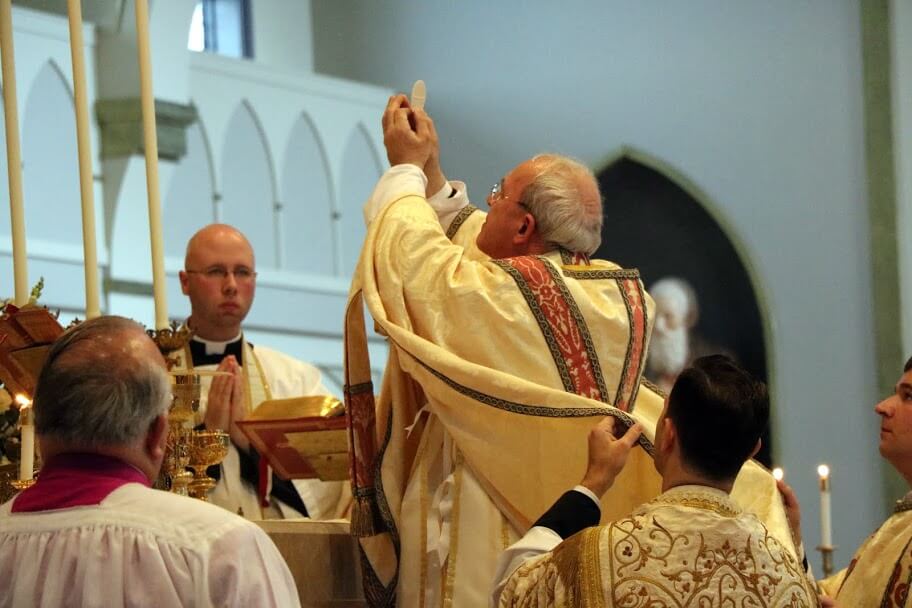
Next week marks the tenth anniversary of Pope Benedict XVI’s Summorum Pontificum, which on July 7, 2007 granted all priests the right to use the 1962 Roman Missal without the permission of their bishop and which has resulted in a slow but ready rise in celebrations of the traditional Latin Mass around the world. This calls for a drink! And so we present to you an original cocktail in honor of the Pope Emeritus and his historic motu proprio.


Some More, Um, Pontificum

1 oz. London dry gin
½ oz. Bénédictine liqueur
¼ oz. lemon juice
dash kirsch
lemon twist

Pour all ingredients except lemon twist into a shaker filled with ice and shake forty times (the biblical number for penance). Strain into a cocktail glass and garnish with lemon twist.


Allegorical Explanation

The Bénédictine honors the name that Joseph Ratzinger took upon his election to the Holy See.

The kirsch pays tribute to the Pontiff’s German heritage, and since kirschwasser is a cherry brandy, it also symbolizes Pope St. Gregory the Great, who according to legend was quite fond of the juicy red fruits (see Drinking with the Saints, p. 52). It is appropriate that Pope Benedict’s drink would incorporate a symbol of Gregory the Great, since Summorum Pontificum liberalizes the use of what is sometimes called the Gregorian Rite.

The lemon juice recalls the bitter opposition of tradition’s enemies to Pope Benedict XVI’s liturgical largesse. These enemies are alas still with us but we can use them to our spiritual benefit to grow holier and more charitable, just as we can use bitter ingredients to make a tasty drink.

The lemon twist, on the other hand, betokens not resistance to the Pope’s largesse but the largesse itself. In Drinking with the Saints, the twist is a symbol of St. Martin’s torn cloak generously given to a beggar who turned out to be Christ (p. 311). And because lemon rinds are oleaginous, secreting healthy essential oils, they are also symbolic of the sacraments that can now be celebrated with greater freedom according to the 1962 liturgical books.

As for the London dry gin, we like to think of it as a nod to all of the English-speaking supporters of Summorum Pontificum such as the good folks at OnePeterFive, the New Liturgical Movement, The Latin Mass Magazine, Fr. Z’s Blog, the Society for Catholic Liturgy, Una Voce, Sacra Liturgia, and so on (please forgive me if I left anyone out).

A Toast

To the first ten years, reverend Fathers and recognizable Sisters, ladies and gentlemen: May what has begun in our day be brought to perfection, for the honor of God and of Our Lady and of all the Saints. Happy anniversary and many more!

Last Call

Be it to your bartender or your parish priest, never hesitate to ask: “Can I have Some More, Um, Pontificum?”

Recite over and over again these beautiful lines from Pope Benedict XVI until you have committed them to memory (which may be harder to do after the second round):

What earlier generations held as sacred, remains sacred and great for us too, and it cannot be all of a sudden entirely forbidden or even considered harmful. It behooves all of us to preserve the riches which have developed in the Church’s faith and prayer, and to give them their proper place (from his Letter to the Bishops accompanying the motu proprio).

Or a similar sentiment expressed earlier in his life:

I am of the opinion, to be sure, that the old rite should be granted much more generously to all those who desire it. It’s impossible to see what could be dangerous or unacceptable about that. A community is calling its very being into question when it suddenly declares that what until now was its holiest and highest possession is strictly forbidden and when it makes the longing for it seem downright indecent (Joseph Ratzinger, Salt of the Earth [1997]).


Michael P. Foley, an Associate Professor of Patristics at Baylor University, is the author of a Drinking with the Saints: The Sinner’s Guide to a Holy Happy Hour (Regnery, 2015), a book that pairs beer, wine, and cocktail suggestions with the feast days of the 1962 liturgical calendar (see Peter Kwasniewski’s review here).

Print Friendly
Posted in Uncategorized | 1 Comment

THE CONVERSION OF THE CURIA CONTINUES APACE

Settimo Cielodi Sandro Magister 

28 giu 17

After the Academy for Life, a New Face for the Institute for the Family

Paglia


*

After passing through the sieve one after the other, the new members of the Pontifical Academy for Life appointed on June 13 by Pope Francis have new surprises in store every day.

But also at the contiguous Pontifical John Paul II Institute for Studies on Marriage and Family, this too consigned by the pope to the supervision of Archbishop Vincenzo Paglia, a shift in the same direction is on the way.

*

At the Pontifical Academy for Life, the first big uproar was over the appointment of the Anglican moral theologian Nigel Biggar, a supporter of abortion until “18 weeks after conception.”

Asked to comment by Vatican Insider, Archbishop Paglia tried to justify the appointment by asserting that Biggar – apart from words he exchanged in 2011 with the staunchly pro-abortion philosopher Peter Singer – “has never written anything on the issue of abortion” and that on the end of life “he has a position absolutely in keeping with the Catholic one.”

But it didn’t take much to discover that neither statement corresponds to the truth, and that Biggar has expressed his liberal positions on abortion in a 2015 article for the “Journal of Medical Ethics,” and on euthanasia in his 2004 book “Aiming To Kill. The Ethics of Suicide and Euthanasia.”

Then it was noted that other new members of the academy are rather far from the Church’s positions:

– Katarina Le Blanc of the Karolinska Institutet in Stockholm, Sweden, who uses stem cells taken from human embryos fertilized in vitro;
– Japanese Nobel laureate Shinya Yamanaka, who in spite of his fame for producing pluripotent stem cells artificially has by no means rules out continued research on the use of embryonic stem cells, and explains why in an article in the scientific journal “Cell & Stem Cell.”
– the Israeli Jew Avraham Steinberg, who admits in some cases abortion and the destruction of embryos for scientific use;
– Maurizio Chiodi, a leading Italian moral theologian, who in his book “Ethics of life” makes allowances for artificial procreation, if it is supported by an “intention of fertility.”

*

Meanwhile, as has already happened for the Academy, the Pontifical John Paul II Institute for Studies on Marriage and Family is also about to get new statutes, which will soon go into effect with a chirograph of Pope Francis.

The name of the institute will be changed, and it will no longer be styled after the pope who founded it, but will be called “Institute of Studies on the Family” or something similar, and will be incorporated within the Pontifical Lateran University under the authority of its current, Bishop Enrico dal Covolo.

The proponents of the new course are justifying this loss of autonomy for the institute with the intention of reinforcing the value of the graduate degrees in moral theology, doctorates, and master’s degrees that it confers, of expanding its curriculum by integrating it with that of the university and extending its international scope.

But apart from the fact that the John Paul II Institute already has numerous branches in Europe, Asia, Africa, America, and Australia, one initial practical effect of this change will be that its faculty can be reshaped at will, bringing in new professors and new scholars from the Lateran University and from other universities pontifical and not.

And this is enough to get around the wall erected by its current professors, almost all of them united in holding firm to the course of the institute’s founder, pope Karol Wojtyla, and of its first three presidents: Carlo Caffarra, Angelo Scola, and Livio Melina. This latter was removed last summer and replaced with the Milanese theologian PierAngelo Sequeri, contextually with the appointment of Archbishop Paglia as Grand Chancellor of the institute. About Scola, who has become cardinal and archbishop of Milan, it is known that he was the big loser to Jorge Mario Bergoglio in the conclave of 2013. While Caffarra, who also became a cardinal and is now archbishop emeritus of Bologna, is known for his frankness of speech toward Pope Francis: he is one of the four cardinals who have publicly asked him to bring clarity on the “dubia” generated by his magisterium specifically on the subject of marriage and family, and have recently written to him asking to be received in audience. In both cases without the pope dignifying them with a reply.

One example of the “Wojtylian” course inherited from the previous management and along which the professors continue is the “Handbook” on the interpretation of “Amoris Laetitia” edited by professors José Granados, Stephan Kampowski, and Juan José Pérez-Soba, in complete continuity with the preceding magisterium of the Church.

But the first changes of allegiance are showing up, too. The most sensational is that of Gilfredo Marengo, since 2013 a professor of theological anthropology at the institute. He was one of Scola’s favorite disciples when he was president and even afterward, while now he is one the other side, with Archbishop Paglia. It is no coincidence that none other than Marengo has been made coordinator of the commission – one member of which is the current president of the institute, Sequeri – that is supposed to open the way to a reinterpretation of Paul VI’s encyclical on contraception, “Humanae Vitae,” in the light of “Amoris Laetitia.”

It remains to be seen what will happen with the satellites of the institute, which are also hardly inclined to submit to the new course. The most powerful is that of Washington, with a pugnacious faculty wholly on the “Wojtylian” course and well financed by the Knights of Columbus, whose supreme head, Carl Anderson, is also professor and vice-president there.

*

In any case, the students and professors still at the John Paul II Institute are forging ahead, without giving up.

In the next issue of the Institute’s magazine, “Anthropotes,” there will be an article by a doctoral student from Milan, Alberto Frigerio, presenting a thorough critique of the volume “Amoris laetitia: a turning point for moral theology” edited by Stephan Goertz and Caroline Witting, published in Italy by San Paolo, which expresses the most progressive positions of German theology.

And it was with none other than the most noted moral theologian of Germany, Eberhard Schockenhoff – author of a recent essay in “Stimmen der Zeit” that made a big stir – that penultimate institute president Livio Melina crossed swords during a conference in Nysa, Silesia for a hundred Polish moral theologians, in the presence of two auxiliary bishops from Poznan and Lublin.

Schockenhoff is an authority not only in Germany but also elsewhere. The episcopal conference of Denmark, Finland, Iceland, Norway, and Sweden wanted a talk from none other than him during a day of study on “Amoris Laetitia” held in Hamburg two months ago.

But Melina contradicted the positions of the German theologian point by point, demonstrating the baselessness of the presumed “paradigm shift” that many associate with the magisterium of Pope Francis. And the bishops of Poland, in their guidelines for the application of “Amoris Laetitia,” completely agree with him.

Melina’s talk, given on June 12, will also be published in the next issue of “Anthropotes.” Here is a sneak peek at the complete text:

> “Le sfide di ‘Amoris Laetitia’ per un teologo della morale”

(English translation by Matthew Sherry, Ballwin, Missouri, U.S.A.)

Condividi:
  • Facebook
  • Twitter
  • Google Bookmarks
  • FriendFeed
  • LinkedIn
Posted in Uncategorized | 1 Comment

CONFUSED ABOUT INFALLIBILITY, READ THIS

On the Modes of Exercise of the Magisterium – Part I

FacebookPinterestPocket

Editor’s note: As we continue our exploration of the Church’s magisterium in light of some more recently troubling papal documents, we are pleased to introduce this work from Dr. des. John P. Joy. Joy wrote his doctoral dissertation in dogmatic theology “On the Ordinary and Extraordinary Magisterium from Joseph Kleutgen to the Second Vatican Council” (SThD diss., University of Fribourg, Switzerland, 2017). He is also the Co-Founder and President of the St. Albert the Great Center for Scholastic Studies and resides in Madison, Wisconsin.

(Part I of a two-part series. Read Part II here.)


The State of the Question
If one consults books, internet articles, etc., on the various modes of operation of the Church’s magisterium, one is likely to find a bewildering array of differing descriptions of the matter with different theologians using the terms ‘extraordinary magisterium’, ‘ordinary magisterium,’ and ‘ordinary and universal magisterium’ in different ways to mean different things.

Most theologians agree that the ‘extraordinary magisterium’ refers to the solemn and infallible judgments or definitions of popes and ecumenical councils. But they disagree about what counts as a solemn judgment or definition.

  1. Some would include any proposition of a matter of faith or morals that is set forth in a definitive way, that is, with the manifest intention of obliging the faithful to hold or believe it.
  2. Others would include only the definitive proposition of dogmas, that is, matters of faith or morals set forth specifically as divinely revealed truths.
  3. Still others would restrict this category still further to include only the definitive proposition of new dogmas, that is, matters of faith or morals set forth as divinely revealed truths which up until then had been open to legitimate dispute.

(I am convinced that the first position can be shown to be the correct one, but that is an essay for another day.)

Then regarding the ‘ordinary and universal magisterium’, most theologians agree that this is exercised by the college of bishops in union with the pope in their state of dispersion throughout the world.

  1. Some, taking the term ‘universal’ to refer to this universal dispersion of the bishops, extend their use of the term ‘ordinary and universal magisterium’ no further than this.
  2. But others, taking the term ‘universal’ to refer instead to the universality of the episcopal college itself, also apply the term ‘ordinary and universal magisterium’ to the non-solemn teaching of ecumenical councils.
  3. Still others, taking the term ‘universal’ to refer to the extension of authority over the universal Church, also apply the term ‘ordinary and universal magisterium’ to the magisterium of the pope when he is teaching the universal Church without speaking ex cathedra.

I will argue in this essay that the first position is the correct one.

Finally, there is the term ‘ordinary magisterium’ without the addition of ‘universal’. Most theologians agree that this category includes whatever is left over from the other two categories, though the details of what exactly is included here will vary greatly depending on how broadly or restrictively one understands those other two categories.


The Question of Infallibility

As if all this weren’t enough, there is also the question of infallibility. Most theologians agree that the extraordinary magisterium is always infallible and that the ordinary and universal magisterium at least can be infallible (some hold that it is always infallible). And most agree that the ordinary magisterium (non-universal) is not infallible.

The most significant diversity of opinion turns on how one deals with the fact that the Church teaches (e.g. in Lumen gentium 25): that the pope and ecumenical councils are infallible when they define doctrine (extraordinary magisterium); and that the bishops dispersed throughout the world are infallible when they propose a doctrine as definitively to be held (ordinary and universal magisterium). Why do the bishops appear to have two modes of infallible teaching while the pope has only one?

1.) Most theologians hold that the proposition of a doctrine as definitively to be held by a pope or a council is not enough to constitute a definition of the extraordinary magisterium.

a.) Some of these, arguing that the pope’s infallibility cannot be more limited than the bishops’ and that the bishops gathered in council cannot have less authority than the same bishops dispersed throughout the world, conclude that when a pope or a council proposes a doctrine as definitively to be held, they do so infallibly in virtue of the ordinary and universal magisterium.

b.) Others argue that the ‘dissymmetry’ in the Church’s teaching between papal and episcopal infallibility is deliberate and that there is no such thing as an infallible ordinary magisterium of the pope or an infallible papal exercise of the ordinary and universal magisterium, so that a pope who proposes a doctrine as definitively to be helddoes not do so infallibly whereas the bishops dispersed throughout the world (and perhaps also the bishops gathered in council?) are infallible when they propose a doctrine as definitively to be held.

c.) Another option, however, which is mostly overlooked on account of the confusion about the nature of the extraordinary magisterium, is to deny the presupposition of both the above positions and hold instead that the proposition of a doctrine as definitively to be held by a pope or an ecumenical council simply is a definition and that the bishops’ unique mode of teaching definitively without defining is due to the state of dispersion in which it occurs. (I hold that this last position is the correct one.)

The degree of confusion in these matters can be seen especially clearly in the case of Pope John Paul II’s declaration in Ordinatio sacerdotalis regarding the reservation of the priesthood to males alone.

1.) Some regard this declaration as an infallible definition of the extraordinary magisterium because in it the pope, acting as supreme head of the Church, proposes a doctrine of faith or morals as definitively to be held.

2.) Others regard it as an exercise of the ordinary magisterium because it defined nothing new but only confirmed what had always been held and taught in the Church.

a.) But some among these regard it as an infallible act of the ordinary and universal magisterium.

b.) Others argue that it the ordinary and universal magisterium can only be exercised by the universal episcopate and not by the pope alone and so this declaration can only belong to the non-infallible ordinary papal magisterium.

(I believe that the first position can be shown to be the correct one, but again, that is an essay for another day.)


A Question of Context

I am convinced that the root of the confusion surrounding these issues is the assumption that the terminology of ordinary and extraordinary magisterium refers to just one distinction, whereas in fact it applies to two separate but overlapping distinctions in two separate but overlapping contexts. The result is that the term ‘ordinary magisterium’ in particular is highly ambiguous (it means different things in different contexts) and thus arguments involving the term ‘ordinary magisterium’ easily fall into the fallacy of equivocation.

Let me begin by setting out these two different contexts in which the terminology of ordinary and extraordinary arises. The original context is that of the rule of faith (regula fidei) within the field of fundamental theology. The focus here is on the nature of divine revelation, the virtue of faith as man’s response to divine revelation, the relationship between faith and reason, Scripture and Tradition as the sources of divine revelation, and the role of the Church in safeguarding and transmitting divine revelation. At Vatican I, this was treated in Dei Filius, the dogmatic constitution on the Catholic faith; at Vatican II, this was treated in Dei Verbum, the dogmatic constitution on divine revelation.

The second context in which the same terminology arises is the nature of the Church within the field of ecclesiology. The focus here is on the nature of the Church, the members of the Church, the hierarchical structure of the Church, authority and jurisdiction in the Church, the Church’s mission of teaching, governing, and sanctifying, etc. At Vatican I, this was treated in Pastor Aeternus, the first dogmatic constitution on the Church of Christ (a second constitution was intended but never completed); at Vatican II, this was treated in Lumen gentium, the dogmatic constitution on the Church.


The Origins of the Terminology

The terminology of ordinary and extraordinary magisterium was invented by the German Jesuit neo-scholastic theologian Joseph Kleutgen in the middle of the 19th century in the context of his treatise on the rule of faith. The first question he set out to answer in his massive and highly influential work Die Theologie der Vorzeit verteidigt (a defense of scholastic theology) was: what are Catholics obliged to believe? And his principal concern in answering this question was to oppose the dogmatic minimalism, especially prevalent in contemporary German theology, according to which Catholics are only obliged to believe what has been formally and infallibly defined by the Church. Against this idea, he asserts that the Church exercises a double magisterium: the one is “ordinary and perpetual” (ordentlich und immerwährend) and it consists in all those ongoing apostolates of the Church by which the faith is handed down through the living tradition; the other is “extraordinary” (außerordentlich) and is used only at special times when false teachers disturb the Church (Kleutgen, Die Theologie, 1st ed., 47).

What did he mean by these terms and what exactly was the nature of the distinction between them? In Kleutgen’s works, the term ‘extraordinary magisterium’ refers to the explicit definitions of the Church in matters of faith and morals (see especially Die Theologie, 40–46). Let us look at each part of this definition in turn:

  • The object of the extraordinary magisterium is ‘matters of faith and morals’, whether contained directly in the deposit of faith (primary object) or intrinsically connected to the deposit of faith (secondary object).
  • The subject of the extraordinary magisterium is ‘the Church’, which means that it can be exercised only by those who bear supreme authority in the Church, namely the pope and the college of bishops (which includes the pope).
  • The act of the extraordinary magisterium is the act of ‘definition’, which means that the doctrine in question is proposed to the Church in a ‘definitive’ or ‘conclusive’ way as something that must be firmly believed or definitively held.
  • The distinguishing feature of the extraordinary magisterium as compared with the ordinary magisterium lies in the fact that its definitive teaching is ‘explicit’, which means that it is visibly and tangibly enshrined in a public document of the magisterium.

What, then, does Kleutgen intend by the term ‘ordinary magisterium’? The term ‘ordinary magisterium’ refers to the organic transmission of the contents of divine revelation through the living tradition of the Church (see especially Die Theologie, 46–53). Let us again look at each part of this definition:

  • The object of the ordinary magisterium is ‘the contents of divine revelation’, which is the same as saying ‘matters of faith and morals’.
  • The subject of the ordinary magisterium is ‘the Church’, which Kleutgen specifies as meaning the body of bishops in union with their head the pope (Die Theologie, 42).
  • The activity of the ordinary magisterium is the ‘organic transmission’ of divine revelation, which refers to the daily teaching, preaching, and handing on of the faith that occurs within the Church through her ‘living tradition’.
  • The distinguishing feature of the ordinary magisterium as compared with the extraordinary magisterium lies in its relative intangibility; it is the infallible teaching of the Church that occurs apart from the formal and visible documents of the Church’s magisterium.

The last point requires further explanation. The teaching of the extraordinary magisterium is found by looking within the documents of the magisterium; the teaching of the ordinary magisterium, by contrast, is found by looking outsidethe formal teaching documents of the magisterium to all the other sources of the living tradition, and in the first place to Scripture itself. Since the Church proposes all of Scripture as the divinely revealed word of God, as soon as one sees that a truth is clearly proposed in Scripture, one can also see that it is proposed by the Church as a divinely revealed truth and so one must accept and believe it as a dogma of faith (i.e. taught by the ordinary magisterium). It would be heresy to deny, for example, that Christ was transfigured on the mount, that the holy family fled to Egypt, or that Christians have a moral duty to love their enemies, even though none of these things have been formally defined by the Church. And then together with Sacred Scripture one looks to the writings of the Church Fathers, who are the privileged witnesses of Sacred Tradition, and then also to the Doctors of the Church and other eminent Catholic theologians, to the customs, liturgies, and laws of the Church, to the monuments of antiquity, the consensus of the faithful, and the statements of individual bishops and local councils.

Kleutgen’s main purpose in speaking at all about an ‘ordinary magisterium’ was to re-assert against the dogmatic minimalists of his time (who are still with us today) the binding authority of the living tradition of the Church; he wanted to re-direct our attention away from an obsessive fixation on the formal teaching documents of the Church toward the broader horizons and greater depths of the entire living tradition. At the same time, however, he was also wary of asserting the authority of Scripture and Tradition apart from the explicit judgments of the Church without linking them in some way to the magisterium in order to maintain (against the Protestant principle of private interpretation) the Catholic principle of ecclesiastical mediation according to which Catholics believe all that and only that which God has revealed and which has been proposed as such by the Church. Hence his reinterpretation of the living tradition of the Church, by which Scripture and the oral Tradition are perpetually handed down in the Church, as an exercise of the magisterium of the Church.

There are two concluding points worth emphasizing about Kleutgen’s understanding of the ordinary magisterium.

First, the ordinary magisterium is exercised only by the whole Church in its state of being dispersed throughout the world for the quite simple and obvious reason that the teaching of popes and ecumenical councils are necessarily formal and explicit acts of teaching formulated in public documents of the supreme magisterium (which is exactly what the teaching of the ordinary magisterium is not). Hence, for Kleutgen it would be quite absurd to talk about an ecumenical council or a pope exercising the ordinary magisterium as is commonly done today.

Second, in Kleutgen’s writings there is no distinction between an ‘ordinary magisterium’ and an ‘ordinary and universal magisterium’. There is only one ordinary magisterium and it is always infallible. Because he is writing in the context of the rule of faith, only the infallible teaching of the Church comes into view, for only infallible teaching can oblige the faithful to give an assent of faith. Non-infallible teaching does not constitute part of the rule of faith because the response due to the non-infallible but still authoritative teaching of the Church is a religious submission (obsequium religiosum) rather than the submission of faith (obsequium fidei). The distinction between the ordinary and the extraordinary magisterium occurs for Kleutgen within the context of the Church’s infallible teaching as a distinction between doctrines that have been defined as of faith (de fide definita) and doctrines that are of faith (de fide) even without having been defined as such (de fide non definita).


Pope Pius IX and Vatican I

The substance of Kleutgen’s teaching on the ordinary magisterium was taken up and confirmed by Pope Pius IX in the apostolic letter Tuas libenter and by the First Vatican Council in the dogmatic constitution Dei Filius. In each of these documents the same distinction (between the explicit judgments or definitions of the Church and the ordinary magisterium of the Church) is introduced in the same context (the rule of faith) in order to oppose the same problem (dogmatic minimalism):

Pope Pius IX: “For even if it were a matter of that submission which must be manifested by an act of divine faith, nevertheless, this would not have to be limited to those matters that have been defined by explicit decrees of ecumenical councils or by the Roman pontiffs and by this Apostolic See, but would also have to be extended to those matters transmitted as divinely revealed by the ordinary magisterium of the whole Church dispersed throughout the world and, for that reason, held by the universal and constant consensus of Catholic theologians as belonging to the faith” (Tuas libenter, Denz. 2879).

Vatican I: “All those things are to be believed with divine and Catholic faith that are contained in the word of God, written or handed down, and which by the Church, either in solemn judgment or through her ordinary and universalmagisterium, are proposed for belief as having been divinely revealed” (Dei Filius, Denz. 3011).

The discussions that took place among the fathers of the First Vatican Council and the official explanations and clarifications of the intended meaning of the text that can be found in the conciliar acta make it clear that the intended sense of this distinction in the conciliar text corresponds closely to the way in which Kleutgen understood it. An important point is that the word ‘universal’ was added to the term ‘ordinary magisterium’ specifically in order to express the same thing that Pius IX had expressed in speaking of the “ordinary magisterium dispersed throughout the world” and in order to make it clear that the text did not speak about a papal exercise of the magisterium (Mansi 51:322).

There is still no distinction between an ‘ordinary magisterium’ and an ‘ordinary and universal magisterium’. The ordinary magisterium simply is universal in the sense that it is exercised by the Church dispersed throughout the world (as opposed to by the pope or an ecumenical council). No explanation of this is given in the magisterial texts themselves, but if we understand that the ordinary magisterium refers to the transmission of Scripture and Tradition through the living tradition outside the documents of the magisterium, then it makes perfect sense why this must be the case.


A Shift in Meaning and Application

An important shift occurred in the understanding and use of these terms after Vatican I. After the definition of papal infallibility, it was generally understood that the pope exercised the extraordinary magisterium in his solemn definitions ex cathedra; but many of the magisterial acts of the popes clearly fell short of being solemn definitions ex cathedra; thus they were attributed to an ordinary magisterium exercised by the pope. The concept of an ordinary papal magisterium was thus born and this had several effects.

The first effect was a distortion in the original meaning of the term ‘ordinary magisterium’. Since this ‘ordinary’ teaching of the popes (for example, in their encyclical letters) was quite explicit and documented, Kleutgen’s emphasis on the ordinary magisterium as a means of transmitting the faith apart from the explicit documents of the hierarchy faded from view. The concept of an ordinary magisterium, which had been intended to move beyond a narrow focus on the statements of the hierarchy toward a broader view of the rule of faith grounded in Scripture, Tradition, the liturgy, etc., was reinterpreted as just another kind of magisterial document.

A further result of this distortion was a new application of the same terminology of ordinary and extraordinary magisterium to a different distinction. The same terminology that had been used within the context of the rule of faith to distinguish between defined and undefined doctrines of faith, now began to be applied within the context of the evaluation of individual acts of magisterial teaching to distinguish between definitive and non-definitive acts of explicitly documented magisterial teaching. And this new distinction has been superimposed upon the original distinction, as illustrated below:
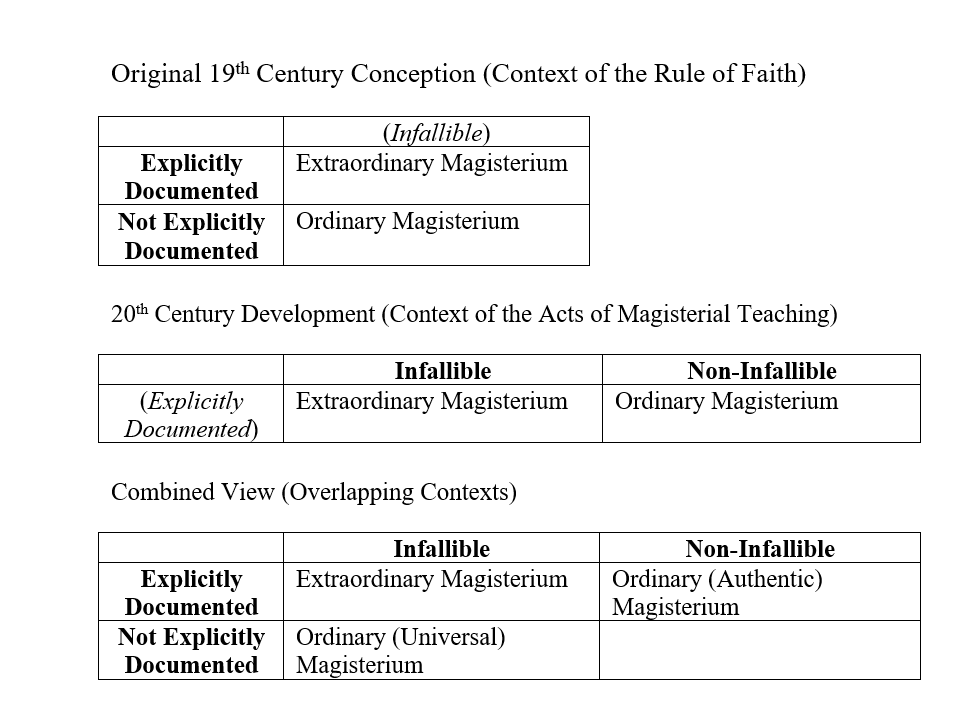
The root of the difficulty is this: if the extraordinary magisterium is the organ of Church teaching that is at once both explicit and definitive, then two very different kinds of teaching can be contrasted against it, and both will appear to be ‘ordinary’ by comparison. One is the teaching of the Church that is definitive but not explicit, and this is what Kleutgen had in mind, and what was intended by the term ‘ordinary magisterium’ as it was used by Pius IX and by Vatican I. The other is the teaching of the Church that is explicit but not definitive, and this appears to be what Pius XII, for example, has in mind in Humani generis when he calls for a religious assent (but not an assent of faith) to the teaching contained in papal encyclical letters. The former ‘ordinary magisterium’ is the infallible living tradition itself; the latter ‘ordinary magisterium’ is the authentic but not infallible magisterium of the pope and bishops. These are completely opposite forms of teaching, sharing in common only the fact that neither is a third thing, namely the extraordinary magisterium. Calling them both by the same name is a little bit like calling angels and apes by the same name simply because neither are men.

Let me repeat that point. I am convinced that the most important thing to understand, in order to gain some clarity regarding the ordinary and extraordinary magisterium, is that this terminology covers not one distinction but two. One usage refers to the distinction between defined and undefined doctrines taught infallibly by the Church; another usage refers to the distinction between infallible and merely authentic acts of teaching. And whereas the meaning of the term ‘extraordinary’ is the same in both cases, the two meanings of ‘ordinary’ are very different. It is this ambiguity of the term ‘ordinary magisterium’ that breeds constant confusion and derails so many arguments.


Vatican II

The Second Vatican Council completely avoided the use of the terminology of ordinary and extraordinary magisterium in its constitution on the Church Lumen gentium, which outlines three basic forms of magisterial teaching: (1) the authentic (i.e. authoritative) but not infallible teaching of the pope and bishops; (2) the infallible definitions of popes and ecumenical councils; and (3) the infallible teaching of the bishops dispersed throughout the world (a footnote referring to Tuas libenter and Dei Filius makes it clear that this is a reference to the ordinary and universal magisterium).

I believe that much confusion could be avoided if we were to follow the example of Lumen gentium in speaking consistently of the ‘authentic magisterium’ of popes and bishops when it is a question of their non-infallible teaching, while reserving the term ‘ordinary magisterium’ for the infallible teaching of the Church dispersed throughout the world.

And we would do well to pay closer attention to employing the right distinction in the right context. When it is a question of evaluating the degree of authority exercised in an individual act of teaching and the response owed to that particular act of teaching, the relevant distinction is between definitive and non-definitive acts of teaching; that is, between the exercise of the ‘infallible magisterium’ or the ‘merely authentic magisterium’ (following Lumen gentium, where the context is the magisterium).

When it is a question of evaluating the status of a given doctrine and the source of our obligation to believe or hold that doctrine, then the relevant distinction is between defined and undefined doctrines taught by the Church; that is, between the ‘extraordinary magisterium’ and the ‘ordinary magisterium’ (following Dei Filius, where the context is the rule of faith).

The ambiguity of the term ‘ordinary magisterium’ makes this topic unnecessarily complex. If we would only resolve the ambiguity by substituting the term ‘authentic magisterium’ for ‘ordinary magisterium’ whenever we are dealing with magisterial documents that do not contain solemn definitions, the whole question would immediately become much clearer and simpler, which would be a good thing if our goal is clarity and truth rather than confusion and obfuscation.

++++++++++++++++++++++++++++++++++++++++++++++++++++++++++++++++++++++++++++
On the Modes of Exercise of the Magisterium – Part II: Evaluating Amoris Laetitia

Google+PinterestPocket

(Part II of a two-part series.)

In the first part of this essay I attempted to cut through some of the confusion that frequently surrounds discussions of the various modes of exercise of the magisterium, particularly with reference to the term ‘ordinary magisterium’, which can mean two different things in two different contexts.

To recap briefly, the original meaning of the term ‘ordinary magisterium’, as it was intended to be understood when it was originally invented in the middle of the 19th century, referred to the infallible transmission of divine revelation (Scripture and Tradition) through the living tradition of the Church apart from the official documents of the supreme magisterium (popes and ecumenical councils). Over the course of time, the same term came to be used to refer to the teaching contained in the magisterial documents of popes and ecumenical councils whenever this teaching fell short of being an extraordinary definition. The first ordinary magisterium (often called the ‘ordinary and universal magisterium’) is infallible; the second ordinary magisterium (sometimes called the ‘authentic magisterium’) is not infallible.


How to Evaluate Magisterial Documents

When evaluating the degree of authority of the teaching contained in any individual papal document (the same principles apply to ecumenical councils), the first step is to identify what judgments are being proposed in matters of faith or morals (as opposed to purely disciplinary legislation or to assertions about other areas of human knowledge not connected with faith or morals).

The next step is to identify the quality or note of the doctrinal proposition:

  1. If a doctrine is proposed as one that must be firmly believed as divinely revealed, then we have an infallible definition of dogma by the extraordinary magisterium of the pope speaking ex cathedra. The response due to this kind of teaching is the assent of divine faith. Its rejection would be heresy.
  2. If a doctrine is proposed as one that must be definitively held by all the faithful, then we have an infallible definition of doctrine by the extraordinary magisterium of the pope speaking ex cathedra. The response due to this kind of teaching is a firm and definitive assent based on faith in the Church’s infallibility in these matters. To reject such a doctrine would separate one from full communion with the Church.
  3. If a doctrine is proposed as true or sure but without the note of definitive obligation, then we have an authoritative (but not infallible) proposition of doctrine by the authentic magisterium of the pope. The response due to this kind of teaching is a religious submission of will and intellect. Failure to assent to this kind of teaching, without grave reason, would be rash.
  4. If a doctrine is proposed merely as possible or probable, then it does not rise to the level of magisterial teaching and does not impose any obligation of assent or adherence.


The Case of Amoris laetitia

In the case of Amoris laetitia, there is a general consensus that it represents, at least in the main, an exercise of the authentic magisterium (category 3 above), though there may be portions of the text that don’t even rise to that level.

The kind of response owed to this kind of teaching is specified by Vatican II in Lumen gentium 25 where it says that a “religious submission of mind and will must be shown in a special way to the authentic magisterium of the Roman Pontiff, even when he is not speaking ex cathedra.” There is a lengthy discussion in the 1990 CDF document Donum veritatis (§§ 23–31) about what this kind of response entails. To put the matter briefly, a genuine internal assent to the truth of the teaching is generally expected, although there can be cases were it is legitimate to withhold this kind of assent for serious reasons. This is because we are dealing precisely with the non-infallible teaching of the Church, which by definition could be mistaken; at the same time, since the Church enjoys a special divine assistance in the exercise of her mission, even when the charism of infallibility is not involved, it would be wrong to conclude that the Church could be habitually mistaken in these matters.


A Particularly Egregious Exaggeration of the Authority of Amoris laetitia

Stephen Walford, in his February 2, 2017 piece in the Vatican Insider, takes this “charism of special assistance” as his point of departure for constructing an argument on the basis of which he concludes:

“We must affirm that Pope Francis cannot possibly be in error in his ordinary magisterium concerning issues of faith and morals, and thus his teaching that under certain, carefully considered cases, Holy Communion can be given to persons in irregular situations is perfectly valid and influenced by the Holy Spirit.” (My emphasis)

That is an audacious claim. Let’s try to follow the steps of his argument. His first premise, drawn from Pope John Paul II’s commentary on Lumen gentium 25 in his Wednesday Audience of March 17, 1993, is that the ordinary magisterium of the pope enjoys a “charism of special assistance” even when he is not speaking ex cathedra. So far, so good.

He then adds that Amoris laetitia is certainly an exercise of the ordinary magisterium, which is unobjectionable as long as we understand that the term ‘ordinary magisterium’ in this context refers to the ‘authentic magisterium’ of the pope not speaking ex cathedra and not to the ‘ordinary magisterium’ of the bishops dispersed throughout the world, which is infallible. These are, as I argued earlier, two very different things.

Walford continues:

“Can a Pope teach error in his ordinary magisterium in matters of faith and morals? St John Paul’s answer is a definite no.”

Now to say that the pope “cannot teach error” in his ordinary magisterium is the same as saying that the pope is infallible in his ordinary magisterium. That’s just what infallible means. Prior to Vatican II it was fairly common for theologians to argue that the ordinary magisterium of the pope is infallible, but this is a rare claim these days. Does John Paul II really teach this? Walford quotes a text that does seem to support this idea:

“Alongside this infallibility of ex cathedra definitions, there is the charism of the Holy Spirit’s assistance, granted to Peter and his successors so that they would not err in matters of faith and morals, but rather shed great light on the Christian people. This charism is not limited to exceptional cases.” (John Paul II, Wednesday Audience of March 24, 1993)

I have to admit that the first time I read this text I also thought that the pope was endorsing the infallibility of the ordinary papal magisterium. But one of my theology professors at the time helpfully drew my attention to some other remarks that John Paul II makes in the same context. In his Audience of March 10, 1993, he contrasts the ordinary papal magisterium against the ex cathedra definitions of the pope, which he identifies with the extraordinary magisterium; then in the Audience of March 24, 1993, he clearly asserts that the pope speaks infallibly only (‘solo’) when he speaks ex cathedra. Taken together these statements exclude an infallible exercise of the ordinary papal magisterium.

So if we are to assume that John Paul II is not just contradicting himself, I think we have to interpret the statement quoted by Walford as referring to a general protection from habitual error rather than an infallible protection from all error.

Walford’s next authority is Pope Innocent III, who says:

“The Lord clearly intimates that Peter’s successors will never at any time deviate from the Catholic faith, but will instead recall the others and strengthen the hesitant.” (Pope Innocent III, Apostolicae Sedis Primatus, 1199)

What Walford needed to do at this point was to show that these words apply not only to the ex cathedra definitions of the popes but also to their teaching when they are not speaking ex cathedra. Instead he turns aside to the question about whether a pope can fall into heresy as a “private theologian,” which is really irrelevant to the question of Amoris laetitia unless Cardinal Burke is right that it does not even rise to the level of being an act of the magisterium. In any case, however, the idea that the pope cannot fall into error as a private theologian has never been more than the private opinion of some people; it has never been endorsed by the Church.

Next up is a pair of even less relevant quotes from Pope Pius XII which demonstrate the “supreme importance of the papacy.” Since when was that the point at issue? Then there is some meandering commentary about how the popes have the task of teaching the truth, supporting the truth, and guarding the true faith not only in their ex cathedradefinitions but also in their ordinary teaching, which is all absolutely true and does absolutely nothing to prove that they receive the additional grace to do all of this infallibly in their ordinary magisterium.

Finally, Walford appeals to the text of Pope Pius IX’s Tuas libenter, in which we are reminded that the dogmatic teaching of the Church is not limited to the solemn definitions of popes and ecumenical councils but includes the dogmatic teaching of the ordinary magisterium of the Church dispersed throughout the world. Walford offers no commentary on this text but simply moves directly to his conclusion that:

“Pope Francis cannot possibly be in error in his ordinary magisterium concerning issues of faith and morals, and thus to his teaching that under certain, carefully considered cases, Holy Communion can be given to persons in irregular situations.”

This, however, completely overlooks the fact that Pius IX was speaking explicitly about the authority of the ordinary magisterium of the Church dispersed throughout the world, which is, as I argued previously, an allusion to the living tradition of the whole Church, and not to the magisterial teaching of the popes when they are not speaking ex cathedra.

I have to admit that it can seem very tempting to reason that the ordinary magisterium of the pope must be infallible because the ordinary magisterium of the bishops dispersed throughout the world is infallible. But to do so is to commit the fallacy of equivocation, because the term ‘ordinary magisterium’ means different things when applied to the Church dispersed throughout the world and when applied to the pope. In the former case, it means the infallibleteaching of the living tradition transmitted apart from the documents of the magisterium; in the latter case, it means the non-infallible teaching of the pope and bishops contained in the documents of the magisterium. Once the terms are clearly understood the argument contains its own refutation.

Before ending, Walford throws off a couple of rhetorical questions and cites some additional authorities to reinforce his position.

He asks:

“Do we then pick and choose which teachings of which popes to accept? That would be tantamount to a form of Protestantism. The Council of Lyons stated the Pope: ‘has the duty to defend the truth of the faith, and it is his responsibility to resolve all disputed matters in the area of faith’.”

I answer: We accept all of the infallible teachings of all of the popes and we accept all of the non-infallible teaching of all of the popes insofar as it does not conflict with the infallible teaching of the Church.

I fail to see anything very Protestant about that. And the citation of Lyons is, of course, true — but once again beside the point. Popes defend the truth and resolve disputed questions of faith through their ex cathedra definitions. Indeed, that is the principal purpose of ex cathedra definitions. If Walford wants to argue that this text of Lyons goes beyond ex cathedra definitions he will have to provide some reasons for thinking so.

Then he asks:

“If protection from the Lord were only to apply to rare ex cathedra declarations how could all disputes of faith possibly be resolved? We must remember St Ambrose’ famous phrase: ‘Where Peter is, there is the Church. Where the Church is, there is no death but life eternal’.”

I answer: All disputes of faith could be resolved by ex cathedra definitions, which need not be as rare as they are and are probably much less rare than Wolford supposes.

They are only rare by comparison with the ordinary (universal) magisterium, which is exercised literally every day in the preaching and teaching by which the faith is handed down all over the world. Even several ex cathedra definitions per month would still be rare by comparison. At the First Vatican Council, in the official explanation of the intended sense of the definition of papal infallibility, Bishop Vincent Gasser, speaking on behalf of the deputation charged with the drafting of the definition, remarked that it was impossible to specify the form in which ex cathedra definitions had to be given, since “already thousands and thousands of dogmatic judgments have gone forth from the Apostolic See” (Mansi 52:1215). Granted, this is not part of the definition itself, but the understanding of the text as presented in Gasser’s speech was the basis upon which the council fathers voted to pass and promulgate the text, so it counts for something in determining the right interpretation of the text of Vatican I.

As for St. Ambrose’s famous phrase: “Where Peter is, there is the Church. Where the Church is, there is no death but life eternal,” this is a beautiful expression of the necessity for salvation of membership in the Roman Catholic Church and of the primacy of Rome as the center of the Church’s unity. But I thought we were arguing about whether the ordinary papal magisterium is infallible?

To paraphrase Walford’s concluding lines, I would say that if we claim to hold Tradition dear, if we claim to defend Tradition with all our strength, then we must accept and defend the magisterium of Pope Francis insofar as it does not deviate from Tradition. There is no other interpretation available; the Church has spoken.


Donum Veritatis on Non-Infallible Church Teaching

Since Amoris laetitia does not contain any ex cathedra definitions, and since the pope is only infallible when he defines ex cathedra, the charism of infallibility is not involved in Amoris laetitia. 

But since Amoris laetitia does contain teaching in matters of faith and morals, and since the authentic magisterium of the pope is engaged in such teaching even when it is not ex cathedra, the charism of divine assistance is potentially involved in Amoris laetitia, and this charism excludes the probability but not the possibility of error.

Because authentic magisterial teaching is probably true (in the abstract), we owe to it a religious submission of will and intellect, which is a genuine internal assent to the truth of the teaching. But because it is also possibly false, this assent is at best provisional rather than definitive, and there can be serious reasons for withholding assent entirely, such as would most obviously be the case if it were in conflict with infallible teaching which always requires absolute and definitive assent.

What to do in such a case? The CDF, in the instruction Donum veritatis, 24, says this:

“It can happen, however, that a theologian may, according to the case, raise questions regarding the timeliness, the form, or even the contents of magisterial interventions.”

A theologian who finds himself unable to assent to some teaching of the authentic papal magisterium should not present his own opinions as though they were non-arguable conclusions (DV 27). And he should “refrain from giving untimely public expression to them” (DV 27), which implies that there may be a timely public expression of disagreement. And then, DV 30:

If, despite a loyal effort on the theologian’s part, the difficulties persist, the theologian has the duty to make known to the Magisterial authorities the problems raised by the teaching in itself, in the arguments proposed to justify it, or even in the manner in which it is presented. He should do this in an evangelical spirit and with a profound desire to resolve the difficulties. His objections could then contribute to real progress and provide a stimulus to the Magisterium to propose the teaching of the Church in greater depth and with a clearer presentation of the arguments.

In the case of Amoris laetitia, it seems clear to me that this is exactly the course of action that the Cardinals who submitted the dubia to Pope Francis are faithfully trying to pursue. Not to mention Code of Canon Law, 212, 3.


Posted in Uncategorized | 2 Comments

WHEN IS JUSTICE FINALLY GOING TO MAKE AN APPEARANCE IN PHILADELPHIA

Will Fr Charles Engelhardt’s Prosecutor Take a Plea Deal?

Seth Williams, a Philadelphia prosecutor who sent Msgr William Lynn and the late Fr Charles Engelhardt to prison, now faces a 23-count federal indictment of his own.

Some of the mighty have fallen from their public ruse as self-proclaimed champions of truth, justice, and the American way. The entire landscape of the Catholic Church in America was altered by the work of David Clohessy, Barbara Blaine, and “SNAP,” the Survivors Network of those Abused by Priests.

SNAP’s snappy acronym, and Clohessy’s and Blaine’s relentless media assault about sexually abusive Catholic priests, made the organization a Catholic household name. SNAP’s manipulation of the media helped launch the mediated settlement process that, to date, has siphoned over $3 billion from Catholic institutions, insurance carriers, and Catholic ministries in the United States

SNAP also made the American Catholic bishops shudder, spawning policies that, in the quest to assuage SNAP and satisfy lawyers, brought great harm to the priesthood and the relationship between bishops and priests. The damage was summed up in a single sentence by Canadian Catholic blogger, Michael Brandon, in an assessment of These Stone Walls:

“The Catholic Church has become the safest place in the world for young people and the most dangerous place in the world for Catholic priests.”

Now, ever so slowly, much of the media and prosecutorial spin woven by SNAP has begun to unravel. While most Catholic leaders were cowered into accommodating silence, the Catholic League for Religious & Civil Rights led by Bill Donohue, published “SNAP Implodes” in a recent issue of Catalyst.

It’s a stunning summation of SNAP’s seismic fall. A lawsuit against SNAP by one of its top officials has unmasked all that Bill Donohue suspected to be true. SNAP officials now stand accused of fraud and a financial kickback scheme with personal injury lawyers. SNAP is alleged to have used the plight of victims – real and fraudulent – to pad its own bottom line. (See “David Clohessy resigns SNAP in Alleged Kickback Scheme.”)

David Clohessy, SNAP’s Executive Director, and Barbara Blaine, SNAP’s President, have since quietly resigned. How SNAP built its empire of fear and loathing regarding priests is a study in the tactics of media manipulation. SNAP created a media bias – called an “availability bias” in the psychology of marketing – that presumes the guilt of any priest accused and underwrites a prejudice that priests are a suspect class. I described this bias in “How SNAP Brought McCarthyism to American Catholics.”

You can see the results of this bias throughout all media as it spills over from its treatment in the news to multiple other venues. Even as I type this post, I came across a TV replay of ventriloquist, Jeff Dunham. As he manipulated one of his famous dummies with great skill, the dummy proclaimed to raucous laughter, “Get your hands off me! You’re not my priest!” Any number of TV sitcoms now carry similar lines.

A THIN LINE BETWEEN PROSECUTION AND PERSECUTION

Among the most widely read and shared posts on These Stone Walls was one I wrote in January, 2016, entitled, “The Lying, Scheming Altar Boy on the Cover of Newsweek.” Readers found it to be shocking and compelling, and shared it over 2,000 times on Facebook. It profiles the story of Father Charles Engelhardt, a Catholic priest who died chained to a gurney in the hospital wing of a Pennsylvania prison.

As the story that landed him in prison was sensationalized in the press, facts became lost in the national coverage. Rolling Stone magazine’s now-infamous former crime reporter, Sabrina Rubin Erdely, hyped the story of lascivious Philadelphia priests molesting innocent youths while bishops looked the other way.

This was two years before Ms. Erdely was deposed for vastly irresponsible journalistic ethics and practices. After her lurid account of “Billy Doe” molested by Father Engelhardt and then “traded” to other priests, Ms. Erdely went on to be conned by another fraudulent claim brought by “Jackie.” This time the accused were fraternity students at the University of Virginia.

Unlike the Catholic targets of Rolling Stone, UVA and the students sued for defamation. The result was a multi-million dollar judgment against Rolling Stone for Ms. Erdely’s “Rape on Campus” story, described by jurors as “reckless disregard for truth.” Ms. Erdely was quickly and quietly dropped from the Rolling Stone editorial staff. I wrote more of this story in “The Path of Sabrina Rubin Erdely’s Rolling Stone.”

Meanwhile, journalist Ralph Cipriano took the story of Father Engelhardt to the cover of Newsweekmagazine. Every objective observer of this story is now convinced that Father Charles Engelhardt was an innocent man falsely accused and wrongfully convicted.

The accuser’s history, kept from the jury, leaves little doubt that conducting such a scam was well within his reach. “The Lying, Scheming Altar Boy on the Cover of Newsweek” – his real name is Daniel Gallagher – received $5 million dollars for his claims against Father Charles Engelhardt and other priests.

The story made Daniel Gallagher a millionaire, and then he became the face of false witness and fraud. It made Sabrina Rubin Erdely an icon of investigative journalism, and then the face of journalistic disgrace. It made Fr Charles Engelhardt a prisoner, and then a martyr for the truth.

HOW PHILADELPHIA CRACKED THE LIBERTY BELL

This story also made Philadelphia prosecutor, Seth Williams, a rising star reaching for ever new career heights in the world of Pennsylvania tough-on-crime politics. But now that, too, has imploded. Mr. Williams now finds himself before the same bar of justice through which he dragged some innocent priests.

In a 23-count federal indictment in March, Seth Williams stands accused of soliciting and receiving bribes in the form of cash and gifts – including a Jaguar convertible and trips to Florida, California, Las Vegas, and the Dominican Republic. He is accused of using his office to alter plea deal offers in exchange for money, and multiple other fraud efforts.

The indictment contains a set of text messages between Williams and a business owner in which the prosecutor agreed to lower terms of a plea deal in exchange for cash. Mr. Williams – whose annual salary is $170,000 – is accused of receiving more than $54,000 in bribes that the grand jury ordered him to forfeit. The indictment also alleges that he channeled for his own use a relative’s retirement funds intended for nursing home care.

Before the federal indictment was issued, Seth Williams sought to end an investigation by Philadelphia’s Board of Professional Ethics by agreeing to pay $62,000 in civil penalties. It was the largest penalty ever imposed by the Ethics Board in its 10-year history.

The big target of Seth Williams’ Philadelphia prosecutions was, of course, Monsignor William Lynn. Accused of child endangerment for assigning the priests who were later found guilty in tainted trials, Msgr. Lynn has spent three years in prison only to have his conviction overturned and reinstated twice. In “Justice for Msgr. Lynn Delayed Again” in Catalyst (May 2017), Bill Donohue wrote:

“[Prosecutor Seth] Williams’ war on Msgr. Lynn is the most unethical assault ever conducted by a D.A. against a high-ranking member of the Catholic clergy in America. Worse, the corruption extends beyond Williams.”

In the same week that prosecutor Seth Williams was indicted on federal corruption charges in Philadelphia, Msgr. William Lynn was once again denied justice in Philadelphia. His contrived “child endangerment” conviction was overturned by a previous court because prosecutors failed to tell his defense attorneys that the lead detective in the case had serious doubts about the veracity of “Billy Doe” – aka Daniel Gallagher.

Philadelphia Detective Joseph Walsh was assigned to investigate the wild claims of Gallagher, the prosecution’s star witness against both Father Charles Engelhardt and Msgr. William Lynn. The conclusion was that every witness statement the detective took – including ones from Gallagher’s own family members – entirely contradicted Gallagher’s claims.

The detective could corroborate none of Daniel Gallagher’s story. Then the prosecutor hid that fact from the defense, accusing the detective of “killing my case.” Now, in the latest legal debacle, Judge Gwendolyn Bright has denied a motion to dismiss the case against Msgr. William Lynn stating that a decision to hide evidence is not “intentional” misconduct.

Despite having his conviction overturned twice, Msgr. Lynn remains under a legal cloud pending multiple appeals. Despite his claims being thoroughly debunked, Daniel Gallagher remains a millionaire with no one in the Justice Department showing any interest in looking into his fraud. Despite being indicted on 23 criminal counts, D.A. Seth Williams remains in office and retains his $170,000 annual salary. [See: Judge in Seth Williams Case Has Conflict of Interest]

The American Liberty Bell housed in Philadelphia cracked when it was tolled upon the death of Chief Justice John Marshall in 1835. This champion of liberty and justice for all would find no justice in Seth Williams’ office in the Philadelphia of today. The moral demise of SNAP has shown us that it is real victims of abuse who should be most affronted by the injustice of false, money-driven claims. As Dorothy Rabinowitz wrote:

“People have to come to understand that there is a large scam going on with personal injury attorneys, and what started as a serious effort (to help genuine victims) has now expanded to become a huge money-making proposition.” Dorothy Rabinowitz, The Wall Street Journal).

Editor’s Note: If you subscribe to the WSJwatch and hear this brief video interview with Dorothy Rabinowitz of The Wall Street Journal.

THE LAST WORD

After the above post was written, Catholic League President Bill Donohue released a statement about D.A. Seth Williams and the Philadelphia prosecutions of Msgr William Lynn and Father Charles Engelhardt. Philadelphia detective Joseph Walsh, now retired, has issued a 12-page affidavit in the claims against Msgr William Lynn, Father Charles Engelhardt, and another priest brought by accuser, Daniel Gallagher.

The detective’s new affidavit exposes Gallagher’s claims as a series of lies and describes how D.A. Seth Williams and other prosecutors ignored his warnings about Daniel Gallagher’s credibility – or lack thereof – in their zeal to nail priests. As Bill Donohue concludes:

“The detective’s statement exposed not only the flagrant lies of the prosecution’s star witness, but also the depth of corruption in the Philadelphia judicial system.”

Does this story raise your ire? It should. In fact, it must! It is time for a revolution against the tyranny and deceit that turns innocent priests into prisoners and martyrs while con men and their lawyers turn into millionaires. If liberty and justice for all still mean anything to you, then share this post. If your friends are people of conscience, share this with them. Many a revolution has begun in just this way.

(Note from Father Gordon MacRae: The above post contains exactly 1776 words. That is also the year America fought for its independence to become the land of the free.)

For more on this story, also see:

About Fr. Gordon J. MacRae

The late Cardinal Avery Dulles and The Rev. Richard John Neuhaus encouraged Father MacRae to write. Cardinal Dulles wrote in 2005: “Someday your story and that of your fellow sufferers will come to light and will be instrumental in a reform. Your writing, which is clear, eloquent, and spiritually sound will be a monument to your trials.” READ MORE

Posted in Uncategorized | 1 Comment

WHAT KIND OF WORSHIP DO YOU BELIEVE IS MOST ACCEPTABLE TO GOD?


“Acceptable Worship, with Fear and Reverence”— An Appreciation of Peter Kwasniewski’s New Book

OnePeterFive
PinterestPocket

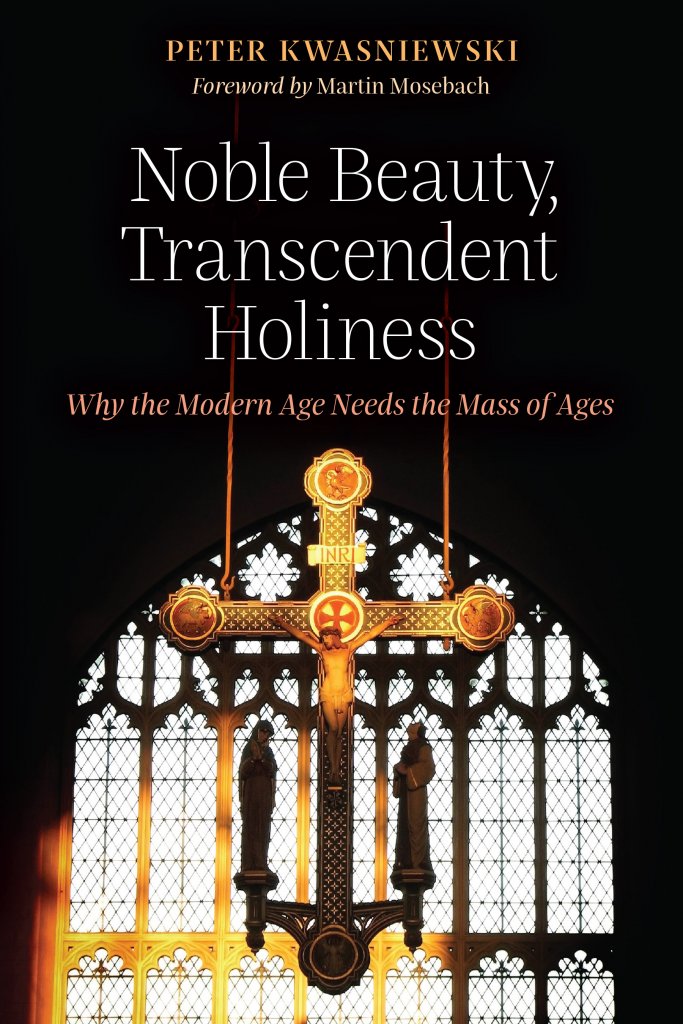
Editor’s Note: Bishop Athanasius Schneider, who received an advance copy of Noble Beauty, Transcendent Holiness: Why the Modern Age Needs the Mass of Ages  Dr. Peter Kwasniewski’s new book on sacred liturgy — has written the following reflection on it and given us permission to publish it. We are honored to be able to share these thoughts from His Excellency on the topic of the Most Holy Sacrifice of the Mass.


The whole meaning and aim of creation—and in the first place, of the spiritual creatures, namely, angels and men—consists in glorifying the Triune God through their existence, through their life, and through visible acts of worship. The most sublime act of God’s glorification is the worship of adoration (latria), which man has to perform according to his nature, that is, both in a spiritual, interior way and in a bodily, exterior way, as explained lucidly by Saint Thomas Aquinas:

Certain sensible works are performed by man, not to stimulate God by such things, but to awaken man himself to divine matters by these actions, such as prostrations, genuflections, vocal prayers, and hymns. These things are done not because God needs them, for He knows all things, and His will is immutable, and the disposition of His mind does not admit of movement from a body for His own sake; rather, we do these things for our sakes, so that our attention may be directed to God by these sensible deeds and that our love may be aroused. At the same time, then, we confess by these actions that God is the author of soul and body, to Whom we offer both spiritual and bodily acts of homage.[1]

In order that man may be able to offer God a most worthy worship, God Himself became man and taught us by His words and acts how to worship. Our Lord Jesus Christ demonstrated by His example that the essence of true worship consists in filial fear and in the loving reverence of God: “In the days of his flesh, Jesus offered up prayers and supplications, with loud cries and tears, to him who was able to save him from death, and he was heard because of his reverence” (Heb 5:7). Through His redeeming sacrifice of the Cross, Christ the God-man made men capable of worshiping God truly by associating the Church with this, His own highest act of worship.

The liturgy of the Church is the more true and God-pleasing, the more all of its elements—words, gestures, music, architecture, liturgical objects and paraments, and, of course, the state of mind and soul of the celebrant and of the assisting faithful—correspond to the spirit of Christ the High Priest, to His filial fear and to His loving reverence towards God. He alone is the “universal priest of God the Father,” the “catholicus sacerdos Patris,” according to an affirmation of Tertullian (Adv. Marc., IV, 9; IV, 35). The entire life of Jesus Christ was a glorification, an adoration, of God the Father: “I glorified you on earth” (Jn 17:4). Therefore, the life and work of Christ constitutes a reminder to fallen humanity of the first duty and of the very first commandment: “You shall worship the Lord your God, and Him only shall you serve” (Mt 4:10). Giving glory to God brings true salvation to men, as the liturgy of the Church says: “Our praises add nothing to your greatness but profit us for salvation.”[2]

The Church, the Bride of Christ, has as her first duty to proclaim and to praise the majesty of God and the wonders of His redeeming work. Christ, the only true worshipper of the Father, imbued His Bride with His reverential worshiping spirit. The reverential, adoring, sacred, and keenly Christocentric spirit of the liturgy is part of the spiritual “genetic inheritance” of the Church. Since the beginning and throughout her bimillennial history, the Church preserved this spirit of the liturgy and realized it in her rituals, above all in the rite of Holy Mass, the sacramental celebration of the sacrifice of the Cross. Since the beginning of the Church, this liturgical program sounded forth: “Let us offer to God acceptable worship, with fear and reverence [cum metu et reverentia], for our God is a consuming fire” (Heb 12:28-29).

Due to the consequences of original sin, which remain in the sons and daughters of the Church and in her ministers, there has always been in the history of the Church the temptation to yield to an egocentric, anthropocentric, naturalistic, and idolatrous tendency in worship. This means yielding to a perversion of the meaning and of the rite of divine worship, so that the essential liturgical law proclaimed in the words of Sacred Scripture, “Not to us, O Lord, not to us, but to your name give glory” (Ps 115:1), is perverted into: “To us, O Lord, to us, and to our name give glory!” The texts and the rites of the reformed liturgy issued after the Second Vatican Council show unfortunately a shift towards an anthropocentric mentality, and this, contrary to the basic teaching of the liturgical Constitution of the same Council. The imprecise character of the reformed liturgy leads often to a kind of free-style celebration, which destroys the very nature of true worship. The widespread practice of the reformed liturgy demonstrates the fact of liturgical anarchy in the Church of our days. The true apostolic and perennial spirit and practice of the liturgy is in some way in exile.

The rehabilitation and restoration of the traditional Roman liturgy by Pope Benedict XVI and before him already to a small extent by Pope John Paul II marks the beginning of the return of this spirit and practice from exile back into the ordinary life of the Church. The traditional Roman liturgy, since it reflects and realizes in a most sure manner the liturgical spirit of Christ Himself, is nowadays conquering slowly but steadily new generations of Catholics. This process cannot be reversed, because the traditional liturgy is the clearest voice of the Bride of Christ—a voice that was heard and experienced by our forefathers for over a thousand years. This liturgy remains therefore always young and up-to-date, because it constitutes the very living expression of the faith of the Church. To the traditional Roman liturgy one may apply an affirmation of Saint Irenaeus, paraphrasing it in the following manner: “This liturgy, which, having been received from the Church, we do preserve, and which always, by the Spirit of God, renewing its youth as if it were some precious deposit in an excellent vessel, causes the vessel itself containing it to renew its youth.”[3] The traditional Roman liturgy in the objective aspect of its content and ritual is the most apt manner to renew souls spiritually and thereby the Church herself. As we read in the words of the Eucharistic Hymn Sacris solemniis of Saint Thomas Aquinas, nova sint omnia: corda, voces et opera: “may the liturgy renew all things: hearts, voices, and works.” The same truth express the first words spoken in the traditional Roman rite: Introibo ad altare Dei, ad Deum qui laetificat iuventutem meam, “I shall go in to the altar of God, Who giveth joy to my youth.” In this way we begin a ritual permeated with beauty, powerfully summoning us to holiness, the true youthfulness.

Peter Kwasniewski offers to us a precious book with the emblematic and extremely apt title Noble Beauty, Transcendent Holiness: Why the Modern Age Needs the Mass of Ages. The author demonstrates masterfully the perennial theological, spiritual, and ritual meaning of the liturgy of the Mass. However, Dr. Kwasniewski does not merely present us with the truth in its theoretical aspect. The liturgical truth becomes more evident and convincing through the numerous witnesses of people of different ages and states of life to whom the author gives a voice. What is most striking and moving are the voices of young people, whom the traditional Roman liturgy spontaneously attracts, as truth and beauty always attract sincere hearts and souls. Such witnesses cause the edifice of anti-traditional ideas of today’s liturgical nomenklatura to collapse. The traditional Roman rite is the rite of all ages and is therefore the true Youth Mass.

May this new book by Peter Kwasniewski, published by Angelico Press, circulate as widely as possible and reach especially those in the Church who have the crucial responsibility for the liturgy. May bishops and most of all the Supreme Pastor of the Church listen to the voices of many young people who bear witness to the up-to-date character and the perennial youth of the traditional Roman rite. May God grant that not only the “little ones” in the Church (the young people and the laity) be lovers, defenders, and witnesses of the traditional Roman liturgy, the liturgy of all ages, but also—and indeed in the first place, as their office requires—the Shepherds of the Church, and especially her Supreme Pastor. I offer my sincere congratulations to Dr. Kwasniewski and to Angelico Press for this book, with constitutes a valuable contribution on behalf of the authentic renewal of the sacred liturgy and of its practice in the Church of our days. May we have more serious liturgical scholars who, like Dr. Kwasniewski, are at the same time true adorers of Christ, and lovers and defenders of the traditional Roman liturgy, the liturgy of all ages and of the Saints, so that the liturgical life of the Church may keep its perennial beauty and youth. May all those who do not yet know the traditional Roman rite of the Mass, or who reject it due to ignorance or other reasons, come to experience this form of the Church’s worship and discover in it the beauty of God’s house and the dwelling-place of His glory (cf. Ps 25:8).

June 24, 2017

+ Athanasius Schneider, Auxiliary Bishop of the archdiocese of Saint Mary in Astana

[1] Summa Contra Gentiles, III, 119, 4.

[2] Roman Missal, Common Preface IV.

[3] cf. Adversus Haereses, III, 24, 1.

Posted in Uncategorized | Comments Off on WHAT KIND OF WORSHIP DO YOU BELIEVE IS MOST ACCEPTABLE TO GOD?

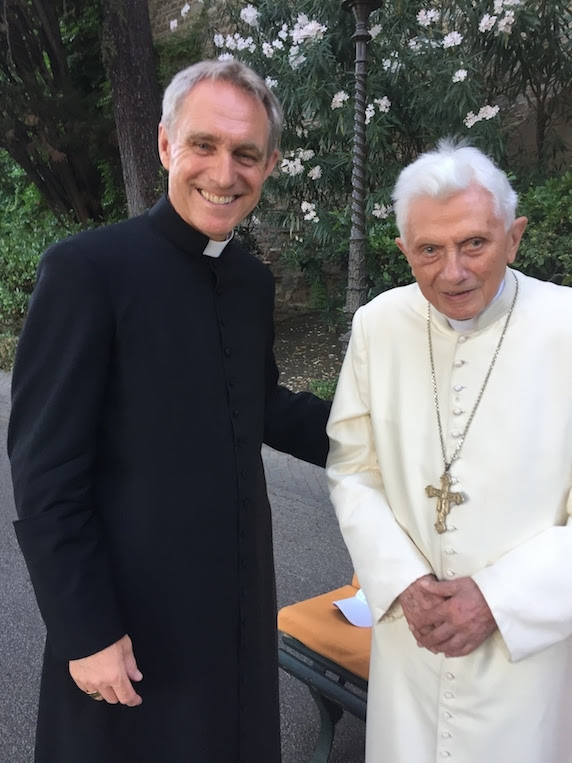
POPE BENEDICT WITH ARCHBISHOP GAENSWEIN

unnamed-25

Posted in Uncategorized | 1 Comment

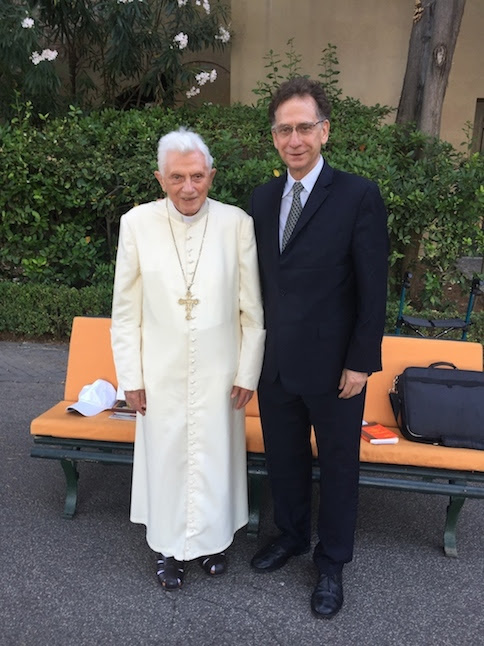
POPE BENEDICT WITH ROBERT MOYNIHAN

unnamed-24

Posted in Uncategorized | Comments Off on POPE BENEDICT WITH ROBERT MOYNIHAN

FRANCIS’ SUPPORT OF THE IDEA THAT GLOBAL WARMING IS CAUSED MOSTLY BY HUMAN ACTIVITY FITS RIGHT IN WITH THE RUSSIAN PUSH OF SOCIALISM

images_014

Why the Russians Conceived the Global Warming Scam

by Cliff Kincaid on June 20, 2017


One of my duties at Accuracy in Media (AIM) has been to expose left-wingers in the media and Congress who were soft on the old Soviet Union and are now acting like hard-liners on Vladimir Putin’s Russia. It is a fascinating topic which exposes the duplicity of the left-wing obsession with Russia.

These people, who were soft on the Soviet Union and now hard on Russia, are the worst kind of hypocrites. Their hypocrisy is further demonstrated by the abundant evidence that the global warming or climate change theory, which they now embrace, was conceived by Soviet communists as a means by which to destroy the industrial base in the United States. This disinformation theme has been embraced by the liberals now claiming to be tough on Russia.

Don’t take my word for it. When Natalie Grant Wraga died in 2002 at the age of 101, The Washington Post recognized her expertise as a Soviet expert, noting that she was “born in czarist Russia, saw great upheaval in her native land and became an expert in unmasking Soviet deception methods for the State Department…”

But the Post would not admit that fact in today’s political climate.

The liberal Economist magazine wrote, “She was perhaps the only person alive in the West who could claim such an intimate knowledge of Russian political thinking, from tsarist times to the collapse of the Soviet Union.” She commented, “Many people are studying the past, but very few are studying the present. Keep your eyes open and your ears open.”

This is good advice. One of the great Soviet/Russian deceptions, Wraga wrote, was the idea that humans were changing the climate and that humans could save the earth through socialism. She said, “…protection of the environment has become the principal tool for attack against the West.”

In her 1998 article, “Green Cross: Gorbachev and Enviro-Communism,” Wraga, who dropped her last name and wrote under the byline Natalie Grant, explains in detail how the Soviet deception campaign, using the climate as an organizing tool, was developed. It was launched after the so-called collapse of the Soviet state, when Mikhail Gorbachev, the last Soviet president, embarked on an environmental crusade, using the United Nations and other international organizations.

The veteran journalist Wes Vernon wrote about Grant’s research in this area, in an article entitled, “The Marxist Roots of the Global Warming Scare.”

The big event, as Grant called it, was a Moscow conference in January, 1990. As Time magazine described it, “At a meeting of the Global Forum in Moscow in 1990, when he was still Soviet President, Gorbachev proposed an organization roughly analogous to the International Red Cross to contend with environmental problems that cross national boundaries.” Among the guests and speakers was then-U.S. senator and future vice president Al Gore.

Talk about “collusion” with the Russians! Where was the FBI investigation?

The collusion took place through the Global Forum and various United Nations conferences, including the Earth Summit of 1992, giving rise to the concept of “sustainable development,” another way to describe socialism.

Grant wrote, “Protection of the environment may be used as a pretext to adopt a series of measures designed to undermine the industrial base of developed nations. It may also serve to introduce malaise by lowering their standard of living and implanting communist values.”

Grant predicted how this campaign would proceed, using “nightmarish” pictures of floods, scorched earth, disease and death, unless drastic action was taken at the international level to curb industrial activity in the capitalist West.

She said the campaign would be driven by Moscow’s sympathizers or dupes in “science,” academia, “and the slavishly obedient Establishment media,” all for the purpose of forcing the United States and other Western countries “to accept measures and regulations harmful to the Western world.”

In short, for communism to succeed, capitalism would have to be portrayed as based on exploitation—but not of man, as the old Marxist theory held. Rather, capitalism was now exploiting the earth! The whole purpose of this dogma has been to inhibit global capitalism, the only system that has proven capable of meeting the growing needs of expanding populations. But this time the claim was that human economic progress threatened the environment because of the capitalist model on which it was based.

Hence, President Obama’s Paris climate change agreement was designed to curtail U.S. industrial expansion while sending foreign aid to the rest of the world. It was a Marxist plan that benefited Russia, a major oil and gas producer.

On June 1, when he announced pulling out of the climate change agreement, President Donald Trump put his finger on the key problem, which was deliberately part of the plan. He attacked “the draconian financial and economic burdens the agreement imposes on our country” while creating a so-called Green Climate Fund which would cost the United States “a vast fortune” to be sent to the other nations of the world.

In other words, Trump’s pull-out from the agreement works AGAINST Russian interests and those of the global socialists.

Nevertheless, the propaganda campaign continues. In July, Netflix releases the film “Chasing Coral,” which attempts to blame man for “dramatically changing” and losing coral reefs in the world’s oceans on a global scale. With carbon emissions said to be “warming the seas,” the audience will be told of the “catastrophe” that is “silently raging underwater” unless we wake up and dramatically restrict our lifestyles.

Meanwhile, Ohio State University has released a “study” in the Journal of Peace Research suggesting that climate change could lead to “food violence.” One of the authors is quoted in an Ohio State University press release as saying, “Development aid is important now and it is likely to be even more important in the future as we look for ways to increase climate resilience.”

In other words, the United States must pay more to the other nations of the world. This is global socialism.

It looks like the “nightmarish” scenarios predicted by Natalie Grant are not yet at an end.

But when will the liberals wake up? Answer: they won’t. Like James Hodgkinson, a true believer in the global warming theory, they want to “tax the rich” in their own country and will shoot to kill those who stand in the way of this global redistribution scheme.

Cliff Kincaid is the Director of the AIM Center for Investigative Journalism and can be contacted atcliff.kincaid@aim.orgView the complete archives from Cliff Kincaid.

http://www.aim.org/aim-column/why-the-russians-conceived-the-global-warming-scam/


Attachments area

Preview YouTube video Chasing Coral | Official Trailer [HD] | Netflix

Chasing Coral | Official Trailer [HD] | Netflix


Posted in Uncategorized | Comments Off on FRANCIS’ SUPPORT OF THE IDEA THAT GLOBAL WARMING IS CAUSED MOSTLY BY HUMAN ACTIVITY FITS RIGHT IN WITH THE RUSSIAN PUSH OF SOCIALISM

EVERY DIOCESE OF THE UNITED STATES NEEDS TO BE GRADED IN COMPARISON TO THE DIOCESE OF LINCOLN IN NEBRASKA

El_Greco_021-large

IF WE WANT THE VOCATION CRISIS IN THE CHURCH TO TURN AROUND IT HAS TO START AT THE TOP, THE CATHEDRAL, TO MODEL WHAT WILL BRING IT ABOUT! LINCOLN, NEBRASKA, A PERIPHERY DIOCESE, MAY BE SHOWING THE CHURCH THE WAY! WHAT GOOD CAN COME FROM LINCOLN? COME AND SEE!

 Philip findeth Nathanael, and saith unto him, “We have found him, of whom Moses in the law, and the prophets, wrote, Jesus of Nazareth, the son of Joseph.” And Nathanael said unto him, “Can any good thing come out of Nazareth?” Philip saith unto him, “Come and see” (John 1:45-46).

While there would certainly be push back in so many places, this is in fact the way for bishops to gain more more discerning the priesthood and ultimately becoming priests. Catholic liberalism is a complete and total failure but so many are in denial about it from the top down.

This is a challenging article but prophetic and the periphery, like Bethlehem, his leading the way!

Why Aren’t Other Dioceses Looking to Lincoln?

image
(Photo from the 2015 Mass of Ordination in the Diocese of Lincoln, NE)
So often these days we read of the ongoing collapse of Catholicism in the west.  In diocese after diocese we see parishes and schools closing or consolidating, a decline in priests as older clergy pass away at rates higher than new ordinations, and a widespread loss of the next generation to either the secular left or the evangelical right.

We also read of various plans to counter these trends. Everyone seems to have a program to promote, a new strategy to increase vocations, to increase weekly Mass attendance, to keep teens from fleeing the faith…

However, what’s not as widely known is that we already have a blueprint for success: the Diocese of Lincoln, Nebraska.  The problem is that few are talking about it.  So let’s fix that.

First, a few facts you might not know about the Diocese of Lincoln:

According to the Official Catholic Directory and the Center for Applied Research in the Apostolate (CARA), Lincoln, NE is the only diocese in the United States to place in the Top 20 for the ratio of ordinands to population in every survey conducted from 1993-2012.

Despite having a Catholic population of only 97,000, the Lincoln diocese ordained 22 men from 2010-2012.  Only seven diocese in the entire country ordained more.  One of those, the Archdiocese of Los Angeles (with a Catholic population over 4.2 million) ordained 34 men during those same three years.  In other words, L.A. only ordained four more men per year on average despite having a population 44X greater than Lincoln.

Bishop James Conley recently noted that, with this year’s class, the diocese will have ordained 17 men to the priesthood in a 24 month span of time; unheard of in this day and age.
As of 2012 the diocese had a total of 150 priests serving 134 parishes.

There is no permanent diaconate program in Lincoln. There are, however, installed acolytes and lectors constituted of lay men.

There are also 33 Catholic schools, including 6 high schools.  One of those high schools, St. Pius X, produced 18 of the 48 men enrolled at St. Gregory the Great Seminary in 2014.

It’s also interesting to note that 96 percent of students attending diocesan schools are Catholic.

Many of the schools are staffed by female religious, of which the Diocese of Lincoln boasts 141 sisters from 14 different orders. Many have priests teaching high school theology and often serving as principals as well.

Having established that Lincoln is a thriving community of Catholicism, seemingly impervious to many of the challenges encountered elsewhere, we now need to look at the secret of their success.

The Lincoln blueprint can be narrowed down to a few foundational elements:

Orthodox Bishops
Against all odds and the prevailing winds of the post-conciliar Church, Lincoln has avoided the craziness and irreverence that has afflicted so many other dioceses. This has largely been achieved through the stability and orthodoxy provided over the last fifty years by three men: Bishop Glennon Flavin (1967-1992), Bishop Fabian Bruskewitz (1992-2012), and Bishop James Conley (2012-present). They succeeded despite the occasional scorn of their brother bishops, and by making the Church’s perennial priorities their own.
The National Catholic Reporter (known as the Fishwrap to Fr. Z readers) once bemoaned that it was as if the “reforms” so prevalent in the aftermath of Vatican II had missed Lincoln altogether. Exactly.

The Male Only Sanctuary
Several things immediately differentiate Lincoln from nearly every other diocese in the country when it comes to the sacred liturgy.
To a large extent, Lincoln has preserved a male only sanctuary. In this area the diocese has simply given more weight to tradition and common sense instead of “modern sensibilities” that are more secular minded.

The diocese remains the only one in the country to maintain an altar serving policy of boys only. As I have written about before, this is in direct recognition of what Rome itself acknowledged back in 1994:

The Holy See wishes to recall that it will always be very appropriate to follow the noble tradition of having boys serve at the altar. As is well known, this has led to a reassuring development of priestly vocations. Thus the obligation to support such groups of altar boys will always continue.

Lincoln also utilizes installed acolytes and lectors for the Holy Mass. Since it is an instituted ministry, the role of an acolyte is only open to men. Both of these instituted ministries commenced during Bishop Flavin’s time during the 1970’s.

As an example, a parish with 1,200 or so families could have as many as 30-40 acolytes. They function mainly in a capacity to serve during Mass, often much like an altar boy or deacon: they turn the missal pages for the priest, carry the processional cross, distribute communion, handle the thurifer for incensing, and so on.

These acolytes are utilized on an as needed basis and are not viewed as simply another way to increase lay participation. An average Sunday mass with 800 people would typically have only 2 main acolytes and 3 more assist the extra priest to distribute Holy Communion. It’s also interesting to note that the faithful only receive under one species in Lincoln, foregoing the need to double the number of acolytes. This is of course in stark contrast to most dioceses that make ordinary use of

Extraordinary Ministers of Holy Communion, to the point of abusing the intention set forth by Rome.
As stated previously, Lincoln also utilizes installed lectors for most Sunday Masses. Back in the early 1980’s Bishop Rembert Weakland (the progressive homosexual prelate of Milwaukee at the time) publicly chastised Bishop Flavin of Lincoln for not embracing the innovation of female readers for Mass. While Flavin’s successor Bishop Bruskewitz would eventually acquiesce and permit their use in the diocese, female readers are still more commonly utilized for daily masses and school masses, with lectors more prevalent for Sunday’s and holy days of obligation.

Tradition Friendly 
Those in Lincoln will speak of the lack of Catholic tribalism and the absence of the liturgical wars so prevalent in other dioceses. In large part this is due to the environment established by Lincoln’s bishops. Reverent Novus Ordo liturgies have served the faithful well, preventing the frustration that so many encounter in other dioceses.

However, Lincoln has also avoided the hostility toward tradition that so often defines the traditionalists experience elsewhere. Back in the 1990’s then Bishop Bruskewitz invited the newly established Priestly Fraternity of Saint Peter (FSSP) to the diocese to establish a North American seminary, Our Lady of Guadalupe in Denton, NE. The Fraternity exclusively celebrates Mass in the Extraordinary Form and adheres to the liturgical books in use in 1962.

Presently there are about 7 or so diocesan priests who offer the Traditional Latin Mass; however, more are learning it. The rector at the diocesan seminary (St. Gregory the Great) offers it to the seminarians once a month.

This is probably one of the more interesting sides of Lincoln. The Latin Mass community is not very large in Lincoln. Because the diocese has historically been so conservative there has never been a great battle cry from traditionalists for the exclusive return of the Latin Mass. Many within the community can even be seen at various Novus Ordo parishes participating fully within the liturgy .

The number of priests learning the old Mass is on the rise, though mainly among the younger priests (of which there are many). Most of the older priests will delegate it to the FSSP priests in the diocese at the seminary or to St. Francis’ parish. Bishops Bruskewitz, Conley and Robert Finn (formerly of the Diocese of Kansas City-St. Joseph) all offer it regularly in the diocese.

Lincoln’s diocesan priests and the FSSP priests have an excellent relationship, and it is only getting better. St. Gregory the Great diocesan seminarians have gone to Our Lady of Guadalupe, and vice versa, for evenings of prayer and fraternity and for vespers in both the old and new rites.

Liturgical Continuity
As stated previously, the Lincoln diocese has intentionally avoided the modern tendency to clericalize the laity by delegating liturgical roles to the faithful. Thanks to its use of acolytes and lectors, instead of the more common excessive use of readers and EMHC’s, the diocese has not blurred the lines between ministers and laity, or between sanctuary and nave. It’s obvious to see how this would reinforce the ministerial priesthood in Lincoln, as well as the continuity between both forms of the Roman Rite.

Proper liturgical orientation has been further reinforced through the manner in which many masses are offered in Lincoln: with the priest facing toward the liturgical east, or Ad Orientem.

As I have written about before, the last two years Bishop Conley has offered all Sunday masses Ad Orientem during Advent. Further, he has publicly encouraged the priests of his diocese to do the same. From what I have been told, about 40% of parishes chose to follow his lead. For many, however, this was not anything new, as most large diocesan masses are already being offered Ad Orientem.

A Catholic Education
While I have saved this for last, in many ways education is the primary ingredient to Lincoln’s recipe for success. Bishop Glennon Flavin’s vision for a diocese that allowed its children to go to Catholic school at an affordable cost and to be taught authentic Catholicism by religious sisters and priests is integral to the diocesan mission.

While Lincoln’s Catholic population is less than 100,000, they have provided the faithful with 27 elementary schools and 6 high schools to educate the next generation. More importantly, most diocesan schools have at least 1-2 habited sisters and all Catholic schools are staffed by at least one priest.

As noted earlier, high school theology classes are only taught by priests and religious sisters. For example, the Catholic high school in Lincoln, Pius X, has over 1200 students and is staffed by 4 religious sisters (in traditional religious habits) and 15 priests who always wear their clerics. Each newly ordained priest can expect to teach high school for at least 5 years. Priests who are assigned to parishes in smaller towns with a Catholic high school are still expected to teach as well.

Unlike other dioceses which require school masses only once a week, or in some cases once a month, each grade school in the Diocese of Lincoln is required to offer daily mass for the entire school each day.

However, there may be no better example of Lincoln’s commitment to the future than the fact that it’s diocesan schools have some of the lowest tuition costs in the entire country. As an example, St. Teresa’s Catholic School in town has an annual tuition cost of only $100 per student, and yet it is a thriving school with a habited sister as principal.

As one local explained, “These good, solid, Catholic schools are the roots of the diocese and continue to pump out religious vocations and plain good Catholics, thanks to the work of our clergy, diocesan staff, and laity.”

Why Aren’t Other Dioceses Looking to Lincoln?
Why more dioceses aren’t looking to incorporate the Lincoln model is a mystery. It is easy to see how some might dismiss it, however.

Lincoln is a rural diocese. It’s exceptionally high number of religious sisters help to reduce tuition costs for schools. The relatively small size of the Catholic population creates an insulated environment unlike that found in such diverse and populous areas as Los Angeles, Chicago, or New York.

Of course there may be other reasons why the Lincoln blueprint is apparently being ignored.

No doubt many bishops, priests, and lay faithful would rather forgo a boom in vocations if it means having to reestablish clear divisions between the nave and the sanctuary, or ending such post-conciliar innovations as altar girls or Extraordinary Ministers. The secular push for egalitarianism has been enthusiastically embraced by most bishops these past few decades. It would seem that either pride, or fear, or an agenda that is not exclusively focused on saving souls, is keeping many from reversing course. Or maybe some dioceses simply don’t want orthodox Catholicism.

We can only hope and pray that more of those within the Church hierarchy humbly and attentively look to Lincoln for some answers. There is a blueprint for rebuilding a vibrant Church, an authentic and thriving Catholicism.

Look to Lincoln.

(I would like to thank Tanner Lockhorn of Lincoln, NE for his assistance and significant contribution to this post. Tanner is a life long resident of Lincoln and a graduate of St. Pius X High School).

Posted in Uncategorized | 1 Comment

FOR JESUITS SATAN NO LONGER EXISTS, HE IS ONE “OF THE SYMBOLIC FIGURES” WE HAVE CREATED TO EXPRESS THE CONSEQUENCES OF THE EVIL CHOICES MEN MAKE

notre_dame_paris

SSPSX

It is astonishing, disturbing, and saddening to read certain remarks that seem to question the Faith of the Church founded by Jesus Christ.

It is sometimes said that the devil does not really exist, as if belief in the devil was optional or even debatable in the Church. Satan would be just a way of speaking of the mystery of evil in our lives, a symbol belonging to an outdated culture of bygone days. But is he really?

The trend is towards disbelief, even in the Catholic Church. For example, on May 31, 2017, Fr. Arturo Sosa, the Jesuit Superior General – traditionally known as the “Black Pope” because of the importance of his position – ventured to broach the theme of evil in an interview with the Spanish newspaper El Mundo.

To the question of the journalist, who asks whether the question of evil finds its explanation in a process of purely human psychology or comes from a higher being, Fr. Sosa gave an answer so astounding that it is worth quoting in full:

From my point of view, evil is part of the mystery of freedom. If the human being is free, he can choose between good and evil. Christians believe that we are made in the image and likeness of God, and God is free, but He always chooses to do good because He is all goodness. We have created symbolic figures, such as the devil, to express [the reality of] evil. Social conditioning can also represent this figure, since there are people who act [in an evil way] because they are in an environment where it is difficult to act to the contrary.

In other words, evil is reduced to a purely psychological dimension and to an a priori category that is really just the fruit of the history of mentalities.

Fr. Sosa was answered from the opposite perspective by a son of St. Francis on the other side of the Atlantic. Archbishop Charles Chaput, a Capuchin, is in charge of the Archdiocese of Philadelphia. In his column on June 5, a few days after the resounding publication of the El Mundo interview, the prelate wrote on the question of evil, offering an analysis of the ideas of Leszek Kołakowski (1927-2009), a Polish Catholic philosopher known for his criticism of Marxism: “The devil and evil are constants at work in human history and in the struggles of every human soul,” he once declared.

The archbishop continued on a sharper tone: “And note that Kolakowski – unlike some of our own Catholic leaders who should know better – was not using the word ‘devil’ as a symbol of the darkness in our own hearts, or a metaphor for the bad things that happen in the world.” It’s hard not to see this as a dig at the General of the Jesuits.

Archbishop Chaput’s final remark is also very interesting: “The devil, more than anyone, appreciates this irony, i.e., that we can’t fully understand the mission of Jesus without him. And he exploits this to his full advantage. He knows that consigning him to myth inevitably sets in motion our same treatment of God.” He could hardly have made it more clear: denying the existence of the devil sooner or later leads to a profession of atheism.

Fr. Sosa is known for being close to the current pope. However, Francis does not share the Jesuit’s opinion on the mystery of evil – far from it. In a compilation of then-Cardinal Bergoglio’s letters, homilies, and talks called, “Only Love Can Save Us”, the existence of the devil is clearly asserted: “Careful: we are not fighting against human powers, but against the powers of darkness. Just like he did with Jesus, Satan will seek to seduce us, to lead us astray, to offer us ‘viable alternatives’.”

More recently, on October 30, 2014, in a homily during his morning Mass at Santa Marta, the Holy Father was very explicit: to think they have “made people think that the devil was a myth, a character, an idea, the concept of evil. The devil exists and we have to fight against him.”

On this point, the pope is faithful to the teaching of the Church.

The holy Gospels are full of references to the fact that the Devil really exists as a person. Jesus confronts the prince of Darkness several times when He practices exorcisms on possessed people. He meets him personally in the desert before vigorously driving him away: “Begone, Satan: for it is written, The Lord thy God shalt thou adore, and him only shalt thou serve” (Mt. 4:10). He speaks of him in His teachings, describing Satan’s action in the world, or announcing that the “gates of hell” will never prevail against the Church He is going to found (Mt. 16:18).

Likewise, St. Paul, in his epistles, makes a clear distinction between the sins of men and the one who inspires them, Satan and the other evil spirits who roam throughout the world seeking the ruin of souls. He exhorts us to put on “the armor of God, that you may be able to stand against the deceits of the devil” (Eph. 6:11). The great Apostle himself is tried, lest the greatness of the revelations made to him exalt him: “There was given me a sting of my flesh, an angel of Satan, to buffet me” (II Cor. 12:7).

As for St. John, he gives us the words of Christ that are anything but ambiguous: “Now shall the prince of this world be cast out” (Jn. 12: 31). In the Apocalypse, he presents the victory of the immolated Lamb after a terrible battle against Satan, his angels and his followers: “And that great dragon was cast out, that old serpent, who is called the devil and Satan, who seduceth the whole world; and he was cast unto the earth, and his angels were thrown down with him” (Apoc. 12:9).

In keeping with Sacred Scripture, all of Tradition unanimously asserts the existence of Satan and the evil spirits.

The Fathers of the Church unmask them in their battles against the errors of the gnostics and the heresies spread by the prince of lies. Among them are Tertullian, St. Irenaeus, Origen, St. Basil, St. Gregory of Nazianzus, St. John Chrysostom, St. Eusebius of Vercelli, St. Ambrose, St. Augustine, St. Leo the Great, and others.

The devil is a creature of God; he was initially excellent and even brilliant, but he did not remain in the truth where it had been established: The devil “was a murderer from the beginning, and he stood not in the truth; because truth is not in him. When he speaketh a lie, he speaketh of his own: for he is a liar, and the father thereof” (Jn. 8:44). Satan rose up against the Lord, and the evil was not in his nature, but in a free and contingent act of his own will, an act of pure malice and revolt, by which he sought to take the place of God.

When the Manichean dualism resurfaced with the Cathars and the Albigensians, the Fourth Ecumenical Council of the Lateran, in 1215, solemnly taught that “the devil and other demons were created by God naturally good, but they became evil by their own doing. Man, however, sinned at the prompting of the devil.”

The existence of Satan therefore has indeed been constantly maintained by the Faith of the Church. It is a truth that is not up for debate, for it is an integral part of her most solemn teaching. It has been asserted by multiple councils under the form of professions of faith.

By Christ and holy baptism, the Christian is set free from the devil’s dominion (Council of Florence, 1442). Through justification by grace, he escapes the “power of the devil and of death” (Council of Trent, 1547), but if he sins again, he is again delivered “into the power of the devil”, unless he resorts to the sacrament of penance (Council of Trent, 1551). Such is the Faith of the Church, and the reason the baptismal promises are renewed every year in the Easter liturgy. To into eternal life, one must renounce Satan, profess the Faith in the Most Blessed Trinity and adhere to Christ the Savior.

May these reminders of the Faith of the Church enlighten the General of the Jesuits and help him to submit to them. The devil and the dogmas, that is to say, the truths revealed by God, are not just symbols. Otherwise we fall into the “sewer of all heresies”, that St. Pius X condemned under the name of Modernism.

news-image-2
Posted in Uncategorized | 1 Comment