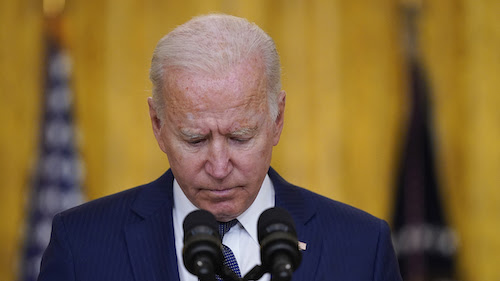
NEARLY 90 RETIRED GENERALS AND ADMIRALS CALL FOR THE RESIGNATION OF AUSTIN AND MILLEY

Nearly 90 retired generals and admirals have called on Defense Secretary Lloyd Austin and Joint Chiefs Chairman Gen. Mark Milley to resign after overseeing the debacle that was President Joe Biden’s withdrawal from Afghanistan.

The letter, released by the group Flag Officers 4 America, states that “the hasty retreat has left an unknown number of Americans stranded in dangerous areas controlled by a brutal enemy.” The group’s letter notes that Austin and Milley “were the top two military officials in a position to recommend against the dangerous withdrawal” and that even if they did all they could to prevent Biden from going forward with it, they should still resign out of conscience.

Two weeks ago, Austin said that the Defense Department would move everyone we possibly can out of Afghanistan “until the clock runs out or we run out of capability.” This was not such a hard promise to keep, yet it has already been broken even though the clock has not run out. Moreover, the greatest military in the world should not “run out of capability” at all when it comes to helping Americans stranded in a country controlled by the Taliban.

Ultimately, anywhere from 100 to 200 Americans who wanted to leave the country were stranded by the Biden administration by its own numbers. Austin also confirmed that the Taliban were preventing some Americans from getting to the airport.

Posted in Uncategorized | Comments Off on NEARLY 90 RETIRED GENERALS AND ADMIRALS CALL FOR THE RESIGNATION OF AUSTIN AND MILLEY

The Virginia Supreme Court made a wise decision when it said it would not accept a challenge to a lower court ruling that required Loudoun County Public Schools to reinstate a teacher who was punished for not acknowledging that boys can be girls, and vice versa. 


Thought Control In Schools Must End
September 2, 2021
Catholic League president Bill Donohue comments on a court decision that may have wide implications for thought control:
The Virginia Supreme Court made a wise decision when it said it would not accept a challenge to a lower court ruling that required Loudoun County Public Schools to reinstate a teacher who was punished for not acknowledging that boys can be girls, and vice versa. 
The victim in this case, Tanner Cross, argued that his Christian convictions did not permit him to lie about sex transitioning. He knows it is child abuse. So does every honest person who knows anything about the subject, which unfortunately excludes many in the healthcare profession and education. 
The school district violated this teacher’s freedom of speech as well as freedom of religion. It had the gall to maintain that Cross was suspended not for his speech but for the “disruption” he caused at a school board meeting in May. 
He was being sanctioned because of what civil libertarian Harvey Kalven once called the “heckler’s veto.” In short, this means that those who are upset about someone’s speech can effectively veto his First Amendment right by holding him responsible for their planned, or actual, disruptive behavior. 
This is not a matter of speculation. In 1949, the U.S. Supreme Court overthrew the conviction of a suspended Catholic priest who gave an incendiary speech in Chicago. A riot took place outside the hall where he spoke, and he was held accountable for the mob’s behavior. The high court overturned his conviction. Had it not done so, it would have been the death knell to robust speech of any kind.
There was another dustup in June in Loudoun County when parents objected to the adoption of critical race theory (CRT). School officials mandated, without offering any proof that there was a problem with racism in the district, that all teachers accept the racist dogma associated with this ideology.  
An economist who lives in this area, Max B. Sawicky, recently defended the school district for ordering teachers to abide by CRT. In an article posted by The New Republic, he lashed out at parents and teachers who objected to it. He denied that CRT was racist. He is wrong. 
“White identity is inherently racist; white people do not exist outside the system of white supremacy.” Those are the words of Robin DiAngelo, one of the gurus of this pernicious brand of hate speech. 
Ironically, those who live in Loudoun are mostly white privileged people, the very ones seen as racists by CRT activists. Sawicky brags that “Loudoun is one of the richest counties in the United States,” where “Joe Biden received 62 percent of the vote.” 
These are precisely the kind of people who are most likely to deny that there are only two sexes. Not surprisingly, Sawicky berates “Christian fundamentalist teachers” who object to having their religious rights abrogated by sexually confused elites. He also rails against “anti-CRT fanatics” who object to branding all white people as racists.
More important, there is no shortage of left-wing totalitarians who want to use the power of the state to dictate how people think about transgenderism and CRT. Their penchant for thought control makes these people the most dangerous segment in American society today. They need to be resisted and defeated.
Posted in Uncategorized | Comments Off on The Virginia Supreme Court made a wise decision when it said it would not accept a challenge to a lower court ruling that required Loudoun County Public Schools to reinstate a teacher who was punished for not acknowledging that boys can be girls, and vice versa. 

IN THE “SHOOT-OUT” IN THE OK CORRAL IN WASHINGTON THE STATE OF TEXAS (AND A LOT OF UNBORN BABIES) WON LAST NIGHT

Denial in Texas case should have been unanimous, and more

TEXAS’ AUDACIOUS “TEXAS HEARTBEAT ACT” SURVIVED AN ALL-OUT ATTACK ON THE ACT BEFORE THE United States Supreme Court

From NRO’s Bench Memos:

Denial By the United States Supreme Court Should Have Been Unanimous

By ED WHELAN

September 2, 2021 10:01 AM

Last night the Court denied abortion providers’ beyondaudacious request for emergency relief against the Texas Heartbeat Act by a 5-4 vote. The feebleness of the four dissents shows that the denial should have been 9-0.

In one long paragraph, the per curiam majority (Thomas, Alito, Gorsuch, Kavanaugh, and Barrett) explains that the abortion providers’ request “presents complex and novel antecedent procedural questions on which they have not carried their burden.” Federal courts “enjoy the power to enjoin individuals tasked with enforcing laws, not [as so many people mistakenly suppose] the laws themselves.” The abortion providers haven’t shown that the “named defendants can or will seek to enforce the Texas law against the applicants in a manner that might permit our intervention.” (My emphasis.) Thus, there is no occasion to address the “serious questions [raised] regarding the constitutionality of the Texas law at issue.”

The four dissents have one common glaring defect. They fail to explain what relief they would order against which named defendants in a way that would somehow prevent the millions of non-party individuals from enforcing the Act in hundreds of Texas courts. As I’ve pointed out, by their own account, the harm that the abortion providers allege is the same whether or not they receive full relief against the named defendants. (That’s why they were trying to get the district court to certify statewide defendant classes of judges and clerks.) Thus, they haven’t shown that emergency relief against the named defendants would prevent any injury they allege. They therefore are clearly not entitled to injunctive relief.

Let’s look at the dissents one by one:

The most disappointing—because we should have expected so much better, especially from someone who often presents himself as very serious about jurisdictional limits on judicial power—is the Chief’s (which Breyer and Kagan join). The Chief acknowledges that defendants “may be correct” that “existing doctrines preclude judicial intervention.” That acknowledgment should be enough to require him to deny relief. Instead, he somehow imagines that the Court has the power to “grant preliminary relief to preserve the status quo ante” so that the lower courts can address the “particularly difficult” questions that the case raises. And, again, he also mistakenly assumes that preliminary relief against the named defendants actually could “preserve the status quo ante.”

One bright note for those who fear that the Chief holds extraordinary sway over a couple of his conservative colleagues is that neither of them went south with him.

Justice Breyer (joined by Sotomayor and Kagan) declares that “[i]t should prove possible to apply procedures adequate to [the] task” of preventing threatened imminent constitutional harm.” But he doesn’t acknowledge that there are only eight actual defendants in the case, and the alternatives he imagines all depend on a much larger set of defendants.

Amidst extravagant rhetoric that you might find in a New York Times editorial, Justice Sotomayor (joined by Breyer and Kagan) complains that the majority “declined to grant relief because of procedural complexities of the State’s own invention.” Well, yes, that’s one way, I suppose, to acknowledge that the majority applied ordinary and long-established rules to the innovative Texas statute. She also weirdly faults the majority for “belatedly” explaining why it didn’t grant relief on Tuesday evening. Well, maybe the members of the majority were still working their way through the arguments (on a matter in which the abortion providers waited 2-1/2 months before filing their motion for preliminary injunction), or maybe they wanted to extend the usual courtesy of deferring an order until the dissents were ready. Picking up a cheap talking point from the Left, Sotomayor even charges that “a Fifth Circuit panel abruptly stayed all proceedings before the District Court” and doesn’t disclose that the district judge had already entered an order vacating the preliminary-injunction hearing as to all of the governmental defendants.

Justice Kagan, who is plenty smart enough to find a procedural solution if one existed, doesn’t even try to offer one. Instead, joined by Breyer and Sotomayor, she oddly complains that the “majority has acted without any guidance from the Court of Appeals” and “has reviewed only the most cursory party submissions, and then only hastily.” But her complaints ought to be directed against the abortion providers for leapfrogging the Fifth Circuit and asking for relief on an emergency basis (again, after taking 2-1/2 months to file their preliminary-injunction motion). And how can the three liberals complain in this dissent that the majority acted too hastily, while they complain in Sotomayor’s dissent that the majority acted belatedly?

Posted in Uncategorized | Comments Off on IN THE “SHOOT-OUT” IN THE OK CORRAL IN WASHINGTON THE STATE OF TEXAS (AND A LOT OF UNBORN BABIES) WON LAST NIGHT

BRAVO CATHOLIC LEAGUE : CONGRATULATIONS BISHOP DiMARZIO


Bishop DiMarzio Exonerated
September 1, 2021
Catholic League president Bill Donohue comments on Brooklyn Bishop Nicholas DiMarzio:
The Most Reverend Nicholas DiMarzio, Bishop of Brooklyn, has been exonerated by the Congregation for the Diocese of the Faith at the Vatican of charges that he sexually abused minors. It is a credit to New York Archbishop Timothy Dolan, who was authorized by the Vatican to conduct an investigation, that he took this assignment seriously by hiring a law firm that retained former FBI Director Louis Freeh to do this job.
As I previously indicated, the allegations against DiMarzio were bogus from the start. In November 2019, Mitchell Garabedian, an unethical lawyer, announced that he was suing DiMarzio for abusing an 11-year-old boy, Mark Matzek, when he was a young priest in the 1970s. DiMarzio categorically denied the charges and Garabedian took several months before he acted on his claim.
In June 2020, Garabedian said he found another “victim” who said he was abused around the same time as Matzek. Once again, the Boston-based attorney did not move quickly against DiMarzio, settling for a PR smear of the bishop; he finally followed through. 
The alleged second victim, Samier Tadros, said DiMarzio abused him in Holy Rosary Church in the Archdiocese of Newark. Yet as the bishop said, Tadros “did not attend the parish or the parish school and does not appear to have been Catholic.”
Here is what I said on June 4, 2020. “Why would anyone wait a half century to bring a lawsuit? How is it possible that the parents of these boys [Garabedian’s two clients] never knew about it [the alleged abuse]—Tadros says the abuse started when he was 6-years-old and happened ‘repeatedly’—especially given its alleged serial nature?”
It seems clear that DiMarzio was pursued by Garabedian because he opposed unjust discriminatory legislation that singled out the Catholic Church for retribution over crimes against minors. This was payback.
This was reminiscent of a former office holder who accused DiMarzio in 2016 of offering her a $5,000 bribe. It was a lie. She admitted she was wrong about the date of their meeting—by three years—and wrong about the venue. She was also wrong about her accusation, which was undercut by witnesses at the meeting.
Bishops, like all priests who have been accused, are entitled to due process, and all priests, regardless of rank, should be held to the same standards by the Church, as well as by civil authorities, when they are accused.
Bishop DiMarzio is an honorable man, a great servant of the Church who is understandably loved by those who know him. He should never have had to go through these ordeals. But then again we live in a time when some very vicious persons are out to sunder the Catholic Church.
[Note: In a few weeks, Ignatius Press will publish my new book, “The Truth About Clergy Sexual Abuse: Clarifying the Facts and the Causes.” While I discuss Garabedian, I do not mention the DiMarzio case because it was still unresolved when the book went to print.]
Posted in Uncategorized | Comments Off on BRAVO CATHOLIC LEAGUE : CONGRATULATIONS BISHOP DiMARZIO

PLEASE GOD, MAY BIDEN BE IMPEACHED!!!!!!!!!!!!!!!!!

House Republicans Call For Afghanistan Accountability and Demand Biden Resign

Biden faces an increasingly dire situation.

We now have Americans stuck in Afghanistan, the Taliban in charge with more weaponry than they’ve ever had in the past, and a border that is open.

House Republicans pledged to hold the Biden administration accountable.

Click here to read the full story >>

House Republicans Call For Afghanistan Accountability and Demand Biden Resign

Biden faces an increasingly dire situation.

We now have Americans stuck in Afghanistan, the Taliban in charge with more weaponry than they’ve ever had in the past, and a border that is open.

House Republicans pledged to hold the Biden administration accountable.

Click here to read the full story >>

Posted in Uncategorized | Comments Off on PLEASE GOD, MAY BIDEN BE IMPEACHED!!!!!!!!!!!!!!!!!

THE “TEXAS HEARTBEAT ACT” GOES INTO EFFECT TODAY. PASSED BY THE REPUBLICANS IN THE STATE LEGISLATURE AGAINST THE OPPOSITION OF THE DEMOCRATS IN THE LEGISATURE AND SIGNED BY GOVERNOR Greg Abbott THE NEW LAW GOVERNS ABORTIONS IN TEXAS

Texas Heartbeat Act now in effect!

GLORY BE TO GOD!!! ALLELUIA, ALLELUIA, ALLELUIA

“And I will give them one heart and one purpose: to worship me forever, for their own good and for the good of all their descendants.” Jeremiah 32:39 

Texas Right to Life WEDNESDAY, 9/01/21. 2:50 PM
Beginning today it is against the law to abort an child in the womb of its mother after a heartbeat of the child can be detected by the doctor who must seek the presence of a heartbeat before beginning the abortion procedure.
As of 12:00 a.m., the Texas Heartbeat Act is in effect! The Supreme Court has not ruled on abortionists’ request to block the policy. Texas is now the first state ever to enforce a heartbeat law.


Planned Parenthood locations across the state announced they are not scheduling abortions past 6 weeks.

Already, pregnancy centers in Texas have seen a HUGE SURGE in women coming in for help. They need volunteers! If you are able to give your time to aid local pregnancy centers, please fill out this form. We will connect you to pregnancy centers in your community!VolunteerIf you are unable to donate time, then please consider financially supporting Texas Right to Life with a gift of $50, $100, or $250. We mobilize Pro-Life activists around the state.Give now!Please join with us and pregnancy centers to support pregnant women and continue fighting for Life!

Texas Right to LifeGive now!Text PROLIFE to 40237


FOR IMMEDIATE RELEASE


1 September 2021


Media Contact: 
Quentin L. Van Meter, MD, FCP President
admin@acpeds.org 
(352) 376-1877


Texas Bans Abortions Once A Heartbeat is Detectable


The Texas Heartbeat Act, Senate Bill 8, has taken full effect, meaning an abortion cannot be performed once a heartbeat is detectable. Despite many attempts by the abortion industry to block the act, the Supreme Court issued no ruling, thus making Texas the first state to enforce a heartbeat law. 


Dr. Robin Pierucci, Chair of the American College of Pediatricians (ACPeds) Pro-Life Committee says, “Texas’ recognition that the baby in the womb is in fact a real person is something to genuinely celebrate. It is, however, just one step in our desire to assist and support the entire mother-infant dyad.” 


All human life is equally valuable from the moment of conception until natural death. ACPeds affirms that human life begins at conception, however, this is a significant step in acknowledging the autonomy and innate value of the child inside his or her mother’s womb. Consistent with its mission to “enable all children to reach their optimal physical and emotional health and well-being,” the ACPeds, therefore, opposes active measures that end the life of any child at any stage of development, including elective abortion and infanticide.


About the American College of Pediatricians
The American College of Pediatricians (ACPeds) is a national medical association of licensed physicians and healthcare professionals who specialize in the care of infants, children, and adolescents. It was founded by a group of concerned physicians who saw the need for a pediatric organization that would not be influenced by the politically driven pronouncements of the day. The mission of the ACPeds is to enable all children to reach their optimal physical and emotional health and well-being. The ACPeds is committed to fulfilling its mission by producing sound policy, based upon the best available research, to assist parents and to influence society in the endeavor of childrearing. 


Help us get the message out! 


Share on Facebook and Twitter


Learn how to share ACPeds resources with your networks


Click here to view the Press Release on the ACPeds website

You can support the ACPeds message by spreading it on social media and sharing it with your networks. 
It’s easy to do, just click on the links above!


Stay Connected
 ‌  ‌  ‌  ‌


admin@acpeds.org | www.acpeds.org | 352-376-1877


American College of Pediatricians | P.O. Box 357190, Gainesville, FL 32635


FOR IMMEDIATE RELEASE


1 September 2021


Media Contact: 
Quentin L. Van Meter, MD, FCP President
admin@acpeds.org 
(352) 376-1877


Texas Bans Abortions Once A Heartbeat is Detectable


The Texas Heartbeat Act, Senate Bill 8, has taken full effect, meaning an abortion cannot be performed once a heartbeat is detectable. Despite many attempts by the abortion industry to block the act, the Supreme Court issued no ruling, thus making Texas the first state to enforce a heartbeat law. 


Dr. Robin Pierucci, Chair of the American College of Pediatricians (ACPeds) Pro-Life Committee says, “Texas’ recognition that the baby in the womb is in fact a real person is something to genuinely celebrate. It is, however, just one step in our desire to assist and support the entire mother-infant dyad.” 


All human life is equally valuable from the moment of conception until natural death. ACPeds affirms that human life begins at conception, however, this is a significant step in acknowledging the autonomy and innate value of the child inside his or her mother’s womb. Consistent with its mission to “enable all children to reach their optimal physical and emotional health and well-being,” the ACPeds, therefore, opposes active measures that end the life of any child at any stage of development, including elective abortion and infanticide.


About the American College of Pediatricians
The American College of Pediatricians (ACPeds) is a national medical association of licensed physicians and healthcare professionals who specialize in the care of infants, children, and adolescents. It was founded by a group of concerned physicians who saw the need for a pediatric organization that would not be influenced by the politically driven pronouncements of the day. The mission of the ACPeds is to enable all children to reach their optimal physical and emotional health and well-being. The ACPeds is committed to fulfilling its mission by producing sound policy, based upon the best available research, to assist parents and to influence society in the endeavor of childrearing. 


Help us get the message out! 


Share on Facebook and Twitter


Learn how to share ACPeds resources with your networks


Click here to view the Press Release on the ACPeds website

You can support the ACPeds message by spreading it on social media and sharing it with your networks. 
It’s easy to do, just click on the links above!


Stay Connected
 ‌  ‌  ‌  ‌


admin@acpeds.org | www.acpeds.org | 352-376-1877


American College of Pediatricians | P.O. Box 357190, Gainesville, FL 32635


Posted in Uncategorized | 1 Comment

ARCHBISHOP Carlo Maria Vigano HAS JUST ISSUED THIS IMPORTANT LETTER EXPLAINING THAT NO ONE WILL BE PART OF THE NEW WORLD ORDER UNLESS HE CARRIES OUT AN ACT OF WORSHIP TO LUCIFER


    Letter #100, 2021, Tuesday, August 31: Viganò issues a new letter entitled “Deliver us from evil” (in Latin, “Libera nos a malo,” the last words of the Lord’s prayer)    I received today a new text from Archbishop Carlo Maria Viganò and send it out here below.    There is a video of the archbishop delivering this text in Italian at this Lifesitenews link. By reading the English text below while clicking on the link, you can hear the the text in Italian, and follow along in English.    P.S. The archbishop has also granted a long, wide-ranging videotaped interview, in English, to be released later this week.    ==============================================LIBERA NOS A MALOConsiderations on the Great Resetand the New World Orderby Archbishop Carlo Maria ViganòAugust 28, 2021Feast of St. Augustine No one will be part of the New World Orderunless he carries out an act of worship to Lucifer.No one will enter the New Age unless he receives Luciferian initiation.                 —David Spangler, Director of the United Nations Planetary Initiative Project (Reflections on The Christ, Findhorn, 1978)     For more than a year and a half we have been helplessly witnessing the succession of incongruent events to which most of us are unable to give a plausible justification.    The pandemic emergency has made particularly evident the contradictions and illogicalities of measures nominally intended to limit contagion – lockdowns, curfews, closures of commercial activities, limitations of public services and classes, suspension of citizens’ rights – but which are disavowed daily by conflicting voices, by clear evidence of ineffectiveness, by contradictions on the part of the same health authorities.    There is no need to list the measures that almost all the governments of the world have taken without achieving the promised results.    If we limit ourselves to the presumed advantages that the experimental gene serum should have brought to the community — above all immunity to the virus and renewed freedom of movement — we discover that an Oxford University study published in The Lancet (here) stated that the viral load of those vaccinated with a double dose is 251 times greater than the first strains of the virus (here), despite the proclamations of world leaders, starting with the Italian Prime Minister Mario Draghi, according to whom “whoever gets vaccinated lives, whoever does not get the vaccine dies.”    The side effects of the gene serum, cleverly disguised or deliberately not registered by the national health authorities, seem to confirm the danger of taking the vaccine and the disturbing unknowns for the health of citizens which we will soon have to face.    From science to scientism    The art of medicine — which is not science, but the application of scientific principles to different cases each time, on an experiential and experimental basis — seems to have renounced its prudence, in the name of an emergency that has risen to the level of priesthood of a religion — the religion of science, in fact — which in order to be such has cloaked itself in a dogmatism bordering on superstition.    The ministers of this cult have constituted themselves as a caste of untouchables, exempt from any criticism even when their claims are denied by the evidence of the facts.    The principles of medicine, considered universally valid until February 2020, have given way to improvisation, to the point of being advised to vaccinate at the height of the pandemic, the obligation of masks being imposed although they are useless, the arbitrary mandating of bizarre distances, the prohibition of treatments with effective drugs and the imposition of experimental gene therapies in violation of normal safety protocols.    And just as there are new Covid priests, so there are also new heretics, that is, those who reject the new pandemic religion and want to remain faithful to the Hippocratic Oath.    Not infrequently, the aura of infallibility that surrounds virologists and other more or less titled scientists does not seem to be questioned due to their conflicts of interest or by the substantial financial benefits received by pharmaceutical companies, which under normal conditions would be scandalous and criminal.    What many fail to understand is the inconsistency between the stated aims and the means that are adopted in a constantly changing manner in order to achieve them.    If in Sweden the absence of lockdowns and masks did not lead to higher infection rates than those in countries where people have been confined to their homes or where they have had masks put on even in primary schools, this element is not considered as proof of ineffectiveness of the measures.    If in Israel or in Great Britain mass vaccination has increased infections and made them more virulent, their example does not induce the rulers of other countries to be cautious in the vaccination campaign, but rather pushes them to evaluate the mandatory nature of their giving of the vaccine.    If ivermectin or hyperimmune plasma prove to be valid treatments, this is not enough to authorize them, let alone recommend them.    And those who wonder the reason for this disconcerting irrationality end up refraining from judgment, giving a sort of fideistic acceptance to the pronouncements of the Covid priests, or conversely considering doctors as unreliable sorcerers.    A single script under a single direction    As I said earlier, we are faced with a colossal deception, based on lies and fraud.    This deception starts from the premise that the justifications put forward by the authorities in support of their actions are sincere.    More simply, the mistake consists in believing that the rulers are honest and in assuming that they do not lie to us.    So we persist in finding more or less plausible justifications, with the sole purpose of not recognizing that we are the object of a conspiracy planned to the smallest detail.    And while we try to rationally explain irrational behavior, while we attribute logic to the illogical actions of those who govern us, cognitive dissonance leads us to close our eyes to reality and to believe the most shameless lies.    We should have understood — I wrote it some time ago — that the Great Reset plan was not the result of the ravings of some “conspiracy theorist” but the crude evidence of a criminal plan, conceived for decades and aimed at establishing a universal dictatorship in which a minority of immeasurably rich and powerful people intends to enslave and subjugate the whole of humanity to the globalist ideology.    The accusation of “conspiracy theory” could perhaps have made sense when the conspiracy was not yet evident, but today denying what the elite has planned since the 1950s is unjustifiable.    What Kalergi, the Rothschilds, the Rockefellers, Klaus Schwab, Jacques Attali and Bill Gates have been saying since World War II has been published in books and newspapers, commented on and taken up by international bodies and foundations, made up precisely by parties and government majorities.    The United States of Europe, uncontrolled immigration, the reduction of wages, the cancellation of trade union guarantees, the renunciation of national sovereignty, the single currency, the control of citizens under the pretext of a pandemic, and the reduction of the population through the use of vaccines with new technologies are not recent inventions, but the result of a planned, organized and coordinated action — an action that clearly shows itself perfectly adhering to a single script under a single direction.    The criminal mens [“mind,” in Latin]    Once it is understood that the present events have been intended in order to obtain certain results — and consequently to pursue certain interests on behalf of a minority part of humanity, with incalculable harm for the majority — we must also have the honesty to recognize the criminal mens [mind] of the authors of this plan.    This criminal design also makes us understand the fraud perpetrated by civil authority in presenting certain measures as an unavoidable response to unpredictable events, when the events have been artfully created and magnified with the sole purpose of legitimizing a revolution — which Schwab identifies as the fourth industrial revolution — intended by the elite to the detriment of all humanity.    The enslavement of authority is on the other hand the result of a process that began even earlier, with the French Revolution, and which made the political class the servant not of God (whose Lordship it disdainfully disregards) nor of the sovereign people (which it despises and uses only to legitimize itself), but of the economic and financial potentates, of the international oligarchy of bankers and usurers, of multinationals and pharmaceutical companies.    In reality, on closer inspection, all these subjects belong to a small number of well-known very rich families.    Equal enslavement is also evident in the media: journalists have accepted — without any scruple of conscience — prostituting themselves to the powerful, going so far as to censor the truth and spread shameless lies without even trying to give them the appearance of credibility.    Up until last year journalists counted the numbers of the “victims” of Covid by presenting anyone who tested positive as terminally ill; today those who die after being vaccinated are always and only taken by a vague “illness,” and even before the post mortem examinations they officially decide that there is no correlation between a person’s death and the administration of the gene serum.    They twist the truth with impunity when it does not confirm their narrative, bending it to fit their purposes.    What has been happening for a year and a half had been widely announced, down to the smallest detail, by the creators of the Great Reset themselves; just as we were told the measures that would be adopted.    On February 17, 1950, testifying before the United States Senate, the well-known banker James Warburg said, “We will have a world government, whether you like it or not. The only question that arises is whether this world government will be established by consensus or by force.”     Four years later, the Bilderberg Group was born, which has counted among its members characters such as [Italian businessman Gianni] Agnelli, Henry Kissinger, Mario Monti, and the current Italian Prime Minister Mario Draghi.    In 1991, David Rockefeller wrote: “The world is ready for a world government. The supranational sovereignty of an intellectual elite and world bankers is certainly preferable to the national self-determination practiced in past centuries.” And he added: “We are on the verge of a global transformation. All we need is the ‘right’ global crisis and the nations will accept the New World Order.”    Today we can affirm that this “right crisis” coincides with the pandemic emergency and with the “lockstep” outlined since 2010 by the Rockefeller Foundation document “Scenarios for the Future of Technology and International Development,” in which the events we are now witnessing are all anticipated (here).    In short, they have created a false problem in order to be able to impose population control measures as an apparent solution, cancel small and medium-sized businesses with lockdowns and the green pass to the benefit of a few international groups, demolish education by imposing distance learning, lower the cost of manpower and employees with “smart working,” privatize public health for the benefit of BigPharma, and allow governments to use the state of emergency to legislate in derogation of the law and impose so-called vaccines on the entire population, making citizens traceable in all their movements and either chronically ill or sterile.    Everything the elite wanted to do, they have done. And what is incomprehensible is that in the face of the evidence of the premeditation of this terrible crime against humanity, which sees the leaders of almost the whole world as accomplices and traitors, there is not a single magistrate who opens a file against them to ascertain the truth and condemn the guilty and complicit.    Those who disagree are not only censored but pointed out as public enemies, as infectors, as non-persons for whom no rights are recognized.    Deep state and deep church    Now, in the face of a criminal plan it would be at least logical to denounce it and make it known, in order to then be able to avert it and try those who are guilty.    The list of traitors should start with the heads of government, with cabinet members and elected officials, and then continue with the virologists and corrupt doctors, the complicit officials, the leaders of the armed forces incapable of opposing the violation of the Constitution, the sold-out journalists, the cowardly judges and the obsequious unions.    In that long list that will perhaps be drawn up one day, the leaders of the Catholic Church should also be listed, starting with Bergoglio and not a few of the Bishops, who have become zealous executors of the will of the prince against the mandate received from Christ.    And certainly, in that list, one would know the extent of the conspiracy and the number of the conspirators, confirming the crisis of authority and the perversion of civil and religious power.    In short, it would be understood that the corrupt part of the civil authority — the deep state — and the corrupt part of ecclesiastical authority — the deep church — are two sides of the same coin, both instrumental to the establishment of the New World Order.    However, in order to understand this alliance between civil and religious power, it is necessary to recognize the spiritual and eschatological dimension of the present conflict, framing it in the context of the war that Lucifer, ever since his fall, has waged against God.    This war, whose outcomes have been decided ab æterno with the inexorable defeat of Satan and the Antichrist and the overwhelming victory of the Woman encircled with the stars, is now approaching its conclusion.    This is why the forces of darkness are so wild at present, so impatient to cancel the name of Our Lord from the earth, to not only destroy his tangible presence in our cities by tearing down churches, demolishing crosses, and suppressing Christian holidays; but also by eliminating memory, cancelling Christian civilization, adulterating its teaching, and debasing its worship.    And in order to do this, the presence of a faithful and courageous Hierarchy, ready to suffer martyrdom in order to defend Christian faith and moral teaching, is certainly an obstacle.    This is why, from the very initial phase of the globalist plan, it was essential to corrupt the Hierarchy in morals and doctrine, to infiltrate it with fifth columns and sleeper cells, to deprive it of any supernatural yearning, and to make it vulnerable to blackmail thanks to financial and sexual scandals; all with the purpose of excluding it and eliminating it once its purpose has been achieved, according to established practice.    This infiltration operation began at the end of the 1950’s, when the project of the New World Order was just taking shape.    It began its own work of subversion a few years later, with the Second Vatican Ecumenical Council, in view of which the election of Roncalli and the expulsion of Cardinal Siri, Pacelli’s “dauphin” or probable successor as pope, represented a reason for enthusiasm both for the progressive and modernist element within the Church, as well as for the communist, liberal, and Masonic element of the civil world.    Vatican II represented within the ecclesial body what the Tennis Court Oath [of the French Revolution] was for civil society: the beginning of the Revolution.    And if on many occasions I have drawn attention to the subversive nature of the Council, today I believe that a historical analysis deserves attention in which apparently disconnected facts acquire a disturbing significance, explaining many things.    Liaisons dangereuses    As Michael J. Matt has reported in a recent video at The Remnant (here), today we are beginning to put together all the pieces of the mosaic, and we discover — by the very admission of one of the protagonists — that Msgr. Hélder Câmara, Archbishop of Olinda and Recife in Brazil, had a meeting in those years with the young Klaus Schwab, the founder of the World Economic Forum and theorizer of the Great Reset.    Once Schwab recognized Câmara for his opposition to the traditional Church and his revolutionary and pauperist theories, he invited him to the Davos Forum, considering his participation in this event as extremely important in view of the project of the New Order.    We know that Hélder Câmara was among the organizers of the “Pact of the Catacombs,” which was signed by about forty ultra-progressivist Bishops on 16 November 1965, a few days before the closing of the Council.    Among the heretical theses of that document, there is also collaboration in the establishment of “another, new social order”(here, n. 9) based on justice and equality.    And we are not surprised to learn that among the signatories there was also Msgr. Enrique Angelelli, the auxiliary bishop of Cordoba in Argentina, “[a] point of reference for then-Father Jorge Mario Bergoglio” (here).    Bergoglio himself declared right from the beginning of his Pontificate that he agreed with the demands of the Pact of the Catacombs.    On 20 October 2019, during the Synod on the Amazon, the celebration of the pact between the conspirators was repeated in the Catacombs of Santa Domitilla (here), confirming that the plan begun at the Council had found fulfillment precisely in Jorge Mario Bergoglio.    Far from distancing himself from the ultra-progressivists who support him and who determined his election at the last Conclave, Bergoglio never misses an opportunity to give proof of his perfect coherence with the plan of the New World Order, beginning with the collaboration of Vatican commissions and dicasteries with environmentalism of a Malthusian matrix and their participation in the Council for Inclusive Capitalism, a global alliance with the Rothschilds, the Rockefeller Foundation, and large banks.    So on the one hand we have David Rockefeller with the Trilateral Commission, and on the other we have Klaus Schwab, who is related by marriage with the Rothschilds (here), with the World Economic Forum, and both of them are arm-in-arm with the head of the Catholic Church to establish the New Order by means of the Great Reset, as has been planned since the 1950’s.    The world depopulation plan    Among the associates of this pactum sceleris there must also be counted some members of the Pontifical Academy for Life, which recently had its organizational structure overturned by Bergoglio himself when he removed the members who were most faithful to the Magisterium, replacing them with supporters of depopulation, contraception, and abortion.    There should be no surprise at the Holy See’s support for vaccines: in June 2011 the Sovereign Independent carried the headline on its front page: “Depopulation Through Forced Vaccination: The Zero Carbon Solution!”(here).    Beside the headline, a photograph of Bill Gates was accompanied by a quote from him: “The world today has 6.8 billion people. That’s headed up to about 9 billion. Now if we do a really great job on new vaccines, health care, reproductive services [abortion and contraception], we lower that by perhaps 10 or 15 percent.”    This is what Bill Gates said eleven years ago.    Today he is one of the shareholders of the Black Rock group that finances the pharmaceutical companies that produce the vaccines, one of the main sponsors of the World Health Organization (WHO), and also of a myriad of public and private entities connected to health.    At his side we curiously find George Soros, the “philanthropist” of the Open Society, which together with the Bill and Melinda Gates Foundation recently invested in a British company that produces swabs for Covid testing (here).    And since we are talking about economic issues, I would like to recall that the Holy See has held shares worth about €20 million in two pharmaceutical companies that have produced a contraceptive drug (here), and more recently it invested in a fund that guaranteed very high profits in the event of a geopolitical or pandemic crisis thanks to speculation on international currencies, the “Geo-Risk” fund managed by the Merrill Lynch investment bank, which had to close it because of its skyrocketing yields after the first few months of the pandemic (here).    Other capital, coming from the “Peter’s Pence” collection, had been used to finance various other initiatives, even collaborating with [Italian businessman] Lapo Elkann, whose endeavors include Rocketman, the autobiographical film of Elton John.    To say nothing of the real estate speculations and the purchase of the London building at 60 Sloane Avenue that the news coverage has amply informed us on, a purchase that I know, from a reliable source, was decided on by Bergoglio himself.    And then there’s China: always in the name of “coherence” and the “church of the poor for the poor” that is so dear to Bergoglio’s heart, there are those who believe that the secret Accord prepared by the Jesuits and former-Cardinal Theodore McCarrick may have obtained substantial funding from the communist regime in Beijing in exchange for the Vatican’s silence over the persecution of Catholics and the violation of human rights (here).    The same is true for the immigration racket: among those drawing profit from the industry of welcoming immigrants are the Vatican commissions and the Bishops’ Conferences, to which various nations give substantial funding for the reception of illegal immigrants.    The horrid monument with the bronze boat erected by Bergoglio in Saint Peter’s Square is the plastic representation of a hypocrisy that is the distinguishing mark of this pontificate.    In a recent Wednesday audience, we were able to hear these words: “Hypocrites are people who pretend, flatter and deceive because they live with a mask over their faces and do not have the courage to face the truth. […] Hypocrisy in the Church is particularly detestable; and unfortunately, hypocrisy exists in the Church and there are many hypocritical Christians and ministers”(here). I believe no comment is necessary.    Deep state interference    There have been manifold examples of interference by the deep state in the life of the Church.    We cannot forget the emails of John Podesta and Hillary Clinton, which show the intention to oust Benedict XVI from the papacy and so to initiate a new “springtime of the Church” that would be progressivist and globalist, which later came about with the resignation of Benedict and the election of the Argentine.    Nor can we overlook the interference of entities and institutions that are anything but close to religion, such as the B’nai B’rith, in dictating the direction of the “renewal” of the Church after Vatican II and most of all under this Pontificate.    Finally, we should remember on the one hand the disdainful refusals to grant audiences to conservative political and institutional personalities, and on the other hand the passionate smiling encounters with leaders of the Left and of progressivism, along with expressions of enthusiastic satisfaction on the occasion of their election.    Many of them owe their success to having attended universities run by the Society of Jesus or circles of Catholicism that in Italy would be called Dossettian,[1] where the network of social and political relations constitutes a sort of progressive Freemasonry and ensures dazzling careers for so-called “adult Catholics,” those who use the name “Christian” without behaving consistently with Christian faith and morality in their service of public affairs: Joe Biden and Nancy Pelosi; Romano Prodi, Mario Monti, Giuseppe Conte, and Mario Draghi; to name only a few.    As we can see, the cooperation between the deep state and deep churchis long-standing and has now produced the results hoped for by its supporters, with very serious damage to both the State and religion.    The closure of churches in early 2020, even before the civil authorities imposed the lockdowns; the prohibition of the celebration of Masses and the administration of the Sacraments during the pandemic emergency; the grotesque ceremony performed on 27 March 2020 in Saint Peter’s Square (here); the insistence on vaccines and their promotion as morally legitimate despite having been produced with cell lines originating with aborted fetuses; Bergoglio’s declarations that the genetic serum represents a “moral duty” for every Christian; the introduction of the “Green Pass” health passport in the Vatican and more recently in Catholic schools and in some seminaries; the Holy See prohibiting Bishops from announcing that they are against the vaccination obligation, promptly endorsed by certain Bishops’ Conferences — these are all elements that demonstrate the subordination of the deep church to the orders of the deep state, and the way in which the Bergoglian church is an integral part of the globalist plan.    If we combine all this with the idolatrous cult of the pachamama right under the arches of Saint Peter’s Basilica; the insistence on irenicist ecumenism, pacifism, and pauperism; the endorsement of situation ethics and the substantial legitimization of adultery and concubinage in Amoris Laetitia; the declaration that the death penalty is morally illicit; the endorsement of left-wing politicians, revolutionary leaders, and abortion activists; the words of understanding for LGBT issues, homosexuals, and transsexuals; the silence over the legitimization of homosexual unions and the even more disconcerting silence over the blessing of sodomitical couples by German Bishops and priests; and the prohibition of the Tridentine Mass with the abolition of Benedict XVI’s Motu Proprio Summorum Pontificum, we realize that Jorge Mario Bergoglio is carrying out the task entrusted to him by the globalist elite, which wants him to be the liquidator of the Catholic Church and the founder of a philanthropic and ecumenical sect of Masonic inspiration that is meant to constitute the Universal Religion in support of the New Order.    Whether this action is being carried out with full awareness, out of fear, or under blackmail, nothing detracts from the gravity of what is happening, nor from the moral responsibility of those who promote it.    The Luciferian matrix of the New World Order    At this point, it is necessary to clarify what is meant by the “New World Order,” or rather what its creators mean, regardless of what they say publicly.    Because on the one hand, it is true that there is a project, that certain people conceived it and are charged with carrying it out; but on the other hand it is also true that the inspiring principles of the project are not always disclosed, or at least they cannot be openly admitted to be closely related to what is happening today, since such an admission would arouse opposition even from those who are the most peaceful and moderate.    It is one thing to impose the “Green Pass” with the excuse of the pandemic; but it is quite another to recognize that the purpose of the passport is to accustom us to being tracked; and still another to say that this total control is the “mark of the Beast” of which the Book of the Apocalypse speaks (Rev 13:16-18).    The reader will forgive me if, in order to demonstrate my argument, I must resort to using quotations of such gravity and wickedness that they arouse bewilderment and horror — but this is necessary if we are to understand what the real intentions of the architects of this plot really are, and the true nature of the epochal battle they are waging against Christ and His Church.    In order to understand the esoteric roots of the thought that lies at the foundation of the United Nations, once longed for by [19th-century Italian political activist] Giuseppe Mazzini, we cannot fail to consider characters such as Albert Pike, Eliphas Levi, Helena Blavatsky, Alice Ann Bailey, or other disciples of Luciferian sects.    Their writings, published since the late nineteenth century, are quite revealing.    Albert Pike, a friend of Mazzini and a fellow Freemason, gave an address in 1889 in France to the highest levels of Freemasonry, which was then reprinted on 19 January 1935 by the English journal The Freemason. Pike declared:    That which we must say to the crowd is, we worship a god, but it is the god one adores without superstition […]. The Masonic religion ought to be maintained in the purity of Luciferian doctrine by all of us who are initiates of the highest degrees. If Lucifer were not God, would Adonay [sic] [the God of the Christians] whose deeds prove his cruelty, perfidy and hatred of man, barbarism and repulsion of science, would Adonay and his priest calumniate him?    Yes, Lucifer is God, and unfortunately Adonay is also God. For the eternal law is that there is no light without shade, no beauty without ugliness, no white without black, for the absolute can only exist as two gods: darkness being necessary to light to serve as its foil as the pedestal is necessary to the statue, and the brake to the locomotive… the doctrine of Satanism is a heresy; and the true and pure philosophical religion is the belief in Lucifer, the equal of Adonay; but Lucifer, God of Light and God of Good, is struggling for humanity against Adonay, the God of Darkness and Evil.    This profession of faith in the divinity of Satan is not only an admission of who the real Great Architect that Freemasonry adores is, but also a blasphemous political project that passed through the ecumenism of Vatican II, whose first theorist was Freemasonry:    The Christian, the Jew, the Moslem, the Buddhist, the follower of Confucius and Zoroaster can unite as brothers and join together in prayer to the only god who is above all the other gods (cf. Albert Pike, Morals and Dogma, ed. Bastogi, Foggia 1984, vol. VI, p. 153).    And the identity of the “only god who is above all the other gods” has been well explained in the preceding quotation.    In another letter, Pike wrote to Mazzini:    We will unleash the nihilists and atheists and provoke a formidable social cataclysm that will clearly demonstrate to the nations, in all its horror, the effect of absolute atheism, the origin of barbarism and bloody subversion. Then citizens everywhere, forced to defend themselves against a world minority of revolutionaries, […] will receive the true light through the universal manifestation of the pure doctrine of Lucifer, finally revealed to the public’s view; a manifestation that will be followed by the destruction of Christianity and also of atheism, which will be conquered and crushed at the same time! (cf. Letter of 15 August 1871 to Giuseppe Mazzini, Library of the British Museum, London).    It will not escape notice that the “great heresy of separativeness” sounds curiously in agreement with the ecumenism condemned by Pius XI in his Encyclical Mortalium Animos, an ecumenism that was adopted by the Declaration Dignitatis Humanae and recently merged into the doctrine of “inclusivity” formulated by those who allowed idolatrous worship to the pachamama to be offered in Saint Peter’s Basilica.    It is clear that the term “separativeness” intends to designate in a negative key the necessary separation of good from evil, of true from false, of the right from wrong that constitutes the criterion of moral judgment of human behavior.    “Inclusivity” opposes this distinction, allowing oneself to be deliberately contaminated by evil to adulterate the good, equating the true and the false in order to corrupt the former and give legitimacy to the latter.    The shared ideological roots of ecumenism    If one does not understand that the ideological roots of ecumenism are intrinsically linked to Masonic Luciferian esoterism, one cannot grasp the connection that links the doctrinal deviations of Vatican II to the plan of the New World Order.    The revolution of 1968 was a sad example of those pacifist and ecumenist ambitions, in which the “Age of Aquarius” was celebrated by the musical Hair (1969) and then by John Lennon with Imagine (1971):    Imagine there’s no heaven. It’s easy if you try.    No hell below us. Above us only sky.    Imagine all the people, living for today.    Imagine there’s no countries. It isn’t hard to do.    Nothing to kill or die for, and no religion too.        Imagine all the people, living life in peace.    You may say I’m a dreamer, but I’m not the only one.    I hope someday you’ll join us, and the world will be as one.    Imagine no possessions. I wonder if you can.    No need for greed or hunger, a brotherhood of man.    Imagine all the people, sharing all the world.    This manifesto of Masonic nihilism can be considered the hymn of globalism and the new universal religion: it is no coincidence that it was used as the theme song for the 2012 Olympic Games in London, and more recently for those in Tokyo.    A soul that is not led astray can only feel horror at these blasphemous words.    The same is true for the words of Lennon’s no-less-blasphemous song God (1970):    God is a concept by which we measure our pain. […]    I just believe in me.    I understand that for many it is distressing to accept that the Hierarchy may have allowed itself to be deceived by its enemies, making their requests their own in questions that touch the very soul of the Church.    It is certain that there were Masonic prelates who succeeded in introducing their ideas into the Council by disguising them, but in the full awareness that they would inexorably lead to the realization of that demolition of Religion that is the premise for the establishment of the New Era — the Age of Aquarius — in which Our Lord is banished from society in order to welcome the Antichrist.    One can then understand the winking indulgence given to Freemasonry by many Catholic personalities — I am thinking of Cardinals Martini and Ravasi, among the many — and their opposition to the excommunications that the Popes renewed against the sect.    One also understands the reason for the enthusiasm of the Masonic Lodges at the election of Bergoglio, and conversely their ill-concealed hatred toward Benedict XVI, considered as the kathèkon [“the one who restrains” (cfr. 2 Thess 6:7)] to be eliminated.    It should also be remembered, with some embarrassment, that certain statements by Ratzinger suggest an attempt to “Christianize” the globalist project, without condemning it as antichristic and anti-Christian:    Let the Child of Bethlehem take you by the hand! Do not fear; put your trust in him! The life-giving power of his light is an incentive for building a new world order (here).    These words, unfortunately, confirm the fallacy of Hegelian thought, which influenced the professor from Tubingen right up to the Throne.    Certainly the Pontiff’s failure to take a position permitted him to be considered in some way an ally of the globalist plan, if Italian President Giorgio Napolitano was able to affirm in his 2006 year-end address speech to the Italian people: There is harmony between Pope Benedict and me in supporting a New World Order” (31 December 2006).    On the other hand, the Hegelian process of thesis-antithesis-synthesis echoes the motto of alchemy, Solve et Coagula, which was adopted by Freemasonry and by Luciferian esoterism.    It is the motto that appears on the arms of Baphomet, the infernal idol adored by the highest levels of the Masonic sect, as is admitted by its most authoritative members.    In his essay Lucifer Rising, Philip Jones specifies that the Hegelian dialectic “combines a form of Christianity as thesis with a pagan spiritualism as antithesis, with the result of a synthesis that is very similar to the Babylonian mystery religions.”    The globalist pantheism of Theilard de Chardin    Ecumenism is one of the key themes of globalist thought.    This is confirmed by Robert Muller, who was the Assistant Secretary-General of the United Nations: “We must move as quickly as possible towards a one-world government, a one-world religion, and a single world leader.”    Before him, one of the advocates of the League of Nations, Arthur Balfour, created the “Synthetic Society,” which had as its purpose the creation of the “one-world religion.”    Pierre Theilard de Chardin himself, a Jesuit heretic condemned by the Holy Office and today a celebrated theologian of progressivism, considered the United Nations as “the progressivist institutional incarnation of his philosophy,” expressing his hope that “a general convergence of religions on a universal Christ who fulfills them all….seems to me to be the only possible conversion of the world, and the only form in which a religion of the future can be conceived” in order to “reduce the gap between pantheism and Christianity by drawing out what could be called the Christian soul of Pantheism or the pantheistic aspect of Christianity.”    It will not escape notice that the pachamama and the attribution of Marian connotations to Mother Earth turns these concepts of Theilard de Chardin into a disturbing reality.    And that’s not all: Robert Muller, the world government theorist who is also a disciple of the theosophist Alice A. Bailey, declares: “Teilhard de Chardin influenced his companion [the Jesuit Father Emmanuel Saguez de Breuvery, who held important positions at the UN], who in turn inspired his colleagues, and they in turn initiated a rich process of global and long-term thought within the United Nations, which has affected many nations and people all over the world. I was profoundly influenced by Teilhard.”    In his book The Future of Man, Theilard writes: “Even if its form is not yet visible, tomorrow humanity will wake up in a pan-organized world.”    Muller was the founder of the World Core Curriculum, which aimed “to orient our children towards global citizenship, earth-centered beliefs, socialist values and the collective mindset, which are becoming a requirement for the work force of the 21st century” (New Man Magazine).    And if he proudly claims Alice A. Bailey among his inspirers, we discover that she was a disciple of the Theosophic Movement founded by Helena Blavatsky, a declared Luciferian.    In order to correctly understand Blavatsky’s character, here are a few citations from her writings:    Lucifer represents Life, Thought, Progress, Civilization, Liberty, Independence… Lucifer is the Logos, the Serpent, the Savior.    And, almost anticipating the pachamama:    The Celestial Virgin thus becomes, at the same time, the Mother of Gods and Demons, because she is the ever-loving beneficent Divinity… But in antiquity and in reality the name [of this god] is Lucifer. Lucifer is the divine and earthly Light, both the Holy Spirit and Satan at the same moment.”    And last but not least:    It is Satan who is the god of our planet and the only god.    It was Alice A. Bailey who founded the Lucifer Publishing Company, which is now known as the Lucis Publishing Company, closely related to the Lucis Trust, formerly the Lucifer Trust, recognized as an NGO by the United Nations.    If we add to this heap of infernal ramblings the words of David Spangler, the Director of the Planetary Initiative Project of the United Nations, we will realize how terrible is the threat that is hanging over all of us:    No one will be part of the New World Order unless he carries out an act of worship to LuciferNo one will enter the New Age unless he receives a Luciferian initiation (Reflections on the Christ, Findhorn, 1978).    Alice A. Bailey writes about the New Age:    The achievements of science, the conquests of nations and the conquests of territory are all indicative of the method of the Age of Pisces [the age of Christ], with its idealism, its militancy, and its separativity in all fields — religious, political, and economic. But the age of synthesis, of inclusivity, and understanding is upon us, and the new education of the Age of Aquarius [the age of the Antichrist] must very delicately begin to penetrate the human aura.    Today we see how the teaching methods theorized by Muller in the World Core Curriculum have been adopted by almost all nations, including LGBT ideology, gender theory, and all other forms of indoctrination.    This is confirmed by the former director of the WHO, Dr. Brock Chisolm, explaining what the UN educational policy would like to achieve:    In order to achieve a world government, it is necessary to remove from the minds of men their individualism, fidelity to family traditions, national patriotism, and religious dogmas (cf. Christian World Report, Marzo 1991, Vol. 3).    Behold once again the fil rouge [the red thread] that links not only Klaus Schwab to Hélder Câmara, but also Robert Muller and Alice A. Bailey to Pierre Theilard de Chardin and Emmanuel Saguez de Breuvery, always in a globalist key and under the ill-omened inspiration of Luciferian thought.    An in-depth analysis of these disturbing aspects will make it possible to shed light on the truth and reveal the complicity and betrayals of not a few churchmen who are enslaved to the enemy.    Our response to the crisis of authority    The corruption of authority is such that it is very difficult — at least in human terms — to hypothesize a peaceful way out.    In the course of history, totalitarian regimes have been overthrown by force.    It is difficult to think that the health dictatorship that has been established in recent months can be fought differently, since all the powers of the State, all of the means of information, all the international public and private institutions, all of the economic and financial potentates are complicit in this crime.    Faced with this bleak scenario of corruption and conflict of interest, it is indispensable that all those who are not subservient to the globalist plan unite in a compact and cohesive front, in order to defend their natural and religious rights, their own health and that of their loved ones, their freedom, and their goods.    Where authority fails in its duties and indeed betrays the purpose for which it has been established, disobedience is not only lawful but obligatory: non-violent disobedience, at least for now, but determined and courageous.    Disobedience to the illegitimate and tyrannical diktats of ecclesiastical authority, wherever it shows itself to be an accomplice of the infernal plan of the New World Order.    Conclusion    Allow me to conclude this reflection with a brief spiritual thought.     Everything that we know, discover, and understand about the global conspiracy currently unfolding shows us a tremendous reality that is also at the same time sharp and clearly-defined: there are two sides, the side of God and the side of Satan, the side of the children of Light and the side of the children of darkness.     It is not possible to come to terms with the Enemy, nor is it possible to serve two masters (Mt 6:24).     The words of Our Lord must be engraved in our minds: “Whoever is not with Me is against Me, and whoever does not gather with Me scatters” (Mt 12:30).     Hoping to build a world government in which the Divine Kingship of Jesus Christ is outlawed is insane and blasphemous, and no one who has such a plan will ever succeed.     Where Christ reigns, peace, harmony and justice reign; where Christ does not reign, Satan is a tyrant.     Let us consider this well, whenever we have to choose whether to make agreements with the adversary in the name of a false peaceful coexistence!     And let those prelates and civil leaders who think that their complicity only affects economic or health issues, pretending not to know what is behind all this, also consider this well.    Let us turn to Christ, Christ who is the King of hearts, of families, of societies, and of nations.     Let us proclaim Him as Our King and Mary Most Holy as Our Queen.     Only in this way can the wicked project of the New World Order be defeated.     Only in this way can the Holy Church be purified of traitors and renegades.     And may God listen to our prayer.    + Carlo Maria Viganò, Archbishop 28 August 2021S. Augustini Episcopi et Confessoris et Ecclesiae Doctoris
Posted in Uncategorized | Comments Off on ARCHBISHOP Carlo Maria Vigano HAS JUST ISSUED THIS IMPORTANT LETTER EXPLAINING THAT NO ONE WILL BE PART OF THE NEW WORLD ORDER UNLESS HE CARRIES OUT AN ACT OF WORSHIP TO LUCIFER

HERE IS A GREAT DEFENSE OF POPE BENEDICT’S SUMMORUM PONTIFICUM AND A REBUTTAL OF JORGE BERGOLIO’S TRADITIONIS CUSTODES PUBLISHED BY INSIDE THE VATICAN


    ”In the rest of the article we can easily see the point: the author seems to bang his fist on the table and insist, ‘But, yes! Vatican II really did change everything! Nothing can be the same anymore! You can’t believe like they did before the Council and you can’t worship like they did before the Council!—an anonymous essay (full text below) signed by “A Concerned Priest,” published on August 27 on the Rorate Caeli website, which defends Pope Benedict, and sets forth a powerful critique of an August 9 article on the (increasingly progressive) La Croix website by Professor Martin Mader entitled “Pope Francis should correct his predecessor [that is, Pope Benedict]on another point”    ”Those who believe… are one community not only or mainly because they subjectively believe but because what they believe is objectively true, indeed is the Truth that became man and dwelled among us. Against this background, it is easier to see what universal agreement among the faithful must mean. They are faithful insofar as they are agreed on the truth, where the source of their agreement is not a semantic use of the name ‘Christian’ or ‘Catholic,’ but the deeply interior adherence to what God has revealed..” the late Fr. John Hardon, on the meaning of “sensus fidelium,” the common “sense” of “the faithful” concerning the teaching, the doctrine, of the Church    ”The entire body of the faithful, anointed as they are by the Holy One (cf. Jn 2:20, 27), cannot err in matters of belief. They manifest this special property by means of the whole people’s supernatural discernment in matters of faith when ‘from the bishops down to the last of the lay faithful’ they show universal agreement in matters of faith and morals.”—The Vatican II document Lumen Gentium, No. 12; citing St. Augustine, De Praed. Sanct. 14, 27:PL 44, 980), affirming the infallibility of the doctrinal “sense of the faithful” (“sensus fidelium“)    ***    Letter #98, 2021, Tuesday, August 31: Canceling Pope Benedict                Pope Benedict XVI is very old now, and lives mostly in silence and prayer.    Therefore, he is no longer able to defend himself against attacks on his thought as he once did, quite effectively, in his own words, with his own strength of heart, mind and soul.    Yet the 94-year-old Benedict has just come under a very strong attack: his view of the old liturgy as a treasury of faith that is right for Catholics to continue to have access to (expressed in his 2007 decree Summorum Pontificum), is under direct, intense attack.    It is under attack, first of all, in the document issued July 16 under the signature of Pope Francis (but prepared by others), entitled Traditionis custodes.    But it is also under attack in many interpretations of that document in the six weeks since it was published.    Moreover, Benedict’s view that the Second Vatican Council must be interpreted in continuity with prior Church doctrine, not as a departure from that doctrine (a rupture with that doctrine)… as providing an opportunity for that unchanging life and doctrine to be more accessible to modern men and women… is also being attacked.    In other words, Benedict is being directly attacked, doctrinally, and he is not answering a word.    Benedict, to put it bluntly, is in a profound way being “canceled,” even while he is still alive, and is offering no defense.    ***        But if Benedict were to defend himself, he could hardly do better than an anonymous priest does eloquently in the essay republished below.    It is a pity that we do not know the name of the priest who wrote this essay, because he speaks with a profound sensus fidelium (“sense of the faithful”), that sense of the Catholic faith which causes a reader or listener to say, “Yes, this is what the Catholic faith teaches, this is what we believe.”    The essay has that magisterial quality — the magisterial quality that the “sense of the faithful” has.    Here is the essay.     It is long, but, if you take it slowly, in pieces, it well worth reading. [The passages in bold-face are bold-faced by the editor of the Rorate Caeli website].—RM    ***    Canceling Pope Benedict: Reflections on a recent article and the “hermeneutic of rupture”    August 27, 2021    Rorate has received this excellent essay by “A Concerned Priest” and is pleased to share it with our readers. It is one of the best analyses to date of the impossible theological premises on which Pope Francis has enacted his campaign against the survival of the traditional rites of the Church.
    Professor Martin Madar has written in La Croix (August 9, 2021) a revealing article concerning the larger project represented by Traditionis Custodes. It bears the title “Pope Francis should correct his predecessor on another point.”[0 — the article is behind a paywaal]    The project here is one to which all Catholics, especially bishops, should pay close attention because it reveals what is really at stake in the current debates about the future of the traditional Mass.     It is not so much the individual author who matters: he stands in for an ecclesiastical party that is very prominent today; were it otherwise, Catholics outside the ivory tower could just ignore this article and others like it.
    Here we have yet another rearguard attempt to achieve the permanent institutionalization of the “hermeneutic of rupture” which Benedict XVI had dedicated his pontificate to combatting.     We are told in this article that with his motu proprio, “Francis defended both the liturgical reform of Vatican II and the council’s ecclesiology,” but that “to be more thorough…Francis should correct a document of the Congregation for the Doctrine of the Faith (CDF) from 2007, which asserts that Vatican II did not change the doctrine on the church.”     In the rest of the article we can easily see the point: the author seems to bang his fist on the table and insist, But, yes! Vatican II really did change everything! Nothing can be the same anymore! You can’t believe like they did before the Council and you can’t worship like they did the before the Council!    Although the author slams those he calls “Lefebvrists,” it seems not to occur to him that he shares their basic thesis that “Vatican II changed everything,” disagreeing only on whether the change was good or bad.
    We shall return later to the attention paid by the author concerning the clarification made by the Congregation for the Doctrine of the Faith in 2007 and why he opines that it must be overturned. But first, some general considerations. In Catholicism today there are essentially three ways to grapple with the implications of the Second Vatican Council for the life of the Church going forward.
    First, there is the more extreme (which does not necessarily mean false) traditionalist “rupturist” view which identifies outright contradictions between the teaching of Vatican II and that of earlier councils or popes, and which sees this rupture as a bad thing whose possibility can only be explained by the fact that the Council did not define dogmas or invoke the charism of infallibility on its teachings [1] and was thus theoretically capable of falling into error. In such a thesis, the resulting situation presses hard upon but does not destroy the indefectibility of the Church, which necessarily presupposes continuity in the Church’s (infallible) teachings.
    Second, there is the progressivist “rupturist” view, which also sees an essential difference between pre- and post-Vatican II Catholicism, viewing this as a good thing and going so far as to see the Council as a New Pentecost or even, as one might say today, a Great Reset.     The putative contradiction between pre-conciliar and post-conciliar teaching on things like ecumenism or religious liberty is not a problem to be solved but a rupture to be celebrated, since it portends the hoped-for change in other doctrinal spheres such as those of sexual morality or women’s ordination. For them, Vatican II opened the door to a new Church and we need to walk right through it and push back hard when anyone tries to shut the door.
    Then there is a third view, which emphasizes the fundamental continuity in the Church before and after Vatican II [2]. It takes as its premise the notion that there cannot be a “new” Church; to suggest otherwise is to destroy the very foundations of Catholicism.
    The overriding project of the Ratzinger pontificate was to combat “rupturist” ecclesiology. Pope Benedict’s liturgical initiatives—especially Summorum Pontificum—must be seen in this light.     Yes, like John Paul II before him, he was also interested in finding the most just pastoral accommodation for the “rightful aspirations” of the “Catholic faithful who feel attached to some previous liturgical and disciplinary forms of the Latin tradition” [3] and in establishing this pastoral solution on a firm legal basis; yes, he was keenly interested in the question of the liturgy in its own right and saw that the new liturgy itself was not likely to be celebrated reverently, in visible continuity with the historic Roman Rite, unless it were to be infused with the ethos of the old [4].     But even more than that, Benedict XVI wanted concretely to oppose a widespread notion which has become such an unacknowledged assumption of Catholic life over the last half century. As he said in one of his papal audiences: “After the Second Vatican Council some were convinced that everything was new, that there was a different Church, that the pre-conciliar Church was finished and that we had another, totally ‘other’ Church—an anarchic utopianism!” [5].
    Even from his time as cardinal-prefect of the Congregation for the Doctrine of the Faith, Ratzinger saw clearly that opposition to the pre-Vatican II liturgy was more about opposition to the pre-Vatican II Church than it was about about aesthetics or liturgy as such.     He put his finger on the problem when he said: “‘A sizable party of Catholic liturgists seems to have practically arrived at the conclusion that Luther, rather than Trent, was substantially right in the sixteenth century debate… It is only against this background of the effective denial of the authority of Trent, that the bitterness of the struggle against allowing the celebration of Mass according to the 1962 Missal, after the liturgical reform, can be understood. The possibility of so celebrating constitutes the strongest, and thus (for them) the most intolerable contradiction of the opinion of those who believe that the faith in the Eucharist formulated by Trent has lost its value,’ which is why he promoted the practical solution he did: ‘in order to emphasise that there is no essential break, that there is continuity in the Church, which retains its identity, it seems to me indispensable to continue to offer the opportunity to celebrate according to the old Missal, as a sign of the enduring identity of the Church.'” [6]
    That is what was, and is, really at stake: the enduring identity of the Church.    This is not to say that those who prefer the New Mass call into question the Church’s defined (and thus irrevocable) Eucharistic doctrines; but it is to say that those who ideologically oppose the traditional Mass do tend to call into question the Church’s defined doctrines.     What the new rite expresses obscurely, the old rite expresses limpidly and unmistakably, which is why no one who rejects the dogmas of Trent can feel at home in the old Mass.     It must be stamped out if the revolution is to succeed.     Those who may prefer the new forms, all the while continuing to adhere to the perennial Catholic religion (unlike the committed neo-modernists), need to understand that the war against the traditional Mass is also a war against the Catholic faith itself.    The “post-conciliar Church” does not have to be a new religion, but the crisis is that its most ardent partisans make it into one, and claim that theirs is the only plausible interpretation.     Benedict, again, fought against this tendency, since it undermines the Church’s own self-identity.     As he once wrote to the world’s bishops: “Some of those who put themselves forward as great defenders of the Council also need to be reminded that Vatican II embraces the entire doctrinal history of the Church. Anyone who wishes to be obedient to the Council has to accept the faith professed over the centuries, and cannot sever the roots from which the tree draws its life” [7].     Any truly Catholic hermeneutic (rule of interpretation) necessarily has to take this defined principle as its working premise: “That meaning of the sacred dogmas is ever to be maintained which has once been declared by Holy mother Church, and there must never be any abandonment of this sense under the pretext or in the name of a more profound understanding” [8].     That is a dogma of an ecumenical council.
    The pressing problem in the Church today, then, is not: Do traditionalists accept Vatican II, but rather: Do the anti-traditionalists accept everything that came before Vatican II? [9]     The common lot of people attending Latin Masses today do “accept Vatican II,” inasmuch as it was legitimately convened and concluded by legitimate popes; yet they are not willing to let “accepting Vatican II” be a pretext or an occasion for rejecting or neglecting what came before Vatican II. And this is the real reason for the rage of the anti-traditionalists.
    When Pope Francis states in his letter accompanying Traditionis Custodes that the decision of Pope Benedict to issue Summorum Pontificum “was above all motivated by the desire to foster the healing of the schism with the movement of Mons. Lefebvre,” he is notoriously misrepresenting the truth. A pope can do many things, but changing history is not one of them. The still-living(!) legislator of Summorum Pontificum has contradicted Francis’s claim.     Just a few short years ago, Benedict stated explicitly: “The reauthorization of the Tridentine Mass is often interpreted primarily as a concession to the Society of Saint Pius X. This is just absolutely false! It was important for me that the Church is one with herself inwardly, with her own past; that what was previously holy to her is not somehow wrong now” [10].     Only one of these two popes can be right about his claim, and basic human logic indicates that the one who issued Summorum knows what his own motives actually were.    This is the whole crux of the matter: the Church is one with herself inwardly.    Traditionis Custodes, therefore, does not merely call into question Pope Benedict XVI’s entire theological legacy, but—what is far more serious—calls into question the Church’s own self-understanding. If the premises of Traditionis Custodes are true, then Catholicism loses the inner coherence and historical continuity which are a consequence of the principle of non-contradiction and which are essential to the plausibility of the Church’s claims to be the authorized teacher of divine revelation.    Now, back to that article in La Croix. How does it privilege the hermeneutic of rupture?
    The year 2007 must have been a bad year for people like Dr. Madar, because not only was Summorum Pontificum published, but also the lamented document from the Congregation for the Doctrine of the Faith.     This is the double sin which Pope Francis must efface if he is to be the dutiful servant of the cause of rupture.     Here is how Madar characterizes Benedict’s double sin: “It is hardly an accident that these two documents were issued within days of each other. Rather, they indicate that Pope Benedict was aware of a close connection between the council’s reform of the liturgy and its ecclesiology. Perhaps he was even responding to those who argued that the liturgy had to change because the ecclesiology had changed. What we hear from Benedict via CDF, however, is that the ecclesiology did not really change. Between the lines, the message seems to be that it would not be correct to restrict the use of the unreformed rite on the account that it is incompatible with the council’s ecclesiology and that its use severs the link between the lex orandi (the rule of prayer) and the lex credendi (the rule of belief).”
    The 2007 responsum from the CDF is noteworthy in several respects.     First of all, the document in question is a response to dubia received by the Holy See about some questionable teachings arising in some quarters on the basis of appeals to certain texts of the Council.     The Holy Office, acting in concert with the pope, whose duty it is to “confirm thy brethren” in the faith [11], thus showed itself solicitous to fulfil its role of preserving the unity of the faith.     That is why “the Congregation wishes to respond to these questions by clarifying the authentic meaning of some ecclesiological expressions used by the magisterium which are open to misunderstanding in the theological debate” [12].     This approach is obviously a marked contrast to Pope Francis’s persistent refusal even to concede an audience to the Eminent authors of the dubia they submitted concerning the interpretation of Amoris laetitia, and its “expressions…which are open to misunderstanding.”
    Second of all, the responsum contains five articles (dubia and responses), whereas Madar only addresses the first one, which rather generically states that the “Second Vatican Council neither changed nor intended to change this doctrine [concerning the Church].”     The dubium had asked, “Did the Second Vatican Council change the Catholic doctrine on the Church?”     Because he is mostly concerned by the “close connection between the liturgical reform of Vatican II and its ecclesiology,” Madar focuses in his article on the “People of God” ecclesiology promoted by Vatican II, supposedly in rupture with the different ecclesiology attributed to the medieval and Tridentine periods.
    In fact, however, as the other four articles of the responsum show, the CDF document is not so much concerned with this internal ecclesiological question that so interests Madar (and certainly at different moments in Church history one aspect or the other of the Church’s doctrine concerning herself may have been emphasized), as it is with reasserting the Church’s understanding of her own identity, in contradistinction with non-Catholic bodies, since many people have understood Vatican II as renouncing the traditional idea that the Catholic Church is the “one true Church” founded by Jesus Christ.     Though of less concern for the article in La Croix, because the liturgical implications are not as obvious, the question of whether Catholic dogma about the identity of the true Church has changed is obviously essential for addressing the “rupturist” project overall.
    The pre-Vatican II doctrine was very clear: as recently as 1950 a pope could teach plainly, “the Mystical Body of Christ and the Roman Catholic Church are one and the same thing” [13], and recent books like those by Ralph Martin [14] and Eric Sammons [15] have shown that the eclipsing of this truth in the minds of Catholics since Vatican II (whether intended or not) has crippled evangelizing efforts.     The responsum is trying to address the question of why the Council (in Lumen Gentium 8) used the expression “subsists in,” rather than the more readily understandable “is,” when speaking of the identity of the Catholic Church concretely existing now with the Church founded 2000 years ago by Jesus Christ. (Actually, though, we should not forget that the Council did also use the more conventional word “is” when defining the Church in another document: “The Holy Catholic Church, which is the Mystical Body of Christ, is made up of the faithful who are organically united in the Holy Spirit by the same faith, the same sacraments and the same government” [16].)
    The responsum makes clear that the Council’s intention was to find one handy verb which would both reaffirm the identity of the Catholic Church as the Church founded by Christ and teach that certain “elements of sanctification and truth” can be found in communities outside the visible confines of the Church—elements which belong by right to the Catholic Church but which can nonetheless be occasions of grace for those who are non-Catholics in good faith.     Without wishing to reopen debates here about whether the subsistit in really was the most opportune way to express these truths (and without judging the success of the CDF’s attempt to justify this change of expression as having “developed, deepened and more fully explained” Catholic teaching), a correct understanding of the point Lumen Gentium is trying to make can be assisted by this insight from Cardinal (John Henry) Newman: “We do not think it necessary to carp at every instance of supernatural excellence among Protestants when it comes before us, or to explain it away; all we know is, that the grace given them is intended ultimately to bring them into the Church, and if it is not tending to do so, it will not ultimately profit them; but we as little deny its presence in their souls as they do themselves; and as the fact is no perplexity to us, it is no triumph to them.” [17]
    In other words, on this point, as on others, the optimism of Vatican II can benefit by being tempered by a dose of realism.
    What frustrates Madar most about the corrective provided by the CDF in 2007 is the very assertion that Vatican II did not change any doctrine.     For him it is important to assert that “the council’s ecclesiology represents a micro-rupture with the preconciliar ecclesiology.”     To bolster his desire to overturn forever the supposedly clericalist ecclesiology of the Tridentine era in favor of a more democratic ecclesiology, he appeals to a well-known Notre Dame dissident: “The council’s renewal of liturgy was a logical and necessary follow-up to its renewal of ecclesiology.     It could not have been otherwise.     As Richard McBrien observes, ‘How could the council have spoken of the whole Church as the People of God, and then have allowed the Church’s central act of worship to remain a clerical rite, in an unintelligible language, with little or no meaningful role for the rest of the faithful?’”    Latin Mass-going Catholics do not object to a theology of the Church drawing on the concept of the People of God, with its traditional biblical resonances.     There is no contradiction between an ecclesiology that draws attention to the Church as the People of God and the celebration of the old Mass, which Madar denounces as “clericalist,” even though Vatican II emphasizes that “the common priesthood of the faithful and the ministerial or hierarchical priesthood…differ from one another in essence and not only in degree” [18]     The Old Testament antecedent of the People of God was clearly hierarchical, and this too sheds light on the New Testament Church, as we see in the rich typology of the traditional rites of ordination.     So, Latin Mass-going Catholics do not object to the contributions that Vatican II can make to the theology of the Church; what they do object to, as all Catholics must, is the desire of the “rupturists” to banish the ecclesiology of Trent and Vatican I and Leo XIII and Pius XII in order to push a Marxist and overly horizontal interpretation of the People of God, and then on that basis to preclude the celebration of the inherited liturgy.    As one would expect, when Vatican II speaks of the Church as the “new People of God” [19], it cites a well-known line from the New Testament: “those who believe in Christ…are finally established as ‘a chosen race, a royal priesthood, a holy nation, a purchased people…who in times past were not a people, but are now the people of God’” [20].     Protestants had already falsified the import of this verse by overlooking the fact that when God constituted His People under the former alliance, He used almost identical words: “you shall be to me a priestly kingdom, and a holy nation” [21].     When the Lord God constituted the people of Israel, He also gave them their sacred hierarchy, their Temple cult, and their minute and fastidious ritual—a liturgy which La Croix would certainly denounce as “a clerical rite…with little or no meaningful role for the rest of the faithful.”     However, the People of God does not exist in opposition to an inherited and carefully articulated liturgy; it is constituted by the possession of such a liturgy!    Even under the New Covenant, priests are also part of the People of God, and Vatican II states, “older should likewise endeavor to understand the mentality of younger priests, even though it be different from their own” [22].     The sledgehammer approach of Traditionis Custodes seems to indicate that many members of the geriatric Vatican II generation have not made peace with this teaching and that they still recoil unsympathetically in horror from the cassocks and Latin Masses which are part of the natural habitat of the younger clergy today.
    The People of God surely also includes the “young persons” referred to by Benedict XVI, who “have discovered this liturgical form, felt its attraction and found in it a form of encounter with the Mystery of the Most Holy Eucharist, particularly suited to them” [23].     Oddly enough, those who most vociferously promote a democratic view of the Church are often the ones most inclined to defend the clericalist power structure of the Bergoglio Vatican, in which a narrow court of fawning sycophants disregards the sentiments of the “little people” and imposes rigid norms from on high.    Ideologues who have latched onto their own idea of Vatican II are pathologically incapable of responding to Vatican II’s prophetic invitation to read “the signs of the times” [24].     One of those signs is that fact that, since the imposition of the liturgical reform, the overwhelming majority of the “People of God” who were supposed to be the beneficiaries of this new user-friendly liturgy glowingly described in Dr. Madar’s article have in fact stopped coming to Mass at all, and of those who do come, most do not believe in the Real Presence or that the Mass is a true propitiatory sacrifice.     On the other hand, another sign of the times is the attraction felt by people born in the 1980s, ’90s and 2000s for a liturgy that connects them to their Catholic past. Does their voice not matter? Are not all sheep worth smelling?    Far from being a threat to the legacy of Vatican II properly understood, the restoration of the traditional Latin Mass provides the visible reaffirmation that the Church is at peace with herself, and it is only in the context of such a pax ecclesiastica—a necessary self-confidence—that any Council can be properly received.     The establishment of this peace was the life’s work of Benedict XVI; and far from serving the interests of Vatican II, the hermeneutic of rupture in fact makes its reception untenable.     By asking Pope Francis to push this hermeneutic even further, Madar and his ilk are showing their hand and exposing the entire conciliar experiment to failure.    Whether or not Madar and others of his ilk who are trying to push the waning Bergoglio pontificate in an even more explicitly rupturist view like it or not, any renewal in the Church today is going to have to accept as a given not only the “legitimacy” of Vatican II as a validly convened Council, but also the immutability of Catholic doctrine.     How precisely the authority of Vatican II fits into this picture is and will be for the foreseeable future a subject of debate among orthodox bishops and theologians. Vatican II was a “real” Council, but was it not in some ways also a “different” type of Council, as both partisans and critics suggest?     Since Catholic doctrine precludes that this difference could create a “new” Church (or recover a putatively pure pre-Constantinian Church that had been lost for centuries), it is impossible to appeal to Vatican II to legitimize a rupture with what came immediately before. If there were such a rupture, that would speak against the Council and not in favor of the rupture!    Although Ratzinger himself certainly wanted on the whole to “save” Vatican II with his “hermeneutic of continuity” [25], he did also hint at the possibility that the only way to integrate Vatican II may also be, in a way, to relativize it, in the sense of receiving it only in relation to the Tradition that came before and not the other way around.     As he pointed out already in 1988: “There are many accounts of it which give the impression that, from Vatican II onward, everything has been changed, and that what preceded it has no value or, at best, has value only in the light of Vatican II. The Second Vatican Council has not been treated as a part of the entire living Tradition of the Church, but as an end of Tradition, a new start from zero. The truth is that this particular Council defined no dogma at all, and deliberately chose to remain on a modest level, as a merely pastoral council; and yet many treat it as though it had made itself into a sort of ‘super-dogma’ which takes away the importance of all the rest.” [26]
    Evaluations will differ as to how effective Pope Benedict’s solution was ever likely to be.     By trying to save the conciliar “project,” perhaps he was ultimately trying to fix a gaping wound with a band-aid.     Maybe the providential fallout over Traditionis Custodes is that the bishops of the Church, who on the whole are as startled and disoriented as everyone else by Pope Francis’s rigid and unpastoral motu proprio, will start to ask questions that for decades have been preemptively disqualified before the discussion could even begin.     Is Vatican II, very much a product of its times, really the most solid basis for renewal in the Church of the twenty-first century?     Does its juridical legitimacy as a Council really mean that all its pastoral orientations are effective or that none of its doctrinal formulations may be tainted with ambiguity?     Given the catastrophic collapse of every single Catholic indicator over the last fifty years, are we not permitted to ask if there may be some causal relationship between the tree and the fruits?    As one American bishop recently observed: “I’d like to point out that there is a difference between accepting the validity of the Second Vatican Council and believing that it has failed in its objectives” [27].    No Catholic—be he layman, theologian or bishop—should even start to absorb Vatican II until he has, for example, digested the Catechism of the Council of Trent and the great encyclicals of popes like Leo XIIIPius X and Pius XII, and maybe even spent time with the much maligned classic pre-Vatican II theology manuals [28].     When Vatican II itself tells us that the Council “leaves untouched (integram) traditional Catholic doctrine” [29], it stands to reason that no one can adequately receive the Council to whom that “traditional Catholic doctrine” is not already second nature.     One reason that the “hermeneutic of rupture” has enjoyed so much success and has been undergoing such a quasi-official recrudescence under Pope Francis is that so many of those whose reflexes are soundly Catholic but who simply accept Vatican II as a “given” do not have the solid foundation provided by the anterior doctrinal Tradition of the Church, which would be necessary for them to contextualize Vatican II and to oppose the errors of this hermeneutic of rupture.    Unwittingly, even many of the orthodox have accepted as if by osmosis the idea that Vatican II, unlike any earlier council, really does represent a “new beginning.” Regardless of how sanguine one is about the pastoral reforms of Vatican II or how hesitant one is about the occasional ambiguities in its wordy documents, that is one idea that must absolutely be exorcised if the Church is to survive. There can be no new beginning!    The article in La Croix tells us: “To retire the experiment of Summorum Pontificum more thoroughly, Pope Francis should revisit the question of whether Vatican II changed the doctrine of the church.” But Summorum Pontificum is not the experiment that needs retiring.     Articles like Madar’s—and, fundamentally, Traditionis Custodes itself—do more to discredit Vatican II in the eyes of Catholics than even the most strident traditionalist critique, because their premise is one that the Catholic conscience can never accept: the idea that the Church can contradict herself and still be herself.    Madar’s title suggests that one pope should “correct” his predecessor, and this premise is perhaps more correct than he knows. If the Catholic Church is to survive at all—which is a foregone conclusion, given the divine promises—then it is certain that a future pope will have to correct Pope Francis and put to rest forever the progressivist hermeneutic of rupture.     For, when a pope needs correction, it is not because he has maintained Tradition but because he has departed from it.     That was the criterion employed in the seventh century by Pope Leo II when he condemned his predecessor Pope Honorius, “who did not purify this Apostolic Church by the doctrine of the apostolic tradition, but rather attempted to subvert the immaculate faith by profane treason” and because he “allowed the immaculate rule of the apostolic tradition that he had received from his predecessors to be stained” [30].    The fact that even relatively feeble reaffirmations of the immutability of Catholic dogma under the Ratzinger pontificate—like in the 2007 CDF document we have been considering or the earlier Dominus Jesus of 2000—still provoke such a state of panic in the “rupturist” class shows that they feel their revolution is in jeopardy as long as there are still reminders of the old religion.     They have to change ideas and wipe out everything that reminds people of the old ones, because that is how revolutions work.     What every orthodox Catholic needs to understand—even if he personally does not prefer to worship according to the old rite—is that in the bloody civil war tearing apart the Church today, the defence of the traditional liturgy is now the battleline in the defence of the Catholic faith itself, since the traditional liturgy is the visible reminder of the “before” time—the visible reminder that the Church did not begin in 1962.    A. M. D. G. [“Ad majoram Dei gloriam” — “To the greater glory of God.”]
    NOTES
    [0] The article is behind a paywall.
    [1] In a doctrinal note preceding the conciliar constitution Lumen gentium, an interpretive key is provided by this declaration already given by the Theological Commission of the Council on March 6, 1964: “Taking conciliar custom into consideration and also the pastoral purpose of the present Council, the sacred Council defines as binding on the Church only those things in matters of faith and morals which it shall openly declare to be binding. The rest of the things which the sacred Council sets forth, inasmuch as they are the teaching of the Church’s supreme magisterium, ought to be accepted and embraced by each and every one of Christ’s faithful according to the mind of the sacred Council. The mind of the Council becomes known either from the matter treated or from its manner of speaking, in accordance with the norms of theological interpretation” (emphasis added). At his general audience on January 12, 1966, after the Council had been closed, Pope Paul VI reiterated this proviso: “There are those who ask what authority, what theological qualification, the Council intended to give to its teachings, knowing that it avoided issuing solemn dogmatic definitions backed by the Church’s infallible teaching authority. The answer is known by those who remember the conciliar declaration of March 6, 1964, repeated on November 16, 1964. In view of the pastoral nature of the Council, it avoided proclaiming in an extraordinary manner any dogmas carrying the mark of infallibility.”
    [2] This view covers something of a spectrum, depending on just how sanguine one is about the contributions of Vatican II or how concerned one is about its “points of doctrine which, perhaps because they are new, have not yet been well understood by some sections of the Church” (John Paul II, Ecclesia Dei Adflicta, 5.b, emphasis added). . One the other hand, the sheer verbosity of this Council compared to every other Council in history, combined with the fact that it did not define any dogmas or issue any anathemas, with the precise language that both dogmatic definitions and anathemas require, opens the possibility that the Council could here and there contain ambiguities and even quite serious ones—all the more reason to apply to this Council a hermeneutic of continuity (or better yet, a hermeneutic of continuity by means of correction with Tradition), rather than a hermeneutic of rupture. When one encounters an ambiguity without having already absorbed the Tradition, in practice that ambiguity is likely to lead one into error.
    [3] Ecclesia Dei Adflicta (July 2, 1988), 5.c.
    [4] The meaning of the expression “Roman Rite” is very different for Pope Benedict and Pope Francis. For Benedict, it is a descriptive term: the Roman Rite as it slowly developed in history and became something that was passed down before being codified at the time of Pope Pius V after the Council of Trent. For Pope Francis, the Roman Rite is a purely juridical reality—something popes can simply create or discard as they see fit. Ratzinger’s view is this: “The Pope is not an absolute monarch whose will is law, but is the guardian of the authentic Tradition, and thereby the premier guarantor of obedience. … That is why, with respect to the Liturgy, he has the task of a gardener, not that of a technician who builds new machines and throws the old ones on the junk-pile” (“The Organic Development of the Liturgy,” 30 Days, 2004, no. 12), whereas Pope Francis feels able to make the mind-blowing statement that after a continuous usage of centuries, the historic Roman Rite is in 2021 quite simply not part of the Church’s lex credendi. This statement, like others in Traditionis Custodes, is contradicted explicitly by a claim of Ratzinger/Benedict which is much more grounded in reality: “There is no doubt, on the one hand, that a venerable rite such as the Roman rite in use up to 1969 is a rite of the Church, it belongs to the Church, is one of the treasures of the Church, and ought therefore to be preserved in the Church” (Fontgombault Conference, 2001, emphasis added). Since Pope Benedict clearly stated that the old rite “was never juridically abrogated and, consequently, in principle, was always permitted” (letter Con Grande Fiducia, July 7, 2007), this means that Pope Francis is being disingenuous when he speaks of “the decision to suspend the faculty granted by my Predecessors” (emphasis added); in fact, Summorum Pontificum did not simply “grant a faculty” so much as it acknowledged a reality! The ecclesiological—and even ecumenical—implications of the differences between the views of Ratzinger and Bergoglio are striking, because Papa Francesco has an absolutist view of the papacy in which the pope has the power to change even reality and questions of fact. The repugnance with which Orthodox Christians and Protestant “fellow travellers” must regard such a parodied display of papal absolutism is not difficult to imagine. The Vatican II decree on ecumenism states: “All in the Church must preserve unity in essentials. But let all, according to the gifts they have received enjoy a proper freedom, in their various forms of spiritual life and discipline, in their different liturgical rites, and even in their theological elaborations of revealed truth” (Unitatis Redintegratio, , 4).
    [5] General Audience, March 10, 2010.
    [6] Joseph Cardinal Ratzinger, in Alcuin Reid, ed., Looking Again at the Question of the Liturgy with Cardinal Ratzinger: Proceedings of the July 2001 Fontgombault Liturgical Conference (Saint Michael’s Abbey Press, 2003), pp. 20 and 149, emphasis added. Luther objected especially to the prayers of the Offertory and the Canon of the Roman Mass, as these prayers unmistakably express Catholic doctrine concerning the sacrificial nature of the Mass. The excision of these prayers in the liturgical reform raises uncomfortable questions.
    [7] Letter to the Bishops of the Catholic Church, March 10, 2009.
    [8] Vatican Council I, Dei Filius, cap. 4, 14.
    [9] One of the tragic ironies of Traditionis Custodes is that Pope Francis, in his quest for unity, focuses on supposed breaches in unity caused by those attached to the traditional Mass but passes over in complete silence the very real disunity coming from the growing schism in Germany, the diversity of pastoral practices occasioned by his own Amoris Laetitia, the scandal of celebrity priests and even some bishops who promote LGBT ideology in rejection of Church teaching, etc. Pope Francis has tolerated or even actively abetted these offenses against unity, something everybody knows, even if many bishops are afraid to acknowledge this publicly. Even if some caustic traditionalists occasionally fall into faults against charity which are unfortunately encouraged by social media, it is not a bad tone which undermines the unity of the Church, but error, , since all Catholics are bound to be united in the profession of the same (immutable) faith. To the extent that doctrinal error goes unchecked, to that extent the unity of the Church is undermined.    [10] Last Testament in His Own Words, Ignatius Press, 2017, pp. 201-202 (emphasis added). Already in 2001, Cardinal Ratzinger had stated: “Personally, I was from the beginning in favour of the freedom to continue using the old Missal, for a very simple reason: people were already beginning to talk about making a break with the pre-conciliar Church, and of developing various models of Church—a preconciliar and obsolete type of Church, and a new and conciliar type of Church. This is at any rate nowadays the slogan of the Lefebvrists, insisting that there are two Churches, and for them the great rupture becomes visible in the existence of two Missals, which are said to be irreconcilable with each other. It seems to me essential, the basic step, to recognise that both Missals are Missals of the Church, and belong to the Church which remains the same as ever” (Looking Again at the Question of the Liturgy, pp. 148-9). If anything, Pope Benedict’s decision to liberate the traditional Mass in Summorum Pontificum was, far from being a “concession” to the Society of Saint Pius X, rather a challenge to their way of thinking, with its emphasis on the rupture effected at Vatican II and through the reforms subsequently carried on in its name. One of the ironies of Traditionis Custodes is that, in qualifying the Novus Ordo as the “unique [i.e., only] expression of the lex orandi of the Roman Rite,” Pope Francis is implying that the reformed liturgy expresses a different theology than that expressed by the liturgy which the Church had used for many centuries—and which the Church had defended against the accusations of heretics. Whereas Pope Benedict made a noble attempt at demonstrating the basic continuity of the Church before and after Vatican II, Pope Francis is implicitly lending comfort to the theses of the more “extreme” traditionalists. If there really is such a rupture, then Pope Francis has perhaps made a very damning admission.
    [11] Luke 22:32.
    [12] Responses to Questions Regarding Certain Aspects of the Doctrine on the Church(June 29, 2007), Introduction.
    [13] Pius XII, Humani Generis,, 27.
    [14] Will Many Be Saved? What Vatican II Actually Teaches and Its Implications for the New Evangelization, Eerdmans, 2012.
    [15] Deadly Indifference: How the Church Lost Her Mission and How We Can Reclaim It, Crisis Publications, 2021.    [16] Orientalium Ecclesiarum, 2. The external bonds of unity which are constitutive of the true Church mentioned here are globally the same as those specified by Pius XII in his great encyclical on the Church: “Actually only those are to be included as members of the Church who have been baptized and profess the true faith, and who have not been so unfortunate as to separate themselves from the unity of the Body, or been excluded by legitimate authority for grave faults committed” (Mystici Corporis, 22).
    [17] Certain Difficulties Felt by Anglicans in Catholic Teaching,, Lecture 3, 5, emphasis added. John Henry Newman has been canonized by Pope Francis himself and is often hailed as a precursor of Vatican II, although many scholars, like Stanley Jaki, dispute this overly facile attribution.
    [18] Lumen Gentium, 10, emphasis added.
    [19 Lumen Gentium, 9.
    [20] I Peter 2:9-10.
    [21] Exodus 19:6.
    [22] Presbyterorum Ordinis, 8.
    [23] Letter accompanying Summorum Pontificum, July 7, 2007    [24] Gaudium et Spes, 4. The Council refers on multiple occasions to the necessity of discerning the “signs of the times.” It is interesting that the Holy See, in a highly clericalist vein, sent its heavily skewed survey about the Latin Mass in 2020 only to the world’s bishops (many of whom said they did not even receive it), as opposed to consulting the People of God in general. (For that matter, while paying lip service to the authority of bishops, Pope Francis in fact ties their hands, as he did in 2016 when taking away their discretion in the erection of clerical and religious societies of diocesan right, in a way that treats bishops more as branch managers of Catholic Church, Inc., than as successors of the Apostles with true jurisdiction over their dioceses.) This strange lacuna goes directly against the teaching of Vatican II: “They [the clergy] must willingly listen to the laity, consider their wants in a fraternal spirit, recognize their experience and competence in the different areas of human activity, so that together with them they will be able to recognize the signs of the times” (Presbyterorum Ordinis, 9). Many lay intellectuals, musicians, architects, students, and parents in the traditional movement have plenty of insights they can share with the hierarchy, in keeping with this invitation extended by Vatican II. The traditional laity would be delighted if Pope Francis and his Curia would “consider their wants in a fraternal spirit.” Whereas Summorum Pontificum made provisions for the faithful to contact their priest, then their bishop, then the Holy See itself in order to find practical ways to facilitate their aspirations, Traditionis Custodesharshly closes the door on the People of God and even orders bishops to see to it that “groups” of such faithful are not even allowed to form!
    [25] In the famous Address to the Curia on December 22, 2005, Benedict uses the expression “‘hermeneutic of reform,’ of renewal in the continuity of the one subject-Church which the Lord has given to us,” adding that the Church “is a subject which increases in time and develops, yet always remaining the same, the one subject of the journeying People of God” (emphasis added), but in 2007 he did also adopt the expression “hermeneutic of continuity” (Sacramentum Caritatis, 3, n. 6).
    [26] Address to the Bishops of Chile, July 13, 1988.
    [27] Bishop Thomas Paprocki of Springfield, Illinois, interview with Catholic World Report, July 27, 2021. On this question of whether an ecumenical council can fail to achieve its goals, Joseph Ratzinger once stated, speaking specifically of Lateran Council V, which preceded the outbreak of the Protestant Reformation by a few years: “Not every valid council in the history of the Church has been a fruitful one; in the last analysis, many of them have been a waste of time,” and the Council he refers to carried on its work “without doing anything effective to prevent the crisis that was happening” (Principles of Catholic Theology, p. 378).
    [28] Rusty Reno, in his article “Theology after the Revolution,” First Things, May 2007, notes that “Ressourcement does not work if students have neither context nor framework in which to place the richness and depth of the tradition … without a standard theology, the Church will lack precisely the sort of internally coherent and widespread theological culture that is necessary for understanding and employing bold new experiments and fruitful recoveries of past traditions.”    [29] Dignitatis Humanae, 1; the word integram has the sense of whole and entire, undiminished. The context here is Catholic teaching on religious liberty: “Therefore it leaves untouched traditional Catholic doctrine on the moral duty of men and societies toward the true religion and toward the one Church of Christ.” See, for example, the writings of Professor Thomas Pink for one interpretation plausibly seeking continuity between pre-conciliar teaching on religious liberty and the teaching of Dignitatis Humanae.    [30] Quoted by Claudio Pierantoni in, Lamont and Pierantoni, eds., Defending the Faith Against Present Heresies, Arouca Press, 2021, pp. 237-8, emphasis added.    [End, anonymous article from Rorate Caeli]

Posted in Uncategorized | Comments Off on HERE IS A GREAT DEFENSE OF POPE BENEDICT’S SUMMORUM PONTIFICUM AND A REBUTTAL OF JORGE BERGOLIO’S TRADITIONIS CUSTODES PUBLISHED BY INSIDE THE VATICAN

THE VALUE OF THE JUDICIAL OPINIONS OF Supreme Court JUSTICE CLARENCE THOMAS SPRING FROM THE CHARACTER OF THE MAN HIMSELF, MAY GOD WORK A MIRACLE AND LEAVE HIM ON THE United States Supreme Court FOR ANOTHER THIRTY YEARS


Symposium Celebrating Justice Thomas’s Thirty Years on Supreme Court

By ED WHELAN

August 31, 2021 11:47 AM

This fall—on October 23, precisely—Justice Thomas will celebrate thirty years of outstanding service on the Supreme Court. I was fortunate to be there at the beginning, as I was a law clerk for Justice Scalia when Justice Thomas and his law clerks moved into the chambers immediately down the hall.

To mark the anniversary, the Harvard Journal of Law & Public Policy has posted an outstanding online symposium of tributes—some personal, some on his legal legacy—by various of his former law clerks. Very much on the personal side, here’s an excerpt from law professor Nicole Stelle Garnett’s beautiful piece, “What I Saw at the Daytona 500”:

After Mass each day, the Justice waited outside on the steps for his “ladies,” as he referred to the two older women (one white, one black) who would regale him with various stories and memories of childhood.  (I remember a particularly animated one involving roller skating on the lot where the Supreme Court now sits.)  No matter how busy his day ahead, he waited—not because he had the time to spare, but because he knew that it mattered to them.  I recently asked the Justice if he remembered them, and he said, “Oh yes, Geraldine.  She died, you know.  The other was Ilsa.  She always accompanied her mother.  I miss those chats.”  Those chats, I believe, capture something important about Justice Thomas—something that we all left chambers understanding more deeply:  There is never anyone more important than the person in front of you.

Geraldine and Ilsa were not the only beneficiaries of this lesson.  One day, he stopped to talk to a Capitol Police officer standing in front of the Hart Senate Office Building.  He addressed him by his first name and asked about his son.  As we walked away, I asked how he knew the man.  He replied that he’d gotten to know him when he worked for Senator Danforth, twenty years before, and that the officer was very proud of his son who was in the seminary.  I marveled that he could remember his name, let alone those details, after twenty years.  Another day, a man who appeared to be homeless walked up to say something like “Justice Thomas, I’m sending you another petition!”  The security detail accompanying us tried to turn the man away, but the Justice waved them off and talked to the man for a few minutes.  As we returned to the Court, he remarked, “You know, these are hard days for him.  It was recently the anniversary of his mother’s death.”  I was stunned:  In a city full of people who spend every conversation looking over each other’s shoulder to see if someone more important is in the room, Justice Thomas stopped to be kind to a homeless man who was mourning the loss of his mother.  Nobody was ever more important than the person in front of him.

Posted in Uncategorized | Comments Off on THE VALUE OF THE JUDICIAL OPINIONS OF Supreme Court JUSTICE CLARENCE THOMAS SPRING FROM THE CHARACTER OF THE MAN HIMSELF, MAY GOD WORK A MIRACLE AND LEAVE HIM ON THE United States Supreme Court FOR ANOTHER THIRTY YEARS

IT WAS INEVITABLE, HARVARD JUST APPOINTED AN ATHEIST TO BE THE HEAD OF ITS RELIGIOUS CHAPLAINS ORGANIZATION

An Ivy League school just made one hire that baffled all Christians

August 30, 2021

The universities are in the full clutches of the Left.

The more elite the institution, the more outright hostile it is toward traditional values.

And an Ivy League school just made one hire that baffled all Christians.https://lockerdome.com/lad/13777957927990374?pubid=ld-2368-9499&pubo=https%3A%2F%2Fconservativeundergroundnews.com&rid=&width=678

Harvard University, like all other American institutions, has been taken far off its original course.

Established as a Christian ministry in the 17th century, Harvard has now bent the knee to the Church of Progressivism.

The school recently elected an atheist to head its organization of chaplains.

The New York Times reports:https://lockerdome.com/lad/13777966618588262?pubid=ld-6987-3265&pubo=https%3A%2F%2Fconservativeundergroundnews.com&rid=&width=678

“It was named after a pastor, John Harvard, and it would be more than 70 years before the school had a president who was not a clergyman. Nearly four centuries later, Harvard’s organization of chaplains has elected as its next president an atheist named Greg Epstein, who takes on the job this week . . . [Mr. Epstein] was raised in a Jewish household and has been Harvard’s humanist chaplain since 2005, teaching students about the progressive movement that centers people’s relationships with one another instead of with God.”

Replacing a relationship with God is a big reason why western nations founded on Christian ideals have gone off the rails.

The vacuum is being filled by secular humanism, progressivism, and other self-centered modes of thought.

It’s become insensitive – and even dangerous – to speak truths such as there are biological differences between men and women.

The Times continued:

“Nonreligiosity is on the rise far beyond the confines of Harvard; it is the fastest growing religious preference in the country, according to the Pew Research Center. More than 20 percent of the country identifies as atheist, agnostic or nonreligious — called the ‘nones’ — including four in 10 millennials.”

Leftism is incompatible with faith – the two philosophies can only exist so long as religion accepts the precepts of the Left, which is what is rapidly happening at institutions like Harvard.

It’s how left-wing Christians can justify abortion.

The crisis of faith in America is a serious problem.

Countries that lose faith in God swiftly descend into turmoil.

Communist regimes rooted in atheism were responsible for the slaughter of 100 million people in the 20th century.

Harvard has surrendered to the progressive Left, and it continues to pump the next generation of leaders who will poison the well for future generations.

People with traditional values must hold onto them because American institutions cannot be trusted to do so.

Stay tuned to Conservative Underground News for any updates to this ongoing story. 

Posted in Uncategorized | Comments Off on IT WAS INEVITABLE, HARVARD JUST APPOINTED AN ATHEIST TO BE THE HEAD OF ITS RELIGIOUS CHAPLAINS ORGANIZATION