The celebration this morning, Saturday, July 31, 2021, at 7 a.m. of a Mass or prayer for Pope Francis according to the old Tridentine rite, in the Church of St. John the Baptist Church in Front Royal, Virginia, USA, at the head of the Shenandoah Valley. The Mass was attended by about 70 people. “In this case, the major lobby group in the Italian bishops’ conference was set against Summorum Pontificum, mainly because in Italy, rather later than in France, young priests were beginning to celebrate the traditional Mass and to adopt more traditional ideas. They noticed a “traditionalization” of the seminaries, which worried them greatly. In the Curia as well, people like Cardinal Parolin, Cardinal Stella in the Congregation for Clergy, etc., were also very concerned.”—Fr. Claude Barthe, a French priest who has been a leading proponent of the old Mass in France, in a recent interview in the French journal Présent, translated into English by Rorate Caelihere. His point is that Pope Francis did not decide to publish his decree just on his own, but was urged to do so by these Italians prelates in his inner circle ”The Virginian? He may not realize it yet, but he is the last hope of the Third Revolution. The First Revolution was won at Yorktown. The Second Revolution was lost at Appomattox. The Third Revolution will begin there, in the Shenandoah Valley.”—The late Walker Percy, a Catholic convert who won the National Book Award in 1962 for his novel The Moviegoer, in his later novel,Lancelot (NY: Farrar, Straus and Giroux, 1977), p. 220. Christendom College was founded in the Shenandoah Valley in 1977 Letter #78, 2021, Saturday, July 31: Italians were “the moving force” behind publication of Traditionis custodes on July 16, a French priest says First, a brief note: a Mass in the Tridentine rite for Pope Francis was celebrated this morning at 7 a.m. in the Church of St. John the Baptist in the town of Front Royal, Virginia, not far from Christendom College. The Mass was attended by about 70 people. Second, an announcement: later today will come the text of a new letter by Archbishop Viganò on the liturgical question in a wider context. ======================= Italian Bishops and Cardinals were the origin and moving force behind Traditionis Custodes (an Interview with Fr. Claude Barthe) Rorate Caeli wrote yesterday (link): Fr. Claude Barthe is a seasoned veteran of the pre-Summorum“liturgical wars”, now rekindled by Francis in his edict “Traditionis custodes“. Living in Paris, Fr. Barthe was also the main chaplain for the Summorum Pontificum pilgrimages that took thousands of Traditional Catholics to pray and attend the Holy Mass in the Traditional Roman Rite in Saint Peter’s Basilica during the past decade. Fr. Barthe knows, therefore, all involved with the decision that led to the papal edict against the Traditional Mass. As he reveals (corroborated by several sources), the Italian bishops, and a couple of Italian cardinals in the Curia, were at the origin and the moving force behind this document. Let us pray.***Interview with Fr. Claude Barthe“Traditionis custodes: A New Liturgical War” With the motu proprio Traditionis Custodes published on July 16, Pope Francis “unravels” his predecessor Benedict XVI’s motu proprio Summorum Pontificum of July 7, 2007 by drastically limiting the celebration of the traditional Mass. Father, rumors about this motu proprio, which practically cancels Benedict XVI’s motu proprio of July 7, 2007, have been floating around for some time. Did you expect it to be published so soon, on July 16? Fr. Claude Barthe: None of us were quite sure. There had been various rumors. In Rome there was talk of an August publication, while others warned of an imminent publication. The latter version turned out to be true. The Secretariat of State, which led all this, was extremely discreet, it must be admitted. Recent events seemed to point towards the possibility of an appeasement — such as the words of Cardinal Gambetti, archpriest of St. Peter’s Basilica, who appealed to Summorum Pontificum in a recent interview on Vatican News. Were these hopes unfounded? Fr. Barthe: I don’t know what Cardinal Gambetti did or said to the Pope, but it is certain that requests were made to postpone this document so as not to start a new liturgical war in the Church. Notably, some say that Cardinal Ladaria, president of the Congregation for the Doctrine of the Faith, held it back as long as he could, as did others. In the end, the decision was made by the Pope and by those who lobbied him to take it, especially the Secretary of State, Cardinal Parolin, the substitute, Cardinal Peña Parra, Cardinal Versaldi, and others who were involved, that is, who participated in these inter-dicastery meetings (meetings between the prefects of the congregations concerned: Divine Worship, Clergy, Bishops, and the Secretariat of State) and who have been working on this document for a long time. How did the supporters of Francis’ motu proprio win through? Fr. Barthe:It was enough to convince the Pope! He has the power to go against anyone… In this case, the major lobby group in the Italian bishops’ conference was set against Summorum Pontificum, mainly because in Italy, rather later than in France, young priests were beginning to celebrate the traditional Mass and to adopt more traditional ideas. They noticed a “traditionalization” of the seminaries, which worried them greatly. In the Curia as well, people like Cardinal Parolin, Cardinal Stella in the Congregation for Clergy, etc., were also very concerned. What are their arguments for questioning Benedict XVI’s document? Fr. Barthe: They are laid out clearly in the accompanying letter. They can also be found on the blog of Andrea Grillo, a lay professor of liturgy at St. Anselm’s who has been extremely hostile to Summorum Pontificum. His idea, taken up by the Pope and the crafters of the recent motu proprio, is that the traditional Mass represents a state of doctrine prior to Vatican II while the new Mass represents the doctrine of Vatican II – something we all already knew. Therefore, it was no longer necessary for the traditional Mass to be a right, but only a tolerance, and even then a tolerance only granted to faithful and priests to help them gradually transition to the new Mass. So the main reason is doctrinal? Fr. Barthe: Yes, and it is very important to say this and to be aware of it because, paradoxically, this is all very providential. It is of course very painful. It will hinder the diffusion of the traditional Mass. It will start new persecutions. But, on the other hand, it puts the finger on what hurts, namely the doctrinal status of Vatican II, which has never been settled. How does this motu proprio affect the Ecclesia Dei communities — if we can still call them that? Fr. Barthe: It will affect them. They are also in the crosshairs, that’s for sure. The document says it clearly, the Pope’s letter indicates it in a cynical way. It is a question of destroying the traditional celebration of the Mass by ensuring there will be no more priests to celebrate it. These communities are particularly targeted because they are “factories” for such priests, as is the Society of St. Pius X, which was alone at the beginning. Henceforth, these institutes are no longer under the jurisdiction of Ecclesia Dei, which no longer exists, nor under the Congregation of the Faith, which is relatively protective, but under the jurisdiction of the Congregation for Religious. They’ve been reduced from their status of pontifical right. The Congregation for Religious, presided by Cardinal Braz de Aviz, is very much aligned with Francis and is going to get work to put things in order. For example, they will make canonical visits to the seminaries to verify that the teaching given there is in conformity with Vatican II, and to ensure they study and celebrate the new liturgy there. In short: the goal will be to discourage vocations. When we object: “But you are going to cause these institutes’ vocations to dry up”, they answer, “But we don’t need these people, they are useless.” (That was the actual response of a certain person I shall not name!). So for them, the good of souls is of little importance? Fr. Barthe: In fact, yes. For them, the good of souls is Vatican II. They prefer not to have priests than to have those they think are bad priests. It’s appalling – even diabolical. It has to be said: this pontificate is attacking every place where there is priestly renewal. The Franciscans of the Immaculate was one example, but there are many others. In fact, Benedict XVI’s motu proprio was never fully applied, but it did permit the application of John Paul II’s 1988 motu proprio. With Francis, are we now returning to the situation of the 1970s, the period right after the Council? Fr. Barthe: We have forgotten how terrible those times were to live through. It is different in the sense that 50 years have passed and the persecutors are much less strong than they were at that time. The conciliar Church is very sick, in some places it is dying, like in many French dioceses. It has no more troops, especially no more priests. For example, are we going back to the atrocious situation of the 1970s, when requests for a traditional funeral mass were systematically denied? Fr. Barthe: Theoretically, yes. The last motu proprio does not speak of this, but it speaks of things that are permitted, and this is not one of them. I shall celebrate a traditional funeral in Provence in a few days. Theoretically I could be forbidden. For a wedding planned for September, it’s the same thing. Even if you ask permission? Fr. Barthe:We ask permission for group Masses. In general, it is better not to ask for clarification, and just to do it… What will become of the authorization granted by Francis himself to the priests of the Society of St. Pius X to celebrate marriages and funerals in parishes? Isn’t there a contradiction there? Fr. Barthe: That hasn’t changed! Yes, there is a contradiction there… But will they still have the right to celebrate publicly in a parish? I repeat: it is better not to dig too deep for the moment. Each should interpret himself or leave it to the bishop to interpret, rather than getting into details. What do you think the bishops’ reactions will be? I am thinking of the Archbishop of Ferrara, not at all a conservative, who erected a personal parish for the extraordinary form 15 days before the Pope announced his document. Do you expect this kind of reaction? Fr. Barthe: The case of Ferrara is very interesting in many ways. It shows this “left-wing” bishop’s independence from Pope Francis. In Italy, and in the Curia, people are distancing themselves from the pontiff. They feel that he is at the end of his career and are thinking about the future. They find the present government chaotic, and they want something more serious, and more true liberalism. As for the Bishop of Ferrara, it is clear: aware of the document and knowing that personal parishes would no longer be allowed to be erected, he erected one immediately: it’s great! How do you imagine the French bishops will react? Fr. Barthe: Their reactions will vary. Some will use the Pope’s text to repress as much as possible. Others will simply be realistic, they will not want to light fires in their own homes. I am thinking of the bishop of Versailles, who has just published a communiqué that is a little difficult to interpret but which seems to say that nothing will happen for the moment. There are still others who are in favor, there is no doubt, of this traditional life in their dioceses, even if they do not share the ideas. They will circle the wagons, play for time… If they wanted to resist, they could do so, even canonically: Canon 87 paragraph 1 of Canon Law says that “A diocesan bishop, whenever he judges that it contributes to their spiritual good, is able to dispense the faithful from universal and particular disciplinary laws issued for his territory or his subjects by the supreme authority of the Church.” This opens up many possibilities. The bishop still has to want to act. Now, contrary to what we are told about synodality, it really only works one way, in favor of bishops who think like the pope. But when this is not the case… I’m reminded of the words of Archbishop Roche, the new prefect of the Congregation for Divine Worship, who recently said expressly – with a laugh: “We are going to destroy Summorum Pontificum. Liturgical power will be given to the bishops… but not to the conservative bishops!” St. Pius V specifying that this Mass cannot be abrogated, Paul VI forbidding it, Benedict XVI re-establishing it, Francis again seeking to make it disappear: how can the Church’s decisions be taken seriously under these conditions? Fr. Barthe: You are right. We must review the text of Quo Primum and what exactly St. Pius V says: he is saying that no one can prevent a priest from celebrating this Mass, no matter where he is in the Church, in order to oblige him to say it in one of the particular rites (Lyon, etc.)… Aren’t we there in a certain way? Fr. Barthe: In a certain way, we are there, indeed. The Mass of Saint Pius V, when it was abrogated by Paul VI (because it was abrogated, it must be said, Jean Madiran rightly pointed it out), was identical, almost in detail, to what it was in the eleventh century. Benedict XVI, in Summorum Pontificum, said that it had never been abrogated. Then Francis again abrogates it… That doesn’t sound very serious. We come back to the fact that all experiments are permitted, including blessings of homosexual couples (forbidden by the Church), except “the experiment of Tradition”, according to the expression of Archbishop Lefebvre… Fr. Barthe: Everything is allowed, any heresy can be professed by men of the Church , who still get to keep their Catholic “identity card” – except those who celebrate or attend the traditional Mass. No, they are accused by the Pope himself of tearing apart the unity of the Church. So, the bottom line is that this hatred of the traditional Mass has a doctrinal basis? Fr. Barthe: Absolutely. It is the hatred of the Tridentine ecclesiology, of all that this Mass represents from the point of view of Eucharistic doctrine as well as the doctrine of the Church. Father, as chaplain of the Summorum Pontificum pilgrimage, often mentioned in our pages, you are well placed to answer us. Does this pilgrimage have a bright future ahead of it? Fr. Barthe: Who knows? Let’s wait and see! [Original publication in French by Présent; translation by Zachary Thomas.]
The celebration this morning, Saturday, July 31, 2021, at 7 a.m. of a Mass or prayer for Pope Francis according to the old Tridentine rite, in the Church of St. John the Baptist Church in Front Royal, Virginia, USA, at the head of the Shenandoah Valley. The Mass was attended by about 70 people. “In this case, the major lobby group in the Italian bishops’ conference was set against Summorum Pontificum, mainly because in Italy, rather later than in France, young priests were beginning to celebrate the traditional Mass and to adopt more traditional ideas. They noticed a “traditionalization” of the seminaries, which worried them greatly. In the Curia as well, people like Cardinal Parolin, Cardinal Stella in the Congregation for Clergy, etc., were also very concerned.”—Fr. Claude Barthe, a French priest who has been a leading proponent of the old Mass in France, in a recent interview in the French journal Présent, translated into English by Rorate Caelihere. His point is that Pope Francis did not decide to publish his decree just on his own, but was urged to do so by these Italians prelates in his inner circle ”The Virginian? He may not realize it yet, but he is the last hope of the Third Revolution. The First Revolution was won at Yorktown. The Second Revolution was lost at Appomattox. The Third Revolution will begin there, in the Shenandoah Valley.”—The late Walker Percy, a Catholic convert who won the National Book Award in 1962 for his novel The Moviegoer, in his later novel,Lancelot (NY: Farrar, Straus and Giroux, 1977), p. 220. Christendom College was founded in the Shenandoah Valley in 1977 Letter #78, 2021, Saturday, July 31: Italians were “the moving force” behind publication of Traditionis custodes on July 16, a French priest says First, a brief note: a Mass in the Tridentine rite for Pope Francis was celebrated this morning at 7 a.m. in the Church of St. John the Baptist in the town of Front Royal, Virginia, not far from Christendom College. The Mass was attended by about 70 people. Second, an announcement: later today will come the text of a new letter by Archbishop Viganò on the liturgical question in a wider context. ======================= Italian Bishops and Cardinals were the origin and moving force behind Traditionis Custodes (an Interview with Fr. Claude Barthe) Rorate Caeli wrote yesterday (link): Fr. Claude Barthe is a seasoned veteran of the pre-Summorum“liturgical wars”, now rekindled by Francis in his edict “Traditionis custodes“. Living in Paris, Fr. Barthe was also the main chaplain for the Summorum Pontificum pilgrimages that took thousands of Traditional Catholics to pray and attend the Holy Mass in the Traditional Roman Rite in Saint Peter’s Basilica during the past decade. Fr. Barthe knows, therefore, all involved with the decision that led to the papal edict against the Traditional Mass. As he reveals (corroborated by several sources), the Italian bishops, and a couple of Italian cardinals in the Curia, were at the origin and the moving force behind this document. Let us pray.***Interview with Fr. Claude Barthe“Traditionis custodes: A New Liturgical War” With the motu proprio Traditionis Custodes published on July 16, Pope Francis “unravels” his predecessor Benedict XVI’s motu proprio Summorum Pontificum of July 7, 2007 by drastically limiting the celebration of the traditional Mass. Father, rumors about this motu proprio, which practically cancels Benedict XVI’s motu proprio of July 7, 2007, have been floating around for some time. Did you expect it to be published so soon, on July 16? Fr. Claude Barthe: None of us were quite sure. There had been various rumors. In Rome there was talk of an August publication, while others warned of an imminent publication. The latter version turned out to be true. The Secretariat of State, which led all this, was extremely discreet, it must be admitted. Recent events seemed to point towards the possibility of an appeasement — such as the words of Cardinal Gambetti, archpriest of St. Peter’s Basilica, who appealed to Summorum Pontificum in a recent interview on Vatican News. Were these hopes unfounded? Fr. Barthe: I don’t know what Cardinal Gambetti did or said to the Pope, but it is certain that requests were made to postpone this document so as not to start a new liturgical war in the Church. Notably, some say that Cardinal Ladaria, president of the Congregation for the Doctrine of the Faith, held it back as long as he could, as did others. In the end, the decision was made by the Pope and by those who lobbied him to take it, especially the Secretary of State, Cardinal Parolin, the substitute, Cardinal Peña Parra, Cardinal Versaldi, and others who were involved, that is, who participated in these inter-dicastery meetings (meetings between the prefects of the congregations concerned: Divine Worship, Clergy, Bishops, and the Secretariat of State) and who have been working on this document for a long time. How did the supporters of Francis’ motu proprio win through? Fr. Barthe:It was enough to convince the Pope! He has the power to go against anyone… In this case, the major lobby group in the Italian bishops’ conference was set against Summorum Pontificum, mainly because in Italy, rather later than in France, young priests were beginning to celebrate the traditional Mass and to adopt more traditional ideas. They noticed a “traditionalization” of the seminaries, which worried them greatly. In the Curia as well, people like Cardinal Parolin, Cardinal Stella in the Congregation for Clergy, etc., were also very concerned. What are their arguments for questioning Benedict XVI’s document? Fr. Barthe: They are laid out clearly in the accompanying letter. They can also be found on the blog of Andrea Grillo, a lay professor of liturgy at St. Anselm’s who has been extremely hostile to Summorum Pontificum. His idea, taken up by the Pope and the crafters of the recent motu proprio, is that the traditional Mass represents a state of doctrine prior to Vatican II while the new Mass represents the doctrine of Vatican II – something we all already knew. Therefore, it was no longer necessary for the traditional Mass to be a right, but only a tolerance, and even then a tolerance only granted to faithful and priests to help them gradually transition to the new Mass. So the main reason is doctrinal? Fr. Barthe: Yes, and it is very important to say this and to be aware of it because, paradoxically, this is all very providential. It is of course very painful. It will hinder the diffusion of the traditional Mass. It will start new persecutions. But, on the other hand, it puts the finger on what hurts, namely the doctrinal status of Vatican II, which has never been settled. How does this motu proprio affect the Ecclesia Dei communities — if we can still call them that? Fr. Barthe: It will affect them. They are also in the crosshairs, that’s for sure. The document says it clearly, the Pope’s letter indicates it in a cynical way. It is a question of destroying the traditional celebration of the Mass by ensuring there will be no more priests to celebrate it. These communities are particularly targeted because they are “factories” for such priests, as is the Society of St. Pius X, which was alone at the beginning. Henceforth, these institutes are no longer under the jurisdiction of Ecclesia Dei, which no longer exists, nor under the Congregation of the Faith, which is relatively protective, but under the jurisdiction of the Congregation for Religious. They’ve been reduced from their status of pontifical right. The Congregation for Religious, presided by Cardinal Braz de Aviz, is very much aligned with Francis and is going to get work to put things in order. For example, they will make canonical visits to the seminaries to verify that the teaching given there is in conformity with Vatican II, and to ensure they study and celebrate the new liturgy there. In short: the goal will be to discourage vocations. When we object: “But you are going to cause these institutes’ vocations to dry up”, they answer, “But we don’t need these people, they are useless.” (That was the actual response of a certain person I shall not name!). So for them, the good of souls is of little importance? Fr. Barthe: In fact, yes. For them, the good of souls is Vatican II. They prefer not to have priests than to have those they think are bad priests. It’s appalling – even diabolical. It has to be said: this pontificate is attacking every place where there is priestly renewal. The Franciscans of the Immaculate was one example, but there are many others. In fact, Benedict XVI’s motu proprio was never fully applied, but it did permit the application of John Paul II’s 1988 motu proprio. With Francis, are we now returning to the situation of the 1970s, the period right after the Council? Fr. Barthe: We have forgotten how terrible those times were to live through. It is different in the sense that 50 years have passed and the persecutors are much less strong than they were at that time. The conciliar Church is very sick, in some places it is dying, like in many French dioceses. It has no more troops, especially no more priests. For example, are we going back to the atrocious situation of the 1970s, when requests for a traditional funeral mass were systematically denied? Fr. Barthe: Theoretically, yes. The last motu proprio does not speak of this, but it speaks of things that are permitted, and this is not one of them. I shall celebrate a traditional funeral in Provence in a few days. Theoretically I could be forbidden. For a wedding planned for September, it’s the same thing. Even if you ask permission? Fr. Barthe:We ask permission for group Masses. In general, it is better not to ask for clarification, and just to do it… What will become of the authorization granted by Francis himself to the priests of the Society of St. Pius X to celebrate marriages and funerals in parishes? Isn’t there a contradiction there? Fr. Barthe: That hasn’t changed! Yes, there is a contradiction there… But will they still have the right to celebrate publicly in a parish? I repeat: it is better not to dig too deep for the moment. Each should interpret himself or leave it to the bishop to interpret, rather than getting into details. What do you think the bishops’ reactions will be? I am thinking of the Archbishop of Ferrara, not at all a conservative, who erected a personal parish for the extraordinary form 15 days before the Pope announced his document. Do you expect this kind of reaction? Fr. Barthe: The case of Ferrara is very interesting in many ways. It shows this “left-wing” bishop’s independence from Pope Francis. In Italy, and in the Curia, people are distancing themselves from the pontiff. They feel that he is at the end of his career and are thinking about the future. They find the present government chaotic, and they want something more serious, and more true liberalism. As for the Bishop of Ferrara, it is clear: aware of the document and knowing that personal parishes would no longer be allowed to be erected, he erected one immediately: it’s great! How do you imagine the French bishops will react? Fr. Barthe: Their reactions will vary. Some will use the Pope’s text to repress as much as possible. Others will simply be realistic, they will not want to light fires in their own homes. I am thinking of the bishop of Versailles, who has just published a communiqué that is a little difficult to interpret but which seems to say that nothing will happen for the moment. There are still others who are in favor, there is no doubt, of this traditional life in their dioceses, even if they do not share the ideas. They will circle the wagons, play for time… If they wanted to resist, they could do so, even canonically: Canon 87 paragraph 1 of Canon Law says that “A diocesan bishop, whenever he judges that it contributes to their spiritual good, is able to dispense the faithful from universal and particular disciplinary laws issued for his territory or his subjects by the supreme authority of the Church.” This opens up many possibilities. The bishop still has to want to act. Now, contrary to what we are told about synodality, it really only works one way, in favor of bishops who think like the pope. But when this is not the case… I’m reminded of the words of Archbishop Roche, the new prefect of the Congregation for Divine Worship, who recently said expressly – with a laugh: “We are going to destroy Summorum Pontificum. Liturgical power will be given to the bishops… but not to the conservative bishops!” St. Pius V specifying that this Mass cannot be abrogated, Paul VI forbidding it, Benedict XVI re-establishing it, Francis again seeking to make it disappear: how can the Church’s decisions be taken seriously under these conditions? Fr. Barthe: You are right. We must review the text of Quo Primum and what exactly St. Pius V says: he is saying that no one can prevent a priest from celebrating this Mass, no matter where he is in the Church, in order to oblige him to say it in one of the particular rites (Lyon, etc.)… Aren’t we there in a certain way? Fr. Barthe: In a certain way, we are there, indeed. The Mass of Saint Pius V, when it was abrogated by Paul VI (because it was abrogated, it must be said, Jean Madiran rightly pointed it out), was identical, almost in detail, to what it was in the eleventh century. Benedict XVI, in Summorum Pontificum, said that it had never been abrogated. Then Francis again abrogates it… That doesn’t sound very serious. We come back to the fact that all experiments are permitted, including blessings of homosexual couples (forbidden by the Church), except “the experiment of Tradition”, according to the expression of Archbishop Lefebvre… Fr. Barthe: Everything is allowed, any heresy can be professed by men of the Church , who still get to keep their Catholic “identity card” – except those who celebrate or attend the traditional Mass. No, they are accused by the Pope himself of tearing apart the unity of the Church. So, the bottom line is that this hatred of the traditional Mass has a doctrinal basis? Fr. Barthe: Absolutely. It is the hatred of the Tridentine ecclesiology, of all that this Mass represents from the point of view of Eucharistic doctrine as well as the doctrine of the Church. Father, as chaplain of the Summorum Pontificum pilgrimage, often mentioned in our pages, you are well placed to answer us. Does this pilgrimage have a bright future ahead of it? Fr. Barthe: Who knows? Let’s wait and see! [Original publication in French by Présent; translation by Zachary Thomas.]
Abigail Shrier is a journalist and author. She received her A.B. from Columbia College, where she was a Euretta J. Kellett Fellow; her B.Phil. from the University of Oxford; and her J.D. from Yale Law School, where she was a Coker Fellow. A member of the Board of Advisors of the Foundation Against Intolerance and Racism, she has written for numerous publications, including City Journal, Newsweek, RealClearPolitics, The Federalist, the New York Post, and The Wall Street Journal. She is the author of Irreversible Damage: The Transgender Craze Seducing Our Daughters.
The following is adapted from a speech delivered on April 27, 2021, in Franklin, Tennessee, at a Hillsdale College National Leadership Seminar.
In 2007, America had one pediatric gender clinic; today there are hundreds. Testosterone is readily available to adolescents from places like Planned Parenthood and Kaiser, often on a first visit—without even a therapist’s note.
How did we get to this point? How is it that we are all supposed to pretend that the only way you can know I’m a woman is if I tell you my pronouns? How did we get to an America in which a 13-year-old in the State of Washington can begin “gender affirming” therapy without her parents’ consent? How did we get to an America in which a 15-year-old in Oregon can undergo “top surgery”—elective double mastectomy—without her parents’ permission? And what can we do about it?
***
To understand how we got to this point, it is useful to begin by considering gender dysphoria—the feeling of severe discomfort in a person’s biological sex. Gender dysphoria is certainly real. It is also exceedingly rare. It afflicts about 0.01 percent of the population, most of whom are male.
For nearly 100 years of diagnostic history, gender dysphoria typically began in early childhood, between the ages of two and four, and usually involved a boy who insisted that he was not a boy but a girl. Children afflicted are insistent, consistent, and persistent in the feeling that they are in the wrong body. It is by all accounts excruciating—I’ve talked to many transgender adults, most of them biological males, who describe the relentless chafe of a body that feels all wrong.
Historically, this has been the classic presentation of gender dysphoria. When these children were left alone—when no one intervened medically or encouraged what we today call “social transition”—over 70 percent of them naturally outgrew their gender dysphoria. Most of those who outgrew it became gay men. Those who did not outgrow it became what used to be known as transsexuals. They did not believe they were women, but they felt most comfortable presenting themselves as females.
Today, however, we don’t leave these children alone. Instead, the moment children seem not to be perfectly feminine or perfectly masculine, we label them as “trans kids.” Teachers encourage them to reintroduce themselves to their classes with new names and new pronouns. We take them to therapists or doctors, nearly all of whom practice so-called affirmative care—meaning they think it is their job to affirm the diagnosis of gender dysphoria and help the children medically transition.
The typical first step in treatment administered to these kids is puberty blockers, which shut down the part of the pituitary gland that directs the release of hormones catalyzing puberty. The most common of these drugs is Lupron, whose original purpose was the chemical castration of sex offenders. To this day, the FDA has never approved this drug for halting healthy puberty.
One has to wonder why a parent or a doctor would take measures to stop a child’s puberty, given that even a child with genuine gender dysphoria would most likely outgrow that condition if left alone. Some argue that it is traumatizing to let children go through the puberty of the sex to which they do not wish to belong. But in many cases, puberty seems to have helped children overcome gender dysphoria. The truth is that there is no satisfying answer, given that scientists have no way of predicting which children will outgrow the dysphoria on their own and which won’t.
Proponents of “affirmative care” also argue that allowing puberty to occur is dangerous, because suicide rates for trans-identified youth and trans adults are very high. Therefore, they say, we need to start treating children with gender dysphoria as soon and as dramatically as possible.
Yet there are no good long-term studies indicating that puberty blockers cure suicidality or even improve mental health. Nor are there studies that show puberty blockers are safe or reversible when used in this manner.
What we do know is that puberty blockers prevent the development of secondary sex characteristics, sexual maturation, and bone density. Indeed, because of the inhibition of bone density and other risks, doctors don’t like to keep children on puberty blockers for more than two years.
We also know that in almost every case when a child’s healthy puberty is medically arrested, placing the child out of step with his or her peers, that child proceeds to cross-sex hormones. And when puberty blockers and cross-sex hormones are administered to a girl, she becomes infertile. She may also have permanent sexual dysfunction given that her sex organs never reach adult maturity.
Given this, the claims made by so many doctors and gender activists today that these medical transition measures for children are safe and reversible—that they are a “pause button,” without serious downsides—are not only dishonest, but destructive. We would not accept this sort of glib salesmanship in any other area of medicine.
Trans Identification among Teenage Girls
As I mentioned, for the nearly 100-year history of scientific study of gender dysphoria, it has been diagnosed almost exclusively in young children, and mostly in boys. But over the last decade, large numbers of teenage girls have begun to claim they have gender dysphoria.
Prior to 2012, in fact, there was no scientific literature on gender dysphoria arising in teenage girls. Dr. Lisa Littman, then a Brown University public health researcher, used the phrase “rapid onset gender dysphoria” to refer to the subsequent sudden spike in transgender identification among teenage girls with no childhood history of gender dysphoria.
This spike is not unique to America—we see it across the Western world. To offer just one statistic, there has been a decade-to-decade increase of over 4,400 percent in the number of teenage girls seeking treatment at the United Kingdom’s national gender clinic. Across the West, teen girls are now the leading demographic claiming to have gender dysphoria.
What is behind this is social contagion—the spread of ideas, emotions, and behaviors through peer influence, one more instance of teenage girls sharing and spreading their pain. There is a long history of social contagion with this demographic—anorexia and bulimia are also spread this way. And we know that teen girls today are in the midst of the worst mental health crisis on record, with the highest rates of anxiety, self-harm, and clinical depression.
The teen girls susceptible to this social contagion are the same high-anxiety, depressive girls who struggle socially in adolescence and tend to hate their bodies. Add to that a school environment where you can achieve status and popularity by declaring a trans identity. Add to that the teenage temptation to stick it to mom. Also add the intoxicating influence of social media, where trans activists push the idea that identifying as trans and starting a course of testosterone will cure a girl’s problems. Put those together, and you have a fast-spreading social phenomenon.
I’ve spoken to families at top girls’ schools who attest that 15, 20, or in one case 30 percent of the girls in their daughter’s seventh grade class identify as trans. When you see figures like that, you’re witnessing a social contagion in action. There is no other reasonable explanation.
These teen girls are in a great deal of pain. Almost all of them have at some point dealt with an eating disorder, engaged in cutting, or been diagnosed with other mental health comorbidities. And now they’re being allowed to self-diagnose gender dysphoria by a medical establishment that has decided that its job is to affirm and agree with trans-identified adolescents.
Turning a Blind Eye
You may not know the name Keira Bell. She is a young woman in the U.K., very troubled in adolescence, who was rushed to transition in her teen years and came to regret it. She underwent double mastectomy and spent years on testosterone, only to realize that her problem had never been gender dysphoria. She sued the U.K.’s national gender clinic, and last December, after the High Court of Justice examined her case and the claims of similarly situated plaintiffs, she won.
The Court examined the medical protocols applied to Keira Bell—protocols identical to the ones we have in the United States—and was horrified that a young girl had been allowed to consent to begin a process of eliminating her future fertility and sexual function at an age, 15, when she could not possibly have gauged that loss.
Hailed as a “landmark case” by The Times of London, The Economist, and even The Guardian, Bell’s victory was widely viewed as a serious condemnation of the effort to fast-track teen girls to gender transition. One of the appalling things the Court noted was that the national gender clinic had been unable to show any psychological improvement in the adolescents it had treated with transitioning hormones.
If, as I suspect, you haven’t read or heard about the Keira Bell case, that’s because America’s legacy media decided to pretend the case didn’t happen. Similarly, they continue to ignore or dismiss the stories of the thousands of “detransitioners”—young women who underwent medical transition, later regretted it, and attempt to reverse course. A lot of the treatments these girls have undergone are permanent, but they do what they can to try to reverse some of the effects.
Thus it is that in the United States, this crisis among teenage girls gets treated as a political issue—a conservative issue—rather than a medical one. And so perhaps the greatest medical scandal of our time is dismissed as a conservative preoccupation.
The Assault on Women’s Sports and Safe Spaces
No discussion of gender ideology can ignore the ongoing movement to eradicate girls’ and women’s sports and protective spaces. Many or most of the people pushing this are not transgender themselves. But they are activists, they are energized, and they seem to be winning.
This movement promotes dangerous bills like the Equality Act, which would make it illegal ever to distinguish between biological men and women—and thus to exclude a biological male from a girls’ sports team or a women’s protective space, whether it be a restroom, locker room, or prison. We have these laws now in California and in the State of Washington—and as you might imagine, one result is that hundreds of biological male prisoners, many of them violent felons, have applied to transfer to women’s units.
For activists pushing this, it is not enough to create unisex bathrooms, a separate category for trans-identified athletes, or separate safe zones in prisons for trans-identified biological men. No, they are working to abolish all women’s-only spaces and they want to abolish them now.
***
The common thread running through these topics is that the truth is being obscured by gender ideology. Lies are told about the risks of the transition treatments administered to young children, both to play down the dangers of those treatments and to exaggerate the degree to which those treatments are known to be helpful. Lies are told about the researchers and journalists who attempt to report on the crisis of social contagion among teenage girls undergoing transition treatments. And lies are told about the movement to eradicate women’s protective spaces.
The gender ideology behind these lies is a sibling of critical race theory. While critical race activists are teaching kids that they are largely defined by their skin color, gender activists are teaching kids that there are a great many genders, and that only they know their true gender. And just as families who object to racial indoctrination in schools are told that their denials of racism are proof of racism, young women who object to biological males participating in girls’ sports are told that their objections are proof of transphobic bigotry.
These mendacious dogmas have corrupted our K-12 schools, our universities, and our legacy media, as well as our scientific journals and our medical accrediting organizations—the American Academy of Pediatrics, the American Medical Association, the American Psychiatric Association, etc. To give you a sense of how far things have gone, I was informed late last year by a member of the National Association of Science Writers—an association of journalists with scientific backgrounds—that a member of the association’s online forum had been expelled for mentioning my book on the transgender social contagion among teenage girls. He hadn’t even read my book. He just mentioned that it sounded interesting, and for that he was banned as transphobic.
Similarly, endocrinologists, psychiatrists, pediatricians, and researchers who are concerned about the risks of gender interventions report that they struggle today to get their research published. And public and private funding of research is almost entirely restricted to researchers who promote gender transition and downplay the risks.
There are phalanxes of young doctors now, many of them in pediatrics or child psychiatry, who are open about their belief that their primary job is “social justice.” They unreservedly celebrate the increase in transitioning treatment of young people and are inexcusably complacent about the risks of those treatments. The Washington Post recently quoted some of these doctors to the effect that puberty blockers are fully reversible—which is not something that any honest doctor can claim to know. We simply don’t have the data to know whether puberty blockers are fully physically reversible when applied to halt healthy puberty—and they are certainly not psychologically reversible. We’re seeing a startling politicization of medicine and science, which is symptomatic of a larger woke corruption of American society.
***
Now, there’s something I make a point of saying whenever I speak, and I say it for the simple reason that it is true: transgender adults are some of the soberest and kindest people I have met in my work as a journalist. Many of them seem to have been helped by transition, and they are leading admirable and productive lives. They have no desire to harm women or to push transition on children. The gender ideology activists do not represent them.
My understanding of freedom includes a belief that society should allow adults to make consequential decisions about their lives, which includes choosing to undergo sex reassignment surgery. And whenever I am asked by a transgender adult, I use his or her chosen name and pronouns. This seems to me the courteous and the right thing to do. But—and this is a big but—I never lie. This means I never say, and I will never say, that trans women are women. I think reciting this lie leads, as we are seeing, to unjust and dangerous consequences for women and girls. It is not courteous or right to parrot these lies. It is the cowardly surrender of women’s welfare to the woke gods. And it is wrong.
I’m also often asked why it is that the gender ideology activists are doing what they are doing. What possible justification could there be, for instance, for telling small boys that they might be girls and small girls that they might be boys? My best guess at an answer occurred to me while talking to detransitioners. I heard repeatedly from these young women that while they were transitioning, they were angry and politically radical. They often cut off relations with their families, having been coached to do so online by gender activists. Related to this, if you look, you’ll notice a disproportionate number of gender-confused people among the ranks of Antifa in cities like Portland.
In other words, chaos is the point, and these troubled girls become prey for those who seek to recruit revolutionaries. Just as the destructive objective of critical race theory is to divide Americans racially, that of gender ideology is to disrupt the formation of stable families, the building blocks of American life.
So what do we do about it? How do we push back? First and foremost, we must oppose the indoctrination of children in gender ideology. There is no good reason for it, and it does real harm. We can absolutely insist that all children treat each other kindly without indoctrinating an entire generation in gender confusion.
Second, we must overcome our squeamishness and speak the truth in public. Wherever we find ourselves, we must refuse to recite lies. And we must always clearly distinguish between transgender Americans, generally wonderful people, and the ideological transgender movement, which seeks to warp children and weaken families.
This is a movement that would turn our children against themselves because its advocates know there is no greater harm—no quicker way to bring America to its knees—than by driving our children to do themselves irreversible damage. The people pushing this ideology have gotten a head start on us by perhaps a decade. But now I think they have awakened a sleeping giant. The success of my book is one indication. The many state legislatures that are now debating these issues is another.
These are our kids and grandkids. Our future depends on our winning this fight.
High-ranking Swiss priest discusses defects of Novus Ordo Mass and the Church’s need to listen to the faithful
‘The English writer Gilbert K. Chesterton once said that Protestants believe that God can only be worshipped by way of thinking. Catholics, he said, would do it with all their senses. He said this even before the liturgical reform of Vatican II. For today we have arrived at more or less this Protestant position…’Fri Jul 30, 2021 – 12:06 pm EST
July 30, 2021 (LifeSiteNews) – Dr. Martin Grichting, a priest and former vicar general of the Diocese of Chur, Switzerland, has raised once more spoken out regarding the recent July 16 motu proprio against the Traditional Latin Mass. He now argues that, instead of “beating the faithful with the shepherd’s crook,” Church leadership should actually listen to the faithful, seeing in them the “spirit of God” being active, yearning for a reverent sacrifice of the Holy Mass.
This is a very helpful commentary (full text see below), especially since Dr. Grichting does not celebrate the Traditional Mass (as he stated here). But he has the honesty and the courage to listen to the many faithful who are drawn to the ancient form of the Roman Rite, with its reverence and silence.
HOW THE APOSTLES and SOME DISCIPLES OF CHRIST DIED:1. Matthew – suffered martyrdom in Ethiopia, killed by a sword wound.2. Mark – died in Alexandria, Egypt, after being dragged by horses through the streets until he was dead.3. Luke – was hanged in Greece as a result of his tremendous preaching to the lost.4. John – faced martyrdom when he was boiled in a huge basin or caldron of boiling oil during a wave of persecution in Rome. However, he was miraculously delivered from death. John was then sentenced to the mines on the prison island of Patmos. He wrote his prophetic Book of Revelation there on the island of Patmos . The apostle John was later freed and returned to serve as bishop of Edessa in modern day Turkey . He died as an old man, the only apostle to die peacefully.5. Peter – was crucified upside down on a cross. According to church tradition it was because he told his tormentors that he felt unworthy to die in the same way that Jesus Christ had died.6. James – the leader of the church in Jerusalem, was thrown down over a hundred feet from the southeast pinnacle of the Temple when he refused to deny his faith in Christ. When they discovered that he survived the fall, his enemies beat James to death with a fuller’s club. *This was the same pinnacle where Satan had taken Jesus during the temptation.7. James the Son of Zebedee – was a fisherman by trade when Jesus called him to a lifetime of ministry. As a strong leader of the church, James was beheaded at Jerusalem. The Roman officer who guarded James watched in amazement as James defended his faith at his trial. Later, the officer walked beside James to the place of execution. Overcome by conviction, the Roman officer declared his new faith to the judge and knelt beside James to accept beheading as a Christian.8. Bartholomew – also known as Nathaniel was a missionary to Asia. He witnessed for our Lord in present day Turkey. Bartholomew was martyred for his preaching in Armenia where he was flayed to death by a whip.9. Andrew – was crucified on an X-shaped cross in Patras, Greece. After being whipped severely by seven soldiers they tied his body to the cross with cords to prolong his agony. His followers reported that, when he was led toward the cross, Andrew saluted it in these words: ‘I have long desired and expected this happy hour. The cross has been consecrated by the body of Christ hanging on it.’ He continued to preach to his tormentors for two days until he expired.10. Thomas – was stabbed with a spear in India during one of his missionary trips to establish the church in the Sub-continent.11. Jude – was killed with arrows when he refused to deny his faith in Christ.12. Matthias – the apostle chosen to replace the traitor Judas Iscariot, was stoned and then beheaded.13. Paul – was tortured and then BEHEADED by the evil Emperor Nero at Rome in A.D. 67. Paul endured a lengthy imprisonment, which allowed him to write his many epistles to the churches he had formed throughout the Roman Empire. These letters, which taught many of the foundational doctrines of Christianity, form a large portion of the New Testament. Perhaps this is a reminder to us that our sufferings here are indeed minor compared to the intense persecution and cold cruelty faced by the apostles and disciples during their times, for the sake of Christ and the faith.Make this message your contribution to the gospel of our Lord Jesus Christ! THE SALVATION OF OUR PRECIOUS SOULS IS NOT THROUGH RELIGIOUS PERSUASION BUT THROUGH A RELATION PERSONAL WITH THE LORD JESUS CHRIST! Be blessed
High-ranking Swiss priest discusses defects of Novus Ordo Mass and the Church’s need to listen to the faithful
‘The English writer Gilbert K. Chesterton once said that Protestants believe that God can only be worshipped by way of thinking. Catholics, he said, would do it with all their senses. He said this even before the liturgical reform of Vatican II. For today we have arrived at more or less this Protestant position…’Fri Jul 30, 2021 – 12:06 pm EST
July 30, 2021 (LifeSiteNews) – Dr. Martin Grichting, a priest and former vicar general of the Diocese of Chur, Switzerland, has raised once more spoken out regarding the recent July 16 motu proprio against the Traditional Latin Mass. He now argues that, instead of “beating the faithful with the shepherd’s crook,” Church leadership should actually listen to the faithful, seeing in them the “spirit of God” being active, yearning for a reverent sacrifice of the Holy Mass.
This is a very helpful commentary (full text see below), especially since Dr. Grichting does not celebrate the Traditional Mass (as he stated here). But he has the honesty and the courage to listen to the many faithful who are drawn to the ancient form of the Roman Rite, with its reverence and silence.
Texas Governor Greg Abbott ordered the Texas National Guard to arrest immigrants caught illegally crossing the state’s southern border from Mexico Tuesday.
Abbott outlined his order in a letter to Major General Tracy R. Norris, Adjutant General of the Texas National Guard, directing the guard to assist the Texas Department of Public Safety (DPS) in arresting illegal immigrants.
“Beginning on May 31, 2021, I have issued multiple proclamations certifying under Section 418.014 of the Texas Government Code that the surge of individuals unlawfully crossing the Texas-Mexico border poses an ongoing and imminent threat of disaster for certain counties and agencies in the State of Texas,” Abbott wrote. “To respond to this disaster and secure the rule of law at our Southern border, more manpower is needed — in addition to the troopers from the Texas Department of Public Safety (DPS) and soldiers from the Texas National Guard I have already deployed there — and DPS needs help in arresting those who are violating state law.”
“By virtue of the power and authority vested in me by the Constitution and laws of the State of Texas, I hereby order that the Texas National Guard assist DPS in enforcing Texas law by arresting lawbreakers at the border,” he ordered.
As Abbott seeks to crack down on illegal immigration into the U.S., President Joe Biden is struggling to contain a flood of illegal immigrants crossing into the country from Mexico. On Tuesday, news broke that the Biden administration released roughly 50,000 illegal immigrants into the interior of the U.S. without scheduling a time for their asylum claims to be heard in court. As The Daily Wire reported:
Around 50,000 migrants who were captured crossing the United States-Mexico border illegally have been released into the United States without court dates, only instructions to eventually report back to an Immigration and Customs Enforcement (ICE) office, according to a report from Axios.
Only 13% of those, the outlet notes, have actually followed up with an ICE agent.
The shocking news comes as reports indicate that July may be yet another record-breaking month for illegal immigration along the southern border, similar to June, which saw the largest number of illegal immigrant apprehensions at the United States southern border in years, according to The New York Times. Some areas of the Rio Grande Valley in Texas — one of the most highly trafficked areas of the border — are seeing upwards of 20,000 apprehensions per week, according to Customs and Border Protection (CBP).
Total apprehensions at the border for 2021 so far are expected to top one million in July, putting border patrol on track to intercept two million illegal immigrants in 2021.
Abbott and Arizona Governor Doug Ducey put out a joint call in June requesting aid from other states in securing the southern border. A handful of GOP-led states have responded to the governors’ request, such as South Dakota and Florida, sending National Guard soldiers to the border states to aid in border enforcement.
“Securing our border with Mexico is the federal government’s responsibility. But the Biden administration has proven unwilling or unable to do the job,” the governors wrote in a June 10 letter. “This failure to enforce federal immigration laws causes banns that spill over into every State.”
The Hon. Xavier BecerraSecretary for Health and Human Services200 Independence Avenue, S.W.Washington, D.C. 20201 Dear Secretary Becerra: According to recent whistleblowers, children living in HHS migrant shelters are living in subhuman conditions. That this is happening on your watch makes you at least partially culpable. I urge you to address this outrageous situation with all the resources available to you. After enduring a long, arduous journey, these children are sent to camps where Covid is running rampant. In the girls’ tents, lice is left untreated while the boys turn riotous because of the poor conditions they are forced to endure during their detainment at HHS facilities. Clean underwear for the children is practically unheard of in the shelters, and when contractors offered to show these children compassion by purchasing them new underwear, they were discouraged by a senior federal manager. Further, we know that the probability these children were exposed to sexual abuse is very high because that is the nature of human trafficking. We cannot say for certain how many of these children had to endure such horrific acts because your department’s response was to send federal detainees with no background in child psychology to interview the minors to determine if they need special attention due to their history. What is most upsetting is the cover-up that is underway. To be specific senior HHS officials have worked tirelessly to hide the neglect that these children have endured. This is something you have direct control over, yet there are no signs that you are taking this matter seriously. Those engaged in the cover-up need to be held accountable. Reports indicate that HHS officials have couched federal detainees “to make everything sound positive… and down play anything negative” about the living conditions your department has provided for these children. A senior manager from the U.S. Public Health Service refused to share information about how many of these minors had Covid at an employee town hall for fear that information would appear in the media. Not too long ago you lambasted several Catholic dioceses in California for a lack of transparency and failing to adequately report on the welfare of children, but now, your own department is actively engaging in deception with regards to the terrible treatment children are receiving while in HHS’ care. This is nothing more than rank hypocrisy. As the Attorney General of California, you portrayed yourself as a champion of the welfare of children, especially when it came to holding the Catholic Church responsible for crimes allegedly committed against adolescents nearly fifty years ago. You seemed to show much more vigor in your response to allegations made against the Archdiocese of Los Angeles even though most of these were well beyond the statute of limitations than you are for the present crisis on our border. It is imperative that you act immediately to improve the living conditions for these innocent children. Should your response to this request be less diligent than your efforts to defame the Church, I will have no choice but to call for a thorough Congressional inquiry into the subhuman conditions HHS has subjected upon these minors. Time is of the essence, Mr. Secretary, after all we are talking about the welfare of innocent children. Sincerely, William A. Donohue, Ph.D.President
Class—the Word We Dare Not SpeakThe Left does not wish to admit it has become the party of wealth. By Victor Davis HansonJuly 14, 2021 How often during the last year of woke, have middle- and lower-class Americans listened to multimillionaires of all races and genders lecture them on their various pathologies and oppressions? Million-dollar-a-year university presidents virtue signal on the cheap their own sort of “unearned white privilege.” Multimillionaire Meghan Markle and the Obamas, from their plush estates, indict Americans for their biases. Former Black Lives Matter founder and cultural Marxist Patrisse Khan-Cullors Brignac decries the oppressive victimization she and others have suffered—from one of her four newly acquired homes. Do we need another performance-art sermon on America’s innate unfairness from a Hollywood billionaire such as Beyoncé, Jay-Z, or Oprah Winfrey—or a multimillion-dollar-per-year Delta Airlines or Coca-Cola CEO? During the 1980s cultural war, the Left’s mantra was “race, class, and gender.” Occasionally we still hear of that trifecta, but the class part has now increasingly dropped out. The neglect of class is ironic given that dozens of recent studies conclude class differences are widening as never before. Middle-class incomes among all races have stagnated and family net worth has declined. Far greater percentages of rising incomes go to the already rich. Student debt, mostly a phenomenon of the middle and lower classes, has hit $1.7 trillion dollars. States like California have bifurcated into Medieval-style societies. The state’s progressive coastal elite can boast of some of the highest incomes in the nation. But in the more conservative north and central interior nearly a third of the population lives below the poverty line, explaining why one of every three American welfare recipients lives in California. California’s heating and cooling, gasoline, and housing—the stuff of life—are the highest in the continental United States. Most of these spiraling costs are attributable to policies embraced by an upper-class elite—in Silicon Valley, Hollywood, and marquee universities—whose incomes shield them from the deleterious consequences of their utopian bromides. The poor and middle class have no such insulation. So why are we not talking about class? First, we are watching historic changes in political alignment. The two parties are switching class constituents. Sixty-five percent of Americans making over $500,000 are now Democrats. Seventy-four percent of those who earn under $100,000 are Republicans. Gone are the days of working people voting automatically Democratic or Republicans caricatured as a party of stockbrokers on golf courses. By 2018, Democrats controlled all 20 of the wealthiest congressional districts. In the recent presidential primaries and general election, 17 out of the 20 wealthiest zip codes gave money overwhelmingly to Democratic candidates. Increasingly, the Democrats are a bi-coastal party of professional elites of corporate America, Wall Street, Silicon Valley, the media, universities, entertainment, and professional sports. All made out like bandits during 21st-century globalization. Democrats have lost the most support among working-class whites, especially in the interior of the country. But they are also fast forfeiting backing among the Hispanic middle class, and just beginning to lose solidarity among similarly situated African-Americans. The Left does not wish to admit it has become the party of wealth. All too often its stale revolutionary speechifying sounds more like penance arising from guilt than genuine advocacy for the middle class of all races. The wealthy leftist elite has mastered the rhetoric of ridicule for the lower middle classes, especially struggling whites. Multimillionaires Barack Obama, Hillary Clinton, and Joe Biden wrote off their political opponents as supposedly crude, superstitious, and racist, smearing them as “clingers,” “deplorables,” irredeemables,” “dregs,” and “chumps.” Class is also fluid; race is immutable. So by fixating on race, the Left believes that it can divide America into permanent victimizers and victims—at a time when race and class are increasingly disconnecting. The wealthy of all races are the loudest voices of the woke movement. Their frequent assumptions of “victimhood” are absurd. Americans who struggle to pay soaring gas, food, energy, and housing prices are weekly berated for their “white privilege” that is “unearned,” by an array of rich network and cable television news hosts, well-paid academics, media elite, and corporate CEOs. Note that the woke military is the brand of four-star admirals and generals, and retired top brass on corporate boards, not of the enlisted. Multimillionaire CEOs bark at the nation for their prejudices, not saleswomen and company truck drivers. America is a plutocracy, not a genocracy. Wealth, not race, now more likely ensures one power, influence, and the good life. In the pre-Civil Rights past, race was often fused to class, and the two terms were logically used interchangeably to cite oppression and inequality. But such a canard is fossilized. And so are those who desperately cling to it. The more the elites scream their woke banalities, the more they seem to fear that they, not most Americans, are the real privileged, the coddled, the pampered—and sometimes the victimizers.
Four images of Cardinal Walter Brandmüller, 92, in his book-filled cardinal’s apartment next to St. Peter’s Basilica, inside the Vatican, and in Rome (the bottom photo). Brandmüller has just written an important, thoughtful essay on the liturgy (see below). *** WalterBrandmüller is a 92-year-old German cardinal, an eminent professor of history, and profoundly respected for his scholarly research over many decades. He was for 11 years (1998-2009) President of the Pontifical Committee for Historical Sciences, making him, in a sense (in a sense) the leading Catholic historian in the world.(!) It would not be too much to say that, thought he is now quite old at 92, Brandmüller remains among the most respected scholars in the College of Cardinals. *** Pope Benedict had great esteem for Brandmüller,so he honored him by choosing to make him a cardinal on November 20, 2010.(Brandmüller was already past age 80, so he did not vote in the 2013 papal conclave.) *** Brandmüller was born on January 5, 1929, in Ansbach, Germany. His episcopal motto is “Ignem in Terram” which means (“(To cast) fire upon the Earth”) — the words Christ used to describe the purpose of his own mission in Luke’s Gospel, Chapter 12, Verses 49 to 53 (see below for the whole passage). He was 10 years old when the Second World War began in 1939, and 16 when it ended in 1945. He was ordained a priest on July 26, 1953, at the age of 24, in Bamberg by Joseph Otto Kolb, Archbishop of Bamberg. He did pastoral work in the church of St. John, Kronach, 1953–1957, and in that of St. Martin, Bamberg, 1957–1960. Thereafter he did further studies in Munich and served as Professor of Church History and Patrology at the University of Dillingen (1969-1971), and from 1971 until his retirement in 1997 he was Professor of Modern and Medieval Church History at the University of Augsburg, while also serving as parish priest of the Church of the Assumption, Walleshausen, Diocese of Augsburg. A specialist in the history of Church Councils, he is founder and editor of the journal Annuarium conciliorum historiae (Paderborn, 1969); and of the series “Konziliengeschichte” (1979), which has published 37 volumes so far. From 1981 to 1998, he was a member of the Pontifical Committee for Historical Sciences. So, he is a truly great scholar. On 22 July 1990, he received the Cross of the Order of Merit of the Federal Republic of Germany from president Richard von Weizsäcker. *** He has been a canon of the chapter of the St. Peter’s Basilica since 1997 (this means that he lives in Rome, inside Vatican City, just 20 steps from St. Peter’s Basilica, and is present for all the major ceremonies in the basilica. In fact, Brandmüller lives just a few steps from the Domus Santa Marta, and his apartment window looks out over the Domus, just a few steps away, where Pope Francis lives. Brandmüller can see the Pope’s apartment window from his own apartment window…) In September 2016, Brandmüller, along with Cardinals Carlo Caffarra (now deceased), Raymond Burke and Joachim Meisner (now deceased) submitted to Pope Francis a private letter with five dubia (“doubts” or “questions”) seeking clarification on various points of doctrine in the Pope’s apostolic exhortation Amoris laetitia. (So, he is one of the two “dubia cardinals” still living.) The first dubium concerned the reception of the sacraments by the divorced and remarried; the other four asked about fundamental issues of the Christian life, and referenced Pope John Paul II‘s encyclical Veritatis splendor (which had been largely written by Cardinal Joseph Ratzinger). In November 2016, having not received a response, they publicized their letter, entitled “Seeking Clarity: A Plea to Untie the Knots in Amoris Laetitia.” In May 2017, Caffarra, Brandmüller, Burke and Meisner sent a private letter dated April 25, 2017, and hand-delivered to the Pope on May 6, 2017, asking for an audience, having received no response to the dubia they had earlier sent him in September 2016. Having received no response, they made their letter public in June 2017. Two of the four died later that year: Meisner on 5 July; and Caffara on 6 September. In February 2019, Brandmüller and Burke penned an open letter addressed to Pope Francis calling for an end of “the plague of the homosexual agenda,” which they blamed for the sexual abuse crisis engulfing the Catholic Church. They claimed the agenda was spread by “organized networks” protected by a “conspiracy of silence.” After 10 years at the rank of cardinal deacon, he exercised his option to assume the rank of cardinal priest, which Pope Francis confirmed on May 3, 2021, just… two months ago… ======================= Special note: A friend, Richard Duplantis, has a website where he sells beautiful liturgical supplies. I urge readers interested in such items to consider him: https://southernliturgicals.com/ — “Where art and beauty embrace the sacred.” ==================== ”But realize this, that in the last days difficult times will come. For men will be lovers of self, lovers of money, boastful, arrogant… holding to a form of godliness, although they have denied its power; avoid such people as these. For among them are those who slip into households and captivate weak women weighed down with sins, led on by various impulses, always learning and never able to come to the knowledge of the truth.” –2 Timothy 3:1–7 ”And because iniquity shall abound, the love of many shall wax cold.” —Matthew 24:12 ”Jesus said to his disciples: ‘I have come to cast fire on the earth [“ignem in terram,” the motto of Cardinal Brandmüller], and how I wish it were already blazing! There is a baptism with which I must be baptized, and how great is my anguish until it is accomplished! Do you think that I have come to establish peace on the earth? No, I tell you, but rather division. From now on a household of five will be divided, three against two and two against three; a father will be divided against his son and a son against his father, a mother against her daughter and a daughter against her mother, a mother-in-law against her daughter-in-law and a daughter-in-law against her mother-in-law.’” —Gospel of St. Luke (12:49-53) *** Letter #74, 2021, Thursday, July 29: Cardinal Brandmüller on the liturgy If you were to walk into Cardinal Walter Brandmüller‘s Vatican apartment to meet with him, you might think you were walking into a library, more than a home. And you would not be far wrong. For the good cardinal has an enormous library, filled with books in many languages, mostly about the history of the Church. And he has read most of the books, digesting them like a good German scholar, until the history of the centuries is stored in his capacious mind, which travels backwards and forwards over the centuries with ease and familiarity, coming to rest in… our own time. Today. *** But his apartment is also very much a home, and the good cardinal is also a gracious host, making each guest feel at home in his library-like home. Making each guest feel that this home is a type of sanctuary, dedicated to reason and learning, but also to faith, located as it is, strategically, just a few steps from St. Peter’s Basilica — and so, the tomb of St. Peter,the “Big Fisherman,” who still lies beneath Michelangelo’s great dome — and a few steps from the Domus Santa Marta, where Peter’s successor, Pope Francis, lives, and has lived for more than eight years now, since the spring of 2013, not even leaving in July and August, when Rome becomes a furnace and the Italians leave for the seaside or the mountains. In fact, Brandmüller‘s apartment is almost exactly halfway between the Pope’s room in the Domus and the Basilica where Peter is buried. And the good cardinal lives a quiet life here, in between Pope Francis and St. Peter, studying and reflecting and praying, and occasionally receiving an old friend, even a pilgrim, or a journalist… with cheerful, warm hospitality. *** So what does our good cardinal Brandmüller, with all of his learning and wisdom and faith, have to say about the Pope’s latest decree, in which Francis seems to abrogate henceforth to the end of time, the old Mass, the Tridentine rite, which just a few short years ago Pope Benedict told us was something to be revered and considered… holy? Essentially Brandmüller says, “Do not worry… Let nothing disturb you… stay calm… trust in God… wait patiently on the Lord… this too shall pass…” So he speaks words of calm serenity amidst the general storm. And perhaps these are words we all need to hear, now, as the state of the world, and of the Church — the state of viruses and vaccines, of trillionaire proponents of population control and gene-modifying technologies and genetically modified human beings, of Churchmen seemingly using cell phone apps to set up dates even from within Vatican City being exposed by intrepid journalists on an anti-corruption mission — seems sometimes overwhelming, filling many with a sense of fear and dread. ”Let nothing disturb you… trust in God…” *** “Let nothing disturb you, Let nothing frighten you, All things are passing away: God never changes. Patience obtains all things Whoever has God lacks nothing; God alone suffices.” “Christ has no body now, but yours. No hands, no feet on earth, but yours. Yours are the eyes through which Christ looks compassion into the world. Yours are the feet with which Christ walks to do good. Yours are the hands with which Christ blesses the world.” —St. Teresa of Avila (1515-1582)===================== Brandmüller on the Motu Proprio: “A law must be accepted to be valid” July 29, 2021 Posted in Italian earlier today by Marco Tosatti Based on a German original posted on Kath.net Card. Walter Brandmüller, an eminent Church historian, has published this intervention on the motu proprio Traditionis Custodes [“Of Tradition the Guardians”] on Kath.net that we offer you in our Italian translation [now translated into English by myself—RM]. Enjoy the reading. §§§ By Cardinal Walter Brandmüller July 29, 2021 With his motu proprio Traditionis custodes, Pope Francis has practically unleashed a hurricane that has upset those Catholics who feel attached to the “Tridentine” rite of Mass revived by Benedict XVI‘s Summorum Pontificum [issued July 7, 2007]. From now on — according to the essential declaration of Traditionis custodes — Benedict’s Summorum Pontificum will be in large measure suspended and the celebration of Holy Mass, with some exceptions, will be allowed only according to the Missal of Paul VI. A look at the blogger scene and other media outlets reveals how a global protest has erupted against this document, which is unusual in form and content. In contrast to the protests relating to the content of the Traditionis custodes, it is necessary now to make some reflections here that refer to fundamental principles of ecclesiastical legislation — in regard to Traditionis custodes. If the discussion about Traditionis custodes has so far concerned the legislative content of the motu proprio, here the text will be considered from a formal point of view as a legal text. First of all, it should be noted that a law does not require special acceptance by the interested parties to acquire binding force. However, it must be received by them. Reception means affirmative acceptance of the law in the sense of “making it your own.” Only then does the law acquire confirmation and permanence, as the “father” of canon law, Gratian († 1140), taught in his famous Decretum. Here is the original text: “Leges instituuntur cum promulgantur. Firmantur cum moribus utentium approbantur. Sicut enim moribus utentium in contrariem nonnullae leges hodie abrogatae sunt, ita moribus utentium leges confirmantur ”(c. 3 D. 4). (Our translation: “Laws are established when they are promulgated. They are confirmed when they are approved by the behavior of those who use them. For as due to the behaviors of users in an opposing direction [against the laws, not following the laws] quite a few laws today have been abrogated, so through the behaviors of the users the laws are confirmed”). This means, however, that for a law to be valid and binding, it must be approved by those to whom it is addressed. Thus, on the other hand, some laws today are abolished by non-compliance, just as, on the contrary, the laws are confirmed by the fact that those concerned observe them. In this context, reference can also be made to the possibility provided for by customary law, according to which a justified objection against a law of the universal Church has, at least initially, a suspensive effect [in other words, a law not received does not go into effect]. This means, however, that the law need not be obeyed until the objection has been clarified. It should also be remembered that, if there is a doubt as to whether a law is binding, it is not binding. Such doubts could be due, for example, to an inadequate wording of the law. Here it becomes clear that the laws and the community for which the laws are enacted are linked to each other in an almost organic way, to the extent that the community’s bonum commune [“common good“] is their goal. Put simply, this means that the validity of a law ultimately depends on the consent of those affected by it. The law must serve the good of the community — and not vice versa, the community (serving) the law. The two things are not opposed to one another, but linked one to the other, neither can exist without or against the other. If a law is not observed, or is no longer observed, whether from the beginning or after a time, it loses its binding force and becomes obsolete. This — and this must be strongly emphasized — naturally applies only to purely ecclesiastical laws, but in no case to those based on divine or natural law. As an example of a lex mere ecclesiastica [“a merely ecclesiastical law”] consider the apostolic constitution Veterum sapientia [“Of the ancients the wisdom”] of Pope John XXIII of February 22, 1962, in which the Pope prescribed Latin for university teaching, among other things. Young scholar that I was, I reacted only by shaking my head. Well, Latin was the norm at the Gregorian University in Rome, and this made good enough sense given the babel of languages among the students, who came from all continents. But whether Cicero, Virgil and Lactantius would have understood the lessons [Note: given in a stumbling and fractured modern Latin], is doubtful. And then: the history of the Church, even of modern times, (taught) in Latin? With all the love professed for the Roman language — how could it work? [Note: In other words, Pope John ordered the classes to still be taught in Latin, but no one knew Latin well enough, so many simply did not obey the decree.] And so it remained. Veterum sapientia was hardly printed and soon forgotten. But what this inglorious demise of an apostolic constitution meant for the prestige of papal authority became evident only five years later, when Paul VI‘s encyclical Humanae vitae [in 1968] was nearly drowned amid protests from the Western world. The thing is done, therefore, friends, and now, patience. Never has unenlightened zeal served peace, or the common good. It was St. John Henry Newman who, quoting the great Augustine, reminded us: “Securus iudicat orbis terrarum.” [“The verdict of the world is conclusive.” (link)] In the meantime, let’s pay close attention to our language. “Verbal disarmament” has already been called that. [In other words, in discussing this new law, do not resort to alarmed, abusive, “nuclear” language…”] In more pious words: no violation of brotherly (and recently sisterly) love! Now — seriously again: what a grotesque idea that the mystery of love itself [that is, the Mass, the Eucharist, the holt sacrifice of Christ] should become a bone of contention. Again, we quote Saint Augustine, who called the Holy Eucharist the bond of love and peace that encloses [unites] the head and the members of the Church. No greater triumph of hell could be imagined that if this bond [the bond uniting Christians in brotherly love] were broken again, as has happened many times in the past. Then the onlooking world would grin: “Look how they love each other!” [In other words, if the Church divides into competing factions, one hating the other, over this question, it would be the victory of Hell and the cause of amusement for the onlooking world.] [End, Brandmüller on the legal bing power of the Pope’s decree]


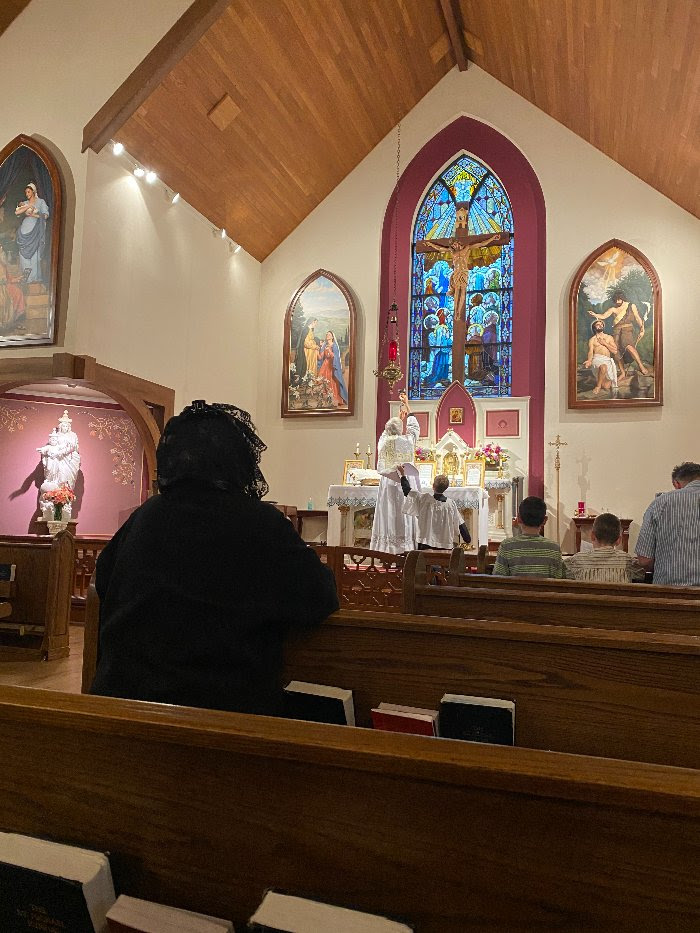
 The celebration this morning, Saturday, July 31, 2021, at 7 a.m. of a Mass or prayer for Pope Francis according to the old Tridentine rite, in the Church of St. John the Baptist Church in Front Royal, Virginia, USA, at the head of the Shenandoah Valley. The Mass was attended by about 70 people. “In this case, the major lobby group in the Italian bishops’ conference was set against Summorum Pontificum, mainly because in Italy, rather later than in France, young priests were beginning to celebrate the traditional Mass and to adopt more traditional ideas. They noticed a “traditionalization” of the seminaries, which worried them greatly. In the Curia as well, people like Cardinal Parolin, Cardinal Stella in the Congregation for Clergy, etc., were also very concerned.” —Fr. Claude Barthe, a French priest who has been a leading proponent of the old Mass in France, in a recent interview in the French journal Présent, translated into English by Rorate Caeli here. His point is that Pope Francis did not decide to publish his decree just on his own, but was urged to do so by these Italians prelates in his inner circle ”The Virginian? He may not realize it yet, but he is the last hope of the Third Revolution. The First Revolution was won at Yorktown. The Second Revolution was lost at Appomattox. The Third Revolution will begin there, in the Shenandoah Valley.” —The late Walker Percy, a Catholic convert who won the National Book Award in 1962 for his novel The Moviegoer, in his later novel, Lancelot (NY: Farrar, Straus and Giroux, 1977), p. 220. Christendom College was founded in the Shenandoah Valley in 1977 Letter #78, 2021, Saturday, July 31: Italians were “the moving force” behind publication of Traditionis custodes on July 16, a French priest says First, a brief note: a Mass in the Tridentine rite for Pope Francis was celebrated this morning at 7 a.m. in the Church of St. John the Baptist in the town of Front Royal, Virginia, not far from Christendom College. The Mass was attended by about 70 people. Second, an announcement: later today will come the text of a new letter by Archbishop Viganò on the liturgical question in a wider context. ======================= Italian Bishops and Cardinals were the origin and moving force behind Traditionis Custodes (an Interview with Fr. Claude Barthe) Rorate Caeli wrote yesterday (link): Fr. Claude Barthe is a seasoned veteran of the pre-Summorum“liturgical wars”, now rekindled by Francis in his edict “Traditionis custodes“. Living in Paris, Fr. Barthe was also the main chaplain for the Summorum Pontificum pilgrimages that took thousands of Traditional Catholics to pray and attend the Holy Mass in the Traditional Roman Rite in Saint Peter’s Basilica during the past decade. Fr. Barthe knows, therefore, all involved with the decision that led to the papal edict against the Traditional Mass. As he reveals (corroborated by several sources), the Italian bishops, and a couple of Italian cardinals in the Curia, were at the origin and the moving force behind this document. Let us pray.***Interview with Fr. Claude Barthe“Traditionis custodes: A New Liturgical War” With the motu proprio Traditionis Custodes published on July 16, Pope Francis “unravels” his predecessor Benedict XVI’s motu proprio Summorum Pontificum of July 7, 2007 by drastically limiting the celebration of the traditional Mass. Father, rumors about this motu proprio, which practically cancels Benedict XVI’s motu proprio of July 7, 2007, have been floating around for some time. Did you expect it to be published so soon, on July 16? Fr. Claude Barthe: None of us were quite sure. There had been various rumors. In Rome there was talk of an August publication, while others warned of an imminent publication. The latter version turned out to be true. The Secretariat of State, which led all this, was extremely discreet, it must be admitted. Recent events seemed to point towards the possibility of an appeasement — such as the words of Cardinal Gambetti, archpriest of St. Peter’s Basilica, who appealed to Summorum Pontificum in a recent interview on Vatican News. Were these hopes unfounded? Fr. Barthe: I don’t know what Cardinal Gambetti did or said to the Pope, but it is certain that requests were made to postpone this document so as not to start a new liturgical war in the Church. Notably, some say that Cardinal Ladaria, president of the Congregation for the Doctrine of the Faith, held it back as long as he could, as did others. In the end, the decision was made by the Pope and by those who lobbied him to take it, especially the Secretary of State, Cardinal Parolin, the substitute, Cardinal Peña Parra, Cardinal Versaldi, and others who were involved, that is, who participated in these inter-dicastery meetings (meetings between the prefects of the congregations concerned: Divine Worship, Clergy, Bishops, and the Secretariat of State) and who have been working on this document for a long time. How did the supporters of Francis’ motu proprio win through? Fr. Barthe:It was enough to convince the Pope! He has the power to go against anyone… In this case, the major lobby group in the Italian bishops’ conference was set against Summorum Pontificum, mainly because in Italy, rather later than in France, young priests were beginning to celebrate the traditional Mass and to adopt more traditional ideas. They noticed a “traditionalization” of the seminaries, which worried them greatly. In the Curia as well, people like Cardinal Parolin, Cardinal Stella in the Congregation for Clergy, etc., were also very concerned. What are their arguments for questioning Benedict XVI’s document? Fr. Barthe: They are laid out clearly in the accompanying letter. They can also be found on the blog of Andrea Grillo, a lay professor of liturgy at St. Anselm’s who has been extremely hostile to Summorum Pontificum. His idea, taken up by the Pope and the crafters of the recent motu proprio, is that the traditional Mass represents a state of doctrine prior to Vatican II while the new Mass represents the doctrine of Vatican II – something we all already knew. Therefore, it was no longer necessary for the traditional Mass to be a right, but only a tolerance, and even then a tolerance only granted to faithful and priests to help them gradually transition to the new Mass. So the main reason is doctrinal? Fr. Barthe: Yes, and it is very important to say this and to be aware of it because, paradoxically, this is all very providential. It is of course very painful. It will hinder the diffusion of the traditional Mass. It will start new persecutions. But, on the other hand, it puts the finger on what hurts, namely the doctrinal status of Vatican II, which has never been settled. How does this motu proprio affect the Ecclesia Dei communities — if we can still call them that? Fr. Barthe: It will affect them. They are also in the crosshairs, that’s for sure. The document says it clearly, the Pope’s letter indicates it in a cynical way. It is a question of destroying the traditional celebration of the Mass by ensuring there will be no more priests to celebrate it. These communities are particularly targeted because they are “factories” for such priests, as is the Society of St. Pius X, which was alone at the beginning. Henceforth, these institutes are no longer under the jurisdiction of Ecclesia Dei, which no longer exists, nor under the Congregation of the Faith, which is relatively protective, but under the jurisdiction of the Congregation for Religious. They’ve been reduced from their status of pontifical right. The Congregation for Religious, presided by Cardinal Braz de Aviz, is very much aligned with Francis and is going to get work to put things in order. For example, they will make canonical visits to the seminaries to verify that the teaching given there is in conformity with Vatican II, and to ensure they study and celebrate the new liturgy there. In short: the goal will be to discourage vocations. When we object: “But you are going to cause these institutes’ vocations to dry up”, they answer, “But we don’t need these people, they are useless.” (That was the actual response of a certain person I shall not name!). So for them, the good of souls is of little importance? Fr. Barthe: In fact, yes. For them, the good of souls is Vatican II. They prefer not to have priests than to have those they think are bad priests. It’s appalling – even diabolical. It has to be said: this pontificate is attacking every place where there is priestly renewal. The Franciscans of the Immaculate was one example, but there are many others. In fact, Benedict XVI’s motu proprio was never fully applied, but it did permit the application of John Paul II’s 1988 motu proprio. With Francis, are we now returning to the situation of the 1970s, the period right after the Council? Fr. Barthe: We have forgotten how terrible those times were to live through. It is different in the sense that 50 years have passed and the persecutors are much less strong than they were at that time. The conciliar Church is very sick, in some places it is dying, like in many French dioceses. It has no more troops, especially no more priests. For example, are we going back to the atrocious situation of the 1970s, when requests for a traditional funeral mass were systematically denied? Fr. Barthe: Theoretically, yes. The last motu proprio does not speak of this, but it speaks of things that are permitted, and this is not one of them. I shall celebrate a traditional funeral in Provence in a few days. Theoretically I could be forbidden. For a wedding planned for September, it’s the same thing. Even if you ask permission? Fr. Barthe:We ask permission for group Masses. In general, it is better not to ask for clarification, and just to do it… What will become of the authorization granted by Francis himself to the priests of the Society of St. Pius X to celebrate marriages and funerals in parishes? Isn’t there a contradiction there? Fr. Barthe: That hasn’t changed! Yes, there is a contradiction there… But will they still have the right to celebrate publicly in a parish? I repeat: it is better not to dig too deep for the moment. Each should interpret himself or leave it to the bishop to interpret, rather than getting into details. What do you think the bishops’ reactions will be? I am thinking of the Archbishop of Ferrara, not at all a conservative, who erected a personal parish for the extraordinary form 15 days before the Pope announced his document. Do you expect this kind of reaction? Fr. Barthe: The case of Ferrara is very interesting in many ways. It shows this “left-wing” bishop’s independence from Pope Francis. In Italy, and in the Curia, people are distancing themselves from the pontiff. They feel that he is at the end of his career and are thinking about the future. They find the present government chaotic, and they want something more serious, and more true liberalism. As for the Bishop of Ferrara, it is clear: aware of the document and knowing that personal parishes would no longer be allowed to be erected, he erected one immediately: it’s great! How do you imagine the French bishops will react? Fr. Barthe: Their reactions will vary. Some will use the Pope’s text to repress as much as possible. Others will simply be realistic, they will not want to light fires in their own homes. I am thinking of the bishop of Versailles, who has just published a communiqué that is a little difficult to interpret but which seems to say that nothing will happen for the moment. There are still others who are in favor, there is no doubt, of this traditional life in their dioceses, even if they do not share the ideas. They will circle the wagons, play for time… If they wanted to resist, they could do so, even canonically: Canon 87 paragraph 1 of Canon Law says that “A diocesan bishop, whenever he judges that it contributes to their spiritual good, is able to dispense the faithful from universal and particular disciplinary laws issued for his territory or his subjects by the supreme authority of the Church.” This opens up many possibilities. The bishop still has to want to act. Now, contrary to what we are told about synodality, it really only works one way, in favor of bishops who think like the pope. But when this is not the case… I’m reminded of the words of Archbishop Roche, the new prefect of the Congregation for Divine Worship, who recently said expressly – with a laugh: “We are going to destroy Summorum Pontificum. Liturgical power will be given to the bishops… but not to the conservative bishops!” St. Pius V specifying that this Mass cannot be abrogated, Paul VI forbidding it, Benedict XVI re-establishing it, Francis again seeking to make it disappear: how can the Church’s decisions be taken seriously under these conditions? Fr. Barthe: You are right. We must review the text of Quo Primum and what exactly St. Pius V says: he is saying that no one can prevent a priest from celebrating this Mass, no matter where he is in the Church, in order to oblige him to say it in one of the particular rites (Lyon, etc.)… Aren’t we there in a certain way? Fr. Barthe: In a certain way, we are there, indeed. The Mass of Saint Pius V, when it was abrogated by Paul VI (because it was abrogated, it must be said, Jean Madiran rightly pointed it out), was identical, almost in detail, to what it was in the eleventh century. Benedict XVI, in Summorum Pontificum, said that it had never been abrogated. Then Francis again abrogates it… That doesn’t sound very serious. We come back to the fact that all experiments are permitted, including blessings of homosexual couples (forbidden by the Church), except “the experiment of Tradition”, according to the expression of Archbishop Lefebvre… Fr. Barthe: Everything is allowed, any heresy can be professed by men of the Church , who still get to keep their Catholic “identity card” – except those who celebrate or attend the traditional Mass. No, they are accused by the Pope himself of tearing apart the unity of the Church. So, the bottom line is that this hatred of the traditional Mass has a doctrinal basis? Fr. Barthe: Absolutely. It is the hatred of the Tridentine ecclesiology, of all that this Mass represents from the point of view of Eucharistic doctrine as well as the doctrine of the Church. Father, as chaplain of the Summorum Pontificum pilgrimage, often mentioned in our pages, you are well placed to answer us. Does this pilgrimage have a bright future ahead of it? Fr. Barthe: Who knows? Let’s wait and see! [Original publication in French by Présent; translation by Zachary Thomas.]
 Abigail Shrier is a journalist and author. She received her A.B. from Columbia College, where she was a Euretta J. Kellett Fellow; her B.Phil. from the University of Oxford; and her J.D. from Yale Law School, where she was a Coker Fellow. A member of the Board of Advisors of the Foundation Against Intolerance and Racism, she has written for numerous publications, including City Journal, Newsweek, RealClearPolitics, The Federalist, the New York Post, and The Wall Street Journal. She is the author of Irreversible Damage: The Transgender Craze Seducing Our Daughters.




 Class—the Word We Dare Not SpeakThe Left does not wish to admit it has become the party of wealth.

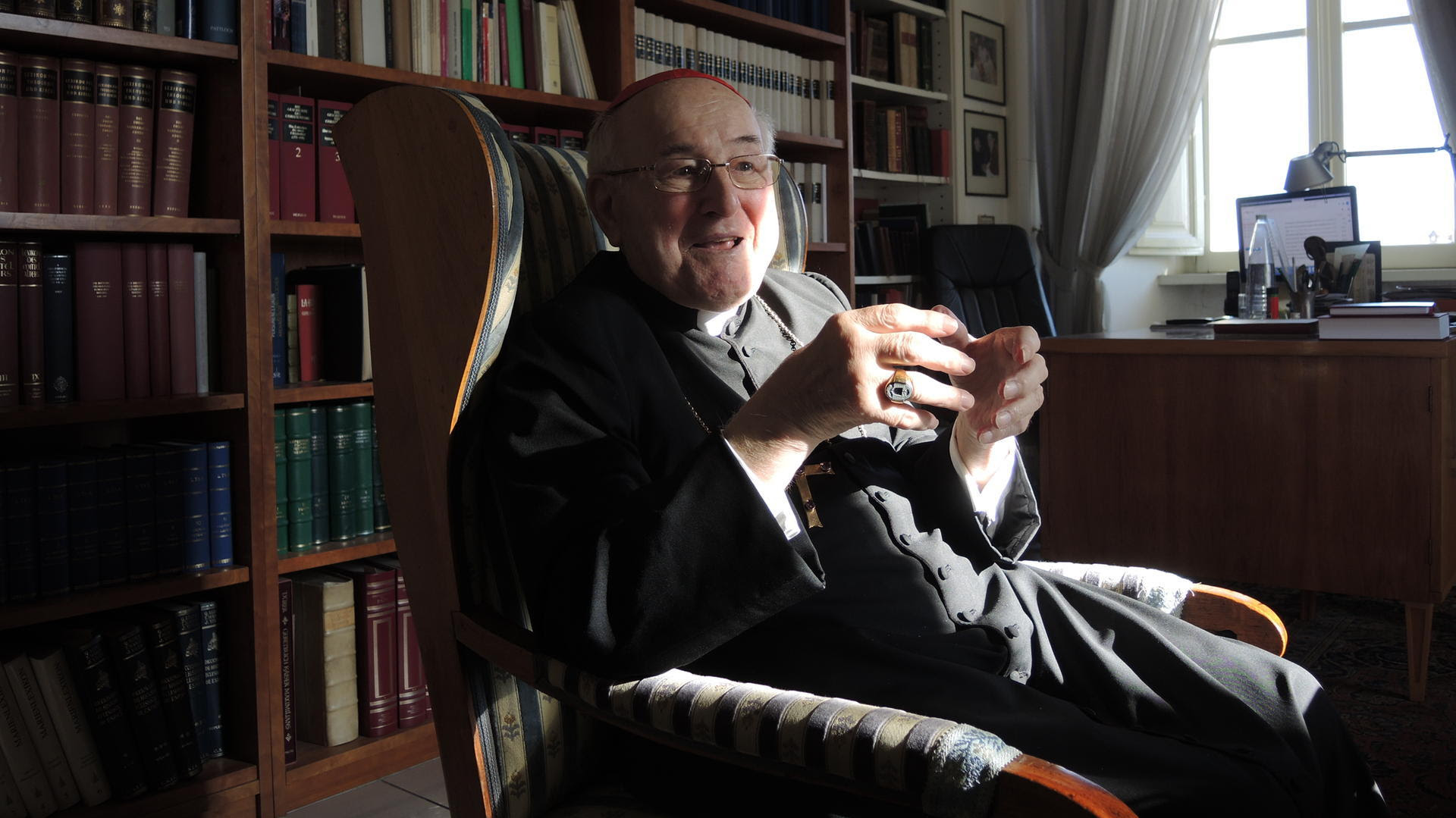
 Four images of Cardinal Walter Brandmüller, 92, in his book-filled cardinal’s apartment next to St. Peter’s Basilica, inside the Vatican, and in Rome (the bottom photo). Brandmüller has just written an important, thoughtful essay on the liturgy (see below). *** Walter Brandmüller is a 92-year-old German cardinal, an eminent professor of history, and profoundly respected for his scholarly research over many decades. He was for 11 years (1998-2009) President of the Pontifical Committee for Historical Sciences, making him, in a sense (in a sense) the leading Catholic historian in the world.(!) It would not be too much to say that, thought he is now quite old at 92, Brandmüller remains among the most respected scholars in the College of Cardinals. *** Pope Benedict had great esteem for Brandmüller, so he honored him by choosing to make him a cardinal on November 20, 2010.(Brandmüller was already past age 80, so he did not vote in the 2013 papal conclave.) *** Brandmüller was born on January 5, 1929, in Ansbach, Germany. His episcopal motto is “Ignem in Terram” which means (“(To cast) fire upon the Earth”) — the words Christ used to describe the purpose of his own mission in Luke’s Gospel, Chapter 12, Verses 49 to 53 (see below for the whole passage). He was 10 years old when the Second World War began in 1939, and 16 when it ended in 1945. He was ordained a priest on July 26, 1953, at the age of 24, in Bamberg by Joseph Otto Kolb, Archbishop of Bamberg. He did pastoral work in the church of St. John, Kronach, 1953–1957, and in that of St. Martin, Bamberg, 1957–1960. Thereafter he did further studies in Munich and served as Professor of Church History and Patrology at the University of Dillingen (1969-1971), and from 1971 until his retirement in 1997 he was Professor of Modern and Medieval Church History at the University of Augsburg, while also serving as parish priest of the Church of the Assumption, Walleshausen, Diocese of Augsburg. A specialist in the history of Church Councils, he is founder and editor of the journal Annuarium conciliorum historiae (Paderborn, 1969); and of the series “Konziliengeschichte” (1979), which has published 37 volumes so far. From 1981 to 1998, he was a member of the Pontifical Committee for Historical Sciences. So, he is a truly great scholar. On 22 July 1990, he received the Cross of the Order of Merit of the Federal Republic of Germany from president Richard von Weizsäcker. *** He has been a canon of the chapter of the St. Peter’s Basilica since 1997 (this means that he lives in Rome, inside Vatican City, just 20 steps from St. Peter’s Basilica, and is present for all the major ceremonies in the basilica. In fact, Brandmüller lives just a few steps from the Domus Santa Marta, and his apartment window looks out over the Domus, just a few steps away, where Pope Francis lives. Brandmüller can see the Pope’s apartment window from his own apartment window…) In September 2016, Brandmüller, along with Cardinals Carlo Caffarra (now deceased), Raymond Burke and Joachim Meisner (now deceased) submitted to Pope Francis a private letter with five dubia (“doubts” or “questions”) seeking clarification on various points of doctrine in the Pope’s apostolic exhortation Amoris laetitia. (So, he is one of the two “dubia cardinals” still living.) The first dubium concerned the reception of the sacraments by the divorced and remarried; the other four asked about fundamental issues of the Christian life, and referenced Pope John Paul II‘s encyclical Veritatis splendor (which had been largely written by Cardinal Joseph Ratzinger). In November 2016, having not received a response, they publicized their letter, entitled
  ABYSSUS ABYSSUM INVOCAT / DEEP CALLS TO DEEP
You must be logged in to post a comment.