THE CATHOLIC MONITOR

Fred Martinez

SEARCH

Lifesite News’ Msgr. Pope Commenting on the Francis’s “Latest Temper Tantrum Aimed at the TLM”

A reader of the Catholic Monitor texted the following to us today:

Msgr. Pope’s article at Lifesite News would like us to know he is “grieved and stunned” by Bergoglio’s latest temper tantrum aimed at the TLM

I would like to ask Msgr. Pope what planet he’s been inhabiting since the fateful day the Argentinian first appeared on the loggia.  

Stop for a moment of silence, ask Jesus Christ what He wants you to do now and next. In this silence remember God, Father, Son and Holy Ghost – Three Divine Persons yet One God, has an ordered universe where you can know truth and falsehood as well as never forget that He wants you to have eternal happiness with Him as his son or daughter by grace. Make this a practice. By doing this you are doing more good than reading anything here or anywhere else on the Internet.

Francis Notes:

– Doctor of the Church St. Francis de Sales totally confirmed beyond any doubt the possibility of a heretical pope and what must be done by the Church in such a situation:

“[T]he Pope… WHEN he is EXPLICITLY a heretic, he falls ipso facto from his dignity and out of the Church, and the Church MUST either deprive him, or, as some say, declare him deprived, of his Apostolic See.”
(The Catholic Controversy, by St. Francis de Sales, Pages 305-306)

Saint Robert Bellarmine, also, said “the Pope heretic is not deposed ipso facto, but must be declared deposed by the Church.”
[https://archive.org/stream/SilveiraImplicationsOfNewMissaeAndHereticPopes/Silveira%20Implications%20of%20New%20Missae%20and%20Heretic%20Popes_djvu.txt]

– “If Francis is a Heretic, What should Canonically happen to him?”: http://www.thecatholicmonitor.com/2020/12/if-francis-is-heretic-what-should.html

– “Could Francis be a Antipope even though the Majority of Cardinals claim he is Pope?”: http://www.thecatholicmonitor.com/2019/03/could-francis-be-antipope-even-though.html

 –  LifeSiteNews, “Confusion explodes as Pope Francis throws magisterial weight behind communion for adulterers,” December 4, 2017:

The AAS guidelines explicitly allows “sexually active adulterous couples facing ‘complex circumstances’ to ‘access the sacraments of Reconciliation and the Eucharist.'”

–  On February 2018, in Rorate Caeli, Catholic theologian Dr. John Lamont:

“The AAS statement… establishes that Pope Francis in Amoris Laetitia has affirmed propositions that are heretical in the strict sense.”

– On December 2, 2017, Bishop Rene Gracida:

“Francis’ heterodoxy is now official. He has published his letter to the Argentina bishops in Acta Apostlica Series making those letters magisterial documents.”

Pray an Our Father now for the restoration of the Church by the bishops by the grace of God.

Election Notes: 

– Intel Cryptanalyst-Mathematician on Biden Steal: “212Million Registered Voters & 66.2% Voting,140.344 M Voted…Trump got 74 M, that leaves only 66.344 M for Biden” [http://catholicmonitor.blogspot.com/2020/12/intel-cryptanalyst-mathematician-on.html?m=1]

– Will US be Venezuela?: Ex-CIA Official told Epoch Times “Chávez started to Focus on [Smartmatic] Voting Machines to Ensure Victory as early as 2003”: http://catholicmonitor.blogspot.com/2020/12/will-us-be-venezuela-ex-cia-official.html– Tucker Carlson’s Conservatism Inc. Biden Steal Betrayal is explained by “One of the Greatest Columns ever Written” according to Rush: http://catholicmonitor.blogspot.com/2021/01/tucker-carlsons-conservatism-inc-biden.html?m=1 – A Hour which will Live in Infamy: 10:01pm November 3, 2020: 
http://www.thecatholicmonitor.com/2021/01/a-hour-which-will-live-in-infamy-1001pm.html?m=1 What is needed right now to save America from those who would destroy our God given rights is to pray at home or in church and if called to even go to outdoor prayer rallies in every town and city across the United States for God to pour out His grace on our country to save us from those who would use a Reichstag Fire-like incident to destroy our civil liberties. [Is the DC Capitol Incident Comparable to the Nazi Reichstag Fire Incident where the German People Lost their Civil Liberties?http://catholicmonitor.blogspot.com/2021/01/is-dc-capital-incident-comparable-to.html?m=1 and Epoch Times Show Crossroads on Capitol Incident: “Anitfa ‘Agent Provocateurs‘”: 
http://catholicmonitor.blogspot.com/2021/01/epoch-times-show-crossroads-on-capital.html?m=1
Pray an Our Father now for the grace to know God’s Will and to do it. SHARE

Posted in Uncategorized | Comments Off on


Pelosi Lies Again About Her Catholic Status
July 22, 2021
Catholic League president Bill Donohue comments on Rep. Nancy Pelosi’s Catholicity:
House Speaker Nancy Pelosi lied again on July 22 when she described herself as “a devout Catholic.”
Addressing the subject of abortion, she said, “As a devout Catholic and mother of five in six years, I feel that God blessed my husband and me with our beautiful family—five children in six years almost to the day. But that may not be what we should—and it’s not up to me to dictate that that’s what other people should do, and it’s an issue of fairness and justice for poorer women in our country.”
The Cambridge English Dictionary defines “devout” as meaning “believing strongly in a religion and obeying all its rules or principles.” Pelosi does not obey the teachings of the Catholic Church on many key  public policy issues.
Her enthusiasm for abortion is off-the-charts. She opposes laws that ban the killing of babies who are 80 percent born (partial birth abortion), and she even won Planned Parenthood’s highest award in 2014. In 2008, she stunned Tom Brokaw on “Meet the Press” when she falsely claimed that the Catholic Church has not taken a position on when life begins; the bishops unloaded on her for lying. That is not how “devout Catholics” act.
Pelosi not only rejects the Church’s teaching on marriage, she lied in 2015 when she said that her support for same-sex marriage is “consistent” with Catholic teaching. Last year she declared war on Catholic schools when she sought to rescind funding for Catholic schools that were granted money by the Coronavirus Aid, Relief, and Economic Security (CARES) Act. That is not how “devout Catholics” act.
Pelosi also lied when she said she does not want to “dictate” to others what they should do. Last September, she sought to dictate to San Francisco Archbishop Salvatore Cordileone what to do about Mass attendance during the pandemic. To be exact, she lectured him for opposing the mayor’s rule that only one person at a time was allowed inside churches to pray. That is not how “devout Catholics” act.
Pelosi’s remark that she supports abortion rights out of “fairness and justice for poorer women in our country” needs explaining.
Why didn’t she say it is an issue of “fairness and justice for all women”? Quite frankly, it sounds racist. Is that her way of “taking care of the urban problem”? After all, population control of African Americans is what galvanized Margaret Sanger to found Planned Parenthood.
Non-Catholics, never mind Catholics, know Pelosi is lying about her Catholic status. So does she.
Contact her chief of staff: terri.mccullough@mail.house.gov
Posted in Uncategorized | 1 Comment

    Italian Professor Massimo Viglione. He has just written a reflection on the liturgy. The reflection was published on the website of Italian Catholic journalist Aldo Maria Valli, who is a friend of Archbishop Viganò. The text below is introduced by Valli, and also by Archbishop Viganò. Viglione has often expressed on the internet his appreciation for the writings of Archbishop Viganò. Here is a recent link to a video of Viglione, speaking in Italian, on the old liturgy. One of the points Viglione makes in the video is that many charge Catholic traditionalists with being “disobedient” with regard to the progressive decisions of the post-conciliar Church, and by extension with regard to Pope Paul VI and Pope Francis, but, he says, many progressive bishops and theologians were for years rebellious or “disobedient” to the requests of Pope Benedict XVI to be charitable toward the desires of the traditionalists to preserve the old liturgy. In other words, he argues that two different measures have been used in judging the obedience of Catholics to the Popes (link)        Letter #62, 2021, Thursday, July 22: Viglione        ”This great and powerful article by Professor Massimo Viglioneconstitutes one of the most lucid and profound comments on the ominous Motu Proprio Traditionis Custodes.”—Archbishop Carlo Maria Viganò    ***    Introduction by Archbishop Carlo Maria Viganò    This great and powerful article by Professor Massimo Viglioneconstitutes one of the most lucid and profound comments on the ominous Motu Proprio Traditionis Custodes. In sharing this important intervention, I intend to offer it to the reading and reflection of all the faithful, Catholics and also non-Catholics, so that each one can draw from it prophetic clarity and apostolic courage in the very hard war that we are all called to face, a war whose inevitable outcome will be the triumph of the Bride of Christ over the unleashing of the infernal powers.    This article by Prof. Viglione deserves wide visibility also for showing the overall vision on the simultaneous and coherent strategy and action of the deep state and the deep church. At a time when discrimination against the unvaccinated is also adopted by the Bergoglian church, it is our duty and responsibility to resist with the utmost determination, raise our voices, denouncing what is happening and revealing what is being prepared.    + Carlo Maria Viganò, Archbishop (link)    =================    Hatred for the Mass of all time and the Question of Obedience    First published at Duc in altum (“Set out into the deep”)    Introduction by Aldo Maria Valli    Dear friends of Duc in altum, Massimo Viglione has written this article after the publication of Traditionis Custodes. It is one of the most complete and lucid analyses that we have read commenting on the papal provision against the Mass of all time. In addition to a comprehensive analysis (in which the liturgical problem is joined to that of the imposition of the New World Order), I would like to draw your attention to his reflection on the question of obedience. —AMV    ***    “They will throw you out of the synagogues” (Jn 16:2)    The hermeneutic of Cain’s envy against Abel    by Massimo Viglione     There have been many comments, one after the other, in these days following the official declaration of war – made by Francishimself – of the ecclesiastical hierarchy against the Holy Mass of all time.     And more than one comment has revealed the not-at-all concealed contempt and the simultaneous absolute clarity of content and form that marks the Motu Proprio Traditionis Custodes, written in a style and formality that is political more than theological or spiritual.     It is in effect a declaration of war.     It is noteworthy that there is a formal difference and also a difference in tone found in the various documents with which Paul VI, beginning in 1964, announced, planned, and implemented his liturgical reform, which was finally made official with the Apostolic Constitution Missale Romanum issued on 3 April 1969, by which the ancient Roman Rite was de facto replaced (this is the most appropriate term both from the point of view of intentions as well as facts) with the new vulgar Rite.     In the Montinian documents we find, on several occasions, hypocritical but evident pain, regret, and remorse, and paradoxically the beauty and sacredness of the ancient Rite are celebrated.    In short, it is as if Montini [that is, Pope Paul VI, whose original name before he was Pope was Giovanni Montini (1897-1978)] had said: “Dear Rite of all time, I am sending you away, but you were so beautiful!”    In contrast, in the Bergoglian document, as many have noted, sarcasm and hatred for the ancient Rite shine through. A hatred such that it cannot be contained.    Naturally, Francis is not the initiator of this war, which was begun by the modernist liturgical movement (or, if you like, with Protestantism), but rather, on the official and operative level, it was Paul VI himself.     Bergoglio has only – to use the strong and popular metaphor – “shot madly” in an effort to kill once and for all a mortally wounded thing that in the course of the post-conciliar decades not only did not die but returned to life, dragging along with it, with an exponential crescendo in the last 14 years, an incalculable number of faithful all over the world.    And this is the crux of the whole matter.     The progressive and more convinced modernist clergy had to suffer Benedict XVI’s Motu Proprio, dragged by the neck, but at the same time they constantly worked against the Mass of all time through hostile resistance by the majority of the world episcopate, which has always openly disobeyed what Summorum Pontificumestablished, beginning right in the years of the Ratzingerian pontificate, and then all the more so after the resignation up until today.    The hostility of the bishops meant that in the end the task of putting the Motu Proprio into action very often fell to the courage of a few priests celebrating it anyway, even without the permission of the bishop (which was specifically not necessary according to the provisions of Summorum Pontificum).     Now, those bishops who have been constantly and undauntedly disobedient to the Supreme Pontiff of the Catholic Church and one of his Motu Proprios, in the name of obedience to the Supreme Pontiff of the Catholic Church and one of his Motu Proprios, will be able not only to continue but even to intensify their censorship, the war that is no longer hidden but is now blatant, as is in fact already happening.    But Francis has not limited himself to “shooting” the immortal victim. He wanted to take a further step, that of a fast and furious – to say nothing of monstruous – “burying alive” of the ancient rite, affirming that the new rite is the Lex Orandi of the Catholic Church. From which it should be deduced that the Mass of all time is no longer the Lex Orandi.    It is well known that Our Friend [Bergoglio] doesn’t have a clue about theology (which is a bit like saying that a doctor doesn’t have a clue about medicine, or that a blacksmith doesn’t know how to use fire and iron).     The Lex Orandi of the Church, in fact, is not a “precept” of positive law voted on by a parliament or prescribed by a sovereign, which can always be retracted, changed, replaced, improved, or worsened.     The Lex Orandi of the Church, furthermore, is not a specific and determined “thing” in time and space, as much as it is the collective whole of theological and spiritual norms and liturgical and pastoral practices of the entire history of the Church, from evangelical times – and specifically from Pentecost – up to today.     Although it obviously lives in the present, it is however rooted in the entire past of the Church. Therefore, we are not talking here about something human – exclusively human – that the latest boss can change at his pleasure.     The Lex Orandi comprises all twenty centuries of the history of the Church, and there is no man or group of men in the world who can change this twenty-century-old deposit.     There is no pope, council, or episcopate that can change the Gospel, the Depositum Fidei, or the universal Magisterium of the Church.     Nor can the Liturgy of all time be changed.     And if it is true that the ancient Rite had an essential apostolic core that then harmonically grew over the course of the centuries, with progressive mutations (even up to Pius XII and John XXIII), it is also true that these mutations – at times more appropriate and other times less so, and sometimes perhaps not appropriate at all – have always been however harmonically structured in a continuum of Faith, Sacredness, Tradition, and Beauty.    The Montinian reform broke all this apart, improvisedly inventing a new rite adapted to the needs of the modern world and transforming the sacred Catholic Liturgy from being theocentric to being anthropocentric.     From the Holy Sacrifice of the Cross repeated in an unbloody manner through the action of the sacerdos, we transitioned to the assembly of the faithful led by its “presider.”     From a salvific and even exorcistic instrument, we passed to a horizontal populist gathering, susceptible to continual autocephalous and relativistic changes and adaptations that are more or less “festive” and whose supposed “value” is based on winning mass consensus, as if it were a political instrument aimed at the audience, an audience however that is progressively completely disappearing.     It is useless to continue on this path: the very results of this liturgical subversion speak to minds and hearts and cannot lie.     What it is important to clarify however is the reason for this transition from Montinian hypocrisy to Bergoglian sincerity.    What has changed?     The general climate has changed.     It has literally turned upside down.     Montini believed that in a few years no one would remember the Mass of all time.     Already John Paul II, faced with the evidence that the enemy did not die at all, was constrained – he too dragged by the neck – to grant an “indult” (as if the Sacred Catholic Liturgy of all time needed to be forgiven for something in order to continue to exist) which (no one ever says this) was even more restrictive than this latest Bergoglian document, although devoid of the hatred that characterizes the latter.     But above all it was the uncontainable success among the people – and in particular among young people – that the Mass of all time found after Benedict XVI’s Motu Proprio that was the triggering factor for this hatred.     The “new Mass” has lost in the face of history and the evidence of the facts.     The churches are empty, ever more empty; the religious orders – even, and perhaps above all, the most ancient and glorious ones – are disappearing; monasteries and convents are deserted, inhabited only by religious who are now very advanced in years, and upon whose death the doors will be shuttered; vocations are reduced to nothing; even the “otto per mille” [Italian church tax] has been cut in half, despite the obsessive cloying and pathetic third-worldesque publicity it receives; priestly vocations are scarce – everywhere we see pastors with three, four, or at times even five parishes to run.     The mathematics of the Council and the “new Mass” is the most merciless thing that can exist.    But the failure is above all qualitative, from the theological, spiritual and moral point of view.     Even the clergy that exists and resists is in large part openly heretical or in any case tolerant of heresy and error in the exact measure that it is intolerant towards the Tradition, no longer recognizing any objective value in the Magisterium of the Church (except for what pleases it), living instead on theological and dogmatic improvisation, and liturgical and pastoral improvisation as well, all based on doctrinal and moral relativism, accompanied by an immense flood of chatter and empty and inane slogans; nor have we even mentioned the devastating – when it is not monstruous – moral situation of a good part of this clergy.    It’s true, there are the so-called “movements” that save the situation a little.     But they save it at the cost, once again, of doctrinal relativism, liturgical relativism (guitars, tambourines, entertainment, “participation”), and moral relativism (the only sin is to go against the dictates of this society: today against the vaccine; everything else is more or less permitted).     Are these movements still Catholic? And in what measure and quality?    If we were to analyze their fidelity with theological and doctrinal precision, how many would pass the examination?    “Lex orandi, lex credenda,” the Church teaches.     And in fact, the Lex Orandi of the nineteen centuries prior to Vatican II and the Montinian liturgical reform have produced one type of faith, and the fifty years following it have produced another type of faith – and another type of Catholic.     “You will know them by their fruits” (Mt 7:16), the Founder of the Church taught.     Exactly.     The fruits of the total failure of modernism (or, if you like – for the most attentive and intelligent – the triumph of the true purposes of modernism), the fruits of the Second Vatican Council, the fruits of the post-council.     Where did the hermeneutic of continuity shipwreck?     It shipwrecked, along with “Mercy,” in the Hermeneutic of Hatred.    The Mass of all time, on the other hand, is the exact antithesis of all this.     It is disruptive in its propagation, despite all of the constant hostility and episcopal censorship; it is sanctifying in its perfection; it is engaging precisely because it is the expression of the Eternal and Unchanging, of the Church of all time, of the theology and spirituality of all time, of the liturgy of all time, of the morality of all time.     It is loved because it is divine, sacred, and hierarchically ordered, not human, “democratic” or liberal-egalitarian.     It is both divine and human together, like its Founder on the day of the Last Supper.    It is loved above all by young people, both the laity who frequent it as well as among those are approaching the priesthood: while the seminaries of the new rite (the Lex Orandi of Bergoglio) are dens of heresy and apostasy (and it is better to be silent about what else…), the seminaries and novitiates of the world of Tradition overflow with vocations, both male and female, in an unstoppable stream.     The explanation of this incontrovertible fact is found in the one Lex Orandi of the Catholic Church, which is the one willed by God Himself and from which no rebel may escape.    Here is the root of the hatred.     It is the worldwide and multi-generational consensus against the enemy who must die, in the face of the failure of that which was supposed to bring new life and instead is withered and dying, because the lifeblood of Grace is missing.    It is hatred of kneeling girls wearing white veils, hatred of ladies with many children wearing black veils; hatred of men kneeling in prayer and recollection, perhaps with the rosary between their hands; hatred of priests in cassocks who are faithful to the doctrine and spirituality of all time; hatred of families that are large and peaceful despite the difficulties of this society; hatred of fidelity, of seriousness, of the thirst for the sacred.    It is hatred of an entire world, ever more numerous, that has not fallen – or no longer falls – into the humanistic and globalist trap of the “New Pentecost.”    At its root, that mad shooting is nothing other than a new murder of Abel by an envious Cain.     And in fact, in the new Rite what is offered to God is “the fruit of the earth and the work of human hands (Cain), while in the Rite of all time what is offered is “hanc immaculatam Ostiam” (the firstborn Lamb of Abel: Gen 4:2-4).    Cain always wins momentarily through violence, but then without fail he suffers the punishment of his hatred and his envy.     Abel dies momentarily, but then he lives forever in the sequela Christi [“followers of Christ,” “disciples of Christ”].    What will happen now?    This is a more interesting and inevitable question than anyone can believe, and at many levels.     Since we cannot know the future, let’s ask ourselves some fundamental questions in the meantime.    Will all the bishops obey?    It seems not.     Apart from the great majority of them, who will fall in line quite willingly either because they share their boss’s hatred (almost all of them) or because they are afraid for their personal future, we think that there will be not a few of them who could also oppose the Bergoglian “machine gun,” as already appears to be happening in various cases in the USA and in France (we have little hope for the Italians, who are the most fearful and flattened as always), either because they are not hostile in principle [to the ancient rite] or else out of friendship with the various orders tied to the Mass of all time, or else perhaps – is this a vain hope? – out of a jolt of just pride in response to the humiliation, which could even be called grotesque, that they have received at the hands of this document, wherein first it says that the decision regarding the granting of permission falls to them, but then not only does it restrict every liberty of action, placing conditions on any minimal possibility of choice, but it also falls into the most blatant contradiction, affirming that in every case they must receive the permission of the Holy See!    Will everyone really obey blindly, or will some cracks start to make the system of hatred shake?    And what will happen in the so-called “traditionalist” world?    “We will see some good ones,” to use a popular expression.     Without excluding historical twists.     There are those who will fall, who will survive, who perhaps will benefit from it (but beware of the poisoned meatballs of the servants of the Father of Lies!).     Instead, let us trust in divine Grace, so that the faithful not only remain faithful but also grow.    All this will be confirmed above all by an aspect that up until now no one has highlighted: the true goal of this multi-decade war against the Sacred Catholic Liturgy, which then is the true goal of the creation of the New Rite ex nihilo (better to say improvisedly [a tavolino (“at a little table”)], is the dissolution of the Catholic Liturgy in itself, of every form of the Holy Sacrifice, of doctrine itself, of the Church herself in the great globalist current of the universal religion of the New World Order.    Concepts like the Most Holy Trinity, the Cross, original sin, Good and Evil understood in the Christian and traditional sense, the Incarnation, the Resurrection and thus the Redemption, the Marian privileges and the very figure of the Mother of God who is the Immaculate Conception, the Eucharist and the Sacraments, Christian morality with its Ten Commandments and the Doctrine of the Universal Magisterium (defense of life, of the family, of rightly ordered sexuality in all its forms, with all the consequent condemnations of today’s follies) – all of this must disappear into the universal and monist cult of the future.    And, in this perspective, the Mass of all time is the first element that must disappear, since it is the absolute bulwark of all that they want to make disappear: it is the first obstacle to every form of ecumenism.     Over time, this will inevitably involve a progressive movement closer to the Sacred Liturgy of all time by the body of the faithful who still linger in attendance at the new Rite, perhaps trying to go to those priests who celebrate it with dignity.     Because in the end, sooner or later, even those priests will find themselves at the crossroads of having to choose between obedience to evil or disobedience in order to remain faithful to the Good.     The comb of the Revolution, in society as in the Church, does not leave any knots: sooner or later they all fall out, if not here then there.     And this will involve the search by the good ones, who are still confused, for Truth and Grace – that is, for the Mass of all time.      Those who still linger today [at the new rite], so as not to have to deal with these “questions,” following these bishops and parish priests, know that, if they want to remain truly Catholic and truly avail themselves of the Body and Blood of the Redeemer…their days are numbered. Soon, they will have to choose.     We have now touched on the central problem of this entire situation: how to behave in the face of a hierarchy that hates the True, the Good, the Beautiful, the Tradition, which fights against the one true Lex Orandi in order to impose another one that is pleasing not to God but to the prince of this world and his “controller” servants (in a certain sense, his “bishops”)?    It is the key problem of obedience, over which even in the world of Tradition a dirty game is often played, often incited not by a sincere search for what is best and for the truth but by personal wars, which have today become more acute in the face of the rift caused by health totalitarianism and vaccination.    Obedience – and this is an error that finds its deepest roots even in the pre-conciliar Church, it must be said – is not an end. It is a means of sanctification.     Therefore, it is not an absolute value, but rather an instrumental one.     It is a positive value, very positive, if it is ordered towards God.     But if one obeys Satan, or his servants, or error, or apostasy, then obedience is no longer a good, but rather a deliberate participation in evil.    Exactly like peace.     Peace – the divinity of today’s subversion – is not an end, but rather an instrument of the Good and the Just, if it is aimed at creating a good and just society.     If it is ordered towards creating or favoring a society that is Satanic, malignant, erroneous, and subversive, then “peace” becomes the instrument of hell.     We must be “pleasing not to men, but to God, who tests our hearts” (1 Thess 2:4).     Exactly!     Therefore, whoever obeys men while being aware of facilitating evil and obstructing the Good, whoever they may be – including the ecclesiastical hierarchy, including the pope – in reality becomes an accomplice of evil, of lies, and of error.    Whoever obeys in these conditions disobeys God. “Because no slave is greater than his master” (Mt 10:24).     Even Judas was part of the apostolic college. Or else he falls into hypocrisy.     As if – just to give an example from academia – a Catholic traditionalist, self-erected as the dispenser and judge of the seriousness of others, would openly criticize the present pontiff for Amoris Laetitiae or this latest document, but then, as regards the submission – even obligatory submission! – to vaccinism in itself and the acceptance of the use of human cell lines obtained from fetuses that are the victims of voluntary abortion, he would declare, in order to defend himself in the face of just and obvious general indignation, that he is obedient to what the “Sovereign Pontiff” says on this matter. [Editor’s note: Viglione in this paragraph seems to be making an oblique reference, which many readers may not catch, to statements made by Italian Catholic historian Dr. Roberto de Mattei, who proposed the theory that Archbishop Viganò was not the true author of the letters he was publishing under his name (and so “not serious” — this is the reference to “the seriousness of others”), a charge Viganò vigorously denied (link); Dr. de Mattei has also changed his position in recent on the morality of using certain vaccines, even if they derive, perhaps remotely, from aborted human fetal cells.—RM)    The conditio sine qua non of all seriousness lies not so much in the “tones” used (also, this is an important aspect but absolutely not primary and above all it remains subjective) but first and foremost in the doctrinal, ideal, and intellectual coherence of the Good and the Truth in their integrity, in every aspect and circumstance.     In other words, we must understand whether the one who guides the Church today wishes to be a faithful servant of God or a faithful servant of the Prince of this world.     In the first hypothesis, obedience is due to him and obedience is the instrument of sanctification.     In the second, the consequences have to be drawn out.     Clearly, in respect for the norms codified by the Church and as children of the Church and also with the proper education and serenity of tone.     But one must always draw out the consequences: the first concern ought to be to always follow and defend the Truth, not the cloying, obsequious, and scrupulous groveling which is the spoiled fruit of a misunderstood Tridentinism.     Neither pope nor hierarchy can be used as a referent of truth in fits and starts according to one’s personal ends.    ***    We are in the most decisive days of human history and also of the history of the Church.     All of the authors who have commented in these days invite their readers to prayer and hope.     We will obviously do this too, in the full conviction that everything that is happening in these days and, more generally, since February 2020, is the unequivocal sign that the times are drawing near in which God will intervene to save His Mystical Body and humanity, as well as the order that He Himself has given to creation and to human coexistence, in the measure He wishes to give it, in the way and time of His choosing.    Let us pray; let us hope; let us keep vigil, and let us choose to be on the right side. The enemy helps us in the choice: in fact, he is always the same everywhere.    [End, Viglione
Posted in Uncategorized | Comments Off on

    Italian Professor Massimo Viglione. He has just written a reflection on the liturgy. The reflection was published on the website of Italian Catholic journalist Aldo Maria Valli, who is a friend of Archbishop Viganò. The text below is introduced by Valli, and also by Archbishop Viganò. Viglione has often expressed on the internet his appreciation for the writings of Archbishop Viganò. Here is a recent link to a video of Viglione, speaking in Italian, on the old liturgy. One of the points Viglione makes in the video is that many charge Catholic traditionalists with being “disobedient” with regard to the progressive decisions of the post-conciliar Church, and by extension with regard to Pope Paul VI and Pope Francis, but, he says, many progressive bishops and theologians were for years rebellious or “disobedient” to the requests of Pope Benedict XVI to be charitable toward the desires of the traditionalists to preserve the old liturgy. In other words, he argues that two different measures have been used in judging the obedience of Catholics to the Popes (link)        Letter #62, 2021, Thursday, July 22: Viglione        ”This great and powerful article by Professor Massimo Viglioneconstitutes one of the most lucid and profound comments on the ominous Motu Proprio Traditionis Custodes.”—Archbishop Carlo Maria Viganò    ***    Introduction by Archbishop Carlo Maria Viganò    This great and powerful article by Professor Massimo Viglioneconstitutes one of the most lucid and profound comments on the ominous Motu Proprio Traditionis Custodes. In sharing this important intervention, I intend to offer it to the reading and reflection of all the faithful, Catholics and also non-Catholics, so that each one can draw from it prophetic clarity and apostolic courage in the very hard war that we are all called to face, a war whose inevitable outcome will be the triumph of the Bride of Christ over the unleashing of the infernal powers.    This article by Prof. Viglione deserves wide visibility also for showing the overall vision on the simultaneous and coherent strategy and action of the deep state and the deep church. At a time when discrimination against the unvaccinated is also adopted by the Bergoglian church, it is our duty and responsibility to resist with the utmost determination, raise our voices, denouncing what is happening and revealing what is being prepared.    + Carlo Maria Viganò, Archbishop (link)    =================    Hatred for the Mass of all time and the Question of Obedience    First published at Duc in altum (“Set out into the deep”)    Introduction by Aldo Maria Valli    Dear friends of Duc in altum, Massimo Viglione has written this article after the publication of Traditionis Custodes. It is one of the most complete and lucid analyses that we have read commenting on the papal provision against the Mass of all time. In addition to a comprehensive analysis (in which the liturgical problem is joined to that of the imposition of the New World Order), I would like to draw your attention to his reflection on the question of obedience. —AMV    ***    “They will throw you out of the synagogues” (Jn 16:2)    The hermeneutic of Cain’s envy against Abel    by Massimo Viglione     There have been many comments, one after the other, in these days following the official declaration of war – made by Francishimself – of the ecclesiastical hierarchy against the Holy Mass of all time.     And more than one comment has revealed the not-at-all concealed contempt and the simultaneous absolute clarity of content and form that marks the Motu Proprio Traditionis Custodes, written in a style and formality that is political more than theological or spiritual.     It is in effect a declaration of war.     It is noteworthy that there is a formal difference and also a difference in tone found in the various documents with which Paul VI, beginning in 1964, announced, planned, and implemented his liturgical reform, which was finally made official with the Apostolic Constitution Missale Romanum issued on 3 April 1969, by which the ancient Roman Rite was de facto replaced (this is the most appropriate term both from the point of view of intentions as well as facts) with the new vulgar Rite.     In the Montinian documents we find, on several occasions, hypocritical but evident pain, regret, and remorse, and paradoxically the beauty and sacredness of the ancient Rite are celebrated.    In short, it is as if Montini [that is, Pope Paul VI, whose original name before he was Pope was Giovanni Montini (1897-1978)] had said: “Dear Rite of all time, I am sending you away, but you were so beautiful!”    In contrast, in the Bergoglian document, as many have noted, sarcasm and hatred for the ancient Rite shine through. A hatred such that it cannot be contained.    Naturally, Francis is not the initiator of this war, which was begun by the modernist liturgical movement (or, if you like, with Protestantism), but rather, on the official and operative level, it was Paul VI himself.     Bergoglio has only – to use the strong and popular metaphor – “shot madly” in an effort to kill once and for all a mortally wounded thing that in the course of the post-conciliar decades not only did not die but returned to life, dragging along with it, with an exponential crescendo in the last 14 years, an incalculable number of faithful all over the world.    And this is the crux of the whole matter.     The progressive and more convinced modernist clergy had to suffer Benedict XVI’s Motu Proprio, dragged by the neck, but at the same time they constantly worked against the Mass of all time through hostile resistance by the majority of the world episcopate, which has always openly disobeyed what Summorum Pontificumestablished, beginning right in the years of the Ratzingerian pontificate, and then all the more so after the resignation up until today.    The hostility of the bishops meant that in the end the task of putting the Motu Proprio into action very often fell to the courage of a few priests celebrating it anyway, even without the permission of the bishop (which was specifically not necessary according to the provisions of Summorum Pontificum).     Now, those bishops who have been constantly and undauntedly disobedient to the Supreme Pontiff of the Catholic Church and one of his Motu Proprios, in the name of obedience to the Supreme Pontiff of the Catholic Church and one of his Motu Proprios, will be able not only to continue but even to intensify their censorship, the war that is no longer hidden but is now blatant, as is in fact already happening.    But Francis has not limited himself to “shooting” the immortal victim. He wanted to take a further step, that of a fast and furious – to say nothing of monstruous – “burying alive” of the ancient rite, affirming that the new rite is the Lex Orandi of the Catholic Church. From which it should be deduced that the Mass of all time is no longer the Lex Orandi.    It is well known that Our Friend [Bergoglio] doesn’t have a clue about theology (which is a bit like saying that a doctor doesn’t have a clue about medicine, or that a blacksmith doesn’t know how to use fire and iron).     The Lex Orandi of the Church, in fact, is not a “precept” of positive law voted on by a parliament or prescribed by a sovereign, which can always be retracted, changed, replaced, improved, or worsened.     The Lex Orandi of the Church, furthermore, is not a specific and determined “thing” in time and space, as much as it is the collective whole of theological and spiritual norms and liturgical and pastoral practices of the entire history of the Church, from evangelical times – and specifically from Pentecost – up to today.     Although it obviously lives in the present, it is however rooted in the entire past of the Church. Therefore, we are not talking here about something human – exclusively human – that the latest boss can change at his pleasure.     The Lex Orandi comprises all twenty centuries of the history of the Church, and there is no man or group of men in the world who can change this twenty-century-old deposit.     There is no pope, council, or episcopate that can change the Gospel, the Depositum Fidei, or the universal Magisterium of the Church.     Nor can the Liturgy of all time be changed.     And if it is true that the ancient Rite had an essential apostolic core that then harmonically grew over the course of the centuries, with progressive mutations (even up to Pius XII and John XXIII), it is also true that these mutations – at times more appropriate and other times less so, and sometimes perhaps not appropriate at all – have always been however harmonically structured in a continuum of Faith, Sacredness, Tradition, and Beauty.    The Montinian reform broke all this apart, improvisedly inventing a new rite adapted to the needs of the modern world and transforming the sacred Catholic Liturgy from being theocentric to being anthropocentric.     From the Holy Sacrifice of the Cross repeated in an unbloody manner through the action of the sacerdos, we transitioned to the assembly of the faithful led by its “presider.”     From a salvific and even exorcistic instrument, we passed to a horizontal populist gathering, susceptible to continual autocephalous and relativistic changes and adaptations that are more or less “festive” and whose supposed “value” is based on winning mass consensus, as if it were a political instrument aimed at the audience, an audience however that is progressively completely disappearing.     It is useless to continue on this path: the very results of this liturgical subversion speak to minds and hearts and cannot lie.     What it is important to clarify however is the reason for this transition from Montinian hypocrisy to Bergoglian sincerity.    What has changed?     The general climate has changed.     It has literally turned upside down.     Montini believed that in a few years no one would remember the Mass of all time.     Already John Paul II, faced with the evidence that the enemy did not die at all, was constrained – he too dragged by the neck – to grant an “indult” (as if the Sacred Catholic Liturgy of all time needed to be forgiven for something in order to continue to exist) which (no one ever says this) was even more restrictive than this latest Bergoglian document, although devoid of the hatred that characterizes the latter.     But above all it was the uncontainable success among the people – and in particular among young people – that the Mass of all time found after Benedict XVI’s Motu Proprio that was the triggering factor for this hatred.     The “new Mass” has lost in the face of history and the evidence of the facts.     The churches are empty, ever more empty; the religious orders – even, and perhaps above all, the most ancient and glorious ones – are disappearing; monasteries and convents are deserted, inhabited only by religious who are now very advanced in years, and upon whose death the doors will be shuttered; vocations are reduced to nothing; even the “otto per mille” [Italian church tax] has been cut in half, despite the obsessive cloying and pathetic third-worldesque publicity it receives; priestly vocations are scarce – everywhere we see pastors with three, four, or at times even five parishes to run.     The mathematics of the Council and the “new Mass” is the most merciless thing that can exist.    But the failure is above all qualitative, from the theological, spiritual and moral point of view.     Even the clergy that exists and resists is in large part openly heretical or in any case tolerant of heresy and error in the exact measure that it is intolerant towards the Tradition, no longer recognizing any objective value in the Magisterium of the Church (except for what pleases it), living instead on theological and dogmatic improvisation, and liturgical and pastoral improvisation as well, all based on doctrinal and moral relativism, accompanied by an immense flood of chatter and empty and inane slogans; nor have we even mentioned the devastating – when it is not monstruous – moral situation of a good part of this clergy.    It’s true, there are the so-called “movements” that save the situation a little.     But they save it at the cost, once again, of doctrinal relativism, liturgical relativism (guitars, tambourines, entertainment, “participation”), and moral relativism (the only sin is to go against the dictates of this society: today against the vaccine; everything else is more or less permitted).     Are these movements still Catholic? And in what measure and quality?    If we were to analyze their fidelity with theological and doctrinal precision, how many would pass the examination?    “Lex orandi, lex credenda,” the Church teaches.     And in fact, the Lex Orandi of the nineteen centuries prior to Vatican II and the Montinian liturgical reform have produced one type of faith, and the fifty years following it have produced another type of faith – and another type of Catholic.     “You will know them by their fruits” (Mt 7:16), the Founder of the Church taught.     Exactly.     The fruits of the total failure of modernism (or, if you like – for the most attentive and intelligent – the triumph of the true purposes of modernism), the fruits of the Second Vatican Council, the fruits of the post-council.     Where did the hermeneutic of continuity shipwreck?     It shipwrecked, along with “Mercy,” in the Hermeneutic of Hatred.    The Mass of all time, on the other hand, is the exact antithesis of all this.     It is disruptive in its propagation, despite all of the constant hostility and episcopal censorship; it is sanctifying in its perfection; it is engaging precisely because it is the expression of the Eternal and Unchanging, of the Church of all time, of the theology and spirituality of all time, of the liturgy of all time, of the morality of all time.     It is loved because it is divine, sacred, and hierarchically ordered, not human, “democratic” or liberal-egalitarian.     It is both divine and human together, like its Founder on the day of the Last Supper.    It is loved above all by young people, both the laity who frequent it as well as among those are approaching the priesthood: while the seminaries of the new rite (the Lex Orandi of Bergoglio) are dens of heresy and apostasy (and it is better to be silent about what else…), the seminaries and novitiates of the world of Tradition overflow with vocations, both male and female, in an unstoppable stream.     The explanation of this incontrovertible fact is found in the one Lex Orandi of the Catholic Church, which is the one willed by God Himself and from which no rebel may escape.    Here is the root of the hatred.     It is the worldwide and multi-generational consensus against the enemy who must die, in the face of the failure of that which was supposed to bring new life and instead is withered and dying, because the lifeblood of Grace is missing.    It is hatred of kneeling girls wearing white veils, hatred of ladies with many children wearing black veils; hatred of men kneeling in prayer and recollection, perhaps with the rosary between their hands; hatred of priests in cassocks who are faithful to the doctrine and spirituality of all time; hatred of families that are large and peaceful despite the difficulties of this society; hatred of fidelity, of seriousness, of the thirst for the sacred.    It is hatred of an entire world, ever more numerous, that has not fallen – or no longer falls – into the humanistic and globalist trap of the “New Pentecost.”    At its root, that mad shooting is nothing other than a new murder of Abel by an envious Cain.     And in fact, in the new Rite what is offered to God is “the fruit of the earth and the work of human hands (Cain), while in the Rite of all time what is offered is “hanc immaculatam Ostiam” (the firstborn Lamb of Abel: Gen 4:2-4).    Cain always wins momentarily through violence, but then without fail he suffers the punishment of his hatred and his envy.     Abel dies momentarily, but then he lives forever in the sequela Christi [“followers of Christ,” “disciples of Christ”].    What will happen now?    This is a more interesting and inevitable question than anyone can believe, and at many levels.     Since we cannot know the future, let’s ask ourselves some fundamental questions in the meantime.    Will all the bishops obey?    It seems not.     Apart from the great majority of them, who will fall in line quite willingly either because they share their boss’s hatred (almost all of them) or because they are afraid for their personal future, we think that there will be not a few of them who could also oppose the Bergoglian “machine gun,” as already appears to be happening in various cases in the USA and in France (we have little hope for the Italians, who are the most fearful and flattened as always), either because they are not hostile in principle [to the ancient rite] or else out of friendship with the various orders tied to the Mass of all time, or else perhaps – is this a vain hope? – out of a jolt of just pride in response to the humiliation, which could even be called grotesque, that they have received at the hands of this document, wherein first it says that the decision regarding the granting of permission falls to them, but then not only does it restrict every liberty of action, placing conditions on any minimal possibility of choice, but it also falls into the most blatant contradiction, affirming that in every case they must receive the permission of the Holy See!    Will everyone really obey blindly, or will some cracks start to make the system of hatred shake?    And what will happen in the so-called “traditionalist” world?    “We will see some good ones,” to use a popular expression.     Without excluding historical twists.     There are those who will fall, who will survive, who perhaps will benefit from it (but beware of the poisoned meatballs of the servants of the Father of Lies!).     Instead, let us trust in divine Grace, so that the faithful not only remain faithful but also grow.    All this will be confirmed above all by an aspect that up until now no one has highlighted: the true goal of this multi-decade war against the Sacred Catholic Liturgy, which then is the true goal of the creation of the New Rite ex nihilo (better to say improvisedly [a tavolino (“at a little table”)], is the dissolution of the Catholic Liturgy in itself, of every form of the Holy Sacrifice, of doctrine itself, of the Church herself in the great globalist current of the universal religion of the New World Order.    Concepts like the Most Holy Trinity, the Cross, original sin, Good and Evil understood in the Christian and traditional sense, the Incarnation, the Resurrection and thus the Redemption, the Marian privileges and the very figure of the Mother of God who is the Immaculate Conception, the Eucharist and the Sacraments, Christian morality with its Ten Commandments and the Doctrine of the Universal Magisterium (defense of life, of the family, of rightly ordered sexuality in all its forms, with all the consequent condemnations of today’s follies) – all of this must disappear into the universal and monist cult of the future.    And, in this perspective, the Mass of all time is the first element that must disappear, since it is the absolute bulwark of all that they want to make disappear: it is the first obstacle to every form of ecumenism.     Over time, this will inevitably involve a progressive movement closer to the Sacred Liturgy of all time by the body of the faithful who still linger in attendance at the new Rite, perhaps trying to go to those priests who celebrate it with dignity.     Because in the end, sooner or later, even those priests will find themselves at the crossroads of having to choose between obedience to evil or disobedience in order to remain faithful to the Good.     The comb of the Revolution, in society as in the Church, does not leave any knots: sooner or later they all fall out, if not here then there.     And this will involve the search by the good ones, who are still confused, for Truth and Grace – that is, for the Mass of all time.      Those who still linger today [at the new rite], so as not to have to deal with these “questions,” following these bishops and parish priests, know that, if they want to remain truly Catholic and truly avail themselves of the Body and Blood of the Redeemer…their days are numbered. Soon, they will have to choose.     We have now touched on the central problem of this entire situation: how to behave in the face of a hierarchy that hates the True, the Good, the Beautiful, the Tradition, which fights against the one true Lex Orandi in order to impose another one that is pleasing not to God but to the prince of this world and his “controller” servants (in a certain sense, his “bishops”)?    It is the key problem of obedience, over which even in the world of Tradition a dirty game is often played, often incited not by a sincere search for what is best and for the truth but by personal wars, which have today become more acute in the face of the rift caused by health totalitarianism and vaccination.    Obedience – and this is an error that finds its deepest roots even in the pre-conciliar Church, it must be said – is not an end. It is a means of sanctification.     Therefore, it is not an absolute value, but rather an instrumental one.     It is a positive value, very positive, if it is ordered towards God.     But if one obeys Satan, or his servants, or error, or apostasy, then obedience is no longer a good, but rather a deliberate participation in evil.    Exactly like peace.     Peace – the divinity of today’s subversion – is not an end, but rather an instrument of the Good and the Just, if it is aimed at creating a good and just society.     If it is ordered towards creating or favoring a society that is Satanic, malignant, erroneous, and subversive, then “peace” becomes the instrument of hell.     We must be “pleasing not to men, but to God, who tests our hearts” (1 Thess 2:4).     Exactly!     Therefore, whoever obeys men while being aware of facilitating evil and obstructing the Good, whoever they may be – including the ecclesiastical hierarchy, including the pope – in reality becomes an accomplice of evil, of lies, and of error.    Whoever obeys in these conditions disobeys God. “Because no slave is greater than his master” (Mt 10:24).     Even Judas was part of the apostolic college. Or else he falls into hypocrisy.     As if – just to give an example from academia – a Catholic traditionalist, self-erected as the dispenser and judge of the seriousness of others, would openly criticize the present pontiff for Amoris Laetitiae or this latest document, but then, as regards the submission – even obligatory submission! – to vaccinism in itself and the acceptance of the use of human cell lines obtained from fetuses that are the victims of voluntary abortion, he would declare, in order to defend himself in the face of just and obvious general indignation, that he is obedient to what the “Sovereign Pontiff” says on this matter. [Editor’s note: Viglione in this paragraph seems to be making an oblique reference, which many readers may not catch, to statements made by Italian Catholic historian Dr. Roberto de Mattei, who proposed the theory that Archbishop Viganò was not the true author of the letters he was publishing under his name (and so “not serious” — this is the reference to “the seriousness of others”), a charge Viganò vigorously denied (link); Dr. de Mattei has also changed his position in recent on the morality of using certain vaccines, even if they derive, perhaps remotely, from aborted human fetal cells.—RM)    The conditio sine qua non of all seriousness lies not so much in the “tones” used (also, this is an important aspect but absolutely not primary and above all it remains subjective) but first and foremost in the doctrinal, ideal, and intellectual coherence of the Good and the Truth in their integrity, in every aspect and circumstance.     In other words, we must understand whether the one who guides the Church today wishes to be a faithful servant of God or a faithful servant of the Prince of this world.     In the first hypothesis, obedience is due to him and obedience is the instrument of sanctification.     In the second, the consequences have to be drawn out.     Clearly, in respect for the norms codified by the Church and as children of the Church and also with the proper education and serenity of tone.     But one must always draw out the consequences: the first concern ought to be to always follow and defend the Truth, not the cloying, obsequious, and scrupulous groveling which is the spoiled fruit of a misunderstood Tridentinism.     Neither pope nor hierarchy can be used as a referent of truth in fits and starts according to one’s personal ends.    ***    We are in the most decisive days of human history and also of the history of the Church.     All of the authors who have commented in these days invite their readers to prayer and hope.     We will obviously do this too, in the full conviction that everything that is happening in these days and, more generally, since February 2020, is the unequivocal sign that the times are drawing near in which God will intervene to save His Mystical Body and humanity, as well as the order that He Himself has given to creation and to human coexistence, in the measure He wishes to give it, in the way and time of His choosing.    Let us pray; let us hope; let us keep vigil, and let us choose to be on the right side. The enemy helps us in the choice: in fact, he is always the same everywhere.    [End, Viglione
Posted in Uncategorized | Comments Off on

    The cover of Monsignor Annibale Bugnini‘s classic work, The Reform of the Liturgy1948-1975 (Liturgical Press, Collegeville, Minnesota, 1990). Bugnini lived from 1912 to 1982 (link). Here is a link to a brief biography (link). Bugnini was for almost 30 years, from 1948 to 1975, the key Vatican figure in organizing the reform of the liturgy, which became the “new Mass”     Pope Pius V (1504-1572), born Antonio Ghislieri (from age 14 known as Michele Ghislieri, O.P.), standardized the Holy Mass by promulgating the 1570 edition of the Roman MissalPius V made this Missal mandatory throughout the Latin rite of the Catholic Church, except where a Mass liturgy dating from before 1370 AD was in use. This form of the Mass remained essentially unchanged for 400 years until Pope Paul VI‘s revision of the Roman Missal in 1969–70, after which it has become widely known as the Tridentine Mass        ”Upon assuming the papacy, Ghislieri (Pope Pius V) immediately started to get rid of many of the extravagant luxuries then prevalent in the court. One of his first acts was to dismiss the papal court jester, and no Pope after had one. He forbade horse racing in St. Peter’s Square. Severe sanctions were imposed against blasphemy, adultery, and sodomy. These laws quickly made Pius V the subject of Roman hatred; he was accused of trying to turn the city into a vast monastery. He was not a hypocrite: in day-to-day life Pius V was highly ascetic. He wore a hair shirt beneath the simple habit of a Dominican friar and was often seen in bare feet.” —the entry “Pope Pius V” in Wikipedia (link)    ”This ordinance applies henceforth, now, and forever, throughout all the provinces of the Christian world.” —Pope Pius V, in his Apostolic Constitution Quo Primum (“From the very first”), issued on July 14, 1570, 451 years and one week ago. The text is often understood to mean that, by the authority of this Pope, the liturgy of the old Mass — which this text codified — is valid in the Catholic Church “now and forever.” ===================        Letter #58, 2021, Tuesday, July 20: Reflections on Guardians of Tradition and Pope Pius V (link)    As I undertake to begin an exploration of what prompted the decision of Pope Francis last Friday, July 16, 2021, to repress the celebration of the old Latin Mass, I realize there are many points of information that must be gathered and presented so that readers may have a better sense of the context of this decision.    As I wrote yesterday, the “way of praying” (lex orandi) determines the “way of believing” (lex credendi).    I argued that the different rites of the Mass, or even the different ways of celebrating one rite, can, over time, alter the faith of those who celebrate or participate in those rites.    For example, a prayer, a Mass, can focus more on God, or on man… more on Christ and His life, death and resurrection, or more on the social issues, the social injustices, of the present time.    I argued that the reality of Christ, the memory of Christ, the encounter with Christ, is the essential characteristic of Christian prayer; that Christian prayer is “Christocentric” and that this type of prayer protects and deepens and gives strength to Christian faith (lex orandi, lex credendi).    Implicit in my argument was that the protection and deepening and strengthening of this faith, through Christocentric prayer, through Christocentric liturgy, through a Christocentric Mass, would bear the “good fruit” of a desire for social justice, of a sincere love for neighbor, which those who favor a “human-centric” liturgy say they seek.    In other words, I was arguing that the better way to true and effective action for “social justice” passes by way of true and profound contemplation of and encounter with Christ.    Also implicit in this way of argument was the posing of a question: had the Church, or the Church’s leaders, perhaps made a miscalculation when, in 1969-1970, they embraced the “new Mass,” saying they hoped to spark a renewal of commitment to social justice and human brotherhood, by setting the aside the “old Mass”?    It was a question, not an assertion.    It was a question prompted not by emotion, or religious fervor, or fanaticism, but by observing varying pieces of evidence.     One such piece of evidence is the fact — seemingly incontestable — that millions upon millions, tens upon tens of millions, of Catholics have ceased attending regular Sunday Mass since 1970, when the “new Mass” was promulgated throughout the world.    In the decades prior to the 1960s (and I realize that I may be thinking of a limited historical period, and that prior to the 20th century the situation may have been different) Catholics in many places were assiduous in attending Mass every single Sunday, if possible; so that it was not uncommon that a quite large percentage of Catholics in a parish or diocese, perhaps 50%, perhaps 75%, perhaps still more, would attend Sunday Mass.     But in many places today, Mass attendance has dropped to 30 percent of all Catholics, or 20 percent, or 10 percent, or even to a smaller percentage.    Church officials may insist that we call our time a “new springtime” in the liturgical life of the Church.     But if this is a new springtime, then it is an odd, harsh springtime, marked by bitter frosts which have left wilted plants.    Men may repeat hopeful phrases as often as they wish, but when those phrases are contradicted by actual evidence, evident to all, we may be in a situation similar to that of the boy in the fable who, when the king, who had been told by his courtiers that his garments were of the finest cloth, strutted by contentedly, cried out: “But the king has no clothes!”    The boy was young, so he spoke the truth.    Meanwhile, all the courtiers of the king told him lies, and he believed them.    Who was disloyal to the king? The boy who told him the truth, so that he could awaken from an illusion and clothe himself? Or the courtiers, who had no real interest in protecting the king from his embarrassing nudity, and the consequent amused mockery or pity of all who looked upon him?    The boy was in fact loyal.    In fact, the only one who was loyal.    ***    I think it is necessary to create the preconditions for a reasoned discussion of these matters by providing some texts.    It is not possible easily to give 2,000 years of history in a handful of email letters. Yet perhaps a few “fragments” may be helpful in “setting the stage” to prepare for a close reading of Monsignor Annibale Bugnini‘s book on the “reform” of that “new liturgy” of which he was the chief architect.    Therefore, below, I have given a “cornerstone” text: the Apostolic Constitution Quo Primum (“From the very first”), promulgated by Pope Pius V in 1570.    As I try to introduce that text, I apologize in advance for any over-simplifications. I am trying to sketch quickly, in broad strokes, in haste, in order to give a glimpse, not an exhaustive photograph. My goal is to reach forward to our present impasse as quickly as I can, though it may take a bit of time…    ***    The year of Quo Primum, 1570, was about 50 years after Martin Luther launched the Protestant Reformation (in 1517).    Part of that “reformation” had been a new understanding of the Mass, of the sacraments, of prayer, and therefore (again, lex orandi, lex credendi) of Christian faith itself.    The Church, and Europe, split apart.    King Henry VIII ordered St. Thomas More (and Bishop John Fisher) to be beheaded in 1535.     So the theological debates ended in the shedding of blood, the taking of the lives of holy men, and holy women…     The sorrow for these events remains after centuries…. and urges us not to repeat such tragedies.    ***    The division came, more or less, along a line that ran horizontally through Europe, with the north going Protestant and the south remaining Catholic.     My professor, Dr. Jaroslav Pelikan, a Lutheran who converted to Greek Orthodoxy in his later years — and who always encouraged me to try to find some way to mend, if possible, the torn fabric of Christendom — remarked with a chuckle (to make clear that he understand the words were whimsical): “Wherever they drank beer, they became Protestant; wherever they drank wine, they remained Catholic.” Perhaps it is a helpful way to catch at least a general glimpse of an extremely complex picture.    The Catholic Church spent the middle decades of the 1500s attempting to confront the consequences of the Protestant Reformation.     The Council of Trent (1545-1563, link) was “open” for… 18 years.(!)     In a sense, it was the “Vatican II” of that century.     And just as Vatican II attempted to chart a course for the Church in the wake of the colossally bloody First and Second World Wars, so the Council of Trent sought to chart a course in the wake of violent Protestant-Catholic clashes.    ***    The Catholic Church leaders of the 1500s could see that a single Christian culture in Europe which had (more or less) ruled the continent for 1,000 years(!), was now multiple.     Unity had been lost, with many political powers embracing one or another reformer, one or another Protestant denomination, until religion and politics led to terrible religious wars which raged on until the Peace of Westphalia in 1648.     That experience — of Protestant and Catholic armies slaughtering one another — was the source of the belief that “religious pluralism” was preferable to religious war, and underlay the belief of many in the ecumenical movement of the 20th century that Catholics and Protestants ought to “reason together” and recover a certain unity rather than fight with one another.     ***    Just after the close of the Council of Trent — which created an architecture of Church teaching against Protestantism we may perhaps liken to a massive fortress, or a stony castle on a windy hilltop, able to withstand hurricane winds of thought, speculation, heresy… an edifice, a castle, which stood for 400 years, until Vatican II, when some of the walls began, intentionally, to be dismantled, with varying results — Pius V attempted to bring “unity” by promulgating a decree establishing the Roman rite of the Mass for the entire Roman Catholic Church.     What he decreed was the celebration of… the old Latin Mass.     The Mass many of us attended as children (I myself did).     The old Mass Paul VI agreed to revise, or reform, relying principally on… Monsignor Bugnini (whose book we will soon study).    The old Mass which Pope Benedict revered and tried to protect in 2007.    The old Mass which Pope Francis has now, in 2021, announced he has decided is “divisive” and must be repressed — evidently, he wishes it to slowly disappear completely.     ***    It is my opinion that Pope Francis in this has been guided to some degree by others.     I say this because in July 2013, on the airplane returning from Brazil, Francis in a press conference — the same press conference where he said “who am I to judge” — gave a glowing testimony of respect to… the Byzantine liturgy(!)… which is very intricate, very ancient, very “vertical,” deeply “Christocentric,” and profoundly beautiful…     So I have some difficulty understanding why Francis, acting on his own, would have launched this uncompromising war on the old Roman Mass, which is the Latin counterpart to the Greek (Byzantine) liturgy, sharing in its antiquity, its Christocentrism, one liturgy Latin, the other Greek).    Here is what Francis said on that occasion:    ”In the Orthodox Churches, they have retained that pristine liturgy, which is so beautiful. We have lost some of the sense of adoration.     ”The Orthodox preserved it; they praise God, they adore God, they sing, time does not matter. God is at the centre, and I would like to say, as you ask me this question, that this is a richness.     ”Once, speaking of the Western Church, of Western Europe, especially the older Church, they said this phrase to me: Lux ex oriente, ex occidente luxus. [“Light from the East, from the West, luxury”].    ”Consumerism, comfort, they have done such harm. Instead, you retain this beauty of God in the centre, the reference point.     ”When reading Dostoevsky – I believe that for all of us he is an author that we must read and reread due to his wisdom – one senses what the Russian soul is, what the eastern soul is. It is something that does us much good.     ”We need this renewal, this fresh air from the East, this light from the East. John Paul II wrote about this in his Letter.     ”But many times the luxus of the West makes us lose this horizon. I don’t know, but these are the thoughts that come to me.”    ***        One important point to note: many say, wrongly, that the old Latin Mass “dates from 1570,” the year Pius V promulgated it.    No.    The old Mass dates at least to Pope St. Gregory the Great (590-604) a thousand years(!) before Pope Pius V, and, arguably, at least in part — and I realize details of this point are debated — all the way back to the Apostles, and so, to Christ Himself.    In other words, the Mass that Francis has decided — advised, I suggest, by his courtiers — to suppress, is the Mass of the Catholic Church since the beginning.    That is why it seems old — because it is old, very old.    And that is why I believe that Francis, if he were in coming weeks or months to reconsider his July 16 decree, reflecting on the value of old Mass as a counterpart to the Byzantine liturgy of St. John Chrysostom(composing it in about 400 A.D., but drawing on liturgical traditions dating back to Christ Himself)… might amend his decree.    ***    I say this also because of a personal experience.     Once, when staying in the Domus Santa Marta where Pope Francislives, my sons and I were guests in his house.    One morning after Mass, we three — my sons and myself — were alone in the Chapel before the Blessed Sacrament.    Francis came into the chapel.    There were no other guards, or priests, no one else at all.    Francis sat down a few feet from us, perhaps 10 feet away.    He bowed his head in prayer.     He prayed for 20 minutes, in silence.    We three quietly stood up and went out of the chapel. Francis remained alone in prayer.    After a few minutes, he came out and spoke kindly to the boys, who had just traveled on the Trans-Siberian railroad, and he asked them what they had seen in Russia and Ukraine, and they told him.    (This was in 2013, in the summer, just after the trip to Brazil mentioned above.)    =====================================             Here is the text of Quo Primum, issued by Pope Pius V on July 14, 1570, in which he says that the “old Latin Mass” is to be considered a Mass that may be celebrated by priests of the Roman Catholic Church “forever.”    ***    Quo Primum (“From the very first”)    Promulgating the Tridentine Liturgy    By Pope Pius V    July 14, 1570    APOSTOLIC CONSTITUTION    From the very first, upon Our elevation to the chief Apostleship, We gladly turned our mind and energies and directed all our thoughts to those matters which concerned the preservation of a pure liturgy, and We strove with God’s help, by every means in our power, to accomplish this purpose.     For, besides other decrees of the sacred Council of Trent, there were stipulations for Us to revise and re-edit the sacred books: the Catechism, the Missal and the Breviary.     With the Catechism published for the instruction of the faithful, by God’s help, and the Breviary thoroughly revised for the worthy praise of God, in order that the Missal and Breviary may be in perfect harmony, as fitting and proper – for its most becoming that there be in the Church only one appropriate manner of reciting the Psalms and only one rite for the celebration of Mass – We deemed it necessary to give our immediate attention to what still remained to be done, viz, the re-editing of the Missal as soon as possible.    Hence, We decided to entrust this work to learned men of our selection.     They very carefully collated all their work with the ancient codices in Our Vatican Library and with reliable, preserved or emended codices from elsewhere.     Besides this, these men consulted the works of ancient and approved authors concerning the same sacred rites; and thus they have restored the Missal itself to the original form and rite of the holy Fathers.     When this work has been gone over numerous times and further emended, after serious study and reflection, We commanded that the finished product be printed and published as soon as possible, so that all might enjoy the fruits of this labor; and thus, priests would know which prayers to use and which rites and ceremonies they were required to observe from now on in the celebration of Masses.    Let all everywhere adopt and observe what has been handed down by the Holy Roman Church, the Mother and Teacher of the other churches, and let Masses not be sung or read according to any other formula than that of this Missal published by Us.     This ordinance applies henceforth, now, and forever, throughout all the provinces of the Christian world, to all patriarchs, cathedral churches, collegiate and parish churches, be they secular or religious, both of men and of women – even of military orders – and of churches or chapels without a specific congregation in which conventual Masses are sung aloud in choir or read privately in accord with the rites and customs of the Roman Church.     This Missal is to be used by all churches, even by those which in their authorization are made exempt, whether by Apostolic indult, custom, or privilege, or even if by oath or official confirmation of the Holy See, or have their rights and faculties guaranteed to them by any other manner whatsoever.    This new rite alone is to be used unless approval of the practice of saying Mass differently was given at the very time of the institution and confirmation of the church by Apostolic See at least 200 years ago, or unless there has prevailed a custom of a similar kind which has been continuously followed for a period of not less than 200 years, in which most cases We in no wise rescind their above-mentioned prerogative or custom.     However, if this Missal, which we have seen fit to publish, be more agreeable to these latter, We grant them permission to celebrate Mass according to its rite, provided they have the consent of their bishop or prelate or of their whole Chapter, everything else to the contrary notwithstanding.    All other of the churches referred to above, however, are hereby denied the use of other missals, which are to be discontinued entirely and absolutely; whereas, by this present Constitution, which will be valid henceforth, now, and forever, We order and enjoin that nothing must be added to Our recently published Missal, nothing omitted from it, nor anything whatsoever be changed within it under the penalty of Our displeasure.    We specifically command each and every patriarch, administrator, and all other persons or whatever ecclesiastical dignity they may be, be they even cardinals of the Holy Roman Church, or possessed of any other rank or pre-eminence, and We order them in virtue of holy obedience to chant or to read the Mass according to the rite and manner and norm herewith laid down by Us and, hereafter, to discontinue and completely discard all other rubrics and rites of other missals, however ancient, which they have customarily followed; and they must not in celebrating Mass presume to introduce any ceremonies or recite any prayers other than those contained in this Missal.    Furthermore, by these presents [this law], in virtue of Our Apostolic authority, We grant and concede in perpetuity that, for the chanting or reading of the Mass in any church whatsoever, this Missal is hereafter to be followed absolutely, without any scruple of conscience or fear of incurring any penalty, judgment, or censure, and may freely and lawfully be used.     Nor are superiors, administrators, canons, chaplains, and other secular priests, or religious, of whatever title designated, obliged to celebrate the Mass otherwise than as enjoined by Us.     We likewise declare and ordain that no one whosoever is forced or coerced to alter this Missal, and that this present document cannot be revoked or modified, but remain always valid and retain its full force notwithstanding the previous constitutions and decrees of the Holy See, as well as any general or special constitutions or edicts of provincial or synodal councils, and notwithstanding the practice and custom of the aforesaid churches, established by long and immemorial prescription – except, however, if more than two hundred years’ standing.    It is Our will, therefore, and by the same authority, We decree that, after We publish this constitution and the edition of the Missal, the priests of the Roman Curia are, after thirty days, obliged to chant or read the Mass according to it; all others south of the Alps, after three months; and those beyond the Alps either within six months or whenever the Missal is available for sale.     Wherefore, in order that the Missal be preserved incorrupt throughout the whole world and kept free of flaws and errors, the penalty for nonobservance for printers, whether mediately or immediately subject to Our dominion, and that of the Holy Roman Church, will be the forfeiting of their books and a fine of one hundred gold ducats, payable ipso facto to the Apostolic Treasury.     Further, as for those located in other parts of the world, the penalty is excommunication latae sententiae, and such other penalties as may in Our judgment be imposed; and We decree by this law that they must not dare or presume either to print or to publish or to sell, or in any way to accept books of this nature without Our approval and consent, or without the express consent of the Apostolic Commissaries of those places, who will be appointed by Us. Said printer must receive a standard Missal and agree faithfully with it and in no wise vary from the Roman Missal of the large type (secundum magnum impressionem).    Accordingly, since it would be difficult for this present pronouncement to be sent to all parts of the Christian world and simultaneously come to light everywhere, We direct that it be, as usual, posted and published at the doors of the Basilica of the Prince of the Apostles, also at the Apostolic Chancery, and on the street at Campo Flora; furthermore, We direct that printed copies of this same edict signed by a notary public and made official by an ecclesiastical dignitary possess the same indubitable validity everywhere and in every nation, as if Our manuscript were shown there.     Therefore, no one whosoever is permitted to alter this notice of Our permission, statute, ordinance, command, precept, grant, indult, declaration, will, decree, and prohibition.     Would anyone, however, presume to commit such an act, he should know that he will incur the wrath of Almighty God and of the Blessed Apostles Peter and Paul.    Given at St. Peter’s in the year of the Lord’s Incarnation, 1570, on the 14th of July of the Fifth year of Our Pontificate.    
Posted in Uncategorized | Comments Off on

THE CATHOLIC MONITOR

5 Dubia Questions for Remnant Editor Michael Matt

“Excellent idea Fred! How about it Mr. Matt? I remember “Argument of the Month”. This should be right up your alley. Argument of the 21st Century perhaps?” – Catholic Monitor commenter Debbie

The Remnant editor Michael Matt is allowing free debate and argument on the validity of the papacy of Francis in his comment section as shown in some comments allowed in the recent “Traditionis Custodes: The New Atom Bomb” post. [https://remnantnewspaper.com/web/index.php/articles/item/5473-traditionis-custodes-the-new-atom-bomb]

So, this seems like a good time to see if Mr. Matt has more guts than Steve Skojec, the publisher of One Peter Five. The Catholic Monitor asks the Remnant editor to answer the following dubia questions that Skojec ran away from:

1. Doctor of the Church St. Francis de Sales said ” The Pope… when he is explicitly a heretic… the Church must either deprive him or as some say declare him deprived of his Apostolic See.” Was St. Francis de Sales a Sedevacantist or a Benevacantist? Answer: yes or no.

2. “Universal Acceptance” theologian John of St. Thomas said “This man in particular lawfully elected and accepted by the Church is the supreme pontiff.” Was John of St. Thomas for saying “the supreme pontiff” must be BOTH “lawfully elected and accepted by the Church” a Sedevacantist or a Benevacantist? Answer: yes or no.

3. Do you think that a “supreme pontiff” if “universally accepted” is still Pope if, to quote papal validity expert Arnaldo Xavier de Silveira on “dubious election[s]”, that he is “a woman… a child… a demented person… a heretic… a apostate… [which] would [thus] be invalid[ed] by divine law”? Answer: yes or no.

4. Renowned Catholic historian Warren Carroll agreed with Bishop René Gracida on the determining factor for discerning a valid conclave for a valid papal election besides divine law. Carroll pronounced:

“But each Pope, having unlimited sovereign power as head of the Church, can prescribe any method for the election of his successor(s) that he chooses… A papal claimant not following these methods is also an Antipope.”

Are renowned historian Carroll and Bishop Gracida for saying this Sedevacantists or Benevacantists? Answer: yes or no.

5. Is Bishop Gracida really only a pawn of the legendary and notorious “Sedevacantist and Benevacantist” mastermind Ann Barnhardt for convincingly demonstrating that there is valid evidence that Pope John Paul II’s conclave constitution “Universi Dominici Gregis” which “prescribe[d].. [the] method for the election of his successor(s)” was violated and must be investigated by Cardinals? Answer: yes or no. [https://www.thecatholicmonitor.com/2019/06/5-dubia-questions-for-steve-skojec.html]

Finally, last year we gave Matt some demands if he wanted the Catholic Monitor to “stand together” with him. Here is our slightly updated post to him from 2020:

Catholic Monitor’s Demands to the Remnant Editor Matt if he wants us to “Stand Together” with him

Could the Remnant editor Michael Matt’s “Francis is definitely pope” bias, that Francis is pope because that’s an infallible dogma of the Francis Creed, finally be starting to crack?
[Click here to read the Francis Creed: http://catholicmonitor.blogspot.com/2020/01/are-1p5-and-where-peter-is-going-to.html?m=1]

I know from someone who knows the inner workings of Matt’s editorship of the Remnant because she has written for him that he “has not allowed phrases like ‘questionably legal’” before in his newspaper or website that appeared in the article “APOSTASY AND OLD LACE: Do We Have an Uncle Benny Brewster in the Attic?”:

– “… Nearly seven years after his resignation from the Papacy, (questionably legal, but certainly effective) the good bishop has found himself to be in fine fiddle, enough to coauthor a new book with Robert Cardinal Sarah on priestly celibacy.”
[https://remnantnewspaper.com/web/index.php/headline-news-around-the-world/item/4732-apostasy-and-old-lace-do-we-have-an-uncle-benny-brewster-in-the-attic]

In fact, Matt in his latest YouTube video “DONALD TRUMP: Vatican Public Enemy No. 1” appears to be claiming he and the other “Francis is definitely pope” traditionalists may be willing to call a ceasefire and stop their attacks, misrepresentations and blacklisting of the BiP[Benedict is Pope] movement and the Bishop Rene Gracida movement. He said:

“I may have it wrong. You may have it wrong. But what is important, right now, is that we do not dogmatize opinion on some of this… Don’t panic. Stay close. Keep praying. Stay together. We can do that. We can all stand together. Do our part without anathematizing. Let’s give it a try.”
(“DONALD TRUMP: Vatican Public Enemy No. 1”: https://youtu.be/WBUHhQrct_M, 24:22-24:31 and 26:51-27:02])

Sadly, I am tempted to think Matt is using the “Good cop/bad cop” routine:

“The ‘bad cop’ takes an aggressive, negative stance towards the subject, making blatant accusations, derogatory comments, threats, and in general creating antipathy between the subject and themself. This sets the stage for the “good cop” to act sympathetically, appearing supportive and understanding, and in general showing sympathy for the subject. The good cop will also defend the subject from the bad cop. The subject may feel they can cooperate with the good cop either out of trust or out of fear of the bad cop. They may then seek protection by and trust the good cop and provide the information the interrogators are seeking.[3] “

“This technique also has its disadvantages in that it can be easily identified and the ‘bad cop’ may alienate the subject.[4]” [https://en.wikipedia.org/wiki/Good_cop/bad_cop]

I want to trust that Mr. Matt is being sincere, but as “President Ronald Reagan on several occasions in the context of nuclear disarmament discussions with the Soviet Union” said “trust, but verify.”
[https://en.wikipedia.org/wiki/Trust,_but_verify]

Unfortunately, too many of Matt’s traditionalist collaborators and even he by playing the bad cop too many times have lost our trust with such things as misrepresenting, attacking and blacklisting members of the BiP movement and the Bishop Gracida movement.

Matt’s long time collaborator, for example, Chris Ferrara used misrepresentation:

“Furthermore, the only time I have ever spoken face-to-face with Ann Barnhardt, at least that I can remember, was at Lake Garda, and the entire conversation involved my objection to her claim that the “data set” shows Bergoglio is not the Pope.  We have no competence to assemble “data sets” and declare that the Chair of Peter is vacant.”
[
http://stumblingblock.org/?p=15295]

He said that the Barnhardt position was “to declare the Chair of Peter is vacant.” The BIP position is the exact opposite of “declar[ing] that the Chair of Peter is vacant.”

Next, Matt has at no time condemned or at least distanced himself from the despicable and loathsome Alinsky tactics of One Peter Five publisher Steve Skojec. Br. Alexis Bugnolo explains the tactic and gives an example of which there are numerous (which, also, include attacks on Bishop Gracida):

“The recent attacks on Ann Barnhardt, chief of all, seem to be employing the Rules for Radicals. In Saul Alinsky’s Rules for Radicals, we have, for example, Rule 13, “Pick the target, freeze it, personalize it, and polarize it.”  This means, in regard to persons, to dissuade the public from consideration of the truths professed by an individual by attacking that individual on personal issues.”

“Then there is Rule 5, “Ridicule is man’s most potent weapon,” which has been honed into a fine art by Steve Skojec, editor and publisher of OnePeterFive.com — apparently a commercial site, because of its *.com, but in reality organized in US Law as a non-profit, where it appears from its tax filings 100% of funds raised, after expenses, go to Skojec or family members.*”

“Here is an example of that, in regard to Ann Barnhardt: 

Couldn’t care less. If you want the queen of Catholic online cancer, she’s it.

And Ferrara is infinitely more qualified on every topic she forgets 1 Tim 2:12 to bloviate about.
— Steve Skojec (@SteveSkojec) February 6,”  [https://fromrome.info/2020/02/09/alinskis-rules-for-radicals-used-against-the-church/]

Finally, the editor of the Remnant has not allowed free debate of the issues on his publication or website with real members of the BiP movement and the Bishop Gracida movement. He in his YouTube video mentioned as an example of free debate at the Remnant an article of Robert Siscoe which is a joke. Siscoe is a close collaborator of the disgraceful Skojec who in my opinion, also, misrepresents the issues. (See: Catholic Monitor, “Why are Skojec & Siscoe Afraid of a Conclave Investigation by Cardinals?”) [http://catholicmonitor.blogspot.com/2019/03/why-are-siscoe-and-skojec-apparently-so.html?m=1]

If you, Mr. Matt, are sincere and want us to “all stand together” then “stop dogmatiz[ing] opinion” and stop “anathematizing” and stop attacking, misrepresenting and blacklisting the BiP movement and the Bishop Gracida movement.

Here are the Catholic Monitor’s demands if you sincerely want me and my readers to “stand together” with you:

Demand number 1:

Condemned or at least distanced yourself in writing from the loathsome Alinsky tactics of One Peter Five publisher Skojec.

Demand number 2:

Have your writer Mr. Ferrara issue a apology and retraction to Miss Barnhardt for misrepresenting her position. 

Demand number 3:

Allow Bishop Gracida, Dr. Ed Mazza, Ann Barnhardt and Latin language expert Br. Bugnolo to publish articles in the Remnant and then get which ever expert you want and have an honest debate in your newspaper between them and your experts.

Lastly, Mr. Matt, if you really think we who follow Bishop Gracida, Br. Bugnolo as well as Miss Barnhardt are wrong and headed to hell for being in schism from Francis then out of simple charity for our souls you should honestly counter our dissertations and arguments.

If you really believe we are wrong and headed to hell and refuse to seriously give us real arguments then you apparently have lost the supernatural virtue of charity.

If you really believe what you are saying then for charity’s sake you should attempt to save us from hell for being in schism from Francis:

But, all we hear are straw man arguments that don’t counter our stated dissertations, name calling propaganda, blacklisting, silence or the noise of you running away as fast as you can from serious reasoned back and forth argumentation.

Just to give fair warning:

We are not going away.

We are growing.

Soon we will be to be too big to ignore.

As even Church Militant’s Michael Voris reported we are becoming the majority of faithful Catholics in Rome. The same thing is happening in the United States and if you can’t stop us now we will probably grow to be the majority of faithful Catholics in America.

Pray an Our Father now for the restoration of the Church as well as for the Triumph of the Kingdom of the Sacred Heart of the Jesus and the Immaculate of Mary.

Comments

Debbie said…

Excellent idea Fred! How about it Mr. Matt? I remember “Argument of the Month”. This should be right up your alley. Argument of the 21st Century perhaps? 

Stop for a moment of silence, ask Jesus Christ what He want you to do now and next. In this silence remember God, Father, Son and Holy Ghost – Three Divine Persons yet One God, has an ordered universe where you can know truth and falsehood as well as never forget that He wants you to have eternal happiness with Him as his son or daughter by grace. Make this a practice. By doing this you are doing more good than reading anything here or anywhere else on the Internet.

Francis Notes:

– Doctor of the Church St. Francis de Sales totally confirmed beyond any doubt the possibility of a heretical pope and what must be done by the Church in such a situation:

“[T]he Pope… WHEN he is EXPLICITLY a heretic, he falls ipso facto from his dignity and out of the Church, and the Church MUST either deprive him, or, as some say, declare him deprived, of his Apostolic See.”
(The Catholic Controversy, by St. Francis de Sales, Pages 305-306)

Saint Robert Bellarmine, also, said “the Pope heretic is not deposed ipso facto, but must be declared deposed by the Church.”
[https://archive.org/stream/SilveiraImplicationsOfNewMissaeAndHereticPopes/Silveira%20Implications%20of%20New%20Missae%20and%20Heretic%20Popes_djvu.txt]

– “If Francis is a Heretic, What should Canonically happen to him?”: http://www.thecatholicmonitor.com/2020/12/if-francis-is-heretic-what-should.html

– “Could Francis be a Antipope even though the Majority of Cardinals claim he is Pope?”: http://www.thecatholicmonitor.com/2019/03/could-francis-be-antipope-even-though.html

 –  LifeSiteNews, “Confusion explodes as Pope Francis throws magisterial weight behind communion for adulterers,” December 4, 2017:

The AAS guidelines explicitly allows “sexually active adulterous couples facing ‘complex circumstances’ to ‘access the sacraments of Reconciliation and the Eucharist.'”

–  On February 2018, in Rorate Caeli, Catholic theologian Dr. John Lamont:

“The AAS statement… establishes that Pope Francis in Amoris Laetitia has affirmed propositions that are heretical in the strict sense.”

– On December 2, 2017, Bishop Rene Gracida:

“Francis’ heterodoxy is now official. He has published his letter to the Argentina bishops in Acta Apostlica Series making those letters magisterial documents.”

Pray an Our Father now for the restoration of the Church by the bishops by the grace of God.

Election Notes: 

– Intel Cryptanalyst-Mathematician on Biden Steal: “212Million Registered Voters & 66.2% Voting,140.344 M Voted…Trump got 74 M, that leaves only 66.344 M for Biden” [http://catholicmonitor.blogspot.com/2020/12/intel-cryptanalyst-mathematician-on.html?m=1]

– Will US be Venezuela?: Ex-CIA Official told Epoch Times “Chávez started to Focus on [Smartmatic] Voting Machines to Ensure Victory as early as 2003”: http://catholicmonitor.blogspot.com/2020/12/will-us-be-venezuela-ex-cia-official.html– Tucker Carlson’s Conservatism Inc. Biden Steal Betrayal is explained by “One of the Greatest Columns ever Written” according to Rush: http://catholicmonitor.blogspot.com/2021/01/tucker-carlsons-conservatism-inc-biden.html?m=1 – A Hour which will Live in Infamy: 10:01pm November 3, 2020: 
http://www.thecatholicmonitor.com/2021/01/a-hour-which-will-live-in-infamy-1001pm.html?m=1 What is needed right now to save America from those who would destroy our God given rights is to pray at home or in church and if called to even go to outdoor prayer rallies in every town and city across the United States for God to pour out His grace on our country to save us from those who would use a Reichstag Fire-like incident to destroy our civil liberties. [Is the DC Capitol Incident Comparable to the Nazi Reichstag Fire Incident where the German People Lost their Civil Liberties?http://catholicmonitor.blogspot.com/2021/01/is-dc-capital-incident-comparable-to.html?m=1 and Epoch Times Show Crossroads on Capitol Incident: “Anitfa ‘Agent Provocateurs‘”: 
http://catholicmonitor.blogspot.com/2021/01/epoch-times-show-crossroads-on-capital.html?m=1
Pray an Our Father now for the grace to know God’s Will and to do it. 

Posted in Uncategorized | Comments Off on


Mainlining Racism In The Schools
July 21, 2021
Catholic League president Bill Donohue comments on racism in the schools:
Never before has the education establishment in the United States been more determined to promote racism in the schools than today. In the past, there have been texts that glossed over slavery, and curriculum that did not adequately address racial inequities in American history, but those are instances of omission. What we are witnessing today is a full-court press to deliberately divide the races, and it is coming from the top.
What makes this especially perverse is that this is not being done by Klan-like educators. No, it is being done by those who claim to be combating racism. The public is being played: Those responsible for indoctrinating students with critical race theory, and its ilk, are dishonestly maintaining that their agenda is anti-racist. In fact, they are mainlining racism in the schools.
To tell one race of students that they are morally inferior to the other is racist, and that is the point of telling white kids that they belong to the oppressor class. To tell white students that their skin color alone makes them racists is manifestly racist. This is what critical race theory espouses. The logical effect of this agenda is to divide the races. The Klan could not do better.
Those who champion this pernicious assault on racial equality often lie about their cause. Rep. Alexander Ocasio-Cortez (AOC) recently said that “Critical race theory is not taught in elementary school.” Yet the title of the msn.com article wherein she is quoted accurately notes, “AOC Defends Critical Race Theory Being Taught in Schools.”
To prove how dishonest AOC is, consider that in June the National Education Association (NEA) approved a motion to adopt critical race theory in the schools. Here are some of the curriculum items the NEA instructed teachers to adopt.
“Share and publicize, through existing channels, information already available on critical race theory (CRT).””Provide an already-created, in-depth, study that critiques empire, white supremacy, anti-Blackness, anti-indigeneity, racism, patriarchy, cisheteropatriarchy, capitalism, ableism, anthropocentrism, and other forms of power and oppression at the intersections of our society, and that we oppose attempts to ban critical race theory and/or The 1619 Project.””Join with Black Lives Matter at School and the Zinn Education Project to call for a rally this year on October 14—George Floyd’s birthday—as a national day of action to teach lessons about structural racism and oppression.”
This is the kind of Marxist claptrap we would expect from a brainwashed high school student, to say nothing of its illiteracy.
Nice to know that the NEA is opposed to capitalism but not socialism. There is a reason for this: The Zinn Education Project, a Marxist teacher-resource endeavor that it endorses, is named after Howard Zinn; he was a member of the Communist Party. Also, its support for Black Lives Matter, which explicitly declares that it wants to smash the nuclear family, is revealing. The Klan shares the same outcome.
The bullet items listed were taken from “New Business Item 39” that was adopted by the NEA in June. But it does not want the taxpayers and the parents of students to know about it: it has been deleted from its website. Sorry, it’s too late. To read it, click here.
It is important to acknowledge that the leadership of the NEA, and those who, like AOC, support critical race theory, are not liberals. They are far left-wing activists. The problem is they are drowning out the voice of reasonable liberals. Unless those who were previously in the center, and were pushed to the fringes, recapture their command seats, the result will be more racism, not less of it. 

Posted in Uncategorized | Comments Off on

What Could Go Wrong?: George Soros and Bill Gates Backed Group Buys Out Coronavirus Testing Company

A group backed by anti-American billionaires George Soros and Bill Gates have reached an agreement to buy out the coronavirus testing company

Published 1 hour ago 

on July 21, 2021

ByWarner Todd Huston

George Soros

FacebookTwitterGabhttps://googleads.g.doubleclick.net/pagead/ads?client=ca-pub-2738991638463933&output=html&h=280&slotname=5655386328&adk=1051858912&adf=78583814&pi=t.ma~as.5655386328&w=336&lmt=1626884910&psa=1&format=336×280&url=https%3A%2F%2Fflagandcross.com%2Fwhat-could-go-wrong-george-soros-and-bill-gates-backed-group-buys-out-coronavirus-testing-company%2F&flash=0&wgl=1&dt=1626884910221&bpp=4&bdt=629&idt=306&shv=r20210719&ptt=9&saldr=aa&abxe=1&cookie=ID%3Da7184c8ab8927647-227e86c553c90057%3AT%3D1626468125%3ART%3D1626657245%3AS%3DALNI_MbeKr7JRBIjjgDU1ru_LpAIJjbx_g&correlator=553673609183&frm=20&pv=2&ga_vid=1955918461.1618766345&ga_sid=1626884911&ga_hid=1621175603&ga_fc=0&u_tz=-300&u_his=2&u_java=0&u_h=1152&u_w=2048&u_ah=1152&u_aw=2048&u_cd=24&u_nplug=1&u_nmime=3&adx=246&ady=1008&biw=1532&bih=1044&scr_x=0&scr_y=0&eid=31061747%2C20211866&oid=3&pvsid=2182552115525946&pem=792&eae=0&fc=896&brdim=0%2C0%2C0%2C0%2C2048%2C0%2C2048%2C1152%2C1547%2C1044&vis=1&rsz=%7C%7CleE%7C&abl=CS&pfx=0&fu=0&bc=31&ifi=1&uci=a!1&fsb=1&xpc=e22Y4Uup7q&p=https%3A//flagandcross.com&dtd=523

A group backed by anti-American billionaires George Soros and Bill Gates have reached an agreement to buy out the coronavirus testing company, Mologic. What could go wrong?

The bidding group now includes the Soros Economic Development Fund, an arm of Soros’ Open Society Foundations, as well as the Bill & Melinda Gates Foundation.https://googleads.g.doubleclick.net/pagead/ads?client=ca-pub-2738991638463933&output=html&h=280&adk=3259916396&adf=3639185595&pi=t.aa~a.1209929155~i.7~rp.4&w=740&fwrn=4&fwrnh=100&lmt=1626884911&num_ads=1&rafmt=1&armr=3&sem=mc&pwprc=3734668697&psa=1&ad_type=text_image&format=740×280&url=https%3A%2F%2Fflagandcross.com%2Fwhat-could-go-wrong-george-soros-and-bill-gates-backed-group-buys-out-coronavirus-testing-company%2F&flash=0&fwr=0&pra=3&rh=185&rw=740&rpe=1&resp_fmts=3&wgl=1&fa=27&dt=1626884911614&bpp=5&bdt=2022&idt=-M&shv=r20210719&ptt=9&saldr=aa&abxe=1&cookie=ID%3Da7184c8ab8927647-227e86c553c90057%3AT%3D1626468125%3ART%3D1626657245%3AS%3DALNI_MbeKr7JRBIjjgDU1ru_LpAIJjbx_g&prev_fmts=336×280%2C336x280%2C336x280%2C0x0&nras=2&correlator=553673609183&frm=20&pv=1&ga_vid=1955918461.1618766345&ga_sid=1626884911&ga_hid=1621175603&ga_fc=0&u_tz=-300&u_his=2&u_java=0&u_h=1152&u_w=2048&u_ah=1152&u_aw=2048&u_cd=24&u_nplug=1&u_nmime=3&adx=246&ady=1561&biw=1532&bih=1044&scr_x=0&scr_y=0&eid=31061747%2C20211866&oid=3&pvsid=2182552115525946&pem=792&eae=0&fc=384&brdim=0%2C0%2C0%2C0%2C2048%2C0%2C2048%2C1152%2C1547%2C1044&vis=1&rsz=%7C%7Cs%7C&abl=NS&fu=128&bc=31&ifi=5&uci=a!5&btvi=2&fsb=1&xpc=uTj09BzrHr&p=https%3A//flagandcross.com&dtd=29

The partnership is reportedly part of the pair’s Global Access Health initiative which is set to invest $41.1 million in the project.https://lockerdome.com/lad/10817563773098342?pubid=ld-7985-7177&pubo=https%3A%2F%2Fflagandcross.com&rid=&width=740

Trending: 2 Dead After EMTs, Firefighters Ambushed by Gunfire While Responding to Emergency Calls

Per a statement by the Soros Open Society Foundations:take our poll – story continues below

  • Do you think Cubans are fighting for healthcare or freedom from Communism?

The group has financed the acquisition of Mologic Ltd, a world leading innovator in the development of lateral flow and rapid diagnostic technologies including tests that can help combat tropical diseases such as dengue, bilharzia, and river blindness, as well as for COVID-19.

This transformation will give it the ability to address gaps in the provision of global diagnostics in low-income communities and regions that profit-focused business has failed to address.https://googleads.g.doubleclick.net/pagead/ads?client=ca-pub-2738991638463933&output=html&h=280&slotname=4314384490&adk=4079963143&adf=891179440&pi=t.ma~as.4314384490&w=336&lmt=1626884910&psa=1&format=336×280&url=https%3A%2F%2Fflagandcross.com%2Fwhat-could-go-wrong-george-soros-and-bill-gates-backed-group-buys-out-coronavirus-testing-company%2F&flash=0&wgl=1&dt=1626884910221&bpp=2&bdt=629&idt=404&shv=r20210719&ptt=9&saldr=aa&abxe=1&cookie=ID%3Da7184c8ab8927647-227e86c553c90057%3AT%3D1626468125%3ART%3D1626657245%3AS%3DALNI_MbeKr7JRBIjjgDU1ru_LpAIJjbx_g&prev_fmts=336×280&correlator=553673609183&frm=20&pv=1&ga_vid=1955918461.1618766345&ga_sid=1626884911&ga_hid=1621175603&ga_fc=0&u_tz=-300&u_his=2&u_java=0&u_h=1152&u_w=2048&u_ah=1152&u_aw=2048&u_cd=24&u_nplug=1&u_nmime=3&adx=448&ady=1941&biw=1532&bih=1044&scr_x=0&scr_y=0&eid=31061747%2C20211866&oid=3&pvsid=2182552115525946&pem=792&eae=0&fc=896&brdim=0%2C0%2C0%2C0%2C2048%2C0%2C2048%2C1152%2C1547%2C1044&vis=1&rsz=%7C%7CoeEbr%7C&abl=CS&pfx=0&fu=0&bc=31&ifi=2&uci=a!2&btvi=1&fsb=1&xpc=x15ohPpDdN&p=https%3A//flagandcross.com&dtd=528

“Mologic’s transition into a social enterprise is a deliberate, logical, and natural step for a company focused on delivering affordable diagnostics and biotechnology to places that have been left underserved by the relentless pursuit of profiteering,” said Mark Davis in the statement. “With the support of our shareholders, donors, and partners, we have come a long way. We believe we have the people and the skills required for the challenges and opportunities ahead. And we hope this unique transaction will be an example for others to follow.”

“The COVID-19 pandemic has painfully demonstrated the fundamental inequities in global public health, and in particular the crucial importance of access in low- and middle-income countries to low-price, high-quality life-saving diagnostic tools,” Davis added. “In this unique transaction, philanthropic funds and investors are working together with a skilled and visionary management team in a truly innovative way to address at least one part of that failure by enabling a cutting edge commercial business to focus all its resources on solving one of the world’s most pressing public health issues.”

This is another attempt by Soros to undermine government everywhere, especially in the United States and Eastern Europe where his groups have pumped billions into areas to control local politicians and change laws by stealth and policy moves.

Posted in Uncategorized | Comments Off on


Catholic Democrat Plays The Victim Card
July 20, 2021
Catholic League president Bill Donohue comments on a Catholic politician who is claiming victim status:
New Mexico State Sen. Joe Cervantes, a Catholic, was recently denied Holy Communion because he is pro-abortion. Now he is playing his constituents, as well as the general public. He wants everyone to think that he is the victim of Catholic persecution, when, in fact, he deliberately sought to place himself in a position so that he could make this false claim.
The teaching of the Catholic Church on abortion is very clear: it opposes the killing of innocent human life. In modern times, science has ratified what the Church has long taught, namely that life begins at conception. Cervantes knows this to be true, and he also knows that his pro-abortion stance is not in keeping with the teachings of the Catholic Church. More important, his recent bid to receive the Eucharist was done to create a stir.
There is a 1969 law in New Mexico that criminalizes abortion. It has never been enforced. That’s because Roe v. Wade, which legalized abortion in 1973, made it moot. For grandstanding purposes, two years ago pro-abortion politicians like Cervantes sought to repeal this law.  They failed.
It is common practice in the Catholic Church in the United States for priests and bishops who live in an area where pro-abortion Catholics live to reach out to them in dialogue. The goal of this outreach effort is to persuade the office holder of the seriousness of abortion and the need to respect the Church’s teachings on this subject. In other words, contrary to what some in the media say, the clergy do not take cheap public shots at wayward Catholic politicians. Regrettably, the obverse is frequently not true.
According to the Diocese of Las Cruces, both the pastor at Cervantes’ church, and the local bishop, Peter Baldacchino, “reached out to him [Cervantes] multiple times in order to convey to him the teaching of the Catholic Church.” And what did he do? He blew them off. “Cervantes never answered or responded to diocesan communications.”
This was not the end of the outreach effort. The pastor of Cervantes’ church “advised him [Cervantes] that a vote in favor of this particular Senate bill would constitute a grave moral evil and that he should not present himself for Communion.” In other words, Cervantes sought to receive Communion on July 16th, knowing full well he would be denied. He did so purposefully.
Those who are not Catholic should know that it would have been perfectly legitimate for Cervantes to join the Communion line and then, instead of receiving the Eucharist, he could have elected to put his hands across his torso (one arm crossed over the other) and bow his head. At that point the priest would have blessed him. But this is not what Cervantes did. He wanted to be denied so he could claim victim status.
Phony Catholics have always been with us. But today we have an abundance of them, especially in political circles. That such persons are found at the national level as well is even more disturbing.
Contact State Sen. Cervantes: joseph.cervantes@nmlegis.gov
Posted in Uncategorized | 1 Comment

    The cover of Monsignor Annibale Bugnini‘s classic work, The Reform of the Liturgy1948-1975 (Liturgical Press, Collegeville, Minnesota, 1990). Bugnini, who came from Umbria in the center of Italy, lived from 1912 to 1982 (link). Here is a link to a brief biography (link). Bugnini was for almost 30 years, from 1948 to 1975, the key Vatican figure in organizing the reform of the liturgy, which became the “new Mass.” (If you wish to refresh your memory about him, read the brief biography at the link just given.)    By reading Bugnini’s book, a Catholic may come to understand better how the Church decided to change from the old Latin Mass to the new Mass, a Mass essentially planned and composed under Bugnini’s direction.     The book was owned by my father, Prof. William Moynihan. He died at the age of 93 on March 28, 2020. He left me this book, which he had read and re-read. For he too, like so many of us, lived in a certain perplexity after the “reform of the liturgy” prepared in the 1960s and promulgated by Paul VI in 1970. He told me before he died that he hoped that his notes, which you can still see at the top of the book, and in the margins (see photo below), might help me to work my way through the book, which is 974 pages long.     So this book is my companion as a new stage in the battle over the Church’s liturgy commences.     This new stage commenced on Friday, July 16, 2021, three days ago, when Pope Francis decided to crack down on the spread of the old Latin Mass, which is attracting more and more young people, especially in the United States.    In so doing, Francis is reversing one of the signature decisions of Pope Benedict XVI, a decision for which Benedict was mocked, indeed hated, by many progressives in the Church.     Francis said he had decided to reverse Benedict’s reform — which granted a place of respect to the old Mass — because it had become “a source of division in the Church” and a rallying point for “Catholics opposed to the Second Vatican Council.”     So in this and future letters, I hope to offer my own imperfect reflection on these recent events, in dialogue with Bugnini himself.     I will come at the matter, as it were, from the side, using Bugnini’s own words, summoning him back, as it were, at this late date, 40 years after his death, to tell us what he and his colleagues did, and why they did it, when they set aside the old Mass, and gave us a new Mass instead.    I spoke with Archbishop Viganò this afternoon on the telephone. The archbishop said he is reflecting on these recent events. He encouraged me to study Bugnini’s book and to write about it.     My father, a Franciscan seminarian at Callicoon, New York, from 1943 to 1947, prayed daily that he might be worthy to become “a priest of God,” that is, worthy to celebrate the Mass, and all the mysteries (sacraments) of the church. He opened each of his diary entries with the sign of the cross. He closed many of his entries with the words “Maria, ora pro nobis [“Mary, pray for us”]. And he always prayed for the good of the Church, and for unity in the Church. As I write about these matters, I remember him. —RM        ”An opportunity offered by St. John Paul II and, with even greater magnanimity, by Benedict XVI, intended to recover the unity of an ecclesial body with diverse liturgical sensibilities, was exploited to widen the gaps, reinforce the divergences, and encourage disagreements that injure the Church, block her path, and expose her to the peril of division.” —Pope Francis, in a letter issued on July 16 explaining his decision to greatly restrict the celebration of the “old Mass,” seen as a cause of “divergences,” “disagreements” and “divisions.” The reason for issuing this document, therefore, is to support unity in the Church based on the acceptance of the liturgy promulgated following Vatican II    ”In prayer and obedience, I am reflecting on the motu proprio issued by Pope Francis and discerning how best to implement the changes. As permitted by the motu proprio, I intend to allow Masses in the Extraordinary Form to continue in the Diocese of Arlington.” Bishop Michael Burbidge (link) tweeted (link), saying he intends to permit the old Latin Mass to be celebrated in his diocese, just outside of Washington D.C., and reaching to the Shenandoah Valley and the edge of West Virginia===================        Letter #58, 2021, Monday, July 19: Reflections on Guardians of Tradition and on Christian worship (link)    Pope Francis on July 16 reversed the welcoming guidelines toward the “old Mass” issued by Benedict XVI in the July 7, 2007 motu proprio Summorum Pontificum. Francis imposed restrictions on celebrating the old Latin Mass throughout the world.    His new letter, Guardians of Tradition, grants full authority to each diocesan bishop to regulate the celebration of the “old Latin Mass” in his diocese — yet asks the bishop to seek a “green light” from Rome before allowing any new group drawn to the old liturgy to be formed.    As I wrote last Friday, the true underlying issue is… Vatican II. The Council which sought to bring the Church “into the modern world.”    ***    But the issue is not just Vatican II, understood narrowly.    The true issue is the Christian faith itself, at the crossroads (today) between the old world of “Christendom” (from Constantine to the French Revolution) and the new world (since the French Revolution) of “secular humanism,” and the world about to come upon us, variously called the world of “transhumanism” or of a “new humanity” or of “Homo sapiens2.0″ or of the “Great Reset.”    And so the issue is, which form of prayer — which Mass, old or new — may more effectively defend the faith, and so also humanity itself, from a world and an ideology which is “anti-Christic,” which does not draw close to Christ, the Logos, but wishes at all costs to set Christ to one side, to forget about Him — to leave us bereft of the Logos of God, the greatest treasure we have or could have.    And all of this played out in two inter-related keys, which we name “lex orandi” and “lex credendi.”    The “law of praying” and “the law of believing.”    The point is that the two are related.    How we pray, is how we will believe.    That is the meaning of it.    If we pray in a reverent way, if we pray with veneration, with a sense of the awesomeness of the One we pray to, then we believe the One we pray to is awesome, Most High, divine, a reality “than which nothing greater may be conceived.”    But if we pray in an irreverent way, without veneration, without a sense of the awesomeness of the One we pray to, then we do not believethe One we pray to is awesome, Most High, divine, a reality “than which nothing greater may be conceived.”    The type of prayer we have, the type of Mass we have, will determineour belief.    One leads to the other.    And so, if men and women are made strong, courageous, fearless, free, not frightened even by death, by drawing close to God and to His Holiness in the liturgy, and if some looking on would wish men and women to be weak, cowardly, fearful, enslaved, afraid of death and distanced from God and His Holiness, then…. then it becomes of interest to some to change the lex orandi (the way of praying) in order to change the lex credendi (the way of believing).    Seen in this light, the old Mass — if one regards it as a liturgy which is profoundly holy, and so sanctifying — might be seen by some as a sort of “bulwark” against the secularizing of the entire human society… a bulwark which certain interests might wish to remove, first slowly, then abruptly.    ***                The issue is, then, is whether the faith, the way we believe, what we believe… that is, what we believe about Christ (making us Christians)… is taught in all its truth and splendor (in a liturgy), or whether it is put under a shadow, made secondary to other concerns (often political or economic or social, “worldly” concerns, “secular” concerns).    This is the distinction between a “Christocentric” faith, or person — a faith or person centered on Christ — and a “human-centric” or “power-centric” or “money-centric” or “pleasure-centric” or, finally “self-centric” faith, or worldview, or person.    And this raises the question: which form of the Mass, which rite of the Mass, is more “Christocentric”? The old Mass, which Pope Francis (with advisors close to him) is now trying to suppress? Or the new Mass, which seems to be “more understandable,” “accessible” to the average person, yet which also seems to be significantly more “horizontal,” less oriented toward the “transcendent,” than the older rite?    ***    The essential Christian teaching is that salvation — freedom, blessedness, true life, even meaning itself (Logos = “meaning”)… a life with meaning — comes from being “Christo-centric,” and that every other “center,” no matter how seemingly attractive, is a snare and delusion that leads to misery, slavery, ultimate frustration… meaninglessness.    In so far as the Church carries Christ, mediates Christ, speaks about Christ, communicates Christ, remembers Christ, prays to Christ, walks with Him, gives Him to mankind, the Church is giving freedom, blessedness, true life, every good thing.    The Church from the beginning has tried to do this daily, in daily prayer, in daily charitable action, in daily sacrifice, in daily worship, that is, in daily liturgy.    And through the centuries, knowing that human weakness, human selfishness, human pride, human treachery (even among clerics), can betray the Lord, set Him off to one side, offer to humanity something other than the one thing necessary — which Mary, sister of Martha, found when she gazed upon His face and drank in His words — the Church has attempted to purify the liturgy, so that it is not about ourselves, but about Him… veneration, worship… of Him.    And the place par excellence where the Church draws close to Christ, listens to Him, sings to Him, communes with Him, is in the Mass.    At Mass, a commemoration of the Last Supper, and of the Agony in the Garden, and of the Crucifixion, and of the silence of Holy Saturday, and of the Resurrection on that first Easter Sunday morning, all pressed together in an hour or so of hymns and prayers and readings, many of which date back to the very first years of the Church — indeed, the central words do date back to Him… the words at the Last Supper which are the words of the consecration.    That is the whole point of the liturgy: to bring the real Christ, again, daily, into the very presence of men and women, here and now.    ***        We are told in the Foreword to Bugnini’s book, written by his friend Fr. Gottardo Pasquale, I.M.C., that the book was “conceived, developed, and finally brought to birth in moments of great suffering.” (Here is a video of an interview with Fr. Pasquale in 2015; it is in Italian.)    This is startling.    Why would a book about the liturgy have involved “moments of great suffering”?    How could the choice of prayers, and hymns and gestures and use of bells and incense have matters of “great suffering”?    Clearly, there was some type of battle involved, some type of intellectual, or spiritual, struggle.    Clearly, organizing the “new Mass” was not simple, but complex, and filled with clashes and “suffering.”    In fact, Pasquale tells us that Bugnini, who had worked in the Vatican from 1948 until 1975, under Pius XII, John XXIII, and Paul VI, was suddenly removed from his post in 1975.     “In mid-July 1975… his service to the liturgy… came to an unexpected and almost dramatic end, without any plausible explanation being given to him,” Fr. Pasquale writes. “Months of utter silence followed during which no one but a very few faithful friends caught so much as a glimpse of him. These were days of bitter affliction for him…”    The, Paul VI assigned Bugnini to become… nuncio in Iran.    Iran had only a handful of Catholics. It is a “pearl” of a country, lovely — but not a country regarded as a prime posting for a Vatican diplomat!    While in Iran, Bugnini studied the country’s “history, and its cultural, religious and social traditions.” And he wrote a book, The Church in Iran.    During 1979, he revised his book on the liturgy (this was during the time when the American hostages were taken) and then during 1980-81.    Fr. Pasquale writes: “At each revision harsh expressions that still conveyed something of the author’s original bitterness were toned down, and the exposition was made as serene and objective as possible.”    What had caused Bugnini to feel so much bitterness?    The allegations made against him that he had carried out the liturgical reform in an improper way — and the way Pope Paul, seemingly, had given some credit to the allegations, removing him abruptly from his post and sending him to Iran.    Fr. Pasquale writes: “The main thing he was anxious to show by means of this book was that the liturgical reform had been carried out in an honest and honorable way… Toward the end especially it consoled him to be able to say: ‘I have faithfully carried out the will of Paul VI and the Council.'”    Fr. Pasquale ends the Foreword with these words: “The simple words he wanted on his tombstone — ‘He served the Church’ — characterized his life and explain his unwearying activity and unqualified obedience. They are his claim to glory.”    Still, if this is true, why was Monsignor Bugnini removed so abruptly, having to spend “months of utter silence”?     What is the real truth here?    (to be continued)====================    Special note: I have been sending out so many emails that, for the first time, I reached the monthly limit established by the email service provider. To continue sending out emails (about 20,000 each time) I had to pay $500 this evening to increase my service limit, otherwise I would have been blocked until August 1. These emails free, of course. If someone would like to cover ta portion of the fees to send out the emails, it would be helpful. The fees amount to about $1,700 per year. (To make a donation, click here.)    The donations go to Urbi et Orbi Communications, which is an American non-profit that has published Inside the Vatican magazine since 1993. Urbi et Orbi also supports “building bridges” with the Orthodox world — including the Russian Orthodox — and our work in Lebanon, where we seek to help people who have faced tremendous hardship since the Beirut port explosion on August 4, 2020, a year ago. We are also this year launching a new Unitas project to try to use every means of communication to help the Church hold fast to “the faith once handed down” amid the difficulties we currently face. Please send a return email if you would like me to send you a complete report on this new Unitasproject.—RM            ***    First Reactions    Here are excerpts from an article by American Fr. John Zuhlsdorfabout the liturgy document, written three days ago, when the document first came out on July 16, Feast of Our Lady of Mr. Carmel — and also the anniversary of the day in 1054 when the “Great Schism” between East and West began. (Fr. Zuhlsdorf and I were students of Latin together under Fr. Reginald Foster at the Gregorian in the 1980s in Rome.)    First reactions to Traditionis custodes    [Note: The Latin words mean “Of Tradition the Guardians” or “Of Tradition the Custodians”] (link)    by Fr. John Zuhlsdorf    July 16, 2021     Today, 16 July, is the Feast of Our Lady of Mount Carmel. During the Amazonian Synod (“walking together”), it was at her church in Rome, near the Vatican, that the shrine to to the demon Pachamama was set up.    Today, 16 July, is the anniversary of the Great Schism in 1054, when a Bull of Excommunication (not a Pachamama bowl) was lain on the altar of Hagia Sophia.    Today, 16 July, the Manhattan Project for the first time successfully detonated a nuclear weapon. Today is the anniversary of the first nuke in 1945.    In each of those cases, it took a long time to weigh the implications.    It also takes times to absorb and weigh the implications of legislative documents.    That leads me to my first reaction to the Motu Proprio, Traditionis custodes, which effectively insults the entire pontificate of Benedict XVI and the pastoral provisions of John Paul II and all the people they have affected.    Speaking of nukes, while this is quite awful, it is also good in that the line has been drawn. For all the cant about “unity” – which apparently is something to be forced not fostered – the divisions are now clearer.    Traditionis custodes. (…) This one just screams the maxim of Juvenal: Quis custodiet ipsos custodes?  Without the whole sentence in Latin we can only guess at the meaning: “Overseers of betrayal…” is one option. “Protectors of surrender…”?    Because it takes time to weigh the implications – questions are flooding my mailbox and phone – I note the following at the end:    Everything that I have declared in this Apostolic Letter in the form of Motu Proprio, I order to be observed in all its parts, anything else to the contrary notwithstanding, even if worthy of particular mention, and I establish that it be promulgated by way of publication in L’Osservatore Romano, entering immediately in force….    “entering immediately in force”    There is no vacatio legis. There is no period of time between the promulgation and when it goes into effect. There is no period during which questions can be answered, changes can be arranged, plans can be made.    BAM.    Now people are writing to me to ask what they are supposed to do on Sunday. Priests are asking if they fulfill the obligation to say the Office with the Breviarium Romanum. The questions multiply even as I write. The first fruit of Traditionis is chaos.    (…)    There is a great deal more to say. However, I will leave you with this counsel.    Fathers… change nothing, do nothing differently for now. It is not rational to leap around without mapping the mine field we are entering. Keep Calm And Carry On.    Lay people… be temperate. Set your faces like flint. When you are on fire, it avails you nothing to run around flapping your arms. Drop and roll and be calm.    Lastly, a note of thanks is in order.    To those of you who have put your heart and goods and hopes into supporting and building the Traditional Latin Mass, thank you.    Do not for a moment despair or wonder if what you did was worth the effort, time, cost and suffering. It was worth it. It still is.    By your efforts you made it possible for many people to come close to an encounter with Mystery. That is of inestimable value and eternal merit.    By your efforts you supported many priests who deepened their appreciation of who they are, as priests, at the altar. The TLM brings forth this awareness in a way that the Novus Ordo does not. That’s why its enemies want to destroy it…    (…)    On this Feast of Our Lady of Mount Carmel – where Elijah slew the priests of Baal – entrust all of this to Mary, Queen of Priests.    [End Fr. Zuhlsdorf]==============    And here is a very brief but very interesting report on one incident in the history of the “reform of the liturgy,” told to us by Fr. Louis Boyer, a convert from Lutheranism wrote out one of the prayers for the new Mass one evening in a trattoria in Trastevere in Rome…. (link)    Original Sins: Eucharistic Prayer II – composed in a few hours in a Roman Trattoria (link)    Perfect for “a banal on-the-spot product”    The unbelievable scene is not unknown, it has been mentioned elsewhere before, but now confirmed in the published recollections of one of the two men involved: during the mad rush to have the Novus Ordo Missae (the New Mass of Paul VI) ready as soon as possible, the Consilium, the 1963-1970 organization charged with the upheaval and destruction of the Roman Rite under the guise of “reform” and under the control mostly of Archbishop Annibale Bugnini, had reached a new level of ignominy in composing a new “canon.”     The draft was so bad and dangerous that the new Eucharistic Prayer had to be rewritten in a hurry and at the last minute during a late-night meeting by two men in a Roman restaurant.     For one and a half millennium, the Canon of the Roman Mass had been almost completely unchanged (which is why it was called a Canon, a rule, unchanged and unique).     Now, after the Council, and without a single mention in Sacrosanctum Concilium (the Constitution on the Sacred Liturgy), the Consilium decided to offer new Anaphoras as if they were ice cream flavors.     The new “Eucharistic Prayers” were released in the fateful month of May 1968, while Western youth was on worldwide revolt (therefore, theoretically, for the 1965-1967 maimed version of the ancient Ordo Missae, but in truth preparing the way for the New Mass introduced in 1969).     Why the rush?     As with everything in the liturgical revolution, Bugnini and his minions knew they had to get everything done as fast as possible before they could be stopped by a dangerous wave of common sense.     They won.     And the Church got an aggressively-imposed new multiple-choice rite stuck in 1968.    The story of what would become the most popular of the new “Eucharistic Prayers” (Eucharistic Prayer II) is so insulting to the venerable Roman Rite that it beggars belief, and shows once again why the New Mass is the opposite of everything that is true and tested.     It is a shallow committee-work of out-of-touch “experts” so proud and revolutionary that they thought they were entitled to pass judgment on the immemorial heritage of almost 2,000 years of organic development and sincere devotion of saints, priests and faithful, something so bizarre that wiser minds have called it “a banal on-the-spot product.”     Cardinal Ratzinger was right to call the New Mass thus, as Sandro Magister makes clear below (translation from his Italian-language blog) when speaking of the memoirs of Fr. Louis Bouyer, one of the (later much disappointed) consultants of the Consilium. The memoirs were recently published in France by Éditions du Cerf:    The Fiery Memoirs of the Convert Paul VI Wished to Create Cardinal (link)    By Sandro Magister    September 16, 2014    Paul VI was seriously at the point of making him a cardinal, if he had not been held back by the ferocious reaction that the nomination would have certainly provoked among the French Bishops, led then by the Archbishop of Paris and President of the Episcopal Conference, Cardinal François Marty, a personality of “crass ignorance” and “devoid of the most elementary capacity of good sense.”    To have missed out on the cardinal’s hat and branded his arch-enemy in such a way was the great theologian and liturgist Louis Bouyer (1913-2003), as we learn in his blistering posthumous work Mémoires, published this past summer by Éditions du Cerf, ten years after his death.    Brought up as a Lutheran and later a pastor in Paris, Bouyer converted to Catholicism in 1939, attracted mainly by the liturgy, in which he distinguished himself before long as an expert authority with his masterpiece The Paschal Mystery, on the rites of Holy Week.    Called to be part of the preparatory commission for the Second Vatican Council, he understood immediately and instinctively its greatness as well as its poverty, and he got out of it fast.     He found the cheap ecumenism “from Alice in Wonderland” from that age unbearable.     Among the few conciliar theologians spared by him was the young Joseph Ratzinger, who gets only praises in the book. And vice-versa, among the few high churchmen who immediately appreciated the talent and merits of this extraordinary theologian and liturgist, the one who stands out most is Giovanni Batttista Montini, who was still Archbishop of Milan.    On becoming Pope and taking the name of Paul VI, Montini wanted Bouyer on the commission for the liturgical reform, “theoretically” presided over by Giacomo Lercaro, “generous” but “incapable of resisting the manipulations of the wicked and mellifluous” Annibale Bugnini, Secretary and factotum of the same organism, “lacking as much in culture as in honesty.”    It was Bouyer who had to remedy in extremis a horrible formulation of the new Eucharistic Prayer II, from which Bugnini even wanted to delete the “Sanctus.”     And it was he who had to rewrite the text of the new Canon that is read in the Masses today, one evening, on the table of a trattoria in Trastevere, together with the Benedictine liturgist, Bernard Botte, with the tormenting thought that everything had to be consigned the following morning.    But the worst part is when Bouyer recalls the peremptory “the Pope wants it” that Bugnini used to shut up the members of the commission every time they opposed him; for example, in the dismantling of the liturgy for the dead and in purging the “imprecatory” verses from the psalms in the Divine Office.    Paul VI, discussing with Bouyer afterwards about these reforms “that the Pope found himself approving, not being satisfied about them any more than I was,” asked him.     “Why did you all get mired in this reform?”     And Bouyer [replied], “Because Bugnini kept assuring us that you absolutely wanted it.”     To which Paul VI [responded]: “But how is this possible? He told me that you were all unanimous in approving it…”    Bouyer recalls in his Mémoires that Paul VI exiled the “despicable” Bugnini to Teheran as Nuncio, but by then the damage had already been done.     For the record, Bugnini’s personal secretary, Piero Marini, would then go on to become the director of pontifical ceremonies from 1983 to 2007, and even today there are voices circulating about him as the future Prefect for the Congregation of Divine Worship. …    [Source, in Italian (main excerpt). Translation: contributor Francesca Romana]    For more on the origins of the made-up new Eucharistic Prayers, see, among others, this 1996 article by Fr. Cassian Folsom, OSB, who would later become the founding prior of the Monastery of Saint Benedict in Nursia (Norcia), Italy.    [End Rorate Caeli piece, citing a 2014 Sandro Magister piece, which cites Fr. Louis Bouyer in a posthumous book published in 2013, 10 years after his death in 2003]    
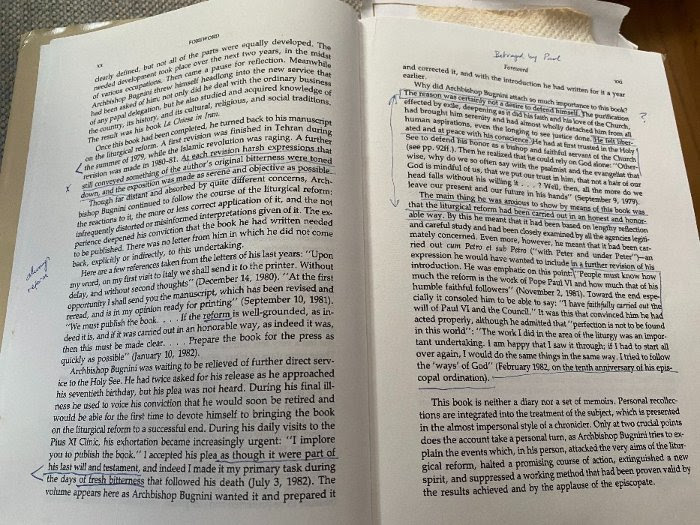
Posted in Uncategorized | Comments Off on