ANOTHER OPINION

INTERVIEW

Israeli scientist: You’re not going to see millions of people die from COVID-19

The new coronavirus is ’80 percent identical’ to the 2002-3 SARS, says Prof. Shy Arkin. On the whole it causes a mild respiratory tract infection. But the elderly are the exception
David Horovitz

By DAVID HOROVITZ18 March 2020, 12:22 pm  22

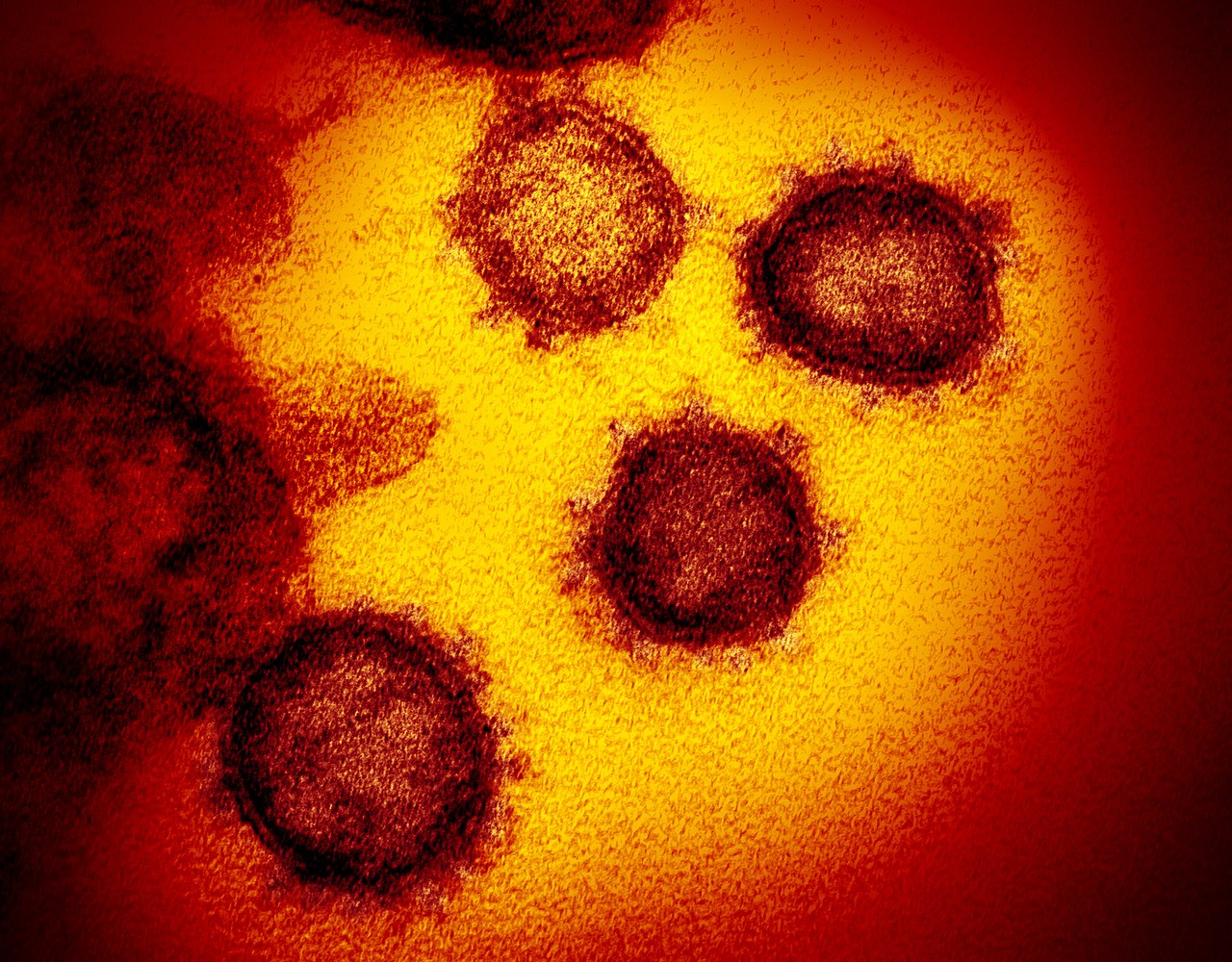
This transmission electron microscope image shows SARS-CoV-2, the virus that causes COVID-19, isolated from a patient in the US, emerging from the surface of cells cultured in the lab. (NIAID-RML / Wikipedia)

Isaiah (Shy) Arkin is a professor of Structural Biochemistry at the Hebrew University of Jerusalem, whose research, among other achievements, has shed new light on the inner workings of viruses. The Times of Israel spoke to him to try to understand more about the coronavirus, how it compares to other viruses, how its spread might stop or be stopped, and how worried humankind should be about it.

He stressed that he didn’t have all the answers to our questions.

The Times of Israel: First, please explain to me what your expertise is as it relates to the current coronavirus crisis.

Get The Times of Israel’s Daily Edition by email and never miss our top storiesFREE SIGN UP

Prof Shy Arkin: Okay, so let me first say that I am not a physician, nor am I an epidemiologist, and I may not even be considered a virologist per se. What am I then? I am a biochemist and what I study are the mechanisms in which viruses regulate their salinity and acidity. So I am a molecular expert on several different parts of viruses.

The two staple viruses that we have studied for close to two decades are influenza and SARS. We have characterized several important components in these viruses.Prof. Isaiah (Shy) Arkin (Courtesy)

And to our amazement, this new virus, which is now called SARS Coronavirus 2, is incredibly similar to SARS Coronavirus 1, that was responsible for the SARS epidemic in 2002-2003 [which killed 774 people worldwide].

Now we can harness all of the expertise and knowledge that we had, to try to find inhibitors to this virus, which is precisely what we’re doing.

So we’re trying to find inhibitors. How does that relate to what we’re also told, which is that a vaccine is probably a year away?

Okay. So let’s take a step back and ask ourselves the following question: How does one deal with viruses?

There are two common routes and one slightly less common, other than simple supportive care.

The most common route is vaccination. It takes a while to develop a vaccine.

I think it’s fair to say that the efforts that are currently underway around the world are the fastest ever. But it’s still very, very unrealistic to state that we will have a vaccine within the next few months. It simply takes longer than that, for a variety of reasons.

Another route that people are taking, and that’s the route that I’m taking, is to look at drugs that inhibit viruses. So, for example, there are very effective drugs against HIV, the causative agent of AIDS. There are no vaccines against AIDS. They are somewhat effective drugs against hepatitis C. There are no vaccines against hepatitis C.

Some viruses have both. Influenza has drugs — you might have heard about Tamiflu — and of course, everyone knows about the flu shots. So there are viruses that you can use this method or that method.

The last method, which we are not doing, which is not as common, is an antiserum. That’s the sort of thing that when you get bitten by a snake, you rush to the clinic and then what they essentially give you is antibodies that someone else generated for you. Often it’s a large animal like a horse or that sort of thing. In the first SARS epidemic in 2003, people tried that to an extent. They literally took antibodies or serum from the blood of someone who recovered from that disease, and gave it to someone who was currently sick. They did that a few dozen times, if I’m not mistaken. But that’s not a very common route.

Of the two main routes — the one that you are researching (drugs), and the vaccine, which do you think is going to get there first?

Very difficult to say. That all depends on the following. If what we do is we identify in our laboratory a brand new chemical, a chemical that has not been approved for use in humans — you’re talking about a long period of time, you’re talking about several years. And the reason for that is that you need to look at the toxicology of that. And that’s not a very simple thing to do.

However, what is far more common today is the process of what’s called repurposing. Repurposing means let’s take a drug that has been approved for one disease, and then suddenly use it against this disease. There’s hundreds, if not thousands, of drugs that have been approved for use in humans against a variety of different diseases.

If something has been approved, it means that its toxicology has been characterized. And it doesn’t really matter if the drug that you’re taking is against liver disease, baldness or high blood pressure. The toxicology is toxicology is toxicology. So if you suddenly find, wow, this chemical is also efficacious against COVID-19, ah, we could use this — and therefore we can bypass a tremendous amount of work that is required in clinical trials. You do need a bit of regulation, but it’s far more rapid.

If a vaccine is a year away, and the drug approach could be faster or slower, the worst-case scenario that the watching world is looking at is a year until there’s some kind of treatment. Correct?

No! The worst-case scenario is we never find anything.

It’s plausible that they won’t find a vaccine fairly rapidly?

We all know of the tremendous mortality and morbidity that AIDS has been exacting from humankind. We have no vaccine.

Hepatitis C is a tremendous problem. We have no vaccine.

If you’re looking for your best-case scenario, it is something beyond a few months. I’m specifically being vague. I don’t want to say six months because people tend to give a lot of importance: ‘Oh, a professor said this. It must be true.’ And we all know that that’s not necessarily the case.

I would say it’s exceedingly optimistic to say a few months. A year is not unrealistic.

However, the upper limit can be never. Because there are viruses… We don’t have a vaccine for SARS. From 2000 to 2003. Now, I don’t necessarily know if it’s because people have lost interest, because there has been no reported case of someone that got SARS since 2003 till today. So interest hasn’t been there.

But that’s because we did find drugs to treat it.

No. There is absolutely nothing to treat any coronavirus. There are vaccines against coronaviruses that affect animals but not against coronaviruses that affect humans.

So SARS just faded away?

Correct.

SARS 1?

Let’s just use a tiny, tiny, tiny bit of the nomenclature: AIDS is the disease; HIV is the virus that causes the disease. SARS is the disease; SARS Coronavirus-1 is the virus that causes the disease. The current disease is called COVID-19 and the virus is called SARS Coronavirus-2.

And we never found a fix for SARS Coronavirus-1?

Or any other human coronavirus for that matter. We know about coronaviruses for a long period of time. They normally cause mild colds in humans. It’s not the major element that causes the common cold; the major element is another virus, called rhinovirus, rhino from nose. But coronaviruses clearly cause mild respiratory tract infections.

In livestock and in birds, they do exact a significant morbidity. So if you’re a farmer, these things do bother you significantly. But to humans, they haven’t been an issue. Again, there are vaccines to some coronaviruses that infect animals.

There is a concern that this virus is of a different order. And you’re saying there are no guarantees that either a vaccine or drugs will be found?

Correct.

That sounds apocalyptic.

No, no, no. I don’t want to elicit any sort of panic. So, first of all, the new virus is very, very, very, very similar to the one that the research community found in 2002-2003. The thing that caused SARS in 2002-2003 is very, very similar — as I said, 80 percent identical — to the thing that’s causing COVID-19. So it’s not as if this is coming out of nowhere.

Having said that, right now, since we have no drugs or vaccinations and nothing is on the immediate horizon, if you wanted to be certain, if you were an insurance agent, you would clearly be able to say we have no insurance with any certainty that we will generate a vaccine or a drug.

This is not going to kill humanity. This is a disease that mostly afflicts the elderly, not that one does not care about the elderly. But to people that are not classified as elderly, this generates a respiratory tract infection that is not very severe, and most people have very mild symptoms.

So the fact that you have a 2 percent or 3 percent mortality rate — that number is driven upwards by the fact that the elderly are far more susceptible to it.

You’re not going to see millions upon millions of people dying. That’s not going to take place.

I mean, look at China. China today has barely any new cases.

So why then, professor, am I living in a country that has just told everyone to stay home. And watching the United States now telling people not to gather in groups of more than 10, having previously sort of brushed this off? And Britain, which was really saying, Nothing to worry about here, all of a sudden telling people…

Fear of the unknown. Fear of the unknown. Very simple.

Let’s imagine three scenarios. Scenario number one, the best case-scenario, is that this disease disappears by the time we finish talking. That’s probably not going to happen.

Another scenario would be what happened with its cousin SARS from 2002 to 2003. That virus, which was more deadly — [a factor] which could have actually limited its spread, because if something is very virulent, then immediately people rush to the hospital and get quarantined — pretty much disappeared in June [2003], when the conditions were sufficiently hot and people stopped crowding, etc.

And the last scenario is doomsday. Where will we fall? I don’t know.

But you don’t think millions of people are going to die around the world?

I can’t imagine why. China is a quarter of the world’s population, right, give or take, maybe slightly less. Roughly 3,000 deaths in 1.5 billion people… China seems to have plateaued.

3,000 deaths among 1.5 billion people. And you’re saying that should be some kind of point of reference when we try to work out how worried we should be?

The biggest problem that we don’t know [relates to] what we classify as asymptomatic people. An asymptomatic person is someone who’s carrying the virus, who might actually be infectious, but doesn’t realize that he or she is carrying the virus. And that’s an issue.

The reason that they were able to to prevent that sort of infection in China is curfew. Curfews are effective. In China, there have been very, very few new cases in the last few weeks. Is that something that we want the world to do? I’ve no idea.

Put what you just said up against that death rate — that 3 to 4 percent death toll among people who are infected?

Again, we don’t know the number of asymptomatic people. That’s the biggest question. The bigger that number is, the better. For example, if you assume that three quarters of humanity actually have the virus within them but are not exhibiting any pathology whatsoever, that would be excellent. That’s a good thing.

That means the death rate among those who are infected is, in fact, massively lower, if there are lots and lots of people who are asymptomatic?

Correct.

The death rate, the mortality rate, is close to 4 percent.

But that’s a rate calculated among those who know they are infected?

A rate [among] those cases that have been confirmed of COVID-19, yes.

Whereas it is reasonable to believe that an accurate rate among those who are infected would actually be much lower?

Could very well be, yes.

One of the limiting factors, as you know, has been the availability of tests. If your name is not Bibi or Donald, the probability of them testing or relegating some of these precious tests to people that are not clearly sick, is vanishingly small.

If we had a test that could be administered to every every individual, then we would have an immediate answer. We don’t. And that’s the problem.

Is this a virus that is able to adapt, to change, in order to beat efforts to stop it? Or do we not know that?

First of all, if we want to be a bit optimistic, lots of people have recovered from this virus in China. Lots. And by the way, recovery does not mean that you don’t die. Recovery means you’re no longer infectious, and you are not exhibiting any symptoms. So that’s really good. Recovery means this is someone that you can go ahead and hug in public.

There have been 56,000 people in China, out of 80,000, that have recovered completely. So this is not as bad of a killer. But there is a trajectory. Where will this end? We don’t know.

How should we compare it, in terms of the danger it poses, to flu, for example, or to smoking [whose related diseases are said to kill about half a million people in the US per year], for example?

Well, flu every year just in the United States kills about 60,000 people. So in terms of the death toll, flu is much, much, much worse. Even in China, flu this season — I’m not talking about last year — this year has killed far more people than COVID-19.

But the thing about flu is that it’s a danger that you’re familiar with. You know the rough extent of it. And in that respect, it’s not something that’s unexpected. When you see something that’s rising, you always wonder, you know, when is this going to stop and where is this going to stop? In flu, you know. Obviously, smoking kills lots of people as well. But the thing is, you can’t just say, Oh, that’s much worse, because this thing is additive to that. It’s not replacing those fears.

I just want to come away from this conversation able to convey a sense of how concerned people should be, and how smart or otherwise the world’s political leadership is proving in handling this.

Well, I think you’re pushing me beyond my expertise. I’m not an epidemiologist, but as a scientist, I am able to read and understand numbers perhaps in the way that the layperson may not be able to. But the impact on the psychology and on politics is not something that I feel very comfortable commenting on.

I understand and I absolutely respect that. Tell me, what are you telling your family to do? What are you doing in terms of precautions?

Following the guidelines, so I’m not going to any crowded places. I’m driving the car. If I want to have a bit of fresh air, then I’ll go to a short hike in the forest. [We spoke on Tuesday afternoon, just before the government told Israelis to stay home unless it was absolutely necessary to go out.] It’s simply following the guidelines. We have not gone to the supermarket to start hoarding food.

It’s similar to asking the insurance agent, you know, Do you buy earthquake insurance even though there hasn’t been an appreciable earthquake in Israel in a significant amount of time? People take different attitudes.

We all know that we’re going to die. Does everyone take exactly the same life insurance? No, they don’t.

There is no reason whatsoever to assume that my opinion is better than anyone else’s, other than the fact that I understand some of the molecular details about this virus far better than most people in the world. I don’t think that qualifies me to make any other judgments.

I understand. You, like everybody else, are following the guidelines. But as a scientist, can you sum up for people, as they dutifully do what they are told to do, how worried or not worried they should be? From the scientific perspective.

It’s too subjective. It’s very difficult to say. This is clearly not doomsday. Humanity will not vanish due to this virus. There is no reason to assume that that will take place.

But as they say, you know, every death, every loss of life, is a world in itself.

We still drive to work. And that’s probably the most dangerous activity that any Israeli does. Yet we continue doing it… What is extreme to one person may not be extreme to another. I don’t know.

Is there anything I should have asked you that I haven’t asked you? 

Well, to put things from another perspective:

I’m dodging your questions because I don’t have an answer. One thing that I always recall is an amusing anecdote that’s used by Nobel Prize winner Daniel Kahneman from the Hebrew University, on the psychology of decision making: Someone goes to a doctor with a particular problem. The doctor tells him, oh, fantastic, I have a procedure that will cure this by 90 percent. The patient says: Excellent procedure — sure. Sign me up.

That individual might choose to go to a different doctor. And that different doctor might say, oh, I have a procedure, but there’s a 10 percent failure. The patient says, That’s a terrible procedure. Why would I use that?

Obviously, we realized both doctors are saying exactly the same thing. And yet the patient is acting completely differently.

Facts are one thing. And the way that people react to them and make evaluations is entirely different. That’s why I don’t necessarily think that scientists who are able to provide rigorous numbers, and epidemiologists, etc., might necessarily be effective in either calming people down or hastening their panic.

Posted in Uncategorized | 1 Comment

BRAVO JOHN STEVENS !!! HE IS WRONG TO CALL THE PRESENT CORONAVIRUS PANDEMIC AN “HYSTERICAL OVER-REACTION TO WHAT IS ESSENTIALLY A VARIATION OF THE COLD VIRUS” BUT HE IS RIGHT TO FAULT THE OVERREACTION OF BISHOPS AND PRIESTS WHO DENY ACCESS TO THE EUCHARIST AND OTHER SACRAMENTS TO THE FAITHFUL IN A TIME OF CRISIS.


       I sent the below email out to many people the other day, yourself included. I have been told by someone that it was arrogant, hateful, and self righteous. I certainly don’t want to put out things like that. I thought I was sending out true information. As always, I deeply value your judgment. Do you feel that it was inappropriate for me to send this email out to people? I sent it out to about 100 people mostly lay but some clergy. Your opinion and advice would be greatly appreciated.

In Christ,
John Stevens
Please forgive my tone for I am very worked up at the moment.        This hysterical over-reaction to what is essentially a variation of the cold virus makes me think I somehow have entered into Alice’s “Wonderland”. I cannot believe what I am hearing from otherwise sane people. I somewhat expect this from the secular powers that be but the Catholic Church (the Church founded by Jesus Christ) seems to have also lost Her collective mind and SOUL.       Our physical health is important and we rely upon doctors and hospitals to help those who are truly ailing. In most cases we can keep our bodies perfectly healthy by giving it the right nutrition, good sleep, and exercise. Our spiritual health and eternal salvation is infinitely more important than our physical health and we rely upon our bishops and priests for the spiritual care we need. We need the Mass and the Sacraments now more than ever. Unfortunately, our spiritual leaders seem to have succumbed to the virus and allowed their brains to be anesthetized. In ever increasing places Mass is being cancelled, people are being encouraged to stay home, Communion on the tongue is being discouraged or prevented, and access to the Sacraments is being denied in some places. Wow! With that kind of spiritual care from our Shepherds, Satan could afford to take a vacation and rest to prepare himself for the final battle. God’s ministers are doing a lot of heavy lifting for him.       No one has ever had an obligation to go to Mass if they are sick or have a compromised immune system. This truth is being driven home to everyone with the added lie by Satan, “No need to attend Mass if you are worried about the corona virus.” This, in my opinion, is not a valid reason for missing Mass. With all the mass hysteria being generated by the media everyone is worried about the corona virus. Might as well have everyone stay home from Mass. As a matter of fact, some bishops have done just that.       In the places that still have Mass, attendance has dropped off precipitously. There were far fewer people at the Vigil Mass at St. Edward’s in Spring, TX last night than I have ever seen since I first attended Mass there in June, 1976. My sister told me that Mass was empty at the Mass she attended at St. Anthony of Padua in The Woodlands. Surely not all the absentees are sick or immune compromised. They are just taking advantage of the invitation to stay home. Many of them will enjoy this opportunity so much that they will never bother to return. I think it will be years before our parishes recover from this disaster. I am sure Satan is very sad about these turn of events.       Now I am being told that I should receive Holy Communion in the hand, all in the interest of protecting the old and sick people and the scaredy-cat priests, deacons, and EMHCs who are worried about germs. Well, I am definitely one of the old people although I am not sick. Everyone who knows me, knows that I would take a bullet to my brain today before I would ever take Communion in the hand. Ain’t happening, no way, not ever! Either Our Lady or Jesus Himself would have to personally appear to me and mandate that I receive Communion in the hand before I would do so. Given that Communion in the hand was introduced into the Church through the disobedience of dissident Cardinals, I do not believe that Heaven will be so instructing me anytime soon.       Speaking of the spreading of germs – Communion on the tongue is no more dangerous than reception of Communion in the hand, probably less so. I was following a thread on NEXTDOOR recently about concerns regarding the corona virus. One woman complained that she was in the restroom at HEB grocery store and a woman came out of one of the stalls after using it and left to shop without washing her hands. Another woman chimed in that she had been to another HEB and noticed the same thing. It occurred to me that if some women are not washing their hands after going to the bathroom imagine how many men are doing the same thing. Men tend to be the slobs. Now some of these people go to Church. How many men and women have used the bathrooms at Church, entered Mass without washing their hands, and proceeded up to receive Holy Communion in the hand? Now I don’t know what germs may exist on my tongue but I can assure you that they are a lot less dangerous than the germs on the hands of those people  who don’t wash their hands after wiping themselves.Besides saliva acts like a kind of hand sanitizer in killing germs.Saliva keeps the ecosystem of the mouth in balance. It contains its own bacterial enzymes that are beneficial to our health. An example of these are lysozomes. These antibacterial agents in saliva kill bacteria in our mouths and protect from potentially dangerous diseases.       I have never administered Holy Communion to anyone so I don’t consider myself an expert on this. However, some priests have said that, if Holy Communion is administered properly, then the fingers of the priest, deacon, or EMHC should never touch either the tongue or the hand of the communicant. In all my life I cannot recall a single occasion where the fingers of the priest touched my tongue. I can’t guarantee it never happened but I don’t recall it ever having happened.       I believe that many priests are naive but genuinely concerned about the well being of their parishioners. However, I believe that some members of the hierarchy are impostors masquerading as Shepherds who see this as an opportunity to drive a further stake into the Church and the Eucharist.       A woman neighbor of mine who is a United Methodist mentioned that their congregation was nearly empty today as well. She said that her minister commented in his homily how interesting it is to see that all the Kroger and HEB parking lots are jam packed on Sunday morning while the Church parking lots are empty. Hell, this is an emergency, we need toilet paper and hand sanitizer, not GOD!!!       Michael Matt has suggested that we may be at the cusp of the long overdue chastisement that we know is coming. Perhaps he is right. One thing is for certain. Satan has been at war with the Church for a long time. He was officially invited in to the Church in the summer of 1957 and it has been down hill ever since. During this time the anti-church has hidden behind the curtain and tried to pass itself off as the true Church of Jesus Christ. During this time the Catholic Church has grown weaker and weaker while the anti-church has grown stronger and stronger. In the past 7 years the anti-church has grown so strong that she no longer hides behind the curtain. She is out in the open seeking to merge the structure of the Catholic Church with the one world religion. This should be obvious for all true Catholics to see. The (True) Church is well into Her Passion and will proceed to Her apparent death and resurrection more resplendent than ever before just like Her Founder.       Anne Catherine Emmerich in her visions talked at length about the two popes, the rise of the anti-church and the suppression of the True Church, and Mary’s ultimate victory. Pope John Paul II as Cardinal Wojtyla in Philadelphia in 1976 talked about the very near coming final battle between the Church and the anti-church. Lastly Fr. Linus Clovis brilliantly discusses the rise of the anti-church. Meanwhile, the pope and some prelates have a service for Pachamama in the Vatican. (You can’t make this stuff up!)
It is my opinion that you can tell where the anti-church is strongest by where the Mass is temporarily suppressed, Communion on the tongue is temporarily  suppressed, and the Sacraments like Penance, Matrimony, Extreme Unction (Annointing of the Sick), etc. are temporarily suppressed  all in the interests of protecting the elderly and the sick from this cold virus. The world cares little about the elderly or the sick but feigns interest to use it as a means to deny the Mass and sacraments. This is the politically correct thing to do and those Shepherds who are politically correct will not fail to deliver to Caesar (the flock be damned).
Wonderful Catholic writer, Solange Hertz, once commented on Satan’s effort to destroy the Eucharist. He loves sacrilege of the Eucharist, but in order to have sacrilege you must have the Eucharist. She felt that Satan must be torn between his desire to destroy Christ in the Eucharist and his lust for sacrilege of the Eucharist. Sacrilege takes place in virtually every Catholic parish every week. From the masses of people who receive while in a state of mortal sin, to the removal of patens allowing particles of the Sacred Host to fall on the floor, to having everyone but the janitor handing out Communion, Sunday Mass is a smorgasbord of sacrilege.With all the particles of the hosts falling to the floor of nearly every parish I heard someone comment that the Church vacuum cleaner has become a de-facto Tabernacle in many Catholic Churches. This is tragic but it occurs every week and our clergy do absolutely nothing about it. How do they plan to explain that on their day of Judgment?
NOT SURE HOW MANY FRIENDS I HAVE LOST OVER THIS BUT THE TRUTH IS THE TRUTH AND IT NEEDS TO BE SPOKEN!
For friends in the clergy who may feel hurt by what I say, remember that true friends tell you what you need to hear, not what you want to hear.

Posted in Uncategorized | 3 Comments

O YE OF LITTLE FAITH !!!!

NEWS

BISHOPS WHO SHUT DOWN THEIR DIOCESES NEED TO RESIGN OR BE EJECTED FROM THEIR SEES

FROM ROME EDITOR

by Br. Alexis Bugnolo

Men are consecrated Bishops to sanctify and govern Christ’s flock. Christ Our God made it quite clear that Bishops are instruments of His Will. He taught this when He called them “ministers.”

An instrument which does not work is useless. It is thrown away.

If your Bishop has shut down your diocese, he is also a useless instrument. And you should treat him as such. No priest, no laymen should obey such an order, for a form of flue which has a mortality rate for the whole population infected, much less than the winter flue. It is insanity.

And those who are insane, are not fit to govern.

___________

Posted in Uncategorized | 1 Comment

HERE IS AN IMPORTANT ARTICLE FOR YOU TO READ FOR TWO REASONS. FIRST, IT SHEDS LIGHT ON THE CORONAVIRUS PANDEMIC WHICH THREATENS ALL OF US. SECOND, IT SHEDS LIGHT ON THE IMPORTANCE OF OUR SPIRITUAL LIFE WHICH ACTUALLY IS MORE IMPORTANT THAN OUR NATURAL LIFE.

Here’s my latest essay in The Atlantic, an interview with/profile of Dr. Francis Collins, director of the NIH and one of the monumental figures in the world of medicine and science. I spoke to Dr. Collins about the coronavirus pandemic; his career and breakthrough achievements; his faith; his love of music; and his unlikely friendship with Christopher Hitchens.
NIH DIRECTOR: ‘WE’RE ON AN
EXPONENTIAL CURVE’The Atlantic    //    March 17, 2020“There are estimates that if nothing goes right and if we fail to flatten the curve and if health systems are overwhelmed, we might see the deaths of as many as a million and a half people in the United States.”That’s what Francis Collins, the director of the National Institutes of Health, told me on Saturday. Collins is one of the most widely respected physician-geneticists in the world, who is deeply involved in containing the coronavirus pandemic. (Anthony Fauci, arguably the leading infectious-disease specialist in the world, works for Collins at NIH and is a close friend.)Collins was not offering a prediction, but a realistic worst-case scenario of what awaits America in the next eight weeks or so unless, in his words, we embrace “the more extreme version” of social distancing.“If you look at the rates of new cases that are being diagnosed, we’re on an exponential curve,” Collins told me. “That curve, some would say, places us only about eight days behind Italy. If that’s true, we have only a very short period of time before this becomes an obvious national crisis with many people presenting with serious illness and hospitals quickly becoming very stressed with the ability to handle all of these sick people, especially older people who are at higher risk and who may need not just a hospital bed but even a ventilator.”I asked Collins if that means that we seem to be tracking with what happened in Italy.“Right,” Collins told me. “If you look at the curve of new cases being diagnosed over the course of the last month, just look at the curve of what happened in Italy, and then look at our curve in the U.S., and you say if you go back eight days from today, they had about the same number of cases that we have today—that is, slightly over 2,000. And then if we follow that same track, then eight days from [March 22], we would be having the same kind of incredible crisis that they are facing.” (The New York Times, in describing the catastrophe befalling Italy, wrote, “The coronavirus epidemic raging through Italy has already left streets empty and shops shuttered as 60 million Italians are essentially under house arrest. There are the exhausted doctors and nurses toiling day and night to keep people alive. There are children hanging drawings of rainbows from their windows and families singing from their balconies. But the ultimate metric of pandemics and plagues is the bodies they leave behind. In Italy, with the oldest population in Europe, the toll has been heavy, with more than 2,100 deaths, the most outside of China. On Monday alone, more than 300 people died.”)Collins added this important qualifier: “Now we have a chance to change that, by applying now the most draconian measures on social distancing to try to limit the spread of coronavirus from person to person. But we will not succeed at changing the course from that exponential curve unless there is full national engagement in those commitments to try to reduce spread. I think we’re getting there; certainly in the last few days there seems to be a lot of waking up to just how serious the threat is, but that’s obviously not universal across this large and complicated country.”Since our interview, we’re seeing what “waking up” means in concrete terms: Ohio is postponing its presidential primary and ordering restaurants and bars to close as of 9 p.m.; Washington State and Maryland announced the shutdown of restaurants and bars (except for delivery and takeout), and entertainment venues and recreational facilities. The new mandates from Washington’s Governor Jay Inslee will also require reduced occupancy for retail outlets. California called for all people 65 and older to shelter in their homes. In Los Angeles, Mayor Eric Garcetti closed movie theaters and gyms, while the Bay Area is in lockdown, requiring people to stay home except for essential needs. More than 30 states have closed down schools. The Centers for Disease Control and Prevention recommended Sunday that no gatherings with 50 people or more—including weddings, festivals, parades, concerts, sporting events or conferences—be held in the United States for the next eight weeks. On Monday, it went a step further, saying we should avoid gatherings of more than 10.When I asked Collins what has surprised him most about the coronavirus from his perspective as a doctor and a scientist, he told me: “The degree to which this is so rapidly transmissible. More so than SARS was. SARS was a terribly scary situation for the world 18 years ago, but it never reached the level of infections or deaths that we have for this coronavirus because it wasn’t as transmissible. SARS was transmissible but only from people who were really very sick. This one seems to be transmissible from people who have minor illness or maybe no illness at all—which is why it has been so difficult to get control or to know when you should be imposing these stringent measures we’ve been talking about. If you wait until you’ve seen lots of affected cases, you know you’ve waited too late because the number of people who haven’t yet turned up in the health-care system but who are already infected is probably 100 times the number of cases you know about.”What’s being done to help hospitals that are being overwhelmed, I asked Collins, and what about the issue of ventilators and protective gear?“There’s a huge effort to try to prepare for that in terms of inventories of personal protective equipment, the so-called PPE, there is a national stockpile and we’re trying to figure out how best to distribute that where it will be most needed,” he told me.“Every hospital is looking at what their capabilities might be and what they might have to do in terms of setting up additional facilities nearby. With universities having closed up for students, it’s possible we may need to see university space used as spill-over for patient care. There are lots of concerns about whether there are enough health-care professionals, especially in places that were already short on physicians like in rural communities. There is a major effort organized through [Health and Human Services], but obviously a lot of it is going to come down to what happens at the community level. And a lot of it will depend upon whether we’re successful in flattening that curve so that the needs for intense medical attention stretches out over the course of several months as opposed to hitting us all at once in the next few weeks.”Because we don’t yet have a vaccine and we don’t yet have therapeutics that we know work, the best means of trying to prevent what Collins says “could be a really terrible outcome,” in addition to social distancing, is using sanitizers and washing your hands faithfully with hot water and soap for 20 seconds as often times during the day as you possibly can. “Those all seem like medieval practices, but they work,” he told me.The soonest a vaccine will be available is a year to 18 months, despite “being developed in record time,” according to Collins, so that’s off the table for now. (One vaccine began phase 1 trials in 45 volunteers on Monday.) More encouragingly, he said, “I would hope that the therapeutic aspects—most notably with a drug called remdesivir, which is now in clinical trials in China, Japan, South Korea, and the U.S.—will show that that particular anti-viral has considerable efficacy for people who are very sick. That would help a lot if we actually had a drug that could be offered to people who most need it.”He added, “It’s a drug that actually was developed in part by academic researchers supported by NIH and then taken on by Gilead, and which did show strong effectiveness against MERS, a related coronavirus, in an animal model. But one hopes that this drug might turn out to be beneficial in this current pandemic. If we had that as a potential medical intervention for the people who most need it, that could change things very much for the better because all the modeling assumes that there’s nothing that we have to offer except supportive care.” The earliest trials should give a result sometime this spring, according to Collins.I asked Collins when he imagines the testing regime will be at a point where he’ll be happy and it will be giving Americans the information he feels is needed.“I would hope in the next two weeks we’ll get there. It may start in those zip codes where the incidence of the disease appears to be the highest, and then quickly spread across the country. This model of having drive-through testing facilities in parking lots seems like the best way to make this accessible to people who really should be getting tested. But that’s pretty complicated to set up. It’s going to take an awful lot of moving parts to come together.”Collins conceded, as has Fauci, that the well-publicized testing failures of the CDC were a blow. “It’s truly unfortunate that the testing got off to such a bad start. The CDC did have in place a plan, and this is certainly what they’ve done before, like with H1N1, where they have the capabilities of putting together a test fairly quickly and then distributing it to the state health departments. Keep in mind the CDC is a federal organization, but most of what they try to get done has to be done through state health departments, which are often underfunded and unprepared for an event like what we are seeing now.”

Collins, honest and a man of integrity, added, “Unfortunately, their very rapid development of this test ended up delivering kits that were defective for reasons that I don’t entirely understand.  That meant we lost a period of maybe three weeks while they were trying to figure out how to fix the problem. Meanwhile, the FDA, which normally is pretty stringent about who’s allowed to offer tests of this sort that are going to have a profound impact on clinical decision-making, did decide to relax that stringency in order to unleash the ability of other laboratories who had made their own tests to begin to use them. But that came at the very last day of February after a lot of time had passed where testing ideally should have been widely available. There was a plan back in February to begin to sample in five cities anybody who showed up in an emergency room with a flu-like illness who tested negative for influenza—so that we could begin to find out what is the representation of coronavirus in the community. But that plan didn’t happen because the testing wasn’t working. We are now playing catch-up.”When I asked Collins what that specifically means, he said, “this is moving in the direction of having drive-through facilities at Walgreens, Walmart, and Target where you could drive up after getting an online approval.  That means you would have a specific need for the test, which means you’ve got to have symptoms of some sort.  You could then get the test done without ever getting out of your car, so it doesn’t expose other people.” The hope is that this would greatly open up the potential for testing, which has happened for example in South Korea, where they’ve given tens of thousands of tests in this fashion.“There are such drive-by facilities already popping up in New Rochelle, New York, and at a few other places around the country. And this does seem like the right kind of model. I wish we’d had those functioning a month ago. We’d be in a much better place to know what’s coming. But here it is, we can’t go back and reinvent that, and we are pulling out all the stops to make it happen as fast as possible.” (That’s much more in CDC’s sweet spot than it is NIH, but NIH is doing what it can to help.)I asked the NIH director what the best-case scenario might look like. “The best hope would be that the measures now being implemented in most states, some quicker than others, will slow the transmission of the virus so that it extends over many months instead of over the next three weeks,” he said. “That’s what we mean by ‘flattening the curve’ to give the health-care system a chance to take care of those who are seriously ill. That way we won’t have an example like Italy in our own country. On top of that, I would hope that the chance that this virus will begin to fade during the arrival of warmer weather will turn out to be true. That certainly has helped with influenza. We have no reason to think that that will necessarily apply to coronavirus, but it might. So let’s hope for that.” He added that he hopes therapeutic options, such as remdesivir, will turn out to help people who are sick.Collins also spoke about civic responsibility and the importance of selflessness in the midst of a pandemic. “I think we as a nation have to get into a place of not just thinking about ourselves, but thinking about everybody else around us, and particularly the most vulnerable people—those who are older and those people with chronic diseases. Young people may have a relatively low risk of serious illness, kids seem to have a very low risk, but if you want to avoid what could be the deaths of hundreds of thousands of people, then it is incumbent on all of us to severely limit our social interactions. We need to ask the question about every interaction we have, and whether it is necessary or not. I’m going to speak very strongly about that. Obviously, people do have to get food in the house and do other absolutely essential things, but beyond that, we should be volunteering to engage in the most stringent kind of isolation.”He added, “that means we all need to take responsibility even if we are thinking of ourselves as relatively impervious to this illness.  It would be easy for a young person to look at the data and go, ‘Well, you know, what if I get it? I’m probably going to be fine.’ But you have to think of yourself also as a vessel for other vulnerable people.  Even if you don’t think you need to do this kind of isolation for your own good, you’re doing it for the rest of the country—and particularly for your grandparents and other people who are in a vulnerable state.”And Collins also offered a big picture-perspective for Americans. “I think people need to be prepared that we are going to be in this space for more time than they will like,” he said. “In many ways, the best sign that we’re making progress will be that the duration of the epidemic goes on a little longer. That’s what flattening the curve means. It means that the most serious cases do get stretched out over time and don’t all happen right at the beginning. So anybody’s who’s imagining that this will all be over and done within a month, needs to get their mind around the fact that we’re in this, I think, for quite a long stretch of time. I can’t imagine that schools that have decided to give students off two weeks will be back in session then, and probably not for this whole academic year. I think we’re facing the fact that at least until June, we all need to be in the space of taking this with the greatest seriousness—and that means every American taking responsibility about this and not coming up with reasons why it’s not necessary.”The coronavirus crisis is merely the latest chapter in the dazzling career of Francis Sellers Collins.Collins, who grew up on a farm in rural Virginia—he was homeschooled until the 6th grade—received a B.S. in chemistry from the University of Virginia, a Ph.D. in physical chemistry from Yale University, and an M.D. with honors from the University of North Carolina at Chapel Hill. (He completed his Ph.D. his first year in medical school.)Collins once told me in a private conversation what those who know him best can testify to: helping people who are suffering has always been a commitment. That was part of what explained his shift in focus from physical chemistry to medicine. “Although I loved the experience of working in quantum mechanics and wrestling with second order differential equations, it was lonely” he said. “It did not have that kind of human connection that I was beginning to long for. And that did drive me then to seek another way to explore science that was going to be more sociable, but also more devoted to outcomes that would help people who were suffering—and medicine was the perfect path to go down, even though it seemed like quite a dramatic departure from the career trajectory I had been on.”Collins eventually found his way to the University of Michigan, where he spent nine years on the faculty and focused on internal medicine and genetics and met his future wife, Diane Baker. At Michigan, Collins was part of a team that among other things identified the major gene defect that causes cystic fibrosis, one of the most common genetic killers in the United States.In 1993, Collins joined NIH, the world’s leading organization supporting biomedical research, and led the Human Genome Project. He made landmark discoveries in the genetic origins of various disorders and was the leader of an effort that revolutionized the practice of medicine: the announcement on June 26, 2000, that scientists had completed the first survey of the entire human genome, the set of instructions that defines the human organism. It revolutionized the diagnosis, prevention and treatment of most human diseases. The New York Times described it as “an achievement that represents a pinnacle of human self-knowledge,” and it ranks among the most significant breakthroughs in medical science in history. (Collins was awarded the Presidential Medal of Freedom in November 2007.)Reflecting back on the events of 20 years ago, Collins told me, “I thought long and hard about what I was going to say that morning, and wrote [my speech] at five that morning. It was particularly poignant because my sister-in-law had died of breast cancer a few days earlier and I had spoken at her funeral on that Saturday and this was the Monday morning where I was talking about how the human genome sequence was going to help a lot of things, including cancer—but it hadn’t come quickly enough for her. So I had that very much on my mind.”But his earlier work on cystic fibrosis had already taught him that translating basic research into treatment can be complicated. “At the time,” he told me, “this was a moment of celebration because we finally had an answer and we could finally do accurate diagnosis, and I hoped that that might lead fairly quickly to better treatments for all these young adults and kids suffering from this disease. It was a long, hard journey to get the therapeutic side of this to start to work.”

The big moment came 30 years later, in November of last year, when the announcement was made based on rigorous clinical trials that a triple drug therapy would provide, if not a cure, certainly a remarkable improvement in the life experience of 90 percent of people with cystic fibrosis who might now be able to live out a pretty normal life span.“I did have the chance to be there in Nashville on that day as this announcement was being made,” Collins said. “This is a community I had stayed close with for all of those 30 years, even when my lab was no longer working on cystic fibrosis. I had written a song about what we all hoped might happen someday, way back in the 1990s, a song called “Dare to Dream.” Now that dream was coming true. At that moment, with 5,000 people gathered as scientists, care providers, families, people who had cystic fibrosis all gathered in that same room, we all sang that song together.”“Boy, it was hard to get through it without really breaking down because all of the people represented in the room, and what they had gone through, their courage, their determination, their belief that this could happen, represented there in the most dramatic way. It felt like such a moment of thankfulness that God’s grace had somehow gotten us to this point. I will not forget that.”I first met Francis Collins when I worked in the White House during the George W. Bush presidency. He, Michael Gerson, the president’s chief speechwriter, and I had lunch in the West Wing to discuss not politics but science and faith. (All three of us were concerned about some prominent Christians who were denying evolution, which we knew was anti-science and we believed was discrediting to the Christian witness.) Most of those who know about Collins associate him with science; far fewer know about his interest in Christian witness. So I asked him to describe his journey of faith.Growing up, Collins’s religious instruction was limited to being sent to the local Episcopal church choir to learn music, “instructed by my dad to ignore the rest of it, which I did,” he told me. In college and then graduate school, he found himself moving from the category of agnostic to atheist. “I would have challenged anybody who wanted to bring to the conversation some discussion about God. I would have asserted they were basically stuck in some past era of supernaturalism that is no longer necessary because science has eliminated the need for it,” is how he put it to me. But the time came as a third-year medical student when he was no longer learning about the human body in a lecture hall; he was sitting at the bedside of people who have terrible illnesses, most of which physicians had imperfect methods to be able to help.“Watching those individuals’ fates, what was going to be coming soon, the end of their life, I was trying to imagine what I would do in that circumstance,” Collins shared with me. “This was in North Carolina and there were a lot of wonderful individuals, many of them having had relatively simple lives, but lives that were totally dedicated to helping other people. Many of these people were deeply committed to faith. I was puzzled and unsettled to see how they approached something that I personally was pretty terrified about, the end of their lives. They had peace and equanimity, and even a sort of sense of joyfulness that there was something beyond. I didn’t know what to do with it.”“It made me realize that I had never really gone beyond the most superficial consideration of whether God exists, or a serious consideration about what happens after you die.”Collins told me about a patient he had gotten pretty attached to—“she reminded me of my grandmother,” he said—and who suffered from advanced cardiac disease, which included episodes of almost daily crushing chest pain. “And yet she came through this all with remarkable peace and was very comfortable sharing the reasons for that with me, namely her faith in Jesus. And at one point after one of those sharing moments, she looked at me in a quizzical way and said, ‘You know, doctor’—she did call me doctor, I wasn’t yet – ‘You have listened to me talk about my faith, but you never say anything. What do you believe?’ Just very direct, very simple question, and it was like a thunderclap. Like a realization that I could not walk away from, but that was the most important question I’ve ever been asked.”Collins later met a Methodist pastor, Sam MacMillan, who was “a very willing partner for me, tolerating my blasphemous questions and assuring me that if God was real there would be answers.” It was MacMillan who introduced Collins to the work of C.S. Lewis, starting with Mere Christianity.“I realized in the very first two or three pages of that book that most of my objections against faith were utterly simplistic. They were arguments from a schoolboy. Here was an Oxford intellectual giant who had traveled the same path from atheism to faith, and had a way of describing why that made sense that was utterly disarming. It was also very upsetting. It was not the answer I was looking for.” But it was, for Collins, the answer he eventually found, and at age 27, he became a Christian.The embrace of that faith transformed not only his relationship with God, but also how he viewed other people, and himself. “They are all, as Lewis said, angels around you. And the notion therefore that it is okay to put yourself in the driver’s seat in every way regardless of what effect that has on others, it’s simply indefensible. I think it did take what had been for me a pretty strong ambitious driving approach and moderate it, not to say that I didn’t retain a fair amount of that, but maybe in a somewhat more loving, forgiving approach.”When I asked him how he sees faith now, in his late 60s, compared to how he saw things in his late 20s, he told me, “I think I’ve also arrived at a place where my faith has become a really strong support for dealing with life’s struggles. It took me awhile, I think—that sense that God is sufficient and that I don’t have to be strong in every circumstance.”I found that striking, particularly in this moment. “One of my great puzzles when I first became a Christian is that verse, ‘My grace is sufficient for you, because My strength is made perfect in your weakness,’” he told me. “That was so completely upside down for me. Weakness? And now I embrace that with the fullness of everything around me when I’m realizing that my strength is inadequate, whether it’s coronavirus or some family crisis, God’s strength is always sufficient. That is a such a great comfort, but it took me a long time to get to the point of really owning that one.”Collins was the founder and creative force behind BioLogos, an organization that invites the church and the world to see the harmony between science and biblical faith. (BioLogos was launched at the time Collins was asked by President Obama to become the director of NIH, in April 2009, which required him having no other affiliations with any other organizations.)I asked Collins what he hopes more Christians would understand about science and what he hopes more scientists would understand about faith.“To Christians I would say, think of science as a gift from the creator. The curiosity that we have been instilled with to understand how the universe works can inspire even greater awe of the creator. This gift could hardly be a threat to God, the author of it all. Celebrate what science can teach us. Think of science as a form of worship.”“Scientists, by their nature, are trying to understand how nature works. And I think the message to scientists has to be there are really important questions that fall outside of what science is able to address meaningfully, such as ‘Why is there something instead of nothing? What is the meaning of love? Is there a God? What happens after you die?’ Those are not questions for which science or scientific methods can be applied.” He believes scientists would be better served by getting outside of a mindset which says that the only questions worth asking are those about the material world.

“It constricts the universe of important questions to assume they are all questions that science can address.”It was said of Freud that he both hated and feared music because it affected him so powerfully and he couldn’t rationally explain why. Anyone who knows Francis Collins well is aware of his gift for music, and his love of it.  “It does something to my soul to be part of a musical experience,” he told me. “In fact, we have, right now, a really interesting moment to try to understand that connection, because neuroscience is progressing rapidly in terms of how music has the ability to so powerfully affect us.” He added, “I do think that music provides glimpses of what Lewis called joy, those moments where you have a sense of something profoundly desirable but as soon as you have started to realize it, it slips through your fingers. Music carries me there, probably more than in almost any other experience.”Collins remembers when he was 12-years-old at a Christmas Eve service, with a choir and an organ playing, and “just feeling like there was something profound happening that caused me to long for something I couldn’t actually name. And that is very much what music is capable of doing. So it gives us a glimpse of something intensely desirable. It can provide a way to the awesome goodness and loving kindness of God himself—and somehow through the experience of beauty, in this case musical beauty, you can touch [God] for an instant.”A final story worth knowing about Francis Collins. The setting: A dinner following an October 11, 2011, debate at Georgetown University between Christopher Hitchens, a prominent writer, polemicist, and atheist, and Alister McGrath, a theologian and Christian apologist from Northern Ireland. I attended the event, as did Collins.When the dinner hosts opened things up to questions from the audience, Collins asked Hitchens a question along the lines of: If you’re going to argue that there is no basis for human morality other than evolutionary responses to survival, then one might argue that there is no objective moral grounding to good and evil, that those are actually mirages, concepts that we’ve been hoodwinked into by our evolutionary ancestors. What would you say to that?Hitchens responded quickly and dismissively, saying that he was shocked that one of the greatest scientific minds in the world would ask such a superficial and silly question, but without actually answering it. The audience, meanwhile, was taken aback by his rudeness, as was I, someone who was friendly with Hitchens. After the dinner broke up, Collins sought out Hitchens to talk to him out in a garden area, in hopes of continuing the conversation.“I wouldn’t say that went particularly well either,” Collins told me, “but it did seem to me that this was a pretty interesting fellow, and there might be an opportunity to go a little deeper than that superficial response. So I filed that away.”A short time later Collins was invited to a modest-sized apartment in Friendship Heights, a residential neighborhood in Washington, D.C., by somebody who wanted to have a discussion, a sort of a salon, about life and faith.“I went without realizing that it had really been set up as a debate between Hitch and myself,” Collins told me. “While everybody else sipped on their cocktails and watched, we got more deeply into it at that point. It was a little bit more useful, he was a little bit more willing to engage in substance. It was more of a respectful conversation that had substance, other people engaged and had questions, and it was a pretty useful evening.”After the gathering broke up, Collins and Hitchens engage in a more personal discussion that started them “on a pathway where we could be completely at opposite ends when it came to the harmony of science and faith, but we could also have a meaningful conversation about other life matters without bringing too much baggage into it.”

Then, in the summer of 2010, Collins learned, along with the rest of the world, that Hitchens was diagnosed with esophageal cancer and that it had spread, a condition which eventually killed him in December 2011. “And so at that point I reached out to him and indicated my willingness to do anything I could to help him sort through what the options might be, knowing that this was going to be one of those things where standard therapy was probably not going to offer a lot,” Collins told me. “And he quickly picked up on that and then began a series of gatherings in his apartment where he would invite me down to talk — ostensibly about his medical decision-making but usually ending up in a very far-ranging conversation.  A conversation with Christopher was always intensely interesting; whether it was about Thomas Jefferson, or whether it was about esophageal cancer, you knew you were going to have a provocative moment graced by a fair amount of alcohol. And in the process I met his wife, Carol Blue, and met his daughter. We became good friends in that circumstance, although obviously with very different views about the fundamental truths of Christian faith, which he continued to discount.”Collins did help by identifying for Hitchens a possibility of taking advantage of the advances in genomics. A protocol at Washington University in St. Louis had just been announced where it would be possible to do a complete DNA analysis of esophageal cancers to see what might be a drug treatment that would be particularly appropriate for that individual.“That genomic analysis was carried out and it did suggest some alterations in the way in which his disease was being approached, which I think may have ultimately given him a few more months, although I can’t prove that. We continued to converse about that and to sit together in his apartment watching the sun go down from time to time. I would occasionally play his piano. And things began to gradually get worse. I remember a time where he was urgently admitted to Georgetown Hospital.”Collins went to see Christopher, who was in tough shape at that time, although he rallied from that. “And then gradually things went from being able to continue his very energetic lifestyle to more and more difficulties with the cancer, and our communication became more by email.” Collins said of Hitchens, “He was very respectful. I never really had a circumstance in a private conversation where Christopher would say derogatory things about faith or about people of faith. Curious, yes, probing, oh, yes, but not denigrating.”Hitchens himself, in an article in Vanity Fair published 15 months before he died, referred to Collins as “the best of the faithful”, a “great humanitarian” and “one of the greatest living Americans.” His affection for the man he once treated with disdain was undisguised.At the conclusion of my interview with Collins, I asked him what was it about the relationship with Hitchens that was special. “You know, I think it was the opportunity to see what lies underneath a very hard-edged perspective that you would normally be really put off by. It’s a reminder of the fact that if we really want to understand each other, we can’t be put off by those kind of superficial, admittedly sometimes difficult to listen to, perspectives. There is real humanity in everyone. This was a guy who was intensely curious about everything. It was a guy who cared deeply about his wife and his daughter. It was a guy who was in many ways a little isolated, maybe a little lonely, who cherished the chance to develop a friendship, and especially with somebody who was very different from him.”On Friday, April 20, 2012, at a memorial service for Hitchens, Collins spoke and played his “Hitchens Sonata” on the piano. It was a beautiful and touching moment, an act of friendship by a man of great grace.Christopher Hitchens was right about Francis Collins. He is the best of the faithful.
Posted in Uncategorized | 2 Comments

EVEN DR. FAUCI, WHO IS USUALLY VERY RELIABLE, CAN MAKE MISSTATEMENTS SO BE CAREFUL IN ACCEPTING EVERY WORD THE EXPERTS UTTER ABOUT THE CORONAVIRUS PANDEMIC

Dr. Fauci’s Mysterious Math – The Quantifying Today Reflects Where We Were A Week Ago – Today Cannot Be Quantified Until Next Week…

Posted on March 17, 2020 by sundance

Let me say up front, there’s something very sketchy about the wordy explanations provided by CDC Director Dr. Fauci.  Listen/watch or read what he says below.

Encapsulating Dr. Fauci’s position:  Data on the coronavirus assembled today doesn’t reflect what is actually taking place today, but rather reflects where we were several days ago…. OK, that part makes sense (there’s a lag).

He then goes on to say what is actually happening today will not be included in data until we arrive at a place a few days from now when today’s reality is quantified.  Again, that reasonably makes sense…  However….

The media is/are reporting on coronavirus impacts in real time.  There is no delay in what the media are reporting from various places around the nation.  The media reporting reflects what is taking place today; right now… and what the media is reporting today is not worse than the data Fauci is explaining.

Meaning if Dr. Fauci was correct, and if the coronavirus data (the reports of spread) was behind by several days from the reality of today; then what the media would be reporting (the on the ground reality of the spread today) would be significantly worse (higher incidents) than Fauci’s data, which he claims is lagging several days behind….

The problem with that supposition – The media ground reports do not reflect a higher incidence of coronavirus spread than Fauci’s data today.

The concept of “flattening” the virus curve; the presumptive reason for social distancing; is based on a theory to extend the spread of COVID-19 to a lesser incident rate over a longer duration, thereby lessening the burden on the U.S. healthcare system.  Hence, ‘flatten’ the spike in infections.

Put another way: “Flattening” means the same number of people eventually contract the virus, only they do so over a longer period of time, and the healthcare system can treat everyone because the numbers do not rise to level where the system is overloaded.  In theory that seems to make sense.

However, no-one is asking: what is the current stress level on the healthcare system right now?  Where are we in that capacity?… and what is normal capacity level during a high-level flu outbreak?… and Where are we when compared against that baseline?

The premise to extend the virus duration in an effort to lower the infection rate and spread the virus over a longer period of time needs to measured against: (a) where the healthcare system is at any given moment; and (b) under traditional high-flu seasons where are we during those historic events.

♦ STRESS LEVEL – The healthcare ‘system’ per se, is expending an awful lot of time on mitigation efforts.  As Dr. Brix noted: the current negative test rate for coronavirus among those showing symptoms who are tested is 98 to 99 percent.  That means of all the people taking coronavirus tests, 98/99 out of 100 are symptomatic (they are sick) but they are not infected with coronavirus.  They are normal flu cases.Powered by wordads.coSeen ad many timesNot relevantOffensiveCovers contentBrokenREPORT THIS AD

Our healthcare “system” is expending an incredible amount of resources on a mitigation effort.  According to Dr. Brix and the test results 99 percent of those mitigation efforts are not engaging with coronavirus.  They are dealing with regular flu (perhaps a strong flu).

If you extract the mitigation effort from the overall effort, the current stress level on the healthcare system doesn’t seem to be overwhelming.  What is stressing the system is a coronavirus mitigation effort with a rate of 99 percent testing negative.

♦ Dr. Fauci’s theory is self-fulfilling.

If the viral spread never exceeds the capacity of the healthcare system to deal with it, he can claim success.  Look, our flattened curve worked.

However, when contrast against flu outbreaks, no-one knows what the COVID-19 capacity threshold is within the healthcare system.  There’s no way to disprove Fauci’s theory.

Given the nature of the baseline for overall U.S. sanitation and hygiene, which is significantly higher than Italy, S-Korea and China; and given the higher standards of food safety (U.S. is the world leader); again significantly higher than Italy, S-Korea and China; and given the nature of the U.S. healthcare system (more capacity per person); is it really a fair comparison to overlay a COVID-19 outbreak, without also overlaying a traditional flu outbreak?

Any theory that cannot be scientifically tested; and is simultaneously self-fulfilling; is, by its nature, a false theory.

This is not to say that Dr. Anthony Fauci is intentionally misleading anyone; however, it is absolutely true that no-one will be able to quantify if trillions of dollars of economic wealth lost; and trillions more in economic activity lost; and trillions more in deficit spending; and that might all be done just to follow the fantastical whims of a doctor who is directing the mitigation of an ordinary flu-virus/season, and appears to be quite full of his own sense of self-importance.

98/99% negative test rate should alarm everyone.  We’ve shut down the biggest economic system in the world for a virus that is not appearing in 99% of the people who are sick.

DR. BIRX: Yeah. No, thank you, Mr. Vice President, for mentioning that because, as I told you, in South Korea there are 250,000-plus tests. About 96-plus percent were negative. So — and that was with symptoms.

So we’re working very hard integrating everything they have learned about symptoms and screening, and that is going into the development of this website. So it’s not just a simple checkbox website. It’s actually going to go through critical symptoms. And that’s why we’re giving ourselves the weekend to get it put up.

So far, in the United States, from LabCorp and Quest, they’re running about a 99 to 98 percent negativity. This always worries me because I’ve worked in public health a long time. When you tell someone they’re negative, yes, it’s reassuring, but the last thing we want is them so reassured that they stopped practicing these critical practices that are going to protect all of us.

This epidemic will be stopped at the community level. Those are the individuals — it’s Americans and their response that will get us over this hump. And that’s why, yes, we’ll have testing available. We’ll have to know that many of them are going to be negative, and you’re going to have to help us carry that message that that means, just at that moment, you’re negative, you need to continue to do all of your protection and protection of others to ensure you remain there. (read more)Powered by wordads.coSeen ad many timesNot relevantOffensiveCovers contentBrokenREPORT THIS AD

♦ FACT: 98 to 99% of the American people tested, who have symptoms (similar to flu), test negative for the Wuhan novel coronavirus (COVID-19).  We are spending hundreds of billions, and disrupting all facets of life and liberty, to avoid a virus almost no-one carries.

Here’s SKETCHY Dr. Fauci’s explanation:

DR. FAUCI: Thank you very much, Dr. Birx. So just to connect with what I mentioned to you in previous discussions in this room — and Dr. Birx said it very well — that in order to be able to contain and curtail this epidemic to not reach its maximum capability, we have a two-pillar approach, one of which I believe has been very effective in preventing the substantial seeding, and namely the travel restrictions that we’ve discussed many times in this room.

The other, equally, if not more important, is when you have infection in your own country, which we do. And you know I could read the numbers, but they’re really, essentially, what we’ve seen yesterday: incremental increases, both globally as well as in the United States, with the curve doing that.

So therefore, the kinds of things that we do are containment and mitigation.

This — what we’re mentioning now — the guidelines, when you look at them carefully, I believe if the people in the United States take them seriously, because they were based on some rather serious consideration back and forth, some may look at them and say they’re going to be really inconvenient for people.

Some will look and say, well, maybe we’ve gone a little bit too far. They were well thought out.

And the thing that I want to reemphasize, and I’ll say it over and over again:

When you’re dealing with an emerging infectious diseases outbreak, you are always behind where you think you are if you think that today reflects where you really are. That’s not word speak.

It means:

If you think you’re here, you’re really here because you’re only getting the results; therefore, it will always seem that the best way to address it were to be doing something that looks like it might be an overreaction. It isn’t an overreaction. It’s a reaction that we feel is commensurate, which is actually going on in reality.

So take a look at the guidelines. Read them carefully. And we hope that the people of the United States will take them very seriously, because they will fail if people don’t adhere to them. We have to have, as a whole country, cooperate and collaborate to make sure these get done.

Thank you.

If the coronavirus spread never exceeds the capacity of the healthcare system to deal with it, he can claim success.  Look, our flattened curve worked.  However, we’ve also destroyed the U.S. economy to do so, and we’ve wiped out tens of trillions in U.S. wealth.

If Dr. Fauci’s magic theories are correct, then by THIS Friday there should be tens of thousands of people testing positive for Coronavirus.  If not….

Here’s the new Fauci recommendations:

Posted in Uncategorized | 1 Comment

BEWARE OF FALSE REPORTING ON THE CORONAVIRUS PANDEMIC

NEWS

JOE HOFT OF THE GATEWAY PUNDIT, CONFIRMS FROMROME.INFO’S FINDINGS ON CORONA MORTALITY

FROM ROME EDITORLEAVE A COMMENT

by Br. Alexis Bugnolo

In an article, by Joe Hoft, entitled, EXCLUSIVE: Evidence Shows Director General of World Health Organization Severely Overstated the Fatality Rate of the Coronavirus Leading to the Greatest Global Panic in Historypublished by the Gateway Pundit, today, March 17, 2020, the observations on each aspect of the true mortality rate of he Wuhan virus, reported here at FromRome.Info in our recent article, Why that 3.4% Mortality rate is a lie, as been confirmed.

Mr. Hoft writes:

The controversial Ethiopian politician and Director General of the World Health Organization (WHO), Tedros Adhanom Ghebreyesus, claimed in a press conference in early March that the fatality rate for the coronavirus was many multiples that of the fatality rate of the common flu.

 This egregiously false premise has led to the greatest panic in world history.

The Director General of the WHO spoke on March 3, 2020 and shared this related to the coronavirus:

While many people globally have built up immunity to seasonal flu strains, COVID-19 is a new virus to which no one has immunity. That means more people are susceptible to infection, and some will suffer severe disease.

Globally, about 3.4% of reported COVID-19 cases have died. By comparison, seasonal flu generally kills far fewer than 1% of those infected.

This statement led to the greatest panic in world history as the media all over the world shared and repeated that the coronavirus was many, many times more deadly than the common flu.

The problem is his statement is false.  It was not accurate! 

See the rest of Mr. Hoft’s, article at the Gateway Pundit, where he discusses the actual mortality rates of the winter flu and Corona virus and compares them to actual numbers of known infections to make similar observations, as I have done in recent days.

+ + +

Blog at WordPress.com.

Posted in Uncategorized | Comments Off on BEWARE OF FALSE REPORTING ON THE CORONAVIRUS PANDEMIC

FACT: THE PAPAL ELECTION OF 2013 WAS INVALID. ERGO: JORGE BERGOLIO WAS NOT ELECTED POPE

Catholic Monitor

Monday, March 16, 2020

LifeSiteNews’ Westen: “Discussions are going on among the Hierarchy” that Francis is a “Heretic or Illegally Elected” 

Today, in a Dr. Taylor Marshall YouTube podcast, LifeSiteNews’ chief editor John-Henry Westen admitted that “discussions are going on among the hierarchy” that Francis is a “heretic or illegally elected”:

“[Marshall said] Beneplenists, Benedict is pope, has taken off and we saw Bishop Gracida endorsing this [Catholic Monitor correction: Bishop Rene Gracida has apparently proposed this as one option of three courses of action including the illegal conclave option and the Bellarmine option for an manifest heretic.] And also… Archbishop Lenga has kind of joined on board and there are a lot of voices in Italy of course Antonio Socci… “

“… How does John-Henry Westen compute all this?… “

“… [Westen answered] “[T]he easiest solution would be to have Pope Francis declared some kind of heretic or illegally elected or whatever. And I know discussions are going on among the hierarchy. But, for lay people we are unable to make those calls. And for right now we are called to pray for the pope and I pray literally for his [Francis’s] conversion.”
(Dr. Taylor Marshall YouTube Channel, “Did Pope Francis Betray Catholic China? Is Corona the Judgement?,” 51:35-54:04)

Question for Westen:

If lay people are not allowed an opinion, how can he, a layman, affirm Francis is the pope?

At LifeSiteNews, only lay people who question Francis’s validity are not allowed to have opinions. Everybody else is.

Moreover, if the “hierarchy” is discussing whether Francis is a antipope due to an “illegal” election then he is a “doubtful pope.”

Theologian Fr. Sylvester Berry wrote:

“Hence the saying of [Doctor of the Church St. Robert] Bellarmine: a doubtful pope is no pope. ‘Therefore,’ continued to Cardinal, ‘if a papal election is really doubtful for any reason, the elected should resign… the universal Church… can and ought to decide, when occasion demands, who is the legitimate pope.”
(The Church of Christ: An Apologetic and Dogmatic Treatise, Page 229, Note 8: Bellarmine, “De Concilio, ii, 19)

Finally, if Westen is praying for Francis’s “conversion” then that mean he apparently is of the opinion that Francis has lost the faith and may be a heretic.

If this is true then the Bellarmine option summarize by his friend and colleague Doctor of the Church St. Francis de Sales comes into play:

“[T]he Pope… when he is explicitly a heretic he falls ipso facto from his dignity and out of the Church, and the Church must either deprive him, or, as some say, declare him deprived of his Apostolic See.”
(The Catholic Controversy by St. Francis de Sales, Pages 305-306)

Pray an Our Father now for the restoration of the Church as well as for the Triumph of the Kingdom of the Sacred Heart of Jesus and the Immaculate Heart of Mary.

Posted by Fred Martinez at 11:00 PM Email ThisBlogThis!Share to TwitterShare to FacebookShare to Pinterest

2 comments:

Alexis Bugnolo said…

Great comments and analysis, Fred.

I think that they speak of this in public, shows that their narrative control is bleeding on all sides.

Their position is emotional politics, not rational, dogmatic, canonical.11:57 PM

Justina said…

There is also the glaring issue of John-Henry characterizing the questioning of the Argentinian’s claim to the papacy as the “easiest” option. Really, Mr. Westen? You and your ilk are the martyrs here, praying your Rosaries and offering up the pain of Pachamama idolatry and Holy Communion for chronic adulterers because you care more about Jesus Christ than those who want to see such abuses corrected at the root?

How can you and the other Bergoglian normalizers, Mr. Westen, dismiss the questioning of his claim to the papacy as taking the wide road, the easy path, out of one side of your mouths, while out of the other you are constantly shielding yourselves behind the baseless assertion that nothing can be done about the situation because it would just be too hard? You can’t have your cake and eat it, too, Mr. Westen. If all of you at Lifesite wish to position yourselves as opinion leaders in the anglophone or even wider Catholic world, you can’t just skip the part about making simple sense in the first place.2:48 AM

Posted in Uncategorized | Comments Off on FACT: THE PAPAL ELECTION OF 2013 WAS INVALID. ERGO: JORGE BERGOLIO WAS NOT ELECTED POPE

R.I.P MIGUEL CERVANTES AND Don Juan OF AUSTRIA, WE ARE ETERNALLY IN YOUR DEBT

Ordo Dei

A site about matters of the Catholic Church, history, philosophy, and literature

The 1571 Meetings of Miguel Cervantes and Don Juan of Austria: Louis de Wohl’s 1956 Historical Novel, The Last Crusader

hicksonfamilyCatholic ChurchLiteratureWar  March 17, 2020 10 Minutes

Dr. Robert Hickson 15 March                             2020 Saint Clement Maria Hofbauer (1820)

Saint Longinus (1st century A.D)

Epigraphs

“[Admiral of the Papal fleet] Marc Antonio Colonna, Duke of Pagliana, was a handsome man of no more than thirty-five….The sight from the [conquered] Sultana’s poop deck was never to be forgotten. Colonna had a few light guns trained on the [Turkish] galleys and brigantines still hovering near, and the two nearest surrendered without a shot, the first Turkish warships ever to do so. The flag from holy Mecca in the hands of the Christians and Ali Pasha’s head on a Spanish pike seemed to be more than they could bear.

Colonna started firing at the others [of the Turkish navy]. His ship, too, showed a good deal of damage.

Juan [overall Christian commander Don Juan of Austria himselfthought of the young man [also 24 years of age] on board there [with Colonna], what was his name? Cervas or Cervantes. Good luck, señor poet, he thought.” (Louis de Wohl, The Last Crusader (1956, 2010), pages 431 and 473)—my emphasis added

***

“Hope only becomes virtue as theological hope, however, meaning a hope moving toward salvation, which does not exist in the natural world.

Even so, Christian hope does not fail to keep our historical created world in sight as well. One can read this, too, from the character of the Christian martyr. The Christian martyr is something truly incomparable. It is not enough to look at him as a man who dies for his conviction – as if the truth of this conviction did not matter. The distinction and the uniqueness of the Christian witness lies in the fact that in spite of the terror befalling him, from his mouth ‘no word against God’s creation is heard’ (E. Peterson).

In the martyr’s hope three elements are joined together. The one thing truly hoped for is eternal life and not happiness found in the world. This is the first element. The second is the active ‘yes’ to the created world in all its realms. The third element is the acceptance of a catastrophic end to the world of history.

The connection of these three elements is, logically, filled with dynamic tension; it is not easy to hold these tensions together and endure them.” (Josef Pieper, Josef Pieper: An Anthology (San Francisco: Ignatius Press, 1989), p. 26—my emphasis added. This excerpt is from an essay that was originally published in 1963 in Tradition als Herausforderung [Tradition as Challenge] (Munich 1963).

***

Earlier this year, after I had discussed and slowly read aloud to my wife and two young children around our glowing kitchen hearth Cervantes’ Don Quixote in it entirety, they unexpectedly requested that I then also read to them The Last Crusader: A Novel about Don Juan of Austria by Louis de Wohl.1 Approximately fifty pages before the end of that almost 500-page book, we had a good surprise. It is this nuanced and touching surprise that I wish now to share with the reader, for it shows us how the future author of Don Quixote (1605 and 1615) met, warmed, and even charmed the heart of Don Juan of Austria himself in 1571—just before and then again the day after the 7 October naval battle of Lepanto in which the courageous Miguel Cervantes was gravely wounded in action.

Cervantes is shown to have been a volunteer soldier under the immediate command of Admiral Colonna, “the papal admiral” (442).

We shall introduce the meetings of Cervantes and Don Juan by first discussing the then-recent 5 August 1571 surrender of Famagusta on the strategic island of Cyprus and the cruel aftermath of that defeat, especially the deliberate and protracted Turkish tortures of Marc Antonio Bragadino, the military governor of Famagusta.

As Captain Barola now reports the grim early August 1571 situation to Don Juan and Admiral Veniero (the close friend of Bragadino), we shudderingly hear (but only in part):

“As soon as the town surrendered Mustapha [the conquering Ottoman Turk General] broke his word. All Christian captives were chained to the galleys—those over age were killed. Bragadino was tortured for twelve days…”

“Santa Madonna,” Veniero said. He was as white as the chalked wall of the desecrated church….

“Mustapha told him [Bragadino] that the cathedral would be transformed into a mosque. He told him how he was going to die. He would have him flayed alive. Then he screamed at him: ‘Where is your Christ? Why doesn’t he free you, if he’s so powerful?’ They began to flay him then and there, and they started at his feet. He began to pray the Miserere [Psalm 51—a lamentation and prayer for mercy]. That was his whole answer….”

He died a martyr,” Juan said. He crossed himself, and the others followed his example. “I command that this story be told to every man in the fleet. I take it that you are certain about your facts, Captain Barola?”

“Quite certain, Your Excellency, I am sorry to say.”

As soon as Juan was back on board [of his flagship] again, he made sure that his last order was obeyed. Within a few hours every man in the fleet knew about the fate of Famagusta [the consequence of its surrender on 5 August 1571] and of Marc Antonio Bragadino….

Juan conferred with Colonna. Veniero had excused himself and the commander in chief respected his grief.” (441-442—my emphasis added)

Shortly after this extended and provocative presentation, Admiral Colonna said to Don Juan, his 24-year-old superior, as follows:

“You seem to be very sure that we shall get hold of the Turk, Your Excellency.”

“I am very sure. Wherever they are, I am going to look for them until I find them.”

Colonna led his commander in chief through the ship. Juan found the discipline on board faultless, equal, if not superior to that of the Spanish ships. He particularly liked the admiral’s bodyguard, twenty-five men of the Pope’s [Pius V’s] own Swiss Guards under their young commander, a giant of a man, Hans Noelle by name.

The sword of Peter,” Juan said, smiling. “Mind you Messer Noelle, this time it will have to cut off more than just an ear.”

Noelle grinned cheerfully and said something in a Italian so grimly Swiss that Colonna had to translate it to Juan. ‘He says he wants a Turkish flag to send home to Switzerland….’

“Well, I hope he’ll get his flag. Who is that man there?” (443—my emphasis added)

Now we shall come to encounter and more fully to appreciate the future author of Don Quixote:

A tall, thin soldier was standing in the gangway and somebody was trying to drag him away by his coat. He resisted stoutly and at the same time saluted; his eyes fixed on the two great commanders [both Juan of Austria and Admiral Colonna]. (443—my emphasis added)

There appears now to have occurred an unexpected commotion and Admiral Colonna promptly responds in the presence of his own superior:

“What’s going on here?” Colonna barked.

The [unnamed] man behind the [dragged and resisting] soldier emerged, saluting sheepishly. “Physician’s mate, sir. This young gentleman is ill with fever, and ought to be in bed, sir.”

“It isn’t much of a fever, Your Grace,” the soldier said eagerly. “And I just heard what happened at Famagusta. I beg Your Grace’s pardon for intruding like this—I would like to ask a favor of Your Grace.”

“What’s your name?” Colonna asked, frowning.

Miguel de Cervantes Saavedra, at Your Grace’s service.

“A Spaniard,” Juan said. “Where from?”

“I was born in Alcalá, Your Excellency.”

“I know it well. Where in Alcalá?”

“Our house was just next to the kitchen garden of the Capuchin monastery, Your Excellency. I was christened in Santa Maria Mayor. We went to Sevilla and then to Madrid.”

“You are a volunteer, I take it?” (444—my emphasis added)

Miguel Cervantes’ immediate reply to Don Juan’s previous question robustly articulates a wise and memorable vision and motivation, especially for a man of just twenty-four years of age:

“Yes [I am a volunteer], Your Excellency. That is to say, I am the kind of madman [like a certain Don Quixote?] who still believes that nobility of heart, courage, and poetry are the three things that matter most, next to the grace of God.”

You are a poet, then?” Juan said with that grave charm that won the heart of every man. (444—my emphasis added)

Don Juan’s question and manner drew forth a larger presentation of the Spaniard’s life and abiding ethos:

“Yes [I am a poet], Your Excellency. I went to Rome in the [clerical diplomatic] retinue of the Most Reverent Guilio Acquaviva de Aragon. But what is life at the most magnificent court when the bugle calls for battle against the infidel? Poetry can remain poetry only so long as it is paired with courage and nobility of heart.”

I wish all Spaniards thought as you do,” said Juan.

Miguel de Cervantes smiled deprecatingly. “There is need for the other type as well,” he said. “Has it ever occurred to Your Excellency that there are two types of Spaniards and two only?

[At this subordinate’s perk and spunkiness] Colonna cleared his throat [once again!] impatientlybut Juan was not to be deflected“Two types only? What are they señor poet?” (444-445—my emphasis added)

Will our poet also still now make room for a Sancho Panza? Let us now consider the implicit possibility of such a pair and companionship!

The first,” Cervantes said, “is slim and dreamy and full of enthusiasm for all things great, sacred, and brilliant. The lady he loves is invariably the most beautiful in the world, and if she is not a queen she should be. He thinks the world is the field God gave him in which to perform shining deeds in the service of a great cause and so he is a hero and a fool, a poet and a knight.”

Like you,” Juan smiled. (445—my emphasis added)

After his “expression of politely hidden irony in his dark eyes,” Cervantes unfolds for Don Juan his own vivid and charming understanding of that second of two enduring types of Spaniard:

“The second type,” he said, “is intensely practical and knows the value of a maravedí, a real and a ducat, A woman to him is a very useful creature, and if she is pretty too, so much the better. He thinks the world is a field in which he must find a small place where he can live with a minimum of discomfort. You only have to look at a Spaniard and you will always know to which of the two types he belongs.”

Once more Colonna cleared his throat.

Thank you, señor poet,” Juan said, “I will certainly think about your theory. But what about the favor you were going to ask?” (445—my emphasis added)

And here is the favor Miguel Cervantes requests from the commander and chief:

“It is, Your Excellency, that I may be freed from the well-meaning but clumsy services of the physician’s mate and permitted to command a dozen soldiers in battle—preferably at bows [at the prow, or forecastle].”

“He’ll be killed there, most likely,” Colonna said.

“But, if he isn’t, he will reach Parnassus,” Juan said, and Cervantes’ eyes lit up. “Let him have his twelve men, Your Grace [i.e., Colonna], as a favor to me.”

“Very well, Your Excellency. You’d better go back to bed, messer poet, and come out only when it’s time to fight.” (445—my emphasis added)

A short time later—now after the decisive and won naval battle—and when Juan was festively about to sail along and salute the line of his assembled victorious fleet, “Colonna accompanied the commander in chief to the gangway.” (494) But then something unexpected was again to transpire:

A tall thin soldier appeared on it [the gangway], his left armed bandaged and in a sling. Somebody, a physician’s mate, was trying to drag him away by the coat, but he resisted stoutly and at the same time saluted, his eyes fixed on Don Juan.

Señor poet,” Juan exclaimed, smiling. “Leave him alone, you there! I am glad to see you still alive, although it looks as if you’ve been fighting as you said you would.”

“He did, Your Excellency,” Colonna affirmed. “And very bravely.”

“I lost the movement of my left hand for the glory of the right,” said Miguel de Cervantes. “And I want to thank you, Your Excellency. Yesterday [Sunday, 7 October 1571] was the most beautiful day of the century.”

So he knows, too, that there will not be another, Juan thought. “I thought of you once,” he said, “during the battle.”

Deeply moved, Cervantes said, “With or without a crown—you, sir, are a true king.”….

A true king, Cervantes thought. A magnificent young king. A crusader. Perhaps…the last crusader. (495—my emphasis added)

In the last few lines of his book (on page 485), Louis de Wohl considered the likelihood of a later tragedy, perhaps also to occur in Don Juan of Austria’s own young life, but also more broadly:

But those who were shouting “Hosanna” today might well be shouting “Crucify” tomorrow. Yesterday’s conquerer was today’s victim and tomorrow’s fool….Glorious fool! Glorious folly! Was there not someone who had spoken even of the Folly of the Cross. Saint Paul, of course. To whatever height a poet [has] soared, always a saint had been there before. (495—my emphasis added)

And the saints—especially the blood martyrs—knew the importance, and lived out the reality, of the virtue of hope, the hope of the Christian martyrs. A gift of grace, a theological virtue.

Miguel Cervantes knew well and later depicted the sorrows and tragedies of life, and he also cherished a virtuous hope: the hope of eternal life. May his companion, Don Juan of Austria, also have come to that sensitive awareness and virtuous conduct by the end of his short, but heroic life.

–Finis–

© 2020 Robert D. Hickson

1Louis de Wohl, The Last Crusader: A Novel about Don Juan of Austria (San Francisco: Ignatius Press, 2010—first published in 1956). All further references to this 495-page book will be to the paginations of the 2010 edition; and they will be placed above in parentheses in the main body of this essay. This essay will especially counterpoint the brief and graciously subtle relationship between Miguel Cervantes as a combatant volunteer soldier, and Don Juan of Austria as the Commanding General of the Fleet—both of whom are 24 years of age.

Share this:

Posted in Uncategorized | Comments Off on R.I.P MIGUEL CERVANTES AND Don Juan OF AUSTRIA, WE ARE ETERNALLY IN YOUR DEBT

RED CHINA IS WAGING BIOLOGICAL WARFARE ON THE REST OF THE WORLD, INTENTIONALLY OR NOT, THAT IS THE REALITY OF THE PRESENT CORONAVIRUS PANDEMIC

NEWS

MULTIPLE STUDIES POINT TO CHINESE BIOWARFARE LAB IN WUHAN AS DESIGNER OF COVID-19

FROM ROME EDITORLEAVE A COMMENT

FACTS NOT CONSPIRACY THEORIES

by Br. Alexis Bugnolo

The Corona virus — which is called the Coronavirus, here in Italy — shows signs that its real name should be the Wuhan virus, and that was intentionally modified in the level 4 biowarfare laboratory in Wuhan China.

In this article, I will recite the evidence,  not the conspiracy theories.

In an article published by the Express on March 10, by Callum Hoare, geneticists publishing in ScienceDirect are reported to have discovered that the Wuhan virus has a particular and unheard of capacity to attach to a specific protein (furin) found in the lungs of humans.

This is not naturally occurring, because a virus cannot learn genetically to attach to a protein unless the protein is in its natural environment. And if the virus, as has been claimed, is 96% the same genetically as corona viruses in Chinese Bat populations, then it would have been impossible for it to acquire this function, unless it was living in a human host or in an animal which ate human lungs or had the same protein.

Dr. Pek, and eminent molecular biologist from the Czech Republic also is of the opinion that the virus has features which show human design or intervention in its genetic code, according to a report on Czech TV.

In an article published by the New York Post, on Feb. 22, Steve W. Mosher reviews multiple indications that this virus is not naturally occurring but is the product of research into Biological Warfare. He writes:

The evidence points to SARS-CoV-2 research being carried out at the Wuhan Institute of Virology. The virus may have been carried out of the lab by an infected worker or crossed over into humans when they unknowingly dined on a lab animal. Whatever the vector, Beijing authorities are now clearly scrambling to correct the serious problems with the way their labs handle deadly pathogens.

In an article in the South China Morning Post, on March 3, published an article co-written by Minne Chang and William Zheng, which confirms that the Chinese government put their viral response in Wuhan in the capable hands of General Chen Wei, who is an expert in viral warfare for the Chinese Military. This would make no sense if the Chinese government believed the virus was natural in origin.

The Wall Street Journal, in an article published, on March 5, confirms that the Wuhan BioWarfare level 4 lab was intimately involved in the initial response to the Corona Virus outbreak, being desribed as being in the “forefront” of the response and for its “fast identification” of the virus.

Finally, I highly recommend watching the Video report at the Epoch Times, which ties these other reports together and reports that a scientist at the Wuhan BioWarfare Lab in 2015 admitted in a published paper in having achieved the modification of a Bat Coronavirus for human transmission.

Seeing that Wuhan Virus is especially likely to target elderly men with poor immune responses, it thus cannot be discounted that the Virus was intentionally transmitted to Europe for the purpose of attacking the clergy of the Catholic Church, which is considered the arch enemy of the Communist Regime in China.

Indeed, a bioagent which attacks mostly men over 50 years of age, would be a suitable weapon to take out the command and control of an opposing military force in the time of war.  Alas, the virus, having been brought back to Iran by a government agent on visit in China, has succeeded to do that among leading Iranian politicians, according to a report by the Jerusalem Post, on March 11, by Seth Franzmann.

Moreover, the response of the Catholic Clergy to this virus has been to do to the faithful, what the Chinese Government has done to the faithful in China: close the Churches and deny the sacraments. This is publicized as a way of protecting the faithful, but it probably has more to do with protecting the clergy.

__________

CREDITS:  The Featured Image is a screen shot of the webpage of the South China Times’ article praising General Ghen Wei, and is used here in accord with fair use standards for editorial commentary.

+ + +

Posted in Uncategorized | 5 Comments

OOPS!!! JORGE BERGOLIO JUST PROMULGATED A LAW FOR THE VATICAN STATE WHICH INADVERTANTLY AGREES THAT Pope Benedict XVI IS STILL THE POPE OF THE Roman Catholic Church

NEWS

BERGOGLIO JUST ADMITTED BENEDICT IS STILL THE POPE

FROM ROME EDITOR

by Br. Alexis Bugnolo

Bergoglio just published a new law for Vatican City regarding the organization of courts and police forces and offices of investigators.

Notice was given in the official Bulletin of the Vatican Press Office, which also published the text of the law in Italian. While I recognize that Bergoglio has no legislative power in the Vatican without express delegation by Pope Benedict, nevertheless, I took a look at the law to keep abreast of the latest news at the Vatican.

And there is where I found that the goose had laid the golden egg. I speak of Article IV, which reads:

Articolo 4
(Cittadinanza vaticana)

I magistrati ordinari sono durante munere cittadini vaticani.

Which in English is:

Article 4
(Grant of Vatican Citizenship)

The ordinary magistrates (of Vatican courts) are Vatican citizens during their munus.

The Latin phrase, durante munere, refers to canon 1484 §1, which I spoke about at the Academic Conference in October, on the Renunciation of Pope Benedict XVI. I quote, here, from my talk on Munus vs. Ministerium: A Canonical Study:

Third, as regards to the distinction of munus and the fulfillment of a duty of office, there is Canon 1484, §1 in regard to the offices of Procurator and Advocate in a Tribunal of Ecclesiastical Jurisdiction:

Can. 1484 – § 1.  Procurator et advocatus antequam munus suscipiant, mandatum authenticum apud tribunal deponere debent.

Which in English is:

Canon 1484 §1.  The procurator and advocate ought to deposit a copy of their authentic mandate with the Tribunal, before they undertake their munus.

Note here, significantly, that the Code associates the mandate to exercise an office with the undertaking of the munus (munus). Negatively, therefore, what is implied by this canon is that when one lays down his mandate, there is a renunciation of the munus.

Significance

The argument about munus meaning ministerium has just received a major blow to its hull and is now taking water at a rapid rate.  What I said in October in my paper at the Conference, has now received approval by Bergoglio in publishing this new law.

And it is not just a one-liner kind of mistake. Again, in Article 10, n. 2, the office of a Magistrate is called in Italian a “carica”, which is the Italian word for “munus”, not ministerium. Again, in Article 17, n. 2,  and in Article 22, n. 2,the same Italian word is used.

Those who believe that Pope Benedict XVI has validly resigned his office, have a major problem on their hands. Bergoglio himself has used munus to mean office. He did not use ministerium. The Latin phrase, durante muneremeans so long as he remains in office, or if you like, for the duration of his munus.

But Pope Benedict XVI did not renounce the petrine munus, so He too is pope durante munere.

+ + +

Posted in Uncategorized | 1 Comment