Last night I was honored to sit in the House chamber to hear President Trump deliver his third State of the Union address.
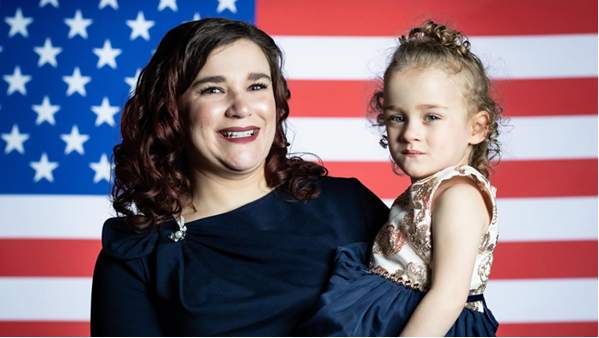
President Trump’s special guests included Ellie Schneider and her mother Robin. Born at just 21 weeks and six days, Ellie is one of the youngest babies to survive in the United States. Today Ellie is a happy, healthy two-year-old.
It’s not the first time President Trump has used his platform to lift up abortion survivors and put a human face on the pro-life cause. Precious children like Ellie are legally aborted every day in America at a point by which science shows they feel excruciating pain. In his remarks, the President again called out the heartless policies of today’s Democratic Party that would deny babies like Ellie their right to live:
In 2017, doctors at St. Luke’s hospital in Kansas City delivered one of the earliest premature babies ever to survive. Born at just 21 weeks and 6 days, and weighing less than a pound, Ellie Schneider was born a fighter. Through the skill of her doctors — and the prayers of her parents — little Ellie kept on winning the battle for life. Today, Ellie is a strong, healthy 2-year-old girl sitting with her amazing mother Robin in the gallery. Ellie and Robin: We are so glad you are here.
Ellie reminds us that every child is a miracle of life. Thanks to modern medical wonders, 50 percent of very premature babies delivered at the hospital where Ellie was born now survive. Our goal should be to ensure that every baby has the best chance to thrive and grow just like Ellie. That is why I am asking the Congress to provide an additional $50 million to fund neo-natal research for America’s youngest patients. That is also why I am calling upon the Members of Congress here tonight to pass legislation finally banning the late-term abortion of babies.
Whether we are Republican, Democrat, or Independent, surely we must all agree that every human life is a sacred gift from God!
I couldn’t agree more. America is at its best when we protect the least among us, and I’m grateful for all you do to bring about a better state for the unborn.
I have watched Steve Skojek’s argumentation over the last 14 months go from straw man arguments, to unreasoning blather, to insults and vicious invective against almost anyone who would point out the unreasonableness of his approach to the problems with the Declaratio of Pope Benedict XVI and its consequences in the Church.
And I have kept silent about it, except for a passing comment here and there, here at FromRome.Info, because I am not concerned with nit picking the sophistries of immature people who do not have the intellectual or moral integrity to discuss something honestly as an adult. I am concerned with the truth of history in this matter, not in the sense of what people might write about it now or in the future, but in the sense of what really did happen, and what it really does mean in canonical and theological terms.
But as Skojec’s private magisterium has become a personal superstition and grows daily among some minds as a cult of superstition, I consider it necessary to say something, because I want every one to be saved and to come to the knowledge of the truth. And for this, error must be refuted, by all who can ably refute it.
So I will broach this topic by commenting on some twitter conversations, the screen shots I was given. Here Steve comments on two groups, as he calls them, the Sedevacantists and the Bennyvacantists. Steve says he did not invent the latter term, but he keeps using it as a 13 yr old petulant school-boy uses a phrase he thinks is cool, but which makes him appear in reality stupid. Because by the term, Steve thinks he is referring to those who hold that Pope Benedict is still the pope, but the term obviously refers to those who think that Benedict vacated the see. So the term really refers to himself. The other term, for those who do not know, refers to those who think there have been no popes since Pius XII. — So of these 2 groups, Steve says:
Steve, if my sources are correct, has admitted to taking one introductory course to Canon Law at Steubenville, where he graduated. My sources tell me that Steve also cannot read the Code of Canon Law, because he does not read Latin. So he reads it, when he does, in the English translation, which, as I have mentioned many times, is both not authoritative and full of errors. As far as I know, also, Steve has never tried to investigate the matter further than his limit of knowledge and has not gone to Rome to speak with anyone about the questions of law or fact. — I have it that he corresponds or at least knows Ryan Grant, whom I showed the other day does not know the basic principles of Canon Law. Ryan, himself, though he is a published translator, is not a very good one. The passages I have examined in his translation of Saint Alphonsus have more than one error in every sentence, and hence I conclude they are worthless for anyone to use.
For this reason, I think that Steve’s first tweet, above, is very honest. I do not think he has the intellectual preparation to see the differences or appreciate them. Even if he knew what they are. Sedevacantists are a group of individuals who do not care about the Church in the least. They only care about condemning others so that like Jansenists they can revel in a being better than everyone else kind of spirit. Catholics, on the other hand, when they encounter schism and heresy, do something about it, by either trying to reconcile the parties involved or seeking their canonical solutions, because their love is for the Church and for the salvation of souls.
That is why, if you love the Church, you can probably see the difference between Sedevacantists and Catholics. It is not just an argument over what was said by so and so and whether that is heretical or not. Though, Sedes nearly always get this wrong, because they have an animus to find fault where not as much fault is found as they would want, in order to continually justify themselves as better than everyone else.
Catholics, concerned about the canonical problems in the Declaratio of Pope Benedict XVI, are obviously not interested at all in themselves, they are interested solely in the good of the entire Church and solving the problems at the root. To deny that is merely a glib ad hominem of a person who cares nothing for the Church and has no consideration for the possibility that his fellow man might actually care for the common good of the Church. His desire, rather, is always to put him down, because that is the only way to prove his superiority.
In his next, tweet Steve recites his straw man argument, which he brings out and dangles about like a shaman does with the bones of a dead man, before reciting an incantation on cue. Steve has been shown by many interlocutors over the past year that the opinion of John of Saint Thomas about universal acceptance refers to a canonical election, not to a doubtful or uncanonical election — taking doubt here in the objective positive sense. — So his continued appeal to universal acceptance is simply dishonest. And his continued use of it as a dogma is superstition.
At this point A. J. Baalman shares a series of tweets, drawing on the commentary on Canons 332, 187 and 188 made by Cathy Caridi on her blog, Canon Law Made Easy, which I reviewed yesterday. A. J. says:
Notice how Steve brings out his straw man, again, and rattles it in the air, as if by such an incantation you can participate in a rational argument. He omits the word “canonical” in front of “papal” one again, to make it seem more supportive of his position. But here he goes one step further. There can be no question of an problematic papal election so long as it was accepted. No need to investigate. — I do not know what others might thing about such a line of reasoning, but it sounds to me the kind of thing a canon lawyer working for the Lavender Mafia might use, because it really aids and abets almost any possible course of corruption and interference in a papal election, as to defy rational explanation. No honest man can reason thus.
A. J., counters and insists on an investigation, and Steve responds:
Steve says an investigation should be done, but it won’t be completed in the life time of the Pope or of Bergoglio. That is a very bold claim coming from someone who is not an investigator and who has shown no inclination to examine the facts already presented in the historical record. It is also another attempt at gaslighting, because it takes about 5 seconds to see the Renunciation is invalid.
Because all you have to do is 1) see that the Latin of Canon 332 §2 says munus, and that the Latin of the Declaratio says ministerium, and 2) recognize that what you do not renounce, you keep.
+ + +
Support FromRome.Info
Help us take on the established Catholic Media who are controlled opposition. They are promoting schism from Pope Benedict, and remain silent at the heresies and schisms of Jorge Mario Bergoglio. We cannot let the St. Gallen Mafia win the information war, which they are presently doing through controlled media. — TO FIGHT THIS WAR we need your generous financial support. — Funds go to Ordo Militaris Inc., and are capital gifts for this Apostolate.
Posted inUncategorized|Comments Off on BROTHER ALEXIS BUGNOLO’S FROM STRAW MAN TO SUPERSTITION
Analysis: Will Francis send Amazon celibacy decision up the river?
27211Pope Francis speaks in the Vatican’s synod hall, Oct. 7, 2019. Credit: Daniel Ibanez/CNABy JD Flynn and Ed Condon
Vatican City, Feb 3, 2020 / 12:53 pm (CNA).- A leaked draft of an anticipated apostolic exhortation on the Amazon started a flurry of speculation last week that Pope Francis plans to allow the ordination of married men to the priesthood for ministry in the region.
But for all the talk about viri probati, it’s likely that the pope’s next move will be to call for even more conversation— establishing a commission to discuss the possibility of ordaining married men to be priests in the Amazon, without actually committing to the idea.
A draft version of the exhortation has been circulated widely Vatican departments, a normal part of the process before a final version is presented for the pope’s signature. On a topic as sensitive as clerical celibacy, several dicasteries are expected to weigh in, especially the Congregation for Clergy and the Congregation for the Doctrine of the Faith.
While the draft leaked last week is far from the finished article, the wording of the text already suggests that a commission will be the next step.
The leaked text’s section on viri probati said that “the competent authority should establish criteria and provisions to ordain” married men to the priesthood.
In the jargon of the Vatican, the language of establishing “criteria and provisions” is a sure sign that a study commission is on the horizon.
During the Synod on the Amazon last October, the possibility of ordaining married deacons to the priesthood was widely discussed; some bishops from the region indicated that they wanted the authority to decide for themselves which and how many men to ordain.
Others bishops, including Cardinal Beniamino Stella of the Congregation for Clergy and Cardinal Marc Ouellet of the Congregation for Bishops, offered that since celibacy is a universal discipline for the Church, exceptions to it need to be discussed and decided at the universal level – meaning in Rome.
When St. John Paul II created an opening for married Anglican clergy to come into communion with Rome and be ordained to the priesthood, the Congregation for the Doctrine of the Faith was given the job of vetting candidates, and approving them for ordination, on a one-by-one, case-by-case, basis. Sources familiar with the feedback being offered on the draft text have told CNA this week that something similar is being suggested in this case.
“I think delegation is the real question,” one senior curial official told CNA.
“Even those most in favor of holding the line on celibacy can make peace with a narrow exception for a remote region if it is on a case-by-case basis and if Rome is keeping control.”
The same official told CNA there is concern in several Vatican departments that if bishops in the Amazon are allowed to dispense from celibacy and ordain married men on their own authority, there will be little to stop other bishops, especially in Germany, from demanding the same power.
In short, the issue of viri probati is as much about Church governance and authority as it is about married priests themselves. And questions about governance and authority are themselves about competing ecclesiological visions of the Church.
On those issues, there is no easy compromise.
The fundamental disagreements behind the question of viri probati make it all the more likely that any forthcoming apostolic exhortation is likely to offer a “yes in theory,” but no practical mechanism for bringing that yes into action.
A yes-in-theory, it should be understood, is not the same as a yes-in-law. The pope is almost certain to say something affirmative about the idea of a case-by-case dispensation from celibacy in the region or the possibilities of married clergy. But if he doesn’t actually change the law, with a clear and explicit declarative statement, it won’t be changed.
“If you didn’t say it,” as Westley observes of juridic acts in “The Princess Bride”, “you didn’t do it.”
In the meantime, the pope must still address two competing views on the question of celibacy, and is likely to use a tool familiar to him.
In the Vatican, the most obvious way of finding a road forward between intractable positions, one that does not commit the pope to a controversial reform of which he may not be entirely convinced, is to put the matter out for a thorough consultation on how the idea might be implemented.
In the half-decade of his papacy, Francis has shown a marked preference for calling for “further study and conversation” as a way of grasping thorny problems lightly: admitting possibilities without committing to them.
In 2017, he established a committee to study the historical nature of the female diaconate. The group has since produced reams of paper, which the pope has left on the table, along with any resolution to the call from some corners for some kind of female “diaconate” in the Church – a question Pope Francis seems uneager to address.
That same year, amid calls for the Church to “reinterpret” Humanae vitae, the pope put together a committee of theologically diverse scholars to study Vatican archives and develop white papers, none of which have changed anything at all.
Even in the wake of controversial interpretations of 2015’s Amoris laetitia, the pope has called for study of his text — going so far as to retool the Pontifical John Paul II Institute for the task — but has not actually made any reforms to the Church’s law.
On the other hand, when Pope Francis has made up his mind, he is not timid about legislating. 2015’s Mitis iudex remade the Church’s annulment process. 2016’s Come una madre amorevole created a new court for bishops, and 2019’s Vos estis lux mundi effectively scrapped that court, and created a new penal process altogether.
Pope Francis has tweaked canon law to his liking at least 10 times, in several cases making substantial changes. But on matters about which the pope seems uncertain, or with decisions likely to generate controversy, he seems happy to use a study committee to punt the ball down the field.
In the case of clerical celibacy, the pope has indicated an openness to hear arguments from those with something to say – that was how the issue arrived on the synodal agenda in the first place. At the same time, he has been consistent about his commitment to the discipline of celibacy, saying at one point he would rather “lose his life” than give it up.
Caught between his progressive courtiers and his own conservative disposition, the pope may hope he can punt the ball as far as his successor. But if South American bishops (or German ones, for that matter), decide to ordain married deacons to the priesthood without Roman approval, Francis may be forced to confront the issue sooner than he wants – or expects.
In that case, getting ahead of the pope would likely prove an unwise tactic: While Francis might sometimes support a diocese that has acted on its initiative to address a pastoral need, if he senses that his tolerance for a new idea has been taken advantage of, or that his authority is being usurped, he could effectively kill ongoing discussion about viri probati.
On the other hand, the more avid defenders of celibacy, including a large number of the pope’s own curial advisors, might be equally wary of appearing to try to box the pope in before he has made up his mind.
For those who hope to see more married priests in the Church – and for those who don’t – if the pope punts the ball, the smartest play is to wait until it has landed.
This means, of course, that there will likely be no swift resolution to the discussion of ordaining married men for the Amazon. The ball will be in the air. Who the pope, or his successor, directs to eventually catch and run with that ball – and several others now hanging somewhere above the field – is anybody’s guess.
I am impressed with the growing number of canonists who off the record are admitting that they recognize that Pope Benedict is still the true pope, because his renunciation was doubtful. While the fact that nearly all of them work for the Church, prevents the ones I have spoken with from being eager for public recognition of their stand, others have in the past admitted the truth of the problem.
One Canonist who spoke explicitly about the issue was Cathy Caridi, J.C.L.. Those letters after her name signify that she eared a Licentiate in Canon Law from a faculty recognized by the Apostolic See.
In a post, entitled, Can a Pope ever resign?, she explicitly discusses the meaning of Canon 332 §2 and what it requires.
She writes:
Only one canon of the entire Code of Canon Law makes any mention of this. Canon 332.2 states that if it happens that the Roman Pontiff resigns from his office, it is required for validity that his resignation be freely made and properly manifested, but it isn’t necessary that it be accepted by anyone. At first glance, it may strike readers as a rather odd thing to say at all! But when it’s read in the context of the entire Code of Canon Law and viewed in light of Catholic ecclesiology, it makes perfect sense. After all, the Pope is a bishop, the Bishop of Rome
After discussing the renunciation Bishops, she returns to the discussion of the Pope, addressing conditions for the renunciation, in order, first liberty. And refers her readers to Canon 187, which explains in what the necessary liberty consists.
But it is the next part, that she makes the explosively correct statements about the facts of law, that nearly everyone has been ignoring for 7 years:
The very next canon talks about external forces being brought to bear on a person who resigns his office. Canon 188 observes that a resignation is invalid if it is made because of unjustly inflicted grave fear, deceit, substantial error, or simony. How would this panoply of situations apply to the Pope.
What is nearly prophetic about what she says, is that she touches upon a pope who on account of a misunderstanding, resigns incorrectly and thus, whose resignation IS INVALID IN VIRTUE OF CANON 188:
“Substantial error” is harder to envision in the case of a papal resignation. Such error can theoretically occur if the person holding an ecclesiastical office incorrectly thinks that (for example) he is required to submit his resignation after holding it for a certain number of years, or when his superior dies and is replaced by someone else. A resignation that is made as the result of such a misunderstanding is invalid under canon 188. When it comes to the Pope, who knows full well that his office is intended to last until his death, it is difficult to imagine that he could make such a mistake!
Here she uses a classic example of a substantial error which arises out of errors of fact or law, using timing as the example. An error is called substantial, because it corrupts the whole substance of the juridical act. As one can see from canon 126, this can occur through several causes. Caridi was not a prophetess, so she did not discuss errors which arise from renouncing the wrong thing, however.
Finally, she boldly affirms that an ambiguous renunciation is invalided by Canon 332 §2 itself, in its clause on due manifestation:
We can now see all that canon 332.2’s phrase “freely made” entails. But there is definite uncertainty about the exact meaning of another phrase of canon 332.2 which asserts that a Pope’s resignation has to be “properly manifested.” Would the Pope have to announce it in the presence of the College of Cardinals, for example? Nobody really knows—but since the Pope is the Church’s Supreme Legislator, he can interpret this law however he wishes. In the end, therefore, it wouldn’t really matter, so long as the Pope’s decision was expressed clearly, i.e., neither ambiguously nor secretly.
You might be scratching your head, right now, and asking why no one has ever spoke of Caridi’s opinion before? Why did it not cause a controversy or storm of arguments?
That is because, what I just quoted, came from a post on her blog, Canon Law Made Easy, from January 2013, when the Catholic world was still Catholic and Trad Inc. was still sane!
Here at FromRome.Info, unlike many other blogs and websites, we keep the same categories and meanings of words and laws as they were on Feb. 10, 2013. We do not change.
Modernists change the meanings of things to push the revolution they back.
So when next you hear someone say, Bergoglio is certainly the pope, ask them, on what day they changed the meanings of the words in the Code of Canon Law!
____________
CREDITS: The Featured Image is a screen capture of the blog page of Cathy Caridi cited in this article. The quotations from her blog are used here according to the fair use standard for editorial commentary.
+ + +
Support FromRome.Info
Help us take on the established Catholic Media who are controlled opposition. They are promoting schism from Pope Benedict, and remain silent at the heresies and schisms of Jorge Mario Bergoglio. We cannot let the St. Gallen Mafia win the information war, which they are presently doing through controlled media. — TO FIGHT THIS WAR we need your generous financial support. — Funds go to Ordo Militaris Inc., and are capital gifts for this Apostolate.
Chirs Ferrara poo-poohed Ann Barnhardt’s collection of evidence, the other day, by calling it a “data set”, in the pure style of every gaslighting Bergoglian apologist. But the truth is the exact opposite — just as with every Marxist apologist — because projecting your own errors on your opponents is one of Salinsky’s Rules for Radicals.
But the only “data set” on Chris’ side is the consistent and constant claim by the Cardinals that Benedict resigned the Papacy. A claim made without citing any evidence which is supported by the Law or reality.
Even major Italian newspapers admitted that Benedict had clearly retained the papal dignity and power, back in 2014. — But perhaps Chris does not read Italian.
Here is my translation of the opening of an article, entitled, Bergoglio 0.0, Papa nullo. E Ratzinger ancora lo è, which appeared in Il Foglio on Sept. 23, 2014 at 6:26 A.M., Rome time. The title translates: Bergoglio 0 for 0, a null Pope. And Ratzinger still is the one.
Rome. He continues to sign himself as, Benedict XVI, even with the P. P., to indicate the power of the pope, a thing, however, which Francis has never done from the day of his enthronement on the Chair of Peter. He used to dress in white and he continues to dress in white, even if he has laid aside the mantle and the cincture. There was not enough time to find a black soutaine in all the Vatican, is the reluctant justification which came from beyond the Tiber. He used to be the Pope and he remains the pope, though emeritus. Even the coat of arms has been retained with the crossed Keys, which a few zealous Cardinals, expert in heraldry, tried to remove, so as to remove all reference to the Petrine Ministry. But, now, of what value was the renunciation made by Joseph Ratzinger, sitting on the red throne in the Sala Clementine, on Feb. 11, a year ago, to the surprise of the crimson clad prelates, who were present, a few of whom — not being so good in Latin — did not understand the meaning of what was happening: “a unique case in 2000 years of Church History”.
Tell me again, Chris, that there are no data sets out there, that say Benedict is still the pope, and consequently, that Bergoglio never was. Tell us that no one has the right to use data sets to say the see is vacant? Does that mean that no one has the right to think? Or that you do not not recognize as somebody, anyone who does look a the facts and think?
I know my Church history. The only unique thing in 2000 years, is not a valid papal resignation, it is an invalid papal resignation, that is ignored, yet taken as valid by a conspiracy of all the Cardinals. — The Cardinals, remember, are the reason for most of the Antipopes of history, let us not forget. Antipopes do not pop-up into being from “data sets” of a laywomen reading Canon Law.
NOTE: The Latin abbreviation, P. P., means Pastor Pastorum, that is Shepherd of Shepherds, and has been used exclusively by the Successors of Saint Peter for centuries.
__________
CREDITS: The Featured Image is a screen shot of the page of the Italian Newspaper where the article still appears to this day. Used in accord with fair use standard for editorial commentary.
+ + +
Support FromRome.Info
Help us take on the established Catholic Media who are controlled opposition. They are promoting schism from Pope Benedict, and remain silent at the heresies and schisms of Jorge Mario Bergoglio. We cannot let the St. Gallen Mafia win the information war, which they are presently doing through controlled media. — TO FIGHT THIS WAR we need your generous financial support. — Funds go to Ordo Militaris Inc., and are capital gifts for this Apostolate.
$10.00
Posted inUncategorized|Comments Off on I know my Church history. The only unique thing in 2000 years, is not a valid papal resignation, it is an invalid papal resignation, that is ignored, yet taken as valid by a conspiracy of all the Cardinals. — The Cardinals, remember, are the reason for most of the Antipopes of history, let us not forget. Antipopes do not pop-up into being from “data sets” of a laywomen reading Canon Law.
Back in 2014, I wrote a book called Defending Marriage: Twelve Arguments for Sanity. I spoke not as an interpreter of Scripture or of the teachings of the Church. My arguments were based on observation, logic, history, anthropology, and culture. As far as I know, no Catholic on the left has taken them up. My arguments included analyses of what we have already done wrong and why, and predictions as to what must happen if we yield to the lures of Sodom.
Opponents at that time fell into two groups. By far the larger of the two predicted that nothing would happen. The re-definition of marriage would only extend to a relatively small number of couples a good that was available to everyone else, and that would be no less available to them for being so extended. A development unprecedented in human history, involving any society’s most important institution, would have no effect upon the common good. The second group consisted of a small number of theorists and activists who had sought the change in order to destroy the institution, which they saw as atavistic, patriarchal, and resistant to the ambitions of progressive politicians who for our own good would oversee and direct all that we otherwise do, from the womb to the grave.
We should listen to what our opponents say when they are speaking to one another, rather than to their easy marks among journalists, television audiences, school teachers, little children reading cartoon propaganda, and women riffling through the pages of Cosmopolitan. When they tell us they want to destroy, we should take them at their word. Still, intentions do not imply results. So I would like to revisit my arguments, one by one, and show that observation, logic, history, anthropology, and culture were more reliable than indifference, sentimentality, and wishful hoping. The first argument was thus: We must not give the sexual revolution the force of irrevocable law. Implicit in the argument were two claims, one as to historical fact (though anthropology and logic can show why we should have expected it), and one as to moral logic: the sexual revolution was a calamity; Sodom implies the sexual revolution.
First things first. The sexual revolution was a calamity—and the calamity continues. It is based upon a deliberate ignoring of what is real. We can see as much in a variety of ways. People talk as if sexual congress properly speaking were not essentially the child-making act. Indeed that is its sole biological purpose. The child is not an accident. It is what you get when everything is working as it should. Contraception is not medical, because it does not remediate. It shields against no communicable disease. It cures no disease already caught. It heals no limb. It restores no function to an organ. The problem is not that the organs are not working, but that they are, all too well. A healthy reproductive system is exactly what the contraceptors do not want, at least not in the instant.
But this severs the act from its fullest human meaning. It is no longer the act whereby every single person has been brought into the world. It is not what fathers and mothers do but only what people with this bodily makeup do with people of that other bodily makeup, because of the powerful feelings the act expresses or arouses or imitates. The man’s seed is no longer seed, but lubricant. The father—the man who in the act stands as the exemplar of a father, even if the act happens not to result in a child—is not a father, but a tool-bearer. The mother—the woman who in the act stands as the exemplar of a mother—is not a mother, but another tool-bearer. The meaning of what they do is wholly subjective and therefore uncertain. If “love” is its motive, that love can shift or fade or vanish. But even if it does not, neither the man nor the woman will find it easy to place their actions in the context of grandparents and parents, sisters and brothers, or aunts and uncles and cousins. The act is existentially truncated.
Catholics of the left, above all, should understand how deeply antisocial the doctrine of laissez-faire is when it is applied to what ought to be the cement of every social relation. The old understanding of sexual intercourse was relentlessly realistic. Every tenet of sexual morality derives from the reality of the act. But if we deny the reality, if we pretend that it is not what it is, then those other social relations will fray in turn. The force is reductive, and it bears upon us all. “Who does not know at least one family,” I wrote, “whose children require an essay merely to describe who under their roof is related to whom, and how?” Nor will they be able to tell how long they will remain related to one another by law, or how long they can expect even to know one another.
I have called the sexual revolution the Lonely Revolution. It must have been so. Its premises are those of individuals regarding their frictions with other individuals. It was to have delivered us peace and happiness and freedom from outdated moral laws. It delivered instead exactly what Shakespeare could have shown, as I wrote:
The expense of spirit in a waste of shame Is lust in action; and, till action, lust Is perjured, murderous, bloody, full of blame, Savage, extreme, rude, cruel, not to trust.
“Yes,” says the heretic, “but we are arguing for love, not lust.” Sorry, but the distinctions are by no means easy to draw in the heat of passion. We human beings have a remarkable capacity for self-deception. This is why clear laws are so necessary and so salutary. You can fool yourself into thinking you are in love, but you cannot fool yourself into thinking that you have been married. These clear laws channeled sexual desire into the fruitful haven of marriage. The absence of clarity leaves everyone uncertain, and, as marriage recedes, many a young person will not only take lust for love, but will take determination—the determination that we must feel something, anything, just to fend off the loneliness of this world—for lust.
Reader, when was the last time you saw, outside of the shelter of a Christian school, a boy and a girl holding hands as they walked across a field? Imagine asking that sentence in your grandparents’ time. People would have looked at you as if you had dropped down from Mars. It would have been like asking, When was the last time somebody had seen a dozen children playing pick-up ball in a back yard or a vacant lot. Yesterday? An hour ago? But those questions are related, are they not? The world in which fornication is the rule is a harsh and unforgiving one. The boy and girl—outside of that shelter—cannot hold hands without giving everyone the sign that they are in bed with one another, and so they do not do it. The boy does not ask the girl on a date, because that too implies the bed.
We have given them no healthy ways to grow in confidence with one another, no healthy ways of sexual innocence developing alongside sexual maturity. The young people who keep the moral law are therefore lonely, often intensely so, and their friends who do not keep the law are often lonelier still. For as there is nothing so lonesome as being in a crowd of laughing people who do not really enjoy the company, so there is nothing so dispiriting as knowingly going through the motions of married love with someone whom you will almost certainly leave.
If the Catholic says, “Many sins are worse than these,” I will surely agree, as I concede that it is worse to be shot in the head than to catch pneumonia. But pneumonia can kill, too. When millions were dying of the Spanish flu a hundred years ago, it was no wisdom to say that rabies was more deadly. The sexual revolution is destroying lives by the millions, right before our eyes, and has corrupted the culture beyond what the worst pessimists ever imagined. And, in this situation, are we to believe that Sodom is the answer? The Church has the answers if she would but heed them and preach them forthrightly. These answers are available to anyone using natural reason. Let them who have eyes open them.
Image: The Destruction of Sodom and Gomorrah by John Martin
Anthony Esolen, a contributing editor at Crisis, is a professor and writer-in-residence at Magdalen College of the Liberal Arts. Dr Esolen has authored several books, including The Politically Incorrect Guide to Western Civilization (Regnery Press, 2008), Ten Ways to Destroy the Imagination of Your Child (ISI Books, 2010) and Reflections on the Christian Life (Sophia Institute Press, 2013).
Posted inUncategorized|Comments Off on We must not give the sexual revolution the force of irrevocable law. The world in which fornication is the rule is a harsh and unforgiving one. The boy and girl—outside of the shelter of a Christian school—cannot hold hands without giving everyone the sign that they are in bed with one another, and so they do not do it. The boy does not ask the girl on a date, because that too implies the bed. The sexual revolution is destroying lives by the millions, right before our eyes, and has corrupted the culture beyond what the worst pessimists ever imagined. And, in this situation, are we to believe that Sodom is the answer? The Church has the answers if she would but heed them and preach them forthrightly. These answers are available to anyone using natural reason. Let them who have eyes open them.
Archbishop of Kampala Dr. Cyprian Lwanga, has stopped the receiving of Holy Communion by hand during Catholic Mass (PHOTO/File).
KAMPALA — Kampala Catholic Archbishop Cyprian Kizito Lwanga has directed that no Christian or practicing Catholic will be allowed to receive the Holy Communion by hand.
He has also decreed that Holy Mass will no longer be celebrated in homes, as is the current norm, in a bid to “fend off abuses in the liturgical life of the Church”.
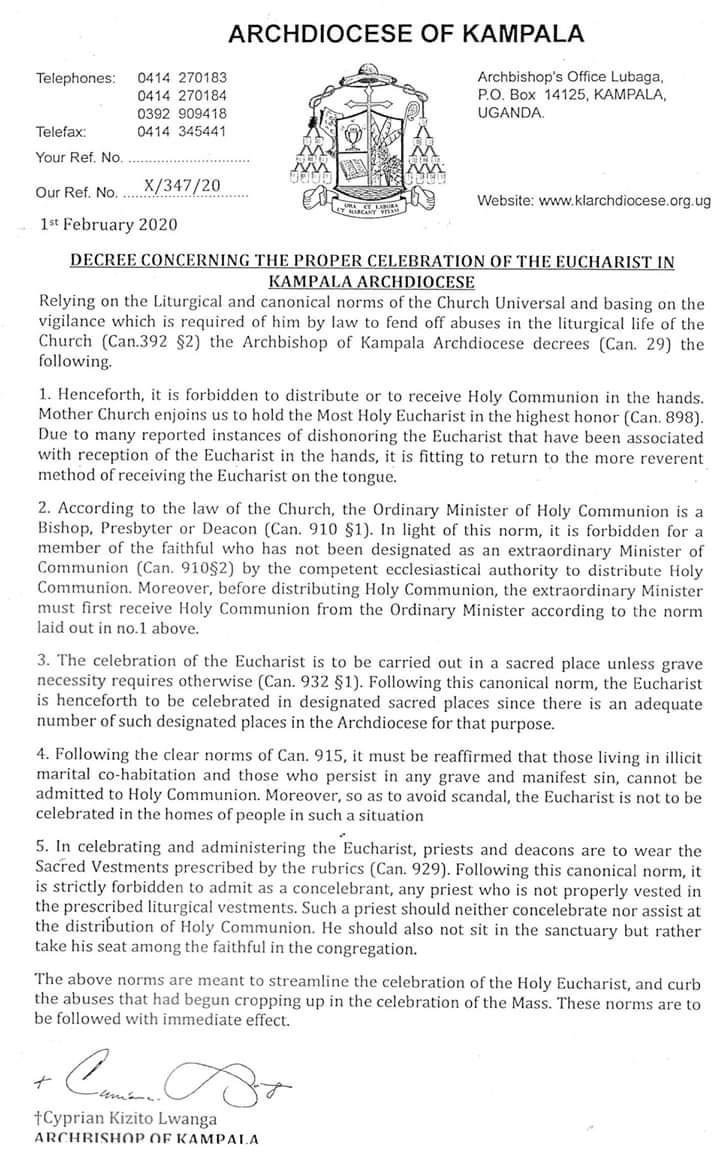
The directives are contained in a decree he issued on Saturday, February 1, 2020 following a high level meeting with the clergy and senior executive committees of parishes at Rubaga Cathedral in Kampala. A decree (Latin: decretum) is an order or law made by a superior authority for the direction of others.
Previously, Catholics have been receiving the Eucharist either by the palm of the hand or by mouth. But under the new decree, the priest will only be allowed to distribute the Holy Eucharist (bread) by mouth. Archbishop Lwanga said the measure is in keeping with the liturgical and canonical norms of the Church Universal under Canon Law 392: 2.
“Henceforth, it is forbidden to distribute or to receive Holy Communion In the hands. Mother Church enjoins US to hold the Most Holy Eucharist in the highest honor (Can. 898). Due to many reported instances of dishonoring the Eucharist that have been associated with reception of the Eucharist in the hands, it is lilting to return to the more reverent method of receiving the Eucharist on the tongue,” the letter reads in part.
In a decree issued on Saturday, February 1, Archbishop Dr. Lwanga seemed to ban faithful holding prayers outside traditional church settings (PHOTO/Courtesy).
Previously, many Christians have also been holding masses in their homes but under the new arrangement, such masses have been restricted to avoid holding them in non-sacred places.
“The celebration of the Eucharist is to be carried out in a sacred place unless grave necessity requires otherwise (Can. 932 91). Following this canonical norm, the Eucharist is henceforth to be celebrated in designated sacred places since there is an adequate number of such designated places in the Archdiocese for that purpose,” the archbishop’s letter adds.
Archbishop Lwanga also warns those who are co-habiting against receiving Holy Communion.
“Following the clear norms of Can. 915. It must be reaffirmed that those living in illicit marital co-habitation and those who persist in any grave and manifest sin., cannot be admitted to Holy Communion. Moreover, so as to avoid scandal, the Eucharist is not to be celebrated in the homes of people in such a situation,” his letter reads in part.
Priests have also been instructed to avoid allowing lay people to distribute Holy Communion during Mass.
“According to the law of the Church, the Ordinary Minister of Holy Communion is a Bishop. Presbyter or Deacon (Can. 910: 91). In light of this norm, it is forbidden for a member of the faithful who has not been designated as an extraordinary Minister of Communion (Can. 910§2) by the competent ecclesiastical authority to distribute Holy Communion. Moreover, before distributing Holy Communion, the extraordinary Minister must first receive Holy Communion from the Ordinary Minister according to the norm laid out in no.1 above,” the letter adds.
The priests have also been tasked to always dress in the permitted sacred vestments before saying Mass.
“In celebrating and administering the Eucharist, priests and deacons are to wear the sacred Vestments prescribed by the rubrics (Can. 929). Following this canonical norm, it is strictly forbidden to admit as a co-celebrant, any priest who is not properly vested in the prescribed liturgical vestments. Such a priest should neither concelebrate nor assist at the distri6ution of Holy Communion. He should also not sit in the sanctuary but rather take his seat among the faithful in the congregation. The above norms are meant to streamline the celebration of the Holy Eucharist, and curb the abuses that had begun cropping up in the celebration of the Mass. These norms are to be followed with immediate effect,” he added.
Etienne Gilson was one of the clearest thinking philosophers of the 20thcentury. As a good philosopher, naturally, he fully understood the importance of reason, a power that is often downgraded or even dismissed in the modern world. In an address he gave at Harvard’s Tercentenary Celebration (1936), he made the following statement: “Realism always was and still remains the source of our personal liberty. Let us add that, for the same reason, it remains the only guarantee of our social liberty.”
Jacques Maritain concurred, citing St. Thomas Aquinas. Totius libertatis radix est in ratione constituta, says the Angelic Doctor: The entire root of liberty is in reason. Maritain went on to say that when reason is suppressed, what is left is not liberty, “but that amorphous impulse surging out of the night which is but a false image of liberty.”
Reason connects us with reality. Liberty is one of its offspring. We are not free if we cannot see where we are going. In fact, we are lost, and lost without a compass or a map. For G. K. Chesterton, “modern man has lost his address.” We are lost because we disregarded reason (i.e., what science says regarding the nature of the unborn human and what it observes concerning the adverse effects of abortion, especially for women) and expected liberty to bloom in a vacuum.
During the recent March for Life, President Donald Trump became the first sitting president to join the hundreds of thousands who came to Washington to stand up for life. The following excerpt from his address indicates his preference for concrete realities over airy abstractions:
When we see the image of a baby in the womb, we glimpse the majesty of God’s creation. When we hold a newborn in our arms, we know the endless love that each child brings to a family. When we watch a child grow, we see the splendor that radiates from each human soul. One life changes the world… We cannot know what our citizens yet unborn will achieve. The dreams they will imagine. The masterpieces they will create. The discoveries they will make. But we know this: every life brings love into this world. Every child brings joy to a family. Every person is worth protecting. And above all, we know that every human soul is divine and every human life, born and unborn, is made in the holy image of Almighty God.
An eloquent testimony, indeed, to the value and dignity of life.
On the other hand, a number of Democrats, infuriated by the president’s stand, have pledged that concern for life must not stand in the way of liberty. As “liberals,” they want to secure, through a federal law, the liberty of a woman to choose abortion. Thus, the clash comes down to Life vs. Liberty. But this is a false dichotomy since life and liberty do not oppose each other. The very first sentence of Lawrence Tribe’s book, The Clash of Absolutes, reads as follows: “This book is about a clash of absolutes, of life against liberty.” His fatal mistake is to make liberty an absolute, whereas, in truth, liberty can flourish only when it is rooted in reason. Liberty is not an absolute; it is a derivative. Reason is fundamental. Life is a blessing. By giving liberty an absolute status, reason is discarded, and, without its connecting function with reality, life is no longer seen as the blessing that it is.
When liberty is viewed as an absolute, all life is threatened, not only that of the unborn child. This is because liberty is no longer tempered, directed, or enlightened by reason. Reason tells us that the unborn child is a member of the human family and thus deserving of the same protection that is extended to all human beings. Respect for life, therefore, becomes the ground for respect for liberty, which is a liberty that does not “clash” with life. A rose flourishes only when its roots are intact. To choose liberty at the expense of life is to lose both.
Justice Harry Blackmun, who wrote the 1973 Doe v. Wade ruling, made a most revealing statement in the 1977 Beal v. Doe Supreme Court case. “But the cost of a nontherapeutic abortion,” he wrote, “is far less than the cost of maternity care and delivery, and holds not comparison whatsoever with the welfare costs that will burden the State for the new indigents and their support in the long years ahead.” This is a far-reaching form of liberty that pretends, without any real basis, to see into the future. By this cost calculus, liberty would endanger all life. To reiterate the words of President Trump, “We cannot know what our citizens yet unborn will achieve. The dreams they will imagine. The masterpieces they will create.”
President Trump’s speech is a defense of true liberty, but one placed in the context of human life, evoking notions of love, joy, potential, and even the hand of God.
Donald DeMarco is professor emeritus at St. Jerome’s University and adjunct professor at Holy Apostles College & Seminary. He’s a regular contributor to the St. Austin Review.
Posted inUncategorized|Comments Off on THE ECONOMIC TOOL OF COST ANALYSIS HAS AN IMPORTANT ROLE TO PLAY IN BUILDING ROADS AND DAMS BUT IT HAS A VERY MINOR ROLE TO PLAY IN MATTERS OF HUMAN LIFE SUCH AS ABORTION AND EUTHANASIA
Andrew Yang is a man ahead of his time. Mark my words: within our lifetime, his ominous-sounding “Freedom Dividend—basically a universal basic income, or UBI—will become a plank of at least one of our two major political parties. And how could it be otherwise?
Mr. Yang argues (correctly) that the developed world is going through a “fourth Industrial Revolution” characterized by automation and outsourcing. There are fewer and fewer careers available to American workers who only possess a high school education; the best jobs are in technology and capital. So, how do we ensure that all Americans can make ends meet?
Heretofore, the answer has been simply to invent new jobs that don’t actually serve any purpose, but allows capital to be funneled from corporations into the pockets of non-productive workers. As the economist David Graeber points out in his (unfortunately titled) essay for Strike! Magazine, “On the Phenomenon of Bulls**t Jobs,” we’ve long since reached the point where Americans could work an average of 15 hours a week. And yet,
rather than allowing a massive reduction of working hours to free the world’s population to pursue their own projects, pleasures, visions, and ideas, we have seen the ballooning of not even so much of the “service” sector as of the administrative sector, up to and including the creation of whole new industries like financial services or telemarketing, or the unprecedented expansion of sectors like corporate law, academic and health administration, human resources, and public relations. And these numbers do not even reflect on all those people whose job is to provide administrative, technical, or security support for these industries, or for that matter the whole host of ancillary industries (dog-washers, all-night pizza delivery) that only exist because everyone else is spending so much of their time working in all the other ones.
This, by the way, is the phenomenon of “job-creating entrepreneurs” that Republicans have so long celebrated.
George H.W. Bush famously said that the solution to those who can’t secure one of these pointless, low-wage jobs isn’t welfare: it’s charity. We don’t need statist solutions to the problem of economic inequality—only a renewed sense of noblesse oblige, where the wealthy take extra care to provide for the needs of those “less fortunate.”
Of course, nobody seriously believes that’s the solution in 2020. The rich simply aren’t giving more relative to the needs of those losing jobs to automation and outsourcing. Those who still oppose government-based solutions—the doyens of National Reviewcruises and Heritage Foundation cocktail parties—don’t bother with the noblesse obligething anymore. Free-market fundamentalists are reduced to the sneering elitism of Kevin D. Williamson, whose solution to the wage gap is (quite literally) to let the poor idiots starve. As he wrote in his infamous 2016 column for National Review, “The Father- Führer,”
The truth about these dysfunctional, downscale communities is that they deserve to die. Economically, they are negative assets. Morally, they are indefensible…. The white American underclass is in thrall to a vicious, selfish culture whose main products are misery and used heroin needles.
Needless to say, no believing Catholic could endorse such a callous attitude towards the poor. Traditional Christians are increasingly estranged from the Conservative Movement™ precisely because of the increasingly dogmatic and irrational adherence to the dogmata of market fundamentalism.
The solution proposed by progressives like Elizabeth Warren and Bernie Sanders is higher-education subsidies. Their reasoning follows this basic formula: people with college degrees earn more; we need to raise wages; therefore, more people should go to college. Of course, these subsidies aren’t contingent on what these students choose to study. A Warren or Sanders administration would only succeed in flooding the job market with yet more unskilled, gender-fluid, left-wing youffs who think they’re entitled to a six-figure salary and an apartment in Manhattan because graduated from a C-list liberal arts college with a major in photography and a minor in naval-gazing.
Still, even if we could dictate what they study, how far would that get us? 300 million Americans can’t all get jobs developing smartphone apps or selling financial services for Goldman Sachs. There’s a limited need for Lyft drivers and Buzzfeed reporters. (In the latter case, it’s somewhere in the neighborhood of zero.) The progressive push for free college education is a smokescreen to hide the deep structural faults in our economy.
Then along comes Mr. Yang, with his very simple proposal: just give everyone a bit of money. If we can’t find jobs for these people—if we literally don’t need them to work—why go on inventing these “bulls**t jobs”? Raise corporate taxes and income taxes on the super-wealthy, and use that money to put cash in the hands of ordinary American families.
Follow the logic far enough and we arrive at the post-labor (and post-capital) world of Star Trek, where automation has extended, not only to growing food, but even to cooking: tell the computer you want a hot fudge Sunday, and—poof! One materializes before your eyes. And, with the astonishing technological advances that have occurred over the last fifty years, Gene Roddenberry’s utopia seems less and less like science fiction and more and more like prophecy. If we continue on this path to full automation, Mr. Yang’s proposal is the necessary first step towards phasing work, money—the economy itself—out of human society.
❧
The question, then, is whether that future is desirable. The social doctrines of the Church are unanimous on this matter: No, it isn’t—for two reasons.
First, work is integral to our humanity. In our daily toil (like our respite on the Sabbath) we show ourselves to be made in the image and likeness of God: He labored for six days creating the universe, each day noting contentedly that what He made was good, and rested on the seventh.
Of course, without actual, productive labor, man could still exercise his creative powers—building model planes, for instance, or writing music. But work isn’t the same thing as a hobby, or even art. For man to work for his own substance has been integral to the human experience ever since our first parents were expelled from the garden. “Cursed is the ground because of you,” the Lord said to Adam; “in toil you shall eat of it all the days of your life.”
But in this retribution we also find our redemption. As Dorothy Sayers wrote in her astonishing essay “Why Work?”, the Christian understands that “every man should do the work for which he is fitted by nature.” This is true economic freedom: the freedom for laymen to pursue their secular vocation. And no man’s vocation is to be an idler, a tinkerer, or a hobbyist. As Sayers explains, every rightly-ordered soul feels a deep need to create something, not only honest and beautiful, but useful. In doing so, the secular vocation becomes a sacred vocation. Only then, in our postlapsarian state, can we feel a wholesome awe towards our Creator and His creation.
Indeed, the further removed we become from this aspect of our nature—the fewer there are among us who put plow to earth, or knife to flesh, or hammer to nail—the more distant and indistinct God’s beneficence becomes, and the easier it is to take His blessings for granted. (How few of us pray for rain, or for a good harvest? Yet these were, not so long ago, a mainstay of our liturgical life.)
In his landmark encyclical Rerum Novarum, Pope Leo XIII observed that, “according to natural reason and Christian philosophy, working for gain is creditable, not shameful, to a man, since it enables him to earn an honorable livelihood.” A fully automated economy would leave man with only the most dishonorable of livelihoods: mooching off our own technology. It would be a complete inversion of the natural order, where the creator is dependent on—enslaved to—his creation.
Anyway, where would St. Joseph have fit into such an economy? How could we, the laity, imitate his simple life of honest toil? Even Our Blessed Lord chose for Himself the life of a carpenter’s apprentice before He began his public ministry. His childhood home was the modest dwelling of a village tradesman. And, as Fr. Vincent McNabb pointed out, He called no farmers as His disciples, for
the Word made flesh was not minded to disturb the Divine order which made land-work the primary duty and need of beings demanding daily bread to keep them in being… Land-work was an institution so indispensable and divine that from it He took no workers, but only the wisdom of parables.
Second, private property is integral to lawful freedom. Again, quoting Leo XIII, Catholic social teaching absolutely upholds the common man’s “possibility of increasing his resources and of bettering his condition in life.” This can only come if he’s in full command of the just wage he earns from his labor.
This is why the Church criticizes any system that limits a man’s ability to provide for his family’s needs, whether that system is capitalist or socialist. It opposes the twinned tyrannies of Big State and Big Business. And Mr. Yang’s universal basic income combines the worst of both worlds. It’s a conspiracy between the government and corporate elites to provide a pittance for the jobless masses.
In short, a man can neither possess his full dignity nor his full liberty if he depends on handouts. And that is precisely where the UBI is leading us: a massive, global welfare state. Pope John Paul II, in his encyclical Centessimus Annus (published to commemorate the 100th anniversary of Rerum Novarum) warns against any system that reduces man to “a molecule within the social organism,” causing a “loss of human energies and impinges his ability to earn “a living through his own initiative.”
Such a system must be opposed by all Catholics, whether it calls itself capitalism, socialism, or the Freedom Dividend. It denies man his God-given right to work, and to the fruits (both economic and moral) of that work. It denies his very humanity.
❧
If left unchecked, our economy will continue slouching towards Mr. Yang’s post-human dystopia. What, then, is the alternative? The answer is easier to articulate than to implement, but it’s perfectly obvious: we must bring jobs in manufacturing and agriculture back to the United States, and to support local crafts and the trades.
This is why President Trump is, oddly enough, one of the great implementers of Catholic social teaching in our time. It’s why he’s earned such strong support from factory workers in Ohio, farmers in Michigan, ranchers in Nebraska, and miners in West Virginia. He understands that men of simple and honest toil are the backbone of any stable society. They are not “obsolete” in the modern economy. On the contrary: any economy that can’t sustain their work is itself obsolete. Markets exist to serve families and communities—not the other way around.
President Trump’s protectionist measures have been decried by wonks on both the Left and the Right as retarding economic growth. These are precisely the “sophisters, economists, and calculators” Edmund Burke warned against: men who can only see society through the lens of GDP and per capita income. It’s true that our economy no longer provides the kind of jobs that make that possible. But, again, the fault is with the economy, not the workers.
The transition back to a more human, localized, family-centered economy would have its little agonies. It would mean rejecting consumerism, the ethic of avarice—the “civilization of greed and waste,” as Sayers calls it. and embracing frugality. Families wouldn’t be able to buy the new iPhone every year; they might have to buy a used Ford instead of leasing a new Lexus. They would have to make careful investments in durable, locally made furniture instead of remodeling their living room every five years at Ikea.
We’ll have to throw away decades of conventional wisdom, which is really so much status-signaling silliness, like the superiority of white-collar jobs over blue-collar ones, or the idea that a college degree somehow makes one more intelligent or well-rounded (these days, the reverse is usually closer to the truth). And we’ll have to revolutionize completely how we measure “standard of living.” A life lived for trinkets and baubles—mere things—is no life at all. But a life lived for God and neighbor, honest work and wholesome leisure: this is what man is made for.
If we can’t accept a few minor hindrances to our comfort and convenience, we’ll continue to watch the decline of human dignity and natural liberty across the West. We’re slouching, not towards Star Trek, but towards Aldous Huxley’s Brave New World: a society that surrenders its dignity and liberty for the sake of carnal pleasures. Culture will continue to be replaced by mere technique, and families will continue to be sacrificed to a venal, self-serving individualism.
This isn’t a recent development. The trend has been progressing at least since the first Industrial Revolution. The Church has consistently warned against the dehumanizing effects of our modern economies, though Catholics (both on the Left and the Right) have paid little heed, preferring to ally ourselves with secular ideologies like laissez-faire capitalism and “democratic” socialism.
Someday, we’ll realize there’s no substitute for the humane economy—the economy that places families before corporations—the economy grounded in communities, not the state—the economy that provides for man’s material needs, but understands that his spiritual needs must come first. Hopefully, when that day comes, there will still be time to act.
ROME, January 31, 2020 (LifeSiteNews) — In a new testimony touching upon the election of the next Pope, Archbishop Carlo Maria Viganò has alleged that the cardinal whom Pope Francis recently approved to preside over the next papal conclave was involved in covering up the misdeeds of infamous Legionary of Christ founder, Marciel Maciel.
In a statement released on January 31 and titled “The faithful have the right to know” (see official English text below), Archbishop Viganò asserts that Pope Francis’s confirmation of Cardinal Leonardo Sandri as Vice-Dean of the College of Cardinals is a “masterpiece of deception.”
On Saturday, January 25, the Holy See announced that Pope Francis had confirmed the election of Cardinal Giovanni Battista Re, 86, and Cardinal Leonardo Sandri, 76, as Dean and Vice-Dean of the College of Cardinals respectively. The announcement came one month after Cardinal Angelo Sodano, 92, resigned as Dean of the Sacred College.
Francis’s approval of these elections “has gone almost unnoticed and yet conceals a devious strategy,” Archbishop Viganò writes.
The former apostolic nuncio to the United States contends that the confirmation of Cardinal Re as Dean of the Sacred College is “a cover for that other more effective appointment — of Cardinal Sandri — which has been prepared ad hoc to pilot the next conclave secundum Franciscum, that is, according to an updated and augmented edition of the St. Gallen Mafia.”
Role of the Dean and Vice-Dean
The Dean of the College of Cardinals presides over the Sacred College. When a Pope dies (or in the case of Benedict XVI has resigned), the Dean is tasked with communicating to all the cardinals that the pontiff has passed and summoning them to Rome for a papal conclave.SUBSCRIBEto LifeSite’s daily headlinesSUBSCRIBEU.S. Canada World Catholic
The word “conclave” refers to the time in which the cardinals are locked inside the Sistine Chapel to elect a new Pope. Only those cardinals who are under the age of 80 are eligible to enter the conclave and vote.
The Dean of the College presides over the conclave and also oversees what are called the pre-conclave “congregations,” at which cardinals discuss the logistics and planning for the conclave, and importantly, meet their brother cardinals and get to know their positions. All of the cardinals, even those who cannot vote in the actual election for reasons of age, are eligible to participate in the congregations. Such was the case with former Cardinal Theodore McCarrick in 2013.
The Vice-Dean’s role is to act as a substitute when the Dean cannot exercise his office. At 86 years of age, Cardinal Re, as newly elected Dean, is not eligible to enter into or preside at the next conclave and will therefore cede this role to 76-year-old Cardinal Sandri.
Cardinal Re will still oversee the congregations, but Cardinal Sandri, as Vice-Dean of the College of Cardinals, will exercise the most important role — to preside over the election of the next Pope.
This is not a novelty. In 2013, after the resignation of Benedict XVI, for reasons of age, Cardinal Angelo Sodano ceded this role to then-Vice-Dean, Cardinal Re, who presided over the election of Pope Francis.
A web of coverup?
In his new statement, Archbishop Viganò recalls his first testimony in August 2018, in order to reiterate that “the person chiefly responsible for covering up the misdeeds committed by Maciel was then-Secretary of State Cardinal Angelo Sodano.”
“Unfortunately for him, Sandri also allowed himself to be involved by Sodano in this operation to cover up Maciel’s horrible misdeeds,” he adds.
Drawing on his first-hand experience as a member of the diplomatic corps and high-level official in the Vatican Secretariat of State, Archbishop Viganò testifies that through a series of “shady maneuvers,” Cardinal Sandri was transferred to Mexico, to replace Archbishop Justo Mullor, who “was removed from the Apostolic Nunciature in Mexico because he opposed the directives coming from the Secretariat of State to cover up the very serious accusations against Marcial Maciel.”
Archbishop Viganò writes:
“To replace Archbishop Mullor in Mexico City, it was necessary to appoint a person of unfailing loyalty to Sodano. Sandri had already given proof of this as Assessor for the section of General Affairs in the Secretariat of State. Serving at the time as Nuncio in Venezuela for just a little over two years, he was transferred to Mexico.”
This new testimony echoes his first, in which he wrote:
“It is known that Sodano tried to cover up the Father Maciel scandal to the end. He even removed the Nuncio in Mexico City, Justo Mullor, who refused to be an accomplice in his scheme to cover Maciel, and in his place appointed Sandri, then-Nuncio to Venezuela, who was willing to collaborate in the cover-up.”
In his first testimony, Archbishop Viganò also stated that he informed Cardinal Sandri, along with Cardinal Tarcisio Bertone, about Theodore McCarrick’s decades-long abuse of priests and seminarians. Sandri was one of several high-ranking prelates who “knew in every detail the situation regarding Cardinal McCarrick,” he testified.
Archbishop Viganò notes his “long-standing friendship” with Cardinal Sandri that dates back 50 years to their shared time in the Pontifical Ecclesiastic Academy (a training academy for Vatican diplomats) and the Secretariat of State. He also affirms that his new testimony is inspired “solely” by the bond of that friendship and is offered “for the good of his soul, for the love of the Truth who is Christ Himself, and for the Church, His Bride, whom we served together.”
The former US nuncio also testifies that Pope Francis, having asked him about Sandri, knew about his character and the Mexico transfer, and “promoted [him] to Cardinal-Priest in May 2018 and a month later to Cardinal-Bishop, so that he might confirm him as Vice-Dean of the College of Cardinals, a candidate prepared by Francis to preside at the next Conclave.”
Archbishop Viganò concludes: “The faithful have a right to know these sordid intrigues of a corrupt court. In the Heart of the Church we seem to glimpse the approaching shadow of Satan’s synagogue (Rev 2:9).”
Here below is the official English translation of Archbishop Carlo Maria Viganò’s new testimony regarding Pope Francis’ recent approval of the election of the new Dean and Vice-Dean of the College of Cardinals.
The Faithful Have a Right to Know
We have just been through one of the most disgraceful episodes in which we have seen the prince of lies at work to discredit the book of Pope Benedict XVI and Cardinal Robert Sarah by covering them with vile insults and vulgar insinuations, and the Pope’s jailer, as a judas, now also acting as a hitman. And once again we find ourselves dealing with another masterpiece of deception: the confirmation by the Pope of the elections of the new Dean and Vice-Dean of the College of Cardinals by the Cardinal-Bishops. This has gone almost unnoticed and yet conceals a devious strategy. It should be borne in mind, in fact, that in June 2018 Pope Francis increased the number of Cardinal-Bishops, which had remained unchanged for centuries, promoting four new ones in one fell swoop. In this way he secured a majority in favor of him, as he has always done with the creation of new members of the College of Cardinals.
To Cardinal Giovanni Battista Re, appointed Dean of the College at the age of 86 and therefore excluded from the next conclave, I wish an even longer life than that of his father. But his appointment is a cover for that other more effective appointment — of Cardinal Sandri — which has been prepared ad hoc to pilot the next conclave secundum Franciscum, that is, according to an updated and augmented edition of the St. Gallen Mafia.
I have a long-standing friendship with Cardinal Sandri that dates back to the time shared in the Pontifical Ecclesiastical Academy, then during eleven years in the same office as secretaries to three Substitutes of the Secretariat of State, and seven years of collaboration once he was appointed Substitute for General Affairs in the Secretariat of State, having returned after just six months from his mission as Nuncio to Mexico.
“Amicus Plato sed magis amica veritas.” [Plato is my friend, but truth is a better friend]. This maxim, attributed to Aristotle, then taken up by Plato towards Socrates and later by Cicero, is explained by St. Thomas Aquinas in Sententia libri Ethicorum, Liber1, Lectio6, n. 4-5 as follows: “Quod autem oporteat veritatem praeferre amicis, ostendit hac ratione. Quia ei qui est magis amicus, magis est deferendum. Cum autem amicitiam habeamus ad ambo, scilicet ad veritatem et ad hominem, magis debemus veritatem amare quam hominem, quia hominem praecipue debemus amare propter veritatem et propter virtutem… Veritas autem est amicus superexcellens cui debetur reverentia honoris; est etiam veritas quiddam divinum, in Deo enim primo et principaliter invenitur. Et ideo concludit, quod sanctum est praehonorare veritatem hominibus amicis.”
In English:
That truth should be preferred to friends he proves in this way. He is the greater friend for whom we ought to have the greater consideration. Although we should have friendship for both truth and our fellow man, we ought rather to love truth because we should love our fellow man especially on account of truth and virtue… Now truth is a most excellent friend of the sort to whom the homage of honor is due. Besides truth is a divine thing, for it is found first and chiefly in God. He concludes, therefore, that it is virtuous to honor truth above friends.
Which is why what I am about to write concerning Cardinal Leonardo Sandri is inspired solely by the friendship that has bound me to him for almost fifty years, for the good of his soul, for the love of the Truth who is Christ Himself, and for the Church, His Bride, whom we served together.
In the first audience that Francis granted me after the one on June 23, 2013 that I have already mentioned (in my first testimony), in which he asked me about Cardinal McCarrick, he asked me a similar question: “What is Cardinal Sandri like?” Caught by surprise by the question about a dear friend of mine, and feeling put on the spot, I did not answer. Then Francis, joining his hands in a characteristically Italian gesture, waved them back and forth — as if to say that Sandri “knows how to get by” — and he looked me in the eyes seeking my consent to his suggestion. So I told him in confidence: “Holy Father, I don’t know if you are aware that Nuncio Justo Mullor, President of the Pontifical Ecclesiastical Academy, was removed from the Apostolic Nunciature in Mexico because he opposed the directives coming from the Secretariat of State to cover up the very serious accusations against Marcial Maciel.” This is what I told the Pope, so that he would take it into account and eventually remedy the injustice that Archbishop Mullor had suffered for not compromising himself, for remaining faithful to the truth, and for love of the Church. I reaffirm this truth here, so as to honor this faithful servant of the Holy See, on whose tomb, in the cathedral of Almeria, Spain, I celebrated a Holy Mass of suffrage.
I already wrote in my first testimony that the person chiefly responsible for covering up the misdeeds committed by Maciel was then-Secretary of State Cardinal Angelo Sodano, whose recent acceptance to resign as Dean of the College of Cardinals was linked to his involvement in the Maciel affair. He, in addition to protecting Maciel, is certainly no stranger to McCarrick’s promotions…
Meanwhile, Cardinal Francis Arinze deserves to be recognized for having opposed, within the Congregation for the Doctrine of the Faith, Sodano’s attempt to cover up the Maciel case.
Unfortunately for him, Sandri also allowed himself to be involved by Sodano in this operation to cover up Maciel’s horrible misdeeds. To replace Archbishop Mullor in Mexico City, it was necessary to appoint a person of unfailing loyalty to Sodano. Sandri had already given proof of this as Assessor for the section of General Affairs in the Secretariat of State. Serving at the time as Nuncio in Venezuela for just a little over two years, he was transferred to Mexico.
I was a direct witness to these shady maneuvers (which those in charge would describe as normal personnel transfers) through a conversation they had on January 25, 2000, the feast of the Conversion of St Paul, while we were on our way to the Basilica that bears his name, for the closing of the Week of Prayer for Christian Unity. The chain linking the dates of these transfers is very significant: on January 19, 2000, Archbishop Giorgio Zur, who had been President of the Pontifical Ecclesiastical Academy (PAE) for only one year, was transferred to Moscow; on February 11, 2000, Archbishop Justo Mullor, who at this point had been in Mexico for just two and a half years, was appointed President of the PAE; on March 1, 2000, Archbishop Sandri was transferred to Mexico after spending only two and a half years in Venezuela. Just six months later, on September 16, 2000, Sandri was promoted to Substitute of the Secretariat of State, i.e., Sodano’s right-hand man.
The Legionaries of Christ did not fail to show their gratitude to Sandri. On the occasion of a lunch held in the atrium of the Paul VI Hall to honor the cardinals, including Sandri, who were created at the November 24, 2007 consistory, I was bewildered when Sandri told me in advance what he was about to tell Pope Benedict as he made his entrance: “Holy Father, you will excuse me if I don’t stay for lunch, but I am expected by five hundred of my guests at the Legionaries of Christ.”
Francis, after having repeatedly and obsessively referred to an unspecified “clericalism” as the cause of sexual abuse, in order to avoid denouncing the scourge of homosexuality, is now flaunting the most unscrupulous clericalism (an accusation he levels at others): he promotes Sandri to Cardinal-Priest in May 2018 and a month later to Cardinal-Bishop, so that he might confirm him as Vice-Dean of the College of Cardinals, a candidate prepared by Francis to preside at the next Conclave.
The faithful have a right to know these sordid intrigues of a corrupt court. In the Heart of the Church we seem to glimpse the approaching shadow of Satan’s synagogue (Rev 2:9).
+ Carlo Maria Viganò Titular Arhbishop of Ulpiana Apostolic Nuncio
Translation by Diane Montagna of LifeSiteNews.
Posted inUncategorized|Comments Off on FRANCIS THE MERCIFUL IS TAKING NO CHANCES ON THE NEXT POPE ABANDONING FRANCIS’ REVOLUTIONARY TRANSFORMATION OF CHRIST’S CHURCH. HE IS PLAYING CHESS WITH HIS APPOINTMENT OF THE CARDINALS WHO WILL BE IN CHARGE OF THE NEXT CONCLAVE



![Screenshot_2020-02-04 Steve Skojec on Twitter JZmirak chesterbelloc3 I think if the Catholic Church's claims were ever some[...]](https://fromrome.files.wordpress.com/2020/02/screenshot_2020-02-04-steve-skojec-on-twitter-jzmirak-chesterbelloc3-i-think-if-the-catholic-churchs-claims-were-ever-some....png?w=474)
![Screenshot_2020-02-04 Steve Skojec on Twitter AjBaalman chesterbelloc3 But if there is such doubt about this centuries-old [...]](https://fromrome.files.wordpress.com/2020/02/screenshot_2020-02-04-steve-skojec-on-twitter-ajbaalman-chesterbelloc3-but-if-there-is-such-doubt-about-this-centuries-old-....png?w=474)
](https://fromrome.files.wordpress.com/2020/02/screenshot_2020-02-04-steve-skojec-on-twitter-ajbaalman-chesterbelloc3-but-if-there-is-such-doubt-about-this-centuries-old-...1.png?w=474)

 Pope Francis speaks in the Vatican’s synod hall, Oct. 7, 2019. Credit: Daniel Ibanez/CNA
 By
By 




 BY
BY 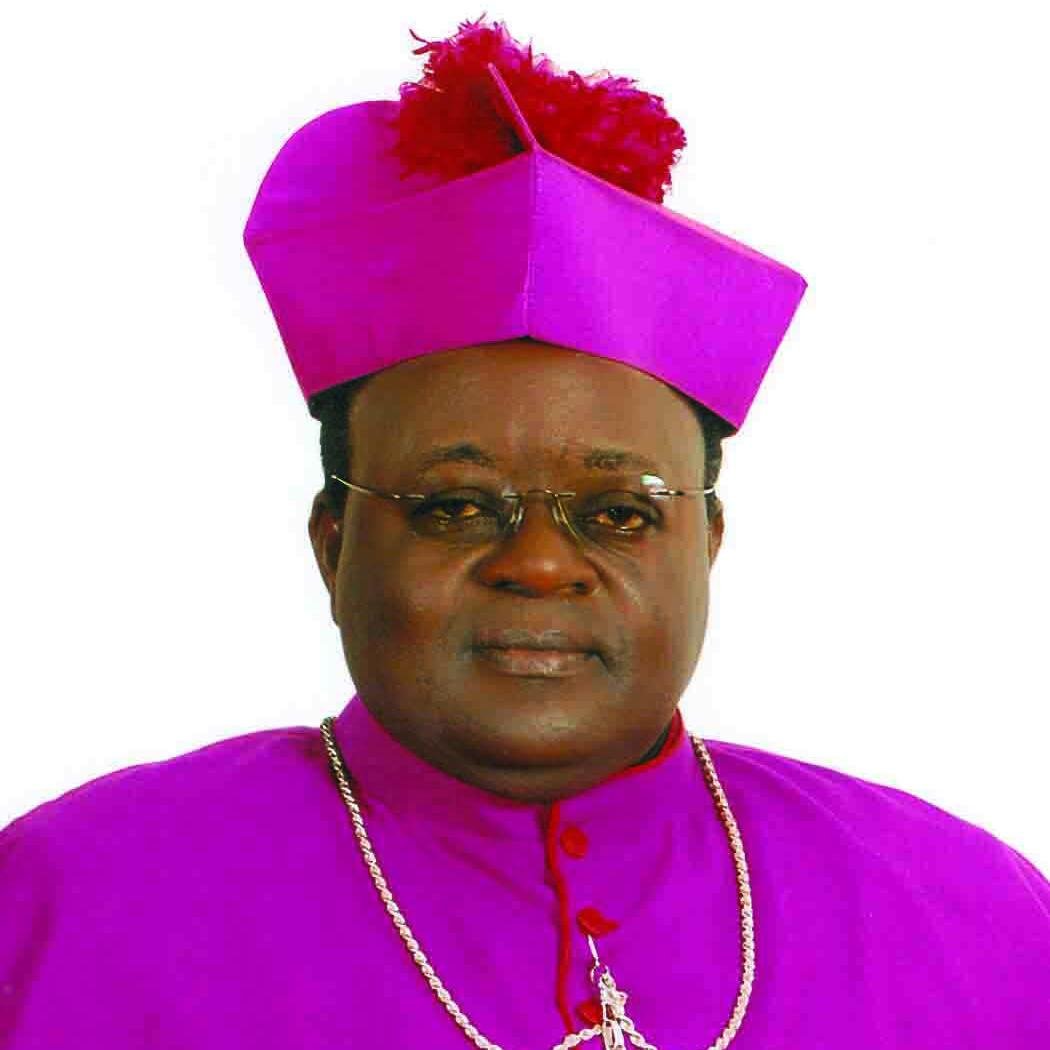


 By Diane Montagna

You must be logged in to post a comment.