CATHOLIC ACTION IS ESSENTIALLY LAY ACTION

Make This a Black Friday the Bishops Won’t Forget

Nikko Lane

Nikko LaneNovember 23, 2018

  • OnePeterFive

Thanksgiving is now past, and while leftovers are being refrigerated and families are saying their goodbyes, much despair is held by lay faithful. We are still reeling following the less than fruitful meeting of the USCCB in Baltimore a little over a week ago. The anger and questions of the laity had been pushed off until this November meeting. We were all expecting to get the ball rolling in the form of action to respond to the McCarrick scandal. We had been told, “You will get your answers. Be patient: this November meeting will initiate the American bishops’ fervent response to truths that have surfaced over the past ninety days.”

November has arrived, and the USCCB had a platform, as designated shepherds, to show their true colors. We had all hoped for strong men, armed with bravery and fortitude, ready to work to get answers for their flock. What did we get? Let me highlight the three big points to take away.

  1. We got the rug pulled out from under us at the last minute. DiNardo was essentially neutered by the Vatican. The president of the USCCB announced that the Holy See had requested a delay in a vote that would establish standards for accountability of the bishops, essentially expanding the 2002 Dallas Charter.
  2. Our American Lavender Mafia representative and Vatican puppet, Blase Cupich, cardinal-archbishop of Chicago, told us that, in many cases, clerical sex involving adult victims is consensual and should thus be judged differently from how child sex abuse cases are judged. In other words, we shouldn’t judge homosexual cases involving priests and bishops using their power to sexually abuse their seminarians.
  3. To cap the Baltimore meeting off, the USCCB took an anonymous vote of the bishops on if the conference should request that the Vatican open its files regarding Cardinal McCarrick’s ongoing abuse. Granted, many expected that Rome would posture its way out of releasing anything, but this was the bishops’ last chance to stand up for what was right. By a margin of 137- 83, the bishops voted down this request. One hundred thirty-seven of the 223 bishops in the USCCB meeting voted to suppress further truth being revealed in light of this scandal. One hundred thirty-seven of the bishops slapped us in the face. One hundred thirty-seven told us they don’t care. One hundred thirty-seven of the bishops continued to cover up for their buddy priests and bishops who are implicated by further investigations.

Well, consider the message received, USCCB. It is clear our shepherds have no intention (with the exception of a few – see Bishop Strickland of Tyler, Texas) of serving their flock’s best interest. Furthermore, it is clear that two thirds of the bishops have essentially sold their souls for the red or purple zucchetti.

The bishops, the cardinals, and even Pope Francis all rely on the laity falling prey to short-term memory. They pray that we wait for February, for the World Meeting of Bishops regarding the abuse crisis. The world will watch, and they will gather and proclaim “fervent discussion” regarding sexual abuse in the clergy and empty promises of far off plans of further action. They will pick another far off date to look forward to for more meetings, and this is when they hope we lose our zeal for change.

As the laity of Christ’s Catholic Church, we must re-invigorate our zeal. This not the time to take our feet off the accelerator. We must remain angry, remain informed, and remain active. The Church needs us to speak out. Get on your favorite social media platform and speak out about how our bishops (and pope) have failed us. Speak up about the doctrine that is undermined in favor of the anti-doctrine this papacy is pushing on us, even when the secular world will hate us for it.

Let’s all fondly remember Thanksgiving. Let us be grateful for what we have, give thanks to God, and eat our weight in leftovers. But let us make today, Black Friday, a symbolic one for the Church and its laity. Black Friday should be a blackout of support for these men who have failed as fathers of the Church. We will cut all channels of support for them. Send a message to your bishop that we will not stand for this any longer. While the USCCB may get significant taxpayer dollars from the American people each year (as much as 33% of their annual budget, according to their own reports), we will not give them a penny more. This support in the form of bishops’ annual appeals, or collections for shady ministries such as the Catholic Campaign for Human Development (which openly supports abortion, contraception, and LGBT issues, to name a few) will collect dust, the money will dry up, and they will realize that the laity’s is the hand that feeds them.

Black Friday falls nine days before Advent, which, for a long time, was a penitential season, much like Lent. Let us use these nine days to prepare ourselves for the coming of our Incarnate Lord, Jesus Christ. The nine days this time affords us is perfect for a novena. The novena to St. Charles Borromeo, a zealous defender of Church teaching, and patron saint of bishops, seminarians, and clergy, is fitting right now.

We as Catholics can get spiritually fit during this time of preparation by fasting, praying the daily rosary, and offering reparations, all things that it doesn’t seem our Church leaders have time for. Black Friday can mark our warm-up session in preparation for the spiritual marathon of the Advent season. Our church is suffering; we need these extra nine days to prepare for Christ’s birth. Grab your rosaries, repent, and let us make this Black Friday a turning point for our suffering Church.

++++++++++++++++++++++++++++++++++++++++++++++++++++++++++++++++


TWELVE VALID CARDINALS, i.e. CARDINALS APPOINTED BY POPES BENEDICT XVI AND SAINT JOHN PAUL II, MUST ACT SOON TO REMOVE FRANCIS THE MERCIFUL FROM THE THRONE OF SAINT PETER BEFORE HE DAMAGES THE INSTITUTIONAL CHURCH EVEN MORE THAN HE HAS ALREADY DAMAGED IT.


Recently many educated Catholic observers, including bishops and priests, have decried the confusion in doctrinal statements about faith or morals made from the Apostolic See at Rome and by the putative Bishop of Rome, Pope Francis. Some devout, faithful and thoughtful Catholics have even suggested that he be set aside as a heretic, a dangerous purveyor of error, as recently mentioned in a number of reports. Claiming heresy on the part of a man who is a supposed Pope, charging material error in statements about faith or morals by a putative Roman Pontiff, suggests and presents an intervening prior question about his authenticity in that August office of Successor of Peter as Chief of The Apostles, i.e., was this man the subject of a valid election by an authentic Conclave of The Holy Roman Church?  This is so because each Successor of Saint Peter enjoys the Gift of Infallibility.  So, before one even begins to talk about excommunicating such a prelate, one must logically examine whether this person exhibits the uniformly good and safe fruit of Infallibility.

If he seems repeatedly to engage in material error, that first raises the question of the validity of his election because one expects an authentically-elected Roman Pontiff miraculously and uniformly to be entirely incapable of stating error in matters of faith or morals.  So to what do we look to discern the invalidity of such an election?  His Holiness, Pope John Paul II, within His massive legacy to the Church and to the World, left us with the answer to this question.  The Catholic faithful must look back for an answer to a point from where we have come—to what occurred in and around the Sistine Chapel in March 2013 and how the fruits of those events have generated such widespread concern among those people of magisterial orthodoxy about confusing and, or, erroneous doctrinal statements which emanate from The Holy See.

His Apostolic Constitution (Universi Dominici Gregis) which governed the supposed Conclave in March 2013 contains quite clear and specific language about the invalidating effect of departures from its norms.  For example, Paragraph 76 states:  “Should the election take place in a way other than that prescribed in the present Constitution, or should the conditions laid down here not be observed, the election is for this very reason null and void, without any need for a declaration on the matter; consequently, it confers no right on the one elected.”

From this, many believe that there is probable cause to believe that Monsignor Jorge Mario Bergoglio was never validly elected as the Bishop of Rome and Successor of Saint Peter—he never rightly took over the office of Supreme Pontiff of the Holy Roman Catholic Church and therefore he does not enjoy the charism of Infallibility.  If this is true, then the situation is dire because supposed papal acts may not be valid or such acts are clearly invalid, including supposed appointments to the college of electors itself.

Only valid cardinals can rectify our critical situation through privately (secretly) recognizing the reality of an ongoing interregnum and preparing for an opportunity to put the process aright by obedience to the legislation of His Holiness, Pope John Paul II, in that Apostolic Constitution, Universi Dominici Gregis.  While thousands of the Catholic faithful do understand that only the cardinals who participated in the events of March 2013 within the Sistine Chapel have all the information necessary to evaluate the issue of election validity, there was public evidence sufficient for astute lay faithful to surmise with moral certainty that the March 2013 action by the College was an invalid conclave, an utter nullity.

What makes this understanding of Universi Dominici Gregisparticularly cogent and plausible is the clear Promulgation Clause at the end of this Apostolic Constitution and its usage of the word “scienter” (“knowingly”).  The Papal Constitution Universi Dominici Gregis thus concludes definitively with these words:  “.   .   .   knowingly or unknowingly, in any way contrary to this Constitution.”  (“.   .   .   scienter vel inscienter contra hanc Constitutionem fuerint excogitata.”)  [Note that His Holiness, Pope Paul VI, had a somewhat similar promulgation clause at the end of his corresponding, now abrogated, Apostolic Constitution, Romano Pontifici Eligendo, but his does not use “scienter”, but rather uses “sciens” instead. This similar term of sciens in the earlier abrogated Constitution has an entirely different legal significance than scienter.] This word, “scienter”, is a legal term of art in Roman law, and in canon law, and in Anglo-American common law, and in each system, scienter has substantially the same significance, i.e., “guilty knowledge” or willfully knowing, criminal intent.

Thus, it clearly appears that Pope John Paul II anticipated the possibility of criminal activity in the nature of a sacrilege against a process which He intended to be purely pious, private, sacramental, secret and deeply spiritual, if not miraculous, in its nature. This contextual reality reinforced in the Promulgation Clause, combined with:  (1) the tenor of the whole document; (2) some other provisions of the document, e.g., Paragraph 76; (3) general provisions of canon law relating to interpretation, e.g., Canons 10 & 17; and, (4) the obvious manifest intention of the Legislator, His Holiness, Pope John Paul II, tends to establish beyond a reasonable doubt the legal conclusion that Monsignor Bergoglio was never validly elected Roman Pontiff.

This is so because:1.  Communication of any kind with the outside world, e.g., communication did occur between the inside of the Sistine Chapel and anyone outside, including a television audience, before, during or even immediately after the Conclave;2.   Any political commitment to “a candidate” and any “course of action” planned for The Church or a future pontificate, such as the extensive decade-long “pastoral” plans conceived by the Sankt Gallen hierarchs; and,3.  Any departure from the required procedures of the conclave voting process as prescribed and known by a cardinal to have occurred:each was made an invalidating act, and if scienter (guilty knowledge) was present, also even a crime on the part of any cardinal or other actor, but, whether criminal or not, any such act or conduct violating the norms operated absolutely, definitively and entirely against the validity of all of the supposed Conclave proceedings.

Quite apart from the apparent notorious violations of the prohibition on a cardinal promising his vote, e.g., commitments given and obtained by cardinals associated with the so-called “Sankt Gallen Mafia,” other acts destructive of conclave validity occurred.  Keeping in mind that Pope John Paul II specifically focused Universi Dominici Gregis on “the seclusion and resulting concentration which an act so vital to the whole Church requires of the electors” such that “the electors can more easily dispose themselves to accept the interior movements of the Holy Spirit,” even certain openly public media broadcasting breached this seclusion by electronic broadcasts outlawed by Universi Dominici Gregis.  These prohibitions include direct declarative statements outlawing any use of television before, during or after a conclave in any area associated with the proceedings, e.g.:  “I further confirm, by my apostolic authority, the duty of maintaining the strictest secrecy with regard to everything that directly or indirectly concerns the election process itself.” Viewed in light of this introductory preambulary language of Universi Dominici Gregis and in light of the legislative text itself, even the EWTN camera situated far inside the Sistine Chapel was an immediately obvious non-compliant  act which became an open and notorious invalidating violation by the time when this audio-visual equipment was used to broadcast to the world the preaching after the “Extra Omnes”.  While these blatant public violations of Chapter IV of Universi Dominici Gregis actuate the invalidity and nullity of the proceedings themselves, nonetheless in His great wisdom, the Legislator did not disqualify automatically those cardinals who failed to recognize these particular offenses against sacred secrecy, or even those who, with scienter, having recognized the offenses and having had some power or voice in these matters, failed or refused to act or to object against them:  “Should any infraction whatsoever of this norm occur and be discovered, those responsible should know that they will be subject to grave penalties according to the judgment of the future Pope.”  [Universi Dominici Gregis, ¶55]

No Pope apparently having been produced in March 2013, those otherwise valid cardinals who failed with scienter to act on violations of Chapter IV, on that account alone would nonetheless remain voting members of the College unless and until a new real Pope is elected and adjudges them.  

Thus, those otherwise valid cardinals who may have been compromised by violations of secrecy can still participate validly in the “clean-up of the mess” while addressing any such secrecy violations with an eventual new Pontiff.  In contrast, the automatic excommunication of those who politicized the sacred conclave process, by obtaining illegally, commitments from cardinals to vote for a particular man, or to follow a certain course of action (even long before the vacancy of the Chair of Peter as Vicar of Christ), is established not only by the word, “scienter,” in the final enacting clause, but by a specific exception, in this case, to the general statement of invalidity which therefore reinforces the clarity of intention by Legislator that those who apply the law must interpret the general rule as truly binding.  Derived directly from Roman law, canonical jurisprudence provides this principle for construing or interpreting legislation such as this Constitution, Universi Dominici Gregis.  Expressed in Latin, this canon of interpretation is:   “Exceptio probat regulam in casibus non exceptis.”  (The exception proves the rule in cases not excepted.)  In this case, an exception from invalidity for acts of simony reinforces the binding force of the general principle of nullity in cases of other violations. Therefore, by exclusion from nullity and invalidity legislated in the case of simony: “If — God forbid — in the election of the Roman Pontiff the crime of simony were to be perpetrated, I decree and declare that all those guilty thereof shall incur excommunication latae sententiae.  At the same time I remove the nullity or invalidity of the same simoniacal provision, in order that — as was already established by my Predecessors — the validity of the election of the Roman Pontiff may not for this reason be challenged.”  

His Holiness made an exception for simony. Exceptio probat regulam in casibus non exceptis.  The clear exception from nullity and invalidity for simony proves the general rule that other violations of the sacred process certainly do and did result in the nullity and invalidity of the entire conclave. Comparing what Pope John Paul II wrote in His Constitution on conclaves with the Constitution which His replaced, you can see that, with the exception of simony, invalidity became universal. 

In the corresponding paragraph of what Pope Paul VI wrote, he specifically confined the provision declaring conclave invalidity to three (3) circumstances described in previous paragraphs within His constitution, Romano Pontfici Eligendo.  No such limitation exists in Universi Dominici Gregis.  See the comparison both in English and Latin below:Romano Pontfici Eligendo, 77. Should the election be conducted in a manner different from the three procedures described above (cf. no. 63 ff.) or without the conditions laid down for each of the same, it is for this very reason null and void (cf. no. 62), without the need for any declaration, and gives no right to him who has been thus elected. [Romano Pontfici Eligendo, 77:  “Quodsi electio aliter celebrata fuerit, quam uno e tribus modis, qui supra sunt dicti (cfr. nn. 63 sqq.), aut non servatis condicionibus pro unoquoque illorum praescriptis, electio eo ipso est nulla et invalida (cfr. n. 62) absque ulla declaratione, et ita electo nullum ius tribuit .”] as compared with:Universi Dominici Gregis, 76:  “Should the election take place in a way other than that prescribed in the present Constitution, or should the conditions laid down here not be observed, the election is for this very reason null and void, without any need for a declaration on the matter; consequently, it confers no right on the one elected.”  [Universi Dominici Gregis, 76:  “Quodsi electio aliter celebrata fuerit, quam haec Constitutio statuit, aut non servatis condicionibus pariter hic praescriptis, electio eo ipso est nulla et invalida absque ulla declaratione, ideoque electo nullum ius tribuit.”]Of course, this is not the only feature of the Constitution or aspect of the matter which tends to establish the breadth of invalidity.

 Faithful must hope and pray that only those cardinals whose status as a valid member of the College remains intact will ascertain the identity of each other and move with the utmost charity and discretion in order to effectuate The Divine Will in these matters.  The valid cardinals, then, must act according to that clear, manifest, obvious and unambiguous mind and intention of His Holiness, Pope John Paul II, so evident in Universi Dominici Gregis, a law which finally established binding and self-actuating conditions of validity on the College for any papal conclave, a reality now made so apparent by the bad fruit of doctrinal confusion and plain error. It would seem then that praying and working in a discreet and prudent manner to encourage only those true cardinals inclined to accept a reality of conclave invalidity, would be a most charitable and logical course of action in the light of Universi Dominici Gregis, and out of our high personal regard for the clear and obvious intention of its Legislator, His Holiness, Pope John Paul II.  Even a relatively small number of valid cardinals could act decisively and work to restore a functioning Apostolic See through the declaration of an interregnum government.  The need is clear for the College to convene a General Congregation in order to declare, to administer, and soon to end the Interregnum which has persisted since March 2013. Finally, it is important to understand that the sheer number of putative counterfeit cardinals will eventually, sooner or later, result in a situation in which The Church will have no normal means validly ever again to elect a Vicar of Christ.  After that time, it will become even more difficult, if not humanly impossible, for the College of Cardinals to rectify the current disastrous situation and conduct a proper and valid Conclave such that The Church may once again both have the benefit of a real Supreme Pontiff, and enjoy the great gift of a truly infallible Vicar of Christ.  It seems that some good cardinals know that the conclave was invalid, but really cannot envision what to do about it; we must pray, if it is the Will of God, that they see declaring the invalidity and administering an Interregnum through a new valid conclave is what they must do.  Without such action or without a great miracle, The Church is in a perilous situation.  Once the last validly appointed cardinal reaches age 80, or before that age, dies, the process for electing a real Pope ends with no apparent legal means to replace it. Absent a miracle then, The Church would no longer have an infallible Successor of Peter and Vicar of Christ.  Roman Catholics would be no different that Orthodox Christians. In this regard, all of the true cardinals may wish to consider what Holy Mother Church teaches in the Catechism of the Catholic Church, ¶675, ¶676 and ¶677 about “The Church’s Ultimate Trial”.  But, the fact that “The Church .   .   .  will follow her Lord in his death and Resurrection” does not justify inaction by the good cardinals, even if there are only a minimal number sufficient to carry out Chapter II of Universi Dominici Gregis and operate the Interregnum. This Apostolic Constitution, Universi Dominici Gregis, which was clearly applicable to the acts and conduct of the College of Cardinals in March 2013, is manifestly and obviously among those “invalidating” laws “which expressly establish that an act is null or that a person is effected” as stated in Canon 10 of the 1983 Code of Canon Law.  And, there is nothing remotely “doubtful or obscure” (Canon 17) about this Apostolic Constitution as clearly promulgated by Pope John Paul II.  The tenor of the whole document expressly establishes that the issue of invalidity was always at stake.  This Apostolic Constitution conclusively establishes, through its Promulgation Clause [which makes “anything done (i.e., any act or conduct) by any person  .   .   .   in any way contrary to this Constitution,”] the invalidity of the entire supposed Conclave, rendering it “completely null and void”. So, what happens if a group of Cardinals who undoubtedly did not knowingly and wilfully initiate or intentionally participate in any acts of disobedience against Universi Dominici Gregis were to meet, confer and declare that, pursuant to Universi Dominici Gregis, Monsignor Bergoglio is most certainly not a valid Roman Pontiff.  Like any action on this matter, including the initial finding of invalidity, that would be left to the valid members of the college of cardinals.  They could declare the Chair of Peter vacant and proceed to a new and proper conclave.  They could meet with His Holiness, Benedict XVI, and discern whether His resignation and retirement was made under duress, or based on some mistake or fraud, or otherwise not done in a legally effective manner, which could invalidate that resignation.  Given the demeanor of His Holiness, Benedict XVI, and the tenor of His few public statements since his departure from the Chair of Peter, this recognition of validity in Benedict XVI seems unlikely. In fact, even before a righteous group of good and authentic cardinals might decide on the validity of the March 2013 supposed conclave, they must face what may be an even more complicated discernment and decide which men are most likely not valid cardinals.  If a man was made a cardinal by the supposed Pope who is, in fact, not a Pope (but merely Monsignor Bergoglio), no such man is in reality a true member of the College of Cardinals.  In addition, those men appointed by Pope John Paul II or by Pope Benedict XVI as cardinals, but who openly violated Universi Dominici Gregis by illegal acts or conduct causing the invalidation of the last attempted conclave, would no longer have voting rights in the College of Cardinals either.  (Thus, the actual valid members in the College of Cardinals may be quite smaller in number than those on the current official Vatican list of supposed cardinals.) In any event, the entire problem is above the level of anyone else in Holy Mother Church who is below the rank of Cardinal.  So, we must pray that The Divine Will of The Most Holy Trinity, through the intercession of Our Lady as Mediatrix of All Graces and Saint Michael, Prince of Mercy, very soon rectifies the confusion in Holy Mother Church through action by those valid Cardinals who still comprise an authentic College of Electors.  Only certainly valid Cardinals can address the open and notorious evidence which points to the probable invalidity of the last supposed conclave and only those cardinals can definitively answer the questions posed here.  May only the good Cardinals unite and if they recognize an ongoing Interregnum, albeit dormant, may they end this Interregnum by activating perfectly a functioning Interregnum government of The Holy See and a renewed process for a true Conclave, one which is purely pious, private, sacramental, secret and deeply spiritual.  If we do not have a real Pontiff, then may the good Cardinals, doing their appointed work “in view of the sacredness of the act of election”  “accept the interior movements of the Holy Spirit” and provide Holy Mother Church with a real Vicar of Christ as the Successor of Saint Peter.   May these thoughts comport with the synderetic considerations of those who read them and may their presentation here please both Our Immaculate Virgin Mother, Mary, Queen of the Apostles, and The Most Holy Trinity, Father, Son and Holy Spirit.N. de PlumeUn ami des Papes
Posted in Uncategorized | Comments Off on CATHOLIC ACTION IS ESSENTIALLY LAY ACTION

NO MAN CAN BY FORCE OF WILL SAY THAT THREE TIMES THREE IS NOT NINE !!


   A mark of first-rate thinkers is their ability to make complex theories understandable. Conversely, muddled thinkers assume that obscurantism is profound. Consider, for instance, a comment made a few months ago by an Italian Jesuit and close advisor to Pope Francis, who wrote: “2 + 2 in theology can equal 5. Because it has to do with God and the real life of people. . .” It was the attempt of a confused mind to justify “situation ethics,” by which sentiment replaces reality.

In the lives that people really live, as distinct from indulged lives lived in ivory towers, facts are facts.   Saint Augustine was a realist: “No man can by force of will say that three times three is not nine.”

By her commitment to reality, the Holy Church has been the greatest benefactor of civilization: in theology, philosophy, science, works of charity, and the arts. Étienne Gilson, of the same religion that gave us Pascal and Pasteur, wrote: “We are told that it is faith which constructed the cathedrals of the Middle Ages. Without doubt, but faith would have constructed nothing at all if there had not also been architects; and if it is true that the façade of Notre Dame of Paris is a yearning of the soul toward God, that does not prevent its being also a geometrical work. It is necessary to know geometry in order to construct a façade which may be an act of love . . .”   

Perhaps the decline of classical reasoning explains the fuzzy and unsystematic thinking of many who portray themselves as theologians. It explains at least in part how Europe, and Rome itself, once the nursery of great sculpture and architecture, has been foisting on culture such pretentious mockeries of art, as often displayed in recent years in the Venice Biennale and scattered urban galleries.

Happily, here at home the current nominee to head the National Endowment for the Arts, Mary Anne Carter, will be able to undo the waste of public monies on sham art, some of which has been blatantly anti-Catholic.   

Pope Pius XI instituted the Feast of Christ the King to celebrate the dominion of the Savior over all creation, sustaining and nurturing every aspect of human knowledge. As the Nazis began to disseminate pagan myths of racism and statism, he had the Vatican Radio broadcast in German: “Twice two makes four, whether you are a Japanese, a German or an Eskimo. There is a truth common to all mankind, and every nation is but a different incarnation of the same truth about man.”  

 Saint Paul said that in his own clarion way: “For in him were all things created in heaven and on earth, visible and invisible, whether thrones, or dominations, or principalities, or powers: all things were created by him and in him. And he is before all, and by him all things consist” (Colossians 1:16-17).

FATHER GEORGE RUTLER
Posted in Uncategorized | Comments Off on NO MAN CAN BY FORCE OF WILL SAY THAT THREE TIMES THREE IS NOT NINE !!

BREAKING NEWS !!! WHY ARE WE NOT SURPRISED ???

Holy See Press Office Communiqué, 23.11.2018

http://press.vatican.va/content/salastampa/en/bollettino/pubblico/2018/11/23/181123c.html

“The Holy Father has designated as members of the organizing committee for the meeting on the protection of minors in the Church, to be held in the Vatican from 21 to 24 February 2019: Cardinal Blase J. Cupich, Archbishop of Chicago (USA); Cardinal Oswald Gracias, Archbishop of Bombay (India) and President of the Bishops’ Conference of India; the Most Reverend Charles Scicluna, Archbishop of Malta and Adjunct Secretary of the Congregation for the Doctrine of the Faith; and the Reverend Hans Zollner, S.J., President of the Centre for the Protection of Minors at the Pontifical Gregorian University and a member of the Pontifical Commission for the Protection of Minors, whom he has named contact person for the committee.”

Aren’t we so proud that an American bishop is first among equals in the U.S. hierarchy and exalted among the world’s cardinals  in the eyes of this Pope? 

Our modern day Thomas Cranmer to Henry VIII, King of the British Empire and Sovereign Lord of the English Anglican Church. But Blaise Cupich should study history … Catholic Queen Mary put him on trial for treason and heresy. The English reformers consider Cranmer a “martyr”, the Catholics consider him a heretic. 

Lord, have mercy on us and Your holy Church!

Let us pray …

Phil Sevilla

++++++++++++++++++++++++++++++++++++++++++++++++++++++++++++++++


TWELVE VALID CARDINALS, i.e. CARDINALS APPOINTED BY POPES BENEDICT XVI AND SAINT JOHN PAUL II, MUST ACT SOON TO REMOVE FRANCIS THE MERCIFUL FROM THE THRONE OF SAINT PETER BEFORE HE DAMAGES THE INSTITUTIONAL CHURCH EVEN MORE THAN HE HAS ALREADY DAMAGED IT.


Recently many educated Catholic observers, including bishops and priests, have decried the confusion in doctrinal statements about faith or morals made from the Apostolic See at Rome and by the putative Bishop of Rome, Pope Francis. Some devout, faithful and thoughtful Catholics have even suggested that he be set aside as a heretic, a dangerous purveyor of error, as recently mentioned in a number of reports. Claiming heresy on the part of a man who is a supposed Pope, charging material error in statements about faith or morals by a putative Roman Pontiff, suggests and presents an intervening prior question about his authenticity in that August office of Successor of Peter as Chief of The Apostles, i.e., was this man the subject of a valid election by an authentic Conclave of The Holy Roman Church?  This is so because each Successor of Saint Peter enjoys the Gift of Infallibility.  So, before one even begins to talk about excommunicating such a prelate, one must logically examine whether this person exhibits the uniformly good and safe fruit of Infallibility.

If he seems repeatedly to engage in material error, that first raises the question of the validity of his election because one expects an authentically-elected Roman Pontiff miraculously and uniformly to be entirely incapable of stating error in matters of faith or morals.  So to what do we look to discern the invalidity of such an election?  His Holiness, Pope John Paul II, within His massive legacy to the Church and to the World, left us with the answer to this question.  The Catholic faithful must look back for an answer to a point from where we have come—to what occurred in and around the Sistine Chapel in March 2013 and how the fruits of those events have generated such widespread concern among those people of magisterial orthodoxy about confusing and, or, erroneous doctrinal statements which emanate from The Holy See.

His Apostolic Constitution (Universi Dominici Gregis) which governed the supposed Conclave in March 2013 contains quite clear and specific language about the invalidating effect of departures from its norms.  For example, Paragraph 76 states:  “Should the election take place in a way other than that prescribed in the present Constitution, or should the conditions laid down here not be observed, the election is for this very reason null and void, without any need for a declaration on the matter; consequently, it confers no right on the one elected.”

From this, many believe that there is probable cause to believe that Monsignor Jorge Mario Bergoglio was never validly elected as the Bishop of Rome and Successor of Saint Peter—he never rightly took over the office of Supreme Pontiff of the Holy Roman Catholic Church and therefore he does not enjoy the charism of Infallibility.  If this is true, then the situation is dire because supposed papal acts may not be valid or such acts are clearly invalid, including supposed appointments to the college of electors itself.

Only valid cardinals can rectify our critical situation through privately (secretly) recognizing the reality of an ongoing interregnum and preparing for an opportunity to put the process aright by obedience to the legislation of His Holiness, Pope John Paul II, in that Apostolic Constitution, Universi Dominici Gregis.  While thousands of the Catholic faithful do understand that only the cardinals who participated in the events of March 2013 within the Sistine Chapel have all the information necessary to evaluate the issue of election validity, there was public evidence sufficient for astute lay faithful to surmise with moral certainty that the March 2013 action by the College was an invalid conclave, an utter nullity.

What makes this understanding of Universi Dominici Gregisparticularly cogent and plausible is the clear Promulgation Clause at the end of this Apostolic Constitution and its usage of the word “scienter” (“knowingly”).  The Papal Constitution Universi Dominici Gregis thus concludes definitively with these words:  “.   .   .   knowingly or unknowingly, in any way contrary to this Constitution.”  (“.   .   .   scienter vel inscienter contra hanc Constitutionem fuerint excogitata.”)  [Note that His Holiness, Pope Paul VI, had a somewhat similar promulgation clause at the end of his corresponding, now abrogated, Apostolic Constitution, Romano Pontifici Eligendo, but his does not use “scienter”, but rather uses “sciens” instead. This similar term of sciens in the earlier abrogated Constitution has an entirely different legal significance than scienter.] This word, “scienter”, is a legal term of art in Roman law, and in canon law, and in Anglo-American common law, and in each system, scienter has substantially the same significance, i.e., “guilty knowledge” or willfully knowing, criminal intent.

Thus, it clearly appears that Pope John Paul II anticipated the possibility of criminal activity in the nature of a sacrilege against a process which He intended to be purely pious, private, sacramental, secret and deeply spiritual, if not miraculous, in its nature. This contextual reality reinforced in the Promulgation Clause, combined with:  (1) the tenor of the whole document; (2) some other provisions of the document, e.g., Paragraph 76; (3) general provisions of canon law relating to interpretation, e.g., Canons 10 & 17; and, (4) the obvious manifest intention of the Legislator, His Holiness, Pope John Paul II, tends to establish beyond a reasonable doubt the legal conclusion that Monsignor Bergoglio was never validly elected Roman Pontiff.

This is so because:1.  Communication of any kind with the outside world, e.g., communication did occur between the inside of the Sistine Chapel and anyone outside, including a television audience, before, during or even immediately after the Conclave;2.   Any political commitment to “a candidate” and any “course of action” planned for The Church or a future pontificate, such as the extensive decade-long “pastoral” plans conceived by the Sankt Gallen hierarchs; and,3.  Any departure from the required procedures of the conclave voting process as prescribed and known by a cardinal to have occurred:each was made an invalidating act, and if scienter (guilty knowledge) was present, also even a crime on the part of any cardinal or other actor, but, whether criminal or not, any such act or conduct violating the norms operated absolutely, definitively and entirely against the validity of all of the supposed Conclave proceedings.

Quite apart from the apparent notorious violations of the prohibition on a cardinal promising his vote, e.g., commitments given and obtained by cardinals associated with the so-called “Sankt Gallen Mafia,” other acts destructive of conclave validity occurred.  Keeping in mind that Pope John Paul II specifically focused Universi Dominici Gregis on “the seclusion and resulting concentration which an act so vital to the whole Church requires of the electors” such that “the electors can more easily dispose themselves to accept the interior movements of the Holy Spirit,” even certain openly public media broadcasting breached this seclusion by electronic broadcasts outlawed by Universi Dominici Gregis.  These prohibitions include direct declarative statements outlawing any use of television before, during or after a conclave in any area associated with the proceedings, e.g.:  “I further confirm, by my apostolic authority, the duty of maintaining the strictest secrecy with regard to everything that directly or indirectly concerns the election process itself.” Viewed in light of this introductory preambulary language of Universi Dominici Gregis and in light of the legislative text itself, even the EWTN camera situated far inside the Sistine Chapel was an immediately obvious non-compliant  act which became an open and notorious invalidating violation by the time when this audio-visual equipment was used to broadcast to the world the preaching after the “Extra Omnes”.  While these blatant public violations of Chapter IV of Universi Dominici Gregis actuate the invalidity and nullity of the proceedings themselves, nonetheless in His great wisdom, the Legislator did not disqualify automatically those cardinals who failed to recognize these particular offenses against sacred secrecy, or even those who, with scienter, having recognized the offenses and having had some power or voice in these matters, failed or refused to act or to object against them:  “Should any infraction whatsoever of this norm occur and be discovered, those responsible should know that they will be subject to grave penalties according to the judgment of the future Pope.”  [Universi Dominici Gregis, ¶55]

No Pope apparently having been produced in March 2013, those otherwise valid cardinals who failed with scienter to act on violations of Chapter IV, on that account alone would nonetheless remain voting members of the College unless and until a new real Pope is elected and adjudges them.  

Thus, those otherwise valid cardinals who may have been compromised by violations of secrecy can still participate validly in the “clean-up of the mess” while addressing any such secrecy violations with an eventual new Pontiff.  In contrast, the automatic excommunication of those who politicized the sacred conclave process, by obtaining illegally, commitments from cardinals to vote for a particular man, or to follow a certain course of action (even long before the vacancy of the Chair of Peter as Vicar of Christ), is established not only by the word, “scienter,” in the final enacting clause, but by a specific exception, in this case, to the general statement of invalidity which therefore reinforces the clarity of intention by Legislator that those who apply the law must interpret the general rule as truly binding.  Derived directly from Roman law, canonical jurisprudence provides this principle for construing or interpreting legislation such as this Constitution, Universi Dominici Gregis.  Expressed in Latin, this canon of interpretation is:   “Exceptio probat regulam in casibus non exceptis.”  (The exception proves the rule in cases not excepted.)  In this case, an exception from invalidity for acts of simony reinforces the binding force of the general principle of nullity in cases of other violations. Therefore, by exclusion from nullity and invalidity legislated in the case of simony: “If — God forbid — in the election of the Roman Pontiff the crime of simony were to be perpetrated, I decree and declare that all those guilty thereof shall incur excommunication latae sententiae.  At the same time I remove the nullity or invalidity of the same simoniacal provision, in order that — as was already established by my Predecessors — the validity of the election of the Roman Pontiff may not for this reason be challenged.”  

His Holiness made an exception for simony. Exceptio probat regulam in casibus non exceptis.  The clear exception from nullity and invalidity for simony proves the general rule that other violations of the sacred process certainly do and did result in the nullity and invalidity of the entire conclave. Comparing what Pope John Paul II wrote in His Constitution on conclaves with the Constitution which His replaced, you can see that, with the exception of simony, invalidity became universal. 

In the corresponding paragraph of what Pope Paul VI wrote, he specifically confined the provision declaring conclave invalidity to three (3) circumstances described in previous paragraphs within His constitution, Romano Pontfici Eligendo.  No such limitation exists in Universi Dominici Gregis.  See the comparison both in English and Latin below:Romano Pontfici Eligendo, 77. Should the election be conducted in a manner different from the three procedures described above (cf. no. 63 ff.) or without the conditions laid down for each of the same, it is for this very reason null and void (cf. no. 62), without the need for any declaration, and gives no right to him who has been thus elected. [Romano Pontfici Eligendo, 77:  “Quodsi electio aliter celebrata fuerit, quam uno e tribus modis, qui supra sunt dicti (cfr. nn. 63 sqq.), aut non servatis condicionibus pro unoquoque illorum praescriptis, electio eo ipso est nulla et invalida (cfr. n. 62) absque ulla declaratione, et ita electo nullum ius tribuit .”] as compared with:Universi Dominici Gregis, 76:  “Should the election take place in a way other than that prescribed in the present Constitution, or should the conditions laid down here not be observed, the election is for this very reason null and void, without any need for a declaration on the matter; consequently, it confers no right on the one elected.”  [Universi Dominici Gregis, 76:  “Quodsi electio aliter celebrata fuerit, quam haec Constitutio statuit, aut non servatis condicionibus pariter hic praescriptis, electio eo ipso est nulla et invalida absque ulla declaratione, ideoque electo nullum ius tribuit.”]Of course, this is not the only feature of the Constitution or aspect of the matter which tends to establish the breadth of invalidity.

 Faithful must hope and pray that only those cardinals whose status as a valid member of the College remains intact will ascertain the identity of each other and move with the utmost charity and discretion in order to effectuate The Divine Will in these matters.  The valid cardinals, then, must act according to that clear, manifest, obvious and unambiguous mind and intention of His Holiness, Pope John Paul II, so evident in Universi Dominici Gregis, a law which finally established binding and self-actuating conditions of validity on the College for any papal conclave, a reality now made so apparent by the bad fruit of doctrinal confusion and plain error. It would seem then that praying and working in a discreet and prudent manner to encourage only those true cardinals inclined to accept a reality of conclave invalidity, would be a most charitable and logical course of action in the light of Universi Dominici Gregis, and out of our high personal regard for the clear and obvious intention of its Legislator, His Holiness, Pope John Paul II.  Even a relatively small number of valid cardinals could act decisively and work to restore a functioning Apostolic See through the declaration of an interregnum government.  The need is clear for the College to convene a General Congregation in order to declare, to administer, and soon to end the Interregnum which has persisted since March 2013. Finally, it is important to understand that the sheer number of putative counterfeit cardinals will eventually, sooner or later, result in a situation in which The Church will have no normal means validly ever again to elect a Vicar of Christ.  After that time, it will become even more difficult, if not humanly impossible, for the College of Cardinals to rectify the current disastrous situation and conduct a proper and valid Conclave such that The Church may once again both have the benefit of a real Supreme Pontiff, and enjoy the great gift of a truly infallible Vicar of Christ.  It seems that some good cardinals know that the conclave was invalid, but really cannot envision what to do about it; we must pray, if it is the Will of God, that they see declaring the invalidity and administering an Interregnum through a new valid conclave is what they must do.  Without such action or without a great miracle, The Church is in a perilous situation.  Once the last validly appointed cardinal reaches age 80, or before that age, dies, the process for electing a real Pope ends with no apparent legal means to replace it. Absent a miracle then, The Church would no longer have an infallible Successor of Peter and Vicar of Christ.  Roman Catholics would be no different that Orthodox Christians. In this regard, all of the true cardinals may wish to consider what Holy Mother Church teaches in the Catechism of the Catholic Church, ¶675, ¶676 and ¶677 about “The Church’s Ultimate Trial”.  But, the fact that “The Church .   .   .  will follow her Lord in his death and Resurrection” does not justify inaction by the good cardinals, even if there are only a minimal number sufficient to carry out Chapter II of Universi Dominici Gregis and operate the Interregnum. This Apostolic Constitution, Universi Dominici Gregis, which was clearly applicable to the acts and conduct of the College of Cardinals in March 2013, is manifestly and obviously among those “invalidating” laws “which expressly establish that an act is null or that a person is effected” as stated in Canon 10 of the 1983 Code of Canon Law.  And, there is nothing remotely “doubtful or obscure” (Canon 17) about this Apostolic Constitution as clearly promulgated by Pope John Paul II.  The tenor of the whole document expressly establishes that the issue of invalidity was always at stake.  This Apostolic Constitution conclusively establishes, through its Promulgation Clause [which makes “anything done (i.e., any act or conduct) by any person  .   .   .   in any way contrary to this Constitution,”] the invalidity of the entire supposed Conclave, rendering it “completely null and void”. So, what happens if a group of Cardinals who undoubtedly did not knowingly and wilfully initiate or intentionally participate in any acts of disobedience against Universi Dominici Gregis were to meet, confer and declare that, pursuant to Universi Dominici Gregis, Monsignor Bergoglio is most certainly not a valid Roman Pontiff.  Like any action on this matter, including the initial finding of invalidity, that would be left to the valid members of the college of cardinals.  They could declare the Chair of Peter vacant and proceed to a new and proper conclave.  They could meet with His Holiness, Benedict XVI, and discern whether His resignation and retirement was made under duress, or based on some mistake or fraud, or otherwise not done in a legally effective manner, which could invalidate that resignation.  Given the demeanor of His Holiness, Benedict XVI, and the tenor of His few public statements since his departure from the Chair of Peter, this recognition of validity in Benedict XVI seems unlikely. In fact, even before a righteous group of good and authentic cardinals might decide on the validity of the March 2013 supposed conclave, they must face what may be an even more complicated discernment and decide which men are most likely not valid cardinals.  If a man was made a cardinal by the supposed Pope who is, in fact, not a Pope (but merely Monsignor Bergoglio), no such man is in reality a true member of the College of Cardinals.  In addition, those men appointed by Pope John Paul II or by Pope Benedict XVI as cardinals, but who openly violated Universi Dominici Gregis by illegal acts or conduct causing the invalidation of the last attempted conclave, would no longer have voting rights in the College of Cardinals either.  (Thus, the actual valid members in the College of Cardinals may be quite smaller in number than those on the current official Vatican list of supposed cardinals.) In any event, the entire problem is above the level of anyone else in Holy Mother Church who is below the rank of Cardinal.  So, we must pray that The Divine Will of The Most Holy Trinity, through the intercession of Our Lady as Mediatrix of All Graces and Saint Michael, Prince of Mercy, very soon rectifies the confusion in Holy Mother Church through action by those valid Cardinals who still comprise an authentic College of Electors.  Only certainly valid Cardinals can address the open and notorious evidence which points to the probable invalidity of the last supposed conclave and only those cardinals can definitively answer the questions posed here.  May only the good Cardinals unite and if they recognize an ongoing Interregnum, albeit dormant, may they end this Interregnum by activating perfectly a functioning Interregnum government of The Holy See and a renewed process for a true Conclave, one which is purely pious, private, sacramental, secret and deeply spiritual.  If we do not have a real Pontiff, then may the good Cardinals, doing their appointed work “in view of the sacredness of the act of election”  “accept the interior movements of the Holy Spirit” and provide Holy Mother Church with a real Vicar of Christ as the Successor of Saint Peter.   May these thoughts comport with the synderetic considerations of those who read them and may their presentation here please both Our Immaculate Virgin Mother, Mary, Queen of the Apostles, and The Most Holy Trinity, Father, Son and Holy Spirit.N. de PlumeUn ami des Papes



Posted in Uncategorized | 2 Comments

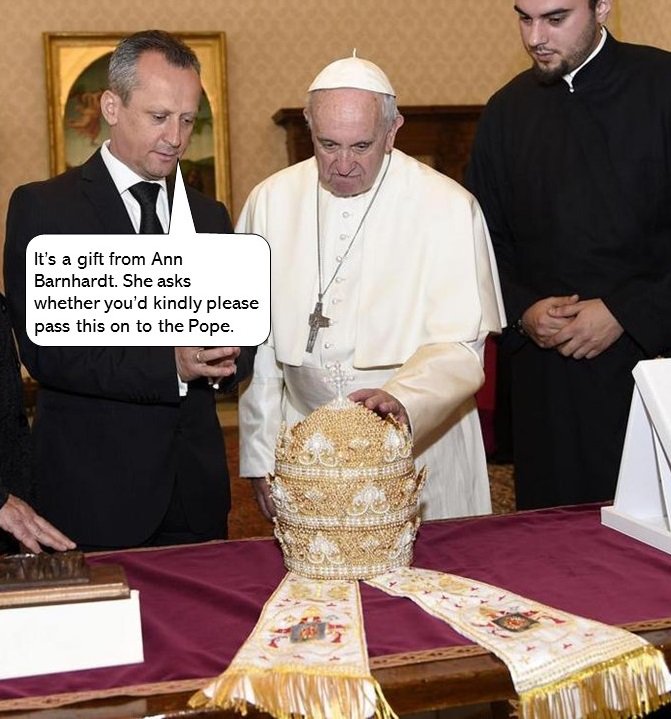
HEADGEAR FOR A REAL POPE

Barnhardt

Judica me, Deus, et discerne causam meam de gente non sancta.

Barnhardt

Fun Antipapacy Giggle

Tip of the cap to Laurence England for this little photoshop.

This entry was posted in Uncategorized on November 23, ARSH 2018 by Ann Barnhardt.

Posted in Uncategorized | Comments Off on HEADGEAR FOR A REAL POPE

NOT EVEN MACHIAVELIIA COULD MAKE SENSE OUT OF THE RELATIONSHIP OF FRANCIS THE MERCIFUL AND THE CHURCH IN AMERICA

COVER STORY IN THE CATHOLIC HERALD. UK

Playing politics with sex abuse 

Michael Warren Davis and Damian Thompson 22 November, 2018

Last week, the Vatican dramatically blocked the US bishops’ proposals to tackle the crisis. What happens next? 

Leading US bishops and senior figures in the Vatican are – quite disgracefully – playing politics with sex abuse. That is the first thing American Catholics need to understand about the chaos currently reigning in their Church. Indeed, it is something that Catholics all over the world need to know, because a crisis like this is likely to engulf their national churches in the near future. That is why the Catholic Herald is running this analysis in both its new US edition and the 130-year-old British magazine.

Events over the past few months – and especially the last two weeks – have been so confusing that millions of faithful Catholics are concentrating on their spiritual lives rather than the frequently incomprehensible bad news about crimes committed by bishops, priests and the monstrous Theodore McCarrick, former Cardinal Archbishop of Washington.

Unfortunately, world-shattering scandals are often frustratingly complex. Watergate ended in high drama, but first came mind-numbing claims and counter-claims that only political junkies could keep up with.

What follows is as straightforward as we can make it: five things you need know about very recent developments in the American bishops’ sex abuse crisis. It’s based on conversations with well-informed sources who, understandably, refuse to be named at a time when some of the most exalted Catholic prelates are gripped by a spirit of vengefulness.

1. Very senior American bishops are still compromised by ex-Cardinal McCarrick 

“Uncle Ted” didn’t just “corrupt generations of seminarians and priests”, as whistleblower Archbishop Viganò accurately put it. He also compromised his close allies – who must have known roughly what he was up to in that notorious beachfront house. Yet two of those allies, Cardinals Donald Wuerl (his successor in Washington, just forced to resign) and Cardinal Kevin Farrell in Rome say they never suspected a thing.

To make matters worse, it was McCarrick who drew up the 2002 US bishops’ sex abuse guidelines which exempted bishops from disciplinary proceedings. How convenient for him. After McCarrick’s crimes and the cover-ups were made public year, the US conference of bishops had to draw up emergency plans for proper guidelines. This month those plans went spectacularly wrong.

2. Ludicrously, there are two rival plans to discipline immoral bishops

Plan A, backed by Cardinal Daniel DiNardo, president of the US bishops’ conference, involves setting up an independent commission of six lay people and three clergy to draw up a code of conduct for bishops. Critics say allowing non-clerics power over the hierarchy smacks of Protestantism. Many parents don’t care. They’re not exactly impressed with the bishops’ efforts to police themselves.

Under Plan B, complaints against a bishop would be handled by his metropolitan archbishop and a “metropolitan review board”. This is a more Catholic way of doing things. The conservative Archbishop Charles Chaput of Philadelphia favours it on these grounds. But one obvious objection is that Ted McCarrick was a metropolitan. Until their meeting in Baltimore this month, most US bishops thought Plan B was dead in the water; they had no idea Rome was pushing for it.

3. The Vatican is playing a very strange game with these plans

On the first day of the Baltimore meeting, Rome humiliated Cardinal DiNardo by forcing him to announce at the very last minute that the bishops could not even vote on, let alone implement, Plan A (giving power to a lay-dominated commission). Instead, they must wait for Pope Francis’s global summit of the presidents of bishops’ conferences at the Vatican in February next year.

It’s reasonable for the Pope to want worldwide guidelines for errant bishops – but why resort to Trumpian tactics, pulling the rug from under DiNardo in front of the television cameras? If Plan A was unacceptable to Francis, why didn’t he say so well in advance? He had already embarrassed Cardinals DiNardo and O’Malley and Archbishop Gómez once this year, when they visited him to ask for an apostolic visitation into the McCarrick saga and he sent them away empty-handed. (Incidentally, would he have treated visitors from any other country with such disrespect? Some US Catholics are muttering that if the Holy Father dislikes Americans as much as he sometimes appears to, he can look for sources of funding elsewhere.)

The Pope now says he will oversee his own McCarrick inquiry. This promise is not generating much confidence.

4. Cardinal Blase Cupich of Chicago is playing an even stranger game

Last Saturday, Dr Ed Condon, canon lawyer and Washington bureau chief of the Catholic News Agency, broke a story that made disturbing claims about the Baltimore fiasco. Plan B (giving power to metropolitan archbishops) is back with a vengeance, reported Condon. A version of it had been drawn up by Cardinal Cupich of Chicago and Cardinal Wuerl, of all people – with the approval of the Pope, it seems. Moreover, Cupich and Wuerl had earlier presented it to the powerful Congregation for Bishops in Rome, said Condon. They belong to it; DiNardo doesn’t.

A bishops’ conference official told Condon that the revived metropolitan scheme is known as the “Wuerl plan” – though Cardinal Wuerl is not happy about this, because he knows his name is toxic in America. According to Vatican expert Fr Raymond de Souza, Wuerl had to resign his see because his own Washington priests thought he was “lying” when he claimed to know nothing about McCarrick’s serial molestation. Yet Pope Francis is strangely indulgent of Wuerl. He was reluctant to let him resign and praised him to the skies. But we should also bear in mind that Plan B has its merits.

The man to watch, for all sorts of reasons, is Cardinal Cupich. He is now denying that he collaborated with Wuerl. In which case, why are multiple sources insisting that he did? Cupich was thoroughly conversant with the “Wuerl plan” when he unexpectedly presented it to the bishops in Baltimore. Cardinal DiNardo was taken by surprise. Someone is playing politics here.

Is Cardinal Cupich pitching to become de facto leader of the US bishops with the backing of Francis? If so, he is asking for trouble. He is the most divisive serving metropolitan archbishop in the country, parachuted into Chicago by the Pope in a manner that outraged some fellow bishops. Significantly, a year ago he was defeated when he stood for election of the bishops’ pro-life committee.

5. Pope Francis’s reputation is now really on the line 

Let us take a step back and remember that the Pope is still refusing to answer questions about McCarrick. Last week, Mgr Charles Pope, a pastor in the Archdiocese of Washington and one of the most influential priests in the United States, wrote the following words in the National Catholic Register:

To most Catholics, the Pope’s actions and seeming resistance place the ownership of the scandal squarely in his court; he has increasingly become the face of the scandal. This is due to the credible accusations that he knew of former Cardinal McCarrick’s predatory behaviour but even more so to the fact that he has steadfastly refused even to respond to the charges … Instead, the Pope has declared that he will “not say one word on this”. Even worse, he subsequently referred to those who have asked for answers and investigations as “a pack of wild dogs”, “scandal-mongers”, and “those in league with the Great Accuser”. This is no way to treat God’s faithful; it makes him seem more of a besieged and angry potentate than a shepherd who “has the smell of the sheep”.

One might dispute the monsignor’s claim that “most Catholics” feel this way. But, clearly, many leading Catholics – including cardinals – hold this opinion. They are desperate to see the US bishops clean house. But it is a measure of the extraordinary times in which we live that they will be wary of any plan that comes with the papal seal of approval.

Michael Warren Davis is the Catholic Herald’s US editor. Damian Thompson is editor-in-chief of the Catholic Herald and associate editor ofThe Spectator

++++++++++++++++++++++++++++++++++++++++++++++++++++++++++++++++


TWELVE VALID CARDINALS, i.e. CARDINALS APPOINTED BY POPES BENEDICT XVI AND SAINT JOHN PAUL II, MUST ACT SOON TO REMOVE FRANCIS THE MERCIFUL FROM THE THRONE OF SAINT PETER BEFORE HE DAMAGES THE INSTITUTIONAL CHURCH EVEN MORE THAN HE HAS ALREADY DAMAGED IT.


Recently many educated Catholic observers, including bishops and priests, have decried the confusion in doctrinal statements about faith or morals made from the Apostolic See at Rome and by the putative Bishop of Rome, Pope Francis. Some devout, faithful and thoughtful Catholics have even suggested that he be set aside as a heretic, a dangerous purveyor of error, as recently mentioned in a number of reports. Claiming heresy on the part of a man who is a supposed Pope, charging material error in statements about faith or morals by a putative Roman Pontiff, suggests and presents an intervening prior question about his authenticity in that August office of Successor of Peter as Chief of The Apostles, i.e., was this man the subject of a valid election by an authentic Conclave of The Holy Roman Church?  This is so because each Successor of Saint Peter enjoys the Gift of Infallibility.  So, before one even begins to talk about excommunicating such a prelate, one must logically examine whether this person exhibits the uniformly good and safe fruit of Infallibility.

If he seems repeatedly to engage in material error, that first raises the question of the validity of his election because one expects an authentically-elected Roman Pontiff miraculously and uniformly to be entirely incapable of stating error in matters of faith or morals.  So to what do we look to discern the invalidity of such an election?  His Holiness, Pope John Paul II, within His massive legacy to the Church and to the World, left us with the answer to this question.  The Catholic faithful must look back for an answer to a point from where we have come—to what occurred in and around the Sistine Chapel in March 2013 and how the fruits of those events have generated such widespread concern among those people of magisterial orthodoxy about confusing and, or, erroneous doctrinal statements which emanate from The Holy See.

His Apostolic Constitution (Universi Dominici Gregis) which governed the supposed Conclave in March 2013 contains quite clear and specific language about the invalidating effect of departures from its norms.  For example, Paragraph 76 states:  “Should the election take place in a way other than that prescribed in the present Constitution, or should the conditions laid down here not be observed, the election is for this very reason null and void, without any need for a declaration on the matter; consequently, it confers no right on the one elected.”

From this, many believe that there is probable cause to believe that Monsignor Jorge Mario Bergoglio was never validly elected as the Bishop of Rome and Successor of Saint Peter—he never rightly took over the office of Supreme Pontiff of the Holy Roman Catholic Church and therefore he does not enjoy the charism of Infallibility.  If this is true, then the situation is dire because supposed papal acts may not be valid or such acts are clearly invalid, including supposed appointments to the college of electors itself.

Only valid cardinals can rectify our critical situation through privately (secretly) recognizing the reality of an ongoing interregnum and preparing for an opportunity to put the process aright by obedience to the legislation of His Holiness, Pope John Paul II, in that Apostolic Constitution, Universi Dominici Gregis.  While thousands of the Catholic faithful do understand that only the cardinals who participated in the events of March 2013 within the Sistine Chapel have all the information necessary to evaluate the issue of election validity, there was public evidence sufficient for astute lay faithful to surmise with moral certainty that the March 2013 action by the College was an invalid conclave, an utter nullity.

What makes this understanding of Universi Dominici Gregisparticularly cogent and plausible is the clear Promulgation Clause at the end of this Apostolic Constitution and its usage of the word “scienter” (“knowingly”).  The Papal Constitution Universi Dominici Gregis thus concludes definitively with these words:  “.   .   .   knowingly or unknowingly, in any way contrary to this Constitution.”  (“.   .   .   scienter vel inscienter contra hanc Constitutionem fuerint excogitata.”)  [Note that His Holiness, Pope Paul VI, had a somewhat similar promulgation clause at the end of his corresponding, now abrogated, Apostolic Constitution, Romano Pontifici Eligendo, but his does not use “scienter”, but rather uses “sciens” instead. This similar term of sciens in the earlier abrogated Constitution has an entirely different legal significance than scienter.] This word, “scienter”, is a legal term of art in Roman law, and in canon law, and in Anglo-American common law, and in each system, scienter has substantially the same significance, i.e., “guilty knowledge” or willfully knowing, criminal intent.

Thus, it clearly appears that Pope John Paul II anticipated the possibility of criminal activity in the nature of a sacrilege against a process which He intended to be purely pious, private, sacramental, secret and deeply spiritual, if not miraculous, in its nature. This contextual reality reinforced in the Promulgation Clause, combined with:  (1) the tenor of the whole document; (2) some other provisions of the document, e.g., Paragraph 76; (3) general provisions of canon law relating to interpretation, e.g., Canons 10 & 17; and, (4) the obvious manifest intention of the Legislator, His Holiness, Pope John Paul II, tends to establish beyond a reasonable doubt the legal conclusion that Monsignor Bergoglio was never validly elected Roman Pontiff.

This is so because:1.  Communication of any kind with the outside world, e.g., communication did occur between the inside of the Sistine Chapel and anyone outside, including a television audience, before, during or even immediately after the Conclave;2.   Any political commitment to “a candidate” and any “course of action” planned for The Church or a future pontificate, such as the extensive decade-long “pastoral” plans conceived by the Sankt Gallen hierarchs; and,3.  Any departure from the required procedures of the conclave voting process as prescribed and known by a cardinal to have occurred:each was made an invalidating act, and if scienter (guilty knowledge) was present, also even a crime on the part of any cardinal or other actor, but, whether criminal or not, any such act or conduct violating the norms operated absolutely, definitively and entirely against the validity of all of the supposed Conclave proceedings.

Quite apart from the apparent notorious violations of the prohibition on a cardinal promising his vote, e.g., commitments given and obtained by cardinals associated with the so-called “Sankt Gallen Mafia,” other acts destructive of conclave validity occurred.  Keeping in mind that Pope John Paul II specifically focused Universi Dominici Gregis on “the seclusion and resulting concentration which an act so vital to the whole Church requires of the electors” such that “the electors can more easily dispose themselves to accept the interior movements of the Holy Spirit,” even certain openly public media broadcasting breached this seclusion by electronic broadcasts outlawed by Universi Dominici Gregis.  These prohibitions include direct declarative statements outlawing any use of television before, during or after a conclave in any area associated with the proceedings, e.g.:  “I further confirm, by my apostolic authority, the duty of maintaining the strictest secrecy with regard to everything that directly or indirectly concerns the election process itself.” Viewed in light of this introductory preambulary language of Universi Dominici Gregis and in light of the legislative text itself, even the EWTN camera situated far inside the Sistine Chapel was an immediately obvious non-compliant  act which became an open and notorious invalidating violation by the time when this audio-visual equipment was used to broadcast to the world the preaching after the “Extra Omnes”.  While these blatant public violations of Chapter IV of Universi Dominici Gregis actuate the invalidity and nullity of the proceedings themselves, nonetheless in His great wisdom, the Legislator did not disqualify automatically those cardinals who failed to recognize these particular offenses against sacred secrecy, or even those who, with scienter, having recognized the offenses and having had some power or voice in these matters, failed or refused to act or to object against them:  “Should any infraction whatsoever of this norm occur and be discovered, those responsible should know that they will be subject to grave penalties according to the judgment of the future Pope.”  [Universi Dominici Gregis, ¶55]

No Pope apparently having been produced in March 2013, those otherwise valid cardinals who failed with scienter to act on violations of Chapter IV, on that account alone would nonetheless remain voting members of the College unless and until a new real Pope is elected and adjudges them.  

Thus, those otherwise valid cardinals who may have been compromised by violations of secrecy can still participate validly in the “clean-up of the mess” while addressing any such secrecy violations with an eventual new Pontiff.  In contrast, the automatic excommunication of those who politicized the sacred conclave process, by obtaining illegally, commitments from cardinals to vote for a particular man, or to follow a certain course of action (even long before the vacancy of the Chair of Peter as Vicar of Christ), is established not only by the word, “scienter,” in the final enacting clause, but by a specific exception, in this case, to the general statement of invalidity which therefore reinforces the clarity of intention by Legislator that those who apply the law must interpret the general rule as truly binding.  Derived directly from Roman law, canonical jurisprudence provides this principle for construing or interpreting legislation such as this Constitution, Universi Dominici Gregis.  Expressed in Latin, this canon of interpretation is:   “Exceptio probat regulam in casibus non exceptis.”  (The exception proves the rule in cases not excepted.)  In this case, an exception from invalidity for acts of simony reinforces the binding force of the general principle of nullity in cases of other violations. Therefore, by exclusion from nullity and invalidity legislated in the case of simony: “If — God forbid — in the election of the Roman Pontiff the crime of simony were to be perpetrated, I decree and declare that all those guilty thereof shall incur excommunication latae sententiae.  At the same time I remove the nullity or invalidity of the same simoniacal provision, in order that — as was already established by my Predecessors — the validity of the election of the Roman Pontiff may not for this reason be challenged.”  

His Holiness made an exception for simony. Exceptio probat regulam in casibus non exceptis.  The clear exception from nullity and invalidity for simony proves the general rule that other violations of the sacred process certainly do and did result in the nullity and invalidity of the entire conclave. Comparing what Pope John Paul II wrote in His Constitution on conclaves with the Constitution which His replaced, you can see that, with the exception of simony, invalidity became universal. 

In the corresponding paragraph of what Pope Paul VI wrote, he specifically confined the provision declaring conclave invalidity to three (3) circumstances described in previous paragraphs within His constitution, Romano Pontfici Eligendo.  No such limitation exists in Universi Dominici Gregis.  See the comparison both in English and Latin below:Romano Pontfici Eligendo, 77. Should the election be conducted in a manner different from the three procedures described above (cf. no. 63 ff.) or without the conditions laid down for each of the same, it is for this very reason null and void (cf. no. 62), without the need for any declaration, and gives no right to him who has been thus elected. [Romano Pontfici Eligendo, 77:  “Quodsi electio aliter celebrata fuerit, quam uno e tribus modis, qui supra sunt dicti (cfr. nn. 63 sqq.), aut non servatis condicionibus pro unoquoque illorum praescriptis, electio eo ipso est nulla et invalida (cfr. n. 62) absque ulla declaratione, et ita electo nullum ius tribuit .”] as compared with:Universi Dominici Gregis, 76:  “Should the election take place in a way other than that prescribed in the present Constitution, or should the conditions laid down here not be observed, the election is for this very reason null and void, without any need for a declaration on the matter; consequently, it confers no right on the one elected.”  [Universi Dominici Gregis, 76:  “Quodsi electio aliter celebrata fuerit, quam haec Constitutio statuit, aut non servatis condicionibus pariter hic praescriptis, electio eo ipso est nulla et invalida absque ulla declaratione, ideoque electo nullum ius tribuit.”]Of course, this is not the only feature of the Constitution or aspect of the matter which tends to establish the breadth of invalidity.

 Faithful must hope and pray that only those cardinals whose status as a valid member of the College remains intact will ascertain the identity of each other and move with the utmost charity and discretion in order to effectuate The Divine Will in these matters.  The valid cardinals, then, must act according to that clear, manifest, obvious and unambiguous mind and intention of His Holiness, Pope John Paul II, so evident in Universi Dominici Gregis, a law which finally established binding and self-actuating conditions of validity on the College for any papal conclave, a reality now made so apparent by the bad fruit of doctrinal confusion and plain error. It would seem then that praying and working in a discreet and prudent manner to encourage only those true cardinals inclined to accept a reality of conclave invalidity, would be a most charitable and logical course of action in the light of Universi Dominici Gregis, and out of our high personal regard for the clear and obvious intention of its Legislator, His Holiness, Pope John Paul II.  Even a relatively small number of valid cardinals could act decisively and work to restore a functioning Apostolic See through the declaration of an interregnum government.  The need is clear for the College to convene a General Congregation in order to declare, to administer, and soon to end the Interregnum which has persisted since March 2013. Finally, it is important to understand that the sheer number of putative counterfeit cardinals will eventually, sooner or later, result in a situation in which The Church will have no normal means validly ever again to elect a Vicar of Christ.  After that time, it will become even more difficult, if not humanly impossible, for the College of Cardinals to rectify the current disastrous situation and conduct a proper and valid Conclave such that The Church may once again both have the benefit of a real Supreme Pontiff, and enjoy the great gift of a truly infallible Vicar of Christ.  It seems that some good cardinals know that the conclave was invalid, but really cannot envision what to do about it; we must pray, if it is the Will of God, that they see declaring the invalidity and administering an Interregnum through a new valid conclave is what they must do.  Without such action or without a great miracle, The Church is in a perilous situation.  Once the last validly appointed cardinal reaches age 80, or before that age, dies, the process for electing a real Pope ends with no apparent legal means to replace it. Absent a miracle then, The Church would no longer have an infallible Successor of Peter and Vicar of Christ.  Roman Catholics would be no different that Orthodox Christians. In this regard, all of the true cardinals may wish to consider what Holy Mother Church teaches in the Catechism of the Catholic Church, ¶675, ¶676 and ¶677 about “The Church’s Ultimate Trial”.  But, the fact that “The Church .   .   .  will follow her Lord in his death and Resurrection” does not justify inaction by the good cardinals, even if there are only a minimal number sufficient to carry out Chapter II of Universi Dominici Gregis and operate the Interregnum. This Apostolic Constitution, Universi Dominici Gregis, which was clearly applicable to the acts and conduct of the College of Cardinals in March 2013, is manifestly and obviously among those “invalidating” laws “which expressly establish that an act is null or that a person is effected” as stated in Canon 10 of the 1983 Code of Canon Law.  And, there is nothing remotely “doubtful or obscure” (Canon 17) about this Apostolic Constitution as clearly promulgated by Pope John Paul II.  The tenor of the whole document expressly establishes that the issue of invalidity was always at stake.  This Apostolic Constitution conclusively establishes, through its Promulgation Clause [which makes “anything done (i.e., any act or conduct) by any person  .   .   .   in any way contrary to this Constitution,”] the invalidity of the entire supposed Conclave, rendering it “completely null and void”. So, what happens if a group of Cardinals who undoubtedly did not knowingly and wilfully initiate or intentionally participate in any acts of disobedience against Universi Dominici Gregis were to meet, confer and declare that, pursuant to Universi Dominici Gregis, Monsignor Bergoglio is most certainly not a valid Roman Pontiff.  Like any action on this matter, including the initial finding of invalidity, that would be left to the valid members of the college of cardinals.  They could declare the Chair of Peter vacant and proceed to a new and proper conclave.  They could meet with His Holiness, Benedict XVI, and discern whether His resignation and retirement was made under duress, or based on some mistake or fraud, or otherwise not done in a legally effective manner, which could invalidate that resignation.  Given the demeanor of His Holiness, Benedict XVI, and the tenor of His few public statements since his departure from the Chair of Peter, this recognition of validity in Benedict XVI seems unlikely. In fact, even before a righteous group of good and authentic cardinals might decide on the validity of the March 2013 supposed conclave, they must face what may be an even more complicated discernment and decide which men are most likely not valid cardinals.  If a man was made a cardinal by the supposed Pope who is, in fact, not a Pope (but merely Monsignor Bergoglio), no such man is in reality a true member of the College of Cardinals.  In addition, those men appointed by Pope John Paul II or by Pope Benedict XVI as cardinals, but who openly violated Universi Dominici Gregis by illegal acts or conduct causing the invalidation of the last attempted conclave, would no longer have voting rights in the College of Cardinals either.  (Thus, the actual valid members in the College of Cardinals may be quite smaller in number than those on the current official Vatican list of supposed cardinals.) In any event, the entire problem is above the level of anyone else in Holy Mother Church who is below the rank of Cardinal.  So, we must pray that The Divine Will of The Most Holy Trinity, through the intercession of Our Lady as Mediatrix of All Graces and Saint Michael, Prince of Mercy, very soon rectifies the confusion in Holy Mother Church through action by those valid Cardinals who still comprise an authentic College of Electors.  Only certainly valid Cardinals can address the open and notorious evidence which points to the probable invalidity of the last supposed conclave and only those cardinals can definitively answer the questions posed here.  May only the good Cardinals unite and if they recognize an ongoing Interregnum, albeit dormant, may they end this Interregnum by activating perfectly a functioning Interregnum government of The Holy See and a renewed process for a true Conclave, one which is purely pious, private, sacramental, secret and deeply spiritual.  If we do not have a real Pontiff, then may the good Cardinals, doing their appointed work “in view of the sacredness of the act of election”  “accept the interior movements of the Holy Spirit” and provide Holy Mother Church with a real Vicar of Christ as the Successor of Saint Peter.   May these thoughts comport with the synderetic considerations of those who read them and may their presentation here please both Our Immaculate Virgin Mother, Mary, Queen of the Apostles, and The Most Holy Trinity, Father, Son and Holy Spirit.N. de PlumeUn ami des Papes


Posted in Uncategorized | 1 Comment

ANN BARNHARDT OFFERS US A THANKSGIVING SMORGASBORD

Barnhardt

Judica me, Deus, et discerne causam meam de gente non sancta.S

Barnhardt

Barnhardt Podcast #067: A Thanksgiving Smorgasbord

[Direct link to the MP3 file]

In this episode we discuss a little bit of everything from Thanksgiving sports observances in the United States and Canada, thanksgiving as an essential element of prayer, the best way to pray for the souls in Purgatory (spoiler: “just doing it” is the best), a correction about the layout of US Air Force bases, kombucha and keyboards, a very nerdy tangent (and tangent from a tangent) by SuperNerd — and we even discussed our main topic of tribalism and how it applies to the situation with the papacy.

Links, reading, and YouTube:

Feedback: please send your questions, comments, and suggestions to podcast@barnhardt.biz

The Barnhardt Podcast is produced by SuperNerd Media; if you found this episode to be of value you can share some value to back to SuperNerd at the SuperNerd Media website. You can also follow SuperNerd Media on Twitter.

Do the BigMac Maneuver!

Click here for The Stale Big Mac Maneuver

Posted in Uncategorized | 1 Comment

WE SHOULD BE THANKFUL TODAY FOR THOSE ORTHODOX THEOLOGIANS WHO DARE TO POINT OUT THE HERESY BEING PROCLAIMED BY FRANCIS AND FRIENDS

Wednesday, November 21, 2018

Why is Pope Francis Promoting Intrinsic Evil & does he believe God wills Evil?

Why is the unscholarly Pope Francis, who thinks a third rate thinkers such as the confused and almost unreadable Postmodernist Michael de Certeau is “the greatest theologian for today,” promoting intrinsically evil acts?

One possibility is because he was “confused and mislead” into thinking Amoris Leatitia is “Thomist” and orthodox by the heretical scholar Archbishop Victor Manuel Fernandez and the “great theologian” Cardinal Christoph Schonborn.

Latin American Catholic philosopher Carlos A. Casanova shows that dissenter Tony Mifsud and Archbishop Fernandez both of whom “irrationally” misuse Thomism are bedfellows following the lead of Fr. Bernard Haring in dissent from Catholic moral doctrine:

“Mifsud… [i]n p.73 he quotes Bernard Haring holding that the fruit of the II Vatican Council was the spirit of dissent among theologians towards the “dictates of the official Church.”

“… Victor Manuel Fernandez’s concrete reasoning is different… [b]ut the goal is very similar to Mifsud’s, to open the way for the plausibility of “righteous” (or at least not-guilty) violations of God’s law.”

“… What Fernandez means is that the lady of his example does not will what is just, because that does not conform her concrete situation… As one can see in pp. 158 and 160 of his paper, he applies this principle to homosexuals and to spouses who “need” to use the condom.”
(Aemaet, “Humanae Vitae and Veritatis Splendor as Exposition of ‘Natural Law’ Contrasted with Their Irrational Rejection,” Carlos A. Casanova, 2018)

Schonborn didn’t explain to unscholarly Francis that the heretical Fr. Haring’s theology of the denial of intrinsically evil acts which was used by the heretical Fernandez as a ghostwriter of Amoris Laetitia (AL) would destroy all Catholic moral doctrine as it attempted to justify the “violation of God’s law” by promoting “persistent adultery and reception of Holy Communion” with the unavoidable logic of unrepentant homosexuals eventually receiving the Eucharist.

Dubia Cardinal Brandmuller says that those who promote intrinsically evil acts are heretics:
“Whoever thinks that persistent adultery and reception of Holy Communion are compatible is a heretic.”(lifesitenews.com, “Dubia Cardinal: Anyone who opens Communion to adulterers ‘some a heretic and promotes schism,'” December 23, 2016)
An example of what appears to have happened to Francis in his promoting of heresy can be found in history.

Pope Francis is the new Pope Horonius.
The unscholarly Pope Honorius was “confused and mislead” into becoming a material heretic who promoted the Monothelitist heresy. He was condemned by a general council and Pope St. Agatho and Pope St. Leo II.
The Catholic Encyclopedia said of Honorius that he “was not a profound theologian, and allowed himself to be confused and mislead.”(Edward Feser.blogspot, “Denial flows into the Tiber,” December 18, 2016)
Theologian Tracey Rowland wrote that Francis before the papacy said “I can’t imagine anything more boring than Fundamental Theology.” She quotes Ross Douthat saying:
“Francis is clearly a less systematic thinker than… his predecessors” to the papacy. (Catholic Theology, page 192)

In other words, Francis is not a profound theologian and often a “confused” thinker.
It was reported that the not very systematic thinker Francis during his visit to Colombia said:
Amoris Laetitia is Thomist, the morality of the great Thomas. You can speak of it with a great theologian, one of the best today and one of the most mature, Cardinal Schönborn. .”(National Catholic Register, “Pope to Jesuits: Help Critics of Amoris Leatitia to See Its Morality Is Thomist,” September 28, 2017)
In a interview, with the Jesuit magazine America, Schonborn said “one who is in an objective situation of sin can receive the help of the sacraments.”
Schonborn in the interview appears to deny that the truths of the Decalogue of Revelation are eternal or objective:
“The complexity of family situations, which goes far beyond what was customary in our Western societies even a few decades ago, has made it necessary to look in a more nuanced way at the complexity of these situations. To a greater degree than in the past, the objective situation of a person does not tell us everything about that person in relation to God and in relation to the church. This evolution compels us urgently to rethink what we meant when we spoke of objective situations of sin. And this implicitly entails a homogeneous evolution in the understanding and expression of the doctrine.“(America, “Cardinal Christoph Schonborn on the demands and joys of love,” August 15-22, 2016)
This is not Thomist, but appears to be soft historicism which comes from Hegel.
Hegelian historicism doesn’t believe with Thomism that truth is objective and eternal.
Schonborn, in his quote above, appears to believe that historical evolution changes the meaning of truth which is anti-Thomist.
The unscholarly Francis bases his statement that “Amoris Leatitia is Thomist” on Schonborn’s authority as “a great theologian.”
Unfortunately for Francis, Schonborn is misrepresenting the truth about Aquinas’s teachings and Amoris Leatitia is not Thomist.
Thomist scholar Fr. Basil Cole OP said that Schonborn’s theology and Amoris Leatitia contradicts Thomism:

“Another tangle one can encounter is when quoting Aquinas piecemeal or without full advertence to his theological project. St. Thomas was nothing if not a complete and consistent thinker. To pick and choose his statements without considering their context and relation to his other relevant insights would be about as disastrous as proof-texting Sacred Scripture.”

“One might suppose that a situationist ethic is supported by Aquinas when he states, “In matters of action, truth or practical rectitude is not the same for all, as to matters of detail, but only as to the general principles; and where there is the same rectitude in matters of detail, it is not equally known to all. […] The principle will be found to fail, according as we descend further into detail” (ST I-II, q. 94, a. 4; quoted in Amoris Laetitia n. 304). Isolated from Aquinas’s other statements, it could seem as if the doctor of the Church is saying that no moral rule is absolute, but that discernment is needed in each and every situation to know whether or not a general moral principle applies in a particular situation. However, this is not authentic Thomism.”
“Situation ethics contradicts Aquinas’s firm affirmation that there are some moral norms that always hold for everyone: these are the precepts of the Decalogue (T I-94, q.100, a.8)… Aquinas’s teaching is clear: a person should not receive Holy Communion or absolution from sin who does not intend to change his life and forsake public sin… (ST I-94, q.43, a.1).”(National Catholic Register, “Is ‘Amoris Laetitia’ Really Thomistic?,” December 16, 2016)

The Filial Correction give similar evidence to show how and why Pope Francis’s situation ethics is spreading heresy. 
So far, all the Filial Correction attackers, the Pope’s inner circle and supporters who are defending Amoris Laetitia, it appears, are not Thomist, but soft Hegelian historicists who claim there is no objective/eternal morality or discipline.
Francis supporter theologian Giuseppe Lorizio of the Pontifical Lateran University mocked the Correction statement of “eternal discipline” in the area of the Eucharist.
He appears to have forgotten that St. Paul said you can’t receive the Eucharist in a state of moral sin such as having sexual relations in an adulterous relationship.
Lorizio claims the discipline came only after the Council of Trent.(Catholic Conclave, “Anti-Papal manipulation by enemies of the Pope and the Gospel,” September 27, 2017)
Gay activist Michael Sean Winters in his attack on the Correction let the Hegelian historicism cat out of the bag.
He went so far as to attack Fr. James Martin defender Archbishop Charles Chaput for daring to criticize soft Hegelian Fr. Bernard Haring. (National Catholic Reporter, “‘Correction’ of Francis reveals critics don’t come in good faith,” September 27, 2017)
Winters pointed to the source of their problem with the Correction:
Winters, Lorizio, Schonborn and, it appears, Pope Francis don’t believe in objective morality and promote allowing intrincically evil acts which Haring brought into the Church following the Second Vatican Council.

Schonborn following in the footsteps of Haring (who Francis praised), it appears, in a America magazine interview is saying that Amoris Laetitia says that God wills evil:

“In his great experience of accompanying people spiritually, when the Holy Father speaks of “objective situations of sin,” he does not stop short at the kinds of cases that are specified in No. 84 of ‘The Family in the Modern World.’ He refers in a broader way to “certain situations which do not objectively embody our understanding of marriage. Every effort should be made to encourage the development of an enlightened conscience” while “recognizing the influence of concrete factors” (No. 303).

“The conscience plays a fundamental role.”
“Indeed:
Conscience can do more than recognize that a given situation does not correspond objectively to the overall demands of the Gospel. It can also recognize with sincerity and honesty what for now is the most generous response which can be given to God, and come to see with a certain moral security that it is what God himself is asking amid the concrete complexity of one’s limits, while not yet fully the objective ideal (No. 303).”(America, “Cardinal Christoph Schonborn on the demands and joys of love,” August 15-22, 2016)
What is Schonborn saying?

World-renown philosopher, founding Rector of the International Academy of Philosopher and friend of Pope John Paul II, Josef Seifert in a new paper on Amoris Laetitia explains what Schonborn is saying:
“AL says that we can know with ‘a certain moral security’ that God himself asks us to commit intrinsically wrong acts such as adultery…”
“If only one case of an intrinsically immoral act can be permitted and even willed by God, must this not apply to all acts considered ‘intrinsically wrong’?” (“Does pure logic threaten to destroy the entire moral doctrine of the Catholic Church?,” August 5, 2017)
In simple words the friend of John Paul II and renown philosopher says:
Pope Francis’s Amoris Leatitia says God wills evil.
The philosopher’s paper says:
“Let us read the decisive text (AL 303), which is being applied by Pope Francis to the case of adulterous or ‘irregular couples’… :
‘Yet conscience can do more… the most generous response which can be given to God (Relations Finalise 2015, 85) and come to see with a certain moral security that God himself is asking amid the concrete complexity of one’s limits, while yet not fully the objective ideal (AL 303).'”

Again, in simple words, Amoris Laetitia says God wills intrinsically evil acts which brings us to Haring’s influence on the current Pope.

Fr. Edmundus Waldstein, O. Cist., at sancrucensis.wordpress.com, gives an overview of why Francis praised dissenter Haring and why Amoris Laetitia promotes allowing intrinsically evil acts:
“In a discussion with the General Congregation of the Society of Jesus, the Holy Father praised Fr. Bernard Haring for having helped overcome a decadent scholastic moral theology that had been fixated on negative commandments, and opened up a way for moral theology to flourish. Now, Haring’s moral theology is a great example of what it might mean to begin processes as opposed to occupying spaces.” (Dubia and Initiating Processes, December 7, 2016, sancrucensis.wordpress.com)
Even Amoris Laetitia supporter Jeff Mirus in a March 7, 2017 article for Catholic Culture.com said anyone who would praise Haring “as one of the first to give Catholic moral theology new life in the twentieth century must be ignorant, confused, or subversive.”
In the beginning of the post, titled “Pope Francis and Bernard Haring: The literally infernal cheek of dissent,” Mirus said:
“Pope Francis praised…Fr. Bernard Haring, for being one of the first to try to revive an ailing moral theology following the Second Vatican Council.”
The article presented some of the moral theologian’s dissenting heretical teachings:
“In his 1973 book Medical Ethics Haring defended sterilization, contraception and artificial insemination…According to Haring, under difficult circumstances, we may engage in a process of discernment which leads to the commission of intrinsically evil acts.”
The Kasper proposal agenda which became Amoris Laetitia is in significant segments about allowing intrinsically evil acts such as adultery and implicitly homosexuality. Fr. Z said at his website on April 16, 2016:
“‘Homosexuality’ was the bigger issue with the Kasperites… This is still the Kasperite strategy.”
The Kasper agenda and Amoris Laetitia’s unavoidable logic is:
It follows that if unrepentant adulterers can receive Holy Communion, then unrepentant homosexuals can receive the Eucharist, too.
The bigger agenda of Cardinal Kasper, Schonborn and Haring (besides allowing intrinsically evil acts), which Francis probably doesn’t understand, is a Hegelian philosophic idealistic subjective metaphysics of historical becoming which denies the eternal and/or objective truths of the Classical Greek/Thomistic metaphysics of being.
Waldstein, O. Cist., explains:
“This is a soft version of certain strands of modern historicism, indebted to Hegel. Having abandoned nature, and an objective teleological order, Hegel and some of his followers give to history a role analogous to that played by nature in classical philosophy…. Haring is proposing something similar for the life of the Church.”
“I call this sort of historicism “soft” since its proponents would not all be willing to affirm the dark core of Hegel’s account of the good. But by adopting historicist terms they tend to draw conclusions that imply the basically subjectivist, modern account of the good, and the account of freedom that follows from it. Thomas Stark has shown how these problems play out in the theology of Cardinal Kasper.” [https://sancrucensis.wordpress.com/2016/12/07/dubia-and-initiating-processes/#more-5361]

Those who promote relativistic historicism promote the killing of  objective Thomism.
The Thomistic philosophy of being or objective truth and Revelation is a basis of all Catholic infallible doctrinal and moral teachings as well as the basis of Western Civilization and offshoots of it such as charity, objective universal human rights and science.
Thomas Woods in the book “How the Catholic Church Build Western Civilization” explains in detail why and how the Church and Thomistic philosophy alone guarantee sound objective moral teachings and a civilization that brings about charity, human rights and science.
If intrinsically evil acts are allowed through a denial of objective truth and objective Revelation to become the norm in our culture, then not only does Catholic doctrinal and moral teachings collapse, but Western Civilization, also, collapses.

Pray an Our Father now for the restoration of the Church.

Fred Martinez at 8:19 PM

++++++++++++++++++++++++++++++++++++++++++++++++++++++++++++++++

X


TWELVE VALID CARDINALS, i.e. CARDINALS APPOINTED BY POPES BENEDICT XVI AND SAINT JOHN PAUL II, MUST ACT SOON TO REMOVE FRANCIS THE MERCIFUL FROM THE THRONE OF SAINT PETER BEFORE HE DAMAGES THE INSTITUTIONAL CHURCH EVEN MORE THAN HE HAS ALREADY DAMAGED IT.


Recently many educated Catholic observers, including bishops and priests, have decried the confusion in doctrinal statements about faith or morals made from the Apostolic See at Rome and by the putative Bishop of Rome, Pope Francis. Some devout, faithful and thoughtful Catholics have even suggested that he be set aside as a heretic, a dangerous purveyor of error, as recently mentioned in a number of reports. Claiming heresy on the part of a man who is a supposed Pope, charging material error in statements about faith or morals by a putative Roman Pontiff, suggests and presents an intervening prior question about his authenticity in that August office of Successor of Peter as Chief of The Apostles, i.e., was this man the subject of a valid election by an authentic Conclave of The Holy Roman Church?  This is so because each Successor of Saint Peter enjoys the Gift of Infallibility.  So, before one even begins to talk about excommunicating such a prelate, one must logically examine whether this person exhibits the uniformly good and safe fruit of Infallibility.

If he seems repeatedly to engage in material error, that first raises the question of the validity of his election because one expects an authentically-elected Roman Pontiff miraculously and uniformly to be entirely incapable of stating error in matters of faith or morals.  So to what do we look to discern the invalidity of such an election?  His Holiness, Pope John Paul II, within His massive legacy to the Church and to the World, left us with the answer to this question.  The Catholic faithful must look back for an answer to a point from where we have come—to what occurred in and around the Sistine Chapel in March 2013 and how the fruits of those events have generated such widespread concern among those people of magisterial orthodoxy about confusing and, or, erroneous doctrinal statements which emanate from The Holy See.

His Apostolic Constitution (Universi Dominici Gregis) which governed the supposed Conclave in March 2013 contains quite clear and specific language about the invalidating effect of departures from its norms.  For example, Paragraph 76 states:  “Should the election take place in a way other than that prescribed in the present Constitution, or should the conditions laid down here not be observed, the election is for this very reason null and void, without any need for a declaration on the matter; consequently, it confers no right on the one elected.”

From this, many believe that there is probable cause to believe that Monsignor Jorge Mario Bergoglio was never validly elected as the Bishop of Rome and Successor of Saint Peter—he never rightly took over the office of Supreme Pontiff of the Holy Roman Catholic Church and therefore he does not enjoy the charism of Infallibility.  If this is true, then the situation is dire because supposed papal acts may not be valid or such acts are clearly invalid, including supposed appointments to the college of electors itself.

Only valid cardinals can rectify our critical situation through privately (secretly) recognizing the reality of an ongoing interregnum and preparing for an opportunity to put the process aright by obedience to the legislation of His Holiness, Pope John Paul II, in that Apostolic Constitution, Universi Dominici Gregis.  While thousands of the Catholic faithful do understand that only the cardinals who participated in the events of March 2013 within the Sistine Chapel have all the information necessary to evaluate the issue of election validity, there was public evidence sufficient for astute lay faithful to surmise with moral certainty that the March 2013 action by the College was an invalid conclave, an utter nullity.

What makes this understanding of Universi Dominici Gregisparticularly cogent and plausible is the clear Promulgation Clause at the end of this Apostolic Constitution and its usage of the word “scienter” (“knowingly”).  The Papal Constitution Universi Dominici Gregis thus concludes definitively with these words:  “.   .   .   knowingly or unknowingly, in any way contrary to this Constitution.”  (“.   .   .   scienter vel inscienter contra hanc Constitutionem fuerint excogitata.”)  [Note that His Holiness, Pope Paul VI, had a somewhat similar promulgation clause at the end of his corresponding, now abrogated, Apostolic Constitution, Romano Pontifici Eligendo, but his does not use “scienter”, but rather uses “sciens” instead. This similar term of sciens in the earlier abrogated Constitution has an entirely different legal significance than scienter.] This word, “scienter”, is a legal term of art in Roman law, and in canon law, and in Anglo-American common law, and in each system, scienter has substantially the same significance, i.e., “guilty knowledge” or willfully knowing, criminal intent.

Thus, it clearly appears that Pope John Paul II anticipated the possibility of criminal activity in the nature of a sacrilege against a process which He intended to be purely pious, private, sacramental, secret and deeply spiritual, if not miraculous, in its nature. This contextual reality reinforced in the Promulgation Clause, combined with:  (1) the tenor of the whole document; (2) some other provisions of the document, e.g., Paragraph 76; (3) general provisions of canon law relating to interpretation, e.g., Canons 10 & 17; and, (4) the obvious manifest intention of the Legislator, His Holiness, Pope John Paul II, tends to establish beyond a reasonable doubt the legal conclusion that Monsignor Bergoglio was never validly elected Roman Pontiff.

This is so because:1.  Communication of any kind with the outside world, e.g., communication did occur between the inside of the Sistine Chapel and anyone outside, including a television audience, before, during or even immediately after the Conclave;2.   Any political commitment to “a candidate” and any “course of action” planned for The Church or a future pontificate, such as the extensive decade-long “pastoral” plans conceived by the Sankt Gallen hierarchs; and,3.  Any departure from the required procedures of the conclave voting process as prescribed and known by a cardinal to have occurred:each was made an invalidating act, and if scienter (guilty knowledge) was present, also even a crime on the part of any cardinal or other actor, but, whether criminal or not, any such act or conduct violating the norms operated absolutely, definitively and entirely against the validity of all of the supposed Conclave proceedings.

Quite apart from the apparent notorious violations of the prohibition on a cardinal promising his vote, e.g., commitments given and obtained by cardinals associated with the so-called “Sankt Gallen Mafia,” other acts destructive of conclave validity occurred.  Keeping in mind that Pope John Paul II specifically focused Universi Dominici Gregis on “the seclusion and resulting concentration which an act so vital to the whole Church requires of the electors” such that “the electors can more easily dispose themselves to accept the interior movements of the Holy Spirit,” even certain openly public media broadcasting breached this seclusion by electronic broadcasts outlawed by Universi Dominici Gregis.  These prohibitions include direct declarative statements outlawing any use of television before, during or after a conclave in any area associated with the proceedings, e.g.:  “I further confirm, by my apostolic authority, the duty of maintaining the strictest secrecy with regard to everything that directly or indirectly concerns the election process itself.” Viewed in light of this introductory preambulary language of Universi Dominici Gregis and in light of the legislative text itself, even the EWTN camera situated far inside the Sistine Chapel was an immediately obvious non-compliant  act which became an open and notorious invalidating violation by the time when this audio-visual equipment was used to broadcast to the world the preaching after the “Extra Omnes”.  While these blatant public violations of Chapter IV of Universi Dominici Gregis actuate the invalidity and nullity of the proceedings themselves, nonetheless in His great wisdom, the Legislator did not disqualify automatically those cardinals who failed to recognize these particular offenses against sacred secrecy, or even those who, with scienter, having recognized the offenses and having had some power or voice in these matters, failed or refused to act or to object against them:  “Should any infraction whatsoever of this norm occur and be discovered, those responsible should know that they will be subject to grave penalties according to the judgment of the future Pope.”  [Universi Dominici Gregis, ¶55]

No Pope apparently having been produced in March 2013, those otherwise valid cardinals who failed with scienter to act on violations of Chapter IV, on that account alone would nonetheless remain voting members of the College unless and until a new real Pope is elected and adjudges them.  

Thus, those otherwise valid cardinals who may have been compromised by violations of secrecy can still participate validly in the “clean-up of the mess” while addressing any such secrecy violations with an eventual new Pontiff.  In contrast, the automatic excommunication of those who politicized the sacred conclave process, by obtaining illegally, commitments from cardinals to vote for a particular man, or to follow a certain course of action (even long before the vacancy of the Chair of Peter as Vicar of Christ), is established not only by the word, “scienter,” in the final enacting clause, but by a specific exception, in this case, to the general statement of invalidity which therefore reinforces the clarity of intention by Legislator that those who apply the law must interpret the general rule as truly binding.  Derived directly from Roman law, canonical jurisprudence provides this principle for construing or interpreting legislation such as this Constitution, Universi Dominici Gregis.  Expressed in Latin, this canon of interpretation is:   “Exceptio probat regulam in casibus non exceptis.”  (The exception proves the rule in cases not excepted.)  In this case, an exception from invalidity for acts of simony reinforces the binding force of the general principle of nullity in cases of other violations. Therefore, by exclusion from nullity and invalidity legislated in the case of simony: “If — God forbid — in the election of the Roman Pontiff the crime of simony were to be perpetrated, I decree and declare that all those guilty thereof shall incur excommunication latae sententiae.  At the same time I remove the nullity or invalidity of the same simoniacal provision, in order that — as was already established by my Predecessors — the validity of the election of the Roman Pontiff may not for this reason be challenged.”  

His Holiness made an exception for simony. Exceptio probat regulam in casibus non exceptis.  The clear exception from nullity and invalidity for simony proves the general rule that other violations of the sacred process certainly do and did result in the nullity and invalidity of the entire conclave. Comparing what Pope John Paul II wrote in His Constitution on conclaves with the Constitution which His replaced, you can see that, with the exception of simony, invalidity became universal. 

In the corresponding paragraph of what Pope Paul VI wrote, he specifically confined the provision declaring conclave invalidity to three (3) circumstances described in previous paragraphs within His constitution, Romano Pontfici Eligendo.  No such limitation exists in Universi Dominici Gregis.  See the comparison both in English and Latin below:Romano Pontfici Eligendo, 77. Should the election be conducted in a manner different from the three procedures described above (cf. no. 63 ff.) or without the conditions laid down for each of the same, it is for this very reason null and void (cf. no. 62), without the need for any declaration, and gives no right to him who has been thus elected. [Romano Pontfici Eligendo, 77:  “Quodsi electio aliter celebrata fuerit, quam uno e tribus modis, qui supra sunt dicti (cfr. nn. 63 sqq.), aut non servatis condicionibus pro unoquoque illorum praescriptis, electio eo ipso est nulla et invalida (cfr. n. 62) absque ulla declaratione, et ita electo nullum ius tribuit .”] as compared with:Universi Dominici Gregis, 76:  “Should the election take place in a way other than that prescribed in the present Constitution, or should the conditions laid down here not be observed, the election is for this very reason null and void, without any need for a declaration on the matter; consequently, it confers no right on the one elected.”  [Universi Dominici Gregis, 76:  “Quodsi electio aliter celebrata fuerit, quam haec Constitutio statuit, aut non servatis condicionibus pariter hic praescriptis, electio eo ipso est nulla et invalida absque ulla declaratione, ideoque electo nullum ius tribuit.”]Of course, this is not the only feature of the Constitution or aspect of the matter which tends to establish the breadth of invalidity.

 Faithful must hope and pray that only those cardinals whose status as a valid member of the College remains intact will ascertain the identity of each other and move with the utmost charity and discretion in order to effectuate The Divine Will in these matters.  The valid cardinals, then, must act according to that clear, manifest, obvious and unambiguous mind and intention of His Holiness, Pope John Paul II, so evident in Universi Dominici Gregis, a law which finally established binding and self-actuating conditions of validity on the College for any papal conclave, a reality now made so apparent by the bad fruit of doctrinal confusion and plain error. It would seem then that praying and working in a discreet and prudent manner to encourage only those true cardinals inclined to accept a reality of conclave invalidity, would be a most charitable and logical course of action in the light of Universi Dominici Gregis, and out of our high personal regard for the clear and obvious intention of its Legislator, His Holiness, Pope John Paul II.  Even a relatively small number of valid cardinals could act decisively and work to restore a functioning Apostolic See through the declaration of an interregnum government.  The need is clear for the College to convene a General Congregation in order to declare, to administer, and soon to end the Interregnum which has persisted since March 2013. Finally, it is important to understand that the sheer number of putative counterfeit cardinals will eventually, sooner or later, result in a situation in which The Church will have no normal means validly ever again to elect a Vicar of Christ.  After that time, it will become even more difficult, if not humanly impossible, for the College of Cardinals to rectify the current disastrous situation and conduct a proper and valid Conclave such that The Church may once again both have the benefit of a real Supreme Pontiff, and enjoy the great gift of a truly infallible Vicar of Christ.  It seems that some good cardinals know that the conclave was invalid, but really cannot envision what to do about it; we must pray, if it is the Will of God, that they see declaring the invalidity and administering an Interregnum through a new valid conclave is what they must do.  Without such action or without a great miracle, The Church is in a perilous situation.  Once the last validly appointed cardinal reaches age 80, or before that age, dies, the process for electing a real Pope ends with no apparent legal means to replace it. Absent a miracle then, The Church would no longer have an infallible Successor of Peter and Vicar of Christ.  Roman Catholics would be no different that Orthodox Christians. In this regard, all of the true cardinals may wish to consider what Holy Mother Church teaches in the Catechism of the Catholic Church, ¶675, ¶676 and ¶677 about “The Church’s Ultimate Trial”.  But, the fact that “The Church .   .   .  will follow her Lord in his death and Resurrection” does not justify inaction by the good cardinals, even if there are only a minimal number sufficient to carry out Chapter II of Universi Dominici Gregis and operate the Interregnum. This Apostolic Constitution, Universi Dominici Gregis, which was clearly applicable to the acts and conduct of the College of Cardinals in March 2013, is manifestly and obviously among those “invalidating” laws “which expressly establish that an act is null or that a person is effected” as stated in Canon 10 of the 1983 Code of Canon Law.  And, there is nothing remotely “doubtful or obscure” (Canon 17) about this Apostolic Constitution as clearly promulgated by Pope John Paul II.  The tenor of the whole document expressly establishes that the issue of invalidity was always at stake.  This Apostolic Constitution conclusively establishes, through its Promulgation Clause [which makes “anything done (i.e., any act or conduct) by any person  .   .   .   in any way contrary to this Constitution,”] the invalidity of the entire supposed Conclave, rendering it “completely null and void”. So, what happens if a group of Cardinals who undoubtedly did not knowingly and wilfully initiate or intentionally participate in any acts of disobedience against Universi Dominici Gregis were to meet, confer and declare that, pursuant to Universi Dominici Gregis, Monsignor Bergoglio is most certainly not a valid Roman Pontiff.  Like any action on this matter, including the initial finding of invalidity, that would be left to the valid members of the college of cardinals.  They could declare the Chair of Peter vacant and proceed to a new and proper conclave.  They could meet with His Holiness, Benedict XVI, and discern whether His resignation and retirement was made under duress, or based on some mistake or fraud, or otherwise not done in a legally effective manner, which could invalidate that resignation.  Given the demeanor of His Holiness, Benedict XVI, and the tenor of His few public statements since his departure from the Chair of Peter, this recognition of validity in Benedict XVI seems unlikely. In fact, even before a righteous group of good and authentic cardinals might decide on the validity of the March 2013 supposed conclave, they must face what may be an even more complicated discernment and decide which men are most likely not valid cardinals.  If a man was made a cardinal by the supposed Pope who is, in fact, not a Pope (but merely Monsignor Bergoglio), no such man is in reality a true member of the College of Cardinals.  In addition, those men appointed by Pope John Paul II or by Pope Benedict XVI as cardinals, but who openly violated Universi Dominici Gregis by illegal acts or conduct causing the invalidation of the last attempted conclave, would no longer have voting rights in the College of Cardinals either.  (Thus, the actual valid members in the College of Cardinals may be quite smaller in number than those on the current official Vatican list of supposed cardinals.) In any event, the entire problem is above the level of anyone else in Holy Mother Church who is below the rank of Cardinal.  So, we must pray that The Divine Will of The Most Holy Trinity, through the intercession of Our Lady as Mediatrix of All Graces and Saint Michael, Prince of Mercy, very soon rectifies the confusion in Holy Mother Church through action by those valid Cardinals who still comprise an authentic College of Electors.  Only certainly valid Cardinals can address the open and notorious evidence which points to the probable invalidity of the last supposed conclave and only those cardinals can definitively answer the questions posed here.  May only the good Cardinals unite and if they recognize an ongoing Interregnum, albeit dormant, may they end this Interregnum by activating perfectly a functioning Interregnum government of The Holy See and a renewed process for a true Conclave, one which is purely pious, private, sacramental, secret and deeply spiritual.  If we do not have a real Pontiff, then may the good Cardinals, doing their appointed work “in view of the sacredness of the act of election”  “accept the interior movements of the Holy Spirit” and provide Holy Mother Church with a real Vicar of Christ as the Successor of Saint Peter.   May these thoughts comport with the synderetic considerations of those who read them and may their presentation here please both Our Immaculate Virgin Mother, Mary, Queen of the Apostles, and The Most Holy Trinity, Father, Son and Holy Spirit.N. de PlumeUn ami des Papes

Posted in Uncategorized | 2 Comments

WE ARE APPROACHING THE FLASH POINT IN THE COMBUSTIBLE MIXTURE OF PROGRESSIVE AND TRADITIONAL LEADERSHIP AND MEMBERSHIP OF THE CHURCH

Ecclesiastical Corruption Must be Met Not Just With Prayer, but Action

Steve Skojec

Steve SkojecNovember 21, 2018

“I have been asked over and over again by lay Catholics,” writes Fr. Gerald Murray a recent column for The Catholic Thing, “‘What can I do to help resolve the crisis in the Church?’ My answer is: ‘Pray and act.’ By action, I mean: make known your dissatisfaction to the American bishops, to the Holy See, and to your fellow Catholics.”

He continues:

Discouragement over the long history of sexual crimes and episcopal cover-ups is widespread. This is understandable, but something to resist, because discouragement can become an excuse for inaction.

Ordinary lay people have great power to influence their shepherds at the present moment. Bishops depend upon the support of their people and on the goodwill of the civil authorities who are sensitive to whether the Catholic people as a whole support their bishops. If those authorities sense that the flock is angry with the shepherds, then they will use their power to hold those shepherds accountable to the law.

It has been difficult for most of us to figure out the most effective way to hold our shepherds accountable. To let them know just how angry we are. While platforms like this give us an opportunity to raise our voices, we are nevertheless left to wonder if they will be heard. Or for that matter, if anyone will care.

In an interaction with Cardinal William Levada, former prefect of the Congregation for the Doctrine of the Faith, Christine Niles of Church Militant got a taste of just how little some of the Church’s most powerful and influential prelates care about what the faithful think.

Niles pressed Levada on the accusation, made by Archbishop Carlo Maria Viganò, that even the pope was involved in the coverup of former-Cardinal McCarrick’s abuse. Levada dismissed Viganò’s concerns, saying that he questioned the former nuncio’s motives.

“The laity have lost confidence,” Niles fired back, “that the Vatican is trustworthy on this, and are tired of the complicity and cover-up”.

“Oh, the laity,” Levada replied, with what Niles describes as “a dismissive wave of the hand.”

“I’ve met so many laity throughout my life, and they’re all over the spectrum.”

“The tone of disdain in his voice,” Niles reports, “was unmistakable.”

Levada went on to take a swing at the media and their calls for transparency. And this indeed seems to be a new focus of the pope and his allies in repelling mounting criticism from all sides. As I told you last week, paragraph 146 of the final Youth Synod document produced last month takes aim at Catholic media that is not on board with the agenda of “reform”. It describes a desire for the Church to “develop adequate tools” that could include “certification systems of Catholic sites, to counter the spread of fake news regarding the Church”.

Earlier this week, NBC News ran a piece that seems torn straight from the pages of the Church’s new playbook on silencing dissent from their dissent. “Many Catholics say they are worried,” the report states, about “a  new offensive by ultra-conservative Catholic groups that see the growing acceptance of LGBTQ Catholics by Pope Francis and other reformers as a mortal threat to their church.”

The report goes on to name Church Militant, LifeSiteNews, and the Lepanto Institute as examples of those “ratcheting up the rhetoric while replacing polite and prayerful discourse with personal attacks on supporters of gay Catholics, they say.” (These three outlets were accused of inflicting “physical and emotional violence” and outing the personal information of a partnered gay man working in a California parish earlier this year.)

Jason Steidl, a “theologian” from Fordham University, has borrowed a pejorative term for independent Catholic media outlets from the popular culture: “I call them the ‘Catholic alt-right,’” Steidl said to NBC News. “We haven’t seen anything like this before.”

Fr. James Martin, SJ, arguably the Church’s most active promoter of LGBT ideology and a part of the Vatican’s official communications apparatus, also weighed in:

“Some bishops promote sites like LifeSite,” he said. “I know some people read them in Rome. … These groups are very small, but they have an outsize influence and a very big voice. Fear and hatred are remarkably motivating for some people.”

The good news about these attacks is that there’s no greater evidence that independent Catholic media have been effective. They have tried for years to ignore us, and it has cost them the battle for public perception. Now, they’re desperate, and looking for any way they can to discredit us.

NBC News says that they made “repeated requests for comment” to the U.S. Conference of Catholic Bishops (USCCB), and finally received a statement from spokesman Bishop Coyne:

“The promotion and defense of the faith should invite an encounter with the merciful love of Christ and contribute to a more civil and peaceful dialogue in our church and society,” he said. “I urge my brothers and sisters to exercise extreme caution before giving credence to anyone who instigates shameful, digital stoning as a way to defend the Church. Catholic participation in the public square should be marked by both fidelity to the Gospel and to charity toward all our fellow citizens.”

Digital stoning? That’s a hell of a reach. But I suppose after all the crybaby victim signaling we got from the pope after Viganò cut his legs out from under him in August (and after), we shouldn’t be surprised.

It appears that the papal cabal and its allies in the American Church are courting a powerful ally: the secular mainstream media. They have taken advantage of the pro-homosexual bias of progressive journalists to wage war against critics of their larger agenda, since those critics are often the loudest opponents of the “ideological colonization” of the Church by pro-homosexual forces. Secondarily, the willful blindness of the correlation between homosexuality in the priesthood and clerical sexual abuse found in most modern commentary works well as a cover for the Church’s mishandling of the abuse crisis – and the epidemic of homosexuality in the priesthood that is the cause of so much of it. The mainstream media is far too wedded to the idea that there is no connection between the two issues, and they’ll do whatever mental gymnastics are required to avoid looking at the evidence head on.

But the evidence exists. Evidence like that found in a new study issued this month by the Ruth Institute, which found that “The concentration of homosexual men in the priesthood rose from twice the concentration in overall population in the 1950s to eight times the general population in the 1980s.”

The study found that “Four out of five victims over age 7 were boys; only one in five were girls. Ease of access to boys relative to girls accounts for about one fifth of this disparity. The number of homosexual priests accounts for the remaining four fifths.”

The authors conclude that “Estimates from these findings predict that, had the proportion of homosexual priests remained at the 1950s level, at least 12,000 fewer children, mostly boys, would have suffered abuse.”

That’s not a narrative that can be allowed to flourish. There’s simply too much ideological capital on the line. This is why we are fighting an uphill battle. When it comes to the war of ideas, we are working against both the World, and a Church that has co-opted its agenda.

And that’s why the second piece of the “action” in the “pray and act” strategy has to go to the root. We must find every way possible to deprive them of funding.

I’ve written before about just how much cash the U.S. Bishops receive from the Federal Government for programs like “refugee resettlement”. From 2008 to 2015, the amount was in the billions of dollars. There is evidence that since Trump has taken office, a reduction in the number of refugees authorized for admission to the United States has dropped, and the funding along with it – but just how much is unclear. According to a report earlier this year in Crux, “Catholic organizations charged with resettling refugees have laid off or transferred as many as 300 employees as a direct result of the reduced numbers”.

Whatever the current state of the financial take from sources other than donations from the faithful, the U.S. Bishops have done a good job diversifying their income. But that doesn’t mean we can’t make them feel it.

And perhaps more importantly, we can make the Vatican feel it.

That’s exactly what Legatus, an international organization of Catholic business leaders led by former Domino’s Pizza magnate Tom Monaghan has done. According to a report in the National Catholic Register:

Nearly $1 million in funds which had been earmarked for the Holy See will now be withheld, following the Vatican’s action to delay the U.S. Bishops’ vote on a plan to end the sexual abuse crisis in the Church.

[…]

On Friday, Nov. 16, following the Vatican’s unexpected intervention into the USCCB’s General Assembly in Baltimore and its demand that the bishops delay voting on a plan which could bring closure to the sexual abuse crisis, Legatus’ Board of Governors took the next step and formally revoked the organization’s 2019 tithe to the Holy See. Members who have already submitted their dues for the 2019 year will receive a refund of that portion (10 percent) which had been earmarked for the Holy See; and members who have not yet remitted their dues will receive a new, revised invoice.

And the Vatican is not a position to lose cash. Take a look at recent actions by the Vatican through the lens of finance, and you’ll see indications that money has become quite the priority:

  • Cardinal Pell found over a billion euros improperly hidden away during his audit of the Vatican Bank. Almost immediately, he wound up being called back to Australia to face 40-year-old allegations of abuse, while Archbishop Becciu, one of the pope’s ranking hatchet men, made sure the financial reform died.
  •  At the heart of the Vatican-led coup within the Sovereign Military Order of Malta was a battle over a significant bequest to the order — to the tune of 30 million Swiss francs. During the coup, the brother of key figure Albrecht von Boeselager was appointed to a position on the Vatican bank. (Recall that here, too, Becciu took over Cardinal Burke’s role within the Knights of Malta following the coup.) Where is that money now?
  • It is widely believed that the suppression of the Franciscan Friars of the Immaculate has been over their considerable assets. According to at least one report, assets totaling roughly 30 million Euros — assets which the Vatican has been said to have tried to seize control of.
  • A $25 million grant to the Vatican this year was made through the Papal Foundation, and the money is “unaccounted for”. The hospital designated as a recipient of the grant claims not to have received it. (It was Cardinal Wuerl, incidentally, who “spearheaded” the grant.)

If the Vatican is having money problems, they’re about to get worse. Just this month, The Court of Justice of the European Union (CJEU) issued a judgment ordering Italy to recover five billion euros worth of property tax from the Vatican, throwing out an earlier exemption. It has been reported that the Vatican Bank only controls about 6 billion Euros in assets, so one can only imagine how this ruling will affect their position.

In addition, a U.S.-based class action lawsuit has been filed against the Holy See and the USCCB by six men who claim to have been victims of clerical sexual abuse. (The USCCB has also been targeted in an additional, separate suit.) As the US Department of Justice begins investigating cases in New York and Pennsylvania, it is looking increasingly likely that an investigation under the Racketeering Influenced and Corrupt Organizations Act (RICO) could happen on a national basis. And the class-action suit is seeking to use RICO provisions to “triple” the “financial damages”. Any hope that the Vatican could distance itself from an international lawsuit was dashed at the USCCB meeting in Baltimore this month, when Rome demonstrated just how much control it has over the actions of US bishops. According to the Washington Post:

The suit filed in the District notes that the Holy See has successfully avoided liability in the United States by claiming it did not have direct authority over priests. But then on Monday, as the bishops were meeting at their national conference in Baltimore to address the issue, they were directed by a letter from the Vatican to stop the discussion, and did. “If that’s not command responsibility, I don’t know what is,” said Mitchell A. Toups, one of the lead attorneys in the class-action case.

The situation in the Church is both scandalous and challenging, but the faithful are not without power. As the walls close in ever more tightly against a systemically corrupt hierarchy, it’s anyone’s guess how things will turn out. But however protracted, the tide will turn in this battle for control of the heart and soul of Catholicism, and we know which side will win.

Until then, chickens are finally coming home to roost. As Msgr. Charles Pope so succinctly put it in a recent column, “The pope owns this.”

++++++++++++++++++++++++++++++++++++++++++++++++++++++++++++++++


TWELVE OF THE VALID CARDINALS, i.e. CARDINALS APPOINTED BY POPES BENEDICT XVI AND SAINT JOHN PAUL II, MUST ACT SOON TO REMOVE FRANCIS THE MERCIFUL FROM THE THRONE OF SAINT PETER BEFORE HE DAMAGES THE INSTITUTIONAL CHURCH EVEN MORE THAN HE HAS ALREADY DAMAGED IT.


Recently many educated Catholic observers, including bishops and priests, have decried the confusion in doctrinal statements about faith or morals made from the Apostolic See at Rome and by the putative Bishop of Rome, Pope Francis. Some devout, faithful and thoughtful Catholics have even suggested that he be set aside as a heretic, a dangerous purveyor of error, as recently mentioned in a number of reports. Claiming heresy on the part of a man who is a supposed Pope, charging material error in statements about faith or morals by a putative Roman Pontiff, suggests and presents an intervening prior question about his authenticity in that August office of Successor of Peter as Chief of The Apostles, i.e., was this man the subject of a valid election by an authentic Conclave of The Holy Roman Church?  This is so because each Successor of Saint Peter enjoys the Gift of Infallibility.  So, before one even begins to talk about excommunicating such a prelate, one must logically examine whether this person exhibits the uniformly good and safe fruit of Infallibility.

If he seems repeatedly to engage in material error, that first raises the question of the validity of his election because one expects an authentically-elected Roman Pontiff miraculously and uniformly to be entirely incapable of stating error in matters of faith or morals.  So to what do we look to discern the invalidity of such an election?  His Holiness, Pope John Paul II, within His massive legacy to the Church and to the World, left us with the answer to this question.  The Catholic faithful must look back for an answer to a point from where we have come—to what occurred in and around the Sistine Chapel in March 2013 and how the fruits of those events have generated such widespread concern among those people of magisterial orthodoxy about confusing and, or, erroneous doctrinal statements which emanate from The Holy See.

His Apostolic Constitution (Universi Dominici Gregis) which governed the supposed Conclave in March 2013 contains quite clear and specific language about the invalidating effect of departures from its norms.  For example, Paragraph 76 states:  “Should the election take place in a way other than that prescribed in the present Constitution, or should the conditions laid down here not be observed, the election is for this very reason null and void, without any need for a declaration on the matter; consequently, it confers no right on the one elected.”

From this, many believe that there is probable cause to believe that Monsignor Jorge Mario Bergoglio was never validly elected as the Bishop of Rome and Successor of Saint Peter—he never rightly took over the office of Supreme Pontiff of the Holy Roman Catholic Church and therefore he does not enjoy the charism of Infallibility.  If this is true, then the situation is dire because supposed papal acts may not be valid or such acts are clearly invalid, including supposed appointments to the college of electors itself.

Only valid cardinals can rectify our critical situation through privately (secretly) recognizing the reality of an ongoing interregnum and preparing for an opportunity to put the process aright by obedience to the legislation of His Holiness, Pope John Paul II, in that Apostolic Constitution, Universi Dominici Gregis.  While thousands of the Catholic faithful do understand that only the cardinals who participated in the events of March 2013 within the Sistine Chapel have all the information necessary to evaluate the issue of election validity, there was public evidence sufficient for astute lay faithful to surmise with moral certainty that the March 2013 action by the College was an invalid conclave, an utter nullity.

What makes this understanding of Universi Dominici Gregisparticularly cogent and plausible is the clear Promulgation Clause at the end of this Apostolic Constitution and its usage of the word “scienter” (“knowingly”).  The Papal Constitution Universi Dominici Gregis thus concludes definitively with these words:  “.   .   .   knowingly or unknowingly, in any way contrary to this Constitution.”  (“.   .   .   scienter vel inscienter contra hanc Constitutionem fuerint excogitata.”)  [Note that His Holiness, Pope Paul VI, had a somewhat similar promulgation clause at the end of his corresponding, now abrogated, Apostolic Constitution, Romano Pontifici Eligendo, but his does not use “scienter”, but rather uses “sciens” instead. This similar term of sciens in the earlier abrogated Constitution has an entirely different legal significance than scienter.] This word, “scienter”, is a legal term of art in Roman law, and in canon law, and in Anglo-American common law, and in each system, scienter has substantially the same significance, i.e., “guilty knowledge” or willfully knowing, criminal intent.

Thus, it clearly appears that Pope John Paul II anticipated the possibility of criminal activity in the nature of a sacrilege against a process which He intended to be purely pious, private, sacramental, secret and deeply spiritual, if not miraculous, in its nature. This contextual reality reinforced in the Promulgation Clause, combined with:  (1) the tenor of the whole document; (2) some other provisions of the document, e.g., Paragraph 76; (3) general provisions of canon law relating to interpretation, e.g., Canons 10 & 17; and, (4) the obvious manifest intention of the Legislator, His Holiness, Pope John Paul II, tends to establish beyond a reasonable doubt the legal conclusion that Monsignor Bergoglio was never validly elected Roman Pontiff.

This is so because:1.  Communication of any kind with the outside world, e.g., communication did occur between the inside of the Sistine Chapel and anyone outside, including a television audience, before, during or even immediately after the Conclave;2.   Any political commitment to “a candidate” and any “course of action” planned for The Church or a future pontificate, such as the extensive decade-long “pastoral” plans conceived by the Sankt Gallen hierarchs; and,3.  Any departure from the required procedures of the conclave voting process as prescribed and known by a cardinal to have occurred:each was made an invalidating act, and if scienter (guilty knowledge) was present, also even a crime on the part of any cardinal or other actor, but, whether criminal or not, any such act or conduct violating the norms operated absolutely, definitively and entirely against the validity of all of the supposed Conclave proceedings.

Quite apart from the apparent notorious violations of the prohibition on a cardinal promising his vote, e.g., commitments given and obtained by cardinals associated with the so-called “Sankt Gallen Mafia,” other acts destructive of conclave validity occurred.  Keeping in mind that Pope John Paul II specifically focused Universi Dominici Gregis on “the seclusion and resulting concentration which an act so vital to the whole Church requires of the electors” such that “the electors can more easily dispose themselves to accept the interior movements of the Holy Spirit,” even certain openly public media broadcasting breached this seclusion by electronic broadcasts outlawed by Universi Dominici Gregis.  These prohibitions include direct declarative statements outlawing any use of television before, during or after a conclave in any area associated with the proceedings, e.g.:  “I further confirm, by my apostolic authority, the duty of maintaining the strictest secrecy with regard to everything that directly or indirectly concerns the election process itself.” Viewed in light of this introductory preambulary language of Universi Dominici Gregis and in light of the legislative text itself, even the EWTN camera situated far inside the Sistine Chapel was an immediately obvious non-compliant  act which became an open and notorious invalidating violation by the time when this audio-visual equipment was used to broadcast to the world the preaching after the “Extra Omnes”.  While these blatant public violations of Chapter IV of Universi Dominici Gregis actuate the invalidity and nullity of the proceedings themselves, nonetheless in His great wisdom, the Legislator did not disqualify automatically those cardinals who failed to recognize these particular offenses against sacred secrecy, or even those who, with scienter, having recognized the offenses and having had some power or voice in these matters, failed or refused to act or to object against them:  “Should any infraction whatsoever of this norm occur and be discovered, those responsible should know that they will be subject to grave penalties according to the judgment of the future Pope.”  [Universi Dominici Gregis, ¶55]

No Pope apparently having been produced in March 2013, those otherwise valid cardinals who failed with scienter to act on violations of Chapter IV, on that account alone would nonetheless remain voting members of the College unless and until a new real Pope is elected and adjudges them.  

Thus, those otherwise valid cardinals who may have been compromised by violations of secrecy can still participate validly in the “clean-up of the mess” while addressing any such secrecy violations with an eventual new Pontiff.  In contrast, the automatic excommunication of those who politicized the sacred conclave process, by obtaining illegally, commitments from cardinals to vote for a particular man, or to follow a certain course of action (even long before the vacancy of the Chair of Peter as Vicar of Christ), is established not only by the word, “scienter,” in the final enacting clause, but by a specific exception, in this case, to the general statement of invalidity which therefore reinforces the clarity of intention by Legislator that those who apply the law must interpret the general rule as truly binding.  Derived directly from Roman law, canonical jurisprudence provides this principle for construing or interpreting legislation such as this Constitution, Universi Dominici Gregis.  Expressed in Latin, this canon of interpretation is:   “Exceptio probat regulam in casibus non exceptis.”  (The exception proves the rule in cases not excepted.)  In this case, an exception from invalidity for acts of simony reinforces the binding force of the general principle of nullity in cases of other violations. Therefore, by exclusion from nullity and invalidity legislated in the case of simony: “If — God forbid — in the election of the Roman Pontiff the crime of simony were to be perpetrated, I decree and declare that all those guilty thereof shall incur excommunication latae sententiae.  At the same time I remove the nullity or invalidity of the same simoniacal provision, in order that — as was already established by my Predecessors — the validity of the election of the Roman Pontiff may not for this reason be challenged.”  

His Holiness made an exception for simony. Exceptio probat regulam in casibus non exceptis.  The clear exception from nullity and invalidity for simony proves the general rule that other violations of the sacred process certainly do and did result in the nullity and invalidity of the entire conclave. Comparing what Pope John Paul II wrote in His Constitution on conclaves with the Constitution which His replaced, you can see that, with the exception of simony, invalidity became universal. 

In the corresponding paragraph of what Pope Paul VI wrote, he specifically confined the provision declaring conclave invalidity to three (3) circumstances described in previous paragraphs within His constitution, Romano Pontfici Eligendo.  No such limitation exists in Universi Dominici Gregis.  See the comparison both in English and Latin below:Romano Pontfici Eligendo, 77. Should the election be conducted in a manner different from the three procedures described above (cf. no. 63 ff.) or without the conditions laid down for each of the same, it is for this very reason null and void (cf. no. 62), without the need for any declaration, and gives no right to him who has been thus elected. [Romano Pontfici Eligendo, 77:  “Quodsi electio aliter celebrata fuerit, quam uno e tribus modis, qui supra sunt dicti (cfr. nn. 63 sqq.), aut non servatis condicionibus pro unoquoque illorum praescriptis, electio eo ipso est nulla et invalida (cfr. n. 62) absque ulla declaratione, et ita electo nullum ius tribuit .”] as compared with:Universi Dominici Gregis, 76:  “Should the election take place in a way other than that prescribed in the present Constitution, or should the conditions laid down here not be observed, the election is for this very reason null and void, without any need for a declaration on the matter; consequently, it confers no right on the one elected.”  [Universi Dominici Gregis, 76:  “Quodsi electio aliter celebrata fuerit, quam haec Constitutio statuit, aut non servatis condicionibus pariter hic praescriptis, electio eo ipso est nulla et invalida absque ulla declaratione, ideoque electo nullum ius tribuit.”]Of course, this is not the only feature of the Constitution or aspect of the matter which tends to establish the breadth of invalidity.

 Faithful must hope and pray that only those cardinals whose status as a valid member of the College remains intact will ascertain the identity of each other and move with the utmost charity and discretion in order to effectuate The Divine Will in these matters.  The valid cardinals, then, must act according to that clear, manifest, obvious and unambiguous mind and intention of His Holiness, Pope John Paul II, so evident in Universi Dominici Gregis, a law which finally established binding and self-actuating conditions of validity on the College for any papal conclave, a reality now made so apparent by the bad fruit of doctrinal confusion and plain error. It would seem then that praying and working in a discreet and prudent manner to encourage only those true cardinals inclined to accept a reality of conclave invalidity, would be a most charitable and logical course of action in the light of Universi Dominici Gregis, and out of our high personal regard for the clear and obvious intention of its Legislator, His Holiness, Pope John Paul II.  Even a relatively small number of valid cardinals could act decisively and work to restore a functioning Apostolic See through the declaration of an interregnum government.  The need is clear for the College to convene a General Congregation in order to declare, to administer, and soon to end the Interregnum which has persisted since March 2013. Finally, it is important to understand that the sheer number of putative counterfeit cardinals will eventually, sooner or later, result in a situation in which The Church will have no normal means validly ever again to elect a Vicar of Christ.  After that time, it will become even more difficult, if not humanly impossible, for the College of Cardinals to rectify the current disastrous situation and conduct a proper and valid Conclave such that The Church may once again both have the benefit of a real Supreme Pontiff, and enjoy the great gift of a truly infallible Vicar of Christ.  It seems that some good cardinals know that the conclave was invalid, but really cannot envision what to do about it; we must pray, if it is the Will of God, that they see declaring the invalidity and administering an Interregnum through a new valid conclave is what they must do.  Without such action or without a great miracle, The Church is in a perilous situation.  Once the last validly appointed cardinal reaches age 80, or before that age, dies, the process for electing a real Pope ends with no apparent legal means to replace it. Absent a miracle then, The Church would no longer have an infallible Successor of Peter and Vicar of Christ.  Roman Catholics would be no different that Orthodox Christians. In this regard, all of the true cardinals may wish to consider what Holy Mother Church teaches in the Catechism of the Catholic Church, ¶675, ¶676 and ¶677 about “The Church’s Ultimate Trial”.  But, the fact that “The Church .   .   .  will follow her Lord in his death and Resurrection” does not justify inaction by the good cardinals, even if there are only a minimal number sufficient to carry out Chapter II of Universi Dominici Gregis and operate the Interregnum. This Apostolic Constitution, Universi Dominici Gregis, which was clearly applicable to the acts and conduct of the College of Cardinals in March 2013, is manifestly and obviously among those “invalidating” laws “which expressly establish that an act is null or that a person is effected” as stated in Canon 10 of the 1983 Code of Canon Law.  And, there is nothing remotely “doubtful or obscure” (Canon 17) about this Apostolic Constitution as clearly promulgated by Pope John Paul II.  The tenor of the whole document expressly establishes that the issue of invalidity was always at stake.  This Apostolic Constitution conclusively establishes, through its Promulgation Clause [which makes “anything done (i.e., any act or conduct) by any person  .   .   .   in any way contrary to this Constitution,”] the invalidity of the entire supposed Conclave, rendering it “completely null and void”. So, what happens if a group of Cardinals who undoubtedly did not knowingly and wilfully initiate or intentionally participate in any acts of disobedience against Universi Dominici Gregis were to meet, confer and declare that, pursuant to Universi Dominici Gregis, Monsignor Bergoglio is most certainly not a valid Roman Pontiff.  Like any action on this matter, including the initial finding of invalidity, that would be left to the valid members of the college of cardinals.  They could declare the Chair of Peter vacant and proceed to a new and proper conclave.  They could meet with His Holiness, Benedict XVI, and discern whether His resignation and retirement was made under duress, or based on some mistake or fraud, or otherwise not done in a legally effective manner, which could invalidate that resignation.  Given the demeanor of His Holiness, Benedict XVI, and the tenor of His few public statements since his departure from the Chair of Peter, this recognition of validity in Benedict XVI seems unlikely. In fact, even before a righteous group of good and authentic cardinals might decide on the validity of the March 2013 supposed conclave, they must face what may be an even more complicated discernment and decide which men are most likely not valid cardinals.  If a man was made a cardinal by the supposed Pope who is, in fact, not a Pope (but merely Monsignor Bergoglio), no such man is in reality a true member of the College of Cardinals.  In addition, those men appointed by Pope John Paul II or by Pope Benedict XVI as cardinals, but who openly violated Universi Dominici Gregis by illegal acts or conduct causing the invalidation of the last attempted conclave, would no longer have voting rights in the College of Cardinals either.  (Thus, the actual valid members in the College of Cardinals may be quite smaller in number than those on the current official Vatican list of supposed cardinals.) In any event, the entire problem is above the level of anyone else in Holy Mother Church who is below the rank of Cardinal.  So, we must pray that The Divine Will of The Most Holy Trinity, through the intercession of Our Lady as Mediatrix of All Graces and Saint Michael, Prince of Mercy, very soon rectifies the confusion in Holy Mother Church through action by those valid Cardinals who still comprise an authentic College of Electors.  Only certainly valid Cardinals can address the open and notorious evidence which points to the probable invalidity of the last supposed conclave and only those cardinals can definitively answer the questions posed here.  May only the good Cardinals unite and if they recognize an ongoing Interregnum, albeit dormant, may they end this Interregnum by activating perfectly a functioning Interregnum government of The Holy See and a renewed process for a true Conclave, one which is purely pious, private, sacramental, secret and deeply spiritual.  If we do not have a real Pontiff, then may the good Cardinals, doing their appointed work “in view of the sacredness of the act of election”  “accept the interior movements of the Holy Spirit” and provide Holy Mother Church with a real Vicar of Christ as the Successor of Saint Peter.   May these thoughts comport with the synderetic considerations of those who read them and may their presentation here please both Our Immaculate Virgin Mother, Mary, Queen of the Apostles, and The Most Holy Trinity, Father, Son and Holy Spirit.N. de PlumeUn ami des Papes


Posted in Uncategorized | 1 Comment

HERE IS A GOOD ANALYSIS OF THE VALIDITY OF THE ASSERTION THAT FRANCIS THE MERCIFUL IS NOT A VALID POPE

Barnhardt

Judica me, Deus, et discerne causam meam de gente non sancta.S

Barnhardt

The Bergoglian Antipapcy

TIMESTAMPS:

https://www.barnhardt.biz/the-bergoglian-antipapcy/

0:00 Intro and acknowledgments

1:42 Why make this video?

03:25 If anything in this presentation is illogical, irrational or detached from reality, let me know

05:03 THE False Premise: Jorge Mario Bergoglio is not now and never has been the Pope.

06:48 WHY isn’t Bergoglio the Pope?  What happened?

08:16 The principle of Reversion to the Status Quo

11:37 Canon 188 – the text of the law

16:09 The plain sense of the law is the last line of defense against tyranny

18:04 SUBSTANTIAL ERROR: the key criterion

19:51 Pope Benedict XVI in his own words: “Always and forever…I remain in the enclosure of St. Peter.”

23:24 Essential precision: Pope Benedict’s mind is NOT the arbiter of reality, nor does his substantial error change the ontological reality of his status as Pope.25:47 We know from logic that a Pope can commit substantial error in the context of an attempted resignation and still retain his office27:18 Archbishop Georg Ganswein’s approved remarks from 20 May ARSH 2013 in his address at the Gregorianum in Rome35:02 There cannot be a “Pope Emeritus”.  Either a man occupied the Petrine See, or he does not.36:37 Yes, Popes absolutely CAN resign.  The issue here is the VALIDITY of the attempted partial resignation in February ARSH 201337:44 +Ganswein. Who is this omnipresent guy that is playing both sides?38:35 STUPID TROPE ALERT: “But both Pope Benedict and +Ganswein are sub-verbal and don’t understand the words they are saying!”40:10 The most intelligent people (and angels) make the biggest mistakes41:13 The second invalidating criterion: FEAR43:00 Just vs. Unjust Fear45:28 Never underestimate the viciousness and violence of the sodomite.46:32 Satanism is real and its global nexus today is inside the Vatican48:41 Archbishop Viganò is in hiding for fear of his life.49:03 The Southern Italian Mafia: longtime mercenaries of the Freemasons and sodomites50:26 Fear of blackmail by the sodomite mafia using PAID false witnesses53:05 “Pray for me, that I may not FLEE for FEAR of the WOLVES.”54:22 STUPID TROPE ALERT: “The fact that Pope Benedict resigned is proof that he wasn’t coerced!”55:57 MASSIVE BODY OF VISUAL EVIDENCE, the conscious retention of visible signs of the Papacy by Pope Benedict XVI after 28 February ARSH 201301:02:50 Prophecies: Apostasy from the Top01:05:17 Pope Benedict XVI, worst Pope ever, notorious for quitting.  The 300 page dossier on the sodomite/satanist infiltration of the Church, delivered to him on 11 December ARSH 201201:07:15 Pope Benedict’s warped metaphysics of “meaning”, not “being”01:08:26 Pope Celestine V in the mind of Pope Benedict XVI01:09:12 Pope Benedict’s mind is NOT the source nor arbiter of reality.  He needs to be told this, not asked.01:09:54 VALID YET ILLICIT – an essential precision01:11:11 What anyone WANTS is not germane to the question. Binary objective reality.01:13:35 Charity should immediately cause us to ask, “Holy Father, what did they do to you?”01:14:55 What if Pope Benedict VALIDLY resigned tomorrow? It would confirm that the February ARSH 2013 attempt was invalid01:16:58 STUPID TROPE ALERT “We can’t know who the Pope really is, and it doesn’t matter anyway!”01:18:09 Why won’t people even discuss this? EFFEMICACY and SLOTH01:25:20 The Sedevacantism Red Herring01:30:00 “But what if Pope Benedict dies…?” Binary Objective Reality.01:31:58 “What is Bergoglio dies or goes away somehow?” Any “conclave” called while Pope Benedict is still alive and occupies the See will be invalid, just as the March ARSH 2013 conclave was invalid01:33:27 We MUST get thi 100% right.  Half-right won’t cut it. The Parable of the seven demons.01:35:00 Jorge Bergoglio01:36:33 Electioneering of ARSH 2013 “conclave” is completely irrelevant because THERE WAS NO CONCALVE IN ARSH 2013.  The only relevance the faux-concalve of ARSH 2013 served was to expose the corruption and criminality in the College of Cardinals and Curia01:38:43 Jorge Bergoglio: arch-heretic.  Informative but not germane to Bergoglio’s status as antipope. Only a confirming corollary.01:40:35 STUPID TROPE ALERT “There have been heretic Popes before!”01:44:17 Ann misspeaks – John the XXII, not John XXIII01:44:34 Bellarmine and Suarez believed that the Petrine Promise precluded a heretic or man who had lost the Catholic faith to be the Pope.01:46:27 Having faith in Our Lord Jesus Christ and His promises is being viciously attacked on a daily basis by “conservative” and even “Trad Catholic” “thought leaders” as “papolatry”.  The only way to hold the false premise that Bergoglio is the Pope is to ruthlessly attack the Papacy, and thus the Virtue of Faith itself.01:48:20 Papolatry has NOTHING to do with the global cult of Bergoglio.  It is 100% ideological tribalism driven by the fact that Antipope Bergoglio RATIFIED PEOPLE IN THEIR SINS AND APOSTASY01:52:07 Attributes and characteristics of the False Prophet Forerunner of the Antichrist01:53:30 MORE visible confirmations that Bergoglio is not now and never has been the Pope01:57:07 STUPID TROPE ALERT: “Papal Infallibility only applies to those things the Pope says that are true!”01:58:05 It is precisely the AUTHENTIC authority of the Papacy that will be needed to fix this mess – and everyday “conservative” and “Trad” Catholic “thought leaders” attack the Papacy in order to continue to hold their false premise that Bergoglio is the Pope.02:00:10 The concept of “Popular Acceptance”is NOT in play because the See was never vacant in ARSH 2013.  The Mob/Vox Populi can not change ontological reality.02:03:15 STUPID TROPE ALERT: “We believe that Novus Ordoism is a completely different religion to whose authority we MUST SUBMIT!”02:04:42 The mystery of how “even the Elect would be deceived…” We are living it. Right now. The Elect are being deceived.02:09:32 The greatest act of violence against the Papacy is to call a man who is not Peter, “Peter”.02:10:12 Antipope Bergoglio has ZERO AUTHORITY.  What will you do, Father, is Antipope Bergoglio tries to abrogate the Mass of the Ages?02:12:21 What to do? Speak up. Man up. Defend Pope Benedict! Fast and pray – Matthew 17:20 Initiative02:13:45 Deepen your relationship with Jesus Christ. “Jesus, I know that you love me.”02:14:57 Conclusion. Please mirror, copy and spread this video. Closing prayer.

++++++++++++++++++++++++++++++++++++++++++++++++++++++++++++++++


TWELVE VALID CARDINALS, i.e. CARDINALS APPOINTED BY POPES BENEDICT XVI AND SAINT JOHN PAUL II, MUST ACT SOON TO REMOVE FRANCIS THE MERCIFUL FROM THE THRONE OF SAINT PETER BEFORE HE DAMAGES THE INSTITUTIONAL CHURCH EVEN MORE THAN HE HAS ALREADY DAMAGED IT.


Recently many educated Catholic observers, including bishops and priests, have decried the confusion in doctrinal statements about faith or morals made from the Apostolic See at Rome and by the putative Bishop of Rome, Pope Francis. Some devout, faithful and thoughtful Catholics have even suggested that he be set aside as a heretic, a dangerous purveyor of error, as recently mentioned in a number of reports. Claiming heresy on the part of a man who is a supposed Pope, charging material error in statements about faith or morals by a putative Roman Pontiff, suggests and presents an intervening prior question about his authenticity in that August office of Successor of Peter as Chief of The Apostles, i.e., was this man the subject of a valid election by an authentic Conclave of The Holy Roman Church?  This is so because each Successor of Saint Peter enjoys the Gift of Infallibility.  So, before one even begins to talk about excommunicating such a prelate, one must logically examine whether this person exhibits the uniformly good and safe fruit of Infallibility.

If he seems repeatedly to engage in material error, that first raises the question of the validity of his election because one expects an authentically-elected Roman Pontiff miraculously and uniformly to be entirely incapable of stating error in matters of faith or morals.  So to what do we look to discern the invalidity of such an election?  His Holiness, Pope John Paul II, within His massive legacy to the Church and to the World, left us with the answer to this question.  The Catholic faithful must look back for an answer to a point from where we have come—to what occurred in and around the Sistine Chapel in March 2013 and how the fruits of those events have generated such widespread concern among those people of magisterial orthodoxy about confusing and, or, erroneous doctrinal statements which emanate from The Holy See.

His Apostolic Constitution (Universi Dominici Gregis) which governed the supposed Conclave in March 2013 contains quite clear and specific language about the invalidating effect of departures from its norms.  For example, Paragraph 76 states:  “Should the election take place in a way other than that prescribed in the present Constitution, or should the conditions laid down here not be observed, the election is for this very reason null and void, without any need for a declaration on the matter; consequently, it confers no right on the one elected.”

From this, many believe that there is probable cause to believe that Monsignor Jorge Mario Bergoglio was never validly elected as the Bishop of Rome and Successor of Saint Peter—he never rightly took over the office of Supreme Pontiff of the Holy Roman Catholic Church and therefore he does not enjoy the charism of Infallibility.  If this is true, then the situation is dire because supposed papal acts may not be valid or such acts are clearly invalid, including supposed appointments to the college of electors itself.

Only valid cardinals can rectify our critical situation through privately (secretly) recognizing the reality of an ongoing interregnum and preparing for an opportunity to put the process aright by obedience to the legislation of His Holiness, Pope John Paul II, in that Apostolic Constitution, Universi Dominici Gregis.  While thousands of the Catholic faithful do understand that only the cardinals who participated in the events of March 2013 within the Sistine Chapel have all the information necessary to evaluate the issue of election validity, there was public evidence sufficient for astute lay faithful to surmise with moral certainty that the March 2013 action by the College was an invalid conclave, an utter nullity.

What makes this understanding of Universi Dominici Gregisparticularly cogent and plausible is the clear Promulgation Clause at the end of this Apostolic Constitution and its usage of the word “scienter” (“knowingly”).  The Papal Constitution Universi Dominici Gregis thus concludes definitively with these words:  “.   .   .   knowingly or unknowingly, in any way contrary to this Constitution.”  (“.   .   .   scienter vel inscienter contra hanc Constitutionem fuerint excogitata.”)  [Note that His Holiness, Pope Paul VI, had a somewhat similar promulgation clause at the end of his corresponding, now abrogated, Apostolic Constitution, Romano Pontifici Eligendo, but his does not use “scienter”, but rather uses “sciens” instead. This similar term of sciens in the earlier abrogated Constitution has an entirely different legal significance than scienter.] This word, “scienter”, is a legal term of art in Roman law, and in canon law, and in Anglo-American common law, and in each system, scienter has substantially the same significance, i.e., “guilty knowledge” or willfully knowing, criminal intent.

Thus, it clearly appears that Pope John Paul II anticipated the possibility of criminal activity in the nature of a sacrilege against a process which He intended to be purely pious, private, sacramental, secret and deeply spiritual, if not miraculous, in its nature. This contextual reality reinforced in the Promulgation Clause, combined with:  (1) the tenor of the whole document; (2) some other provisions of the document, e.g., Paragraph 76; (3) general provisions of canon law relating to interpretation, e.g., Canons 10 & 17; and, (4) the obvious manifest intention of the Legislator, His Holiness, Pope John Paul II, tends to establish beyond a reasonable doubt the legal conclusion that Monsignor Bergoglio was never validly elected Roman Pontiff.

This is so because:1.  Communication of any kind with the outside world, e.g., communication did occur between the inside of the Sistine Chapel and anyone outside, including a television audience, before, during or even immediately after the Conclave;2.   Any political commitment to “a candidate” and any “course of action” planned for The Church or a future pontificate, such as the extensive decade-long “pastoral” plans conceived by the Sankt Gallen hierarchs; and,3.  Any departure from the required procedures of the conclave voting process as prescribed and known by a cardinal to have occurred:each was made an invalidating act, and if scienter (guilty knowledge) was present, also even a crime on the part of any cardinal or other actor, but, whether criminal or not, any such act or conduct violating the norms operated absolutely, definitively and entirely against the validity of all of the supposed Conclave proceedings.

Quite apart from the apparent notorious violations of the prohibition on a cardinal promising his vote, e.g., commitments given and obtained by cardinals associated with the so-called “Sankt Gallen Mafia,” other acts destructive of conclave validity occurred.  Keeping in mind that Pope John Paul II specifically focused Universi Dominici Gregis on “the seclusion and resulting concentration which an act so vital to the whole Church requires of the electors” such that “the electors can more easily dispose themselves to accept the interior movements of the Holy Spirit,” even certain openly public media broadcasting breached this seclusion by electronic broadcasts outlawed by Universi Dominici Gregis.  These prohibitions include direct declarative statements outlawing any use of television before, during or after a conclave in any area associated with the proceedings, e.g.:  “I further confirm, by my apostolic authority, the duty of maintaining the strictest secrecy with regard to everything that directly or indirectly concerns the election process itself.” Viewed in light of this introductory preambulary language of Universi Dominici Gregis and in light of the legislative text itself, even the EWTN camera situated far inside the Sistine Chapel was an immediately obvious non-compliant  act which became an open and notorious invalidating violation by the time when this audio-visual equipment was used to broadcast to the world the preaching after the “Extra Omnes”.  While these blatant public violations of Chapter IV of Universi Dominici Gregis actuate the invalidity and nullity of the proceedings themselves, nonetheless in His great wisdom, the Legislator did not disqualify automatically those cardinals who failed to recognize these particular offenses against sacred secrecy, or even those who, with scienter, having recognized the offenses and having had some power or voice in these matters, failed or refused to act or to object against them:  “Should any infraction whatsoever of this norm occur and be discovered, those responsible should know that they will be subject to grave penalties according to the judgment of the future Pope.”  [Universi Dominici Gregis, ¶55]

No Pope apparently having been produced in March 2013, those otherwise valid cardinals who failed with scienter to act on violations of Chapter IV, on that account alone would nonetheless remain voting members of the College unless and until a new real Pope is elected and adjudges them.  

Thus, those otherwise valid cardinals who may have been compromised by violations of secrecy can still participate validly in the “clean-up of the mess” while addressing any such secrecy violations with an eventual new Pontiff.  In contrast, the automatic excommunication of those who politicized the sacred conclave process, by obtaining illegally, commitments from cardinals to vote for a particular man, or to follow a certain course of action (even long before the vacancy of the Chair of Peter as Vicar of Christ), is established not only by the word, “scienter,” in the final enacting clause, but by a specific exception, in this case, to the general statement of invalidity which therefore reinforces the clarity of intention by Legislator that those who apply the law must interpret the general rule as truly binding.  Derived directly from Roman law, canonical jurisprudence provides this principle for construing or interpreting legislation such as this Constitution, Universi Dominici Gregis.  Expressed in Latin, this canon of interpretation is:   “Exceptio probat regulam in casibus non exceptis.”  (The exception proves the rule in cases not excepted.)  In this case, an exception from invalidity for acts of simony reinforces the binding force of the general principle of nullity in cases of other violations. Therefore, by exclusion from nullity and invalidity legislated in the case of simony: “If — God forbid — in the election of the Roman Pontiff the crime of simony were to be perpetrated, I decree and declare that all those guilty thereof shall incur excommunication latae sententiae.  At the same time I remove the nullity or invalidity of the same simoniacal provision, in order that — as was already established by my Predecessors — the validity of the election of the Roman Pontiff may not for this reason be challenged.”  

His Holiness made an exception for simony. Exceptio probat regulam in casibus non exceptis.  The clear exception from nullity and invalidity for simony proves the general rule that other violations of the sacred process certainly do and did result in the nullity and invalidity of the entire conclave. Comparing what Pope John Paul II wrote in His Constitution on conclaves with the Constitution which His replaced, you can see that, with the exception of simony, invalidity became universal. 

In the corresponding paragraph of what Pope Paul VI wrote, he specifically confined the provision declaring conclave invalidity to three (3) circumstances described in previous paragraphs within His constitution, Romano Pontfici Eligendo.  No such limitation exists in Universi Dominici Gregis.  See the comparison both in English and Latin below:Romano Pontfici Eligendo, 77. Should the election be conducted in a manner different from the three procedures described above (cf. no. 63 ff.) or without the conditions laid down for each of the same, it is for this very reason null and void (cf. no. 62), without the need for any declaration, and gives no right to him who has been thus elected. [Romano Pontfici Eligendo, 77:  “Quodsi electio aliter celebrata fuerit, quam uno e tribus modis, qui supra sunt dicti (cfr. nn. 63 sqq.), aut non servatis condicionibus pro unoquoque illorum praescriptis, electio eo ipso est nulla et invalida (cfr. n. 62) absque ulla declaratione, et ita electo nullum ius tribuit .”] as compared with:Universi Dominici Gregis, 76:  “Should the election take place in a way other than that prescribed in the present Constitution, or should the conditions laid down here not be observed, the election is for this very reason null and void, without any need for a declaration on the matter; consequently, it confers no right on the one elected.”  [Universi Dominici Gregis, 76:  “Quodsi electio aliter celebrata fuerit, quam haec Constitutio statuit, aut non servatis condicionibus pariter hic praescriptis, electio eo ipso est nulla et invalida absque ulla declaratione, ideoque electo nullum ius tribuit.”]Of course, this is not the only feature of the Constitution or aspect of the matter which tends to establish the breadth of invalidity.

 Faithful must hope and pray that only those cardinals whose status as a valid member of the College remains intact will ascertain the identity of each other and move with the utmost charity and discretion in order to effectuate The Divine Will in these matters.  The valid cardinals, then, must act according to that clear, manifest, obvious and unambiguous mind and intention of His Holiness, Pope John Paul II, so evident in Universi Dominici Gregis, a law which finally established binding and self-actuating conditions of validity on the College for any papal conclave, a reality now made so apparent by the bad fruit of doctrinal confusion and plain error. It would seem then that praying and working in a discreet and prudent manner to encourage only those true cardinals inclined to accept a reality of conclave invalidity, would be a most charitable and logical course of action in the light of Universi Dominici Gregis, and out of our high personal regard for the clear and obvious intention of its Legislator, His Holiness, Pope John Paul II.  Even a relatively small number of valid cardinals could act decisively and work to restore a functioning Apostolic See through the declaration of an interregnum government.  The need is clear for the College to convene a General Congregation in order to declare, to administer, and soon to end the Interregnum which has persisted since March 2013. Finally, it is important to understand that the sheer number of putative counterfeit cardinals will eventually, sooner or later, result in a situation in which The Church will have no normal means validly ever again to elect a Vicar of Christ.  After that time, it will become even more difficult, if not humanly impossible, for the College of Cardinals to rectify the current disastrous situation and conduct a proper and valid Conclave such that The Church may once again both have the benefit of a real Supreme Pontiff, and enjoy the great gift of a truly infallible Vicar of Christ.  It seems that some good cardinals know that the conclave was invalid, but really cannot envision what to do about it; we must pray, if it is the Will of God, that they see declaring the invalidity and administering an Interregnum through a new valid conclave is what they must do.  Without such action or without a great miracle, The Church is in a perilous situation.  Once the last validly appointed cardinal reaches age 80, or before that age, dies, the process for electing a real Pope ends with no apparent legal means to replace it. Absent a miracle then, The Church would no longer have an infallible Successor of Peter and Vicar of Christ.  Roman Catholics would be no different that Orthodox Christians. In this regard, all of the true cardinals may wish to consider what Holy Mother Church teaches in the Catechism of the Catholic Church, ¶675, ¶676 and ¶677 about “The Church’s Ultimate Trial”.  But, the fact that “The Church .   .   .  will follow her Lord in his death and Resurrection” does not justify inaction by the good cardinals, even if there are only a minimal number sufficient to carry out Chapter II of Universi Dominici Gregis and operate the Interregnum. This Apostolic Constitution, Universi Dominici Gregis, which was clearly applicable to the acts and conduct of the College of Cardinals in March 2013, is manifestly and obviously among those “invalidating” laws “which expressly establish that an act is null or that a person is effected” as stated in Canon 10 of the 1983 Code of Canon Law.  And, there is nothing remotely “doubtful or obscure” (Canon 17) about this Apostolic Constitution as clearly promulgated by Pope John Paul II.  The tenor of the whole document expressly establishes that the issue of invalidity was always at stake.  This Apostolic Constitution conclusively establishes, through its Promulgation Clause [which makes “anything done (i.e., any act or conduct) by any person  .   .   .   in any way contrary to this Constitution,”] the invalidity of the entire supposed Conclave, rendering it “completely null and void”. So, what happens if a group of Cardinals who undoubtedly did not knowingly and wilfully initiate or intentionally participate in any acts of disobedience against Universi Dominici Gregis were to meet, confer and declare that, pursuant to Universi Dominici Gregis, Monsignor Bergoglio is most certainly not a valid Roman Pontiff.  Like any action on this matter, including the initial finding of invalidity, that would be left to the valid members of the college of cardinals.  They could declare the Chair of Peter vacant and proceed to a new and proper conclave.  They could meet with His Holiness, Benedict XVI, and discern whether His resignation and retirement was made under duress, or based on some mistake or fraud, or otherwise not done in a legally effective manner, which could invalidate that resignation.  Given the demeanor of His Holiness, Benedict XVI, and the tenor of His few public statements since his departure from the Chair of Peter, this recognition of validity in Benedict XVI seems unlikely. In fact, even before a righteous group of good and authentic cardinals might decide on the validity of the March 2013 supposed conclave, they must face what may be an even more complicated discernment and decide which men are most likely not valid cardinals.  If a man was made a cardinal by the supposed Pope who is, in fact, not a Pope (but merely Monsignor Bergoglio), no such man is in reality a true member of the College of Cardinals.  In addition, those men appointed by Pope John Paul II or by Pope Benedict XVI as cardinals, but who openly violated Universi Dominici Gregis by illegal acts or conduct causing the invalidation of the last attempted conclave, would no longer have voting rights in the College of Cardinals either.  (Thus, the actual valid members in the College of Cardinals may be quite smaller in number than those on the current official Vatican list of supposed cardinals.) In any event, the entire problem is above the level of anyone else in Holy Mother Church who is below the rank of Cardinal.  So, we must pray that The Divine Will of The Most Holy Trinity, through the intercession of Our Lady as Mediatrix of All Graces and Saint Michael, Prince of Mercy, very soon rectifies the confusion in Holy Mother Church through action by those valid Cardinals who still comprise an authentic College of Electors.  Only certainly valid Cardinals can address the open and notorious evidence which points to the probable invalidity of the last supposed conclave and only those cardinals can definitively answer the questions posed here.  May only the good Cardinals unite and if they recognize an ongoing Interregnum, albeit dormant, may they end this Interregnum by activating perfectly a functioning Interregnum government of The Holy See and a renewed process for a true Conclave, one which is purely pious, private, sacramental, secret and deeply spiritual.  If we do not have a real Pontiff, then may the good Cardinals, doing their appointed work “in view of the sacredness of the act of election”  “accept the interior movements of the Holy Spirit” and provide Holy Mother Church with a real Vicar of Christ as the Successor of Saint Peter.   May these thoughts comport with the synderetic considerations of those who read them and may their presentation here please both Our Immaculate Virgin Mother, Mary, Queen of the Apostles, and The Most Holy Trinity, Father, Son and Holy Spirit.N. de PlumeUn ami des Papes


Posted in Uncategorized | Comments Off on HERE IS A GOOD ANALYSIS OF THE VALIDITY OF THE ASSERTION THAT FRANCIS THE MERCIFUL IS NOT A VALID POPE

“What can I do to help resolve the crisis in the Church?” “Pray and act.” By action, make known your dissatisfaction to the American bishops, to the Holy See, and to your fellow Catholics. Prayer is all-powerful. God wants us to pray to Him for the graces we need to remedy the evils we find in the Church today. Our prayers remind us that we are totally dependent upon God, and that God wants us to exercise our love for Him in the sweet duty of seeking His help. We must also act to stir the shepherds of the Church to recognize the serious problems we face and to do whatever is necessary to resolve these problems.

THE CATHOLIC THING
Fr. Gerald E. Murray

MONDAY, NOVEMBER 19, 2018

Note to Readers: We are happy to announce that our colleague and friend Fr. Gerald E. Murray, J.C.D. will be the recipient of the 2018 Fr. Benedict Groeschel Good Counsel Award at a dinner in New York City on December 10 (tickets available here). The entire Papal Posse – Raymond Arroyo, Fr. Murray, and I – will be present, live in public for the very first time. Good Counsel provides “home and hope for mothers and babies,” and we encourage you to support their efforts. Speaking of support, thanks to all you readers who have donated to our end-of-year fund drive so far. We still have a long way to go and I remind those who still have not donated that everything we do depends on your support. For example: Readers sometimes write me asking about our relationship with EWTN.  I inform them, usually to their surprise, that in the five years that the 2013 Conclave Crew morphed into the Papal Posse, neither Fr. Murray nor I have ever received any remuneration for the work we do there. Your support of this site helps us to do what we do over there as well. So here’s a unique two-for-one situation: support TCT and get our EWTN work as a bonus. What are you waiting for? Support TCT now! – Robert Royal

I have been asked over and over again by lay Catholics: “What can I do to help resolve the crisis in the Church?” My answer is: “Pray and act.” By action, I mean: make known your dissatisfaction to the American bishops, to the Holy See, and to your fellow Catholics.

Prayer is all-powerful. God wants us to pray to Him for the graces we need to remedy the evils we find in the Church today. Our prayers remind us that we are totally dependent upon God, and that God wants us to exercise our love for Him in the sweet duty of seeking His help.

We must also act to stir the shepherds of the Church to recognize the serious problems we face and to do whatever is necessary to resolve these problems.

Discouragement over the long history of sexual crimes and episcopal cover-ups is widespread. This is understandable, but something to resist, because discouragement can become an excuse for inaction.

Ordinary lay people have great power to influence their shepherds at the present moment. Bishops depend upon the support of their people and on the goodwill of the civil authorities who are sensitive to whether the Catholic people as a whole support their bishops. If those authorities sense that the flock is angry with the shepherds, then they will use their power to hold those shepherds accountable to the law.

The revelation of the McCarrick scandal and the revelations of episcopal malfeasance regarding criminal priests in Pennsylvania were not the result of bishops on their own coming clean about what was in their files. The revelations were the result of current and prospective legal proceedings that enjoy large public approval.

In the McCarrick case, the story broke because the Archdiocese of New York decided to offer monetary compensation to victims of clerical sexual abuse in return for an agreement not to sue the Archdiocese in the event (now inevitable, following the recent election of a Democrat majority in the state senate) that the New York State statute of limitations were extended.

While some see this coming extension as an attack on the Church (since it will almost certainly exempt public school teachers), the extension is also an understandable response to the fact that so many people can credibly claim to have been sexually assaulted by priests when they were youths.

Those victims deserve compensation for what they suffered at the hands of priests under the watch of bishops who allowed these crimes to happen through negligence in oversight, especially through the callous disregard of previous incidents of sexual crimes committed by priests they knowingly allowed to continue to function in parishes and schools.

*

Public pressure in support of legal proceedings to get to the truth is the background to this whole story. If the Boston Globe had not convinced a Massachusetts judge to unseal the records in the case of Fr. John Geoghan, the horrors that occurred in the Boston Archdiocese would have remained unknown. And the predator priests then in parishes and schools would have continued to enjoy episcopal protection from criminal and canonical sanctions.

The judge’s ruling in favor of the Globe enjoyed broad public support. Cardinal Law felt compelled to resign because he lost the support of the Catholic people of Boston.

But the justified public outrage in that earlier American case was not understood by Rome. It’s clear that the Holy See failed to deal with the situation in the United States with the requisite seriousness.

The disorder in the Boston Archdiocese was not an isolated occurrence. The Holy See should have realized that it was absolutely necessary for the pope to send investigators into every diocese in America for the sake of exposing clerical criminal behavior and protecting young people from the same type of criminal priests who had been removed in the Boston Archdiocese. It was not enough to let each diocese, on its own, clean house, as the recent revelations make manifestly clear.

The failure to act back in 2002 has come back to haunt the Church in 2018. Lay people are truly disgusted by the seemingly daily revelations of sex crimes by priests, and episcopal protection of the predators.

They do not trust the bishops to police themselves. They cannot understand why the Holy See has not acted more decisively but has instead put up a roadblock to planned reforms formulated by the bishops’ conference designed to root out corruption and restore confidence.

The role of the laity today is to come to the rescue of our Church by praying and acting. Public pressure upon the hierarchy is not a form of rebellion or disloyalty. It is a form of fraternal correction designed to get the attention of those, including Pope Francis, who need to be spurred to act more quickly and decisively to confront and root out evil in the Church.

Pope Francis himself did a mea culpa in the case of his previous vehement defense of now-sidelined Bishop Barros in Chile. Without public pressure, it is unlikely that he would have acted as decisively as he did.

The American situation is critical, not least because what happened here has repercussions elsewhere. Will the Church come clean or not? Will she be purified by her leaders or by the coercive power of the state?

The pope alone has the power to call the bishops to account and to remove those who are responsible for allowing a culture of immunity to develop that has allowed sexual criminals to flourish behind a screen of payouts and transfers and lies.

Making all this known to the Holy Father and the Vatican, individually and in common with others, is a powerful way to serve the Lord and advance the true good of the Church.

*Image: Christ the Good Shepherd by Lucas Cranach the Younger, c. 1540 [Angermuseum, Erfurt, Germany]

© 2018 The Catholic Thing. All rights reserved. For reprint rights, write to: info@frinstitute.orgThe Catholic Thing is a forum for intelligent Catholic commentary. Opinions expressed by writers are solely their own.A

Fr. Gerald E. Murray

Fr. Gerald E. Murray

The Rev. Gerald E. Murray, J.C.D. is a canon lawyer and the pastor of Holy Family Church in New York City.

+++++++++++++++++++++


THE VALID CARDINALS, i.e. CARDINALS APPOINTED BY POPES BENEDICT XVI AND SAINT JOHN PAUL II, MUST ACT SOON TO REMOVE FRANCIS THE MERCIFUL FROM THE THRONE OF SAINT PETER BEFORE HE DAMAGES THE INSTITUTIONAL CHURCH EVEN MORE THAN HE HAS ALREADY DAMAGED IT.


Recently many educated Catholic observers, including bishops and priests, have decried the confusion in doctrinal statements about faith or morals made from the Apostolic See at Rome and by the putative Bishop of Rome, Pope Francis. Some devout, faithful and thoughtful Catholics have even suggested that he be set aside as a heretic, a dangerous purveyor of error, as recently mentioned in a number of reports. Claiming heresy on the part of a man who is a supposed Pope, charging material error in statements about faith or morals by a putative Roman Pontiff, suggests and presents an intervening prior question about his authenticity in that August office of Successor of Peter as Chief of The Apostles, i.e., was this man the subject of a valid election by an authentic Conclave of The Holy Roman Church?  This is so because each Successor of Saint Peter enjoys the Gift of Infallibility.  So, before one even begins to talk about excommunicating such a prelate, one must logically examine whether this person exhibits the uniformly good and safe fruit of Infallibility.

If he seems repeatedly to engage in material error, that first raises the question of the validity of his election because one expects an authentically-elected Roman Pontiff miraculously and uniformly to be entirely incapable of stating error in matters of faith or morals.  So to what do we look to discern the invalidity of such an election?  His Holiness, Pope John Paul II, within His massive legacy to the Church and to the World, left us with the answer to this question.  The Catholic faithful must look back for an answer to a point from where we have come—to what occurred in and around the Sistine Chapel in March 2013 and how the fruits of those events have generated such widespread concern among those people of magisterial orthodoxy about confusing and, or, erroneous doctrinal statements which emanate from The Holy See.

His Apostolic Constitution (Universi Dominici Gregis) which governed the supposed Conclave in March 2013 contains quite clear and specific language about the invalidating effect of departures from its norms.  For example, Paragraph 76 states:  “Should the election take place in a way other than that prescribed in the present Constitution, or should the conditions laid down here not be observed, the election is for this very reason null and void, without any need for a declaration on the matter; consequently, it confers no right on the one elected.”

From this, many believe that there is probable cause to believe that Monsignor Jorge Mario Bergoglio was never validly elected as the Bishop of Rome and Successor of Saint Peter—he never rightly took over the office of Supreme Pontiff of the Holy Roman Catholic Church and therefore he does not enjoy the charism of Infallibility.  If this is true, then the situation is dire because supposed papal acts may not be valid or such acts are clearly invalid, including supposed appointments to the college of electors itself.

Only valid cardinals can rectify our critical situation through privately (secretly) recognizing the reality of an ongoing interregnum and preparing for an opportunity to put the process aright by obedience to the legislation of His Holiness, Pope John Paul II, in that Apostolic Constitution, Universi Dominici Gregis.  While thousands of the Catholic faithful do understand that only the cardinals who participated in the events of March 2013 within the Sistine Chapel have all the information necessary to evaluate the issue of election validity, there was public evidence sufficient for astute lay faithful to surmise with moral certainty that the March 2013 action by the College was an invalid conclave, an utter nullity.

What makes this understanding of Universi Dominici Gregisparticularly cogent and plausible is the clear Promulgation Clause at the end of this Apostolic Constitution and its usage of the word “scienter” (“knowingly”).  The Papal Constitution Universi Dominici Gregis thus concludes definitively with these words:  “.   .   .   knowingly or unknowingly, in any way contrary to this Constitution.”  (“.   .   .   scienter vel inscienter contra hanc Constitutionem fuerint excogitata.”)  [Note that His Holiness, Pope Paul VI, had a somewhat similar promulgation clause at the end of his corresponding, now abrogated, Apostolic Constitution, Romano Pontifici Eligendo, but his does not use “scienter”, but rather uses “sciens” instead. This similar term of sciens in the earlier abrogated Constitution has an entirely different legal significance than scienter.] This word, “scienter”, is a legal term of art in Roman law, and in canon law, and in Anglo-American common law, and in each system, scienter has substantially the same significance, i.e., “guilty knowledge” or willfully knowing, criminal intent.

Thus, it clearly appears that Pope John Paul II anticipated the possibility of criminal activity in the nature of a sacrilege against a process which He intended to be purely pious, private, sacramental, secret and deeply spiritual, if not miraculous, in its nature. This contextual reality reinforced in the Promulgation Clause, combined with:  (1) the tenor of the whole document; (2) some other provisions of the document, e.g., Paragraph 76; (3) general provisions of canon law relating to interpretation, e.g., Canons 10 & 17; and, (4) the obvious manifest intention of the Legislator, His Holiness, Pope John Paul II, tends to establish beyond a reasonable doubt the legal conclusion that Monsignor Bergoglio was never validly elected Roman Pontiff.

This is so because:1.  Communication of any kind with the outside world, e.g., communication did occur between the inside of the Sistine Chapel and anyone outside, including a television audience, before, during or even immediately after the Conclave;2.   Any political commitment to “a candidate” and any “course of action” planned for The Church or a future pontificate, such as the extensive decade-long “pastoral” plans conceived by the Sankt Gallen hierarchs; and,3.  Any departure from the required procedures of the conclave voting process as prescribed and known by a cardinal to have occurred:each was made an invalidating act, and if scienter (guilty knowledge) was present, also even a crime on the part of any cardinal or other actor, but, whether criminal or not, any such act or conduct violating the norms operated absolutely, definitively and entirely against the validity of all of the supposed Conclave proceedings.

Quite apart from the apparent notorious violations of the prohibition on a cardinal promising his vote, e.g., commitments given and obtained by cardinals associated with the so-called “Sankt Gallen Mafia,” other acts destructive of conclave validity occurred.  Keeping in mind that Pope John Paul II specifically focused Universi Dominici Gregis on “the seclusion and resulting concentration which an act so vital to the whole Church requires of the electors” such that “the electors can more easily dispose themselves to accept the interior movements of the Holy Spirit,” even certain openly public media broadcasting breached this seclusion by electronic broadcasts outlawed by Universi Dominici Gregis.  These prohibitions include direct declarative statements outlawing any use of television before, during or after a conclave in any area associated with the proceedings, e.g.:  “I further confirm, by my apostolic authority, the duty of maintaining the strictest secrecy with regard to everything that directly or indirectly concerns the election process itself.” Viewed in light of this introductory preambulary language of Universi Dominici Gregis and in light of the legislative text itself, even the EWTN camera situated far inside the Sistine Chapel was an immediately obvious non-compliant  act which became an open and notorious invalidating violation by the time when this audio-visual equipment was used to broadcast to the world the preaching after the “Extra Omnes”.  While these blatant public violations of Chapter IV of Universi Dominici Gregis actuate the invalidity and nullity of the proceedings themselves, nonetheless in His great wisdom, the Legislator did not disqualify automatically those cardinals who failed to recognize these particular offenses against sacred secrecy, or even those who, with scienter, having recognized the offenses and having had some power or voice in these matters, failed or refused to act or to object against them:  “Should any infraction whatsoever of this norm occur and be discovered, those responsible should know that they will be subject to grave penalties according to the judgment of the future Pope.”  [Universi Dominici Gregis, ¶55]

No Pope apparently having been produced in March 2013, those otherwise valid cardinals who failed with scienter to act on violations of Chapter IV, on that account alone would nonetheless remain voting members of the College unless and until a new real Pope is elected and adjudges them.  

Thus, those otherwise valid cardinals who may have been compromised by violations of secrecy can still participate validly in the “clean-up of the mess” while addressing any such secrecy violations with an eventual new Pontiff.  In contrast, the automatic excommunication of those who politicized the sacred conclave process, by obtaining illegally, commitments from cardinals to vote for a particular man, or to follow a certain course of action (even long before the vacancy of the Chair of Peter as Vicar of Christ), is established not only by the word, “scienter,” in the final enacting clause, but by a specific exception, in this case, to the general statement of invalidity which therefore reinforces the clarity of intention by Legislator that those who apply the law must interpret the general rule as truly binding.  Derived directly from Roman law, canonical jurisprudence provides this principle for construing or interpreting legislation such as this Constitution, Universi Dominici Gregis.  Expressed in Latin, this canon of interpretation is:   “Exceptio probat regulam in casibus non exceptis.”  (The exception proves the rule in cases not excepted.)  In this case, an exception from invalidity for acts of simony reinforces the binding force of the general principle of nullity in cases of other violations. Therefore, by exclusion from nullity and invalidity legislated in the case of simony: “If — God forbid — in the election of the Roman Pontiff the crime of simony were to be perpetrated, I decree and declare that all those guilty thereof shall incur excommunication latae sententiae.  At the same time I remove the nullity or invalidity of the same simoniacal provision, in order that — as was already established by my Predecessors — the validity of the election of the Roman Pontiff may not for this reason be challenged.”  

His Holiness made an exception for simony. Exceptio probat regulam in casibus non exceptis.  The clear exception from nullity and invalidity for simony proves the general rule that other violations of the sacred process certainly do and did result in the nullity and invalidity of the entire conclave. Comparing what Pope John Paul II wrote in His Constitution on conclaves with the Constitution which His replaced, you can see that, with the exception of simony, invalidity became universal. 

In the corresponding paragraph of what Pope Paul VI wrote, he specifically confined the provision declaring conclave invalidity to three (3) circumstances described in previous paragraphs within His constitution, Romano Pontfici Eligendo.  No such limitation exists in Universi Dominici Gregis.  See the comparison both in English and Latin below:Romano Pontfici Eligendo, 77. Should the election be conducted in a manner different from the three procedures described above (cf. no. 63 ff.) or without the conditions laid down for each of the same, it is for this very reason null and void (cf. no. 62), without the need for any declaration, and gives no right to him who has been thus elected. [Romano Pontfici Eligendo, 77:  “Quodsi electio aliter celebrata fuerit, quam uno e tribus modis, qui supra sunt dicti (cfr. nn. 63 sqq.), aut non servatis condicionibus pro unoquoque illorum praescriptis, electio eo ipso est nulla et invalida (cfr. n. 62) absque ulla declaratione, et ita electo nullum ius tribuit .”] as compared with:Universi Dominici Gregis, 76:  “Should the election take place in a way other than that prescribed in the present Constitution, or should the conditions laid down here not be observed, the election is for this very reason null and void, without any need for a declaration on the matter; consequently, it confers no right on the one elected.”  [Universi Dominici Gregis, 76:  “Quodsi electio aliter celebrata fuerit, quam haec Constitutio statuit, aut non servatis condicionibus pariter hic praescriptis, electio eo ipso est nulla et invalida absque ulla declaratione, ideoque electo nullum ius tribuit.”]Of course, this is not the only feature of the Constitution or aspect of the matter which tends to establish the breadth of invalidity.

 Faithful must hope and pray that only those cardinals whose status as a valid member of the College remains intact will ascertain the identity of each other and move with the utmost charity and discretion in order to effectuate The Divine Will in these matters.  The valid cardinals, then, must act according to that clear, manifest, obvious and unambiguous mind and intention of His Holiness, Pope John Paul II, so evident in Universi Dominici Gregis, a law which finally established binding and self-actuating conditions of validity on the College for any papal conclave, a reality now made so apparent by the bad fruit of doctrinal confusion and plain error. It would seem then that praying and working in a discreet and prudent manner to encourage only those true cardinals inclined to accept a reality of conclave invalidity, would be a most charitable and logical course of action in the light of Universi Dominici Gregis, and out of our high personal regard for the clear and obvious intention of its Legislator, His Holiness, Pope John Paul II.  Even a relatively small number of valid cardinals could act decisively and work to restore a functioning Apostolic See through the declaration of an interregnum government.  The need is clear for the College to convene a General Congregation in order to declare, to administer, and soon to end the Interregnum which has persisted since March 2013. Finally, it is important to understand that the sheer number of putative counterfeit cardinals will eventually, sooner or later, result in a situation in which The Church will have no normal means validly ever again to elect a Vicar of Christ.  After that time, it will become even more difficult, if not humanly impossible, for the College of Cardinals to rectify the current disastrous situation and conduct a proper and valid Conclave such that The Church may once again both have the benefit of a real Supreme Pontiff, and enjoy the great gift of a truly infallible Vicar of Christ.  It seems that some good cardinals know that the conclave was invalid, but really cannot envision what to do about it; we must pray, if it is the Will of God, that they see declaring the invalidity and administering an Interregnum through a new valid conclave is what they must do.  Without such action or without a great miracle, The Church is in a perilous situation.  Once the last validly appointed cardinal reaches age 80, or before that age, dies, the process for electing a real Pope ends with no apparent legal means to replace it. Absent a miracle then, The Church would no longer have an infallible Successor of Peter and Vicar of Christ.  Roman Catholics would be no different that Orthodox Christians. In this regard, all of the true cardinals may wish to consider what Holy Mother Church teaches in the Catechism of the Catholic Church, ¶675, ¶676 and ¶677 about “The Church’s Ultimate Trial”.  But, the fact that “The Church .   .   .  will follow her Lord in his death and Resurrection” does not justify inaction by the good cardinals, even if there are only a minimal number sufficient to carry out Chapter II of Universi Dominici Gregis and operate the Interregnum. This Apostolic Constitution, Universi Dominici Gregis, which was clearly applicable to the acts and conduct of the College of Cardinals in March 2013, is manifestly and obviously among those “invalidating” laws “which expressly establish that an act is null or that a person is effected” as stated in Canon 10 of the 1983 Code of Canon Law.  And, there is nothing remotely “doubtful or obscure” (Canon 17) about this Apostolic Constitution as clearly promulgated by Pope John Paul II.  The tenor of the whole document expressly establishes that the issue of invalidity was always at stake.  This Apostolic Constitution conclusively establishes, through its Promulgation Clause [which makes “anything done (i.e., any act or conduct) by any person  .   .   .   in any way contrary to this Constitution,”] the invalidity of the entire supposed Conclave, rendering it “completely null and void”. So, what happens if a group of Cardinals who undoubtedly did not knowingly and wilfully initiate or intentionally participate in any acts of disobedience against Universi Dominici Gregis were to meet, confer and declare that, pursuant to Universi Dominici Gregis, Monsignor Bergoglio is most certainly not a valid Roman Pontiff.  Like any action on this matter, including the initial finding of invalidity, that would be left to the valid members of the college of cardinals.  They could declare the Chair of Peter vacant and proceed to a new and proper conclave.  They could meet with His Holiness, Benedict XVI, and discern whether His resignation and retirement was made under duress, or based on some mistake or fraud, or otherwise not done in a legally effective manner, which could invalidate that resignation.  Given the demeanor of His Holiness, Benedict XVI, and the tenor of His few public statements since his departure from the Chair of Peter, this recognition of validity in Benedict XVI seems unlikely. In fact, even before a righteous group of good and authentic cardinals might decide on the validity of the March 2013 supposed conclave, they must face what may be an even more complicated discernment and decide which men are most likely not valid cardinals.  If a man was made a cardinal by the supposed Pope who is, in fact, not a Pope (but merely Monsignor Bergoglio), no such man is in reality a true member of the College of Cardinals.  In addition, those men appointed by Pope John Paul II or by Pope Benedict XVI as cardinals, but who openly violated Universi Dominici Gregis by illegal acts or conduct causing the invalidation of the last attempted conclave, would no longer have voting rights in the College of Cardinals either.  (Thus, the actual valid members in the College of Cardinals may be quite smaller in number than those on the current official Vatican list of supposed cardinals.) In any event, the entire problem is above the level of anyone else in Holy Mother Church who is below the rank of Cardinal.  So, we must pray that The Divine Will of The Most Holy Trinity, through the intercession of Our Lady as Mediatrix of All Graces and Saint Michael, Prince of Mercy, very soon rectifies the confusion in Holy Mother Church through action by those valid Cardinals who still comprise an authentic College of Electors.  Only certainly valid Cardinals can address the open and notorious evidence which points to the probable invalidity of the last supposed conclave and only those cardinals can definitively answer the questions posed here.  May only the good Cardinals unite and if they recognize an ongoing Interregnum, albeit dormant, may they end this Interregnum by activating perfectly a functioning Interregnum government of The Holy See and a renewed process for a true Conclave, one which is purely pious, private, sacramental, secret and deeply spiritual.  If we do not have a real Pontiff, then may the good Cardinals, doing their appointed work “in view of the sacredness of the act of election”  “accept the interior movements of the Holy Spirit” and provide Holy Mother Church with a real Vicar of Christ as the Successor of Saint Peter.   May these thoughts comport with the synderetic considerations of those who read them and may their presentation here please both Our Immaculate Virgin Mother, Mary, Queen of the Apostles, and The Most Holy Trinity, Father, Son and Holy Spirit.N. de PlumeUn ami des Papes

Posted in Uncategorized | 1 Comment