IS FRANCIS THE MERCIFUL IN REALITY A NIHILIST WHO DOES NOT BELIEVE IN OBJECTIVE TRUTH, TO SAY NOTHING ABOUT TRUTH REVEALED BY JESUS CHRIST

Monday, November 19, 2018

Is Pope Francis a Nihilist who doesn”t believe in Truth?

The Catholic Thing wrote that “Francis made a startling claim” that appears to deny objective truth:

“We must be careful not to fall into the temptation of making idols of certain abstract truths.”
[https://www.thecatholicthing.org/2018/04/21/of-truth-and-idols/]

Pope Francis apparently got this terminology about “abstract truths” from a Jesuit theologian Michael de Certeau who wrote:

“In history everything begins with the gesture of setting aside, of putting together, of transforming certain classified objects… It exiles them from practice [praxis] in order to confer upon them the status of “abstract” objects of knowledge…”

“… [T]he historical discipline… designate[s] the “that” as a “fact” is only a way of naming what cannot be understood.”
( Michael de Certeau’s book: The Writing of History, pages 72-73 and 84)

De Certeau is a nihilist who Francis considers to “be the greatest theologian for today.” This theologian believes that there is no “possibility of an objective basis for truth” and that there is no objective meaning or reality. (Dictionary.com definitions of nihilism)

 In simple words, de Certeau’s theology denies objective truth and objective Catholic truth.

The present Pope considers him the most eminent modern theologian. Francis said:

“For me, de Certeau is still the greatest theologian for today.” (onepeterfive.com, March 8, 2016, “Pope Francis Reveals His Mind to Private Audience”)

Rev. Dr. Federico Colautti, ITI, in a talk titled “Pope Francis: Understanding His Language and Mission (1-10-2015),” shows that de Certeau had “a great influence in the Pope’s way of being open… [n]ot making faith of a museum”:

In the “discourse, a video message that the Pope send the Catholic University of Buenos Aires… I discovered that one of the few quotes he makes is from a theologian… a certain Michael de Certeau… I can imagine that this author had a great influence in the Pope’s way of being open… Not making faith of a museum… This preference for the periphery could have a relationship with this theologian Michael de Certeau.”

De Certeau in his greatest book “Heterologies” said:

“It is not Mr. Foucault who is making fun of domains of knowledge… It is history that is laughing at them. It plays tricks on the teleologists who take themselves to be the lieutenants of meaning. A meaninglessness of history.” (“Heterologogies,” Pages 195-196)

Historian Keith Windschuttle shows that the Pope’s favorite modern theologian is a radical who thinks that there is no “access” to outside reality. Windschuttle wrote:

“Of all the French theorists… de Certeau is the most radical. He is critical of the poststructuralist Foucault for his use of documentary evidence and of Derrida for the way he privileges the practice of writing. For de Certeau, writing is a form of oppression… he argues… writing itself constitutes the act of colonisation…”

“Like both structuralist and poststructuralist theorists, de Certeau subscribes to the thesis that we have access only to our language and not to any real, outside world…”

“De Certeau claims that writing can never be objective. Its status is no different from that of fiction. So, because history is a form of writing, all history is also fiction.” (“The Killing of History,” Pages 31-34)

By Francis’s greatest modern theologian’s logic then Jesus Christ, true God and true man, who walked the earth during the reign of Pontius Pilate is fiction.

The central doctrine of Catholism, the Incarnation, is fiction.

Post Structuralists like de Certeau, more widely known as Postmodernists, believe all reality is fiction or “narrative.”

They change the “narrative” or story usually to compile with their leftist or liberal views on politics, sexual morality or whatever their pet project happens to be.

They rarely use scholarship to backup their “narrative” point of view, only mind numbing long confusing writing that obscures instead of clarifying.

The Postmodernists in the media are one exception to the obscurantism of non-clarity.

Their “narratives” are clear and well written, but again rarely is there scholarship or strong evidence to backup their stories. They use spin to obscure.

Media spin “narrative” is “news and information that is manipulated or slanted to affect its interpretation and influence public opinion.” (Dictionary.com)

They usually use their “narratives” in history, news, the Bible and any writing as a vehicle to promote their ideological ideas.

With that background, here is the Pope’s favorite theologian’s central religious ideas. The de Certeau Scholar Johannes Hoff wrote:

“According to this new approach to the Biblical narrative, the focal event of Christianity is not the incarnation, the crucifixion, or the resurrection of Christ, but the empty tomb. The Christian form of life is no longer associated with a place, a body, or an institution, but with a quest for a missing body: the missing body of the people of Israel, and mutatis mutandis the missing body of Jesus.”
(Article by Johannes Hoff, “Mysticism, Ecclesiology And The Body Christ: Certeau’s (Mis-) Reading of Corpus Mystium and the Legacy of Henri de Lubac” Page 87, Titus Brandsma Institute Studies In Spirituality, Supplement 24, “Spiritual Spaces: History and Mysticism in Michel De Certeau”)

The nihilist theologian believes that the central truths of Christianity are about “absence” or nonexistence. De Certeau scholar Graham Ward wrote:

“For de Lubac the… Eucharist is not a sign of the presence of Christ’s body, it is Christ’s body… And yet Certeau… makes the Eucharist (as later the church and body of mystical text he treats) into substitutes, acts of bereavement, signs of absence.” (“Michel de Certeau – in the Plural, ” Page 511)

In other words, Francis’s greatest modern theologian believes that the Eucharist is not the body of Christ present, he doesn’t even believe it is a sign of the presence of Christ’s body like some Protestants, but a sign of “absence.”

Might de Certeau’s influence on Francis be the reason he never kneels before the Eucharist, but kneels to wash the feet of those he like Certeau might consider oppressed?

De Certeau’s influence on Francis may be the reason he reportedly said:

“It is not excluded that I will enter history as the one who split the Catholic Church.” (Der Spiegel magazine, December, 23, 2016)

De Certeau scholar Frederick Christian Bauerschmidt wrote:

“Certeau… came increasingly to stress the clash of interpretation, the “law of conflict,” that applies even to the church. Under the pressure of this clash, the ecclesial/eucharistic body is “shattered.” (“Michael de Certeau – in the Plural”, Page 359)

Francis’s greatest modern theologian doesn’t believe in the central truths of the Catholic Church.

The Pope’s most eminent modern theologian doesn’t even believe in objective truth.

Does Francis believe in the central doctrines of the Catholic Church or in objective truth?

The question needs to be asked:

If the Pope is a disciple of de Certeau and Postmodernism, then what ultimately do he and these thinkers believe in?

Philosopher Stephen Hicks said:

The “Left thinkers of the 1950s and 1960s… Confronted by the continued poverty and brutality of socialism, they could either go with the evidence and reject their most cherish ideals – or stick by their ideals and attack the whole idea that evidence and logic matter…”

“Postmodernism is born of the marriage of Left politics and skeptical epistemology…”

“Then, strikingly, postmodernism turns out not to be relativistic at all. Relativism becomes part of a rhetorical political strategy, some Machiavellian realpolitik employed to throw the opposition off track…”

“Here it is useful to recall Derrida: ‘deconstruction never had any meaning… than as a radicalization… within the tradition of a certain Marxism, in a certain spirit of Marxism.'” (“Explaining Postmodernism,” Page 90, 186)

For Postmodernists like de Certeau, Derrida, Foucault and it appears Francis, if he is their disciple, falsehood or truth doesn’t matter.

The only thing that matters is achieving power for their liberal ideology or group.

Instead of economic Marxism, the post-modernist in the 1970’s focused on what de Certeau and other post-modernists termed “oppression” of groups.

Power not truth for groups such as women, gays, transexauls, workers and any sub-category of minorities was the new goal to achieving control.

An example is abortion: women had to have power over their bodies so the truth that the unborn baby is human must be denied and politically incorrect.

Another example is homosexual acts: gays had to have power over their bodies so the truth that is was a sin and lead to disease and a early death had to be denied and politically incorrect.

Remember that liberals, who never use Marxist words, are nothing but post-modernist who use words like equality and compassion as masks for raw power.

Venezuela is another example.

The liberals from Fr. James Martin to Pope Francis will not lift a finger or say a word to stop the Venezuelan people from being starved and brutalized because the country’s dictator is part of their liberal group.

The liberals means to achieve power in the Church is praxis theology.

Internationally renowned theologian Dr. Tracey Rowland said Francis’s “decision – making process” outlined in Evangelii Gaudium is “the tendency to give priority to praxis over theory.”

She states that chapter eight of Amoris Laetitia “might be described as the praxis chapter rather than a theory chapter.” Theory meaning Catholic doctrine.

The renowned theologian asks how footnote 351 of Amoris Laetitia “can be consistent with paragraph eighty-four of John Paul II’s Apostolic Exhortation Familiaris consortio and paragraph twenty-nine of Benedict XVI’s Apostolic Exhortation Sacramentum Caritatis? A pastoral crisis may arise if the lay faithful and their priests have to choose between… two Popes (John Paul II and Benedict XVI) on one side, and a third Pope (Pope Francis) on the other.” (“Catholic Theology,” Page 192, 198, 199)

The choice appears to be between the infallible doctrines of the Catholic Church or praxis theology.

Rowland says “praxis types agree in rejecting classical metaphysics.” She then explains praxis ideology or “theology”:

“Doctrinal theory is at best extrinsic and secondary. The reflex character of theory-praxis tends toward a reduction of theory to reflection on praxis as variously understood. The normativity tends toward an identification of Christianity with modern, secular (liberal or Marxist) process.” (“Catholic Theology,” Page174)

If what the internationally renowned theologian is saying is true of Pope Francis and praxis “theology,” then the Church is in the greatest crisis in history.

The Church has a Pope who has betrayed Jesus Christ and His Gospel for the world.

It appears that Francis has exchanged the Gospel of Jesus Christ for “secular (liberal or Marxist)” ideology which denies objective truth.

Francis in Amoris Laetitia and back on Holy Thursday appeared to be denying objective truth. Canon lawyer Fr. Gerald E. Murray, in The Catholic Thing, wrote at the Chrism Mass in St. Peter’s Basilica on Holy Thursday morning “Francis made a startling claim” when he called truth an idol:

“We must be careful not to fall into the temptation of making idols of certain abstract truths. They can be comfortable idols, always within easy reach; they offer a certain prestige and power and are difficult to discern. Because the “truth-idol” imitates, it dresses itself up in the words of the Gospel, but does not let those words touch the heart. Much worse, it distances ordinary people from the healing closeness of the word and of the sacraments of Jesus.”

Fr. Murray then defines truth as the Catholic Church and St. Thomas Aquinas teaches and shows that apparently Francis denies truth and makes“erroneous opinion into an idol”:

“Truth is the conformity of mind and reality. The truth about God is understood when we accurately grasp the nature and purpose of His creation (natural theology), and when we believe in any supernatural revelation He may make. Jesus told us that He is the Way, the Truth, and the Life. All truths have their origin in the Truth who is God made man. The Christian understands that the truth is a Person.”

“… Pope Francis states that “the ‘truth-idol’ imitates, it dresses itself up in the words of the Gospel, but does not let those words touch the heart.” Is the Gospel obscured or falsified by truths taught by the Magisterium of the Church – which are drawn from that Gospel?

“If the truth could be an idol, then naturally any use of the Scriptures to illustrate that particular truth would be a charade. But the truth of God cannot be an idol because what God has made known to us is our means of entering into His reality – the goal of our existence.”

“Francis states that this ‘truth-idolatry’ in fact ‘distances ordinary people from the healing closeness of the word and of the sacraments of Jesus.’”

“Here we have the interpretative key to what I think he is getting at. He is defending his decision in Amoris Laetitia to allow some people who are living in adulterous unions to receive the sacraments of penance and the Holy Eucharistic while intending to continue to engage in adulterous relations.”

“… The truth will set you free, it will not enslave you in error and darkness. Those who seek to be healed by coming close to Christ in his sacraments will only realize that goal by knowing and doing what Jesus asks of them. To reject in practice his words about the permanence of marriage and the obligation to avoid adultery, and then assert a right to receive the sacraments risks making an erroneous opinion into an idol.” [https://www.thecatholicthing.org/2018/04/21/of-truth-and-idols/]

Francis because of his apparent denial of truth appears to be denying objective morality and intrinsically evil acts. Professor Claudio Pierantoni, a Patristic Scholar of Medieval Philosophy at the University of Chile and Member of JAHLF (John Paul II Academy for Human Life and Family), said that  Francis’s Gaudete et Exsultate appears to deny “the existence of intrinsically evil acts” and is promoting “situation ethics”:

“[T]he document is read within the context of the present controversies in the Church, especially that about Amoris Laetitia and situation ethics, one gets the strong impression that many passages are directly aimed at harshly rebuking all those people (cardinals, scholars, journalists and simple laypeople writing on blogs) that have opposed the papal agenda about giving Communion to the divorced and remarried, Communion to Protestants, permitting contraception in certain cases, too mild opposition or silence in the face of anti-family and anti-life legislation (pro-abortion, pro-birth control pro-euthanasia and pro same-sex marriage). In this sense, the document brings no progress or clarity in any of the most controversial and anti-doctrinal stances of Pope Francis. Quite to the contrary, it seems to represent one more step towards giving a kind of official approval to situation ethics.”

“So, the reading of this document should once more to urge us to plead before the Pope for an answer to the dubia, and in particular to dubium no. 2 about the existence of intrinsically evil acts, which are not justifiable in any situation. We should not forget that to deny this doctrine, or sow doubts about it, in any field of ethics, is the principal heresy of our times and the most dangerous enemy of sanctity.” [http://m.ncregister.com/blog/edward-pentin/professor-pierantoni-gaudete-et-exsultate-supports-error-of-situational-eth#.WuLDtN9lDqC]

Why does Francis deny truth which has lead to his promoting situation ethics?

Pope Francis expert Austen Ivereigh points to how this happened:

“Bergoglio’s fascination with polarities began in the 1960s, when he first began exploring as a Jesuit via Gaston Fessard’s 1956 monumental anti-Hegelian work on the dialectics of grace and freedom in St. Ignatius of Loyola’s Spiritual ExercisesFessard,Francis tells Borghesi, ‘gave me so many of the elements that later got mixed in.’”
Ivereigh is wrong about Fessard’s theology being “anti-Hegelian.” Anyone who researches him knows he is a Hegelian theologian.
“Fessard was one of a 1950s group of Lyons-based jésuites blondéliens – that is, Jesuits inspired by Maurice Blondel – that included Henri de Lubac, Gaston Fessard and Michel de Certeau.” [https://cruxnow.com/book-review/2017/11/18/new-book-looks-intellectual-history-francis-pope-polarity/]

Francis theological advisor Fr. Juan Carlos Scannone connects the final dots of the close connection of Francis’s thinking with Blondel’s teachings which explains why the Pope does not believe in truth and promotes situation ethics:

“Between Blondel’s philosophy of action and Pope Francis’ pastoral action, there are significant coincidences, probably because they both draw from the Spiritual Exercises of St. Ignatius of Loyola. However, indirect links between the two should not be excluded, for example, through the relationship between Gaston Fessard (strongly influenced by Blondel) and Miguel Ángel Fiorito, much appreciated by Bergoglio. This article focuses first on the convergences regarding action; then it compares the coincidences between the two authors regarding the overcoming of social and existential conflicts. Finally, it studies the parallelism between the «logic of love», nominated and applied by the Pope, and the «logic of a moral life» by Blondel, focused on charity. ( La Civiltà Cattolica 2015 III / www.laciviltacattolica.it )” [https://m.facebook.com/civiltacattolica/photos/a.10150836993325245.745627.379688310244/10242607255245/?type=3]

Scannone connecting the Pope’s thinking to Blondel is very important because he is one of “Francis’ closest theological advisors” according to an expert on Latin America and Francis’s theology, Claudio Remeseira:

“In the almost fifty years since its appearance, the Theology of the People has become the Argentine theological school by default. The generation of its founders was followed by a second generation of disseminators, the most prolific of whom is father Scannone… Scannone, Galli, and Fernández are among Francis’ closest theological advisors. [“https://medium.com/@hispanicnewyork/pope-francis-per%C3%B3n-and-god-s-people-the-political-religion-of-jorge-mario-bergoglio-2a85787e7abe ]

Theologian John Lamont explains what Blondel taught:

“The neomodernists, due to their historical perspectivism, did not think that the theology and dogma of previous epochs could satisfy this understanding, but they did not want to dismiss them as false. They accordingly held that dogma was true, but that its truth could not be understood in Aristotle’s sense. Garrigou-Lagrange saw them as reviving the philosopher Maurice Blondel’s rejection of the traditional definition of truth as bringing the mind into conformity with reality (‘adaequatio rei et intellectus’) in favour of an account of truth as bringing thought into line with life (‘adaequatio realis mentis et vitae’). While this definition of truth was not explicitly stated by the neomodernists, the importance of Blondel for their thought makes this interpretation a plausible one; Bouillard, for example, wrote extensively and approvingly on Blondel.12 What they did explicitly assert was that the truth of past dogmatic pronouncements does not consist in their being an accurate description of reality, and that a theology that was not relevant to the present day (‘actuel’) was untrue.” [https://rorate-caeli.blogspot.com/2015/01/a-christmastide-gift-for-our-readers.html?m=1]

Even liberal neo-modernist philosophy writer Anthony Carroll wrote:

“Conscious of the challenge to the traditional Thomist theory of knowledge that had been ushered in by modern philosophy, Blondel, for example, sought to identify the practical level of human action as the place where one might find a new apologetic for the Christian faith. In his L’Action (1893), he analyses the dynamics of human action and argues that the distance between what we desire and what we actually realise in our actions indicates that what we truly desire lies always beyond the particular object that we are momentarily fixed upon. This transcendental horizon of desire draws the mind and heart towards God as the only One who can satisfy truly our infinite longings. For Blondel, it is this Augustinian unrest that leaves a trace of the divine in our human experience. Such a turn to the interiority of human experience as grounds for the proof of God’s existence is what is meant by immanentism in Pascendi.”

“Rather than pointing towards the historical existence of Jesus, the factual occurrence of miracles and the fulfilment of earlier prophecies for proof of God’s existence, the Blondelian schema holds that justification for the faith is to be found by turning inwards to the personal experience of the human subject. This turn to the subject is characteristic of modern philosophy, from Descartes right up to the Idealism of Kant and Hegel and beyond, and presented a major challenge to the traditional Catholic apologetics of the time, which had been constructed on the basis that external revelation could be taken for granted. With this turn to the interior experience of the human subject, more than simply philosophical questions were raised. If it were the case that inner experience justified the faith, if each person was to find the proof of God’s existence within their own life, then what would be the basis for the teaching authority of the Church?” [https://www.thinkingfaith.org/articles/20090724_1.htm]

Finally, the great theologian and teacher of Pope John Paul II, Fr. Reginald Garrigou-Lagrange, O.P., wrote about Blondel and why anyone who was influenced by his teachings, directly or indirectly, would deny truth, as apparently Francis is influenced according one of his closest advisor’s Scannone:

“One sees the danger of the new definition of 
truth, no longer the adequation of intellect and reality 
but the conformity of mind and life.™ When Maurice 
Blondel in 1906 proposed this substitution, he did not 
foresee all of the consequences for the faith. Would he 
himself not be terrified, or at least very troubled? 
What life” is meant in this definition of: “conformity 
of mind and life”? It means human life. And so then, 
how can one avoid the modernist definition: “Truth is 
no more immutable than man himself inasmuch as it 
is evolved with him, in him and through him. (Denz. 
2058) One understands why Pius X said of the 
modernists: “they pervert the eternal concept of truth. 11 
(Denz. 2080) ” [https://archive.org/stream/Garrigou-LagrangeEnglish/_Where%20is%20the%20New%20Theology%20Leading%20Us__%20-%20Garrigou-Lagrange%2C%20Reginald%2C%20O.P__djvu.txt]

Blondel’s modernist philosophy came from “the Idealism of Kant and Hegel.” Hegel leads to the “Prophets of Extremity: Nietzsche, Heidegger, Foucault, Derrida” where de Certeau got most of his philosophy. 

Remember what Francis expert Rev. Dr. Colautti said:

In the “discourse, a video message that the Pope send the Catholic University of Buenos Aires… I discovered that one of the few quotes he makes is from a theologian… a certain Michael de Certeau… I can imagine that this author had a great influence in the Pope’s way of being open… Not making faith of a museum… This preference for the periphery could have a relationship with this theologian Michael de Certeau.”

Francis’s favorite theologian de Certeau’s key ideas are oppression of groups and the deconstruction of meaning for the most part. He got these ideas from Derrida who, like Fessard, had as his starting point Hegel. Remember that much of Francis’s thinking comes from not only from de Certeau, but from Fessard (and, thus, from Hegel as shown above) according to scholar Borghesi.

Derrida scholar Allan Megill on the Hegelian influence wrote:

He “sees no possibility of ever “escaping” Hegel… every attempt to state a truth is already a reintegration into the dialectic… A key term for Derrida is “dissemination”… a kind of anti-dialectic, going against the dialectical rule of three… The fourth moment of the dialectic is the deconstruction moment: position, negation, negation of the negation, deconstruction (or Nietzsche… Derrida).”
(“Prophets of Extremity: Nietzsche, Heidegger, Foucault, Derrida,” Pages 271, 273-274)

The four moment or the deconstruction of meaning for Derrida and de Certeau is the Nietzschean relativism moment.

Francis’s favorite theologian de Certeau ultimately leads him to Friedrick Nietzsche and the Nietzschean relativism moment.

De Certeau apparently made Francis a Nietzschean.

Nietzsche scholar Hans-Georg Gadamer wrote:

Nietzsche said the “‘dialectical principles with which Hegel assisted the German spirit to gain its victory over Europe- ‘contradiction moves the world, all things are contradictory to themselves.'”
(“From Hegel to Nietzsche,” Page 180)

Professor Allan Bloom, author of “The Closing of the American Mind thought that the only virtue 50 years of Nietzsche’s influenceon public education – and he could have said 50 years of Catholic education – has achieved is relativity of truth.

Bloom said relativism “is the modern replacement for the inalienable natural rights that used to be the traditional ground for a free society.”

The move away from objective truth leads to universal rights being replaced by Nietzsche’s will to power. Bloom, for example, showed how the old civil rights movement “relied on the Declaration of Independence and the Constitution.” But the new Black Power movement considered the Constitution “corrupt” and demanded a “black identity, not universal rights. Not rights but power counted.” 

The liberal “Catholics” speak the jargon of the Catholic while following Nietzsche’s will to power. They understand power and hold most of the power positions in the infrastructure of the American Church.

According to Catholic scholar James Hitchcock, the leftist “clerical homosexual network” extends to “bishops, seminary rectors, chancery officials, [and] superiors of religious orders.” 

The faithful Catholics, the ones not infected with relativism and will to power, not realizing that their opponents use words as ploys to attain power, still use logic in an attempt to reason them back into objective truth. So they control many traditional and conservative publications, as well as the EWTN Cable Network, but they have power over only a few dioceses, colleges and high schools, where the real power is. 

Meanwhile, the Nietzschean “Catholics” are going for the throat by going after the young. They control the American Catholic high school system, which is pro-homosexual, and filter out Roman Church documents such as the Catechism of the Catholic Church. The Catechism states that “homosexual acts are intrinsically disordered … [and] under no circumstances can they be approved.” 
That the Catholic schools are not teaching the Catechism of the Catholic Church is shown by recent polls which found that the vast majority of Catholic high school students are pro-gay. That is, they buy the whole gay agenda and even have gay clubs at their Catholic schools.

Norman Mailer, in his book “Prisoner of Sex,” shows why this relativism and moving away from natural objective truths such as heterosexual sex can lead to will to power: 

“So, yes, [homosexuals] in prison strive to become part of the male population, and indeed – it is the irony of homosexuality – try to take on the masculine powers of the man who enters them, even as the studs, if Genet is our accurate guide, become effeminate over the years. … Homosexuality is not heterosexuality. There is no conception possible, no, no inner space, no damnable spongy pool of a womb … no hint remains of the awe that a life in these circumstances can be conceived. Heterosexual sex with contraception is become by this logic a form of sexual currency closer to the homosexual than the heterosexual, a clearinghouse for power, a market for psychic power in which the stronger will use the weaker, and the female in the act, whether possessed of a vagina or phallus, will look to ingest or steal the masculine qualities of the dominator.” 

This is the end result when universal truths and responsibility toward those truths are denied. The only “currency” left to the left is stealing of power, because they are insecure in any truth including their own objective masculinity. 

Unsure of their own objective masculinity – or any objective truth, for that matter – they will not tolerate truth, calling it intolerance. They will not tolerate the truth of the purpose of sex, which is married love, with the creation of a secure family for the children of that love. 

Leftists replace the traditional family with sexual power struggles that lead to the death mills of the abortion industry and the graveyards of AIDS and the abandonment of children and women at the altar of free sex. 

Sex is not free. It was once a responsibility that a mature man entered into for life, for the security of his beloved children and wife. 

Likewise, liberals replace the Constitution with gay, gender, group and ethnic power struggles that lead to the breaking of the rule of law.

If a president can sexually abuse women and possibly even rape them, then obstruct justice and lie under oath, are we under the rule of law?

If our society will not tolerate truth, then men and women are not secure in their “inalienable natural rights that used to be the traditional ground for a free society,” as Bloom said. 

If we reject the rule of law and natural rights, our society will progress toward the Clintonian and homosexual power tactics of prison inmates.

The leftists in the Church and the media rejecting objective truth no longer want to be identified as men of objective faith and reason, but rather as Nietzschean post-modernists to be identified with the “culture” of the gay and Clintonian playboy slogans of the media elite. 

The media elite uses management tactics on anyone who wants to be identified as a man of objective morals, faith and reason. They redefine the meaning of words like morals, faith and reason through association and repetition, then isolate those who don’t accept the new definitions, after which they ostracize the good name of any person or group that doesn’t accept the new “culture” and isn’t a “team player.” 

The very respected scholar Edgar H. Schein of MIT Sloan School of Management explains the process in “Organizational Learning as Cognitive Re-definition: Coercive Persuasion Revisited”: 

“It may seem absurd to the reader to draw an analogy between the coercive persuasion in political prisons and a new leader announcing that he or she is going ‘to change the culture.’ 

“However, if the leader really means it, if the change will really affect fundamental assumptions and values, one can anticipate levels of anxiety and resistance quite comparable to those one would see in prisons. The coercive element is not as strong. More people will simply leave before they change their cognitive structures, but if they have a financial stake or a career investment in the organization, they face the same pressure to ‘convert’ that the prisoner did. … Consider, for example, what it means to impose a ‘culture of teamwork’ based on ‘openness and mutual trust’ in an individualistic society.” 

By using this process, the leftists with the media’s marketing ability learned they could create massive peer pressure – some would call it a “mob mentality,” which changes the worldview of people with weak morals, weak faith or the Judas mentality. These types of people see themselves as the “elite” because they accept the “culture of teamwork” and have “openness” to the new definitions.

These persons wishing to be part of the “culture” or “team” are open to cognitive re-definition. Schein explains how the process works: 

“‘Cognitive redefinition’ involved two different processes. First, concepts like crime and espionage had to be semantically redefined. Crime is an abstraction that can mean different things in different conceptual systems when one makes it concrete. Second, standards of judgment had to be altered. Even within the western concept of crime, what was previously regarded as trivial was now seen to be serious. The anchors by which judgments are made are shifted and the point of neutrality is moved. Behavior that was previously judged to be neutral or of no consequence became criminal, once the anchor of what was a minimum crime was shifted. These two processes, semantic re-definition and changing one’s anchors for what is good or bad, acceptable or unacceptable, are the essence of cognitive re-definition.”

Professor Bloom thought that Nietzsche was the father of the modern American culture with it’s “semantic re-definition and changing one’s anchors for what is good or bad.” He said, “Words such as ‘charisma,’ ‘lifestyle,’ ‘commitment,’ ‘identity,’ and many others, all of which can easily be traced to Nietzsche … are now practically American slang.” 

But the most important Nietzschean slang word is “values.”

“Values” are the death of Christian morality because values simply mean opinions. If opinion is how things are decided, then might makes right. 

One must remember that whenever someone talks about values in modern America – family values or religious values or place-the-blank-in-front-of values – they are saying there is no real or objective right or wrong – only opinions of the self and its will to power. 

Nietzsche’s philosophy is summed up by Bloom as:

“Commitment values the values and makes them valuable. Not love of truth but intellectual honesty characterizes the proper state of mind. Since there is no truth in the values, and what truth there is about life is not lovable, the hallmark of the authentic will is consulting one’s oracle while facing up to what one is and what one experiences. Decisions, not, deliberations, are the movers of deeds. One cannot know or plan the future. One must will it.”

As a philologist, Nietzsche believed there was no original text and transferred this belief to reality, which he thought was only pure chaos. He proposed will to power in which one imposes or “posits” one’s values on a meaningless world.

Previous to Freud’s psychoanalysis, Nietzsche’s writings spoke of the unconscious and destructive side of the self. In fact, Freud wrote that Nietzsche “had a more penetrating knowledge of himself than any other man who ever lived or was likely to live.” 

Max Weber and Sigmund Freud are the two writers most responsible for Nietzschean language in America. Few know that Freud was ” profoundly influenced by Nietzsche,” according to Bloom. Freud, much more than Weber, profoundly changed America from a Christian culture to a therapeutic or self-centered culture. 

The therapeutic approaches, which started with Freud, have a basic assumption that is not Christian. The starting point is not the Christian worldview, which is summed up in the parable of the prodigal son: a fallen and sinful world with persons needing God the Father to forgive them so they can return to be His sons and daughters. 

Unlike the Christian worldview, the therapeutic starting point is that the individual must overcome personal unconscious forces, in Freud, and in Carl Jung the person must unite to the collective unconscious, which is shared by all humans. 

In both cases, the therapist assists his client to change himself to ‘become his real self.’ Forgiveness and returning to God are not needed. What is needed are not God and His Forgiveness, but a therapist assisting a self to reach the fullness of its self. 

Freud, under the influence of Nietzsche, moved psychiatry away from the mechanistic and biological to the previously “unscientific” model of the “symbolic language of the unconscious.” 

Freud’s pupil Carl Jung took the symbolic language of the unconscious a step further. Unlike his mentor, Jung’s unconscious theory is not just about making conscious sexually repressed or forgotten memories. His symbolic therapy used what he called the “active imagination” to incorporate split-off parts of the unconscious (complexes) into the conscious mind. 

He believed with Freud that dreams and symbols are means to the unconscious, but for Jung the dream and symbol are not repressed lusts from stages of development. They are a way to unite with the collective unconsciousness. 

Many Christians thought this “language of the soul” was a step forward from what they considered the cramped scientific reality of modernity. What they didn’t understand was that Jung’s theory was part of a movement that led to the rejection of objective morality and truth. 

Jungian (and Freudian) psychoanalysis reduces Christian concepts such as God, free will and intelligence to blind reactions, unconscious urges and uncontrollable acts. Even more disastrous, Jung inverted Christian worship. 

Leanne Payne, a Christian therapist, considers Jung “not a scientist, but a post-modernist subjectivist. Jung’s active imagination therapy is hostile not only to the Judeo-Christian worldview, but to all systems containing objective moral and spiritual value. Within this world the unconscious urge becomes god. What the unconscious urge wants is what is finally right or moral. These psychic personae [complexes] are literally called ‘gods’ (archetypes),’ and so an overt idolatry of self follows quickly.” 

It seems to me that within the modern French Nietzschean schools of thought of Foucault, Derrida and Francis’s favorite theologian de Certeau a type of Jungian unconscious urge is replacing the old existential conscious self who chooses. The post-modernist and all Nietzschean secularists are moving from the idolatry of self to the idolatry of autonomous inner “beings” that, according to Payne, are similar to pagan “gods.” 

Sadly, these pagan “gods” appear to be the “spirits” that guides those who are disciples of de Certeau and the French Postmodernists who can be called Marxist “Materialist Magicians.”

As C.S. Lewis predicted in “The Screwtape Letters,” we are moving to a “scientific” paganism. C.S. Lewis’ name for the “scientific” pagan was the Materialist Magician and the name of the autonomous inner “beings” was the “Forces.” 

In “The Screwtape Letters,” his character who is a senior evil spirit said: 

I have high hopes that we shall learn in due time how to emotionalise and mythologise their science to such an extent that what is, in effect, belief in us (though not under that name) will creep in while the human mind remains closed to the Enemy [God]. The “Life Force,” the worship of sex, and some aspects of Psychoanalysis may here prove useful. If once we can produce our prefect work – the Materialist Magician, the man, not using, but veritably worshipping, what he vaguely calls “Forces” while denying the existence of “spirits” – then the end of the war will be in sight. 

Some of the largest audiences for this “scientific” paganism with its inversion of worship and the Judeo-Christian worldview are followers of Christ. By using Christian symbols and terminology, Jungian spirituality has infiltrated to a large extent Christian publishers, seminaries, even convents and monasteries. 

Many Christians are using Jung’s active imagination as a method of prayer. Psychiatrist Jeffrey Satinover, M.D., thinks this is dangerous “because this fantasy life has no moral underpinnings, because it helps to reinforce an experience of autonomous inner ‘beings’ accessible via the imagination, and because it is a defense against redemptive suffering, it easily allies with and quickly becomes a Gnostic form of spiritually with powerfully occult overtones.” 

If one is under the influence of the autonomous inner “beings,” uncontrollable urges can overpower the self. One can go temporarily or permanently insane. And in the Christian worldview, the autonomous inner “being” is not always just an imaginary being, but can be a personal being, which then makes possession a rare, but not impossible, occurrence. 

In fact, according to one Jungian therapist, Nietzsche himself went insane permanently when an autonomous inner “being” (archetype) overpowered him. So, unfortunately with the widespread acceptance of Jungian spirituality, mainstream Christianity seems to be moving to post-modern Nietzschean insanity and possibly, in some cases, possession. 

Jung’s autobiography is full of insane or occult experiences. He was continually hearing ‘voices.’ In his autobiography he said his home was “… crammed full of spirits … they were packed deep right up to the front door and the air was so thick it was scarcely possible to breathe.” 

During the Hitler regime, which itself was obsessed with the occult, Jung edited a Nazi psychotherapeutic journal where he said, “The ‘Aryan’ unconscious has a higher potential than the Jewish.” Keep that word “potential” in your mind. It will be used by American psychology. 

Once opinion is master, then might makes right. In “Beyond Good and Evil,” Nietzsche proclaimed a new morality, “Master morality,” which was different from Christian morality – or “slave morality,” as he called it. He thought the weak have the morality of obedience and conformity to the master. Masters have a right to do whatever they want; since there is no God, everything is permissible. 

In what Nietzsche considered his masterpiece, “Zarathustra,” he said the new masters would replace the dead God. The masters were to be called Supermen, or the superior men. 

After Freud and Jung came Alfred Adler, also a follower of Nietzsche, with “Individual psychology,” which maintains that the individual strives for what he called “superiority” but now is called “self-realization” or “self-actualization,” and which came from Nietzsche’s ideas of striving and self-creation. 

The “human potential movement” and humanistic psychology of Abraham Maslow and Carl Rogers are imbedded with these types of ideas. The psychologists of “potential” teach the superior man. 

Edvard Munch said: 

“Alfred Adler translated Nietzsche’s philosophical idea of ‘will to power’ into the psychological concept of self-actualization.”

“Thus, Nietzschean thought forms the foundation for and permeates Alfred Adler’s Individual Psychology, Abraham Maslow’s Humanistic Biology, Carl Rogers’s Person-Centered Psychology, and has influenced many other psychological ideas and systems. … Alfred Adler was the first psychologist to borrow directly from Nietzsche, making numerous references to the philosopher throughout his works. Adler took Nietzsche’s idea of “will to power” and transformed it into the psychological concept of self-actualization, in which an individual strives to realize his potential.”

Mary Kearns, in an address to the Catholic Head Teachers Association of Scotland, spoke of the Nietzschean ideas now being taught in Catholic schools in the name of “scientific” psychology. Kearns said: 

“The methods are based on ‘the group therapy technique’ first developed in America in the 1970’s by two psychologists, Carl Rogers and Abraham Maslow. They described how emotional conditioning should be carried out by a group ‘facilitator.’ The facilitator does not impart knowledge like the old fashioned teacher. Instead he/she initiates discussions encouraging children to reveal their personal views and feelings. The facilitator’s approach is ‘value free.’ There is no right or wrong answer to any religious or moral question. Each person discloses what is right or wrong for them. All choices are equally valid even if they are opposites. Everything depends on feelings or emotions. Reason and conscience are discouraged. If anyone attempts objective evaluation, they are to be treated as an ‘outsider’ and there will be a strong emotional reaction against such judgemental intolerance'”. 

If it is true that Catholic education now uses these techniques in “teaching religious and moral education,” then the Catholic education system has entered into the Nietzschean insanity. If these are the techniques being used in education and in the seminaries, then sexual misconduct charges against priests are a symptom of “scientific” paganism replacing Christianity. 

Santa Rosa priest Don Kimball, who is charged with sexual misconduct, is an example of someone whose “approach” was “value free” – that is, there was “no right or wrong answer to any religious or moral question.” 

In 1996, Karyn Wolfe and Mark Spaulding of Pacific Church News said, “THE WEDGE! You can’t do youth ministry (any ministry for that matter) without it. … Basing his theory on psychologist Abraham Maslow’s ‘Hierarchy of Needs’, the Rev. Don Kimball developed this model for the growth and maturity process of a group.” 

Another example of the value-free approach is Thomas Zanzig, a major leader in the Catholic Church for youth ministry, plus an editor and writer of Catholic textbooks. 

According to Marks S. Winward, Zanzig, in a book on youth ministry, “bases his ‘Wedge Model’ on a similar model developed by Fr. Don Kimble.” Homeschool leader Marianna Bartold said, “Sharing the Christian Message by Thomas Zanzig has students come up with as many slang or street words as possible for penis and vagina in three or four minutes.” 

Now, many might say these are only isolated cases of misuses of Maslow and Adler until one reads the original text. According to William Coulson, a former collaborator of Carl Rogers, Maslow was always a revolutionary. … In 1965, working a radical idea about children and adult sex into his book about management, “In Eupsychian Management: A Journal,” [Maslow said]: “I remember talking with Alfred Adler about this in a kind of joking way, but then we both got quite serious about it, and Adler thought that this sexual therapy at various ages was certainly a very fine thing. As we both played with the thought, we envisioned a kind of social worker … as a psychotherapist in giving therapy literally on the couch.” 

As one can see, the basic therapeutic assumption leads to certain results in the real world. These thinkers don’t believe in the basic Christian assumption that there is a need for forgiveness from God. Instead, they believe there is no sin, only selves needing to reach the fullness of themselves. 

It is understandable that Nietzschean atheists such as Maslow, Adler and Gay activists could hold these basic assumptions that sexually abusing children is okay, just as Hitler thought killing Jews was okay since he had the basic assumption that there is no right or wrong only relativism and will to power disguised in Nazi pagan religious and “National Socialist” language.  

It would not be understandable and would be a disgrace if Pope Francis holds these Nietzschean assumptions. Relativism with its implicit denial of original sin and personal sin is, in large part, behind the sex-abuse headlines of the Chile, Pennsylvania and around the globe.

Pray an Our Father now for the restoration of the Church

Fred Martinez 


About Me

Fred MartinezFred Martinez is a widely published Catholic writer and former TV broadcaster who has been a pro-life activist, speaker and Board member/adviser with various organisations for many years. In 1985 he founded the Juan Diego Society through which hundreds of babies under threat of abortion were saved. Praise for Fred Martinez’s The Hidden Axis : “[T]horough piece of journalism.”- Dale Ahlquist, EWTN host and American Chesterton Society President, “[N]ecessary reading.” – Ginny Hitchcock, National pro-life leader and longtime colleague of Fr. Paul Marx, “[A] moral tour de force that is must reading .”- Chuck Morse, radio talk show host, WROL-Boston, “[O]ne incredible, thought-provoking book.” – Tony DiGirolamo, Executive Producer of the Culture Shock television show, “[P]rofoundly important.” – Dr. Pravin Thevathasan, Catholic Psychologist, “[T]renchant expose.” Click here for “Hidden Axis”: http://www.amazon.com/exec/obidos/ASIN/1410746186/qid=1099936755/sr=11-1/refView my complete profile

++++++++++++++++++++++++++++++++++++++++++++++++++++++++++++++++


THE VALID CARDINALS, i.e. CARDINALS APPOINTED BY POPES BENEDICT XVI AND SAINT JOHN PAUL II, MUST ACT SOON TO REMOVE FRANCIS THE MERCIFUL FROM THE THRONE OF SAINT PETER BEFORE HE DAMAGES THE INSTITUTIONAL CHURCH EVEN MORE THAN HE HAS ALREADY DAMAGED IT.


Recently many educated Catholic observers, including bishops and priests, have decried the confusion in doctrinal statements about faith or morals made from the Apostolic See at Rome and by the putative Bishop of Rome, Pope Francis. Some devout, faithful and thoughtful Catholics have even suggested that he be set aside as a heretic, a dangerous purveyor of error, as recently mentioned in a number of reports. Claiming heresy on the part of a man who is a supposed Pope, charging material error in statements about faith or morals by a putative Roman Pontiff, suggests and presents an intervening prior question about his authenticity in that August office of Successor of Peter as Chief of The Apostles, i.e., was this man the subject of a valid election by an authentic Conclave of The Holy Roman Church?  This is so because each Successor of Saint Peter enjoys the Gift of Infallibility.  So, before one even begins to talk about excommunicating such a prelate, one must logically examine whether this person exhibits the uniformly good and safe fruit of Infallibility.

If he seems repeatedly to engage in material error, that first raises the question of the validity of his election because one expects an authentically-elected Roman Pontiff miraculously and uniformly to be entirely incapable of stating error in matters of faith or morals.  So to what do we look to discern the invalidity of such an election?  His Holiness, Pope John Paul II, within His massive legacy to the Church and to the World, left us with the answer to this question.  The Catholic faithful must look back for an answer to a point from where we have come—to what occurred in and around the Sistine Chapel in March 2013 and how the fruits of those events have generated such widespread concern among those people of magisterial orthodoxy about confusing and, or, erroneous doctrinal statements which emanate from The Holy See.

His Apostolic Constitution (Universi Dominici Gregis) which governed the supposed Conclave in March 2013 contains quite clear and specific language about the invalidating effect of departures from its norms.  For example, Paragraph 76 states:  “Should the election take place in a way other than that prescribed in the present Constitution, or should the conditions laid down here not be observed, the election is for this very reason null and void, without any need for a declaration on the matter; consequently, it confers no right on the one elected.”

From this, many believe that there is probable cause to believe that Monsignor Jorge Mario Bergoglio was never validly elected as the Bishop of Rome and Successor of Saint Peter—he never rightly took over the office of Supreme Pontiff of the Holy Roman Catholic Church and therefore he does not enjoy the charism of Infallibility.  If this is true, then the situation is dire because supposed papal acts may not be valid or such acts are clearly invalid, including supposed appointments to the college of electors itself.

Only valid cardinals can rectify our critical situation through privately (secretly) recognizing the reality of an ongoing interregnum and preparing for an opportunity to put the process aright by obedience to the legislation of His Holiness, Pope John Paul II, in that Apostolic Constitution, Universi Dominici Gregis.  While thousands of the Catholic faithful do understand that only the cardinals who participated in the events of March 2013 within the Sistine Chapel have all the information necessary to evaluate the issue of election validity, there was public evidence sufficient for astute lay faithful to surmise with moral certainty that the March 2013 action by the College was an invalid conclave, an utter nullity.

What makes this understanding of Universi Dominici Gregisparticularly cogent and plausible is the clear Promulgation Clause at the end of this Apostolic Constitution and its usage of the word “scienter” (“knowingly”).  The Papal Constitution Universi Dominici Gregis thus concludes definitively with these words:  “.   .   .   knowingly or unknowingly, in any way contrary to this Constitution.”  (“.   .   .   scienter vel inscienter contra hanc Constitutionem fuerint excogitata.”)  [Note that His Holiness, Pope Paul VI, had a somewhat similar promulgation clause at the end of his corresponding, now abrogated, Apostolic Constitution, Romano Pontifici Eligendo, but his does not use “scienter”, but rather uses “sciens” instead. This similar term of sciens in the earlier abrogated Constitution has an entirely different legal significance than scienter.] This word, “scienter”, is a legal term of art in Roman law, and in canon law, and in Anglo-American common law, and in each system, scienter has substantially the same significance, i.e., “guilty knowledge” or willfully knowing, criminal intent.

Thus, it clearly appears that Pope John Paul II anticipated the possibility of criminal activity in the nature of a sacrilege against a process which He intended to be purely pious, private, sacramental, secret and deeply spiritual, if not miraculous, in its nature. This contextual reality reinforced in the Promulgation Clause, combined with:  (1) the tenor of the whole document; (2) some other provisions of the document, e.g., Paragraph 76; (3) general provisions of canon law relating to interpretation, e.g., Canons 10 & 17; and, (4) the obvious manifest intention of the Legislator, His Holiness, Pope John Paul II, tends to establish beyond a reasonable doubt the legal conclusion that Monsignor Bergoglio was never validly elected Roman Pontiff.

This is so because:1.  Communication of any kind with the outside world, e.g., communication did occur between the inside of the Sistine Chapel and anyone outside, including a television audience, before, during or even immediately after the Conclave;2.   Any political commitment to “a candidate” and any “course of action” planned for The Church or a future pontificate, such as the extensive decade-long “pastoral” plans conceived by the Sankt Gallen hierarchs; and,3.  Any departure from the required procedures of the conclave voting process as prescribed and known by a cardinal to have occurred:each was made an invalidating act, and if scienter (guilty knowledge) was present, also even a crime on the part of any cardinal or other actor, but, whether criminal or not, any such act or conduct violating the norms operated absolutely, definitively and entirely against the validity of all of the supposed Conclave proceedings.

Quite apart from the apparent notorious violations of the prohibition on a cardinal promising his vote, e.g., commitments given and obtained by cardinals associated with the so-called “Sankt Gallen Mafia,” other acts destructive of conclave validity occurred.  Keeping in mind that Pope John Paul II specifically focused Universi Dominici Gregis on “the seclusion and resulting concentration which an act so vital to the whole Church requires of the electors” such that “the electors can more easily dispose themselves to accept the interior movements of the Holy Spirit,” even certain openly public media broadcasting breached this seclusion by electronic broadcasts outlawed by Universi Dominici Gregis.  These prohibitions include direct declarative statements outlawing any use of television before, during or after a conclave in any area associated with the proceedings, e.g.:  “I further confirm, by my apostolic authority, the duty of maintaining the strictest secrecy with regard to everything that directly or indirectly concerns the election process itself.” Viewed in light of this introductory preambulary language of Universi Dominici Gregis and in light of the legislative text itself, even the EWTN camera situated far inside the Sistine Chapel was an immediately obvious non-compliant  act which became an open and notorious invalidating violation by the time when this audio-visual equipment was used to broadcast to the world the preaching after the “Extra Omnes”.  While these blatant public violations of Chapter IV of Universi Dominici Gregis actuate the invalidity and nullity of the proceedings themselves, nonetheless in His great wisdom, the Legislator did not disqualify automatically those cardinals who failed to recognize these particular offenses against sacred secrecy, or even those who, with scienter, having recognized the offenses and having had some power or voice in these matters, failed or refused to act or to object against them:  “Should any infraction whatsoever of this norm occur and be discovered, those responsible should know that they will be subject to grave penalties according to the judgment of the future Pope.”  [Universi Dominici Gregis, ¶55]

No Pope apparently having been produced in March 2013, those otherwise valid cardinals who failed with scienter to act on violations of Chapter IV, on that account alone would nonetheless remain voting members of the College unless and until a new real Pope is elected and adjudges them.  

Thus, those otherwise valid cardinals who may have been compromised by violations of secrecy can still participate validly in the “clean-up of the mess” while addressing any such secrecy violations with an eventual new Pontiff.  In contrast, the automatic excommunication of those who politicized the sacred conclave process, by obtaining illegally, commitments from cardinals to vote for a particular man, or to follow a certain course of action (even long before the vacancy of the Chair of Peter as Vicar of Christ), is established not only by the word, “scienter,” in the final enacting clause, but by a specific exception, in this case, to the general statement of invalidity which therefore reinforces the clarity of intention by Legislator that those who apply the law must interpret the general rule as truly binding.  Derived directly from Roman law, canonical jurisprudence provides this principle for construing or interpreting legislation such as this Constitution, Universi Dominici Gregis.  Expressed in Latin, this canon of interpretation is:   “Exceptio probat regulam in casibus non exceptis.”  (The exception proves the rule in cases not excepted.)  In this case, an exception from invalidity for acts of simony reinforces the binding force of the general principle of nullity in cases of other violations. Therefore, by exclusion from nullity and invalidity legislated in the case of simony: “If — God forbid — in the election of the Roman Pontiff the crime of simony were to be perpetrated, I decree and declare that all those guilty thereof shall incur excommunication latae sententiae.  At the same time I remove the nullity or invalidity of the same simoniacal provision, in order that — as was already established by my Predecessors — the validity of the election of the Roman Pontiff may not for this reason be challenged.”  

His Holiness made an exception for simony. Exceptio probat regulam in casibus non exceptis.  The clear exception from nullity and invalidity for simony proves the general rule that other violations of the sacred process certainly do and did result in the nullity and invalidity of the entire conclave. Comparing what Pope John Paul II wrote in His Constitution on conclaves with the Constitution which His replaced, you can see that, with the exception of simony, invalidity became universal. 

In the corresponding paragraph of what Pope Paul VI wrote, he specifically confined the provision declaring conclave invalidity to three (3) circumstances described in previous paragraphs within His constitution, Romano Pontfici Eligendo.  No such limitation exists in Universi Dominici Gregis.  See the comparison both in English and Latin below:Romano Pontfici Eligendo, 77. Should the election be conducted in a manner different from the three procedures described above (cf. no. 63 ff.) or without the conditions laid down for each of the same, it is for this very reason null and void (cf. no. 62), without the need for any declaration, and gives no right to him who has been thus elected. [Romano Pontfici Eligendo, 77:  “Quodsi electio aliter celebrata fuerit, quam uno e tribus modis, qui supra sunt dicti (cfr. nn. 63 sqq.), aut non servatis condicionibus pro unoquoque illorum praescriptis, electio eo ipso est nulla et invalida (cfr. n. 62) absque ulla declaratione, et ita electo nullum ius tribuit .”] as compared with:Universi Dominici Gregis, 76:  “Should the election take place in a way other than that prescribed in the present Constitution, or should the conditions laid down here not be observed, the election is for this very reason null and void, without any need for a declaration on the matter; consequently, it confers no right on the one elected.”  [Universi Dominici Gregis, 76:  “Quodsi electio aliter celebrata fuerit, quam haec Constitutio statuit, aut non servatis condicionibus pariter hic praescriptis, electio eo ipso est nulla et invalida absque ulla declaratione, ideoque electo nullum ius tribuit.”]Of course, this is not the only feature of the Constitution or aspect of the matter which tends to establish the breadth of invalidity.

 Faithful must hope and pray that only those cardinals whose status as a valid member of the College remains intact will ascertain the identity of each other and move with the utmost charity and discretion in order to effectuate The Divine Will in these matters.  The valid cardinals, then, must act according to that clear, manifest, obvious and unambiguous mind and intention of His Holiness, Pope John Paul II, so evident in Universi Dominici Gregis, a law which finally established binding and self-actuating conditions of validity on the College for any papal conclave, a reality now made so apparent by the bad fruit of doctrinal confusion and plain error. It would seem then that praying and working in a discreet and prudent manner to encourage only those true cardinals inclined to accept a reality of conclave invalidity, would be a most charitable and logical course of action in the light of Universi Dominici Gregis, and out of our high personal regard for the clear and obvious intention of its Legislator, His Holiness, Pope John Paul II.  Even a relatively small number of valid cardinals could act decisively and work to restore a functioning Apostolic See through the declaration of an interregnum government.  The need is clear for the College to convene a General Congregation in order to declare, to administer, and soon to end the Interregnum which has persisted since March 2013. Finally, it is important to understand that the sheer number of putative counterfeit cardinals will eventually, sooner or later, result in a situation in which The Church will have no normal means validly ever again to elect a Vicar of Christ.  After that time, it will become even more difficult, if not humanly impossible, for the College of Cardinals to rectify the current disastrous situation and conduct a proper and valid Conclave such that The Church may once again both have the benefit of a real Supreme Pontiff, and enjoy the great gift of a truly infallible Vicar of Christ.  It seems that some good cardinals know that the conclave was invalid, but really cannot envision what to do about it; we must pray, if it is the Will of God, that they see declaring the invalidity and administering an Interregnum through a new valid conclave is what they must do.  Without such action or without a great miracle, The Church is in a perilous situation.  Once the last validly appointed cardinal reaches age 80, or before that age, dies, the process for electing a real Pope ends with no apparent legal means to replace it. Absent a miracle then, The Church would no longer have an infallible Successor of Peter and Vicar of Christ.  Roman Catholics would be no different that Orthodox Christians. In this regard, all of the true cardinals may wish to consider what Holy Mother Church teaches in the Catechism of the Catholic Church, ¶675, ¶676 and ¶677 about “The Church’s Ultimate Trial”.  But, the fact that “The Church .   .   .  will follow her Lord in his death and Resurrection” does not justify inaction by the good cardinals, even if there are only a minimal number sufficient to carry out Chapter II of Universi Dominici Gregis and operate the Interregnum. This Apostolic Constitution, Universi Dominici Gregis, which was clearly applicable to the acts and conduct of the College of Cardinals in March 2013, is manifestly and obviously among those “invalidating” laws “which expressly establish that an act is null or that a person is effected” as stated in Canon 10 of the 1983 Code of Canon Law.  And, there is nothing remotely “doubtful or obscure” (Canon 17) about this Apostolic Constitution as clearly promulgated by Pope John Paul II.  The tenor of the whole document expressly establishes that the issue of invalidity was always at stake.  This Apostolic Constitution conclusively establishes, through its Promulgation Clause [which makes “anything done (i.e., any act or conduct) by any person  .   .   .   in any way contrary to this Constitution,”] the invalidity of the entire supposed Conclave, rendering it “completely null and void”. So, what happens if a group of Cardinals who undoubtedly did not knowingly and wilfully initiate or intentionally participate in any acts of disobedience against Universi Dominici Gregis were to meet, confer and declare that, pursuant to Universi Dominici Gregis, Monsignor Bergoglio is most certainly not a valid Roman Pontiff.  Like any action on this matter, including the initial finding of invalidity, that would be left to the valid members of the college of cardinals.  They could declare the Chair of Peter vacant and proceed to a new and proper conclave.  They could meet with His Holiness, Benedict XVI, and discern whether His resignation and retirement was made under duress, or based on some mistake or fraud, or otherwise not done in a legally effective manner, which could invalidate that resignation.  Given the demeanor of His Holiness, Benedict XVI, and the tenor of His few public statements since his departure from the Chair of Peter, this recognition of validity in Benedict XVI seems unlikely. In fact, even before a righteous group of good and authentic cardinals might decide on the validity of the March 2013 supposed conclave, they must face what may be an even more complicated discernment and decide which men are most likely not valid cardinals.  If a man was made a cardinal by the supposed Pope who is, in fact, not a Pope (but merely Monsignor Bergoglio), no such man is in reality a true member of the College of Cardinals.  In addition, those men appointed by Pope John Paul II or by Pope Benedict XVI as cardinals, but who openly violated Universi Dominici Gregis by illegal acts or conduct causing the invalidation of the last attempted conclave, would no longer have voting rights in the College of Cardinals either.  (Thus, the actual valid members in the College of Cardinals may be quite smaller in number than those on the current official Vatican list of supposed cardinals.) In any event, the entire problem is above the level of anyone else in Holy Mother Church who is below the rank of Cardinal.  So, we must pray that The Divine Will of The Most Holy Trinity, through the intercession of Our Lady as Mediatrix of All Graces and Saint Michael, Prince of Mercy, very soon rectifies the confusion in Holy Mother Church through action by those valid Cardinals who still comprise an authentic College of Electors.  Only certainly valid Cardinals can address the open and notorious evidence which points to the probable invalidity of the last supposed conclave and only those cardinals can definitively answer the questions posed here.  May only the good Cardinals unite and if they recognize an ongoing Interregnum, albeit dormant, may they end this Interregnum by activating perfectly a functioning Interregnum government of The Holy See and a renewed process for a true Conclave, one which is purely pious, private, sacramental, secret and deeply spiritual.  If we do not have a real Pontiff, then may the good Cardinals, doing their appointed work “in view of the sacredness of the act of election”  “accept the interior movements of the Holy Spirit” and provide Holy Mother Church with a real Vicar of Christ as the Successor of Saint Peter.   May these thoughts comport with the synderetic considerations of those who read them and may their presentation here please both Our Immaculate Virgin Mother, Mary, Queen of the Apostles, and The Most Holy Trinity, Father, Son and Holy Spirit.N. de PlumeUn ami des Papes

Posted in Uncategorized | Comments Off on IS FRANCIS THE MERCIFUL IN REALITY A NIHILIST WHO DOES NOT BELIEVE IN OBJECTIVE TRUTH, TO SAY NOTHING ABOUT TRUTH REVEALED BY JESUS CHRIST

Thanks to Pope Francis’ deal with Xi Jinping those conducting the extirpation of Catholicism in China can taunt the targets of their purge with the fact that they act with the Vatican’s blessing.


THE VALID CARDINALS, i.e. CARDINALS APPOINTED BY POPES BENEDICT XVI AND SAINT JOHN PAUL II, MUST ACT SOON TO REMOVE FRANCIS THE MERCIFUL FROM THE THRONE OF SAINT PETER BEFORE HE DAMAGES THE INSTITUTIONAL CHURCH EVEN MORE THAN HE HAS ALREADY DAMAGED IT.


Recently many educated Catholic observers, including bishops and priests, have decried the confusion in doctrinal statements about faith or morals made from the Apostolic See at Rome and by the putative Bishop of Rome, Pope Francis. Some devout, faithful and thoughtful Catholics have even suggested that he be set aside as a heretic, a dangerous purveyor of error, as recently mentioned in a number of reports. Claiming heresy on the part of a man who is a supposed Pope, charging material error in statements about faith or morals by a putative Roman Pontiff, suggests and presents an intervening prior question about his authenticity in that August office of Successor of Peter as Chief of The Apostles, i.e., was this man the subject of a valid election by an authentic Conclave of The Holy Roman Church?  This is so because each Successor of Saint Peter enjoys the Gift of Infallibility.  So, before one even begins to talk about excommunicating such a prelate, one must logically examine whether this person exhibits the uniformly good and safe fruit of Infallibility.

If he seems repeatedly to engage in material error, that first raises the question of the validity of his election because one expects an authentically-elected Roman Pontiff miraculously and uniformly to be entirely incapable of stating error in matters of faith or morals.  So to what do we look to discern the invalidity of such an election?  His Holiness, Pope John Paul II, within His massive legacy to the Church and to the World, left us with the answer to this question.  The Catholic faithful must look back for an answer to a point from where we have come—to what occurred in and around the Sistine Chapel in March 2013 and how the fruits of those events have generated such widespread concern among those people of magisterial orthodoxy about confusing and, or, erroneous doctrinal statements which emanate from The Holy See.

His Apostolic Constitution (Universi Dominici Gregis) which governed the supposed Conclave in March 2013 contains quite clear and specific language about the invalidating effect of departures from its norms.  For example, Paragraph 76 states:  “Should the election take place in a way other than that prescribed in the present Constitution, or should the conditions laid down here not be observed, the election is for this very reason null and void, without any need for a declaration on the matter; consequently, it confers no right on the one elected.”

From this, many believe that there is probable cause to believe that Monsignor Jorge Mario Bergoglio was never validly elected as the Bishop of Rome and Successor of Saint Peter—he never rightly took over the office of Supreme Pontiff of the Holy Roman Catholic Church and therefore he does not enjoy the charism of Infallibility.  If this is true, then the situation is dire because supposed papal acts may not be valid or such acts are clearly invalid, including supposed appointments to the college of electors itself.

Only valid cardinals can rectify our critical situation through privately (secretly) recognizing the reality of an ongoing interregnum and preparing for an opportunity to put the process aright by obedience to the legislation of His Holiness, Pope John Paul II, in that Apostolic Constitution, Universi Dominici Gregis.  While thousands of the Catholic faithful do understand that only the cardinals who participated in the events of March 2013 within the Sistine Chapel have all the information necessary to evaluate the issue of election validity, there was public evidence sufficient for astute lay faithful to surmise with moral certainty that the March 2013 action by the College was an invalid conclave, an utter nullity.

What makes this understanding of Universi Dominici Gregisparticularly cogent and plausible is the clear Promulgation Clause at the end of this Apostolic Constitution and its usage of the word “scienter” (“knowingly”).  The Papal Constitution Universi Dominici Gregis thus concludes definitively with these words:  “.   .   .   knowingly or unknowingly, in any way contrary to this Constitution.”  (“.   .   .   scienter vel inscienter contra hanc Constitutionem fuerint excogitata.”)  [Note that His Holiness, Pope Paul VI, had a somewhat similar promulgation clause at the end of his corresponding, now abrogated, Apostolic Constitution, Romano Pontifici Eligendo, but his does not use “scienter”, but rather uses “sciens” instead. This similar term of sciens in the earlier abrogated Constitution has an entirely different legal significance than scienter.] This word, “scienter”, is a legal term of art in Roman law, and in canon law, and in Anglo-American common law, and in each system, scienter has substantially the same significance, i.e., “guilty knowledge” or willfully knowing, criminal intent.

Thus, it clearly appears that Pope John Paul II anticipated the possibility of criminal activity in the nature of a sacrilege against a process which He intended to be purely pious, private, sacramental, secret and deeply spiritual, if not miraculous, in its nature. This contextual reality reinforced in the Promulgation Clause, combined with:  (1) the tenor of the whole document; (2) some other provisions of the document, e.g., Paragraph 76; (3) general provisions of canon law relating to interpretation, e.g., Canons 10 & 17; and, (4) the obvious manifest intention of the Legislator, His Holiness, Pope John Paul II, tends to establish beyond a reasonable doubt the legal conclusion that Monsignor Bergoglio was never validly elected Roman Pontiff.

This is so because:1.  Communication of any kind with the outside world, e.g., communication did occur between the inside of the Sistine Chapel and anyone outside, including a television audience, before, during or even immediately after the Conclave;2.   Any political commitment to “a candidate” and any “course of action” planned for The Church or a future pontificate, such as the extensive decade-long “pastoral” plans conceived by the Sankt Gallen hierarchs; and,3.  Any departure from the required procedures of the conclave voting process as prescribed and known by a cardinal to have occurred:each was made an invalidating act, and if scienter (guilty knowledge) was present, also even a crime on the part of any cardinal or other actor, but, whether criminal or not, any such act or conduct violating the norms operated absolutely, definitively and entirely against the validity of all of the supposed Conclave proceedings.

Quite apart from the apparent notorious violations of the prohibition on a cardinal promising his vote, e.g., commitments given and obtained by cardinals associated with the so-called “Sankt Gallen Mafia,” other acts destructive of conclave validity occurred.  Keeping in mind that Pope John Paul II specifically focused Universi Dominici Gregis on “the seclusion and resulting concentration which an act so vital to the whole Church requires of the electors” such that “the electors can more easily dispose themselves to accept the interior movements of the Holy Spirit,” even certain openly public media broadcasting breached this seclusion by electronic broadcasts outlawed by Universi Dominici Gregis.  These prohibitions include direct declarative statements outlawing any use of television before, during or after a conclave in any area associated with the proceedings, e.g.:  “I further confirm, by my apostolic authority, the duty of maintaining the strictest secrecy with regard to everything that directly or indirectly concerns the election process itself.” Viewed in light of this introductory preambulary language of Universi Dominici Gregis and in light of the legislative text itself, even the EWTN camera situated far inside the Sistine Chapel was an immediately obvious non-compliant  act which became an open and notorious invalidating violation by the time when this audio-visual equipment was used to broadcast to the world the preaching after the “Extra Omnes”.  While these blatant public violations of Chapter IV of Universi Dominici Gregis actuate the invalidity and nullity of the proceedings themselves, nonetheless in His great wisdom, the Legislator did not disqualify automatically those cardinals who failed to recognize these particular offenses against sacred secrecy, or even those who, with scienter, having recognized the offenses and having had some power or voice in these matters, failed or refused to act or to object against them:  “Should any infraction whatsoever of this norm occur and be discovered, those responsible should know that they will be subject to grave penalties according to the judgment of the future Pope.”  [Universi Dominici Gregis, ¶55]

No Pope apparently having been produced in March 2013, those otherwise valid cardinals who failed with scienter to act on violations of Chapter IV, on that account alone would nonetheless remain voting members of the College unless and until a new real Pope is elected and adjudges them.  

Thus, those otherwise valid cardinals who may have been compromised by violations of secrecy can still participate validly in the “clean-up of the mess” while addressing any such secrecy violations with an eventual new Pontiff.  In contrast, the automatic excommunication of those who politicized the sacred conclave process, by obtaining illegally, commitments from cardinals to vote for a particular man, or to follow a certain course of action (even long before the vacancy of the Chair of Peter as Vicar of Christ), is established not only by the word, “scienter,” in the final enacting clause, but by a specific exception, in this case, to the general statement of invalidity which therefore reinforces the clarity of intention by Legislator that those who apply the law must interpret the general rule as truly binding.  Derived directly from Roman law, canonical jurisprudence provides this principle for construing or interpreting legislation such as this Constitution, Universi Dominici Gregis.  Expressed in Latin, this canon of interpretation is:   “Exceptio probat regulam in casibus non exceptis.”  (The exception proves the rule in cases not excepted.)  In this case, an exception from invalidity for acts of simony reinforces the binding force of the general principle of nullity in cases of other violations. Therefore, by exclusion from nullity and invalidity legislated in the case of simony: “If — God forbid — in the election of the Roman Pontiff the crime of simony were to be perpetrated, I decree and declare that all those guilty thereof shall incur excommunication latae sententiae.  At the same time I remove the nullity or invalidity of the same simoniacal provision, in order that — as was already established by my Predecessors — the validity of the election of the Roman Pontiff may not for this reason be challenged.”  

His Holiness made an exception for simony. Exceptio probat regulam in casibus non exceptis.  The clear exception from nullity and invalidity for simony proves the general rule that other violations of the sacred process certainly do and did result in the nullity and invalidity of the entire conclave. Comparing what Pope John Paul II wrote in His Constitution on conclaves with the Constitution which His replaced, you can see that, with the exception of simony, invalidity became universal. 

In the corresponding paragraph of what Pope Paul VI wrote, he specifically confined the provision declaring conclave invalidity to three (3) circumstances described in previous paragraphs within His constitution, Romano Pontfici Eligendo.  No such limitation exists in Universi Dominici Gregis.  See the comparison both in English and Latin below:Romano Pontfici Eligendo, 77. Should the election be conducted in a manner different from the three procedures described above (cf. no. 63 ff.) or without the conditions laid down for each of the same, it is for this very reason null and void (cf. no. 62), without the need for any declaration, and gives no right to him who has been thus elected. [Romano Pontfici Eligendo, 77:  “Quodsi electio aliter celebrata fuerit, quam uno e tribus modis, qui supra sunt dicti (cfr. nn. 63 sqq.), aut non servatis condicionibus pro unoquoque illorum praescriptis, electio eo ipso est nulla et invalida (cfr. n. 62) absque ulla declaratione, et ita electo nullum ius tribuit .”] as compared with:Universi Dominici Gregis, 76:  “Should the election take place in a way other than that prescribed in the present Constitution, or should the conditions laid down here not be observed, the election is for this very reason null and void, without any need for a declaration on the matter; consequently, it confers no right on the one elected.”  [Universi Dominici Gregis, 76:  “Quodsi electio aliter celebrata fuerit, quam haec Constitutio statuit, aut non servatis condicionibus pariter hic praescriptis, electio eo ipso est nulla et invalida absque ulla declaratione, ideoque electo nullum ius tribuit.”]Of course, this is not the only feature of the Constitution or aspect of the matter which tends to establish the breadth of invalidity.

 Faithful must hope and pray that only those cardinals whose status as a valid member of the College remains intact will ascertain the identity of each other and move with the utmost charity and discretion in order to effectuate The Divine Will in these matters.  The valid cardinals, then, must act according to that clear, manifest, obvious and unambiguous mind and intention of His Holiness, Pope John Paul II, so evident in Universi Dominici Gregis, a law which finally established binding and self-actuating conditions of validity on the College for any papal conclave, a reality now made so apparent by the bad fruit of doctrinal confusion and plain error. It would seem then that praying and working in a discreet and prudent manner to encourage only those true cardinals inclined to accept a reality of conclave invalidity, would be a most charitable and logical course of action in the light of Universi Dominici Gregis, and out of our high personal regard for the clear and obvious intention of its Legislator, His Holiness, Pope John Paul II.  Even a relatively small number of valid cardinals could act decisively and work to restore a functioning Apostolic See through the declaration of an interregnum government.  The need is clear for the College to convene a General Congregation in order to declare, to administer, and soon to end the Interregnum which has persisted since March 2013. Finally, it is important to understand that the sheer number of putative counterfeit cardinals will eventually, sooner or later, result in a situation in which The Church will have no normal means validly ever again to elect a Vicar of Christ.  After that time, it will become even more difficult, if not humanly impossible, for the College of Cardinals to rectify the current disastrous situation and conduct a proper and valid Conclave such that The Church may once again both have the benefit of a real Supreme Pontiff, and enjoy the great gift of a truly infallible Vicar of Christ.  It seems that some good cardinals know that the conclave was invalid, but really cannot envision what to do about it; we must pray, if it is the Will of God, that they see declaring the invalidity and administering an Interregnum through a new valid conclave is what they must do.  Without such action or without a great miracle, The Church is in a perilous situation.  Once the last validly appointed cardinal reaches age 80, or before that age, dies, the process for electing a real Pope ends with no apparent legal means to replace it. Absent a miracle then, The Church would no longer have an infallible Successor of Peter and Vicar of Christ.  Roman Catholics would be no different that Orthodox Christians. In this regard, all of the true cardinals may wish to consider what Holy Mother Church teaches in the Catechism of the Catholic Church, ¶675, ¶676 and ¶677 about “The Church’s Ultimate Trial”.  But, the fact that “The Church .   .   .  will follow her Lord in his death and Resurrection” does not justify inaction by the good cardinals, even if there are only a minimal number sufficient to carry out Chapter II of Universi Dominici Gregis and operate the Interregnum. This Apostolic Constitution, Universi Dominici Gregis, which was clearly applicable to the acts and conduct of the College of Cardinals in March 2013, is manifestly and obviously among those “invalidating” laws “which expressly establish that an act is null or that a person is effected” as stated in Canon 10 of the 1983 Code of Canon Law.  And, there is nothing remotely “doubtful or obscure” (Canon 17) about this Apostolic Constitution as clearly promulgated by Pope John Paul II.  The tenor of the whole document expressly establishes that the issue of invalidity was always at stake.  This Apostolic Constitution conclusively establishes, through its Promulgation Clause [which makes “anything done (i.e., any act or conduct) by any person  .   .   .   in any way contrary to this Constitution,”] the invalidity of the entire supposed Conclave, rendering it “completely null and void”. So, what happens if a group of Cardinals who undoubtedly did not knowingly and wilfully initiate or intentionally participate in any acts of disobedience against Universi Dominici Gregis were to meet, confer and declare that, pursuant to Universi Dominici Gregis, Monsignor Bergoglio is most certainly not a valid Roman Pontiff.  Like any action on this matter, including the initial finding of invalidity, that would be left to the valid members of the college of cardinals.  They could declare the Chair of Peter vacant and proceed to a new and proper conclave.  They could meet with His Holiness, Benedict XVI, and discern whether His resignation and retirement was made under duress, or based on some mistake or fraud, or otherwise not done in a legally effective manner, which could invalidate that resignation.  Given the demeanor of His Holiness, Benedict XVI, and the tenor of His few public statements since his departure from the Chair of Peter, this recognition of validity in Benedict XVI seems unlikely. In fact, even before a righteous group of good and authentic cardinals might decide on the validity of the March 2013 supposed conclave, they must face what may be an even more complicated discernment and decide which men are most likely not valid cardinals.  If a man was made a cardinal by the supposed Pope who is, in fact, not a Pope (but merely Monsignor Bergoglio), no such man is in reality a true member of the College of Cardinals.  In addition, those men appointed by Pope John Paul II or by Pope Benedict XVI as cardinals, but who openly violated Universi Dominici Gregis by illegal acts or conduct causing the invalidation of the last attempted conclave, would no longer have voting rights in the College of Cardinals either.  (Thus, the actual valid members in the College of Cardinals may be quite smaller in number than those on the current official Vatican list of supposed cardinals.) In any event, the entire problem is above the level of anyone else in Holy Mother Church who is below the rank of Cardinal.  So, we must pray that The Divine Will of The Most Holy Trinity, through the intercession of Our Lady as Mediatrix of All Graces and Saint Michael, Prince of Mercy, very soon rectifies the confusion in Holy Mother Church through action by those valid Cardinals who still comprise an authentic College of Electors.  Only certainly valid Cardinals can address the open and notorious evidence which points to the probable invalidity of the last supposed conclave and only those cardinals can definitively answer the questions posed here.  May only the good Cardinals unite and if they recognize an ongoing Interregnum, albeit dormant, may they end this Interregnum by activating perfectly a functioning Interregnum government of The Holy See and a renewed process for a true Conclave, one which is purely pious, private, sacramental, secret and deeply spiritual.  If we do not have a real Pontiff, then may the good Cardinals, doing their appointed work “in view of the sacredness of the act of election”  “accept the interior movements of the Holy Spirit” and provide Holy Mother Church with a real Vicar of Christ as the Successor of Saint Peter.   May these thoughts comport with the synderetic considerations of those who read them and may their presentation here please both Our Immaculate Virgin Mother, Mary, Queen of the Apostles, and The Most Holy Trinity, Father, Son and Holy Spirit.N. de PlumeUn ami des Papes

Posted in Uncategorized | Comments Off on Thanks to Pope Francis’ deal with Xi Jinping those conducting the extirpation of Catholicism in China can taunt the targets of their purge with the fact that they act with the Vatican’s blessing.

I CANNOT GET OVER THE IRONY THAT BRAIN DEATH WHICH ORIGINATED IN THE U.S. IS GOING TO BE GIVEN A THOROUGH ANALYSIS IN AN INTERNATIONAL SYMPOSIUM BEING HELD IN COMMUNIST CUBA

Brain Death – the Cuba Conference

The program for the VIII INTERNATIONAL SYMPOSIUM ON BRAIN DEATH AND DISORDERS OF CONSCIOUSNESS is packed full of interesting sessions from Tuesday, December 3 to Friday, December 7. Here are some session titles.

Why And When Should Brain Death Be Declared?

Brain Death Uncertainty: Growing Challenges To Its Legal Status

Vegetative State, Minimally Conscious State, Brain Death, Or A New State Of Disorder Of Consciousness?

“I” And “Thou”: The Development Of Individuation In The Context Of Consciousness

World-Wide Consensus Statement On Brain Death Determination.

Changing Tides In “Death By Neurologic Criteria”

Lessons Learned From The Charlie Gard Case

Determination Of Death By Neurologic Criteria For Adults – Usa (State Of New Jersey)

Current Status Of AAN Guidelines For The Determination Of Brain Death In Adults: Where The Guidelines Fall Short

Reversible Brain Death After Cardiopulmonary Arrest And Induced Hypothermia

Round Table On Jahi Mcmath and Other Controversial Brain-Dead Cases

Different Types Of Brain Death

Ethical Controversies In The Diagnosis Of Brain Death: Ancillary Testing

Physiologic Signatures Of Brain Death Using Invasive Intracranial Monitoring

Are ‘Brain Death’ And ‘Death’ Equivalent? Opinions In The General Public And In Clinicians

Determining Brain Death: The Updated Version Of The Brain Death Protocol Of The Netherlands

Euthanasia In The Netherlands

OH HOW I WISH I COULD ATTEND THIS SYMPOSIUM !!! +RHG

Posted in Uncategorized | Comments Off on I CANNOT GET OVER THE IRONY THAT BRAIN DEATH WHICH ORIGINATED IN THE U.S. IS GOING TO BE GIVEN A THOROUGH ANALYSIS IN AN INTERNATIONAL SYMPOSIUM BEING HELD IN COMMUNIST CUBA

IT IS A SCIENTIFIC FACT THAT ANIMALS CAN SMELL FEAR PRESENT IN OTHER ANIMALS, INCLUDING HUMANS, BUT INSTEAD OF THE ODOR OF FEAR AT THE MEETING OF THE USCCB LAST WEEK THERE WAS THE LOOK OF FEAR ON THE FACES OF MOST OF THE BISHOPS

DOUG MAINWARING

Featured Image

BLOGSCATHOLIC CHURCHHOMOSEXUALITY Mon Nov 19, 2018 – 5:34 pm EST

What fear smells like: Our US bishops, God’s frozen people

  Carlo ViganoCatholicHomosexualityPope FrancisSex Abuse Crisis In Catholic ChurchUs BishopsUsccbUsccb18Vatican Cover-Up

November 19, 2018 (LifeSiteNews) – I was with the bishops in Baltimore for their annual fall assembly. Paralyzing fear was palpable among the prelates. The air was thick with it, permeating the general sessions, lobby, and corridors of the hotel where they met, ate, and slept.  

They have proven it was necessary for Archbishop Carlo Maria Viganò to have exhorted them to confront sex abuse as “courageous shepherds” rather than “frightened sheep.”

What are they afraid of? Just about everything.  

Our bishops fear the laity

Members of the United States Catholic Conference of Bishops (USCCB) are scared to death of the people back home who hold them accountable for the existence and perpetuation of the clergy sexual abuse crisis. Along with the general public, lay people are incredulous that now-disgraced Archbishop Theodore McCarrick could abuse boys and seminarians for decades while ascending to the cardinalate.

If his brother bishops knew and did nothing, that’s a horrible scandal. And if they didn’t know, it’s a scandal of equal proportions because it reveals these men have no brotherhood at all.  

Our bishops fear their own priests

USCCB members are scared of the priests in their own dioceses who now face this crisis on their own. They’ve had to endure painful “listening sessions” with angry and dispirited members of their parishes, some of whom risk losing their faith. In a sense, these priests have been hung out to dry.

These priests, mostly undeservedly, have also come under suspicion by parishioners and the general public who wonder if there might not be more priest-predators hidden under their noses.  

Their priests needed them to make headway on dealing with the crisis in order to dispel the widely-shared notion that it continues unabated, out of control. Yet the bishops had to return to their dioceses with the news that they basically accomplished nothing while in Baltimore.  

Our bishops fear the media

During this past week in Baltimore, access to our U.S. prelates was severely limited. Journalists were warned not to approach bishops one-on-one with our questions at any point during the five days we shared a hotel, restaurants, and elevators with them. Contact could only be made by submitting electronic request forms, most of which were ignored.

We were limited to, “Nice to see you, Your Excellency” as we rode elevators together in the luxurious waterfront Marriott Inner Harbor Hotel.

All that said, here are their three biggest fears.

The bishops fear Pope Francis

The bishops fear offending the Holy See. Despite whatever ferver was ignited in many after being informed that the Vatican had pulled the carpet out from under their plans to deal with the sex abuse crisis, the bishops could not even agree on a sentence or two of “encouragement” to Pope Francis, asking him to release the Vatican’s documentation on McCarrick.   

The discussion revealed not only disarray and a directionless, wandering in the desert as the Israelites once did. It revealed a lack of manliness.    

Very little courage was on display last week, but when it was, it was magnificent. Five courageous prelates stood out: Bishop Stickland of the diocese of Tyler, Texas; Bishop Cozzens of Saint Paul and Minneapolis; Bishop Daly of Spokane, Washington; Bishop McKnight of Jefferson City, Missouri; and Bishop Paprocki of Springfield, Illinois.

And the reason they stood out is because they acted like men. Catholic men. Vicars of Christ.

Our bishops fear offending promoters of LGBT liberation theology

The bishops were also paralyzed when it came to discussing homosexuality. Most can’t even utter the “h word,” yet it remained the elephant in the room. Only one – Archbishop Cordileone of San Francisco – dared to use the term on the second day of their gathering, but he then concluded his remarks by obscuring the fact that homosexuality stands at the heart of the current mess the Church now faces.

Their omission states volumes about the depth of their fear of the gay lobby within the Catholic Church. By not speaking directly about homosexual priests and prelates who, as grand jury reports and independent studies have revealed, have been responsible for 80 percent of clergy sexual predation over the decades, they give cover to forces within the Church seeking to promote homosexuality as fully normal.

Their fear raises the question: “Why?”  

Why do they fear unchaste gays within the ranks of clergy more than they fear abandoning Church teaching and their roles as shepherds?  

The bishops fear protesters who seek faithful shepherds

In the days before they gathered in Baltimore, the USCCB contacted the Baltimore Police Department expressing their fear of the protesters who planned to hold a rally on a pier opposite the hotel.

The Baltimore Police Department was told that the bishops’ conference was considering changing venues at the last minute.  

“Officials at the bishops’ conference informed the Baltimore Police that attendees at the rally were going to disrupt the bishops meeting and ‘throw blood on the walls,’” according to a report by Church Militant.  

“The effort by the bishops’ representatives to try and paint faithful Catholics as a physical threat, planning to storm their meeting, throw blood on the walls and Heaven knows what else proves the point of how completely out of touch the U.S. bishops are,” the report continued.  

Bishops and bridges 

The Silence Stops Now rally was held in a tent-like structure on a pier opposite the bishops’ hotel. A little pedestrian bridge over the water joined the hotel to the site of the rally.   

But the bishops feared crossing that bridge to the laity. They were more comfortable remaining detached.  

In the end, only one bishop cared enough to leave the hotel to greet the faithful, hear their concerns, and pray with them.

“My flock, back in Tyler, said ‘go and pray with those people,’” explained Bishop Strickland of Tyler, Texas, who spoke at length and then gave his blessing to participants of the Silence Stops Now rally as they filed into the MECU Pavilion.

Strickland’s trek across the bridge provides important symbolism, and not only because he was the only prelate who sought to be connected with laity who had traveled from all over the country to communicate with their bishops.

His action contrasts with other bishops and cardinals who have joined with Father James Martin, SJ in his effort to “Build a Bridge” with the LGBT world, effectively dislodging Church magisterium, aggressively and increasingly brazenly seeking to normalize homosexuality within the Church.

Bishops fear treading bridges connecting them with their faithful block while happily building bridges to sodom.

One more bishop, Richard Stika of Knoxville, Tennessee, had the courage to emerge from the hotel to talk to rally goers after the event. According to the National Catholic Register:

“I believe Satan is behind all of this,” he said. Bishop Stika said Christ gives the Eucharist to feed the faith of his people – and to cut people off from the Eucharist and kill their faith, he is attacking the priesthood.

That the smell of fear was in the air among the bishops is certain. But might this also be the noxious smoke of satan filling our nostrils as it fills the Church?  

++++++++++++++++++++++++++++++++++++++++++++++++++++++++++++++++


THE VALID CARDINALS, i.e. CARDINALS APPOINTED BY POPES BENEDICT XVI AND SAINT JOHN PAUL II, MUST ACT SOON TO REMOVE FRANCIS THE MERCIFUL FROM THE THRONE OF SAINT PETER BEFORE HE DAMAGES THE INSTITUTIONAL CHURCH EVEN MORE THAN HE HAS ALREADY DAMAGED IT.


Recently many educated Catholic observers, including bishops and priests, have decried the confusion in doctrinal statements about faith or morals made from the Apostolic See at Rome and by the putative Bishop of Rome, Pope Francis. Some devout, faithful and thoughtful Catholics have even suggested that he be set aside as a heretic, a dangerous purveyor of error, as recently mentioned in a number of reports. Claiming heresy on the part of a man who is a supposed Pope, charging material error in statements about faith or morals by a putative Roman Pontiff, suggests and presents an intervening prior question about his authenticity in that August office of Successor of Peter as Chief of The Apostles, i.e., was this man the subject of a valid election by an authentic Conclave of The Holy Roman Church?  This is so because each Successor of Saint Peter enjoys the Gift of Infallibility.  So, before one even begins to talk about excommunicating such a prelate, one must logically examine whether this person exhibits the uniformly good and safe fruit of Infallibility.

If he seems repeatedly to engage in material error, that first raises the question of the validity of his election because one expects an authentically-elected Roman Pontiff miraculously and uniformly to be entirely incapable of stating error in matters of faith or morals.  So to what do we look to discern the invalidity of such an election?  His Holiness, Pope John Paul II, within His massive legacy to the Church and to the World, left us with the answer to this question.  The Catholic faithful must look back for an answer to a point from where we have come—to what occurred in and around the Sistine Chapel in March 2013 and how the fruits of those events have generated such widespread concern among those people of magisterial orthodoxy about confusing and, or, erroneous doctrinal statements which emanate from The Holy See.

His Apostolic Constitution (Universi Dominici Gregis) which governed the supposed Conclave in March 2013 contains quite clear and specific language about the invalidating effect of departures from its norms.  For example, Paragraph 76 states:  “Should the election take place in a way other than that prescribed in the present Constitution, or should the conditions laid down here not be observed, the election is for this very reason null and void, without any need for a declaration on the matter; consequently, it confers no right on the one elected.”

From this, many believe that there is probable cause to believe that Monsignor Jorge Mario Bergoglio was never validly elected as the Bishop of Rome and Successor of Saint Peter—he never rightly took over the office of Supreme Pontiff of the Holy Roman Catholic Church and therefore he does not enjoy the charism of Infallibility.  If this is true, then the situation is dire because supposed papal acts may not be valid or such acts are clearly invalid, including supposed appointments to the college of electors itself.

Only valid cardinals can rectify our critical situation through privately (secretly) recognizing the reality of an ongoing interregnum and preparing for an opportunity to put the process aright by obedience to the legislation of His Holiness, Pope John Paul II, in that Apostolic Constitution, Universi Dominici Gregis.  While thousands of the Catholic faithful do understand that only the cardinals who participated in the events of March 2013 within the Sistine Chapel have all the information necessary to evaluate the issue of election validity, there was public evidence sufficient for astute lay faithful to surmise with moral certainty that the March 2013 action by the College was an invalid conclave, an utter nullity.

What makes this understanding of Universi Dominici Gregisparticularly cogent and plausible is the clear Promulgation Clause at the end of this Apostolic Constitution and its usage of the word “scienter” (“knowingly”).  The Papal Constitution Universi Dominici Gregis thus concludes definitively with these words:  “.   .   .   knowingly or unknowingly, in any way contrary to this Constitution.”  (“.   .   .   scienter vel inscienter contra hanc Constitutionem fuerint excogitata.”)  [Note that His Holiness, Pope Paul VI, had a somewhat similar promulgation clause at the end of his corresponding, now abrogated, Apostolic Constitution, Romano Pontifici Eligendo, but his does not use “scienter”, but rather uses “sciens” instead. This similar term of sciens in the earlier abrogated Constitution has an entirely different legal significance than scienter.] This word, “scienter”, is a legal term of art in Roman law, and in canon law, and in Anglo-American common law, and in each system, scienter has substantially the same significance, i.e., “guilty knowledge” or willfully knowing, criminal intent.

Thus, it clearly appears that Pope John Paul II anticipated the possibility of criminal activity in the nature of a sacrilege against a process which He intended to be purely pious, private, sacramental, secret and deeply spiritual, if not miraculous, in its nature. This contextual reality reinforced in the Promulgation Clause, combined with:  (1) the tenor of the whole document; (2) some other provisions of the document, e.g., Paragraph 76; (3) general provisions of canon law relating to interpretation, e.g., Canons 10 & 17; and, (4) the obvious manifest intention of the Legislator, His Holiness, Pope John Paul II, tends to establish beyond a reasonable doubt the legal conclusion that Monsignor Bergoglio was never validly elected Roman Pontiff.

This is so because:1.  Communication of any kind with the outside world, e.g., communication did occur between the inside of the Sistine Chapel and anyone outside, including a television audience, before, during or even immediately after the Conclave;2.   Any political commitment to “a candidate” and any “course of action” planned for The Church or a future pontificate, such as the extensive decade-long “pastoral” plans conceived by the Sankt Gallen hierarchs; and,3.  Any departure from the required procedures of the conclave voting process as prescribed and known by a cardinal to have occurred:each was made an invalidating act, and if scienter (guilty knowledge) was present, also even a crime on the part of any cardinal or other actor, but, whether criminal or not, any such act or conduct violating the norms operated absolutely, definitively and entirely against the validity of all of the supposed Conclave proceedings.

Quite apart from the apparent notorious violations of the prohibition on a cardinal promising his vote, e.g., commitments given and obtained by cardinals associated with the so-called “Sankt Gallen Mafia,” other acts destructive of conclave validity occurred.  Keeping in mind that Pope John Paul II specifically focused Universi Dominici Gregis on “the seclusion and resulting concentration which an act so vital to the whole Church requires of the electors” such that “the electors can more easily dispose themselves to accept the interior movements of the Holy Spirit,” even certain openly public media broadcasting breached this seclusion by electronic broadcasts outlawed by Universi Dominici Gregis.  These prohibitions include direct declarative statements outlawing any use of television before, during or after a conclave in any area associated with the proceedings, e.g.:  “I further confirm, by my apostolic authority, the duty of maintaining the strictest secrecy with regard to everything that directly or indirectly concerns the election process itself.” Viewed in light of this introductory preambulary language of Universi Dominici Gregis and in light of the legislative text itself, even the EWTN camera situated far inside the Sistine Chapel was an immediately obvious non-compliant  act which became an open and notorious invalidating violation by the time when this audio-visual equipment was used to broadcast to the world the preaching after the “Extra Omnes”.  While these blatant public violations of Chapter IV of Universi Dominici Gregis actuate the invalidity and nullity of the proceedings themselves, nonetheless in His great wisdom, the Legislator did not disqualify automatically those cardinals who failed to recognize these particular offenses against sacred secrecy, or even those who, with scienter, having recognized the offenses and having had some power or voice in these matters, failed or refused to act or to object against them:  “Should any infraction whatsoever of this norm occur and be discovered, those responsible should know that they will be subject to grave penalties according to the judgment of the future Pope.”  [Universi Dominici Gregis, ¶55]

No Pope apparently having been produced in March 2013, those otherwise valid cardinals who failed with scienter to act on violations of Chapter IV, on that account alone would nonetheless remain voting members of the College unless and until a new real Pope is elected and adjudges them.  

Thus, those otherwise valid cardinals who may have been compromised by violations of secrecy can still participate validly in the “clean-up of the mess” while addressing any such secrecy violations with an eventual new Pontiff.  In contrast, the automatic excommunication of those who politicized the sacred conclave process, by obtaining illegally, commitments from cardinals to vote for a particular man, or to follow a certain course of action (even long before the vacancy of the Chair of Peter as Vicar of Christ), is established not only by the word, “scienter,” in the final enacting clause, but by a specific exception, in this case, to the general statement of invalidity which therefore reinforces the clarity of intention by Legislator that those who apply the law must interpret the general rule as truly binding.  Derived directly from Roman law, canonical jurisprudence provides this principle for construing or interpreting legislation such as this Constitution, Universi Dominici Gregis.  Expressed in Latin, this canon of interpretation is:   “Exceptio probat regulam in casibus non exceptis.”  (The exception proves the rule in cases not excepted.)  In this case, an exception from invalidity for acts of simony reinforces the binding force of the general principle of nullity in cases of other violations. Therefore, by exclusion from nullity and invalidity legislated in the case of simony: “If — God forbid — in the election of the Roman Pontiff the crime of simony were to be perpetrated, I decree and declare that all those guilty thereof shall incur excommunication latae sententiae.  At the same time I remove the nullity or invalidity of the same simoniacal provision, in order that — as was already established by my Predecessors — the validity of the election of the Roman Pontiff may not for this reason be challenged.”  

His Holiness made an exception for simony. Exceptio probat regulam in casibus non exceptis.  The clear exception from nullity and invalidity for simony proves the general rule that other violations of the sacred process certainly do and did result in the nullity and invalidity of the entire conclave. Comparing what Pope John Paul II wrote in His Constitution on conclaves with the Constitution which His replaced, you can see that, with the exception of simony, invalidity became universal. 

In the corresponding paragraph of what Pope Paul VI wrote, he specifically confined the provision declaring conclave invalidity to three (3) circumstances described in previous paragraphs within His constitution, Romano Pontfici Eligendo.  No such limitation exists in Universi Dominici Gregis.  See the comparison both in English and Latin below:Romano Pontfici Eligendo, 77. Should the election be conducted in a manner different from the three procedures described above (cf. no. 63 ff.) or without the conditions laid down for each of the same, it is for this very reason null and void (cf. no. 62), without the need for any declaration, and gives no right to him who has been thus elected. [Romano Pontfici Eligendo, 77:  “Quodsi electio aliter celebrata fuerit, quam uno e tribus modis, qui supra sunt dicti (cfr. nn. 63 sqq.), aut non servatis condicionibus pro unoquoque illorum praescriptis, electio eo ipso est nulla et invalida (cfr. n. 62) absque ulla declaratione, et ita electo nullum ius tribuit .”] as compared with:Universi Dominici Gregis, 76:  “Should the election take place in a way other than that prescribed in the present Constitution, or should the conditions laid down here not be observed, the election is for this very reason null and void, without any need for a declaration on the matter; consequently, it confers no right on the one elected.”  [Universi Dominici Gregis, 76:  “Quodsi electio aliter celebrata fuerit, quam haec Constitutio statuit, aut non servatis condicionibus pariter hic praescriptis, electio eo ipso est nulla et invalida absque ulla declaratione, ideoque electo nullum ius tribuit.”]Of course, this is not the only feature of the Constitution or aspect of the matter which tends to establish the breadth of invalidity.

 Faithful must hope and pray that only those cardinals whose status as a valid member of the College remains intact will ascertain the identity of each other and move with the utmost charity and discretion in order to effectuate The Divine Will in these matters.  The valid cardinals, then, must act according to that clear, manifest, obvious and unambiguous mind and intention of His Holiness, Pope John Paul II, so evident in Universi Dominici Gregis, a law which finally established binding and self-actuating conditions of validity on the College for any papal conclave, a reality now made so apparent by the bad fruit of doctrinal confusion and plain error. It would seem then that praying and working in a discreet and prudent manner to encourage only those true cardinals inclined to accept a reality of conclave invalidity, would be a most charitable and logical course of action in the light of Universi Dominici Gregis, and out of our high personal regard for the clear and obvious intention of its Legislator, His Holiness, Pope John Paul II.  Even a relatively small number of valid cardinals could act decisively and work to restore a functioning Apostolic See through the declaration of an interregnum government.  The need is clear for the College to convene a General Congregation in order to declare, to administer, and soon to end the Interregnum which has persisted since March 2013. Finally, it is important to understand that the sheer number of putative counterfeit cardinals will eventually, sooner or later, result in a situation in which The Church will have no normal means validly ever again to elect a Vicar of Christ.  After that time, it will become even more difficult, if not humanly impossible, for the College of Cardinals to rectify the current disastrous situation and conduct a proper and valid Conclave such that The Church may once again both have the benefit of a real Supreme Pontiff, and enjoy the great gift of a truly infallible Vicar of Christ.  It seems that some good cardinals know that the conclave was invalid, but really cannot envision what to do about it; we must pray, if it is the Will of God, that they see declaring the invalidity and administering an Interregnum through a new valid conclave is what they must do.  Without such action or without a great miracle, The Church is in a perilous situation.  Once the last validly appointed cardinal reaches age 80, or before that age, dies, the process for electing a real Pope ends with no apparent legal means to replace it. Absent a miracle then, The Church would no longer have an infallible Successor of Peter and Vicar of Christ.  Roman Catholics would be no different that Orthodox Christians. In this regard, all of the true cardinals may wish to consider what Holy Mother Church teaches in the Catechism of the Catholic Church, ¶675, ¶676 and ¶677 about “The Church’s Ultimate Trial”.  But, the fact that “The Church .   .   .  will follow her Lord in his death and Resurrection” does not justify inaction by the good cardinals, even if there are only a minimal number sufficient to carry out Chapter II of Universi Dominici Gregis and operate the Interregnum. This Apostolic Constitution, Universi Dominici Gregis, which was clearly applicable to the acts and conduct of the College of Cardinals in March 2013, is manifestly and obviously among those “invalidating” laws “which expressly establish that an act is null or that a person is effected” as stated in Canon 10 of the 1983 Code of Canon Law.  And, there is nothing remotely “doubtful or obscure” (Canon 17) about this Apostolic Constitution as clearly promulgated by Pope John Paul II.  The tenor of the whole document expressly establishes that the issue of invalidity was always at stake.  This Apostolic Constitution conclusively establishes, through its Promulgation Clause [which makes “anything done (i.e., any act or conduct) by any person  .   .   .   in any way contrary to this Constitution,”] the invalidity of the entire supposed Conclave, rendering it “completely null and void”. So, what happens if a group of Cardinals who undoubtedly did not knowingly and wilfully initiate or intentionally participate in any acts of disobedience against Universi Dominici Gregis were to meet, confer and declare that, pursuant to Universi Dominici Gregis, Monsignor Bergoglio is most certainly not a valid Roman Pontiff.  Like any action on this matter, including the initial finding of invalidity, that would be left to the valid members of the college of cardinals.  They could declare the Chair of Peter vacant and proceed to a new and proper conclave.  They could meet with His Holiness, Benedict XVI, and discern whether His resignation and retirement was made under duress, or based on some mistake or fraud, or otherwise not done in a legally effective manner, which could invalidate that resignation.  Given the demeanor of His Holiness, Benedict XVI, and the tenor of His few public statements since his departure from the Chair of Peter, this recognition of validity in Benedict XVI seems unlikely. In fact, even before a righteous group of good and authentic cardinals might decide on the validity of the March 2013 supposed conclave, they must face what may be an even more complicated discernment and decide which men are most likely not valid cardinals.  If a man was made a cardinal by the supposed Pope who is, in fact, not a Pope (but merely Monsignor Bergoglio), no such man is in reality a true member of the College of Cardinals.  In addition, those men appointed by Pope John Paul II or by Pope Benedict XVI as cardinals, but who openly violated Universi Dominici Gregis by illegal acts or conduct causing the invalidation of the last attempted conclave, would no longer have voting rights in the College of Cardinals either.  (Thus, the actual valid members in the College of Cardinals may be quite smaller in number than those on the current official Vatican list of supposed cardinals.) In any event, the entire problem is above the level of anyone else in Holy Mother Church who is below the rank of Cardinal.  So, we must pray that The Divine Will of The Most Holy Trinity, through the intercession of Our Lady as Mediatrix of All Graces and Saint Michael, Prince of Mercy, very soon rectifies the confusion in Holy Mother Church through action by those valid Cardinals who still comprise an authentic College of Electors.  Only certainly valid Cardinals can address the open and notorious evidence which points to the probable invalidity of the last supposed conclave and only those cardinals can definitively answer the questions posed here.  May only the good Cardinals unite and if they recognize an ongoing Interregnum, albeit dormant, may they end this Interregnum by activating perfectly a functioning Interregnum government of The Holy See and a renewed process for a true Conclave, one which is purely pious, private, sacramental, secret and deeply spiritual.  If we do not have a real Pontiff, then may the good Cardinals, doing their appointed work “in view of the sacredness of the act of election”  “accept the interior movements of the Holy Spirit” and provide Holy Mother Church with a real Vicar of Christ as the Successor of Saint Peter.   May these thoughts comport with the synderetic considerations of those who read them and may their presentation here please both Our Immaculate Virgin Mother, Mary, Queen of the Apostles, and The Most Holy Trinity, Father, Son and Holy Spirit.N. de PlumeUn ami des Papes


Posted in Uncategorized | Comments Off on IT IS A SCIENTIFIC FACT THAT ANIMALS CAN SMELL FEAR PRESENT IN OTHER ANIMALS, INCLUDING HUMANS, BUT INSTEAD OF THE ODOR OF FEAR AT THE MEETING OF THE USCCB LAST WEEK THERE WAS THE LOOK OF FEAR ON THE FACES OF MOST OF THE BISHOPS

THE VALIDITY OF POPE BENEDICT’S RESIGNATION MUST BE QUESTIONED IF THE PRESENT CRISIS OF THE CHURCH IS TO BE RESOLVED THROUGH HUMAN EFFORT AS IT SEEMS TO BE THE WILL OF Jesus Christ

From Rome

An International Venue for Catholic Thought


The Validity of Pope Benedict’s resignation must be questioned

Nov 19, 2018. bThe Editor

Resignation

by Br. Alexis Bugnolo

Recently, the noted Vatican theologian, and former member of the Congregation for the Faith, Msgr. Nichola Bux publicly opined that the validity of the resignation of Pope Benedict XVI should be studied in regard to the question of what appears to be substantial error in the formula of resignation.

Msgr. Bux was not the first to raise this doubt. There was a very noteworthy thesis published by a student in canon law at the Theological Institute of Legano, Switzerland, in 2014 by Stefano Violi, which raised questions regarding the validity.

On June 19, 2016, Anne Barnhardt raised specifically the question of a doubt arising from canon 188, which cites substantial error as sufficient grounds to establish the grounds for a canonical determination of invalidity in any resignation. She did this following the remarkable comments by Pope Benedict’s personal Secretary on May 20th earlier, in which he claimed that Benedict still occupied the Papal Office.

Msgr. Henry Gracida, Bishop Emeritus of Corpus Christi, Texas, in the United States, and a former member of Opus Dei, has also sustained this same doubt and others regarding the validity of the resignation. I understand that the Bishop has written many members of the Sacred Hierarchy and Curia about these matters urging action be taken (He suggests a public declaration by 12 pre-Bergoglian Cardinals).

According to Ann Barnhart, in the following year, Attorney Chris Ferrara and Mrs. Anne Kreitzer also sustained this same doubt. The historian Richard Cowden Guidoopined the same on May 11, 2017. And, the famous Italian controversialist, Antonio Socci quoted Violi at length on May 31, 2017 and sustained the same thesis.

Finally, Pope Benedict XVI in his private letters to Cardinal Brandmueller openly asks for suggestions for a better way to resign, if he did not do it correctly.

There being a number of notable Catholics sustaining this doubt, and since Msgr. Bux called for an investigation of this matter, I will add here in Scholastic Form, the arguments in favor of sustaining it, in course of which will refute all substantial arguments against it.

Whether Pope Benedict XVI by means of the act expressed in his address, “Non solum propter”, resigned the office of the Bishop of Rome?

And it seems that he did not:

1. First, because substantial error, in an act of resignation, regards the vis verborum, or signification of the words, as they regard the form and matter of the act.  But the act of renouncing a ministry regards one of the proper accidents of the office by which that ministry can be rightfully exercised.  Therefore, if one renounces a ministry, he does not renounce the office. And if he believes to have renounced the office, by renouncing one of the ministries, he is in substantial error as to the signification of the words he has used. But in the text, Non Solum Propter, Benedict XVI renounces the ministerium which he received as Bishop of Rome, when he was elected.  Therefore, to understand that act as a renunciation of the office is to be in substantial error as to the effect of the act. Therefore as per canon 188, the resignation is invalid.

2. Saint Peter the Apostle exercised many ministries in many places. But no one is the real successor of Saint Peter except the Bishop of Rome (canon 331). If one renounces a petrine ministry, therefore, he does not renounce the office of Bishopric of Rome (cf. canons 331 & 332), who has other ministries in virtue of his office. Therefore, if one believes he has renounced the Bishopric of Rome by renouncing a petrine ministry, he is in substantial error, and thus as per canon 188, the resignation is invalid.

3. According to Saint Paul (1 Corinthians 12) there are diverse graces, ministries and offices in the Church, inasmuch as the Church is the Body of Christ. Therefore, since the Bishop of Rome can exercise several of these ministries, it follows that one does not renounce the Bishopric of Rome if one renounces one of these ministries, since no one ministry is coextensive with the Bishopric of Rome. Ergo in such a renunciation, if one believes he has sufficiently signified the renunciation of the Bishopric of Rome, he is in substantial error. Therefore, as per canon 188, the resignation is invalid.

4. According to Seneca (Moral Essays, vol. 3, John W. Basore, Heineman, 1935), one must distinguish between benefices, offices and ministries. Benefices are that which are given by an alien, offices by sons, mothers and others with necessary relationships, and ministries by servants who do what superiors do not do.  The Petrine ministry is a service to the Church. But the office of the Bishop of Rome is a duty to Christ. If one renounces the ministry of a servant, he does not renounce the office of a son. Ergo in such a renunciation etc…

5. The validity of an act of resignation cannot be founded upon the subjective definition of words, or the mere intention of the one renouncing. If that were the case, the interpretation would make the act an act of resignation. The act itself would not declare it. But the Church is a public society founded by the Incarnate Living God. Therefore, the renunciation of offices must be not only intentional but public, to give witness to the fact that the office was established by the Living and Incarnate God. But the office of the Bishop of Rome is such an office. Ergo in such a renunciation etc..

6. As Msgr. Henry Gracida argues on his blog, abyssum.org: If Christ did not accept the resignation of Benedict as valid, because the act itself was not canonically valid per canon 188, then Christ would be obliged in justice to deprive Bergoglio of grace, so that his lack of being pope be MOST EVIDENT to all with Faith, Hope and Charity. But it is MOST EVIDENT to everyone, even non Catholics, that he has NOT the grace of God in him or in his actions. Ergo, either Christ is unjust, or Christ is just. He cannot be unjust. Ergo, Bergoglio is not pope!

7. Christ prayed for Peter that his faith might not fail, and so that he could confirm his brethren in the Apostolic College. Now this prayer of Christ must be efficacious, since Christ is God and the Beloved Son of the Eternal Father, and because of the office of Saint Peter is not something merely useful to the Body of Christ, but necessary in matters of faith and unity. Therefore, Christ’s prayer for the Successors of Saint Peter must be efficacious in some manner as regards the faith and unity of the Church. But Bergoglio manifestly attacks both the faith and unity of the Church. Far be it, therefore, to judge that in this one man Christ’s prayer was not intended to be effective. Ergo, Bergoglio is not a valid successor of Saint Peter!

8. From the text of the act of resignation. Pope Benedict admits in the first sentence that he holds the munus petrinum. But further down, he says he renounces the ministerium which he had received as Bishop of Rome. Therefore, he has not renounced the munus. But munus means office and gift of grace (cf. Canon 145 §1). Therefore, he has not stated that he has renounced the office and gift of grace. Therefore, in such a resignation etc..

9.From the sense of the Latin tongue, which lacks the definite and indefinite article. When you say: Renuntio ministerio, you do not say whether you have renounced the ministry or a ministry. Therefore, you leave unsaid what ministry you have renounced. Therefore, in such a resignation etc..

10.From the papal law Universi Dominici Gregison Papal elections:  One is not elected to the Petrine Ministry, but to be the Bishop of Rome.  Therefore, unless one renounce the Bishopric of Rome one has not vacated the See of Saint Peter. But in public statements Pope Benedict XVI after March 2013 says only that he has renounced the ministerium. Therefore, he is in substantial habitual error as regards what is required in an act of resignation of the office of the Bishopric of Rome.  Therefore, in such a resignation etc..

11. From the Code of Canon Law:  Canonical resignations are valid if 3 things are valid: liberty from coercion, right intention, unambiguous signification. This is confirmed in canon 332, § 2 which expressly denies that the acceptance of a resignation affects is validity or non-validity. But Pope Benedict admits in his letters to Cardinal Brandmueller that his intent was to retain something of the Pontifical Dignity. His private secretary also publicly has affirmed that he occupies the  See of Peter. This is incontrovertible evidence that the act of resignation is ambiguous. For either it means he has renounced the See or has not renounced the See.  Therefore, in such a resignation etc..

12. From Pneumetology, that is, from the theology of the Holy Spirit. After Feb 2013 the whole Church still recognizes and accepts Pope Benedict with the title of pope and with papal prerogatives. All call him Benedict, not Ratzinger or Joseph. But the whole Church cannot be deceived. Nevertheless, according to Divine Institution, the Papacy cannot be held by more than one person at one time. And he who holds it first, has the valid claim to the office. Therefore, the Church does not understand the act as one which renounces the office. Therefore, in such a resignation etc..

13. From insufficiency of intention:  If a Pope renounces eating bananas, he has not renounced the office of Bishopric of Rome. Therefore, if he says, “I have renounced eating bananas, to vacate the See of Rome”, he is in substantial error as to the effect of his act.  But in his text of renunciation he says he has renounced the ministry so as to vacate the see of Saint Peter [ut sedes Sancti Petri vacet]. But that is a substantial error, since the ministry is only a proper accident of the Bishopric of Rome, for to be the Bishop of Rome is the first act of its being [esse primum], to exercise the ministries of the Bishopric of Rome is the second act of its being [esse secundum]. Therefore, since the second act of being is in potency to the first act, and potency is divided from act as accident to substance, to renounce a or all ministries of an office is an act regarding the accidents not the substance of the office. Therefore, one could just as well renounce any or all of its ministries and retain the office. Therefore, by renouncing a or the ministry he does not renounce the office. Indeed, in public statements, he explicitly affirms only to have renounced the ministry. Therefore, his insufficiency of expressed intention does not save the act from substantial error.  Therefore, in such a renunciation etc..

In summation:

Hence, it appears, that if a Pope were to intend to retire from active ministry, but retain the Papal Office in all its fullness, that he could just as well read out loud the statement made by Pope Benedict XVI, Non solum propter, since the vis verborum of that text is that he renounced the ministry of the office of the Bishop of Rome, but not the office. Herein lies the substantial error, and thus that act of Benedict XVI on Feb. 11, 2013 must be judged to be invalid, as per canon 188, if it be asserted to be an act of resignation of the office of Bishop of Rome. However, if one were to assert that it is only the act of renunciation of active ministry, not of office, then yes, it should be said to be a valid act, containing no substantial error.

On which account, as a baptized Roman Catholic, Italian Citizen and legal resident of the City of Rome, I call upon the Italian Government to invoke its right, as a party to the Lateran Pact and its subsequent agreements, to convene the entire Clergy of the Diocese of Rome, to judge in tribunal, just as they did in A. D. 1046 at Sutri, at the command of the Germany King Henry III, the validity of the claim to office of Popes Benedict and Francis, namely, whether the act of renunciation of Benedict XVI was valid as to a renunciation of office, and if not, to declare the Conclave of 2013 canonically invalid ex radicibus.

++++++++++++++++++++++++++++++++++++++++++++++++++++++++++++++++


THE VALID CARDINALS, i.e. CARDINALS APPOINTED BY POPES BENEDICT XVI AND SAINT JOHN PAUL II, MUST ACT SOON TO REMOVE FRANCIS THE MERCIFUL FROM THE THRONE OF SAINT PETER BEFORE HE DAMAGES THE INSTITUTIONAL CHURCH EVEN MORE THAN HE HAS ALREADY DAMAGED IT.


Recently many educated Catholic observers, including bishops and priests, have decried the confusion in doctrinal statements about faith or morals made from the Apostolic See at Rome and by the putative Bishop of Rome, Pope Francis. Some devout, faithful and thoughtful Catholics have even suggested that he be set aside as a heretic, a dangerous purveyor of error, as recently mentioned in a number of reports. Claiming heresy on the part of a man who is a supposed Pope, charging material error in statements about faith or morals by a putative Roman Pontiff, suggests and presents an intervening prior question about his authenticity in that August office of Successor of Peter as Chief of The Apostles, i.e., was this man the subject of a valid election by an authentic Conclave of The Holy Roman Church?  This is so because each Successor of Saint Peter enjoys the Gift of Infallibility.  So, before one even begins to talk about excommunicating such a prelate, one must logically examine whether this person exhibits the uniformly good and safe fruit of Infallibility.

If he seems repeatedly to engage in material error, that first raises the question of the validity of his election because one expects an authentically-elected Roman Pontiff miraculously and uniformly to be entirely incapable of stating error in matters of faith or morals.  So to what do we look to discern the invalidity of such an election?  His Holiness, Pope John Paul II, within His massive legacy to the Church and to the World, left us with the answer to this question.  The Catholic faithful must look back for an answer to a point from where we have come—to what occurred in and around the Sistine Chapel in March 2013 and how the fruits of those events have generated such widespread concern among those people of magisterial orthodoxy about confusing and, or, erroneous doctrinal statements which emanate from The Holy See.

His Apostolic Constitution (Universi Dominici Gregis) which governed the supposed Conclave in March 2013 contains quite clear and specific language about the invalidating effect of departures from its norms.  For example, Paragraph 76 states:  “Should the election take place in a way other than that prescribed in the present Constitution, or should the conditions laid down here not be observed, the election is for this very reason null and void, without any need for a declaration on the matter; consequently, it confers no right on the one elected.”

From this, many believe that there is probable cause to believe that Monsignor Jorge Mario Bergoglio was never validly elected as the Bishop of Rome and Successor of Saint Peter—he never rightly took over the office of Supreme Pontiff of the Holy Roman Catholic Church and therefore he does not enjoy the charism of Infallibility.  If this is true, then the situation is dire because supposed papal acts may not be valid or such acts are clearly invalid, including supposed appointments to the college of electors itself.

Only valid cardinals can rectify our critical situation through privately (secretly) recognizing the reality of an ongoing interregnum and preparing for an opportunity to put the process aright by obedience to the legislation of His Holiness, Pope John Paul II, in that Apostolic Constitution, Universi Dominici Gregis.  While thousands of the Catholic faithful do understand that only the cardinals who participated in the events of March 2013 within the Sistine Chapel have all the information necessary to evaluate the issue of election validity, there was public evidence sufficient for astute lay faithful to surmise with moral certainty that the March 2013 action by the College was an invalid conclave, an utter nullity.

What makes this understanding of Universi Dominici Gregisparticularly cogent and plausible is the clear Promulgation Clause at the end of this Apostolic Constitution and its usage of the word “scienter” (“knowingly”).  The Papal Constitution Universi Dominici Gregis thus concludes definitively with these words:  “.   .   .   knowingly or unknowingly, in any way contrary to this Constitution.”  (“.   .   .   scienter vel inscienter contra hanc Constitutionem fuerint excogitata.”)  [Note that His Holiness, Pope Paul VI, had a somewhat similar promulgation clause at the end of his corresponding, now abrogated, Apostolic Constitution, Romano Pontifici Eligendo, but his does not use “scienter”, but rather uses “sciens” instead. This similar term of sciens in the earlier abrogated Constitution has an entirely different legal significance than scienter.] This word, “scienter”, is a legal term of art in Roman law, and in canon law, and in Anglo-American common law, and in each system, scienter has substantially the same significance, i.e., “guilty knowledge” or willfully knowing, criminal intent.

Thus, it clearly appears that Pope John Paul II anticipated the possibility of criminal activity in the nature of a sacrilege against a process which He intended to be purely pious, private, sacramental, secret and deeply spiritual, if not miraculous, in its nature. This contextual reality reinforced in the Promulgation Clause, combined with:  (1) the tenor of the whole document; (2) some other provisions of the document, e.g., Paragraph 76; (3) general provisions of canon law relating to interpretation, e.g., Canons 10 & 17; and, (4) the obvious manifest intention of the Legislator, His Holiness, Pope John Paul II, tends to establish beyond a reasonable doubt the legal conclusion that Monsignor Bergoglio was never validly elected Roman Pontiff.

This is so because:1.  Communication of any kind with the outside world, e.g., communication did occur between the inside of the Sistine Chapel and anyone outside, including a television audience, before, during or even immediately after the Conclave;2.   Any political commitment to “a candidate” and any “course of action” planned for The Church or a future pontificate, such as the extensive decade-long “pastoral” plans conceived by the Sankt Gallen hierarchs; and,3.  Any departure from the required procedures of the conclave voting process as prescribed and known by a cardinal to have occurred:each was made an invalidating act, and if scienter (guilty knowledge) was present, also even a crime on the part of any cardinal or other actor, but, whether criminal or not, any such act or conduct violating the norms operated absolutely, definitively and entirely against the validity of all of the supposed Conclave proceedings.

Quite apart from the apparent notorious violations of the prohibition on a cardinal promising his vote, e.g., commitments given and obtained by cardinals associated with the so-called “Sankt Gallen Mafia,” other acts destructive of conclave validity occurred.  Keeping in mind that Pope John Paul II specifically focused Universi Dominici Gregis on “the seclusion and resulting concentration which an act so vital to the whole Church requires of the electors” such that “the electors can more easily dispose themselves to accept the interior movements of the Holy Spirit,” even certain openly public media broadcasting breached this seclusion by electronic broadcasts outlawed by Universi Dominici Gregis.  These prohibitions include direct declarative statements outlawing any use of television before, during or after a conclave in any area associated with the proceedings, e.g.:  “I further confirm, by my apostolic authority, the duty of maintaining the strictest secrecy with regard to everything that directly or indirectly concerns the election process itself.” Viewed in light of this introductory preambulary language of Universi Dominici Gregis and in light of the legislative text itself, even the EWTN camera situated far inside the Sistine Chapel was an immediately obvious non-compliant  act which became an open and notorious invalidating violation by the time when this audio-visual equipment was used to broadcast to the world the preaching after the “Extra Omnes”.  While these blatant public violations of Chapter IV of Universi Dominici Gregis actuate the invalidity and nullity of the proceedings themselves, nonetheless in His great wisdom, the Legislator did not disqualify automatically those cardinals who failed to recognize these particular offenses against sacred secrecy, or even those who, with scienter, having recognized the offenses and having had some power or voice in these matters, failed or refused to act or to object against them:  “Should any infraction whatsoever of this norm occur and be discovered, those responsible should know that they will be subject to grave penalties according to the judgment of the future Pope.”  [Universi Dominici Gregis, ¶55]

No Pope apparently having been produced in March 2013, those otherwise valid cardinals who failed with scienter to act on violations of Chapter IV, on that account alone would nonetheless remain voting members of the College unless and until a new real Pope is elected and adjudges them.  

Thus, those otherwise valid cardinals who may have been compromised by violations of secrecy can still participate validly in the “clean-up of the mess” while addressing any such secrecy violations with an eventual new Pontiff.  In contrast, the automatic excommunication of those who politicized the sacred conclave process, by obtaining illegally, commitments from cardinals to vote for a particular man, or to follow a certain course of action (even long before the vacancy of the Chair of Peter as Vicar of Christ), is established not only by the word, “scienter,” in the final enacting clause, but by a specific exception, in this case, to the general statement of invalidity which therefore reinforces the clarity of intention by Legislator that those who apply the law must interpret the general rule as truly binding.  Derived directly from Roman law, canonical jurisprudence provides this principle for construing or interpreting legislation such as this Constitution, Universi Dominici Gregis.  Expressed in Latin, this canon of interpretation is:   “Exceptio probat regulam in casibus non exceptis.”  (The exception proves the rule in cases not excepted.)  In this case, an exception from invalidity for acts of simony reinforces the binding force of the general principle of nullity in cases of other violations. Therefore, by exclusion from nullity and invalidity legislated in the case of simony: “If — God forbid — in the election of the Roman Pontiff the crime of simony were to be perpetrated, I decree and declare that all those guilty thereof shall incur excommunication latae sententiae.  At the same time I remove the nullity or invalidity of the same simoniacal provision, in order that — as was already established by my Predecessors — the validity of the election of the Roman Pontiff may not for this reason be challenged.”  

His Holiness made an exception for simony. Exceptio probat regulam in casibus non exceptis.  The clear exception from nullity and invalidity for simony proves the general rule that other violations of the sacred process certainly do and did result in the nullity and invalidity of the entire conclave. Comparing what Pope John Paul II wrote in His Constitution on conclaves with the Constitution which His replaced, you can see that, with the exception of simony, invalidity became universal. 

In the corresponding paragraph of what Pope Paul VI wrote, he specifically confined the provision declaring conclave invalidity to three (3) circumstances described in previous paragraphs within His constitution, Romano Pontfici Eligendo.  No such limitation exists in Universi Dominici Gregis.  See the comparison both in English and Latin below:Romano Pontfici Eligendo, 77. Should the election be conducted in a manner different from the three procedures described above (cf. no. 63 ff.) or without the conditions laid down for each of the same, it is for this very reason null and void (cf. no. 62), without the need for any declaration, and gives no right to him who has been thus elected. [Romano Pontfici Eligendo, 77:  “Quodsi electio aliter celebrata fuerit, quam uno e tribus modis, qui supra sunt dicti (cfr. nn. 63 sqq.), aut non servatis condicionibus pro unoquoque illorum praescriptis, electio eo ipso est nulla et invalida (cfr. n. 62) absque ulla declaratione, et ita electo nullum ius tribuit .”] as compared with:Universi Dominici Gregis, 76:  “Should the election take place in a way other than that prescribed in the present Constitution, or should the conditions laid down here not be observed, the election is for this very reason null and void, without any need for a declaration on the matter; consequently, it confers no right on the one elected.”  [Universi Dominici Gregis, 76:  “Quodsi electio aliter celebrata fuerit, quam haec Constitutio statuit, aut non servatis condicionibus pariter hic praescriptis, electio eo ipso est nulla et invalida absque ulla declaratione, ideoque electo nullum ius tribuit.”]Of course, this is not the only feature of the Constitution or aspect of the matter which tends to establish the breadth of invalidity.

 Faithful must hope and pray that only those cardinals whose status as a valid member of the College remains intact will ascertain the identity of each other and move with the utmost charity and discretion in order to effectuate The Divine Will in these matters.  The valid cardinals, then, must act according to that clear, manifest, obvious and unambiguous mind and intention of His Holiness, Pope John Paul II, so evident in Universi Dominici Gregis, a law which finally established binding and self-actuating conditions of validity on the College for any papal conclave, a reality now made so apparent by the bad fruit of doctrinal confusion and plain error. It would seem then that praying and working in a discreet and prudent manner to encourage only those true cardinals inclined to accept a reality of conclave invalidity, would be a most charitable and logical course of action in the light of Universi Dominici Gregis, and out of our high personal regard for the clear and obvious intention of its Legislator, His Holiness, Pope John Paul II.  Even a relatively small number of valid cardinals could act decisively and work to restore a functioning Apostolic See through the declaration of an interregnum government.  The need is clear for the College to convene a General Congregation in order to declare, to administer, and soon to end the Interregnum which has persisted since March 2013. Finally, it is important to understand that the sheer number of putative counterfeit cardinals will eventually, sooner or later, result in a situation in which The Church will have no normal means validly ever again to elect a Vicar of Christ.  After that time, it will become even more difficult, if not humanly impossible, for the College of Cardinals to rectify the current disastrous situation and conduct a proper and valid Conclave such that The Church may once again both have the benefit of a real Supreme Pontiff, and enjoy the great gift of a truly infallible Vicar of Christ.  It seems that some good cardinals know that the conclave was invalid, but really cannot envision what to do about it; we must pray, if it is the Will of God, that they see declaring the invalidity and administering an Interregnum through a new valid conclave is what they must do.  Without such action or without a great miracle, The Church is in a perilous situation.  Once the last validly appointed cardinal reaches age 80, or before that age, dies, the process for electing a real Pope ends with no apparent legal means to replace it. Absent a miracle then, The Church would no longer have an infallible Successor of Peter and Vicar of Christ.  Roman Catholics would be no different that Orthodox Christians. In this regard, all of the true cardinals may wish to consider what Holy Mother Church teaches in the Catechism of the Catholic Church, ¶675, ¶676 and ¶677 about “The Church’s Ultimate Trial”.  But, the fact that “The Church .   .   .  will follow her Lord in his death and Resurrection” does not justify inaction by the good cardinals, even if there are only a minimal number sufficient to carry out Chapter II of Universi Dominici Gregis and operate the Interregnum. This Apostolic Constitution, Universi Dominici Gregis, which was clearly applicable to the acts and conduct of the College of Cardinals in March 2013, is manifestly and obviously among those “invalidating” laws “which expressly establish that an act is null or that a person is effected” as stated in Canon 10 of the 1983 Code of Canon Law.  And, there is nothing remotely “doubtful or obscure” (Canon 17) about this Apostolic Constitution as clearly promulgated by Pope John Paul II.  The tenor of the whole document expressly establishes that the issue of invalidity was always at stake.  This Apostolic Constitution conclusively establishes, through its Promulgation Clause [which makes “anything done (i.e., any act or conduct) by any person  .   .   .   in any way contrary to this Constitution,”] the invalidity of the entire supposed Conclave, rendering it “completely null and void”. So, what happens if a group of Cardinals who undoubtedly did not knowingly and wilfully initiate or intentionally participate in any acts of disobedience against Universi Dominici Gregis were to meet, confer and declare that, pursuant to Universi Dominici Gregis, Monsignor Bergoglio is most certainly not a valid Roman Pontiff.  Like any action on this matter, including the initial finding of invalidity, that would be left to the valid members of the college of cardinals.  They could declare the Chair of Peter vacant and proceed to a new and proper conclave.  They could meet with His Holiness, Benedict XVI, and discern whether His resignation and retirement was made under duress, or based on some mistake or fraud, or otherwise not done in a legally effective manner, which could invalidate that resignation.  Given the demeanor of His Holiness, Benedict XVI, and the tenor of His few public statements since his departure from the Chair of Peter, this recognition of validity in Benedict XVI seems unlikely. In fact, even before a righteous group of good and authentic cardinals might decide on the validity of the March 2013 supposed conclave, they must face what may be an even more complicated discernment and decide which men are most likely not valid cardinals.  If a man was made a cardinal by the supposed Pope who is, in fact, not a Pope (but merely Monsignor Bergoglio), no such man is in reality a true member of the College of Cardinals.  In addition, those men appointed by Pope John Paul II or by Pope Benedict XVI as cardinals, but who openly violated Universi Dominici Gregis by illegal acts or conduct causing the invalidation of the last attempted conclave, would no longer have voting rights in the College of Cardinals either.  (Thus, the actual valid members in the College of Cardinals may be quite smaller in number than those on the current official Vatican list of supposed cardinals.) In any event, the entire problem is above the level of anyone else in Holy Mother Church who is below the rank of Cardinal.  So, we must pray that The Divine Will of The Most Holy Trinity, through the intercession of Our Lady as Mediatrix of All Graces and Saint Michael, Prince of Mercy, very soon rectifies the confusion in Holy Mother Church through action by those valid Cardinals who still comprise an authentic College of Electors.  Only certainly valid Cardinals can address the open and notorious evidence which points to the probable invalidity of the last supposed conclave and only those cardinals can definitively answer the questions posed here.  May only the good Cardinals unite and if they recognize an ongoing Interregnum, albeit dormant, may they end this Interregnum by activating perfectly a functioning Interregnum government of The Holy See and a renewed process for a true Conclave, one which is purely pious, private, sacramental, secret and deeply spiritual.  If we do not have a real Pontiff, then may the good Cardinals, doing their appointed work “in view of the sacredness of the act of election”  “accept the interior movements of the Holy Spirit” and provide Holy Mother Church with a real Vicar of Christ as the Successor of Saint Peter.   May these thoughts comport with the synderetic considerations of those who read them and may their presentation here please both Our Immaculate Virgin Mother, Mary, Queen of the Apostles, and The Most Holy Trinity, Father, Son and Holy Spirit.N. de PlumeUn ami des Papes
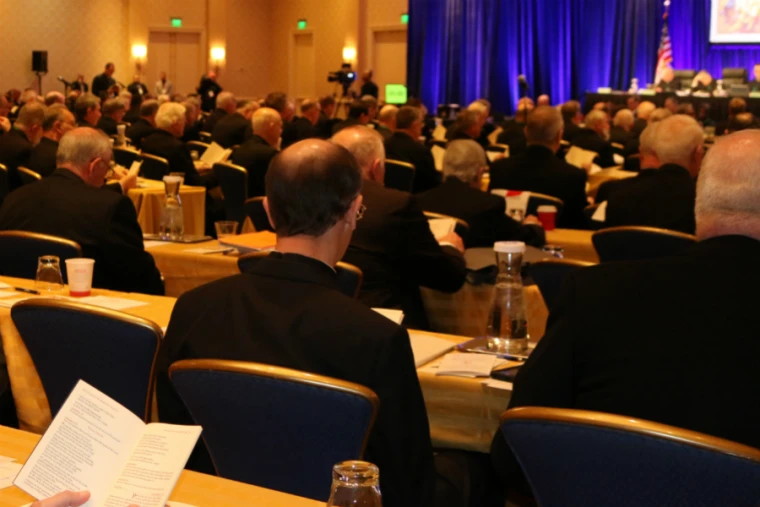

Posted in Uncategorized | 4 Comments

Pope Francis, who was himself tasked by the last conclave with rooting out abuse and corruption, has tended to surround himself with men who are at the very heart of the scandals rocking the Church throughout the world. He has said to American Catholics and to our bishops, in effect, “Let me and the Holy See handle this.”

Register Logo

Pope Francis meets with cardinals during the weekly general audience on Nov. 14, 2018, at St. Peter's square in the Vatican.

Pope Francis meets with cardinals during the weekly general audience on Nov. 14, 2018, at St. Peter’s square in the Vatican. (Vincenzo Pinto/AFP/Getty Images)BLOGS |  NOV. 16, 2018The Pope Owns ThisThis is no time to be dismissive. This is a time to work together for reform and a new springtime of faith in the Church and in the world.Msgr. Charles Pope

The annual Fall Meeting of the United States Conference of Catholic Bishops (USCCB), which took place in Baltimore earlier this week, was a disappointment on many levels. Yet there were also moments of light and strength coming from a good number of bishops. They spoke with clarity, acknowledging the seriousness of the crisis both in terms of the need to bring some semblance of justice to the victims and of the faltering credibility of the Church. Some even made the forbidden connection of the crisis to active homosexuals in the priesthood. Still others lamented the collective silence on sexual morality, wondering how many bishops and clergy do not believe what the Church teaches. (The interventions of these courageous bishops were reported in detail in the National Catholic Register here and here.)

Lamentably, the vote to encourage the Holy See to release all documents related to former Cardinal McCarrick’s alleged misconduct did not pass. The debate seemed to center on canonical issues and even wordsmithing. Nonetheless, the fact that more than 80 bishops were willing to issue even a mild-mannered insistence to Rome shows that many are finding a voice that is willing to confront when and where necessary.

The greatest disappointment was Pope Francis’ decision to suppress any vote or action on the abuse scandals by the U.S. bishops. Some bishops remarked that this decision indicates that Rome is serious about reform—a gratuitous claim. To many if not most of the faithful from whom I regularly hear, this seems yet another sad example of intransigence from Rome and the Pope. There is an almost complete tone-deafness in Rome; there seems to be bewilderment as to why these American “conservatives” are so worked up. Even worse, it appears that there is intentional resistance, obfuscation, and outright refusal to grant the legitimate requests of God’s faithful for a full and prompt investigation. These requests by the faithful are intended to ensure that tolerance of sin, violations of chastity, and clerical malfeasance will end. Victims deserve a prompt and thorough investigation and the faithful are right to insist that their clergy live up to the vows they take and observe the Sixth Commandment.

To most Catholics, the Pope’s actions and seeming resistance place the ownership of the scandal squarely in his court; he has increasingly become the face of the scandal. This is due to the credible accusations that he knew of former Cardinal McCarrick’s predatory behavior but even more so to the fact that he has steadfastly refused even to respond to the charges. He could deny them, but he does not. Even if he were to say, “I made a serious error in judgment and I ask the mercy and forgiveness of God’s people,” many people would do so, even if with sadness. Instead, the Pope has declared that he will “not say one word on this.” Even worse, he subsequently referred to those who have asked for answers and investigations as “a pack of wild dogs,” “scandal-mongers,” and “those in league with the Great Accuser.” This is no way to treat God’s faithful; it makes him seem more of a besieged and angry potentate than a shepherd who “has the smell of the sheep.” There is a lot of talk about mercy and accompaniment, but the Pope’s actions, including the recent suppression of the USCCB’s planned vote and actions on the sexual abuse crisis, demonstrate that such terms will be very selectively applied.

Indeed, the response of the Pope to the situation in the U.S. seems eerily familiar to his treatment of the people of Chile: Pope Francis deeply offended abuse survivors by defending Chilean Bishop Juan Barros from what he called the “calumny” and “gossip” of victims of clerical sexual abuse, stubbornly backing his appointment as bishop despite widespread advice to remove it. He even called the Chileans who protested Barros’ appointment “dumb.” So detrimental was this stubbornness, dismissiveness,and unkindness to basic credibility that even some of Pope Francis’ closest associates, including Cardinal Seán O’Malley of Boston, distanced themselves from him. Only when his hand was forced by strong protests and by actions of the Chilean government did Pope Francis alter his stance and finally remove Barros, later issuing an apology.

Americans, both clergy and lay, may well have to learn that it could take strong protest to move this pope to reconsider his seemingly dismissive stance regarding our concerns. While there were some early promises of an investigation and a canonical trial of Archbishop McCarrick, nothing seems to have materialized, and the Pope’s suppression of the planned votes and actions of the USCCB seems to indicate that it he does not consider it a high priority.

It also does not help that many of Pope Francis’ closest advisors are themselves caught up in this worldwide scandal and have at best exhibited poor judgment. For example, Cardinal Óscar Rodríguez Maradiaga (from Honduras) is seen as highly connected to homosexual and financial improprieties there; more than forty seminarians in his diocese published a letter asking him to root out the homosexual network in his seminary. Cardinal Rodríguez is Pope Francis’ chief advisor, the head of his “Council of Nine,” which works closely with him in bringing about reform in Rome.

Yet another associate of Francis’ in the “Council of Nine,” Chilean Cardinal Francisco Javier Errázuriz Ossa, has stepped down to face legal charges of covering up for abusive priests.

My point here is not to recount every detail but rather to point out that Pope Francis, who was himself tasked by the last conclave with rooting out abuse and corruption, has tended to surround himself with men who are at the very heart of the scandals rocking the Church throughout the world. His credibility as a reformer who will root out scandal and insist upon accountability is nearly nonexistent; the scandal in the United States has landed firmly on his desk as a result of his own behavior. He has said to American Catholics and to our bishops, in effect, “Let me and the Holy See handle this.”

I am not confident that we will see anything close to a full inquiry or a clear adjudication of this matter in Rome. Too many there are implicated and compromised to be able to carry out a clear and forceful investigation. The testimonies of Archbishop Viganò have substantially withstood scrutiny: former Cardinal McCarrick’s misdeeds were known and ignored despite previous sanctions. However, there just seems to be little importance attached to any of this in Rome.

I cannot say strongly enough how uncomfortable it makes me to be detailing all this. Every faithful Catholic—and certainly every priest—has an instinct to support the Pope and our bishops, but this worldwide scandal has forced many of us to speak out. Just like the people of Chile, we are going to have to speak even more forcefully and persistently, focusing much of our attention now on Rome and the Pope. It will feel awkward, and we must be careful in what we say and how we say it, in what we insist upon and how we go about it.

I pray that the bishops who spoke out so courageously at the USCCB meeting will continue to do so and will also direct clear and forceful appeals to Rome and to the Holy Father. Demands for a full and credible investigation and a canonical trial of former Cardinal McCarrick are not out of place or unreasonable. Bishops are not acolytes of the Pope and their dioceses are not mere franchises of the Diocese of Rome. I pray that they will raise their rightful voices as shepherds seeking to protect their flock. May they have the courage to insist, not just request, actions that they deem necessary for the protection of God’s faithful and for a restoration of credibility. Restoration will take time, but God’s faithful deserve to see their bishops fighting for them and will respond well when they do. My intent here is not to bait the bishops; each must prudently consider how best to respond to this crisis. It is clear, however, that they are going to have to show a strong resolve to move Roman officials and the Pope toward the kind of actions the faithful deserve.

As for God’s faithful, pray for your bishop. If he has spoken well and strongly, encourage and support him. If he has been silent, challenge him with love. Find your own voice, too. It may feel awkward to speak forcefully and with concern toward the Holy Father, but it seems that this will be necessary. By his own actions, he has become the face of this crisis, indicating that he wants to be the one to handle it. Our focus, prayers, and insistence must now be directed toward him. Practically speaking, I would advise you to write to the Papal Nuncio in Washington D.C., Archbishop Christophe Pierre. Keep your letter brief, but be clear in stating your concerns and in insisting on the actions that the Holy See must take to begin restoring credibility; ask the good archbishop to forward your concerns to the Holy Father.

Finally, there are some in Rome and even among our own bishops and priests in the U.S. who still see this crisis as a mere tempest in a teapot, largely stirred up by “right-wing” bloggers and Catholics who simply “don’t like” Pope Francis. I know of no one from any sector of the Church who is not heartbroken about this, while also angry and insistent upon reform. This is not a storm created in the “blogosphere.” Every day I am approached by parishioners and contacted by people from all over: young adults in our Bible study and pre-Cana programs, older Catholics in our Sodality and Knights of Columbus, catechists, staff members, long-time Catholics, recent converts, attendees at Sunday Mass, daily communicants, and those frequenting Eucharistic Adoration. They are all concerned; they are on the receiving end of questions themselves from family and friends: “What’s wrong with your Church?” They are dismayed; they are deeply concerned for the Church they still love. These are the people still in our pews, who did not leave during the cultural downslide and have supported the Church through thick and thin. These are the people who look to us. No clergyman should demonize them; they have been too good to us for us to write them off as some fringe element. They are good Catholics and are looking to us for clear teaching, for some return of the love and loyalty they have shown us through the most difficult decades of the cultural and sexual revolutions. They have been exceedingly patient with us. This is no time to be dismissive; this is a time to listen and work together with God’s good people for reform and a new springtime of faith in the Church and in the world. Somebody say, “Amen!”

++++++++++++++++++++++++++++++++++++++++++++++++++++++++++++++++


THE VALID CARDINALS, i.e. CARDINALS APPOINTED BY POPES BENEDICT XVI AND SAINT JOHN PAUL II, MUST ACT SOON TO REMOVE FRANCIS THE MERCIFUL FROM THE THRONE OF SAINT PETER BEFORE HE DAMAGES THE INSTITUTIONAL CHURCH EVEN MORE THAN HE HAS ALREADY DAMAGED IT.


Recently many educated Catholic observers, including bishops and priests, have decried the confusion in doctrinal statements about faith or morals made from the Apostolic See at Rome and by the putative Bishop of Rome, Pope Francis. Some devout, faithful and thoughtful Catholics have even suggested that he be set aside as a heretic, a dangerous purveyor of error, as recently mentioned in a number of reports. Claiming heresy on the part of a man who is a supposed Pope, charging material error in statements about faith or morals by a putative Roman Pontiff, suggests and presents an intervening prior question about his authenticity in that August office of Successor of Peter as Chief of The Apostles, i.e., was this man the subject of a valid election by an authentic Conclave of The Holy Roman Church?  This is so because each Successor of Saint Peter enjoys the Gift of Infallibility.  So, before one even begins to talk about excommunicating such a prelate, one must logically examine whether this person exhibits the uniformly good and safe fruit of Infallibility.

If he seems repeatedly to engage in material error, that first raises the question of the validity of his election because one expects an authentically-elected Roman Pontiff miraculously and uniformly to be entirely incapable of stating error in matters of faith or morals.  So to what do we look to discern the invalidity of such an election?  His Holiness, Pope John Paul II, within His massive legacy to the Church and to the World, left us with the answer to this question.  The Catholic faithful must look back for an answer to a point from where we have come—to what occurred in and around the Sistine Chapel in March 2013 and how the fruits of those events have generated such widespread concern among those people of magisterial orthodoxy about confusing and, or, erroneous doctrinal statements which emanate from The Holy See.

His Apostolic Constitution (Universi Dominici Gregis) which governed the supposed Conclave in March 2013 contains quite clear and specific language about the invalidating effect of departures from its norms.  For example, Paragraph 76 states:  “Should the election take place in a way other than that prescribed in the present Constitution, or should the conditions laid down here not be observed, the election is for this very reason null and void, without any need for a declaration on the matter; consequently, it confers no right on the one elected.”

From this, many believe that there is probable cause to believe that Monsignor Jorge Mario Bergoglio was never validly elected as the Bishop of Rome and Successor of Saint Peter—he never rightly took over the office of Supreme Pontiff of the Holy Roman Catholic Church and therefore he does not enjoy the charism of Infallibility.  If this is true, then the situation is dire because supposed papal acts may not be valid or such acts are clearly invalid, including supposed appointments to the college of electors itself.

Only valid cardinals can rectify our critical situation through privately (secretly) recognizing the reality of an ongoing interregnum and preparing for an opportunity to put the process aright by obedience to the legislation of His Holiness, Pope John Paul II, in that Apostolic Constitution, Universi Dominici Gregis.  While thousands of the Catholic faithful do understand that only the cardinals who participated in the events of March 2013 within the Sistine Chapel have all the information necessary to evaluate the issue of election validity, there was public evidence sufficient for astute lay faithful to surmise with moral certainty that the March 2013 action by the College was an invalid conclave, an utter nullity.

What makes this understanding of Universi Dominici Gregisparticularly cogent and plausible is the clear Promulgation Clause at the end of this Apostolic Constitution and its usage of the word “scienter” (“knowingly”).  The Papal Constitution Universi Dominici Gregis thus concludes definitively with these words:  “.   .   .   knowingly or unknowingly, in any way contrary to this Constitution.”  (“.   .   .   scienter vel inscienter contra hanc Constitutionem fuerint excogitata.”)  [Note that His Holiness, Pope Paul VI, had a somewhat similar promulgation clause at the end of his corresponding, now abrogated, Apostolic Constitution, Romano Pontifici Eligendo, but his does not use “scienter”, but rather uses “sciens” instead. This similar term of sciens in the earlier abrogated Constitution has an entirely different legal significance than scienter.] This word, “scienter”, is a legal term of art in Roman law, and in canon law, and in Anglo-American common law, and in each system, scienter has substantially the same significance, i.e., “guilty knowledge” or willfully knowing, criminal intent.

Thus, it clearly appears that Pope John Paul II anticipated the possibility of criminal activity in the nature of a sacrilege against a process which He intended to be purely pious, private, sacramental, secret and deeply spiritual, if not miraculous, in its nature. This contextual reality reinforced in the Promulgation Clause, combined with:  (1) the tenor of the whole document; (2) some other provisions of the document, e.g., Paragraph 76; (3) general provisions of canon law relating to interpretation, e.g., Canons 10 & 17; and, (4) the obvious manifest intention of the Legislator, His Holiness, Pope John Paul II, tends to establish beyond a reasonable doubt the legal conclusion that Monsignor Bergoglio was never validly elected Roman Pontiff.

This is so because:1.  Communication of any kind with the outside world, e.g., communication did occur between the inside of the Sistine Chapel and anyone outside, including a television audience, before, during or even immediately after the Conclave;2.   Any political commitment to “a candidate” and any “course of action” planned for The Church or a future pontificate, such as the extensive decade-long “pastoral” plans conceived by the Sankt Gallen hierarchs; and,3.  Any departure from the required procedures of the conclave voting process as prescribed and known by a cardinal to have occurred:each was made an invalidating act, and if scienter (guilty knowledge) was present, also even a crime on the part of any cardinal or other actor, but, whether criminal or not, any such act or conduct violating the norms operated absolutely, definitively and entirely against the validity of all of the supposed Conclave proceedings.

Quite apart from the apparent notorious violations of the prohibition on a cardinal promising his vote, e.g., commitments given and obtained by cardinals associated with the so-called “Sankt Gallen Mafia,” other acts destructive of conclave validity occurred.  Keeping in mind that Pope John Paul II specifically focused Universi Dominici Gregis on “the seclusion and resulting concentration which an act so vital to the whole Church requires of the electors” such that “the electors can more easily dispose themselves to accept the interior movements of the Holy Spirit,” even certain openly public media broadcasting breached this seclusion by electronic broadcasts outlawed by Universi Dominici Gregis.  These prohibitions include direct declarative statements outlawing any use of television before, during or after a conclave in any area associated with the proceedings, e.g.:  “I further confirm, by my apostolic authority, the duty of maintaining the strictest secrecy with regard to everything that directly or indirectly concerns the election process itself.” Viewed in light of this introductory preambulary language of Universi Dominici Gregis and in light of the legislative text itself, even the EWTN camera situated far inside the Sistine Chapel was an immediately obvious non-compliant  act which became an open and notorious invalidating violation by the time when this audio-visual equipment was used to broadcast to the world the preaching after the “Extra Omnes”.  While these blatant public violations of Chapter IV of Universi Dominici Gregis actuate the invalidity and nullity of the proceedings themselves, nonetheless in His great wisdom, the Legislator did not disqualify automatically those cardinals who failed to recognize these particular offenses against sacred secrecy, or even those who, with scienter, having recognized the offenses and having had some power or voice in these matters, failed or refused to act or to object against them:  “Should any infraction whatsoever of this norm occur and be discovered, those responsible should know that they will be subject to grave penalties according to the judgment of the future Pope.”  [Universi Dominici Gregis, ¶55]

No Pope apparently having been produced in March 2013, those otherwise valid cardinals who failed with scienter to act on violations of Chapter IV, on that account alone would nonetheless remain voting members of the College unless and until a new real Pope is elected and adjudges them.  

Thus, those otherwise valid cardinals who may have been compromised by violations of secrecy can still participate validly in the “clean-up of the mess” while addressing any such secrecy violations with an eventual new Pontiff.  In contrast, the automatic excommunication of those who politicized the sacred conclave process, by obtaining illegally, commitments from cardinals to vote for a particular man, or to follow a certain course of action (even long before the vacancy of the Chair of Peter as Vicar of Christ), is established not only by the word, “scienter,” in the final enacting clause, but by a specific exception, in this case, to the general statement of invalidity which therefore reinforces the clarity of intention by Legislator that those who apply the law must interpret the general rule as truly binding.  Derived directly from Roman law, canonical jurisprudence provides this principle for construing or interpreting legislation such as this Constitution, Universi Dominici Gregis.  Expressed in Latin, this canon of interpretation is:   “Exceptio probat regulam in casibus non exceptis.”  (The exception proves the rule in cases not excepted.)  In this case, an exception from invalidity for acts of simony reinforces the binding force of the general principle of nullity in cases of other violations. Therefore, by exclusion from nullity and invalidity legislated in the case of simony: “If — God forbid — in the election of the Roman Pontiff the crime of simony were to be perpetrated, I decree and declare that all those guilty thereof shall incur excommunication latae sententiae.  At the same time I remove the nullity or invalidity of the same simoniacal provision, in order that — as was already established by my Predecessors — the validity of the election of the Roman Pontiff may not for this reason be challenged.”  

His Holiness made an exception for simony. Exceptio probat regulam in casibus non exceptis.  The clear exception from nullity and invalidity for simony proves the general rule that other violations of the sacred process certainly do and did result in the nullity and invalidity of the entire conclave. Comparing what Pope John Paul II wrote in His Constitution on conclaves with the Constitution which His replaced, you can see that, with the exception of simony, invalidity became universal. 

In the corresponding paragraph of what Pope Paul VI wrote, he specifically confined the provision declaring conclave invalidity to three (3) circumstances described in previous paragraphs within His constitution, Romano Pontfici Eligendo.  No such limitation exists in Universi Dominici Gregis.  See the comparison both in English and Latin below:Romano Pontfici Eligendo, 77. Should the election be conducted in a manner different from the three procedures described above (cf. no. 63 ff.) or without the conditions laid down for each of the same, it is for this very reason null and void (cf. no. 62), without the need for any declaration, and gives no right to him who has been thus elected. [Romano Pontfici Eligendo, 77:  “Quodsi electio aliter celebrata fuerit, quam uno e tribus modis, qui supra sunt dicti (cfr. nn. 63 sqq.), aut non servatis condicionibus pro unoquoque illorum praescriptis, electio eo ipso est nulla et invalida (cfr. n. 62) absque ulla declaratione, et ita electo nullum ius tribuit .”] as compared with:Universi Dominici Gregis, 76:  “Should the election take place in a way other than that prescribed in the present Constitution, or should the conditions laid down here not be observed, the election is for this very reason null and void, without any need for a declaration on the matter; consequently, it confers no right on the one elected.”  [Universi Dominici Gregis, 76:  “Quodsi electio aliter celebrata fuerit, quam haec Constitutio statuit, aut non servatis condicionibus pariter hic praescriptis, electio eo ipso est nulla et invalida absque ulla declaratione, ideoque electo nullum ius tribuit.”]Of course, this is not the only feature of the Constitution or aspect of the matter which tends to establish the breadth of invalidity.

 Faithful must hope and pray that only those cardinals whose status as a valid member of the College remains intact will ascertain the identity of each other and move with the utmost charity and discretion in order to effectuate The Divine Will in these matters.  The valid cardinals, then, must act according to that clear, manifest, obvious and unambiguous mind and intention of His Holiness, Pope John Paul II, so evident in Universi Dominici Gregis, a law which finally established binding and self-actuating conditions of validity on the College for any papal conclave, a reality now made so apparent by the bad fruit of doctrinal confusion and plain error. It would seem then that praying and working in a discreet and prudent manner to encourage only those true cardinals inclined to accept a reality of conclave invalidity, would be a most charitable and logical course of action in the light of Universi Dominici Gregis, and out of our high personal regard for the clear and obvious intention of its Legislator, His Holiness, Pope John Paul II.  Even a relatively small number of valid cardinals could act decisively and work to restore a functioning Apostolic See through the declaration of an interregnum government.  The need is clear for the College to convene a General Congregation in order to declare, to administer, and soon to end the Interregnum which has persisted since March 2013. Finally, it is important to understand that the sheer number of putative counterfeit cardinals will eventually, sooner or later, result in a situation in which The Church will have no normal means validly ever again to elect a Vicar of Christ.  After that time, it will become even more difficult, if not humanly impossible, for the College of Cardinals to rectify the current disastrous situation and conduct a proper and valid Conclave such that The Church may once again both have the benefit of a real Supreme Pontiff, and enjoy the great gift of a truly infallible Vicar of Christ.  It seems that some good cardinals know that the conclave was invalid, but really cannot envision what to do about it; we must pray, if it is the Will of God, that they see declaring the invalidity and administering an Interregnum through a new valid conclave is what they must do.  Without such action or without a great miracle, The Church is in a perilous situation.  Once the last validly appointed cardinal reaches age 80, or before that age, dies, the process for electing a real Pope ends with no apparent legal means to replace it. Absent a miracle then, The Church would no longer have an infallible Successor of Peter and Vicar of Christ.  Roman Catholics would be no different that Orthodox Christians. In this regard, all of the true cardinals may wish to consider what Holy Mother Church teaches in the Catechism of the Catholic Church, ¶675, ¶676 and ¶677 about “The Church’s Ultimate Trial”.  But, the fact that “The Church .   .   .  will follow her Lord in his death and Resurrection” does not justify inaction by the good cardinals, even if there are only a minimal number sufficient to carry out Chapter II of Universi Dominici Gregis and operate the Interregnum. This Apostolic Constitution, Universi Dominici Gregis, which was clearly applicable to the acts and conduct of the College of Cardinals in March 2013, is manifestly and obviously among those “invalidating” laws “which expressly establish that an act is null or that a person is effected” as stated in Canon 10 of the 1983 Code of Canon Law.  And, there is nothing remotely “doubtful or obscure” (Canon 17) about this Apostolic Constitution as clearly promulgated by Pope John Paul II.  The tenor of the whole document expressly establishes that the issue of invalidity was always at stake.  This Apostolic Constitution conclusively establishes, through its Promulgation Clause [which makes “anything done (i.e., any act or conduct) by any person  .   .   .   in any way contrary to this Constitution,”] the invalidity of the entire supposed Conclave, rendering it “completely null and void”. So, what happens if a group of Cardinals who undoubtedly did not knowingly and wilfully initiate or intentionally participate in any acts of disobedience against Universi Dominici Gregis were to meet, confer and declare that, pursuant to Universi Dominici Gregis, Monsignor Bergoglio is most certainly not a valid Roman Pontiff.  Like any action on this matter, including the initial finding of invalidity, that would be left to the valid members of the college of cardinals.  They could declare the Chair of Peter vacant and proceed to a new and proper conclave.  They could meet with His Holiness, Benedict XVI, and discern whether His resignation and retirement was made under duress, or based on some mistake or fraud, or otherwise not done in a legally effective manner, which could invalidate that resignation.  Given the demeanor of His Holiness, Benedict XVI, and the tenor of His few public statements since his departure from the Chair of Peter, this recognition of validity in Benedict XVI seems unlikely. In fact, even before a righteous group of good and authentic cardinals might decide on the validity of the March 2013 supposed conclave, they must face what may be an even more complicated discernment and decide which men are most likely not valid cardinals.  If a man was made a cardinal by the supposed Pope who is, in fact, not a Pope (but merely Monsignor Bergoglio), no such man is in reality a true member of the College of Cardinals.  In addition, those men appointed by Pope John Paul II or by Pope Benedict XVI as cardinals, but who openly violated Universi Dominici Gregis by illegal acts or conduct causing the invalidation of the last attempted conclave, would no longer have voting rights in the College of Cardinals either.  (Thus, the actual valid members in the College of Cardinals may be quite smaller in number than those on the current official Vatican list of supposed cardinals.) In any event, the entire problem is above the level of anyone else in Holy Mother Church who is below the rank of Cardinal.  So, we must pray that The Divine Will of The Most Holy Trinity, through the intercession of Our Lady as Mediatrix of All Graces and Saint Michael, Prince of Mercy, very soon rectifies the confusion in Holy Mother Church through action by those valid Cardinals who still comprise an authentic College of Electors.  Only certainly valid Cardinals can address the open and notorious evidence which points to the probable invalidity of the last supposed conclave and only those cardinals can definitively answer the questions posed here.  May only the good Cardinals unite and if they recognize an ongoing Interregnum, albeit dormant, may they end this Interregnum by activating perfectly a functioning Interregnum government of The Holy See and a renewed process for a true Conclave, one which is purely pious, private, sacramental, secret and deeply spiritual.  If we do not have a real Pontiff, then may the good Cardinals, doing their appointed work “in view of the sacredness of the act of election”  “accept the interior movements of the Holy Spirit” and provide Holy Mother Church with a real Vicar of Christ as the Successor of Saint Peter.   May these thoughts comport with the synderetic considerations of those who read them and may their presentation here please both Our Immaculate Virgin Mother, Mary, Queen of the Apostles, and The Most Holy Trinity, Father, Son and Holy Spirit.N. de PlumeUn ami des Papes
Posted in Uncategorized | 3 Comments

THE CHURCH IN THE United States IS NOW GOING TO BE RUN BY TWO VICE POPES (pun intended), WUERL AND CUPICH.

Cupich and Wuerl collaborated on alternative sex abuse proposal

4.9K1209

The USCCB autumn General Assembly in Baltimore, Md., Nov. 12, 2018. Credit: Christine Rousselle/CNA

The USCCB autumn General Assembly in Baltimore, Md., Nov. 12, 2018. Credit: Christine Rousselle/CNA

By Ed Condon

Washington D.C., Nov 16, 2018 / 06:56 pm (CNA).- Cardinal Blase Cupich of Chicago and Cardinal Donald Wuerl of Washington collaborated extensively on a recently proposed policy for handling abuse allegations against bishops, CNA has learned.

Cupich submitted the plan Tuesday to leaders of the U.S. bishops’ conference, proffering it as an alternative to a proposal that had been devised by conference officials and staffers.

The conference’s proposed plan would have established an independent lay-led commission to investigate allegations against bishops. The Cupich-Wuerl plan would instead send allegations against bishops to be investigated by their metropolitan archbishops, along with archdiocesan review boards. Metropolitans themselves would be investigated by their senior suffragan bishops.

Sources in Rome and Washington, DC told CNA that Wuerl and Cupich worked together on their alternative plan for weeks, and presented it to the Vatican’s Congregation for Bishops before the U.S. bishops’ conference assembly in Baltimore. Cupich and Wuerl are both members of the Congregation for Bishops.
 
The Cupich-Wuerl plan was submitted to the U.S. bishops even after a Vatican directive was issued Monday barring U.S. bishops from voting on any abuse-related measures. The Vatican suspended USCCB policy-making on sexual abuse until after a February meeting involving the heads of bishops’ conferences from around the world.

An official at the Congregation for Bishops told CNA on Thursday that the substance of the plan presented by Cupich at the Baltimore meeting is known in the congregation as “Wuerl’s plan.” The official would not confirm whether the congregation had received an advance copy of the document.

Senior chancery officials in Washington described the plan presented Tuesday as a collaborative effort by the cardinals, telling CNA that Wuerl and Cupich first informed the Congregation for Bishops several weeks ago about their idea for the “metropolitan model” to handle complaints against a bishop, and suggested they had continued to discuss the plan with Congregation officials since that time.

“It was a mutual effort,” one Archdiocese of Washington official told CNA.

The idea of amending USCCB policy so that allegations against a bishop would be handled by his metropolitan archbishop was first suggested by Wuerl publicly in August.

While Cupich played an active role in conference sessions this week, and proposed the detailed plan for an alternative to the conference’s special commission, Wuerl did not make any public comment on the plan, which at least some in Rome consider to be “his,” and which he first suggested in public 3 months ago.

Sources familiar with the behind-the-scenes discussions in Baltimore told CNA that Wuerl chose to step back from the plan’s presentation, providing advice and counsel but not seeking to take public credit. A spokesman for Wuerl declined to comment on that decision.

Several bishops in Baltimore told CNA that Cupich appeared to be positioning himself as an unofficial but influential policy-maker in the conference. His status would be strengthened if the plan he introduced in Baltimore gained support in Rome, they said, especially if it were favored over the plan proposed by conference officials.

It is not clear to what extent Cupich considered how the manner in which he presented his plan could be interpreted. A spokesperson for the Archdiocese of Chicago told CNA that Cardinal Cupich was away, and could not be reached for comment.

A source familiar with the drafting of the alternative proposal told CNA that Wuerl was not involved in the way the plan was presented in Baltimore, saying that Wuerl’s only concern was developing the best possible plan for tackling the sexual abuse crisis, and not “playing games” at the conference.

Many American bishops arrived in Baltimore this week expecting to approve the proposed the independent commission, along with proposed standards for episcopal conduct. Bishops were stunned to discover Monday that they could not vote on the measures, following the last-minute instruction from the Congregation for Bishops, received Sunday night by conference president Cardinal Daniel DiNardo.

An Archdiocese of Washington official suggested to CNA that the Congregation for Bishops’ last minute suspension of voting at the Baltimore meeting might have been because the conference’s independent commission proposal was not sent to Rome until Oct. 30.

DiNardo, however, told a press conference Monday that while the draft document for the independent commission had been sent to Rome at the end of October, the USCCB had been in consistent contact with Vatican officials as the texts were developed.

DiNardo said that “When we were in Rome [in October] we consulted with all of [the Vatican dicasteries]. I mean, [that’s what] we do.”

“When I met with the Holy Father in October, the Holy Father was very positive in a general way – he had not seen everything yet – of the kind of action items we were looking to do.”

Cupich spoke from the floor immediately after DiNardo’s announcement of the change Monday morning. The cardinal suggested that the bishops continue to discuss the proposed measures and take non-binding votes on them. He offered no indication at that time that he would introduce a completely different plan.

By Tuesday afternoon, the Chicago cardinal rose to question the premise of the USCCB’s proposed independent commission, asking if it was a reflection of sound ecclesiology. Cupich suggested that the commission could be seen as a way of “outsourcing” difficult situations.

Shortly thereafter, Cupich submitted to conference leaders a seemingly well-prepared and comprehensive “Supplement to the [USCCB] Essential Norms,” which outlined in detail the plan he had developed with Wuerl.

Archbishop Charles Chaput of Philadelphia said from the floor that the “metropolitan model” appeared to align closer with the Church’s hierarchical structure.

“I really do favor the use of the metropolitan and the metropolitan review board for these cases… but that would require that the Holy See give metropolitan archbishops more authority than we have,” Chaput told the conference.

Chaput told the bishop that the reason the USCCB executive committee opted to pursue the idea of an independent commission instead of developing a plan based around the metropolitan archbishop was because they did not think the “metropolitan model’ would have support in Rome.

“When we discussed this at the executive committee level we, some people, thought it would be easier for us to develop this independent commission than to get the Church to change canon law,” he said.

Sources close to the USCCB told CNA that if the executive committee had known the Vatican might support the “metropolitan model,” it might have been pursued earlier, with a proposal being circulated to members by the conference leadership. A spokesperson for the USCCB declined to comment on that possibility.

Cupich had suggested during the meeting that either or both plans could be voted on in non-binding resolutions in order to give the Vatican a sense of the American episcopate’s desires. Ultimately, no vote was taken.

Instead, as the Baltimore meeting ended, DiNardo agreed that Cupich’s plan would be developed alongside the independent commission plan, by a special task force consisting of former USCCB presidents Cardinal Timothy Dolan, Archbishop Joseph Kurtz, and Archbishop Wilton Gregory. DiNardo will have the option of presenting either or both possibilities when he and conference vice president Archbishop Jose Gomez attend the Vatican’s February meeting.

USCCB spokespersons declined several times to comment on any role Cupich or Wuerl, members of the Congregation for Bishops, might have played in developing the congregation’s reaction to the special commission plan.

Ed. note: This story was updated after publication to explain that metropolitans under investigation would be investigated by their senior suffragan bishops.

++++++++++++++++++++++++++++++++++++++++++++++++++++++++++++++++


THE VALID CARDINALS, i.e. CARDINALS APPOINTED BY POPES BENEDICT XVI AND SAINT JOHN PAUL II, MUST ACT SOON TO REMOVE FRANCIS THE MERCIFUL FROM THE THRONE OF SAINT PETER BEFORE HE DAMAGES THE INSTITUTIONAL CHURCH EVEN MORE THAN HE HAS ALREADY DAMAGED IT.


Recently many educated Catholic observers, including bishops and priests, have decried the confusion in doctrinal statements about faith or morals made from the Apostolic See at Rome and by the putative Bishop of Rome, Pope Francis. Some devout, faithful and thoughtful Catholics have even suggested that he be set aside as a heretic, a dangerous purveyor of error, as recently mentioned in a number of reports. Claiming heresy on the part of a man who is a supposed Pope, charging material error in statements about faith or morals by a putative Roman Pontiff, suggests and presents an intervening prior question about his authenticity in that August office of Successor of Peter as Chief of The Apostles, i.e., was this man the subject of a valid election by an authentic Conclave of The Holy Roman Church?  This is so because each Successor of Saint Peter enjoys the Gift of Infallibility.  So, before one even begins to talk about excommunicating such a prelate, one must logically examine whether this person exhibits the uniformly good and safe fruit of Infallibility.

If he seems repeatedly to engage in material error, that first raises the question of the validity of his election because one expects an authentically-elected Roman Pontiff miraculously and uniformly to be entirely incapable of stating error in matters of faith or morals.  So to what do we look to discern the invalidity of such an election?  His Holiness, Pope John Paul II, within His massive legacy to the Church and to the World, left us with the answer to this question.  The Catholic faithful must look back for an answer to a point from where we have come—to what occurred in and around the Sistine Chapel in March 2013 and how the fruits of those events have generated such widespread concern among those people of magisterial orthodoxy about confusing and, or, erroneous doctrinal statements which emanate from The Holy See.

His Apostolic Constitution (Universi Dominici Gregis) which governed the supposed Conclave in March 2013 contains quite clear and specific language about the invalidating effect of departures from its norms.  For example, Paragraph 76 states:  “Should the election take place in a way other than that prescribed in the present Constitution, or should the conditions laid down here not be observed, the election is for this very reason null and void, without any need for a declaration on the matter; consequently, it confers no right on the one elected.”

From this, many believe that there is probable cause to believe that Monsignor Jorge Mario Bergoglio was never validly elected as the Bishop of Rome and Successor of Saint Peter—he never rightly took over the office of Supreme Pontiff of the Holy Roman Catholic Church and therefore he does not enjoy the charism of Infallibility.  If this is true, then the situation is dire because supposed papal acts may not be valid or such acts are clearly invalid, including supposed appointments to the college of electors itself.

Only valid cardinals can rectify our critical situation through privately (secretly) recognizing the reality of an ongoing interregnum and preparing for an opportunity to put the process aright by obedience to the legislation of His Holiness, Pope John Paul II, in that Apostolic Constitution, Universi Dominici Gregis.  While thousands of the Catholic faithful do understand that only the cardinals who participated in the events of March 2013 within the Sistine Chapel have all the information necessary to evaluate the issue of election validity, there was public evidence sufficient for astute lay faithful to surmise with moral certainty that the March 2013 action by the College was an invalid conclave, an utter nullity.

What makes this understanding of Universi Dominici Gregisparticularly cogent and plausible is the clear Promulgation Clause at the end of this Apostolic Constitution and its usage of the word “scienter” (“knowingly”).  The Papal Constitution Universi Dominici Gregis thus concludes definitively with these words:  “.   .   .   knowingly or unknowingly, in any way contrary to this Constitution.”  (“.   .   .   scienter vel inscienter contra hanc Constitutionem fuerint excogitata.”)  [Note that His Holiness, Pope Paul VI, had a somewhat similar promulgation clause at the end of his corresponding, now abrogated, Apostolic Constitution, Romano Pontifici Eligendo, but his does not use “scienter”, but rather uses “sciens” instead. This similar term of sciens in the earlier abrogated Constitution has an entirely different legal significance than scienter.] This word, “scienter”, is a legal term of art in Roman law, and in canon law, and in Anglo-American common law, and in each system, scienter has substantially the same significance, i.e., “guilty knowledge” or willfully knowing, criminal intent.

Thus, it clearly appears that Pope John Paul II anticipated the possibility of criminal activity in the nature of a sacrilege against a process which He intended to be purely pious, private, sacramental, secret and deeply spiritual, if not miraculous, in its nature. This contextual reality reinforced in the Promulgation Clause, combined with:  (1) the tenor of the whole document; (2) some other provisions of the document, e.g., Paragraph 76; (3) general provisions of canon law relating to interpretation, e.g., Canons 10 & 17; and, (4) the obvious manifest intention of the Legislator, His Holiness, Pope John Paul II, tends to establish beyond a reasonable doubt the legal conclusion that Monsignor Bergoglio was never validly elected Roman Pontiff.

This is so because:1.  Communication of any kind with the outside world, e.g., communication did occur between the inside of the Sistine Chapel and anyone outside, including a television audience, before, during or even immediately after the Conclave;2.   Any political commitment to “a candidate” and any “course of action” planned for The Church or a future pontificate, such as the extensive decade-long “pastoral” plans conceived by the Sankt Gallen hierarchs; and,3.  Any departure from the required procedures of the conclave voting process as prescribed and known by a cardinal to have occurred:each was made an invalidating act, and if scienter (guilty knowledge) was present, also even a crime on the part of any cardinal or other actor, but, whether criminal or not, any such act or conduct violating the norms operated absolutely, definitively and entirely against the validity of all of the supposed Conclave proceedings.

Quite apart from the apparent notorious violations of the prohibition on a cardinal promising his vote, e.g., commitments given and obtained by cardinals associated with the so-called “Sankt Gallen Mafia,” other acts destructive of conclave validity occurred.  Keeping in mind that Pope John Paul II specifically focused Universi Dominici Gregis on “the seclusion and resulting concentration which an act so vital to the whole Church requires of the electors” such that “the electors can more easily dispose themselves to accept the interior movements of the Holy Spirit,” even certain openly public media broadcasting breached this seclusion by electronic broadcasts outlawed by Universi Dominici Gregis.  These prohibitions include direct declarative statements outlawing any use of television before, during or after a conclave in any area associated with the proceedings, e.g.:  “I further confirm, by my apostolic authority, the duty of maintaining the strictest secrecy with regard to everything that directly or indirectly concerns the election process itself.” Viewed in light of this introductory preambulary language of Universi Dominici Gregis and in light of the legislative text itself, even the EWTN camera situated far inside the Sistine Chapel was an immediately obvious non-compliant  act which became an open and notorious invalidating violation by the time when this audio-visual equipment was used to broadcast to the world the preaching after the “Extra Omnes”.  While these blatant public violations of Chapter IV of Universi Dominici Gregis actuate the invalidity and nullity of the proceedings themselves, nonetheless in His great wisdom, the Legislator did not disqualify automatically those cardinals who failed to recognize these particular offenses against sacred secrecy, or even those who, with scienter, having recognized the offenses and having had some power or voice in these matters, failed or refused to act or to object against them:  “Should any infraction whatsoever of this norm occur and be discovered, those responsible should know that they will be subject to grave penalties according to the judgment of the future Pope.”  [Universi Dominici Gregis, ¶55]

No Pope apparently having been produced in March 2013, those otherwise valid cardinals who failed with scienter to act on violations of Chapter IV, on that account alone would nonetheless remain voting members of the College unless and until a new real Pope is elected and adjudges them.  

Thus, those otherwise valid cardinals who may have been compromised by violations of secrecy can still participate validly in the “clean-up of the mess” while addressing any such secrecy violations with an eventual new Pontiff.  In contrast, the automatic excommunication of those who politicized the sacred conclave process, by obtaining illegally, commitments from cardinals to vote for a particular man, or to follow a certain course of action (even long before the vacancy of the Chair of Peter as Vicar of Christ), is established not only by the word, “scienter,” in the final enacting clause, but by a specific exception, in this case, to the general statement of invalidity which therefore reinforces the clarity of intention by Legislator that those who apply the law must interpret the general rule as truly binding.  Derived directly from Roman law, canonical jurisprudence provides this principle for construing or interpreting legislation such as this Constitution, Universi Dominici Gregis.  Expressed in Latin, this canon of interpretation is:   “Exceptio probat regulam in casibus non exceptis.”  (The exception proves the rule in cases not excepted.)  In this case, an exception from invalidity for acts of simony reinforces the binding force of the general principle of nullity in cases of other violations. Therefore, by exclusion from nullity and invalidity legislated in the case of simony: “If — God forbid — in the election of the Roman Pontiff the crime of simony were to be perpetrated, I decree and declare that all those guilty thereof shall incur excommunication latae sententiae.  At the same time I remove the nullity or invalidity of the same simoniacal provision, in order that — as was already established by my Predecessors — the validity of the election of the Roman Pontiff may not for this reason be challenged.”  

His Holiness made an exception for simony. Exceptio probat regulam in casibus non exceptis.  The clear exception from nullity and invalidity for simony proves the general rule that other violations of the sacred process certainly do and did result in the nullity and invalidity of the entire conclave. Comparing what Pope John Paul II wrote in His Constitution on conclaves with the Constitution which His replaced, you can see that, with the exception of simony, invalidity became universal. 

In the corresponding paragraph of what Pope Paul VI wrote, he specifically confined the provision declaring conclave invalidity to three (3) circumstances described in previous paragraphs within His constitution, Romano Pontfici Eligendo.  No such limitation exists in Universi Dominici Gregis.  See the comparison both in English and Latin below:Romano Pontfici Eligendo, 77. Should the election be conducted in a manner different from the three procedures described above (cf. no. 63 ff.) or without the conditions laid down for each of the same, it is for this very reason null and void (cf. no. 62), without the need for any declaration, and gives no right to him who has been thus elected. [Romano Pontfici Eligendo, 77:  “Quodsi electio aliter celebrata fuerit, quam uno e tribus modis, qui supra sunt dicti (cfr. nn. 63 sqq.), aut non servatis condicionibus pro unoquoque illorum praescriptis, electio eo ipso est nulla et invalida (cfr. n. 62) absque ulla declaratione, et ita electo nullum ius tribuit .”] as compared with:Universi Dominici Gregis, 76:  “Should the election take place in a way other than that prescribed in the present Constitution, or should the conditions laid down here not be observed, the election is for this very reason null and void, without any need for a declaration on the matter; consequently, it confers no right on the one elected.”  [Universi Dominici Gregis, 76:  “Quodsi electio aliter celebrata fuerit, quam haec Constitutio statuit, aut non servatis condicionibus pariter hic praescriptis, electio eo ipso est nulla et invalida absque ulla declaratione, ideoque electo nullum ius tribuit.”]Of course, this is not the only feature of the Constitution or aspect of the matter which tends to establish the breadth of invalidity.

 Faithful must hope and pray that only those cardinals whose status as a valid member of the College remains intact will ascertain the identity of each other and move with the utmost charity and discretion in order to effectuate The Divine Will in these matters.  The valid cardinals, then, must act according to that clear, manifest, obvious and unambiguous mind and intention of His Holiness, Pope John Paul II, so evident in Universi Dominici Gregis, a law which finally established binding and self-actuating conditions of validity on the College for any papal conclave, a reality now made so apparent by the bad fruit of doctrinal confusion and plain error. It would seem then that praying and working in a discreet and prudent manner to encourage only those true cardinals inclined to accept a reality of conclave invalidity, would be a most charitable and logical course of action in the light of Universi Dominici Gregis, and out of our high personal regard for the clear and obvious intention of its Legislator, His Holiness, Pope John Paul II.  Even a relatively small number of valid cardinals could act decisively and work to restore a functioning Apostolic See through the declaration of an interregnum government.  The need is clear for the College to convene a General Congregation in order to declare, to administer, and soon to end the Interregnum which has persisted since March 2013. Finally, it is important to understand that the sheer number of putative counterfeit cardinals will eventually, sooner or later, result in a situation in which The Church will have no normal means validly ever again to elect a Vicar of Christ.  After that time, it will become even more difficult, if not humanly impossible, for the College of Cardinals to rectify the current disastrous situation and conduct a proper and valid Conclave such that The Church may once again both have the benefit of a real Supreme Pontiff, and enjoy the great gift of a truly infallible Vicar of Christ.  It seems that some good cardinals know that the conclave was invalid, but really cannot envision what to do about it; we must pray, if it is the Will of God, that they see declaring the invalidity and administering an Interregnum through a new valid conclave is what they must do.  Without such action or without a great miracle, The Church is in a perilous situation.  Once the last validly appointed cardinal reaches age 80, or before that age, dies, the process for electing a real Pope ends with no apparent legal means to replace it. Absent a miracle then, The Church would no longer have an infallible Successor of Peter and Vicar of Christ.  Roman Catholics would be no different that Orthodox Christians. In this regard, all of the true cardinals may wish to consider what Holy Mother Church teaches in the Catechism of the Catholic Church, ¶675, ¶676 and ¶677 about “The Church’s Ultimate Trial”.  But, the fact that “The Church .   .   .  will follow her Lord in his death and Resurrection” does not justify inaction by the good cardinals, even if there are only a minimal number sufficient to carry out Chapter II of Universi Dominici Gregis and operate the Interregnum. This Apostolic Constitution, Universi Dominici Gregis, which was clearly applicable to the acts and conduct of the College of Cardinals in March 2013, is manifestly and obviously among those “invalidating” laws “which expressly establish that an act is null or that a person is effected” as stated in Canon 10 of the 1983 Code of Canon Law.  And, there is nothing remotely “doubtful or obscure” (Canon 17) about this Apostolic Constitution as clearly promulgated by Pope John Paul II.  The tenor of the whole document expressly establishes that the issue of invalidity was always at stake.  This Apostolic Constitution conclusively establishes, through its Promulgation Clause [which makes “anything done (i.e., any act or conduct) by any person  .   .   .   in any way contrary to this Constitution,”] the invalidity of the entire supposed Conclave, rendering it “completely null and void”. So, what happens if a group of Cardinals who undoubtedly did not knowingly and wilfully initiate or intentionally participate in any acts of disobedience against Universi Dominici Gregis were to meet, confer and declare that, pursuant to Universi Dominici Gregis, Monsignor Bergoglio is most certainly not a valid Roman Pontiff.  Like any action on this matter, including the initial finding of invalidity, that would be left to the valid members of the college of cardinals.  They could declare the Chair of Peter vacant and proceed to a new and proper conclave.  They could meet with His Holiness, Benedict XVI, and discern whether His resignation and retirement was made under duress, or based on some mistake or fraud, or otherwise not done in a legally effective manner, which could invalidate that resignation.  Given the demeanor of His Holiness, Benedict XVI, and the tenor of His few public statements since his departure from the Chair of Peter, this recognition of validity in Benedict XVI seems unlikely. In fact, even before a righteous group of good and authentic cardinals might decide on the validity of the March 2013 supposed conclave, they must face what may be an even more complicated discernment and decide which men are most likely not valid cardinals.  If a man was made a cardinal by the supposed Pope who is, in fact, not a Pope (but merely Monsignor Bergoglio), no such man is in reality a true member of the College of Cardinals.  In addition, those men appointed by Pope John Paul II or by Pope Benedict XVI as cardinals, but who openly violated Universi Dominici Gregis by illegal acts or conduct causing the invalidation of the last attempted conclave, would no longer have voting rights in the College of Cardinals either.  (Thus, the actual valid members in the College of Cardinals may be quite smaller in number than those on the current official Vatican list of supposed cardinals.) In any event, the entire problem is above the level of anyone else in Holy Mother Church who is below the rank of Cardinal.  So, we must pray that The Divine Will of The Most Holy Trinity, through the intercession of Our Lady as Mediatrix of All Graces and Saint Michael, Prince of Mercy, very soon rectifies the confusion in Holy Mother Church through action by those valid Cardinals who still comprise an authentic College of Electors.  Only certainly valid Cardinals can address the open and notorious evidence which points to the probable invalidity of the last supposed conclave and only those cardinals can definitively answer the questions posed here.  May only the good Cardinals unite and if they recognize an ongoing Interregnum, albeit dormant, may they end this Interregnum by activating perfectly a functioning Interregnum government of The Holy See and a renewed process for a true Conclave, one which is purely pious, private, sacramental, secret and deeply spiritual.  If we do not have a real Pontiff, then may the good Cardinals, doing their appointed work “in view of the sacredness of the act of election”  “accept the interior movements of the Holy Spirit” and provide Holy Mother Church with a real Vicar of Christ as the Successor of Saint Peter.   May these thoughts comport with the synderetic considerations of those who read them and may their presentation here please both Our Immaculate Virgin Mother, Mary, Queen of the Apostles, and The Most Holy Trinity, Father, Son and Holy Spirit.N. de PlumeUn ami des Papes

Posted in Uncategorized | Comments Off on THE CHURCH IN THE United States IS NOW GOING TO BE RUN BY TWO VICE POPES (pun intended), WUERL AND CUPICH.

When it comes to Catholic clergy, so-called “clericalism” is the perversion of clerical identity that pursues the prideful satisfaction of worldly appetites — for pleasure, material things and privileged power; It substitutes these things for the humble satisfaction of communing with God in Jesus Christ; and of representing to others the ministry of salvation offered to all who are willing to be reformed through that communion, by the power of God’s Holy Spirit. The idolization of sexual pleasure could be construed as an instance of clericalism. But the apologists for clerical silence pretend that homosexuality should not be the focus. What if homosexual delicts are being exploited to advance the power of an ideology exalted above God’s truth, indeed in strenuous opposition to it? Wouldn’t this be clericalism of the worst sort?

THE CATHOLIC CHURCH’S HOMOSEXUAL SEX ABUSE CRISIS: IS CLERICALISM ITS FINAL CAUSE?

NEWS:COMMENTARY

The Catholic Church’s Homosexual Sex Abuse Crisis: Is Clericalism its Final Cause?

by Dr. Alan Keyes  •  ChurchMilitant.com  •  November 15, 2018    35 Comments

Ideological clerics slyly insist that the problem is clericalism


Image
Dr. Alan Keyes

I was impressed by the insightful and inspiring speeches I heard Tuesday at the prayer and protest meeting Church Militant organized across from the site where the U.S. Conference of Catholic Bishops (USCCB) is holding its conference in Baltimore. All the speakers addressed the ongoing crisis brought on by reports and investigations of (mostly homosexual) sex abuse by Catholic clergy. Those reports and investigations indicate that the crisis is more deeply rooted than most Catholics suspected. They confirm that the vow-breaking, deeply scandalizing behavior mostly involved homosexual acts. 

The speakers at the meeting also decried the high clerics who knew and covered up the soul-killing scandal involved and thereby cooperated in the activities of what was tantamount to a secret society within the Church working to elevate perpetrators to seats the highest level of authority in the Church and keep them there. Thanks to the scandalous character of the transgressions involved, people understandably focus on the crisis of mostly homosexual sex abuse against young boys, the very ones from whose ranks the Holy Spirit inspires vocations, to recruit the strength of the clergy from generation to generation.

Pope Francis and those who parrot his doctrinal confusions have tried to keep the focus on what they call “pedophilia.” They pretend that it is a species of “clericalism,” which they unaccountably identify assert to be the cause of the crisis. But the facts prove beyond doubt that homosexuality isthe proximate cause of the crisis. Refusing to admit that fact may cleverly distract from the question of its final cause. For to answer that question, one has to ponder the possibly significant fact that the present crisis coincides with the ever more successful assertion of totalitarian, dictatorial power by secular Marxists in the Catholic Church. Are they, in reality, Catholic clerics in mascheraimplementing, in the Church, Antonio Gramsci’s strategic plan to march God-despising socialists into universal power over all authoritative human institutions?


Thanks to its universalist economic premises, aggressive Marxist socialism has, from the beginning, envisaged a global totalitarian dictatorship, encompassing all means of production. As its name implies, the Catholic Church represents a competing and equally universal purpose. The Church is supposed to act as the living body of Christ. It is supposed to reach throughout the world, preaching the Gospel of Christ. It is supposed to teach, by word and deed, the meaning of Christ’s name, imparting the knowledge of God and His forgiving power to those who have the heart to walk in His way — respecting, loving and serving God with all their heart, in all they do.

When truly reflected in their words and deeds, Christ’s authority over those who profess His name inevitably poses an obstacle to the ambition of speciously “populist” demagogues.  Those in whom Christ dwells care for no power on Earth but that of God, exemplified in Jesus of Nazareth, in and through whom God dwelt among us. For our sake, he suffered torturous humiliation, even unto death by crucifixion. 

But by His resurrection, in and through God’s Holy Spirit, He returned to life. By that same spirit, He returns to life among us still. In all those who receive and heartily choose to follow Him, He is restored to life and continues to pursue the ministry of His Father God: To seek out, revive and nourish all who willingly receive Him — setting them free of every bond but their wholeheartedly, loving service to the Lord.Pope Francis and those who parrot his doctrinal confusions have tried to keep the focus on what they call ‘pedophilia.’Tweet

Given the liberal (meaning, in this context, Marxist, socialist) leanings of the above-mentioned time servers for papal confusion, their pose of anticlericalism is striking. That pose is a common feature of rabidly anti-Catholic secularism, e.g., in Mexico and other countries historically inclined to fall prey to socialist demagogues. As part of their schemes to achieve dictatorial, totalitarian power over the people as a whole, such demagogues strike a populist pose. Their bywords, slogans and promises exploit the resentments of the majority of people, rousing them against the oligarchs who abuse them.

The train of thought advanced in the preceding paragraphs suggests a hypothesis about the nature and purpose of the crisis currently besetting the Catholic hierarchy. It provided elements for a view of the facts now available that suggests a hypothesis based on the following suppositions:

  • The cultivation of cliquish homosexual abuse was not just scandalizing, vow-breaking activity impelled by sexual lust. It was an instrument of coldly calculated ideological ambition, wielded to establish and exert control over individuals would then be promoted lifted into positions of authority in the Church.
  • Hence, the crisis currently threatening the unity and doctrinal coherence of the Catholic Church is not just about sexual lust. It’s about the lust for power.
  • It’s about how a Marxist socialist cell within the Church exploited the existence of a homosexualist clique in some Catholic seminaries manipulated its existence to compromise and control promising clerics.
  • Some such clerics shared their ideological ambitions and, therefore, willingly advanced them. These ideological fellow travelers not only involved themselves in the illicit, scandalizing sexual activities, unbeknownst to others, they collected evidence against the non-ideological transgressors. The latter probably had no inkling of the trap that ensnared them until it was sprung.
  • The ideological clerics also set about recruiting promising boys to become seminarians, weeding out and otherwise silencing those who rejected or threatened to expose their advances.
  • The ideologues thus created a pool of ordained clergy whom they brought up in their way of thinking. They recommended individuals from this pool to the good graces of fellow members of the homosexual clique. Thinking they were simply new fodder for their sexual appetite, the latter obliged.
  • Thus, up to a point, the ruthless ideologues supported and exploited other members of the homosexual clique who did not share their ideological ambitions. But when key opportunities arose, they deployed the caches of evidence they had developed to blackmail highly placed members of the homosexual clique into advancing the interests and authority of trusted members of their ideological cell. (Was this the means by which ex-Cdl. McCarrick rose so high?) In any case, fearfully isolated by the blackmail threats of their colleagues in dereliction, the blackmailed hierarchs did what they were asked to do.

With good reason, public furor focuses on the scandalizing homosexual transgressions involved in the clerical sex abuse crisis. But the ideological clerics may have developed fodder for blackmail about other scandalous activities (particularly regarding financial irregularities).

A hypothesis is, in some respects, simply a guess that seeks to take accurate account of available facts to posit a cause that reliably explains them. It sometimes points to possible facts, not yet in evidence, but worth seeking by further investigation. In this respect, it may be helpful to ponder the seemingly incongruous assertion mentioned above (and continually reiterated by Cdl. Cupich and other close associates of Pope Francis) that the sex abuse crisis is about clericalism, not homosexuality.Could it be in this sense that these ideological clerics slyly insist that the problem is clericalism — knowing that they are themselves responsible for it?Tweet

When it comes to Catholic clergy, so-called “clericalism” is the perversion of clerical identity that pursues the prideful satisfaction of worldly appetites — for pleasure, material things and privileged power. It substitutes these things for the humble satisfaction of communing with God in Jesus Christ and of representing to others the ministry of salvation offered to all who are willing to be reformed through that communion, by the power of God’s Holy Spirit.   

The idolization of sexual pleasure could be construed as an instance of clericalism. But the apologists for clerical silence pretend that homosexuality should not be the focus of concern. However, what if homosexual delicts are being exploited to advance the power of an ideology exalted above God’s truth, indeed in strenuous opposition to it? Wouldn’t this be clericalism of the worst sort:

  • The sort that declares war on God and Christ;
  • The sort that elevates clerics to sit in judgment of God;
  • The sort that leads them to reject His ministry of salvation and seek instead to confuse, confound and destroy the Church He founded upon the rock of apostolic good faith, to which He gave the name of Peter?

Could it be in this sense that these ideological clerics slyly insist that the problem is clericalism — knowing that they are themselves responsible for it? Thus, as it were, hiding in plain sight would be their self-damning admission that the cause of the Church’s crisis is in the very clerics who claim that the crisis is long over. This sly and continual admission goes to prove that they think they are Satan’s triumphant vanguard, successfully come to power over the institution that is supposed to be the living testament that Christ lives, and will come again, to defeat, once and for all, the devil’s prideful resentment against all of God’s creation.

Dr. Alan Keyes served as Assistant Secretary of State for International Organizations under President Ronald Reagan, and ran for president in 1996, 2000 and 2008. He holds a Ph.D. in government from Harvard, and writes at his website Loyal to Liberty.

++++++++++++++++++++++++++++++++++++++++++++++++++++++++++++++++


THE VALID CARDINALS, i.e. CARDINALS APPOINTED BY POPES BENEDICT XVI AND SAINT JOHN PAUL II, MUST ACT SOON TO REMOVE FRANCIS THE MERCIFUL FROM THE THRONE OF SAINT PETER BEFORE HE DAMAGES THE INSTITUTIONAL CHURCH EVEN MORE THAN HE HAS ALREADY DAMAGED IT.


Recently many educated Catholic observers, including bishops and priests, have decried the confusion in doctrinal statements about faith or morals made from the Apostolic See at Rome and by the putative Bishop of Rome, Pope Francis. Some devout, faithful and thoughtful Catholics have even suggested that he be set aside as a heretic, a dangerous purveyor of error, as recently mentioned in a number of reports. Claiming heresy on the part of a man who is a supposed Pope, charging material error in statements about faith or morals by a putative Roman Pontiff, suggests and presents an intervening prior question about his authenticity in that August office of Successor of Peter as Chief of The Apostles, i.e., was this man the subject of a valid election by an authentic Conclave of The Holy Roman Church?  This is so because each Successor of Saint Peter enjoys the Gift of Infallibility.  So, before one even begins to talk about excommunicating such a prelate, one must logically examine whether this person exhibits the uniformly good and safe fruit of Infallibility.

If he seems repeatedly to engage in material error, that first raises the question of the validity of his election because one expects an authentically-elected Roman Pontiff miraculously and uniformly to be entirely incapable of stating error in matters of faith or morals.  So to what do we look to discern the invalidity of such an election?  His Holiness, Pope John Paul II, within His massive legacy to the Church and to the World, left us with the answer to this question.  The Catholic faithful must look back for an answer to a point from where we have come—to what occurred in and around the Sistine Chapel in March 2013 and how the fruits of those events have generated such widespread concern among those people of magisterial orthodoxy about confusing and, or, erroneous doctrinal statements which emanate from The Holy See.

His Apostolic Constitution (Universi Dominici Gregis) which governed the supposed Conclave in March 2013 contains quite clear and specific language about the invalidating effect of departures from its norms.  For example, Paragraph 76 states:  “Should the election take place in a way other than that prescribed in the present Constitution, or should the conditions laid down here not be observed, the election is for this very reason null and void, without any need for a declaration on the matter; consequently, it confers no right on the one elected.”

From this, many believe that there is probable cause to believe that Monsignor Jorge Mario Bergoglio was never validly elected as the Bishop of Rome and Successor of Saint Peter—he never rightly took over the office of Supreme Pontiff of the Holy Roman Catholic Church and therefore he does not enjoy the charism of Infallibility.  If this is true, then the situation is dire because supposed papal acts may not be valid or such acts are clearly invalid, including supposed appointments to the college of electors itself.

Only valid cardinals can rectify our critical situation through privately (secretly) recognizing the reality of an ongoing interregnum and preparing for an opportunity to put the process aright by obedience to the legislation of His Holiness, Pope John Paul II, in that Apostolic Constitution, Universi Dominici Gregis.  While thousands of the Catholic faithful do understand that only the cardinals who participated in the events of March 2013 within the Sistine Chapel have all the information necessary to evaluate the issue of election validity, there was public evidence sufficient for astute lay faithful to surmise with moral certainty that the March 2013 action by the College was an invalid conclave, an utter nullity.

What makes this understanding of Universi Dominici Gregisparticularly cogent and plausible is the clear Promulgation Clause at the end of this Apostolic Constitution and its usage of the word “scienter” (“knowingly”).  The Papal Constitution Universi Dominici Gregis thus concludes definitively with these words:  “.   .   .   knowingly or unknowingly, in any way contrary to this Constitution.”  (“.   .   .   scienter vel inscienter contra hanc Constitutionem fuerint excogitata.”)  [Note that His Holiness, Pope Paul VI, had a somewhat similar promulgation clause at the end of his corresponding, now abrogated, Apostolic Constitution, Romano Pontifici Eligendo, but his does not use “scienter”, but rather uses “sciens” instead. This similar term of sciens in the earlier abrogated Constitution has an entirely different legal significance than scienter.] This word, “scienter”, is a legal term of art in Roman law, and in canon law, and in Anglo-American common law, and in each system, scienter has substantially the same significance, i.e., “guilty knowledge” or willfully knowing, criminal intent.

Thus, it clearly appears that Pope John Paul II anticipated the possibility of criminal activity in the nature of a sacrilege against a process which He intended to be purely pious, private, sacramental, secret and deeply spiritual, if not miraculous, in its nature. This contextual reality reinforced in the Promulgation Clause, combined with:  (1) the tenor of the whole document; (2) some other provisions of the document, e.g., Paragraph 76; (3) general provisions of canon law relating to interpretation, e.g., Canons 10 & 17; and, (4) the obvious manifest intention of the Legislator, His Holiness, Pope John Paul II, tends to establish beyond a reasonable doubt the legal conclusion that Monsignor Bergoglio was never validly elected Roman Pontiff.

This is so because:1.  Communication of any kind with the outside world, e.g., communication did occur between the inside of the Sistine Chapel and anyone outside, including a television audience, before, during or even immediately after the Conclave;2.   Any political commitment to “a candidate” and any “course of action” planned for The Church or a future pontificate, such as the extensive decade-long “pastoral” plans conceived by the Sankt Gallen hierarchs; and,3.  Any departure from the required procedures of the conclave voting process as prescribed and known by a cardinal to have occurred:each was made an invalidating act, and if scienter (guilty knowledge) was present, also even a crime on the part of any cardinal or other actor, but, whether criminal or not, any such act or conduct violating the norms operated absolutely, definitively and entirely against the validity of all of the supposed Conclave proceedings.

Quite apart from the apparent notorious violations of the prohibition on a cardinal promising his vote, e.g., commitments given and obtained by cardinals associated with the so-called “Sankt Gallen Mafia,” other acts destructive of conclave validity occurred.  Keeping in mind that Pope John Paul II specifically focused Universi Dominici Gregis on “the seclusion and resulting concentration which an act so vital to the whole Church requires of the electors” such that “the electors can more easily dispose themselves to accept the interior movements of the Holy Spirit,” even certain openly public media broadcasting breached this seclusion by electronic broadcasts outlawed by Universi Dominici Gregis.  These prohibitions include direct declarative statements outlawing any use of television before, during or after a conclave in any area associated with the proceedings, e.g.:  “I further confirm, by my apostolic authority, the duty of maintaining the strictest secrecy with regard to everything that directly or indirectly concerns the election process itself.” Viewed in light of this introductory preambulary language of Universi Dominici Gregis and in light of the legislative text itself, even the EWTN camera situated far inside the Sistine Chapel was an immediately obvious non-compliant  act which became an open and notorious invalidating violation by the time when this audio-visual equipment was used to broadcast to the world the preaching after the “Extra Omnes”.  While these blatant public violations of Chapter IV of Universi Dominici Gregis actuate the invalidity and nullity of the proceedings themselves, nonetheless in His great wisdom, the Legislator did not disqualify automatically those cardinals who failed to recognize these particular offenses against sacred secrecy, or even those who, with scienter, having recognized the offenses and having had some power or voice in these matters, failed or refused to act or to object against them:  “Should any infraction whatsoever of this norm occur and be discovered, those responsible should know that they will be subject to grave penalties according to the judgment of the future Pope.”  [Universi Dominici Gregis, ¶55]

No Pope apparently having been produced in March 2013, those otherwise valid cardinals who failed with scienter to act on violations of Chapter IV, on that account alone would nonetheless remain voting members of the College unless and until a new real Pope is elected and adjudges them.  

Thus, those otherwise valid cardinals who may have been compromised by violations of secrecy can still participate validly in the “clean-up of the mess” while addressing any such secrecy violations with an eventual new Pontiff.  In contrast, the automatic excommunication of those who politicized the sacred conclave process, by obtaining illegally, commitments from cardinals to vote for a particular man, or to follow a certain course of action (even long before the vacancy of the Chair of Peter as Vicar of Christ), is established not only by the word, “scienter,” in the final enacting clause, but by a specific exception, in this case, to the general statement of invalidity which therefore reinforces the clarity of intention by Legislator that those who apply the law must interpret the general rule as truly binding.  Derived directly from Roman law, canonical jurisprudence provides this principle for construing or interpreting legislation such as this Constitution, Universi Dominici Gregis.  Expressed in Latin, this canon of interpretation is:   “Exceptio probat regulam in casibus non exceptis.”  (The exception proves the rule in cases not excepted.)  In this case, an exception from invalidity for acts of simony reinforces the binding force of the general principle of nullity in cases of other violations. Therefore, by exclusion from nullity and invalidity legislated in the case of simony: “If — God forbid — in the election of the Roman Pontiff the crime of simony were to be perpetrated, I decree and declare that all those guilty thereof shall incur excommunication latae sententiae.  At the same time I remove the nullity or invalidity of the same simoniacal provision, in order that — as was already established by my Predecessors — the validity of the election of the Roman Pontiff may not for this reason be challenged.”  

His Holiness made an exception for simony. Exceptio probat regulam in casibus non exceptis.  The clear exception from nullity and invalidity for simony proves the general rule that other violations of the sacred process certainly do and did result in the nullity and invalidity of the entire conclave. Comparing what Pope John Paul II wrote in His Constitution on conclaves with the Constitution which His replaced, you can see that, with the exception of simony, invalidity became universal. 

In the corresponding paragraph of what Pope Paul VI wrote, he specifically confined the provision declaring conclave invalidity to three (3) circumstances described in previous paragraphs within His constitution, Romano Pontfici Eligendo.  No such limitation exists in Universi Dominici Gregis.  See the comparison both in English and Latin below:Romano Pontfici Eligendo, 77. Should the election be conducted in a manner different from the three procedures described above (cf. no. 63 ff.) or without the conditions laid down for each of the same, it is for this very reason null and void (cf. no. 62), without the need for any declaration, and gives no right to him who has been thus elected. [Romano Pontfici Eligendo, 77:  “Quodsi electio aliter celebrata fuerit, quam uno e tribus modis, qui supra sunt dicti (cfr. nn. 63 sqq.), aut non servatis condicionibus pro unoquoque illorum praescriptis, electio eo ipso est nulla et invalida (cfr. n. 62) absque ulla declaratione, et ita electo nullum ius tribuit .”] as compared with:Universi Dominici Gregis, 76:  “Should the election take place in a way other than that prescribed in the present Constitution, or should the conditions laid down here not be observed, the election is for this very reason null and void, without any need for a declaration on the matter; consequently, it confers no right on the one elected.”  [Universi Dominici Gregis, 76:  “Quodsi electio aliter celebrata fuerit, quam haec Constitutio statuit, aut non servatis condicionibus pariter hic praescriptis, electio eo ipso est nulla et invalida absque ulla declaratione, ideoque electo nullum ius tribuit.”]Of course, this is not the only feature of the Constitution or aspect of the matter which tends to establish the breadth of invalidity.

 Faithful must hope and pray that only those cardinals whose status as a valid member of the College remains intact will ascertain the identity of each other and move with the utmost charity and discretion in order to effectuate The Divine Will in these matters.  The valid cardinals, then, must act according to that clear, manifest, obvious and unambiguous mind and intention of His Holiness, Pope John Paul II, so evident in Universi Dominici Gregis, a law which finally established binding and self-actuating conditions of validity on the College for any papal conclave, a reality now made so apparent by the bad fruit of doctrinal confusion and plain error. It would seem then that praying and working in a discreet and prudent manner to encourage only those true cardinals inclined to accept a reality of conclave invalidity, would be a most charitable and logical course of action in the light of Universi Dominici Gregis, and out of our high personal regard for the clear and obvious intention of its Legislator, His Holiness, Pope John Paul II.  Even a relatively small number of valid cardinals could act decisively and work to restore a functioning Apostolic See through the declaration of an interregnum government.  The need is clear for the College to convene a General Congregation in order to declare, to administer, and soon to end the Interregnum which has persisted since March 2013. Finally, it is important to understand that the sheer number of putative counterfeit cardinals will eventually, sooner or later, result in a situation in which The Church will have no normal means validly ever again to elect a Vicar of Christ.  After that time, it will become even more difficult, if not humanly impossible, for the College of Cardinals to rectify the current disastrous situation and conduct a proper and valid Conclave such that The Church may once again both have the benefit of a real Supreme Pontiff, and enjoy the great gift of a truly infallible Vicar of Christ.  It seems that some good cardinals know that the conclave was invalid, but really cannot envision what to do about it; we must pray, if it is the Will of God, that they see declaring the invalidity and administering an Interregnum through a new valid conclave is what they must do.  Without such action or without a great miracle, The Church is in a perilous situation.  Once the last validly appointed cardinal reaches age 80, or before that age, dies, the process for electing a real Pope ends with no apparent legal means to replace it. Absent a miracle then, The Church would no longer have an infallible Successor of Peter and Vicar of Christ.  Roman Catholics would be no different that Orthodox Christians. In this regard, all of the true cardinals may wish to consider what Holy Mother Church teaches in the Catechism of the Catholic Church, ¶675, ¶676 and ¶677 about “The Church’s Ultimate Trial”.  But, the fact that “The Church .   .   .  will follow her Lord in his death and Resurrection” does not justify inaction by the good cardinals, even if there are only a minimal number sufficient to carry out Chapter II of Universi Dominici Gregis and operate the Interregnum. This Apostolic Constitution, Universi Dominici Gregis, which was clearly applicable to the acts and conduct of the College of Cardinals in March 2013, is manifestly and obviously among those “invalidating” laws “which expressly establish that an act is null or that a person is effected” as stated in Canon 10 of the 1983 Code of Canon Law.  And, there is nothing remotely “doubtful or obscure” (Canon 17) about this Apostolic Constitution as clearly promulgated by Pope John Paul II.  The tenor of the whole document expressly establishes that the issue of invalidity was always at stake.  This Apostolic Constitution conclusively establishes, through its Promulgation Clause [which makes “anything done (i.e., any act or conduct) by any person  .   .   .   in any way contrary to this Constitution,”] the invalidity of the entire supposed Conclave, rendering it “completely null and void”. So, what happens if a group of Cardinals who undoubtedly did not knowingly and wilfully initiate or intentionally participate in any acts of disobedience against Universi Dominici Gregis were to meet, confer and declare that, pursuant to Universi Dominici Gregis, Monsignor Bergoglio is most certainly not a valid Roman Pontiff.  Like any action on this matter, including the initial finding of invalidity, that would be left to the valid members of the college of cardinals.  They could declare the Chair of Peter vacant and proceed to a new and proper conclave.  They could meet with His Holiness, Benedict XVI, and discern whether His resignation and retirement was made under duress, or based on some mistake or fraud, or otherwise not done in a legally effective manner, which could invalidate that resignation.  Given the demeanor of His Holiness, Benedict XVI, and the tenor of His few public statements since his departure from the Chair of Peter, this recognition of validity in Benedict XVI seems unlikely. In fact, even before a righteous group of good and authentic cardinals might decide on the validity of the March 2013 supposed conclave, they must face what may be an even more complicated discernment and decide which men are most likely not valid cardinals.  If a man was made a cardinal by the supposed Pope who is, in fact, not a Pope (but merely Monsignor Bergoglio), no such man is in reality a true member of the College of Cardinals.  In addition, those men appointed by Pope John Paul II or by Pope Benedict XVI as cardinals, but who openly violated Universi Dominici Gregis by illegal acts or conduct causing the invalidation of the last attempted conclave, would no longer have voting rights in the College of Cardinals either.  (Thus, the actual valid members in the College of Cardinals may be quite smaller in number than those on the current official Vatican list of supposed cardinals.) In any event, the entire problem is above the level of anyone else in Holy Mother Church who is below the rank of Cardinal.  So, we must pray that The Divine Will of The Most Holy Trinity, through the intercession of Our Lady as Mediatrix of All Graces and Saint Michael, Prince of Mercy, very soon rectifies the confusion in Holy Mother Church through action by those valid Cardinals who still comprise an authentic College of Electors.  Only certainly valid Cardinals can address the open and notorious evidence which points to the probable invalidity of the last supposed conclave and only those cardinals can definitively answer the questions posed here.  May only the good Cardinals unite and if they recognize an ongoing Interregnum, albeit dormant, may they end this Interregnum by activating perfectly a functioning Interregnum government of The Holy See and a renewed process for a true Conclave, one which is purely pious, private, sacramental, secret and deeply spiritual.  If we do not have a real Pontiff, then may the good Cardinals, doing their appointed work “in view of the sacredness of the act of election”  “accept the interior movements of the Holy Spirit” and provide Holy Mother Church with a real Vicar of Christ as the Successor of Saint Peter.   May these thoughts comport with the synderetic considerations of those who read them and may their presentation here please both Our Immaculate Virgin Mother, Mary, Queen of the Apostles, and The Most Holy Trinity, Father, Son and Holy Spirit.N. de PlumeUn ami des Papes

Posted in Uncategorized | Comments Off on When it comes to Catholic clergy, so-called “clericalism” is the perversion of clerical identity that pursues the prideful satisfaction of worldly appetites — for pleasure, material things and privileged power; It substitutes these things for the humble satisfaction of communing with God in Jesus Christ; and of representing to others the ministry of salvation offered to all who are willing to be reformed through that communion, by the power of God’s Holy Spirit. The idolization of sexual pleasure could be construed as an instance of clericalism. But the apologists for clerical silence pretend that homosexuality should not be the focus. What if homosexual delicts are being exploited to advance the power of an ideology exalted above God’s truth, indeed in strenuous opposition to it? Wouldn’t this be clericalism of the worst sort?

MORE CONVINCING EVIDENCE THAT THE ‘PAPACY’ OF FRANCIS THE MERCIFUL IS INVALID AND THAT Benedict XVI, WHETHER HE LIKES IT OR NOT, IS THE VICAR OF CHRIST.

Barnhardt

Judica me, Deus, et discerne causam meam de gente non sancta.

Barnhardt

It’s All Happening: PJMedia Picks Up the Invalid Resignation Story. God bless Msgr. Nicola Bux for Speaking Out Manfully

The PJMedia piece goes into greater depth than Edward Pentin’s piece.

And they’re getting it right: the key is the SUBSTANTIAL ERROR clause in Canon 188 as applied to Pope Benedict’s intent to “fundamentally transform” the papacy into a “collegial, synodal” office, consisting of both “contemplative and active” members.

Nope. The Papacy cannot be bifurcated nor transformed, even by the Pope himself. Thus the attempted partial faux-abdication was invalid, and the situation reverted to the status quo: Pope Benedict XVI reigning. And so has it remained since.

Jorge Mario Bergoglio is not now and never has been the Pope.

The truth WILL out.

Have faith in Our Lord and His promises.

Pray for Pope Benedict XVI, the one and only living Pope, whether he likes it or not.

More to come….This entry was posted in Uncategorized on November 18, ARSH 2018 by Ann Barnhardt

Noted Vatican Theologian Calls for Examination of Validity of Pope Benedict’s XVI’s Resignation

Debra Heine 11-16-2018 07:14:26 AMchat Comments

featured image

Msgr. Nicola Bux. Image via Facebook.

In an important interview that was overlooked last month, a Vatican theologian said that unless Pope Francis corrects himself and reaffirms Church teaching on morals, the faith, and the sacraments, “the apostasy will deepen and the de facto schism will widen.”

To address the current crisis, he suggested that an examination of the “juridical validity” of Pope Benedict’s XVI’s resignation was in order to “overcome problems that today seem insurmountable to us.” The theologian consultor to the Congregation for the Causes of Saints was implying that further study of the situation could reveal that Francis is not and has never been a valid pope, but is, in fact, an antipope who could be removed from the papacy, thus nullifying his “insurmountable” errors.

Msgr. Nicola Bux, a former consultor to the Congregation for the Doctrine of the Faith under Benedict XVI, made the remarkable comments in an in-depth interview with Vatican reporter Aldo Maria Valli, the same reporter who interviewed Archbishop Carlo Viganò before he accused the pope of covering up clerical sexual misconduct in a stunning eleven-page letter back in August.

Writing on his own blog, National Catholic Register reporter Edward Pentin says that Bux warned that the current pope is issuing statements that are generating “heresies, schisms, and controversies of various kinds” and that the pontiff should issue a profession of faith to restore unity in the Church.

In the interview, published Oct. 13 but overlooked due to the Youth Synod taking place in Rome last month, the theologian consultor to the Congregation for the Causes of Saints said “heretical statements” on marriage, the moral life and reception of the sacraments are now “at the center of a vast debate which is becoming more and more passionate by the day.”

Msgr. Bux said the origin of many of these questioned teachings — highlighted in a September 2017 filial correction and at a Rome conference in April on doctrinal confusion in the Church — is the Pope’s post-synodal apostolic exhortation Amoris Laetitia, but they have since become “considerably worse and more complicated.”

He said this has led some senior prelates, such as Cardinal Walter Brandmüller, one of the four cardinals to sign the dubia in 2016, to reiterate a call for a “profession of faith on the part of the Pope.”

But Msgr. Bux said this would be difficult to achieve given the Pope’s vision of the Church as a federation of ecclesial communities — something Msgr. Bux described as “a bit like the Protestant communities.”

The theologian said that after the last two synods on the family, teaching on faith and morality has become inconsistent on the question of whether to give Holy Communion to divorced and remarried Catholics.

++++++++++++++++++++++++++++++++++++++++++++++


THE VALID CARDINALS, i.e. CARDINALS APPOINTED BY POPES BENEDICT XVI AND SAINT JOHN PAUL II, MUST ACT SOON TO REMOVE FRANCIS THE MERCIFUL FROM THE THRONE OF SAINT PETER BEFORE HE DAMAGES THE INSTITUTIONAL CHURCH EVEN MORE THAN HE HAS ALREADY DAMAGED IT.


Recently many educated Catholic observers, including bishops and priests, have decried the confusion in doctrinal statements about faith or morals made from the Apostolic See at Rome and by the putative Bishop of Rome, Pope Francis. Some devout, faithful and thoughtful Catholics have even suggested that he be set aside as a heretic, a dangerous purveyor of error, as recently mentioned in a number of reports. Claiming heresy on the part of a man who is a supposed Pope, charging material error in statements about faith or morals by a putative Roman Pontiff, suggests and presents an intervening prior question about his authenticity in that August office of Successor of Peter as Chief of The Apostles, i.e., was this man the subject of a valid election by an authentic Conclave of The Holy Roman Church?  This is so because each Successor of Saint Peter enjoys the Gift of Infallibility.  So, before one even begins to talk about excommunicating such a prelate, one must logically examine whether this person exhibits the uniformly good and safe fruit of Infallibility.

If he seems repeatedly to engage in material error, that first raises the question of the validity of his election because one expects an authentically-elected Roman Pontiff miraculously and uniformly to be entirely incapable of stating error in matters of faith or morals.  So to what do we look to discern the invalidity of such an election?  His Holiness, Pope John Paul II, within His massive legacy to the Church and to the World, left us with the answer to this question.  The Catholic faithful must look back for an answer to a point from where we have come—to what occurred in and around the Sistine Chapel in March 2013 and how the fruits of those events have generated such widespread concern among those people of magisterial orthodoxy about confusing and, or, erroneous doctrinal statements which emanate from The Holy See.

His Apostolic Constitution (Universi Dominici Gregis) which governed the supposed Conclave in March 2013 contains quite clear and specific language about the invalidating effect of departures from its norms.  For example, Paragraph 76 states:  “Should the election take place in a way other than that prescribed in the present Constitution, or should the conditions laid down here not be observed, the election is for this very reason null and void, without any need for a declaration on the matter; consequently, it confers no right on the one elected.”

From this, many believe that there is probable cause to believe that Monsignor Jorge Mario Bergoglio was never validly elected as the Bishop of Rome and Successor of Saint Peter—he never rightly took over the office of Supreme Pontiff of the Holy Roman Catholic Church and therefore he does not enjoy the charism of Infallibility.  If this is true, then the situation is dire because supposed papal acts may not be valid or such acts are clearly invalid, including supposed appointments to the college of electors itself.

Only valid cardinals can rectify our critical situation through privately (secretly) recognizing the reality of an ongoing interregnum and preparing for an opportunity to put the process aright by obedience to the legislation of His Holiness, Pope John Paul II, in that Apostolic Constitution, Universi Dominici Gregis.  While thousands of the Catholic faithful do understand that only the cardinals who participated in the events of March 2013 within the Sistine Chapel have all the information necessary to evaluate the issue of election validity, there was public evidence sufficient for astute lay faithful to surmise with moral certainty that the March 2013 action by the College was an invalid conclave, an utter nullity.

What makes this understanding of Universi Dominici Gregisparticularly cogent and plausible is the clear Promulgation Clause at the end of this Apostolic Constitution and its usage of the word “scienter” (“knowingly”).  The Papal Constitution Universi Dominici Gregis thus concludes definitively with these words:  “.   .   .   knowingly or unknowingly, in any way contrary to this Constitution.”  (“.   .   .   scienter vel inscienter contra hanc Constitutionem fuerint excogitata.”)  [Note that His Holiness, Pope Paul VI, had a somewhat similar promulgation clause at the end of his corresponding, now abrogated, Apostolic Constitution, Romano Pontifici Eligendo, but his does not use “scienter”, but rather uses “sciens” instead. This similar term of sciens in the earlier abrogated Constitution has an entirely different legal significance than scienter.] This word, “scienter”, is a legal term of art in Roman law, and in canon law, and in Anglo-American common law, and in each system, scienter has substantially the same significance, i.e., “guilty knowledge” or willfully knowing, criminal intent.

Thus, it clearly appears that Pope John Paul II anticipated the possibility of criminal activity in the nature of a sacrilege against a process which He intended to be purely pious, private, sacramental, secret and deeply spiritual, if not miraculous, in its nature. This contextual reality reinforced in the Promulgation Clause, combined with:  (1) the tenor of the whole document; (2) some other provisions of the document, e.g., Paragraph 76; (3) general provisions of canon law relating to interpretation, e.g., Canons 10 & 17; and, (4) the obvious manifest intention of the Legislator, His Holiness, Pope John Paul II, tends to establish beyond a reasonable doubt the legal conclusion that Monsignor Bergoglio was never validly elected Roman Pontiff.

This is so because:1.  Communication of any kind with the outside world, e.g., communication did occur between the inside of the Sistine Chapel and anyone outside, including a television audience, before, during or even immediately after the Conclave;2.   Any political commitment to “a candidate” and any “course of action” planned for The Church or a future pontificate, such as the extensive decade-long “pastoral” plans conceived by the Sankt Gallen hierarchs; and,3.  Any departure from the required procedures of the conclave voting process as prescribed and known by a cardinal to have occurred:each was made an invalidating act, and if scienter (guilty knowledge) was present, also even a crime on the part of any cardinal or other actor, but, whether criminal or not, any such act or conduct violating the norms operated absolutely, definitively and entirely against the validity of all of the supposed Conclave proceedings.

Quite apart from the apparent notorious violations of the prohibition on a cardinal promising his vote, e.g., commitments given and obtained by cardinals associated with the so-called “Sankt Gallen Mafia,” other acts destructive of conclave validity occurred.  Keeping in mind that Pope John Paul II specifically focused Universi Dominici Gregis on “the seclusion and resulting concentration which an act so vital to the whole Church requires of the electors” such that “the electors can more easily dispose themselves to accept the interior movements of the Holy Spirit,” even certain openly public media broadcasting breached this seclusion by electronic broadcasts outlawed by Universi Dominici Gregis.  These prohibitions include direct declarative statements outlawing any use of television before, during or after a conclave in any area associated with the proceedings, e.g.:  “I further confirm, by my apostolic authority, the duty of maintaining the strictest secrecy with regard to everything that directly or indirectly concerns the election process itself.” Viewed in light of this introductory preambulary language of Universi Dominici Gregis and in light of the legislative text itself, even the EWTN camera situated far inside the Sistine Chapel was an immediately obvious non-compliant  act which became an open and notorious invalidating violation by the time when this audio-visual equipment was used to broadcast to the world the preaching after the “Extra Omnes”.  While these blatant public violations of Chapter IV of Universi Dominici Gregis actuate the invalidity and nullity of the proceedings themselves, nonetheless in His great wisdom, the Legislator did not disqualify automatically those cardinals who failed to recognize these particular offenses against sacred secrecy, or even those who, with scienter, having recognized the offenses and having had some power or voice in these matters, failed or refused to act or to object against them:  “Should any infraction whatsoever of this norm occur and be discovered, those responsible should know that they will be subject to grave penalties according to the judgment of the future Pope.”  [Universi Dominici Gregis, ¶55]

No Pope apparently having been produced in March 2013, those otherwise valid cardinals who failed with scienter to act on violations of Chapter IV, on that account alone would nonetheless remain voting members of the College unless and until a new real Pope is elected and adjudges them.  

Thus, those otherwise valid cardinals who may have been compromised by violations of secrecy can still participate validly in the “clean-up of the mess” while addressing any such secrecy violations with an eventual new Pontiff.  In contrast, the automatic excommunication of those who politicized the sacred conclave process, by obtaining illegally, commitments from cardinals to vote for a particular man, or to follow a certain course of action (even long before the vacancy of the Chair of Peter as Vicar of Christ), is established not only by the word, “scienter,” in the final enacting clause, but by a specific exception, in this case, to the general statement of invalidity which therefore reinforces the clarity of intention by Legislator that those who apply the law must interpret the general rule as truly binding.  Derived directly from Roman law, canonical jurisprudence provides this principle for construing or interpreting legislation such as this Constitution, Universi Dominici Gregis.  Expressed in Latin, this canon of interpretation is:   “Exceptio probat regulam in casibus non exceptis.”  (The exception proves the rule in cases not excepted.)  In this case, an exception from invalidity for acts of simony reinforces the binding force of the general principle of nullity in cases of other violations. Therefore, by exclusion from nullity and invalidity legislated in the case of simony: “If — God forbid — in the election of the Roman Pontiff the crime of simony were to be perpetrated, I decree and declare that all those guilty thereof shall incur excommunication latae sententiae.  At the same time I remove the nullity or invalidity of the same simoniacal provision, in order that — as was already established by my Predecessors — the validity of the election of the Roman Pontiff may not for this reason be challenged.”  

His Holiness made an exception for simony. Exceptio probat regulam in casibus non exceptis.  The clear exception from nullity and invalidity for simony proves the general rule that other violations of the sacred process certainly do and did result in the nullity and invalidity of the entire conclave. Comparing what Pope John Paul II wrote in His Constitution on conclaves with the Constitution which His replaced, you can see that, with the exception of simony, invalidity became universal. 

In the corresponding paragraph of what Pope Paul VI wrote, he specifically confined the provision declaring conclave invalidity to three (3) circumstances described in previous paragraphs within His constitution, Romano Pontfici Eligendo.  No such limitation exists in Universi Dominici Gregis.  See the comparison both in English and Latin below:Romano Pontfici Eligendo, 77. Should the election be conducted in a manner different from the three procedures described above (cf. no. 63 ff.) or without the conditions laid down for each of the same, it is for this very reason null and void (cf. no. 62), without the need for any declaration, and gives no right to him who has been thus elected. [Romano Pontfici Eligendo, 77:  “Quodsi electio aliter celebrata fuerit, quam uno e tribus modis, qui supra sunt dicti (cfr. nn. 63 sqq.), aut non servatis condicionibus pro unoquoque illorum praescriptis, electio eo ipso est nulla et invalida (cfr. n. 62) absque ulla declaratione, et ita electo nullum ius tribuit .”] as compared with:Universi Dominici Gregis, 76:  “Should the election take place in a way other than that prescribed in the present Constitution, or should the conditions laid down here not be observed, the election is for this very reason null and void, without any need for a declaration on the matter; consequently, it confers no right on the one elected.”  [Universi Dominici Gregis, 76:  “Quodsi electio aliter celebrata fuerit, quam haec Constitutio statuit, aut non servatis condicionibus pariter hic praescriptis, electio eo ipso est nulla et invalida absque ulla declaratione, ideoque electo nullum ius tribuit.”]Of course, this is not the only feature of the Constitution or aspect of the matter which tends to establish the breadth of invalidity.

 Faithful must hope and pray that only those cardinals whose status as a valid member of the College remains intact will ascertain the identity of each other and move with the utmost charity and discretion in order to effectuate The Divine Will in these matters.  The valid cardinals, then, must act according to that clear, manifest, obvious and unambiguous mind and intention of His Holiness, Pope John Paul II, so evident in Universi Dominici Gregis, a law which finally established binding and self-actuating conditions of validity on the College for any papal conclave, a reality now made so apparent by the bad fruit of doctrinal confusion and plain error. It would seem then that praying and working in a discreet and prudent manner to encourage only those true cardinals inclined to accept a reality of conclave invalidity, would be a most charitable and logical course of action in the light of Universi Dominici Gregis, and out of our high personal regard for the clear and obvious intention of its Legislator, His Holiness, Pope John Paul II.  Even a relatively small number of valid cardinals could act decisively and work to restore a functioning Apostolic See through the declaration of an interregnum government.  The need is clear for the College to convene a General Congregation in order to declare, to administer, and soon to end the Interregnum which has persisted since March 2013. Finally, it is important to understand that the sheer number of putative counterfeit cardinals will eventually, sooner or later, result in a situation in which The Church will have no normal means validly ever again to elect a Vicar of Christ.  After that time, it will become even more difficult, if not humanly impossible, for the College of Cardinals to rectify the current disastrous situation and conduct a proper and valid Conclave such that The Church may once again both have the benefit of a real Supreme Pontiff, and enjoy the great gift of a truly infallible Vicar of Christ.  It seems that some good cardinals know that the conclave was invalid, but really cannot envision what to do about it; we must pray, if it is the Will of God, that they see declaring the invalidity and administering an Interregnum through a new valid conclave is what they must do.  Without such action or without a great miracle, The Church is in a perilous situation.  Once the last validly appointed cardinal reaches age 80, or before that age, dies, the process for electing a real Pope ends with no apparent legal means to replace it. Absent a miracle then, The Church would no longer have an infallible Successor of Peter and Vicar of Christ.  Roman Catholics would be no different that Orthodox Christians. In this regard, all of the true cardinals may wish to consider what Holy Mother Church teaches in the Catechism of the Catholic Church, ¶675, ¶676 and ¶677 about “The Church’s Ultimate Trial”.  But, the fact that “The Church .   .   .  will follow her Lord in his death and Resurrection” does not justify inaction by the good cardinals, even if there are only a minimal number sufficient to carry out Chapter II of Universi Dominici Gregis and operate the Interregnum. This Apostolic Constitution, Universi Dominici Gregis, which was clearly applicable to the acts and conduct of the College of Cardinals in March 2013, is manifestly and obviously among those “invalidating” laws “which expressly establish that an act is null or that a person is effected” as stated in Canon 10 of the 1983 Code of Canon Law.  And, there is nothing remotely “doubtful or obscure” (Canon 17) about this Apostolic Constitution as clearly promulgated by Pope John Paul II.  The tenor of the whole document expressly establishes that the issue of invalidity was always at stake.  This Apostolic Constitution conclusively establishes, through its Promulgation Clause [which makes “anything done (i.e., any act or conduct) by any person  .   .   .   in any way contrary to this Constitution,”] the invalidity of the entire supposed Conclave, rendering it “completely null and void”. So, what happens if a group of Cardinals who undoubtedly did not knowingly and wilfully initiate or intentionally participate in any acts of disobedience against Universi Dominici Gregis were to meet, confer and declare that, pursuant to Universi Dominici Gregis, Monsignor Bergoglio is most certainly not a valid Roman Pontiff.  Like any action on this matter, including the initial finding of invalidity, that would be left to the valid members of the college of cardinals.  They could declare the Chair of Peter vacant and proceed to a new and proper conclave.  They could meet with His Holiness, Benedict XVI, and discern whether His resignation and retirement was made under duress, or based on some mistake or fraud, or otherwise not done in a legally effective manner, which could invalidate that resignation.  Given the demeanor of His Holiness, Benedict XVI, and the tenor of His few public statements since his departure from the Chair of Peter, this recognition of validity in Benedict XVI seems unlikely. In fact, even before a righteous group of good and authentic cardinals might decide on the validity of the March 2013 supposed conclave, they must face what may be an even more complicated discernment and decide which men are most likely not valid cardinals.  If a man was made a cardinal by the supposed Pope who is, in fact, not a Pope (but merely Monsignor Bergoglio), no such man is in reality a true member of the College of Cardinals.  In addition, those men appointed by Pope John Paul II or by Pope Benedict XVI as cardinals, but who openly violated Universi Dominici Gregis by illegal acts or conduct causing the invalidation of the last attempted conclave, would no longer have voting rights in the College of Cardinals either.  (Thus, the actual valid members in the College of Cardinals may be quite smaller in number than those on the current official Vatican list of supposed cardinals.) In any event, the entire problem is above the level of anyone else in Holy Mother Church who is below the rank of Cardinal.  So, we must pray that The Divine Will of The Most Holy Trinity, through the intercession of Our Lady as Mediatrix of All Graces and Saint Michael, Prince of Mercy, very soon rectifies the confusion in Holy Mother Church through action by those valid Cardinals who still comprise an authentic College of Electors.  Only certainly valid Cardinals can address the open and notorious evidence which points to the probable invalidity of the last supposed conclave and only those cardinals can definitively answer the questions posed here.  May only the good Cardinals unite and if they recognize an ongoing Interregnum, albeit dormant, may they end this Interregnum by activating perfectly a functioning Interregnum government of The Holy See and a renewed process for a true Conclave, one which is purely pious, private, sacramental, secret and deeply spiritual.  If we do not have a real Pontiff, then may the good Cardinals, doing their appointed work “in view of the sacredness of the act of election”  “accept the interior movements of the Holy Spirit” and provide Holy Mother Church with a real Vicar of Christ as the Successor of Saint Peter.   May these thoughts comport with the synderetic considerations of those who read them and may their presentation here please both Our Immaculate Virgin Mother, Mary, Queen of the Apostles, and The Most Holy Trinity, Father, Son and Holy Spirit.N. de PlumeUn ami des Papes
Posted in Uncategorized | 4 Comments

THE INSANE ATTACK ON THE LATIN MASS GAINS MOMENTUM IN ITALY

Italian Bishops Take Aim at Summorum Pontificum, Want Traditional Mass Abrogated

Steve Skojec

Steve SkojecNovember 17, 20180 Comments

  • 726Shares
  • 723
  • 1

As has so often been the case in the past year or two, an important report has surfaced on the Italian traditionalist blog, Messa in Latino (Mass in Latin). In it, the authors reveal that at the recent Italian Bishops’ Conference meeting in Rome (Nov. 12-15), an attack was mounted on the 2007 Motu Proprio of Pope Benedict XVI, Summorum Pontificum. That papal instruction affirmed that it is “permitted to celebrate the Sacrifice of the Mass following the typical edition of the Roman Missal, which was promulgated by Blessed John XXIII in 1962 and never abrogated, as an extraordinary form of the Church’s Liturgy.”

The attack was led by Archbishop Redaelli of Gorizia, who argued that the Mass was, in fact, abrogated (in direct contradiction to Pope Benedict) and that it can thus not be considered to be universally permitted.

Earlier this week, 1P5 contributor Hilary White, who lives in Italy, offered more insight into what the liturgical landscape looks like in Italy, and how this move might be interpreted. She says that the Traditional Mass “is barely surviving” in Italy “due to the blind, insane hostility of the Italian bishops to the Catholic religion.” She also argues that Francis has effectively taken over the Italian Bishops’ Conference, imposing his own candidate in Perugia and parachuting “a bunch of his toadies into key positions around the country to start softening up the local Church to his ideological platform planks.” Hilary continues, saying of Francis:

I’d bet money this is his idea made to look like theirs and he will acquiesce reluctantly to the overwhelmingly unified decision of the bishops – synodality, dontcha know. It will probably take a couple of years – one needs chronological distance in order to maintain plausible deniability – but it will probably show up as a “key principle” after one of the Synods. Something that one or two bishops will complain was “never talked about” in the discussions in the aula.

She expects that locally, there will be a push to kill off whatever TLMs have managed to survive the already hostile landscape. Over the past half decade, availability of traditional Masses has “plummeted,” Hilary writes, and that became clear to her when trying to find a place to live with access to the Mass after the town of Norcia, where she was an oblate at the Benedictine Monastery, was destroyed by earthquakes and she was forced to find a new home.

Twenty months ago, when I was looking for a place in Umbria my first priority was finding a place within a reasonable communing distance from a Mass. But I spent a month traveling up and down and back and forth visiting ALL the Mass centre locations listed by the traddie websites, and of the five regular Mass centres (not including SSPX) only three were barely hanging on – one of which was the monastery at Norcia. If they do manage to formally restrict the Mass again, it will be in the nature of a mop-up job.

Traditionalists are treated by the Italian clergy and hierarchy like people with a contagious mental disease.

The blow struck by the Italian Bishops against the Mass of the Ages does not appear to be decisive. To my knowledge, no concrete action has been taken to repeal Summorum Pontificum in Italy — which, if it were to happen, would begin a domino effect in hostile dioceses around the world. We may not see the next step yet, but make no mistake: this is a portentous event, and it isn’t the last we’ll hear of it.

As she so often does, Hilary cuts to the heart of the matter when she concludes:

One thing this does demonstrate, however, is that it is only the Traditionalists and the rabid revolutionaries in robes we still call bishops who fully understand the importance of the ancient liturgy. They need to kill it in order to kill the Faith it embodies.

In a followup post, she notes that Archbishop Redaelli recently refused “to back up one of his parish priests who objected to having an adult male scout leader of the parish who was in a same-sex “civil union”.” This refusal ultimately led to the priest’s resignation while the gay scout leader remained.

“I merely add all this,” she says, “as a helpful illustration of what I mean by the hatred of the traditional liturgy always goes along with the hatred of the Faith it embodies.”

The full translation of the Messa in Latino post is below, courtesy of 1P5’s Giuseppe Pellegrino:


Italian Bishops’ Conference: The Traditional Mass Should be Abrogated, Benedict XVI Was Mistaken

The reports that had come to us have been confirmed: in Rome, at the Meeting of the Italian Bishops’ Conference (CEI), an attempt has been made to attack the motu proprio of Benedict XVI [Summorum Pontificum], and also Benedict himself, he who was so fond of that reform, so much so that he fearlessly faced opposition to it.

What happened?

Archbishop Redaelli, Bishop of Gorizia (whom we know received a degree in Canon Law at the Pontifical Gregorian University) has asserted that the [1962] Missal of John XXIII was abrogated by Paul VI (contrary to what Benedict XVI said in the motu proprio), and thus, because the juridical premises on which Summorum Pontificum is based are in error, is without efficacy in the part in which it affirms the continuing validity of the [1962] Missal and its unchanged vigor today. For this reason, the motu proprio is a “nonsense” law and the “Tridentine” liturgy was not legitimately re-established by the motu proprio and it cannot presently be considered to be universally permitted.

The consequence, hoped for by the most hostile bishops, is a total cancellation (without appeal) of all of the centers where the TLM is offered and flourishing since September 14, 2007.

To which we respond, based on the opinion of professional canon lawyers, not simply doctors of the law in other matters like His Excellency [Archbishop Radaelli], even if the premise of the motu proprio that the ancient liturgy was numquam abrogata is wrong (which it is not, as is evidenced, apart from other things, by the pre-existing faculty [prior to 2007] to celebrate the TLM under the Indult), the essential datum is that Summorum Pontificum expresses an irrefutable ratio legis: namely that the Extraordinary Form is henceforward freely to be used; always permitted for private Masses, and on the request of a stable group of the faithful for public Masses. Therefore the criticism of Archbishop Radaelli, even if it was well-founded (and it is not) would have no impact at all on the force of canon law in effect since 2007.

To this unconvincing intervention is added the even more hostile intervention of Girardi, Rector of the Institute of Pastoral Liturgy of Saint Justina of Padua (one of the epicenters of post-conciliar aberrations), filled with the worst ideology of the “aggiornamento.”

Devoid of legal knowledge but full of liturgical arrogance (the famous joke that circulates in the Vatican is that the difference between a liturgist and a terrorist is that with the latter, usually, one can negotiate…), Girardi explained that Summorum Pontificum is pernicious from the point of view of pastoral care, because it is contrary to the conciliar indications of the Fathers who demanded (according to him) a radical change to the [1962] Missal. This is by no means true, as evidenced by the reading of the conciliar Constitution Sacrosanctum Concilium, which for example does not direct that the priest should be turned towards the people, and at n. 36 categorically prescribes: “The use of the Latin language, except for particular laws, is preserved in the Latin rites.”

A bishop from Puglia also spoke in support of this liturgist, Bishop Brambilla of Novara, who, although he spoke in a more elegant manner, also struck a harsh blow against the motu proprio.

Of course, after having been worried [at their meeting] about changing the long-standing translations of the Gloria and the Our Father, without anyone feeling it was necessary (and yet obviously the “for you and for all” has still not been modified, which is clearly in contrast with the original version, or rather with the very words of Our Lord, who said “for you and for many”), why would Their Excellencies waste any time analyzing the true causes of the grave crisis of faith which the Italian Church is living through (empty seminaries, abandonment of the cassock by many priests, the collapse of Catholic practice, terrible incidents of homosexual and pedophilic abuse, altars of severed heads, to cite just a few examples.)

Instead, the urgent matter of the moment was, apparently, lashing out at the ancient liturgy and calling for its banishment.

There is something sinisterly psychopathic in all this, and it is the envy of those who are bankrupt: in the collapse of their utopias, in the cold winter which the radiant ‘conciliar spring’ has turned into, it is too painful to face reality and honestly admit their mistakes. Instead they try to destroy the little that still works, like the zeal and decorum of the celebrations of the ancient rite and the flourishing of vocations in traditional religious institutes. The case of the Franciscans of the Immaculate and the hatred of the immemorial liturgy are a clear example of this insane frenzy of crazy castaways, who try to turn over the few rafts that still float, rather than thinking of climbing into them or building new ones.

Robert and Henry

Translated by Giuseppe Pellegrino

++++++++++++++++++++++++++++++++++++++++++++++++++++++++++++


THE VALID CARDINALS, i.e. CARDINALS APPOINTED BY POPES BENEDICT XVI AND SAINT JOHN PAUL II, MUST ACT SOON TO REMOVE FRANCIS THE MERCIFUL FROM THE THRONE OF SAINT PETER BEFORE HE DAMAGES THE INSTITUTIONAL CHURCH EVEN MORE THAN HE HAS ALREADY DAMAGED IT.


Recently many educated Catholic observers, including bishops and priests, have decried the confusion in doctrinal statements about faith or morals made from the Apostolic See at Rome and by the putative Bishop of Rome, Pope Francis. Some devout, faithful and thoughtful Catholics have even suggested that he be set aside as a heretic, a dangerous purveyor of error, as recently mentioned in a number of reports. Claiming heresy on the part of a man who is a supposed Pope, charging material error in statements about faith or morals by a putative Roman Pontiff, suggests and presents an intervening prior question about his authenticity in that August office of Successor of Peter as Chief of The Apostles, i.e., was this man the subject of a valid election by an authentic Conclave of The Holy Roman Church?  This is so because each Successor of Saint Peter enjoys the Gift of Infallibility.  So, before one even begins to talk about excommunicating such a prelate, one must logically examine whether this person exhibits the uniformly good and safe fruit of Infallibility.

If he seems repeatedly to engage in material error, that first raises the question of the validity of his election because one expects an authentically-elected Roman Pontiff miraculously and uniformly to be entirely incapable of stating error in matters of faith or morals.  So to what do we look to discern the invalidity of such an election?  His Holiness, Pope John Paul II, within His massive legacy to the Church and to the World, left us with the answer to this question.  The Catholic faithful must look back for an answer to a point from where we have come—to what occurred in and around the Sistine Chapel in March 2013 and how the fruits of those events have generated such widespread concern among those people of magisterial orthodoxy about confusing and, or, erroneous doctrinal statements which emanate from The Holy See.

His Apostolic Constitution (Universi Dominici Gregis) which governed the supposed Conclave in March 2013 contains quite clear and specific language about the invalidating effect of departures from its norms.  For example, Paragraph 76 states:  “Should the election take place in a way other than that prescribed in the present Constitution, or should the conditions laid down here not be observed, the election is for this very reason null and void, without any need for a declaration on the matter; consequently, it confers no right on the one elected.”

From this, many believe that there is probable cause to believe that Monsignor Jorge Mario Bergoglio was never validly elected as the Bishop of Rome and Successor of Saint Peter—he never rightly took over the office of Supreme Pontiff of the Holy Roman Catholic Church and therefore he does not enjoy the charism of Infallibility.  If this is true, then the situation is dire because supposed papal acts may not be valid or such acts are clearly invalid, including supposed appointments to the college of electors itself.

Only valid cardinals can rectify our critical situation through privately (secretly) recognizing the reality of an ongoing interregnum and preparing for an opportunity to put the process aright by obedience to the legislation of His Holiness, Pope John Paul II, in that Apostolic Constitution, Universi Dominici Gregis.  While thousands of the Catholic faithful do understand that only the cardinals who participated in the events of March 2013 within the Sistine Chapel have all the information necessary to evaluate the issue of election validity, there was public evidence sufficient for astute lay faithful to surmise with moral certainty that the March 2013 action by the College was an invalid conclave, an utter nullity.

What makes this understanding of Universi Dominici Gregisparticularly cogent and plausible is the clear Promulgation Clause at the end of this Apostolic Constitution and its usage of the word “scienter” (“knowingly”).  The Papal Constitution Universi Dominici Gregis thus concludes definitively with these words:  “.   .   .   knowingly or unknowingly, in any way contrary to this Constitution.”  (“.   .   .   scienter vel inscienter contra hanc Constitutionem fuerint excogitata.”)  [Note that His Holiness, Pope Paul VI, had a somewhat similar promulgation clause at the end of his corresponding, now abrogated, Apostolic Constitution, Romano Pontifici Eligendo, but his does not use “scienter”, but rather uses “sciens” instead. This similar term of sciens in the earlier abrogated Constitution has an entirely different legal significance than scienter.] This word, “scienter”, is a legal term of art in Roman law, and in canon law, and in Anglo-American common law, and in each system, scienter has substantially the same significance, i.e., “guilty knowledge” or willfully knowing, criminal intent.

Thus, it clearly appears that Pope John Paul II anticipated the possibility of criminal activity in the nature of a sacrilege against a process which He intended to be purely pious, private, sacramental, secret and deeply spiritual, if not miraculous, in its nature. This contextual reality reinforced in the Promulgation Clause, combined with:  (1) the tenor of the whole document; (2) some other provisions of the document, e.g., Paragraph 76; (3) general provisions of canon law relating to interpretation, e.g., Canons 10 & 17; and, (4) the obvious manifest intention of the Legislator, His Holiness, Pope John Paul II, tends to establish beyond a reasonable doubt the legal conclusion that Monsignor Bergoglio was never validly elected Roman Pontiff.

This is so because:1.  Communication of any kind with the outside world, e.g., communication did occur between the inside of the Sistine Chapel and anyone outside, including a television audience, before, during or even immediately after the Conclave;2.   Any political commitment to “a candidate” and any “course of action” planned for The Church or a future pontificate, such as the extensive decade-long “pastoral” plans conceived by the Sankt Gallen hierarchs; and,3.  Any departure from the required procedures of the conclave voting process as prescribed and known by a cardinal to have occurred:each was made an invalidating act, and if scienter (guilty knowledge) was present, also even a crime on the part of any cardinal or other actor, but, whether criminal or not, any such act or conduct violating the norms operated absolutely, definitively and entirely against the validity of all of the supposed Conclave proceedings.

Quite apart from the apparent notorious violations of the prohibition on a cardinal promising his vote, e.g., commitments given and obtained by cardinals associated with the so-called “Sankt Gallen Mafia,” other acts destructive of conclave validity occurred.  Keeping in mind that Pope John Paul II specifically focused Universi Dominici Gregis on “the seclusion and resulting concentration which an act so vital to the whole Church requires of the electors” such that “the electors can more easily dispose themselves to accept the interior movements of the Holy Spirit,” even certain openly public media broadcasting breached this seclusion by electronic broadcasts outlawed by Universi Dominici Gregis.  These prohibitions include direct declarative statements outlawing any use of television before, during or after a conclave in any area associated with the proceedings, e.g.:  “I further confirm, by my apostolic authority, the duty of maintaining the strictest secrecy with regard to everything that directly or indirectly concerns the election process itself.” Viewed in light of this introductory preambulary language of Universi Dominici Gregis and in light of the legislative text itself, even the EWTN camera situated far inside the Sistine Chapel was an immediately obvious non-compliant  act which became an open and notorious invalidating violation by the time when this audio-visual equipment was used to broadcast to the world the preaching after the “Extra Omnes”.  While these blatant public violations of Chapter IV of Universi Dominici Gregis actuate the invalidity and nullity of the proceedings themselves, nonetheless in His great wisdom, the Legislator did not disqualify automatically those cardinals who failed to recognize these particular offenses against sacred secrecy, or even those who, with scienter, having recognized the offenses and having had some power or voice in these matters, failed or refused to act or to object against them:  “Should any infraction whatsoever of this norm occur and be discovered, those responsible should know that they will be subject to grave penalties according to the judgment of the future Pope.”  [Universi Dominici Gregis, ¶55]

No Pope apparently having been produced in March 2013, those otherwise valid cardinals who failed with scienter to act on violations of Chapter IV, on that account alone would nonetheless remain voting members of the College unless and until a new real Pope is elected and adjudges them.  

Thus, those otherwise valid cardinals who may have been compromised by violations of secrecy can still participate validly in the “clean-up of the mess” while addressing any such secrecy violations with an eventual new Pontiff.  In contrast, the automatic excommunication of those who politicized the sacred conclave process, by obtaining illegally, commitments from cardinals to vote for a particular man, or to follow a certain course of action (even long before the vacancy of the Chair of Peter as Vicar of Christ), is established not only by the word, “scienter,” in the final enacting clause, but by a specific exception, in this case, to the general statement of invalidity which therefore reinforces the clarity of intention by Legislator that those who apply the law must interpret the general rule as truly binding.  Derived directly from Roman law, canonical jurisprudence provides this principle for construing or interpreting legislation such as this Constitution, Universi Dominici Gregis.  Expressed in Latin, this canon of interpretation is:   “Exceptio probat regulam in casibus non exceptis.”  (The exception proves the rule in cases not excepted.)  In this case, an exception from invalidity for acts of simony reinforces the binding force of the general principle of nullity in cases of other violations. Therefore, by exclusion from nullity and invalidity legislated in the case of simony: “If — God forbid — in the election of the Roman Pontiff the crime of simony were to be perpetrated, I decree and declare that all those guilty thereof shall incur excommunication latae sententiae.  At the same time I remove the nullity or invalidity of the same simoniacal provision, in order that — as was already established by my Predecessors — the validity of the election of the Roman Pontiff may not for this reason be challenged.”  

His Holiness made an exception for simony. Exceptio probat regulam in casibus non exceptis.  The clear exception from nullity and invalidity for simony proves the general rule that other violations of the sacred process certainly do and did result in the nullity and invalidity of the entire conclave. Comparing what Pope John Paul II wrote in His Constitution on conclaves with the Constitution which His replaced, you can see that, with the exception of simony, invalidity became universal. 

In the corresponding paragraph of what Pope Paul VI wrote, he specifically confined the provision declaring conclave invalidity to three (3) circumstances described in previous paragraphs within His constitution, Romano Pontfici Eligendo.  No such limitation exists in Universi Dominici Gregis.  See the comparison both in English and Latin below:Romano Pontfici Eligendo, 77. Should the election be conducted in a manner different from the three procedures described above (cf. no. 63 ff.) or without the conditions laid down for each of the same, it is for this very reason null and void (cf. no. 62), without the need for any declaration, and gives no right to him who has been thus elected. [Romano Pontfici Eligendo, 77:  “Quodsi electio aliter celebrata fuerit, quam uno e tribus modis, qui supra sunt dicti (cfr. nn. 63 sqq.), aut non servatis condicionibus pro unoquoque illorum praescriptis, electio eo ipso est nulla et invalida (cfr. n. 62) absque ulla declaratione, et ita electo nullum ius tribuit .”] as compared with:Universi Dominici Gregis, 76:  “Should the election take place in a way other than that prescribed in the present Constitution, or should the conditions laid down here not be observed, the election is for this very reason null and void, without any need for a declaration on the matter; consequently, it confers no right on the one elected.”  [Universi Dominici Gregis, 76:  “Quodsi electio aliter celebrata fuerit, quam haec Constitutio statuit, aut non servatis condicionibus pariter hic praescriptis, electio eo ipso est nulla et invalida absque ulla declaratione, ideoque electo nullum ius tribuit.”]Of course, this is not the only feature of the Constitution or aspect of the matter which tends to establish the breadth of invalidity.

 Faithful must hope and pray that only those cardinals whose status as a valid member of the College remains intact will ascertain the identity of each other and move with the utmost charity and discretion in order to effectuate The Divine Will in these matters.  The valid cardinals, then, must act according to that clear, manifest, obvious and unambiguous mind and intention of His Holiness, Pope John Paul II, so evident in Universi Dominici Gregis, a law which finally established binding and self-actuating conditions of validity on the College for any papal conclave, a reality now made so apparent by the bad fruit of doctrinal confusion and plain error. It would seem then that praying and working in a discreet and prudent manner to encourage only those true cardinals inclined to accept a reality of conclave invalidity, would be a most charitable and logical course of action in the light of Universi Dominici Gregis, and out of our high personal regard for the clear and obvious intention of its Legislator, His Holiness, Pope John Paul II.  Even a relatively small number of valid cardinals could act decisively and work to restore a functioning Apostolic See through the declaration of an interregnum government.  The need is clear for the College to convene a General Congregation in order to declare, to administer, and soon to end the Interregnum which has persisted since March 2013. Finally, it is important to understand that the sheer number of putative counterfeit cardinals will eventually, sooner or later, result in a situation in which The Church will have no normal means validly ever again to elect a Vicar of Christ.  After that time, it will become even more difficult, if not humanly impossible, for the College of Cardinals to rectify the current disastrous situation and conduct a proper and valid Conclave such that The Church may once again both have the benefit of a real Supreme Pontiff, and enjoy the great gift of a truly infallible Vicar of Christ.  It seems that some good cardinals know that the conclave was invalid, but really cannot envision what to do about it; we must pray, if it is the Will of God, that they see declaring the invalidity and administering an Interregnum through a new valid conclave is what they must do.  Without such action or without a great miracle, The Church is in a perilous situation.  Once the last validly appointed cardinal reaches age 80, or before that age, dies, the process for electing a real Pope ends with no apparent legal means to replace it. Absent a miracle then, The Church would no longer have an infallible Successor of Peter and Vicar of Christ.  Roman Catholics would be no different that Orthodox Christians. In this regard, all of the true cardinals may wish to consider what Holy Mother Church teaches in the Catechism of the Catholic Church, ¶675, ¶676 and ¶677 about “The Church’s Ultimate Trial”.  But, the fact that “The Church .   .   .  will follow her Lord in his death and Resurrection” does not justify inaction by the good cardinals, even if there are only a minimal number sufficient to carry out Chapter II of Universi Dominici Gregis and operate the Interregnum. This Apostolic Constitution, Universi Dominici Gregis, which was clearly applicable to the acts and conduct of the College of Cardinals in March 2013, is manifestly and obviously among those “invalidating” laws “which expressly establish that an act is null or that a person is effected” as stated in Canon 10 of the 1983 Code of Canon Law.  And, there is nothing remotely “doubtful or obscure” (Canon 17) about this Apostolic Constitution as clearly promulgated by Pope John Paul II.  The tenor of the whole document expressly establishes that the issue of invalidity was always at stake.  This Apostolic Constitution conclusively establishes, through its Promulgation Clause [which makes “anything done (i.e., any act or conduct) by any person  .   .   .   in any way contrary to this Constitution,”] the invalidity of the entire supposed Conclave, rendering it “completely null and void”. So, what happens if a group of Cardinals who undoubtedly did not knowingly and wilfully initiate or intentionally participate in any acts of disobedience against Universi Dominici Gregis were to meet, confer and declare that, pursuant to Universi Dominici Gregis, Monsignor Bergoglio is most certainly not a valid Roman Pontiff.  Like any action on this matter, including the initial finding of invalidity, that would be left to the valid members of the college of cardinals.  They could declare the Chair of Peter vacant and proceed to a new and proper conclave.  They could meet with His Holiness, Benedict XVI, and discern whether His resignation and retirement was made under duress, or based on some mistake or fraud, or otherwise not done in a legally effective manner, which could invalidate that resignation.  Given the demeanor of His Holiness, Benedict XVI, and the tenor of His few public statements since his departure from the Chair of Peter, this recognition of validity in Benedict XVI seems unlikely. In fact, even before a righteous group of good and authentic cardinals might decide on the validity of the March 2013 supposed conclave, they must face what may be an even more complicated discernment and decide which men are most likely not valid cardinals.  If a man was made a cardinal by the supposed Pope who is, in fact, not a Pope (but merely Monsignor Bergoglio), no such man is in reality a true member of the College of Cardinals.  In addition, those men appointed by Pope John Paul II or by Pope Benedict XVI as cardinals, but who openly violated Universi Dominici Gregis by illegal acts or conduct causing the invalidation of the last attempted conclave, would no longer have voting rights in the College of Cardinals either.  (Thus, the actual valid members in the College of Cardinals may be quite smaller in number than those on the current official Vatican list of supposed cardinals.) In any event, the entire problem is above the level of anyone else in Holy Mother Church who is below the rank of Cardinal.  So, we must pray that The Divine Will of The Most Holy Trinity, through the intercession of Our Lady as Mediatrix of All Graces and Saint Michael, Prince of Mercy, very soon rectifies the confusion in Holy Mother Church through action by those valid Cardinals who still comprise an authentic College of Electors.  Only certainly valid Cardinals can address the open and notorious evidence which points to the probable invalidity of the last supposed conclave and only those cardinals can definitively answer the questions posed here.  May only the good Cardinals unite and if they recognize an ongoing Interregnum, albeit dormant, may they end this Interregnum by activating perfectly a functioning Interregnum government of The Holy See and a renewed process for a true Conclave, one which is purely pious, private, sacramental, secret and deeply spiritual.  If we do not have a real Pontiff, then may the good Cardinals, doing their appointed work “in view of the sacredness of the act of election”  “accept the interior movements of the Holy Spirit” and provide Holy Mother Church with a real Vicar of Christ as the Successor of Saint Peter.   May these thoughts comport with the synderetic considerations of those who read them and may their presentation here please both Our Immaculate Virgin Mother, Mary, Queen of the Apostles, and The Most Holy Trinity, Father, Son and Holy Spirit.N. de PlumeUn ami des Papes

Posted in Uncategorized | Comments Off on THE INSANE ATTACK ON THE LATIN MASS GAINS MOMENTUM IN ITALY