Amid the low rolling plains, where the coastal mountains dot the northwest corner of Ireland, lies the beautiful county of Donegal. There, in the rural village of Gortahork, where Gaelic primarily is spoken among the 1,600 residents, lies the Catholic Parish of Criost Ri (Christ the King). Known for its natural diverse, rugged beauty, Gortahork is infamous – not as the home of Gerry Adams, the leader of the Sinn Féin political party, but for the wreckage of many young lives. Tragically, this beautiful, quaint hamlet harbors a dark and menacing secret.
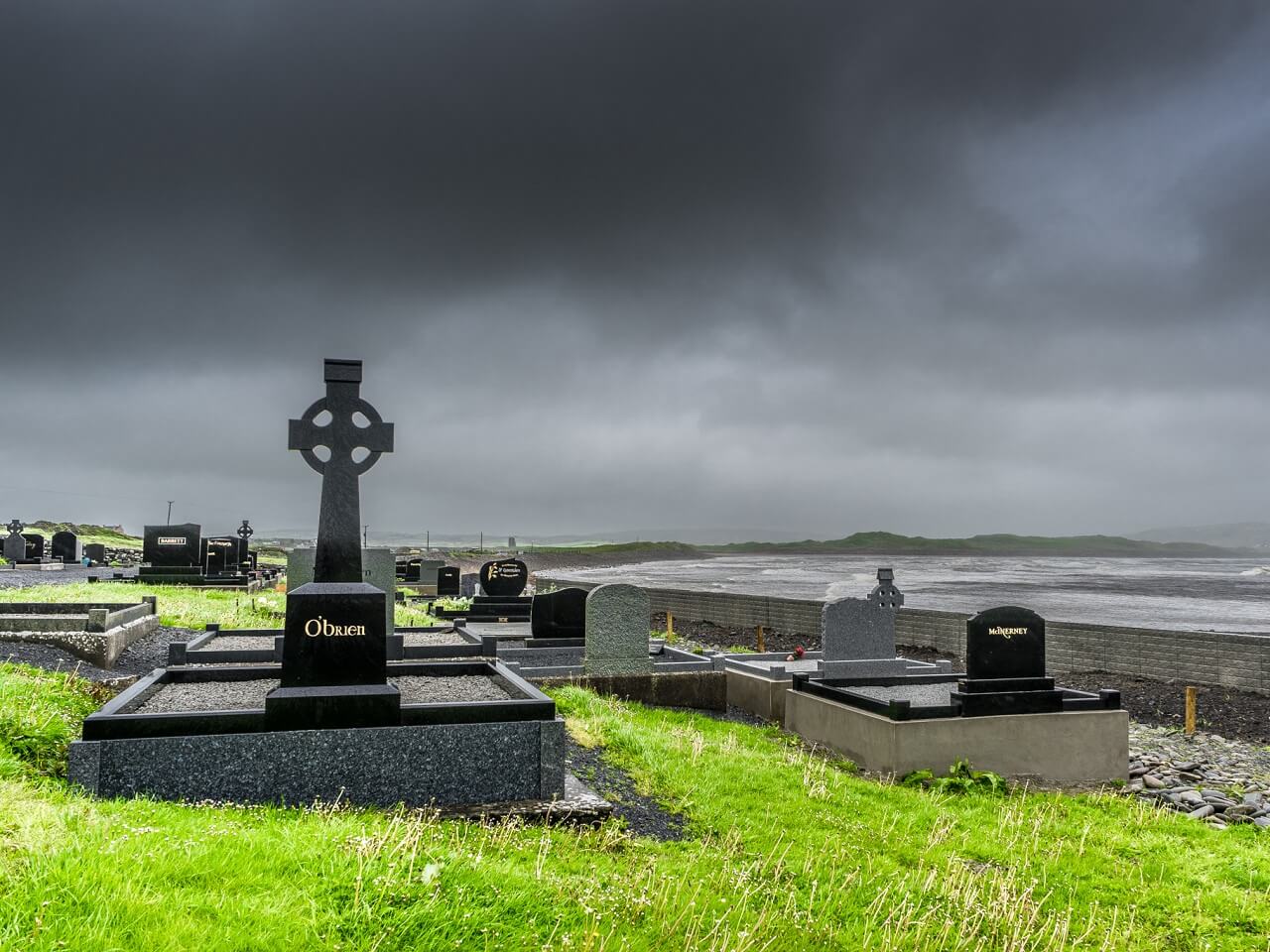
Clerical sex abuse hangs like a fog over this village. Across the road from Christ the King Church lies its Catholic cemetery. The Celtic cross gravestones jut above ground like the Errigal Mountain off in the distance. Herein, buried in the graveyard, among Donegal’s aged dead, lie the graves of eight young men who committed suicide. All eight were victims of sexual abuse by Catholic priests. Their deaths symbolize the unrelenting pain and trauma gripping victims of clerical sex abuse around the world – eight young Donegal men tortured with the vile memories of their spiritual and sexual assault by trusted priests.
Clerical sex abuse is soul murder. The body and soul are violated by the predator priest. Nothing remains but a brittle and broken shell of a person.
Child advocates and law enforcement who have investigated know that clerical sex abuse is unique from all other abuse. Clerical sex abuse leaves its victims with physical, emotional, and spiritual devastation. So devastated are clerical victims that they more often turn to suicide for relief from the shame and memories of their assault.
Why do so many victims of clerical abuse take their own lives? What causes the high incidence of suicide among victims of clerical sex abuse?
The answer may lie in the hideous nature of child sexual abuse by a man of God. The grooming words of notorious sexual predator Cardinal McCarrick are instructive. They portray the depth of depravity and spiritual torture employed by clerical abusers.
James, the 11-year-old McCarrick victim, recalls the spiritual power trip utilized by the offending priest: “He would always tell me that I was his special boy, that God gave me to him, so we could worship together and be happy together. He told me he had the power to get God to forgive me all my sins. That my father didn’t have that power. That’s the aura.”
The predator priest often uses God to groom the victim. How perfect, to subdue and intimidate a child! When the powerful predator invokes God as a consenting participant in the abuse, the child victim is left defenseless, devoid of spiritual help. The abuser supplants God as a willing cooperator in order to diabolically silence the victim into submission. As James recounts, McCarrick told him hundreds and hundreds of times, “God will only listen to you when you are with me.”
The unique and heinous spiritual abuse perpetrated upon clerical sex abuse victims robs these children of hope and escape. Their world is turned upside-down, with God not as their savior, but as their tormentor. The priest, portraying himself as in persona Christi, sadistically warps any sense of good and evil for the child. He loses all hope. For the soul tormented with utter hopelessness, no belief in a better future, no chance of recovery, it seems that only suicide remains.
In his response to the Archbishop Viganò testament about McCarrick’s history of predation and the Vatican’s knowledge of it, Cardinal Marc Ouellet callously dismissed McCarrick’s crimes and thus exposed the Vatican’s disdain for the suffering of clerical sex abuse victims:
I strongly doubt that McCarrick was of interest to him [Pope Francis] to the point that you believed him to be, since at the moment he was an 82-year-old archbishop emeritus who had been without an appointment for seven years.
In essence, Ouellet provides the excuse that since McCarrick is an old man, despite decades of abuse, which was never prosecuted or investigated by the Church, he is given a papal pass.
Pennsylvania attorney general Josh Shapiro referenced the number of suicide victims in his press conference when he unveiled the damning Pennsylvania clergy abuse report in August.
In the 2004 John Jay Report on the U.S. clergy abuse scandal, the authors described the particular impact on clergy abuse victims (p. 217):
The effects of sexual abuse on the victims vary, but the impact is long lasting and may result in sexual depersonalization, depression, sexually acting out, and suicide. When a child has been victimized by a priest, the impact of the abuse effects how the child perceives God, the Church and the clergy. The abuse also raises the question as to how these institutions will view the victim.
Australia, Ireland, and America seem to be especially vulnerable to the suicide ticking time bomb among clergy abuse victims.
The Catholic Church in Australia is particularly noteworthy for incidents of suicide among its victims of clergy abuse. Aussie law enforcement has documented the high incidence of suicide among these victims:
CONFIDENTIAL police reports have detailed the suicides of at least 40 people sexually abused by Catholic clergy in Victoria, and have urged a new inquiry into these and many other deaths suspected to be linked to abuse in the church.
In a damning assessment of the church’s handling of abuse issues, the reports say it appears the church has known about a shockingly high rate of suicides and premature deaths but has “chosen to remain silent.”
The reports state that while conducting lengthy inquiries into paedophile clergy, investigators have discovered “an inordinate number of suicides which appear to be a consequence of sexual offending.”
“The number of people contacting this office to report members of their family, people they know, people they went to school with, who have taken their lives is constant. It would appear that an investigation would uncover many more deaths as a consequence of clergy sexual abuse,” one of the reports states.
Dr. A.W. Richard Sipe, the prominent expert and child advocate for clergy abuse victims, who died during this past summer of shame, delivered a prescient 16-page plea to San Diego bishop Robert McElroy in 2016. The letter warned McElroy about McCarrick’s sexual predation and the fatal effects of clergy abuse. Sipe pleaded with Bishop McElroy:
I have tried to help the Church understand and heal the wounds of sexual abuse by clergy. My services have not been welcomed.
My appeal to you has been for pastoral attention to victims of abuse and the long term consequences of that violation. This includes the effects of suicidal attempts. Only a bishop can minister to these wounds.
It is apparent that Francis, the bishop of Rome, is uninterested in ministering to these wounds. He dismisses them as “rumors” and intimates that those who blow the whistle are in league the devil, the “great Accuser, who roams the world looking for ways to accuse.”
Time has run out for this papacy. The global sex abuse scandal has engulfed Francis and his cabal with his inaction over, promotion of, and facilitation of predatory clerics. His papacy is mired in corruption, apathy, and malfeasance over his total abdication of responsibility for this massive crisis.
The Irish are known for their long memories and fiery tempers. The Donegal winds blow a menacing warning from the graves of the eight young men of Gortahork. Their now silenced voices cry out for vengeance and justice against the Church and its pope, who dismisses their pain and abuse as mere rumors.
There’s an old Gaelic saying that Pope Francis should heed: “Truth speaks even though the tongue were dead.” We will not forget the boys of Donegal. Eternal rest grant to them, O Lord.
NIH Spends $13.5 Million on Aborted Baby Parts to Transplant Their Brain Tissue Into Mice
NATIONAL MICAIAH BILGER OCT 17, 2018 | 4:36PM WASHINGTON, DC
A new government contract uncovered by CNS News shows the federal government continues to spend taxpayer dollars on research using aborted baby body parts.
The National Institute of Health contract is with University of California- San Francisco. The contract provides money for fetal body parts to conduct experiments involving “humanized mice,” according to the report. NIH is an agency under the U.S. Department of Health and Human Services.
The contract, which began in December 2013 continues through December 2020, according to NIH.
“The actual total amount of this contract, including all options, is $13,799,501 for a full performance period through December 5, 2020,” the NIH told CNSNews.com. “We have obligated $9,554,796 to date.”
Aborted baby body parts used in the experiments were taken from healthy, later-term unborn babies. According to the report, the aborted babies were 18 to 24 weeks gestation from “women with normal pregnancies before elective termination for nonmedical reasons.”
Another article indicated aborted babies’ livers and thymuses also were used. According to the report:
Similarly, a 2008 journal article describing how the UCSF professor who is the principle investigator for this contract engineers one version of the mouse required by the contract, said the professor used human fetal livers and thymuses taken from babies at 20-to-24 weeks gestational age.
While the NIH did respond to CNSNews.com’s inquiry about the monetary value of these two contracts, it did not specifically respond to sixteen questions about its current “Humanized Mouse Models for HIV Therapeutics Development” contract with UCSF. CNSNews.com sent these questions to the Department of Health and Human Services (of which NIH is a part) and UCSF. NIH and the University of California responded with statements.
President Donald Trump’s administration has been taking steps to stop the purchasing of aborted baby parts with tax dollars.
In September, it canceled a Food and Drug Administration contract to acquire body parts from aborted babies to be transplanted into so-called humanized mice. The grisly experiments allow mice to have a functioning human immune system for research purposes.
Although the move was a good step, one pro-life group said more protections are needed to ensure the FDA and HHS do not sign other agreements to purchase aborted baby parts in the future.
“Canceling a single contract and conducting a review is a small step forward, but overall is completely inadequate,” said Susan B. Anthony List president Marjorie Dannenfelser in a statement.
The department appears to be moving in that direction. In a statement in September, the Trump administration said HHS is also conducting an audit of all acquisitions involving human fetal tissue to “ensure conformity with procurement and human fetal tissue research laws and regulations.”
The agency said it would continue reviewing alternatives to human fetal tissue in HHS funded research “and will ensure that efforts to develop such alternatives are funded and accelerated.”
Brief Answers to Big Questions is Stephen Hawking’s last book. His family finished the manuscript that he started, launching the book this week, six months after the famous physicist died. The media hullaballoo over the book centers mostly on his professed atheism. CNN shouted Hawking’s conclusion, “There is no God,” calling it a “bombshell.”
It is hardly a “bombshell” to learn that a celebrated atheist was an atheist. Hawking never declared himself a religious man, though his atheism was always shaky. Just last year, in a book about him by Kitty Ferguson, he was asked why there is a universe. “If I knew that,” he answered, “then I would know everything important.” He added, “then we would know the mind of God.”
Now we are told that in his new book, at the end of his life, he was more sure of his atheist convictions. “Do I have faith? We are each free to believe what we want,” Hawking said, “and it’s my view that the simplest explanation is that there is no God…No one created the universe and no one directs our fate. This leads to a profound realisation: there is probably no heaven and afterlife either.” Probably. Which means there may be.
Why did Hawking hedge? And why would a brilliant man who supposedly understands elements of the universe that are too complex and difficult for most of us to understand settle the question of God’s existence by choosing “the simplest explanation” available?
Would it not be just as simple to adopt Pascal’s answer to the wager he proffered? The wager entailed the consequences of believing in God versus not believing. The 17th century French philosopher said it was wiser to err on the side of caution. “If you gain, you gain all; if you lose, you lose nothing.”
A popular reconstruction of Pascal’s wager goes like this: “If I believe in God and life after death and you do not, and if there is no God, we both lose when we die. However, if there is a God, you still lose and I gain everything.”
This is clearly one of the “simplest” alternatives to Hawking’s position. It also has the merit of being more persuasive—to lose the wager is to lose it all.
It is fascinating to learn that while Hawking cannot conceive of a personal God, and doubts there is life after death, he believes in life in outer space. In Brief Answers to Big Questions, he confesses his belief in aliens. Great. But for a guy who insists on scientific evidence for everything else, where is the proof?
Why would Hawking believe in aliens? In the book by Ferguson, he says, “We are such insignificant creatures on a minor planet of a very average star in the outer suburbs of one of a hundred thousand million galaxies.” He is entitled to believe that human beings are “insignificant creatures,” but he has no empirical evidence to support it.
It would have helped had Hawking identified who the significant creatures are and where they live. But he never did. More important, why is it rational for him to believe in aliens but irrational for me to believe in God?
Where Hawking fails, as do all atheists, is in responding to the central issue involving the origin of the universe. Saint John Paul II said it best. “Every scientific hypothesis about the origin of the world, such as the one that says that there is a basic atom from which the whole of the physical universe is derived,” he said in a 1981 Vatican conference on cosmology, “leaves unanswered the problem concerning the beginning of the universe. By itself, science cannot resolve this problem….”
How much of Hawking’s atheism was a function of his disability (he suffered from Lou Gehrig’s disease for most of his adult life) is uncertain, but in his last book he makes this an issue. “For centuries,” he said, “it was believed that disabled people like me were living under a curse that was inflicted by God. I prefer to think that everything can be explained another way, by the laws of nature.”
It is true that in the ancient world it was believed that the disabled must have done something wrong to merit their condition. But Hawking should have updated his readings.
Jesus healed the sick, the blind, the lame—everyone in need of help—and the religion he founded does not abandon the disabled. On the contrary, it tends to their suffering. Christians have had a phenomenal record treating the handicapped of every malady, mental and physical alike. So to invoke centuries-old beliefs (many born of paganism for that matter) as a way of indicting religion today is simply wrong.
Christians believe in mysteries, and so did Hawking, albeit of a different kind. Pascal believed in mysteries as well, but he was much more rational than Hawking.
Posted inUncategorized|Comments Off on BRACE YOURSELF FOR THE MEDIA GLORIFICATION OF THE SELF-PROFESSED ATHEISM OF STEPHEN HAWKING. HIS RESPONSE TO KITTY FERGUSON BETRAYS HIS DOUBT ABOUT HIS OWN ATHEISM
Cocaine-snorting sacriligious faggot Msgr. Luigi Capozzi and his sugar daddy, Cardinal Coccopalmerio.
Last week LifeSite News broke the news that Antipope Bergoglio’s top aide, the revolting sodomite Cardinal Coccopalmerio, was not only present at the “cocaine-fueled gay orgy” in the apartment of his “personal secretary”, Msgr. Luigi Capozzi in the palace of the Holy Office – the same building that houses not only the Congregation for the Doctrine of the Faith (which is responsible for investigating sex abuse cases), but also the Ecclesiae Dei commission, which oversees all of the communities that celebrate the Traditional Mass -but that Coccopalmerio was “presiding” over the orgy and was whisked away to safety by the Vatican Gendarmerie who conducted the raid. And Antipope Bergoglio knows it.
I think a lot of people glazed over this story, as there was so much else going on both in Church events, and in secular events (Kavanaugh, Hurricane Michael, etc.). What I want to point out is the very telling use of the word “presiding”. Coccopalmerio was not merely participating in the sodomite orgy, he was PRESIDING over it.The word “orgy” implies a chaotic, disorganized activity. It can be used as a crude colloquialism for any large, disorganized activity or action. “The buffet dinner at the Greek wedding was a gastronomic orgy.” Folks, orgies, kinda by definition, don’t have “presiders”. It’s a contradiction of terms. The word “presiding” communicates an organized, even ritualistic activity.
A big trend among the Bergoglian Antichurch crowd is to call the priest at Mass “the presider”.Given what we know about the abject evil of Cardinal Coccopalmerio, the fact that he is a flaming faggot that hates God and is at war with Him and His Holy Church, and given that we know that the nexus of the practice of Satanism in the world today is inside the Vatican, I think it is not at all a stretch to postulate that what was raided in that apartment was not merely a sodomite orgy, but was a Black Mass with Cardinal Coccopalmerio as the “presider”.Cocaine-snorting sacriligious faggot Msgr. Luigi Capozzi and his satanic sugar daddy, Cardinal Coccopalmerio.
ON MONDAY, Senator Elizabeth Warren released the results of a DNA test confirming what everyone already knew: The “vast majority” of her genetic makeup is European, but she may have a Native American ancestor in her distant past. That makes her, as Barack Obama once said in a different context, a “typical white person.”
According to genetic scholars, the genome of white European-Americans is on average 0.18 percent Native American. The analysis of Warren’s DNA, which she submitted to Stanford geneticist Carlos Bustamante, suggests that there was a Native American in her family tree somewhere between 6 and 10 generations ago. That would put the American Indian share of her DNA within a range of 1.5 percent and 0.09 percent — just like millions of other white Americans.
If you’re like most people, a sliver of Native American coding in your DNA is no more than a colorful bit of family trivia. The only reason it has been treated as such a big deal in Warren’s case is because she herself long ago puffed it up into the claim that she was a racial minority.”During her academic career as a law professor,” recounted The Boston Globe in its story on Warren’s DNA test, “she had her ethnicity changed from white to Native American at the University of Pennsylvania Law School, where she taught from 1987 to 1995, and at Harvard University Law School, where she was a tenured faculty member starting in 1995.”
For years, Warren had herself listed as “Native American” in directories of law professors. To rebut accusations in 1996 that Harvard’s law school faculty was insufficiently diverse, a university spokesman identified Warren as a Native American woman. The Fordham Law Review described her as Harvard Law’s “first woman of color.” These and other fabulations — and Warren’s defensive doubling-down when they were reported — became an issue in her US Senate race in 2012.
Now they’re an issue all over again as she prepares to run for president in 2020.Having a dab of American Indian ancestry doesn’t make Warren an American Indian, any more than having a Viking or Charlemagne in her family tree — you probably do, too — makes her a seafaring Norse warrior or a royal highness.
Warren’s meticulously choreographed DNA rollout doesn’t prove that she is a proud Cherokee-American, as Cherokee activists and tribal authorities have adamantly pointed out. Genetics determine only biology — not social identity or culture or tradition.The racist trope that a man was black if he had “one drop” of African blood was a pillar of segregation in post-Reconstruction America. US Census enumerators used to subdivide Americans into pseudo-scientific racial classifications — “white,” “Negro,” “mulatto,” “quadroon,” “octoroon.” Those labels rightly make us cringe today.
The genomes of millions of white (and black) Americans include a sliver of American Indian DNA. Elizabeth Warren’s genetic makeup is typical for a white American of European descent. So should the notion that a faculty is more “diverse” because a professor’s great-great-great-great grandmother was an American Indian.The Warren DNA hype is just one more manifestation of the whole rotten business of judging or valuing people on the basis of race. Whether you love Warren or loathe her should depend on her ideas and ideals, her deeds and words — not on her genetic ancestry.
Professors and senators, like plumbers and stockbrokers, should be selected or rejected because of their abilities and the quality of their work. The color of their skin, the shape of their eyes, and ethnicity of their ancestors shouldn’t even enter into the equation.
On the same day Warren released her DNA results, a federal judge in Boston began hearing a lawsuit challenging Harvard’s admissions policies, which pretty clearly measure applicants of different races with sharply different yardsticks. Those policies are defended in the name of “diversity” and “outreach,” but they are the fruit of the same odious philosophy that justified “octoroon” as a Census category or celebrated Warren as Harvard Law School’s “first woman of color.
“Two generations ago, great champions of civil rights like Thurgood Marshall argued that “classifications and distinctions based on race or color [should] have no moral or legal validity in our society.” As it was wrong then to allocate a seat on a bus because of race, it is wrong now to allocate a spot in the freshman class because of race — and wrong always to pin “diversity” to a strand of DNA.
(Jeff Jacoby is a columnist for The Boston Globe).– ## —
Posted inUncategorized|Comments Off on ‘POCAHONTAS’ ELIZABETH WARREN IS NOT A NATIVE AMERICAN BUT SHE IS A TYPICAL LIBERAL DEMOCRAT; TRUTH IS WHAT SHE SAYS IT IS, JUST LIKE THE ACCUSATIONS OF CHRISTINE BLASEY FORD AGAINST BRETT KAVANAUGH
The Red Hat Report: Should Laypeople Investigate Cardinals?Posted by Judy Roberts on Tuesday Oct 16th, 2018 at 1:16 PMThe planned initiative proposes to provide information about how cardinals have addressed clergy sexual abuse and other key issues.
When Philip Nielsen set out as a concerned Catholic layman to respond to what he saw as a lack of transparency in Church governance, he knew he could expect opposition.
Indeed, he has faced plenty since word got out that he was organizing Better Church Governance, a group that plans to investigate the Church’s cardinals and publish its findings in what it calls the Red Hat Report.
Using the services of academic researchers, lawyers, editors and investigators who are former FBI and CIA agents, the group hopes to create dossiers on cardinals by examining their priorities, and records of handling sexual abuse incidents and financial and legal matters.
Better Church Governance originally had planned an Oct. 24 launch of its project, but the story broke Oct. 1 in the Catholic Herald and Crux, which obtained an audio recording of the group’s Sept. 30 event attended by about 40 people. Reports by other news organizations quickly followed, some portraying the group, which has a fund-raising goal of $1 million, as one being backed by wealthy Catholics. A story in Slate called the effort a crusade against Pope Francis’s leadership, homosexuality in the Church and cardinals who do not adhere to “traditional values.”
In an email interview, Nielsen, a writer and editor with a background in art, architecture and theology who is serving as the group’s executive director, said the succeeding days brought a firestorm marked by persistent misconceptions about the project, although he acknowledged that the group failed to control its messaging.
For example, an email from Nielsen mentioned plans to publicly announce the project Oct. 2 at the Napa Institute Conference on Authentic Catholic Reform, but Nielsen told the Register that by the time of the conference, the decision had been changed to launch Oct. 24. The Sept. 30 meeting was to have been a private RSVP event, yet it was posted on the group’s public Facebook page and on Eventbrite.
Nielsen said he also underestimated both the interest and hostility the project would garner in the media.
The project’s $1 million fundraising goal, for instance, appears to have excited many commentators, he said, but he considers it a modest amount compared to the billions the Church has paid in sexual-abuse settlements worldwide. As for the group being backed by wealthy Catholics, he said that so far, the typical donor has given a few hundred dollars and no single donor has represented more than 5% of the funding. A GoFundMe account set up as a temporary measure had raised $1,846 of a $400,000 goal as of Oct. 15.
Nielsen also said the project is not primarily a theological one or focused on homosexuality, but merely notes a cardinal’s theological and pastoral priorities.
“We ask what the cardinals teach, what they make their main initiatives and where they spend their energies,” he said.
Canonical Concerns
However, despite demurrals from the organizers, the Red Hat Report also has raised concerns about the possibility that it could be attempting to influence a papal election.
In an Oct. 1 posting on Twitter, canon lawyer Kurt Martens of The Catholic University of America asked whether the group could risk excommunication by preparing its report for the next conclave. He cited Article 80 of Universi Dominici Gregis(On the Vacancy of the Apostolic See and the Election of the Roman Pontiff), St. John Paul II’s 1996 apostolic constitution, which prohibits “all possible forms of interference, opposition and suggestion whereby secular authorities of whatever order and degree, or any individual or group, might attempt to exercise influence on the election of the Pope.”
Martens said in an interview with the Register that he posed the question because early news reports said the group wanted to be ready for the next conclave and quoted a spokesman as saying that if more information had been available Pope Francis might never have been elected.
“You put all those things together and it looks as if they’re trying to influence the conclave and they’re not happy with the current Pope,” he said. “That is forbidden under Article 80 of the apostolic constitution.”
The origins of such prohibitions, Martens said, go back to civil powers trying to interfere in conclaves, but they have been expanded to include all kinds of pressure groups.
“The point is there is a reason for all those rules when a pope is elected — that the cardinals are absolutely free from outside interference,” he said. “It’s fine to put information together, but you’re walking a very thin line because it could easily be seen as a way to attempt to influence the outcome.”
Documenting Information
Having consulted with canon lawyers, the group, Nielsen reiterated, is not seeking to influence the next papal conclave or to dictate Church governance.
“We are simply working to compile known data, investigate the question marks and then make readily available to all accurate information about the actions of Church leadership according to objective standards of scholarship, journalism and investigation,” he said. “Right now, rumors and accusations are rife and ordinary Catholics are losing confidence in the Church’s integrity. If we Catholics can’t come together to take responsibility and restore trust, secular authorities will do it for us as we are already seeing in the attorney general investigations across a dozen states.”
Nielsen said the group sees its task as one of documenting information about cardinals.
“The fact that we are doing so in a methodical and scholarly manner may unnerve some, but canonically it is no different than what countless Church reporters do every day,” he said. “What it does do, however, is save ordinary Catholics from having to obsessively follow all news reports in order to know the credibility of the cardinals who have been entrusted with shepherding them.”
Added Nielsen, “… Pope Francis has spoken about a ‘hermeneutic of suspicion’ that can arise in Church politics. This is a grave danger, and the way to end suspicion is to speak with clarity and honesty, with parrhesia as Francis has repeatedly exhorted the faithful. We want, as Pope Benedict XVI’s motto proclaimed, to be ‘co-workers with the truth,’ and to ‘be not afraid’ as St. Pope John Paul II said.”
Is It Necessary?
Still, Dawn Eden Goldstein, who accepted an invitation to the Sept. 30 meeting with some concerns about what she had read in the accompanying materials, told the Register she asked organizers at the event whether such a project is necessary given there is no historical precedent for it.
Goldstein, an assistant professor of dogmatic theology at Holy Apostles College and Seminary in Cromwell, Connecticut, said that she also cited the Second Vatican Council’s dogmatic constitution on the Church, Lumen Gentium, in asking if organizers saw the Red Hat Report as their only option given Lumen Gentium specifies that the laity are to voice their opinions “through the organs erected by the Church for this purpose.”
Goldstein said she was told by Jacob Imam, Better Church Governance director of operations, that the group had a list of other options prepared, but that the Red Hat Report was the first they were trying to get off the ground. She said she found it disturbing that the group has chosen as its first project something that hasn’t been done even though they acknowledged other unspecified options were available.
Nielsen, the former research director of the Center for Evangelical Catholicism, a nonprofit group that seeks to advance the New Evangelization, said he was impelled to start the new group after being concerned for years about the lack of knowledge about leaders of the Church and lack of transparency in Church governance.
“The combination of the allegations against [former] Cardinal [Theodore] McCarrick and the Pennsylvania [grand jury] report gave it a new urgency,” Nielsen said.
He began by contacting friends and family members, academics and graduate students, and within a week or two, had gathered about 30 people, although many of those at Catholic universities did not want their names used for fear of reprisals.
Among the few willing to be named was Jay Richards, an assistant professor of business and economics at The Catholic University of America, who has been listed as a research editor for the project.
As for the opposition he has encountered, Nielsen said he anticipated that if the group set out to document individual cardinals’ responses to abuse and corruption, some would have a vested interest in discrediting the project.
“I also knew that certain quarters of the Church would object to lay involvement at all,” he said. “But at the same time, Vatican II called for greater lay involvement and this seems like an obvious place for that to happen.”
Additional Perspectives
Canon lawyer Philip Gray, the president of the St. Joseph Foundation and Catholics United for the Faith, said he thinks Better Church Governance’s effort is in line with their rights and obligations under canon law, provided they maintain the integrity of virtue and grace and the reports they produce are grounded in truth and justice and respectful of the dignity of the subjects.
“The faithful have a right and at times a duty to manifest to the pastors of the Church and share with each other concerns about the Church, as long as they do so in pursuit of virtue,” Gray said. “That is enshrined, recognized and protected in the code of canon law.”
However, Opus Dei Father Robert Gahl, an associate professor of ethics at Rome’s Pontifical University of the Holy Cross, takes issue with Better Church’s Governance’s characterization of itself as an independent watchdog that will investigate abuse and corruption in the hierarchy by producing dossiers on cardinals.
“The Church sorely needs transparency and accountability and professional lay involvement,” he said, “but not at the expense of the hierarchical structure and surely not in the adversarial guise of a watchdog.”
Father Gahl said the reform the Church needs has been enunciated by Pope Francis and consists in a “renewed, joyful spirit of evangelization, with the laity and families at the forefront as protagonists.” This, he continued, will overcome “the dual clericalist tendencies of, first, abuse of power by clerics and, second, by the false attempt to promote the laity by giving them clerical tasks that remove them from their role in the world to sanctify all things in Christ.”
Under the Church’s divinely designed hierarchical structure, Father Gahl added, priests, especially bishops, are responsible for governance because of their sacramental ordination. Although the laity by baptism share in the royal priesthood of the faithful, they are to responsibly support the Church, and the ordained ministers in turn are accountable to them.
Respecting Persons
The St. Joseph Foundation’s Gray said laity can voice their concerns and still maintain respect for the structure and nature of the Church by looking at how Christ presented his mission to the religious authorities of his time.
“He respected their authority, their person, but he didn’t respect the wrong that they said or did,” Gray said. “He never walked away from a conversation with them. He never condemned their person. It’s very important that when we are critical of an idea or an action that the way we present it is a criticism of the ideal or the action, not of the person.”
A trusted friend, one of the wisest heads I’ve encountered in our fallen world, just called my attention to “this little item” from Monday’s synod briefing by Fr. Arturo Sosa S.J., a Venezuelan who was elected the Superior General of the Jesuits two Octobers ago: “The Church should show the multicultural face of the God who revealed himself in Nazareth, and promote a universal citizenship, that recognizes the richness that is brought by cultural diversity, therefore build a multicultural world.”
I was in the room when he made this remark. And as the Protestants say, “I feel convicted” now by my friend’s message. I simply typed a note into my running log for the day without giving it much importance. My bad. But when you are swimming around in many words that don’t seem to be attached to anything, you tend to get numb to the next little bit.
No excuse, but I remembered – the minute he stepped to the podium – that Fr. Sosa infamously tried to open up space for reinterpreting Jesus’ teachings on marriage, divorce, and adultery during the controversies over the Synod on the Family. He asserted that there were no tape recorders in Jesus’ time, so we have to “interpret” the words of the Gospel. (Presumably we would have to “interpret” a tape of those same words, but that’s a subject for another day.) So I expected some sophistry from him and – there’s so much else that demands attention – discounted it ahead of time.
Happily, there hasn’t been a lot of this sort of thing in the Synod, though it floats vaguely in the background. In a way, it’s good that Sosa gave it expression. By this sort of thing, I mean these abstract concoctions that point in so many directions that they mean everything and nothing at the same time.
Does “universal citizenship” here mean real, card-carrying belonging, like open borders everywhere in the world, certified by some international authority like the U.N.? Or does universal citizenship mean membership in a Church that recognizes the “universal call to holiness” and God’s desire to redeem the whole world in the Beatific Vision? Or neither? Or both? It’s like Teilhard de Chardin S.J. 2.0.
I have to wonder whether Fr. Sosa himself can answer those questions.
Sosa was trying to lay out an alternative to what he called the homogenizing of the world, if I recall correctly. Many have spoken at the Synod about the bland uniformity that digital media and economic forces are producing everywhere. But Sosa’s remedy, a “multicultural world,” is the very term that, paradoxically, encapsulates the very first-world uniformity he otherwise deplores.
Like many Synod Fathers, he seems blissfully unaware that in the United States – and not only there – we have thousands of colleges and universities that promote diversity and multiculturalism. And are fundamentally all the same.
Their idea of multiculturalism is not to study the values and ways of peoples separated from us in space and time, to appreciate how different they were or are from us, and the ways their response to God and the world might enrich our poor post-truth culture. Instead, they insulate young people from opinions and challenges outside the narrow radius of their concerns, which quite a few at the Synod seem to believe are primarily about sex. Especially “differently ordered” sex.
Arturo Sosa S.J. (Photo: sjapc.net)
The Catholic Church is – or perhaps once was – the bearer of the richest cultural tradition in the world, even the “multicultural world.” When we founded The Catholic Thing, recovering a better appreciation of that cultural tradition and its perennial value was one of our main goals. Indeed, compared even with successful multicultural political empires – Rome, Austria-Hungary, etc. – it’s the greatest example and the longest living multicultural reality. Ever.
Should we not be seeking to enliven that as well?
Someone else will have to try to “interpret” what Fr. Sosa means by the “multicultural face of the God who revealed himself in Nazareth.” It’s true that Jesus broadened the divine mission from the Chosen People to all nations. But that also meant preserving the main line of sacred history in its new phase.
By contrast, postmodern multiculturalism simply means including everything except that sacred history. And that simply will not do. As Bishop Robert Barron keeps repeating here, young people are hungry for a mission, would like an invitation to a high calling, one that can engage them passionately in something they can believe is real and significant.
You can try to make a universal politics or abstract multiculturalism your passion – if you are very young, whatever your calendar age. For young people, especially young Christians looking for an authentic life, that will pale, sooner rather than later.
There’s a phenomenon familiar to college professors that one of them, a friend, has dubbed the myth of “my beautiful career.” Young people are given such unrealistic expectations of the future in school – sometimes abetted by misguided parents – that by the time they enter university, they expect four years of study to make them famous or at least fabulously rich.
The reality for most of us is that adult life is a matter of responsibilities, sometimes heavy ones: earning a living, fostering the lives of a spouse and children, perhaps caring for elderly parents or relatives or friends. There are also many good days, very good days, of gratitude to God, at work or play, home or abroad.
But for most of us it’s in the ordinary daily responsibilities that we are going to find meaning and happiness. And in a way, it’s also there that we will build up the kind of “multicultural” solidarity in our dealings with all the people, of various backgrounds, with whom we come in contact.
In almost three weeks of talk now, there has been no expression of this “little way” of daily virtue and responsibility. At least, I haven’t heard it. [Author’s note: I’d written these words before a briefing today revealed that yesterday morning there was a mention of linking the ordinary with the extraordinary – perhaps evidence that the Spirit is at work in various quarters filling in what’s been missing.]
That’s the challenge that all but a tiny number of specially talented or fortunate people will face. The Church used to – and should again – teach the most important school of spirituality of all: how to live a passionate, ordinary, good life.
Posted inUncategorized|Comments Off on I remembered – the minute he stepped to the podium – that Fr. Sosa infamously tried to open up space for reinterpreting Jesus’ teachings on marriage, divorce, and adultery during the controversies over the Synod on the Family. He asserted that there were no tape recorders in Jesus’ time, so we have to “interpret” the words of the Gospel. (Presumably we would have to “interpret” a tape of those same words, but that’s a subject for another day.) In a way, it’s good that Sosa gave it expression. By this sort of thing, I mean these abstract concoctions that point in so many directions that they mean everything and nothing at the same time.
Shortly after the youth synod began, Edward Pentin—the authoritative chronicler of the family synod’s rigging—reported that an Italian cardinal close to Pope Francis had prophesied a great “surprise,” convinced that the pope would “for sure invent something.” Pentin said some sources had indicated that the final document’s main substance was in fact already written—hence the synod’s deep secrecy, missing mid-term report, and nebulous voting procedures.
As the synod progressed, increasingly ominous voices spoke confidently, buoyantly about being “open” to a new definition of family. One synod father announced at a press conference: “As old folks we should not be afraid to embark on this new path that the pope is pointing out to us. It is a path that is leading us to new kinds of families, new family relations, in a way, and we should not be afraid to open up to this.”
Meanwhile, bishops alarmed by potentially rigged voting rules planned a public group protest; then synod leaders said old procedures would remain in force. Archbishop Forte—a member of the final document’s stacked writing committee—said on October 11 that it was “impossible” for the text’s draft to already be written; then Cruxreported that Cardinal Baldisseri’s office had actually presented its own “preliminary draft” to those writers.
I believe that text’s likely principal writer is Fr. Giacomo Costa, S.J.—the writing committee member who has already helped author the Preparatory Documentand Instrumentum Laboris and published multiplearticles on the synod’s aims. He has also, as I will show, already loaded the Instrumentum Laboris with subversive plagiarizations of his own writings on “discernment.”
Fr. Costa is the Vice President of the Carlo Martini Foundation—dedicated to the cardinal who led the St. Gallen mafia, attacked Humanae Vitae, and endorsedsame-sex civil unions. Fr. Costa has praised the 2014 synodal report on the “precious support” found in same-sex relationships—rigged by none other than Archbishop Forte, the Martini disciple who joked about how he and the pope wouldn’t speak “plainly” about their plan to endorse Communion for adulterers at the family synod.
That coup was accomplished, in great part, because Archbishop Victor Manuel Fernandez loaded both the 2015 final synodal document and Amoris Laetitia with plagiarizations of his old writings promoting situational ethics. Now, Fr. Costa has planted key plagiarizations of his book Il Discernimento into the Instrumentum Laboris, as these examples show (with common words in bold):
IL 117: Questa valorizzazione della coscienzasi radica nella contemplazione del modo di agire del Signore: è nella propria coscienza che Gesù, in dialogo intimo con il Padre…
Costa 17: Questa valorizzazione della coscienza si radica nella contemplazione del modo di agire del Signore: è nellacoscienza di Gesù che si svolge il suo dialogo intimo con il Padre…
IL 117: …l’esercizio della coscienza rappresenti un valore antropologico universale: interpella ogni uomo e ogni donna, non soltanto i credenti…
Costa 18: …il valore antropologico universale dell’esercizio della coscienza, che interpella ogni uomo e ogni donna, non soltanto i credenti…
Most importantly, Fr. Costa has fixed the Instrumentum Laboris’s section on conscience (116-117) to ventriloquize two of his book’s key claims (pp. 16-17):
We must “make room” for consciences (Amoris Laetitia 37), increasing their role in the Church’s “praxis” (AL 303).
Conscience can discern that God is asking for the “gift” of committing an intrinsically wrong act (euphemized as a departure from the “ideal”) (AL 303). This notion is supported by Gaudium et Spes 16: conscience is the “sanctuary” where man “is alone with God, whose voice echoes in his depths.”
AL 303 is already an atomic bomb set to explode every moral law—and when it is strapped onto that decontextualized line about conscience’s “sanctuary,” it is ready for mass distribution to souls. In February, Cardinal Cupich quoted those very lines to presage a “paradigm shift” on morality—for the revolutionaries are now ready to openly blow up the very concept of intrinsically wrong acts.
Then, out of the rubble and ruins, there will arise the synod’s great “surprise”: the advance of the “anti-creation,” the worldwide subversion of marriage and the family.
The synod group led by Cardinal Cupich has called the Church to recognize “other forms of family”—to “accept and even honor” every “family unit.” The group led by Cardinal Rodriguez Maradiaga has pushed for “pastoral care” on “realities such as marriage between homosexuals, surrogate pregnancy, and adoption by same-sex couples.”
Both synod fathers, notably, appear in Archbishop Viganò’s testimony. Rodriguez Maradiaga, ex-Cardinal McCarrick’s fellow “kingmaker” for Church appointments, has been embroiled in multiple homosexual-related scandals; Cupich, a top revolutionary on homosexuality, was reportedly elevated by their recommendation.
Outside the synod, Fr. James Martin, S.J., defended the agenda to embrace the ideological term “LGBT”—and “acknowledge that gay couples can form a ‘family’” and enhance society’s “flourishing” by adopting children. “LGBT” had appeared in the Instrumentum Laboris under Cardinal Baldisseri’s false pretense that it was merely a quotation from a pre-synodal document by young people. When the cardinal was asked if he’d expunge the term because it in fact never appears there, he said, “Look, I am not removing anything.”
Then it emerged that the secretary of the pope’s C-9 council had told a radical “LGBT” group that their input to the synod’s leaders had been worked into that very section on “LGBT youths” and “what to suggest” to young homosexual couples (197).
“Trust in the Spirit,” he said of the synod.
It was yet another example of the “Catholic deep gay state,” crusading with cultural Marxists outside the Church to spread the brave new anti-creation. Another speaker at that conference was Fr. Martin himself, the celebrity priest who helped bring a “gay tsunami” to Italy and starred in Ireland’s pro-“LGBT” World Meeting of Families, organized by a top McCarrick protégé.
Before he arrived at the World Meeting of Families, Fr. Martin told a young “LGBT” activist: “See you soon. Prepare the way!” That young “preparer”—whose article on “How to Be Gay in the Catholic Church” features lines like “Jesus said to love my neighbor, and I can’t help that Grindr says the nearest one is 264 feet away”—then starred in a parallel conference announcing a global crusade to push the “LGBT” agenda at the youth synod. Its architect successfully led the “gay marriage” referendum campaigns in Ireland and Australia.
Then Fr. Martin used the World Meeting of Families to promote the young preparer’s group, Out at St. Paul—which boasts “Pride Masses,” trips to “gay bars,” and priests who endorse active homosexuality, according to one member.
Fr. Costa himself contributed to a 2008 project encouraging the legal recognition of a bond between two people of the same sex. His article promoted homosexual couples’ struggle for “social and civil rights,” valorizing their attempt to shed invisibility and thus contribute “positively” to society (432). Archbishop Forte has said that defining the rights of homosexual couples is a matter of “being civilized.” These two men are the likely principal writers of a final document that could, if approved by the pope, become part of his “ordinary magisterium” under new synod rules.
Recently, Archbishop Forte sanguinely praised Pope Francis’s “enthusiasm towards God’s surprises.” Four years earlier, the pope had approved Archbishop Forte’s rigged report on same-sex relationships, released the very day that two Italian political parties backed homosexual unions. The pope preached that day of being “open to the God of surprises” and now he is portentously repeating the theme—a cry that comes from Martini himself, the “ante-pope,” the man who plotted this all.
Shortly before this synod started, I wrote an open letter to Archbishop Chaput supporting his call to cancel the event in light of the sexual abuse crisis. I noted the alarming number of participants who are named in Viganò’s testimonies and said I was deeply scandalized that this synod would now be targeting youths with a homosexual agenda championed by Martini, McCarrick, and the St. Gallen mafia.
As a young Catholic I want to thank Archbishop Chaput and every other bishop who is directly resisting this synod’s subversive agenda. I pray that, with their leadership, we may still avert this synod’s looming “surprise.”
(Photo credit: Interview of Fr. Giacomo Costa S.J.; ChiesadiMilano.it / Youtubescreenshot)
Julia Meloni writes from the Pacific Northwest. She holds a bachelor’s degree in English from Yale and a master’s degree in English from Harvard.
Posted inUncategorized|Comments Off on As the present synod progressed, increasingly ominous voices spoke confidently, buoyantly about being “open” to a new definition of family. One synod father announced at a press conference: “As old folks we should not be afraid to embark on this new path that the pope is pointing out to us. It is a path that is leading us to new kinds of families, new family relations, in a way, and we should not be afraid to open up to this.” My advice: be very afraid!
The loss of confidence in Pope Francis reflects that his mismanagement of the crisis has been a scandal in itself. It may also reveal a growing public awareness of Francis’ own poor record.
As news about the Catholic Church’s sex abuse scandal spreads, public confidence in Pope Francis’ handling of the matter has plummeted. A recent Pew Research Center poll shows that six in ten American Catholics say the pope is doing an “only fair” or “poor” job of managing the scandal.
That is almost double the share who said he was doing a poor job earlier this year, and triple the share who said this in 2015. The lack of confidence is also broadly based—both Catholic women and men, young and old, and church-attending or not, have grown increasingly critical of this pontiff.
Of course, the pope is not competing in a popularity contest. Furthermore, the Pew survey registers only American Catholics’ views. All the same, the loss of confidence in Francis reflects that his mismanagement of the crisis has been a scandal in itself. It may also reveal a growing public awareness of Francis’ own poor record. That record, as we recently argued in these pages, has been marked by indifference or disbelief toward abuse victims, coupled with protectiveness and credulity in dealing with their abusers.
Francis Owes the World an Answer to These Charges
New evidence from Italy supports the case against Francis’ probity. These recent allegations, we emphasize, have not been tested and proven in the courts of law (although earlier accusations involving Francis have). Moreover, after the sobering experience of the Brett Kavanaugh confirmation hearings, this country needs no reminder of the importance of providing corroboration (in the form of witnesses or evidence) to sustain accusations.
The simple fact that an accuser, or even several accusers, steps forward does not amount to proof. Where there is doubt, the accused should have the benefit of it.
But it would equally be mistaken to assume that the accused is always in the right. When numerous accusers make serious charges, have no apparent pre-existing bias against the person they accuse, and are willing to submit to cross-examination and judicial action, then, as lawyers say, the burden of producing evidence may shift to the accused. That is especially so when the same accused and his close associates have faced similar charges but refused to answer them openly, honestly, and directly, and when they have access to evidence that could confirm or refute the accusers but withhold it.
Further, in the Italian case, the accusers allege that the Italian government, and not merely Pope Francis, refuses to examine claims of clerical sexual abuse. None of that substantiates the charges. But it does place the onus on Francis and the Vatican to answer them.
Kavanaugh confronted his accusers, answered hostile questions from Democratic senators under oath and before millions of viewers, produced documentary evidence rebutting his chief accuser, and carried the day. Let that be an example to the pope and his team.
Is Francis Unconcerned About Abuse Victims?
In Italy, Francesco Zenardi, the president of an Italian abuse survivors group called Rete L’Abuso (Abuse Network), recently described Francis’ management of the sex abuse scandals as “dramatic and disastrous.” “His commitment to ‘zero tolerance’ is only on paper and for the TV cameras,” Zenardi said.
Zenardi discussed four specific cases in which he said Francis had been notified of clerical abuses or cover-ups but had done nothing. In one case, Zenardi alleged that Mario Enrico Delpini, whom Francis named the archbishop of Milan in 2017, covered up for at least one offender-priest who was allowed to continue his abuses for years. That abuser is now serving time in Italian prison. Francis is also reported to have ignored the abuse of at least one boy attending classes within the Vatican’s walls, and the systemic abuse of children at the Antonio Provolo Institute for the deaf in Verona.
The same abuse survivors group saysCardinal Luis Ladaria Ferrer, who currently heads the Congregation for the Doctrine of the Church (CDF), covered up certain Vatican officials’ abuse of the pope’s altar boys. Then, a German journalist details how Cardinal Francesco Coccopalmerio, also at the CDF and accused of being involved in a drug-fueled orgy that occurred in CDF offices, engaged in efforts to promote leniencytoward sexual abusers.
Astonishingly, CDF is the Vatican body tasked with investigating sex-abuse cases. Even those who consider Francis sympathetic to survivors’ claims are angry with his Vatican’s reluctance to investigate clerical abusers and hold them accountable.
One such individual is Marie Collins, herself a survivor, whom Francis named in 2014 to the eight-member Pontifical Commission for the Protection of Minors. Francis charged that committee with recommending measures to deal with clerical child abuse. Collins resigned from the committee in 2017, saying that the Vatican’s resistance to the committee was “soul-destroying.”
Collins also condemned the “constant setbacks” Vatican officials had caused. “The lack of co-operation, particularly by the [department] most closely involved in dealing with cases of abuse, has been shameful,” Collins wrote.
Whether Francis’ professions of sympathy for survivors are staged or genuine, he can be held accountable for the obstructiveness of his ranking subordinates, just as any corporate CEO would be. The buck stops at the chair of Peter.
Earlier Evidence of Francis’s Lack of Concern
The pope’s alleged indifference to abuses in Italy is consistent with the pattern of his conduct before he assumed the papacy. Our earlier article referred to a lengthy and detailed Der Spiegel report, which reviewed Francis’ record as a cardinal archbishop in his native Argentina. Der Spiegel is a leading (and left-leaning) German news magazine that has no ideological axe to grind against Francis, and had earlier praised him effusively.
In Argentina too, Francis (then Cardinal Jorge Borgoglio) doubted or ignored abuse survivors, including a girl who was seven years old at the time she was abused. Francis also ordered and supported the legal defense of a priest who is serving time in Argentinian prison for raping young boys.His knee-jerk defense of the Chilean hierarchy and strident dismissal of their accusers speaks volumes about Francis’s clericalist instincts.
Next door to Francis’ native Argentina, in Chile, when abuse survivors complained about Bishop Juan Barros’s cover-up of abuses committed by his mentor, priest Fernando Karadima, Francis immediately took the side of the bishop and called the allegations “calumny,” or slander. Later, Francis had to back down, but his knee-jerk defense of the Chilean hierarchy and strident dismissal of their accusers speaks volumes about his clericalist instincts.
Furthermore, it is emerging that former Chilean Archbishop Francisco Cox, who is living out his final years in Germany, was a serial abuser of children as well. The current archbishop of Santiago has also been accused of covering up for abuser-priests. More on Chile below.
In Honduras, former auxiliary bishop Juan Jose Pineda was accused of financial corruption, and the widespread sexual assault and abuse of seminarians. Pineda has since resigned, but his boss— Cardinal Oscar Rodriguez Maradiaga, a close ally of Pope Francis—remains in his position.
When more than 50 seminarians spoke out about the abuses and behavior of others in the seminary, even going so far as to petition Francis, this same cardinal attacked them, accusing them of spreading malicious gossip. Francis has had nothing to say about this, either.
Is the Pope’s Inner Circle of Advisors Tainted?
From the start of his papacy, Francis has surrounded himself with a hand-picked inner circle of cardinal advisers—a kind of papal “kitchen cabinet.” He also purged dissidents considered to be “conservatives,” prompting the respected Catholic journalist John Allen to ask early in this papacy, “Does Pope Francis have an enemies list?”
This inner circle of nine cardinals close to Francis has become known as the “C9.” Honduran Cardinal Oscar Rodriguez Maradiaga, whom we’ve just mentioned, is the coordinator of the C9. According to no less an authority than the left-wing Mother Jones, the pope’s “blind spot on sexual misconduct begins with” the C9.When other Chilean bishops, including Juan Barros, stood accused of covering up clerical sex abuses, Francis vehemently defended them.
Two of the pope’s C9 intimates are under investigation or prosecution. Australian Cardinal George Pell is accused of abusing minors decades ago, and currently faces chargesin Australia, although he may be aquitted.
The second is Cardinal Francisco Javier Errázuriz Ossa of Chile, who is facing questioning for allegedly hiding the flagrant abuses of disgraced Chilean priest, the aforementioned Karadima. Errázuriz Ossa is a close ally of Francis, going back at least to 2007, when Errázuriz Ossa and then-Cardinal Borgoglio worked together to have the church place a greater emphasis on environmental issues—getting their priorities right, so to say.
When other Chilean bishops, including Juan Barros, stood accused of covering up clerical sex abuses, Francis vehemently defended them. Francis appointed Barros bishop over the stiff resistance of numerous Chilean Catholics, hundreds of whom demonstrated at Barros’ installation mass. At a meeting with Chilean Catholics, Francis told them that their objections to Barros were mistaken: “Think with your heads and do not be led by the noses by the lefties who orchestrated this whole thing,” Francis reportedly told them.
But Francis turned on his Chilean prelates after receiving a 2,300-page report prepared by two Vatican sex abuse experts that found the Chilean hierarchy’s protection of children from pedophiles had been gravely defective. Yet even though 34 Chilean bishops tendered their resignations to the pope after the report was submitted, Errázuriz Ossa remained a member of the College of Cardinals and of the C9.
Protecting the Cardinals Who Helped Elect Him?
According to “Lost Shepherd,” a recent book by the accomplished Catholic author Philip Lawlor, the election of then-Cardinal Bergoglio to the papacy was promoted before the 2013 conclave by a small group of “progressive” cardinals, including Godfried Danneels, Carlo Montini, Achille Silvestrini, Karl Lehmann, Walter Kasper, and Cormac Murphy-O’Connor. The small group of “progressives” has been called “The St. Gallen Mafia,” in reference to the town in Switzerland where they gathered.
Based on a biography of Danneels (who called the group a “mafia club”), the group began planning Bergoglio’s election after their attempt to defeat his predecessor (Cardinal Joseph Ratzinger) failed in the conclave of 2003.The group began planning Bergoglio’s election after their attempt to defeat his predecessor (Joseph Ratzinger) failed in the conclave of 2003.
If it is true that the cardinals involved had agreed to form a lobbying group to campaign for Bergoglio, they would have been in clear violation of the rules governing papal elections. Under rules promulgated in 1996 by Pope John Paul II, cardinal-electors are forbidden “during the Pope’s lifetime and without having consulted him, to make plans concerning the election of his successor, or to promise votes, or to make decisions in this regard in private gatherings.”
Among the members of the St. Gallen group was Cardinal Murphy O’Connor of England. Hewas too old to vote in the 2013 conclave, but not too old to influence the outcome, and reportedly a key figure in Francis’ election. According to a biographer of Francis named Austen Iveigh, Murphy-O’Connor began to sound Bergoglio out before the conclave to see if he would accept the St. Gallen’s group’s plans. Murphy O’Connor allegedly warned Bergoglio to “be careful,” but said it was his turn. Bergoglio is said to have answered, “I understand.”
Also involved in the lobbying effort (if it was that) to elect Bergoglio was now-disgraced Cardinal Theodore McCarrick of Washington DC. Both Murphy-O’Connor (who is now dead) and McCarrick came under suspicion of sexual abuse during Francis’ papacy, and his actions—or inaction—in their cases lead one to wonder if he was paying back their electoral favors.
Murphy-O’Connor was accused of abusing a teenage girl decades ago, and there is significant evidence that the pope shut down an investigation into Murphy-O’Connor. Such, at least, seems to be suggested by Cardinal Gerhard Muller, the already mentioned CDF prefect (CDF), the church’s body tasked with investigating sex-abuse cases. As for McCarrick, although Francis belatedly got around to disciplining him, he had earlier promoted him to one of the highest non-papal positions in the church, and it is alleged that Francis knew of McCarrick’s misdeeds before the promotion.
As for Vigano’s Charges and Ouellet’s Response
This leads us, finally, to the accusations against Francis lodged by the former Vatican nuncio (diplomat) to the United States, Archbishop Carlo Maria Viganò. Viganò’s original charges focused mainly on Pope Francis’ handling of McCarrick.If this is how Francis and his Vatican advisers are seeking to smother the fire Viganò set, they have only added to the flames.
Specifically, Viganò charged that Francis’ predecessor, Pope Benedict XVI, had imposed “sanctions” on McCarrick because of his sexual misconduct, but that Francis, on becoming pope, had lifted those sanctions. When the world press made Francis aware of Viganò’s accusations, he refused to answer them. And the pope has maintained silence ever since.
But one of Francis’ subordinates at the Vatican, Canadian Cardinal Marc Ouellet, has undertaken to reply to Viganò—the only occasion, we believe, in which a cardinal in the Roman curia (or court) has done so publicly.
Ouellet’s criticism of Viganò is sharp and severe. But when his refutation of Viganò is parsed closely, its outward force evaporates. Indeed, it emerges as equivocal and downright evasive. If this is how Francis and his Vatican advisers are seeking to smother the fire Viganò set, they have only added to the flames.
Rod Dreher examined Ouellet’s letter in two postings, and his dissection is flawless. Our reading of Ouellet’s letter is as follows. Ouellet wrote:
“The written instructions prepared for you by the Congregation for Bishops at the beginning of your service in 2011 did not say anything about McCarrick, except what I told you about his situation as an Emeritus Bishop who had to obey certain conditions and restrictions because of rumors about his behavior in the past.”
“The former cardinal, who retired in May 2006, was strongly urged not to travel and not to appear in public, in order not to provoke further rumours about him. It is false to present the measures taken against him as ‘sanctions’ decreed by Pope Benedict XVI and annulled by Pope Francis.”
“After reviewing the archives, I note that there are no documents in this regard signed by either Pope, nor a note of audience from my predecessor, Cardinal Giovanni-Battista Re, which gave mandate to the Archbishop Emeritus McCarrick to silence and private life, with the rigor of canonical penalties. The reason for this is that, unlike today, there was not enough evidence of his alleged guilt at the time. Hence the position of the Congregation inspired by prudence and the letters of my predecessor and mine that reiterated, through the Apostolic Nuncio Pietro Sambi and then also through you, the exhortation to a discreet lifestyle of prayer and penance for his own good and that of the Church. His case would have been the subject of new disciplinary measures if the Nunciature in Washington, or any other source, had provided us with recent and decisive information on his behavior.”
So Ouellet would have the world believe that the “measures taken against [McCarrick],” or what he also calls “certain conditions and restrictions,” were not “sanctions.” That is absurd. The “measures” were: no public appearances and no public speaking. Those are unquestionably “sanctions,” even if not formal ones. Informal sanctions are sanctions, and Ouellet himself says that McCarrick “had to obey” them.
Yes, the “restrictions” were not imposed as “canonical penalties” after a trial under canon law. And perhaps there are “no documents signed by either Pope” that impose “canonical penalties.” But again, that obscures the main issue. We already knew that McCarrick was not under canonical penalties because his first canon law trial is scheduled for next year. The relevant question is whether there are any signed papal (or other) documents that imposed the conditions and restrictions that applied to McCarrick, or that lifted them.
Ouellet simply refuses to address whether Francis lifted those “conditions and restrictions” or not. But that is the key question here, and the gravamen of Viganò’s original charges. Ouellet is trying to dodge the bullet. That maneuver does not clarify the issue: it merely obfuscates, and therefore it deepens suspicions.
We Know Evidence Exists, But It’s Being Sidelined
Further, if there were both “rumours about [McCarrick] in the past,” were they investigated? If not, why not? Why wasn’t there “enough evidence”? Did nobody in the Vatican particularly care if the rumors about McCarrick were true? Evidence usually does not just drop out of the sky. Someone has to gather it.
But in fact there was evidence, which Ouellet slithers over. Fr. Boniface Ramsey, a Dominican and then a professor at a Catholic seminary in New Jersey, wrote to the Vatican in 2000, just six years before McCarrick’s retirement, with detailed informationabout McCarrick’s predatory activities. Ramsey did not get a reply until 2006.
Ramsey did not retain a copy of his letter, but has the Vatican’s reply. Ouellet surely saw the original letter if he reviewed the archives with due diligence. Why did he not mention it? And why does the Vatican not disclose it?
Note that Ouellet talks about “reviewing the archives.” If Francis wants transparency on this matter, let him publish all the archival material that Ouellet reviewed. That might clear away a lot of suspicion. Furthermore, let Ouellet appear for a press conference before the world media and undergo an hour or more of questioning. Let the Kavanaugh model apply to Ouellet.
It’s Time to Come Clean
It’s time for full and frank disclosure. Yet Francis’ pattern of avoidance continues. Last Friday, he announced his acceptance of the resignation of Cardinal Donald Wuerl, McCarrick’s successor as the archbishop of Washington DC.
A Pennsylvania grand jury had named Wuerl some 200 times in connection with the cover-up of clerical sex abuses, when Wuerl was bishop of Pittsburgh. Outraged Catholic laity demanded that he resign his current position. But in accepting his resignation, Francis praised Wuerl’s “nobility,” held him up as a model bishop, and announced that he would stay on in Washington DC as a caretaker until his replacement arrives.
Is the pope simply tone-deaf to the growing indignation of the world? Or is he overbearingly arrogant, scornful, and defiant?Willis L. Krumholz lives in Minneapolis, Minnesota. He is a JD/MBA graduate from the University of St. Thomas, and works in the financial services industry. Robert J. Delahunty is a professor of law at the University of St Thomas and has taught Constitutional Law there for a decade.
In 2013 Cardinal Cormac Murphy-O’Connor told Paul Vallely of The Independent, “Four years of Bergoglio would be enough to change things.” In a story published in March 2017, LifeSiteNews quoted from a speech given by former cardinal Theodore McCarrick that there was a pre-conclave plan to elect Jorge Bergoglio as the one who could “reform the Church … [and in] five years, he could put us back on target.”
The LifeSiteNews article was itself about an interview with Cardinal Donald Wuerl that had appeared in the Jesuit magazine America. The essence of that interview was that, after the Second Vatican Council, Popes John Paul II and Benedict XVI had gone astray, but Francis had set the Church back on the path laid out by Vatican II. Wuerl’s assessment was that “[the papacy] will never look like it did 25 or more years ago.”
That assessment was too narrow. As Ross Douthat shows in his book, To Change the Church, Francis is not only changing the Papacy, but also changing Catholicism itself.
We now see why Pope Benedict XVI resigned. In early 2013, Cardinal Jorge Bergoglio was already 76 years old. He had been identified by certain cardinals as the right man for the job, but if he needed five years to get the job done, time was running out. Benedict was (and is) still alive. Benedict needed to be forced out. Someday, the full story how they did it will come out.
We can also see why the Vatican not only commemorated, but celebrated the riforma protestante in 2017. Francis, the Great Reformer, needed to be seen as following in the footsteps of the last great reformer.
Various Catholic media, awakening to the possibility that we might have a bad pope on our hands, have begun to observe that the Church has had bad popes in the past and survived. But this time it’s different.
On September 13, 2018, Fr. George Rutler appeared on The World Over on EWTN and told Raymond Arroyo that even in the most corrupt periods of papal abuse, the integrity of the faith was not challenged. Now, he pointed out, “we have corruption commingled with an attempt to re-dress the authentic faith of the church.” He nailed it.
The denouement is upon us. The new version of the faith is being forced upon Catholics with magisterial authority. The pope must not be questioned. The bewildered faithful do not know where to turn for the truth. They do not know because the Novus Ordo Church never told them where to find the Way, the Truth, and the Life. Instead, after 1965, Catholics were conditioned to accept every innovation that came out of the Vatican.
The new Mass, the new liturgy, the new Catechism, the new rosary, the new hymns, the new fast-tracked papal saints – these were all designed to prepare Catholics in the pews for what was to come next: the new religion. The new religion would seem completely natural and familiar to two generations of Catholics who had known nothing else.
Cardinal Wuerl seemed quite all right in 2017 with the popes who immediately followed the Second Vatican Council – namely, John XXIII and Paul VI. But the next two, John Paul II and Benedict XVI, were apparently problematic; they had strayed from the Vatican II path. This assessment is remarkable, given the list that Pater Kwasniewski gave us this week of 28 “terrible cardinals and bishops” who were created by these latter two popes and who today are responsible for the catastrophe that has befallen the Church.
Mr. Kwasniewski has also given us a chilling observation: “In the end, there are only two reasons we had a conclave of cardinals who voted for Bergoglio: Wojtyła and Ratzinger.” Whom, then, will the next conclave give us?
External circumstances led to the timing of Pope Benedict XVI’s abdication. Jorge Bergoglio had a five-year job to do, and the modernist cabal knew that Bergoglio was already 76 years old. Things had to be moved along.
External circumstances are now beginning to play a role again. Most significantly, the testimony of Archbishop Viganò is opening eyes and awakening even Novus Ordo Catholics. There is a slim chance that the credibility or even the power of the modernist cabal may be eroded. They will intuit that it is time for Bergoglio to move on and be replaced with a younger man who can continue steadfastly on the Vatican II path for another 30 years or so. It is time for a conclave they can still control.
What can they wring out of the last days of Bergoglio’s reign? Just as Bergoglio abruptly changed the Catechism of the Catholic Church to make capital punishment “inadmissible,” I foresee another change to the Catechism following the current Synod on Young People, the Faith, and Vocational Discernment, to remove the characterization of homosexuality as “intrinsically disordered.”
I also fear one final, treacherous act: the abrogation of Benedict XVI’s motu proprio Summorum Pontificum.
With the traditional Latin Mass safely returned to the dustbin of history, and sodomy accepted as completely natural, the next pope can begin his reign. Who might that next pope be? How about an American this time: Francis II, the former Cardinal Blase Cupich?





 ABYSSUS ABYSSUM INVOCAT / DEEP CALLS TO DEEP
You must be logged in to post a comment.