Brett Kavanaugh’s Supreme Court nomination hearings were an embarrassing and degrading spectacle for America. They were ugly, they were painful and they were shameful. They weren’t simply the result of the year-old #MeToo movement, nor just another symptom of the decline in political norms in the wake of President Trump’s victory. These heated and intense hearings were the reflection of the ongoing war over America’s soul. This war truly divides American politics today: the struggle is between those who revere America’s past and those who question or disdain it. It is a war that, like binary conflicts of the past, promises to get much worse before resolution can be found.

FLYOVER COUNTRY

A culture war the Founding Fathers couldn’t foresee

The Constitution was drawn up to minimise dangerous, divisive conflict


Henry Olsen

HENRY OLSEN

https://unherd.com/2018/10/america-tearing-apart/

@henryolsenEPPC 
09 OCTOBER 2018


Brett Kavanaugh’s Supreme Court nomination hearings were an embarrassing and degrading spectacle for America. They were ugly, they were painful and they were shameful. They weren’t simply the result of the year-old #MeToo movement, nor just another symptom of the decline in political norms in the wake of President Trump’s victory. These heated and intense hearings were the reflection of the ongoing war over America’s soul.

This war truly divides American politics today: the struggle is between those who revere America’s past and those who question or disdain it. It is a war that, like binary conflicts of the past, promises to get much worse before resolution can be found.

America’s Founding Fathers recognised how dangerous such divisive binary wars over values could be to the political order. In the Federalist Papers, Alexander Hamilton and James Madison explained how the new Constitution was intended to minimise the dangers. Their arguments remain important today, both in understanding why America has so rarely become engulfed in these types of conflicts, and why it is now teetering on the brink of one.

They identified two types of conflicts that could destroy a state. The first flowed from the economic demands democracy would create. Looking to the ancient Greek and Roman republics, they sought to remove the possibility that a popular majority would try to take the wealth of a rich minority. To this end, the Constitution’s primary author, Madison, insisted on three innovations that remain mainstays of America’s governing structure: representation, bicameralism, and the separation of powers.FURTHER READINGCould America’s Democrats be ‘Corbynised’?BY RUY TEIXEIRA

The existence of the three reduces the possibility that one single group – what Madison called a faction – could seize control of all the levers of government at once. Representation ensured that a mob could not be whipped into a frenzy to violent action: their will could be exercised only indirectly. Bicameralism meant that a faction had to obtain control of two different electoral bodies, each with its own mode of election, and elected according to different schedules, to obtain legislative power. The separation of powers added a third hurdle: that such a faction would need to win control of an independently elected executive to wield the full power of government. Madison thought that these measures would break the zeal and intensity of a single faction’s desire to dominate, and as such preserve civic peace.

The second type of binary conflict stems from debates over ways of life. If one faction believed that their way was the right way, it could use control of the government to force its views on dissenters. This is what happened in Europe during the religious wars of the 16thand 17th Centuries, when Protestants and Catholics warred incessantly over whose was the one true religion.

Madison and the Founders sought to prevent such a destructive conflict from ever coming to America by removing religion from national politics altogether. The Constitution contains a clause that forbids the institution of a religious test for holding public office; in the United States, simply being a Catholic or a Jew would not bar one from public life.FURTHER LISTENINGBelievers in TrumpBY KATIE HARRISON

The Constitution’s First Amendment also prevents Congress from “making any law respecting the establishment of a religion, or the free exercise thereof”, further removing religious disputes from national public life. Nothing in the original Constitution prevented states from establishing a religion; indeed, Massachusetts would not disestablish its state church until 1833, and New Hampshire did not remove its own religious test for office until 1876. The Constitutional impediments, however, did prevent religious quarrels from becoming national political questions.

Today’s conflict is neither religious nor economic. In this respect, the Founders’ protections have held. But the growth in national judicial power has made Madison’s original barriers to faction much less salient. And today, binary conflicts over values need not necessarily concern religious doctrines.

Americans today are, instead, deeply divided over culture; they are at odds over which is the best way of life to lead. On the one side are people who find America’s traditional, European, and Christian culture defective; on the other, there are those who believe that heritage to be valuable and essential. The first group finds its political expression in support for same-sex marriage, feminism, and measures empowering immigrants and non-whites. The second is the realm of the evangelical Christian and its allies in other orthodox and traditional faiths – as well as those worried about the declining importance of Americans of European heritage.FURTHER READINGWhy I helped Trump kill the old Republican PartyBY FRANK BUCKLEY

A poll from late 2017 shows how neatly these views separate into the two political camps. Conducted by YouGov on behalf of the cross-partisan Voter Study Group, it asked whether respondents thought America “has one primary culture with traditions and values that most everyone believes in”, or “has many different cultures with different traditions and values that people believe in”. Seventy-seven percent of Clinton voters said America has many different cultures, while 54% of Trump voters said it had one primary culture. The share of respondents who thought America has one primary culture increased with self-described conservatism, and among groups most favourable to Trump or the religious Right.

These differences have spawned dramatic increases in partisan hatred. A new book, Prius or Pickup, citing survey data, shows that nearly half of Republicans and Democrats hate the other party, more than twice the level of hatred just two decades ago. Another survey taken in 2016 found that between 41 and 45 % of partisans thought the other party’s policies were a threat to the nation. By mid-2017 more than half of Democrats and Republicans thought the other party represented a national threat. In light of these data, perhaps recent editorials by liberal columnists saying the Kavanaugh confirmation was “illegitimate” or represented “war” should be taken as serious beliefs rather than hyperbole.

These cultural divides are politically crucial nowadays because America’s Constitution has, through decades of Supreme Court rulings, made them the subject of national political debate. The traditional understanding that the federal Constitution, and especially the First Amendment, did not apply to the states was overruled in a series of cases between 1925 and 1947. Since then, virtually every major issue concerning traditional Christian views of morality has been decided via a Supreme Court decision, not by legislation. As a result, cultural questions have been nationalised in a way the Founders sought to prevent, and control of the Court is thus vital to each side’s interests.FURTHER READINGWhy Trump’s impeachment rests on the midtermsBY HENRY OLSEN

This is why Kavanaugh’s nomination has stirred such passions. His confirmation meant that his would be the fifth and deciding vote that could overrule a host of Court precedents supported by Democrats and Clinton voters. For them, therefore, stopping him was a must, something that could not be compromised. The survival of their way of life depended on their winning this battle.

Similarly, traditionalists saw his vote as a bulwark against further potential Court rulings that might be adverse to their interests, as well as a potential vote to overturn such rulings as Roe v Wade (which established a constitutional right for a woman to have an abortion) or Obergefell v Hodges (which established same-sex marriage as a constitutional right across the United States). Losing for them was not an option.

The religious wars were similarly fought over the right way to live, each side deeming its own interpretation of Christianity as the one true one. Only the stalemate produced by over a century of warfare, culminating in the Treaty of Westphalia, ended the bloodshed.FROM THE SAME AUTHORIs Trump killing or curing American conservatism?BY HENRY OLSEN

The Westphalian solution could be an answer to America’s woes, but adopting it would require turning back American jurisprudence to its earlier conceptions. The Treaty famously established the idea of religious federalism – as contained in the doctrine cuius regio, eius religio (the ruler of a realm determines its religion) – as the solution to the wars. This is identical in nature to the original American formulation that matters of culture should be for the individual states, and not the national government, to decide.

If applied today, it would mean that Baptist Alabama could have one set of laws concerning abortion and homosexuality, while progressive California could have another. Each side could believe zealously in its own views but, by removing the conflict from the national sphere, the nation itself could be preserved.

There would be difficulties, as the experience of post-Westphalian Europe demonstrates. Religious minorities within states were still subject to persecution. Louis XIV’s revocation of the Edict of Nantes in 1685 ended the freedom of Protestants to worship, leading to mass emigration. Even Great Britain suppressed the rights of religious dissidents until a series of acts of “emancipation” restored full civil rights to Catholics (1829) and Jews (1858).FURTHER READINGTrumpism: America’s new religionBY PETER FRANKLIN

In contemporary United States, however, many Americans would be concerned about what would happen in traditionalist states to non-whites, gays and lesbians, and women who sought abortions in other states. The federalist solution sits very uneasily with the ideal of universal human rights.

America did try this approach before, and it ended in our Civil War. And the division was over human slavery. The Founders had deferred the conflict when they drafted the Constitution by adopting a Westphalian model and leaving slavery to the states to determine. But by the mid-19thCentury that solution no longer satisfied either side.

Those who opposed slavery in the free states of the North sought to either abolish it or curtail its spread by barring slaves from federal territories. Those who supported slavery in the slave-holding South sought to defend it as a positive good and insisted on the right to settle federal territories with slaves in tow. No attempt to mediate this dispute, although many were attempted, could satisfy both sides. And so, as President Abraham Lincoln said in his Second Inaugural Address, “the war came”.

No one expects this conflict to end in war, but that is because the ability of one section of the country to resist another is no longer militarily possible. The potential for physical conflict cannot be ignored, however, as Left-wing activists follow conservative legislators to dinner to harass them, and Right-wing activists regularly denounce their foes as mendacious and deceitful.FURTHER READINGWhy I helped Trump kill the old Republican PartyBY FRANK BUCKLEY

Hundreds of protestors have been arrested already within Senate office buildings as anti-Kavanaugh forces swarm offices of the last undecided members. In a country with nearly 400 million firearms in private hands, it would be easy to imagine random acts of violence breaking out anywhere in the country no matter what the Kavanaugh result had been. What happens now only God knows.

The third author of the Federalist Papers, John Jay, noted that “Providence has been pleased to give this one connected country to one united people – a people descended from the same ancestors, speaking the same language, professing the same religion, attached to the same principles of government, very similar in their manners and customs”. That original unity no longer pertains, and that is the root the cause of the conflict.

It is difficult now to see how it ends. Similar conflicts in history have been defused through partition (India and Pakistan, for example), a grant of special rights to the minority, as in the Edict of Nantes or the Good Friday Agreement, or through the replacement of one set of primary values (Christianity) with another (liberalism). Each of these examples, though, contain the potential seeds of its own failure.FURTHER READINGWhy the Open vs Closed debate is so deplorableBY HENRY OLSEN

America faced questions like these during the period of our massive immigration, which was diluting the political power of our original British, Protestant settlers with millions of Catholics and Jews from Ireland and Southern and Eastern Europe. After much trial and error, forged in part through the common experiences of the Great Depression and the Second World War, American identity morphed from that of a British-descended, Protestant country to one of the ‘melting pot’ where people from any background could come, so long as they adopted American values of decency, hard work, and devotion to political liberty.

It is possible that this identity can be updated to both include the new, secular or non-Christian American while maintaining the liberties and values of the older stock. But given the depth of the division and ferocity of the passions on display, it’s hard to see any sort of resolution coming soon.FURTHER READINGAdventures in TrumplandBY IAN BIRRELL

Posted in Uncategorized | Comments Off on Brett Kavanaugh’s Supreme Court nomination hearings were an embarrassing and degrading spectacle for America. They were ugly, they were painful and they were shameful. They weren’t simply the result of the year-old #MeToo movement, nor just another symptom of the decline in political norms in the wake of President Trump’s victory. These heated and intense hearings were the reflection of the ongoing war over America’s soul. This war truly divides American politics today: the struggle is between those who revere America’s past and those who question or disdain it. It is a war that, like binary conflicts of the past, promises to get much worse before resolution can be found.

THE EVIDENCE AGAINST THE VALIDITY OF THE REIGN OF FRANCIS THE MERCIFUL IS OVERWHELMING

The Federalist
THE  FEDERALIST
It’s Past Time For Pope Francis To Come Clean, But Instead He’s Burying Himself

It’s Past Time For Pope Francis To Come Clean, But Instead He’s Burying Himself

The loss of confidence in Pope Francis reflects that his mismanagement of the crisis has been a scandal in itself. It may also reveal a growing public awareness of Francis’ own poor record.

Willis L. Krumholz and Robert Delahunty

By Willis L. Krumholz and Robert DelahuntyOCTOBER16, 2018

As news about the Catholic Church’s sex abuse scandal spreads, public confidence in Pope Francis’ handling of the matter has plummeted. A recent Pew Research Center poll shows that six in ten American Catholics say the pope is doing an “only fair” or “poor” job of managing the scandal.

That is almost double the share who said he was doing a poor job earlier this year, and triple the share who said this in 2015. The lack of confidence is also broadly based—both Catholic women and men, young and old, and church-attending or not, have grown increasingly critical of this pontiff.

Of course, the pope is not competing in a popularity contest. Furthermore, the Pew survey registers only American Catholics’ views. All the same, the loss of confidence in Francis reflects that his mismanagement of the crisis has been a scandal in itself. It may also reveal a growing public awareness of Francis’ own poor record. That record, as we recently argued in these pages, has been marked by indifference or disbelief toward abuse victims, coupled with protectiveness and credulity in dealing with their abusers.

Francis Owes the World an Answer to These Charges

New evidence from Italy supports the case against Francis’ probity. These recent allegations, we emphasize, have not been tested and proven in the courts of law (although earlier accusations involving Francis have). Moreover, after the sobering experience of the Brett Kavanaugh confirmation hearings, this country needs no reminder of the importance of providing corroboration (in the form of witnesses or evidence) to sustain accusations.

The simple fact that an accuser, or even several accusers, steps forward does not amount to proof. Where there is doubt, the accused should have the benefit of it.

But it would equally be mistaken to assume that the accused is always in the right. When numerous accusers make serious charges, have no apparent pre-existing bias against the person they accuse, and are willing to submit to cross-examination and judicial action, then, as lawyers say, the burden of producing evidence may shift to the accused. That is especially so when the same accused and his close associates have faced similar charges but refused to answer them openly, honestly, and directly, and when they have access to evidence that could confirm or refute the accusers but withhold it.

Further, in the Italian case, the accusers allege that the Italian government, and not merely Pope Francis, refuses to examine claims of clerical sexual abuse. None of that substantiates the charges. But it does place the onus on Francis and the Vatican to answer them.

Kavanaugh confronted his accusers, answered hostile questions from Democratic senators under oath and before millions of viewers, produced documentary evidence rebutting his chief accuser, and carried the day. Let that be an example to the pope and his team.

Is Francis Unconcerned About Abuse Victims?

In Italy, Francesco Zenardi, the president of an Italian abuse survivors group called Rete L’Abuso (Abuse Network), recently described Francis’ management of the sex abuse scandals as “dramatic and disastrous.”  “His commitment to ‘zero tolerance’ is only on paper and for the TV cameras,” Zenardi said.

Zenardi discussed four specific cases in which he said Francis had been notified of clerical abuses or cover-ups but had done nothing. In one case, Zenardi alleged that Mario Enrico Delpini, whom Francis named the archbishop of Milan in 2017, covered up for at least one offender-priest who was allowed to continue his abuses for years. That abuser is now serving time in Italian prison. Francis is also reported to have ignored the abuse of at least one boy attending classes within the Vatican’s walls, and the systemic abuse of children at the Antonio Provolo Institute for the deaf in Verona.

The same abuse survivors group saysCardinal Luis Ladaria Ferrer, who currently heads the Congregation for the Doctrine of the Church (CDF), covered up certain Vatican officials’ abuse of the pope’s altar boys. Then, a German journalist details how Cardinal Francesco Coccopalmerio, also at the CDF and accused of being involved in a drug-fueled orgy that occurred in CDF offices, engaged in efforts to promote leniencytoward sexual abusers.

Astonishingly, CDF is the Vatican body tasked with investigating sex-abuse cases. Even those who consider Francis sympathetic to survivors’ claims are angry with his Vatican’s reluctance to investigate clerical abusers and hold them accountable.

One such individual is Marie Collins, herself a survivor, whom Francis named in 2014 to the eight-member Pontifical Commission for the Protection of Minors. Francis charged that committee with recommending measures to deal with clerical child abuse. Collins resigned from the committee in 2017, saying that the Vatican’s resistance to the committee was “soul-destroying.”

Collins also condemned the “constant setbacks” Vatican officials had caused. “The lack of co-operation, particularly by the [department] most closely involved in dealing with cases of abuse, has been shameful,” Collins wrote.

Whether Francis’ professions of sympathy for survivors are staged or genuine, he can be held accountable for the obstructiveness of his ranking subordinates, just as any corporate CEO would be. The buck stops at the chair of Peter.

Earlier Evidence of Francis’s Lack of Concern

The pope’s alleged indifference to abuses in Italy is consistent with the pattern of his conduct before he assumed the papacy. Our earlier article referred to a lengthy and detailed Der Spiegel report, which reviewed Francis’ record as a cardinal archbishop in his native Argentina. Der Spiegel is a leading (and left-leaning) German news magazine that has no ideological axe to grind against Francis, and had earlier praised him effusively.

In Argentina too, Francis (then Cardinal Jorge Borgoglio) doubted or ignored abuse survivors, including a girl who was seven years old at the time she was abused. Francis also ordered and supported the legal defense of a priest who is serving time in Argentinian prison for raping young boys.His knee-jerk defense of the Chilean hierarchy and strident dismissal of their accusers speaks volumes about Francis’s clericalist instincts.

Next door to Francis’ native Argentina, in Chile, when abuse survivors complained about Bishop Juan Barros’s cover-up of abuses committed by his mentor, priest Fernando Karadima, Francis immediately took the side of the bishop and called the allegations “calumny,” or slander. Later, Francis had to back down, but his knee-jerk defense of the Chilean hierarchy and strident dismissal of their accusers speaks volumes about his clericalist instincts.

Furthermore, it is emerging that former Chilean Archbishop Francisco Cox, who is living out his final years in Germany, was a serial abuser of children as well. The current archbishop of Santiago has also been accused of covering up for abuser-priests. More on Chile below.

In Honduras, former auxiliary bishop Juan Jose Pineda was accused of financial corruption, and the widespread sexual assault and abuse of seminarians. Pineda has since resigned, but his boss— Cardinal Oscar Rodriguez Maradiaga, a close ally of Pope Francis—remains in his position.

When more than 50 seminarians spoke out about the abuses and behavior of others in the seminary, even going so far as to petition Francis, this same cardinal attacked them, accusing them of spreading malicious gossip. Francis has had nothing to say about this, either.

Is the Pope’s Inner Circle of Advisors Tainted?

From the start of his papacy, Francis has surrounded himself with a hand-picked inner circle of cardinal advisers—a kind of papal “kitchen cabinet.” He also purged dissidents considered to be “conservatives,” prompting the respected Catholic journalist John Allen to ask early in this papacy, “Does Pope Francis have an enemies list?”

This inner circle of nine cardinals close to Francis has become known as the “C9.” Honduran Cardinal Oscar Rodriguez Maradiaga, whom we’ve just mentioned, is the coordinator of the C9. According to no less an authority than the left-wing Mother Jones, the pope’s “blind spot on sexual misconduct begins with” the C9.When other Chilean bishops, including Juan Barros, stood accused of covering up clerical sex abuses, Francis vehemently defended them.

Two of the pope’s C9 intimates are under investigation or prosecution. Australian Cardinal George Pell is accused of abusing minors decades ago, and currently faces chargesin Australia, although he may be aquitted.

The second is Cardinal Francisco Javier Errázuriz Ossa of Chile, who is facing questioning for allegedly hiding the flagrant abuses of disgraced Chilean priest, the aforementioned Karadima. Errázuriz Ossa is a close ally of Francis, going back at least to 2007, when Errázuriz Ossa and then-Cardinal Borgoglio worked together to have the church place a greater emphasis on environmental issues—getting their priorities right, so to say.

When other Chilean bishops, including Juan Barros, stood accused of covering up clerical sex abuses, Francis vehemently defended them. Francis appointed Barros bishop over the stiff resistance of numerous Chilean Catholics, hundreds of whom demonstrated at Barros’ installation mass. At a meeting with Chilean Catholics, Francis told them that their objections to Barros were mistaken: “Think with your heads and do not be led by the noses by the lefties who orchestrated this whole thing,” Francis reportedly told them.

But Francis turned on his Chilean prelates after receiving a 2,300-page report prepared by two Vatican sex abuse experts that found the Chilean hierarchy’s protection of children from pedophiles had been gravely defective. Yet even though 34 Chilean bishops tendered their resignations to the pope after the report was submitted, Errázuriz Ossa remained a member of the College of Cardinals and of the C9.

Protecting the Cardinals Who Helped Elect Him?

According to “Lost Shepherd,” a recent book by the accomplished Catholic author Philip Lawlor, the election of then-Cardinal Bergoglio to the papacy was promoted before the 2013 conclave by a small group of “progressive” cardinals, including Godfried Danneels, Carlo Montini, Achille Silvestrini, Karl Lehmann, Walter Kasper, and Cormac Murphy-O’Connor. The small group of “progressives” has been called “The St. Gallen Mafia,” in reference to the town in Switzerland where they gathered.

Based on a biography of Danneels (who called the group a “mafia club”), the group began planning Bergoglio’s election after their attempt to defeat his predecessor (Cardinal Joseph Ratzinger) failed in the conclave of 2003.The group began planning Bergoglio’s election after their attempt to defeat his predecessor (Joseph Ratzinger) failed in the conclave of 2003.

If it is true that the cardinals involved had agreed to form a lobbying group to campaign for Bergoglio, they would have been in clear violation of the rules governing papal elections. Under rules promulgated in 1996 by Pope John Paul II, cardinal-electors are forbidden to make plans concerning the election of his successor, or to promise votes.”

Among the members of the St. Gallen group was Cardinal Murphy O’Connor of England. Hewas too old to vote in the 2013 conclave, but not too old to influence the outcome, and reportedly a key figure in Francis’ election. According to a biographer of Francis named Austen Iveigh, Murphy-O’Connor began to sound Bergoglio out before the conclave to see if he would accept the St. Gallen’s group’s plans. Murphy O’Connor allegedly warned Bergoglio to “be careful,” but said it was his turn. Bergoglio is said to have answered, “I understand.”

Also involved in the lobbying effort (if it was that) to elect Bergoglio was now-disgraced Cardinal Theodore McCarrick of Washington DC. Both Murphy-O’Connor (who is now dead) and McCarrick came under suspicion of sexual abuse during Francis’ papacy, and his actions—or inaction—in their cases lead one to wonder if he was paying back their electoral favors.

Murphy-O’Connor was accused of abusing a teenage girl decades ago, and there is significant evidence that the pope shut down an investigation into Murphy-O’Connor. Such, at least, seems to be suggested by Cardinal Gerhard Muller, the already mentioned CDF prefect (CDF), the church’s body tasked with investigating sex-abuse cases. As for McCarrick, although Francis belatedly got around to disciplining him, he had earlier promoted him to one of the highest non-papal positions in the church, and it is alleged that Francis knew of McCarrick’s misdeeds before the promotion.

As for Vigano’s Charges and Ouellet’s Response

This leads us, finally, to the accusations against Francis lodged by the former Vatican nuncio (diplomat) to the United States, Archbishop Carlo Maria Viganò. Viganò’s original charges focused mainly on Pope Francis’ handling of McCarrick.If this is how Francis and his Vatican advisers are seeking to smother the fire Viganò set, they have only added to the flames.

Specifically, Viganò charged that Francis’ predecessor, Pope Benedict XVI, had imposed “sanctions” on McCarrick because of his sexual misconduct, but that Francis, on becoming pope, had lifted those sanctions. When the world press made Francis aware of Viganò’s accusations, he refused to answer them. And the pope has maintained silence ever since.

But one of Francis’ subordinates at the Vatican, Canadian Cardinal Marc Ouellet, has undertaken to reply to Viganò—the only occasion, we believe, in which a cardinal in the Roman curia (or court) has done so publicly.

Ouellet’s criticism of Viganò is sharp and severe. But when his refutation of Viganò is parsed closely, its outward force evaporates. Indeed, it emerges as equivocal and downright evasive. If this is how Francis and his Vatican advisers are seeking to smother the fire Viganò set, they have only added to the flames.

Rod Dreher examined Ouellet’s letter in two postings, and his dissection is flawless. Our reading of Ouellet’s letter is as follows. Ouellet wrote:

“The written instructions prepared for you by the Congregation for Bishops at the beginning of your service in 2011 did not say anything about McCarrick, except what I told you about his situation as an Emeritus Bishop who had to obey certain conditions and restrictions because of rumors about his behavior in the past.”

“The former cardinal, who retired in May 2006, was strongly urged not to travel and not to appear in public, in order not to provoke further rumours about him. It is false to present the measures taken against him as ‘sanctions’ decreed by Pope Benedict XVI and annulled by Pope Francis.”

“After reviewing the archives, I note that there are no documents in this regard signed by either Pope, nor a note of audience from my predecessor, Cardinal Giovanni-Battista Re, which gave mandate to the Archbishop Emeritus McCarrick to silence and private life, with the rigor of canonical penalties. The reason for this is that, unlike today, there was not enough evidence of his alleged guilt at the time. Hence the position of the Congregation inspired by prudence and the letters of my predecessor and mine that reiterated, through the Apostolic Nuncio Pietro Sambi and then also through you, the exhortation to a discreet lifestyle of prayer and penance for his own good and that of the Church. His case would have been the subject of new disciplinary measures if the Nunciature in Washington, or any other source, had provided us with recent and decisive information on his behavior.”

So Ouellet would have the world believe that the “measures taken against [McCarrick],” or what he also calls “certain conditions and restrictions,” were not “sanctions.” That is absurd. The “measures” were: no public appearances and no public speaking. Those are unquestionably “sanctions,” even if not formal ones. Informal sanctions are sanctions, and Ouellet himself says that McCarrick “had to obey” them.

Yes, the “restrictions” were not imposed as “canonical penalties” after a trial under canon law. And perhaps there are “no documents signed by either Pope” that impose “canonical penalties.” But again, that obscures the main issue. We already knew that McCarrick was not under canonical penalties because his first canon law trial is scheduled for next year. The relevant question is whether there are any signed papal (or other) documents that imposed the conditions and restrictions that applied to McCarrick, or that lifted them.

Ouellet simply refuses to address whether Francis lifted those “conditions and restrictions” or not. But that is the key question here, and the gravamen of Viganò’s original charges. Ouellet is trying to dodge the bullet. That maneuver does not clarify the issue: it merely obfuscates, and therefore it deepens suspicions.

We Know Evidence Exists, But It’s Being Sidelined

Further, if there were both “rumours about [McCarrick] in the past,” were they investigated? If not, why not? Why wasn’t there “enough evidence”? Did nobody in the Vatican particularly care if the rumors about McCarrick were true? Evidence usually does not just drop out of the sky. Someone has to gather it.

But in fact there was evidence, which Ouellet slithers over. Fr. Boniface Ramsey, a Dominican and then a professor at a Catholic seminary in New Jersey, wrote to the Vatican in 2000, just six years before McCarrick’s retirement, with detailed informationabout McCarrick’s predatory activities. Ramsey did not get a reply until 2006.

Ramsey did not retain a copy of his letter, but has the Vatican’s reply. Ouellet surely saw the original letter if he reviewed the archives with due diligence. Why did he not mention it? And why does the Vatican not disclose it?

Note that Ouellet talks about “reviewing the archives.” If Francis wants transparency on this matter, let him publish all the archival material that Ouellet reviewed. That might clear away a lot of suspicion. Furthermore, let Ouellet appear for a press conference before the world media and undergo an hour or more of questioning. Let the Kavanaugh model apply to Ouellet.

It’s Time to Come Clean

It’s time for full and frank disclosure. Yet Francis’ pattern of avoidance continues. Last Friday, he announced his acceptance of the resignation of Cardinal Donald Wuerl, McCarrick’s successor as the archbishop of Washington DC.

A Pennsylvania grand jury had named Wuerl some 200 times in connection with the cover-up of clerical sex abuses, when Wuerl was bishop of Pittsburgh. Outraged Catholic laity demanded that he resign his current position. But in accepting his resignation, Francis praised Wuerl’s “nobility,” held him up as a model bishop, and announced that he would stay on in Washington DC as a caretaker until his replacement arrives.

Is the pope simply tone-deaf to the growing indignation of the world? Or is he overbearingly arrogant, scornful, and defiant?Willis L. Krumholz lives in Minneapolis, Minnesota. He is a JD/MBA graduate from the University of St. Thomas, and works in the financial services industry. Robert J. Delahunty is a professor of law at the University of St Thomas and has taught Constitutional Law there for a decade.

Posted in Uncategorized | 1 Comment

Yes, adolescents and young adults represent the immediate future. Still, if they don’t start having children in greater numbers than the generation or two before them, “the future” is going to hit a demographic wall. And not all that far in “the future.”

What “Future” without Children?

Robert Royal

THE CATHOLIC  THING

FRIDAY, OCTOBER 12, 2018

The “future” has been a hot topic at the Synod on Youth, the Faith, and Vocational Discernment. Virtually everyone, bishops and lay people alike, works hard to find reasons to believe that, despite the dismaying statistics about young people turning their backs on Christianity and the mostly tepid stance of most of those who have not left, we should not give into pessimism or, worse, the sin of despair. There’s “hope” – they say – for the “future.”

But there’s a telling omission. Yes, adolescents and young adults represent the immediate future. Still, if they don’t start having children in greater numbers than the generation or two before them, “the future” is going to hit a demographic wall. And not all that far in “the future.”

All of this is connected, of course, with a topic that Archbishop Bruno Forte – author in 2014 of the scandalous passage in the mid-term report at the Synod on the Family about “valuing” homosexual relationships – said yesterday has not been discussed explicitly in the first ten days: Humanae Vitae, whose 50thanniversary the Church is not exactly celebrating, but kind-of-sort-of remembering this year.

How can you talk about marriage, family, and sexuality and not mention the most salient tool of destruction wielded against them all: contraception? Most bishops and even the pope himself avoid the subject as much as possible – for the obvious reason that it automatically puts you at odds with one of the deepest beliefs in the modern world: the right to childless sex. And there are few willing to suffer the shunning and criticism that will bring.

There’s a passing mention in one of the French-language circles of the need for stable marriages and openness to life. That’s it.

Paul VI will be canonized on Sunday. Even people who remember him with affection admit that he’s an ambiguous figure. In 1963, when he became pope, the chaos of Vatican II was well under way. He made efforts to curb its worst excesses, but mostly stood by as the forces of disorder wrecked the liturgy, the Creed, religious life, and much of the 2000-year-old tradition.

The only way in which, beyond all doubt, he exhibited heroic virtue was in his refusal to go along with the so-called experts who encouraged him to abandon the Church’s constant teaching about contraception. He rightly predicted that disaster would follow the widespread adoption of a contraceptive mentality – in the family, relations between men and women, and society as a whole.

He took heavy criticism for defending that truth – which has been confirmed beyond all reasonable dispute by subsequent history (and the social science beloved by the Synod organizers). And he held on, despite the fact that it tore the Church apart in many ways. Different factions arose, of course, but many people chose the World over the Faith on contraception and came, as a result, to doubt the whole moral witness of an unbroken moral tradition that went back to the earliest days of the Church.

Those may or may not be adequate grounds for his canonization. But it would be difficult to find any others.

Photo: Gregorio Borgia/AP

We’ve been hearing lately that the anniversary of Humanae Vitae provides an opportunity for the Church to “deepen” its understanding that encyclical. Archbishop Forte repeated that when asked about it by a journalist yesterday. But it’s not hard to imagine what that “deepening” would lead to in these troubled days.

As in the recent teaching about the indissolubility of marriage, we’re likely to see an ambiguous formulation that we cannot simply apply universal rules to every situation. Each case is “different,” and we’ll need accompaniment and discernment, to find a way around the teaching that leaves it formally in place, but without real effect on people’s lives.

Or rather, without positive effects. The right to childless sex is also similar to a chemical precursor for “gay sex.” Once you’ve sterilized relations between men and women, you’ve removed the grounds for understanding why same-sex acts clash with both nature and nature’s God.

In the past, the Church – the last bastion of belief in the Deity, reason, and the created order – would have spoken about marriage and family from within the anthropology such truths imply. In the present, and looking to the future, the Church seems to have finally noticed that it forgot to teach the truth about God and man for a half century.

So what now? Well, you can’t start with philosophy, theology, or even the facts of life because most people long ago were taught they weren’t important. Young people, in particular, are distant and deaf to the old music of the Gospel and Creation.

Instead, you speak of accompanying, listening, discerning. For the few people inside the magic circle of the Faith, these all sound promising. But for those outside, those you really need to work to convert, you might as well be a Jehovah’s Witness knocking on a door to distribute the latest issue of The Watchtower. The kindly among them will shoo you away as poor, hapless, eccentric. The not so kindly . . .

I’ve heard Europeans argue that the culture wars that St. John Paul II and Benedict XVI engaged in didn’t work. True, in a way, they righted the Church some and brought back many lost sheep, though not enough to make a difference. Yet.

The day is coming – it may not be near, but it will come – when the world will be forced to choose between something like JPII’s Theology of the Body and extinction – at least in the West. In Islamic nations and other non-Western cultures that have not swallowed the poison pill of contraception, children are still valued. Their populations grow, and they are religious.

The West may be too far gone to avoid demographic suicide. But maybe the Church – in a Synod about the “future” – should at least be reminding people that, without children, the future they’re projecting will be very short indeed. And we won’t like the world we’ll inhabit when it’s over.© 2018 The Catholic Thing. All rights reserved. For reprint rights, write to: info@frinstitute.orgThe Catholic Thing is a forum for intelligent Catholic commentary. Opinions expressed by writers are solely their own.

Robert Royal

Robert Royal

Dr. Robert Royal is editor-in-chief of The Catholic Thing, and president of the Faith & Reason Institute in Washington, D.C. His most recent book is A Deeper Vision: The Catholic Intellectual Tradition in the Twentieth Century, published by Ignatius Press.  The God That Did Not Fail: How Religion Built and Sustains the West, is now available in paperback from Encounter Books.

Posted in Uncategorized | Comments Off on Yes, adolescents and young adults represent the immediate future. Still, if they don’t start having children in greater numbers than the generation or two before them, “the future” is going to hit a demographic wall. And not all that far in “the future.”

AN EXCELLENT HOMILY BY OUR GUEST HOMILIST WHO WISHES TO REMAIN ANONYMOUS

After we have attained a certain age and gained a bit of experience we realize that almost everything that happens in this world is controlled by forces outside ourselves. When I was very young on Cape Breton Island, Nova Scotia, living in a small village, it was like living in Frodo’s Shire (as in Tolkien’s The Hobbit and The Lord of the Rings). We were poor but it didn’t bother us, because everyone else was poor too. We didn’t starve because there was plenty of codfish and herring in the Bras D’Or Lakes nearby, and a few acres where you could plant your potatoes. We lived in our own little world.

But as I grew older and my horizons widened, I began to realize that the world didn’t belong just to me or to my kind, but that there were all kinds of people out there trying to make their way in “this vale of tears.” There were good people everywhere, trying to make a living, and trying to get to Heaven. But there was a terrible force out there, more terrible than the forces of Mordor. This is because, as St. Paul tells us, our battle is “not against flesh and blood, but against the Principalities and the Powers, against the world-rulers of this darkness, against the spiritual forces of wickedness on high” (Eph.6:12). If you are a citizen of this world only, the battle is already lost before it begins. This world is the real Mordor, under the power of one far worse than the Dark Lord, Sauron. Jesus Himself said that it was the devil who was “the Prince of this world” (Jn.16:11).

But many do not fear “the world-rulers of darkness.” Television and movies are fixated on stories about vampires, zombies, witches, and demons. The “spiritual forces of wickedness” are played up, but true religion is ridiculed, and Christ and His Church blasphemed, while people watch, fascinated.

The big losers in our “Mordor” are the innocent children, who do not have the knowledge or experience to protect themselves. They are targeted not only by pedophiles, but by the media and the whole education system. They are not taught to love God and to keep His Commandments, but to live as if there were no God to Whom they will be held accountable for their actions. They are even given “how to” lessons. The deepest pits in Hell must be reserved for those who lead the little ones into sin. Our Lord said as much.

The Prince of this world does not work alone. Besides his demonic companions, he has conscripted most of the powerful men and women of this world, secular and even religious. Control the leaders and you control the masses who follow them. Where can we find a ruler or a statesman who is faithful to the Gospel and who honors Christ as King? There is wickedness in high places! With scarcely an exception they conduct their government activities not according to what God has ordained in His Commandments, but according to what is politically expedient. They justify their wars and their conquests by lies.


Their destinies are described prophetically in the second Psalm:

“He who is throned in heaven laughs; the Lord derides them. Then in anger he speaks to them; he terrifies them in his wrath: ‘I myself have set up my king on Sion, my holy mountain’… And now, O kings, give heed; take warning, you rulers of the earth. Serve the Lord with fear, and rejoice before him; with trembling pay homage to him, lest he be angry and you perish from the way, when his anger blazes suddenly” (Ps.2:1-6;10-12).

How can we live in a world out of control, which denies God and His Anointed One? St. Paul gives us a detailed set of instructions in today’s Epistle. To sit back and do nothing, to remain in our sins, means to become a pawn in the devil’s conspiracy, a useful idiot in the plot against Christ and His Church. We must become Christ’s soldiers, and put on the armor of God:

“For the rest, brethren, be strengthened in the Lord and in the might of his power. Put on the armor of God, that you may be able to stand against the wiles of the devil. For our wrestling is not against flesh and blood, but against the Principalities and the Powers, against the world-rulers of this darkness, against the spiritual forces of wickedness on high. Therefore take up the armor of God, that you may be able to resist in the evil day, and stand in all things perfect” (Eph.6:10-13).

Thus armed, we become part of the valiant company of the saints. We have the companionship of the Blessed Virgin Mary and St. Joseph, who faced hardship, sorrow and persecution, as they strove to raise and protect the Child Jesus, helping Him prepare for His mission as Savior of the world. Then we have Sts. Peter and Paul and the other Apostles like our own St. Jude, who spread the word of Christ to the nations at the price of their own blood. We have the holy martyrs and saints of all time, of whom St. John records in his Apocalypse:

“After this I saw a great multitude which no man could number, out of all nations and tribes and peoples and tongues, standing before the throne and before the Lamb, clothed in white robes, and with palms in their hands. And they cried with a loud voice, saying, ‘Salvation belongs to our God who sits upon the throne, and to the Lamb’” (Apoc.7:9,10).

Already on earth we are members of that great company of the Communion of Saints:

“But you have come to Mount Sion, and to the city of the living God, the heavenly Jerusalem, and to the company of many thousands of angels, and to the Church of the firstborn who are enrolled in the heavens, and to God, the judge of all, and to the spirits of the just made perfect, and to Jesus, mediator of a new covenant and to a sprinkling of blood which speaks better than Abel. See that you do not refuse him who speaks (Jesus). For if they did not escape who rejected him who spoke upon earth, much more shall we not escape who turn away from him who speaks to us from heaven… Therefore, since we receive a kingdom that cannot be shaken, we have grace, through which we may offer pleasing service to God with fear and reverence. For our God is a consuming fire” (Heb.12:22-25;28,29). †

Posted in Uncategorized | 1 Comment

WE CAN AND SHOULD PRAY FOR PUBLIC SINNERS AND SO PRIESTS CAN PRAY FOR THE SINNERS MENTIONED IN THIS POST BY ASKING GOD IN THE CANON OF THE MASS TO HAVE MERCY ON BAD PRIESTS, BISHOPS AND POPES TO THE EXTENT THAT THEY DESERVE DIVINE MERCY BECAUSE OF ANY GOOD THAT THEY DID

Featured Image

Phil Lawler


OPINIONFri Oct 12, 2018 – 1:09 pm EST

The utter hypocrisy of Cardinal Ouellet’s attack on Viganò

 Carlo ViganoCatholicHomosexualityMarc OuelletPhil LawlerPope FrancisSex Abuse Crisis

October 12, 2018 (CatholicCulture.org) – “How can you celebrate Mass,” Cardinal Ouellet angrily demands of Archbishop Viganò, “and mention the pope’s name in the Eucharistic Prayer?”

An excellent question. It forces us to ask whether we have ever imagined that in praying for our shepherds we were thereby paying tribute to their rectitude and decency. Think of the faithful whose priests, over, say, the last 30 years, have invited them to pray for John Paul our pope, or for Benedict our pope …

  • “… and for Rembert our bishop”—who used $450,000 of his flock’s contributions to buy the silence of his partner in sodomy.
  • “… and for Lawrence our bishop”—who throttled a male prostitute who was in the act of fellating him.
  • “… and for Thomas our bishop”—who struck a pedestrian with his Buick and drove off leaving him to die.
  • “… and for Patrick our bishop”—who outfitted his catamite with a beeper to summon him for sex.
  • “… and for Theodore our bishop”—who slept with priests and seminarians and fondled boys.
  • “… and for Robert our bishop”—who gave $30 million in no-bid construction contracts to a tri-athlete and “special friend” and paid out $100,000 in another settlement with an unhappy (male) roommate.
  • “… and for Donald our bishop”—who turned up at the hospital beaten to a pulp and claimed he fell down the stairs.
  • “… and for Daniel our bishop”—who had a screaming spat with an angry rent-boy in his driveway.
  • “… and for Joseph our bishop”—who tweeted “Nighty-night, baby” to a chum and claimed he was texting his sister.

Now that you mention it, Your Eminence, “Francis our pope” fits into the roster with hardly any trouble at all.

Posted in Uncategorized | Comments Off on WE CAN AND SHOULD PRAY FOR PUBLIC SINNERS AND SO PRIESTS CAN PRAY FOR THE SINNERS MENTIONED IN THIS POST BY ASKING GOD IN THE CANON OF THE MASS TO HAVE MERCY ON BAD PRIESTS, BISHOPS AND POPES TO THE EXTENT THAT THEY DESERVE DIVINE MERCY BECAUSE OF ANY GOOD THAT THEY DID

THE CALIFORNIA CERTIFICATION OF THE TOTAL DEATH OF JAHI McMATH WILL GO DOWN IN HISTORY AS THE NADIR OF THE REPUTATION OF CALIFORNIA JUSTICE


Medical Futility Blog – 1 new article

  1. Jahi McMath – Status of Her Lawsuits
  2. More Recent Articles

Jahi McMath – Status of Her Lawsuits

Since 2013, there have been six lawsuits contesting the death of Jahi McMath. Now, there is only one.
The Alameda County medical malpractice case was the primary case in which the family of Jahi McMath challenged the legitimacy of her determination of death by neurological criteria. If the family had been able to prove that Jahi were alive, the value of the case may have exceeded $10 million (roughly $500,000 in future medical expenses per year for 20 years).
But Jahi died on cardiopulmonary criteria, negating most of these future medical expenses. Consequently, the case settled and was dismissed. As is common in medical malpractice settlements, the amount is confidential.
Still, the federal lawsuit to retract the December 2013 California death certificate continues. A status conference is scheduled for November 6, 2018, before Judge Gilliam in the U.S. District Court for the Northern District of California. The family wants the 2018 New Jersey death certificate to be the only or official death certificate. 

Posted in Uncategorized | Comments Off on THE CALIFORNIA CERTIFICATION OF THE TOTAL DEATH OF JAHI McMATH WILL GO DOWN IN HISTORY AS THE NADIR OF THE REPUTATION OF CALIFORNIA JUSTICE

“BIRDS OF A FEATHER FLOCK TOGETHER” HERE IS A LOOK AT SOME OF THE ‘BIRDS’ FRANCIS THE MERCIFUL KEEPS AS HIS CLOSEST ADVISORS AND COOPERATORS

Settimo Cielodi Sandro Magister 

14 ott 18

The Wrong People Francis Can’t Get Rid Of

papaFr

>

*

Ex-cardinal Theodore McCarrick is not the only wrong person on whom Francis bet. Because at least three others can be pointed out, in the upper levels of the hierarchy, each one tied with double thread to the changes that this pope wants to introduce into the Church.

Francis too had known for some time about McCarrick’s bad conduct, his grooming of young people and seminarians, taking them on outings and then to bed. And yet he kept him right with him until the end, as his chief adviser in the appointments aimed at tipping the balance of power among the bishops of the United States in favor of the progressive wing. Blaise Cupich in Chicago, Joseph Tobin in Newark, Kevin Farrell as president of the Vatican dicastery for laity, family and life, whom Francis also immediately promoted as cardinals, are all three of the McCarrick brood, their careers advancing miraculously with him, even if today they too are in danger of being damaged by the collapse of their tutelary deity, whom a few months ago not even Francis could not defend after it came to light that years ago he had also abused a minor.

Then there is Belgian cardinal Godfried Danneels, one who prides himself on having been the kingmaker in the election of Jorge Mario Bergoglio as pope, together with that “mafia of St. Gallen,” his definition, which saw the periodic meeting in that Swiss town of the Who’s Who of cardinals hostile to John Paul II and Benedict XVI. In the two synods on the family of 2014 and 2015, both times Pope Francis put at the head of his guest list none other than Danneels, because he is a supporter of that “openness” to communion for the divorced and remarried, in practice meaning the admission of divorce and remarriage, which Francis wanted to broach at all costs, as he afterward did with the postsynodal exhortation “Amoris Laetitia.” But not even Danneels is that paragon of virtue which Francis’s conspicuous tokens of appreciation would have one think. In 2010 an audio recording came out in Belgium of him telling a young man to shut up and not report that he was the nephew and sexual victim of the archbishop of Bruges at the time, Roger Vangheluwe, his friend and protege.

Then again there is the Honduran cardinal Óscar Andrés Rodríguez Maradiaga, for some time the target of serious accusations of embezzlement that were investigated by an apostolic visitation in his diocese, and whose auxiliary bishop and pupil, Juan José Pineda Fasquelle, was removed last July 20 because of continuous homosexual activity with his seminarians. And yet Pope Francis continues to entrust to him the coordination of the “C9,” the council of nine cardinals who assist him in the governance of the universal Church.

Not only that. Last August 15, Pope Francis appointed to the key role of substitute at the secretariat of state the Venezuelan archbishop Edgar Peña Parra, former adviser at the nunciature in Honduras from 2002 to 2005, and closely connected to Maradiaga and Pineda, whose appointment as auxiliary bishop of Tegucigalpa he backed in 2005.

Last but not least there is Monsignor Battista Ricca. Who is not a cardinal but is nevertheless the emblem of the personal secretariat that Bergoglio has built around himself, parallel and often alternative to the offices of the curia. In the organizational structure of the secretariat of state Ricca figures as a diplomatic adviser of the first class, but when he was working in diplomacy in the field he stood out for the scandals he sowed. In Uruguay in particular, where he lived with his lover at the nunciature, whom he had brought down there from Switzerland, the previous stage of his career. Francis knows this, and yet he has promoted Ricca as prelate of the IOR, the Vatican “bank,” and is also keeping him in place as director of the Casa di Santa Marta, his residence. And to those who asked him why he answered, “Who am I to judge?”

In short, Francis wants to reform the Church, but is betting precisely on persons from whom he should first of all free himself if he truly wants a renovated and purified Church.

(English translation by Matthew Sherry, Ballwin, Missouri, U.S.A.)

Posted in Uncategorized | Comments Off on “BIRDS OF A FEATHER FLOCK TOGETHER” HERE IS A LOOK AT SOME OF THE ‘BIRDS’ FRANCIS THE MERCIFUL KEEPS AS HIS CLOSEST ADVISORS AND COOPERATORS

THERE IS ALMOST UNIVERSAL DISGUST AT THE PRAISE FRANCIS THE MERCIFUL HEAPED ON WUERL IN ACCEPTING HIS RESIGNATION WHILE KEEPING HIM IN ALL OF HIS POSITIONS OF POWER

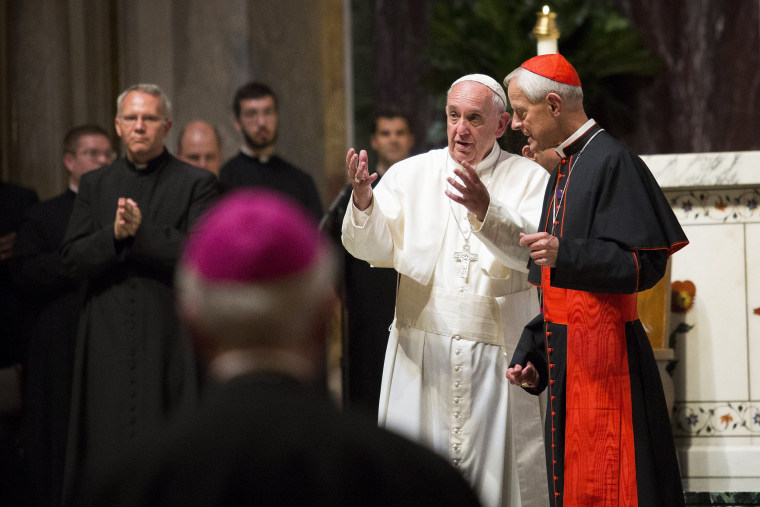
Image: Pope Francis speaks with Cardinal Donald Wuerl during a midday prayer at St. Matthew's Cathedral in Washington on Sept. 23, 2015.
NBC NEWS

The Vatican is facing mounting criticism for not taking a more heavy-handed approach to sexual abuse allegations after accepting the resignation of Cardinal Donald Wuerl but allowing him to remain influential in the church.

Pope Francis issued a letter Friday saying he would accept the resignation of the archbishop of Washington, D.C.,in response to accusations that he did nothing to stop abuse by senior clerics in Pennsylvania where he served as a bishop from 1988 to 2006.

While some church leaders and parishioners have called for Wuerl’s resignation in recent weeks, critics point to the fact that Francis asked Wuerl to remain the apostolic administrator of the archdiocese. He will also attend the annual American bishops meeting slated for November and holds an influential role on the Congregation of Bishops, which chooses who will take roles of church leadership.

Wuerl will no longer serve as leader to more than 650,000 Catholics in Washington, but he’s still expected to retain significant influence as a member of the Congregation for the Doctrine of the Faith, which over sees Vatican theology.

The Vatican did not immediately respond to NBC News’ request for comment.YOUR VIDEO BEGINS IN: 00:15

Pope Francis accepts embattled Cardinal Wuerl’s resignation

OCT.12.201802:54

In sharing his disappointment with the Vatican, Pennsylvania Attorney General Josh Shapiro referred to details in a Pennsylvania grand jury report that alleged Wuerl was able to cover up abuses in the Pittsburgh diocese.

“He is now able to retire seemingly with no consequences for his actions,” Shapiro said at a news conference on Friday.

The report released two months ago found that more than 300 priests in the state sexually abused minors over a 70-year period. Wuerl, 77, was not accused of abuse but was named several times throughout the report. A key ally of Francis, he has been the most prominent figure to take the fall since the report was released.

Related

NEWS

Pope Francis accepts D.C. Cardinal Donald Wuerl’s resignation

Shapiro has been championing legal reforms recommended by the grand jury to remove the statute of limitations on child sexual abuse claims in order to convict perpetrators decades later. The attorney general said Friday that he is focusing on strengthening the law to support victims seeking justice and prevent future cases of abuse.

“I think we’ve learned in this process that we can’t rely on the church to fix itself,” he said.

While Francis accepted the resignation, the letter thanks Wuerl for not taking a defensive approach to justify “some mistakes” he may have made.

Recommended

Facebook says hackers saw personal info of 14 million people

Hurricane Michael may have disrupted Florida’s red tide

“[You] make clear the intent to put God’s Project first, before any kind of personal project, including what could be considered as good for the Church,” it says.

A group representing survivors of the scandal said the Vatican should be admonishing church leaders that covered up abuse and the letter minimizes the impact Wuerl’s actions had on victims. “This is another knife in the heart of those who have already suffered at the hands of the Catholic church,” said Survivors Network of those Abused by Priests in a statement.

Mitchell Garabedian, who has represented numerous clergy sex abuse victims including those involved in the Catholic Archdiocese of Boston sex abuse scandal, said the pope had not gone far enough. Based off Francis’s statement, he noted that it would be unsurprising if Wuerl were given a promotion to a Basilica in Rome as was the case with Cardinal Bernard Francis Law, who was accused of covering up decades of abuse in Boston.

Related

NEWS

Cardinal Theodore McCarrick removed from ministry after teen sex abuse claim

“Instead of portraying Cardinal Wuerl as a victim who made some mistakes, Pope Francis should be instructing Cardinal Wuerl to fully reveal Cardinal Wuerl’s role in the cover up while Bishop of the Diocese of Pittsburgh for about 18 years and in the scandal involving former Cardinal McCarrick so that victims can try to heal,” he said, referring to disgraced Cardinal Theodore McCarrick. “Pope Francis’s portrayal of Cardinal Wuerl adds another layer to the cover up.”

Garabedian said all should remember that numerous state attorneys general have opened investigations into the Catholic Church and sex abuse.

“Momentum is building,” Garabedian told NBC News. “What happened in Boston and Pennsylvania is causing many other states to investigate the criminal activities concerning pedophilia within the church and a domino effect is taking place.”

And that’s an encouraging sign, according to Garabedian, who emphasized that the abuse and the cover up are both criminal acts.

“Take away their robes and religion and we have one of the biggest criminal enterprises in the world,” he said. “We’re talking about sexual abuse of thousands of children in wholesale fashion for decades upon decades while thousands of priests and supervisors covered it up — they’re criminals. They belong in jail.”by TaboolaSPONSORED STORIESAvoid Embarrassing Work Mistakes With This Grammar Checking AppGrammarlyManufacturers Are At The Center Of The IoT RevolutionTravelers Insurance

Posted in Uncategorized | Comments Off on THERE IS ALMOST UNIVERSAL DISGUST AT THE PRAISE FRANCIS THE MERCIFUL HEAPED ON WUERL IN ACCEPTING HIS RESIGNATION WHILE KEEPING HIM IN ALL OF HIS POSITIONS OF POWER

FATHER GEORGE RUTLER’S WEEKLY COLUMN

Fr. Rutler’s Weekly ColumnOctober 14, 2018
   Last Sunday was the anniversary of the Battle of Lepanto, a conflict that saved civilization on the seventh of October, 1571. The day after that anniversary marked the celebration of the life of Christopher Columbus, an observance that has become muted by polemicists who do not understand the significance of events. Were it not for the courage of the 41-year-old Columbus braving the uncharted ocean to the west to avoid the Mediterranean blockade by Islamic jihadists in 1492, and the valor of the 24-year-old Don Juan of Austria, who commanded the Holy League fleet in the Straits of Corinth in 1571, we would not exist today in what we still call a civilized form of nature.

   Columbus invoked the Blessed Virgin’s protection each day, ringing the Angelus bell. On his arrival in the West Indies, a grateful local populace thanked him for saving them from marauding Carib cannibals. The Franciscans who accompanied him proclaimed the Gospel, putting a stop to the Aztec sacrifices of about fifty thousand human victims annually. The spread of the Gospel was so rapid that Don Juan’s flagship in 1571 carried an image of Our Lady of Guadalupe that had been touched to the original miraculous image imprinted on Saint Juan Diego’s tilma exactly forty years earlier.

   Columbus could not have made it to the New World without the astrolabe, whose design had been perfected four centuries before by a young Benedictine monk, Blessed Hermann of Reichenau. Blessed Hermann had been so crippled by congenital deformities, that many barbaric modern doctors acting on the results of amniocentesis would have aborted him. Countless are the discoveries that could have been made by recent generations of those whose right to life was erased by an autonomous decree of our Supreme Court.

   The Holy See has convened a Synod on Youth, with laudatory intent to form the next generation of Catholics. But its draft syllabus has been supine, expressing a desire to “accompany” and “learn” from youth rather than instruct them. The sailors with Columbus and Don Juan would have laughed at that. It is not the job of the Church to “accompany” the young in their ways of naiveté, but to commission youthful vigor to spread the joy of the Gospel. 

   Pope Saint Gregory did not pander to young people by flattering them: “Your prophets saw false and foolish visions and did not point out your wickedness, that you might repent of your sins. The name of prophet is sometimes given in the sacred writings to teachers who both declare the present to be fleeting and reveal what is to come. The word of God accuses them of seeing false visions because they are afraid to reproach men for their faults and they consequently lull the evildoer with an empty promise of safety. Because they fear reproach, they keep silent and fail to point out the sinner’s wrongdoing.”
Posted in Uncategorized | 1 Comment

The biggest crisis in the Catholic Church right now is not whether bishops, cardinals or priests are sinners. It is whether the Church will uphold its own teaching. Teaching that has withstood the test of over 2000 years of attacks from friend and foe alike. And at the center of the crisis is Francis the Merciful.

Featured Image
Lisa Bourne

Lisa Bourne

NEWSCATHOLIC CHURCHFri Oct 12, 2018 – 1:35 pm EST

90-year-old philosopher priest: Pope Francis is at the center of Church’s current crisis

 CatholicCrisis In The Catholic ChurchDoctrineDogmaJames SchallPope Francis

October 12, 2018 (LifeSiteNews) – The biggest crisis in the Catholic Church right now is not whether bishops, cardinals or priests are sinners, a noted priest and author said. It is whether the Church will uphold its own teaching. And at the center of the crisis is Pope Francis.

“The Church is being watched to see if it upholds the natural law in its own teachings and practices,” Jesuit Father James V. Schall said, “or whether it joins the world and thereby undermines its claim to consistency and truth of doctrine since its beginning.”

Schall, former Georgetown University political science professor, began his October 8 column in Crisis Magazine by referring to the recent highly critical report on the Francis pontificate in the prominent German magazine, Der Spiegel

The magazine’s report criticized Pope Francis’s leadership of the Church and charged him with ignoring abuse survivors in Argentina. It had the subtitle, “The Greatest Crisis in the History of the Church.”

Catholics have voiced anger and increasingly called for answers in the Church’s sexual abuse scandal after allegations surfaced beginning in June that former Cardinal Theodore McCarrick abused seminarians, young priests and at least one minor over decades. 

The McCarrick revelations were followed by the Pennsylvania grand jury report released in August detailing abuse by some 300 priests over 70 years in six dioceses there.

Later in August, former papal nuncio to the U.S. Carlo Maria Viganò released testimony implicating Francis and other high-level prelates in covering for McCarrick. Viganò has been in hiding since.

Francis initially stated he would not say “a word” about the allegations, and then proceeded to cryptically criticize an unspecified “Great Accuser” repeatedly in his Mass homilies.

The McCarrick scandal has brought Francis’ handling of sex abuse under greater scrutiny. 

At the same time concerns persist over his leadership with regard to Church teaching on sexuality and marriage – owing to his apparent departure from the teachings of his predecessors, especially in the outcome of the Synod on the Family and its resultant exhortation Amoris Laetitia that has been used to allow Catholics living in objectively sinful situations to receive Holy Communion. 

Most people want to be fair to the pope and they also want to know the facts, said Schall, both in his handling of abuse in Argentina, and also with regard to the McCarrick case.

“People are also puzzled by the pope’s refusal to answer what seem to be quite legitimate and straightforward questions about what he teaches,” he said. “Common sense would normally suggest that, if someone is not guilty, he would be anxious to state why, to clear the record, as it were. The pope’s silence, fairly or unfairly, suggests to most people of good will that something was covered up, something is not quite right.”

Whether or not the saga broached by Der Spiegel actually constitutes the “greatest crisis” in Church history, Schall said, “it certainly is a crisis of major proportions that challenges the credibility of the Church on its own terms.”

“Pope Bergoglio himself seems willing to talk about almost every subject but his own beliefs and record,” he said. “They seem most at issue. The crisis at this stage, whether we like it or not, is precisely about the present pope, what he believes and which decisions he made.” 

“It is not directly about whether Catholicism is objectively true or not,” he continued. “Rather it is a question of whether the Catholic Church, in its own testimony about itself, is consistent with its own teachings.”

By suggesting that this crisis is the “greatest” in the Church’s history, Der Spiegel is taking the Church at its own word, wrote Schall.

“It compares the Church’s own teachings with what is practiced or proposed by Pope Francis,” he said. “The implication is that the crisis is of the Church’s own making.” 

“It is not due to some barbarian invasion, a Masonic plot, or some other outside force imposing on it or threatening it,” said Schall. “It is being threatened by its own ministers not only for not living according to Christian moral standards but also in not teaching what is good.”

The priest philosopher continued, “The irony, to be specific, is that disordered man-man sexual relations have become a civil “right” in many countries but the same relationship is a natural law aberration according to Church teaching.”

“The world watches to see if the Church will join the world in approving these relations as “rights” in the public order and in the Church,” said Schall. “Or will it reject them?” 

It is reasonable to ask what the Church’s ‘greatest’ crisis would be, he wrote.

“It would have something to do with pride, as in placing a human opinion over a divinely revealed or rational teaching,” stated the priest. “It would have to be an embracing of “this world,” spoken of in John’s Gospel as a world that rejects Christ’s coming and his Cross.”

Scripture passages in 2 Timothy and Matthew 25 also signal that a serious crisis can flare up when “unworthy priests and prelates are found within the Church itself,” Father Schall said.  

He cited other examples, such as Francis himself often speaking of clericalism and Pharisees in the Church, Pope Paul VI’s speaking of the “smoke of Satan” in the Church, and Ezekiel and St. Augustine giving warnings that “unworthy shepherds might prevail among us.” 

“On the other hand, at least the papacy was supposed to have been a place where “the gates of hell” did not prevail,” said Schall. “Popes could be sinful in their personal lives but still would not teach false doctrine or approve immoral activities.”

Therefore, he said, the “greatest crisis” of the Church, is not the discovery that clerics are themselves sinners. 

“Christ was sent not for the just but the unjust. He was sent to grant forgiveness to whoever asked for it,” the priest wrote. “But he also told us to stop sinning. Therefore, the fact that sinners populate the world and the Church, even after Christ established rules to live by, cannot surprise anyone.”

Even those who do not think the “aberrations” some priests and bishops are accused of committing equate to sins or disorders recognize that “the Church is the last bastion of moral integrity as seen in its classical philosophic and religious form,” he said.

And, he said, they also see that the serious troubles the Church itself is in are primarily due to its own actions.

“Christ was sent not for the just but the unjust. He was sent to grant forgiveness to whoever asked for it,” the priest wrote. “But he also told us to stop sinning. Therefore, the fact that sinners populate the world and the Church, even after Christ established rules to live by, cannot surprise anyone.”

Even those who do not think the “aberrations” some priests and bishops are accused of committing equate to sins or disorders recognize that “the Church is the last bastion of moral integrity as seen in its classical philosophic and religious form,” he said.

And, he said, they also see that the serious troubles the Church itself is in are primarily due to its own actions.

“We can say that the issue is not over whether the pope is a sinner, naïve, or weak, but whether he has approved teachings or moral behaviors that he is obliged to oppose,” said Father Schall. “If he has taken this step in some obviously authoritative way, then Der Spiegel will be proved right.” 

“A reversal of fundamental teaching at the highest levels of the Church would constitute the “greatest crisis” in Catholic history,” he said. “It is an act of faithfulness to respectfully hope Pope Francis clarifies his own teachings. It does not seem like too much to ask and many, including Der Spiegel, are asking it.”

Posted in Uncategorized | Comments Off on The biggest crisis in the Catholic Church right now is not whether bishops, cardinals or priests are sinners. It is whether the Church will uphold its own teaching. Teaching that has withstood the test of over 2000 years of attacks from friend and foe alike. And at the center of the crisis is Francis the Merciful.