There is a long history of organizations that have nothing to do with the Catholic Church which nonetheless persist in sticking their noses into its internal affairs.
In the last century, the Communist party in the United States sought to infiltrate the Church with apostate homosexual priests. In more recent times, wealthy left-wing activists and foundations have attempted to derail the Church by promoting propaganda campaigns against Church teachings, typically centered on sexuality issues. For instance, the pro-abortion movement was launched by Catholic Church-hating activists who sought to destroy its moral authority.
The most recent manifestation of this invidious effort comes from a constellation of forces called Equal Future. It has taken direct aim at the Synod of Bishops on Young People, the Faith and the Discernment of Vocations, which is meeting in Rome, October 3-28.
According to the director of Equal Future, Tiernan Brady, the purpose of his outfit is “to highlight the damage being done to children and young people” by Church teachings. Brady, who directed the referenda campaigns on gay marriage in Australia and Ireland, is using this opportunity to pressure the Church to change its teachings on sexuality.
Equal Future consists of many lesbian, gay, bisexual, and transgender (LGBT) groups. The estimates range from 29 to more than 100 such entities. It includes some of the most prominent LGBT organizations, such as the Human Rights Campaign and the Gay and Lesbian Alliance Against Defamation (GLAAD).
More important, it is comprised of gay groups which claim to be Catholic: New Ways Ministry, DignityUSA, and We Are Church are among the best known. They are all dissident groups in rebellion against the Catholic Church, and have practically zero support among Catholics. They wouldn’t exist were it not for funding from anti-Catholic organizations such as the Arcus Foundation, an institution that works closely with atheist billionaire and Church hater, George Soros.
In the last ten years, DignityUSA has received well over $700,000 from the Arcus Foundation. Last year, it gave New Ways Ministry a grant of $35,000 “to connect the work of pro-LGBT Catholic organizations in every region of the world.” In 2009, it gave them almost $100,000.
It also funds the Women’s Alliance for Theology Ethics and Ritual (WATER). Arcus gave it a boatload of cash to “create a cadre of Catholic, lesbian, bisexual and transgender women and their allies that would assume a leadership role within the Catholic community.” Earlier in this decade it gave WATER $70,000. Naturally, Arcus provides grants to Catholics for Choice, the pro-abortion and anti-Catholic entity that receives the bulk of its money from the Ford Foundation.
Arcus has made inroads in Catholic universities as well. It receives its most cooperation from Jesuit institutions such as Fordham University and Fairfield University. For example, Arcus funded a conference series, “More Than a Monologue,” that deliberately promoted dissident voices seeking to undermine Catholic teachings on sexuality. Pledges to area bishops that they would not do so were not honored.
According to a report by the Cardinal Newman Society, this conference sponsored several speakers who questioned Catholic teaching on homosexuality. They argued that the Vatican’s “official repression” of gay priests needs to end, and that “the Catholic Church would be much better off if all its priests were having sex with each other.” To top things off, they “disputed the necessity of priests for consecration of the Eucharist at Catholic Mass.”
The idea that gay priests are repressed is nonsense. Just the opposite is true: Gay-active seminarians and priests have driven more heterosexual men out of the seminaries and the priesthood than anyone can fathom. Moreover, it is diabolical to assert that priests would be better off if they practiced sodomy with each other. Even more pernicious is the assault on the Eucharist. That is what these activists want—a total annihilation of the Catholic Church. It was not always this way.
When Dr. Bernard Nathanson, the famed abortionist who co-founded the National Abortion Rights Action League (NARAL), started his effort to legalize abortion in 1969, he devised a plan to attack the Catholic Church. Why? He had to. The Church, he readily conceded, was the greatest defender of life. This meant that his pro-abortion agenda could not be realized without discrediting its voice.
Nathanson quickly embarked on a lengthy propaganda campaign that was riddled with lies about Catholicism. We know this to be true because of his conversion: after witnessing pictures of unborn babies—the sonogram had just been invented—he became pro-life. Then he converted to Catholicism. The key point is this: even in his most radical days, Nathanson never sought to assault the Church’s sacraments. That’s what we are faced with today. It is just that vicious.
There is no justification for any outside organization seeking to subvert the teachings and practices of any world religion. That some of these busy-bodies are tax-exempt foundations, which purport to serve the common good, makes it all the more perverse. Phone: 212-371-3191 E-mail: pr@catholicleague.org
THE VALID CARDINALS, i.e. CARDINALS APPOINTED BY POPES BENEDICT XVI AND SAINT JOHN PAUL II, MUST ACT SOON TO REMOVE FRANCIS THE MERCIFUL FROM THE THRONE OF SAINT PETER BEFORE HE DAMAGES THE INSTITUTIONAL CHURCH EVEN MORE THAN HE HAS ALREADY DAMAGED IT.
Recently many educated Catholic observers, including bishops and priests, have decried the confusion in doctrinal statements about faith or morals made from the Apostolic See at Rome and by the putative Bishop of Rome, Pope Francis. Some devout, faithful and thoughtful Catholics have even suggested that he be set aside as a heretic, a dangerous purveyor of error, as recently mentioned in a number of reports. Claiming heresy on the part of a man who is a supposed Pope, charging material error in statements about faith or morals by a putative Roman Pontiff, suggests and presents an intervening prior question about his authenticity in that August office of Successor of Peter as Chief of The Apostles, i.e., was this man the subject of a valid election by an authentic Conclave of The Holy Roman Church? This is so because each Successor of Saint Peter enjoys the Gift of Infallibility. So, before one even begins to talk about excommunicating such a prelate, one must logically examine whether this person exhibits the uniformly good and safe fruit of Infallibility. If he seems repeatedly to engage in material error, that first raises the question of the validity of his election because one expects an authentically-elected Roman Pontiff miraculously and uniformly to be entirely incapable of stating error in matters of faith or morals. So to what do we look to discern the invalidity of such an election? His Holiness, Pope John Paul II, within His massive legacy to the Church and to the World, left us with the answer to this question. The Catholic faithful must look back for an answer to a point from where we have come—to what occurred in and around the Sistine Chapel in March 2013 and how the fruits of those events have generated such widespread concern among those people of magisterial orthodoxy about confusing and, or, erroneous doctrinal statements which emanate from The Holy See. His Apostolic Constitution (Universi Dominici Gregis) which governed the supposed Conclave in March 2013 contains quite clear and specific language about the invalidating effect of departures from its norms. For example, Paragraph 76 states: “Should the election take place in a way other than that prescribed in the present Constitution, or should the conditions laid down here not be observed, the election is for this very reason null and void, without any need for a declaration on the matter; consequently, it confers no right on the one elected.” From this, many believe that there is probable cause to believe that Monsignor Jorge Mario Bergoglio was never validly elected as the Bishop of Rome and Successor of Saint Peter—he never rightly took over the office of Supreme Pontiff of the Holy Roman Catholic Church and therefore he does not enjoy the charism of Infallibility. If this is true, then the situation is dire because supposed papal acts may not be valid or such acts are clearly invalid, including supposed appointments to the college of electors itself. Only valid cardinals can rectify our critical situation through privately (secretly) recognizing the reality of an ongoing interregnum and preparing for an opportunity to put the process aright by obedience to the legislation of His Holiness, Pope John Paul II, in that Apostolic Constitution, Universi Dominici Gregis. While thousands of the Catholic faithful do understand that only the cardinals who participated in the events of March 2013 within the Sistine Chapel have all the information necessary to evaluate the issue of election validity, there was public evidence sufficient for astute lay faithful to surmise with moral certainty that the March 2013 action by the College was an invalid conclave, an utter nullity. What makes this understanding of Universi Dominici Gregisparticularly cogent and plausible is the clear Promulgation Clause at the end of this Apostolic Constitution and its usage of the word “scienter” (“knowingly”). The Papal Constitution Universi Dominici Gregis thus concludes definitively with these words: “. . . knowingly or unknowingly, in any way contrary to this Constitution.” (“. . . scienter vel inscienter contra hanc Constitutionem fuerint excogitata.”) [Note that His Holiness, Pope Paul VI, had a somewhat similar promulgation clause at the end of his corresponding, now abrogated, Apostolic Constitution, Romano Pontifici Eligendo, but his does not use “scienter”, but rather uses “sciens” instead. This similar term of sciens in the earlier abrogated Constitution has an entirely different legal significance than scienter.] This word, “scienter”, is a legal term of art in Roman law, and in canon law, and in Anglo-American common law, and in each system, scienter has substantially the same significance, i.e., “guilty knowledge” or willfully knowing, criminal intent. Thus, it clearly appears that Pope John Paul II anticipated the possibility of criminal activity in the nature of a sacrilege against a process which He intended to be purely pious, private, sacramental, secret and deeply spiritual, if not miraculous, in its nature. This contextual reality reinforced in the Promulgation Clause, combined with: (1) the tenor of the whole document; (2) some other provisions of the document, e.g., Paragraph 76; (3) general provisions of canon law relating to interpretation, e.g., Canons 10 & 17; and, (4) the obvious manifest intention of the Legislator, His Holiness, Pope John Paul II, tends to establish beyond a reasonable doubt the legal conclusion that Monsignor Bergoglio was never validly elected Roman Pontiff. This is so because:1. Communication of any kind with the outside world, e.g., communication did occur between the inside of the Sistine Chapel and anyone outside, including a television audience, before, during or even immediately after the Conclave;2. Any political commitment to “a candidate” and any “course of action” planned for The Church or a future pontificate, such as the extensive decade-long “pastoral” plans conceived by the Sankt Gallen hierarchs; and,3. Any departure from the required procedures of the conclave voting process as prescribed and known by a cardinal to have occurred:each was made an invalidating act, and if scienter (guilty knowledge) was present, also even a crime on the part of any cardinal or other actor, but, whether criminal or not, any such act or conduct violating the norms operated absolutely, definitively and entirely against the validity of all of the supposed Conclave proceedings. Quite apart from the apparent notorious violations of the prohibition on a cardinal promising his vote, e.g., commitments given and obtained by cardinals associated with the so-called “Sankt Gallen Mafia,” other acts destructive of conclave validity occurred. Keeping in mind that Pope John Paul II specifically focused Universi Dominici Gregis on “the seclusion and resulting concentration which an act so vital to the whole Church requires of the electors” such that “the electors can more easily dispose themselves to accept the interior movements of the Holy Spirit,” even certain openly public media broadcasting breached this seclusion by electronic broadcasts outlawed by Universi Dominici Gregis. These prohibitions include direct declarative statements outlawing any use of television before, during or after a conclave in any area associated with the proceedings, e.g.: “I further confirm, by my apostolic authority, the duty of maintaining the strictest secrecy with regard to everything that directly or indirectly concerns the election process itself.” Viewed in light of this introductory preambulary language of Universi Dominici Gregis and in light of the legislative text itself, even the EWTN camera situated far inside the Sistine Chapel was an immediately obvious non-compliant act which became an open and notorious invalidating violation by the time when this audio-visual equipment was used to broadcast to the world the preaching after the “Extra Omnes”. While these blatant public violations of Chapter IV of Universi Dominici Gregis actuate the invalidity and nullity of the proceedings themselves, nonetheless in His great wisdom, the Legislator did not disqualify automatically those cardinals who failed to recognize these particular offenses against sacred secrecy, or even those who, with scienter, having recognized the offenses and having had some power or voice in these matters, failed or refused to act or to object against them: “Should any infraction whatsoever of this norm occur and be discovered, those responsible should know that they will be subject to grave penalties according to the judgment of the future Pope.” [Universi Dominici Gregis, ¶55] No Pope apparently having been produced in March 2013, those otherwise valid cardinals who failed with scienter to act on violations of Chapter IV, on that account alone would nonetheless remain voting members of the College unless and until a new real Pope is elected and adjudges them. Thus, those otherwise valid cardinals who may have been compromised by violations of secrecy can still participate validly in the “clean-up of the mess” while addressing any such secrecy violations with an eventual new Pontiff. In contrast, the automatic excommunication of those who politicized the sacred conclave process, by obtaining illegally, commitments from cardinals to vote for a particular man, or to follow a certain course of action (even long before the vacancy of the Chair of Peter as Vicar of Christ), is established not only by the word, “scienter,” in the final enacting clause, but by a specific exception, in this case, to the general statement of invalidity which therefore reinforces the clarity of intention by Legislator that those who apply the law must interpret the general rule as truly binding. Derived directly from Roman law, canonical jurisprudence provides this principle for construing or interpreting legislation such as this Constitution, Universi Dominici Gregis. Expressed in Latin, this canon of interpretation is: “Exceptio probat regulam in casibus non exceptis.” (The exception proves the rule in cases not excepted.) In this case, an exception from invalidity for acts of simony reinforces the binding force of the general principle of nullity in cases of other violations. Therefore, by exclusion from nullity and invalidity legislated in the case of simony: “If — God forbid — in the election of the Roman Pontiff the crime of simony were to be perpetrated, I decree and declare that all those guilty thereof shall incur excommunication latae sententiae. At the same time I remove the nullity or invalidity of the same simoniacal provision, in order that — as was already established by my Predecessors — the validity of the election of the Roman Pontiff may not for this reason be challenged.” His Holiness made an exception for simony. Exceptio probat regulam in casibus non exceptis. The clear exception from nullity and invalidity for simony proves the general rule that other violations of the sacred process certainly do and did result in the nullity and invalidity of the entire conclave. Comparing what Pope John Paul II wrote in His Constitution on conclaves with the Constitution which His replaced, you can see that, with the exception of simony, invalidity became universal. In the corresponding paragraph of what Pope Paul VI wrote, he specifically confined the provision declaring conclave invalidity to three (3) circumstances described in previous paragraphs within His constitution, Romano Pontfici Eligendo. No such limitation exists in Universi Dominici Gregis. See the comparison both in English and Latin below:Romano Pontfici Eligendo, 77. Should the election be conducted in a manner different from the three procedures described above (cf. no. 63 ff.) or without the conditions laid down for each of the same, it is for this very reason null and void (cf. no. 62), without the need for any declaration, and gives no right to him who has been thus elected. [Romano Pontfici Eligendo, 77: “Quodsi electio aliter celebrata fuerit, quam uno e tribus modis, qui supra sunt dicti (cfr. nn. 63 sqq.), aut non servatis condicionibus pro unoquoque illorum praescriptis, electio eo ipso est nulla et invalida (cfr. n. 62) absque ulla declaratione, et ita electo nullum ius tribuit .”] as compared with:Universi Dominici Gregis, 76: “Should the election take place in a way other than that prescribed in the present Constitution, or should the conditions laid down here not be observed, the election is for this very reason null and void, without any need for a declaration on the matter; consequently, it confers no right on the one elected.” [Universi Dominici Gregis, 76: “Quodsi electio aliter celebrata fuerit, quam haec Constitutio statuit, aut non servatis condicionibus pariter hic praescriptis, electio eo ipso est nulla et invalida absque ulla declaratione, ideoque electo nullum ius tribuit.”]Of course, this is not the only feature of the Constitution or aspect of the matter which tends to establish the breadth of invalidity. Faithful must hope and pray that only those cardinals whose status as a valid member of the College remains intact will ascertain the identity of each other and move with the utmost charity and discretion in order to effectuate The Divine Will in these matters. The valid cardinals, then, must act according to that clear, manifest, obvious and unambiguous mind and intention of His Holiness, Pope John Paul II, so evident in Universi Dominici Gregis, a law which finally established binding and self-actuating conditions of validity on the College for any papal conclave, a reality now made so apparent by the bad fruit of doctrinal confusion and plain error. It would seem then that praying and working in a discreet and prudent manner to encourage only those true cardinals inclined to accept a reality of conclave invalidity, would be a most charitable and logical course of action in the light of Universi Dominici Gregis, and out of our high personal regard for the clear and obvious intention of its Legislator, His Holiness, Pope John Paul II. Even a relatively small number of valid cardinals could act decisively and work to restore a functioning Apostolic See through the declaration of an interregnum government. The need is clear for the College to convene a General Congregation in order to declare, to administer, and soon to end the Interregnum which has persisted since March 2013. Finally, it is important to understand that the sheer number of putative counterfeit cardinals will eventually, sooner or later, result in a situation in which The Church will have no normal means validly ever again to elect a Vicar of Christ. After that time, it will become even more difficult, if not humanly impossible, for the College of Cardinals to rectify the current disastrous situation and conduct a proper and valid Conclave such that The Church may once again both have the benefit of a real Supreme Pontiff, and enjoy the great gift of a truly infallible Vicar of Christ. It seems that some good cardinals know that the conclave was invalid, but really cannot envision what to do about it; we must pray, if it is the Will of God, that they see declaring the invalidity and administering an Interregnum through a new valid conclave is what they must do. Without such action or without a great miracle, The Church is in a perilous situation. Once the last validly appointed cardinal reaches age 80, or before that age, dies, the process for electing a real Pope ends with no apparent legal means to replace it. Absent a miracle then, The Church would no longer have an infallible Successor of Peter and Vicar of Christ. Roman Catholics would be no different that Orthodox Christians. In this regard, all of the true cardinals may wish to consider what Holy Mother Church teaches in the Catechism of the Catholic Church, ¶675, ¶676 and ¶677 about “The Church’s Ultimate Trial”. But, the fact that “The Church . . . will follow her Lord in his death and Resurrection” does not justify inaction by the good cardinals, even if there are only a minimal number sufficient to carry out Chapter II of Universi Dominici Gregis and operate the Interregnum. This Apostolic Constitution, Universi Dominici Gregis, which was clearly applicable to the acts and conduct of the College of Cardinals in March 2013, is manifestly and obviously among those “invalidating” laws “which expressly establish that an act is null or that a person is effected” as stated in Canon 10 of the 1983 Code of Canon Law. And, there is nothing remotely “doubtful or obscure” (Canon 17) about this Apostolic Constitution as clearly promulgated by Pope John Paul II. The tenor of the whole document expressly establishes that the issue of invalidity was always at stake. This Apostolic Constitution conclusively establishes, through its Promulgation Clause [which makes “anything done (i.e., any act or conduct) by any person . . . in any way contrary to this Constitution,”] the invalidity of the entire supposed Conclave, rendering it “completely null and void”. So, what happens if a group of Cardinals who undoubtedly did not knowingly and wilfully initiate or intentionally participate in any acts of disobedience against Universi Dominici Gregis were to meet, confer and declare that, pursuant to Universi Dominici Gregis, Monsignor Bergoglio is most certainly not a valid Roman Pontiff. Like any action on this matter, including the initial finding of invalidity, that would be left to the valid members of the college of cardinals. They could declare the Chair of Peter vacant and proceed to a new and proper conclave. They could meet with His Holiness, Benedict XVI, and discern whether His resignation and retirement was made under duress, or based on some mistake or fraud, or otherwise not done in a legally effective manner, which could invalidate that resignation. Given the demeanor of His Holiness, Benedict XVI, and the tenor of His few public statements since his departure from the Chair of Peter, this recognition of validity in Benedict XVI seems unlikely. In fact, even before a righteous group of good and authentic cardinals might decide on the validity of the March 2013 supposed conclave, they must face what may be an even more complicated discernment and decide which men are most likely not valid cardinals. If a man was made a cardinal by the supposed Pope who is, in fact, not a Pope (but merely Monsignor Bergoglio), no such man is in reality a true member of the College of Cardinals. In addition, those men appointed by Pope John Paul II or by Pope Benedict XVI as cardinals, but who openly violated Universi Dominici Gregis by illegal acts or conduct causing the invalidation of the last attempted conclave, would no longer have voting rights in the College of Cardinals either. (Thus, the actual valid members in the College of Cardinals may be quite smaller in number than those on the current official Vatican list of supposed cardinals.) In any event, the entire problem is above the level of anyone else in Holy Mother Church who is below the rank of Cardinal. So, we must pray that The Divine Will of The Most Holy Trinity, through the intercession of Our Lady as Mediatrix of All Graces and Saint Michael, Prince of Mercy, very soon rectifies the confusion in Holy Mother Church through action by those valid Cardinals who still comprise an authentic College of Electors. Only certainly valid Cardinals can address the open and notorious evidence which points to the probable invalidity of the last supposed conclave and only those cardinals can definitively answer the questions posed here. May only the good Cardinals unite and if they recognize an ongoing Interregnum, albeit dormant, may they end this Interregnum by activating perfectly a functioning Interregnum government of The Holy See and a renewed process for a true Conclave, one which is purely pious, private, sacramental, secret and deeply spiritual. If we do not have a real Pontiff, then may the good Cardinals, doing their appointed work “in view of the sacredness of the act of election” “accept the interior movements of the Holy Spirit” and provide Holy Mother Church with a real Vicar of Christ as the Successor of Saint Peter. May these thoughts comport with the synderetic considerations of those who read them and may their presentation here please both Our Immaculate Virgin Mother, Mary, Queen of the Apostles, and The Most Holy Trinity, Father, Son and Holy Spirit.N. de PlumeUn ami des Papes
Posted inUncategorized|Comments Off on THIS IS AN INTERESTING ARTICLE BY THE CATHOLIC LEAGUE’S BILL DONOHUE. THE CHURCH IS UNDER ATTACK BY PERSONS AND GROUPS INSIDE AND OUTSIDE OF THE CHURCH, FOR THE FIRST TIME ON SUCH A GRAND SCALE. MARANATHA!!!
When I Google “it’s not the same religion” – in quotes – the first result I get is a tweet from Hilary White about Archbishop Gómez of Los Angeles giving communion to the pro-abortion mayor.
When I Google “Novusordoism isn’t Catholicism” – in quotes – I get an entire category of posts from Hilary at her “What’s Up With Francis-Church” blog filed under that label. The most significant of these – a post entitled “To touch the sky: ‘Novusordoist’ New Paradigm isn’t the same religion” – begins with an excellent description of this phenomenon that Hilary and others (myself included) have been trying to explain for some time:
The fact that we don’t really yet have an official name for the New Paradigm (and probably won’t for another couple of centuries) has made it difficult to help clarify what I mean when I say that in effect, most regular novus ordo Mass-going Catholics don’t believe the same religious things as previous generations of Catholics believed. I’ve said it many times, and I’m not alone, that “Novusordoism isn’t Catholicism.” It’s become a bit of a catchphrase. I’ve also often used the term “New Paradigm” to refer to the creation of what is in essence, if not yet in name, the new thing created after Vatican II. I am gratified to see that the Pope’s closest collaborators are starting to promote this term themselves to describe it. Makes things easier.
How do we define it? We’ve talked about the “false floor” of the Novusordoist New Paradigm and the vast “lost city,” full of treasures, of the Catholic Faith that has been suppressed and buried since Vatican II that very very few Catholics know is down there. We’ve talked about how it’s so difficult to explain because of the great success of the NuChurchians at suppressing even the language we use (no, not Latin) to describe the concepts.
For the people who re-booted the Church in 1965, Orwell was taken as a how-to manual, not a warning. A great deal of the content of the Faith has been memory-holed, and a new edifice has been created in the gaps.
They’ve created a kind of bubble or “Matrix” – a whole false new world the very existence of which is unknown to the people living in it.
And when the old world – the one our Catholic grandparents and great grandparents would instantly recognize, in precisely the opposite way they’d feel if they walked into an average suburban parish in 2018 – makes an appearance, the guardians of the false new world seek quickly to tamp it down, to grind it out, to ensure that everyone within earshot knows “that’s not who we are anymore.”
One recent example is that of Cardinal Wilfrid Napier of South Africa, who was given a great deal of credit by “conservatives” after he pushed back on some of the machinations during the synods on the family. On Twitter, however, where he is among the more active and engaged cardinals, he has long since put to rest the notion that he is anything but a company man for the Francis Regime. Most recently, this came in the form of his critique of a traditional Mass offered by Archbishop Thomas Wenski of Miami.
“A Mass in extraordinary form,” tweeted a very pleased-looking Archbishop Wenski, “sung at St. Mary’s Cathedral on Feast of St. Michael the Archangel at conclusion of meeting of Society for Catholic Liturgy. Around 500 people attended.”
The photos Wenski included in his tweet show an event looking every bit like the Catholicism that endured for centuries, not the newfangled cheap plastic imitation most of us are used to:
Napier’s riposte to this happy event came like a tactical strike on the joyful hope evident on the faces of the young men standing with the bishop in the final photo. “Looking at this pictures [sic],” he tweeted, “reminds me of my childhood some 70 years ago. That was a time when there was a universe between the Clergy especially Bishops and Lay Faithful! Some might call it the age of supreme Clericalism. To me it’s a reminder of what we should never ever be again!”
“Supreme clericalism.” Something “we should never ever be again.” This is how a voting member of the College of Cardinals thought by many to be a “conservative” describes the beautiful ritual vestments, gestures, and liturgical actions of the Mass of the Ages – a beauty designed to give glory to God, not to elevate the men offering the sacrifice. A liturgy where God, not the “presider,” was the center of attention.
Napier is not the lone prelate in recent weeks to make an overt attack on Catholic tradition. Bishop Felix Genn of Münster – who has been accused of facilitating homosexual indoctrination of children and of not allowing his priests to preach on Catholic sexual morality from the pulpit – was reported to have said in a press conference last month, “I can tell you firmly: I do not want pre-conciliar clerical guys and I will not ordain them.”
Genn, also considered a “conservative” in some circles, will be attending this week’s Synod of Youth. Readers will perhaps remember with some irony that one of the early controversies surrounding this synod took place during its preparatory phase, in which many youth participants in the creation of a synod preparatory document felt that their voices were not heard when they asked for a focus on more reverent liturgy – specifically the traditional Mass. From my report at the time:
“I’m sure by now you’re probably aware,” read an image of one Facebook comment with all the identifying information redacted, “of the dumpster fire that is the 2018 Pre-Synodal document.” “Refreshingly, the VAST majority of responses in the group were demanding greater access to the Tridentine Mass, recapturing tradition, and greater reverence in the Mass (Whether it be EF or OF)”. Nevertheless, the commenter wrote, “many of us were shocked to find there is no mention of this in the final document” and “many young people are not happy with the current way things are going, despite what the Pre-Synodal document would have you believe.”
Why does it so often seem to be the case that the same bishops who are allowing sexual license so much latitude are the very same who find their inner disciplinarian when it comes to the Church’s traditional expressions of worship and piety? These men are not, as is demonstrated by the growing demand for the Church’s venerable liturgy, populists. They are not merely expressing the will of the faithful.
They are giving the faithful what they want them to have, and they’re giving it to them good and hard.
Another recent indication of the desperate attempt to widen the rift between the pre- and post-conciliar Church is the push from Cardinal Schönborn – archbishop of Vienna, famed editor of the Catechism of the Catholic Church, and handpicked representative of the pope’s interpretation of Amoris Laetitia – to allow the ordination of women to the diaconate. In a tweet that was published, then quickly deleted, the cardinal was quoted as saying, “I was only recently able to consecrate deacons again. A great joy. Perhaps I will one day be able to consecrate women to the diaconate…. Dear priests, have the courage for teamwork!”
Despite the disappearing act, it wasn’t long before the tweet was confirmed in a story for the Catholic News Agency (CNA). “Cardinal Christoph Schönborn,” wrote Anian Christoph Wimmer for CNA, “has said that in his view, whether the Church could ordain women as deacons remains an ‘open question.’”
The Archbishop of Vienna was speaking Sept. 29 to 1700 delegates from parish councils and other bodies in St. Stephen’s Cathedral. Reflecting that he recently had ordained 14 men to the permanent diaconate, he added, according to local news agency Kathpress, “perhaps one day also female deacons.”
Schönborn said that there had been female deacons in the Church in times past, and that “basically, this is open.”
In April of this year, Schönborn had made comments indicating that an ecumenical council could change the prohibition against female ordination laid out by Pope John Paul II in Ordinatio Sacerdotalis. “The question of ordination [of women] is a question which clearly can only be clarified by a Council,” the cardinal said. “That cannot be decided upon by a pope alone. That is a question too big that it could be decided from the desk of a pope.” Asked what he meant about women’s ordination, Schönborn clarified that he was speaking of, “deaconesses, female priests, and female bishops.” In June, however, he backtracked – offering what may have been a calculated Hegelian synthesis – saying that for women, only “the diaconate, the first degree of ordination” was on the table. Admitting that “there have never been female priests in the Catholic Church” from “the beginning,” Schönborn conceded that “even Pope Francis has said that this is not foreseen in the Tradition.” But evidently, so long as we’re not making women into priests and bishops, ordaining them to the diaconate is perfectly fine.
Just. Keep. Moving. The Needle.
We hear it again and again – that the reform must press on; that what has come since the council is “irreversible.” Whether it’s the pope saying it about the liturgical “reform” or the cardinal secretary of state saying it about the Vatican II “process” of transforming the Church, this notion of irreversible forward progress away from what the Church was into the thing that they have remade it to be is driven home with such frequency that it becomes taken for granted. The Church is not immutable, resolute, and timeless; she is in a state of constant flux. “It is not possible to go backwards,” the pope admonishes us, referencing liturgical reform, “We must always go forward. Always forward! And those who go backward are mistaken…”
They want us to believe that the past is dead. That our patrimony has been gutted. That we’d better mourn it and move on, because what we have now is all we will ever have – until they change it again, and tell us we’d better like it. The progressive “theologian” Massimo Faggioli tweeted not long ago that he hoped it was not “overly optimistic to assume that Catholics should all agree on the fact that the secular state is preferable to a theocratic state.” He then noted, apparently anticipating a deluge of papal documents supporting just the opposite, “If you quote from the magisterium, try with something published after 1944.” They don’t just move the goalposts. They take them right out of the stadium.
In an essay on the liturgy for Commonweal, Faggioli again focuses on the division between the pre- and post-conciliar Church. He laments that in his motu proprio Summorum Pontificum, Pope Benedict XVI created a “fait accompli” resulting in a “new ‘bi-ritualism’” in the Roman Rite – the bringing back of an old liturgy when a new ersatz one has taken its place – which Faggioli amusingly sees as itself a violation of tradition. He also notes the role reversal of those who support the new liturgy and the old:
This new bi-ritualism is not, for the most part, an accommodation for those who grew up with the old Latin Mass; it’s aimed at a new generation of traditionalists, born after 1964, who grew up with the novus ordo. The disputes between the advocates of the liturgical reform of Vatican II and advocates of the extraordinary form are – another paradox – disputes between an older generation advocating the new and a younger generation advocating the old. These disputes have wounded the sense of communion between Catholics. The rancor of this conflict in the United States was a painful surprise for me when I first moved to this country.
They are terrified – terrified – that the revolution has very little appeal to future generations. And so they must do all they can to subvert their interest in bringing back the Church’s sacred treasures and traditions, or the doom of all they have worked for will be the real fait accompli.
One needn’t look only to the heterodox ideologues in the Church to find the tension between historical Catholicism and the present. In a discussion about a public tiff between Bishop Morlino of Madison, Wisconsin and the fiery Catholic journalist and author George Neumayr, a friend familiar with the diocesan situation in Wisconsin related that the bishop, known as one of the greatest friends of tradition in the American hierarchy, allows the old Mass, but only by priests who will also offer the Novus Ordo. There are, to my knowledge – and I’ve been asking around – no exclusive TLM chapels in Madison.
If this is true, it would be entirely unsurprising. The same is the case in the much-touted diocese of Arlington, Virginia, which has no fewer than half a dozen Sunday TLMs (and probably more) each week at various parishes. Many see that diocese as the “mecca” for traditionalist Catholics, but if you want a Mass every day of the week in the old form, you’ll have to bounce from parish to parish day by day – or else it’s the SSPX, or you leave the diocese altogether for neighboring West Virginia. This is the daily reality – and dare I say it, the schizophrenic nature – of the post-conciliar Church. Even as demand for tradition grows, even as love for tradition blossoms, our hierarchy remains inextricably chained to a mode of Catholicism that is a manifest failure. It has not retained the faithful; it has not produced vocations; it has not held off the forces of secularism; and as has become painfully clear, it has not even successfully maintained clerical celibacy and holiness. And yet, every faithful bishop and priest is forced to offer his pinch of incense to the council, to the new Mass, to the low-expectations motif of just how valid and probably not heretical it all is.
But it is wholly, woefully insufficient to sustain the faithful. That has continued, and does continue, and will continue to be made clear as the people filling the pews of every non-traditional chapel continue to diminish, or simply fill the space for other reasons while having no intention of actually honoring what the Church teaches.
But ask a priest who has had the opportunity to learn the old Mass after knowing only the new, or has immersed himself in the old theology, or has performed a couple of old-rite baptisms, and the majority of time you’ll hear, through a nervous smile, or a serious look, that the experience was transformative for him. That once he partook of the incredible richness of the Church’s extraordinary and fathomless stores, he no longer felt that they can continue to offer merely what is now considered “ordinary” – or at the very least, that doing so makes him deeply uncomfortable. Such priests recognize that the treasures that enliven their vocations, nourish their flocks, and act as a bulwark against a hostile world are right there at their fingertips, so how can they continue to treat them as though they are merely a matter of taste or preference?
As the faithful begin to arise from their slumber, awakened by scandal after scandal, and look with new, critical eyes at how we got to where we are, I suggest that they also take a hard look at all that began changing in 1965, and the birthright that was stolen from them. Many of our readers here have already taken this journey, and they know how difficult it can be to discover that the “hermeneutic of rupture,” as Pope Benedict called it, is in fact very real. Many of the faithful will now be making it anew. I ask that in particular our community here not shun or scorn those new to these discoveries, but welcome, mentor, and teach. Be patient and kind. Recognize that people will be surprised and angry at what they discover. If you’re anything like me, you didn’t always have these answers, either. If you’re anything like me, you resisted accepting the hard truth about the hijacking of our Church by men who had anything but the best interests of the souls entrusted to her care in mind.
We’ve got a lot of work to do, but more and more people are becoming invested in restoration every day. If that’s not a sign of hope, what is?
THE VALID CARDINALS, i.e. CARDINALS APPOINTED BY POPES BENEDICT XVI AND SAINT JOHN PAUL II, MUST ACT SOON TO REMOVE FRANCIS THE MERCIFUL FROM THE THRONE OF SAINT PETER BEFORE HE DAMAGES THE INSTITUTIONAL CHURCH EVEN MORE THAN HE HAS ALREADY DAMAGED IT.
Recently many educated Catholic observers, including bishops and priests, have decried the confusion in doctrinal statements about faith or morals made from the Apostolic See at Rome and by the putative Bishop of Rome, Pope Francis. Some devout, faithful and thoughtful Catholics have even suggested that he be set aside as a heretic, a dangerous purveyor of error, as recently mentioned in a number of reports. Claiming heresy on the part of a man who is a supposed Pope, charging material error in statements about faith or morals by a putative Roman Pontiff, suggests and presents an intervening prior question about his authenticity in that August office of Successor of Peter as Chief of The Apostles, i.e., was this man the subject of a valid election by an authentic Conclave of The Holy Roman Church? This is so because each Successor of Saint Peter enjoys the Gift of Infallibility. So, before one even begins to talk about excommunicating such a prelate, one must logically examine whether this person exhibits the uniformly good and safe fruit of Infallibility. If he seems repeatedly to engage in material error, that first raises the question of the validity of his election because one expects an authentically-elected Roman Pontiff miraculously and uniformly to be entirely incapable of stating error in matters of faith or morals. So to what do we look to discern the invalidity of such an election? His Holiness, Pope John Paul II, within His massive legacy to the Church and to the World, left us with the answer to this question. The Catholic faithful must look back for an answer to a point from where we have come—to what occurred in and around the Sistine Chapel in March 2013 and how the fruits of those events have generated such widespread concern among those people of magisterial orthodoxy about confusing and, or, erroneous doctrinal statements which emanate from The Holy See. His Apostolic Constitution (Universi Dominici Gregis) which governed the supposed Conclave in March 2013 contains quite clear and specific language about the invalidating effect of departures from its norms. For example, Paragraph 76 states: “Should the election take place in a way other than that prescribed in the present Constitution, or should the conditions laid down here not be observed, the election is for this very reason null and void, without any need for a declaration on the matter; consequently, it confers no right on the one elected.” From this, many believe that there is probable cause to believe that Monsignor Jorge Mario Bergoglio was never validly elected as the Bishop of Rome and Successor of Saint Peter—he never rightly took over the office of Supreme Pontiff of the Holy Roman Catholic Church and therefore he does not enjoy the charism of Infallibility. If this is true, then the situation is dire because supposed papal acts may not be valid or such acts are clearly invalid, including supposed appointments to the college of electors itself. Only valid cardinals can rectify our critical situation through privately (secretly) recognizing the reality of an ongoing interregnum and preparing for an opportunity to put the process aright by obedience to the legislation of His Holiness, Pope John Paul II, in that Apostolic Constitution, Universi Dominici Gregis. While thousands of the Catholic faithful do understand that only the cardinals who participated in the events of March 2013 within the Sistine Chapel have all the information necessary to evaluate the issue of election validity, there was public evidence sufficient for astute lay faithful to surmise with moral certainty that the March 2013 action by the College was an invalid conclave, an utter nullity. What makes this understanding of Universi Dominici Gregisparticularly cogent and plausible is the clear Promulgation Clause at the end of this Apostolic Constitution and its usage of the word “scienter” (“knowingly”). The Papal Constitution Universi Dominici Gregis thus concludes definitively with these words: “. . . knowingly or unknowingly, in any way contrary to this Constitution.” (“. . . scienter vel inscienter contra hanc Constitutionem fuerint excogitata.”) [Note that His Holiness, Pope Paul VI, had a somewhat similar promulgation clause at the end of his corresponding, now abrogated, Apostolic Constitution, Romano Pontifici Eligendo, but his does not use “scienter”, but rather uses “sciens” instead. This similar term of sciens in the earlier abrogated Constitution has an entirely different legal significance than scienter.] This word, “scienter”, is a legal term of art in Roman law, and in canon law, and in Anglo-American common law, and in each system, scienter has substantially the same significance, i.e., “guilty knowledge” or willfully knowing, criminal intent. Thus, it clearly appears that Pope John Paul II anticipated the possibility of criminal activity in the nature of a sacrilege against a process which He intended to be purely pious, private, sacramental, secret and deeply spiritual, if not miraculous, in its nature. This contextual reality reinforced in the Promulgation Clause, combined with: (1) the tenor of the whole document; (2) some other provisions of the document, e.g., Paragraph 76; (3) general provisions of canon law relating to interpretation, e.g., Canons 10 & 17; and, (4) the obvious manifest intention of the Legislator, His Holiness, Pope John Paul II, tends to establish beyond a reasonable doubt the legal conclusion that Monsignor Bergoglio was never validly elected Roman Pontiff. This is so because:1. Communication of any kind with the outside world, e.g., communication did occur between the inside of the Sistine Chapel and anyone outside, including a television audience, before, during or even immediately after the Conclave;2. Any political commitment to “a candidate” and any “course of action” planned for The Church or a future pontificate, such as the extensive decade-long “pastoral” plans conceived by the Sankt Gallen hierarchs; and,3. Any departure from the required procedures of the conclave voting process as prescribed and known by a cardinal to have occurred:each was made an invalidating act, and if scienter (guilty knowledge) was present, also even a crime on the part of any cardinal or other actor, but, whether criminal or not, any such act or conduct violating the norms operated absolutely, definitively and entirely against the validity of all of the supposed Conclave proceedings. Quite apart from the apparent notorious violations of the prohibition on a cardinal promising his vote, e.g., commitments given and obtained by cardinals associated with the so-called “Sankt Gallen Mafia,” other acts destructive of conclave validity occurred. Keeping in mind that Pope John Paul II specifically focused Universi Dominici Gregis on “the seclusion and resulting concentration which an act so vital to the whole Church requires of the electors” such that “the electors can more easily dispose themselves to accept the interior movements of the Holy Spirit,” even certain openly public media broadcasting breached this seclusion by electronic broadcasts outlawed by Universi Dominici Gregis. These prohibitions include direct declarative statements outlawing any use of television before, during or after a conclave in any area associated with the proceedings, e.g.: “I further confirm, by my apostolic authority, the duty of maintaining the strictest secrecy with regard to everything that directly or indirectly concerns the election process itself.” Viewed in light of this introductory preambulary language of Universi Dominici Gregis and in light of the legislative text itself, even the EWTN camera situated far inside the Sistine Chapel was an immediately obvious non-compliant act which became an open and notorious invalidating violation by the time when this audio-visual equipment was used to broadcast to the world the preaching after the “Extra Omnes”. While these blatant public violations of Chapter IV of Universi Dominici Gregis actuate the invalidity and nullity of the proceedings themselves, nonetheless in His great wisdom, the Legislator did not disqualify automatically those cardinals who failed to recognize these particular offenses against sacred secrecy, or even those who, with scienter, having recognized the offenses and having had some power or voice in these matters, failed or refused to act or to object against them: “Should any infraction whatsoever of this norm occur and be discovered, those responsible should know that they will be subject to grave penalties according to the judgment of the future Pope.” [Universi Dominici Gregis, ¶55] No Pope apparently having been produced in March 2013, those otherwise valid cardinals who failed with scienter to act on violations of Chapter IV, on that account alone would nonetheless remain voting members of the College unless and until a new real Pope is elected and adjudges them. Thus, those otherwise valid cardinals who may have been compromised by violations of secrecy can still participate validly in the “clean-up of the mess” while addressing any such secrecy violations with an eventual new Pontiff. In contrast, the automatic excommunication of those who politicized the sacred conclave process, by obtaining illegally, commitments from cardinals to vote for a particular man, or to follow a certain course of action (even long before the vacancy of the Chair of Peter as Vicar of Christ), is established not only by the word, “scienter,” in the final enacting clause, but by a specific exception, in this case, to the general statement of invalidity which therefore reinforces the clarity of intention by Legislator that those who apply the law must interpret the general rule as truly binding. Derived directly from Roman law, canonical jurisprudence provides this principle for construing or interpreting legislation such as this Constitution, Universi Dominici Gregis. Expressed in Latin, this canon of interpretation is: “Exceptio probat regulam in casibus non exceptis.” (The exception proves the rule in cases not excepted.) In this case, an exception from invalidity for acts of simony reinforces the binding force of the general principle of nullity in cases of other violations. Therefore, by exclusion from nullity and invalidity legislated in the case of simony: “If — God forbid — in the election of the Roman Pontiff the crime of simony were to be perpetrated, I decree and declare that all those guilty thereof shall incur excommunication latae sententiae. At the same time I remove the nullity or invalidity of the same simoniacal provision, in order that — as was already established by my Predecessors — the validity of the election of the Roman Pontiff may not for this reason be challenged.” His Holiness made an exception for simony. Exceptio probat regulam in casibus non exceptis. The clear exception from nullity and invalidity for simony proves the general rule that other violations of the sacred process certainly do and did result in the nullity and invalidity of the entire conclave. Comparing what Pope John Paul II wrote in His Constitution on conclaves with the Constitution which His replaced, you can see that, with the exception of simony, invalidity became universal. In the corresponding paragraph of what Pope Paul VI wrote, he specifically confined the provision declaring conclave invalidity to three (3) circumstances described in previous paragraphs within His constitution, Romano Pontfici Eligendo. No such limitation exists in Universi Dominici Gregis. See the comparison both in English and Latin below:Romano Pontfici Eligendo, 77. Should the election be conducted in a manner different from the three procedures described above (cf. no. 63 ff.) or without the conditions laid down for each of the same, it is for this very reason null and void (cf. no. 62), without the need for any declaration, and gives no right to him who has been thus elected. [Romano Pontfici Eligendo, 77: “Quodsi electio aliter celebrata fuerit, quam uno e tribus modis, qui supra sunt dicti (cfr. nn. 63 sqq.), aut non servatis condicionibus pro unoquoque illorum praescriptis, electio eo ipso est nulla et invalida (cfr. n. 62) absque ulla declaratione, et ita electo nullum ius tribuit .”] as compared with:Universi Dominici Gregis, 76: “Should the election take place in a way other than that prescribed in the present Constitution, or should the conditions laid down here not be observed, the election is for this very reason null and void, without any need for a declaration on the matter; consequently, it confers no right on the one elected.” [Universi Dominici Gregis, 76: “Quodsi electio aliter celebrata fuerit, quam haec Constitutio statuit, aut non servatis condicionibus pariter hic praescriptis, electio eo ipso est nulla et invalida absque ulla declaratione, ideoque electo nullum ius tribuit.”]Of course, this is not the only feature of the Constitution or aspect of the matter which tends to establish the breadth of invalidity. Faithful must hope and pray that only those cardinals whose status as a valid member of the College remains intact will ascertain the identity of each other and move with the utmost charity and discretion in order to effectuate The Divine Will in these matters. The valid cardinals, then, must act according to that clear, manifest, obvious and unambiguous mind and intention of His Holiness, Pope John Paul II, so evident in Universi Dominici Gregis, a law which finally established binding and self-actuating conditions of validity on the College for any papal conclave, a reality now made so apparent by the bad fruit of doctrinal confusion and plain error. It would seem then that praying and working in a discreet and prudent manner to encourage only those true cardinals inclined to accept a reality of conclave invalidity, would be a most charitable and logical course of action in the light of Universi Dominici Gregis, and out of our high personal regard for the clear and obvious intention of its Legislator, His Holiness, Pope John Paul II. Even a relatively small number of valid cardinals could act decisively and work to restore a functioning Apostolic See through the declaration of an interregnum government. The need is clear for the College to convene a General Congregation in order to declare, to administer, and soon to end the Interregnum which has persisted since March 2013. Finally, it is important to understand that the sheer number of putative counterfeit cardinals will eventually, sooner or later, result in a situation in which The Church will have no normal means validly ever again to elect a Vicar of Christ. After that time, it will become even more difficult, if not humanly impossible, for the College of Cardinals to rectify the current disastrous situation and conduct a proper and valid Conclave such that The Church may once again both have the benefit of a real Supreme Pontiff, and enjoy the great gift of a truly infallible Vicar of Christ. It seems that some good cardinals know that the conclave was invalid, but really cannot envision what to do about it; we must pray, if it is the Will of God, that they see declaring the invalidity and administering an Interregnum through a new valid conclave is what they must do. Without such action or without a great miracle, The Church is in a perilous situation. Once the last validly appointed cardinal reaches age 80, or before that age, dies, the process for electing a real Pope ends with no apparent legal means to replace it. Absent a miracle then, The Church would no longer have an infallible Successor of Peter and Vicar of Christ. Roman Catholics would be no different that Orthodox Christians. In this regard, all of the true cardinals may wish to consider what Holy Mother Church teaches in the Catechism of the Catholic Church, ¶675, ¶676 and ¶677 about “The Church’s Ultimate Trial”. But, the fact that “The Church . . . will follow her Lord in his death and Resurrection” does not justify inaction by the good cardinals, even if there are only a minimal number sufficient to carry out Chapter II of Universi Dominici Gregis and operate the Interregnum. This Apostolic Constitution, Universi Dominici Gregis, which was clearly applicable to the acts and conduct of the College of Cardinals in March 2013, is manifestly and obviously among those “invalidating” laws “which expressly establish that an act is null or that a person is effected” as stated in Canon 10 of the 1983 Code of Canon Law. And, there is nothing remotely “doubtful or obscure” (Canon 17) about this Apostolic Constitution as clearly promulgated by Pope John Paul II. The tenor of the whole document expressly establishes that the issue of invalidity was always at stake. This Apostolic Constitution conclusively establishes, through its Promulgation Clause [which makes “anything done (i.e., any act or conduct) by any person . . . in any way contrary to this Constitution,”] the invalidity of the entire supposed Conclave, rendering it “completely null and void”. So, what happens if a group of Cardinals who undoubtedly did not knowingly and wilfully initiate or intentionally participate in any acts of disobedience against Universi Dominici Gregis were to meet, confer and declare that, pursuant to Universi Dominici Gregis, Monsignor Bergoglio is most certainly not a valid Roman Pontiff. Like any action on this matter, including the initial finding of invalidity, that would be left to the valid members of the college of cardinals. They could declare the Chair of Peter vacant and proceed to a new and proper conclave. They could meet with His Holiness, Benedict XVI, and discern whether His resignation and retirement was made under duress, or based on some mistake or fraud, or otherwise not done in a legally effective manner, which could invalidate that resignation. Given the demeanor of His Holiness, Benedict XVI, and the tenor of His few public statements since his departure from the Chair of Peter, this recognition of validity in Benedict XVI seems unlikely. In fact, even before a righteous group of good and authentic cardinals might decide on the validity of the March 2013 supposed conclave, they must face what may be an even more complicated discernment and decide which men are most likely not valid cardinals. If a man was made a cardinal by the supposed Pope who is, in fact, not a Pope (but merely Monsignor Bergoglio), no such man is in reality a true member of the College of Cardinals. In addition, those men appointed by Pope John Paul II or by Pope Benedict XVI as cardinals, but who openly violated Universi Dominici Gregis by illegal acts or conduct causing the invalidation of the last attempted conclave, would no longer have voting rights in the College of Cardinals either. (Thus, the actual valid members in the College of Cardinals may be quite smaller in number than those on the current official Vatican list of supposed cardinals.) In any event, the entire problem is above the level of anyone else in Holy Mother Church who is below the rank of Cardinal. So, we must pray that The Divine Will of The Most Holy Trinity, through the intercession of Our Lady as Mediatrix of All Graces and Saint Michael, Prince of Mercy, very soon rectifies the confusion in Holy Mother Church through action by those valid Cardinals who still comprise an authentic College of Electors. Only certainly valid Cardinals can address the open and notorious evidence which points to the probable invalidity of the last supposed conclave and only those cardinals can definitively answer the questions posed here. May only the good Cardinals unite and if they recognize an ongoing Interregnum, albeit dormant, may they end this Interregnum by activating perfectly a functioning Interregnum government of The Holy See and a renewed process for a true Conclave, one which is purely pious, private, sacramental, secret and deeply spiritual. If we do not have a real Pontiff, then may the good Cardinals, doing their appointed work “in view of the sacredness of the act of election” “accept the interior movements of the Holy Spirit” and provide Holy Mother Church with a real Vicar of Christ as the Successor of Saint Peter. May these thoughts comport with the synderetic considerations of those who read them and may their presentation here please both Our Immaculate Virgin Mother, Mary, Queen of the Apostles, and The Most Holy Trinity, Father, Son and Holy Spirit.N. de PlumeUn ami des Papes
Posted inUncategorized|Comments Off on “As the faithful begin to arise from their slumber, awakened by scandal after scandal, and look with new, critical eyes at how we got to where we are, I suggest that they also take a hard look at all that began changing in 1965, and the birthright that was stolen from them. Many of our readers here have already taken this journey, and they know how difficult it can be to discover that the “hermeneutic of rupture,” as Pope Benedict called it, is in fact very real. Many of the faithful will now be making it anew. I ask that in particular our community here not shun or scorn those new to these discoveries, but welcome, mentor, and teach. Be patient and kind. Recognize that people will be surprised and angry at what they discover. If you’re anything like me, you didn’t always have these answers, either. If you’re anything like me, you resisted accepting the hard truth about the hijacking of our Church by men who had anything but the best interests of the souls entrusted to her care in mind.”
The doctrine of hellfire attests to the fact that we can make ourselves such as not to need God. “But every creature needs God to continue to exist,” you say. Yes, metaphysically, every being other than God receives its being from God and therefore needs God. We can become such persons, however, that in our thoughts and wishes, our desires, plans, and pleasures, it makes no difference to us if there is a God. Some would even regard the universe as better if He were not.
Many people are like this. Sure, you might describe them as “people who mistakenly believe that they do not need God.” For them, though, it’s much more than a misguided “belief.” It’s a way of living. It touches their core. We must describe them in their own words: they’ve defined the meaning of the universe that way.
“Oh, but their hearts are restless, and they will not rest until they rest in God,” you say, quoting a great authority. “They will find out someday that they are wrong.” But what if they don’t? They seem not to have found that out for the fifty, sixty, seventy years they have lived. Why would seventy more make a difference?
A greater authority said, “Water the tree for one more year, and then, if it does not bear fruit, cut it down.” Our hearts are indeed restless, by nature, but we can wreck that nature, so that it becomes obscured to us, except for a miracle.
This is where hellfire comes in. Someone with a restless heart somewhere deep down, if banished from the presence of God eternally, will be filled with an eternal aching regret: not the regret of repentance, mind you, but the regret of mere self-recrimination, the “worm which never dies.” They do not respond to God after death as, “Oh, this is the one I have been restless for,” because, if that were the case, they would not have been banished to hell.
*
The saints say that eternal regret is hell enough: indeed it is, for even the vaguely restless at heart. But what about the ones who really have made themselves such that they nowhere acknowledge in their being the good that is God? For them, banishment is just fine. It rids them of a potential nuisance. An eternal vacation on their own, free from the cares of temporal necessity, and the “hell” which is other people would be, for them, fantastic.
There may be more of our fellow human beings in this state than we usually think.
Everyone can see that letting them continue to define the meaning of the universe for themselves would be unjust. It is necessary that God now do some defining for them. Taking away the eternal vacation is a good start. But the saints have held that real justice, indeed even as medicinal, indicates that they must be made to experience in their bodies something analogous to the gnawing ache that most feel in the soul. This would also be, in a way, medicinal, since it would improve them. Again, that highest authority who says “the worm never dies” also says, of Gehenna, that “there the fire is never quenched.”
So I repeat it: The doctrine of hellfire attests to the fact that we can make ourselves such as not to need God.
It is a doctrine, and Catholics must believe it, on pain of heresy, and to avoid rendering their epitaph ironical: “Here lies a well-intentioned Catholic who died denying the doctrine of hellfire.”
In the Catechism the doctrine of hellfire is taught with clarity, although its articulation seems a bit sheepish (and thus not pastoral):
The teaching of the Church affirms the existence of hell and its eternity. Immediately after death the souls of those who die in a state of mortal sin descend into hell, where they suffer the punishments of hell, “eternal fire.” [Note 617] The chief punishment of hell is eternal separation from God, in whom alone man can possess the life and happiness for which he was created and for which he longs.
One suspects the phrase “eternal fire” was put in scare quotes because the fire is not earthly fire but only something like it. Yet today the scare quotes will be understood as skepticism, calling the doctrine into question. It’s impossible for a scare quote to be a sufficiently scary quote.
Still, in the Catechism, the footnotes are invariably edifying. Note 617 gives a bevy of citations: “cf. DS 76; 409; 411; 801; 858; 1002; 1351; 1575; Paul VI, CPG § 12.” “DS” is a reference book which used to be on every seminarian’s desk alongside the Bible: Denzinger’s (and now Schönmetzer’s), Enchiridion Symbolorum, which is an authoritative compilation of magisterial teachings: Those texts will be in Latin or Greek and therefore unintelligible to nearly all Catholics, including bishops.
But it’s easy enough to look up “CPG” in English, the Credo of the People of God. On this important point pope-beatusPaul VI evidently wanted the Church to teach with unmistakable clarity: “He ascended to heaven, and He will come again, this time in glory, to judge the living and the dead: each according to his merits – those who have responded to the love and piety of God going to eternal life, those who have refused them to the end going to the fire that is not extinguished.” (The Latin text is even stronger, saying that the latter are “delivered over” or “abandoned to” that fire.)
“But I know that I need God,” you say. “How could I get through even a single day, do my work well, keep my patience, sustain my optimism, without praying?” To someone who said this, undoubtedly, Our Lord would look at him and love him. (Mk 10:21) But then he might add: “There is one thing that you lack. Do you need God?”
And this raises the question of heaven – for next time.
*Image:Dante and Virgil [observing a tormented soul in hell] by William Bouguereau, 1850 [Musée d’Orsay, Paris]
Michael Pakaluk, an Aristotle scholar and Ordinarius of the Pontifical Academy of St. Thomas Aquinas, is professor at the Busch School of Business and Economics at The Catholic University of America. He lives in Hyattsville, MD, with his wife Catherine, also a professor at the Busch School, and their eight children.
THE VALID CARDINALS, i.e. CARDINALS APPOINTED BY POPES BENEDICT XVI AND SAINT JOHN PAUL II, MUST ACT SOON TO REMOVE FRANCIS THE MERCIFUL FROM THE THRONE OF SAINT PETER BEFORE HE DAMAGES THE INSTITUTIONAL CHURCH EVEN MORE THAN HE HAS ALREADY DAMAGED IT.
Recently many educated Catholic observers, including bishops and priests, have decried the confusion in doctrinal statements about faith or morals made from the Apostolic See at Rome and by the putative Bishop of Rome, Pope Francis. Some devout, faithful and thoughtful Catholics have even suggested that he be set aside as a heretic, a dangerous purveyor of error, as recently mentioned in a number of reports. Claiming heresy on the part of a man who is a supposed Pope, charging material error in statements about faith or morals by a putative Roman Pontiff, suggests and presents an intervening prior question about his authenticity in that August office of Successor of Peter as Chief of The Apostles, i.e., was this man the subject of a valid election by an authentic Conclave of The Holy Roman Church? This is so because each Successor of Saint Peter enjoys the Gift of Infallibility. So, before one even begins to talk about excommunicating such a prelate, one must logically examine whether this person exhibits the uniformly good and safe fruit of Infallibility. If he seems repeatedly to engage in material error, that first raises the question of the validity of his election because one expects an authentically-elected Roman Pontiff miraculously and uniformly to be entirely incapable of stating error in matters of faith or morals. So to what do we look to discern the invalidity of such an election? His Holiness, Pope John Paul II, within His massive legacy to the Church and to the World, left us with the answer to this question. The Catholic faithful must look back for an answer to a point from where we have come—to what occurred in and around the Sistine Chapel in March 2013 and how the fruits of those events have generated such widespread concern among those people of magisterial orthodoxy about confusing and, or, erroneous doctrinal statements which emanate from The Holy See. His Apostolic Constitution (Universi Dominici Gregis) which governed the supposed Conclave in March 2013 contains quite clear and specific language about the invalidating effect of departures from its norms. For example, Paragraph 76 states: “Should the election take place in a way other than that prescribed in the present Constitution, or should the conditions laid down here not be observed, the election is for this very reason null and void, without any need for a declaration on the matter; consequently, it confers no right on the one elected.” From this, many believe that there is probable cause to believe that Monsignor Jorge Mario Bergoglio was never validly elected as the Bishop of Rome and Successor of Saint Peter—he never rightly took over the office of Supreme Pontiff of the Holy Roman Catholic Church and therefore he does not enjoy the charism of Infallibility. If this is true, then the situation is dire because supposed papal acts may not be valid or such acts are clearly invalid, including supposed appointments to the college of electors itself. Only valid cardinals can rectify our critical situation through privately (secretly) recognizing the reality of an ongoing interregnum and preparing for an opportunity to put the process aright by obedience to the legislation of His Holiness, Pope John Paul II, in that Apostolic Constitution, Universi Dominici Gregis. While thousands of the Catholic faithful do understand that only the cardinals who participated in the events of March 2013 within the Sistine Chapel have all the information necessary to evaluate the issue of election validity, there was public evidence sufficient for astute lay faithful to surmise with moral certainty that the March 2013 action by the College was an invalid conclave, an utter nullity. What makes this understanding of Universi Dominici Gregisparticularly cogent and plausible is the clear Promulgation Clause at the end of this Apostolic Constitution and its usage of the word “scienter” (“knowingly”). The Papal Constitution Universi Dominici Gregis thus concludes definitively with these words: “. . . knowingly or unknowingly, in any way contrary to this Constitution.” (“. . . scienter vel inscienter contra hanc Constitutionem fuerint excogitata.”) [Note that His Holiness, Pope Paul VI, had a somewhat similar promulgation clause at the end of his corresponding, now abrogated, Apostolic Constitution, Romano Pontifici Eligendo, but his does not use “scienter”, but rather uses “sciens” instead. This similar term of sciens in the earlier abrogated Constitution has an entirely different legal significance than scienter.] This word, “scienter”, is a legal term of art in Roman law, and in canon law, and in Anglo-American common law, and in each system, scienter has substantially the same significance, i.e., “guilty knowledge” or willfully knowing, criminal intent. Thus, it clearly appears that Pope John Paul II anticipated the possibility of criminal activity in the nature of a sacrilege against a process which He intended to be purely pious, private, sacramental, secret and deeply spiritual, if not miraculous, in its nature. This contextual reality reinforced in the Promulgation Clause, combined with: (1) the tenor of the whole document; (2) some other provisions of the document, e.g., Paragraph 76; (3) general provisions of canon law relating to interpretation, e.g., Canons 10 & 17; and, (4) the obvious manifest intention of the Legislator, His Holiness, Pope John Paul II, tends to establish beyond a reasonable doubt the legal conclusion that Monsignor Bergoglio was never validly elected Roman Pontiff. This is so because:1. Communication of any kind with the outside world, e.g., communication did occur between the inside of the Sistine Chapel and anyone outside, including a television audience, before, during or even immediately after the Conclave;2. Any political commitment to “a candidate” and any “course of action” planned for The Church or a future pontificate, such as the extensive decade-long “pastoral” plans conceived by the Sankt Gallen hierarchs; and,3. Any departure from the required procedures of the conclave voting process as prescribed and known by a cardinal to have occurred:each was made an invalidating act, and if scienter (guilty knowledge) was present, also even a crime on the part of any cardinal or other actor, but, whether criminal or not, any such act or conduct violating the norms operated absolutely, definitively and entirely against the validity of all of the supposed Conclave proceedings. Quite apart from the apparent notorious violations of the prohibition on a cardinal promising his vote, e.g., commitments given and obtained by cardinals associated with the so-called “Sankt Gallen Mafia,” other acts destructive of conclave validity occurred. Keeping in mind that Pope John Paul II specifically focused Universi Dominici Gregis on “the seclusion and resulting concentration which an act so vital to the whole Church requires of the electors” such that “the electors can more easily dispose themselves to accept the interior movements of the Holy Spirit,” even certain openly public media broadcasting breached this seclusion by electronic broadcasts outlawed by Universi Dominici Gregis. These prohibitions include direct declarative statements outlawing any use of television before, during or after a conclave in any area associated with the proceedings, e.g.: “I further confirm, by my apostolic authority, the duty of maintaining the strictest secrecy with regard to everything that directly or indirectly concerns the election process itself.” Viewed in light of this introductory preambulary language of Universi Dominici Gregis and in light of the legislative text itself, even the EWTN camera situated far inside the Sistine Chapel was an immediately obvious non-compliant act which became an open and notorious invalidating violation by the time when this audio-visual equipment was used to broadcast to the world the preaching after the “Extra Omnes”. While these blatant public violations of Chapter IV of Universi Dominici Gregis actuate the invalidity and nullity of the proceedings themselves, nonetheless in His great wisdom, the Legislator did not disqualify automatically those cardinals who failed to recognize these particular offenses against sacred secrecy, or even those who, with scienter, having recognized the offenses and having had some power or voice in these matters, failed or refused to act or to object against them: “Should any infraction whatsoever of this norm occur and be discovered, those responsible should know that they will be subject to grave penalties according to the judgment of the future Pope.” [Universi Dominici Gregis, ¶55] No Pope apparently having been produced in March 2013, those otherwise valid cardinals who failed with scienter to act on violations of Chapter IV, on that account alone would nonetheless remain voting members of the College unless and until a new real Pope is elected and adjudges them. Thus, those otherwise valid cardinals who may have been compromised by violations of secrecy can still participate validly in the “clean-up of the mess” while addressing any such secrecy violations with an eventual new Pontiff. In contrast, the automatic excommunication of those who politicized the sacred conclave process, by obtaining illegally, commitments from cardinals to vote for a particular man, or to follow a certain course of action (even long before the vacancy of the Chair of Peter as Vicar of Christ), is established not only by the word, “scienter,” in the final enacting clause, but by a specific exception, in this case, to the general statement of invalidity which therefore reinforces the clarity of intention by Legislator that those who apply the law must interpret the general rule as truly binding. Derived directly from Roman law, canonical jurisprudence provides this principle for construing or interpreting legislation such as this Constitution, Universi Dominici Gregis. Expressed in Latin, this canon of interpretation is: “Exceptio probat regulam in casibus non exceptis.” (The exception proves the rule in cases not excepted.) In this case, an exception from invalidity for acts of simony reinforces the binding force of the general principle of nullity in cases of other violations. Therefore, by exclusion from nullity and invalidity legislated in the case of simony: “If — God forbid — in the election of the Roman Pontiff the crime of simony were to be perpetrated, I decree and declare that all those guilty thereof shall incur excommunication latae sententiae. At the same time I remove the nullity or invalidity of the same simoniacal provision, in order that — as was already established by my Predecessors — the validity of the election of the Roman Pontiff may not for this reason be challenged.” His Holiness made an exception for simony. Exceptio probat regulam in casibus non exceptis. The clear exception from nullity and invalidity for simony proves the general rule that other violations of the sacred process certainly do and did result in the nullity and invalidity of the entire conclave. Comparing what Pope John Paul II wrote in His Constitution on conclaves with the Constitution which His replaced, you can see that, with the exception of simony, invalidity became universal. In the corresponding paragraph of what Pope Paul VI wrote, he specifically confined the provision declaring conclave invalidity to three (3) circumstances described in previous paragraphs within His constitution, Romano Pontfici Eligendo. No such limitation exists in Universi Dominici Gregis. See the comparison both in English and Latin below:Romano Pontfici Eligendo, 77. Should the election be conducted in a manner different from the three procedures described above (cf. no. 63 ff.) or without the conditions laid down for each of the same, it is for this very reason null and void (cf. no. 62), without the need for any declaration, and gives no right to him who has been thus elected. [Romano Pontfici Eligendo, 77: “Quodsi electio aliter celebrata fuerit, quam uno e tribus modis, qui supra sunt dicti (cfr. nn. 63 sqq.), aut non servatis condicionibus pro unoquoque illorum praescriptis, electio eo ipso est nulla et invalida (cfr. n. 62) absque ulla declaratione, et ita electo nullum ius tribuit .”] as compared with:Universi Dominici Gregis, 76: “Should the election take place in a way other than that prescribed in the present Constitution, or should the conditions laid down here not be observed, the election is for this very reason null and void, without any need for a declaration on the matter; consequently, it confers no right on the one elected.” [Universi Dominici Gregis, 76: “Quodsi electio aliter celebrata fuerit, quam haec Constitutio statuit, aut non servatis condicionibus pariter hic praescriptis, electio eo ipso est nulla et invalida absque ulla declaratione, ideoque electo nullum ius tribuit.”]Of course, this is not the only feature of the Constitution or aspect of the matter which tends to establish the breadth of invalidity. Faithful must hope and pray that only those cardinals whose status as a valid member of the College remains intact will ascertain the identity of each other and move with the utmost charity and discretion in order to effectuate The Divine Will in these matters. The valid cardinals, then, must act according to that clear, manifest, obvious and unambiguous mind and intention of His Holiness, Pope John Paul II, so evident in Universi Dominici Gregis, a law which finally established binding and self-actuating conditions of validity on the College for any papal conclave, a reality now made so apparent by the bad fruit of doctrinal confusion and plain error. It would seem then that praying and working in a discreet and prudent manner to encourage only those true cardinals inclined to accept a reality of conclave invalidity, would be a most charitable and logical course of action in the light of Universi Dominici Gregis, and out of our high personal regard for the clear and obvious intention of its Legislator, His Holiness, Pope John Paul II. Even a relatively small number of valid cardinals could act decisively and work to restore a functioning Apostolic See through the declaration of an interregnum government. The need is clear for the College to convene a General Congregation in order to declare, to administer, and soon to end the Interregnum which has persisted since March 2013. Finally, it is important to understand that the sheer number of putative counterfeit cardinals will eventually, sooner or later, result in a situation in which The Church will have no normal means validly ever again to elect a Vicar of Christ. After that time, it will become even more difficult, if not humanly impossible, for the College of Cardinals to rectify the current disastrous situation and conduct a proper and valid Conclave such that The Church may once again both have the benefit of a real Supreme Pontiff, and enjoy the great gift of a truly infallible Vicar of Christ. It seems that some good cardinals know that the conclave was invalid, but really cannot envision what to do about it; we must pray, if it is the Will of God, that they see declaring the invalidity and administering an Interregnum through a new valid conclave is what they must do. Without such action or without a great miracle, The Church is in a perilous situation. Once the last validly appointed cardinal reaches age 80, or before that age, dies, the process for electing a real Pope ends with no apparent legal means to replace it. Absent a miracle then, The Church would no longer have an infallible Successor of Peter and Vicar of Christ. Roman Catholics would be no different that Orthodox Christians. In this regard, all of the true cardinals may wish to consider what Holy Mother Church teaches in the Catechism of the Catholic Church, ¶675, ¶676 and ¶677 about “The Church’s Ultimate Trial”. But, the fact that “The Church . . . will follow her Lord in his death and Resurrection” does not justify inaction by the good cardinals, even if there are only a minimal number sufficient to carry out Chapter II of Universi Dominici Gregis and operate the Interregnum. This Apostolic Constitution, Universi Dominici Gregis, which was clearly applicable to the acts and conduct of the College of Cardinals in March 2013, is manifestly and obviously among those “invalidating” laws “which expressly establish that an act is null or that a person is effected” as stated in Canon 10 of the 1983 Code of Canon Law. And, there is nothing remotely “doubtful or obscure” (Canon 17) about this Apostolic Constitution as clearly promulgated by Pope John Paul II. The tenor of the whole document expressly establishes that the issue of invalidity was always at stake. This Apostolic Constitution conclusively establishes, through its Promulgation Clause [which makes “anything done (i.e., any act or conduct) by any person . . . in any way contrary to this Constitution,”] the invalidity of the entire supposed Conclave, rendering it “completely null and void”. So, what happens if a group of Cardinals who undoubtedly did not knowingly and wilfully initiate or intentionally participate in any acts of disobedience against Universi Dominici Gregis were to meet, confer and declare that, pursuant to Universi Dominici Gregis, Monsignor Bergoglio is most certainly not a valid Roman Pontiff. Like any action on this matter, including the initial finding of invalidity, that would be left to the valid members of the college of cardinals. They could declare the Chair of Peter vacant and proceed to a new and proper conclave. They could meet with His Holiness, Benedict XVI, and discern whether His resignation and retirement was made under duress, or based on some mistake or fraud, or otherwise not done in a legally effective manner, which could invalidate that resignation. Given the demeanor of His Holiness, Benedict XVI, and the tenor of His few public statements since his departure from the Chair of Peter, this recognition of validity in Benedict XVI seems unlikely. In fact, even before a righteous group of good and authentic cardinals might decide on the validity of the March 2013 supposed conclave, they must face what may be an even more complicated discernment and decide which men are most likely not valid cardinals. If a man was made a cardinal by the supposed Pope who is, in fact, not a Pope (but merely Monsignor Bergoglio), no such man is in reality a true member of the College of Cardinals. In addition, those men appointed by Pope John Paul II or by Pope Benedict XVI as cardinals, but who openly violated Universi Dominici Gregis by illegal acts or conduct causing the invalidation of the last attempted conclave, would no longer have voting rights in the College of Cardinals either. (Thus, the actual valid members in the College of Cardinals may be quite smaller in number than those on the current official Vatican list of supposed cardinals.) In any event, the entire problem is above the level of anyone else in Holy Mother Church who is below the rank of Cardinal. So, we must pray that The Divine Will of The Most Holy Trinity, through the intercession of Our Lady as Mediatrix of All Graces and Saint Michael, Prince of Mercy, very soon rectifies the confusion in Holy Mother Church through action by those valid Cardinals who still comprise an authentic College of Electors. Only certainly valid Cardinals can address the open and notorious evidence which points to the probable invalidity of the last supposed conclave and only those cardinals can definitively answer the questions posed here. May only the good Cardinals unite and if they recognize an ongoing Interregnum, albeit dormant, may they end this Interregnum by activating perfectly a functioning Interregnum government of The Holy See and a renewed process for a true Conclave, one which is purely pious, private, sacramental, secret and deeply spiritual. If we do not have a real Pontiff, then may the good Cardinals, doing their appointed work “in view of the sacredness of the act of election” “accept the interior movements of the Holy Spirit” and provide Holy Mother Church with a real Vicar of Christ as the Successor of Saint Peter. May these thoughts comport with the synderetic considerations of those who read them and may their presentation here please both Our Immaculate Virgin Mother, Mary, Queen of the Apostles, and The Most Holy Trinity, Father, Son and Holy Spirit.N. de PlumeUn ami des Papes
October 1, 2018 (Cardinal Newman Society) – It’s underway. Despite Archbishop Chaput’s call for a delay or cancellation – which the Newman Society supported – the Synod on Young People, the Faith, and Vocational Discernment is proceeding in Rome.
We have grave concerns that too many Synod organizers and gadflies with the ears of powerful officials are using it to advance their agenda to dilute Church teachings and, instead of calling young people to join the Church on the narrow path to Christ, are plotting to have the Church move to meet them on the secular world’s easy, wide path.
How so? By seemingly discarding centuries of wisdom about formation and how to evangelize young people under the guise of offering a listening ear, “meeting them where they are,” and attention to “practical realities,” which would appear to be code for giving in to worldly concerns.
But isn’t that precisely what has brought about today’s crisis in the Church?
Accompanying young people down the secular world’s wide path is not the way to God. Permissiveness and dependence on human relationships is tempting, but it is treacherous and full of deceivers, thieves, and (yes) predators who strive to ruin souls. Young people don’t need the Church to walk with them on this dangerous path, they need to the Church to show them the way to Christ!
Christ’s way is the narrow path. It is Truth, and it is hard, except for God’s grace and mercy. A formation that gives young people the tools, knowledge, and moral discipline to help carry the Cross is the true path of holiness.
Synod organizers don’t seem to believe this is possible today. But they only need look at thriving parishes with traditional devotions, the growing Catholic homeschool movement, the examples of faithful Catholic schools like those recognized by the Society’s Catholic Education Honor Roll, and, of course, the counter-cultural Newman Guide colleges that take their Catholic identity seriously.
These places prove that the traditional way of forming young people works! This is precisely why The Newman Society proposes faithful Catholic education as the best response to the “contemporary ‘crisis of truth’ [that] is rooted in a ‘crisis of faith,'” as Pope Benedict explained to American Catholic educators 10 years ago.
It is a shame that the organizers of the Synod ignore this success.
Bad Timing, Bad Direction
And it’s hard to imagine a worse time for the world’s bishops to gather for a Synod on Young People.
Too many Church leaders have demonstrated an appalling lack of concern for the safety of children and young adults from predator priests and bishops. How do the Synod fathers assure parents, educators, youth ministers, and others that they speak with authority – the authority of Christ – if key Synod participants and even Pope Francis himself will not respond forthrightly and decisively to the scandals and accusations that have rocked the Faithful?
Moreover, as The Cardinal Newman Society and others like the intrepid Robert Royal have warned for months, the Synod organizers seem disinterested in taking the necessary steps to bring the authentic Truth of our Faith to young people.
Our reports on the Youth Synod’s preparatory documents have exposed serious flaws in the Synod organizers’ favored approaches of attending to youthful desires and permissive “accompaniment.”
But even a cursory glance at the Instrumentum Laboris, or working document, for the Synod exposes a social-progressive mindset that clouds the importance of Christian formation. The document seems more about “taking care of young people” than teaching them Truth.
The “realities” for young people that are considered by the Synod’s working document include globalization and diversity, social and economic inequalities, war and violence, injustice and exploitation, jobs and unemployment, intergenerational relationships, digital media, sports and entertainment, immigration, and so on.
To the extent that sexuality is discussed, there is no sense of crisis. Instead, the document seeks more “practical” conversation about fundamental teachings on sexuality.
Education gets far too little attention. When it is discussed, it is primarily in the secular context of academics and career, not with the mission of evangelization.
Narrow Path Forward
We hope that some of the faithful bishops attending the Synod, and there are a number of them, are able to redirect the discussions and outcome. But assuming that not much good will come out of it regarding effectively leading young people away from the secular world’s siren call, families – in partnership with faithful educators and trusted priests and bishops – must go all-in on the renewal of Catholic education.
A renewal of Catholic education – by which we mean the Christian formation of young people in the home and in schools – is critical to the renewal of the Church’s mission of evangelization.
The disastrous results of prior generations’ rebellion against authority and moral discipline – against Truth itself – have reached a culmination in the horrific scandals among so many unfaithful priests and bishops. At least, we hope and pray this is the turning point.
Now is the time when our message of fidelity and responsible formation can resonate. It is for this reason that now – in our 25th anniversary year – the Newman Society is refocusing and redoubling our efforts on recognizing faithful Catholic education and holding it out as a model for the Church.
By setting more and more young Catholics on the narrow path, the true Way of Christ, we will once again see the heroism and the holiness of the saints. And by their example, and by the sacrifice of true educators, and with God’s grace, we will see the renewal of the Church and Catholic life.
THE VALID CARDINALS, i.e. CARDINALS APPOINTED BY POPES BENEDICT XVI AND SAINT JOHN PAUL II, MUST ACT SOON TO REMOVE FRANCIS THE MERCIFUL FROM THE THRONE OF SAINT PETER BEFORE HE DAMAGES THE INSTITUTIONAL CHURCH EVEN MORE THAN HE HAS ALREADY DAMAGED IT.
Recently many educated Catholic observers, including bishops and priests, have decried the confusion in doctrinal statements about faith or morals made from the Apostolic See at Rome and by the putative Bishop of Rome, Pope Francis. Some devout, faithful and thoughtful Catholics have even suggested that he be set aside as a heretic, a dangerous purveyor of error, as recently mentioned in a number of reports. Claiming heresy on the part of a man who is a supposed Pope, charging material error in statements about faith or morals by a putative Roman Pontiff, suggests and presents an intervening prior question about his authenticity in that August office of Successor of Peter as Chief of The Apostles, i.e., was this man the subject of a valid election by an authentic Conclave of The Holy Roman Church? This is so because each Successor of Saint Peter enjoys the Gift of Infallibility. So, before one even begins to talk about excommunicating such a prelate, one must logically examine whether this person exhibits the uniformly good and safe fruit of Infallibility. If he seems repeatedly to engage in material error, that first raises the question of the validity of his election because one expects an authentically-elected Roman Pontiff miraculously and uniformly to be entirely incapable of stating error in matters of faith or morals. So to what do we look to discern the invalidity of such an election? His Holiness, Pope John Paul II, within His massive legacy to the Church and to the World, left us with the answer to this question. The Catholic faithful must look back for an answer to a point from where we have come—to what occurred in and around the Sistine Chapel in March 2013 and how the fruits of those events have generated such widespread concern among those people of magisterial orthodoxy about confusing and, or, erroneous doctrinal statements which emanate from The Holy See. His Apostolic Constitution (Universi Dominici Gregis) which governed the supposed Conclave in March 2013 contains quite clear and specific language about the invalidating effect of departures from its norms. For example, Paragraph 76 states: “Should the election take place in a way other than that prescribed in the present Constitution, or should the conditions laid down here not be observed, the election is for this very reason null and void, without any need for a declaration on the matter; consequently, it confers no right on the one elected.” From this, many believe that there is probable cause to believe that Monsignor Jorge Mario Bergoglio was never validly elected as the Bishop of Rome and Successor of Saint Peter—he never rightly took over the office of Supreme Pontiff of the Holy Roman Catholic Church and therefore he does not enjoy the charism of Infallibility. If this is true, then the situation is dire because supposed papal acts may not be valid or such acts are clearly invalid, including supposed appointments to the college of electors itself. Only valid cardinals can rectify our critical situation through privately (secretly) recognizing the reality of an ongoing interregnum and preparing for an opportunity to put the process aright by obedience to the legislation of His Holiness, Pope John Paul II, in that Apostolic Constitution, Universi Dominici Gregis. While thousands of the Catholic faithful do understand that only the cardinals who participated in the events of March 2013 within the Sistine Chapel have all the information necessary to evaluate the issue of election validity, there was public evidence sufficient for astute lay faithful to surmise with moral certainty that the March 2013 action by the College was an invalid conclave, an utter nullity. What makes this understanding of Universi Dominici Gregisparticularly cogent and plausible is the clear Promulgation Clause at the end of this Apostolic Constitution and its usage of the word “scienter” (“knowingly”). The Papal Constitution Universi Dominici Gregis thus concludes definitively with these words: “. . . knowingly or unknowingly, in any way contrary to this Constitution.” (“. . . scienter vel inscienter contra hanc Constitutionem fuerint excogitata.”) [Note that His Holiness, Pope Paul VI, had a somewhat similar promulgation clause at the end of his corresponding, now abrogated, Apostolic Constitution, Romano Pontifici Eligendo, but his does not use “scienter”, but rather uses “sciens” instead. This similar term of sciens in the earlier abrogated Constitution has an entirely different legal significance than scienter.] This word, “scienter”, is a legal term of art in Roman law, and in canon law, and in Anglo-American common law, and in each system, scienter has substantially the same significance, i.e., “guilty knowledge” or willfully knowing, criminal intent. Thus, it clearly appears that Pope John Paul II anticipated the possibility of criminal activity in the nature of a sacrilege against a process which He intended to be purely pious, private, sacramental, secret and deeply spiritual, if not miraculous, in its nature. This contextual reality reinforced in the Promulgation Clause, combined with: (1) the tenor of the whole document; (2) some other provisions of the document, e.g., Paragraph 76; (3) general provisions of canon law relating to interpretation, e.g., Canons 10 & 17; and, (4) the obvious manifest intention of the Legislator, His Holiness, Pope John Paul II, tends to establish beyond a reasonable doubt the legal conclusion that Monsignor Bergoglio was never validly elected Roman Pontiff. This is so because:1. Communication of any kind with the outside world, e.g., communication did occur between the inside of the Sistine Chapel and anyone outside, including a television audience, before, during or even immediately after the Conclave;2. Any political commitment to “a candidate” and any “course of action” planned for The Church or a future pontificate, such as the extensive decade-long “pastoral” plans conceived by the Sankt Gallen hierarchs; and,3. Any departure from the required procedures of the conclave voting process as prescribed and known by a cardinal to have occurred:each was made an invalidating act, and if scienter (guilty knowledge) was present, also even a crime on the part of any cardinal or other actor, but, whether criminal or not, any such act or conduct violating the norms operated absolutely, definitively and entirely against the validity of all of the supposed Conclave proceedings. Quite apart from the apparent notorious violations of the prohibition on a cardinal promising his vote, e.g., commitments given and obtained by cardinals associated with the so-called “Sankt Gallen Mafia,” other acts destructive of conclave validity occurred. Keeping in mind that Pope John Paul II specifically focused Universi Dominici Gregis on “the seclusion and resulting concentration which an act so vital to the whole Church requires of the electors” such that “the electors can more easily dispose themselves to accept the interior movements of the Holy Spirit,” even certain openly public media broadcasting breached this seclusion by electronic broadcasts outlawed by Universi Dominici Gregis. These prohibitions include direct declarative statements outlawing any use of television before, during or after a conclave in any area associated with the proceedings, e.g.: “I further confirm, by my apostolic authority, the duty of maintaining the strictest secrecy with regard to everything that directly or indirectly concerns the election process itself.” Viewed in light of this introductory preambulary language of Universi Dominici Gregis and in light of the legislative text itself, even the EWTN camera situated far inside the Sistine Chapel was an immediately obvious non-compliant act which became an open and notorious invalidating violation by the time when this audio-visual equipment was used to broadcast to the world the preaching after the “Extra Omnes”. While these blatant public violations of Chapter IV of Universi Dominici Gregis actuate the invalidity and nullity of the proceedings themselves, nonetheless in His great wisdom, the Legislator did not disqualify automatically those cardinals who failed to recognize these particular offenses against sacred secrecy, or even those who, with scienter, having recognized the offenses and having had some power or voice in these matters, failed or refused to act or to object against them: “Should any infraction whatsoever of this norm occur and be discovered, those responsible should know that they will be subject to grave penalties according to the judgment of the future Pope.” [Universi Dominici Gregis, ¶55] No Pope apparently having been produced in March 2013, those otherwise valid cardinals who failed with scienter to act on violations of Chapter IV, on that account alone would nonetheless remain voting members of the College unless and until a new real Pope is elected and adjudges them. Thus, those otherwise valid cardinals who may have been compromised by violations of secrecy can still participate validly in the “clean-up of the mess” while addressing any such secrecy violations with an eventual new Pontiff. In contrast, the automatic excommunication of those who politicized the sacred conclave process, by obtaining illegally, commitments from cardinals to vote for a particular man, or to follow a certain course of action (even long before the vacancy of the Chair of Peter as Vicar of Christ), is established not only by the word, “scienter,” in the final enacting clause, but by a specific exception, in this case, to the general statement of invalidity which therefore reinforces the clarity of intention by Legislator that those who apply the law must interpret the general rule as truly binding. Derived directly from Roman law, canonical jurisprudence provides this principle for construing or interpreting legislation such as this Constitution, Universi Dominici Gregis. Expressed in Latin, this canon of interpretation is: “Exceptio probat regulam in casibus non exceptis.” (The exception proves the rule in cases not excepted.) In this case, an exception from invalidity for acts of simony reinforces the binding force of the general principle of nullity in cases of other violations. Therefore, by exclusion from nullity and invalidity legislated in the case of simony: “If — God forbid — in the election of the Roman Pontiff the crime of simony were to be perpetrated, I decree and declare that all those guilty thereof shall incur excommunication latae sententiae. At the same time I remove the nullity or invalidity of the same simoniacal provision, in order that — as was already established by my Predecessors — the validity of the election of the Roman Pontiff may not for this reason be challenged.” His Holiness made an exception for simony. Exceptio probat regulam in casibus non exceptis. The clear exception from nullity and invalidity for simony proves the general rule that other violations of the sacred process certainly do and did result in the nullity and invalidity of the entire conclave. Comparing what Pope John Paul II wrote in His Constitution on conclaves with the Constitution which His replaced, you can see that, with the exception of simony, invalidity became universal. In the corresponding paragraph of what Pope Paul VI wrote, he specifically confined the provision declaring conclave invalidity to three (3) circumstances described in previous paragraphs within His constitution, Romano Pontfici Eligendo. No such limitation exists in Universi Dominici Gregis. See the comparison both in English and Latin below:Romano Pontfici Eligendo, 77. Should the election be conducted in a manner different from the three procedures described above (cf. no. 63 ff.) or without the conditions laid down for each of the same, it is for this very reason null and void (cf. no. 62), without the need for any declaration, and gives no right to him who has been thus elected. [Romano Pontfici Eligendo, 77: “Quodsi electio aliter celebrata fuerit, quam uno e tribus modis, qui supra sunt dicti (cfr. nn. 63 sqq.), aut non servatis condicionibus pro unoquoque illorum praescriptis, electio eo ipso est nulla et invalida (cfr. n. 62) absque ulla declaratione, et ita electo nullum ius tribuit .”] as compared with:Universi Dominici Gregis, 76: “Should the election take place in a way other than that prescribed in the present Constitution, or should the conditions laid down here not be observed, the election is for this very reason null and void, without any need for a declaration on the matter; consequently, it confers no right on the one elected.” [Universi Dominici Gregis, 76: “Quodsi electio aliter celebrata fuerit, quam haec Constitutio statuit, aut non servatis condicionibus pariter hic praescriptis, electio eo ipso est nulla et invalida absque ulla declaratione, ideoque electo nullum ius tribuit.”]Of course, this is not the only feature of the Constitution or aspect of the matter which tends to establish the breadth of invalidity. Faithful must hope and pray that only those cardinals whose status as a valid member of the College remains intact will ascertain the identity of each other and move with the utmost charity and discretion in order to effectuate The Divine Will in these matters. The valid cardinals, then, must act according to that clear, manifest, obvious and unambiguous mind and intention of His Holiness, Pope John Paul II, so evident in Universi Dominici Gregis, a law which finally established binding and self-actuating conditions of validity on the College for any papal conclave, a reality now made so apparent by the bad fruit of doctrinal confusion and plain error. It would seem then that praying and working in a discreet and prudent manner to encourage only those true cardinals inclined to accept a reality of conclave invalidity, would be a most charitable and logical course of action in the light of Universi Dominici Gregis, and out of our high personal regard for the clear and obvious intention of its Legislator, His Holiness, Pope John Paul II. Even a relatively small number of valid cardinals could act decisively and work to restore a functioning Apostolic See through the declaration of an interregnum government. The need is clear for the College to convene a General Congregation in order to declare, to administer, and soon to end the Interregnum which has persisted since March 2013. Finally, it is important to understand that the sheer number of putative counterfeit cardinals will eventually, sooner or later, result in a situation in which The Church will have no normal means validly ever again to elect a Vicar of Christ. After that time, it will become even more difficult, if not humanly impossible, for the College of Cardinals to rectify the current disastrous situation and conduct a proper and valid Conclave such that The Church may once again both have the benefit of a real Supreme Pontiff, and enjoy the great gift of a truly infallible Vicar of Christ. It seems that some good cardinals know that the conclave was invalid, but really cannot envision what to do about it; we must pray, if it is the Will of God, that they see declaring the invalidity and administering an Interregnum through a new valid conclave is what they must do. Without such action or without a great miracle, The Church is in a perilous situation. Once the last validly appointed cardinal reaches age 80, or before that age, dies, the process for electing a real Pope ends with no apparent legal means to replace it. Absent a miracle then, The Church would no longer have an infallible Successor of Peter and Vicar of Christ. Roman Catholics would be no different that Orthodox Christians. In this regard, all of the true cardinals may wish to consider what Holy Mother Church teaches in the Catechism of the Catholic Church, ¶675, ¶676 and ¶677 about “The Church’s Ultimate Trial”. But, the fact that “The Church . . . will follow her Lord in his death and Resurrection” does not justify inaction by the good cardinals, even if there are only a minimal number sufficient to carry out Chapter II of Universi Dominici Gregis and operate the Interregnum. This Apostolic Constitution, Universi Dominici Gregis, which was clearly applicable to the acts and conduct of the College of Cardinals in March 2013, is manifestly and obviously among those “invalidating” laws “which expressly establish that an act is null or that a person is effected” as stated in Canon 10 of the 1983 Code of Canon Law. And, there is nothing remotely “doubtful or obscure” (Canon 17) about this Apostolic Constitution as clearly promulgated by Pope John Paul II. The tenor of the whole document expressly establishes that the issue of invalidity was always at stake. This Apostolic Constitution conclusively establishes, through its Promulgation Clause [which makes “anything done (i.e., any act or conduct) by any person . . . in any way contrary to this Constitution,”] the invalidity of the entire supposed Conclave, rendering it “completely null and void”. So, what happens if a group of Cardinals who undoubtedly did not knowingly and wilfully initiate or intentionally participate in any acts of disobedience against Universi Dominici Gregis were to meet, confer and declare that, pursuant to Universi Dominici Gregis, Monsignor Bergoglio is most certainly not a valid Roman Pontiff. Like any action on this matter, including the initial finding of invalidity, that would be left to the valid members of the college of cardinals. They could declare the Chair of Peter vacant and proceed to a new and proper conclave. They could meet with His Holiness, Benedict XVI, and discern whether His resignation and retirement was made under duress, or based on some mistake or fraud, or otherwise not done in a legally effective manner, which could invalidate that resignation. Given the demeanor of His Holiness, Benedict XVI, and the tenor of His few public statements since his departure from the Chair of Peter, this recognition of validity in Benedict XVI seems unlikely. In fact, even before a righteous group of good and authentic cardinals might decide on the validity of the March 2013 supposed conclave, they must face what may be an even more complicated discernment and decide which men are most likely not valid cardinals. If a man was made a cardinal by the supposed Pope who is, in fact, not a Pope (but merely Monsignor Bergoglio), no such man is in reality a true member of the College of Cardinals. In addition, those men appointed by Pope John Paul II or by Pope Benedict XVI as cardinals, but who openly violated Universi Dominici Gregis by illegal acts or conduct causing the invalidation of the last attempted conclave, would no longer have voting rights in the College of Cardinals either. (Thus, the actual valid members in the College of Cardinals may be quite smaller in number than those on the current official Vatican list of supposed cardinals.) In any event, the entire problem is above the level of anyone else in Holy Mother Church who is below the rank of Cardinal. So, we must pray that The Divine Will of The Most Holy Trinity, through the intercession of Our Lady as Mediatrix of All Graces and Saint Michael, Prince of Mercy, very soon rectifies the confusion in Holy Mother Church through action by those valid Cardinals who still comprise an authentic College of Electors. Only certainly valid Cardinals can address the open and notorious evidence which points to the probable invalidity of the last supposed conclave and only those cardinals can definitively answer the questions posed here. May only the good Cardinals unite and if they recognize an ongoing Interregnum, albeit dormant, may they end this Interregnum by activating perfectly a functioning Interregnum government of The Holy See and a renewed process for a true Conclave, one which is purely pious, private, sacramental, secret and deeply spiritual. If we do not have a real Pontiff, then may the good Cardinals, doing their appointed work “in view of the sacredness of the act of election” “accept the interior movements of the Holy Spirit” and provide Holy Mother Church with a real Vicar of Christ as the Successor of Saint Peter. May these thoughts comport with the synderetic considerations of those who read them and may their presentation here please both Our Immaculate Virgin Mother, Mary, Queen of the Apostles, and The Most Holy Trinity, Father, Son and Holy Spirit.N. de PlumeUn ami des Papes
Posted inUncategorized|Comments Off on WHEN FRANCIS THE MERCIFUL ANNOUNCED IN 2017 THE SUBJECT OF THE SYNOD OF BISHOPS TO BE HELD THIS MONTH IN ROME I PROTESTED THAT THIS SYNOD WILL BE THE CHARTER FOR THE CORRUPTION OF ALL THE YOUTH OF THE CHURCH FOLLOWING THE EXAMPLE OF THE HITLER AND MUSSOLINI PROGRAMS TO SUBVERT THE YOUTH OF GERMANY AND ITALY TO THE BELIEFS AND GOALS OF FASCISM.
Our youngest daughter and I recently found ourselves at a Latin High Mass at the beautiful Oratory of St. Francis de Sales in St. Louis. It had been a few years since I had been there; while my attraction to Mass in the old “extraordinary” form has been strong, and opportunities abound in St. Louis, one gets stuck in a rut. This was our 15-year-old’s idea, and I embraced it. As always, attending these Masses helps me reflect about the way things used to be, the way they are now, and the way they should be. To some extent, they provide the antidote to some of what ails the Church today.
The Mass was long, but not in a bad way. I did not wear a watch or worry about the time. It was a 10 a.m. Mass and there was nothing pressing afterwards. I knew we’d be home in time for lunch. That said, the Mass took roughly an hour and forty-five minutes. Now, some professionals believe Mass should take less than an hour, and the current thinking about homilies is that the briefer, the better. Consumers today want everything in a hashtagable sound bite. I did not time the priest’s homily, but it did not seem long. It was interesting and tied the readings together, even after he started with mundane announcements about priest assignments. One writer notesthat, on the Sunday after Pope Francis said that homilies should last no longer than eight minutes, he then gave one that lasted for more than twice that.
As I have read various homilies over the years, I’m struck by how long some are—say, those of the Church fathers, or those by priests whose writing I admire, such as Msgr. Ronald Knox. You can easily find collections of Knox’s sermons, and they are very readable. Some of his books are collections of sermons written for a younger audience, in fact—the three dozen schoolgirls who descended upon the home where he was staying during World War II to work on his translation of the Bible. Knox was a middle-aged Oxford academic not used to adolescents. With this experience during the war, he and the young evacuees formed such a strong bond of friendship that, years later, he even officiated at some of their weddings.
Adding to the length of the Mass was the chanting throughout, it being a High “Sung” Mass. While many Masses as experienced in parishes today have the “four-hymn sandwich” (opening, offertory, communion, recessional), the chant experienced throughout the High Mass ties it all together, as Martin Mosebach points out in The Heresy of Formlessness: “The bond that Gregorian Chant weaves throughout liturgical action and song is so close that it is impossible to separate form and content.” When it came time for communion, the choir sang Palestrina’s powerful polyphonic motet Sicut Cervus. Sometimes I assume Palestrina has been banned from parish choir repertoires.
Thinking about these two elements of the Mass, the homily and the music, I could not help but call to mind one of the parish revitalization programs popular today, based on the 2013 book Rebuilt: Awakening the Faithful, Reaching the Lost, and Making Church Matter. The book traces the experience of a suburban Maryland parish that was losing its parishioners, and how it emulated some practices of a large local evangelical church to foster growth.
At its core, the Rebuilt program (one encouraged actively in my home archdiocese) aims to create a welcome “weekend experience” for the community, and a lot of time and energy are put into the two elements I cited above, the music and the homily, with the latter now referred to as the “message.” While everything in the Mass my daughter and I experienced that late-summer Sunday was pointed to the Eucharistic Sacrifice, the Rebuilt model appears to focus on everything else. When I reflect on St. Francis de Sales and its massive sanctuary soaring heavenward, I have to confront this line, from Rebuilt: “We did nothing to our exceptionally austere seventies-era sanctuary because we prioritized the guest experience over the architecture. The liturgical decorations might delight churchpeople, but they are of no interest to the dechurched.”
Perhaps the best reflection of our experience that Sunday was considering those filling the pews at St. Francis de Sales. It was not a tiny group of elderly people who remember how beautiful Mass was back in the 1950s, but rather a very mixed demographic that included several young families, and there were 200 or more in attendance. The fact of the matter is, the Old Mass has become new again, rediscovered by a new generation who will appreciate it, something else Mosebach points out in The Heresy of Formlessness. It is not simple nostalgia that brings young Catholics to the Mass, but a need for a deeper experience than they had been receiving from those who run the churches, the generation that embraced a twisted understanding of the so-called “Spirit” of Vatican II.
Relatedly, my experience has been that those who frequent parishes for weekday Masses—so often, those who are retired, but often younger families—are the backbone of the parish, leading highly effective programs like the local Knights of Columbus, Legion of Mary or St. Vincent de Paul, programs ignored by the Rebuiltauthors. While the smart pastor would work to encourage these faithful Catholics to grow in their spiritual lives, the Rebuilt program almost considers daily communicants to be parish parasites. “In our experience at Nativity some daily Mass goers were isolated from parish life, and seemed quite selfish in their attitude toward the parish,” the Rebuilt authors write. “In an unexpected way, these people were actually the ultimate consumers because they were consuming the most, while giving the least.”
When we look at human souls as spiritual consumers, and focus on the “guest experience” as if the Mass is a ride at Disney World, we’ve lost sight of a few things. When I think about the comment about daily Mass attendees “giving the least”—perhaps because of old age? I can only think of Our Lord’s reaction to the widow and her mite. And I think that while she’d have no place at a Rebuilt parish, St. Francis de Sales would happily welcome her.
The capital campaign to help restore St. Francis de Sales is called “Tradition for Tomorrow.” Judging from the number of those in the pew and their average age, and the simple desire of our teen daughter to explore something other than our usual parish for a Sunday Mass, the real success in growing the Church and saving souls will take place when churches are restored, not Rebuilt.
K. E. Colombini is a former journalist who served as a political speechwriter before a career in corporate communications. A Thomas Aquinas College alumnus, he also studied English literature at Sonoma State University in Northern California. In addition to Crisis, Colombini has been published in the National Catholic Register and the Homiletic and Pastoral Review. He and his wife live in suburban St. Louis, and have five children and two grandchildren.
THE VALID CARDINALS, i.e. CARDINALS APPOINTED BY POPES BENEDICT XVI AND SAINT JOHN PAUL II, MUST ACT SOON TO REMOVE FRANCIS THE MERCIFUL FROM THE THRONE OF SAINT PETER BEFORE HE DAMAGES THE INSTITUTIONAL CHURCH EVEN MORE THAN HE HAS ALREADY DAMAGED IT.
Recently many educated Catholic observers, including bishops and priests, have decried the confusion in doctrinal statements about faith or morals made from the Apostolic See at Rome and by the putative Bishop of Rome, Pope Francis. Some devout, faithful and thoughtful Catholics have even suggested that he be set aside as a heretic, a dangerous purveyor of error, as recently mentioned in a number of reports. Claiming heresy on the part of a man who is a supposed Pope, charging material error in statements about faith or morals by a putative Roman Pontiff, suggests and presents an intervening prior question about his authenticity in that August office of Successor of Peter as Chief of The Apostles, i.e., was this man the subject of a valid election by an authentic Conclave of The Holy Roman Church? This is so because each Successor of Saint Peter enjoys the Gift of Infallibility. So, before one even begins to talk about excommunicating such a prelate, one must logically examine whether this person exhibits the uniformly good and safe fruit of Infallibility. If he seems repeatedly to engage in material error, that first raises the question of the validity of his election because one expects an authentically-elected Roman Pontiff miraculously and uniformly to be entirely incapable of stating error in matters of faith or morals. So to what do we look to discern the invalidity of such an election? His Holiness, Pope John Paul II, within His massive legacy to the Church and to the World, left us with the answer to this question. The Catholic faithful must look back for an answer to a point from where we have come—to what occurred in and around the Sistine Chapel in March 2013 and how the fruits of those events have generated such widespread concern among those people of magisterial orthodoxy about confusing and, or, erroneous doctrinal statements which emanate from The Holy See. His Apostolic Constitution (Universi Dominici Gregis) which governed the supposed Conclave in March 2013 contains quite clear and specific language about the invalidating effect of departures from its norms. For example, Paragraph 76 states: “Should the election take place in a way other than that prescribed in the present Constitution, or should the conditions laid down here not be observed, the election is for this very reason null and void, without any need for a declaration on the matter; consequently, it confers no right on the one elected.” From this, many believe that there is probable cause to believe that Monsignor Jorge Mario Bergoglio was never validly elected as the Bishop of Rome and Successor of Saint Peter—he never rightly took over the office of Supreme Pontiff of the Holy Roman Catholic Church and therefore he does not enjoy the charism of Infallibility. If this is true, then the situation is dire because supposed papal acts may not be valid or such acts are clearly invalid, including supposed appointments to the college of electors itself. Only valid cardinals can rectify our critical situation through privately (secretly) recognizing the reality of an ongoing interregnum and preparing for an opportunity to put the process aright by obedience to the legislation of His Holiness, Pope John Paul II, in that Apostolic Constitution, Universi Dominici Gregis. While thousands of the Catholic faithful do understand that only the cardinals who participated in the events of March 2013 within the Sistine Chapel have all the information necessary to evaluate the issue of election validity, there was public evidence sufficient for astute lay faithful to surmise with moral certainty that the March 2013 action by the College was an invalid conclave, an utter nullity. What makes this understanding of Universi Dominici Gregisparticularly cogent and plausible is the clear Promulgation Clause at the end of this Apostolic Constitution and its usage of the word “scienter” (“knowingly”). The Papal Constitution Universi Dominici Gregis thus concludes definitively with these words: “. . . knowingly or unknowingly, in any way contrary to this Constitution.” (“. . . scienter vel inscienter contra hanc Constitutionem fuerint excogitata.”) [Note that His Holiness, Pope Paul VI, had a somewhat similar promulgation clause at the end of his corresponding, now abrogated, Apostolic Constitution, Romano Pontifici Eligendo, but his does not use “scienter”, but rather uses “sciens” instead. This similar term of sciens in the earlier abrogated Constitution has an entirely different legal significance than scienter.] This word, “scienter”, is a legal term of art in Roman law, and in canon law, and in Anglo-American common law, and in each system, scienter has substantially the same significance, i.e., “guilty knowledge” or willfully knowing, criminal intent. Thus, it clearly appears that Pope John Paul II anticipated the possibility of criminal activity in the nature of a sacrilege against a process which He intended to be purely pious, private, sacramental, secret and deeply spiritual, if not miraculous, in its nature. This contextual reality reinforced in the Promulgation Clause, combined with: (1) the tenor of the whole document; (2) some other provisions of the document, e.g., Paragraph 76; (3) general provisions of canon law relating to interpretation, e.g., Canons 10 & 17; and, (4) the obvious manifest intention of the Legislator, His Holiness, Pope John Paul II, tends to establish beyond a reasonable doubt the legal conclusion that Monsignor Bergoglio was never validly elected Roman Pontiff. This is so because:1. Communication of any kind with the outside world, e.g., communication did occur between the inside of the Sistine Chapel and anyone outside, including a television audience, before, during or even immediately after the Conclave;2. Any political commitment to “a candidate” and any “course of action” planned for The Church or a future pontificate, such as the extensive decade-long “pastoral” plans conceived by the Sankt Gallen hierarchs; and,3. Any departure from the required procedures of the conclave voting process as prescribed and known by a cardinal to have occurred:each was made an invalidating act, and if scienter (guilty knowledge) was present, also even a crime on the part of any cardinal or other actor, but, whether criminal or not, any such act or conduct violating the norms operated absolutely, definitively and entirely against the validity of all of the supposed Conclave proceedings. Quite apart from the apparent notorious violations of the prohibition on a cardinal promising his vote, e.g., commitments given and obtained by cardinals associated with the so-called “Sankt Gallen Mafia,” other acts destructive of conclave validity occurred. Keeping in mind that Pope John Paul II specifically focused Universi Dominici Gregis on “the seclusion and resulting concentration which an act so vital to the whole Church requires of the electors” such that “the electors can more easily dispose themselves to accept the interior movements of the Holy Spirit,” even certain openly public media broadcasting breached this seclusion by electronic broadcasts outlawed by Universi Dominici Gregis. These prohibitions include direct declarative statements outlawing any use of television before, during or after a conclave in any area associated with the proceedings, e.g.: “I further confirm, by my apostolic authority, the duty of maintaining the strictest secrecy with regard to everything that directly or indirectly concerns the election process itself.” Viewed in light of this introductory preambulary language of Universi Dominici Gregis and in light of the legislative text itself, even the EWTN camera situated far inside the Sistine Chapel was an immediately obvious non-compliant act which became an open and notorious invalidating violation by the time when this audio-visual equipment was used to broadcast to the world the preaching after the “Extra Omnes”. While these blatant public violations of Chapter IV of Universi Dominici Gregis actuate the invalidity and nullity of the proceedings themselves, nonetheless in His great wisdom, the Legislator did not disqualify automatically those cardinals who failed to recognize these particular offenses against sacred secrecy, or even those who, with scienter, having recognized the offenses and having had some power or voice in these matters, failed or refused to act or to object against them: “Should any infraction whatsoever of this norm occur and be discovered, those responsible should know that they will be subject to grave penalties according to the judgment of the future Pope.” [Universi Dominici Gregis, ¶55] No Pope apparently having been produced in March 2013, those otherwise valid cardinals who failed with scienter to act on violations of Chapter IV, on that account alone would nonetheless remain voting members of the College unless and until a new real Pope is elected and adjudges them. Thus, those otherwise valid cardinals who may have been compromised by violations of secrecy can still participate validly in the “clean-up of the mess” while addressing any such secrecy violations with an eventual new Pontiff. In contrast, the automatic excommunication of those who politicized the sacred conclave process, by obtaining illegally, commitments from cardinals to vote for a particular man, or to follow a certain course of action (even long before the vacancy of the Chair of Peter as Vicar of Christ), is established not only by the word, “scienter,” in the final enacting clause, but by a specific exception, in this case, to the general statement of invalidity which therefore reinforces the clarity of intention by Legislator that those who apply the law must interpret the general rule as truly binding. Derived directly from Roman law, canonical jurisprudence provides this principle for construing or interpreting legislation such as this Constitution, Universi Dominici Gregis. Expressed in Latin, this canon of interpretation is: “Exceptio probat regulam in casibus non exceptis.” (The exception proves the rule in cases not excepted.) In this case, an exception from invalidity for acts of simony reinforces the binding force of the general principle of nullity in cases of other violations. Therefore, by exclusion from nullity and invalidity legislated in the case of simony: “If — God forbid — in the election of the Roman Pontiff the crime of simony were to be perpetrated, I decree and declare that all those guilty thereof shall incur excommunication latae sententiae. At the same time I remove the nullity or invalidity of the same simoniacal provision, in order that — as was already established by my Predecessors — the validity of the election of the Roman Pontiff may not for this reason be challenged.” His Holiness made an exception for simony. Exceptio probat regulam in casibus non exceptis. The clear exception from nullity and invalidity for simony proves the general rule that other violations of the sacred process certainly do and did result in the nullity and invalidity of the entire conclave. Comparing what Pope John Paul II wrote in His Constitution on conclaves with the Constitution which His replaced, you can see that, with the exception of simony, invalidity became universal. In the corresponding paragraph of what Pope Paul VI wrote, he specifically confined the provision declaring conclave invalidity to three (3) circumstances described in previous paragraphs within His constitution, Romano Pontfici Eligendo. No such limitation exists in Universi Dominici Gregis. See the comparison both in English and Latin below:Romano Pontfici Eligendo, 77. Should the election be conducted in a manner different from the three procedures described above (cf. no. 63 ff.) or without the conditions laid down for each of the same, it is for this very reason null and void (cf. no. 62), without the need for any declaration, and gives no right to him who has been thus elected. [Romano Pontfici Eligendo, 77: “Quodsi electio aliter celebrata fuerit, quam uno e tribus modis, qui supra sunt dicti (cfr. nn. 63 sqq.), aut non servatis condicionibus pro unoquoque illorum praescriptis, electio eo ipso est nulla et invalida (cfr. n. 62) absque ulla declaratione, et ita electo nullum ius tribuit .”] as compared with:Universi Dominici Gregis, 76: “Should the election take place in a way other than that prescribed in the present Constitution, or should the conditions laid down here not be observed, the election is for this very reason null and void, without any need for a declaration on the matter; consequently, it confers no right on the one elected.” [Universi Dominici Gregis, 76: “Quodsi electio aliter celebrata fuerit, quam haec Constitutio statuit, aut non servatis condicionibus pariter hic praescriptis, electio eo ipso est nulla et invalida absque ulla declaratione, ideoque electo nullum ius tribuit.”]Of course, this is not the only feature of the Constitution or aspect of the matter which tends to establish the breadth of invalidity. Faithful must hope and pray that only those cardinals whose status as a valid member of the College remains intact will ascertain the identity of each other and move with the utmost charity and discretion in order to effectuate The Divine Will in these matters. The valid cardinals, then, must act according to that clear, manifest, obvious and unambiguous mind and intention of His Holiness, Pope John Paul II, so evident in Universi Dominici Gregis, a law which finally established binding and self-actuating conditions of validity on the College for any papal conclave, a reality now made so apparent by the bad fruit of doctrinal confusion and plain error. It would seem then that praying and working in a discreet and prudent manner to encourage only those true cardinals inclined to accept a reality of conclave invalidity, would be a most charitable and logical course of action in the light of Universi Dominici Gregis, and out of our high personal regard for the clear and obvious intention of its Legislator, His Holiness, Pope John Paul II. Even a relatively small number of valid cardinals could act decisively and work to restore a functioning Apostolic See through the declaration of an interregnum government. The need is clear for the College to convene a General Congregation in order to declare, to administer, and soon to end the Interregnum which has persisted since March 2013. Finally, it is important to understand that the sheer number of putative counterfeit cardinals will eventually, sooner or later, result in a situation in which The Church will have no normal means validly ever again to elect a Vicar of Christ. After that time, it will become even more difficult, if not humanly impossible, for the College of Cardinals to rectify the current disastrous situation and conduct a proper and valid Conclave such that The Church may once again both have the benefit of a real Supreme Pontiff, and enjoy the great gift of a truly infallible Vicar of Christ. It seems that some good cardinals know that the conclave was invalid, but really cannot envision what to do about it; we must pray, if it is the Will of God, that they see declaring the invalidity and administering an Interregnum through a new valid conclave is what they must do. Without such action or without a great miracle, The Church is in a perilous situation. Once the last validly appointed cardinal reaches age 80, or before that age, dies, the process for electing a real Pope ends with no apparent legal means to replace it. Absent a miracle then, The Church would no longer have an infallible Successor of Peter and Vicar of Christ. Roman Catholics would be no different that Orthodox Christians. In this regard, all of the true cardinals may wish to consider what Holy Mother Church teaches in the Catechism of the Catholic Church, ¶675, ¶676 and ¶677 about “The Church’s Ultimate Trial”. But, the fact that “The Church . . . will follow her Lord in his death and Resurrection” does not justify inaction by the good cardinals, even if there are only a minimal number sufficient to carry out Chapter II of Universi Dominici Gregis and operate the Interregnum. This Apostolic Constitution, Universi Dominici Gregis, which was clearly applicable to the acts and conduct of the College of Cardinals in March 2013, is manifestly and obviously among those “invalidating” laws “which expressly establish that an act is null or that a person is effected” as stated in Canon 10 of the 1983 Code of Canon Law. And, there is nothing remotely “doubtful or obscure” (Canon 17) about this Apostolic Constitution as clearly promulgated by Pope John Paul II. The tenor of the whole document expressly establishes that the issue of invalidity was always at stake. This Apostolic Constitution conclusively establishes, through its Promulgation Clause [which makes “anything done (i.e., any act or conduct) by any person . . . in any way contrary to this Constitution,”] the invalidity of the entire supposed Conclave, rendering it “completely null and void”. So, what happens if a group of Cardinals who undoubtedly did not knowingly and wilfully initiate or intentionally participate in any acts of disobedience against Universi Dominici Gregis were to meet, confer and declare that, pursuant to Universi Dominici Gregis, Monsignor Bergoglio is most certainly not a valid Roman Pontiff. Like any action on this matter, including the initial finding of invalidity, that would be left to the valid members of the college of cardinals. They could declare the Chair of Peter vacant and proceed to a new and proper conclave. They could meet with His Holiness, Benedict XVI, and discern whether His resignation and retirement was made under duress, or based on some mistake or fraud, or otherwise not done in a legally effective manner, which could invalidate that resignation. Given the demeanor of His Holiness, Benedict XVI, and the tenor of His few public statements since his departure from the Chair of Peter, this recognition of validity in Benedict XVI seems unlikely. In fact, even before a righteous group of good and authentic cardinals might decide on the validity of the March 2013 supposed conclave, they must face what may be an even more complicated discernment and decide which men are most likely not valid cardinals. If a man was made a cardinal by the supposed Pope who is, in fact, not a Pope (but merely Monsignor Bergoglio), no such man is in reality a true member of the College of Cardinals. In addition, those men appointed by Pope John Paul II or by Pope Benedict XVI as cardinals, but who openly violated Universi Dominici Gregis by illegal acts or conduct causing the invalidation of the last attempted conclave, would no longer have voting rights in the College of Cardinals either. (Thus, the actual valid members in the College of Cardinals may be quite smaller in number than those on the current official Vatican list of supposed cardinals.) In any event, the entire problem is above the level of anyone else in Holy Mother Church who is below the rank of Cardinal. So, we must pray that The Divine Will of The Most Holy Trinity, through the intercession of Our Lady as Mediatrix of All Graces and Saint Michael, Prince of Mercy, very soon rectifies the confusion in Holy Mother Church through action by those valid Cardinals who still comprise an authentic College of Electors. Only certainly valid Cardinals can address the open and notorious evidence which points to the probable invalidity of the last supposed conclave and only those cardinals can definitively answer the questions posed here. May only the good Cardinals unite and if they recognize an ongoing Interregnum, albeit dormant, may they end this Interregnum by activating perfectly a functioning Interregnum government of The Holy See and a renewed process for a true Conclave, one which is purely pious, private, sacramental, secret and deeply spiritual. If we do not have a real Pontiff, then may the good Cardinals, doing their appointed work “in view of the sacredness of the act of election” “accept the interior movements of the Holy Spirit” and provide Holy Mother Church with a real Vicar of Christ as the Successor of Saint Peter. May these thoughts comport with the synderetic considerations of those who read them and may their presentation here please both Our Immaculate Virgin Mother, Mary, Queen of the Apostles, and The Most Holy Trinity, Father, Son and Holy Spirit.N. de PlumeUn ami des Papes
Editor’s note: Julian Kwasniewski conducted this interview with Fr. Cassian Folsom, OSB of the Benedictines of Norcia at the Sacred Liturgy Conference in Salem, Oregon, June 27-30, 2018.
Julian Kwasniewski: In his Holy Rule, St. Benedict tells the monks to put the liturgy before all else. According to tradition, St. Benedict died just having received communion. How does the Eucharist become, in a particularly monastic way, the source and summit of a monk’s life?
Fr. Cassian: Well, that is a complicated question because St. Benedict is referring specifically to the Divine Office, and it was only later that daily celebration of Mass became a feature of monasteries. In the 6th century there may have been daily communion, but not daily Mass. But it’s not clear, and we don’t know very much about how Mass was integrated into the horarium the way it is today: right in the most important place, at 10 A.M., almost at the center of the day and the other hours of the office.
But let me come at the question from another angle. When the monk makes vows, it is always within the context of the Eucharist, and he places his vow chart on the altar, at the time of the Offertory. He is offering himself, with Our Lord, to the Father. That is the Eucharistic content of the monk’s life, that kind of self-offering with Our Lord in the Eucharist, to the Father. Now, around that core of the profession, there is all the beauty of the ritual, the chant, and the other texts – but that is all around this core of self-offering.
You mentioned the various rites surrounding the core of the profession. How do you think the spiritual and liturgical tradition of the Church enhances the monk’s union with Christ?
These things serve as a vehicle. You are right. There are many ways, but the way of the liturgy is primary for the monk. I would put it this way: I will use an analogy. Someone says “I would like to learn how to swim.” And you say, “Well, okay, let’s go down to the ocean,” and they just want to put their big toe in the water, and you say, “Well, that’s very nice, you got that a little bit wet, but you have not learned how to swim.” And they might say, “Oh, well then I’ll just wade,” and they wade by the beach, maybe up to their knees. “You got more wet,” you say, “but you still haven’t learned how to swim. Until you dive in and are surrounded by the water, you can’t swim.” I think that for the monk, liturgical prayer is like diving into the water, and you are surrounded by it on all sides. You do it over and over again, year after year after year, and so you become, by osmosis, almost impregnated by the water. Like a fish, that is the environment in which you live, and you can’t live without it, otherwise you will die. So I think that liturgical prayer acts like that in the life of the monk.
Fr. Cassian.
In chapter 32 of the Holy Rule, St. Benedict enjoins the humble cellerar to treat all the tools of the monastery as if they were the sacred vessels of the altar. How should this inform our celebration of the Eucharist? Why does St. Benedict transmit this very high level of respect down to the simplest things?
Well – I love that passage, by the way – it shows what the sacramental economy is about. That is a fancy way of saying it, but the material world speaks to us of the immaterial world. Matter communicates the spirit in some way. That’s what sacraments do. St. Benedict, in this admonition to the cellerar, is saying that. We can see very clearly in the liturgy, in the Eucharist in particular, that the material elements are transformed and bring us into the spiritual realm. “But,” St. Benedict is saying, “it’s not just restricted to the liturgy. It is every aspect of our life.” And so, in this particular case of the tools of the monastery, those things, instruments, communicate spiritual realities to us. The monk has to learn how to read the material elements to see the spiritual reality. That translates into a whole attitude, where you take care of things. It should manifest itself in the way you set the table, for example, with things lined up properly, or that you clean your tools after using them – whatever it might be. Creation tells us about the Creator, and material things made by man also communicate to us the Creator. It is a sacramental principle that is pretty fundamental.
Why do Benedictines take vows of obedience, stability, and conversion of manners? Can you explain how they are different from and yet united to the vows of chastity, poverty, and obedience?
This is a controverted question, but there is a simple answer! I don’t mean to be facetious, but when the monk makes vows, it is “a package deal.” St. Benedict did not intend three separate objects of our vows: it’s monastic life. He became a monk when Romanus put the habit on him. Later tradition makes that the object of three separate vows, but in the Rule itself, they are synonymous; they are all talking about the same thing. The monk lives in a monastery, under an abbot: well, that’s stability and obedience, and conversatio morum just means the monastic way of life. In a juridical model, how can you “vow” a way of life? Usually, the vow is of some particular object. So that’s why I say it is a package deal.
In the 13th century, with the arrival of the mendicant orders, that triple synthesis of poverty, chastity, and obedience becomes very popular…the so-called “evangelical counsels,” because in the Gospels, Our Lord speaks about those aspects of those who would be perfect. “If you want to be perfect, sell all you have and follow me.” But the Gospels never talk about those three things in the same breath; it is a [later] synthesis.
But because those three vows became even canonically regulated, even in monastic law we have to say in our statutes that the monastic vows include what the Church intends by poverty, chastity, and obedience.
It seems like one of the things that characterizes the Church in the 21st century is a loss of faith in the power of prayer. Could you elaborate on how this especially manifests itself in the loss of contemplative vocations and the loss of an understanding of their value and even purpose?
We live in an activist society, not just now, but for centuries. The Church oftentimes absorbs the values of the world, and so the Church tends to be very activist also. You are supposed to do something for God. And to use Mother Teresa’s expression, to do something for God is a glorious thing. But…maybe God should do something beautiful for you. And you should receive that first! So I think that the fundamental issue is, as the Scriptures say, “You have not chosen me, but I have chosen you.” So God takes the initiative, then we respond. In a life of prayer, so-called “contemplative” vocations, the primary actor is God, not we. The world doesn’t understand that and doesn’t believe it. And, since the Church is often very worldly, the Church doesn’t understand it or believe it, either! The fundamental thing is that God takes the initiative, and we receive that…so how can you give what you have not received?
What might be one little thing a layman reading this might be able to do to become less activistic?
I think lots of people say they want to pray, but this usually does not translate itself into anything concrete because we don’t make for ourselves a rule of prayer. That is, “I will get up at a certain time in the morning, and I will dedicate a certain amount of time to prayer.” To put it in a nutshell, everyone needs a rule of prayer. You can’t just leave it up to your good intentions or how you happen to feel that day.
This Sacred Liturgy Conference’s theme is transfiguration in the Eucharist. What would you say is the primary thing that must be transformed when a monk enters the monastery?
The old Adam. The “old man” must die. And that’s very, very difficult. One of the collects that I mentioned in my talk today used the phrase “de die in diem”: day by day. This dying to self takes place day by day; it’s not once and for all. When we talk about “conversion” – that the goal of the monk’s life is to convert himself – that means to put on the New Man, Christ, and to let the old man die. That’s baptismal language, you know, nothing new. But because of original sin, and actual sin as well, the old man resists, kicking and screaming. And so it becomes a life project.
Do you think the singing of the Suscipe at the profession is a plea for God to take the monk out of himself? This isn’t my own insight, but might it be like St. Thérèse saying, “I’m not strong enough to climb the ladder, so Jesus will be my elevator.”
That’s very lovely! It’s a nice insight. Suscipe…it’s a petition, that God accept the gift that we offer, the gift of ourselves. That’s a response to God’s initiative, too, isn’t it? The process of purification I was speaking about: we can be activistic about that also! No, God will do that for you, and you have to cooperate with Him. So the insight there is good: God purifies us, but we give ourselves to Him.
How have the earthquakes, the building of a new monastery, the toughing it out in the mountains helped the monks enter into the monastic spirit? I have heard several times from the community that living on the mountain has helped.
Yes…God used the earthquakes to bring our monasticism to a new level, most obviously by giving us a different physical environment. To be out of the noisy town in the silent national park on the mountain side is much more conducive to the monastic life: silence, solitude, land, the possibility of more manual labor, the possibility of organizing our life without the restrictions of the town.
So it’s not a disturbance of the life of contemplation, but something that makes it richer?
Oh, absolutely! We are just as delighted as can be! And, because we are not limited to the schedule of Masses in town, for example, we have more flexibility. Here is a concrete example: the vigil of Saints Peter and Paul is a fast day in the monastery. But a fast day for a vigil means that mass is at three in the afternoon, because if you receive Communion, you are breaking your fast. So we don’t have Mass in the morning on that fast day: it is with the Eucharist that you first break your fast. It’s in the old missal, if you read carefully. In town, we couldn’t do that because you had to have something regular that the people could attend. So we have the increased flexibility, which enables us to live the monastic life more intensely.
So much of the Benedictine charism is obedience, and the beauty of obedience…and he [Benedict] even treats of the case of a brother commanded to do something “impossible.” Could St. Benedict help those Catholics who, while professing loyalty to Rome and their bishops, sometimes feel that they have to say “we cannot do what you are asking us because it is contrary to the Faith”? How does the spirit of the Rule inform how that should be done?
The Rule makes clear that it is simply an elaboration on the Gospel. Obedience is, first of all, to Christ as manifested in the Gospel, and then, in a more immediate way, to the superior [of the community]. But the superior can’t command something contrary to Christ, or contradictory to the Gospel. For the faithful in general, our obedience is to the Scriptures, to Tradition, and to the authentic Magisterium. We have all that we need to be obedient to Christ in the Gospel, and that is manifested in human beings, in the structure of things. But, unlike the Rule of the Master, which puts the abbot on a pedestal, St. Benedict is always warning the abbot to “practice what you preach,” and “you can’t command against the Gospel precepts.”
And so we have to make distinctions. If the superior says, “Please go poison that man over there because I don’t want him around anymore,” well, you would have to “disobey.” So in troubled times like our own, we have to be very clear that obedience is first of all to Christ, as manifested in the Gospel, as lived out in the Tradition of the Church, as defined by the Magisterium. Anything that is a deviation from that is…a deviation! So obedience does not mean blind obedience; it means having your eyes open and using your God-given intelligence to weigh things.
In the Holy Rule, St. Benedict mentions chastity only once. He just says the brothers should “love chastity.” How can young people take that as an example of how to approach chastity, even if they are not called to consecrated virginity?
It’s a wonderful question, and very timely. This particular phrase can be understood best by referring to one of Benedict’s sources – that is, St. John Cassian, who has three treatises on chastity. Cassian makes a distinction between continence and chastity. Let me talk about that for the celibate first, and then everyone.
For the celibate, continence means the self-discipline of restraining your natural impulses. We don’t love continence because it is a struggle, a battle. Chastity, in Cassian’s vocabulary, is the peace that comes as a result of the struggle: it’s the prize. It is the tranquility of body and spirit that comes at the end of the struggle. So we can certainly love that, and desire that ardently.
Now, I said that first about the celibate, but it applies to every Christian as well. In a sex-saturated culture like our own, with enormous confusion in the sexual realm, the notion of self-restraint seems “out of place” in our times, or something…like you have three heads! But I would say unrestrained sexual liberty is devastating to the human person and leads only to unhappiness. Why people can’t see that is because sexual pleasure acts like a drug. So to learn self-restraint is a wonderful quality that should be part of every human life, including married life. Being married doesn’t mean you can have sex whenever you want to! That’s the most absurd notion that a lot of people have. It does not work that way.
So, there is a lot of confusion in this area, in our culture and in our Church. St. Benedict is saying that to love chastity is a thing for everyone: chastity in the sense of the proper use of the sexual faculty according to your state in life. For a married man, it means, frequently enough, self-restraint and abstinence. Likewise for the woman. It’s a very attractive virtue that we should cultivate.
This is related to fasting. It’s not the struggle [that we want], but the tranquility that comes at the end of a fast period, just as we love chastity as a sort of physical and spiritual integrity, and peace that comes from abstinence. The two are related. We see this in the desert fathers. They say, “If you want sexual purity, fast.” Because they are both controlling physical appetites.
Fasting is not an end in itself; it’s a tool that develops our will so that when we are used to denying ourselves in small things, we can also deny the big things when they come along.
Exactly. That sense is gone, completely gone. But it can be recovered!
One meal a day: that may be unrealistic for many laity, but what about an internet fast?
Absolutely! But even in terms of fasting, our [Eastern] Orthodox friends look on us with disdain, because their laity fast before certain feasts! A two-week fast in the summer, before the Assumption: well, we are just wimps! And that is because, in our society, the proposal is “fulfill your desires; whatever you want, just do it.” This comes especially through commercials, over and over again. It’s a lie. And we are in a mess! But it was Bishop Schneider who was saying: “It seems like we are in a winter, but there are signs of flowers coming through the snow.”
Posted inUncategorized|Comments Off on Human appetites must be controlled or they will control a person and lead to self destruction and destruction of the wellbeing of others; the psychological and physical driving forces of human nature are powerful and make a person a saint or a devil.
Pope Francis makes an infallible jokePosted: 30 Sep 2018 07:51 AM PDT Theologians, canon lawyers, professors, journalists, Jesuits, and Catholics worldwide are currently trying to get to grips with Pope Francis’s latest claim that he is the Devil. Should this be interpreted as an infallible statement? Or at least part of the Catholic Magisterium? Well, if not, does it have the “ex aeroplane” authority of an in-flight declaration?
Or maybe it’s just a load of Scalfaris, and never happened at all? You see the problem. If some of the Pope’s statements are deemed to be jokes, how are we to tell which they are?
Is Amoris Laetitiajust one big joke? Or is it just the footnotes? Will it be necessary for Cardinal Burke to issue another Dubium along the lines of: “Are you really the Devil, Holy Father?” Was the appointment of Cardinal Cupich (“the world’s nastiest cardinal”) a joke that was accidentally taken seriously?
“From now on, if I’m wearing the balloon hat, I’m joking, otherwise I’m being Magisterial.”Fortunately, Catholics are asked to respect the views of the Pope, but do not need to agree with them unless they bear the authority of the Magisterium. Unlike many of the Pope’s utterances, the “I am the Devil” claim does not contradict the teachings of previous Popes: on the other hand, Catholics are still not obliged to believe this new doctrine.
So, please let us have no more queues of people at Confession saying “Father, the Pope says he’s the Devil, but I cannot believe this teaching. I think he’s just a very naughty pope.” A red nose indicates a Magisterial statement where the “infallibility” button has not been pushed.We are looking forward to hearing jokes from Pope Francis along the lines of “A cardinal, a bishop and a seminarian went into a bar.” If the papal balloon-hat is not being worn, this means that the event actually happened (and Archbishop Viganò has all the details).
THE VALID CARDINALS, i.e. CARDINALS APPOINTED BY POPES BENEDICT XVI AND SAINT JOHN PAUL II, MUST ACT SOON TO REMOVE FRANCIS THE MERCIFUL FROM THE THRONE OF SAINT PETER BEFORE HE DAMAGES THE INSTITUTIONAL CHURCH EVEN MORE THAN HE HAS ALREADY DAMAGED IT.
Recently many educated Catholic observers, including bishops and priests, have decried the confusion in doctrinal statements about faith or morals made from the Apostolic See at Rome and by the putative Bishop of Rome, Pope Francis. Some devout, faithful and thoughtful Catholics have even suggested that he be set aside as a heretic, a dangerous purveyor of error, as recently mentioned in a number of reports. Claiming heresy on the part of a man who is a supposed Pope, charging material error in statements about faith or morals by a putative Roman Pontiff, suggests and presents an intervening prior question about his authenticity in that August office of Successor of Peter as Chief of The Apostles, i.e., was this man the subject of a valid election by an authentic Conclave of The Holy Roman Church? This is so because each Successor of Saint Peter enjoys the Gift of Infallibility. So, before one even begins to talk about excommunicating such a prelate, one must logically examine whether this person exhibits the uniformly good and safe fruit of Infallibility. If he seems repeatedly to engage in material error, that first raises the question of the validity of his election because one expects an authentically-elected Roman Pontiff miraculously and uniformly to be entirely incapable of stating error in matters of faith or morals. So to what do we look to discern the invalidity of such an election? His Holiness, Pope John Paul II, within His massive legacy to the Church and to the World, left us with the answer to this question. The Catholic faithful must look back for an answer to a point from where we have come—to what occurred in and around the Sistine Chapel in March 2013 and how the fruits of those events have generated such widespread concern among those people of magisterial orthodoxy about confusing and, or, erroneous doctrinal statements which emanate from The Holy See. His Apostolic Constitution (Universi Dominici Gregis) which governed the supposed Conclave in March 2013 contains quite clear and specific language about the invalidating effect of departures from its norms. For example, Paragraph 76 states: “Should the election take place in a way other than that prescribed in the present Constitution, or should the conditions laid down here not be observed, the election is for this very reason null and void, without any need for a declaration on the matter; consequently, it confers no right on the one elected.” From this, many believe that there is probable cause to believe that Monsignor Jorge Mario Bergoglio was never validly elected as the Bishop of Rome and Successor of Saint Peter—he never rightly took over the office of Supreme Pontiff of the Holy Roman Catholic Church and therefore he does not enjoy the charism of Infallibility. If this is true, then the situation is dire because supposed papal acts may not be valid or such acts are clearly invalid, including supposed appointments to the college of electors itself. Only valid cardinals can rectify our critical situation through privately (secretly) recognizing the reality of an ongoing interregnum and preparing for an opportunity to put the process aright by obedience to the legislation of His Holiness, Pope John Paul II, in that Apostolic Constitution, Universi Dominici Gregis. While thousands of the Catholic faithful do understand that only the cardinals who participated in the events of March 2013 within the Sistine Chapel have all the information necessary to evaluate the issue of election validity, there was public evidence sufficient for astute lay faithful to surmise with moral certainty that the March 2013 action by the College was an invalid conclave, an utter nullity. What makes this understanding of Universi Dominici Gregisparticularly cogent and plausible is the clear Promulgation Clause at the end of this Apostolic Constitution and its usage of the word “scienter” (“knowingly”). The Papal Constitution Universi Dominici Gregis thus concludes definitively with these words: “. . . knowingly or unknowingly, in any way contrary to this Constitution.” (“. . . scienter vel inscienter contra hanc Constitutionem fuerint excogitata.”) [Note that His Holiness, Pope Paul VI, had a somewhat similar promulgation clause at the end of his corresponding, now abrogated, Apostolic Constitution, Romano Pontifici Eligendo, but his does not use “scienter”, but rather uses “sciens” instead. This similar term of sciens in the earlier abrogated Constitution has an entirely different legal significance than scienter.] This word, “scienter”, is a legal term of art in Roman law, and in canon law, and in Anglo-American common law, and in each system, scienter has substantially the same significance, i.e., “guilty knowledge” or willfully knowing, criminal intent. Thus, it clearly appears that Pope John Paul II anticipated the possibility of criminal activity in the nature of a sacrilege against a process which He intended to be purely pious, private, sacramental, secret and deeply spiritual, if not miraculous, in its nature. This contextual reality reinforced in the Promulgation Clause, combined with: (1) the tenor of the whole document; (2) some other provisions of the document, e.g., Paragraph 76; (3) general provisions of canon law relating to interpretation, e.g., Canons 10 & 17; and, (4) the obvious manifest intention of the Legislator, His Holiness, Pope John Paul II, tends to establish beyond a reasonable doubt the legal conclusion that Monsignor Bergoglio was never validly elected Roman Pontiff. This is so because:1. Communication of any kind with the outside world, e.g., communication did occur between the inside of the Sistine Chapel and anyone outside, including a television audience, before, during or even immediately after the Conclave;2. Any political commitment to “a candidate” and any “course of action” planned for The Church or a future pontificate, such as the extensive decade-long “pastoral” plans conceived by the Sankt Gallen hierarchs; and,3. Any departure from the required procedures of the conclave voting process as prescribed and known by a cardinal to have occurred:each was made an invalidating act, and if scienter (guilty knowledge) was present, also even a crime on the part of any cardinal or other actor, but, whether criminal or not, any such act or conduct violating the norms operated absolutely, definitively and entirely against the validity of all of the supposed Conclave proceedings. Quite apart from the apparent notorious violations of the prohibition on a cardinal promising his vote, e.g., commitments given and obtained by cardinals associated with the so-called “Sankt Gallen Mafia,” other acts destructive of conclave validity occurred. Keeping in mind that Pope John Paul II specifically focused Universi Dominici Gregis on “the seclusion and resulting concentration which an act so vital to the whole Church requires of the electors” such that “the electors can more easily dispose themselves to accept the interior movements of the Holy Spirit,” even certain openly public media broadcasting breached this seclusion by electronic broadcasts outlawed by Universi Dominici Gregis. These prohibitions include direct declarative statements outlawing any use of television before, during or after a conclave in any area associated with the proceedings, e.g.: “I further confirm, by my apostolic authority, the duty of maintaining the strictest secrecy with regard to everything that directly or indirectly concerns the election process itself.” Viewed in light of this introductory preambulary language of Universi Dominici Gregis and in light of the legislative text itself, even the EWTN camera situated far inside the Sistine Chapel was an immediately obvious non-compliant act which became an open and notorious invalidating violation by the time when this audio-visual equipment was used to broadcast to the world the preaching after the “Extra Omnes”. While these blatant public violations of Chapter IV of Universi Dominici Gregis actuate the invalidity and nullity of the proceedings themselves, nonetheless in His great wisdom, the Legislator did not disqualify automatically those cardinals who failed to recognize these particular offenses against sacred secrecy, or even those who, with scienter, having recognized the offenses and having had some power or voice in these matters, failed or refused to act or to object against them: “Should any infraction whatsoever of this norm occur and be discovered, those responsible should know that they will be subject to grave penalties according to the judgment of the future Pope.” [Universi Dominici Gregis, ¶55] No Pope apparently having been produced in March 2013, those otherwise valid cardinals who failed with scienter to act on violations of Chapter IV, on that account alone would nonetheless remain voting members of the College unless and until a new real Pope is elected and adjudges them. Thus, those otherwise valid cardinals who may have been compromised by violations of secrecy can still participate validly in the “clean-up of the mess” while addressing any such secrecy violations with an eventual new Pontiff. In contrast, the automatic excommunication of those who politicized the sacred conclave process, by obtaining illegally, commitments from cardinals to vote for a particular man, or to follow a certain course of action (even long before the vacancy of the Chair of Peter as Vicar of Christ), is established not only by the word, “scienter,” in the final enacting clause, but by a specific exception, in this case, to the general statement of invalidity which therefore reinforces the clarity of intention by Legislator that those who apply the law must interpret the general rule as truly binding. Derived directly from Roman law, canonical jurisprudence provides this principle for construing or interpreting legislation such as this Constitution, Universi Dominici Gregis. Expressed in Latin, this canon of interpretation is: “Exceptio probat regulam in casibus non exceptis.” (The exception proves the rule in cases not excepted.) In this case, an exception from invalidity for acts of simony reinforces the binding force of the general principle of nullity in cases of other violations. Therefore, by exclusion from nullity and invalidity legislated in the case of simony: “If — God forbid — in the election of the Roman Pontiff the crime of simony were to be perpetrated, I decree and declare that all those guilty thereof shall incur excommunication latae sententiae. At the same time I remove the nullity or invalidity of the same simoniacal provision, in order that — as was already established by my Predecessors — the validity of the election of the Roman Pontiff may not for this reason be challenged.” His Holiness made an exception for simony. Exceptio probat regulam in casibus non exceptis. The clear exception from nullity and invalidity for simony proves the general rule that other violations of the sacred process certainly do and did result in the nullity and invalidity of the entire conclave. Comparing what Pope John Paul II wrote in His Constitution on conclaves with the Constitution which His replaced, you can see that, with the exception of simony, invalidity became universal. In the corresponding paragraph of what Pope Paul VI wrote, he specifically confined the provision declaring conclave invalidity to three (3) circumstances described in previous paragraphs within His constitution, Romano Pontfici Eligendo. No such limitation exists in Universi Dominici Gregis. See the comparison both in English and Latin below:Romano Pontfici Eligendo, 77. Should the election be conducted in a manner different from the three procedures described above (cf. no. 63 ff.) or without the conditions laid down for each of the same, it is for this very reason null and void (cf. no. 62), without the need for any declaration, and gives no right to him who has been thus elected. [Romano Pontfici Eligendo, 77: “Quodsi electio aliter celebrata fuerit, quam uno e tribus modis, qui supra sunt dicti (cfr. nn. 63 sqq.), aut non servatis condicionibus pro unoquoque illorum praescriptis, electio eo ipso est nulla et invalida (cfr. n. 62) absque ulla declaratione, et ita electo nullum ius tribuit .”] as compared with:Universi Dominici Gregis, 76: “Should the election take place in a way other than that prescribed in the present Constitution, or should the conditions laid down here not be observed, the election is for this very reason null and void, without any need for a declaration on the matter; consequently, it confers no right on the one elected.” [Universi Dominici Gregis, 76: “Quodsi electio aliter celebrata fuerit, quam haec Constitutio statuit, aut non servatis condicionibus pariter hic praescriptis, electio eo ipso est nulla et invalida absque ulla declaratione, ideoque electo nullum ius tribuit.”]Of course, this is not the only feature of the Constitution or aspect of the matter which tends to establish the breadth of invalidity. Faithful must hope and pray that only those cardinals whose status as a valid member of the College remains intact will ascertain the identity of each other and move with the utmost charity and discretion in order to effectuate The Divine Will in these matters. The valid cardinals, then, must act according to that clear, manifest, obvious and unambiguous mind and intention of His Holiness, Pope John Paul II, so evident in Universi Dominici Gregis, a law which finally established binding and self-actuating conditions of validity on the College for any papal conclave, a reality now made so apparent by the bad fruit of doctrinal confusion and plain error. It would seem then that praying and working in a discreet and prudent manner to encourage only those true cardinals inclined to accept a reality of conclave invalidity, would be a most charitable and logical course of action in the light of Universi Dominici Gregis, and out of our high personal regard for the clear and obvious intention of its Legislator, His Holiness, Pope John Paul II. Even a relatively small number of valid cardinals could act decisively and work to restore a functioning Apostolic See through the declaration of an interregnum government. The need is clear for the College to convene a General Congregation in order to declare, to administer, and soon to end the Interregnum which has persisted since March 2013. Finally, it is important to understand that the sheer number of putative counterfeit cardinals will eventually, sooner or later, result in a situation in which The Church will have no normal means validly ever again to elect a Vicar of Christ. After that time, it will become even more difficult, if not humanly impossible, for the College of Cardinals to rectify the current disastrous situation and conduct a proper and valid Conclave such that The Church may once again both have the benefit of a real Supreme Pontiff, and enjoy the great gift of a truly infallible Vicar of Christ. It seems that some good cardinals know that the conclave was invalid, but really cannot envision what to do about it; we must pray, if it is the Will of God, that they see declaring the invalidity and administering an Interregnum through a new valid conclave is what they must do. Without such action or without a great miracle, The Church is in a perilous situation. Once the last validly appointed cardinal reaches age 80, or before that age, dies, the process for electing a real Pope ends with no apparent legal means to replace it. Absent a miracle then, The Church would no longer have an infallible Successor of Peter and Vicar of Christ. Roman Catholics would be no different that Orthodox Christians. In this regard, all of the true cardinals may wish to consider what Holy Mother Church teaches in the Catechism of the Catholic Church, ¶675, ¶676 and ¶677 about “The Church’s Ultimate Trial”. But, the fact that “The Church . . . will follow her Lord in his death and Resurrection” does not justify inaction by the good cardinals, even if there are only a minimal number sufficient to carry out Chapter II of Universi Dominici Gregis and operate the Interregnum. This Apostolic Constitution, Universi Dominici Gregis, which was clearly applicable to the acts and conduct of the College of Cardinals in March 2013, is manifestly and obviously among those “invalidating” laws “which expressly establish that an act is null or that a person is effected” as stated in Canon 10 of the 1983 Code of Canon Law. And, there is nothing remotely “doubtful or obscure” (Canon 17) about this Apostolic Constitution as clearly promulgated by Pope John Paul II. The tenor of the whole document expressly establishes that the issue of invalidity was always at stake. This Apostolic Constitution conclusively establishes, through its Promulgation Clause [which makes “anything done (i.e., any act or conduct) by any person . . . in any way contrary to this Constitution,”] the invalidity of the entire supposed Conclave, rendering it “completely null and void”. So, what happens if a group of Cardinals who undoubtedly did not knowingly and wilfully initiate or intentionally participate in any acts of disobedience against Universi Dominici Gregis were to meet, confer and declare that, pursuant to Universi Dominici Gregis, Monsignor Bergoglio is most certainly not a valid Roman Pontiff. Like any action on this matter, including the initial finding of invalidity, that would be left to the valid members of the college of cardinals. They could declare the Chair of Peter vacant and proceed to a new and proper conclave. They could meet with His Holiness, Benedict XVI, and discern whether His resignation and retirement was made under duress, or based on some mistake or fraud, or otherwise not done in a legally effective manner, which could invalidate that resignation. Given the demeanor of His Holiness, Benedict XVI, and the tenor of His few public statements since his departure from the Chair of Peter, this recognition of validity in Benedict XVI seems unlikely. In fact, even before a righteous group of good and authentic cardinals might decide on the validity of the March 2013 supposed conclave, they must face what may be an even more complicated discernment and decide which men are most likely not valid cardinals. If a man was made a cardinal by the supposed Pope who is, in fact, not a Pope (but merely Monsignor Bergoglio), no such man is in reality a true member of the College of Cardinals. In addition, those men appointed by Pope John Paul II or by Pope Benedict XVI as cardinals, but who openly violated Universi Dominici Gregis by illegal acts or conduct causing the invalidation of the last attempted conclave, would no longer have voting rights in the College of Cardinals either. (Thus, the actual valid members in the College of Cardinals may be quite smaller in number than those on the current official Vatican list of supposed cardinals.) In any event, the entire problem is above the level of anyone else in Holy Mother Church who is below the rank of Cardinal. So, we must pray that The Divine Will of The Most Holy Trinity, through the intercession of Our Lady as Mediatrix of All Graces and Saint Michael, Prince of Mercy, very soon rectifies the confusion in Holy Mother Church through action by those valid Cardinals who still comprise an authentic College of Electors. Only certainly valid Cardinals can address the open and notorious evidence which points to the probable invalidity of the last supposed conclave and only those cardinals can definitively answer the questions posed here. May only the good Cardinals unite and if they recognize an ongoing Interregnum, albeit dormant, may they end this Interregnum by activating perfectly a functioning Interregnum government of The Holy See and a renewed process for a true Conclave, one which is purely pious, private, sacramental, secret and deeply spiritual. If we do not have a real Pontiff, then may the good Cardinals, doing their appointed work “in view of the sacredness of the act of election” “accept the interior movements of the Holy Spirit” and provide Holy Mother Church with a real Vicar of Christ as the Successor of Saint Peter. May these thoughts comport with the synderetic considerations of those who read them and may their presentation here please both Our Immaculate Virgin Mother, Mary, Queen of the Apostles, and The Most Holy Trinity, Father, Son and Holy Spirit.N. de PlumeUn ami des Papes
by Carson Holloway within 2016 Election Sep 30, 2018 08:01 pm http://www.thepublicdiscourse.com/2018/09/22498/ The country’s ruling elites misunderstood or ignored the concerns of a significant segment of the electorate. The Great Revolt suggests that those elites should move beyond lamenting the misfortune (to them) of Trump’s elevation to the presidency and ponder the mistakes on their part that made it possible.Share this article: Almost two years after the event, many Americans—even the most sophisticated political observers—are still astonished and perplexed by the results of the 2016 presidential election. “What happened?” many people wonder—including Hillary Clinton herself, who chose those words for the title of her election memoir. How did Donald Trump, the most unlikely presidential candidate in American history, ace Clinton and her party out of the presidency?Was it a mere fluke? This, of course, is the explanation favored by many Democrats and even some Trump-averse Republicans. Trump, after all, lost the national popular vote, and his electoral triumph depended on eking out narrow popular vote victories in certain key states. No one can dismiss the possibility that, had one or two details played out differently—say, for example, had former FBI Director James Comey remained silent about his brief re-opening of the Clinton e-mail investigation—Clinton would have prevailed.Or perhaps Trump’s victory was not a fluke, but rather a sign of a significant electoral realignment. This interpretation is favored by Trump’s most ardent supporters, and, no doubt, by the president himself. Trump may have lost the popular vote, but he won the electoral college vote handily—more handily than any Republican since 1988. Moreover, Trump “flipped” a number of states that had been reliably Democratic for decades. While he only won them narrowly, he far outperformed previous GOP nominees in those states.It is only fair to acknowledge that Hillary Clinton was not alone in having her presidential aspirations thwarted by external factors; Trump faced a national press corps that seemed determined to destroy his candidacy from its inception. One can only wonder how much stronger his campaign might have been had the media chosen to act as a nonpartisan conduit of information instead of as an unpaid arm of the Clinton campaign.Confronted with these competing plausible interpretations, how are we to understand the significance of the 2016 presidential election? Salena Zito and Brad Todd try to answer this important question in their excellent and fascinating study of Trump voters, The Great Revolt: Inside the Populist Coalition Reshaping American Politics. As the subtitle suggests, the authors are inclined to believe that the 2016 election was no fluke but portends a reconfiguration of the forces that have traditionally shaped American politics. Nevertheless, they are properly cautious about whether Trump’s coalition can be held together and, if so, whether it can remain a governing majority for long.Who Voted for Trump?Zito, a journalist, and Todd, a Republican political consultant, make their task more manageable by choosing not to examine Trump supporters nationwide but instead to focus on a relatively narrow subset of them. They surveyed and did extensive interviews with Trump voters from ten counties in five states of America’s Great Lakes region: Pennsylvania, Michigan, Ohio, Wisconsin, and Iowa.This approach serves the authors well. These states—and these voters—are where the difference was made and where there is something new to be learned. Most of Trump’s voters, after all, are a relatively well-known and well-understood breed: loyal, long-term Republicans in traditionally Republican states. In these Great Lakes states, however, we also find long-time non-voters and even Democrats (including, remarkably, Democratic Party and labor union activists) who were moved by Trump’s populist appeal either to vote for the first time or to walk away from the party around which they had organized their whole political lives.The Great Revolt identifies and profiles seven kinds of voters essential to Trump’s winning coalition in these decisive states:“Red-blooded and blue-collared” workers: those who appreciated Trump’s defense of American manufacturing.“Perot-istas”: less partisan, and sometimes politically inactive, citizens who had been attracted to Ross Perot’s independence and who found Trump’s alluring as well.“Rough rebounders”: people who had suffered (but also recovered from) setbacks and who identified with Trump’s comeback from bankruptcy, as well as his sometimes uncertain effort to find his way forward in an unfamiliar (political) undertaking.“Girl gun power” voters: younger female gun-owners who were pleased by Trump’s defense of the Second Amendment.“Rotary reliables”: well-educated and civically engaged leaders of smaller communities who supported Trump in part because they live and work among working class people who saw in Trump a defender of their interests and their importance.“King Cyrus Christians”: religious conservatives who acknowledged Trump’s personal failings but saw him as a sincere and energetic defender of religious liberty.“Silent suburban moms”: a group much more favorable to Clinton, but among whom Trump was able to hang on to enough support to prevail in the states examined.The Great Revolt is refreshing and enlightening in part because it is so non-judgmental. The urge to denounce Trump’s voters has already been indulged far beyond the limits of reason, prudence, and justice, and the authors wisely eschew it. Rather, they listen sympathetically to these voters in order to learn about them and their concerns.Redefining President Trump’s BaseAs a result, their book contains many instructive surprises. Some commentators have suggested that Trump’s political base is the “white underclass.” This idea was never very plausible. Members of the “white underclass”—or any “underclass”—generally do not vote in primaries. Nor is any such “underclass” sufficiently numerous and engaged to sustain a national presidential campaign.Nevertheless, anyone still entertaining such notions can be cured of them by reading The Great Revolt. The voters it depicts are responsible people who have worked their whole adult lives, not only to support themselves but also to support their families. Indeed, the importance and dignity of work is a recurring theme in the book, a common concern of voters across the various groups profiled. Some of these voters moved away from the Democratic Party out of a belief that it no longer supports working people but instead seeks to win votes by promising to give away things for free—an approach that one respondent noted is no way to make good people or a strong country.The book also sheds interesting light on the much-debated question of identity politics. Trump has been accused of leading a movement of “white nationalism.” The Great Revolt provides no support for this slanderous charge. In exploring the minds of these voters, the question of race almost never arises. There are two notable exceptions. One white woman interviewed had adopted two African American children, both of whom had grown up to be United States Marines. Another expressed her disgust at being accused of racism for supporting Trump after she had twice voted for Barack Obama.This is not to say, however, that there is no element of identity politics to be found in Trump’s coalition. What one finds, however, is less an identity of race and more an identity of place—a regional or geographic identity that its holders believe has been affronted by the country’s coastal and urban elites. One “Rotary reliable” noted that the work of all Americans contributes to the country, but that if you “live in a small or medium-size town” you “would think that we are dragging the country down. What we do here matters. We aren’t a country just made up of large metropolitan areas.”The US Supreme Court in the 2016 ElectionPerhaps most interesting to the student of law and politics, however, is the role that opinions about the Supreme Court played in the election. The evidence presented in The Great Revolt suggests that Trump was helped considerably by his promise to nominate conservative justices to the Supreme Court, a promise made more convincing by his bold stroke of putting out a list of specific names from which he pledged to draw his nominees. One might think that this plank of Trump’s platform was a necessary concession to locking down the traditionally conservative (Ted Cruz-supporting) voters that Trump needed in order to win both the Republican nomination and the general election. There is no doubt some truth in this view, but it is not the whole truth.The survey and interviews conducted by Zito and Todd suggest that the Supreme Court was a surprisingly salient issue to voters beyond self-styled constitutional conservatives. Although these Great Lakes region voters ranked Trump’s promise to put conservative justices on the Court as third in importance among his campaign pledges, they tended to regard it as a weighty issue. Indeed, it had only a little less support than the issues that were ranked first and second. Thirty-four percent held that bringing back manufacturing jobs was most important, and thirty percent held that protecting Medicare and Social Security was most important. At twenty-eight percent, putting conservatives on the Supreme Court trailed these issues only by a little bit.Perhaps this should not be surprising. Belief in popular self-government is deeply rooted in the American political psyche. Yet, over the past two or three generations, activist courts—often on the basis of debatable and novel interpretations of the Constitution—have been busily narrowing the bounds within which the American people are permitted to govern their country. We boast of being a democracy, but the people are not allowed to decide the definition of marriage or to prescribe a prayer for the beginning of the public school day. It was to be expected that this would produce a spirited response in a significant number of voters.In addition, many Americans are conservative not ideologically but by disposition. That is, they are more or less satisfied with and even proud of their country. Such Americans would not welcome the Supreme Court’s increasing efforts to place itself in the vanguard of social progress—or, more accurately, of what liberals think is social progress but what many other Americans regard as subversion of the country’s inherited culture and institutions.Over the last fifty years, the American left has been willing to use the Supreme Court as the “bulldozer of its social engineering”—to borrow a typically vivid expression of Justice Antonin Scalia’s. Moreover, they seem to have thought that they could do this without risking any significant political backlash. Here they miscalculated. The ironic consequence of their miscalculation is the Trump presidency and a more conservative federal judiciary.This returns us to the question: was Trump’s victory due to mere chance, or was it a result of deeper changes in the nation’s politics? The most prudent answer—here as in relation to most historical events—is that both answers contain an element of truth. Luck may have helped Trump to win, but he was in a position to win because the country’s ruling elites had misunderstood or ignored the concerns of a significant segment of the electorate. The Great Revolt suggests that those elites should move beyond lamenting the misfortune (to them) of Trump’s elevation to the presidency and ponder the mistakes on their part that made it possible.Carson Holloway is a Visiting Scholar in the B. Kenneth Simon Center for Principles and Politics at The Heritage Foundation (heritage.org) and a Professor of Political Science at the University of Nebraska–Omaha. He is the author of Hamilton versus Jefferson in the Washington Administration.
Posted inUncategorized|Comments Off on WITH THE PASSAGE OF TIME AND THE AID OF AN ANALYSIS OF CURRENT EVENTS WE GAIN A CLEARER PICTURE OF WHAT HAPPENED IN THE 2016 PRESIDENTIAL ELECTION
Follow Christ!Posted: 30 Sep 2018 05:53 PM PDTOn October 1st, thirty-nine years ago, I was standing on the Boston Common with about 600,000 others. I was a young Episcopal cleric, and a Catholic priest friend of mine had encouraged me to go to Boston “to see the Pope.” It rained for most of the day, and I was standing in it with no umbrella. An excited community of religious sisters was in front of me, screaming their heads off and waving their signs to no one in particular. I didn’t know a single person around me, and after standing in the mud and rain for nearly seven hours, I didn’t think I’d ever want to do this again.
But then… the Holy Father arrived. The Mass started. The memory of the long and uncomfortable wait we’d had melted away. I didn’t hear anything but his voice.
When he began his sermon, my heart was ready. And when he repeated, “Follow Christ!” that’s all I wanted to do. So I made my decision then and there. I would become a Catholic. I didn’t know how, and I didn’t know when, but to follow Christ meant that I had to become a Catholic.
Little did I know at the time that I was in the presence of a saint. I thank God every day that I heard his words, and that the Holy Spirit urged me to respond.
Follow Christ. That says it all.
St. Thérèse of the Child JesusPosted: 30 Sep 2018 05:41 PM PDT Marie Thérèse Martin was born into a family of very faithful Catholics, and she was the youngest of five daughters. Her father was a watchmaker, and her mother, Zelie, who died when Thérèse was four, was a lace maker.
While still a child she felt the attraction of the cloister, and at fifteen obtained permission to enter the Carmel of Lisieux, taking the name of Sr. Thérèse of the Child Jesus and the Holy Face. For the next nine years she lived a very ordinary religious life. There are no miracles or exceptional experiences recorded about her. She attained a very high degree of holiness simply by carrying out her ordinary daily duties with perfect faithfulness, having a childlike confidence in God’s providence and merciful love and by being ready to be at the service of others at all times. She also had a great love of the Church and a zeal for the conversion of souls, and she prayed especially for priests.
She died of tuberculosis on September 30, 1897, at the age of 24, and was canonized in 1925. She has never ceased to fulfill her promise: “I will pass my heaven in doing good on earth.” Her interior life is known through her autobiography called The Story of a Soul. Pope St. John Paul II declared her to be a Doctor of the Church in 1997.
O Lord Jesus Christ, who hast said, except ye become as little children ye shall not enter into the kingdom of heaven: grant us, we beseech thee, in meekness and lowliness of heart to follow the footsteps of blessed Thérèse thy Virgin; and so at last to come unto thine everlasting kingdom; who livest and reignest with the Father in the unity of the Holy Spirit, ever one God, world without end. Amen. On a personal note, with the Commemoration of St. Thérèse of the Child Jesus – the Little Flower – come remembrances of occasions when she has sent a rose into someone’s life at just the right time.
My own experience was several years ago, during a time of great trial, when I very much needed a sign of God’s love and something which would indicate I was acting in accordance with His Divine Will. It was at about 4:45 a.m., when I was walking from my car to offer Mass at the Carmelite convent where I was chaplain. It was a winter morning, and the temperature was near freezing. I had been asking St. Thérèse and the Blessed Mother for their intercession. Just before opening the gate to the convent I looked down, and on the sidewalk was a fresh rose with some drops of water on the petals. When I got inside I asked the nuns if they had been bringing roses in from someplace, but they assured me that they hadn’t. I took it as a sign of God’s love, sent by the Little Flower, and it was all I needed at that important time.
Posted inUncategorized|Comments Off on A WONDERFUL PERSONAL NOTE BY FATHER CHRISTOPHER G. PHILLIPS, FORMER PASTOR OF THE CHURCH OF THE ATONEMENT IN SAN ANTONIO
in 1979, almost a year into the papacy of John Paul II, a novel called The Vicar of Christ spent 13 weeks on the New York Times best-seller list. The work of a Princeton legal scholar, Walter F. Murphy, it featured an unlikely papal candidate named Declan Walsh—first a war hero, then a United States Supreme Court justice, and then (after an affair and his wife’s untimely death) a monk—who is summoned to the throne of Saint Peter by a deadlocked, desperate conclave.
Once elevated, Walsh takes the name Francesco—that is, Francis—and sets about using the office in extraordinary ways. He launches a global crusade against hunger, staffed by Catholic youth and funded by the sale of Vatican treasures. He intervenes repeatedly in world conflicts, at one point flying into Tel Aviv during an Arab bombing campaign. He lays plans to gradually reverse the Church’s teachings on contraception and clerical celibacy, and banishes conservative cardinals to monastic life when they plot against him. He flirts with the Arian heresy, which doubted Jesus’s full divinity, and he embraces Quaker-style religious pacifism, arguing that just-war theory is out of date in an age of nuclear arms and total war. (This last move eventually gets him assassinated, probably by one of the governments threatened by his quest for peace.)
Murphy’s book is mostly forgotten, but his hook, the idea of a progressive pope who sets out to bring sweeping change to Catholicism, has endured in the cultural imagination. The priest-novelist Andrew M. Greeley’s 1996 potboiler White Smoke, for instance, culminates in the election of a modernizing Spanish cardinal, whose conservative opponents are undone by the wily politicking of two Irish American prelates. Two years ago, Showtime shot a pilot for a series called The Vatican, in which Kyle Chandler (a k a Coach Taylor from Friday Night Lights) played a rising-star New York cardinal with progressive views—only to spike the show, perhaps feeling overtaken by events, 10 months after Pope Benedict XVI unexpectedly resigned.
The possibility of a revolutionary pope isn’t one that most Vatican-watchers have taken seriously, and not only because a college of cardinals with members appointed by John Paul and Benedict seemed unlikely to elevate a true wild card to the office. The reality is that popes are rarely the great protagonists of Catholic dramas. They are circumscribed by tradition and hemmed in by bureaucracy, and on vexing issues Rome tends to move last, after arguments have been thrashed out for generations.The arc of Jorge Bergoglio’s career follows a literary script: youthful success, defeat and exile, unexpected vindication and ascent.
Yet now we have a Pope Francesco in the flesh, and elements of Murphy’s vision have come to pass, or so it seems: the attention-grabbing breaks with papal protocol, the interventions in global politics, the reopening of moral issues that his predecessors had deemed settled, and the blend of public humility and skillful exploitation—including the cashiering of opponents—of the papal office and its powers.
The Church is not yet in the grip of a revolution. The limits, theological and practical, on papal power are still present, and the man who was Jorge Bergoglio has not done anything that explicitly puts them to the test. But his moves and choices (and the media coverage thereof) have generated a revolutionary atmosphere around Catholicism. For the moment, at least, there is a sense that a new springtime has arrived for the Church’s progressives. And among some conservative Catholics, there is a feeling of uncertainty absent since the often-chaotic aftermath of the Second Vatican Council, in the 1960s and ’70s.
That unease has coexisted with a tendency to deny that anything has really changed since the former cardinal and archbishop of Buenos Aires became pope. From the first unscripted shocker—his “Who am I to judge?” in response to a reporter’s question about gay priests—many conservative Catholics have argued that the press is seeing what it wants to see in the new pontiff. Taking his comments and gestures out of context, reporters are imposing a Declan Walsh frame on a reality in which continuity is still the order of the day.
The conservative observers are often right. Some of Francis’s gestures mirror moves his predecessors made to less fanfare or acclaim. Some of his forays into world affairs, like the opening to Cuba, build on Vatican diplomatic efforts begun before his time. Some of his leftward-tilting public statements—the critiques of global capitalism, the stress on environmental stewardship—are in step with the rhetoric of both John Paul and Benedict. Some of his headline-grabbing comments (on the compatibility of Catholic doctrine and evolutionary theory, say) get attention only because certain reporters have no real clue about what Catholicism teaches; others (like his alleged promise that pets go to heaven) because journalists will believe any story that fits the “maverick pope” narrative.
Yet the media are not deceived in thinking that Francis differs from his predecessors in substance as well as style. He may not be a liberal Catholic as the term is understood in an American or European context, but he has a different set of priorities than the previous two popes did. He reads the times differently, and elements of his agenda are clearly in tune with what many progressive Catholics (and progressives, period) in the West have long hoped for from the Church.
The exact details of that agenda can sometimes be difficult to discern. Phrases like master of ambiguity circulate among admirers and critics alike. But there are now a number of biographies of Francis/Bergoglio in English, and three of them, read together, give a provisional sense of where this pope is coming from. They also suggest why his pontificate, without being as deliberately revolutionary as the reigns of the liberal popes of fiction, might have dramatic consequences for the Church.
the arc of Bergoglio’s life and career follows a literary script: youthful success, defeat and exile, unexpected vindication and ascent. Each of his three biographers approaches the story in a different way. Elisabetta Piqué, a correspondent for the Argentine newspaper La Nación, has written an intensely personal work (Bergoglio baptized her two children); her Pope Francis: Life and Revolution draws richly on interviews with Argentinians touched by Bergoglio’s pastoral work. The Great Reformer: Francis and the Making of a Radical Pope, by the British Catholic journalist Austen Ivereigh, has the widest angle and the most depth, taking in Argentina’s distinctive history as well as the particular trajectory of its now most famous son. In Pope Francis: Untying the Knots, Paul Vallely, another British Catholic writer on religion, develops a distinctive interpretation of his subject.
But the basic narrative is there in all three treatments. The descendant of Italian immigrants to Argentina, devout from an early age and committed to the priesthood after a teenage epiphany, Bergoglio entered the Jesuit order in 1958, just four years before the Second Vatican Council opened in Rome. His training was long (Jesuits spend more than a decade “in formation”) and initially old-fashioned in its rigors; the order in Argentina devoted a great deal of its work to educating the national elite. But by the time he took his final vow and became a Jesuit in full, in 1973, the reforms of the Council and the turbulence that followed had dramatically changed his order, and divided it.
Many of Bergoglio’s fellow Jesuits believed they had a postconciliar mandate to make the pursuit of social justice the order’s organizing mission. In Latin America, the emerging Big Idea for what this meant was liberation theology, which promoted a synthesis between Gospel faith and Marxist-flavored political activism. Argentina’s provincial, the head of the country’s Jesuits, Ricardo O’Farrell, offered encouragement to these ideas. He backed priests who essentially wanted to live as political organizers among Argentina’s poor. He also supported a syllabus rewrite that was “heavy on sociology and Hegelian dialectics,” as Ivereigh describes it, and lighter on traditional Catholic elements.
But O’Farrell soon found himself dealing with a crisis: the number of men entering the order plummeted, and more-conservative Jesuits openly revolted. In the summer of 1973, he stepped aside, and at just 36, Bergoglio was elevated in his place. In many ways he made a success of things. The order’s numbers rebounded, and he won many admirers among the priests formed under his leadership. But he made enemies as well, most of them on the order’s theological and political left. Radical priests felt that their revolution had been betrayed, and a coterie of Jesuit academics fretted that Bergoglio’s program for Jesuits in training—which restored traditional elements abandoned by O’Farrell—was too reactionary, too pre–Vatican II. Ivereigh quotes one critic marveling that Bergoglio encouraged students to
go to the chapel at night and touch images! This was something the poor did, the people of the pueblo, something that the Society of Jesus worldwide just doesn’t do. I mean, touching images … What is that?
His leadership also coincided with the 1976 military coup and the “Dirty War,” during which left-wing Jesuits were particular targets for the junta’s thugs. Bergoglio was accused of complicity in the arrest and torture of two priests, a charge that Ivereigh and Piqué think is baseless; Vallely hedges, but seems to mostly concur. Indeed, all three biographers make clear that Bergoglio labored tirelessly behind the scenes to save people (not only priests) in danger of joining the ranks of the “disappeared.”
But he did not attack the Dirty War publicly, and the Jesuits under his leadership kept a low political profile as well. The entire Argentine Church was a compromised force during the junta’s rule, and Bergoglio probably couldn’t have played the kind of role that, say, the soon-to-be-beatified archbishop Oscar Romero played in El Salvador. But some in the order blamed his conservatism, as they saw it, for the absence of a clear Jesuit witness against the junta’s crimes.
Eventually these critics gained the upper hand. Not long after Bergoglio’s term ended in 1979, his policies were altered or reversed. Just over a decade later, following a period in which the Argentine Jesuits were divided into pro- and anti-Bergoglio camps, he was exiled from the leadership, sent to a Jesuit residence in the mountain town of Córdoba, and essentially left to rot.Francis seems to be trying to occupy a carefully balanced center between two equally dangerous poles.
That exile lasted almost two years, and ended when John Paul II’s choice for the archbishop of Buenos Aires, Antonio Quarracino, reached out and picked Bergoglio to serve as one of his auxiliaries in 1992. The rescue made everything that followed possible, but it also completed the former provincial’s break with his own order. Ivereigh notes that over the next 20 years, during which he took many trips to the Vatican, Bergoglio never so much as set foot in the Jesuit headquarters in Rome.
told this way—conservative Jesuit fights post–Vatican II radicalization, finds himself shunned by left-wing confreres, gets rescued by a John Paul appointee—the story of Francis’s rise and fall and rise sounds for all the world like The Making of a Conservative Pope. And indeed, a number of Catholic writers greeted Bergoglio’s election—some optimistically, some despairingly—with exactly that interpretation of his past’s likely impact on his papacy. But it seems fair to say that this interpretation was mistaken. So how, exactly, did the man who fought bitterly with left-wing Jesuits in the 1970s become the darling of progressive Catholics in the 2010s?
Piqué’s biography doesn’t even attempt to explain this seeming paradox. She blurs the tensions by treating Bergoglio’s 1970s-era critics dismissively—without really digging into the theological and political roots of the disputes—and then portraying Bergoglio the archbishop as basically progressive in his orientation. After succeeding Quarracino, she writes, he fought with “right-wing adversaries in the Roman Curia,” publicly showed annoyance at “obsessive strictness” on sexual ethics, and so on.
Vallely has a more creative argument. He suggests that Francis was essentially a pre–Vatican II traditionalist as provincial, and then, in exile, experienced a kind of theological and political conversion to his critics’ point of view. This is a fascinating idea, but perhaps too psychologically pat, and Vallely’s documentary evidence is interesting but thin. He makes much, for instance, of the older Bergoglio’s tendency to retrospectively criticize the too-hasty or overly authoritarian decision making of his earlier years. But much of this self-criticism seems more about style than about religious substance. And Vallely (like his sources) is rather too fond of false dichotomies: it’s supposed to be surprising, a sign of some radical interior change, that a theological conservative could be pastoral or want to spend time among the poor.
Bergoglio’s thinking clearly evolved. But the more plausible explanation for what’s going on emerges out of Ivereigh’s biography, which proposes a general continuity between the young provincial of the 1970s and the pope of today. To begin with, Ivereigh stresses that the younger Bergoglio was never a real traditionalist, never an enemy of Vatican II, never a foe of renewal or reform. Instead, he was trying to heed the warning of Yves Congar, the great mid-century Catholic theologian, that “true reform” must always be safeguarded from “false” alternatives. Bergoglio’s battles with radicals and liberals in his own order shouldn’t be interpreted as a case of the Catholic right resisting change. They should be understood as an attempt to steer a moderate course, to discern which changes are necessary and fruitful, and to reject the errors of both extremes.
This perspective undergirds Ivereigh’s larger argument that—the attention-grabbing “radical pope” language in his subtitle notwithstanding—there’s actually a greater consistency of views among Francis, Benedict, and John Paul than some press caricatures would suggest. Both of Francis’s predecessors were also men of Vatican II, liberals in the context of the Council’s debates who tried to rein in radical interpretations of its reforms and emphasize the continuity between the Church before and after. Like Francis, both were defenders of popular Catholic piety and mysticism—what Benedict, as Cardinal Ratzinger, called “the faith of the little ones”—against the condescension of certain progressive theologians. And both, like him, rejected fusions of Christianity and Marxism while offering at best a cheer and a half for capitalism.
Yet several crucial issues—some raised explicitly by Ivereigh, some implicit in all three biographies—set Francis’s background and worldview apart. They help explain why his pontificate looks much more friendly to progressive strands within Catholicism than anyone expected from the successor to the previous two popes.
First, Jorge Bergoglio had a very different experience of globalization than Karol Wojtyła (who would become Pope John Paul II) and Joseph Ratzinger did in Europe, one shaped by disappointments particular to his country. For most of his life, his native Argentina was an economic loser, persistently underperforming and corruption-wracked. During the 1980s, inequality and the poverty rate increased in tandem; in the late ’90s and early 2000s, while Bergoglio was archbishop, Argentina endured a downturn and a depression. Where his predecessors’ skepticism of capitalism and consumerism was mainly intellectual and theoretical, for Bergoglio the critique became something more visceral and personal.
Second, in the course of his political experience in Argentina, he encountered very different balances of power—between the left and the right, between Church and state, and within global Catholicism—than either of the previous two popes confronted. As much as Bergoglio clashed with Marxist-influenced Jesuits, the Marxists in Argentina weren’t running the state (as they were in John Paul’s Poland, and in the eastern bloc of Benedict’s native Germany). They were being murdered by it. Likewise, the fact that the Church in Argentina was compromised during the Dirty War had theological implications: it meant that for Bergoglio, more-intense forms of traditionalist Catholicism were associated with fascism in a very specific, immediate way. And coming from the Church’s geographical periphery himself, Bergoglio had reasons to sympathize with the progressive argument that John Paul had centralized too much power in the Vatican, and that local churches needed more freedom to evolve.
Third, while highly intellectual in his own distinctive way, Francis is clearly a less systematic thinker than either of his predecessors, and especially than the academic-minded Benedict. Whereas the previous pope defended popular piety against liberal critiques, Francis embodies a certain style of populist Catholicism—one that’s suspicious of overly academic faith in any form. He seems to have an affinity for the kind of Catholic culture in which Mass attendance might be spotty but the local saint’s processions are packed—a style of faith that’s fervent and supernaturalist but not particularly doctrinal. He also remains a Jesuit-formed leader, and Jesuits have traditionally combined missionary zeal with a certain conscious flexibility about doctrinal details that might impede their proselytizing work. This has often made them controversial among other missionary orders, as in the famous debate over the efforts of Matteo Ricci. A Jesuit in China during the late 16th and early 17th centuries, Ricci was attacked for incorporating Chinese concepts into his preaching and permitting converts to continue to venerate their ancestors. That Ricci is currently on the path to canonization, and his critics are mostly forgotten, says something important about the value of Jesuit envelope-pushing within the Church. But it also says something important that Catholicism has never before had a Jesuit pope.
Finally, Francis has a different base of support—and thus a different set of debts to pay, perhaps—within the Catholic hierarchy than the popes who preceded him had. He became a papal candidate at the 2005 conclave, and was elected pope eight years later, thanks to efforts made on his behalf by a small group of European cardinals, including Godfried Danneels of Belgium, Walter Kasper of Germany, England’s Cormac Murphy-O’Connor, and the late Carlo Maria Martini, himself a Jesuit and the former archbishop of Milan. In the John Paul era, all four men were among the most theologically liberal cardinals; Martini was regarded wistfully as a kind of might-have-been progressive pope.If ongoing adultery is forgivable, then why not other forms of loving, long-standing sexual commitment?
Both Ivereigh (a former adviser to Murphy-O’Connor) and Vallely leave little doubt as to this group’s importance. What is in doubt is how Bergoglio, who reportedly urged his supporters to vote for Ratzinger in 2005 rather than prolong the vote, felt about their efforts in either conclave, and how he feels about them now. Clearly the liberal cardinals fastened onto him as a candidate because they saw him as theologically closer to the center of the conclave and more doctrinally reliable than any of their group; clearly his support within the 2013 conclave extended well beyond just the liberal faction. At the same time, it is striking that the men who arguably did the most to make Bergoglio pontiff were among the cardinals most in opposition to the previous two popes.
these distinctive features of his background have helped define Francis’s agenda for the Church. The areas where he has the strongest mandate lie in governance: reforming the Vatican bureaucracy, purging corruption from the Curia, and reorienting the Church’s leadership toward the global South. These projects are natural extensions of his past experience, as are their rhetorical accompaniments—the public scoldings of worldly and careerist clergy, and the vision of a Church in which the “peripheries” (Africa, Latin America, Asia) bring renewal to the center.
So too with what looks like the broadest theme of his pontificate: his constant stress on economic issues, the Church’s social teachings, and the plight of the unemployed, the immigrant, the poor. The content here may not be different from previous papal statements on these subjects, but Francis returns to these issues much more often. His sharp, prophetic tone—the recurring references to the “throwaway culture” of modern capitalism, the condemnation of “an economy [that] kills”—seems intended to grab attention, to spotlight these issues, and to shatter the press’s image of a Church exclusively interested in sexual morality.
In this sense and others, Francis may indeed see his papacy as a kind of moderate corrective to the previous two. Rather than conceiving of himself primarily as a custodian of Catholic truth against relativizing trends, he seems to be trying to occupy a carefully balanced center between two equally dangerous poles. At one extreme are “the ‘do-gooders’ ” and “the so-called ‘progressives and liberals,’ ” as he put it in his closing remarks to last fall’s synod on the family. At the other extreme, to be equally condemned, are “the zealous” and “the scrupulous” and “the so-called—today—‘traditionalists.’ ”
To further that balancing act, his appointments, while hardly uniform, have filled the higher ranks of bishops and cardinals not only with more non-Europeans but with more men from the Church’s progressive wing. (The most prominent example is Blase J. Cupich, the new archbishop of Chicago, who was plucked from a minor diocese to run one of America’s most important sees.) Meanwhile Francis has shown explicit disfavor, not so much toward mainstream-conservative clerics, but toward those explicitly associated with traditionalism and the Latin Mass. Cardinal Raymond L. Burke, a Benedict appointee demoted to a mostly ceremonial position, is the famous case, but traditionalist-leaning bishops and religious orders have felt a chill wind at times as well.
Amid these moves, conservative Catholics have consoled themselves by noting that Francis is not at all like the left-wing Jesuits he feuded with in the 1970s. As he certainly is not: His economic vision offers a general critique of greed and indifference, rather than a specific social-democratic program, and there is nothing secularized about his style. He is devotional in his piety, supernatural and sometimes apocalyptic in his themes (complete with frequent mentions of the devil), and emphatic about the importance of the sacraments and saints. And he has stated clearly that he has neither the intention nor the capacity to alter the Church’s teachings on such issues as abortion and same-sex marriage.
All of this makes it imaginable that Francis could succeed in his balancing act. So long as doctrine doesn’t seem to be in question, a papal agenda focused on ending corruption in the Vatican and emphasizing a commitment to the global poor could successfully straddle some of the Church’s internal divides—not least because those divides aren’t always as binary as the language of “left and right” suggests. Many theological conservatives in the developing world are natural economic populists, and they’re perfectly happy with the way this pope talks about globalization and the free market. The allergy to some of his rhetoric is mostly confined to the American right, and even there it’s largely an elite-level phenomenon; Francis’s approval rating in the United States among conservative Catholics is about as high—that is, very high—as it is among Catholics who identify as moderate or liberal. And at least some in the latter groups mostly want the Church to de-emphasize the culture war rather than change specific teachings, so Francis’s rhetorical shifts may be enough to satisfy them.
But there are times when Francis himself seems to desire something more than just a change in emphasis. Even as he has officially reaffirmed Church teachings on sex and marriage, he has shown a persistent impatience—populist, Jesuit, or both—with the obstacles these teachings present to bringing some lapsed Catholics back to the Church. His frustration has emerged most clearly on the issue of divorce and remarriage: he has repeatedly shown what seems to be tacit support for the idea, long endorsed by Walter Kasper and other liberal cardinals, to allow Catholics in a second marriage to receive Communion even if their first marriage is still considered valid—that is, even if they are living in what the Church considers an adulterous relationship.
The argument, from Kasper and others, is that this would be strictly a pastoral change, a gesture of welcome and forgiveness rather than an endorsement of the second union, and so it wouldn’t alter the Church’s formal teaching on the indissolubility of marriage. The possible implication is that the post-sexual-revolution landscape is now as culturally foreign to the Church as China was in the age of Matteo Ricci, and that some cultural accommodation is needed before missionary work can thrive.
The problem for Francis is that Kasper’s argument is not particularly persuasive. Describing Communion for the remarried as merely a pastoral change ignores its inevitable doctrinal implications. If people who are living as adulterers can receive Communion, if the Church can recognize their state of life as nonideal but somehow tolerable, then either the Church’s sacramental theology or its definition of sin has been effectively rewritten. And the ramifications of such a change are potentially sweeping. If ongoing adultery is forgivable, then why not other forms of loving, long-standing sexual commitment? Not only same-sex couples but cohabiting straight couples and even polygamous families (a particular concern among African cardinals) could make a plausible case that they deserve the same pastoral exception, rendering the very idea of objective sexual sin anachronistic in one swift march.
This, then, is the place where Francis’s quest for balance could, through his own initiative, ultimately fall apart, bringing the very culture war he’s downplayed back to center stage. And it’s the place where his pontificate could become genuinely revolutionary. His other moves are changing the Church, but in gradual and reversible ways, leaving lines of conflict blurry and tensions bridgeable. But altering a teaching on sex and marriage that the Church has spent centuries insisting it simply cannot alter—a teaching on a question addressed directly (as, say, homosexuality is not) by Jesus himself—is a very different thing. It would suggest to the world, and to many Catholics, that Catholicism was formally capitulating to the sexual revolution. It would grant the Church’s progressives reasonable grounds for demanding room for further experiments. And it would make it impossible for many conservatives, lay and clerical, to avoid some kind of public opposition to the pope.
Such a development probably would not produce an immediate crisis or schism. But it would put the Church on the kind of trajectory that the Anglican Communion and other Protestant denominations have traced on these issues, and would make some eventual division much more likely. As pastoral experiments proliferated, geographical and cultural differences would matter more and more, and official Catholic teaching would effectively vary from country to country, diocese to diocese, in a more explicit way than it does today. (Already, the German bishops are telegraphing their intention to move ahead with a Kasper-like approach no matter what happens in Rome.) Open clashes within the hierarchy would become commonplace. Criticisms of the pope would become normal among the self-consciously orthodox, and the stakes would get higher with every subsequent papal election and intervention.From the beginning, sexual ethics have been closer to the heart of Christianity and Christian life than many theological progressives now assume.
None of this would be exactly new: Catholic Christianity has never been monolithic, and similar divisions have opened up across the past 2,000 years. But those examples are not particularly encouraging, given that many major theological disputes have led, as you would expect, to major schisms, from the early splits with the Copts and Monophysites and Nestorians, to the separation from the Eastern Church, to the late-medieval Great Schism, and of course to the Protestant Reformation.
Perhaps the debates of the sexual revolution will look less significant in hindsight than controversies over the nature of Christ’s divinity or Reformation-era arguments about papal authority and the sacraments. But from the beginning, sexual ethics have been closer to the heart of Christianity and Christian life than many theological progressives now assume. Not for nothing did Philip Rieff describe ideals like monogamy and chastity as part of “the consensual matrix of Christian culture.” It’s not really surprising that in Protestant churches, these debates have often threatened or produced schism.
Which raises an important question: Is this what liberal Catholics want?
the answer, in my experience, is no. Most liberal Catholics would simply dismiss the argument I’ve just made. Some don’t see any reason the Church can’t enact one or two changes on sexual ethics while holding the line on other fronts; they think conservatives are exaggerating the extent to which the Church’s view of human sexuality is, like Jesus’s robe, a seamless garment. Others sincerely think that a shift like the one Cardinal Kasper is proposing really does amount to merely a pastoral tweak (like the post–Vatican II disappearance of meatless Fridays), and conservatives will grumble and then quickly learn to live with it.
More broadly, there’s an assumption that a distinction between practice and doctrine is sustainable, or at least sustainable over the decades or centuries required for conservative opposition to diminish. Indeed, many liberal Catholics would say that’s how the Church always changes. A teaching or an idea (the prohibition against usury, say, or the theological speculation that unbaptized infants who die go to Limbo) gradually becomes vestigial: Catholics ignore it and churchmen stop talking about it, and then eventually the hierarchy comes up with some official-sounding explanation (one that starts, “As the Church has alwaystaught …”) for why it’s no longer really in force. The rest of Catholic teaching holds together just fine during this transition; there’s no danger of a Jenga effect, no thread-pulling that ends up unraveling the whole.
This view is widespread without always being made explicit. Sometimes it gets a full airing, though: in his new book, The Future of the Catholic Church With Pope Francis (in which the pontiff himself appears mostly in extremely selective quotation), the longtime papal critic Garry Wills offers a vision of the Catholic future in which the Church’s understanding of natural law, its opposition to abortion, and even the sacrament of confession are all destined for the same fate as the Latin Mass. (Wills already dispensed with the priesthood itself in Why Priests? A Failed Tradition, so disposing of a sacrament is relatively easy work.)
His view of Catholic history is ruthlessly consistent. The “development of dogma” really just means that doctrines come and go at history’s whim, and no idea or institution—save some kind of belief in Jesus’s divinity, presumably—is necessarily essential. Instead there’s just one damn thing after another, and if the Church teaches one thing in one age, reversing itself in the next is no big deal. Here his book boldly repurposes the views of G. K. Chesterton, who pointed out how impressively the Church shook itself free of the failing Roman empire, the dying medieval world, and eventually the ancien régime. To Chesterton, this proved the faith’s resilience and ultimately its capital‑T Truth. To Wills, it proves that the Church can just change the faith as it sees fit to suit a changing world.
Wills is an outlier among liberal Catholics, most of whom tend to be more modest and gradualist, and less inclined to take premises to their extreme. But most progressives share his basic conviction that conservative resistance on just about any doctrinal issue can eventually be overcome, and that Catholicism will always somehow remain Catholicism no matter how many once-essential-seeming things are altered or abandoned.
in the age of francis, this progressive faith seems to rest on two assumptions. The first is that the changes conservatives are resisting are, in fact, necessary for missionary work in the post-sexual-revolution age, and that once they’re accomplished, the subsequent renewal will justify the means. The second is that because conservative Catholics are so invested in papal authority, a revolution from above can carry all before it: the conservatives’ very theology makes it impossible for them to effectively resist a liberalizing pope, and anyway they have no other place to go.
But the first assumption now has a certain amount of evidence against it, given how many of the Protestant churches that have already liberalized on sexual issues—again, often dividing in the process—are presently aging toward a comfortable extinction. (As is, of course, the Catholic Church in Germany, ground zero for Walter Kasper’s vision of reform.)
Contemporary progressive Catholicism has been stamped by the experience of the Second Vatican Council, when what was then a vital American Catholicism could be invoked as evidence that the Church should make its peace with liberalism as it was understood in 1960. But liberalism in 2015 means something rather different, and attempts to accommodate Christianity to its tenets have rarely produced the expected flourishing and growth. Instead, liberal Christianity’s recent victories have very often been associated with the decline or dissolution of its institutional expressions.
Which leaves the second assumption for liberals to fall back on—a kind of progressive ultramontanism, which assumes that papal power can remake the Church without dividing it, and that when Rome speaks, even disappointed conservatives will ultimately concede that the case is closed.
It is a brave theory. We will soon find out whether Papa Francesco intends to put it to the test.
Like The Atlantic‘s family coverage? Subscribe to The Family Weekly, our free newsletter delivered to your inbox every Saturday morning.
in 1979, almost a year into the papacy of John Paul II, a novel called The Vicar of Christ spent 13 weeks on the New York Times best-seller list. The work of a Princeton legal scholar, Walter F. Murphy, it featured an unlikely papal candidate named Declan Walsh—first a war hero, then a United States Supreme Court justice, and then (after an affair and his wife’s untimely death) a monk—who is summoned to the throne of Saint Peter by a deadlocked, desperate conclave.
Once elevated, Walsh takes the name Francesco—that is, Francis—and sets about using the office in extraordinary ways. He launches a global crusade against hunger, staffed by Catholic youth and funded by the sale of Vatican treasures. He intervenes repeatedly in world conflicts, at one point flying into Tel Aviv during an Arab bombing campaign. He lays plans to gradually reverse the Church’s teachings on contraception and clerical celibacy, and banishes conservative cardinals to monastic life when they plot against him. He flirts with the Arian heresy, which doubted Jesus’s full divinity, and he embraces Quaker-style religious pacifism, arguing that just-war theory is out of date in an age of nuclear arms and total war. (This last move eventually gets him assassinated, probably by one of the governments threatened by his quest for peace.)
Murphy’s book is mostly forgotten, but his hook, the idea of a progressive pope who sets out to bring sweeping change to Catholicism, has endured in the cultural imagination. The priest-novelist Andrew M. Greeley’s 1996 potboiler White Smoke, for instance, culminates in the election of a modernizing Spanish cardinal, whose conservative opponents are undone by the wily politicking of two Irish American prelates. Two years ago, Showtime shot a pilot for a series called The Vatican, in which Kyle Chandler (a k a Coach Taylor from Friday Night Lights) played a rising-star New York cardinal with progressive views—only to spike the show, perhaps feeling overtaken by events, 10 months after Pope Benedict XVI unexpectedly resigned.
The possibility of a revolutionary pope isn’t one that most Vatican-watchers have taken seriously, and not only because a college of cardinals with members appointed by John Paul and Benedict seemed unlikely to elevate a true wild card to the office. The reality is that popes are rarely the great protagonists of Catholic dramas. They are circumscribed by tradition and hemmed in by bureaucracy, and on vexing issues Rome tends to move last, after arguments have been thrashed out for generations.The arc of Jorge Bergoglio’s career follows a literary script: youthful success, defeat and exile, unexpected vindication and ascent.
Yet now we have a Pope Francesco in the flesh, and elements of Murphy’s vision have come to pass, or so it seems: the attention-grabbing breaks with papal protocol, the interventions in global politics, the reopening of moral issues that his predecessors had deemed settled, and the blend of public humility and skillful exploitation—including the cashiering of opponents—of the papal office and its powers.
The Church is not yet in the grip of a revolution. The limits, theological and practical, on papal power are still present, and the man who was Jorge Bergoglio has not done anything that explicitly puts them to the test. But his moves and choices (and the media coverage thereof) have generated a revolutionary atmosphere around Catholicism. For the moment, at least, there is a sense that a new springtime has arrived for the Church’s progressives. And among some conservative Catholics, there is a feeling of uncertainty absent since the often-chaotic aftermath of the Second Vatican Council, in the 1960s and ’70s.
That unease has coexisted with a tendency to deny that anything has really changed since the former cardinal and archbishop of Buenos Aires became pope. From the first unscripted shocker—his “Who am I to judge?” in response to a reporter’s question about gay priests—many conservative Catholics have argued that the press is seeing what it wants to see in the new pontiff. Taking his comments and gestures out of context, reporters are imposing a Declan Walsh frame on a reality in which continuity is still the order of the day.
The conservative observers are often right. Some of Francis’s gestures mirror moves his predecessors made to less fanfare or acclaim. Some of his forays into world affairs, like the opening to Cuba, build on Vatican diplomatic efforts begun before his time. Some of his leftward-tilting public statements—the critiques of global capitalism, the stress on environmental stewardship—are in step with the rhetoric of both John Paul and Benedict. Some of his headline-grabbing comments (on the compatibility of Catholic doctrine and evolutionary theory, say) get attention only because certain reporters have no real clue about what Catholicism teaches; others (like his alleged promise that pets go to heaven) because journalists will believe any story that fits the “maverick pope” narrative.
Yet the media are not deceived in thinking that Francis differs from his predecessors in substance as well as style. He may not be a liberal Catholic as the term is understood in an American or European context, but he has a different set of priorities than the previous two popes did. He reads the times differently, and elements of his agenda are clearly in tune with what many progressive Catholics (and progressives, period) in the West have long hoped for from the Church.
The exact details of that agenda can sometimes be difficult to discern. Phrases like master of ambiguity circulate among admirers and critics alike. But there are now a number of biographies of Francis/Bergoglio in English, and three of them, read together, give a provisional sense of where this pope is coming from. They also suggest why his pontificate, without being as deliberately revolutionary as the reigns of the liberal popes of fiction, might have dramatic consequences for the Church.
the arc of Bergoglio’s life and career follows a literary script: youthful success, defeat and exile, unexpected vindication and ascent. Each of his three biographers approaches the story in a different way. Elisabetta Piqué, a correspondent for the Argentine newspaper La Nación, has written an intensely personal work (Bergoglio baptized her two children); her Pope Francis: Life and Revolution draws richly on interviews with Argentinians touched by Bergoglio’s pastoral work. The Great Reformer: Francis and the Making of a Radical Pope, by the British Catholic journalist Austen Ivereigh, has the widest angle and the most depth, taking in Argentina’s distinctive history as well as the particular trajectory of its now most famous son. In Pope Francis: Untying the Knots, Paul Vallely, another British Catholic writer on religion, develops a distinctive interpretation of his subject.
But the basic narrative is there in all three treatments. The descendant of Italian immigrants to Argentina, devout from an early age and committed to the priesthood after a teenage epiphany, Bergoglio entered the Jesuit order in 1958, just four years before the Second Vatican Council opened in Rome. His training was long (Jesuits spend more than a decade “in formation”) and initially old-fashioned in its rigors; the order in Argentina devoted a great deal of its work to educating the national elite. But by the time he took his final vow and became a Jesuit in full, in 1973, the reforms of the Council and the turbulence that followed had dramatically changed his order, and divided it.
Many of Bergoglio’s fellow Jesuits believed they had a postconciliar mandate to make the pursuit of social justice the order’s organizing mission. In Latin America, the emerging Big Idea for what this meant was liberation theology, which promoted a synthesis between Gospel faith and Marxist-flavored political activism. Argentina’s provincial, the head of the country’s Jesuits, Ricardo O’Farrell, offered encouragement to these ideas. He backed priests who essentially wanted to live as political organizers among Argentina’s poor. He also supported a syllabus rewrite that was “heavy on sociology and Hegelian dialectics,” as Ivereigh describes it, and lighter on traditional Catholic elements.
But O’Farrell soon found himself dealing with a crisis: the number of men entering the order plummeted, and more-conservative Jesuits openly revolted. In the summer of 1973, he stepped aside, and at just 36, Bergoglio was elevated in his place. In many ways he made a success of things. The order’s numbers rebounded, and he won many admirers among the priests formed under his leadership. But he made enemies as well, most of them on the order’s theological and political left. Radical priests felt that their revolution had been betrayed, and a coterie of Jesuit academics fretted that Bergoglio’s program for Jesuits in training—which restored traditional elements abandoned by O’Farrell—was too reactionary, too pre–Vatican II. Ivereigh quotes one critic marveling that Bergoglio encouraged students to
go to the chapel at night and touch images! This was something the poor did, the people of the pueblo, something that the Society of Jesus worldwide just doesn’t do. I mean, touching images … What is that?
His leadership also coincided with the 1976 military coup and the “Dirty War,” during which left-wing Jesuits were particular targets for the junta’s thugs. Bergoglio was accused of complicity in the arrest and torture of two priests, a charge that Ivereigh and Piqué think is baseless; Vallely hedges, but seems to mostly concur. Indeed, all three biographers make clear that Bergoglio labored tirelessly behind the scenes to save people (not only priests) in danger of joining the ranks of the “disappeared.”
But he did not attack the Dirty War publicly, and the Jesuits under his leadership kept a low political profile as well. The entire Argentine Church was a compromised force during the junta’s rule, and Bergoglio probably couldn’t have played the kind of role that, say, the soon-to-be-beatified archbishop Oscar Romero played in El Salvador. But some in the order blamed his conservatism, as they saw it, for the absence of a clear Jesuit witness against the junta’s crimes.
Eventually these critics gained the upper hand. Not long after Bergoglio’s term ended in 1979, his policies were altered or reversed. Just over a decade later, following a period in which the Argentine Jesuits were divided into pro- and anti-Bergoglio camps, he was exiled from the leadership, sent to a Jesuit residence in the mountain town of Córdoba, and essentially left to rot.Francis seems to be trying to occupy a carefully balanced center between two equally dangerous poles.
That exile lasted almost two years, and ended when John Paul II’s choice for the archbishop of Buenos Aires, Antonio Quarracino, reached out and picked Bergoglio to serve as one of his auxiliaries in 1992. The rescue made everything that followed possible, but it also completed the former provincial’s break with his own order. Ivereigh notes that over the next 20 years, during which he took many trips to the Vatican, Bergoglio never so much as set foot in the Jesuit headquarters in Rome.
told this way—conservative Jesuit fights post–Vatican II radicalization, finds himself shunned by left-wing confreres, gets rescued by a John Paul appointee—the story of Francis’s rise and fall and rise sounds for all the world like The Making of a Conservative Pope. And indeed, a number of Catholic writers greeted Bergoglio’s election—some optimistically, some despairingly—with exactly that interpretation of his past’s likely impact on his papacy. But it seems fair to say that this interpretation was mistaken. So how, exactly, did the man who fought bitterly with left-wing Jesuits in the 1970s become the darling of progressive Catholics in the 2010s?
Piqué’s biography doesn’t even attempt to explain this seeming paradox. She blurs the tensions by treating Bergoglio’s 1970s-era critics dismissively—without really digging into the theological and political roots of the disputes—and then portraying Bergoglio the archbishop as basically progressive in his orientation. After succeeding Quarracino, she writes, he fought with “right-wing adversaries in the Roman Curia,” publicly showed annoyance at “obsessive strictness” on sexual ethics, and so on.
Vallely has a more creative argument. He suggests that Francis was essentially a pre–Vatican II traditionalist as provincial, and then, in exile, experienced a kind of theological and political conversion to his critics’ point of view. This is a fascinating idea, but perhaps too psychologically pat, and Vallely’s documentary evidence is interesting but thin. He makes much, for instance, of the older Bergoglio’s tendency to retrospectively criticize the too-hasty or overly authoritarian decision making of his earlier years. But much of this self-criticism seems more about style than about religious substance. And Vallely (like his sources) is rather too fond of false dichotomies: it’s supposed to be surprising, a sign of some radical interior change, that a theological conservative could be pastoral or want to spend time among the poor.
Bergoglio’s thinking clearly evolved. But the more plausible explanation for what’s going on emerges out of Ivereigh’s biography, which proposes a general continuity between the young provincial of the 1970s and the pope of today. To begin with, Ivereigh stresses that the younger Bergoglio was never a real traditionalist, never an enemy of Vatican II, never a foe of renewal or reform. Instead, he was trying to heed the warning of Yves Congar, the great mid-century Catholic theologian, that “true reform” must always be safeguarded from “false” alternatives. Bergoglio’s battles with radicals and liberals in his own order shouldn’t be interpreted as a case of the Catholic right resisting change. They should be understood as an attempt to steer a moderate course, to discern which changes are necessary and fruitful, and to reject the errors of both extremes.
This perspective undergirds Ivereigh’s larger argument that—the attention-grabbing “radical pope” language in his subtitle notwithstanding—there’s actually a greater consistency of views among Francis, Benedict, and John Paul than some press caricatures would suggest. Both of Francis’s predecessors were also men of Vatican II, liberals in the context of the Council’s debates who tried to rein in radical interpretations of its reforms and emphasize the continuity between the Church before and after. Like Francis, both were defenders of popular Catholic piety and mysticism—what Benedict, as Cardinal Ratzinger, called “the faith of the little ones”—against the condescension of certain progressive theologians. And both, like him, rejected fusions of Christianity and Marxism while offering at best a cheer and a half for capitalism.
Yet several crucial issues—some raised explicitly by Ivereigh, some implicit in all three biographies—set Francis’s background and worldview apart. They help explain why his pontificate looks much more friendly to progressive strands within Catholicism than anyone expected from the successor to the previous two popes.
First, Jorge Bergoglio had a very different experience of globalization than Karol Wojtyła (who would become Pope John Paul II) and Joseph Ratzinger did in Europe, one shaped by disappointments particular to his country. For most of his life, his native Argentina was an economic loser, persistently underperforming and corruption-wracked. During the 1980s, inequality and the poverty rate increased in tandem; in the late ’90s and early 2000s, while Bergoglio was archbishop, Argentina endured a downturn and a depression. Where his predecessors’ skepticism of capitalism and consumerism was mainly intellectual and theoretical, for Bergoglio the critique became something more visceral and personal.
Second, in the course of his political experience in Argentina, he encountered very different balances of power—between the left and the right, between Church and state, and within global Catholicism—than either of the previous two popes confronted. As much as Bergoglio clashed with Marxist-influenced Jesuits, the Marxists in Argentina weren’t running the state (as they were in John Paul’s Poland, and in the eastern bloc of Benedict’s native Germany). They were being murdered by it. Likewise, the fact that the Church in Argentina was compromised during the Dirty War had theological implications: it meant that for Bergoglio, more-intense forms of traditionalist Catholicism were associated with fascism in a very specific, immediate way. And coming from the Church’s geographical periphery himself, Bergoglio had reasons to sympathize with the progressive argument that John Paul had centralized too much power in the Vatican, and that local churches needed more freedom to evolve.
Third, while highly intellectual in his own distinctive way, Francis is clearly a less systematic thinker than either of his predecessors, and especially than the academic-minded Benedict. Whereas the previous pope defended popular piety against liberal critiques, Francis embodies a certain style of populist Catholicism—one that’s suspicious of overly academic faith in any form. He seems to have an affinity for the kind of Catholic culture in which Mass attendance might be spotty but the local saint’s processions are packed—a style of faith that’s fervent and supernaturalist but not particularly doctrinal. He also remains a Jesuit-formed leader, and Jesuits have traditionally combined missionary zeal with a certain conscious flexibility about doctrinal details that might impede their proselytizing work. This has often made them controversial among other missionary orders, as in the famous debate over the efforts of Matteo Ricci. A Jesuit in China during the late 16th and early 17th centuries, Ricci was attacked for incorporating Chinese concepts into his preaching and permitting converts to continue to venerate their ancestors. That Ricci is currently on the path to canonization, and his critics are mostly forgotten, says something important about the value of Jesuit envelope-pushing within the Church. But it also says something important that Catholicism has never before had a Jesuit pope.
Finally, Francis has a different base of support—and thus a different set of debts to pay, perhaps—within the Catholic hierarchy than the popes who preceded him had. He became a papal candidate at the 2005 conclave, and was elected pope eight years later, thanks to efforts made on his behalf by a small group of European cardinals, including Godfried Danneels of Belgium, Walter Kasper of Germany, England’s Cormac Murphy-O’Connor, and the late Carlo Maria Martini, himself a Jesuit and the former archbishop of Milan. In the John Paul era, all four men were among the most theologically liberal cardinals; Martini was regarded wistfully as a kind of might-have-been progressive pope.If ongoing adultery is forgivable, then why not other forms of loving, long-standing sexual commitment?
Both Ivereigh (a former adviser to Murphy-O’Connor) and Vallely leave little doubt as to this group’s importance. What is in doubt is how Bergoglio, who reportedly urged his supporters to vote for Ratzinger in 2005 rather than prolong the vote, felt about their efforts in either conclave, and how he feels about them now. Clearly the liberal cardinals fastened onto him as a candidate because they saw him as theologically closer to the center of the conclave and more doctrinally reliable than any of their group; clearly his support within the 2013 conclave extended well beyond just the liberal faction. At the same time, it is striking that the men who arguably did the most to make Bergoglio pontiff were among the cardinals most in opposition to the previous two popes.
these distinctive features of his background have helped define Francis’s agenda for the Church. The areas where he has the strongest mandate lie in governance: reforming the Vatican bureaucracy, purging corruption from the Curia, and reorienting the Church’s leadership toward the global South. These projects are natural extensions of his past experience, as are their rhetorical accompaniments—the public scoldings of worldly and careerist clergy, and the vision of a Church in which the “peripheries” (Africa, Latin America, Asia) bring renewal to the center.
So too with what looks like the broadest theme of his pontificate: his constant stress on economic issues, the Church’s social teachings, and the plight of the unemployed, the immigrant, the poor. The content here may not be different from previous papal statements on these subjects, but Francis returns to these issues much more often. His sharp, prophetic tone—the recurring references to the “throwaway culture” of modern capitalism, the condemnation of “an economy [that] kills”—seems intended to grab attention, to spotlight these issues, and to shatter the press’s image of a Church exclusively interested in sexual morality.
In this sense and others, Francis may indeed see his papacy as a kind of moderate corrective to the previous two. Rather than conceiving of himself primarily as a custodian of Catholic truth against relativizing trends, he seems to be trying to occupy a carefully balanced center between two equally dangerous poles. At one extreme are “the ‘do-gooders’ ” and “the so-called ‘progressives and liberals,’ ” as he put it in his closing remarks to last fall’s synod on the family. At the other extreme, to be equally condemned, are “the zealous” and “the scrupulous” and “the so-called—today—‘traditionalists.’ ”
To further that balancing act, his appointments, while hardly uniform, have filled the higher ranks of bishops and cardinals not only with more non-Europeans but with more men from the Church’s progressive wing. (The most prominent example is Blase J. Cupich, the new archbishop of Chicago, who was plucked from a minor diocese to run one of America’s most important sees.) Meanwhile Francis has shown explicit disfavor, not so much toward mainstream-conservative clerics, but toward those explicitly associated with traditionalism and the Latin Mass. Cardinal Raymond L. Burke, a Benedict appointee demoted to a mostly ceremonial position, is the famous case, but traditionalist-leaning bishops and religious orders have felt a chill wind at times as well.
Amid these moves, conservative Catholics have consoled themselves by noting that Francis is not at all like the left-wing Jesuits he feuded with in the 1970s. As he certainly is not: His economic vision offers a general critique of greed and indifference, rather than a specific social-democratic program, and there is nothing secularized about his style. He is devotional in his piety, supernatural and sometimes apocalyptic in his themes (complete with frequent mentions of the devil), and emphatic about the importance of the sacraments and saints. And he has stated clearly that he has neither the intention nor the capacity to alter the Church’s teachings on such issues as abortion and same-sex marriage.
All of this makes it imaginable that Francis could succeed in his balancing act. So long as doctrine doesn’t seem to be in question, a papal agenda focused on ending corruption in the Vatican and emphasizing a commitment to the global poor could successfully straddle some of the Church’s internal divides—not least because those divides aren’t always as binary as the language of “left and right” suggests. Many theological conservatives in the developing world are natural economic populists, and they’re perfectly happy with the way this pope talks about globalization and the free market. The allergy to some of his rhetoric is mostly confined to the American right, and even there it’s largely an elite-level phenomenon; Francis’s approval rating in the United States among conservative Catholics is about as high—that is, very high—as it is among Catholics who identify as moderate or liberal. And at least some in the latter groups mostly want the Church to de-emphasize the culture war rather than change specific teachings, so Francis’s rhetorical shifts may be enough to satisfy them.
But there are times when Francis himself seems to desire something more than just a change in emphasis. Even as he has officially reaffirmed Church teachings on sex and marriage, he has shown a persistent impatience—populist, Jesuit, or both—with the obstacles these teachings present to bringing some lapsed Catholics back to the Church. His frustration has emerged most clearly on the issue of divorce and remarriage: he has repeatedly shown what seems to be tacit support for the idea, long endorsed by Walter Kasper and other liberal cardinals, to allow Catholics in a second marriage to receive Communion even if their first marriage is still considered valid—that is, even if they are living in what the Church considers an adulterous relationship.
The argument, from Kasper and others, is that this would be strictly a pastoral change, a gesture of welcome and forgiveness rather than an endorsement of the second union, and so it wouldn’t alter the Church’s formal teaching on the indissolubility of marriage. The possible implication is that the post-sexual-revolution landscape is now as culturally foreign to the Church as China was in the age of Matteo Ricci, and that some cultural accommodation is needed before missionary work can thrive.
The problem for Francis is that Kasper’s argument is not particularly persuasive. Describing Communion for the remarried as merely a pastoral change ignores its inevitable doctrinal implications. If people who are living as adulterers can receive Communion, if the Church can recognize their state of life as nonideal but somehow tolerable, then either the Church’s sacramental theology or its definition of sin has been effectively rewritten. And the ramifications of such a change are potentially sweeping. If ongoing adultery is forgivable, then why not other forms of loving, long-standing sexual commitment? Not only same-sex couples but cohabiting straight couples and even polygamous families (a particular concern among African cardinals) could make a plausible case that they deserve the same pastoral exception, rendering the very idea of objective sexual sin anachronistic in one swift march.
This, then, is the place where Francis’s quest for balance could, through his own initiative, ultimately fall apart, bringing the very culture war he’s downplayed back to center stage. And it’s the place where his pontificate could become genuinely revolutionary. His other moves are changing the Church, but in gradual and reversible ways, leaving lines of conflict blurry and tensions bridgeable. But altering a teaching on sex and marriage that the Church has spent centuries insisting it simply cannot alter—a teaching on a question addressed directly (as, say, homosexuality is not) by Jesus himself—is a very different thing. It would suggest to the world, and to many Catholics, that Catholicism was formally capitulating to the sexual revolution. It would grant the Church’s progressives reasonable grounds for demanding room for further experiments. And it would make it impossible for many conservatives, lay and clerical, to avoid some kind of public opposition to the pope.
Such a development probably would not produce an immediate crisis or schism. But it would put the Church on the kind of trajectory that the Anglican Communion and other Protestant denominations have traced on these issues, and would make some eventual division much more likely. As pastoral experiments proliferated, geographical and cultural differences would matter more and more, and official Catholic teaching would effectively vary from country to country, diocese to diocese, in a more explicit way than it does today. (Already, the German bishops are telegraphing their intention to move ahead with a Kasper-like approach no matter what happens in Rome.) Open clashes within the hierarchy would become commonplace. Criticisms of the pope would become normal among the self-consciously orthodox, and the stakes would get higher with every subsequent papal election and intervention.From the beginning, sexual ethics have been closer to the heart of Christianity and Christian life than many theological progressives now assume.
None of this would be exactly new: Catholic Christianity has never been monolithic, and similar divisions have opened up across the past 2,000 years. But those examples are not particularly encouraging, given that many major theological disputes have led, as you would expect, to major schisms, from the early splits with the Copts and Monophysites and Nestorians, to the separation from the Eastern Church, to the late-medieval Great Schism, and of course to the Protestant Reformation.
Perhaps the debates of the sexual revolution will look less significant in hindsight than controversies over the nature of Christ’s divinity or Reformation-era arguments about papal authority and the sacraments. But from the beginning, sexual ethics have been closer to the heart of Christianity and Christian life than many theological progressives now assume. Not for nothing did Philip Rieff describe ideals like monogamy and chastity as part of “the consensual matrix of Christian culture.” It’s not really surprising that in Protestant churches, these debates have often threatened or produced schism.
Which raises an important question: Is this what liberal Catholics want?
the answer, in my experience, is no. Most liberal Catholics would simply dismiss the argument I’ve just made. Some don’t see any reason the Church can’t enact one or two changes on sexual ethics while holding the line on other fronts; they think conservatives are exaggerating the extent to which the Church’s view of human sexuality is, like Jesus’s robe, a seamless garment. Others sincerely think that a shift like the one Cardinal Kasper is proposing really does amount to merely a pastoral tweak (like the post–Vatican II disappearance of meatless Fridays), and conservatives will grumble and then quickly learn to live with it.
More broadly, there’s an assumption that a distinction between practice and doctrine is sustainable, or at least sustainable over the decades or centuries required for conservative opposition to diminish. Indeed, many liberal Catholics would say that’s how the Church always changes. A teaching or an idea (the prohibition against usury, say, or the theological speculation that unbaptized infants who die go to Limbo) gradually becomes vestigial: Catholics ignore it and churchmen stop talking about it, and then eventually the hierarchy comes up with some official-sounding explanation (one that starts, “As the Church has alwaystaught …”) for why it’s no longer really in force. The rest of Catholic teaching holds together just fine during this transition; there’s no danger of a Jenga effect, no thread-pulling that ends up unraveling the whole.
This view is widespread without always being made explicit. Sometimes it gets a full airing, though: in his new book, The Future of the Catholic Church With Pope Francis (in which the pontiff himself appears mostly in extremely selective quotation), the longtime papal critic Garry Wills offers a vision of the Catholic future in which the Church’s understanding of natural law, its opposition to abortion, and even the sacrament of confession are all destined for the same fate as the Latin Mass. (Wills already dispensed with the priesthood itself in Why Priests? A Failed Tradition, so disposing of a sacrament is relatively easy work.)
His view of Catholic history is ruthlessly consistent. The “development of dogma” really just means that doctrines come and go at history’s whim, and no idea or institution—save some kind of belief in Jesus’s divinity, presumably—is necessarily essential. Instead there’s just one damn thing after another, and if the Church teaches one thing in one age, reversing itself in the next is no big deal. Here his book boldly repurposes the views of G. K. Chesterton, who pointed out how impressively the Church shook itself free of the failing Roman empire, the dying medieval world, and eventually the ancien régime. To Chesterton, this proved the faith’s resilience and ultimately its capital‑T Truth. To Wills, it proves that the Church can just change the faith as it sees fit to suit a changing world.
Wills is an outlier among liberal Catholics, most of whom tend to be more modest and gradualist, and less inclined to take premises to their extreme. But most progressives share his basic conviction that conservative resistance on just about any doctrinal issue can eventually be overcome, and that Catholicism will always somehow remain Catholicism no matter how many once-essential-seeming things are altered or abandoned.
in the age of francis, this progressive faith seems to rest on two assumptions. The first is that the changes conservatives are resisting are, in fact, necessary for missionary work in the post-sexual-revolution age, and that once they’re accomplished, the subsequent renewal will justify the means. The second is that because conservative Catholics are so invested in papal authority, a revolution from above can carry all before it: the conservatives’ very theology makes it impossible for them to effectively resist a liberalizing pope, and anyway they have no other place to go.
But the first assumption now has a certain amount of evidence against it, given how many of the Protestant churches that have already liberalized on sexual issues—again, often dividing in the process—are presently aging toward a comfortable extinction. (As is, of course, the Catholic Church in Germany, ground zero for Walter Kasper’s vision of reform.)
Contemporary progressive Catholicism has been stamped by the experience of the Second Vatican Council, when what was then a vital American Catholicism could be invoked as evidence that the Church should make its peace with liberalism as it was understood in 1960. But liberalism in 2015 means something rather different, and attempts to accommodate Christianity to its tenets have rarely produced the expected flourishing and growth. Instead, liberal Christianity’s recent victories have very often been associated with the decline or dissolution of its institutional expressions.
Which leaves the second assumption for liberals to fall back on—a kind of progressive ultramontanism, which assumes that papal power can remake the Church without dividing it, and that when Rome speaks, even disappointed conservatives will ultimately concede that the case is closed.
It is a brave theory. We will soon find out whether Papa Francesco intends to put it to the test.
Pope Francis makes an infallible jokePosted: 30 Sep 2018 07:51 AM PDT Theologians, canon lawyers, professors, journalists, Jesuits, and Catholics worldwide are currently trying to get to grips with Pope Francis’s latest claim that he is the Devil. Should this be interpreted as an infallible statement? Or at least part of the Catholic Magisterium? Well, if not, does it have the “ex aeroplane” authority of an in-flight declaration?
Or maybe it’s just a load of Scalfaris, and never happened at all? You see the problem. If some of the Pope’s statements are deemed to be jokes, how are we to tell which they are?
Is Amoris Laetitiajust one big joke? Or is it just the footnotes? Will it be necessary for Cardinal Burke to issue another Dubium along the lines of: “Are you really the Devil, Holy Father?” Was the appointment of Cardinal Cupich (“the world’s nastiest cardinal”) a joke that was accidentally taken seriously?
“From now on, if I’m wearing the balloon hat, I’m joking, otherwise I’m being Magisterial.”Fortunately, Catholics are asked to respect the views of the Pope, but do not need to agree with them unless they bear the authority of the Magisterium. Unlike many of the Pope’s utterances, the “I am the Devil” claim does not contradict the teachings of previous Popes: on the other hand, Catholics are still not obliged to believe this new doctrine.
So, please let us have no more queues of people at Confession saying “Father, the Pope says he’s the Devil, but I cannot believe this teaching. I think he’s just a very naughty pope.” A red nose indicates a Magisterial statement where the “infallibility” button has not been pushed.We are looking forward to hearing jokes from Pope Francis along the lines of “A cardinal, a bishop and a seminarian went into a bar.” If the papal balloon-hat is not being worn, this means that the event actually happened (and Archbishop Viganò has all the details).
Recently many educated Catholic observers, including bishops and priests, have decried the confusion in doctrinal statements about faith or morals made from the Apostolic See at Rome and by the putative Bishop of Rome, Pope Francis. Some devout, faithful and thoughtful Catholics have even suggested that he be set aside as a heretic, a dangerous purveyor of error, as recently mentioned in a number of reports. Claiming heresy on the part of a man who is a supposed Pope, charging material error in statements about faith or morals by a putative Roman Pontiff, suggests and presents an intervening prior question about his authenticity in that August office of Successor of Peter as Chief of The Apostles, i.e., was this man the subject of a valid election by an authentic Conclave of The Holy Roman Church? This is so because each Successor of Saint Peter enjoys the Gift of Infallibility. So, before one even begins to talk about excommunicating such a prelate, one must logically examine whether this person exhibits the uniformly good and safe fruit of Infallibility. If he seems repeatedly to engage in material error, that first raises the question of the validity of his election because one expects an authentically-elected Roman Pontiff miraculously and uniformly to be entirely incapable of stating error in matters of faith or morals. So to what do we look to discern the invalidity of such an election? His Holiness, Pope John Paul II, within His massive legacy to the Church and to the World, left us with the answer to this question. The Catholic faithful must look back for an answer to a point from where we have come—to what occurred in and around the Sistine Chapel in March 2013 and how the fruits of those events have generated such widespread concern among those people of magisterial orthodoxy about confusing and, or, erroneous doctrinal statements which emanate from The Holy See. His Apostolic Constitution (Universi Dominici Gregis) which governed the supposed Conclave in March 2013 contains quite clear and specific language about the invalidating effect of departures from its norms. For example, Paragraph 76 states: “Should the election take place in a way other than that prescribed in the present Constitution, or should the conditions laid down here not be observed, the election is for this very reason null and void, without any need for a declaration on the matter; consequently, it confers no right on the one elected.” From this, many believe that there is probable cause to believe that Monsignor Jorge Mario Bergoglio was never validly elected as the Bishop of Rome and Successor of Saint Peter—he never rightly took over the office of Supreme Pontiff of the Holy Roman Catholic Church and therefore he does not enjoy the charism of Infallibility. If this is true, then the situation is dire because supposed papal acts may not be valid or such acts are clearly invalid, including supposed appointments to the college of electors itself. Only valid cardinals can rectify our critical situation through privately (secretly) recognizing the reality of an ongoing interregnum and preparing for an opportunity to put the process aright by obedience to the legislation of His Holiness, Pope John Paul II, in that Apostolic Constitution, Universi Dominici Gregis. While thousands of the Catholic faithful do understand that only the cardinals who participated in the events of March 2013 within the Sistine Chapel have all the information necessary to evaluate the issue of election validity, there was public evidence sufficient for astute lay faithful to surmise with moral certainty that the March 2013 action by the College was an invalid conclave, an utter nullity. What makes this understanding of Universi Dominici Gregisparticularly cogent and plausible is the clear Promulgation Clause at the end of this Apostolic Constitution and its usage of the word “scienter” (“knowingly”). The Papal Constitution Universi Dominici Gregis thus concludes definitively with these words: “. . . knowingly or unknowingly, in any way contrary to this Constitution.” (“. . . scienter vel inscienter contra hanc Constitutionem fuerint excogitata.”) [Note that His Holiness, Pope Paul VI, had a somewhat similar promulgation clause at the end of his corresponding, now abrogated, Apostolic Constitution, Romano Pontifici Eligendo, but his does not use “scienter”, but rather uses “sciens” instead. This similar term of sciens in the earlier abrogated Constitution has an entirely different legal significance than scienter.] This word, “scienter”, is a legal term of art in Roman law, and in canon law, and in Anglo-American common law, and in each system, scienter has substantially the same significance, i.e., “guilty knowledge” or willfully knowing, criminal intent. Thus, it clearly appears that Pope John Paul II anticipated the possibility of criminal activity in the nature of a sacrilege against a process which He intended to be purely pious, private, sacramental, secret and deeply spiritual, if not miraculous, in its nature. This contextual reality reinforced in the Promulgation Clause, combined with: (1) the tenor of the whole document; (2) some other provisions of the document, e.g., Paragraph 76; (3) general provisions of canon law relating to interpretation, e.g., Canons 10 & 17; and, (4) the obvious manifest intention of the Legislator, His Holiness, Pope John Paul II, tends to establish beyond a reasonable doubt the legal conclusion that Monsignor Bergoglio was never validly elected Roman Pontiff. This is so because:1. Communication of any kind with the outside world, e.g., communication did occur between the inside of the Sistine Chapel and anyone outside, including a television audience, before, during or even immediately after the Conclave;2. Any political commitment to “a candidate” and any “course of action” planned for The Church or a future pontificate, such as the extensive decade-long “pastoral” plans conceived by the Sankt Gallen hierarchs; and,3. Any departure from the required procedures of the conclave voting process as prescribed and known by a cardinal to have occurred:each was made an invalidating act, and if scienter (guilty knowledge) was present, also even a crime on the part of any cardinal or other actor, but, whether criminal or not, any such act or conduct violating the norms operated absolutely, definitively and entirely against the validity of all of the supposed Conclave proceedings. Quite apart from the apparent notorious violations of the prohibition on a cardinal promising his vote, e.g., commitments given and obtained by cardinals associated with the so-called “Sankt Gallen Mafia,” other acts destructive of conclave validity occurred. Keeping in mind that Pope John Paul II specifically focused Universi Dominici Gregis on “the seclusion and resulting concentration which an act so vital to the whole Church requires of the electors” such that “the electors can more easily dispose themselves to accept the interior movements of the Holy Spirit,” even certain openly public media broadcasting breached this seclusion by electronic broadcasts outlawed by Universi Dominici Gregis. These prohibitions include direct declarative statements outlawing any use of television before, during or after a conclave in any area associated with the proceedings, e.g.: “I further confirm, by my apostolic authority, the duty of maintaining the strictest secrecy with regard to everything that directly or indirectly concerns the election process itself.” Viewed in light of this introductory preambulary language of Universi Dominici Gregis and in light of the legislative text itself, even the EWTN camera situated far inside the Sistine Chapel was an immediately obvious non-compliant act which became an open and notorious invalidating violation by the time when this audio-visual equipment was used to broadcast to the world the preaching after the “Extra Omnes”. While these blatant public violations of Chapter IV of Universi Dominici Gregis actuate the invalidity and nullity of the proceedings themselves, nonetheless in His great wisdom, the Legislator did not disqualify automatically those cardinals who failed to recognize these particular offenses against sacred secrecy, or even those who, with scienter, having recognized the offenses and having had some power or voice in these matters, failed or refused to act or to object against them: “Should any infraction whatsoever of this norm occur and be discovered, those responsible should know that they will be subject to grave penalties according to the judgment of the future Pope.” [Universi Dominici Gregis, ¶55] No Pope apparently having been produced in March 2013, those otherwise valid cardinals who failed with scienter to act on violations of Chapter IV, on that account alone would nonetheless remain voting members of the College unless and until a new real Pope is elected and adjudges them. Thus, those otherwise valid cardinals who may have been compromised by violations of secrecy can still participate validly in the “clean-up of the mess” while addressing any such secrecy violations with an eventual new Pontiff. In contrast, the automatic excommunication of those who politicized the sacred conclave process, by obtaining illegally, commitments from cardinals to vote for a particular man, or to follow a certain course of action (even long before the vacancy of the Chair of Peter as Vicar of Christ), is established not only by the word, “scienter,” in the final enacting clause, but by a specific exception, in this case, to the general statement of invalidity which therefore reinforces the clarity of intention by Legislator that those who apply the law must interpret the general rule as truly binding. Derived directly from Roman law, canonical jurisprudence provides this principle for construing or interpreting legislation such as this Constitution, Universi Dominici Gregis. Expressed in Latin, this canon of interpretation is: “Exceptio probat regulam in casibus non exceptis.” (The exception proves the rule in cases not excepted.) In this case, an exception from invalidity for acts of simony reinforces the binding force of the general principle of nullity in cases of other violations. Therefore, by exclusion from nullity and invalidity legislated in the case of simony: “If — God forbid — in the election of the Roman Pontiff the crime of simony were to be perpetrated, I decree and declare that all those guilty thereof shall incur excommunication latae sententiae. At the same time I remove the nullity or invalidity of the same simoniacal provision, in order that — as was already established by my Predecessors — the validity of the election of the Roman Pontiff may not for this reason be challenged.” His Holiness made an exception for simony. Exceptio probat regulam in casibus non exceptis. The clear exception from nullity and invalidity for simony proves the general rule that other violations of the sacred process certainly do and did result in the nullity and invalidity of the entire conclave. Comparing what Pope John Paul II wrote in His Constitution on conclaves with the Constitution which His replaced, you can see that, with the exception of simony, invalidity became universal. In the corresponding paragraph of what Pope Paul VI wrote, he specifically confined the provision declaring conclave invalidity to three (3) circumstances described in previous paragraphs within His constitution, Romano Pontfici Eligendo. No such limitation exists in Universi Dominici Gregis. See the comparison both in English and Latin below:Romano Pontfici Eligendo, 77. Should the election be conducted in a manner different from the three procedures described above (cf. no. 63 ff.) or without the conditions laid down for each of the same, it is for this very reason null and void (cf. no. 62), without the need for any declaration, and gives no right to him who has been thus elected. [Romano Pontfici Eligendo, 77: “Quodsi electio aliter celebrata fuerit, quam uno e tribus modis, qui supra sunt dicti (cfr. nn. 63 sqq.), aut non servatis condicionibus pro unoquoque illorum praescriptis, electio eo ipso est nulla et invalida (cfr. n. 62) absque ulla declaratione, et ita electo nullum ius tribuit .”] as compared with:Universi Dominici Gregis, 76: “Should the election take place in a way other than that prescribed in the present Constitution, or should the conditions laid down here not be observed, the election is for this very reason null and void, without any need for a declaration on the matter; consequently, it confers no right on the one elected.” [Universi Dominici Gregis, 76: “Quodsi electio aliter celebrata fuerit, quam haec Constitutio statuit, aut non servatis condicionibus pariter hic praescriptis, electio eo ipso est nulla et invalida absque ulla declaratione, ideoque electo nullum ius tribuit.”]Of course, this is not the only feature of the Constitution or aspect of the matter which tends to establish the breadth of invalidity. Faithful must hope and pray that only those cardinals whose status as a valid member of the College remains intact will ascertain the identity of each other and move with the utmost charity and discretion in order to effectuate The Divine Will in these matters. The valid cardinals, then, must act according to that clear, manifest, obvious and unambiguous mind and intention of His Holiness, Pope John Paul II, so evident in Universi Dominici Gregis, a law which finally established binding and self-actuating conditions of validity on the College for any papal conclave, a reality now made so apparent by the bad fruit of doctrinal confusion and plain error. It would seem then that praying and working in a discreet and prudent manner to encourage only those true cardinals inclined to accept a reality of conclave invalidity, would be a most charitable and logical course of action in the light of Universi Dominici Gregis, and out of our high personal regard for the clear and obvious intention of its Legislator, His Holiness, Pope John Paul II. Even a relatively small number of valid cardinals could act decisively and work to restore a functioning Apostolic See through the declaration of an interregnum government. The need is clear for the College to convene a General Congregation in order to declare, to administer, and soon to end the Interregnum which has persisted since March 2013. Finally, it is important to understand that the sheer number of putative counterfeit cardinals will eventually, sooner or later, result in a situation in which The Church will have no normal means validly ever again to elect a Vicar of Christ. After that time, it will become even more difficult, if not humanly impossible, for the College of Cardinals to rectify the current disastrous situation and conduct a proper and valid Conclave such that The Church may once again both have the benefit of a real Supreme Pontiff, and enjoy the great gift of a truly infallible Vicar of Christ. It seems that some good cardinals know that the conclave was invalid, but really cannot envision what to do about it; we must pray, if it is the Will of God, that they see declaring the invalidity and administering an Interregnum through a new valid conclave is what they must do. Without such action or without a great miracle, The Church is in a perilous situation. Once the last validly appointed cardinal reaches age 80, or before that age, dies, the process for electing a real Pope ends with no apparent legal means to replace it. Absent a miracle then, The Church would no longer have an infallible Successor of Peter and Vicar of Christ. Roman Catholics would be no different that Orthodox Christians. In this regard, all of the true cardinals may wish to consider what Holy Mother Church teaches in the Catechism of the Catholic Church, ¶675, ¶676 and ¶677 about “The Church’s Ultimate Trial”. But, the fact that “The Church . . . will follow her Lord in his death and Resurrection” does not justify inaction by the good cardinals, even if there are only a minimal number sufficient to carry out Chapter II of Universi Dominici Gregis and operate the Interregnum. This Apostolic Constitution, Universi Dominici Gregis, which was clearly applicable to the acts and conduct of the College of Cardinals in March 2013, is manifestly and obviously among those “invalidating” laws “which expressly establish that an act is null or that a person is effected” as stated in Canon 10 of the 1983 Code of Canon Law. And, there is nothing remotely “doubtful or obscure” (Canon 17) about this Apostolic Constitution as clearly promulgated by Pope John Paul II. The tenor of the whole document expressly establishes that the issue of invalidity was always at stake. This Apostolic Constitution conclusively establishes, through its Promulgation Clause [which makes “anything done (i.e., any act or conduct) by any person . . . in any way contrary to this Constitution,”] the invalidity of the entire supposed Conclave, rendering it “completely null and void”. So, what happens if a group of Cardinals who undoubtedly did not knowingly and wilfully initiate or intentionally participate in any acts of disobedience against Universi Dominici Gregis were to meet, confer and declare that, pursuant to Universi Dominici Gregis, Monsignor Bergoglio is most certainly not a valid Roman Pontiff. Like any action on this matter, including the initial finding of invalidity, that would be left to the valid members of the college of cardinals. They could declare the Chair of Peter vacant and proceed to a new and proper conclave. They could meet with His Holiness, Benedict XVI, and discern whether His resignation and retirement was made under duress, or based on some mistake or fraud, or otherwise not done in a legally effective manner, which could invalidate that resignation. Given the demeanor of His Holiness, Benedict XVI, and the tenor of His few public statements since his departure from the Chair of Peter, this recognition of validity in Benedict XVI seems unlikely. In fact, even before a righteous group of good and authentic cardinals might decide on the validity of the March 2013 supposed conclave, they must face what may be an even more complicated discernment and decide which men are most likely not valid cardinals. If a man was made a cardinal by the supposed Pope who is, in fact, not a Pope (but merely Monsignor Bergoglio), no such man is in reality a true member of the College of Cardinals. In addition, those men appointed by Pope John Paul II or by Pope Benedict XVI as cardinals, but who openly violated Universi Dominici Gregis by illegal acts or conduct causing the invalidation of the last attempted conclave, would no longer have voting rights in the College of Cardinals either. (Thus, the actual valid members in the College of Cardinals may be quite smaller in number than those on the current official Vatican list of supposed cardinals.) In any event, the entire problem is above the level of anyone else in Holy Mother Church who is below the rank of Cardinal. So, we must pray that The Divine Will of The Most Holy Trinity, through the intercession of Our Lady as Mediatrix of All Graces and Saint Michael, Prince of Mercy, very soon rectifies the confusion in Holy Mother Church through action by those valid Cardinals who still comprise an authentic College of Electors. Only certainly valid Cardinals can address the open and notorious evidence which points to the probable invalidity of the last supposed conclave and only those cardinals can definitively answer the questions posed here. May only the good Cardinals unite and if they recognize an ongoing Interregnum, albeit dormant, may they end this Interregnum by activating perfectly a functioning Interregnum government of The Holy See and a renewed process for a true Conclave, one which is purely pious, private, sacramental, secret and deeply spiritual. If we do not have a real Pontiff, then may the good Cardinals, doing their appointed work “in view of the sacredness of the act of election” “accept the interior movements of the Holy Spirit” and provide Holy Mother Church with a real Vicar of Christ as the Successor of Saint Peter. May these thoughts comport with the synderetic considerations of those who read them and may their presentation here please both Our Immaculate Virgin Mother, Mary, Queen of the Apostles, and The Most Holy Trinity, Father, Son and Holy Spirit.N. de PlumeUn ami des Papes


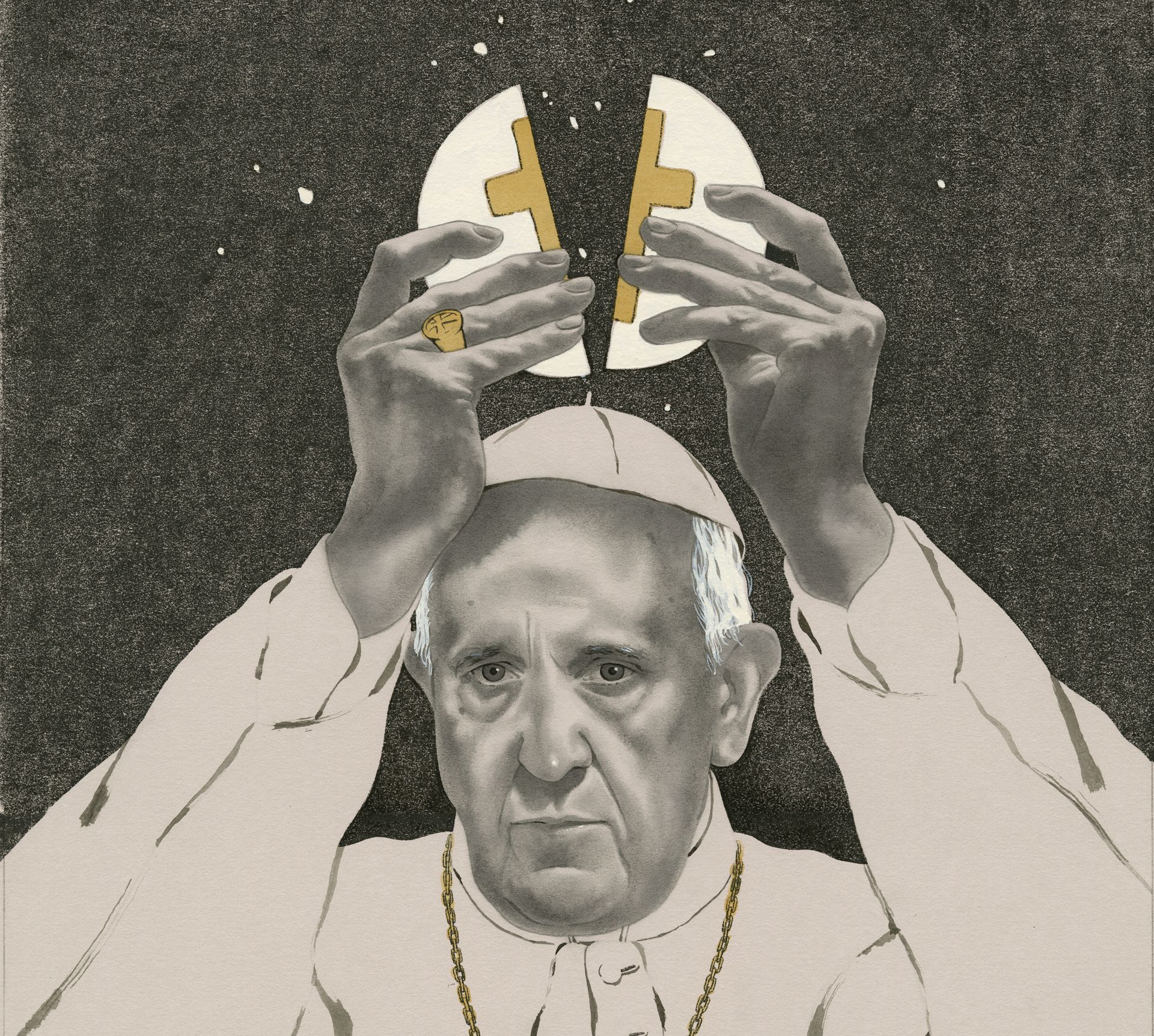


You must be logged in to post a comment.