


NEWS: COMMENTARY
by Bradley Eli, M.Div., Ma.Th. • ChurchMilitant.com • July 3, 2018 3 Comments
America’s Christians are hoping President Donald Trump’s reshaping of the U.S. Supreme Court will bring death to the Culture of Death that supports abortion, euthanasia, same-sex “marriage” and the killing of consciences of those forced to participate in this deadly culture.
Cases destined to come before the High Court will determine who gets the rights to “life, liberty and the pursuit of happiness” proclaimed in the Declaration of Independence. Pro-lifers and Democrats are all abuzz about whether Trump’s future mix of justices will overturn Roe v. Wade that took away what was previously called an “unalienable right” to life from some 60 million Americans by legalizing abortion in 1973. They’re spurred on in this regard by Trump’s well-known campaign promise to nominate justices who would overturn Roe v. Wade.
But such a monumental decision by the Supreme Court would simply allow states to determine who gets to live and who dies. A more sudden way this case may come before the Supreme Court — and one which would immediately kill the abortion industry — is for Trump to sign an executive order establishing personhood for unborn babies and thus guaranteeing their right to life under the Fourteenth Amendment.
Such an executive order may not be far off. Trump, in his letter to the National Right to Life Committee (NRLC) on June 28, declared that children in the womb have a fundamental right to life.
In this letter to NRLC, Trump stated, “We all have a duty to defend the most basic and fundamental human right — the right to life. As President, I am dedicated to protecting the lives of every American, including the unborn.”
If the president turns his dedication into an executive order, the Supreme Court’s vetting of its constitutionality would dwarf the controversy that arose over the High Court’s examination and recent approval of Trump’s highly publicized travel ban.
Trump’s move toward legally establishing personhood for the unborn already enteredinto legal text last October when the U.S. Department of Health and Human Services (HHS) released their 2018–2022 plan stating that life begins at conception and, therefore, deserves legal protection.
In the introduction of this plan, the government agency declared, “HHS accomplishes its mission through programs and initiatives that cover a wide spectrum of activities, serving and protecting Americans at every stage of life, beginning at conception.” These regulations are on a collision course with the so-called right to abortion and this collision will ultimately occur in the midst of Trump’s future mix of Supreme Court justices.
As President, I am dedicated to protecting the lives of every American, including the unborn.Tweet
But regardless of how courts will view a baby’s right to life, another pressing issue for the Supreme Court will be vetting a doctor’s right to refuse to kill babies. The push for doctors and health care professionals to participate in this deadly practice was resisted by Trump in January when he formed, within HHS, the Conscience and Religious Freedom Division. In the accompanying press release, HHS explained the role of this new division is to “restore federal enforcement of our nation’s laws that protect the fundamental and unalienable rights of conscience and religious freedom.”
The division pledges to protect the rights of health care providers who refuse to perform, accommodate or assist in sterilizations, abortions and other procedures that violate their religious beliefs. A doctor’s freedom to follow their conscience, based on sincerely held religious beliefs, will be weighed by the Supreme Court against a women’s fallacious right to kill her unborn child.
This same division will also protect health care providers who refuse to kill their patients. The deadly practice of physician-assisted suicide was broadcast in the 1990’s by Dr. Jack Kevorkian, a medical pathologist who helped dozens of terminally ill people commit suicide. It wasn’t until the highly publicized suicide of Brittany Maynard in 2014, however, that assisted-suicide became widely accepted. Eight states and Washington, D.C. have legalized suicide.
Not only will the Supreme Court have to uphold the liberty of Americans to reject killing the elderly and the infirm, but the practice itself may also come under their purview. Trump’s latest addition to the Supreme Court, Justice Neil Gorsuch, has written that such a practice itself violates the natural law principle that human life is intrinsically valuable.
The High Court must also balance the right to same-sex “marriage” it established in the 2015 case of Obergefell v. Hodges with the rights of Americans to refuse to serve what they understand are sham marriages. The Supreme Court punted two such cases back to the lower courts. The first involved a Christian baker from Colorado, who refused to make a wedding cake for a same-sex wedding. The second case involved a florist from the state of Washington, who likewise refused to make flowers celebrating a so-called same-sex wedding.
Neither case addresses the central issue of business owners’ right of declining service to same-sex couples who attempt to marry. In deciding the case of Colorado’s Masterpiece Cakeshop, Justice Anthony Kennedy admitted that this issue is not yet settled. Speaking of the Christian baker, Jack Phillips, Kennedy, in his majority opinion, verified there’s still a “delicate question of when the free exercise of his religion must yield to an otherwise valid exercise of state power” to regulate same-sex “marriage.”
He added that “the outcome of some future controversy involving facts similar to these” is yet to be decided by the High Court. What makes it certain that such a case will come before the Supreme Court is the fact that many other cases are now working their way through the lower courts involving, not only bakers, but also florists, printers, photographers, videographers and calligraphers who all agree that their religious beliefs won’t allow them to offer their services for same-sex wedding ceremonies.
++++++++++++++++++++++++++++++++++++++++++++++++++++++++++++++++++++++++++
|
||||||
|

Justice Anthony Kennedy recently announced his resignation from the United States Supreme Court. Good riddance.
What Shakespeare said about a traitor’s life in Macbeth applies equally well to Kennedy’s life on the Supreme Court: “Nothing in his life became him like the leaving it.” In other words, Kennedy’s decision to resign during the current presidency might be his greatest contribution to the Court, since it gives President Donald Trump the opportunity to feasibly replace him with a much better justice. After all, grave errors define Kennedy’s legacy: deepening our culture’s delusions about sexuality in particular and human nature in general through his rulings on homosexuality, exacerbating the largest mass killing of innocent human life in history through his rulings on abortion, and officially confirming relativism as America’s state religion through his ruling in Planned Parenthood v. Casey – the one in which he made the definitively relativistic claim, “At the heart of liberty is the right to define one’s own concept of existence, of meaning, of the universe, and of the mystery of human life.”
That relativism “at the heart of” America’s concept of liberty has doomed the American political system from its beginnings. Many Americans claim their country’s system to be among the best in history due to its “success,” but the catastrophic effects of its relativism prove otherwise. And, as opposed to claims to the contrary, that relativism is not accidental to the system, but rather intrinsic to it, and its disastrous effects are not just recent, but were also present during the time of the Founding Fathers. So, as America’s 250th anniversary nears, it is vital to take stock of its legacy – a legacy stemming largely from its most relativistic doctrine: the false teaching that Church and state should be separate, and that religious freedom is an inalienable right. Granted, the Founding Fathers were not relativists, and many indeed were Christians, but the American doctrine on religion – regardless of the intentions originally behind it – is relativistic, not Christian. Claiming that people have a moral right to religious freedom places all religions, true and false, on the same moral level, thereby divorcing morality from truth, is the essence of relativism.
This has allowed perhaps the most catastrophic effect of relativism to occur in America from the time of the Founding Fathers all the way to now: the unchecked spread of heresies, false religions, and moral error. That could be the most pressing issue in our nation because it could lead countless souls to eternal damnation, a fate infinitely worse than the merely temporal suffering and death on which our nation’s laws are exclusively focused. Governments should always have as their ultimate goal the long-term well-being of their citizens, but the secularity of America’s political system causes it to be shortsighted, fixated on the ephemeral at the expense of the everlasting.
While only orthodox Catholics can recognize the danger of beliefs opposed to traditional Catholic doctrine, all conservative Christians – as well as all non-Christians who embrace natural law – can acknowledge another danger caused by relativism in our country: abortion. If morality is divorced from objective truth, then the moral value of different groups of people becomes relative, leading to the dehumanization of certain groups. The widespread acceptance of abortion in America reveals this; an unborn child’s moral value is perceived to be relative to the mother’s wishes, causing wanted children to be cherished and unwanted ones to be murdered. As a result, America now, by the permission of its own laws, participates in the biggest mass killing of innocent human life in history. We comfort ourselves about the supposed superiority of our political system by comparing it to the barbarism of the Nazis, yet we have our own ongoing, much larger-scale genocide on our hands, and we have the audacity to celebrate it. This is unspeakably heinous not only because untold numbers of people are dying, but also because those dying have not been baptized, so their eternal salvation is uncertain, and countless women are committing an objectively grave sin, so their salvation (as well as that of the people encouraging them) is in jeopardy. Repentance can restore these women’s hope for salvation, but our relativistic culture does all it can to preclude their repentance by relabeling abortion as an empowerment of themselves, not a sin against their children.
Pro-choice advocates may disagree with this assessment of abortion, but almost any American can see the danger of Kennedy’s relativistic words when they are applied consistently, not just to the unborn, but to all human life. If one should be free to “define one’s own concept … of the mystery of human life” even to the point of being allowed to devalue and kill unborn human life, as Kennedy intended in writing those words to defend Planned Parenthood, then why should the slaveholders of American history not have been free to “define their own concept of human life” to the point of being allowed to devalue and enslave black human life? If the definition of morally valuable human life is up for grabs in the absence of a state religion, how can the state prevent heinous abuses of human rights like the South’s dehumanizing system of slavery? In The Civil War as a Theological Crisis’s synopsis of the La Civiltà Cattolica article “Disunion in the United States,” written by European Jesuits during the American Civil War, Mark Noll explains how the Jesuits believed America’s conflict over slavery to have arisen from this absence of a state religion:
While there was much to praise in American religion, the Jesuits nonetheless saw a “great mistake,” a “missing principle … dissolving a great union.” That missing element was “religious unity.” Reconciliation, so the Jesuits thought, would elude the Americans “because they are divided on a moral question, and moral questions are fundamentally grounded in religious dogma.” As they viewed the American conflict, it seemed to them that different American factions were using the Scriptures to mask their economic and political interests. But if Americans understood the true character of religious authority, then it would be possible to use the Bible with greater effect. If the Americans lived where their rights and their trust in Scripture “were assured by an authority respected by both parties, then the Bible could come into the conflict not as a plaything but as in a contest of truth over against falsehood.” Such an authority, which obviously meant the Roman magisterium, could exercise “an almost invincible strength over the two parties, so that one would surrender or that both would be reconciled to each other.” But “dogmas there are very free, as are also moral principles, and everything in these spheres is mere probability. Between two equal possibilities it is hardly a marvel that the two opposite factions come without scruple to opposite conclusions. Their independence makes it impossible to find a solution to their quarrel, both because they lack a central religious authority and because they lack moral honesty, which is itself a consequence of not having a central religious authority.”
This is as true of the Culture War over religion, morality, and abortion today as it was of the Civil War over slavery back then. Because the American political system is based on the separation of Church and state, relativism and its attendant errors, devaluations of human life, and conflicts fill the void left by the Church in the political sphere. After all, what better description of relativism could there be than a state in which “dogmas … are very free, as are also moral principles, and everything in these spheres is mere probability”?
If European Jesuits could recognize the relativism of our political system even back then, when our country overwhelmingly considered itself Christian, then relativism has been part of our cultural fabric for a long time; it is not just a recent aberration. Indeed, it is part of the very foundation of our country, which was founded as a haven for heresies, a place where no Puritans, Huguenots, or other exiles would be officially encouraged to conform to one objective truth.
As we survey the wasteland of enslaved human beings, murdered babies, and – worst of all – damned souls, we have to ask ourselves: is the American system really the one we want?
Editor’s note: This article comes from an anonymous contributor.

Even as Christian thinkers respond to divorce, gay “marriage,” and mass feticide, we should also give extra thought to the patriotic question, which is more closely related to the pro-life movement and the defense of marriage than we might at first suppose. As C.S. Lewis has pointed out, the different facets of natural law stand or fall together, so if the sanctity of the conjugal vow, the dignity of unborn life, and the complementarity of the sexes embody real values, then so, too, does loyalty to homeland, community, and heritage. Those of us who are alarmed to see marriage trivialized and redefined might do well to think long and hard about how citizenship has been trivialized and redefined.
During most of the history of the West, citizenship was understood to be a jealously guarded privilege and honor, not a universal entitlement entailing access to a plethora of welfare benefits. In the Aristotelian scheme, the most legitimate republican form of government is a polity, yet even in said polity, citizenship would be restricted to able-bodied men who bear arms; to have a vote, one would have to be one of those who stands in harm’s way to protect the community. Even in more recent times, with the ascendance of classical liberalism, it was taken for granted that the franchise would be restricted according to a variety of criteria, such as property ownership. While I may not be numbered among the classical liberals, I can see their point here: It is difficult to imagine how we might prevent a large-scale egalitarian democracy from degenerating into a “race to the bottom,” whereby a demagogic system confiscates middle-class wealth to fund bread and circuses.
None of this is to suggest that we try restoring citizenship to exactly what it was in ancient Athens, or eighteenth-century Britain, or whenever, any more than taking seriously the long and instructive history of the family automatically means a return to arranged marriages. The point is that once upon a time citizenship was heavily laden with status and significance; it meant something. Now it has become much more inclusive, but at the price of having been radically devalued. It has been reinvented as if it were a romanticized Costco membership, much as marriage has in our time been reinvented as a romanticized hook-up. Sentimental rhetoric about Ellis Island notwithstanding, the truth is that no mere bureaucratic ruling can transform a foreigner into a full-fledged American, anymore than it could turn two men into husband and wife.
Those who find this last claim objectionable are advised to look to Summa Theologiae I – II, Q. 105, Art. 3, wherein St. Thomas Aquinas discusses citizenship by way of ancient Israel. Under the Law, says Aquinas, whenever foreigners wished to be admitted into complete fellowship with the Israelites, “a certain order was observed”:
For they were not at once admitted to citizenship: just as it was law with some nations that no one was deemed a citizen except after two or three generations, as the Philosopher says (Politics III, 2).
The reason for this was that if foreigners were allowed to meddle with the affairs of a nation as soon as they settled down in its midst, many dangers might occur, since the foreigners not yet having the common good firmly at heart might attempt something hurtful to the people.
In other words, according to precepts Aquinas cites as “suitable” (convenientia) for directing relations “with foreigners” (extraneis), only the descendants of new arrivals would be eligible for citizenship. The reason for this seems to be that the Israelites understood true assimilation into a living community to be a profound, challenging process, one requiring not years, nor even decades, but generations. And lest we miss a couple of other important implicit points, note that the would-be citizens here are presumably not participating in massive overwhelming waves of illegal settlement, and that their hearty espousal of Israelite customs, heritage, and language seems to have been taken for granted.
That there is at least a grain of truth to Aquinas’s account of naturalization is easily demonstrable, and there is no need to surf the Internet for accounts of the US soccer team being booed while playing the Mexican team in Los Angeles. Unless one lives in the heart of Appalachia or an Amish homestead, it is nigh impossible in America today to avoid encountering US citizens who speak of “going back to my country for the holidays,” or who reminisce about life “back in my country,” or who even—in the case of one of my students who had been adopted from abroad as a small child—explicitly and vehemently deny being American. Just to be clear, this is not to censure people for revealing in unguarded moments their more or less normal sentiments toward their respective birthplace. Rather, it is to question bureaucrats and intellectuals who insist that an unlimited number of foreigners may move into a community without said community being turned into another country.
Getting back to Aquinas, it should be noted that while he brings up Aristotle’s Politics, he goes further than the Aristotelian passage by considering, and then condoning, the making of distinctions with respect to national origin. For although in exceptional circumstances “it was possible by dispensation for a man to be admitted to citizenship on account of some act of virtue,” for the most part among the Israelites it was only
in respect of certain nations that had close relations with the Jews (viz., the Egyptians among whom they were born and educated, and the Idumeans, the children of Esau, Jacob’s brother), that they should be admitted to the fellowship of the people after the third generation; whereas others, (with whom their relations had been hostile, such as the Ammonites and Moabites) were never to be admitted to citizenship; while the Amalekites, who were yet more hostile to them, and had no fellowship of kindred with them, were to be held as foes in perpetuity, for it is written (Ex. 17:16): “The war of the Lord shall be against Amalec from generation to generation.”
We see that historical ties conferred upon certain incoming peoples easy access to citizenship—“easy” by ancient standards, that is—while other peoples were to be permanently excluded, and still others not merely excluded but regarded as being in a state of longstanding enmity. Thus there is an extraordinary contrast between Aquinas’s remarks and the outlook of Catholics offended by the Trump administration’s quarantine of terror-ridden Islamic countries. Setting aside the question of whether Aquinas is right or wrong, or how he might respond to any specific contemporary question, or how his pronouncements might be balanced with those of other teaching authorities, it is obvious that his sensibilities and those expressed by most diocesan newspapers are mutually exclusive.
None of this should be understood as a call to recreate nationhood or citizenship per the Old Testament, medieval Thomist thought, or any other bygone era or school, much less to enlist St. Thomas in the cause of populist conservatism. It has always seemed to me to be a misuse of tradition to cherry-pick teachings from the distant past and then try applying them to the present in a cookie-cutter fashion, without accounting for historical context. The danger today is not that too many are selectively and dishonestly quoting Aquinas to advance their own political agenda in ways that are unfaithful to the Angelic Doctor’s beliefs and intentions.
The real point, the metapolitical point, so to speak, is that Catholics have fallen into an appalling habit of censoring the very voices from the past that should be helping us define ourselves. We need to be more willing to look to our traditions, immerse ourselves in them, and learn from them, instead of selectively filtering them so as to make them neatly compatible with the relatively recent, politically correct fixation with inclusiveness. That is, if they are quoted at all. For whatever we make of Question 105, Article 3, the extent to which it has been totally and completely irrelevant to the Catholic discourse about immigration is undeniable—as well as positively surreal from the standpoint of anyone who takes the notion of magisterial continuity seriously.
We have not, after all, been talking about some obscure figure who vaguely and fleetingly touched upon an issue of mild interest. We have been talking about one of the foremost teachers of the Church speaking directly to one of the most searing controversies of our time. Were I unwise enough to rely solely upon my diocesan establishment for information, however, I would not merely think that arguments in favor of more rigorous restrictions on citizenship are wrong; I would assume such arguments simply do not exist. I would not think that concerns about the long-term effects of indiscriminate mass immigration upon America’s communities, culture, politics, and economic system are misinformed; I would, along with Nancy Pelosi and Hollywood and the ACLU, think that there are no such concerns, only “hate.” Certainly, I would not have the slightest shadow of suspicion that Saint Thomas Aquinas has an opinion pertaining to the matter. Indeed, when it comes to what the Doctor of the Church says, it is not just as if nobody knows. It is almost as if nobody cares.
Editor’s note: Pictured above is St. Thomas Aquinas painted by Francisco de Zurbaran.

Jerry D. Salyer holds a Bachelor of Science degree in Aeronautics from Miami University and a Master of Arts from the Great Books Program of St. John’s College, Annapolis. A veteran of the US Navy, Mr. Salyer now works as an educator and as a freelance writer.
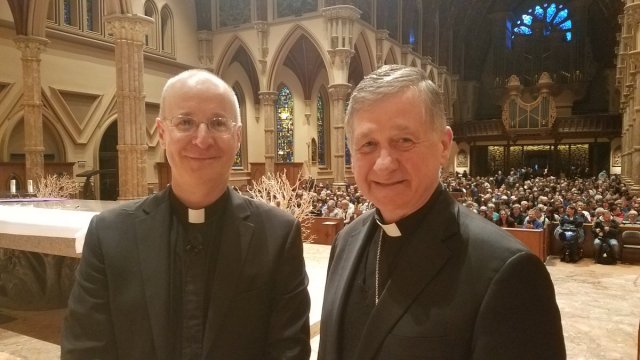
Father James Martin, S.J. and Cardinal Blaise Cupich
Cardinal Cupich’s Revolutionary Conscience
https://www.thecatholicthing.org/2018/02/21/cardinal-cupichs-revolutionary-conscience/
Fr. Gerald E. Murray
Wednesday, February 21, 2018
The Church has always taught that marriage is intrinsically indissoluble by the express will of God. That the unbreakable unity of marriage is not an ideal, in the sense of an as yet unattained goal towards which married couples strive, but rather is the very reality, the very nature of marriage. The Church teaches that fidelity to marriage vows is not merely something that you should strive for in seeking to arrive at the ideal of marriage, but rather is a serious obligation inherent in the nature of marriage.
Thus infidelity is not an excusable failure to live up to an ideal that is difficult, perhaps even impossible to achieve. Infidelity is rather a positive rejection of a solemnly promised vow to live in accordance with the divinely willed nature of marriage. In short, the Church teaches that God joins a man and a woman in an indissoluble bond and offers them the grace to be faithful for life to the obligations inherent in this state of life. Any infidelity to these obligations does not cause that marriage to die or disappear. And marriage is not subject to dissolution by the retroactive withdrawal of consent at any point after the exchange of vows.
Ever since the publication of Amoris Laetitia, doubts have been cast upon the necessity of adhering to this understanding of marriage. Chicago’s Cardinal Blasé Cupich recently spoke on Amoris Laetitia at St. Edmund’s College in Cambridge, England. His line of argument undermines the Church’s teaching on marriage, and everything else, by treating one’s lived experience as some sort of divine revelation. This means that what one does becomes the standard of what one should believe.
Cardinal Cupich speaks about a synodal church in which:
“there is no hierarchical distinction between those with knowledge and those without. As such, the most important consequence of this call to accompaniment ought to be greater attention to the voices of the laity, especially on matters of marriage and family life, for they live this reality day to day.”
Laymen are often better instructed in Catholic doctrine than their pastors. The shepherds should rejoice when they find their flock to be knowledgeable and faithful believers. But what if they reject Church teaching? Is that rejection to be embraced as a sign of God’s action in their lives?
Cardinal Cupich argues:
“It goes without saying that this will also mean rejecting an authoritarian or paternalistic way of dealing with people that lays down the law, that pretends to have all the answers, or easy answers to complex problems, that suggests that general rules will seamlessly bring immediate clarity or that the teachings of our tradition can preemptively be applied to the particular challenges confronting couples and families. In its place a new direction will be required, one that envisions ministry as accompaniment, an accompaniment, which we will see, is marked by a deep respect for the conscience of the faithful.”
It is deeply demoralizing to hear a Catholic bishop describe the task of teaching the faithful the truths of the Gospel as being an exercise of authoritarianism or paternalism that “pretends” to answer the difficult questions or problems people have. When he claims that it is wrong to think that “the teachings of our tradition” can “preemptively” meet “particular challenges confronting couples and families,” he is reducing Church teaching to an inadequate set of possibly useful suggestions. The voice of the Lord speaking through the doctrine of his Church is no longer reliable or universally applicable. Instead, we must listen to the conscience of married couples, which is even seen as a new source of divine teaching.
Cardinal Cupich claims:
“accompaniment also is an act of forming Church teaching. There is a continuum of accompaniment which undergirds this entire range of actions by the Church. And thus . . . the core goal of formal teaching on marriage is accompaniment, not the pursuit of an abstract, isolated set of truths. This represents a major shift in our ministerial approach that is nothing short of revolutionary.” [Emphasis added.]
What does this revolution involve? Cardinal Cupich says:
“When taken seriously, this definition demands a profound respect for the discernment of married couples and families. Their decisions of conscience represent God’s personal guidance for the particularities of their lives. In other words, the voice of conscience – the voice of God – or if I may be permitted to quote an Oxford man here at Cambridge, what Newman called “the aboriginal vicar of Christ” – could very well affirm the necessity of living at some distance from the Church’s understanding of the ideal, while nevertheless calling a person “to new stages of growth and to new decisions which can enable the ideal to be more fully realized” (AL 303).
Thus a decision of conscience, for instance, to leave one’s wife and civilly “remarry,” is labeled “God’s personal guidance” that would grant divine approval to one’s blameless embrace of the “necessity” of what is euphemistically called “living at some distance from the Church’s understanding of the ideal.” Cardinal Cupich is telling us that God will inspire someone to serenely decide in his conscience that it is necessary for him to commit adulterous acts, and that this is therefore God’s will for him.
Is there any possible way that this opinion is reconcilable with Catholic teaching on the nature and proper formation of conscience, the necessity to avoid mortal sin at all times, and the impossibility of God approving of what He condemns, i.e., adultery?
What is revolutionary here is not any change in the Church’s teaching on marriage (which is impossible), but rather the attempt to impugn that teaching by claiming that since some people decide that they would rather not be faithful to their marriage vows, they may in good conscience claim that God does not require them to be faithful; rather they should calmly recognize the “necessity” of embracing what has always been taught by the Church to be a gravely immoral lifestyle.
© 2018 The Catholic Thing. All rights reserved. For reprint rights, write to: info@frinstitute.org The Catholic Thing is a forum for intelligent Catholic commentary. Opinions expressed by writers are solely their own.
The Rev. Gerald E. Murray, J.C.D. is a canon lawyer and the pastor of Holy Family Church in New York City.
Cardinal Cupich’s Revolutionary Conscience
https://www.thecatholicthing.org/2018/02/21/cardinal-cupichs-revolutionary-conscience/
Fr. Gerald E. Murray
Wednesday, February 21, 2018
The Church has always taught that marriage is intrinsically indissoluble by the express will of God. That the unbreakable unity of marriage is not an ideal, in the sense of an as yet unattained goal towards which married couples strive, but rather is the very reality, the very nature of marriage. The Church teaches that fidelity to marriage vows is not merely something that you should strive for in seeking to arrive at the ideal of marriage, but rather is a serious obligation inherent in the nature of marriage.
Thus infidelity is not an excusable failure to live up to an ideal that is difficult, perhaps even impossible to achieve. Infidelity is rather a positive rejection of a solemnly promised vow to live in accordance with the divinely willed nature of marriage. In short, the Church teaches that God joins a man and a woman in an indissoluble bond and offers them the grace to be faithful for life to the obligations inherent in this state of life. Any infidelity to these obligations does not cause that marriage to die or disappear. And marriage is not subject to dissolution by the retroactive withdrawal of consent at any point after the exchange of vows.
Ever since the publication of Amoris Laetitia, doubts have been cast upon the necessity of adhering to this understanding of marriage. Chicago’s Cardinal Blasé Cupich recently spoke on Amoris Laetitia at St. Edmund’s College in Cambridge, England. His line of argument undermines the Church’s teaching on marriage, and everything else, by treating one’s lived experience as some sort of divine revelation. This means that what one does becomes the standard of what one should believe.
Cardinal Cupich speaks about a synodal church in which:
“there is no hierarchical distinction between those with knowledge and those without. As such, the most important consequence of this call to accompaniment ought to be greater attention to the voices of the laity, especially on matters of marriage and family life, for they live this reality day to day.”
Laymen are often better instructed in Catholic doctrine than their pastors. The shepherds should rejoice when they find their flock to be knowledgeable and faithful believers. But what if they reject Church teaching? Is that rejection to be embraced as a sign of God’s action in their lives?
Cardinal Cupich argues:
“It goes without saying that this will also mean rejecting an authoritarian or paternalistic way of dealing with people that lays down the law, that pretends to have all the answers, or easy answers to complex problems, that suggests that general rules will seamlessly bring immediate clarity or that the teachings of our tradition can preemptively be applied to the particular challenges confronting couples and families. In its place a new direction will be required, one that envisions ministry as accompaniment, an accompaniment, which we will see, is marked by a deep respect for the conscience of the faithful.”
It is deeply demoralizing to hear a Catholic bishop describe the task of teaching the faithful the truths of the Gospel as being an exercise of authoritarianism or paternalism that “pretends” to answer the difficult questions or problems people have. When he claims that it is wrong to think that “the teachings of our tradition” can “preemptively” meet “particular challenges confronting couples and families,” he is reducing Church teaching to an inadequate set of possibly useful suggestions. The voice of the Lord speaking through the doctrine of his Church is no longer reliable or universally applicable. Instead, we must listen to the conscience of married couples, which is even seen as a new source of divine teaching.
Cardinal Cupich claims:
“accompaniment also is an act of forming Church teaching. There is a continuum of accompaniment which undergirds this entire range of actions by the Church. And thus . . . the core goal of formal teaching on marriage is accompaniment, not the pursuit of an abstract, isolated set of truths. This represents a major shift in our ministerial approach that is nothing short of revolutionary.” [Emphasis added.]
What does this revolution involve? Cardinal Cupich says:
“When taken seriously, this definition demands a profound respect for the discernment of married couples and families. Their decisions of conscience represent God’s personal guidance for the particularities of their lives. In other words, the voice of conscience – the voice of God – or if I may be permitted to quote an Oxford man here at Cambridge, what Newman called “the aboriginal vicar of Christ” – could very well affirm the necessity of living at some distance from the Church’s understanding of the ideal, while nevertheless calling a person “to new stages of growth and to new decisions which can enable the ideal to be more fully realized” (AL 303).
Thus a decision of conscience, for instance, to leave one’s wife and civilly “remarry,” is labeled “God’s personal guidance” that would grant divine approval to one’s blameless embrace of the “necessity” of what is euphemistically called “living at some distance from the Church’s understanding of the ideal.” Cardinal Cupich is telling us that God will inspire someone to serenely decide in his conscience that it is necessary for him to commit adulterous acts, and that this is therefore God’s will for him.
Is there any possible way that this opinion is reconcilable with Catholic teaching on the nature and proper formation of conscience, the necessity to avoid mortal sin at all times, and the impossibility of God approving of what He condemns, i.e., adultery?
What is revolutionary here is not any change in the Church’s teaching on marriage (which is impossible), but rather the attempt to impugn that teaching by claiming that since some people decide that they would rather not be faithful to their marriage vows, they may in good conscience claim that God does not require them to be faithful; rather they should calmly recognize the “necessity” of embracing what has always been taught by the Church to be a gravely immoral lifestyle.
© 2018 The Catholic Thing. All rights reserved. For reprint rights, write to: info@frinstitute.org The Catholic Thing is a forum for intelligent Catholic commentary. Opinions expressed by writers are solely their own.
The Rev. Gerald E. Murray, J.C.D. is a canon lawyer and the pastor of Holy Family Church in New York City.
|

Traditionalist priests now account for 20 per cent of ordinations in France
The number of new ordinations in France has fallen this year, from 133 in 2017 to 114.
According to figures from La Croix, 82 of these new priests are diocesan, while the rest are members of various orders and societies of apostolic life.
Paris and Bordeaux are the dioceses with most ordinations – six each – however, this still marks a considerable decline for Paris, which had 10 in 2017 and 11 in 2016.
Lyon, Versailles and Fréjus-Toulon follow with five each, then Evry with four.
However, a total of 58 dioceses had no ordinations at all.
In contrast, the “traditionalist” communities, where priests primarily celebrate Mass in the Old Rite, are continuing to grow. La Croix calculates that 20 per cent of new priests this year come from communities classed as “traditional” or “classical”.
These include three ordinations for the Institute of the Good Shepherd, two for the Priestly Fraternity of St Peter (FSSP) and two for the Institute of Christ the King. Younger priests are particularly well-represented among these groups.
La Croix also reports that France has witnessed a rise in late vocations in recent years as the number of older people studying for the priesthood steadily rises. These include the new Archbishop of Paris, Michel Aupetit, who entered seminary at the age of 39.
A survey by the French bishops’ conference of first and second-year seminarians in 2016 found that four per cent were aged 36-40, while a further two per cent were 41-45. This means that by the time they are ordained, around a dozen will be 42 or older.

|
CRISIS MAGAZINE
|
{ABYSSUM}
Socialism never goes away. A quarter century after its collapse in Eastern Europe and Russia and the success of market-oriented reforms elsewhere, many people once again see it as the ideal.
That’s true even in the Church. Not so very long ago Saint John XXIII could reaffirm the teaching of Pope Pius XI that “No Catholic could subscribe even to moderate socialism.” And Saint John Paul II could point to “the fundamental error of socialism,” that it “maintains that the good of the individual can be realized without reference to his free choice.”
That was then and this is now. Today we find people, some of them serious and well-informed, who call themselves Catholic socialists. So it’s not just a matter of bad or stupid people believing false and destructive things. There are good and intelligent people who believe those things. Why is that?
Many people find socialism irresistible. Life is unfair, as we all know, but unfairness can often be remedied. When that’s so, justice calls for the remedy to be applied. And if similar situations keep arising—which they do—it seems right to get organized and make the remedy a matter of routine backed by public authority so it can be relied on. After all, shouldn’t government establish justice?
Apply that line of thought again and again and you end up with comprehensive bureaucratic control of social life for the sake of fairness. In a prosperous modern society, fairness would include providing everyone with all things necessary for well-being. Anything short of that would leave some harms unremedied.
It’s that tendency that I’m calling “socialism.” So I’m using the word not in the narrow sense of state ownership of business enterprise but in a broader sense to refer to open-ended expansion of government activity to redress life’s unfairness.
This more general definition takes account of problems—like the need for markets to set prices and allocate resources—that have arisen in the course of the socialist project. But since the fundamental project continues, why stick with an obsolete nineteenth century definition? We don’t do that with “liberalism” or “civil rights,” so it seems odd to do it with “socialism.”
Whether it’s the older or newer version, it’s easy to find serious problems with socialism. It’s inefficient and doesn’t deliver on its promises. When it fixes one thing it deranges others. Government can’t know much about what’s going on at the individual level, so it redefines “justice” as “equality” and so deprives people of responsibility for their situation. And it concentrates power, supplants autonomous institutions like family and religion, and makes it impossible for important centers of thought and action independent of the state bureaucracy to exist.
The end result is a non-functional society with an arbitrary, corrupt, and ineffective government. When government controls everything, nothing controls government, and those who run it can do what they want. And since socialism destroys personal feelings of responsibility—how can they develop when people don’t depend on each other in daily life?—those in power lose any motive to sacrifice their personal advantage to the public good.
Even if those in charge manage for a time to run a principled and efficient government, socialism causes problems. The reason is that it gives all power to a false vision of the human good.
Every state claims the right to back its decisions with deadly force and demand the ultimate sacrifice. Today’s state claims the further right to remake human relations and social understandings. That’s what antidiscrimination laws and similar initiatives are about. It’s inevitable that the principles behind an institution with such comprehensive authority will take on a religious quality. And since the purpose of the state is to enforce those principles, they will become in effect an established and intolerant religion.
So if the goal of the state is to guarantee and equalize material goods, and even intangible goods like social respect, then equal status and comfort for everyone will be seen as the highest social goal. But if that’s the highest good, people will feel that the world owes them the same no matter what they do. Under such circumstances, how concerned will they be about fulfilling personal obligations?
Such tendencies don’t end well. Even so, proponents of socialism find ways to shrug off objections. They can argue that fixes can be found for some problems and others are misconceived or out of order. Efficiency and accountability can be improved by various institutional arrangements. Side effects can be identified and dealt with. Talking about “people’s responsibility for their own situation” is blaming the victim and shouldn’t be part of the discussion. And if what props up institutions like family, local community, and religion is government failure to deal with social unfairness then they are the opiate of the masses and don’t deserve preservation.
Worries about socialism becoming an intolerant religion that promotes both tyranny and egoism are also thought to be absurd. There are Christian socialists, and the secular ones talk about diversity, tolerance, freedom, solidarity, and sacrifice for the common good. Why not accept that their goals and values are what they say they are? And since socialism is simply an effort to advance justice, why not view socialist criticism as well-motivated?
The arguing never ends. In the absence of a resolution the uncertainty of the future and the compelling presence of human need decide the issue for many people. At every stage of the process leading to full socialism, human problems that could be remedied seem more pressing than possible institutional issues. So many people think they should err on the side of justice and generosity rather than worrying about problems that may never materialize.
The most fundamental consideration is the influence of the times. The sense of the eternal and transcendent has been weakening, and that leaves social action as the main focus of the Church. A technocratic approach to social life makes bureaucratic management—which eliminated smallpox and put a man on the moon—seem the obvious way to deal with problems. And people accept the democratic claim that action by the state is action by the people.
Put those things together and you get the view that Catholics should be socialists. After all, shouldn’t we support efforts to advance universal justice? To avoid that result—as experience, reason, and the teaching of Saints John XXIII and John Paul II tell us we must—we need to change the basic understandings that lead to it.
First, we need to understand that government provides a framework and not a vehicle for our actions. Acts of government and acts of the people are two different things, and confusing the first with the second is the road to totalitarianism and other madness.
We also need an understanding of man based on classical natural law rather than technology. The problems of modern technological society won’t be solved by a more modern and technological society. To bureaucratize a social world composed of natural institutions like the family and cultural community, and so convert it into an industrial process, is to destroy rather than perfect it.
And finally, we need a rebirth of the sense of the eternal and transcendent that puts earthly affairs in perspective so we can deal with them from a standpoint of overall prudence rather than this-worldly eschatology. From the first point of view, it’s the predictable effects of socialism that matter; from the second, it’s the sacredness of social justice as a cause. The first approach means better decisions.
Of these, the most important is the last. As Saint John XXIII noted in Mater et Magistra: “The most perniciously typical aspect of the modern era consists in the absurd attempt to reconstruct a solid and fruitful temporal order divorced from God.” Without God, man and the state become gods. And that way leads to disaster.

James Kalb is a lawyer, independent scholar, and Catholic convert who lives in Brooklyn, New York. He is the author of The Tyranny of Liberalism: Understanding and Overcoming Administered Freedom, Inquisitorial Tolerance, and Equality by Command (ISI Books, 2008), and, most recently, Against Inclusiveness: How the Diversity Regime is Flattening America and the West and What to Do About It (Angelico Press, 2013).





You must be logged in to post a comment.