NFL Epiphany On Prayer? January 4, 2023 Catholic League president Bill Donohue comments on the NFL’s reaction to Damar Hamlin’s serious injury: The day after Buffalo Bills safety Damar Hamlin went into cardiac arrest during Monday night’s NFL game, ESPN analyst Dan Orlovsky said on air, “I heard the Buffalo Bills organization say that we believe in prayer, and maybe this is not the right thing to do, but it’s just on my heart and I want to pray for Damar Hamlin right now” (my italics). And so he did. But why wouldn’t it be the right thing to do? Isn’t that what most Americans do in times of adversity? They pray. They don’t pray to God that he might send in the therapy dogs—they pray that he might intervene and offer relief to the suffering. Unfortunately, Orlovsky was not acting irrationally. ESPN, like the NFL, embraces the politics of the Left, and that means it is strongly committed to the secular agenda. However, it appears that the sports commentator has not been called on the carpet, with good reason: the outpouring of prayer has been so overwhelming that only a fool would want to sanction someone for praying in public for Hamlin. The NFL is also experiencing a new tolerance for prayer. Every one of the 32 NFL teams amended their Twitter photo to say, “Pray for Damar.” In doing so, they followed the lead of the players who knelt in prayer on Monday night. The NFL’s left-wing commissioner, Roger Goodell, got the memo and did not want to be seen as an outlier, especially given that most of the players who prayed were black: being the woke kind of guy he is, he did not want to be branded as insensitive, or worse. Hamlin attended Central Catholic High School in Pittsburgh, and is loved by the school’s administrators and students for regularly revisiting his alma mater, and for his yeoman charitable work. His family issued a statement asking, “Please keep Damar in your prayers.” Public displays of group prayer at NFL games extends back to 1990. That is when the chaplains of the opposing teams, the New York Giants and the San Francisco 49ers, requested that the players huddle in prayer after the game. Giants tight end Howard Cross, one of the spiritual leaders on the team, explained, “We were just kneeling. …A simple act of kneeling is not aggressive. You’re surrendering at that moment.” Things have since changed. When the Colin Kaepernicks of today take a knee, it isn’t about prayer, and it certainly isn’t about surrendering to God. It’s about politics and victimhood. Things changed again in 2019. That is when New Orleans Saints linebacker Demario Davis was fined $7,000 by the NFL for violating its “personal message” rule. His crime: The devout Christian wore a headband with the phrase, “Man of God.” Rule 5, Section 4, Article 8 of the 2022 NFL Rulebook is titled, “Personal Messages.” Here is part of what it says. “The League will not grant helmet decals, arm bands, jersey patches, mouthpieces, or other items affixed to game uniforms or equipment, which relate to political activities or causes, other non-football events, causes or campaigns, or charitable causes of campaigns.” This policy was invoked against Davis for his religious message. Had he waited a year, following the Black Lives Matter riots of 2020, and decided to promote a left-wing cause on his headband, he would have been applauded by Goodell. Beginning in 2020, the NFL has refused to enforce its “personal messages” rule when it comes to “social justice” causes. In fact, it authorizes violations of its policy. On the apparel of NFL players today can be seen such catchy phrases as “It Takes All Of Us,” “Inspire Change,” “Stop Hate,” and “End Racism.” No “End Abortion” or “Pray to God” slogans are allowed. It even has stencil displays in the end zones that say, “Black Lives Matter.” In other words, acknowledging God is a problem in the NFL, but acknowledging a violent Marxist organization—one that is being investigated for massive tax fraud violations—is okay. It would be so great if the NFL’s newfound support for prayer signaled an epiphany. But we won’t get our hopes up. It is much more likely that the next time there is a “prayer-like” moment during a game, the therapy dogs will be unleashed on the field. Contact the VP for Corporate Communications: Brian.McCarthy@nfl.com
Phone: 212-371-3191
Posted inUncategorized|Comments Off on The day after Buffalo Bills safety Damar Hamlin went into cardiac arrest during Monday night’s NFL game, ESPN analyst Dan Orlovsky said on air, “I heard the Buffalo Bills organization say that we believe in prayer, and maybe this is not the right thing to do, but it’s just on my heart and I want to pray for Damar Hamlin right now” (my italics). And so he did.
The deceased Pope’s final message to the world: prayer is central for the life of human beings. Thus, Rosary beads are seen entwined in the hands of the late Pope Emeritus Benedict XVI as his body lies in state on January 3 in St. Peter’s Basilica, where tens of thousands over three days are lining up to pay their last respects (photo: Daniel Ibañez / CNA) Letter #1, 2023 Tuesday January 3: Benedict’s Funeral Emeritus Pope Benedict XVI‘s funeral Mass will be celebrated in St. Peter’s Basilica at 9:30 a.m. on Thursday, January 5, two days from now. You will be able view it live on EWTN here. *** Benedict died on Saturday, December 31 — the last day of 2022 — at his residence of the past 10 years in the Vatican Gardens, at the age of 95. *** Benedict’s last words: “Signore, ti amo !” (“Lord, I love you!”) As confirmed by his personal secretary Archbishop Georg Gänswein, Benedict’s last words were “Signore, ti amo !” (“Lord, I love you!”). And, though Benedict was born and raised in Germany, he pronounced his last words in Italian, having spent, in addition to many months in the 1960s during the Second Vatican Council (1962-65), the last four decades of his life, from 1982 until 2022 (40 years) in Rome. Unlike the death of St. John Paul II almost 18 years ago on April 2, in 2005, Benedict’s death was not announced in St. Peter’s Square nor was there a peal of bells. Confirmation of his death was reported by the director of the Vatican Press Office, Dr. Matteo Bruni. ”Under the sign of simplicity” Bruni told reporters that “following the wishes of the Pope Emeritus, the funeral will be held under the sign of simplicity,” stressing that it will be a “solemn but sober funeral.” “The express request on the part of the emeritus pope is that everything be simple, both with regard to the funeral, as well as the other celebrations and gestures during this time of pain,” Bruni added. After his death Saturday morning, the body of Benedict XVI remained in the Mater Ecclesiae Monastery, his place of residence since his resignation in 2013. The small monastery is located in the Vatican Gardens, on a hill behind St. Peter’s Basilica. First images from the monastery On January 1, 2023, the Holy See released the first images of the body of the Pope Emeritus with a rosary in his hand and lying at the foot of the altar in the monastery’s chapel. The chapel is the same place where, in addition to celebrating Mass, it received public visits from Pope Francis and the new cardinals every time there was a consistory in the Vatican. (Since it continues to be Christmas liturgically, the chapel still has a small Christmas tree and a manger.) Next to the remains of Benedict XVI, some kneelers were placed for prayer. A few hours later dozens of people including cardinals, bishops, priests, Vatican workers, nuns from different congregations and even journalists who cover the activities of the Holy See, were able to enter the monastery to keep vigil and pray with the remains of the Pope before they were transferred to San Peter. From the monastery to the basilica…. In a very simple, quiet ceremony, at 7:00 am on January 2, the body of the Pope Emeritus was transferred from theMater Ecclesiae Monastery to St. Peter’s Basilica to begin the wake and allow thousands of pilgrims to say their last goodbyes. The Archpriest of the Basilica, Cardinal Mauro Gambetti, received the remains of Benedict XVI with a liturgical act that lasted about 30 minutes. Among the attendees were Archbishop Georg Gänswein, who was his personal secretary since 2003, and the master of liturgical celebrations, Bishop Diego Ravelli. Then from 9:00 am (see photo above) to 7:00 pm the faithful from all over the world were allowed to enter St. Peter’s Basilica to visit the body of Benedict XVI. It is estimated that at least 65,000 people came to visit the Pope Emeritus on the first day of his wake. The remains of Benedict XVI will remain on display in St. Peter’s Basilica until Wednesday, Jan. 4 (tomorrow). Visiting hours for Tuesday and Wednesday are from 7:00 a.m. to 7:00 p.m. (Rome time). Funeral of Benedict XVI Pope Francis will preside over the funeral of Benedict XVI on Thursday, January 5 at 9:30 a.m. (Rome time), in St. Peter’s Square. Two official state delegations, those of Italy and Germany, will attend the funeral of Pope Emeritus Benedict XVI. The President of Italy, Sergio Mattarella, was one of the first to visit the funeral chapel of Pope Benedict XVI. Prime Minister Giorgia Meloni, accompanied by other officials from her government, also attended on the morning of Monday, January 2, and prayed for several minutes before the remains of the Pope Emeritus. Many other heads of state will come to pay respects and attend the funeral in an unofficial capacity, including the President of Hungary, Katalin Novak; the President of Poland, Andrzej Duda; King Philip of Belgium; and Queen Sofia of Spain, among others. Funeral Mass readings released The Vatican has released the missal for Pope Emeritus Benedict XVI’s funeral Mass. Here is a preview of the readings and prayers that will be offered at the funeral of Benedict XVI: The Collect prayer will be prayed in Latin: Let us pray. O God, who in your wondrous providence chose your servant Benedict to preside over your Church, grant, we pray, that, having served as the Vicar of your Son on earth, he may be welcomed by him into eternal glory. Who lives and reigns with you in the unity of the Holy Spirit, God, forever and ever. Amen. The readings for Pope Emeritus Benedict XVI’s funeral Mass will be: Isaiah 29:16-19, read in Spanish; Psalm 23, sung in Latin; 1 Peter 1: 3-9, in English; and Gospel of Luke 23: 39-46, read in Italian. In the Prayers of the Faithful, the second prayer will be said in German: For Pope Emeritus Benedict, who has fallen asleep in the Lord: May the eternal Shepherd receive him into his kingdom of light and peace. At the end of the Prayers of the Faithful, Pope Francis will pray: God our Father, lover of life, hear the prayers we raise to you with faith in the Risen Lord for Pope Emeritus Benedict and for the needs of the Church and our world. Grant us a share in fellowship with you in the heavenly Jerusalem, where sorrow and tears will be no more. Through Christ our Lord. Amen. The Prayer Over the Offerings: Look with favor on the offerings of your Church as she calls on you, O Lord, and by the power of this sacrifice grant that, as you placed your servant Benedict as High Priest over your flock, so you may set him among the number of your chosen Priests in heaven. Through Christ our Lord. Amen. Prayer at the end of the Eucharistic Prayer III, offered in Latin: Remember your servant Pope Emeritus Benedict, whom you have called from this world to yourself. Grant that he who was united with your Son in a death like his, may also be one with him in his Resurrection, when from the earth he will raise up in the flesh those who have died, and transform our lowly body after the pattern of his own glorious body. To our departed brothers and sisters, too, and to all who were pleasing to you at their passing from this life, give kind admittance to your kingdom. There we hope to enjoy forever the fullness of your glory, when you will wipe away every tear from our eyes. For seeing you, our God, as you are, we shall be like you for all the ages and praise you without end, through Christ our Lord, through whom you bestow on the world all that is good. The Prayer after Communion will be prayed in Latin: Let us pray. As we receive sacred sustenance from your charity, O Lord, we pray that your servant Benedict, who was a faithful steward of your mysteries on earth, may praise your mercy forever in the glory of the saints. Through Christ our Lord. After Communion there will be a Final Commendation and Farewell followed by a moment for silent prayer: Dear brothers and sisters, in celebrating the sacred mysteries we have opened our minds and hearts to joy-filled hope; with confidence we now offer our final farewell to Pope Emeritus Benedict and commend him to God, our merciful and loving Father. May the God of our fathers, through Jesus Christ, his only Son, in the Holy Spirit, Lord and Giver of Life, deliver Pope Emeritus Benedict from death, that he may sing God’s praises in the heavenly Jerusalem in expectation of the resurrection of his mortal body on the last day. May the Blessed Virgin Mary, Queen of the Apostles and Salus Populi Romani, intercede before the Eternal Father, that he may reveal the face of Jesus his Son to Pope Emeritus Benedict and console the Church on her pilgrimage through history as she awaits the Lord’s return. After Pope Francis incenses the mortal remains of Benedict XVI, the Pope will pray in Latin: Gracious Father, we commend to your mercy Pope Emeritus Benedict, whom you made Successor of Peter and shepherd of the Church, a fearless preacher of your word and a faithful minister of the divine mysteries. Welcome him, we pray, into your heavenly dwelling place, to enjoy eternal glory with all your chosen ones. We give you thanks, Lord, for all the blessings that in your goodness you bestowed upon him for the good of your people. Grant us the comfort of faith and the strength of hope. To you Father, source of life, through Christ, the conqueror of death, in the life-giving Spirit, be all honor and glory forever and ever. The choir and the congregation will sing the following Antiphons: May the angels lead you into paradise; may the martyrs come and welcome you and take you to the holy city, the new and eternal Jerusalem. May choirs of angels welcome you and with Lazarus, who is poor no longer, may you have eternal rest. As Benedict XVI’s coffin is carried to his place of burial in the crypt of St. Peter’s Basilica, the choir will sing the Magnificat in Latin. Magnificat in Latin “Magníficat ánima méa Dóminum, Et exultávit spíritus méus in Déo salutári méo. Quia respéxit humilitátem ancíllæ súæ, ecce enim ex hoc beátam me dícent ómnes generatiónes. Quia fécit míhi mágna qui pótens est : et sánctum nómen éjus Et misericórdia éjus a progénie in progénies timéntibus éum. Fécit poténtiam in bráchio súo : dispérsit supérbos ménte córdis súi. Depósuit poténtes de séde, et exaltávit húmiles. Esuriéntes implévit bónis : et dívites dimísit inánes. Suscépit Israël púerum súum, recordátus misericórdiæ súæ. Sicut locútus est ad pátres nóstros, Abraham et sémini éjus in saécula. Glória Pátri et Fílio et Spirítui Sáncto, Sicut érat in princípio, et nunc, et sémper, et in saécula sæculórum. Amen.” *** ”It Broke his Heart” Speaking of the liturgy, below is a very brief video I have posted to bring to your attention a rather interesting, and important, interview given by the secretary of Emeritus Pope Benedict, Archbishop Georg Gänswein, to German journalist Guido Horst. In the interview, Gänswein told Horst that, when Pope Benedict had read Pope Francis‘ July 16, 2021 motu proprio Traditionis custodes (“Of tradition the guardians”), a decree which mandated an end to the celebration of the old rite of the Mass, the Tridentine rite, in many places around the world, it had “broken his heart.” Benedict had tried to protect a special space for thew old liturgy in the Church through his document Summorum Pontificum of July 7, 2007, but that protection was reversed by the decree of Pope Francis. In my brief reflection on this passage from the Horst-Gänswein interview, I argue that it would seem good to find a way to protect the old liturgy, which Benedict XVI cared so deeply about, even if the celebration of the old liturgy is being characterized (wrongly, in my view) as a practice which draws people away from the true Catholic faith. Benedict XVI as late as last year felt the suppression of the old liturgy was a tragic, painful decision, not only for him, but for all those attached to the old liturgy, who find in it spiritual comfort and strength. Perhaps a way might still be found to preserve the old liturgy, a liturgy Pope Benedict, as the Pope of the Universal Church, sought to protect in his July 7, 2007 decree. —RM ”He was like a father to me” (link) At the links above and below is exclusive interview conducted by Guido Horst with Archbishop Georg Gänswein, 66, private secretary to the late Pope Benedict XVI, who died in Rome at the age of 95 on the final day of last year, at 9:34 in the morning, on December 31, 2022. Here is a link to a page containing both an abridged version of the video interview (3 minutes and 30 seconds) and to the full video, 34 minutes 45 seconds, here. There are English subtitles (the two spoke in German) so readers who do not speak German may still enjoy watching the interview, as the English subtitles make it easy to understand. Archbishop Gänswein was the late Pope’s closest confidant. He served Joseph Ratzinger as private secretary from his days as Prefect of the Congregation for the Doctrine of the Faith. After his election to the papacy, Benedict XVI kept Gänswein as his private secretary. No other person had such a close-up view of Benedict’s pontificate. Gänswein remained at the side of the now deceased pontiff until the very end. In an interview for this Internet portal, Gänswein looks back on Benedict XVI’s time in office and talks about the years following his resignation from the Petrine Office. The interview in Rome was conducted by Guido Horst, chief editor of the Catholic newspaper Die Tagespost. Gänswein: “Traditionis Custodes Broke Pope Benedict’s Heart” (link) When asked if Benedict was disappointed with Traditionis Custodes, Gänswein replied: “It hit him very hard. I think it broke Pope Benedict’s heart to read that motu proprio. ”Pope Benedict’s intention had been to help those who had simply found a home in the old Mass find an inner peace, find a liturgical peace and also to take them away from Lefebvre. ”If you think for how many centuries the old Mass has been a source of spiritual life and nourishment for many saints, it is difficult to imagine that it no longer has anything to offer… impossible to imagine that it has nothing more to offer. ”And let us not forget all those young people who were born after the Second Vatican Council and know nothing of the dramas that surrounded the Second Vatican Council… ”Take away this treasure from people, why? I don’t think I can say I’m comfortable with that.” [End, selection on the liturgy and Benedict’s reaction to the publication on July 16, 2021, of Pope Francis’ motu proprio Traditionis custodes(“The Guardians of tradition”] Hungarian Prime Minister Viktor Orban pays homage to former Pope Benedict in St. Peter’s Basilica at the Vatican, January 3, 2023. Vatican Media/Handout via REUTERS Here is another report from an Italian news agency on the upcoming funeral: Benedict XVI’s funeral delegations are added (link) Vatican employees will be able to be absent from services to attend funerals Vatican City, January 3. The number of delegations, official and non-official, who will participate in the solemn funeral of Pope Emeritus Benedict XVI which will take place on Thursday 5 January in St. Peter’s Square, presided over by Pope Francis, is being outlined. In the absence of an official list yet, attendances are gradually being clarified, with the confirmation that there will be two “official” delegations present in St. Peter’s Square, those from Germany and that from Italy. In total, to date, there are eight representatives of the various states that will certainly be present at the funeral and 23 ecumenical delegations from all over the world. Queen Sofia and Minister Félix Bolanos will arrive in Rome from Spain, King Philip and Queen Mathilde from Belgium, President Andrzej Duda from Poland, President Marcelo Nuno Duarte Rebelo de Sousa from Portugal, and President Katalin Novak from Hungary. As for the “official” delegations, however, the German one will be led by President Frank-Walter Steinmeier, while a representation will also come from Bavaria, the native region of the Pontiff emeritus, led by Governor Markus Soder. As far as Italy is concerned, the delegation should instead be led by President Sergio Mattarella. In terms of ecumenical representations, the presence, among others, of that of the Patriarchate of Moscow led by Metropolitan Antony of Volokolamsk, President of the Department for External Ecclesiastical Relations of the Patriarchate of Moscow, was noted. From what has been learned, even Vatican employees, if not engaged in a service deemed indispensable, will be able to take advantage of permits to go to funerals if they wish. [End Askanews article] And here is an article about a new book about to come out by Archbishop Gänswein: Benedict aide’s tell-all book will expose ‘dark maneuvers’ (link) By Nicole Winfield January 2, 2023 VATICAN CITY (AP) — Pope Emeritus Benedict XVI’s longtime personal secretary has written a tell-all book that his publisher on Monday promised would tell the truth about the “blatant calumnies,” “dark maneuvers,” mysteries and scandals that sullied the reputation of a pontiff best known for his historic resignation. Archbishop Georg Gaenswein’s “Nothing but the Truth: My Life Beside Pope Benedict XVI” is being published this month by the Piemme imprint of Italian publishing giant Mondadori, according to a press release. Benedict died Saturday at age 95 and his body was put on display Monday in St. Peter’s Basilica ahead of a Thursday funeral to be celebrated by his successor, Pope Francis. Gaenswein, a 66-year-old German priest, stood by Benedict’s side for nearly three decades, first as an official working for then-Cardinal Joseph Ratzinger in the Congregation for the Doctrine of the Faith, then starting in 2003 as Ratzinger’s personal secretary. Gaenswein followed his boss to the Apostolic Palace as secretary when Ratzinger was elected pope in 2005. And in one of the most memorable images of Benedict’s final day as pope Feb. 28, 2013, Gaenswein wept as he accompanied Benedict through the frescoed halls of the Vatican, saying goodbye. He remained Benedict’s gatekeeper, confidant and protector during a decade-long retirement, while also serving until recently as the prefect of Francis’ papal household. It was Gaenswein who performed the anointing of the sick last Wednesday, when Benedict’s health deteriorated, and it was he who called Francis on Saturday to tell him that Benedict had died. According to Piemme, Gaenswein’s book contains “a personal testimony about the greatness of a mild man, a fine scholar, a cardinal and a pope who made the history of our time.” But it said the book also contained a first-hand account that would correct some “misunderstood” aspects of the pontificate as well as the machinations of the Vatican. “Today, after the death of the pope emeritus, the time has come for the current prefect of the papal household to tell his own truth about the blatant calumnies and dark maneuvers that have tried in vain to cast shadows on the German pontiff’s magisterium and actions,” the press release said. Gaenswein’s account would “finally make known the true face of one of the greatest protagonists of recent decades, too often unjustly denigrated by critics as ‘Panzerkardinal’ or ‘God’s Rottweiler,’” it said, referring to some common media nicknames for the German known for his conservative, doctrinaire bent. Specifically, the publisher said Gaenswein would address the “Vatileaks” scandal, in which Benedict’s own butler leaked his personal correspondence to a journalist, as well as clergy sex abuse scandals and one of the enduring mysteries of the Vatican, the 1983 disappearance of the 15-year-old daughter of a Vatican employee, Emanuela Orlandi. The book appears to be just part of what is shaping up as a postmortem media blitz by Gaenswein, including the release Monday of excerpts of a lengthy interview he granted Italian state RAI television last month that is to be broadcast Thursday after the funeral. According to the excerpts published by La Repubblica newspaper, Gaenswein recounted how he tried to dissuade Benedict from resigning after the then-pope told him in late September 2012 that he had made up his mind. That was six months after Benedict took a nighttime fall during a visit to Mexico and determined he no longer could handle the rigors of the job. “He told me: ‘You can imagine I have thought long and hard about this, I’ve reflected, I’ve prayed, I’ve struggled. And now I’m communicating to you that a decision has been taken, it’s not up for discussion,’” Gaenswein recalled Benedict saying. Gaenswein also referred to the struggles, scandals and problems Benedict faced during his eight-year pontificate, recalling he had asked for prayers at the start to protect him from the “wolves” who were out to get him. Gaenswein cited in particular the “Vatileaks” betrayal, which resulted in the butler being convicted by the Vatican tribunal, only to be pardoned by the pope two months before his resignation. “Anyone who thinks there can be a calm papacy has got the wrong profession,” he said. [End AP article]
Posted inUncategorized|Comments Off on POPE BENEDICT, RESQUIESCAT IN PACE
The question really should be: “Did the young Joseph Ratzinger assist in the attempt to shoot down the young Rene Henry Gracida as he, Gracida, bombed the railroad marshaling yards of central Germany in the Spring of 1945?
The question first entered my mind when I learned, upon Joseph Cardinal Ratzinger’s election as Pope Benedict XVI, that he had served as a Hitler Youth helper at anti-aircraft batteries in Germany during the Second World War.
During the Spring of 1945 I had served as a Flight Engineer on a B-17 Flying Fortress bomber in the 303rd Bomb Group (H) of the Eighth Air Force flying out of England. I flew 32 combat missions over Germany between February 14, 1945 and April 25, 1945, some of which were in the vicinity of Munich.
Here is the Wikipedia article describing Joseph Ratzinger’s military career:
“Following his 14th birthday in 1941, Ratzinger was conscripted in the Hitler Youth, as membership was required for all 14-year old German boys after December 1939,[7] but was an unenthusiastic member and refused to attend meetings.[8] (His father was a bitter enemy of Nazism, believing it conflicted with the Catholic faith. In 1941, one of Ratzinger’s cousins, a 14-year-old boy with Down syndrome, was taken away by the Nazi regime and killed during the Aktion T4 campaign of Nazi eugenics.[9]) In 1943, while still in seminary, he was drafted into the German anti-aircraft corps. Ratzinger then trained in the German infantry, but a subsequent illness precluded him from the usual rigours of military duty. As the Allied front drew closer to his post in 1945, he deserted back to his family’s home in Traunstein after his unit had ceased to exist, just as American troops established their headquarters in the Ratzinger household. As a German soldier, he was put in a POW camp, but was released a few months later at the end of the war in the summer of 1945. He reentered the seminary, along with his brother Georg, in November of that year.
Luftwaffenhelfer (commonly: Flakhelfer) are terms commonly used for German students deployed as child soldiers during World War II. The Luftwaffenhelfer (“Luftwaffe support personnel”) program was the implementation of the “Kriegshilfseinsatz der Jugend bei der Luftwaffe” (“Deployment of the youth to support the war effort with the air force”) order issued on January 22nd, 1943. The order called for drafting whole school classes with male students born in 1926 and 1927 into a military corps, supervised by Hitler Youth and Luftwaffe personnel. The draft was later extended to include the 1928 and 1929 births. Deployment included ideological indoctrination by the Hitler Youth, military duties and limited continuation of the normal school curriculum, often by the original teachers. While the official term was “Luftwaffenhelfer (HJ)”, the term more commonly used is “Flakhelfer” (Anti-Aircraft-support or AA gun assistant) referred to as the “Flakhelfer-Generation”. In German ears the phrase associates with the collective and incisive experience of being torn out of conventional adolescent life (though under circumstances of total war) and being thrown into strict military service and extreme peril, when in the final phase of the war, the AA-batteries themselves became preferred targets of allied strafers.”
Only God knows whether or not young Joseph Ratzinger was assisting at some of the 88 millimeter anti-aircraft batteries shooting at my B-17 as I flew overhead. If true, how ironic that the future B-16 was shooting at the B-17 in which the future Fifth Bishop of Corpus Christi was flying. If only I had asked him when I, along with the other bishops of Texas, enjoyed a protracted supper with the then Cardinal Ratzinger 20 years ago when we were in Rome for our ad-limina visit to the Holy See. Now, it is too late!
Joseph Ratzinger warned us that the West faced a new dark age emanating from scientific laboratories, mendacious media, the corruption of democracy and the influence of the UN and other such bodies.
There is a funny anecdote — perhaps apocryphal, perhaps not — that went around the place in the interregnum between the announcement of the retirement of Pope Benedict XVI and the election of his successor. It was said that the pope was being interviewed by a journalist and was discussing the process by which the new pope would be elected. The journalist was fixated on the coming conclave, and the internal politics pertaining thereto. The pope, impatient with this line of questioning, intervened to redirect the conversation.
‘Of course,’ he said, ‘it is the Holy Spirit who elects the pope.’ Here, he paused before continuing: ‘And the Holy Spirit only occasionally makes a mistake!’
We might like it to be true, for it would confirm all the more definitively what we already know about the capacity of insight, prescience, frankness, irony and intelligence of this man, Joseph Cardinal Ratzinger/Pope Benedict XVI — a laconic message for the world as though from a kidnap victim ordered to broadcast a statement concerning the determination of his captors, who uses the opportunity to issue a coded message in the hope of conveying the true situation. It would add, too, its own layer of black irony, arising from the possibility that Pope Benedict already knew what was about to unfold, implying that his departure was to some extent involuntary, that what he had once called the ‘filth’ of the Church had finally caught up with him, forcing him to withdraw from the battlefield he had graced with unprecedented fluency and intelligence for half a century.
Another random tale from the frontline of the Ratzinger media wars: At the time of Benedict XVI’s announcement in 2013 that he was to step down as pope, I was writing for The Irish Times, still a reasonably decent and respectable newspaper. One day, I was speaking on the phone to one of my editors — to whose ambivalent care I had filed more than a few robust defences of Pope Benedict XVI — when he suddenly remembered he had something important to tell me: He’d been speaking to a senior Italian diplomat who had confided in him the real reason why the Pope resigned.
‘Really?’ I prompted.
‘Oh yes,’ he replied. ‘It’s because he no longer believes in God!’ He paused momentarily before the punchline: ‘He’s too intelligent for that!’
Ah! — a none-too-subtly coded message: Faith is incompatible with intelligence and now your hero has tacitly admitted as much. Where does that leave you?
The episode is emblematic of several syndromes. Of course, it gives a sense of the kinds of conversations that may occur between journalists and senior Italian diplomats, but also a measure of insight into the media hostility towards Pope Benedict. Really, the thing that most bothered the commentariat about Ratzinger/Benedict was that he was so utterly, undeniably brilliant, his every word so coherent and irrefutable. His brilliance was not only a threat to their programme but also an accusation: ‘You’re missing something, maybe even everything!’ His resignation therefore came as a great relief — now they wouldn’t have to work so hard at corrupting every word of the pope’s before publication, or spend every waking moment tinkering with the narrative to ensure a consistency of negativity.
The ideology that contemporary editors and journalists are enjoined to disseminate makes such a mindset essential. The allotted mission is to make the world free for human desire understood in its crudest form, by the constant insinuation of what Benedict XVI, in one of his crystal phrases, termed ‘false infinities’. Such verbal precision made it unsurprising that virtually his every word had to be twisted beyond recognition before being passed into the mainstream. In these days of mass hypnosis by nonsense and mendacity, slurs and smears travel farther and faster than words of beauty and hope. So, for our catchword-clotted media, Ratzinger was the ‘grim enforcer’, the ‘Panzer-Cardinal’, The ‘Pope’s Policeman’, ‘God’s Rottweiler’, a renegade ‘liberal’ who had become an implacable enemy of ‘progress’, the ‘Man who couldn’t laugh’. Pope Benedict, having spent his life peering into the culture of which such malevolence was a central element, was unfazed. There is no existential condition of the modern age — scepticism, relativism, positivism, unreason, despair, nihilism, boredom — which he did not lay bare with the greatest tenderness and reason.
In an age of which Doubting Thomas might plausibly be deemed the patron saint, Ratzinger/Benedict spoke in two languages, sometimes intertwined: the languages of the Beyond and the ‘here below’. See the young Joseph Ratzinger, svelte and smiling in his black priest’s uniform, hair whitened from the heat of his mind, speaking to the inhabitants of the manmade world in a language that seemed effortlessly to translate the Word of the Godly city into the idiom of the earthly metropolis and shanty-town. This fragile body has in our time been as the filament in a floodlight of reason that has sometimes seemed capable of re-illuminating the world. Most of the time, he did the heavy generating while never moving from his couch, horizontal as a saint.
In his Foreword to Last Testament, the last of his four-part dialogue with Peter Seewald, his interlocutor described Pope Benedict as ‘the philosopher of God’. Yes, but he was also the theologian of the humble human seeker, extending the Word of God into the modern world, explaining, illuminating, synthesising, always striving to reconcile the altered desiring and reasoning of humanity with the Word that was always his touchstone.His adaptation of theology as an instrument of engagement with the modern world ranks him alongside singular figures like Václav Havel and Aleksandr Solzhenitsyn as a practitioner of thought and curator of public conscience, though Joseph Ratzinger was a different kind of dissident: The others, driven underground by regimes whose tyranny had become incontrovertible, became, for a time at least, unambiguous heroes to their peoples and times. Ratzinger appeared to belong to an establishment — he became Pope, after all — but was really the voice of dissidence from a darkening future, a free radical before his time. Even in ‘retirement’, he remained the most eloquent voice of God in the world.
In a series of radio talks delivered in 1969, when he was a youngish professor of theology in Ragensburg, Joseph Ratzinger had spoken of the future of the Church as a marginal, slimmed-down operation, with far fewer members and churches — ignored, humiliated and resented, socially irrelevant, starting over. He predicted that this Church would survive and, in its marginality, become stronger and more vital, but along the way would suffer many trials. The lecture was delivered at a moment of unparalleled turmoil in the Church and in European society — post Vatican II, the immediate wake of the student uprisings of ’68. Ratzinger had already begun his chosen exile from the centre of Church affairs, having split from fellow theologians, including Hans Küng and Karl Rahner, over their public interpretations of the deliberations of the Council. He warned that the Church was going through an era akin to the French Revolution or the Enlightenment, comparing the moment to the incarceration of Pope Pius VI, abducted by French troops and cast into prison, where he died in 1799. ‘We are,’ he said, ‘at a turning point in the evolution of mankind.’ The Church, he warned, now faced a similar foe, just as determined to destroy it, to confiscate its property and criminalise its priests and nuns. The Church would become smaller and would have to start all over again. ‘It will no longer have use of the structures it built in the years of prosperity. The reduction of the number of faithful will lead it to lose an important part of its social privileges . . . It will be a more spiritual Church, and will not claim a political mandate, flirting with the Right one minute and the Left the next. It will be poor and will become the Church of the destitute.’ This process, he predicted, would last a long time. ‘But when all the suffering is past, a great power will emerge from a more simple and spiritual Church.’ This moment would come when the people on the outside arrived at the realisation that, having lost sight of God, they were living in a world of ‘indescribable solitude’, would come to recognise ‘the horror of their poverty’ and to see the ‘small flock of the faithful’ as something completely new. ‘They will see it as a source of hope for themselves, the answer they had always secretly been searching for.’
Accordingly, one of many tiresome liberal clichés about Joseph Ratzinger is that he was a moderniser who ‘turned’, to become an arch-traditionalist, harking back to the past. This falsehood goes back to Vatican II, when the young Professor Ratzinger, who attended as theological adviser to Cardinal Josef Frings of Cologne, was first deemed a ‘progressive’. He has not rejected the label, but explained to Peter Seewald that, at that time, it meant something different than what it would come to mean: ‘not breaking out of the faith, but that you wanted to understand better, and more accurately, how it lives from its origins’. The change in meaning was already detectable at the time of Vatican II, but ‘only began to loom clearly with the passing of the years.’ An interesting aspect of these controversies is the way selective interpretations of the Second Vatican Council have since come to be employed to depict the Church as though some kind of political party, concerned with the administration of earthly matters. Such interventions, Ratzinger frequently observed, were based upon a refusal to read the text of Vatican II, or — worse — upon its calculated division into two parts: an ‘acceptable’ progressive part and an ‘unacceptable’ old-fashioned’ part. He wanted none of it. Vatican II must be read, he insisted, in the context of what came before. One of the greatest threats to the Church, he constantly reminded the faithful, is public pressure for a watered down, appeasing Christianity. And, as he told Peter Seewald for their second book of interviews, God and the World (2002), ‘I think the situation may absolutely develop here in which there must be resistance against the dictatorship of this apparent tolerance, which eliminates the scandal of the faith by declaring it intolerant.’
Ratzinger’s ‘trade’ might be called the science of the unknown, the realm beyond the three-dimensional, which — for all that we may be unable to penetrate it — nevertheless defines the structure and nature of the world and the flesh and blood factuality of our humanity. He early on recognised that we had entered a new age, in which man had given oxygen to a culture utterly inimical to the religious impulse. He saw that, although faith is incessantly exposed to the influence of culture, this had ceased to work the other way around. And, since all cultures are necessarily founded on religious ideas, the eclipsing of God in culture inevitably invited destruction. Belonging to God, he wrote in Theology of the Liturgy, ‘means emerging from the state of separation, of apparent autonomy, of existing only for oneself and in oneself. It means losing oneself as the only possible way of finding oneself.’ The problem is not simply humanity’s escalating remoteness from God, but that, in becoming ‘dissimilar’ to God, mankind becomes ‘dissimilar to itself’, to what being human truly is.’
The core problem he identified as the mutilation of reason in its detachment from transcendent concerns. Faith and reason, he insisted, need each other to truly become themselves. Without the mutual purification they provide, either element risks becoming pathological. When faith does not have reason, it becomes fanatical, unhinged; but reason without faith loses its very roots, since true reason is more than logic, or technocratic demonstrability. ‘Without faith,’ he wrote in Truth and Tolerance, ‘philosophy cannot be whole, but faith without reason cannot be human.’
Although there could have been little doubt about his determination to take the Church back to fundamentals, Pope John Paul II had been a highly charismatic and avuncular figure, whose uncompromising moralism was largely offset by his populist image and global voyaging. Although most commentators on Church affairs rejected his message, they also welcomed his populism and celebrated his charisma, embracing him like a slightly cantankerous venerable rock star whose occasional bluntness could be overlooked by virtue of his success at the box office. Pope Benedict, however, offered a different proposition. A longtime loyal lieutenant of Pope John Paul, the fact that he was widely regarded as the most brilliant theologian of his time cut little ice with media commentators. In truth, journalists regarded him as the worst of all possible popes: traditionalist, reticent, soft-spoken, given to long and complex sentences, and utterly rejecting of their view of the world. Benedict was, by the secular media analysis, a stop-gap and a throwback, a reactionary, a ‘right-winger’, an obscurantist. But what emerged, in spite of the scribes, was what had already been implicit in his magisterial writings over several decades: a supreme intellect mounted in a highly animated humanity, a man who in his lifetime had watched mankind lurch between great good and the greatest evil, and sought in his witness and mission to reconcile these observations with the truths he had inherited in the greatest repository of understanding in the world.
Back in the early spring of 2013, many commentators were predicting that the new pope might be chosen from among the innumerable protégés of Joseph Ratzinger, whom he had nurtured in the theological journal Communio, which he had founded many years before with like-minded theologians like Hans Urs von Balthasar and Henri de Lubec. The names mentioned included the Italian Angela Scola, the Bohemian Christoph Schönborn and the Canadian Marc Ouellet. Instead, the man who appeared on the balcony was the all but unknown Argentine Jesuit, Jorge Bergoglio, who in time would become notorious as the self-styled ‘Bishop of Rome’ who tried to change the Church in accordance with the demands of the world. In the immediate wake of the election of Bergoglio, much was made in the media of the different style of the new pope: his insistence upon taking the bus or driving his old Ford Focus, wearing his own black shoes rather than the red papal moccasins, and living not in the papal apartment but the guest house, Santa Marta, where visiting clerics are accommodated when they have business in the Vatican. The impression was slyly conveyed that Bergoglio was more ‘humble’, i.e. more Christlike, than his predecessor. The new pope, we were assured, was ‘opening up’ the doors of the Church to invite in the ‘other’ — all those whom, it was implied, the Church had excluded until then. Nothing that had been said by the man who had just been elected pope — as cardinal, bishop or priest — had suggested him as a liberal, still less a neo-pagan. On the contrary, he had been at war with politicians in his native Argentina over their determination to liberalise laws to provide for abortion and gay marriage. What unfolded can be understood only in terms of the infiltration of the Church in the middle years of the twentieth century and the influence of the corrupting world’s media — their demands, self-interests and driving philosophy. For reasons of ideology and commercial advantage, the media required the pope to offer, in effect, the ‘watered down, appeasing Christianity’ Pope Benedict had warned against, and there was an abundance of actors within the Church — in particular the Vatican — prepared to give the scribes what they desired. It is undeniable that Bergoglio permitted himself and his occupation of the throne of Peter to become instruments of both factions.
Sandwiched, thus, between two populist popes, Pope Benedict XVI, delicate and self-effacing, might seem at risk of historical obliteration. Saint John Paul the Great spoke to crowds, as does also the present incumbent. Benedict spoke to persons. John Paul, the great populist pope, drew multitudes of the curious and hungry to be uplifted and enthralled; Benedict was the envoy, interpreter, diplomat, persuader, the one who attracted people, one at a time, to delve into his books in the confident hope of having their questions answered. Wojtyla was the window through which we peered to see what God might look like. Ratzinger was the fireman who climbed out on the ledge to talk the sceptic down from the ledge of despair. His every word was an attempt to make things clearer. Human beings, he stressed, are by their essential nature both transcendent and dependent, and the fact that we have generated a culture that denies these realities does not make them less true.
The ‘narrative’ about the pontificate of Benedict, from the outset, told of a regression from the days of John Paul. Although Pope Benedict almost weekly issued erudite analyses of the nature of human reality in the modern moment, the message pumped out by journalists was that the Church had slipped further back towards the Middle Ages. His rigidities forgotten, Pope John Paul was ‘remembered’ as a kind and benevolent figure, while his successor was presented as little short of a despotic intransigent, obsessed with evil and sin. Few of those who praised John Paul and sought to bury Benedict could have named a single point of theological difference between them, but this did nothing to curtail the commentary that would dog his pontificate. He was close to the opposite of what this narrative suggested. From the outset as pope he eyeballed the culture of the age, his first two encyclicals confronting the two most pressing issues of our time: the haemorrhaging from public language of, respectively, love and hope. ‘In a world where the name of God is sometimes associated with vengeance or even a duty of hatred and violence . . . I wish in my first Encyclical to speak of the love which God lavishes upon us and which we in turn must share with others,’ he wrote in Deus Caritas Est.
Benedict’s primary project was the restoration to Western culture of an integrated concept of reason, the re-separation of the metaphysical from the physical. In Last Testament, Pope Benedict related how he followed the path forged by Saint Augustine in seeking a synthesis between revelation and philosophy, between the Abrahamic, living God and the God of the philosophers. ‘I came to the conclusion: of course we need the God that has spoken, the God that speaks, the living God. The God that touches the heart, that knows me and loves me. But he must be accessible somehow to the mind. The human being is a unity. And what has nothing at all to do with the mind, but rather takes its course alongside it, would then not be integrated into my whole existence, it would remain some kind of separated element.’
The supreme importance of Benedict was that he brought an intellectual rigour to the core of Christianity in the public square, expounding and illuminating the core connections — and disconnections — between Christianity and modern culture, and thus entering the world as, in a sense, a secular voice of the urgency of faith. Ratzinger/Benedict was adept at bringing Catholic legalisms back to their core significance, at reaching out to the educated generations of young people who now, as he correctly identified, hungered for something to transform the lassitude invoked in them by a culture selling sensation and freedom but nothing approaching the kind of satisfaction they craved. Despite the persistent attempts to insinuate that every speech and statement of Pope Benedict XVI related to homosexuality, contraception or abortion (topics he touched upon directly with surprising infrequency, thereby requiring journalists to invent subtexts and hidden meanings for his words), the keynotes of Pope Benedict XVI’s pontificate were: love, charity, hope, faith, reason and beauty. Commentators did their best to set him up as the scapegoat for the plague of clerical sexual abuse by rogue priests, implying he had been derelict in his responsibility when Prefect of the Congregation of the Faith — whereas it was he who altered the canonical procedures to make it possible to remove the problematic non-priests who were using the priesthood to prey upon — mostly — teenage boys, a factor rarely alluded to by homosexualist journalists. Pope Benedict kicked hundreds of such individuals out of the priesthood but this was rarely mentioned.
He could not be put in any box. Though dogged by his undeserved reputation as a theological traditionalist, he was in may respects the most intelligent reader of modernism, even at times as someone who comprehended the post-modernist impulse even better than many of its adherents. Often leaving for dead the most modern and radical among other thinkers — of every hue — he presented the Christian message for what it was: the most revolutionary set of ideas ever encountered in the human journey.
His concern always was for the soul of society. He faced an age in the throes of an identity crisis and sought to show it the way out. As the ideologies of the Sixties’ ‘freedom’ project shattered on the rocks of reality; as the proponents of these ideologies began to perceive that they did not, after all, have answers to the most fundamental dilemmas of humanity; as we slouched towards what loomed more clearly as the suicide of Western civilisation, Ratzinger/Benedict continue in his quiet way to whisper the most urgent and scintillating thoughts about why all this was happening and what we needed to do to restore things.
Far from the ogre of popular media mythology, Benedict XVI quietly revealed himself as a totally new kind of voice in modern culture, speaking with clarity and enormous depth about the constitution of mankind in a world seeking to live without Christ. His great gift was his capacity to analyse the deep condition of the modern world, to describe with extraordinary facility how its drifts and tendencies were impacting upon the human person in the most authentic recesses of the heart. Among the qualities that made him so uncongenial to journalists was what often seemed his almost obsessive determination to pursue arguments from beginning to conclusion, through many loops of attentive reasoning, setting out his case as though every word was required to be heard by both God and men. With a firm insistence, he reminded humankind of the dangers of misunderstanding human desiring, of pursuing too narrow a definition of freedom, of misusing reason in ways that would make such errors unavoidable. He consistently characterised the condition of modern society as defined by a futile pursuit of things that do not exist. But his adherence to the core content of Christianity, and his detailed critiques of modern reality were — to say the least of it — of no interest to those peddling the very destructive agendas he was trying to name and render fully visible to the world.
His words, sharp as icicles, penetrated the paradoxes of reality and drew their secrets out like a poultice. Man can comprehend the world, he said, only as incomprehensible — both the Mystery of Light and the mystery of darkness. Yet, paradoxically, reality is also constructed to be intelligible to man along a path of reason revealed by Christ. Man has the freedom to choose: to know God in Christ and become one with the Mystery, or reject Him and cause reality to transform itself into an indecipherable enigma. At stake, he understood, was a very secular concern: the very propulsion mechanism of the human species. The answers offered by the world, he insisted, again and again, would not be adequate to meet the needs of the human person. ‘False infinities’ would lead humanity astray. After all the pleasures, the emancipations, and the hopes we have pinned to them, there remained, as he wrote in A New Song For the Lord a ‘much-too-little’. Faith and reason, he explained, need each other to each become what it is supposed to be — each is purified by the other. Faith is a non-expendable quantity of the human structure, and without true reason, faith is impossible. Each element, without the other, becomes pathological. Where faith does not have reason, faith can become destructive and unhinged; but reason without faith is not reason. True reason is more than logic, or positivistic demonstrability. ‘Without faith,’ he wrote in Truth and Tolerance, ‘philosophy cannot be whole, but faith without reason cannot be human.’
Every word of his was as though designed to transport us beyond the immediate and ‘obvious’, beyond our own first impressions and responses, beyond our sense of ourselves and the world, to a new way of seeing and reasoning. As a priest, a theologian, and finally as pope, he remembered always that his job was to stand at the edge of human reality and point outwards, beyond. Thus, he constantly reminded us, even the Church is ultimately a sign rather than an institution. The Church is ‘not our institution but is the breakthrough of something different’, he wrote in Pilgrim Fellowship of Faith(2002), and it followed that ‘we cannot ever simply constitute her ourselves’. Instead, we pray and bend and wait and become willing.
For eight glorious years Pope Benedict XVI was our father and our brother: The father who teaches us to adhere, to understand more deeply, to postpone, forego, to obey in all the deepest senses; a brother who accompanies more gently, allowing himself to empathise and cajole. The father’s authority calls upon a deeper kind of affection: the kind that loves the destiny more than the immediate approval of his child. Yet, Ratzinger did not speak as a leader so much as an equal, most of the time choosing his words from the vocabulary of his listeners, his words collapsing time and topography to enable a clear sightline to the infinite. His mission was to bring the truth as he had discovered it under the most rigorous condition to the modern mind ‘here below’ and in doing so to penetrate the human and its mysteriousness more truly.
He consistently characterised the condition of modern society as defined by a futile pursuit of things that do not exist. In his dazzling ‘bunker’ speech to the Bundestag in September 2011, he described an ‘ecology of man’, a counterpoint to the more familiar concept of ecology of the natural world.
The two elements must go together, he declared, if human freedom is fully to be realised. ‘Man too has a nature that he must respect and that he cannot manipulate at will’, he elaborated. Man ‘is not merely self-creating freedom’ — he is intellect and will, but also nature, ‘and his will is rightly ordered if he listens to his nature, respects it and accepts himself for who he is, as one who did not create himself. In this way, and in no other, is true human freedom fulfilled.’ But rather than adhering to his nature, man lives seeking to pretend that he is not a creature but his own master, as though he has himself created the conditions for human life. And yet, in this supposedly manmade world, he still covertly draws on God’s raw materials, denying their origin.
Pope Benedict was speaking primarily about the triumph over public culture of positivistic thinking — the insistence that only what is provable can be trusted or believed. The positivist understandings of nature and reason, he said, had gained an almost universal acceptance, with the effect of reducing nature to something that awaits man’s total triumph over it. Nature becomes functional, not given. The favoured logic recognises only what is measurable, provable, demonstrable, and no other form of reasoning or seeing is permitted. In such a dispensation, ‘progress’ is possible in the material sense only. Man appears to move forward, and convinces himself that he is moving inexorably towards a domination of nature. But this is illusory, because his capacity for achieving coherence between himself and his environment is not subject to the same quality of progress as that which defines his self-declared ascendancy. Man’s freedom renews itself in every instant, and so he is called upon to confront every new moment from a point of beginning.
The ecology of the human is defined by limits and consequences that become the blue lines in the notebook of existence — unerring and constant laws by which the human is defined against reality. In the modern world, we tend to forget this, allowing ourselves to imagine that limits are placed arbitrarily by tradition or an imagined tyranny, in which consequences can be pathologised or reattributed, and new vistas carved out as though the ‘dead’ God has overlooked them.
In recent times, the most ominous threats to the ecology of the human have come from movements to promote abortion, gender theory and initiatives to change the meaning of marriage to accommodate gay couples on a similar basis to man-woman relationships — men’s attempts to become the gatekeepers of life and death for the human being at the beginning and the end. In these phenomena we can observe a globalised, determined attempt to defy the limits defining the human, and deny that consequences will follow from man arrogating to himself the redefinition and remaking of his own nature. The unspoken objective is to insinuate a new metaphysics in which man becomes not merely his own master but, in effect, his own creator. In denying the sanctity of every human life, from conception to natural death, or the difference and complementarity between men and women, man turns upon himself, attacking both his own humanity and the very basis of human functioning. This cannot but lead to catastrophe.
In that remarkable Bundestag speech — perhaps the greatest by a pope in living memory — we received the most graphic and accurate description of where what we called ‘progress’ had taken us. Benedict showed us that, in his pursuit of omnipotence, man has lost sight of what might serve to comprehend his desires and cushion him against his own inability to satisfy them. He has, in other words, lost sight of his own structure, of the inbuilt disproportionality between what the human person truly desires and what his dreaming leads him towards. The dreams, as Pope Benedict intimated, are good — leading man to discover great things about the world — but the desire that propels man to pursue them is far greater than anything man himself can devise or comprehend. Thus, the more he seeks stewardship of his own destiny, the more dissatisfied man tends to become. Man had grown too ‘clever’ for God, rendering himself ‘creatorless’, without any reasonable basis for understanding his own origin. But, far from being smarter than those who preceded us, modern men had become intellectually enfeebled by the very process of claiming self-sufficiency, rendering himself unable to make the kind of connections that might enable the species to protect itself against its own overweening delusions.
That speech amounted to a summary of a lifetime’s public project, warning forcibly of the eclipsing of Mystery in modern culture, of the decline into the relativist and positivist codes and delusions that lock us into our errors — and then the antidote: throwing open the windows so that God might be recognised anew by His people.
Perhaps uniquely among the great minds of the Church through the ages, Benedict recognised that we had entered a new age, in which man had given birth to a culture that was, for the first time, utterly inimical to the religious impulse. Those who claimed an earthly continuity with the past were exposed by his words in their clinging to a spurious continuity, their blindness to the rupture of modern technocracy. Above all, he recognised the necessity to acknowledge that faith was incessantly exposed to the influence of culture, but that this had ceased to work the other way around. And, then, cutting to the chase: all cultures are necessarily founded on religious ideas, so that the attempted eradication of these from any culture inevitable invites destruction.
The pontificate of Pope Benedict XVI, then, had two key themes: the crisis engulfing humanity in modern manmade culture and the possibility of rediscovering the antidote: Jesus Christ. Crisis and Christ—or, perhaps, crisis in a Christian world in Christ’s apparent absence. These two strands were interwoven in virtually every public statement and written sentence of this extraordinary witness to the human dilemma. His appeal for the young lay in an intellect manifestly located in the heart; his charisma—which is undoubted—derived from his reticence, shyness and his entirely genuine humility. ‘I could not be a John Paul III’ he told Peter Seewald for Last Testament. ‘I had a different sort of charisma, or rather a non-charisma.’
It wasn’t true. A Spanish friend described to me the extraordinary events at the aerodrome of Cuatro Vientus, Madrid, in the Summer of 2011, where Pope Benedict said Mass in front of two million young people for World Youth Day. All day long, despite temperatures nearing 40 degrees, the multitudes of the young sang and danced as they waited for the pope, firemen spraying then with water to keep the heat at bay. Later, as the pope began his homily, the rain came in great horizontal sheets that left nothing or nobody undrenched. The Pope abandoned his homily; it became uncertain that the event could continue. Then Benedict began to speak again. He said the Lord had sent the rain as a gift. He told the young people that they would encounter trials in their lives much worse than this, but should not be fearful because they would be accompanied always. ‘Your faith is stronger than the rain,’ he said. Then, with the storm still raging, the Pope knelt before the Blessed Sacrament and two million young people lapsed into silence.
Seasoned policemen afterwards said that, had a storm like this hit a rock concert or a football match, there might have been a major catastrophe. Here, there was silence, stillness, before something immense and seemingly immeasurably attractive. For seven years, Spain had been in the clutches of the Socialist regime of José Luis Rodríguez Zapatero, which had determinedly sought to squeeze the mysteriousness out of civic reality. Still, the world saw that weekend in Madrid that the children of that era recognised something more hopeful than what politicians call progress, more beautiful than what journalists call freedom. The following morning, a squad of reporters from El Pais, one of the leading Spanish dailies, descended on Cuatro Vientus to sift among the detritus of the previous day’s happenings. They were searching for beer cans, used condoms, evidence of drug use among the young people who had gathered to greet the pope. They found nothing to satisfy them.
When first he met Cardinal Ratzinger, Peter Seewald was a lapsed believer and in his Foreword to their first book-length dialogue, Salt of the Earth, seemed to summarise the general situation along with his own: ‘I had left the Church a long time before; there were plenty of reasons. Once upon a time, all you had to do was sit in a church, and you got bombarded by particles of faith loaded in the course of centuries. But now every certainty had become questionable, and all tradition seemed impossibly old and stale. Some were of the opinion that Christianity had to adapt to people’s needs. Others thought that Christianity had outlived its usefulness; it was out of date and no longer had a right to exist. It is not altogether easy to leave the Church. But it is less easy to return. Does God really exist? And, if so, do we need a Church as well? What is it supposed to look like — and how can someone rediscover it?’
On the occasion of the publication of the third volume of their conversations, Light of the World, in 2010, Seewald told an interviewer for the French weekly magazine, Pèlerin: ‘Today, after having formerly rejected the Church and spent time as a Communist, I’m finding once again — in the Gospels — the ideals of my youth. Christianity is not reactionary; it is revolutionary. That’s what we need to rediscover.’
The most intriguing aspect of the four-part Ratzinger/Seewald dialogue is as a document of the friendship between these two men from the land of the Reformation, the former German Communist and the German Cardinal/Pope/Pope Emeritus. This most unlikely of relationships would prove extraordinarily fruitful in teasing out the more perplexing issues concerning the Christian faith in the modern world, and in a way that speaks instructively concerning the personality and intentions of Pope Benedict XVI: his commitment to interface with the doubter in this age of scepticism; his insistence on a simplicity of language so that old truths may become renewed.
Seewald is a superb interviewer, who seems to have immersed his whole being in his questions before asking them. Like a chess grandmaster, he pursues a series of predictable moves, then nonchalantly shifts to the unflagged: ‘Was there ever a second in your life when you asked yourself whether or not everything we believe about God is only an idea?’ he interrupts. ‘Whether you might wake up one day and say: Yes, we were wrong?’ Benedict’s reply: ‘The question “Is it really proven?” comes to one again and again. But then I’ve had so many concrete experiences of faith, experience of the presence of God, that I am ready for these moments and they cannot crush me.’
In an interview published in the January-February 2016 edition of Faith magazine, Seewald said that Ratzinger ‘was always a very modern person, even if people didn’t see him this way; modern in a sense he does things no one has done before, because they’re necessary, examining those steps like no one else. He examines them not only with his mind but of course in prayer as well.’
A striking example occurs in Last Testament, the only time in the book when Pope Benedict surrenders to the role of ‘philosopher of God’, when Seewald asks him where the God of hope and love is actually to be located, prompting the Pope Emeritus to revisit a theme he had touched on before, notably in his second encyclical, Spe Salvi: the timelessness and placelessness of God. In his response we can observe the breadth of Benedict’s gaze as he acknowledges the difficulties of confronting a positivistic world with a proposal that, in some respects, is conceptually and linguistically out-of-sync. Is it not the case, Seewald wonders, that heaven is nowhere to be found in what we see as reality? So where then might God be enthroned? The Pope laughs: ‘Yes, because there is not something, a place where He sits. God Himself is the place beyond all places. If you look into the world, you do not see heaven, but you see traces of God everywhere. In the structure of matter, in all the rationality of reality. Even when you see human beings, you find traces of God. You see vices, but you also see goodness, love. These are the places where God is there.
‘We must do away with these old spatial notions as they do not work anymore. Because the all is certainly not infinite in the strict sense of the word, although it is so vast that we humans may certainly refer to it as infinite. And God cannot be found in some place inside or outside; rather, His presence is something wholly other.’
The translation of theology and faith into the language of the present time ‘has tremendous lacunae,’ he continues. We need ‘new conceptual schemes’, to renew our thinking about many aspects of God, to ‘completely clear away these spatial things, and grasp matters afresh.’ God is the reality that upholds all reality. ‘And for this reality I don’t need any kind of “where”. Because “where” is already a limitation, already no longer the infinite, the creator, who is the all, who sweeps over all time and is not Himself time, for He creates time and is always present.’
In his announcement of his resignation, Pope Benedict gave his critics and their mendacious narrative their definitive answer, demonstrating in the most dramatic way that his life as pope had been lived in service — not power — and that all the time he had been in the hands of Another. In his gesture of surrender, this most radical of men reminded us that the ultimate radicalism does not reside in the human being who exhibits it, but in the transcendent and eternal ‘radicalism’ of the Creator of all things and the Redeemer who entered history to save mankind.
Bur Ratzinger/Benedict always took pains to ‘earth’ his observations in the ways of the world, albeit without a hint of compromise with these ways adrift of the eternal. In Paris, in 2008, delivering a lecture in the Collége des Bernardins, he warned in conclusion: ‘A purely positivistic culture which tried to drive the question concerning God into the subjective realm, as being unscientific, would be the capitulation of reason, the renunciation of its highest possibilities, and hence a disaster for humanity, with very grave consequences. What gave Europe’s culture its foundation — the search for God and the readiness to listen to him — remains today the basis of any genuine culture.’ This amounted to a summary of his lifetime project: making the need for this synthesis clear and diagnosing the symptoms of its breakdown in the modern world: the decline into an absolutist relativism, positivist delusions, the separation between faith and reason — seeking the restoration of the circuitry by which the reasonable God might be recognised anew by His people.
On the Feast of the Immaculate Conception, in the final year of his pontificate, the pope journeyed across Rome to the Piazza di Spagna, where he spoke pointedly of ‘the city’ and contrasted the loving example of the Blessed Virgin with the persistent drumbeat of negativity in the news media. By ‘the city’, he was again invoking the total manmade reality, which, for all its beauty and utilitarian qualities, contained many traps for human longing. The city becomes home to us but also steals our capacity to look deeply. ‘People become bodies and these bodies lose their souls, they become things, faceless objects that can be exchanged and consumed,’ he said. We complain of the pollution that makes parts of the city difficult to breathe in. ‘Yet there is another kind of contamination, less perceptible to the senses, but equally dangerous. It is the pollution of the spirit; it makes us smile less, makes our faces gloomier, less likely to greet each other or look each other in the eye.’
The final year of his pontificate also saw the release of a film, Bells of Europe, dealing with the relationship between Christianity, European culture and the future of the continent, includes extracts from a series of interviews with important religious, cultural and political leaders. His contribution to the film, as remarkable as it is brief, gives a far better understanding of what this man has represented than the thousands of acres of newsprint generated about him during his lifetime. In a few sentences, he got to the heart of the difficulty of modern man. In a few broad strokes, he provided both reassurance and guidance, setting out both an antidote to the positivistic misappropriation of reason and a method for seeing truly.
‘The first reason for my hope’, he says, ‘consists in the fact that the desire for God, the search for God, is profoundly inscribed into each human soul and cannot disappear. Certainly we can forget God for a time, lay Him aside and concern ourselves with other things. But God never disappears. Saint Augustine’s words are true: We men are restless until we have found God. This restlessness also exists today, and is an expression of the hope that man may, ever and anew, even today, start to journey.’
Young people, he says in that filmed interview, ‘have seen much — the proposals of the various ideologies and of consumerism — and they have become aware of the emptiness and insufficiency of those things. Man was created for the infinite, the finite is too little. Thus, among the new generations, we are seeing the reawakening of this restlessness, and they too begin their journey making new discoveries of the beauty of Christianity; not a cut-price or watered-down version, but Christianity in all its radicalism and profundity. Thus I believe that anthropology, as such, is showing us that there will always be a new reawakening of Christianity. The facts confirm this in a single phrase: Deep foundations. That is Christianity; it is true and the truth always has a future.’
In 1986, Joseph Ratzinger wrote that ‘it is almost impossible to escape the fear of being gradually pushed into the void and the time will come when we will have nothing left to defend and nothing to hide behind.’ In an interview with the French newspaper Le Monde in 1992, Cardinal Ratzinger spoke of the ‘terrible danger of nihilism’. He saw coming the ‘tired Catholicism’, the ‘secularised messianism’, the ‘tyrant legislator’, the collapse of the revolution of ‘68, the opportunistic resurgence of Islam against the decadent West.’
Now in these newborn moments of 2023, following the departure of this great man, his words sound not so much prophetic as a real time acknowledgment of our contemporary drama. He anticipated the decay of the Catholic Church from the aftermath of Vatican II, and diagnosed the external conditions and pathologies that would hasten this process, delivering Western civilisation to a position of abject and unknowing dependency on what remained of what the Church had bequeathed a long time before. Long before these symptoms became visible, Joseph Ratzinger had been warning of the encroachment of the ideological ‘New World’ being ushered in by the United Nations, the World Economic Forum, Cultural Marxism, and the farewell of Europe to Catholicism taking place without tears or nostalgia or even awareness, the advent of a ‘post-European Europe’, a Europe without Christ, the crisis of relativism with its tentacles around Western culture, the explosion of a reinvigorated Islam, the aftershocks of 1968, the neo-Communist insurgency into the most intimate areas of human existence, and the paradox of a West that, at the maximum of its material power, reached also the peak of cultural insecurity and lassitude.
The Western political hegemony after 1989, its hubris epitomised in Francis Fukuyama’s triumphant declaration of the ‘end of history’, was an illusion for Ratzinger. In the West, as much as under Communism, he detected a kind of totalitarianism, for all that this was presented as seductive and apparently benign. He understood that the great successes of the West contained the seeds of its future decline. Today, having become too ‘clever’ for our own good, we have nothing left to believe in, because we have ‘no need’ for belief. And yet, as time unfolds, we can see ever more clearly the accuracy of Václav Havel’s diagnosis that Soviet tyranny was no more than ’a convex-mirror image’ of Western capitalism and its protective systems, a slightly exaggerated version of something relating fundamentally to a perversion of human desire and a profound misunderstanding of human freedom. The Ratzinger who had called Communism ‘the shame of our century’ was worried by the possibility that the West would fall into a new dark period emanating from scientific laboratories, mendacious media, the perversion of university education, the corruption of parliamentary democracy, the insidious growth of the ideological influence of the United Nations and other supranational bodies — all those pillars of the ‘dictatorship of relativism’ against which this diminutive giant had fought for half a century. All these things were happening while this great man was dying.
Joseph Ratzinger was, and remains, a pilgrim in the alien territory of postmodernity and the remnants of the old European world marked by shortness of breath, emptiness, derision, death-wish. Before becoming Benedict XVI, in half a century of interviews, lectures and essays, he made a spectacular pilgrimage through modernity and the old European world, his almost every word greeted by dismissiveness, emptiness, derision. His genius was from the beginning a threat to the programme of postmodern culture, the liquid and sweet barbarity of post-cultural societies. His resignation was a great relief for the many who remained in denial, too many of them within the Catholic Church. His presence was intolerable to the new culture, riven as it was with a collective suicidal ideation. His genius and intelligence posed threats to the new ‘freedoms’, and so it was vital that he be ignored. But almost immediately it became clear that the cliff edge was exactly as close as Joseph Ratzinger had been saying.
Joseph Ratzinger was a colossus who in the end was ‘defeated’ in his efforts to save Western civilisation from going over the cliff, but he has left behind him the codes which may yet enable humanity to put things into reverse. He saw the collapse and described it with a clarity no one else had achieved, and also spelt out the antidote. Having offered himself as a living shield against secularisation, relativism, Islamisation and creeping nihilism, he in the end felt forced to withdraw with the danger approaching its worst point. Over the course of half a century, he had presented to the world a unique set of ideas concerning its situation, addressed not only to Catholics/Christians, but to the secularist and even the atheist as well. He travelled to ever corner of Europe to try to stop the collapse, but it came to nothing because his voice was twisted and distorted in the megaphones of his enemies.
Nearing the end of his pontificate in 2012, anticipating the occasion of the 46th World Communications Day, Pope Benedict asked us to consider the importance of silence. Words need silence, he said — the two phenomena not being opposites but different elements of the same mechanism, ‘two aspects of communication which need to be kept in balance, to alternate and to be integrated with one another if authentic dialogue and deep closeness between people are to be achieved.’ He called it ‘God’s silence’ — silence becoming contemplation, out of which a new Word, the redeeming Word, is born.
And now, this greatest of popes has repaired to ‘God’s silence’. But, as with his stepping down from the throne of Peter, it does not amount to a retreat, simply another phase in the different ways Joseph Ratzine has had of accompanying and speaking to us. Those of us who understand how blessed we have been by his presence shall continue to have, by his words of witness, access to the presence of our beloved Pope of all popes, on his knees somewhere in the vicinity, reminding us always of the newness that is promised — that He Who Makes Us reigns supreme over every earthly thing, and every earthly being, and that the Father in Heaven speaks to us through the words and silences of men who are of and like us, but have been charged with, and changed by, the heavy responsibility of leading us to what awaits, no matter how much the interlopers and predators may try to thwart that reality by seeking the claim for themselves the throne of God in the sight of other men.
In a thousand years, when every single person writing today in the Irish, Italian, British, German and American media has long been forgotten, the name of Ratzinger/Benedict XVI will resound in the world as one of the great prophets of the Christian ages. When the world falls apart, aa it threatens to again, in the days of his waking, it is from the words of this unapologetic dissident that humanity will stand the best chance of piecing it back together. May God be good to him.
Posted inUncategorized|Comments Off on REQUIESCAT IN PACE, JOSEPH RATZINGER
The numbers are staggering. In just two months spanning five Texas border sectors, Border Patrol apprehended over 266,000 illegal migrants entering the U.S. Of that figure, 106,561 were seized in the El Paso sector.
El Paso Sector Chief Patrol Agent Peter Jaquez reported the explosion in border crossers for his region.
The figures for El Paso covering October and November represent an overwhelming 260% increase from just last year. The November Southwest Land Border Encounters Report revealed the startling increase in Fiscal Year 2023, which began Oct. 1.
Another 50,000-plus encounters are expected for December.
The numbers, for the record, were released by border authorities on the Friday night before Christmas.
The Del Rio Sector saw 90,482 arrests during October and November, a modest increase of almost 55% compared to the El Paso explosion. Officials say large migrant groups account for the soaring numbers.
Three other sectors, Rio Grande Valley, Laredo, and Big Bend, reported decreases in illegal migrant apprehensions. This, according to Border Patrol officials, is due to border crossers attempting to evade authorities by entering the U.S. in the El Paso and Del Rio sectors.
Del Rio Chief Patrol Agent Jason D. Owens noted that, in less than 24 hours, agents there encountered four large groups totaling over 1,400 migrants. This is now a regular occurrence, and he added that so-called “smaller” groups number “from 1-99.”
President Joe Biden’s border crisis continues to worsen as hundreds of thousands march into the country from origins largely unknown.
How unknown? Customs and Border Protection Acting Commissioner Troy Miller admitted that “individuals from Mexico and northern Central America accounted for just 30% of unique encounters in November.”
That number plunged from 53% just last year.
The Title 42 victory celebrated by proponents of controlling migration along the southern border may be fleeting. The Trump-era policy permitted to continue temporarily by the U.S. Supreme Court only remains until at least February, and then the dam may break.
Border authorities revealed in the hidden Christmas release that almost 67,000 of the illegal migrants encountered were processed for release under Title 42. Though hardly a solid solution to border control, it at least proved the effectiveness of the policy.
The old antisemitism was more a right-wing than a left-wing phenomenon—perhaps best personified by the now-withered Ku Klux Klan.
A new antisemitism followed from the campus leftism of the 1960s. It arose from and was masked by a general hatred of Israel, following the Jewish state’s incredible victory in the 1967 Six-Day War.
That lopsided triumph globally transformed Israel in the leftist mind from a David fighting the Arab Goliath into a veritable Western imperialist, neocolonialist overdog.
On campuses, Middle-East activism, course instruction, and faculty profiles are now virulently anti-Israel—and indistinguishable from anti-Jewishness.
When columnist Ben Shapiro spoke at Stanford University in 2019, left-wing posters were plastered around campus depicting Shapiro as an insect menace. A “BenBGon” bug spray bottle in Nazi fashion unsubtly suggested that a chemical agent is the best remedy to make sure Jews “be gone” from the premises.
The avowed socialist Representative Rashida Tlaib (D-Mich.) retweeted the old propaganda boast, “From the river to the sea, Palestine will be free.”
Tlaib knew well “to the sea” could mean only the extinction of Israel itself and its 9 million Jews. She deleted her tweet—but only after an outcry of protest.
Anti-Zionists and leftist Palestinian activists Linda Sarsour and Rep. Ilhan Omar (D-Minn.)—“it’s all about the Benjamins”—often made no effort to hide their antisemitism.
Yet now a dangerous new, new antisemitism is trending, predominantly among African-Americans—especially prominent politicians, celebrities, and billionaires.
The old trope that blacks inordinately were prejudiced against Jews due to past inner-city stereotypes of exploiting Jewish landlords has been recalibrated. It is now repackaged by black elites claiming that their careers are overly profitable to and orchestrated by “the Jews.”
It has been difficult to find any major black leader who has not trafficked in antisemitism, whether Jesse Jackson (“Hymietown”), Al Sharpton (“tell them to pin their yarmulkes back”), Louis Farrakhan (“gutter religion”) or Obama’s former pastor, Jeremiah Wright (“Them Jews”).
Yet what is different about the new, new antisemitism is the open defiance, often even or especially when exposed.
Kayne West was met with pushback after warning, “I’m going death con 3 On JEWISH PEOPLE.” Yet he trumped that by soon praising Adolf Hitler.
The Black Hebrew movement absurdly claims blacks are the real Biblical Jews, Jews the imposters. Black Lives Matter clumsily disguised its antisemitism when claiming Israelis were committing mass genocide in the Middle East.
When novelist Alice Walker was chastised for praising virulent antisemite David Icke (he claimed that Jews formed a cabal of “lizard people”), she too was unremorseful. Walker retorted that Icke was “brave” for publishing his nutty rants.
Rappers from Public Enemy and Ice Cube to Jay-Z and Kanye West all spouted anti-Jewish venom. And billionaires, from the late Michael Jackson to LeBron James, dabbled in antisemitic talk, the first in lines from lyrics, the second in retweets.
In the hate-crime statistics, blacks as perpetrators are overrepresented, and, as victims, Jews and Asians are overrepresented. “Knock out the Jew” occasionally resurfaces as a common sport among New York city black youth.
In our “woke” age, race is seen as an indemnity policy for any self-described victim. Thus even elite blacks, as the still oppressed, cannot be seen as oppressors against “white”Jews.
Wokeism’s competitive victimization often embraces Holocaust denial. That way, the systematic slaughter of 6 million Jews in industrial fashion does not overshadow the need for a reparatory legacy to atone for slavery and Jim Crow.
When Whoopi Goldberg claimed the Holocaust was not about race and was, for a while, suspended from her morning chat show, she only temporarily apologized. Goldberg this week returned to claiming that the Holocaust was only a crime by white people against white people.
In her ignorance, she was oblivious that Hitler and the Nazis did not believe Jews to be fully human at all.
Among black elites in professional sports and entertainment, the belief that Jews inordinately are represented as agents, executives, or commissioners is considered proof of exploitation—and often ridiculously reduced to master-slave psychodramas.
Marquee professional athletes like Kyrie Irving, DeSean Jackson, and the retired Stephen Jackson only reluctantly backed off their blatant anti-Jewish messaging.
Apparently, if the athletes of the NFL and NBA are approximately 60 percent or more African American, then they are merely diverse. But if Jews in the entertainment and sport hierarchies appear more frequently than their 2.4 percent demographic, then as a “cabal” they supposedly pose a threat to black livelihoods.
Black antisemitism is spreading in strange, dangerous ways.
Why? Woke orthodoxy offers cover by insisting that supposed victims can never be victimizers. A leftist-dominated media hides or contextualizes the hatred promulgated by its own constituents.
Jewish-American groups remain predominately liberal. And too often, they conveniently overlook black antisemitism, given the demands of left-wing intersectional solidarity.
So, expect the new, new antisemitism to grow more common—and more toxic.
Posted inUncategorized|Comments Off on YOU ASK, “WHAT’S NEW?” THE ANSWER IS “THE ANTI-SEMITISM OF THE LEFT!”
Letter #139, 2022 Sat Dec 31: Farewell, Benedict XVIInboxDr. Robert Moynihanvia icontactmail4.com 5:55 AM (7 hours ago)to me “With sorrow I inform you that the Pope Emeritus, Benedict XVI, passed away today at 9:34 in the Mater Ecclesiae Monastery in the Vatican,” the Vatican spokesman, Dr. Matteo Bruni, said a few minutes ago in an official Vatican communiqué. (link) Above, from top, two images of Pope Benedict XVI (April 16, 1927-December 31, 2022), during his papacy (April 19, 2005-February 28, 2013), when he was between 77 and 85 years old; a young Fr. Joseph Ratzinger at the time of his ordination to the priesthood in 1951, when he was 24 (he was born in 1927); and a close-up from about the same time; and a view of the Holy Father during his papacy (2005-2013) when he was about age 80. Letter #139, 2022, Saturday, December 31: Farewell, Benedict Feast of St. Sylvester I (285 A.D. to 335 A.D., Pope from January 31, 314 until his death on December 31, 335) Declaration of the Director of the Press Office of the Holy See, Matteo Bruni, December 31, 2022 (link) “With sorrow I inform you that the Pope Emeritus, Benedict XVI, passed away today at 9:34 in the Mater Ecclesiae Monastery in the Vatican. Further information will be provided as soon as possible.” *** Testo in lingua italiana “Con dolore informo che il Papa Emerito, Benedetto XVI, è deceduto oggi alle ore 9:34, nel Monastero Mater Ecclesiae in Vaticano. Non appena possibile seguiranno ulteriori informazioni.”*** Traduzione in lingua francese ”J’ai la douleur de vous annoncer que le pape émérite, Benoît XVI, est décédé aujourd’hui à 9:34 heures, au Monastère Mater Ecclesiae, au Vatican. D’autres informations vous seront communiquées dès que possible».*** Traduzione in lingua tedesca “Schmerzerfüllt muss ich mitteilen, dass Benedikt XVI., Papst Emeritus, heute um 9:34 Uhr im Kloster Mater Ecclesiae im Vatikan verstorben ist. Weitere Informationen folgen baldmöglichst.”*** Traduzione in lingua spagnola „Con pesar doy a conocer que el Papa emérito Benedicto XVI ha fallecido hoy a las 9:34 horas, en el Monasterio Mater Ecclesiae del Vaticano. Apenas sea posible se proporcionará mayor información.”*** Traduzione in lingua portoghese “Com pesar informo que o Papa Emérito Bento XVI faleceu hoje às 9,34, no Mosteiro Mater Ecclesiae, no Vaticano. Assim que possível, serão enviadas novas informações”. [02037-XX.01] [Testo originale: plurilingue] [B0962-XX.01] *** The official Vatican News website reported (link): Farewell to Benedict XVI: ‘Humble worker in vineyard of the Lord’ The 95-year-old Pope Emeritus Benedict XVI passed away on Saturday at 9:34 AM in his residence at the Vatican’s Mater Ecclesiae Monastery. By Vatican News Pope Emeritus Benedict XVI has returned to the Father’s House. The Holy See Press Office announced that the Pope Emeritus died at 9:34 AM on Saturday morning in his residence at the Mater Ecclesiae Monastery, which the 95-year-old Pope emeritus had chosen as his residence after resigning from the Petrine ministry in 2013. “With sorrow I inform you that the Pope Emeritus, Benedict XVI, passed away today at 9:34 AM in the Mater Ecclesiae Monastery in the Vatican. Further information will be provided as soon as possible. As of Monday morning, 2 January 2023, the body of the Pope Emeritus will be in Saint Peter’s Basilica so the faithful can bid farewell.” News of worsening health condition Already for several days, the health conditions of the Pope Emeritus had worsened due to advancing age, as the Press Office had reported in its updates of the evolving situation. Pope Francis himself publicly shared the news about his predecessor’s worsening health at the end of the last General Audience of the year, on 28 December. The Pope had invited people to pray for the Pope Emeritus, who was “very ill,” so that the Lord might console him and support him “in this witness of love for the Church until the end.” Following this invitation, prayer initiatives sprung up and multiplied on all continents, along with an outpouring of messages of solidarity and closeness from secular leaders. Funeral plans In the next few hours, the Holy See Press Office will communicate details for the funeral rite. *** Fr. Lombardi: ‘Benedict spent his life seeking the face of Jesus’ (link) Pope Emeritus Benedict XVI’s former spokesperson, Fr. Federico Lombardi, SJ, paints a portrait of the late Joseph Ratzinger and his extraordinary mission centred on faith in Christ. By Fr. Federico Lombardi, SJ “Soon I will stand before the ultimate judge of my life. Although in looking back on my long life I may have much cause for fear and dread, I have nevertheless a joyful spirit because I firmly trust that the Lord is not only the righteous judge, but, at the same time, the friend and brother who has already suffered my inadequacies himself and therefore, as judge, is at the same time my advocate. Looking at the hour of judgment, the grace of being a Christian thus becomes clear to me. Being a Christian gives me knowledge and, moreover, friendship with the judge of my life and enables me to cross the dark door of death with confidence. In this regard, I am constantly reminded of what John recounts at the beginning of Revelation: he sees the Son of Man in all his greatness and falls to his feet, as dead. But He, laying His right hand upon him, says to him, “Do not be afraid. I am…” (cf. Rev. 1:12-17).” So wrote Benedict XVI in his last letter, dated February 6 (2022), at the conclusion of painful days “of examination of conscience and reflection” over criticism of an abuse affair when he was archbishop of Munich more than 40 years earlier. Eventually, the time of the encounter with the Lord came. It certainly cannot be said that it was unexpected and that our great elder came to it unprepared. If his predecessor had given us a precious and unforgettable testimony of how to faithfully live a painful, progressive illness until death, Benedict XVI has given us a beautiful testimony of how to live in faith the growing frailty of old age for many years until the end. The fact that he gave up the papacy at an opportune time allowed him — and us with him — to walk this path with great serenity. He had the gift of completing his path by keeping a lucid mind, approaching with fully conscious experience those “ultimate realities” about which he had had like few others the courage to think and speak, thanks to the faith he had received and lived. Both as a theologian and as Pope he had spoken to us about them in a profound, credible and convincing way. His pages and words on eschatology, his encyclical on hope remain a gift to the Church on which his silent prayer set the seal during the long years of his retreat “on the mountain.” Of the many things that can be remembered about his pontificate, the one that honestly seemed and continues to seem to me the most extraordinary was that in those years he was able to write and complete his trilogy on Jesus. How could a Pope, with the responsibilities and concerns of the universal Church, which he carried on his shoulders, manage to write a work like that? Certainly, it was the result of a lifetime of reflection and research. But undoubtedly the inner passion, the motivation had to be formidable. His pages came from the pen of a scholar, but at the same time of a believer who had committed his life to seeking an encounter with the face of Jesus and who saw in that, at the same time, the fulfillment of his vocation and his service for others. In this sense, as much as I well understand why he made it clear that that work was not to be considered “pontifical magisterium,” I continue to think that it is an essential part of his witness of service as Pope, that is, as a believer who recognizes in Jesus the Son of God, and on whose faith we can continue to lean ours as well. In this sense, I cannot consider it coincidental that the time of the decision to resign from the papacy, the summer of 2012, coincides with the time of the conclusion of the trilogy on Jesus. The fulfillment of a mission centered on the faith in Jesus Christ. There is no doubt that Benedict XVI’s pontificate has been characterized by his magisterium more than by his governance. “I knew well that my strength — if I had one — was that of the presentation of the faith in a way suited to the culture of our time” (…). A faith always in dialogue with reason, a reasonable faith; a reason open to faith. Rightly, Pope Ratzinger was respected by those who live attentive to movements of thought and spirit and try to read events in their deeper and longer-term meaning, without limiting themselves to the surface of events and changes. It is not for nothing that some of his great speeches before audiences not only of the Church, but of representatives of the whole of society, in London, in Berlin… have remained etched in memory. He was not afraid of confrontation with different ideas and positions. He looked with loyalty and foresight at the great questions, at the darkening of God’s presence on the horizon of contemporary humanity, at the questions about the future of the Church, particularly in his country and in Europe. And he tried to face the problems with loyalty, without evading them even if they were dramatic; but faith and the intelligence of faith allowed him always to find a perspective of hope. Joseph Ratzinger’s intellectual and cultural value are too well known to be reiterated. The one who knew how to understand and value him for the universal Church was John Paul II. For 24 years out of the 26 years of his predecessor’s pontificate, Ratzinger was the Prefect of the Congregation of the Doctrine of the Faith. Two different personalities but — allow me to say it — a “formidable pairing.” The boundless pontificate of Pope Wojtyla cannot be adequately thought of, doctrinally speaking, without the presence of Cardinal Ratzinger and the trust placed in him, in his ecclesial theology, in the breadth and balance of his thought. Serving the unity of the Church’s faith in the decades following Vatican II by facing epochal tensions and challenges in dialogue with Judaism, ecumenism, dialogue with other religions, confrontation with Marxism, in the context of secularization and the transformation of the vision of man and sexuality… succeeding in proposing a doctrinal synthesis as broad and harmonious as that of the Catechism of the Catholic Church, welcomed by the great majority of the ecclesial community with unexpected consensus, so as to lead this community to cross the threshold of the third millennium feeling as the bearer of a message of salvation for humanity… In fact, that long and extraordinary collaboration was the preparation for the pontificate of Benedict XVI, seen by the cardinals as the most suitable continuer and successor of the work of Pope Wojtyla. An overall look at Joseph Ratzinger’s itinerary does not escape — indeed it impresses — the continuity of his thread and, at the same time, the progressive broadening of the horizon of his service. Joseph Ratzinger’s vocation is, from the beginning, a priestly vocation, at the same time to theological studies and to liturgical and pastoral service. He progresses through its various stages, from seminary to early pastoral experience and university teaching; then the horizon has a first major broadening to the experience of the universal Church with the participation at the Council and the relationships with the great theologians of the time; he returns to academic activity of theological study, but always in the midst of ecclesial debate and experience; then he widens again into the pastoral service of the great archdiocese of Munich; he definitively passes to the service of the universal Church with the call to lead the Doctrine of the Faith in Rome; finally a new call leads him to the government of the entire Church community. The horizon became total not only for its thought, but also for priestly and pastoral service. To serve the whole community of the Church, to lead it intelligently on the paths of our time, and to guard the unity and genuineness of its faith. The motto chosen on the occasion of his episcopal ordination, “Cooperators of the Truth” (John 3:8), expresses very well the whole thread of Joseph Ratzinger’s life and vocation, if one understands that for him truth was not at all a set of abstract concepts, but was ultimately embodied in the person of Jesus Christ. The pontificate of Benedict XVI is and will also commonly be remembered as a pontificate marked by times of crisis and difficulty. This is true, and it would be unfair to gloss over this aspect. But it should be seen and evaluated not superficially. As for internal or external criticism and opposition, he himself recalled with a smile that several other Popes had faced far more dramatic times and situations. Without the need to go back to the persecutions of the early centuries, one can think of Pius IX, or Benedict XV when he condemned the “useless slaughter,” or the contexts in which Popes operated during the world wars. So he did not consider himself a martyr. No Pope can imagine not encountering criticism, difficulties and tensions. This does not detract from the fact that, if necessary, he knew how to react to criticism with vivacity and decisiveness, as happened with the unforgettable Letter written to the Bishops in 2009, after the affair of the remission of excommunication to the Lefebvrians and the “Williamson case”; a passionate letter that expressed, as his secretary commented to me, “Ratzinger at its purest state.” However, what has been the heaviest cross of his pontificate, the gravity of which he had already begun to grasp during his time at the Doctrine of the Faith and which continues to manifest itself as a test and a challenge to the Church of historic magnitude, is the affair of sexual abuse. This was also a reason for criticism and personal attacks on him until his last years, thus also a reason for deep suffering. Having also been very much involved in these matters during his pontificate, I am firmly convinced that he saw in an increasingly lucid way the seriousness of the problems and had great merits in addressing them with breadth and depth of vision in their different dimensions: listening to the victims, rigor in pursuing justice in the face of the crimes, healing the wounds, establishing appropriate norms and procedures, formation and prevention of evil. It was only the beginning of a long journey, but in the right directions and with much humility. Benedict never worried about an “image” of himself or the Church that did not correspond to the truth. And even in this field he has always moved in the perspective of a man of faith. Beyond pastoral or juridical measures, necessary to confront evil in its manifestations, he felt the terrible and mysterious power of evil and the need to appeal to grace in order not to be crushed by it in despair and to find the path of healing, conversion, penance, purification, which people, the Church and society need. When I was asked to summarize, with an episode, the story of Benedict XVI’s pontificate, I recalled the Prayer Vigil during World Youth Day in Madrid, in 2011, on the large esplanade of the Cuatro Vientos Airport, attended by about a million young people. It was in the evening, the darkness growing thicker as the Pope began his speech. At one point, a veritable hurricane of rain and wind blew in. The lighting and sound systems stopped working and many of the tents on the edge of the esplanade collapsed. The situation was truly dramatic. The Pope was urged by his staff to move away and take shelter, but he would not. He patiently and courageously remained seated in his place on the open stage, protected by a simple umbrella flapping in the wind. The whole immense assembly followed his example, with confidence and patience. After some time, the storm quieted down, the rain stopped, and a great and wholly unexpected calm took over. The facilities resumed operation. The Pope finished his speech and the wonderful monstrance from Toledo Cathedral was brought to the center of the stage for Eucharistic adoration. The Pope knelt in silence before the Blessed Sacrament and behind him, in the darkness, the immense assembly joined in prayer at length in absolute calm. In a sense, this may remain the image not only of the pontificate but also of Joseph Ratzinger’s life and the goal of his journey. As he now enters the ultimate silence before the Lord, we too continue to feel ourselves behind him and with him. Father Federico Lombardi, SJ, is the President of the Joseph Ratzinger-Benedict XVI Vatican Foundation. *** Benedict XVI: Key events of his pontificate (link) The papacy of the late Pope Emeritus Benedict XVI was momentous and focused on the goal of bringing “God back to the centre”. By Vatican News Pope Emeritus Benedict XVI’s reign lasted exactly seven years, ten months and nine days. It began on 19 April 2005 and ended on 28 February 2013 with the surprise announcement that he was stepping down from the Petrine Ministry, the first Pope to do so in nearly 600 years. Although his papacy was a lot shorter than that of his predecessor, St. John Paul II, it was still a busy and momentous one. In those nearly 8 years, Benedict carried out 24 Apostolic Visits abroad; participated in three World Youth Days and a World Meeting of Families; wrote three encyclicals, an Apostolic Constitution, three Apostolic Exhortations; summoned four Synods (2 Ordinary and 2 Extraordinary); created 84 cardinals; proclaimed 45 saints and 855 blessed, among them his predecessor, Pope John Paul II. One of the key themes of his pontificate was his desire to bring “God back to the centre” in a world where he said “the faith is in danger of dying out” (Letter to the bishops of the whole world – 10 March 2009). He also often stressed the need to purify the Church. Pope of dialogue between faith and reason In the wake of his predecessors – from John XXIII to John Paul II – and in line with the main themes spelt out in his first encyclical Deus Caritas Est, Benedict XVI was a Pope who was aware of the importance of interreligious and intercultural dialogue, although this was an often under-estimated characteristic of his pontificate. This dialogue was marked by several difficulties and misunderstandings but Benedict persevered with his efforts to reach out to those of different religions, faiths and cultures. A recurring theme in many of his discourses and writings was the link between faith and reason: faith presupposes reason and perfects it,” he wrote. Examples of this theme were contained in his famous (but misunderstood) address at Regensburg in Germany, (2006), his address to representatives of the world of culture in Paris (2008), his historic address at London’s Westminster Hall (2010) and an equally historic address to the German Bundestag (2011). A Pope at the helm of a boat in stormy waters Pope Benedict’s reign coincided with a particularly difficult period for the Church, marked above all by the clerical sex abuse crisis and the Vatileaks scandal. In a keynote speech at the start of his pontificate, the German Pontiff had condemned “the filth” in the Church, and he faced up to these crises with clarity and determination and laid the groundwork for the reforms that would be carried out later by Pope Francis. One of the distinctive features of Benedict’s pontificate was the relentless struggle he waged against the scourge of paedophilia within the Church. This was borne out by the sharp increase in the number of priests suspended in 2011 and 2012 (400) due to involvement in cases of sex abuse as well as the number of bishops sent away because of their mismanagement of the crisis. These figures were the first tangible result of the reform Benedict enacted, entitled “De Gravioribus Delictis” a document that contained regulations aimed at making law enforcement and prevention of sexual abuse more effective. When it came to financial scandals involving the Vatican, credit must also go to Benedict XVI for initiating reforms to make the management of the Holy See’s financial affairs more transparent. A case in point was his Motu Proprio of 30 December 2010 on “Preventing and Combating Money Laundering and Terrorist Financing.” *** Death of Pope Emeritus Benedict: his official biography (link) Following the announcement of the passing of Pope Emeritus Benedict XVI on Saturday at the age of 95, we look back at his long life and its main highlights with the following official biography. By Vatican News Cardinal Joseph Ratzinger, Pope Benedict XVI, was born at Marktl am Inn, Diocese of Passau (Germany) on 16 April 1927 (Holy Saturday) and was baptised on the same day. His father, a Police Commissioner, belonged to an old family of farmers from Lower Bavaria of modest economic resources. His mother was the daughter of artisans from Rimsting on the shore of Lake Chiem. Before marrying, she worked as a cook in a number of hotels. Joseph spent his childhood and adolescence in Traunstein, a small village near the Austrian border, thirty kilometres from Salzburg. In this environment, which he himself has defined as “Mozartian”, he received his Christian, cultural and human formation. His youthful years were not easy. His faith and the education received at home prepared him for the harsh experience of those years during which the Nazi regime pursued a hostile attitude towards the Catholic Church. The young Joseph saw how some Nazis beat the Parish Priest before the celebration of Mass. It was precisely during that complex situation that he discovered the beauty and truth of faith in Christ; fundamental for this was his family’s attitude, who always gave a clear witness of goodness and hope, rooted in a convinced attachment to the Church. He was enrolled in an auxiliary anti-aircraft corps until September 1944. Priest From 1946 to 1951, he studied philosophy and theology in the Higher School of Philosophy and Theology of Freising and at the University of Munich. He received his priestly ordination on 29 June 1951. A year later he began teaching at the Higher School of Freising. In 1953, he obtained his doctorate in theology with a thesis entitled “People and House of God in St Augustine’s Doctrine of the Church”. Four years later, under the direction of the renowned professor of fundamental theology Gottlieb Söhngen, he qualified for University teaching with a dissertation on: “The Theology of History in St Bonaventure.” After teaching dogmatic and fundamental theology at the Higher School of Philosophy and Theology in Freising, he went on to teach at Bonn, from 1959 to1963; at Münster from 1963 to 1966; and at Tübingen from 1966 to 1969. During this last year, he held the Chair of dogmatics and history of dogma at the University of Regensburg, where he was also Vice-President of the University. From 1962 to 1965, he made a notable contribution to Vatican II as an “expert”, being present at the Council as theological consultant of Cardinal Joseph Frings, Archbishop of Cologne. His intense scientific activity led him to important positions at the service of the German Bishops’ Conference and the International Theological Commission. In 1972, together with Hans Urs von Balthasar, Henri de Lubac and other important theologians, he initiated the theological journal Communio. Bishop and Cardinal On 25 March 1977, Pope Paul VI named him Archbishop of Munich and Freising. On 28 May of the same year, he received episcopal ordination. He was the first diocesan priest in 80 years to take on the pastoral governance of the great Bavarian Archdiocese. He chose as his episcopal motto: “Cooperators of the truth.” He himself explained why: On the one hand I saw it as the relation between my previous task as professor and my new mission. In spite of different approaches, what was involved, and continued to be so, was following the truth and being at its service. On the other hand I chose that motto because in today’s world the theme of truth is omitted almost entirely, as something too great for man, and yet everything collapses if truth is missing. Paul VI made him a Cardinal with the priestly title of “Santa Maria Consolatrice al Tiburtino,” during the Consistory of 27 June 1977. In 1978, he took part in the Conclave of 25 and 26 August which elected John Paul I, who named him his Special Envoy to the III International Mariological Congress, celebrated in Guayaquil (Ecuador) from 16 to 24 September. In the month of October of the same year, he took part in the Conclave that elected Pope John Paul II. He was Relator of the V Ordinary General Assembly of the Synod of Bishops which took place in 1980 on the theme: “The Role of the Christian Family in the Modern World,” and was Delegate President of the VI Ordinary General Assembly of 1983 on “Reconciliation and Penance in the Mission of the Church Today.” Prefect John Paul II named him Prefect of the Congregation for the Doctrine of the Faith and President of the Pontifical Biblical Commission and of the International Theological Commission on 25 November 1981. On 15 February 1982, he resigned the pastoral governance of the Archdiocese of Munich and Freising. The Holy Father elevated him to the Order of Bishops assigning to him the Suburbicarian See of Velletri-Segni on 5 April 1993. He was President of the Preparatory Commission for the Catechism of the Catholic Church, which after six years of work (1986-1992), presented the new Catechism to the Holy Father. On 6 November 1998, the Holy Father approved the election of Cardinal Ratzinger as Vice-Dean of the College of Cardinals, submitted by the Cardinals of the Order of Bishops. On 30 November 2002, Pope John Paul II approved his election as Dean; together with this office he was entrusted with the Suburbicarian See of Ostia. In 1999, he was Special Papal Envoy for the Celebration of the XII Centenary of the foundation of the Diocese of Paderborn, Germany, which took place on 3 January. In the Roman Curia he was a member of: the Council of the Secretariat of State for Relations with States; the Congregations for the Oriental Churches, Divine Worship and the Discipline of the Sacraments, Bishops, the Evangelization of Peoples, Catholic Education, Clergy and the Causes of the Saints; the Pontifical Councils for Promoting Christian Unity and Culture; the Supreme Tribunal of the Apostolic Signatura, and of the Pontifical Commissions for Latin America, “Ecclesia Dei,” the Authentic Interpretation of the Code of Canon Law, and the Revision of the Code of Canons of Oriental Churches. Since 13 November 2000, he was an Honorary Academic of the Pontifical Academy of Sciences. Academic Among his many publications, special mention should be made of his Introduction to Christianity, a compilation of University lectures on the Apostolic Creed, published in 1968; and Dogma and Preaching (1973), an anthology of essays, sermons and reflections dedicated to pastoral arguments. His address to the Catholic Academy of Bavaria on “Why I am still in the Church” had a wide resonance; in it he stated with his usual clarity: “one can only be a Christian in the Church, not beside the Church.” His many publications are spread out over a number of years and constitute a point of reference for many people, especially for those interested in entering deeper into the study of theology. In 1985, he published his interview-book on the situation of the faith (The Ratzinger Report) and in 1996 Salt of the Earth. On the occasion of his 70th birthday the volume At the School of Truth was published, containing articles by several authors on different aspects of his personality and production. He received numerous honorary doctorates: in 1984 from the College of St. Thomas in St. Paul, (Minnesota, USA); in 1986 from the Catholic University of Lima (Peru); in 1987 from the Catholic University of Eichstätt (Germany); in 1988 from the Catholic University of Lublin (Poland); in 1998 from the University of Navarre (Pamplona, Spain); in 1999 from the LUMSA (Libera Università Maria Santissima Assunta) of Rome and in 2000 from the Faculty of Theology of the University of Wrocław in Poland. Pope Joseph Cardinal Ratzinger was elected on 19 April 2005 as the 265th Pope. He was the oldest person to be elected Pope since 1730, and had been a Cardinal for a longer period of time than any Pope since 1724. On 11 February 2013, during the Ordinary Public Consistory for the Vote on several Causes for Canonization, Benedict announced his decision to resign from the Petrine ministry with these words: “After having repeatedly examined my conscience before God, I have come to the certainty that my strengths, due to an advanced age, are no longer suited to an adequate exercise of the Petrine ministry. I am well aware that this ministry, due to its essential spiritual nature, must be carried out not only with words and deeds, but no less with prayer and suffering. However, in today’s world, subject to so many rapid changes and shaken by questions of deep relevance for the life of faith, in order to govern the barque of Saint Peter and proclaim the Gospel, both strength of mind and body are necessary, strength which in the last few months, has deteriorated in me to the extent that I have had to recognize my incapacity to adequately fulfill the ministry entrusted to me. For this reason, and well aware of the seriousness of this act, with full freedom I declare that I renounce the ministry of Bishop of Rome, Successor of Saint Peter.” His pontificate came to an end on 28 February 2013. After his resignation took effect, Pope Emeritus Benedict XVI lived within the Vatican in the Mater Ecclesiae Monastery until his death. *** Farewell I first met Cardinal Ratzinger-Pope Benedict XVI in 1984, then met him on numerous occasions over the years. He was kind to me, and patient with me, and I spent many hours in conversation with him, and interviewing him, as I began to write about the Vatican. As Fr. Lombardi, who served Pope Benedict as his press secretary, writes above, Benedict’s entire life was a seeking of the face of Christ — to come to know Christ, to write about him for the world, to encounter Christ personally, to be with Christ in prayer and silence. ”As he now enters the ultimate silence before the Lord, we too continue to feel ourselves behind him and with him,” Fr. Lombardi writes. That is how I too feel. I mourn his passing with deep sorrow, and with profound gratitude for the witness of faith he gave, to me, to the entire Church, and to the world. He ran the difficult race of faith with great courage, to the very end. May eternal light shine upon him, and may he rest in peace. —RM Pope Benedict on September 1, 2006, visiting the Shrine of the Holy Face in Manoppello, Italy. The small cloth that has been preserved there for several hundred years, but is believed by many to date from 2,000 years ago in Palestine, bears the image of the face of a man whose nose and cheeks have been severely bruised. But no trace of paint or pigment has been found on the veil fabric, meaning that the cause or source of the image remains a mystery. Some maintain that the image was made simply by light itself. Pope Benedict made no pronouncement about the image. Addressing priests, religious and pilgrims who packed the shrine that day, he said that those who seek the true face of Christ can find it in their brothers and sisters, “especially the poorest and those most in need.” *** Here are some of the remarks Pope Benedict XVI made that day, September 1, 2006, about seeking to see the face of Christ, and gaze upon that face: ”The is the path of Christ, the way of total love that overcomes death” Words spoken by Pope Benedict XVI on September 1, 2006 in Manoppello, Italy at the Shrine of the Holy Face During my pause for prayer just now, I was thinking of the first two Apostles who, urged by John the Baptist, followed Jesus to the banks of the Jordan River, as we read at the beginning of John’s Gospel (cf. 1: 35-37). The Evangelist recounts that Jesus turned around and asked them: “What do you seek?” And they answered him, “Rabbi… where are you staying?” And he said to them, “Come and see” (cf. Jn 1: 38-39). That very same day, the two who were following him had an unforgettable experience which prompted them to say: “We have found the Messiah” (Jn 1: 41). The One whom a few hours earlier they had thought of as a simple “rabbi” had acquired a very precise identity: the identity of Christ who had been awaited for centuries. But, in fact, what a long journey still lay ahead of those disciples! They could not even imagine how profound the mystery of Jesus of Nazareth could be or how unfathomable, inscrutable, his “Face” would prove, so that even after living with Jesus for three years, Philip, who was one of them, was to hear him say at the Last Supper: “Have I been with you so long, and yet you do not know me, Philip?” And then the words that sum up the novelty of Jesus’ revelation: “He who has seen me has seen the Father” (Jn 14: 9). Only after his Passion when they encountered him Risen, when the Spirit enlightened their minds and their hearts, would the Apostles understand the significance of the words Jesus had spoken and recognize him as the Son of God, the Messiah promised for the world’s redemption. They were then to become his unflagging messengers, courageous witnesses even to martyrdom. ”He who has seen me has seen the Father.” Yes, dear brothers and sisters, to “see God” it is necessary to know Christ and to let oneself be moulded by his Spirit who guides believers “into all the truth” (cf. Jn 16: 13). Those who meet Jesus, who let themselves be attracted by him and are prepared to follow him even to the point of sacrificing their lives, personally experience, as he did on the Cross, that only the “grain of wheat” that falls into the earth and dies, bears “much fruit” (Jn 12: 24). This is the path of Christ, the way of total love that overcomes death: he who takes it and “hates his life in this world will keep it for eternal life” (Jn 12: 25). In other words, he lives in God already on this earth, attracted and transformed by the dazzling brightness of his Face. This is the experience of God’s true friends, the saints who, in the brethren, especially the poorest and neediest, recognized and loved the Face of that God, lovingly contemplated for hours in prayer. For us they are encouraging examples to imitate; they assure us that if we follow this path, the way of love, with fidelity, we too, as the Psalmist sings, will be satisfied with God’s presence (cf. Ps 17[16]: 15). ”Jesu… quam bonus te quaerentibus!” — “How kind you are, Jesus, to those who seek you!” This is what we have just sung in the ancient hymn “Jesu, dulcis memoria” [Jesus, the very thought of you], which some people attribute to St Bernard. It is a hymn that acquires rare eloquence in the Shrine dedicated to the Holy Face, which calls to mind Psalm 24[23]: “Such is the generation of those who seek him, who seek the face of the God of Jacob” (v. 6). But which is “the generation” of those who seek the Face of God, which generation deserves to “ascend the hill of the Lord” and “stand in his holy place”? The Psalmist explains: it consists of those who have “clean hands and a pure heart,” who do not speak falsehoods, who do not “swear deceitfully” to their neighbour (cf. vv. 3-4). Therefore, in order to enter into communion with Christ and to contemplate his Face, to recognize the Lord’s Face in the faces of the brethren and in daily events, we require “clean hands and a pure heart.” Clean hands, that is, a life illumined by the truth of love that overcomes indifference, doubt, falsehood and selfishness; and pure hearts are essential too, hearts enraptured by divine beauty, as the Little Teresa of Lisieux says in her prayer to the Holy Face, hearts stamped with the hallmark of the Face of Christ… [End, remarks of Pope Benedict XVI, September 1, 2006, in Manoppello, Italy] (link, link
Posted inUncategorized|Comments Off on Letter #139, 2022 Sat Dec 31: Farewell, Benedict XVII
Benedict is like the oldest living member of the family, a relic from another era who represents a lost generation in a time where all the sons of the family view the past as the greatest enemy.
It is often the case that families are dysfunctional, even if well-intentioned and not altogether bad. But, fallen human nature being what it is, the relationships between siblings and relatives are complex and often contentious.
Never is this dysfunction more apparent than during a crisis (which is why so many families suffered from deeper dysfunction when the cult of 2020 began). One of those times of great crisis for a family is when the patriarch of the family is set to die.
ADVERTISEMENT – CONTINUE READING BELOW
Orthodox. Faithful. Free.
Sign up to get Crisis articles delivered to your inbox dailySUBSCRIBE
When the patriarch is set to die, it means that a whole era of history is set to die with him, which is, of course, very sad. In addition to the sadness of losing the leader of the family, there is the added reality that, when he dies, it will be necessary to divvy up the inheritance—if there is any—and handle the affairs.
In the best of scenarios, everything is taken care of in an airtight fashion with no room for backstabbing and politicking by greedy siblings. However, when there is confusion about the role of the executor, or if there is more than one executor, then unless the dysfunctional family is suddenly imbibed with an overflow of fraternal charity, the family will likely crumble to pieces after the patriarch is gone.
That rebellious and absentee sister who magically reappeared to spend time beside Dad when he was dying—worried he would forget to leave her some cash if she didn’t—is ruthless when her inheritance is at stake. That brother who has sullied his dad’s legacy is all too eager to step into the role of leader, even though he has the spine of a mollusk. And poor mom is heartbroken and in no place to deal with her bratty, grown-up children, let alone the guilt of realizing she raised them that way.
Needless to say, after Dad passes on, what is left in his wake is a storm of epic proportions that rips the family to pieces.
This is what—I believe—will happen after Pope Emeritus Benedict XVI dies.
The Church can be compared to many things, and one of those things is a family. And the fictitious family we just considered could also be called the Roman Curia.
ADVERTISEMENT – CONTINUE READING BELOW
Although Benedict is “Pope Emeritus,” he still is in many ways the patriarch of the Church.
Confusion about this era of two men dressed in white notwithstanding, Benedict is like the oldest living member of the family, a relic from another era who represents a lost generation in a time where all the sons of the family view the past as the greatest enemy.
Now, before I continue, I believe it is necessary to speak honestly about Pope Benedict; but, at the same time, there is no sense in being overly polemical, especially given the sensitive nature of the end of a man’s life.
That being said, it must be considered that Pope Benedict—no matter how well-intentioned—is more like the father of that dysfunctional family we described than not.
ADVERTISEMENT – CONTINUE READING BELOW
What I mean to say is that it is entirely possible that he is, in many respects, a good man—even a great man in some ways—while, at the same time, he was without the ability or willingness to fix the deep dysfunction in the family he inherited.
Remember, he knew all too well how bad things were. He told us, upon his election, to pray for him that he “may not flee for fear of the wolves.”
Benedict knew there were wolfish hirelings masquerading as shepherds; and ultimately, it seems, he was not able to withstand their attacks. I understand that partisans of Benedict might be uneasy to hear him spoken of as if he failed in any capacity, but it is simply a fact that he told us he was worried about fleeing, then he ultimately fled.
Benedict is a paradoxical pope, to say the least. Some of his actions and theological writings make him seem like a champion for Tradition. At the same time, some of his works—especially his earlier ones—look like they could have been ghostwritten by Teilhard de Chardin.
He is the pope who liberated the Latin Mass; but he is also the pope who didn’t do enough to ensure the Latin Mass couldn’t be supressed by his successor.
Personally, I believe that Benedict’s presence in Rome—even if passive and symbolic—has acted as a sort of stopgap against the worst onslaughts of neo-modernism set to be unleashed after his death. As long as he is alive and wearing white, he is like the dying patriarch that his progeny largely despises but to whom at least a bit of honor must be feigned for matters of decorum.
When he dies—which will likely happen very soon—all honor and decorum will be a thing of the past.
If there is any inclination in Modernist Rome to play nice a bit with Tradition and theological orthodoxy for the sake of a ceremonial hat-tip to the failed experiment of the hermeneutic of continuity, this will be gone when Benedict is gone.
When Papa Emeritus is deceased, any faint glimmer of a pre-conciliar era will be officially gone, and the dysfunction inherent in the fraternity of the Church’s hierarchy will be—I believe—on full display.
And just like in a dysfunctional family after the death of the patriarch, I imagine there will be numerous spats and splits to follow.
Posted inUncategorized|Comments Off on ONE OF YOUR NEW YEAR’S RESOLUTIONS SHOULD BE TO .REDOUBLE YOUR PRAYER LIFE AND RECEPTION OF THE SACRAMENTS. THERE ARE STORMS ON THE HORIZON, THE WORST OF WHICH WILL BE ENTIRELY MAN-MADE, AND THOSE THAT ARE MAN-MADE AND ORIGINATE IN THE VATICAN WILL BE THE MOST DIFFICULT TO SURVIVE SPIRITUALLY
Could George Washington ever have foreseen the day that we’d have to live side by side with Satan clubs for children in public schools?Have you had time to think about joining the battle against Satanism by joining a special program for to defeat the devil in 2023:Saint Michael’s Sword: Effective, LongDistance Combat against Satanism Please consider it!Part of our work is helping inform locals about Satanic events to protest, like the Satanic”Christmas Snake” in the Illinois Capitol this year. Saint Michael’s Sword is Return to Order’s monthly giving program that lets you help Return to Order continue opposing the Satanic Movement with effective action this year and future years.
Return to Order has 2,917 St. Michael’s Sword members, and I’m praying that you will become one before the New Year, so we will be 3,000 strong to stand with Saint Michael against Satanism.The threat of Satanism is growing fast! For example: Children as young as 5-years-old exposed to Satan Clubs opening in elementary schools around the nation.Attempts to put a statue of Satan in the Arkansas State Capitol grounds. Popular TV shows with evil Satanic themes.Black Masses at a public tax funded center in Oklahoma City. And Satanic “prayers” officially started off city council meetings in Florida, Alaska and Colorado.And Satanists are trying to say an invocation to the devil to open a city council meeting in Boston, Massachusetts. They only recently lost their case to open a Satanic club in Pennsylvania…but only after we protested. That’s why I’m inviting — and indeed urging — you to join in the fight against Satan.And you can — for just 50 cents a day! That’s just $15 a month. Also — we have many members who give 83 cents a day — $25 a month.Whenever a Satanic event takes place, we try to help and train locals how to fight the threat. Please give it serious thought — and if your answer is “Yes!”……then I’ve reserved a Spiritual War Kit for you that includes these special items for the intense spiritual battles against Satan:A St. Michael Medal to helps protect you each dayA St. Michael chaplet for your personal devotionsA companion chaplet prayer cardA magnificent Mount Saint Michael screen saverWe need good fighters who are not afraid to stand up against Satan. Americans who will not sit silent while blasphemy against God dominate the airwaves and threaten to get a strangle hold on our young people.I’m seeking 83 new members by the New Year.Will you be one of them?Your donation will help all of our efforts, large and small That way, we can have more members to oppose the mainstreaming of Satanism. Your 50 cents a day will put you in the ranks of God’s children who are battling the hordes of Satanism. And you are needed!In fact, I also need many who will send 83 cents a day!One thing I know:2023 will be a year of intense spiritual battles against Satan and the growingranks of Satanists nationwide.But with your help, I can dedicate funds to oppose the mainstreaming of Satanism.To let me know about your decision, just CLICK HERE. Remember, the devil never sleeps. We expect many battles with Satan in 2023. But we have the certain hope of victory which rests on our confidence in Jesus and Mary, and on your generous support.May God Bless you and your family, and may St. Michael strengthen you.Sincerely,
John Horvat Vice-President, Tradition, Family, and Property (TFP) www.returntoorder.orgP.S. Return to Order has 2,917 St. Michael’s Sword members, and I’m praying that you will become one before the New Year, so we will be 3,000 strong to stand with Saint Michael against Satanism.
Posted inUncategorized|Comments Off on DO YOU BELIEVE IN GOD, IN JESUS CHRIST? IF YOU DO NOT, THE ODDS ARE THAT YOU ARE EASY PREY FOR SATAN AND HIS FOLLOWERS!!!
Letter #137, 2022 Thu Dec 29: Benedict’s conditioinInboxDr. Robert Moynihanvia icontactmail4.com 5:42 PM (5 minutes ago)to me Above, from top, a young Joseph Ratzinger at the time of his ordination to the priesthood in 1951, when he was 24 (he was born in 1927); and a close-up from about the same time; a photo of Cardinal Joseph Ratzinger in his office in the Congregation for the Doctrine of the Faith in the early 1990s, as I was interviewing him, when he was in his mid-60s; and during his papacy (2005-2013) when he was about age 80 December 29, 2022: Feast of St. Thomas Becket Letter #137, 2022, Thursday, December 29: “The situation at the moment is stable” Emeritus Pope Benedict XVI, 95, is in “stable” condition today, a Vatican spokesman said. “The Pope Emeritus managed to rest well last night, he is absolutely lucid and alert and today, although his condition remains serious, the situation at the moment is stable,” the director of the Vatican Press Office, Dr. Matteo Bruni, said at about 2:15 this afternoon (Rome time; about 8:15 this morning in the eastern US). “Pope Francis renews his invitation to pray for him and to accompany him in these difficult hours.” (link) Here is the official communiqué in the original Italian: “Il Papa emerito è riuscito a riposare bene la notte scorsa, è assolutamente lucido e vigile e oggi, pur restando gravi le sue condizioni, la situazione al momento è stabile. Papa Francesco rinnova l’invito a pregare per lui e ad accompagnarlo in queste ore difficili.” *** Yesterday, December 28, Pope Francis for the first time revealed publicly to those present at his General Audience that Pope Benedict was “very ill” and needed prayers. “Let us ask the Lord to console him and to sustain him in this witness of love for the Church, until the end,” Francis said, asking all Catholics to pray for the aging pontiff. Pope Francis revealed the fragility of Emeritus Pope Benedict’s health because Benedict briefly lost consciousness Tuesday evening, December 27, and that Pope Francis had been informed of this before the Wednesday morning audience, Diane Montagna reported today for the Catholic Herald (link). Montagna attributed this information to a “well-informed Vatican source” with whom she spoke on “Wednesday evening” who told her that Benedict was not suffering from “any particular grave illness” but is “gradually wearing out and fading away due to his advanced age,” adding that “Benedict had a recent modification to his pacemaker” but that this —along with reported kidney failure — was “typical of old age” rather than due to a specific illness or disease. (link). Montagna then continued: ”The (Vatican) source also explained that Benedict’s condition had significantly worsened on Tuesday night, to the point of losing consciousness, and that Pope Francis had been informed of this prior to Wednesday’s general audience. ”Benedict later regained consciousness and was said to be ‘alert’ but on Wednesday evening took a turn for the worse, with those close to him believing the Pope Emeritus might be entering his final hours. ”By Thursday morning, however, his condition had stabilised.” Her source told her: “We have probably reached the last phase of his earthly life, and we must prepare and pray for him and for the Church. But only God knows when this will happen: this evening, tomorrow night, in a few days or perhaps in ten. I don’t think we can speak of months now, but we are in the Lord’s hands now more than ever.” *** On death, dying, and eternal life… I would like to suggest four quotations from Joseph Ratzinger on death and dying, on judgment, on life after death, and of what this may all mean, in simple language we can all understand. These quotations come from the book Ratzinger wrote entitled Eschatology: Death and Eternal Life, first published in 1988, when he was a cardinal and head of the Congregation for the Doctrine of the Faith in Rome (link). First, Ratzinger takes on the question of damnation, of hell. He says that damnation is not imposed by Christ as a punishment, because Christ is, in Himself, “sheer salvation”(!). Rather, damnation is… chosen by the person, when the person chooses to distance himself from Christ: ”Christ inflicts pure perdition on no one. In Himself he is sheer salvation. Anyone who is with Him has entered the space of deliverance and salvation. Perdition is not imposed by Him, but comes to be wherever a person distances himself from Christ. It comes about whenever someone remains enclosed within himself. Christ’s word, the bearer of the offer of salvation, then lays bare the fact that the person who is lost has himself drawn the dividing line and separated himself from salvation.” —Joseph Ratzinger, Eschatology, p. 203 Second, Ratzinger takes on the question of salvation, of heaven… of paradise. He says that this state, or condition, is not one of “endless ice-cream cones,” as a child may imagine, but of an infinite intimacy which penetrates the very deepest recesses of the human personality, enabling that personality — the soul of each one of us — to encounter God directly, and in this encounter, to both remain, in some mysterious way, a separate person, a separate identity, ourselves, but also, at the same time (if it is permissible to speak of time in the context of eternity) to be united with the divine, completely and forever. He writes: ”Heaven’s existence depends upon the fact that Jesus Christ is God, is man, and makes space for human existence in the existence of God himself. One is in Heaven when, and to the degree, that one is in Christ. It is by being with Christ that we find the true location of our existence as human beings in God. Heaven is thus primarily a personal reality, and one that remains forever shaped by the historical origin in the paschal mystery of death and resurrection.” —Joseph Ratzinger, Eschatology, p. 233 Third, Ratzinger takes on the question of the last judgment, that moment when the soul either enters into final sorrow or final joy, into hell or heaven. Ratzinger says that “judgment” is simply “the truth of a man” which “has emerged as the fundamental orientation of his existence” during his entire lifetime. He writes: ”The truth of a man that Judgment renders definitive is that truth which has emerged as the fundamental orientation of his existence in all the pathways of his life. In terms of the sum total of decisions from out of which an entire life is constructed, this final direction may be, in the end, a fumbling after readiness for God, valid no matter what wrong turnings have been taken by and by [Note: that is, at one time or another, from time to time]. Or again, it may be a decision to reject God, reaching down into the deepest roots of the self. But this is something that only God can determine. He knows the shadows of our freedom better than we do ourselves. But he also knows of our divine call, and unlimited possibilities. Because he knows what human weakness is, he himself became salvation as truth, yet without stripping himself of the dignity that belongs to truth. —Joseph Ratzinger, Eschatology, p. 208 Fourth, and finally, Ratzinger takes on the question of truth in judgment, of the presence at the final judgment of truth Himself, that is, Jesus Christ. Jesus Christ is Truth Himself. Ratzinger sees as a central Christian belief that Truth is a person. Jesus literally is Truth, Truth is not impersonal. Being with Christ means being with the Truth. Yet not an instrumental mechanical truth, but a Truth-in-Love. And this should give us cause for hope, in this Christmas season, when we celebrate the coming into the world of this Person who is Truth, Jesus Christ, because if he came to save us, if he sought us out, we may hope, and believe, and know, that Hew will find us in the end, even if we — fallen, selfish, arrogant, as we may well be — have lost track of, lost sight of, simply lost, the most important thing of all, our own souls. He writes these words of great hope, which bring great joy: ”In death, a human being emerges into the light of full reality and truth. He takes up that place which is truly his by right. The masquerade of living with its constant retreat behind posturings and fictions, is now over. Man is what he is in truth. Judgment consists of the removal of the mask in death. The Judgment is simply the manifestation of the truth. Not that this truth is something impersonal. God is truth; the truth is God; it is personal. There can be a truth which is judging, definitive, only if there is a truth with a divine character. God is judge inasmuch as he is truth itself. Yet God is the truth of us as the One who became man, becoming in that moment the measure of man. And so God is the criterion of truth for us in and through Christ. Herein lies that redemptive transformation of the idea of Judgment which Christian faith brought about. The truth which judges man has itself set out to save him. It has created a new truth for man. In love, it has taken man’s place and, in this vicarious action, has given man a truth of a special kind, the truth of being loved by truth.” —Joseph Ratzinger, Eschatology, p. 20
Posted inUncategorized|Comments Off on PRAY FOR THE RECOVERY OF POPE BENEDICT FROM HIS PRESENT HEALTH CRISIS, NOT ONLY FOR HIS PERSONAL GOOD BUT FOR THE GOOD OF THE CHURCH


 The deceased Pope’s final message to the world: prayer is central for the life of human beings. Thus, Rosary beads are seen entwined in the hands of the late Pope Emeritus Benedict XVI as his body lies in state on January 3 in St. Peter’s Basilica, where tens of thousands over three days are lining up to pay their last respects (photo: Daniel Ibañez / CNA) Letter #1, 2023 Tuesday January 3: Benedict’s Funeral Emeritus Pope Benedict XVI‘s funeral Mass will be celebrated in St. Peter’s Basilica at 9:30 a.m. on Thursday, January 5, two days from now. You will be able view it live on EWTN
  Hungarian Prime Minister Viktor Orban pays homage to former Pope Benedict in St. Peter’s Basilica at the Vatican, January 3, 2023. Vatican Media/Handout via REUTERS Here is another report from an Italian news agency on the upcoming funeral: Benedict XVI’s funeral delegations are added (
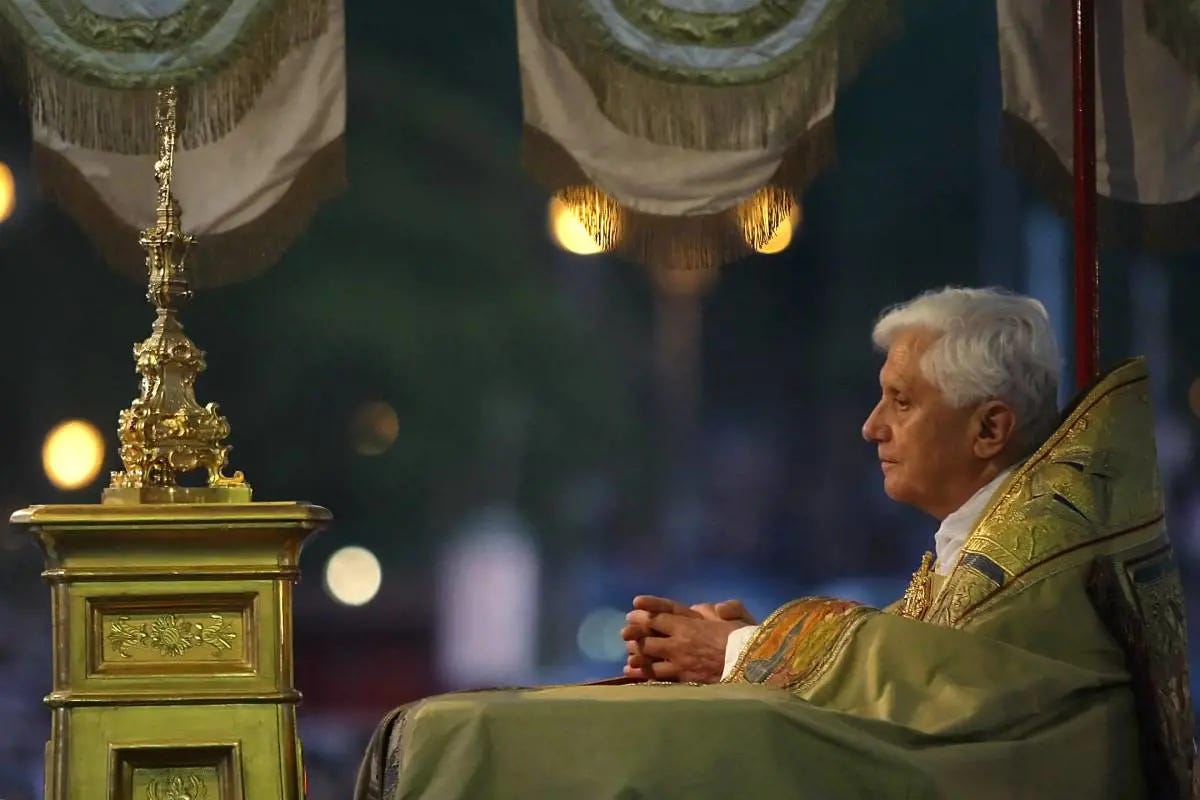
 Dr. Robert Moynihan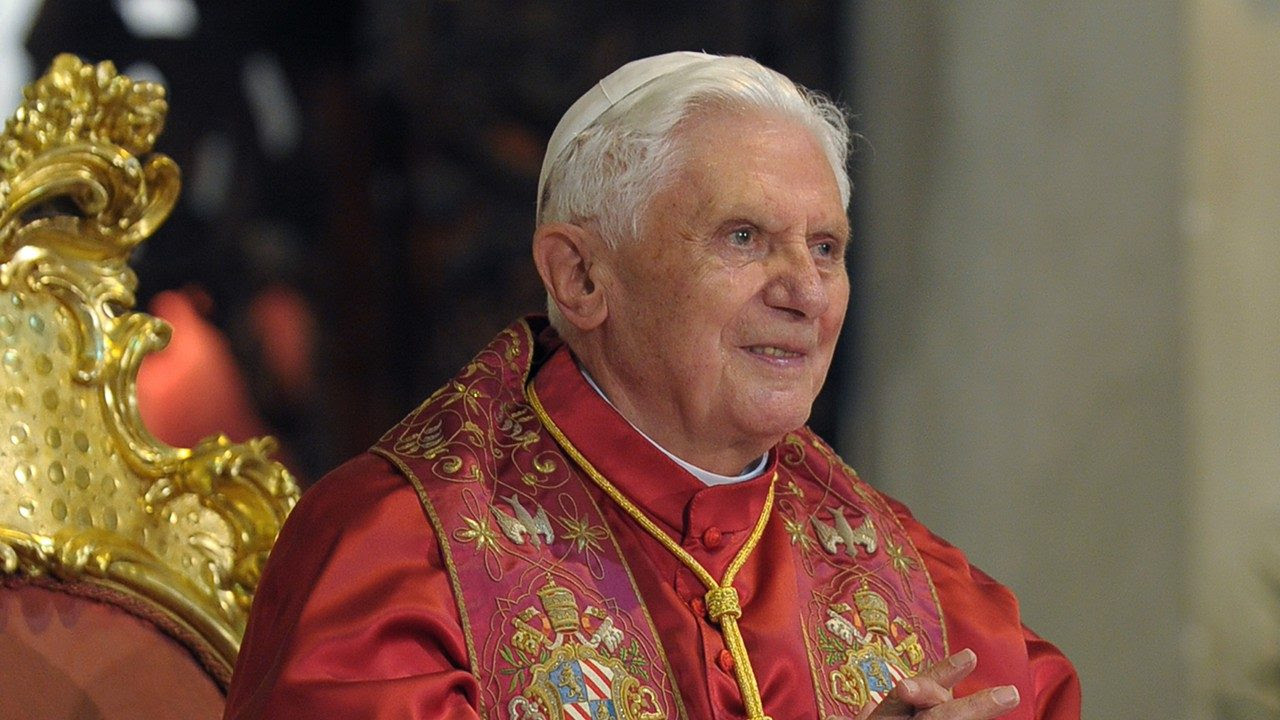
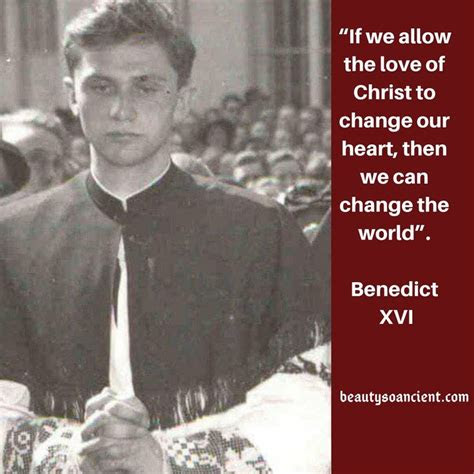
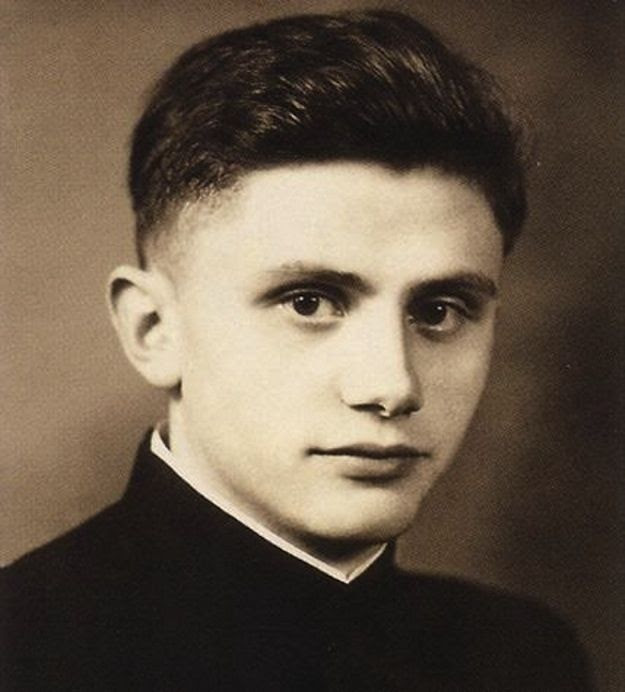
 “With sorrow I inform you that the Pope Emeritus, Benedict XVI, passed away today at 9:34 in the Mater Ecclesiae Monastery in the Vatican,” the Vatican spokesman, Dr. Matteo Bruni, said a few minutes ago in an official Vatican communiqué. (
 Pope Benedict on September 1, 2006, visiting the Shrine of the Holy Face in Manoppello, Italy. The small cloth that has been preserved there for several hundred years, but is believed by many to date from 2,000 years ago in Palestine, bears the image of the face of a man whose nose and cheeks have been severely bruised. But no trace of paint or pigment has been found on the veil fabric, meaning that the cause or source of the image remains a mystery. Some maintain that the image was made simply by light itself. Pope Benedict made no pronouncement about the image. Addressing priests, religious and pilgrims who packed the shrine that day, he said that those who seek the true face of Christ can find it in their brothers and sisters, “especially the poorest and those most in need.” *** Here are some of the remarks Pope Benedict XVI made that day, September 1, 2006, about seeking to see the face of Christ, and gaze upon that face: ”The is the path of Christ, the way of total love that overcomes death” Words spoken by Pope Benedict XVI on September 1, 2006 in Manoppello, Italy at the Shrine of the Holy Face During my pause for prayer just now, I was thinking of the first two Apostles who, urged by John the Baptist, followed Jesus to the banks of the Jordan River, as we read at the beginning of John’s Gospel (cf. 1: 35-37). The Evangelist recounts that Jesus turned around and asked them: “What do you seek?” And they answered him, “Rabbi… where are you staying?” And he said to them, “Come and see” (cf. Jn 1: 38-39). That very same day, the two who were following him had an unforgettable experience which prompted them to say: “We have found the Messiah” (Jn 1: 41). The One whom a few hours earlier they had thought of as a simple “rabbi” had acquired a very precise identity: the identity of Christ who had been awaited for centuries. But, in fact, what a long journey still lay ahead of those disciples! They could not even imagine how profound the mystery of Jesus of Nazareth could be or how unfathomable, inscrutable, his “Face” would prove, so that even after living with Jesus for three years, Philip, who was one of them, was to hear him say at the Last Supper: “Have I been with you so long, and yet you do not know me, Philip?” And then the words that sum up the novelty of Jesus’ revelation: “He who has seen me has seen the Father” (Jn 14: 9). Only after his Passion when they encountered him Risen, when the Spirit enlightened their minds and their hearts, would the Apostles understand the significance of the words Jesus had spoken and recognize him as the Son of God, the Messiah promised for the world’s redemption. They were then to become his unflagging messengers, courageous witnesses even to martyrdom. ”He who has seen me has seen the Father.” Yes, dear brothers and sisters, to “see God” it is necessary to know Christ and to let oneself be moulded by his Spirit who guides believers “into all the truth” (cf. Jn 16: 13). Those who meet Jesus, who let themselves be attracted by him and are prepared to follow him even to the point of sacrificing their lives, personally experience, as he did on the Cross, that only the “grain of wheat” that falls into the earth and dies, bears “much fruit” (Jn 12: 24). This is the path of Christ, the way of total love that overcomes death: he who takes it and “hates his life in this world will keep it for eternal life” (Jn 12: 25). In other words, he lives in God already on this earth, attracted and transformed by the dazzling brightness of his Face. This is the experience of God’s true friends, the saints who, in the brethren, especially the poorest and neediest, recognized and loved the Face of that God, lovingly contemplated for hours in prayer. For us they are encouraging examples to imitate; they assure us that if we follow this path, the way of love, with fidelity, we too, as the Psalmist sings, will be satisfied with God’s presence (cf. Ps 17[16]: 15). ”Jesu… quam bonus te quaerentibus!” — “How kind you are, Jesus, to those who seek you!” This is what we have just sung in the ancient hymn “Jesu, dulcis memoria” [Jesus, the very thought of you], which some people attribute to St Bernard. It is a hymn that acquires rare eloquence in the Shrine dedicated to the Holy Face, which calls to mind Psalm 24[23]: “Such is the generation of those who seek him, who seek the face of the God of Jacob” (v. 6). But which is “the generation” of those who seek the Face of God, which generation deserves to “ascend the hill of the Lord” and “stand in his holy place”? The Psalmist explains: it consists of those who have “clean hands and a pure heart,” who do not speak falsehoods, who do not “swear deceitfully” to their neighbour (cf. vv. 3-4). Therefore, in order to enter into communion with Christ and to contemplate his Face, to recognize the Lord’s Face in the faces of the brethren and in daily events, we require “clean hands and a pure heart.” Clean hands, that is, a life illumined by the truth of love that overcomes indifference, doubt, falsehood and selfishness; and pure hearts are essential too, hearts enraptured by divine beauty, as the Little Teresa of Lisieux says in her prayer to the Holy Face, hearts stamped with the hallmark of the Face of Christ… [End, remarks of Pope Benedict XVI, September 1, 2006, in Manoppello, Italy] (
 Sincerely,
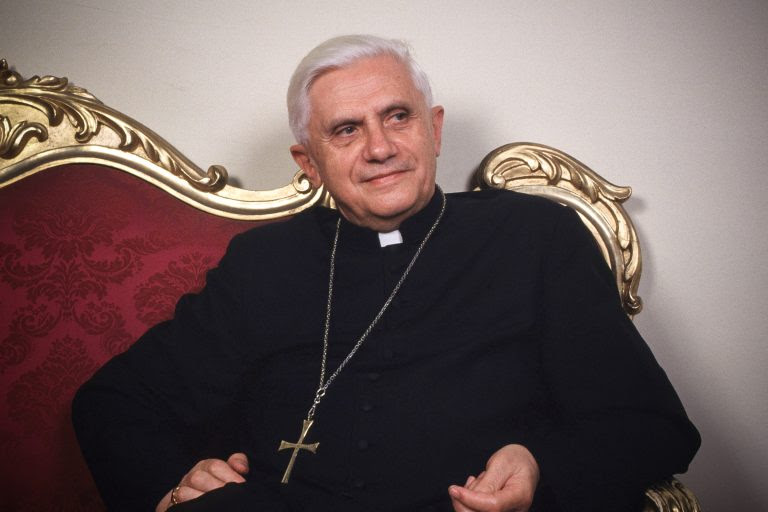
 ABYSSUS ABYSSUM INVOCAT / DEEP CALLS TO DEEP
You must be logged in to post a comment.