

Heart Religion, Tradition, and the Evangelical Chameleon
121 49 181
What can keep today’s young evangelical searchers in the fold? Only the recognition that their own questing puts them squarely in the lineage of martyrs, mystics, monastics, and the whole “cloud of witnesses.”
It is easy enough to see that contemporary evangelicalism indulges a sort of fetish for reinventing itself. Christianity Today editor Mark Galli once described a flier he received in the mail:
A new flavor of church is in town! Whether you prefer church with a more traditional blend or a robust contemporary flavor, at [church name], we have a style just for you! Casual atmosphere, relevant messages, great music, dynamic kids’ programs, and yes, you can choose your own flavor!
The “flavors” the flier advertised were things like “‘Real-life messages,’ ‘Safe and fun children’s program,’ ‘Friendly people,’ and the marketing coup de grace, ‘Fresh coffee and doughnuts!’”
Evangelicalism is and has always been chameleonic. It exhibits a uniquely strong instance of what Lamin Sanneh has called the “translatability” of Christianity. Sparked by the transatlantic revival of Wesley and Edwards in the eighteenth century, the evangelical flame has since flashed through almost every neighborhood of Protestantism’s heavenly city. And as it has spread, it has melted down every time-honored ecclesial structure in its pursuit of the direct, unmediated experience of God.
This pietistic, revivalistic impulse reached white heat in the late eighteenth- and nineteenth-century America, that furnace of “populism, individualism, democratization, and market-making.” Nineteenth-century evangelical worship and spirituality promoted a direct and personal relationship with God. It featured fluid, pragmatic worship forms tailored to specific situations and purposes, democratic lay participation in worship, and importations from popular culture. As one nineteenth-century Methodist exclaimed: “Why should the Devil have all the good tunes?” Thus was evangelicalism in the beginning, is now, and (quite likely) ever shall be.
As each new generation of evangelicals has forged its own culturally attuned modes, the movement has held on to only two sacred realities. The first is “the church invisible”—the fellowship of saints across time, space, and denominational traditions. The second is the individual’s relationship with God. Between these two, everything else—all the doctrinal formulations, liturgies, polities, and other ecclesiological frameworks—have been rendered negotiable and plastic, continually modified and remodified to achieve pietistic ends.
Years of feeding, promoting, and protecting its hunger for direct experiential access to God have encased this theologically conservative movement in a culturally liberal skin. The resulting incongruous religiosity has descended, in some of its forms, into a sort of Jesus-y multiple personality disorder. For despite its socially angular commitments to sin, salvation, miracles, and the theology of the cross, evangelicalism expertly camouflages itself in every setting, hugging the contours of the world around it. Want to know which way the cultural wind is blowing at any time and place? Look to the innovative, pragmatic, malleable evangelicals.
The Heart against Tradition
As it seeks camouflage in its surrounding cultures, evangelicalism tends to separate itself from its own Christian roots. To see why, we need to spend a moment more with evangelical experientialism. David Bebbington famously defined the movement with a fourfold typology: biblicist, crucicentrist, conversionist, and activist. In raising evangelical “matters of the heart,” we are, I suppose, talking about conversionism. Yet that term by itself is inadequate to describe the movement’s habitus of affective devotion.
To modern critics (including some evangelicals), the movement’s emotional bent can seem mawkish, self-indulgent, even theologically dangerous. This may miss the fact that Christian groups in the pietistic tradition of evangelicalism have typically treated (if not always fully articulated) religious emotion not as raw feeling but, quite biblically, as a response of the “heart”—understood as our unified center of feeling, thinking, and willing—to a Gospel both understood and acted upon. Evangelicals tend to understand better than most that it is impossible for us to live righteously unless our whole being, including our emotions, has experienced transformation. And they can claim as support for this understanding not only Jonathan Edwards and John Wesley, but also C.S. Lewis and such thoughtful modern pastors as John Piper and Tim Keller.
But whatever the merit of this affectively toned conversionism, what has it meant to the evangelical willingness to reinvent all ecclesial forms? Is there any way heart religion can lead toward, rather than away from, a firmer and better-grounded Christian identity?
Since the Reformation, Protestants have consistently worried that traditional forms of worship and ecclesial life may lead people away from God and back into what Martin Luther once called the “Babylonian Captivity of the Church.” Since their first cries in the Puritan cradle, evangelicals have lashed out against all tricks of the religious trade that are proffered as necessary mediations between humans and God. Any time ecclesiasts have prescribed images, rituals, gestures, or their own holy offices and orders as crucial to the believer’s relationship with God, evangelical Protestants have demurred. The proto-evangelical “free church” Protestants—first the Anabaptists, then later the varieties of Reformed Christianity stemming from Huldrych Zwingli and John Calvin, then the nonconformist varieties of Puritans (Baptists, Congregationalists, etc.), then all their heirs up to the modern Pentecostal denominations and Charismatic movements—have desired to be “free,” not only from state control and church hierarchy, but also from such priestcraft. How dare any human tell others they must do this or that to reach God! Each of us stands before God on our own two feet. And God, in turn, stands ready to meet us without the poor helps of human tradition.
The Heart for Tradition
Yet—and here is where I take hope—this very same attention to the heart’s experience of God’s presence is itself a piece of Christian tradition. The desire to experience intimacy with God in Christ and through his Spirit, and the understanding that this desire is itself God-given—a blessing to be enjoyed both in heaven and here on earth—runs like a golden thread through Christianity since its origins. It animated Paul, Origen, Augustine, the medieval monks, and the Orthodox mystical writers, as well as the evangelical family line of Pietists, Puritans, Baptists, and Methodists.
In fact, its emphasis on heart religion may yet prove to be evangelicalism’s way out of its long history of anti-traditionalism. For the movement’s tide of experientially driven heart religion pulls in not one, but two directions. Yes, it threatens to sweep some of its followers onto the rocks of a traditionless banality. But at the same time, its impassioned undertow is pulling others out into the wine-dark sea of older faith traditions.
In fact, it is the very evangelical desire to be “closer to God”—which has in the past separated the movement from its own Christian heritage—that drives this yearning for a more solid and satisfying Christian identity in an increasingly post-Christian world. From this yearning has emerged a now forty-year-old movement toward a more traditional Christian spirituality, reclaiming such time-honored practices as lectio divina (slow, meditative reading of Scripture), spiritual direction, and Ignatian retreats.
This modern evangelical retrieval movement started in America in the 1950s and 1960s, as walls between Protestant and Catholic camps began to come down (though, as Kenneth Stewart has taught us, it has analogues throughout evangelical history). It “broke out” in 1978, with the publication of Richard Foster’s Celebration of Discipline. By that year, conciliatory, culture-engaging “new evangelicals” (represented by the NAE, Christianity Today, and Fuller and Gordon-Conwell seminaries) had already begun to initiate themselves into the world of traditional Christian spirituality. They were using contemplative prayer techniques, attending retreats, sitting under spiritual directors, and reading Catholic and Orthodox books. But Foster, along with such teachers as Dallas Willard, Eugene Peterson, and James Houston, brought ancient spirituality into the evangelical mainstream for at least a season.
And although leaders confess that this movement has begun to stall out in recent years, committed evangelicals who regret their churches’ chameleonic adaptation to modern culture—and concomitant loss of historic Christian flavor, if not identity—are continuing to seek spiritual help along older pathways. For some at least, a reappropriation of older traditions seems the only way to re-anchor a church that seems more and more to be becoming “all things for all people.”
Though no church, of course, can be wholly immune to the influence of the culture that surrounds it, thoughtful evangelicals yearn for a Christianity that has its own strong culture, standing (where necessary) against the stream. This they glimpse in certain presumably golden times and places—the persecuted church before Constantine, early monasticism, Celtic Christianity, the anti-state ranks of the sixteenth-century Anabaptists—and such glimpses spur them to further exploration. They hope that, in patristic pastoral theology, monastic rules of life, and time-honored devotional forms, they can discover modes and practices of faith that look less like malls and rock concerts than the churches they’ve attended. Consider the popularity of Orthodox convert Rod Dreher’s Benedict Option: though many evangelicals critiqued it, many more read it with wistful hearts.
The quest is supported, too, by evangelical scholars, from whom has come a strong stream of books and articles. Translated and excerpted spiritual classics are now joined by monumental historical commentary series from evangelical presses, appreciative histories of confessional Protestantism, the popular explorations of Christian History Magazine and Touchstone Magazine, and even a nascent evangelical “medieval retrieval.”
This last is a ressourcement latecomer, and still much more on the edges of evangelical consciousness than early-church retrieval. My own recent book, Medieval Wisdom for Modern Christians, seeks to contribute to this part of the conversation, as do works by Rebecca DeYoung, Greg Peters, Dennis Okholm, Douglas Wilson, Glenn Myers, and the occasional evangelical contributor to First Things, to name only a few.
In the face of continued attempts to make church “relevant,” many younger evangelicals have simply been leaving the mall-like megachurches, spurning the high-energy, entertainment-oriented worship services and marketing-driven strategies of modern de-denominationalized, de-traditioned “worship centers.” And why, indeed, should they stay, when it is not at all clear just how these culturally camouflaged churches can offer them anything more transforming than the flood of empty promises pouring from the consumerist world around them?
For a time, young evangelicals pushed these frontiers through “emerging” and “new monastic” experiments, sampling ancient- and medieval-inflected elements of worship and modes of community. Though highly selective in implementation, and far short of sparking any ecclesial revolution, these dalliances reveal the power of the modern evangelical spiritual hunger for tradition described by such authors of a previous generation as Richard Lovelace, Robert Webber, and Dallas Willard.
It is fair to say that young evangelicals continue to question received forms, to hunger for authenticity and community, to yearn for a spiritual therapy that will heal their sin-sick souls, and above all, to reach out for immediate, personal connection to the divine.
But with the ecclesial impulses of the “emergent” and “new monastic” crowd already fading, what can keep today’s young searchers in the fold? Only, I think, a dawning or renewed recognition that their own questing puts them squarely in the lineage of martyrs, mystics, monastics, and the whole “cloud of witnesses.” Only the solidarity that comes as we see that our own hearts’ impulses for God are the same impulses that drove every Christian generation’s quest, from the spiritual warfare of the desert fathers, to the spiritual and theological odysseys of Augustine and Aquinas, to the communal disciplines of the Benedictines, to the impassioned born-again activism of the early modern Pietists and Puritans.
I pray we all will find this ancient sustenance for this post-Christian age.
Chris R. Armstrong is a faculty member at Wheaton College (IL) and founding director of Opus: The Art of Work. His most recent book is Medieval Wisdom for Modern Christians: Finding Authentic Faith in a Forgotten Age with C. S. Lewis (Brazos, 2016).
|
|||
|
|












Such a beautiful tribute – let us not forget who & what was sacrificed for us.
So very true…
As an 8 year old I mingled with those Yanks in London knowing that a stick of yankee gum might come my way.
All those yanks we made a cup of tea for were Aircrew and we cherished them especially if like us you had years of bombing hiding in a London Cellar
Years later I spent time with the crews from SAC
As an airforce store man I spent 2 years service in the Deserts of North Africa!
A beautiful remembrance.
This was outstanding to watch. I was in the AF never new the numbers of how many brave men we lost during that war. My father was in WWII in the AF he never spoke much about it I was in Nam and I don’t talk about it eather.
Like you and your father, my father didn’t speak of the war. He ‘stuffed’ his memories for more than 30 years. Then in 1977, he lost his brother and he suffered from a sort of breakdown that was diagnosed as a form of delayed PTSD. His doctor suggested that he write down some of his war memories that still plagued him so long after the war. He sat down to write a short ‘confession’ of sorts to me and my sisters. But once he started to write, it all came out. A couple years later, he’d completed a lengthy remembrance that was ultimately edited and became “Doorknob Five Two”, an autobiographical novel.
It is 2018 as I write this. He is 96 and as recently as this morning, his eyes welled up with recollections of his role in the war. “So many killed…” he repeated over and over, shaking his head. He is still overwhelmed by the human cost of war.
Be well and a sincere thanks to you and your father for your service,
Marc Arnold
I was deeply moved by the video and the story behind the sculpture. I am retired from the U.S. Navy and, though my record shows I served in a combat zone (Viet Nam), I never had to put my life on the line as the Major did. In addition to being a wonderful tribute to those who made the ultimate sacrifice, I was amazed by the fantastic detail of the sculptures. Thank you for your service during and after the war.
At too many public appearances to remember, men would make a distinction between their ‘non-combat’ military service and his experiences on the front line. “Bullshit,” he’d say. “You put on the uniform. You put your life on the line just like me. Service is service.” He taught me to respect everyone who serves equally. And I do. Thank you, sir. Marc Arnold
Thank you! From the family of 2Lt Robert C Simmons 849th Bomber Squadron, 490th Bomber Group–Heavy, tail number 43-37776, KIA 9-27-1944
“Lest We Forget: The Mission” is dedicated to the immeasurable sacrifice of your family’s Robert Simmons. We hope you have the opportunity to see the sculpture in person. It is there for you and your posterity.
With deepest respect,
Marc Arnold
As a modern era US Army Aviator (helicopter pilot) at first glance I was put off by some things that looked wrong, like wearing helmets in the briefing, but then having seen the video, I began to understand the symbolism of the art and changed my mind completely. I love this work and would love to have a miniature of it. Thank you Major Arnold.
Major (Ret.) Matthew Arnold
USA 1978 – 2002
Major — Thank you for your comment and for taking the time to watch the video. We watch the reaction of people at the museum and see the same transformation as people’s first impression of the exhibit solely as a static work of art gives way to understanding that Dad used the sculpture to tell his story of combat.
If you would like a miniature, there are two options. A 20″ x 22″ miniature of all twelve figures is available. There is also a limited edition of 50 tabletop bronze sculptures of “Teenager”. Each, corresponds to one of Dad’s 50 combat missions. Each comes with a copy of his combat logbook and a certificate describing the specific mission correlated to the edition number. If you want more information, please use the Contact Us page to send a message.
Thank you for your service, Major.
Marc Arnold
I WAS A B-17 FIRST PILOT ASSIGNED TO THE 384TH BOMB GROUP. OUR CREW FLEW 25
COMBAT MISSIONS DURING THE LAST TWO MONTHS. THE EIGHTH AIR LAST COMBAT
MISSION WAS APRIL 25, 1945. OUR GROUP, INCLUDING OUR CREW, PARTICIPATED. THE
TARGET WAS THE SKODA WORKS NEAR PILSEN. CK. ON AN EARLIER MISSION OUR LEFT
OUTBOARD ENGINE CAUGHT FIRE. WE HAD TO RETURN TO BASE AS WE COULD NOT
KEEP UP WITH THE FORMATION. WE LEARNED THE B-17 THAT TOOK OUR POSITION IN
FORMATION BLEW UP AND ALL WERE KILLED. THE CREW DESIGNATED TO DO SO WAS
PILOTED BY A FRIEND OF MINE; NAMELY, ROBERT GRIFFEN. IT TURNED OUT THAT BOB
AND HIS CREW DID NOT AS A B-17 FROM ANOTHER GROUP DID. UNFORTUNATELY, A
WEEK OR SO LATER THEY CRASH IN BAD WEATHER WITH A COMBAT DAMAGED B-17.
THE ENTIRE CREW WERE KILLED. I ALSO KNEW HIS NAVIGATOR, ROYAL RUNYON. IN
1995, ALONG WITH OTHER MEMBERS OF THE 384TH ASSOCIATION, WE ATTENDED THE
50TH ANNIVERSARY OF V-DAY ON MAY 8, 1945. WE VISITED THE AMERICAN CEMETARY
NEAR CAMBRIDGE, ENGLAND. RUNYON IS BURIED THERE. CAMBRIDGE UNIVERSITY
DEDICATED THE LAND FOR THE CEMETARY. YES, THE EIGHTH AIR FORCE EXPERIENCE
MORE LOST AIRMEN THAN DID THE MARINES IN THE SOUTH PACIFIC. THE COMPARISON
IS ONLY MENT TO INDICATE WHAT LOSSES “EIGHTH” EXPERIENCED FROM BEGINNING.
WHILE, AT 94, AS I DO NOT TRAVEL ANYMORE, I APPRECIATE ANY SUCH DEDICATIONS.
Mr. Lewis —
Thank you for sharing a bit about your experience with the Eighth. Those of us who are too young to have experienced the horror of WWII personally can’t possibly imagine the hair-thin difference between life and death in those terrible days. We owe the modern world’s safety, security and prosperity to you and your generation.
Thank you for remembering and passing on your memory of Mssrs. Robert Griffen, Royal Runyon and their crews. I will pass on your thoughts to my Dad, who at 96, doesn’t access the internet that much.
I salute you, sir.
Marc Arnold
WE where proud to be AMERICAN in those days! Today hey want everything right now?
What a wonderful remembrance of such a tragic loss, God Bless them and Thank you for your sacrifice.
Thank you. Dad will be pleased to hear your comment. Be well, Marc Arnold
My uncle, Harold Lorenz, was with the 51st Fighter Squadron in Panama during WWII. They also had P-38’s and he was a gunnery sergeant making sure the guns were working and aimed properly. He got a ride one time in a jump seat behind the pilot and found out why the pilots said the P-38 climbed like a homesick angel.
Mr. Lorenz —
Thank you for your comment. Dad described an interaction with ground crew that is reminiscent of your uncle’s comment. From Dad’s book, Doorknob Five Two: “When they had finished refueling the plane, the sergeant said, “After take off, maybe you could fly low across the field so we could see this baby in the air? We’ve heard a lot of rumors about how good they fly. It’d give the men a kick.”
It was their fuel. I owed them a pass. I raced down the runway and pulled into a steep climb. I was flying again! I’d survived six missions. Nineteen to go. I can do it, I thought, and I relaxed into the feel of the plane again. At 6,000 feet I turned the plane on its back, pulled it through the loop, and roared back down to the runway. The airspeed indicator hit the redline as I shot across the boundary a few feet above the ground, the men waving wildly from their Jeep. Two jumped off the hood as I hurtled a few feet above them. The others scattered, unable to hold their balance in the prop wash. I climbed straight up and rolled the plane, once, twice, three times. I loved the sensation of plunging through space and I was happy to be on my way home.”
Be well,
Marc Arnold
This art work is there to show us what these men and women have given for so many and I hope to see this wonderful Art work in person in the near future in Denver. Thank you, those who gave their all and to the artist for giving us a way to remember them and God Bless.
Thank you for your kind words. I am confident you will be moved by the sculpture when you see it in person. There is always a crowd of people around the sculpture. No one misses the impact of seeing such a meaningful work of art
by someone who was there
.
Be well,
Marc Arnold
I have viewed this very touching Memorial in Denver. I sat in a nearby chair and studied each subject. Very touching and centered around the great planes that kept us free. A great grouping that all young people should see.
Mr. Christensen —
It was Dad’s fondest wish that the import of the sculpture would reach across the generations… Not every young person ‘gets it’, but in any school group, there are always those who do. When Dad was up to public speaking, he addressed hundreds of school gatherings in the greater Denver area. The many thoughtful thank you notes demonstrate without doubt that his message reached a sizable fraction of those kids. The horror of war is a tough message, but one that Dad felt needed to passed along.
Be well,
Marc Arnold
This is awesome. Thankyou
Pat —
I read your comment to Dad today, who doesn’t use a computer anymore (he’s 96 now). He smiled and waved a bit.
Thank you for brightening his day,
Marc Arnold
HI MARK,THANK YOU FOR THIS EMAIL,SOME DAY MY WIFE AND I WILL GO TO SEE THE SCULPTURE .MY WIFE IS FROM COLORADO,AGAIN THANK YOU,I SERVED IN THE Air Force I WAS IN GERMANY,KOREA AND THE STATES TOO.TSGT.DANIEL C.MACIEL
Mr. Maciel —
I do hope you and your wife get a chance to see it in person. Be sure to check the website before you make the trip to verify it is still here in Denver. At some point, it will likely go to New Orleans for exhibition at the National WWII Museum.
Be well,
Marc Arnold
While none of my family members were pilots, a couple uncles were bombadier’s with the 505th bomb group, neither survived, they were both killed prior to end of war in January and February 1944. The older uncle, Lt. James Allen Burner’s plane caught fire and wound up going into the ocean completely on fire near Japan, with only survivor parachuting out. My second and younger uncle, Lt. Hugh Donald Burner’s bomber collided with another bomber over Japan and both crashed and burned on the ground with no survivors. There is now a memorial in that Japanese town for these two bombers and the ashes of all crew members were turned over to the U.S. Military after war was ended. I know that many bomber crews made it safely home due to the resiliance and perseverance of the fighter pilots who were their guardians while they were on their bombing missions. May all the families of all 88,000 American Airmen be blessed as they realize the service as well as the lives of their family members that were given for their country. God bless America and God bless all military who are currently still alive in all branches of service.
Dear Barbara —
Thank you for your heart felt good wishes. The project is dedicated to men like your two uncles. Dad dedicated seven years to convey the very message you’ve written. I hope you have the opportunity to see and appreciate the sculpture in person as a memorial and remembrance of your uncles.
— Marc Arnold
My WW2 aviator father; his aviator brothers and my, P-38 pilot cousin (who also flew w the RAF 171 Eagle squadron). All survived except my cousin Fred Scudday who was accidentally killed by a tent mate cleaning his .45 in China ALL of these men inspired an undying love of country, patriotism and military service. Your fathers beautiful sculpture brings to life such sacrifice inherent in military service for the sake of FREEDOM which has a flavor the protected will never know. Thank you so much. Bill
McDonald Colonel USAF retired
Colonel —
You come from an extraordinarily dedicated and lucky family line. My deepest thanks to you and your family for serving.
While the general public can never fully appreciate the debt we owe, we are gratified to see people of all ages taking the time to sit and contemplate the message of Dad’s unique memorial. In this day and age of sound bites lasting seconds, it is quite amazing to see people of all ages sit for 20-30 minutes simply contemplating the sacrifices embodied in Dad’s artwork. Not a few tears are shed.
Thank you for your kind words and for your service to our country,
Marc Arnold
As an EX A-1 USAF Skyraider pilot who flew 250 missions in S Vietnam in 1964-65 I was very impressed by your video, I hope someday to see the actual sculpture in the Denver museum. My best to you in your endeavor.
Mr. Elliott —
I can’t even remotely imagine, let alone appreciate, the magnitude of 250 combat missions. Each war has it own technology and tactics, but it still comes down to the MEN. The Denver Air and Space Museum tells us all the time they are grateful to have the sculpture there because, more than any other exhibit, it is about the MEN.
All good wishes to you, sir,
Marc Arnold
My father, Robert Capen, is also the last surviving P38 pilot from his squadron. Devilishly handsome still, an artist and sculptor, he walks 3 miles daily and would welcome cameraderie of surviving P-38 pilot/veterans.
Ms. Rolston — Thank you for writing. I am so glad to hear your extraordinary father is doing well. Please pass along my family’s best wishes and gratitude for his service. If there is any chance you may be in the Denver area, we would be pleased to arrange a special visit for you and your father at the museum. Be well, Marc Arnold
So amazing and touching. A true artist a true patriot and great American. Deeply thank you for you service and artistic memorial. Please have Hollywood make a big screen movie of your story. Harrison Ford or Tom Hanks come to mind. I don’t have enough words to tell you how touched my family was. OUR GREATEST GLORY IS NOT IN NEVER FALLING BUT RISING WHEN WE DO. You no doubt are a man that rises . Beautiful man beautiful family and beautiful art work. Thank you
Thank you for your kind comment. Dad’s book, “Doorknob Five Two”, has been optioned by different movie production companies over the years, which is proof that it has appeal to Hollywood. One of these times, all the factors (financing, lead actors, aircraft special effects, etc.) will all come together and a film will get made.
Be well,
Marc Arnold
I had the great opportunity to see this exhibit in November, 2016 at the museum. It touched me deeply. I am retired Army, and a history buff, but I may have overlooked the sacrifice of the US Army Air Corps in WWII. These sculptures, and the accompanying stories of the men they portray brought that harsh reality to the forefront. It brought tears to my eyes to think of so many young men lost in war, many whose identities and memories are already forgotten. We should never forget the sacrifice and service of our nation’s heroes. What an outstanding exhibit. I highly recommend you see it, and, if you can’t, watch the video!
Thank you for your service, Mr. Fuhrman. We can never fully know or appreciate the debt we owe to the countless soldiers of every branch of service that paid for our freedoms. It is heartening to see Dad’s sculpture affect people of all ages and backgrounds.
Be well,
Marc Arnold
I thought you might enjoy teading about another “arty farty” warrior from a previous war. We are all Americans. I enjoyed your reading aboub your service, thank you, and will visit the museum in Denver thevnext time we travel
West. All the best to youband your family. Sam Duncan, USAF 1961-68, Vero Beach, FL.
Field of Shoes: Moses Jacob Ezekiel
Moses Jacob Ezekiel, a world renowned “arty farty” sculptor, Jewish Johnny Reb, 1st Jewish Virginia Military Institute cadet, as a teenager, along with the other teenage VMI cadets, fought gallantly at the Civil War New Market battle (the battle site has been preserved and today as an American, it is possible to walk the field of lost shoes) depicted in the movie Field of Lost Shoes. This is another example of a teenager with a diverse heritage serving his country as a warrior, today know as a citizen-soldier, just like later in WWII when 14 million citizen-soldiers stepped up, served, not whiners, just like Moses did in his situation, the Confederate States of America. After the war, Moses Jacob Ezekiel went on with his life, contributed to the arts, as an American. The US and its residents/citizens has always been a diverse shining light on the hill. FACTUAL
https://en.m.wikipedia.org/wiki/Moses_Jacob_Ezekiel
Thank you for your comment and the link to Moses Jacob Ezekiel. Yes, the concept of “citizen-warrior” is central to Dad’s message. They were called upon to do a job, then they returned to their life as it was before the war. All the best, Marc Arnold
Thank you. Lt. Bob Fisher from Burnettsville IN, was the first cousin of my father. He spoke of him a view times, always with a great deal of pride mixed with sadness. I hope to be able to see this beautiful memorial someday soon.
Thank you!
Patti (Fisher) Lashbrook
Patti —
Finding relatives of Dad’s original group of 14, including your father’s cousin, Lt. Bob Fisher, has been a rich reward for doing his monument. Bob Fisher’s son and two grand-daughters attended the dedication of another memorial project done by my father… a 20×16 foot mural. Their attendance was included in the documentary, “Between Two Worlds”, by Aaron Weisblatt. I was also there and it was a deeply touching tribute. The grandson of Jim Hagenback, the other survivor, is coming to Denver in October to visit with us and to see the sculpture. You are welcome anytime.
— Marc Arnold
Made a special trip to see sculpture on day off and worth the time to see it and contemplate the meaning of each of the figures and the positions of the figures. I have visited the WWII museum in New Orleans and it will be a wonderful addition. I have found the stories behind the people who have served in our military to be very humbling to me in what they had witnessed and experienced in their lives. I served in the Air Force in the late 80’s and early 90’s and have my own “military stories”, but I did not experience combat or the life threatening experiences of many of our past and current soldiers and airman. I have the utmost respect for them and thank them. Thank you Maj. Arnold for your service and this tribute to your fellow pilots.
Bill — Thank you for your service. Dad and I just came back from an “Honor Flight” to Washington DC. It was an emotional tour of the national monuments dedicated to the many soldiers who stood up and defended our freedoms. Thank you for your kind words. Be well, Marc Arnold
This brought tears to my eyes. Thank you seems to little for the great gift you have given every citizen . I have been blessed by the freedom that all those who serve have fought so hard to protect. All of you are in my prayers every day.
Thank you, Mickey. All the best to you, Marc Arnold
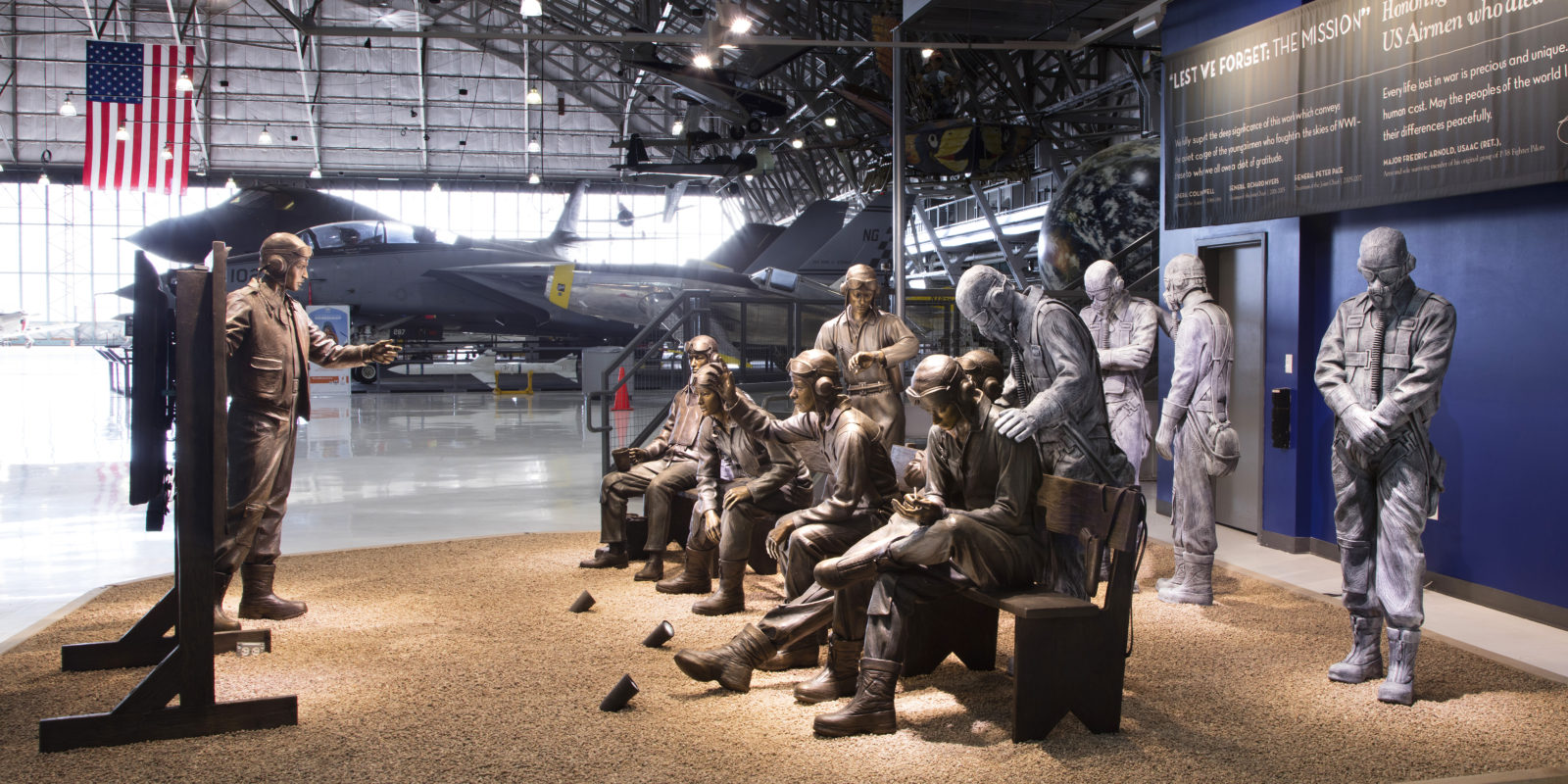
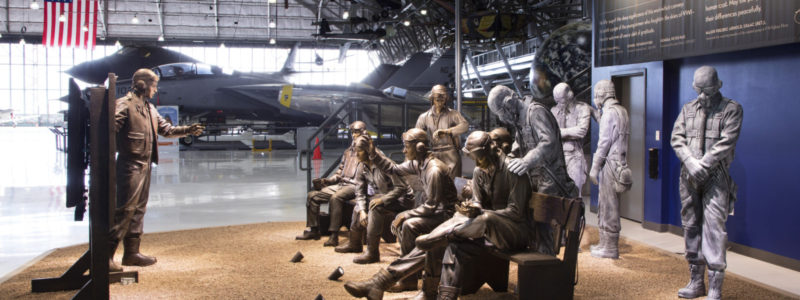
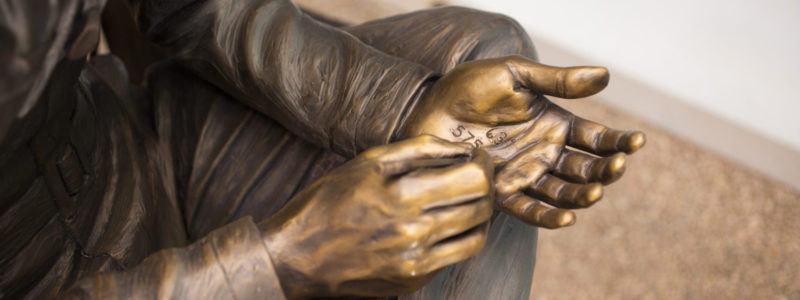
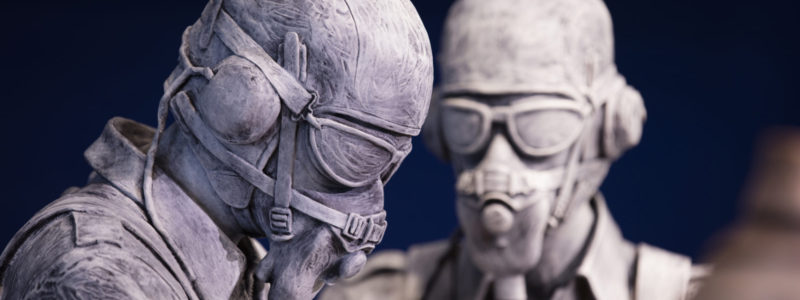
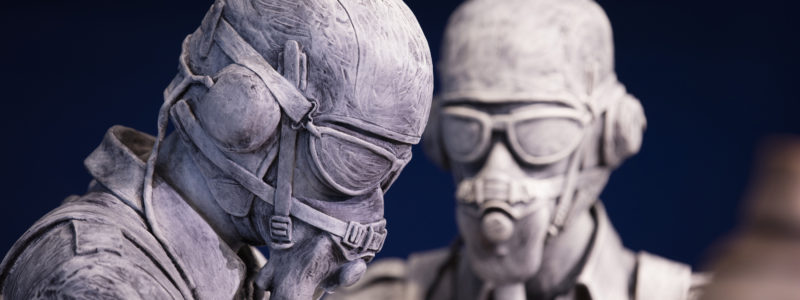
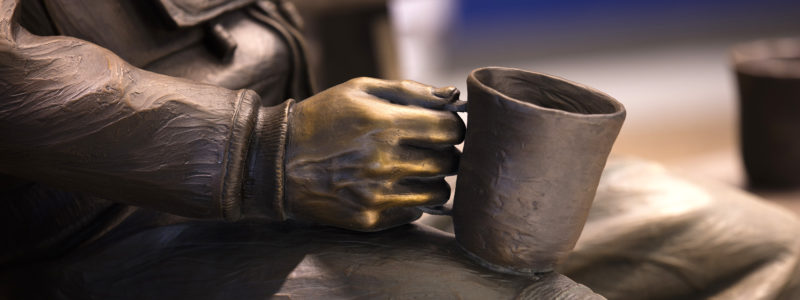
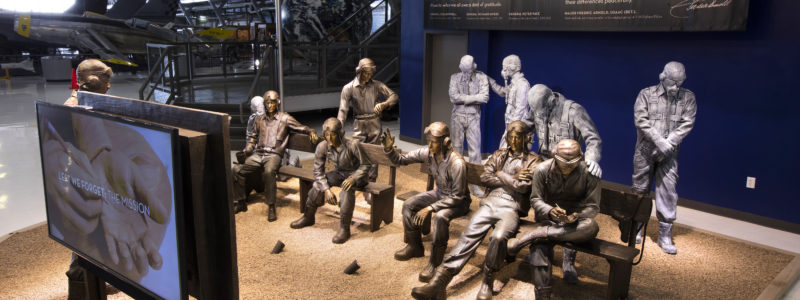
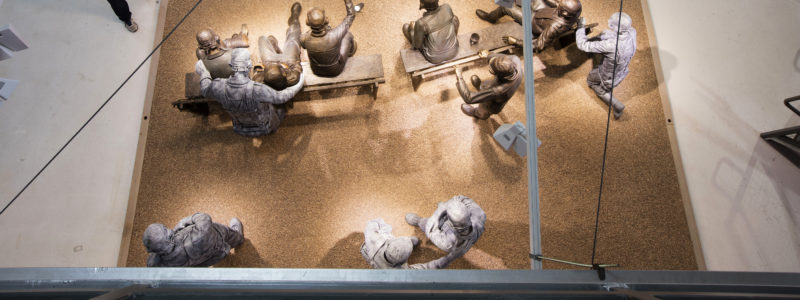
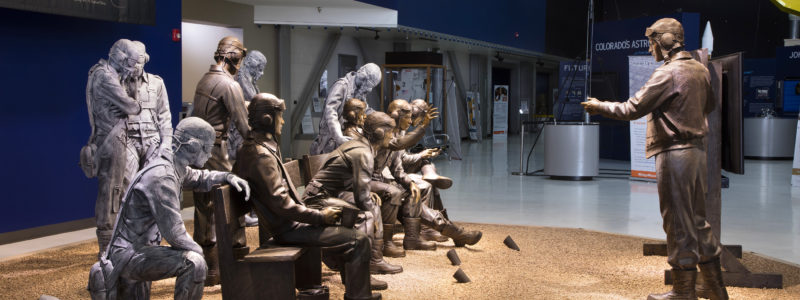
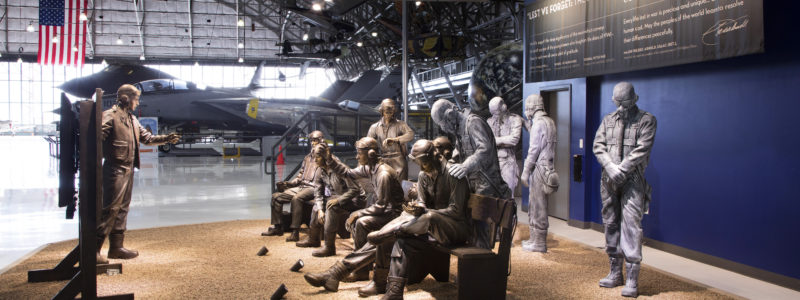
Arnold visited monuments and museums but could not come up with an idea. Eventually, his daughter-in-law suggested that Arnold use the 10 maps he had been given by his crew chief as background for painted memorials. Arnold liked the idea and, using the maps, created 10 panels on which he painted murals. While Arnold’s memories of the 12 fellow pilots in his class provided the inspiration, the sculptures intend to represent the 88,000 airmen who were killed in combat in World War II. The piece differentiates between living pilots and those who had been killed in action by the color of the metals, with the dead men in a more pallid hue.
We unknowingly came across your sculpture at the museum yesterday. We brought our 14 year old WWII history buff nephew with us. He was quite enamored with your beautiful, thought provoking work. Our group all felt your work was a wonderful tribute to those who sacrificed everything for this country.
Thank you, Allison, for taking the time to leave a comment. Reaching young people like your nephew was one of Dad’s fondest hope… to reach across the generations, as it were, and make a connection. Be well, Marc
As the daughter of a man who served two tours of duty during WWII, and survived, I am so touched by this beautiful tribute to those airmen who did not make it home. If my father, Walter Adren Whitcomb, had not survived the war, I would not exist. It is ironic that he survived his service in Germany, Japan and the Philippines, and then lost his life in a tractor accident, while preparing for a new home for our family. I was a little more than 3 years old, and my brothers were approximately 6 and 8 years old at the time of our father’s death. My mother, Bessie Lockhart Whitcomb, who was only 28 years old when my father died, worked very hard to provide for us and raised my brothers and myself in a way that would show respect to all who served our country, regardless of when or how they served. Both of my brothers served during the Viet Nam war, and my uncle, Ray Lockhart, who passed away several years ago, began his service during WWII and was a career Air Force pilot. This beautiful sculpture is an amazing tribute to those who served in The Great War, as well as to all who have served our country in any capacity. I am so moved by the dedication it took to complete this project and it is my hope to see it in person some day. Thank you so much for your devotion, Major Arnold and Marc Arnold. You have created a lasting treasure for our nation.
Peggy — Thank you for sharing your connection to the work.
Dad was especially honored by the presence of the nephew of one of the original 12 pilots in Dad’s Group killed in the war. Like you, he had a strong bond to his uncle and other members of his family who served in the war. They hugged and cried over their shared loss after so many decades; Dad because he knew his uncle, the nephew because he never knew his uncle. Loss, mourning, respect and gratitude can all leap across generations, time and distance.
On July 26th, while visiting old friends in Ft. Collins, CO, I received an email from an old buddy that I flew with in Vietnam, with a link to the “Lest We Forget: The Vow” video that is on the home page of this site. I watched it early in the morning. Later that day, my friend and I were going to drive down to Denver to visit the Wings Over The Rockies museum. During the drive, I told my friend about the video. He is a pilot and his father was a Navy pilot in WWII. Well, we toured the museum for a couple of hours and were on our way out when I was surprised to see the sculpture being set up, and then realized I was looking at Marc and Maj. Arnold as they worked on the project! I was astounded. I had just seen the video that morning and now I am talking to Maj. Arnold! It was a special moment for me and I want to thank you for taking the time to chat with us and allowing us to take photographs. My wife and I are donating to the project and look forward to seeing it in New Orleans. Thank you for your dedication, and your art, to help insure that those who paid the ultimate price will not be forgotten.
Thank you, David. It was a pleasure to meet you. You were present at a special time as the finished monument was coming together.
Now that the finished monument is on display, the video on the home page of this website has been changed to reflect the 13 minute video that is part of the exhibit.
All good wishes. Be well.
What a GREAT project for you to do. I was in the Air Force 57H class where I flew the F-80 (T-bird) in basic training; graduated and flew B-47’s in 1957 with Lloyd Gray who became a pilot flying B-17s at the age of 17 during WWII in 1944. I later flew the F-86H in the Mass ANG….. and later owned a Cessna 182 that, with my wife, flew many places including AirVenture for over 10 yeqrs. I also worked for Pratt & Whitney for about 40 years doing all kinds of ‘Research stuff’ for future aircraft engines. It would be wonderful to ‘chat’ with you about your project, and aviation. PLEASE do contact me by telephone if you’d like (206) 382-xxxx
Mr. Godston —
Thank you for your comment.
Under the heading of “small world”… You flew the F-80 and my father did the initial flight acceptance test flight of the XP-80 on behalf of the Army Air Corp. His logbook shows his first flight of the XP-80 happened on Jan 19, 1945. It was a one hour flight and includes the note: “Checked out by Milo [Birchum… Lockheed’s chief test pilot at the time]. Prediction: Props [will be] rare 10 years from now … Bugs yet to be removed, but when they are!!!!! Greatest thing in aviation.”
He went on to write and illustrate the first flight manual for the P-80. So it is possible you studied from his manual (or later revisions).
It is kind of you to invite Dad to contact you by phone. He has many of his faculties, but phone calls have become difficult recently, so that is not likely to happen. He did, however, ask me to pass along his best wishes to you… I’ll add my own!
Thank you for your service, sir.
Marc Arnold
I visited the Wings Over The Rockies Museum today and watched the video and was able to see at least something of the sculpture as it was still largely covered. It is beautiful and the stories behind each figure are so very impressive. I am so sorry I will not be able to see it unveiled in person but am gratefull for what I could see. I am thankfull for all those that fought for my freedom (I am Dutch) and the “Lest we forget : the mission” is a truly wonderful testament to all that fought and paid the ultimate price. Thank you Maj. Arnold
Mr. Libert —
We worked on the installation for a week before the first public unveiling yesterday. You were among the lucky few that got a sneak peek. Now that it is fully exposed, I hope you have the opportunity to revisit the museum. As an occupied country during WWII, the Netherlands suffered dearly at the hands of the Nazis. The loss of life there was truly horrific.
Thank you for your kind words of support.
Marc Arnold
I have had the pleasure of working with the Arnold family in designing and setting the lighting for the Lest We Forget memorial. I quickly recognized the importance and magnitude of this great work of art. Maj. Arnold not only created a masterpiece, but has brought new awareness to an often forgotten war and the people who lost their lives defending our Country. I hope that our younger generations will gain insight and appreciation of the enormous sacrifices made by a generation of Americans, now almost all gone. This sculpture is a great way to stir the interest and encourage all of us to go back and absorb this time in our history and really understand what WWII was all about.
Congratulations Maj Arnold for creating a permanent dedication and remembrance for now and every generation to come.
Bob —
Thanks for your help with the project. Bronze is a difficult medium to light and your expertise made a big difference. We have a photo shoot scheduled in the morning to capture images of the finished bronze figures. When time permits, we will post these updated images so people visiting the site can appreciate the lighting work you did.
All the very best to you,
Marc
Truly awesome story. I just finished a book on my dad’s service in WWII and was touched by the lives that he touched (and was touched by) as a pilot. I so envy Maj. Arnold’s son for taking the time to help his dad create this lasting legacy. As a retired Air Force fighter pilot myself who lost far too many comrades both in battle and in peacetime, this memorial is a fitting tribute to those who lost their lives in defense of our Republic. There is a special place in Heaven for such noble souls.
Mr. Miller —
Like you, I have been fortunate indeed to be able to support my father in a project that allowed me to appreciate the sacrifices of his comrades.
Your comment about the loss of life in peacetime reminds me of my father’s common refrain, “I don’t care if a soldier dies in war, in peace, in combat or in training… it doesn’t matter a bit. In fact, it doesn’t even matter if they were injured. Fact is, they put on the uniform and that very act means they put their life on the line for the country.”
My thanks to you and your father for your service.
— Marc Arnold
Our son and 5 of our young grandkids had the honor of meeting Maj Arnold July 27, 2016, the day y’all were setting up the sculpture exhibit at Wings. We talked for 12 – 15 minutes and captured a few photos of the war hero which we will treasure. I felt so humble conversing with this great unassuming man of my parent’s generation, the Greatest Generation. Thank you Major Arnold and your son, for bringing this profound, humbling, magnificent sculpture to Wings Over the Rockies . . . to our American countrymen. We will one day get to the World War II Museum in New Orleans to view this wonderful tribute to your buddies of 42-J and the 88,000 heroes otherwise lost to the ages.