kassiblog.com tells it like it is !!! Texas bishops, read up !!!

kassiblog.com

11:07 AM (4 minutes ago)


A RePost: Word Is Getting Out about the TCCB & Faithful Catholics Are Rightly Shaking Their Heads

Posted: 07 May 2018 07:49 PM PDT

I don’t often repost other people’s blogs or articles here. I generally like my content to be largely my own and relevant to the very specific, narrow purpose of this blog, albeit heavily supported with abundant links. Also, I decided when I started this blog that I’ll write when I have something to say. (Although I often have plenty to say but no time to write!)
That said, occasionally I think it is worthwhile to bring your attention to others’ writing. Today is just such a day. Lest you think that Texas Right to Life and their supporters – like myself – maybe you think especially myself – are just a bunch of blowhards playing the victim and making a mountain out of a molehill, I think it would be useful for you to read what others are writing.
One such person is John Zmirak, who is quite well-known among the “conservative” Catholic blogosphere. He writes an interesting essay on The Stream comparing and contrasting the California Bishops’ Conference with the TCCB. I know, right? Gasp! In Texas, we all pretty much assume nothing good comes from California – or Oklahoma – but for different reasons. I jest. A little. So when someone writes that the Bishops’ Conference in Cali got it right, we Texans (and others) should take notice. Texas Bishops, listen up.
In that situation, the California Bishops opposed a bill there that “could result in the ban of books aimed at helping people with unwanted same-sex attractions” according to a LifeSiteNews article. The California Catholic Bishops issued a statement opposing the bill. Then it tweeted against the bill:
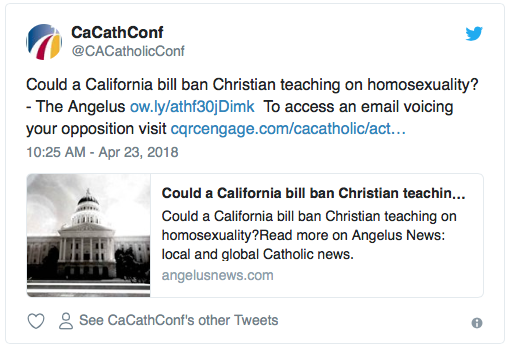
National Review’s David French also covered the sweeping nature of this bill and the censorship it would unleash including the outright banning of the sale of certain books. Really? It is still 2018, isn’t it? Indeed, it apparently is. Next they’ll be burning books in public ceremonies. Welcome to the Brave New World and Fahrenheit 451.
Zmirak notes that the California Bishops worked “with, not against pro-family groups.” (Emphasis added.) Imagine that. He then lauds them and turns right back toward Texas and states: “So bravo for California’s bishops. You know who could learn something from them? The Catholic bishops of Texas.” He quotes from Jason Jones’ piece praising disunity in the pro-life movement because, to put it simply,  there are a number of ways to reach the same goals.
(Of course, this assumes, and I will assume here merely for the sake of argument, that we all actually share the same goals. The truth is – and I’m just going to say it – I am far from convinced that Texas Right to Life and activists like myself share the same goals with these other organizations in Texas. You hear me, TAL, TCCB, and Texans for Life Coalition? I’m not the only one questioning this. As I’ve been saying on this blog and elsewhere on social media: by their fruits you will know them. The sour, often bitter, fruit coming from these organizations (and make no mistake, it is coordinated) is doing more to explain the problems with them than I ever could here.)
Then we get to the meat of Zmirak’s piece as far as I’m concerned and I will quote it all here:

Texas Bishops Declare War on Texas Right to Life 

I wish the Texas bishops took Jones’s approach. Instead, they have decided that their differences are irreconcilable. They filed for a divorce.

They announced that to every Catholic in Texas. The bishops sent a statement sent to be printed in every parish bulletin. It called on Catholics to stop supporting Texas Right to Life. That’s a shocking step for bishops to take toward such an organization. Have the bishops issued similar statements about pro-choice labor unions? About pro-immigration groups that back same-sex marriage? Not that I ever saw in my parish bulletin.

Surely Texas Right to Life has gone nuts, then. Right? Not at all. In the advisory, the bishops make their case. They cite some differences of approach on legislative strategy. And on how to score Texas representatives on life issues. Big deal.

Killing the Next Alfie Evans … in Texas 

The next issue is more serious. The bishops have backed an end-of-life law that Texas Right to Life considers dangerous. As Texas Right to Life wrote in its detailed response to the bishops:

Texas Advance Directives Act (TADA) grants hospitals and doctors unilateral authority to remove life-sustaining treatment from patients with a mere ten days notice, which has sped the death of hundreds of patients in Texas. TCCB vilified Texas Right to Life in the Parish Advisory for working to reform the draconian law that is worse than any statute in Britain. While TCCB’s lobbyist wholeheartedly agrees with the bishops in Britain in that doctors and hospitals should have the final authority to make life-ending decisions for patients, Pope Francis’ defense of Alfie mirrors Texas Right to Life’s patient advocacy efforts in which we work to transfer patients to willing providers in more appropriate care settings.

Churchy progressivism serves as a Gospel replacement serum. It soothes those who’ve lost their faith.

The Houston Press (not a pro-life paper) summed up TADA’s impact this way: “In Texas it doesn’t matter what instructions you’ve previously given or what your relatives say: If you’re in critical condition, you’re dependent on machines to survive and hospital officials decide it’s time to pull the plug, you will die. And it’s completely legal.”

I’m no bioethicist. But I did follow the Alfie Evans case very closely. Who were the fiercest advocates for Alfie and his parents? Not local bishops. (The Bishop of Liverpool backed the hospital.) They were lay pro-life advocates. Good people like the members of Texas Right to Life.

(Emphasis added.)
Bravo, John Zmirak! He’s not even here in Texas, but can clearly see from the outside looking in that there are big problems here that make no sense at all. None whatsoever. From TADA itself to the TCCB, things are not making sense in Texas and the implications are that lives will continue to be lost and souls will continue to be scandalized. To what end? Most objective people no longer question that these other groups and the TCCB are opposing true pro-life legislation and reform. They don’t question the what anymore. They do question the why. I’ve been trying to figure that out for at least the last five years and I still can’t answer that. What I do know is that it is not enough for them to take alternative positions on legislation; it’s not enough to take anti-life positions and call them pro-life; it’s not enough for them to support candidates that will not protect all life; they must try to take down the only organization that is fighting for all the Alfie’s in Texas. And be clear on this as well, they aren’t helping people navigate the mess that is TADA that they continue to enable. But they would sure like to get rid of the only organization that is. Why? Ask them. I would only be speculating.
I have come to truly understand what the adage “it is always darkest before the dawn” means. It is getting darker here in Texas and around the world for orthodox Catholics, authentic pro-lifers, and especially those fighting the Culture of Disposal, the Culture of Death that is euthanasia. But that means that the dawn is getting closer as well. You can help in that effort to bring about the dawn. If the bishops won’t see the light, maybe you can make them feel some heat. Write your bishops. Tell them they are wrong. Withhold giving until they right this ship and tell them why. Support truly pro-life organizations and their efforts. In Texas that is easy – you have one choice – Texas Right to Life. Educate your neighbors, friends, and even clergy. Vote for the right people at the right time, then hold their feet to the fire when the legislature meets. Keep up with things, make calls. Go down to Austin and tell your legislators what you want, testify about legislation, go to town hall meetings. Respectfully correct your pastors and bishops on these matters. (It is no sin to walk out of a bad homily where error is being taught and scandal committed.) You must try whether you think they’ll listen or not. You are responsible for what you do; they are likewise responsible for what they’re doing, not doing, and the effects of their acts and omissions. Their souls are at stake as well. Remember Matthew 18:6-9, 15-19 and Luke 17:1-3.
Be aware, be prayerful, be involved, be in it to win it and for the long haul. Have frequent recourse to the Sacraments. It is a difficult time. I know. But there is strength in numbers, in faith, in truth, and in believing and doing what is right.
Thanks for reading! 


Posted in Uncategorized | Comments Off on kassiblog.com tells it like it is !!! Texas bishops, read up !!!

BRAVO CARDINAL EIJK, MAY YOUR TRIBE INCREASE

Cardinal Eijk: Pope’s response to German bishops ‘incomprehensible’

{ABYSSUM}

The Dutch cardinal said the Pope should have clearly rejected proposals to allow Protestants to receive Communion

Pope Francis’s response to the German bishops’ draft guidelines on Communion for Protestants is “completely incomprehensible”, Cardinal Willem Eijk has said.

The Archbishop of Utrecht said the guidelines clearly breach Church teaching, and expressed his surprise that Pope Francis had not rejected them outright.

“The Holy Father should have given the delegation of the German episcopal conference clear directives, based on the clear doctrine and practice of the Church,” he said.

“He should have also responded on this basis to the Lutheran woman who asked him on November 15, 2015 if she could receive Communion with her Catholic spouse, saying that this is not acceptable instead of suggesting she could receive Communion on the basis of her being baptized, and in accordance with her conscience.”

Writing in National Catholic Register, Cardinal Eijk said Pope Francis had caused “great confusion among the faithful” and “endangered” the Church’s unity.

“This is also the case with cardinals who publicly propose to bless homosexual relationships, something which is diametrically opposed to the doctrine of the Church, founded on Sacred Scripture, that marriage, according to the order of creation, exists only between a man and a woman,” he added.

The cardinal concluded by saying the situation resembled the end times, quoting Article 675 of the Catechism which speaks of “a religious deception offering men an apparent solution to their problems at the price of apostasy from the truth.”

Posted in Uncategorized | 1 Comment

The New Paradigm naturally inculcates a distorted view that ignores or misrepresents the Church’s integral and authoritative role in conscience and discipline.


The ‘New Paradigm’: Old Errors, Same Tactics

By Fr. Timothy Vaverek

May 01, 2018

CATHOLIC CULTURE.ORG

Cardinal Cupich recently gave a talk in Cambridge in which he, like Cardinal Marx and other revisionist prelates and theologians, promotes a “New Paradigm” for understanding Catholic morality. The trouble is, the paradigm isn’t true, and it’s not even new.

The “New Paradigm” that Cardinal Cupich presents is a rehash of discredited theories from the 1960s and 1970s held together by a false notion of conscience, allegedly supported by Vatican II’s Gaudium et Spes. This approach claims that actions contrary to the Gospel and to human dignity are sometimes morally permissible. Once the paradigm is scrutinized, however, it collapses and its many inaccurate descriptions of the Catholic faith are exposed. The revisionists’ response to such critiques is to reassert their position and to resort to condescension, name calling, and pressure tactics. We have seen all this before, and the knowledge of past debates can help us understand what is unfolding in the Church today.

The revisionists’ paradigm has survived for half a century despite ecclesial opposition. Earlier versions of the New Paradigm dominated theological faculties and seminaries for a generation after Vatican II, in some places never completely falling out of favor. Its influence on moral theology was evident during the 1960s in the works of Josef Fuchs, Bernard Haring, and Charles Curran. So the paradigm was already in use when Cardinal Cupich began his studies at the Pontifical Gregorian University in the early 1970s (Fuchs, in fact, was teaching there).

In the interest of full disclosure, I need to admit having studied at the Gregorian as well (I arrived six years after the Cardinal left). While many seminarians in those days embraced the paradigm and retained it later as priests, theologians, and bishops, there was a marginalized minority who objected to it, recognizing that it was problematic and contrary to the Gospel. Providentially, I was among the latter. That experience enabled us to learn the paradigm from its leading proponents. As a result, we know its premises, structure, rhetorical strategies, and popular appeal—just as well as we know its failings. We are also aware of the way revisionists tend to resort to power and personal accusations (such as rigidity, nostalgia, and psychic insecurities) in order to ostracize critics or break down resistance.

In Opposition to the Church

The theoretical foundations and practical conclusions proposed by the first generation of theologians using the paradigm were highly controversial. By the mid-1980s, many of those claims were officially declared incompatible with the faith. Among the numerous ecclesial documents related to that struggle, the 1993 encyclical Veritatis Splendorarguably provides the most prominent and comprehensive refutation of the paradigm’s theoretical and practical errors in the field of moral theology.

During this struggle, open profession of the paradigm could have proved damaging to the “career path” of rising theologians and ecclesiastics, so proponents were generally discreet in their public statements. This did not, of course, alter their beliefs or keep tenured faculty and established ecclesiastics from supporting such positions. As a result, the paradigm never completely went away. In recent years, the paradigm has resurfaced as the “New Paradigm.” It has largely shed itself of explicit reference to its discredited theoretical foundations. Yet it continues to promote many of its old conclusions, most notably the claim that conscience can exempt a Christian from the Church’s evangelical teaching and discipline.

The revisionists accomplished this transformation by a simple and elegant maneuver. Instead of providing an analysis of personhood and human action which comprehensively disproves the “outdated” paradigm(s) that they wish to replace and then presenting a rigorous demonstration of the truth of their own novel claims, they cleverly cut the Gordian knot of detailed theological analysis by shifting to a practical approach that reduces morality to casuistry (i.e., the concrete application of norms). The key to the maneuver is to declare (without any proof) that the Church’s teachings are ideals. Considered as abstractions, these teachings obviously could not explicitly address every circumstance in life. Personal conscience, rooted in the concrete reality of daily existence, is then invoked as the means to apply the abstract teachings to particular cases and, voilà, the moral action suited to the situation emerges for each individual. The Church cannot gainsay this judgment because her role is to present principles, not conclusions.

This newest reincarnation of the paradigm has a number of practical advantages: it doesn’t have to expose its deepest theoretical foundations to scrutiny; it leaves people free to follow their consciences without submitting to ecclesial teaching or correction; it permits the teaching of Christ and the Church to be affirmed in theory while being set aside in practice; and it enables opponents to be denounced as unrealistic, heartless legalists who prefer fear and justice over love and mercy. It is easy to see how this approach might prove attractive to clergy and laity alike—and useful for revisionists in dealing with anyone who disagrees.

Conscience Distorted

Clearly, the current “New Paradigm” depends entirely on its claims regarding the abstract nature of Christian moral teaching and the role of conscience. Both are wrong, as even a brief analysis of its treatment of conscience will show. Aware that the paradigm’s view of conscience is pivotal, Cardinal Cupich and others have tried to bolster it by using a “proof text” from Vatican II’s Gaudium et Spes: “conscience is man’s most secret core and his sanctuary… [where] he is alone with God whose voice echoes in his depths” (GS 16). Their appeal fails for three reasons.

First, the context is against them. GS is addressed to the entire world and paragraph 16 is part of a discussion on the dignity of the human person. Thus, the purpose of GS 16 is to affirm the reality of conscience as related to God and common to every human being, not to provide an exhaustive analysis of its structure and operation or to describe the unique characteristics of a Christian conscience.

Second, the fact that GS 16 speaks of God’s voice echoing (resonat) means the text does not support Cardinal Cupich and others who refer to conscience as “the voice of God.” We know from experience that an echo can distort a voice. This can happen in conscience for many reasons, innocent or culpable, and can leave the conscience mistaken or blind, as GS 16 itself affirms. Third, and most important for our present discussion, it is not true that a person is absolutely alone with God in conscience—certainly no Christian is. Jesus, the Word Incarnate, abides in us by the gift of the Holy Spirit. But, where Jesus and the Holy Spirit are, there is the body and bride of Christ, the Church. GS 16 does not mention these Christological, pnuematological, and ecclesiological dimensions because of its narrow purpose.

For a Christian, then, conscience is no longer simply the natural faculty briefly described in GS 16 which imperfectly echoes the voice of God. It has been transformed by the grace of the indwelling Trinity into a real, but imperfect, participation in the life of God, Christ, and the Church. This means it is a con-scientia in both etymological senses: a personal “consciousness” (or “awareness”) and a communal “knowing with” the Trinity, Jesus, and the Church—encompassing the entire communion of saints. This personal and communal conscience is the one St. Thomas More invoked when he died rather than take an oath that had been declared morally acceptable by all but one of the English bishops.

For a believing Catholic, this dual experience of conscience bears witness in the Holy Spirit to a personal awareness of fallibility and to the consequent need to be part of the communal embrace and practice of the Gospel proclaimed infallibly by Christ in the Church. That is why Cardinal Newman, who famously called conscience “the aboriginal vicar of Christ” also adamantly affirmed it must be docile to the living voice of the Church, “the pillar and bulwark of the truth.” Notably, Cardinal Cupich and other revisionists cite Newman without mentioning this latter point.

Thus, it is a grave error to view conscience as the means of applying allegedly abstract moral norms to concrete situations. Conscience is, rather, a means of drawing the concrete wisdom and love of the Trinity, manifest in Jesus of Nazareth and lived within the Church, more perfectly into the daily life of the Christian. The moral norms of the Gospel are not idealistic intellectual statements that we apply; they are practical manifestations of the Word of God, revealing the personal and communal reality of who Christ is and what it means to share his life.

Apostolic Witness

This explains why the Apostles insisted that in receiving the Gospel a Christian must put on the mind of Christ and act as a member of his body, sharing his divine life and holiness. It is why they required ecclesial discipline, even expulsion when necessary, for those who violated the Gospel delivered once and for all within the life of the Church (Gal 1:8; I Jn 2:24; II Jn 8-11; Jude 3, 22, 23). In so doing, they handed on a practice established by Christ (Mt 18:15-17). It is crucial to note that Jesus and the Apostles did not authorize the Church to make such corrections based on a person’s innocence or guilt. That would be impossible, since the Church cannot know the state of anyone’s conscience. Instead, they commanded the Church to judge based on the fact of whether a person had departed from the belief and behavior which is ours in Christ and whether that person subsequently accepted or refused correction.

The early Church followed this practice, accompanying Christians who objectively failed to live the Gospel by pointing out the error of their actions or beliefs and helping them lay those aside. When the matter was grave, however, Holy Communion was withheld, whether they were innocent or culpable, until they rejected the sin, fear, or error that led to their failure.

Having misconceived the nature of conscience, the New Paradigm naturally inculcates a distorted view that ignores or misrepresents the Church’s integral and authoritative role in conscience and discipline. Similarly, it is unable to envision that the critics who affirm what it denies are intelligent, well-grounded, and pastorally minded. This disposes otherwise charitable prelates and theologians, like Cardinal Cupich, to treat critics with condescension and baseless accusations, claiming that the critics are not able to understand the New Paradigm, are insecure or fearful in the face of change and freedom, fail to recognize that people can err innocently or through the pressures of life, wish to replace conscience rather than guide it, prefer to treat Christians like children, think they have all answers, are Pharisees, etc., etc.

Fifty years of repetition cannot make their accusations true any more than it can remove the fundamental errors of their not-so-new paradigm. But their consistency does enable us to know precisely what we are dealing with and what to expect if their popularity and power continue to grow. We can only pray that some bishops find an effective way to accept marginalization and to stand against this false paradigm in order to offer an authentic apostolic witness. For the proclamation and living of the Gospel is the only remedy we have.


Fr. Timothy V. Vaverek, STD has been a priest of the Diocese of Austin since 1985 and serves parishes in Gatesville and Hamilton. His studies focused on Ecclesiology and Apostolic Ministry, including Newman’s understanding of Conscience in relation to the Church.


Sound Off! CatholicCulture.org supporters weigh in with their comments:


  • Posted by: bkmajer3729 – May. 06, 2018 10:00 PM ET USA Do we even have souls anymore? This all sounds like saying the means justify the ends. Receiving HC validly makes two claims:(1)by approaching one (re)states commitment to Christ & His Catholic Church AND (2)by receiving one accepts Christ & His Grace. Non-Catholic reception ignores the first part. Christ & His Church are supposed to be one. If the marriage is solid why not RCIA for the spouse to become Catholic? Well, yeah, I know, it’s complicated. Tell it to Jesus hanging on the Cross.
  • Posted by: rjbennett1294 – May. 02, 2018 10:31 AM ET USA In the current climate in the Church, Fr. Vavarek is exceedingly brave to write an article like this. Priests in some dioceses – Cardinal Cupich’s Chicago archdiocese springs to mind – would be severely punished for speaking the truth in this way. In some respects, the “New Paradigm” may actually have a long history. To many of us, there are elements of it that sound a lot like what Eve was told in the Garden of Eden. God bless Fr. Vavarek.
  • Posted by: feedback – May. 02, 2018 10:17 AM ET USA Thank you for this valuable essay. Some clerics are firmly stuck in the 1960-70’s with their theological “new” ideas, frequently combined with their left-leaning political involvement, and their taste for “new” church music, “new” art, and “new” 1960-70’s architecture. The results of their activism are overall counter productive.
  • Posted by: Randal Mandock – May. 01, 2018 8:57 PM ET USA Succinct answer to the Pope’s and his men’s and women’s well-practiced belittlements, condescensions, and proffering of spurious logic and analysis. Frequent recourse to these types of essays is critical in the fight to continue to embrace the rule of faith and morality that can save us from casuistry, a false irenicism, and subjugation to the modern “consensus” disciplinarian. Since Fr. Vaverak is not directly referencing the Pope in his essay, we hope that he remains secure in his ministry.
  • Posted by: miked.doc6394 – May. 01, 2018 4:56 PM ET USA Thank you for this much needed and thorough explanation. “Whoever then relaxes one of the least of these commandments and teaches men so, shall be called least in the kingdom of heaven; but he who does them and teaches them shall be called great in the kingdom of heaven.” -Matthew 5:19
Posted in Uncategorized | 1 Comment

HERE IS YOUR LITTLE DOSE OF SATIRE TO HELP YOU DIGEST THE NEWS THAT MARX WANTS TO REMOVE ALL THE CROSSES FROM WALLS IN GERMANY

Eccles and Bosco is saved


Cardinal Marx bans the cross

Posted: 05 May 2018 04:05 AM PDT

On this, the 200th anniversary of the birth of Karl Marx, the founder of, er, Marxism, one of his illustrious descendants, Cardinal Reinhard “Rhino” Marx has taken the opportunity to explain that from now on the German Catholic Church will prohibit the use of the Cross.prats at Karl Marx grave

You can fool some of the people all of the time.


It began with Rhino condemning the hanging of crosses in public buildings, which is only reasonable, for why should people be allowed to use the patented, trademarked, symbol of the Church without paying Royalties, like good Catholic Germans do with their Church Tax? But on further reflection, His Eminence has decided that the cross is a hated symbol of traditional Catholicism and needs to be exterminated completely.

Rhino Marx

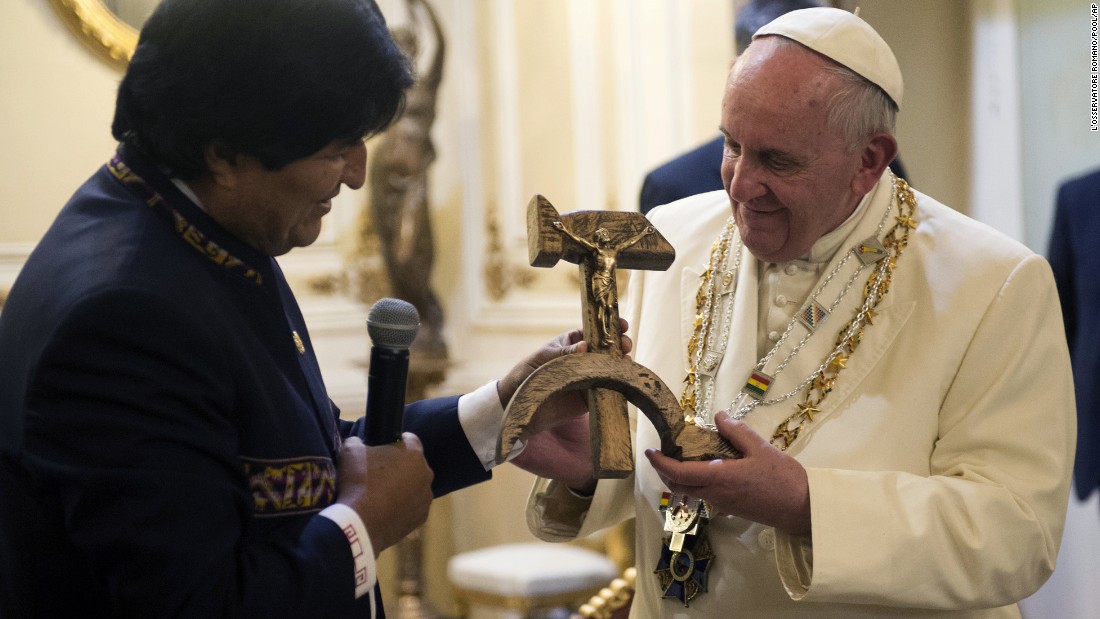
“I used to wear a cross, but it’s a hammer and sickle from now on!”

German Catholics are being told to abandon the “sign of the cross” and from now on will be making the “sign of the hammer and sickle”: this is definitely more complicated, and osteopaths will be on hand to help anyone who gets into difficulties. The change from “Cross” to “Hammer and Sickle” is expected to be approved at the highest level in the Church – as with the Protestant heresy, the Germans lead the way – and Pope Francis, advised by top theologian Cardinal Walter Kasper, has agreed that it is a better symbol of modern Catholic belief.

Pope and hammer/sickle

Vorsprung durch Ketzerei.

Meanwhile, the German bishops – who sometimes make even the English bishops look orthodox – are debating whether a Protestant married to a Catholic should be allowed to receive Communion. That is, a Communion in which he (or she) doesn’t believe. My distant kinsman Fr Bob Eccles has written some absurd letters in the Catholic Herald on this subject – apparently it isn’t about what you believe, or what Christ taught, but more about what makes people happy (I paraphrase).

But the German bishops are divided, and they asked the Pope to rule on this matter. Do we go along with all the Catholic teachings of the last 2000 years, or do we have a free-for-all, in which the Host may be consumed by Protestants, Muslims, Atheists, and even British High Court Judges?

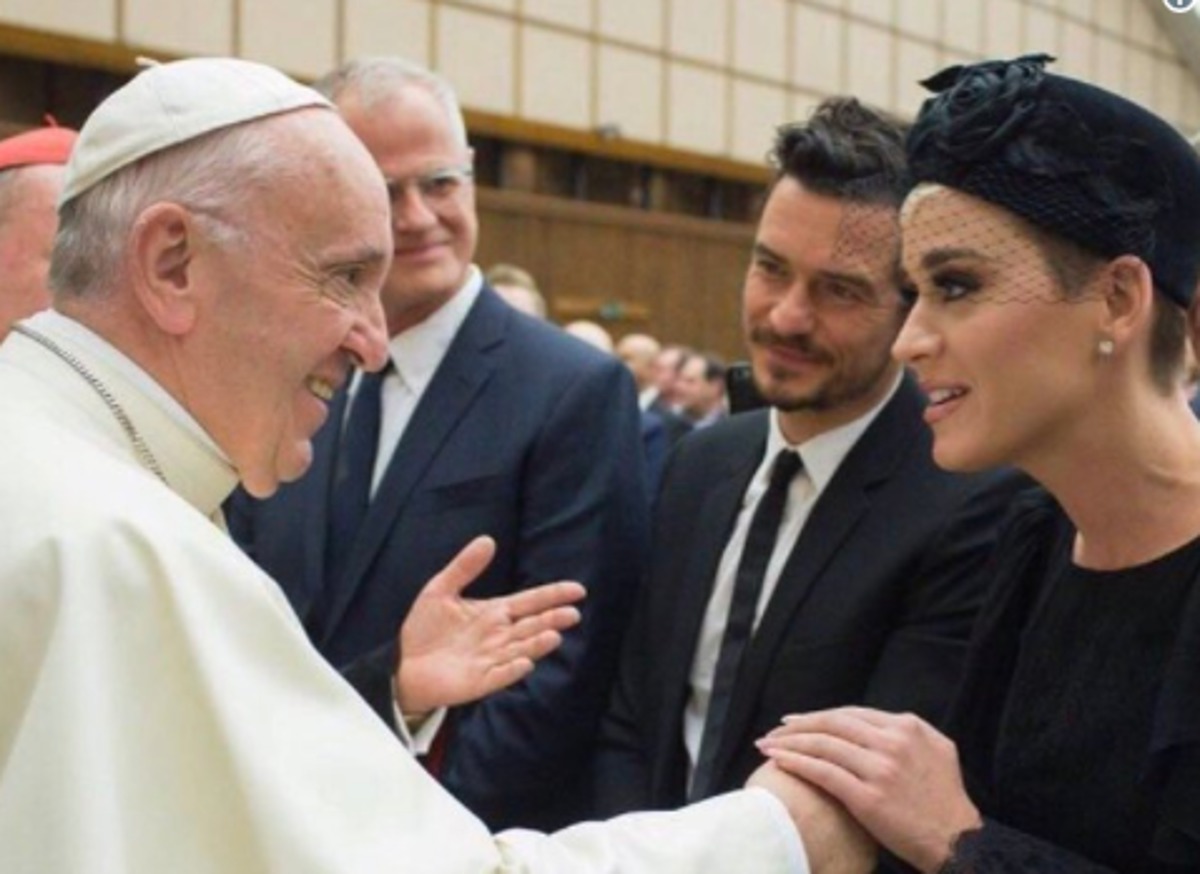
Pope and Katy Perry

The Pope asks his new best friend, Katy Perry, for advice.

We don’t know what advice Pope Francis received from his new theological adviser, but in the end he decided to play safe and treat the German bishops’ enquiry as a Dubium. This means it was filed in a shoe-box labelled “Questions I am never going to answer”.

So the ball is back with Rhino and his chums. The good Cardinal is said to be very hammer-and-sickle about the whole affair.


Posted in Uncategorized | 1 Comment

In our fallen human nature, we do not understand love, joy, and friendship. Our darkened intellect does not see them clearly and easily accepts counterfeits of them. And our weakened, selfish will distorts them to be what our passions want.

The Vine’s Commands Fr. Paul Scalia: We cannot hope to imitate Christ or live His commands by our own power. Unless He comes to our assistance, His commands become torturous.

In today’s Gospel our Lord speaks of things that resonate deep in the human heart: love, joy, and friendship. We all desire these, so we delight in His words: Remain in my love. . . .I have told you this so that my joy may be in you and your joy might be complete. . . .I have called you friends. . . .But then He also speaks of something less appealing: commandments:  If you keep my commandments, you will remain in my love. . . .This is my commandment: love one another as I love you. . . .You are my friends if you do what I command you.

How do we square these things? On one hand, the appeal of love, joy, and friendship.  On the other hand, the burden of commands. Or, put differently: Why is it that we get to love, joy, and friendship only by way of obedience to His commands?

            First of all, because in our fallen human nature, we do not understand love, joy, and friendship. Our darkened intellect does not see them clearly and easily accepts counterfeits of them. And our weakened, selfish will distorts them to be what our passions want. We need the teaching of Christ to enlighten our minds and hearts so that we can grasp the true meaning of these blessings. Only in Him, true God and true man, do we see authentic love, real joy, and genuine friendship. Without Him, we have only their natural, wounded versions of those crucial things that incline easily to error and harm.

He not only loved perfectly in this world but is Himself Love Incarnate. Unless, then, His perfect love is the standard, our love risks becoming mere sentimentality – silly at best, brutal at worst. Unhinged from Truth, our loves tend towards the tenderness that causes so much wreckage in our families and society. And that, in Flannery O’Connor’s famous words, “leads to the gas chamber.”

He lived a genuinely joyful life, in complete abandonment to the Father and in the midst of the worst sufferings. Without this example, we will seek complacency, fun, or physical pleasure instead of joy.

Finally, He showed Himself the perfect friend, loving his own in the world and loving them to the end. (cf. Jn 13:1) Without His example to teach us, we will likely settle for superficial relationships masquerading as friendships. These may produce the banality of drinking buddies or the brutality of cliques and gangs.

But it is not only His words and example that bring us the reality of the greatest of gifts.  In fact, our Lords teaching – and even His salutary example – can become what seems an external, frustrating imposition upon us.  We cannot hope to imitate His example or live His commands by our own power.  It is only by way of that transforming union with Him that we have the ability to attain and imitate His love, joy, and friendship. Unless He comes to our assistance, His commands become torturous.

So we have to hear our Lord’s commands within their context, specifically in light of His preceding words about the vine and branches (last Sunday’s Gospel):  Remain in me, as I remain in you. . . .I am the vine, you are the branches.  He speaks about our union with Him before He speaks about our obedience to Him. Union precedes obedience and makes it possible.

The sap of the vine flows into the branches. His love, joy, and friendship are, in effect, already within us from our being grafted onto the Vine. So His commands arise not from outside but from within us. They help us to become what we truly are. They are no more foreign to us than the vine’s sap is to the branches. To obey His commands simply means to remain on the vine and be true to what He has made us.

Our Lord can command what He does because he has already given us the grace to respond.  So Saint Augustine could pray Da quod iubes et iube quod vis (“Give what you command and command what you will”), fully confident that God had, in effect, already given the grace to live His commands. 

The broader context of our Lord’s words is the Last Supper, when He established the Sacrament of love, joy, and friendship. So it is most of all by the frequent and devout reception of Holy Communion that we remain in Him and He in us.  It is by that union with Him – that remaining on the Vine – that we branches receive the grace to love, to rejoice, and to be friends as He commands.


*Image: Christ the True Vine, Eastern Orthodox icon, 16thcentury [Byzantine and Christian Museum, Athens]

Fr. Paul D. Scalia

Fr. Paul D. Scalia

Fr. Paul Scalia is a priest of the Diocese of Arlington, Va, where he serves as Episcopal Vicar for Clergy. His new book is That Nothing May Be Lost: Reflections on Catholic Doctrine and Devotion.

Posted in Uncategorized | Comments Off on In our fallen human nature, we do not understand love, joy, and friendship. Our darkened intellect does not see them clearly and easily accepts counterfeits of them. And our weakened, selfish will distorts them to be what our passions want.

HUMANAE VITAE REVISITED

A Re-Reading (Relectio) ofHumanae Vitae, Part II

{ABYSSUM}
E. Christian Brugger recounts the attempts by some to reinterpret Paul VI’s great encyclical for a new age. But that’s what the pope did in 1968 — for the immemorial teaching of the Catholic Church.Note: The first part of this essay appeared last Saturday. In that earlier portion, Professor Brugger deals with the details of how Paul VI wrote his encyclical and of the opposition he faced. It ended with an explanation of how the pope conceived of the absolutely inseparability of the unity of the spouses and the procreative dimension in every sexual act that is morally licit.

[A fundraising update: we’re almost a quarter of the way to our goal, but we need more of you, many more, to do your part in advancing the work of The Catholic Thing. Tomorrow is Sunday and we don’t fundraise on the Sabbath, so that you’ll be able to enjoy your day of rest and a deep reflection by Fr. Paul Scalia. So, please, be generous and act – today– Robert Royal]

Another way to phrase this is to say that unity and procreation are intrinsic goods of the marital act. They are its goods precisely because they are defining goods of marriage itself. Marriage is a unitive and procreative typeof friendship. The sexual act that takes its name from that friendship – the marital act – is likewise a unitive and procreative type of act.

People may engage in all sorts of sexual acts, but only sexual acts that are unitive and procreative in type are conjugal – are marital – acts. If the actors in any sexual act reject either or both of the goods of marriage, then the act, whatever else it is, is not a marital type of act.  This follows logically from Pope Paul’s unity/procreation paradigm.
Thus, if a husband forces himself sexually upon his wife, the act, as John Paul II affirmed, is not a marital type of act, but rather an act of rape. Likewise, if he or she does anything with the specific intent to render their intercourse non-procreative, the act, not being a procreative type of act, but one that by intent has been rendered sterile, is also not a marital type of act.

Since only martial sexual acts are justifiable, these non-marital types of acts are judged to be always wrongful. This is what is meant by the much-maligned term “intrinsically evil” as it is applied to contraception: it means such acts can never be chosen in a way that conduces to the integral wellbeing of the marriage.

This logic is quite tight and constitutes the central normative part of the Catholic teaching on conjugal chastity. Whatever else is variable about that teaching – and there are several things: the linguistic formulations by which the truths are communicated; the people who officially communicate them (once only clerics and religious, now including laypeople); the ages to whom they are first communicated, etc. – whatever else is changeable, the truths concerning the nature of marriage and the consequent moral implications for sexual activity are unchanging and unchangeable.

Marriage is an exclusive, comprehensive, procreative one-flesh communion of persons; and sexual acts that intentionally reject either the unitive or procreative goods of the marriage are non-marital and hence not morally legitimate.

To defend the integrity of these sacred but vulnerable truths, Pope Paul VI authoritatively declared in paragraph 14 that “any action which either before, at the moment of, or after sexual intercourse, is specifically intended to prevent procreation – whether as an end or a means [is intrinsically evil].”

By formulating the norm as he did, the pope declares his own judgment about the morality of the birth control pill, a pill that is taken before sexual intercourse with the specific intent to prevent procreation.

What follows this declaration is full of wisdom and very much worthwhile reading. Here I can do no more here than touch on highlights.

The pope debunks the principal argument – from “totality” – put forward by the pro-contraception majority of his commission. He praises responsible parenthood and recommends to couples who have serious reasons to limit the size of their families to have recourse to natural fertility cycles. But he predicts several dire social consequences should a widespread use of contraception take root throughout the world.

Therefore, he urges public authorities, scientists, medical professionals, and Christian married couples to defend and support the goods of marriage within their respective domains of influence.

Finally, he ends with two paragraphs, terribly painful to read, that are addressed to his priests and brother bishops. They are painful not because of what he says, which is beautiful, wise, and filled with paternal solicitude and pastoral urgency, but painful because we know now, from our broken vantage point fifty years later, that the majority – the vast majority – of the priests and bishops to whom the pope’s words were lovingly addressed, did at best hide them under a bushel basket – and at worst outright disdained them.


The distinguished Catholic journalist and social commentator Russell Shaw recently imagined here what a “re-reading” of the Catholic teaching on contraception might look like refracted through the lens of the so-called “new paradigm.”  He noted that it would teach the following:

The Church cherishes and upholds as an ideal for husbands and wives that each and every act of marital intimacy be open to new life, and married couples ideally should will and do nothing directly to impede that possibility. But in the circumstances of the present day, the Church, as a loving and merciful mother, does not seriously expect all couples to live by this ideal and does not pass harsh judgment on those who don’t.

This imaginary rereading, we see, like the rereading noted above, dispenses with the absolute nature of the moral norm against contraceptive acts as taught not only in Humanae Vitae but also in Pius XI’s Casti Connubii (1930), Pius XII’s Address to Italian Midwives (1951), John Paul II’s Familiaris Consortio (1981), the Catechism of the Catholic Church (1997), Vatican II’s Gaudium et Spes (1965), The Council of Trent’s Roman Catechism (1566), the work of Thomas Aquinas, as well as in traditional canon law, and many other authoritative sources.

The “new paradigm” dispenses with the absolute moral norm in the name of “love” and “mercy,” “non-judgmentalism” and “circumstances.” But it does not and cannot dispense with the absolute prohibition of every freely chosen contraceptive act in the name of Jesus Christ and his Church.

Any dispensation, however generously adorned, is spurious and cannot be admitted. Why? Is it because of a fear of change, or a hardened rigorism, or an adhering to a cold bureaucratic morality, or a defense of dry and lifeless doctrine? No. It cannot be admitted because the two central truths discussed above remain true: the moral norm with its absoluteness is what it is because marriage is what it is.

Therefore, out of true love for all persons tempted to render their intercourse non-procreative, and in the name of Jesus’ genuine mercy that protects from sin and saves us from its sting, the Church can only teach that every freely chosen non-marital sexual act is always harmful to marriage, will never conduce towards true happiness in the present life or in the life to come, and therefore can never be rightly chosen.

If such acts are chosen, then the Church, as the guardian of Jesus’ Good News, is required by love to say they must be repented of in the Sacrament of Reconciliation.

##

I said at the beginning of this essay that after attempting to formulate anew the enduring principles taught in HV, I would apply them anew to the present state of affairs.  Having come this far, however, I am convinced they need no “new” application for today, over and above what can be found in the texts I have noted, especially Humanae Vitae, Familiaris Consortio, and the Catechism of the Catholic Church.  So I commend the consciences of my readers to the treatment of conjugal chastity summarized in those authoritative texts.

Humanae Vitae was a wake-up call to Christians and their pastors not only to do something then but also to see what was coming. What it warned about has long since come to pass. And every day further confirms the urgency of the truth that Pope Paul VI bravely set forth. It did not say everything that could have been said, but what it did say was profoundly true and relevant. It is still true and relevant.

E. Christian Brugger

E. Christian Brugger

Dr. E. Christian Brugger is a senior research fellow at the Culture of Life Foundation in Washington, D.C. In 2016 he was a theological consultant to the U.S. Conference of Catholic Bishops’ Committee on Doctrine. He has served as dean of the School of Philosophy and Theology at the University of Notre Dame, Australia, and the J. Francis Cardinal Stafford Professor of Moral Theology at St. John Vianney Theological Seminary in Denver. He is the author of <a href=”https://amzn.to/2vOi2hK”The Indissolubility of Marriage and the Council of Trent

Posted in Uncategorized | Comments Off on HUMANAE VITAE REVISITED

IT WAS BOUND TO HAPPEN !!! FRANCIS WOULD WIN THE APPLAUSE OF THE IGNORATI FOR THE ‘MERCY’ HE WOULD SHOW TO ALFIE EVANS AND HIS PARENTS, WHILE DELIVERING A MESSAGE TO THE WORLD MEDICAL ASSOCIATION APPROVING OF THE VERY POLICIES OF THE LIVERPOOL HOSPITAL WHICH KILLED ALFIE EVANS. THE HYPOCRISY IS TOO MUCH TO CONTEMPLATE.

From: FeedBlitz <feedblitz@mail.feedblitz.com>
Date: May 5, 2018 at 2:18:24 AM EDT
To: rcapone15 <rcapone15@comcast.net>
Subject: Medical Futility Blog – Pope Francis Supports Principles of Medical Futility, Non-beneficial Treatment, and Therapeutic Obstinacy
Reply-To: FeedBlitz <feedblitz@mail.feedblitz.com>
Feedblitz is a website that supports euthanasia!!!


Pope Francis Supports Principles of Medical Futility, Non-beneficial Treatment, and Therapeutic Obstinacy


In a recent message to the World Medical Association, Pope Francis confirmed his support (and that of Catholic doctrine) for principles of medical futility, non-beneficial treatment, and therapeutic obstinacy.

“The growing therapeutic capabilities of medical science . . . have become ever more effective, but they are not always beneficial: they can sustain, or even replace, failing vital functions, but that is not the same as promoting health.”

“Greater wisdom is called for today, because of the temptation to insist on treatments that have powerful effects on the body, yet at times do not serve the integral good of the person.”

“[I]t is morally licit to decide not to adopt therapeutic measures, or to discontinue them, when their use does not meet that ethical and humanistic standard that would later be called ‘due proportion in the use of remedies.’ . . .  It thus makes possible a decision that is morally qualified as withdrawal of ‘overzealous treatment.'”
“Such a decision responsibly acknowledges the limitations of our mortality, once it becomes clear that opposition to it is futile.  euthanasia is to end life and cause death.”
++++++++++++++++++++++++++++++++++++++++++++++++++++++++++++++++++
{Abyssum}
Dr. Capone writes to me {RHG}:
“This secular site (Feedblitz) tends very much to espouse the point of view of the secular culture of death by their statements over the years. Now they can say they’ve an ally with the Pope. One of the problems with futility is that it’s very hard to define medically. If a specific treatment keeps an important physiological function normal (and lab value) such as dialysis, but doesn’t cure the underlying disease, is that futile? Medical futility is all in the eye of the beholder. Further, this particular site views the provision of artificial nutrition and hydration for the most part to be futile. This is not in keeping with St JPII exhortation in 2004 {which exhortation of the Pope was based to a large extent on the text of my dissent from the Texas Catholic Conference’s statement supporting the withdrawal of nutrition and hydration and the Statement of the NCCB Committee on Pro-Life Activities of which I was also the author} that such care {the supplying of nutrition and hydration} is normal human care. 
This comment as it is represented here is also not the same as that contained in the Catechism 2278, allowing for the stopping of “overzealous”, extraordinary or disproportionate therapies when they are burdensome to self or others or no longer effective but always with the intention of ending such a treatment, but not the intention to end a burdensome life. Further, the decision, as it says in the Catechism should be made by the patient or if unable, the family, not some professional or bureaucratic third party. Futility laws empower such third parties. 
I’m afraid this will be bad news for orthodox Catholic physicians and patients to be told the Pope says it’s ok for the doctors unilaterally stop “futile” treatment and for patients/families to accept this.
Posted in Uncategorized | 2 Comments

THE KILLING OF CATHOLIC PRIESTS IS ONE OF SATANS FAVORITE WAY TO HURT THE CHURCH. 23 PRIESTS HAVE BEEN KILLED IN MEXICO IN RECENT YEARS.

EmailPinterestPocketGoogle+

On the Trail of a Traditional Priest’s Killer

OnePeterFive

By keeping certain cold cases in the public eye, the chance of those cases being solved appears to increase. The latest example is the April 24 arrest of the notorious Golden State Killer, who committed his crimes in the 1970s and ‘80s.

Thus, on this 20th anniversary year of the unsolved murder of Father Alfred Kunz — a case I’ve been following and writing about for quite a few years — I’d like to highlight the recent social media campaign conducted by the Dane County Sheriff’s Office (primarily on Facebook, but also on Twitter), which “is hoping to reinvigorate the investigation of this case.”

Father Kunz was a priest and canon lawyer of the Diocese of Madison, Wisconsin. He was known for celebrating the Traditional Latin Mass (and the Novus Ordo) as the longtime pastor of St. Michael Catholic Church, located in rural Dane, Wisconsin. He had a good reputation among a number of orthodox Catholics, even on a regional level, and was staunchly pro-life.

Father Kunz was also a discreet adviser to Illinois Catholic activist Stephen Brady, who founded the now-defunct Roman Catholic Faithful, Inc. Brady was instrumental in exposing clergy corruption in the Diocese of Springfield, Illinois, including that of the late Bishop Daniel Ryan, who resigned in disgrace in 1999. (In 2000, Brady went on to expose a network of pederasts in the priesthood and hierarchy worldwide, but was not taken seriously by the mainstream media or the Catholic establishment. As we know, the clergy abuse scandal erupted in the mainstream media in 2002.)

On the morning of March 4, 1998, Father Kunz was found brutally murdered, his throat slit, in the hallway of the school attached to his parish. There have been various theories put forth as to the killer’s motive, some more plausible than others.

Now to the Sheriff’s Office March 2018 social media campaign…

One of the most intriguing Sheriff’s Office Facebook posts has to do with Maureen O’Leary — referred to as “Ms. O’Leary” in the post — the principal of St. Michael School at the time of the murder. Sure sounds like Ms. O’Leary has something to hide! Could she be shielding the killer for some reason?

The Sheriff’s Office reportedly is monitoring a few persons of interest, at least one of whom has a criminal record.

I asked Sheriff’s Office spokeswoman Elise Schaffer the following question: Do the reported handful of persons of interest know each other, and could they be collectively covering up the crime? She responded: “Our detectives say the persons of interest do not generally move in the same circles.”

Is it possible that any of the persons of interest might kill again at some point? “Anyone’s guess. Anything is possible,” Ms. Schaffer responded.

Below are additional images from the campaign, including two crime scene photos, a timeline photo, and a photo of one of Father Kunz’s hands, post-mortem, showing defensive wounds (bruising). That photo, originally on the Sheriff’s Office Facebook page, was captured by writer Joe Hanneman at his website.

Stay tuned.


Matt C. Abbott is a Catholic commentator with a Bachelor of Arts degree in communication, media and theatre from Northeastern Illinois University. He also has an Associate in Applied Science degree in business management from Triton College. He’s been interviewed on MSNBC, Bill Martinez Live, WOSU Radio in Ohio, the Milwaukee Journal Sentinel’s ‘Unsolved’ podcast, WLS-TV (ABC) in Chicago, WMTV (NBC) and WISC-TV (CBS) in Madison, Wis., and has been quoted in The New York Times and the Chicago Tribune. He can be reached at mattcabbott@gmail.com.

 +++++++++++++++++++++++++++++++++++++++++++++++++++++++++++++++++++++++++++

SAINT-ETIENNE-DU-ROUVRAY, France (Reuters) – Knife-wielding attackers interrupted a French church service, forced the priest to his knees and slit his throat on Tuesday, a murder made even more shocking as one of the assailants was a known would-be jihadist under supposedly tight surveillance.

As the attackers came out of the church shouting “Allahu akbar” (“God is Greatest”) they were shot and killed by police.

The men arrived during morning mass in Saint-Etienne-du-Rouvray, a working-class town near Rouen, northwest of Paris, where the 85-year-old parish priest, Father Jacques Hamel, was leading prayers.

“They forced him to his knees and he tried to defend himself and that’s when the drama began,” Sister Danielle, who escaped as the attackers slayed the priest, told RMC radio.

“They filmed themselves. It was like a sermon in Arabic around the altar,” the nun said.

Three other worshippers were held hostage until the assailants were killed, one of them was badly wounded during the attack

News agency Amaq, which is affiliated with Islamic State, a group France is bombing in Iraq and Syria as part of a U.S.-led coalition, said two of its “soldiers” had carried out the attack. Police said one person had been arrested.

France’s anti-terrorism prosecutor Francois Molins identified one of the attackers as 19-year-old Adel Kermiche, a local man who was known to intelligence services after his failed bids to reach Syria to wage jihad.

Kermiche first tried to travel to Syria in March 2015 but was arrested in Germany. Upon his return to France he was placed under surveillance and barred from leaving his local area.

But less than two months later he slipped away and was intercepted in Turkey making his way towards Syria again.

He was sent back to France and detained until late March this year when he was released on bail. He had to wear an electronic tag, surrender his passport and was only allowed to leave his parents home for a few hours a day.

The fact that he was still able to commit the attack will raise yet more questions over the intelligence services and legal procedures in a country still under a state of emergency.

It is less than two weeks since a Tunisian plowed a truck into a crowd in the French Riviera city of Nice, killing 84 people, an attack claimed by Islamic State.

“In the face of this threat that has never been greater in France and Europe, the government is absolutely determined (to defeat) terrorism,” President Hollande said in a televised address.

The White House condemned the attack and commended the French police’s “quick and decisive response.”

One former school acquaintance remembered Kermiche as a normal teenager who became obsessed with hardline interpretations of the Koran after the attack on the satirical Charlie Hebdo magazine in January 2015 and would later urge his friends to “fight for our brothers”.

“He tried to indoctrinate us,” said the 18-year-old, who gave his name only as Redwan.

A horrified local resident, Cecile Lefebre, said: “I have no words. How do you arrive at this point, killing people in cold blood like this? It’s pure barbarity.”

Since the Bastille Day mass murder in Nice, there has been a spate of attacks in Germany, some of which also appear to be Islamist-inspired.

“In the face of this threat that has never been greater in France and Europe, the government is absolutely determined (to defeat) terrorism,” Hollande said in a televised address.

Police and rescue workers stand at the scene after two assailants had taken five people hostage in the church at Saint-Etienne-du -Rouvray near Rouen in Normandy, France, July 26, 2016. REUTERS/Steve Bonet

MERCILESS

But former president Nicolas Sarkozy, who is expected to enter a conservative primary for next year’s presidential election, accused the Socialist government of being soft.

“We must be merciless,” Sarkozy said in a statement to reporters.

“The legal quibbling, precautions and pretexts for insufficient action are not acceptable. I demand that the government implement without delay the proposals we presented months ago. There is no more time to be wasted.”

The center-right opposition wants all Islamist suspects to be either held in detention or electronically tagged to avert potential attacks.

Far-right National Front leader Marine Le Pen, who is also expected to run for the presidency, said both Sarkozy’s and Hollande’s parties had failed on security.

“All those who have governed us for 30 years bear an immense responsibility. It’s revolting to watch them bickering!” she tweeted.

Slideshow (9 Images)

Hollande said France should “use all its means” within the law to fight Islamic State.

Pope Francis condemned what he called a “barbarous killing”.

“The fact that this episode took place in a church, killing a priest, a minister of the Lord and involving the faithful, is something that affects us profoundly,” Vatican spokesman Father Federico Lombardi said.

In a telephone call with the pope, Hollande expressed “the sorrow of all French people after the heinous murder of Father Jacques Hamel by two terrorists,” and said everything would be done to protect places of worship, the presidential palace said.

Jean-Pierre Raffarin, a former conservative prime minister who now heads the Senate’s foreign affairs committee tweeted: “Everything is being done to trigger a war of religions.”

Additional reporting by Chine Labbe, Marine Pennetier, Michel Rose and Richard Lough in Paris and Jess Mason in Washington; Writing by Richard Lough and Paul Taylor; Editing by Jeremy Gaunt and Robin Pomeroy

Posted in Uncategorized | Comments Off on THE KILLING OF CATHOLIC PRIESTS IS ONE OF SATANS FAVORITE WAY TO HURT THE CHURCH. 23 PRIESTS HAVE BEEN KILLED IN MEXICO IN RECENT YEARS.

IN OTHER CASES LIKE THE ALFIE EVANS CASE, IS THE POSITION OF THE BISHOPS OF THE TEXAS CATHOLIC CONFERENCE REALLY ANY DIFFERENT FROM THE APPROVING POSITION OF THE ENGLISH BISHOPS?

TX BISHOPS AND THE CULTURE OF DEATH

NEWS: COMMENTARY


by Bradley Eli, M.Div., Ma.Th.  •  ChurchMilitant.com  •  May 3, 2018    15 Comments

Social justice bishops support euthanasia in Texas

Texas bishops are actually supporting end-of-life directives that allow Texas hospitals to kill their patients much the same as U.K. hospitals did to Alfie Evans and Charlie Guard.The Texas Advance Directives Act (TADA) allows hospitals, not patients or family members to decide when to withdraw life-sustaining care from patients if doctors deem continued care to be futile. The Texas Catholic Conference of Bishops (TCCB) last year showed strong support for the measure: “Human intervention that would deliberately cause, hasten or unnecessarily prolong the patient’s death violates the dignity of the human person. … TCCB strongly supports §166.046 as indispensable for ensuring dignity at end of life.”

In other words, providing such basics as food, water and oxygen to someone would prolong their life, which they surmise would not be merciful. This was exactly the argument Alder Hey hospital used to kill Alfie Evans against the plea of his parents.

Pope St. John Paul II strongly opposed this mentality and practice. In his 2004 address on “life-sustaining treatments and vegetative state,” John Paul II taught that food and water must always be offered even when it’s artificially provided. “The sick person in a vegetative state, awaiting recovery or a natural end,” said the Pope, “still has the right to basic health care (nutrition, hydration, cleanliness, warmth, etc.).” He added, “Death by starvation or dehydration is … euthanasia by omission.”

The Culture of Death isn’t being staunchly attacked in Texas because social justice bishops are instead attacking the very groups who are fighting for life from womb to tomb such as the Texas Right to Life. Earlier this year Texas bishops issued a parish advisory attacking the oldest and largest pro-life group in Texas.

Watch the panel discuss Catholic support of social justice politicians in The Download—TX Bishops the Culture of Death.

Posted in Uncategorized | 2 Comments

THE 64 DOLLAR QUESTION IN THE PELL CASE: WERE THE ACCUSERS PAID BY MEMBERS OF THE VATICAN CURIA? PELL WAS IN CHARGE OF THE INVESTIGATION OF VATICAN FINANCIAL CORRUPTION

CARDINAL PELL PLEADS “NOT GUILTY”

CARDINAL PELL PLEADS “NOT GUILTY”

Catholic League president Bill Donohue comments on Australian Cardinal George Pell’s day in court:

Cardinal George Pell pleaded “not guilty” on May 1 to charges of sexual misconduct dating back decades ago. Though the majority of the charges against him were either thrown out or withdrawn, including the most serious accusations, Melbourne Magistrate Belinda Wallington said there was sufficient evidence to warrant a trial on some of the other charges.

Last week I said that Wallington “is already on record noting the inconsistencies in the testimony of his [Pell’s] accusers, about which the prosecutor readily admits to as well. But both have indicated that any discrepancies could be sorted out in a trial, which suggests that the process will go forward.” Pell will appear in court on May 2 to learn of the details of the trial.

Sometime in the future—it could be a year or more—Cardinal Pell will appear before a jury on charges that he molested two boys at a pool in Ballarat in the 1970s, and for forcing two boys to engage in a sex act with him in the 1990s in Melbourne’s St. Patrick’s Cathedral. Both cases are so contrived that only Church haters would be inclined to believe them.

The swimming pool incident involves horsing around with two boys, Lyndon Monument and Damian Dignan. Pell admits to tossing them in the air, but nothing else. They maintain that while he was tossing them he also managed to fondle them.

Did anyone see this? One witness came forward saying he had seen Pell playing with the boys, launching them in the air, but he never saw anything “untoward.” Another witness, a woman who often took her daughter to the pool, said she never saw Pell do anything wrong.

Moreover, the court had previously heard that one of the accusers gave police a wholly different account from what he told others. This same person also confessed that he was having trouble remembering the exact placement of the cardinal’s hand.

There is a reason why this accuser cannot remember exactly what happened: the alleged offense took place 40 years ago. Why did neither of the two boys say a word about this until a few years ago? And why have the media been so quiet about their identity? Here’s what we know.

Monument was a big boozer, a drug addict, and a thug who beat and stalked his girlfriend. An ex-con, he was also arrested for burglary, assault, and making threats to kill. Dignan also has a record of violence, and has been arrested for drunk driving. To top things off, both of them have made accusations against former teachers.

The St. Patrick’s Cathedral incident involves two choir boys who are accusing Pell of making them perform oral sex on him after Mass two decades ago. The police investigated this matter and found nothing to support it. One of the boys has since died, having overdosed on drugs. On two occasions, the boy’s mother said her son admitted that Pell never abused him.

Father Charles Portelli, who assisted Pell during cathedral ceremonies, says that Pell was never alone, either before, during, or after Mass. “There was never an opportunity for the archbishop to be alone in the priest’s sacristy.” Maxwell Porter, who was sacristan at St. Patrick’s at the time, agreed with this assessment. Rodney Dearing, a pastoral associate, testified that it would not be easy for Pell to reveal his genitals since his robes were not able to be parted in the middle or to the side. Moreover, he said, the robes were too heavy to be easily lifted to expose himself.

We have been following this case carefully for several years, and have no reason to doubt the veracity of Cardinal Pell.

Pell’s morally challenged accusers, and their supporters, have never been interested in him, per se: He is a prominent surrogate for their real enemy—the Catholic Church. To be exact, Cardinal Pell is the whipping boy of the Church haters. That’s what this witch-hunt has been about all along.

Posted in Uncategorized | 3 Comments