CATHOLICISM MUST IN THE FUTURE, AS IT HAS THROUGHOUT ITS HISTORY UNTIL THE TWENTIETH CENTURY, FOSTER “COUNTER-ANTI-CULTURAL CULTURES” WHILE ALSO WORKING TOWARD CONCEIVING A VERY DIFFERENT POLITICAL ORDER THROUGH NEW DEPARTURES IN POLITICAL THEORY FREE OF THE LIBERALISM VIRUS


On Christian Liberty and Lockean Liberty: A Grateful Response to Micah Watson, Samuel Gregg, and Anthony Esolen
by Patrick J. Deneen
within American Founding, Philosophy
May 16, 2018 08:00 pm http://www.thepublicdiscourse.com/2018/05/21520/
If we want a different politics, ultimately we must offer a different moral imagination for ourselves, our children, and theirs.

Emphasis added in red type by Abyssum.  Commentary added in {red type} by Abyssum.

I am deeply appreciative of Public Discourse for devoting nearly a week’s content to a discussion of my recent book, Why Liberalism Failed, and allowing me the opportunity to respond to three thoughtful and thought-provoking essays. A narrow window between the conclusion of a semester and impending travel abroad allows me to offer a too brief and unsatisfying response to three commentators and friends—Micah Watson, Sam Gregg, and Anthony Esolen—whose reflections each deserve and invite a lengthier response. I hope for another occasion allowing just that, preferably in person and with requisite refreshments.

Micah Watson generously praises my “lightning bolt of a book.” But, like so many of my more conservative critics, he seeks to tug me back into a sufficient appreciation of Locke, the Founders, and their handiwork, suggesting that the philosophical grounds of the Founding might be reconstituted. Yet we read in Sam Gregg’s response an implicit acknowledgement that Locke represents a longstanding tradition that stretches back at least to Scotus and Ockham (and, arguably, further back to Epicurus, if not the serpent). Gregg, it seems to me, has the stronger case. Locke does make occasional statements urging the discipline to master passing passions, but he does so mainly with a view to advancing an individual notion of happiness—what he understands to be “power” to act or not to act—which he equates with accumulation of pleasures, however defined. As any undergraduate at a top university knows, one has to exercise self-control in order to access a wealth of pleasures. This observation does not make Locke into Aquinas, nor our students into good Aristotelians.

If the Second Treatise is the text that especially informed the thinking behind the Declaration of Independence, it is Locke’s Essay Concerning Human Understanding to which one must turn to understand the radicalness of his utilitarianism, relativism, and voluntarism. As Gregg rightly suggests by linking Locke to the nominalist tradition, we find in that work an unequivocal echo of Hobbes’s denunciation of the Aristotelian and Thomist tradition that sought to delineate the objective nature of happiness and the attendant virtues, and we encounter an endorsement of a view that happiness is relative to the individual and its “attainment” is always comparative. Because happiness is defined in relation to others—and not an unchanging standard—Locke recognizes that we are inescapably “uneasy” and thus always engaged in a “pursuit of happiness.” He writes:

Hence it was, I think, that the philosophers of old did in vain inquire, whether summum bonum consisted in riches, or bodily delights, or virtue, or contemplation: and they might have as reasonably disputed, whether the best relish were to be found in apples, plums, or nuts, and have divided themselves into sects upon it. For, as pleasant tastes depend not on the things themselves, but on their agreeableness to this or that particular palate, wherein there is great variety; so the greatest happiness consists in the having those things which produce the greatest pleasure, and in the absence of those which cause any disturbance, any pain.

Watson seeks to rest his case for restoring the Founding on several passages that instruct a young person how, ultimately, to be successful in a materialist, relativist, and voluntarist world. As with the writings of Wendell Berry, if we understand the grain of the argument, we can agree or disagree with specifics, but we can’t finally deny its most fundamental teachings.

That said, Watson is entirely right in recognizing that at the time of the founding there was a deep reservoir of belief in the compatibility of liberal philosophy and those who valued “virtue and freedom, rightly understood.” A world thick with Christian practices and belief would have generally left the average person undisturbed by any thoughts of long-term threats posed by that philosophy to those beliefs and practices. But those with a longer-term view saw this threat clearly, throwing into doubt the philosophic “compatibility” of two contrary understandings of liberty, a deeper incompatibility that was discerned by keen contemporaries.

I would point to the sermons “Two Discourses on Liberty” delivered by Nathaniel Niles on the eve of the Revolution, in which he articulated the contradiction between Christian liberty and the Lockean liberty advanced by the more secular elite such as Jefferson. I would point to the prescient and prophetic concerns of the so-called “Anti-Federalists,” who discerned in the Constitution a threat to local liberty and a tendency toward “consolidation” that would ultimately pit the government (including the judiciary) against the people and lead to the undermining of civic virtue. And, of course, we can point to the remarkable analysis of Alexis de Tocqueville, who perceived the threats of “individualism” and statism arising from modern notions of “equal liberty” that echo the form of liberty articulated by Locke. If there was once a time that one could assume a degree of “compatibility” between Christian and Lockean liberty, that time is well behind us: the compatibility that now exists lies between our philosophy and ourselves.

In light of this challenge, Gregg asks whether I might endorse the idea that the Constitution might be “re-premised on non-voluntarism and non-utilitarian foundations.” This is indeed an attractive possibility, but one that requires a fairly revolutionary re-conceptualization of the nature of the Constitution. It was Madison who stated that “neither moral nor religious motives can be relied on” to curtail the origins of faction, since—agreeing with Locke—there is no objective truth that can be called upon to adjudicate between contesting ideas of the good. Thus, to “re-found” the Constitution along lines compatible with the natural law would effectively attempt to achieve what was effected by Progressives in their philosophical (and ultimately judicial) reinterpretation of the Constitution.

Of courseit was far more likely for this “reinterpretation” to take place because (as I argue in my book), Progressivism is a logical outworking of Lockean liberalism in practice and over time. To read the Constitution against the grain is a possibility, but it would require a very different people that would itself require a different constitution. We run into the ancient Aristotelian conundrum: how does one solve the ethico-political puzzle in which a virtuous people needs to be fostered by a virtuous regime, while a virtuous regime can only come into being through a virtuous people? Because of the magnitude of the challenge of realistically bringing about such an outcome in a sprawling and internally incoherent corrupt imperial nation like America today, I more modestly suggest that, for most of us, our efforts are best expended fostering “counter-anti-cultural cultures” where we can, while also working toward conceiving a very different political order through new departures in political theory.  {I agree that our efforts are best expended fostering “counter-anti-cultural cultures” where we can, while also working toward conserving a different political order through new departures in political theory that are not tainted by inclusion of liberalism since liberalism by its very nature abhors stability which it regards as cultural rigorism.}

Anthony Esolen is the kind of reader any author wishes for: not only understanding the crux of my argument, but extending and deepening it through a sustained effort to show how my analysis is confirmed and demonstrated by elucidating the threat posed to liberalism by the apparently weak, yet immensely powerful, Little Sisters of the Poor. Their witness contradicts the most fundamental assumptions of liberalism, and it is such exemplars that must ultimately be brought to heel by a totalizing regime. But most revealing to me in reading his inimitable prose is the fact that Esolen is among the first readers to focus on parts of the book that have been almost entirely ignored in the dozens of reviews and essays about it: the “triumph” of liberalism through its fostering of an “anti-culture” and evidenced through its evisceration of liberal education.

The fact that almost every review has focused on liberalism as a narrowly political project, and sees the stakes lying in my interpretation of the Founding or Locke, suggests just how thoroughly our vision is narrowed and cramped by liberalism: if only we could light on the right political fix, we could solve all of the attendant and incidental problems of liberalism. I care deeply about politics—it is the discipline I have spent my adult life studying—but I also agree with Percy Bysshe Shelley (or Plato, for that matter), who wrote that it is the poets who are the “unacknowledged legislators of the world.”

If we want a different politics, ultimately we must offer a different moral imagination for ourselves, our children, and theirs. I hope more professors of literature, music, theater, and teachers and parents of children will read my book, and help in turn to tutor the political theorists. But for any appreciative reader an author is rightly grateful, and for the generous and challenging comments of Micah Watson, Sam Gregg, and Anthony Esolen I am especially grateful.

Patrick Deneen is Professor of Political Science and holds the David A. Potenziani Memorial College Chair of Constitutional Studies at the University of Notre Dame. 

Posted in Uncategorized | Comments Off on CATHOLICISM MUST IN THE FUTURE, AS IT HAS THROUGHOUT ITS HISTORY UNTIL THE TWENTIETH CENTURY, FOSTER “COUNTER-ANTI-CULTURAL CULTURES” WHILE ALSO WORKING TOWARD CONCEIVING A VERY DIFFERENT POLITICAL ORDER THROUGH NEW DEPARTURES IN POLITICAL THEORY FREE OF THE LIBERALISM VIRUS

ALONG WITH THE CANONIZATION OF POPE PAUL VI CAN WE EXPECT THE CANONIZATION OF FRIEDRICH NIETZSCHE

The New Synthesis of All Heresies: On Nietzschean Catholicism


OnePeterFive
Highlight in Red by Abyssum  {Commentary in Red in these brackets by Abyssum}

Friedrich Nietzsche spoke of the “transvaluation of all values”: the inversion of our conceptions of good and evil in this post-Christian era. What had been regarded as good—humility, self-denial, obedience, love of the poor and of poverty, looking towards a world to come—was, in his system, to be seen as evil, and what had been regarded as evil—imposing one’s will by domination, satisfying one’s lusts, crushing the weak, dismissing thoughts of an afterlife, living for the moment—would now be virtues. The Übermensch or Superman would be the exact contrary of the Christian saint.

As the atrocity of abortion demonstrates, Nietzsche’s view has prevailed in the secular society of the West. But has not a subtler form of this “transvaluation of all values” invaded Christianity as well—including the Catholic Church, which had seemed for so many centuries to be adamantly opposed to any compromise with modernity and its atheistic spirit? In the past thirty years of my life (that is, the years in which I have been really conscious of being a Catholic and trying to live a life consistent with my faith), I have increasingly noticed a trend that certainly deserves to be called Nietzschean.

If, for example, one objects that a certain idea or practice is “Protestant,” he is likely to be dismissed as “anti-ecumenical.” In this way, a vague ecumenism has supplanted several de fide dogmas as the measure of being a Christian. “I don’t believe in dogma, I believe in love,” as a plainclothes nun once said to a priest tour-guide.

If one objects that a liturgical practice or opinion is contrary to the teaching of the Council of Trent or any other magisterial determination, he is likely to be shut down as “stuck in the past” or “not in line with the Council”—meaning, of course, the Second Vatican Super-Council in whose name all earlier councils can be ignored or negated. A new form of conciliarism has supplanted obedience to the deposit of faith in its integrity and ecclesiastical tradition in its received richness. “That’s pre-Vatican,” as a difficult elderly nun used to bark at a certain priest whenever he stated the teaching of the Church.

In a recent article, I objected to modern lector praxis as Protestant and Pelagian. The reaction of today’s progressives (that is, the mainstream Church) would undoubtedly be: “So what? We’re chummy with the Protestants, and we don’t care about obscure ancient heresies in these enlightened times. All that matters is active participation.” With one badly-understood phrase, five, ten, fifteen centuries of Catholicism can be swept aside. Remarkably, even ecclesiastics who bring up the term Pelagianism seem incapable of seeing its most dynamic symbols and reinforcing practices right under their noses.

Our Lord taught that divorcing and marrying another person was committing adultery, which is a mortal sin; but say this today and you are nearly put to death with verbal stones: “rigid, judgmental, unmerciful, unwelcoming, Pharisaical.” Never mind that the Pharisees were the ones who approved divorce and bending big rules while imposing little ones; no one today cares about either history or logic. That, too, is essential to the “new paradigm”: the banishment of history and the emasculation of logic.

Such examples could be multiplied ad nauseam. They all point to one thing: what used to be orthodoxy is now viewed as heresy, and what used to be heresy is now viewed as orthodoxy. The transvaluation of all values.

We are standing at a juncture in the history of the Catholic Church. We might call it the nadir of Pascendi Dominici Gregis—the moment when an attempt is being made, in practice if not in theory, to substitute for the teaching of St. Pius X its diametrical opposite. St. Pius X had defined Modernism as “the synthesis of all heresies.” For many of today’s church leaders and people in the pews, however, it is orthodoxy that is “the synthesis of all heresies,” and Modernism that is the Catholic Faith pure and simple. Indeed, it has become fashionable today, even in so-called conservative circles, to brand as “fundamentalists” Catholics who hold and teach what John Paul II’s Catechism of the Catholic Church teaches.

The transvaluation, or perhaps at times merely the devaluation, of all values can be seen if we survey popular theologians of our time. Hans Urs von Balthasar’s downright bizarre Trinitarian theology is in no way reconcileable with the Church’s orthodox Trinitarian theology.[1] Taking his cue from another of Balthasar’s novelties, Bishop Robert Barron thinks that he can seriously claim that all men might be saved—a view that Our Lord in the Gospels, Our Lady of Fatima, and the entire tradition of Christianity prior to Vatican II would have taken exception to. {Bishop Barron seems to be echoing Francis who has denied the existence of Hell maintaining that when sinners die their souls just go “poof” and disintegrate.}  The standard “Bud Lite” version of Christology bears little resemblance to the Christology articulated and defended at such great cost by so many Fathers of the Church, such as St. Athanasius and St. Cyril of Alexandria. Compared to that of St. Alphonsus or St. Louis de Montfort, our Mariology is either non-existent, sentimental, or reductive. Catholic Social Teaching has been co-opted by the socialist Left and the capitalist Right, each for its own purposes, while the fundamental themes as we find them in Leo XIII, e.g., the ontologically and institutionally necessary relationship of Church and State, are unknown or caricatured. {The efforts of some contemporary conservative to update Catholic Social Teaching of the popes of the 19th and 20th Centuries through a blending of liberalism and Catholic Social Teaching ignores the oxymoron character of such blending.}  As for our sacramental and liturgical theology, one may be pardoned for wondering if there is any orthodox theology left at the popular level, apart from a (simplistic) conception of validity and licitness.

How did we get here? The path is a long and winding one that leads back several centuries at least, with nominalism, voluntarism, Protestantism, rationalism, and liberalism each playing star roles. But in terms of how this Nietzscheanism came to find its home in almost every Catholic church and Catholic bosom, seeping into the nave, rising into the sanctuary, erasing or jackhammering the memories of our forefathers and the faces of saints and angels, I think the answer is more straightforward.

This transvaluation of all values follows necessarily from the transformation of all forms.

I refer to the way in which nothing of Catholic life was left untouched after Vatican II. Every bit of the Mass, every aspect of the Divine Office, every sacramental rite, every blessing, every piece of clerical and liturgical clothing, every page of Canon Law and the Catechism—all had to be revamped, reworked, revised, usually in the direction of diminution and softening: “the Word was made bland, and dwelt in the suburbs.” The beauty and power of our tradition was muted at best, silenced at worst. No form was safe, stable, or deemed worthy of preservation as it stood, as it had been received.

The open or subliminal message isn’t hard to infer: “The Catholic Church went off the rails many centuries ago, and now has to play catch up with the modern world.” Everything is up for grabs. What measure to apply, what ideal to aspire to, what goal to reach before the changing stops—even these are indeterminate, disputable, open-ended, like a badly written stream-of-consciousness story. Nothing is to be left intact in humble, grateful acknowledgement of its longevity and belovedness. We “must be done building on rock, for it is unchanging; shifting sand is what suits the evolution, flexibility, and pluralism of Modern Man.”

It was simply not possible for such an iconoclastic, vandalistic, self-doubting and self-creative process to occur without profoundly calling into question all Catholic beliefs, all Catholic practices. Ostensibly, the Church’s liturgy was being reformed; in reality, Catholicism was being questioned from top to bottom, or shall we say, campanella to crypt. One crack in the dam is enough to lead to its entire collapse.

Hence, from the transformation of all forms came, as inevitably as exhaustion and dictatorship follow after revolution, the transvaluation of all values. One could almost approach it like a theorem in Euclid: “Assuming aggiornamento, demonstrate that orthodoxy will become the synthesis of all heresies.” And so it happened as one might have predicted. Q.E.D.

This is the larger context that explains and, in fact, impels the dizzying events we are witnessing under this pontificate, such as the dismantling of the Franciscan Friars and Sisters of the Immaculate, the suppression of the Trappist monastery of Mariawald, the push for optionalizing clerical celibacy, the push to expand female ministries, the bitter hatred of Summorum Pontificum and every traditional liturgical practice (e.g., ad orientem celebration) that has resurfaced in its wake, the antics of the Amorites who are working sleeplessly (in imitation of their master) to gain acceptance in the Church for every sexual “expression,” and on and on.

It all falls into place the moment one sees that the new masters of the universe hold exactly the opposite of what you and I hold. We believe what Catholics have always believed; we want to live and pray as Catholics have always done[2]; and we are shocked to find ourselves the object of mockery, hostility, and persecution. But we should not be shocked. We are living by the old paradigm, in which Modernism was the synthesis of all heresies. Our enemies follow a new paradigm—the paradigm, in fact, of systematic newness or novelty. The newer something is, the better, the more authentic, the more real, in the ever-evolving process of human maturation. For them, the so-called “orthodox Faith” defended by the likes of St. Augustine, St. John Damascene, St. Thomas Aquinas, St. Robert Bellarmine, St. Pius X, this is absolutely no longer “relevant” to Modern Man; it is a frozen relic of a dead past, an obstacle to the Progress that the Spirit of Newness wishes to bestow.[3]

The noveltymongers will stop short, perhaps, at canonizing the more illustrious members of their house—Ockham, Descartes, Luther, Hegel, or Nietzsche—but they will do their best to canonize lesser factotums such as Giovanni Battista Montini, Annibale Bugnini, and Teilhard de Chardin. We should prepare ourselves spiritually to endure a season of sacrileges, blasphemies, and apostasies that Catholics have never dreamed of in the worst periods of pagan persecution or internal confusion.

We may take comfort in the certainty, as John Paul II reminded us in his last book Memory and Identity, that the Lord always puts a limit to evil, as He did with National Socialism and Soviet Communism. He will not tempt any man beyond what he can bear. And, sobering as the thought is, we may also draw some comfort from the certainty that Our Lord puts a limit to the evils each of us must endure by setting a boundary to our lives. For the faithful disciple who clings to Christ and His life-giving Gospel, death accepted in self-abandonment is, in addition to being a curse of the Fall, a blessing that liberates us from a world that is not and was never intended to be our lasting home (cf. Heb 13:14). This inevitable fact is not an invitation to quietism—work we must, and work we shall—but rather a call to preserve our peace of soul in the midst of earthly trials, which will never be lacking and which are meant to wean us, bit by bit, from our attachments, as we prepare for the eternal wedding feast of the Lamb.

Meanwhile, during our pilgrimage in this life, it is ours to fight the good fight, to keep the true Faith, and to resist any and every deformity of it that raises its ugly head, as we strive to pass on what we have received and seek to enthrone Christ as King of our hearts, homes, parishes, countries, and all of creation.


NOTES:

[1] Fr. Bertrand de Margerie, S.J., published a short but scathing “Note on Balthasar’s Trinitarian Theology” in The Thomist 64 (2000): 127–30, in which he quotes various heretical texts from Balthasar’s work and comments: “We have here a paradox: some modern authors, evidently concerned with spirituality, have unwittingly fallen into a conception of the divine Being that is overly materialistic. … A kind of human psychologism risks drawing the readers of the Swiss theologian in the direction of tritheism. … Given the strong affirmations in the Gospels of the unity between the Father and the Son-affirmations reiterated by several ecumenical councils in underscoring their consubstantiality, we cannot accept the dialectical, obscure, and, above all, dangerous language of Balthasar, who appears to affirm and to deny it at the same time.”


[2] The favorite comeback of progressives is that “the liturgy kept developing over time, so you can’t say that Catholics ‘always’ worshiped this or that way.” But that is a superficial response. The deeper truth is that Catholics have always worshiped according to the liturgy they have received, and any development occurred within this fundamental assumption of the continuity of the rituals, chants, and texts. The work of the Consilium of the 1960s rejected this assumption in altering almost every aspect of the liturgy, adding and deleting material according to their own theories. Therefore what they produced is not and can never be an expression of Catholic tradition; it will always remain a foreign body.


[3] It is in keeping with this Darwinian-Hegelian evolutionism that we find today’s “conservatives” so ready to embrace the view that whatever the current reigning pope says automatically trumps all that his predecessors have said on the same subject. In reality, a pope’s teaching possesses authority precisely insofar as it contains and confirms the teaching of his predecessors, even if it expands on it in ways harmonious with what has already been taught. Moreover, elementary rules of magisterial interpretation tell us that a teaching given with a greater level of authority, no matter how many decades or centuries old it may be, carries more weight than a recent teaching given with a lower level of authority. Level of authority is gauged by the type of document in which, or the occasion on which, it is issued, the verbal formula employed, and other such signs.

Posted in Uncategorized | 2 Comments

LIBERALISM REARS IT UGLY HEAD, MOTHER MARY PLEASE STEP ON IT

Patrick Deneen, The Little Sisters of the Poor, and Libertas Idiotica
by Anthony Esolen
within American Founding, Book Reviews, Religion and the Public Square
May 15, 2018 08:04 pm http://www.thepublicdiscourse.com/2018/05/21245/
We are not Hobbesian atoms of self-will, not until liberalism makes us so. Human beings have ever been human by virtue of their relations with others, and by virtue of the bonds of duty and memory that these relations imply.
 Highlighting in red is by Abyssum/ Text in red in {} brackets is by Abyssum.


I have devoured Patrick Deneen’s Why Liberalism Failed, marking up one paradoxical truth after another. Or, perhaps, these are truths that are only regarded as paradoxical, because people are blind to those foundations of liberal thought that would explain why, for example, the champion of the unfettered “individual” smoking and riding his horse into the western mountains (or wearing pajamas while he trawls the internet for pornography of a peculiarly sterile kind) is the fraternal twin of the engineer of the all-competent and all-surveying state.

As I read, my mind turned to the controversy surrounding the Little Sisters of the Poor and the Obama administration’s attempt to sue them out of their consciences. Their offense was that they did not want to cooperate materially with providing artificial estrogen to women who wanted to fool or abuse the nature of their bodies, putting them on a pregnant-already setting while remaining childless. The Little Sisters of the Poor are Roman Catholic, and thus retain some residual respect for the created order.

Professor Deneen can explain to us why the attack on the Sisters was so persistent, and why those who call themselves conservative mounted so feeble a defense. This case touches on every one of the neuralgic contradictions that Deneen says have been built into liberalism from the beginning, so that it is no surprise that liberalism advances while actual human liberty recedes.

Religion, Relationality, and the Res Idiotica

It is no accidental result of the liberal order, but precisely its object, says Deneen, to create the res idiotica: a public space for broad individual expression and complete state control both of the collateral disorder and those cultural institutions that make a claim on a person’s allegiance. Those include religion, as a matter of course. We are mostly born into religious faith, as we are born into families, neighborhoods, and towns—or, at least, we used to be—and the virtue of piety demands that we honor those connections. That is meant as more than a formal admission of gratitude, such as we see on display, says Deneen, for a couple of minutes before a football game. These connections help to constitute a truly human being. For we are not Hobbesian atoms of self-will, not until liberalism makes us so. Not only has the “state of nature” or Rawls’s “veil of ignorance” never existed, human beings have ever been human by virtue of their relations with others, and by virtue of the bonds of duty and memory that these relations imply.

So then, the religious commitment of the Little Sisters could hardly count in their favor. It was instead rather like a small outpost of resistance, surviving the liberal onslaught. “Religion” cannot be tolerated unless it is recast as a simulacrum or reduced to a palimpsest—the residual impression of a religion that used to possess real flesh and bones and blood. Religion as a binding force must not be encouraged, because the liberal orthodoxy holds that nothing ought to bind us but a commitment to ever-increasing power over nature and to the space it clears for individualism. We may, as a function of that individualism, “choose” a religion, rather as we choose a shirt. In other words, religion must cease to be religion, and then it may be tolerated, so long as it does not get in the way of the unfettered choices of other people. There is, in such a system, no God at all.

Thus we find not only the unwillingness but the incapacity of the liberal order even to conceive that a human being might have a hierarchically determinative commitment to obedience, regardless of personal preference. In the liberal order, all such commitments are scorned as atavistic. Hence Deneen’s chilling account of a conversation with a liberal colleague in political science. The man opined that Amish youth must be set free even against their choices to return, after a year of trial in our world of libertas idiotica, to the rich religious and social communities that gave them life and purpose. Hence also the obviously counterfactual claim that the Little Sisters of the Poor would be “imposing” their Catholic faith on their secular employees. The Sisters, who wished merely to refrain from participating, in this one regard, in the regnant individualistic hedonism, threaten that hedonism by their implicit suggestion that God and not man must be the measure of all things.

What about their work? Surely the Sisters might be given credit for their selfless service to the poor? No, not so. Just as essentially placeless and faceless health insurance companies drove out of existence the local and personal arrangements whereby fraternal organizations and guilds once cared for their sick, their widows, and their orphans, so now the liberal state means to engulf all charities, or absorb them and assimilate them to itself. The old forms, again, preserved duties that extended across families and generations, so that I might feel duty-bound to take my turn in helping the people who once helped my father. The new forms entail no such duty. We must always keep in mind that the ideal liberal person, as conceived by such men as John Stuart Mill, is—as Deneen shows again and again—disentangled, dissociated, and disencumbered by prior commitments. What the Little Sisters do, then, is to get in the way of both the state and the individual. They get in the way, as it were, of the technocratic canalization of charity.

The Industrialization and Sterilization of Sex

We can now see, I think, that the specific content of the cause against the Sisters was also crucial. Deneen shows, I believe correctly, that the consumerism of the modern market and the consumerism of modern sex are both progeny of the liberal order. If you wish to raise a laugh, or to turn faces red with wrath, try suggesting that the congress of the sexes is both biologically and anthropologically what I have called “the child-making thing,” and that any realistic view of the act and its moral import must turn to the child who may be begotten by it, and back toward the parents and grandparents who brought into being the acting man and woman in the first place.

For liberalism, that is precisely the thing that must be denied at all costs. It implies the structural inequality of male and female in reproduction and in the care of infants and small children. It reminds us forcibly of those physical differences that underlie so much of our traditional divisions of labor. It is time-transcending, when the liberal order, as Deneen says, means to fix us in a “pastless present.” It is amnesiac, like a bottle of booze, but without the festivity. One should not wonder that the Little Sisters attracted so much opprobrium for wishing to refrain to hand out the sexual soma. It is rather to be wondered that judges and pundits did not demand that they be required to telephone the women in question to take their daily doses.

If it be objected that such drugs are merely a form of medication which ought to be made available to everyone who wants it, we might reply that that is not true, as a plain fact of the matter. The pills do not medicate. They do not prevent a communicable disease; they do not heal a sickness; they do not restore proper function to an organ. The problem, such as it is, is that the organs in question are quite healthy and are working rather too well for the wishes of the not wholly copulating couple. But medicine in the metastatic liberal order is not just for medication. It is for liberation, for the realization of the desires of the individual self.

That is why we are now seeing, much to the profit of pharmaceutical companies, the industrialization of sex and of sexual self-creation or self-negation, as even children are ushered into a world of utterly unfettered and therefore intrinsically meaningless choices. Amputation, mutilation, a series of plastic surgeries, and many decades of synthetic hormones—and everyone who counts in the liberal order profits; mainly the big players in high finance and ever more intrusive and perversely avuncular government.

Children and Culture

But children imply something else, too, something whose destruction by the liberal order is in keeping with the willed sterility of sex. Children imply culture. Liberals, both of the market and of Jabba the State, may speak a lot about “culture,” but they mean by it the thin-soil drift of mass consumption. They are robber barons, Deneen shows, stripping away the cognitive talent from once thriving communities to homogenize the cleverest of our young people, making them into “a fungible global elite who readily identify other members capable of living in a cultureless and placeless world defined above all by liberal norms of globalized indifference toward shared fates of actual neighbors and communities.” Their indifference, or outright hostility, extends toward the hard-won moral, aesthetic, intellectual, and religious wisdom of the past.

The child is a forcible reminder that our life, if it is to be fully human, must transcend the few fretful hours in which we move upon earth. That is just what all of the liberal myths of the state of nature deny. We are blank slates, blank beings, for whom the past is a blank, and the selves outside of our choice of associations are blank. But “the disassembling of those cultural forms that tutor our presentism and instruct us that a distinctive feature of our humanity is to remember and to promise renders us at once free, and trapped by ‘brutish indifference’ to any time outside our eternal present.”

I am aware that we remain sentimentally attached to our children, as we are to our pets. Our barbarism, abortion excepted, is usually not cruel in ways that involve bloodshed or human sacrifice. But we do not allow children to have too great an effect on the really important business of life, which is, as Deneen shows, our clawing our way to the top of the cultural elite, an aristocracy far more radically removed from the poor, both physically and “culturally,” than any periwigged dukes in the days of Louis XVI could ever dream of being. We do not work on behalf of children, just as we do not work on behalf of our poodles and retrievers. We work, and have children, and demand institutions that will keep us in the workplace and away from our children, lest they distract us from that work. In the name of liberation, we cash in the liberty that ordinary human beings once longed for, the practical liberty to have the time and the means to be free from servile labor, so as to enjoy the goods for which we work, things that are good in themselves: a rich family life, most of all.

A Different View of Liberty

That family life should situate us in a place, among other families and in our local approach to eternity. It should endow us with a human time that does not merely count the digits on a clock. But to be so situated requires an utterly different view of liberty from what we have been sold in the mass market or in our mills of mass evacuation of the mind, heart, and soul—our schools, I mean. Cicero could have taught us about this rich and true liberty, or Aristotle, or the fathers of the Church. It is not defined by negation. It is not a freedom from duty, but a freedom for those duties, a freedom for civic engagement with your neighbors, and for the highest call of love, human and divine.

Such freedom requires, as Deneen shows, the ancient habits of self-restraint. These habits allow you not to remake the world according to your desires, which are always insatiable, but to accommodate your desires to the order of things around and within you. That is exactly the self-restraint, the dutiful modesty, and the gratitude that the liberal order denies, just as it denies the goodness of the natural world unless that world is subjected to our technological strafing, stretching, pounding, pumping, and pulverizing.

I will conclude with one more consideration, one that I trust will meet with Professor Deneen’s approval. It too is inspired by the Little Sisters of the Poor. There is a liberty that soars beyond the liberal’s vision of self-fashioning, and also beyond the classical vision of tempered and well-directed passions in the service of the common good. It is what Saint Paul calls “the glorious liberty of the children of God.” That liberty, more than any other, must terrify the worldling of the liberal on the left and the liberal on the right. That liberty does more than acknowledge a duty. It flings itself abroad when there is no duty; it binds itself foolishly in love; it is the freedom of a promise never to be retracted or hedged; the adventurous liberty of devotion, whereby man responds to and even imitates the grace of God.

Anthony Esolen is a writer, social commentator, translator of classical poetry, and professor of English Renaissance and classical literature at the Thomas More College of Liberal Arts.

Posted in Uncategorized | Comments Off on LIBERALISM REARS IT UGLY HEAD, MOTHER MARY PLEASE STEP ON IT

WATCH THE TRAILER FOR THE EWTN DOCUMENTARY ON THE MARTYRS OF LA FLORIDA

Shortly after I was installed in the Co-Cathedral of St. Thomas in Tallahassee as the First Bishop of the new Diocese of Pensacola-Tallahassee, Monsignor William Kerr, Rector of the Co-Cathedral, showed me around Tallahassee and told me a lot about the history of that part of North Florida.

One of the things he told me was the history of the Catholic converts to the Catholic Faith, the Native Americans of the Appalachia Indian Tribe who had a number of villages in the area.  Those Indians were converted to the Catholic Faith by Spanish Franciscan Friars in the 16th and 17th Centuries.

I was shocked to learn from Monsignor Kerr that the villages and been destroyed and the Indians martyred by the English Governor Green from South Carolina, who, motivated by hatred of both Spain and the Roman Catholic Church marched south to Florida with an army composed of colonial troops and Creek Indian allies and ravaged the villages of North Florida.

Part of Governor Greens’s objective was the elimination of Spanish colonies in North Florida and also to enslave as many of the Appalachee indians as he could to bring back to the Carolinas to work on the plantations of the English colonies.

When Monsignor Kerr pointed out one of the sites of the Appalachee villages I said, “Lets buy the land and maybe someday we will be able to build a Shrine to the memory of the martyrs after Rome has beatified them.  We bought the land and soon afterward a non-profit organization was formed to promote the cause of the martyrs and to build the shrine.

The Cause has been approved by the Congregation for Saints in Rome and much progress has been made assembling the historical documents which will form much of the basis for the eventual beatification.

EWTN is going to air a documentary on the Martyrs of La Florida, watch this trailer and watch the documentary when it airs on EWTN.

Posted in Uncategorized | Comments Off on WATCH THE TRAILER FOR THE EWTN DOCUMENTARY ON THE MARTYRS OF LA FLORIDA

I HAVE FALLEN OFF OF MY HORSE (EQUUS) A COUPLE OF TIMES AND I HAVE FALLEN OFF OF MY HORSE (PRIDE) MANY TIMES. I SUSPECT THAT OUR LORD WAS RESPONSIBLE EVERY TIME

Caravaggio (1571-1610), “The Conversion of St. Paul”
MAY. 16, 2018
3 Life Lessons from Saint Paul the Apostle
First, it’s OK to be human. Second, sometimes, you need to be knocked off the horse. And third, you have to give a person a chance.

Saul of Tarsus, about whom we have been hearing so much in the Acts of the Apostles at the first reading of the Mass during this Easter season, is a fascinating man. I would like to suggest that there are three things that we can learn from the life of Saint Paul.

First, it’s OK to be human. Second, sometimes in life, you need to be knocked off the horse. And third, sometimes, you have to learn to give a person a chance.

First, it’s OK to be human. Saul was no angel. We know from Acts of the Apostles that he was “breathing murderous threats” against the early followers of the Way. He was zealous for the Jewish faith, or at least his brand of it, and, by his own admission, he was the chief persecutor of Christians. It was he who incited the martyrdom of Stephen the proto-deacon. But even when he has his conversion, even when he becomes one the Lord’s Apostles, he’s still more than a little rough around the edges.

When one reads his letters, Paul can be curt. He can be acerbic —“You foolish Galatians!” just to cite one example. And, what is interesting to me, at least, is that Paul was so difficult at times that each of his companions left the side of Paul. Many Scripture scholars believe that this is because of the intensity, the ferocity of spirit of St. Paul. After a while, he might have been a bit hard to take. Yet, even though they couldn’t work with him on a daily basis, I’m sure that Timothy, Titus, Silas, John Mark and Barnabas loved and respected Paul. The relationship that Paul had with them exemplifies the adage: “We don’t always have to think alike, but we do have to think together.” Paul might have driven them crazy, but I’m sure that his friends knew that he was absolutely brilliant, absolutely driven and absolutely in love with Christ. And it is the fact that he is absolutely in love with Christ that fed and led his friendship with others.

And further, if you think about it, Paul is more than a little insecure about being an apostle. He’s constantly reminding his readers that he’s as much an apostle as Peter and the others. And yet, Paul knows who he is and what’s he’s meant to do. He allows the grace of Christ to work on his earthen vessel and, even with all the thorns in his flesh, he is able to consecrate his life to the Lord.

Second, you need to be knocked off the horse sometimes. Yes, I know that Acts doesn’t explicitly say that Paul fell off the horse and we really have that image more from Caravaggio’s famous painting than anything else, but bear with me! True growth can only come from true struggle. I have been told that Saint Theresa of Calcutta was once asked what she thought was necessary to form a good priest. To paraphrase, she said “You need to break his heart.” And that’s true. The priest’s heart, and indeed, the heart of all of us, needs to be broken and the only one who can heal the heart is he who is the Sacred Heart. Once we, in our humility, recognize that it is the Lord and the Lord alone who can heal us, then and only then can true healing begin.

Third and finally, you have to give a person a chance. Imagine being the Christian community who had to bring Paul into their homes. Imagine their fear. Imagine their distrust. Imagine their dislike of this man who had already done so much harm to the Church. And, yet, trust him they did. And, through Paul, the Word of God, Jesus, the Lord, was made known to the Gentiles. In our lives, we have to trust people and to give that second chance, within reason, to our brothers and sisters who have hurt us, to learn to forgive, if not forget.

We are blessed today in this Easter Season to read at Mass about Saint Paul in the Acts of the Apostles. May we who are already converted to Christ become more fully converted to the truth of Christ crucified in all we do and say.

Posted in Uncategorized | 1 Comment

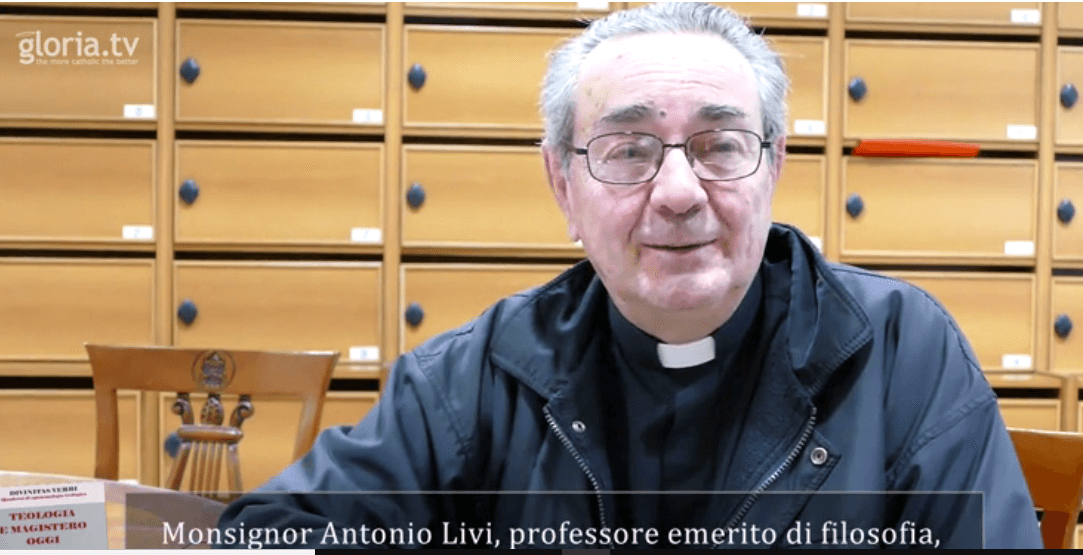
On the basis of many historical witnesses the election of Pope Francis was orchestrated. Livi points out that it is absurd to claim that Francis is pope because the Holy Spirit wanted it so. Livi puts this orchestrated election in the context of the “Sankt Gallen Group,” and he also mentions, with regard to the protestantization of the Church, Cardinals Walter Kasper and Reinhard Marx.

Msgr Livi on Pope Francis, His Promoting of Heretics and of a Lutheran Reform

OnePeterFive

Monsignor Antonio Livi, a professor of philosophy and former dean at the Lateran University in Rome, has made some incisive and strong statements concerning the papacy of Pope Francis. He claims that this pope was put into his office in order to protestantize the Church; he says that the pope is putting “the worst heretics” at the top of the Church; and he also states that the post-conciliar popes all had sympathies for neo-Modernism.

Monsignor Livi made these statements in an interview with Gloria.tv – whose content Gloria.tv published in English in three installments, from 25 April until 10 May (here, here, and here). The English reports are mostly summaries of the interview, with some direct quotes from Livi. Livi himself posted the Gloria.tv interview conducted in the Italian language on his own website.

On 25 May, Gloria.tv reported on Monsignor Livi’s words concerning Pope Francis’s election. He claims that Francis was elected to carry out a “reform in the Lutheran sense.” In this newly protestantized Church, Livi sees that the sacred will be replaced by politics. As Gloria.tv says, Livi is convinced of an orchestrated election of Pope Francis:

On the basis of many historical witnesses Monsignor Livi is “absolutely certain” that the election of Pope Francis was orchestrated. He also points out that it is absurd to claim that Francis is pope because the Holy Spirit wanted it so. “The Holy Spirit inspires everybody so that they may do good, but not everybody who is inspired by the Holy Spirit effectively does good.”

In the Italian version of this interview, Livi puts this orchestrated election in the context of the “Sankt Gallen Group,” and he also mentions, with regard to the protestantization of the Church, Cardinals Walter Kasper and Reinhard Marx.

Monsignor Livi also explains that Cardinal Kasper – who is known for his heterodox views – was chosen by Pope Francis as the main inspirator for the two family synods in Rome and that this fact alone indicates Pope Francis’ planned election which will finally lead to the recognition of Luther, and to the creation of a Mass without consecration. As Gloria.tv’s report continues:

According to Livi this revolution was already planned in the early sixties. The last fifty years were marked by the activity of “evil and heretical” theologians in order to conquer power. “Now they have conquered it.”

In their 7 May installment, Gloria.tv covers Monsignor Livi’s words concerning post-conciliar popes and their sympathies for neo-Modernism. As the Catholic television channel says, Livi “pointed out that all popes since the Second Vatican Council have had an attitude of esteem regarding heretical neo-modernism, including Benedict XVI who confessed that he basically agreed with the heretical theologian Karl Rahner.” Livi does “absolutely not” believe that Joseph Ratzinger’s own theology could lead us out of the current crisis. For Livi, Ratzinger is a theologian who is under neo-Protestant influence and who is opposed to the old Scholastic theology which has a more rational, rather than sentimental approach to the understanding of the faith, as Gloria.tv. thus sums up Livi’s own words. As Gloria.tv explains:

According to Livi, the documents published by Benedict XVI are theology, not magisterial documents. In these documents, Benedict XVI discusses with other theologians and he is less interested to re-propose the Catholic faith and to defend it from errors. Further, Livi points out that Benedict XVI spent months and months of his short pontificate to write theological books which he published as a private man.

Furthermore, Monsignor Livi regrets in this interview that, since the time of Pope John XXIII, the Church started thinking that she has to “translate” Catholic dogma into a new language that could be understood by “modern man.” Yet, for Livi, this “modern man” is a “myth.”

Livi also regrets that the pastoral decisions proposed since Vatican II have often been turned into a set of effectively infallible doctrines which one may not criticize. Those who dared criticizing these post-conciliar pastoral decisions were in various ways “oppressed.”

In the last, 10 May report on this longer Livi interview, Gloria.tv quotes Monsignor Livi as saying that Pope Francis is promoting the “worst heretics.” He points out that the persecution inside the Church is increasing, and he adds that Pope Francis accuses of “heresy” those who are faithful to Catholic doctrine and who fight confusion. Livi also said that Pope Francis promotes to the top of the Church “the worst heretics” and that his encyclicals are being written by “the worst heretics.” As Gloria.tv. says:

According to Livi, those who profess the integral Catholic Faith are now often forbidden to give talks, and their publications are hidden away in the Catholic bookstores. “All the official Catholic media in Italy ostracize the solid Catholic doctrine.” Livi further states that it has become “habitual” to sack theology professors for being “too Catholic.”

Monsignor Livi also honors journalists like Marco Tosatti – a former colleague of Andrea Tornielli at the Italian newspaper La Stampa – when he says that he is now poor because he did not join the Bergoglio camp; however, Andrea Tornielli, who had previously been more of a defender of Catholic positions, has now made his own “choice of convenience” and has become Pope Francis’ court journalist.

Just like Tosatti, Livi adds: “I am also poor.” The Lateran University refused to pay a pension to Livi. This leaves him with a minimal state pension, according to Gloria.tv.

Monsignor Livi is one of the 250 signatories of the Filial Correction which had been issued in September of 2017 and which accuses Pope Francis of “the propagation of heresies effected by the apostolic exhortation Amoris Laetitia and by other words, deeds and omissions.” He is an outspoken critic of Pope Francis, rebuking him for ambiguous statements that seem to please the world, and Livi also states that Holy Communion should be received on the tongue, and in a kneeling position. Moreover, at the beginning of the year 2018, the Vatican specialist Sandro Magister published an article in which Monsignor Livi is quoted as a critic of Pope Benedict XVI and his theology.

Posted in Uncategorized | 2 Comments

YOU HAVE NOT SEEN ANYTHING YET COMPARED TO WHAT IS COMING IN THE OCTOBER SYNOD OF BISHOPS ON YOUTH. GOD PROTECT THE YOUTH OF THE WORLD FROM WHAT IS COMING IN THE APOSTOLIC LETTER TO BE PUBLISHED FOLLOWING THAT SYNOD.

notre_dame_paris

The article below is very important.  Homosexual acts (not the orientation as such) have been, and will forever be, understood as so very serious because these depraved acts are sins that the The Church classifies among those evil acts taken directly against God, “against the Creator and Lawgiver” because these acts go against His Created order.  The following article therefore attaches great importance to understanding how erroneous the supposed teaching in the document known as Amoris Laetitia really is.


A priest explains how Amoris Laetitia was really written to ‘normalize’ homosexuality

 Amoris LaetitiaCatholicGay AgendaHomosexualityPope FrancisSodomy

Analysis

Editor’s note: This analysis has been written by a priest who asked that it be published anonymously over concern of being disciplined for raising concerns about a papal document. 

May 14, 2018 (LifeSiteNews) – I said it right from the beginning, when Amoris Laetitia was first published, with its infamous Chapter 8 that allows individual conscience to trump objective moral law and thus effectively eliminate the notion of intrinsic moral evil: The real issue is not Holy Communion for the divorced and civilly remarried. After all, Pope Francis had already streamlined the annulment process, to allow declarations of nullity which were generally easy to attain, to be even easier. The real issue is all about sodomy, and normalizing — even blessing — this behavior called by the Catechism “intrinsically disordered.” In what follows, I’ll try to “connect the dots” in order to clarify the bigger picture.

Recall that no. 50 of the first draft of the document for the first synod on the family in October, 2014 stated that, “Homosexuals have gifts and qualities to offer the Christian community,” and then asked if our communities are “capable of . . . accepting and valuing their sexual orientation” – implying those who practice homosexual behaviors have special “gifts and qualities” over and above everyone else, and that their same-sex attraction — called by the Catechism “objectively disordered” — should be “accepted and valued.” (1)

Although this language never appeared in Amoris Laetitia (AL), the fact that it was inserted into a preliminary working document with Pope Francis’s approval and was then read to the assembled bishops in his presence, is most telling. This language provides a key to understand how Chapter 8 of AL has been interpreted, so as to allow not only those in second civil marriages (and committing adultery) to be admitted to Holy Communion, but also those in same same-sex unions (and engaging in sodomy) – as long as they are “accompanied” by a priest, engage in “discernment,” and follow their “conscience.” (2)

This homosexualist agenda continued to be pushed forward by those who participated in a “secret synod” held in May 2015 at the Pontifical Gregorian University in Rome, the purpose of which was to persuade those who participated in the then-upcoming second synod on the family to accept same-sex unions, dispense with the term ‘intrinsically evil,’ and introduce a controversial “theology of love.” (3) As National Catholic Register correspondent Edward Pentin reported regarding this assembly:

“Around 50 participants, including bishops, theologians and media representatives, took part in the gathering, at the invitation of the presidents of the bishops’ conferences of Germany, Switzerland and France – Cardinal Reinhard Marx, Bishop Markus Büchel and Archbishop Georges Pontier. One of the key topics discussed at the closed-door meeting was how the Church could better welcome those in stable same-sex unions, and reportedly ‘no one’ opposed such unions being recognized as valid by the Church.” (4)

This agenda was given voice during the second synod on the family in October, 2015 by Chicago Archbishop Blase Cupich, who had been hand-picked by Pope Francis to be a papal delegate at the synod. When asked by Vatican City reporters about Holy Communion for the divorced and civilly remarried, Cupich said this was possible if they had “come to a decision in good conscience,” and stressed that “conscience was inviolable” and “we have to respect that when making decisions.”

Cupich was then asked about “accompanying” homosexual couples in receiving Holy Communion, to which he responded, “Gay people are human beings, too; they have a conscience, and my role as a pastor is to help them to discern what the will of God is by looking at the objective moral teaching of the Church.” But he went on to say that “at the same time,” his role as a pastor is to help them “through a period of discernment, to understand what God is calling them to at that point, so it’s for everybody.” He added, “We have to be sure we don’t pigeonhole one group as though they’re not part of the human family, as though there’s a different set of rules for them. That would be a big mistake.” (5)

In other words, if those living in adulterous relationships are able with the help of their pastors to discern, according to their conscience, that they should receive Holy Communion, well then, the same can be done for same-sex couples who engage in sodomy. There is no need to truly repent and firmly resolve to amend one’s life, to “go and sin no more”; one can continue in one’s gravely sinful behavior and still receive the Eucharist. (6) Hence, conscience reigns supreme, and the objective moral order is no more.

Worthy of note is that after having made these statements, which were widely quoted by the news media around the world, Pope Francis raised Blase Cupich to the College of Cardinals.

High-level prelates supporting new paradigm 

This same interpretation of Chapter 8 of AL has been confirmed by a host of other high-level prelates – some of whom are cardinals very close to Pope Francis – in the months and years that followed publication of AL. Here are some noteworthy examples:

Recall that it was German Cardinal Walter Kasper, at a consistory of cardinals called by Pope Francis back in February of 2014, who initially proposed allowing the divorced and civilly remarried to receive Holy Communion (the “Kasper proposal”). Soon after the release of AL, Kasper went on record saying that it “seems clear . . . that there can be situations of divorced and remarried where on the way of inclusion, absolution and communion becomes possible”; and that the exhortation “overcomes a rigid casuistic approach and gives room for Christian freedom of conscience.” (7)

Ah, yes, and the appeal to individual conscience as the final arbiter of one’s conduct can likewise apply to those in same-sex relationships, to allow them to be admitted to the Eucharist. Kasper says as much in a new booklet he authored, The Message of Amoris Laetitia: A Fraternal Discussion:

“The pope does not leave room for doubt over the fact that civil marriages, de facto unions, new marriages following a divorce (Amoris Laetitia 291) and unions between homosexual persons (Amoris Laetitia 250s.) do not correspond to the Christian conception of marriage”; however, says Kasper, the Pope insists that “some of these partners can realize in a partial and analogous way some elements in Christian marriage (Amoris Laetitia 292).” (8)

Austrian Cardinal Christoph Schoenborn, whom Pope Francis has called an “authoritative interpreter” of Amoris Laetitia, sees AL as allowing Holy Communion for the divorced and civilly remarried. (9) In an interview during the 2015 Synod on the Family, he called for the recognition of “positive elements” of homosexual unions, saying: “We can and we must respect the decision to form a union with a person of the same sex, [and] to seek means under civil law to protect their living together with laws to ensure such protection.” Schoenborn went on to criticize “intransigent moralists” among his fellow bishops, whom he accused of having an “obsession with intrinsece malum [intrinsic evils].” (10)

Back in 2006, Schoenborn’s cathedral in Vienna offered a blessing for unmarried couples on Valentine’s Day that included homosexual partners; and in 2016, the bulletin in Schoenborn’s cathedral featured a photograph of two men and an adopted child, presenting them as “family” and a “married couple.” (11)

In an interview back in 2016, German Cardinal Reinhardt Marx, President of the German Bishops’ Conference and one of Pope Francis’s nine cardinal advisers, said that one cannot say same-sex relationships have no “worth”; that the Church should support “regulating” such relationships and that “[w]e as church cannot be against it.” (12) And in interview in January of 2018, Marx said that the Church in her teaching on sexual morality cannot apply a “blind rigorism”; that it is “difficult to say from the outside whether someone is in the state of mortal sin” – a principle which he said applies not only to men and women in “irregular situations,” but also to those in homosexual relationships, because there has to be a “respect for a decision made in freedom” and in light of one’s “conscience.” (13)

In an interview on January 10 of this year, Bishop Franz-Josef Bode, Vice-President of the German Bishops’ Conference, made world news when he called for a blessing of homosexual couples: “We have to reflect upon the question of how to assess, in a differentiated manner, a relationship between two homosexual persons . . . . Is there not so much positive and good and right so that we have to be more just?” (14)

And just a few weeks later, news reports throughout the world quoted Cardinal Marx supporting his fellow Bishop Bode in calling for blessings for same-sex couples, saying that the decision should made by “the pastor on the ground, and the individual under pastoral care,” (15) and that such blessing could be performed publicly in a “liturgical” form. (16)  {A new liturgical rite for sodomite couples ?????}

So, members of the Church hierarchy, while acknowledging that homosexual unions are not the “ideal,” have now gone from considering the “positive” elements of such relationships to “blessing” them, and (as it appears) will go on to compose a new liturgical rite which (at least for now) recognizes that while this is not “marriage” in the technical sense, it is a legitimate, alternative form of a relationship which we must “value.”  

What is lost here is that by blessing same-sex unions, one in reality is blessing the gravely sinful and “intrinsically disordered” behavior that accompanies it, a sin that, according to revealed word of God and the constant teaching of the Church throughout the ages, “cries out to Heaven for vengeance.” (17) As Archbishop Charles Chaput of Philadelphia wisely noted in response to this proposal for a blessing: “Any such ‘blessing rite’ would cooperate in a morally forbidden act”; moreover, to bless such a relationship would actually be uncharitable because it would encourage people to continue living in a state of grave sin which harms them spiritually. Chaput went on to say: “There is no love – no charity – without truth, just as there is no real mercy separated from a framework of justice informed and guided by truth.” (18)

Gerhard Cardinal Mueller, former Prefect for the Congregation for the Doctrine of the Faith, has recognized these attempts to redefine the Church’s perennial moral teachings by claiming that they represent a “development of doctrine” and a “paradigm shift,” for what they really are: the heresy of modernism. (19) N.Y. Timescolumnist Ross Douthat has concluded pretty much the same, noting that with Amoris Laetitia, Pope Francis and others want Church’s moral teaching to adapt to modern cultural norms. (20)

The real goal of Amoris Laetitia

Call it modernism, call it corruption of doctrine, call it by whatever name one sees fit. I submit that winning moral approval for homosexual behavior is the real goal of Amoris Laetitia, and that this is precisely why the teaching of Humanae Vitae and the Natural Law must be cast aside, which is: that by God’s design, there exists an inseparable link between the unitive and procreative meanings of the marital act, and that the unitive meaning is subordinated to the primary end: procreation. As Couple-to-Couple League founder John Kippley has argued, if the procreative meaning can be eliminated from the marital act, then one is effectively left with no argument against sodomy. And those who promote the sodomite agenda know this. 

They know that they must also discard the notion of physical and emotional complementarity of the sexes, (21) as well as the concept of intrinsic moral evil – which in effect means they must overturn the entire moral order. This explains why they are now calling for removing language in the Catechism which states that the same-sex attraction is “objectively disordered,” (22) and that homosexual acts “are acts of grave depravity” which are “intrinsically disordered” and “contrary to the natural law” precisely because they “close the sexual act to the gift of life” and “do not proceed from a genuine affective and sexual complementarity.” (23)

This also explains why for over a year now we’ve heard talk of “re-examining” the teaching of Pope Paul VI’s 1968 encyclical. Those who desire to cast Humanae Vitae into the trash bin are now showing their hand. Witness Fr. Maurizio Chiodi, who was recently appointed by Pope Francis to the Pontifical Academy of Life. Although St. John Paul II in his 1993 encyclical Veritatis Splendor (no. 80) specifically includes contraception in a list of acts that are “intrinsically evil,” Fr. Chiodi, in a Dec. 14, 2017 lecture at the Pontifical Gregorian University in Rome, “Humanae Vitae in light of AL,” argued just the opposite: that based on the language of Amoris Laetitiaregarding conscience, “an artificial method for the regulation of births could be recognized as an act of responsibility that is carried out, not in order to radically reject the gift of a child, but because in those situations responsibility calls the couple and the family to other forms of welcome and hospitality.” To support his argument, Chiodi says that Amoris Laetitia makes no “explicit reference” to contraception as “intrinsically evil,” adding that “it would have been very easy to do so given Veritatis Splendor.” (24)

Chiodi has been followed by Cardinal Kasper, who in his new booklet, The Message of Amoris Laetitia: A Fraternal Discussion, implies that AL opens the door for the use of contraception. Kasper says that in his exhortation the Pope only “encourages the use of the method of observing the cycles of natural fertility,” and “does not say anything about other methods of family planning and avoids all casuistic definitions.” (25)

More arguments to permit the exclusion of the procreative end of sexual activity are sure to come from those who seek approval of homosexual behavior, because they know that they cannot succeed as long as the teachings of Humanae Vitae and the Natural Law stand.

In this writer’s humble opinion, the fact that cardinals and bishops of the Church are arguing that not only the divorced and civilly remarried, but those in homosexual unions, should be admitted Holy Communion, and that the teaching of Humanae Vitae should be cast aside, reveals that they have lost the theological virtue of faith. The words of the Epistle to the Hebrews aptly describe their sad state:

“For it is impossible for those who were once enlightened, who have both tasted the heavenly gift and become partakers of the Holy Spirit, . . . and then have fallen away, to be renewed again to repentance; since they crucify again for themselves the Son of God and make him a mockery. For the earth that drinks in the rain that often falls upon it, and produces vegetation that is of use to those by whom it is tilled, receives a blessing from God; but that which brings forth thorns and thistles is worthless, and is nigh unto a curse, and its end is to be burnt” (Heb. 6:4-8).

How should the faithful – bishops, priests, religious and laity – respond to these wicked assaults on God and His beautiful plan for the authentic expression of love, the transmission of human life, the sanctity of marriage and the family? This year marks the 50th anniversary of Humanae Vitae, and thus offers a golden opportunity to celebrate and make better known the teaching in Bl. Paul VI’s 1968 landmark encyclical. We have the magisterium of St. John Paul II to draw upon as well – not only Veritatis Splendor, but his “Theology of the Body.” This year, let us, assisted by the grace of the Holy Spirit and the intercession of Our Lady, valiantly proclaim the splendor of the truth of this teaching, and thereby mount a strong and unshakeable defense against any and all who attack it. 

______________

1 https://www.lifesitenews.com/news/reporters-criticize-vatican-for-dropping-welcoming-language-in-new-english (Oct. 16, 2014).

2 See AL nos. 300-305, and footnote 351.

3 https://www.lifesitenews.com/news/new-academy-for-life-member-uses-amoris-to-say-some-circumstances-require-c (Jan. 8, 2017).

4 http://www.ncregister.com/daily-news/confidential-meeting-seeks-to-sway-synod-to-accept-same-sex-unions (May 26, 2015).

5 http://www.ncregister.com/daily-news/abp-cupich-conscience-decides-whether-divorced-remarried-and-homosexual-cou (Oct. 16, 2016). In his Feb. 9, 2018 address at St. Edmund’s College in Cambridge, England, “Pope Francis’ Revolution of Mercy: Amoris Laetitia as a New Paradigm of Catholicity,” Cardinal Cupich insisted that “the voice of conscience . . . could very well affirm the necessity of living at some distance from the Church’s understanding of the ideal” – an understanding of conscience which can be applied equally to the divorced and civilly remarried engaged in adulterous conduct, and to those in same-sex unions engaged in sodomy.

6 As a priest and confessor, if a penitent tells me he is sexually active in an invalid marriage or in a same-sex relationship, but insists that he plans to continue his sinful acts, I am obliged to try to bring him to a realization that his subjective opinion regarding his conduct cannot overrule the objective moral law and the clear teaching of Christ; and that I have to follow my conscience and withhold absolution if he is unwilling to firmly resolve to amend his life. If the penitent persists in saying he does not believe he is committing a sin, I would have to tell him: “Then I have nothing to absolve you from”; and then ask him: “Why are you here in the confessional asking to be absolved from a course of conduct you do not believe is sinful?”

7 https://www.lifesitenews.com/news/cardinal-kasper-seems-clear-exhortation-allows-communion-for-divorced-remar (April 18, 2016).

8 https://www.lifesitenews.com/news/cardinal-kasper-homosexual-unions-are-analogous-to-christian-marriage (March 14, 2018). In the booklet, Kasper compares such irregular unions with the relationship between the Catholic Church and non-Catholic Christian groups, whom Vatican II says contain “elements of sanctification and truth” of the Church. Kasper insists that “Just as outside the Catholic Church there are elements of the true Church, in the above-mentioned unions there can be elements present of Christian marriage, although they do not completely fulfill, or do not yet completely fulfill, the ideal.” N.B.:  Christoph Cardinal Schoenborn made this same argument at the 2014 Synod on the Family – see footnote 10 below.

9 https://www.lifesitenews.com/news/pope-says-schonborn-interpretation-on-communion-for-remarried-is-the-final (April 6, 2016). This position is not new for Schoenborn. At the International Retreat for Priests held in Ars, France in 2009 held during the Year of Priests proclaimed by Pope Benedict XVI, Cardinal Schoenborn delivered most of the daily meditations, which were, on the whole, very inspiring. But as the retreat drew to a close, the Cardinal announced that he would use his last retreat talk to address topics of concern, and invited priests to submit questions. During his final talk, Schoenborn addressed the issue of Communion for those divorced and civilly remarried. To the surprise and shock of the 1200 priests present, he proceeded to tell them that it was his practice to allow such couples to receive the Eucharist if they remained faithful and committed to each other for many years.

10 https://www.lifesitenews.com/news/cardinal-schoenborn-at-synod-church-should-embrace-positive-elements-of-gay (Sept. 14, 2015). This article notes that at the 2015 Synod, Schoenborn “proposed an interpretative key” to revolutionize the Church’s approach to family life and sexual ethics by looking at Vatican II’s dogmatic constitution on the Church, Lumen Gentium, which states: “Although many elements of sanctification and of truth are found outside of its visible structure. These elements, as gifts belonging to the Church of Christ, are forces impelling toward catholic unity [LG 8].” Schoenborn argues that “Because marriage is a Church in miniature,” and just as the Church seeks to find elements of truth in different religions, it follows that “who are we to judge and say that there are no elements of truth and sanctification in them [non-marital sexual lifestyles]?”

11 https://onepeterfive.com/schonborns-vienna-cathedral-bulletin-depicts-homosexual-couple-adopted-son/ (Oct. 6, 2016).

12 https://www.lifesitenews.com/opinion/cardinal-reinhard-marx-vs.-cardinal-and-saint-peter-damian-do-homosexual-un (Jan. 28, 2016).

13 https://onepeterfive.com/push-for-greater-acceptance-of-homosexual-unions-continues-in-german-church/ (Jan. 19, 2018). This interview appeared in the German Catholic journal Herder Korrespondenz, and the German Bishops’ official website immediately reported on Marx’s statement.

14 Ibid.

15 http://catholicherald.co.uk/news/2018/02/04/cardinal-marx-suggests-church-should-bless-gay-couples/ (Feb. 4, 2018).

16 https://www.lifesitenews.com/news/one-of-popes-9-advisor-cardinals-proposes-liturgical-blessings-of-homosexua (Feb. 4, 2018).

17 Cf. Gen. 18:20; Catechism of the Catholic Church, no. 1867.

18 https://www.lifesitenews.com/news/german-cardinal-liturgical-blessing-for-gay-unions-truly-seems-sacrilegious (Feb. 8, 2018).

19 https://www.firstthings.com/web-exclusives/2018/02/development-or-corruption (Feb. 20, 2018).

20 See Douthat’s new book, To Change the Church: Pope Francis and the Future of Catholicism (Simon & Schuster, 2018).

21 CCC 2333.

22 CCC 2368.

23 CCC 2357.

24 https://www.lifesitenews.com/news/new-academy-for-life-member-uses-amoris-to-say-some-circumstances-require-c (Jan. 8, 2017). As Diane Montagna relates in this article, “Fr. Chiodi’s talk was introduced by one of the chief organizers of the conference series, Argentine Jesuit Father Humberto Miguel Yanez. Fr. Yanez is the Director of the Department of Moral Theology at the Gregorian University. Yanez is known to be close to Pope Francis, and in fact Bergoglio was Yanez’ religious superior as a young Jesuit. In May 2015, Father Yanez participated in the ‘secret synod’ at the Gregorian” (as discussed herein above).

25 https://www.lifesitenews.com/news/cardinal-kasper-homosexual-unions-are-analogous-to-christian-marriage (March 14, 2018).

Posted in Uncategorized | 9 Comments

Liberalism comprises two core beliefs about human nature: first, that we are beings characterized by an “anthropological individualism” coupled with a “voluntarist conception of choice,” and second, we are separate from and opposed to nature. Deneen describes liberalism as an “anticulture,” promoting what one of its prophets referred to as the heart of liberty: “the right to define one’s own concept of existence, of meaning, of the universe, and of the mystery of human life.” Anything that threatens or undermines that right threatens liberty itself, and thus must be vanquished.


PUBLIC DISCOURSE
Prisoners in the American Cave
by Micah Watson
within Book Reviews, Philosophy, Politics
May 13, 2018 08:03 pm http://www.thepublicdiscourse.com/2018/05/21315/
Patrick Deneen’s Why Liberalism Failed is a provocative attempt to explain what’s wrong with our culture, how this came to be, and what might be done about it. Although his historical account of liberalism is unpersuasive, he offers a prescient analysis of the current moment and insightful prescriptions for constructive action.
 {Abyssum}

“The one principle of Hell is ‘I am my own,’” declared Scottish poet and pastor George MacDonald in the nineteenth century. MacDonald’s quip brings to mind the famous words of Milton’s Satan, describing the silver lining of being cast into Hell:

. . . Here at least  . . .We shall be free;
Here we may reign secure, and in my choyce
To reign is worth ambition though in Hell:
Better to reign in Hell, then serve in Heav’n.

Freedom, choice, ambition . . . these are enticing ideas for modern man and woman. But what sort of freedom? The word can have two radically different meanings. The first, voiced by Milton’s Satan, condemned by Macdonald, and put to song by Frank Sinatra, refers to the freedom to do what we want, whatever that is. The alternative meaning is a tethered freedom, a freedom to become what we ought to be, according to standards that we may choose to embrace but do not author ourselves.

Patrick Deneen’s Why Liberalism Failed is a provocative portrayal of how this ancient tension has played out in liberal modernity, especially in the United States. Deneen’s primary thesis is not only that American society has come to be completely dominated by the devil’s version of freedom, but that it was orchestrated that way from the beginning by the founders of modernity and the United States. John Locke was the serpent in America’s garden.

Part jeremiad, part political philosophy, part cultural criticism, and part call for renewal, Deneen’s book has achieved something even rarer than philosophers becoming kings: an academic book published by an academic press that has nevertheless sold out of its first run and is taking the high- and middlebrow literati by storm. Deneen’s book has captured an anxiety about our current moment that transcends left and right, (politically) conservative and (politically) liberal, religious and secular. One mark of the book’s success is that it has elicited so many reviews from so many different outlets and voices. It’s a nice twist of irony that Deneen’s book has done so well, and been so widely reviewed online, given his criticism of capitalism and warnings about technology.

One way to understand what Deneen is up to is to frame his book with three questions he addresses. What is our current predicament? What is the origin of our situation? What does it look like to move forward from here?

Our Predicament

Deneen draws on Plato’s allegory of the cave to illustrate why we are so uneasy in modern America. We are fooled by the trinkets and gadgets that keep us mesmerized by the images, screens, and shadows in front of us. Yet, despite all the persuasive might that liberal apologists like Steven Pinker can muster, we have a nagging sense that something is rotten.

Liberalism comprises two core beliefs about human nature: first, that we are beings characterized by an “anthropological individualism” coupled with a “voluntarist conception of choice,” and second, we are separate from and opposed to nature. Deneen describes liberalism as an “anticulture,” promoting what one of its prophets referred to as the heart of liberty: “the right to define one’s own concept of existence, of meaning, of the universe, and of the mystery of human life.” Anything that threatens or undermines that right threatens liberty itself, and thus must be vanquished.

Liberalism teaches that we are not naturally social beings but atomistic individuals yearning to be free of external constraints: tradition, family, nature, God, and so on. We chafe against thick bonds linking us to each other, and to nature, time, and place. “Conservative” liberals seek to free us to pursue our unfettered choices in the modern economy, commodifying any and every thing short of our own bodies. “Progressive” liberals make up a second wave that sees no reason to stop at bodies, fully embracing the sexual revolution and seeing the traditional family as one more obstacle to achieving our “freedom.” Deneen claims that the right’s push for economic freedom and the left’s campaign for personal and sexual freedom are two sides of the same liberal coin, leading to increasingly autonomous lives that require an ever-growing and omnicompetent government to pick up the messy pieces that result from our poor choices. “Liberalism thus culminates in two ontological points: the liberated individual and the controlling state.”

Liberalism’s Origin Story

In Deneen’s narrative, the philosophical founders of liberalism are the usual suspects. Bacon, Hobbes, and Locke play the central roles in liberalism’s attempt to free us from the arbitrary restrictions of custom, place, and religion.

In an interpretation that has been contested at Public Discourse previously, Deneen argues that liberalism’s ascendancy was only possible because the philosophical grounding was channeled into the political accomplishments of the American founders. Deneen rests his case primarily on readings of Jefferson and Madison, who channeled Locke. He finds Jefferson’s Lockean Declaration telling, as well as his belief that the central right of liberal man is “the right to leave the place of one’s birth.” Madison’s language about “ambition countering ambition” and the Constitution’s encouragement of “useful arts and sciences” show that the American founding was intended to be the political engine whereby the philosophical vision of Bacon, Hobbes, and Locke would be put into practice.

This did not happen all at once. As Deneen notes, there were pre-liberal traditions in America that provided the resources that liberalism would eventually deplete. However, over time, the seeds planted by the philosophers and the practitioners have taken root, and the current predicament Deneen paints so vividly is the fruit of an experiment gone terribly wrong. The Founders did not build “better than they knew.” No: they built worse than we could have imagined, and they did so on purpose. Those of us who are sympathetic to the Founding are watching shadow puppets on the wall. We are victims of an earlier version of false consciousness and the most successful noble lie ever constructed.

Why Liberalism Failed is meant to be a lantern in our American cave.

Steps toward a Post-Liberal Future

If Deneen is right, the one thing we cannot do is imagine that liberalism holds the answers to our current problems. If liberalism is as he describes it, then answering liberalism’s problems with more liberalism is akin to trying to save a burning house with kerosene. Liberalism is finished. Instead, in the book’s most conciliatory chapter, Deneen concludes with three steps to take toward a post-liberal future.

The first of these is recognizing all the good things that liberalism has provided and building on them. There is no going back to a pre-liberal golden age. Readers may be surprised by Deneen’s tempered praise of liberalism in this section, given the tenor of what has come before.

The second step is abandoning the quest to solve our problems through the creation of an all-encompassing ideology. Liberalism may have outlasted its other ideological rivals, but in the future we must look to the local and the homegrown. “Politics and human community must percolate from the bottom up, from experience and practice.”

The final step is a counterweight to the second. While we should not construct a new ideology, we can and should seek new political theories—not understood as grand and comprehensive explanations but as ways of seeing what is near and dear and building from there. There are still pockets of healthy virtue thriving within liberalism. Deneen hopes we can learn from those communities how to cultivate the thick bonds necessary for human flourishing without jettisoning the genuine achievements that liberalism helped make possible.

Strengths and Weaknesses

What are we to make of this remarkable book that hands up such a damning indictment of the American political tradition and the deeply disordered culture that has emerged from it? The claims made in this slim volume are the culmination of several years’ work and many previous articles from a lively and incisive critic, and they raise so many questions that any review leaves much by the wayside.

Perhaps the most pertinent question is whether one must endorse Deneen’s genealogy of American liberalism to agree with his take on our present and three steps for the future. I hope not, mainly because I think so much of Deneen’s analysis of the current moment is prescient while finding a great deal of his historical account of liberalism unpersuasive. I find it unpersuasive for a host of reasons, but two stand out.

The first objection is that Deneen’s origin story about liberalism is too neat and too narrow. In his telling, liberalism takes on an anthropomorphic character as it shapes, and molds, and intends various things to take place—a sort of personified zeitgeist guiding the pens of Locke and Jefferson and Madison. Deneen offers us readings of those figures that highlight some putatively problematic passages while ignoring others. When it comes to Locke, Deneen focuses almost entirely on a controversial reading of the Second Treatise while ignoring the book most colonial Americans would have been more familiar with, his best-selling Some Thoughts Concerning Education. This work explicitly names the two different types of freedom, and endorses the freedom to become what we ought. Not only that, Locke also unapologetically insisted that parents must inculcate virtue and combat selfishness in their children: “Covetousness and the desire of having in our possession and under our dominion more than we have need of, being the root of all evil, should be early and carefully weeded out and the contrary quality of a readiness to impart to others implanted.” This is hardly the advice of a prophet of atomistic individualism.

The objection here is not just to the substance of Deneen’s readings but their unevenness. Whereas Locke’s explicit condemnations of sexual immorality go unmentioned, Deneen approvingly cites Wendell Berry’s arguments for nature and place throughout the book without mentioning or reckoning with Berry’s endorsement of same-sex marriage and demonization of those who disagree. Reading Berry with hermeneutical charity allows us to draw from the good things he has to say while remaining critical of his recent puzzling departure from the natural. Surely we can also read Locke and the Founders without shoehorning them entirely into the service of a pernicious liberalism that is only possible when artificially extracted from the particular time, place, and context of the Founding Era.

This leads to the second problem. The debates about getting Locke and the Founders right are of more than mere historical interest. Deneen is entirely right to call attention to how liberalism has subsisted on social capital borrowed from the pre-liberal and primarily religious traditions that characterized the early generations of Americans. In his conclusion, he calls us to consider how we might recapture some of the health and vitality we see in the remnants of those traditions. Yet, if he is right about the origins of liberalism, then the people who then valued virtue and cultivated freedom, rightly understood, are the very same people who saw little conflict between their faith and the political philosophy of Locke and the Founders. How could they have been so blind to what we can supposedly see so clearly now? Why did they make a devil’s bargain?

Perhaps they didn’t. We find a partial explanation of the disconnect between early Americans and Deneen in the fact that Why Liberalism Fails attends to only one of two slippery slopes that are perennial dangers for human society, given human nature. Deneen paints a very convincing portrait of the dangers of individualism’s acidic tendency to weaken the social bonds that matter most. What he leaves out, at least in this book, is the opposite danger: the stultifying tendency of authoritarianism to encourage and maintain unjust and even tyrannical power relations. It is certainly the case that social bonds can be too loose, but it’s also the case that they can be too tight. Those early generations of Americans were primarily concerned with the latter problem, and it is not coincidental that those Americans were overwhelmingly Protestants aiming to protect their local communities, ecclesial and political. Their endorsement of a regime meant to protect individual virtue, liberty, and, yes, property, need not implicate them, or necessarily us, in the excesses of a culture that has now swung too far the other way.

These are arguments worth having, though they should not obscure this remarkable achievement. It is not an accident that a scholar so immersed in the wisdom of the great thinkers of the past has produced such a lightning bolt of a book for the present, one that shockingly illuminates the reality of our dark cultural landscape while offering some beginning steps toward reimagining a healthier future. Such a future will be brighter than it otherwise would be thanks to the labors—past, present, and future—of the provocative Professor Deneen. 

Micah Watson is associate professor of political science at Calvin College.


Posted in Uncategorized | 1 Comment

“RECONSIDERING” IN JESUIT SPEAK MEANS REPLACING IT

“Reconsidering” Humanae Vitae Randall Smith notes that a meeting in Rome will “reconsider” Paul VI’s Humanae Vitae. Well, St. John Paul II did just that consistently in his pontificate.

A friend tells stories of an elderly Catholic priest with whom he used to share an office. The man frequently spoke as though it was still 1969 and nothing had happened in the Church since then.

It is said that some people are planning a meeting in Rome to “reconsider” Paul VI’s 1968 encyclical Humanae Vitae. This is interesting, but also a little odd. Consider how odd it would appear if someone suggested a meeting in Rome to “reconsider” Pope Leo XIII’s 1891 encyclical Rerum Novarum. The first thing we might say is that there has been a lot of water under the bridge since then, including Pius XI’s 1931 encyclical Quadragesimo Anno, John XXIII’s 1961 encyclicalMater et Magistra, Paul VI’s 1971 apostolic letter Octogesima Adveniens, and John Paul II’s 1981 encyclical Laborem Exercens and 1991 encyclical Centesimus Annus on the hundredth year anniversary.           You couldn’t very well “reconsider” Rerum Novarum as Church doctrine without considering all the later official papal developments of that teaching.

The second thing you would be inclined to ask, especially after so much commentary, is how anyone could “reconsider” the teaching of Rerum Novarum. Wouldn’t this be a little like “reconsidering” the Council of Nicea? That ship has sailed.

I am not claiming the teaching of Humanae Vitae holds the same formality as Nicea. But perhaps it would be a better comparison to ask how liberal Catholics would view it if a group in Rome announced there was to be a “reconsideration” of the teaching about the relation of the Church to non-Christian religions in Nostra Aetate with the implication that there might be an effective reversal.

I imagine they would say what I just did. First, that ship has sailed; it is firm teaching.  And second, there has been a lot of papal commentary on it since the publication of that document. I imagine they might even point to the numerous places where Pope John Paul II mentions it as definitive Church teaching.

How could anyone consider Humanae Vitae without considering John Paul II’s development of that teaching in his long series of Wednesday addresses that make up his “Theology of the Body”?  How about the many other places he mentions it?  Allow me to quote just a few from his 1994 “Letter to Families”:

In particular, responsible fatherhood and motherhood directly concern the moment in which a man and a woman, uniting themselves “in one flesh”, can become parents. This is a moment of special value both for their interpersonal relationship and for their service to life: they can become parents – father and mother – by communicating life to a new human being. The two dimensions of conjugal union, the unitive and the procreative, cannot be artificially separated without damaging the deepest truth of the conjugal act itself. This is the constant teaching of the Church, and the “signs of the times” which we see today are providing new reasons for forcefully reaffirming that teaching.

This subject has been extensively treated in the documents of the Second Vatican Council, the Encyclical Humanae Vitae, the “Propositiones” of the 1980 Synod of Bishops, the Apostolic Exhortation Familiaris Consortio, and in other statements, up to the Instruction Donum Vitae of the Congregation for the Doctrine of the Faith. The Church both teaches the moral truth about responsible fatherhood and motherhood and protects it from the erroneous views and tendencies which are widespread today. Why does the Church continue to do this? Is she unaware of the problems raised by those who counsel her to make concessions in this area and who even attempt to persuade her by undue pressures if not even threats?

The Church’s Magisterium is often chided for being behind the times and closed to the promptings of the spirit of modern times, and for promoting a course of action which is harmful to humanity, and indeed to the Church herself. By obstinately holding to her own positions, it is said, the Church will end up losing popularity, and more and more believers will turn away from her.  But how can it be maintained that the Church, especially the College of Bishops in communion with the Pope, is insensitive to such grave and pressing questions? It was precisely these extremely important questions which led Pope Paul VI to publish the Encyclical Humanae Vitae.

Later in this same letter, John Paul II praises those struggling to defend this teaching, saying: “I am thinking in particular about pastors and the many scholars, theologians, philosophers, writers and journalists who have resisted the powerful trend to cultural conformity and are courageously ready to ‘swim against the tide.’”

Such words, expressed in definitive terms, repeated again and again, not only here, but in other documents, suggest an irreformable teaching. You can “reconsider” it only in the way any official teaching can be reconsidered: to reiterate and re-emphasize it. You could no more reverse it than you could reverse the teaching on the Immaculate Conception of Mary. My question is simply whether those reconsidering Humanae Vitae will give strength to the swimmers, or seek to drown them in the tide?

But by all means, talk about Humanae Vitae.  It is a document worth reading and re-reading.  In my view, the addenda Pope John Paul II made are sometimes even better than the original.  But you will probably need more than a few days to talk it over.  Let me suggest constant meetings over two or three years. Otherwise, you look like those students who take a weekend to read the Iliad and then say, “Yeah, I read that.”  Somehow, I doubt it.

And if you discuss it as though nothing had been written about it since 1968, you will sound like the elderly priest with whom my friend shared an office: trite, tired, dull, and dated, popular with a certain Boomer Catholic who thought the Second Vatican Council “didn’t go far enough,” but of absolutely no relevance at all to the skeptical young agnostics and baptized non-believers I teach every day.

Randall Smith

Randall Smith

Randall B. Smith is the Scanlan Professor of Theology at the University of St. Thomas in Houston. His most recent book, Reading the Sermons of Thomas Aquinas: A Beginner’s Guide, is now available at Amazon and from Emmaus Academic Press.


Posted in Uncategorized | 1 Comment

TEMPUS FUGIT !!! DO WE HAVE MUCH LEFT? DON’T JUST STAND (SIT) THERE, BE PROACTIVE. IT TAKES COURAGE (WHICH SEEMS TO BE IN VERY SHORT SUPPLY) TO RESPOND TO THE QUESTION: WHERE DO WE GO FROM HERE?

Settimo Cielodi Sandro Magister

Church Alarm At Full Blast. But Francis Is Letting It Sound In Vain

Wenders


Attention. The conflict that has exploded in Germany for and against communion for Protestant spouses should have exceeded the threshold of alarm for the unity of the whole Church, to judge by the warnings issued in recent days by several cardinals to the pope. Warnings of a severity that has no precedent, in the five years of the pontificate of Francis (in the photo, on the set with Wim Wenders).

The backstory can be found in this post from Settimo Cielo of May 2, just before the encounter between the opposing parties when they were called to Rome by the pope:

> One Cardinal, Seven Bishops, and Four New “Dubia.” This Time on Intercommunion

The meeting between the German cardinals and bishops and the Vatican authorities took place on May 3 in the offices of the congregation for the doctrine of the faith. But it concluded without any sort of decision. In the evening, a laconic statement simply revealed that “Pope Francis values the ecumenical efforts of the German bishops and asks them to find, in a spirit of ecclesial communion, a unanimous result if possible.”  {Say what?}

And it is precisely this deflection – backed by the pope – to a further encounter among the German bishops, to be resolved by a vote, that has unleashed the reactions of some of the highest ranking cardinals, absolutely convinced that questions of faith cannot be resolved by vote and without the universal Church being involved.

*

The first of these is Cardinal Willem Jacobus Eijk, archbishop of Utrecht.

“The response of the Holy Father is completely incomprehensible,” he wrote in no uncertain terms in a commentary published in the United States on the “National Catholic Register” and in Italy on “La Nuova Bussola Quotidiana.”

And he explained:

“The Holy Father has informed the delegation of the German episcopal conference that it must discuss again, and try to find unanimity. Unanimity about what? The practice of the Catholic Church, based on her faith, is not determined and does not change statistically when a majority of an episcopal conference votes in favor of it, not even if unanimously.”

And again:

“The Holy Father should have given the delegation of the German episcopal conference clear directives, based on the clear doctrine and practice of the Church. He should have also responded on this basis to the Lutheran woman who asked him on November 15, 2015 if she could receive Communion with her Catholic spouse, saying that this is not acceptable instead of suggesting she could receive Communion on the basis of her being baptized, and in accordance with her conscience. By failing to create clarity, great confusion is created among the faithful and the unity of the Church is endangered.”

Eijk is referring here to the tortuous response – yes, no, I don’t know, you figure it out – that Francis gave to that Protestant woman and that can be viewed in this video from Centro Televisivo Vaticano, in the original language with an English translation:

> “La domanda sul condividere la cena del Signore…”

And here is the dramatic conclusion that the Dutch cardinal reaches, citing an unsettling passage from the catechism:

“Observing that the bishops and, above all, the Successor of Peter fail to maintain and transmit faithfully and in unity the deposit of faith contained in Sacred Tradition and Sacred Scripture, I cannot help but think of Article 675 of the Catechism of the Catholic Church: ‘Before Christ’s second coming the Church must pass through a final trial that will shake the faith of many believers. The persecution that accompanies her pilgrimage on earth will unveil the ‘mystery of iniquity’ in the form of a religious deception offering men an apparent solution to their problems at the price of apostasy from the truth’.”

*

Another cardinal who has given a tough reaction is Gerhard L. Müller, former prefect of the congregation for the doctrine of the faith.

Commenting for the “National Catholic Register” on the outcome of the May 3 summit, Müller lamented the absence of a clear response on a question that is a “pillar of our faith, the Eucharist.” A response that it was right to expect from the pope, whose task is precisely to “affirm the faith” and to “give a very clear orientation,” not “through personal opinion but according to the revealed faith.”

It is not admissible – Müller continued – that an episcopal conference should vote against a doctrine that is a “basic element” of the Church. It is not possible to be “in sacramental communion without ecclesial communion,” because if this principle is destroyed then too “the Catholic Church is destroyed.”

“We must resist this,” Müller went on to say. “I hope more bishops will raise their voices and do their duty. Every cardinal has a duty to explain, defend, promote the Catholic faith, not according to personal feelings, or the swings of public opinion, but by reading the Gospel, the Bible, Holy Scripture, the Church fathers and to know them. Also the Councils, to study the great theologians of the past, and be able to explain and defend the Catholic faith, not with sophistic arguments to please all sides, to be everyone’s darling.”

Müller expressed his hope that the congregation for the doctrine of the faith may carry out its task as “guide of the magisterium of the pope”: a task from which Francis has always steered clear, both when the prefect of the congregation for the doctrine of the faith was Müller and now that the prefect is the Spanish Jesuit Luis Ladaria. “More clarity and courage must be encouraged,” the cardinal concluded.

*

Furthermore, the excellent vaticanista Edward Pentin, also on the “National Catholic Register,” collected the comments of a source close to the two German bishops who at the Vatican summit on May 3 represented those who had appealed to the Holy See against the concession of communion for Protestant spouses: cardinal archbishop of Cologne Rainer Woelki, and Regensburg bishop Rudolf Voderholzer.

“Official answer is that there is no answer,” this source lamented in commenting on the result of the May 3 summit. “The congregation for the doctrine of the faith was left to act as a postman,” meaning as a mere transmitter of the non-response from Francis. Who in his turn “had failed to fulfill his obligation as pope regarding a question of dogma which his office must decide” and “affirm the faith.”

In the coming months – the source continued – when the discussion continues in the episcopal conference of Germany, as the pope wishes, “our job now is to strengthen” and expand the ranks of the bishops who oppose communion for Protestant spouses. “It’ll be a long fight and we’ll be dedicating ourselves to it.”

What is taking shape, in fact, is an “ecclesiological revolution. The real problem is not the issue itself, but the refusal of the Pope to carry out his obligation as Peter, and this could have heavy consequences. Peter is no longer the rock he was, instead the shepherd is saying to the sheep: ‘Go and look for yourself for something to eat.’”

*

And Francis? It is easy to foresee that as usual he will not react to the warnings from these cardinals. He has not responded to the five “dubia” concerning “Amoris Laetitia” and communion for the divorced and remarried. He has not responded to the four “dubia”concerning communion for Protestant spouses. In the first case he has remained silent, in the second he has said that the discussion should continue. He has given hints of his thinking, and in both cases he is in favor of the innovation. But what matters to him is not yanking out the result right away. It is enough for him that the “process” of change be set in motion. A growing number of cardinals and bishops see in this the risk that the unity of the Church may be shattered, and on questions central to the Catholic faith. But for him, the Church must be made precisely like this: “polyhedral,” with many sides. In plainer words: in pieces.

*

Meanwhile, in Germany, the further discussion that Pope Francis wants is already underway, on positions that are still opposed to each other:

> German Bishop: Pope Francis Has Effectively Approved of the Intercommunion Handout

(English translation by Matthew Sherry, Ballwin, Missouri, U.S.A.)

Posted in Uncategorized | 1 Comment