In an elegantly written and admirably concise text however, Pope Paul VI reaffirmed the traditional judgment that freely chosen contraceptive acts are always wrongful. His reformulation of this ancient moral norm is found in Humanae Vitae 14. But he first provided a helpful contextualization of the social problems under consideration, and a coherent, although brief, philosophical account of marriage and sex that stands as a kind of premise for the concrete norm.

A Re-reading (‘Relectio’) of “Humanae Vitae” – Part 1

Note: There are indications coming from Rome that there may be a reconsideration this year of “Humanae Vitae” and its prohibition of contraception. Since this would have enormous consequences for marriage and family – and the Church itself – we are publishing a very careful re-reading of this crucial encyclical by one of America’s most prominent moral theologians. Part I appears today; Part II will appear next Saturday. – Robert Royal

To “peruse” a text means to examine it carefully. To “reperuse” it means to return to it in order to examine it even more carefully, perhaps in light of new information relevant to its understanding. This type of re-examination, called in Latin a relectio, was common in 16th-century Catholic theology.  The Americas were then just opening to Europeans and new questions were arising about legitimate authority, human rights, just war, slavery, and killing, especially in regard to the newly subjugated Native Americans.  Theologians such as the Spaniard Francisco de Vitoria (c. 1483-1546) returned to classical texts on such matters, chiefly from Thomas Aquinas, to reflect upon the new things that were happening in the New World.  His texts were called relectiones (reperusals or rereadings) and exercised enormous influence over the theological debates of the day.

In this 50thanniversary year of the publication of Pope Paul VI’s greatest text, Humanae Vitae (HV), there has been considerable talk of “rereading” the papal document in the “light” of the “new paradigm” drawn from chapter 8 of Amoris Laetitia.  Unfortunately, this HV relectio, unlike its 16thcentury counterparts, has little to do with serious Christian theology. For theology takes as its non-negotiable starting points and measuring sticks the teachings of Divine Revelation as found in Scripture and Church teaching.

Therefore, a theological relectio of Humanae Vitae would reread its foundational premises, formulating them anew if necessary, while maintaining logical consistency with the contents of prior formulations, and then apply them as needed to new situations and states of affairs.  The current rereading of Humanae Vitae, however, does not do this.  Rather, while claiming for itself the traditional term “rereading”, it departs from the text’s foundational premises and rejects its concrete conclusions.

My purpose here is not to critique that rereading. I have done this elsewhere.  Rather it is to offer my own relectio of Humanae Vitae.  After briefly situating the text historically, I will re-examine its contents focusing on its foundational premises, trying to formulate them even more clearly for the present time, and then see how they can be applied to present states of affairs.

Looking Back, we can see that people have been trying to render their sex sterile for as long as they have been having sex. Whether using Coitus Interruptus (withdrawal); or crude vaginal suppositories such as were made of crocodile dung and fermented dough by the ancient Egyptians (1850 B.C.), or elephant feces as used in Arabic medicine (AD 9thc.); or natural anti-fertility agents (cedar resin, lead, galbanum, etc.) smeared on the mouth of the uterus as prescribed by the ancient gynecologist Soranus (AD 2ndc.); or the moistened copper ore prescribed by the Greek physician Hippocrates (4thc. BC).

All Christians from apostolic times rejected all forms of contraception as an attack on God’s procreative purposes for human sexuality. This stance came to an end, at least officially, at the 1930 Anglican Lambeth Conference, where the Anglican bishops, spurning, albeit reluctantly, the ancient consensus, taught for the first time that the use of contraceptive devices by married couples could be morally legitimate:

Where there is a clearly felt moral obligation to limit or avoid parenthood, the method must be decided on Christian principles.  The primary and obvious method is complete abstinence from intercourse (as far as may be necessary) in a life of discipline and self-control lived in the power of the Holy Spirit. Nevertheless in those cases where there is such a clearly felt moral obligation to limit or avoid parenthood, and where there is a morally sound reason for avoiding complete abstinence, the Conference agrees that other methods may be used, provided that this is done in the light of the same Christian principles. The Conference records its strong condemnation for the use of any methods of conception control from motives of selfishness, luxury, or mere convenience. [emphasis added]

The 1958 Lambeth Conference taught with much less reticence: “[The] means [which Christian couples use in their responsible] family planning are in large measure matters of clinical and aesthetic choice . . . and Christians have every right to use the gifts of science for proper ends.”

As went Lambeth and the Anglican Communion, so went the rest of Protestant Christianity.

Humanae Vitae was not published until 1968, but the question of the morality of contraception was on the minds of the Council fathers at Vatican II.  In April 1963 Pope John XXIII created a small commission of six members, which he called the Pontifical Commission on Population, Family, and Birth-rate. Its purpose was limited: to assist the Holy See to prepare for an international conference sponsored by the U.N. and World Health Organization.

Pope John died in June 1963. Critics who wanted a change in teaching urged Pope Paul VI to expand the Commission and broaden its mandate to include a wholesale reassessment of the morality of contraception. Paul was confident of the truth of the received teaching. But he had doubts about the immorality of the relatively new birth control pill. It could be taken before sexual intercourse leaving the act free from the interference of a physical prophylactic device. Was it truly contraceptive?

In early 1964, Paul considerably expanded the birth control commission in order to give the widest possible attention to the unique question of the morality of “the pill.”  But he did not communicate his intentions clearly. The commission’s Secretary General, Rev. Henri de Riedmatten, O.P., a critic of the received teaching, decided to focus the commission’s attention not on questions about “the pill” but on whether the received teaching was “reformable” or “irreformable.”

A majority of the commission’s theological section (12 of 19) believed the teaching was reformable – i.e., it could be changed. Their views were summarized in a confidential report intended to be seen only by the pope.  The minority members who defended the traditional teaching also wrote a report.  In 1967, someone associated with the majority leaked both to the press, raising public expectations that the pope would follow the recommendations of the majority.

In an elegantly written and admirably concise text of just under 8000 words, however, the pope reaffirmed the traditional judgment that freely chosen contraceptive acts are always wrongful. His reformulation of this ancient moral norm is found in HV14. But he first provided a helpful contextualization of the social problems under consideration, and a coherent, although brief, philosophical account of marriage and sex that stands as a kind of premise for the concrete norm. Paragraph 14 is followed by insightful pastoral commentary and a series of direct addresses to different constituencies both inside and outside the Church.

His opening remarks note that recent changes in society have raised “new questions” that the Church must address: population growth, the role of women in society, the value attributed to marriage and sex, and the “stupendous progress” in mastery over nature. One of those questions is this: should the Church change its teaching on the morality of contraceptive acts, especially in light of the fact that living in accord with that teaching today can be very hard and sometimes requires “heroic sacrifices”?

The rest of the encyclical is the pope’s reply to this question.

Any ethical discussion of sex in Catholic tradition must always take place in the context of a wider consideration of the good of marriage.  Since sex acts are only morally justified – indeed, only rendered fully intelligible – by marriage, we can only understand clearly which of those acts protect and support marriage or harm and weaken it by first knowing what marriage is.

For this reason, the pope provides an account of the nature of marriage. First, he says marriage is a relationship of love, taking its origin from God, who is love.  This tells us little specifically about marriage since all true friendships involve love. But he goes on to say that this kind of love is sui generis (wholly unique), referring to it, following Vatican II, by the term “conjugal love.”

The verb coniungo in Latin, from which the term “conjugal” derives, means to bind together, to join, to unite.  The conjugal love that is proper to marriage binds the spouses together, joins them, unites them in a wholly unique way. It is not just a union of souls, as in other platonic friendships; nor just a union of bodies, as with those who engage, say, in the hook-up culture. It is a union of both body and soul. For this reason, the pope refers to conjugal love as “fully human.”  In addition, he says, married love is “total,” a love where spouses “share everything” related to the goods of body and soul.  Further, it is “faithful”, that is, exclusive to the spouses until death.  And finally, it is “fruitful”; conjugal love goes beyond the spouses to welcome the new life that its realization endeavors to bring into existence.

These four components of conjugal love – fullness, totality, faithfulness, and fruitfulness – make up the pope’s (and the Catholic Church’s) normative definition of marriage: an exclusive communion of persons characterized by a one-flesh and comprehensive sharing of body and soul.

From this definition, drawn from a New Testament understanding of marriage, Pope Paul draws the conclusion regarding the “inseparable connection” between the two “meanings” (significationes) “inherent” to the marriage act.  The same act that intimately unites husband and wife into a one-flesh unity also “makes them apt for the generation of new life” (cf. CIC, canon 1061 §1).  So unity and procreation are “inherent” to the marriage act.


To be continued.

E. Christian Brugger

E. Christian Brugger

Dr. E. Christian Brugger is a senior research fellow at the Culture of Life Foundation in Washington, D.C. In 2016 he was a theological consultant to the U.S. Conference of Catholic Bishops’ Committee on Doctrine. He has served as dean of the School of Philosophy and Theology at the University of Notre Dame, Australia, and the J. Francis Cardinal Stafford Professor of Moral Theology at St. John Vianney Theological Seminary in Denver. He is the author of <a href=”https://amzn.to/2vOi2hK”The Indissolubility of Marriage and the Council of Trent

Posted in Uncategorized | 1 Comment

THERE IS A LOT TO RECOMMEND TRADITIONAL COURTSHIP FOLLOWED BY PRE-CANA INSTRUCTION

unnamed-47

Posted in Uncategorized | 1 Comment

Here is today’s little dose of satire to help ease the pain of watching England trying to kill little Alfie.

Eccles and Bosco is saved !!!

Career options in the modern world

As regular readers of this blog will know, I am a particularly nasty piece of work. My way of relaxing in the evening is to pull the wings off butterflies or to torture sweet little kittens. So, watching the way poor Alfie Evans has been treated, I was pleased to see lots of possible new career openings.

hanging judge

Judge.

It’s a pity they abolished hanging. Unlike Peter Cook, I do have enough Latin to be a judge, and I would have loved to be able to sentence some screaming villain – or preferably someone totally innocent – to death by hanging. I look really nice in a black cap. Also, a judge is the boss in his own court (sorry, no inclusive language on this blog). Fawning barristers address him as “My Lord”.

And in this modern era, judges can sentence people to death once more. Oh, not terrorists who kill hundreds of people, there’s no fun in that. Still, they can sentence helpless children to death, by removal of water, nutrition, even air, if some doctors say it is the right thing to do. Then they watch the parents suffer! But they won’t let judges wear a black cap.

Doc Morrissey

Doctor.

I wouldn’t be a very good doctor. A priest came to see me complaining of clergyman’s knee (this was one of those rigid priests who still thought that kneeling was an appropriate activity). I helped him by taking out his appendix with a carving knife: the operation was a success but the patient died.

In the bad old days doctors had the Hippocratic oath, so abortion was out, and euthanasia was also forbidden. Especially the unwanted euthanasia of a child, where the parents were fighting for his life. Not any more! No matter if the whole world is shocked – the Pope, the Italian ambassador, the President of Poland, sundry other Americans, etc. Even Kim Jong-un said “Crikey! I wish I’d thought of that!”

laughing policeman

Policeman.

Hello, hello, hello! I want to join the police force to maintain law and order, to serve the causes of justice, and to help the public. So I could spend the night standing outside a child’s hospital room, making sure that nobody came in and interfered with him by giving him oxygen or water! Ho ho ho ho ho ho ho!

Monty Python bishop

Bishop.

SITUATIONS VACANT. ARCHBISHOP OF KNOTTY ASH. Would suit someone who is vaguely interested in Catholicism (no previous experience necessary). Warning – if you’re the sort who likes to give a moral lead on subjects such as putting children to death, then this job is not for you. No, we’re looking for someone who will network well with non-Christians, and definitely won’t rock the boat.

And don’t even think about becoming Cardinal Archbishop of Elephant and Castle, as you have to have your spine removed as part of the terms and conditions of employment.

As Jesus said, “Well you *could* stick up for the weak and helpless, but I don’t advise it as it might make you unpopular.”

Queen opens Alder Hey

“I now declare this death camp open.”

Posted in Uncategorized | Comments Off on Here is today’s little dose of satire to help ease the pain of watching England trying to kill little Alfie.

PERHAPS A PARTIAL EXPLANATION OF WHY THE TRAGEDY OF LITTLE ALFIE BROWN OCCURRED CAN BE FOUND IN THIS ARTICLE FROM WIKIPEDIA

unnamed-27

Liverpool Care Pathway for the Dying Patient

From Wikipedia, the free encyclopedia

The Liverpool Care Pathway for the Dying Patient (LCP) was a UK care pathway (excluding Wales) covering palliative care options for patients in the final days or hours of life. It was developed to help doctors and nurses provide quality end-of-life care. Now discredited, the LCP was widely abused as a ‘tick box exercise’, with patients being casually assessed as terminal, heavily sedated, and denied water so the diagnosis became self-fulfilling. Hospitals were also provided cash incentives to achieve targets for the number of patients dying on the LCP.[1]

The Liverpool Care Pathway was developed by Royal Liverpool University Hospital and Liverpool’s Marie Curie Hospice in the late 1990s for the care of terminally ill cancer patients. The LCP was then extended to include all patients deemed dying. Its inflexible application by Nursing staff of Liverpool Community Health NHS Trust was subject to scrutiny after the poor care delivered to a relative of Rosie Cooper Member of Parliament.

While the initial reception was positive, it was heavily criticised in the media in 2009 and 2012 following the practical application by Liverpool Community Health care staff. In July 2013, the Department of Health released a statement which stated the use of the LCP should be “phased out over the next 6-12 months and replaced with an individual approach to end of life care for each patient”.[2] However, The Telegraph reported that the program was just rebranded and that its supposed replacement would “perpetuate many of its worst practices, allowing patients to suffer days of dehydration, or to be sedated, leaving them unable to even ask for food or drink.”[3]

The Pathway was developed to aid members of a multi-disciplinary team in matters relating to continuing medical treatment, discontinuation of treatment and comfort measures during the last days and hours of a patient’s life. The Liverpool Care Pathway is organised into sections ensuring that evaluation and care is continuous and consistent.

It was not intended to replace the skill and expertise of health professionals.

In the first stage of the pathway a multi-professional team caring for the patient is supposed to agree that all reversible causes for the patient’s conditions have been considered and that the patient is in fact “dying”. The assessment then makes suggestions for what palliative care options to consider and whether non-essential treatments and medications should be discontinued.[4]

In practice, the implementation of this guideline was found to be lacking. Many decisions are taken in ward settings without the oversight of an experienced doctor of medicine. In almost half of the cases neither patients nor family were informed or consulted that it was decided to place the patient on the LCP.[5]

The programme suggests the provision of treatments to manage pain, agitation, respiratory tract secretions, nausea and vomiting, or shortness of breath (dyspnoea) that the patient may experience.[6]

The care was not designed to be a one-way street to death. However, in 2012 controversy arose indicating that in most cases it was, and even patients that might have survived longer otherwise died because of the LCP.[7] In a response to negative media reports, Clare Henry and Professor Mike Richards issued a statement on behalf of the NHS End of Life Care Team, claiming that the pathway was reversible, and stating that “approximately 3% of patients initially put on the pathway are removed from the pathway when reassessed” – although no source was cited for this figure.[8]

Initial assessments of the effects and value of the pathway were largely positive. A 2003 study published in the International Journal of Palliative Nursing found that nurses saw the pathway as having a generally positive effect on patients and their families.[9] A 2006 study published in the same journal found that, despite some “initial scepticism”, the doctors and nurses who were interviewed saw the approach as having a valuable place in hospice care, though its use on “dying” patients on general wards was not addressed.[10] A multi-centre study was published in 2008 in the Journal of Palliative Medicine that found that nurses and relatives thought that the approach improved the management of patients’ symptoms, but did not significantly improve communication.[11] The authors concluded that they “consider LCP use beneficial for the care for dying patients and their family.”[11]

A 2009 study published in Journal of Pain and Symptom Management studied the impact of the pathway on the end-of-life care of over three hundred patients and found that it produced a large decrease in the use of medication that might shorten life and increased patients’ involvement in their medication and care.[12] A 2009 survey of 42 carers providing the pathway was published in the Journal of Palliative Medicine, it found that 84% were “highly satisfied” with the approach and that it enhanced patient dignity, symptom management and communication with families.[13]

Research into its use outside the UK Healthcare System has not, however, demonstrated the same results: a cluster phase II trial conducted in Italy showed no statistically significant improvement in patients’ symptom control.[14] On the other hand, the study did find significant improvements in the other four dimensions it surveyed: respect, kindness and dignity; family emotional support; family self-efficacy; and coordination of care.[14]

Jonathan Potter, the director of the Clinical Effectiveness and Evaluation Unit of the Royal College of Physicians stated in 2009 that their audits showed that “where the Liverpool Care Pathway for the dying patient (LCP) is used, people are receiving high quality clinical care in the last hours and days of life”.[15] The 2009 audit looked at end-of-life care in 155 hospitals, and examined the records of about 4,000 patients. A major criticism of this study was that each of the participating hospitals was only asked to submit datasets from 30 patients: arguably, the study was heavily biased by the ability to “cherry-pick” the most favourable datasets, and the lack of availability of all data for independent scrutiny and objective assessment.

Version 12 of the LCP was launched on 8 December 2009, after more than two years of consultation. Among other revisions, it includes new decision-making support on whether or not to start the LCP; highlighted guidance to review the appropriateness of continuing on the pathway at any time if concern is expressed by either the patient, a relative, or a team member; and new prompts to support decisions on artificial nutrition and hydration.[16][17] An editorial in the BMJ judged the new release did “much to tackle recent criticisms”.[18]

In July 2013, the results of an independent review into the LCP led by Baroness Julia Neuberger were published.[19] Accepting the review’s recommendations, the government advised that NHS hospitals should phase out the use of the LCP over the next 6–12 months, and that “NHS England should work with CCGs to bring about an immediate end to local financial incentives for hospitals to promote a certain type of care for dying patients, including the LCP.[2]

A 2008 article in the American Journal of Hospice and Palliative Care criticised the Liverpool Pathway for its traditional approach and not taking an explicit position on the artificial hydration for critically ill patients.[20] A 2009 editorial in the Journal of Clinical Nursing welcomed the impetus towards providing improved care at the end of life and the more widespread use of integrated care pathways, but warned that much more research is needed to assess which of the several approaches that are in use is most effective.[21]

In 2009 The Daily Telegraph wrote that the pathway has been blamed by some doctors for hastening the death of some mortally ill patients, and possibly masking signs that the patient is improving.[22] This story was criticised by the Association for Palliative Medicine and the anti-euthanasia charity Care Not Killing as inaccurate.[4][23] In contrast, The Times welcomed the pathway as an attempt to address patients’ wishes and warned about “alarmist” press coverage of the scheme.[24][25] A German study in 2015 found no indication of hastening death. In fact, one in ten patients improves and leaves the pathway.[26]

The LCP has continued to be controversial. Many witnesses have testified that elderly patients were admitted to hospital for emergency treatment and put on the LCP without documented proof that the patient consented to it, or could not recover from their health problem; 48-year-old Norfolk man Andrew Flanagan was revived by his family and went home for a further five weeks after doctors put him on the LCP. The Royal College of Physicians found that up to half of families were not informed of clinicians’ decision to put a relative on the pathway.[27]

In a letter to The Daily Telegraph, six doctors belonging to the Medical Ethics Alliance[27] called on LCP to provide evidence that the pathway is “safe and effective, or even required”, arguing that, in the elderly, natural death is more often painless, provision of fluids is the main way of easing thirst, and “no one should be deprived of consciousness except for the gravest reason.”[7]

In October 2012 figures released under the Freedom of Information Act showed that some two thirds of NHS trusts had received incentive payments for meeting “targets” for using the LCP, and that such payments totalled £12 million or more.[28]

Posted in Uncategorized | 3 Comments

THE HORROR, THE HORROR, THE HORROR !!! WHERE IS QUEEN ELIZABETH IN THIS TRAGEDY, DOES SHE NOT HAVE A VOICE?

Members of New Life and Family Academy Make Statement in Alfie Case


Members of the newly founded John Paul II Academy for Human Life and the Family (JAHLF), which has been partly established by former members of the Pontifical Academy for Life (PAV), have decided to publish a statement in defense of Alfie Evans and his parents, Tom Evans and Kate James. The following members – who are either Board Members, Advisory Board Members, or simple members – have signed the text below:

Professor Josef Seifert (President), Doyen Nguyen, M.D., S.T.D, Paul A Byrne MD, Professor Roberto de Mattei, Professor Claudio Pierantoni, Thomas Ward, MD, Philippe Schepens, MD, Professor Carlos Casanova, Dr. Maike Hickson, Professor Luke Gormally, John-Henry Westen, M.A., Christine de Marcellus Vollmer, Mercedes Wilson, Pedro Luis Llera, and Virginia Coda Nunziante.

Please see here the statement itself, below.

______________________________________________________________

For Alfie

No man and woman of good will can remain indifferent watching the plight of Alfie Evans and his parents – their heroic battle against the tyranny of a medico-legal alliance.

The 23 month-old boy has remained alive for two days breathing on his own after having been removed from ventilator support on 22/04/18. He was granted Italian citizenship, and a medical air-ambulance was ready to take him to the Bambino Gesù Hospital in Rome for continued appropriate supportive care.

Yet the High Court of Manchester has ruled on 23/04/18 that the child will not be allowed to fly to Italy!

Is not the most obvious question that should prick our collective conscience: Who has the natural right to care for Alfie and safeguard his best interest? Is it the state or the child’s parents? It is self-evident that parents, by virtue of the parent-child relationship, have the natural right to act in the best interest and welfare of their child; and the exercise of this right cannot be unjustly denied by coercive state interference except in cases of abuse and neglect.

The second question which should prick our collective conscience is this: What does “best interest” refer to? To act in the best interest of someone is to will his or her good. The most fundamental good in this earthly life is none other than life itself, of which the most foundational dimension is the biological (vegetative) life. Who is the author of life if not the Creator God Himself? No human being is the author of his own life. The most basic human right is the right to life, and therefore the most fundamental duty of all men and women of good will is to safeguard human life from its very beginning to its natural end. Alfie’s right to life and his parents’ right to do what is in the best interest of their son mean that they must be allowed to fly to the Bambino Gesù Hospital.

From the above considerations, it is evident that the action of the High Court is a clear violation of basic human rights, both of the right to life and the natural right of parents. In what way then is the Court fulfilling its function as an instrument of justice?

Any man and woman of good will can recognize that the disregard of the right to life as well as the disregard of the natural right of parents are acts of injustice.

Therefore, as men and women of faith, we, members of John Paul II Academy for Human Life and the Family stand in solidarity with the parents of Alfie Evans. We earnestly urge that legal authorities (the Court of Appeal) let Alfie be transferred to the Bambino Gesù Hospital where he may receive appropriate treatment and care. We also respectfully ask that His Holiness Pope Francis renew his support for Alfie, and that Her Majesty Queen Elizabeth II will also intervene on behalf of Alfie, and that every doctor at Alfie’s bedside will not do anything to hasten his death or shorten Alfie’s life.

Posted in Uncategorized | 4 Comments

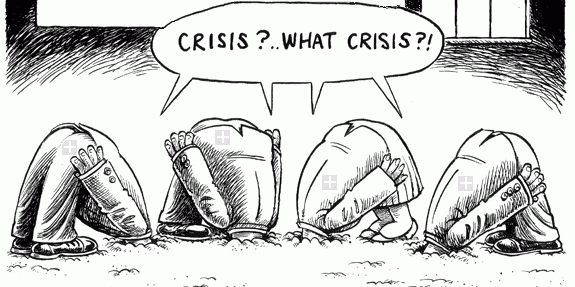
YOU CAN THINK LIKE AN OSTRICH, ACT LIKE AN OSTRICH BUT YOU ARE NOT AN OSTRICH, YOU ARE A MAN OR A WOMAN MADE IN THE IMAGE AND LIKENESS OF GOD

heads-in-sand

OF OSTRICHES AND HUMANS

THE AMERICAN CATHOLIC   Wednesday, April 11, AD 2018

Guy McClung


In the last few weeks some things have happened that have stunned me – and caused me to think and rethink writing about and discussing what I see as the devastating crisis in Jesus’s Church.


A priest was introduced to me, ordained fifteen years, who is very active in parish work, not Judas social justice work, but real parish work, bringing the sacraments to the faithful. I mentioned the exhortation Amoris Laetitia and he said he had heard of it, but he had not read it.


In speaking with a close relative, she referred to the saintly man now wearing papal white and how she loves to hear the words he speaks to the faithful. She has only heard the “words” recounted from the pulpit at her local parish and as repeated to her by her fellow parishioners.


Another close relative told me he knows about all the corruption, wickedness, heresy and depravity of the priests, bishops, cardinals, and man wearing papal white, but he ignores it all, and would prefer I not speak of these things to him. He has a master’s degree in theology and teaches extensively in parish programs.


When I told both the priest and the one close relative that Jorge Bergolgio wrote and published the statement that “No one is condemned forever,” at first they did not believe me. I said that those were his actual, printed, proclaimed words. The priest said “that could be understood to lack clarity.”


I then asked the close relative had she heard of the homosexual cocaine orgies in the Vatican with male prostitutes or the pervert addicted to child pornography whisked away from the authorities in Canada, to the diplomatic safety of Vatican City,  and now recently arrested in the Vatican. She asked me never again to tell her about such things and to send her no emails with any such information, or with anything derogatory about Jorge Bergoglio.


These are not three folks in outer Mongolia who have never heard the name, “Jesus.” These were cradle Catholics, one ordained who daily acts in persona Christi,  all of whom, many times since the age of reason and literacy, have heard that Jesus said there is a hell and there is everlasting fire


So. This has made me think. Do I keep on keepin’ on ? Do I continue to say, when the occasion presents itself, I believe Jorge Bergoglio is a heretic and, while wearing the papal white,  he has proclaimed his heresy? Do I go on in telling people the bishops and cardinals, some of whom themselves are perverts, pederasts, pedophiles and the abusers and assaulters of women, girls and boys, that these men have stolen billions of the widows’ mites and the faithful’s  dollars, some  to live a life of perverted luxury or to  pay off those victims and their lawyers who speak out? Insuring that the details of their perfidy and the actions of the wicked are kept secret under the seals of the many, many courts who are dealing with these crimes?


I am thinking about the apostles, arrested by the Synagogue hierarchy of the time, and told you may not henceforth speak publicly in  the name of Jesus of Nazareth. I am thinking about St. Peter’s response, the response of the Rock Jesus chose for His Church, the first pope, when told to shut up he replied: “We can obey you  or we can obey God.”


I am praying.


I am also thinking about St. Dismas who, from his own cross, himself tortured and dying, ignored the crowd, ignored the ruling Romans, ignored the (so-called) “high” priests, and gave no heed to the soldiers of power gathered around celebrating Jesus’s suffering and crucifixion. St. Dismas, unlike his brother hanging nearby who was ridiculing Jesus in his agony. St. Dismas, the first and in some ways the most knowledegable evangelist of the passion, death and crucifixion of Jesus, who said, for all the world to hear, that Jesus is “Lord.”


Posted in Uncategorized | 1 Comment

The elite classes in our society use their ostensible concern for inequality to mask their privilege and defend their social position, they are the neofacists who seek to control everyone else’s life.

The Dual Legitimation Crisis: Elitism, Populism, and Political Power
by Nathanael Blake
within Philosophy, Politics
Apr 24, 2018 08:03 pm http://www.thepublicdiscourse.com/2018/04/21326/
Because liberal Western democracies are ostensibly rooted in the theory of popular sovereignty, elite disdain for the people creates another legitimation crisis—one that many fail to recognize. It is not simply that the people have lost confidence in the elites and their governance, or that the elites struggle to speak for (and even to) the people. Disdain for the people also unmoors elite authority.

The liberal democratic West is experiencing a legitimation crisis. There is little popular faith that those controlling government and important institutions deserve their power or that they use it for the common good.

The symptoms are varied: Brexit, the election of Donald Trump, the successes of post-liberal popular governments in Poland and Hungary, and the rise of formerly fringe political parties throughout Europe. Each much-discussed case reveals an extensive loss of confidence in Western elites and challenges to the legitimacy of their power, influence, and status.

But this legitimation crisis cuts both ways. Just as the people question the legitimacy of elite governance, so too do many elites question the idea that the legitimate exercise of political power should be grounded in the consent of the people.

The Rise of Today’s Cultural Elites

This is a culmination of trends that American historian and social critic Christopher Lasch noted in The Revolt of the Elites, published in the mid-’90s. According to Lasch, the developing elite class was composed of “those who control the international flow of money and information, preside over philanthropic foundations and institutions of higher learning, manage the instruments of cultural production and thus set the terms of public debate.” They are supported by many middle-class professionals who, like the shabbily genteel of the nineteenth century, are often most insistent on preserving class distinctions. What members of the elite and professional classes have in common is that their “livelihoods rest not so much on the ownership of property as on the manipulation of information and professional expertise. Their investment in education and information, as opposed to property, distinguishes them from the rich bourgeoisie.” Lasch argued that the new elite class wanted to separate itself, and it increasingly has, clustering in so-called super-zips, mostly near coastal cities.

However, they have also become more ideologically homogeneous since Lasch’s time, and now they mean to rule. It is not enough that same-sex marriage is legally recognized; every wedding vendor, no matter how small-time or small-town, must be compelled to participate in promoting and celebrating same-sex weddings. It is not enough for contraception to be legal, easily available, and often subsidized; elderly nuns must be forced to facilitate its disbursement. They tried to mandate that every school district in the nation allow males to share bathrooms, locker rooms, and hotel rooms with girls. And they are not just using government power to accomplish their goals. The behemoths of corporate America are increasingly aggressive in pushing a left-wing social agenda.

These uncompromising efforts are rooted in disdain for opposing viewpoints. A representative example is the declaration by Ben Smith of Buzzfeed that there are not two sides to issues such as same-sex marriage. The views of those who oppose same-sex marriage are fundamentally illegitimate and may be ignored. Smith, a leader in new media, simply said openly what many in older media outlets quietly believe: certain positions are irrational, explicable only by ignorance or bigotry, and those who hold them may therefore be dismissed as foolish, morally depraved, or both.

Bolstering this contempt for contrary opinions is the confidence of the elites that their status is deserved. In an essay in First Things, Patrick Deneen argues that the elite classes in our society use their ostensible concern for inequality to mask their privilege and defend their social position. Comparing them to the French aristocracy of the ancien régime, he writes: “much like those who took for granted the naturalness of political arrangements during the medieval ages, today’s elites seldom subject their meritocratic justifications of their status and position to the same skepticism.” No matter how critical our elites may be of historical forms of privilege, they presume that their own status is deserved.

And there is a corollary to this. Except for particular historically oppressed classes that the elites have taken on as clients, those on the bottom rungs of the socioeconomic ladder deserve to be where they are, too. As Deneen observes,

If elites largely regard their social status, wealth, and position as the result of their own efforts and work (and certainly not of birth or inheritance), then those who remain in the lower classes have, by the same logic, chosen to remain in such a condition.

Because liberal Western democracies are ostensibly rooted in the theory of popular sovereignty, elite disdain for the people creates another legitimation crisis—one that many fail to recognize. It is not simply that the people have lost confidence in the elites and their governance, or that the elites struggle to speak for (and even to) the people. Disdain for the people also unmoors elite authority.

Not Popular Sovereignty—Rule by the Strong

Elites have to justify their rule not only to the people, but also to themselves. But their increasing contempt for the populace undermines what liberal Western democracies consider to be the source of their authority: the sovereignty of the people. At the level of theory, Western elites increasingly reject the authority of the people, many of whom they consider to be intellectually benighted, culturally backward, and morally grotesque. Politically, perhaps no one reveals this contempt more than Hillary Clinton, who has not bothered to hide her loathing for those who did not support her.

If elites reject the authority of the people and no longer claim to govern on their behalf, how can they legitimate their rule? Their answer seems to be by appealing to their own superiority—moral, intellectual, and cultural. The sneering disdain for ordinary persons that Western elites and their supporters increasingly display is tied to this aspect of the legitimation crisis. They believe that they deserve to rule not because they represent the people, but because they are better than the people, as demonstrated by their status and their (mostly rhetorical) solicitude for client groups they identify as historically oppressed.

This justification is self-reinforcing. Elites’ belief in their own moral superiority causes them to lose confidence in the people, and their loss of confidence in, and increasing disdain for, the people necessitates an even firmer belief in elite superiority to justify their power and status. This attitude is passed down to those who support elite policies and mimic elite culture. For example, Jon Stewart and his many imitators throve on encouraging a sense of smug superiority among the elite and its supporting classes, especially in media, education, and entertainment.

We are witnessing the rise of a new theory of political sovereignty, or the resurrection of a very old one: rule by the strong, justified by their supposed superiority.

It is revealing that this new basis for sovereignty is largely unnecessary. While the elite claim to concern for the common good has weakened, they can still claim many electoral victories over their populist challengers. There is still substantial political support for elites, which is magnified by their outsized power and influence throughout institutions like the academy and the media. But the shock of successful challenges to the elite consensus seems to have unnerved them enough to look for a new source to legitimate their power, and they have settled on the flattering supposition that their natural superiority entitles them to rule.

Not coincidentally, this frees them from accountability and responsibility toward those they govern, especially their populist opponents. Elites and their allies have become comfortable deeming certain views fundamentally illegitimate, even if the majority of the people hold these views. On some issues, there is to be no debate. If the popular will turns against them, then the popular will is not just wrong (which every political minority must believe), but illegitimate as a source of political authority.

Populist Backlash

This disrespect has understandably fueled a populist backlash. Writing in the Washington Post, Megan McArdle observes, “What most consistently motivates the Trump supporters I’ve met is not jobs or racism but anger at a culturally powerful elite that veers between ignoring them and disrespecting every facet of their lives.” And populist movements—whether of the right, the left, or the radical center—can be ugly. However, elites could defuse their worst impulses by addressing the reasonable concerns that give rise to them, rather than suppressing them or dismissing them as beyond the pale.

A case in point is the way European elites have treated all criticism of their preferred immigration policies as illegitimate. This attitude culminated in the German chancellor’s unilateral decision to remake the population of Europe. The repercussions have staggered the European order and may yet shatter it, but the European elite still cling to their belief that opposition to their immigration policies was fundamentally irrational, motivated by racism and xenophobia, and therefore unworthy of being heard. This dismissive response to popular concerns has fueled the rise of populist parties and movements, which in turn intensifies elite efforts to reground political legitimacy in themselves.

Similar dynamics can be seen in the escalating elite hostility to the bedrock liberties of political liberalism, such as the freedoms of speech, religion, and association, all of which elites increasingly see as enablers of bigotry that must be carefully limited. Thus, free speech is limited to prevent “hate speech,” and protections of religious liberty are dismissed as a “license to discriminate.” To defend the liberal order that they dominate, Western elites become illiberal in both theory and practice. Whatever commitment they had to liberalism was weaker than their commitment to their own power and status. And so, just as the people question the legitimacy of elite authority, the elites question the legitimacy of popular sovereignty, preferring a polity grounded in their own supposed superiority and expertise.

In the United States, this is perhaps most pronounced and persistent in our legal system, where the dominant legal theories elevate elite opinion above statutory law and even the Constitution. The words of the law mean what the legal elite want them to mean. For example, there are many different views of what constitutes human dignity. However, when judges and legal theorists discover a right to dignity lurking, unwritten, in the Constitution, they meandignity as understood by the latest elite fads, not dignity as, say, a tradition-minded Catholic philosopher would understand it. When judges interpret the Constitution through the lens of “evolving standards of decency,” they mean evolving elite standards, not the populace’s standards, or those of dissenting scholars who disagree with the elite consensus.

When rights to same-sex marriage and abortion were favored by elite opinion, they were found lurking in the Constitution. If enumerated rights are out of step with elite views, grounds will be found to limit them. If the elites want sex to mean sexual orientation or even gender identity, it will. From judicial opinions to law review articles, elite legal writing attempts to obscure this exercise of raw power, covering it with a counterfeit patina of legitimacy. But the reality is unmistakable, and it has become the model for elite rule.

For our elites, who fancy themselves sovereign by virtue of their superiority: La loi, c’est moi.

Nathanael Blake has a PhD in political theory. He lives in Missouri.

Posted in Uncategorized | 1 Comment

IF IT IS DIFFICULT TO LOVE YOURSELF BECAUSE OF YOUR LOVE FOR DRUGS, ALCOHOL, PORNOGRAPHY, MONEY, POWER, ETC. HOW MUCH MORE DIFFICULT IS IT TO LOVE YOUR NEIGHBOR ?

Probably the most famous saying in the Bible is:

“You shall love your neighbour as yourself.” (Leviticus 19:18)

It’s a passage that everybody likes to quote. But only few know how to put in practice.

In every reader’s mind the question naturally comes up: “Who is my neighbor?”

Rabbinic answers to the question, “Who is my neighbor?”

Rambam interprets it like this, “You shall love your neighbor as yourself” claiming that our “neighbors”, our friends, are only Jews who keep the rabbinical tradition and no one else. Everyone else is to be hated, according to the Talmud. Rambam, the rabbinical tradition and even today’s rabbis incite hatred against whoever is different. Here are some examples:

Rabbi Bagdadi says:

“Do you have an animal? Don’t leave it with a Gentile, he will come and rape your animal, according to the Talmud.”

Rambam said:

“The Gentile is not really a human being.”

Rabbi Tzadik, Priest of Lublin, claimed:

“Only Israel is called ‘human’. In comparison to Israel all the Gentiles are anyhow like beasts that just look human.”

RABad adds:

“The gentiles are like beasts, a people similar to a donkey.”

Ha’ARI says:

“The Gentiles have neither spirit nor soul and are not even equal to animals considered clean, but rather lower than them.”

What the Bible says about Gentiles and strangers

Firstly, it’s important to understand that the Judaism of the Sages contradicts the Judaism of the Bible. Since the Torah commands:

“When a stranger sojourns with you in your land, you shall not do him wrong. You shall treat the stranger who sojourns with you as the native among you, and you shall love himas yourself…” (Leviticus 19:33-34)

Maybe someone should remind the rabbis that Melchizedek, King of Salem, a Gentile, receives in the book of Genesis a higher position than Abraham. Abraham, gave him a tithe of all his possessions. In Exodus, we read about another Gentile, Jethro, a Midianite priest, who receives a higher position than Moses. And Moses does whatever Jethro tells him. Osnat, Joseph’s wife, a Gentile. Zipporah, Moses’ wife, a Gentile. David’s grandmother, Ruth the Moabite, a Gentile.

We could continue with more names but you for sure got the idea. By the way, we owe it to the Gentiles’ generosity, Christians that love Israel, that today we have a strong nation and army.

Yeshua’s answer to the question “Who is my neighbor?”

But is Rambam’s interpretation correct? Whoever watched the last episodes of “Seinfeld” surely remembers that they revolved around a law called “Good Samaritan law”. According to this law, in Europe and in the US, each citizen is obliged to help anyone in distress.

Most people don’t know that the term “Good Samaritan” comes from the New Testament.

In the New Testament we read about a question the religious leaders asked Jesus, testing him: “Who is the neighbor that I need to love?” Jesus’ answer later became one of the most famous parables in history, the parable of the Good Samaritan.

“A lawyer stood up to put him to the test, saying, “Teacher, what shall I do to inherit eternal life?”
He said to him, “What is written in the Law? How do you read it?”
And he answered,“You shall love the Lord your God with all your heart and with all your soul and with all your strength and with all your mind, and your neighbor as yourself.”
And he said to him, “You have answered correctly; do this, and you will live.”
But he, desiring to justify himself, said to Jesus, “And who is my neighbor?”
Jesus replied, “A man was going down from Jerusalem to Jericho, and he fell among robbers, who stripped him and beat him and departed, leaving him half dead. Now by chance  a priest was going down that road, and when he saw him he passed by on the other side. So likewise a Levite, when he came to the place and saw him, passed by on the other side. But a Samaritan, as he journeyed, came to where he was, and when he saw him, he had compassion. He went to him and bound up his wounds, pouring on oil and wine. Then he set him on his own animal and brought him to an inn and took care of him. And the next day he took out two denarii and gave them to the innkeeper, saying, ‘Take care of him, and whatever more you spend, I will repay you when I come back.’ Which of these three, do you think, proved to be a neighbor to the man who fell among the robbers?”
He said, “The one who showed him mercy.”
And Jesus said to him, “You go, and do likewise.” (Luke 10:25-37)

Jesus, as opposed to Rambam, gave an interpretation that is contrary to the rabbinical tradition. But first of all we need to understand how revolutionary his teaching was.

For in the rabbinic tradition at that time, Samaritans were viewed in the same way as the Arabs are viewed today. According to Jesus we are to love everyone. Also the Samaritans. Or for us today, also the Arabs. Jesus taught that it is no sign of wisdom if we only love those who love us back. Or to love only those who are similar to us. Wisdom is to also love the one who is different, strange, and even to love our enemy who does not love us. This is not a political statement but rather a theological explanation of God’s character. God loves everyone. He created us. Jews, Arabs and every other nation. Also today, we need to distinguish between the person and his ideology. For example, we do not doubt that Islam cultivates diabolic ideologies that are wrong and that we need to reject. Jesus taught, that we need to love everyone. Including Muslims. Since they too were created in God’s image. The point Jesus was making in this parable was that God dislikes the classes, boxes and religions that we, humanity, create. And that we need to relate to and love everyone equally, even focusing on the weak, the rejected and the different.

Yeshua practiced what he preached

Jesus despised the fact that men create for themselves a certain status in God’s name. He couldn’t stand it that people admired and kissed the hands of the religious leaders and he did not believe that money can buy access to heaven. Jesus emphasized relationships. The way we relate to the ones around us. The same goes for today. Whoever reads the newspaper can see how well religion and money go hand in hand together. Rabbis, priests and other religious leaders sell salvation, talismans, prayers and odd blessings for money, a lot of money, coming normally from the poor and the desperate. Jesus, however, did not only exhort with words, but also practiced what he preached. He loved simple people, those who had been rejected and disregarded by the religious establishment. On our behalf the Messiah gave not only two Denarii, but the most valuable thing… his own life, so that we might live.

The man in the parable of the Good Samaritan was stripped, beaten up and left to die. So did we strip Jesus, not only of his clothes, but also of his glory. We beat him and left him to die. But in the death of the righteous Messiah we, the sinners, receive forgiveness and absolution. Jesus gave us the perfect example for the command “And you should love your neighbor as yourself”, by giving his own life for us, his neighbors. He taught that:

“Greater love has no one than this, that someone lay down his life for his friends.” (John 15:13)

He also put this teaching in practice. Now, ask yourselves the following question: Would the world be a better place to live in according to Rambam’s interpretation, a world where each one loves and cares only for the one who thinks, acts and believes the way he does?

Or, according to Yeshua’s interpretation, a world where everyone brings sacrifices and loves not only foreigners that we don’t know but even our enemies.

Eitan Bar

Eitan Bar

Eitan Bar is a native Jewish-Israeli who was born and raised in Tel Aviv, Israel (1984). Graduated with his B.A. in Biblical Studies from Israel College of the Bible (Jerusalem, 2009), his M.A. in Theology from Liberty University (2013) and is now pursuing his Doctorate with Dallas Theological Seminary. Eitan currently serves as ONE FOR ISRAEL’s Director of Media & Evangelism. (From 2006 to 2013, Eitan worked for CRU, in which his roles included serving as Israel’s VLM-SLM leader.)

Eitan’s professional background is in “Multimedia Design and Visual Communications” working for various secular advertising agencies in Tel-Aviv.

Eitan is the producer of:
1) I MET MESSIAH (Jewish testimonials).
2) Answering Rabbinic Objections to Jesus.

Posted in Uncategorized | Comments Off on IF IT IS DIFFICULT TO LOVE YOURSELF BECAUSE OF YOUR LOVE FOR DRUGS, ALCOHOL, PORNOGRAPHY, MONEY, POWER, ETC. HOW MUCH MORE DIFFICULT IS IT TO LOVE YOUR NEIGHBOR ?

What most afflicts us is the clear and widespread perception that the present terrible crisis of the Church is caused eminently by the Catholic hierarchy itself. The tree is rotting from inside. Can we ignore this undeniable fact, thus avoiding any engagement in the “good battle” for the restoration of the true Doctrine?

PinterestPocketGoogle+

The Vatican II Points of Rupture Remain

Editor’s note: The following is the response of Prof. Paolo Pasqualucci to some criticism of his previous article, “‘Points of Rupture’ of the Second Vatican Council,” available here.

The critical remarks:

  1. “Articles such as this one, written at a time of great confusion, only inflict greater uncertainty and anxiety upon the faithful.”
  1. The author so often uses expressions like “it seems,” “it appears to say,” “could be interpreted as” that his reasoning appears “flimsy.”
  1. The supposed “rupture” with the traditional notion of priesthood is not proven. The author muddles up the notions of priestly “task” and priestly “function.”
  1. The author has not understood the notion of “divinization” of man implied by Gaudium et Spes 22.2: “For by His incarnation the Son of God has united Himself in some fashion with every man [Ipse enim, Filius Dei, incarnatione sua cum omni homine quodammodo Se univit].” The implied “divinization” of man is theologically correct (as allegedly demonstrated by a long list of scriptural and patristical quotations).

My replies:

  1. We are all affected, I think, by a despondent feeling of “uncertainty and anxiety” about the future of our civilization and our Catholic religion. What most afflicts us is the clear and widespread perception that the present terrible crisis of the Church is caused eminently by the Catholic hierarchy itself. The tree is rotting from inside. Can we ignore this undeniable fact, thus avoiding any engagement in the “good battle” for the restoration of the true Doctrine? We Catholics have all been confirmed as “milites Christi,” soldiers of Christ, and have first of all the duty to fight for Our Lord’s honor and glory, everyone according to his capacities, as shown in the Parable of the Talents (Lk 19). The spiritual and practical fight for the Dogma of the Faith, against all the anti-Christian powers of this world, is in essence supernatural, its ultimate and everlasting prize life eternal.

Let’s be brave, then, and never lose faith in the help of the Holy Ghost, “For that which is at present momentary and light of our tribulation, worketh for us above measure exceedingly an eternal weight of glory. While we look not at the things which are seen, but at the things which are not seen. For the things which are seen, are temporal; but the things which are not seen, are eternal”(2 Cor. 4:17-18).

  1. The frequent use of “it seems,” “it appears to say,” etc. makes my reasoning inconsistent or “flimsy”?

I think the layman has the authority (CIC c. 212 §3) to enucleate and expose ambiguous (or erroneous) statements issued by a legitimate Church authority. As far as Catholic doctrine is concerned, no ambiguity is admissible, no possibility of a double entendre that might point directly or indirectly to erroneous or heretical doctrines. At the same time, an author ought to allow the public to establish by itself whether the exposed ambiguity conceals or not an error in fide – i.e., whether the ambiguous statements appear in accordance with the traditional teaching of the Church or not.

The due analysis of the ambiguities that appear in the often tortuous language of Vatican II documents is also spiritually offered to the judgment of the authority of the Church, which is supposed to have the ultimate word in these vital matters – i.e., to establish one day officially and forever if the exposed ambiguities are or are not in accordance with the perennial doctrine of the Church.

As shown by the history of the Church, ambiguities usually appear when new doctrines (nova) are introduced. They are generally proposed as if they were always in accordance with the traditional doctrine, which they are now supposed to explain better, with new arguments (nove). But the new doctrines that are introduced are generally dangerous for the faith. That’s why they are often camouflaged by tortuous and ambiguous language.

Vatican II has admitted of introducing new doctrines, though (of course) always in harmony (congruentia) with the old ones:

This Vatican Council takes careful note of these desires [of dignity and freedom] in the minds of men. It proposes to declare them to be greatly in accord with truth and justice. To this end, it searches into the sacred tradition and doctrine of the Church – the treasury out of which the Church continually brings forth new things [nova] that are in harmony with the things that are old [sacram Ecclesiae traditionem doctrinamque scrutatur, ex quibus nova semper cum veteribus congruentia profert]. –Decl. Dignitatis humanae on religious liberty, 1.1)

The notion of tradition and doctrine that appears here does not seem correct to me: it is not the task of the Church “to bring forth new things” from the Deposit of the Faith (whether “continually” or not), albeit (in theory) “always in harmony with the old ones.” Which “new things”? Those “desired in the minds of men” professing the profane values of our secularized age?

Such a statement shows in any case an evolutive notion of tradition, incompatible with the notions of Deposit of the Faith and of revealed truth. These notions imply that the Church can explain the “old things” better, with new arguments (nove), as for instance the dogmatic Council of Trent did, but has absolutely no power of introducing “new doctrines,” nova.

  1. Did I say that according to the Council, preaching was the “first task” of priesthood, to be put in “the first place among priestly functions,” when, as a mere “task”, it should not be included among the “functions” of the priesthood? And did I overlook the fact that the first place among these “functions” is attributed by the decree Presbyterorum Ordinis to the celebration of the Holy Mass?

Surely not. I do not understand where this word “task” comes from, since the English translation of my Synopsisreports:

[A]mong the “functions” of the priesthood the first place ought to be given to preaching (“proclaiming the Gospel of God to all” PO 4.1). Indeed, if we check the text of the Decree, we see that, in listing the “Priests’ functions” (presbyterorum munera) the Council writes: “…priests, as co-workers with their bishops, have the primary duty of proclaming the Gospel of God to all” [primum habent officium Evangelium Dei omnibus evangelizandi]. Preaching, therefore, is not conceived of as a secondary task at all; it is emphasized as the “primary duty” of priests. The first duty, among the duties (munera) that fill their priestly “function”. In its analysis of the “priests’ functions”, the Decree begins significantly with the “praedicatio sacerdotalis”.

There is no ambiguity here. The change of perspective is quite obvious.

  1. Why should the (improper) divinization of man implied by GS 22.2 be considered a legitimate notion?

Because, argues my critic, “it is perfectly orthodox to say that we baptized are by grace what Christ is by nature.”

My reply:

4.1 By grace we can become “sons of God by adoption,” as explained by St. Paul (Rm 8:14). This means that, in this world, we can become similar to Him (our Master) but never the same in nature. The adoption is conceded “provided we suffer with him in order that we may also be glorified with him”(Rm 8:17) – that is, only if we are capable of sanctifying ourselves, regenerating ourselves with the help of God. The divine adoption is conditioned by the cooperation of our free will or, in other words, by our effective exercise of the Christian virtues. It is a condition we can achieve only fighting against ourselves.

4.2 We become “children of God,”, “Sons of God,” “Gods or likened to God,” “fellow-heirs with Christ” not because we have been divinized for the simple fact of being Christian, but because of our success in becoming an individual “born anew of water and the Spirit,” an individual who proves to be an effective disciple of Christ (John 3:3ff).

4.3 My critic lists five quotations from the Scripture, one from the New Catechism, and nine from the fathers of the Church to support his argument.

As some readers have pointed out, the status of “children of God” applies also to the elect in the Kingdom of God; in this case, it has nothing to do with what we are debating here. Furthermore, such a status, when related to man in this world, is never connected by the sources listed above to the Incarnation of Our Lord. This is a novelty introduced by Vatican II. To say the truth, it isn’t even a novelty: this error was refuted by St. John of Damascus (deceased A.D. 749) and by St Thomas Aquinas (see: Summa Theologiae, III, q. IV, a. 5). So “divinization” by Adoption and not by a union begotten by the Incarnation.

4.4 The idea that we have “been made gods” echoes the notion of theosis, typical of the Greek patristics, if I am not mistaken. But generally, isn’t it translated this way: “becoming likened to God” and not at all “like God”? “Likened to God” by the action of the Holy Spirit – that makes God act in the faithful receiving it. This seems to be the supernatural action revealed by Jesus in John 14:23: “if a man loves Me, he will keep my word, and my Father will love him, and We will come to him and make our home with him.” Here we have a beautiful illustration of the ineffable and trinitarian action of the divine grace in us. Such an action has obviously nothing to do with a supposed “union” of Christ with us for the simple fact of His Incarnation.

4.5 GS 22.2, instead, seemingly wants to say that, by the mere fact

of Incarnation, the Son of God “has made his home” with every human being (!) – not exclusively with the faithful who loves Christ, but with every man for the simple fact that he is a man. Man is not supposed to do anything to achieve the extraordinary benefit of the “union” with the Son of God. The “union” with Christ becomes then an ontological quality of man, and we must assume that man is “divinized.” (Ontological is pertaining to the being [on, ontos] in Greek) – i.e., to the nature of man as such, without any further specification.

This new doctrine aims at establishing a supernatural foundation to the notion of human dignity, proposed in the same article. That’s why the sentence begins with “for” – enim in Latin. Article GS 22 tells us that Christ came in this world to “fully reveal man to man himself and to make his supreme calling clear”(a notion taken from the troubled theology of Henri de Lubac, S.J.). The Savior came not to make us believe in Him, repent, and be saved from eternal damnation (Mk 2:17); He came to reveal to man “his supreme calling.” Perhaps this consists of a call to “eternal life”? No. It consists, we are told, of the awareness of the divine dignity of our nature: “[s]ince human nature as He assumed it was not annulled, by that very fact it has been raised up to a divine dignity in our respect too. For by His incarnation the Son of God has united himself in some fashion with every man”(GS 22.2, my emphasis). Therefore: every man as such possesses a divine dignity for the simple reason that, in His Incarnation, the Son of God “has united himself with every man”!

4.6 How could this extraordinary “union” take place? Is this supposed to be a clear notion? Further confusion is introduced by the expression “in some fashion” (quodammodo). What is this supposed to mean?

4.7 There is more to say on this extraordinary article 22 of GS and its interpretations. I conclude my short reply outlining that this ontological “union” practically destroys the dogma of original sin, at any rate vanished (as well as other dogmas) from the teaching of the Catholic hierarchy after Vatican II.

Posted in Uncategorized | Comments Off on What most afflicts us is the clear and widespread perception that the present terrible crisis of the Church is caused eminently by the Catholic hierarchy itself. The tree is rotting from inside. Can we ignore this undeniable fact, thus avoiding any engagement in the “good battle” for the restoration of the true Doctrine?

Here comes Speaker Nancy Pelosi and Majority Leader Chuck Schumer; America, brace yourself for at least two years of hell and the possible impeachment of President Donald Trump

Exclusive – Brent Bozell: Last Chance for the GOP

Back in ‘92, the late Paul Weyrich and I held a press conference during the Republican National Convention to make two announcements.

First, we were endorsing George Bush 41’s re-election. Second, we’d just made the most meaningless endorsement in history. He had so thoroughly bungled his first term that there was nothing to be done to save him. And we were right.

The Republicans are now facing the same future in November. At this point they will certainly lose the House and quite possibly the Senate too. Worse, they’ve so botched their opportunity that only they can save themselves now. The $1.3 trillion Omnibus Bill — their omnibus bill — was not just the most reckless spending bill in history, it was an abject surrender on every single political and policy pledge made to those who put them in office, save helping the military.

It’s been this way from the start. First, they asked for control of the House and its appropriations authority to right the fiscal ship, and as importantly, end Obamacare. In 2010, they got it — and immediately stated they could do nothing without the Senate. In 2014, they were awarded that too — and just as quickly declared they could do nothing without the White House. So, in 2016 they were handed that, and with it complete control of the legislative process, but now with no more excuses available.

And what have they done? They surrendered without a fight. Any real advance, be it Gorsuch, regulatory relief, minimal border security, minimal tax cuts, or minimal changes in Obamacare — it’s all being driven by the White House. Congress has done nothing.

Here’s the difference between the two parties. For the past eight years, the GOP has been the party that begins each conversation with, “This is why we can’t do it.” The Democrats begin theirs with, “This is how we’ll get it done.” The crisis for Republicans is so grave that not even a rhetorical shift will save them. Only action, concrete action, might — might. They must come up with victories.

Here’s what they need to do, in six easy steps.

  1. Like it or not, wrap themselves around the president to save him from impeachment. This means publicly embracing him as their leader. More to the point, it means supporting everything he puts on the table from here through November, and doing it with brio.
  2. Reverse that disastrous $1.3 trillion omnibus. This talk about a revision, or worse, a balanced budget amendment is the height of hypocrisy and the public’s not going to stand for it. It’s like committing rape and then joining the #metoo movement. Only tangible results, legislation that reduces the deficit and puts the government on the road to fiscal sanity, will work.
  3. Kill Obamacare. Nothing less will do. The public that voted these Republicans in has had it with excuses and half-measures.
  4. End funding of Planned Parenthood. The pro-life movement is leaving the GOP, and for good reason. When Republicans award the operation that proudly massacres over 300,000 babies annually with $450,000,000 dollars taken from American taxpayers, there’s no difference between the parties.
  5. Fund border security. The base will not stomach any more of the GOP’s public displays of affection for Chuck Schumer while denying funds for Trump’s border wall. Promises made, promises broken.
  6. Deliver real personal tax cuts. What they came up with last year rewarded Big Business nicely while excusing nearly 50% of Americans from the responsibility of paying taxes altogether. Everyone else was given bread crumbs — or screwed. Those were your voters, GOP.

Here is the bottom line. On September 30, five weeks before the election, there will be the need for a new spending bill to keep the government running. Everything listed above can be accomplished in that one piece of legislation. No more excuses. No more punts. No more stalling.

It’s so obvious, really. At this point the GOP faithful are set to make a devastating declaration in seven months: “We gave you complete control, and you not only accomplished nothing, you broke your word on virtually everything. Good-bye.”

And you know what, Republicans? They’re right.

Your call.

L. Brent Bozell is the Chairman of ForAmerica, a national grassroots organization whose mission is to use social media to reinvigorate the public with the principles of American exceptionalism: freedom, prosperity and virtue. ForAmerica has over 9 million members and is a non-profit 501(c)4. www.ForAmerica.org.