BRAVO SARAH SANDERS

Sanders holds the daily briefing at the White House in Washington


Where’s the Tax Return?


Press Secretary Sarah Sanders is one of the brightest people in the current administration. She has a very quick wit about her.

During a recent press conference, a reporter with MSNBC hollered from the press corps, “Where is President Trump hiding his tax returns?” 

Press Secretary, Sarah Huckabee Sanders, astutely responded, “We’ve found a very secure place and I’m certain they won’t be found.” 

“And just where is that?” asked the reporter sarcastically.

Mrs. Sanders grinned sardonically and said, “They are underneath Obama’s college records, his passport application, his immigration status as a student, his funding sources to pay for college, his college records, and his Selective Service registration.

​”​
​​

“Next question?”

hat tip:  Bill Hohn/Debbie Roeder

Posted in Uncategorized | 2 Comments

MY CAT ATE MY MOUSE

ATT65110


Posted in Uncategorized | 1 Comment

LITTLE BY LITTLE EVERY DOCTRINE OF THE CHURCH WILL BE CHANGED AFTER “REVIEW” IN THE BERGOLIAN PAPACY, IS DE TRINITATE NEXT???

Settimo Cielodi Sandro Magister

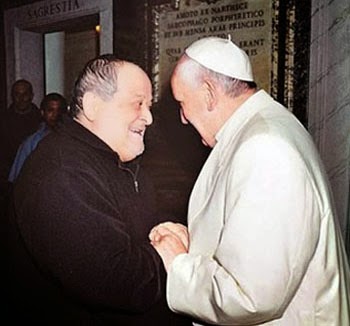
Goodbye, “Humanae Vitae.” Francis Liberalizes the Pill

Chiodi

> Italiano
> English
> Español
> Français

> All the articles of Settimo Cielo in English

*

Goodbye, “Humanae Vitae.” Half a century later, the encyclical against artificial methods of birth control that marked the most dramatic moment of the pontificate of Paul VI, rejected by entire episcopates, contested by countless theologians, disobeyed by myriads of faithful, is now giving way to a radical reinterpretation, to a “paradigm shift” undoubtedly desired and encouraged by Pope Francis himself.

Paradox would have it that Paul VI should be the pope whom Jorge Mario Bergoglio admires and praises the most. And precisely – his own words – for the “prophetic brilliance” with which he wrote that encyclical and for his “courage in standing up against the majority, in defending moral discipline, in applying a cultural brake, in opposing neo-Malthusianism present and future.”

But the reality is that “everything depends on how ‘Humanae Vitae’ is interpreted,” as Pope Francis never fails to comment. Because “the question is not that of changing doctrine, but of digging deep and making sure that pastoral practice takes into account the situations and what persons are able to do.”

His wish becomes command. An authoritative guise has now been given to the new interpretive paradigm of “Humanae Vitae,” with an explicit go-ahead for artificial contraception, by one of the pope’s most respected theologians, Maurizio Chiodi, professor of moral theology at the Theological Faculty of Northern Italy and a newly appointed member of the Pontifical Academy for Life, already the author of a book published in 2006, “Etica della vita,” that upheld the legitimacy of artificial procreation.

The authoritativeness of his position is confirmed by two connected facts.

The first is the context in which Chiodi laid down the new interpretation of “Humanae Vitae”: a conference at the Pontifical Gregorian University on December 14, in the course of a round of meetings dedicated to that encyclical at the fiftieth anniversary of its publication, organized by the university’s faculty of moral theology, directed by the Argentine Jesuit Humberto Miguel Yáñez, a protege of Bergoglio’s.

A detailed account of this conference was provided by the American journalist Diane Montagna on LifeSite News on January 8, followed by lively reactions from defenders of the contested encyclical:

> New Academy for Life member uses “Amoris” to say some circumstances “require” contraception

But now there’s more. On Sunday, January 28 Chiodi’s conference was prominently featured by the newspaper of the Italian episcopal conference, “Avvenire,” in the monthly supplement “Noi, Famiglia & Vita,”  introduced with a commentary entitled “From pope Montini to Francis, development in fidelity,” which states:

“It is a position [that of Chiodi] that authoritatively takes its place in the debate underway, and that must not be understood as an overrun or critique of ‘Humanae Vitae,’ a text that is and remains the fruit of a prophetic and courageous decision for the time and historical situation in which pope Montini conceived of it, not without torment and not without having clarified that this was a matter of a magisterium that was neither infallible nor irreformable. In this perspective, the theologian’s reflection is to be understood as a proposal that is intended to represent the development of a tradition. And a tradition, in order to be alive and to continue to speak to the women and men of our time, must not be fossilized but rendered dynamic, which means to be in keeping with a society that is changing. Fr. Chiodi has the courage to define the problem that is raised by some theologians and experts on pastoral practice. Are natural methods really to be understood as the only means possible for family planning?”

The commentary, as can be seen, ends with a question mark. Which is, however, entirely rhetorical. The ideas Chiodi presents in his conference, in fact, are not hypothetical, but affirmative. There are circumstances – he maintains – that not only allow but “require” other methods, not natural, for birth control.

The complete text of Chiodi’s conference republished in “Avvenire” – with a few edits that do not substantially alter it with respect to the one delivered at the Gregorian – is on this other page of Settimo Cielo:

> Rileggere “Humanae vitae” alla luce di “Amoris laetitia”

After discussing again “the subjective responsibility of conscience and the essential relationship between norm and discernment” in the vein of the postsynodal exhortation from Pope Francis, Chiodi poses “the question of whether natural methods can / should be the only form of responsible procreation.”

And these are the conclusions at which he arrives:

“That to which the practice of ‘natural methods of fertility’ attests is the responsorial character of procreation: these too say that to procreate is not to create. The method, however, attests to more than it can guarantee on its own. It reveals a sense that transcends it. If the responsibility of procreating is that to which these ‘methods’ refer, then one can understand how in situations in which these are impossible or impracticable other forms of responsibility must be found: these ‘circumstances,’ for responsibility, require other methods of birth control. In these cases, ‘technological’ intervention does not deny the responsibility of the procreating relationship, just as moreover a conjugal relationship that observes natural methods is not automatically responsible.

“The insistence of the magisterium on natural methods therefore cannot be interpreted as a norm that is an end in itself, nor as mere conformity with the laws of biology, because the norm refers to the good of conjugal responsibility and the physical laws (physis) of infertility are inscribed upon a body of flesh and in human relations that cannot be reduced to biological laws.

“Technology, in certain circumstances, can allow the preservation of the responsible quality of the sexual act. So this cannot be rejected a priori, when the birth of a child is at stake, because this too is a form of acting and as such requires discernment on the basis of moral criteria that cannot be reduced to a syllogistic-deductive application of the norm.”

For the benefit of the reader, this is how “Avvenire” summarizes, in the center of the page, Chiodi’s reinterpretation of “Humanae Vitae”:

“If there are situations in which natural methods are impossible or impracticable, other ways must be found, because responsible procreation cannot ignore what technology has to offer.”

It is helpful to add that on January 27, the day before the republication of this conference by Chiodi, Monsignor Vincenzo Paglia, president of the Pontifical Academy for Life and grand chancellor of the John Paul II Institute, also said in an interview with the newspaper of the Italian episcopal conference, alluding to “Humanae Vitae,” that “further exploration on the front of responsibility in procreation” must be made, because “the norms are there to enliven human beings, not to operate robots,” and therefore “they require a process of evaluation that must take into account the whole of the concrete circumstances and of the relations in which the person finds himself.”

And even before Chiodi gave his conference at the Gregorian, Bishop Luigi Bettazzi, 94, one of the very few bishops still living who took part in Vatican Council II, had said to “Avvenire” on October 29, 2017 that fifty years after “Humanae Vitae” “the time has come to rethink the question,” because “it is not the doctrines that change, but it is we ourselves, with the passing of the years, who are able to understand their meaning better and better, interpreting them in the light of the signs of the times.”

Moreover, since last spring a study commission set up at the Vatican has already been working to reconstruct the genesis of “Humanae Vitae” from the historical and documentary point of view.

Its members are the Monsignors Gilfredo Marengo and Pierangelo Sequeri of the John Paul II Institute, Angelo Maffeis of the Paul VI Institute in Brescia, and the historian Philippe Chenaux of the Pontifical Lateran University.

Marengo and Paglia have denied that the work of the commission has to do with the contents of “Humanae Vitae,” much less with a reinterpretation of them.

But it is all too clear that the revisitation of the tumultuous path of the that encyclical’s preparation – in which already back then the circles in favor of artificial contraception were stronger and more pressing than those against, espoused by Paul VI – can only benefit the paradigm shift that is underway.

(English translation by Matthew Sherry, Ballwin, Missouri, U.S.A.)

Posted in Uncategorized | 2 Comments

PHOTO OF THE DAY

9 Illegal by Pelosi8

hat tip: Bill Hohn

Posted in Uncategorized | 1 Comment

Fr. Paul Robinson, a professor at the Society of Saint Pius X’s Holy Cross Seminary, has written a new article on Archbishop Marcel Lefebvre and his relationship with the Roman authorities. Contrary to the contentions of certain naysayers, Fr. Robinson demonstrates that the Archbishop was remarkably consistent in both his attitude toward the Church and his dealings with other bishops, including the Pope.

Weekly Video News Recap: Growth of SSPX, General Chapter, A Study of Abp. Lefebvre

JANUARY 12, 2018
BY FSSPX.NEWS

This week we look at the growth of the Society of Saint Pius X, a new study on the integrity of the Society’s founder, Archbishop Marcel Lefebvre, and a new video on the Fatima Pilgrim Statue’s journey around the United States.

2018: Status of the SSPX & General Chapter

Following the 2017 ordinations, the Society of St. Pius X now has 637 priests, with 123 professed brothers and 79 oblate sisters working by their side. In its seminaries and novitiates throughout the world, approximately 250 young men are currently being formed in the service of the altar. The next step in the life of the Society in 2018 is its General Chapter meeting, which is held every 12 years to elect a Superior General and two assistants.
Read Full Story

New Study on the Archbishop’s Constancy

Fr. Paul Robinson, a professor at the Society of Saint Pius X’s Holy Cross Seminary, has written a new article on Archbishop Marcel Lefebvre and his relationship with the Roman authorities. Contrary to the contentions of certain naysayers, Fr. Robinson demonstrates that the Archbishop was remarkably consistent in both his attitude toward the Church and his dealings with other bishops, including the Pope.
Read Full Story

Video Chronicles Pilgrim Statue’s US Journey

The United States District of the Society of St. Pius X organized a devotion to Our Lady of Fatima in honor of the 100th anniversary of Her apparitions. A video chronicling this devotion is now available online. The devotion was publicly held for over two and a half years and built around a special statue of our Lady of Fatima, hand carved and painted according to the vision described by Sister Lucy in her memories. This pilgrim statue traveled to over 33 states, totaling over 110 destinations.
Read Full Story

Posted in Uncategorized | 1 Comment

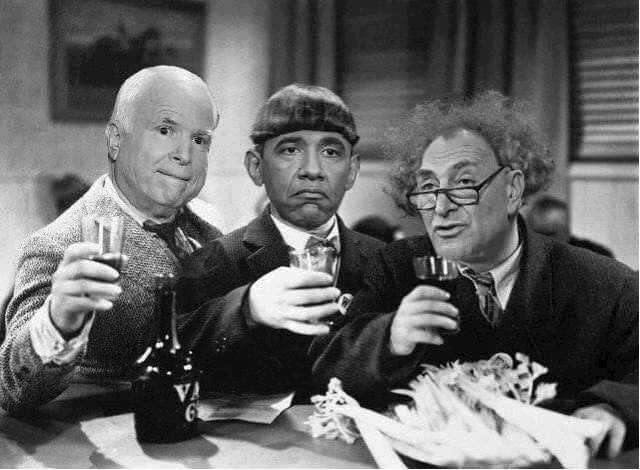
No wonder Congress is having so much trouble passing needed legislation, someone let the Three Stooges have control.

image021

Posted in Uncategorized | Comments Off on No wonder Congress is having so much trouble passing needed legislation, someone let the Three Stooges have control.

HERE IS HOW THE MODERNISTS IN CHARGE IN THE BERGOLIAN PONTIFICATE ARE DESTROYING THE INSTITUTIONAL CHURCH; THANK GOD THEY CANNOT DESTROY THE CHURCH ITSELF WHICH CONSISTS OF THE LAITY AND FAITHFUL BISHOPS AND PRIESTS AND RELIGIOUS

The Franciscans of the Immaculate: A courageous voice speaks out

Father Paolo M. Siano
Corrispondenza Romana
January 24, 2018


A few days ago, on January 20th there was an important anniversary in the history of the Franciscans of the Immaculate (FI).  On that date six years ago (2012), in our Roman convent on Via Boccea, a meeting took place between the then General Council of the FI and five friars (two Americans and three Italians) opponents of Father Stefano Manelli, founder and Minster General [of the Order].

Myself, along with other professors of the then FI Seminary and those in charge of formation, were invited by Father Manelli to take part in the event. The meeting, which lasted the entire day in two sessions, was shocking for the amount of vehemence and malicious attacks made against Father Manelli.

With hindsight we see now that those accusations were gradually deployed and developed in the mudslinging  and the ecclesiastic, media and judiciary war conducted against Father Manelli, a war promoted and/or backed by some churchmen (even in the Vatican) friars, laity and a somewhat “Tridentine” diocesan priest. Over these past six years I have witnessed the objective devastation  of my Religious Family (Friars, Nuns, Laity) the persecution (still going on) of our Founding Father and our authentic FI charism approved by Pope St. John Paul II.
My vocational future and that of other confreres, who like me defend the person and line of our Founders, is uncertain. In the light of various facts, I’m convinced that at least until the end of this Pontificate, we are liable to be monitored, obstructed and persecuted wherever we go and whatever we do or become. In the meeting of January 21st 2012, those three Italian friars essentially said this to us (I’m a witness to it): “If you don’t remove Latin from the Seminary (at that time, The Theological Seminary of the Immaculate Mediatrix)  we will denounce you to the Congregation [CIVCSVA-The Congregation for Institutes of Consecrated Life and Societies of Apostolic Life] where – as you know – the modernists [or progressives] are and who will have you put under a commissioner”. And that’s exactly what happened. We didn’t bend to the threat so the Visit arrived and we were put under the Commissioner.
Now one of those three Italian priests (in the meantime one of the two Americans has gone back to the Minor Conventuals) is the chief editor of “The Franciscans of the Immaculate 2018 Calendar” (Why wasn’t it sent here to Ferrara?). In a certain sense it is an official text inasmuch as it specifies that it has been published by the Franciscan Friars of the Immaculate “with the benediction and supervision of the Apostolic Commissioner Don Sabino Ardito, SDB”.
Strange though to see on the FI Calendar, that Pope Francis’ letter to the Young (January 13th 2017) is alongside a photo of some young people in the company of – Pope John Paul II! Anyway, the photos and texts cited from St. Maximilian Kolbe, Blessed Paul VI and St. John Paul II are very beautiful.
Nevertheless, we cannot keep silent about some perplexities in the article from the Editor, “Young People, Families, St. Maximilian and the Franciscan Friars of the Immaculate”.  A good thing indeed it is to underline our discipleship as the Marian-Franciscan ideal of Father Kolbe. Nonetheless, the exclusion with regard to our Founder Fathers, Manelli and Pellettieri, who are not mentioned at all, is very grave and symptomatic. This is in fact a sign of their damnatio memoriae, which  they would like to plant among the new FI (The Editor is one of Manelli’s five accusers and opponents at the FI
meeting on 21st  January, 2012) with the backing and/ or under the direction of some curial figures.
In effect, what was and should be our “Marian Vow of Unlimited Consecration to the Immaculate”, which was the primary constitutive vow of the FI, is instead reduced by the Editor (and by the Heads) to a “fourth vow (mass-media – and missionary nature…)”. Who knows what the extended dotted line means. All of this would confirm the program imposed from “on high”: to remake, or manipulate – on the drawing-board – our FI charism, history, formation, thought and conscience.
The plan in act was already in some way perceptible in the disgraceful and calumnious interview (Kolbe, not Lefebvre) published in the 2014 March number of the Vita Consacrata Testimoni (EDB) magazine, which certainly does not stand out for its appreciation of the reality of a somewhat “traditional”  Religious Life.
In short, the plan of a few individuals was deducible for some time:  to calumniate and destroy Father Manelli “identifying him”  first, with Monsignor Lefebvre, second, with Father Maciel Degollado, and third, with Friar Elia of Cortona:  consequently cutting off the FI from their besmirched Founder and linking them to Father Kolbe; treating the Founders like infidels of the Church and the FI charism; denying their charismatic contribution (eg. The Marian Vow and Franciscan poverty); constructing new “founders” and re-programming the FI, perhaps by making them shift slowly towards a probable “return” to the Conventual or other Minor Orders.
 
Do not forget that in the great Franciscan Families there is a project in the making for unification. (https://www.corrispondenzaromana.it/il-francescanesimo-del-futuro-annunciato-da-radio-vaticana/). The Editor of the Calendar seems to be even too optimistic, convinced the FI will conserve at the end of the external administration their fundamental characteristics.
It will not be so: The Marian Vow has already been eliminated, and our Marian nature reduced to a so-called “atmosphere”, an act of consecration, no longer a public and constitutive Vow.  Not to mention true Franciscan Poverty and the war against the Associations. In short, in light of the last six years, it can be deduced that from the very start a few individuals had the intent to destroy us.
The resistance, even the legal and judicial one, slowed down their plans which nevertheless continue. Another painful point by the Editor is the emphasis that the external administrator is working on FI “doctrinal clarification”.  The insiders know well that he is one of those who accused and calumniated us of a “Lefebvrian drift”  and of betraying the Church and our charism. In truth, in knowledge and in conscience, we now see a “drift” and it is certainly not in the traditionalist sense.  For example, it would be interesting to investigate the positions of the Friars and the Heads of the FI about the matter of Communion allowed to the divorced/remarried who are living more uxorio”. The one who is writing this  on the other hand shares the “Dubia” of the four (now 2) Cardinals and many other more or less well-known prelates and priestsIn effect, we fear that those who have made or have even now been making “discernments”about the FI, in other words, those who want “to re-program us”, are in fact influenced by at least some of those principles that constituted the joint plant of Karl Rahner’s transcendental Thomism and Gustavo Gutierrez’s  (1971) Liberation Theology.  Churchmen and church workers  formed in such a progressive mentality can do nothing other than hope for and cause our destruction (http://amicideltimoneferrara.blogspot.it/2017/03/teologia-della-liberazione-anno-1971.html). As long as they are influential in the Church we have no way out

Appealing to the Vatican Authorities would appear useless. Our Sisters of the Franciscans of the Immaculate had appealed to the Apostolic Signatura against the CIVCSVA and probably they would have been  proven right and gotten justice. However someone from “on high” instead of respecting the correct legal course, perhaps by spurring the Signatura’s sentence, has practically blocked everything, by accepting the CIVCSVA’s request and decreeing another external commissioning.
With knowledge and in conscience before the Divine Judgment, the God of Israel, we can no longer keep quiet and watch silently and passively at the triumph of injustice and speciousness which indeed cry out for vengeance in the sight of God. May God and Mary Our Blessed Mother, Co-Redemptrix, the New Ester, help us to bear this suffering for the good of the Church.  We do not know what our future will be: whether it will be as FI, diocesan priests or be reduced to the lay state. Only an extraordinary intervention of Grace can save us. Otherwise “we will die” vocationally, but with honor, not as traitors.
Translation: Francesca Romana
Posted in Uncategorized | Comments Off on HERE IS HOW THE MODERNISTS IN CHARGE IN THE BERGOLIAN PONTIFICATE ARE DESTROYING THE INSTITUTIONAL CHURCH; THANK GOD THEY CANNOT DESTROY THE CHURCH ITSELF WHICH CONSISTS OF THE LAITY AND FAITHFUL BISHOPS AND PRIESTS AND RELIGIOUS

PHOTO OF THE DAY

8 Finish Text7

hat tip: Bill Hohn


Posted in Uncategorized | 1 Comment

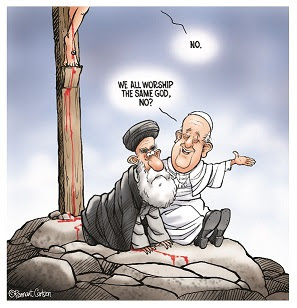
CARTOON OF THE WEEK

unnamed-39

hat tip: The Remnant

Posted in Uncategorized | 4 Comments

“The Common Word Initiative” is very much to the advantage of Muslims, but it makes no sense for Christians to subscribe to it.

A “Common Word” Versus Common Sense


CRISIS MAGAZINE

If you’ve seen the movie version of Porgy and Bess, you might recall Sammy Davis Jr.’s rendition of “It Ain’t Necessarily So.” At a church picnic, Sportin’ Life, a somewhat disreputable character, tries to convince the others that “the things that you’re liable to read in the Bible, It ain’t necessarily so.” He then proceeds to cast doubts on several Bible stories—David’s defeat of Goliath, Jonah’s sojourn in the whale, and Methuselah’s 900-year life span (“who calls dat livin’ when no gal will give in to no man what’s nine hundred years?”).

The song is amusing and slightly shocking—more shocking if you’re a fundamentalist Christian who believes that every word of the Bible is meant to be taken literally. Of course, such attacks on the credibility of the Bible are less of a problem for those Christians who realize that not all of scripture is meant to be understood in the literal sense.

There is, to my knowledge, no equivalent of “It ain’t necessarily so” in the Muslim world. And if there is, the lyricist is probably in hiding and living under an assumed name. That’s because the Koran is understood by Muslims to be the literal word of God, written in the mind of Allah before creation and dictated by the Angel Gabriel to Muhammad in the seventh century. You may think that Muhammad composed the Koran, but Muslims do not. To their mind it was composed by Allah and is thus unchangeable and beyond criticism.

Currently, most of the “debate” over the Koran concerns its contents. Does the Koran command violence, as some say? Or does it commend peace, as others, including many Catholic clergy, say? Thus, those on different sides of the Islam-means-peace debate tend to throw verses back and forth at each other.

But the question of content ought to be secondary to the question of authorship. Because if Allah didn’t write the Koran, what does it matter what verse such-and-such says? If the whole thing was made up by a merchant-turned-warrior named Muhammad, why risk your neck waging jihad?

That’s a question for Muslims to ponder. What Catholic leaders need to ponder is why they’ve allowed themselves to get roped into what might be called the “common word” approach to Christian-Islamic relations. The Common Word Initiative began in 2007 with an open letter to the Christian world signed by 138 Muslim scholars. The letter was entitled “A Common Word Between Us and You,” and it’s purpose was “to declare the common ground between Christianity and Islam.” As the Common Ground website maintains, “despite their differences, Islam and Christianity not only share the same Divine Origin and the same Abrahamic heritage, but the same two greatest commandments.” If that’s so, then the current Catholic approach makes sense. Instead of focusing on differences, you emphasize the common ground between the two religions. In particular, you try to convince extremist Muslims and “fundamentalist” Christians alike, that, in the words of Pope Francis, “the proper reading of the Koran is opposed to every form of violence.”

The pope, along with others in the hierarchy, seem to have convinced himself that “authentic” religions are always about peace and justice. Ergo, an authentic reading of the Koran must produce peaceful results. Thus, in a talk to immigrants, Pope Francis once counseled Christians to expel hatred from their hearts by reading the Bible, and Muslims to do the same by reading the Koran. This is consistent with the Common Word thesis that both religions share much common ground and, in particular, that they share “the same Divine Origin.”

But that’s the main point at issue, isn’t it? How can you say that both books share the same divine authorship when one of them flatly contradicts the other on numerous key points such as the Trinity, the Incarnation, the Crucifixion, the Resurrection, and the means of salvation?

It’s true that the Koran shares common material with the Bible. That’s because Muhammad borrowed freely from the Bible. He included stories about Adam, Abraham, Noah, and Moses—all of them retold in ways that suited his own purposes. But that’s hardly an argument for the divine origin of the Koran. If I produce a book which contains stories from the Old Testament, I can’t very well claim that my book is thereby of divine origin. If I claimed that my book was the result of a direct revelation from God, you would be justified in having grave doubts. If I claimed that my book predates the Old and New Testaments, you would certainly question my veracity. If I maintained that the Old and New Testaments were deliberate distortions of the true book delivered to me by an angel … well, you get the picture.

The Common Word Initiative is very much to the advantage of Muslims, but it makes no sense for Christians to subscribe to it. Muhammad borrowed stories from the Bible that predated the Koran by hundreds and even thousands of years, added in material of his own, and then declared that his version was the authentic one. Why should Christians wax enthusiastic over that? Yet the Common Word Initiative received a warm welcome from hundreds of prominent Christian scholars and numerous Christian institutions.

Some of the warm reception may be due to the fact that there are 1.6 billion Muslims in the world, and no one wants to upset them. So let’s consider the same issue in regard to a much smaller religion. The Book of Mormon also shares much in common with the Bible. Yet Catholics don’t treat the Book of Mormon as though it were on a par with the Bible. Once again, authorship is crucial. Catholics don’t believe the Book of Mormon was delivered by an angel from God as Mormons believe. Catholics believe it was written by a man named Joseph Smith circa 1830 in Western New York. Hence, there is little point in trying to reconcile the Bible with the Book of Mormon. Nor is there much sense in trying to convince Mormons that if they only read their scripture in the right way, they would see that it corroborates the traditional Christian understanding of God’s revelation. The whole effect of such a project would be to give the Book of Mormon a legitimacy it doesn’t deserve.

For the same reason, Catholics should be cautious about the Common Word approach. The danger in accepting the “same Divine Origin” thesis is that it grants an unwarranted legitimacy to the Koran. And that, in turn, sends the wrong message to both Muslims and Christians.

You’re probably seen that photo of Pope John Paul II kissing the Koran. He most certainly meant it not as an endorsement of the Koran, but as a gesture of respect for the billions of Muslims for whom the Koran is a holy book. Still, the gesture caused a good deal of concern and consternation for many Christians. And rightly so. Should he have kissed the Book of Mormon for the similar reason that it is holy scripture for Mormons? Should he have kissed the Communist Manifesto because it reflects the sincere belief of communists all over the world?

It makes sense for Catholics to discuss different interpretations of scripture with Protestants, Orthodox, and Jews because all these faiths start from the same original revelation. There is much less point in trying to reconcile the Bible with the Koran, because one is a real revelation and the other is not.

Although Muhammad included stories from the Old Testament, and although the Koran recognizes Jesus as a prophet, the book has no more claim to being a revelation from God than does the Book of Mormon. Like the Koran, the Book of Mormon “honors” Jesus, but it’s still a fabrication.

While it’s not advisable to go around calling the Koran a fake, it’s not advisable to treat it with great respect and excessive deference either. Excessive deference? Here’s an example. The Southern Command guidelines for military personnel at Guantanamo Bay mandate that personnel wear clean gloves when they touch the Koran. The guidelines also require that the Koran be handled in a “manner signaling respect and reverence.” “Handle the Koran,” states the guidelines, “as if it were a fragile piece of delicate art.”

A good many scholars, theologians, and bishops also seem to have fallen into the politically correct habit of treating the Koran “as if it were a fragile piece of delicate art.” That’s unfortunate. Since the Koran is the main generator of Islamic violence, it warrants a critical examination. It ought to be subject to the same kind of historical and textual criticism to which the Bible has long been subjected. Muslims and Christians alike ought to be free to say that many of the claims contained in the Koran “ain’t necessarily so.”

By the way, the Common Word Initiative is based on a passage in the Koran—verse 3:64. Here is the Yusuf Ali translation:

Say: O people of the Book! Come to common terms as between us and you: that we worship none but Allah; that we associate no partners with Him; that we erect not, from among ourselves, lords and patrons other than Allah (3:64).

A translation into contemporary English would read something like this:

Listen, Christians! Agree with us that Jesus is not the Son of God, and that God is not a Trinity, and then we can talk.

That is the price of entry into the Common Word club.

Posted in Uncategorized | 3 Comments