Why Ratzinger Is Not a Heretic. The Defense Speaks
The frontal attack on the theology of Joseph Ratzinger / Benedict XVI by Enrico Maria Radaelli and Antonio Livi, which Settimo Cielocovered at the beginning of the year, has given rise to a very lively debate.
Radaelli and Livi accuse Ratzinger of having reinterpreted the Christian faith “in the conceptual categories proper to modern subjectivism, from the transcendental idealism of Kant to the dialectical idealism of Hegel,” with the result of invalidating precisely “the basic notion of Christianity, that of faith in the revelation of supernatural mysteries by God.” In their judgment, in fact, in the theology of Ratzinger “this notion becomes irreparably deformed by the adoption of the Kantian schema of the impossibility of a metaphysical knowledge of God, which involves the negation of the rational premises of faith.”
On this charge of substantial heresy, Settimo Cielo has already hosted a first reply, signed by Antonio Caragliu.
And now here is a second, written by an administrative magistrate of Rome who is also an esteemed author of works of philosophy and theology.
*
NEITHER KANT NOR HEGEL. BETTER PAUL IN ATHENS
by Francesco Arzillo
I think that the final part of the unforgettable address by Benedict XVI at the Collège des Bernardins in Paris on September 12, 2008 could offer a decisive key for understanding succinctly – but also retrospectively – the true core of the thought of the “pope theologian.”
These are his exact words:
«The fundamental structure of Christian proclamation “outwards” – towards searching and questioning mankind – is seen in Saint Paul’s address at the Areopagus. We should remember that the Areopagus was not a form of academy at which the most illustrious minds would meet for discussion of lofty matters, but a court of justice, which was competent in matters of religion and ought to have opposed the import of foreign religions. This is exactly what Paul is reproached for: “he seems to be a preacher of foreign divinities” (Acts 17:18). To this, Paul responds: I have found an altar of yours with this inscription: ‘to an unknown god’. What therefore you worship as unknown, this I proclaim to you (17:23). Paul is not proclaiming unknown gods. He is proclaiming him whom men do not know and yet do know – the unknown-known; the one they are seeking, whom ultimately they know already, and who yet remains the unknown and unrecognizable. The deepest layer of human thinking and feeling somehow knows that he must exist, that at the beginning of all things, there must be not irrationality, but creative Reason – not blind chance, but freedom.
«Yet even though all men somehow know this, as Paul expressly says in the Letter to the Romans (1:21), this knowledge remains unreal: a God who is merely imagined and invented is not God at all. If he does not reveal himself, we cannot gain access to him. The novelty of Christian proclamation is that it can now say to all peoples: he has revealed himself. He personally. And now the way to him is open. The novelty of Christian proclamation does not consist in a thought, but in a deed: God has revealed himself. Yet this is no blind deed, but one which is itself “Logos” – the presence of eternal reason in our flesh. “Verbum caro factum est” (Jn 1:14): just so, amid what is made (factum) there is now “Logos”, “Logos” is among us. Creation (factum) is rational. Naturally, the humility of reason is always needed, in order to accept it: man’s humility, which responds to God’s humility.
«Our present situation differs in many respects from the one that Paul encountered in Athens, yet despite the difference, the two situations also have much in common. Our cities are no longer filled with altars and with images of multiple deities. God has truly become for many the great unknown. But just as in the past, when behind the many images of God the question concerning the unknown God was hidden and present, so too the present absence of God is silently besieged by the question concerning him. “Quaerere Deum” – to seek God and to let oneself be found by him, that is today no less necessary than in former times. A purely positivistic culture which tried to drive the question concerning God into the subjective realm, as being unscientific, would be the capitulation of reason, the renunciation of its highest possibilities, and hence a disaster for humanity, with very grave consequences. What gave Europe’s culture its foundation – the search for God and the readiness to listen to him – remains today the basis of any genuine culture.»
In these dense passages of the address of Benedict XVI, enthusiasts of philosophy and theology can find the thousand complex strands of the question of Revelation, as it is posed today in the mind of those who would like to be faithful to the wealth of revealed truth and of the understanding elaborated by the Church’s magisterium, above all in the two Vatican councils.
These councils must be interpreted, as Leo Scheffczyk taught, according to a criterion of strict continuity – I would say of reciprocity – from which it can be demonstrated that:
– on the one hand, Vatican I also incorporates the concept of the self-revelation of God (DH 3004), which is not an innovation of Vatican II and which – taken in itself – is older than the reuse of it made by philosophical idealism in a different context of thought: a reference to this can be found, in fact, as far back as in Saint Bonaventure;
– on the other hand, Vatican II must be understood in the sense that “the words and actions presented by God themselves communicate the truth and can be accepted with reasonableness in their sense only as truth” (cf. L. Scheffczyck, “Fondamenti del dogma. Introduzione alla dogmatica,” Rome, Lateran University Press, 2010, pp. 82-83).
In the address of Benedict XVI in Paris, somewhat subtle but also very concrete, one can therefore find “in a nutshell” truly everything. There is a realistic understanding of the “preambula fidei.” There is the need for salvation. There is human reason in its various forms, and there is the Logos / Advent. There is human history intertwined with that of salvation.
But it does not contain any preliminary barrier of a Kantian nature, or in any case of irrational, pragmatic, or antimetaphysical origin.
In this latter regard it is opportune to point out that in the address “The faith and theology of our days” delivered in Guadalajara, Mexico in May of 1996, then-prefect of the congregation for the doctrine of the faith Joseph Ratzinger did not limit himself to criticizing certain forms of neo-Scholastic rationalism, citing as “more well-founded historically and objectively the position of J. Pieper” (who was in any case a thinker of Thomistic origin), but above all, in criticizing the relativistic theories of Hick, Knitter, and other theologians, he emphasized precisely the fact that they are ultimately founded “on a rationalism that, in Kant’s manner, maintains that reason cannot know that which is metaphysical”; while instead “man possesses a more extensive dimension than Kant and the various post-Kantian philosophies attributed to him.”
Moreover, in keeping with these premises, in the address to the international congress on the natural law organized by the Pontifical Lateran University on February 12, 2007, Pope Benedict XVI recalled “another less visible danger, but no less disturbing: the method that permits us to know ever more deeply the rational structures of matter makes us ever less capable of perceiving the source of this rationality, creative Reason. The capacity to see the laws of material being makes us incapable of seeing the ethical message contained in being, a message that tradition calls lex naturalis, natural moral law. This word for many today is almost incomprehensible due to a concept of nature that is no longer metaphysical, but only empirical.”
It is no coincidence, for that matter, that Ratzinger’s thought has been the object instead – and I would say prevalently – of a criticism of a “progressive” nature. Klaus Müller, in a calm and dense reading of the work of the pope theologian, in retracing the question of “Platonism” and of the “Hellenization of Christianity,” in fact emphasized how “Ratzinger never developed a positive and creative relationship with modern thought,” and in the first place with the grand season of German idealism (K. Müller, “Il teologo papa,” in a supplement to “Il Regno – Documenti” no. 3, February 1, 2013).
It seems to me that these few references could help bring the “Ratzinger question” back onto the right track.
(English translation by Matthew Sherry, Ballwin, Missouri, U.S.A.)
U.S. fathers today are spending more time caring for their children than they did a half-century ago. Still, most (63%) say they spend too little time with their kids and a much smaller share (36%) say they spend the right amount of time with them, according to a Pew Research Center surveyconducted in August and September 2017.
Moms, by comparison, still do more of the child care and are more likely than dads to say they are satisfied with the amount of time they spend with their kids. About half (53%) say this, while only 35% say they spend too little time with their children, according to the survey.
Fathers without a bachelor’s degree are particularly likely to say they spend too little time with their kids. About seven-in-ten dads with some college or less education (69%) say this is the case, compared with half of dads with at least a bachelor’s degree.
Education is not a factor when it comes to the share of mothers who say they spend too little time with their children, but employment status is: 43% of full-time working moms say they don’t spend enough time with their kids, compared with 28% of moms who work part time or who are not employed.
For both dads and moms who say they spend too little time with their kids, work obligations are cited most often as the main reason: 62% of dads and 54% of moms say this is the case. However, a sizable share of fathers (20%) say the main reason they spend too little time with their children is that they don’t live with them full-time.
These findings come as about one-in-four fathers of children 17 or younger (24%) are living apart from at least one of their children, and 17% are living apart from all of them, according to a Pew Research Center analysis of data from the National Survey of Family Growth.
Education is strongly linked to the likelihood that a dad will be living apart from his children. Fathers who lack a four-year college degree are especially likely to be living apart from their kids: 28% in this group are, compared with just 8% of fathers with a bachelor’s degree or more education.
Differences along racial and ethnic lines are even more dramatic. About half of black fathers (47%) are living apart from at least one of their children ages 17 or younger, and 36% are living apart from all of their children. Far lower shares of Hispanic (26%) and white (17%) fathers are living apart from one or more of their children.
Have you wondered why the Clinton Foundation folded so suddenly after Hillary was no longer in a position of influence? Perhaps this summary will provide some insight??
They list 486 employees (line 5)! It took 486 people who are paid $34.8 million and $91.3 million in fees and expenses, to give away $5.1 MILLION.
This is real. You can check the return yourself (see below). The real heart of the Clinton’s can be seen here. Staggering but not surprising. These figures are from an official copy of the Bill, Hillary, and Chelsea Clinton Foundation for the tax year 2014. The copy of the tax return is from the National Center for Charitable Statistics web site. You can obtain the latest tax return on any charitable organization there.
The Clinton Foundation:
Number of Employees (line 5) 486
Total revenue (line 12) $177,804,612.00
Total grants to charity (line 13) $5,160,385.00(this is less than 3%)
Total expenses of $91,281,145.00
Expenses include:
Salaries (line 15) $34,838,106.00
Fund raising fees (line 16a) $850,803.00
Other expenses (line 17) $50,431,851.00 HUH??????
Travel $8,000,000.00
Meetings $12,000,000.00
Net assets/fund balances (line 22) $332,471,349.00
So, it required 486 people, who were paid $34.8 million, plus $91.3 million in fees and
expenses, to give away $5.1 MILLION! And they call this a CHARITY?
This is one of the greatest white-collar crimes ever committed. And just think—one of the
participants was a former president and one (gasp!) wanted to be elected president of the
United States.
If justice was truly served they would both be in prison.
After another devastating ISIS attack in France, this time against a priest in his 80s while he was saying Mass, the answer isn’t just, “Do nothing.” As racism distorts race and sexism corrupts sex — so does pacifism affront peace.
Turning the other cheek is the counsel Christ gave in the instance of an individual when morally insulted: Humility conquers pride. It has nothing to do with self-defense.
Christ warned the apostles, as shepherds, to beware of wolves.
Defend Yourself and Your Family
The Catholic Church has always maintained that the defiance of an evil force is not only a right but an obligation. Its Catechism (cf. #2265) cites St. Thomas Aquinas: “Legitimate defense can be not only a right but a grave duty for someone responsible for another’s life, the common good of the family or of the State.”
A father is culpable if he does not protect his family. A bishop has the same duty as a spiritual father of his sons and daughters in the church, just as the civil state has as its first responsibility the maintenance of the “tranquility of order” through self-defense.
Christ warned the apostles, as shepherds, to beware of wolves. This requires both the “shrewdness of serpents and the innocence of doves.” To shrink from the moral duty to protect peace by not using force when needed is to be innocent as a serpent and shrewd as a dove.
That is not innocence — it is naiveté.
Saints Leading the Way into Battle
Saint John Capistrano led an army against the Moors in 1456 to protect Belgrade. In 1601, Saint Lawrence of Brindisi did the same in defense of Hungary. As Franciscans, they carried no sword and charged on horseback into battle carrying a crucifix. They inspired the shrewd generals and soldiers, whom they had assembled through artful diplomacy, with their brave innocence.
This is not obscure trivia: Were it not for Charles Martel at Tours in 732 and Jan Sobieski at the gates of Vienna in 1683 — and most certainly had Pope Saint Pius V not enlisted Andrea Doria and Don Juan at Lepanto in 1571 — we would not be here now. No Western nations as we know them — no universities, no modern science, no human rights — would exist.
In the ninth century, the long line of martyrs of Cordoba told the Spanish Umayyad Caliph Abd Ar-Rahman II that his denial of Christ was infernal, and that they would rather die than surrender. Saint Juan de Ribera (d. 1611) and St. Alfonsus Liguori (d. 1787) repeated the admonition that the concept of peace in Islam requires not co-existence but submission.
It’s Our Own Fault
The dormancy of Islam until recent times, however, has obscured the threat that this poses — especially to a Western civilization that has grown flaccid in virtue and ignorant of its own moral foundations.
The shortcut to handling the crisis is to deny that it exists.
On the first day of the Democratic National Convention in Philadelphia, there were over 60 speeches, and yet not one of them mentioned ISIS.
Vice has destroyed countless individual souls, but in the decline of civilizations, weakness has done more harm than vice. “Peace for our time” is as empty now as it was when Chamberlain went to Munich and honor was bartered in Vichy.
Hilaire Belloc, who knew Normandy and all of Europe well, said in 1929: “We shall almost certainly have to reckon with Islam in the near future. Perhaps, if we lose our faith, it will rise. For after this subjugation of the Islamic culture by the nominally Christian had already been achieved, the political conquerors of that culture began to notice two disquieting features about it. The first was that its spiritual foundation proved immovable; the second, that its area of occupation did not recede, but on the contrary slowly expanded.”
The priest in Saint-Étienne-du-Rouvrary in Normandy, France, was not the first to die at the altar — and he will not be the last.
In his old age, the priest embodied a civilization that has been betrayed by a generation whose hymn was John Lennon’s “Imagine” — that there was neither heaven nor hell but “above us only sky” and “all the people living for today.” When reality intrudes, they can only leave teddy bears and balloons at the site of a carnage they call “inexplicable.”
Fr. George William Rutler is a Catholic priest and the pastor of the Church of St. Michael in Manhattan.
Bishop Paprocki Responds to Fr. Martin (with Video)
“Father Martin gets a lot Wrong in Those Tweets”
By Bishop Thomas John Paprocki, Bishop of Springfield Catholic Times:
There has been quite a bit of consternation since I sent an internal communication to my clergy and staff last month that was unfortunately leaked to the public concerning my “Decree Regarding Same-sex ‘Marriage’ and Related Pastoral Issues.” While the underlying doctrinal issues are not new, these norms were necessary to address situations in the pastoral context arising from the new reality in the law and in our culture, given that same-sex marriage is now recognized by legislative action and judicial decision as legal throughout the United States. This decree prohibits same-sex weddings to be performed by our diocesan personnel or to take place in Catholic facilities, restricts persons in such unions from receiving the sacraments or serving in a public liturgical role unless they have repented, and says that deceased persons who had lived openly in a same-sex marriage giving public scandal to the faithful are to be deprived of ecclesiastical funeral rites unless they have given some signs of repentance before their death.
There has been quite a bit of consternation since I sent an internal communication to my clergy and staff last month that was unfortunately leaked to the public concerning my “Decree Regarding Same-sex ‘Marriage’ and Related Pastoral Issues.” While the underlying doctrinal issues are not new, these norms were necessary to address situations in the pastoral context arising from the new reality in the law and in our culture, given that same-sex marriage is now recognized by legislative action and judicial decision as legal throughout the United States. This decree prohibits same-sex weddings to be performed by our diocesan personnel or to take place in Catholic facilities, restricts persons in such unions from receiving the sacraments or serving in a public liturgical role unless they have repented, and says that deceased persons who had lived openly in a same-sex marriage giving public scandal to the faithful are to be deprived of ecclesiastical funeral rites unless they have given some signs of repentance before their death.
At the same time, the decree says that a child with a Catholic parent or parents living in a same-sex marriage may be baptized if there is a well-founded hope that he or she will be brought up in the Catholic faith and that such a child who is otherwise qualified and properly disposed may receive first Eucharist and the sacrament of confirmation. Moreover, the decree states that children living with persons in a same-sex marriage are not to be denied admission to Catholic schools and catechetical and formational programs on those grounds alone. However, parents and those who legally take the place of parents are to be advised that their children will be instructed according to the church’s teachings on marriage and sexuality in their fullness and they must agree to abide by the Family School Agreement.
In the decree I also remind all who exercise a ministry within the church that, while being clear and direct about what the church teaches, our pastoral ministry must always be respectful, compassionate and sensitive to all our brothers and sisters in faith, as was the ministry of Christ Jesus, the Good Shepherd and our everlasting model for ministry. People with same-sex attraction are welcome in our parishes in the Catholic Diocese of Springfield in Illinois as we repent our sins and pray for God to keep us in his grace.
All of this is totally consistent with Catholic teaching about the sacraments and the understanding of marriage as between one man and one woman that has prevailed for millennia in all of society, not just in the church. The fact that there would be such an outcry against this decree is quite astounding and shows how strong the LGBT lobby is both in the secular world as well as within the church. People have been quick to quote the famous in-flight statement of Pope Francis in 2013 when he said, “If someone is gay and is searching for the Lord and has good will, then who am I to judge him?” But the pope quickly added, “The problem is not having this [homosexual] tendency, no, we must be brothers and sisters to one another, and there is this one and there is that one. The problem is in making a lobby of this tendency: a lobby of misers, a lobby of politicians, a lobby of masons, so many lobbies. For me, this is the greater problem.” So while we certainly leave the eternal judgment of one’s soul to God, we still must deal with objective realities here on earth and even Pope Francis recognized that the gay lobby is a great problem.
Critics have been urging me to rescind my “Decree Regarding Same-sex ‘Marriage’ and Related Pastoral Issues.” However, this decree is a rather straightforward application of existing Catholic doctrine and canon law to the new situation of legal marital status being granted in civil law to same-sex couples, which is contrary to the teaching of the Catholic Church. All clergy before they are ordained take an Oath of Fidelity which includes the statement, “In fulfilling the charge entrusted to me in the name of the Church, I shall hold fast to the deposit of faith in its entirety; I shall faithfully hand it on and explain it, and I shall avoid any teachings contrary to it. I shall follow and foster the common discipline of the entire Church and I shall maintain the observance of all ecclesiastical laws, especially those contained in the Code of Canon Law.” Pastors and bishops repeat this oath upon assuming their office to be exercised in the name of the church. Thus, deacons, priests and bishops cannot contradict church teachings or refuse to observe ecclesiastical laws without violating their oath, which is a promise made to God.
My Response to Fr. James Martin
Father James Martin, a Jesuit priest who lives in New York, posted my decree on Twitter and said in a series of tweets, “If bishops ban members of same-sex couples from funeral rites, they must also ban divorced and remarried Catholics without annulments … women who have children out of wedlock, members of straight couples living together before marriage, anyone using birth control … To focus only on LGBT people, even those in same-sex marriages, without a similar focus on the sexual or moral behavior of straight people is in the words of the Catechism a ‘sign of unjust discrimination.’” Father Martin gets a lot wrong in those tweets, since canon law prohibits ecclesiastical funeral rites only in cases of “manifest sinners” which gives “public scandal,” and something such as using birth control is a private matter that is usually not manifest or made
public. Moreover, my decree does not focus on “LGBT people,” but on so-called same-sex marriage, which is a public legal status. No one is ever denied the sacraments or Christian burial for simply having a homosexual orientation. Even someone who had entered into a same-sex “marriage” can receive the sacraments and be given ecclesiastical funeral rites if they repent and renounce their “marriage.”
Father Martin also misses the key phrase in the decree that ecclesiastical funeral rites are to be denied to persons in same-sex marriages “unless they have given some signs of repentance before their death.” This is a direct quote from canon 1184 of the Code of Canon Law, which is intended as a call to repentance. Jesus began his public ministry proclaiming the Gospel of God with these words: “This is the time of fulfillment. The kingdom of God is at hand. Repent, and believe in the gospel” (Mark 1:15). In other words, those living openly in same-sex marriage, like other manifest sinners who give public scandal, can receive ecclesiastical funeral rites if they gave some sign of repentance. This does not mean that unrepentant manifest sinners will simply be refused or turned away. Even in those cases where a public Mass of Christian Burial in church cannot be celebrated because the deceased person was unrepentant and there would be public scandal, the priest or deacon may conduct a private funeral service, for example, at the funeral home.
Father Martin’s tweets do raise an important point with regard to other situations of grave sin and the reception of Holy Communion. He is right that the Church’s teaching does not apply only to people in same-sex marriages. According to canon 916, all those who are “conscious of grave sin” are not to receive Holy Communion without previous sacramental confession. This is normally not a question of denying Holy Communion, but of people themselves refraining from Holy Communion if they are “conscious of grave sin.” While no one can know one’s subjective sinfulness before God, the Church can and must teach about the objective realities of grave sin. Speaking objectively, then, one can say the following:
Those who have sexual relations outside of a valid marriage, whether they are heterosexual or homosexual, should not receive Holy Communion unless they repent, go to confession and amend their lives. This includes the divorced and remarried without an annulment. An exception would be where the couple agrees to live as brother and sister, as long as there is no public scandal. Similarly, if there is no public scandal, two men who live chastely with each other as friends or as brother and brother, or two women who live chastely with each other as friends or as sister and sister, may receive Holy Communion if there is no public scandal.
Those who have had an abortion or have assisted in performing or procuring an abortion should not receive Holy Communion unless they repent, go to confession and amend their lives.
Those politicians and judges who helped to make same-sex marriage legal and who aid and abet abortion, for example, by voting for taxpayer funding for abortion, should not receive Holy Communion unless they repent, go to confession and amend their lives.
Those who use artificial contraception should not receive Holy Communion unless they repent, go to confession and amend their lives.
Those who miss Mass on Sundays and Holy Days of Obligation, unless it would be impossible due to a grave cause such as serious illness, should not receive Holy Communion unless they repent, go to confession and amend their lives.
These are just a few examples, but in fact all those who are conscious of any grave sin should not receive Holy Communion unless they repent, go to confession and amend their lives. Those who do receive Holy Communion while conscious of grave sin compound the moral offense by committing the sin of sacrilege.
My recent decree did not address all these various other situations because they have long been part of Church teaching. The decree was needed to add the novel concept of same-sex “marriage” to those instances considered to be objectively grave sins.
The truths of the faith revealed by our Lord in Scripture and Tradition are not always easy to accept, especially in a world that seeks to make all truth subjective. The fact is that some truths are objective and unalterable. Jesus said, “Blessed are the pure of heart, for they shall see God” (Matthew 5:8). There is no greater happiness than to see God. Saint Paul reminds us that we are all in need of daily conversion in that “all have sinned and fallen short of the glory of God (Romans 3:23).” Let us pray for each other, that each of us may come to an ever deeper understanding of God’s call to discipleship in our lives, the same God who “wills everyone to be saved and come to knowledge of the truth” (1 Tim. 2: 4).
January 9, 2018 (LifeSiteNews) – Some people I know have mentioned that they are weary of the debate over Amoris Laetitia. At a recent USCCB meeting, an American bishop said that the richness of this apostolic exhortation has been eclipsed by the excessive preoccupation of the conservative blogosphere with the problems of chapter 8, and that the “narrative” about the document has to be seized back and replenished. I’m sure there are many who wish the whole conversation would just go away.
But I’m afraid that’s not going to happen. It’s not possible. What’s more, it’s not desirable. If a banquet is full of delicious and nourishing foods but the wine has a drop of cyanide in it, the meal is still deadly, and the one who prepared it is still responsible for the outcome. Chapter 8, which has provoked a veritable firestorm of confusion and contradiction in moral theology and the discipline of the sacraments, has done vastly more harm than any amount of good the rest of the document may ever accomplish.
The devil is a clever strategist. He knows that the best way to establish error is not to argue for it, but to keep repeating it ad nauseam, so that people already disposed to the error will come to accept it without argument as part of the ambiance, and those who oppose it will surrender from sheer exhaustion. This is why we must never tire of pointing out the intrinsic error of, and the host of evil consequences that follow from, the proposal to admit to the sacraments of Penance and the Holy Eucharist a “divorced and remarried Catholic,” i.e., a Catholic living more uxorio (sharing the bed) with someone who is not his or her actual spouse in the eyes of God and the Church. For this is not just one small error. It is an error that, by logical implication, touches and corrupts every aspect of Catholic faith and morals. To take just one example, it would invalidate the divine inspiration and inerrancy of Sacred Scripture.
Proponents of sacraments for already-married persons continuing to live in a sexually active relationship with someone other than their original spouse(s) have never hidden their agenda. This was true during the two Synods (of which the telltale event that sticks in my mind was the theft of the copies of Remaining in the Truth of Christ from the mailboxes of the synodal participants). It has remained true in the entire period following Amoris Laetitia.
For 2,000 years, the Church has seen certain actions in the realm of human sexuality, e.g., fornication, masturbation, pornography, incest, and pedophilia, as intrinsically evil, regardless of intention. Such actions, deliberately chosen, are always and everywhere wrong to do, displeasing to God, incompatible with grace and inheriting eternal life.
Adultery is no less serious a sin than the others just mentioned. If there are now pastoral situations that allow us to admit adulterers to “penance” and communion without any intention on their part to end sexual relations with someone not their spouse, why would we deny the same sacraments to those who fornicate, masturbate, produce or view pornography, or practice incest or pedophilia? They may feel regrets or even “anguish” about it, but if they have no firm intention of amending their life by God’s grace, they do not have repentance.
What, after all, is “repentance”? For a murderer or a thief, repentance is being sorry for having killed or stolen, making restitution for the crime, and resolving earnestly not to kill or steal again. For a liar, it is to be sorry for lying and to resolve not to tell lies in the future. For a blasphemer, it is to bewail his blasphemy and firmly intend never to do it again. For a fornicator, repentance is to be sincerely sorry for having had sexual intercourse outside of marriage, and to firmly intend never to do so again.
It is no different with adultery. A person who is “civilly remarried” while his or her sacramental (i.e., only real) spouse is still alive and who has sexual intercourse with the civil partner is committing adultery—there is no way around this fact. Therefore, repentance for such a person is to be sorry for having sinned against fidelity to an indissoluble bond by having slept with someone who is not one’s lawful spouse in the eyes of God, and firmly and sincerely to intend never to do it again. This, and nothing else, is the repentance required to make a valid Confession and, a fortiori, to be admitted to the Eucharistic nuptial banquet.
This, of course, is exactly what St. John Paul II taught in Familiaris Consortio, grounding it in Sacred Scripture:
The Church reaffirms her practice, which is based upon Sacred Scripture, of not admitting to Eucharistic Communion divorced persons who have remarried. They are unable to be admitted thereto from the fact that their state and condition of life objectively contradict that union of love between Christ and the Church which is signified and effected by the Eucharist. Besides this, there is another special pastoral reason: if these people were admitted to the Eucharist, the faithful would be led into error and confusion regarding the Church’s teaching about the indissolubility of marriage.
Reconciliation in the sacrament of Penance which would open the way to the Eucharist, can only be granted to those who, repenting of having broken the sign of the Covenant and of fidelity to Christ, are sincerely ready to undertake a way of life that is no longer in contradiction to the indissolubility of marriage. This means, in practice, that when, for serious reasons, such as for example the children’s upbringing, a man and a woman cannot satisfy the obligation to separate, they “take on themselves the duty to live in complete continence, that is, by abstinence from the acts proper to married couples.”
This is not legalism or rigorism or any other -ism. It is simply the truth. It is not possible to contradict this Catholic teaching, given consummate expression by John Paul II, without placing oneself outside of the Catholic Faith and at odds with the divine law. It is the very opposite of mercy to create confusion among the faithful about the Gospel’s “demands of radicalness and perfection” (Familiaris Consortio 33). The Church is a merciful Mother who exercises her mercy by proclaiming the fullness of the truth that saves us from our sins and calling people to conversion, for which God is always ready to provide the grace.
Recently I heard St. Alphonus Liguori invoked as one who would support Pope Francis’s “gradualist” approach. Whatever limited gradualism the patron saint of moral theologians accepted, he would be appalled to find his name used in support of Communion for a man or woman who, while not intending to forego future adulterous sexual acts, would still be admitted to Communion. At this point, we are clearly working against the entire doctrine of the sacraments as it has been handed down by the Fathers, Doctors, Councils, and Popes.
Nevertheless, any priest or bishop who still follows the hitherto unbroken doctrine and practice of the Church is now labeled a legalist, a rigorist, a Pharisee, a hater, etc. Moreover, entire episcopates are now divided against each other with regard to who may receive the sacraments. Such a turning against our tradition and against one another can never be from the Holy Spirit. Nor can it be from the Holy Spirit to contradict the perennial magisterium enunciated in such a clear, declarative, and normative way by John Paul II in Familiaris Consortio, Ecclesia de Eucharistia, Reconciliatio et Poenitentia, Veritatis Splendor, and other documents. If John Paul II is wrong in what he taught so many times and in so authoritative a manner, then there is no Pope who may ever be trusted again when it comes to morality.
“Mercy” is invoked today to cover a multitude of sins, but the Church has never pitted mercy against law or justice. This is the ancient error of antinomianism (nothing new under the sun). Mercy in the New Covenant is extended to the repentant sinner, not to the sinner who clings to his sin. Mercy will be given seventy times seven times to the sinner who repents and falls again out of human weakness, but only as long as he genuinely intended and intends to stop sinning. There has never been any disagreement about this—until now.
The progressives like to invoke the “ancient Church” and pretend that the liturgical reform after Vatican II was a return to ancient practices (which it mostly was not). Curiously enough, the progressives never want to imitate the penitential discipline of the early Church, whereby fornicators or adulterers could be banished for years not only from the sacraments but from the church building itself, to be readmitted only if they had done serious penance and had utterly overcome and forsworn their sinful behavior. The reason is simple: ancient Christians really believed what they professed, and they zealously kept the Eucharist away from anyone who was not worthy of it—worthy in the sense of being among the baptized and living a life in harmony with the Ten Commandments, free from mortal sins. Have we forgotten that Christianity teaches self-denial, asceticism, as the narrow road to perfection, the premise of all spiritual development? The Eucharist is not a point of departure but a place of arrival. The point of departure, for the Fathers of the Church, was the rudiments of moral virtue, fasting and abstinence, prayer, the reading of Scripture, and other disciplines, which prepare the soul to partake of the heavenly feast.
Certainly the Church is a “field hospital,” and we must bend over backwards to take care of each wounded person who comes our way. At the same time, a doctor does not apply the same remedy to each disease, knowing that a medicine that cures in one case may kill in another. This is how the Church Fathers speak of the Holy Eucharist: it is food for the wayfarer who is living according to God’s revealed law; it is poison for anyone else. It is only when we have a well-founded confidence that we are wearing the wedding garment of charity and sanctifying grace (cf. Matt 22:11) that we may dare to approach “the divine, holy, pure, immortal, heavenly, life-creating, and awesome Mysteries of Christ” (Byzantine Divine Liturgy). Otherwise, as every liturgical rite says before Communion, we eat and drink “judgment and condemnation.”
Peter Kwasniewski holds a B.A. in Liberal Arts from Thomas Aquinas College in California and an M.A. and Ph.D. in Philosophy from The Catholic University of America in Washington, D.C. After teaching at the International Theological Institute in Austria and for the Franciscan University of Steubenville’s Austrian Program, he joined the founding team of Wyoming Catholic College in Lander, Wyoming, where he serves as professor and choirmaster.
Dr. Kwasniewski has published five books: Wisdom’s Apprentice (CUA Press, 2007); On Love and Charity (CUA Press, 2008); Sacred Choral Works (Corpus Christi Watershed, 2014); Resurgent in the Midst of Crisis: Sacred Liturgy, the Traditional Latin Mass, and Renewal in the Church (Angelico Press, 2014); and most recently, Noble Beauty, Transcendent Holiness: Why the Modern Age Needs the Mass of Ages (Angelico Press, 2017). Resurgent in the Midst of Crisis has also been published in Czech, Polish, and German, will soon appear in Spanish and Portuguese, and is being translated into Italian, French, and Belarusian.
Kwasniewski is a board member and scholar of The Aquinas Institute for the Study of Sacred Doctrine, which is publishing the Opera Omnia of the Angelic Doctor, and a Fellow of the Albertus Magnus Center for Scholastic Studies. He has published over 500 articles on Thomistic thought, sacramental and liturgical theology, the history and aesthetics of music, and the social doctrine of the Church.
Profession of the Immutable Truths About Sacramental Marriage
After the publication of the Apostolic Exhortation “Amoris laetitia” (2016) various bishops issued at local, regional, and national levels applicable norms regarding the sacramental discipline of those faithful, called “divorced and remarried,” who having still a living spouse to whom they are united with a valid sacramental matrimonial bond, have nevertheless begun a stable cohabitation more uxorio with a person who is not their legitimate spouse.
The aforementioned rules provide inter alia that in individual cases the persons, called “divorced and remarried,” may receive the sacrament of Penance and Holy Communion, while continuing to live habitually and intentionally more uxorio with a person who is not their legitimate spouse. These pastoral norms have received approval from various hierarchical authorities. Some of these norms have received approval even from the supreme authority of the Church.
The spread of these ecclesiastically approved pastoral norms has caused a considerable and ever increasing confusion among the faithful and the clergy, a confusion that touches the central manifestations of the life of the Church, such as sacramental marriage with the family, the domestic church, and the sacrament of the Most Holy Eucharist.
According to the doctrine of the Church, only the sacramental matrimonial bond constitutes a domestic church (see Second Vatican Council, Lumen Gentium, 11). The admission of so-called “divorced and remarried” faithful to Holy Communion, which is the highest expression of the unity of Christ the Spouse with His Church, means in practice a way of approving or legitimizing divorce, and in this meaning a kind of introduction of divorce in the life of the Church.
The mentioned pastoral norms are revealed in practice and in time as a means of spreading the “plague of divorce” (an expression used by the Second Vatican Council, see Gaudium et spes, 47). It is a matter of spreading the “plague of divorce” even in the life of the Church, when the Church, instead, because of her unconditional fidelity to the doctrine of Christ, should be a bulwark and an unmistakable sign of contradiction against the plague of divorce which is every day more rampant in civil society.
Unequivocally and without admitting any exception Our Lord and Redeemer Jesus Christ solemnly reaffirmed God’s will regarding the absolute prohibition of divorce. An approval or legitimation of the violation of the sacredness of the marriage bond, even indirectly through the mentioned new sacramental discipline, seriously contradicts God’s express will and His commandment. This practice therefore represents a substantial alteration of the two thousand-year-old sacramental discipline of the Church. Furthermore, a substantially altered discipline will eventually lead to an alteration in the corresponding doctrine.
The constant Magisterium of the Church, beginning with the teachings of the Apostles and of all the Supreme Pontiffs, has preserved and faithfully transmitted both in the doctrine (in theory) and in the sacramental discipline (in practice) in an unequivocal way, without any shadow of doubt and always in the same sense and in the same meaning (eodem sensu eademque sententia), the crystalline teaching of Christ concerning the indissolubility of marriage.
Because of its Divinely established nature, the discipline of the sacraments must never contradict the revealed word of God and the faith of the Church in the absolute indissolubility of a ratified and consummated marriage. “The sacraments not only presuppose faith, but by words and objects they also nourish, strengthen, and express it; that is why they are called “sacraments of faith.” (Second Vatican Council, Sacrosanctum Concilium, 59). “Even the supreme authority in the Church may not change the liturgy arbitrarily, but only in the obedience of faith and with religious respect for the mystery of the liturgy” (Catechism of the Catholic Church, 1125).
The Catholic faith by its nature excludes a formal contradiction between the faith professed on the one hand and the life and practice of the sacraments on the other. In this sense we can also understand the following affirmation of the Magisterium: “This split between the faith which many profess and their daily lives deserves to be counted among the more serious errors of our age.” (Second Vatican Council, Gaudium et Spes, 43) and “Accordingly, the concrete pedagogy of the Church must always remain linked with her doctrine and never be separated from it” (John Paul II, Apostolic Exhortation Familiaris Consortio, 33).
In view of the vital importance that the doctrine and discipline of marriage and the Eucharist constitute, the Church is obliged to speak with the same voice. The pastoral norms regarding the indissolubility of marriage must not, therefore, be contradicted between one diocese and another, between one country and another. Since the time of the Apostles, the Church has observed this principle as St. Irenaeus of Lyons testifies: “The Church, though spread throughout the world to the ends of the earth, having received the faith from the Apostles and their disciples, preserves this preaching and this faith with care and, as if she inhabits a single house, believes in the same identical way, as if she had only one soul and only one heart, and preaches the truth of the faith, teaches it and transmits it in a unanimous voice, as if she had only one mouth”(Adversus haereses, I, 10, 2). Saint Thomas Aquinas transmits to us the same perennial principle of the life of the Church: “There is one and the same faith of the ancients and the moderns, otherwise there would not be one and the same Church” (Questiones Disputatae de Veritate, q. 14, a. 12c).
The following warning from Pope John Paul II remains current and valid: “The confusion, created in the conscience of many faithful by the differences of opinions and teachings in theology, in preaching, in catechesis, in spiritual direction, about serious and delicate questions of Christian morals, ends up by diminishing the true sense of sin almost to the point of eliminating it” (Apostolic Exhortation Reconciliatio et Paenitenia, 18).
The meaning of the following statements of the Magisterium of the Church is fully applicable to the doctrine and sacramental discipline concerning the indissolubility of a ratified and consummated marriage:
“For the Church of Christ, watchful guardian that she is, and defender of the dogmas deposited with her, never changes anything, never diminishes anything, never adds anything to them; but with all diligence she treats the ancient doctrines faithfully and wisely, which the faith of the Fathers has transmitted. She strives to investigate and explain them in such a way that the ancient dogmas of heavenly doctrine will be made evident and clear, but will retain their full, integral, and proper nature, and will grow only within their own genus — that is, within the same dogma, in the same sense and the same meaning” (Pius IX, Dogmatic Bull Ineffabilis Deus)
“With regard to the very substance of truth, the Church has before God and men the sacred duty to announce it, to teach it without any attenuation, as Christ revealed it, and there is no condition of time that can reduce the rigor of this obligation. It binds in conscience every priest who is entrusted with the care of teaching, admonishing, and guiding the faithful “(Pius XII, Discourse to parish priests and Lenten preachers, March 23, 1949).
“The Church does not historicize, does not relativize to the metamorphoses of profane culture the nature of the Church that is always equal and faithful to itself, as Christ wanted it and authentic tradition perfected it” (Paul VI, Homily from October 28, 1965).
“Now it is an outstanding manifestation of charity toward souls to omit nothing from the saving doctrine of Christ” (Paul VI, Encyclical Humanae Vitae, 29).
“Any conjugal difficulties are resolved without ever falsifying and compromising the truth” (John Paul II, Apostolic Exhortation FamiliarisConsortio, 33).
“The Church is in no way the author or the arbiter of this norm [of the Divine moral law]. In obedience to the truth which is Christ, whose image is reflected in the nature and dignity of the human person, the Church interprets the moral norm and proposes it to all people of good will, without concealing its demands of radicalness and perfection” (John Paul II, Apostolic Exhortation Familiaris Consortio, 33).
“The other principle is that of truth and consistency, whereby the church does not agree to call good evil and evil good. Basing herself on these two complementary principles, the church can only invite her children who find themselves in these painful situations to approach the divine mercy by other ways, not however through the sacraments of penance and the eucharist until such time as they have attained the required dispositions” (John Paul II, Apostolic Exhortation ReconciliatioetPaenitentia, 34).
“The Church’s firmness in defending the universal and unchanging moral norms is not demeaning at all. Its only purpose is to serve man’s true freedom. Because there can be no freedom apart from or in opposition to the truth”(John Paul II, Encyclical Veritatis Splendor, 96).
“When it is a matter of the moral norms prohibiting intrinsic evil, there are no privileges or exceptions for anyone. It makes no difference whether one is the master of the world or the “poorest of the poor” on the face of the earth. Before the demands of morality we are all absolutely equal” (emphasis in original) (John Paul II, Encyclical VeritatisSplendor, 96).
“The obligation of reiterating this impossibility of admission to the Eucharist is required for genuine pastoral care and for an authentic concern for the well-being of these faithful and of the whole Church, as it indicates the conditions necessary for the fullness of that conversion to which all are always invited by the Lord“ (Pontifical Council for Legislative Texts, Declaration on the admissibility to the Holy Communion of the divorced and remarried, 24 June 2000, n. 5).As Catholic bishops, who – according to the teaching of the Second Vatican Council – must defend the unity of faith and the common discipline of the Church, and take care that the light of the full truth should arise for all men (see Lumen Gentium, 23 ) we are forced in conscience to profess in the face of the current rampant confusion the unchanging truth and the equally immutable sacramental discipline regarding the indissolubility of marriage according to the bimillennial and unaltered teaching of the Magisterium of the Church. In this spirit we reiterate:
Sexual relationships between people who are not in the bond to one another of a valid marriage – which occurs in the case of the so-called “divorced and remarried” – are always contrary to God’s will and constitute a grave offense against God.
No circumstance or finality, not even a possible imputability or diminished guilt, can make such sexual relations a positive moral reality and pleasing to God. The same applies to the other negative precepts of the Ten Commandments of God. Since “there exist acts which, per se and in themselves, independently of circumstances, are always seriously wrong by reason of their object” (John Paul II, Apostolic Exhortation Reconciliatio et Paenitentia, 17).
The Church does not possess the infallible charism of judging the internal state of grace of a member of the faithful (see Council of Trent, session 24, chapter 1). The non-admission to Holy Communion of the so-called “divorced and remarried” does not therefore mean a judgment on their state of grace before God, but a judgment on the visible, public, and objective character of their situation. Because of the visible nature of the sacraments and of the Church herself, the reception of the sacraments necessarily depends on the corresponding visible and objective situation of the faithful.
It is not morally licit to engage in sexual relations with a person who is not one’s legitimate spouse supposedly to avoid another sin. Since the Word of God teaches us, it is not lawful “to do evil so that good may come” (Romans 3, 8).
The admission of such persons to Holy Communion may be permitted only when they with the help of God’s grace and a patient and individual pastoral accompaniment make a sincere intention to cease from now on the habit of such sexual relations and to avoid scandal. It is in this way that true discernment and authentic pastoral accompaniment were always expressed in the Church.
People who have habitual non-marital sexual relations violate their indissoluble sacramental nuptial bond with their life style in relation to their legitimate spouse. For this reason they are not able to participate “in Spirit and in Truth” (see John 4, 23) at the Eucharistic wedding supper of Christ, also taking into account the words of the rite of Holy Communion: “Blessed are the guests at the wedding supper of the Lamb!” (Revelation 19, 9).
The fulfillment of God’s will, revealed in His Ten Commandments and in His explicit and absolute prohibition of divorce, constitutes the true spiritual good of the people here on earth and will lead them to the true joy of love in the salvation of eternal life.
Being bishops in the pastoral office, who promote the Catholic and Apostolic faith (“cultores catholicae et apostolicae fidei”, see MissaleRomanum, Canon Romanus), we are aware of this grave responsibility and our duty before the faithful who await from us a public and unequivocal profession of the truth and the immutable discipline of the Church regarding the indissolubility of marriage. For this reason we are not allowed to be silent.
We affirm therefore in the spirit of St. John the Baptist, of St. John Fisher, of St. Thomas More, of Blessed Laura Vicuña and of numerous known and unknown confessors and martyrs of the indissolubility of marriage:
It is not licit (non licet) to justify, approve, or legitimize either directly or indirectly divorce and a non-conjugal stable sexual relationship through the sacramental discipline of the admission of so-called “divorced and remarried” to Holy Communion, in this case a discipline alien to the entire Tradition of the Catholic and Apostolic faith.
By making this public profession before our conscience and before God who will judge us, we are sincerely convinced that we have provided a service of charity in truth to the Church of our day and to the Supreme Pontiff, Successor of Saint Peter and Vicar of Christ on earth .
31 December 2017, the Feast of the Holy Family, in the year of the centenary of the apparitions of Our Lady at Fatima.
+ Tomash Peta, Archbishop Metropolitan of the Archdiocese of Saint Mary in Astana
+ Jan Pawel Lenga, Archbishop-Bishop of Karaganda
+ Athanasius Schneider, Auxiliary Bishop of the Archdiocese of Saint Mary in Astana
Three bishops in Kazakhstan have solemnly professed the Church’s received teaching and discipline regarding sacramental marriage and the limited conditions under which the “divorced and remarried” may receive Holy Communion. (Three more bishops and a cardinal have now joined them.) Presented “before God who will judge us,” their Profession is effectively an apostolic declaration that these are matters of faith and morals that no one, including other bishops, may reinterpret so as to approve sexual activity in “second unions” or to permit Holy Communion for those who continue such activity.
This is a radical act of apostolic teaching that has few, if any, parallels in living memory. Taken seriously, it would decisively alter the current debates and lead us to consider the very heart of the Church’s apostolic witness to Jesus and his teachings on marriage, the moral life, and the Eucharist.
To date, Cardinal Kasper and others have claimed that the reception of Holy Communion by “divorced and remarried” Catholics who continue to engage in sexual activity can be compatible with Jesus’ teachings. Yet the underlying justification is based on defective notions of conscience, ecclesial discipline, and the relationship between doctrine and practice. Specifically, these theories fail to acknowledge the fact (affirmed by the three bishops) that reception of Holy Communion depends not only on the recipient’s culpability and conscience but also on his objective beliefs and behavior.
Arguing from mistaken premises, the innovators claim that in some cases a “divorced and remarried” person can affirm the doctrine of indissolubility in theory while in practice he can be free in conscience to engage in sexual relations and continue receiving Holy Communion. Their false assumptions also lead them to advocate allowing bishops to decide locally whether to retain or alter the Church’s received discipline. (A strategy reminiscent of the Anglican Communion’s ultimately disastrous attempts to accommodate doctrinal and pastoral divisions.)
This pastoral “diversity” has created contradictory practices around the globe. Although interpretations of Amoris Laetitia have played a role in this process, many of these innovations have for decades been de facto realities in ecclesial life.
Now, the three Kazakhstani bishops are challenging this lamentable state of affairs by formally denouncing the innovations and the erroneous assumptions behind them. In doing so, the bishops reach beyond the limited canonical jurisdiction of their own territory and speak directly to the universal Church as Successors of the Apostles. Their authority and mandate come not from Canon Law, but from Christ himself who placed them in the Church to proclaim the Gospel. (Mt. 28:18 and LG 23-24)
The previous status quo was troubling, but we now face a much graver controversy. The three bishops have issued an apostolic denunciation of teachings and practices advocated or approved by other bishops.
What happens next? The Profession’s publication seems to leave the world’s bishops three options: 1) say nothing, 2) issue a similar Profession, or join this one, 3) publicly reject the Profession.
**
Saying nothing will undoubtedly seem attractive. It buys time and minimizes the risk of engaging the issues. Such a response is aided by the Profession’s origin in Asia. As a result, media coverage will probably be minimal. And despite the innovators’ expressed concern for those on the margins, they are unlikely to treat this Profession as they would one from Europe. (The Anglican Communion too failed to engage the concerns of its “Third World” members – leading to profound divisions.)
Most bishops will understandably find it difficult to sign the Profession or to issue their own.
After all, disagreement among bishops regarding the Gospel is painful and can shock the faithful. Division and confusion have been present in the Church for two generations, however, and are evident to almost everyone. The three bishops offer a path, difficult and rarely used, that deals with such conflicts openly through a formal act of apostolic and ecclesial communion, presented in charity and truth.
A pragmatic reason for making a Profession is that contradictory practices are unsustainable. Catholics who oppose the innovations as violations of the Gospel will seek to root them out. Those favoring the innovations will encourage diversity – until they can impose changes everywhere. Eventually, a position will have to be taken. (The fragmentation of the Anglican Communion demonstrates the final outcome when contradictions go unchecked.)
Bishops who publicly reject the Profession will probably take the easy path of ad hominem attacks, an increasingly popular approach. It signals that “diversity” really means that bishops who oppose the innovations will be tolerated only if they teach quietly in their own dioceses. Otherwise, efforts will be made to drown them out.
An actual refutation of the Profession seems extremely unlikely. First, this requires a systematic critique and an exact description of the innovations.
Second, any refutation must move beyond media interviews, pastoral letters, or episcopal conference statements. After all, the Profession was offered solemnly before God. To be taken seriously, bishops wishing to refute it will need to demonstrate a similar level of personal commitment.
This raises a telling point. The three bishops have exercised their teaching office through a formal witness to Christ and the Gospel as Successors of the Apostles in a manner rarely seen, an exercise only exceeded by an act of the Extraordinary Magisterium. They have put themselves on the line to shepherd the flock.
Every bishop knows that many Catholics believe “before God” that the innovations violate the Gospel. They also know there is widespread confusion and a need for sure guidance. Why, then, would any bishop attempt to impose these changes on his priests and people through mere policy statements? Why would bishops refrain – whatever position they take – from personally offering their own witness before God for the benefit their people and the universal Church?
The controversy cannot be resolved without such apostolic witness. Three Kazakhstani bishops recognize this and have set the bar accordingly. The rest of the bishops are now in the arena whether they want to be or not.
**Image: The Kazakhstani bishops: Tomash Peta, Jan Pawel Lenga, and Athanasius Schneider
Fr. Timothy V. Vaverek, STD has been a priest of the Diocese of Austin since 1985 and is currently pastor of parishes in Gatesville and Hamilton. His doctoral studies were in Dogmatics with a focus on Ecclesiology, Apostolic Ministry, Newman, and Ecumenism.
January 6, 2018 (LifeSiteNews) — Bishop Andreas Laun, Emeritus Auxiliary of Salzburg, Austria, today put his name to the “Profession of Immutable Truths about Sacramental Marriage,” bringing the number of signatories to six bishops and one cardinal, LifeSite has confirmed.
On Monday, Bishop Athanasius Schneider, auxiliary of Astana, Kazakhstan, Archbishop Tomash Peta, Metropolitan of Astana, and Archbishop Jan Pawel Lenga of Karaganda, Kazakhstan, issued a “public and unequivocal profession of the truth” regarding the Church’s teaching on the indissolubility of marriage as a “service of charity in truth” to the Church of today and to the Pope.
The statement of the Kazakh Ordinaries comes in response to Pope Francis’ and certain bishops’ interpretation of Amoris Laetitia to allow some “remarried” divorcees (without an annulment and not living in sexual continence) access to the Sacraments of Penance and Holy Communion.
The bishops said that such a reading is causing “rampant confusion,” will spread “a plague of divorce” in the Church, and is “alien” to the Church’s entire faith and Tradition.
The three Kazakh Ordinaries took the decision to make a “public and unequivocal profession of the truth” regarding the Church’s teaching on the indissolubility of marriage because they say they “are not allowed to be silent.”
As Catholic bishops charged with defending and promoting the Catholic faith and common discipline, they say they have a “grave responsibility” and “duty before the faithful” who expect from them “a public and unequivocal profession of the truth and the immutable discipline of the Church regarding the indissolubility of marriage.”
Bishop Laun is a member of the Oblates of St. Francis de Sales. He was ordained a priest on June 29, 1967, and was ordained Auxiliary Bishop of Salzburg, Austria on March 25, 1995. Laun has also been a professor of moral theology at the Philosophical-Theological Faculty of Heiligenkreuz, Austria.
In December 2016, Bishop Laun said in an interview that he shared the concerns of the four ‘dubia’ cardinals over certain passages in Pope Francis’ apostolic exhortation on the family, Amoris Laetitia. “I have read the concerns of the four cardinals, and I agree with them,” he said. “Additionally, I know personally especially Cardinals Meisner and Caffarra and know how competent they are. With them, I am in the best company.”
Bishop Laun turned 75 on October 13 of last year. Pope Francis accepted his resignation the same day on the grounds of age.
His adherence to the profession brings the total number of signatories up to seven. On Friday, Cardinal Janis Pujats, Emeritus Archbishop Metropolitan of Riga, Latvia, signed the document. On Thursday, former U.S. apostolic nuncio Archbishop Carlo Maria Viganò and Emeritus Archbishop Luigi Negri joined their names to the profession of “immutable truths about sacramental marriage.”
Sandro Magister, the Italian Vatican specialist, recently discussed Lawler’s forthcoming book. As he puts it, Lawler is
one of the most authoritative and balanced Catholic writers in the United States. He was editor of “Catholic World Report,” the news magazine of Ignatius Press, the publishing house founded by the Jesuit Joseph Fessio, a disciple of Joseph Ratzinger. And today he directs “Catholic World News.” He was born and raised in Boston. He is married and the father of seven children.
Before we look at Lawler’s criticisms of Pope Francis in more detail, therefore, it should be stated that arguably the greatest importance of Lawler’s book does not lie in its newness of approach or in its originality of argument; rather, it is significant because Lawler is a prominent and well-respected Catholic conservative – that is to say, a Catholic who is not known as a stringent traditionalist, and thus, not an obvious or easily-dismissed papal critic. Lawler makes clear in the book that he identifies with the teaching of the two previous popes, Pope John Paul II and Pope Benedict XVI, and that he considers them still to serve as a bulwark against some of the devious and specious developments in our times. It is, for example, Lawler’s view that one should approach the Second Vatican Council through Benedict’s “Hermeneutic of Continuity,” which implies that all of the 1962-1965 Council’s teachings can and should somehow be reconciled with the 2,000 year-old traditional teaching of the Catholic Church.
Such a perspective should stand as a counter-argument against those who claim that resistance to the “reforms” of Pope Francis is mainly “Lefebvrist” or “traditionalist” in origin. Andrea Tornelli, a confidant of the pope and journalist for La Stampa’s Vatican Insider, recently put it this way:
Philosopher Rocco Buttiglione had said this, commenting on the “correctio filialis” which accused Pope Francis of propagating heretical teachings: “at the origin of many doctrinal criticisms against the current Pontiff there is also the opposition to his predecessors and ultimately to the Council”. And now this observation finds further confirmation in a book signed by Enrico Maria Radaelli, who critiques Joseph Ratzinger’s theological thought and his fundamental work “Introduction to Christianity”, and has been endorsement [sic – endorsed] by theologian Antonio Livi, former professor of Lateran and signatory of the “correctio”. I don’t know all the other signatories of the correctio – Buttiglione said last October – Of those I know, some are Lefebvrians. They were against the Council, against Paul VI, against John Paul II, against Benedict XVI and now they are against Pope Francis. [emphasis added]
On the contrary, what may become the most prominent book taking a critical look at Pope Francis has now been written by a non-traditionalist Catholic, as it were! My own husband, Dr. Robert Hickson, as a matter of fact, first memorably encountered and debated Mr. Lawler in 1985 when the latter had come to Christendom College to deliver a laudatory talk about Pope John Paul II and the Extraordinary Synod of Bishops’ 1985 Relatio Finalis (20 Years after Vatican II), which was an encomium of the Second Vatican Council itself, as well as of its twenty-year aftermath. (Of some significance is that that document was drafted by now-Cardinal Godfried Danneels.) My husband – then a Professor and Head of the Literature Department at Christendom College – challenged Mr. Lawler (as well as Christendom Philosophy Professor Russell Hittinger) – and with it the Council – concerning some of its problematic aspects. He then questioned whether the College effectively wished to “preserve the revolution of the Second Vatican Council,” and he added that he believed that parts of the teaching of the Council cannot be reconciled with the Church’s tradition, especially about religious liberty, syncretism, and indifferentism, and about grace, a sincere but erroneous conscience, and about the very nature of the Church (de Ecclesia).
We hope that this debate will be continued in good Faith with Mr. Lawler at some point in the future. Having taken the opposite position in that earlier debate, let us now honor him for his courage in taking such a stance on the current crisis in the Church.
For many readers of OnePeterFive, Lawler’s book will serve mostly as a review of what we have also reported closely over the course of this papacy, and it moves step by step. Lawler’s book is organized along a chronology – starting with the election of Pope Francis and his first programmatic writing —Evangelii Gaudium — and later describing the two Synods of Bishops on the Family and the post-synodal exhortation Amoris Laetitia. It also deals with different problematic themes of this papacy, such as Pope Francis’ reform of the curia, his statements about contraception, the gender issue (the famous “she who is a he” statement!), Islam, environmentalism, and more. He ends the book with the discussion of whether a pope can be wrong and what the response of the clergy and laity could now be.
In the following, we shall not recapitulate Lawler’s — in many ways very painful — depiction of the trajectory of revolutionary papal steps, but we shall concentrate on the assessments and the criticisms that Mr. Lawler presents along the way. As he puts it at the beginning of his book:
I did my best to provide assurance—for my readers and sometimes for myself—that, despite his sometimes alarming remarks, Francis was not a radical, was not leading the Church away from the ancient sources of the Faith. But gradually, reluctantly, I came to the conclusion that he was.[….] I found I could no longer pretend that Francis was merely offering a novel interpretation of Catholic doctrine. No, it was more than that. He was engaged in a deliberate effort to change what the Church teaches. [emphasis added]
As many of us then reported, Francis’ own theological adviser, Archbishop Victor Fernández, had made it clear already in 2015 that the pope was aiming at an “irreversible reform.” Here is how Lawler comments on this matter. After talking about how loyal Catholics, trying to maintain their Faith, had under the previous popes the further “support of the Vatican,” he continues, saying:
No longer. Francis has reopened the debate about the continuity of Catholic teaching. His supporters see him as the liberator of the spirit of Vatican II, bringing permanent change to the Church, while his critics protest that the Church cannot alter its fundamental doctrine.
And further:
The pope’s closest advisers have stated on several occasions, Francis intends not only to change the Church but to lock in the changes. Archbishop Victor Fernández, a fellow Argentine who helped the pontiff draft his first encyclical, remarked in 2015, “You have to realize that he is aiming at reform that is irreversible.”
Comments Lawler:
For Catholics who have weathered two generations of confusion and conflict, clinging to beliefs they hold precious, the prospect of ‘irreversible change’ along the lines suggested by Fernández is horrifying.
When dealing with Cardinal Gerhard Müller’s removal from his position as the Prefect of the Congregation for the Doctrine of the Faith in July of 2017 – as an example of how the pope is dealing with those who stand in the way of his intended “irreversible reform” – Lawler sees a “striking reversal of roles.” He says: “It was not the stern German ‘inquisitor general’ but the smiling Argentine pope – supposedly the embodiment of mercy and compassion – who demanded unquestioning acquiescence to his authority.” These words make it clear that Phil Lawler is past the point of trying to attenuate or mince words. He comes back to the pope’s manner of dealing with critics within the Vatican when saying:
From early in his pontificate, Francis showed no patience with officials of the Roman Curia who questioned his policies. As tensions heightened, morale plummeted in Vatican offices. Reports circulated in the Italian media – too many to be ignored – of staff members called before the pope for reprimands because of unguarded remarks in private conversations. The pope demanded immediate dismissal of three clerics on the staff of the Congregation for the Doctrine of the Faith, angrily refusing to give an explanation and insisting that he had the authority to insist on obedience.
With regard to some of the close advisers of the pope, Mr. Lawler also has some strong words to say. The record of the new President of the Pontifical Academy for Life, Archbishop Vincenzo Paglia, is “troubling.” He is responsible “for a shocking sex-education guide that featured explicit images, instructed children in sexual techniques, and encouraged discussion of sexuality without reference to the Church’s moral teaching.” One other adviser, Cardinal Oscar Maradiaga of Honduras, “has not been a conspicuously successful pastor at home.” While the number of Catholics in his diocese were plummeting, Maradiaga was “the epitome of the ‘airport bishop’ that Francis denounces, jetting around the world to deliver speeches rather than tending his flock.” The German Cardinal Reinhard Marx “has, like Maradiaga, presided over the collapse of the Church in his own diocese.” Pope Francis, says Lawler, “longs for ‘a Church that is poor, for the poor.’” But: “He would not find that Church in Germany.” Lawler proceeds to show the immense material wealth of the German Catholic Church — a wealth amassed amidst a “mass exodus from the pews.”
Lawler also speaks about the pope’s constant denigration of loyal Catholics. This seems to be one of the aspects of this papacy that is most offensive to Lawler. As he puts it at the beginning of his book: “Every day I pray for Pope Francis. And every day (I am exaggerating, but only slightly), the pope issues another reminder that he does not approve of Catholics like me.” Lawler describes the pope’s speech at another place as follows:
[E]ven a cursory reading of the pope’s daily homilies reveals harsh rhetoric, stinging rebukes, and angry denunciations such as we have not heard from a Roman pontiff for generations.
Additionally, Lawler touches upon the matter of the “Sankt Gallen Mafia” (the title of a sub-chapter of his book), although he does not come to a clear conclusion himself as to whether it unduly influenced the election of Pope Francis or not. As the author puts it:
Maybe there was no active conspiracy or illicit campaign for the election of Bergoglio. Maybe three different cardinals – Danneels, Murphy-O’Connor, and McCarrick – exaggerated their own roles in the process for the sake of a good story. But there can be little doubt that a group of liberal prelates saw the Argentine cardinal as their best hope for changes in the Church.
Lawler shows there to be a certain lack of seriousness in the pope when he asked Cardinal Christoph Schönborn afterpromulgating his post-synodal exhortation Amoris Laetitia as to whether it was “orthodox”, and for showing himself “comforted” after a positive response from the Austrian cardinal. Lawler comments:
It is to be expected that Francis consults Schönborn, one of his close advisers and a respected theologian. But he apparently sought assurance of his writing’s orthodoxy after the document had been issued. Publishing the document first and soliciting opinions about its doctrinal soundness later bespeaks a dangerously insouciant approach to the integrity of the Faith. [emphasis added]
Finally, let us turn to Lawler’s more fundamental discussion on the “Limits of Papal Authority,” the title of one of his other sub-chapters. Lawler makes it clear that “when he [the pope] speaks on questions of faith and morals, there are some things the pope cannot [may not] say.” The author gives an example:
The Pope cannot say that 2+2=5. Nor can he repeal the laws of logic. So if the pope makes two contradictory statements, they cannot both be right. And since every pontiff enjoys the same teaching authority, if one pope contradicts another pope, something is wrong.
Applying this principle of non-contradiction, Lawler himself concludes, as follows:
Thus if Amoris Laetitia contradicts Veritatis Splendor and Casti Connubii – earlier papal encyclicals, which carry a higher level of teaching authority – the faithful cannot be obliged to swallow the contradiction. [emphasis added]
In the context of some statements issued by Rocco Buttiglione, the Catholic philosopher and defender of Amoris Laetitia, Lawler makes this principle of non-contradiction clear when he states:
Thus, Buttiglione assumes that a couple should remain together, even in an illicit marriage, for the sake of their children. But that assumption contradicts the understanding of marriage set forth by a previous pontiff. In his 1930 encyclical Casti Connubii, Pius XI, quoting St. Augustine, wrote that the marriage bond is so sacred that “a husband or wife, if separated, should not be joined to another even for the sake of offspring.”
It is our hope that the excerpts presented here give our readers enough of a sense to see that the Catholic Church has in Phil Lawler a loyal and morally earnest Catholic layman willing to take a lucid stance in confronting an all-too-insouciant (and often abrupt) pope for his being a “lost shepherd” and for “leading the sheep astray.” May Lawler’s book help to open the eyes of many well-meaning Catholics who still have illusions about this pope, especially for the sake of their salvation and the salvation of their children.
Under the motto “God is for everyone”, 1.2 million Poles in more than 660 cities and towns in Poland and abroad joined in the March of the Three Kings. This year’s event was accompanied by fundraising “Kings for the East”, the income from which will be delivered to cultural and educational institutions operating beyond the eastern border as well as in Poland for the benefit of the eastern citizens.
This March of the Three Kings was one of the largest events in the year of celebrating the 100th anniversary of Poland’s regaining independence. The March’s songbook contained 14 Polish Christmas carols with their history. Participants of the Warsaw March danced at the Pilsudski Square the Polonaise to the carol “God is born”, which referred to the 100thanniversary of regaining independence. The President of the Republic of Poland, Andrzej Duda, took part in the Warsaw March for the third time.
This year, the Three Kings were not only representatives of three continents, but also of three generations: the young, those with families, and seniors. The biggest March of the Three Kings passed through the streets of Warsaw already for the tenth time. Traditionally, it started at Castle Square. Each of the Kings traveled differently to Bethlehem: the African King on a camel, the Asian King on a platform and the King of Europe on a throne placed on a rickshaw. The March was accompanied by alpacas led on a leash by children.
The colorful March proceeded to Pilsudski Square, where the Kings bowed down and handed the gifts to the Infant Jesus.
“Jesus Christ is the center. We are going to the crib, we are going to bow down to Christ. The second feature is openness. This is an apolitical event, we invite everyone. This is a peaceful walk, full of fun. It’s a theatre, dances, music, a beautiful colorful show”, explained the idea of the March its proposer Piotr Giertych.
The initiative to organize street nativity plays was created in the “Żagle” school, run by the Association “Sternik”. On January 6, 2018, the March celebrated the 10th anniversary of its founding. The event was broadcast live on Polish Television.
Today is a very meaningful 5 year anniversary for me, and for my flock.
I wrote this, five years ago today (The photo is that Mass on January 6, 2013. We have since added a Communion rail) …
St. Mary Of Pine Bluff Has Officially Made The Move. East.
After a year of celebrating daily Masses ad orientem, we wondered when we might take the next step to celebrate all of our Masses this way – including weekend Masses. Then came the December 6, 2012 homily by our own Bishop Robert Morlino. In his homily, our bishop was actually encouraging ad orientem worship. That was all the encouragement we needed.
And so, it’s official … St. Mary of Pine Bluff became a parish that celebrates the Novus Ordo ad orientem at all of their Masses.
I made the decision to use the great feast of Epiphany, in which we see the Magi journeying toward the star they saw at it’s rising (in the East).
And then, one year later, I posted a copy of this letter I wrote to a priest (February 22, 2014). I wrote it because I don’t believe we priests should be frightened anymore. I agree with a recent post that said, while we take our time, souls are being lost. We all know, in our bones, that God wants this … let’s simply obey and allow God to bless our obedience!!!
Dear Father,
I wanted to write to update you on the amazing things God is doing here …
A year is up and the results are in.
It’s been a little over one year since we removed the freestanding altar and committed to ad orientem worship for all of our Masses. Without a doubt, it was a leap of faith, as I simply trusted God would provide.
The initial response from some of the old guard was a bit nerve-racking. In fact, a handful of them decided to no longer attend here, as they dispersed to local parishes.
Beyond that, I don’t even know if I can begin to share all of the fruits of this move.
First, the spiritual benefits are palpable. Our parish has a sense that we are truly worshiping, and it simply feels so right. This is visibly seen in such things as the altar boys who are more reverent and precise. People are coming early to pray the rosary, and many are staying afterwards to offer prayers of thanksgiving. Everyone is offering the “proper” gestures (bowing, etc.) at the appropriate times. Virtually everyone began, mostly in just the past year, really dressing up for Mass. It seems every Sunday another woman has decided to veil – AT A NOVUS ORDO! And, we just had over 300 people go through the 33 Days of Preparation for Consecration to Jesus Through Mary!!!
Our choir has doubled in size over the past year, and they are chanting and singing polyphony so beautifully that I am thinking they should make a CD. Even our men’s schola went from 7 members to nearly 20 in just this past year. And, these men have become quite a “band of brothers” as they also gather once a month in my man cave for what we call, “Pipes and Pints” … Most of them enjoy a nice pipe and brew as we discuss church related issues and try to solve all of the problems of the world. Virtually all of these men are young professionals.
I haven’t looked at any statistics, but it seems that, over just this one year, the average age of our parishioners went from 65 to 35, as so many young families are discovering us and joining the parish. It is so wonderful to hear the squeaks and squawks of little ones throughout the Mass!!! My secretary commented that it seems a new young family appears here every week.
Last year, our finance council was recommending that we begin a special giving campaign, as we were feeling the effects of the economic downturn of the past five years. I asked them to give it one more year, as we see the effects of ad orientem worship. They reluctantly agreed. A year later, we just had a finance council meeting and – get this! – Contributions are up 30% IN ONE YEAR!!!
I can’t say this is what will happen in every parish that decides to take the risk and move in this direction, but I wanted to be, at least, one more story of a parish that put their trust in God, and witnessed how God blessed this move to offer greater reverence in the Mass, especially by celebrating ad orientem.
Ad majorem Dei gloriam!!
Two years later, we added a Traditional Latin Mass on Sunday. Many of those young families who discovered the “sense of the sacred” in the Novus Ordo ad orientem, have now transitioned to the Traditional Latin Mass.
It’s an amazing phenomenon going on here. More families (mostly young) pour in to fill the pews of those who have transitioned to the Traditional Latin Mass.
Having the opportunity to experience it, first hand, I firmly believe this is “the way” to free our people from the grasp of modern banality in the liturgy … help them experience “truly reverent worship” – ad orientem is KEY – then this will open them to the “epiphany” they receive: “Oh, this is why our ancestors worshipped this way!”
This was all purely an act of faith, on my part. I trusted this was the will of God, and blessings upon blessings have flowed from making this decision. Trust in God! Go Ad Orientem!




 Father James Martin, a Jesuit priest who lives in New York, posted my decree on Twitter and said in a series of tweets, “If bishops ban members of same-sex couples from funeral rites, they must also ban divorced and remarried Catholics without annulments … women who have children out of wedlock, members of straight couples living together before marriage, anyone using birth control … To focus only on LGBT people, even those in same-sex marriages, without a similar focus on the sexual or moral behavior of straight people is in the words of the Catechism a ‘sign of unjust discrimination.’” Father Martin gets a lot wrong in those tweets, since canon law prohibits ecclesiastical funeral rites only in cases of “manifest sinners” which gives “public scandal,” and something such as using birth control is a private matter that is usually not manifest or made

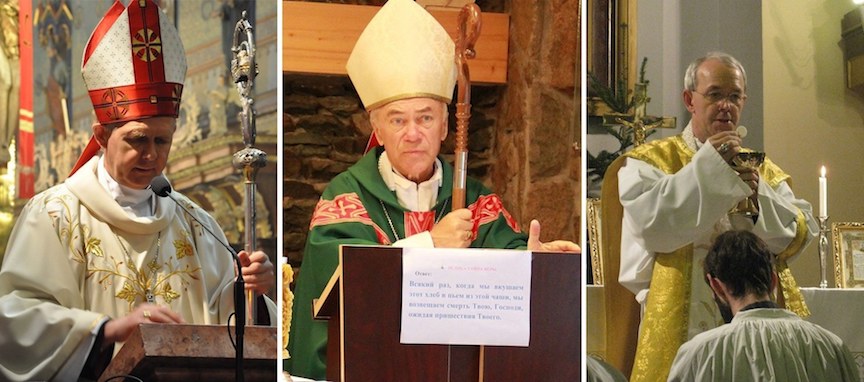



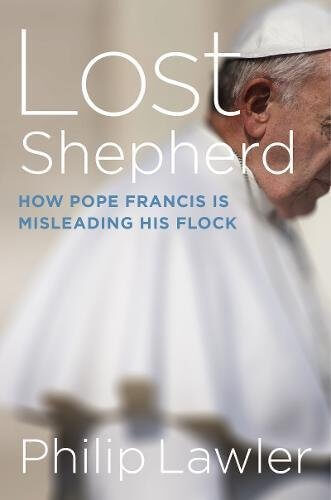 Lost Shepherd: How Pope Francis is Misleading His Flock


You must be logged in to post a comment.