THIS FORM OF CARBON MONOXIDE KILLS THE SPIRIT BEFORE IT KILLS THE BODY

CRISIS MAGAZINE

Carbon Monoxide Clericalism


Invisible, odorless, and deadly, carbon monoxide clericalism is less a power-trip than a survival mechanism that proves counter-productive. Simply describing it is the first step toward prevention or cure. Then let us all pray for a serious intervention of the Holy Spirit, for without the reform of the priesthood, it is difficult, if not impossible, to renew the Church.

Different manifestations of clericalism have appeared in the course of Church history, and we may have personally experienced various forms in parish settings. It has often been said, in the pre-Vatican II mind-set, that the “Church” meant priests and nuns, while the laity were considered second-class citizens. The ordained enjoyed an ontological superiority by our very identity, and a moral superiority through celibacy and a daily familiarity with holy things. The documents of Vatican II corrected this tendency and struck an admirable balance in the explanation that the ministerial priesthood differs in kind, not only in degree, from the priesthood of the laity) thus acknowledging an ontological distinction (while at the same time insisting that the ministerial priesthood is not a self-promoting caste, but exists to serve the priesthood of the baptized). With a little wisdom, we can appreciate that the simultaneous promotion of the laity and the priesthood, properly understood, enhances the holiness of the Church and advances our mission in the world. Accordingly, carbon monoxide clericalism is a deadly disease that priests and laity must fight together.

I never dreamed that I myself could be living and moving in this atmosphere, and breathing in its spirit. How would I describe this clericalism? Yes, it is invisible, odorless and deadly, but what does that mean exactly? It is the spirit of the world that diminishes our humanity and slowly enslaves us, turning bishops into bureaucrats, priests into functionaries, and parishes into businesses. It stands in stark contrast to the example of Jesus, and our common call to share in the life and love of the Trinity. It is the spirituality of the self-made man: a self-contained, self-sufficient and isolated individual. “Carbon monoxide” may be an apt metaphor because this kind of poisoning—whether literal or spiritual—usually occurs in private, in enclosed spaces, an image of the isolated soul.

No priests were trained to live this way, as seminaries strive to inculcate the opposite spirit. I found seminary to be a positive, life-giving model of fraternity in community. I enjoyed my time there, but with the understanding that after ordination in my average-sized diocese, I would spend a few years as an associate, then be named a pastor, most likely living alone. But it was the hope, prayer, and expectation of myself and my diocesan brothers that the strong fraternal bonds we formed in seminary would continue in the diocese. Although we might live alone in our own rectory, emotionally and spiritually, we would still receive support and enjoy a sense of belonging, brotherhood, and shared mission. Unfortunately, our monthly fraternal gatherings petered out after a few years. One by one, priests started dropping off the radar, slowly sinking out of sight, their heads submerged under the turbulent waters of the overwhelming demands of their own parish. Unless a priest has a strong inner resolve and determination to swim against the current, it seems almost inevitable that he will drift away into isolation.

The Church is only beginning to form new structures to counter-act the extreme individuality and isolation of Western culture. The lack of fraternal support among priests is a reflection of the moral disintegration and disarray of our society; it is understandable but nonetheless tragic that the Church has succumbed to the spirit of the world in this way, impoverishing the humanity of priests and weakening our witness to the Gospel.

Let us not forget that Jesus himself chose to live and minister with twelve other men, and when he commissioned apostles to proclaim the Kingdom, he sent them out not as lone rangers, but two by two, walking side by side through the villages of Galilee. This does not mean that every priest must join a religious order, but that priesthood by its very nature demands not only intimacy with Christ but also communion and fraternity with other priests.

The Church at the highest levels is aware of the need for more priestly fraternity and communion, as witnessed for instance in last year’s Ratio Fundamentalis from the Congregation of the Clergy. The authors acknowledge, for instance, that personal and community accompaniment are essential aspects of human formation for priests, and express the hope that some sort of “accompaniment” will continue in the life of diocesan clergy.

Our Trinitarian God intends for the Church to be a family, the sacrament of the unity and salvation of the human race, and the priests-fathers of this family must be brothers to one another. If priests manifest little or no interest in spending time with our brother-priests, how effective is our witness and preaching to the lay people on the supremacy of love in the life of a disciple of Jesus? Furthermore, it is also well known that such isolation can contribute to self-destructive tendencies such as alcoholism, pornography, masturbation and other addictions.

Here is not the place to offer a detailed solution to a complex spiritual problem, but it would be extremely helpful if the whole Church—bishops, priests and lay people—would begin to openly discuss this form of clericalism, and offer diocesan priests practical means of support to live a healthier lifestyle.

Ultimately, a spiritual problem demands a spiritual solution. We are dealing with a spiritual stronghold that resists a frontal attack. In my first years of priesthood, I was well-intentioned and high-minded, energetic and idealistic, but also stubborn and independent. Would angry accusations and denunciations have helped convert me? Probably not. In practical terms, an isolated priest caught up in any kind of clericalism first needs a refuge in at least one secure friendship, in which he can open up and be himself without fear of judgment. Hopefully he will then listen to good advice.

But radical personal change is the work of grace, and authentic conversions are gained through suffering love, not driven by the threat of punishment. St. Luke testifies that repentance was one of the immediate fruits of the Crucifixion: the crowds who witnessed the death of Christ returned home “beating their breasts.” And St. John alludes to the redemptive sorrows of our Lady, standing at the foot of the Cross, interceding for the Church. In the divine economy, miraculous transformations only occur through prayer and suffering, in the spirit of love. The quiet work and hidden grace of personal prayer, united above all to the sacrifice of the Mass and the petitions of the Rosary, has power to move mountains, and to heal the deep roots of fear and pride that sustain the stronghold of carbon monoxide clericalism.

There are good reasons for the whole Church to pray and work toward building healthier presbyterates. For the Year for Priests in 2009, Pope Benedict issued a letter that I believe was prophetic but under-appreciated. He wrote that “the ordained ministry has a radical ‘communitarian form’ and can be exercised only in the communion of priests with their bishop. This communion … needs to be translated into various concrete expressions of an effective and affective priestly fraternity. Only thus will priests be able to live fully the gift of celibacy and build thriving Christian communities in which the miracles which accompanied the first preaching of the Gospel can be repeated.” What an astonishing statement! Yet I do not recall much commentary or response. If the pope was proposing an outline of how the miracles of the Acts of the Apostles might be repeated in our times, surely we should stand up and take notice!

In Pope John Paul II’s post-synodal exhortation, Pastores Dabo Vobis, he reminds us that human formation is the basis of all priestly formation. He writes, “of special importance is the capacity to relate to others. This is truly fundamental for a person who is called to be responsible for a community and to be a ‘man of communion’ … people today are often trapped in situations of standardization and loneliness … and they become even more appreciative of the value of communion. Today this is one of the most eloquent signs and one of the most effective ways of transmitting the Gospel message.”

I would like to offer one brief practical example of how fraternity and communion among priests might open the door to the Holy Spirit working new miracles. On a recent diocesan retreat for priests in Ogdensburg, NY, our youthful auxiliary bishop introduced a novelty: after his morning conference in the chapel, we priests were invited to pray over one another, ministering to each other. We had to take a risk and share our vulnerability, asking for prayer in an area of weakness, exposing our need for healing. As priests laid hands on their brothers’ arm or shoulder and prayed aloud, expressing fraternal charity in words and deeds, I realized I was experiencing a concrete instance of effective and affective priestly fraternity! What happened? Like a gentle dewfall, the Advocate and Consoler descended. The same Holy Spirit that flowed more freely among us could potentially overflow to people in our parishes….

Jesus the Divine Son of God, our supreme model of manhood and priesthood, was certainly not a self-made man nor an isolated individual. He was rather a  “man of the Trinity,” a man of communion, out of whom living waters flowed, divine power that healed everyone who touched him. In the Old Testament, many holy men modeled this communion with God and his people—Abraham our father in faith, Moses who spoke with God face to face, David a man after God’s own heart.

In the New Testament, what miraculous graces flowed out from saints such as Peter and Paul! When handkerchiefs that had touched Paul’s skin were brought to the sick, “their diseases left them, and the evil spirits came out of them.” In the presence of Peter, “they even carried out the sick into the streets, and laid them on cots and mats, in order that Peter’s shadow might fall on some of them as he came by.” Consider also the prophetic leaders the Holy Spirit has raised up to lead the Church in these troubled times. Each priest is called to a man of the Trinity, a man of communion. Then the Church can be renewed, and the miracles that accompanied the first preaching of the Gospel can be repeated in our times.

Fr. Tim McCauley

By

Fr. Tim McCauley is a priest of the Archdiocese of Ottawa. He was received into the Catholic Church in Brooklyn, NY in 1995, and ordained in 2002. He has served in several parishes, as well as vocation director and chaplain at Carleton University. He is currently a priest in residence at Blessed Sacrament parish in Ottawa.

Posted in Uncategorized | 1 Comment

Francis’ use of the term “authentic magisterium” in promulgating his letter to the Argentine bishops on AAS is especially disturbing because it appears intended to trigger Canon 752, to purportedly require “religious submission of the intellect and will” to the Buenos Aires guidelines’ overturning of the traditional teaching of the Church:

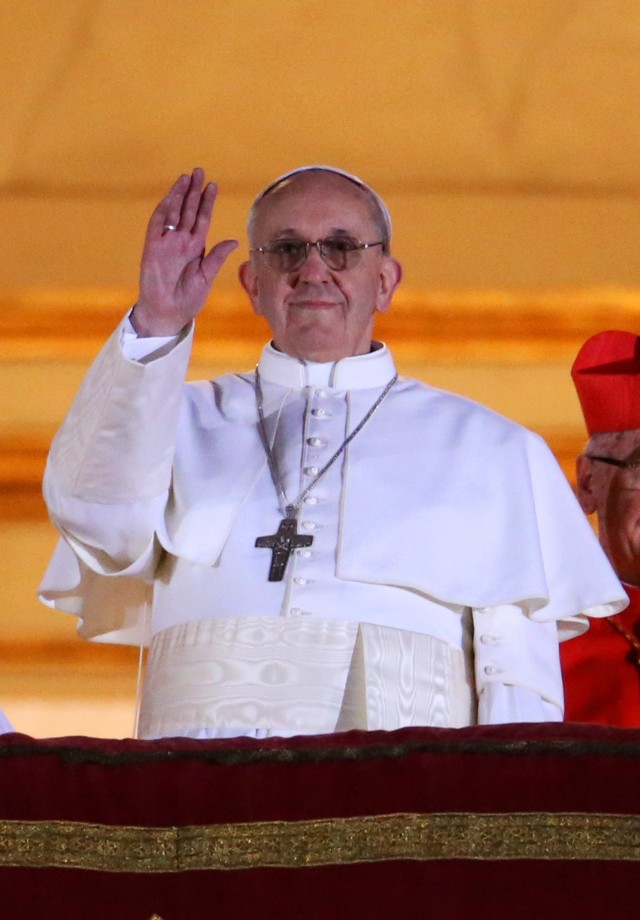
The Conclave Of Cardinals Have Elected A New Pope To Lead The World's Catholics

VATICAN CITY, VATICAN – MARCH 13: Newly elected Pope Francis I appears on the central balcony of St Peter’s Basilica on March 13, 2013 in Vatican City, Vatican. Argentinian Cardinal Jorge Mario Bergoglio was elected as the 266th Pontiff and will lead the world’s 1.2 billion Catholics. (Photo by Peter Macdiarmid/Getty Images)

RORATE COELI

Pope Francis Promulgates Buenos Aires Guidelines Allowing Communion for Some Adulterers in AAS as his “Authentic Magisterium”

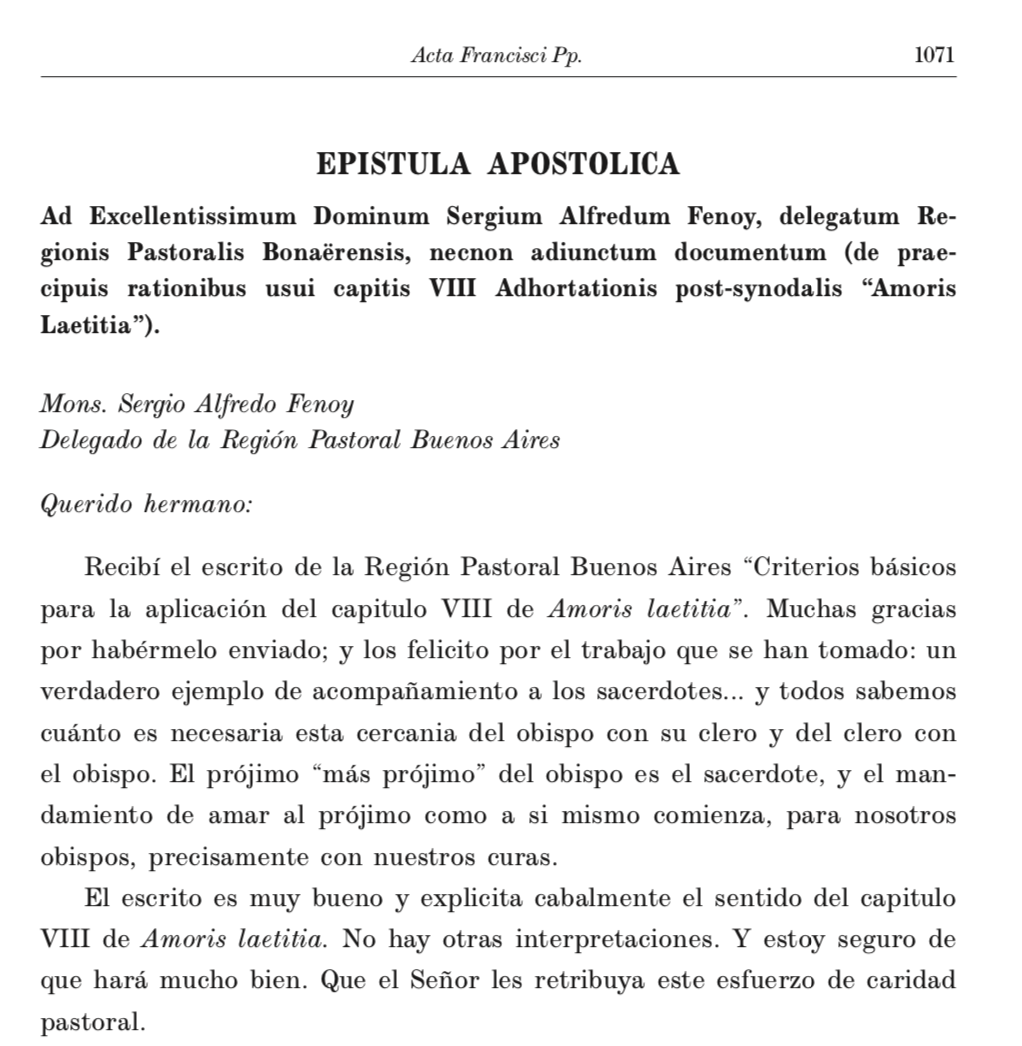
This week, the Vatican’s organ for promulgating the Official Acts of the Apostolic See, Acta Apostolicae Sedis (AAS), has published its October 2016 issue, containing Pope Francis’ infamous Letter to the Buenos Aires Bishops. AAS not only published this letter, declaring that there are “no other interpretations” (“No hay otras interpretaciones”) of Amoris Laetitia other than those of the Buenos Aires bishops, but it also published the full Buenos Aires guidelines themselves, which permit Holy Communion in some cases for couples in a state of permanent and public adultery who are not committed to living in complete continence.

Most significantly, AAS upgrades Pope Francis’ private letter to the Buenos Aires bishops to the official magisterial status of an “Apostolic Letter” (“Epistola Apostolica”) – AND it includes a special rescript as an addendum by Cardinal Pietro Parolin, Secretary of State. This rescript declares that Pope Francis expressly intends that BOTH documents – the pope’s letter and the Buenos Aires guidelines themselves- bear the character of his “authentic Magisterium”, and that the pope personally ordered their publication in AAS and on the Vatican website.
 
The rescript reads in Latin as follows:

RESCRIPTUM «EX AUDIENTIA SS.MI»

Summus Pontifex decernit ut duo Documenta quae praecedunt edantur per publicationem in situ electronico Vaticano et in Actis Apostolicae Sedis, velut Magisterium authenticum.

Ex Aedibus Vaticanis, die V mensis Iunii anno MMXVII

Petrus Card. Parolin
Secretarius Status

Here is an English translation:
Rescript “from an Audience with His Holiness”
The Supreme Pontiff decreed that the two preceding documents be promulgated through publication on the Vatican website and in Acta Apostolicae Sedis, as authentic Magisterium.
From the Vatican Palace, on the day of June 5 in the year 2017
Pietro Card. Parolin
Secretary of State
The Catholic Encyclopedia defines a papal rescript as follows: “Rescripts are responses of the pope or a Sacred Congregation, in writing, to queries or petitions of individuals. Some rescripts concern the granting of favours; others the administration of justice, e.g. the interpretation of a law, the appointment of a judge.” Rescipts generally have the force of particular law, however, as in this case, only “when they interpret or promulgate a general law, are they of universal application.” Since papal rescripts answer an inquiry – could this rescript be a direct reply to the dubia of the Four Cardinals?

Under Canon 8 § 1 of the 1983 Code of Canon Law, the AAS is the regular method by which “universal ecclesiastical laws” are to be promulgated: “Universal ecclesiastical laws are promulgated by publication in the official commentary Acta Apostolicae Sedis, unless some other manner of promulgation has been prescribed in particular cases.” While most papal documents appearing in AAS lack canonical or disciplinary force, the Pope’s rescript at the hand of Cardinal Parolin is clearly intended to give the Buenos Aires Guidelines a significant level of Magisterial authority in the interpretation of Amoris Laetitia.
The pope’s use of the term “authentic magisterium” is especially disturbing because it appears intended to trigger Canon 752, to purportedly require “religious submission of the intellect and will” to the Buenos Aires guidelines’ overturning of the traditional teaching of the Church:

Can. 752 Although not an assent of faith, a religious submission of the intellect and will must be given to a doctrine which the Supreme Pontiff or the college of bishops declares concerning faith or morals when they exercise the authentic magisterium, even if they do not intend to proclaim it by definitive act; therefore, the Christian faithful are to take care to avoid those things which do not agree with it.

In paragraph 6 of the Buenos Aires guidelines, now explicitly to be treated as belonging to Pope Francis’ “authentic magisterium”, the allowance for communion in cases of couples in a state of adultery without living in complete continence is made explicit:

6) In other, more complex circumstances, and when it is not possible to obtain a declaration of nullity, the aforementioned option [living in continence] may not, in fact, be feasible. Nonetheless, it is equally possible to undertake a journey of discernment. If one arrives at the recognition that, in a particular case, there are limitations that diminish responsibility and culpability (cf. 301-302), particularly when a person judges that he would fall into a subsequent fault by damaging the children of the new union, Amoris Laetitia opens up the possibility of access to the sacraments of Reconciliation and the Eucharist (cf. footnotes 336 and 351). These in turn dispose the person to continue maturing and growing with the aid of grace.
Pope Francis’ once private letter to the Buenos Aires Bishops, but now to be considered an Apostolic Letter belonging to his “authentic magisterium”, confirms these guidelines:

“The document is very good and completely explains the meaning of chapter VIII of Amoris Laetitia. There are no other interpretations. And I am certain that it will do much good.”
The problem with Amoris Laetitia, it is clear, is not merely with “liberal bishops” who interpret it, but with the pope whose manifest interpretation of his own document is impossible to square with the perennial doctrine and discipline of the Catholic faith.

See the October 2016 edition of the AAS on the Vatican website (very large pdf).
See the Buenos Aires guidelines on the Vatican website here.
Below is the excerpted portion of the AAS in its original published form.

https://drive.google.com/file/d/1eOJgNsRUWp4krLBT6v5fKuL0RTk4yvW1/preview

Posted in Uncategorized | Comments Off on Francis’ use of the term “authentic magisterium” in promulgating his letter to the Argentine bishops on AAS is especially disturbing because it appears intended to trigger Canon 752, to purportedly require “religious submission of the intellect and will” to the Buenos Aires guidelines’ overturning of the traditional teaching of the Church:

Francis’ heterodoxy is now official. He has published his letters to the Argentine bishops in the ACTA APOSTOLICA SEDES making those letters magisterial documents.

The Conclave Of Cardinals Have Elected A New Pope To Lead The World's Catholics

VATICAN CITY, VATICAN – MARCH 13: Newly elected Pope Francis I appears on the central balcony of St Peter’s Basilica on March 13, 2013 in Vatican City, Vatican. Argentinian Cardinal Jorge Mario Bergoglio was elected as the 266th Pontiff and will lead the world’s 1.2 billion Catholics. (Photo by Peter Macdiarmid/Getty Images)

BREAKING: POPE DECLARES TROUBLING INTERPRETATION OF AMORIS LAETITIA ‘AUTHENTIC MAGISTERIUM’

NEWS: WORLD NEWS

by Church Militant  •  ChurchMilitant.com  •  December 2, 2017    191 Comments

A direct contradiction of Canon 915


Church Militant is confirming that Pope Francis has officially approved the interpretation of Amoris Laetitia that opens Holy Communion to the divorced and civilly remarried in some instances, directly contradicting Canon 915 of the Code of Canon Law, arguably making this interpretation binding on the consciences of the faithful.

In a Papal Rescript granted on June 5, 2017 ex Audientia Sanctissimi to the Cardinal Secretary of State Pietro Parolin, and just now released by the Vatican in the Acta Apostolicae Sedis, the Holy Father has raised to the level of “authentic Magisterium” both the private letter he wrote on September 5, 2016 to Bp. Sergio Alfredo Fenoy, the Delegate of the Buenos Aires Pastoral Region of the Bishops’ Conference of Argentina, and the Criterios Basicos para la aplicación del capitulo VIII de Amoris laetitia (“Basic Criteria for the Application of Chapter VIII of Amoris Laetitia“), issued on the same day by the bishops of the Buenos Aires Pastoral Region.

Some are arguing that Pope Francis is using a “back door” in order to raise to the level of official teaching what his defenders had been describing as merely new “pastoral” discipline.Tweet

The directives of the Buenos Aires bishops caused controversy last year because it interpreted the pope’s apostolic exhortation to allow Holy Communion in certain cases to those in invalid unions who deliberately engage in sexual relations. In the Pope’s September 5 letter to the bishops, he praised their interpretation.

“The document is very good and completely explains the meaning of Chapter VIII of Amoris Laetitia,” he said, adding, “There are no other interpretations.”

According to experts whom Church Militant has consulted, the importance of the official decision of the Pope to elevate the referenced documents to the level of “authentic Magisterium” and order their publication in the Acta Apostolicae Sedis (the official register of the Holy See, a compendium of decrees, encyclicals, appointments and other official acts of the Holy See) cannot be underestimated. The issuance of the decision through Rescript form puts to rest any more discussion regarding the official and precise interpretation to be given by the episcopal hierarchy and faithful to Amoris Laetitia.

Church Militant’s unofficial English translation of the Rescript published in Latin states:

The Supreme Pontiff decrees that the two Documents that precede [this Rescript] are to be made known by publication on the Vatican website and in the Acta Apostolicae Sedis, as authentic Magisterium. From the Vatican Palace, on the 5th day of June in the year 2017. (emphasis added)

Pietro Cardinal Parolin
Secretary of State

The terms of art, “authentic Magisterium,” are especially referenced in canon 752 of the Code of Canon Law:

While the assent of faith is not required, a religious submission of intellect and will is to be given to any doctrine which either the Supreme Pontiff or the College of Bishops, exercising their authentic magisterium, declare upon a matter of faith or morals, even though they do not intend to proclaim that doctrine by definitive act. Christ’s faithful are therefore to ensure that they avoid whatever does not accord with that doctrine. (Code of Canon Law Annotated, 2nd ed. Midwest Theological Forum: Woodridge, 2004, p. 586) (emphasis added)

The use by the Supreme Pontiff of the terms “authentic Magisterium” has been qualified as “very troubling” by one expert whom Church Militant consulted regarding this breaking development, because such usage is primarily employed in strictly categorizing doctrines pertaining to faith or morals, not merely ecclesiastical discipline. Consequently, some are arguing that Pope Francis is using a “back door” in order to raise to the level of official teaching what his defenders had been describing as merely new “pastoral” discipline meant to “accompany” divorced and civilly remarried faithful in their “discernment” as to whether they can receive Holy Communion despite living more uxorio (as husband and wife).

This story is unfolding as we write, and will be updated.


Posted in Uncategorized | 5 Comments

APOSTASY IS ONE OF THE SIGNS OF OUR TIMES, UNDERSTAND IT SO THAT YOU WILL NOT BE TEMPTED BY IT

The Silence question is apostasy. Too many get the answer wrong.

By Dr. Jeff Mirus

Catholic Culture

Nov 30, 2017

{Abyssum}

Shusakū Endō’s 1966 novel Silence raised haunting questions about apostasy in the minds of many readers, troubling questions which have been called to our attention repeatedly by the various film adaptations of the work: Silence directed by Masahiro Shinoda (1971), The Eyes of Asia readapted by João Mária Grilo (1996), and of course Martin Scorsese’s Silence last year, which premiered at the Pontifical Oriental Institute in Rome.

{Apostasy for a layman is the voluntary giving up the faith; Apostasy for someone ordained to sacred orders (priesthood) is the voluntary giving up the exercise of their clerical state; Apostasy for a vowed person in religious life is the voluntary giving up of the observance of their vows.}

Endo himself had written a stage version under the title of The Golden Country. A libretto and music for an opera based on the novel were written by Teizo Matsumura, and the Scottish composer James MacMillan apparently wrote his third symphony, “Silence”, in honor of the book. For further evidence of what Wikipedia can do for you in the matter of basic information, see Silence (novel).

As most readers know, Silence is a work of fiction centered on the persecution of Christians and the brutal eradication of the Church in Japan in the seventeenth century. The key issue in the story is the apostasy of its main character, a Jesuit priest, ostensibly in order to save his flock from almost unimaginable suffering. This character believes Our Lord has told Him the right thing to do is to trample on His image to satisfy the persecutors. The theory is that Our Lord wants to suffer again for his people, rather than to see them suffer.

The theology, of course, is totally bogus, and I will come to that in a moment. First, as a matter of full disclosure, let me say the following: I have not read Silence. I have not viewed Silence. I have not listened to Silence. Nor do I intend to. Such bleakness may have to be faced in real life, but it does not attract me in the form of stories or entertainment.

Also in the interest of full disclosure, please note that Endō’s novel is most emphatically not historically accurate on the critical point at issue. There is no evidence that those who apostatized did so to help others. To the best of our knowledge, no such opportunity existed, and the later actions of the persons in question gave the lie to what has become, in effect, a self-serving myth for those who do not take their Faith as seriously as they should. For an important corrective, read (among other possibilities) Patricia Snow’s fine article in the October issue of First Things, Empathy is not Charity.

Regardless of the details, Snow refuses to justify apostasy. Therefore, in a recent letter to the editor criticizing her article, one correspondent wrote: “If it is an error of dogma that I should deny Christ to alleviate the torture and death of the innocent, then, like Kirchijiro, I must trust in the forgiveness of Jesus.” But since the critic clearly believes denial of Christ to be the moral choice in these circumstances, he must also envision an unrepentant forgiveness from a confused savior. Thus does one more soul, thinking faith a shallow thing, float off to where so many have drifted—far beyond his depth.

The central question

My own reflection on the questions raised by the book and movies comes through family and faith. My wife has read and spoken with me about the novel and a son who also writes for CatholicCulture.org has written perceptively about the recent movie (see Thomas V. Mirus’ Scorsese’s Silence is a contemplative masterpiece). More importantly, there is the Faith: While the question of whether it is morally good to deny Christ in order to help or save others may be very hard to answer through our own actions, it is not at all difficult to answer in theory.

In other words, while we may be forgiven, if we seek forgiveness, for apostatizing (or perhaps pretending to apostatize) for apparently noble reasons, apostasy is always and everywhere seriously wrong. The right thing to do, the thing that God wants us to do, is always—always—to remain publicly faithful to Him. Moreover, He has very directly revealed this to us.

Was it not Our Lord who said, point blank:

[D]o not fear those who kill the body but cannot kill the soul; rather fear him who can destroy both soul and body in hell. Are not two sparrows sold for a penny? And not one of them will fall to the ground without your Father’s will. But even the hairs of your head are all numbered. Fear not, therefore; you are of more value than many sparrows. So every one who acknowledges me before men, I also will acknowledge before my Father who is in heaven; but whoever denies me before men, I also will deny before my Father who is in heaven. [Mt 10:28-33]

And was it not St. Paul who wrote to Timothy:

The saying is sure: If we have died with him, we shall also live with him; if we endure, we shall also reign with him; if we deny him, he also will deny us; if we are faithless, he remains faithful—for he cannot deny himself. [2 Tim 11:13]

To understand more fully what God asks of us in unpleasant circumstances, read chapter 7 of the Second Book of Maccabees. Reflect on the widow portrayed there, and on her seven sons.

What does faith mean?

All of this was brought home to me again in a discussion with family members over Thanksgiving. A question was raised about whether it could be morally justifiable for a mother to deny Christ in order to save the life of her infant child, who would otherwise be brutally murdered. But the answer remains simple even when it is not easy: It is objectively seriously wrong to do so. Culpability is reduced by compulsion which limits full consent of the will. Forgiveness, if sought, is freely available—as forgiveness always is. But no rationalizations can be accepted.

Now, the real question—the only question that matters—is simply this: How and why can this answer be always and everywhere the correct answer?

The response to this question is not only a test of our own faith but also a lesson in humility. Among other considerations, apostasy is always and everywhere seriously wrong for the very practical reason that God can do far more for anyone than we can do ourselves. The chief problem with our Catholicism is that we so seldom act as if we believe this inescapable pragmatic fact.

Should we be willing to suffer horribly and even die for our fidelity? Well, let us reflect that God can do far more for those who love Him than we can ever do for ourselves even by our own survival.

Should we be willing to allow others to suffer horribly and even die for our fidelity? Let us reflect that God allows us to release oceans of grace through that fidelity, and that He can do far more for those who are to suffer than we can ever do by preventing or reducing any particular suffering.

Should we be willing even to deprive our children of their mother or father by suffering and dying for our fidelity? Again, we must reflect on this question: Is it more likely that I can provide for my children better than God can if I will only be faithful to Him?

This is simply bedrock realism concerning Who God is and who we are. Under duress it can be hard to live in light of this reality. But living in this light is what it means to have faith. The point I wish to make, then, is nothing but this: Not only is it morally wrong under any circumstances to apostatize but also, even with what we might think the best motives in the world, it is an egregiously bad bet. That may not be clear enough to us now, when we see but through a glass darkly. But when we see face to face, we shall have no doubt whatsoever.

Here is the whole book on apostasy: It is not only grave sin. It is gross conceit and gargantuan folly.

Jeffrey Mirus holds a Ph.D. in intellectual history from Princeton University. A co-founder of Christendom College, he also pioneered Catholic Internet services. He is the founder of Trinity Communications and CatholicCulture.org. See full bio.


The sadness of all apostasy—and the modern scandal

By Dr. Jeff Mirus

Dec 01, 2017

{Abyssum)

I explained yesterday why, regardless of the motives and the naysayers, apostasy is always wrong, even under the circumstances depicted in the novel and film Silence.

As a postscript, I believe the following two observations will be found quite apt:

First, in a certain sense there is relatively little scandal in the formal apostasy of Jesuit priests in eighteenth-century Japan. When ten Jesuits entered Japan in an effort to counter the effects of the apostasy of a previous Jesuit, all of them eventually denied Christ under similar threats of torture.

This renunciation of the Faith would have scandalized the Japanese faithful undergoing similar threats—in the deepest sense of tempting them to commit the same sin, though many of them did not do so. But in the attenuated sense in which we understand “scandal” today—the sense of being outraged by another’s sin—we can hardly be outraged by the failure of these priests to pass the ultimate test, especially insofar as we ourselves can hardly be certain of our own perseverance in similar circumstances.

Perhaps it is this attenuated sense of scandal that the unfortunate James Martin, SJ had in mind when he argued in America magazine that, under the circumstances depicted in the 2016 film Silence (though the fictional circumstances of the novel and the film were not in fact the real circumstances), well-formed and prayerful Jesuits could legitimately deny Christ.

This is false (as I explained yesterday), but clearly the scandal of the denial is significantly mitigated by either the real or the fictional circumstances. Condemnation and millstones may be warranted, but not on our authority. For us, weaklings that we all may be, a more appropriate response would be sadness.

But a parallel dilemma in modern Western culture leads to a second observation. Indeed, Fr. Martin’s comments on the original dilemma lend this fresh observation greater urgency simply because he himself has so often been on the wrong side of the dilemma.

The legitimacy of contempt?

Second, then, there is a very great deal of scandal in the less formal yet material apostasy of so many Jesuit priests today, along with many others, especially in wayward religious communities and universities. These practical apostates harm countless souls and leads them into sin for no better reason than to be recognized as mainstream thinkers. Such men and women apparently fear, above all else, to be marginalized by the larger secular culture. Accordingly, they are driven to employ an unending series of specious arguments to demonstrate why this or that Catholic teaching is really quite compatible with what the world so urgently desires.

Here we have a scandal in both the deeper and the more modern senses. In the deep sense, this progressive denial of Christ leads little ones into sin on a daily basis. Those who apostatize in this way would rather justify the wayward desires of students (and others) than strengthen them against the world, the flesh and the devil. This form of apostasy produces an elite club which those who are misled are all too eager to join.

But in this case our response can be fundamentally different. The vast majority of those reading these comments have experienced all of the same worldly inducements, yet they have consistently said “No”. A great many have, in this case, earned the right to be scandalized in the more modern sense. We have earned the right to be outraged.

The apostasy of Modernism, the apostasy motivated by this itchy desire for cultural approval and intellectual “respectability”, this is sad indeed. But it really does also call for condemnation and millstones. It is just here that Our Lord’s own words apply so exactly. “For what does it profit a man if he gains the whole world and loses or forfeits himself” (Lk 9:25)?

For the matter of that, what does such a vain and even risible weakness profit anyone else?

Jeffrey Mirus holds a Ph.D. in intellectual history from Princeton University. A co-founder of Christendom College, he also pioneered Catholic Internet services. He is the founder of Trinity Communications and CatholicCulture.org. See full bio.

Posted in Uncategorized | 1 Comment

The Church, when stating some doctrine, also formulates it in a negative way, in the form of an “anathema”, i.e., explicitly condemning the opposite error, this is something Francis does not do.

Scholars Repond to Fastiggi, Rejecting Notion the Pope has Indirectly Answered the Dubia

OnePeterFive
{Abyssum}

FacebookEmailPinterestPocketGoogle+

This week has seen yet another attempt of loyal supporters of Pope Francis to calm down the concerned critics of the pope with regard to Amoris Laetitia and the papal silence with regard to the dubia of the four cardinals. The Italian newspaper of the papal friend, Andrea Tornielli, Vatican Insider (La Stampa), published on 28 November an articlewritten by the U.S. theologian Dr. Robert Fastiggi who teaches at Sacred Heart Major Seminary, Detroit. Entitled “Recent Comments of Pope Francis Should Help to Quiet Papal Critics,” the article tries to convince papal critics that the pope already answered the dubia, though indirectly, but certainly in an orthodox way.

After a short introduction, we shall present the statements of three prominent loyal and orthodox Catholic scholars – Father Brian Harrison, O.S., Professor Paolo Pasqualucci, and Professor Claudio Pierantoni – who have sent to us, upon our request, their own reflections and responses to Fastiggi’s article, which has been prominently and internationally published.

It seems that the recently-published letter to Pope Francis, as written by Father Thomas Weinandy, O.F.M., Cap., has had a strong impact on Catholic discourse, since Dr. Fastiggi mentions it both at the beginning and at the end of his new article. Fastiggi begins his arguments as follows:

Some critics of Pope Francis seem to think he cares little about doctrinal clarity, especially with regard to moral theology and conscience. Fr. Thomas Weinandy, OFMCap, for example—in his recently made public July 31, 2017 letter to the Holy Father—suggests that in Amoris laetitia Pope Francis offers guidance that “at times seems intentionally ambiguous.” The “explanatory note” on the fifth dubium of the four Cardinals sent to Pope Francis on September 19, 2016 expresses concern that Amoris laetita, 303 might imply a view of conscience “as a faculty for autonomously deciding about good and evil.”

Before we go further into the discussion of Dr. Fastiggi’s article, it might be worth mentioning in this context that the Father Weinandy letter – and the request that immediately followed that he resign from his position as a consultant to the US Conference of Catholic Bishops (USCCB) – had also stirred a discussion in Germany with much sympathy for Fr. Weinandy. The prominent national newspaper, Frankfurter Allgemeine Zeitung (FAZ), published, on 7 November, an article about Father Weinandy’s letter and his description of the atmosphere of fear within the Catholic Church among those who disagree with Pope Francis’ path of reform. Describing Weinandy as a “man of the center,” an “internationally renowned theologian,” and a member of the International Theological Commission, FAZ’s journalist Christian Geyer said that the immediate request from the U.S. bishops that Weinandy resign from his position proves Weinandy’s point. Geyer wrote:

This incident is a symptom of that which Weinandy named in his letter: the fear of being dismissed, put aside, overshadows the willingness to express criticism freely, a criticism which in turn could at any moment by denounced as “badmouthing” of the papal agenda.

Thus, Father Weinandy’s polite critique of the strong confusion stemming from the papal document Amoris Laetitia, which drew international attention, could well have been a further invitation to Pope Francis to finally make an act of clarification. Now, in light of the international response to Father Weinandy’s prominent letter to Pope Francis and his call for a doctrinal clarification, it is even more understandable why Dr. Fastiggi felt compelled to write a defense of Pope Francis. As our scholars will show, indirect papal comments might not be a sufficient answer to the many calls for substantive clarification.

Let us first briefly (and incompletely) present some aspects of Dr. Fastiggi’s letter, while inviting our readers to read his full article. Fastiggi quotes several recent statements from the pope about Amoris Laetitia and about the question of the “remarried” and divorced couples, saying that in these papal comments, he sees an orthodox response to all the critics. Among these alleged papal signals is a 11 November video message from the pope to participants in the 3rd International Symposium on the Apostolic Exhortation. In reference to this communication, Fastiggi states:

Instead of describing conscience as an autonomous faculty for deciding good or evil, the Holy Father points to a proper conscience as an antidote for “a worship of the self, on whose altar everything is sacrificed.”

Thus, Fastiggi sees the fifth dubium answered. Fastiggi also quotes Pope Francis’ 25 November address to the Roman Rota, where the pope called for a shorter process for obtaining declarations of nullity, saying that then such couples also could again be admitted to the Holy Eucharist. Fastiggi comments:

It’s important to note that the Holy Father sees a declaration of nullity as a means to restore peace to the consciences of the divorced and remarried in order for them to have readmission to the Eucharist. This implies that those who are divorced and remarried are not admitted to the Eucharist. Some might object that Pope Francis does not actually say this, but it’s difficult to understand his statement in any other way. If admission to the Eucharist is allowed after a declaration of nullity, then it suggests that it is not possible before.

This statement is in Fastiggi’s eyes a response to the first of the five dubia. He also discusses possible objections, quoting Cardinal Müller’s own unfortunate recent statement:

Critics of Pope Francis will likely try to reassert their criticisms and point to the Holy Father’s alleged permission for divorced and remarried Catholics to receive Holy Communion via his letter endorsing the guidelines of a group of Argentine bishops. Cardinal Müller, however, told Edward Pentin in a Sept. 28, 2017 interview that “if you look at what the Argentine bishops wrote in their directive, you can interpret this in an orthodox way.”

With reference to some “remarried” and divorced orthodox Christians who, by Canon Law (canon 844§3), might be admitted, under certain conditions, to Holy Communion in the Catholic Church, Dr. Fastiggi also sees some ways of exceptions for the “remarried” and divorced couples who do not live in continence, while maintaining the general rule:

My only point is that such possible exceptions might exist, but they should not hinder the articulation of the general rule, which is that divorced and civilly remarried Catholics should not receive Holy Communion unless they are living in continence.

Dr. Fastiggi also points to the possibility that Pope Francis, with his footnote 351 in Amoris Laetitia about “certain cases” in which such couples could have access to the Holy Eucharist, merely thought of those couples who cannot prove, due to difficult circumstances in remote places in the world, the nullity of their marriage and thus should make use of the “forum internum” with a priest.

The final words of Dr. Fastiggi’s article are, as follows:

This is not to say he [Pope Francis] was consciously responding to these dubia. His intent was simply to teach the truth. If only the papal critics would pay more attention to the many and frequent teachings of the Holy Father that clearly articulate the truth, we would be better off. Fr. Weinandy is correct that “truth is the light that sets women and men free from the blindness of sin, a darkness that kills the life of the soul.” Pope Francis, however, has been and continues to teach the truth. It’s sad, though, that his critics fail to notice this.

In the following, therefore, we shall present the eloquent responses of three Catholics scholars (one of them also a priest) who are all well known to our readers. Fr. Harrison, Professor Pasqualucci, and Professor Pierantoni are all among the 45 signatories of the Theological Censures Document sent last year to the College of Cardinals addressing Amoris Laetitia; Pasqualucci and Pierantoni have also both signed the Filial Correction concerning Amoris Laetitia and other papal words and actions. We are grateful to them for having been willing to make this act of charity for the sake of the fuller truth.


Father Brian Harrison, O.S.

Regarding Dr. Robert Fastiggi’s claim that Pope Francis upholds orthodox sacramental doctrine and discipline:

In a November 25 address to the Roman Rota, Pope Francis referred to his own recent legislation expediting marriage nullity processes, and exhorted the canonists in his audience “to be close to the solitude and suffering of the faithful who expect from ecclesial justice the competent and factual help to restore peace to their consciences and God’s will on readmission to the Eucharist.” According to Dr. Robert Fastiggi, the Holy Father’s words imply that readmission to the Eucharist for divorced and remarried Catholics not living in continence “can only come after the declaration of nullity” (emphasis added). Not so. The word “only” is logically unwarranted here, for Francis’ words are quite compatible with his holding that while some – perhaps most – such Catholics will need a declaration of nullity of their first marriage in order to be absolved and readmitted to the Eucharist, not all of them will need it.

In other words, the Pope’s observation fails to state or imply what the dubia cardinals and others troubled by Amoris Laetitia rightly wish to hear him teach, namely, that if and only if a declaration of nullity is granted may those in question eventually be readmitted to the Eucharist. Francis’ November 25 speech leaves open the possibility that somesuch persons may be absolved and readmitted to the Eucharistic by a different path – one of “dialogue,” “accompanying” and “discernment” – that requires neither a commitment to continence nor the Church’s recognition that the first marriage was invalid. That the Pope intends AL’s note 351 to open up this new path “in certain cases” is shown by (for instance) Vatican approval of the Maltese bishops’ allowance of it, his praise for a top-level AL expositor (Cardinal Schönborn) who says the Pope’s exhortation “obviously” allows for it, a Vatican cardinal’s 30-page bookletallowing it, and its approved implementation in the Holy Father’s own Diocese of Rome.

The Rev. Brian W. Harrison, O.S., M.A., S.T.D., a priest of the Society of the Oblates of Wisdom, is a retired Associate Professor of Theology of the Pontifical Catholic University of Puerto Rico in Ponce, P.R. In 1997 he gained his doctorate in Systematic Theology, summa cum laude, from the Pontifical Athenæum of the Holy Cross in Rome. Since 2007 Fr. Harrison has been scholar-in-residence at the Oblates of Wisdom Study Center in St. Louis, Missouri, and is well-known as a speaker and writer. He is the author of three books and over 130 articles in Catholic books, magazines, and journals.

*   *   *

Professor Paolo Pasqualucci

Did Pope Francis already answer the five dubia of the four cardinals, or some of them? No, he didn’t.

Why didn’t he? Here are some reasons.

1.) A preliminary but substantial point. The five dubia do not represent an accusation.  They are an official request of clarification by four cardinals, aiming to dissolve erroneous and heretical interpretations of what the Pope himself has written in a magisterial document (AL).  The Pope has the duty to answer in an official way, i.e. either with a document released motu proprio or through the Congregation for the Doctrine of the Faith, stating authoritatively the authentic meaning (interpretatio authentica) of his own words; that is, an interpretation by the Lawmaker himself that eliminates any doubt as to the perfect orthodoxy of what he has written, contextually condemning any possible erroneous interpretation thereof.

Therefore, the Pope’s indirect declarations and hints related to the problems involved by AL, released in audio messages, addresses, interviews, etc., have no value as to the solution of those problems.

He has to answer ex cathedra, since the four cardinals have addressed their dubia ex cathedra too, i.e., in their capacity as high level members of the clergy directly assisting the pope in the government of the Church.

The lack of any official, magisterial answer on the part of the pope allows anyone to interpret the ambiguous parts of Amoris Laetitia the way he wants, so that confusion and anarchy continue to spread in the Holy Church.

Pope Francis can’t persist in maintaining an indirect approach — substantially a no-approach — policy on the dubia questions. In any case, independently from the dubia, the reigning, sinister confusion requires as such a magisterial pronouncement on his part, since he alone is the Vicar of Christ on earth and the Head of the visible Church.

2.) The thesis that Pope Francis does not describe “conscience as an autonomous faculty for deciding good or evil”, as the four cardinals (according to the author of the article) seem to think, overlooks the fact that the four cardinals in reality do not intimate that the Pope “describes” conscience that way; rather, that such a wrong notion of conscience may be deducted from certain ambiguous points of AL.

In addition, the papal quotation from Romano Guardini (supposedly demonstrating his orthodoxy) proposes a text that on one side is not conclusive, in the sense that it can very well suit a deistic notion of the conscience (à la Jean-Jacques Rousseau, to be clear); on the other side, it appears obscure in its final, dotted [abbreviated using multiple ellipses – Ed.] part.

3.) The quotation of art. 16 of Gaudium et Spes (GS) on the part of the pope introduces a very slippery text. This famous article deals with “the dignity of moral consciousness”. Initially, it moves along still in accordance with the right doctrine, based on Rom. 2:14-16, that notoriously confirms the existence of a moral law established by God in our conscience; a law which our conscience can (and must) comprehend and follow.  The heathens, teaches St. Paul, deprived of  Revelation, will be judged according to this law, i.e. according to how their conscience has behaved in relation to this law.

But in the second part of art. 16, it is said that “in fidelity to conscience, Christians are joined with the rest of men in the search for truth, and for the genuine solution to the numerous problems which arise in the life of individuals from social relationships.  Hence the more right conscience holds sway, the more persons and groups turn aside from blind choice and strive to be guided by the objective norms of morality”. (GS 16 §2)

Here the “objective norms of morality” do not result from the Revelation of Our Lord Jesus Christ or from the natural law embedded in our hearts, but from the “dialogue” with “the rest of men”, with the aim “of finding the truth”. Truth in ethics, therefore, does not result from what Our Lord, the Apostles, and the perennial Church have taught us, but from a common research with the rest of humanity, either heretical or adverse to Christianity! In this quest the guide is not the Gospel and the teaching of the Church but our individual conscience, that elaborates the truth together with all the rest of mankind while learning from them!  Here appears a notion of truth that is absolutely incompatible with the notion of a truth revealed by the true God as the only basis of our religious and moral principles.

So, to make an example, the truth about marriage how are we supposed “to find it”, since Vatican 2?  In a common research (or “dialogue”) with those who admit of divorce, repudiation, temporary marriage, poligamy, concubinate and so on? Indeed, that’s what many have done, relying on the judgement of their own conscience, and we have seen the nefarious results of this quest or research for the notion and practice of Catholic marriage.

4.) It is grand that a remark by Pope Francis to an audience of participants in the course promoted by the Roman Rota (on Nov. 25, 2017) apparently “implied that those who are divorced and remarried are not admitted to the Eucharist”. If that was the meaning of his remark — I mean, that the implicit meaning of the remark effectively coincided with the Pope’s opinion on the matter dealt with in the remark — the fact remains that the Pope has the duty to expose the right doctrine openly, clearly and, when necessary, in a magisterial statement, without compelling so frequently the faithful to dig out possible orthodox meanings from statements otherwise involved and ambiguous.

5.) In the end, the hermeneutic on Pope’s Francis ambiguous statements, via the quotation of Cardinal Müller’s interpretations and of certain non-conclusive doctrinal statements by Cardinal Ratzinger, plus the author’s own interpretation of the same problematic [statements] do not come to any real valid conclusion because they are always compelled, in the end, to make a hypothesis on what Pope Francis “perhaps” really meant.

Paolo Pasqualucci is a retired professor of philosophy of the law at the University of Perugia, Italy.

*   *   *

Professor Claudio Pierantoni

What mainly strikes me about Dr. Fastiggi’s recent article is his naïveness: I can see his honesty and good faith in looking for orthodox statements by the pope. But to think that a few orthodox sentences that “could be taken” to express the correct doctrine in the disputed issues can quiet papal critics shows a thorough lack of understanding of Francis’ tactics.

He has been shown on quite a number of occasions “quieting” his interlocutor with sentences that “can be taken” in an orthodox sense; but without excluding “exceptions” or “precisions” that come from the opposite point of view. That is, in fact, the typical tactic of the heretic: the heretic, by definition, is not someone that “attacks” Christian doctrine, but someone who interprets it in his own way: he is not someone that wants to be excluded from the Church, but someone who wants to stay firmly in his position.

So, there is nothing surprising in the fact that he can say many things that can be, or at least sound orthodox. That’s the reason why the Church, when stating some doctrine, also formulates it in a negative way, in the form of an “anatema”, i.e., explicitly condemning the opposite error.

That’s why four of the five presented dubia require a negative answer: because the exclusion of something is here the decisive thing: e.g. “divorced and remarried can in no case receive the Eucharist”; “some kind of acts may never be licitly performed”. If I express the same concept in a positive way, there’s always the possibility to later add an exception.

That is the main reason why we critics – and millions of Catholics – cannot be quieted by such statements as Dr. Fastiggi quotes, and need a clear answer to the dubia.

In the absence of this, we must necessarily think, after more than one year and a series of occasions that have been given to the Pope in order that he clarify his position, that he doesn’t really maintain the doctrines to which the dubia make reference, and therefore he has fallen into heresy.

Claudio Pierantoni is Professor of Medieval Philosophy at the University of Chile, and a Former Professor of Church History and Patrology at the Faculty of Theology of the Pontificia Universidad Católica de Chile. He is also a member of the International Association of Patristic Studies.

+++++++++++++++++++++++++++++++++++++++++++++++++++++++++++++++++++++++++++++
COMMENT BY IMPRIMI POTEST:

Professor Fastiggi seems to not realize how great latent ‘papalotria’ may cloud one’s reasoning and dull one’s judgment, which is our sole attainment of truth.

His contortions to legitimate every utterance of Pope Francis requires that he stoop to what the latter must have implicitly meant, rather than being attentive to exactly what he has said, done, not said, and not done and the contexts in which such were done, which would reveal the adequacy of Pope Francis’ suppositions or their inadequacy.

To be consistent, these sorts of apologists for the pope would have to make ‘eisegesis’ supreme over ‘exegesis’ and thus undermine the supremacy of the literal or strict meaning of texts over derivative or other levels of meanings.

Posted in Uncategorized | 3 Comments

PASCAL GOT IT RIGHT

Pascal and the Jesuits

.

.

Note: Our politician-professor-pundit friend David Carlin makes a crucial distinction this morning. There is a difference between the older tolerance and patience with Catholic misbehavior, and the newer situation in which an alternative – and quite militant – religion is growing under the canopy of tolerance. That is why at The Catholic Thing we have always believed that the very survival of the Church in the West depends on what Pope Benedict XVI has called “creative minorities.” At the same time, we must not only maintain but grow those minorities so that it becomes impossible even for the cynical politicians to ignore us.

It seems to me (I’m hardly alone) that many clerical leaders (priests and bishops) are relatively “soft” on matters related to sexual sin – fornication, unmarried cohabitation, abortion, and homosexuality. It’s not that they approve of these things; they just don’t go out of their way to condemn them.

.

If someone were challenged to write in defense of this clerical “softness,” I think the argument would go like this.

At least since the time of Emperor Constantine, the Church has realized that there are three main classes of Christians.

Class 1: an elite minority of “real” Christians: those who are deadly serious about their religion; who believe all the official doctrines; who try hard (though never quite succeeding) to obey all the commandments all the time; who spend much of their time and energy at Mass and in prayer.

Class 2: those who are “ordinary” Christians, the great majority of all Christians. They honestly believe in their religion, but they are decidedly lukewarm. When it comes to doctrine, their willingness to recite the Apostle’s Creed or the Nicene Creed doesn’t imply that they agree with all the articles. And it certainly doesn’t even imply that they understand all the articles; they don’t, and they are not troubled by their lack of understanding.

As for the rules of Christian morality, not only do they habitually violate many of them, except for the really big ones – e.g., murder and adultery – they barely notice them. They usually say prayers, especially in moments of trouble; and they attend Mass on a fairly regular basis. They are for the most part “decent” people, and hope to go to Heaven someday.

Class 3: this is made up of ne’er-do-wells who habitually and conspicuously fall below the level of ordinary decency. They are robbers, gangsters, prostitutes, drunks, drug addicts, wife-beaters, etc. They rarely attend church. And except when they’re standing before a judge waiting for him to pronounce sentence, they rarely pray. Apart from the existence of God (who, they hope, will someday rescue them from their sea of troubles), the dogmas of the religion mean little to them. And occasionally, in their moments of despair, they doubt even God’s existence. But they never sever their formal connection with the Church.

Members of this third class aren’t a threat to the Church. They are even, in a perverse way, allies. For one thing, they verify by their horrid examples what the Church teaches about sin, that it will have bad consequences, both spiritual and temporal. For another, they provide opportunities for Class 1 Catholics to show compassion to the “least of these,” easing their pain, showing them the right path. Further, they occasionally supply edifying examples of late-in-life conversions to righteousness.

But Class 2 Catholics are always a potential threat to the Church. For if the Church were to insist that all Catholics must be of the Class 1 type, that all must strive for sainthood on a daily and even hourly basis, most Class 2 (“ordinary” or “decent”) Catholics would bid farewell. “I see this is not a religion for me,” they would say. “It demands too much. It is unrealistic. It is fanatical. Au revoir.”

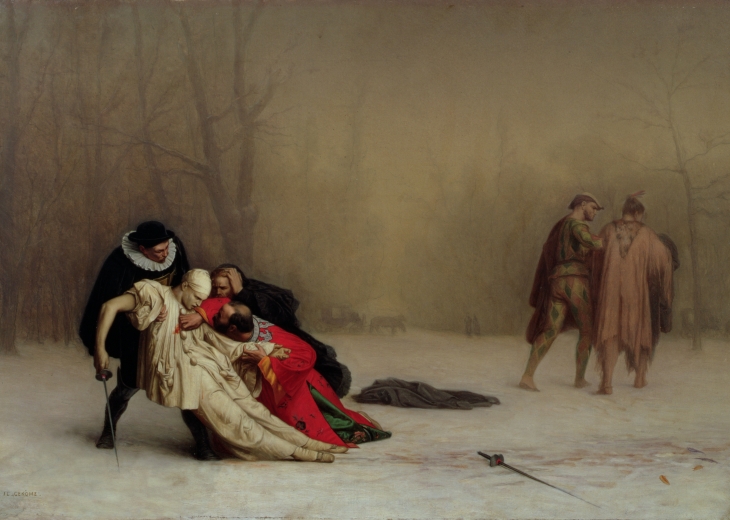
Duel After the Masquerade by Jean-Léon Gérôme, c. 1857 [Walters Art Museum, Baltimore]

And so, to make sure these folks, the great majority of Catholics, don’t leave the Church, thereby not only damaging the religion but endangering their own salvation, the Church loosens the reins on these people. If they don’t believe everything the Church believes, oh well, let’s not make a fuss about it. And if they have incorrigible habits of sin, well, let’s not make them feel uncomfortable by publicly condemning the sins they’re prone to; and let’s tell them that God is forgiving and tolerant; and let’s remind them that all sins can be instantaneously wiped away in the confessional or on a good deathbed. Above all, let’s tell them that, practically speaking, the goal of this life (except for a rare few) is not Heaven but Purgatory; in other words, you don’t have to get an A-plus in sanctity, a C-minus will do just fine.

In his Provincial Letters, Blaise Pascal (a Class 1 Catholic if ever there was one) finds fault with the Jesuits of his day for bending Catholicism so that it will accommodate the un-Christian code of honor that was then typical of upper-class gentlemen. In one of the more hilarious letters, Pascal tells of a Jesuit casuist (some things never change) who figured out a way for a gentleman to participate in a duel while not, technically speaking, violating the Catholic rule that dueling is a mortal sin.

So can it be argued that the “softness” with regard to sex-related sins that we find today among many bishops and priests is just one more example of what has been an all-too-human Catholic practice since at least the fourth century, the practice of – not exactly consenting to – but tolerating the many imperfections of Class 2 Catholics?

No, I don’t think so. When the Jesuits tolerated, say, the morality of 17th century French gentlemen – a morality that included dueling and “gallantry” (as upper-class adultery was euphemistically called) – they were not tolerating a non- or anti-Catholic religion. They were tolerating – however much we may laugh about it – an un-Catholic code of manners and morals, quite a different thing.

But when today’s Jesuits (and other Catholic clerics) are “soft” on sex-related sins, including homosexuality, they are doing much more than making a calculated accommodation to an un-Christian code of manners. They are tolerating a sexual ethic that is part and parcel of an increasingly militant anti-Catholic religion.

What religion is that? Secular humanism, a comprehensive worldview that is tantamount to a (God-less) religion. Dueling in 17th century upper-class Paris was bad, but it was not an affirmation of an anti-Catholic religion. By contrast, abortion and homosexuality in 21st century America truly are affirmations of a growing and decidedly anti-Catholic quasi-religion.

Catholic leaders from the pope on down need to wake up to the nature of that new mortal threat.


David Carlin

David Carlin

David Carlin is professor of sociology and philosophy at the Community College of Rhode Island, and the author of The Decline and Fall of the Catholic Church in America.

Posted in Uncategorized | 2 Comments

TEDESCHI ON WHY HE SIGNED THE FILIALIS CORRECTIO

OnePeterFive
{Abyssum}
Google+PinterestPocket

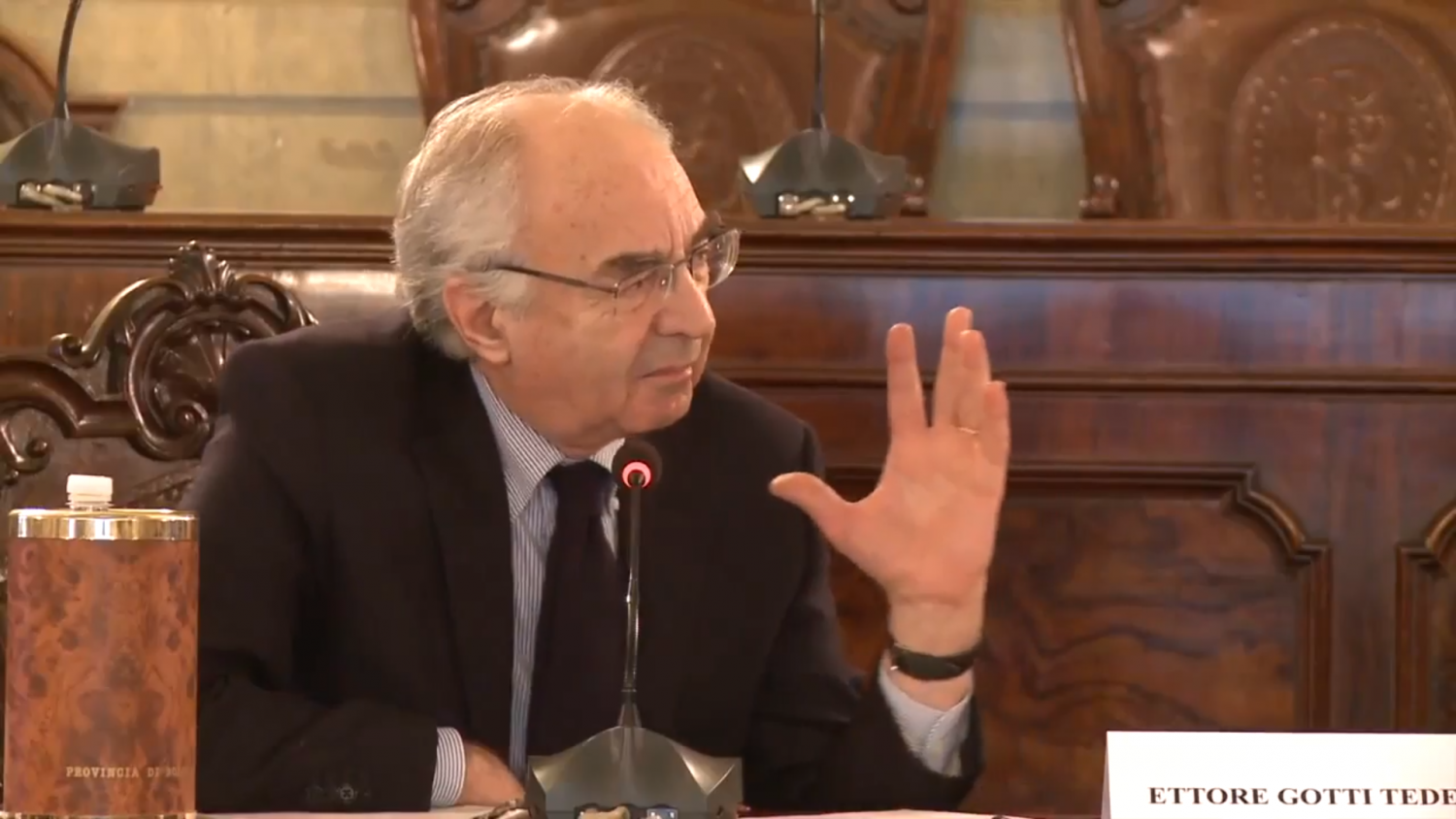
Editor’s note: The following is an interview conducted by Italian journalist Lorenza Formicola with Ettore Gotti Tedeschi. As former head of the Vatican Bank, Tedeschi is one of the better -known signatories of the recently issued filial correction of Pope Francis

Lorenza Formicola: It’s been a few months since the “filial correction” was published, and confusion remains. What is this letter, signed by 62 and delivered in August to Pope Francis?

Ettore Gotti Tedeschi: It simply is the natural outcome of all the dubia. It was submitted to the holy father as a filial and devout plea by laypeople who are faithful both to the pope and to the Magisterium of the Church but who are, at the same time, worried for those souls in need of doctrinal certainties. There are many faithful and priests – who have nothing to do with the caricature that depicts them as sinister, pharisaical traditionalists – who are struggling to face the confusion that comes from equivocal and manifold interpretations. Not everyone possesses the needed capacity of discernment. Not everyone has an adequately formed conscience, and many find themselves advised by confused and confusing priests. These priests are also creative, perhaps, in their anxiety to interpret the gospel and eternal truths in an evolutionary fashion, thinking this is the right way to do it according to the will of the Holy Father.

Formicola: You are one of the most well-known signatories. Why did you want to sign?

Tedeschi: Because my sense of responsibility demanded it. My love for the vicar of Christ demanded it. My conscience of what should be the mission of the Church also demanded it, as well as my witnessing – as a layperson – the applicability to the modern world of the Five Wounds of the Holy Church (by Rosmini) and the perception of the need for strong, clear, and absolute values among people, at all levels, conditions, and age. The understanding of what is happening in the world also demanded it. {Precisely for the same reasons I signed it}

This is an estimation of the matter I had the privilege of learning from and sharing with Cardinal Ratzinger, later to be Benedict XVI – a vision I also shared with other holy men, such as Cardinal Caffarra, for instance, and Cardinal Sarah. I do not let illusory strategies confuse me – neither those founded on a reality superior to ideas nor those about a different conversion policy to be enforced after having attracted the world to Catholicism by opening up a dialogue. I have strong doubts about the possibility of an easy communication with the “world guided by gnosis.” Who is able to do that?

Formicola: For a long time, there has been talk of “heresy.” But on reading the 25-page letter, it doesn’t seem as though anyone is accusing the pope of heresy. Or am I mistaken?

Tedeschi: On page 13, it is possible to read a specific note that declares the purpose of the letter.

If the pope wanted to understand who the real dangerous enemies of the Church are, it would be enough to read through some of the reactions to the letter – reactions written by people who probably did not even read it, and if they read it, they did not want to understand it. Such an attitude speaks volumes on the value of some non-official “interpreters.”

Formicola: The Vatican has still not answered. Rather, in dealing with its own house, it has raised a wall…

Tedeschi: Sometimes non-answers are clear answers. Clearly, someone thinks it is good to have doubts, to foment them, to create and distribute them. Isn’t this the way to prepare the ground for the proposition of new certainties?

Formicola: After a year since the publication of the dubia, Cardinal Burke recently spoke of an “increasing confusion about the ways of interpreting the apostolic exhortation.” From your point of view, why does such a climate of disorder still survive? Even after the pope asked everyone to “speak of it with a great theologian, one of the best today and one of the most mature, Cardinal Schönborn”?

Tedeschi: I can say I share the opinion of Cardinal Burke by direct experience, not by reading about it in newspapers. I can’t say anything about Cardinal Schönborn. I am not able to interpret his thoughts.

Formicola: It almost seems as if the media were looking forward to pillorying you again. Can you explain why your signature has been seen – and still is seen – as an “ironic coincidence”?

Tedeschi: Other things happened after my signature and after the media attack, which focused my name almost as the promoter of the correction. A really good bishop, with whom a conference had already been scheduled for two months, called the meeting off because of inappropriateness; another bishop immediately “discouraged” (and canceled) another conference already scheduled in his dioceses; and a third bishop asked the organizers of a roundtable to postpone it because of my presence. I also received a public correction (which hurt me greatly) by another prelate, who doesn’t know me, who doesn’t know the facts and the circumstances and who didn’t ever care to.

On the other hand, I received multiple expressions of esteem, consensus, and sympathy, not only in the Catholic community, but also in a more secular environment (and this is really remarkable). There are even people worried about the collapse of the Catholic education built on the values of the gospel, which they benefited from, and they’re afraid it may now disappear. …

Never forget that the values of Christian traditions aren’t lived, but they are greatly appreciated if lived by the people around us. Always remember that Voltaire claimed he wanted his servant, his doctor, and his wife to be Catholic to avoid being robbed, killed, and cheated on. And still he despised the Catholic religion.

Formicola: Can a son who asks his father for explanations expect the support of his siblings? Or does he deserve disdain?

Tedeschi: It turned out all the worse for Abel…

Formicola: A year ago, you wrote, “After meditation on the exhortation of Pope Francis, ‘Amoris Laetitia,’ I wonder if this document is not founded on the certainty that the Christian civilization has actually finished collapsing. If this is true, it explains why the exhortation indirectly suggests that the moral laws and the sacraments should be adapted to the practical reality according to different cultures and not according to authoritative ideals to which we were used.” Do you think this is still true?

Tedeschi: I don’t believe this is still true – I believe that this “must” be true. Because now all of this must be imposed, since it is not accepted by those to whom it was addressed.

All through this year, I perceived more of a refusal of doctrinal relativism rather than the wish to opening up to modernity. People with a sound conscience understood the greatness of the risk. All sacraments end up collapsing if we start questioning the sacrament of matrimony (not by denying it, but by relativizing it) and, as a consequence, that of penance and most of all that of the Eucharist.

Here there is a clear contradiction between Lumen Fidei and Amoris Laetitia, and I will confide it to you. Pope Benedict ended Caritas in Veritate essentially explaining that to solve the world’s problems, it is the hearts of men that need to be changed (not the instruments); in Lumen Fidei (signed by Pope Francis), it is said that changing the heart of men is a duty of the Church, which has three instruments to succeed: prayer, the Magisterium, and the sacraments. In order to see if the Church is attending to its mission, it is enough to see if it is accomplishing these three actions and how it is doing it. Most of all, it is enough to see if the Church is reinforcing or weakening the absolute value of the sacraments wanted by Christ himself.

Formicola: Professor Josef Seifert recently claimed that Amoris Laetitia really is a “theological atomic bomb that threatens to tear down the whole moral edifice of the Ten Commandments and of Catholic moral teaching.” Would you agree with this statement?

Tedeschi: I answer saying that it “could be,” as well as that it could undermine three sacraments, and all of them as a consequence. We hope, however, for an intervention by Pope Francis to prevent all of this – maybe by answering, even indirectly, the dubia.

Posted in Uncategorized | 2 Comments

Looking for a boarding school for your son, grandson or nephew? Look at Saint Martin Academy.

Christ’s masculinity: A model for educating boys

The controversial modernist poet Ezra Pound had a talent (believe it or not) for recovering cultural artifacts in his translations and adaptations and infusing them with a newly pressurized language. Think of the “River Merchant’s Wife” or “The Seafarer.” His own poetry often seeks to reanimate stories and personalities found in history by using the full rhetorical palette that poetry provides.

The “Ballad of the Goodly Fere,” written in a Scots dialect where a “fere” is a comrade, is an example of this recovery effort. Perhaps strangely for the irreligious Pound, this particular poem is concerned with recovering Christ’s masculinity and intervenes with lines like “No capon priest was the Goodly Fere / But a man o’ men was he,” and “A master of men was the Goodly Fere, / A mate of the wind and sea.”

Pound noted after he wrote the “Fere” that he was provoked to write by “a certain sort of cheap irreverence” that feminized one whom Pound thought of as a great and particularly masculine man. Pound, of course, preferred irreverence of the expensive sort. Nevertheless, the “Ballad of the Goodly Fere” is a striking and compelling picture of Christ’s humanity—an attempt to recover His masculinity from a culture gone anemic with enlightenment and that preferred a soft, androgynous savior to one who flips a few tables now and again.

It seems that Pound’s effort at recovery is now in need of recovery. If Pound’s 1909 audience needed correction with regard to Christ’s masculinity, what about us? We can be grateful to higher education for pioneering the initiative to uproot toxic masculinity, grateful because at least the word masculine, for which we had lost any use, is now re-entering the lexicon.

In a secular culture that sees masculinity as simply a threatening binary with some pretty serious baggage, what chance do men have of finding an exemplar for their masculine natures? The Christian point of view is not immune from these effeminizing tendencies as we can see from the proliferation of grotesquely soft and fabulously groomed caricatures of Our Lord. Where in them can we find the man that showed “how a brave man dies on the tree” or who drove “a hundred men / Wi’ a bundle o’ cords swung free?”

While the Pound’s “Ballad” hardly offers a complete and orthodox Christology, it does illuminate an aspect of the person of Christ that badly needs illumination in Catholic education today. Not every school suffers from this malady, but all too often we neglect boyhood with its perils and promise for the sake of a hyper-controlled domestic (or industrial) environment. We medicate boys so as to keep them indoors on a strict program of physical enervation and virtual reality in the form of television, video games, and online “schooling.”

The culturally acceptable outlet of “sports” is too often an arena for simultaneously exalting the ego while protecting it from any real consequences, and simply perpetuates a kind of infancy that promises to culminate in petulance of NFL caliber. True to the depictions of Christ on which they were reared, teachers often encourage a neutered expression of boyhood—you know, the kind of boyhood Christ had as a preternatural goody-two-shoes. Needless to say, it is not just a healthy expression of a boy’s masculine nature that is at risk, but his ability to know, respect, and love Our Lord at all.

The program at St. Martin’s Academy, a boarding high school for boys opening in 2018, seeks to remedy this devaluation of the masculine in young men’s education. Situated on a 200-acre sustainable farm in southeast Kansas, St. Martin’s will immerse its students in an environment that teaches through every aspect and action of each day. The curriculum is squarely within the liberal arts tradition, emphasizing contact with primary sources and classic works, but with the addition of a robust work program in which every student participates. “No mouse of the scrolls was the Goodly Fere!” {I suspect that the program at Saint Martin’s Academy is based on the program John Senior developed at the University at Kansas.  The program was a spectacular success, so much so that the liberal/progressives in power at the University shut it down.}

The school’s inspiration is Benedictine, an order whose discipline of ora et labora (work and prayer) has for over a thousand years transformed men’s souls into fertile soil for Our Lord’s harvest. The farm work, daily chores, and robust outdoor programs will serve as a proving ground for the intellectual and moral lives of the students. As a screen-free campus, we will remove the boys from the distancing layer and distraction of virtual reality, and through the integration of farm labor and vigorous physical exercise, bring them into close and attentive contact with nature—mankind’s first teacher.

As a boarding school, the students will benefit from the supervision of strong masculine exemplars in the faculty and staff and live in an environment that provides for the unscripted social experience and camaraderie that Blessed John Henry Newman says is essential to a young man’s maturation and education. The rigorous academics at St. Martin’s will benefit from the sustained attention that the residential environment provides, the grounding in nature, the work ethic inculcated through the labor program, and an experienced and passionate faculty.

One could summarize this model of education as an effort to cultivate authentic Christian masculinity rather than ashamed pseudo-masculinity. The hegemony of the effete was old to Ezra Pound a century ago; its senescence in our time is downright macabre. It is time for a renewed devotion to Christ in his masculinity, and time for our efforts at educating boys to acknowledge that their exemplar was, and is, unapologetically masculine.

If they think they ha’ slain our Goodly Fere
They are fools eternally.
I ha’ seen him eat o’ the honey-comb
Sin’ they nailed him to the tree.

Posted in Uncategorized | 1 Comment

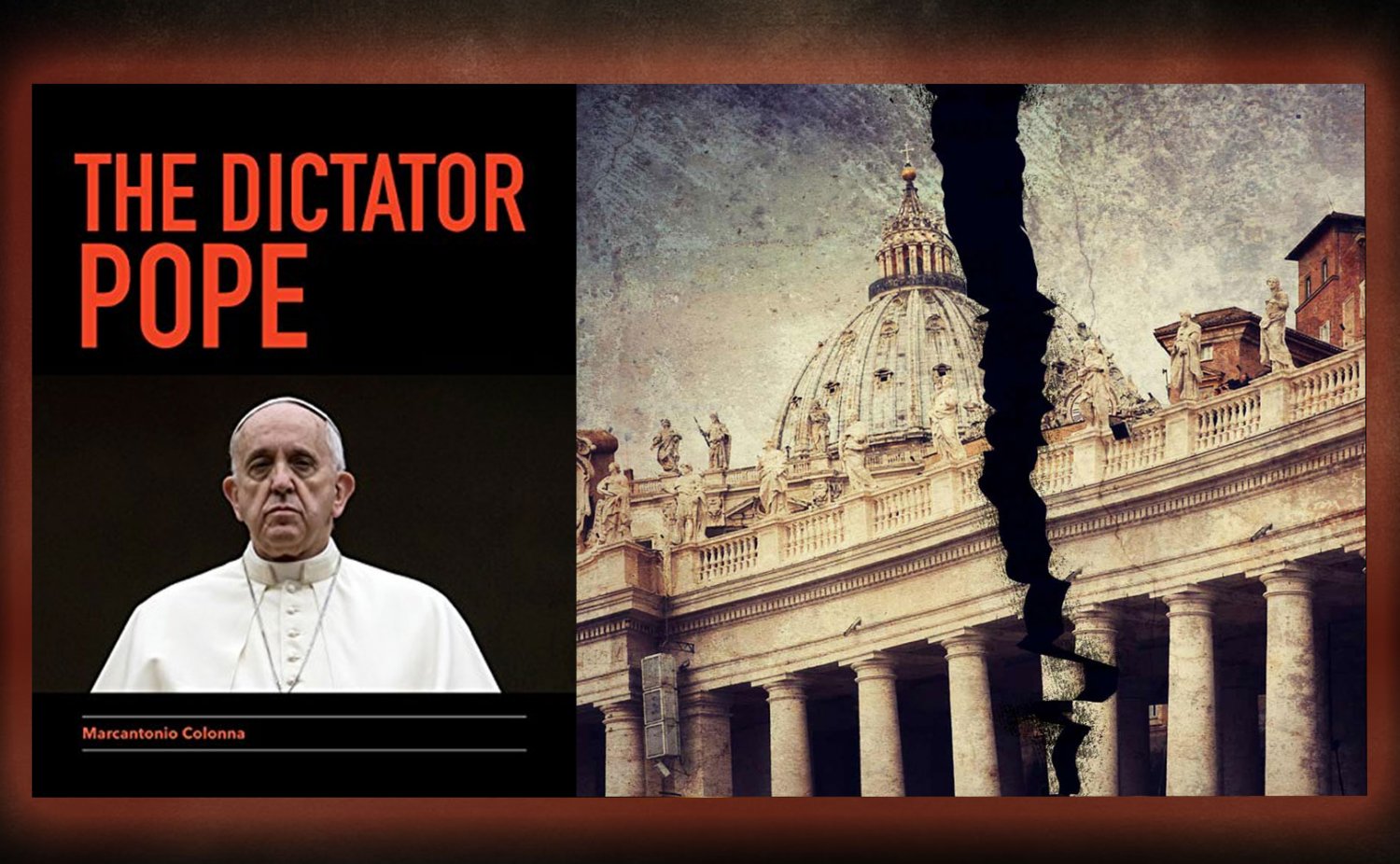
“THE DICTATOR POPE”, A MUST-READ BOOK

OnePeterFive
{Abyssum}

!!!

Google+Pocket

A remarkable new book about the Francis papacy is set to be released in English this coming Monday, December 4th, after an Italian debut earlier this month that is rumored to have made quite a splash in Rome. Entitled, The Dictator Pope, it is described on the Amazon pre-order page as “The inside story of the most tyrannical and unprincipled papacy of modern times.”

The book promises a look “behind the mask” of Francis, the alleged “genial man of the people,” revealing how he “consolidated his position as a dictator who rules by fear and has allied himself with the most corrupt elements in the Vatican to prevent and reverse the reforms that were expected of him.”

OnePeterFive has obtained an advance copy of the English text, and I am still working my way through it. Although most of its contents will be at least cursorily familiar to those who have followed this unusual pontificate, it treats in detail many of the most important topics we have covered in these pages, providing the additional benefit of collecting them all in one place.

The author of the work is listed as Marcantonio Colonna — a transparently clever pen name laden with meaning for the Catholic history buff; the historical Colonna was an Italian nobleman who served as admiral of the papal fleet at the Battle of Lepanto. His author bio tells us he is an Oxford graduate with extensive experience in historical research who has been living in Rome since the beginning of the Francis pontificate, and whose contact with Vatican insiders — including Cardinals and other important figures — helped piece together this particular puzzle. The level of potential controversy associated with the book has seemingly led some journalists in Rome to be wary of broaching the book’s existence publicly (though it is said to be very much a topic of private conversation), whether for fear of retribution — the Vatican has recently been known to exclude or mistreat journalists it suspects of hostility — or for some other reason, remains unclear. Notable exceptions to this conspicuous silence include the stalwart Marco Tosatti — who has already begun unpacking the text at his website, Stilum Curae — and Professor Roberto de Mattei, who writes that the book confirms Cardinal Müller’s recent remarks that there is a “magic circle” around the pope which “prevents an open and balanced debate on the doctrinal problems raised” by objections like the dubia and Filial Correction, and that there is also “a climate of espionage and delusion” in Francis’ Vatican.

Some sources have even told me that the Vatican, incensed by the book’s claims, is so ardently pursuing information about the author’s true identity that they’ve been seeking out and badgering anyone they think might have knowledge of the matter. The Italian version of the book’s website has already gone down since its launch. The reason, as one particularly credible rumor has it, is that its disappearance was a result of the harassment of its designer, even though that person had nothing to do with the book other than having been hired to put it online.

If these sound like thuggish tactics, the book wastes no time in confirming that this pope — and those who support him — are not at all above such things. Colonna introduces his text by way of an ominous portrait of Francis himself, describing a “miraculous change that has taken over” Bergoglio since his election — a change that Catholics of his native Buenos Aires noticed immediately:

Their dour, unsmiling archbishop was turned overnight into the smiling, jolly Pope Francis, the idol of the people with whom he so fully identifies. If you speak to anyone working in the Vatican, they will tell you about the miracle in reverse. When the publicity cameras are off him, Pope Francis turns into a different figure: arrogant, dismissive of people, prodigal of bad language and notorious for furious outbursts of temper which are known to everyone from the cardinals to the chauffeurs.

Colonna writes, too, of the “buyer’s remorse” that some of the cardinals who elected Bergoglio are experiencing as his pontificate approaches its fifth anniversary: “Francis is showing,” writes Colonna, “that he is not the democratic, liberal ruler that the cardinals thought they were electing in 2103, but a papal tyrant the like of whom has not been seen for many centuries.”

Colonna then transitions to an opening chapter exposing the work of the so-called St. Gallen “Mafia” — the group of cardinals who had been conspiring for decades to see to it that a pope of their liking — a pope like Cardinal Jorge Mario Bergoglio was capable of becoming — would be elected. Formed in 1996 (with precursor meetings between progressive European prelates giving initial shape to the group as early as the 1980s) in St. Gallen, Switzerland, the St. Gallen Mafia was originally headed up by the infamous late archbishop of Milan, Cardinal Carlo Maria Martini. The group roster was a rogue’s gallery of heterodox prelates with a list of ecclesiastical accomplishments that reads more like a rap sheet than a curriculum vitae. (In the case of Godfried Danneels, implicated in some way in about 50 of 475 dossiers on clerical sexual abuse allegations that mysteriously disappeared after evidence seized by Belgian police was inexplicably declared inadmissible in court, this comparison transcends analogy.)

The names of some of the most prominent members of the group — many of which would have been unknown to even relatively well-informed Catholics just a decade ago — have become uncomfortably familiar in recent years: Cardinals Martini, Danneels, Kasper, Lehman, and (Cormac) Murphy O’Connor have all risen in profile considerably since their protege was elevated to the Petrine throne. After a controversial career, Walter Kasper had already begun fading into obscurity before he was unexpectedly praised in the new pope’s first Angelus address on March 17, 2013. Francis spoke admiringly of Kasper’s book on the topic of mercy — a theme that would become a defining touchstone of his pontificate. When Kasper was subsequently tapped to present the Keynote at the February 14, 2014 consistory of cardinals, the advancement of his proposal to create a path for Communion for the divorced and remarried thrust him further into the spotlight. The so-called “Kaspoer proposal” launched expectations for the two synods that would follow on marriage and the family and provided the substrate for the post-synodal apostolic exhortation, Amoris Laetitia, around which there has been a theological and philosophical debate the likes of which has not seen in the living memory of the Church. For his part, Danneels, who retired his position as Archbishop of Brussels under “a cloud of scandal” in 2010, even went so far as to declare that the 2013 conclave result represented for him “a personal resurrection experience.”

And what was the goal of the St. Gallen group?

Originally, their agenda was to bring about a “much more modern” Church. That goal finally crystalized around opposition to the anticipated election of Cardinal Joseph Ratzinger to the papacy — a battle in which they were narrowly defeated during the 2005 conclave, when, according to an undisclosed source within the curia, the penultimate ballot showed a count of 40 votes for Bergoglio and 72 for Ratzinger. Colonna cites German Catholic journalist Paul Badde in saying that it was the late Cardinal Joachim Meisner — later one of the four “dubia” cardinals — who “passionately fought” the Gallen Mafia in favor of the election of Ratzinger. After this loss, the Gallen Mafia officially disbanded. But although Cardinal Martini died in 2012, they staged a comeback — and eventually won the day — on Wednesday, March 13, 2013. For it was on that day that Jorge Mario Bergoglio stepped out onto the loggia of St. Peter’s Basilica, victorious, as Pope Francis the First. Those paying attention would take note that one Cardinal Godfried Danneels of Belgium stood triumphantly by his side.

Colonna points out that indications existed — particularly through certain press interviews with Cardinal Murphy O’Connor — the possibility of some pre-meditated collusion between Bergoglio and the St. Gallen conspirators who worked to elect him. Colonna writes:

In late 2013, the archbishop of Westminster gave an interview to the Catholic Herald in which he admitted not only to campaigning at the Conclave, but to gaining Bergoglio’s assent to be their man.

The article by Miguel Cullen in the September 12, 2013 edition of the Herald says, “The cardinal also disclosed that he had spoken to the future Pope as they left the Missa pro Eligendo Romano Pontifice, the final Mass before the conclave began on March 12.”

Murphy O’Connor said, “We talked a little bit. I told him he had my prayers and said, in Italian: ‘Be careful.’ I was hinting, and he realised and said: “Si – capisco” – yes, I understand. He was calm. He was aware that he was probably going to be a candidate going in. Did I know he was going to be Pope? No. There were other good candidates. But I knew he would be one of the leading ones.’” The admonition to Bergoglio to “be careful” certainly seems to imply that Murphy O’Connor – and Bergoglio – knew he was at least bending the rules.

This is supported again in the same article in the Herald where Murphy O’Connor is quoted saying, “All the cardinals had a meeting with him in the Hall of Benedictions, two days after his election. We all went up one by one. He greeted me very warmly. He said something like: ‘It’s your fault. What have you done to me?’”

In an interview with the Independent after the Conclave, Murphy O’Connor also hinted there was a particular programme laid before the 76 year-old Argentinian, that he was expected to accomplish in about four years. The English cardinal told journalist[3] and author Paul Vallely, “Four years of Bergoglio would be enough to change things.” A fair enough comment after the fact, but this was the same phrase recorded by Andrea Tornielli in La Stampa in an article dated March 2, 2013, eleven days before Bergoglio’s election: “Four years of Bergoglio would be enough to change things,’ whispers a cardinal and long-time friend of the archbishop of Buenos Aires.”

Four years has certainly been enough.

From this analysis of Francis’ inauspicious beginnings as the handpicked pope of the most progressive forces in the Church, Colonna takes us on a brief but informative tour of his life and background. He mentions Bergoglio’s strained relationship with his parents — his father a “struggling accountant” and mother a temporary invalid — noting that he rarely speaks of them. He examines Bergoglio’s precipitous rise through the Jesuits in Argentina, despite opposition from his superiors at certain critical points along the way. Highlighted too, was the assessment of the unusually young provincial by the Jesuit Superior General —  offered when Bergoglio applied for a dispensation from the Jesuit rule forbidding him from becoming a bishop — allegedly describing him in no uncertain terms as unsuitable for the role. I say allegedly, because the text of the evaluation has never been made public. Writes Colonna:

Father Kolvenbach accused Bergoglio of a series of defects, ranging from habitual use of vulgar language to deviousness, disobedience concealed under a mask of humility, and lack of psychological balance; with a view to his suitability as a future bishop, the report pointed out that he had been a divisive figure as Provincial of his own order. It is not surprising that, on being elected Pope, Francis made efforts to get his hands on the existing copies of the document, and the original filed in the official Jesuit archives in Rome has disappeared.

Despite these setbacks, Bergoglio was seen, at the time, as a champion of Catholic conservatism in the mode of John Paul II by Cardinal Quarracino, his predecessor in the archbishopric of Buenos Aires and the man who ultimately ignored the warnings and raised him to the episcopacy. The perception of Bergoglio’s conservatism appears to have stemmed largely from his opposition to the Marxist liberation theology that had become so prevalent in the region — an opposition which, as Colonna explains, was not so much because of ideological disagreement as class warfare:

Bergoglio himself was a man of the people, and in Latin America “liberation theology” was a movement of intellectuals from the higher classes, the counterpart of the radical chic that led the bourgeoisie in Europe to worship Sartre and Marcuse. With such attitudes Bergoglio had no sympathy; although he had not yet identified himself explicitly with the “theology of the people”, which arose in direct competition with the Marxist school, his instinct made him follow the populist line of Peronism, which (whatever the cynicism of its creator) was more in touch with the genuine working class and lower middle class. Thus, Father Bergoglio backed the apostolate to the slum districts, but he did not want their inhabitants recruited as left-wing guerillas, as some of his priests were trying to do.

His Peronism helps to make clear, in another illuminating moment, Francis’s infuriating habit of saying diametrically opposing things from one day to the next:

The story is told that Perón, in his days of glory, once proposed to induct a nephew in the mysteries of politics. He first brought the young man with him when he received a deputation of communists; after hearing their views, he told them, “You’re quite right.” The next day he received a deputation of fascists and replied again to their arguments, “You’re quite right.” Then he asked his nephew what he thought and the young man said, “You’ve spoken with two groups with diametrically opposite opinions and you told them both that you agreed with them. This is completely unacceptable.” Perón replied, “You’re quite right too.” An anecdote like this is an illustration of why no-one can be expected to assess Pope Francis unless he understands the tradition of Argentinian politics, a phenomenon outside the rest of the world’s experience; the Church has been taken by surprise by Francis because it has not had the key to him: he is Juan Perón in ecclesiastical translation. Those who seek to interpret him otherwise are missing the only relevant criterion.

The book is packed with such fascinating insights into the phenomena of the Francis papacy, in part by viewing the present through the lens of his past. From indications that his notorious simplicity was simply a means of shedding any “ballast” that might impede his pursuit of power to his ostentatious humility (often with cameras conveniently waiting to capture the moment) to his masterful manipulation of an over-eager media into displaying the image he wishes to portray, the layers of the Argentinian pope are peeled back and examined, offering a deeper understanding of the man himself.

Colonna does not spend much time on the question of the validity of Francis’ papal election, but he does raise questions about the convenient (for the St. Gallen group) timing of Benedict’s abdication and considerations made both by papal biographer Austen Ivereigh and Vatican journalist Antonio Socci on the politicking and the questionable canonical validity, respectively, in the 2013 conclave. “Whether one chooses to uphold Socci’s view or not,” Colonna writes, “there is something rather appropriate in the fact that the political heir of Juan Perón should have been raised to the head of the Catholic Church by what was arguably an invalid vote.”

The book does not merely content itself with the pre-pontificate history of Bergoglio. Under the microscope, too, are the critical agenda items of the ongoing papacy, foremost among them, those promises which have never materialized. From reform of the curia to a supposed “zero tolerance” policy on clerical sexual abusers to Vatican bank and financial reform, some of the major initiatives of the Francis papacy have failed to reach fruition, been abandoned, or have received only lip service.

Later chapters deal, among other important topics, with the heavily-manipulated synods on the family, the Vatican response to orthodox resistance, the saga surrounding the dubia, the gutting and reinvention of the Pontifical Academy for Life, the destruction of the Franciscan Friars of the Immaculate, the Vatican-supported coup within the Knights of Malta, and the persecution of those ecclesiastics who fail to toe the line for the papal agenda — along with an examination of the KGB-style tactics deployed by “Kremlin Santa Marta”. (On a personal note, I was both pleased and honored to discover a chapter subheading entitled “The Dictatorship of Mercy,” with a direct reference to the article in which I coined the term.)

There is a great deal of material in this book for all Catholics, but it will be of particular interest to readers of this website, who have watched many of these developments unfold in real time. There are also new things to learn from the text, particularly in its examination of the pope’s Argentinian history. If you or someone you know is interested in getting up to speed quickly on where things are with this papacy — and why it is so singularly controversial — this book appears to be an excellent starting point to cover much of the necessary ground. At 141 pages, it provides a sufficient amount of depth without overwhelming the reader with too much information, and the language and presentation make it an easy, fascinating read.

I believe The Dictator Pope will prove to be a critical tool in understanding and documenting the present papacy, and so, despite already having a copy of the text, I’ve also pre-ordered the book, both in support of the author and to help bolster its status via the one metric that seems to garner the most attention: sales rank. I encourage you to do the same. Already in Italy, the e-book is an Amazon best seller, having attained the rank of #60 in that country and hovering at #1 or #2 in books in its category. It would be fantastic to thrust it to the top of the charts in the English-speaking world as well.

That would send quite a message.

Posted in Uncategorized | 2 Comments

LET THEM EAT CAKE THEY HAVE THEMSELVES BAKED BUT DO NOT FORCE ME TO HELP THEM BAKE IT

The Christian Baker’s Unanswered Legal Argument: Why the Strongest Objections Fail
by Sherif Girgis
within Conscience Protection, Constitutional Law, Religion and the Public Square
Nov 29, 2017 08:00 pm http://www.thepublicdiscourse.com/2017/11/20581/
The Supreme Court is about to decide whether a baker has a First Amendment right not to be compelled to design and create cakes celebrating same-sex weddings. The baker’s best legal argument is simple, and it survives the best objections filed by the ACLU and Progressive scholars.
Share this article: Facebook Twitter LinkedIn
Next week, the Supreme Court will hear one of the most important free speech cases in years, a case of special concern to libertarians and conservatives, small business-owners, artisans, and religious believers. Masterpiece Cakeshop v. Colorado Civil Rights Commission involves Jack Phillips, a baker who claims a First Amendment right not to be compelled to design and create custom wedding cakes for same-sex weddings. Many legal commentators think the case is either a very close call or a certain defeat for Phillips.

In fact, Phillips’s case is very strong. It is based on freedom-of-speech doctrines favored by conservatives and liberals alike. One argument for Phillips in particular survives the best objections leveled in briefs filed by the Colorado Civil Rights Commission, by the ACLU (on behalf of the couple who sought the cake), and by several constitutional law scholars.

That argument rests on the widely acknowledged principle that freedom of speech has to include the freedom not to speak. You aren’t free to express your convictions authentically if the state can make you affirm its own orthodoxies. Thus, for more than seventy years, in cases widely seen as more American than apple pie, the Supreme Court has said government can’t force you to say, do, or make something that carries a message you reject. Applying that principle, it has held that the government can’t force Jehovah’s Witnesses to salute the flag. It can’t force newspapers to carry columns by politicians criticized in their pages. It can’t force drivers to carry license plates with a state-imposed (though utterly banal) slogan (“Live Free or Die”). It can’t force companies to include third-party messages in their billing envelopes. Political majorities are entitled to enact their beliefs into law, but not to force dissenting minorities to affirm those or anyone else’s beliefs in word or deed. That would involve “compelled speech,” which is generally unconstitutional.

Phillips argues that the Colorado Civil Rights Commission has compelled his artistic expression (which counts as “speech” under our law) by forcing him to create same-sex wedding cakes if he wants to stay in the wedding business. To be clear, Phillips serves all patrons, whatever their religion or sexual orientation. But he won’t design cakes celebrating themes that go against his religious beliefs as an evangelical Christian. So he takes a hit to his business to avoid designing cakes for Halloween parties, which are big sellers, as well as lewd bachelor parties, divorce parties, and much else. And he won’t design cakes that celebrate same-sex weddings since he believes that only a man and woman can form a true marriage. Finding this last practice illegal, the Colorado Civil Rights Commission ordered Phillips to make same-sex wedding cakes if he wants to make any at all. The Supreme Court’s decision on whether this order violated his rights may decide the fate of other bakers—and florists and photographers—who’ve faced legal penalties (as crippling as $135,000 and risk of jail) for refusing to lend their creative talents to designing artistic products celebrating same-sex weddings.

The Best Argument for Jack Phillips, in Three Steps

The Supreme Court’s “compelled speech” doctrine says that it’s unconstitutional for the government to force you to say, do, or create something expressive (whether verbal or not) that carries a message you reject—unless coercing you in this way serves a compelling public interest.

Forcing Phillips to custom-design and create same-sex wedding cakes is compelled speech: it forces him to create an expressive (artistic) product carrying a message he rejects. It forces certain content onto his artistic work, in a kind of political censorship of art. And it does so without serving the type of interest that our constitutional law would consider a legitimate (much less a compelling) justification for interfering with anyone’s free speech. So Colorado’s decision violates Phillips’s First Amendment rights.

This argument applies three premises drawn from earlier cases:

First, under clear Supreme Court precedent, the free speech clause applies to artistic creations (“artistic speech”) every bit as much as books, speeches, and other verbal forms of expression.
Custom-designed wedding cakes fall under the very broad standard by which courts decide what counts as “artistic speech.”
Second, as the Court has also held, the message conveyed by a symbolic item depends on its context.
Wedding cakes’ context and purpose give them a clear meaning: they express the idea that the couple’s bond should be celebrated as a marriage.
Third, the Court has held that counteracting offensive, hurtful, or demeaning messages is never a compelling (or even a legitimate) goal for governmental interference with free speech or expression.
Yet the only net benefit of coercing Phillips is to suppress what many call dignitary harm: the distress of being confronted with ideas deemed offensive, hurtful, or demeaning. After all, there are no material harms at stake; and under Supreme Court precedent, it won’t suffice for Colorado to cite “antidiscrimination” as a generic justification here.
The first two points prove that by forcing Phillips to bake a same-sex wedding cake, Colorado forces him to (1) create First Amendment expression (2) carrying a message he rejects. The third proves that this coercion serves no compelling governmental interest and is therefore unconstitutional.

I’ll defend these three steps below, each under its own heading. Along the way, I’ll answer the best ten counterarguments leveled by Colorado, by the ACLU, and by scholars who filed amicus briefs against Phillips. Let me highlight the three most popular ones, which I address one-by-one in the other three sections below. One contends that the “speech” here is that of the same-sex couple, not Jack Phillips, so he has no valid complaint. Another holds that we shouldn’t honor compelled-speech claims arising in commerce, period. And according to a third—which has emerged as the most powerful objection—the Commission hasn’t compelled Phillips’s speech because it hasn’t tried to control the design or content of his cakes, but only insisted that he sell cakes of the same design and content to anyone who asks. I’ll show that this argument rests on a subtle but fatal flaw. So feel free to jump to the section that addresses your favorite objection, as this essay is long.

Step One: The First Amendment Covers Phillips’ Artistic Product

Let’s dispense with the weakest objection first. Many say that a win for Phillips would send us down a slippery slope, since almost anything can be expressive. If a vendor has to cater salad for a wedding reception—or even rent out folding chairs for the big day—doesn’t that force the vendor to support the couple’s marriage in some sense? For that matter, don’t we force sexist employers to support the idea of women working outside the home when we bar them from discriminating against women in hiring? Didn’t we force the racist owners of Ollie’s Barbecue to support integration when we made them serve African Americans in their restaurant? “If we exempt Phillips, won’t we have to exempt all these people from antidiscrimination law?” ask his critics.

But the best argument for Phillips is not that forcing people to sell a product for an event by itself compels them to endorse the event; it’s that forcing them to create speech celebrating the event does. And under longstanding precedent, First Amendment “speech” includes artistic creations (“artistic speech”) like paintings, right alongside books and sermons and other items involving words. So unlike folding chairs, and unlike restaurant dining service, custom wedding cakes are full-fledged speech under the First Amendment—if they’re artistic.

And the Court’s standard for “artistic speech” is broad. It looks for anything so much as an “attempt at serious art.” Under this standard, courts have included pictures, films, paintings, drawings, engravings, sculptures, tattoos, and even custom-painted clothing. Indeed, the Supreme Court has assured us that artistic speech needn’t carry a “succinctly articulable” or “particularized” message; as examples of protected art with amorphous content, the Court has cited the atonal instrumental music of Arnold Schoenberg, the abstract paintings of Jackson Pollock, and the gibberish verse of Lewis Carroll’s “Jabberwocky.”

Under this liberal standard, custom-designed wedding cakes should surely count as artistic creations, and thus as First Amendment “speech.” To make them, after all, Phillips (1) draws on his artistic talents and skills to (2) choose from an endless array of shapes, colors, designs, and decorations, in producing something that will then (3) be judged mainly for its aesthetic qualities. The creative nature, complexity and range of possible designs, and overwhelmingly aesthetic purpose all explain how these cakes can reflect their creators’ artistic identity and sensibility, according to Phillips and other wedding-cake designers. Protecting that expressive autonomy is the point of First Amendment protection for art. So the three features just mentioned are surely enough to show that custom wedding cakes are just as artistic as Lewis Carroll’s Jabberwocky verse. Would anyone doubt this point, if the result of Phillips’s design and handiwork were a sculpture of just the same shape, color, and design as the wedding cakes he actually makes? Why should it matter that Phillips molds batter, not plaster, or that he colors and decorates with icing, not acrylic paint?

Legal scholars Eugene Volokh and Dale Carpenter argue that unlike sculptures or paintings, wedding cakes are primarily “utilitarian”: they’re made to be eaten! But that is surely secondary. Couples don’t spend hundreds or thousands of dollars on wedding cakes out of fear that their guests might still go hungry after the salmon or filet. Nor do newlyweds make a big show of feeding the cake to each other in order to model what guests should do when their own slices come around. No, the overwhelmingly dominant purpose of having wedding cakes is to make them integral to the celebration of a new marriage—first as the centerpiece of that celebration, and then as part of its programming.

Wedding cakes in this respect are like central props in a play. And we wouldn’t let lawmakers force dissident artists to design props for use in plays promoting the state’s favored messages.

Professors Volokh and Carpenter also argue that wedding cakes shouldn’t get First Amendment coverage because they haven’t been covered in earlier cases. But that’s because the question has never been forced; even meddlesome city councils and state legislatures have never before tried to regulate wedding décor. So the novelty of wedding-related claims shouldn’t prevent us from treating them as we would claims by traditionally protected artisans like sculptors.

To be clear, it can be good, not meddlesome, to pass laws guaranteeing people access to key goods and services. But it is meddlesome to use those laws to regulate artistic-expressive content when no couple is at risk of losing access to wedding cakes, flowers, or photographs. That is anti-free speech through and through; it takes aim at the (artistic) expression of ideas that offend the majority.

Step Two: Its Purpose and Context Impose on Each Wedding Cake a Message Specific to That Wedding

It’s crucial to see that this compelled-speech argument doesn’t rely simply on the idea that wedding cakes count as art. That’s because forcing you to make an artistic product doesn’t always force you to create something expressing a message you reject, which is all the compelled-speech doctrine forbids. For example, photography is art—and hence First Amendment “speech”—but this doesn’t prove that we violate your freedom from compelled speech by forcing you to do photo shoots for Latinos if you do them for whites.

But that example is different from this case (contra Colorado’s brief). It’s one thing to say “create art for gay patrons if you do for straight patrons”; it’s quite another to say “create art for same-sex weddings if you do for opposite-sex weddings.” Phillips has always followed the first rule (about gay and straight patrons), which doesn’t yet force any particular content onto his artistic work. But the rule focused on weddings does. That’s because wedding cakes aren’t simply artistic; they’re celebratory. In particular, they’re art that carries a certain message: that this relationship is a new marriage, to be celebrated as such. And that is why forcing people to create them raises compelled-speech concerns. Against this, Colorado offers two objections.

First, the state suggests that this argument for Phillips would license too much; for example, it would allow racists to refuse to serve black people birthday cakes, since those too are celebratory. But compelled-speech claims are about not having to make something that carries expressive content you reject. Now it’s certainly hard to imagine someone having a sincere moral objection to celebrating a person’s living to see another year, period. So to have a compelled-speech claim against making birthday cakes, you’d have to believe—and care—that it wasn’t truly the person’s birthday, or perhaps that celebrating birthdays was wrong (e.g., pagan and idolatrous).

Second, Colorado also says that wedding cakes convey no message unless they have words on top. And here the couple hadn’t yet told Phillips whether they wanted words on the cake. So Phillips should lose.

But we’ve already seen that wedding cakes are expressive, since they’re artistic. So they can carry expressive content. And it isn’t only letters or symbols that give content to an expressive item: so does context. As the Supreme Court observed in one case, “The context in which a symbol is used for purposes of expression is important, for the context may give meaning to the symbol.” Applying this principle, the Court found that the display of an upside-down flag with an attached peace sign carried an anti-war message because of its timing. Draped at a time of escalating international conflict, it conveyed opposition to military action in Cambodia. Now if the current events that overlap in time with an expressive item can specify its meaning, so can the once-in-a-lifetime party for which an expressive item is explicitly and exclusively designed—especially when that party’s sole and unmistakable purpose is to celebrate a proposition: “This couple just got married!” With wedding cakes, by their nature and range of designs, the medium is part of the message.

If you have any doubt that a cake designed for a wedding reception signifies something (“hooray for this new marriage!”) even before words are inscribed, try imagining one with words expressing skepticism about whether the happy couple had formed a true marriage or whether this was something to celebrate. Or imagine a cake with colors and shapes that were always associated with sadness and doom. These suggestions are absurd. They show that wedding cakes, by their inherent purpose and range of imaginable designs, are understood by everyone to signify this much at least: “Hooray for this new marriage!” And I do mean everyone. If you asked 100 people whether wedding cakes are celebratory of the marriage they’re used for, 100 would say yes (unless you mentioned that you were asking for a friend named Jack Phillips).

Is Commerce Different?

Some would say that Phillips should have no right against compelled speech in the commercial context—that is, when he’s being paid for the compelled expression. But that has never been our law. Indeed, in a previous case in which the Supreme Court struck down governmental action that had interfered with an entity’s free expression (on LGBT-antidiscrimination grounds, as in this case), the Court reaffirmed that a speaker’s “autonomy to choose the content of [its] own message” is “enjoyed by business corporations generally,” including for-profit entities that aren’t the sole origin of every “item featured in” their expression. In general, as the Supreme Court has elsewhere noted, “it is well settled that a speaker’s rights are not lost merely because compensation is received; a speaker is no less a speaker because he or she is paid to speak.”

Besides, does anyone really think vendors should always lose compelled-speech claims? Should states get to force commercial artists to paint whatever a patron requests that’s closely tied to his protected status? If a Unitarian asks for a portrait depicting her vision of heaven (as filled with everyone), should a Westboro Baptist get to make the same painter depict his vision of hell (as filled with… almost everyone)? Should an Islamophobic sect get to force Muslim caricaturists to sketch mocking images of the Prophet? Clearly not.

The Best Counterargument

A better objection appears in a brief filed against Phillips by a Who’s Who of First Amendment scholars, including Floyd Abrams, Walter Dellinger, and my brilliant professor and former dean of Yale Law School, Robert Post. Their argument is the strongest to emerge since the Court decided to take Phillips’s case. It says, effectively: “Sure, we’ll grant that wedding cakes carry a certain message, and that even commercial bakers should get to pick what message to make them carry. Still, bakers have no right to deny the same cake (with the same design and content) for one wedding that they’ve made for another. Forcing them to make the same cake for a different wedding only ‘forces’ them to affirm what they were already willing to affirm.”

Set aside the fact that Phillips custom-designs each wedding cake after consulting with the couple on how to fit the design to their relationship and the flavor of the celebration they’re after. The First Amendment scholars’ argument assumes that two cakes with the same design will carry messages with the same meaning no matter which event they’re created for. But that idea, too, is willfully blind to context—and again, the Court has made clear beyond any possible cavil that changing the context can change the ideas being conveyed.

Indeed, it’s incoherent to care about which letters the baker has to inscribe (as these scholars do) but not which context he’s inscribing them for. After all, the only reason to care about forcing a baker to inscribe certain letters is that this might force her to inscribe something with a meaning she rejects. Yet meaning isn’t just about letters; it necessarily depends on context. So if you care about letting the baker choose which letters to write, you have to let her choose her context, too.

Imagine that a fly-fishermen’s association asks you to design a cake for its annual banquet that says, in reference to riverbanks, “Banks are a blessing from the Lord.” Would this cake affirm the same thing as a custom cake with the same letters, but made to order for Deutsche Bank’s gala celebrating another year of rapacious investment banking? If you’re an Elizabeth Warren-voting fly-fisherman, can you bake the first cake but not the second, for reasons of conscience? Not by the logic of the First Amendment scholars. To be consistent, they’d have to say that both cakes affirm the same thing, just because they have the same appearance, even though “bank” in each refers to different things, with the result that the sentences on each have entirely different meanings. That’s clearly the wrong conclusion. Conscientious bakers don’t have scruples about arranging certain letters together, just as such, but about creating messages with certain meanings. Of course, hypotheticals involving homonyms are an extreme example, but they establish a point quite relevant here: context is essential.

Other examples do the same. Say you’re a Progressive artist, and a Unitarian commissions you to paint a mural for her church that says, “What happens here is pleasing to God.” You happily oblige, knowing that Unitarians use their worship-space to pray for and celebrate care for all of creation; embrace of all sexual relations; and the salvation of everyone, regardless of lifestyle or creed. A week later, the leader of a vicious cult comes in to order the same mural for his own worship-space, which you know has been used to desecrate the Qur’an, pray for the extermination of Jews, and implore God to rain hellfire down on gay people forever.

The second mural obviously affirms something different from the first; to deny this because the murals use the same letters would be literalistic in the extreme (in the original sense of fixated on the letters). Again, symbols and letters don’t determine the meaning all by themselves; they mean something only in combination with context. “What happens here” refers to different things based on where it’s posted. Likewise, wedding cakes say, “hooray for this marriage” (whether or not they use words to say it, as we just saw). And “this marriage” refers to different things based on which wedding the cake is created for.

It’s obvious—but irrelevant—that no one would morally equate support for same-sex marriage with the vicious commitments of our imaginary cult-leader. The lurid example only dramatizes the point behind step two of this argument: A cake designed for a particular wedding isn’t just an expressive product. It affirms and celebrates an idea, and one that Phillips rejects in this case: that this particular union is to be celebrated as a marriage.

Now sometimes the context for your inscription is indeterminate—e.g., if you’re writing “yay!” on a cake before anyone has ordered it for anything. In those cases, the meaning is also indeterminate, and you can’t object to having to create the cake (unless, say, you object to celebrations, period). It doesn’t matter if someone later buys it off the shelf for a purpose you oppose. All your “speaking” (your creation of expressive content) was done by the time you put the cake on the shelf, not when you sold it. So you never created expression whose meaning you opposed. But you do just that if the context that gives your expressive item its more specific (and objectionable) meaning is in place when you’re forced to create or decorate the item. Then you really are being asked to create something whose expressive content you oppose. Then your speech is compelled every bit as much as that of a baker forced to write a whole sentence she already finds deeply objectionable.

Thus, forcing Phillips to create an artistic (hence expressive) product, made to order for a same-sex wedding, forces him to create expression whose content he rejects. That’s because a wedding cake created for this wedding says “hooray for this marriage,” with words or not; and Phillips rejects the validity of same-sex marriages.

Won’t Everyone Know the Message is Coming from the Couple, Not Phillips?

At this point, many will object that because couples pay Phillips to create a cake with the message they request, no one will assume that the message is his—that Phillips himself affirms it. So there isn’t really compelled speech. But if “the customer ordered it” were enough to defeat compelled-speech claims, that would entail something even many opponents of Phillips’s legal position have explicitly denied: namely, that Colorado could lawfully force Phillips to inscribe words or images he opposed. Indeed, if the speech is only the customer’s, not the baker’s, then Christian bakers could lawfully be forced to draw sacrilegious images of Jesus, and gay bakers could be forced to inscribe antigay slurs. That can’t be right.

This objection’s mistake is to assume that the only reason to protect you from compelled speech is to avoid misleading others about what you believe. Not so. If that were the only reason, we’d hardly have compelled-speech protections at all. For one thing, virtually every time the state forced you to say something, informed observers would know the law made you say it, so they wouldn’t simply assume you believed it. If that were enough to defeat compelled-speech claims, no such claim would ever get off the ground. Perhaps this is why, to take one example, the Court protected drivers’ freedom not to display license plates bearing a state-imposed slogan, despite the dissent’s observation that people wouldn’t attribute that slogan to the drivers. Likewise, in another case, the Court vindicated a company’s right not to include another entity’s message in its billing envelope even though it was clear that the message came from that third party.

Besides, speakers have always had the ability to clear things up by explicitly disclaiming messages they were being forced to express or convey. That has never stopped the Court from ruling in their favor. Thus, the Jehovah’s Witnesses forced to salute the flag could simply have said that they didn’t mean to pledge their loyalty. Yet the Court rightly found it unlawful to make them go through the motions. The drivers compelled to display a license plate bearing the state’s favored slogan could’ve added a bumper sticker saying they rejected that slogan. It was still unlawful to compel them. It would likewise be unlawful to force someone to create a cake bearing anti-gay slurs, even if she could always drape a rainbow flag to tell you where her sympathies really lay. Nor can a Jewish baker lawfully be forced to inscribe cakes with swastikas just because his yarmulke would reveal his true allegiance. Indeed, the Court has expressly rejected the idea that a speaker’s ability to disclaim a message undercuts a compelled-speech claim. All of this only confirms that the point of compelled-speech protection isn’t simply to avoid confusing others about what you actually believe.

So what other goal does it serve? It spares you from having to be complicit, duplicitous, and hypocritical: It guards your integrity and autonomy, your sovereignty over your own words and expressions. It ensures that you aren’t forced to “affirm in one breath” what you “deny in the next,” as the Court has expressly held. That is why it must protect you against being forced to create speech carrying a message you reject—even if you also get a chance, by other forms of speech, to cancel the implication that you believe that message. Thus, if Phillips is forced to pour his creative talents into the creation of an artistic product that expresses an idea he opposes, it’s no relief to assure him that the wedding guests will understand his hand was forced. He was still made complicit in expression he opposed; his artistic autonomy was compromised.

Step Three: Coercing Phillips Serves No Compelling Interest

Almost every time the Supreme Court has found compelled speech, it has ruled against the government without even stopping to ask if the compulsion was justified. Still, a plurality opinion in one case says that compelled speech can be justified if it’s narrowly tailored to advancing a compelling public interest (the most stringent test the Court ever applies to burdens on constitutional rights). But as I’ll show, the very opposite is true of the compelled speech at issue here. Not only does it not serve a compelling public interest; the goal it serves is one that our law has always deemed inherently illegitimate—absolutely off-limits—as a justification for any regulation of speech.

The first justification many cite for compelling Phillips is simply to fight discrimination in the provision of goods and services. Since the general goal of Colorado’s antidiscrimination law is neutral and legitimate (rather than targeted at the expression of disfavored ideas), so is every application of that law.

But the Court has explicitly considered and rejected that argument twice. It’s held that while antidiscrimination laws don’t “as a general matter” violate the First Amendment, they do when “applied in a peculiar way” that burdens speech. To be clear, in both of these earlier cases, as here, the government had found sexual-orientation discrimination. Both cases involved public-accommodations laws in particular. The government’s professed goal in both cases was to reduce discrimination rooted in “oppos[ition]” to “homosexual conduct.” And in both cases, the Court held that while this generic antidiscrimination goal was legitimate, it wasn’t enough to justify interference with the content of anyone’s speech or expression. The government would have to point to a more specific harm flowing from the discriminatory choice at stake.

In such cases, after all, the specific instance of discrimination being targeted just is the speaker’s choosing (discriminating) among which ideas to affirm—yet that choice is exactly what the First Amendment exists to protect. As the Court noted in one such case, it is the whole “point of all speech protection . . . to shield [even] those choices of content that in someone’s eyes are misguided, or even hurtful.”

Here, in other words, Colorado has applied its antidiscrimination law to regulate Phillips’s choice (“discrimination”) about which messages to affirm through his expressive work. That is, Phillips’s decision to (artistically) affirm one view of marriage and not another just is the “discrimination” being regulated. To justify regulating it by appeal to the goal of fighting “discrimination,” then, is to justify interference with Phillips’s freedom of expression for its own sake. Nothing could be more hostile to the First Amendment.

So, to identify a legitimate justification for interfering with Phillips’s choices of artistic content, Colorado must point to something beyond the fact that they’re discriminatory; they must work further harm. And again, under the stringent test applied to compelled speech, coercing Phillips (and other dissenters from the state’s view of marriage) must be necessary to achieve a compelling public interest.

Colorado would be on strongest footing if coercing Phillips and others like him were essential for ensuring that LGBT people got the material goods they needed. But no one has found a single case in which respecting a wedding vendor’s freedom would deprive any couple of cakes, flowers, or photographs for their wedding. That’s because the number of florists, bakers, photographers, and other vendors who won’t serve same-sex weddings amounts to a “handful” scattered throughout “a country of 300 million people,” according to LGBT rights advocate and legal scholar Andrew Koppelman. (As Koppelman also bluntly admits, “there have been no claims of a right to simply refuse to deal with gay people.”) So the material cost of granting claims like Phillips’s is vanishing to nonexistent. This fact was only reinforced when the couple in another case sued a florist for $7.91—the cost of the gas needed to drive to the next florist.

What’s left as a justification for coercing Phillips, if not the generic goal of antidiscrimination, or the more specific goal of preventing material harm to gay couples? Well, respecting Phillips’s freedom does impose a cost of sorts, but an intangible one. Advocates refer to it as dignitary harm. It’s the distress of being confronted with ideas one finds deeply offensive. In this case, the couple is acutely and perhaps painfully reminded that Phillips and others think their union isn’t a marriage. We must not paper over that hard fact. But to treat it as a reason to interfere with freedom of expression would require drilling through decades of cases to shatter what the Supreme Court has said is the “bedrock principle underlying the First Amendment, [which] is that the government may not prohibit the expression of an idea simply because society finds the idea itself offensive or disagreeable.”

Why Majorities May Not Suppress Speech to Fight Dignitary Harm

As the Supreme Court has observed, it is the “proudest boast of our free speech jurisprudence … that we protect the freedom to express ‘the thought that we hate.’” So courts have held that states have no legitimate interest in fighting the distress caused by those ideas. They even lack the authority to fight ideas the majority finds demeaning or biased toward minority groups. They lack that authority even in the context of public accommodations laws, and even when those laws are designed to protect sexual minorities in particular. In one case, in fact, members of the Westboro Baptist Church picketed the funeral of a fallen soldier, with signs bearing anti-gay slurs and saying God sent the 9/11 attacks to punish America on account of gay people. The emotional harm to the bereaved father of that soldier was so great that a jury awarded him $10 million. But the Court—by a vote of eight to one, including every “liberal” justice—overturned that verdict on the ground that it violates the First Amendment to punish offensive ideas, however painful and deplorable.

Here, too, the dignitary-harm argument would imply that majorities may punish expressive conduct whose message they abhor, just because they abhor it. Against this plea, our First Amendment jurisprudence speaks with one confident voice. And with good reason.

First, using coercion here to avoid the sending of offensive messages would be self-defeating. After all, a ruling against Phillips would tell him—with all the cultural authority of the Supreme Court of the United States—that choices central to his identity are bigoted. That is surely as offensive a message as any his conduct might convey to same-sex couples.

Second, to keep our society open and dynamic, we must allow the expression of dissenting ideas precisely when they deeply offend us. A policy of silencing today’s offensive dissent will mute the voice for tomorrow’s reform, since reforms always debut as ideas offensive to a majority.

Third, we have no choice. In a pluralistic society, everyone has views that deeply offend someone, perhaps even disparaging the core of his identity. Because I believe in God, angels, and an afterlife, my secularist friends think I’m deluded. Because I organize my life around worship of the Eucharist, Protestants may think I’ve centered my identity on idolatry: a violation of the first and greatest commandment. These ideas are no less offensive than the suggestion that a couple’s relationship isn’t a marriage, or that a baker’s views on marriage are bigoted. We learn to live with these tensions because the harms of suppressing them are even greater. As Koppelman notes, “the dignitary harm of knowing that some of your fellow citizens condemn your way of life is not one from which the law can or should protect you in a regime of free speech.”

Doctrinal specifics aside, this case is about whether political majorities—having won sweeping legal and cultural victories—can go on to regulate the speech of those who still dissent. That dissent causes real pain, to gay couples and others; but pain of the same sort bubbles out from every fissure in our public life. To respond by trying to seal the vents of dissent is dangerous. It heightens the pressures on the fragile cultural foundations of ordered liberty.

Sherif Girgis earned his JD at Yale Law School and is a PhD candidate in philosophy at Princeton.

Posted in Uncategorized | Comments Off on LET THEM EAT CAKE THEY HAVE THEMSELVES BAKED BUT DO NOT FORCE ME TO HELP THEM BAKE IT