TODAY’S DOSE OF SATIRE FOR ALL THAT AILS YOU

Eccles and Bosco is saved


It’s the Wedding of the Millennium

Posted: 29 Nov 2017 09:01 AM PST

London, 1533.Yes, it’s the wedding of the millennium, as dashing Prince Harry weds his new lifelong partner Meg-Anne Boleyn (having tactfully said farewell to his previous lifelong partner, Queen Katherine)!

Anne Boleyn

Meg-anne previous acted in the Entertainment Doublet and Hose.

One religious difficulty will have to be overcome before the happy couple can be wed, namely that Harry (and indeed Anne) will have to leave the Catholic Church and become Protestant. Harry sees no problem with this, and has even offered to become the head of the new church.

Vincent Nichols tweet

The Vicar of Bray sends his congratulations, and angles for an invitation.

Further congratulations have come from the Lord High Chancellor, Sir Thomas More: “It is clear that Harry has really lost his head over this girl,” he says, “and I am sure that Anne will be losing hers too! Indeed I may even end up losing mine! Well done all round!”

So far no reaction has come from Rome, but it must be remembered that the 16th century postal service is not very quick, and Pope Clement VII is always slow to respond to letters – indeed, some Dubia sent back from the New World in 1492 have still not been answered. Moreover, the Holy Father is currently lost somewhere in the Burmese Empire, desperately trying not to say the word “Rohingya”, which is Burmese for “Can you direct me to the rest room?”

William and Angela Merkel

An awkward moment, when Prince William believes that Harry is marrying Anne Markle of Cleves.

The final word must go to Harry. “My family has always been keen on marriage, indeed most of hem have married several times. I don’t think I shall have more than six lifelong partners, myself, though!”

Posted in Uncategorized | Comments Off on TODAY’S DOSE OF SATIRE FOR ALL THAT AILS YOU

GOD FORGIVE US OUR SMUGNESS WHEN WE CONTEMPLATE OUR OWN SITUATION AND THANK GOD THAT WE ARE NOT LIKE THAT PUBLICAN PRAYING SILENTLY OVER THERE

OnePeterFive

FacebookGoogle+PinterestPocket

By a prodding of Providence, I walked into an old religious house some days ago in the French village where I live, where, as in the massive, once flourishing house of sisters across the road, the remnants of a formerly vibrant missionary order spend their waning years in retirement. The same saintly founder bequeathed both orders to this tiny French village and to Mother Church, who was reeling then from the shock of revolution, as she is reeling again.

An old priest shuffled slowly down to the door and gave me a warm smile. He was a kind and holy old man whose radiating goodness immediately captured my affection, whose untamed wispy beard and too close brown eyes gave him an irresistible, dispossessing charm. As he led me into an elegant reception room nearby, I was startled to find a veritable natural history museum of curious objects: an armadillo-skin purse, wooden figurines, a swordfish bill, strange guitar-like instruments that once belonged to a heathen bard, and a giant python skin stretched triumphantly over it all. It was a trove of treasures sent back by men {the priest missionaries of that order} whose blood and faith had won those tribes from barbarism and the devil.

We had a genial conversation for about an hour, in the course of which I discovered that he was the superior of the community there and that he had served his whole life in the missions – in the Antilles, Quebec, and Cameroon.

Questioning him about his formation, I learned that at the age of 20, he was studying at the Gregorian, right when the Second Vatican Council opened. There he met de Lubac, Congar, Chenu, and all the great French theologians who visited the French seminary, not to mention daily conferences about the Council with the thirty bishops who lodged there.

He was in every respect one of the better specimens – if I can speak this way in charity – of his generation’s psychology. For example:

1. He claimed that his Scholastic formation had been too intellectual, a mere exercise. His real spiritual work began when he started to work with lay people after the Council. His true joy had been forming these lay catechists. When I ventured a phrase in Latin to remind him of his education (Deus est primum movens), he waved it away impatiently and said, “No, I don’t even want to remember that!” {Incredible, when one thinks about the implications of that reaction.}

Contemplating the mixture of chance and bitter sacrifice it has taken for me, and for my generation, to learn what those precious words mean when there was no one to teach us has been a frequent temptation to wrath. This priest’s generation allowed a vast heritage of ecclesial and human culture, a whole way of life, to languish under the silence of interdict for so many decades, and with their death, it will pass away forever. A tremendous loss.

2. He said the Council defined his generation. During the Council, the bishops and their peritistayed at the seminary and every day recounted the day’s events.

It strikes me that this was one chief way that the liberal interpretation of the Council spread: through a sort of indoctrination of the cream of the crop from every country, who were studying at Rome during the Council and who more than anyone would have been caught up in the developing “spirit” of the thing.

3. He had a master’s degree in sociology from Montreal – another sign of a generation that joined the bandwagon of social scientists trying to reconstruct society without the sacramental priesthood, the means established by Christ for the consummation of the world.

4. Most striking was how completely baffled he was when I told him about the popularity of the old Mass in the USA. His eyebrows rose first in disbelief, then in scarcely concealed contempt.

“Of course, our generation considers that tradition entirely dépassée. I don’t even want to think about it.”

“You mean there are places where the people go to Mass…all in Latin?” he asked in a tone of innocent incredulity. “And the priest – he…I mean, he stands away from the people, with his…back to the people? Is that right? And there are priests…priests who can…do that? That is too bad, too bad. In France that is very rare, very rare, indeed.” Not so rare as he thinks.

His reaction was something like the Anglican priest in {Hugh} Benson’s The Dawn of All, as if he had woken up to an inconceivable future in which a rejected past had come inconceivably back to life, and I were giving a silent version of the professor’s lecture, rehearsing all the follies of his generation.

I choked bitterly on images of the book-burnings and defections, iconoclasm and the simple faithful betrayed, and the Carmelite who tore down his certificates of ordination to the minor orders in a fit of rage and despair from which he has never emerged. What is it that blinds them to what they have done? Here his order happily displays the primitive arts of barbaric civilizations. Why did they grind their own glories – our glories – into dust?

5. Within a five-minute span, he mentioned that, unfortunately, there were almost no Frenchmen left in his order, and also how happy he was to have enjoyed the “renewal” of his order that followed after the Council. {The ‘renewal’ was really the death of the Order.}

To accentuate the tragic irony of this last claim, consider that we were sitting in the middle of a region in which the total number of practicing Catholics who live in all five surrounding villages does not ordinarily fill one of the dozen small churches they all share in a large territorial parish. Perhaps the lay catechists aren’t working hard enough. Or maybe it’s just inevitable social change.

Whatever the case, when the remnants of this priest’s congregation soon go to their rest, and the house is converted into apartments, and the guitar and the python vanish into a museum, and the last of the religious are gone from this town, what will his generation have left us? Whether it is what they all desired or what a few bad men desired, it seems they will vanish into the autonomous lay world they helped construct.

None of this was terribly novel or interesting for anyone used to the opposition of that generation of the clergy. Just rather drab and disappointing. But I suppose that’s why it is remarkable. Here, as everywhere else, the story is exactly the same: the same excuses, the same mantra-like incantation of “conciliar renewal,” as if the mere words could chase away the stark realities of a barque run aground.

I left with the full intention of returning. I will go back to benefit from his gifts of grace, but also to marvel again at the irresolvable contradictions of that most tragic, inscrutable generation.

Lest anyone take away a note of arrogance or self-satisfaction from this anecdote, we should prayerfully take this priest’s life to heart as a warning against the folly that rules the spirit of every age. As Fr. Waldstein observed in a recent post on Sancrucensis with his usual wisdom and charity, to the limpid eyes of orthodoxy, every age is the worst of times, its darkness illuminated only by the light of a few saints who rise above the mediocre majority, the darkness of unbelief in which each one of us plays too great a part:

Man is fallen from Paradise so it is natural to look back to a pre-lapsarian age, but one is inclined not to look back far enough and to project pre-lapsarian perfection on very lapsarian times. …

The opposite error is equally natural: to look forward to a coming generation which will set everything right. This is all very well if one looks forward to the Second Coming, but I’m afraid even Catholics have the tendency not to look forward far enough. How many times have we heard so-called “conservatives” say that soon the present unfortunate generation of “liberals” will die off and their places be taken by the rising generation of “traditionalist” churchmen who will reverse the excesses of the past decades? But every generation of churchmen is full of heresy, pride, cowardice, envy, and folly; all we can hope for is a occasional saint to keep our hopes up till the eschatological solution to all problems.

What generation yet to be born will look into our happy aged faces and wonder at our ignorance, our blindness, our lassitude? And wonder why we could not see the beams in our eyes?

If that is not a serious concern to us, we should know ourselves better.

Si iniquitates observaveris, Domine quis sustinebit? Ab occultis meis munda me, Domine.

+++++++++++++++++++++++++++++++++++++++++++++++++++++++++++++++++++++++++++++
COMMENTS:
  • These are criticical times in the church. Lately there’s criticism of Humanae Vitae here in Eire.
    Glenstal Abbey’s Benedictine Father Mark Patrick Hederman provoked controversy when he said what he described as the church’s “stifling teachings on sex” need to be dramatically modernized.
    He also said that the church needs to address its subjugation of women and to open a discussion on sex, celibacy and ethics.
    “Now that we have legislated for gay marriage and accepted the fact that sexuality does happen for reasons other than procreation; now that we also recognize that some of the most heinous sexual crimes have been perpetrated within the ‘sanctity’ of marriage; it is surely time to take a more comprehensive approach to the ethics of sexual behavior,” he wrote in the book The Opal and the Pearl. Hederman’s book takes its title from a letter from James Joyce to Nora Barnacle in 1909.
    Hederman said in the book that Catholics who wish to remain “conservative and old-fashioned,” should avoid being sectarian and supportive of values and lifestyles that have been rejected by the majority of 21st-century families.
    “Otherwise we are categorized as out-of-date leftovers from a previous era,” he wrote.
    The pope is visiting Ireland in August, 2018 after the abortion vote.
    30,000 pro-lifers out of 5 million Catholics came out to pray the rosary this past weekend in Ireland. Let’s continue to pray that abortion wont be legalized.
    Prelates like Hederman are no help to the Right to Life battle for the unborn. Hederman is another James Martin. Why the pope allows this open dissent among his priests is beyond me.

      • Avatar

        Yes, that statement is pretty telling, eh? Is that the worst of his fears – that he (and we) might not have the love and respect of the world because we believe and live, and teach Jesus, and Him Crucified? Poor wee soul!

        Excellent point by the author that we are naive to wait for a new generation of ‘traditional’ priests and bishops…some saintly priests will come, some will remain faithless, and most will remain weak and faithful.

        But really what difference should it make to you and me? Don’t we have ONE soul to save – our own? We must become holy (see previous OPF article) and shine before GOD, then we may become that light on the lamp stand Our Lord talks about. Let the rest go their way.

  • Avatar

    Some Priests who have spent most of their lives abroad as Missionaries appear to “go native”
    to some degree. The finer points of Catholic (Tradition) teaching are not considered sufficiently relevant
    to the daily grind and “absorption” within the local culture and surrounding poverty.

    And this is easy to understand and appreciate and a very human error of perspective on the part of
    some such Missionaries.
    An attitude they carry home and abide with in retirement. Although it’s noted that in the case of the Priest
    in this article his perspective was already absorbed by novelties as a young and impressionable Priest of his
    generation.

  • Avatar

    Dang. This is a good one.
    To study and ponder what we’re living in is good.
    What.
    The.
    H…

  • Reply

    These are criticical times in the church. Lately there’s criticism of Humanae Vitae here in Eire.
    Glenstal Abbey’s Benedictine Father Mark Patrick Hederman provoked controversy when he said what he described as the church’s “stifling teachings on sex” need to be dramatically modernized.
    He also said that the church needs to address its subjugation of women and to open a discussion on sex, celibacy and ethics.
    “Now that we have legislated for gay marriage and accepted the fact that sexuality does happen for reasons other than procreation; now that we also recognize that some of the most heinous sexual crimes have been perpetrated within the ‘sanctity’ of marriage; it is surely time to take a more comprehensive approach to the ethics of sexual behavior,” he wrote in the book The Opal and the Pearl. Hederman’s book takes its title from a letter from James Joyce to Nora Barnacle in 1909.
    Hederman said in the book that Catholics who wish to remain “conservative and old-fashioned,” should avoid being sectarian and supportive of values and lifestyles that have been rejected by the majority of 21st-century families.
    “Otherwise we are categorized as out-of-date leftovers from a previous era,” he wrote.
    The pope is visiting Ireland in August, 2018 after the abortion vote.
    30,000 pro-lifers out of 5 million Catholics came out to pray the rosary this past weekend in Ireland. Let’s continue to pray that abortion wont be legalized.
    Prelates like Hederman are no help to the Right to Life battle for the unborn. Hederman is another James Martin. Why the pope allows this open dissent among his priests is beyond me.

    • Avatar

      Call me ‘out-of-date leftover from a previous era’. I’m proud of it.

      • Avatar

        Yes, that statement is pretty telling, eh? Is that the worst of his fears – that he (and we) might not have the love and respect of the world because we believe and live, and teach Jesus, and Him Crucified? Poor wee soul!

        Excellent point by the author that we are naive to wait for a new generation of ‘traditional’ priests and bishops…some saintly priests will come, some will remain faithless, and most will remain weak and faithful.

        But really what difference should it make to you and me? Don’t we have ONE soul to save – our own? We must become holy (see previous OPF article) and shine before GOD, then we may become that light on the lamp stand Our Lord talks about. Let the rest go their way.

        Avatar

        Dang. This is a good one.
        To study and ponder what we’re living in is good.
        What.
        The.
        H…

Posted in Uncategorized | Comments Off on GOD FORGIVE US OUR SMUGNESS WHEN WE CONTEMPLATE OUR OWN SITUATION AND THANK GOD THAT WE ARE NOT LIKE THAT PUBLICAN PRAYING SILENTLY OVER THERE

THE PROBLEM OF ORTHODOX CHRISTIANS RECEIVING HOLY COMMUNION IN THE ROMAN CATHOLIC CHURCH CANNOT BE USED TO JUSTIFY THE ERRORS OF AMORIS LAETITIA


Canon 844 is not a snag on which Canon 915 might unravel

November 29, 2017
by Edward A. Peters, J.D.
.

My friend and colleague Robert Fastiggi writes again at Vatican Insider (28 nov 2017) to defend Amoris laetita against assertions that it contains serious ambiguities. To that debate I have little to add. Along the way, however, Robert makes a claim about canon law: “As is well-known, the separated Eastern Churches allow divorce and remarriage. What would happen if a divorced and remarried Eastern Orthodox man or woman sought to receive Holy Communion in a Catholic Church?” Interesting question. Robert answers it: “According to canon 844 § 3, Holy Communion could be licitly given to them.”

Hmmm. I question my friend’s interpretation of Canon 844.

In pertinent part Canon 844 § 3 simply says: “Catholic ministers administer the sacraments of penance, Eucharist, and anointing of the sick licitly to members of Eastern Churches which do not have full communion with the Catholic Church if they seek such on their own accord and are properly disposed.” This is obviously a broad assertion of law which, like other broad assertions of law, could be tempered by specific exceptions gleaned from other provisions.

While Robert invokes no experts in support of his conclusion that Canon 844 authorizes reception of holy Communion by divorced-and-remarried Orthodox (I know of none whom he could invoke), he seems to argue that insofar as “divorced and remarried Eastern Orthodox Christians believe they are properly disposed because they have been remarried in their Church and with Church approval”, this good faith error on their part authorizes their being given holy Communion by Catholic ministers.

Ahhh. I think I see the problem.

Most discussants in this matter routinely but incorrectlyassume that one’s “proper disposition” for a sacrament is determined by the conclusions of one’s personal conscience. But, as I have pointed out before, qualified commentators distinguish between “internal disposition” (which are indeed largely matters of personal faith, conscience, and so on) and “external dispositions” (such as one’s demeanor and public status) and hold that one’s “proper disposition” for a sacrament depends on both sets of factors being verified, not just one. See, e.g., Halligan, Administration of the Sacraments(1962) 110-113; Regatillo, Ius Sacramentarium (1964) 205-211. Thus, Orthodox faithful might be in good faith about the gravity of the disorder that is divorce-and-remarriage (as might many Catholics after decades of thin or bad catechesis), but such an arguably sufficient internaldisposition does not exempt ministers of holy Communion from assessing, as best they can, the question of externaldisposition as well and, where it is found wanting, to withhold holy Communion on those grounds.

Support for withholding holy Communion from divorced and remarried Orthodox who would otherwise be eligible for the sacrament per Canon 844 § 3 seems present in, for example, the British-Irish commentary, Letter & Spirit (1985) 465, which states: “The requirement regarding disposition would be the same as for a catholic with whom the [Orthodox] is presumed to share a common faith in the sacraments.” Or again, the Code of Canon Law Annotated (2004) 668 states that “whoever requests the sacraments should be duly prepared, which implies that their faith must conform to that of the Catholic Church regarding the sacraments they are to receive.” Similar is the Exegetical Commentary (2004) III/1 at 414. This focus on sacramental (as opposed to broader dogmatic) beliefs is important.

Consider: Roman Catholics believe not simply that the Eucharist is the Body, Blood, Soul, and Divinity of Christ, but also that reception of that most august sacrament demands suitable internal and external dispositions in accord with a tradition that dates back to St. Paul’s letter to the Corinthians. See 1983 CIC 915 and 916. So, Canon 844 might tolerate discrepancies in an Orthodox Christian’s doctrinal beliefs about, say, papal primacy, but about sacramental issues such as reception of the Eucharist in the face of, here, “public and permanent adultery” (CCC 2384)? That seems a much harder claim to defend. At the least, such observations should prompt pause before simply asserting that “according to canon 844 § 3, Holy Communion could be licitly given” even to divorced-and-remarried Orthodox.

Now truth to tell, Robert himself is ambiguous about the certainty of his claim. He introduces his theory as but a “possible exception” to the general prohibition of holy Communion for divorced-and-remarried persons and concludes his remarks by saying “I only mention this as a possible exception to the general rule.” I am tempted to say that if even scholars with Robert’s sterling reputation for accuracy can slip into ambiguities here, I am not sure why others find so unpalatable the suggestion that prelates lacking such credentials could also have written ambiguously, but, as I said above, that is not my concern now. I write simply to challenge the overly-confident assertion that “according to canon 844 § 3, Holy Communion could be licitly given” to anydivorced-and-remarried persons, Orthodox or otherwise, outside the very narrow norms discussed amply elsewhere. + + +

PS: In support of his claim, Robert invokes the 1996 USCCB “Guidelines for the Reception of Communion” that advises separated Christians “to respect the discipline of their own churches”. I take this occasion to say that that line, in an otherwise sound conference document, is problematic. It is one thing, I grant, to decline seizing every opportunity to urge those in schism to disregard “the discipline of their own Churches” and to return to full communion with the Catholic Church forthwith; but it is quite another for Roman prelates officially to advise those outside of full communion “to respect the discipline of their own churches.” That advice should, in my view, be dropped from the Guidelines, leaving in place the simple and correct assertion that “According to Roman Catholic discipline, the Code of Canon Law does not object to the reception of Communion by Christians of these Churches (canon 844 § 3).”

Posted in Uncategorized | Comments Off on THE PROBLEM OF ORTHODOX CHRISTIANS RECEIVING HOLY COMMUNION IN THE ROMAN CATHOLIC CHURCH CANNOT BE USED TO JUSTIFY THE ERRORS OF AMORIS LAETITIA

The things contained in the “Third Secret” correspond to what has been announced in Scripture and has been said again and again in many other apparitions: Conversion and penitence are the essential conditions required for “salvation.”

ONE,PETER,FIVE
Google+PinterestPocket

Cardinal Silvio Oddi, who died in 2001, was one of the most outspoken conservative prelates of his time. He also has a special place in the history of the debate about the message of Fatima, inasmuch as he insistently tried to get Pope John XXIII to publish the Third Secret of Fatima. As the British newspaper The Telegraphreported upon his death:

In yet another unguarded interview, published in 1990, Cardinal Oddi spoke about his relationship with John XXIII. In the early 1960s, when acting as his secretary, he told the Pope: “Most Holy Father, there is one thing for which I cannot forgive you”. The Pope, surprised, asked what it was. Oddi replied that he had not revealed the Third Secret of Fatima, conveyed to three Portuguese children by the Virgin Mary in 1917, which had been scheduled for release in 1960. [emphasis added]

“Let’s not talk about it,” replied the Pope. Oddi said he had already delivered a hundred sermons and speeches on the subject. “I told you not to mention it,” said the Pope.

When recently going through to archives of my husband, Dr. Robert Hickson, with regard to another matter, I happened to find a file on the Fatima debate. In it, there was to be found the famous interview which Cardinal Oddi gave, in April of 1990, to the international monthly journal 30 Days. Since the interview is not available on the journal’s own website, I shall quote from the hard copy from my husband’s archive, but here is a link to the same interview, even though this link says that the interview was published by another journal, Il Sabato magazine. I shall present parts of this interview to our readers who might be still in the process of learning more about Fatima, just as I do.

Cardinal Oddi, who had been had been the secretary of Archbishop Angelo Giuseppe Roncalli — later Pope John XXIII — during the time the latter served as the apostolic nuncio in Paris, said in the 1990 interview that he did not believe that the then-unpublished Third Secret was mainly about developments in Russia, with Gorbachev and his perestroika, and such. He responds to the question whether he agrees with this Russian thesis, as follows:

No, on the contrary, I remain very skeptical. I believe I knew John XXIII quite well, since I spent a number of years at his side when he was at the nunciature in Paris. If the Secret had concerned realities consoling for the Church like the conversion of Russia or the religious rebirth of eastern Europe, I believe that he would have brought pressure to bear to make the Secret public.

By temperament he did not hesitate to communicate joyful things (it has been revealed that Cardinal Roncalli in a number of letters to friends practically announced his election to the papacy). But when I asked him during an audience why in 1960, when the obligation to keep the Secret secret had come to an end, he had not made public the last part of the message of Fatima, he responded with a weary sigh. He then said: “Don’t bring that subject up with me, please …” [emphasis added]

Later in that same interview, Cardinal Oddi explains his own theory concerning the content of the Third Secret of Fatima:

What happened in 1960 that might have been seen in connection with the Secret of Fatima? The most important event is without a doubt the launching of the preparatory phase of the Second Vatican Council. Therefore I would not be surprised if the Secret had something to do with the convocation of Vatican II… [emphasis added]

When asked, “Why do you say that?” Oddi responds, in part:

From the attitude Pope John showed during our conversation, I deduced – but it is only an hypothesis – that the Secret might contain a part that could have a rather unpleasant ring to it. John XXIII had convened the Council with the precise intention of directing the forces of the Church toward the solution of the problems that concern all of humanity, beginning from within. That is, he intended the work to begin with the evangelical perfection pursued by consecrated persons … But we all know that, despite the great merits of the Council, many sad things have also taken place. These sad things are not due to the Council, but they took place in conjunction with the Council. I am thinking, for example, of the number of priests who have abandoned the priesthood: it is said that there have been 80,000. But one only has to recall the anguish with which the Holy Father, Paul VI, in 1968 cried out against the “autodemolition” taking place in the Church [to include the “smoke of Satan” quote].

Concluding his own reflections upon the possible content of the Third Secret of Fatima, Cardinal Oddi adds:

This: that I would not be surprised if the Third Secret alluded to dark times for the Church: grave confusions and troubling apostasies within Catholicism itself … If we consider the grave crisis we have lived through since the Council, the signs that this prophecy has been fulfilled do not seem to be lacking [emphasis added]

These words might resound in the words of Sister Lucia of Fatima that have been reported just today in a Catholic World Reportinterview with Kevin J. Symonds, a Fatima scholar, who now quotes the seer as having written a letter to Pope Paul VI:

“In her letter, Sr. Lúcia spoke about a ‘diabolical revolt’ that was being ‘promoted by the powers of darkness’ with ‘errors’ being made against God, His Church, her doctrines and dogmas,” Symonds told Catholic World Report. “She said the Church was going through an ‘agony in Gethsemane’ and that there was a ‘worldwide disorientation that is martyring the Church.’ She wrote to encourage Paul VI as the Vicar of Christ on earth and to tell him of her and others’ steadfastness to him, to Christ and His Church in the midst of the revolt.”

In 1984, Cardinal Joseph Ratzinger had given an interview to Jesus magazine (also this document I found in my husband’s archives, but I give here a link available on the Internet) in which the prelate responds to the question as to why the Third Secret had not yet been revealed, as follows:

Because, according to the judgement of the Popes, it [the Third Secret] adds nothing (literally: “nothing different”) to what a Christian must know concerning what derives from Revelation: i.e., a radical call for conversion; the absolute importance of history; the dangers threatening the faith and the life of the Christian, and therefore of the world. And then the importance of the “novissimi(the last events at the end of time). If it is not made public — at least for the time being — it is in order to prevent religious prophecy from being mistaken for a quest for the sensational (literally: “for sensationalism”). But the things contained in this “Third Secret” correspond to what has been announced in Scripture and has been said again and again in many other Marian apparitions, first of all that of Fatima in what is already known of what its message contains. Conversion and penitence are the essential conditions for “salvation.” [emphasis added]

As we continue to see our historic Catholic Faith attenuated, diminished and undermined by the day – much of it still being done in the name of the “Spirit of the Council” – and often by high-ranking prelates themselves, we cannot stop reflecting upon what Cardinal Oddi’s own well-considered theory about the Third Secret was. The Third Secret – that is, the vision – as we now have seen it putatively fully revealed in 2000, does not explain to us the danger of apostasy, nor the other dangers threatening the Faith.

I myself cannot imagine that Our Lady, in 1917 and afterwards, would not want us to be forewarned about what was to come in the years after 1960, if certain things were not loyally done. May there, pray God, soon be more truth and light to come to us in this important matter, at the end of the 100th Anniversary of the apparitions of Fatima.

Print Friendly, PDF & Email
Posted in Uncategorized | Comments Off on The things contained in the “Third Secret” correspond to what has been announced in Scripture and has been said again and again in many other apparitions: Conversion and penitence are the essential conditions required for “salvation.”

LIKE THE CHURCH IN JAPAN THE CHURCH KOREA IS BUILT ON THE WITNESS AND FIDELITY OF THE LAITY WHOSE MARTYRDOM SERVED TO INSPIRE THE GENERATIONS THAT FOLLOWED

Above, President Moon Jae-in and the first lady, Kim Jung-sook, a classical singer, attend Hongje-dong Catholic Church in Seoul. President Moon won popular election last May as the solution to a political crisis that saw the impeachment of his predecessor. Below, Father Paul Yoo, the pastor, and four women religious who serve Hongje-dong Catholic Church in Seoul celebrate the blessing of Korea’s “Blue House,” where President Moon and his wife live.
Above, President Moon Jae-in and the first lady, Kim Jung-sook, a classical singer, attend Hongje-dong Catholic Church in Seoul. President Moon won popular election last May as the solution to a political crisis that saw the impeachment of his predecessor. Below, Father Paul Yoo, the pastor, and four women religious who serve Hongje-dong Catholic Church in Seoul celebrate the blessing of Korea’s “Blue House,” where President Moon and his wife live. (Courtesy of Father Paul Yoo)
.
.
NOV. 28, 2017
South Korea’s Hidden Treasure: A Vibrant Catholic Church
NEWS ANALYSIS: Inspired by an origin marked by martyrdom and a more recent history of promoting human rights, the Church on this Asian peninsula is thriving.
ByVictor Gaetan
.

SEOUL, South Korea — From the celebrities accounted as adherents, to nuns, to the president and his parish, the Catholic Church in Korea is alive and purposeful.

When Korean “K-pop” megastars Rain, 35, and Kim Tae Hee, 37, announced their engagement last year, all details were secret — except plans to marry in the Catholic Church.

Among the couples’ shared gigs was a music video, with some 20 other young Korean celebrities, greeting Pope Francis, who visited Korea on his first Asian trip in August 2014.

Like the majority of new Catholics, Rain was baptized as an adult. In 2016, 74% of all baptisms in Korea were of adults. Ten years ago, that percentage was 84%.

Now, the famous couple are true stars in the eyes of the Church: They had a baby girl four weeks ago — Rain announced the birth with the hashtag #blessed via Instagram — at a time when the Church is keen to encourage bigger families.

Korea’s birthrate is one of the lowest in the world, despite the fact that abortion is illegal.

“The low birthrate is a problem for the Church,” confirmed Father Paul Yoo, pastor of Hongje-dong Catholic Church in Seoul, attended by President Moon Jae-in and first lady Kim Jung- sook, a classical singer.

Father Yoo considers the nation’s education policy and the high expense of private tutoring as part of the explanation of the phenomena of one-child families.

But in so many other ways, a tour of Father Yoo’s parish — in a lower middle-class neighborhood on the outskirts of Seoul — helps explain why the Catholic Church in Korea is vibrant and admirably healthy.


Animated Parish

At 5:30pm, the churchyard is bustling as families pick up children from aftercare and others arrive for a daily evening Mass.

At the well-attended Mass, one notices that most women wear white veils; the Sign of Peace is shared with deep, reverential bows to each other, rather than handshakes; and no donation baskets are passed, as it is considered indiscreet to collect money so publicly.

Father Yoo explains the parish is able to keep a strong accent on catechesis through the help of four women religious, who live in the church compound at a small convent: Two run an on-site kindergarten, while another manages Church outreach, including adult catechism.

Sunday school programs cover all school-age children, from elementary through high school.

South Korea has an abundance of women religious: There are approximately 10,170 sisters spread between 78 papal jurisdiction orders and 36 diocesan religious institutes. There are some 1,560 religious brothers.

To promote fellowship and raise funds for charitable work, volunteers run a full-service café, called Harang (“love of God”) on church grounds. Profits are used mainly to help support local poor and the elderly, including nonparishioners.

At the altar and in the wider world, Hongje Church finds creative ways to engage the faithful: Father Yoo also offers family Mass to small groups of family and friends to draw them closer to the liturgy, he says.

Photos on the church website depict an impressive variety of activities: from all-male retreats to fieldtrips that women seem to favor, from Rosary devotions to food fairs.

Three Seoul parishes together sponsored a pilgrimage to Macau to walk in the steps of St. Andrew Kim Taegon, the nation’s patron saint.

Ordained in Shanghai, China, in 1845 as the first Korean priest, following seminary studies on the island of Macau (then a Portuguese colony), St. Andrew Kim returned home and was beheaded just a year later, at age 25 — martyred, as were his father and great-grandfather.


Homegrown Church  

“The Gospel was brought to Korea by Catholic laymen who gathered at home and prayed and read the Gospel. There were no missionaries or priests,” explained Father Yoo.

In 1784, lay seekers, who had heard about the faith from China, sent a Confucian scholar to Beijing to learn more about Catholicism. He was baptized and returned to Korea with books for his companions, who spread the faith.

Within just seven years, the ruling Joseon dynasty banned Catholicism as threatening to Confucianism — the state religion — and traditions of ancestor worship. The ban was not lifted until 1895.

For almost 100 years, wave upon wave of persecution brutalized Catholic communities on the peninsula, in a bloody history memorialized by St. John Paul II in 1984, when he canonized 93 Korean martyrs and 10 French missionaries killed for the faith, too.

According to the Pope’s homily — delivered for the first canonization held outside Rome since the Middle Ages — some 10,000 Korean Catholics were martyred in the first 100 years of the Church’s life there.

Three years ago, Pope Francis beatified another 124 Korean martyrs. By all accounts, it is the Church in Korea’s lay foundation and history of tested conviction that still fuels its tenacity and fecundity today.


Democracy Support

Another historical factor that fuels national respect for Catholicism — and converts — was the Church’s role in promoting democracy, especially against military dictatorship in the 1970s and 1980s.

The Catholic Priests’ Association for Justice (CPAJ), founded in 1974, was one organization determined to confront a series of regimes accused of corruption and abuse of power.

The Catholic Church encouraged student activists, explained Father Yoo, even giving sanctuary to some who ran afoul of the government and needed to evade arrest.

Catholic support for reform wasn’t just a local, parish-level phenomenon.

St. John Paul II listened to testimony from students while he was in South Korea in 1984. He encouraged them to persevere, even when they “run into a wall of incomprehension.”

An imprisoned student made a small statue of Jesus by grinding a toothbrush on the floor of his cell — the assembled youth gave the toothbrush Jesus to Pope John Paul II.

Thousands of Koreans were arrested under the dictatorship, which ended in 1992, when the first civilian president was freely elected.

Among the pro-democracy activists jailed was President Moon Jae-in, elected in May, when the sitting president was impeached for corruption.


President and Parishioner

One of the first things the new president did after taking residence at the presidential palace, known as the Blue House, was to ask Father Yoo to come and bless it.

“He is a devout Catholic and a remarkably unpretentious person, very down-to-earth,” observed Father Yoo, who invited the parish’s four religious sisters to accompany him for the special blessing.

The priest gave President Moon a photograph of a small boat with a single rower on a vast ocean: “There’s an old Chinese saying that a king is like a boat and the people are the water; if they get upset, they rise up and overturn the boat.”

Father Yoo hopes the president will seek reconciliation with the communist North, one of his campaign promises, which is also the Catholic Church’s stand on the preferred solution.


Catholics in Elite

Archbishop Hyginus Kim Hee-joong, president of the Catholic Bishops’ Conference of Korea, explained to the Register that a high percentage of Catholics are found in the country’s parliament (about 25%) and among the military leadership (about 35%).

Archbishop Kim confirmed that the Church’s history as being the product of a lay movement and its strong, public advocacy for democracy and its stand against authoritarianism have served to make it a much-admired institution.

Many Catholics have been exemplary citizens, such as Korea’s only Nobel Prize winner, former President Kim Dae-jung, who served 1998-2003. The statesman received the Nobel Prize for Peace in 2000.

One 2015 poll found Catholicism is the most respected religion in South Korea, followed by Buddhism.

Protestant denominations certainly have strong followings, as well, although a series of scandals surrounding corruption at megachurches undermined the reputation of some pastors. Approximately 30% of the South Korean population of 52 million is Christian.

Bishop Emeritus Park Jeong-il of Masan, 91, who was born in the North but fled communism in the 1950s, thinks Koreans developed a positive outlook on Christianity because so many Church organizations fed and cared for refugees and displaced people during and after the conflict.

“Christians were a picture of God’s love,” he told the Register at Seoul’s main seminary, where 217 priests are in formation. “Now we have enough vocations to offer priests to serve in other countries.”

Last year, there were more than 1,045 Korean priests serving abroad, with the largest groups living in China (95), the Philippines (91), France (49), Italy (42) and Vietnam (40).

Those in China are largely concentrated in the northeast (where Jilin Province includes the Yanbian Korean Autonomous Prefecture, with a majority of ethnic Koreans), as well as with communities of Koreans now living in Beijing and Hong Kong.

Not only are ties growing between the Korean Catholic Church and the Church in China, but Korean clerics increasingly talk about improving trust and relations regionally in order to secure peace.

“Our diplomacy has suffered from the loss of independence,” observed Father Yoo, in reference to the dominant U.S. influence in the South.

Every Catholic cleric (including bishops and the Cardinal), I talked to said overtly or subtly that the dominant US. influence has caused an anemic Korean diplomacy.

“We need to establish trust … through regional diplomacy, and we are already working on this,” confirmed Archbishop Kim. “Nothing is impossible for us, with God.”

Senior Register correspondent Victor Gaetan is an

award-winning international

correspondent and a

contributor toForeign Affairsmagazine

The American Spectator and

theWashington Examiner.

Editor’s Note: This article is part of a series on the state of the Catholic Church in Korea, Taiwan and Hong Kong.


Posted in Uncategorized | Comments Off on LIKE THE CHURCH IN JAPAN THE CHURCH KOREA IS BUILT ON THE WITNESS AND FIDELITY OF THE LAITY WHOSE MARTYRDOM SERVED TO INSPIRE THE GENERATIONS THAT FOLLOWED

IF YOU DO NOT SPEAK UP HERE YOU MAY NOT BE ABLE TO SPEAK UP WITH GOD IN THE HEAREAFTER

Featured Image
Bishop Athanasius Schneider Jan Bentz / LifeSiteNews
John-Henry WestenJohn-Henry Westen

Bishop: Catholics will be judged by God for failing to ask Pope to end confusion

November 27, 2017 (LifeSiteNews) — One of the world’s most outspoken bishops regarding the current crisis in the Church has said that at the final judgment God will ask Catholics living today who ignored the crisis why they did not ask the Pope to end the confusion in the Church.

Bishop Athanasius Schneider, auxiliary bishop of Astana in Kazakhstan, said in an interview with Michael Matt of The Remnant newspaper that “the true friends of the Pope” are those cardinals bishops and laymen “who express their public concern about these very important issues, about the state of confusion in the Church. They are really the friends of the Pope.”

He called the concerns and calls for clarity, “an act of charity towards the Pope.” He added that he was convinced that when the Pope faces his judgment before God, “he will be thankful to those” cardinals, bishops and lay people who called on him to offer clarity.

Archbishop Schneider said that those who perform “adulation of the Pope” and “deny the evidence” that ambiguity in the Pope’s teachings is causing confusion are not helping the Pope nor themselves when they will face their final judgment.

Regarding those who tell the Pope, “It’s all okay,” despite the “disastrous situation,” the archbishop warned that at their judgment God will ask them “what have you done when there was confusion, why have you not raised your voice to defend the truth?”

Bishop Schneider sees the Church as a “big family of God” and that within the family we have to have the opportunity to speak “without fear of being punished or isolated.” He noted that this “spirit of family” was “stressed that the second Vatican council” and that a “climate of family” should be fostered in the Church.

Posted in Uncategorized | 1 Comment

SNAP JUDGEMENT IS ALWAYS WRONG

Catholic World News

SNAP acknowledges false accusation against St. Louis priest

November 28, 2017

The Survivors Network of those Abused by Priests (SNAP) has issued a public statement acknowledging that the group publicized false accusations against a priest of the St. Louis archdiocese.

SNAP reached a settlement in a lawsuit brought by Father Joseph Jiang, who had sued the group for defamation. As part of the settlement, SNAP admitted “that all matters and claims against Fr. Jiang have either been dismissed or adjudicated in favor of Fr. Jiang.”

In announcing the settlement of the lawsuit, the St. Louis archdiocese said that SNAP had apologized to the falsely accused priest. However Barbara Dorris, the director of the group, said that the SNAP statement was not an apology. She pointed out that the statement expressed regret that false accusations were made, but—although SNAP had repeatedly publicized the accusations—she claimed that the group itself had “made no false allegation or false statements about Father Jiang.”
Further information:

Posted in Uncategorized | 2 Comments

MEET THE NEW WAY TO EVANGELIZE: NEVER MENTION JESUS CHRIST !!!!

Settimo Cielodi Sandro Magister

The Pope in Mission Territory. But the Only One Talking About Jesus Is a Buddhist

Aung


There was only one moment in which Jesus was named and his Gospel proclaimed, in the speeches on the first day of Pope Francis’s visit to Myanmar.

Only that the one who spoke these words was not the pope, but the Burmese state counsellor and foreign minister Aung San Su Kyi, who is of the Buddhist faith:

“Jesus himself offers a ‘manual’ for this strategy of peacemaking in the Sermon on the Mount. The eight Beatitudes (cf. Mt 5:3-10) provide a portrait of the person we could describe as blessed, good and authentic. Blessed are the meek, Jesus tells us, the merciful and the peacemakers, those who are pure in heart, and those who hunger and thirst for justice.”

“This is also a programme and a challenge for political and religious leaders, the heads of international institutions, and business and media executives: to apply the Beatitudes in the exercise of their respective responsibilities. It is a challenge to build up society, communities and businesses by acting as peacemakers. It is to show mercy by refusing to discard people, harm the environment, or seek to win at any cost.”

It is true that San Su Kyi took these words from the message of Francis for the world day of peace on January 1, 2017. But it is striking that the only one to mention the name of Jesus and to make his Gospel resonate should have been she, and not the pope.

The complete text of the speech by the Nobel peace laureate, delivered at the beginning of the meeting between Francis and the authorities and representatives of civil society, can be read on this other page Settimo Cielo:

> “Jesus himself in the Sermon on the Mount…”

While this is the speech delivered immediately afterward by Pope Francis, a speech that instead was completely “secular,” except for the final invocation upon those present of “the divine blessings of wisdom, strength and peace”:

> “A peace based on respect for each ethnic group and its identity”

Also on the morning of Tuesday, November 28, in meeting with representatives of the various religions present in Myanmar – Buddhists, Muslims, Hindus, Jews, Anglican and Catholic Christians – Francis did not say anything specifically Christian, but instead insisted on the fact that “every confession has its wealth, its traditions to give, to share”; he invoked a “harmony” among the religions in respect for differences; he condemned the “cultural colonization” that presumes to “make all equal” and therefore to “kill humanity”:

> “Desde esas diferencias uno aprende del otro, como hermanos”

And yet, was not a Church that “goes forth,” more “missionary” than ever, precisely the objective that pope Jorge Mario Bergoglio put in first place in the agenda-setting text of his pontificate, the exhortation “Evangelii Gaudium“?

And what could be more “forthgoing” and more “missionary” than a journey of the successor of the apostle Peter to a “periphery” of the world like Myanmar, which remains almost entirely to be evangelized?

(English translation by Matthew Sherry, Ballwin, Missouri, U.S.A.)

Posted in Uncategorized | 3 Comments

THE BARBARIANS ARE AT THE GATE. “I WOULD GO SO BOLD AS TO SAY THAT IT IS EITHER FATIMA OR DEATH.”

As 2017 Draws to a Close, Fatima Warnings Still Resonate

OnePeterFive
Google+PinterestPocket

Many Fatima devotees were, I think it’s fair to say, disappointed when the centenaries of each of the original apparitions in 1917 came and went with no discernible event taking place to mark the occasion. For my part, I have always believed that God prefers to be less predictable than this, though there is certainly precedent for divinely-ordered things happening on important dates and anniversaries.

Nevertheless, despite a relatively quiet year from the perspective of obvious supernatural occurrences, the Fatima message continues to play out before us in ways that sometimes feel more relevant than they ever have.

Islam and Rome

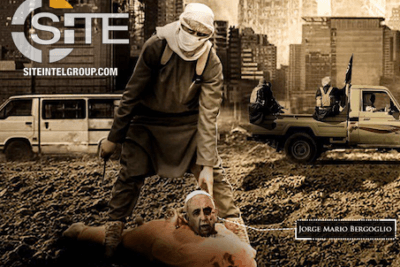
For example, just this past week, a pro-ISIS group called the “Wafa’ Media Foundation” distributed a propaganda image over Telegram, a heavily-encrypted, cloud-based messaging service that has been called the “app of choice for terrorists.” The image depicts a masked jihadi in a desolated city street with ISIS fighters sitting on the back of a truck behind him. In his right hand, he holds a knife, and beneath his feet is a beheaded Pope Francis, wearing the orange jumpsuit we have seen on many ISIS prisoners. Beside the decapitated head of the pope is a label: “Jorge Mario Bergoglio.”

Earlier in the month, Wafa’ produced another poster showing a weapons-laden vehicle heading towards the Vatican, with the message, “Christmas Blood…So Wait…” A news report from earlier this month details this and some additional recent threats:

A propaganda video from this past summer shows jihadi fighters destroying statues and churches, and tearing up images of both Pope Francis and Pope Benedict. One masked fighter looks into the camera and says, “Remember this…we will be in Rome!”

This of course isn’t the first time we’ve heard such warnings. We’ve reported on them here before. As Islamic scholar Andrew Bieszad wrote in 2014 amidst rumors that there was an ISIS assassination threat against the pope, Francis’ pro-Islamic stance has done nothing to shield him from their desire to shed his blood. In fact:

The fact is that from an Islamic viewpoint, Pope Francis’ statements about the Muslim faith actually further Islamic beliefs. However, he is not only not of their faith but is the leader of the largest group of Christians in the world. In the Muslim mind, this sets up a paradox — an infidel of the highest order is supporting their religious ideas, yet he is manifestly not a Muslim. The question about Pope Francis for Muslims becomes whether is he going to fully accept Islam (since he is already promoting it) or persist in his infidelity, and thus merit the punishment for infidels. What Pope Francis may see as an act of outreach and solidarity to Muslims is actually interpreted by Islamic theology as a form of partial consent to the Islamic faith, and thus merits an aggressive push to encourage him to complete the process of his conversion to Islam.

How aggressive? There’s a reason why Islam is known as a religion which “converts by the sword.”

Andrew continues:

Chapter 30 of the Quran is dedicated to the fall of “Rome.” While many of the Quranic commentators explain this to be the Islamic conquest of Constantinople, it is also understood as referring to the “final” Rome – namely, Rome, Italy. This is because for many Muslims, Rome — as the heart of the Catholic Church and the home of the Roman Pontiff — is considered the “center” of the Christian world. If it is conquered, Christianity will (Muslims believe) quickly be globally eclipsed by Islam. Given the large numbers of Muslims living in Italy and Rome, it is a small miracle that neither the Pope nor the Vatican has been attacked before now.

But there’s more: this is not just my reading of the Quran being applied to the present context. Even before the more recent threats on the life of Pope Francis, the Islamic State had specifically called for the conquest of Christian Rome. If they can find a way, there is no reason to believe they will not make such an attempt.

In light of this, consider again these words of the Third Secret of Fatima as revealed by the Vatican…

And we saw in an immense light that is God: ‘something similar to how people appear in a mirror when they pass in front of it’ a Bishop dressed in White ‘we had the impression that it was the Holy Father’. Other Bishops, Priests, men and women Religious going up a steep mountain, at the top of which there was a big Cross of rough-hewn trunks as of a cork-tree with the bark; before reaching there the Holy Father passed through a big city half in ruins and half trembling with halting step, afflicted with pain and sorrow, he prayed for the souls of the corpses he met on his way; having reached the top of the mountain, on his knees at the foot of the big Cross he was killed by a group of soldiers who fired bullets and arrows at him…

Russia’s Errors

In another story of relevance this week, Patriarch Kirill of the Russian Orthodox Church has warned — though obliquely — that certain apocalyptic biblical signs are now in evidence:

“All people who love the Motherland must be together because we are entering a critical period in the course of human civilization. This can already be seen with the naked eye. You have to be blind not to notice the approaching awe-inspiring moments in history that the apostle and evangelist John was talking about in the Book of Revelation,” the patriarch was quoted as saying by Interfax.

Patriarch Kirill added, however, that the exact time of the end times depends on everyone’s actions. He called on people to understand their responsibility regarding Russia and the whole of mankind, and to stop “the movement towards the end of history’s abyss.”

He emphasized that many representatives of the modern Russian intelligentsia are repeating the mistakes made by their predecessors, who led the country into the ruinous revolutionary events of the early 20th century.

As a religious leader, Kirill is a controversial figure, seen by many as an unethical tool of the Russian state. Nevertheless, I can’t help hearing in his warning about Russian leaders repeating the “mistakes made by their predecessors” an echo of Our Lady in the second Fatima secret: “I shall come to ask for the consecration of Russia to My Immaculate Heart, and the Communion of Reparation on the First Saturdays. If My requests are heeded, Russia will be converted and there will be peace; if not, she will spread her errors throughout the world, causing wars and persecutions against the Church. The good will be martyred, the Holy Father will have much to suffer, various nations will be annihilated.”

Whatever Kirill’s motives, the question of Russia’s errors — and her neglected consecration — remain very much at issue.

In an interview with me in January, 2017, Bishop Athanasius Schneider, who grew up in the Soviet Union, elaborated on his earlier comments that we must “pray that the pope may soon consecrate explicitly Russia to the Immaculate Heart of Mary”:

We have to take it at serious when God sends us His Immaculate Mother to warn us. If we hear the admonitions of Our Heavenly Mother, Her Divine Son, Our Lord Jesus Christ will make miracles, as He did at the wedding in Cana. A solemn act of consecration of Russia to the Immaculate Heart of Mary on behalf of the Pope in moral union with all bishops will undoubtedly cause the pouring out of abundant graces for the Church and for all mankind, as it foretold Our Lady in Fatima. It is tragic that prophetic appeals are heard oftentimes too late. Let us pray and ask the Holy Father to do what Our Lady asked in Fatima.

Cardinal Burke, too, repeated last month a message he had presented earlier this year, namely, that the consecration of Russia “was not carried out in the manner requested by Our Lady”. Burke insisted: “Recognizing the necessity of a total conversion from atheistic materialism and communism to Christ, the call of Our Lady of Fatima to consecrate Russia to Her Immaculate Heart in accord with Her explicit instruction remains urgent.”

So where do Russia, Islam, and Fatima intersect? In our podcast on November 14, 2015, in the wake of the Charlie Hebdo attacks in Paris, Andrew Bieszad offered this theory:

If there’s any country who has the ability to actually stop Islam…and actually drive it out — both in terms of military, culturally, spiritually speaking — the one who is closest to it is actually Russia. … I’ve felt this way for many years. Now, some people say in Fatima it’s been consecrated, some people say it has not. I am of the camp that I think it’s pretty clear it has not been. And if you ask me, this is my opinion … consecrate Russia to the Immaculate Heart of Mary. That could very well bring about the expulsion of Islam from Europe. Because frankly, I don’t see how temporal means are going to help. … I would go so bold as to say it’s Fatima or death.

Since that interview, we’ve seen Russia take the lead in the fight against ISIS, with some going so far as to declare that victory is within reach by year’s end. The diplomatic situation between the United States (and her allies) and Russia is, of course, complicated, and beyond the scope of this essay to explore. Suffice to say, however, that at least one part of Bieszad’s prediction appears to have been somewhat accurate.

The most critical part, however, remains unfulfilled.

As the Fatima centenary year draws to a close, we should not allow ourselves to neglect our prayers for the triumph of the Immaculate Heart of Mary and the consecration of Russia. The future of the West as we know it could very well hinge upon it in ways we’ve not yet even imagined.

Print Friendly, PDF & Email
Posted in Uncategorized | 1 Comment

IN HIM WAS LIFE, AND THE LIFE WAS THE LIGHT OF MEN: AND THE LIGHT SHINED IN THE DARKNESS, AND THE DARKNESS DID NOT COMPREHEND IT

El_Greco_021-large

Immortal, invisible, God only wise,
In light inaccessible hid from our eyes,
Most blessed, most glorious, the Ancient of Days,
Almighty, victorious, your great name we praise.

Unresting, unhasting, and silent as light,
Nor wanting, nor wasting, you rule day and night;
Your justice like mountains high soaring above
Your clouds, which are fountains of goodness and love.

Life-giving Creator, of both great and small;
Of all life the maker, the true life of all;
We blossom, then wither, as leaves on a tree,
But you live for ever, who is and will be.

Great Father of glory, pure Father of light,
Your angels adoring, all veiling their sight;
We too, God invisible, offer our praise;
O light inaccessible, Ancient of Days!

Tune: St. Denio 11.11.11.11
Music: Roberts’ Canaidau y Cyssegr, 1839
Text: Walter C. Smith, 1824-1908, alt.

Posted in Uncategorized | 1 Comment