PERIGRINATING WITH FATHER GEORGE W. RUTLER, A TREAT, A DELIGHT, AN EXPOSURE TO WIT AND WISDOM


In Heaven, There Is Only Singing

HOMILETIC AND PASTORAL REVIEW

A Review of Two of Father Rutler’s Books, and an Interview with the Author

I was fortunate to be able to read two review copies of recent books by Father George W. Rutler. As always happens when I read his writing, I was delighted by his style, inspired by the soundness of his doctrine, and enlightened–and sometimes overwhelmed–by his erudition:

  • He Spoke to Us–Discerning God in People and Events (Ignatius Press)
  • The Stories of Hymns–The History Behind 100 of Christianity’s Greatest Hymns(published by EWTN Publishing, Inc. and available from Sophia Institute Press)

Before going on to an email interview with Father Rutler, I want first to explore some thoughts about the attractions of the essay form, and then to use snippets from one of Father Rutler’s essays to illustrate how his dense and many-layered, widely wandering, writing style works effectively to convey some deep and resonant truths about the Catholic faith.

Why Does Father Rutler Have So Many Fans?
About ten years ago, my first accidental exposure to Father Rutler was in a no-longer-available YouTube video on a Father Rutler series by EWTN on the stories of hymns. During that show, Father Rutler wore a black cassock with cloth-covered buttons, and a satin cummerbund around his trim waist. He moved around the set as if he was in his own study, picking out a few notes on a grand piano, pausing in front of a desk or a bookcase occasionally to sum up a thought.

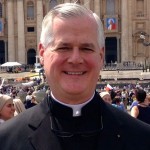
With his egg-shaped, bald head, small mouth, and pale complexion, above his clerical collar, and his studied manner of speaking, he looked and sounded like I thought an erudite, Oxford don must look and sound like. So it was a surprise to find out later that he was born and raised in New Jersey. He is a former Episcopalian priest, who now serves as pastor of St. Michael’s Roman Catholic Church in New York City.

From that first show I saw of his, I learned for the first time that the hymn “O Come O Come Emmanuel” was translated and rearranged from the ancient “O Antiphons” which the Church has sung for centuries at Vespers during the last week leading up to Christmas Eve. I love learning the connection between Catholic things. I was hooked.

A few years ago, I published two articles that expanded on what I had learned from that show: “History and Mystery: The O Antiphons in a Favorite Hymn” and “Top Ten Thoughts about Advent from Fr. Rutler”.

Later, I signed up to receive Father Rutler’s weekly columns by email. I even follow his “Fan Group” on Facebook. That’s quite a compliment coming from me. I usually don’t join fan groups. Close reading of the essays from the most recent two books of this deft, learned, and perceptive writer started me thinking about what makes a satisfying essay.

Essay: To Try, To Weigh, To Ascertain the Value of
The enormous amount of enjoyment we can get out of a well-written essay is not derived merely from the subject, but from the journey we take with the writer as he or she applies his or her intelligence to that subject, often examining it from many angles and showing how it connects to many other subjects. An essay of the type that I mean is a reflection, refracting light onto the subject off the many facets of a brilliant mind. The whole of such an essay, greater than its parts, carries its meaning.

The word “peregrinate,” comes to mind—a word I know well, but have never had the occasion to actually use before. The English word comes from the Latin, peregrinatio(journey) through an “Old French” word peregrinacion (pilgrimage). Peregrinating is a most apt word for Rutler’s essays, because he seems to be walking us around—as he moves from one anecdote, one image, one historical personage, or story, to another. Sometimes you feel he’s lost his way. But at the end of the peregrination, he usually has brought you to somewhere you have never quite been before.

Most of us know that the word “essay” is derived from the French word, essayer, which means to attempt, or to try, or to ascertain, the value of something. When we learned to write essays in school, we weren’t taught the type of essay that Fr. Rutler writes. His essays are not the kind of essays that have a thesis stated up front, and a concluding argument.

The meaning of a “pedestrian” essay might be summarized in a sentence or two, but what would be the fun in that? A peregrinating essay doesn’t proceed like a newspaper article, which gives us the most important information first. And it’s not like a scientific paper, which gives us an abstract of its conclusions to read before we start.

How I Learned to Love Essays
I learned to love essays before I ever knew what an essay was. Ever since I was a young child, I have been an avid reader. I spent a lot of time in doctors’ offices when my Aunt Peggy would take me, or one of my two sisters, or her daughter, our cousin, to appointments in Boston when I was a kid, and I cut my intellectual baby teeth on the long discursive essays I read in the months-old, or even years-old, New Yorker magazines I picked up in doctors’ waiting rooms.

Later in my life, I fell in love with the New Yorker essays of John McPhee, the ultimate peregrinating writer, who takes readers into new places, and new areas of human experience, ranging between such far-separated places as the near-wilderness, called the “Pine Barrens” (that is smack in the middle of New Jersey), to the rugged lands where bush pilots, prospectors, settlers, politicians, and business people live in the state of Alaska. McPhee is still writing, and still overwhelming his readers—in the best possible way—with his long, discursive essays whose floods of details bring to life landscapes, both exterior and interior, along with vivid glimpses into unfamiliar ways of living.

Father Rutler’s Peregrinating Essays
I love Father Rutler’s essays partly because they are similar in style to McPhee’s, although not in their geographic scope. As I mentioned, Father Rutler was raised in New Jersey, and currently lives in New York City, not far away. He has studied abroad, in Rome and at Oxford, but as one of his essays, “Vacation Trials and Tribulations” indicates, he actually hates to travel. He ends that essay with this quote, humorously attributing it to St. Paul: “When you live in New York, you don’t have to travel because you are already there.”

The wide range of Rutler’s expertise is not geographical; it is religious and historical, political and cultural. The more I read Father Rutler’s essays, the more I get out of them. They are dense with poetic, learned references, lightened with flights of fact and fancy, and dry rarified humor.

He starts out with one subject, which leads to another, and to another, and you find at the end, that all of the facts he brought in come together. “Ah yes,” you finally think, “I see what he’s getting at.”

And if you don’t get any one person or thing or historical event he mentions in one of his essays, you file it away mentally so you can find out more about it later for yourself. Any unknown things he refers to get embedded in your mind like little hooks for future study and research. Like the writings of T. S. Eliot and others, Rutler’s writings are going to leave most readers lost in one or several particulars. But that’s okay. “To learn gives the greatest pleasure.” You can catch up later with the facts about the things you don’t already know.

One writer referred to the method of writing as practiced by Eliot and Pound, McPhee and Rutler, as bringing in everything but the kitchen sink; and then, the sink, too. That suits me fine. Don’t they say that: “God is in the details”..? Bring them on!

You probably won’t agree with him on everything. I ran across one blogger who was irate that Father Rutler wrote one essay against the long-standing practice of having pews in churches. I wasn’t convinced by Father Rutler’s arguments against pews either, but I, for one, enjoyed reading what he had to say.

“The Transfiguration of the Church”
The essay titled “The Transfiguration of the Church” is the first essay in Father Rutler’s collection: He Spoke to Us. It starts with the story of an eccentric Oxford don who kept a small menagerie–including a mongoose and an eagle–in his rooms. Fr. Rutler writes that one day, the eagle flew from the don’s rooms into the cathedral, and tried to mate with the brass eagle-shaped lectern, which, Fr. Rutler notes with sly humor, “was cold and unresponsive.”

At the time the eagle landed, the choir, we then learn, was singing Mendelsohn’s “O for the wings of a Dove.” Rutler’s inclusion of an aside that Mendelssohn had recently dedicated his “Scottish” symphony to Queen Victoria is arguably an extraneous fact. But Father Rutler then moves quickly on to remind us that the dove and the eagle represent differing aspects of the spiritual life, and after a few comments about the existence of eagle lecterns in churches all over the world, he ends the dense first paragraph by reminding us that the eagle symbolizes St. John, “whose record of the saving Gospel soars on wings not of this world.”

In the next paragraph he finally uses for the first time the central word of the essay, when he notes that it is curious that: “Saint John is the only evangelist who does not record the ethereal mystery of the Transfiguration, and especially so since he was there.”

Father Rutler then tells us that even though St. John did not record the Transfiguration, some say John’s Gospel is one long Transfiguration. Besides, John was “the only evangelist who recorded the marriage at Cana,” which Rutler argues can be seen as a kind of prototype for the Transfiguration.

After a few more interesting asides, Father Rutler begins to bring us to the meat of the essay. He leads us to realize that we are not transformed by ideals no matter how much we idealize them, but only by being transfigured by the glory of God, with observations such as these:

The Church Militant, which in its weakest moments may seem like a scattered and tattered regiment of the Church Triumphant, has supernal guarantees that the gates of hell shall not prevail against it. Any reformation of the Church that is not a transfiguration by the light of that confidence becomes a deformation. With the best intentions, sectaries spring up to fix the cracks they see in the Rock which is Peter, using some principle other than his power to bind and loose.

Father Rutler makes the excellent point that, as truly laudable as the morality of those denominations created by reformist sectarians often is, whose followers’ moral lives “often excel the practice of Catholics,” the Church is not perfected based on any mere theory, or on striving for perfection, but on the saints who are perfected by their experience of the glory of God. “The perfectionist wants to make himself good, better, best. But the Perfect Man said, ‘apart from me you can do nothing’ (Jn 15:5). That is why he gave us the Church as his body . . .”

He is showing that apart from Christ’s Body the Church, we cannot achieve anything of real value. Reformers who try to set up an alternative to the Church are going about it all wrong, based on their own efforts, and the ideals they have constructed for themselves. These ideas of his are, perhaps, especially convincing because Father Rutler is a convert, and he knows the failures of the innumerable sects that sprang up from idealistic humans determined to reform the Catholic Church from outside. The saints, he tells us, know better.

The saints, having seen the glory on the mountaintop, do not gaze at themselves but ‘see only Jesus’, who rather than transforming them into goodness, transfigures them into glory.

There’s a lot to think about in just the first part of that essay that I’ve touched on here. And there is much, much, more. I hope you’ll read the rest of that essay, and other essays by Father Rutler yourself, from He Spoke to Us, and get as much out of them as I do.

Interview with Father Rutler
Whether hymns should be sung, or not sung, at Mass, and which hymns are acceptable, is a fraught topic. The issues are described in more detail in an interview I did with Professor Peter Kwasniewski, called “The Propers of the Mass Versus the Four-Hymn Sandwich”(which was published here at Homiletic and Pastoral Review).

The phrase “We should not be singing at Mass, we should be singing the Mass” is used often among Church musicians and liturgical experts who believe it is important it is that the actual texts of the Mass be sung. San Francisco Archbishop Salvatore Cordileone wrote this in his “Foreword” to The Proper of the Mass for Sundays and Solemnities, by chant composer Father Samuel Weber, O.S.B., who founded with Archbishop Cordileone the Benedict XVI Institute for Sacred Music and Divine Liturgy at the archdiocesan seminary.

“It is often said, and rightly so, that we should aim at singing the Mass not singing at the Mass, but old habits die hard, and in many places the ‘four-hymn sandwich’ is still being served, a relic from the days before the Second Vatican Council when provision was made to allow vernacular hymns to be sung at Mass.” The archbishop went on to write that the best hymns can enhance our liturgical celebrations, but that hymn singing is a recent innovation in terms of Church history.

Experts claim that singing of any old hymns at Mass became entrenched after Vatican II because vernacular versions of the Proper texts were not available, and hymns filled the void. Many feel that choirs and congregations should be singing the texts of the Mass, which are the Ordinary and the Proper texts of the Mass. Venerable Pope Paul VI wanted congregations to be able to sing the Ordinary in Latin set to simple chants, as published in his booklet Jubilate Deo. And eighteen more-complex settings of the Ordinary are available in the Kyriale. Many musicians, including Father Weber, are composing English versions of the Propers.

Because of the controversy about where hymns belong in Ordinary Form Masses, my questions to Father Rutler focused mainly on the paragraph at the end of his “Preface” to his Stories of Hymns, in which he wrote about how the hymns he wrote about may be included in Catholic liturgy. But that does mean that I didn’t read and enjoy the rest of the book, and I hope you will read and enjoy it too.

Where Can Catholics Sing These Wonderful Hymns?
RTS: At the end of your preface to Stories of Hymns, you wrote:

The hymns that follow complement the Liturgy but are not part of it. The whole Mass itself is its own gigantic hymn, and it is only by indult that it is said at all instead of being sung. It is liturgically eccentric to “say” a Mass and intersperse it with extraliturgical hymns. Hymns may precede or follow the Mass, but they should never replace the model of the sung Eucharist itself with its hymnodic propers. In the Latin Rite, that model gives primacy of place to the Latin language and Gregorian chant, according to numerous decrees, most historically those of Pope Pius X in Tra le Sollecitudini and Vatican II’s Sacrosanctum Concilium. The Church has normally reserved other hymns for other forms of public prayer, especially the Daily Office. And, of course, all hymns can be part of private prayer, following the Augustinian principle that he who sings prays twice.

What do you mean by: “The hymns that follow complement the liturgy but are not part of it”?

Father Rutler: Those hymns would qualify as “tropes,” or embellishments of the proper liturgical texts, but not substitutes for them. The guidelines for the Ordinary Form would accord a certain validity to hymns, other than the traditional Propers, as part of the Liturgy provided the texts are approved by the legitimate ecclesiastical authority, but this is by way of exception.

RTS: Do you agree that we should not be singing at Mass, we should be singing the Mass?

Father Rutler: Since the Mass is the highest act of praise, and singing is the highest form of praise, the Mass is a song, and is not therefore interrupted by song.

RTS: Can you explain what you mean where you wrote, “The whole Mass itself is its own gigantic hymn, and it is only by indult that it is said at all, instead of being sung.” How is the Mass a hymn? What indult do you mean?

Father Rutler: The Second Vatican Council described the Holy Eucharist as the song of the Heavenly Jerusalem brought to earthly altars. For expediency in the Latin Rite, recitation is permitted instead of chant, but this should be only by exception. Expediency is not a concern of the Oriental Rites, or of Jewish prayer, for that matter. In Heaven, there is only singing, no mere talking.

RTS: You wrote, “Hymns may precede or follow the Mass, but they should never replace the model of the sung Eucharist itself with its hymnodic propers.” In layman’s terms, what are the “hymnodic propers?”

Father Rutler: The Propers are the Scriptural texts and other sacred texts. The Psalter is the Church’s main hymnal. To recite Psalms, rather than chanting them, is an oddity. It would be better to sing brief texts (antiphons) rather than rather drearily recite a Psalm between the readings. Indeed, as I understand it, the provision of lengthy Psalm verses between the Readings was granted at the last moment in the revision of the Mass, to satisfy a minority opinion.

RTS: If hymns should not be sung during Mass, when might hymns from this rich collection you wrote about in Stories of Hymns be sung by Catholics?

Father Rutler: I did not say that hymns should not be sung at Mass. In the Ordinary Form they are permitted, but should not replace the Propers (for example, the Introit and Gradual). A hymn after Communion would not be inappropriate but the “Hymn Sandwich” of an Entrance Hymn, Offertory Hymn and Closing Hymn accompanied by a static “said” Liturgy should be avoided.

RTS: You also wrote in your “Preface” that outside of the Mass, these hymns might be used in the Divine Office and private prayer. The stories for some of the hymns also often mention how stirring some hymns can be when sung in procession, for example, the Easter hymn “Hail Thee Festival Day,” with its alternative verses that can make it also appropriate for processions on Ascension Day, Pentecost, Corpus Christi, and at dedications of churches. You also wrote about “Daily, Daily Sing to Mary” as “a marvelously raucous hymn, which is especially suited for processions.” And you wrote about a favorite hymn, “Jerusalem the Golden,” which you fondly recalled singing as a choirboy. Do any others still appeal to you particularly?

Father Rutler: “Jerusalem the Golden” was my favorite boyhood hymn–I had good taste in youth–and it remains such. There are others I especially like, such as “Brightest and Best” and “Hark, Hark My Soul”–but it is difficult to choose. Obviously some are more appropriate for particular seasons. One hymn that I wish I had included in my book was the Wesleyan one: “And Can it Be That I Should Gain.”

RTS: I remember enthusiastically singing, “And Can it Be That I Should Gain,” “The Church’s One Foundation,” and “All Glory, Laud, and Honor”–and other hymns that I recognized in the Stories of Hymns–when I worshipped at an Evangelical Free Church, which is one of the Protestant denominations I sampled on my way back to the Catholic Church after I lapsed as a college student. I missed that enthusiastic hymn singing when I came back to the Church, until I started singing with a Gregorian Chant choir, and all the treasures of the chant repertoire opened to me. More important than hymn singing is the Eucharist, and the Eucharist and the teaching authority of the Church are a large part of what brought me back. Now it seems to me that Protestant denominations filled up their worship services with long sermons, and lots of hymns, because they removed the Sacrifice out of the Mass.

How do you use music in Masses in your current parish, St. Michael’s in New York City? Do you, the choir, and/or the congregation sing the Propers?

Father Rutler: We have a small choir that sings the Introit and Gradual and, often a special setting of the Gloria. Otherwise the people sing the chants. (Plainchant, or Gregorian chant, should have pride of place, even as Vatican II prescribed.)

It is highly preferable that the choir be in a loft, or at least positioned to support the people’s voices. Choirs should never face the people. And “song leaders” are entirely counter-productive. No ritualistic: “Please join us in singing…” and so forth, and no arm waving. Highly recommended on the topic are two books: Why Catholics Can’t Sing by Thomas Day, and Real Music: A Guide to Timeless Hymns by Anthony Esolen.

We sing the liturgical texts and, as provided in the rubrics for the Ordinary Form, we usually have an additional hymn at the Offertory. I think that if there is a hymn, it may best be at the end of the Mass. Hymns should not displace the liturgical texts, and normally one hymn is adequate.

RTS: By saying that your congregation sings the chants, do you mean the Ordinary chants? If the Ordinary is chanted by the congregation, what settings do you sing? Do you cycle during the year through the some of the eighteen Gregorian chant Masses available from the Kyriale, such as Mass I: Lux et origo (for Pascaltide), Mass XI: Orbis factor (for Sundays/Sundays per annum)? Or do you follow a simpler scheme?

Father Rutler: To encourage participation, the Missa de Angelis is a Plainchant setting that everyone can sing easily–then on special feasts other Gregorian settings can be sung from the choir.

RTS: What might you add to help Catholics who are attached to singing their favorite hymns at Mass, and who might object to the idea of any change?

Father Rutler: In a time of cultural decay, such as ours, the Church has an obligation to preserve and promote the best human achievements, including music, and the visual arts. The Church must convert the barbarians and not be converted by them. Many of the aging “baby-boomers” who resist change, imposed it wantonly on others right after Vatican II. That period of aesthetic destruction may take a long time to repair, but bad music should not be allowed to drive out the good, just as bad money should not be allowed to drive out good money. To deny that there are superior forms of aesthetics is simply to enlist oneself in the ranks of the relativists for who quality is nothing more than opinion. That is not aestheticism; it is narcissism. The astonishing collapse of church attendance in recent decades, cannot be blamed on St. Gregory, Palestrina, and Mozart, and there are many reasons for it other than a defective psychology of worship, but the cloyingly grotesque, pseudo-Christian elevator music in many parishes is not guiltless of the damage done in those post-Conciliar years.

Roseanne T. SullivanAbout Roseanne T. Sullivan
Roseanne T. Sullivan is a writer from the Boston area who currently lives in San Jose, CA. Sullivan studied graphic design, painting, journalism, fiction and poetry writing while completing a BA in Studio Arts and English, and an MA with writing emphasis at the University of Minnesota. She has a deep and abiding interest in sacred music, sacred art, liturgy, and Latin, and she teaches Latin to homeschoolers. Many of her writings and photographs have appeared in the National Catholic Register, the New Liturgical Movement, Regina Magazine, Latin Mass Magazine, and other publications. Her own intermittently updated blog, Catholic Pundit Wannabe, is at catholicpunditwannabe.blogspot.com.
 

2
Posted in Uncategorized | Comments Off on PERIGRINATING WITH FATHER GEORGE W. RUTLER, A TREAT, A DELIGHT, AN EXPOSURE TO WIT AND WISDOM

YOU DO NOT HAVE TO FACE THE CRUCIFIX WHEN YOU PRAY TO GOD, RATHER THAN FACE THE PEOPLE, BUT IT SURELY HELPS

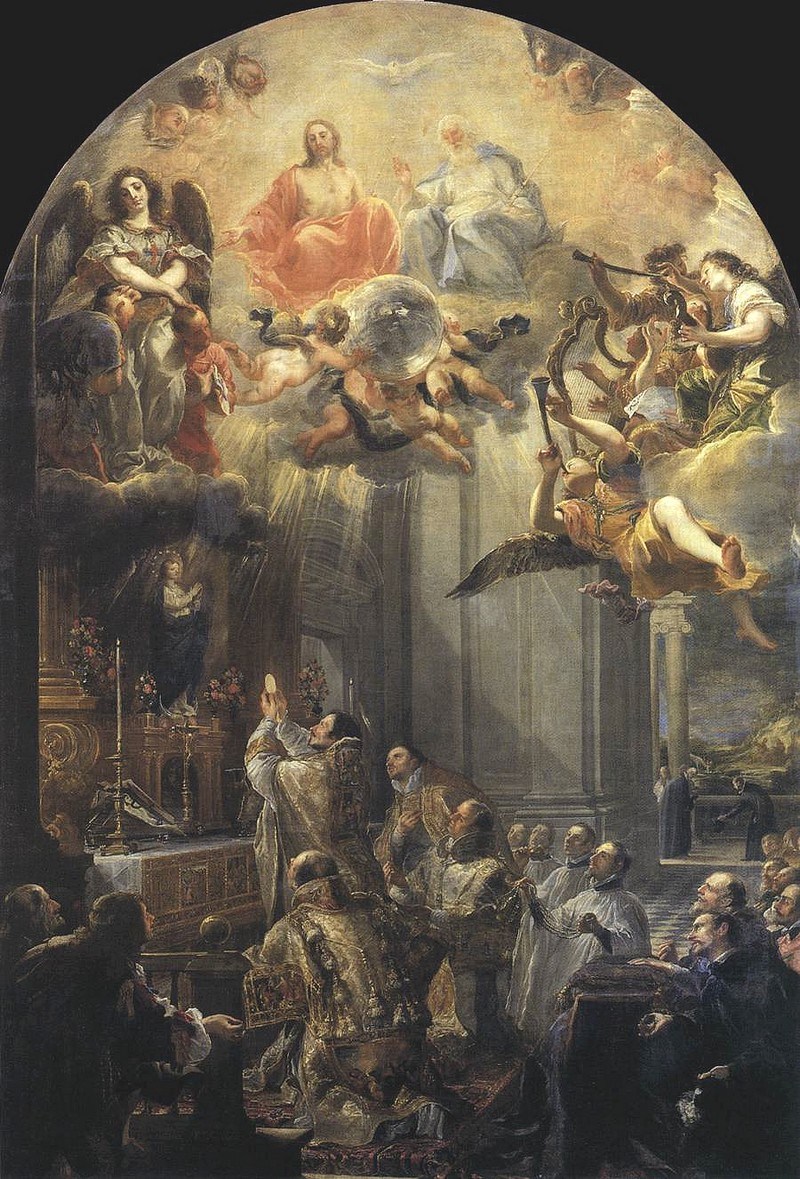
Mass of St. John of Matha by Juan Carreño de Miranda, 1666 [Louvre, Paris]


It has been one year since our parish changed over to the celebration of the Holy Sacrifice of the Mass facing the liturgical East. My decision to switch to ad orientem was prompted by Cardinal Sarah’s encouragement of the return to this ancient practice of the Church.

The reception of this change by parishioners has been largely positive. Visitors attending Mass naturally remark upon it, expressing in general surprise but only occasional dissatisfaction. Some remark that they are happy to participate in the Mass as they remember it from their childhood. The priests of the parish (and most visiting priests) have found this change to be a great improvement that promotes a prayerful and recollected celebration of Mass.

Cardinal Sarah spoke again recently about the celebration ad orientem in a conference published in the French magazine La Nef (July-August 2017). He said:

To be oriented towards God is before all else an interior action, a conversion of our soul towards the one God. The liturgy should foster in us this conversion towards the Lord who is the Way, the Truth, the Life. To do this it uses signs, simple means. The celebration [of Mass] ad orientem is part of this. It is one of the treasures of the Christian people that permit us to preserve the spirit of the liturgy. The oriented celebration should not become the expression of a partisan and polemical attitude. On the contrary, it should be the expression of the most intimate and essential movement of all liturgy: turning ourselves towards the Lord who comes.

The spiritual truth that worship is a turning to the Lord is visually communicated to the worshiping faithful in the pews when the priest does not look at them when addressing God, but rather looks towards the crucifix, towards Christ, towards God.


The Rorate Caeli website recently published a translation of a short piece Paul Claudel wrote in Le Figaro in 1955 protesting against the incipient spread in France of the celebration of the Mass facing the people. Claudel expressed a severely negative judgment on this innovation: “The Mass is the homage par excellence which we render to God by the Sacrifice which the priest offers to Him in our name on the altar of His Son. It is us led by the priest and as one with him, going to God to offer Him hostias et preces [victims and prayers]. It is not God presenting Himself to us for our convenience to make us indifferent witnesses of the mystery about to be accomplished.”

Claudel’s insight rings true, in my experience. The priest celebrant leads and brings the people with him as he raises his hands and voice to God in prayer and worship. They are not spectators but rather fellow pilgrims who look with the priest towards Christ. In reply to the objection that the people need to see the entire liturgical action at the altar, which is not possible during the ad orientem celebration, Claudel writes: “It is true that in the traditional liturgy the most touching, the most moving part of the Holy Sacrifice is hidden from the view of the faithful. But it is not hidden from their hearts and their faith. To demonstrate this, during Solemn High Masses the sub-deacon stays at the foot of the altar during the Offertory, hiding his face with his left hand. We too are invited to pray, to withdraw into ourselves, not in a spirit of curiosity but of recollection.”

That recollection helps us to see with the eyes of faith the hidden presence of Christ in the sacred host and the chalice as they are elevated by the priest following the consecration. In the ad orientem celebration, the people do not have to look at the expression on the priest celebrant’s face (for weal or for woe) when he elevates the host and the chalice. This unnecessary distraction is eliminated and his role as mediator between God and man is best expressed when he offers no competition to the Holy Eucharist for the faithful’s glance.

Claudel further observed: “The novel liturgy {Novus Ordo} deprives the Christian people of their dignity and their rights. It is no longer they who say the Mass with the priest, by ‘following’ it, as the saying very rightly goes, and to whom the priest turns from time to time to assure them of his presence, participation and cooperation, in the work which he undertakes in their name. All that remains is a curious audience watching him do his job. Small wonder that the impious compare him to a magician performing his act before a politely admiring crowd.”

My happy experience at the parish is that the ad orientem celebration of Mass, combined with the practice of the priest now sitting along the side wall of the sanctuary and no longer seated directly behind the free standing altar, has resulted in a more prayerful and Christ-centered liturgical experience. The priest celebrant is not an unending center of attention – as he can easily become when he first sits overlooking the congregation during the readings – and then when he stands behind the altar looking at the congregation while offering the prayers of the Mass to God.

Cardinal Sarah observes: “Allow me to express humbly my fear: the liturgy in the Ordinary Form could lead us to run the risk of turning ourselves away from God because of the overwhelming and central presence of the priest. He is constantly in front of the microphone, and ceaselessly has his eyes and his attention turned towards the people. He is like an opaque screen between God and man.”

After one year of the ad orientem celebration, I am absolutely convinced that Cardinal Sarah is correct. Turning physically and contemplatively towards the Lord promotes a deeper experience for both priest and people of prayer and worship at Mass.

Fr. Gerald E. Murray

Fr. Gerald E. Murray

The Rev. Gerald E. Murray, J.C.D. is pastor of Holy Family Church, New York, NY, and a canon lawyer.

Posted in Uncategorized | 2 Comments

THE FOUR HORSEMEN OF THE APOCALYPSE ARE SEARCHING FOR YOUR CHILDREN

THE CHURCH MILITANT

With so many leaders in the Church in open rebellion to Her and Her divinely revealed teachings, it’s worth alerting people to the treachery. Currently, in the English-speaking world at any given moment, you will find some combination of the following four priests, spreading error and sowing confusion anywhere they can gain an audience. And because of their influence in Church circles, they gain entrance to many many audiences.

First, the big four are Fr. James Martin, Fr. Thomas Rosica, Fr. Bryan Massingale and Fr. Timothy Radcliffe. Combined, they form the leading edge of a public relations campaign to introduce doubt and confusion into the minds of as many Catholics who will give them a hearing.

One of the favorite topics for each of them is how the Church’s teachings on sexual morality can essentially be ignored, sidelined or downplayed and even rejected. This is especially true in the arena of homosexuality and even gender dysphoria — the mental illness commonly referred to as transgenderism. Simply stated, they all think the Church is wrong in Her magisterial teachings. They are always suggesting, to young minds in particular, that the teachings are outdated and sooner or later the Church will amend them and get in step with the culture.

A couple weeks ago, Fr. Thomas Rosica was given access to over 100 young people at a Theology on Tap event hosted by the archdiocese of Chicago under Cdl. Cupich. On stage with Rosica was the out and proud homosexual writer for America Magazine — a Jesuit publication — Michael O’Loughlin. It’s ironic to have them speak at an event with the name “Theology” in it because what they offer is their own distorted perceptions and opinions — definitely not theology.

Then, of course, there is Fr. James Martin, who is on a personal non-stop campaign to get the Church to change its teaching on the psychological disorder of homosexuality. The homosexualist priest will be the keynote speaker at the Equestrian Order of the Knights of the Holy Sepulchre this coming October in New York with Cdl. Timothy Dolan’s smiling acceptance of course. And now reports are that Martin will be addressing a gathering of elementary and high school teachers of the archdiocese of New York on September 19 at the Westchester County Convention Center — more poison, more treachery, more deceit.

Father Bryan Massingale, as recently as last year’s Religious Education Congress in the archdiocese of Los Angeles, stood on stage and after a roughly 45-minute, cleverly twisted, cherry-picked presentation before a sizeable crowd in the main arena, declared what Church teaching is — you can disobey Church teaching — conveniently in the area of sexuality. The next day he was present on stage at the gender dysphoria conference, lending his support to more evil.

And just as Fr. Rosica has carte blanche at just about any diocese he shows up at, so too does Fr. Martin, likewise protected by higher-ups, so too does Fr. Massingale, who was given at least tacit permission to speak by L.A. Archbishop Jose Gomez and Fr. Timothy Radcliffe, the former master of the Dominicans for nearly all of the 1990s. This man described homosexuality as “eucharistic” in that a great sharing and sacrifice for the other occurs. Radcliffe is the untouchable — a cleric who must have extremely influential protectors because he is rarely if ever denied access or rebuked by anyone in the hierarchy.

All four of these high-profile men continually travel the Catholic world. Seminaries are a favorite haunt of Rosica when he’s not pumping his poison out through the Salt + Light television deception he runs in Canada. Martin, of course, has invented himself as a secular media “go to” for all matters gay and Catholic, providing him a perfect springboard to deceive many. Massingale and Radcliffe are more like inside men, doing most of their damage at Catholic conferences and retreats where they can pervert the minds of many, at least nominal Catholics, many of whom are looking for an excuse to bypass the Church’s teachings.

Regardless of their venues, they each are protected and promoted by men higher up the food chain who are happy to let them do the public side of what they privately wish to accomplish. Men like this embrace young men who are sexually confused and assure them that their disordered passions are good and the Church is wrong. This is what priests of this mind told me in my younger years in the midst of confusion and sin.

They lie to souls in crisis to make themselves feel better about their own personal sin and evil. And they are given unfettered access to such souls at diocesan conferences, Theology on Tap events, seminarians who they try to corrupt before ordination and the rest of the speaking circuit. When they aren’t peddling their poison in front of live crowds and audiences, they are writing books, articles, granting interviews and keeping themselves front and center with a great assist from their friends in so-called Catholic media, including Church of Nice Establishment outfits who rarely say anything about this wicked strategy. It is a constant stream of evil and treachery coming from these men — thinly disguised as social justice efforts or caring for human rights.

Father Timothy Radcliffe has even assumed the directorship of the Las Casas Institute in England, dedicated to the promotion of social justice causes and human rights — two incredibly elastic terms which mean essentially whatever you want them to mean.

Hillary Clinton, for example, famously said that gay rights are human rights, something it would be difficult to imagine any of these four men disagreeing with given their hundreds of public comments, not to mention more private ones.

It would be hard to find a more frightful foursome of clergy than these four, not necessarily because of any intellectual prowess per se but because they have positioned themselves or been positioned to have easy and constant access to the laity who can be easily deceived.

The laity deserves to know the wicked agenda these men spread throughout the Catholic world. None of these men should ever be allowed near young minds or those that teach young minds. The laity also needs to understand that these men are protected, which means that there are many above them who are more hidden but no less dangerous.

Indeed, if any public scandal ever erupted over any one of them, they would simply be replaced and the agenda would simply continue to be pressed without him. This is the state of affairs in many quarters of the Church these days, and very few are saying anything about it, so someone has to.

Guard your souls from these Catholic impostors. They use the Church and Her resources to promote their own personal agendas. And they are protected by others who are in league with them.

Posted in Uncategorized | 3 Comments

THE CITY OF GOD HAS A BIG PROBLEM: MANY OF THOSE CHARGED WITH PROTECTING AND DEFENDING THE CITY HAVE GONE OVER TO THE ENEMY

notre_dame_paris

THURSDAY, AUGUST 17, 2017

The Treason of the Catholic “Nice Guys”

The Church will —
through the power of the Holy Spirit!

Editor’s Note: This is the main article from the current issue of the Les Femmes newsletter. It’s not posted on line yet; I’m offering this as preview. I am on retreat this week and scheduled the article to post before I left. No comments will be posted, however, until I return on Saturday. So if you comment please be patient. 

I will be computer and phone-free this week and will moderate all comments when I return. I’m praying for the intentions of my readers during this five-day silent retreat. I would appreciate your prayers as well.

The City of God has a problem, a big problem. Many of those charged with protecting and defending the city have gone over to the enemy. Some are active members of the treasonous conspiracy, but others commit treason by their silence and capitulation. They are the “nice guys” who want to be liked and admired. They don’t want anyone rocking the boat by insisting on unpleasant truths and they fear epithets like “rigid” and “medieval.” And so they say and do nothing when the active conspirators within and the enemy without take their jackhammers and wrecking balls to the foundations of the holy city.

In a recent article at The Catholic Thing,  Deacon James Toner discussed The Nice Guy Syndrome and raised some provocative points:

Nice guys are sincere….. Nice guys are tolerant…. Nice guys are “authentic”….That there can be sincere rapists, tolerant drug dealers, or authentic terrorists; that abortionists can be pleasant people; that those planning a political paradise marked by eugenics and euthanasia can simultaneously be loving grandparents – all these things testify to what Hannah Arendt famously called the “banality of evil.”….

Nice guys…have done, and can do, great evil because of apathy, because of unwillingness to seek the truth and then to do it. Truth obliges. Knowing the truth requires us to act in that truth – to “do” the truth. (James 1:22, CCC 898) If being a “nice guy” means that we must be wishy-washy or apathetic about knowing and serving truth, then we must be as disagreeable, as dyspeptic, as possible….

Smiling nice guys are legion: we find them in parliaments and in pulpits, in chancelleries and in colleges, in the public square and in religious synods….

… if I do not trouble myself about the truth – about its certainty in Christ – then I need not concern myself about doing the truth, about testifying to that truth by what I say and do, and thus risk alienating those very people who see me as a “nice guy.”[i]

This article will focus, not on the “nice guys” of the world who lack the advantage of the fullness of the faith; rather it will look at those within the City of God with the responsibility to teach: the men in Roman collars with multiple letters after their names, the Catholic educators and writers willing to purge the truth from their institutions and works, and the laity in the pew who pick and choose their beliefs in accordance with their pet sins. Not all these “nice guys” are merely silent about the truth. Some actively seek the approval of the world by vigorously defending what’s popular and politically correct. They may even uphold certain teachings of the faith when it is easy and costs nothing. Their silence, however, is deafening when it comes to hard truths that make them targets of criticism and ridicule. These are the “nice guys” committing treason against the City and her ruler, Jesus Christ.

The word treason derives from the Latin “traditionem” meaning to hand over, deliver, or surrender and from the Old French verb “trair” meaning to betray.  Under old English law, high treason involved a subject’s betraying his sovereign (in our case Christ Himself) or the state (the City of God). Petit treason involved a subject’s offense against a fellow subject.  Today, “nice guys” commit both of these treasons. They violate the two great commandments to love God and neighbor. They undermine the faith and weaken the ability of the City of God to carry out its proper role of bringing the entire world to the service of Christ the King. They also undermine the faith of Catholics.

Let us examine several common spheres of silence that reflect the failure of “nice guys” to defend the faith and rob the Church of her evangelical mission to proclaim the truth and spread it to the ends of the earth: silence in the pulpit about moral evils common among the flock, silence from the hierarchy about syncretism, the belief that all religions are essentially the same and all can lead to salvation, and failure of the laity to defend the faith in the marketplace.

First of all, consider the silence of the clergy to teach the faith clearly and boldly. This problem plagued the Church from its very beginning and often arises from human respect. Peter himself fell victim when he stopped eating with the Gentile converts in order to please the Jewish converts.[ii] St. Paul called him to account and, when the first council met in Jerusalem, the Church spoke clearly about the limited obligations of the Gentiles to follow Mosaic Law. But it took a very UN-silent St. Paul to chastise the pope himself. How many clergy fall into the same trap as the English bishops who chose silence to please a king and avoid martyrdom? And the clergy today do it with much less cause, since they will hardly be executed for making a handful of parishioners angry. The bishop may lose some big contributors, of course, which seems to be an important consideration with nice guys in the chancery.

There are several particularly pernicious areas of silence for which our teaching shepherds are culpable. Humanae Vitae, the encyclical condemning contraception, remains unproclaimed after fifty years. The silence in most dioceses and parishes is deafening. Most clerics never challenge the sins of the flesh common to their flocks: abortion, contraception, pornography, immodesty, etc. Have you ever heard a sermon on the seven deadly sins or the four last things? Hell and damnation are very real, but those words are seldom heard. Instead, the Sunday homily, the major opportunity each week for the clergy to teach doctrine and morality to their parishioners, often has little more substance than a bowl of jello. How many clergy will have to answer to Christ, because they abandoned their flocks to spiritual ignorance?

We should be especially aware of the damage of silence in this anniversary year of Fatima since Our Lady told the three shepherd children that sins of the flesh send most sinners to hell.  And certainly the sin of our day is lust. Contraception, pornography, and immodesty give free reign to fornication, adultery, and the perversion of the marriage bed. Contraception often leads to abortion since many couples cite contraceptive failure as the reason they kill their children. According to a 2011 U.K. study by the largest abortion provider in the country, two thirds of women choosing abortion were using contraception when they conceived.[iii] When I was sidewalk counseling, several abortion-minded women told me it wasn’t their fault since they conceived while using birth control. Hence, in their minds, abortion was justified.

And yet the silence about the immorality of these evils continues. Since the publication of Amoris Laetitia it’s been joined by another major assault on the family, the attack on the indissolubility of marriage. Only a handful of clerics joined the Dubia asking Pope Francis for clarification of the document which is being interpreted in some places to allow adulterers and fornicators to receive Communion. The majority of the clergy are taking the role of silent “nice guys” who want to be “pastoral” by not upsetting those living in sin. Add the massive silence on gender ideology and you have a triumvirate of lust treated with silence: contraception, the indissolubility of marriage, and gender ideology.

Many families I know struggle with “gender” issues having a son, daughter, niece, nephew, cousin, close friend, etc. who identifies as one of the letters in the LGBTQ alphabet. Is this ever addressed from the pulpit except in gay-friendly parishes where clergy affirm it? Silence indicates consent. So it appears that the “nice guys” are willing to accept that the souls in their care can choose their own genders and/or embrace “marriage equality” even when these choices defy reality and lead to spiritual death. Perhaps they sincerely believe it isn’t a problem for their parishioners, but most religious polls show that Catholics are more accepting of same-sex “marriage” and homosexuality than any other group except white mainline Protestants and the unaffiliated.[iv]

Of course, since so many self-identified Catholics don’t believe what the Church teaches, it’s hard to say what the statistics really prove. It is probably more useful to look at beliefs. In a 2014 Pew Religious Landscape study of 35,000 Americans(20.8% were Catholic, but only 58% of the them said religion was “very important.” The survey found that about 19,000 of those interviewed favored same sex marriage while about 14,000 opposed it. The differences among the two groups were not surprising. A lower percentage of gay marriage supporters attended religious services once a week and prayed daily or were even certain that God exists. 76% of those strongly opposed said religion was “very important” in their lives. Only 36% of gay marriage supporters believed religion was important.[v]

But no matter how you look at the statistics, it’s clear that a large number of Catholics do not accept Church teaching on these issues. It is an obligation of charity to preach and teach the truth lest many souls fall into hell as Mary showed the children at Fatima. Silence is a cowardly option. Sadly, it is one commonly found on Catholic college campuses where faithful professors are likely to be persecuted if they break the silence, as happened to Professor Anthony Esolen at Providence in Rhode Island. The Cardinal Newman Society website gives ample testimony to the collapse of Catholic higher education at schools like Notre Dame, Marqhette, Fordham, Boston University, etc. where LGBTQ events are more prominent than teaching the faith.

What may be an even more dangerous error of the “nice guys,”however, is their focus on a false ecumenism that treats all religions the same and fosters indifferentism, a sin against the First Commandment.  Authentic ecumenism works toward the unity desired by Our Lord at the Last Supper when He prayed that “All might be one.”[vi] The Vatican II document on ecumenism makes it clear that:

…our separated brethren, whether considered as individuals or as Communities and Churches, are not blessed with that unity which Jesus Christ wished to bestow on all those who through Him were born again into one body, and with Him quickened to newness of life – that unity which the Holy Scriptures and the ancient Tradition of the Church proclaim. For it never loses sight of the fact that it is through Christ’s Catholic Church alone, which is the universal help toward salvation, that the fullness of the means of salvation can be obtained. It was to the apostolic college alone, of which Peter is the head, that we believe that our Lord entrusted all the blessings of the New Covenant, in order to establish on earth the one Body of Christ into which all those should be fully incorporated who belong in any way to the People of God.”[vii]

Our goal in ecumenism, then, should not be to conform Christ’s teachings to the heretical beliefs of those who abandoned the Church. Rather we should encourage our “separated brethren” to return to the fullness of the faith. Watering down doctrines to make them more palatable to non-believers and Protestant Christians is like turning the miraculous wine of Cana back into water.  But that’s exactly what the “nice guys” do. In RCIA classes they avoid discussing difficult issues like remarriage after divorce (even more problematic after Amoris Laetitia) and the use of contraception. They often focus exclusively on shared and non-controversial beliefs. They join in ecumenical prayer services that imply a union with mainline Protestants and even non-Christian religions that does not exist. At weddings and funerals they fail to instruct that only Catholics not conscious of grave sin may approach for Communion. Some even invite non-Catholics to receive committing a serious sin of scandal.

Pope Francis’ trip to Lund last Fall to “celebrate” Martin Luther’s revolution was a prime example of the scandal of false ecumenism and it is being imitated by some bishops. In Orlando, for example, Bishop John Noonan held a similar event and, on the Orlando diocesan website, quoted Pope Francis’ statement from the week of Christian Unity last January that“the intention of Martin Luther five hundred years ago was to renew the Church, not divide her.”  That anyone can know the intentions of another is questionable, but one can be especially skeptical after considering Luther’s own statements.

After refusing to reconcile with the Church, Luther responded to the Bull of Excommunication three years after his rebellion by calling the pope the “anti-Christ.” His statements attacking Holy Mother Church and the priesthood caused his contemporary, the bishop-martyr, St. John Fisher, to write, “My God! How can one be calm when one hears such blasphemous lies uttered against the mysteries of Christ? How can one without resentment listen to such outrageous insults hurled against God’s priests? Who can read such blasphemies without weeping from sheer grief if he still retains in his heart even the smallest spark of Christian piety?”[viii] My answer to the saint’s question – the “nice guys.” Ecumenism for the them equals indifferentism. I’m okay, you’re okay, we’re all okay. This is particularly noticeable among those who believe and teach no one needs to convert.

Not so for St. Pope John Paul II who wrote in his encyclical, Ut Unum Sint (That all may be one) “The unity willed by God can be attained only by the adherence of all to the content of revealed faith in its entirety. In matters of faith, compromise is in contradiction with God who is Truth. In the Body of Christ, the way, and the truth, and the life (Jn 14:6), who could consider legitimate a reconciliation brought about at the expense of the truth?”[ix]

Ecumenism will not come about by the friendly indifferentism promoted by “nice guy” clergy with their touchy-feely prayer services ignoring doctrinal differences on major moral issues like abortion and theological issues like the Real Presence. They foster a false ecumenism described by Fr. John Hardon, S.J. who writes, “In large part, and with rare exception, Christian bodies separated from Rome conceive the foundation of religious union more or less independent of doctrinal agreement; or at best, they minimize the agreement and make it subjective. They are less concerned to reunite the churches by their common acceptance of Christian revelation than to merge them at any price, even to eliminating doctrines that are an ‘obstacle’ to uniformity.”[x] Father also warns that this false ecumenism leads many Catholics out of the Church who, with a weak foundation in their own faith, come to think that all faiths are essentially the same. Fr. Hardon concludes writing, “For the Catholic Church only one condition is necessary [for reunion] and only one possible—the acceptance of her teaching and submission to her authority, not because they are hers but because they are divine. Conscious of her possession of revealed truth, she assumes that those who are seeking unity implicitly want, because they need, the unifying principle that only God in His Church can supply.”[xi]

The silence of the English bishops, with the exception of St. John Fisher, allowed the heretic Henry VIII to snatch the authority of the papacy and make himself the head of the Church in England. That entire country, with the exception of a minority of recusants, lost the faith. Today, 500 years later, the silence of most American bishops about the real Martin Luther, a malicious heretic who began by addressing an abuse over indulgences and ended up viciously attacking the priesthood, the Mass, the papacy, and Jesus Christ Himself, is creating a spirit of indifferentism.

Bishop Robert Barron recently called Luther a “mystic of grace.”[xii] What an insult to Jesus Christ. Luther accused our Savior of being a sinner who committed adultery and fornication with the woman at the well and Mary Magdalene.[xiii]Can Bishop Barron be serious? Silence on these facts is part of the false ecumenism that threatens to mislead poorly formed Catholics to accept the idea that all faiths are the same. If Luther is such a hero, why not be Lutheran?

The laity too can fall into the “nice guy” trap. Parents do it when they condone by their silence or even actively affirm their adult children living sinful lifestyles or fail to discipline and train teenagers because they fear their wrath. In the workplace it can be tempting to participate in immoral activities especially in health care where a medical school or nursing program might require a rotation performing or participating in abortions. A psychiatric social worker might be required to affirm gender ideology and pharmacists will almost surely face the problem of being asked to fill prescriptions for drugs that kill babies in the womb. More commonly, the challenge might be the temptation to be silent when work colleagues share dirty jokes around the coffee station or brag about their immoral activities. Going along “for fellowship” is tempting, even for serious Catholics. No one wants to be ridiculed or disliked by his peers. We all want to be accepted and considered “nice guys.”

Being “nice guys” may be the most insidious temptation of our day, leading us to a treasonous betrayal of Christ. Jesus told Pilate He came into the world to “testify to the truth.” We can testify by our actions, but also refuse to testify by our silence. In the Confiteor of the Mass we confess and express sorrow for “what I have done and what I have failed to do.” Silence can be, and often is, a sin.

In May, Cardinal Caffarra, speaking at the fourth annual Rome Life Forum organized by Voice of Family, described the culture of truth and the culture of the lie. Catholics, he said have an obligation to testify to the truth. “Testimony means to say, to speak, to announce openly and publicly. Someone who does not testify in this way is like a soldier who flees at the decisive moment in a battle. We are no longer witnesses, but deserters, if we do not speak openly and publicly.”[xiv] The silence of the “nice guys” is not an option for the Church militant.

Deacon Toner hit the target when he said if being “nice guys” means being wishy-washy about the truth we must be as disagreeable and dyspeptic as possible.” Was he advising unkindness? Of course not! He was using hyperbole to condemn the temptation to value human opinions above the will of God. Toner ended his article quoting a man often called the apostle of common sense, G. K. Chesterton. “Chesterton,” he wrote “had it exactly right in his observation that Christians are not hated enough by the world. Too often, we are ‘nice guys.’” “Nice guy” is a title, none of us should seek, especially if it means advancing the culture of the lie instead of the culture of truth and life. We are called to be soldiers in the Church Militant and should ponder carefully the words of Cardinal Robert Sarah at the 12 Annual National Catholic Prayer Breakfast in 2016. “Discern carefully – in your lives, your homes, your workplaces – how, in your nation, God is being eroded, eclipsed, liquidated….You have a mission of bringing Divine Revelation to bear in the lives of your fellow citizens…. Do not be afraid to proclaim the truth with love…. In the words of Saint Catherine of Siena: ‘Proclaim the truth and do not be silent through fear.’…and above all pray.”[xv]

The silence of the “nice guys” contributes to “eroding, eclipsing, and liquidating” God. It is the lukewarmness Revelation 3:16 warns against. “because thou art lukewarm, and neither cold, not hot, I will begin to vomit thee out of my mouth.” And that is the lesson for the prudent Catholic who pursues the truth and loves our Lord. “No more Mr. nice guy!”

[i]Deacon James Toner, The Nice Guy Syndrome, The Catholic Thing, https://www.thecatholicthing.org/2017/05/17/the-nice-guy-syndrome/, May 17, 2017.

[ii] Acts of the Apostles

[iii] Peter Baklinski, Two-thirds of women seeking abortions were using contraception: Britain’s largest abortion provider, LifeSiteNews, February 5, 2014, https://www.lifesitenews.com/news/two-thirds-of-women-seeking-abortions-were-using-contraception-britains-lar.

[iv] Pew Research Center, Changing Attitudes on Gay Marriage 2001-2016,

http://www.pewforum.org/2016/05/12/changing-attitudes-on-gay-marriage/

[v] Pew Research Center, Religious Landscape Sudy, 2014, http://www.pewforum.org/religious-landscape-study/views-about-same-sex-marriage/

[vi] Gospel of John

[vii] Unitatis Redintegratio,

[viii] St. John Fisher, The Defense of the Priesthood, translated by Msgr. P.E. Hallet, published by American  Council on Economics and Society, Fraser, Michigan 1996, p.2.

[ix] Pope John Paul II, Ut Unum Sint, chapter 18, http://w2.vatican.va/content/john-paul-ii/en/encyclicals/documents/hf_jp-ii_enc_25051995_ut-unum-sint.html

[x] Fr. John Hardon, S.J. Christ to Catholicism, Chapter XI, The Ecumenical Movement, http://www.therealpresence.org/archives/Church_Dogma/Church_Dogma_033.htm

[xi] Ibid.

[xii]Bishop Robert Barron, Looking at Luther with Fresh Eyes, Catholic World Report, June 13, 2017, http://www.catholicworldreport.com/2017/06/13/looking-at-luther-with-fresh-eyes/#comment-699

[xiii] Raymond Taouk, Luther, Exposing the Myth, http://catholicapologetics.info/apologetics/protestantism/matluther.htm#_ftn57

[xiv] Cardinal Carlo Caffarra, Address to 4th Annual Rome Life Forum, May 19, 2017, http://voiceofthefamily.com/cardinal-caffarra-we-are-no-longer-witnesses-but-deserters-if-we-do-not-speak-openly-and-publicly/

[xv] Cardinal Robert Sarah, Address to the 12 Annual National Catholic Prayer Breakfast, May 17, 2016, https://thewarourtime.com/2016/05/18/his-eminence-cardinal-robert-sarahs-keynote-speech-at-the-12th-annual-national-catholic-prayer-breakfast-tue-may-17-2016/

Posted by Mary Ann Kreitzer at 6:00 AM

Labels: defend the faith, Les Femmes newsletter, sins of omission, treason definition, treason of the Catholic “nice guys”

N

Posted in Uncategorized | Comments Off on THE CITY OF GOD HAS A BIG PROBLEM: MANY OF THOSE CHARGED WITH PROTECTING AND DEFENDING THE CITY HAVE GONE OVER TO THE ENEMY

JESUS EVIDENTLY DID NOT FORESEE AMORIS LAETITIA, OR HE WOULD NOT HAVE SPOKEN AS HE DID, OR WOULD HE HAVE SPOKEN AS HE DID IF HE HAD FORSEEN AMORIS LAETITIA ?????

Jesus, You’ve Got Some Explaining to Do

By Guy McClung on Aug 17, 2017 02:00 am

To His Holiness Jesus Christ, God the Son
ATTN: God the Father ; God the Holy Spirit
Most Holy Jesus,
Recently I have had some serious doubts (“dubia”) about Your teaching and Your words. Both Your own words and words of the Bible by men whom You inspired, appear to me to conflict with recent papal pronouncements. Some of these conflicts may be outright contradictions of what has been recently proclaimed and promulgated in the papal apostolic exhortation, Amoris Laetitia (henceforth “Papal Exhortation,” cited as “AL”).
Moreover, the media have emphasized the possible ambiguity in Your words, provoking uncertainty, confusion and disorientation for myself and many of the faithful.
My Dubia follow.

1. Hell Not Forever?

Papal Exhortation:
No one is condemned forever, (AL, 297). The way of the Church is not to condemn anyone forever; (AL, 296).
But You, Jesus, have said:
Then he will say to those on his left, ‘Depart from me, you who are cursed, into the eternal fire prepared for the devil and his angels; (Mt 25:41).
Whoever believes and is baptized will be saved, but whoever does not believe will be condemned (Mark 16:16).
Truly I tell you, anyone who will not receive the kingdom of God like a little child will never enter it (Mark 10:15).
And You inspired St. Paul to say:
I warn you, as I did before, that those who live like this will not inherit the kingdom of God (Gal 6:21).
And You inspired the author of the epistle of St. Jude to say:
In a similar way, Sodom and Gomorrah and the surrounding towns gave themselves up to sexual immorality and perversion. They serve as an example of those who suffer the punishment of eternal fire (Jude 1:7).
My Dubia: I can see no way for Your words – regarding Hell and that it is everlasting – to be interpreted in accord with AL. Can You dispel my doubts about this and explain to me the truth of a non-eternal Hell?

2. Adultery-Sin; Adultery-Virtue?

Papal Exhortation:
The divorced who have entered a new union, for example, can find themselves in a variety of situations, which should not be pigeonholed or fit into overly rigid classifications leaving no room for a suitable personal and pastoral discernment (AL, 298).
This is also the case with regard to sacramental discipline, since discernment can recognize that in a particular situation no grave fault exists (AL, Footnote 336).
Hence it can no longer simply be said that all those in any “irregular” situation are living in a state of mortal sin and are deprived of sanctifying grace (AL, 301).
The practical pastoral care of ministers and of communities must not fail to embrace this reality (AL, 305).
But Your words, Jesus, are:
It has been said, ‘Anyone who divorces his wife must give her a certificate of divorce.’ But I tell you that anyone who divorces his wife, except for sexual immorality, makes her the victim of adultery, and anyone who marries a divorced woman commits adultery (Matthew 5:31).
And You inspired St. Paul to write:
Do not be deceived: neither the sexually immoral nor idolaters nor adulterers nor men who have sex with men nor thieves nor the greedy nor drunkards nor slanderers nor swindlers will inherit the kingdom of God (1 Cor 6:10).
My Dubia: Can those living in on-going adultery inherit Your kingdom? How? Can they decide that what they are doing, and are resolved to continue to do, is for them personally not a sin, but loving virtue,  and so they are not in reality sinful adulterers? It seems, based on the Papal Exhortation, that sacramental absolution can now be granted in the sacrament of penance to those living this reality, and that they can be admitted to Holy Communion, while bound by a valid marital bond and living together in a state of adultery with a different person.
This is all very confusing to me.

3. Go And Sin On More ?

Papal Exhortation:
A subject may know full well the rule . . . be in a concrete situation which does not allow him or her to act differently and decide otherwise without further sin (AL, 301).
“ . . .it is possible that in an objective situation of sin . . . a person may be living in God’s grace (AL, 305).
But, Jesus, You said to an adulterer; “Go and sin no more (John 8:11).”
My Dubia: How can a person, apparently in accord with the Papal Exhortation, continue in a state of on-going adultery and still be, all the time, in Your grace? It appears that Your “Go and sin no more” words do not take into account that an adulterer’s intentions can transform his or her sin into a good act. Does a sinner still need, after repenting, to try to “sin no more” ?

4. Divine Mercy Nullifies Human Free Will ?

Papal Exhortation:
The mercy of God which is not denied anyone (AL, 300).
Mercy is the very foundation of the Church’s life (AL, 310).
Mercy is the fullness of justice and the most radiant manifestation of God’s truth (AL, 311).
It is a matter of reaching out to everyone, of needing to help each person find his or her proper way of participating in the ecclesial community and thus to experience being touched by an unmerited, unconditional and gratuitous” mercy (AL, 297).
On the basis of this realization, it will become possible for ‘the balm of mercy to reach everyone, believers and those far away, as a sign that the kingdom of God is already present in our midst.’ [quoting Bull Misericordiae Vultus] (AL, 309).
But, Jesus, You said:
Do not be amazed at this, for a time is coming when all who are in their graves will hear his voice and come out—those who have done what is good will rise to live, and those who have done what is evil will rise to be condemned (John 5:28-29).
And you inspired St. Paul to write this:
But because of your stubbornness and your unrepentant heart, you are storing up wrath against yourself for the day of God’s wrath, when his righteous judgment will be revealed. God will repay each person according to what they have done (Rom 2:2-3).
My Dubia: What is the point of You judging people according to Your infinite justice if Your infinite mercy is going to negate the judgment? If Your mercy is unconditional, why judge anyone according to what they have done?
And how does this work – how can Your mercy be effective with someone who has freely turned away from You ? How can Your mercy operate without negating a person’s free will? If their subjective consciences tell them a sin is a good act, how does Your mercy change that? Or can a sinner, unchanged, unrepentant, enjoy heaven with You ?

Conclusion

Compelled in conscience by my responsibility (that of my baptism, that noted in documents of Vatican II, and that of Canon Law), and desiring to implement that synodality to which the recent Papal Exhortation urges us, with profound respect, I permit myself to ask you, Jesus, as God Almighty and as Supreme Teacher of the faith, You the Risen One who confirms Your children in the faith, to resolve my uncertainties, to bring clarity, benevolently giving a response to my dubia, and, as my Good Shepherd, to lead me, one of your sheep, to unambiguous Truth, to You.
May Your Almighty Holiness, Jesus, wish to bless me, as I promise constantly to beseech You in prayer.
Guy L. McClung, III
Posted in Uncategorized | 1 Comment

IF ADAM AND EVE WERE ALIVE TODAY, ADAMS RESPONSE TO GOD WOULD BE: BATMAN DID IT !!!

Original Sin Explained in Fifteen Seconds By a Two Year Old

One of the core concepts of Christian Dogma that many people, especially adult converts, struggle with is the Dogma of Original Sin.  People find it difficult to understand that all human beings are born “fallen”, and this stain of sin is literally hereditary, the result of the first sin of Adam.

A very concise definition comes from the Second Council of Orange, which occurred in ARSH 529:

One man has transmitted to the whole human race not only the death of the body, which is the punishment of sin, but even sin itself, which is the death of the soul. As death is the privation of the principle of life, the death of the soul is the privation of sanctifying grace which according to all theologians is the principle of supernatural life. Therefore, if original sin is “the death of the soul”, it is the privation of sanctifying grace.

Because we are fallen, human beings are born with a tendency to sin.  This is called concupiscence.  Concupiscence is not sin itself, it is simply the inclination to sin, which can and should be corrected and held in check.

I came across a perfect example of this “brokenness” in a little video clip that has gone viral.  It is of a little boy named Noel who is two years old.  Just a matter of months before this little video was filmed, Noel was a baby – a literal infant.  But here we see little Noel – cute as a bug’s ear – already manifesting the effects of Original Sin.

Noel’s mom has discovered Noel in her bedroom, standing in front of the full-length mirror. The mirror is covered in “drawing”, apparently with red lipstick.   Little Noel has succumbed to his desire to feel the sensation of drawing on the mirror with lipstick.  He knew that mirrors are not for drawing, and that lipstick is not paint, and that this was the incorrect and unnatural use of the mirror and the lipstick – but he succumbed and chose to do something that he knew was wrong.

But this is just the beginning.  Here, watch the clip, then we will continue on…

If cuteness were carbohydrate, we’d all be in a diabetic coma now.

But let’s look at Noel’s actions, which mirror the Genesis 3 narrative about the Fall of Man.  Like God in the Garden of Eden, Noel’s mother is not asking Noel questions because she lacks information. When God asks Adam, “Where are you?” it isn’t because God doesn’t know.  God is trying to gently elicit a confession.  This is exactly what Noel’s mom is doing.

“Noel, who drew on Mommy’s mirror?”

Because Noel’s mommy loves Noel, she is giving him the chance to confess and come clean.  She knows exactly what he did, but she’s giving him a chance to repent and “get right” with her, again, because she loves him.

But what does Noel do?  He lies.  He lies, and the little tyke lays it on thick.  “I don’t knooow” as he scurries away from the scene of the crime in faux-surprise.  He lies to the person that is the complete source and experience of love in his life.  Noel’s mommy hugs him and kisses him, but also feeds him, dresses him, protects him and provides for him in every way.  Noel is completely dependent upon her and he lives his entire life in the warm embrace of her love… AND HE LIES TO HER FACE.

“Was it you?”

“No.”

But wait, it gets even worse.  Noel’s Mommy asks him who it was and what does Noel do?

Noel lies again, and frames Batman.  Now, this is very interesting because Batman is Noel’s buddy, his superhero friend.  Noel loves Batman.  Batman’s his boy.  And yet, in order to cover his own tail Noel sells out and frames his boy, Batman.

It all got pretty morally intense pretty quick, didn’t it?  That’s Original Sin, folks.  We are, all of us, broken in this way.  Baptism remits the guilt of Original Sin, but it obviously does not eliminate concupiscence, or that tendency or inclination that we all have to sin.  We all need to accept God’s grace to keep ourselves on the straight and narrow, which is possible, but obviously difficult.  Look at the example of this sweet little tyke, who in a flash lied to his mother and framed Batman.  He’s two.  A young two.  What about when he is 12, or 22 or 42?

Original Sin isn’t a lie that churchmen came up with in order to control people, or whatever argument heretics and atheists make these days.  It is real, and it is clearly visible, first and foremost in ourselves, but also all around us.  But Christ gave us, through His Holy Church, the Sacrament of Baptism to remit the guilt of Original Sin, and then the Sacrament of Confession so that we can be absolved of all the times we have “framed Batman”, and the Sacrament of Love Itself, the Eucharist, so that like little Noel going to the arms of his mother (after coming clean, and cleaning up the mirror), we can go to the embrace of Our Savior.

Posted in Uncategorized | Comments Off on IF ADAM AND EVE WERE ALIVE TODAY, ADAMS RESPONSE TO GOD WOULD BE: BATMAN DID IT !!!

THE POLARIZATION OF AMERICA BY THE ANTIFA LIBERAL/PROGRESSIVES IS A FAR GREATER DANGER TO OUR NATION THAN THE EVIL KKK WHICH WAS SUCH A THREAT TO CATHOLICS IN THE 20th CENTURY


Rod Dreher

Antifa: The Other Evil Political Force

Antifa demonstrator burns MAGA hat (Michael Candelori/Shutterstock)

If you are not at work and can stand foul, racist language, you should take a look at this VICE News report from Charlottesville last weekend. Looking and and listening to the neo-Nazis and right-wing radicals at the march is not the same as reading about them. Evil has a face, and a voice, and it is chilling.  It will give you an idea of why so many people were flabbergasted that Trump could not condemn these people without equivocation.

But Trump’s errors, however egregious, should not let us excuse or diminish the real threat to our politics from the violent left-wing agitators of antifa (anti-fascists). You may be tempted to sympathize with them because they punch neo-Nazis, but Peter Beinart’s report on them in The Atlantic ought to put an end to that. Excerpts:

Since 1907, Portland, Oregon, has hosted an annual Rose Festival. Since 2007, the festival had included a parade down 82nd Avenue. Since 2013, the Republican Party of Multnomah County, which includes Portland, had taken part. This April, all of that changed.

In the days leading up to the planned parade, a group called the Direct Action Alliance declared, “Fascists plan to march through the streets,” and warned, “Nazis will not march through Portland unopposed.” The alliance said it didn’t object to the Multnomah GOP itself, but to “fascists” who planned to infiltrate its ranks. Yet it also denounced marchers with “Trump flags” and “red maga hats” who could “normalize support for an orange man who bragged about sexually harassing women and who is waging a war of hate, racism and prejudice.” A second group, Oregon Students Empowered, created a Facebook page called “Shut down fascism! No nazis in Portland!”

Next, the parade’s organizers received an anonymous email warning that if “Trump supporters” and others who promote “hateful rhetoric” marched, “we will have two hundred or more people rush into the parade … and drag and push those people out.” When Portland police said they lacked the resources to provide adequate security, the organizers canceled the parade. It was a sign of things to come.

For progressives, Donald Trump is not just another Republican president. Seventy-six percent of Democrats, according to a Suffolk poll from last September, consider him a racist. Last March, according to a YouGov survey, 71 percent of Democrats agreed that his campaign contained “fascist undertones.” All of which raises a question that is likely to bedevil progressives for years to come: If you believe the president of the United States is leading a racist, fascist movement that threatens the rights, if not the lives, of vulnerable minorities, how far are you willing to go to stop it?

For a while, antifa has remained on the fringes of the Left, smashing up storefronts to protest globalism, and things like that. But:

Trump has changed that. For antifa, the result has been explosive growth. According to NYC Antifa, the group’s Twitter following nearly quadrupled in the first three weeks of January alone. (By summer, it exceeded 15,000.) Trump’s rise has also bred a new sympathy for antifa among some on the mainstream left. “Suddenly,” noted the antifa-aligned journal It’s Going Down, “anarchists and antifa, who have been demonized and sidelined by the wider Left have been hearing from liberals and Leftists, ‘you’ve been right all along.’ ” An article in The Nation argued that “to call Trumpism fascist” is to realize that it is “not well combated or contained by standard liberal appeals to reason.” The radical left, it said, offers “practical and serious responses in this political moment.”

The legitimization by mainstream people of violent political action is a Rubicon. Mark my words, it will be followed by the same thing on the Right. More:

The violence is not directed only at avowed racists like [Richard] Spencer: In June of last year, demonstrators—at least some of whom were associated with antifa—punched and threw eggs at people exiting a Trump rally in San Jose, California. An article in It’s Going Down celebrated the “righteous beatings.”

And, as Beinart notes, these violent attacks on people on the Right, making no distinction between true fascists like Richard Spencer and ordinary Republicans, is being cheered by some on the mainstream Left. Thus, antifa — which reserves to itself the right to determine who is allowed to speak publicly — is growing. Beinart:

Revulsion, fear, and rage are understandable. But one thing is clear. The people preventing Republicans from safely assembling on the streets of Portland may consider themselves fierce opponents of the authoritarianism growing on the American right. In truth, however, they are its unlikeliest allies.

Read the whole thing. Beinart is absolutely correct. I was talking via text this morning to a conservative Christian I know, who was telling me, with deep concern, how so many conservatives in his broad professional and personal circles, want to hear anything that counters the narrative that says the Left must be resisted by any means necessary. They are the mirror of people on the Left who believe that extremism in the defense of America from Trump is no vice.

Where are the restraining forces against radicalization on both the Left and the Right?

Robin Wright asked some academics how stable they thought our democracy was these days. Excerpt:

America’s stability is increasingly an undercurrent in political discourse. Earlier this year, I began a conversation with Keith Mines about America’s turmoil. Mines has spent his career—in the U.S. Army Special Forces, the United Nations, and now the State Department—navigating civil wars in other countries, including Afghanistan, Colombia, El Salvador, Iraq, Somalia, and Sudan. He returned to Washington after sixteen years to find conditions that he had seen nurture conflict abroad now visible at home. It haunts him. In March, Mines was one of several national-security experts whom Foreign Policy asked to evaluate the risks of a second civil war—with percentages. Mines concluded that the United States faces a sixty-per-cent chance of civil war over the next ten to fifteen years. Other experts’ predictions ranged from five per cent to ninety-five per cent. The sobering consensus was thirty-five per cent. And that was five months before Charlottesville.

“We keep saying, ‘It can’t happen here,’ but then, holy smokes, it can,” Mines told me after we talked, on Sunday, about Charlottesville. The pattern of civil strife has evolved worldwide over the past sixty years. Today, few civil wars involve pitched battles from trenches along neat geographic front lines. Many are low-intensity conflicts with episodic violence in constantly moving locales. Mines’s definition of a civil war is large-scale violence that includes a rejection of traditional political authority and requires the National Guard to deal with it. On Saturday, McAuliffe put the National Guard on alert and declared a state of emergency.

Based on his experience in civil wars on three continents, Mines cited five conditions that support his prediction: entrenched national polarization, with no obvious meeting place for resolution; increasingly divisive press coverage and information flows; weakened institutions, notably Congress and the judiciary; a sellout or abandonment of responsibility by political leadership; and the legitimization of violence as the “in” way to either conduct discourse or solve disputes.

Seems to me that the only one of these conditions not in place is the final one. Charlottesville may have changed that. People of goodwill on both sides have to hold the line against the legitimization of political violence. Empathy — the ability to put yourself in the shoes of someone unlike yourself — is a fundamental quality of liberal democracy. Losing the capacity for empathy is a precursor of political violence.

This, by the way, is why I am so alarmed by Texas A&M Prof. Tommy Curry’s radical racialist rhetoric, and how he is given a pass by academia. Quotes from a Curry paper:

African people in the United States must start to speak of and act on political alternatives that are not rooted in the eventuation of white sympathy for the “human condition” of Blacks … In an attempt to move Black political theory in this direction, this essay explores the use of violence as a solution to the permanent institutionalization and white cultural reification of anti-Black racism. In African American political thought, integration and the hopes of non-violent progress has become the unquestioned foundation of Black political and legal theory. This author believes that the dogmatic allegiance to non-violence is a price that African descended people in America can no longer afford to pay. Historically, the use of violence has been a serious option in the liberation of African people from the cultural tyranny of whiteness, and should again be investigated as a plausible and in some sense necessary political option. 

Curry talks about racial violence — about blacks attacking whites — as cleansing, as “anger realized as liberation.” Now, since I wrote about him earlier this year, there has been media coverage — some of it national — about Dr. Curry and his views. I have yet to see a media report that discusses the inflammatory things Dr. Curry has actually written. It’s as if the media do not want to see it, or do not want to talk about it for fear of giving fuel to the fire of white racists. The coverage has generally portrayed Dr. Curry as the innocent victim of a right-wing blogger who stirred up the crazies. Never mind that I quoted at length Dr. Curry’s own words. This kind of thing is why so many people on the Right simply do not trust the media.

But the media should talk about it. All of it. The media should talk about every instance of people on the Left and the Right, especially authority figures (pastors, politicians, academics, and so on) legitimizing violence as a way to solve political disputes. And the rest of us should fight hard to make it taboo, to establish it as a line we as a society will not cross. We have to stop with whataboutism, the habit of responding to revolting things your own side does with “but the other side does it too!” Donald Trump is an accelerant to both the radical Left and the radical Right.

Ross Douthat says don’t panic, that we are nowhere near as violent and fraught as we were in 1968. He’s right about that. But if we are going to keep ourselves from going there, it is time for people in authority — whatever authority they have — to speak out forcefully and repeatedly. Not just people on the Right, but people on the Left. If we are going to stop this spiral into political violence, we have to start somewhere. It doesn’t matter who’s worse, antifa or the neo-Nazis. Both are capable of doing severe damage to our democracy, because they both hate the political order, and they both love violence.

UPDATE: If you are preparing yourself to write a comment saying that I’m calling Social Justice Warriors the equivalent of neo-Nazis, a) you’re wrong, and b) I’m not going to publish it. This post is to say that we have to stigmatize and refuse all political violence.

Posted in , , , . Tagged , , , .
Posted in Uncategorized | Comments Off on THE POLARIZATION OF AMERICA BY THE ANTIFA LIBERAL/PROGRESSIVES IS A FAR GREATER DANGER TO OUR NATION THAN THE EVIL KKK WHICH WAS SUCH A THREAT TO CATHOLICS IN THE 20th CENTURY

If you think that the U.S. Senate is impotent under the leadership of Mitch McConnell, the Texas House of Representatives is much worse under Speaker Joe Straus, time for a change.


Joe Straus (R-San Antonio), Speaker of the Texas House, gave the state of Texas a gift last night (Tuesday, August 15) when he abruptly ended the First Called Special Session of the 85th Texas Legislature.  Members of the Texas House were in the midst of debating needed reforms, and despite vocal objection, Straus brought the gavel down and adjourned.  By doing so, Straus officially opened the primary election season for March 2018.

Thank you, Mister Speaker, for the gift of clarifying (yet again) to the whole state that the Texas House of Representatives needs a new speaker.

Now, the rest of Texas knows what we have seen and experienced in the Capitol since 2009: the obstructionist tactics of the leadership of the Texas House of Representatives.  Maybe now House members will act to finally elect a Pro-Life, conservative speaker as their leader.  If House members do not capitalize on this dictatorial leadership, if House members do not rebuke Straus’s thwarting of them, if House members do not accept this gift that Straus tied with a bow, they, too must go.

A mysteriously missing Pro-Life bill, property tax reform, privacy protection, and so much more died under Joe Straus this brutal summer.

At every step in the legislative process, Pro-Life advocates have had to work around, rather than with, the leadership of the Texas House to pass bills supported by the vast majority of the House members and the majority of Texans.  House leadership thumbed their noses at Governor Abbott, killing many of the needed reforms set forth in his agenda for the First Called Special Session of the 85th Texas Legislature.  An agenda, remember, that Straus with no qualifications or exception called a “pile of manure.”  During the special session, Joe Straus and his hitman, Byron Cook of Corsicana, employed the same political tactics that have repeatedly killed Pro-Life measures.

Cook’s and Straus’ systematic slaughter of Pro-Life bills won’t end unless House leadership changes.  Open season on Texas RINOs (Republicans-In-Name-Only) begins now, and our priority race is House District 8, (mis)represented by Byron Cook. 

Granting that passing four Pro-Life bills in four weeks is unprecedented in Texas, those few hard won victories are owed to the work of Lieutenant Governor Dan Patrick, the State Senate, Governor Abbott, the Freedom Caucus, and a few heroes in the House.  But House leadership begrudgingly did the minimum.  Despite many committed Pro-Life members in the Texas House, the liberal Republicans and Democrats who demand fealty to Straus wanted no part in passing Governor Abbott’s agenda, and their refusal to do so is a gift to voters who can now work to replace the leadership of the Texas House.

While we are thanking the speaker for the gavel that likely dashed the prospects of many of the moderates to return to office in the pink dome, we should thank him, too, for never being shy to reveal his management style that has for years caused the death of countless Pro-Life bills—thus causing the need for these special sessions.  Whenever the speaker, Byron Cook, et al., kill Pro-Life bills and needed conservative reforms, we land in special session or with conservative measures being deemed “emergency items” when leadership’s apathy and hostility to these issues are under the microscope and when expedited rules facilitate the passage of Pro-Life and other bills.

So for not being Pro-Life in 2009, Mister Speaker, we thank you because Governor Perry knew that he needed to fast-track the Sonogram Bill through your deadly House in 2011.

So for not passing Medicaid reform in 2011, thank you, Mister Speaker.  Because in the special session of 2011, we were able to add a rule to SB 7 to restrict funding for the abortion industry.

So for killing our bills in 2013, thank you, Mister Speaker and Byron Cook.  You caused a special session in 2013 (two actually) during which four Pro-Life bills passed in one Pro-Life omnibus.

So for trying to hijack HB 3994 in 2015, Mister Speaker, we thank you because we were able to force the stronger version through Senate amendments so that pregnant teens are protected from predators.

And for trying to kill the bill on ban dismemberment abortions, yes, we’re appreciative of that, too, because….well, voters have really responded to knowing that the leadership of the Texas House is okay with helpless, fully formed babies being ripped from the womb limb by limb.  So thanks for that, too.

And now, Mister Speaker, thank you for this month of blistering heat inside and outside the capitol.  Because had you not killed Pro-Life bills during the regular session of the 85th Texas Legislature, we would not be thankful for these four bittersweet legislative victories from this special session.

Passage of the DNR Consent bill marks a hard fought win from this special session.  One in fact, that Chairman Cook singlehandedly nearly killed with political games and placing disingenuous demands on Pro-Life members.  The Texas Advance Directives Act (TADA) authorizes hospitals to end life-sustaining care against the wishes of the patient or the patient’s family and remains a deadly blemish on Texas’ Pro-Life record since 1999.  While the DNR Consent bill is an important step, reform to the whole of TADA remains elusive, thanks to you, Mister Speaker and Byron Cook.

Passage of the Pro-Life Health Insurance Reform marks another win.  The Senate passed this bill five times over three sessions, but the House killed the bill each time.  Thank you, Mister Speaker.  Finally, in the last few weeks, the loophole-free insurance bill was pried from Byron Cook’s death grip and has now been signed into law.  The abortion reporting reforms passed in the special session are important, but they should have been in place for years in order to provide lawmakers with accurate information about abortions in our state.  Codifying commonsense reporting requirements can hardly be seen as a major accomplishment in a Pro-Life state, Mister Speaker.

HB 14 would have prohibited municipalities from contracting with abortion clinics and their affiliates, which is the next step in fully defunding the abortion industry in Texas.  Yet, without justification or explanation, House Bill 14 did actually die during this special session.  The majority of Texans and the majority of House members support the legislation.  And yet, one man blocked HB 14from passing.  Thank you, Mister Speaker, for giving us more reason to expose Byron Cook in his re-election efforts.

Texans are demanding that their elected officials be held accountable for the political games that killed Pro-Life reforms.  Thank you, Mister Speaker, for demanding such fealty to you and your henchmen that the wheels are finally in motion to oust you and replace you with a true, Pro-Life conservative.

Conservative Texans have spent too many sessions watching their top priorities languish in politically motivated committees and die in backroom deals.  Texans demanded that their elected officials #PassThemAll.  They must choose between the obstructionist policies of House leadership and the will of the people.


For Life,

Elizabeth Graham
Director, Texas Right to Life


Posted in Uncategorized | 1 Comment

Catholics, to arms (spiritual arms) !!! You must fight against the fascism of the left/progressives with the weapons described by Saint Paul in Ephesians 6:10-20


Cardinal Sarah at the Grave of Saint Louis-Marie Grignion de Montfort,
who was born in Bretagne, but died in the Vend
ée and is buried there.

Tuesday, August 15, 2017

THE EPONYMOUS FLOWER

( Emphasis and {commentary} in red type by Abyssum )

“Every Christian is Spiritually a Vendéan” — Cardinal Sarah on the “Inner Rebellion” against the “Columns of Hell”

(Paris) An extraordinary and prophetic sermon was given by Robert Cardinal Sarah, Prefect of the Roman Congregation of Divine Worship and the Order of the Sacraments, in Saint Laurent sur Sèvres in the Vendée. The occasion was the opening of the 700th anniversary of the Diocese of Luçon.
The Catholic and Royalist population of this French landscape and its surroundings rose up from 1793 to 1796 in an insurrection against the anti-Christ and anti-royalist programs of the French Revolution. Their insurrection was cruelly suppressed by the revolutionaries in the name of “freedom, equality, brotherhood.”
{ The suppression of the Catholic and Royalist (conservative) population by the revolutionaries (progressives and liberals of their day) is being replicated today here in America by the progressive/liberal revolutionaries like some Democrat politicians and ANTIFA people.}
The cruelty of the Revolutionary Government and its “hell columns,” as the revolutionary groups were called, which precipitated the uprising in the Vendée, caused about 200,000 deaths by systematically burning entire villages and killing the population. Today, the extermination policy of the revolution is sometimes referred to as genocide (genocide) and “populicide” (popular murder).
The Cardinal will be in the Vendée until 15 August, the Feast of the Assumption of Mary.
Here is the full text of Cardinal Sarah’s sermon:

Dear Brothers in the Lord!

We Christians need the spirit of the inhabitants of the Vendée! We need such an example! As we have to leave our sowing, our harvest, the furrows drawn by our plows, to fight – not for the defense of human interests, but for God!
Cardinal Sarah preached on the 12th of August in the Vendée
So who will stand up for God today? Who will dare to face the modern persecutors of the Church? Who will have the courage to rise, unarmed, only with the Rosary and the Sacred Heart, to meet the columns of death of our days, the relativism, the indifference and the contempt of God? Who will tell this world that the only truth worth dying for is freedom to believe?
Brothers, as once our brethren of the Vendée, today we have been called to confession, that is, to martyrdom!
Today, our Christian brothers in the Middle East, in Pakistan, in Africa, die for their faith, destroyed by the columns of the Islamic persecution. Therefore, you, people of France, you, people of the Vendée, {you people of the United States} when will you take up the peaceful weapons of prayer and love to defend your faith?
Dear friends, the blood of the martyrs flows in your veins. Be faithful to it!
We are all mentally sons of the martyrs of the Vendée! Also we Africans, we who have received many missionaries from the Vendée, who came to proclaim us Christ and to die with us! We must remain faithful to their heritage!
In this place the spirit of these martyrs surrounds us. What do they tell us? What are they going to give us?
First and foremost their courage! When it comes to God, no compromise is possible! The glory of God is not for discussion! This has to start with our personal life, our prayer life and our worship.
Brothers, it is time to rise up against the real existential atheism that stifles our lives. If we pray in the family, we place God in the first place! A family who prays is a family that lives! A Christian who does not pray, who leaves no space for God by silence and worship, dies!
From the example of the Vendée, we also learn the love of the priesthood. Because their “good shepherds” were threatened, they rose. Your children, when they see the faithful example of your ancestors, love their priests, love the priesthood!
You must ask: Have I also been called to be a priest in the succession of these good priests who have suffered martyrdom by the revolution? Would I have the courage to give life entirely to Christ and to my brethren?
The martyrs of the Vendée also teach us the forgiveness and mercy. Despite persecution and hatred, they have preserved in their hearts the concern for peace and forgiveness. Remember, commander Bonchamps 1) had given 5,000 prisoners their freedom in 1793 a few minutes before he died. We should counteract hatred without resentment and without animosity. We are to be armed with the heart of Jesus, and like this we shall be full of meekness.
Finally, we also learn the generosity and selflessness of the martyrs of the Vendée.
Your ancestors did not themselves fight for their own interests. They had nothing to gain. Today they teach us true humanity. We live in a world dominated by the dictatorship of money, interests and wealth. The joy of selflessness is everywhere despised and mocked. Nevertheless, only the generous love and the unselfish surrender of one’s own life can defeat the hatred of God and of men, the origin of every revolution. The inhabitants of the Vendée have taught us to resist all these revolutions. They have shown us that there is only one answer to the colonialists, the National Socialist extermination camps, the Communist Gulag, the Islamic barbarism: the complete self-giving of one’s own life. Only love defeats the powers of death!
Today again, perhaps today more than ever before, the revolutionary ideologues want to destroy the natural place of self-giving, joyous generosity and love – I mean the family!
Gender ideology, contempt for fertility and loyalty are the new guiding principles of the revolution. The families have become many Vendées, which are to be exterminated. It is planned to systematically wipe them out as they once did against the Vendée.
These new revolutionaries are annoyed by the selflessness families with children. They laugh at the Christian families because they embody everything they hate. They are ready to send their columns of hell against Africa to put the family under pressure and impose on it sterilization, abortion and contraception.
Africa will resist like the Vendée!
Everywhere: Christian families must be a joyous avant-garde of an insurrection against this new dictatorship of egoism!
Now, in the heart of every family, every Christian, every person of good will has to raise an inner Vendée! Every Christian is mentally a Vendéan! Let us not allow the unselfish and generous devotion to be stifled in us. Let us also learn how the martyrs of the Vendée, to draw this gift from their source: the heart of Jesus. Let us ask that a powerful and joyful inner Vendée rise in the Church and in the world.
Amen!
Text / Translation: Giuseppe Nardi
Image: Le Salon beige / Messa in latino
Trans: Tancred vekron99@hotmail.com
AMDG
Posted in Uncategorized | 1 Comment

Goodbye England, land of Chaucer, Shakespeare and the Magna Carta. It was nice to have known you. Thanks for all that you have given to America

183432817

Englands Houses of Parliament in London

> “Farewell to England”   This is an sobering wakeup call to America.
England has experienced Hijrah.  Hijrah is the Muslim doctrine that advocates the conquering of a nation by immigration without going to war. 
Don’t think for a moment that America is not a target or that there are no American cities where Islamic and Sharia victories and takeovers have
already occurred.
During the eight years of the Barack Hussein Obama administration priority was given to Muslim ‘refugees’ and Christians were rejected.
It’s time for strict border control and a sane legal immigration policy for America.
 Here’s what has already happened to England within a few years of opening their borders without reasonable entry control; the British have
passively succumbed to the Muslim Hijrah invasion: 

> Mayor of London … MUSLIM 

> Mayor of Birmingham … MUSLIM

> Mayor of Leeds … MUSLIM 

> Mayor of Blackburn … MUSLIM 

> Mayor of Sheffield … MUSLIM  

> Mayor of Oxford … MUSLIM  

> Mayor of Luton …MUSLIM  

> Mayor of Oldham … MUSLIM  

> Mayor of Rochdale … MUSLIM
All the that was achieved by just 4 million Muslims voters out of the 66 million total  population in England.

England now has:
> Over 3,000 Muslim Mosques  

> Over 130 Muslim Sharia Courts  

> Over 50 Muslim Sharia Councils 

> Muslims Only No-Go Areas Across The UK 

> Muslim Women… 78% don’t work and are on FREE
> benefits/housing  

> Muslim Men… 63% don’t work and are on FREE
> benefits/housing 

> Muslim Families… 6-8 children planning to go on FREE
> benefits/housing.
 >Now all UK schools are ONLY serving HALAL MEAT!,
>We  (the USA) even can’t decide on an immigration policy???    
Posted in Uncategorized | 1 Comment