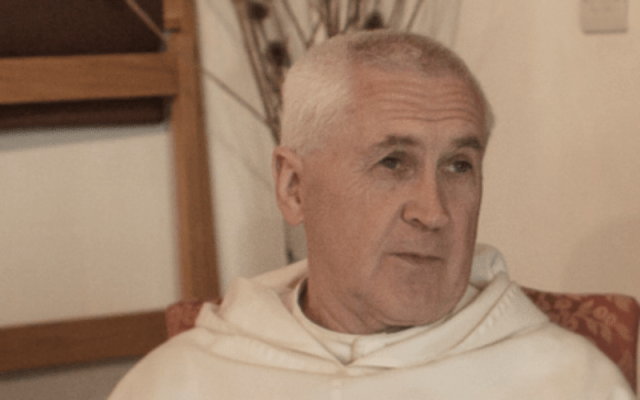
CONGRATULATIONS TO THE PARISH OF OUR LADY OF THE ATONEMENT IN SAN ANTONIO AND TO PASTOR EMERITUS FATHER CHRISTOPHER PHILLIPS, ITS FOUNDER


Our Lady of the Atonement’s new rector installed amidst bittersweet ceremony

Our Lady of the Atonement’s new rector installed amidst bittersweet ceremony
Beloved pastor-emeritus watches from the sidelines

By Mary Ann Mueller in San Antonio
VOL Special Correspondent
www.virtueonline.org
August 21, 2017

SAN ANTONIO, TEXAS — That day had to come … eventually. The day that Our Lady of the Atonement, the thriving Anglican Use Catholic parish and a jewel in the Personal Ordinariate of the Chair of St. Peter’s crown, would officially change leadership. That the keys to the church and the Tabernacle would be turned over to a priest other than Fr. Christopher Phillips, the founding priest of the mother church of the Anglican Use and the Pastoral Provision patrimony in the United States.

That day came last week on the Feast of the Assumption — August 15.

For more than three decades, August 15 has had a very special significance for Fr. Phillips and Our Lady of the Atonement. For it was on August 15, 1983, that Christopher Phillips, a former Episcopal priest, led 18 Episcopalian souls into the Catholic Church and was himself ordained as a Roman Catholic priest. On that day, in addition to Fr. Phillips’ Catholic sacerdotal ordination and the reception of the former Episcopalians into the Catholic Church, what would become Our Lady of the Atonement parish was canonically erected. That seed was firmly planted in the warm sandy soil of Bexar County, Texas, not far from the famed Alamo, where the Siege and Battle of the Alamo was a pivotal event in Texas’ fight for independence. The small seed was waiting to germinate, then grow and eventually flower.

Even though the idea, vision and dream of a flourishing Our Lady of the Atonement Parish was established on that August day in 1983 by a Decree of Erection under the direction of Pope John Paul II and signed by Catholic Archbishop Patrick Flores (IV San Antonio), the church’s actual beginnings were rather humble.

Fr. Phillips and his growing family had a small rectory on the northeast side of town. The house also served as OLA’s church office and initially, liturgical celebrations were held at San Francesco diPaola Catholic Church in near downtown San Antonio. To provide sustenance for his family, Fr. Phillips wore many birettas. He served as chaplain for the Carmelite Sisters of the Divine Heart of Jesus, and as an auxiliary military chaplain at Wilford Hall Hospital, as well as a supply priest assisting at various San Antonio Catholic parishes by celebrating Masses and hearing Confessions. But the former Episcopal priest never took his eyes off the vision that the Lord gave him about a flourishing Anglican Use parish in Archdiocese of San Antonio. Little by little, that dream came into being. Eventually the Anglican Use liturgical celebrations were moved to Mount Sacred Heart Convent chapel as the growing congregation sought a place of its own.

The break came in 1985 when vacant property was located on Red Robin Road. A six-and-a-half acre plot of land was already owned by the archdiocese which allowed the fledging pastoral provision congregation to purchase it and set down delicate root hairs allowing then them to take hold and grow. Our Lady of Atonement had found a permanent home in northwest San Antonio just off of the Loop 1604 and near the University of Texas-San Antonio campus. The first item of business was to build the church. Ground was broken in 1986 and on August 15, 1987, OLA was dedicated, the high altar was consecrated and the beautifully ornate triptych was unfurled for the first time.

The church, which is under the title and patronage of Our Lady of the Atonement, was firmly established.

Our Lady of the Atonement Anglican origins

Our Lady of the Atonement (Domina Nostra Adunationis) is inherently an Anglican Marian title honoring the Blessed Virgin Mary. It crept into the Roman Catholic Church through the Society of the Atonement, an Anglican Franciscan order dedicated to seeking the “at-one-ment” — unity — of all Christians as the Anglican Franciscans understood the meaning of Romans 5:11: “And not only so, but we also find joy in God through Our Lord Jesus Christ, by whom we have now received the atonement.” (KJV)

The Atonement was accomplished through Jesus Christ’s sacrifice on the Cross and Holy Mary is His virgin mother. The title — Our Lady of the Atonement — honors that sacred motherhood.

The Society of the Atonement was co-founded in the late 19th century by Paul Wattson and Lurana White. Fr. Louis Wattson — as he was then known — was an Anglo-Catholic priest yearning to start an Episcopal religious order dedicated to working towards the unity of all Christians based on his “at-one-ment” understanding of Romans 5:11. At the time, Miss White was a novice in the Sisters of the Holy Child Jesus, which was an Episcopal religious community for women. But she was searching for an American religious order with a Franciscan spirituality and at that time The Episcopal Church had no Franciscan religious expression. Therefore, Miss White and Fr. Wattson joined forces and the Society of the Atonement was born in Garrison, New York, as the Friars and Sisters of the Atonement. The foundation date is given as Dec. 15, 1898.

During that time, the Oxford Movement was in full flower and many Anglicans on both sides of the Atlantic ended up finding the fullness of their faith in the Church of Rome, including: John Henry Newman, Ronald Knox, Gerard Manley Hopkins, Henry Edward Manning, Robert Hugh Benson, William George Ward, Benjamin Williams Whitcher and others. At least two of the 19th century converts became Catholic cardinals — Newman and Manning. Women also swam the Tiber, including Sr. Margaret Anna Cusack, an Anglican nun; and Augusta Theodosia Drane, who became a Dominican prioress.

The strong pull of the Oxford Movement had a powerful draw upon the founders of the Society of the Atonement. Eventually, they headed to Rome, bringing members of their joint Episcopal religious order with them. The corporate reception of the Friars and Sisters of the Atonement into the Roman Church occurred on Oct. 30, 1909 and that was the first time a cooperate reunion of Anglicans to the Roman Catholic Church occurred since the time of the 16th century English Reformation. Fr. Wattson and Mother Lurana, along with one Atonement friar, two professed Atonement sisters, two novices and 10 lay associates were all converted — 17 in all.

“The Society of the Atonement, heretofore, has been a company of Anglicans living under the rule of St. Francis, and its founder, Father Paul, has become well known as advocating the corporate reunion of the Anglican Church with the Holy See,” the New York Times reported on October 31, 1909. “The reception of the Society of the Atonement as a body, preserving its name and corporate existence, is an exceptional privilege granted from Rome, as the result of a petition made some time ago to Pope Pius X…”

One century later, in 2009, the All Saints Sisters of the Poor, an Episcopal religious order of nuns in Cantonsville, Maryland, were received into the Catholic Church. Then “across the pond” in 2013, the Community of St. Mary the Virgin, a religious order of women in the Church of England, was received into the Catholic Church. Now rebranded as the Sisters of the Blessed Virgin, the British community is a part of the English Ordinariate of Our Lady of Walsingham.

“The call to Christian unity must always be the primary motivating factor in the decision of Anglicans to enter the Catholic Church,” one English Sister noted about seeking ‘at-one-ment’ with the Catholics. “Anything which impedes that process cannot be of God, and so must be set aside to achieve this aim, which is the will of Christ.”

Today the Catholic version of the Society of the Atonement is called the Franciscan Sisters and Friars of the Atonement or simply the Graymoors. They are still dedicated to bringing unity to the whole Body of Christ through the “at-one-ment.” Fr. Paul of Graymoor (Fr. Wattson) is on the road to Catholic sainthood, as is John Henry Cardinal Newman.

In 1983, Fr. Christopher Phillips, too, led his small band of 18 Episcopalians into the Catholic Church and, embracing the Graymoors’ ecumenism of the “at-one-ment”, named the-hoped-for Pastoral Provision Anglican Use parish, Our Lady of the Atonement, thus making it one of only two Catholic churches in the world under that name. The other is Baguio’s Cathedral of Our Lady of the Atonement in the Philippines. It received its unique Anglican-style name in 1936, as a result of Anglican spirituality being introduced to the Cordillera mountains of the Philippines by Episcopal missionaries from the United States, who obviously were influenced by the Society of the Atonement.

For 10 years, the Our Lady of Atonement parish grew in Texas. The Gospel was preached and the Sacraments were celebrated with a decidedly Anglican accent in Elizabethan English. Fr. Phillips’ rich baritone voice and crisp New England diction helped to make the Anglican Use liturgies memorable. Parish life was firmly established and flourished. Young couples got married and babies were baptized. Children were taught the faith and confirmed and their grandparents were buried. But it became acutely obvious that something was missing — a parish day school.

Atonement Academy

On August 15, 1993 — on the tenth anniversary of the founding of the parish — the decision was made to establish a Catholic parochial school under the title of Atonement Academy. This was the fulfillment of Fr. Phillips’ academic dream to establish an accompanying Catholic parish school. The classical Catholic education of children became the parish’s unique mission. One year later, on August 15, 1994, Atonement Academy opened its doors to its young first scholars — 66 Kindergarten through third grade students.

Again, on August 15, 2017, another academic year has started. This year a massive newly-completed 117,000 three-story school building — the size of a small medieval castle — opened its doors to nearly 600 Pre-K through high school students. Fr. Phillips wanted to build an educational edifice large enough to “grow into.” Before that, other Academy additions were “outgrown” almost before the doors were opened and the note was paid off, as Atonement Academy’s student body exploded nearly 10-fold in less than 25 years.

Not only was Atonement Academy beginning a new academic year on August 15, but the entire parish was in the throes of transition as a new rector came in to take over the leadership reins and Bishop Steven Lopes (I Ordinariate) did the honors of installing him that evening.

Fr. Phillips had fulfilled his mission. He successfully established an Anglican Use Pastoral Provision parish in south Texas. Then he was able to shepherd his congregation, church and school safely into the Personal Ordinariate of the Chair of St. Peter, but not without some last minute difficulty.

The San Antonio priest championed the Anglican ordinariates and looked forward with great anticipation to the establishment of the American ordinariate after Pope Benedict XVI announced to the world in 2009 that through the apostolic constitution, Anglicanorum Coetibus, a unique jurisdiction would be set up to allow former Anglicans — including Episcopalians — who become Catholic, to retain some of their unique patrimony: liturgy … music … architecture … parish life … ethos … ethnicity …

Anglicanorum Coetibus, which was announced 100 years after Fr. Paul and Mother Lurana joined the Catholic Church, can almost be seen as a fruit of their long desire and heartfelt prayers for “at-one-ment” within the Body of Christ. They unknowingly led the way for others to follow.

As the Ordinariate of the Chair of St. Peter was being erected in 2012, Fr. Phillips quietly bided his time as the infant jurisdiction got its feet firmly planted in Houston, Texas. Meanwhile, the San Antonio priest continued to grow Our Lady of the Atonement. Five years later, he realized the time was ripe to fold into the Ordinariate.

But that was simpler said than done. The Archbishop of San Antonio, Gustavo García-Siller, M.Sp.S. (VI San Antonio), stood in his way. Our Lady of the Atonement had grown into a large, dynamic, flourishing Catholic parish with a very successful and growing parochial school. San Antonio’s archbishop did not want to see Our Lady of the Atonement slip through his fingers into the Ordinariate, taking the people in the pews, property, buildings and money with it.

So on the afternoon of January 19, 2017, just ten days after his predecessor and Fr. Phillips’ protector, Archbishop Patrick Flores, died, Archbishop García-Siller unexpectedly swooped in and removed OLA’s priest as pastor, banishing him from the church, and replacing him with a Polish priest. (The Lord had called Archbishop Flores unto Himself on January 9.) So for 60 days, Fr. Phillips was in exile as his parishioners stormed heaven with daily prayer, fasting and sacrifice while the San Antonio archbishop mounted a hostile takeover of their beloved pastoral provision parish.

All this started to unfold at the beginning of the Catholic Church’s annual Week of Prayer for Christian Unity (Jan. 18-25), which was initially established as the Church Unity Octave by Fr. Paul of Graymoor and Mother Lurana of the Society of the Atonement. The two Anglican religious order founders and their followers were actively seeking “At-one-ment — the unity of men and women with God and with one another.”

The flap ended up going to the Congregation for the Doctrine of the Faith (CDF) for resolution. The CDF is the Vatican’s curial office which oversees the world’s three Anglican ordinariates. Ultimately it was Pope Francis who decreed that Our Lady of the Atonement would be transferred into the Ordinariate of the Chair of St. Peter. But in so doing, Fr. Phillips was no longer the rector when he returned to the Ordinariate-bound parish. His primary task had been fulfilled. Our Lady of the Atonement would safely land in the Ordinariate with its church and school property intact.

Immediately, the parish had new episcopal authority — Bishop Steven Lopes, who on March 21 travelled to San Antonio with the exciting news that Fr. Phillips would be joyfully returned to his parish as pastor-emeritus. But a new priest was needed to carry on Fr. Phillips’ work and expand his vision. Fr. Phillips would no longer be the “father” of the parish, he would now be the revered “grandfather” of the parish and his many years of knowledge, experience and wisdom would be invaluable to whomever the Bishop Lopes tapped as the new rector.

At 67, Fr. Phillips is not being put out to pasture. He continues simply as a parish priest — celebrating Mass, hearing Confessions, teaching the children their prayers — but without the burden, weight and responsibly of leadership on his shoulders. His talents and passion will also be tapped by Bishop Lopes, who has asked him to share his insight, skills and familiarity with church planting and growth with the other 40-plus parishes in the wide-flung Ordinariate.

Enter Fr. Mark Lewis

It is Fr. Mark Lewis who was tapped as Our Lady of the Atonement’s second pastor. He is a first generation Ordinariate priest, just as Fr. Phillips is a first generation Pastoral Provision priest. In 2011, Fr. Lewis was converted along with members of his Anglo-Catholic congregation at St. Luke’s Episcopal Church in Bladensburg, Maryland.

Eventually, St. Luke’s joined forces with St. Thomas of Canterbury Society in Washington, DC, and St. John Fisher Community in northern Virginia to form a unified parish. The larger Ordinariate congregation, bearing St. Luke’s name, then moved to a bigger centralized location to share worship space at the Basilica Shrine of the Immaculate Conception in Washington.

It was to St. Luke’s that the Bishop Lopes reached out to fill the pulpit at Our Lady of the Atonement.

“Father Lewis is known across the Ordinariate for his pastoral wisdom, spirit of hospitality, and keen administrative gifts. We are confident he will bring the same qualities of kindness and vision to his service to the faithful of Our Lady of the Atonement …” Bishop Lopes explained as he announced Fr. Lewis’ new appointment. “We know you will welcome and encourage your new Pastor — and that together, you will continue to share the vitality our faith offers to all those seeking the spiritual treasures of the Universal Church.”

Mark Lewis was graduated from Mount St. Mary’s Seminary and then he picked up a Masters of Divinity from Nashotah House. As an Episcopal priest, he served as curate at St. Stephen’s in Whitehall, Pennsylvania, before moving on to St. Luke’s as rector. Fr. Lewis is also an ex-officio member of the Ordinariate’s Governing Council. He and his wife Vicky have two children and one grandchild.

On August 15, Bishop Lopes made his third trip to San Antonio since the Anglican Use parish came into the Ordinariate five months before. This time he was accompanied by at least 50 parishioners and clergy from Our Lady of Walsingham Cathedral in Houston, who came in solidarity to witness Bishop Lopes install Fr. Lewis. OLW was established just one year after OLA and there has always been a close fraternal connection between the two Anglican Use Texas parishes for more than thirty years.

During the installation rite, Bishop Lopes led Fr. Lewis to different parts of the church. First, they went to the baptismal font where the priest was given the faculties to baptize in the Name of the Father, and of the Son, and of the Holy Ghost.

The next stop was the confessional, where the priest was given the authority to hear confessions and pronounce absolution, then on to the raised pulpit, highlighting the prophetic nature of Fr. Lewis’ priesthood as he preaches.

Next was a stop at the sedilia — the needlepoint embroidered priest’s chair — nestled in the alcove on the Gospel side of the altar. The throne-like sedilia represents the earthly priest’s kingship with his ruling authority and leadership of the parish.

Finally, the incoming Ordinariate priest was led to the Tabernacle, where he was given the Tabernacle key and took possession of the Reserved Sacrament. Turning around, he stepped to the altar, where he will be celebrating the Mass, possibly for many years to come. The altar is the heart of the church and the place where a priest most exercises the sacerdotal aspects of his priesthood. It was at the altar, that the new priest signed the Decree of Possession and at 7:55 p.m., the deed was done, the Rev. Mark Lewis had officially become the second pastor of Our Lady of the Atonement, 30 years to the day that the ornate Anglican Use church was first dedicated as a bastion for the Anglican patrimony.

Mary Ann Mueller is a journalist living in Texas. She is a regular contributor to VirtueOnline

Posted in Uncategorized | 4 Comments

HOW AWARE WERE YOU OF THE OTHER ECLIPSE HAPPENING TODAY? YOU DID NOT NEED SPECIAL GLASSES TO SEE THIS OTHER ECLIPSE.

2017 Solar Eclipse. Image courtesy of NASA Goddard Space Flight Center (CC)
An Eclipse of the Sun of Catholic Truth
Steve Skojec Steve Skojec
August 21, 2017
OnePeterFive
FacebookGoogle+PinterestPocket

Today, I stood in my back yard and watched as the sun was obscured by the passing of the moon. Things felt strange. The birds stopped singing. My dog stopped barking at the things he usually would, and sat there with his ears perked up. The temperature dropped noticeably. The air was still. Everything was eerily quiet, and while I wasn’t in the path of a total eclipse, the sunlight was dimmed enough that shadows changed and everything took on a different, unsettling hue.

I remarked to my wife that it felt like I was standing on an alien planet that only looked like Earth, but had a different solar arrangement.

As I watched with wonder and curiosity, I found myself remembering something I was told some time ago.

Early last year, feeling discouraged (as I sometimes do) by the situation in the Church, I reached out to a member of the clergy whom I greatly respect, seeking counsel. I had recently watched the pope’s video about “Care for Creation”, which I wrote about in an essay entitled, “Gaia Church: Love the Earth. Heaven Can Wait.”

“With so much focus on the temporal, the immanent, the passable,” I said to this true servant of Our Lord, “I cannot help but wonder if our Holy Father even believes in God, or consequently, the need to help souls attain heaven. All is humanism. All is immanentism.”

I mentioned the video. I also mentioned an interview Francis had given at the time about the situation in China. In it, he made not one mention of the suffering, imprisoned, or oppressed Catholics there. When asked about China’s slaughter of 400 million of it’s own children — often against the will of their parents — he referred to this only as a “mistake.” As though the Chinese had simply gotten their priorities out of order.

“I know the unchangeable truths of the faith.” I said. “I believe in them. I hold to them. But this man, I truly believe, is a chastisement on the faithful. … God must be so very angry with us.”

This alter Christus responded to me with compassion, agreeing that the situation with Pope Francis was quite sad. He said to me that this papacy presents a significant trial for our faith, as well as our supernatural view of the Church. But, he insisted, this is only happening by means of God’s mysterious permission. He advised me that the faithful should try not to take what Francis is saying and doing too seriously.

“Let us in some way ignore this pontificate,” he said, “which represents an eclipse of the sun of Catholic truth. The eclipse is temporal and passes. Let us pray fervently for the salvation of the poor soul of pope Francis and at the same time for the miracle of the next conclave to give us a traditional pope. The darker it is getting in Rome, the brighter has to shine our faith and our love for Jesus. It is a challenge for our faith. Let us be in all humility soldiers and knights of Christ.”

This image has stayed with me ever since.

A solar eclipse obscures, it does not obliterate. As we know, it occurs when the moon — an object that generates no light of its own — passes in front of the sun — the source of all light in our solar system — allowing darkness to fall across the surface of the earth. It is merely the casting of a shadow, not the dying of the light.

Today, standing in my yard, I found that I could see more clearly why this analogy is so appropriate for our present ecclesiastical situation.

At the advent of today’s eclipse, many people were very excited. A few were concerned about what it might mean. Still, it seemed that it was all anyone could talk about. Websites, social media, TV & radio stations were all filled with chatter about this unique and once-in-a-lifetime event.

At the moment of apex, everyone — even many who claimed not to care — found themselves looking out windows, standing on porches, pulling their cars over to the side of the road, or planted in their yards, trying to make sense of what they were witnessing. The experience, while fascinating, was also very uncanny. Things looked almost the same, but everything was cast in the same strange light. Like a parody of a normal day, with many of the important details missing.

And then it was gone, and the light grew brighter, and the shadows slipped back into their normal places, and the warmth of the summer returned, and the people went back inside, back to school, back to work, back to the normalcy of life that did not come to a stop but was merely put on pause, just for that brief span of time. Just for the moment when things were perceptibly not as they should be.

As analogies go, it isn’t really much of a stretch, is it?

In the life of the Church, the eclipse we are now experiencing has lasted just four years, but it feels as though it has gone on for longer than many of us feel we can bear. What began as a cause of excitement for many has now gotten under their skin. The fascinating curiosity of the otherness of the event has given way to a nightmare that things will never again be the same.

But we must remember: it is merely the casting of a shadow, not the dying of the light. And in our case, it is not a natural phenomenon, but rather a preternatural one. Put another way, our ecclesiastical eclipse is not the work of the moon; rather, it is the doing of other celestial creatures: “And his tail drew the third part of the stars of heaven, and cast them to the earth: and the dragon stood before the woman who was ready to be delivered; that, when she should be delivered, he might devour her son.” (Rev. 12:4)

For in Christian symbolism, Christ is the sun and Mary the moon. Mary, who does not generate her own light, but so beautifully reflects the light of Christ into the darkness of our sin and ignorance. Mary, that perfect creature who never occludes the life-giving light of her Son. Her brilliance never wanes, but her presence never obscures; she stands beside Him in her fullness, and yet ever in submission. This imagery is captured beautifully in the following prayer of St. Bernard:

O Blessed Queen! It is of thee prophet speaks when he says, “Who is she that riseth like the day-star, beautiful as the moon, brilliant as the sun?” Yes, thou didst appear in the world like the bright day-star, preceding by the light of thy sanctity the coming of the Sun of Justice. The day on which thou camest into the world may well be styled a day of salvation and a day of grace. Thou art beautiful as the moon; because as none of the celestial bodies so nearly resembles the sun as it does, so there is no creature whose perfections so nearly approach to those of God as thy own. The moon enlightens the night by reflecting the rays of the sun, and thou enlightenest our darkness by the splendor of those virtues with which God has adorned the. But thou art even more beautiful than the moon, because in thee is found neither spot nor shade; thou art brilliant like the sun; I mean that divine Sun who created the one which enlightens the earth, for, as He and His humanity is the most resplendent among men, so art thou the brightest among women.

We should pray, then, that soon the light of Christ the Sun and Mary the moon will shine forth brightly to destroy this momentary darkness that now hides the beauty and splendor of Holy Mother Church.

“Heaven and earth shall pass, but my words shall not pass.” – (Mt. 24:35)

Posted in Uncategorized | 2 Comments

10,00 PILGRIMS FROM ALL OVER THE WORLD MAKE A PILGRIMAGE TO FATIMA


Fatima: Crowd of Pilgrims From All Parts of The World

Around 10,000 faithful came to Fatima for the pilgrimage organized by the SSPX on August 19 and 20 for the centenary of the apparitions of Our Lady.

Read more…

In Fatima, Pontifical Mass on August 20

Read more…

In Fatima, Rosary and Adoration

After mass, the pilgrims went in procession to the very place where Our Lady appeared to the children on August 19, 1917. At Os Valinhos, they prayed the rosary.

Read more…

Bishop Fellay’s Sermon at Fatima on August 20, 2017

During the sermon during the Mass celebrated on Sunday, August 20 – the votive Mass of the Immaculate Heart of Mary – Bishop Bernard Fellay spoke to the pilgrims in Fatima in French, English, German, Italian, and Spanish.

Read more…

Fatima: A Magnificent Pilgrimage Draws to a Close

Towards 3:00 p.m., at the Os Valinhos – in the shade of the olive trees, where the temperature was 102° – the pilgrims recited the final rosary that brought the pilgrimage for the centenary of the apparitions of Fatima to a close.

Read more…

Act of Consecration of Russia to the Immaculate Heart of Mary

On August 20, Bishop Bernard Fellay, Superior General recited this act of consecration along with Bishop Bernard Tissier de Mallerais and Bishop Alfonso de Galarreta, auxiliary bishops of the Society of Saint Pius X during an international pilgrimage gathering more than 10.000 faithful from all over the world.

Read more…

Posted in Uncategorized | Comments Off on 10,00 PILGRIMS FROM ALL OVER THE WORLD MAKE A PILGRIMAGE TO FATIMA

Statues can remind us of where we once stood. More important than any statue, however, is where we now stand. Do we stand with God? Are we near Him or far off?


Destruction of the Cheapside Cross, 1647
.
.
.
  AUG. 19, 2017
THE NATIONAL CATHOLIC REGISTER
.
.
A Reflection on the Removal of Controversial Statues
Statues can remind us of where we once stood. More important than any statue, however, is where we now stand.
.
.

Understanding our story is a critical aspect of the life of every Christian. We all have a story, a narrative of how God brought us to birth and has interacted with us. It is filled with successes and struggles, virtues and vices. Knowing that story is crucial to testifying and being a witness to others of God’s grace, mercy, and truth. On a collective level, Israel, the Church and nations have stories of how God has interacted with and led them. Just as with those of individuals, the histories of these collectives are also marked with both wondrous and horrifying moments.

In the United States, we are currently locked in a great battle over our history: what to remember, how to remember it, and how to interpret it. The battle has been going on for quite some time regarding what is taught in our schools, but recently statues and monuments have become the focus.

As a Catholic priest trying to stay within my bounds, I will try to steer clear of making merely political observations. Instead, I would like to reflect on “remembering” in the context of faith. Remembering, of course, is not simply retrieving stored facts from our mind. For a Christian, it also involves interpretingation and understanding memories in the light of God’s revealed truth; it is the same with our national memories.

Permit from me an initial disclaimer about the Civil War and then a written hope that we can apply our faith to remembering.

Like any great human conflict, the Civil War was complex and multifaceted. Yes, it was about slavery, but also conflicting cultures, and the respective powers of federal and state governments.

Although the issue of slavery is settled, the other conflicts continue to this day. Those who claim that the Civil War had little to do with slavery itself but rather with states’ rights remind me of those who say that the issue of abortion is one of “choice.” The issue isn’t really choice itself, but what that choice involves. In the case of abortion, the choice made is to end the life of an unborn child for any reason at any time during pregnancy. “Choice” is too general; specificity is needed. All sorts of “choices” are forbidden by law (e.g., rape, murder). In the case of the Civil War, the rights of the states were a concern—but the right of the states to do what? The greatest dispute was over the right of the states to permit and uphold slavery. Especially after the Emancipation Proclamation (January 1, 1863), slavery was the focal issue of the Civil War.

The Civil War was complex and so are the memories of it. Was it the “War to Preserve the Union,” the “War of the Southern Rebellion,” the “War to Make Men Free”? Or was it the “War Between the States,” the “War of Northern Aggression”? Yes! All of these contain some truth.

What was in the heart and mind of each soldier, each general? Only God knows. What was in the hearts and minds of those who honored the Confederate dead in state cemeteries or by erecting statues in public venues? Only God knows. Perhaps there were many motives, some noble, some sinful.

The word “statue” comes from the Latin status, the past participle stem of stare, which means “to stand or be firm.” As such, a statue represents someone who once stood and was firm but is now gone. In terms of issues, a statue can represent where we once stood. Thus, in one sense a statue is merely a representation of history. For many today, however, a statue is less about history than about honor. To them, a statue conveys respect, not just a nod to history or memory.

Should controversial statues be removed today? That is not for me to say; it would be imprudent for me as a priest to “take sides.” It is a prudential decision best left to local communities to resolve after discussion and debate. I will note that I have served African-American Catholics for many years and realize the pain that such things often cause, but I also understand the fear engendered in others by the removal of statues in the middle of the night at the direction of government officials who are rather suddenly reacting to national political pressures rather than local and community-based concerns. Further, there seems to be no end in sight to this escalating issue. I would remind people on both sides that pain is a part of life and that we cannot have everything as we want.

Writing as a Catholic and a priest, I do wish to offer an insight from faith about the need for and purpose of remembering. To remember is to assemble the often-fragmented stories of our past into an intelligible narrative with self-understanding. To honestly remember yields the sober insight that, though gifted, each of us is flawed; our nation is flawed and all of our heroes were flawed, sometimes significantly so. Human nature is wounded and prone to sin. Each of us is a mixed bag of virtue and vice. Pray God that we are moving steadily away from vice and toward virtue, but people need time to repent and to grow. It is the same with nations, peoples, and cultures.

Recognizing our flawed nature should lead us to humility and mercy, and the resolve to live up to the ideals to which we are summoned. The journey can be long, both individually and collectively, but God stays with us.

In the Scriptures, consider that most of the greatest heroes were deeply flawed, and yet God worked with them and led them a mighty long way:

  • Abraham followed God’s call to Canaan but then strayed to Egypt, trusting Pharaoh more than God to feed him. In Egypt he placed his own wife in Pharaoh’s harem. Later, he committed adultery with Hagar and in so doing abused her. Only at the end did Abraham faithfully resolve to trust God.
  • Moses was a murderer; at age 40 he was too strong and proud for God to use. Only much later, at age eighty and stammering, was he finally humble enough for God to use him.
  • Jacob was a liar and conspired with his mother to defraud his brother Esau of the birthright, yet God said He loved him, and through him came the Twelve Tribes of Israel.
  • David was an adulterer and plotted to have Uriah the Hittite killed. He was a great King of Israel, but his own household was in disarray due to his polygamy and his favoritism of Amnon over Tamar and Absalom. One of his own sons went to war against him.
  • Peter denied Jesus.
  • Paul was set against the faith and conspired or participated in the death of many Christians.

Many of the saints of the Church had less-than-spotless pasts. A large number of them held views that, from a 21st century point of view, are “unenlightened.” Some of the saints encouraged and even preached the crusades. Others had very harsh views of the Jewish people.

The point is that God used flawed people with checkered pasts to accomplish great things.He did not affirm their wickedness or weaknesses; remember, God can write straight with crooked lines and make a way out of no way. God looks beyond our faults and sees our needs. He works with sinners. One day He will draw the faithful to perfection in Heaven, but the earthly reality is that we have fallen natures and live in a fallen world, governed by a fallen angel.

Individuals, cultures, the Church, and nations all have pasts. There we will find both the glory and what is gory, virtue and vice, what is ennobling and what is embarrassing. We’ve got some nuts in our family tree; in our American family, some of our heroes could also be heathens. Flawed men led ancient Israel and the Church. Flawed men wrote the Scriptures under divine inspiration. Flawed men led our country in its early years. Flawed men wrote the Constitution. Flawed people lead our country today.

Perhaps the best stance is to accept (though not approve of) this fact, learning to imitate the virtues of the past while avoiding the vices. This is honest and sober remembering. Further, we should ponder with amazement what God can do, even with the mess of this human family of ours.

Should statues of civil war generals be removed? Should statues of supreme court justices who wrote embarrassing or foolish decision be removed? Again, it is not for me to say. I leave that to local communities to decide. However, I do have a concern that we not forget our story as a nation any more than our biblical past. If statues were erected only of the sinless, the only ones in existence would be those of Our Lord and Our Lady.

Expunging the painful and even embarrassing moments of our past can too easily lead to the proverbial warning coming to pass: “Those who forget the past are condemned to repeat it.”

Yes, we need to remember that as a nation we were once horribly wrong about a moral issue: slavery. Public opinion polls of those times showing support for slavery did not yield the truth. That memory is important today in the great battle against abortion and other moral evils. I pray that one day we will be as embarrassed that we ever legalized and supported abortion as we are today that we permitted slavery. How could we have been so wrong then? How can we be so wrong now? Where were our heart then? Where are they now? The honest and complete recounting of history provides a framework for this sort of reflection; expunged history leaves us without that context in which to reason.

We need to remember Roger B. Taney (statue or not) and the Dred Scott decision. Just because the Supreme Court makes a ruling doesn’t mean that it is moral or true or that it is “settled law.” The lesson of the Dred Scott case is that just because something is legal does not make it right or even just. An unjust law is no law at all.

Perhaps a few Confederate generals (statues or not) should be in our national memory to remind us all that we don’t always win what we fight for, that we’re not always right. Further, even the good things we fight for aren’t always unambiguously pure or good. Even our best intentions are often admixed with less admirable and even sinful motives. I’m sure that a few Union generals would admit to mixed motives for what they did.

Yes, honest remembering is important. We have a great nation, one with many virtues and blessings; but serious flaws are also part of our story.

A stance of patience, gratitude, and admitting our flaws, current and historical, is better than one of angry discourse or violence. Selective outrage is also a problem today. Sin comes in a lot of flavors. What does not offend us says as much about us as what does. Too often today there seems to arise a sudden indignation over a particular “sin du jour”; it sweeps through like a tsunami, leaving no time for thoughtful reflection. In its wake is left a lot of fear, anger, and damage. The result is not real reform, just an undercurrent of simmering anger waiting for an opportune moment to explode.

God is so very patient with us, but His patience is directed toward our salvation. For us, too, patience and acceptance of our past are important. Remember, this does not mean approval. God shows us patience in order to get us somewhere, but He never stops summoning us to the truth and to holiness. Whatever patience we can show one another should have the same purpose: summoning one another to what is true and what is best in our country.

Statues can remind us of where we once stood. More important than any statue, however, is where we now stand. Do we stand with God? Are we near Him or far off?

Posted in Uncategorized | Comments Off on Statues can remind us of where we once stood. More important than any statue, however, is where we now stand. Do we stand with God? Are we near Him or far off?

FATHER AIDAN NICHOLS PROPOSES THAT AFTER FRANCIS GOES TO HIS ETERNAL REWARD CANON LAW SHOULD BE CHANGED TO MAKE IT EASER TO “CALL A POIPE TO ORDER WHO TEACHES ERROR

image001

Fr Aidan Nichols


Leading theologian: change canon law to correct papal errors


by Dan Hitchens

posted Friday, 18 Aug 2017

Fr Aidan Nichols

Fr Aidan Nichols said that Pope Francis’s teaching had led to an ‘extremely grave’ situation

A prominent theologian has proposed reforming canon law to allow a pope’s doctrinal errors to be established.

Fr Aidan Nichols, a prolific author who has lectured at Oxford and Cambridge as well as the Angelicum in Rome, said that Pope Francis’s exhortation Amoris Laetitia had led to an “extremely grave” situation.

Fr Nichols proposed that, given the Pope’s statements on issues including marriage and the moral law, the Church may need “a procedure for calling to order a pope who teaches error”.

The Dominican theologian said that this procedure might be less “conflictual” if it took place during a future pontificate, rather as Pope Honorius was only condemned for error after he had ceased to occupy the chair of Peter.

Fr Nichols was speaking at the annual conference in Cuddesdon of an ecumenical society, the Fellowship of St Alban and St Sergius, to a largely non-Catholic audience.

He said the judicial process would “dissuade popes from any tendency to doctrinal waywardness or simple negligence”, and would answer some “ecumenical anxieties” of Anglicans, Orthodox and others who fear that the pope has carte blanche to impose any teaching. “Indeed, it may be that the present crisis of the Roman magisterium is providentially intended to call attention to the limits of primacy in this regard.”

Fr Nichols has written over 40 books of philosophy, theology, apologetics and criticism. In 2006 he was appointed to Oxford University’s first lectureship since the Reformation in Catholic theology.

He has not publicly commented on Amoris Laetitia until now, but was a signatory to a leaked letter from 45 priests and theologians to the College of Cardinals. The letter asked the cardinals to request a clarification from the Pope to rule out heretical and erroneous interpretations of the exhortation.

In his paper Fr Nichols mentioned some of the same concerns as the letter: he noted, for instance, that Amoris Laetitia could seem to imply that the monastic life was not a higher state than marriage – a view condemned as heretical by the Council of Trent.

The exhortation has also been interpreted as arguing that the divorced and remarried can receive Communion without endeavouring to live “as brother and sister”. This contradicts the perennial teaching of the Church, reaffirmed by Popes St John Paul II and Benedict XVI.

Fr Nichols said that this interpretation, which Pope Francis has reportedly approved, would introduce into the Church “a previously unheard-of state of life. Put bluntly, this state of life is one of tolerated concubinage.”

But Fr Nichols said the way in which Amoris Laetitia argued for “tolerated concubinage” (without using the phrase) was potentially even more harmful. He quoted the exhortation’s description of a conscience which “recognizes that a given situation does not correspond objectively to the demands of the Gospel” but sees “with a certain moral security…what for now is the most generous response.” Fr Nichols said this seemed to say “that actions condemned by the law of Christ can sometimes be morally right or even, indeed, requested by God.”

This would contradict the Church’s teaching that some acts are always morally wrong, Fr Nichols said.

He also drew attention to the statement – presumably referring to attempts to live continently – that someone “may know full well the rule yet…be in a concrete situation which does not allow him or her to act differently and decide otherwise without further sin”. Fr Nichols noted that the Council of Trent had solemnly condemned the idea that “the commandments of God are impossible to observe even for a man who is justified and established in grace.” Amoris Laetitia seemed to say that it is not always possible or even advisable to follow the moral law.

If such general statements about moral acts were correct, Fr Nichols said, “then no area of Christian morality can remain unscathed.”

He said that it would be preferable to think that the Pope had been merely “negligent” in his language, rather than actively teaching error. But this seemed doubtful, given the reports that the Congregation for the Doctrine of the Faith had suggested corrections to Amoris Laetitia, and was ignored.

Cardinal Raymond Burke has publicly discussed making a formal correction of the Pope. However, Fr Nichols said that neither the Western nor Eastern Codes of Canon Law contain a procedure “for enquiry into the case of a pope believed to have taught doctrinal error, much less is there provision for a trial.”

Fr Nichols observed that the tradition of canon law is that “the first see is judged by no-one.”  But he said that the First Vatican Council had restricted the doctrine of papal infallibility, so that “it is not the position of the Roman Catholic Church that a pope is incapable of leading people astray by false teaching as a public doctor.

“He may be the supreme appeal judge of Christendom…but that does not make him immune to perpetrating doctrinal howlers. Surprisingly, or perhaps not so surprisingly given the piety that has surrounded the figures of the popes since the pontificate of Pius IX, this fact appears to be unknown to many who ought to know better.” Given the limits on papal infallibility, canon law might be able to accommodate a formal procedure for inquiring into whether a pope had taught error.

Fr Nichols said that bishops’ conferences had been slow to support Pope Francis, probably because they were divided among themselves; but he said that the Pope’s “programme would not have got as far as it has were it not the case that theological liberals, generally of the closet variety, have in the fairly recent past been appointed to high positions both in the world episcopate and in the ranks of the Roman Curia.”

Fr Nichols said that there was “a danger of possible schism”, but that it was unlikely and not as immediate a danger as “the spread of a moral heresy”. The view which Amoris Laetitia apparently contains would, if it passed without correction, “increasingly be regarded as at the very least an acceptable theological opinion. And that will do more damage than can easily be repaired.”

He concluded that the law of the Church will live on, because of those who “give the law life by faithfulness in love”.


Posted in Uncategorized | Comments Off on FATHER AIDAN NICHOLS PROPOSES THAT AFTER FRANCIS GOES TO HIS ETERNAL REWARD CANON LAW SHOULD BE CHANGED TO MAKE IT EASER TO “CALL A POIPE TO ORDER WHO TEACHES ERROR

TO SAY THAT SAINT PIUS X ESTABLISHED A PRECEDENT FOR THE KASPER INTERPRETATION OF AMORIS LAETITIA IS TO SIN AGAINST THE MEMORY OF THAT GREAT SAINT

Pope St. Pius X (8)

  Roma Locuta Est

A Pius View of Amoris Laetitia

by ejbarr678

Blog Note: RomaLocutaEst welcomes Edward J. Barr, an old friend, as a guest contributor.


A Pius View of Amoris Laetitia

August 19, 2019 (Edward J. Barr – Guest Contributor) – It has been quite challenging for me to decipher the true meaning of the Pope’s teaching on Amoris Laetitia.  I frankly am stumped with the twisted “logic” that states that Amoris Laetitia is in conformity with Church teaching.  After all, such teaching clearly holds that the divorced and remarried cannot receive communion without the proper repentance and change of lifestyle, while the Pope has supported dioceses in Malta, Argentina, Germany and elsewhere that support the exact opposite view.  Yet I have been told that this apostolic exhortation on the family is an example of the “ordinary magisterium” — papal teaching — to which Catholics are obliged to give “religious submission of will and intellect.” But to what are we to give “submission of will and intellect?”

Up until Amoris Laetitia Church teaching was clear – Roman Catholics who break their marriage vows remain within the church but cannot receive Communion even if they feel able to do so with a clear conscience. For the faithful to decide on personal conviction alone that they can receive the Eucharist despite not following the Church’s teachings (repentance and cessation of “marital relations”) is prohibited.  Yet the more I read commentators that claimed there is continuity between Amoris Laetitia and Church teaching the more my head began to spin.  Yet I continued to search for some document that would provide a logical view in support of the continuity position.

I didn’t completely succeed, though I must admit I was interested in one opinion that gave an historical analogy on how a Pope could change Church discipline regarding divorced and “remarried” Catholics.  It was claimed that the laudable goal to open the floodgates of Christ’s mercy through the sacraments could be achieved by relating Amoris Laetitia to Sacra Tridentina Synodus.  This was the initiative of St. Pope St. Pius X to increase the practice of frequent communion.  The Pope felt that the corruption of the world could be combatted by frequent and/or daily Communion, which he promoted in his 1905 decree.  However, when I investigated further I found that the Pope actually sought to strengthen Church teaching by stipulating that frequent and daily communion be addressed with even greater prudence. He specifically did not expunge the requirement to be in a state of grace, as some proponents of Amoris Laetitia maintain de facto if not directly.  Sacra Tridentina Synodus promotes frequent and daily Communion, …” so no one who is in the state of grace, and who approaches the Holy Table with a right and devout intention (recta piaque mente) can be prohibited therefrom”.  The reverse is also true.

Another obvious difference is that Sacra Tridentina Synodus was issued in part as a rebuttal to the Jansenism heresy.  The heresy was a denial of man’s participation, via the exercise of his free will, in his salvation.  This led in part to the faithful not actively seeking the Eucharist; in fact, many believed themselves unworthy.  Pope Pius X exhorted them, “Accordingly all hostile prejudices, those vain fears to which so many yield, and their specious excuses from abstaining from the Eucharist, must be resolutely put aside…” (Mirae Caritatis) Clearly this is not the case today, where in Western Churches the Communion lines are long while the Reconciliation lines are almost non-existent.

Yet there are churches that HAVE changed Church teaching on the reception of Communion by divorced and remarried couples, so they must not believe that Amoris Laetitia is in continuity with previous doctrine (I know, I know, they can’t change Church doctrine, so they say they aren’t and institute guidance that does just that).  How have they fared? How do the churches that embrace the progressive “aggiornamento” and the preeminence of personal conscience viewpoint of Amoris Laetitia fare as compared to those churches that stand firm in the teachings that Christ and His Church have always taught?  No greater contrast can be seen than that between the dying church of Germany (and their Western European brethren) and the thriving church of Poland.  Why would this be?  If frequent reception of the Holy Eucharist for all is encouraged since, per Cardinal Kasper, it is “medicine for sinners on their penitential journey,” shouldn’t the church in Germany be thriving?  Of course not, since unrepentant sinners cannot benefit from the sacraments.  On the contrary, it can be incredibly harmful (see 1 Cor. 11:27-29); yet this fact is conveniently ignored by the Kaspar clan.

Perhaps it is time for the Holy See to emulate the early Church and clearly define the differences between Christ’s Church and our pagan culture, rather than slipping towards a universalism that diminishes both Christ’s sacrifice AND His promises.  The most profitable accompaniment would be to help sinners better understand their need for repentance so that they can participate fully in and receive the graces that come from Holy Communion.

While I understand the concern of the Kasper contingent to address the needs of the modern world, I fear their solution will further lead to increased confusion, subjective judgements, and a watered-down faith that would be “Protestant like” in its individualized interpretations.  In the words of my Marine Corps company commander back in my Second Lieutenant days, “good initiative, bad judgement.”
Edward J Barr is an attorney, a Marine, an intelligence officer, and a university faculty member.

ejbarr678 | August 20, 2017 at 3:16 am | Categories: Uncategorized | URL: http://wp.me/p7YMML-3om
Comment    See all comments    Like
Posted in Uncategorized | 1 Comment

THE TIMES THEY ARE A’CHANGING. CATHOLICS NOW HAVE MORE TO FEAR FROM LEFT/LIBERAL/PROGRESSIVES AND THE DEMOCRAT PARTY THAN FROM THE KU KLUX KLAN, THE TRADITIONAL ENEMY OF THE CHURCH. INCREDIBLE!!!


FOR RELIGIOUS AND CIVIL RIGHTS

Trump Was Right To Blame Both Sides

August 16, 2017
Catholic League president Bill Donohue comments on the events of Charlottesville and what they mean:

President Trump was right to call out the extremists on both sides of the Charlottesville tragedy, but more needs to be said about those on the Left who helped to bring it about.

The crazies on the Right—the KKK, the Neo-Nazis and the White Supremacists—have been justly condemned by virtually everyone, save for their sick sympathizers. But we will not make progress if the role of the Left is ignored. Their censorial agenda is wide ranging.

It is the Left that has led the fight to scrub the public square free of religious symbols. From banning Christmas songs in school events, to lawsuits against the display of nativity scenes and the Ten Commandments on public property, the Left has been waging war on our Judeo-Christian heritage for decades.

The multicultural agenda, with its express animus against Western Civilization, is another expression of this pernicious uprooting of our past. Very much linked to this phenomenon are the speech codes on college campuses. It is not conservatives who are promoting gag rules, it is the Left that wants to muzzle the free speech of those who defend American traditions and our religious heritage.

Now the Left has seized upon Southern historical persons and symbols to attack and destroy.

The media have done a superlative job in creating the impression that what happened in Charlottesville was purely the work of right-wing lunatics. That is why they are so angry with Trump—he unmasked them. More unmasking is in order.

Even normally astute commentators such as Charles Krauthammer took the media’s bait. He put 100% of the blame on the far Right, saying “the riots began over a Nazi riot.” But it was not a neo-Nazi who put a cord over the neck of a 1924 statue of a confederate soldier, smashing it to the ground—it was members of the Workers World Party.

There was no mention of the Workers World Party at the Charlottesville event on ABC, CBS, NBC, or PBS. The New York Times, the Washington Post, and a few other newspapers cited its role. AP said nothing. That was it. It was close to a media blackout.

Even this account is too generous. Though the Washington Post reported on the Workers World Party, its front-page story on August 16 simply noted that “left-leaning protesters” were there. It did not refer to the Klan or the neo-Nazis as “leaning” Right.

The Workers World Party is not “left-leaning”: it is a Communist organization. Since being founded in 1959, it has taken up the cause of Mao Zedong, who killed 77 million Chinese people, the Soviet invasion of Hungary, and the mass slaughter of innocents by Saddam Hussein. In America, it has supported the Black Panthers and the Weather Underground.

When not endorsing violence, the Workers World Party is busy attacking the Catholic Church’s teachings on sexuality. When Pope Francis was elected, he was cast as the pawn of capitalists. Israel is accused of promoting genocide against the Palestinians, and now the U.S. is charged with waging war on North Korea, a nation the Communists proudly defend. It also supports the left-wing dictatorship in Venezuela.

The media have said nothing about any of this. Nor will it report that the Workers World Party mapped out a violent agenda for Charlottesville several days before the Nazi rally. It also pledged to work with Black Lives Matter to “disrupt” it.

Instead of fairly reporting on the violent pedigree of both sides, the media rely on the notoriously unreliable Southern Poverty Law Center—it treats the Family Research Council as a hate group alongside the KKK—for source material.

The truth is that this left-wing organization does not track “hate groups,” per se. The Southern Poverty Law Center explicitly limits its interest to “the American radical right.” This explains why the Workers World Party is given a pass: it is too busy monitoring Tony Perkins.

If we are going to bring the country together, more needs to be done than to condemn all of these hate groups. We need to answer the president. He asked the right question. “Where does it stop? I wonder, is it George Washington next week? And is it Thomas Jefferson the week after?”

Krauthammer has given us his answer. He would prefer to leave such statues up, but he will not object if they are taken down. He did not say just how far his “tolerance” might extend. All he said was that “if they become symbols and centers for racism and neo-Nazism and the KKK, then there’s a case for bringing them down.”

Krauthammer did not mention that those most responsible for associating Southern historical persons and symbols exclusively with racism—it is certainly not the Southern people—belong to violent, anti-American Communist entities such as the Workers World Party.

Censoring speech, religion, and traditions is the mark of a totalitarian society, not a democratic one. But as Tocqueville instructed, there are times when the passion for equality in democratic nations turns to “delirium,” and when that appetite is abetted by administrative centralization, it inexorably leads to despotism.

That is the conversation we should be having.

Posted in Uncategorized | Comments Off on THE TIMES THEY ARE A’CHANGING. CATHOLICS NOW HAVE MORE TO FEAR FROM LEFT/LIBERAL/PROGRESSIVES AND THE DEMOCRAT PARTY THAN FROM THE KU KLUX KLAN, THE TRADITIONAL ENEMY OF THE CHURCH. INCREDIBLE!!!

CARDINAL BRANDMUELLER EXPLAINS HOW THE CORRECTION OF FRANCIS WILL TAKE PLACE


Cardinal Brandmüller on the Tradition of Making Papal Professions of Faith

53
Shares

Facebook53TwitterGoogle+PinterestPocket

Cardinal Walter Brandmüller – the former president of the Pontifical Committee for Historical Sciences and one of the four dubia cardinals – has just published an article in German (in Die Neue Ordnung, August issue) in which he discusses an old ecclesiastical tradition – and its exemplified history – of how newly elected popes have made their own professions of Faith.

Under the title “The Pope: Believer; Teacher of the Faithful,” the German prelate reminds the readers that Jesus Christ gave St. Peter the mission of becoming the rock upon which He wanted to build His Church only after St. Peter had made a profession of Faith: “Thou are the Messiah, the Son of the Living God.” “Following the profession of Faith of the Apostle, Jesus responds with His unique call to Peter,” as Brandmüller explains. He then continues, saying:

In this light, the foundational significance of Peter’s Faith for the inchoate Church becomes clear. Analogously, this of course also applies for the successor of Peter, the pope. Also the pope is foremost a “listener of the word” (K. Rahner [sic]), a believer, and only as such can he thus be a guarantee and teacher of the Faith for the Church.

The cardinal then explains that the pope himself, though the head of the Church, still is “in organic connection a member of that one body.” In light of these words, Cardinal Brandmüller makes it clear how important it is for the Catholic Church that the pope is himself to be seen actually preserving the authentic Catholic Faith:

If this is the case, then it becomes understandable that it lies in the vital interest of the Church that she can be sure of the genuine, authentic Faith of exactly that man who is the successor of the Prince of the Apostles, Peter, and [thus] carrier of his authority.

Importantly, Cardinal  Brandmüller explains that there is a tradition that goes back to the 5th century that a newly elected pope would communicate his profession of Faith (Professio fidei). The shared “community of the Apostolic Faith” (consortium fidei apostolicae) was the purpose of such professions of faith which took different forms over the course of history. (A personal side remark here: My husband remembers how in Rome once, in the presence of Father John Hardon, S.J., one bluntly forthright cardinal reminded Mother Teresa of Calcutta explicitly that “The basis of unity is truth!”)

Moreover, Cardinal Brandmüller refers to early-medieval documents which show that popes during that period of time had to proclaim a profession of faith before and after their own papal election. This profession of Faith was the basis of the unity between “the pope and the faithful of the Church.” In one such early text (from perhaps the 7th century) called Indiculum Pontificis, explains Brandmüller, “the new pope declares the true Faith as it has been founded by Christ, passed on by Peter, and then transmitted from his successor on to the last, newly elected pope, as he has himself found it in the Church and which he desires now to protect with his own blood.” That Faith includes

the mysteries of the Holy Trinity and of the Incarnation, as well as the additional ‘dogmata‘ [dogmas] of the Church as it had been laid down by the general councils, the constitutiones[constitutions] of the pope, and the respected teachers of the Church.

Additionally, the new pope binds himself to confirm and to preserve all the decrees of his predecessors.  Brandmüller comments upon this last fact, as follows:

It is striking how explicitly – especially in the last paragraph of the text – the strict preservation of the given and now transmitted is being stressed: he [the pope] promises to preserve the canones [canons] and decrees of our popes as divine and heavenly commandments.

Among other declarations or additional formulas (among them condemnations of specific heresies and erroneous teachings), this specific text explicitly mentions that the new pope threatens anyone who aims at contradicting any element of this orthodox Faith and tradition with an anathema (“anathema sit”).

As Cardinal Brandmüller shows, however, this custom has not been kept without interruption, but it can be found as far back as the 15th century. After the Eastern Schism in the 14th century and the further eruptions in the early 15thcentury, the Church then tried to “re-establish unity” on the eve of the Council of Constance. These newly formulated professions of Faith for the popes were, however, based on an earlier profession of Faith, the Liber Diurnus. At this point, Cardinal Brandmüller quotes and discusses at length this new text and compares it with previous versions of those professions of Faith. An important aspect here to be mentioned is that he says that that new text was to be read aloud on every anniversary of the pope’s coronation so as to remind him of his promises and solemn profession.

The German prelate then concludes that those professions of Faith have always been “reactions to serious, threatening crises of Faith”: that is, “Answers of popes to threats to the genuine Catholic Faith in its changing historical context.”

It is here that we readers might well consider that Cardinal Brandmüller deftly implies that we too might ourselves be again faced with such a crisis, and that such a profession of Faith might be once more a fitting and helpful tool in the preservation of unity within the Catholic Church.

He concludes his learned essay with the following meaningful words:

In a comparable situation – that is to say, in the confusion concerning the right interpretation of the Second Vatican Council – when Bl. Pope Paul VI even had to bemoan, in a review on 30 June 1972, that the smoke of Satan had entered the Church’s interior, he proclaimed with great concern for the truth and the clarity of the Faith at the end of the “Year of Faith” on 30 June 1968 his “Creed of the People of God.” As the first, he thus had given his own personal profession of Faith in front of tens of thousands of faithful which he then presented to the whole Church. This took place at the height of the cultural revolution of 1968 which had profound effects also on the Church. These went so far that there took place – at the German Katholikentag [Catholic Convention] in Essen in the same year – indignant demonstrations against Paul VI’s encyclical Humanae Vitae (25 June 1968) – a magisterial document whose prophetic character and whose providential significance since then are being more and more recognized.

Cardinal Brandmüller then brings his essay to a close with this:

Whoever considers this historical finding in the light of our present time may well ask himself what conclusion could be drawn for the Church of our days.


Since Cardinal Brandmüller is one of the dubia cardinals, the implication is that Pope Francis might do well himself to make such an orthodox and public profession of Faith.

It is worthwhile to remember in this context that it was recently, in June of 2017, that an Italian Monsignor Nicola Bux, in an interview with Edward Pentin, called upon Pope Francis to make exactly such a profession of Faith. Cardinal Brandmüller’s own words seem to resonate in those of Monsignor Bux:

We are in a full crisis of faith! Therefore, in order to stop the divisions now in progress, the Pope [i.e., Pope Francis] — like Paul VI in 1967, faced with the erroneous theories that were circulating shortly after the conclusion of the Council — should make a Declaration or Profession of Faith, affirming what is Catholic, and correcting those ambiguous and erroneous words and acts — his own and those of bishops — that are interpreted in a non-Catholic manner.

Otherwise, it would be grotesque that, while seeking unity with non-Catholic Christians or even understanding with non-Christians, apostasy and division are being fostered within the Catholic Church.

Let us also aptly consider – in light of these loyal proposals – that popes might first make an act of retraction – analogous to the ones humbly made by St. Augustine of Hippo – before they then would proceed to make their own profession of Faith.

It is also noteworthy that Cardinal Brandmüller’s own subtle and polite exploration of this topic comes to the public shortly after Cardinal Raymond L. Burke – one of his dubia colleagues – has explained more explicitly what a possible public fraternal correction of Pope Francis would look like. In a 14 August interview with The Wanderer, Cardinal Burke recently laid out a vision for such action as follows:

Q. Setting aside the question of timing, please explain how the process for the execution of a “formal correction” would proceed should a response to the five dubia not be forthcoming? How is a formal correction officially submitted, how is it addressed within the Church’s hierarchical structure, etc.?

A. The process has not been frequently invoked in the Church, and not now for several centuries. There has been the correction of past Holy Fathers on significant points, but not in a doctrinal way. It seems to me that the essence of the correction is quite simple. On the one hand, one sets forth the clear teaching of the Church; on the other hand, what is actually being taught by the Roman Pontiff is stated. If there is a contradiction, the Roman Pontiff is called to conform his own teaching in obedience to Christ and the Magisterium of the Church.

The question is asked, “How would this be done?” It is done very simply by a formal declaration to which the Holy Father would be obliged to respond. Cardinals Brandmüller, Caffarra, Meisner, and I used an ancient institution in the Church of proposing dubia to the Pope.

This was done in a very respectful way and not in any way to be aggressive, in order to give him the occasion to set forth the Church’s unchanging teaching. Pope Francis has chosen not to respond to the five dubia, so it is now necessary simply to state what the Church teaches about marriage, the family, acts that are intrinsically evil, and so forth. These are the points that are not clear in the current teachings of the Roman Pontiff; therefore, this situation must be corrected. The correction would then direct itself principally to those doctrinal points.

There have been cases, as I mentioned, of the correction of past Roman Pontiffs on non-doctrinal points where cardinals have gone to the Holy Father on one thing or the other such as, for example, matters dealing with administration of the Church.

Another question can also be raised. The Pope is the principle of unity of the bishops and all the faithful. However, the Church is being torn asunder right now by confusion and division. The Holy Father must be called on to exercise his office to put an end to this.

So then, the next step would be a formal declaration stating the clear teachings of the Church as set forth in the dubia. Furthermore, it would be stated that these truths of the Faith are not being clearly set forth by the Roman Pontiff. In other words, instead of asking the questions as was done in the dubia, the formal correction would be stating the answers as clearly taught by the Church.

Let us pray for the three remaining dubia cardinals that they may also receive the sustaining light and strength from God as to what step they should courageously take next, and also when they should do it.

Posted in Uncategorized | Comments Off on CARDINAL BRANDMUELLER EXPLAINS HOW THE CORRECTION OF FRANCIS WILL TAKE PLACE

CARDINAL BURKE SAYS THAT THERE IS GROWING APOSTACY IN THE CHURCH AND A FORMAL CORRECTION OF FRANCIS’S TEACHING IN AMORIS LAETITIA MUST SOON OCCUR


665cc-cardinal2bburke

John-Henry Westen / LifeSiteNews.com

Dorothy Cummings McLeanFollow Dorothy

NEWSCATHOLIC CHURCHFri Aug 18, 2017 – 4:26 pm EST

Formal correction of Pope Francis: 12 facts you need to know

Amoris Laetitia , Dubia , Formal Correction , Pope Francis , Raymond Burke

ROME, Italy, August 18, 2017 (LifeSiteNews) — In an August 14 interview with The Wanderer, Cardinal Leo Burke stated that a formal “correction” of some of Pope Francis’ teachings on marriage and the family is “necessary.”

Here are 12 facts about the proposed correction:

1) The correction will be an attempt to clear up the confusion and heal the divisions in the Catholic Church caused by differing interpretations of Pope Francis’ post-synodal exhortation Amoris Laetitia.

2) The correction will follow the five dubia (questions) about the doctrinal implications of Paragraphs 300-305 of Amoris Laetitia sent to Pope Francis and Cardinal Gerhard Müller, then the prefect for the Congregation of the Doctrine of the Faith, on September 19, 2016.

3) The dubia and accompanying letter were signed by Cardinals Walter Brandmüller, Carlo Caffarra, Joachim Meisner (now deceased) and Raymond Burke.

4) Pope Francis chose not to respond to the dubia, and therefore confusion and division regarding Amoris Laetitia continue in the Catholic Church, necessitating a correction.

5) As evidence of this division, Cardinal Burke told The Wanderer, “Bishops tell me that when they insist on authentic Church teaching with regard to irregular matrimonial unions, people are simply rejecting their teachings. They say that another bishop teaches differently, and they choose to follow him.”

6) As further evidence of division, Cardinal Burke cited the Archbishop of Malta, who said that the Maltese bishops “follow the teaching of Pope Francis and not of other popes,” an assertion Cardinal Burke finds “shocking.”

7) Although a formal correction of a reigning pontiff on doctrinal matters has not happened in centuries, there have been corrections of past popes on several points, including administrative matters.

8) The proposed correction will set forth the clear teaching of the Catholic Church on marriage, the family, intrinsically evil acts and other matters thrown into doubt by Amoris Laetitia and compare them to what is being “actually taught” by Pope Francis.

9) If there is a correction, it will call Pope Francis to conform his teaching in obedience to Christ and the Magisterium of the Church.

10) The correction will be a formal declaration to which Pope Francis will be, in Cardinal Burke’s opinion, “obliged” to respond.

11) Cardinal Burke has asserted that the Roman Pontiff is the principle of unity of all the bishops, and so it is Pope Francis’ responsibility to put a stop to the current division among the bishops with a clear affirmation of Church teaching.

12) While opposed to any kind of formal schism, Cardinal Burke believes that there is currently apostasy within the Church, as was predicted by Our Lady of Fatima.


Posted in Uncategorized | Comments Off on CARDINAL BURKE SAYS THAT THERE IS GROWING APOSTACY IN THE CHURCH AND A FORMAL CORRECTION OF FRANCIS’S TEACHING IN AMORIS LAETITIA MUST SOON OCCUR

THE VIRULENT VIRUS OF HISTORICAL REVISIONISM HAS INFECTED THE DEMOCRAT PARTY TO IT OWN PERIL, EVIDENTLY MANY DEMOCRATS ARE IGNORANT OF THEIR OWN PARTY’S RACIST PAST


August 18, 2017, 12:05 am

++++++++++++++++++++++++++++++++++++++++++++++++++++++++++++++++++++++++++++++++++++++++++++++++++++++++++++++++++++++++++++++++++++++++++++++++

Political Hay
At the Orgy of Self-Righteousness
GEORGE NEUMAYR
Print Friendly and PDF
August 18, 2017, 12:05 am

Naturally, the stupid party and its spokesmen desperately want an invite to it.
Out of this week’s orgy of self-righteousness has come toppled statues in the South, a vandalized Lincoln Memorial in the North, a Democratic state senator in the Midwest calling for the assassination of President Trump, and numerous other examples of “progressive” barbarism. It tells you everything you need to know about the rancid condition of “higher education” that the scenes of the greatest irrationality in America today take place in university towns.

In Durham, a cradle of ruling-class liberals at Duke, demonstrators put down their copies of Malcolm X’s memoirs long enough to take off Robert E. Lee’s nose in the school’s chapel. How will Duke respond to this vandalism? By expelling the students? Or by expelling the Lee statue?

Naturally, “conservatives” and members of the stupid party are joining the lynch mob instead of stopping it. By the way, what exactly do “conservatives” conserve anymore? It is difficult to say, except maybe their seats on Meet the Press and Morning Joe. Turn on the TV and you are likely to hear some “conservative” rebuking Trump for his ban on transgendered troops, extolling the glories of gay marriage, and casting Robert E. Lee as a traitorous dirtbag. Rich Lowry wants to see the Confederate monuments “mothballed.”

One wonders what entitles this generation to speak so confidently about past evils given its inability to recognize present ones. Modern America is awash in the blood of millions of aborted children — a monstrous evil we’re told is as central to the modern lifestyle as slavery was to the ancient one.

Can anybody imagine the “conservatives” heard this week lecturing Trump on his comments ever refusing to appear in the company of abortion advocates? No, the Bill Kristols are only too happy to belly up to the smugfests of the pro-abortion liberal elite. They consider their pro-abortion peers very fine people indeed. They will often lecture social conservatives on the need to lighten up and accept the “Big Tent.”

Of course, it is an enormous lie that Trump ever called white nationalists very fine people. He explicitly condemned them. His comment was obviously referring to the non-racist protesters dismayed by the removal of Lee’s statue. Notice that nobody in the press actually quotes Trump’s statement, since that would expose their “reporting” as despicable propaganda worthy of a Soviet show trial.

The fake news has never been faker, as puffed-chest “anchors” instruct their audiences to trust their dishonest paraphrase of Trump’s remarks. And of course here too the “conservative” press joined in the journalistic malpractice. The politically correct weenies at the New York Post, for example, ran outrageously dishonest headlines about Trump calling the white supremacists fine people.

A parade of “conservative” prognosticators and effete Republicans say that this controversy will inflict permanent damage on Trump. Before you take their comments seriously, go back and look at what these cocky jackasses said about Trump’s chances in the Republican primaries. If any of these frauds ever tried to run against Trump, he would crush them. Pundits on stations with anemic ratings, and pols who couldn’t win their own states, claim that they speak for the “country.”

These dolts still don’t get it. Trump won the presidency not in spite of his defiance of conventional wisdom but because of it. And he will win re-election for the same reason. If anything, the hidden Trump vote will increase. Trump’s strength is that he refuses to go wobbly in the face of fashionable lies — a trait no Republican president since Reagan has displayed.

One can only laugh at the fatuousness of the Bushes, who so desperately want to be seen as “enlightened” on matters of race. In what the press reported as an implicit rebuke to Trump, they issued a joint statement on Tuesday from Kennebunkport against “hatred.” I recall George W. Bush saying that one of the most troubling moments of his presidency was when Kanye West accused him of not giving a damn about the stranded people of New Orleans during Hurricane Katrina. That criticism hurt deeply, an anxious Bush acknowledged. Bush’s imprudent decision to invade and occupy Iraq, causing thousands of collateral deaths, didn’t keep him up at night. No, he was worried about the self-indulgent carping of a celebrity rapper. And the fruit doesn’t fall far from the tree. When Bush’s daughter made the utterly minor and innocent mistake of confusing the titles of two black movies, she quickly popped up on the Today show to offer an abject, tears-streaming-down-the-face apology to the black community.

This Might Be the Best Way to Chase a Solar Eclipse
Roadshow
Sponsored by Revcontent
Find Out More >
55,177
The press had grown accustomed to Republican presidents who suffered under what might be called a conservative inferiority complex. Trump, fortunately, isn’t touched by it and is willing to call the self-appointed ruling class on its propaganda and lies. As phony Republicans and conservatives chase after the mob headed for Lee’s statue, there stands Trump like a stonewall.

Posted in Uncategorized | Comments Off on THE VIRULENT VIRUS OF HISTORICAL REVISIONISM HAS INFECTED THE DEMOCRAT PARTY TO IT OWN PERIL, EVIDENTLY MANY DEMOCRATS ARE IGNORANT OF THEIR OWN PARTY’S RACIST PAST