YES, PURE LOGIC DOES SHOW THAT AL 303 DOES THREATEN TO DESTROY THE ENTIRE MORAL DOCTRINE OF THE CATHOLIC CHURCH

Josef Seifert: Does Pure Logic Threaten to Destroy the Entire Moral Doctrine of the Catholic Church?

Editor’s note: In June 2016, Josef Seifert, a famous Austrian philosopher and friend of Pope John Paul II wrote an article in a German journal called, “The Tears of Jesus over Amoris Laetitia”. From our report:

In it, he [Seifert] compares the words of Our Lord in the Gospel to those found Pope Francis’ post-synodal apostolic exhortation.

Seifert reaches the inescapable conclusion, “How can Jesus and His Most Holy Mother read and compare these words of the Pope with those of Jesus and his Church without crying? Let us therefore cry with Jesus, with deep respect and affection for the Pope, and with profound grief that arises from the obligation to criticize his mistakes!”

Now, in a new paper released under an open license so that it might be published by anyone, anywhere in the world, Seifert tackles a larger question: whether a key logical conclusion drawn from Amoris Laetitia will bring the whole moral doctrine of the Church crashing down.


Does pure logic threaten to destroy the entire moral doctrine of the Catholic Church?

Josef Seifert
August 5, 2017
Aemaet Bd. 6, Nr. 2 (2017) 2-9

Abstract

The question in the title of this paper {shown immediately above in red} is addressed to Pope Francis and to all Catholic cardinals, bishops, philosophers and theologians. It deals with a dubium about a purely logical consequence of an affirmation in Amoris Laetitia, and ends with a plea to Pope Francis to retract at least one affirmation of AL, if the title question of this little essay has to be answered in the affirmative, and if indeed from this one affirmation in AL alone pure logic, using evident premises, can deduce the destruction of the entire Catholic moral teaching. In a Socratic style, the paper leaves it up to Pope Francis and other readers to answer the title question and to act upon their own answer.

Amoris Laetitia has no doubt created much uncertainty and evoked conflicting interpretations throughout the Catholic World. I do not wish to present this entire controversy here nor to repeat – or develop further – the position I have defended on this matter in previous articles (See Josef Seifert, “Amoris Laetitia. Joy, Sadness and Hopes”) I might still do this in a reply to some critical comments I have received from my personal friend Buttiglione, with whom I agree on almost all other philosophical matters, and others.

There is a single affirmation in AL, however, that has nothing to do with a recognition of the rights of subjective conscience, by reference to which Rocco Buttiglione seeks to demonstrate the full harmony between the moral magisterium of Saint John Paul II and Pope Francis, against Robert Spaemann’s and other assertions of a clear break between them. Buttiglione argues that, regarding their contrary teaching on sacramental discipline, Pope John Paul II is correct if one considers only the objective content of human acts, while Pope Francis is right when one accords, after due discernment, to subjective factors and missing conditions of mortal sin (deficient knowledge and weakness of free will) their proper role and recognition.

The assertion of AL I wish to investigate here, however, does not invoke subjective conscience at all, but claims a totally objective divine will for us to commit, in certain situations, acts that are intrinsically wrong, and have always been considered such by the Church. Since God can certainly not have a lack of ethical knowledge, an “erring conscience,” or a weakness of free will, this text does not “defend the rights of human subjectivity,” as Buttiglione claims, but appears to affirm clearly that these intrinsically disordered and objectively gravely sinful acts, as Buttiglione admits, can be permitted, or can even objectively be commanded, by God. If this is truly what AL affirms, all alarm over AL’s direct affirmations, regarding matters of changes of sacramental discipline (admitting, after due discernment, adulterers, active homosexuals, and other couples in similar situations to the sacraments of confession and eucharist, and, logically, also of baptism, confirmation, and matrimony, without their willingness to change their lives and to live in total sexual abstinence, which Pope John Paul II demanded in Familiaris Consortio from couples in such “irregular situations”), refer only to the peak of an iceberg, to the weak beginning of an avalanche, or to the first few buildings destroyed by a moral theological atomic bomb that threatens to tear down the whole moral edifice of the 10 commandments and of Catholic Moral Teaching.

In the present paper, however, I will not claim that this is the case. On the contrary, I will leave it entirely to the Pope or to any reader to answer the question whether or not there is at least one affirmation in Amoris Laetitia that has the logical consequence of destroying the entire Catholic moral teaching. And I must admit that what I read about a commission convened in order to “re-examine” Humanae Vitae, an Encyclical that put, like later Veritatis Splendor, a definitive end to decades of ethical and moral theological debates, has made this title question of my essay a matter of extreme concern to me.

Let us read the decisive text (AL 303), which is being applied by Pope Francis to the case of adulterous or otherwise “irregular couples” who decide not to follow the demand addressed in the Encyclical Familiaris Consortio of Saint Pope John Paul II to such “irregular couples”. Pope John Paul II tells these couples to either separate entirely or, if this is impossible, to abstain entirely from sexual relations. Pope Francis states, however:

Yet conscience can do more than recognize that a given situation does not correspond objectively to the overall demands of the Gospel. It can also recognize with sincerity and honesty what for now is the most generous response which can be given to God (Relatio Finalis 2015, 85) and come to see with a certain moral security that it is what God himself is asking amid the concrete complexity of one’s limits, while yet not fully the objective ideal (AL 303).

From the previous as well as from the later context it is clear that this “will of God” here refers to continuing to live in what constitutes objectively a grave sin. Cf., for example, AL 298, Footnote 329:

“In such situations, many people, knowing and accepting the possibility of living ‘as brothers and sisters’ which the Church offers them, point out that if certain expressions of intimacy are lacking, ‘it often happens that faithfulness is endangered and the good of the children suffers’.”

In Gaudium et Spes, 51, from which the last quote is taken, the thought is taken as an invalid objection against the moral demand never to commit adultery or an act of contraception. In AL it is understood in the sense explained above, as a justification, even known to correspond to the objective will of God, to continue to commit objectively speaking grave sins.

In other words, besides calling an objective state of grave sin, euphemistically, “not yet fully the objective ideal,” AL says that we can know with “a certain moral security” that God himself asks us to continue to commit intrinsically wrong acts, such as adultery or active homosexuality. I ask: Can pure Logic fail to ask us under this assumption:

If only one case of an intrinsically immoral act can be permitted and even willed by God, must this not apply to all acts considered ‘intrinsically wrong’? If it is true that God can want an adulterous couple to live in adultery, should then not also the commandment ‘Do not commit adultery!’ be reformulated: ‘If in your situation adultery is not the lesser evil, do not commit it! If it is, continue living it!’?

Must then not also the other 9 commandments, Humanae Vitae, Evangelium Vitae, and all past and present or future Church documents, dogmas, or councils that teach the existence of intrinsically wrong acts, fall? Is it then not any more intrinsically wrong to use contraceptives and is not Humanae Vitae in error that states unambiguously that it can never happen that contraception in any situation is morally justified, let alone commanded by God?

Must then not, to begin with, the new commission on Humanae Vitae Pope Francis instituted, conclude that using contraception can in some situations be good or even obligatory and willed by God? Can then not also abortions, as Mons. Fisichella, then President of the Pontifical Academy for Life, claimed, be justified in some cases and ‘be what God himself is asking amid the concrete complexity of one’s limits, while yet not fully the objective ideal’?

Must then not from pure logic euthanasia, suicide, or assistance to it, lies, thefts, perjuries, negations or betrayals of Christ, like that of St. Peter, or murder, under some circumstances and after proper “discernment,” be good and praiseworthy because of the complexity of a concrete situation (or because of a lack of ethical knowledge or strength of will)? Can then not God also demand that a Sicilian, who feels obligated to extinguish the innocent family members of a family, whose head has murdered a member of his own family and whose brother would murder four families if he does not kill one, go ahead with his murder, because his act is, under his conditions “what God himself is asking amid the concrete complexity of one’s limits, while yet not fully the objective ideal”? Does not pure logic demand that we draw this consequence from this proposition of Pope Francis?

However, if the title question of this paper must be answered in the affirmative, as I personally believe to be the case, the purely logical consequence of that one assertion of Amoris Laetitia seems to destroy the entire moral teaching of the Church. Should it not, therefore, be withdrawn and condemned by Pope Francis himself, who no doubt abhors such a consequence, which, if the title question needs to be answered affirmatively, iron and cool logic cannot fail to draw from the cited assertion of Pope Francis?

Thus I wish to plead with our supreme spiritual Father on Earth, the “sweet Christ on earth,” as Saint Catherine of Siena called one of the Popes, under whose reign she lived, while she criticized him fiercely (if Pope Francis agrees with this logical conclusion, and answers the title question of this essay in the affirmative) to please retract the mentioned affirmation. If its logical consequences lead with iron stringency to nothing less than to a total destruction of the moral teachings of the Catholic Church, should the “sweet Christ on Earth” not retract an affirmation of his own? If the mentioned thesis leads with cogent logical consequence to the rejection of there being any acts that must be considered intrinsically morally wrong, under any circumstances and in all situations, and if this assertion will tear down, after Familiaris Consortio and Veritatis Splendor, likewise Humanae Vitae and many other solemn Church teachings, should it not be revoked? Are there not evidently such acts that are always intrinsically wrong, as there are other acts, which are always intrinsically good, justified, or willed by God? (See John Paul II, Veritatis Splendor. See also Josef Seifert, “The Splendor of Truth and Intrinsically Immoral Acts: A Philosophical Defense of the Rejection of Proportionalism and Consequentialism in ‘Veritatis Splendor’.” In: Studia Philosophiae Christianae UKSW 51 (2015) 2, 27-67. “The Splendor of Truth and Intrinsically Immoral Acts II: A Philosophical Defense of the Rejection of Proportionalism and Consequentialism in ‘Veritatis Splendor’.” In: Studia Philosophiae Christianae UKSW 51 (2015) 3, 7-37.) And should not every Cardinal and Bishop, every priest, monk or consecrated Virgin, and every layperson in the Church, take a most vivid interest in this and subscribe this passionate plea of a a humble layperson, a simple Professor of Philosophy and, among other subjects, of logic?

Josef Seifert is the founding Rector of the The International Academy of Philosophy in the Principality of Liechtenstein, holder of the Dietrich von Hildebrand Chair for Realist Phenomenology at the IAP-IFES, Granada, Spain, and elected by Saint Pope John Paul II as ordinary (life-long) member of the Pontifical Academy for Life (a charge that ended with the dismissal of all PAV members by Pope Francis in 2016, and the failure to be re-elected as member of, a profoundly changed, PAV in 2017).

Email: jmmbseifertXYZcom (replace ‘XYZ’ by ‘12@gmail.’)

**

The Text is available under the Creative Commons License Attribution

3.0 (CC BY 3.0). Publication date: 08.05.2017.

Posted in Uncategorized | Comments Off on YES, PURE LOGIC DOES SHOW THAT AL 303 DOES THREATEN TO DESTROY THE ENTIRE MORAL DOCTRINE OF THE CATHOLIC CHURCH

CANONIST EDWARD PETERS ATTEMPTS TO CLARIFY THE SIGNIFICANCE OF THE APPEARANCE OF FRANCIS’ LETTER TO THE ARGENTINE BISHOPS ON THE VATICAN WEBSITE

Dr-Ed-Peters

On the appearance of the pope’s ‘Buenos Aires’ letter on the Vatican website


By Edward Peters

IN THE LIGHT OF THE LAW BLOG

August 24, 2017
[  Emphasis and {commentary} in red type by Abyssum ]

Part of the turmoil engendered by Pope Francis’ exhortation Amoris laetitia regarding whether divorced-and-remarried Catholics (living in the manner of married couples) may be admitted to holy Communion turns on what authority should be accorded a private letter the pope sent to the bishops of Buenos Aires endorsing, supposedly as definitive, their interpretation of Amoris in regard to this crucial question.

For the reasons I suggested here*, however, the pope’s letter to the Buenos Aires bishops does not “settle” anything about the application of Amoris in this area, if for no other reason than that the Buenos Aires directives themselves, amid their copious platitudes and euphemisms, manage to avoid, if perhaps more narrowly than does Amoris, directly answering the key question raised by Amoris in this area. Thus, the near-universal conclusion, applauded by some and deplored by others, that the pope in Amoris, or at the very least in his endorsement of the Buenos Aires document, has indeed established that, ‘Yes, divorced-and-remarried Catholics, while living sexually active lives, may licitly approach for and be administered holy Communion’—as, I grant, the Maltese bishops plainly say and as the German episcopal committee effectively holds—is a source of consternation. Oh well.

In any event a few days ago the pope’s letter and the Argentine directives to which he was replying appeared on the Vatican’s website (Spanish, English), setting off a fresh tizzy of concerns about the level of authority to be accorded them in light of their now being posted at vatican.va.

In response to such concerns, here are, in my professional opinion, the three levels of canonical authority to be ascribed to Church documents in virtue of their being published on the Vatican’s website: None, Zero, or Zip.

Let’s back up.

As has been explained many times (and pace fact-patterns very rarely encountered) divorced-and-remarried Catholics living as if they were married should not approach for holy Communion per Canon916 and, if they do approach, ministers should not give them the Sacrament per Canon 915. Therefore, if the pope, immediately (in Amoris) or mediately (by endorsing the Buenos Aires directives), wished to authorize persons living in irregular unions to approach for holy Communion and/or to direct ministers of holy Communion to give the Sacrament to such persons, he would have had to modify or cancel the pontifically-authorized canons unquestionably prohibiting such actions found in his Code of Canon Law.

But canon law is barely a blip in Amoris and neither it, nor the Argentine directives, nor the pope’s endorsement letter so much as mentions Canons 915 or 916, meaning that these two canon laws remain in full force and must be understood and applied as the canonical and moral tradition has long understood and applied them. That, or Francis is the first pope in history to widely and expressly authorize what he plainly and comprehensively prohibits. Which I don’t think is the case.

But now, suppose under some result-driven, eisegetical reading of Amoris and/or the Buenos Aires document, someone argues that Canons 915 and 916 have been derogated from in the case of divorced-and-remarried Catholics, in other words, that Amoris or (even more fantastically) the endlessly malleable verbiage of the Buenos Aires document, has the character of universally-applicable canon law. What then?

Enter Canon 8 § 1 of the 1983 Code of Canon Law which states: “Universal ecclesiastical laws are promulgated by publication in the official commentary Acta Apostolicae Sedis, unless some other manner of promulgation has been prescribed in particular cases.”

For over a century the Acta Apostolicae Sedis (Documents of the Apostolic See), a monthly journal subscribed to by few outside of arch/diocesan chanceries and ecclesiastical academe, has been the nearly-exclusive vehicle for publishing the official, binding documents of the Holy See. In just the last several years it has, Deo gratias, been posted on-line (warning: there are many maddening errors in the electronic texts not present in the printed versions). But the Acta Apostolicae Sedis is not a synonym for “Vatican Website” and, however useful that website might be to researchers, it has not been designated as the vehicle for promulgating canon law or equivalent provisions. As it is, moreover, self-evident that no “other manner of publication” was prescribed in Amoris or the pope’s follow-up letter, the appearance of these materials on the Vatican’s website means canonically nothing.

There are, to be sure, many important publications coming out of the Holy See and/or the Vatican City State (L’Osservatore Romano, Communicationes, Enchiridion Vaticanum, the Insegnamenti of recent popes, and so on) some of which carry canonically and magisterially significant documents in a complex (and sometimes confusing) variety of formats. Sorting out these fontes essendi and fontes cognoscendi is stuff for professionals; our focus today is on key points of codified canon law, on some very important disciplinary provisions presented in that law, and specifically on where such laws and norms for pastoral activity are set out authoritatively.

And that, folks, is not the Vatican website.

{ The problem, my dear Doctor Peters, is that Francis probably does not believe that canon law any longer has a role to play in the life of the Church.  He has criticized those who cite law as being pharisees.  He would not dare to abolish canon law so he simply ignores it, he does not “discern” that it even exists. }

+ + +

* See also my article “The canonical position of Amoris laetitia” in Fellowship of Catholic Scholars Quarterly 40/1-2 (Spring-Summer 2017) 15-19.

Related thought: What if the pope’s Buenos Aires letter does eventually appear in the Acta, what then? Well, in this case, basically, nothing. Many, nay most, papal documents appearing in the Acta carry no canonical or disciplinary force, a fact demonstrable by understanding how to assess the various fontes mentioned above. We can talk about that if it happens (my guess is, it will), but my concern today is for those who, in this electronic age, think that the appearance of a papal document on the Vatican website carries some special canonical consequences. Well, it doesn’t.

Posted in Uncategorized | Comments Off on CANONIST EDWARD PETERS ATTEMPTS TO CLARIFY THE SIGNIFICANCE OF THE APPEARANCE OF FRANCIS’ LETTER TO THE ARGENTINE BISHOPS ON THE VATICAN WEBSITE

WHEN THE TICKING ‘ATOMIC BOMB’ THAT IS AMORIS LAETITIA EXPLODES, THE CATHOLIC MORALITY TAUGHT BY POPE SAINT JOHN PAUL II IN VERITATIS SPLENDOR WILL BE DESTROYED


Featured Image
Shutterstock.com
Pete BaklinskiPete Baklinski

NEWS,

Amoris Laetitia is a ticking ‘atomic bomb’ set to obliterate all Catholic morality: philosopher

[ Emphasis and {commentary} in red type by Abyssum ]

August 23, 2017 (LifeSiteNews) — One of the world’s top Catholic philosophers has called Pope’ Francis’ Exhortation Amoris Laetitia a ticking “theological atomic bomb” that has the capacity to entirely destroy all Catholic moral teaching.

Dr. Josef Seifert, founding rector of the International Academy of Philosophy in Liechtenstein, said the only way the theological bomb can be defused is by Pope Francis retracting at least one major error in his 2016 Exhortation.

With philosophical precision, Seifert pinpoints the main problem in Amoris Laetitia (AL) to a passage that he said suggests that God actively wills people, in certain situations, to commit acts that have always been considered objectively evil by the Catholic Church.

He quotes directly from passage 303 of Amoris where Pope Francis speaks about “irregular couples” living in habitual adultery who decide to forgo following the Six Commandment.

“Yet conscience can do more than recognize that a given situation does not correspond objectively to the overall demands of the Gospel,” wrote Pope Francis in his 2016 Exhortation. 

“It can also recognize with sincerity and honesty what for now is the most generous response which can be given to God, and come to see with a certain moral security that it is what God himself is asking amid the concrete complexity of one’s limits, while yet not fully the objective ideal,” he added. 

Commented Seifert: “In other words, besides calling an objective state of grave sin, euphemistically, ‘not yet fully the objective ideal,’ AL says that we can know with ‘a certain moral security’ that God himself asks us to continue to commit intrinsically wrong acts, such as adultery or active homosexuality.”

But Seifert pointed out that if just one intrinsically immoral act, such as adultery, can be permitted and even willed by God, then there is nothing stopping such a principle being applied to “all acts considered ‘intrinsically wrong.’”

If it is true that God can want an adulterous couple to live in adultery against the Sixth Commandment, he said, then there is nothing to keep the other nine Commandments from falling.

According to such logic, Seifert continued, evils such as murder, abortion, euthanasia, suicide, lying, thievery, perjury, and betrayal can be “justified in some cases and ‘be what God himself is asking amid the concrete complexity of one’s limits, while yet not fully the objective ideal.’”

“Does not pure logic demand that we draw this consequence from this proposition of Pope Francis?” the philosopher said.

Seifert said that if his above question is answered in the affirmative, then the “purely logical consequence of that one assertion of Amoris Laetitia seems to destroy the entire moral teaching of the Church.”

The professor’s concern is similar to one of the dubia (questions) raised by the four cardinals to Pope Francis last year asking him to clarify the meaning of his Exhortation.

Question two of five asks the Pope if, with the publication of Amoris, does one still need to regard as valid the teaching of St. John Paul II in Veritatis Splendor that there are “absolute moral norms that prohibit intrinsically evil acts and that are binding without exceptions?”

In his paper, Seifert pleaded with Pope Francis to withdraw and condemn the notion that God sometimes wills people to commit intrinsically evil acts.

“If this is truly what AL affirms, all alarm over AL’s direct affirmations regarding matters of changes of sacramental discipline refer only to the peak of an iceberg, to the weak beginning of an avalanche, or to the first few buildings destroyed by a moral theological atomic bomb that threatens to tear down the whole moral edifice of the Ten Commandments and of Catholic moral teaching,” he said. 

Leaving such a notion uncorrected will lead to “nothing less than to a total destruction of the moral teachings of the Catholic Church,” he concluded.

Last week, Cardinal Raymond Burke, one of the four cardinals who signed the dubiaalmost one year ago, outlined how the process for issuing a “formal correction” of the Pope would proceed if the Pope continued in his refusal to clarify his teaching.

“It seems to me that the essence of the correction is quite simple,” Burke explained.

“On the one hand, one sets forth the clear teaching of the Church; on the other hand, what is actually being taught by the Roman Pontiff is stated. If there is a contradiction, the Roman Pontiff is called to conform his own teaching in obedience to Christ and the Magisterium of the Church,” he said.

“Pope Francis has chosen not to respond to the five dubia, so it is now necessary simply to state what the Church teaches about marriage, the family, acts that are intrinsically evil, and so forth. These are the points that are not clear in the current teachings of the Roman Pontiff; therefore, this situation must be corrected. The correction would then direct itself principally to those doctrinal points,” he added.

Dr. Josef Seifert paper: Does pure Logic threaten to destroy the entire moral Doctrine of the Catholic Church?

Posted in Uncategorized | 1 Comment

DISCERNMENT IS EASY WHEN ONE SETS UP STRAW MEN TO KNOCK DOWN

Dr-Ed-Peters

Clarifying what we can

August 23, 2017
by Edward Peters
IN THE LIGHT OF THE LAW BLOG

According to Archbishop Víctor Manuel Fernández, or perhaps Austen Ivereigh who was reporting on the prelate’s position: “In the case of norms forbidding killing and stealing, for example, the norms are absolute, admitting of no exceptions; yet it is questionable … whether taking life in self-defense is killing, or taking food to feed a hungry child is stealing.”

However such confused formulations of moral principles came to be offered as examples of critical thinking in the Church, one can’t respond to every misstatement of Church teaching floating around these days and so I limit myself to commenting only on some assertions made by Fernández/Ivereigh about what canon law supposedly held and holds in regard to divorce, remarriage, and admission to the sacraments and sacramentals.

“Over the past century alone,” Fernández per Ivereigh claims, “there have been important changes even in the area of the discipline concerning the divorced and remarried, [such as] the example of their being denied a church burial, which was one of the effects of excommunication of the divorced and remarried that was possible under the 1917 Code. The lifting of that ban was opposed … with the same arguments against their receiving Communion now.”

Okay, two problems: (1) Catholics were not excommunicated under the 1917 Code for being divorced and remarried; and (2) divorced and ‘remarried’ Catholics are still recognized as figuring among those to whom ecclesiastical burial may be denied.

Re the first problem. In a blog post some three years ago, I noted that, contrary to common perception, the 1917 Code did not excommunicate divorced-and-remarried Catholics; in fact, the closest that universal law came to doing so was to excommunicate Catholics who violated canonical form in marrying and, given that most divorced Catholics who ‘remarried’ did so in violation of canonical form, divorced and ‘remarried’ Catholics could be excommunicated but—again, to be clear—such Catholics, like all who married ‘outside the Church’ (which is lots of Catholics), risked excommunication for violating form and not for being divorced and ‘remarried’. I further noted that while bigamy was a crime under the Pio-Benedictine Code, the penalty for bigamy was “infamy” and only if later combined with obduracy, might it result in excommunication or not. Finally I noted that divorced and ‘remarried’ American Catholics could be excommunicated for being divorced and ‘remarried’, but only under American legislation. Why the Argentine Fernández or the Briton Ivereigh should be concerned about that local possibility in their discussion of the universal law of the Code escapes me.

In any case, Pope Paul VI abrogated the old Code’s excommunication for Catholics violating canonical form in 1970, and he lifted the particular American excommunication for divorce and ‘remarriage’ in 1977. Thus, both sanctions went off the books while the 1917 Code was still in effect and, whatever factors led to these changes, they were not changes to the status of divorced-and-remarried Catholics excommunicated under some canon of the 1917 Code because divorced-and-remarried Catholics per se were not excommunicated by the 1917 Code.

Re the second problem. The 1983 Code does not, and the 1917 Code did not, deprive divorced-and-remarried Catholics per se of ecclesiastical funeral rites. Rather the new law (1983 CIC 1184 § 1 n. 3) and the old law (1917 CIC 1240 § 1 n. 6) both call/ed for public and manifest sinners to be deprived of ecclesiastical funeral and Mass. Pio-Benedictine commentators regularly cited divorced-and-remarried Catholics as examples of ‘public and manifest sinners’, and few Johanno-Pauline commentators dispute that example (how could they, given CCC 2384?), although they do rightly underscore what, in fact, both codes called for, namely, pastoral discernment by local ordinaries in concrete cases which, in turn, means that, as a practical matter, cases of denial of ecclesiastical burial for ‘public sin’ will be very few. In short, canon law in this area has always had more flexibility built into its application than most non-canonists would have spotted.

But finally, beyond the fact that the canon law on funerals which Fernández/Ivereigh seem to think has greatly changed has basically remained the same, and besides the fact that the law on funerals law has always been more flexible than Fernández/Ivereigh seem to realize, there are serious difficulties in trying to parlay changes in laws regarding sacramentals (such as burial, over which the Church has great authority) into arguments for changing laws regarding sacraments (such as the Eucharist, over which the Church has much less authority). But, while discussions of these difficulties are worth having, if only for their ability to clarify wider issues, little clarity can be expected when inaccuracies about and muddled formulations of basic moral and canonical categories plague their presentation from the outset.

Posted in Uncategorized | Comments Off on DISCERNMENT IS EASY WHEN ONE SETS UP STRAW MEN TO KNOCK DOWN

DID YOU KNOW THAT JESUITS TAKE NINE VOWS, FOUR SOLEMN PERPETUAL VOWS AND FIVE SIMPLE PERPETUAL VOWS.

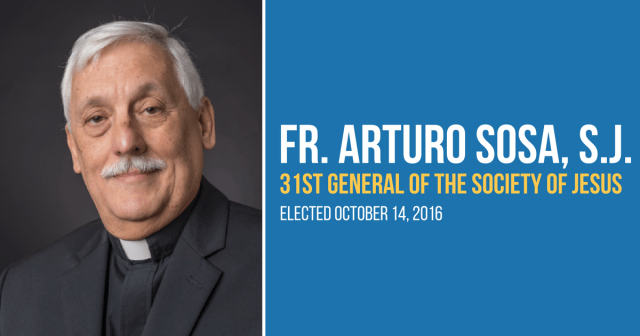
arturo-sosa-fb-2

New post on Roma Locuta Est

Who Dispensed Jorge Bergoglio, S.J., from his Vows?

by Steven O’Reilly

August 24, 2017 (Steven O’Reilly) – If you have been a regular reader of this blog then you know I have long supported the Dubia Cardinals’ quest for answers, and that I support a “formal correction” of Pope Francis. In my last post I outlined both what I thought a “formal correction” might look like and the consequences it might have for a pope who would remain silent (see High Noon: Musings on a Formal Correction of a Pope). This said, it is also true I do not share the opinion of those who hold that Benedict XVI resigned against his will and is therefore still pope (NB: At some point, I will finally get around to commenting on that subject in more detail in a future post). Although I think there were those around Benedict XVI who were duplicitous in their attempts to convince him to resign (see Thoughts on Free Will and Hypothetical Papal Plots), I see no evidence he was forced against his will to surrender the See of Peter. I have also said Francis is Pope.

As a former intelligence officer, I do not like loose ends. Knowing something of Jesuits and the Jesuit order; I know Jesuits profess a number of vows (emphasis added):

The professed of the Four Vows take, in addition to these solemn perpetual vows five additional Simple Vows: not to consent to any mitigation of the Society’s observance of poverty; not to “ambition” or seek any prelacies (ecclesiastical offices) outside the Society; not to ambition any offices within the Society; a commitment to report any Jesuit who does so ambition; and, if a Jesuit does become a bishop, to permit the general to continue to provide advice to that bishop, though the vow of obedience to Jesuit superiors is not operative over matters the man undertakes as bishop. Under these vows, no Jesuit may “campaign” or even offer his name for appointment or election to any office, and if chosen for one must remind the appointing authority (even the Pope) of these Vows—if the Pope commands that the Jesuit accept ordination as a bishop anyway, the Jesuit must keep an open ear to the Jesuit general as an influence.  (Jesuit Formation.  Wikipedia)

Of these vows, Fr. John Hardon, S.J., wrote (emphasis added):

The third vow besides the solemn vow is to never seek or accept unless under formal obedience and pain of mortal sin from the Pope, any dignity in the Church: we are forbidden under pain of mortal sin to become bishops. And the fourth vow to protect the third – we are bound under sin to resist every effort to advance us in the Church.” (History of Religious Life: St. Ignatius of Loyola and the Society of Jesus, by Father John A. Hardon, S.J.)

For the remainder of the article, I will only use sources who view themselves as allies of Pope Francis. Austen Ivereigh tells us that Cardinal Bergoglio was approached at the 2013 conclave by those who worked on his behalf to elect him pope. Speaking of the effort to elect Cardinal Bergoglio in 2013, Mr. Ivereigh’s account is quoted in an article in The Telegraph:

“Spotting their moment, the initiative was now seized by the European reformers who in 2005 had pushed for Bergoglio,” Mr Ivereigh, who once served as Cardinal Murphy-O’Connor’s press secretary, explains in the book.” (Pope Francis: how cardinals’ Conclave lobbying campaign paved way for Argentine pontiff, by John Bingham in The Telegraph, November 22, 2014)

The article continues with Mr. Ivereigh’s narrative (emphasis added):

“They had learnt their lessons from 2005,” Mr Ivereigh explains. “They first secured Bergoglio’s assent. Asked if he was willing, he said that he believed that at this time of crisis for the Church no cardinal could refuse if asked.

“Murphy-O’Connor knowingly warned him to ‘be careful’, and that it was his turn now, and was told ‘capisco’ – ‘I understand’.

Then they got to work, touring the cardinals’ dinners to promote their man, arguing that his age – 76 – should no longer be considered an obstacle, given that popes could resign. Having understood from 2005 the dynamics of a conclave, they knew that votes travelled to those who made a strong showing out of the gate.” (Pope Francis: how cardinals’ Conclave lobbying campaign paved way for Argentine pontiff, by John Bingham in the Telegraph, November 22, 2014)

Now, it may be argued that Cardinal Bergoglio only gave a passive assent, but I do wonder if such passive assent – i.e., giving the wink to others to seek a dignity on ones behalf – runs afoul of the spirit of the Jesuit vow not to “ambition” or seek “any dignity.” Fr. Hardon was quoted earlier on the vow: “and the fourth vow to protect the third – we are bound under sin to resist every effort to advance us in the Church.” Did Bergoglio “resist every effort?” If we are to trust Mr. Ivereigh’s account, the answer is “no.”

Researching another potential article for this blog on the topic of Fr. James Martin, S.J., I came across an old article written by Fr. Martin dating back to March 21, 2013 – just days after the election of Pope Francis (see Is the Pope still a Jesuit, by Fr. James Martin, S.J.). The most interesting tidbit was a seeming throw-away line in the last paragraph of Fr. Martin’s article (emphasis added):

“And to answer two other questions that have come up frequently: Yes, the Superior General of the Society of Jesus is obedient to Pope Francis, not the other way around.  In a few days, Father General will meet with the Pope Francis to “formally” to offer his own obedience, as Superiors General have done with every Pope. And no, I seriously doubt that Cardinal Bergoglio asked the permission of the Superior General to accept his election as pope; besides, he was locked away in the conclave.”

Now, according to Fr. Hardon, S.J., a Jesuit cannot accept Church any dignity “unless under formal obedience and pain of mortal sin from the Pope.” There may be a simple answer, and that is more than fine. However, given the Jesuit vows not to seekor accept any dignity in the Church, my question is:

There being no living pope and no Superior General of the Jesuits present in the conclave of March 2013, who dispensed Jorge Bergoglio from these vows prior to his acceptance of his election as Roman Pontiff?

Obviously, there was no pope to dispense Jorge Bergoglio, S.J., from his vow, and even Fr. Martin S.J., ‘seriously doubted’ Jorge Bergoglio, S.J., asked the Superior General of the Society of Jesus for permission to accept his election as pope. The cardinal-electors in a conclave do not command or order anyone to accept the papacy – so they do not seem to be a proper authority (such as a pope) to release someone from a vow. Note, I am not suggesting anything about the canonical validity of the election on this account, as even a broken vow would not impact the validity of the election as I understand it. My point is more narrowly focused on (1) the status of Cardinal Bergoglio relative to his vows as he entered the conclave, (2) the requirement not to seek any dignity and (3) the requirement one must be ordered to accept any dignity. If he was still subject to his vows going into the conclave of 2013, it seems we could say the following: Cardinal Bergoglio was not ordered to accept the papacy; therefore, he should not have accepted it. Again, there may be simple answers. I am just a former intelligence officer who does not like loose ends, and this seems to be one: who dispensed Jorge Bergoglio, S.J., from his Jesuit vows?

Steven O’Reilly is a graduate of the University of Dallas and the Georgia Institute of Technology. He lives near Atlanta with his wife Margaret. He has four children. He has written apologetic articles and is working on a historical-adventure trilogy, set during the time of the Arian crisis. He can be contacted at StevenOReilly@AOL.com.


Steven O’Reilly | August 24, 2017 at 6:56 am | Categories: Uncategorized | URL: http://wp.me/p7YMML-3DL
Posted in Uncategorized | 2 Comments

USING JEWS FOR SLAVE LABOR IS NEVER A GOOD IDEA, THEY ARE TOO SMART


Posted in Uncategorized | 1 Comment

THE GHOST WRITER SPEAKS AND DOUBLE-SPEAKS


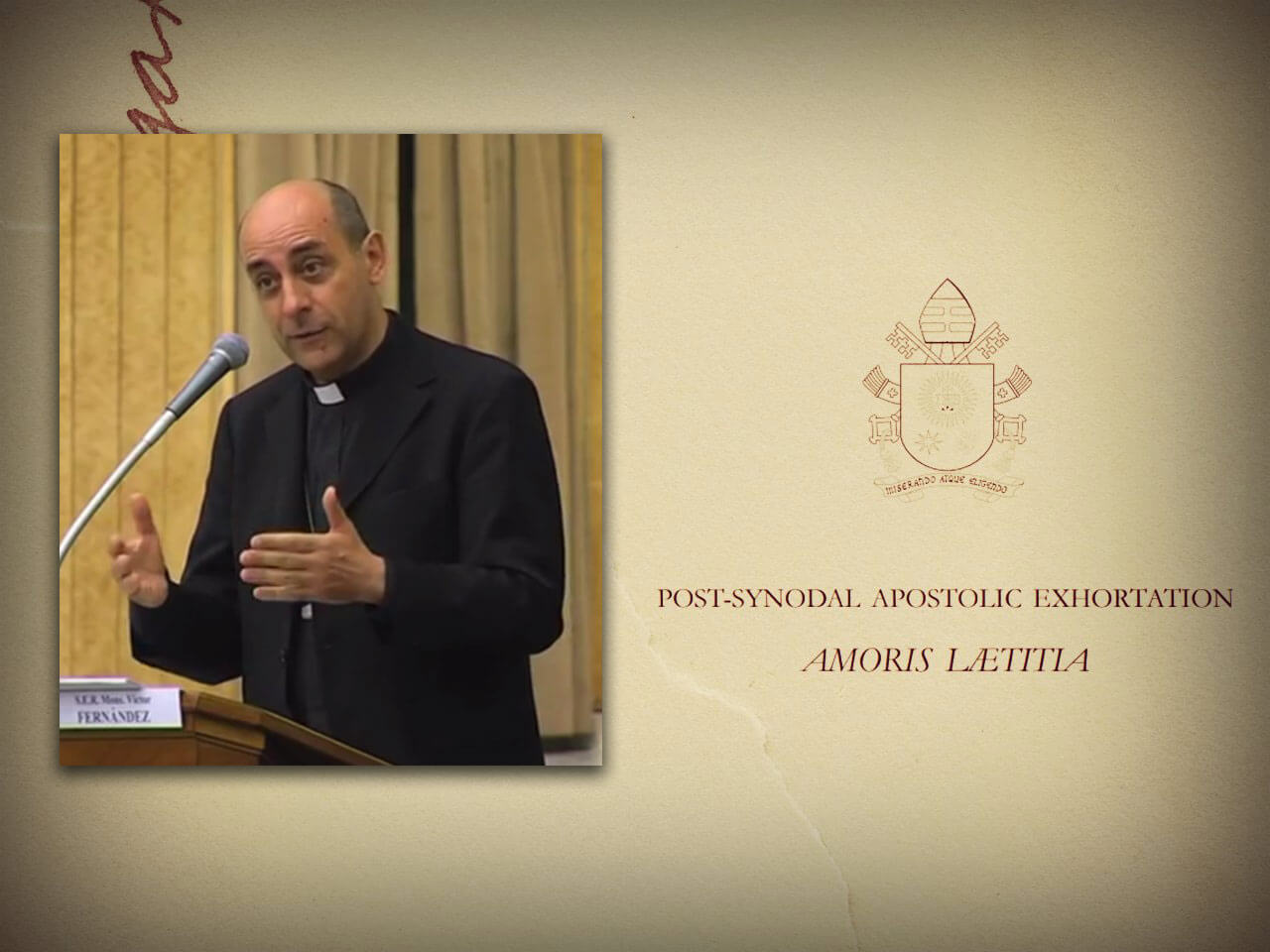
Did Amoris Laetitia’s Ghostwriter Just Respond to the Dubia?

OnePeterFive
PinterestPocket

Archbishop Victor Manuel Fernández is a man close to the pope — and his mission. The relationship between these two men can be traced back to their native Argentina, where, nearly a decade ago, then-Cardinal Archbishop Jorge Mario Bergoglio “fought tooth and nail to clear the way for the promotion of his protege” to the position of rector at the Universidad Católica Argentina. It was a job the alumnus and faculty member of the Catholic University of Argentina had wanted for some time, but he was stopped by from obtaining it by the Congregation for Catholic Education. Why this obstruction in the career path of an up and comer under the tutelage of the future pope? It was in part because of work Fernández did on the topic of marriage and family. Work that was created as a counterpoint to a 2004 conference in Buenos Aires dedicated to the theology of the family in light of Veritatis Splendor. Work that would later re-appear nearly verbatim in the controversial eighth chapter of Amoris Laetitia.

Of his work on the topic at the time, Vaticanista Sandro Magister writes:

During those years Fernández was professor of theology at the Universidad Católica Argentina in Buenos Aires.

And at that same university in 2004 an international theological conference was held on “Veritatis Splendor,” the encyclical of John Paul II on “certain fundamental truths of Catholic doctrine,” decisively critical of “situational” ethics, the permissive tendency already present among the Jesuits in the 17th century and today more widespread than ever in the Church.

Attention. “Veritatis Splendor” is not a minor encyclical. In March of 2014, in one of his rare and deeply pondered writings as pope emeritus, indicating the encyclicals out of the fourteen published by John Paul II that in his judgment are “most important for the Church,” Joseph Ratzinger cited four of these, with a few lines for each, but then he added a fifth, which was precisely “Veritatis Splendor,” to which he dedicated an entire page, calling it “of unchanged relevance” and concluding that “studying and assimilating this encyclical remains a great and important duty.”

In “Veritatis Splendor” the pope emeritus saw the restoration to Catholic morality of its metaphysical and Christological foundation, the only one capable of overcoming the pragmatic drift of current morality, “in which there no longer exists that which is truly evil and that which is truly good, but only that which, from the point of view of efficacy, is better or worse.”

So then, that 2004 conference in Buenos Aires, dedicated in particular to the theology of the family, moved in the same direction later examined by Ratzinger. And it was precisely in order to react to that conference that Fernández wrote the two articles cited here, practically in defense of situational ethics.

It would seem, then, that the Congregation for Catholic Education was right to block Fernandez from the top position at a Catholic university. However, as Magister notes, they were forced “to have to give in later, in 2009”, when Bergoglio exerted his considerable influence.

To say that Fernández knows the mind of the pope on his now-infamous post-synodal apostolic exhortation is an understatement; it was Fernández who was the author of much of what was written therein. And as we all know, the very substance of that document has sparked one of the most significant theological debates among some of the Church’s most preeminent scholars and clergy around the world.

It was also Fernández who, over two years ago, laid out the road map for the papacy when he made clear that the “reform” agenda of Pope Francis was, by design, intended to be “irreversible”. In May of 2015, Fernández was interviewed for the Italian newspaper Corriere della Sera by Robert Mickens — the openly homosexual journalist who lost his position as the Rome correspondent at the leftist UK Catholic publication The Tablet after referring to Pope Benedict XVI as “the Rat” and seemingly wishing for his imminent death. The same Robert Mickens who, in September of that same year, referred to the pope admiringly as a “Master Tactician” who is “keeping score” against those who get in his way. The same Robert Mickens who wrote just last month, with apparent anticipation, that “the reformer-pope has run out of patience with the obstructionists [in the curia] and now wants to move more decisively in replacing them with people who are much more eager to promote his agenda. After all, the clock is ticking.”

And perhaps only a sympathetic interviewer of Mickens’ stripe could have elicited such brazen candor from this Argentinian Archbishop who has ridden his patron’s coattails all the way to the episcopacy — and into Vatican’s inner circle.

“There’s no turning back.” Fernández told Mickens. “If and when Francis is no longer pope, his legacy will remain strong. For example, the pope is convinced that the things he’s already written or said cannot be condemned as an error. Therefore, in the future anyone can repeat those things without fear of being sanctioned. And then the majority of the People of God with their special sense will not easily accept turning back on certain things.”

Throughout the interview, Fernández displayed the same unwavering confidence in his mentor’s ability to get the job done: “You have to realize that he is aiming at reform that is irreversible. If one day he should sense that he’s running out of time and doesn’t have enough time to do what the Spirit is asking him, you can be sure he will speed up.”

A ticking clock indeed.

In June of 2016, on the heels of Amoris Laetitia’s publication, Fernández toldLa Stampa’s own resident papal sycophant, Andrea Tornielli, that the plan going forward was “decentralization of the Catholic Church.” Further, he said that it was time to consider giving

“…more power to the Bishops’ Conferences, including  some doctrinal authority.” He adds: “Progress is very slow – not because the pope has not encouraged it, but because the theologians and pastors themselves do not dare react with generous creativity.”

The archbishop then explained that the pope’s intention – as expressed in Amoris Laetitia – is to give more scope to the local bishops to deal with moral questions “in dialogue with the pope.”  Fernández still insists that the Church has to become “more merciful, more transformed by the primacy of love and also closer to the reality of the people.” He also repeated that there is a “pastoral door” opened with regard to the divorced and “remarried.”

This summer, Fernández is back in the news again, and he’s continuing his line of thought right where he left off. In a new interview with the Spanish-language theology journal Medellín, entitled “Chapter Eight of Amoris Laetitia: What Remains After the Storm,” Fernández came out swinging against critics of the ersatz moral theology in the document. As reported by Crux‘s Austen Ivereigh:

[Fernández] begins by asserting the pope himself gave an authoritative interpretation of chapter eight of Amoris, where the footnote on Communion is found, in a letter to the bishops of Buenos Aires on Sept 9, 2016.

In the letter, Francis thanked the bishops for guidelines they had drafted allowing for discernment leading in some cases to the sacraments, and said there was “no other interpretation” of Amoris than the one they had given.

Responding to critics that the pope cannot make an authoritative statement in such a format,  Fernández cites past instances of papal correspondence to bishops being quoted in teaching documents (for example, in a note by Pope Pius IX cited in Lumen Gentium, a document of the Second Vatican Council).

Those precedents prove the “hermeneutical authority” of his letter to the Buenos Aires bishops, Fernández said. [emphasis added]

It should be noted here that the archbishop conflates two examples of the same form of papal writing with two examples of the same level of papal authority — a trick becoming increasingly popular with today’s papal positivists. (Recall that it in the modern Church, it is not so much the form but the content that is most helpful in determining the magisterial authority of a given teaching.) While it is true that a letter written by Bl. Pope Pius IX to a German bishop was cited in Lumen Gentium (and Vatican I before it), that correspondence is of a significantly different nature than that sent by Pope Francis to the bishops of the Buenos Aires region. Lumen Gentium 25 states:

Although the individual bishops do not enjoy the prerogative of infallibility, they nevertheless proclaim Christ’s doctrine infallibly whenever, even though dispersed through the world, but still maintaining the bond of communion among themselves and with the successor of Peter, and authentically teaching matters of faith and morals, they are in agreement on one position as definitively to be held.(40*)

The citation in footnote 40 includes a reference to “Pius IX, Epist. Tuas libener: Denz. 1683 (2879)” — the correspondence in question. Dr. Kurt Martens explained the history and significance of this particular piece of papal writing in an article last summer for the Catholic Herald:

The term ‘ordinary magisterium’ was first used by Pius IX in the letter Tuas libenter addressed to the archbishop of Munich and Freising on 21 December 1863.

Earlier that year, a meeting of Catholic theologians had taken place in Munich. The pope had been told that in the course of that meeting the opinion had been expressed that Catholic theologians were bound to hold only those truths of faith which had been solemnly declared.

Pius IX replied that “it must not be limited to those things which have been defined by the express decrees of councils or of the Roman Pontiffs and of this Apostolic See, but must also be extended to those things which are handed on by the ordinary magisterium of the whole church dispersed throughout the world as divinely revealed, and therefore are held by the universal and constant consensus of Catholic theologians to pertain to the faith.”

[…]

The teaching of Pius IX on ordinary magisterium was later incorporated in the documents of Vatican I, in particular the dogmatic constitution Dei Filius: “Wherefore, by divine and catholic faith all those things are to be believed which are contained in the word of God as found in scripture and tradition, and which are proposed by the church as matters to be believed as divinely revealed, whether by her solemn judgment or in her ordinary and universal magisterium.”

It was understood that the addition of ‘universal’ to ‘ordinary magisterium’ was meant to relate the phrase to the teaching of the whole episcopate with the pope, and not the teaching of the pope alone.

It is ironic, therefore, that Fernández equates a letter from a pope praising pastoral guidelines implementing a pastoraldocument (Amoris Laetitia) that disclaims its own universal and magisterial application (AL #3) at the outset with a critical theological clarification made by a pope that helped to authoritatively define magisterial authority and its application in the first place (Tuas Libenter). (The irony deepens when one considers that said pastoral guidelines have themselves been argued to be “against the ordinances of God” — which excludes them from the faithful’s duty to assent.)


A Response to the Dubia

Paraphrasing Fernández, Ivereigh — himself a known papal apologist and defender of Amoris Laetitia — argues that

Francis never claims general moral laws are incapable of covering every situation, nor that they are incapable of determining a decision in conscience, but that in their formulation they are incapable of addressing each and every situation, the archbishop said.

“It is the formulation of the norm that cannot cover everything, not the norm in itself,” Fernández said.

In the case of norms forbidding killing and stealing, for example, the norms are absolute, admitting of no exceptions; yet it is questionable, he said, whether taking life in self-defense is killing, or taking food to feed a hungry child is stealing.

From my reading, it appears that in the above, Fernández is backing away from the menacing specificity of the dubia.

Stranger still, he then appears to go on to attempt to answer the dubia. I didn’t catch it on my first read through, but as I parsed his statements, it occured to me that I should cross-reference them. I would not say that these are direct responses, and they aren’t prefaced as such, but it is almost impossible not to see a parallel structure between the dubia and the Archbishop’s carefully staked out defense of the pope. See for yourself:

Dubia #1: 

It is asked whether, following the affirmations of Amoris Laetitia (300-305), it has now become possible to grant absolution in the sacrament of penance and thus to admit to holy Communion a person who, while bound by a valid marital bond, lives together with a different person more uxorio without fulfilling the conditions provided for by Familiaris Consortio, 84, and subsequently reaffirmed by Reconciliatio et Paenitentia, 34, and Sacramentum Caritatis, 29. Can the expression “in certain cases” found in Note 351 (305) of the exhortation Amoris Laetitia be applied to divorced persons who are in a new union and who continue to live more uxorio?[emphasis in original]

Fernández:

“… It is also licit to ask if acts of living together more uxorio [i.e. having sexual relations] should always fall, in its integral meaning, within the negative precept of “fornication”. I say, ‘in its integral meaning,’ because one cannot maintain those acts in each and every case are gravely dishonest in a subjective sense. In the complexity of particular situations is where, according to St. Thomas [Aquinas], ‘the indetermination increases.’ Indeed, it is not easy to describe as an ‘adulterer’ a woman who has been beaten and treated with contempt by her Catholic husband, and who received shelter, economic and psychological help from another man who helped her raise the children of the previous union, and with whom she has lived and had new children for many years.” [emphasis added]

And further:

Turning to the process of discernment outlined in Amoris, Fernández said Francis nowhere claimed that someone can receive Communion if they are not in a state of grace, only that an objectively grave fault is not sufficient to deprive a person of sanctifying grace.

Therefore, “there can be a path of discernment open to the possibility of receiving the food of the Eucharist.” [emphasis added]

Dubia #2, 3, and 4:

2.) After the publication of the post-synodal exhortation Amoris Laetitia (304), does one still need to regard as valid the teaching of St. John Paul II’s encyclical Veritatis Splendor, 79, based on sacred Scripture and on the Tradition of the Church, on the existence of absolute moral norms that prohibit intrinsically evil acts and that are binding without exceptions?

3.) After Amoris Laetitia (301) is it still possible to affirm that a person who habitually lives in contradiction to a commandment of God’s law, as for instance the one that prohibits adultery (Matthew 19:3-9), finds him or herself in an objective situation of grave habitual sin (Pontifical Council for Legislative Texts, “Declaration,” June 24, 2000)?

4.) After the affirmations of Amoris Laetitia (302) on “circumstances which mitigate moral responsibility,” does one still need to regard as valid the teaching of St. John Paul II’s encyclical Veritatis Splendor, 81, based on sacred Scripture and on the Tradition of the Church, according to which “circumstances or intentions can never transform an act intrinsically evil by virtue of its object into an act ‘subjectively’ good or defensible as a choice”? [emphasis in original]

Fernández:

He said Pope Francis has resisted proposals of progressive moral theologians to drop altogether a distinction between objective sin and subjective guilt, and has maintained that sexual relations by divorced people in a new union always “constitute an objective situation of habitual grave sin,” even if culpability might not exist in a subjective sense in some cases.

Even in these cases, however, “for Francis it is not the concrete circumstances that determine the objective morality,” said Fernández, adding: “The fact that conditions might diminish culpability does not mean that what is objectively bad thereby becomes objectively good.”

Rather, the objectively sinful situation persists “because there remains the clear Gospel proposal for marriage, and this concrete situation does not objectively reflect that.” [Emphasis added]

Dubia #5: 

After Amoris Laetitia (303) does one still need to regard as valid the teaching of St. John Paul II’s encyclical Veritatis Splendor, 56, based on sacred Scripture and on the Tradition of the Church, that excludes a creative interpretation of the role of conscience and that emphasizes that conscience can never be authorized to legitimate exceptions to absolute moral norms that prohibit intrinsically evil acts by virtue of their object?

Fernandez: 

Discernment in such cases, he said, involves a person using his or her conscience to examine before God their real situation, together with its limits and practical possibilities, in the company of a pastor and enlightened by the Church’s teaching.

Such discernment, he went on, is not about the moral absolute of the norm, but about its disciplinary consequences. The norm remains universal, but its consequences or effects can vary. By making clear that this can be discerned by means of a “pastoral dialogue,” said Fernández, “this is what opens the way to a change in [sacramental] discipline.” [emphasis added]

Is it just me? Or is Fernández carefully stepping away from the danger zone on Francis’ behalf? His interpretations here are full of casuistry and would hardly be considered orthodox, but they appear to me to be moving away from the current position and in the direction of at least appearing to honor the Church’s moral norms. Or perhaps more aptly put, to at least to admit they exist.

I don’t know whether to be encouraged or concerned.

Fernández sums up his view of Francis’ paradigm shift in Amoris as follows:

“Francis’s great innovation,” he wrote, “is to allow for a pastoral discernment in the realm of the internal forum to have practical consequences in the manner of applying the discipline [his italics].” The general canonical norm remains, but “may not be applied in certain cases as a consequence of a path of discernment.”

This, said Fernández, is where Francis “is bringing in a change with respect to the previous praxis.”

Meanwhile, the pope’s letter to the bishops of the Buenos Aires region now appears as part of the official papal correspondence on the Vatican website. One can’t help but wonder, then, if there are plans to move it into the Acta Apostolicae Sedis — the journal of the official acts of the Apostolic See. Such a move would take the letter from the realm of personal correspondence and give it official status. The AAS “contains all the principal decrees, encyclical letters, decisions of Roman congregations, and notices of ecclesiastical appointments. The contents are to be considered promulgated when published, and effective three months from date of issue.”

Fernández is close to both the pope and the exhortation. He knows and has been broadcast

ing the papal agenda for some time now, and he hasn’t been afraid to disclose just how revolutionary it is. The appearance that he is circling the wagons, attempting to redefine terms and thereby shoring up the doctrinal bona fides of Amoris while simultaneously elevating the pope’s letter to the Buenos Aires bishops to the status of “authoritative” and “hermeneutical” interpretation is raising red flags, but I can’t put my finger on what I’m seeing.

What I know is that this is a new tactic from a team that always goes to the same playbook, time after time. Something is afoot.

************************************************************************************


COMMENTS:

  • Avatar

    Archbishop Victor Manuel Fernández is a stalking horse for Pope Francis sent out to see how the wind is blowing, figuring out how to maneuver in order to bring Pope Francis ship of heresy (Amoris Laetitia) safely to port. We can be sure of one thing. If Victor Manuel Fernández is involved bad things are happening. No need to put a finer point on it.

    • Avatar

      It is a bait and switch!

      Their goal is to legitimize homosexuality and their ” unions “, and hence the Sacrament of Matrimony and all that is holy and good. Sin is their pleasure. It was never really about Communion for the civilly remarried, that was a smokescreen.

      Fernandez is but a foolish tool who takes the faithful laity eyes away from what is swirling around all of us.

      We must see what is front of us. It is very ugly, but it must be called out.
      Here is the elephant in the room question to Pope Francis, ” Do you renounce homosexuality? Do you believe man was created by God to be homosexual? Do you renounce Father James Martin’s activities in promoting homosexuality?”

      Our Lord needs to put more spit on the eyes of our prelates and take the wax from their ears and fill their tongues with Truth!
      I am reminded of last week’s Gospel.
      Until then, I remain very, very guarded of everything and everyone with Catholic in front or behind their name, or door. My trust has been brokered of the things and men of this earth.

      • Avatar

        “Their goal is to legitimize homosexuality and their “unions”……..I have been saying this cs since the day after A.L. was published. This is NOT only about “Marriage” and the destruction of it, the REAL GOAL is the acceptance of homosexual sex as ‘normal, natural and even going so far as to say it is ‘God ordained’!!! This is the golden ring they are after!

    • Avatar

      Correct, but we would do well to understand the finer points in Abp. Fernandez’s rhetorical devices.

      “Make a mess!” the Pope told a youth rally in 2015. The Archbishop, a clericalist if ever there was one, is doing just that here – indeed trying (at least in public) to step away from the danger zone through confusing language, but not so far as to weaken the intent of the AL exhortation, which he is clearly addressing. Nixon’s Attorney General, John Mitchell, said it best: “Watch what we do, not what we say.”

      These men, or the secularists who control them, are not foolish. They mean business and know how to use procedure. For public consumption, clarity is the enemy, and absolutely everything can come up for “discernment.” Sadly, some early results are favorable – the Maltese bishops teach AL one way, the Polish bishops the other.

      • Avatar

        Yes. Archbishop Victor Manuel Fernandez is trying to make official what has
        been a defacto practice in many dioceses for years, particularly as
        regards co-habitation before marriage. One of our priests told me he
        requires that couples stop cohabiting two weeks before marriage,
        presumably as a hat-tip to the morality (official) of it all. Nothing
        like hypocrisy paying tribute to virtue. The entire annulment and
        re-marriage business is pretty much of a fraud. If the Church is going
        to insist on strict Catholic morality it is going to be much, much
        smaller. That, I think, is the real issue.

        • Avatar

          Paul VI did exactly alike with the communion in the hand that many Dutch and German dioceses had begun to practice in the wake of VATII though it was obviously forbidden. Once it began to spread, the Pope authorized it instead of clinging hard to its interdiction.

        • Avatar

          ah…excuse me here?
          I am understanding the priest has no problem with the couple having relations prior to two weeks before marriage?
          How little this priest thinks of this man and woman.

          • Avatar

            cs. Guess so. I was told that some time ago Florida Bishops told their priests not to speak about co-habitation to couples seeking to be married. Times do change–and only for the worse. This is the spirit of Vatican II at work.

        • Avatar

          The couples in the situation your priest discussed are exercising their free will in the absence of well-formed conscience, and are casualties of the persistent crisis in catechesis. The priest is trying to do his “best” amid a misguided pastoral sensitivity and fomenting scandal. And all this is probably just fine with the local bishop, who really, really wants to keep his job. At the top, globalists Fernandez and Francis are capitalizing on all this.

          Your point brings to mind this 1969 quote, one of many reasons Ratzinger will go down as one of the greats. Link to related article below: “From the crisis of today a new Church of tomorrow will emerge…she will become small and will have to start afresh
          more or less from the beginning. She will no longer be able to inhabit
          many of the edifices she built in prosperity. . . ”

          But to me, while the transition will continue to be very painful, a small church would be an improvement, not an issue. And the next conclave is critical.

          https://www.firstthings.com…

  • Avatar

    Steve, you say “but they appear to me to be moving away from the current position and in the direction of at least appearing to honor the Church’s moral norms.”

    Yes, the greatest danger is the use of taqiyya by this Pope and his henchmen.

    In fact, I have been surprised he hasn’t used this tactic more frequently.

    Why, he could easily come out and answer every question in the Dubia in a totally orthodox fashion and nevertheless still continue wrecking the Church.

    Indeed, that is how Catholic prelates have been doing it for years.

    Pretend to be orthodox and then allow ANYTHING.

    This is precisely why “men” like this Tucho heretic were excommunicated in the past. They are toxic and malignant tumors in the Body of Christ.

    The Church needs a LOT more excommunications, laicizations and interdicts.

    • Avatar

      Taqiyya is a good word for it.

      • Avatar

        The Islamic doctrine perfectly describes it.

        Early on after converting I found myself asking “How can the Church have all these doctrinal problems if all the prelates are avowedly orthodox?” Because, publicly, they all are “orthodox”.

        The reason is simple.

        We have a culture of deceit and lying from the top to the bottom.

        What we see now with the current pontificate isn’t a pell mell, radical conversion of orthodox prelates to heterodoxy, it is merely the little-by-little coming-out of dishonest men, now willing to let out a bit more of what they believe/don’t believe without the fear of any ramifications for doing so.

        “And furthermore, the Church desperately needs excommunications, laicizations and interdicts.”

        • Avatar

          You are absolutely correct.
          Anyone who has been in religious life since the council can affirm the rabid daily demonstration of your analysis. Manipulation and deceit in order to create a new entity which has no resemblance to the congregation one entered.
          The formal concept of “taqyia” was unknown to me. My thanks to both you and Steve for bringing it up. Very illuminating.

    • Avatar

      Catechism of the Catholic Church, CCC1735: “Imputability and responsibility for an action can be diminished or even nullified by ignorance, inadvertence, duress, fear, habit, inordinate attachments, and other psychological or social factors”. This deals with the “full knowledge/deliberate consent” parts of the equation, in a case (let’s assume) where the matter concerned is objectively grave (i.e. serious). This of itself is no more than classic Catholic moral theology, which (thank God) considers our intentions and not just our foolish actions. However, Amoris is perceived to have used this “get-out” as a pretext for fudging the issues around adultery and suggesting that access to Communion may be given in difficult cases. But, as it is said: “hard cases do not make good law”. It’s difficult to envisage many cases where a person in such a situation could justly be admitted to the sacraments. A case where abandoning a divorcee partner sexually might cause the partner to return with her children to an abusive biological father, perhaps?

      • Avatar

        “It’s difficult to envisage many cases where a person in such a situation could justly be admitted to the sacraments.”

        I don’t think it is hard to envision this at all. When people are not taught the truth, they will desecrate the Holy Eucharist. Look at the Pro-Abortion Advocate Politicians, they are going up to receive Communion to protect their reputations. They don’t care about God, it is all a SCAM! Hey, Adulterers want to protect their reputations too, and their sins have darkened their mind. It is called Justifiable Adultery!

        • Avatar

          Of course, if people aren’t told the truth, they may be wrong in their actions through no fault of their own, it’s possible. That’s what I’m saying.

          • Avatar

            Father, with all respect, “I did not know,” can not be the proper justification. Not for Catholics. Catholics should and must know the truth. Truth which is unchangeable and of vital importance for their eternal life.
            We can not just sit and wait, or just do not care or minimal effort, until the truth about certain and very important things shall be announced to us.
            If an adulterer 30, 40, and 50 years old is mature enough and able to know how to marry two or three times … Then he/she must also be mature enough to know the truth, which btw. is of vital importance for him/her.
            Besides, we are here not talking about pagans, who probably could have right to say ‘I did not know’. But the ones who are baptized in the water and the Spirit cannot have that justification.
            Moreover, the main task of every Christian is to seek, find and live with the truth, according the truth, and in the truth. Even in the smallest things. How more we should in such great things which are of vital importance.
            As the psalmist speaks: “The mouth of the just shall meditate wisdom: and his tongue shall speak judgment. The law of his God is in his heart, and his steps shall not be supplanted.”
            And: “Blessed is the man that feareth the Lord: he shall delight exceedingly in his commandments.”

          • Avatar

            Errr…disagree somewhat. There IS such thing as “vincible ignorance” and it is certainly culpable. The “fault of their own” was never seeking out the truth in fact. God leads the good to the truth and lets the evil “have eyes and yet not see”. Obdurate sin breeds ignorance because “their minds have been darkened” [Romans]. God “gives up” the obdurate sinner to the folly of willful blindness.

            p.s. this is why, if you were wondering, many people (even Catholics) today do not “see” the obvious truth that Islam is the Antichrist religion and of the devil, full of evil. Because of their sin. Grave sin engaged in and justified over long periods of time (obduracy) leads to moral blindness and even to what St. Thomas calls “the loss of the good of intellect”. As a punishment for their grave sinfulness and refusal to repent, God “gives them up” to blindness and they are thus incapable of seeing what to any decent, good person is patently obvious. And they will pay the price for rejecting the truth.

  • Avatar

    The sticky word is “irreversible”, an apt word capping the terminus of this stage of the “road map”.

    Think these folks mean it. What was honed and fine-tuned in Argentina was not meant to stay in Argentina. The road is now being mapped for the post-Francis papacy.

    Yes, review papal history, but it can’t be denied that something is frightfully odd with this papacy. Do we have the language for it?

Posted in Uncategorized | Comments Off on THE GHOST WRITER SPEAKS AND DOUBLE-SPEAKS

The correct assessment of a “second union” – or any moral situation – requires an understanding of morality based on Christ and the righteousness of God, not on approaches designed to favor allegedly just or merciful applications of legal precepts.

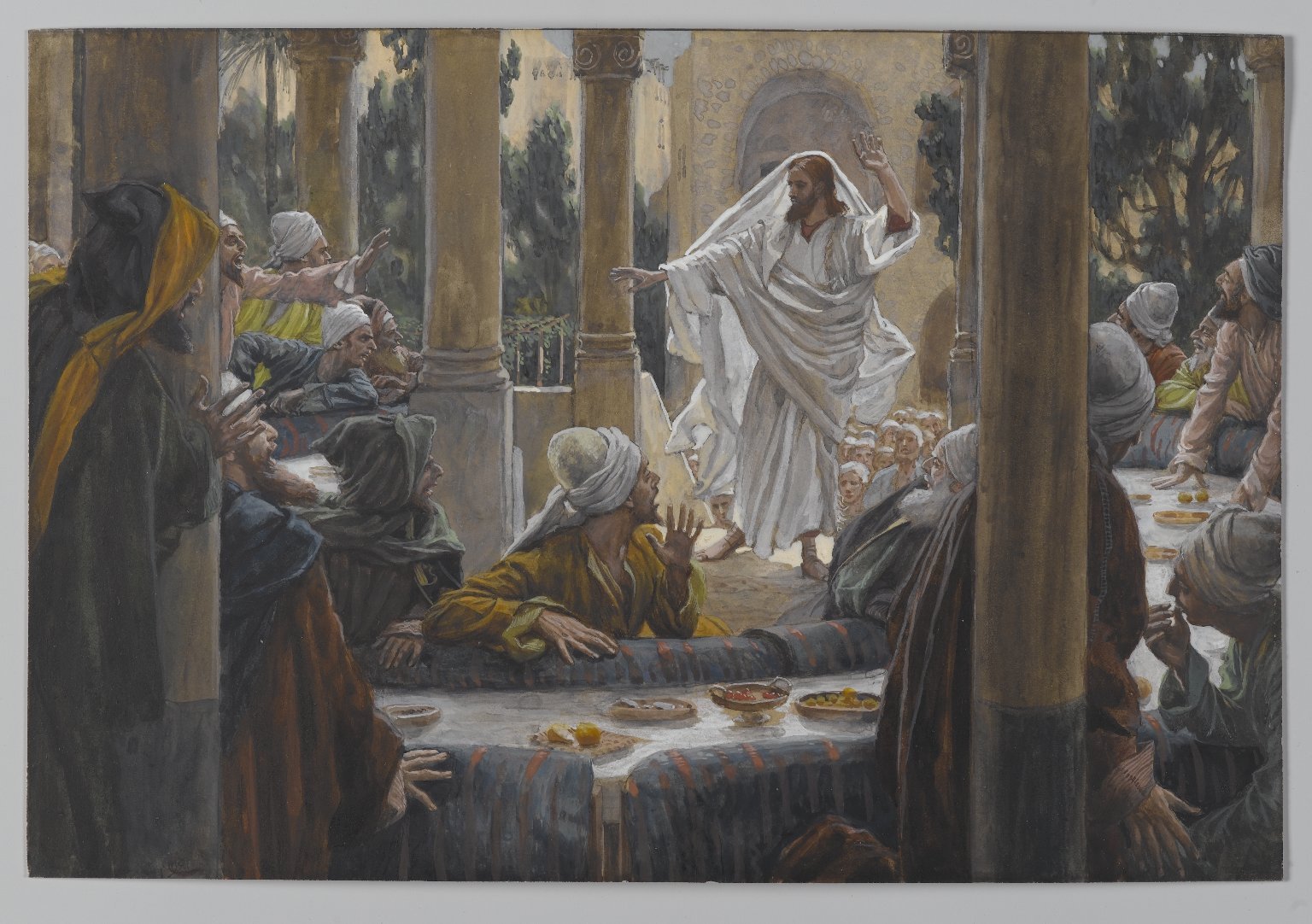
Curses Against the Pharisees by James Tissot, c. 1890 [Brooklyn Museum]


The Newer Phariseeism

The debate over remarriage after divorce has resurfaced with an interpretation of controversial aspects of Amoris laetitia by Archbishop Victor Fernandez, a papal advisor rumored to have ghostwritten the document. Like many wishing to accommodate “second unions,” he seems to prefer vagueness and marginalizing those who raise objections rather than presenting a precise, comprehensive rationale. Nevertheless, it’s worth trying to clarify a few key points.

The problems begin with the human tendency to treat morality as a kind of legal system. This approach mistakenly identifies the rigorous application of rules with “justice” and circumstantial adaptation with “mercy.” Those who prefer “mercy” often label their opponents “Pharisees.” But they fail to recognize that, by contrasting justice and mercy, they expose their own pharisaical mindset. The correct assessment of a “second union” – or any moral situation – requires an understanding of morality based on Christ and the righteousness of God, not on approaches designed to favor allegedly just or merciful applications of legal precepts.

Human laws cannot anticipate every situation. Hence, judicial decisions tend either to apply the law strictly or to adapt it to circumstances. Because legal justice strives to give “what is due” to others, mercy toward an offender sometimes conflicts with justice for an aggrieved party.

But this is simply not the case for divine justice and mercy. God owes us nothing; his works of creation and salvation are acts of pure generosity. The Old Testament calls this generosity “justice” or “righteousness” (tzedeqah). It means giving to others “what is good” rather than “what is due.” God calls his people to practice this generous justice rather than mere legal justice.

Despite sin, God’s justice does not abandon us but offers “what is good” for us: truth, conversion, and union with Himself. Thus, divine justice reveals itself in merciful love (hesed) and fidelity (emet). Because God’s merciful love expresses his justice, they cannot be in tension. Covenantal justice is founded in love of God and neighbor. This foundation is personal, not legalistic, calling for the faithful gift of oneself in imitation of God’s gift of Himself.

Covenantal justice, merciful love, and fidelity are directed to authentic and realizable goods, not to subjective or idealized ones. In a fallen world, these goods may be unwelcome or entail considerable suffering – even death – because fidelity to the good cuts against our fallen condition, mistaken judgments, false attachments, and sinful inclinations.

Our commitment to God and neighbor causes pain when we see how we and others mistreat them. It also leads to suffering innocently from evil and from the animosity of the world.God’s people proved unfaithful, under trials, in the Old Covenant. Responding with justice, God generously promised to wed them to himself in a New Covenant by sending his Spirit and giving them new, faithful hearts.

Through the incarnation, death, and glorification of Jesus, God fulfilled his promise. He now abides in us so that we share his justice, merciful love, and fidelity. This new covenantal relation makes possible a new righteousness. No longer is love measured by our human capacity (i.e., “with all your heart” and “as yourself”). Instead, Jesus’ love becomes the source and measure of our love (i.e., “as I have loved you”). The imitation of God is thereby achieved through an indwelling participation in his divine life, enabling us to be faithful in all circumstances.

Christian morality, then, is not based on the application of precepts or ideals, but on our nuptial union with God in Christ. The moral assessment of a situation, including a remarriage after divorce, is fundamentally a matter of recognizing what it means to join Jesus in doing what is truly good for us and others. This is always just, merciful, and faithful.

Jesus insisted that what is good for us will lead to crucifixion; we must be prepared to lose our loved ones and our lives if we are to love as he loves. (Mt 10: 37-39) Inevitably, this entails sacrifices and martyrdoms of many kinds, including the loss of the personal and financial support of a “second spouse” who abandons a family because a partner refuses adulterous sexual relations. In that situation, it is no act of mercy to offer a way around the Cross by declaring the sexual relations “good” since deliberate infidelity is not good, but harmful for each partner’s union with Jesus, their current relationship, children, and the first marriage.

Nuptial fidelity to one’s first spouse and to Christ must be chosen over adultery, regardless of the cost. That is the clear meaning of the fidelity, merciful love, and justice God has shown to us; a meaning reaffirmed by the Lord’s life and his teaching that remarriage after divorce is adultery; adultery is a sin; sin is a betrayal of Him; that it is better to suffer than to betray Him. (Mk 10:11; Jn 8:11; Mt 25:31-46; Mk 9:43)

Jesus condemned the Pharisees not only for the false burdens they created but also for the righteous duties they set aside. (Mk 7:1-15) In the past, strict priests wrongly burdened those in troubled marriages by refusing to consider the need for legal separation or the possibility of an invalid marriage. Now, accommodating priests wrongly declare sexual relations in a second union “good” by setting aside the first marriage in light of the current partners’ support for each other and their children.

This is not pastoral progress or mercy, but the replacement of an older pharisaical approach with a newer one – its mirror image. In the name of avoiding rigorism, this effectively “nullifies the word of God” regarding covenant fidelity, marriage, adultery, and sin.

This new pharisaical approach can be corrected only by viewing second unions in light of the first marriage and the union of Christ and the Church. For we call something “good” not because it fits a strict or accommodating application of moral principles, or because it suits our preference for a “just” or “merciful” solution, but because it conforms to Him who alone is good. (Mk 10:18-19)

Fr. Timothy V. Vaverek

Fr. Timothy V. Vaverek

Fr. Timothy V. Vaverek, STD has been a priest of the Diocese of Austin since 1985 and is currently pastor of parishes in Gatesville and Hamilton. His doctoral studies were in Dogmatics with a focus on Ecclesiology, Apostolic Ministry, Newman, and Ecumenism.

Posted in Uncategorized | Comments Off on The correct assessment of a “second union” – or any moral situation – requires an understanding of morality based on Christ and the righteousness of God, not on approaches designed to favor allegedly just or merciful applications of legal precepts.

Cardinal Burke nails it !!!

notre_dame_paris

the Vortex
The Church Militant
 APOSTASY

That’s the only word that applies.

August 23, 2017

TRANSCRIPT

As we shared with you yesterday, all this week the staff here at the apostolate will be having in-service days, making plans for the next year, programming decisions, training and so forth. So, for this week, we will be providing you with abbreviated Vortex episodes — today, the interview of Cdl. Raymond Burke with our friends at The Wanderer where he did a “drop mic” on the question of the unfaithfulness of so many leaders in the Church these days and the resulting apostasy.

His Eminence simply nailed it — apostasy. That’s the only word that applies — a total walking away from the Faith, a denial of what or rather who the Church is and who is the Church, no less than Jesus Christ, the Messiah, the Son of God present on earth to continue His saving mission throughout time through the agency of men. How evil when the ordained class succumbs to apostasy. There could be nothing worse than apostolic apostasy, which is what we have in the case of corrupt, weak and cowardly bishops and clerics.

Cardinal Burke’s words hearken back to St. Peter’s denunciation of Judas in the Book of Acts when the first pope declared that Judas had, in fact, had a share in salvation and had lost it along with his apostleship, having gone to “his own place.” Judas was the first apostate. Unfortunately, he is not the last. But just as St. Peter called it out in his day, so too does it need calling out in this day so that the faithful may not be lead even more into error.

Face the facts, there are Judases, traitors and apostates who are running loose in the Church these days. They deny Christ. They deny His Holy Church. They must absolutely be exposed and opposed.

Posted in Uncategorized | 1 Comment

INSANITY IN BOSTON PROVOKED BY ITS MAYOR, SO WHAT ELSE SHOULD ONE EXPECT FROM LIBERAL BOSTON

Jeff Jacoby

Pundicity

A free-speech rally, minus the free speech

by Jeff Jacoby
The Boston Globe
August 22, 2017

http://www.jeffjacoby.com/20196/a-free-speech-rally-minus-the-free-speech

IF ONE LINE captured the essence of Saturday’s Boston Common rally and counter-protest, it was a quote halfway through Mark Arsenault’s Page 1 story in the Boston Globe:

“‘Excuse me,’ one man in the counter-protest innocently asked a Globe reporter. ‘Where are the white supremacists?'”

As a police officer escorted a participant in the Boston Free Speech Rally away from the scene, a water bottle was flung at the man’s head.

That was the day in a nutshell. Participants in the “Boston Free Speech Rally” had been demonized as a troupe of neo-Nazis prepared to reprise the horror that had erupted in Charlottesville. They turned out to be a couple dozen courteous people linked by little more than a commitment to — surprise! — free speech.

The small group on the Parkman Bandstand threatened no one. One of the rally’s organizers, a 23-year-old libertarian named John Medlar, had insisted vigorously that its purpose was not to endorse white supremacy. “The rally I’m helping to organize is about promoting Free Speech as a COUNTER to political violence,” he had posted on Facebook. “There are NO WHITE SUPREMACISTS speaking at this rally.”

Indeed, nothing about the tiny rally, whose organizers had a permit, seemed in any way connected with bigotry or hatred. One of the speakers was Shiva Ayyadurai, an immigrant from India who is seeking the Republican nomination in next year’s US Senate race. As Ayyadurai spoke, his supporters held signs proclaiming “Black Lives Do Matter.”

But he and the others who gathered at the Parkman Bandstand had never stood a chance of competing with the rumor that neo-Nazis were coming to Boston. That toxic claim was irresponsibly fueled by Mayor Marty Walsh, who denounced the planned rally — “Boston does not want you here” — even though organizers were at pains to stress that they had no connection to Charlottesville’s racial agenda and intended to focus on the importance of free speech.

What happened on Saturday was both impressive and distressing.

A massive counter-protest, 40,000 strong, showed up to denounce a nonexistent cohort of racists. Boston deployed hundreds of police officers, who did an admirable job of maintaining order. Some of the counter-protesters screamed, cursed, or acted like thugs — at one point the Boston Police Department warned protesters “to refrain from throwing urine, bottles, and other harmful projectiles” — but most behaved appropriately. Though a few dozen punks were arrested, nobody was seriously hurt.

But free speech took a beating.

The speakers on the Common bandstand were kept from being heard. They were blocked off with a 225-foot buffer zone, and segregated beyond earshot. Police barred anyone from approaching to hear what the rally speakers had to say. Reporters were excluded, too.

Result: The free-speech rally took place in a virtual cone of silence. Its participants “spoke essentially to themselves for about 50 minutes,” the Globe reported. “If any of them said anything provocative, the massive crowd did not hear it.”

Even some of the rally’s own would-be attendees were kept from the bandstand. But when Police Commissioner Bill Evans was asked at a press conference Saturday afternoon whether it was right to treat them that way, he was unapologetic.

If a free-speech rally is held in a Boston Common pavilion but no one can get close enough to hear it, do the speakers make a sound?

“You know what,” he said, “if they didn’t get in, that’s a good thing, because their message isn’t what we want to hear.”

No, Commissioner Evans. It was not a “good thing” that people with a right to speak were effectively silenced by the operations of the police. The ralliers did nothing wrong. They followed the city’s rules. They did what police asked of them. They absorbed the slanders flung at them by the mayor and others. They didn’t try to shut their critics down, and they weren’t the ones hurling “urine, bottles, and other harmful projectiles.”

All they were guilty of was attempting to defend the importance of free speech. For that, they were unjustly smeared as Nazis and their own freedom of speech was mauled.

Boston was kept safe on Saturday, for which city authorities deserve great credit. But in the course of preventing a riot, those authorities rode roughshod over the free-speech rights of a small, disfavored minority. That is never a good thing, whatever the police commissioner may think.

This column is adapted from the current issue of Arguable, Jeff Jacoby’s weekly email newsletter. To subscribe to Arguable, click here.

(Jeff Jacoby is a columnist for The Boston Globe).

— ## —

Follow Jeff Jacoby on Twitter.

“Like” Jeff Jacoby’s columns on Facebook.

Related Topics:  Boston, Liberty and Government Power

You are subscribed to this list as rhg1923@gmail.com.
To unsubscribe completely from all Pundicity authors’ mailing lists, go to http://www.pundicity.com/list_unsubscribe.php
To edit your subscription options, go to http://www.pundicity.com/list_edit.php
To subscribe to the Jeff Jacoby mailing list, go to http://www.pundicity.com/list_subscribe.php

Pundicity

Posted in Uncategorized | Comments Off on INSANITY IN BOSTON PROVOKED BY ITS MAYOR, SO WHAT ELSE SHOULD ONE EXPECT FROM LIBERAL BOSTON