

|
|
The first day he put on a cassock, a seminarian got a letter from a friend, a few years his senior. This is what he learned about his cassock:
A cassock. Today in your eyes it is more beautiful than a bride’s dress. You are truly and rightfully happy wearing it; after all, you have been waiting for it since the time you entered the seminary.
I can only hope that you will be equally happy when it has come to be what its color implies, i.e. a deadly shroud and a dying uniform. Today it is a bride’s dress you enthuse over, along with your family and friends. Be as enthusiastic about it when it starts to be your solitary confinement, cage and furnace where God will melt and purify you, an uncomfortable hermitage.
This bride’s dress, when necessary, will be your armor, provided you care to remember and use it this way. Wearing a cassock can and should be a form of prayer in itself, but it does not become a prayer just by putting it on.
Pockets. The deep ones are meant to store all the things you will share with others. Always have something to give away to the needy and children. Remember that they will appreciate a little money, your smile, and a word of solace more than your impeccable hymn singing. This is because people need first and foremost to hear that they are loved, and even more so to feel that this is true.
An inside breast pocket. It is not meant for holding an expensive pen. Carry in it letters you do not know how to answer, notes with the names of those you have promised to pray for, other people’s bills you have decided to pay, addresses you know should be visited, as their occupants will never come to you on their own, pictures of dogs, cats, grandchildren, and people in love as well as tree leaves and drawings nursery students have offered you. Keep this pocket filled at all times.
May your cassock always be a nuisance and a stumbling block when you start putting on airs and strutting like a peacock, falling prey to your vaulting ambitions. May you always stumble on it when you are led astray. Do not worry – it will stick in your way.
Do not be afraid to tuck it up and run to help your neighbor, even if you will look like a clown.
Sleeves can be rolled up. The cuff reminds you that a cassock is no dress uniform, but work clothes. But roll up your sleeves only to do the work He wants you to do, never to further your own agenda.
I sincerely wish that your cassock would show white salt marks: the ones on the back will be the signs of your sweat, the ones on the chest will be the marks of tears, both yours and those who, hugged by you, will confide in you their hundreds of worries big and small, grave and frivolous. I wish that these white salt marks would appear sooner than the first streaks of grey in your hair.
Do not be afraid to crumple and soil your cassock, coming to the rescue of the needy and wounded. Do not hesitate to tear it up to make bandage and dressing for human wounds. Remember that, if need be, it can be converted into a cloak or a tent.
May it quickly show traces of wear and tear on the knees and shoulders, signs of your prayer and bearing other people’s burdens. May it not show such signs on the behind and elbows, indicators that you have sat down a lot or elbowed your way through the crowd.
Love your cassock but do not love yourself in it.
First and foremost, love the Church who has given it to you. And love Jesus, who has offered you the Church and who has offered you to the Church, for which I am myself so grateful to Him.
Remember that passengers on a bus or on the metro believe they have more right to take a seat than a priest. Frankly speaking, it is immaterial whether they are right or not. What matters is that even when people hate you, they must not hate God.
More and more people will look at you; after all, your cassock gives you a lot of visibility. It also intimidates, and there will be fewer people brave enough to criticize you. This does not mean, however, that there will be no grounds for criticism.
Remember that your cassock is not the packaging of a completed product. The Lord has clothed you in it to mercifully hide your inadequacies and deficiencies. Now that you know this, blessed are you if you behave accordingly (John 13:17).
~
Reprinted from Aleteia’s Polish edition.

When Noah Wall was born, the doctors said he probably wouldn’t survive and if he did, he would be severely physically and developmentally disabled. Born with only 2 percent of his brain to a family in Cumbria, England, Noah had no hope — at least according to the doctors.
In utero, Noah had developed a rare complication of spina bifida where his skull filled with fluid, crushing his brain down into a “thin sliver of tissue,” according to the UK’s Mirror. His parents — Shelly and Rob — were advised to abort him on five occasions. They refused. After Noah’s birth, an open wound in his back was closed and a shunt was installed to drain the fluid from his brain.
Shelly and Rob picked out a baby coffin for Noah, but they also never stopped believing he was anything less than a great gift. They took him home and the entire family surrounded him constantly with love, affection, and 24-7 care. Noah’s brain began to grow. And grow. And grow some more.
When he was 3, a brain scan showed that his brain “had expanded to 80% of a normal brain.” Now a movie on Britain’s Channel 5 called The Boy Who Grew A Brain documents just how far Noah has come.
The family continues to keep Noah’s brain stimulated to aid his neurological growth. Dr. Claire Nicholson of Newcastle’s Great North Children’s Hospital in England — Noah’s neurosurgeon — calls him “a remarkable child with two remarkable parents.”
Noah, who’s always smiling and shows empathy and love in his words and deeds, is learning to read and write, can count, and attends school. His brain continues to develop beyond anyone’s wildest dreams and after some surgeries on his hips, Noah’s family believes he may actually walk one day. Given how this story has unfolded so far, you should probably bet on it.

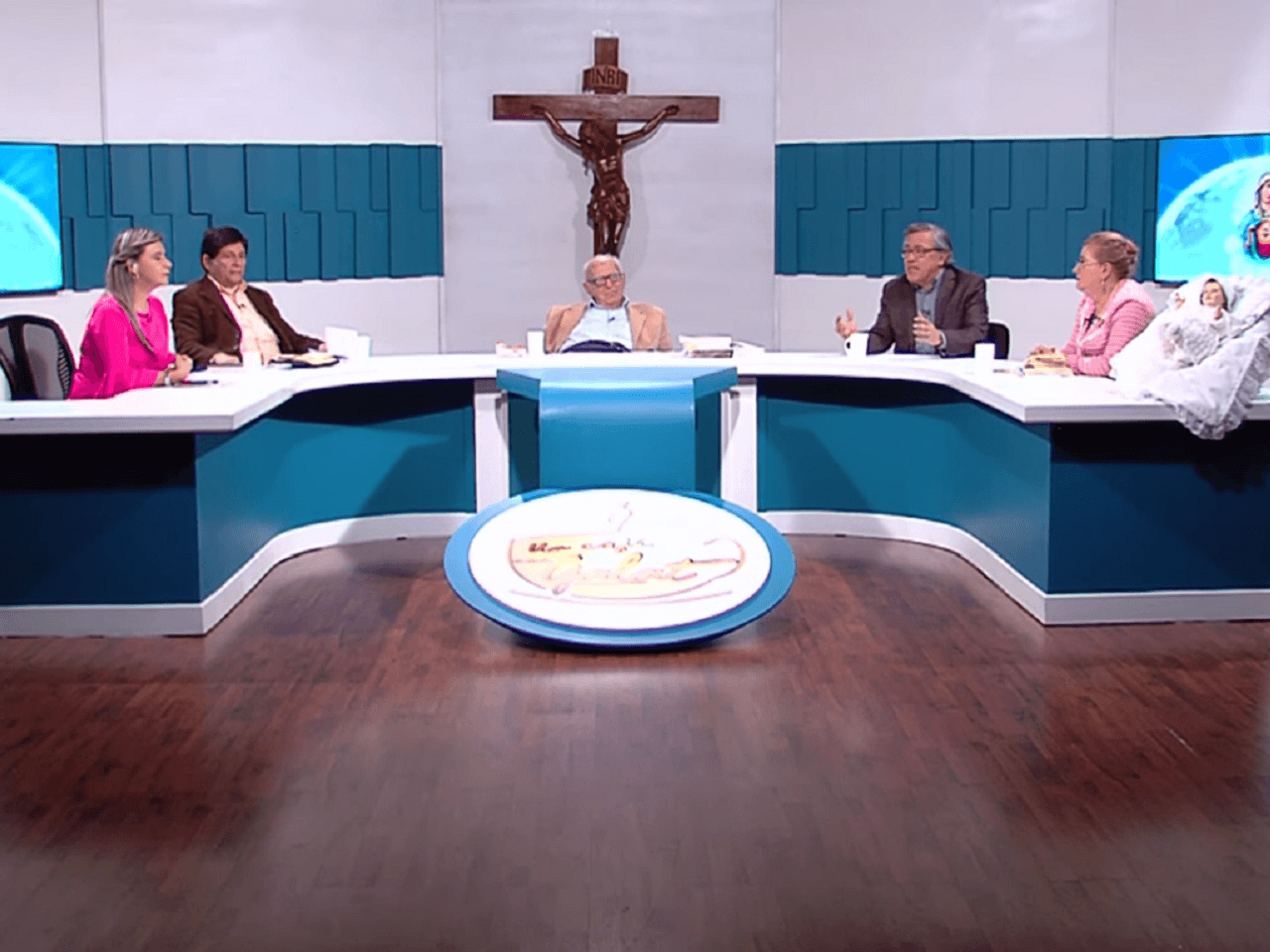

Image: A panel on Un Café con Galat, the television program hosted by Professor José Galat (center).
Some troubling news has, once more, just come to us from Colombia. As we reported a while ago, there was the case of Don Uribe Medina, a parish priest punished for criticizing Pope Francis and his novel teaching concerning marriage. Fortunately, that case was resolved on good terms, with Fr. Uribe’s own bishop now even fully defending the Church’s traditional teaching on marriage.
In the new case, however, Professor José Galat, former rector of the La Gran Colombia University and founder and owner of the television station Teleamiga, has been declared excommunicated for his purported schismatic attitude. More specifically, he and his own weekly TV program, Un Café con Galat (Coffee with Galat), have been accused of not being sufficiently obedient toward Pope Francis.
Significantly, it was Galat himself who, at the time of the Don Uribe case, hosted the priest and gave him the scope to defend his positions.
Galat himself recently made statements on his own television show, where, citing the “Sankt Gallen Mafia,” of whom Belgian cardinal Godfried Danneels is among the most famous members, he claimed that Pope Francis was unlawfully elected. He also claimed that Pope Francis is distorting many aspects of the Catholic Church’s fundamental teaching.
For these statements – and especially in light of the imminent mid-September 2017 visit of Pope Francis to Colombia – the bishops of Colombia have taken canonical steps against Prof. Galat.
One of the more unusual steps is that, on 26 July, Monsignor Pedro Mercado, president of the Ecclesiastical Tribunal of Bogotá, has published the following statement on Twitter (sic): “For obstinate disobedience toward the pope, José Galat has placed himself outside of the Communion with the Church. He cannot receive the Sacraments.” On the same day, the same prelate posted, again on his Twitter feed, a picture with himself and Pope Francis along with the caption: “I am Catholic and I am in communion!”
ACI Prensa, the Spanish branch of Catholic News Agency (CNA), has already published two articles on this Galat case. On 25 July, ACI Prensa reported that the Episcopal Conference of Colombia (CEC) “lamented the content of the Colombian television channel Teleamiga, which claims to be of Catholic inspiration but which attacks Pope Francis.” The bishops now “urged priests, religious, and lay people to cease any support they give” to this program. In their 25 July statement, the bishops also state that “Teleamiga does not represent, nor reflect, the teaching of the Catholic Church; therefore it cannot call itself a ‘Catholic channel.’” Here ACI Prensa also directly quotes the bishops: “Based on Canon Law, we point out that, by rejecting submission to the Pope and seriously injuring the communion of the Church, a schism is thereby incurred and other people are [thus also] induced to fall into it.”
The Colombian bishops – three of whom have signed the statement, among them the president of the Episcopal Conference – especially criticized the messages coming from Un Café con Galat as carried out by the founder and director of Teleamiga. The bishops accuse him of sowing among the Catholic faithful, with the help of “superficial and harmful arguments,” “attitudes of detachment and doubt regarding the validity of the pontificate of Pope Francis.”
The Colombian bishops also stressed that they have sought “the way of dialogue” with Galat “over the years.” “However, a calm and fruitful approach has not been possible, nor has there been a change of attitude [on his part],” they added. Next to telling Catholics not to support the channel anymore, the bishops also declare that “it is an absolute contradiction that the Teleamiga channel should continue to transmit the celebration [and Sacrifice] of the Eucharist and that, in its facilities, there is to be found the Blessed Sacrament [reserved].”
Teleamiga has been airing traditional Masses. The Colombian bishops advise the faithful to look for other ways and means to find “sound doctrine.” For example, the bishops have explicitly invited the faithful to prepare themselves well for a welcome of Pope Francis on his upcoming visit to Colombia (Bogotá, Villavicencio, Medellín, and Cartagena) and to listen to him “with docility.”
It might be of worth to note that the Archdiocese of Bogotá, Colombia is also about to host a conference given by Monsignor Pio Vito Pinto, dean of the Roman Rota, concerning the papal document Amoris Laetitia, with 600 participants in registered attendance already.
Teleamiga is a television station licensed, among others, by the La Gran Colombia University, Bogotá, whose rector was Professor Galat himself from 1981 to 2017. Galat has studied political sciences and philosophy at different universities in Paris, France; Barcelona, Spain; and Colombia. He is now 88 years of age…and just excommunicated.
On 26 July, ACI Prensa published a follow-up report on the Galat case, quoting Bishop Mercado: “[W]ith his angry response to the episcopate and his obstinate rejection of Pope Francis, Dr. José Galat has placed himself outside the communion of the Catholic Church[.] … He should not be admitted to the sacraments until he shows clear signs of repentance.” According to Bishop Mercado, “heresy and schism are typified as canonical offenses punished with (automatic) excommunication latae sententiae.” The bishop added, “Those who have committed this crime may not receive the sacraments of the Church until manifesting a visible and sincere repentance.”
At this point, Galat is disallowed from receiving even a Catholic burial. According to the bishop, “by disobeying Pope Francis in a visible, public, and reiterated way, Dr. Galat has placed himself outside the communion of the Church.”
According to ACI Prensa, Bishop Mercado said, “[I]t is painful for me to realize that Dr. Galat, who for so many years served the Church faithfully, has ended his days in this pitiful spiritual situation.”
These tones do not sound very merciful, at least to some observers.
Prof. Galat himself has now responded on two occasions. First, on 25 July, he declared that “it is true that a Catholic must have love and adherence to the legitimate successor of the Apostle Peter.” But, according to Galat, one wonders about a pope “not chosen by God, but by men and even worse by a ‘mafia of cardinals,’” as it had been called by “Cardinal Godfried Danneels himself, who, with savvy, publicly declared that this mob determined the resignation of Benedict XVI and put Francis in the papacy.” Galat goes so far to say that the present pontiff’s election “was the work of a political and corrupt mafia of cardinals.” The Colombian professor insisted that this is said not by him, but by Cardinal Danneels himself, as can be shown with the help of different sources, among them an article written by Edward Pentin. Galat also spoke about Francis’s “undoubted illegitimacy of origin,” complemented by an “illegitimate exercise of teaching doctrines contrary to the Catholic Faith.” As examples, he mentioned Francis’s claim that everyone is saved, that proselytism is foolish, and that adulterers may receive Communion.
Galat claimed that he has presented even more facts on his television program. He also spoke about the “nonsense of him who figures [presents himself] as pontiff.” He accused the Bishops’ Conference of branding as formal “schismatics those who try to defend the Faith, when it is exactly the opposite.” Galat explained that those who attack the Catholic truths are, in fact, the ones who put themselves outside the Church. He concluded that “‘false and harmful’ is the silence of those who are called to defend the Faith”; those who now practice “complicity or cowardice” also want to destroy Teleamiga, which does actually defend the Faith.
Galat “very respectfully” challenged the “Colombian episcopate itself to respond and to counter-argue – with the help of biblical evidence and the traditional teaching of the Church” in order to show “what are our alleged mistakes that have caused their ‘superficial and noxious’ anger.” And: “Why do they persecute those who defend the Faith of the Church?”
On 26 July, the day after his first response to the episcopal steps taken against him, Professor Galat also responded on his Facebook page to the claim that he is using “harmful and superficial” arguments. Galat rejected these reproaches, applying the same words to some of the confusing teachings coming these days from the Catholic hierarchy itself. “False and harmful are the heresies taught by theologians, bishops, cardinals, and even by Pope Francis – and not the defense of the truths of the Faith as we have undertaken it on our channel.” “False and harmful” are, in Galat’s eyes, those who, instead, endanger the salvation of souls by teaching “false doctrines against the Faith of the Church, taught and sustained by Pope Francis.” Amoris Laetitia was also mentioned here for calling “sin” [i.e., adultery] an “irregular situation.” “And harmful it is to destroy the family with the virtual legalization of adultery which is now to be easily achieved, according to the principles enshrined in that document,” explained Galat. After naming more examples, he concluded: “False and harmful are a multitude of other wrong teachings of the current pope.” Galat posted this same statement on the website of Teleamiga.
The Galat case has, so far, not been widely covered. But the well respected Catholic website Infovaticana published on 29 July a comment that asserts Professor Galat’s inclination to make himself the center of his TV program, in spite of his alleged defective theological expertise. The article uses even harsher language that I prefer not to repeat. To an outsider like me, this article and tone seem inappropriate amid a grave situation where an 88-year-old Catholic man who seems to have contributed so much to the common good of his country – also economically, by fostering community-based enterprises that help the poor – is now threatened to be indefinitely excluded from the Sacraments. Is this to be a fitting manifestation of the newly (and more expansively) merciful Church? Is this how Pope Francis’s welcome is to be prepared in Colombia – at the expense of an elderly Catholic veteran?
We might not agree with all of Galat’s own forceful statements and sweeping assertions, which certainly are hard to prove. They might also lack prudence.
But we might also remember in this context that the well respected Italian journalist and papal critic Antonio Socci – who not many years ago also argued that the election of Pope Francis was invalid – received last year a personal letter from the pope, thanking him for his work and welcoming his criticism. How is it that one critic receives a papal thank-you note, while another – and much older – gentleman receives an excommunication?
Update: Infovaticana now published, today, another post on Prof. Galat, more differentiated, showing his many achievements and, while saying they don’t share Galat’s theses, calling Pope Francis to prudence.
They also add the information that we should add, too – namely, “His Teleamiga Television Channel, of which he is co-founder and director, reaches 35 countries and more than 50 million homes.”
+++++++++++++++++++++++++++++++++++++++++++++++++++++++++++++++++++++++++


Yesterday’s article on the excommunication of papal critic Professor José Galat, formerly the rector of La Gran Colombia University and founder of Spanish language TV station Teleamiga, has stirred up quite a firestorm in the comment box. And not without reason.
Galat is not, however, just a papal critic. As reported by Maike Hickson, he takes his criticisms to the point of unfounded conclusions:
Galat himself recently made statements on his own television show, where, citing the “Sankt Gallen Mafia,” of whom Belgian cardinal Godfried Danneels is among the most famous members, he claimed that Pope Francis was unlawfully elected. He also claimed that Pope Francis is distorting many aspects of the Catholic Church’s fundamental teaching. [emphasis added]
Of the existence of the so-called “Sankt Gallen Mafia,” which is said to have colluded to elect Jorge Bergoglio pope, there is no real question. By the admission of some of their own members, the group existed. Quite a good deal is known about their operations. Other details have come to light about international pressure against Pope Benedict XVI to resign. Questions have also come up about possible canonicalirregularities in the election of Pope Francis.
Of the assertion that Francis is distorting the teaching of the Church, there can also be no question. From significant segments of Amoris Laetitia to certain assertions in Evangelii Gaudium to his many, many less-well-known statementsthat appear to run contrary to what the Church has perennially taught, this pope has done great damage to the faithful in their ability to comprehend and accept authentic Catholic teaching.
Whatever one thinks of all these things, it seems to me that within reasonable parameters, there is room for a measure of skepticism. Skepticism about the abdication, skepticism about the election, skepticism about whether material heresy may have crossed the line into formal heresy, and so on. It seems that no honest Catholic today feels sure about very much except that we’re dealing with a crisis in the papacy of unprecedented proportions.
But skepticism, difficulties, doubts, and questions are just that. They do not rise to the level of certitude. They do not give to any of us the right to make formal declarations of fact when we don’t even have all of the information needed to make a determination, let alone the authority to do so. These things, by their nature, give rise to uncertanties, not the other way around. And we should give these uncertanties to God in prayer, asking Him to guide us and to aid and restore His Church.
In other words: it’s a big mess, but fixing it is above our pay grade. We each have our tasks. Let’s leave the big problems to the big players.
By way of analogy, one of the things we (rightly) push back against in the midst of the ecclesiastical assault on Holy Matrimony is the idea that via the “internal forum” a couple can determine that their marriage was never valid, even if a tribunal has not been involved, or has reached a decision upholding the union. But how is this any different than those of us who run around telling ourselves and anyone who will listen that Francis isn’t just a lousy pope, he’s an antipope? Do we really think we can defend the Church’s juridical authority in the former case and totally ignore it in the latter?
Further — and I think this is what really lies at the heart of the matter — do we have so little trust that God is guiding His Church that we think we have to jump in and do it for Him? Are we, finding ourselves int he midst of this storm, reacting like the apostles before us? Do we wish to prod Him from His (apparent) sleep, crying out, “Master, does it not concern thee that we perish?” Have we forgotten Our Lord’s reaction to such squeamishness?
And rising up, he rebuked the wind, and said to the sea: Peace, be still. And the wind ceased: and there was made a great calm. And he said to them: Why are you fearful? have you not faith yet? And they feared exceedingly: and they said one to another: Who is this (thinkest thou) that both wind and sea obey him? (Mark 4:39-40)
We have a Church that is both human and divine. It has been guaranteed the guidance of the Holy Spirit to keep the faithful from being bound to error, but we were never promised the impeccability of the men who would lead it. St. Paul warned the bishops of precisely the problem we face at this very moment:
Take heed to yourselves, and to the whole flock, wherein the Holy Ghost hath placed you bishops, to rule the church of God, which he hath purchased with his own blood. I know that, after my departure, ravening wolves will enter in among you, not sparing the flock. And of your own selves shall arise men speaking perverse things, to draw away disciples after them. (Acts 20:28-31)
And in the Scriptures, we were even given, under divine inspiration, an example of an errant pope:
But when Cephas was come to Antioch, I withstood him to the face, because he was to be blamed. – Galatians 2:11
In his commentary on Galatians 2, St. Thomas Aquinas explained the nature of Peter’s error, and thus, Paul’s rebuke:
Apropos of what is said in a certain Gloss, namely, that I withstood him as an adversary, the answer is that the Apostle opposed Peter in the exercise of authority, not in his authority of ruling.
St. Thomas goes on:
The occasion of the rebuke was not slight, but just and useful, namely, the danger to the Gospel teaching. Hence he says: Thus was Peter reprehensible, but I alone, when I saw that they, who were doing these things, walked not uprightly unto the truth of the gospel, because its truth was being undone, if the Gentiles were compelled to observe the legal justifications, as will be plain below. That, they were not walking uprightly is so, because in cases where danger is imminent, the truth must be preached openly and the opposite never condoned through fear of scandalizing others: “That which I tell you in the dark, speak ye in the light” (Mt 10:27); “The way of the just is right: the path of the just is right to walk in” (Is 26:7). The manner of the rebuke was fitting, i.e., public and plain. Hence he says, I said to Cephas, i.e., to Peter, before them all, because that dissimulation posed a danger to all: “Them that sin, reprove before all” (1 Tim 5:20). This is to be understood of public sins and not of private ones, in which the procedures of fraternal charity ought to be observed.
Note well the distinction made here: a differentiation between Peter’s exercise of authority and his authority of ruling. The former is subject to rebuke, even on a matter that was “a danger to the Gospel teaching”; the latter, however, is not. Peter was still the pope, even though he was leading the faithful astray, and his authority from Christ was unquestioned by Paul.
It would be much easier for us to deal with the multiple “dangers to Gospel teaching” presented by Francis if he were not a legitimate pope. But we ourselves have no authority of ruling, and no one may judge a pope. Whatever suspicions we may have, we have been told by the Church that Benedict XVI resigned and we have been told that Francis was elected by the conclave. There is no rival claimant to the Petrine Throne. The Universal Church has accepted Francis as pope.
He is, whether we like it or not, the man we must accept as the Roman Pontiff. He holds the keys of St. Peter. If, like the marriage tribunal I used in the example above, he is determined at some point to have in some way nullified his office, then we may rest assured that we will come to know it after the fact. But we do not know it today.
This is a cross. There is no question. It is a heavy one, and for some, it has scandalized them to the point of losing their faith. This is certainly a tragedy, and it is one that Pope Francis will have to answer for. No matter how much he causes us to grind our teeth, we should be praying for him, because to stand accountable before the Lord for using the highest office in the Church to confuse and scatter the flock is…well, about the most terrifying thing you can imagine.
Speculation on these matters might feel cathartic, but it helps nothing. It does not remove him from office. It does not change what is being done. And for some who are already struggling with their faith, or why they’ve converted, running into endless debates on who is pope and who isn’t and why and why not just compounds the confusion they already feel about the chaos in the Church. It has the potential to lead people astray, or to cause them to give up completely.
This is why we have the comment policy we do, and why we enforce it even when it sometimes seems a bit heavy handed. I’m not looking forward to standing before God and having to answer for why I let reckless and idle speculation run wild here. We’re careful in the stories we report to give you the information we have about the problems that exist, but not to draw conclusions that we have no right to come to. We ask for that same prudence to be extended to your discussion of these articles.
The selective application of ecclesiastical penalties against Professor Galat when so many dissenters are empowered or promoted to positions of influence in the Church is surely an injustice. On the other hand, if Galat could have just refrained from arrogating to himself the authority to say with certainty what we cannot know with certainty, he might never have wound up in trouble in the first place.
Whatever happens with Galat — and we should hope and pray that he receives justice, not the jackboot — it’s a lesson for all of us. One we’d do well not to forget.
++++++++++++++++++++++++++++++++++++++++++++++++++++++++++++++++++++++++++++

Last year, I wrote about a wonderful work of light fiction, The Awakening of Miss Prim, which is more or less a novelization of the Benedict Option. Its Spanish author, Natalia Sanmartin Fenollera, came to speak at this year’s Idea Of A Village conference near Clear Creek Abbey, in eastern Oklahoma. If you click on that link, you can watch a video of all the talks. Fenollera delivered hers in Spanish, her native language, but provided a printout of the English translation for conferees.
Andrew Pudewa, a conference organizer, shared with me the English translation of Fenollera’s speech. Here it is:
When I sat down to write The Awakening of Miss Prim, I had no idea whether it would be published even in my own country, Spain; much less could I ever have imagined that it would actually be translated into eleven languages—English among them—and that it would be distributed in more than seventy countries! Why could I not have imagined such a thing? Not only because it was my first novel, but because my intention in writing it, beyond telling a story, was to challenge certain notions that have gained a hold in our day and are now taken for granted, notions that are supposedly settled and incontrovertible.
Much of the inspiration that brought me to write the book came from having read authors and masters of old. Resonating in the pages of Miss Prim are echoes of books I read both in my childhood and later years, but most especially echoes of those books that helped me return to the Faith, and that guided me in my search for the Good, the True, and the Beautiful. Works by Chesterton, Cardinal Newman, Tolkien and C.S. Lewis, and by someone well known and much loved here in Clear Creek—Professor John Senior.
I have not come here to speak about the rich legacy left by John Senior, as I am sure many of you know it much better than I. I would have loved to have had the good fortune of being able to attend his classes and listen to him. But to me, it has only been possible to read him, and that, only years after his death. Nonetheless, his imprint, the imprint of what he believed and taught, runs through my novel.
The Awakening of Miss Prim is a book full of hidden clues—little details that are seemingly accidental and unimportant, but that are not at all so. Details that were placed along the way as hidden pebbles, as silent acts of homage awaiting to be discovered and recognized by at least a few readers. One of these pebbles pertains to John Senior. His name doesn’t expressly figure in the novel, but is present throughout in an indirect way. As the story goes, the male protagonist of the story, the “man in the wing chair,” in the process of his conversion to the Catholic Faith, had attended a seminar at the University of Kansas, where “something” happened to him. This passing reference to Senior and Kansas, just a single line, was “discovered” by a very special reader: Philippe Maxence, editor of the French Catholic magazine “L’Homme Nouveau”; and through him, reached Abbot Philip Anderson of Clear Creek Abbey who wrote me and gave me the great joy of knowing that the hidden clue had been found and unraveled.
I believe it is thanks to Divine Providence that I am here today, and I warmly thank you for the generous invitation that has made this possible.I am going to approach this talk about The Awakening of Miss Prim almost as one would a mystery novel. In this case, though, we won’t be in search of the assassin, but in search of the motivation: Why was such a book, containing hints of Christianity and that challenges many of the dogmas of our present-day culture—why would such a book be so well received in a world that in many instances doesn’t understand those hints, and in others, outright rejects what they stand for?
If I were to describe what The Awakening of Miss Prim is, I would say it is a story, apparently simple, that runs with that gentle simplicity of fairy tales, but peppered with unexpected bombshells. Odd bombshells, because they are coated with sugar and chocolate like Hansel and Gretel’s house, but bombshells nonetheless they are. The story begins with the arrival of Prudentia Prim—a young woman, independent and loaded with academic titles—to San Ireneo de Arnois, a peaceful village whose dwellers have declared war on the modern world. Miss Prim had come in response to an employment ad placed by a ferociously anti-modernist, and irritatingly traditional gentleman who needed a librarian to put his library in order. The clashes between these two contrasting and strong personalities, and her dealings with the peculiar inhabitants of the place, will rock many of the firm convictions self-sufficient Prudentia Prim held, and will change her life forever.
As you can see, it is not a thriller, nor a mystery novel, nor hard-boiled fiction, much less a romantic story or a historical narrative. What is it, then? I usually describe it as a tale, in the sense that it isn’t a realist novel, even though it speaks of profoundly real things. And it takes the license that tales do, which allows us to sharpen colors or tone them down as needed, to shift vantage points, and to direct focus so as to call attention to things that may go unnoticed.
When I began writing The Awakening of Miss Prim, I set out to create a story that could be read in three ways, leaving it to each reader to find his own. The first way would be as a social realism novel about the goings on in a peculiar little village, and, parallel to that, as a love story. This is how many have read the book, a reading that is rather bland because, as a love story, it is very restricted for present-day norms, and because the book is actually not a love story. At least not in the sense that we give this term in our day, though it includes a “love story” in lowercase, and another “Love” story with capital L. We will soon come back to this.The second manner of approaching the book—and here we already run into one of those bombshells—is reading it as a declaration of war, as a cry of rebellion against modernity and its demons. The story outlines the conflict between two radically different worldviews: the traditional, represented by the residents of San Ireneo, and the modern, defended by Miss Prim. The Ireneans (as we shall call the residents of San Ireneo), are deeply rebellious, but of a very particular rebelliousness, because they are not aiming at the future, but rather at the past; they are not claiming the new, but rather the old; they are not seeking the future in the future, but in the past.
This notion of seeking the future in the past may seem to be contradictory, especially for us who are used to associating rebellion with the rejection or destruction of something unsatisfactory in the present in order to build something new and better in its place for the future. But while we take for granted the idea of rejecting the past to build the future, history teaches us otherwise. If we think about the fall of the Roman Empire, for example, and about the centuries immediately following, we see that the Romanized people could not longingly look toward the future, which loomed dark, devastated by the invasion of barbarian tribes that destroyed everything in their way. Rather, they yearned for the past. Those people missed the old times of law and order, of government and administration that Rome took to the farthest corners of the empire. For them, progress was not something ahead of them, but rather something that had stayed behind.
There’s a moving and terrible sense of desolation contemporary texts that narrate this collapse, this obscuring of civilization. It is the voice of men who looked upon present times with horror, who could not begin to imagine what the future could hold, and who lamented a lost past. Saint Jerome, for example, who so loved and studied the great Latin authors in his youth, spoke of the sack of Rome by Alaric in these impassioned and heartbreaking words:
“My voice catches in my throat; as I dictate, sobs choke my words. The city that took the whole world has itself been taken. … The most brilliant light in the entire world has been extinguished. The head of the Roman Empire has been severed. To speak clearly, the world has died with the City. Who would have thought that Rome, which built itself upon victories wrought throughout the world, would fall in such a way as to become both mother and tomb of all peoples?”
For the people of those days, progress did not lie in abolishing old structures, not even in looking toward the future, but rather in resisting destruction and preserving portions of civilization. There is a book by Chesterton entitled A Short History of England, that explains this paradox very well. With that common sense that characterizes him, Chesterton points out that the word “progress” in itself refers to only one direction: forward. But only an unreasonable person would take a direction as being an end in itself. Progressing toward a valley flowing with milk and honey, and progressing toward a dark cliff, are not the same thing.
The residents of San Ireneo de Arnois, the little village where Miss Prim arrives, have this conviction, this sense that present-day civilization is heading toward a cliff, not a fertile valley. They believe that we live in disquieting times, a time when the sun seems to be setting, a time in which “the virtues have gone mad” (to borrow Chesterton’s words), and men have lost the capacity to recognize them.
Many readers ask me where San Ireneo is located, and if such a place as described in the novel really exists, or if it is simply a utopia. The answer is that San Ireneo is a fictitious place, but it is not a utopia, because it is a type of community that lives in Europe’s DNA, that breathes in its foundations. A tiny village born around spiritual lungs—which in the novel is a Benedictine abbey of the traditional Roman Rite—in which old ideas full of wisdom are preserved, such as those that remind us that human life must be subject to order if it is to be truly human. A place where neighborly ties are fostered, where there are solid families, the economy is small, and where its residents wage a war to preserve the best of the past, without which the present cannot be understood, nor the future be faced.
The Ireneans have fled away from modern life, away from a huge world gone out-of-hand, full of din and noise; away from a Western culture where the scale of human things has been lost, and another ancient idea has been forgotten (how beautiful are the old ideas that survive the short lives of men): the idea that the world must be fashioned by the measure of man, and not man fashioned by the measure of the world.I mentioned three different readings the book may have. We are still missing the third one, which is the most important and also the least evident. The adventures of Prudentia Prim in San Ireneo de Arnois tell a story of religious conversion, which not all readers uncover because it is told in the way of Poe’s stolen letter. It is there, it is so obvious, but it is so intertwined with the threads of the novel … that not many see it.
Why have it so? It is said of one of my favorite English authors, Evelyn Waugh, that one day at a party, when a lady approached him to congratulate him for his latest book, Waugh, who was acid and corrosive as few can be, replied in such a way that prompted the admirer to exclaim: “How is it possible that being a Christian, you can be so disagreeable?” to which he replied “What you do not know, Madam, is that before being a Christian, I was only human.”
The reason I mention Evelyn Waugh and the clear understanding he had about the effect of grace in himself, is because his Brideshead Revisited served as a model for me, as I traced out the story of conversion in The Awakening of Miss Prim. In his magnificent novel, Waugh tried to explain, within the bounds of possibility, how grace guides us through the events of our lives, through the people we know, through our joys and our pains, through the contemplation of beauty and, most especially, through our wounds and failures. That is what I tried to do in the book, within all the limitations imposed by this theme, and that is why the clues in this third type of reading, are not as evident as in the other two. That is because God doesn’t usually make Himself obvious; things would be much simpler if He would, but that is certainly not the case. This is a fact experienced particularly by converts; this experience that grace acts in gentle ways, speaks ever so softly, whispers in the ears, without haste, without imposing itself, gingerly.
Waugh himself once said that conversion is like climbing up a chimney, passing from a world of shadows, where everything is like a caricature, to the real world. Cardinal John Henry Newman’s epitaph reflects a similar idea: “Out of shadows and images unto the Truth.” [Ex umbris et imaginibus in veritatem]. In C.S. Lewis’s Chronicles of Narnia, one of the characters explains to us that the lands of Narnia are only a “shadow” or copy “of the real Narnia, which has always been here and will always be.” And Miss Prim is disturbed when, upon an afternoon in a garden, four children explain to her that the Gospel is a “real” fairy tale, not because it is similar to a fairy tale, but because fairy tales are similar to the Gospel. It is this fascinating concept of Revelation as reality in myth that underlies Tolkien and Lewis.It is also in this third type of reading that we find Miss Prim’s love story. In the beginning of the novel, when she first arrives in San Ireneo de Arnois, she loves, in particular, her own self. She carefully protects her self-esteem and is very concerned about her dignity. Soon she discovers the second type of love—friendship—as she gradually comes to know the Ireneans and enters into the life of the village. Then follows the third type of love: love between a man and a woman; a love that is only truly possible when the fourth type of love is attained, which is the source of all others: Divine Love. That is when everything falls into its proper place—love of self and love of others—all find their proper place and measure when one finds Love, with capital L.
The love story of the two protagonists in the book, Miss Prim and the man who hires her to organize his library, entails a conflict between two completely different personalities. Different not just because of how they view the world, but also because of the way they approach reality. He represents reason, a reason enlightened by faith (because he is a convert), which is the only way reason will avoid falling into the temptation of becoming a blind monster. And she represents sentimentality, which is an old pathology affecting reason, or, if you prefer, of feelings that swell up, overflow, and then occupy a place that does not belong to them, something the ancient philosophers diagnosed very accurately. Miss Prim is very sensitive; she loves the arts and beauty, but she thinks with the heart instead of the head. And the heart has a marvelous and unique function—to love—but it fails miserably when it is used for what it is not meant.Let us now talk about other sugar-coated bombshells. What other targets do Ireneans fire at? Among them are feminism as an ideology, and, most especially, modern education. One of Miss Prim’s first surprises is that in San Ireneo de Arnois there is a peculiar educational system that surprises and scandalizes this librarian. Ireneans educate their children at home and in community. The children take classes from several of the village’s residents. Whoever masters biology, gives biology classes. The literature expert teaches literature; the scholar of mathematics, mathematics. There is a teacher in the village who teaches the Trivium to little ones; three tools—grammar, rhetoric and dialectic—that not too long ago were considered as indispensable for learning how to think. Reading is an absolutely essential thing in this small community, with an especially reverential fervor toward the classics, to the point where the villagers pridefully proclaim that most of what the world calls literature, in San Ireneo is called “a waste of time.”
Many readers ask me if the relationship I describe in the book between childhood and literature—something in which are evident John Senior’s enlightened and on-target teachings, and my own childhood experience—if this relationship is truly possible. The children of San Ireneo grow up surrounded by fairy tales, solid children’s literature, old poems, sagas and legends, and by the classics … a lot of classics. These are children who are able to enjoy The Wind in the Willows of Kenneth Grahame, but also who can recognize lines by Virgil, in Latin. They grow up in a home in which one can learn to love Peter Pan, Alice in Wonderland, and fairy tales, but also the Odyssey and the Iliad, the medieval romances, and Robinson Crusoe or Oliver Twist. Another utopia? If we consider children’s literature of the 19th century, or of the early 20th century, and compare it to many of the works that are written for children in our day, we must come to the conclusion that, either the children of our day are less intelligent than children were in the past, or society believes them to be less intelligent than they are. I believe the second option is the correct one.
Added to this is the fact that we have become used to labeling certain things as impossible or utopian which were never thought to be so by those before us. To illustrate this, we have a good example in Tolkien’s childhood (only one example among many). Tolkien was educated at home by his mother, a woman of the middle class who had received a solid education. With her help, he started reading at age four, and learned Latin, French and German when he was seven, before going to school. Another example is provided by Ronald Knox, a British convert, whose biography was written by Evelyn Waugh. At the age of seven, he composed sweet poems in Latin. And then we have Bernard Shaw, who used to say, with characteristic irony, that his education ended at age seven, on the day his parents took him to school.
I was brought up in the 70s, a time when books were not classified by age groups, and no one thought anything of a child thumbing through a classical work, and perhaps even enhancing it with a few dabs of color. I was brought up in a large family—in that noisy, free and semi-wild environment in which large families lived and breathed at the time. I was raised with many siblings, and also with many poems, legends, fairy tales and classics … a lot of classics, at the reach of children.
Two years ago, when I presented The Awakening of Miss Prim in Germany, I had a conversation with an elderly professor of literature who told me with great sadness: “German children no longer know Goethe; Goethe is no longer read.” In a certain sense, we Westerners have turned into those fairy-tale dwarves who sit upon a treasure trove and have no time to enjoy it—a treasure of tradition and culture of incalculable worth, which is the best gift one can give one’s children. There is an old Western world that was built by dreams and wonderful stories filled with heroes, woods, dragons, swamps, warriors, magic rings, witches and knights, monsters, spells, courage and sacrifice, which all wield such force that it is difficult not to feel vanquished. This magic language of fairy tales, of medieval epics and pre-Christian Nordic sagas, is a language extraordinarily suited for transmitting to children truths that are not as easily expressed in other ways. I remember that the first time I read Beowulf, in Tolkien’s translation, to four very small nephews of mine, they listened to the entire story without blinking an eye. This force is almost like an elfin spell … marvelous!
Another one of the battles fought at San Ireneo is for preserving the magic of childhood. We have become used to the idea that children be continuously present to the adult world, that they be the center of gatherings, and often of conversations. But not too long ago, a child’s world was something apart, a warm, sunny country, safe and magical. And this magic largely came from their not being exposed to the interests and problems of the adults around them and from not being considered the center of attention at any gathering. San Ireneo preserves this magic. When Miss Prim first comes into the garden area where the children of the house are playing, she enters into a world she does not belong to and that has its own rules. She is a stranger, a foreigner, an adult. And they are children. These are two distinct races, and their worlds operate under two distinct logics.I opened by saying that we would be talking about a motivation that would explain the why of this book, a book that defends tradition in the face of society’s blind cult of progress, and which is in itself a story of conversion. It has been well received by a large number of readers who actually are aligned with this progress and are in no way religiously inclined. I believe the key to this lies in that it isn’t a story written especially for Christians, nor is there any intention of catechizing its readers. It is a simple tale that speaks of something that has been in the human heart since always: the search for paradise lost, that indefinable nostalgic sense that we all have engraved in our hearts. A nostalgia that at times savors of childhood, and which neither noise, nor frenetic activity, nor the massiveness of a world that no longer has time to reflect about the perennial ancient questions, can completely muffle. The Awakening of Miss Prim begins with a quote by Newman, from one of his sermons while still an Anglican, that magisterially explains the reason for this ongoing search, for this perpetual dissatisfaction that the human being carries:
“They believe they yearn for the past, but in reality the yearning has to do with the future.”
And I will close this talk with another Englishman, Robert Hugh Benson, also a convert who is very special to me. Born during the Victorian age, Benson was the son of the archbishop of Canterbury and an Anglican clergyman. He wrote a small book entitled Confessions of a Convert in which he describes what we are, with the simplicity and magical beauty of a fairy tale:
“But all of us together are but a party of children wandering in from the country, travel-stained, tired, and bewildered with glory.” [Benson, Confessions of a Convert (New York: Longmans, Green, and Co.: 1913), p. 163.]
Thank you.
The novel is The Awakening of Miss Prim, by Natalia Sanmartin Fenollera. You can see this speech (delivered in Spanish) and the other conference talks here. Believe me, if the Benedict Option resonates with you, you’ll enjoy this book. The Benedictine monastery in Norcia even figures into the plot.


NEWSCATHOLIC CHURCH, HOMOSEXUALITYTue Aug 1, 2017 – 10:33 am EST
MOUNT RAINIER, Maryland, July 31, 2017 (LifeSiteNews) – The homosexual advocacy group New Ways Ministry is compiling a list of “gay-friendly” Catholic colleges and universities.
New Ways Ministry began publishing a “gay-friendly” parish list 20 years ago and had 33 parishes from 14 U.S. states and the District of Columbia, according to its blog. Now it has a robust representation with “well over 200 parishes listed.” The inaugural “gay-friendly” parish list also contained seven colleges “whose Catholic student communities were known to be gay-friendly.” Today, that college list is separate and has more than 100 schools.
To be classified by New Ways as “gay-friendly,” Catholic colleges and universities will have “some type of lesbian/gay student group, support group or ally group.” Readers are encouraged to recommend “gay-friendly” colleges and universities.
The president of the Cardinal Newman Society told LifeSiteNews the if the Catholic colleges and universities on the New Ways list are affirming homosexual behavior then this is harmful to their students.
“What’s a ‘gay-unfriendly’ Catholic college?” Patrick Reilly asked. “I don’t know of any.”
The Cardinal Newman Society, in its mission is to promote and defend faithful Catholic education, studies and produces data each year for a list of Catholic collegesthat conduct education in observance of Catholic teaching and fidelity to the Church.
“My experience of the faithful Catholic colleges in our Newman Guide is that they are the friendliest, most generous places on earth — and none are on the New Ways list,” he said. “The problem for New Ways Ministry, I suspect, is that Catholic institutions that stick to the truth of the human person — even in a loving way — don’t conform to the ‘new ways’ that distort marriage and sexuality.”
“The most unfriendly act is to lead someone into sin and falsehood,” Reilly said. “What too many of these ‘friendly’ Catholic colleges are doing, by supporting ‘gay’-centered activities that avoid and even distort truth, is scandal and quite dangerous to their students.”
New Ways terms itself a “gay-positive ministry of advocacy and justice for lesbian and gay Catholics.” The organization advocates for same-sex “marriage” and acceptance of the homosexual lifestyle.
It keeps a “gay-friendly” parish list, from which various entries have received mention in LifeSiteNews reporting concerning affirmation of homosexuality or LGBT issues.
New Ways celebrated its “gay-friendly” parish list as part of a “This Month in Catholic LGBT History” observance in its blog.
The Catholic Church’s teaching states that homosexual acts are contrary to natural law and that they close the sexual act to the gift of life, and hold that the marital act is reserved for a man and a woman united in sacramental marriage.
The Church says homosexual inclinations themselves are not sinful, though they are objectively disordered. Those experiencing these tendencies are to be “accepted with respect, compassion, and sensitivity,” the Church further states, while at the same time they “are called to chastity.”
Regarding sexual identity, the Church teaches that it is “a reality deeply inscribed in man and woman,” and it constitutes but is more than one’s biological identity, and also that a person “should acknowledge and accept his sexual identity.” One’s biological sex and gender expression are not to be disaggregated, the Church says, but should be seen in harmony, according to God’s plan.
Promotion of homosexuality in conflict with Church teaching is rooted in the foundation of New Ways Ministry.
Its founders, Sister Jeanine Gramick and Father Robert Nugent, were investigated and censured by the Vatican’s Congregation for the Doctrine of the Faith in 1999.
The CDF found for their teaching on homosexuality to be “erroneous and dangerous” and “doctrinally unacceptable.” The two were “permanently prohibited from any pastoral work involving homosexual persons,” an order they both disobeyed.
New Ways Ministry has also been condemned twice by the United States Conference of Catholic Bishops (USCCB), and banned from Catholic venues in several dioceses.
In 2015, New Ways and other homosexual advocacy were prohibited from holding a shadow LGBT outreach at a Catholic parish during the World Meeting of Families in Philadelphia.
 George Soros with his pal, the infamous abortionist and friend of Pope Francis, Emma Bonino, at the “In The Pursuit of Peace Award Dinner 2015”
Monday, July 31, 2017
Written by Hilary White
With the breaking of the news into the English language media-sphere the other day, some thoughts converged, into the form of a question: Why would anyone expect Emma “La Bicicletta” Bonino not to be invited to speak at a Catholic Church in Italy? Catholic editorialists are furious that Bonino was invited to speak at the church of San Defendente in Ronco di Cossato, on July 26, 2017, “World Refugee Day”. But there is an underlying tone of defeated routine in their protestations, as though they are objecting out of a dogged sense of duty to fulfill rather than any real outrage; let alone shock.
The soaring rates of violent crime – a few months ago in the little town next to ours our station master was murdered by the gang of African migrant thugs who loiter about the station day and night… he had dared to intervene in their bullying – seems inconsequential to the bishops and clergy. Italy is simply no longer a safe country, as it was only five years ago. The respectable village ladies are afraid to walk the five minutes from the church to their homes at the end of their Thursday night Rosary group. But the parish priest is more likely to accuse them of racism than change the time to help keep them safe should they complain.
The sacramental life – that is, the Catholic religion – seems to be of interest to no one but the laity, slowly spiritually starving on bare subsistence rations. In our village there is only a Mass offered one day a week, and, in the summer, half the Masses in the six villages down the valley are cancelled completely. (It goes without saying that this is strictly the Novus Ordo, with the full complement of guitar-strummers; the traditional Mass is simply not on the radar.) Even worse, there are no scheduled Confession times at all; that Sacrament has simply gone locally extinct.
But none of this is apparently of any interest to our bishop, whom Francis recently appointed head of the Italian bishops’ conference and made a cardinal (at 75) and who a few months ago organised a sort of rally (without a Mass, of course) in the city up on the hill to “celebrate” the enormous influx of African Muslim migrants to our area. This was after having given an interview in which he urged the government to grant legal concessions to same-sex liaisons, while cautioning Catholic participants in the Family Day demonstrations not to be “against” anyone: “The example comes from Pope Francis. His words are always of absolute clarity, the Holy Father is never against anyone, ever.”
It is true that in the Francis pontificate the Marxist faction in the Italian episcopate has been emboldened. In March 2017 when Archbishop Vincenzo Paglia – yes, the one who commissioned the homoerotic mural for Terni cathedral, with himself as one of the featured nudes – gave a brief eulogy for a Radical Party founder, Marco Pannella. Francis’ pick as head of the Pontifical Academy for Life and the John Paul II Institute for Studies in Marriage and Family went to a party meeting as a very special guest to call Pannella “a man of great spirituality,” saying his death is a “great loss” not just for the party but “for our country” and “for our world, which needs more than ever men who can talk like him.”
Pannella, Paglia said had “spent his life for the least” in “defence of the dignity of all, especially the most marginalized.” Paglia described his warm and close friendship with Pannella, calling his death “a great loss,” not just for the party but “for our country.” Pannella’s life, he said, is an “inspiration for a more beautiful life not only for Italy, but for our world, which needs more than ever men who can talk like him … I hope that the spirit of Marco can help us to live in that same direction.”
In October last year, Catholic writers in Italy expressed their shock at the bishops proudly announcing their partnership with the Radicals to promote the party’s “March for Amnesty, Justice, Freedom” project demanding the release of criminals from prisons. Given the party’s devotion to driving the Church out of public life, the Italian bishops’ collusion with the Radicals could justly be described as the turkeys working with the butcher to promote Thanksgiving.
It sounds to an outside observer like the world’s most advanced case of Stockholm Syndrome: A Church demonstrating its bona fides to a bitterly anti-Catholic Left by committing ritual suicide. Perhaps the only sensible question we are left with is why Emma Bonino is not doing a preaching tour of all the major basilicas and cathedrals of Italy.
But the whole business does raise other questions. As we start to understand the advanced state of moral decay this anti-Catholic ideology has caused among bishops and clergy, we tend to forget that it was not always so. The news has raised in my mind the question of how exactly this situation came about. How and why and by whom was Italy and the other Catholic nations of Europe so thoroughly de-Catholicised? Why, for example, are the “most Catholic” nations of Europe also the countries with the lowest fertility rates in the western world? Why has Italy not had a fertility rate over 1.4 children per woman in the last 30 years? The country’s statistical agency, Istat, says that in 2015 the total fertility rate was 1.35, a demographic death spiral. Italian politicians now openly speak of Italy as “a dying nation.”
This preview article will appear in the next Print/E-edition of The Remnant. To find out what else is in that issue—including Dr. Boyd Cathey’s tribute to Pat Buchanan, as well as the heart-warming story of a Catholic chaplain who gave his life for his Marines in Vietnam—subscribe today!

By now the looming “demographic winter” of the western and westernized Asian nations is an accepted reality, but why is it particularly acute – particularly advanced – in the formerly Catholic nations? If we put what we know together with these questions, the logic drives us toward an inescapable, though profoundly disturbing, hypothesis. One could be excused for asking, “Has the Catholic hierarchy been colluding with the globalist population control agenda to effect the decimation, even the extinction, of the Catholic population of Europe? And if so, for how long? Who made the decision and when, and what did they get in exchange?”
Anyone who wants to can do the research; I’m not going to reproduce it all here but everything has been declassified and is available online. Suffice for now to note that in 1974 a document was presented to the United Nations, authored by then-Secretary of State Henry Kissinger, that demanded the resources of the UN – especially including all its aid organisations like UNICEF – be ordered to the reduction of fertility in certain “target” states[1]. Assistance to people in these countries was to be attached to a demand that they accept contraception and sterilization – and later abortion – or do without the help.
The Catholic depopulation work, however, was already well under way when Kissinger’s committee produced National Security Memorandum 200. Had some controlling faction of the Catholic hierarchy already agreed in the 1960s to participate in a similar clandestine European Catholic genocide? Was there an agreement at the international level – as it has been said there was between Toronto’s Cardinal Gerald Emmett Carter[2] and Pierre Trudeau – to suppress the teaching of the Church on marriage and family life in exchange for concessions of some kind? Certainly the mood, the fashion, in Rome at the time was for making such deals. And it might have seemed like a pretty good one: progressives – and even normal Catholics who loved the approval of the secular world – were angry and deeply embarrassed by Humanae Vitae; they were definitely in a mood to suppress it. And after the debacle in Washington DC, it was clear that Pope Paul VI had no immediate plans to defend it. And we have certainly seen that the Holy See’s decades of presence at the UN has greatly increased the Vatican’s prestige and influence in international diplomatic circles, as we were reminded by Pope Francis’ intervention in Cuba.
Is it possible that some character like an Agostino Casaroli[3] – thought by many in this country to be a Freemason – made a deal with the nascent population control movement at the UN to effectively suppress Humanae Vitae in Europe’s Catholic churches?
The Holy See established its mission – and received “permanent observer” status – at the UN in 1964. Ten years later, the UN formally entered the global population control business, but by that time the population slide in Europe was well under way.
The international contraception promoters had already been at work in Italy for some years by that time. A report by the abortion/contraception agency Pathfinders International, brags that their agents were already handing out hormonal contraceptives to poor women in Rome in 1958, materials that “had been supplied free of charge by a manufacturer in Great Britain.” The agent of the Planned Parenthood affiliate group, Maria Luisa DeMarchi, “continued these visits for the next two decades, making weekly visits to over 550 clients annually—a total of over 7,000 visits.” The propaganda was effective: friends tell me that if you have one baby in a stroller, the nonnas will smile and coo; two or more children and the response is a lecture on overpopulation.
The results, the statistics, are easy to find; a recent report said that Italy now has the lowest fertility rate in Europe, one that has more halved since the 1960s. Births have fallen to fewer than in any other years since the modern state was formed in 1861. Italian Health Minister Beatrice Lorenzin – who thinks the problem can be solved by a 160 Euro monthly baby bonus – warned that Italy as a nation is facing an uncertain future without children. “In five years we have lost more than 66,000 births (per year) – that is the equivalent of a city the size of Siena. If we link this to the increasing number of old and chronically ill people, we have a picture of a moribund country.”
This bleak picture, of course, gives the likes of Emma Bonino and her friend at Santa Marta all the excuse they require to bring in as many African Muslim migrants as George Soros could wish. Italian parliamentarians on the left openly argue that these are the people needed to “replace” the native Italian population that is going extinct.
Italy’s fertility rate is well below the European average of 1.58 average, but that number itself falls far short of the 2.1 required to maintain a stable population. The CIA World Factbook, a project of the US State Department, tells us that Spain (67.8%), Italy (80%), Poland (87.2%), Portugal (81%) and the Republic of Ireland (84.7%), are among the “most Catholic” nations of Europe. Every one of them also has what demographers call the “lowest-low,” or below-replacement fertility rates. Incremental boosts in the birth rates have come in the last few years, but have been generally understood to be the result of influxes of more fecund immigrants.
Just taking a closer look at one country, the little bellwether nation of Malta, we see that the situation has to have been sliding for decades before the recent leftist governments started altering the legislative scene. The median age of the Maltese population is 41.5 years, which breaks down to “male: 40.4 years; female: 42.7 years,” well over child-bearing age. This could not be accomplished in a few years. It takes decades of low birth rates to push the median age so high, even for such a small population. The Total Fertility Rate of Malta was 1.55 children born per woman in 2016, a situation that would be impossible if the Maltese hierarchy and clergy had taught what the Church teaches about marriage and family.
It can be fairly said that Malta is the most Catholic nation in the world. Various estimates place it about 90-98%. The conscious abandonment of the Church’s teaching can be the only possible explanation for their current demographic situation. Fifteen years ago, about 80% of the population of Malta attended Mass every week. A few years ago when I visited it was down to 50%. Masses are mainly well attended, but only with older people, and the men generally stay away. The installation of legalized divorce, contraception and now “gay marriage” in this Catholic nation could not have come about without at least the tacit cooperation of the Church. I was told that when the government moved to legalise divorce in 2011 – the first of a long line of legislative dominoes – there was no outcry, either from the laity or the clergy; indeed, many of the latter promoted the change from the pulpits. More recently still, we have seen the Maltese bishops becoming the poster-boys for the Bergoglian revolution; ordering their priests to give Holy Communion to people they know to be in unrepented adulterous liaisons.
For obvious reasons, it might also be worth looking at Argentina, for which the CIA’s notes are especially damning: “One-third of the population lives in Buenos Aires,” and are merely “nominally Roman Catholic, 92% (less than 20% practicing)”; this might be the only country for which the notes include this telling little caveat. It gives the fertility rate for Argentina as “2.28 children born/woman (2016 est.)” putting it just marginally above the level of population replacement of 2.1 children per woman. The 2014 “country implementation” report on Argentina by the UNFPA, the United Nations office overseeing the global population control movement, notes that between 1990 and 2001, contraceptive use increased from zero to 65%. The report also notes that the government has “major concerns” about “adolescent fertility,” and is implementing “direct support for family planning” among young people.
North American conservative Catholics, working with their local political categories, are often hampered in understanding this situation. They laugh at the wild “conspiracy theories” of Traditionalists, with our table talk of Freemasons and Communist infiltration… What’s next? UFO abductions? But on the old continent, these realities are acknowledged as part of the landscape; Italians know that Freemasons and Communists are not fairytales; the prominent displays of hammers and sickles at the “Gay Pride” parade every year in Rome being a bit of a give-away. We sheltered Anglos really have no idea how commonplace it is for Italian priests and even bishops to openly operate as Communist agitators or sympathizers.
Many years ago, when I first became interested in these issues, I started reading about the movement by wealthy western countries to “curtail” the birth rates of poor “developing nations”. At the time I had no strong objection to contraception per se, but it struck me immediately that it was a gross moral violation for rich people to start demanding that poor people stop having children, so they could maintain their extravagant consumption indefinitely. This was clearly a case of genocide, on a global scale. But it is simply a fact that the European Catholic fertility rates started plunging well before the UN’s aid agencies started working to curtail births in the developing world.
Mass contraceptive and sterilization programmes, including government propaganda promoting them, is genocide. And this is what the UN has been doing in every “developing” nation in the world since the early 1970s. Given what we know now about how things have worked in the Vatican since the 1950s, I see no reason not to suspect, very strongly, that the extermination of Catholic Europe, that has been on the secularist, Freemasonic agenda since the early 19thcentury, was brought into the Church by the turncoat Trojans in Rome.
[1] The countries named in the 1974 memo for special treatment were India, Bangladesh, Pakistan, Indonesia, Thailand, the Philippines, Turkey, Nigeria, Egypt, Ethiopia, Mexico, Colombia and Brazil. With the revelations since then that UN-funded health organisations have been entering South American and African countries and sterilizing women without their knowledge or consent, one can assume that the mandate has expanded.
[2] Carter was one of the Church’s most outspoken opponents of Humanae Vitae and the author of the key paragraphs of the Winnipeg Statement repudiating its moral teaching. He publicly called the encyclical a “tragedy” and issued confessional guidelines for priests all but instructing them to ignore it: “Because of the doubt in the practical order, no priest can refuse absolution to persons using the pill, unless their motive is clearly sinful.”
[3] Secretary of State 1979 – 1990, Casaroli was a lifelong Vatican diplomat. Under John XXIII he was the author of the Vatican’s “Ostpolitik” approach of appeasement of Communism. He was included in the famous “Pecorelli’s List” of suspected Vatican Freemasons, as was his immediate predecessor in the office, Jean Villot.

NEWSCATHOLIC CHURCH, END OF LIFEMon Jul 31, 2017 – 10:28 am EST
QUEBEC CITY, July 31, 2017 (LifeSiteNews) — Cardinal Gérald Lacroix, archbishop for Quebec City and primate of Canada, says he doesn’t oppose church funerals for Catholics who choose to be killed by lethal injection.
But on the other hand, Lacroix says he could foresee denying a Catholic funeral when the euthanized person had publicly advocated for legal euthanasia in direct contradiction to Catholic teaching.
Lacroix told the Jesuit magazine America it’s hard to know why someone would choose euthanasia. He also said the elderly, frail, and infirm are “bombarded” with messages that ending their life is preferable to being alone, a burden, or in pain.
“So who are we to judge why they are like this?” he said.
“We do the best we can and leave the rest to the Lord. If the Lord accuses us of being too merciful, well, I’ll take it.”
Lacroix said the family of the euthanized Catholic might not have agreed with the decision, so a church burial would be in order.
“Do you think they need consolation? Of course,” he told America. “We accompany everybody.”
But well-known canon lawyer Dr. Edward Peters has a differing view, which he summarized in an email to LifeSiteNews:
The 1917 Code of Canon Law expressly forbade Church funeral rites to those who deliberately killed themselves. The 1983 Code, in contrast, does not prohibit funeral rites to suicides per se, but rather, to those who are considered “manifest sinners.” While suicide is objectively gravely sinful, it is not always clear that those killing themselves do so with adequate awareness of the sinful character of their deed. There is room for some flexibility in interpretation of the law here.
Those who kill themselves in accord with state approved procedures, however, procedures that include ruling out hasty decisions for death made out of depression and so on, leave ministers little basis for concluding other than that they killed themselves with adequate knowledge of and awareness concerning what they were doing.
I think canon law requires withholding ecclesiastical funerals from Catholics who kill themselves in accord with civil suicide statutes.
Moreover, it’s unclear from Lacroix’s remarks just how, and how far, he expects his priests to accompany euthanasia seekers and their families.
Douglas Farrow, professor of Christian thought at McGill University, had this critique of Cardinal Lacroix’s remarks:
That the deceased decided to seize from God authority over his or her life, and furthermore to cooperate with others in an act of illicit killing, does not seem to trouble the Cardinal much. It can hardly be denied that there is a quite fundamental matter of justice here. But on the “Who are we to judge?” principle, mercy apparently means declining to ask or answer questions about justice. So much for the Church’s exercise of the keys! This, I fear, is the verypathology I criticized in Rome. “If the Lord accuses us of being too merciful, well, I’ll take it,” says the Cardinal – but he may rest assured that the Lord will accuse him of no such thing. What he is likely to be accused of is setting justice and mercy at odds, thus destroying both.
LifeSiteNews asked Cardinal Lacroix to clarify his position, but he replied via his secretary that he did not want to answer the questions.
Since euthanasia was legalized in Canada in June 2016, the Catholic Church’s response has split along regional lines.
Lacroix is aligned with the bishops of Atlantic Canada, whose December 2016 guidelines refer to Pope Francis’ call to accompaniment in allowing priests discretion to grant anointing of the sick, confession and Communion to Catholics euthanasia seekers, as well as church funerals for voluntarily euthanized Catholics.
In contrast, the bishops of Alberta and the Northwest Territories issued a 34-page vademecum in September 2016, later endorsed by Ottawa’s Archbishop Terrence Prendergast, noting that euthanasia is an objective mortal sin and priests may be required deny the sacraments to Catholic euthanasia seekers, or a church burial to a voluntarily euthanized Catholic.
But the Alberta bishops also stressed pastoral accompaniment and directed priests to gently probe the reasons why Catholics would seek euthanasia, and to perseveringly pray and fast and urgently seek the conversion and repentance of such Catholics, who are in grave spiritual peril.

BLOGSGENDER, HOMOSEXUALITY, POLITICS – U.S. Mon Jul 31, 2017 – 11:57 am EST
[ Emphasis and {Commentary} in red type by Abyssum ]
July 31, 2017 (LifeSiteNews) — A few weeks ago while practicing for the annual charity Congressional Baseball Game, Rep. Steve Scalise was shot and nearly mortally wounded by a man out to kill pro-life conservatives. The gunman, taken down by Capitol Hill police, was a follower of the hate and violence-inciting Southern Poverty Law Center (SLPC).
More than 50 years ago, Hollywood provided the perfect metaphor for understanding what we now see happening in our world: In the classic 1956 science fiction motion picture Forbidden Planet, loosely based on Shakespeare’s The Tempest, a 23rd century spaceship from Earth arrives on the planet Altair to rescue a reclusive but very kind gentlemanly scientist (Walter Pidgeon) and his beautiful daughter (Anne Francis).
The rescuers are soon menaced by an invisible monster who possesses unimaginable powers to terrify and destroy. In the end, we find out that the monster is actually the professor’s “id” made manifest — unwittingly through the presence of a mysterious alien machine — as a powerful being, ravaging all those who threaten the utopia that the professor has created for himself and his daughter.
Like the rampaging monster terrorizing the planet Altair, groups like The Southern Poverty Law Center, Planned Parenthood, and the Gill Foundation are the machine and their devotees are the physical manifestation of the monstrous, collective id of this nation’s liberal elites. Their aim is the violent destruction of biological families and faith; of sexual innocence, chaste lives and complementarity. The sexual revolution must march on at any and all costs.
Sigmund Freud coined the term “id” to describe the lowest realm of functioning in the human psyche. It represents the most base, instinctual portion of the human mind. He defined the id as “the dark, inaccessible part of our personality … and most of that is of a negative character(.) … We approach the id with analogies: we call it a chaos, a cauldron full of seething excitations” (Freud, New Introductory Lectures on Psychoanalysis, 1933).
Political correctness is a tool of tyranny, wielded skillfully by Progressives to silence and render impotent — if not completely wipe out — principled objection to the advancement of their cause.
Let’s face it, the rise of political correctness is nothing more than the end of free speech in the United States and in westernized countries around the world. While appearing on the surface as benign and guileless, in reality it mercilessly foments hostility and violence, and if lives are destroyed, so be it.
Progressives and their facilitators in the media want us to believe that the angels and archangels, the cherubim and seraphim, are singing the praises of abortion, same-sex “marriage,” transgenderism, and a host of other human-life-and-dignity-defying causes. They want us to hear only positive proclamations concerning the implausible notion that a man can be a woman, or that two men or two women together is exactly the same as a man and a woman. To enforce their grand pretensions, violence or the threat of it is sometimes required.
The SLPC continues to carry a defamatory blog post from 2014 asserting that Rep. Scalise “may have had some real affinities” with “a well-known group of white supremacists and neo-Nazis.” Perhaps this was what produced the murderous actions in his would-be assassin.

But this is just the tip of the iceberg for the SPLC.
Former Attorney General Ed Meese, writing about another matter in the pages of The Wall Street Journal, said, “The headlines were both inflammatory and untrue: ‘Attorney General Jeff Sessions Criticized for speaking to ‘Hate Group,’ reported NBC. Reports from ABC and other major news outlets used similar language. Readers might be surprised to learn that the group in question is the Alliance Defending Freedom, a respected civil rights firm.”
He continued, “‘So where did this scurrilous charge originate? With the Southern Poverty Law Center, which labels ADF a ‘hate group.’ The designation had nothing to do with the law firm’s policies or behavior. It’s just that the SPLC objects to its traditional views on the Constitution, the First Amendment and the meaning of marriage.”
Most significantly, the former Attorney General pointed out, “No responsible media outlet should parrot the SPLC’s hate list without seeking to understand not only its motives but also the consequences of spreading false charges.”
Mark Potok, a senior fellow at SPLC once revealed, “Sometimes the press will describe us as monitoring hate groups and so on. I want to say plainly that our aim in life is to destroy these groups, to completely destroy them.”
This sentiment sounds strangely familiar.
Over the last decade or so, the Gill Foundation, founded by the wealthy gay entrepreneur Tim Gill, funneled nearly a half billion dollars — yes, that’s billion with a B — to efforts to make same-sex “marriage” the law of the land.

Now his attention has turned to battling against religious liberty under the guise of “anti-discrimination” while also supporting transgenderism, mostly notably by financing efforts to make women’s and girls’ locker rooms and bathrooms available to men.
As reported in a recent feature article in Rolling Stone, “[F]or Gill and his allies, nondiscrimination is the new front of the movement: a campaign that pits LGBTQ advocates against a religious right that responded to marriage equality by redoubling its efforts. The election of Donald Trump, who claims to support gay rights but stocked his administration with anti-LGBTQ extremists, has only emboldened those looking to erase the gains of the past decade. Gill refuses to go on the defense.”
And here’s the money line: “We’re going into the hardest states in the country. We’re going to punish the wicked.”
“Punish the wicked,” i.e., {Roman Catholic}those who believe most strongly in faith and family. Who could be more wicked than that?
There are efforts afoot to silence those who seek to expose the horrific nature of Planned Parenthood’s baby parts sales.
Pro-abortion politicians and the abortion lobby have attempted to silence the Center for Medical Progress (CMP) journalists David Daleiden and Sandra Merritt. Earlier this year, the state of California charged the pro-life investigators with 15 crimes.
The move was initiated by former attorney general of California, pro-abortion Kamala Harris, now a U.S. senator. She even ordered a raid on Daleiden’s home to seize his undercover footage of Planned Parenthood. Interestingly, she received large donations from Planned Parenthood-affiliated PACS during her senatorial campaign.
This isn’t the first time pro-abortion forces have meted out swift punishments for refusing to bow to pro-choice America.
In 2012, the Susan G. Komen for the Cure organization was dealt a swift rebuke when it announced it would no longer contribute to Planned Parenthood. The violent backlash was breathtaking, perhaps expressed best by Boston Herald pundit Margery Eagan. “The great, sleeping giant that is pro-choice America was startled awake this week — and then, in about a nanosecond, proceeded to crush pro-life forces like a bug. Just steamrolled ’em, actually. It was extremely gratifying, I must say.”
Because it dared suspend contributions to Planned Parenthood, Eagan reasoned the Komen Foundation and pro-lifers deserved to be crushed. Flattened. Squashed.
The most famous accidental public revelation by a member of the liberal elite was Hillary Clinton’s declaration before a group of wealthy homosexuals that more than half the country’s voters are “Deplorables,” revealing her contempt for those who do not support abortion, homosexuality, and transgenderism as she does.
There are plenty of other examples.
In 2014, The Human Rights Campaign (HRC) published its incendiary “Exporters of Hate” report, falsely accusing their detractors of spewing “venomous rhetoric, outrageous theories, and discredited science,” and concluding, “It’s time to take action.”

GLAAD’s Commentator Accountability Project serves the same purpose as SPLC’s Hate List. GLAAD (Gay & Lesbian Alliance Against Defamation) not only wants to discredit those who legitimately challenge the organization’s goals, they seek to forever silence their voices and end their activities. They don’t care how it comes about.
These groups always present themselves as benevolent and good-hearted, representing the vulnerable and victimized. Whether as individuals, as organizations, or as cultural groups, they present a picture of innocence and goodness, of unparalleled magnanimity and empathy. Nothing could be further than the truth.
Though the true nature of the politically correct nonprofits such as SLPC, Planned Parenthood, the Gill Foundation and others is occasionally accidentally publicly expressed, it is most evident in the hatred they foment. Some of it is verbal, some of it is physical. All of it represents violence stemming from deep-seated hatred for faith, family and sexual purity — that cauldron full of seething excitations — the id, of the liberal elite.

BLOGSCATHOLIC CHURCH Wed Jul 19, 2017 – 2:49 pm EST
July 19, 2017 (LifeSiteNews) – In an inexplicable move, during the past 48 hours Facebook has blocked or removed more than two dozen pages belonging to conservative Catholic organizations and individuals.
{Facebook employs thousands of young men and women to monitor the things people post on their pages. They are supposed to be on the lookout for obscenity and porn. But, inevitably the LGBTG people working for Facebook abuse their authority and block legitimate expression of views by conservative Catholics.}
As of this writing, most if not all of the pages have been restored, with Facebook citing a “malfunction in the system” as an explanation.
According to Catholic News Agency (CNA/EWTN), a Facebook spokesperson said, “The pages were re-established. The incident was a malfunction of the spam detection mechanism in our platform { the “detection mechanism” is the large number of gay staffers}. We sincerely apologize for any inconvenience this may have caused.”
Most of the blocked pages had from several hundred thousand to six million followers.
The move affected millions of Catholics around the globe, with Spanish-speaking Catholics especially hard hit.
Many LifeSiteNews readers are familiar with Relevant Radio’s executive director, Fr. Francis J. Hoffman, whose Facebook page, Fr. Rocky, boasts more than 3.5 million “likes.”
Also among the blocked English-language pages is Catholic and Proud, which has six million followers.
Catholic News Service (CNS) reported that “of the known affected pages, 21 are based in Brazil and four are English-language pages, with administrators in the U.S. and Africa. Most of the blocked pages had significant followings — between hundreds of thousands and up to six million followers each.”
CNS added, “While it remains unknown why these pages were blocked, some of the page administrators have said they wonder whether they are being censored.”
Breitbart reported that “observers have suggested that the 25 pages are just the tip of the iceberg and actual numbers of blocked Catholic pages could well be in the dozens.”
In a posting yesterday, Fox News’ Todd Starnes, author and host of Fox News & Commentary, asked, “ So why is Facebook purging so many Catholic Facebook pages? Well, no one can seem to get an answer.”
“You might recall that Facebook has a dark history of blocking conservative and Christian pages,” said Starnes, adding that he himself was once “blocked for running afoul of Facebook’s “community standards.”
Starnes concluded by taking a step back and looking at the bigger picture: “Let’s hope people of faith stand alongside the Catholics as they try to persuade Mark Zuckerberg to reinstate their pages — because one day Facebook might shut down the Baptist pages or the Lutheran pages.”
What Facebook has yet to explain is why conservative Catholic pages were the only ones affected by the “glitch.” Some have wondered if this might not have been a glitch at all, but a trial balloon of sorts.
{In the past twelve months Abyssum has had several posts deleted from Facebook.}

The case of Charlie Gard, the British baby afflicted with the rare mitochondrial DNA depletion syndrome who a London hospital would not discharge to his parents so they could take him to the U.S. for experimental treatment, brought together a number of increasingly portentous trends and realities that have come to define our age.
The first obvious reality is the advancement of the euthanasia/“quality of life” mindset. The medical staff and administrators of the Great Ormond Street Hospital in London apparently decided somewhere along the way that baby Charlie’s case was hopeless and it would be better if he were just allowed to die. It was not a medically indisputable position, not only because such conclusions are hardly infallible and in fact often enough turn out to be erroneous, but because they apparently were unaware of or cavalierly dismissive of the new experimental treatment options. In the end, the medical window of opportunity to pursue those options closed and Charlie went downhill—seemingly because the hospital pursued a lengthy legal battle to oppose the parents’ wish to allow him to avail himself of those treatments that reputable medical experts and facilities in the U.S. were offering him. It looks like Charlie was a victim of being categorized as “unworthy of living” on the grounds of disability. Anyone who follows the euthanasia developments in Western Europe and even North America knows how much this attitude, advanced by pro-euthanasia ideologues, has taken hold. He also should recall how it first was applied to the disabled in Weimar Germany and, of course, advanced from disability to the further “categorizations” of people unworthy of life under the Nazis.
The second reality is the substantial suppression of parental rights. This isn’t surprising in an age when we see the state increasingly substituting its preferences for those of parents not just in education but even basic childrearing practices. The Charlie Gard case, after all, happened in the U.K., one of whose constituent parts, Scotland, pushed a few years ago to assign a social worker to every child at birth to second-guess his parents. The mentality in Western countries—we see it massively in the U.S.—that views every parent as a potential child abuser, permits child protective system (CPS) type agencies to intervene with abandon into innocent families on the basis of false abuse and neglect claims, and thinks that the state knows more about how to rear children than their parents, apparently now will use the full force of the law to exclude parents from trying to provide proper medical care for their children even on life-and-death matters.
Charlie Gard type cases don’t happen just in the U.K. Recall the Justina Pelletier case where Boston Children’s Hospital refused to allow her parents to get the care for her that she needed because its staff didn’t agree with the (correct) diagnosis of her problem by other competent medical professionals. In both these cases—and others, that have come to be called “medical kidnapping”—we witnessed the shocking scenario of young patients effectively being held as prisoners in medical facilities, which refused to respect the right of their legal caretakers to take them elsewhere for the treatment they needed.
Both the Gard and Pelletier cases—in countries an ocean away from each other—illustrate even more deeply the “closed system” of child protection—not just the lack of appropriate judicial oversight of agencies and institutions supposedly directed to child welfare, but the almost reflexive deference of judges to them. As legal scholars like Professor Paul Chill of the University of Connecticut have written, the playing field is decisively tilted against parents when facing off against the CPS in juvenile courts in the U.S. The Pelletier case strikingly demonstrated that as the juvenile court, at the behest of the hospital, readily transferred custody of Justina from her parents to the Commonwealth of Massachusetts.
What these cases illustrate more broadly is the reality of runaway judicial power, which we are certainly familiar with in the U.S. with a Supreme Court that for decades seems to have identified the Constitution with its own decisions—irrespective of legal and constitutional tradition and history. While that problem has not been as serious in the U.K., the Charlie Gard case brings it into full force, as judges there—supposedly governed by the common law—obviously think they can dispense with parental rights that were viewed as basic under common law.
Another obvious contemporary trend illustrated by the Charlie Gard case—and the Pelletier case before it—is the increasing arrogance, ultra-paternalism, and—most disturbingly—authoritarianism of the elite of functional experts in the West. Not only do we witness the substitution of an ethic of service with one of control, but a blatant unwillingness to acknowledge error. In both cases, the medical authorities involved bungled diagnoses and decisions. It was even worse that they refused to acknowledge it and correct themselves, even when other, probably more competent experts thought otherwise. Worse still, however, were their authoritarian actions—fully backed up, or in the Pelletier case, participated in—by the state in virtually incarcerating their young patients and refusing them the care they needed and their parents the opportunity to help them. They deprived their patients not only physically, but also emotionally and spiritually. Both were not permitted to have the emotional support and succor of their families at home—the hospital would not even allow Charlie Gard to go home to spend his last days with his parents—or their spiritual good taken care of. The Catholic teenager Justina Pelletier was not allowed to attend Mass or receive the sacraments and the Great Ormond Street Hospital wouldn’t allow a noted minister from the U.S. to pray, with the parents’ permission, over Charlie Gard in his hospital room. They cited a “security” issue—by which they probably meant that they didn’t want the minister, known as a religious freedom activist, to have more of an opening to publicly criticize them. Wesley Smith, the American medical ethics expert, recently said that the authoritarian actions of Great Ormond were unprecedented in medical annals.
The extent of the elite arrogance in the Charlie Gard case was seen in the fact that the hospital authorities were so confident that they would prevail—bolstered by U.K. courts and the European Court of Human Rights both giving them a pass—that they didn’t even seem deterred by the bad PR they were facing.
Yet another current reality shown by the Charlie Gard case is the tepidness of political executives in standing up to the overreaching of courts. U.K. Prime Minister Theresa May expressed sympathy for Charlie’s parents’ plight, but indicated it was a judicial matter. Later, it seemed as if she thought the bigger victim was the hospital because of the public hostility directed toward it because of the case. One thinks also here of Governor Jeb Bush in Florida, who in the face of the outrageous actions of Judge George Greer in allowing Terri Schiavo’s husband—who had abandoned her and taken up with another woman—to make the decision to allow her starvation, was apparently unwilling even to consider circumventing Greer to save her. It’s very clear that the norm for political executives nowadays is just to allow, without even a whimper, political authority to pass into the hands of judges and bureaucrats—in some sense, in the U.K.’s socialized health care system, the hospital was an extension of the government bureaucracy—even when the lives of their constituents are at stake. Charlie Gard, Terri Schiavo, and Justina Pelletier could have all been spared what happened to them if the different political executives had acted aggressively to block the courts and to uphold traditional legal norms that the supposed guardians of the law—the judges—were thwarting.
If we are to talk about the law, wouldn’t the appropriate response in the Charlie Gard case be criminal indictments against the hospital authorities for kidnapping and the British equivalent of child endangerment and, since their delay perhaps made it impossible to seek the care in the U.S. that might have given Charlie a chance, manslaughter? Of course, it won’t happen. If the parents had delayed seeking care for Charlie, though, you can be sure the British criminal justice system would have made them the example of examples.
If anything positive comes out of the Charlie Gard case, it might be that it will make the publics in Western countries more attuned to these realities and dangers of an overbearing elite, an advancing pro-euthanasia mindset, and the gross subversion of parental rights and find their voice in resisting them and start demanding that their elected officials to do something about them.
(Photo credit: REUTERS / Peter Nicholls)

Stephen M. Krason’s “Neither Left nor Right, but Catholic” column appears monthly (sometimes bi-monthly) in Crisis Magazine. He is Professor of Political Science and Legal Studies and associate director of the Veritas Center for Ethics in Public Life at Franciscan University of Steubenville. He is also co-founder and president of the Society of Catholic Social Scientists. He is the author, most recently, of The Transformation of the American Democratic Republic (Transaction Publishers, 2012), and editor of three volumes: Child Abuse, Family Rights, and the Child Protective System (Scarecrow Press, 2013) and The Crisis of Religious Liberty(Rowman and Littlefield, 2014); and most recently, Challenging the Secular Culture: A Call to Christians (Franciscan University Press). His next book is Catholicism and American Political Ideologies (forthcoming this fall from Hamilton Books). He is also the author of a new novel, American Cincinnatus.


You must be logged in to post a comment.