YOU AIN’T SEEN NOTHING YET !!!

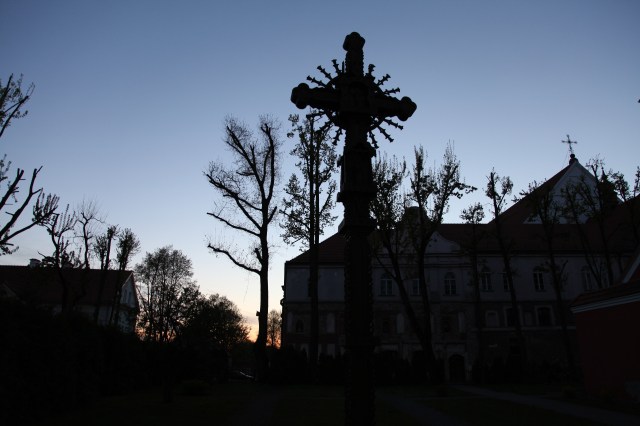
uec_lt_kaunas_wooded_cross_franciscan_monastery_11_may_2017

Father George Rutler shares a thought:

[Emphasis by Abyssum]

A few blocks north of our church, at 1664 Broadway in the old Warners’ Theatre which was demolished in 1952, the first Vitaphone talking film, The Jazz Singer, opened on October 6, 1927. I have been astonished that some of our bright young parishioners never heard of Al Jolson, but history records, as did Vitaphone, his words, “You ain’t heard nothing yet.” The Lord of History said more monumentally: “I have yet many things to say to you, but you cannot bear them now” (John 16:12).

The Word could finally be heard, having been “made flesh and dwelt among us” (John 1:14). When that Word rose from the dead, he said, in so many human words, “You ain’t seen nothing yet.” The Resurrection was far from a grand finale: it was the start of everything else. As our Lord ascended in glory, he gave the Great Commission: “Therefore go and make disciples of all nations” (Matthew 28:19).

This commission is called evangelization, for it means to announce the good news. Our Lord structured the organism for this by creating the Church. If half-hearted Catholics do not evangelize, they are not truly Catholic, and if well meaning people try to evangelize without the Catholic Church, they are not truly Evangelical.

In obedience to the Great Commission, the Holy See has a Pontifical Council for New Evangelization. All well and good, even if not clearly defined. But in recent decades there have been numerous committees and programs to evangelize, with little effect, despite all their meetings and conferences and advertising. Christ was meticulous with everything except bureaucracy. Instead, he sent his disciples out with a commission. Only holiness evangelizes.

   Cardinal Nguyen Van Thuan, who died in 2002, has recently been declared a candidate for sainthood for his heroic virtues. Beginning in 1975, this coadjutor archbishop of Saigon was imprisoned by communists in Vietnam for thirteen years, nine of them in solitary confinement. He thought he might go mad, in a cell without light or ventilation, and mushrooms growing on his thin mattress. But his serene example kept converting many of his prison guards to Christianity.

The evangelization of souls, without benefit of councils or committees, was all that concerned him. Shortly before he died, he said, “If Jesus took a math examination he would surely fail. A shepherd had 100 sheep; one of them strayed. Without thinking, the shepherd went in search of it, leaving the other 99 sheep. When he found the lost sheep he put it on his shoulders (Luke 15:4-5). For Jesus, 1 equals 99, perhaps even more . . .”

Jesus said, “. . . a time is coming and has now come when the dead will hear the voice of the Son of God, and those who hear will live” (John 5:25). I expect that when Cardinal Van Thuan died, he heard a voice saying: “You ain’t seen nothing yet.”

Posted in Uncategorized | Comments Off on YOU AIN’T SEEN NOTHING YET !!!

WITH MEMORIAL DAY AROUND THE CORNER, I COULD NOT HELP BUT RECALL MY DAYS AS A B-17 TAIL GUNNER

Image result for photo of Old Thunderbird B-17
Image result for photo of old thunderbird b-17


Whenever someone retires, it marks the end of an era in their personal life. When U.S. Air Force Chief Master Sergeant Rob Wellbaum leaves the service he’ll end an entire era of aerial combat as America’s last bomber tail gunner.

On May 12, 2017, Wellbaum retired after three decades in the Air Force. When he first joined up in 1987, the non-commissioned officer had signed up for Specialty Code 111X0—Aerial Defense Gunner.

“I went into the recruiter’s office and asked them what jobs they had for enlisted [personnel] to fly,” Wellbaum recalled in an interview. “My recruiter listed off loadmaster, boom operator, and B-52 aerial defensive gunner. The gunner job sounded like the coolest job out of the three so that is what I applied for.”

For the next five years, he served in that role on a B-52 Stratofortress bomber. This aircraft – more lovingly referred to as the Big Ugly Fat Fellow, or BUFF – was the last in service to even have a tail gun.

USAF

Chief Master Sergeant Rob Wellbaum and his family pose in front of one of the 15th Wing’s KC-10A Extender tankers.

When the first B-52 prototype rolled out of Boeing’s plant in Seattle in 1952, aircraft defensive armament was already in a period of flux. For more than a decade at that point, American heavy bombers, as well many smaller attack and maritime patrol aircraft had featured various guns for self-protection against enemy fighters and interceptors.

The American workhorses of World War II, Boeing’s B-17 Flying Fortress and Consolidated’s B-24 Liberator both bristled with machine guns by the end of their service life. Both companies specifically designed the armament configurations to provide maximum coverage. So, in addition to weapons in the nose and sticking out the sides and the top and bottom of the fuselage, another gunner’s position was installed in the tail. From there a member of the crew could cover the vulnerable rear flank.

The U.S. Army Air Force’s entire bomber doctrine revolved around this defensive armament. The lumbering aircraft would fly together in tight “boxes” in order to provide mutually supporting firepower. U.S. military proponents of heavy bombing felt this method of operation, combined with superior aircraft designs, might even obviate the need for escorting fighter planes altogether.

USAF

The tail gun position on a World War II-era B-29 bomber.

The World War II experience in both the Europe and Pacific theaters showed this notion was a pipedream. Over Germany especially, American crews suffered horrific losses until sufficient escorting aircraft became available. After one raid on Nazi factories in Schweinfurt on Oct. 14, 1943, the Eight Air Force effectively lost more than 25 percent of its entire force.

“With the Schweinfurt missions went the virtual end of the idea that the heavy bomber could ‘go it alone’,” according to one 1955 Air Force history. “The debate that had continued since the early 1930’s was now all but over.”

Though this didn’t stop bombers from carrying weapons, it did begin to reduce crews’ reliance on their own guns for self-defense. Boeing’s B-29 Superfortress, which became iconic of the fight against the Japanese, still had multiple machine gun positions, including then state-of-the-art remote control dorsal and ventral turrets. Its particularly deadly tail gun position, often referred to as the plane’s “stinger,” packed a pair of .50 caliber M3 machine guns flanking a single 20mm M2 cannon. But with the Japanese Army and Navy air arms all but crushed, American crews began leaving some or all of those weapons back at base to reduce weight and increase flying time.

Many immediate post-war bomber designs for the brand new, separate Air Force continued to come with full suites of defensive weapons. The B-50, a suped-up B-29, had the same gun positions. The initial prototypes of Consolidated’s massive B-36 Peacemaker had numerous, retractable remotely-operated turrets with 20mm cannons, along with a tail gun.

But technological advances were making much of this obsolete. Most importantly, surface-to-air and air-to-air missiles gave anti-aircraft teams on the ground and fighter pilots the ability to attack bombers from increasingly long distances, well outside of the range of a bomber’s guns.

USAF

The tail gun position on a B-52D.

So, Boeing’s B-47 Stratojet and B-52 both dispensed with guns in the nose and fuselage completely. On both aircraft, tail guns were the only traditional defensive weapons. Nearly all of the B-52 variants featured a radar-assisted tail position with four M3 machine guns, each firing at a rate of 1,200 rounds per minute. The ultimate version, the B-52H, came with a single 20mm M61 Vulcan cannon, able to spit out up to 100 shells every second, in their place. In addition, the air search radar for the guns was powerful enough to act as a navigational aid and help keep bombers in formation, according to an article in Air Force Magazine. On top of that, it could help guide trailing bombers in a single cell toward their destination through bad weather.

Still, physically separated from the rest of the crew at the other end of the plane’s enormous fuselage, it sounds like it would have been a lonely job. However, starting with the B-52G, the gunner joined the rest of the crew in the main cabin. The Air Force Magazine piece explains this was done in order to allow the crew to better coordinate during the flight and finally put the gunner in an ejection seat like everyone else, but “many gunners rued the loss of their wide-screen view.”

USAF

A view from inside the tail gunner’s position on a B-52D.

Convair’s super-sonic B-58 Hustler had a similar arrangement with a single Vulcan cannon. At the same time, electronic countermeasures and chaff to jam and confuse enemy radars, along with bright-burning flares to distract heat-seeking missiles, increasingly became the primary means of defense.

Fast-forward to the 1970s and the B-52 was Americans sole remaining heavy bomber. It was also the service’s last aircraft to even feature a tail gun, whatever its utility might have been at that point. Over Southeast Asia, B-52D bombers scored just two kills. Both instances occurred over North Vietnam in 1972.

USAF

A B-52H bomber with its tail gun still installed.

“When the target got to 2,000 yards, I notified the crew that I was firing,” Airman 1st Class Albert Moore, who was responsible for the second kill, explained later. “I fired at the bandit until it ballooned to three times in intensity then suddenly disappeared from my radar scope at approximately 1,200 yards, 6:30 low. I expended 800 rounds in three bursts.”

A gunner in another nearby B-52 confirmed Moore had blasted a North Vietnamese MiG-21. This was the last time a tail gunner from any air force scored a kill.

“On the way home I wasn’t sure whether I should be happy or sad. You know, there was a guy in that MiG,” Moore wrote afterwards. “I’m sure he would have wanted to fly home too. But it was a case of him or my crew. I’m glad it turned out the way it did. Yes, I’d go again. Do I want another MiG? No, but given the same set of circumstances, yes, I’d go for another one.”

The bomber Moore served on, nicknamed Diamond Lil and with the tail number 55-083, continued to serve until 1983. It now sits near the north entrance to the Air Force Academy in Colorado Springs, Colorado. Moore died in 2009.

After the Vietnam War ended, the Air Force continued to train enlisted personnel like Chief Master Sergeant Wellbaum to man the guns on the remaining B-52s. After the fall of the Soviet Union in 1991, the service finally decided it wasn’t worth the trouble.

“My decision to eliminate the guns from the ‘BUFF’ was not an easy one,” General George L. Butler, then head of Strategic Air Command (SAC), wrote to the aerial gunner community in the fall of 1991. “It stemmed from the collapse of the soviet threat and the leading edge of very sharp budget cuts… Our Air Force is going to go through a lengthy period of turmoil as we adapt to a dramatically changing world.”

USAF

The tails of two B-52H bombers in 2012, with the guns obviously missing.

By 1992, the Air Force had removed the guns from all its remaining B-52Gs and Hs. The service’s 111X0s, including Wellbaum, transitioned to other jobs. Neither the B-1 Bone nor the B-2 Spirit bombers ever had tail guns.

“We knew something was in the works but we weren’t expecting to be cut,” Wellbaum said of the Air Force’s decision to remove the BUFF’s weapons for good and eliminate tail gunners. “However, the Air Force did take care of us and opened up a lot of AFSCs, one of which was flight engineer.”

In total, Wellbaum accumulated more than 1,000 flight hours as a B-52 tail gunner. His last position was as the superintendent of the 15th Operations Group, the flying component of Pacific Air Force’s composite 15th Wing, which is situated at Hickam Air Force Base in Hawaii.

{I entered the United States Army Air Corps in 1943.  I flew 32 missions (twelve as a tail gunner and 20 as a flight engineer in a B-17 over Germany) and when the war ended I was sent to Amarillo Air Base to train as a flight engineer on a B-29.  The war ended in 1945 and I was discharged.  When the United States Air Force was created in 1946 I was commissioned a Second Lieutenant in the USAF Reserves.  In 1953 Archabbot Dennis Strittmatter, OSB ordered me to resign my commission and out of obedience I did.   Abyssum}

Posted in Uncategorized | Comments Off on WITH MEMORIAL DAY AROUND THE CORNER, I COULD NOT HELP BUT RECALL MY DAYS AS A B-17 TAIL GUNNER

IF YOU THINK THAT THINGS ARE BAD IN CARACAS TAKE A LOOK AT AUSTIN; BAAAD !!!


This 85th Session of the Texas Legislature has been dominated by the political games and personal attacks on the conservative members, many of whom belong to the House Freedom Caucus, orchestrated by the leadership cabal of moderate Republicans and pro-abortion Democrats of the Texas House of Representatives.

With yesterday’s midnight deadline looming for the passage of House bills, House leadership once again did not disappoint, again singling out and punishing members for no other reason than their conservative voting records and proclivity to expose the vindictive tactics of House Leadership.  In order to achieve an important legislative goal and left with no other recourse after respectfully enduring months of abuse and the thwarting of conservative legislation, the Freedom Caucus successfully organized and executed an effort that killed scores of bills anointed by House leadership.

The open disdain of the speaker and his chairmen toward the mainstream Republican House members already had tensions rising.  The majority of House members, including some Democrats, support conservative reforms for Texas, real reforms that impact Life, faith, freedoms, the protection of our women and daughters, fairness in education, family equality, and other measures.  These measures would all pass 90-60 if a vote on the House floor was ever allowed.  But House leadership has systematically stalled all such legislative proposals while prioritizing bills that are antithetical to the conservative movement.

Preborn children are being torn limb from limb in the womb while House leadership ceaselessly claims to be Pro-Life.  Yet with only three weeks left in the session, not one single bill that reduces the 55,000 annual Texas abortions has been heard on the floor of the Texas House of Representatives.

On Thursday, May 11, in another coercive procedural maneuver, House leadership suspended the rules of the House to schedule votes on 200+ bills on the Local and Consent Calendar for the following day.  Historically, the Local and Consent Calendar includes bills that are non-controversial, unopposed, and apply to limited jurisdictions (such as a new local library or naming a building).  But under the current progressive House leadership, the Local and Consent Calendar has become a tool to ram through questionable measures that would otherwise be debated and defeated.  As such, House members have often selectively killed specific bills on the Local and Consent Calendar on the basis of principled, studied objections.  The main objection last night was the quantity; properly vetting and reading 200+ bills would have been impossible after working until midnight and then needing to be on the House floor at 10:00 a.m.

However, after conservatives and members of the Freedom Caucus objected to the rules suspension for the Local and Consent Calendar, dozens of their bills were removed from the Local and Consent Calendar—a blatant act of political retribution ensuring the death of the conservatives’ bills.  This attack from leadership was personal and severe.

Subsequently, the Freedom Caucus called a press conference to shed light on the ever-changing rules of the House.  Representative Jeff Leach (R-Plano) described the move as “another direct shot at the conservative members of this House” by leadership.  Representative Matt Shaheen (R-Plano) elaborated, “Our bills have been targeted for weeks…for conservative legislators, their bills have been targeted because of the voting record of those legislators.  If you are too conservative, you cannot represent your district.”

After the press conference, the Freedom Caucus masterfully used parliamentary procedures and debate tactics to break free from the suffocating hands of House leadership.  The Freedom Caucus spent time at the back microphone of the House, methodically deliberating the policies before the full House, and thereby burning the clock with protracted debate (called “chubbing”).  In doing so, the Freedom Caucus killed bills that House leadership wanted to pass by the midnight deadline. Leadership was given a lethal dose of their own bitter medicine last night.

Once the Freedom Caucus achieved the goal of killing those House bills, similar proposals that are still viable in the Senate will likely emerge as much stronger policy reforms, e.g., the Sunset bills that reauthorize state agencies. In sessions past, Pro-Life amendments have been successfully added to Sunset bills related to health and medical agencies.  The Sunset bills under consideration in the State Senate reflect more conservative policy, which is a main reason the Freedom Caucus wanted to kill the limp versions scheduled on the House calendar last night.

The process of writing Sunset bills is another example of draconian leadership.  The House versions of these measures have been so watered-down that no substantial reforms or reorganizations are offered in the Sunset bills.  House leadership demanded that the meaningful provisions of the Sunset bills be removed so that Pro-Life amendments would be rendered non-germane, thus squashing another opportunity for Pro-Life dialogue and victories.  Conservative, Pro-Life members had no choice last night but to take dramatic and drastic action to kill the remaining bills, clearing the way for these Senate bills.

More importantly, House leadership controls the pace of the session.  They are responsible for killing their own bills AND also for killing Pro-Life bills that they intentionally set at the end of the calendar for yesterday. Leadership could have used the time since January to prioritize and pass not only their bills, but also important bills that reflect the Texas Republican Party Platform, like the Dismemberment Abortion Ban, which received overwhelming grassroots support.  The blame and responsibility of yesterday’s events in the Texas House of Representatives ultimately lies solely with House leadership who not only set the pace and the calendars, but also the tone and the collaboration—for better or worse.

Yours for Life,

Elizabeth Graham
Director

Posted in Uncategorized | 1 Comment

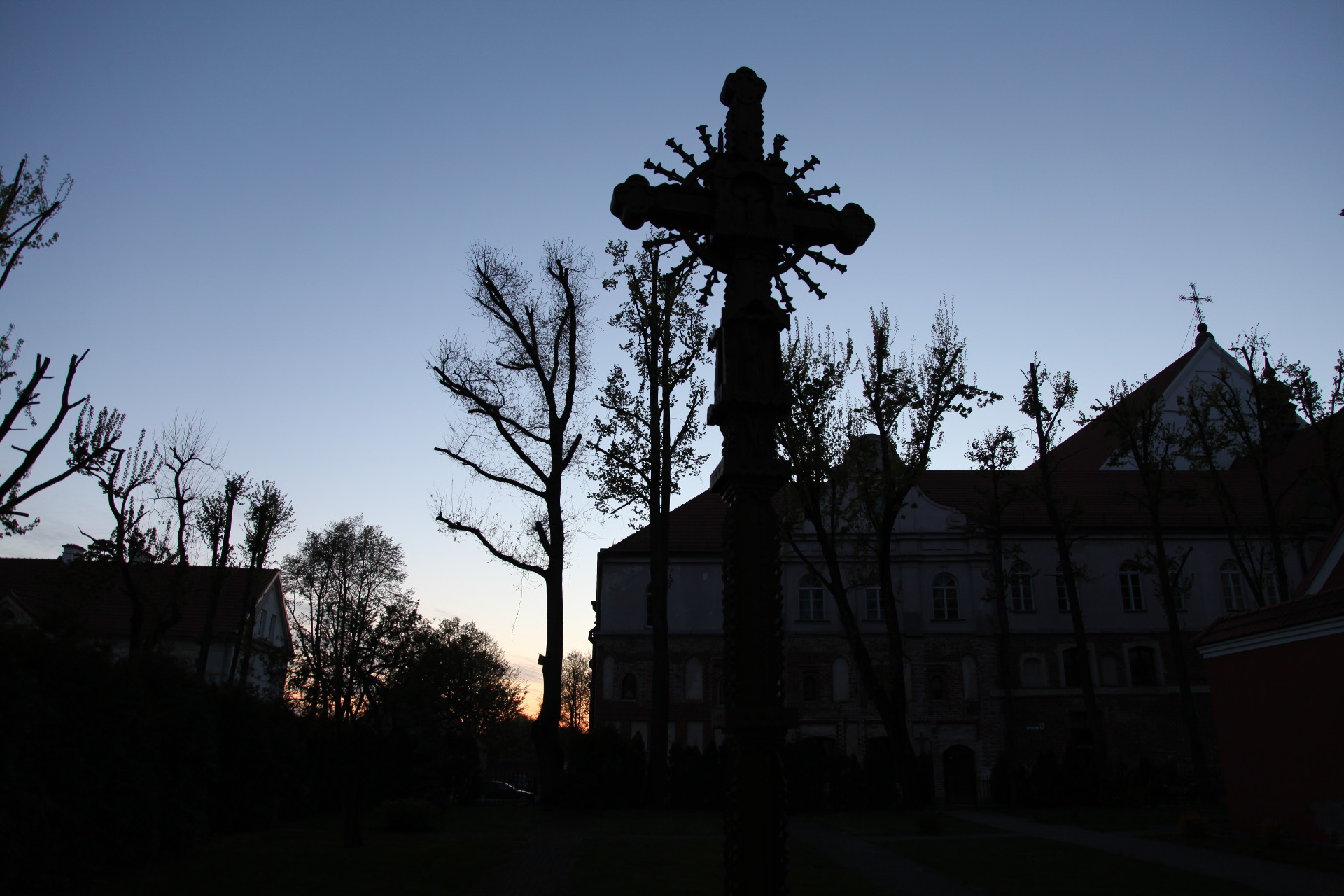
HAIL HOLY CROSS, OUR ONLY HOPE

The wooden cross on top of the Franciscan Monastery at Kaunas,Lithuania; photo by David Owen

Posted in Uncategorized | Comments Off on HAIL HOLY CROSS, OUR ONLY HOPE

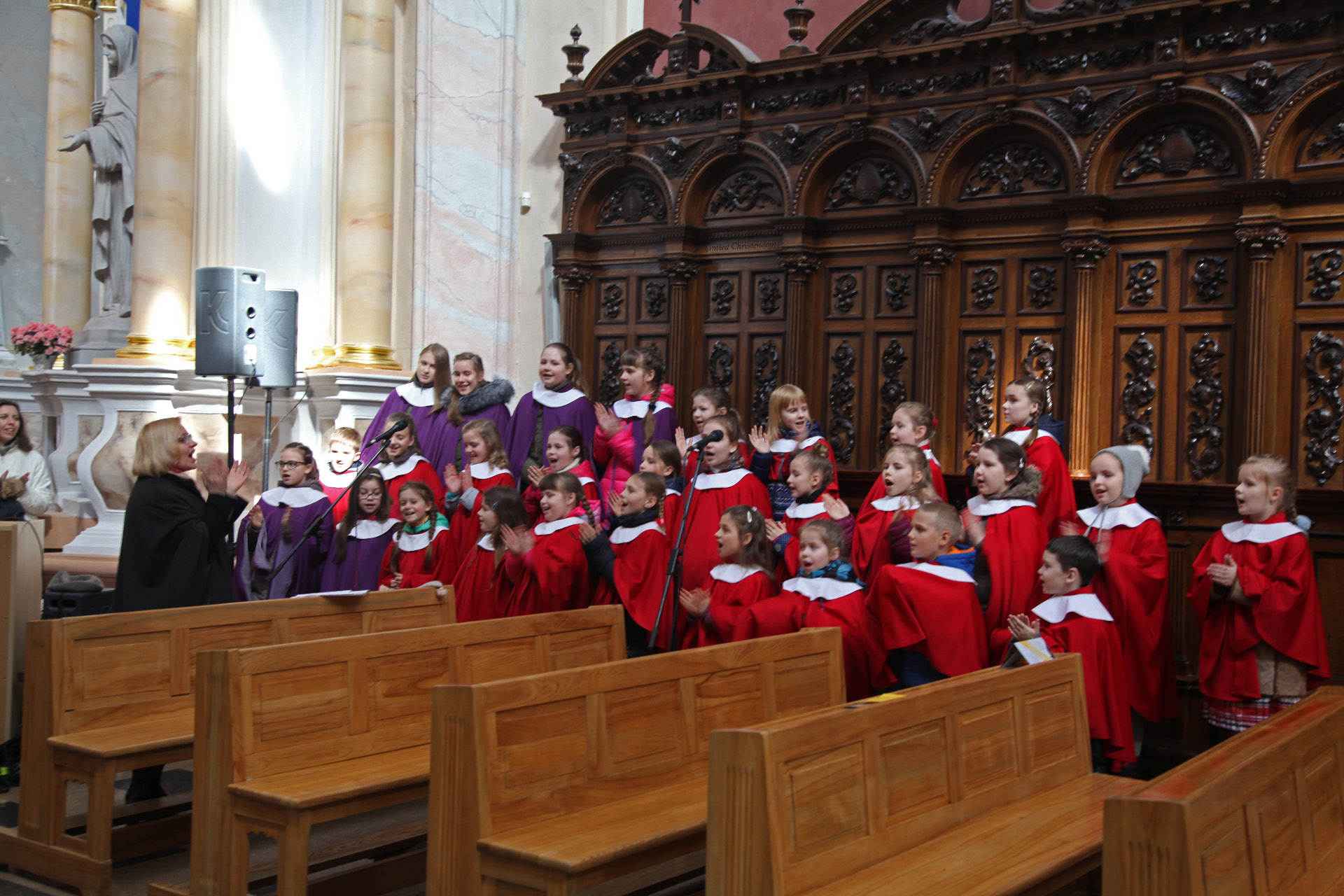
SING TO THE LORD A NEW SONG, JOYFULLY, ALLELUIA

The children choir in Kaunas Cathedral, Lithuania, practicing for Easter Sunday Mass
Photo by David Owen

Posted in Uncategorized | 2 Comments

THE JESUITS SOWED THE WIND IN LATIN AMERICA AND NOW THE CHURCH IS EXPERIENCING THE TORNADO PRODUCED BY THE REVOLUTIONARY MOVEMENTS GUIDED BY LIBERATION THEOLOGY

Caracas

Settimo Cielodi Sandro Magister 

11 mag 17

Pontius Pilate Has Reappeared In Venezuela

[ Emphasis and {commentary} in red by Abyssum ]

The number of dead is now around forty, the wounded number a thousand. It is the price of a month of popular demonstrations, even of only women dressed in white, against the presidency of Nicolás Maduro, in a Venezuela on the brink.

A Venezuela in which a new factor has recently taken the field, and this is the growing, systematic aggression against properties and personnel of the Catholic Church.

Vatican sources – starting with “L’Osservatore Romano” – as detailed as they are in covering the developments of the crisis, are sparing with news about aggression against the Church.

There is not a single reference to this even in the letter that Pope Francis wrote on May 5 to the Venezuelan bishops, who on the same day published a vibrant declaration against the announcement made by Maduro of a “constitutional convention” to reform the state for his use and consumption, meaning in practice – the bishops charge – to impose “a totalitarian, militaristic, violent, oppressive police state system” even worse than the “21st-century socialism” set up by Maduro’s predecesssor, Hugo Chávez, a leader still praised by many leftist populist groups in Latin America and elsewhere.

For Sunday, May 21, the bishop have called a “Day of prayer for peace in Venezuela.” But meanwhile, here is an initial survey of the aggression against the Catholic Church, published by the Venezuelan journalist Marinellys Tremamunno in La Nuova Bussola Quotidiana of April 2:

> Venezuela, inizia la persecuzione della Chiesa

Nothing is off-limits. Death threats and blasphemous graffiti on the walls of churches. Masses interrupted by incursions of Chavist “colectivos.” Caracas cardinal Jorge Urosa Savino silenced during the homily and forced to leave the church. The venerated image of the Nazarene in the cathedral of Valencia smeared with human excrement. The chanceries of the dioceses of Guarenas and Maracay plundered. Thefts of consecrated hosts in Maracaibo. The headquarters of the episcopal conference devastated. One priest killed in Guayana and another abducted.

But it doesn’t end there. On May 4, the doors of the cathedral of Caracas were damaged and its walls were covered with graffiti in praise of the government. That same day, a crowd of students from the Catholic university marched on the episcopal residence, as a sign of solidarity {solidarity with whom?  Maduro or the Cardinal ???}

Because by now the bishops too are an “enemy” against whom the Maduro presidency is lashing out with vehemence. Especially after the failure at the outset of the attempt at mediation between the government and opposition groups supported at the end of last year by pope Jorge Mario Bergoglio through his envoys:

> Venezuela, a Nation on the Brink of the Abyss (7.11.2017)

The stance adopted by the Vatican authorities to foster a reconciliation among the parties was that expressed by Cardinal Pietro Parolin, formerly the nuncio in Caracas before his appointment as secretary of state, in the letter he sent to the parties in mid-December, “in the name and at the behest of the Holy Father.”

In it, he identified four conditions for the opening of dialogue:

– humanitarian channels to guarantee the population food and medicine;
– restitution to the parliament (in which the opposition groups are in the majority) of the prerogatives stipulated by the constitution;
– the liberation of political prisoners;
– new free elections.

But the Maduro presidency has not wanted to meet any of these conditions. On the contrary, it has made additional decisions that have ramped up the repression.

And Pope Francis has been punctually informed about everything. Also through direct conversations with Venezuelan bishops, including the president of the episcopal conference, Cardinal Baltazar Porras Cardozo, archbishop of Mérida, who met with the pope in Rome on April 27, on the eve of his journey to Egypt.

So one can understand the disappointment and anger of many Venezuelans, including bishops, when two days later, on April 29, during the customary press conference on the flight back to Rome from Cairo, Francis said this about the crisis in Venezuela:

“There was an effort by the Holy See, but this did not produce results, because the proposals were not accepted, or were diluted with a ‘yes, yes, but no, no.’ We all know the difficult situation in Venezuela, which is a country that I love very much. I know that now there is insistence – I believe on the part of the four former presidents [of Colombia, Spain, Panama, and Santo Domingo – editor’s note] – to restore this facilitation. I believe that conditions have already been presented. Very clear conditions. But part of the opposition does not want this. Because it is curious, the opposition is divided. And, on the other hand, it appears that the conflicts are intensifying all the time. There is something astir, I am informed about it, but it is very much up in the air. But everything that can be done for Venezuela must be done. With the necessary guarantees. If not, we are playing ‘tintìn pirulero’ [where everyone wants to get out of paying the pledge – editor’s note], and this is no good.”

The next day, Sunday, April 30, speaking at the “Regina Caeli,” Francis moderated somewhat the dismissive words he spoke on the plane against the Venezuelan opposition groups, practically blamed for being the ones who ruined the agreement. He addressed “a heartfelt appeal to the government and to all the components of society that every further form of violence be avoided, human rights be respected, and negotiated solutions be sought for the grave humanitarian, social, political, and economic crisis that is devastating the population.” But this correction has by no means calmed the waters. Twelve hours later, in fact, the opposition groups wrote a letter to the pope in which “not divided but unanimous” they said that they agree to the conditions set by Cardinal Parolin – unlike the government, which has always rejected them – and indicated free elections as the only way out of the crisis.

The fact is that between Pope Francis and the Venezuelan bishops, concerning the crisis that is ravaging the country, there is an abyss. The bishops stand with the population that is protesting against the dictatorship, and are respected and listened to as authoritative guides. While Bergoglio is judged on a par with Pontius Pilate, unforgivably reckless with Maduro and Chavism, in addition to being incomprehensibly reticent on the victims of the repression and on the aggression that is striking the Church itself.

It is a fracture analogous to the one produced in Bolivia, where President Evo Morales has his biggest critics in the bishops, and instead a tireless supporter in the pope. Or that which was seen during the pope’s journey to Cuba, where Francis did not conceal his admiration for the Castro brothers, while not dignifying the dissidents with so much as a word or a glance.

Many see the root of the pope’s behavior in his invincible populist {Jesuit} sentiment, typically Latin American, brought to light once again in recent days by one of the leading scholars of the phenomenon, Professor Loris Zanatta of the university of Bologna, in a long essay in “Il Foglio” of May 8:

“Reality, Bergoglio repeats, is greater than ideas. And yet, seeing his silence on the social drama in Venezuela, or in the country that with Chávez had set itself up as a model of anti-liberalism by invoking the stereotypes dear to the pope, the thought arises that he too, like many, prefers his ideas to reality.”

(English translation by Matthew Sherry, Ballwin, Missouri, U.S.A.)

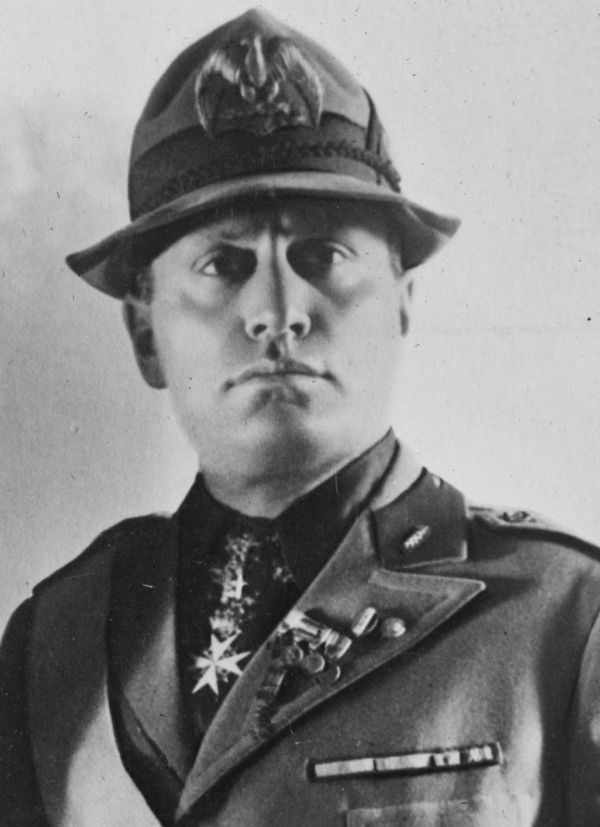
 {Why is it that liberals and conservatives alike love Fascism.  It is because Fascism is the ultimate expression of political power:  absolute, total, totalitarian power.  Hitler was a Fascist.  Mussolini was a Fascist.  Stalin was a Fascist.  Pol Pot was a Fascist.  Fidel Castro was a Fascist.  Nicolas Maduro is a Fascist.  Daniel Ortega is a Fascist.  Lord Acton had it right: “Power tends to corrupt and absolute power tends to corrupt totally!”  That principle holds true whether the one exercising power is a king, a president, a pope, a bishop, a priest, a husband, a father.  It makes no difference whether one starts out as a liberal/progressive or a conservative/reactionary, the accretion of power corrupts and one becomes a fascist.  The fasces, the symbol of total power, from ancient times has consisted of a bundle of birch rods surrounding a battle axe, all held together by blood red bands.  The birch rods represent the power to chastise, as in the case of the scourging of Jesus Christ by Pilate.  The battle ax represents the power to decapitate; that was too quick a death for Jesus Christ, it did not have enough propaganda value for Caiphas, and so Roman crucifixion was the mode of execution chosen. }
Image result for images of fasces 
Posted in Uncategorized | Comments Off on THE JESUITS SOWED THE WIND IN LATIN AMERICA AND NOW THE CHURCH IS EXPERIENCING THE TORNADO PRODUCED BY THE REVOLUTIONARY MOVEMENTS GUIDED BY LIBERATION THEOLOGY

IT IS THE MYSTERY OF JESUS CHRIST THAT THE CHURCH CELEBRATES IN ITS LITURGY, WHICH IS THE COMPLEXUS OF SACRED SIGNS INSTITUTED BY CHRIST OR HIS CHURCH WHICH BOTH SIGNIFY AND CONVEY SANCTIFYING GRACE

 
The exclusive English translation of the message sent by the Prefect of the Congregation for Divine Worship and the Discipline of the Sacraments to the Colloquium “The Source of the Future”

Colloquium “The Source of the Future” (“Quelle der Zukunft”)
on the occasion of the 10th anniversary of the publication
of the Motu proprio Summorum Pontificum by Pope Benedict XVI

March 29 – April 1, 2017
Herzogenrath, near Aachen (Germany)

[ Emphasis in red type by Abyssum ]

Introductory Message

First of all I wish to thank from the bottom of my heart the organizers of the Colloquium entitled “The Source of the Future” on the occasion of the tenth anniversary of the Motu proprio Summorum Pontificum by Pope Benedict XVI, in Herzogenrath, for allowing me to offer an introduction to your reflections on this subject, which is so important for the life of the Church and, more particularly, for the future of the Liturgy; I do so with great joy. I would like to greet very cordially all the participants in this Colloquium, particularly the members of the following associations whose names are mentioned on the invitation that you so kindly sent me, and I hope that I do not forget any: Una Voce Germany; The Catholic Circle of the Priests and Laity of the Archdioceses of Hamburg and Cologne; The Cardinal Newman Association; the Network of the priests of Saint Gertrude Parish in Herzogenrath. As I wrote to the Rev. Father Guido Rodheudt, pastor of Saint Gertrude Parish in Herzogenrath, I am very sorry that I had to forgo participating in your Colloquium because of obligations that came up unexpectedly and were added to a schedule that was already very busy. Nevertheless, be assured that I will be among you through prayer: it will accompany you every day, and of course you will all be present at the offertory of the daily Holy Mass that I will celebrate during the four days of your Colloquium, from March 29 to April 1. I will therefore start off your proceedings to the best of my ability with a brief reflection on the way that the Motu proprio Summorum Pontificum should be applied in unity and peace.

As you know, what was called “the liturgical movement” in the early twentieth century was the intention of Pope Saint Pius X, expressed in another Motu proprio entitled Tra le sollicitudini (1903), to restore the liturgy so as to make its treasures more accessible, so that it might also become again the source of authentically Christian life. Hence the definition of the liturgy as “summit and source of the life and mission of the Church” found in the Constitution on the Sacred Liturgy Sacrosanctum Concilium of Vatican Council II (see n. 10). And it can never be repeated often enough that the Liturgy, as summit and source of the Church, has its foundation in Christ Himself. In fact, Our Lord Jesus Christ is the sole and definitive High Priest of the New and Eternal Covenant, since He offered Himself in sacrifice, and “by a single offering He has perfected for all time those whom He sanctifies” (cf. Heb 10:14). Thus as the Catechism of the Catholic Church declares, “It is this mystery of Christ that the Church proclaims and celebrates in her liturgy so that the faithful may live from it and bear witness to it in the world” (n. 1068).

This “liturgical movement”, one of the finest fruits of which was the ConstitutionSacrosanctum Concilium, is the context in which we ought to consider the Motu proprioSummorum Pontificum dated July 7, 2007; we are happy to celebrate this year with great joy and thanksgiving the tenth anniversary of its promulgation. We can say therefore that the “liturgical movement” initiated by Pope Saint Pius X was never interrupted, and that it still continues in our days following the new impetus given to it by Pope Benedict XVI. On this subject we might mention the particular care and personal attention that he showed in celebrating the Sacred Liturgy as Pope, and then the frequent references in his speeches to its centrality in the life of the Church, and finally his two Magisterial documents Sacramentum Caritatis and Summorum Pontificum. In other words, what is called liturgical aggiornamento1 was in a way completed by the Motu proprio Summorum Pontificum by Pope Benedict XVI. What was it about? The Pope emeritus made the distinction between two forms of the same Roman rite: a so-called “ordinary” form, referring to the liturgical texts of the Roman Missal as revised following the guidelines of Vatican Council II, and a form designated “extraordinary” that corresponds to the liturgy that was in use before the liturgical aggiornamento. Thus, presently, in the Roman or Latin rite, two missals are in force: that of Blessed Pope Paul VI, the third edition of which is dated 2002, and that of Saint Pius V, the last edition of which, promulgated by Saint John XXIII, goes back to 1962.

In his Letter to the Bishops that accompanied the Motu proprio, Pope Benedict XVI clearly explained that the purpose for his decision to have the two missals coexist was not only to satisfy the wishes of certain groups of the faithful who are attached to the liturgical forms prior to the Second Vatican Council, but also to allow for the mutual enrichment of the two forms of the same Roman rite, in other words, not only their peaceful coexistence but also the possibility of perfecting them by emphasizing the best features that characterize them. He wrote in particular that “the two Forms of the usage of the Roman rite can be mutually enriching: new Saints and some of the new Prefaces can and should be inserted in the old Missal….  The celebration of the Mass according to the Missal of Paul VI will be able to demonstrate, more powerfully than has been the case hitherto, the sacrality which attracts many people to the former usage.” These then are the terms in which the Pope emeritus expressed his desire to re-launch the “liturgical movement”. In parishes where it has been possible to implement the Motu proprio, pastors testify to the greater fervor both in the faithful and in the priests, as Father Rodheudt himself can bear witness. They have also noted a repercussion and a positive spiritual development in the way of experiencing Eucharistic liturgies according to the Ordinary Form, particularly the rediscovery of postures expressing adoration of the Blessed Sacrament: kneeling, genuflection, etc., and also greater recollection characterized by the sacred silence that should mark the important moments of the Holy Sacrifice of the Mass, so as to allow the priests and the faithful to interiorize the mystery of faith that is being celebrated.

It is true also that liturgical and spiritual formation must be encouraged and promoted. Similarly, it will be necessary to promote a thoroughly revised pedagogy in order to get beyond an excessively formal “rubricism” in explaining the rites of the Tridentine Missal to those who are not yet familiar with it, or who are only partly acquainted with it…and sometimes not impartially. To do that, it is urgently necessary to finalize a bilingual Latin-vernacular missal to allow for full, conscious, intimate and more fruitful participation of the lay faithful in Eucharistic celebrations. It is also very important to emphasize the continuity between the two missals by appropriate liturgical catecheses…. Many priests testify that this is a stimulating task, because they are conscious of working for the liturgical renewal, of contributing their own efforts to the “liturgical movement” that we were just talking about, in other words, in reality, to this mystical and spiritual renewal that is therefore missionary in character, which was intended by the Second Vatican Council, to which Pope Francis is vigorously calling us.

The liturgy must therefore always be reformed so as to be more faithful to its mystical essence. But most of the time, this “reform” that replaced the genuine “restoration” intended by the Second Vatican Council was carried out in a superficial spirit and on the basis of only one criterion: to suppress at all costs a heritage that must be perceived as totally negative and outmoded so as to excavate a gulf between the time before and the time after the Council.

Now it is enough to pick up the Constitution on the Sacred Liturgy again and to read it honestly, without betraying its meaning, to see that the true purpose of the Second Vatican Council was not to start a reform that could become the occasion for a break with Tradition, but quite the contrary, to rediscover and to confirm Tradition in its deepest meaning. In fact, what is called “the reform of the reform”, which perhaps ought to be called more precisely “the mutual enrichment of the rites”, to use an expression from the Magisterium of Benedict XVI, is a primarily spiritual necessity. And it quite obviously concerns the two forms of the Roman rite. The particular care that should be brought to the liturgy, the urgency of holding it in high esteem and working for its beauty, its sacral character and keeping the right balance between fidelity to Tradition and legitimate development, and therefore rejecting absolutely and radically any hermeneutic of discontinuity or rupture: these essential elements are the heart of all authentic Christian liturgy. Cardinal Joseph Ratzinger tirelessly repeated that the crisis that has shaken the Church for fifty years, chiefly since Vatican Council II, is connected with the crisis of the liturgy, and therefore to the lack of respect, the desacralization and the leveling of the essential elements of divine worship. “I am convinced,” he writes, “that the crisis in the Church that we are experiencing today is to a large extent due to the disintegration of the liturgy.”2

Certainly, the Second Vatican Council wished to promote greater active participation by the people of God and to bring about progress day by day in the Christian life of the faithful (see Sacrosanctum Concilium, n. 1). Certainly, some fine initiatives were taken along these lines. However we cannot close our eyes to the disaster, the devastation and the schism that the modern promoters of a living liturgy caused by remodeling the Church’s liturgy according to their ideas. They forgot that the liturgical act is not just a PRAYER, but also and above all a MYSTERY in which something is accomplished for us that we cannot fully understand but that we must accept and receive in faith, love, obedience and adoring silence.

And this is the real meaning of active participation of the faithful. It is not about exclusively external activity, the distribution of roles or of functions in the liturgy, but rather about an intensely active receptivity: this reception is, in Christ and with Christ, the humble offering of oneself in silent prayer and a thoroughly contemplative attitude. The serious crisis of faith, not only at the level of the Christian faithful but also and especially among many priests and bishops, has made us incapable of understanding the Eucharistic liturgy as a sacrifice, as identical to the act performed once and for all by Jesus Christ, making present the Sacrifice of the Cross in a non-bloody manner, throughout the Church, through different ages, places, peoples and nations.

There is often a sacrilegious tendency to reduce the Holy Mass to a simple convivial meal, the celebration of a profane feast, the community’s celebration of itself, or even worse, a terrible diversion from the anguish of a life that no longer has meaning or from the fear of meeting God face to face, because His glance unveils and obliges us to look truly and unflinchingly at the ugliness of our interior life.

But the Holy Mass is not a diversion. It is the living sacrifice of Christ who died on the cross to free us from sin and death, for the purpose of revealing the love and the glory of God the Father. Many Catholics do not know that the final purpose of every liturgical celebration is the glory and adoration of God, the salvation and sanctification of human beings, since in the liturgy “God is perfectly glorified and men are sanctified” (Sacrosanctum Concilium, n. 7). Most of the faithful—including priests and bishops—do not know this teaching of the Council. Just as they do not know that the true worshippers of God are not those who reform the liturgy according to their own ideas and creativity, to make it something pleasing to the world, but rather those who reform the world in depth with the Gospel so as to allow it access to a liturgy that is the reflection of the liturgy that is celebrated from all eternity in the heavenly Jerusalem.

As Benedict XVI often emphasized, at the root of the liturgy is adoration, and therefore God. Hence it is necessary to recognize that the serious, profound crisis that has affected the liturgy and the Church itself since the Council is due to the fact that its CENTER is no longer God and the adoration of Him, but rather men and their alleged ability to “do” something to keep themselves busy during the Eucharistic celebrations.

Even today, a significant number of Church leaders underestimate the serious crisis that the Church is going through: relativism in doctrinal, moral and disciplinary teaching, grave abuses, the desacralization and trivialization of the Sacred Liturgy, a merely social and horizontal view of the Church’s mission. Many believe and declare loud and long that Vatican Council II brought about a true springtime in the Church. Nevertheless, a growing number of Church leaders see this “springtime” as a rejection, a renunciation of her centuries-old heritage, or even as a radical questioning of her past and Tradition. Political Europe is rebuked for abandoning or denying its Christian roots. But the first to have abandoned her Christian roots and past is indisputably the post-conciliar Catholic Church. Some episcopal conferences even refuse to translate faithfully the original Latin text of the Roman Missal. Some claim that each local Church can translate the Roman Missal, not according to the sacred heritage of the Church, following the methods and principles indicated by Liturgiam authenticam, but according to the fantasies, ideologies and cultural expressions which, they say, can be understood and accepted by the people. But the people desire to be initiated into the sacred language of God. The Gospel and revelation themselves are “reinterpreted”, “contextualized” and adapted to decadent Western culture. In 1968, the Bishop of Metz, in France, wrote in his diocesan newsletter a horrible, outrageous thing that seemed like the desire for and expression of a complete break with the Church’s past. According to that bishop, today we must rethink the very concept of the salvation brought by Jesus Christ, because the apostolic Church and the Christian communities in the early centuries of Christianity had understood nothing of the Gospel. Only in our era has the plan of salvation brought by Jesus been understood. Here is the audacious, surprising statement by the Bishop of Metz:

The transformation of the world (change of civilization) teaches and demands a change in the very concept of the salvation brought by Jesus Christ; this transformation reveals to us that the Church’s thinking about God’s plan was, before the present change, insufficiently evangelical…. No era has been as capable as ours of understanding the evangelical ideal of fraternal life.3

With a vision like that, it is not surprising that devastation, destruction and wars have followed and persisted these days at the liturgical, doctrinal and moral level, because they claim that no era has been capable of understanding the “evangelical ideal” as well as ours. Many refuse to face up to the Church’s work of self-destruction through the deliberate demolition of her doctrinal, liturgical, moral and pastoral foundations. While more and more voices of high-ranking prelates stubbornly affirm obvious doctrinal, moral and liturgical errors that have been condemned a hundred times and work to demolish the little faith remaining in the people of God, while the bark of the Church furrows the stormy sea of this decadent world and the waves crash down on the ship, so that it is already filling with water, a growing number of Church leaders and faithful shout: “Tout va très bien, Madame la Marquise!” [“Everything is just fine, Milady,” the refrain of a popular comic song from the 1930’s, in which the employees of a noblewoman report to her a series of catastrophes]. But the reality is quite different: in fact, as Cardinal Ratzinger said:

What the Popes and the Council Fathers were expecting was a new Catholic unity, and instead one has encountered a dissension which—to use the words of Paul VI—seems to have passed over from self-criticism to self-destruction. There had been the expectation of a new enthusiasm, and instead too often it has ended in boredom and discouragement. There had been the expectation of a step forward, and instead one found oneself facing a progressive process of decadence that to a large measure has been unfolding under the sign of a summons to a presumed “spirit of the Council” and by so doing has actually and increasingly discredited it.4

“No one can seriously deny the critical manifestations” and liturgy wars that Vatican Council II led to.5 Today they have gone on to fragment and demolish the sacred Missale Romanum by abandoning it to experiments in cultural diversity and compilers of liturgical texts. Here I am happy to congratulate the tremendous, marvelous work accomplished, through Vox Clara, by the English-language Episcopal Conferences, by the Spanish- and Korean-language Episcopal Conferences, etc., which have faithfully translated the Missale Romanum in perfect conformity with the guidelines and principles of Liturgiam authenticam, and the Congregation for Divine Worship and the Discipline of the Sacraments has granted them the recognitio [approval].

Following the publication of my book God or Nothing, people have asked me about the “liturgy wars” which for decades have too often divided Catholics. I stated that that is an aberration, because the liturgy is the field par excellence in which Catholics ought to experience unity in the truth, in faith and in love, and consequently that it is inconceivable to celebrate the liturgy while having in one’s heart feelings of fratricidal struggle and rancor. Besides, did Jesus not speak very demanding words about the need to go and be reconciled with one’s brother before presenting his own sacrifice at the altar? (See Mt 5:23-24.)

The liturgy in its turn moves the faithful, filled with “the paschal sacraments,” to be “one in holiness”6; it prays that “they may hold fast in their lives to what they have grasped by their faith”; the renewal in the Eucharist of the covenant between the Lord and man draws the faithful into the compelling love of Christ and sets them on fire. From the liturgy, therefore, and especially from the Eucharist, as from a font, grace is poured forth upon us; and the sanctification of men in Christ and the glorification of God, to which all other activities of the Church are directed as toward their end, is achieved in the most efficacious possible way. (Sacrosanctum Concilium, n. 10)

In this “face-to-face encounter” with God, which the liturgy is, our heart must be pure of all enmity, which presupposes that everyone must be respected with his own sensibility. This means concretely that, although it must be reaffirmed that Vatican Council II never asked to make tabula rasa of the past and therefore to abandon the Missal said to be of Saint Pius V, which produced so many saints, not to mention three such admirable priests as Saint John Vianney, the Curé of Ars, Saint Pius of Pietrelcina (Padre Pio) and Saint Josemaría Escrivá de Balaguer, at the same time it is essential to promote the liturgical renewal intended by that same Council, and therefore the liturgical books were updated following the Constitution Sacrosanctum Concilium, in particular the Missal said to be of Blessed Pope Paul VI. And I added that what is important above all, whether one is celebrating in the Ordinary or the Extraordinary Form, is to bring to the faithful something that they have a right to: the beauty of the liturgy, its sacrality, silence, recollection, the mystical dimension and adoration. The liturgy should put us face to face with God in a personal relationship of intense intimacy. It should plunge us into the inner life of the Most Holy Trinity. Speaking of the usus antiquior (the older form of the Mass) in his Letter that accompanies Summorum Pontificum, Pope Benedict XVI said that

Immediately after the Second Vatican Council it was presumed that requests for the use of the 1962 Missal would be limited to the older generation which had grown up with it, but in the meantime it has clearly been demonstrated that young persons too have discovered this liturgical form, felt its attraction and found in it a form of encounter with the Mystery of the Most Holy Eucharist, particularly suited to them.

This is an unavoidable reality, a true sign of our times. When young people are absent from the holy Liturgy, we must ask ourselves: Why? We must make sure that the celebrations according to the usus recentior (the newer form of the Mass) facilitate this encounter too, that they lead people on the path of the via pulchritudinis (the way of beauty) that leads through her sacred rites to the living Christ and to the work within His Church today. Indeed, the Eucharist is not a sort of “dinner among friends”, a convivial meal of the community, but rather a sacred Mystery, the great Mystery of our faith, the celebration of the Redemption accomplished by Our Lord Jesus Christ, the commemoration of the death of Jesus on the cross to free us from our sins. It is therefore appropriate to celebrate Holy Mass with the beauty and fervor of the saintly Curé of Ars, of Padre Pio or Saint Josemaría, and this is the sine qua non condition for arriving at a liturgical reconciliation “by the high road”, if I may put it that way.7 I vehemently refuse therefore to waste our time pitting one liturgy against another, or the Missal of Saint Pius V against that of Blessed Paul VI. Rather, it is a question of entering into the great silence of the liturgy, by allowing ourselves to be enriched by all the liturgical forms, whether they are Latin or Eastern. Indeed, without this mystical dimension of silence and without a contemplative spirit, the liturgy will remain an occasion for hateful divisions, ideological confrontations and the public humiliation of the weak by those who claim to hold some authority, instead of being the place of our unity and communion in the Lord. Thus, instead of being an occasion for confronting and hating each other, the liturgy should bring us all together to unity in the faith and to the true knowledge of the Son of God, to mature manhood, to the measure of the stature of the fullness of Christ… and, by living in the truth of love, we will grow into Christ so as to be raised up in all things to Him who is the Head (cf. Eph 4:13-15).8

As you know, the great German liturgist Msgr. Klaus Gamber (1919-1989) used the word Heimat to designate this common home or “little homeland” of Catholics gathered around the altar of the Holy Sacrifice. The sense of the sacred that imbues and irrigates the rites of the Church is the inseparable correlative of the liturgy. Now in recent decades, many, many of the faithful have been ill treated or profoundly troubled by celebrations marked with a superficial, devastating subjectivism, to the point where they did not recognize their Heimat, their common home, whereas the youngest among them had never known it! How many have tiptoed away, particularly the least significant and the poorest among them! They have become in a way “liturgically stateless persons”. The “liturgical movement”, with which the two forms (of the Latin rite) are associated, aims therefore to restore to them their Heimat and thus to bring them back into their common home, for we know very well that, in his works on sacramental theology, Joseph Cardinal Ratzinger, well before the publication of Summorum Pontificum, had pointed out that the crisis in the Church and therefore the crisis of the weakening of the faith comes in large measure from the way in which we treat the liturgy, according to the old adage: lex orandi, lex credendi (the law of faith is the law of prayer). In the preface that he wrote for the French edition of the magisterial volume by Msgr. Gamber, La réforme de la liturgie romaine [English edition: The Reform of the Roman Liturgy], the future Pope Benedict XVI said this, and I quote:

A young priest told me recently, “What we need today is a new liturgical movement.” This was an expression of a concern which nowadays only willfully superficial minds could ignore. What mattered to this priest was not winning new, daring liberties: what liberty has not been arrogantly taken already? He thought that we needed a new start coming from within the liturgy, just as the liturgical movement had intended when it was at the height of its true nature, when it was not a matter of fabricating texts or inventing actions and forms, but of rediscovering the living center, of penetrating into the tissue, strictly speaking, of the liturgy, so that the celebration thereof might proceed from its very substance. The liturgical reform, in its concrete implementation, has strayed ever farther from this origin. The result was not a revival but devastation. On the one hand, we have a liturgy that has degenerated into a show, in which one attempts to make religion interesting with the help of fashionable innovations and catchy moral platitudes, with short-lived successes within the guild of liturgical craftsmen, and an even more pronounced attitude of retreat from them on the part of those who seek in the liturgy not a spiritual “emcee”, but rather an encounter with the living God before Whom all “making” becomes meaningless, since that encounter alone is capable of giving us access to the true riches of being. On the other hand, there is the conservation of the ritual forms whose grandeur is always moving, but which, taken to the extreme, manifests a stubborn isolation and finally leaves nothing but sadness.

Surely, between these two poles there are still all the priests and their parishioners who celebrate the new liturgy with respect and solemnity; but they are called into question by the contradiction between the two extremes, and the lack of internal unity in the Church finally makes their fidelity appear, wrongly in many cases, to be merely a personal brand of neo-conservatism. Because that is the situation, a new spiritual impulse is necessary if the liturgy is to be once more for us a communitarian activity of the Church and to be delivered from arbitrariness. One cannot “fabricate” a liturgical movement of that sort—any more than one can “fabricate” a living thing—but one can contribute to its development by striving to assimilate anew the spirit of the liturgy, and by defending publicly what one has received in this way.

I think that this long citation, which is so accurate and clear, should be of interest to you, at the beginning of this Colloquium, and also should help to start off your reflections on “the source of the future” (“die Quelle der Zukunft”) of the Motu proprio Summorum Pontificum. Indeed, allow me to communicate to you a conviction that I have held deeply for a long time: the Roman liturgy, reconciled in its two forms, which is itself the “fruit of a development”, as the great German liturgist Joseph Jungmann (1889-1975) put it, can initiate the decisive process of the “liturgical movement” that so many priests and faithful have awaited for so long.

Where to begin? I take the liberty of proposing to you the three following paths, which I sum up in the three letters SAF: silence-adoration-formation in English and French, and in German: SAA, Stille-Anbetung-Ausbildung. First of all, sacred silence, without which we cannot encounter God. In my book The Power of Silence, [La Force du silence] I write: “In silence, a human being gains his nobility and his grandeur only if he is on his knees in order to hear and adore God” (n. 66). Next, adoration; in this regard I cite my spiritual experience in the same book, The Power of Silence:

For my part, I know that all the great moments of my day are found in the incomparable hours that I spend on my knees in darkness before the Most Blessed Sacrament of the Body and Blood of Our Lord Jesus Christ. I am so to speak swallowed up in God and surrounded on all sides by His presence. I would like to belong now to God alone and to plunge into the purity of His Love. And yet, I can tell how poor I am, how far from loving the Lord as He loved me to the point of giving Himself up for me. (n. 54)

Finally, liturgical formation based on a proclamation of the faith or catechesis that refers to the Catechism of the Catholic Church, which protects us from possible more-or-less learned ravings of some theologians who long for “novelties”. This is what I said in this connection in what is now commonly called, with some humor, the “London Discourse” of July 5, 2016, given during the Third International Conference of Sacra Liturgia:

The liturgical formation that is primary and essential is…one of immersion in the liturgy, in the deep mystery of God our loving Father. It is a question of living the liturgy in all its richness, so that having drunk deeply from its fount we always have a thirst for its delights, its order and beauty, its silence and contemplation, its exultation and adoration, its ability to connect us intimately with He who is at work in and through the Church’s sacred rites.9

In this global context, therefore, and in a spirit of faith and profound communion with Christ’s obedience on the cross, I humbly ask you to apply Summorum Pontificum very carefully; not as a negative, backward measure that looks toward the past, or as something that builds walls and creates a ghetto, but as an important and real contribution to the present and future liturgical life of the Church, and also to the liturgical movement of our era, from which more and more people, and particularly young people, are drawing so many things that are true, good and beautiful.

I would like to conclude this introduction with the luminous words of Benedict XVI at the end of the homily that he gave in 2008, on the Solemnity of Saints Peter and Paul: “When the world in all its parts has become a liturgy of God, when, in its reality, it has become adoration, then it will have reached its goal and will be safe and sound.”

I thank you for your kind attention. And may God bless you and fill your lives with His silent Presence!

Robert Cardinal Sarah
Prefect of the Congregation for Divine Worship and the Discipline of the Sacraments

(Translation from the French original by Michael J. Miller.)

Endnotes:

1 “Aggiornamento” is an Italian term that means literally: “updating”. We celebrated the fiftieth anniversary of the Constitution on the Sacred Liturgy of Vatican Council II Sacrosanctum Concilium in 2013, since it was promulgated on December 4, 1963.

2 Joseph Ratzinger, Milestones: Memoirs: 1927-1977, translated by Erasmo Leiva-Merikakis (San Francisco: Ignatius Press, 1998), 148.

3 Cited by Jean Madiran, L’hérésie du XX siècle (Paris: Nouvelles Editions Latines [NEL], 1968), 166.

4 Joseph Ratzinger and Vittorio Messori, The Ratzinger Report: An exclusive interview on the state of the Church, translated by Salvator Attanasio and Graham Harrison (San Francisco: Ignatius Press, 1985), 29-30.

5 Joseph Ratzinger, Principles of Catholic Theology: Building Stones for a Fundamental Theology, translated by Sister Mary Frances McCarthy, S.N.D. (San Francisco: Ignatius Press, 1992), 370.

6 Cf. Postcommunion for the Easter Vigil and Easter Sunday.

7 Cf. Interview with the Catholic website Aleteia, March 4, 2015.

8 Cf. Interview with La Nef, October 2016, question 9.

9 Cardinal Robert Sarah: Third International Conference of the Sacra LiturgiaAssociation, London. Speech given on July 5, 2016. See the Sacra Liturgia website: “Towards an Authentic Implementation of Sacrosanctum Concilium”, July 11, 2016.http://www.sacraliturgia.org/2016/07/robert-cardinal-sarah-towards-authentic.html

Related at CWR:
• Cardinal Robert Sarah on “The Strength of Silence” and the Dictatorship of Noise (Oct 03, 2016)
• Cardinal Sarah has challenged “the prejudices” behind “certain modern liturgical practices” (July 13, 2016)
• The Quiet Courage of Cardinal Robert Sarah (Nov 02, 2016) by Dr. Samuel Gregg
• Cardinal Sarah’s pastoral call to “turn to the Lord” (Nov 21, 2016) by Jeanette Flood

About the Author
Cardinal Robert Sarah

Cardinal Robert Sarah is prefect of the Congregation for Divine Worship and the Discipline of the Sacraments. He is the author, with Nicolas Diat, of God or Nothing(Ignatius Press).

Posted in Uncategorized | Comments Off on IT IS THE MYSTERY OF JESUS CHRIST THAT THE CHURCH CELEBRATES IN ITS LITURGY, WHICH IS THE COMPLEXUS OF SACRED SIGNS INSTITUTED BY CHRIST OR HIS CHURCH WHICH BOTH SIGNIFY AND CONVEY SANCTIFYING GRACE

YOUR FOCUS NEEDS TO BE ON JESUS CHRIST, NOT ON ANOTHER PERSON, NOT ON YOUR BODY, BUT ON JESUS CHRIST. HAVE YOU SPOKEN WITH HIM TODAY ???

A Priest Explains the Hard Truth About Why the Church Is In Decline

May 8, 2017

I spend a lot of time thinking, reading, and praying about why the Church is decline in this country.

The influx of immigrants from Latin America hides the number decline. Even with this influx, every measurable indicator is down: baptisms, confirmations, marriages, priestly ordinations, numbers of men’s and women’s religious, children in parochial schools and religion programs. It is grim.

How did we get here?

The major error was ditching the transcendent. We domesticated God. We became functional Arians. (This doesn’t mean racist, that would be Aryans.) It means we act as if Jesus was merely human, that He is a guru, self-help teacher, social worker extraordinaire.

To be sure, I am not talking about every parish. But as a Church in this country, we took our eyes off the ball.

Mass started looking less like the worship of God and more like a pep rally. Our churches stopped looking Catholic and were overrun by iconoclasts. We went from churches that exuded Catholic belief visually, to ubiquitous ‘sacred spaces’ that looked more like theaters.

Some places ran with the theater aspect. Worship transformed to entertainment. What I got out of it became much more important than what I put into it.

By ripping out the transcendent heart out of worship, we reduced Mass. It is little wonder that belief in the Real Presence of Christ in the Eucharist plummeted. It is little wonder that priestly vocations plummeted. While the generation that ushered these things love them, the subsequent generations fled in droves.

With worship emptied of the transcendent, Catholic life soon followed. Devotional life in parishes dried up. Parish churches became Mass stations. It has been heartening to see a rise in Eucharistic Adoration.

With the focus off the transcendent, awareness also plummeted. Confession lines disappeared. Families shrunk as we started contracepting ourselves out of existence. The loud din of children gave way to seas of gray. Accommodation of the secular culture went largely unchallenged. Causes replaced action. The works of mercy declined as a false idea of social justice rose in its place.

In this mileau, it was easy for people to leave. Without the transcendent, we offer nothing more than any fraternal order. Without the transcendent, objective morality withers. With our eyes off the ball, 78% of Catholics simply quit coming to Mass. Without the source and summit that is the Eucharist, the Catholic life dies. It is starved to death.

But those who leave, even if they go nowhere else, still have that longing. Many identify that as “spiritual but not religious.” There is still an unrequited longing for the transcendent. If they cannot find it with us, they will look elsewhere, even if that means cobbling something together themselves. We can sneer and belittle them at our own peril. The fact they aren’t drawn to a pep rally isn’t on them – it is on us.

How do we turn this around?

Let’s start with focusing back on the transcendent again. In our structures, our worship, our music, our preaching, and our teaching.

This doesn’t mean we ignore the immanent. Not at all! The lessons from the transcendent must find a home in our lives. If God has placed a longing for Him, then that must be the focus at Mass. If we don’t focus on God there, we will leave people no choice but to look elsewhere.

Let us then, having established the prominence of God in our lives, revel in our being counter cultural. We are in the world but not of the world. We are yeast, light, salt, and whatever other transformative description Jesus uses to describe His people.

If we look and act the same as the secular culture around us, then we can hardly be a witness to the throngs of people who are searching for something to fill that God sized hole in their souls. After all, St. Augustine reminds us that our hearts are restless until they rest in Christ.

Our eyes need to be on the ball. Our eyes need to be on Christ. Not on the congregation. Not on the priest. They need to be on Christ.

My duty as a priest, as a pastor of souls, is to be sure the focus is on Him.

Originally posted on Facebook

Posted in Uncategorized | Comments Off on YOUR FOCUS NEEDS TO BE ON JESUS CHRIST, NOT ON ANOTHER PERSON, NOT ON YOUR BODY, BUT ON JESUS CHRIST. HAVE YOU SPOKEN WITH HIM TODAY ???

THE FASCISM OF THE LEFT ATTACKS THE FREEDOM OF CONSCIENCE OF HEALTHCARE PROVIDERS

images_014

UNDER ATTACK! Conscience Rights: Healthcare Providers’ Right to Refuse to Kill

By Ralph A. Capone, M.D. and Julie Grimstad


Conscientious objection, when exercised by healthcare practitioners, is a refusal to provide a legal “medical service” (such as abortion or assisted suicide) that conflicts with their deeply held religious or moral convictions.


Calls to Exclude Conscientious Objectors from Medical Practice


On February 6, 2015, the Supreme Court of Canada struck down the federal law prohibiting assisted suicide and euthanasia. Subsequently, Canadian lawmakers passed legislation to permit “medical assistance in dying,” the euphemism assisted suicide advocates employ to avoid the word “suicide.” The law went into effect in June 2016. Many healthcare practitioners, exercising their conscience rights, have refused to participate.


The Journal of Medical Ethics, April 27, 2016, published an essay entitled “Why medical professionals have no moral claim to conscientious objection accommodation in liberal democracies.” It was written by Udo Schuklenk and Ricardo Smalling, colleagues at Queens University in Ontario, Canada. Schuklenk is a professor of philosophy at Queens, but more importantly, he is co-editor of Bioethics, one of the world’s leading journals in the field. Schuklenk and Smalling contend that “conscientious objection has no place in the practice of medicine.” Their abstract states, “We discuss common counterarguments to this view and reject all of them.”[i] In other words, there isn’t a single reason they would accept for a healthcare provider to follow the dictates of their conscience in their practice of medicine.


This is genuine irony. It is almost impossible to believe that academia has become so blinded or hard-hearted that the authors’ contention is, in fact, accepted by the “illumined intelligentsia” and published in a once serious scholastic journal. A classically liberal democracy is one in which freedom is maximized for all. Nevertheless, Schuklenk and Smalling assert that such a liberal democracy tolerates no freedom for individuals who dare to dissent from the left’s progressive agenda, better known as the culture of death.


In June 2016, a group of influential bioethicists and philosophers met in Geneva, Switzerland, to participate in a workshop on conscientious objection in healthcare. At its conclusion, more than a dozen bioethicists signed a ten-point “Consensus Statement.” The “ethical guidelines” these bioethicists propose boil down to this: “Healthcare practitioners’ primary obligations are towards their patients, not towards their own personal conscience.” Further, they believe “a patient’s desire for a legal, professionally sanctioned medical service” should override a healthcare practitioner’s personal conscience. “When they have a conscientious objection,” these bioethicists declare, “they ought to refer their patients to another practitioner who is willing to perform the treatment. In emergency situations, when referral is not possible, or when it poses too great a burden on patients or on the healthcare system, health practitioners should perform the treatment themselves.” Even more troubling is their stance on training new practitioners: “Medical students should not be exempted from learning how to perform basic medical procedures they consider to be morally wrong.”[ii] [Stress added by authors.] “Basic medical procedures” include abortion by various methods, terminal sedation accompanied by patient starvation and dehydration, and, wherever legal, prescribing drugs for assisted suicide and lethal injections.


These and other “ethical guidelines” proposed by bioethicists in the last few years demonstrate the escalation of efforts to coerce healthcare professionals to accede to immoral societal and patient demands. Those individuals who unwaveringly resist coercion will be either marginalized or disqualified altogether from carrying out their professional duties within a moral framework that values human life.


Secular Bioethics and the Corruption of Medicine


Just a few decades ago (within our memory), every person who joined the medical profession understood that intentionally killing patients is wrong. Medical ethics was initially based on natural law. This was articulated by the ancient Greeks and codified by Hippocrates whose Oath prohibited the deliberate killing of patients because of the recognized inherent value of human life. Later, the work of the Church fathers (e.g., Augustine and Aquinas) Christianized this understanding of natural law. From their work several core principles were articulated, including human dignity–arising from man being made in God’s image (imago Dei)–and the resultant concept of the sanctity of life. Secular society, too, protected human life, especially in the legal and medical professions. Historically, society revered human life based on the general consensus that human life, itself, is special. As such, the common good is best served by establishing laws, principles, and practices that value and safeguard each and every human life.


Bioethics, which emerged in the 1960s, has become a secular field of study, untethered from the theological roots of medical ethics. Efforts by Christian bioethicists to accommodate humanistic ethics and to influence it have mostly failed. Most affected is the concept of the dignity of the human person based upon inherent qualities (endowments from God) that cannot be taken away by governments or other third parties. The right to life is one of these intrinsic and inalienable qualities at much risk today. Further, since the advance of secular bioethics over the past 50 plus years, and especially with the legalization of abortion in many countries, the once high ideals of an independent medical profession have been steadily corrupted. The secular culture has co-opted medical ethics to serve its own purposes, hostile to God’s authority and remarkably anti-Christian.


In fact, most bioethicists today embrace a secular, post-Christian, utilitarian (an unproductive person is a useless person) philosophy. Viewed through this “quality of life” lens, human lives burdened by advanced years, serious illness, or special needs are regarded as no longer worth protecting, nor worth the cost necessary to care for them. And lives judged “worthless” are disposable.


For example, in 1993, Dr. Ezekiel Emmanuel, the physician and ethicist who was to become the architect of the Affordable Care Act (a.k.a., Obamacare), wrote in the American Journal of Medicine: “…increasingly it will be our collective determination as to what lives are worth living that will decide how incompetent patients are treated. We need to begin to articulate and justify these collective determinations.”[iii]


When patients who have never expressed a wish to die are judged incompetent (that is, unable to make their own decisions), bioethicists, like Dr. Emmanuel, want to rely on “collective determinations” to decide their fate. On the other hand, for those supposedly competent individuals who ask for help to commit suicide or to be killed, such bioethicists promote a radical personal autonomy, not a group decision. The bottom line is, if you fall in line with what the culture promotes, you get to decide. If you are unable to speak for yourself or if you resist what the culture promotes, then a “collective determination” is called for. There is so much wrong with this notion that it is hard to believe it was ever advocated. Talk about fascism!


This illustrates the often denied “slippery slope” that accompanies the legalization of euthanasia. The freedom of individuals to choose death for themselves gradually becomes a duty to die where others decide, in the words of Dr. Emmanuel, “what lives are worth living.” Thus, the attack on physicians’ conscience rights can extend to an assault on patients’ conscience rights, as well as their right to life. This is just plain DANGEROUS for everyone.


Do we want a healthcare system in which the only doctors available are those willing and trained to kill us? And the only socially acceptable choice for physically or mentally incapacitated individuals is to unburden society by choosing their death? 


Or, do we want a just healthcare system, one that protects patients, doctors, and other healthcare providers who value human life, and one that rejects expanding the scope of healthcare to include harming (i.e. killing) patients.


Combating Attacks on Conscience Rights


Dark days are imminent for Christian healthcare providers and others who stand firm in their belief that medical killing is immoral. These individuals risk legal, professional, and financial punishment. Nevertheless, there may be reasons for hope.


In Vermont, where assisted suicide was legalized (Act 39) in 2013, a federal court dismissed a lawsuit brought against officials at the Board of Medical Practice and the Office of Professional Regulation who interpreted Act 39 in a manner that infringes upon the conscience rights of healthcare workers. The Alliance Defending Freedom (ADF) is now exploring legal options for conscientious objectors.[iv]


Representing the Vermont Alliance for Ethical Healthcare and the Christian Medical and Dental Association, ADF Senior Counsel Steven H. Aden stated, “Vermont health care workers just want to act consistently with their reasonable and time-honored convictions without fear of government punishment.” LifeNews, April 5, 2017, reported, “As the brief in support of the requested motion for preliminary injunction in Vermont Alliance for Ethical Healthcare v. Hoser explains, ‘Vermont’s Act 39 makes the State the first and only one to mandate that all licensed healthcare professionals counsel terminal patients about the availability and procedures for physician-assisted suicide, and refer them to willing prescribers to dispense the death-dealing drug. Act 39 coerces professionals to counsel patients about the ‘benefits’ of assisted suicide–benefits that Plaintiffs’ members do not believe exist–and in addition stands in opposition to a federal law protecting healthcare professionals who cannot participate in assisted suicide for conscientious reasons.’”[v]


There is good news on another front. Last month (March 2017), Arizona’s legislators approved a bill (SB 1439) “intended to protect medical professionals and the facilities where they work from discrimination if they refuse to assist in end-of-life procedures” (such as removing a feeding tube in order to cause or hasten a patient’s death) and Governor Doug Ducey signed it. The bill was supported by the Legislature’s Republicans and, unfortunately, opposed by Democrats.[vi] Assisted suicide is not legal in Arizona, but, presumably, this bill would protect objecting healthcare practitioners in the unhappy event that it is ever legalized in the state.


Call to Action


Let’s speak out–loudly and clearly–in every state and every nation. Let’s tell our leaders to enact laws that protect the conscience rights of doctors and all healthcare professionals, and to put teeth in those laws so they will be enforced.


We must do this to renew and strengthen the integrity of the once-revered medical profession.


We must do this because, if we do not, doctors, nurses and other healthcare providers of good conscience will be prevented from practicing in the future, leaving only those willing to dispose of a life–your life or the life of a loved one.


As important as the preceding reasons are, it is even more imperative that we do this to proclaim the truth of the immeasurable worth and dignity of every human life, now, in our lifetime, and to safeguard the splendor of this truth for our children and for all generations to come.


                                           ***


Note: “The Health Care and Conscience Debate” by Luke W. Goodrich, is an excellent explanation of federal law/regulations regarding the conscience rights of healthcare providers.[vii]


About the authors: Ralph A. Capone, MD, FACPis board-certified in Hospice and Palliative Medicine and Internal Medicine, and presently teaches Catholic Bioethics at St Vincent College and for the Diocese of Greensburg, Pennsylvania. Julie Grimstad lives in Bedford, Texas, is executive director of Life is Worth Living, Inc., coordinator of St. John’s Befrienders (outreach program to nursing home residents and homebound elderly), a speaker and writer on healthcare issues, and editor of the PHA Monthly. Julie has served as a volunteer patient advocate for 31 years.
Posted in Uncategorized | Comments Off on THE FASCISM OF THE LEFT ATTACKS THE FREEDOM OF CONSCIENCE OF HEALTHCARE PROVIDERS

MY PILGRIMAGE THROUGH LIFE, ACCOMPANIED BY AN UNWELCOME COMPANION: FASCISM


I was born in 1923, eight months after Benito Mussolini first came to power in Italy as the Prime Minister of Italy under King Umberto.  From the first moment that I became aware of the worldwide tensions that were building up to the Second World War in which I would have to fight, the attention of the world was focused on the rise of the Fascist movement in Italy and its close relationship with National Socialism in Germany which had been established by Adolph Hitler.

As a child I was fascinated by the use of the fasces as the emblem of the Fascist Party in Italy.  The fasces has a long and interesting history.

Image result for image of the fascist symbol

The fasces originated as a bundle of birch rods surrounding a battle ax all bound together by red ribbons as a symbol of power, absolute power.  I probably originated in the eastern Mediterranean region.  It was adopted by the rulers of the Etruscan tribes and was passed on by them to Imperial Rome.  The fasces were carried in procession in front of a high dignitary as a symbol of his authority over all of the people over whom he held power.

As you read in the Wikipedia article I posted in the post preceding this post, the faces have been used by all western nations, including our own in their heraldry.

I soon realized that any government that has the power to inflict corporal punishment and impose death on a subject shares some aspects of fascism, more or less.   Over the years I also came to realize that the word fascist when use pejoratively is truly meaningless since it can mean whatever the person using the word wants it to mean.

The fasces originated as a bundle of birch rods surrounding a battle ax all bound together by red ribbons as a symbol of power, absolute power.  I probably originated in the eastern Mediterranean region.  It was adopted by the rulers of the Etruscan tribes and was passed on by them to Imperial Rome.  The fasces were carried in procession in front of a high dignitary as a symbol of his authority over all of the people over whom he held power.

As you read in the Wikipedia article I posted in the post preceding this post, the faces have been used by all western nations, including our own in their heraldry.

I soon realized that any government that has the power to inflict corporal punishment and impose death on a subject shares some aspects of fascism, more or less.   Over the years I also came to realize that the word fascist when used pejoratively is truly meaningless since it can mean whatever the person using the word wants it to mean.

It is customary among adherents of left/progressive politics to accuse conservatives of fascism.  But the reality is that ultimately there is only superficial difference between extremists of both end of the political spectrum.  Ultimately there is no practical difference between Socialism/Communism and Laisssez Faire Capitalism when power is concentrated in the hands of an elite or oligarchy.

I cannot see the difference between Adolf Hitler, Joseph Stalin, Benito Mussolini, Fidel Castro, Pol Pot, Daniel Ortega, Evo Morales, Mao Zedong.  Right or left, they were all the same in the long run.  They suppressed and are suppressing every natural and positive freedom.

Who are the fascists in America today?  The leading candidates for that designation are the progressives and leftists in main-stream media, government and academia.  Freedom of religion survived Hitler, Stalin and Mussolini;  it is having a hard time surviving in America’s schools at every level, from kindergarten to Yale, Harvard, Duke et al.  Freedom of speech had a hard time existing in Germany and Italy, and it is having a hard time existing in America’s colleges and universities today because of fascists power in the faculty and administration of those citadels of intellectual freedom.

Who are the fascists in America today?  Do not look to your right, look to your left !!!

+++++++++

HATE SPEECH AND THE POLITICS OF GRIEVANCE:

Yesterday, MSNBC host Chris Hayes went off on the idea that American conservatives are paying an outsized degree of attention to academia and speech issues on campus because conservatism is based on a politics of victimhood and grievance. I am not exaggerating. http://vlt.tc/2tgt   “If you haven’t been paying attention to right wing media recently, it’s *amazing* how much attention current campus controversies have gotten. The reason, I think, is that the right now controls most state houses and all three branches of federal gov’t. They have *tons of power*. But modern conservatism’s emotional fuel is grievance and persecution, so they need to focus on Berkeley campus. You’d think liberals arts undergrads had the nuclear codes.”

First of all, paying attention to what happens on campus hasn’t been a new item of conservative priority since God and Man at Yale. Conservatives recognize that college campuses and their frames of reality have an outsized impact on the culture, training the next generation of leaders. There are countless books about the academy and the problematic impact it has had on American life, and there were particularly a good deal of things written during the 1960s and 1970s about the changing nature of the academy. This strikes many conservative writers as a similar moment, a flashpoint when something dramatic is changing about our institutions of higher education. Additionally, as a practical matter, conservatives tend to be older and middle class – they are more likely to have college-aged children and to be confronting the challenge of finding an institution that will educate rather than indoctrinate their sons and daughters, and for a hefty fee.

Second, the idea that conservatism’s emotional fuel is grievance and persecution as a political and legal matter strikes me as a very new idea – as in, post-Obergefell. Prior to that, conservatives had few examples of actual legal prosecution for the way they live according to their beliefs (with the exception of, say, home schooling or gun ownership). Hayes is indeed correct that Republicans (not conservatives) have won at every level of government and do indeed hold political power. The left, on the other hand, is overwhelmingly dominant in two places: the academy and mass media. So that is where the fights happen.

It is no accident that the place that lends itself to creating conflicts between the dominant order of thought and people who want to speak their minds freely is the college campus, where conservatives feel outnumbered and crushed by a system of higher education that believes in academic freedom for me, not for thee. On the campus, administrators have nigh unchecked power to negatively impact the lives of the students on campus, and along with faculty, they are often easily brought to heel by the heckling mobs of the moment – see most recently at Middlebury, where a professor apologized to the recent rioters for the offense of even inviting Charles Murray to speak. http://vlt.tc/2tff  This is, of course, a mistake on the part of the rioters – if they did not protest, heckle, and attempt to shut down speech they treat as a violent assault on their minds, no one would remark on a lecture to a handful of quiet well-behaved students. But instead they give Murray, and Ann Coulter, and Milo, and all the rest the oxygen that turns these sparks into forest fires.

The power of the closed bubble of academia makes for more conflict. Mass media, on the other hand, is essentially powerless other than an ability to lecture you about your wrongthink. They are easier to ignore, and to mock in return. Conservatives have gotten used to being yelled at just about everywhere and by just about everyone for years – by cable news and NPR and SNL and Jon Stewart and Stephen Colbert and John Oliver and Seth Meyers and Samantha Bee and Trevor Noah and so on, but also by sportscasters and entertainment reporters, by dramatic television and sitcoms, and by any movie or TV show in need of conveniently depicting Americans who read Bibles or own guns as hicks and bigots undeserving of respect.

When I was much younger, my siblings and I would routinely tune in to watch Bill Nye the Science Guy on PBS. He was a fascinating instructor bent on helping kids achieve a basic understanding of science. When he engaged in politics, it was only very briefly if at all. He has recently returned to Netflix to, as so many of their products attempt, play on the nostalgia of older Millennials. Sadly, he spends most of his new Netflix show yelling at the audience. http://vlt.tc/2tfl   He also collaborated with Rachel Bloom on this bizarre video on transgenderism which has nothing to do with science, and is as cringeworthy a thing as you will see all year. http://vlt.tc/2tfp  The whole thing manages to be unfunny, tone-deaf, and hectoring – it mangles the real issues involved and disrespects the audience at the same time.

This isn’t about persecution – it’s disrespect. And the fundamental basis of healthy politics is respect. Real persecution is only a small part of what conservatives object to about the current state of the campus or the public square – the occasional group that is shut down, the florist or cake baker whose livelihood is threatened, the religious group that is berated into breaking their faith – these are the exceptions. The overall issue is a disrespect that now views words as weapons, fueled by an academic culture which has transferred the language of PTSD to simple day-to-day existence. We want an educational system that produces citizens, not victims – one that produces thinking people who respect the views of those with whom they disagree, who can grapple with those views as they come, not one that will curl up into a ball of rage at the first sign of wrongthink, or turn into an aggrieved party whose pain must be acknowledged.

We must not fall into the trap of thinking speech that offends is speech that must be forbidden. A healthy culture demands that much of us, to equip the next generation of Americans with the knowledge and reason they will need to confront an uncertain future.


Posted in Uncategorized | 1 Comment