The pursuit of physical pleasure is the engine driving modern society, and it seems that our society cannot conceive of a higher good. People work ‘to have fun’ and they believe that is what makes life worth living, because ‘you only go around once.’


May 17, 2017Wednesday
Is Pope Francis planning to re-examine the Church’s teaching on contraception?


Rumors have been circulating in Rome for several days, since a May 11 blog post by veteran Italian Vaticanist Marco Tosatti, that Francis is seriously considering setting up a commission to study Humanae Vitae, the 1968 papal document of Pope Paul VI, which condemned the use of artificial means of contraception.


The post is entitled “Humanae Vitae: Rumors of a Vatican Study Commission to Examine the Encyclical of Paul VI” (in Italian: “Humanae Vitae: Voci su una commissione di studio Vaticana per esaminare l’enciclica di Paolo VI”).


Here is a link to that article: link.


Then, on May 15, a German article appeared on the internet based on Tosatti’s article.


The German article, written by Giuseppe Nardi, is entitled “Hat Papst Franziskus ‘Geheimkommission’ zur Revision von Humanae vitaeeingesetzt?” (“Has Pope Francis Established a ‘Secret Commission’ to Review [Revise] ‘Humanae Vitae‘?”).


This German report is entirely based on Tosatti’s report, adding no new evidence to support Tosatti’s report.


However, the German report is much longer than Tosatti’s report, going into some detail about the issues surrounding the 1968 publication of Humanae Vitae and the battle over its acceptance (or rejection) in the decades since, including the basic question of the morality or immorality of contraception.


The German article may be found here: link.


Then today, May 17, Maike Hickson of the website onepeterfive.compublished an article based on Tosatti’s report entitled “Marco Tosatti on the Pope’s Secret Plans to Potentially Modify Humanae Vitae.”


Hickson writes: “As of today, Marco Tosatti still has not yet received either an official denial or a confirmation of the story from the Vatican.”


But she then adds: “In our own research, we have been able to confirm the story. A well-informed source in Rome has confirmed Tosatti’s account without however being able to give specific names of the members of that commission.”


Here is a link to her report, in English: link.


So, as of now, Tosatti’s report has not been officially confirmed.


Tosatti, in fact, in his original piece, tells us that his requests to various Vatican offices for either a confirmation or denial of the report have not met with any response.


So there is no certainty that his report is accurate.


However, Tosatti has been a Vatican reporter since the 1980s and enjoys relations of trust with a number of usually well-informed sources in the Roman Curia.


And Hickson is saying that she has been “able to confirm” the report with her own Vatican sources.


Therefore, when Tosatti writes that his sources have told him that the Pope is thinking of establishing such a commission, and when he decides to publish this information, and when Hickson repeats the story and says it has been “confirmed,” it seems at least worth noting.


The fact that his report has already been picked up in Germany and now in the United States means that it is already a matter that is being discussed and debated in several countries.


We will make every effort to confirm or deny this report, and one of our editors at Inside the VaticanChristina Deardurff, a Catholic scholar educated at the prestigious Thomas Aquinas College in California and the mother of several children, will be preparing a complete report on the question for our June-July issue of Inside the Vatican magazine.


(To subscribe to the magazine, go herelink.)


“Pleasure, especially sexual pleasure, seems to be regarded as an ultimate, unmitigated good in our society,” Deardurff says.


“Indeed, we seem willing to use any means to remove any obstacle to our experience of such pleasure.


“Entire industries have arisen in support of this longing for pleasure: pharmaceutical companies which earn billions by manufacturing birth control pills which cripple the natural functioning of the body and cause pathologies like cancer and heart disease; the ‘adult entertainment’ industry, which exists to stoke the fires of our lust so we can, supposedly, enjoy even more pleasure than would be possible with actual mates; and the abortion industry, which crowns the whole by actually killing off our offspring so we can go on to live, and seek more pleasure, another day…


“All of this has as its engine the pursuit of physical pleasure, and it seems that our society cannot conceive of a higher good. People work ‘to have fun’ and they believe that is what makes life worth living, because ‘you only go around once.’


“And yet the profound joys unrelated to physical pleasure, the joy of gazing into the eyes of an infant, or of caring for an aged parent, the joys of a love which is not eros but agape, are forgotten.


“Pleasure is not supreme,” Deardurff concludes. “There is something more profound, and this ‘more profound’ is at the heart of the Christian message.”


Posted in Uncategorized | Comments Off on The pursuit of physical pleasure is the engine driving modern society, and it seems that our society cannot conceive of a higher good. People work ‘to have fun’ and they believe that is what makes life worth living, because ‘you only go around once.’

YOU IGNORE THE SIGNIFICANCE OF 2017 AT THE PERIL NOT ONLY OF YOURSELF BUT OF YOUR FAMILY; DO NOT LET FRANCIS’ DISMISSIVE REMARKS ABOUT FATIMA MISLEAD YOU


Nihilism: The Essence of the New Left — An Interview with Roberto de Mattei

FacebookPinterestPocket

Editor’s note: The following interview with Professor Roberto de Mattei was originally conducted by Hungarian journalists Norbert Filemon and Péter Heltai. Though it has already appeared in the Hungarian press, it has been made available to us through the graciousness of the interviewers to share here for the first time with the English-speaking world. We would like to thank Mr. Filemon and Mr. Heltai for their generosity in providing us with the use of this important discussion on matters of concern to all Catholics. 


Filemon and Heltai: We’re here in Rome next to Cardinal Peter Erdő’s titular church. Have you ever been to Hungary, have you got any Hungarian connections?

Roberto de Mattei: I have only been there once, and I could only stay for a few days. As a historian I appreciate all the countries that lived under the Soviet oppression. Hungary stands out because Hungarians were brave enough to rebel against the dictatorship. Cardinal Mindszenty, who is a hero of the Catholic resistance in the 20th century, is particularly close to me.

F&H: At the end of March in your speech at Cosmos Club in Washington, on the occasion of the 100th anniversary of the apparitions of Fatima, you drew attention to three other anniversaries that define our present: 1517, 1717, 1917. How are these numbers related to each other?

RM: In my opinion insofar as the history of ideas is concerned these three dates are related and it points out how deep political, cultural and religious crisis we live in. It is very important to understand the roots of this crisis, because our present is the result of a long process. All this started in Italy with humanism, then continued with the protestant revolution in German territories up to Luther. Then came the French Revolution, and finally the Bolshevik takeover in Russia. 1717 may be striking because it is not the French Revolution but the foundation of the first masonic lodge. There is a close relationship between the spread of the masons and the revolutionary events. It is a common denominator of the movements connected to these dates that their aim was to destroy the united Christian world.

F&H: These “attempts” clearly failed. How do we arrive at the present?

RM: In the 21st century there is a new wind is blowing: instead of construction there is destruction. Instead of (re)building there is demolition. This is the immediate target of today’s revolutionaries. What I say is easily understood in the context of Communism. The Communist ideology has two sides: on one hand there is a (not good, but) positive notion about an equal society without classes. On the other hand, there is this destructive aspect that wants to destroy Christianity and its base, family, property, state, and religion itself, in order to achieve the previous idea. This nihilism is the essence of the new left. {The best example of this was the regime of POL POT in Cambodia.  6,000,000 Cambodians were killed in an effort to create a tabula rasa of illiterate people with no knowledge of the past upon which the utopian communist state could be built – they hoped !!!  – Abyssum}  The failures of the 20th century, namely the utopian visions brought only death and wars, have completely killed the constructivist approach — chaos and demolitions remained, and they hope something new may be born from that.

F&H: Let’s talk a bit more about those dates. 1517. This year many people remember the Reformation that started 500 years ago. The Catholic Church has changed a lot in the 20th century and has started and is trying to maintain dialogue with the other Churches ever since. What do you think, is this process successful? What may be the future of the ecumenism?

RM: I don’t think it has a future.{emphasis by Abyssum} The root of the problem is that there is not a unified protestant belief system, whereas the Catholic Church has one which has not been changed for 2000 years. One of the essential characteristics of the Catholic faith is that it is permanent. The protestant reformation is the opposite. After Luther came Zwingli, then Calvin, after that the Anabaptists, and they were followed by thousands of groups since then. The history of the Protestantism is the history of changes. The French bishop, an excellent theologian, Bousset already wrote a book with this title in the 17th century: The History of the variations of the protestant churches. Protestantism is similar to Islam in this respect. There is no unified Islam, either. There is no coherent teaching, there are only groups and religious trends. The only correct dialogue with protestants, just like with Orthodoxy or Islam, should be continued along the lines of the embodiment of unity, the papacy. With this we arrive to another crucial topic, that today’s crisis in the Church affects the centre of unity, the papacy.

F&H: What do you mean by the crisis of the papacy and the Church? Pope Francis seems to be a popular and open Church leader who, with the courage to use social media, can effectively communicate his message to the people.

RM: There is a crisis of faith and morals in the Church. A bishop who took part in the Synod on the Family told me that serious internal issues occurred during the meetings. Normally a situation like this should always be solved by the pope. He is the head, Christ’s earthly representative whose duty is to pronounce the last word in arguments and critical situations. But now, unfortunately, it seems that the papacy carries the symptoms of the aforementioned crisis, which, of course, has other, mainly historical reasons, as well.

F&H: You mentioned the Synod on the Family. A lot has been said about the crises of the institution of the family from a lot of people and from a lot of places in the 21st century. Based on this, Pope Francis convened a synod in order to find solution to the rising questions. What is wrong with this? Is this not a quick reaction that should be welcomed?

RM: Naturally, it is not a problem if the Pope seeks a solution in calling for a synod. But with or without a synod he could have said a few clear thoughts as the Head of the Catholic Church, that could show the path for the families in the middle of the crisis. What happened since 2014 instead? Utter chaos. The Pope’s apostolic exhortation Amoris Laetitiathat was published after the synods is an extremely ambiguous document that causes huge confusion in the Church. Based on this document German bishop Müller said that the teachings of the Church have not changed a bit, the institution of marriage is still inseparable.

F&H: Why is it the Pope’s fault if bishops arbitrarily interpret a teaching?

RM: We are not talking about the opposition of just a few bishops. Cardinal Marx is not alone with his opinion. And most importantly, ordinary believers, in the meantime, do not understand what is happening. A Polish Catholic can hear from his bishops that the remarried can not receive Holy Communion, while if he goes go to Germany, the opposite will be told to him. The Catholic teaching must not be changed, it must be unified everywhere. The Pope, being the Vicar of Christ, is the only one who can publicly decide on this debate. We are talking about fundamental issues that are sensitive to us. Francis has not given any clear guidance in the past two years. His task, among other things, is to strengthen believers in their faith and to govern the Church. Instead, we find that he is saying something in an interview, then he takes half a sentence in one of his homilies, or in specific cases, writes a private letter to bishops of a particular country. These all create confusion and controversy. It is Pope Francis’ responsibility to manifest publicly and clearly on controversial issues.

F&H: If I understand it correctly, most of the debates are on a footnote of Amoris Laetitia, which some interpret as opening a way of distributing Communion to the remarried.

RM: In a letter, which was about this document and was addressed to the Holy Father by forty-five theologians, not just a single footnote was criticized. There are even more problems with the text. If four cardinals send a so-called “dubia” to the pope, with their concerns about the writing, it is not just about a footnote. Not to mention that those four cardinals, who have publicly taken up this, are just the face of all the others who are also concerned.

F&H: Since then, no response has been received from Pope Francis. Do you see the chance of breaking the silence?

RM: Solving such issues cannot wait. Perhaps, the Pope will soon take a manifestation on it. I do not know, but I am sure it will be clarified in the coming months.

F&H: Do you know about circles of Cardinals that are considering to take steps in this case within the foreseeable future?

RM: I know many cardinals who support this dubia, but their names are not in the document. I talked with them too. It is likely that there will soon be a move.

F&H: The last year out of three is 1917 you mentioned in your speech, which marks not only the Bolshevik Revolution but also the hundredth anniversary of the beginning of the Fatima appearances. In this connection, you pointed out that the messages received there are significant to humanity, even though they are private revelations. What is the message of Fatima in this hundred-year perspective ?

RM: Although the Virgin Mother appeared at the beginning of the twentieth century, it has perhaps become even more clear today what she had spoken to three simple shepherd children. The core of the message was, if Russia was not going to be offered up to her Immaculate Heart, their false doctrines were going to spread out to the world that was followed by wars and persecution of the Church.

These false doctrines, though the Soviet Union collapsed, are even more raging in the world than ever, since the center of Marxism is dialectical materialism and relativism.

In this ideology, there is no stability and constancy, but evolution only. Nowadays, dictatorship of the proletariat has been replaced by the dictatorship of relativism. This is the present of western societies. So our task is to bring in the Christian counter-pole into this situation.

F&H: At first sight, it appears, in the “Western world,” this battle has finished. In political and social issues the trend or stream of relativism became the absolute dominant direction, without any particular resistance.

RM: It might be so. Unfortunately, these mistakes affected the Catholic Church itself. Otherwise, here in Europe, there’s a false impression that every bad thing comes straight from the United States. The roots of every single false ideology is to be looked for on the “Old Continent.” In 1968, when the student riots in Berkeley, as one of the centers of the insurgency, had begun in California, its ideological background actually came from the Frankfurt School! Members like Adorno and the others took Marx and the Russian example as a basis. However, it’s also interesting that the LGBT’s agenda and the gender theory originate from Germany. Of course, the United States is the most significant propagators of all of this, but the source was always Europe and Russia. Abortion was legalized first in Russia, fifty years before it happened in the US. So I don’t agree with those views which imagine the US as the source of all trouble. I don’t even know considerable theorists in the above-mentioned subject. Gramsci, unfortunately, was Italian, Marx was German, and Lenin was Russian.

F&H: The solution, if there is one, could only come from Europe?

RM: The solution could come solely from Rome, from the Catholic Church. Perhaps during the papacy of Pope Francis or not, I don’t know for sure. Formerly when I was reading about the Messages of Fatima which says Russia will spread its false doctrine, I thought it this meant geographically. Now I clearly see that we cannot talk about just political and cultural spreading. This revolutionary process infiltrated the biggest counter-pole, represented by the Catholic Church. For me, this brought much closer the reality of the Messages of Fatima. Pope Francis uses Marxist style or rhetoric in his speeches. A few days ago, regarding the attacks committed against the Coptic Christians in Egypt [in an April 14 interview – ed.] the Pope emphasized the arms trade as the first reason and source of these types of attack. He was talking about material or financial interests, however it was clearly a terrorist attack carried out on religious basis. The Pope is not Marxist, but the rhetoric he applies, the conclusions are.

The only true answer may come from Christianity.

F&H: You mentioned multiple times the religion of Islam, which is one way or another, but more and more intensively present in Europe. You have five children. What kind of future do you picture for themselves?

RM: Merely on the basis of human aspects, Europe’s future is not too bright. The demographic crisis, which we talk about a lot, is a consequence of moral crisis. We have forgotten or have thrown our very values. Cases like this are always in favour of hedonism and relativism, the “fruits” of which we can already see. Contrarily, under the heading of migration, a Muslim inrush is happening towards Europe. This silent, peaceful Islam contains more dangerous risks than its violent version, because the latter – with suicidal terror attacks – is able to arouse shocking psychological reactions in the society and awake the people.

F&H: There have been many shocking terror attacks in the past few years all around Europe.

RM: And there will be more. There are two types of Islam. The first is the “Leninist,” violent direction, which attempts to take possession of power and make possible to hold it through violence. At the same time, there is another way which uses the change of demographic composition as a tool. From the European viewpoint both of them remained unsolved and we do not have the answers.

The religion of Islam hates Christianity. For more than fifteen hundred years Europe defined itself as Christian, and it also had strife with Islam within this definition. Due to lack of this now we experience the prominence and advantage of Islam.

F&H: There are plenty of European leaders and bishops who emphasize the “Christian response” when they stand behind the receptive migrant policy.

RM: Exactly, this is the problem. This attitude that the politicians and bishops represent is wrong and neglects the aforementioned bellicose mentality which, after all, contributes to the breakdown. I’m certain that the Church is strong enough to start off the action of resisting and fighting against progressivism, and the annihilators of the faith and the Church itself. If we take our part out of it, we’ll be able to change the mentality of Europe and organize the bout against external adversaries. Nevertheless, we know that this is an exceptionally uncertain period we live in. The situation in the Middle East and concerning the international associated with it represents a real threat which could end in a war that – in that case – could change the entire situation.

F&H: We are having this conversation in Rome right now, on Good Friday. If I correctly understand you, the “Western world” is also having its Good Friday. And what about the Resurrection?

RM: Falsehood can only prevail when the truth is hiding in the shadows. For the victory of the truth, there is no need for financial resources or power of numbers, only one thing: integrity. Fidelity. The Lord is never silent and passive on our things. The source of the problem is the infidelity of the western people. We need to rely on the divine grace, as Our Lady Fatima made her promise: “In the end my Immaculate Heart will triumph.” It’s a clear and firm promise. We don’t know exactly when will this happen, one year, or ten years in the future… We cannot make a prediction on this. What I do believe is that the centenary has an important significance.

***

Roberto de Mattei (1948):

Professor de Mattei is an Italian Catholic historian, writer and president of Lepanto Foundation in Rome. He studied political science and history at the University of Rome. He currently teaches modern history and Christian history at the European University of Rome. He also works as an editor at the newspaper Radici Cristiane and at the Correnpondenza Romana news agency. Between 2003 and 2011 he was the vice-president of the Italian National Research Council, and from 2005 to 2011, he was board member of the Italian Academy at the Columbia University in New York. He has published dozens of books and academic studies about the history of Europe and Christianity, which have been translated into many European languages. He is married with five children.

Posted in Uncategorized | Comments Off on YOU IGNORE THE SIGNIFICANCE OF 2017 AT THE PERIL NOT ONLY OF YOURSELF BUT OF YOUR FAMILY; DO NOT LET FRANCIS’ DISMISSIVE REMARKS ABOUT FATIMA MISLEAD YOU

SCHISM? WHAT SCHISM? WHAT, ME WORRY?

STUPID IS AS STUPID SAYS AS STUPID DOES, IN OTHER WORDS, IT IS JUST PLAIN STUPIDITY

Alfred E. Neuman

A Schism in the Catholic Church?

splitHeadlines last week were proclaiming that a group of cardinals believe Pope Francis should step down to avoid a catastrophic schism in the Catholic Church.

Schism? What schism?

In fact, the modern Catholic Church is already in schism, but it is an internal schism, hidden to most people.

The divide is very clear and yet virtually unspoken. Nobody dares to really speak of it. The divide runs between cardinals. It runs between bishops and archbishops. It runs between theologians. It runs between parish priests. It runs between liturgists and catechists, church workers, musicians, teachers, journalists and writers.

It is not really a divide between conservative and liberal, between traditionalist and progressive.

It is the divide between those who believe that Jesus Christ is the Virgin born Son of God and that as the second person of the Holy and undivided Trinity established his church on earth supernaturally filled with the Holy Spirit which  would stand firm until the end of time, and those who believe otherwise.

Those who believe otherwise are the modernists. They are the ones who think the church is a human construct. It is a historic accident that occurred two thousand years ago and succeeded by a few twists of fate and a few happy circumstances. Because the believe the church is a human construct from a particular time and place, the church can and MUST adapt and change for every age and culture in which she finds herself.

This is the great divide. This is the schism which already exists.

Is the church a divinely appointed institution established for the eternal salvation of souls or is it a social construct which sincere people have put together to make the world a better place?

This is the divide within the church today and every conflict about everything –from music, to architecture, to art, to Catholic education, from liturgy, to literature, from devotions to disciplines and doctrines–everything comes back to this basic divide.

Of course I believe the first: the church was established by God’s Son Jesus Christ our Lord for the defeat of Satan, the salvation of souls and the redemption of the world through the supernatural graces empowered by the sacrificial death  of Jesus Christ on the cross.

All the rest–from saving the environment to feeding the hungry, from equal rights for workers to opening a soup kitchen, from educating the young to achieving peace and justice–are secondary and reliant on this first and eternal priority.

The schism already exists.

All that is required is for individual Catholics to decide which side of the chasm they reside.

Posted in Uncategorized | 1 Comment

IS IT OK TO KNEEL TO WASH THE FEET OF WOMEN ON HOLY THURSDAY BUT NOT KNEEL IN THE PRESENCE OF THE EUCHARIST EXPOSED?

Posted in Uncategorized | 2 Comments

JESUS CHRIST REALLY SAID: “DO NOT THINK THAT I HAVE COME TO ABOLISH THE LAW AND THE PROPHETS, I HAVE COME NOT TO ABOLISH BUT TO FULFILL IT.”


“When … Francis once again rebuked hardhearted Catholics … all I could do was scratch my head”

Rigidity and conversion do not mix. But don’t be fooled by double-speak.

By Dr. Jeff Mirus (

When Pope Francis once again rebuked hardhearted Catholics in a homily on May 2nd, all I could do was scratch my head. “This causes suffering in the Church,” the Pope said, “the closed hearts, the hearts of stone, the hearts which do not want to be open, do not want to hear, the hearts which only know the language of condemnation.” Referring to “the tenderness of Jesus”, the Pope urged everyone to call for the grace which “softens the rigid hearts of those people who are always closed in the law and condemn all who are outside the law.”

If “this causes suffering in the Church”, we must presume there are a great many such persons in the Church. Yet how many of us have actually met large numbers of believing Catholics who do nothing but condemn others, who have no desire to invite others to repentance so they might enjoy Our Lord’s embrace? I cannot speak for everyone, but the vast majority of Catholics I have ever known who value Christ and the Church seem to me to be driven by a desire to extend the mercy of God to others. They yearn to do this, but they understand that it cannot be done if those others are unwilling to turn to Him and be healed of their own refusal to open their hearts.

In fact, it is the hallmark of our seriously confused yet politically correct culture that all those under its influence must close their hearts against the message of Christ. The culture routinely insists that everyone must call evil good and good evil, which is simply a variant of the unforgivable sin against the Holy Spirit. It seems as if the only people who are to be shunned as “outside the law” are those who insist that truth is liberating.

It was in fact Our Lord who said, “You will know the truth, and the truth will make you free” (Jn 8:32). It is primarily those who refuse the truth who experience real hardness of heart—that hardness of heart which leads so rapidly to the condemnation of all who claim there is a difference between right and wrong. Only those whom the truth has set free are condemned by the world as “rigid”, as locked within the law, as lacking in basic human decency, and as incapable of opening themselves to Christ.

If your experience is like mine, you have had ample opportunity to witness this inversion of Christian values. Not content to argue positively for their own desires, those who are captive to desire find it necessary to categorically condemn those who bear witness to the truth that can set them free. Haven’t you met far more people who condemn and ostracize the good, even within the Church, than those who condemn sinners to the point of not wanting to offer them a way home? I certainly have.

Let me put it this way: Haven’t you been far more often scandalized by people like Cardinal Joseph Tobin, who has endorsed a pilgrimage to his cathedral for “the LGBTQ brothers and sisters”? They distribute flyers entitled “LGBT Catholics and Friends” with the slogan “Love includes everyone”—as of course it does, but not without a certain propulsion to the good. Or perhaps like Bishop John Stowe who recently praised New Ways Ministry despite its consistent refusal to take Church teaching into account when dealing with the “LGBTQ” persons whom it professes to serve.

Now, whom do we suppose LGBTQ Catholics and friends are, if not those who actively embrace the “goodness” of the alphabetical lifestyle? Do we expect Cardinal Tobin to preach to them as Our Lord, St. Peter or St. Paul would? Do we expect Bishop Stowe to refuse to employ in his schools those who are committed to what Our Lord opposes, since he dismisses such moral seriousness as “discrimination”?

No believing Catholic I have ever met refuses to love such persons, but Catholics who reject Catholic teaching more or less continually refuse to love. In contrast, real disciples of Christ understand that Our Lord’s call to love demands of them a witness to the truth that can alone set others free. The whole point is to offer others a real chance at beatitude, as Peter did when he implored them to “turn again, that your sins may be blotted out, that times of refreshing may come from the presence of the Lord” (Acts 3:19). Real disciples of Christ eschew that counterfeit mercy which is nothing but a refusal to tell the truth. And if they do speak the truth, will they not be condemned as rigid?

Other takes

Does anyone really believe that it takes a prophetic voice to be “merciful” through the technique of never speaking forthrightly of the sinfulness, hopelessness, and destruction of lives caused by the values the world holds in high regard? A far more prophetic approach was offered a few days ago by Greek Orthodox Metropolitan Seraphim of Piraeus. He sent an open letter to the President of Turkey, telling him that he must convert from Islam to Christianity or be damned. “Renounce,” he wrote, “all errors, heresies, and innovations of Islam.” Oops!

Of course, there are probably far better ways to witness to the truth than to write “open letters” to the rich and powerful, which does sound something like a publicity stunt. But it ought to give us pause. Meanwhile, Archbishop Pierbattista Pizzaballa (no, I did not make up the name) found himself straining to parse Pope Francis’ advice. The apostolic administrator of the Latin Patriarchate of Jerusalem said:

The world today is frightened by religious fundamentalism—er, um,especially the Islamic one…. With his visit…Pope Francis is telling the Church…not to be afraid to meet and dialogue with members of the great religions. It is the only way to combat, um, er, fundamentalisms and, er, um, all forms of religious violence. It tells us that, um, er, despite what many think, this is also, er, um, possible with Muslims…um, er, ahem, whew! [Italicized text is, um, er, imaginative.]

In contrast, it is quite interesting to learn that the Christian governor of Indonesia’s Jakarta province has lost his office and been charged with blasphemy for suggesting that Muslims were misusing the Qu’ran to demonstrate that they cannot accept the public authority of non-Muslims. Meanwhile, a member of the Iraqi parliament has noted that 1,500,000 Christians have left Iraq since the US invasion of 2003.

Now, are all deeply-committed Catholics free from sin? I hope not, since that would mean I am not a deeply-committed Catholic. But is it not time to speak honestly about these terms “rigidity” and “fundamentalism”? There are presently two, and I believe only two, large and damnably rigid groups in the modern world: Militant Muslims and secure secularists. That’s it. Both groups are seriously and distinctively opposed to Jesus Christ. If you like, you may call those who understand this somewhat simplistic. But we are not stupid.

Read the full article at Catholic Culture

Posted in Uncategorized | Comments Off on JESUS CHRIST REALLY SAID: “DO NOT THINK THAT I HAVE COME TO ABOLISH THE LAW AND THE PROPHETS, I HAVE COME NOT TO ABOLISH BUT TO FULFILL IT.”

THEY REALLY MEAN IT WHEN THEY SAY THAT BLACK IS WHITE AND WHITE IS BLACK


More Sophists Defending Amoris Laetitia

More Sophists Defending Amoris Laetitia

Modernists are working hard to get you to accept mortal sin.

Amoris Laetitia:
Send in the Clowns (Sophists)

by Christopher A. Ferrara
May 9, 2017

Vatican Insider has published a report concerning the postscript to a volume on Amoris Laetitia entitled “Amoris Laetitia: a turning point in moral theology?” The title is a dead giveaway to the book’s thesis: that the current occupant of the Chair of Peter, by the mere publication of an apostolic exhortation, has altered the Church’s constant moral teaching in some dramatic way — as if any Pope had such authority.

The postscript on which the article reports demonstrates how this imaginary “turning point” is to be defended: sophistry that borders on the clownish, to which a reasonable response would be: “Is this a joke?”

The authors of the postscript, two Italian academics, take the four cardinals to task for posing as one of their dubia concerning AL the following:

“After Amoris Laetitia (303) does one still need to regard as valid the teaching of St. John Paul II’s encyclical Veritatis Splendor, no. 56, based on sacred Scripture and on the Tradition of the Church, that excludes a creative interpretation of the role of conscience and that emphasizes that conscience can never be authorized to legitimate exceptions to absolute moral norms that prohibit intrinsically evil acts by virtue of their object?”

That dubium addresses AL 303, which contains the simply outrageous proposition that even one who knows that Our Lord teaches that his “second marriage” objectively constitutes adultery — which is always and everywhere wrong — can “also recognize with sincerity and honesty what for now is the most generous response which can be given to God, and come to see with a certain moral security that it is what God himself is asking amid the concrete complexity of one’s limits, while yet not fully the objective ideal.”

This principle would make normative the private judgment of habitual sinners concerning the morality of their own behavior in the sight of God. It would mean, in practice, the demolition of the entire moral edifice of the Church in favor of a form of situation ethics based on “the concrete complexity of one’s limits.”

But the authors of the postscript maintain that the intrinsically evil act of adultery, which Our Lord ascribes to “whoever” — without exception — “divorces his wife and marries another” is not always adultery. They wonder aloud whether someone, “following a catastrophic marriage from the human point of view, deprived of love and whose character as the image of God has been crushed, cannot find in a new relationship that human and spiritual fullness, lived also in the expressive forms of his corporeal existence.”

Translation: It would not be adultery for someone who has had a very bad experience with his valid, sacramental marriage to take up with another partner and engage in sexual relations outside of marriage in order to regain his/her “human and spiritual fullness.” The “argument” — stripped of the pious word salad — reduces to the claim that sexual relations outside of marriage are not adultery if one has a really good excuse for engaging in them.

For this laughable proposition the authors offer the equally laughable explanation that as not every act of killing is murder, nor every act of taking the property of another stealing, it makes no sense to say that every act called adultery is adultery.

Come now. Murder is the deliberate killing of an innocent, and stealing is the deliberate taking of the property of another to which one has no rightful claim. Neither killing nor taking as such is an intrinsic evil, but only murder and theft. Adultery, on the other hand, is by definition a sexual act outside of marriage and thus can never be licit under any circumstances. The authors are playing word games by conflating killing with murder and the taking of property with stealing. A thoughtful ten-year-old could see through this “argument” in defense of the novelties of AL. But such nonsense is the only argument that can be mustered.

And what of the teaching of John Paul II in Veritatis splendor and Familiaris consortio on the absolute impermissibility of intrinsically evil acts, including adultery, which is in line with the entire tradition of the Church? According to the authors, this teaching is merely the result of “the influence of neoscholastic thought” which has led to “blocks of thought and action in the Catholic Church,” but “with Amoris laetitia, Pope Francis aims to offer a cue for continuing research, even in this field.”

Research? No “research” will ever turn up a justification for what Our Lord condemned as adultery without exception. By “research” the authors really mean what they themselves put on display: laughable sophistry in defense of an indefensible document that represents a blatant departure from the constant teaching of the Church on the intrinsic evil of adultery. Of such developments is the Third Secret of Fatima a warning to the Church.

Read the full article at Fatima Perspectives

Posted in Uncategorized | Comments Off on THEY REALLY MEAN IT WHEN THEY SAY THAT BLACK IS WHITE AND WHITE IS BLACK

L’OSSERVATORE CALLS THE ATTENTION OF THE FAITHFUL TO THE PLIGHT OF THE PROLETARIAT

L’Osservatore Romano Celebrates Communist Antonio Gramsci

L’Osservatore Romano Celebrates Communist Antonio Gramsci

L’Osservatore Romano celebrates Gramsci

On April 27, 2017, L’Osservatore Romano, the daily newspaper of the Holy See, dedicated a large space to celebrate the 80th anniversary of the death of communist Antonio Gramsci.

With a prestigious portrait of Gramsci on its page 1 – above and below first row – and almost all of page 5 dedicated to him – second row – the article goes on to quote various comments on religion made by the Italian theorist of Communism.

Although Gramsci did not have any sympathy for religion and only analyzed it to devise how to replace it with communist propaganda, the Vatican’s organ is drunk with joy over the fact that the communist was obliged to recognize that religion – and especially the Catholic Church – have a great influence on the people.

Tired of praising Luther along with other Protestant heretics, homosexual film directors like Pasolini and revolutionary modern artists like Picasso, now L’Osservatore Romano is paying homage to communist intellectuals.

Photos from L’Osservatore Romano

Read the full article at Tradition in Action

Posted in Uncategorized | Comments Off on L’OSSERVATORE CALLS THE ATTENTION OF THE FAITHFUL TO THE PLIGHT OF THE PROLETARIAT

THERE IS SILENCE AND THERE IS SILENCE: THE BEST SILENCE IS NOT EMPTY BUT IS FILLED WITH THE GLORY OF GOD

Latin Liturgy at Vatican_Card. Brandmuller, Archbishop Guido Pozzo, Archbishop Pablo Colino and Fr. Michael Brown in November 2013

The Liturgy as Educator

CRISIS MAGAZINE

“I have understood more than all my teachers: because thy testimonies are my meditation.” —Ps. 118:99

Mine is a familiar story. Having grown up Catholic in the 1980s, I was well into my twenties when I first encountered the concepts—not to mention the terms—transubstantiation, real presence, or holy sacrifice. Having fallen away from any semblance of belief in or practice of the faith, I became curious as to the meaning of what I had so casually rejected. A charitable friend sent me a copy of Marcel Lefebvre’s aptly titled Open Letter to Confused Catholics.

To say that the book opened my eyes would be an understatement. I was dumbfounded to learn that the central reality of the Church in which I had been baptized and confirmed, and whose Eucharist I had so thoughtlessly (and sacrilegiously) received week after week, had somehow escaped my notice.

Looking back, I was able to recall three experiences that, had I been zealous for the truth, might have clued me in. One occurred around the time of my first holy communion: as the priest elevated the host, gazing upwards—and, just possibly, as a server rang the bells—I had the distinct impression that some sort of interchange was taking place between heaven and earth. Years later, another priest interrupted the usual order of Mass to inform us that, due to an inadvertent defect in the ceremony, the bread and wine prepared for distribution had not been consecrated, and so the congregation could not receive that day. Finally, I remembered having come across a beautiful hand missal, and wondering how its majestic illustrations and page after page of carefully ordered and prescribed prayers related to the often (though not always) spontaneous and folksy words and actions of our typical Sunday Mass.

In each case, something physical or actual touched my heart or struck my mind with the intimation of a mysterious and extramundane reality. In addition to my own sloth, however, two things prevented this divine seed from bearing fruit: first, the infrequency of the experience itself; and second, the absence of any understanding or explanation of what had happened. Years later, a combination of serious instruction in the faith, participation in traditional modes of worship, and private prayer rooted in the missal, the divine office, and the rosary, allowed my heart and mind to undergo the gradual transformation necessary to make me a real if unworthy member of the Mystical Body of Christ.

As Robert Cardinal Sarah has recently stressed (and more recently reiterated), the reinvigoration of Catholicism in modern times demands that we place God front and center in every part of our lives—beginning with the liturgy. Immersion in a theocentric liturgy best teaches us to look for God and listen to him in other times and places. Given the deformations so often encountered in contemporary worship, however, the Cardinal wisely stresses the need to turn to the more ancient or “Extraordinary” form of the Roman Rite as we seek to reform the liturgy so that it may better assist us in uniting ourselves body and soul to our Redeemer.

nothing-superfluous coverIn many cases, however, such a thing is easier said than done. The testimony of those who remember when the traditional liturgy was the only form going indicates that, despite the powerful impressions it left on their souls—impressions intimately connected to profound spiritual truths—the crucial task of cementing those impressions with adequate instruction on the meaning of immemorial customs was sometimes badly neglected. Today, even those blessed to find a traditional or especially reverent Mass nearby often find it daunting to adapt to rituals the language and symbolism of which seems incurably foreign and obscure.

Over two millennia the Church has built up an abundant treasury of resources for learning and growing in the faith, but knowing where to begin can be perplexing. Thanks to the loving labors of Father James Jackson, that task is now easier than ever before. Fr. Jackson’s Nothing Superfluous: An Explanation of the Symbolism of the Rite of St. Gregory the Great is steeped in centuries of reflection on the spiritual significance of each and every detail of the Mass as it developed over time under the guidance of the Holy Spirit. From the Apostles and early Church Fathers to St. John Paul II and Pope Benedict XVI, Fr. Jackson draws upon the perennial wisdom of the Church to show us how each moment of the traditional liturgy is an invitation and guide to deepening our relationship with the God who became man to save us from sin and death.

Though generally refraining from polemics, Nothing Superfluous is deftly designed for the reader formed under the influence of the newer Roman Rite with its associated beliefs and attitudes. Fr. Jackson dispels many misconceptions even as he demonstrates the value of gestures and rubrics that might strike the contemporary mind as pointless. With Fr. Romano Guardini and others, he emphasizes the difference between purposeunderstood in a modern, mechanical sense, and meaning. Since the true purpose of the Mass is nothing less than to bring us face to face with God our Savior, every detail that reminds us of him in one way or another is a source of joy and inspiration, nourishing the meditation and adoration—“the free and loving submission of the whole being to God”—which are the foundations of a genuinely apostolic life.

I leave it to readers to explore this treasure trove of insights for themselves. Among my favorite gems are Fr. Jackson’s explanations of the silent canon, the purification of the priest’s fingers after communion, and the veiling of the chalice and tabernacle. The canon (stretching from the Preface to the Minor Elevation) represents the crucifixion, during which Christ prayed silently to the Father, speaking seven times—hence the priest speaks audibly seven times during this portion of the Mass. The priest “purifies” his hands after handling the Blessed Sacrament, not because they are unclean, but to return them to ordinary use after completing their sacred service. So too the Purification of the Blessed Virgin and churching of women signify, not a denigration of childbirth, but its sanctity. Similarly, the veiling of an object does not imply that it is unsightly or unworthy of attention, but rather that its spiritual significance far exceeds its outward beauty—hence the veiling of receptacles of the Blessed Sacrament and of women, who represent the Mother of God and our Holy Mother the Church.

Though grounded in a plethora of sound sources, Fr. Jackson’s presentation is anything but dry. Speaking of the meaning of incense, he remembers a seminary priest who directed his servers to dump “seven spoonfuls of incense onto … three coals,” until the altar was entirely obscured by the smoke. “Beware the poverty of Judas!” he warned his students. “It is said in the Scriptures that the Lamb was seated on His throne surrounded by multum incensumMultum incensum, gentlemen!”

Explaining that the commixture of water and wine in the sacred chalice represents our collaboration with divine grace in the work of salvation, Fr. Jackson notes that Martin Luther, attributing salvation to “grace alone,” rejected this liturgical practice along with the doctrine it signifies. “Now he knows that he was wrong,” the good Father wryly concludes.

Towards the beginning of Nothing Superfluous, Fr. Jackson insists that the Mass is a vital part of our spiritual education precisely because it is not focused on teaching in a didactic manner. By facilitating an encounter with God and cultivating a desire to conform ourselves to him, the liturgy touches our souls in a way that mere argumentation never can. This is not to say, however, that reasoning and reflection are superfluous in our spiritual development. An invaluable aspect of Fr. Jacksons’ book is his careful parsing of the distinct stages of education and the different aspects of the true, the good, and the beautiful to which each corresponds.

One upshot of this treatment is the importance of utilizing different sources and methods at different times. In the early Church, Fr. Jackson notes, scriptural commentaries by the Church Fathers were sometimes included as Mass readings. In her wisdom the Church soon limited such readings to scripture itself, while retaining the Fathers’ insights in her divine office. Use of the office as well as the missal outside of Mass remains essential to the full appropriation and application of its fruits to our lives as a whole.

Likewise, Fr. Jackson notes that in the realm of liturgical music the Church has strongly favored Gregorian chant, whose melodies are bound so closely to the content of the prayers that they seem to represent the thing itself rather than a commentary upon it. At the same time, he notes, other forms of sacred music can be edifying, as are sound commentaries on scripture.

An example came to mind as I reflected on Fr. Jackson’s treatment of pulchritude—the kind of beauty emanating from what is both powerful and good. Consider the pulchritude packed into the following composition of Jan Dismas Zelenka, dramatizing a line from the Gloria: “For thou alone art holy, thou alone art Lord, thou alone art Most High: Jesus Christ!” Or Antonio Vivaldi’s powerful meditation on Psalm 112:5-6—“Who is as the Lord our God, who dwells on high: and looks down on the low things in heaven and in earth?”

How can we comprehend, much less imitate, the perfections of a God who alone is Most High, and for whom the glories of heaven itself are “low things”? In the Mass this God reaches out to us and makes such a union possible. “Centuries of meditation and prayer” are not enough to “unlock the wisdom and beauty of the Rite of St. Gregory,” but every minute we devote to doing so brings us one step closer to our Creator and Redeemer. Nothing Superfluous is a timely reminder and eloquent guide to making this practice a reality in our daily lives.

Editor’s note: Pictured above is a Tridentine liturgy celebrated by Cardinal Brandmüller at the Vatican in November 2013 to commemorate the 25th anniversary of the Priestly Fraternity of Saint Peter. 

L. Joseph Hebert

By 

L. Joseph Hebert is Professor of Political Science and Leadership Studies and Director of Pre-Law Studies at St. Ambrose University in Davenport, IA. He is also Editor in Chief of The Catholic Social Science Review published by the Society of Catholic Social Scientists. Dr. Hebert is the President of Una Voce Quad Cities.

Posted in Uncategorized | Comments Off on THERE IS SILENCE AND THERE IS SILENCE: THE BEST SILENCE IS NOT EMPTY BUT IS FILLED WITH THE GLORY OF GOD

MILITANT MUSLIM MINORITIES MARCH MENACINGLY MORE AND MORE MAKING CHRISTIANS MOVE TO ESCAPE PERSECUTION

Settimo Cielodi Sandro Magister 

15 mag 17

Asia Bibi in Pakistan, Ahok in Indonesia. The Intolerance of Islam Is Spreading

Ahok


*

Indonesia has the most Muslims of any country in the world, 230 million out of a total population of 260 million. But there are also quite a few Christians, 9 percent of the total, a third of whom, 8 million, are Catholics.

And the story goes that relations between the two communities are unusually peaceful. One of the most renowned Indonesian Islamic theologians, Nurcholish Madjid (1939-2005), theorized that heaven is for anyone who surrenders to the Absolute, and therefore not only for Muslims, but also for Christians, Jews, Buddhists. And another great Muslim leader, Abdurrahman Wahid, president of the country between 1999 and 2001, was a staunch supporter of the political philosophy called “Pancasila,” according to which Indonesia belongs to Indonesians regardless of their religious affiliation.

It was with good reason, therefore, that the German-born Jesuit Franz Graf von Magnis, naturalized as an Indonesian with the name Franz Magnis-Suseno, gave the title “Islam and Christianity, the model is Indonesia” to his “lectio magistralis” given recently at the Catholic University of Milan and published in the latest issue of “Vita e Pensiero.”

But the signs have been growing for some time that even in Indonesia a fanatical and aggressive Islam is making inroads, under the pressure of Wahhabi groups, the Muslim Brotherhood, ISIS.

In the north of the island of Sumatra, in the province of Aceh, since 2002 there has been a full regime of shariah, the Qur’anic law, with a religious police force and the application of corporal punishment.

But even in areas with a reputation of moderation, like the islands of Java and Bali, Muslim intolerance is strongly on the rise. The independent Wahid Institute, named after the ex-president, has ascertained that in 2016 violations of religious freedom increased by 7 percent over the previous year, with spikes not only in Aceh but also in Java and the capital of Jakarta.

It is a diagnosis that is also shared by the authors of the annual survey of religious freedom in the world promoted by the international Catholic organization Aid To the Church in Need. In their judgment, Indonesia will be the next “new entry” on the list of the most intolerant Muslim nations.

The most glaring confirmation of this reversal of course is very recent. It is the sentence of two years in prison inflicted May 9 on a Christian of Chinese origin, Basuki Tjahaja Purnama, nicknamed “Ahok,” the outgoing governor of Jakarta and until recently a strongly favored and popular candidate for the presidency of the country.

The accusation is that he offended the Muslim religion during a rally last September for his reelection as governor, during which Ahok contested as non-Qur’anic the claims of one of his opponents, according to whom Islam would not allow a non-Muslim to govern over Muslims.

Afterward came the charges and the trial, but above all the mobilization of the most intolerant factions of Indonesian Islam, which had a powerful influence both on the result of the election – with the defeat of Ahok and the victory of a radical Muslim, Anies Baswedan, as the new governor of Jakarta – and on the sentence in the trial, which was even tougher than had been asked for by the prosecution. Not to mention the downfall of any chance for Ahok to succeed as president of Indonesia to Joko Widoda, whose pupil and deputy governor he was in Jakarta.

With this paradigmatic affair Indonesia is drawing dangerously close to the levels of intolerance of Pakistan, the country with the second-largest number of Muslims, 180 million.

In Pakistan too there is an analogous emblematic case, that of the Christian Asia Bibi, an ordinary wife and mother who in 2010 was sentenced to death for blasphemy and has been held in solitary confinement since then while awaiting the results of a final appeal to the supreme court, which however has repeatedly delayed its ruling under pressure from the most radical Islamic organizations, which threaten with death anyone who would dare to defend or exonerate the woman, as has already happened to two of her courageous defenders and martyrs, the Christian Shahbaz Bhatti, minister of minorities, and the Muslim Salmaan Taseer, governor of Punjab.

For all the details on the case of Asia Bibi and on the incredible silence of Pope Francis about her:

> Asia Bibi Sentenced To Death For Faith. But in the Vatican Her Case Is Taboo

(English translation by Matthew Sherry, Ballwin, Missouri, U.S.A.)

Posted in Uncategorized | Comments Off on MILITANT MUSLIM MINORITIES MARCH MENACINGLY MORE AND MORE MAKING CHRISTIANS MOVE TO ESCAPE PERSECUTION

HOMILY FOR THE FIFTH SUNDAY OF EASTER – cycle A

HOMILY FOR THE FIFTY SUNDAY OF EASTER

CYCLE A

Bishop Rene Henry Gracida

First Readig

A READING FROM THE ACTS OF THE APOSTLES

As the number of disciples continued to grow,

the Hellenists complained against the Hebrews

because their widows

were being neglected in the daily distribution.

So the Twelve called together the community of the disciples and said,

“It is not right for us to neglect the word of God to serve at table.

Brothers, select from among you seven reputable men,

filled with the Spirit and wisdom,

whom we shall appoint to this task,

whereas we shall devote ourselves to prayer

and to the ministry of the word.”

The proposal was acceptable to the whole community,

so they chose Stephen, a man filled with faith and the Holy Spirit,

also Philip, Prochorus, Nicanor, Timon, Parmenas,

and Nicholas of Antioch, a convert to Judaism.

They presented these men to the apostles

who prayed and laid hands on them.

The word of God continued to spread,

and the number of the disciples in Jerusalem increased greatly;

even a large group of priests were becoming obedient to the faith.

THE RESPONSORIAL PSALM

(Response) Lord, let your mercy be on us, as we place our trust in you.

Exult, you just, in the LORD;

praise from the upright is fitting.

Give thanks to the LORD on the harp;

with the ten-stringed lyre chant his praises.

R/ Lord, let your mercy be on us, as we place our trust in you.

Upright is the word of the LORD,

and all his works are trustworthy.

He loves justice and right;

of the kindness of the LORD the earth is full.

R/ Lord, let your mercy be on us, as we place our trust in you.

See, the eyes of the LORD are upon those who fear him,

upon those who hope for his kindness,

To deliver them from death

and preserve them in spite of famine.

R/ Lord, let your mercy be on us, as we place our trust in you.

Reading 2

A reading from the First Letter of Saint Peter:

Beloved:

Come to him, a living stone, rejected by human beings

but chosen and precious in the sight of God,

and, like living stones,

let yourselves be built into a spiritual house

to be a holy priesthood to offer spiritual sacrifices

acceptable to God through Jesus Christ.

For it says in Scripture:

Behold, I am laying a stone in Zion,

a cornerstone, chosen and precious,

and whoever believes in it shall not be put to shame.

Therefore, its value is for you who have faith, but for those without faith:

The stone that the builders rejected

has become the cornerstone, and

A stone that will make people stumble,

and a rock that will make them fall.

They stumble by disobeying the word, as is their destiny.

You are “a chosen race, a royal priesthood,

a holy nation, a people of his own,

so that you may announce the praises” of him

who called you out of darkness into his wonderful light.

Gospel

JN 14:1-12

A reading from the Holy Gospel

according to Saint John

Jesus said to his disciples:

“Do not let your hearts be troubled.

You have faith in God; have faith also in me.

In my Father’s house there are many dwelling places.

If there were not,

would I have told you that I am going to prepare a place for you?

And if I go and prepare a place for you,

I will come back again and take you to myself,

so that where I am you also may be.

Where I am going you know the way.”

Thomas said to him,

“Master, we do not know where you are going;

how can we know the way?”

Jesus said to him, “I am the way and the truth and the life.

No one comes to the Father except through me.

If you know me, then you will also know my Father.

From now on you do know him and have seen him.”

Philip said to him,

“Master, show us the Father, and that will be enough for us.”

Jesus said to him, “Have I been with you for so long a time

and you still do not know me, Philip?

Whoever has seen me has seen the Father.

How can you say, ‘Show us the Father’?

Do you not believe that I am in the Father and the Father is in me?

The words that I speak to you I do not speak on my own.

The Father who dwells in me is doing his works.

Believe me that I am in the Father and the Father is in me,

or else, believe because of the works themselves.

Amen, amen, I say to you,

whoever believes in me will do the works that I do,

and will do greater ones than these,

because I am going to the Father.

++++++++++

COLLECT PRAYER

Almighty ever-living God, 

you constantly accomplish the Paschal Mystery within us, 

that those you were pleased to make new in Holy Baptism may, 

under your protective care, 

bear much fruit and 

come to the joys of life eternal. 

Through our Lord Jesus Christ, your Son, who lives and reigns with you in the unity of the Holy Spirit, 

one God, 

for ever 

+++++++++

HOMILY

According to the Pew Foundation’s Research Center Americans are going to church on Sundays less often year by year in the past few decades.

“The percentage of Americans who say they “seldom” or “never” attend religious services (aside from weddings and funerals) has risen modestly in the past decade. Roughly three-in-ten U.S. adults (29%) now say they seldom or never attend worship services, up from 25% in 2003, according to aggregated data from Pew Research Center surveys. The share of people who say they attend services at least once a week has remained relatively steady; 37% say they attend at least weekly today, compared with 39% a decade ago.

Of course, how often people say they usually attend services is not necessarily the same as how often they actually do attend. For example, time diary studies, in which respondents report on concrete activities over a limited span of time, often show lower rates of church attendance than data from surveys, which perhaps better reflect how people see themselves (rather than how they behave).”

There are probably as many reasons for the decline as there are people.

There has been much speculation by social scientists and others as to the causes for the steadily declining numbers.

I have my own theory as to why

Americans have stopped going to Church,  an indicator of abandonment of religious practice and belief.

I believe that many Americans are suffering from the

GPS SYNDROME.

GPS stands for Global Positioning System.

The Global Positioning System (GPS), is a space-based radionavigation system owned by the United States government and operated by the United States Air Force.

It is a global navigation satellite system that provides geolocation and time information to a GPS receiver anywhere on or near the Earth where there is an unobstructed line of sight to four or more GPS satellites.[3]

The United States government created the system, maintains it, and makes it freely accessible to anyone with a GPS receiver.

Nowadays anyone can afford to own a GPS receiver, either mounted in their car or handheld; they are relatively inexpensive.

For years I would go hunting with a friend and he would drive the truck and I would give directions.  God gave me the ability to read a map and memorize the route in less than a minute.

Then one day he told me he did not need my help in navigating to the place where we would hunt and he pointed to the GPS device mounted on the dashboard of his truck.

What does all this have to do with the phenomenon declining church attendance and religious practice?

Simply this, as people have come to depend more and more on science, all branches of science, to guide them through life they no longer believe that Jesus Christ needs to show them the way.

Science provides the answer to whatever life problem at the moment challenges us.

Is it procreation? Science give us a variety of ways to control procreation.

Is it mental health?  Science gives us an infinite variety of substances, legal and illegal, to help us cope with the pressures and illnesses associated with mental health.

Technology, with the aid of the computer and algorithms can seemingly solve any of life’s problems.

If science and technology can show us the way, then why is the suicide rate climbing.

Why are more and more patients opting for euthanasia, assisted or otherwise.  Why is there a seemingly unending progression of drug use.

When I was a boy all I ever heard of was pot and alcohol.  A psychoactive drug, psychopharmaceutical, or psychotropic is any chemical substance that changes brain function and results in alterations in perception, mood, consciousness or behavior.

Today there are literally thousands of such substances available to anyone and everyone.

We do not need statistics to help us understand that modern man has made great scientific and technological progress, but has lost his way.

Thomas asked Jesus:

“How can we know the way?”

Jesus replied:

“I am the way and the truth and the life.”

You cannot know the way that Jesus is referring to if you do not know Jesus,

personally, intimately, as a lover.

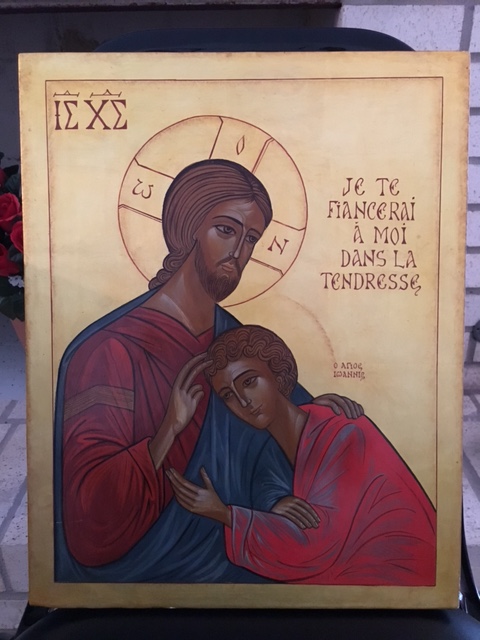
On the wall of my chapel you see an icon.

It was painted by a Benedictine nun in a convent near the home of Zachery and Elizabeth.

I was visiting the convent and I saw the unfnished icon and I said “Sister I want to buy that icon when you finish it.”  I bought it and you see it hanging on my wall.

It shows the Apostle John resting his head on the chest of Jesus at the last supper.

The text on the icon: “Je te fiancerai a moi dans la tendresse” is taken from Hosea 2:19  “I will espouse you for ever; I will espouse you in righteousness and in justice, in steadfast love and in mercy.  I will espouse you in faithfulness; and you shall know the Lord.”

Paul is my patron; I choose him for my Confirmation.  I choose to be ordained a bishop on the Feast of the Conversion of Saint Paul.  He is my model for ministry.

But John is my model for my deepest personal relationship with Jesus Christ.

As Jesus hung dying on the cross all the disciples deserted him, except John.

Jesus is the WAY and John is my model for loving my Lord, Jesus Christ.

I have no need of a ‘GPS’ in my spiritual life,

nor should you.

O God,

Eternal Father, 

your Son, Our Lord Jesus Christ,

has shown us the way to return to you.

In this relativistic, materialistic world

we are offered many detours that would take us off of the way your Son 

has shown us.

Strengthen our faith and love for you that we may remain faithful in following the way 

of Jesus Christ,

and so find our way to eternal life with you and your Son in the Holy Spirit.

This we ask through the same Jesus Christ, your Son, who lives and reigns with you in the unity of the Holy Spirit,

one God,

forever and ever.

Amen!

Posted in Uncategorized | Comments Off on HOMILY FOR THE FIFTH SUNDAY OF EASTER – cycle A