MARTIN LUTHER: HERETIC TO MOST CATHOLICS, HERO TO FRANCIS !!!

Martin_Luther

Martin Luther: Defender of Erroneous Conscience

CRISIS MAGAZINE
MARCH 13, 2017
.
.

Two trials, two appeals to conscience.

Trial 1: I cannot and will not recant anything, for to go against conscience is neither right nor safe. Here I stand, I can do no other, so help me God. Amen.

Trial 2: If the number of bishops and universities should be so material as your lordship seems to think, then I see little cause, my lord, why that should make any change in my conscience. For I have no doubt that, though not in this realm, but of all those well learned bishops and virtuous men that are yet alive throughout Christendom, they are not fewer who are of my mind therein. But if I should speak of those who are already dead, of whom many are now holy saints in heaven, I am very sure it is the far greater part of them who, all the while they lived, thought in this case the way that I think now. And therefore am I not bound, my lord, to conform my conscience to the council of one realm against the General Council of Christendom.

What is the difference of these two quotes?

The first, from the friar Martin Luther, asserts the primacy of conscience over the universal consent of the Church and the tradition.

The second, from a laymen Thomas More, notes the agreement of conscience to the faith of Christendom, the history of the Church, and the saints of Heaven.

Why are these appeals to conscience significant? I think Belloc is fundamentally correct in his assessment of the nature of Protestantism as a denial of religious authority, resting in a visible Church:

The Protestant attack differed from the rest especially in this characteristic, that its attack did not consist in the promulgation of a new doctrine or of a new authority, that it made no concerted attempt at creating a counter-Church, but had for its principle the denial of unity. It was an effort to promote that state of mind in which a “Church” in the old sense of the word-that is, an infallible, united, teaching body, a Person speaking with Divine authority-should be denied; not the doctrines it might happen to advance, but its very claim to advance them with unique authority.

The individual quickly emerged to fill the vacuum left by the Church, as the dominant religious factor in the modern period.

Martin Luther: Revolutionary, Not Reformer
In this year of the five hundredth anniversary of the Reformation, we have to take stock of the legacy of the renegade, Catholic priest, Martin Luther. What were his intentions? It is commonly alleged, even among Catholics, that he had the noble aim of reforming abuses within the Church.

In fact, Martin Luther discovered his revolutionary, theological positions about a year before he posted his 95 theses. Probably in the year 1516, while lecturing on Romans at the seminary in Wittenburg, Luther had a pivotal experience, which shaped the way he viewed the Christian faith. Essentially, his “tower experience,” resolved his difficulty of conscience. He saw God and His commandments as a moral threat:

But I, blameless monk that I was, felt that before God I was a sinner with an extremely troubled conscience. I couldn’t be sure that God was appeased by my satisfaction. I did not love, no, rather I hated the just God who punishes sinners. In silence, if I did not blaspheme, then certainly I grumbled vehemently and got angry at God. I said, “Isn’t it enough that we miserable sinners, lost for all eternity because of original sin, are oppressed by every kind of calamity through the Ten Commandments? Why does God heap sorrow upon sorrow through the Gospel and through the Gospel threaten us with his justice and his wrath?” This was how I was raging with wild and disturbed conscience. I constantly badgered St. Paul about that spot in Romans 1 and anxiously wanted to know what he meant.

Reading Romans 1, while in the tower of his monastery, Luther suddenly saw the resolution of his troubled conscience through faith: “All at once I felt that I had been born again and entered into paradise itself through open gates. Immediately I saw the whole of Scripture in a different light.”

As we see in Trent’s teaching on justification and the Joint Declaration of Faith, there is nothing wrong with the realization that righteousness (same word as justification) comes through faith alone, moved by the grace of God. The problem is the re-reading of Scripture and all of the Christian tradition in a different light through this realization. Luther’s troubled conscience and experience of faith led him eventually (as it took him a while to work it out) to reject many of the Sacraments, books of the Bible, and the Church’s authority all in the name of liberty of conscience. A great schism would follow from Luther’s personal experience.

The Significance of Luther’s Teaching on Conscience
No doubt reforms were needed in the Catholic Church in 1517. Contrary to popular opinion however, Luther primarily sought to spread his understanding of the Gospel, not to correct abuses. Catholic practices became abuses precisely because they contradicted his tower experience of 1516.

One of Luther’s early tracts, Appeal to the Christian Nobility of the German Nation (1520), lays out the implications of his view in more detail:

Besides, if we are all priests, as was said above, and all have one faith, one Gospel, one sacrament, why should we not also have the power to test and judge what is correct or incorrect in matters of faith? What becomes of the words of Paul in I Corinthians 2:15: “He that is spiritual judgeth all things, yet he himself is judged of no man,” II Corinthians 4:13: “We have all the same Spirit of faith”? Why, then, should not we perceive what squares with faith and what does not, as well as does an unbelieving pope?

All these and many other texts should make us bold and free, and we should not allow the Spirit of liberty, as Paul calls Him, to be frightened off by the fabrications of the popes, but we ought to go boldly forward to test all that they do or leave undone, according to our interpretation of the Scriptures, which rests on faith, and compel them to follow not their own interpretation, but the one that is better….

Thus I hope that the false, lying terror with which the Romans have this long time made our conscience timid and stupid, has been allayed.

Luther never condoned license (though he did condone Philip of Hesse’s bigamy), as he said his conscience was captive to the Word of God, but he did separate the decision of his conscience from the authority of the Church. This proved absolutely foundational for Protestantism and modern, religious experience.

Father of the Modern World
The claim that Luther stands at a crucial moment between medieval Christendom and the modern world is not contentious. This is need for care, however. His separation of faith and reason and insistence on the spiritual nature of the Church, in my opinion, did quicken the advance to secularism. However, Luther did not directly intend the creation of the modern, secular world as know it. Yet his stand on conscience and his individualistic interpretation of faith did lend itself to modern individualism, which I would even say is the heart of modern culture.

Cardinal Ratzinger suggested that Luther stood at the forefront of the modern movement, focused on the freedom of the individual. I recommend looking at this piece, “Truth and Freedom” further, but his central insight on Luther follows:

There is no doubt that from the very outset freedom has been the defining theme of that epoch which we call modern…. Luther’s polemical writing [On the Freedom of the Christian] boldly struck up this theme in resounding tones…. At issue was the freedom of conscience vis-à-vis the authority of the Church, hence the most intimate of all human freedoms…. Even if it would not be right to speak of the individualism of the Reformation, the new importance of the individual and the shift in the relation between individual conscience and authority are nonetheless among its dominant traits (Communio 23 [1996]: 20).

These traits have survived and at times predominate our contemporary religious experience.  The sociologist, Christian Smith, has noted in his study of the faith life of emerging adults, Souls in Transition, that an evangelical focus on individual salvation has been carried over into a new religious autonomy. He claims that…

the places where today’s emerging adults have taken that individualism in religion basically continues the cultural trajectory launched by Martin Luther five centuries ago and propelled along the way by subsequent development of evangelical individualism, through revivalism, evangelism and pietism….  Furthermore, the strong individualistic subjectivism in the emerging adult religious outlook—that “truth” should be decided by “what seems right” to individuals, based on their personal experience and feelings—also has deep cultural-structural roots in American evangelicalism.

Luther’s legacy clearly points toward individualism in religion, setting up a conflict with religious authority and tradition. The average Western Christian probably follows his central assertion that one must follow one’s own conscience over and against the Church.

Luther’s View of Conscience in the Catholic Church
The key issue in debating Luther’s legacy on conscience in the Catholic Church entails whether the teachings of the Church are subordinate to one’s own conscience or whether conscience is bound by the teaching of the Church.

I know an elderly Salesian priest who told me with all sincerity that the purpose of Vatican II was to teach us that we could decide what to believe and how to live according to our conscience. This is clearly the “Spirit of Vatican II,” as Gaudium et Spes, while upholding the dignity of conscience, enjoins couples in regards to the transmission of life: “But in their manner of acting, spouses should be aware that they cannot proceed arbitrarily, but must always be governed according to a conscience dutifully conformed to the divine law itself, and should be submissive toward the Church’s teaching office, which authentically interprets that law in the light of the Gospel” (50). Dignitatis Humanae, Vatican’s Declaration on Religious Liberty, holds together two crucial points, stating that one cannot “be forced to act in a manner contrary to his conscience,” (3) as well as that “in the formation of their consciences, the Christian faithful ought carefully to attend to the sacred and certain doctrine of the Church” (14). The Council upheld the dignity of conscience as well as its obligation to accept the authority of the Church.

The misinterpretation of the Council’s teaching on conscience as license found its first test case just three years after the Council closed in Humanae Vitae. Theologians such as Bernard Härring and Charles Curran advocated for the legitimacy of dissent from the encyclical on the grounds of conscience. The Canadian Bishops, in their Winnipeg Statement, affirmed: “In accord with the accepted principles of moral theology, if these persons have tried sincerely but without success to pursue a line of conduct in keeping with the given directives, they may be safely assure that, whoever honestly chooses that course which seems right to him does so in good conscience.”

Conscience also stands at the center of the current controversy over the interpretation of Amoris Laetitia. I’ve already written on how Amoris stands in relation to the Church’s efforts to inculturate the modern world in relation to conscience. Cardinal Caffarra claimed that the fifth dubium on conscience was the most important. He stated further: “Here, for me, is the decisive clash between the vision of life that belongs to the Church (because it belongs to divine Revelation) and modernity’s conception of one’s own conscience.” Recently, the German bishops, following those of Malta, have decided: “We write that—in justified individual cases and after a longer process—there can be a decision of conscience on the side of the faithful to receive the Sacraments, a decision which must be respected.”

In light of the current controversy on conscience, it is troubling that Luther is now upheld as genuine reformer. The most troubling is from the Pontifical Council for Promoting Christian Unity in its Resources for the Week of Prayer for Christian Unity and throughout the year 2017: “Separating that which is polemical from the theological insights of the Reformation, Catholics are now able to hear Luther’s challenge for the Church of today, recognising him as a ‘witness to the gospel’ (From Conflict to Communion 29). And so after centuries of mutual condemnations and vilification, in 2017 Lutheran and Catholic Christians will for the first time commemorate together the beginning of the Reformation.” The Vatican also announced a commemorative stamp (which to me sounds like the United States issuing a stamp commemorating the burning the White House by British troops).

Pope Francis has spoken of Luther several times in the past year, including in an inflight press conference returning from Armenia: “I think that the intentions of Martin Luther were not mistaken. He was a reformer. Perhaps some methods were not correct.” In response I ask, what did Luther reform? Francis pointed to two things in his journey to Sweden. The Reformation “helped give greater centrality to sacred scripture in the Church’s life,” but it did so by advocating the flawed notion of sola scriptura. Francis also pointed to Luther’s concept of sola gratia, which “reminds us that God always takes the initiative, prior to any human response, even as he seeks to awaken that response.” While the priority of God’s initiative is true and there are similarities to Catholic teaching in this teaching (that faith is a free gift that cannot be merited), Luther denied our cooperation with grace, our ability to grow in sanctification and merit, and that we fall from grace through mortal sin. Francis also noted, while speaking to an ecumenical delegation from Finland: “In this spirit, we recalled in Lund that the intention of Martin Luther 500 years ago was to renew the Church, not divide Her.” Most recently he spoke of how we now know “how to appreciate the spiritual and theological gifts that we have received from the Reformation.”

It is true that Martin Luther did not want to divide the Church. He wanted to reform the Church on his own terms, which was not genuine reform. Luther said he would follow the Pope if the Pope taught the pure Gospel of his conception: “The chief cause that I fell out with the pope was this: the pope boasted that he was the head of the Church, and condemned all that would not be under his power and authority; for he said, although Christ be the head of the Church, yet, notwithstanding, there must be a corporal head of the Church upon earth. With this I could have been content, had he but taught the gospel pure and clear, and not introduced human inventions and lies in its stead.” Further he accuses the corruption of conscience by listening to the Church as opposed to Scripture: “But the papists, against their own consciences, say, No; we must hear the Church.” This points us back to the crucial issue of authority, pointed out by Belloc.

Conclusion: More Over Luther
We should not celebrate the Reformation, because we cannot celebrate the defense of erroneous conscience held up against the authority of the Church. As St. Thomas More rightly said in his “Dialogue on Conscience,” taken down by his daughter Meg: “But indeed, if on the other side a man would in a matter take away by himself upon his own mind alone, or with some few, or with never so many, against an evident truth appearing by the common faith of Christendom, this conscience is very damnable.” He may have had Luther in mind.

More did not stand on his own private interpretation of the faith, but rested firmly on the authority of Christendom and, as Chesterton put it, the democracy of the dead: “But go we now to them that are dead before, and that are I trust in heaven, I am sure that it is not the fewer part of them that all the time while they lived, thought in some of the things, the way that I think now.”

More is a crucial example of standing firm in a rightly formed conscience. We should remember why he died and not let his witness remain in vain. He stood on the ground of the Church’s timeless teaching, anchored in Scripture and the witness of the saints. If we divorce conscience from authority, we will end in moral chaos. As Cardinal Ratzinger asked in his lucid work, On Conscience: “Does God speak to men in a contradictory manner? Does He contradict Himself? Does He forbid one person, even to the point of martyrdom, to do something that He allows or even requires of another?” These are crucial questions we must face.

Rather than celebrating the defender of erroneous conscience, let’s remember and invoke the true martyr of conscience, who died upholding the unity of the faith.

Editor’s note: This article first appeared February 25, 2017 in Catholic World Reportand is reprinted with permission.

R. Jared Staudt

By 

R. Jared Staudt works in the Office of Evangelization and Family Life Ministries of the Archdiocese of Denver. He earned his BA and MA in Catholic Studies at the University of St. Thomas in St. Paul, MN and his PhD in Systematic Theology from Ave Maria University in Florida. Staudt served previously as a director of religious education in two parishes, taught at the Augustine Institute and the University of Mary, and served as co-editor of the theological journal Nova et Vetera. He and his wife Anne have six children and he is a Benedictine oblate.
Posted in Uncategorized | Comments Off on MARTIN LUTHER: HERETIC TO MOST CATHOLICS, HERO TO FRANCIS !!!

LUST IS THE MOST UNDERSTANDABLE OF SINS BECAUSE IT COUNTERFEITS THE INTERPERSONAL LOVE BETWEEN THE TRINITY OF PERSONS


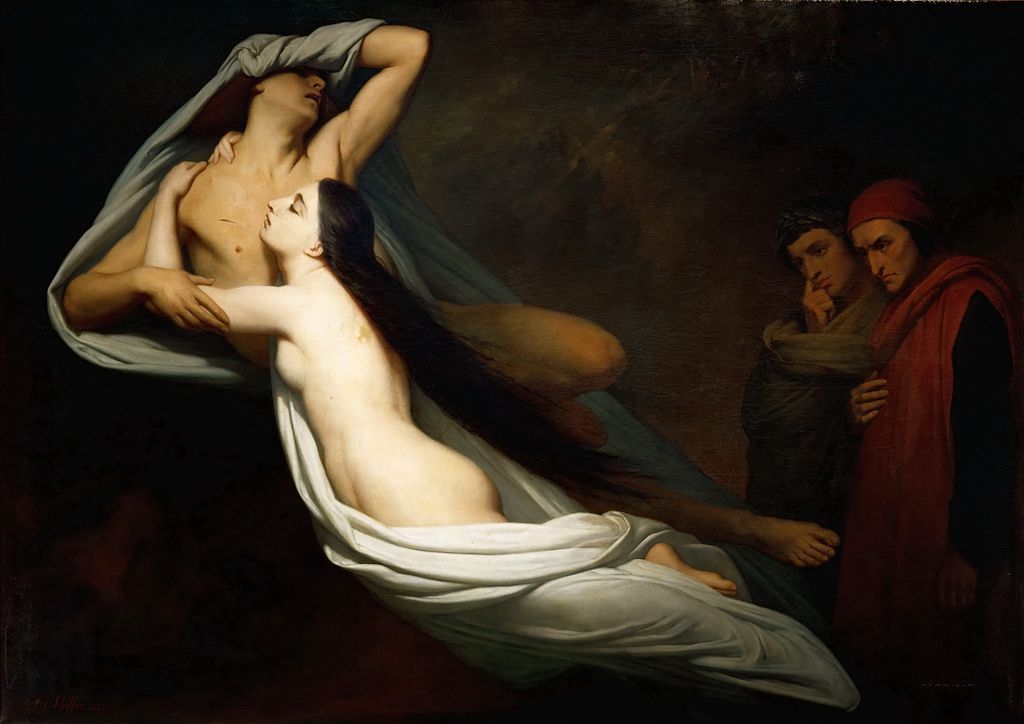
Francesca di Rimini and Paolo Malatesta Appraised by Dante and Virgil by Ary Scheffer, c. 1855 [Louvre, Paris]

A Lesson on Sex – from Dante

When I teach Dante’s Inferno, it often happens that students are surprised to find that Lust is the first real circle (after the Limbo of the virtuous pagans) in his medieval Hell. Which is to say, it’s the lightest of sins for which people are eternally damned. The real rogues – the evil counselors, sowers of discord, and traitors to lawful rulers and to God Himself are much further down and suffer far worse punishments. The Lustful are blown around in a relentless wind like birds or leaves in a tempest, an image of their untethered and unruly emotions.

And to make matters worse (for the students first encountering the text), Dante the pilgrim/character in the poem (we always have to remember he’s not necessarily the same Dante as the Dante who is doing the writing) seems half sympathetic to a pair of adulterous lovers – the famous Paolo and Francesca – as they recount their plight. She was married to a brute of a husband (and perhaps was offered marriage under false pretenses that it would be another person as well). And he is so courteous and refined. If there had been a medieval equivalent of our modern “discernment” regime, these two would have been perfect candidates for accompaniment and mercy.

But as we (students and I) start to read the text more carefully, some other features begin to emerge. For example, the Canto (Inferno V) where the two adulterers tell their story begins with Dante (and his guide Virgil) meeting Minos, judge of the underworld, who tells them: “O you who come to this abode of pain. . .beware how you come in and whom you trust. Don’t let the easy entrance fool you.”

Virgil, a smart pagan, thinks Minos is just trying to block their way. But that’s not what he said or did. He’s warning them about infernal deception, especially how easy it is to find yourself entangled in it. It may, thus, be something that even Virgil’s pagan wisdom doesn’t see clearly on its own. And since what follows is two adulterers presenting a touching and almost beautiful picture of their sin, maybe the pagan poet, for all his wisdom, is not the best guide in this particular case.

Because what follows needs a different framework to be understood properly. The two souls come at Dante’s bidding out of the violent wind, like two doves coming to their nest, he says. And Francesca addresses Dante:

O living creature, gracious and kind,
that come through somber air to visit us
who stained the world with blood,
if the King of the universe were our friend
we would pray that He might give you peace,
since you show pity for our grievous plight.

How gentle. And courtly. And delicate. And how great a contrast with their brutal murder by a jealous husband. But also, how subtly strange: “If the King of the universe were our friend. . .” Francesca seems to think that God should be like one of the worldly members of the court at a castle, sympathetic to their situation and willing to indulge them because their love is so cultivated and understandable.

It’s all love, love, love:
Love, quick to kindle in the gentle heart,
seized this man with the fair form taken from me.
The way of it afflicts me still.
Love, which absolves no one beloved from loving,
seized me so strongly with his charm that,
as you see, it has not left me yet.
Love brought us to one death.
Caïna waits for him who quenched our lives.

Dante gets drawn into this fantasy until he faints and wakes up further down in Hell.

I’ve found that once students get the bigger picture of what’s going on here, they recognize the seductiveness that Dante has reproduced – but also the lesson that he teaches by not presenting it overtly. Many people, as we know from daily life, are misled by what they think is love because it has the capacity to present itself as right even when it’s wrong.

Most of us won’t be tempted to betray a ruler or steal from a bank, even assuming we were in a position to do so. But lust turns one of our prime human qualities – our spontaneous affections towards other people – into a tool for diverting us from our high calling as human persons. It’s the most understandable of sins, in its way, because it counterfeits the real interpersonal love of the Trinity and the ordered love we should have for God and one another. In other words, it’s not just that it touches the root of our affections. It’s subtle, and that’s all the more reason why we need to be wary of what we’re entering into and who we trust. It’s easy to be deceived and – to judge by divorces and family breakups – it happens a lot.

It happened a lot in Dante’s time, too, if not quite so openly or as celebrated as it seems to be today. And those medieval thinkers and poets, those great geniuses who were able to see how concrete instances fit into larger patterns of vice and virtue, were themselves subtle – and realistic. They didn’t make temptations to lust look horrifying like the devilish practices seen further down in Hell. They made them appear as they are, tempting – and clever at concocting rationalizations.

“If the King of the universe were our friend. . .” We seem to say that to ourselves, in our own modern idiom, about many things, as if the fault were God’s. And it were an excuse.

Robert Royal

Robert Royal

Robert Royal is editor-in-chief of The Catholic Thing, and president of the Faith & Reason Institute in Washington, D.C. His most recent book is A Deeper Vision: The Catholic Intellectual Tradition in the Twentieth Century, published by Ignatius Press.  The God That Did Not Fail: How Religion Built and Sustains the West, is now available in paperback from Encounter Books.

Posted in Uncategorized | Comments Off on LUST IS THE MOST UNDERSTANDABLE OF SINS BECAUSE IT COUNTERFEITS THE INTERPERSONAL LOVE BETWEEN THE TRINITY OF PERSONS

THE ROT GOES MUCH DEEPER AND IS MUCH OLDER THAN THIS LATEST ROUND OF LEFT SAVAGERY

Image result for photo of thomas sowell


By Thomas Sowell

The American Spectator

March 13, 2017, 

Posted in Uncategorized | Comments Off on THE ROT GOES MUCH DEEPER AND IS MUCH OLDER THAN THIS LATEST ROUND OF LEFT SAVAGERY

STATISTS OF THE WORLD UNITE !

Image result for photo of karl marx

March 13, 2017


Statists of the World, Unite! The Totalitarian Statism of Left

By Peter Amos Cohen

A Description of the Left’s Totalitarian Statism


Steve Deace has written a very good article describing the fanaticism and totalitarianism of the Left (https://tinyurl.com/j8tzuw7). Deace writes: “But what remains possible in the mind of a genuine liberal, no matter whether they are on the winning or losing side of an argument, is the possibility or requirement to coexist on some level with their countrymen. While they may be at war with the ideas of the person they are debating, they are not fundamentally at war with the person themselves. Not so with Leftists.”


Deace lists the differences between liberals and Leftists as the following:


  • The liberal seeks to mold civilized society in ways we oppose. Mainly because they have a different definition of compassion, or have a different view of the role government should play in our lives. The Leftist seeks to dismantle civilized society altogether.
  • The liberal believes in things we think are unconstitutional. The Leftist pursues an agenda that is anti-constitutional. They’re not simply perverting the general welfare clause, but attacking the very integrity of the Constitution itself.
  • The liberal will contend for your free speech, even if they think you’re an unevolved troglodyte. The Leftist believes you forfeit your free speech entirely if you dare disagree.
  • The liberal believes those who disagree with him or her simply need to be educated or exposed to diverse cultures and ideas. The Leftist believes those who disagree are automatically racist/misogynist/homophobic bigots.
  • The liberal believes government is the primary tool to carry out his or her ideology. The Leftist believes government is the primary weapon to punish those who oppose his or her ideology.


The Left seeks ideological purity at the expense of social harmony and national unity. Events throughout the Obama years and since the Trump election make that clear. One could be tempted to psychologize the Left by calling these events merely immature and frenzied public displays that will simmer in time, as the movement matures. But, as Deace warns, the Left cannot recognize the humanity of those who disagree with its agenda. Why is that? There is no coexistence with Leftism. It is willing to attack even those who are pragmatic allies and moderate supporters precisely because they still are willing to moderate their politics during sports events and other traditional, non-political, American activities. What are the causes of the Left’s unrelenting fanaticism and totalitarianism?


A Brief Statement on the Causes of the Left’s Totalitarian Statism


The causes of the Left’s fanaticism and totalitarianism are in-built and essential to its primary purposes and goals: the rejection of civil society. To be consistent with this goal, Leftists cannot recognize people’s humanity independent of their political agenda; the Left must dehumanize its political opponents. Totalitarianism and fanaticism are not incidental, but essential to the Left’s political agenda. The correct understanding of civil society helps to see how this is the case.


A Definition of Civil Society

What is civil society? Civil society consists of families relating to and cooperating with other families, and forming intermediate organizations. Intermediate organizations are named such because they are formed after families but before the state (i.e. political society). These are voluntary societies that exist “in between” families and the state. But, although they exist inter media (in the middle or in between) families and the state, these associations do not serve both equally: service to the state is only a side effect of their primary purpose to serve families. These associations naturally develop amongst families as they interact and cooperate to form economic, educational, cultural, and/or religious auxiliaries to family life. The vast majority of human life and society, of justice, and of human goodness and flourishing takes place in families and these intermediate societies, while only a minimal amount involves the state, as important as its role is. Civil society generates the need for the state when its activity becomes complex and formalized to the extent that the rule of law is needed. The state is then formed to serve and preserve the pre-political, civil society. This is referred to as the instrumentalist view of the state: the state does not have its own, independent good/purpose, but is meant to be instrumental in civil society’s attainment of its own good. It is proclaimed a self-evident truth in the Declaration of Independence: “To secure these (God-given, unalienable, pre-political) rights, governments are instituted among men, deriving their just powers from the consent of the governed.” The correct view of civil society comes to light when one combines the instrumentalist view of the state with the principle of subsidiarity, which defines the state’s role as subsidiary to civil society, that is, helping it, not replacing it or any of its intermediary organizations. Catholic Vote offers a brief video explaining the principle of subsidiarity here: https://www.youtube.com/watch?v=GD0moAiq22k. This correct view of civil society is the basis for minarchy, a position which holds that the statization of human society ought to be minimized.


While the state is necessary for matters of conflict of interest among pre-political societies, for national security, or sometimes for positive action to serve the common good, etc., minarchy is required for human flourishing because the vast majority of human life takes place in civil society. Saint John Paul II wrote: “The social nature of man… is realized in various intermediary groups, beginning with the family and including economic, social, political and cultural groups which stem from human nature itself and have their own autonomy, always with a view to the common good.” (Centesimus Annus 13) Ryan Anderson explains that the true meaning of social justice refers to the order of justice, the duties and obligations, that exist by nature within the family and civil society (https://tinyurl.com/js8zbn4). This is the form of social justice which is diminished by the statization of civil society. But, conversely, affirming civil society (and the order of justice within it) limits the state. While there are further prudential limits (e.g. the separation of powers, term limits, election cycles, etc.) that can and should be placed on government, the priority of civil society is not a prudential judgment but an ethical, moral principle. Government (or the state) is ought to be limited in principle due to its subordination within the moral order to higher and prior goods. Unless subordinated and limited, politics are absolute and governments unlimited. But it would be wrong not to render unto Caesar what is Caesar’s, just as it would be to render unto Caesar what is God’s.  


The Causes of the Left’s Totalitarian Statism Reconsidered


After the above reflection of civil society, one is positioned to understand the Left and the causes of its totalitarianism. Leftism dates back to the 60’s and 70’s and the sexual liberation movement. This movement is summarized here (https://tinyurl.com/3ru2wgv) by the following bullet points:    


  • Sexuality became political, emerging as an axis around which new social movements organised.
  • Shifts in the relations between women and men, particularly those inspired by the emergent women’s liberation movements. This parallels women’s increased presence in the public realm and personal autonomy concerning reproductive choices and sexual expression.
  • The political mobilisation of the gay & lesbian movements.
  • A destabilising of the rigid boundary between the private family and the individualistic orientated public realm.
  • Reforms in the legal and medical regulation of sexuality.
  • The increased commercialisation and commodification of sexuality through pornography and mass media. The concomitant relaxation of censorship laws.


The sexual revolution promotes what is traditionally called sexual vice — sexual vice refers to all the forms of sexual activity denied in virtue-based societies (including traditional American life) that regulated sexuality according to reason. Reason, of course, finds marriage to be the appropriate and honorable “place” for erotic, sexual expression; having a family is the corresponding goal of sexuality. Marriage and the family, according to right reason, “frame in” sexuality, as alpha/origin and omega/end. Hence, marriage and the family are the primary obstacles and objects of animosity for the Leftist, politicized alternative forms of sexuality. Leftists hold that sexuality must be “liberated” from its “prison” within marriage and the family. Hence, the Left’s attack on the family and civil society.   


The Left’s weaponization of the mechanisms of the state against its political enemies; the Left’s undermining of democratic processes to further its agenda; its using the courts, the media, and schools to counteract popular vote losses; it all flows directly from the Left’s philosophical denial of the family and civil society. Watch how this Leftist justifies her political absolutism: (https://tinyurl.com/zyfcyw8). The Left is a mixture of anarchy and absolutism: its anarchy towards civil society renders its politics absolute. For the Left, because there is no pre-political, civil human society, there is no basis human interaction outside of political agenda. There is no common humanity. Within the perspective of Leftism, there is no basis to enjoy a sports event where there is political disagreement: every platform must be subjugated to the agenda: (https://tinyurl.com/jawdbvr) The Left’s political agenda defines the social existence of its adherents. Any acknowledgment of the humanity of its political opponents would entail a betrayal of its core tenet by an admission of civil society. Coexistence is theoretically impossible for a Leftist.  


Posted in Uncategorized | Comments Off on STATISTS OF THE WORLD UNITE !

HOMILY FOR THE SECOND SUNDAY IN LENT – CYCLE A

47400b6822f5090564c584418c42951c

HOMILY FOR THE SECOND SUNDAY OF LENT

Cycle A

Bishop Rene Henry Gracida

O God,

who have commanded us

to listen to your beloved Son,

be pleased, we pray,

to nourish us inwardly by your word,

that with spiritual light made pure,

we may rejoice to behold your glory.

Through our Lord Jesus Christ,

your Son,

who lives and reigns with you

in the unity of the Holy Spirit,

one God, for ever and ever.

Amen!

That is the opening prayer, The Collect, for today’s Mass.

I call your attention to the three principle elements of that prayer.

First, we ask God to nourish us by his word.

Second, we ask him to nourish us by his word so that we may see reality

with a spiritual light made pure.

Thirdly, that with that light we may rejoice

to behold God’s glory.

FIRST

How are we nourished by the word that God speaks to us.  We are nourished by the words that the Word of God because it is Jesus Christ and his apostle who spoke to us, and the words of Jesus Christ and his apostles have power that the words of others do not have

The Church makes sure that we encounter in every celebration of the Holy Sacrifice of the Mass the words of the Word made flesh and the writings of the apostles contained in the bible.

The Second Vatican Council decreed that the number of readings from sacred scripture at Mass should be triples in number and so the Lectionary of the Church was expanded so that number of readings from the bible were indeed tripled from what we had before the Council.  That is what is signified by the designation of the three cycles of readings.  We are presently in Cycle A and next year we will be in Cycle B and then the following year we will be in Cycle C of scripture readings at Mass.

What a wonderful enrichment this expansion has been for the faithful.  But if our only contact with the words of the Word of God and his apostles are in hearing the readings proclaimed at Mass, we are on a ‘Slim Fast’ diet.

You should own your own personal copy of the bible and add ‘protein’ to your ‘Slim Fast’ diet by reading the bible.

An excellent Catholic edition of the bible is the Ignatius Bible available from Ignatius Press in over ten different editions either directly from Ignatius press or through

Amazon.

SECOND

We listen to the sacred scripture readings at Mass and we read the sacred scriptures at home so that we may “see reality

with a spiritual light made pure.”

Saint John the Evangelist tells us how this is accomplished:

“We announce to you the eternal life which dwelt with the Father and was made visible to us.  What we have seen and heard we announce to you, so that you may have

fellowship with us and our common fellowship be with the Father and his Son, Jesus Christ.” (1 John 1:2-3)

How you read sacred scripture will determine how much we receive the spiritual light which will make reality more clear to us.

Saint Benedict famously prescribed a manner of reading of sacred scripture that is called “LECTIO DIVINA.”

Here is  William of Saint Thierry’s description of Lectio Divina”

§ 120. [A]t fixed hours time should be given to certain definite reading. For haphazard reading, constantly varied and as if lighted on by chance does not edify but makes the mind unstable; taken into the memory lightly, it goes out from it even more lightly. But you should concentrate on certain authors and let your mind grow used to them.

§ 121. The Scriptures need to be read and understood in the same spirit in which they were written. You will never enter into Paul’s meaning until by constant application to reading him and by giving yourself to meditation you have imbibed his spirit. You will never understand David until by experience you have made the very sentiments of the psalms your own. And that applies to all Scripture. There is the same gulf between attentive study and mere reading as there is between friendship and acquaintance with a passing guest, between boon companionship and chance meeting.

§ 122. Some part of your daily reading should also each day be committed to memory, taken as it were into the stomach, to be more carefully digested and brought up again for frequent rumination; something in keeping with your vocation and helpful to concentration, something that will take hold of the mind and save it from distraction.

§ 123. The reading should also stimulate the feelings and give rise to prayer, which should interrupt your reading: an interruption which should not so much hamper the reading as restore to it a mind ever more purified for understanding.

§ 124. For reading serves the purpose of the intention with which it is done. If the reader truly seeks God in his reading, everything that he reads tends to promote that end, making the mind surrender in the course of the reading and bring all that is understood into Christ’s service.

From: William of Saint Thierry (d. 1148), The Golden Epistle: A Letter to the Brethren at Mont Dieu 1.120-124, trans. Theodore Berkeley, The Works of William of St. Thierry, Cistercian Fathers 12 (Spencer, Mass.: Cistercian Publications, 1971) 51-52. In the Migne Patrologia Latina, volume 184, this would be Book 1, paragraph 31.

 THIRD

That through our Lenten reading of sacred scripture we may be illuminated to see the reality of our salvation and rejoice in the Resurrection of Jesus Christ on Easter Sunday.

This truth was beautifully expressed by the Second Vatican Council in its Decree

DEI VERBUM:

REVELATION ITSELF

In His goodness and wisdom God chose to reveal Himself and to make known to us the hidden purpose of His will (see Eph. 1:9) by which through Christ, the Word made flesh, man might in the Holy Spirit have access to the Father and come to share in the divine nature (see Eph. 2:18; 2 Peter 1:4). 

Through this revelation, therefore, the invisible God (see Col. 1;15, 1 Tim. 1:17) out of the abundance of His love speaks to men as friends (see Ex. 33:11; John 15:14-15) and lives among them (see Bar. 3:38), so that He may invite and take them into fellowship with Himself. 

This plan of revelation is realized by deeds and words having an inner unity: the deeds wrought by God in the history of salvation manifest and confirm the teaching and realities signified by the words, while the words proclaim the deeds and clarify the mystery contained in them. By this revelation then, the deepest truth about God and the salvation of man shines out for our sake in Christ, who is both the mediator and the fullness of all revelation. 

Almighty God, Eternal Father,

grant that through our Lenten

reading of sacred scripture in the manner of Lectio Divina

we be filled with the light of Christ your Son and thus be able to grasp the reality of his passion, death and resurrection as

the source of our ability to share in your divine life for all eternity.

Amen!

Posted in Uncategorized | 1 Comment

ONE MAN’S MEAT IS ANOTHER MAN’S POISON OR ONE MAN’S MEDE IS ANOTHER MAN’S PERSIAN*


Dogma and the Age of Anxiety

It’s quite common these days to hear disparaging comments about Catholic dogma and doctrine. But the complaints about dogma are harder to accept when they come from within, from Catholics themselves.

When the Archbishop of Dublin ordained Jesuit deacons in 2015 he warned, “We will not heal those whose lives have drifted from Jesus Christ by throwing books of dogma at them.”

And the new General of the Jesuits recently said, “Doctrine is a word that I don’t like very much, it brings with it the image of the hardness of stone. Instead, the human reality is much more nuanced, it is never black or white, it is in continual development.”

Ironically, it’s precisely because human reality is not black and white that we need the rock-hard reality of dogma. Aside from the fact that the “controversial” doctrines usually have to do with the 6th Commandment (many would welcome its repeal for obvious reasons), we would do well to consider some of the “difficult” and “rigid” doctrines of Jesus {emphasis by Abyssum}.

For example, the Sermon on the Mount presents some particularly difficult teachings.  In the “Lilies of the Field” discourse, Jesus says: “Do not worry about tomorrow; tomorrow will take care of itself. Sufficient for a day is its own evil.”  Without doubting the truth of His words, we may find ourselves struggling to put them into practice. How is it possible to dispel so many of life’s anxieties? Those very difficulties, unfortunately, sometimes lead to rejecting His teaching {emphasis by Abyssum}.

We are said to live in an “Age of Anxiety” – just like every other age, I suppose.  The media makes more money selling anxiety. Facts without anxiety are boring.  When scientists recently determined that a huge swath of molten carbon lies 200 miles beneath the surface in the American West, reporters deftly linked the story to our fears – suggesting that if a massive volcano erupted in Yellowstone National Park, it would mean the end of the world as we know it. There are many such news reports, on subjects from solar flares to low testosterone. So much to worry about, so little time.

Many anxieties, of course, are far more understandable, if not exactly “reasonable.”  Personal health – especially as we grow older – can cause worry.  But when a doctor diagnoses a malady after tests, the certainty of the diagnosis usually brings some sense of relief. The illness can finally be treated, or at least understood, going forward. The certainty of truth is a remedy for anxiety.

The firm certainties of life vary depending on context.  On the one hand, our personal history is certain because events have taken place (even if memory fails) and simply become facts of our life. We were born; we grew up and were educated; we found jobs; we loved; we’ve suffered – the factual certainties are endless.

On the other hand, when we look to the future, humanly speaking, there is only one certainty: death.  No matter how certain we think our day planner is, we may not wake up tomorrow. Consequently, the uncertainties of the future are unlimited and can be very unsettling. As any parent knows.

Yet Jesus teaches us not to be anxious about tomorrow. He wants us to look at the facts of life – the lilies of the field, etc. –trust in God’s loving providence.

We know from our childhood catechisms that the dogmas and doctrines of our faith console us with certainties that we’d never have without God’s revelation. Here’s one:  “Can a woman forget her infant, so as not to have pity on the son of her womb? And if she should forget, yet will I [the Lord God] not forget thee.  Behold, I have graven thee upon the palms of my hands.” (Is. 49:14-16)

Another dogma needs no comment, and directs us on our way with certainty:  “I am the way and the truth and the life. No one comes to the Father except through me.” (Jn. 14:6).  If you’re worried about the state of your marriage, Jesus says, again with unequivocal dogmatic certainty:  “Therefore now they are not two, but one flesh. What therefore God hath joined together, let no man put asunder.” (Mt. 19:6)

Without such dogmas and doctrines of faith, there would be no clarity for the future except the certain prospect of death.  As Flannery O’Connor writes, dogmas are true “windows to the infinite.”  As in: “Now if we died with Christ, we believe that we will also live with him.” (Rom. 6:8){Emphasis by Abyssum}

But even as we strive, with God’s grace, to believe all that Jesus teaches through His Church, we continue an ongoing struggle against anxiety. We are to live in the moment and that’s difficult to do in a fast-paced world.  God provides grace, if we’re open to Him, and when we need it, moment by moment, day by day.  This is why it is so necessary to repeatedly encounter Christ in prayer, the Sacraments, Sunday Mass, and the certitudes of Catholic dogma – God’s revelation of His plan for us. But God does not grant His grace in advance.

Hence there is sinful hubris in presuming to tinker with the teachings of Christ or to disparage Catholic “dogmas” and “doctrines” by suggesting they are subject to constant change. Those who do so become agents of confusion and anxiety, truly undermining Christ. Members of the hierarchy of the Church are not above the firm teachings of Christ.

Church doctrines – regardless of their perceived “rigidity” – are good because through them we encounter Christ and the providence of God.  The firm certainties of the teachings of Christ not only direct us, they help relieve the anxieties that plague us daily.  After all, “You shall know the truth and the truth will set you free.” (Jn. 8:32)  Not a bad dogma to reflect upon {emphasis by Abyssum}.

 *HT George S. Kaufman
Rev. Jerry J. Pokorsky

Rev. Jerry J. Pokorsky

Father Jerry J. Pokorsky is a priest of the Diocese of Arlington. He is pastor of St. Catherine of Siena parish in Great Falls, Virginia.

Posted in Uncategorized | 1 Comment

MAKE NO MISTAKE, THE DAYS OF THIS PAPACY ARE RAPIDLY DRAWING TO A CLOSE. BRACE YOURSELVES, THE REAL WAR IS ABOUT TO BEGIN


Four Years Later: Reflections on an Unprecedented Pontificate


FacebookGoogle+Pocket

On March 13, 2013, I sat in my office and watched my screen as a new pope — a man whom I had never seen before that moment — walked out onto the loggia of St. Peter’s Basilica. I had never heard of him. I did not even know his name. Like most Catholics, I had approached the papal conclave with a sense of hopeful anticipation. But the feeling that came over me when I saw the man the cardinals had elected was shockingly forceful. It was a feeling of icy cold dread. As I looked at him, standing there, staring out at the crowd, I heard seven words distinctly in my mind, unbidden: “This man is no friend of Tradition.”

It was a strange sentence. Oddly phrased. I knew, just as surely as one knows that the voice of someone speaking to them in a quiet room is not their own, that this was not my thought, but some sort of external prompting. It would have been impossible for me to even attempt such an assessment, since I knew literally nothing about the man, this Argentinian cardinal, Jorge Bergoglio.

I am admittedly oblivious to the minutiae of ecclesiastical dress or custom. I cannot, therefore, claim that my feeling was rooted in the observance of some obvious deviation from the protocols of a papal election. I did not notice, for example, that he chose not to wear the papal mozetta. I was not jarred by his unusual greeting of the crowd with a “good evening,” instead of something more spiritually profound. I can’t say I recall hearing, in those first moments, that he was a Jesuit. To be honest, I may very well not have noticed these things even under normal circumstances, but these were not normal circumstances. My impression of the man was something that took place on a visceral level. And the feeling was so strong, it distracted me from everything else.

There was something in his face. In the way he stared down at the gathered crowd. There was something…wrong about his eyes. What I saw — what I thought I saw — was something other, looking out through that unreadable mask. Something triumphant, haughty, contemptuous, leering out at long last from atop the pinnacle of a long and hard-fought battle. It was incredibly strange.

When I look back at the photo of that moment, I can see that there was no discernible expression on his face. What I saw was, I think, not so much something physical but more of a spiritual insight. It struck me, at the risk of sounding hyperbolic, as a preternatural experience. I was so unnerved, I had to fight down a wave of nausea.

I alluded to these things months later, when I first began, after trying very hard to give Pope Francis the benefit of the doubt, to write about why his papacy was already full of warning signs. I was derided by some at the time, as though this were just some fantasy I had conjured up (for what reason I would do such a thing, I couldn’t hope to explain.) But I have since heard from countless others who had the same, bizarre, unexpected initial reaction. From that first moment, even though I tried hard to shove impressions aside and let reason prevail, I knew, as did so many other Catholics in what I have come to think of as a signal grace. A warning from God: this would be a papacy of terrible consequence.

Four years later, I stand confirmed in that knowledge. Not through the persistence of a feeling, but a preponderance of evidence. If 2016 was the tipping point, 2017 is the year the dam broke. Amoris Laetitia raised the stakes of the battle for the soul of the Church to the level that even the most die-hard ultramontanists — the honest ones, anyway — are now forced to admit that we are faced with a a serious problem. If it took something as significant as an arguably heretical apostolic exhortation that lays siege to the sacraments to raise the alarm, there have also been countless less-well-publicized examples of heterodoxy since that fateful night four years ago that it should remove all doubt about the severity of the crisis. Our attempts to document these things here, though incomplete, have spanned hundreds of pages. It is beyond the scope of a single article to attempt a comprehensive summary of the worrisome moments of the past four years, though we will attempt to call some of the more memorable such events to the reader’s attention below. It should, frankly, have been beyond human means to produce so much confusion and distortion in such a short period of time. And perhaps it was. The devil, after all, is not a creature of brute force, but a master of subtlety and seduction, only too happy to make use of willing instruments.

Whatever the provenance of this insurgency within the very heart — and head — of the Church, we find ourselves in a precipitous moment. For those who remain unconvinced, there’s likely no amount of evidence that could change that. Sides have been taken. Battle lines drawn. The initial phase of the engagement has concluded.

The Escalation of an Agenda

One of the most important moments of revelation in the Francis pontificate took place during an interview with close papal friend and ghostwriter Archbishop Victor Manuel Fernández, in May of 2015:

The pope goes slow because he wants to be sure that the changes have a deep impact. The slow pace is necessary to ensure the effectiveness of the changes. He knows there are those hoping that the next pope will turn everything back around. If you go slowly it’s more difficult to turn things back.” The interviewer then proceeded to ask him whether it does not help his adversaries when they know that Pope Francis says that his papacy might be short. Fernández answered: “The pope must have his reasons, because he knows very well what he’s doing. He must have an objective that we don’t understand yet. You have to realize that he is aiming at reform that is irreversible. If one day he should sense that he’s running out of time and doesn’t have enough time to do what the Spirit is asking him, you can be sure he will speed up. [emphasis added]

These comments, made nearly two years ago, provided an early glimpse of the strategy that has driven the agenda thus far. “Reform that is irreversible” is itself a theme that has been repeated by other close papal collaborators. Cardinal Oscar Andres Maradiaga Rodriguez used these exact same words in January of 2015. They have been telling us their intentions. Many have simply been unwilling to believe that they mean what they say. What this “irreversible reform” has turned out to be is nothing less than severe and intentional doctrinal distortion, a heretical approach to the Catholic understanding of sin and the sacraments, the breaking down of existing structures, rules, boundaries, and institutions, and a resulting confusion that is metastasizing in the Mystical Body of Christ with eternal consequences for souls.

One is forced to wonder: if Satan himself were to engineer an assault from within the Church, how would it differ from what we are experiencing today?

Just two years ago, at the time of his interview, Archbishop Fernández spoke of the favorable public response to the Francis agenda:

The pope first filled St. Peter’s square with crowds and then began changing the Church.” When asked whether the Pope is isolated in the Vatican, he responds: “By no means. The people are with him [Pope Francis], and not with his adversaries.”

Already at the time of his comments, however, things were beginning to change. By 2015, papal crowds were already beginning to diminish in size. And while here in America, at least, he’s been shown to have moved the needle on issues like climate change and feelings of liberal favorability toward Catholicism, there’s no evidence that he’s brought people into the Church. Millennials in particular continue to drift away, even when they express affection for the pope’s liberalizing approach to doctrine. And religious life — not healthy by any measure before the election of Francis — appears to be taking even more serious damage. The pope himself has lamented the “hemorrhage” of priests and nuns from the Church, but seems completely unaware of his own role in their departure — a track record that follows himfrom his native Argentina. As Fr. Linus Clovis of Family Life International said at a conference in 2015:

The Francis Effect is the disarming and silencing of Catholic bishops, priests, and laity.  Holding firm to Catholic doctrine and practise seems like an act of disloyalty to the pope, yet to acquiesce is to betray the Church.

In an op-ed at the New York Times last September, Matthew Schmitz took things further:

[Francis] describes parish priests as “little monsters” who “throw stones” at poor sinners. He has given curial officials a diagnosis of “spiritual Alzheimer’s.” He scolds pro-life activists for their “obsession” with abortion. He has said that Catholics who place an emphasis on attending Mass, frequenting confession, and saying traditional prayers are “Pelagians” — people who believe, heretically, that they can be saved by their own works.

Such denunciations demoralize faithful Catholics without giving the disaffected any reason to return. Why join a church whose priests are little monsters and whose members like to throw stones? When the pope himself stresses internal spiritual states over ritual observance, there is little reason to line up for confession or wake up for Mass.

“Francis has built his popularity,” Schmitz concludes, “at the expense of the Church he leads.” And it seems that now, the reservoir of good will having been expended, this is a reality that has caught up with him.

With years of mounting resistance that has spread from the scattered concerns of of a few concerned laity up to include the highest echelons of the Church, the situation on the ground is far different in 2017 than in was in 2015. Francis is no longer the “breath of fresh air” he was once perceived to be. Instead, his reckless speech in an incessant string of interviews and speeches grate on the faithful. His constant scolding of those simply trying to live their Catholicism devoutly combined with a seemingly boundless energy for innovation, self-contradiction, and change push people who have tried to give him a fair hearing away. Even some of the most patient Catholic commentators have at last reached the inescapable conclusion that this papacy is most aptly described as “disastrous“.

A Shift in Strategy

With the “populist” phase of this papacy now receding from view, there has been a subtle alteration in communications strategy from a Vatican that is nothing if not calculating. The critics of this papacy, once few, have grown significantly in number. Their efforts to resist these institutional errors, foisted as they have been upon the faithful, have become nearly as unrelenting as the papal agenda. The pushback against Amoris Laetitia has included forceful responses from across the spectrum of lay and clerical ranks in the Church. The theological dubia issued by four noteworthy cardinals questioning where the pope stands on traditional Catholic teaching was the most authoritative response, but the theological censures levied against the exhortation by 45 theologians, scholars, and priests was an even more theologically punishing rebuttal. Catholic luminaries like Josef Seifert, Jude Dougherty, and Robert Spaeman have added their own considerable voices to the rising chorus. Blows once easily swept aside by the Vatican apparatus are beginning to land – and sting. Papal boosters in the media such as Andrea Tornielli, Fr. Antonio Spadaro, and Austen Ivereigh have responded by coming out swinging, hoping to put those who refuse to ignore the real man behind the papal curtain in their place.

A more tangible example of how far things have come for the counter-insurgency is found in the appearance of posters that appeared overnight in Rome recently. At The Spectator, Damian Thompson recounts the scene:

On the first Saturday in February, the people of Rome awoke to find the city covered in peculiar posters depicting a scowling Pope Francis. Underneath were written the words:

Ah, Francis, you have intervened in Congregations, removed priests, decapitated the Order of Malta and the Franciscans of the Immaculate, ignored Cardinals… but where is your mercy?

The reference to mercy was a jibe that any Catholic could understand. Francis had just concluded his ‘Year of Mercy’, during which the church was instructed to reach out to sinners in a spirit of radical forgiveness. But it was also a year in which the Argentinian pontiff continued his policy of squashing his critics with theatrical contempt.

Thompson goes on to say:

Although the stunt made headlines around the world, it is unlikely to have unnerved the Pope. There is a touch of the Peronist street-fighter about Jorge Bergoglio. As his fellow Argentinian Jesuits know only too well, he is relaxed about making enemies so long as he is confident that he has the upper hand. The posters convey impotent rage: they are unlikely to carry the fingerprints of senior churchmen.

But does he have the upper hand? It would seem that as he loses control of the narrative, the advantage is slipping. Francis attempted, perhaps a little to eagerly, to downplay the incident. In a recent interview with Die Zeit, he rather unconvincingly laughed off the spectacle, even giving credit for cleverness to his accusers:

Pope Francis said he was at peace, adding: “I can understand how my way of dealing with things is not liked by some, that is totally in order. Everybody can have their opinion. That is legitimate and humanly enriching.”

When the interviewer followed up asking if the posters were enriching, Francis replied “the Roman dialect of the posters was great. That was not written by anyone on the street, but by a clever person.” The interviewer interjected, “Somebody from the Vatican?” to which Francis quipped, “No, I said a clever person (laughs).”

“Either way, that was great!” he concluded.

So great, in fact, that there is an ongoing Italian criminal investigation into “the conservative circles believed responsible” for the posters. And when a parody edition of L’Osservatore Romano was published the same month as the posters, also lampooning Francis, the Vatican launched its own police investigation into that matter as well. If persistent rumors are to be believed, Francis’ reaction to criticism when he is behind closed doors is far less sanguine than when the cameras are rolling. And as our extensive coverage of the dubia has shown, Francis has no qualms about making use of surrogates to attack anyone who stands in his way.

These reactions tell us something very important: resistance is not useless. It is having an effect.

The reality for Catholics is that we have reached a saturation point — let’s call it Peak Francis — and there is nowhere to go from here but down. This means that for the revolutionaries who have taken control of Holy Mother Church, there is far less benefit at this point in the use of subtlety; little to be gained through coyness or the continued pursuit of popularity; only an agenda already well underway that needs to be firmly cemented into place before this papacy becomes, as it inevitably will, a thing of (unhappy) memory. Fernández warned us that as time grew short, things would speed up. But the pace of change is so breathtaking, even reckless, that it has awoken the faithful from a decades-long complacency. It is perhaps for this reason that those more cautious career churchmen who have dedicated countless years to incremental, permanent ecclesiastical change are now wishing to make Francis go away. They unleashed a weapon they cannot control, and it is damaging their own cause as well as that of their adversaries.

It is, as I said above, impossible to adequately sum up the full litany of problems introduced by this papacy. But to take a top level view, reflecting briefly on some of the major issues in play during Francis’ brief tenure, we will find that they are astonishing in their boldness and scope.

The main thrust of the campaign to remake the Church took the shape of a consistory and two rapid-fire synods that began the process of dismantling the Sacrament of Holy Matrimony and the concept of objective grave sin — a process brought to fruition through an apostolic exhortation — Amoris Laetitia — that promotes adultery and the reception of communion (and other sacraments) for those living outside the state of grace.

Meanwhile, other fundamental aspects of Catholic teaching and identity have been simultaneously eroded. We have seen long-established Church teaching on the death penalty and the doctrine of hell usurped by contradictions. We are treated with increasing frequency to questions about the possibility of a female diaconate. Whispers have also begun about relaxing the celibacy requirements of the Latin Rite priesthood. Under the leadership of Francis, the Vatican went so far as to celebrate the legacy of the same Martin Luther it had previously condemned on the eve of the 500th anniversary of that arch-heretic’s rending of Christendom. The pope himself has encouraged, through permissive and ambiguous answers, the reception of Holy Communion by individual Protestants, in violation of both long-standing sacramental discipline and canon law. Along this same trajectory, we now hear frequent rumors of a planned revision to the Mass that will make it suitable as an ecumenical prayer service that can be celebrated in common with Protestants — a possible answer to the more-than-just-rumored growing push within the Church for intercommunion. This is sadly unsurprising from a pope who has demonstrated his opposition to evangelization (proselytism, as he calls it), and who shows an apparent disregard for the Eucharist, before which he is known rarely to kneel. Some have questioned whether this is the fruit of some physical disability, but he has demonstrated that he is able to kneel on other occasions, such as the washing of the feet of Muslims on Holy Thursday. (The most recent example of his strange Eucharistic posture comes to our attention by way of images of his retreat this past week in Arricia.)

The theological musings of Pope Francis include the idea that there is no Catholic God; that atheists are also redeemed; that the miracle of the loaves and fishes was not an actual miracle of multiplication; that Jesus likes it when we tell Him we have sinned and will sin again, that the first and greatest commandment is love of neighbor, and that the Blessed Virgin Mary wanted to accuse God of being a liar — to name but a few.

And then there are the optics of this papacy: Francis’ embrace of communist leaders and symbols and regimes while rejecting those who want to secure their borders and ensure thei economic security. His authoritarian approach to governance, from the brutal suppression of the Franciscan Friars of the Immaculate to the burgeoning Dictatorship of Mercy to the gutting of the Congregation for Divine Worship and the Pontifical Academy for Life to the attack on the John Paul II Institutes for Marriage and Family to the systematic removal of Cardinal Burkefrom all positions of curial influence to the dismantling of the sovereignty of the Knights of Malta and the decapitation of their head to the blaming of Burke for the whole affair. See also his embrace of a host of figures involved in sexual deviancy, including but not limited to the alleged homosexual administrator of his papal household, Msgr. Battista Ricca, about whom he famously said, “Who am I to Judge?” His appointment of a priest known for comparing gay sex to the Eucharist as a Consultor for the Pontifical Council for Justice and Peace. His leniency on clerical sex abusers like Fr. Inzoli and clerical sex abuse enablers like Cardinal Daneels. In a similar vein, we are left to wonder at his appointment of Archbishop Paglia to head up the Pontifical Academy for Life and the Rome campus of the JPII Institute for Marriage and Family, a man who has been revealed to have commissioned a homo-erotic mural within his Cathedral church a decade ago and who just this month publicly praised “a radical, leftist atheist who wanted to legalize prostitution and who sympathized with pedophiles.” We are also treated to a conspicuous papal advocacy for unfettered migration amidst his outright denial that Islamic terrorism exists, or that Islam is an ideology that advocates violence; his allowance of the use of the Basilica of St. Peter’s for an ecological light show on the Feast of the Immaculate Conception. His multiple points of association with George Soros, his work with UN population control advocate Jeffrey Sachs, his closeness to Italian abortionist Emma Bonino, his invitation to global population control and abortion advocate Paul Erlich to speak at the Vatican, and so much more.

It is completely a completely staggering list. But it is also an undeniable one. Our cultural context is not the same as it was during the Second Vatican Council, or even the promulgation of Humanae Vitae. During those halcyon years (for progressives), the Church was able to utterly control the narrative through the sheer weight of her global stature and gravitas. In 2017, however, sources close to the Vatican have repeatedly told us that the institutional ineptitude in understanding a world dominated by decentralized, social media cannot be underestimated. They do not understand the Internet. And the Internet has been holding them to account.

But the Vatican has fresh blood. Greg Burke, a former Fox News and Time Magazine correspondent took over Fr. Frederico Lombardi’s position as Director of the Vatican Press Office last year. Francis is close to the bishops of the incredibly well-funded and cunning German Church, who have the resources to hire consultants to shore up their weaknesses. Business as usual cannot be assumed in perpetuity.

I’ve mentioned in previous reports that rumor, always the medium of information transfer around the Vatican even in the best of times, has been increasing in scope and importance in these latter days of the Francis papacy. From candid but confidential emails received from well-connected readers to leak-gushing blogs like that of the alleged but anonymous Italian priest Fra Cristoforo, to the tantalizing but short-lived Twitter account of a supposed “Rogue Swiss Guard,” an information-starved Catholic press has an excess of potential material to work with when it comes to click-worthy content. It is also, therefore, a target-rich opportunity for enemies of papal critics to sow false rumors and diminish the credibility of those willing to present them without verification. The 2016 US Presidential election brought to our attention the reality of phony news websites created by the political Left in order to disseminate false information and discredit those who shared it. Recent Wikileaks dumps have indicated that similar strategies may have been deployed on social media sites and in comment boxes, with the purpose of generating confusion and disruption. As more evidence emerges connecting the Vatican to the progressive, global elite — including new claims that these political powers exerted pressure on Pope Benedict to resign — cross-pollination of methodology moves from the realm of speculation to that of probability.

The likelihood of similar tactics used by powerful figures in the Church — waters chummed with “fake Catholic news” to send critics on credibility-destroying snipe hunts  — turns an impossibly rapid news cycle into a veritable minefield. Pope-watchers are being forced to slow down to avoid a major misstep just when the pace of Vatican events is reaching fever pitch.

This is why we must remember that the subject matter of our work is not merely the domain of human affairs. No less a figure than God Himself is marshaling the forces in this battle for the Catholic Church, and if we can’t see through the fog of war beyond arm’s length, we can trust our omniscient commander to give us the necessary marching orders for the fighting that is to come.

Make no mistake: the days of this papacy are numbered — and as it wanes, the danger it represents to the faith will only increase. It will take decades to undo the damage that has already been done. With less to lose and much still to accomplish, Francis and his allies cannot be expected to hold back — particularly when there can be no guarantee of a like-minded successor in the next conclave. The time to cement irreversible change in the Church is now. 

Gone are the days when our primary mission was to convince the Catholic world that there is a problem. The problem has been recognized by those with eyes to see, and as the gloves come off, we must realize that we are David to the enemy’s Goliath. With cardinals opposing cardinals, bishops against bishops — and the fundamentals of Catholic belief the subject of contention — the Church as we know it is unlikely to survive in one piece.

Brace yourselves. The real war is about to begin.  {Emphasis by Abyssum}


Posted in Uncategorized | 3 Comments

GOD SNATCHED A RIB FROM ADAM TO MAKE EVE AND GOD SNATCHED SENNACHERIB TO MAKE ISRAEL SAFE


Sennacherib (Source: Timo Roller, CC BY 3.0, via Wikimedia Commons)
.
ISIS Inadvertently Proves Bible Historically Accurate
One archeologist was quoted as saying that ISIS’s act of “destruction has actually led us to a fantastic find.” A find that shows the Bible to be correct once again.
.
Posted in Uncategorized | Comments Off on GOD SNATCHED A RIB FROM ADAM TO MAKE EVE AND GOD SNATCHED SENNACHERIB TO MAKE ISRAEL SAFE

THE MADNESS AT MIDDLEBURY RESEMBLES SAURON’S DOMAIN RATHER THAN MIDDLE EARTH

Charles Murray, another Enemy Of The People (Via AEI.org)

The Madness At Middlebury

In the days before Charles Murray appeared at Middlebury College to deliver an address, a senior named Nic Valenti took to the op-ed page of the campus newspaper to inform the community why he refuses to engage with Murray. Excerpts:

Indeed, when I first arrived at Middlebury I was clueless to the systems of power constructed around race, gender, sexuality, class or ability, and found that when I talked about these issues as I understood them — or rather, as I didn’t — I was met with blank stares and stigma rather than substantial debate. As a young bigot, I can recall thinking: “I thought at Middlebury I would get to have intellectual discussions, but instead it feels as though my views are being censored.” However, as a first-year I had failed to consider a simple, yet powerful component of debate: not all opinions are valid opinions. I had fallen into the trap of false equivalence.

False equivalence is simple: just because two sides are opposed does not mean they are equally logically valid. 

The Hon. Valenti goes on to use profanity to express his wokeness, and to identify Murray as “dangerous.”

So. Murray comes to the Vermont college to speak about the themes in his book “Coming Apart,” which details the social, economic, and moral collapse of the white working class. He’s going to talk about the lessons from the Trump victory. Then all hell breaks loose. Reports PBS News Hour:

Prior to the point when Murray was introduced, several Middlebury officials reminded students that they were allowed to protest but not to disrupt the talk. The students ignored those reminders and faced no visible consequences for doing so.
As soon as Murray took the stage, students stood up, turned their backs to him and started various chants that were loud enough and in unison such that he could not talk over them. Chants included:

    • “Racist, sexist, anti-gay, Charles Murray, go away.”
    • “Your message is hatred. We cannot tolerate it.”
    • “Charles Murray, go away. Middlebury says no way.”
    • “Who is the enemy? White supremacy.”
    • “Hey hey, ho ho. Charles Murray has got to go.”

The scene was recorded and posted to YouTube. Murray appears around minute 19.

After the students chanted for about 20 minutes, college officials announced that the lecture would not take place but that Murray would go to another location, which the college didn’t name, and have a discussion with a Middlebury faculty member — livestreamed back to the original lecture site.

According to Middlebury officials, after Murray and the professor who interviewed him for the livestream attempted to leave the location in a car, some protesters surrounded the car, jumped on it, pounded on it and tried to prevent the car from leaving campus.

Here’s the YouTube clip. Watch from the moment Murray appears (minute 19). It is horrifying:

The Middlebury student mob physically attacked Prof. Allison Stanger as she was trying to protect Murray from violence. She had to go to the hospital for treatment. Here’s what she said later on Facebook:

I apologize for the impersonal and lengthy nature of this communication, but I wanted to provide a general response to the many people who wrote to me on Friday, and this was the most efficient way to do so. Your cards, gifts, and letters have meant so much to me. Please know that I will be responding to you individually in due time.

I agreed to participate in the event with Charles Murray, because several of my students asked me to do so. They are smart and good people, all of them, and this was their big event of the year. I actually welcomed the opportunity to be involved, because while my students may know I am a Democrat, all of my courses are nonpartisan, and this was a chance to demonstrate publicly my commitment to a free and fair exchange of views in my classroom. As the campus uproar about his visit built, I was genuinely surprised and troubled to learn that some of my faculty colleagues had rendered judgement on Dr. Murray’s work and character, while openly admitting that they had not read anything he had written. With the best of intentions, they offered their leadership to enraged students, and we all now know what the results were.

I want you to know what it feels like to look out at a sea of students yelling obscenities at other members of my beloved community. There were students and faculty who wanted to hear the exchange, but were unable to do so, either because of the screaming and chanting and chair-pounding in the room, or because their seats were occupied by those who refused to listen, and they were stranded outside the doors. I saw some of my faculty colleagues who had publicly acknowledged that they had not read anything Dr. Murray had written join the effort to shut down the lecture. All of this was deeply unsettling to me. What alarmed me most, however, was what I saw in student eyes from up on that stage. Those who wanted the event to take place made eye contact with me. Those intent on disrupting it steadfastly refused to do so. It was clear to me that they had effectively dehumanized me. They couldn’t look me in the eye, because if they had, they would have seen another human being. There is a lot to be angry about in America today, but nothing good ever comes from demonizing our brothers and sisters.

Things deteriorated from there as we went to another location in an attempt to salvage the event via live-stream for those who were still interested in engaging. I want you to know how hard it was for us to continue with fire alarms going off and enraged students and outside agitators banging on the windows. I thought they were going to break through, and I then wondered what would happen next. It is hard to think and listen in such an environment. I am proud that we somehow continued the conversation. Listen to the video and judge for yourself whether this was an event that should take place on a college campus.

When the event ended, and it was time to leave the building, I breathed a sigh of relief. We had made it. I was ready for dinner and conversation with faculty and students in a tranquil setting. What transpired instead felt like a scene from Homeland rather than an evening at an institution of higher learning. We confronted an angry mob as we tried to exit the building. Most of the hatred was focused on Dr. Murray, but when I took his right arm both to shield him from attack and to make sure we stayed together so I could reach the car too, that’s when the hatred turned on me. One thug grabbed me by the hair and another shoved me in a different direction. I noticed signs with expletives and my name on them. There was also an angry human on crutches, and I remember thinking to myself, “What are you doing? That’s so dangerous!” For those of you who marched in Washington the day after the inauguration, imagine being in a crowd like that, only being surrounded by hatred rather than love. I feared for my life.

Once we got into the car, the intimidation escalated. That story has already been told well. What I want you to know is how it felt to land safely at Kirk Alumni Center after taking a decoy route. I was so happy to see my students there to greet me. I took off my coat and realized I was hungry. I told a colleague in my department that I felt proud of myself for not having slugged someone. Then Bill Burger charged back into the room (he is my hero) and told Dr. Murray and I to get our coats and leave—NOW. The protestors knew where the dinner was. We raced back to the car, driving over the curb and sidewalk to escape quickly. It was then we decided that it was probably best to leave town.

After the adrenaline and a martini (full disclosure; you would have needed a martini too) wore off, I realized that there was something wrong with my neck. My husband took me to the ER, and President Patton, God bless her, showed up there, despite my insistence that it was unnecessary. I have a soft brace that allowed me, after cancelling my Friday class, resting up all day, and taking painkillers, to attend our son’s district jazz festival. He’s a high school senior who plays tenor sax, and I cried when I realized that these events had not prevented me from hearing him play his last district concert.

To people who wish to spin this story as one about what’s wrong with elite colleges and universities, you are mistaken. Please instead consider this as a metaphor for what is wrong with our country, and on that, Charles Murray and I would agree. This was the saddest day of my life. We have got to do better by those who feel and are marginalized. Our 230-year constitutional democracy depends on it, especially when our current President is blind to the evils he has unleashed. We must all realize the precious inheritance we have as fellow Americans and defend the Constitution against all its enemies, both foreign and domestic. That is why I do not regret my involvement in the event with Dr. Murray. But as we find a way to move forward, we should also hold fast to the wisdom of James Baldwin, “Not everything that is faced can be changed, but nothing can be changed until it is faced.”


“I feared for my life.” This is an American university professor — a liberal! — under assault by a left-wing mob.

Charles Murray’s version of events is here. Excerpts:

We finished around 6:45 and prepared to leave the building to attend a campus dinner with a dozen students and some faculty members. Allison, Bill, and I (by this point I saw both of them as dear friends and still do) were accompanied by two large and capable security guards. (As I write, I still don’t have their names. My gratitude to them is profound.) We walked out the door and into the middle of a mob. I have read that they numbered about twenty. It seemed like a lot more than that to me, maybe fifty or so, but I was not in a position to get a good count. I registered that several of them were wearing ski masks. That was disquieting.

What would have happened after that I don’t know, but I do recall thinking that being on the ground was a really bad idea, and I should try really hard to avoid that. Unlike Allison, I wasn’t actually hurt at all.

I had expected that they would shout expletives at us but no more. So I was nonplussed when I realized that a big man with a sign was standing right in front of us and wasn’t going to let us pass. I instinctively thought, we’ll go around him. But that wasn’t possible. We’d just get blocked by the others who were joining him. So we walked straight into him, one of our security guys pushed him aside, and that’s the way it went from then on: Allison and Bill each holding one of my elbows, the three of us plowing ahead, the security guys clearing our way, and lots of pushing and shoving from all sides.

I didn’t see it happen, but someone grabbed Allison’s hair just as someone else shoved her from another direction, damaging muscles, tendons, and fascia in her neck. I was stumbling because of the shoving. If it hadn’t been for Allison and Bill keeping hold of me and the security guards pulling people off me, I would have been pushed to the ground. That much is sure. What would have happened after that I don’t know, but I do recall thinking that being on the ground was a really bad idea, and I should try really hard to avoid that. Unlike Allison, I wasn’t actually hurt at all.

The three of us got to the car, with the security guards keeping protesters away while we closed and locked the doors. Then we found that the evening wasn’t over. So many protesters surrounded the car, banging on the sides and the windows and rocking the car, climbing onto the hood, that Bill had to inch forward lest he run over them. At the time, I wouldn’t have objected. Bill must have a longer time horizon than I do.

Extricating ourselves took a few blocks and several minutes. When we had done so and were finally satisfied that no cars were tailing us, we drove to the dinner venue. Allison and I went in and started chatting with the gathered students and faculty members. Suddenly Bill reappeared and said abruptly, “We’re leaving. Now.” The protesters had discovered where the dinner was being held and were on their way. So it was the three of us in the car again.

Murray praises the Middlebury administration for standing by his invitation to speak on campus, and for preparing a Plan B to protect his right to speak in case of disruptive student protest. He now says that the “meaning” of the debacle depends on what Middlebury’s administration does now. If it does not take a hard line in punishing those who shut down the talk — including expulsion for those who were part of the mob that chased him and the others, and criminal charges against those who injured Prof. Stanger — then the Middlebury Mob Moment will become a turning point in American academic life. Here’s Murray:

Worse yet, the intellectual thugs will take over many campuses. In the mid-1990s, I could count on students who had wanted to listen to start yelling at the protesters after a certain point, “Sit down and shut up, we want to hear what he has to say.” That kind of pushback had an effect. It reminded the protesters that they were a minority. I am assured by people at Middlebury that their protesters are a minority as well. But they are a minority that has intimidated the majority. The people in the audience who wanted to hear me speak were completely cowed. That cannot be allowed to stand. A campus where a majority of students are fearful to speak openly because they know a minority will jump on them is no longer an intellectually free campus in any meaningful sense.

A college’s faculty is the obvious resource for keeping the bubble translucent and the intellectual thugs from taking over. A faculty that is overwhelmingly on the side of free intellectual exchange, stipulating only that it be conducted with logic, evidence, and civility, can easily lead each new freshman class to understand that’s how academia operates. If faculty members routinely condemn intellectual thuggery, the majority of students who also oppose it will feel entitled to say “sit down and shut up, we want to hear what he has to say” when protesters try to shut down intellectual exchange.

That leads me to two critical questions for which I have no empirical answers: What is the percentage of tenured faculty on American campuses who are still unambiguously on the side of free intellectual exchange? What is the percentage of them who are willing to express that position openly? I am confident that the answer to the first question is still far greater than fifty percent. But what about the answer to the second question? My reading of events on campuses over the last few years is that a minority of faculty are cowing a majority in the same way that a minority of students are cowing the majority.

The people in the audience who wanted to hear me speak were completely cowed. That cannot be allowed to stand.

I’m sure the pattern differs by geography and type of institution. But my impression is that the problem at elite colleges and universities is extremely widespread. In such colleges, events such as the Middlebury episode will further empower the minorities and make the majorities still more timorous.

Middlebury College is on trial now. Its administration will either forthrightly defend liberal democratic norms, or it will capitulate. There is no middle ground. And by the way, the way Nic Valenti was brainwashed at Middlebury hardly recommends it as a place to send one’s children to study.

It’s a cliche to say, “This is why Trump won.” But you know, it kind of is. These little Maoists studying at elite colleges and universities like Middlebury are on the fast track to move into the American ruling class. You see what they will do to dissenters. They must be resisted, and resisted strongly. If Middlebury and institutions like it do not believe in their mission enough to defend it against barbarians like that student mob — and defend it enough to expel the worst of them, without apology or appeal — then it deserves contempt and shunning by all people — left, right, and center — who believe in education, who believe in the free exchange of ideas on campus, and indeed, who believe in civilization.

Posted in , , , . Tagged , , , , .

A Comment to The Madness At Middlebury

  1. CatherineNY says:

    @Cornelia, I went to a non-elite college, and then to an Ivy grad school. I was very unhappy at the latter, due to culture shock. This was the mid-70s, and the place was very left-wing. I got called a fascist for supporting…Gerald Ford. When I was in high school, I was a National Merit Finalist, and my mother suggested I apply to a nearby Ivy. My father got up from the dinner table and lay down on the floor, to demonstrate the position he would have to be in for me to attend that (in his view) den of iniquity {emphasis by Abyssum}. This was the year of Kent State and much more in terms of sex, drugs and rock&roll. I don’t blame him a bit, and I was happy at the fairly conservative Catholic college I attended. I am just appalled at what happened at Middlebury, and even more by what happened at Yale (the language from the young woman screaming at the Master of her college…I can’t even). We will be sending children off to college (presumably) in not too many years, and I am already looking at the Cardinal Newman Society list of schools as a set of good alternatives to the insanity that prevails elsewhere. I may be the one lying down on the kitchen floor this time.

Posted in Uncategorized | Comments Off on THE MADNESS AT MIDDLEBURY RESEMBLES SAURON’S DOMAIN RATHER THAN MIDDLE EARTH

DO NOT CRY FOR ME ARGENTINA, I CRY FOR YOU AND FOR THE CHURCH

Featured ImageA man holding a Vatican City flag was pursued by protesters at the Metropolitan Cathedral in Buenos Aires, Argentina, on International Women’s Day.

SHOCK VIDEO: Feminist protesters try to burn down cathedral. One heroic man stays to defend it.

Abortion ,  Argentina ,  Catholic ,  Homosexuality ,  International Women’s Day , Metropolitan Cathedral

BUENOS AIRES, Argentina, March 10, 2017 (LifeSiteNews) – Women who participated in an International Women’s Day march in historic heart of Buenos Aires covered the national museum with graffiti, attempted to set the Metropolitan Cathedral afire, and viciously attacked a lone man who bravely tried to defend the cathedral.

Startling video footage shows the man standing in front of the cathedral, quietly holding a Vatican City flag. He is approached by a masked women who attempts to take the flag from his hands. After that another woman lunges at him and tries to punch him in the head.

After that, hordes of women surround him, punching him, pulling his hair, and shoving him away from the cathedral.

Among the thousands of marchers on Wednesday were feminists, LGBT supporters, and members of the Socialist Workers Party dressed as Halloween witches. When their largely peaceful march ended with ceremonies at the Plaza Mayo, some marchers stayed to defile two of the city’s oldest buildings.

They covered the Cibalda, now a museum but 400 years ago the seat of government, with graffiti. They also attempted to set fire to the Metropolitan Cathedral, a frequent target, like other Argentine Catholic churches, of International Women’s Day marchers. Feminists and Leftists blame the Catholic Church for Argentina’s restrictions on abortion.

Held back by a temporary barrier and police, they pelted the latter with bottles and rocks. When they failed to set the church on fire, they succeeded in torching the fence.

The video of the lone defender of the catehdarl was posted by a Facebook page called LGBTears, with this caption. “This is a friend of ours. We met him years ago, and we know that he didn’t hit anyone or incite any violence. He went to defend the cathedral so that it was not vandalized. There are a lot of people saying he was smacking the participants of the march, but he didn’t touch anyone.”

Police dispersed the protesters with rubber bullets and water from fire hydrants. They arrested about 20 people allegedly involved in vandalism, but march spokespersons claimed they were innocent bystanders. They called the arrests “a witch hunt.”

This is far from the first time that feminist protests in Argentina have been marred by horrific violence. Videos from the annual Women’s Day March in Mar de Plata show groups of Catholics trying to defend the cathedral against protesters, while being viciously assaulted by topless women who spit on them, throw bottles at them, spraypaint them, and attempt to set the church on fire.

Similarly disturbing scenes were seen in Posadas, Argentina, in 2012.


Posted in Uncategorized | 4 Comments