THE REMOVAL OF THE ALTAR RAIL SYMBOLIZED THE REMOVAL OF ORTHODOXY

The Conclave Of Cardinals Have Elected A New Pope To Lead The World's Catholics

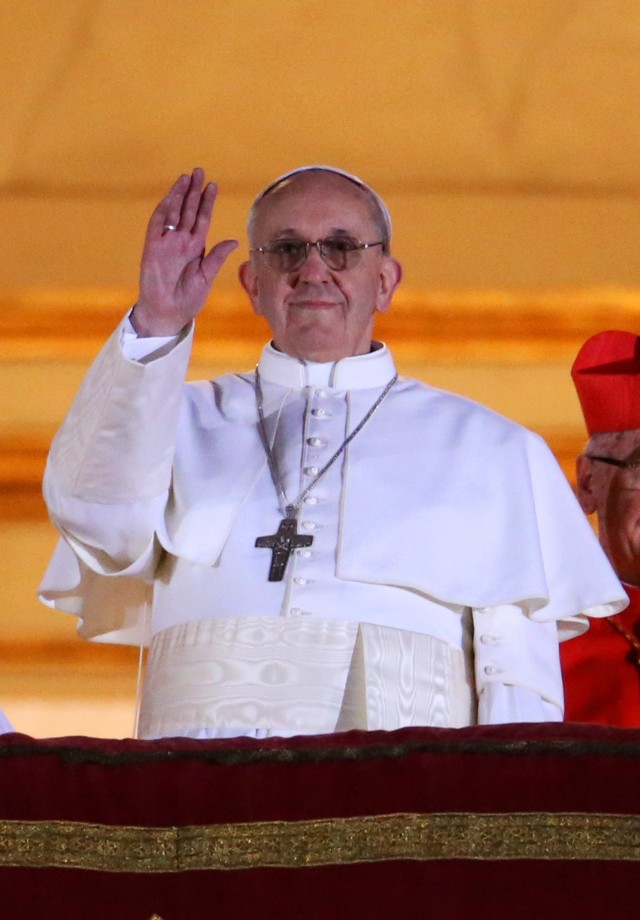
VATICAN CITY, VATICAN – MARCH 13: Newly elected Pope Francis I appears on the central balcony of St Peter’s Basilica on March 13, 2013 in Vatican City, Vatican. Argentinian Cardinal Jorge Mario Bergoglio was elected as the 266th Pontiff and will lead the world’s 1.2 billion Catholics. (Photo by Peter Macdiarmid/Getty Images)

Soft Truths, Vague Boundaries

By R.R.Reno

FIRST THINGS

April 2017

Amoris Laetitia, Pope Francis’s apostolic exhortation meant to restate Catholic teaching on marriage and family, has stirred up a controversy about divorce, remarriage, and the sacramental discipline of the Catholic Church. In a notoriously vague section, Francis gives the impression that those who divorce and remarry can, in some circumstances, receive the Eucharist. There have been official challenges. Four cardinals formulated five dubia, a formal way of requesting clarification. John Finnis and Germain Grisez wrote a detailed letter (published on our website) asking the Holy Father to condemn eight positions they argue can be supported by the ambiguities of the papal document. In recent months, bishops and episcopal conferences in different parts of the world have offered divergent, even incompatible interpretations. On the eve of the five-hundredth anniversary of the Reformation, is the Catholic Church entering a new season of schism?

I don’t anticipate a breakup, but the controversy is serious. At root, it is a referendum on John Paul II, or at least one aspect of his legacy. That long and fruitful pontificate reached its most countercultural point with the publication of Veritatis Splendor, the encyclical on moral theology. That document issued an unequivocal affirmation of moral truth as an objective reality. It surveyed a number of modern moral theories known as proportionalism or consequentialism, as well as arguments that the real subject matter of moral reflection should be the inner state of the individual rather than his outward behavior. These theories have important differences. But they’re united in their basic dynamic, which is to soften moral demands, making them more flexible and adaptable to difficult circumstances. Veritatis Splendor rejects them all.

This rigorous view of moral truth runs against our nonjudgmental, therapeutic age. But Veritatis Splendor was still more radical. John Paul II exulted in the moral rigorism of the Church’s perpetual teaching that some acts are intrinsically evil and should never be done. Drawing on the New Testament’s account of Jesus’s command to the rich young man—sell all your possessions and follow me—Veritatis Splendor champions the spiritual heroism that makes great sacrifices in order to obey truth’s unalterable demands. The modern secular world tends to flatten out existence by encouraging us to live in accord with the hearth gods of health, wealth, and pleasure. The Church’s unflinching commitment to moral truth beckons us to transcend that limited horizon. The Ten Commandments are not sad limitations. The unalterable “thou shalt not” stops us in our worldly tracks, shocking us out of our comfortable, wealth-sated complacency and calling us to higher things.

Veritatis Splendor made quite a stir when it was released in 1993. I was a young theology professor at a Jesuit university at the time. Most of my colleagues silently dissented. Over time, I came to see that the vast majority of moral theologians in Europe and North America rejected the encyclical. A few did so openly. Bernard Häring was among the most outspoken. He angrily denounced the encyclical as a naked assertion of papal power exercised to prop up Humanae Vitae, Paul VI’s encyclical prohibiting artificial means of birth control. Häring went on to condemn John Paul II’s moral rigorism. An inflexible notion of moral truth subjects ordinary Christians to severe burdens, and this imposition “is unlawful and possibly a great injustice.” Others took the more cautious route of arguing that John Paul II had mischaracterized the complex moral theories that allowed for exceptions, and therefore they remained legitimate ways of thinking. Most ignored the encyclical and continued to teach the moral theories John Paul II had condemned.

At the time I was not a Catholic. Nevertheless, I was somewhat taken aback by the scope of dissent. Many, perhaps most, Catholic theologians whom I knew did not want to believe that there are inflexible moral truths. In retrospect, however, that’s not surprising. The Catholic Church is a universal church. Its theological and pastoral culture, however, remains closely tied to Western culture. Over the last three generations, the West has become increasingly ambivalent about strong truths, seeing them as divisive and judgmental. The influential intellectual and cultural movements of recent decades have sought a view of truth that’s more fluid, open, and inclusive. This is obvious when it comes to sexual morality. But it’s evident in other areas as well. Many want a more flexible view of suicide, one that allows people to take their own lives if they face pain or despair. Divorce—the focus of controversy surrounding Amoris—should be treated as “tragic,” not wrong. In this issue, Christopher Caldwell reports on the softening, nonjudgmental language professionals now encourage, even require, when talking about drug addiction (“American Carnage”). At every turn, our dominant culture weakens strong truths.

The majority of Catholic theologians, priests, and bishops have gone along with this pattern of weakening. All the changes in the Church since Vatican II have been in the direction of relaxation and softening. We have sharp rhetoric about social justice, but the preferential option for the poor is an open-ended exhortation, not a precise moral demand like the condemnation of taking innocent life as an intrinsically evil act. But most of the energy in Catholic moral theology has gone into making arguments showing that what used to be prohibited can actually be licit. There have been exceptions, of course, such as the Dominican Servais Pinckaers, who wrote beautifully about the fullness of the Catholic vision of the moral life. But as a rule, the discipline of moral theology, when it’s not hectoring us for failing to be sufficiently progressive in our political judgments, has for many decades specialized in permission. This has been the Catholic Church’s way of bringing her moral teaching into conformity with the spirit of our age.

The ambiguities in Amoris Laetitia concerning divorce, remarriage, and the sacraments participate in the preferential option for permission. One can understand the impulse, given the cultural assumptions that currently reign. Are we to say out loud that a Catholic who has remarried without receiving an annulment is committing adultery when having sexual intercourse with his “wife”? Aren’t the scare quotes around “wife” an insult to adults who are trying their best to live good, decent lives? What church could survive such a countercultural legalism? So Pope Francis retreats to weasel words such as “accompaniment” and in his own way recapitulates the super-subtle scholasticism of the theorists of exceptions who came to prominence after Vatican II.

Closely related to this softening of moral truth has been a relaxation of church discipline. Before the modern era, the Catholic Church’s governance, structures, and self-understanding were intertwined with secular institutions. As Christendom dissolved and the modern nation-state began to claim a monopoly on legitimate authority, the Church worked to disentangle herself and establish a sacred polity distinct from worldly authorities. The culmination of this project was the 1917 Code of Canon Law, one of the great achievements of modern Catholicism. The code was superseded by the 1983 code, but the latter operates in the same spirit. It establishes a clear frontier between the Church and the world, and canonical discipline maintains that boundary.

With the trend toward flexible truths came ambivalence about boundaries. The Eucharist is the sacramental center and spiritual summit of Catholicism. Insofar as the Church is a set-apart, supernatural body, the Eucharist is naturally encircled by disciplines that protect its celebration from invasions by the profane, just as the Code of Canon Law firms up the boundaries between the Church and the world. Those disciplines were much relaxed after Vatican II. Liturgical ideologies of that era encouraged a more relaxed, casual approach to Eucharistic celebration. The physical boundary of the altar rail was often removed. Translations into the vernacular were deliberately demotic and banal. Music was written to make the experience more contemporary. The border between the sacred and profane was deliberately made uncertain and porous.

Pope Francis follows in this post–Vatican II tradition, which we’ve all experienced because it’s the dominant tradition of the past fifty years. The Church is a field hospital, a temporary, moveable structure like so much in our contemporary world. The hospital tent needs to have open flaps to bring in the wounded, and the spiritual physicians don’t have time to check credentials or worry about fine questions of canonical legitimacy. It’s not surprising, therefore, that Amoris is insouciant about the question of the integrity of the Eucharist and the need to maintain a steady discipline concerning its celebration and reception. When it comes to the Church, Pope Francis follows in the tradition of the majority of priests and bishops who went along with the removal of altar rails. He’s not a fan of clear boundaries.

John Paul II was an outlier. Though pope for more than two decades, he was a minority voice, at least in the West. Since Vatican II, most Catholic theologians—dogmatic, moral, and liturgical—have been on the side of the dominant secular culture, making things softer, weaker, and more porous. It’s foolish to invest too much time trying to parse chapter eight of Amoris. It’s a muddle—like most post–Vatican II Catholicism. That this document—and by implication, this pontificate—is not being swallowed happily by today’s Church suggests that some, perhaps more than we realize, do not want still more flexibility and permission.
Posted in Uncategorized | 1 Comment

Those ordained to act in the person of Jesus do well to teach the truth as he did and went on doing even when many of his disciples said they found his word too hard and drifted away.

unnamed-2

We invite readers’ attention to The Misuse of Amoris Laetitia To Support Errors against the Catholic Faith, a letter we have addressed “to the Supreme Pontiff Francis, to all bishops in communion with him, and to the rest of the Christian faithful.” The letter was dispatched for delivery to Pope Francis on November 21.

In this letter we request Pope Francis to condemn eight positions against the Catholic faith that are being supported, or likely will be, by the misuse of his Apostolic Exhortation Amoris Laetitia. We ask all bishops to join in this request and to issue their own condemnations of the erroneous positions we identify, while reaffirming the Catholic teachings these positions contradict.

The following considerations make it clear why appeals to Amoris Laetitia in support of these positions are correctly described as misuse of the Pope’s document.

When a bishop acts in persona Christi, fulfilling his duty to teach on matters of faith and morals by identifying propositions to which he calls upon the faithful to assent, he presumably means to state truths that belong to one and the same body of truths: primarily, those entrusted by Jesus to his Church and, secondarily, those necessary to preserve the primary truths as inviolable and/or to expound them with fidelity. Since truths like these cannot supersede or annul one another, papal or other episcopal statements made while teaching in persona Christi must be presumed to be consistent with one another when carefully interpreted. Thus it is a misuse of such a teaching statement to claim its support without having first sought so to interpret it.

Furthermore, if an apparent inconsistency emerges after careful interpretation, a teaching statement that is not definitive is misused unless it is understood with qualifications and delimitations sufficient to make it consistent with Scripture and teachings that definitively pertain to Tradition, each interpreted in the other’s light.

In our letter we deal only with the misuse of Amoris Laetitia to support positions held by theologians and pastors who are not teaching in persona Christ. We neither assert nor deny that Amoris Laetitia contains teachings needing qualification or delimitation, nor do we make any suggestions about how to do that, supposing it were necessary.

The letter explains how proponents of the eight positions we identify can find support in statements by or omissions from the Apostolic Exhortation, and indicates how these positions are or include errors against the Catholic faith. In each case we explain briefly how the position has emerged among Catholic theologians or pastors and show how certain statements or omissions from Amoris Laetitia are being used, or likely will be used, to support it. We then set out grounds for judging the position to be contrary to Catholic faith, that is, to Scripture and teachings that definitively pertain to Tradition, each interpreted in the other’s light.

The eight positions are these.

Position A: A priest administering the Sacrament of Reconciliation may sometimes absolve a penitent who lacks a purpose of amendment with respect to a sin in grave matter that either pertains to his or her ongoing form of life or is habitually repetitive.

Position B: Some of the faithful are too weak to keep God’s commandments; though resigned to committing ongoing and habitual sins in grave matter, they can live in grace.

Position C: No general moral rule is exceptionless. Even divine commandments forbidding specific kinds of actions are subject to exceptions in some situations.

Position D: While some of God’s commandments or precepts seem to require that one never choose an act of one of the kinds to which they refer, those commandments and precepts actually are rules that express ideals and identify goods that one should always serve and strive after as best one can, given one’s weaknesses and one’s complex, concrete situation, which may require one to choose an act at odds with the letter of the rule.

Position E: If one bears in mind one’s concrete situation and personal limitations, one’s conscience may at times discern that doing an act of a kind contrary even to a divine commandment will be doing one’s best to respond to God, which is all that he asks, and then one ought to choose to do that act but also be ready to conform fully to the divine commandment if and when one can do so.

Position F: Choosing to bring about one’s own, another’s, or others’ sexual arousal and/or satisfaction is morally acceptable provided only that (1) no adult has bodily contact with a child; (2) no participant’s body is contacted without his or her free and clear consent to both the mode and the extent of contact; (3) nothing done knowingly brings about or unduly risks significant physical harm, disease transmission, or unwanted pregnancy; and (4) no moral norm governing behavior in general is violated.

Position G: A consummated, sacramental marriage is indissoluble in the sense that spouses ought always to foster marital love and ought never to choose to dissolve their marriage. But by causes beyond the spouses’ control and/or by grave faults of at least one of them, their human relationship as a married couple sometimes deteriorates until it ceases to exist. When a couple’s marriage relationship no longer exists, their marriage has dissolved, and at least one of the parties may rightly obtain a divorce and remarry.

Position H: A Catholic need not believe that many human beings will end in hell.

Our letter concludes by indicating how theologians and pastors who teach and put into practice any of these eight positions can thereby do grave harm to many souls, and pointing to some ways in which this may happen. It also notes the grave damage these errors do to marriage and to young people who otherwise might have entered into authentic married life with good hearts and been signs of Christ’s covenantal love for his Church.

Many theologians and pastors who champion positions contrary to the faith suppose themselves to be dealing realistically with Catholics influenced by secularized culture who are breaking with the Church or drifting away. But their strategy sets aside the Church’s tradition and primary mission—to preach the Gospel everywhere and always, and to teach believers all that Jesus has commanded.

The experience of Christian ecclesial communities that have adopted similar strategies in the past two centuries strongly suggests that those which compromised their Christian identity in one generation held little interest for subsequent generations. Those ordained to act in the person of Jesus do well to teach the truth as he did and went on doing even when many of his disciples said they found his word too hard and drifted away.

John Finnis is emeritus professor of law and legal philosophy at the University of Oxford and Biolchini Family Professor of Law at the University of Notre Dame.

Germain Grisez is emeritus professor of Christian ethics at Mount St. Mary’s University.

Posted in Uncategorized | Comments Off on Those ordained to act in the person of Jesus do well to teach the truth as he did and went on doing even when many of his disciples said they found his word too hard and drifted away.

A THANK-YOU NOTE TO ALL PRIESTS

Jules-Alexis Muenier (1863-1942), “La Leçon de catéchisme”
.
.
Blogs  |  Mar. 10, 2017
A Thank-You Note to Our Priests
To all the priests who have answered God’s call, endured great sacrifice and given that extra measure to bring each of us closer to Christ: Thank you.

I know. I know.

The comments will come.

{for example} “This priest was reprehensible for committing an act of abuse, or that priest was shameful for an inexcusable act of omission.”

I know.

In this essay, I will not excuse evil that has been done by certain priests entrusted to do the greatest good. And I am sorry for any whose lives and faith have been deeply wounded by this gross negligence of God’s high call.

But this essay is about a different body of priests {emphasis by Abyssum}. It is about hundreds of thousands of men worldwide and throughout history who have faithfully done God’s work – often difficult, thankless, exhausting toil in the name of a God much greater than them.

Once upon a time I had a rather naïve sense of what a priest’s life was like. Prior to becoming Catholic, I perceived priests as bookish mice, the favorites of church ladies at potlucks, delicate and removed from the crushing concerns of daily life. Priests’ lives were clean and neat, moral and upright, vestments and protocol. Simple. But then I came across a particularly wise insight from G.K. Chesterton.

In his autobiography, Chesterton described a conversation with “two hearty and healthy Cambridge undergraduates” and Father O’Connor about the nature of the priesthood. As the cultured and refined Father O’Connor stepped away from the conversation, one of the young men condescended:

I don’t believe [Fr. O’Connor’s] sort of life is the right one. It’s all very well to like religious music and so on, when you’re all shut up in a cloister and don’t know anything about the real evil in the world. But I don’t believe that’s the right ideal. I believe in a fellow coming out into the world, and facing the evil that’s in it, and knowing something about the dangers and all that. It’s a very beautiful thing to be innocent and ignorant; but I think it’s a much finer thing not to be afraid of knowledge.

Chesterton recalled his immediate reaction to this laughable naiveté on the part of this haughty, bright young thing:

To me, still almost shivering with the appallingly practical facts of colossal and crushing irony, that I nearly burst into a loud harsh laugh in the drawing-room. For I knew perfectly well that, as regards all the solid Satanism which the priest knew and warred against with all his life, these two Cambridge gentlemen (luckily for them) knew about as much of real evil as two babies in the same perambulator.

For what Chesterton had seen in his dear and wise priest was no untouchable gilded lily, but rather a man gravely familiar with the evil that men do. And as I began to consider what Chesterton wrote, I started to see priests in a new, more accurate light.

I began to recognize that it is a priest who, late in the evening, patiently waits outside the hospital room while I finish caring for an ill patient. It is a priest trudging through the wicked winter snow to offer the Eucharist to a shut-in. It is a priest who shoots basketball with boys in the city’s heart to keep them out of the clutches of ever-present gangs. It is a priest counseling the addicted, comforting the forlorn and remembering the forgotten.

I began to truly see the pictures of the ash-covered priest carried dead from the North Tower on 9/11 after charging in to offer prayer and last rites. I read stories about Father Kapaun, the prisoner of war, administering sacraments and carrying the wounded for miles on a death march during the Korean War. And I marveled at the wretched death and stunning grace of Father Damien among the lepers and Father Kolbe among the death camp inmates.

Seven years ago, I came into the Catholic Church thanks, in part, to the gentle, but deeply wise Father Michael. I am further sustained by the energetic and educating Father Mike. Week in and week out, through their own brutal schedules, inclement weather and periods of illness these priests have buoyed me with consecrated bread and wine, absolved me of my many sins, and counseled me with insight and grace. They have been sure and faithful shepherds for my family and me. And I am deeply, deeply grateful.

I know, I know.

There have been some very bad priests out there.

But there have been infinitely more good ones {emphasis by Abyssum}.

To all the priests who have answered God’s call, endured great sacrifice and given that extra measure to bring each of us closer to Christ, this belated thank you note is for you.

Thank you.

Quite simply, thank you.

{Thank you, Ted Worner !!!   Abyssum}

http://www.ncregister.com/blog/tworner/a-thank-you-note-to-our-priests?utm_source=feedburner&utm_medium=feed&utm_campaign=Feed%3A+NCRegisterDailyBlog+National+Catholic+Register#When%3A2017-03-10+05%3A01%3A01

To all the priests who have answered God’s call, endured great sacrifice and given that extra measure to bring each of us closer to Chr…
Posted in Uncategorized | 1 Comment

THE UNDERLYING HIDEOUS REALITY OF HOMOSEXUALITIY HAS BEEN HIDDEN FROM MR. AND MRS. AMERICA

The Gay Mind graphic

Homo-Homophobia

CRISIS MAGAZINE

When the Supreme Court imposed phony marriage on the entire country, the LGBTs were left wondering what to do next, how to keep their issue boiling?

Some of them, chief among them radio host/activist Michelangelo Signorelli, accurately predicted that the conservative Christian response would be to protect religious freedom, that the Christians would beg to be left alone, not forced to participate in morally objectionable religious services.

Other homosexual power centers responded by pushing the transgender thing even though they had never really been interested before. A cursory look at the New York Times demonstrates that there were next to no stories at all about transgenders per se until 2015 in the run-up to Obergefell. Stories went from one or two to more than 1,000 almost overnight.

Both responses had more to do with fundraising and keeping their issue before the public after they had swept the table at the Supreme Court. After all, gay couples could easily find other bakers and other photographers to decorate and commemorate their “nuptials.”

The quite remarkable thing that has happened is they are now willing to talk openly about their way of life. The execrable but nonetheless mainstream gay publication Advocate published a story—by a doctor no less—teaching youngsters how to train their bodies for sodomy. It makes for truly gruesome reading.

He writes, “I often tell patients that great bottoms have been doing it for quite some time, with many first experiencing it in their youth. Unfortunately, no one showed us the right way to bottom in our high school sexual education class. Still, it’s never too late to learn, and we all enjoy new and positive sexual experiences. Here’s my 101 guide to bottoming…”

The publication also ran a piece on how gay men should have regular pap smears for their backsides. Now, these pieces will not be seen outside the homosexual bubble, but even more out in the open are two shocking and revealing pieces just published in the more mainstream Huffington Post.

Keep in mind, if they did not think they had already won everything, they would not be willing to reveal the nasty underside of their way of life.

Chad Felix Greene begins “What Happens When Men Have Sex with Teenage Boys” with this rather arresting opening: “I had sex with a man as a teenager for the first time when I was 14.” He says an older man approached him in a public library and essentially assaulted him. He liked it and kept going back for more. He writes the older man “guided me through the various sexual activities.”

Greene goes on to describe his riotously sexual and dangerous teen years: “at 15 standing outside, alone, in empty parking lots at 1 a.m. waiting for complete strangers to pick me up for sex in their cars.” By 16, he “had had dozens of sexual partners.” When he left high school he said he met more gay guys his own age and he was “shocked to discover nearly all of them had experienced the same thing.”

Greene is now 34 and says he cannot imagine doing the same to a teen boy that was done to him. Even so, what he describes is commonplace, something gays hitherto would be loathe to admit.

The other story published at the Huffington Post is called “Together Along: The Epidemic of Gay Loneliness” by Michael Hobbes. It is thousands of words long and can only be described as a cry of the heart about how awful is Gay World. Hobbes describes the trajectory that separates his gay and sexually normal friends; the sexually normal go off to relationships, marriage, happiness; the gays go off to lives of furtive drug fueled anonymous sex, heavy drinking, porn, and debilitating loneliness. Hobbes cites half a dozen studies demonstrating there is something terribly wrong in Gay World.

They are “between 2 and 10 times more likely than straight people to commit suicide … twice as likely to have a major depressive episode.” Three-quarters of “gay men who have recently arrived in New York City suffer from anxiety or depression, abused drugs or alcohol, or were having risky sex, or some combination of the three.”

Hobbes says, “gay men have fewer close friends than straight people or gay women” and the feeling of emptiness “is not just an American phenomenon. In the Netherlands, where gay marriage has been legal since 2001, gay men remain three times more likely to suffer from a mood disorder than straight men, and 10 times more likely to engage in ‘suicidal self harm’.” In Sweden, which has had civil unions since 1995 and full marriage since 2009, men married to men have triple the suicide rate of men married to women, Hobbes writes.

Hobbes mentions New York, Sweden and the Netherlands deliberately to make a point. Each are relative gay paradises so external “homophobia” cannot be a reason. Hobbes himself was “raised in a bright blue city by PFLAG parents. I’ve never known anyone who died of AIDS, I’ve never experienced direct discrimination and I came out of the closet into a work where marriage, a picket fence and a golden retriever were not just feasible but expected.” Then he says, “I’ve also been in and out of therapy more times than I’ve downloaded and deleted Grindr.” (Grindr is a particularly nasty gay website that allows men to hook up with other men right now wherever they are.)

Hobbes says part of the problem is internalized homophobia, what you might call “homo-homophobia,” but what they call “minority stress.” The theory of minority stress is that a member of a “marginalized” community may experience outright hostility or at the least require extra effort in all aspects of their lives, pressure that most of us cannot know. Maybe. Maybe not.

In their magisterial review of the literature on sexual orientation and gender identity, Drs. Lawrence Mayer and Paul McHugh write,

The social stress model probably accounts for some of the poor mental health outcomes experienced by sexual minorities, though the evidence supporting the model is limited, inconsistent and incomplete. Some of the central concepts of the model, such as stigmatization, are not easily operationalized. There is evidence linking some forms of mistreatment, stigmatization, and discrimination to some of the poor mental health outcomes experienced by non-heterosexuals, but it is far from clear that these factors account for all of the disparities between the heterosexual and non-heterosexual populations.

And not even Hobbes is fully convinced. He says the common gay life is inherently alienating, most especially with the rise of Grindr. But, even more than that, social interaction is vile. He describes coming out as homosexual and eagerly going to West Hollywood to be with his people and discovered “it was really horrifying. It’s made by gay adults, and it’s not welcoming for gay kids.” He says it’s like a jungle. Hobbes’s friend Paul says he felt just like a piece of meat. Moreover, rejection was everywhere and constant. “All of a sudden it’s not your gayness that gets you rejected. It’s your weight, or your income, or your race.”

Gay men in particular are just not very nice to each other, Hobbes reports.

Hobbes’s truly honest piece goes on and on and it is heartbreaking to read, particularly when you know that more and more teen boys have been lied to and are being lured into this noxious germ-ridden and psychologically debilitating stew.

But this is the reality of Gay World that most Americans do not know. It is the reality of Gay World that Homosexual Inc. was eager to hide and that traditional marriage leaders were quite happy to turn away from.

We are now busy defending the religious freedom not to be forced to participate in gay weddings. This is perhaps the most defensive position we could take, and therefore the weakest, and by the way, it is already largely lost. Why should we be able to refuse service to a homosexual wedding when they are just like us and it is legal?

Unless, they are not just like us. The underlying reality of Gay World is ugly and dangerous. Even they are admitting it now. But this is something Traditional Marriage Inc. has refused to consider.

One of our marriage leaders actually said he “honored” the relationships among his gay friends. Recall that super-lawyer Chuck Cooper was planning his lesbian daughter’s wedding at the same time he was badly defending traditional marriage in the California courts. Traditional marriage leaders have resolutely refused to engage Robert Reilly’s sodomy thesis in his Making Gay Okay: How Rationalizing Homosexual Behavior Is Changing Everything.

Some traditional marriage leaders say gay sex has nothing to do with defending marriage and we cannot work to overturn gay marriage unless and until we get our own house in order. They say we ruined marriage and gave homosexuals their opening. In fact, it was the leftist sexual revolutionaries who set out to destroy marriage.

The reality is that even after all the opprobrium heaped on the sacred institution of marriage, most people still want it, they hunger for it. According to Gallup 78 percent of those never married say they want to be married. And when married, people believe in faithfulness. Gallup reports only 10 percent think adultery is morally acceptable and this is up only 3 percent since 2001.

The fact is that the underlying hideous reality of homosexuality has been hidden from Mr. and Mrs. America. Would they be so open to it, if they knew the truth? Would young boys be lured to it if they knew the horrors that awaited them? We will only ever know if someone tells them. Who will that be?

Austin Ruse

By 

Austin Ruse is president of C-FAM (Center for Family & Human Rights), a New York and Washington DC-based research institute focusing on international legal and social policy. The views expressed here are not necessarily those of C-FAM.

Posted in Uncategorized | Comments Off on THE UNDERLYING HIDEOUS REALITY OF HOMOSEXUALITIY HAS BEEN HIDDEN FROM MR. AND MRS. AMERICA

HOW DO YOU LOOK AT GOD ???

47400b6822f5090564c584418c42951c

There is no doubt that political attitudes depend on how individuals look at God. But the analysis should go one step further: how these individuals on the ideological sides have attitudes regarding how they think that God (even if they do not believe in God but they possess this attitude concerning a rhetorical God) looks at them.

Many on the left think that God is (or would be if He existed) an authoritarian God and that He would treat humans as slaves with little inherent dignity or worth. As I wrote in the book that you endorsed (for which I am greatly thankful) “Fight the Left; it’s Gauche. It’s Sinister”, God – as understood by the most conservative religion, Catholicism – is not a slave driver: He gives us the greatest dignity in leaving us free to make the most important decision – that we each one of us has to make – on our own: to believe in Him and adore Him.. or not. Naturally, God does it on the basis of the logic of love: love cannot be commanded and God is the God of pure love.

Thus, Conservatives believe that we each of us possess an enormous worth and solid credentials for independent decision making, as well as the corollary of accepting responsibilities for poor decisions that we might make. But liberals do not believe that individuals can make decisions, good or bad, nor should they be seen as responsible for any decision. Individuals are weak. The state should make decisions for all.

Also individual human beings are so weak that they easily become victims. Leftists thus heartily believe in the need for strong governments and the logic of victimology beginning with the struggle for the very elusive goal of “equality”. So what appears to be a political reality and social dichotomy is rather a spiritual reality.

Conservatives’ best plan to succeed politically is to convert their leftist brothers and sisters to Catholicism (Luther was not so strong a believer in the power of individuals to resist sin and be responsible for it as he had a flawed understanding of grace – with God’s help through grace all is possible to individuals). Our work is cut out for us! God bless us all!

Jean-Francios  Orsini

Posted in Uncategorized | Comments Off on HOW DO YOU LOOK AT GOD ???

PHYSICIAN, HEAL THYSELF; WHILE YOU ARE IN PRISON


Trial begins for Fla. doctor tied to Sen. Bob Menendez corruption case

FBI agents carry out boxes as law enforcement officials investigate the medical-office complex of Dr. Salomon Melgen on January 30, 2013 in West Palm Beach, Florida

 JOE RAEDLE, GETTY IMAGES

WEST PALM BEACH, Fla. — A prominent Florida eye doctor tied to a U.S. senator’s alleged corruption built much of his fortune by defrauding Medicare and instilling false hopes in some patients, a federal prosecutor told a jury Thursday.

Salomon Melgen stole millions from Medicare between 2008 and 2013 by falsely diagnosing patients and by performing unnecessary tests and treatments, Assistant U.S. Attorney Carolyn Bell said during her opening statement for Melgen’s fraud trial. Melgen and Democratic New Jersey Sen. Bob Menendez face a separate trial in the fall in an alleged bribery case.

“This is a case about a doctor who lied to Medicare for money,” Bell told the 12-member panel. He lied about his patients’ diagnoses, she said. He lied about the tests he ran, she said. He lied about their prognoses, she said. All of it, she said, aimed at making Melgen rich, as many of these falsely diagnosed and treated patients could net him $72,000 each annually.

Medicare paid Melgen, 62, because it “relied on the integrity of the doctor,” she said, but the government’s investigation found that in many cases he “lied,” using that word or a variation about two dozen times during her address.

ap-86476818381.jpg

In this April 2, 2015, file photo, Dr. Salomon Melgen arrives at the Martin Luther King Jr. Federal Courthouse for his arraignment, in Newark, New Jersey

 AP

Matthew Menchel, Melgen’s attorney, countered during his opening that the government’s case is built upon viewing Melgen’s actions as criminal when they were actually aggressive medicine, legitimate differences of opinions between doctors and honest mistakes.

“There is an old saying that when you look at the world through a dirty window, everything looks dirty,” Menchel told the jury, saying that mindset gave prosecutors “a twisted interpretation” of the evidence. It led prosecutors, he said, to ignore facts that support Melgen’s innocence.

“They turned a blind eye to evidence they didn’t like,” he said.

Many charges relate to patients Melgen said had age-related macular degeneration, one of the leading causes of severe vision loss in people 65 and older. Most ARMD patients have the “dry” variety, which is caused by retinal cells breaking down and cannot be treated. Fewer have the “wet” variety, which involves bleeding beneath the retina. It can be treated by injections.

Prosecutors say the Dominican-born doctor falsely diagnosed many patients with ARMD so he could run unneeded tests. They say he also falsely claimed patients with dry ARMD had wet ARMD, giving them multiple injections that had no benefit.

Bell displayed photographs of several Melgen patients’ that she said he used without their knowledge to defraud Medicare. Patients, she said, whose prosthetic eye Melgen claimed on multiple occasions to have tested and treated. Patients, she said, who had untreatable dry ARMD but Melgen put them through useless, sometimes painful but always profitable tests and treatments. Patients, she said, who were told that if they kept visiting Melgen, they would get better when there was no hope that was true.

“This highly trained, Harvard and Yale educated specialist would falsely diagnose patients to justify injecting eyes that did not need it and lied to Medicare about it,” Bell said.

Menchel said other doctors who have looked at Melgen’s diagnoses and treatments don’t always agree with him, but understand what he was attempting. Other eye doctors sent Melgen their hardest, most desperate patients because they knew of his “cutting edge” treatments that sometimes worked, Menchel said. He said a totally blind person who regains even a flicker of peripheral vision would feel the treatment is worth it.

“Many of Dr. Melgen’s patients loved him, not just liked him, because he helped them,” Menchel said.

Menchel said Melgen never claimed to test or treat prosthetic eyes, saying those billings were mistakes made by his employees. When those mistakes were pointed out to him, Melgen reimbursed Medicare, Menchel said.

In the Menendez case, federal prosecutors in New Jersey say the Melgen and Menendez friendship devolved into corruption. For example, they say, Melgen took the senator on trips to France and to the doctor’s second home at a Dominican resort.

In return, they say, the senator got visas for the married Melgen’s foreign mistresses, interceded with Medicare officials when they began investigating Melgen’s practice and pressured the State Department to help Melgen with a business dispute he had with the Dominican government. Menendez has denied wrongdoing.

If convicted on the Medicare fraud counts, Melgen faces up to 610 years in prison. He is free on $18 million bond. The trial is expected to last about six weeks.

Posted in Uncategorized | Comments Off on PHYSICIAN, HEAL THYSELF; WHILE YOU ARE IN PRISON

IT IS PAST TIME FOR FRANCIS TO RESIGN, HE HAS ALREADY DONE HARM THAT WILL TAKE A LONG TIME TO REMEDY


The plot against the Pope

It is no secret in Rome that several cardinals want Francis to step down

THE SPECTATOR

11 March 2017

9:00 AM

On the first Saturday in February, the people of Rome awoke to find the city covered in peculiar posters depicting a scowling Pope Francis. Underneath were written the words:

Ah, Francis, you have intervened in Congregations, removed priests, decapitated the Order of Malta and the Franciscans of the Immaculate, ignored Cardinals… but where is your mercy?

The reference to mercy was a jibe that any Catholic could understand. Francis had just concluded his ‘Year of Mercy’, during which the church was instructed to reach out to sinners in a spirit of radical forgiveness. But it was also a year in which the Argentinian pontiff continued his policy of squashing his critics with theatrical contempt.

Before the Year of Mercy, he had removed (or ‘decapitated’) the leaders of the Franciscans of the Immaculate, apparently for their traditionalist sympathies. During it, he froze out senior churchmen who questioned his plans to allow divorced-and-remarried Catholics to receive Holy Communion. As the year finished, the papal axe fell on the Grand Master of the Knights of Malta, Fra’ Matthew Festing, who during an internal row over the alleged distribution of condoms by its charitable arm had robustly asserted the crusader order’s 800-year sovereignty. Francis seized control of the knights. They are sovereign no longer.


Damian Thompson and Dan Hitchens discuss the plot against Pope Francis:


So the sarcasm of asking the Pope about his ‘mercy’ is pretty obvious. But Italians noticed something else. ‘A France’… ma n’do sta la tua misericordia?’ is local dialect — the Romanesco slang in which citizens taunted corrupt or tyrannical popes before the fall of the Papal States in 1870.

Although the stunt made headlines around the world, it is unlikely to have unnerved the Pope. There is a touch of the Peronist street-fighter about Jorge Bergoglio. As his fellow Argentinian Jesuits know only too well, he is relaxed about making enemies so long as he is confident that he has the upper hand. The posters convey impotent rage: they are unlikely to carry the fingerprints of senior churchmen.

In any case, it is not anonymous mockery that should worry the Pope: it is the public silence of cardinals and bishops who, in the early days of his pontificate, missed no opportunity to cheer him on.

The silence is ominous because it comes amid suspicion that influential cardinals are plotting against Francis — motivated not by partisan malice, but by fear that the integrity and authority of the papacy is at stake.

Antonio Socci, a leading conservative Vatican-watcher, says that cardinals once loyal to Francis are so concerned about a schism that they are planning to appeal to him to step down. He predicts that the rebellion will be led by about a dozen moderate cardinals who work in the curia.

Their favoured candidate is understood to be Cardinal Pietro Parolin, a veteran diplomat who serves as the Pope’s secretary of state, a post that combines the duties of prime minister and foreign secretary. Parolin is unusually powerful because the Pope indulges him. Power has drained from other Vatican departments towards the secretariat of state. It is Parolin who is pushing the church towards an accommodation with Beijing that, critics say, would betray faithful Chinese Catholics; it was also Parolin who moved against the leadership of the Order of Malta, which had sacked one of his well-connected friends.

The argument for replacing Francis with Parolin rests on the latter’s administrative skills: unlike the current Pope, he is not given to wildly impulsive decisions which he then reverses without bothering to tell anyone.

But even if a group of cardinals are determined to elevate Parolin, what chance do they have of succeeding? It’s true that when Pope Benedict resigned, he created an extraordinary precedent: that popes can choose to stand down. But to nudge an unwilling pope over the edge would be a tall order, even by the standards of today’s Vatican skulduggery.

If, however, we remove the fanciful speculation, we are left with a real story. It is no secret in Rome that certain cardinals who voted for Francis are now worried that he is leading the church towards schism, and that he must therefore be stopped. There are many more than a dozen of them and, though they may not yet be ready to act upon their concerns, they would like this pontificate to end sooner rather than later.

The stakes are so high because the discontent is not fundamentally about personality: it arises from an argument about the central tenets of the faith.

In the end, it all boils down to the question of giving communion to people who are either divorced and remarried or married to a divorced person.

Non-Catholics, and indeed many Catholics, find it hard to understand why this is such a big deal. Put simply, the Catholic church is the only worldwide Christian denomination that takes literally the parts of the Bible (Luke 16:8, Mark 10:11, Matthew 19:9) where Jesus says that divorced and remarried people are committing adultery. This isn’t to say that church authorities haven’t hypocritically (or compassionately) bent the rules down the centuries — but the teaching has remained unchanged.

Until now, anyway. In April last year, Pope Francis released Amoris Laetitia, (‘The Joy of Love’), a 200-page document in response to a synod of the world’s bishops that had rejected any change to the teaching that Catholics in irregular marriages should not receive communion.

To cut a long story short, Francis appeared to go along with the synod’s wishes. But a footnote in Amoris Laetitia hinted (and it was just a hint) that couples, in consultation with a priest, could decide for themselves whether to receive the sacrament.

A few progressive cardinals and bishops — most significantly in Germany, where Catholicism looks an awful lot like liberal Protestantism — seized on this footnote and declared that divorced-and-remarried couples could have communion if their consciences were clear.

Whereupon countless cardinals, bishops, priests and canon lawyers said, no they can’t. But Francis, without going on the record, let it be known that yes they can — in his opinion, anyway. And he’s the Pope. So please would bishops everywhere start falling into line and support a more liberal stance on communion for the remarried, even though he has never formally articulated it?

A split like this over the meaning of marriage threatens to do to the Catholic church what the issue of homosexuality has done to the Anglican communion: creating rifts between liberals and conservatives and dividing the church in the West against the church in the developing world.

To a great many in Rome, it looks as if the Pope is single-handedly ripping apart church teaching — in defiance of his own hierarchy. ‘It’s utterly bizarre. He’s actually been ringing round asking for support on this,’ says a priest in the Vatican. Like an American president lobbying senators? ‘Exactly. But he’s not getting the answers he wanted. Instead, there’s this silence that has not greeted any other papal exhortation I can think of.’

Why the silence? The answer is that the Pope has put cardinals and bishops in an impossible situation.

Consider the case of England and Wales. Cardinal Vincent Nichols, president of the bishops’ conference, could not issue a set of German-style ‘anything goes on divorce’ guidelines even if he wanted to (and no one knows what the inscrutable Nichols really wants, except perhaps to be Pope himself).

The conservative Bishop Philip Egan of Portsmouth has already said that there will be no change of pastoral practice in his diocese, full stop. Nichols couldn’t even sell relaxed guidelines to his own Westminster diocese: at least one of his bishops would rebel.

This dilemma is being replicated all over the world. Two thirds of diocesan bishops either believe that the Pope is monkeying with the fundamentals of Christian doctrine or, taking a more lenient view, think his misguided compassion has created pastoral chaos. And the chaos will persist for as long as this man is Pope.

Which is why — despite various efforts to cast Francis in the role of ‘great reformer’ squaring up to satin-clad dinosaurs — moderate cardinals are ready for a new pope who can kick this wretched issue into the long grass.

But how can this be achieved? The moderates aren’t keen to join forces with anti-Francis conservatives, who are already, as those posters showed, taking resistance to extraordinary lengths.

At the end of this month, the University of Paris-Sud is hosting a conference on ‘the canonical problem of the deposition of heretical popes’. The organisers are not openly suggesting that Francis falls into this category, but others may draw their own conclusions. Two of the professors giving papers have asked the Pope to rule against ‘heretical’ misunderstandings of Amoris Laetitia — which he refuses to do. So some of the theoretical discussions of deposing popes may be rather pointed.

But can Francis really be forced out of office by canon law? Moderate cardinals wouldn’t countenance it even if it were possible. That leaves what Socci calls ‘moral suasion’, otherwise known as arm-twisting. Several cardinals believe that this is what happened to Benedict XVI, though the pope emeritus insists that the decision to resign was his alone. Benedict, a theologian, grew to hate being pope. Francis, by contrast, loves it so much that he hasn’t taken a holiday since walking on to the balcony of St Peter’s. That doesn’t mean that no one will try to persuade Francis to step down, but God help them when they do.

This leaves the Catholic church in deadlock. To quote one Vatican employee, ‘Liberal or conservative, what most cardinals want is release from the endless fatigue created by Francis.’

The plotting will go on, of course: some clerical politicians can’t stop themselves. So will the papal lobbying, but it is unlikely to bear fruit. And the longer the deadlock lasts, the angrier and more outspoken Francis will become. Which leaves the Vatican in the worst possible situation: a plot against the Pope that is an open secret, but which has little chance of success.

The word ‘Catholic’ means universal — yet now local tension between the liberal and conservative strands of the faith is intensifying, and is being made worse by the Pope himself. Many priests have absolutely no intention of giving communion to couples in irregular marriages. So the couples are left wondering who is right: their priest or their Pope? The conditions for a schism are there, for those with an eye to see them.

Subscribe to The Spectator today for a quality of argument not found in any other publication. Get more Spectator for less – just £12 for 12 issues.


Posted in Uncategorized | Comments Off on IT IS PAST TIME FOR FRANCIS TO RESIGN, HE HAS ALREADY DONE HARM THAT WILL TAKE A LONG TIME TO REMEDY

IT IS SUICIDAL TO BE SO POLITICALLY CORRECT THAT YOU CONVINCE YOURSELF AND OTHERS THAT ISLAM IS A RELIGION OF PEACE


 In this Tuesday, Jan. 6, 2015 file photo, Coptic Christians walk outside St. Markos Church in Minya, south of Cairo, Egypt. A Muslim mob ransacked and torched seven Christian homes in a province south of the Egyptian capital, Cairo, after rumors spread that a Christian man had an affair with a Muslim woman, according to a statement by the local Orthodox Coptic church. Released late Wednesday, it said that during the May 20, 2016 attack, the mother of the Christian man, who had fled the village, was publicly stripped of her clothes by the mob to humiliate her.

A Muslim mob ransacked and torched seven Christian homes in a province south of the Egyptian capital, Cairo, after rumors spread that a Christian man had an affair with a Muslim woman, according to a statement by the local Orthodox Coptic church.  ROGER ANIS/AP

Stop Playing “Let’s Pretend” about Islam

It’s disappointing that Lt. General William Mc Master, President Trump’s new National Security Advisor, has said that the Islamic State is “un-Islamic.” He also insists that organizations like ISIS “cynically use a perverted interpretation of religion to incite hatred and justify horrific cruelty against innocents.” In short, the General seems to think that terrorism has nothing to do with Islam.

This kind of thinking prevailed under the Obama administration. And during those eight years, the Islamic threat grew by leaps and bounds. It would be a shame if a key person in the new national security team perpetuated such simplistic views of Islamic terrorism.

Many Church leaders have views not much different. For the last four years, we’ve been treated to a litany of ecclesiastical pronouncements that there is a solid wall of separation between Islam and violence.

Some people seem actually to believe this counter-factual nonsense. Others probably see it as a good strategy – a way to strengthen “moderate Islam.” The strategists are fond of saying that criticism of Islam itself will drive the moderates into the radical camp. From this point of view, the only way to promote positive change in Islam is to praise it, and hope that a self-fulfilling prophecy is set in motion.

But it’s not a good strategy. In fact, it gives the upper hand to the radicals. Here’s why. If everyone from national security advisors to the pope says that Islam fine as is, then there is no incentive to change. If there’s no problem with Islam – only with extreme splinter (“un-Islamic”) groups, you undercut Muslim reformers. It’s difficult enough being a moderate Muslim; it’s downright dangerous to be a Muslim reformer. Why should the reformers stick their necks out if they get no reinforcement from prominent non-Muslims? And why should other Muslims listen to them if everything is fine the way it is? This strategy turns Muslims away from the moderates and reformers and towards the imams.

We assume that mosques, Islamic schools, and imams will have a moderating effect on Muslims, but the truth is otherwise. Five separate studies (four in the U.S. and one in Canada) revealed that about 80 percent of mosques promote extremist views. The majority can hardly be considered moderate. In fact, Dr. Zuhdi Jasser relates that when the Muslim Reform Movement sent a mailing to over 3,000 American mosques seeking support, they received only forty responses, and of those only nine were positive. You’ve probably seen Dr. Jasser on television. He’s the embodiment of moderation and reasonableness. Yet most Muslim leaders will have nothing to do with him. Apparently, they see no need for reform.

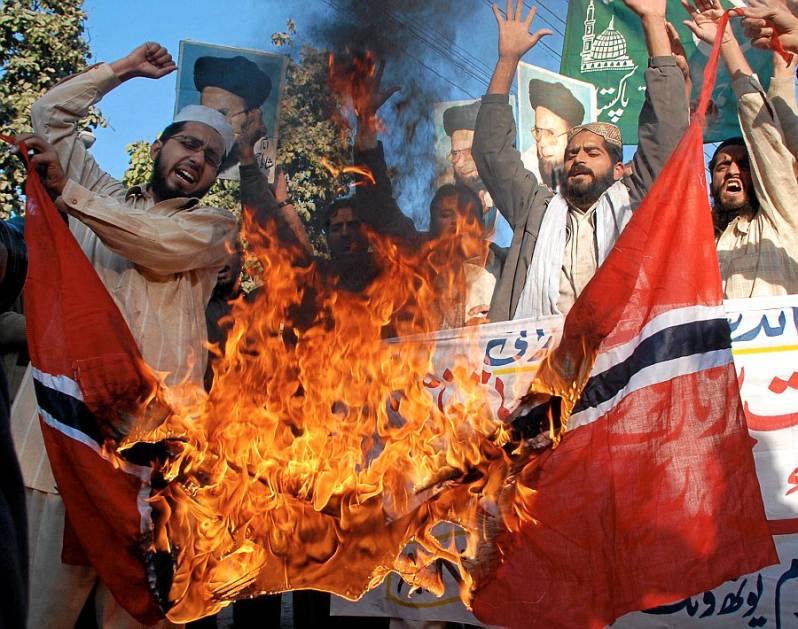
Muslim immigrants in Norway

In other countries, of course, mosques are often centers of recruitment and radicalization – sometimes even weapons depots. When a terrorist attack occurs on Muslim soil, authorities often respond by raiding and closing mosques. Even “enlightened” Western countries have adopted a policy of “cherchez la mosquée.” After terrorist attacks, both France and Germany have conducted numerous raids on mosques.

So when Catholic leaders draw a moral equivalence between Christianity and Islam – as they often do – they are encouraging Muslims to find meaning in a faith that finds meaning in jihad. Pope Francis once told a group of immigrants that they could find direction in their holy books – Christians in the Bible, and Muslims in the Koran. But such advice only pushes Muslims deeper into the fundamentalism that the pope thinks is embraced only by a few.

By Western definition of “fundamentalist,” Islam is a fundamentalist religion. Most Muslims take the Koran literally, and their imams tell them that’s how they must understand it.

If we are really interested in seeing Islam turn in a moderate direction, we need to criticize, not cosset it. After all, there is something wrong with Islam. And as ex-Muslim Nonie Darwish writes, “The West is not doing Muslims. . .a favor by constantly treating them as children who should be shielded from reality.”

The reality is that there is something wrong with Islam’s harsh blasphemy laws, apostasy laws, and treatment of women, children, and minorities – among many other serious problems, including the call to jihad.

So it’s time to stop playing “let’s pretend.” Muslim nations won’t clean up these problems unless non-Muslim nations and Church leaders put pressure on them. When Saudi Arabia officially abolished slavery in 1962, it was only because of intense Western pressure.

Why? Because, as a number of observers have remarked, Muslim societies are not given to introspection. Raphael Patai, author of The Arab Mind, suggests that the Islamic belief in fate or pre-destination leads to a “disinclination to undertake efforts to change or improve things.”

When Western leaders give Muslims the message that their religion deserves much respect, it may be good for Muslim self-esteem (and make Westerners feel tolerant), but it doesn’t prompt people to realize that something is wrong. Instead, we should be telling Muslims, as diplomatically as possible, that many aspects of their faith are deeply disturbing. And that until they do something about it, we will have to consider various stern measures such as breaking off dialogue (on the part of the Church), or initiating withdrawal of aid, sanctions, and divestments (on the part of governments and businesses.)

At the very least, we should close our doors to immigration from the most troubled Islamic states. Some people caution that such a ban will increase Muslim hatred for the West. It may have that effect on some Muslims. But strong and decisive action may also give many Muslims second thoughts about Islam.

The spoiled child only learns to question himself when others will no longer play with him. After 9/11, many Americans asked, “Why do they hate us?” In other words, “What did we do wrong?” It’s about time that the Muslim world starts asking that question of itself. But it will never ask it unless the West dispenses with its “I’m OK, you’re OK” policies towards Islam.

William Kilpatrick

William Kilpatrick

William Kilpatrick is the author of Christianity, Islam and Atheism: The Struggle for the Soul of the West, and a new book, The Politically Incorrect Guide to Jihad. For more on his work and writings, visit his website, The Turning Point Project

Posted in Uncategorized | Comments Off on IT IS SUICIDAL TO BE SO POLITICALLY CORRECT THAT YOU CONVINCE YOURSELF AND OTHERS THAT ISLAM IS A RELIGION OF PEACE

A CALL FOR THE RESTORATION OF THE ROMAN RITE, A RETURN TO FORM

41cab-4-aaa_9598

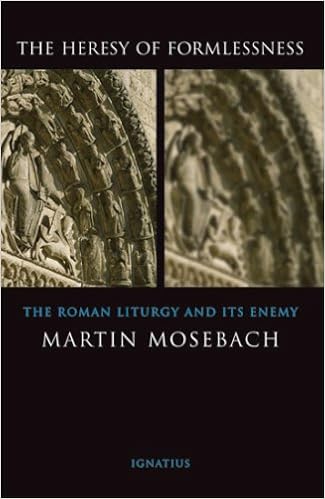
BRILLIANT by Mosebach: RETURN TO FORM – A CALL FOR THE RESTORATION OF THE ROMAN RITE


I have often lauded the important book by Martin Mosebach The Heresy of Formlessness.  I warmly recommend it.  US HERE – UK HERE  As a matter of fact, it was first on my suggestions for Lenten reading.  HERE

First Things has published a piece by Mosebach from last December 2016.  Let’s have a look with my now legendary emphases and comments:

RETURN TO FORM: A CALL FOR THE RESTORATION OF THE ROMAN RITE

The times in which a new form is born are extremely rare in the history of mankind. Great forms are characterized by their ability to outlive the age in which they emerge and to pursue their path through all history’s hiatuses and upheavals. The Greek column with its Doric, Ionic, and Corinthian capitals is such a form, as is the Greek tragedy with its invention of dialogue that still lives on in the silliest soap opera. The Greeks regarded tradition itself as a precious object; it was tradition that created legitimacy. Among the Greeks, tradition stood under collective protection. The violation of tradition was called tyrannis—tyranny is the act of violence that damages a traditional form that has been handed down.

One form that has effortlessly overleaped the constraints of the ages is the Holy Mass of the Roman Church, the parts of which grew organically over centuries and were finally united at the Council of Trent in the sixteenth century. It was then that the missal of the Roman pope, which since late antiquity had never succumbed to heretical attack, was prescribed for universal use by Catholic Christendom throughout the West. If one considers the course of human history, it is nothing short of remarkable that the Roman Rite has survived the most violent catastrophes unaltered.

[…]

Hereafter he gives a good summary of what happened to our liturgical worship after the Council and then what Pope Benedict tried to do, both before his election and after with Summorum Pontificum.

Then he really drills in.  The effect is electric.

Note how he talks about what I have hammered on for YEARS. The importance of LAY PEOPLE!

[…]

The great liturgical crisis following the Second Vatican Council, which was part of a larger crisis of faith and authority, put an end to the illusion that the laity need not be involved.

The now decades-old movement for the restoration of the Roman Rite has been to a considerable extent a lay movement. The position of priests who support the Roman Rite was and will be strengthened by Summorum Pontificum, and hopefully the cause of the Tridentine Mass will receive further support from the eagerly awaited reconciliation of the Society of St. Pius X with the Holy See. Yet this does not change the fact that it will be the laity who will be decisive in bringing about the success of efforts to reform the reform. The laity of today differs from the laity of forty years ago. They had precise knowledge of the Roman Rite and took its loss bitterly and contested it. The young people who are turning to the Roman Rite today often did not know it as children. They are not, as Pope Francis erroneously presumes, nostalgically longing for a lost time. [Do I hear an “Amen!”?] On the contrary, they are experiencing the Roman Rite as something new. [Yes, this is a great irony, a great tragedy, and a great gift.  First, it is ironic that something so old, should be so new… even as Augustine describes the transcendental beauty of God.  It is sad that so many for so long have been cheated of a patrimony which could have formed and supported them.  It is such a gift to have the treasury they slammed in our faces opened again.  Not only, we get to have it back but without the sloppiness or the negligence it may have had in some places.  Its loss purified and strengthened it, in a sense. In the words of Joni Mitchell: “Don’t it always seem to go / That you don’t know what you’ve got til its gone / They paved paradise / And put up a parking lot”.  Well, now we can recover the paradise.] It opens an entire world to them, the exploration of which promises to be inexhaustibly fascinating. It is true that those who discover the Roman Rite today and relish its formal exactness and rigorous orthodoxy are naturally an elite group, yet not in a social sense. [NOTA BENE] Theirs is a higher mystical receptivity and an aesthetic sensitivity to the difference between truth and falsehood. As Johan Huizinga, author of The Waning of the Middle Ages, [US HERE Kindle $1.20!  UK HERE] established nearly a century ago, there exists a close connection between orthodoxy and an appreciation of style.  [Ain’t it the truth!]

The vast majority of the faithful have in the meantime never known anything else but the revised Mass in its countless manifestations. They have lost any sense of the spiritual wealth of the Church and in many cases simply are not capable of following the old rite. [Their “receptivity” has been twisted.  In many of the various talks I give I talk about being “actively receptive”.  This is the key to participation.]They should not be criticized on account of this. The Tridentine Mass demands a lifetime of education,  [Okay… but so does the whole “Catholic Thing”.  As I convert I know how long it takes to get that Thing down into the marrow.  But that doesn’t mean that it cannot be undertaken swiftly and well.] and the post-conciliar age is characterized, among other things, by the widespread abandonment of religious instruction. The Catholic religion with its high number of believers has actually become the most unknown religion in the world, especially to its own adherents. [I often listen to or read what some Catholics say and wonder if they belong to the same Church or religion that I do.] While there are many Catholics who feel repelled and offended by the superficiality of the new rite as it is frequently celebrated today, by the odious music, the puritanical kitsch, the trivialization of dogma, and the profane character of new church buildings, the gap that has opened up in the forty years between the traditional rite and the new Mass is very deep, often unbridgeable. [Yes… it can be very hard.  Some are simply unwilling to walk the bridge.] The challenge becomes more difficult because one of the peculiarities of the old rite is that it makes itself accessible only slowly—unless the uninitiated newcomer to this ancient pattern of worship is a religious genius. [I think this over states the situation just a bit.]One has never “learned everything there is to learn” about the Roman Rite, because in its very origin and essence this enduring and truly extraordinary form is hermetic, presupposing arcane discipline and rigorous initiation.  [One who is not familiar with the traditional forms might get the impression from what Mosebach says that it is fruitless even to try.  I sharply disagree.  Mosebach gives a sober assessment.  Don’t let his sobriety and serious tone be taken for insuperable pessimism.]

If the Tridentine Mass is to prosper, the ground must be prepared for a new generation to receive such an initiation. [Amen.] Pope Benedict disappointed many advocates of the old liturgy because he did not do more for them. He refused the urgent requests to celebrate the Latin Mass at least once as pope, something he had occasionally done while a cardinal. But this refusal stems from the fact that he believed—no matter how welcome such a celebration would have been—that the reinstitution of the old rite, like all significant movements in the history of the Church, must come from below, not as a result of a papal decree from above. In the meantime, the post-conciliar work of destruction has wounded multitudes of the faithful. Unless a change of mind and a desire for a return to the sacred begin to sprout in countless individual hearts, administrative actions by Rome, however well-intentioned and sound, can affect little.  [Right.  And it could be that the only way this will come about is through greater “creative destruction” in the Church.  It could be that something like the debridement of a festering wound inflicted through confusion and infidelity will take place.  Then the wound will heal and life can go on and thrive again.]

Summorum Pontificum makes priests and the laity responsible for the Roman Rite’s future—if it means a lot to them. [As I have asked time and again… what are you willing to do?  If you want this you have to work and sacrifice!] It is up to them to celebrate it in as many places as possible, to win over for it as many people as possible, and to disseminate the arcane knowledge concerning its sacred mysteries. The odium of disobedience and defiance against the Holy See has been spared them by Pope Benedict’s promulgation, and they are making use of the right granted them by the Church’s highest legislator, but this right only has substance if it is claimed and used. The law is there. No Catholic can, as was possible not long ago, contend that fostering the Roman Rite runs counter to the will of the Church.  [This is what I and others are doing with the Tridentine Mass Society of the Diocese of Madison!  This is why we are having vestments made, why I am constantly after you for donations, why we are having Pontifical Masses, why are are ratcheting up our Sunday celebrations with more Solemn Masses when possible.  And we have big plans.  HELP]

Perhaps it is even good that, despite Summorum Pontificum, the Tridentine Mass is still not promoted by the great majority of bishops. If it is a true treasure without which the Church would not be itself, then it will not be won until it has been fought for. [OORAH!] Its loss was a spiritual catastrophe for the Church and had disastrous consequences far beyond the liturgy, and that loss can only be overcome by a widespread spiritual renewal. [One of my constant phrases is “We are our Rites!”… and … “Change how people pray and you change what they believe.”  The iconoclasts of the Consilium were drunk on the idea that they were not just changing rites, they were changing doctrine.  Bugnini’s secretary, later papal MC Piero Marini wrote in the smoking gun book A Challenging Reform: “They met in public to begin one of the greatest liturgical reforms in the history of the Western church.  Unlike the reform after Trent, it was all the greater because it also dealt with doctrine.”  (p. 46).] It is not necessarily a bad thing that members of the hierarchy, in open disobedience to Summorum Pontificum, continue to put obstacles in the way of champions of the Roman Rite. As we learn in the lives of the saints and the orders they founded, the established authorities typically persecute with extreme mistrust new movements and attempt to suppress them. [I learned recently that the Congregation for Religious may be about to give the FFI treatment to many more new foundations.] This is one of the constants of church history, and it characterizes every unusual spiritual effort, indeed, every true reform, [because it’s the Devil that is really driving it] for true reform consists of putting on the bridle, of returning to a stricter order. This is the trial by fire that all reformers worthy of their name had to endure. The Roman Rite will be won back in hundreds of small chapels, in improvised circumstances throughout the whole world, celebrated by young priests with congregations that have many small children, or it will not be won back at all.

Recapturing the fullness of the Church’s liturgy is now a matter for the young. Those who experienced the abolition and uncanonical proscription of the old rite in the late 1960s were formed by the liturgical praxis of the 1950s and the decades prior. It may sound surprising, but this praxis was not the best in many countries. The revolution that was to disfigure the Mass cast a long shadow ahead of itself. In many cases, the liturgical practice was such that people no longer believed in the mystagogical power of the rite. In many countries, the liturgical architecture of the rite was obscured or even dismantled. There were silent Masses during which a prayer leader incessantly recited prayers in the vernacular that were not always translations of the Latin prayers, and in a number of places Gregorian chant played a subordinate role. [NB] Those who are twenty or thirty today have no bad habits of these sorts. They can experience the rite in its new purity, free of the incrustations of the more recent past.  [This is a real gift.  Make use of it!  As I have written elsewhere, you have been given the beautiful new bicycle and patted on the head: now, take off the training wheels and RIDE THE DAMN BIKE!]

The great damage caused by the liturgical revolution after Vatican II consists above all in the way in which the Church lost the conviction with which all Catholics—illiterate goatherds, maids and laborers, Descartes and Pascal—naturally took part in the Church’s sacred worship. Up until then, the rite was among the riches of the poor, who, through it, entered into a world that was otherwise closed to them. They experienced in the old Mass the life to come as well as life in the present, an experience of which only artists and mystics are otherwise capable. [Once back in Italy, where I was handling the preparation of sacred music for the Mass in which Card. Ratzinger would take possession of his cardinatial see, a lib priest accused me of “elitism”, because “simple people” couldn’t understand the music.  That attitude fills me with rage at its condescension.  “So, beauty is only for the wealthy?”, I shot back at the truly elitist jerk. Then we had a fight, which I won.  The music for the Mass was glorious and the Cardinal was well pleased.] This loss of shared transcendence[YES!] available to the most humble cannot be repaired for generations, and this great loss is what makes the ill-considered reform of the Mass so reprehensible. It is a moral outrage that those who gutted the Roman Rite because of their presumption and delusion were permitted to rob a future generation of their full Catholic inheritance. [“AMEN!”] Yet it is now at least possible for individuals and for small groups to gradually win back a modicum of un-self-conscious familiarity with even the most arcane prayers of the Church. Today, children can grow into the rite and thus attain a new, more advanced level of spiritual participation.

The movement for the old rite, far from indicating aesthetic self-satisfaction, has, in truth, an apostolic character. [It truly is the cutting edge and most important tool of the New Evanglization.  Christ is the Perfect Communicator.  The most potent form of Social Communication which Holy Church has is SACRED LITURGICAL WORSHIP, in which Christ is the true Actor, the true Communicator communicating Himself in ever gesture and word and vestment and vessel, even brick of the church and carved pew and lovely bound book and stained-glass window.] It has been observed that the Roman Rite has an especially strong effect on converts, [Count me in.] indeed, that it has even brought about a considerable number of conversions. Its deep rootedness in history and its alignment with the end of the world create a sacred time antithetical to the present, a present that, with its acquisitive preoccupations, leaves many people unsatisfied. Above all, the old rite runs counter to the faith in progress that has long gone hand in hand with an economic mentality that is now curdling into anxiety regarding the future and even a certain pessimism. This contradiction with the spirit of our present age should not be lamented. It betokens, rather, a general awakening from a two-hundred-year-old delusion. Christians always knew that the world fell because of original sin and that, as far as the course of history is concerned, it offers no reason at all for optimism. The Catholic religion is, in the words of T. S. Eliot, a “philosophy of disillusionment” that does not suppress hope, but rather teaches us not to direct our hope toward something that the world cannot give. The liturgy of Rome and, naturally, Greek Orthodoxy’s Divine Liturgy of St. John Chrysostom open a window that draws our gaze from time into eternity.

Reform is a return to form. The movement that seeks to restore the form of the Latin Rite is still an avant-garde, attracting young people who find modern society suffocating. But it can only be a truly Christian avant-garde if it does not forget those it leads into battle; it must not forget the multitude who will someday have to find their way back into the abundant richness of the Catholic religion, once the generations who, in the wake of the Second Vatican Council, sought the salvation of the Church in its secularization have sunk into their graves.

I’ll tell you something.  That left me pretty revved up.

¡Hagan lío!

Posted in Uncategorized | Comments Off on A CALL FOR THE RESTORATION OF THE ROMAN RITE, A RETURN TO FORM

MERCY FOR THE PEDOPHILE; SCORN FOR THE VICTIM

O'Malley

Settimo Cielodi Sandro Magister 

09 mar 17

Sexual Abuse. The Excessive Mercy of the Pope, Sole Judge and Jury


*

The resignation from the pontifical commission for the protection of minors by Marie Collins, an Irish woman who at the age of 13 was herself the victim of sexual abuse by a priest, has caught the media off guard, resulting in haphazard coverage and highly divergent judgments.

There are those who have blamed everything, in the wake of some statements by Collins herself, on the “shameful” resistance of the Roman curia against the commission’s proposals and against Pope Francis, who set it up.

There are those who have focused their fire on the congregation for the doctrine of the faith and on its prefect, Cardinal Gerhard L. Müller, as the main culprits behind the mess.

But there are also those – like the ultra-Bergoglian Alberto Melloni – who have deflected back onto Collins and onto a few reckless proposals of the commission, inevitably rejected by the curia, the blame of deliberately getting Pope Francis into trouble.

In reality, right from the start there was one voice above suspicion that called for more prudent judgments: that of the esteemed German Jesuit Hans Zollner, president of the Centre for Child Protection of the Pontifical Gregorian University, the architect of the commission and a supporter of Collins, who in his view is today too “impatient” concerning a “cultural change” that necessarily requires time and effort, not so much in the curia as in the Church worldwide.

Even Cardinal Müller has had his say, explaining why it was not possible to accept some of the proposals of the commission, in particular the one to set up within the congregation for the doctrine of the faith, already equipped with a supreme tribunal for cases of pedophilia involving ecclesiastics, a special extra tribunal for bishops implicated in such cases.

*

But there is one point that has essentially met with silence. And it is the criticism that Marie Collins has leveled against Pope Francis himself.

The most pointed criticism dates back to two years ago.

When on January 10, 2015 Francis promoted to the diocese of Osorno, Chile the bishop Juan de la Cruz Barros Madrid, Collins and other members of the commission protested strenuously.

The new bishop, in fact, was under substantiated accusations from three victims of sexual abuse, who charged him with having shielded the priest Fernando Karadima, for many years a celebrity of the Chilean Church but in the end condemned to “prayer and penance” by the Holy See for his countless verified misdeeds.

The new bishop’s installation in his diocese was heavily contested. But on March 31 the Vatican congregation for bishops stated that it had “attentively studied the prelate’s candidacy and had not found objective reasons that would block his appointment.”

So in April, Collins and other members of the commission for the protection of minors went to Rome to ask the president of the commission, Cardinal Sean Patrick O’Malley (in the photo), to urge the pope to revoke the appointment.

But they got the opposite result. One month later, in May, Pope Francis responded to questions from a former spokesman of the Chilean episcopal conference he met in Saint Peter’s Square. And he went after the bishop’s accusers, in his most indignant words ever.

The video of the encounter was made public afterward. And these are the pope’s actual words:

“It is a Church [that of Osorno] that has lost its freedom because it has let its head be filled up by the politicians, judging a bishop without any proof after twenty years of service. So think with your heads, and don’t let yourselves be led by the nose by all those leftists who are the ones who drummed up the business.

“Furthermore, the only accusation that there has been against this bishop has been discredited by the judicial court. So please, eh? Don’t lose your serenity. Yes, [the diocese of] Osorno is suffering, because it is stupid, because it is not opening its heart to what God is saying and is letting itself get carried away by the stupidities that all those people are saying. I am the first to judge and punish those who have been accused of such things. . . But in this case there is a lack of proof, or rather, on the contrary. . . I say it from the heart. Don’t let yourselves be led by the nose by these people who are seeking only to make ‘lío,’ confusion, who seek to calumniate. . . .”

The “leftists” – “zurdos” in Argentine slang – who had particularly irritated the pope included the 51 Chilean deputies, for the most part of the socialist party of president Michelle Bachelet, who had signed a petition against the appointment of Barros as bishop of Osorno.

So then, when the video with Francis’s words were made public, Marie Collins said she was “discouraged and saddened when you see the claims of Karadima’s courageous victims categorized in this way” by the pope.

That of the bishop of Osorno is not the only case in which Jorge Mario Bergoglio has commandeered judgment for himself, nullifying or sidestepping canonical procedures.

In Italy there has been an uproar over the act of “mercy” with which he has graced Fr. Mauro Inzoli, a prominent priest of the movement Communion and Liberation, reduced to the lay state in 2012 by the congregation for the doctrine of the faith for having abused numerous young people, but restored to the active priesthood by Francis in 2014, with the admonishment that he lead a life of penance and prayer. In the civil arena, Inzoli has been sentenced to 4 years and 9 months in prison.

Marie Collins also protested against such indulgences: “While mercy is important, justice for all parties is equally important. If there is seen to be any weakness about proper penalties, then it might well send the wrong message to those who would abuse.”

(English translation by Matthew Sherry, Ballwin, Missouri, U.S.A.)

Posted in Uncategorized | Comments Off on MERCY FOR THE PEDOPHILE; SCORN FOR THE VICTIM