The Holy Father Francis, grants to each and every member of the Society of Apostolic Life “Fraternity of Saint Peter”, founded on July 18, 1988 and declared of “Pontifical Right” by the Holy See, the faculty to celebrate the sacrifice of the Mass, and to carry out the sacraments and other sacred rites, as well as to fulfill the Divine Office, according to the typical editions of the liturgical books, namely the Missal, the Ritual, the Pontifical and the Roman Breviary, in force in the year 1962.
They may use this faculty in their own churches or oratories; otherwise it may only be used with the consent of the Ordinary of the place, except for the celebration of private Masses.
Without prejudice to what has been said above, the Holy Father suggests that, as far as possible, the provisions of the motu proprio Traditionis Custodes be taken into account as well.
Given in Rome, near St. Peter’s, on February 11, the Feast of Our Lady of Lourdes, in the year 2022, the ninth year of my Pontificate.
Francis
Posted inUncategorized|Comments Off on PROGRESS, OF SORTS
Speaking at a press conference at the Lord Elgin Hotel in downtown Ottawa on Feb. 19, retired Canadian military officer Tom Marazzo said many truckers feel that the best course of action for them and their families is to withdraw in order to avoid further harm.
“As a movement, we have chosen to peacefully withdraw from the streets of Ottawa. There is nothing to be gained by being brutalized by police,” Marazzo said…
… “It’s a dark day in our history,” Marazzo said. “Never in life would I believe anyone if they told me that our prime minister would refuse dialogue and choose violence against peaceful protesters.”
Note from Scott: I received a link to this short but powerful call-to-action video from my Canadian friend Kevin Abrams late last night and it had just over 100K views. At 5am this morning it had 210K. I urge everyone receiving this email to view the video and blast it to your own lists, and to any individual Canadians you know. I further encourage you to read this article from December 12, 2014 warning Why Canada Will Become a Dictatorship Under Trudeau. I further invite you to join me in prayer for the Canadian freedom fighters. The sudden surprising and peaceful uprising of the famously laid back Canadian people, many of them openly citing their Christian faith as their motive, looks to me like the beginning of a righteous revolution that could end the global tyranny of the elites. I will do everything I can to support it. [Scott Lively’s Mission Dispatch, February 21, 2022, Observations and Action on Current Events, History and Theology…
Pray an Our Father now for reparation for the sins committed because of Francis’s Amoris Laetitia.
Pray an Our Father now for the restoration of the Church as well as the Triumph of the Kingdom of the Sacred Heart and the Immaculate Heart of Mary.
Stop for a moment of silence, ask Jesus Christ what He wants you to do now and next. In this silence remember God, Father, Son and Holy Ghost – Three Divine Persons yet One God, has an ordered universe where you can know truth and falsehood as well as never forget that He wants you to have eternal happiness with Him as his son or daughter by grace. Make this a practice. By doing this you are doing more good than reading anything here or anywhere else on the Internet.
Francis Notes:
– Doctor of the Church St. Francis de Sales totally confirmed beyond any doubt the possibility of a heretical pope and what must be done by the Church in such a situation:
“[T]he Pope… WHEN he is EXPLICITLY a heretic, he falls ipso facto from his dignity and out of the Church, and the Church MUST either deprive him, or, as some say, declare him deprived, of his Apostolic See.” (The Catholic Controversy, by St. Francis de Sales, Pages 305-306)
– If Francis betrays Benedict XVI & the”Roman Rite Communities” like he betrayed the Chinese Catholics we must respond like St. Athanasius, the Saintly English Bishop Robert Grosseteste & “Eminent Canonists and Theologians” by “Resist[ing]” him: https://www.thecatholicmonitor.com/2021/12/if-francis-betrays-benedict-xvi.html
– LifeSiteNews, “Confusion explodes as Pope Francis throws magisterial weight behind communion for adulterers,” December 4, 2017:
The AAS guidelines explicitly allows “sexually active adulterous couples facing ‘complex circumstances’ to ‘access the sacraments of Reconciliation and the Eucharist.'”
– On February 2018, in Rorate Caeli, Catholic theologian Dr. John Lamont:
“The AAS statement… establishes that Pope Francis in Amoris Laetitia has affirmed propositions that are heretical in the strict sense.”
– On December 2, 2017, Bishop Rene Gracida:
“Francis’ heterodoxy is now official. He has published his letter to the Argentina bishops in Acta Apostlica Series making those letters magisterial documents.”
Pray an Our Father now for the restoration of the Church by the bishops by the grace of God.
What is needed right now to save America from those who would destroy our God given rights is to pray at home or in church and if called to even go to outdoor prayer rallies in every town and city across the United States for God to pour out His grace on our country to save us from those who would use a Reichstag Fire-like incident to destroy our civil liberties. [Is the DC Capitol Incident Comparable to the Nazi Reichstag Fire Incident where the German People Lost their Civil Liberties?: http://catholicmonitor.blogspot.com/2021/01/is-dc-capital-incident-comparable-to.html?m=1 and Epoch Times Show Crossroads on Capitol Incident: “Anitfa ‘Agent Provocateurs‘”: http://catholicmonitor.blogspot.com/2021/01/epoch-times-show-crossroads-on-capital.html?m=1]
Pray an Our Father now for the grace to know God’s Will and to do it.
Posted inUncategorized|Comments Off on CANADA, O Canada, GOD HELP YOU AND SUSTAIN YOU IN YOUR HOUR OF SUFFERING CUBAN STYLE OPPRESSION
The Fertile Ground of Obedienceby charliej373Jesus went down with them and came to Nazareth, and was obedient to themBy Charlie JohnstonToday (Monday, Feb. 16) is the day the Canadian Parliament will decide whether Canada will try to reclaim some vestige of liberty from newly-minted tyrant Justin Trudeau (formerly just a doofus) or join him in open warfare against the Canadian people. Today the Parliament must decide whether to revoke his assumption of extraordinary emergency powers or confirm them.Over the weekend, many Canadian police went full Gestapo on the peaceful protesters. A government minister suggested they find out which Canadians had ever spoken admiringly of Donald Trump so the government could seize their bank accounts, too. Already, some multi-national companies are quietly making plans to get their money out of Canadian banks altogether. Frankly, ordinary Canadians of all stripes should do the same, particularly those near the border who could easily move their cash to American regional banks. Even if the Parliament lifts the emergency order, I don’t know how well the Canadian banking system can weather the revelation that, in Canada, ALL money in banks is the government’s money, to be seized from account holders at the prime minister’s whim and for holding the “wrong” political views. I say regional banks because the big boys in American banking have shown that, even if they can’t just seize your money for the wrong political views, they are eager to “partner” with leftist governments to surveil you.While astute commentator Derek Hunter thinks the Canadian people will fold, I think the repeated provocations and brutality of Trudeau’s minions may very well spark a genuine revolution on our northern border if the government does not back down instead of doubling down. Thanks be to God, the brave Canadian truckers have sparked grass-roots imitators around the globe, including here in America. The authoritarian globalist project, which would make all citizens of every nation into subjects of a small but incredibly arrogant and ignorant ruling class, is going down. We owe a debt of gratitude to those truckers. O Canada, indeed!*********I’ve got two talks this week; in Columbia, Maryland on Wednesday and then in Manassas, Virginia on Saturday. For information or to sign up, go to the CORAC website and click on the meeting you would like to attend.*********Obedience to legitimate authority in its lawful powers is a virtue. Politically, in America, government is theoretically by the consent of the governed and protects legitimate protests and demonstrations. It has been a long time since this has been practically true, but the fact is that, in America, publicly elected officials are servants of the public and have a duty to obey the public’s collective will, except in areas that would constrain the natural rights which each citizen has been endowed with from birth by almighty God. Each citizen has the duty to obey the laws enacted by public consent while retaining the right to protest or work for the change of those they think are wrong at election. The servants in this system have been getting right haughty of late – and have even assigned their duties to a host of bureaucrats who have been elected to nothing, who issue decrees with arbitrary imperialism that have no relation to the consent of the governed.In this climate, political dissent in the form of protest, demonstration, and even civil disobedience has become a duty, even an obligation, for people who are free and sovereign. But the questions must always be asked: who has legitimate authority, how is it legitimately expressed, and what are the actual constraints on that authority in order that organized dissent does not degenerate into chaos and anarchy.A week and a half ago, CORAC had a banner weekend. Many of our members near the Canadian border were busy supporting the Canadian truckers, while many of our members near Scottsdale, Arizona, were busy participating in the “You Shall Not Pass” demonstration headed by Jesse Romero against the satanist convention being held in that city that weekend.It was a very successful demonstration in which a lot of friendships and connections were made for future endeavors.Before the event, several members of CORAC had noted that Phoenix Bishop Thomas Olmsted had asked that Catholics in his Diocese (which includes Scottsdale) refrain from public demonstration, lest it give even more attention to the satanists. Instead, he asked, that Catholics spend extra time in adoration and in private prayer groups. I was in communication with both the local and the national teams on the question – and I told them that since the Bishop had asked, rather than ordered, it was a matter for each one’s individual conscience. I have come to believe that I was mistaken, despite the fruits that arose from the physical demonstration.Bishop Olmsted is one of the best Bishops in the country, if your matrix is consistent orthodox defense of Scripture and the Magisterium. He is a Bishop to be admired and emulated.There is not a real question of obedience in this matter as it is, indeed, a case in which each person can make a prudential judgment. In fact, Romero, who organized the physical demonstration against the satanists, met with Bishop Olmsted for 90 minutes to discuss what he had planned. The Bishop confirmed that, while it was not what he preferred, it was within the prudential judgment of each Catholic. In Crisis Magazine, Romero discussed the conversation he and Bishop Olmsted had and the statement the Bishop approved for his website:“It was the classic example of people coming together united in creed, united in faith, and discussing like grown men and nobody lording over each other, nobody saying… There was no clericalism, is what I’m saying like, “I’m a bishop, shut your mouth. Here’s what’s going to happen, and that’s it. Get out of here. You and your wife get out of here.” There was none of that stuff.This Bishop is such a genuine human being, such a holy man. I’ve always known that he was holy, but this meeting took my love for him to a higher level. He allowed me to speak, Eric, uninterrupted for 30 minutes. He goes, “I want to hear from you, Jess, and your wife Anita.” And so we did. We basically laid out our case.After the meeting, well right after I spoke, he agreed. “You’re right, Jess. This is a prudential decision. I, as a bishop, or no other bishop can tell you how to act upon this issue. You have to make that decision for yourself.”Let me read to you what he’s allowed me to post on my social media channels. We came up with a statement. He says, “Go ahead and let people know the synopsis of our meeting.” It’s on the website azriseupfaithful.com page two. And here’s what he’s allowed me to put out, him and father John Nahrgang. I’ll read it.“I, Jesse Romero, a faithful son of the Church am in communication with the Diocese of Phoenix. I met with his Excellency Bishop Olmsted and Father John Nahrgang, Vicar for Evangelization and Education. It was clarified at our meeting and agreed upon that assembling for prayer in front of the Saguaro Hotel on February in 11th, 12th, 13th falls under the definition of a prudential judgment.“A Prudential judgment is an evaluation of a situation where we use the virtue of prudence in order to determine the best approach to resolving the issue at hand. When faithful Catholics disagree on a matter of Prudential judgment, the key difference is over the particular application of a moral principle, not the moral principle itself. The moral principle in play here is confronting evil, and we all agree on its importance.“Now, Bishop Olmsted has invited the faithful to apply this principle in this way.” He put out this letter called A call for the Faithful to Unite in Spiritual Warfare before our meeting. So, he’s allowed me to put this out on social media he’s. So, with the Bishop permission and Father John, I continue.“Catholics may discern with the help of God in examining their conscience whether they’re also at peace with gathering in front of the hotel to pray in reparation for the evil being done and for the conversion of the participants. We can all agree that we must all unite in prayer. Let every person listen to God speaking through his or her own conscience and not look down on anyone else for their decision.”So, that was what he’s allowed me to put out in public. I share this with you and your audience. Again, I’m impressed with the way he treated me and my wife with such dignity and such respect.”There is, however, the question of deference. When I appoint a department head or committee head, anyone with responsibility in a particular area, it is my habit to defer to them in how they carry out their duties. Similarly, if a person has taken responsibility for something outside of my scope, I generally defer to them, even when they do it in a manner different than I would, so long as it is geared towards the greater goal. I well know it is all tougher than it looks, so I always give people of good will who have accepted responsibility a lot of latitude. If I do that in mere secular situations, how much more should I do it in spiritual situations?I have long said that we should obey our Bishops – even those waging war against Scripture and the Magisterium – in their legitimate authority. (That is not as tough as it sounds: most Bishops who are at war with Scripture and the Magisterium don’t make a lot of pronouncements from their legitimate authority. They make a lot of political statements, on which they have no authority, or they try to undermine clear Scriptural authority – and they lack authority to countermand Jesus Christ).In the case of a Bishop who has been steadfast in his defense of the faith, I think our duty in honor is even greater. Though we may honorably disagree on the means to approach a matter that is within each of our prudential territory, I think we ought to live solidarity with the Bishop in deference to his wishes, particularly when he has been such a profound witness to Christ as has been Bishop Olmsted.As I pondered how I had handled this situation, I got a note from a Catholic man I much respect, who has substantial experience with solid deliverance ministries. He wrote:“I think it’s great that people are resisting the Satanic convention with prayer. However, out of fraternal concern for those planning to ignore Bishop Olmsted, I want to share my experience with deliverance ministry. That experience is that demons will use any instance of disobedience – their specialty (non serviam) – to gain a foothold in the souls of the disobedient. In one case, a demon told an exorcist that he didn’t have to listen to him because he didn’t have the permission of the local bishop to perform exorcisms. The priest was a few miles outside of his home diocese. So, I’m concerned for the spiritual wellbeing of those who are not listening to the bishop and going to protest the convention in person. Certainly, Jesus is infinitely more powerful than Satan, but he also was obedient even to the point of death.”This brought to mind one of my favorite passages of Scripture, Luke 2:51-52. When Jesus is returning from the Temple after getting separated from Mary and Joseph:“And he went down with them and came to Nazareth, and was obedient to them; and his mother kept all these things in her heart. And Jesus increased in wisdom and stature, and in favor with God and man.”Think of that: God, Himself, was obedient to people He had created in order that all righteousness be fulfilled.One of the key tenets of CORAC as I initially envisioned it is that we are not called to overthrow legitimate authority; rather, we are called to work for the restoration and fortification of legitimate authority. Whenever I have privately corrected a Priest, I have made great pains to go to confession with him within the week. I figure if I pointedly ask that he obey the legitimate authority of Scripture and the Magisterium, I should demonstrate my willing obedience to his legitimate authority.I am very glad for the stand our people took. We did do an online Rosary for three days – which was in full accord with the Bishop’s wishes. But in the future I will ask that we completely defer to the wishes of the local Bishop in such matters, particularly when he is such a steadfast defender of the faith as Bishop Olmsted. Our aim, after all, is not to blow the house up, but to rebuild and fortify it.
Guarding the Flock: A Canon Lawyer’s Advice to Bishops on Latest Vatican Crackdown on Tradition
Written by Diane Montagna | Vatican Journalist
The Church Militant
New York canonist Father Gerald Murray has said that a recent Vatican document on applying Traditionis Custodesgoes beyond what is canonically possible in restricting the celebration of most of the traditional sacraments and that bishops are free to dispense with its disciplinary provisions if they judge them to be unfavorable to their flock.
In an interview with The Remnant, Father Murray discusses in detail the canonical questions surrounding the Responsa ad dubia issued on December 18, 2021 by Archbishop Arthur Roche, Prefect of the Congregation for Divine Worship and the Discipline of the Sacraments (CDW), and approved one month prior by Pope Francis.
Although he contends the Responsa is “an instruction having the force of law,” he also firmly maintains that a bishop is able to apply or not apply its disciplinary instructions for the “spiritual welfare” of his flock.
He further argues that a bishop need not ask the CDW for a dispensation to allow the celebration of the traditional Latin Mass (TLM) in parish churches, and he questions the canonical regularity of the requirement found in the Responsa that bishops must seek authorization from the CDW to grant permission to a newly ordained priest to offer Mass using the 1962 Missal. The latter, he said, also represents an “unwarranted interference” in the bishop’s role of moderating the liturgical life in his diocese.
Father Murray, co-author (with this journalist) of the forthcoming book “Calming the Storm: Navigating the Crises facing the Catholic Church and Society” (Emmaus Road Publishing, 2022), also discusses how the Responsa impacts Ecclesia Dei institutes, the “anomaly” it creates of SSPX priests enjoying papal authorizations denied to canonically regular priests, and questions over the entire legitimacy of Traditionis Custodes.
Bishops, he said, need to make known their concerns about this document to the Holy See.
Here is the full interview with Fr. Gerald Murray.
Bishops should make known to the Holy See that they are disturbed and upset about the harsh measures being taken against their faithful who attend the TLM.
Diane Montagna (DM): Fr. Murray, canonically speaking what sort of document is the Responsa ad dubia (e.g., instruction, law, decree, or administrative act)? As such, what legal force does it have, and is it subject to the Church’s law?
Fr. Murray (FM): The Apostolic Constitution Pastor Bonus regulates the activities of the various Congregations of the Roman Curia. Article 15 states that “questions are to be dealt with according to law…yet with pastoral means and judgments, attentive to justice and the good of the Church and especially to the salvation of souls.” Article 18 states: “Decisions of major importance are to be submitted for the approbation of the Supreme Pontiff…” It further states that a congregation “cannot issue laws or general decrees having the force of law or derogate from the prescriptions of current universal law, unless in individual cases and with the specific approbation of the Supreme Pontiff.”
The Responsa expresses a will to hasten what Pope Francis wrote in his Letter accompanying TC, namely that he wants the bishops to cooperate with him in doing away over time with the celebration of the Traditional Latin Mass (TLM).
The Responsa ad dubia (Responsa), which is addressed to the Presidents of Bishops Conferences, is not in the form of a law or a general decree but rather seems to fall into the category of an instruction according to canon 34 of the Code of Canon Law. Yet this title is not given to the document by the Congregation for Divine Worship (CDW). Instructions “set out the provisions of a law [in this case, Traditionis custodes (TC)] and develop the manner in which it is to be put into effect” and “are given for the benefit of those whose duty it is to execute the law, and they bind them in executing the law” (canon 34 §1).
The Prefect of the CDW, Archbishop Arthur Roche, in his letter presenting the Responsa, states that the CDW received “several requests for clarification on [the]correct application” of TC. He obviously considered that the CDW’s answers to these requests would constitute a “decision of major importance” needing papal approbation. He states that Pope Francis was informed of the Responsa and that he assented to their publication. I thus conclude that the Responsa is an instruction having the force of law, binding the bishops of the Church to carry out the provisions of TC according to what the Responsa state, always, of course, in accordance with the general law of the Church which retains its force and guides us in the proper understanding and application of the Responsa.
The various determinations in the Responsa, which is neither a law nor a decree, are “decisions of major importance” that have been published at the direction of the Pope, and thus bind all bishops, not simply those who submitted one or more dubia. I also conclude that the “assent” given by Pope Francis to the publication of the Responsa is the legal equivalent of a papal “specific approbation” of a law or decree, thus giving this instruction the force of law. Thus, the provisions of the Responsa are binding upon the bishops and others who have canonical responsibility for seeing that the laws of the Church are observed, always keeping in mind the general law of the Church regarding the bishop’s power to dispense in disciplinary matters which retains its force unless specifically set aside by the Pope.
The diocesan bishop already has the power to dispense from this prohibition according to canon 87 §1. There is no need to seek from CDW what he already enjoys by virtue of the general law of the Church.
DM: You mention the Pope’s assent. In his introduction to the Responsa, Archbishop Roche writes that Pope Francis,“in the course of an audience granted to the Prefect of this Congregation on 18 November 2021, was informed of and gave his consent to the publication of these Responsa ad dubia with attached Explanatory Notes.” Can you say more about what sort of approval this is, canonically speaking? And does such approval render it an act of the legislator or of the dicastery?
FM: The papal “assent” makes this document an act of the pope, the supreme legislator, thus making it not subject to canonical recourse, meaning you cannot lodge a canonical complaint against the Responsa with the CDW. Canon 333 §3 states: “There is neither appeal nor recourse against a judgement or a decree of the Roman Pontiff.” The Responsa is neither a judgement nor a decree, but I think it falls within the scope of this canon by an analogy of law, meaning that as an instruction specifically approved by the pope the Responsa enjoys the same immunity to canonical recourse as does a decree.
DM: On several points, which we’ll look at more in detail later, the Responsa seems to go beyond or against Traditionis Custodes. You have said that, in your view, this document seems to fall under the category of an instruction. Can such a document legitimately go beyond the document it is intended to clarify?
FM: Given that the Responsa were published with papal “assent” they express the mind and intention of the pope concerning the meaning and application of TC. It is clear that various provisions in the Responsa go beyond the provisions of TC and regulate matters not raised in TC. This manner of answering doubts about the meaning of TC by issuing new binding legal provisions would be beyond the competence of the CDW, and thus subject to canonical recourse, if the document had been published without the “specific approbation” of the pope. The papal “assent” given to the Responsa constitutes the necessary “specific approbation” of these new provisions, making this document an act of papal legislating. This instruction enjoying specific papal approbation can establish new canonical norms regarding the provisions of TC because that approbation makes it an act of the supreme legislator who manifestly intends that such new norms enjoy legal force in the Church. But as an instruction, any new norms can only be legally binding about those matters specifically treated in TC. An instruction about a document cannot go beyond what that document itself establishes.
DM: Can an instruction issued by the prefect of a Vatican dicastery restrict or override the prerogatives of bishops and priests established in the Code of Canon Law or the Second Vatican Council, e.g., a bishop’s power to dispense from the law (canon 87 §1)?
FM: The provisions of canon 87 §1 that permit the diocesan bishop, for reasons of “spiritual welfare,” to dispense from disciplinary “universal laws and those particular laws made by the supreme ecclesiastical authority for his territory or his subjects” remain in place, unless the pope specifically reserves such dispensation to himself or to some other authority. No such reservation is stated in TC nor in the Responsa.
I would argue that since TC makes no provision withdrawing the permission found in article 9 §1 of SP for the celebration of the sacraments of Baptism, Confirmation, Penance, Marriage, and the Anointing of the Sick, that permission is still canonically in effect following the promulgation of TC.
DM: The Responsa ad dubia was published five months after Traditionis Custodes. Within this timeframe, although a few bishops used TC to crack down on the traditional liturgy in their dioceses, many more bishops responded with a “wait and see” policy. The general reaction of bishops is consonant with reports that, in response to a 2020 survey of bishops by the Congregation for the Doctrine of the Faith (CDF), the majority favored continuing forward with a careful and prudent application of Summorum Pontificum. To many, the Responsa seems focused on corralling the bishops into a determined outcome regarding the traditional Latin Mass. What is your view?
FM: The Responsa expresses a will to hasten what Pope Francis wrote in his Letter accompanying TC, namely that he wants the bishops to cooperate with him in doing away over time with the celebration of the Traditional Latin Mass (TLM). He instructed them: “It is up to you to proceed in such a way as to return to a unitary form of celebration and to determine case by case the reality of the groups which celebrate with this Missale Romanum. Indications about how to proceed in your dioceses are chiefly dictated by two principles: on the one hand, to provide for the good of those who are rooted in the previous form of celebration and need to return in due time to the Roman Rite promulgated by Saints Paul VI and John Paul II, and, on the other hand, to discontinue the erection of new personal parishes tied more to the desire and wishes of individual priests than to the real need of the ‘holy People of God’.’” Pope Francis concluded his Letter with another appeal to unify all Latin Rite Catholics in the celebration of the Novus Ordo Mass: “Upon you I invoke the Spirit of the risen Lord, that he may make you strong and firm in your service to the People of God entrusted to you by the Lord, so that your care and vigilance express communion even in the unity of one, single Rite, in which is preserved the great richness of the Roman liturgical tradition.”
DM: Considering the nature and extent of the canonical duties of a bishop, may a bishop disregard this document, especially whenever he finds it goes against or is more restrictive than the law contained in Traditionis Custodes?
FM: Bishops may not disregard the Responsa as they are obliged to obey the Supreme Pontiff when he issues canonical norms to govern the activity of the Universal Church. This obedience is carried out according to the Code of Canon Law and other universal laws that regulate the exercise of papal and episcopal authority. The dispensing powers granted in canon 87 may be used as judged appropriate by a bishop in his diocese. Such a decision is not a form of disobedience of TC or the Responsa, but rather a pastorally justified exercise of a bishop’s legitimate authority for the “spiritual welfare” of the faithful of his diocese.
The Responsa offers authoritative instructions about provisions that are not found in the document it is clarifying, and in doing so goes beyond what is canonically possible.
DM: Archbishop Roche justifies several of his responses (e.g., 1, 2, 5) by invoking TC art. 7, which states: “The Congregation for Divine Worship and the Discipline of the Sacraments and the Congregation for Institutes of Consecrated Life and Societies of Apostolic Life, for matters of their particular competence, exercise the authority of the Holy See with respect to the observance of these provisions.” How is this authority limited?
FM: Canon 87 §1 grants power to diocesan bishops to dispense from disciplinary laws when he judges this to be advisable for the “spiritual welfare” of his flock. The general law of the Church grants this power, which can only be taken away by the Roman Pontiff when he “specially reserves” the power of dispensation “to the Apostolic See or to some other authority.” He has not done so in either TC or the Responsa.
Response to question 1
DM: Let’s look more closely at the canonical issues in several of the responses. The response to question 1 regards TC’s provision forbidding the celebration of the 1962 Mass for ‘groups’ in parish churches. The Congregation for Divine Worship says that a bishop may ask the congregation for a dispensation from this provision. Is the granting of such dispensations really reserved to the congregation? And is the CDW here violating canons 87 and 18 of the Code of Canon Law by assigning to itself this authority?
FM: The first question presented in the Responsa is: “When it is not possible to find a church, oratory or chapel which is available to accommodate the faithful who celebrate using the Missale Romanum (Editio typica 1962), can the diocesan Bishop ask the Congregation for Divine Worship and the Discipline of the Sacraments for a dispensation from the provision of the Motu Proprio Traditionis custodes (Art. 3 § 2), and thus allow such a celebration in the parish church?” The answer is “Affirmative.” The diocesan bishop already has the power to dispense from this prohibition according to canon 87 §1. There is no need to seek from CDW what he already enjoys by virtue of the general law of the Church.
Bishops are authorized to confer the sacrament of Holy Orders using the older Roman Pontifical on behalf of the Ecclesia Dei.
The response to this first question is followed by an Explanatory Note that states:
“This Congregation, exercising the authority of the Holy See in matters within its competence (cf. Traditionis custodes, n. 7), can grant, at the request of the diocesan Bishop, that the parish church be used to celebrate according to the Missale Romanum of 1962 only if it is established that it is impossible to use another church, oratory or chapel. The assessment of this impossibility must be made with the utmost care.”
This provision does not indicate that a dispensation from the prohibition of celebrating the TLM in parish churches contained in TC article 3.2 is specially reserved to the Apostolic See and therefore cannot be granted by the diocesan bishop (canon 87 §1). Thus, the bishop is not obliged to seek such a dispensation from the CDW.
DM: The Congregation goes on to require that celebrations of Holy Mass using the 1962 Missal not be advertised in parish bulletins, a provision which clearly goes beyond Traditionis Custodes. Is the CDW overstepping its authority here in attempting to micromanage parish bulletins?
FM: This provision is remarkable. The language, however, is not that of a strict prohibition. The Italian language version of the Responsa, which is presumed to be the standard text from which the English language version was created, states: “non è opportuno che venga inserita nell’orario.” The English translation of “non è opportuno” is “it is not appropriate, it is not opportune, it is not suitable, it is not fitting.” This language is not a strict prohibition, but rather a judgement of the CDW on what it finds appropriate for insertion in the parish bulletin. One can disagree with that judgement for a good reason. A plainly good reason would be that a parish bulletin by its nature is meant to inform parishioners and other interested persons about all the activities carried out on a regular basis at the parish.
We have the anomalous situation in which priests of the SSPX, who are in a canonically irregular situation, are authorized by Pope Francis to use the Roman Ritual, while most canonically regular priests are denied this possibility.
DM: Archbishop Roche has said publicly that promoting the TLM is a problem. In a recent interviewwith Catholic News Service, he said: “What was clearly the case from the questionnaire that the Holy Father put out from the Congregation for the Doctrine of the Faith was that this was not simply now caring for those who found it difficult [to move forward with the Novus Ordo Mass], but this was actually promoting the liturgy that existed before the Council.” Given the declaration of Sacrosanctum Concilium 4 that “holy Mother Church holds all lawfully acknowledged rites to be of equal right and dignity [and] that she wishes to preserve them in the future and to foster them in every way,” how can the promotion and preservation of the historic Roman Rite be a problem to be solved?
FM: Caring for the spiritual welfare of the faithful by allowing those who find inspiration and strength in TLM to worship in this extraordinary form of the Roman Rite was precisely the reason why Pope Benedict issued Summorum Pontificum [SP]. Such pastoral care extends to all those who desire to worship in this manner, and Pope Benedict never intended that there would be a cut-off date, such that anyone born after the Novus Ordo came into use was ineligible to attend the TLM. What is good in and of itself, including an immemorial form of Catholic worship, should be promoted by the Church. Any implication that Catholics who did not grow up attending the TLM before Vatican II ought not to attend the TLM is pastorally insensitive and ignores the fact that many younger Catholics have been peacefully attending the TLM since Pope John Paul II liberalized its celebration 33 years ago in 1988.
Response to question 2
DM: The CDW’s response to question 2 restricts the use of the Roman Ritual and forbids the use of the Roman Pontifical. In doing so, it goes beyond Traditionis Custodes. Are bishops therefore within their right to disregard it, employing canon 18 or 87? And is this restriction of a bishop’s powers ultra vires?
FM: TC does not mention the Roman Ritual, the Roman Pontifical, nor for that matter the Roman Breviary (whose use is also not treated in the Responsa) that were in use in 1962. TC simply mentions the 1962 edition of the Roman Missal. Article 8 of TC states: “Previous norms, instructions, permissions, and customs that do not conform to the provisions of the present Motu Proprio are abrogated.” I would argue that since TC makes no provision withdrawing the permission found in article 9 §1 of SP for the celebration of the sacraments of Baptism, Confirmation, Penance, Marriage, and the Anointing of the Sick, that permission is still canonically in effect following the promulgation of TC. Likewise, TC did not abrogate article 9 §3 of SP which states: “[o]rdained clerics may also use the Roman Breviary promulgated in 1962 by Blessed John XXIII.” TC did not abrogate SP as a whole, but only those provisions of SP that “do not conform to the provisions of” TC. The new restrictions on the use of the Roman Ritual, and the prohibition of the Roman Pontifical, found in the Responsa are not found in the text of TC, and contradict the unabrogated provisions of article 9 of SP. What TC does not mention is clearly not regulated by TC. The Responsa offers authoritative instructions about provisions that are not found in the document it is clarifying, and in doing so goes beyond what is canonically possible. Thus, there is a well-founded doubt that these provisions enjoy canonical force. I would argue, in any event, that the unabrogated provisions of SP 9 remain in effect as a papal Motu Proprio prevails over an instruction such as the Responsa of the CDW, even with its papal approbation. It is interesting to note that SP does not grant permission for the administration of the sacrament of Holy Orders according to the Roman Pontifical in use in 1962. The Ecclesia Dei congregations, however, enjoy the use of the older Roman Pontifical according to their pontifically approved constitutions, which retain their force and are not in any way modified by TC or the Responsa.
This anomaly of canonically irregular priests enjoying papal authorizations denied to canonically regular priests highlights the problems with TC and the Responsa.
DM: In the response to question 2, Archbishop Roche says that the diocesan bishop is not authorized to grant permission to use the Roman Pontifical (which contains sacraments normally conferred by a bishop, such as ordination and confirmation), but it does not say that he cannot use it himself. May he?
FM: This is an interesting question. Canon 17 states: “Ecclesiastical laws are to be understood according to the proper meaning of the words considered in their text and context.” The Responsa states: “After discernment the diocesan Bishop is authorized to grant permission to use only the Rituale Romanum (last editio typica 1952) and not the Pontificale Romanum which predate the liturgical reform of the Second Vatican Council.” Strictly taking the words as written, the diocesan bishop is not authorized by the Responsa to grant permission to another bishop to administer Confirmation in his diocese using the older Roman Pontifical, but it does not say that he himself is not authorized to use the Roman Pontifical. It is poorly written, as it should have specified that both the diocesan bishop and any other bishop are not authorized to use the Roman Pontifical. This I believe is the intent of the Responsa. Therefore, the context of the Responsa indicates that all bishops are not authorized to use the Roman Pontifical. But I contend above that TC did not abrogate the provisions of SP 9 permitting the use of the Roman Pontifical for the administration of the sacrament of Confirmation. I also note that there is an exception regarding the use of the Roman Pontifical for the conferral of Holy Orders which should have been noted in the Responsa, namely that bishops are authorized to confer the sacrament of Holy Orders using the older Roman Pontifical on behalf of the Ecclesia Dei congregations which, by their constitutions, enjoy the use of the older liturgical books including the Roman Pontifical.
DM: In the Year of Mercy, Pope Francis gave faculties to the SSPX to use both the Roman Ritualand the Roman Pontifical. Doesn’t this prove that these books and rites are in fact part of the lex orandi of the Latin Church and are not “abrogated”?
FM: In a letter of September 1, 2015, Pope Francis wrote:
“A final consideration concerns those faithful who for various reasons choose to attend churches officiated by priests of the Fraternity of St Pius X. This Jubilee Year of Mercy excludes no one. From various quarters, several Brother Bishops have told me of their good faith and sacramental practice, combined however with an uneasy situation from the pastoral standpoint. I trust that in the near future solutions may be found to recover full communion with the priests and superiors of the Fraternity. In the meantime, motivated by the need to respond to the good of these faithful, through my own disposition, I establish that those who during the Holy Year of Mercy approach these priests of the Fraternity of St Pius X to celebrate the Sacrament of Reconciliation shall validly and licitly receive the absolution of their sins.”
Is it likely that the SSPX will continue to seek to be fully reconciled with the Church knowing that this papal authorization is no longer given to most priests of the Latin Rite?
A year later he extended this faculty beyond the Holy Year in his Apostolic letter Misericordia et miseraof November 20, 2016:
“For the Jubilee Year I had also granted that those faithful who, for various reasons, attend churches officiated by the priests of the Priestly Fraternity of Saint Pius X, can validly and licitly receive the sacramental absolution of their sins. For the pastoral benefit of these faithful, and trusting in the good will of their priests to strive with God’s help for the recovery of full communion in the Catholic Church, I have personally decided to extend this faculty beyond the Jubilee Year, until further provisions are made, lest anyone ever be deprived of the sacramental sign of reconciliation through the Church’s pardon.”
A Letter of the Pontifical Ecclesia Dei Commission dated March 27, 2017, approved by Pope Francis, and signed by Gerhard Cardinal Mueller states regarding the celebration of marriages by priests of the Society of St. Pius X [SSPX], founded by Archbishop Marcel Lefebvre:
“[T]he Holy Father, following a proposal by the Congregation for the Doctrine of the Faith and the Pontifical Commission Ecclesia Dei, has decided to authorize Local Ordinaries the possibility to grant faculties for the celebration of marriages of faithful who follow the pastoral activity of the Society, according to the following provisions. Insofar as possible, the Local Ordinary is to grant the delegation to assist at the marriage to a priest of the Diocese (or in any event, to a fully regular priest), such that the priest may receive the consent of the parties during the marriage rite, followed, in keeping with the liturgy of the Vetus ordo, by the celebration of Mass, which may be celebrated by a priest of the Society. Where the above is not possible, or if there are no priests in the Diocese able to receive the consent of the parties, the Ordinary may grant the necessary faculties to the priest of the Society who is also to celebrate the Holy Mass, reminding him of the duty to forward the relevant documents to the Diocesan Curia as soon as possible.”
These papal authorizations were not rescinded by TC nor by the Responsa. So we have the anomalous situation in which priests of the SSPX, who are in a canonically irregular situation, are authorized by Pope Francis to use the Roman Ritual, while most canonically regular priests are denied this possibility. The Responsa states:
“The diocesan Bishop is authorized to grant permission to use only the Rituale Romanum (last editio typica 1952) and not the Pontificale Romanum which predate the liturgical reform of the Second Vatican Council. He may grant this permission only to those canonically erected personal parishes which, according to the provisions of the Motu Proprio Traditionis custodes, celebrate using the Missale Romanum of 1962.”
It could be reasonably concluded that the goal expressed in TC and the Responsa of a uniformity of the lex orandi of the Latin Rite really means the suppression of only one expression that is different from the reformed liturgical rites.
Pope Francis’ praiseworthy generosity is denied to priests who fully submit to his authority, unless they are part of the small number assigned to personal parishes dedicated to celebrating the TLM. These permissions again highlight that the assertion that only the reformed liturgical books make up the lex orandi of the Church is refuted by this papal authorization to continue using the older rites. It should be noted that the SSPX was not given authorization by Pope Francis to use the Roman Pontifical.
DM: As you mention, we now have a situation where the SSPX’s use of these liturgical books and rites is accepted and normalized, but their use by diocesan priests is being severely restricted. Doesn’t this reality render both Traditionis Custodes and the Responsa contradictory and nonsensical? Are bishops well within their rights to disregard this, employing canon 14, according to which a law that is doubtful or contradictory, especially when restrictive, does not oblige?
FM: This anomaly of canonically irregular priests enjoying papal authorizations denied to canonically regular priests highlights the problems with TC and the Responsa. The Pope is very generous in providing for the valid administration of the sacrament of penance and the valid reception of marriage vows by SSPX priests. In Misericordia et misera, Pope Francis states that his motivation for authorizing SSPX priests to validly absolve in the sacrament of penance while remaining in a canonically irregular status is “[f]or the pastoral benefit of these faithful, and trusting in the good will of their priests to strive with God’s help for the recovery of full communion in the Catholic Church…”. Thus the papal authorization of SSPX priests, who only use the sacramental rites found in the older Roman Ritual, to administer the sacrament of penance carries with it the hope of promoting the “recovery of full communion in the Catholic Church.” Is it likely that the SSPX will continue to seek to be fully reconciled with the Church knowing that this papal authorization is no longer given to most priests of the Latin Rite? How is it just that disobedience is, in effect, rewarded with the authorized use of older liturgical rites in the hope of restoring full unity with the Church, while priests who are obedient to the Pope are prohibited from using those same rites under the contention that such use promotes disunity in the Church?
As the leaked documents from the survey of the world’s bishops regarding SP revealed, the majority of responding bishops were either positive or neutral about the TLM in their dioceses.
DM: In his explanatory note to question 2, Archbishop Roche asserts: “The Motu Proprio Traditionis custodes intends to re-establish in the whole Church of the Roman Rite a single and identical prayer expressing its unity, according to the liturgical books promulgated by the Popes Saint Paul VI and Saint John Paul II, in conformity with the decrees of the Second Vatican Council and in line with the tradition of the Church.” You note that it’s highly unlikely that the SSPX would seek to be completely reconciled with the Holy See at this point. What, in your view, are the implications for the Ordinariate established by Benedict XVI?
FM: The unity of the Church does not depend upon “a single and identical prayer” but rather on the common profession of the Catholic Faith, the due submission to the Church’s pastors, and the reception of the sacraments which are celebrated in a variety of liturgical rites in both the Eastern Catholic Churches and the in the Latin Rite (Ambrosian Rite, Ordinariate Rite for former Anglicans, Dominican Rite, et al.). The continuing, if restricted, papally authorized use of the TLM also demonstrates that the unity of the Church in no way depends upon a uniformity of liturgical practice. Seeking to enforce liturgical uniformity in the Latin Rite would logically entail suppressing all the other liturgical rites currently in use in the Latin Church. Otherwise, it could be reasonably concluded that the goal expressed in TC and the Responsa of a uniformity of the lex orandi of the Latin Rite really means the suppression of only one expression that is different from the reformed liturgical rites. Hence it would not be uniformity that is sought, but rather the suppression of the TLM alone.
No priest can be canonically compelled to concelebrate Mass as canon 902 states.
Response to question 3
DM: The third question in the Responsa is: “If a Priest who has been granted the use of the Missale Romanum of 1962 does not recognize the validity and legitimacy of concelebration – refusing to concelebrate, in particular, at the Chrism Mass – can he continue to benefit from this concession?” The answer is “Negative.” Is this effectively an attempt to force concelebration in violation of Canon 902?
FM: The clear presumption of this question is that a priest who chooses not to concelebrate at the Chrism Mass or at other Masses, as is his right, is suspected of not recognizing the validity and legitimacy of concelebration itself. The Responsa states: “The explicit choice not to take part in concelebration, particularly at the Chrism Mass, seems to express a lack of acceptance of the liturgical reform and a lack of ecclesial communion with the Bishop…” That is an unwarranted suspicion and presumes that it is likely that the priest rejects concelebration as valid and legitimate, rejects the liturgical reform as a whole, and lacks ecclesial communion with the bishop in addition. Such rash conclusions about the intentions of priests who choose not to concelebrate Mass cast these men in the position of being presumed guilty of grave offenses for simply exercising their canonical right to celebrate Mass individually.
No priest can be canonically compelled to concelebrate Mass as canon 902 states that “priests may concelebrate the Eucharist; they are, however, fully entitled to celebrate the Eucharist individually.” Thus, a decision to not concelebrate Mass is perfectly lawful in itself, and should not form the basis for a suspicion that any particular priest who makes the choice not to concelebrate does so because he “does not recognize the validity and legitimacy of concelebration.” Only direct evidence that a priest believes that concelebration of the Mass is invalid and illegitimate should lead to that priest being asked by his ecclesiastical superior to correct this erroneous contention or face canonical sanctions. Concelebration remains a free choice of every priest, with the possible exception of the Mass celebrated at his priestly ordination where the ritual presumes that the newly ordained priest will concelebrate the Mass with the ordaining bishop from the point immediately following his ordination.
If the Holy See does not require bishops to seek permission to ordain a man to the priesthood whom the bishop finds suitable after lengthy and serious evaluation, why should the bishop be required to gain permission for granting authorization to that priest to celebrate the TLM?
Response to question 5
DM: The fifth question in the Responsa is: “Does the diocesan Bishop have to be authorised by the Apostolic See to allow priests ordained after the publication of the Motu Proprio Traditionis Custodes to celebrate with the Missale Romanum of 1962 (cf. Traditionis Custodes, n. 4)? The answer is “Affirmative.”
Archbishop Roche justifies his response by asserting that the Latin text, which he says is “the official text to be referenced” uses the word “licentiam,” which is “not merely a consultative opinion, but a necessary authorization given to the diocesan Bishop by the Congregation for Divine Worship and the Discipline of the Sacraments, which exercises the authority of the Holy See over matters within its competence. (cf. Traditionis custodes, n. 7).” However, when the Holy See published Traditionis Custodes on July 16, 2021, the Italian text was the “original text,” not the Latin. The daily bulletin of that day still indicates this on the Vatican website.
In fact, the Latin text did not appear on the Vatican’s website until mid to late November. This new Latin version, requiring a “licentiam,” (a previous binding consultation) alters the Italian original text of art. 4 of Traditionis Custodes, which only mentioned an obligatory previous consultation but a non-binding one. The official English translation and the other languages follow the Italian. If the Latin version is not the princeps, doesn’t the responsum violate can. 18 and Traditionis Custodes itself?
FM: This change found in the Latin version of the Responsa is stunning, given that the Responsa was issued on July 16, 2021, in Italian, with translations into English and German issued that same date. In the Italian original, the diocesan bishop was required to “consult the Apostolic See” about any request from a priest ordained after July 16, 2021, to be authorized to celebrate the TLM. In the Responsa, reference is made to the Latin text of TC, which is designated “the official text to be referenced”. As you noted, the Latin text was put up on the Vatican website in November 2021, months after the July 16th publication of the Italian text from which translations were made into other modern languages. The Latin text is clearly a translation of the Italian text into Latin, but it contains this substantive change in language which is, in fact, a change in law. The Italian version on the Vatican website, as of February 11, 2022, continues to state that the diocesan bishop “will consult the Apostolic See” before granting permission to newly ordained priests to celebrate the TLM. The English version, as of that same date, also continues to use the word “consult.”
Due submission to the Supreme Pontiff requires obedience to duly promulgated laws which regulate external behavior, not internal thoughts.
This procedure of changing a canonical provision from requiring a consultation with the Apostolic See to requiring an authorization from Apostolic See by changing the wording found in the previously issued Italian text (which the Holy See identified as the source from which the English and German translations were made) in the subsequently issued Latin text, now designated the official text, is an irregular way to modify legal obligations. The continuing discrepancy between the online Italian, English and Latin versions is remarkable. The imposition of a new obligation upon diocesan bishops via the issuance four months later of a Latin language version of a Motu Proprio dated July 16, 2021, that came into full legal effect on the day of its issuance, should have been done with prominent notification of this change to the world’s bishops, and should have clearly indicated that this change in law enjoyed specific papal approval.
The “Explanatory note” accompanying this new provision states: “This rule is intended to assist the diocesan Bishop in evaluating such a request: his discernment will be duly taken into account by the Congregation for Divine Worship and the Discipline of the Sacraments.” This is puzzling for two reasons: what assistance can the CDW provide regarding the suitability of a newly ordained priest to celebrate the TLM when the CDW has, apart from a rare exception, no information of its own about the priest? Isn’t the fact that the bishop decided to seek permission from the CDW to authorize the newly ordained priest to celebrate the TLM indicative, based on his own knowledge of the capabilities and characteristics of a man he judged suitable for ordination to the priesthood, that he is confident that this priest is suitable to celebrate the TLM? In other words, the presumption should be that a diocesan bishop will only seek permission from the Holy See for those newly ordained men who he knows are suitable and will not forward names of those whom he judges to be unsuitable. If the Holy See does not require bishops to seek permission to ordain a man to the priesthood whom the bishop finds suitable after lengthy and serious evaluation, why should the bishop be required to gain permission for granting authorization to that priest to celebrate the TLM? What is not asked by the Holy See regarding a greater matter (suitability for receiving the sacrament of Holy Orders) should not be asked of a lesser matter (suitability to celebrate the TLM), unless this new provision is not in fact about better certifying suitability to celebrate the TLM but about what the Responsa states in the next paragraph: “The Motu Proprio clearly expresses the desire that what is contained in the liturgical books promulgated by Popes Saint Paul VI and Saint John Paul II, in conformity with the decrees of the Second Vatican Council, be recognized as the unique expression of the lex orandi of the Roman Rite: it is therefore absolutely essential that Priests ordained after the publication of the Motu Proprio share this desire of the Holy Father.”
So a priest should not be asked to recognize something the CDW itself in practice does not recognize, namely that the TLM is not an expression of the lex orandi of the Roman Rite.
This paragraph reveals a concern that newly ordained priests may not “share this desire of the Holy Father” that what is contained in the reformed liturgical books “be recognized as the unique expression of the lex orandi of the Roman Rite…” Such recognition is “absolutely essential.” Thus, it appears that the CDW may use the occasion of deciding whether or not to grant permission to bishops to authorize newly ordained priests to celebrate the TLM to verify, nay to require, that the priest agrees with the Holy Father’s assertion that there is only one expression of the lex orandi of the Roman Rite, that is, the Novus Ordo Missae and the other reformed liturgical rites. This is puzzling and contradictory because the CDW, charged with regulating the lex orandi of the Roman Rite, is regulating who can celebrate the TLM, by asking that priests agree that the TLM is not an expression of the lex orandi of the Roman Rite. If that is true, then the priest needs no such permission from the CDW, as the CDW has no role in regulating something that is not recognized to be a liturgical expression of the lex orandi of the Roman Rite. In point of fact, there is more than one expression of the lex orandi of the Roman Rite, and the TLM is one of them. The CDW recognizes this by asserting its competence to regulate who may celebrate the TLM. So a priest should not be asked to recognize something the CDW itself in practice does not recognize, namely that the TLM is not an expression of the lex orandi of the Roman Rite.
I also note that it is problematic to assert that it is “absolutely essential” that priests ordained after the publication of TC share the “desire” of Pope Francis regarding the recognition of the reformed liturgical books as “the unique expression of the lex orandi of the Roman Rite.” Due submission to the Supreme Pontiff requires obedience to duly promulgated laws which regulate external behavior, not internal thoughts. Due submission cannot require the vague and indeterminate “sharing the desires” of any Supreme Pontiff as this would be a violation of the conscience of a priest who, for instance in the present case, was convinced that the provisions of SP of Pope Benedict XVI recognizing the TLM as a legitimate expression of the lex orandi of the Roman Rite, conform to a proper and historically accurate evaluation of the lex orandi. Compelling priests to accept the judgement of Pope Francis on a matter which is clearly subject to debate, that is, whether the Roman Rite has more than one expression of the lex orandi, as a condition of being authorized to celebrate the TLM would be an unjust use of the coercive power enjoyed by the CDW.
Canon 1321 § 1 states the principle in penal law that only external violations of law are punishable: “No one can be punished for the commission of an external violation of the law or precept unless it is gravely imputable by reason of malice or of culpability.” This means that someone who internally disagrees with a law or precept, but nonetheless observes that law or precept in his external behavior, cannot be punished for this disagreement in thought. By an analogy of law, in the matter of granting an authorization for the celebration of the TLM, the denial of such authorization on the basis that the priest does not share Pope Francis’ desire that the reformed liturgy be recognized as the unique expression of the lex orandi of the Roman Rite is not canonically permissible.
In the matter of granting an authorization for the celebration of the TLM, the denial of such authorization on the basis that the priest does not share Pope Francis’ desire that the reformed liturgy be recognized as the unique expression of the lex orandi of the Roman Rite is not canonically permissible.
DM: To follow up, in the response to question 5, Archbishop Roche says that: “This rule is intended to assist the diocesan Bishop in evaluating such a request: his discernment will be duly taken into account by the Congregation for Divine Worship and the Discipline of the Sacraments.” How is this not a case of a dicastery usurping the authority and role of local bishop as the main moderator and regulator of the liturgy?
FM: As I stated above, apart from a very rare case, the CDW has no independent information regarding a newly ordained priest. The diocesan bishop who seeks authorization for a newly ordained priest to celebrate the TLM has already found him to be suitable. To second guess his judgement on a matter in which he is in possession of the most complete information about the priest is an unwarranted interference in his role of moderating the liturgical life in his diocese.
Response to question 7
DM: According to response 7, the faculty granted by the diocesan Bishop to celebrate using the Missale Romanum of 1962 only applies to the territory of his own diocese. Are there any canonical problems here?
FM: The restriction to the territory of his diocese of the faculty granted by a diocesan bishop to celebrate the TLM to a priest under his authority will require that the priest seek this faculty whenever he travels outside of the diocese, even if the priest is seeking only a faculty for the private celebration of the TLM. This can be onerous, particularly if he is travelling in foreign countries where he is not planning to stay for any extended time.
It is, on the contrary, the recent actions taken to restrict and eventually eliminate the celebration of the TLM that have harmed the Church.
Responses to questions 10 and 11
DM: Questions 10 and 11 deal with bination, i.e., whether a priest may celebrate the Holy Mass using the 1962 Missal twice in one day, or after having already celebrated the Novus Ordo. In both cases, the explanatory note says: “It is not possible to grant bination on the grounds that there is no ‘just cause’ or ‘pastoral necessity’ as required by canon 905 §2: the right of the faithful to the celebration of the Eucharist is in no way denied, since they are offered the possibility of participating in the Eucharist in its current ritual form.” Is it not the bishop’s prerogative to judge whether there is a pastoral justification for bination?
FM: Yes, it is the bishop’s prerogative to judge when to allow priests to binate “for a just cause” (offer two Masses per day) and trinate “if pastoral need requires it” (offer three Masses per day). The Responsa removes that prerogative in cases of bination involving a request to celebrate the TLM as the second Mass. The Responsa states that a priest who is authorized to celebrate the TLM who has celebrated either the Mass of Paul VI or the TLM may not celebrate a second Mass that day using the 1962 Missale. The reason given for this prohibition is “there is no ‘just cause’ or ‘pastoral necessity’ as required by canon 905 §2: the right of the faithful to the celebration of the Eucharist is in no way denied, since they are offered the possibility of participating in the Eucharist in its current ritual form.”
I can think of no other group of the faithful in the Church who are treated in this way.
Canon 905 §2 requires a “just cause” for bination and a “pastoral necessity” for trination. A just cause would also include a pastoral necessity, such as providing the faithful with the chance to fulfill their Sunday obligation in a large parish with a scarcity of priests and multiple scheduled Masses. The required just cause for bination would include fostering the spiritual growth of the faithful who seek to worship God at the TLM. That just cause cannot be fulfilled when the priest is forbidden to binate celebrating the TLM.
What this means is that a priest who would ordinarily celebrate a second Mass using the 1962 Missal in fulfillment of the just cause of providing spiritual assistance to the faithful devoted to the TLM, may only celebrate a second Mass using the reformed Roman Missal. This ignores the fact that responding positively to the faithful who seek to worship at the TLM where there is a scarcity of priests plainly qualifies as a just cause as set forth in canon 905 §2. The justification given in the Responsa is that there is neither a just cause nor a pastoral necessity to celebrate a second Mass that day using the 1962 Roman Missal for a group of the faithful “since they are offered the possibility of participating in the Eucharist in its current ritual form.” This means they can attend the New Mass, but not the TLM, even if the priest is willing to celebrate the TLM. Would not the logic of that mean that, beyond simply the case of a bination, whenever and wherever the “current ritual form” of the Mass is available, the request of the faithful to participate in the TLM may be ignored since such a request does not give rise to either a “just cause” or “pastoral necessity”? Apart from depriving a diocesan bishop of a means for meeting the particular pastoral needs of his diocese, these restrictions on bination mean that the devotion of the faithful to the TLM may be disregarded and treated as of no pastoral significance calling for a generous response from the Church’s pastors. I can think of no other group of the faithful in the Church who are treated in this way.
DM: Ultimately, these last two provisions, together with others, may also be said to contrast the suprema lex, according to which the action of the Church authorities should favor the salus animarum, a principle of divine law contained in the last canon, can. 1752. In your view, does the Responsa ad dubia violate the supreme law of the salvation of souls, and do you believe that bishops have a duty to resist or grant a dispensation to it?
FM: The salvation of souls is properly promoted when the Church provides spiritual nourishment and inspiration to the faithful, drawing on the spiritual treasures that the Church has safeguarded and promoted over the course of her pilgrimage on earth. Popes John Paul II and Benedict XVI heeded the pleas of numerous faithful Catholics to be allowed the freedom to worship according to the immemorial rites of the Church in use until the promulgation of the reformed rites after the Second Vatican Council. The fruits of this generosity are evident in the devotion and apostolic spirit of those growing number of Catholics who attend the TLM. Pope Francis decided to severely restrict the availability of the TLM because of his concern that, considered as a group, those who celebrate or attend the TLM are often causing disunity in the Church. He wrote in his letter accompanying TC: “Regrettably, the pastoral objective of my Predecessors, who had intended “to do everything possible to ensure that all those who truly possessed the desire for unity would find it possible to remain in this unity or to rediscover it anew”, has often been seriously disregarded. An opportunity offered by St. John Paul II and, with even greater magnanimity, by Benedict XVI, intended to recover the unity of an ecclesial body with diverse liturgical sensibilities, was exploited to widen the gaps, reinforce the divergences, and encourage disagreements that injure the Church, block her path, and expose her to the peril of division.
Following the issuance of TC there was no widespread public expression of gratitude to Pope Francis from the bishops of the world, thanking him for solving a serious problem that they themselves had perceived and for which they had sought a remedy from the Holy See.
I find this judgement to be misplaced and unsupported by evidence. Following the issuance of TC there was no widespread public expression of gratitude to Pope Francis from the bishops of the world, thanking him for solving a serious problem that they themselves had perceived and for which they had sought a remedy from the Holy See. As the leaked documents from the survey of the world’s bishops regarding SP revealed, the majority of responding bishops were either positive or neutral about the TLM in their dioceses. Bishops should make known to the Holy See that they are disturbed and upset about the harsh measures being taken against their faithful who attend the TLM. They should make known to the Holy See that they regret the tone of suspicion and even disdain found in both TC and the Responsa for those priests and lay people whose only “fault” is to love the liturgical patrimony of the Latin Rite and desire to experience it without being tempted, because the Supreme Authority in the Church mistakenly finds them to be causes of disunity in the Church, to choose to attend chapels served by priests who are canonically irregular, in search of what they were deprived of without consultation or warning, namely the TLM .
DM: Fr. Murray, do you have any other canonical concerns about the document? And is there anything you wish to add, as a canon lawyer or as a parish priest?
FM: Archbishop Roche wrote in his introductory letter to the Responsa: “As pastors we must not lend ourselves to sterile polemics, capable only of creating division, in which the ritual itself is often exploited by ideological viewpoints.” This sentence is revelatory of a mindset that seeks to justify the harsh and unmerciful treatment of a whole category of Catholics by, in effect, accusing them of bringing such treatment down upon themselves by their supposedly sterilely polemical, divisive, and exploitative ideological viewpoints. No examples of these viewpoints are given, nor are the names of the proponents of these viewpoints identified. The Holy See is here treating love for and defense of the TLM as an indicator not of a praiseworthy devotion to the Faith, but as the expression of viewpoints that “often” result in words and actions that harm the Church. This conclusion is not supported by my experience or knowledge of what has gone on in the Church since restrictions on the TLM were lifted by Popes John Paul II and Benedict XVI. It is, on the contrary, the recent actions taken to restrict and eventually eliminate the celebration of the TLM that have harmed the Church.
Posted inUncategorized|Comments Off on VATICAN JOURNALIST, DIANE MONTAGNA, HAS RENDERED A VALUABLE SERVICE TO THE CHURCH THROUGH THIS PUBLICATION OF HER INTERVIEW WITH HIGHLY RESPECTED CANON LAWYER FATHER GERALD MURRAY
Unless I attended some as an infant or toddler that I don’t recall (I was born in 1967), I’ve only been to one Traditional Latin Mass in my life, as I described here. I wish I could attend the Latin Mass regularly as well as introduce my wife to it. She converted to Catholicism about 20 years ago in a Japanese diocese that probably hasn’t had a Latin Mass in decades, so the Novus Ordo is all she knows.
We live in the northern Japanese city of Hakodate, though, which means the nearest Latin Mass for us is in Tokyo, more than 500 miles away. That Mass is offered by the Society of St. Pius X, which has been active in Japan for nearly 30 years and opened its first priory in the country just over one year ago.
Until rather recently, I didn’t know much about the SSPX. I’d heard of them, of course, but only in bits and pieces, and the little that I’d read about them didn’t sound good. They don’t have “regular canonical status” or exercise legitimate ministry; their founder was excommunicated for grossly disobeying the Pope; they’re just a bunch of schismatics or even sedevacantists. Perhaps basically good and well-meaning people, I figured, but too far “out there” for the average faithful Catholic.
That’s what I thought, but not anymore. I’m starting to wonder if the SSPX is what the Church needs, given the entrance of the “Smoke of Satan” into the Church since Vatican II and the all-out ramping-up since last year of the decades-long assault on traditional Catholicism.
What has gotten me thinking more positively about the SSPX recently? I’ve begun to hear them out. I’ve started taking the time, especially against the backdrop of a Church clearly in ongoing and even worsening modernist crisis, to see what they have to offer. I’d already heard the entire anti-SSPX narrative – now, I finally thought, it was time to hear their side of the story.
So I began reading the SSPX’s website entries; watching their podcasts; and learning about the life and theological views of SSPX founder Archbishop Marcel Lefebvre, whom I now know was anything but an off-the-rails Pope-defying schismatic.
That mattered a great deal to me. The SSPX wasn’t treating the faithful like lepers or health hazards, as most of the “mainstream Church” was – even in countries where the government (as here in Japan) didn’t order houses-of-worship closures. Fear of COVID has almost become on a societal level a mandatory emotion, one that gained force via government mandates, and yet in at least many places the SSPX seemed to be prioritizing the work of God over the dictates of man.
The biggest sticking point people seem to have with the SSPX, of course, is the consecration of four bishops by Archbishop Lefebvre in 1988 without the approval of Pope John Paul II. In carrying out the Écône consecrations, as this event is commonly known, Archbishop Lefebvre was acting as a wild man, making up his own rules while thumbing his nose at a now-canonized pope and deliberately engaging in a schismatic act. Thus, he and the four men he named as bishops were declared excommunicated latae sententiae, or by the very act – and justifiably so. Or were they?
The more I read about the Écône consecrations and give a fair hearing to the SSPX’s side of the story – explained here by one of the four bishops consecrated that day, Bernard Fellay – the more I’m at least beginning to understand why Lefebvre carried them out. Far from being an ecclesiastical renegade, he seems to me now a man of deep faith who did what he felt he had to do for the survival of traditional Catholicism and, fulfilling the highest law of the Church (Code of Canon Law, Can. 1752), for the salvation of souls.
At least in a way, Lefebvre sort of reminds me (a long-time resident of Japan) of 19th-century samurai leader Saigo Takamori, who saw his 1877 Satsuma Rebellion against the new Japanese government not as an uprising against the Emperor Meiji but actually in service to him – given the harmful direction in which Saigo and others believed the country was being taken by “new ideas” at the expense of its traditional culture. (Sound familiar?)
While canon law prohibits the consecration of bishops without papal approval (Can. 1013), it also states that no penalties apply to one who is acting (Can. 1323.4) or who even genuinely thinks he is acting (Can. 1323.7) out of necessity – and Lefebvre saw the survival of his Society, which required bishops to ordain priests after Lefebvre’s death, as necessary.
When seen in this light and in conjunction with Can. 1752, I can understand the argument that Archbishop Lefebvre and the four bishops he consecrated did not commit an act warranting excommunication – a view seemingly affirmed by the Church in 2009 when Pope Benedict XVI lifted the excommunications against all four bishops. It stands to reason that Lefebvre, who died in 1991, would have had his sanction lifted as well, given that it involved the commission of the same act.
One striking aspect about the lifting of the SSPX excommunications is the language used in the Vatican decree announcing it. Authored by Cardinal Giovanni Battista Re in Pope Benedict XVI’s name, this document formalized the remission of the excommunications “incurred by BishopsBernard Fellay, Bernard Tissier de Mallerais, Richard Williamson and Alfonso de Galarreta” (emphasis added). This seems to imply, if not outright state, that not only were the excommunications lifted, but that the episcopal consecrations were being legitimized. It’s hard to still regard the Écône consecrations, therefore, as illegitimate and certainly not as schismatic.
As such, there seem to be “no weighty reasons,” in the words of Bishop Athanasius Schneider, to see the SSPX as anything less than a society of “full-on” Catholic priests. All of them can trace their priesthoods back, at least indirectly if not directly, to one of the four men identified as “bishops” in Cardinal Re’s 2009 decree – if not to Marcel Lefebvre himself, who was undoubtedly a bishop.
What’s more, are the SSPX’s clergymen “real priests” only in the confessional, per Pope Francis’ Year of Mercy decree, but then cease being so when they step outside of it? It’s an “absurdity” to think so, at least according to Bishop Schneider, and how can one logically dismiss his point?
Truth be told, if an SSPX chapel or priory – the Society doesn’t call them “parishes,” I’ve come to learn, as they respect the authority of local bishops and would not use that designation without their say-so – were to be opened near where I live, I would seriously consider attending Masses there. “Regular canonical status” to me smacks of not much more than petty Church politics, something with which man and not Christ has corrupted the Church. My “job,” so to speak, as a Catholic layman is not to sink myself too deeply into such politics, but to effect the salvation of my soul and help whoever else I can (starting with my wife) to do the same.
So why wouldn’t I give the SSPX a look? After all, they must be doing something right; their seminaries are brimming with a healthy number of future priests, and they’re growing by leaps and bounds in at least a few places, such as the traditionally heavily Catholic land of Poland.
Also, consider the commitment to Catholic teaching by the SSPX faithful compared to their Novus Ordo counterparts. SSPX priest Fr. John McFarland explains beginning at the 5:30 mark in this video: the list of Catholic beliefs and teachings rejected by large numbers within the latter group is a mile long. In contrast, almost no one who attends Traditional Latin Masses denies any of these fundamental aspects of Catholicism.
As for Vatican II, who is really more unfaithful to it – the SSPX, or Novus Ordo communities? The SSPX, if I were to put a positive pro-Society spin on it, seems tolerantly silent on most of the Council’s statements while taking exception (albeit quite vociferously) to but a few of them.
The Novus Ordo communities, however, have wreaked all sorts of havoc and damage on the Church – liturgically, doctrinally, and even morally – by appealing to a bogus “spirit of Vatican II” to enact numerous “reforms” that the Council never permitted or ordered.
Which is worse – the SSPX’s treatment of Vatican II, which can arguably be seen as polite disregard, or the “canonically regular” Church’s hijacking and misapplication of it? I’d say the latter is, and much more so.
So, when it comes to all that’s wrong in the Church today, the “canonically irregular” SSPX is not the problem – so why are they treated as if they are?
Why are the likes of Fr. Michael Pfleger, who held this sorry excuse for a Christmas Eve “Mass”in Chicago, seen as “priests in good standing” while SSPX priests are not? Why is a good and holy SSPX priest such as Fr. Thomas Onoda here in Japan considered an ecclesiastical outcast, while Fr. James Martin is allowed to prance around advancing homosexuality and Fr. Pat Conroy cheerleads for legalized abortion without being sanctioned by their Jesuit superiors (surprise, surprise) or anyone else in the Church?
And let’s not get started on what “Catholics in good standing” are up to in Germany – people who are still seen as “exercising legitimate ministry” in the Church while the SSPX, the “bureaucracy” tells us, are not.
Why am I supposed to think that attending SSPX Masses would be detrimental to my soul – when going to “regular Masses” runs every risk of exposing us to a doctrinal and moral train wreck?
What happens when a regular SSPX Mass-goer dies and stands before the judgment of God? I wonder if He says this to him or her:
“You chose to attend solemn, sacred, completely reverent Masses at an SSPX chapel instead of the ‘faith community’ down the road with their ‘liturgical dancing,’ comedy-show homilies, flimsy catechesis, and high percentages of people who blatantly deny major Church teachings. But because the SSPX priests don’t have ‘formal canonical status’ while the ‘faith community’ priests do, I’m not sure that I should let you into Heaven.”
I’m not one to speak for God, of course, but I seriously doubt He would say that.
Again, I live nowhere near any Latin Mass community, including an SSPX one. So barring the unlikely event of my relocating to Tokyo, or to an area in the States where a Latin Mass is offered, I’ll have to settle for admiring the Society – and for “attending” the Latin Mass at least in spirit if not physically – from afar.
If God wants me to live near an existing SSPX chapel, or to have a new one opened near me, it will happen. His will be done.
Ken Foye is an American Catholic living abroad, teaching English writing, reading, presentation, discussion, and conversation classes at a four-year university in northern Japan. He is an Oblate of St. Benedict and is married to a Japanese convert to Catholicism. Among his academic research interests is the inclusion of faith and religion discussions in the English language classroom.
Posted inUncategorized|Comments Off on UNTIL THAT INEVITABLE DAY COMES, PLEASE GOD, WHEN THERE WILL BE FULL CANONICAL AS WELL AS THE PRESENT MYSTICAL UNITY BETWEEN THE Church of Rome AND THE CHURCH OF THE SOCIETY OF SAINT PIUS X, MEMBERS OF BOTH FACTIONS WOULD DO WELL TO REFRAIN FROM UNJUST AND HARSH CRITICISM OF THE OTHER
Will the people ever learn how false information was seeded throughout the government and media in a conspiratorial effort to destroy a sitting president?
By: Victor Davis Hanson
American Greatness
February 16, 2022
Hillary Clinton’s never-ending shenanigans in 2015-2016 could be summarized as an attempted slow-motion coup.
Four years of national hysteria, a divided nation, and dangerous new tensions with Russia were some of the wages of Clinton’s machinations.
Clinton hired a British national and ex-spy, Christopher Steele, to compile dirt on her election opponent, Trump. She hid her likely illegal campaign payments to him through at least three paywalls—the Democratic National Committee, the Perkins Coie law firm, and the opposition research firm Fusion GPS.
Partisans in the FBI helped her, by variously spying on minor officials affiliated with the Trump campaign, like George Papadopoulos and Carter Page. To expedite its improper surveillance, a corrupt FBI hierarchy presented fraudulent documents to a FISA court that authorized the illicit surveillance.
Clinton’s orbit of former subordinates and friends seeded the lies in the dossier throughout the Department of Justice, the FBI, and the CIA.
During the Trump transition, the FBI also tapped into the communications of national security advisor designate General Michael Flynn. The illegally leaked surveillance put an end to his service to the Trump Administration and ruined his life.
The country went through 22 months and $40 million in legal expenses under special counsel Robert Mueller to investigate the Clinton-inspired Russian collusion hoax.
When it was all over, Mueller’s “dream team” found no such actionable Trump-Russian collusion.
Mueller himself ended up nearly humiliated, preposterously claiming under oath no knowledge about the Steele dossier or Fusion GPS—the twin pillars of deceit that prompted his investigation.
But Clinton was undaunted.
According to a recent affidavit filed by Special Counsel John Durham, Clinton furthermore had previously hired members of the Perkins Coie law firm to contract with tech experts to leverage their existing access to the White House and Trump servers—and tap into the top-secret communications data of candidate and then President Trump.
Their apparent desperate purpose was to find any dirt that the failed Steele dossier had not discovered.
As a result, Clinton’s tech hirelings helped promulgate another “collusion” lie that Trump Tower computers were communicating back and forth with the Russian Alfa Bank.
This additional Clinton investment in ruining Trump succeeded, as planned, in provoking media “collusion” hysteria that further paralyzed the Trump presidency.
Nightly news still trafficked in the fake Steele dossier and the Russian collusion hoax. The additional phony Alfa Bank smear was cited as further proof that Trump should be removed from office.
Clinton’s efforts created the general background landscape of hysteria and untruth that greenlighted the first Trump impeachment over a phone call to the Ukrainian president.
“Collusion” helped prompt efforts to remove or discredit him through the possible invocation of the 25th Amendment.
And such skullduggery mainlined the once unthinkable scenario of a military coup. In this Clinton-created climate of collective madness, retired generals referenced their commander in chief as Hitler and Mussolini-like. A former Obama Pentagon official even wrote out a scenario of a military coup removing him.
Nonetheless, Trump completed a solid record of accomplishment of border security, energy production, full employment without inflation, deregulation, and a deterrent, but not interventionist, foreign policy.
The chief criticism of his administration was that Trump believed the Washington establishment and media were out to get him. In furor, he railed nonstop that the Left had conspired to monitor his communications and break the law to ruin him.
Yet that supposed paranoia is proving to be an unpleasant reality.
What would Trump’s presidency have been like had opponents like Clinton kept to normal adversarial politics? What if they had avoided spinning conspiracies, often through violation of federal laws? Could they have been content with just opposing him rather than seeking to destroy him?
One of the reasons why American-Russian relations are poor, aside from Vladimir Putin’s aggressive efforts to reclaim the borders of the old Soviet Union, was the nonstop and politicized demonization of “Russia.”
Americans were repeatedly and falsely told that “the Russians” had tried to destroy the Clinton campaign to partner with the traitor Trump and betray the United States. That was a slanderous lie
Former CIA director John Brennan fed such hysteria by libeling Trump as “treasonous.” The retired Director of National Intelligence James Clapper smeared Trump as a “Russian asset.”
Will the nation ever demand an investigation to find out how and to what extent Hillary Clinton’s subordinates and contractors infiltrated the private communications of the president of the United States?
Will the people ever learn how such false information was seeded throughout the government and media in a conspiratorial effort to destroy a sitting president?
Hillary Clinton by now is an old master of scandals. Her lifelong oeuvre is vast—the cattle futures scam, Rose law firm missing documents, Travelgate, Uranium One shenanigans, missing emails, and the Steele dossier.
But the ongoing effort of her paid associates to tap into the top-secret communications of a presidential candidate and further use such illicit information to ruin the American presidency will go down as her greatest masterpiece of deceit.
Posted inUncategorized|Comments Off on Four years of national hysteria, a divided nation, and dangerous new tensions with Russia were some of the wages of Hillary Clinton’s political machinations against Donald Trump
Guarding the Flock: A Canon Lawyer’s Advice to Bishops on Latest Vatican Crackdown on Tradition
Written by Diane Montagna | Vatican Journalist
New York canonist Father Gerald Murray has said that a recent Vatican document on applying Traditionis Custodesgoes beyond what is canonically possible in restricting the celebration of most of the traditional sacraments and that bishops are free to dispense with its disciplinary provisions if they judge them to be unfavorable to their flock.
In an interview with The Remnant, Father Murray discusses in detail the canonical questions surrounding the Responsa ad dubia issued on December 18, 2021 by Archbishop Arthur Roche, Prefect of the Congregation for Divine Worship and the Discipline of the Sacraments (CDW), and approved one month prior by Pope Francis.
Although he contends the Responsa is “an instruction having the force of law,” he also firmly maintains that a bishop is able to apply or not apply its disciplinary instructions for the “spiritual welfare” of his flock.
He further argues that a bishop need not ask the CDW for a dispensation to allow the celebration of the traditional Latin Mass (TLM) in parish churches, and he questions the canonical regularity of the requirement found in the Responsa that bishops must seek authorization from the CDW to grant permission to a newly ordained priest to offer Mass using the 1962 Missal. The latter, he said, also represents an “unwarranted interference” in the bishop’s role of moderating the liturgical life in his diocese.
Father Murray, co-author (with this journalist) of the forthcoming book “Calming the Storm: Navigating the Crises facing the Catholic Church and Society” (Emmaus Road Publishing, 2022), also discusses how the Responsa impacts Ecclesia Dei institutes, the “anomaly” it creates of SSPX priests enjoying papal authorizations denied to canonically regular priests, and questions over the entire legitimacy of Traditionis Custodes.
Bishops, he said, need to make known their concerns about this document to the Holy See.
Here is the full interview with Fr. Gerald Murray.
Bishops should make known to the Holy See that they are disturbed and upset about the harsh measures being taken against their faithful who attend the TLM.
Diane Montagna (DM): Fr. Murray, canonically speaking what sort of document is the Responsa ad dubia (e.g., instruction, law, decree, or administrative act)? As such, what legal force does it have, and is it subject to the Church’s law?
Fr. Murray (FM): The Apostolic Constitution Pastor Bonus regulates the activities of the various Congregations of the Roman Curia. Article 15 states that “questions are to be dealt with according to law…yet with pastoral means and judgments, attentive to justice and the good of the Church and especially to the salvation of souls.” Article 18 states: “Decisions of major importance are to be submitted for the approbation of the Supreme Pontiff…” It further states that a congregation “cannot issue laws or general decrees having the force of law or derogate from the prescriptions of current universal law, unless in individual cases and with the specific approbation of the Supreme Pontiff.”
The Responsa expresses a will to hasten what Pope Francis wrote in his Letter accompanying TC, namely that he wants the bishops to cooperate with him in doing away over time with the celebration of the Traditional Latin Mass (TLM).
The Responsa ad dubia (Responsa), which is addressed to the Presidents of Bishops Conferences, is not in the form of a law or a general decree but rather seems to fall into the category of an instruction according to canon 34 of the Code of Canon Law. Yet this title is not given to the document by the Congregation for Divine Worship (CDW). Instructions “set out the provisions of a law [in this case, Traditionis custodes (TC)] and develop the manner in which it is to be put into effect” and “are given for the benefit of those whose duty it is to execute the law, and they bind them in executing the law” (canon 34 §1).
The Prefect of the CDW, Archbishop Arthur Roche, in his letter presenting the Responsa, states that the CDW received “several requests for clarification on [the]correct application” of TC. He obviously considered that the CDW’s answers to these requests would constitute a “decision of major importance” needing papal approbation. He states that Pope Francis was informed of the Responsa and that he assented to their publication. I thus conclude that the Responsa is an instruction having the force of law, binding the bishops of the Church to carry out the provisions of TC according to what the Responsa state, always, of course, in accordance with the general law of the Church which retains its force and guides us in the proper understanding and application of the Responsa.
The various determinations in the Responsa, which is neither a law nor a decree, are “decisions of major importance” that have been published at the direction of the Pope, and thus bind all bishops, not simply those who submitted one or more dubia. I also conclude that the “assent” given by Pope Francis to the publication of the Responsa is the legal equivalent of a papal “specific approbation” of a law or decree, thus giving this instruction the force of law. Thus, the provisions of the Responsa are binding upon the bishops and others who have canonical responsibility for seeing that the laws of the Church are observed, always keeping in mind the general law of the Church regarding the bishop’s power to dispense in disciplinary matters which retains its force unless specifically set aside by the Pope.
The diocesan bishop already has the power to dispense from this prohibition according to canon 87 §1. There is no need to seek from CDW what he already enjoys by virtue of the general law of the Church.
DM: You mention the Pope’s assent. In his introduction to the Responsa, Archbishop Roche writes that Pope Francis,“in the course of an audience granted to the Prefect of this Congregation on 18 November 2021, was informed of and gave his consent to the publication of these Responsa ad dubia with attached Explanatory Notes.” Can you say more about what sort of approval this is, canonically speaking? And does such approval render it an act of the legislator or of the dicastery?
FM: The papal “assent” makes this document an act of the pope, the supreme legislator, thus making it not subject to canonical recourse, meaning you cannot lodge a canonical complaint against the Responsa with the CDW. Canon 333 §3 states: “There is neither appeal nor recourse against a judgement or a decree of the Roman Pontiff.” The Responsa is neither a judgement nor a decree, but I think it falls within the scope of this canon by an analogy of law, meaning that as an instruction specifically approved by the pope the Responsa enjoys the same immunity to canonical recourse as does a decree.
DM: On several points, which we’ll look at more in detail later, the Responsa seems to go beyond or against Traditionis Custodes. You have said that, in your view, this document seems to fall under the category of an instruction. Can such a document legitimately go beyond the document it is intended to clarify?
FM: Given that the Responsa were published with papal “assent” they express the mind and intention of the pope concerning the meaning and application of TC. It is clear that various provisions in the Responsa go beyond the provisions of TC and regulate matters not raised in TC. This manner of answering doubts about the meaning of TC by issuing new binding legal provisions would be beyond the competence of the CDW, and thus subject to canonical recourse, if the document had been published without the “specific approbation” of the pope. The papal “assent” given to the Responsa constitutes the necessary “specific approbation” of these new provisions, making this document an act of papal legislating. This instruction enjoying specific papal approbation can establish new canonical norms regarding the provisions of TC because that approbation makes it an act of the supreme legislator who manifestly intends that such new norms enjoy legal force in the Church. But as an instruction, any new norms can only be legally binding about those matters specifically treated in TC. An instruction about a document cannot go beyond what that document itself establishes.
DM: Can an instruction issued by the prefect of a Vatican dicastery restrict or override the prerogatives of bishops and priests established in the Code of Canon Law or the Second Vatican Council, e.g., a bishop’s power to dispense from the law (canon 87 §1)?
FM: The provisions of canon 87 §1 that permit the diocesan bishop, for reasons of “spiritual welfare,” to dispense from disciplinary “universal laws and those particular laws made by the supreme ecclesiastical authority for his territory or his subjects” remain in place, unless the pope specifically reserves such dispensation to himself or to some other authority. No such reservation is stated in TC nor in the Responsa.
I would argue that since TC makes no provision withdrawing the permission found in article 9 §1 of SP for the celebration of the sacraments of Baptism, Confirmation, Penance, Marriage, and the Anointing of the Sick, that permission is still canonically in effect following the promulgation of TC.
DM: The Responsa ad dubia was published five months after Traditionis Custodes. Within this timeframe, although a few bishops used TC to crack down on the traditional liturgy in their dioceses, many more bishops responded with a “wait and see” policy. The general reaction of bishops is consonant with reports that, in response to a 2020 survey of bishops by the Congregation for the Doctrine of the Faith (CDF), the majority favored continuing forward with a careful and prudent application of Summorum Pontificum. To many, the Responsa seems focused on corralling the bishops into a determined outcome regarding the traditional Latin Mass. What is your view?
FM: The Responsa expresses a will to hasten what Pope Francis wrote in his Letter accompanying TC, namely that he wants the bishops to cooperate with him in doing away over time with the celebration of the Traditional Latin Mass (TLM). He instructed them: “It is up to you to proceed in such a way as to return to a unitary form of celebration and to determine case by case the reality of the groups which celebrate with this Missale Romanum. Indications about how to proceed in your dioceses are chiefly dictated by two principles: on the one hand, to provide for the good of those who are rooted in the previous form of celebration and need to return in due time to the Roman Rite promulgated by Saints Paul VI and John Paul II, and, on the other hand, to discontinue the erection of new personal parishes tied more to the desire and wishes of individual priests than to the real need of the ‘holy People of God’.’” Pope Francis concluded his Letter with another appeal to unify all Latin Rite Catholics in the celebration of the Novus Ordo Mass: “Upon you I invoke the Spirit of the risen Lord, that he may make you strong and firm in your service to the People of God entrusted to you by the Lord, so that your care and vigilance express communion even in the unity of one, single Rite, in which is preserved the great richness of the Roman liturgical tradition.”
DM: Considering the nature and extent of the canonical duties of a bishop, may a bishop disregard this document, especially whenever he finds it goes against or is more restrictive than the law contained in Traditionis Custodes?
FM: Bishops may not disregard the Responsa as they are obliged to obey the Supreme Pontiff when he issues canonical norms to govern the activity of the Universal Church. This obedience is carried out according to the Code of Canon Law and other universal laws that regulate the exercise of papal and episcopal authority. The dispensing powers granted in canon 87 may be used as judged appropriate by a bishop in his diocese. Such a decision is not a form of disobedience of TC or the Responsa, but rather a pastorally justified exercise of a bishop’s legitimate authority for the “spiritual welfare” of the faithful of his diocese.
The Responsa offers authoritative instructions about provisions that are not found in the document it is clarifying, and in doing so goes beyond what is canonically possible.
DM: Archbishop Roche justifies several of his responses (e.g., 1, 2, 5) by invoking TC art. 7, which states: “The Congregation for Divine Worship and the Discipline of the Sacraments and the Congregation for Institutes of Consecrated Life and Societies of Apostolic Life, for matters of their particular competence, exercise the authority of the Holy See with respect to the observance of these provisions.” How is this authority limited?
FM: Canon 87 §1 grants power to diocesan bishops to dispense from disciplinary laws when he judges this to be advisable for the “spiritual welfare” of his flock. The general law of the Church grants this power, which can only be taken away by the Roman Pontiff when he “specially reserves” the power of dispensation “to the Apostolic See or to some other authority.” He has not done so in either TC or the Responsa.
Response to question 1
DM: Let’s look more closely at the canonical issues in several of the responses. The response to question 1 regards TC’s provision forbidding the celebration of the 1962 Mass for ‘groups’ in parish churches. The Congregation for Divine Worship says that a bishop may ask the congregation for a dispensation from this provision. Is the granting of such dispensations really reserved to the congregation? And is the CDW here violating canons 87 and 18 of the Code of Canon Law by assigning to itself this authority?
FM: The first question presented in the Responsa is: “When it is not possible to find a church, oratory or chapel which is available to accommodate the faithful who celebrate using the Missale Romanum (Editio typica 1962), can the diocesan Bishop ask the Congregation for Divine Worship and the Discipline of the Sacraments for a dispensation from the provision of the Motu Proprio Traditionis custodes (Art. 3 § 2), and thus allow such a celebration in the parish church?” The answer is “Affirmative.” The diocesan bishop already has the power to dispense from this prohibition according to canon 87 §1. There is no need to seek from CDW what he already enjoys by virtue of the general law of the Church.
Bishops are authorized to confer the sacrament of Holy Orders using the older Roman Pontifical on behalf of the Ecclesia Dei.
The response to this first question is followed by an Explanatory Note that states:
“This Congregation, exercising the authority of the Holy See in matters within its competence (cf. Traditionis custodes, n. 7), can grant, at the request of the diocesan Bishop, that the parish church be used to celebrate according to the Missale Romanum of 1962 only if it is established that it is impossible to use another church, oratory or chapel. The assessment of this impossibility must be made with the utmost care.”
This provision does not indicate that a dispensation from the prohibition of celebrating the TLM in parish churches contained in TC article 3.2 is specially reserved to the Apostolic See and therefore cannot be granted by the diocesan bishop (canon 87 §1). Thus, the bishop is not obliged to seek such a dispensation from the CDW.
DM: The Congregation goes on to require that celebrations of Holy Mass using the 1962 Missal not be advertised in parish bulletins, a provision which clearly goes beyond Traditionis Custodes. Is the CDW overstepping its authority here in attempting to micromanage parish bulletins?
FM: This provision is remarkable. The language, however, is not that of a strict prohibition. The Italian language version of the Responsa, which is presumed to be the standard text from which the English language version was created, states: “non è opportuno che venga inserita nell’orario.” The English translation of “non è opportuno” is “it is not appropriate, it is not opportune, it is not suitable, it is not fitting.” This language is not a strict prohibition, but rather a judgement of the CDW on what it finds appropriate for insertion in the parish bulletin. One can disagree with that judgement for a good reason. A plainly good reason would be that a parish bulletin by its nature is meant to inform parishioners and other interested persons about all the activities carried out on a regular basis at the parish.
We have the anomalous situation in which priests of the SSPX, who are in a canonically irregular situation, are authorized by Pope Francis to use the Roman Ritual, while most canonically regular priests are denied this possibility.
DM: Archbishop Roche has said publicly that promoting the TLM is a problem. In a recent interviewwith Catholic News Service, he said: “What was clearly the case from the questionnaire that the Holy Father put out from the Congregation for the Doctrine of the Faith was that this was not simply now caring for those who found it difficult [to move forward with the Novus Ordo Mass], but this was actually promoting the liturgy that existed before the Council.” Given the declaration of Sacrosanctum Concilium 4 that “holy Mother Church holds all lawfully acknowledged rites to be of equal right and dignity [and] that she wishes to preserve them in the future and to foster them in every way,” how can the promotion and preservation of the historic Roman Rite be a problem to be solved?
FM: Caring for the spiritual welfare of the faithful by allowing those who find inspiration and strength in TLM to worship in this extraordinary form of the Roman Rite was precisely the reason why Pope Benedict issued Summorum Pontificum [SP]. Such pastoral care extends to all those who desire to worship in this manner, and Pope Benedict never intended that there would be a cut-off date, such that anyone born after the Novus Ordo came into use was ineligible to attend the TLM. What is good in and of itself, including an immemorial form of Catholic worship, should be promoted by the Church. Any implication that Catholics who did not grow up attending the TLM before Vatican II ought not to attend the TLM is pastorally insensitive and ignores the fact that many younger Catholics have been peacefully attending the TLM since Pope John Paul II liberalized its celebration 33 years ago in 1988.
Response to question 2
DM: The CDW’s response to question 2 restricts the use of the Roman Ritual and forbids the use of the Roman Pontifical. In doing so, it goes beyond Traditionis Custodes. Are bishops therefore within their right to disregard it, employing canon 18 or 87? And is this restriction of a bishop’s powers ultra vires?
FM: TC does not mention the Roman Ritual, the Roman Pontifical, nor for that matter the Roman Breviary (whose use is also not treated in the Responsa) that were in use in 1962. TC simply mentions the 1962 edition of the Roman Missal. Article 8 of TC states: “Previous norms, instructions, permissions, and customs that do not conform to the provisions of the present Motu Proprio are abrogated.” I would argue that since TC makes no provision withdrawing the permission found in article 9 §1 of SP for the celebration of the sacraments of Baptism, Confirmation, Penance, Marriage, and the Anointing of the Sick, that permission is still canonically in effect following the promulgation of TC. Likewise, TC did not abrogate article 9 §3 of SP which states: “[o]rdained clerics may also use the Roman Breviary promulgated in 1962 by Blessed John XXIII.” TC did not abrogate SP as a whole, but only those provisions of SP that “do not conform to the provisions of” TC. The new restrictions on the use of the Roman Ritual, and the prohibition of the Roman Pontifical, found in the Responsa are not found in the text of TC, and contradict the unabrogated provisions of article 9 of SP. What TC does not mention is clearly not regulated by TC. The Responsa offers authoritative instructions about provisions that are not found in the document it is clarifying, and in doing so goes beyond what is canonically possible. Thus, there is a well-founded doubt that these provisions enjoy canonical force. I would argue, in any event, that the unabrogated provisions of SP 9 remain in effect as a papal Motu Proprio prevails over an instruction such as the Responsa of the CDW, even with its papal approbation. It is interesting to note that SP does not grant permission for the administration of the sacrament of Holy Orders according to the Roman Pontifical in use in 1962. The Ecclesia Dei congregations, however, enjoy the use of the older Roman Pontifical according to their pontifically approved constitutions, which retain their force and are not in any way modified by TC or the Responsa.
This anomaly of canonically irregular priests enjoying papal authorizations denied to canonically regular priests highlights the problems with TC and the Responsa.
DM: In the response to question 2, Archbishop Roche says that the diocesan bishop is not authorized to grant permission to use the Roman Pontifical (which contains sacraments normally conferred by a bishop, such as ordination and confirmation), but it does not say that he cannot use it himself. May he?
FM: This is an interesting question. Canon 17 states: “Ecclesiastical laws are to be understood according to the proper meaning of the words considered in their text and context.” The Responsa states: “After discernment the diocesan Bishop is authorized to grant permission to use only the Rituale Romanum (last editio typica 1952) and not the Pontificale Romanum which predate the liturgical reform of the Second Vatican Council.” Strictly taking the words as written, the diocesan bishop is not authorized by the Responsa to grant permission to another bishop to administer Confirmation in his diocese using the older Roman Pontifical, but it does not say that he himself is not authorized to use the Roman Pontifical. It is poorly written, as it should have specified that both the diocesan bishop and any other bishop are not authorized to use the Roman Pontifical. This I believe is the intent of the Responsa. Therefore, the context of the Responsa indicates that all bishops are not authorized to use the Roman Pontifical. But I contend above that TC did not abrogate the provisions of SP 9 permitting the use of the Roman Pontifical for the administration of the sacrament of Confirmation. I also note that there is an exception regarding the use of the Roman Pontifical for the conferral of Holy Orders which should have been noted in the Responsa, namely that bishops are authorized to confer the sacrament of Holy Orders using the older Roman Pontifical on behalf of the Ecclesia Dei congregations which, by their constitutions, enjoy the use of the older liturgical books including the Roman Pontifical.
DM: In the Year of Mercy, Pope Francis gave faculties to the SSPX to use both the Roman Ritualand the Roman Pontifical. Doesn’t this prove that these books and rites are in fact part of the lex orandi of the Latin Church and are not “abrogated”?
FM: In a letter of September 1, 2015, Pope Francis wrote:
“A final consideration concerns those faithful who for various reasons choose to attend churches officiated by priests of the Fraternity of St Pius X. This Jubilee Year of Mercy excludes no one. From various quarters, several Brother Bishops have told me of their good faith and sacramental practice, combined however with an uneasy situation from the pastoral standpoint. I trust that in the near future solutions may be found to recover full communion with the priests and superiors of the Fraternity. In the meantime, motivated by the need to respond to the good of these faithful, through my own disposition, I establish that those who during the Holy Year of Mercy approach these priests of the Fraternity of St Pius X to celebrate the Sacrament of Reconciliation shall validly and licitly receive the absolution of their sins.”
Is it likely that the SSPX will continue to seek to be fully reconciled with the Church knowing that this papal authorization is no longer given to most priests of the Latin Rite?
A year later he extended this faculty beyond the Holy Year in his Apostolic letter Misericordia et miseraof November 20, 2016:
“For the Jubilee Year I had also granted that those faithful who, for various reasons, attend churches officiated by the priests of the Priestly Fraternity of Saint Pius X, can validly and licitly receive the sacramental absolution of their sins. For the pastoral benefit of these faithful, and trusting in the good will of their priests to strive with God’s help for the recovery of full communion in the Catholic Church, I have personally decided to extend this faculty beyond the Jubilee Year, until further provisions are made, lest anyone ever be deprived of the sacramental sign of reconciliation through the Church’s pardon.”
A Letter of the Pontifical Ecclesia Dei Commission dated March 27, 2017, approved by Pope Francis, and signed by Gerhard Cardinal Mueller states regarding the celebration of marriages by priests of the Society of St. Pius X [SSPX], founded by Archbishop Marcel Lefebvre:
“[T]he Holy Father, following a proposal by the Congregation for the Doctrine of the Faith and the Pontifical Commission Ecclesia Dei, has decided to authorize Local Ordinaries the possibility to grant faculties for the celebration of marriages of faithful who follow the pastoral activity of the Society, according to the following provisions. Insofar as possible, the Local Ordinary is to grant the delegation to assist at the marriage to a priest of the Diocese (or in any event, to a fully regular priest), such that the priest may receive the consent of the parties during the marriage rite, followed, in keeping with the liturgy of the Vetus ordo, by the celebration of Mass, which may be celebrated by a priest of the Society. Where the above is not possible, or if there are no priests in the Diocese able to receive the consent of the parties, the Ordinary may grant the necessary faculties to the priest of the Society who is also to celebrate the Holy Mass, reminding him of the duty to forward the relevant documents to the Diocesan Curia as soon as possible.”
These papal authorizations were not rescinded by TC nor by the Responsa. So we have the anomalous situation in which priests of the SSPX, who are in a canonically irregular situation, are authorized by Pope Francis to use the Roman Ritual, while most canonically regular priests are denied this possibility. The Responsa states:
“The diocesan Bishop is authorized to grant permission to use only the Rituale Romanum (last editio typica 1952) and not the Pontificale Romanum which predate the liturgical reform of the Second Vatican Council. He may grant this permission only to those canonically erected personal parishes which, according to the provisions of the Motu Proprio Traditionis custodes, celebrate using the Missale Romanum of 1962.”
It could be reasonably concluded that the goal expressed in TC and the Responsa of a uniformity of the lex orandi of the Latin Rite really means the suppression of only one expression that is different from the reformed liturgical rites.
Pope Francis’ praiseworthy generosity is denied to priests who fully submit to his authority, unless they are part of the small number assigned to personal parishes dedicated to celebrating the TLM. These permissions again highlight that the assertion that only the reformed liturgical books make up the lex orandi of the Church is refuted by this papal authorization to continue using the older rites. It should be noted that the SSPX was not given authorization by Pope Francis to use the Roman Pontifical.
DM: As you mention, we now have a situation where the SSPX’s use of these liturgical books and rites is accepted and normalized, but their use by diocesan priests is being severely restricted. Doesn’t this reality render both Traditionis Custodes and the Responsa contradictory and nonsensical? Are bishops well within their rights to disregard this, employing canon 14, according to which a law that is doubtful or contradictory, especially when restrictive, does not oblige?
FM: This anomaly of canonically irregular priests enjoying papal authorizations denied to canonically regular priests highlights the problems with TC and the Responsa. The Pope is very generous in providing for the valid administration of the sacrament of penance and the valid reception of marriage vows by SSPX priests. In Misericordia et misera, Pope Francis states that his motivation for authorizing SSPX priests to validly absolve in the sacrament of penance while remaining in a canonically irregular status is “[f]or the pastoral benefit of these faithful, and trusting in the good will of their priests to strive with God’s help for the recovery of full communion in the Catholic Church…”. Thus the papal authorization of SSPX priests, who only use the sacramental rites found in the older Roman Ritual, to administer the sacrament of penance carries with it the hope of promoting the “recovery of full communion in the Catholic Church.” Is it likely that the SSPX will continue to seek to be fully reconciled with the Church knowing that this papal authorization is no longer given to most priests of the Latin Rite? How is it just that disobedience is, in effect, rewarded with the authorized use of older liturgical rites in the hope of restoring full unity with the Church, while priests who are obedient to the Pope are prohibited from using those same rites under the contention that such use promotes disunity in the Church?
As the leaked documents from the survey of the world’s bishops regarding SP revealed, the majority of responding bishops were either positive or neutral about the TLM in their dioceses.
DM: In his explanatory note to question 2, Archbishop Roche asserts: “The Motu Proprio Traditionis custodes intends to re-establish in the whole Church of the Roman Rite a single and identical prayer expressing its unity, according to the liturgical books promulgated by the Popes Saint Paul VI and Saint John Paul II, in conformity with the decrees of the Second Vatican Council and in line with the tradition of the Church.” You note that it’s highly unlikely that the SSPX would seek to be completely reconciled with the Holy See at this point. What, in your view, are the implications for the Ordinariate established by Benedict XVI?
FM: The unity of the Church does not depend upon “a single and identical prayer” but rather on the common profession of the Catholic Faith, the due submission to the Church’s pastors, and the reception of the sacraments which are celebrated in a variety of liturgical rites in both the Eastern Catholic Churches and the in the Latin Rite (Ambrosian Rite, Ordinariate Rite for former Anglicans, Dominican Rite, et al.). The continuing, if restricted, papally authorized use of the TLM also demonstrates that the unity of the Church in no way depends upon a uniformity of liturgical practice. Seeking to enforce liturgical uniformity in the Latin Rite would logically entail suppressing all the other liturgical rites currently in use in the Latin Church. Otherwise, it could be reasonably concluded that the goal expressed in TC and the Responsa of a uniformity of the lex orandi of the Latin Rite really means the suppression of only one expression that is different from the reformed liturgical rites. Hence it would not be uniformity that is sought, but rather the suppression of the TLM alone.
No priest can be canonically compelled to concelebrate Mass as canon 902 states.
Response to question 3
DM: The third question in the Responsa is: “If a Priest who has been granted the use of the Missale Romanum of 1962 does not recognize the validity and legitimacy of concelebration – refusing to concelebrate, in particular, at the Chrism Mass – can he continue to benefit from this concession?” The answer is “Negative.” Is this effectively an attempt to force concelebration in violation of Canon 902?
FM: The clear presumption of this question is that a priest who chooses not to concelebrate at the Chrism Mass or at other Masses, as is his right, is suspected of not recognizing the validity and legitimacy of concelebration itself. The Responsa states: “The explicit choice not to take part in concelebration, particularly at the Chrism Mass, seems to express a lack of acceptance of the liturgical reform and a lack of ecclesial communion with the Bishop…” That is an unwarranted suspicion and presumes that it is likely that the priest rejects concelebration as valid and legitimate, rejects the liturgical reform as a whole, and lacks ecclesial communion with the bishop in addition. Such rash conclusions about the intentions of priests who choose not to concelebrate Mass cast these men in the position of being presumed guilty of grave offenses for simply exercising their canonical right to celebrate Mass individually.
No priest can be canonically compelled to concelebrate Mass as canon 902 states that “priests may concelebrate the Eucharist; they are, however, fully entitled to celebrate the Eucharist individually.” Thus, a decision to not concelebrate Mass is perfectly lawful in itself, and should not form the basis for a suspicion that any particular priest who makes the choice not to concelebrate does so because he “does not recognize the validity and legitimacy of concelebration.” Only direct evidence that a priest believes that concelebration of the Mass is invalid and illegitimate should lead to that priest being asked by his ecclesiastical superior to correct this erroneous contention or face canonical sanctions. Concelebration remains a free choice of every priest, with the possible exception of the Mass celebrated at his priestly ordination where the ritual presumes that the newly ordained priest will concelebrate the Mass with the ordaining bishop from the point immediately following his ordination.
If the Holy See does not require bishops to seek permission to ordain a man to the priesthood whom the bishop finds suitable after lengthy and serious evaluation, why should the bishop be required to gain permission for granting authorization to that priest to celebrate the TLM?
Response to question 5
DM: The fifth question in the Responsa is: “Does the diocesan Bishop have to be authorised by the Apostolic See to allow priests ordained after the publication of the Motu Proprio Traditionis Custodes to celebrate with the Missale Romanum of 1962 (cf. Traditionis Custodes, n. 4)? The answer is “Affirmative.”
Archbishop Roche justifies his response by asserting that the Latin text, which he says is “the official text to be referenced” uses the word “licentiam,” which is “not merely a consultative opinion, but a necessary authorization given to the diocesan Bishop by the Congregation for Divine Worship and the Discipline of the Sacraments, which exercises the authority of the Holy See over matters within its competence. (cf. Traditionis custodes, n. 7).” However, when the Holy See published Traditionis Custodes on July 16, 2021, the Italian text was the “original text,” not the Latin. The daily bulletin of that day still indicates this on the Vatican website.
In fact, the Latin text did not appear on the Vatican’s website until mid to late November. This new Latin version, requiring a “licentiam,” (a previous binding consultation) alters the Italian original text of art. 4 of Traditionis Custodes, which only mentioned an obligatory previous consultation but a non-binding one. The official English translation and the other languages follow the Italian. If the Latin version is not the princeps, doesn’t the responsum violate can. 18 and Traditionis Custodes itself?
FM: This change found in the Latin version of the Responsa is stunning, given that the Responsa was issued on July 16, 2021, in Italian, with translations into English and German issued that same date. In the Italian original, the diocesan bishop was required to “consult the Apostolic See” about any request from a priest ordained after July 16, 2021, to be authorized to celebrate the TLM. In the Responsa, reference is made to the Latin text of TC, which is designated “the official text to be referenced”. As you noted, the Latin text was put up on the Vatican website in November 2021, months after the July 16th publication of the Italian text from which translations were made into other modern languages. The Latin text is clearly a translation of the Italian text into Latin, but it contains this substantive change in language which is, in fact, a change in law. The Italian version on the Vatican website, as of February 11, 2022, continues to state that the diocesan bishop “will consult the Apostolic See” before granting permission to newly ordained priests to celebrate the TLM. The English version, as of that same date, also continues to use the word “consult.”
Due submission to the Supreme Pontiff requires obedience to duly promulgated laws which regulate external behavior, not internal thoughts.
This procedure of changing a canonical provision from requiring a consultation with the Apostolic See to requiring an authorization from Apostolic See by changing the wording found in the previously issued Italian text (which the Holy See identified as the source from which the English and German translations were made) in the subsequently issued Latin text, now designated the official text, is an irregular way to modify legal obligations. The continuing discrepancy between the online Italian, English and Latin versions is remarkable. The imposition of a new obligation upon diocesan bishops via the issuance four months later of a Latin language version of a Motu Proprio dated July 16, 2021, that came into full legal effect on the day of its issuance, should have been done with prominent notification of this change to the world’s bishops, and should have clearly indicated that this change in law enjoyed specific papal approval.
The “Explanatory note” accompanying this new provision states: “This rule is intended to assist the diocesan Bishop in evaluating such a request: his discernment will be duly taken into account by the Congregation for Divine Worship and the Discipline of the Sacraments.” This is puzzling for two reasons: what assistance can the CDW provide regarding the suitability of a newly ordained priest to celebrate the TLM when the CDW has, apart from a rare exception, no information of its own about the priest? Isn’t the fact that the bishop decided to seek permission from the CDW to authorize the newly ordained priest to celebrate the TLM indicative, based on his own knowledge of the capabilities and characteristics of a man he judged suitable for ordination to the priesthood, that he is confident that this priest is suitable to celebrate the TLM? In other words, the presumption should be that a diocesan bishop will only seek permission from the Holy See for those newly ordained men who he knows are suitable and will not forward names of those whom he judges to be unsuitable. If the Holy See does not require bishops to seek permission to ordain a man to the priesthood whom the bishop finds suitable after lengthy and serious evaluation, why should the bishop be required to gain permission for granting authorization to that priest to celebrate the TLM? What is not asked by the Holy See regarding a greater matter (suitability for receiving the sacrament of Holy Orders) should not be asked of a lesser matter (suitability to celebrate the TLM), unless this new provision is not in fact about better certifying suitability to celebrate the TLM but about what the Responsa states in the next paragraph: “The Motu Proprio clearly expresses the desire that what is contained in the liturgical books promulgated by Popes Saint Paul VI and Saint John Paul II, in conformity with the decrees of the Second Vatican Council, be recognized as the unique expression of the lex orandi of the Roman Rite: it is therefore absolutely essential that Priests ordained after the publication of the Motu Proprio share this desire of the Holy Father.”
So a priest should not be asked to recognize something the CDW itself in practice does not recognize, namely that the TLM is not an expression of the lex orandi of the Roman Rite.
This paragraph reveals a concern that newly ordained priests may not “share this desire of the Holy Father” that what is contained in the reformed liturgical books “be recognized as the unique expression of the lex orandi of the Roman Rite…” Such recognition is “absolutely essential.” Thus, it appears that the CDW may use the occasion of deciding whether or not to grant permission to bishops to authorize newly ordained priests to celebrate the TLM to verify, nay to require, that the priest agrees with the Holy Father’s assertion that there is only one expression of the lex orandi of the Roman Rite, that is, the Novus Ordo Missae and the other reformed liturgical rites. This is puzzling and contradictory because the CDW, charged with regulating the lex orandi of the Roman Rite, is regulating who can celebrate the TLM, by asking that priests agree that the TLM is not an expression of the lex orandi of the Roman Rite. If that is true, then the priest needs no such permission from the CDW, as the CDW has no role in regulating something that is not recognized to be a liturgical expression of the lex orandi of the Roman Rite. In point of fact, there is more than one expression of the lex orandi of the Roman Rite, and the TLM is one of them. The CDW recognizes this by asserting its competence to regulate who may celebrate the TLM. So a priest should not be asked to recognize something the CDW itself in practice does not recognize, namely that the TLM is not an expression of the lex orandi of the Roman Rite.
I also note that it is problematic to assert that it is “absolutely essential” that priests ordained after the publication of TC share the “desire” of Pope Francis regarding the recognition of the reformed liturgical books as “the unique expression of the lex orandi of the Roman Rite.” Due submission to the Supreme Pontiff requires obedience to duly promulgated laws which regulate external behavior, not internal thoughts. Due submission cannot require the vague and indeterminate “sharing the desires” of any Supreme Pontiff as this would be a violation of the conscience of a priest who, for instance in the present case, was convinced that the provisions of SP of Pope Benedict XVI recognizing the TLM as a legitimate expression of the lex orandi of the Roman Rite, conform to a proper and historically accurate evaluation of the lex orandi. Compelling priests to accept the judgement of Pope Francis on a matter which is clearly subject to debate, that is, whether the Roman Rite has more than one expression of the lex orandi, as a condition of being authorized to celebrate the TLM would be an unjust use of the coercive power enjoyed by the CDW.
Canon 1321 § 1 states the principle in penal law that only external violations of law are punishable: “No one can be punished for the commission of an external violation of the law or precept unless it is gravely imputable by reason of malice or of culpability.” This means that someone who internally disagrees with a law or precept, but nonetheless observes that law or precept in his external behavior, cannot be punished for this disagreement in thought. By an analogy of law, in the matter of granting an authorization for the celebration of the TLM, the denial of such authorization on the basis that the priest does not share Pope Francis’ desire that the reformed liturgy be recognized as the unique expression of the lex orandi of the Roman Rite is not canonically permissible.
In the matter of granting an authorization for the celebration of the TLM, the denial of such authorization on the basis that the priest does not share Pope Francis’ desire that the reformed liturgy be recognized as the unique expression of the lex orandi of the Roman Rite is not canonically permissible.
DM: To follow up, in the response to question 5, Archbishop Roche says that: “This rule is intended to assist the diocesan Bishop in evaluating such a request: his discernment will be duly taken into account by the Congregation for Divine Worship and the Discipline of the Sacraments.” How is this not a case of a dicastery usurping the authority and role of local bishop as the main moderator and regulator of the liturgy?
FM: As I stated above, apart from a very rare case, the CDW has no independent information regarding a newly ordained priest. The diocesan bishop who seeks authorization for a newly ordained priest to celebrate the TLM has already found him to be suitable. To second guess his judgement on a matter in which he is in possession of the most complete information about the priest is an unwarranted interference in his role of moderating the liturgical life in his diocese.
Response to question 7
DM: According to response 7, the faculty granted by the diocesan Bishop to celebrate using the Missale Romanum of 1962 only applies to the territory of his own diocese. Are there any canonical problems here?
FM: The restriction to the territory of his diocese of the faculty granted by a diocesan bishop to celebrate the TLM to a priest under his authority will require that the priest seek this faculty whenever he travels outside of the diocese, even if the priest is seeking only a faculty for the private celebration of the TLM. This can be onerous, particularly if he is travelling in foreign countries where he is not planning to stay for any extended time.
It is, on the contrary, the recent actions taken to restrict and eventually eliminate the celebration of the TLM that have harmed the Church.
Responses to questions 10 and 11
DM: Questions 10 and 11 deal with bination, i.e., whether a priest may celebrate the Holy Mass using the 1962 Missal twice in one day, or after having already celebrated the Novus Ordo. In both cases, the explanatory note says: “It is not possible to grant bination on the grounds that there is no ‘just cause’ or ‘pastoral necessity’ as required by canon 905 §2: the right of the faithful to the celebration of the Eucharist is in no way denied, since they are offered the possibility of participating in the Eucharist in its current ritual form.” Is it not the bishop’s prerogative to judge whether there is a pastoral justification for bination?
FM: Yes, it is the bishop’s prerogative to judge when to allow priests to binate “for a just cause” (offer two Masses per day) and trinate “if pastoral need requires it” (offer three Masses per day). The Responsa removes that prerogative in cases of bination involving a request to celebrate the TLM as the second Mass. The Responsa states that a priest who is authorized to celebrate the TLM who has celebrated either the Mass of Paul VI or the TLM may not celebrate a second Mass that day using the 1962 Missale. The reason given for this prohibition is “there is no ‘just cause’ or ‘pastoral necessity’ as required by canon 905 §2: the right of the faithful to the celebration of the Eucharist is in no way denied, since they are offered the possibility of participating in the Eucharist in its current ritual form.”
I can think of no other group of the faithful in the Church who are treated in this way.
Canon 905 §2 requires a “just cause” for bination and a “pastoral necessity” for trination. A just cause would also include a pastoral necessity, such as providing the faithful with the chance to fulfill their Sunday obligation in a large parish with a scarcity of priests and multiple scheduled Masses. The required just cause for bination would include fostering the spiritual growth of the faithful who seek to worship God at the TLM. That just cause cannot be fulfilled when the priest is forbidden to binate celebrating the TLM.
What this means is that a priest who would ordinarily celebrate a second Mass using the 1962 Missal in fulfillment of the just cause of providing spiritual assistance to the faithful devoted to the TLM, may only celebrate a second Mass using the reformed Roman Missal. This ignores the fact that responding positively to the faithful who seek to worship at the TLM where there is a scarcity of priests plainly qualifies as a just cause as set forth in canon 905 §2. The justification given in the Responsa is that there is neither a just cause nor a pastoral necessity to celebrate a second Mass that day using the 1962 Roman Missal for a group of the faithful “since they are offered the possibility of participating in the Eucharist in its current ritual form.” This means they can attend the New Mass, but not the TLM, even if the priest is willing to celebrate the TLM. Would not the logic of that mean that, beyond simply the case of a bination, whenever and wherever the “current ritual form” of the Mass is available, the request of the faithful to participate in the TLM may be ignored since such a request does not give rise to either a “just cause” or “pastoral necessity”? Apart from depriving a diocesan bishop of a means for meeting the particular pastoral needs of his diocese, these restrictions on bination mean that the devotion of the faithful to the TLM may be disregarded and treated as of no pastoral significance calling for a generous response from the Church’s pastors. I can think of no other group of the faithful in the Church who are treated in this way.
DM: Ultimately, these last two provisions, together with others, may also be said to contrast the suprema lex, according to which the action of the Church authorities should favor the salus animarum, a principle of divine law contained in the last canon, can. 1752. In your view, does the Responsa ad dubia violate the supreme law of the salvation of souls, and do you believe that bishops have a duty to resist or grant a dispensation to it?
FM: The salvation of souls is properly promoted when the Church provides spiritual nourishment and inspiration to the faithful, drawing on the spiritual treasures that the Church has safeguarded and promoted over the course of her pilgrimage on earth. Popes John Paul II and Benedict XVI heeded the pleas of numerous faithful Catholics to be allowed the freedom to worship according to the immemorial rites of the Church in use until the promulgation of the reformed rites after the Second Vatican Council. The fruits of this generosity are evident in the devotion and apostolic spirit of those growing number of Catholics who attend the TLM. Pope Francis decided to severely restrict the availability of the TLM because of his concern that, considered as a group, those who celebrate or attend the TLM are often causing disunity in the Church. He wrote in his letter accompanying TC: “Regrettably, the pastoral objective of my Predecessors, who had intended “to do everything possible to ensure that all those who truly possessed the desire for unity would find it possible to remain in this unity or to rediscover it anew”, has often been seriously disregarded. An opportunity offered by St. John Paul II and, with even greater magnanimity, by Benedict XVI, intended to recover the unity of an ecclesial body with diverse liturgical sensibilities, was exploited to widen the gaps, reinforce the divergences, and encourage disagreements that injure the Church, block her path, and expose her to the peril of division.
Following the issuance of TC there was no widespread public expression of gratitude to Pope Francis from the bishops of the world, thanking him for solving a serious problem that they themselves had perceived and for which they had sought a remedy from the Holy See.
I find this judgement to be misplaced and unsupported by evidence. Following the issuance of TC there was no widespread public expression of gratitude to Pope Francis from the bishops of the world, thanking him for solving a serious problem that they themselves had perceived and for which they had sought a remedy from the Holy See. As the leaked documents from the survey of the world’s bishops regarding SP revealed, the majority of responding bishops were either positive or neutral about the TLM in their dioceses. Bishops should make known to the Holy See that they are disturbed and upset about the harsh measures being taken against their faithful who attend the TLM. They should make known to the Holy See that they regret the tone of suspicion and even disdain found in both TC and the Responsa for those priests and lay people whose only “fault” is to love the liturgical patrimony of the Latin Rite and desire to experience it without being tempted, because the Supreme Authority in the Church mistakenly finds them to be causes of disunity in the Church, to choose to attend chapels served by priests who are canonically irregular, in search of what they were deprived of without consultation or warning, namely the TLM .
DM: Fr. Murray, do you have any other canonical concerns about the document? And is there anything you wish to add, as a canon lawyer or as a parish priest?
FM: Archbishop Roche wrote in his introductory letter to the Responsa: “As pastors we must not lend ourselves to sterile polemics, capable only of creating division, in which the ritual itself is often exploited by ideological viewpoints.” This sentence is revelatory of a mindset that seeks to justify the harsh and unmerciful treatment of a whole category of Catholics by, in effect, accusing them of bringing such treatment down upon themselves by their supposedly sterilely polemical, divisive, and exploitative ideological viewpoints. No examples of these viewpoints are given, nor are the names of the proponents of these viewpoints identified. The Holy See is here treating love for and defense of the TLM as an indicator not of a praiseworthy devotion to the Faith, but as the expression of viewpoints that “often” result in words and actions that harm the Church. This conclusion is not supported by my experience or knowledge of what has gone on in the Church since restrictions on the TLM were lifted by Popes John Paul II and Benedict XVI. It is, on the contrary, the recent actions taken to restrict and eventually eliminate the celebration of the TLM that have harmed the Church.
Posted inUncategorized|Comments Off on HERE IS THE VALUABLE COMMENTARY OF FATHER GERALD MURRAY ON THE PROBLEMS CREATED BY A TOO SEVERE APPLICATION OF DOUBTFUL CANONICAL VALIDITY OF CERTAIN PROVISIONS OF TRADITIONES CUSTODES
Apriest resigned earlier this month after his diocese discovered the baptisms he had performed were invalid because he had changed a single word while performing the sacrament.
“It is with sincere pastoral concern that I inform the faithful that baptisms performed by Reverend Andres Arango, a priest of the Diocese of Phoenix, are invalid,” Bishop of the Diocese of Phoenix Thomas J. Olmsted announced in a letter last month.
“This determination was made after careful study by diocesan officials and through consultation with the Congregation for the Doctrine of the Faith in Rome,” he wrote.
Arango, who has been practicing as a priest for more than two decades, used the phrase “We baptize you in the name of the Father, and of the Son, and of the Holy Spirit,” instead of “I baptize you in the name of the Father, and of the Son, and of the Holy Spirit.”
“The issue with using ‘We’ is that it is not the community that baptizes a person, rather, it is Christ, and Him alone, who presides at all of the sacraments, and so it is Christ Jesus who baptizes,” Olmsted said.
Video: Centuries-old Christian ring depicting Jesus recovered off Holy Land coast (NBC News)
Play
Current Time 0:12
/
Duration 1:04
Loaded: 99.90%CaptionsFullscreenUnmute
0
New Method of Laser Propulsion Could Cut Travel Time to Mars by Nearly 10x
The Vatican’s Congregation for the Doctrine of the Faith in 2020 clarified that using “we” during the first sacrament was not valid.
It wasn’t immediately clear how many baptisms Arango performed. He also practiced in San Diego and Brazil.
In a letter to his parish, Arango wrote: “It saddens me to learn that I have performed invalid baptisms throughout my ministry as a priest by regularly using an incorrect formula. I deeply regret my error and how this has affected numerous people in your parish and elsewhere.”
He said he resigned, effective Feb. 1, so he could “dedicate my energy and full time ministry to help remedy this and heal those affected.”
“I sincerely apologize for any inconvenience my actions have caused and genuinely ask for your prayers, forgiveness, and understanding,” he wrote.
The Diocese of Phoenix said Arango “has not disqualified himself from his vocation and ministry” and “remains a priest in good standing.”
Those who believe they or their children were baptized by Arango can fill out a form online to be properly baptized. Subsequent sacraments, including marriage, may need to be repeated by those who had invalid baptisms performed by Arango, according to the Diocese of Phoenix.
Posted inUncategorized|Comments Off on OH THE HORROR, THE HORROR!!!
How often have we heard it on social media? “As long as Jesus is present, nothing else really matters in the Mass, does it? We all have our preferences, but let’s stop fighting about things that are infinitely less important than He is.”[1]
I find it interesting that we never reason this way in any other area of life.
“The only thing that matters is that you’re alive; the condition of your life is unimportant.” “The only thing that matters is that the food is edible and not poisonous.” “The only thing that matters in a marriage is that children come from it.” “The only thing that matters in architecture is that a building stands up and doesn’t collapse.” “The only thing that matters is that a man has a paying job—the work itself is irrelevant.” “The only thing that matters is that a country has a government; anything’s better than anarchy.”
By such logic, slow torture in a gulag or a Nazi experiment will be better than dying, and a wicked life better than the death of the saints. All the marvelous cuisines of the world will disappear. The primary end of marriage will become the only end, and the objection to in vitro fertilization will evaporate. Hideous modern structures, eyesores marring the skyline, will be vindicated. An abusive work situation in a life-threatening environment will now be another option for college grads. The worst forms of government will be slapped on the back: at least they’re not anarchy.
The reductive statements do have a kernel of truth. It obviously matters that one is alive, that food is edible, that marriage is fruitful, that buildings stand, that a man has work, and that a country has a government: these are basic goods without which the things themselves would not exist or function. But the goods identified fall short of the complete good, the fullness of the good in question. Life is for the sake of living well; food should be well-prepared, nourishing, and tasty; marriage should be an intimate friendship; buildings should be noble and beautiful; a man’s work should be suited to him and not in violation of human dignity; a country’s government should be ordered to good laws and a virtuous citizenry.
Relating the Divine and the Human in Worship
Our interlocutor may object: “These examples are all beside the point. In the Eucharist we have God almighty, who is infinitely good. Next to Him, nothing else could make a
What is wrong with this line of argument? For starters, it would obliterate any distinction between reverent and irreverent, worthy and unworthy, licit and illicit—even “white Mass” and “black Mass.” It is precisely because Jesus is present in our midst that liturgy must be taken so seriously.
More profoundly, the objector discloses what we might dub the “heresy of liturgical Nestorianism.” Brief recap: Nestorius (says Pope Pius XI) “asserted that the only-begotten Word of God was not made man but was in human flesh, by indwelling, by good pleasure and by the power of operation. Wherefore he was to be called Theophoros, or God-bearer, in much the same way as prophets and other holy men can be called God-bearers by reason of the divine grace imparted to them.”[2] In the realm of liturgy, the equivalent would be thinking the divineaspect of the liturgy is totally other and separate from the human aspect—from our participation, our involvement, our contribution. God and the human are not truly at one, but remain compartmentalized. The part God does and the part man does are disconnected: we can no longer call the Mass “the holy sacrifice” or “the divine liturgy,” because God is doing His thing, and we are doing ours, and the two do not form a unity or totality. As Christ would not be the God-man but God who works with a man, so the liturgy would not be our insertion into divine mystery but an intervention from above that pops into an otherwise merely human show.
Alternatively, this line of argument could collapse into a kind of Monophysitism: the divine swallows up and obliterates the human. Since God is pure being and power, and the creature is nothing in and of itself, the divine reality overwhelms and, for all intents and purposes, renders irrelevant the human reality. Christ would not be God and man, but simply God. Likewise in the liturgy, the divine reality would swallow up and obliterate the human.[3]
(I should note that I am not making the claim that ancient Nestorians or Monophysites would have had simplistic or irreverence-ridden liturgical rites; on the contrary, their historical rites were extremely elaborate, because no one would have dared to worship God in any other way: the instinct for religious mystery was too deep in ancient times. Rather, I am claiming that something like the Novus Ordo could only have been the product of an implicitly Nestorian or Monophysite mentality as described above; orthodox Christianity would be incapable of evolving such a form.[4])
Synergy Between the Divine and the Human
Needless to say, neither Nestorianism nor Monophysitism is orthodox Christology; and neither of their liturgical analogues is orthodox sacramental theology. Fr. Daniel Gordon Dozier, a Byzantine Catholic priest, wrote on Facebook:
I would never reduce the value of the liturgy to questions of validity. The goal of the liturgy is not just to receive “grace” but also to participate in God’s glory. Glory reveals and radiates the grace of the life and love of the Holy Trinity and the Incarnation communicated in the liturgy. Without glory, or when that glory is needlessly muted, the liturgy is defective no matter how valid it is.
Thank you, Father, for stating this profound truth so beautifully. The reductionistic sentiment “Well, if Jesus is there, nothing else matters” writes off the entire witness of Catholic history. And, come to think of it, such a view also writes off Jesus, since, if He really comes into our midst, we ought to welcome Him like the woman who poured the precious ointment on His feet, as wasteful as it was—she had to give Him the costliest and the best, even as God formed for Himself the best humanity in the womb of the Virgin, and adorned His own soul with inexhaustible grace.[5] The Son of God deserves the perfect human mother and the perfect human nature. If we know Him to be our God and Savior, and we give Him sorry scraps, we are guilty of wrongdoing.
In fact, if we think about it closely, the daily offering of the Holy Sacrifice of the Mass makes sense only on the basis of a high esteem for the synergy between divine and human in worship. From a divine point of view, the one-time historical sacrifice on Calvary would have sufficed—and indeed it does!—but as the Council of Trent teaches, this one same sacrifice must be made present to us, or rather, we must be made present to it. The Church is given the privilege of offering Christ and herself with Him. As a priest wrote at Rorate Caeli:
It is not sufficient to say “the Mass is the Mass”, or “Christ is present whatever the rite.” Christ is really present in the Blessed Sacrament, and so the faithful receive sacramental grace in proportion to their dispositions when they receive Holy Communion, no matter what the rite. But the Mass as a sacrifice is not only the act of Christ, but also the act of the Church. As the act of the Church, this sacrifice will be more or less pleasing to God in function of the holiness of the rite, and in this way it will bring down more or less grace and mercy upon each local church.[6]
Gnosticism and Pseudo-Sanjuanism
This “only Jesus matters in the Mass” perspective is also a form of gnosticism: the exoteric, the external, the sensible, the words and gestures and bodily things we say, sing, do—these are (with the exception of the magical sacramental formula!) unimportant, even contemptible, compared to the esoteric, the essentially spiritual content. What would matter is not being a “liturgical Catholic,” the old mantra of the Liturgical Movement, but being a spiritual Catholic—reminiscent of the groanworthy throwaway line: “I’m spiritual, but not religious.” For a Catholic—indeed, for anyone who attempts to adhere to divine revelation as given in the Old and New Testaments—that line would be impossible to utter. Religion is the primary moral virtue by which we offer due worship to God, above all in the public worship of the Mystical Body with Christ as its head: the Mass, the Office, the sacraments through which grace flows to the members of that body.
There is a sense in which it is true to say “nothing but God matters.” St. John of the Cross is famous for his nada, nada, nada: nothing is real, nothing to be clung to, except God. The more elusive question is: In just what sense is that true? No masters of the spiritual life have ever in fact severed spiritual maturation from liturgical tradition, much less pitted them against each other in a simplistic, inhuman, anti-incarnational way. Certainly St. John of the Cross, who was formed by and offered Mass in its traditional Latin form, would never be able to recognize himself in such a comic-book gnosticism or spiritualism.
Practically every great saint of centuries past was shaped and stamped, inside and out, by the liturgical rites of the Church—by the splendid ceremonies, by the Holy Sacrifice, by the weekly Davidic psalter (in full, not expurgated), by the rich panoply of orations, lessons, responsories, antiphons.[7] This was the air of faith they breathed, the water of devotion they drank, the bread of intellect they consumed, together with the Bread of Life. One can trace the profound marks of the quiet, consistent, stable cycle of liturgical rites on every page of the saints who left behind writings. It was taken for granted as the steady backdrop that was always there and would always be there.
It is highly questionable to think that “being spiritual,” whatever that means, or “being dogmatically correct” or even “being charitable” is more important than worshiping God with the fullness of divine worship unfolded by His Providence in the Church. It is a matter of fact that the liturgy is the vehicle He employed to carry, express, and impart the orthodox faith, and, what is more, to unite us to the source of Charity itself, and through Him with the other members of the Mystical Body on earth, in heaven, and in purgatory. Orthodoxy, as Joseph Ratzinger liked to remind us, means both “right doctrine” and “right worship”; charity, doctrine, and worship are inseparable companions, like the three Graces of antiquity.
We should be ready to live and die for the Mass or any sacrament or any dogma of the Faith. We should have this disposition because these things, although not God, are from Him and for Him, uniting us to Him the way a photo or a letter unites us to someone beloved, or the way a face unites us to the heart of the person who shines through the face. If we do not understand this point, we will soon be condemning marriage and religious vows, as some heretics did in search of a “pure love of God.” We are not a sect of Buddhists who seek to escape from flesh-and-blood realities, but Catholics who see the world sacramentally.[8]
Our Struggle for the Whole Christ
One wonders if anyone who says “the only thing that matters in the Mass is Jesus” actually means it, when push comes to shove. It seems more like a defense mechanism, deployed whenever another Catholic legitimately raises questions about our worship’s worthiness, beauty, theological content, or connection with immemorial tradition (or lack thereof). Questions like that make people uncomfortable. And they should. As we can see, some prelates in the Church are so uncomfortable that they are trying to beat down, silence, or drive away those who ask such questions.
Is “good enough” really good enough for God? The traditional Roman liturgy is the sum total of the highest aspirations and most fervent prayers of generations of Catholics, high and lowly, coalesced into an offering of concentrated faith, piety, and honor. Does God not deserve the best we can give Him? We can never be worthy of Him in His divine infinity, but we can give Him the best of which we are capable.
One can understand why some people would feel moved to address the hierarchy like this: “Please, dear bishop (or dear Holy Father), please let us have the TLM.”[9] But your enemies are progressives, liberals, modernists, who hate what you love, who hate the idea of your children loving what you love, and don’t care if you despair while they flex their administrative muscles to stamp you out once and for all, like the annoying vermin they think you are. We must resist, with every fibre of honesty, the now-habitual gaslighting and the Stockholm Syndrome.
The great Tridentine liturgy is not the hierarchy’s plaything, their pet possession, to allow or forbid as the modish mood or trendy theologoumenon takes them. They have no business preventing you from offering the Church’s worthy worship to God in her hallowed traditional rites. The immense treasury of the classical Roman Rite is ours—the entire Church’s—and we will keep it no matter what, for God will not forbid it to be loved and revered or allow it to perish.
Clergy especially must recognize that any “obedience” that forwards the destruction of the Church, the loss of vital tradition, and the injury of souls is not from God and cannot be from God, and that a most grave obligation lies upon them to resist, whether openly or secretly, such rampant and flagrant spiritual abuse of the little ones of Christ.[10]
In a way, then, we agree: all that matters is Jesus. But we mean, as St. Augustine would say, the whole Christ—Head and members, the Mystical Body in all its wealth of life, homage of praise, and instruments of holiness, spanning the ages and resounding eternally in the courts of heaven. Our adherence to tradition is motivated by our love for Christ. Understand that, and you will understand the rest.
For more on this subject, see my related articles:
[1] It has been objected to me in the past that I am not being fair to people by using the unqualified form of this sentiment—“the only thing that matters…”—rather than a qualified form: “Jesus is the most important thing about the Mass.” However, first of all, I have seen or heard the simple version. Second, there are attitudes that reduce to it, such as “We should just go to Mass and offer up whatever bad things are happening.” This logically reverts to the thesis under critique. Third, the moment someone admits that something else deeply matters besides the Real Presence, they are already outside of the minimalist-utilitarian-reductionist paradigm and have no salient reason to object to the traditionalist’s love of the ancient Mass.
[3] See this article on why Calvinism is a form of Nestorianism. The line of argument I am criticizing is also like Protestantism in that it gives exclusive emphasis to divine causality in justification and overlooks or even denies human co-causality.
[4] The underlying premise of the liturgical reform was mid-twentieth-century functionalism, which looks at a thing and asks “what is the essential element to its function?,” and the function itself is conceived of in a stripped-down way—the essential function. The essential function of the Mass would then be the confection of the sacrament, as the function of a house is to provide shelter. If that can be done more efficiently by tossing out other elements (e.g., repetitious litanies of prayer, stretches of silence or chanting, layers of symbolic garments), then it should be. Yet how could someone arrive at this functionalist view without already having a skewed Christology?
[5] As John Paul II said in his final encyclical: “Like the woman who anointed Jesus in Bethany, the Church has feared no ‘extravagance,’ devoting the best of her resources to expressing her wonder and adoration before the unsurpassable gift of the Eucharist” (Ecclesia de Eucharistia, n. 48).
[6] On the question of how Masses may vary in merit, see Fr. Ripperger’s classic article on the subject here.
[7] I say “practically every saint” because there were the occasional desert hermits who had rare access to the liturgy and whose sanctity was forged in solitude and penance. Even this radical eremitical commitment usually came after some period of time spent in a communal setting.
[9] I do not say this to slight anyone who believes that addressing the pope or a bishop with such a respectful gesture is likely to win him over: they might believe they are following St Francis de Sales’ saying that one catches more flies with honey than with vinegar. My disagreement is that I believe such efforts betray a lack of awareness of how serious, how all-pervasive, the corruption is in much of the hierarchy and how bold a resistance effort is called for. In fact, it is my view that sending letters and petitions in many cases will make the matter worse by convincing our enemies that the “problem” they are fighting is bigger and scarier than they thought and demands even crueler clampdowns on their part.
Posted inUncategorized|Comments Off on In a way we agree: all that matters is Jesus. But we mean, as St. Augustine would say, the whole Christ—Head and members, the Mystical Body in all its wealth of life, homage of praise, and instruments of holiness, spanning the ages and resounding eternally in the courts of heaven. Our adherence to tradition is motivated by our love for Christ. Understand that, and you will understand the rest.



 Jesus went down with them and came to Nazareth, and was obedient to themBy Charlie JohnstonToday (Monday, Feb. 16) is the day the Canadian Parliament will decide whether Canada will try to reclaim some vestige of liberty from newly-minted tyrant Justin Trudeau (formerly just a doofus) or join him in open warfare against the Canadian people. Today the Parliament must decide whether to revoke his assumption of extraordinary emergency powers or confirm them.Over the weekend, many Canadian police went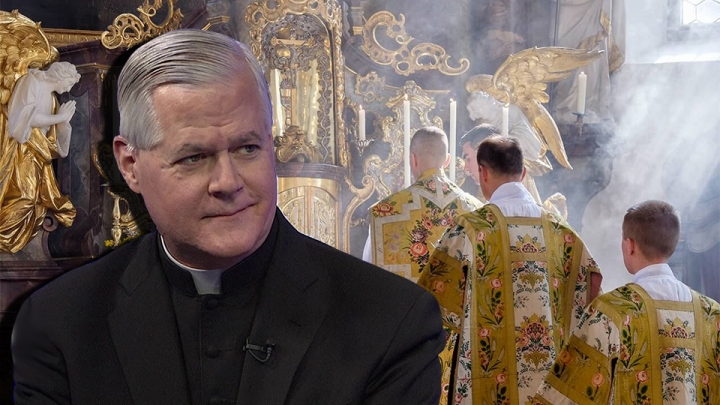





 ABYSSUS ABYSSUM INVOCAT / DEEP CALLS TO DEEP
You must be logged in to post a comment.